WO2013145696A1 - オレフィン重合体の製造方法 - Google Patents
オレフィン重合体の製造方法 Download PDFInfo
- Publication number
- WO2013145696A1 WO2013145696A1 PCT/JP2013/002013 JP2013002013W WO2013145696A1 WO 2013145696 A1 WO2013145696 A1 WO 2013145696A1 JP 2013002013 W JP2013002013 W JP 2013002013W WO 2013145696 A1 WO2013145696 A1 WO 2013145696A1
- Authority
- WO
- WIPO (PCT)
- Prior art keywords
- carbon atoms
- liquid
- column
- distillation
- olefin
- Prior art date
- Legal status (The legal status is an assumption and is not a legal conclusion. Google has not performed a legal analysis and makes no representation as to the accuracy of the status listed.)
- Ceased
Links
Images

Classifications
-
- C—CHEMISTRY; METALLURGY
- C07—ORGANIC CHEMISTRY
- C07C—ACYCLIC OR CARBOCYCLIC COMPOUNDS
- C07C2/00—Preparation of hydrocarbons from hydrocarbons containing a smaller number of carbon atoms
- C07C2/02—Preparation of hydrocarbons from hydrocarbons containing a smaller number of carbon atoms by addition between unsaturated hydrocarbons
- C07C2/04—Preparation of hydrocarbons from hydrocarbons containing a smaller number of carbon atoms by addition between unsaturated hydrocarbons by oligomerisation of well-defined unsaturated hydrocarbons without ring formation
- C07C2/06—Preparation of hydrocarbons from hydrocarbons containing a smaller number of carbon atoms by addition between unsaturated hydrocarbons by oligomerisation of well-defined unsaturated hydrocarbons without ring formation of alkenes, i.e. acyclic hydrocarbons having only one carbon-to-carbon double bond
- C07C2/08—Catalytic processes
- C07C2/26—Catalytic processes with hydrides or organic compounds
- C07C2/32—Catalytic processes with hydrides or organic compounds as complexes, e.g. acetyl-acetonates
- C07C2/34—Metal-hydrocarbon complexes
-
- C—CHEMISTRY; METALLURGY
- C07—ORGANIC CHEMISTRY
- C07C—ACYCLIC OR CARBOCYCLIC COMPOUNDS
- C07C11/00—Aliphatic unsaturated hydrocarbons
- C07C11/02—Alkenes
-
- C—CHEMISTRY; METALLURGY
- C07—ORGANIC CHEMISTRY
- C07C—ACYCLIC OR CARBOCYCLIC COMPOUNDS
- C07C7/00—Purification; Separation; Use of additives
- C07C7/04—Purification; Separation; Use of additives by distillation
-
- C—CHEMISTRY; METALLURGY
- C08—ORGANIC MACROMOLECULAR COMPOUNDS; THEIR PREPARATION OR CHEMICAL WORKING-UP; COMPOSITIONS BASED THEREON
- C08L—COMPOSITIONS OF MACROMOLECULAR COMPOUNDS
- C08L23/00—Compositions of homopolymers or copolymers of unsaturated aliphatic hydrocarbons having only one carbon-to-carbon double bond; Compositions of derivatives of such polymers
- C08L23/02—Compositions of homopolymers or copolymers of unsaturated aliphatic hydrocarbons having only one carbon-to-carbon double bond; Compositions of derivatives of such polymers not modified by chemical after-treatment
- C08L23/04—Homopolymers or copolymers of ethene
- C08L23/06—Polyethylene
-
- C—CHEMISTRY; METALLURGY
- C07—ORGANIC CHEMISTRY
- C07C—ACYCLIC OR CARBOCYCLIC COMPOUNDS
- C07C2531/00—Catalysts comprising hydrides, coordination complexes or organic compounds
- C07C2531/16—Catalysts comprising hydrides, coordination complexes or organic compounds containing coordination complexes
- C07C2531/22—Organic complexes
-
- C—CHEMISTRY; METALLURGY
- C07—ORGANIC CHEMISTRY
- C07C—ACYCLIC OR CARBOCYCLIC COMPOUNDS
- C07C2531/00—Catalysts comprising hydrides, coordination complexes or organic compounds
- C07C2531/26—Catalysts comprising hydrides, coordination complexes or organic compounds containing in addition, inorganic metal compounds not provided for in groups C07C2531/02 - C07C2531/24
- C07C2531/38—Catalysts comprising hydrides, coordination complexes or organic compounds containing in addition, inorganic metal compounds not provided for in groups C07C2531/02 - C07C2531/24 of titanium, zirconium or hafnium
Definitions
- the present invention relates to a method for producing an olefin polymer having 20 carbon atoms and an olefin polymer having 20 carbon atoms obtained by the production method.
- the oligomer (C20) having 20 carbon atoms which is a dimer produced from an ⁇ -olefin (C10) having 10 carbon atoms, is spreading to the market as a product mainly including an adhesive and a sealing agent. Since C20 is an olefin, it can be used as a reaction activator, has no volatile organic compound (VOC), and has low odor characteristics. Accordingly, when a light component, particularly a VOC component having a great influence on the human body or a VOC component of odorous olefins, is mixed, the product value is remarkably lowered. Therefore, it is necessary not to mix them in the manufacturing process. In addition, although C20 itself of a product is an olefin, since it is a high boiling point and low volatility, it has almost no odor characteristic peculiar to an olefin.
- the polymerization reaction for producing C20 has been conventionally performed using various catalysts, but this reaction is a chain polymerization reaction regardless of the type of catalyst. That is, the polymerization product contains an oligomer (C30 +) having 30 or more carbon atoms as a by-product in addition to C20 as a product. Therefore, it is necessary to separate the product C20 and the by-product C30 +.
- An object of the present invention is to provide a method for producing C20 that suppresses thermal decomposition of an oligomer and produces a yield of 0.99 or more when producing an oligomer (C20) having 20 carbon atoms from an ⁇ -olefin having 10 carbon atoms. Is to provide.
- the thermal decomposition of the oligomer is suppressed, and the yield of C20 is set to a yield of 0.99 or more.
- a manufacturing method can be provided.
- a polymer solution containing C20 + is produced by polymerizing C10, the polymer solution from which unreacted C10 has been removed is distilled, and C20 is separated at a yield of 0.99 or more. At this time, the concentration of light components having 6 to 16 carbon atoms generated by thermal decomposition in the separated C20 is 100 ppm by weight or less.
- C10 means an ⁇ -olefin (decene) having 10 carbon atoms
- CX (X is an integer) means an olefin polymer having X carbon atoms
- CX + means a mixture of olefin polymers having more than X carbon atoms.
- a known method can be used as a polymerization method for producing a polymerization liquid containing raw materials C10 to C20.
- a metallocene catalyst As the polymerization catalyst that can be used, a metallocene catalyst, a Ziegler-Natta catalyst, or the like can be used, and a metallocene catalyst is preferable.
- a metallocene catalyst that is a transition metal compound and a catalyst that contains at least one selected from a compound that can react with the transition metal compound or a derivative thereof to form an ionic complex or an aluminoxane can be given.
- An organoaluminum compound can be used as the promoter component.
- metallocene catalyst examples include transition metal compounds represented by the following formula (I).
- M represents a metal element of Groups 3 to 10 of the periodic table or a lanthanoid series
- E 1 and E 2 are a cyclopentadienyl group, a substituted cyclopentadienyl group, an indenyl group, a substituted indenyl group, respectively.
- X represents a sigma-binding ligand, and when there are a plurality of X, the plurality of X may be the same or different, X, E 1 , E 2 or Y may be cross-linked.
- Y represents a Lewis base, and when there are a plurality of Y, the plurality of Y may be the same or different, may be cross-linked with other Y, E 1 , E 2 or X, and A 1 and A 2 are A divalent bridging group that binds two ligands, a hydrocarbon group having 1 to 20 carbon atoms, a halogen-containing hydrocarbon group having 1 to 20 carbon atoms, a silicon-containing group, a germanium-containing group, a tin-containing group , -O -, - CO -, - S -, - SO 2 -, - Se -, - NR 1 -, - PR 1 -, - P (O) R 1 -, - BR 1 - or -AlR 1 - R 1 represents a hydrogen atom, a halogen atom, a hydrocarbon group having 1 to 20 carbon atoms or a halogen-containing hydrocarbon group having 1 to 20 carbon
- M represents a metal element of Group 3 to 10 of the periodic table or a lanthanoid series, and specific examples include titanium, zirconium, hafnium, yttrium, vanadium, chromium, manganese, nickel, cobalt, palladium and Examples of these include lanthanoid metals, among which titanium, zirconium and hafnium are preferred from the viewpoint of olefin copolymerization activity.
- E 1 and E 2 are preferably a cyclopentadienyl group, a substituted cyclopentadienyl group, or a substituted or unsubstituted indenyl group.
- X include a halogen atom, a hydrocarbon group having 1 to 20 carbon atoms, an alkoxy group having 1 to 20 carbon atoms, an aryloxy group having 6 to 20 carbon atoms, an amide group having 1 to 20 carbon atoms, and a carbon number.
- examples thereof include a silicon-containing group having 1 to 20 carbon atoms, a phosphide group having 1 to 20 carbon atoms, a sulfide group having 1 to 20 carbon atoms, and an acyl group having 1 to 20 carbon atoms.
- Specific examples of the Lewis base of Y include amines, ethers, phosphines, thioethers and the like.
- a 1 and A 2 are divalent bridging groups for linking two ligands, including a hydrocarbon group having 1 to 20 carbon atoms, a halogen-containing hydrocarbon group having 1 to 20 carbon atoms, and silicon-containing groups.
- Examples of the metallocene catalyst include transition metal compounds represented by the following formula (II).
- E 1 ′ E 2 ′ MX q Y r (II) (In the formula, M, X, q, Y and r are the same as those in the formula (I).
- E 1 ′ and E 2 ′ are E 1 and E 2 in the formula (I) and are not crosslinked. .)
- a catalyst deactivator is added to the obtained polymerization liquid and stirred to deactivate the catalyst, and an oil phase (phase containing an olefin oligomer) and an aqueous phase containing a metal component derived from the catalyst (including a deactivator) Phase) is separated (decalcified).
- quenching agent examples include alcohol, water, and aqueous solutions of acids, alkalis, oxygenated compounds, and the like, and specific examples include sodium hydroxide aqueous solution, ethanol, isopropyl alcohol, hydrochloric acid, and acetone.
- the unreacted monomer C10 contained in a polymerization liquid is removed.
- light components such as trace moisture and solvent can be removed together.
- Such a light component removing step is usually performed under conditions of 220 to 250 ° C. and 3000 to 5000 Pa-A.
- Unreacted C10 in C20 + is, for example, 50 ppm or less in a weight ratio of C10 / C20.
- the polymerization solution that has undergone the above steps includes C20 +, such as C20, C30, C40, and C50 +. In addition, a small amount of unreacted C10 may remain.
- C20 is separated from C20 + with a yield of 0.99 or more.
- distillation is performed in a vacuum distillation column at a temperature below the normal boiling point of C20. This is because the boiling point of C20 at normal pressure is 335 ° C., but it exceeds the decomposition temperature (260 ° C.) of the polymerization product mixture.
- C20 is obtained from the top of the vacuum distillation column, and a by-product C30 + is obtained from the bottom of the column.
- C20 / C30 at the column bottom needs to be 0.01, preferably about 0.001.
- Table 1 shows the tower bottom pressure and the evaporation temperature (bubble point) for setting C20 / C30 at the tower bottom to 0.1, 0.01, 0.001 and 0.0.
- a volatile light component (VOC) having 6 to 16 carbon atoms generated by the decomposition is mixed into C20 at the top of the column. Since this light component causes deterioration of product quality and affects the human body, the concentration in C20 is 100 ppm by weight or less, preferably 50 ppm by weight or less. The concentration of light components in C20 can be measured by gas chromatography measurement.
- Examples of the method for setting the light component concentration in C20 to 100 ppm by weight or less include a method in which the bottom temperature of the distillation column is 280 ° C. or less, preferably 260 ° C. or less, more preferably 250 ° C. or less.
- the residence time of the polymerization liquid at the tower bottom is preferably 15 to 20 minutes.
- the residence of the polymerization liquid at the tower bottom is preferred. The time is preferably 60 to 90 minutes.
- the light component concentration in C20 was set as follows. There is no legal restriction on the allowable concentration of VOC in the liquid, but the VOC indoor concentration guideline value in the gas is provided by the Ministry of Health, Labor and Welfare. The guide value is 1 to several hundred ⁇ g / m 3 depending on the substance.
- the light component concentration in the liquid of the product C20 which is a gas generation source, was calculated based on the following concept. That is, C8 or C10 in the C20 liquid such that the vapor concentration of C8 or C10 which can be volatilized is several hundred ⁇ g / m 3 in a state where the atmosphere 100 m 3 is sufficiently in contact with 1 kg of the product C20. The concentration of was calculated. From the above, the light component concentration in the C20 liquid was set to 100 ppm by weight or less.
- the bottom temperature of the distillation column is 280 ° C. or less, and in order to make the C20 yield 0.99 or more,
- the column bottom pressure is 2 kPa-A or less, preferably 1 kPa-A or less.
- the following (1) to (4) may be mentioned as methods for setting the bottom pressure of the distillation column to 2 kPa-A or less.
- the falling film reboiler is a fixed tube plate type vertical heat exchanger, which is heated by a plurality of heated tubes. This is a reboiler which allows the liquid to be heated to flow in and evaporates by flowing down the heating wall surface into a film.
- a cylindrical ferrule is usually provided on all the tubes. The ferrule has a function as a weir, and the amount of inflow into each tube is made uniform by aligning the height of the weir.
- thermo-siphon since the liquid level exists in the heat exchanger, the pressure of the liquid's own weight is applied to the evaporation surface. Since this pressure is proportional to the liquid density and the liquid depth, it varies greatly depending on the location in the height direction of the longitudinal heat exchanger. Further, even if the liquid at the lowest pressure position in the reboiler is evaporated, the gas-liquid mixed phase fluid needs to climb up the rising pipe connected to the distillation column main body together with the liquid, and the pressure rises due to the influence.
- the falling film membrane reboiler has no liquid depth, and there is no rising portion in the return pipe from the reboiler to the distillation column body.
- the liquid that has flowed into the tube flows down in a liquid film state on the wall surface of the tube, and the surface of the liquid film is connected to the distillation tower in a gas phase, so that a pressure increase due to the liquid depth does not occur.
- the falling liquid film type evaporator is not natural circulation but forced circulation, a pump is necessary.
- a pump that draws out liquid such as C20 and C30 + is provided at the top and bottom of the tower.
- a valve with low air leakage such as a bellows type valve should be used. preferable.
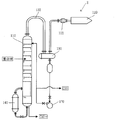
- FIG. 1 An example of a distillation column used in the first production method of the present invention is shown in FIG.
- the distillation column main body 10 of the distillation column 1 is connected to a vacuum pump 20 via a vent condenser 22 at the top of the column, and a condenser 30 is provided inside the distillation column.
- a distillation packing 12 is provided in the center of the column.
- a falling liquid film evaporation reboiler (falling liquid film reboiler) 40 is provided at the bottom of the tower via a pump 42, and a baffle 60 is provided in the liquid pool at the bottom of the tower. .
- the polymerization liquid charged into the distillation tower 10 from the liquid disperser 52 is sent to the falling liquid film reboiler 40 by the pump 42 from the liquid pool at the bottom of the tower.
- the liquid to be heated is heated in the reboiler 40 and a part (mainly C20) becomes a gas, and is sent again into the distillation column 10.
- These gases liquefy when they reach the condenser 30 and are stored in a liquid pool at the top of the column.
- the stored liquid is drawn out by a pump 70 outside the tower, a part is collected, and a part is sent again from the liquid disperser 50 to the inside of the distillation tower 10.
- the component (C30 +) that has not been vaporized in the reboiler 40 is sent again into the distillation column 10 as a liquid and is extracted from the bottom of the column.
- the distillation column main body 110 of the distillation column 2 has a condenser 130 provided outside the distillation column via a pipe 132 at the top of the column.
- a vacuum pump 120 is connected to the condenser 130 via a vent system condenser 122.
- a tray-type gas-liquid contact means is provided at the center of the tower.
- a natural circulation reboiler 140 is provided at the bottom of the tower.
- the column bottom temperature is preferably 260 ° C or higher.
- the tower bottom temperature is too high, VOC generated by thermal decomposition may be mixed into the tower top product, which may deteriorate the product quality.
- the tower bottom temperature is too low in order to prevent thermal decomposition, the product C20 may be lost to the tower bottom and the product yield may be reduced.
- C20 produced by the production method of the present invention has a reduced VOC content, it has little effect on the human body and does not deteriorate product quality.
- Distillation separation was performed at a liquid temperature in the tower bottom of 246 ° C. to 261 ° C., respectively.
- the column bottom pressure was adjusted by adjusting the feed rate of the raw material to the distillation column, the column top pressure and the reflux ratio.
- separated C20 derived from this C10 will be about 18 weight ppm. This is because when C20 contained in the raw material at 29.6% by weight is separated at the top of the column with a yield of about 1, C30 + is removed, but C10 is recovered together with C20 and C10 is concentrated.
- the concentration of light components (components of C7 to 16) contained in the distillation column top fraction was analyzed by gas chromatography under the following conditions. Moreover, the ratio of C20 / C30 at the tower bottom was measured by gas chromatography. The results are shown in Table 3. Although the concentration of the light component C6 is not measured, the amount of C6 produced by the decomposition is very small and is usually 0 to 5 ppm by weight. In addition, the density
- the residence time at the tower bottom of the experimental machine was 0.8 to 1.2 hours, and averaged about 1 hour. Note that if the residence time of the raw material is shortened, the amount of decomposition decreases. From Table 3, it can be seen that when the temperature is increased by 10 ° C., the light component concentration is increased about twice. That is, when the temperature rises by 10 ° C., the decomposition rate increases about twice. Therefore, even at a high tower bottom temperature, thermal decomposition can be suppressed by shortening the residence time.
- the equivalent C20 yield can be secured even if the residence time is shortened to about 15 minutes (about 1/4 residence time). Furthermore, even if the temperature is about 20 ° C., the light component concentration in the C20 solution is considered to be about the same as above.
- the composition of the raw material supplied to the distillation column is as follows: C20 40% by weight, C30 30% by weight, C40 20% by weight, C50 10% by weight, raw material supply rate 2500 kg / hr,
- the upper theoretical plate number 2 and the lower theoretical plate number 2 were separated by regular packing, and each packing had a diameter of 1.6 m and a height of 1 m.
- the regular packing was a low differential pressure type 252Y manufactured by Sulzer.
- the olefin polymer having 20 carbon atoms produced by the production method of the present invention can be used for a thickener, a plasticizer, a diluent, a lubricating oil, a solvent, a synthetic intermediate material, and the like.
Landscapes
- Chemical & Material Sciences (AREA)
- Organic Chemistry (AREA)
- Chemical Kinetics & Catalysis (AREA)
- Health & Medical Sciences (AREA)
- Medicinal Chemistry (AREA)
- Polymers & Plastics (AREA)
- Engineering & Computer Science (AREA)
- Analytical Chemistry (AREA)
- Oil, Petroleum & Natural Gas (AREA)
- Water Supply & Treatment (AREA)
- Organic Low-Molecular-Weight Compounds And Preparation Thereof (AREA)
- Low-Molecular Organic Synthesis Reactions Using Catalysts (AREA)
Abstract
炭素数10のα-オレフィンを重合して炭素数20以上の重合体を含む重合液を製造し、前記重合液から未反応の炭素数10のα-オレフィンを除去し、前記炭素数10のα-オレフィンを除去した重合液を蒸留して、炭素数6~16の軽質分が100重量ppm以下の炭素数20のオレフィン重合体を、収率0.99以上で分離する、炭素数20のオレフィン重合体の製造方法。
Description
本発明は、炭素数20のオレフィン重合体の製造方法及びその製造方法により得られた炭素数20のオレフィン重合体に関する。
炭素数10のα-オレフィン(C10)から製造された2量体である炭素数20のオリゴマー(C20)は、接着剤やシーリング剤を中心とする製品として市場へ広がりつつある。
C20は、オレフィンであるため反応活性剤として用いることができ、揮発性有機化合物(VOC)を含まず、低臭気性であるという特徴を有する。従って、軽質分、特に人体への影響が大きいVOC成分や、臭気性のオレフィン類のVOC成分が混入すると製品価値が著しく低下するので、製造過程でこれらを混入させないことが必要となる。
尚、製品のC20自体はオレフィンであるが、高沸点、低揮発性であるためオレフィン特有の臭気性はほとんど有さない。
C20は、オレフィンであるため反応活性剤として用いることができ、揮発性有機化合物(VOC)を含まず、低臭気性であるという特徴を有する。従って、軽質分、特に人体への影響が大きいVOC成分や、臭気性のオレフィン類のVOC成分が混入すると製品価値が著しく低下するので、製造過程でこれらを混入させないことが必要となる。
尚、製品のC20自体はオレフィンであるが、高沸点、低揮発性であるためオレフィン特有の臭気性はほとんど有さない。
C20を生成する重合反応は、従来から様々な触媒を用いて行われているが、この反応は、触媒の種類にかかわらず連鎖性重合反応となる。即ち、重合生成物に、製品となるC20の他に副生品となる炭素数30以上のオリゴマー(C30+)を含む。従って、製品となるC20と副生品C30+を分離する必要がある。
C20を高収率で分離して塔頂回収するためには、塔底温度を高くする必要があるが、塔底温度を高くすると熱分解により発生したVOCがC20に混入し、製品品質を悪化させてしまう。一方、熱分解を防ぐために塔底温度を低くすると、C20が塔底にロスしてしまい、C20収率を低下させてしまう。
本発明の目的は、炭素数10のα-オレフィンから炭素数20のオリゴマー(C20)を製造する際、オリゴマーの熱分解を抑え、かつ、収率を0.99以上とするC20の製造方法を提供することである。
本発明者らは、鋭意検討した結果、蒸留塔の塔底圧力等を制御することにより、熱分解の制御と高収率の確保を両立できることを見出した。
本発明によれば、以下のオレフィン重合体の製造方法等が提供される。
1.炭素数10のα-オレフィンを重合して炭素数20以上の重合体を含む重合液を製造し、
前記重合液から未反応の炭素数10のα-オレフィンを除去し、
前記炭素数10のα-オレフィンを除去した重合液を蒸留して、炭素数6~16の軽質分が100重量ppm以下の炭素数20のオレフィン重合体を、収率0.99以上で分離する、炭素数20のオレフィン重合体の製造方法。
2.前記蒸留を280℃以下で行う1に記載の炭素数20のオレフィン重合体の製造方法。
3.前記蒸留を、流下液膜式蒸発器を備えた蒸留塔で行う1又は2に記載の炭素数20のオレフィン重合体の製造方法。
4.前記蒸留を、蒸留塔内部熱交換器型の塔頂凝縮器を備えた蒸留塔で行う1~3のいずれかに記載の炭素数20のオレフィン重合体の製造方法。
5.前記重合をメタロセン触媒存在下で行う1~4のいずれかに記載の炭素数20のオレフィン重合体の製造方法。
6.1~5のいずれかに記載の製造方法により得られた炭素数20のオレフィン重合体。
本発明によれば、以下のオレフィン重合体の製造方法等が提供される。
1.炭素数10のα-オレフィンを重合して炭素数20以上の重合体を含む重合液を製造し、
前記重合液から未反応の炭素数10のα-オレフィンを除去し、
前記炭素数10のα-オレフィンを除去した重合液を蒸留して、炭素数6~16の軽質分が100重量ppm以下の炭素数20のオレフィン重合体を、収率0.99以上で分離する、炭素数20のオレフィン重合体の製造方法。
2.前記蒸留を280℃以下で行う1に記載の炭素数20のオレフィン重合体の製造方法。
3.前記蒸留を、流下液膜式蒸発器を備えた蒸留塔で行う1又は2に記載の炭素数20のオレフィン重合体の製造方法。
4.前記蒸留を、蒸留塔内部熱交換器型の塔頂凝縮器を備えた蒸留塔で行う1~3のいずれかに記載の炭素数20のオレフィン重合体の製造方法。
5.前記重合をメタロセン触媒存在下で行う1~4のいずれかに記載の炭素数20のオレフィン重合体の製造方法。
6.1~5のいずれかに記載の製造方法により得られた炭素数20のオレフィン重合体。
本発明によれば、炭素数10のα-オレフィン(C10)から炭素数20のオリゴマー(C20)を製造する際、オリゴマーの熱分解を抑え、かつ、収率を0.99以上にするC20の製造方法を提供できる。
本発明の第1の製造方法は、C10を重合してC20+を含む重合液を製造し、未反応のC10を除去した重合液を蒸留して、C20を収率0.99以上で分離する。
このとき、分離したC20中の、熱分解によって生じた炭素数6~16の軽質分の濃度は100重量ppm以下である。
このとき、分離したC20中の、熱分解によって生じた炭素数6~16の軽質分の濃度は100重量ppm以下である。
尚、「C10」は炭素数10のα-オレフィン(デセン)、「CX」(Xは整数)は炭素数Xのオレフィン重合体、「CX+」は炭素数X以上のオレフィン重合体の混合物を意味する。
原料C10からC20を含む重合液を製造する重合方法としては、公知の方法を用いることができる。
使用できる重合触媒は、メタロセン触媒やチーグラーナッタ触媒等を用いることができるが、好ましくはメタロセン触媒である。例えば、遷移金属化合物であるメタロセン触媒と、該遷移金属化合物又はその派生物と反応してイオン性の錯体を形成し得る化合物やアルミノキサンから選択される少なくとも一種を含有する触媒が挙げられる。助触媒成分としては、有機アルミニウム化合物を使用できる。
メタロセン触媒としては、例えば、下記式(I)で表される遷移金属化合物が挙げられる。

(式中、Mは周期律表第3~10族又はランタノイド系列の金属元素を示し、E1及びE2はそれぞれシクロペンタジエニル基、置換シクロペンタジエニル基、インデニル基、置換インデニル基、ヘテロシクロペンタジエニル基、置換ヘテロシクロペンタジエニル基、アミド基、ホスフィド基、炭化水素基及びケイ素含有基の中から選ばれる配位子であって、A1及びA2を介して架橋構造を形成しており、又それらは互いに同一でも異なっていてもよく、Xはσ結合性の配位子を示し、Xが複数ある場合、複数のXは同じでも異なっていてもよく、他のX、E1、E2又はYと架橋していてもよい。
Yはルイス塩基を示し、Yが複数ある場合、複数のYは同じでも異なっていてもよく、他のY、E1、E2又はXと架橋していてもよく、A1及びA2は二つの配位子を結合する二価の架橋基であって、炭素数1~20の炭化水素基、炭素数1~20のハロゲン含有炭化水素基、珪素含有基、ゲルマニウム含有基、スズ含有基、-O-、-CO-、-S-、-SO2-、-Se-、-NR1-、-PR1-、-P(O)R1-、-BR1-又は-AlR1-を示し、R1は水素原子、ハロゲン原子、炭素数1~20の炭化水素基又は炭素数1~20のハロゲン含有炭化水素基を示し、それらは互いに同一でも異なっていてもよい。qは1~5の整数で〔(Mの原子価)-2〕を示し、rは0~3の整数を示す。)
Yはルイス塩基を示し、Yが複数ある場合、複数のYは同じでも異なっていてもよく、他のY、E1、E2又はXと架橋していてもよく、A1及びA2は二つの配位子を結合する二価の架橋基であって、炭素数1~20の炭化水素基、炭素数1~20のハロゲン含有炭化水素基、珪素含有基、ゲルマニウム含有基、スズ含有基、-O-、-CO-、-S-、-SO2-、-Se-、-NR1-、-PR1-、-P(O)R1-、-BR1-又は-AlR1-を示し、R1は水素原子、ハロゲン原子、炭素数1~20の炭化水素基又は炭素数1~20のハロゲン含有炭化水素基を示し、それらは互いに同一でも異なっていてもよい。qは1~5の整数で〔(Mの原子価)-2〕を示し、rは0~3の整数を示す。)
上記式(I)において、Mは周期律表第3~10族又はランタノイド系列の金属元素を示し、具体例としてはチタン、ジルコニウム、ハフニウム、イットリウム、バナジウム、クロム、マンガン、ニッケル、コバルト、パラジウム及びランタノイド系金属等が挙げられるが、これらの中ではオレフィン共重合活性等の点からチタン、ジルコニウム及びハフニウムが好適である。
E1及びE2としては、シクロペンタジエニル基、置換シクロペンタジエニル基、置換又は無置換のインデニル基が好ましい。
E1及びE2としては、シクロペンタジエニル基、置換シクロペンタジエニル基、置換又は無置換のインデニル基が好ましい。
Xの具体例としては、ハロゲン原子、炭素数1~20の炭化水素基、炭素数1~20のアルコキシ基、炭素数6~20のアリールオキシ基、炭素数1~20のアミド基、炭素数1~20の珪素含有基、炭素数1~20のホスフィド基、炭素数1~20のスルフィド基、炭素数1~20のアシル基等が挙げられる。
Yのルイス塩基の具体例としては、アミン類、エーテル類、ホスフィン類、チオエーテル類等を挙げることができる。
Yのルイス塩基の具体例としては、アミン類、エーテル類、ホスフィン類、チオエーテル類等を挙げることができる。
次に、A1及びA2は二つの配位子を結合する二価の架橋基であって、炭素数1~20の炭化水素基、炭素数1~20のハロゲン含有炭化水素基、珪素含有基、ゲルマニウム含有基、スズ含有基、-O-、-CO-、-S-、-SO2-、-Se-、-NR1-、-PR1-、-P(O)R1-、-BR1-又は-AlR1-を示し、R1は水素原子、ハロゲン原子又は炭素数1~20の炭化水素基、炭素数1~20のハロゲン含有炭化水素基を示し、それらは互いに同一でも異なっていてもよい。
またメタロセン触媒としては、下記式(II)で表される遷移金属化合物が挙げられる。
E1’E2’MXqYr (II)
(式中、M、X、q、Y、rは式(I)と同じである。E1’、E2’は、式(I)のE1、E2であって架橋していないものである。)
E1’E2’MXqYr (II)
(式中、M、X、q、Y、rは式(I)と同じである。E1’、E2’は、式(I)のE1、E2であって架橋していないものである。)
通常、得られた重合液に触媒失活剤を添加、攪拌して触媒を失活し、油相(オレフィンオリゴマーを含む相)と、触媒由来の金属分を含む水相(失活剤を含む相)を分離(脱灰)する。
失活剤としては、例えばアルコール、水、及び酸、アルカリ、含酸素化合物等の水溶液が挙げられ、具体的には、水酸化ナトリウム水溶液、エタノール、イソプロピルアルコール、塩酸及びアセトン等が挙げられる。
また、本発明では、重合液中に含まれる未反応モノマーC10を除去する。このとき、微量水分、溶剤等の軽質分も合わせて除去できる。このような軽質分除去工程は通常、220~250℃、3000~5000Pa-Aの条件下で処理を行う。
C20+中の未反応のC10は、例えばC10/C20の重量比で、50ppm以下とする。
C20+中の未反応のC10は、例えばC10/C20の重量比で、50ppm以下とする。
以上の工程を経た重合液は、C20+、例えば、C20、C30、C40及びC50+等を含む。また、未反応のC10が微量残留している場合もある。
蒸留工程では、このC20+から、収率0.99以上でC20を分離する。
通常蒸留は減圧蒸留塔において、C20の標準沸点未満の温度で行う。C20の常圧での沸点は335℃であるが、重合生成混合物の分解温度(260℃)を超えてしまうためである。C20は減圧蒸留塔の塔頂から得られ、塔底からは副生成物C30+が得られる。
通常蒸留は減圧蒸留塔において、C20の標準沸点未満の温度で行う。C20の常圧での沸点は335℃であるが、重合生成混合物の分解温度(260℃)を超えてしまうためである。C20は減圧蒸留塔の塔頂から得られ、塔底からは副生成物C30+が得られる。
塔頂のC20の収率は、好ましくは0.999以上である。
C20は塔頂又は塔底のいずれにも存在するため、C20の塔頂収率は、塔底におけるC20/C30(重量比率)を指標として算出できる。C20/C30は、重合生成物中のC20とC30の割合によっても変動するが、一般的な連鎖性重合反応によるシュルツフローリー分布等の重合生成物組成によれば、C20とC30の生成比率は同程度である。
即ち、C20の塔頂収率=1-C20/C30(塔底での重量比率)である。C20/C30(重量比率)はガスクロマトグラフィーにより測定できる。
C20は塔頂又は塔底のいずれにも存在するため、C20の塔頂収率は、塔底におけるC20/C30(重量比率)を指標として算出できる。C20/C30は、重合生成物中のC20とC30の割合によっても変動するが、一般的な連鎖性重合反応によるシュルツフローリー分布等の重合生成物組成によれば、C20とC30の生成比率は同程度である。
即ち、C20の塔頂収率=1-C20/C30(塔底での重量比率)である。C20/C30(重量比率)はガスクロマトグラフィーにより測定できる。
物質収支の関係から、塔底の副生成物C30+に混入(残留)するC20が多くなるほど、塔頂でのC20収率が低下し、生産性が低下する。C20を収率0.99又は0.999で塔頂回収するためには、塔底のC20/C30を0.01、好ましくは0.001程度とする必要がある。
塔底でのC20/C30を0.1、0.01、0.001及び0.0とするための塔底圧力及び蒸発温度(泡立ち点)を表1に示す。

表1から、例えば、塔底圧力を1kPa-Aとした場合、塔底温度を258℃とすることで、C20の収率を0.99(C20/C30=0.01)とすることができる。
蒸留工程において、重合生成物が塔底で熱分解すると、分解によって生じた炭素数6~16の揮発性の軽質分(VOC)が、塔頂のC20に混入する。
この軽質分は製品品質の劣化の原因となり、また人体に影響があるため、C20中の濃度を100重量ppm以下、好ましくは50重量ppm以下とする。
C20中の軽質分の濃度は、ガスクロマトグラフィー測定により測定できる。
この軽質分は製品品質の劣化の原因となり、また人体に影響があるため、C20中の濃度を100重量ppm以下、好ましくは50重量ppm以下とする。
C20中の軽質分の濃度は、ガスクロマトグラフィー測定により測定できる。
C20中の軽質分濃度を100重量ppm以下とする方法としては、例えば、蒸留塔の塔底温度を、280℃以下、好ましくは260℃以下、より好ましくは250℃以下とする方法が挙げられる。
尚、塔底温度が280℃以下の場合、塔底での重合液の滞留時間を15~20分とすることが好ましく、塔底温度が260℃以下の場合、塔底での重合液の滞留時間を60~90分とすることが好ましい。
尚、塔底温度が280℃以下の場合、塔底での重合液の滞留時間を15~20分とすることが好ましく、塔底温度が260℃以下の場合、塔底での重合液の滞留時間を60~90分とすることが好ましい。
尚、C20中の軽質分濃度は、以下のように設定した。
液体中のVOCの許容濃度には法的な制約はないが、気体中のVOC室内濃度指針値は厚生労働省により示されている。この指針値は、物質にもよるが1~数百μg/m3である。
液体中のVOCの許容濃度には法的な制約はないが、気体中のVOC室内濃度指針値は厚生労働省により示されている。この指針値は、物質にもよるが1~数百μg/m3である。
この指針値から、気体発生源となる製品C20の液体における軽質分濃度を以下のような考え方で計算した。即ち、大気100m3が1kgの製品C20に十分接している状態で、揮発するC8やC10がとりうる気相中濃度が数百μg/m3となるような、C20液中でのC8やC10の濃度を算出した。
上記より、C20液中の軽質分濃度は、100重量ppm以下とした。
上記より、C20液中の軽質分濃度は、100重量ppm以下とした。
以上から、C20中の軽質分濃度を100重量ppm以下とするために蒸留塔の塔底温度を280℃以下とし、かつ、C20の収率を0.99以上とするためには、蒸留塔の塔底圧力を2kPa-A以下、好ましくは1kPa-A以下にする。
蒸留塔の塔底圧力を2kPa-A以下にするための方法としては、以下の(1)~(4)が挙げられる。
(1)凝縮用熱交換器の蒸留塔内への内蔵化(Internal exchanger)
凝縮用熱交換器を蒸留塔内へ設けると、配管中のガス線速による圧力損失を避けることができ、好ましい。
一般的な蒸留塔において、塔頂から塔外の凝縮器までは配管により接続されるが、配管中のガス線速により、圧力損失が生じる。特に、1kPa-A前後の圧力においてはガス線速が速くなり、その分の圧力損失も大きくなる。圧力損失を避けるためには、塔頂から凝縮器までの配管を短くすることが好ましく、凝縮器を蒸留塔内へ内蔵すると最も短くなる。
凝縮用熱交換器を蒸留塔内へ設けると、配管中のガス線速による圧力損失を避けることができ、好ましい。
一般的な蒸留塔において、塔頂から塔外の凝縮器までは配管により接続されるが、配管中のガス線速により、圧力損失が生じる。特に、1kPa-A前後の圧力においてはガス線速が速くなり、その分の圧力損失も大きくなる。圧力損失を避けるためには、塔頂から凝縮器までの配管を短くすることが好ましく、凝縮器を蒸留塔内へ内蔵すると最も短くなる。
(2)塔底液だまり部におけるバッフルの設置
塔底液だまり部にバッフル(液面制御板)を設置すると、再沸器出口の液体(蒸発しなかった液体)を、塔内液と接触させずに直接缶出することができるので、塔底の温度と圧力を下げることができるため好ましい。
塔底液だまり部にバッフル(液面制御板)を設置すると、再沸器出口の液体(蒸発しなかった液体)を、塔内液と接触させずに直接缶出することができるので、塔底の温度と圧力を下げることができるため好ましい。
(3)流下液膜式蒸発器(FFE:falling film evaporator)の塔底再沸器の採用
流下液膜式再沸器は、固定管板式縦型熱交換器であり、加熱された複数のチューブに被加熱液を流入させ、加熱壁面を膜状に流下させることで蒸発させる再沸器である。各チューブへの流量を均一化するため、通常、全てのチューブ上部に円筒状のフェルールが設けられている。フェルールは、堰としての機能を有し、堰の高さを揃えることで、各チューブへの流入量が均一化する。
流下液膜式再沸器は、固定管板式縦型熱交換器であり、加熱された複数のチューブに被加熱液を流入させ、加熱壁面を膜状に流下させることで蒸発させる再沸器である。各チューブへの流量を均一化するため、通常、全てのチューブ上部に円筒状のフェルールが設けられている。フェルールは、堰としての機能を有し、堰の高さを揃えることで、各チューブへの流入量が均一化する。
一般的に用いられる自然循環式再沸器(thermo-siphon)は、熱交換器内に液面が存在すため、液の自重分の圧力が蒸発面にかかっている。この圧力は、液密度と液深さに比例するため、縦熱交換器の高さ方向の場所によって大きく異なる。
また、再沸器内の最も圧力の低い位置の液が蒸発しても、液とともに気液混相流体が蒸留塔本体に繋がる立ち上がり配管を登る必要があり、その影響で圧力が上昇する。例えば、液深さ約10cmでも1kPaの圧力上昇になるので、塔頂圧力を0.5kPa-Aに低圧化しても、塔底での合計圧力はプロセス上必要な真空度1kPa-Aを簡単に超えてしまうほど影響が大きい。
また、再沸器内の最も圧力の低い位置の液が蒸発しても、液とともに気液混相流体が蒸留塔本体に繋がる立ち上がり配管を登る必要があり、その影響で圧力が上昇する。例えば、液深さ約10cmでも1kPaの圧力上昇になるので、塔頂圧力を0.5kPa-Aに低圧化しても、塔底での合計圧力はプロセス上必要な真空度1kPa-Aを簡単に超えてしまうほど影響が大きい。
流下液膜式再沸器は液深さがなく、かつ、再沸器から蒸留塔本体への復路配管において、立ち上がり部がない。チューブ内に流入した液体は、チューブ内の壁面を液膜状態で流下し、液膜の表面は蒸留塔と気相で繋がっているため、液深さによる圧力上昇は発生しない。
尚、流下液膜式蒸発器は自然循環ではなく強制循環であるため、ポンプが必要である。
尚、流下液膜式蒸発器は自然循環ではなく強制循環であるため、ポンプが必要である。
(4)空気漏れの対策
塔頂部や塔底部には、C20やC30+等の液体を引き抜くポンプが設けられるが、このポンプの接続には、ベロー型バルブ等の空気漏れの少ないバルブを用いることが好ましい。
塔頂部や塔底部には、C20やC30+等の液体を引き抜くポンプが設けられるが、このポンプの接続には、ベロー型バルブ等の空気漏れの少ないバルブを用いることが好ましい。
上記(1)~(4)のうち、1つのみを採用してもよく、2つ以上を採用してもよい。好ましくは、(1)及び(3)を採用する。
本発明の第1の製造方法で用いる蒸留塔の一例を、図1に示す。
蒸留塔1の蒸留塔本体10は、その塔頂部において真空ポンプ20がベント系凝縮器22を介して接続され、凝縮器30が蒸留塔内部に設けられている。塔中央部には蒸留充填物12が設けられている。
また、塔底部には、流下液膜式蒸発式の再沸器(流下液膜式再沸器)40がポンプ42を介して設けられ、塔底部の液だまりにはバッフル60が設置されている。
蒸留塔1の蒸留塔本体10は、その塔頂部において真空ポンプ20がベント系凝縮器22を介して接続され、凝縮器30が蒸留塔内部に設けられている。塔中央部には蒸留充填物12が設けられている。
また、塔底部には、流下液膜式蒸発式の再沸器(流下液膜式再沸器)40がポンプ42を介して設けられ、塔底部の液だまりにはバッフル60が設置されている。
液分散機52から蒸留塔10内部に投入された重合液は、塔底の液だまりからポンプ42によって流下液膜式再沸器40に送られる。被加熱液は、再沸器40において加熱されて一部(主にC20)が気体となり、再び蒸留塔10内部に送られる。これら気体は凝縮器30に達すると液化し、塔頂部の液だまりに貯蔵される。貯蔵された液体は、塔外部のポンプ70により引き抜かれ、一部は回収され、一部は液分散器50から再び蒸留塔10内部に送られる。
再沸器40で気化しなかった成分(C30+)は、液体のまま再び蒸留塔10内部に送られ、塔底部より引き抜かれる。
再沸器40で気化しなかった成分(C30+)は、液体のまま再び蒸留塔10内部に送られ、塔底部より引き抜かれる。
次に、従来、一般的に使用されている減圧蒸留塔を図2に示す。
蒸留塔2の蒸留塔本体110は、その塔頂部において配管132を介して凝縮器130が蒸留塔外部に設けられている。凝縮器130には真空ポンプ120がベント系凝縮器122を介して接続されている。塔中央部にはトレイ型の気液接触手段が設けられている。
また、塔底部には、自然循環式再沸器140が設けられている。
蒸留塔2の蒸留塔本体110は、その塔頂部において配管132を介して凝縮器130が蒸留塔外部に設けられている。凝縮器130には真空ポンプ120がベント系凝縮器122を介して接続されている。塔中央部にはトレイ型の気液接触手段が設けられている。
また、塔底部には、自然循環式再沸器140が設けられている。
上述したように、凝縮器を蒸留塔の外部に設けると、蒸留塔と凝縮器の配管において圧力損失が生じる。また、再沸器として通常の自然循環式再沸器を用いると、液深さに由来する圧力損失が生じる。
この圧力損失は、配管においては約1kPa以上であり、再沸器では液深さ約10cm毎に1kPa程度である。即ち、塔頂に配置した真空ポンプ等の圧力が1kPa-A(=7.5torr)以下を満足しても、塔底圧力はこれらの合計により、通常1kPa-Aより数倍程度大きくなる。
この圧力損失は、配管においては約1kPa以上であり、再沸器では液深さ約10cm毎に1kPa程度である。即ち、塔頂に配置した真空ポンプ等の圧力が1kPa-A(=7.5torr)以下を満足しても、塔底圧力はこれらの合計により、通常1kPa-Aより数倍程度大きくなる。
従って、一般的な蒸留塔を使用する場合、C20を0.99以上で塔頂回収するためには、塔底温度を260℃以上にすることが好ましい。しかしながら、塔底温度が高すぎると、熱分解により発生したVOCが塔頂製品に混入し、製品品質を悪化させる場合がある。一方、熱分解を防ぐために、塔底温度が低すぎると、製品C20が塔底にロスし、製品収率を低下させる場合がある。
本発明の製造方法によって製造されたC20は、VOCの含有量が低減されているので、人体への影響が少なく、また、製品品質を劣化させない。
実験例1
〔連続蒸留塔による熱分解実験〕
凝縮用熱交換器を内蔵化し、塔底再沸器が流下液膜式である連続蒸留塔を用いて、C10が6重量ppm含まれている原料(重合液)の蒸留分離を行った。
原料の組成を表2に示す。
〔連続蒸留塔による熱分解実験〕
凝縮用熱交換器を内蔵化し、塔底再沸器が流下液膜式である連続蒸留塔を用いて、C10が6重量ppm含まれている原料(重合液)の蒸留分離を行った。
原料の組成を表2に示す。
蒸留分離は、塔底内液温度を246℃~261℃の温度においてそれぞれ行った。塔底圧力は、蒸留塔への原料供給速度、蒸留塔の塔頂圧力及び還流比を調整して調節した。

尚、原料中のC10の濃度は6重量ppmであるが、このC10に由来する、分離されたC20中のC10は約18重量ppmとなる。これは、原料中に29.6重量%含まれるC20を収率1程度で塔頂に分離すると、C30+は除去されるが、C10はC20と共に回収され、C10の濃縮が起こるためである。
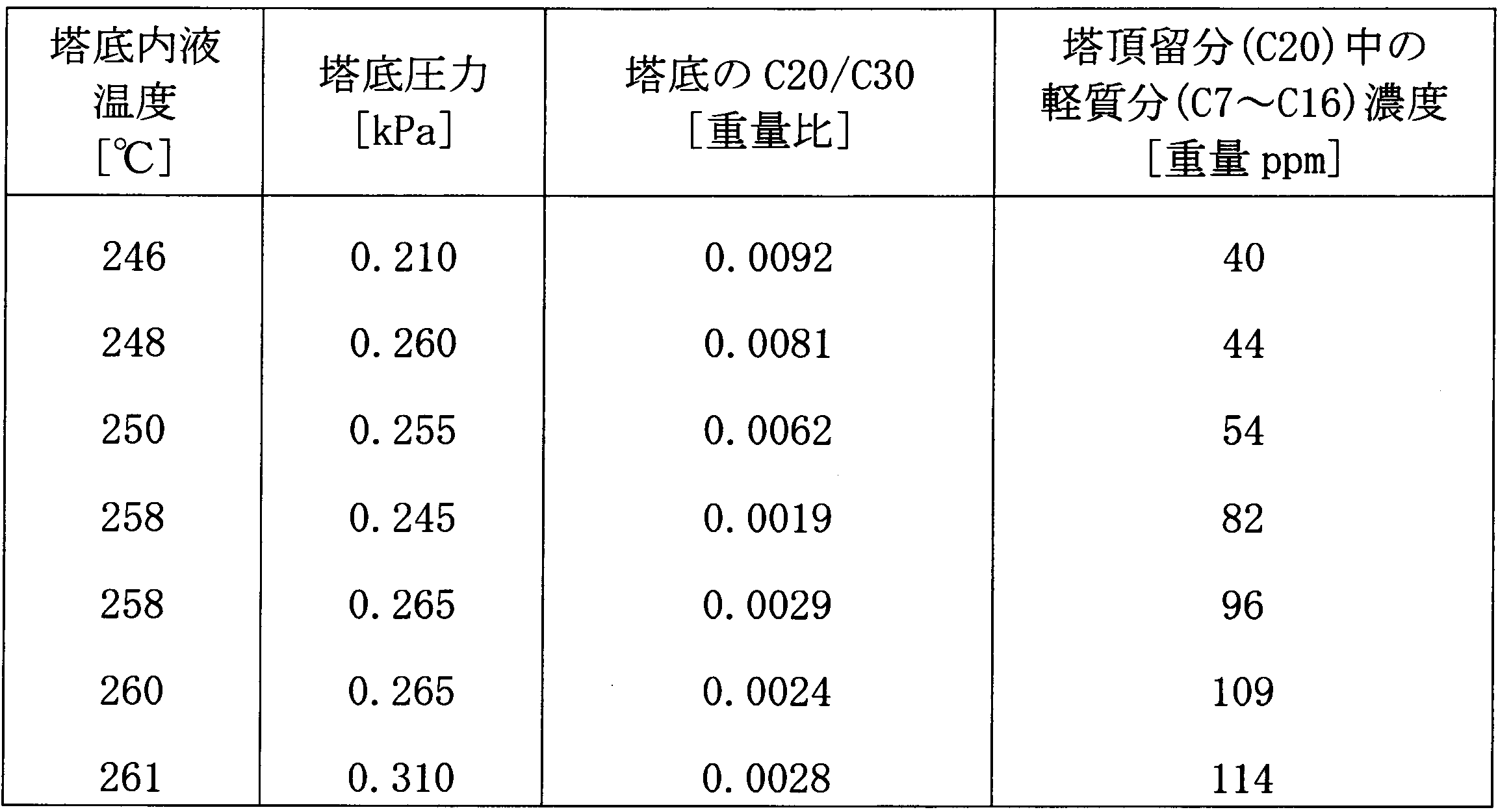
蒸留塔塔頂留分に含まれる軽質分(C7~16の成分)の濃度を、下記条件でガスクロマトグラフィー分析した。また、塔底でのC20/C30の比率をガスクロマトグラフィーにより測定した。結果を表3に示す。
尚、軽質分C6の濃度は測定していないが、分解により生じるC6はごく微量であり、通常、0~5重量ppmである。
尚、軽質分の濃度は、軽質分の分析値から18重量ppm(原料中のC10に由来する軽質分)を差し引いた値である。
尚、軽質分C6の濃度は測定していないが、分解により生じるC6はごく微量であり、通常、0~5重量ppmである。
尚、軽質分の濃度は、軽質分の分析値から18重量ppm(原料中のC10に由来する軽質分)を差し引いた値である。
〔ガスクロマトグラフィー測定条件〕
カラム:DB-5MS(30m×0.53mm×1.0μm)
キャリアガス流量:40cm/秒
注入モード:クールオンカラム注入
インジェクション、ディテクション温度:320℃
カラム温度:50℃(0.1分保持)、10℃/分で昇温、300℃(25分保持)
注入量:1.0μL
カラム:DB-5MS(30m×0.53mm×1.0μm)
キャリアガス流量:40cm/秒
注入モード:クールオンカラム注入
インジェクション、ディテクション温度:320℃
カラム温度:50℃(0.1分保持)、10℃/分で昇温、300℃(25分保持)
注入量:1.0μL
〔実験の考察〕
表3から、蒸留塔の塔底温度の上昇に伴って、分解によりVOC成分が顕著に増加することが分かる。
また、上述したように、C20液中の軽質分濃度は、好ましくは100重量ppm以下であるので、塔底の最高温度が260℃程度、好ましくは258℃以下となるように蒸留塔を運転することが好ましいと言える。
表3から、蒸留塔の塔底温度の上昇に伴って、分解によりVOC成分が顕著に増加することが分かる。
また、上述したように、C20液中の軽質分濃度は、好ましくは100重量ppm以下であるので、塔底の最高温度が260℃程度、好ましくは258℃以下となるように蒸留塔を運転することが好ましいと言える。
上記実験機の塔底での滞留時間は、0.8~1.2時間であり、平均で約1時間であった。
尚、原料の滞留時間を短くすれば、分解量は少なくなる。
表3から、温度が10℃上昇すると、軽質分濃度が2倍程度増加することが分かる。即ち、温度が10℃上昇すると、分解速度は2倍程度増加する。従って、高い塔底温度であっても、滞留時間を短くすれば熱分解を抑えることができる。
尚、原料の滞留時間を短くすれば、分解量は少なくなる。
表3から、温度が10℃上昇すると、軽質分濃度が2倍程度増加することが分かる。即ち、温度が10℃上昇すると、分解速度は2倍程度増加する。従って、高い塔底温度であっても、滞留時間を短くすれば熱分解を抑えることができる。
塔底の直径を小さくする等の設備変更により、滞留時間は15分程度(滞留時間1/4程度)まで短くしても同等のC20収率を確保できるので、この場合、塔底最高温度がさらに20℃程度高くても、C20液中の軽質分濃度は上記と同程度となると考えられる。
実験例2
塔頂に凝縮器が内装されている蒸留塔ではなく、凝縮器が外装され、蒸留塔本体と凝縮器が配管により接続している蒸留塔における圧力損失、及び温度上昇について、以下のように検討した。
即ち、以下の条件でシミュレーション計算を行い、凝縮器が内装型の場合、及び凝縮器が外装型であって蒸留塔との接続配管のサイズ(直径)が20,16,12インチである場合について、圧力損失及び温度上昇を求めた。結果を表4に示す。
塔頂に凝縮器が内装されている蒸留塔ではなく、凝縮器が外装され、蒸留塔本体と凝縮器が配管により接続している蒸留塔における圧力損失、及び温度上昇について、以下のように検討した。
即ち、以下の条件でシミュレーション計算を行い、凝縮器が内装型の場合、及び凝縮器が外装型であって蒸留塔との接続配管のサイズ(直径)が20,16,12インチである場合について、圧力損失及び温度上昇を求めた。結果を表4に示す。
計算条件として、蒸留塔へ供給される原料組成を、C20を40重量%、C30を30重量%、C40を20重量%、C50を10重量%、原料供給速度を2500kg/hr、塔底でのC20/C30濃度を重量比0.003以下、還流比R/D=1.0とした。
また、上部理論段数2段、下部理論段数2段を規則充填物で分離し、各充填物を直径1.6m、高さ1mとした。尚、規則充填物はSulzer社製の低差圧型の252Yとした。
また、上部理論段数2段、下部理論段数2段を規則充填物で分離し、各充填物を直径1.6m、高さ1mとした。尚、規則充填物はSulzer社製の低差圧型の252Yとした。
塔頂留分はC20であり、その流量は約1000kg/hrであるが、還流比R/D=1.0とすると、塔頂蒸発ガス量は約2000kg/hrとなった。
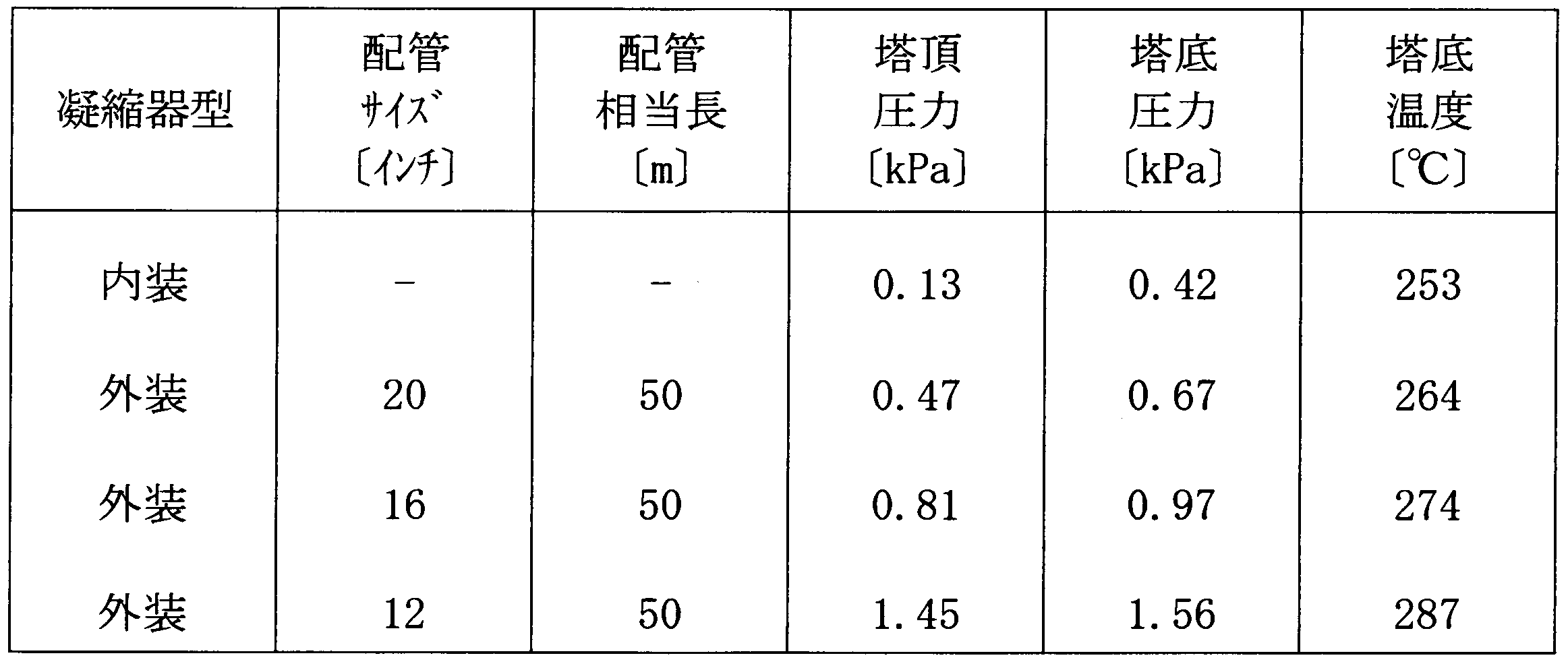
表4から、凝縮器を外装とすると、圧力損失による塔底圧力の上昇が顕著で、塔底温度が目標値の260℃又は限界値の280℃を超えてしまうことが分かる。凝縮器までの配管があることによる圧力損失上昇は1kPa程度あり、これに伴う塔底温度上昇は30℃以上ある。
以上から、凝縮器は内装方式にすることが好ましい。
以上から、凝縮器は内装方式にすることが好ましい。
本発明の製造方法によって製造された炭素数20のオレフィン重合体は、減粘剤、可塑剤、希釈剤、潤滑油、溶剤、合成中間原料等に使用できる。
上記に本発明の実施形態及び/又は実施例を幾つか詳細に説明したが、当業者は、本発明の新規な教示及び効果から実質的に離れることなく、これら例示である実施形態及び/又は実施例に多くの変更を加えることが容易である。従って、これらの多くの変更は本発明の範囲に含まれる。
この明細書に記載の文献及び本願のパリ優先の基礎となる日本出願明細書の内容を全てここに援用する。
この明細書に記載の文献及び本願のパリ優先の基礎となる日本出願明細書の内容を全てここに援用する。
Claims (6)
- 炭素数10のα-オレフィンを重合して炭素数20以上の重合体を含む重合液を製造し、
前記重合液から未反応の炭素数10のα-オレフィンを除去し、
前記炭素数10のα-オレフィンを除去した重合液を蒸留して、炭素数6~16の軽質分が100重量ppm以下の炭素数20のオレフィン重合体を、収率0.99以上で分離する、炭素数20のオレフィン重合体の製造方法。 - 前記蒸留を280℃以下で行う請求項1に記載の炭素数20のオレフィン重合体の製造方法。
- 前記蒸留を、流下液膜式蒸発器を備えた蒸留塔で行う請求項1又は2に記載の炭素数20のオレフィン重合体の製造方法。
- 前記蒸留を、蒸留塔内部熱交換器型の塔頂凝縮器を備えた蒸留塔で行う請求項1~3のいずれかに記載の炭素数20のオレフィン重合体の製造方法。
- 前記重合をメタロセン触媒存在下で行う請求項1~4のいずれかに記載の炭素数20のオレフィン重合体の製造方法。
- 請求項1~5のいずれかに記載の製造方法により得られた炭素数20のオレフィン重合体。
Applications Claiming Priority (2)
| Application Number | Priority Date | Filing Date | Title |
|---|---|---|---|
| JP2012-082673 | 2012-03-30 | ||
| JP2012082673A JP2013212995A (ja) | 2012-03-30 | 2012-03-30 | オレフィン重合体の製造方法 |
Publications (1)
| Publication Number | Publication Date |
|---|---|
| WO2013145696A1 true WO2013145696A1 (ja) | 2013-10-03 |
Family
ID=49258999
Family Applications (1)
| Application Number | Title | Priority Date | Filing Date |
|---|---|---|---|
| PCT/JP2013/002013 Ceased WO2013145696A1 (ja) | 2012-03-30 | 2013-03-25 | オレフィン重合体の製造方法 |
Country Status (2)
| Country | Link |
|---|---|
| JP (1) | JP2013212995A (ja) |
| WO (1) | WO2013145696A1 (ja) |
Families Citing this family (2)
| Publication number | Priority date | Publication date | Assignee | Title |
|---|---|---|---|---|
| WO2020110615A1 (ja) * | 2018-11-29 | 2020-06-04 | 昭和電工株式会社 | 原料供給器及びn-ビニルカルボン酸アミドの製造方法 |
| WO2021246355A1 (ja) | 2020-06-05 | 2021-12-09 | 株式会社日本触媒 | 易重合性化合物の製造方法 |
Citations (3)
| Publication number | Priority date | Publication date | Assignee | Title |
|---|---|---|---|---|
| JP2005501957A (ja) * | 2001-08-31 | 2005-01-20 | シエル・インターナシヨネイル・リサーチ・マーチヤツピイ・ベー・ウイ | ポリ−α−オレフィンの合成及びその用途 |
| JP2005504838A (ja) * | 2001-10-06 | 2005-02-17 | オクセノ オレフィンヒェミー ゲゼルシャフト ミット ベシュレンクテル ハフツング | パラジウムカルベン化合物を用いる1−オレフィンの製造方法 |
| US20110260101A1 (en) * | 2008-12-18 | 2011-10-27 | Basf Se | Surfactant mixture comprising branched short-chain and branched long-chain components |
-
2012
- 2012-03-30 JP JP2012082673A patent/JP2013212995A/ja active Pending
-
2013
- 2013-03-25 WO PCT/JP2013/002013 patent/WO2013145696A1/ja not_active Ceased
Patent Citations (3)
| Publication number | Priority date | Publication date | Assignee | Title |
|---|---|---|---|---|
| JP2005501957A (ja) * | 2001-08-31 | 2005-01-20 | シエル・インターナシヨネイル・リサーチ・マーチヤツピイ・ベー・ウイ | ポリ−α−オレフィンの合成及びその用途 |
| JP2005504838A (ja) * | 2001-10-06 | 2005-02-17 | オクセノ オレフィンヒェミー ゲゼルシャフト ミット ベシュレンクテル ハフツング | パラジウムカルベン化合物を用いる1−オレフィンの製造方法 |
| US20110260101A1 (en) * | 2008-12-18 | 2011-10-27 | Basf Se | Surfactant mixture comprising branched short-chain and branched long-chain components |
Non-Patent Citations (1)
| Title |
|---|
| THE CHEMICAL SOCIETY OF JAPAN, JIKKEN KAGAKU KOZA 1 KIHON SOSA I, 5 November 1990 (1990-11-05), pages 223 - 224 * |
Also Published As
| Publication number | Publication date |
|---|---|
| JP2013212995A (ja) | 2013-10-17 |
Similar Documents
| Publication | Publication Date | Title |
|---|---|---|
| SG178041A1 (en) | Polymerization process for olefin-based polymers | |
| WO2015109184A1 (en) | Monomer/diluent recovery | |
| CA3004662A1 (en) | A process and apparatus for in-line blending of polymers | |
| EP3405271B1 (en) | Purificaton of mercaptans or thiophenes using dividing wall column distillation | |
| CN104245088A (zh) | 聚合中的组分分离 | |
| JP2016522203A (ja) | 芳香族カーボネートの製造方法 | |
| RU2734254C2 (ru) | Способы и системы для получения 1,3-бутадиена | |
| WO2013145696A1 (ja) | オレフィン重合体の製造方法 | |
| KR101672225B1 (ko) | 올레핀 중합의 용액 방법 | |
| CN109665934A (zh) | 一种制备双环戊二烯的方法 | |
| CN103922891B (zh) | 一种两段反应精馏串联生产氯化苄的能量集成方法 | |
| CN114616255B (zh) | 联苯酚聚合催化剂 | |
| US10640582B2 (en) | Olefin polymerization process | |
| CA3083892A1 (en) | Metal-ligand complex, catalyst composition comprising same for ethylene-based polymerization, and method for preparing ethylene-based polymer by using same | |
| JP5322944B2 (ja) | エポキシ樹脂組成物及びそれらの製造方法 | |
| JP5593585B2 (ja) | α−オレフィン低重合体の製造方法 | |
| CN107108777A (zh) | 增塑剂的纯化及其在聚合物生产方法和装置中的用途 | |
| CN107735393A (zh) | 控制残液流中hi浓度的方法 | |
| RU2722593C2 (ru) | Способы и системы очистки 1,3-бутадиена | |
| KR20150115659A (ko) | 분리벽형 증류탑을 이용한 비닐 아세트산의 정제 방법 | |
| JP6659680B2 (ja) | 分離プロセス | |
| WO2024080319A1 (ja) | 3-メチル-1-ブテン、及び3-メチル-1-ブテン系重合体の製造方法 | |
| AU2010283640B2 (en) | Process for treatment of ethylene | |
| CN1085651C (zh) | 支链醛的制备方法 | |
| US2518122A (en) | Manufacture of halogenated hyrocarbon oils |
Legal Events
| Date | Code | Title | Description |
|---|---|---|---|
| 121 | Ep: the epo has been informed by wipo that ep was designated in this application |
Ref document number: 13769225 Country of ref document: EP Kind code of ref document: A1 |
|
| NENP | Non-entry into the national phase |
Ref country code: DE |
|
| 122 | Ep: pct application non-entry in european phase |
Ref document number: 13769225 Country of ref document: EP Kind code of ref document: A1 |