WO2013132829A1 - ばね鋼 - Google Patents
ばね鋼 Download PDFInfo
- Publication number
- WO2013132829A1 WO2013132829A1 PCT/JP2013/001341 JP2013001341W WO2013132829A1 WO 2013132829 A1 WO2013132829 A1 WO 2013132829A1 JP 2013001341 W JP2013001341 W JP 2013001341W WO 2013132829 A1 WO2013132829 A1 WO 2013132829A1
- Authority
- WO
- WIPO (PCT)
- Prior art keywords
- mass
- less
- decarburization
- steel
- value
- Prior art date
- Legal status (The legal status is an assumption and is not a legal conclusion. Google has not performed a legal analysis and makes no representation as to the accuracy of the status listed.)
- Ceased
Links
Images


Classifications
-
- C—CHEMISTRY; METALLURGY
- C21—METALLURGY OF IRON
- C21D—MODIFYING THE PHYSICAL STRUCTURE OF FERROUS METALS; GENERAL DEVICES FOR HEAT TREATMENT OF FERROUS OR NON-FERROUS METALS OR ALLOYS; MAKING METAL MALLEABLE, e.g. BY DECARBURISATION OR TEMPERING
- C21D6/00—Heat treatment of ferrous alloys
- C21D6/002—Heat treatment of ferrous alloys containing Cr
-
- C—CHEMISTRY; METALLURGY
- C21—METALLURGY OF IRON
- C21D—MODIFYING THE PHYSICAL STRUCTURE OF FERROUS METALS; GENERAL DEVICES FOR HEAT TREATMENT OF FERROUS OR NON-FERROUS METALS OR ALLOYS; MAKING METAL MALLEABLE, e.g. BY DECARBURISATION OR TEMPERING
- C21D9/00—Heat treatment, e.g. annealing, hardening, quenching or tempering, adapted for particular articles; Furnaces therefor
- C21D9/02—Heat treatment, e.g. annealing, hardening, quenching or tempering, adapted for particular articles; Furnaces therefor for springs
-
- C—CHEMISTRY; METALLURGY
- C22—METALLURGY; FERROUS OR NON-FERROUS ALLOYS; TREATMENT OF ALLOYS OR NON-FERROUS METALS
- C22C—ALLOYS
- C22C38/00—Ferrous alloys, e.g. steel alloys
- C22C38/002—Ferrous alloys, e.g. steel alloys containing In, Mg, or other elements not provided for in one single group C22C38/001 - C22C38/60
-
- C—CHEMISTRY; METALLURGY
- C22—METALLURGY; FERROUS OR NON-FERROUS ALLOYS; TREATMENT OF ALLOYS OR NON-FERROUS METALS
- C22C—ALLOYS
- C22C38/00—Ferrous alloys, e.g. steel alloys
- C22C38/008—Ferrous alloys, e.g. steel alloys containing tin
-
- C—CHEMISTRY; METALLURGY
- C22—METALLURGY; FERROUS OR NON-FERROUS ALLOYS; TREATMENT OF ALLOYS OR NON-FERROUS METALS
- C22C—ALLOYS
- C22C38/00—Ferrous alloys, e.g. steel alloys
- C22C38/02—Ferrous alloys, e.g. steel alloys containing silicon
-
- C—CHEMISTRY; METALLURGY
- C22—METALLURGY; FERROUS OR NON-FERROUS ALLOYS; TREATMENT OF ALLOYS OR NON-FERROUS METALS
- C22C—ALLOYS
- C22C38/00—Ferrous alloys, e.g. steel alloys
- C22C38/04—Ferrous alloys, e.g. steel alloys containing manganese
-
- C—CHEMISTRY; METALLURGY
- C22—METALLURGY; FERROUS OR NON-FERROUS ALLOYS; TREATMENT OF ALLOYS OR NON-FERROUS METALS
- C22C—ALLOYS
- C22C38/00—Ferrous alloys, e.g. steel alloys
- C22C38/60—Ferrous alloys, e.g. steel alloys containing lead, selenium, tellurium, or antimony, or more than 0.04% by weight of sulfur
Definitions
- the present invention relates to a high-strength spring steel suitable as a spring for a suspension spring, a torsion bar, a stabilizer, etc., which is an undercarriage part for automobiles, a construction machine, and a railway vehicle. is there.
- General-purpose spring steel is stipulated in JIS G4801, etc.
- the strength after quenching and tempering is about 1600 to 1700 MPa, and after hot-rolling to a predetermined wire, Quenching and tempering treatment is performed after heat forming into a spring shape. In the case of a cold formed spring, after drawing, quenching and tempering treatment is performed to form a spring shape.
- SUP9A described in JIS G4801 as a material generally used so far.
- SUP9A is formed into a spring shape in the hot state, and then compressive residual stress is applied to the surface by shot peening for the purpose of improving fatigue resistance.
- C on the surface layer is reduced and total decarburization occurs. The hardness of the surface tends to decrease, and the compression residual stress is not sufficiently applied by shot peening. As a result, the spring characteristics (particularly, fatigue characteristics) are adversely affected.
- ferrite decarburized layer is a layer in which the amount of C is almost zero and is transformed into ferrite even when rapidly cooled after heating to form a ferrite structure.
- a practical decarburized layer is a base material of which the amount of C does not become zero.
- the amount of C decreases compared to the amount of C and the hardness decreases compared to the base material when it is rapidly cooled after heating, it is a layer from which hardness that does not interfere with practical use is obtained.
- a ferrite decarburized layer is formed on the surface side of the steel material, and a practical decarburized layer is formed adjacent to the depth direction of this ferrite decarburized layer, or depending on the component system, a ferrite decarburized layer is not generated, A practical decarburized layer is formed.
- “total decarburization” means practical decarburization.
- Patent Document 1 the amount of addition of C, Si, Mn, P, S, Cu, Ni, Cr, Mo, V, Nb, Ti, Al, N, and B is controlled, and the total of As, Sn, and Sb is controlled.
- a high-strength spring steel excellent in low decarburization and delayed fracture resistance is disclosed by controlling the addition amount and the addition amounts of Cu and Ni.
- Patent Document 1 describes the relationship between the total addition amount of As, Sn, and Sb and the decarburization depth. Even if the total addition amount of As, Sn, and Sb is optimized, ferrite decarburization is suppressed. Therefore, the total decarburization generated on the inner layer side of the ferrite decarburization cannot be suppressed.
- Patent Document 2 discloses spring steel in which decarburization is suppressed by optimizing the addition amount of C, Si, Mn, Sb, As, and Sn. Patent Document 2 describes the relationship between the addition amount of As, Sn, and Sb and the total addition amount of As, Sn, and Sb and the decarburization depth. The total addition amount of As, Sn, and Sb is described below. Even if it optimizes, ferrite decarburization has not been suppressed, and from this, total decarburization generated inside the ferrite decarburization layer cannot always be suppressed.
- the present invention has been made to solve such problems, and in addition to C, Si, Mn, and Cr, Sb, Sn, Bi, As, Ga, Te, and the like are added to conventional high-strength spring steel.
- C, Si, Mn, and Cr, Sb, Sn, Bi, As, Ga, Te, and the like are added to conventional high-strength spring steel.
- the inventors have conceived that in order to suppress decarburization, it is important to optimize the addition ratio of the decarburization suppressing element and the decarburization promoting element. And in order to solve the said subject, in addition to C, Si, Mn, and Cr, the addition amount of Sb, Sn, Bi, As, Ga, Te, and In, and the TDL value represented by the following (1) formula Focusing on the HB value represented by the equation (2) and the HD value represented by the equation (3). That is, by optimizing the addition amount of C, Si, Mn, and Cr, various properties necessary for spring steel can be secured, and the TDL value, that is, the same control as the element that controls the promotion of total decarburization is controlled.
- the total decarburization can be suppressed by specifying the ratio of elements added to the elements, and there is an upper limit on the HB value, that is, the sum of the alloy elements that need to be controlled to suppress cracking of the material after continuous casting.
- TDL [Si] / ⁇ 100 ⁇ [C] ⁇ ([Sb] + [Sn] + [Bi] + [As] + [Ga] + [Te] + [In]) ⁇
- HB [Sb] + [Sn] + [Bi] + [As] + [Ga] + [Te] + [In]
- HD [Si] / ⁇ 10 ⁇ ([Sb] + [Sn] + [Bi] + [As] + [Ga] + [Te] + [In]) ⁇ (3)
- [] is the content of the component in parentheses (% by mass)
- a high strength spring steel is produced by changing the TDL value expressed by the formula, the HB value expressed by the formula (2), and the HD value expressed by the formula (3).
- decarburization resistance is controlled by controlling the addition amount of C, Si, Mn, Cr and Sb, Sn, Bi, As, Ga, Te, In, and TDL, HB, and HD values within a specific range. It has been found that the cracking of the material after continuous casting can be suppressed, and the present invention has been completed.
- the gist configuration of the present invention is as follows. 1. C: more than 0.35% by mass and less than 0.65% by mass, Si: 0.15 mass% or more and 0.70 mass% or less Mn: 0.10 mass% or more and 1.00 mass% or less, Cr: 0.01 mass% or more and 1.50 mass% or less, P: 0.025 mass% or less, S: 0.025% by mass or less and O: 0.0015% by mass or less, Sb: more than 0.001 mass% and 0.05 mass% or less, Sn: 0.001 mass% or more and 0.05 mass% or less, Bi: 0.0001 mass% or more and 0.01 mass% or less, As: 0.001% by mass or more and 0.05% by mass or less, Ga: 0.0001 mass% or more and 0.01 mass% or less, Te: 0.0001% by mass or more and 0.01% by mass or less and In: 0.0001% by mass or more and 0.01% by mass or less selected from 1 type or 2 types or more, TDL value calculated by the following formula (1)
- TDL [Si] / ⁇ 100 ⁇ [C] ⁇ ([Sb] + [Sn] + [Bi] + [As] + [Ga] + [Te] + [In]) ⁇
- HB [Sb] + [Sn] + [Bi] + [As] + [Ga] + [Te] + [In]
- HD [Si] / ⁇ 10 ⁇ ([Sb] + [Sn] + [Bi] + [As] + [Ga] + [Te] + [In]) ⁇ (3)
- [] is the content of the component in parentheses (% by mass)
- the component composition further includes: Al: 0.50 mass% or less, Cu: 1.0 mass% or less, Ni: 2.0 mass% or less, W: 2.0 mass% or less, Nb: 0.1% by mass or less, Ti: 0.2% by mass or less, V: 0.5 mass% or less, 2.
- C more than 0.35% by mass and less than 0.65% by mass
- C is an essential element for ensuring the necessary strength. It is difficult to ensure a predetermined strength at 0.35% by mass or less, and an alloying element for ensuring a predetermined strength. The addition of a large amount of lead to an increase in alloy cost, so the content exceeds 0.35% by mass. Moreover, when there is little C content to contain, it will become easy to produce
- Si 0.15 mass% or more and 0.70 mass% or less
- Si is an element that increases the strength of steel by improving solid solution strengthening and temper softening resistance as a deoxidizer and improves the sag resistance of steel. If it is less than 0.15% by mass, it is difficult to ensure the predetermined strength, and in order to ensure the predetermined strength, it is necessary to add a large amount of alloying elements, leading to an increase in alloy cost.
- Si is an element that promotes decarburization, and addition exceeding 0.70% by mass easily generates not only total decarburization but also ferrite decarburization. Therefore, the upper limit of Si is 0.70% by mass. From the above, the Si content is 0.15 mass% or more and 0.70 mass% or less. Preferably they are 0.15 mass% or more and 0.68 mass% or less.
- Mn 0.10% by mass or more and 1.00% by mass or less Mn improves the hardenability of the steel and is useful for increasing the strength, so 0.01% by mass or more is added. However, the addition exceeding 1.00% by mass increases the strength of the steel, which causes a decrease in the base metal toughness. Therefore, the upper limit of Mn is 1.00% by mass. From the above, the amount of Mn is set to 0.10 mass% or more and 1.00 mass% or less. Preferably it is 0.20 mass% or more.
- P 0.025% by mass or less
- S 0.025% by mass or less
- P and S segregate at the grain boundaries and cause a decrease in the base metal toughness of the steel. From the above, it is preferable to reduce these elements as much as possible. Therefore, both P and S are 0.025 mass% or less. Industrially, it is difficult to make each of P and S 0%, and the content is often 0.0002% by mass or more.
- Cr 0.01% by mass or more and 1.50% by mass or less
- Cr is an element that improves the hardenability of the steel and increases the strength. Therefore, 0.01 mass% or more is added. On the other hand, addition of more than 1.50% by mass increases the strength of the steel, and therefore causes a reduction in the base metal toughness.
- Cr is an element that lowers pitting corrosion resistance because it lowers the pH at the pit bottom. From the above, the Cr content is set to 0.01% by mass or more and 1.50% by mass or less. More preferably, it is 0.05 mass% or more.
- O 0.0015% by mass or less O is bonded to Si or Al to form a hard oxide-based non-metallic inclusion to cause deterioration of the spring characteristics. Then, up to 0.0015% by mass is allowed. Industrially, it is difficult to reduce the O content to 0%, and the content is often 0.0003% by mass or more.
- Sb more than 0.001% by mass and 0.05% by mass or less
- Sn 0.001% by mass to 0.05% by mass
- Bi 0.0001% by mass to 0.01% by mass
- As 0.001% by mass to 0.05% by mass
- Ga 0.0001% by mass or more 0.01% by mass or less
- Te 0.0001% by mass or more and 0.01% by mass or less
- In 0.0001% by mass or more and 0.01% by mass or less selected from one or more types Sb, Sn, Bi, As, Ga, Te and In Is an element that concentrates on the surface layer and suppresses a decrease in the amount of C in the surface layer.
- Sb is more than 0.001% by mass, Sn and As are 0.001% by mass or more, and Bi, Ga, Te, and In Is added at 0.0001 mass% or more.
- Sb, Sn, and As exceed 0.05% by mass, and Bi, Ga, Te, and In exceed 0.01% by mass.
- Sb more than 0.001% by mass and 0.05% by mass or less
- Sn 0.001% by mass to 0.05% by mass
- Bi 0.0001% by mass to 0.01% by mass
- Ga 0.0001 mass% or more and 0.01 mass% or less
- Te 0.0001 mass% or more and 0.01 mass% or less
- TDL value (the above formula (1)): 1.30 or less
- the TDL value is an index for suppressing decarburization, and that the TDL value exceeds 1.30 means that the amount of Si to be added is large or C to be added This means that the amount of Sb, Sn, Bi, As, Ga, Te, and In is small, and if the amount of Si increases, decarburization is promoted, and the amount of C added and Sb, Sn, Bi, As, Ga, Te If the amount of In is decreased, the decrease in C on the surface layer cannot be suppressed, and decarburization is promoted. From the above, the TDL value is 1.30 or less.
- HB value (Equation (2) above): 0.05 mass% or less
- the HB value represents the sum of alloy elements that need to be controlled to prevent cracking of the material after continuous casting, and the HB value exceeds 0.05 mass%. When it becomes, the ductility at high temperature will fall and a crack will come to occur in the raw material after continuous casting. From the above, the HB value is 0.05% by mass or less.
- the HD value (the above formula (3)): 0.45 or more
- the HD value is an index for suppressing decarburization and preventing cracking of the material after continuous casting.
- the amount of alloying elements required to suppress decarburization increases relative to the amount of Si added, and these elements accumulate at the grain boundaries and the ductility at high temperatures decreases, so cracks occur in the material after continuous casting. It comes to occur.
- the HD value is 0.45 or more.
- Al 0.50 mass% or less
- Cu 1.0 mass% or less
- Ni 2.0 mass% or less
- W 2.0 mass% or less
- Nb 0.1 mass% or less
- Ti 0.2 mass% or less
- V 0.5 mass% or less
- Mo 1.00% by mass or less
- B One or more of 0.005% by mass or less
- Cu and Ni are elements that increase the hardenability and strength after tempering, and can be selected and added. In order to obtain such an effect, Cu and Ni are preferably added at 0.005 mass% or more. However, if Cu is added in an amount of 1.0% by mass and Ni is added in an amount exceeding 2.0% by mass, the alloy cost is increased. Therefore, it is preferable to add Cu at an upper limit of 1.0% by mass and Ni at an upper limit of 2.0% by mass.
- Al can be added as a deoxidizer, and further, since it is an element effective in maintaining strength by suppressing austenite grain growth during quenching, it is preferably added in an amount of 0.01% by mass or more. However, even if added in excess of 0.50% by mass, the effect is saturated, resulting in a disadvantage incurring a cost increase, and cold coiling properties are also reduced. Therefore, Al is preferably added with an upper limit of 0.50% by mass.
- W, Nb, Ti and V are all elements that increase the hardenability and strength of the steel after tempering, and can be selected and added according to the required strength. In order to obtain such an effect, it is preferable to add 0.001% by mass or more for W, Nb, and Ti and 0.002% by mass or more for V, respectively. However, when V is added in an amount of 0.5% by mass, Nb is added in an amount of more than 0.1% by mass and Ti is added in an amount of more than 0.2% by mass, a large amount of carbides are formed in the steel, resulting in high strength and a decrease in toughness. Nb, Ti and V are preferably added with the above values as upper limits. On the other hand, when W is added in excess of 2.0% by mass, the strength is increased and the toughness is lowered, leading to an increase in alloy cost. Therefore, it is preferable to add W with an upper limit of 2.0% by mass.
- Mo is an element that enhances hardenability and strength after tempering, and can be selected and added. In order to acquire such an effect, it is preferable to add at 0.01 mass% or more. However, since addition of more than 1.00% by mass increases the alloy cost, it is preferable to add 1.00% by mass as the upper limit.
- B is an element that increases the strength of the steel after tempering by increasing the hardenability, and can be contained if necessary. In order to acquire the said effect, adding at 0.0002 mass% or more is preferable. However, if added over 0.005% by mass, the workability in the cold state deteriorates. Therefore, B is preferably added in the range of 0.0002 to 0.005 mass%.
- the steel ingot having the above component composition can be used in both melting by a converter and vacuum melting. And a material such as a steel ingot, slab, bloom or billet is heated and hot-rolled, pickled and scaled, drawn, adjusted to a predetermined thickness, and used for spring steel. The Thereafter, it is manufactured into spring steel by hot forming or cold forming.
- the high-strength spring steel obtained in this way has excellent decarburization resistance and continuous castability even though it can be manufactured at a low cost.
- suspension springs, construction machinery and railway vehicles that are suspension parts of automobiles It can be applied to the suspension spring used in
- the continuous castability that is, whether or not cracking occurs when the spring steel is continuously cast, is preferably carried out by continuous casting.
- a piece was processed, and an investigation was conducted to simulate the occurrence of cracks during continuous casting according to the method described below.
- the test piece was taken from the 1 / 4D position of the steel bar (D is the diameter of the steel bar).
- the decarburization resistance was evaluated by performing heat treatment on the above-mentioned sample for microstructure observation and measuring the hardness from the surface layer.
- the evaluation method is as follows. The mixture was heated at 1000 ° C. for 15 minutes in an air atmosphere, and then cooled with oil at 60 ° C. The tempering conditions were heating at 400 ° C. for 60 minutes in an air atmosphere, and then cooling with water. Thereafter, in order to observe the structure of the cut surface (cross section with a diameter of 42 mm perpendicular to the longitudinal direction: hereinafter referred to as C section), the test piece was embedded in a resin, and the C section was formed. The hardness was measured after mirror polishing.
- the hardness was measured according to a measurement method by a hardness test described in JIS G0558 “Method for measuring depth of steel decarburized layer”. That is, the conditions are as follows. Measurement was carried out with a load of 0.98 N and a pitch of 25 ⁇ m using a micro hardness tester (HM-115, Vickers hardness) manufactured by Akashi Co., Ltd. For the obtained results, the region where the Vickers hardness is less than HV400 was defined as the total decarburization depth.
- Table 2 shows the results of total decarburization depth and drawing value.
- the steels of A-2 to A-18 and A-29 that satisfy the component composition according to the present invention, and further satisfy the TDL value and the HB value, are free from total decarburization and have a drawing value of 40% or more, which is excellent. It can be seen that it has decarburization resistance and continuous castability.
- total decarburization occurs. Or the aperture value is less than 40%.
- the steel of A-31 to A-37 in which any one of C, Mn, Cr, and O is outside the scope of the present invention has been subjected to total decarburization the tensile strength is reduced, or It can be seen that the toughness is reduced.
- Table 4 shows the results of total decarburization depth and drawing value.
- Steels of B-1, B-3, B-5 to B-7, B-9 to B-19 that satisfy the component composition and DF value of the present invention are free from total decarburization, and the drawing value 40% or more, it can be seen that it has good decarburization resistance and continuous castability.
- steels of B-2, B-4, B-8 and B-20 in which any one of the component composition, TDL value, HB value and HD value is outside the scope of the present invention, It can be seen that charcoal is generated or that the aperture value is less than 40%.
Landscapes
- Chemical & Material Sciences (AREA)
- Engineering & Computer Science (AREA)
- Materials Engineering (AREA)
- Mechanical Engineering (AREA)
- Metallurgy (AREA)
- Organic Chemistry (AREA)
- Physics & Mathematics (AREA)
- Thermal Sciences (AREA)
- Crystallography & Structural Chemistry (AREA)
- Heat Treatment Of Steel (AREA)
Description
本発明は、例えば自動車用の足回り部品である懸架ばね、トーションバーおよびスタビライザーなどの素材となる高強度ばね鋼や建設機械用、鉄道車両用のばねとして好適な、高強度ばね鋼に関するものである。
近年、地球環境問題の観点から、二酸化炭素排出量の削減が要望されており、自動車、建設機械や鉄道車両の軽量化の要望がますます高くなっている。特に、これらで使用されるばねの軽量化に対する要望が強く、焼入れ-焼戻し後の強度が1700MPa以上となる、高強度化した素材を用いた高応力設計が適用されている。
汎用的なばね用鋼は、JIS G4801などに規定される、焼入れ-焼戻し後の強度が1600~1700MPa程度のものであり、熱間圧延で所定の線材に製造後、熱間成形ばねの場合はばね状に加熱成形してから焼入れ-焼戻し処理を行い、冷間成形ばねの場合は、引き抜き加工後、焼入れ-焼戻し処理を行い、ばね状に成形される。
例えば、熱間成形ばねの場合は、焼入れ-焼戻し後、ショットピーニングによりばねの表面に圧縮残留応力を付与して、ばねの耐疲労特性の改善を図っている。
上述したばねにおいては、これまで一般的に使用されている素材として、JIS G4801に記載のSUP9Aがある。SUP9Aは熱間にてばね状に成形したのちに、耐疲労特性向上を目的にショットピーニングによって表面に圧縮残留応力が付与される。しかしながら、SUP9Aでは、熱間圧延で所定の線材に製造する際、また、ばね状に成形するための加熱の際に、表層のCが減少し、全脱炭が生じることから、ばね製造後の表面の硬度が低下しやすく、ショットピーニングによる圧縮残留応力の付与が十分ではなく、その結果、ばねとしての特性(特に、疲労特性)に悪影響を与えることになる。
すなわち、ばね鋼では、少なくとも1回以上加熱されるため、表層のCが減少し全脱炭が生じる。ここで、脱炭層に関してJIS G0558では、「全脱炭層深さ」、「フェライト脱炭層深さ」、「特定残炭率脱炭層深さ」および「実用脱炭層深さ」の4種類の脱炭層深さが定義されている。ばね鋼の脱炭では、「フェライト脱炭層」と「実用脱炭層」の2種類の脱炭層が問題となる。フェライト脱炭層は、C量がほぼゼロとなり、加熱後急冷してもフェライトに変態してフェライト組織となっている層のことであり、実用脱炭層は、C量はゼロにならないものの母材のC量に比べてC量が低下し、加熱後急冷した場合に母材に比べて硬さが低下するが、実用上差し支えない硬さが得られる層のことである。ばね鋼では、鋼材の表面側にフェライト脱炭層が生成し、このフェライト脱炭層の深さ方向に隣接して実用脱炭層が生じるか、あるいは、成分系によっては、フェライト脱炭層は生成しないが、実用脱炭層が生じる。そして、本発明において、「全脱炭」とは、実用脱炭を意味するものである。
上述したように、このような全脱炭が鋼材表面近傍に生成すると、ショットピーニングによる圧縮残留応力の付与を十分に行うことができず、その結果、ばねとしての特性、特に疲労特性に悪影響を与えるという問題が生じる。
上述したように、このような全脱炭が鋼材表面近傍に生成すると、ショットピーニングによる圧縮残留応力の付与を十分に行うことができず、その結果、ばねとしての特性、特に疲労特性に悪影響を与えるという問題が生じる。
そこで、上記問題を克服するため、いくつかの提案がなされている。
特許文献1には、C、Si、Mn、P、S、Cu、Ni、Cr、Mo、V、Nb、Ti、Al、NおよびBの添加量を制御し、As、SnおよびSbの合計の添加量、ならびにCuとNiの添加量を制御することにより、低脱炭および耐遅れ破壊特性に優れた高強度ばね鋼が開示されている。特許文献1には、As、SnおよびSbの合計の添加量と脱炭深さの関係が記載されているが、As、SnおよびSbの合計の添加量を適正化してもフェライト脱炭を抑制するには至っておらず、このことから、フェライト脱炭の内層側に生成する全脱炭も抑制することができるとは限らない。
特許文献1には、C、Si、Mn、P、S、Cu、Ni、Cr、Mo、V、Nb、Ti、Al、NおよびBの添加量を制御し、As、SnおよびSbの合計の添加量、ならびにCuとNiの添加量を制御することにより、低脱炭および耐遅れ破壊特性に優れた高強度ばね鋼が開示されている。特許文献1には、As、SnおよびSbの合計の添加量と脱炭深さの関係が記載されているが、As、SnおよびSbの合計の添加量を適正化してもフェライト脱炭を抑制するには至っておらず、このことから、フェライト脱炭の内層側に生成する全脱炭も抑制することができるとは限らない。
特許文献2には、C、Si、Mn、Sb、AsおよびSnの添加量を最適化することにより脱炭を抑制した、ばね鋼が開示されている。特許文献2には、As、SnおよびSbの添加量ならびにAs、SnおよびSbの合計の添加量と脱炭深さの関係が掲載されているが、As、SnおよびSbの合計の添加量を適正化してもフェライト脱炭を抑制するには至っておらず、このことから、フェライト脱炭層の内側に生成する全脱炭も抑制することができるとは限らない。
また、特許文献1や特許文献2に開示されている範囲で、As、SnおよびSbを添加すると、連続鋳造後の素材に割れが生じる場合があり、この割れの発生を極力抑制できるばね鋼が求められていた。
上述の通り、二酸化炭素排出量の削減の観点から、自動車、建設機械および鉄道車両などに供する、ばねの更なる高強度化が課題となっていた。しかしながら、熱間圧延で所定の線材に製造する際、また、ばね状に成形するための加熱の際に、表層のCが減少し、全脱炭、すなわち、フェライト脱炭に伴って該フェライト脱炭層に隣接して生成する実用脱炭、あるいは、フェライト脱炭を伴わない実用脱炭が生じることから、ばね製造後の表面の硬度が低下しやすく、ショットピーニングによる圧縮残留応力の付与が十分に行われない結果、ばねとしての特性、特に耐疲労特性に悪影響を与えることが問題となっていた。さらに、上記した連続鋳造時の割れの発生も問題であった。
本発明は、このような課題を解決すべくなされたものであり、従来の高強度ばね鋼に対して、C、Si、MnおよびCrに加えて、Sb、Sn、Bi、As、Ga、TeおよびInの添加量の適正化を行うことによって、耐脱炭性に優れ、かつ連続鋳造後の素材に割れの発生しない高強度ばね鋼を提供しようとするものである。
発明者らは、脱炭を抑制するためには、脱炭抑制元素と脱炭促進元素の添加比率を最適化することが重要であると着想した。そして、前記課題を解決するため、C、Si、MnおよびCrに加えて、Sb、Sn、Bi、As、Ga、Te、およびInの添加量と、下記(1)式で表されるTDL値、(2)式で表されるHB値、並びに(3)式で表されるHD値とに着目した。すなわち、C、Si、MnおよびCrの添加量の最適化によりばね鋼として必要な諸特性を確保でき、また、TDL値すなわち、全脱炭の促進を支配している元素と同抑制を支配している元素との添加比率を特定することで全脱炭を抑制でき、HB値すなわち連続鋳造後の素材の割れ抑制のために制御する必要がある合金元素の総和に上限を設け、さらにはHD値すなわち全脱炭の促進を支配している元素と、全脱炭の抑制を支配する元素の中でも、連続鋳造後の素材の割れを生じ易くする元素との添加比率を特定することにより、全脱炭の抑制ならびに連続鋳造後の素材の割れの防止が図れるのではないかと考えた。
記
TDL=[Si]/{100×[C]×([Sb]+[Sn]+[Bi]+[As]+[Ga]+[Te]+[In])} ・・・(1)
HB=[Sb]+[Sn]+[Bi]+[As]+[Ga]+[Te]+[In] ・・・(2)
HD=[Si]/ {10×([Sb]+[Sn]+[Bi]+[As]+[Ga]+[Te]+[In])} ・・・(3)
但し、[ ]は該括弧内成分の含有量(質量%)
記
TDL=[Si]/{100×[C]×([Sb]+[Sn]+[Bi]+[As]+[Ga]+[Te]+[In])} ・・・(1)
HB=[Sb]+[Sn]+[Bi]+[As]+[Ga]+[Te]+[In] ・・・(2)
HD=[Si]/ {10×([Sb]+[Sn]+[Bi]+[As]+[Ga]+[Te]+[In])} ・・・(3)
但し、[ ]は該括弧内成分の含有量(質量%)
そこで、発明者らは、前記課題を解決するため、C、Si、MnおよびCrに加えて、Sb、Sn、Bi、As、Ga、TeおよびInの添加量を変化させ、かつ上記(1)式で表されるTDL値、(2)式で表されるHB値、さらに、(3)式で表されるHD値を変化させた高強度ばね鋼を作製し、その耐脱炭性や連続鋳造後の素材の割れについて鋭意調査した。その結果、C、Si、Mn、CrおよびSb、Sn、Bi、As、Ga、Te、Inの添加量、並びにTDL値、HB値、HD値を特定範囲に制御することによって、耐脱炭性が向上し、さらには、連続鋳造後の素材の割れを抑制できることを見出し、本発明を完成するに至った。
すなわち、本発明の要旨構成は、以下のとおりである。
1.C:0.35質量%超0.65質量%未満、
Si:0.15質量%以上0.70質量%以下
Mn:0.10質量%以上1.00質量%以下、
Cr:0.01質量%以上1.50質量%以下、
P:0.025質量%以下、
S:0.025質量%以下および
O:0.0015質量%以下
を含有し、
Sb:0.001質量%超0.05質量%以下、
Sn:0.001質量%以上0.05質量%以下、
Bi:0.0001質量%以上0.01質量%以下、
As:0.001質量%以上0.05質量%以下、
Ga:0.0001質量%以上0.01質量%以下、
Te:0.0001質量%以上0.01質量%以下および
In:0.0001質量%以上0.01質量%以下
のうちから選ばれる1種または2種以上を含有し、下記(1)式で算出されるTDL値が1.30以下、下記(2)式で算出されるHB値が0.05質量%以下および、下記(3)式で表されるHD値が0.45以上の条件下に含有し、残部不可避的不純物およびFeの成分組成を有するばね鋼。
記
TDL=[Si]/{100×[C]×([Sb]+[Sn]+[Bi]+[As]+[Ga]+[Te]+[In])} ・・・(1)
HB=[Sb]+[Sn]+[Bi]+[As]+[Ga]+[Te]+[In] ・・・(2)
HD=[Si]/{10×([Sb]+[Sn]+[Bi]+[As]+[Ga]+[Te]+[In])} ・・・(3)
但し、[ ]は該括弧内成分の含有量(質量%)
1.C:0.35質量%超0.65質量%未満、
Si:0.15質量%以上0.70質量%以下
Mn:0.10質量%以上1.00質量%以下、
Cr:0.01質量%以上1.50質量%以下、
P:0.025質量%以下、
S:0.025質量%以下および
O:0.0015質量%以下
を含有し、
Sb:0.001質量%超0.05質量%以下、
Sn:0.001質量%以上0.05質量%以下、
Bi:0.0001質量%以上0.01質量%以下、
As:0.001質量%以上0.05質量%以下、
Ga:0.0001質量%以上0.01質量%以下、
Te:0.0001質量%以上0.01質量%以下および
In:0.0001質量%以上0.01質量%以下
のうちから選ばれる1種または2種以上を含有し、下記(1)式で算出されるTDL値が1.30以下、下記(2)式で算出されるHB値が0.05質量%以下および、下記(3)式で表されるHD値が0.45以上の条件下に含有し、残部不可避的不純物およびFeの成分組成を有するばね鋼。
記
TDL=[Si]/{100×[C]×([Sb]+[Sn]+[Bi]+[As]+[Ga]+[Te]+[In])} ・・・(1)
HB=[Sb]+[Sn]+[Bi]+[As]+[Ga]+[Te]+[In] ・・・(2)
HD=[Si]/{10×([Sb]+[Sn]+[Bi]+[As]+[Ga]+[Te]+[In])} ・・・(3)
但し、[ ]は該括弧内成分の含有量(質量%)
なお、Sb、Sn、Bi、As、Ga、TeおよびInについては、添加しない場合にはO(ゼロ)として取り扱い、積極的に添加した場合にはその含有量(質量%)、の値を用いるものとする。
2.前記成分組成は、さらに、
Al: 0.50質量%以下、
Cu: 1.0質量%以下、
Ni: 2.0質量%以下、
W: 2.0質量%以下、
Nb: 0.1質量%以下、
Ti: 0.2質量%以下、
V: 0.5質量%以下、
Mo: 1.0質量%以下および
B: 0.005質量%以下
のうちから選ばれる1種または2種以上を含有する前記1に記載のばね鋼。
Al: 0.50質量%以下、
Cu: 1.0質量%以下、
Ni: 2.0質量%以下、
W: 2.0質量%以下、
Nb: 0.1質量%以下、
Ti: 0.2質量%以下、
V: 0.5質量%以下、
Mo: 1.0質量%以下および
B: 0.005質量%以下
のうちから選ばれる1種または2種以上を含有する前記1に記載のばね鋼。
本発明によれば、従来の高強度ばね鋼に比べて遥かに優れた耐脱炭性を有する高強度ばね鋼を、安定して提供することが可能となる。
次に、本発明の高強度ばね鋼の成分組成並びにその製造条件について説明する。
C:0.35質量%超0.65質量%未満
Cは、必要な強度を確保するため必須の元素であり、0.35質量%以下では所定の強度確保が難しく、また所定強度を確保するためには、合金元素の多量添加が必要となって、合金コストの上昇を招くことから、0.35質量%超とする。また、含有するC量が少ないと、脱炭を生成し易くなる。一方、0.65質量%以上の添加は靭性の低下を招く。以上のことから、C量は0.35質量%超0.65質量%未満とする。好ましくは0.36質量%以上0.64質量%以下とする。
C:0.35質量%超0.65質量%未満
Cは、必要な強度を確保するため必須の元素であり、0.35質量%以下では所定の強度確保が難しく、また所定強度を確保するためには、合金元素の多量添加が必要となって、合金コストの上昇を招くことから、0.35質量%超とする。また、含有するC量が少ないと、脱炭を生成し易くなる。一方、0.65質量%以上の添加は靭性の低下を招く。以上のことから、C量は0.35質量%超0.65質量%未満とする。好ましくは0.36質量%以上0.64質量%以下とする。
Si:0.15質量%以上0.70質量%以下
Siは、脱酸剤として、また、固溶強化や焼戻し軟化抵抗を向上させることにより鋼の強度を高め、鋼の耐へたり性を向上する元素であり、0.15質量%未満では所定の強度確保が難しく、また所定強度を確保するためには、合金元素の多量添加が必要となって、合金コストの上昇を招くことから、0.15質量%以上とする。しかし、Siは脱炭を促進する元素であり、0.70質量%を超える添加は全脱炭のみならずフェライト脱炭をも生成し易くなる。よって、Siの上限は0.70質量%とする。以上のことから、Si量は0.15質量%以上0.70質量%以下とする。好ましくは0.15質量%以上0.68質量%以下とする。
Siは、脱酸剤として、また、固溶強化や焼戻し軟化抵抗を向上させることにより鋼の強度を高め、鋼の耐へたり性を向上する元素であり、0.15質量%未満では所定の強度確保が難しく、また所定強度を確保するためには、合金元素の多量添加が必要となって、合金コストの上昇を招くことから、0.15質量%以上とする。しかし、Siは脱炭を促進する元素であり、0.70質量%を超える添加は全脱炭のみならずフェライト脱炭をも生成し易くなる。よって、Siの上限は0.70質量%とする。以上のことから、Si量は0.15質量%以上0.70質量%以下とする。好ましくは0.15質量%以上0.68質量%以下とする。
Mn:0.10質量%以上1.00質量%以下
Mnは、鋼の焼入れ性を向上させ強度増加に有益であるため、0.01質量%以上添加する。しかし、1.00質量%を超える添加は、鋼を高強度化するため、母材靭性の低下を招く。よって、Mnの上限は、1.00質量%とする。以上のことから、Mn量は、0.10質量%以上1.00質量%以下とする。好ましくは0.20質量%以上とする。
Mnは、鋼の焼入れ性を向上させ強度増加に有益であるため、0.01質量%以上添加する。しかし、1.00質量%を超える添加は、鋼を高強度化するため、母材靭性の低下を招く。よって、Mnの上限は、1.00質量%とする。以上のことから、Mn量は、0.10質量%以上1.00質量%以下とする。好ましくは0.20質量%以上とする。
P:0.025質量%以下
S:0.025質量%以下
PおよびSは、粒界に偏析して鋼の母材靭性の低下を招く。以上のことから、これらの元素はできるかぎり低減するのが好ましい。よって、PおよびSはいずれも0.025質量%以下とする。なお、工業的には、P、Sをそれぞれ0%とすることは困難であり、それぞれ、0.0002質量%以上含有されることが多い。
S:0.025質量%以下
PおよびSは、粒界に偏析して鋼の母材靭性の低下を招く。以上のことから、これらの元素はできるかぎり低減するのが好ましい。よって、PおよびSはいずれも0.025質量%以下とする。なお、工業的には、P、Sをそれぞれ0%とすることは困難であり、それぞれ、0.0002質量%以上含有されることが多い。
Cr:0.01質量%以上1.50質量%以下
Crは、鋼の焼入れ性を向上させ強度を増加させる元素である。そのため、0.01質量%以上は添加する。一方で、1.50質量%超の添加は、鋼を高強度化するため、母材靭性の低下を招く。また、Crはピット底でのpHを低下させるため、耐孔食性を低下させる元素である。以上のことから、Cr量は0.01質量%以上1.50質量%以下とする。より好ましくは、0.05質量%以上である。
Crは、鋼の焼入れ性を向上させ強度を増加させる元素である。そのため、0.01質量%以上は添加する。一方で、1.50質量%超の添加は、鋼を高強度化するため、母材靭性の低下を招く。また、Crはピット底でのpHを低下させるため、耐孔食性を低下させる元素である。以上のことから、Cr量は0.01質量%以上1.50質量%以下とする。より好ましくは、0.05質量%以上である。
O:0.0015質量%以下
Oは、SiやAlと結合し、硬質な酸化物系非金属介在物を形成して、ばねの特性の低下を招くため、可能な限り低い方が良いが、本発明では、0.0015質量%までは許容される。なお、工業的にはO含有量を0%とすることは困難であり、0.0003質量%以上含有されることが多い。
Oは、SiやAlと結合し、硬質な酸化物系非金属介在物を形成して、ばねの特性の低下を招くため、可能な限り低い方が良いが、本発明では、0.0015質量%までは許容される。なお、工業的にはO含有量を0%とすることは困難であり、0.0003質量%以上含有されることが多い。
Sb:0.001質量%超0.05質量%以下、Sn:0.001質量%以上0.05質量%以下、Bi:0.0001質量%以上0.01質量%以下、As:0.001質量%以上0.05質量%以下、Ga:0.0001質量%以上0.01質量%以下、Te:0.0001質量%以上0.01質量%以下およびIn:0.0001質量%以上0.01質量%以下のうちから選ばれる1種または2種以上
Sb、Sn、Bi、As、Ga、TeおよびInは、表層に濃化して表層のC量の低下を抑制する元素であり、Sbは、0.001質量%超にて、SnおよびAsは0.001質量%以上にて、またBi、Ga、Te、およびInは0.0001質量%以上にて添加する。しかし、Sb、SnおよびAsは0.05質量%を超えて、またBi、Ga、TeおよびInは0.01質量%を超えて、添加すると、これら成分が鋼中に偏析するようになり、ばねの特性の低下を招く。また、連続鋳造時やばね鋼の焼戻し時に液体金属となり、素材に割れを生じる可能性がある。以上のことから、Sb:0.001質量%超0.05質量%以下、Sn:0.001質量%以上0.05質量%以下、Bi:0.0001質量%以上0.01質量%以下、As:0.001質量%以上0.05質量%以下、Ga:0.0001質量%以上0.01質量%以下、Te:0.0001質量%以上0.01質量%以下およびIn:0.0001質量%以上0.01質量%以下のうちから選ばれる1種または2種以上を添加する。
Sb、Sn、Bi、As、Ga、TeおよびInは、表層に濃化して表層のC量の低下を抑制する元素であり、Sbは、0.001質量%超にて、SnおよびAsは0.001質量%以上にて、またBi、Ga、Te、およびInは0.0001質量%以上にて添加する。しかし、Sb、SnおよびAsは0.05質量%を超えて、またBi、Ga、TeおよびInは0.01質量%を超えて、添加すると、これら成分が鋼中に偏析するようになり、ばねの特性の低下を招く。また、連続鋳造時やばね鋼の焼戻し時に液体金属となり、素材に割れを生じる可能性がある。以上のことから、Sb:0.001質量%超0.05質量%以下、Sn:0.001質量%以上0.05質量%以下、Bi:0.0001質量%以上0.01質量%以下、As:0.001質量%以上0.05質量%以下、Ga:0.0001質量%以上0.01質量%以下、Te:0.0001質量%以上0.01質量%以下およびIn:0.0001質量%以上0.01質量%以下のうちから選ばれる1種または2種以上を添加する。
TDL値(上記(1)式):1.30以下
TDL値は、脱炭を抑制するための指数であり、TDL値が1.30超になることは、添加するSiの添加量が多いか、添加するC量やSb、Sn、Bi、As、Ga、Te、In量が少ないことであり、Si量が多くなれば脱炭が促進し、添加するC量やSb、Sn、Bi、As、Ga、Te、In量が少なくなれば、表層のCの低下を抑制できなくなり、やはり脱炭が促進する。以上のことから、TDL値は1.30以下とする。
TDL値は、脱炭を抑制するための指数であり、TDL値が1.30超になることは、添加するSiの添加量が多いか、添加するC量やSb、Sn、Bi、As、Ga、Te、In量が少ないことであり、Si量が多くなれば脱炭が促進し、添加するC量やSb、Sn、Bi、As、Ga、Te、In量が少なくなれば、表層のCの低下を抑制できなくなり、やはり脱炭が促進する。以上のことから、TDL値は1.30以下とする。
HB値(上記(2)式):0.05質量%以下
HB値は、連続鋳造後の素材の割れが生じないよう制御する必要がある合金元素の総和を表しており、HB値が0.05質量%超になると、高温での延性が低下し、連続鋳造後の素材に割れが生じるようになる。以上のことから、HB値は0.05質量%以下とする。
HB値は、連続鋳造後の素材の割れが生じないよう制御する必要がある合金元素の総和を表しており、HB値が0.05質量%超になると、高温での延性が低下し、連続鋳造後の素材に割れが生じるようになる。以上のことから、HB値は0.05質量%以下とする。
HD値(上記(3)式):0.45以上
HD値は、脱炭を抑制し、かつ連続鋳造後の素材の割れが生じないようにするための指数であり、HD値が0.45未満になると、添加するSi量に対して、脱炭抑制に必要な合金元素の添加量が多くなり、結晶粒界にこれら元素が集積し、高温での延性が低下するため、連続鋳造後の素材に割れが生じるようになる。以上のことから、HD値は0.45以上とする。
HD値は、脱炭を抑制し、かつ連続鋳造後の素材の割れが生じないようにするための指数であり、HD値が0.45未満になると、添加するSi量に対して、脱炭抑制に必要な合金元素の添加量が多くなり、結晶粒界にこれら元素が集積し、高温での延性が低下するため、連続鋳造後の素材に割れが生じるようになる。以上のことから、HD値は0.45以上とする。
さらに、上記した基本成分に加えて、以下に示す各成分を適宜添加することが可能である。
Al: 0.50質量%以下、Cu:1.0質量%以下およびNi:2.0質量%以下、W:2.0質量%以下、Nb:0.1質量%以下、Ti:0.2質量%以下およびV:0.5質量%以下、Mo:1.00質量%以下、B:0.005質量%以下のうちの1種または2種以上
Al: 0.50質量%以下、Cu:1.0質量%以下およびNi:2.0質量%以下、W:2.0質量%以下、Nb:0.1質量%以下、Ti:0.2質量%以下およびV:0.5質量%以下、Mo:1.00質量%以下、B:0.005質量%以下のうちの1種または2種以上
CuおよびNiは、焼入れ性や焼戻し後の強度を高める元素であり、選択して添加することができる。このような効果を得るためには、CuおよびNiは0.005質量%以上で添加することが好ましい。しかし、Cuは1.0質量%およびNiは2.0質量%を超えて添加すると、却って合金コストが上昇するため、Cuは1.0質量%およびNiは2.0質量%を上限として添加するのが好ましい。
また、Alは脱酸剤として添加することができ、さらに、焼入れ時のオーステナイト粒成長を抑制することによって、強度の維持に有効な元素であるため、好ましくは0.01質量%以上で添加する。しかしながら、0.50質量%を超えて添加しても、その効果は飽和してコスト上昇を招く不利が生じる上、冷間でのコイリング性も低下する。よって、Alは0.50質量%を上限として添加することが好ましい。
W、Nb、TiおよびVは、いずれも焼入れ性や焼戻し後の鋼の強度を高める元素であり、必要とする強度に応じて選択して添加することができる。このような効果を得るためには、W、NbおよびTiは、それぞれ0.001質量%以上、Vは0.002質量%以上添加することが好ましい。しかし、Vは0.5質量%、Nbは0.1質量%およびTiは0.2質量%を超えて添加すると、鋼中に炭化物が多量に生成し、高強度化して靭性の低下を招く。Nb、TiおよびVは、それぞれ上記の値を上限として添加するのが好ましい。また、Wは2.0質量%を超えて添加すると、高強度化して靭性が低下し、合金コストの上昇を招く。よって、Wは、2.0質量%を上限として添加するのが好ましい。
Moは、焼入れ性や焼戻し後の強度を高める元素であり、選択して添加することができる。このような効果を得るためには、0.01質量%以上で添加することが好ましい。しかし、1.00質量%を超えて添加すると、却って合金コストが上昇するため、1.00質量%を上限として添加するのが好ましい。
Bは、焼入れ性の増大により焼戻し後の鋼の強度を高める元素であり、必要に応じて含有することができる。上記効果を得るためには、0.0002質量%以上で添加するのが好ましい。しかし、0.005質量%を超えて添加すると、冷間での加工性が劣化する。よって、Bは0.0002~0.005質量%の範囲で添加することが好ましい。
以上の成分組成を有する鋼塊は、転炉による溶製においても真空溶製によるものでも使用できる。そして、鋼塊、スラブ、ブルームまたはビレットなどの素材は、加熱されて熱間圧延され、酸洗してスケール除去された後に伸線されて所定の太さに整えられ、ばね用鋼に供される。その後、熱間成形あるいは冷間成形にてばね鋼に製造される。
かくして得られた高強度ばね鋼は、安価に製造できるにも関わらず、優れた耐脱炭性ならびに連続鋳造性を有し、例えば自動車の足回り部品である懸架ばね、建設機械や鉄道車両などで使用される懸架ばねへの適用が可能である。
表1に示した成分組成を有する鋼を真空溶解炉で溶製し、これらの鋼から製造した鋼塊を、1000℃に加熱後、熱間圧延を行い、直径42mmの棒鋼にした。加熱時の雰囲気は、大気雰囲気で実施したが、他の雰囲気(例えば、Mガス、LNG、都市ガス、COG+BFGのような混合ガス、COG、重油、窒素、アルゴンなど)を用いて加熱しても良い。熱間圧延後の棒鋼からミクロ組織観察用サンプル(直径42mm、長さ10mm)、引張試験用サンプルおよび靭性調査用サンプル(直径42mm、長さ150mm)を採取し、後述する方法で耐脱炭性、引張強度および靭性を調査した。連続鋳造性、すなわち、ばね鋼を連続鋳造した際に割れが生じるか否かは、実際に連続鋳造して行うのが好ましいが、ここでは、上述した直径42mmの棒鋼を、図1に示す試験片に加工し、後述する方法に従って連続鋳造の際の割れ発生の有無を模擬した調査を行った。試験片は、棒鋼の1/4D(Dは棒鋼の直径)位置から採取した。
[耐脱炭性]
耐脱炭性は、上述したミクロ組織観察用サンプルに対して熱処理を行い、表層からの硬度を測定することで評価した。評価方法は次のとおりである。大気雰囲気下で1000℃×15分加熱し、その後、60℃の油で冷却した。焼戻し条件は、大気雰囲気下で400℃×60分加熱し、その後、水冷した。その後、得られた試験片に対して、切断面(長手方向に対して垂直な直径42mmの断面:以下、C断面という)の組織観察を行うため、該試験片を樹脂に埋め込み、C断面を鏡面研磨後、硬度測定を行った。硬度測定は、JIS G0558「鋼の脱炭層深さ測定方法」に記載の硬さ試験による測定方法に従い測定した。すなわち、条件は次のとおりである。株式会社アカシ製の微小硬さ試験機(HM-115、ビッカース硬さ)にて、荷重0.98Nおよび25μmピッチで測定を実施した。得られた結果に対して、ビッカース硬さがHV400未満の領域を全脱炭深さと定義した。
耐脱炭性は、上述したミクロ組織観察用サンプルに対して熱処理を行い、表層からの硬度を測定することで評価した。評価方法は次のとおりである。大気雰囲気下で1000℃×15分加熱し、その後、60℃の油で冷却した。焼戻し条件は、大気雰囲気下で400℃×60分加熱し、その後、水冷した。その後、得られた試験片に対して、切断面(長手方向に対して垂直な直径42mmの断面:以下、C断面という)の組織観察を行うため、該試験片を樹脂に埋め込み、C断面を鏡面研磨後、硬度測定を行った。硬度測定は、JIS G0558「鋼の脱炭層深さ測定方法」に記載の硬さ試験による測定方法に従い測定した。すなわち、条件は次のとおりである。株式会社アカシ製の微小硬さ試験機(HM-115、ビッカース硬さ)にて、荷重0.98Nおよび25μmピッチで測定を実施した。得られた結果に対して、ビッカース硬さがHV400未満の領域を全脱炭深さと定義した。
[連続鋳造性]
連続鋳造性は、図1に示す試験片を、富士電波工機製のThermecMaster-Z試験機に供して、真空中で図2に示す熱パターンで熱間引張試験を行い、破断後の試験片の絞り値にて評価した。この絞り値が40%以上であれば、連続鋳造後の素材に割れが発生しないため、ここでは、絞り値が40%以上の場合、良好な連続鋳造性を有すると判断した。
連続鋳造性は、図1に示す試験片を、富士電波工機製のThermecMaster-Z試験機に供して、真空中で図2に示す熱パターンで熱間引張試験を行い、破断後の試験片の絞り値にて評価した。この絞り値が40%以上であれば、連続鋳造後の素材に割れが発生しないため、ここでは、絞り値が40%以上の場合、良好な連続鋳造性を有すると判断した。
[引張強度]
上述した直径42mmの棒鋼を、大気雰囲気下で970℃×30分加熱し、その後、60℃の油で冷却した。焼戻し条件は、大気雰囲気下で400℃×60分加熱し、その後、水冷した。次いで、得られた試験片に対して、1/4D(Dは棒鋼の直径)位置を中心としてASTM E8に記載の直径が6mmの引張試験片を採取し、評点間距離24mmおよび引張速度5mm/minで引張試験を実施し、引張強度を求めた。引張強度が1730MPa以上であれば、引張強度は良好とした。
上述した直径42mmの棒鋼を、大気雰囲気下で970℃×30分加熱し、その後、60℃の油で冷却した。焼戻し条件は、大気雰囲気下で400℃×60分加熱し、その後、水冷した。次いで、得られた試験片に対して、1/4D(Dは棒鋼の直径)位置を中心としてASTM E8に記載の直径が6mmの引張試験片を採取し、評点間距離24mmおよび引張速度5mm/minで引張試験を実施し、引張強度を求めた。引張強度が1730MPa以上であれば、引張強度は良好とした。
[靭性]
上述した直径42mmの棒鋼を、大気雰囲気下で970℃×30分加熱し、その後、60℃の油で冷却した。焼戻し条件は、大気雰囲気下で400℃×60分加熱し、その後、水冷した。次いで、得られた試験片に対して、1/4D(Dは棒鋼の直径)位置を中心としてJIS Z2242に記載のUノッチ試験片を採取し、試験温度20℃で衝撃試験を実施した。試験温度20℃での衝撃特性が20J/cm2以上であれば、靭性は良好とした。
上述した直径42mmの棒鋼を、大気雰囲気下で970℃×30分加熱し、その後、60℃の油で冷却した。焼戻し条件は、大気雰囲気下で400℃×60分加熱し、その後、水冷した。次いで、得られた試験片に対して、1/4D(Dは棒鋼の直径)位置を中心としてJIS Z2242に記載のUノッチ試験片を採取し、試験温度20℃で衝撃試験を実施した。試験温度20℃での衝撃特性が20J/cm2以上であれば、靭性は良好とした。

表2に、全脱炭の深さおよび絞り値の各結果を示した。本発明に従う成分組成、さらにTDL値およびHB値を満たす、A-2~A-18およびA-29の鋼は、全脱炭の発生がなく、また、絞り値も40%以上あり、良好な耐脱炭性および連続鋳造性を有していることが分かる。これに対して、成分組成、TDL値、HB値およびHD値のうちのいずれかが本発明の範囲外であるA-19~A-28、およびA-30の鋼は、全脱炭が発生しているか、あるいは、絞り値が40%未満であることが分かる。また、C、Mn、Cr、Oのいずれかが本発明の範囲外であるA-31~A-37の鋼は、全脱炭が発生しているか、引張強度が低下しているか、あるいは、靭性が低下していることがわかる。

表3に示した成分組成を有する鋼を真空溶解炉で溶製し、これらの鋼から製造した鋼塊を、1000℃に加熱後、熱間圧延を行い、直径42mmの棒鋼にした。加熱時の雰囲気は、Mガス雰囲気で実施したが、他の雰囲気(例えば、大気、LNG、都市ガス、COG+BFGのような混合ガス、COG、重油、窒素、アルゴンなど)を用いて加熱しても良い。熱間圧延後の棒鋼からミクロ組織観察用サンプル(直径42mm、長さ10mm))、引張試験用サンプルおよび靭性調査用サンプル(直径42mm、長さ150mm)を採取し、前述した方法で耐脱炭性、引張強度および靭性を調査した。ばね鋼の連続鋳造性においても前述した方法で調査した。
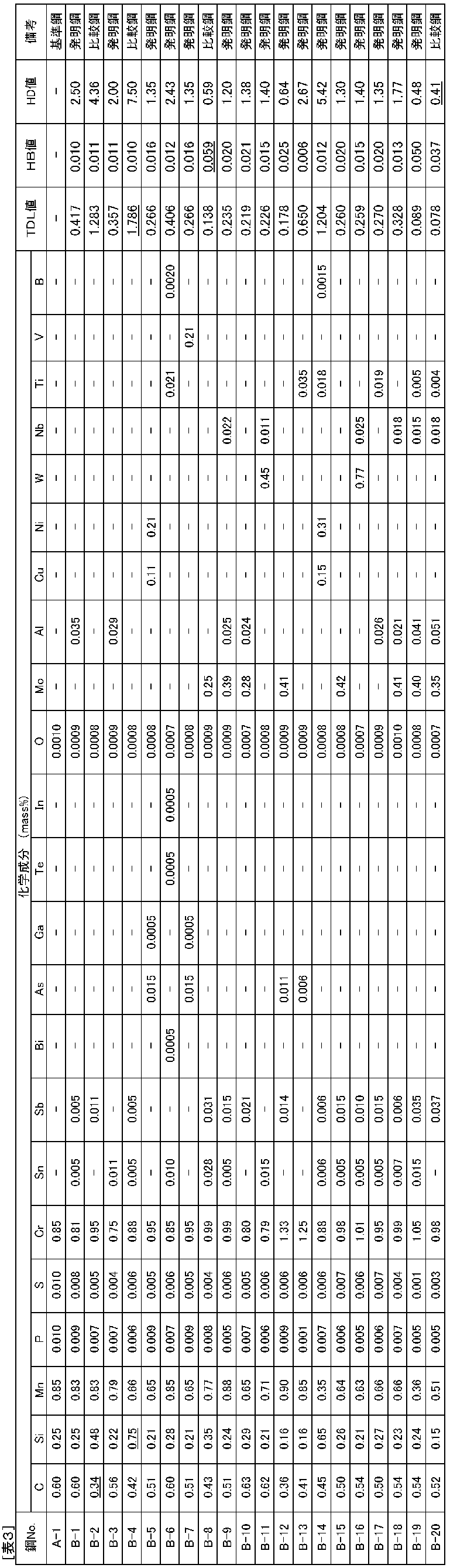
表4に、全脱炭の深さおよび絞り値の各結果を示した。本発明の成分組成およびDF値を満たす、B-1、B-3、B-5~B-7、B-9~B-19の鋼は、全脱炭の発生がなく、また、絞り値も40%以上あり、良好な耐脱炭性、連続鋳造性を有していることが分かる。これに対して、成分組成、TDL値、HB値およびHD値のうちのいずれかが本発明の範囲外であるB-2、B-4、B-8およびB-20の鋼は、全脱炭が発生するか、あるいは、絞り値が40%未満であることが分かる。

Claims (2)
- C:0.35質量%超0.65質量%未満、
Si:0.15質量%以上0.70質量%以下、
Mn:0.10質量%以上1.00質量%以下、
Cr:0.01質量%以上1.50質量%以下、
P:0.025質量%以下、
S:0.025質量%以下および
O:0.0015質量%以下
を含有し、
Sb:0.001質量%超0.05質量%以下、
Sn:0.001質量%以上0.05質量%以下、
Bi:0.0001質量%以上0.01質量%以下、
As:0.001質量%以上0.05質量%以下、
Ga:0.0001質量%以上0.01質量%以下、
Te:0.0001質量%以上0.01質量%以下および
In:0.0001質量%以上0.01質量%以下
のうちから選ばれる1種または2種以上を含有し、下記(1)式で算出されるTDL値が1.30以下、下記(2)式で算出されるHB値が0.05質量%以下および、下記(3)式で算出されるHD値が0.45以上の条件下に含有し、残部不可避的不純物およびFeの成分組成を有するばね鋼。
記
TDL=[Si]/{100×[C]×([Sb]+[Sn]+[Bi]+[As]+[Ga]+[Te]+[In])} ・・・(1)
HB=[Sb]+[Sn]+[Bi]+[As]+[Ga]+[Te]+[In] ・・・(2)
HD=[Si]/{10×([Sb]+[Sn]+[Bi]+[As]+[Ga]+[Te]+[In])} ・・・(3)
但し、[ ]は該括弧内成分の含有量(質量%) - 前記成分組成は、さらに、
Al: 0.50質量%以下、
Cu: 1.0質量%以下、
Ni: 2.0質量%以下、
W: 2.0質量%以下、
Nb: 0.1質量%以下、
Ti: 0.2質量%以下、
V: 0.5質量%以下、
Mo: 1.0質量%以下および
B: 0.005質量%以下
のうちから選ばれる1種または2種以上を含有する請求項1に記載のばね鋼。
Applications Claiming Priority (2)
| Application Number | Priority Date | Filing Date | Title |
|---|---|---|---|
| JP2012048038A JP2015120940A (ja) | 2012-03-05 | 2012-03-05 | ばね鋼 |
| JP2012-048038 | 2012-03-05 |
Publications (1)
| Publication Number | Publication Date |
|---|---|
| WO2013132829A1 true WO2013132829A1 (ja) | 2013-09-12 |
Family
ID=49116324
Family Applications (1)
| Application Number | Title | Priority Date | Filing Date |
|---|---|---|---|
| PCT/JP2013/001341 Ceased WO2013132829A1 (ja) | 2012-03-05 | 2013-03-05 | ばね鋼 |
Country Status (2)
| Country | Link |
|---|---|
| JP (1) | JP2015120940A (ja) |
| WO (1) | WO2013132829A1 (ja) |
Cited By (4)
| Publication number | Priority date | Publication date | Assignee | Title |
|---|---|---|---|---|
| WO2015037246A1 (ja) * | 2013-09-11 | 2015-03-19 | Jfeスチール株式会社 | ばね用鋼およびばねの製造方法 |
| CN105568163A (zh) * | 2015-12-31 | 2016-05-11 | 安徽红桥金属制造有限公司 | 一种发动机用压缩弹簧及其生产工艺 |
| JP2016084514A (ja) * | 2014-10-27 | 2016-05-19 | Jfeスチール株式会社 | ばね用鋼およびばね |
| CN112063929A (zh) * | 2020-09-21 | 2020-12-11 | 江阴方圆环锻法兰有限公司 | 新型盾构机用轴承锻件及其锻造方法 |
Families Citing this family (4)
| Publication number | Priority date | Publication date | Assignee | Title |
|---|---|---|---|---|
| KR101745192B1 (ko) | 2015-12-04 | 2017-06-09 | 현대자동차주식회사 | 초고강도 스프링강 |
| KR101745196B1 (ko) | 2015-12-07 | 2017-06-09 | 현대자동차주식회사 | 초고강도 스프링강 |
| KR101776490B1 (ko) | 2016-04-15 | 2017-09-08 | 현대자동차주식회사 | 내식성이 우수한 고강도 스프링강 |
| JP7560714B2 (ja) * | 2020-02-28 | 2024-10-03 | 日本製鉄株式会社 | 機械構造用棒鋼 |
Citations (5)
| Publication number | Priority date | Publication date | Assignee | Title |
|---|---|---|---|---|
| JPS61183442A (ja) * | 1985-02-12 | 1986-08-16 | Daido Steel Co Ltd | 低脱炭バネ鋼 |
| JPH01319650A (ja) * | 1988-06-20 | 1989-12-25 | Daido Steel Co Ltd | 低脱炭ばね鋼 |
| JPH05179399A (ja) * | 1991-12-28 | 1993-07-20 | Aichi Steel Works Ltd | オーステンパ性および打抜き性に優れたばね用鋼 |
| WO2004046405A1 (ja) * | 2002-11-21 | 2004-06-03 | Mitsubishi Steel Mfg. Co., Ltd. | 焼入れ性と耐孔食性を改善したばね用鋼 |
| JP2005350736A (ja) * | 2004-06-11 | 2005-12-22 | Jfe Bars & Shapes Corp | 耐食性および疲労特性に優れた高強度ばね用鋼およびその製造方法 |
-
2012
- 2012-03-05 JP JP2012048038A patent/JP2015120940A/ja active Pending
-
2013
- 2013-03-05 WO PCT/JP2013/001341 patent/WO2013132829A1/ja not_active Ceased
Patent Citations (5)
| Publication number | Priority date | Publication date | Assignee | Title |
|---|---|---|---|---|
| JPS61183442A (ja) * | 1985-02-12 | 1986-08-16 | Daido Steel Co Ltd | 低脱炭バネ鋼 |
| JPH01319650A (ja) * | 1988-06-20 | 1989-12-25 | Daido Steel Co Ltd | 低脱炭ばね鋼 |
| JPH05179399A (ja) * | 1991-12-28 | 1993-07-20 | Aichi Steel Works Ltd | オーステンパ性および打抜き性に優れたばね用鋼 |
| WO2004046405A1 (ja) * | 2002-11-21 | 2004-06-03 | Mitsubishi Steel Mfg. Co., Ltd. | 焼入れ性と耐孔食性を改善したばね用鋼 |
| JP2005350736A (ja) * | 2004-06-11 | 2005-12-22 | Jfe Bars & Shapes Corp | 耐食性および疲労特性に優れた高強度ばね用鋼およびその製造方法 |
Cited By (5)
| Publication number | Priority date | Publication date | Assignee | Title |
|---|---|---|---|---|
| WO2015037246A1 (ja) * | 2013-09-11 | 2015-03-19 | Jfeスチール株式会社 | ばね用鋼およびばねの製造方法 |
| US10041160B2 (en) | 2013-09-11 | 2018-08-07 | Jfe Steel Corporation | Steel for spring, and method for producing spring |
| JP2016084514A (ja) * | 2014-10-27 | 2016-05-19 | Jfeスチール株式会社 | ばね用鋼およびばね |
| CN105568163A (zh) * | 2015-12-31 | 2016-05-11 | 安徽红桥金属制造有限公司 | 一种发动机用压缩弹簧及其生产工艺 |
| CN112063929A (zh) * | 2020-09-21 | 2020-12-11 | 江阴方圆环锻法兰有限公司 | 新型盾构机用轴承锻件及其锻造方法 |
Also Published As
| Publication number | Publication date |
|---|---|
| JP2015120940A (ja) | 2015-07-02 |
Similar Documents
| Publication | Publication Date | Title |
|---|---|---|
| JP6210155B2 (ja) | 鉄道車両用車輪および鉄道車両用車輪の製造方法 | |
| JP5816391B2 (ja) | ばね用鋼およびばねの製造方法 | |
| JP6027302B2 (ja) | 高強度焼戻し省略ばね用鋼 | |
| JP2015120940A (ja) | ばね鋼 | |
| KR101894426B1 (ko) | 고강도이며 내식성이 우수한 스태빌라이저용 강과, 그것을 이용한 차량용 스태빌라이저 및 그의 제조방법 | |
| JP5679455B2 (ja) | ばね用鋼、ばね用鋼線及びばね | |
| CN120843943A (zh) | 增强性钢筋及其制备方法 | |
| JP5408398B1 (ja) | ばね鋼 | |
| KR20190045314A (ko) | 표면 경화강 및 그 제조 방법 그리고 기어 부품의 제조 방법 | |
| JP5859384B2 (ja) | 大型高強度鍛鋼品 | |
| JP7070696B2 (ja) | 中空スタビライザー用電縫鋼管 | |
| JP6119717B2 (ja) | ばね用鋼およびばね | |
| JP4937499B2 (ja) | 耐食性および疲労特性に優れた高強度ばね用鋼およびその製造方法 | |
| WO2020189097A1 (ja) | 中空スタビライザー用電縫鋼管およびその製造方法 | |
| JP5151510B2 (ja) | 低温靭性、亀裂伝搬停止特性に優れた高張力鋼の製造方法 | |
| JP6225880B2 (ja) | ばね用鋼およびばね | |
| JP4515347B2 (ja) | ばね用鋼線材およびばね用鋼線の耐疲労性の判定方法 | |
| KR20150002961A (ko) | 강판 및 그 제조 방법 |
Legal Events
| Date | Code | Title | Description |
|---|---|---|---|
| 121 | Ep: the epo has been informed by wipo that ep was designated in this application |
Ref document number: 13757182 Country of ref document: EP Kind code of ref document: A1 |
|
| NENP | Non-entry into the national phase |
Ref country code: DE |
|
| 122 | Ep: pct application non-entry in european phase |
Ref document number: 13757182 Country of ref document: EP Kind code of ref document: A1 |
|
| NENP | Non-entry into the national phase |
Ref country code: JP |