WO2013129644A1 - 速崩壊性錠剤 - Google Patents
速崩壊性錠剤 Download PDFInfo
- Publication number
- WO2013129644A1 WO2013129644A1 PCT/JP2013/055634 JP2013055634W WO2013129644A1 WO 2013129644 A1 WO2013129644 A1 WO 2013129644A1 JP 2013055634 W JP2013055634 W JP 2013055634W WO 2013129644 A1 WO2013129644 A1 WO 2013129644A1
- Authority
- WO
- WIPO (PCT)
- Prior art keywords
- carbon dioxide
- tablet
- disintegrating tablet
- rapidly disintegrating
- pressure
- Prior art date
- Legal status (The legal status is an assumption and is not a legal conclusion. Google has not performed a legal analysis and makes no representation as to the accuracy of the status listed.)
- Ceased
Links
Classifications
-
- A—HUMAN NECESSITIES
- A61—MEDICAL OR VETERINARY SCIENCE; HYGIENE
- A61K—PREPARATIONS FOR MEDICAL, DENTAL OR TOILETRY PURPOSES
- A61K9/00—Medicinal preparations characterised by special physical form
- A61K9/0012—Galenical forms characterised by the site of application
- A61K9/0053—Mouth and digestive tract, i.e. intraoral and peroral administration
- A61K9/0056—Mouth soluble or dispersible forms; Suckable, eatable, chewable coherent forms; Forms rapidly disintegrating in the mouth; Lozenges; Lollipops; Bite capsules; Baked products; Baits or other oral forms for animals
-
- A—HUMAN NECESSITIES
- A61—MEDICAL OR VETERINARY SCIENCE; HYGIENE
- A61K—PREPARATIONS FOR MEDICAL, DENTAL OR TOILETRY PURPOSES
- A61K9/00—Medicinal preparations characterised by special physical form
- A61K9/20—Pills, tablets, discs, rods
- A61K9/2095—Tabletting processes
Definitions
- the present invention relates to a rapidly disintegrating tablet (particularly an orally disintegrating tablet) having a porous structure by treatment with carbon dioxide in a supercritical or subcritical state or liquid or gaseous carbon dioxide.
- the present invention also relates to a method for producing a rapidly disintegrating tablet (particularly an orally disintegrating tablet) having a porous structure by treatment with carbon dioxide in a supercritical or subcritical state or liquid or gaseous carbon dioxide. Is.
- Drug-containing particles that provide certain functions depending on the characteristics of the drug, such as drugs that are unstable in temperature or humidity, drugs that have a bitter taste, or drugs that require sustained release when providing pharmaceutical preparations In many cases, it is required to develop pharmaceutical preparations containing.
- the invention relating to the orally disintegrating tablet is an invention relating to an orally disintegrating tablet comprising a granulated product obtained by spraying, coating and / or granulating a saccharide having a low moldability and a saccharide having a high moldability as a binder.
- Patent Document 1 has been reported.
- drugs, water-soluble binders and water-soluble excipients are used.
- An invention relating to an orally disintegrating tablet having a porous structure has been reported by forming interparticle crosslinks between the two (Patent Document 3). Furthermore, in order to increase tablet strength and improve friability without prolonging the disintegration time in the oral cavity, it contains a drug, a diluent, and a saccharide having a melting point relatively lower than that of the drug and the diluent.
- Patent Document 4 An invention relating to an orally rapidly disintegrating tablet in which a low-sugar saccharide is uniformly mixed in a tablet and a cross-link is formed between drug and / or diluent particles by a melt-solidified product of a low-melting saccharide (Patent Document 4) , An invention relating to an orally disintegrating tablet containing a physiologically active substance and a polyvinyl alcohol-polyethylene glycol graft copolymer (Patent Document 5); ) A step of mixing an active ingredient, an acrylic copolymer and at least one pharmacologically acceptable additive; (2) compression of the mixture obtained in the step of (1) And (3) a method for producing a rapidly disintegrating tablet, characterized by comprising the step of keeping the compression-molded product obtained in steps (3) and (2) at a temperature of 50 to 100 ° C.
- Patent Document 6 a rapidly disintegrating tablet, wherein a component in powder form is brought into contact with a pressurized liquefied gas or a gas mixture, homogenized, introduced into a mold by pressurization, and decompressed
- Patent Document 7 a rapidly disintegrating tablet, wherein a component in powder form is brought into contact with a pressurized liquefied gas or a gas mixture, homogenized, introduced into a mold by pressurization, and decompressed
- Patent Document 7 relating to the production method of the above, tableting a mixture comprising an active ingredient, an additive, and a supercritical fluid soluble substance to produce a tablet; and contacting the tablet with a supercritical fluid to make a supercritical fluid
- An invention (Patent Document 8) and the like relating to an intraoral quick disintegrating tablet produced by a method comprising a step of extracting a fluid-soluble substance and forming fine voids in the tablet has been reported.
- the subject of this invention is providing the quick disintegrating tablet (especially orally disintegrating tablet) which improved the cracking chip of the tablet.
- Another object of the present invention is to provide a rapidly disintegrating tablet (particularly an orally disintegrating tablet) that can be applied to a drug that is unstable in humidification or heating treatment.
- an object of the present invention is to prepare a formulation step (formulation design) even for a tablet containing drug-containing particles imparted with a desired function based on drug characteristics (hereinafter sometimes abbreviated as functional particles). In addition, it may be processed at high temperature and high humidity, and may affect the function of the functional drug-containing particles. In disintegrating tablets).
- Another object of the present invention is to provide a method for producing a rapidly disintegrating tablet (especially an orally disintegrating tablet) that can be applied to a drug that is unstable in humidification or heating treatment.
- a tablet containing drug-containing particles imparted with a desired function based on the characteristics of the drug is processed at a high formulation temperature (high temperature and high humidity for formulation design).
- the drug may decompose or may affect the function of the functional drug-containing particles), but the drug itself is stable, or the function of the functional particles is fully expressed.
- Another object of the present invention is to provide a method for producing a functional tablet (particularly an orally disintegrating tablet).
- the rapidly disintegrating tablet thus obtained contains a drug unstable in temperature or humidity in the tablet, or
- functional particles for example, solid dispersion particles composed of poorly soluble drugs, bitterness masking particles, sustained-release particles, etc.
- the present invention [1] Carbon dioxide or liquid in a supercritical or subcritical state containing a drug and a substance having a function of a binder by treatment with carbon dioxide or liquid or gaseous carbon dioxide in a supercritical or subcritical state Or fast disintegrating tablets obtained by treatment with gaseous carbon dioxide, [2]
- the substance having the function of a binder by treating with carbon dioxide or liquid or gaseous carbon dioxide in a supercritical or subcritical state is carbon dioxide or liquid or gaseous carbon dioxide in a supercritical or subcritical state.
- a substance having the function of a binder by treatment with carbon dioxide in a supercritical or subcritical state or liquid or gaseous carbon dioxide is a vinyl pyrrolidone / vinyl acetate copolymer, polyvinyl caprolactam-polyvinyl acetate-polyethylene glycol.
- [1]-[3] fast disintegrating tablets [5] The rapidly disintegrating tablet according to any one of [1] to [4], further comprising a plasticizer, [6] The rapidly disintegrating tablet according to any one of [1] to [5], further comprising a disintegrant, [7] The rapidly disintegrating tablet of any one of [1] to [6], wherein the tablet hardness is 20 N or more, [8] The rapidly disintegrating tablet of any one of [1] to [7], wherein the ratio of the number of broken tablets by a drop test is 5% or less, [9] The rapidly disintegrating tablet according to any one of [1] to [8], wherein the rapidly disintegrating tablet is an orally disintegrating tablet, [10] The rapidly disintegrating tablet according to [9], wherein the oral disintegration time is within 120 seconds, [11] The rapidly disintegrating tablet according to any one of [1] to [10], wherein the drug constitutes a drug and / or functional particles unstable to temperature or humidity, [12] The speed according to [11], wherein the
- Disintegrating tablets [13] (1) A step of mixing a drug and a substance having a function of a binder by treatment with carbon dioxide in a supercritical or subcritical state or liquid or gaseous carbon dioxide, (2) A step of preparing a tablet by compression molding the mixture of (1), and (3) a step of treating the tablet of (2) with carbon dioxide in a supercritical or subcritical state or with liquid or gaseous carbon dioxide.
- a method for producing a rapidly disintegrating tablet [14]
- the substance having the function of a binder by treating with carbon dioxide or liquid or gaseous carbon dioxide in a supercritical or subcritical state is carbon dioxide or liquid or gaseous carbon dioxide in a supercritical or subcritical state.
- a substance having the function of a binder by treatment with carbon dioxide in a supercritical or subcritical state or liquid or gaseous carbon dioxide is a vinyl pyrrolidone / vinyl acetate copolymer, polyvinyl caprolactam-polyvinyl acetate-polyethylene glycol Graft copolymer, povidone, povidone / vinyl acetate resin premix formulation, methacrylic acid copolymer LD, polyvinyl alcohol / polyethylene glycol graft copolymer, polyvinyl alcohol / polyethylene glycol graft copolymer / polyvinyl alcohol premix formulation, polyoxyethylene (196) polyoxypropylene (67) Glycol, macrogol, polyoxyethylene hydrogenated castor oil (40), aminoalkyl methacrylate copolymer E, meta Rylic acid copolymer L, dry methacrylic
- a method for producing a rapidly disintegrating tablet [17] A method for producing a rapidly disintegrating tablet according to any one of [13] to [16], further comprising a plasticizer, [18] The method for producing a rapidly disintegrating tablet according to any one of [13] to [17], further comprising a disintegrant, [19] The method for producing a rapidly disintegrating tablet of any one of [13] to [18], wherein the tablet hardness is 20 N or more, [20] The method for producing a rapidly disintegrating tablet according to any one of [13] to [19], wherein the rapidly disintegrating tablet is an orally disintegrating tablet, [21] The method for producing a rapidly disintegrating tablet according to [20], wherein the oral disintegration time is within 120 seconds, [22] The method for producing a rapidly disintegrating tablet according to any one of [13] to [21], wherein the drug constitutes a drug and / or functional particles unstable to temperature or humidity.
- a fast disintegrating tablet (particularly an orally disintegrating tablet) having breakage resistance with improved cracking and having rapid disintegration in the oral cavity.
- a fast disintegrating tablet having breakage resistance with improved cracking and having rapid disintegration in the oral cavity.
- drugs that are unstable in temperature or humidity, solid dispersion particles composed of poorly soluble drugs, bitterness masking particles, sustained release particles, and the like.
- a rapidly disintegrating tablet (particularly an orally disintegrating tablet) while sufficiently maintaining the stability and desired functions.
- “supercritical (state)” means a non-condensable dense fluid that exceeds the critical point in both pressure and temperature.
- “Subcritical (state)” means a state in which only one of pressure and temperature exceeds the critical point.
- the critical point is, for example, “Particle Formation with Supercritical Fluids-A Review” by JW Tom and PG Debenedetti, Journal of Aerosol Sci., 22 (5), pp. 555-584, 1991 The one described in detail in .1.
- the state in which the pressure and temperature are not liquefied without exceeding the critical point is referred to as “liquid”.
- a state where both pressure and temperature are vaporized without exceeding the critical point is referred to as “gas”.
- carbon dioxide in a supercritical state is a state in which both a critical pressure of about 7.38 megapascal (MPa) and a critical temperature of about 304.1 Kelvin (K) are exceeded. Specifically, it is something other than a solid state. Examples include liquid carbon dioxide, gaseous carbon dioxide, and supercritical carbon dioxide.
- tablette hardness sufficient for handling the formulation or “excellent tablet hardness” is not particularly limited as long as the tablet is not damaged in the distribution process.
- the formulation is extruded from the cover sheet and taken out.
- the hardness in the longitudinal direction of the tablet can be mentioned.
- the hardness varies depending on the size and shape of the tablet. For example, when the diameter is about 8.0 mm and a 180 mg tablet is 20 N or more, when the diameter is about 8.5 mm, it is 30 N or more, when the diameter is about 10.0 mm, 50 N or more, and the diameter is about 12 It is specified as 60N or more when 0.0mm.
- the preparation of the present invention has a strength sufficient to withstand removal from the PTP package in any size. Furthermore, the strength applicable to bottle packaging (packaging in which tablets are encapsulated in glass, plastic, etc.), that is, tablets that can withstand contact between tablets or between tablets and container walls when transported in a normal bottle container. As a measure of the strength, 30N or more is preferable. Further, as another aspect, for example, a breakage rate by a drop test of a PTP-packed tablet can be mentioned.
- the damage rate of the tablets is 5% or less, and in another embodiment, it is defined as having a strength of 2% or less.
- the preparation of the present invention has sufficient strength to withstand transportation or carry-in in bottle packaging.
- a tablet having “rapid disintegration” refers to a tablet having practically sufficient disintegration or solubility by saliva without taking water in the oral cavity. means.
- practically sufficient disintegration or solubility has individual differences, but usually within the oral cavity is about 1 to 300 seconds, as another aspect about 1 to 150 seconds, as a further aspect about 1 to 90 seconds,
- the decay time is within 1 to 300 seconds, as another embodiment within 1 to 120 seconds, as a further embodiment within 1 to 90 seconds, and as another embodiment within 1 to 60 seconds. Further, it is defined as 1 to 40 seconds or less as another aspect.
- the “orally disintegrating tablet” varies depending on individuals, but usually disintegrates or dissolves in the oral cavity in about 1 to 120 seconds, in other embodiments in about 1 to 90 seconds, and in further embodiments in about 1 to 60 seconds. Means tablets. In addition, when measured with a tricoop tester, the decay time is within 1 to 120 seconds, as another embodiment within 1 to 90 seconds, as a further embodiment within 1 to 60 seconds, and as another embodiment within 1 to 40 seconds. Means tablets that disintegrate or dissolve.
- the “porous structure” is not particularly limited as long as the tablet rapidly disintegrates in the oral cavity.
- the porosity is 15% or more and 90% or less, and as another aspect, 25% or more and 70%.
- it is specified as 30% or more and 50% or less as a further aspect.
- the drug used in the present invention is not particularly limited as long as it is a therapeutically effective active ingredient or a prophylactically effective active ingredient.
- pharmaceutically active ingredients include hypnotic sedatives, sleep-inducing agents, migraine agents, anti-anxiety agents, antiepileptic agents, antidepressants, anti-Parkinson agents, psychiatric agents, central nervous system agents, local anesthetics Agent, skeletal muscle relaxant, autonomic nerve agent, antipyretic analgesic / antiinflammatory agent, antispasmodic agent, antipruritic agent, cardiotonic agent, arrhythmic agent, diuretic agent, antihypertensive agent, vasoconstrictor, vasodilator, cardiovascular agent, high Dyslipidemic agent, respiratory accelerator, antitussive agent, expectorant, antitussive agent, bronchodilator, antidiarrheal agent, intestinal adjuster, peptic ulcer agent, stomach digestive agent, antacid, laxative, antibacterial agent,
- Such drugs include, for example, overactive bladder therapeutic agents such as solifenacin, tolterodine, mirabegron, sleep-inducing drugs such as diphenhydramine, lorazepam, zolpidem, indomethacin, diclofenac, diclofenac sodium, codeine, ibuprofen, phenylbutazone, oxyphenbutazone , Mepyrazole, aspirin, etenzamide, acetaminophen, aminopyrine, phenacetin, butylscopolamine bromide, morphine, etmidrin, pentazocine, fenoprofen calcium, naproxen, celecoxib, valdecoxib, tramadol, etc.
- overactive bladder therapeutic agents such as solifenacin, tolterodine, mirabegron
- sleep-inducing drugs such as diphenhydramine, lorazepam, zolpidem, indometh
- Migraine drugs such as sumatriptan, antirheumatic drugs such as etodolac, antituberculosis drugs such as isoniazid and ethambutol hydrochloride, isosorbide nitrate , Nitroglycerin, nifedipine, varnidipine hydrochloride, nicardipine hydrochloride, dipyridamole, amrinone, indenolol hydrochloride, hydralazine hydrochloride, methyldopa, furosemide, spironolactone, guanethidine nitrate, reserpine, amosulalol hydrochloride, lisinopril, metoprolol, pilocarpine, telmisartan, etc.
- Antipsychotics such as chlorpromazine hydrochloride, amitriptyline hydrochloride, nemonapride, haloperidol, moperone hydrochloride, perphenazine, diazepam, lorazepam, chlordiazepoxide, adinazolam, alprazolam, methylphenidate, milnacipran, peroxetine, risperidone, sodium valproate, etc.
- chlorpromazine hydrochloride amitriptyline hydrochloride, nemonapride, haloperidol, moperone hydrochloride, perphenazine, diazepam, lorazepam, chlordiazepoxide, adinazolam, alprazolam, methylphenidate, milnacipran, peroxetine, risperidone, sodium valproate, etc.
- Antidepressant metoclopramide, ramosetron hydrochloride, granisetro hydrochloride , Antiemetics such as ondansetron hydrochloride and azacetron hydrochloride, antihistamines such as chlorpheniramine maleate, vitamin drugs such as thiamine nitrate, tocophenol acetate, chicotiamine, pyridoxal phosphate, cobamide, ascorbic acid, nicotinamide, Goutants such as allopurinol, colchicine, probenecid, Parkinson's disease drugs such as levodopa and selegiline, hypnotic sedatives such as amobarbital, bromvalerylurea, midazolam, chloral hydrate, fluorouracil, carmofur, aclarubicin hydrochloride, cyclophosphamide, thiotepa, etc.
- antihistamines such as chlorpheniramine maleate
- Antineoplastic drugs, pseudoephedrine, anti-allergic drugs such as terfenadine, acetohexamide, insulin, tolbutamide, desmopressin, glipizide, nateglinide, metformin, sita Diabetic drugs such as gliptin, vildagliptin, linagliptin, diuretics such as hydrochlorothiazide, polythiazide, triamterene, bronchodilators such as aminophylline, formoterol fumarate, theophylline, antitussives such as codeine phosphate, noscapine, dimemorphan phosphate, and dextromethorphan , Antiarrhythmic drugs such as quinidine nitrate, dichitoxin, propaphenone hydrochloride, procainamide, surface anesthetics such as ethyl aminobenzoate, lidocaine, dibucaine hydrochloride, antiepileptic
- Antihyperlipidemic agent antibiotics such as ampicillin phthalidyl hydrochloride, cefotetan, josamycin, BPH therapeutic agents such as tamsulosin, doxazosin mesylate, terazosin hydrochloride, pranlukast, zafirlukast, albuterol, ambroxol, budesonide, level Anti-asthmatic agents such as terol, peripheral circulation improving agents such as prostaglandin I2 derivatives such as beraprost sodium, osteoporosis therapeutic agents such as minodronic acid and alendronic acid, Therapeutic agent species complications, skin ulcer therapeutic agents, and the like.
- antibiotics such as ampicillin phthalidyl hydrochloride, cefotetan, josamycin
- BPH therapeutic agents such as tamsulosin, doxazosin mesylate, terazosin hydrochloride, pranlukast, zafirl
- steroidal anti-inflammatory agents include anti-inflammatory analgesics, antipyretic analgesics, antiepileptic agents, chemotherapeutic agents, synthetic antibacterial agents, antiviral agents, antifungal agents, hormone agents, angiogenesis inhibitors, immunosuppressants, or Examples include ulcerative colitis therapeutic agents.
- steroidal anti-inflammatory agents include cortisone acetate, betamethasone, prednisolone, fluticasone propionate, dexamethasone, budesonide, beclomethasone propionate, triamcinolone, rotopredonol, fluorometholone, diflupredone, mometasone furanate, clobetasol propionate, diflorazone propionate, Examples include diflucortron valerate, fluocinonide, amsinonide, harsinonide, fluocinolone acetonide, triamcinolone acetonide, flumethasone pivalate, or clobetasone butyrate.
- Antiinflammatory analgesics include, for example, alclofenac, aluminoprofen, ibuprofen, indomethacin, epilysole, oxaprozin, ketoprofen, diclofenac sodium, diflunisal, naproxen, piroxicam, fenbufen, flufenamic acid, flurbiprofen, fructaphenine, pentazocine, methazidic acid, or Examples include mefenamic acid and mofezolac. Examples of antipyretic analgesics include acetaminophen, sulpyrine, and the like.
- antiepileptic agent examples include acetazolamide, carbamazepine, clonazepam, diazepam, and nitrazepam.
- chemotherapeutic agents include sulfa drugs such as salazosulfapyridine, sulfadimethoxine, sulfamethizole, sulfamethoxazole, sulfamethopyrazine, or sulfamonomethoxine, enoxin, ofloxacin, synoxacin, sparfloxacin Synthetic antibacterial agents such as thiamphenicol, nalidixic acid, tosufloxacin tosylate, norfloxacin, pipemidic acid trihydrate, pyromido acid, fleloxacin, or levofloxacin, antiviral agents such as acyclovir, ganciclovir, didanosine, zidovudine, or vitarabine,
- hormone agents include insulin zinc, testosterone propionate, or estradiol benzoate.
- immunosuppressive agent include cyclosporine, rapamycin, tacrolimus and the like.
- therapeutic agent for ulcerative colitis include mesalazine.
- another embodiment of the drug used in the present invention is a drug that is unstable with respect to temperature or humidity.
- the drug may be granulated and / or mixed with a pharmaceutical additive, or the drug may be coated on core particles such as SELPHYA (manufactured by Asahi Kasei) together with a stabilizer and the like, and then granulated and / or mixed with the pharmaceutical additive. You may mix.
- drugs constituting functional particles drugs constituting functional particles (drugs with a bitter taste, drugs that need to be sustained-released, drugs with poor solubility) can be mentioned.
- functional particles include bitterness masking particles, sustained release particles, solid dispersion particles, and the like.
- a drug having a bitter taste, a drug that needs to be sustained-released or a poorly soluble drug, and a drug that is unstable with respect to temperature or humidity may be selected as a drug constituting the functional particles. Good.
- the drug can be used in either a free form or a pharmaceutically acceptable salt. Moreover, a drug can also be used 1 type or in combination of 2 or more types. These drugs are examples that can be applied to the present invention, and should not be interpreted in a limited manner.
- the compounding amount is usually selected as appropriate depending on the type of drug or pharmaceutical use (indication), but is not particularly limited as long as it is a therapeutically effective amount or a prophylactically effective amount. For example, it is 0.001 to 80% by weight in a rapidly disintegrating tablet (particularly an orally disintegrating tablet), 0.01 to 70% by weight as another embodiment, and 0.01 to 60% by weight as another embodiment. %.
- the rapidly disintegrating tablet of the present invention is a supercritical or subcritical carbon dioxide or a substance having a binder function by treatment with liquid or gaseous carbon dioxide.
- the “substance having a function” has a porous structure by forming a cross-link between components (for example, a drug, and optionally, an excipient, a disintegrant, a stabilizer, a lubricant, etc.).
- the “substance having the function of a binder by treating with carbon dioxide or liquid or gaseous carbon dioxide in a supercritical or subcritical state” used in the present invention includes carbon dioxide or liquid in a supercritical or subcritical state. Or if it is a substance which functions as a binder because the melting point or glass transition temperature of this "substance" falls by processing with gaseous carbon dioxide, it will not be restrict
- by treating with carbon dioxide in a supercritical or subcritical state or with liquid or gaseous carbon dioxide the hardness of the tablet containing the “substance” is compared with that not containing the “substance”. Any substance that increases can be used.
- the treatment pressure is about 0.1 MPa to about 50 MPa in one embodiment, and about 1 MPa to about 20 MPa in another embodiment. In a further embodiment, the pressure is about 1 MPa to 15 MPa. In yet another embodiment, the pressure is about 1 MPa to about 5 MPa. In another embodiment, for example, the melting point or glass transition temperature when the pressure is 20 MPa is reduced by, for example, 5 ° C. or more. Still another embodiment includes, for example, a compound having a styrene skeleton, a carbonyl group, an ether bond, an ester bond, an unsaturated bond between carbon atoms, etc., particularly having an affinity for carbon dioxide in the structural formula.
- Examples of the compound having a styrene skeleton include a polystyrene resin and a copolymer thereof.
- Examples of the compound having a carbonyl group include an aldehyde compound, a ketone compound, a carboxylic acid compound, an ester compound, an amide compound, an enone compound, a carboxylic acid chloride (halogen), an acid anhydride, a polymer thereof, a copolymer, and the like.
- Examples of the compound having an ether bond include polyethers typified by polyethylene glycol and polypropylene glycol.
- Examples of the compound having an unsaturated bond between carbon atoms include alkenes, ethylene, propylene, benzene, annulene, and polymers and copolymers having the structure.
- vinylpyrrolidone / vinyl acetate copolymer hereinafter sometimes abbreviated as copolyvidone
- polyvinylcaprolactam-polyvinylacetic acid-polyethylene glycol graft copolymer polyvinyl caprolactam-polyvinyl glycyline graft copolymer, bipolymer.
- copolyvidone polyvinylcaprolactam-polyvinylacetic acid-polyethylene glycol graft copolymer
- aminoalkyl methacrylate copolymer E aminoalkyl methacrylate copolymer RS, methyl methacrylate / diethylaminoethyl methacrylate copolymer
- HPMCAS ethyl cellulose
- shellac povidone / vinyl acetate Resin premix preparation, povidone, carbomer, polyoxyethylene (196) polyoxypropylene (67) glycol.
- Further embodiments include copolyvidone, polyvinyl caprolactam-polyvinyl acetate-polyethylene glycol graft copolymer, aminoalkyl methacrylate copolymer E, aminoalkyl methacrylate copolymer RS, methyl methacrylate / diethylaminoethyl methacrylate copolymer, HPMCAS, ethyl cellulose, povidone / vinyl acetate resin pre A mixed preparation is mentioned.
- Still other embodiments include copolyvidone, polyvinyl caprolactam-polyvinyl acetate-polyethylene glycol graft copolymer, aminoalkyl methacrylate copolymer E, HPMCAS, and ethyl cellulose.
- Another embodiment includes copolyvidone and aminoalkyl methacrylate copolymer E.
- Yet another embodiment includes aminoalkyl methacrylate copolymer E.
- Pemulen TR-1, TR-2, etc. such as AQUPEC HV-501, HV501E, HV-501ER, HV-504, commercially available from Sumitomo Seika. HV-504E, HV-505, HV-505E, HV-505ED, etc. Hibiswako 103, 104, 105, etc. commercially available from Wako Pure Chemical Industries, Ltd. Polyvinyl acetal diethylaminoacetate: AEA (Mitsubishi Chemical Foods), etc.
- AEA Mitsubishi Chemical Foods
- the function of the binder can be achieved by treating with “supercritical or subcritical carbon dioxide or liquid or gaseous carbon dioxide used in the present invention.
- “substance having” one kind or a combination of two or more kinds can be used.
- the shape of the “substance having the function of a binder by treatment with carbon dioxide in a supercritical or subcritical state or liquid or gaseous carbon dioxide” is not particularly limited, such as granular or needle-like. It can also be used after pulverization.
- the shape of the substance is granular, the average particle size is not particularly limited as long as it has a function of a binder.
- the average particle size when measured with a laser diffraction particle size distribution analyzer is 0.1 to 350 ⁇ m. Is preferred. These substances can be used singly or in combination of two or more kinds having different grades, shapes, average particle diameters, and the like.
- the blending amount thereof is not limited as long as the amount exhibits the function as “substance having the function of a binder by being treated with carbon dioxide in a supercritical or subcritical state or liquid or gaseous carbon dioxide”.
- the amount is not particularly limited as long as the hardness of the fast disintegrating tablet (particularly the orally disintegrating tablet) is improved. Specifically, for example, it is 0.1 to 50% by weight in a rapidly disintegrating tablet (particularly an orally disintegrating tablet), 1 to 30% by weight as another embodiment, and 3 to 20 as another embodiment. % By weight.
- the rapidly disintegrating tablet (especially the orally disintegrating tablet) of the present invention is optionally “a substance having a function of a binder by treatment with carbon dioxide in a supercritical or subcritical state or liquid or gaseous carbon dioxide”.
- the plasticizer which improves the function of can be contained.
- plasticizer can be used 1 type or in combination of 2 or more types.
- the blending amount of the plasticizer is not particularly limited as long as it is an amount that enhances the function of “substance having the function of a binder by treatment with carbon dioxide in a supercritical or subcritical state or liquid or gaseous carbon dioxide”. Specifically, for example, it is 0.1 to 20% by weight in a rapidly disintegrating tablet (particularly an orally disintegrating tablet), 0.1 to 10% by weight as another embodiment, and 0 as another embodiment.
- the blending amount of the plasticizer with respect to “substance having a function of a binder by treatment with carbon dioxide in a supercritical or subcritical state or liquid or gaseous carbon dioxide” is, for example, 0.5 to 200% by weight. In another embodiment, it is 0.5 to 40% by weight, and in yet another embodiment, 10 to 40% by weight.
- the fast disintegrating tablet (especially orally disintegrating tablet) of the present invention can contain an excipient usually added as a pharmaceutical additive, if desired.
- the excipient used in the present invention is not limited as long as it is a hydrophilic substance or a water-soluble substance.
- saccharides, a cellulose derivative, phosphate, and a sulfate are mentioned.
- saccharide include mannitol, lactose, sucrose, sucrose, glucose, fructose, sorbitol, xylitol, erythritol, trehalose, sucrose, and multirole.
- a cellulose derivative etc. are mentioned as a cellulose derivative.
- Examples of the phosphate include calcium monohydrogen phosphate, calcium hydrogen phosphate hydrate, calcium hydrogen phosphate granule, sodium hydrogen phosphate hydrate, potassium dihydrogen phosphate, sodium dihydrogen phosphate and the like. It is done.
- Examples of the sulfate include calcium sulfate.
- the excipient can be used alone or in combination of two or more.
- the blending amount of the excipient is, for example, 0.001 to 99.99% by weight in a rapidly disintegrating tablet (particularly an orally disintegrating tablet), and in another aspect, 1 to 99.9.
- the weight percentage is 10 to 99 weight% in still another embodiment.
- various pharmaceutical additives are appropriately used as needed in the rapidly disintegrating tablet (especially the orally disintegrating tablet) of the present invention to be formulated.
- a pharmaceutical additive is not particularly limited as long as it is pharmaceutically acceptable and pharmacologically acceptable.
- binders, disintegrants, acidulants, foaming agents, artificial sweeteners, fragrances, lubricants, colorants, stabilizers, buffers, antioxidants, surfactants, and the like are used.
- the following binders can also be added.
- binder examples include copolyvidone, povidone, polyvinyl alcohol / polyethylene glycol graft copolymer, polyvinyl alcohol, polyvinyl alcohol / acrylic acid / methyl methacrylate copolymer, hydroxypropyl methylcellulose, gum arabic, candy powder, sodium alginate, pregelatinized starch , Agar, vinyl acetate resin, pullulan, starch, hydroxypropyl cellulose, and the like.
- disintegrant examples include corn starch, potato starch, carmellose calcium, carmellose sodium, crospovidone, pregelatinized starch, partially pregelatinized starch, carmellose, crystalline cellulose, croscarmellose sodium, sodium carboxymethyl starch, magnesium carbonate, Examples include low-substituted hydroxypropyl cellulose, low-substituted sodium carboxymethyl starch, precipitated calcium carbonate, gelatin, magnesium alumina hydroxide, and synthetic aluminum silicate.
- crospovidone croscarmellose sodium
- low-substituted hydroxypropyl methylcellulose sodium carboxymethyl starch, pregelatinized starch, partially pregelatinized starch, carmellose, and carmellose calcium.
- Still other embodiments include low substituted hydroxypropyl methylcellulose, partially pregelatinized starch, croscarmellose sodium.
- the sour agent include citric acid, tartaric acid, malic acid and the like.
- the foaming agent include sodium bicarbonate, tartaric acid, sodium hydrogen carbonate, anhydrous citric acid, sodium hydrogen carbonate and the like.
- Examples of the artificial sweetener include saccharin sodium, dipotassium glycyrrhizin, aspartame, stevia and thaumatin.
- Examples of the fragrances include lemon, lemon lime, orange and menthol.
- Examples of the lubricant include magnesium stearate, calcium stearate, sucrose fatty acid ester, sodium stearyl fumarate, polyethylene glycol, talc, stearic acid and the like.
- Examples of the colorant include yellow ferric oxide, red ferric oxide, edible yellow No. 4, No. 5, edible red No. 3, No. 102, and edible blue No. 3.
- the stabilizer examples include ascorbic acid, aspartic acid, sodium chloride, magnesium chloride, glycine, glycerin, light anhydrous silicic acid, magnesium gluconate, xylitol, calcium citrate, calcium hydroxide, sodium hydroxide, magnesium hydroxide, Examples thereof include potassium carbonate, potassium hydrogen carbonate, sodium hydrogen carbonate and the like.
- Buffers include citric acid, succinic acid, fumaric acid, tartaric acid, ascorbic acid or salts thereof, glutamic acid, glutamine, glycine, aspartic acid, alanine, arginine or salts thereof, magnesium oxide, zinc oxide, magnesium hydroxide, phosphoric acid Boric acid or a salt thereof.
- antioxidant examples include ascorbic acid, dibutylhydroxytoluene, propyl gallate and the like.
- surfactant examples include polysorbate 80, sodium lauryl sulfate, polyoxyethylene hydrogenated castor oil, and the like.
- a pharmaceutical additive one or a combination of two or more can be appropriately added. The compounding quantity of these various pharmaceutical additives can be arbitrarily set.
- the rapidly disintegrating tablet of the present invention is preferably an orally disintegrating tablet.
- the production method of the rapidly disintegrating tablet (especially the orally disintegrating tablet) of the present invention will be described below.
- “treated with carbon dioxide in a supercritical or subcritical state or liquid or gaseous carbon dioxide” has a function as a so-called “binder” that builds a crosslinked structure between components.
- Biner that builds a crosslinked structure between components.
- a tablet after compression (about 1 mL to about 2000 L of carbon dioxide in a supercritical state, a subcritical state, or a liquid or gaseous state (In particular, orally disintegrating tablets) are treated at a rate of about 0.1 g to about 2000 kg in one embodiment and about 5 g to about 100 kg in another embodiment.
- the treatment time is from about 1 minute to about 50 hours in one embodiment, from about 1 minute to about 24 hours in another embodiment, from about 2 minutes to about 12 hours in another embodiment, and from about 5 minutes in another embodiment. About 2 hours.
- the treatment is preferably performed in a pressure-resistant container.
- pressure vessel H series (manufactured by Tama Seiki), EV series (manufactured by JASCO) or VE-1 (manufactured by Mitsubishi Chemical Corporation)
- CO 2 liquid feed pump SCF-GET or PU-2086 ( (Manufactured by JASCO)
- CO 2 compressor PU-1 (manufactured by Mitsubishi Chemical Corporation)
- thermometer platinum resistance thermometer (R36S) (manufactured by Nippon Denshoku) and TI-2068-01 (manufactured by JASCO)
- heater ribbon Heater (JK) (manufactured by ASONE), oven CO-2060 (manufactured by JASCO)
- thermometer instruction controller E5CN (manufactured by OMRON)
- pressure indicator WGA-710B (manufactured by Kyowa Denki)
- pressure gauge PG- 500 KU (manufactured by Kyowa Denki Co.,
- the treatment temperature varies depending on the kinds of components constituting the rapidly disintegrating tablet (especially the orally disintegrating tablet) of the present invention, but in one embodiment, it is about ⁇ 40 ° C. to about 100 ° C.
- a substance having the function of a binder by treatment with carbon dioxide in a supercritical or subcritical state or liquid or gaseous carbon dioxide is copolyvidone, about 25 ° C.
- the treatment pressure varies depending on the types of components constituting the rapidly disintegrating tablet (especially the orally disintegrating tablet) of the present invention, but in one embodiment is about 0.1 MPa to about 50 MPa, and in another embodiment about 1 MPa to about 20 MPa.
- carbon dioxide can be added by mixing other solvents.
- solvents include water; aromatic hydrocarbons such as benzene, toluene, ethyl acetate, cyclohexane, and xylene; ethers such as dimethyl ether, diethyl ether, dioxane, diethoxyethane, tetrahydrofuran, and 1,2-dimethoxyethane.
- Organochlorine organic solvents such as dichloromethane, chloroform, carbon tetrachloride and 1,2-dichloroethane; alkyl nitriles such as acetonitrile and propionitrile; nitroalkanes such as nitromethane and nitroethane; N, N-dimethylformamide; Amides such as N, N-dimethylacetamide; Ketones such as acetone; Fatty acids such as acetic acid, acetic anhydride and oleic acid; Alcohols such as methanol, ethanol and propanol; Sulfoxides such as dimethyl sulfoxide Etc.; or and mixtures of these solvents are used, inter alia ethanol, acetone is preferred.
- the amount of other solvents used is usually from about 0.1 to about 99.9% by volume, in some embodiments from about 1 to about 99.9% by volume in carbon dioxide in the supercritical or subcritical or liquid or gaseous state. 99% by volume.
- other gases can be added to the carbon dioxide during the treatment. For example, nitrogen can be used as the other gas.
- the rapidly disintegrating tablet (especially the orally disintegrating tablet) of the present invention is produced according to any one of the following procedures (1) to (4).
- any of the procedures (1) to (4) may be referred to as carbon dioxide (pressure) treatment.
- a rapidly disintegrating tablet (for example, orally disintegrating tablet) before carbon dioxide treatment is prepared.
- a method of granulating a substance having a function of a binder by treatment with a medicinal component and carbon dioxide in a supercritical or subcritical state or liquid or gaseous carbon dioxide with an aqueous solution, and compression-molding the obtained granulated product Has the function of a binder by treating with medicinal ingredients and carbon dioxide in supercritical or subcritical state or liquid or gaseous carbon dioxide
- a method of granulating a substance having a binder function by treating the substance having carbon dioxide in a supercritical or subcritical state with liquid or gaseous carbon dioxide, and compression-molding the resulting granulated product ,
- compression molding the treated mixture or by treatment with medicinal ingredients and carbon dioxide or liquid or gaseous carbon dioxide in a supercritical or subcritical state
- a rapidly disintegrating tablet for example, orally disintegrating tablet
- a pressure-resistant container -Keep the temperature of the pressure-resistant container above the critical point of carbon dioxide. Fill the pressure-resistant container with carbon dioxide (mix the solvent or other gas as necessary). -The pressure in the pressure-resistant container is kept at a carbon dioxide critical point or higher to perform carbon dioxide treatment. -After completion of the treatment with carbon dioxide, the pressure is released, and the obtained rapidly disintegrating tablet (for example, orally disintegrating tablet) is taken out.
- a rapidly disintegrating tablet for example, orally disintegrating tablet
- a pressure-resistant container (2) -Put a rapidly disintegrating tablet (for example, orally disintegrating tablet) into a pressure-resistant container. -Keep the temperature of the pressure-resistant container above the critical point of carbon dioxide. Fill the pressure-resistant container with carbon dioxide (mix the solvent or other gas as necessary). -The pressure in the pressure-resistant container is kept below the critical point of carbon dioxide, and carbon dioxide treatment is performed. -After completion of the treatment with carbon dioxide, the pressure is released, and the obtained rapidly disintegrating tablet (for example, orally disintegrating tablet) is taken out.
- a rapidly disintegrating tablet for example, orally disintegrating tablet
- a pressure-resistant container -Keep the temperature of the pressure vessel below the critical point of carbon dioxide. Fill the pressure-resistant container with carbon dioxide (mix the solvent or other gas as necessary). -The pressure in the pressure-resistant container is kept at a carbon dioxide critical point or higher to perform carbon dioxide treatment. -After completion of the treatment with carbon dioxide, the pressure is released, and the obtained rapidly disintegrating tablet (for example, orally disintegrating tablet) is taken out.
- a rapidly disintegrating tablet for example, orally disintegrating tablet
- a pressure-resistant container -Keep the pressure vessel temperature below the critical point of carbon dioxide. Fill the pressure-resistant container with carbon dioxide (mix the solvent or other gas as necessary). -The pressure in the pressure-resistant container is kept below the critical point of carbon dioxide, and carbon dioxide treatment is performed. -After completion of the treatment with carbon dioxide, the pressure is released, and the obtained rapidly disintegrating tablet (for example, orally disintegrating tablet) is taken out.
- Example 1 D-mannitol (Pearitol 50C, manufactured by Rocket Japan, unless otherwise noted) 59.0 w / w%, crystalline cellulose (MCC SANAQ burst, PHARMATRANS SANAQAG) 20.0 w / w%, copolyvidone (Kollidon VA64 Fine) , Manufactured by BASF Japan) 10.0 w / w% and crospovidone (Kollidon CL, manufactured by BASF Japan) 10.0 w / w% were mixed.
- this tablet was treated in a pressure-resistant container (pressure cell) at a carbon dioxide pressure of 8.0 MPa and 45 ° C. for 30 minutes and then decompressed at a decompression rate of about 16 kPa / second to obtain the fast disintegrating tablet of the present invention. It was.
- this tablet was treated at a carbon dioxide pressure of 8.0 MPa at 45 ° C. for 30 minutes using a pressure cell, and then decompressed at a decompression rate of about 16 kPa / sec to obtain a rapidly disintegrating tablet of the present invention.
- Example 7 Fmelt (Fuji Chemical) 89.0 w / w% and copolyvidone (Kollidon VA64 Fine, BASF Japan) 10.0 w / w% were mixed. This mixture is mixed with magnesium stearate 1.0 w / w%, and the tableting pressure is about 1.0 kN using a rotary tableting machine (HT-EX series, manufactured by Hata Seiko Co., Ltd., unless otherwise noted). / Tablets (reference example 1) of 180 mg per tablet were produced with a koji (tablet diameter 8.0 mm). Next, this tablet was treated at a carbon dioxide pressure of 4 MPa at 25 ° C. for 5 minutes using a pressure cell, and then reduced in pressure to obtain a rapidly disintegrating tablet of the present invention.
- a koji tablet diameter 8.0 mm
- Example 8 The tablet of Reference Example 1 was treated at a carbon dioxide pressure of 4 MPa at 25 ° C. for 15 minutes using a pressure cell, and then decompressed to obtain a rapidly disintegrating tablet of the present invention.
- the decompression speed condition was about 27 kPa / sec.
- Example 9 The tablet of Reference Example 1 was treated at a carbon dioxide pressure of 4 MPa and 25 ° C. for 30 minutes using a pressure cell, and then decompressed to obtain a rapidly disintegrating tablet of the present invention.
- the decompression speed condition was about 27 kPa / sec.
- Example 10 The tablet of Reference Example 1 was treated at a carbon dioxide pressure of 8 MPa and 25 ° C. for 5 minutes using a pressure cell, and then decompressed to obtain a rapidly disintegrating tablet of the present invention.
- the decompression speed condition was about 16 kPa / sec.
- Example 11 The tablet of Reference Example 1 was treated at a carbon dioxide pressure of 8 MPa and 25 ° C. for 15 minutes using a pressure cell, and then decompressed to obtain a rapidly disintegrating tablet of the present invention.
- the decompression speed condition was about 16 kPa / sec.
- Example 12 The tablet of Reference Example 1 was treated at a carbon dioxide pressure of 8 MPa and 25 ° C. for 30 minutes using a pressure cell, and then decompressed to obtain a rapidly disintegrating tablet of the present invention.
- the decompression speed condition was about 16 kPa / sec.
- Example 13 The tablet of Reference Example 1 was treated at a carbon dioxide pressure of 4 MPa and 35 ° C. for 5 minutes using a pressure cell, and then decompressed to obtain a rapidly disintegrating tablet of the present invention.
- the decompression speed condition was about 27 kPa / sec.
- Example 14 The tablet of Reference Example 1 was treated at a carbon dioxide pressure of 4 MPa and 35 ° C. for 15 minutes using a pressure cell, and then decompressed to obtain a rapidly disintegrating tablet of the present invention.
- the decompression speed condition was about 27 kPa / sec.
- Example 15 The tablet of Reference Example 1 was treated at a carbon dioxide pressure of 4 MPa and 35 ° C. for 30 minutes using a pressure cell, and then decompressed to obtain a rapidly disintegrating tablet of the present invention.
- the decompression speed condition was about 27 kPa / sec.
- Example 16 The tablet of Reference Example 1 was treated at a carbon dioxide pressure of 8 MPa and 35 ° C. for 5 minutes using a pressure cell, and then decompressed to obtain a rapidly disintegrating tablet of the present invention.
- the decompression speed condition was about 16 kPa / sec.
- Example 17 The tablet of Reference Example 1 was treated at a carbon dioxide pressure of 8 MPa and 35 ° C. for 15 minutes using a pressure cell, and then decompressed to obtain a rapidly disintegrating tablet of the present invention.
- the decompression speed condition was about 16 kPa / sec.
- Example 18 The tablet of Reference Example 1 was treated at a carbon dioxide pressure of 8 MPa and 35 ° C. for 30 minutes using a pressure cell, and then decompressed to obtain a rapidly disintegrating tablet of the present invention.
- the decompression speed condition was about 16 kPa / sec.
- Example 19 The tablet of Reference Example 1 was treated at a carbon dioxide pressure of 4 MPa and 45 ° C. for 5 minutes using a pressure cell, and then decompressed to obtain a rapidly disintegrating tablet of the present invention.
- the decompression speed condition was about 27 kPa / sec.
- Example 20 The tablet of Reference Example 1 was treated at a carbon dioxide pressure of 4 MPa and 45 ° C. for 15 minutes using a pressure cell, and then decompressed to obtain a rapidly disintegrating tablet of the present invention.
- the decompression speed condition was about 27 kPa / sec.
- Example 21 The tablet of Reference Example 1 was treated at a carbon dioxide pressure of 4 MPa and 45 ° C. for 30 minutes using a pressure cell, and then decompressed to obtain a rapidly disintegrating tablet of the present invention.
- the decompression speed condition was about 27 kPa / sec.
- Example 22 The tablet of Reference Example 1 was treated at a carbon dioxide pressure of 8 MPa and 45 ° C. for 5 minutes using a pressure cell, and then decompressed to obtain a rapidly disintegrating tablet of the present invention.
- the decompression speed condition was about 16 kPa / sec.
- Example 23 The tablet of Reference Example 1 was treated using a pressure cell at a carbon dioxide pressure of 8 MPa at 45 ° C. for 15 minutes and then decompressed to obtain a rapidly disintegrating tablet of the present invention.
- the decompression speed condition was about 16 kPa / sec.
- Example 24 The tablet of Reference Example 1 was treated at a carbon dioxide pressure of 8 MPa and 45 ° C. for 30 minutes using a pressure cell, and then decompressed to obtain a rapidly disintegrating tablet of the present invention.
- the decompression speed condition was about 16 kPa / sec.
- Example 25 The tablet of Reference Example 1 was treated at a carbon dioxide pressure of 8 MPa and 45 ° C. for 30 minutes using a pressure cell, and then depressurized at a depressurization rate of about 800 kPa / sec to obtain a rapidly disintegrating tablet of the present invention.
- Example 26 The tablet of Reference Example 1 was treated for 2400 minutes at a carbon dioxide pressure of 8 MPa and 45 ° C. using a pressure cell, and then decompressed at a decompression rate of about 800 kPa / sec to obtain a rapidly disintegrating tablet of the present invention.
- Example 27 The tablet of Reference Example 1 was treated for 2400 minutes at a carbon dioxide pressure of 8 MPa and 45 ° C. using a pressure cell, and then decompressed at a decompression rate of about 16 kPa / sec to obtain a rapidly disintegrating tablet of the present invention.
- Example 28 The tablet of Reference Example 1 was treated at a carbon dioxide pressure of 20 MPa and 45 ° C. for 30 minutes using a pressure cell, and then depressurized at a depressurization rate of about 27 kPa / sec to obtain a rapidly disintegrating tablet of the present invention.
- Example 29 The tablet of Reference Example 1 was treated at a carbon dioxide pressure of 20 MPa and 45 ° C. for 30 minutes using a pressure cell, and then decompressed at a decompression rate of about 2000 kPa / sec to obtain a rapidly disintegrating tablet of the present invention.
- Example 30 The tablet of Reference Example 1 was treated for 2400 minutes at a carbon dioxide pressure of 20 MPa and 45 ° C. using a pressure cell, and then decompressed at a decompression rate of about 2000 kPa / sec to obtain a rapidly disintegrating tablet of the present invention.
- Example 31 The tablet of Reference Example 1 was treated for 2400 minutes at a carbon dioxide pressure of 20 MPa and 45 ° C. using a pressure cell, and then the pressure was reduced at a pressure reduction rate of about 27 kPa / second to obtain a rapidly disintegrating tablet of the present invention.
- Example 32 The tablet of Reference Example 1 was treated for 30 minutes at a carbon dioxide pressure of 20 MPa and 40 ° C. using a pressure cell, and then decompressed at a decompression rate of about 2000 kPa / sec to obtain a rapidly disintegrating tablet of the present invention.
- Example 33 The tablet of Reference Example 1 was treated for 2400 minutes at a carbon dioxide pressure of 20 MPa and 40 ° C. using a pressure cell, and then decompressed at a decompression rate of about 2000 kPa / second to obtain a rapidly disintegrating tablet of the present invention.
- Example 34 D-mannitol 54.0 w / w%, crystalline cellulose (manufactured by PHARMATRANS SANAQ AG) 20.0 w / w%, polyvinylcaprolactam-polyvinylacetic acid-polyethylene glycol graft copolymer (Solplus, BASF Japan) 15.0 w / w%, cross Povidone (Kollidon CL, manufactured by BASF Japan) 10.0 w / w% was mixed. This mixture was mixed with magnesium stearate 1.0 w / w%, and tablets of 180 mg per tablet were produced at a tableting pressure of about 1.0 kN / kg using a single tableting machine (tablet diameter 8.5 mm).
- this tablet was treated at a carbon dioxide pressure of 8.0 MPa at 45 ° C. for 30 minutes using a pressure cell, and then decompressed at a decompression rate of about 16 kPa / sec to obtain a rapidly disintegrating tablet of the present invention.
- Comparative Example 1 Fmelt (Fuji Chemical) 89.0 w / w% and copolyvidone (Kollidon VA64 Fine, BASF Japan) 10.0 w / w% were mixed. This mixture was mixed with magnesium stearate 1.0 w / w%, and 180 mg tablets per tablet were prepared at a tableting pressure of about 2.5 kN / ⁇ using a rotary tableting machine (tablet diameter 8.0 mm).
- Test Example 5 Copolyvidone (Kollidon VA64, BASF Japan) and polyvinylcaprolactam-polyvinylacetic acid-polyethylene glycol graft copolymer (Soluplus, BASF Japan) were treated with carbon dioxide.
- the carbon dioxide pressure during the treatment and the glass transition point of each substance are shown in Table 1 (copolyvidone) and Table 2 (polyvinylcaprolactam-polyvinylacetic acid-polyethylene glycol graft copolymer).
- Tables 1 and 2 polyvinylcaprolactam-polyvinylacetic acid-polyethylene glycol graft copolymer
- Reference example 2 Single shot mannitol (Parteck M100, Merck) 99.0 w / w% and magnesium stearate (Parteck LUB MST, Merck, unless otherwise noted) 1.0 w / w% Tableting was performed using a tablet machine (Autograph AGS-20kNG, manufactured by Shimadzu Corporation, unless otherwise specified) so that the tablet hardness was about 20 N and the tablet thickness was about 3.9 mm (tablet diameter 8.5 mm). ). These tablets were treated for 60 minutes at a carbon dioxide pressure of 10 MPa and 40 ° C. using a pressure cell, and then the pressure was reduced to obtain tablets of Reference Example 2.
- a tablet machine Autograph AGS-20kNG, manufactured by Shimadzu Corporation, unless otherwise specified
- Reference examples 3-8 Various pharmaceutical additives 20.0 w / w% shown in Table 4 were mixed with 79.0 w / w% for direct hitting mannitol (Parteck M100, manufactured by Merck). This mixture was mixed with 1.0 w / w% magnesium stearate, and tableted using a single tableting machine so that the tablet hardness was about 20 N and the tablet thickness was about 3.9 mm (tablet diameter 8.5 mm). These tablets were treated using a pressure cell at a carbon dioxide pressure of 6 MPa at 25 ° C. for 45 minutes and then decompressed to obtain tablets of Reference Examples 3 to 8.
- Reference Examples 9-24 Various pharmaceutical additives 20.0 w / w% shown in Table 4 were mixed with 79.0 w / w% for direct hitting mannitol (Parteck M100, manufactured by Merck). This mixture was mixed with 1.0 w / w% magnesium stearate, and tableted using a single tableting machine so that the tablet hardness was about 20 N and the tablet thickness was about 3.9 mm (tablet diameter 8.5 mm). These tablets were treated for 60 minutes at a carbon dioxide pressure of 10 MPa and 40 ° C. using a pressure cell, and then decompressed to obtain tablets of Reference Examples 9 to 24.
- Test Example 6 For Reference Examples 2 to 24, the tablet hardness before and after the carbon dioxide pressure treatment was measured. The hardness was measured using a tablet hardness tester (Table Hardness Tester, “Schleuniger”, Model 6D, manufactured by Schleuniger). The results are shown in Table 4.
- Reference Examples 3 to 14 can be examples of the present invention.
- Reference Example 25 Copolyvidone (Kollidon VA64 Fine, manufactured by BASF Japan) 20.0 w / w% having an average particle size of 10 to 20 ⁇ m was mixed with 79.0 w / w% for direct hitting mannitol (Parteck M100, manufactured by Merck). Magnesium stearate 1.0 w / w% was blended with this mixture, and a tablet with a tablet hardness of 19 N and a tablet thickness of about 3.9 mm was obtained using a single tableting machine (tablet diameter 8.5 mm). Using a pressure cell, the tablets were treated at a carbon dioxide pressure of 6 MPa at 25 ° C. for 45 minutes and then decompressed to obtain tablets of Reference Example 25.
- Test Example 7 About the tablet of Reference Example 25, the hardness of the tableted product and that treated with carbon dioxide were measured. The hardness was measured using a tablet hardness tester (Table Hardness Tester, “Schleuniger”, Model 6D, manufactured by Schleuniger). The results are shown in Table 5.
- Ethyl cellulose (Ethocel standard 7 FP Premium, manufactured by Dow Chemical) 20.0 w / w% was mixed with 79.0 w / w% of mannitol for direct hitting (Parteck M100, manufactured by Merck). This mixture was mixed with 1.0 w / w% magnesium stearate, and tableted using a single tableting machine so that the tablet hardness was about 20 N and the tablet thickness was about 3.9 mm (tablet diameter 8.5 mm). These tablets were treated for 45 minutes at a carbon dioxide pressure of 6 MPa and 25 ° C. using a pressure cell, and then the pressure was reduced to obtain tablets of Reference Example 26.
- Reference Example 27 13.5 g of ethyl cellulose (Ethocel standard 7 FP Premium, manufactured by Dow Chemical) and 1.5 g of triethyl citrate (Triethyl Citrate, manufactured by Tokyo Chemical Industry) are dissolved in 150 g of ethanol (ethanol 99.5%, manufactured by Kanto Chemical) and spray dryer. By spray-drying (Mini Spray Dryer B-290, manufactured by Büch, hereinafter the same unless otherwise specified), an ethylcellulose / triethyl citrate (9/1) spray-dried product was obtained.
- Ethyl cellulose / triethyl citrate (9/1) spray-dried product 20.0 w / w% was mixed with mannitol for direct hitting (Parteck M100, manufactured by Merck) 79.0 w / w%.
- This mixture was mixed with magnesium stearate 1.0 w / w%, and a tablet with a tablet hardness of 22 N and a tablet thickness of about 3.9 mm was obtained using a single tableting machine (tablet diameter 8.5 mm).
- This tablet was treated at a carbon dioxide pressure of 6 MPa and 25 ° C. for 45 minutes using a pressure cell, and then decompressed to obtain a tablet of Reference Example 27.
- Reference Example 28 11.25 g of ethylcellulose (Ethocel standard 7 FP Premium, manufactured by Dow Chemical) and 3.75 g of triethyl citrate (manufactured by Tokyo Chemical) are dissolved in 150 g of ethanol (ethanol 99.5%, manufactured by Kanto Chemical) and spray dryer Spray dried product of ethyl cellulose / triethyl citrate (7.5 / 2.5) was obtained. Ethyl cellulose / triethyl citrate (7.5 / 2.5) spray-dried product 20.0 w / w% was mixed with mannitol for direct hitting (Parteck M100, manufactured by Merck) 79.0 w / w%.
- Parteck M100 manufactured by Merck
- This mixture was mixed with magnesium stearate 1.0 w / w%, and a tablet with a tablet hardness of 20 N and a tablet thickness of about 3.9 mm was obtained using a single tableting machine (tablet diameter 8.5 mm).
- This tablet was treated at a carbon dioxide pressure of 6 MPa and 25 ° C. for 45 minutes using a pressure cell, and then the pressure was reduced to obtain a tablet of Reference Example 28.
- Test Example 8 For the tablets of Reference Examples 26 to 28, the hardness before and after the carbon dioxide treatment was measured. The hardness was measured using a tablet hardness tester (Table Hardness Tester, “Schleuniger”, Model 6D, manufactured by Schleuniger). The results are shown in Table 6.
- Reference Examples 26 to 28 can be examples of the present invention.
- Example 35 Fluidized bed granulator using 410 g of D-mannitol (Pearitol 50C, manufactured by Rocket Japan, hereinafter the same unless otherwise specified) as an aqueous solution (10.0 w / w%) of copolyvidone (Kollidon VA64, manufactured by BASF Japan). (Flow coater FLO-1, manufactured by Freund Sangyo / Okawara Seisakusho, the same applies unless otherwise specified).
- a part of this granulated product was aminoalkyl methacrylate copolymer E (Eudragit EPO, manufactured by Evonik Degussa Japan, unless otherwise noted) 10.0 w / w%, crospovidone (Kollidon CL-F, manufactured by BASF Japan) 5 0.0 w / w% was mixed.
- This mixture is blended with 1.0 w / w% magnesium stearate and compressed using a rotary tableting machine (HT-EX series, manufactured by Hata Seiko Co., Ltd., unless otherwise specified) with a tableting pressure of about 1 kN / kg.
- Produced tablets of about 170 mg per tablet (tablet diameter 8.5 mm). Tablet hardness was 11N (n 10).
- the tablet was treated for 5 minutes at a carbon dioxide pressure of 5 MPa and 25 ° C. using a pressure cell, and then the pressure was reduced to obtain a rapidly disintegrating tablet of the present invention.
- the decompression speed condition was about 1
- Example 36 The tablet of Example 35 was treated at a carbon dioxide pressure of 4 MPa and 25 ° C. for 60 minutes using a pressure cell, and then decompressed to obtain a rapidly disintegrating tablet of the present invention.
- the decompression speed condition was about 1 MPa / min.
- Example 37 The tablet of Example 35 was treated using a pressure cell at a carbon dioxide pressure of 3 MPa and 25 ° C. for 840 minutes, and then decompressed to obtain a rapidly disintegrating tablet of the present invention.
- the decompression speed condition was about 1 MPa / min.
- Example 38 The tablet of Example 35 was treated at a carbon dioxide pressure of 4 MPa and 15 ° C. for 45 minutes using a pressure cell, and then decompressed to obtain a rapidly disintegrating tablet of the present invention.
- the decompression speed condition was about 1 MPa / min.
- Example 39 The tablet of Example 35 was treated at a carbon dioxide pressure of 4 MPa and 45 ° C. for 45 minutes using a pressure cell, and then decompressed to obtain a rapidly disintegrating tablet of the present invention.
- the decompression speed condition was about 1 MPa / min.
- Example 40 The tablet of Example 35 was treated at a carbon dioxide pressure of 3 MPa and 60 ° C. for 45 minutes using a pressure cell, and then decompressed to obtain a rapidly disintegrating tablet of the present invention.
- the decompression speed condition was about 1 MPa / min.
- Example 42 410 g of D-mannitol was granulated using a fluidized bed granulator using 100 g of an aqueous solution of copolyvidone (Kollidon VA64, manufactured by BASF Japan) (10.0 w / w%) as a binding liquid. A part of this granulated product was mixed with aminoalkyl methacrylate copolymer E7.5 w / w% and crospovidone (Kollidon CL-F, manufactured by BASF Japan) 10.0 w / w%.
- copolyvidone Kerdon VA64, manufactured by BASF Japan
- the tablet was treated at a carbon dioxide pressure of 3 MPa and 45 ° C. for 120 minutes using a pressure cell, and then the pressure was reduced to obtain a rapidly disintegrating tablet of the present invention.
- the decompression speed condition was about 1 MPa / min.
- Example 43 410 g of D-mannitol was granulated using a fluidized bed granulator using 100 g of an aqueous solution of copolyvidone (Kollidon VA64, manufactured by BASF Japan) (10.0 w / w%) as a binding liquid. A part of this granulated product was mixed with aminoalkyl methacrylate copolymer E20.0 w / w% and crospovidone (Kollidon CL-F, manufactured by BASF Japan) 10.0 w / w%.
- copolyvidone Kerdon VA64, manufactured by BASF Japan
- the tablets were treated using a pressure-resistant cell at a carbon dioxide pressure of 1 MPa and 35 ° C. for 840 minutes, and then decompressed to obtain a rapidly disintegrating tablet of the present invention.
- the decompression speed condition was about 1 MPa / min.
- Example 44 A mixed solution of 410 g of D-mannitol and 50 g of copolyvidone (Kollidon VA64, manufactured by BASF Japan) aqueous solution (5.0 w / w%) and 50 g of povidone (Kollidon K30, manufactured by BASF Japan) (5.0 w / w%) Granulated using a fluid bed granulator. A part of this granulated product was mixed with aminoalkyl methacrylate copolymer E 10.0 w / w% and crospovidone (Kollidon CL-F, manufactured by BASF Japan) 5.0 w / w%.
- the tablet was subjected to a nitrogen pressure of 10 MPa using a pressure cell, further treated with carbon dioxide pressure of 5.0 MPa and 25 ° C. for 45 minutes, and then decompressed to obtain a rapidly disintegrating tablet of the present invention.
- the decompression speed condition was about 1 MPa / min.
- Example 45 The tablet of Example 44 was added with a carbon dioxide pressure of 5.0 MPa using a pressure cell, further added with a nitrogen pressure of 5.0 MPa, treated at 25 ° C. for 45 minutes, and then decompressed to quickly disintegrate the tablet of the present invention. Got. The decompression speed condition was about 1 MPa / min.
- Example 46 410 g of D-mannitol was granulated using a fluidized bed granulator with 100 g of povidone (Kollidon K30, manufactured by BASF Japan) aqueous solution (10.0 w / w%) as a binding liquid. A part of this granulated product was mixed with aminoalkyl methacrylate copolymer E 10.0 w / w% and crospovidone (Kollidon CL-F, manufactured by BASF Japan) 5.0 w / w%.
- povidone Kerdon K30, manufactured by BASF Japan
- the tablet was treated at a carbon dioxide pressure of 4 MPa and 25 ° C. for 30 minutes using a pressure cell, and then the pressure was reduced to obtain a rapidly disintegrating tablet of the present invention.
- the decompression speed condition was about 1 MPa / min.
- Example 47 Using a fluidized bed granulator, 320 g of D-mannitol was combined with 80 g of an aqueous solution (5.0 w / w%) of polyvinyl alcohol / acrylic acid / methyl methacrylate copolymer (POVACOAT Type F, manufactured by Daido Kasei Kogyo Co., Ltd.). Grained. A part of this granulated product was mixed with aminoalkyl methacrylate copolymer E10.0 w / w% and crospovidone (Kollidon CL-F, manufactured by BASF Japan) 8.0 w / w%.
- POVACOAT Type F polyvinyl alcohol / acrylic acid / methyl methacrylate copolymer
- the tablet was treated at a carbon dioxide pressure of 4 MPa and 25 ° C. for 35 minutes using a pressure cell, and then decompressed to obtain a rapidly disintegrating tablet of the present invention.
- the decompression speed condition was about 1 MPa / min.
- Example 48 320 g of D-mannitol was granulated using a fluidized bed granulator using 80 g of hydroxypropylcellulose (HPC-SSL, manufactured by Nippon Soda) aqueous solution (5.0 w / w%) as a binder. A part of this granulated product was mixed with aminoalkyl methacrylate copolymer E10.0 w / w% and crospovidone (Kollidon CL-F, manufactured by BASF Japan) 8.0 w / w%.
- HPC-SSL hydroxypropylcellulose
- aqueous solution 5.0 w / w%
- the tablet was treated at a carbon dioxide pressure of 4 MPa at 25 ° C. for 45 minutes using a pressure cell and then decompressed to obtain a rapidly disintegrating tablet of the present invention.
- the decompression speed condition was about 1 MPa / min.
- Example 49 320 g of D-mannitol was granulated using a fluidized bed granulator with 80 g of an aqueous solution of hypromellose (TC-5E, manufactured by Shin-Etsu Chemical Co., Ltd.) (5.0 w / w%) as a binding solution. A part of this granulated product was mixed with aminoalkyl methacrylate copolymer E10.0 w / w% and crospovidone (Kollidon CL-F, manufactured by BASF Japan) 8.0 w / w%.
- the tablet was treated at a carbon dioxide pressure of 4 MPa at 25 ° C. for 45 minutes using a pressure cell and then decompressed to obtain a rapidly disintegrating tablet of the present invention.
- the decompression speed condition was about 1 MPa / min.
- Example 50 320 g of D-mannitol was granulated using a fluidized bed granulator using 80 g of an aqueous solution (5.0 w / w%) of polyvinyl alcohol / polyethylene glycol graft copolymer (Kollicoat IR, manufactured by BASF Japan) as a binding liquid. A part of this granulated product was mixed with aminoalkyl methacrylate copolymer E10.0 w / w% and crospovidone (Kollidon CL-F, manufactured by BASF Japan) 8.0 w / w%.
- the tablet was treated at a carbon dioxide pressure of 4 MPa at 25 ° C. for 45 minutes using a pressure cell and then decompressed to obtain a rapidly disintegrating tablet of the present invention.
- the decompression speed condition was about 1 MPa / min.
- Example 51 410 g of D-mannitol was granulated using a fluidized bed granulator using 100 g of an aqueous solution of copolyvidone (Kollidon VA64, manufactured by BASF Japan) (10.0 w / w%) as a binding liquid.
- copolyvidone Kollidon VA64, manufactured by BASF Japan
- Aminoalkyl methacrylate copolymer E 9.0 w / w% and low-substituted hydroxypropyl cellulose (L-HPC NBD-022, manufactured by Shin-Etsu Chemical Co., Ltd.) 9.0 w / w% were mixed with a part of this granulated product.
- the tablet was treated at a carbon dioxide pressure of 4 MPa and 25 ° C. for 35 minutes using a pressure cell, and then decompressed to obtain a rapidly disintegrating tablet of the present invention.
- the decompression speed condition was about 1 MPa / min.
- Example 52 410 g of D-mannitol was granulated using a fluidized bed granulator using 100 g of an aqueous solution of copolyvidone (Kollidon VA64, manufactured by BASF Japan) (10.0 w / w%) as a binding liquid. A part of this granulated product was mixed with aminoalkyl methacrylate copolymer E10.0 w / w% and croscarmellose sodium (Kiccolate ND-2HS, manufactured by Asahi Kasei Chemicals) 5.0 w / w%.
- copolyvidone Kerdon VA64, manufactured by BASF Japan
- the tablet was treated with a pressure cell using a carbon dioxide pressure of 4 MPa at 25 ° C. for 10 minutes and then decompressed to obtain a rapidly disintegrating tablet of the present invention.
- the decompression speed condition was about 1 MPa / min.
- Example 53 410 g of D-mannitol was granulated using a fluidized bed granulator using 100 g of an aqueous solution of copolyvidone (Kollidon VA64, manufactured by BASF Japan) (10.0 w / w%) as a binding liquid.
- copolyvidone Kollidon VA64, manufactured by BASF Japan
- PCS partially pregelatinized starch
- the tablet was treated at a carbon dioxide pressure of 4 MPa and 25 ° C. for 35 minutes using a pressure cell, and then decompressed to obtain a rapidly disintegrating tablet of the present invention.
- the decompression speed condition was about 1 MPa / min.
- Example 54 410 g of D-mannitol was granulated using a fluidized bed granulator using 100 g of an aqueous solution of copolyvidone (Kollidon VA64, manufactured by BASF Japan) (10.0 w / w%) as a binding liquid.
- copolyvidone Kollidon VA64, manufactured by BASF Japan
- Aminoalkyl methacrylate copolymer E9.0 w / w% and sodium carboxymethyl starch (Primojel, manufactured by DMV-Fonterra Experts) 9.0 w / w% were mixed with a part of the granulated product.
- the tablet was treated with a pressure cell using a carbon dioxide pressure of 4 MPa at 25 ° C. for 10 minutes and then decompressed to obtain a rapidly disintegrating tablet of the present invention.
- the decompression speed condition was about 1 MPa / min.
- Example 55 410 g of D-mannitol was granulated using a fluidized bed granulator using 100 g of an aqueous solution of copolyvidone (Kolidon VA64, manufactured by BASF Japan) (10.0 w / w%) as a binding liquid. A part of this granulated product was mixed with aminoalkyl methacrylate copolymer E 10.0 w / w% and carmellose calcium (ECG-505, manufactured by Gotoku Pharmaceutical) 5.0 w / w%.
- copolyvidone Kolidon VA64, manufactured by BASF Japan
- the tablet was treated with a pressure cell using a carbon dioxide pressure of 4 MPa at 25 ° C. for 10 minutes and then decompressed to obtain a rapidly disintegrating tablet of the present invention.
- the decompression speed condition was about 1 MPa / min.
- Example 56 410 g of D-mannitol was granulated using a fluidized bed granulator using 100 g of an aqueous solution of copolyvidone (Kollidon VA64, manufactured by BASF Japan) (10.0 w / w%) as a binding liquid.
- copolyvidone Kollidon VA64, manufactured by BASF Japan
- the tablet was treated at a carbon dioxide pressure of 4 MPa and 25 ° C. for 35 minutes using a pressure cell, and then decompressed to obtain a rapidly disintegrating tablet of the present invention.
- the decompression speed condition was about 1 MPa / min.
- Example 57 410 g of D-mannitol was granulated using a fluidized bed granulator using 100 g of an aqueous solution of copolyvidone (Kollidon VA64, manufactured by BASF Japan) (10.0 w / w%) as a binding liquid.
- copolyvidone Kollidon VA64, manufactured by BASF Japan
- the tablet was treated with a pressure cell using a carbon dioxide pressure of 4 MPa at 25 ° C. for 10 minutes and then decompressed to obtain a rapidly disintegrating tablet of the present invention.
- the decompression speed condition was about 1 MPa / min.
- Example 58 410 g of D-mannitol was granulated using a fluidized bed granulator using 100 g of povidone (Kollidon VA64, manufactured by BASF Japan) aqueous solution (10.0 w / w%) as a binding liquid.
- Acetaminophen manufactured by Yamamoto Chemical Co., Ltd.
- aminoalkyl methacrylate copolymer E 1.0 g
- crospovidone Karl-Open-F
- the tablet was treated at a carbon dioxide pressure of 4 MPa and 25 ° C. for 25 minutes using a pressure cell, and then decompressed to obtain a rapidly disintegrating tablet of the present invention.
- the decompression speed condition was about 1 MPa / min.
- Example 59 410 g of D-mannitol was granulated using a fluidized bed granulator with 100 g of povidone (Kollidon K30, manufactured by BASF Japan) aqueous solution (10.0 w / w%) as a binding liquid. 7.01 g of this granulated product was mixed with 1.11 g of famotidine (manufactured by Astellas Pharma), 1.0 g of aminoalkyl methacrylate copolymer E, and 0.75 g of crospovidone (Kollidon CL-F, manufactured by BASF Japan).
- povidone Kerdon K30, manufactured by BASF Japan
- the tablet was treated at a carbon dioxide pressure of 4 MPa and 25 ° C. for 25 minutes using a pressure cell, and then decompressed to obtain a rapidly disintegrating tablet of the present invention.
- the decompression speed condition was about 1 MPa / min.
- Example 60 410 g of D-mannitol was granulated using a fluidized bed granulator with 100 g of povidone (Kollidon K30, manufactured by BASF Japan) aqueous solution (10.0 w / w%) as a binding liquid.
- povidone Kerdon K30, manufactured by BASF Japan
- aqueous solution (10.0 w / w%) as a binding liquid.
- the tablet was treated at a carbon dioxide pressure of 4 MPa and 25 ° C. for 25 minutes using a pressure cell, and then decompressed to obtain a rapidly disintegrating tablet of the present invention.
- the decompression speed condition was about 1 MPa / min.
- Example 61 410 g of D-mannitol was granulated using a fluidized bed granulator using 100 g of an aqueous solution of copolyvidone (Kollidon VA64, manufactured by BASF Japan) (10.0 w / w%) as a binding liquid.
- HPMCAS AQOAT AS-HF, manufactured by Shin-Etsu Chemical Co., Ltd.
- crospovidone Karl Fischer w / w%
- 8.0 w / w% were mixed with a part of this granulated product.
- the tablet was treated at a carbon dioxide pressure of 5 MPa and 25 ° C. for 45 minutes using a pressure cell, and then the pressure was reduced to obtain a rapidly disintegrating tablet of the present invention.
- the decompression speed condition was about 1 MPa / min.
- Example 62 410 g of D-mannitol was granulated using a fluidized bed granulator using 100 g of an aqueous solution of copolyvidone (Kollidon VA64, manufactured by BASF Japan) (10.0 w / w%) as a binding liquid.
- HPMCAS AQOAT AS-HF, manufactured by Shin-Etsu Chemical Co., Ltd.
- crospovidone Karl Fischer F, manufactured by BASF Japan
- the tablet was treated using a pressure cell at a carbon dioxide pressure of 5 MPa at 45 ° C. for 840 minutes and then decompressed to obtain a rapidly disintegrating tablet of the present invention.
- the decompression speed condition was about 1 MPa / min.
- Example 63 The tablet of Example 62 was treated at a carbon dioxide pressure of 5 MPa and 60 ° C. for 45 minutes using a pressure cell, and then decompressed to obtain a rapidly disintegrating tablet of the present invention.
- the decompression speed condition was about 1 MPa / min.
- Example 64 410 g of D-mannitol was granulated using a fluidized bed granulator with 100 g of povidone (Kollidon K30, manufactured by BASF Japan) aqueous solution (10.0 w / w%) as a binding liquid.
- Part of this granulated product was ethyl cellulose (Ethocel standard 7 FP Premium, manufactured by Dow Chemical) 15.0 w / w%, crospovidone (Kollidon CL-F, manufactured by BASF Japan) 8.0 w / w%, l-menthol ( Manufactured by Kanto Chemical Co., Ltd.) 1.0 w / w% was mixed.
- This mixture was mixed with magnesium stearate 1.0 w / w%, and tablets of about 171 mg per tablet were produced at a tableting pressure of about 1 kN / kg using a single tableting machine (tablet diameter 8.5 mm).
- the tablet was treated at a carbon dioxide pressure of 5 MPa and 60 ° C. for 45 minutes using a pressure cell, and then the pressure was reduced to obtain a rapidly disintegrating tablet of the present invention.
- the decompression speed condition was about 1 MPa / min.
- Example 65 The tablet of Example 35 was treated for 120 minutes at a carbon dioxide pressure of 3.5 MPa and 25 ° C. using a pressure cell, and then decompressed to obtain a rapidly disintegrating tablet of the present invention.
- the decompression speed condition was about 1 MPa / min.
- Example 66 The tablet of Example 46 was treated for 120 minutes at a carbon dioxide pressure of 3.5 MPa and 25 ° C. using a pressure cell, and then decompressed to obtain a rapidly disintegrating tablet of the present invention.
- the decompression speed condition was about 1 MPa / min.
- Example 67 The tablet of Example 44 was treated for 120 minutes at a carbon dioxide pressure of 3.5 MPa and 25 ° C. using a pressure cell, and then decompressed to obtain a rapidly disintegrating tablet of the present invention.
- the decompression speed condition was about 1 MPa / min.
- Example 68 415 g of D-mannitol was granulated using a fluidized bed granulator using 100 g of povidone (Kollidon K30, manufactured by BASF Japan) aqueous solution (5.0 w / w%) as a binding liquid. A part of this granulated product was mixed with aminoalkyl methacrylate copolymer E 10.0 w / w% and crospovidone (Kollidon CL-F, manufactured by BASF Japan) 5.0 w / w%.
- povidone Kerdon K30, manufactured by BASF Japan
- aqueous solution 5.0 w / w%
- Example 69 415 g of D-mannitol was granulated using a fluidized bed granulator using 100 g of povidone (Kollidon K30, manufactured by BASF Japan) aqueous solution (5.0 w / w%) as a binding liquid. A part of this granulated product was mixed with aminoalkyl methacrylate copolymer E 10.0 w / w% and crospovidone (Kollidon CL-F, manufactured by BASF Japan) 5.0 w / w%.
- povidone Kerdon K30, manufactured by BASF Japan
- aqueous solution 5.0 w / w%
- the tablet was treated for 90 minutes at a carbon dioxide pressure of 3.5 MPa and 25 ° C. using a pressure cell, and then the pressure was reduced to obtain a rapidly disintegrating tablet of the present invention.
- the decompression speed condition was about 1 MPa / min.
- Comparative Example 2 After treating the tablet of Example 35 under atmospheric pressure at 60 ° C. for 45 minutes, the tablet of Comparative Example 2 was obtained.
- Test Example 9 The hardness of each of the tablets of Examples 35 to 69 and Comparative Examples 2 to 4 was measured. The hardness was measured using a tablet hardness tester (Table Hardness Tester, “Schleuniger”, Model 6D, manufactured by Schleuniger). The results are shown in Table 7.
- Test Example 10 Oral disintegration time was measured for the tablets of Examples 35 to 69 and Comparative Examples 2 to 4. The oral disintegration time was measured using an oral disintegration tester (Trichop Tester, Okada Seiko Co., Ltd.). The results are shown in Table 7.
- Test Example 12 The rapidly disintegrating tablets of Examples 65 to 69 and Comparative Examples 3 to 4 were packaged in PTP sheets (34 ⁇ 111 mm, 7 tablets ⁇ 2 rows / sheet), and a drop test was performed under the following conditions.
- -Drop height 150cm
- -Number of repeated drops 10 times-Number of PTP sheets to be tested: 10 sheets-Orientation of PTP sheets: drug storage part (pocket) on top-Breakage rate: (Fast disintegrating tablets with cracks and / or chips) Number) / 140 ⁇ 100
- Table 7 The results are shown in Table 7.
- Example 35 a significant increase in tablet hardness was confirmed by treatment at 25 ° C. for 5 minutes under a carbon dioxide pressure of 5 MPa. Therefore, the tablet hardness increased even in a mild temperature environment near room temperature. It was confirmed that it was achieved.
- Examples 44 to 45 it was confirmed that an increase in tablet hardness could be similarly induced by using carbon dioxide in combination with nitrogen. From this result, it was shown that the present invention may use other gases in addition to carbon dioxide.
- various general-purpose binders such as povidone and polyvinyl alcohol / acrylic acid / methyl methacrylate copolymer can be used as the binder used in the granulation step.
- the rapidly disintegrating tablet of the present invention can be obtained by using various general-purpose disintegrating agents such as low-substituted hydroxylpropycellulose, croscarmellose sodium and partially pregelatinized starch as disintegrating agents. It was done.
- Examples 58 to 60 it was confirmed that a rapidly disintegrating tablet having the same performance can be obtained even in a preparation containing a model drug.
- Examples 61 to 64 it was shown that tablet hardness can be increased similarly to aminoalkyl methacrylate copolymer E by combining HPMCAS or ethyl cellulose with carbon dioxide pressure treatment, and the fast disintegrating tablet of the present invention can be obtained. .
- the rapidly disintegrating tablet of the present invention can be obtained by appropriately designing the additive group represented by the component having the function of increasing the tablet hardness by the carbon dioxide pressure in the reference example. It has been shown.
- the failure rate in the drop test was evaluated, but all confirmed a very low failure rate of 0 to 0.7%.
- Comparative Examples 3 and 4 in which fast disintegrating tablets of the same formulation as in Examples 68 and 69 were increased to the same degree of tablet hardness by heat treatment instead of carbon dioxide, relative to 2.1 to 5% Showed a high damage rate. It was revealed that the fast disintegrating tablet of the present invention is excellent in breakage resistance.
- Example 70 Fluidized bed granulator using solifenacin succinate (manufactured by Astellas Pharma Inc.) and fine particle having bitterness masking function 80.7g as copolyvidone (Kollidon VA64, manufactured by BASF Japan) 100g aqueous solution (10.0w / w%) as binding liquid.
- copolyvidone Kollidon VA64, manufactured by BASF Japan
- Aminoalkyl methacrylate copolymer E10.0 w / w% and crospovidone (Kollidon CL-F, manufactured by BASF Japan) 5.0 w / w% were mixed with this granulated product.
- the tablet was treated at a carbon dioxide pressure of 5 MPa and 35 ° C. for 30 minutes using a pressure cell, and then the pressure was reduced to obtain a rapidly disintegrating tablet of the present invention.
- the decompression speed condition was about 1 MPa / min.
- Comparative Example 5 The tablet of Example 70 was heat-treated at 70 ° C. for 840 minutes in the air to obtain the tablet of Comparative Example 5.
- Test Example 13 The hardness of each of the rapidly disintegrating tablet of Example 70 and the tablet of Comparative Example 5 was measured. The hardness was measured using a tablet hardness tester (Table Hardness Tester, “Schleuniger”, Model 6D, manufactured by Schleuniger). The results are shown in Table 8.
- Test Example 14 The dissolution test was performed on the bitter masking particles used in Example 70, the fast disintegrating tablet of Example 70, and the tablet of Comparative Example 5.
- Dissolution tester NTR-6100A manufactured by Toyama Chemical
- the dissolution rate of solifenacin succinate was measured using liquid chromatography (manufactured by Shimadzu Corporation). Test conditions are shown below.
- ⁇ Paddle method 50rpm Test liquid JP disintegration test second liquid (pH 6.8) 900 mL ⁇ Test solution temperature: 37 °C ⁇ 0.5 °C Sampling time: 2 minutes and 30 minutes are shown in Table 8.
- Test Example 15 About the bitterness masking particle used in Example 70, the fast disintegrating tablet of Example 70, and the tablet of Comparative Example 5, the production amount of the most decomposed product (hereinafter referred to as the total amount of solifenacin succinate and its decomposed product)
- the amount of main decomposition product may be abbreviated), and the total amount of decomposition product relative to the total amount of solifenacin succinate and its decomposition product (hereinafter, may be abbreviated as total decomposition product).
- the results are shown in Table 8.
- Example 70 had the same amount of main degradation products as the bitterness masking particles and the total amount of degradation products, whereas the tablet of Comparative Example 5 showed a significant increase. Admitted.
- the present invention improves the breakage of tablets generated in the distribution process, and is characterized by drugs that are unstable in temperature or humidity, solid dispersion particles composed of poorly soluble drugs, bitterness masking particles, sustained release particles, etc. It is possible to provide a rapidly disintegrating tablet (particularly an orally disintegrating tablet) while sufficiently maintaining various functions imparted to the functional particles imparted with a desired function based on the above. As mentioned above, although this invention was demonstrated along the specific aspect, the deformation
Landscapes
- Health & Medical Sciences (AREA)
- Veterinary Medicine (AREA)
- Life Sciences & Earth Sciences (AREA)
- Pharmacology & Pharmacy (AREA)
- Epidemiology (AREA)
- Medicinal Chemistry (AREA)
- Animal Behavior & Ethology (AREA)
- General Health & Medical Sciences (AREA)
- Public Health (AREA)
- Chemical & Material Sciences (AREA)
- Zoology (AREA)
- Nutrition Science (AREA)
- Physiology (AREA)
- Medicinal Preparation (AREA)
Abstract
Description
一方、1980年代に行われた厚生省厚生科学研究シルバーサイエンス研究によれば、「高齢者に投与最適な新規製剤及び新規包装容器の作成研究」(東京女子医大、杉原正泰氏ほか)という報告が行われている(薬事日報 平成元年8月22日発行;非特許文献1)。例えば、新規製剤として、a)口腔溶解型製剤、b)ペースト状製剤、c)ゼリー状製剤がとり上げられており、中でも口腔溶解型製剤及びペースト状製剤はその服用の容易さ、安定性より共に高齢者にとって服用が容易な製剤とされている。
口腔内崩壊錠は、嚥下の能力の低下した患者に適した剤形であり、水の摂取に制限のある疾患や、就寝前や外出時など水なしで飲むことも可能な利便性の高い剤形として広く知られている。
また、供給材料の流動性不良や加圧時における材料の加圧部材への付着などの障害が発生するといった製造上の不具合を改善するため、薬剤、水溶性結合剤及び水溶性賦形剤を含む乾燥状態の錠剤材料を錠剤の形態として、その形態を維持可能な硬度とするために最低必要な低圧力で加圧成形する打錠工程と、打錠工程で成形された錠剤に吸湿させるための加湿工程と、加湿工程で加湿された錠剤を乾燥させる乾燥工程と、を備えることを特徴とする速溶解性錠剤の製造方法に関する発明が報告されている(特許文献2)。
また、薬物、糖類、及びポリエチレングリコールを含有してなる組成物において、該組成物を低圧打錠後に、前記ポリエチレングリコールが溶融する温度条件下に昇温することにより、ポリエチレングリコールが薬物及び糖類との間に粒子間架橋を形成することにより、多孔性構造を有する口腔内崩壊錠に関する発明が報告されている(特許文献3)。
更に、口腔内における崩壊時間を延長させることなく、錠剤強度を高め、摩損度を改善するため、薬物、希釈剤、及び薬物と希釈剤より相対的に融点の低い糖類を含有してなり、融点の低い糖類が錠剤中に均一に配合され、薬物および/または希釈剤粒子間に、融点の低い糖類の溶融固化物による架橋を形成してなる口腔内速崩壊性錠剤に関する発明(特許文献4)、生理活性物質及びポリビニルアルコール-ポリエチレングリコールグラフトコポリマーを含有する口腔内崩壊錠に関する発明(特許文献5)、迅速な崩壊性、及び十分な錠剤強度を有する速崩壊性錠剤を製するため、(1)有効成分と、アクリルコポリマーと、少なくとも1種の薬理学的に許容される添加剤とを混合する工程、(2)(1)の工程で得られた混合物を、圧縮成形する工程、及び(3)(2)の工程で得られた圧縮成形物を50~100℃の温度条件下で一定時間保温する工程からなることを特徴とする速崩壊性錠剤の製造方法に関する発明(特許文献6)、粉末形態の成分が、加圧液化ガスまたはガス混合物と接触され、均一化され、加圧化で成形型に導入され、減圧されることを特徴とする速崩壊性錠剤の製造方法に関する発明(特許文献7)、活性成分、添加剤、及び超臨界流体可溶性物質を含む混合物を打錠して錠剤を製造する段階と、前記錠剤を超臨界流体と接触させて超臨界流体可溶性物質を抽出し、錠剤中に微細空隙を形成させる段階とを含む方法によって製造された口腔内速崩壊錠に関する発明(特許文献8)等が報告されている。
また、加熱処理や加湿処理は、薬物が分解する恐れがあることから、薬物の安定性に影響を与えない速崩壊性錠剤(特に、口腔内崩壊錠)の製造方法を提供するために、更なる技術の改善が必要である。
また本発明の課題は、加湿処理や加温処理に不安定な薬物にも適用可能な速崩壊性錠剤(特に、口腔内崩壊錠)を提供することにある。更に本発明の課題は、薬物の特性に基づく所望の機能を付与した薬物含有粒子(以下、機能性粒子と略記することもある。)を含有する錠剤であっても、製剤化工程(製剤設計上、高温度や高湿度で処理される場合もあり、機能性薬物含有粒子の機能に影響をもたらすこともある)を経ても、当該機能を十分に発現する、速崩壊性錠剤(特に、口腔内崩壊錠)を提供することにある。
本発明の別の課題は、加湿処理や加温処理に不安定な薬物にも適用可能な速崩壊性錠剤(特に、口腔内崩壊錠)の製造方法を提供することにある。また、本発明の別の課題は、薬物の特性に基づく所望の機能を付与した薬物含有粒子を含有する錠剤であっても、製剤化工程(製剤設計上、高温度や高湿度で処理される場合もあり、薬物が分解する恐れ、あるいは機能性薬物含有粒子の機能に影響をもたらすこともある)を経ても、薬物自体安定な、あるいは機能性粒子の当該機能を十分に発現する、速崩壊性錠剤(特に、口腔内崩壊錠)の製造方法を提供することにある。
また、穏和な処理条件で製造が可能であることから、かくして得られた速崩壊性錠剤(特に、口腔内崩壊錠)は、錠剤中に温度または湿度に不安定な薬物が含まれたり、或いは機能性粒子(例えば、難溶性薬物からなる固体分散体粒子、苦味マスキング粒子、徐放性粒子等)が含まれる場合、該安定性や所望の機能を十分に維持した上で、多孔性構造を有することから、製剤取扱い上十分な錠剤硬度を有し、かつ速やかな崩壊性を有する錠剤(速崩壊性錠剤(特に、口腔内崩壊錠))を提供できるものと考え、本発明を完成させるに至った。
[1]薬物、及び超臨界もしくは亜臨界状態にある二酸化炭素または液体もしくは気体二酸化炭素で処理することにより結合剤の機能を有する物質を含有し、超臨界もしくは亜臨界状態にある二酸化炭素または液体もしくは気体二酸化炭素で処理して得られる速崩壊性錠剤、
[2]超臨界もしくは亜臨界状態にある二酸化炭素または液体もしくは気体二酸化炭素で処理することにより結合剤の機能を有する物質が、超臨界もしくは亜臨界状態にある二酸化炭素または液体もしくは気体二酸化炭素で処理することにより融点またはガラス転移温度が降下する物質である、[1]に記載の速崩壊性錠剤、
[3]超臨界もしくは亜臨界状態にある二酸化炭素または液体もしくは気体二酸化炭素で処理することにより結合剤の機能を有する物質が、ビニルピロリドン・酢酸ビニル共重合物、ポリビニルカプロラクタム-ポリビニル酢酸-ポリエチレングリコールグラフトコポリマー、ポビドン、ポビドン/酢酸ビニル樹脂 プレミックス製剤、メタクリル酸コポリマーLD、ポリビニルアルコール・ポリエチレングリコールグラフトコポリマー、ポリビニルアルコール・ポリエチレングリコールグラフトコポリマー/ポリビニルアルコール プレミックス製剤、ポリオキシエチレン(196)ポリオキシプロピレン(67)グリコール、マクロゴール、ポリオキシエチレン硬化ヒマシ油(40)、アミノアルキルメタクリレートコポリマーE、メタクリル酸コポリマーL、乾燥メタクリル酸コポリマーLD、メタクリル酸コポリマーLD、メタクリル酸コポリマーS、アミノアルキルメタクリレートコポリマーRS、アクリル酸エチル・メタクリル酸メチルコポリマー分散液、エチルセルロース、メチルメタクリレート・ジエチルアミノエチルメタクリレート共重合体、ヒドロキシプロピルメチルセルロースアセテートサクシネート、セラック、カーボマー、及びポリビニルアセタールジエチルアミノアセテートからなる群より選択される1種または2種以上である、[1]または[2]の速崩壊性錠剤、
[4]超臨界もしくは亜臨界状態にある二酸化炭素または液体もしくは気体二酸化炭素で処理することにより結合剤の機能を有する物質が、錠剤の重量に対し0.1重量%以上50重量%以下である、[1]~[3]のいずれかの速崩壊性錠剤、
[5]更に、可塑剤を含む[1]~[4]のいずれかの速崩壊性錠剤、
[6]更に、崩壊剤を含む[1]~[5]のいずれかの速崩壊性錠剤、
[7]錠剤硬度が20N以上である、[1]~[6]のいずれかの速崩壊性錠剤、
[8]落下試験による破損錠数の割合が5%以下の、[1]~[7]のいずれかの速崩壊性錠剤、
[9]速崩壊性錠剤が口腔内崩壊錠である、[1]~[8]のいずれかの速崩壊性錠剤、
[10]口腔内崩壊時間が120秒以内である、[9]の速崩壊性錠剤、
[11]薬物が、温度もしくは湿度に不安定な薬物及び/または機能性粒子を構成する、[1]~[10]のいずれかの速崩壊性錠剤、
[12]機能性粒子が、難溶性薬物からなる固体分散体粒子、苦味マスキング粒子、及び徐放性粒子からなる群より選択される1種または2種以上の粒子である、[11]の速崩壊性錠剤、
[13](1)薬物と、超臨界もしくは亜臨界状態にある二酸化炭素または液体もしくは気体二酸化炭素で処理することにより結合剤の機能を有する物質とを混合する工程、
(2)(1)の混合物を圧縮成形して錠剤を調製する工程、及び
(3)(2)の錠剤を、超臨界もしくは亜臨界状態にある二酸化炭素または液体もしくは気体二酸化炭素で処理する工程
を含む、速崩壊性錠剤の製造方法、
[14]超臨界もしくは亜臨界状態にある二酸化炭素または液体もしくは気体二酸化炭素で処理することにより結合剤の機能を有する物質が、超臨界もしくは亜臨界状態にある二酸化炭素または液体もしくは気体二酸化炭素で処理することにより融点またはガラス転移温度が降下する物質である、[13]の速崩壊性錠剤の製造方法、
[15]超臨界もしくは亜臨界状態にある二酸化炭素または液体もしくは気体二酸化炭素で処理することにより結合剤の機能を有する物質が、ビニルピロリドン・酢酸ビニル共重合物、ポリビニルカプロラクタム-ポリビニル酢酸-ポリエチレングリコールグラフトコポリマー、ポビドン、ポビドン/酢酸ビニル樹脂 プレミックス製剤、メタクリル酸コポリマーLD、ポリビニルアルコール・ポリエチレングリコールグラフトコポリマー、ポリビニルアルコール・ポリエチレングリコールグラフトコポリマー/ポリビニルアルコール プレミックス製剤、ポリオキシエチレン(196)ポリオキシプロピレン(67)グリコール、マクロゴール、ポリオキシエチレン硬化ヒマシ油(40)、アミノアルキルメタクリレートコポリマーE、メタクリル酸コポリマーL、乾燥メタクリル酸コポリマーLD、メタクリル酸コポリマーLD、メタクリル酸コポリマーS、アミノアルキルメタクリレートコポリマーRS、アクリル酸エチル・メタクリル酸メチルコポリマー分散液、エチルセルロース、メチルメタクリレート・ジエチルアミノエチルメタクリレート共重合体、ヒドロキシプロピルメチルセルロースアセテートサクシネート、セラック、及びカーボマーからなる群より選択される1種または2種以上である、[13]または[14]の速崩壊性錠剤の製造方法、
[16]超臨界もしくは亜臨界状態にある二酸化炭素または液体もしくは気体二酸化炭素で処理することにより結合剤の機能を有する物質が、錠剤の重量に対し0.1重量%以上50重量%以下である、[13]~[15]のいずれかの速崩壊性錠剤の製造方法、
[17]更に、可塑剤を含む[13]~[16]のいずれかの速崩壊性錠剤の製造方法、
[18]更に、崩壊剤を含む[13]~[17]のいずれかの速崩壊性錠剤の製造方法、
[19]錠剤硬度が20N以上である、[13]~[18]のいずれかの速崩壊性錠剤の製造方法、
[20]速崩壊性錠剤が口腔内崩壊錠である、[13]~[19]のいずれかの速崩壊性錠剤の製造方法、
[21]口腔内崩壊時間が120秒以内である、[20]の速崩壊性錠剤の製造方法、
[22]薬物が、温度もしくは湿度に不安定な薬物及び/または機能性粒子を構成する、[13]~[21]のいずれかの速崩壊性錠剤の製造方法、
[23]機能性粒子が、難溶性薬物からなる固体分散体粒子、苦味マスキング粒子、及び徐放性粒子からなる群より選択される1種または2種以上の粒子である、[22]の速崩壊性錠剤の製造方法、
[24]0.1MPa以上50MPa以下、かつ-40℃以上100℃以下の二酸化炭素で処理することを含む、[13]~[23]のいずれかの速崩壊性錠剤の製造方法、
[25]気体二酸化炭素により処理した、[13]~[24]のいずれかの速崩壊性錠剤の製造方法
に関する。
本明細書において、「超臨界(状態)」とは、圧力、温度ともに臨界点を超えた非凝縮性高密度流体を意味する。
また、「亜臨界(状態)」とは、圧力、温度のいずれか一方のみ臨界点を超えた状態を意味する。臨界点は、例えば、J. W. Tom およびP. G. Debenedettiによる“Particle Formation with Supercritical Fluids-A Review”,ジャーナル オブ エアロゾール サイエンス(J. Aerosol Sci.),22(5),555-584頁、1991年のFig.1に詳細に記載されたものをいう。
更に、圧力、温度ともに臨界点を超えず液化した状態を「液体」と称す。
更に、圧力、温度ともに臨界点を超えず気化した状態を「気体」と称す。
具体的には、超臨界状態にある二酸化炭素とは、臨界圧約7.38メガパスカル(MPa)、臨界温度約304.1ケルビン(K)をともに超えた状態である。具体的には、固体状態以外のものである。例えば、液体二酸化炭素、気体二酸化炭素、超臨界二酸化炭素が挙げられる。
また、苦味のある薬物、徐放性を付すことが必要な薬物または難溶性の薬物であり、更に、温度もしくは湿度に対して不安定な薬物を機能性粒子を構成する薬物として選択してもよい。
カルボニル基を有する化合物としては、例えばアルデヒド化合物、ケトン化合物、カルボン酸化合物、エステル化合物、アミド化合物、エノン化合物、カルボン酸塩化(ハロゲン)物、酸無水物およびその重合体、共重合体などである。
エーテル結合を有する化合物としては、例えばポリエチレングリコールやポリプロピレングリコールなどに代表されるポリエーテルである。
炭素原子間不飽和結合を有する化合物としては、例えばアルケン、エチレン、プロピレン、ベンゼンもしくはアヌレンまたはその構造を持つ重合体、共重合体である。
・コポリビドン:Kollidon VA-64(BASFジャパン)、Kollidon VA-64Fine(BASFジャパン)、プラスドンS-630(アイエスピー・ジャパン)
・ポリビニルカプロラクタム-ポリビニル酢酸-ポリエチレングリコールグラフトコポリマー:Soluplus(BASFジャパン)
・ポビドン:Kollidon 12PF(BASFジャパン)、Kollidon 17PF(BASFジャパン)、Kollidon 30(BASFジャパン)、Kollidon 90F(BASFジャパン)
・ポビドン/酢酸ビニル樹脂 プレミックス製剤:Kollidon SR(BASFジャパン)
・メタクリル酸コポリマーLD:Kollicoat MAE 100P(BASFジャパン)
・ポリビニルアルコール・ポリエチレングリコールグラフトコポリマー:Kollicoat IR(BASFジャパン)
・ポリビニルアルコール・ポリエチレングリコールグラフトコポリマー/ポリビニルアルコール プレミックス製剤:Kollicoat Protect(BASFジャパン)
・ポリオキシエチレン(196)ポリオキシプロピレン(67)グリコール:コリフォールP407(BASFジャパン)
・マクロゴール:Lutrol E400(BASFジャパン)
・ポリオキシエチレン硬化ヒマシ油(40):Cremophor RH40(BASFジャパン)
・アミノアルキルメタクリレートコポリマーE:オイドラギットE100(エボニックデグサジャパン)、オイドラギットEPO(エボニックデグサジャパン)
・メタクリル酸コポリマーL:オイドラギットL100(エボニックデグサジャパン)
・乾燥メタクリル酸コポリマーLD:オイドラギットL100-55(エボニックデグサジャパン)
・メタクリル酸コポリマーLD:オイドラギットL30D-55(エボニックデグサジャパン)
・メタクリル酸コポリマーS:オイドラギットS100(エボニックデグサジャパン)
・アミノアルキルメタクリレートコポリマーRS:オイドラギットRL100(エボニックデグサジャパン)、オイドラギットRLPO(エボニックデグサジャパン))、オイドラギットRS100(エボニックデグサジャパン)、オイドラギットRSPO(エボニックデグサジャパン)
・アクリル酸エチル・メタクリル酸メチルコポリマー分散液:オイドラギットNE30(エボニックデグサジャパン)、Kollicoat EMM30D(BASFジャパン)
・エチルセルロース:エトセル(ダウケミカルジャパン)
・メチルメタクリレート・ジエチルアミノエチルメタクリレート共重合体:Kollicoat Smartseal 30D(BASFジャパン)
・HPMCAS:AQOAT AS-HF、AQOAT AS-MF、 AQOAT AS-LF(信越化学工業)
・セラック:日本シェラック工業社より市販されている乾燥透明白ラック等
・カーボマー:Lubrizol社より市販されている、カーボポール(Carbopol)71G、971P、974P、980、981、5984、ETD2020、Ultrez10、934、934P、940、941、1342等やペムラン(Pemulen)TR-1、TR-2等、住友精化社から市販されているアクペック(AQUPEC)HV-501、HV501E、HV-501ER、HV-504、HV-504E、HV-505、HV-505E、HV-505ED等、和光純薬から市販されているハイビスワコー103、104、105等
・ポリビニルアセタールジエチルアミノアセテート:AEA(三菱化学フーズ)等。
「超臨界もしくは亜臨界状態にある二酸化炭素または液体もしくは気体二酸化炭素で処理することにより結合剤の機能を有する物質」の形状は、粒状、針状等、特に制限されない。粉砕して使用することもできる。該物質の形状が粒状の場合、平均粒子径は、結合剤の機能を有する限り特に制限されないが、例えば、レーザー回折式粒度分布測定装置で測定したときの平均粒子径として、0.1~350μmが好適である。該物質は、グレード、形状、平均粒子径等の異なるものを1種または2種以上適宜組合せて使用することができる。
その配合量は、「超臨界もしくは亜臨界状態にある二酸化炭素または液体もしくは気体二酸化炭素で処理することにより結合剤の機能を有する物質」としての機能を発揮する量であれば制限されない。他の態様として、速速崩壊性錠剤(特に、口腔内崩壊錠)の硬度が改善される量であれば特に制限されない。具体的には、例えば、速崩壊性錠剤(特に、口腔内崩壊錠)中に0.1~50重量%であり、別の態様として1~30重量%、更に別の態様としては3~20重量%である。
本発明に用いられる「超臨界もしくは亜臨界状態にある二酸化炭素または液体もしくは気体二酸化炭素で処理することにより結合剤の機能を有する物質」の機能を高める可塑剤としては、例えばクエン酸トリエチル、カリオン83、グリセリン、グリセリン脂肪酸エステル、ゴマ油、ジメチルポリシロキサン・二酸化ケイ素混合物、D-ソルビトール、中鎖脂肪酸トリグリセリド、トウモロコシデンプン由来糖アルコール液、トリアセチン、濃グリセリン、ヒマシ油、フタル酸ジエチル、フタル酸ジブチル、ブチルフタリルブチルグリコレート、プロピレングリコール、ポリオキシエチレン(105)ポリオキシプロピレン(5)グリコール、ポリソルベート80、マクロゴール400、マクロゴール600、マクロゴール1500、マクロゴール4000、マクロゴール6000、モノステアリン酸グリセリン、キシリトール等の糖類が挙げられる。他の態様として、クエン酸トリエチル、トリアセチン、マクロゴール4000、マクロゴール6000、キシリトール等の糖類が挙げられる。別の態様としては、クエン酸トリエチルが挙げられる。可塑剤は1種または2種以上組み合わせて使用することができる。可塑剤の配合量としては、「超臨界もしくは亜臨界状態にある二酸化炭素または液体もしくは気体二酸化炭素で処理することにより結合剤の機能を有する物質」の機能を高める量であれば特に制限されない。具体的には、例えば、速崩壊性錠剤(特に、口腔内崩壊錠)中に0.1~20重量%であり、別の態様として0.1~10重量%、更に別の態様としては0.1~7重量%であり、また別の態様としては、1~7重量%であり、また更に別の態様としては、2~5重量%である。また、「超臨界もしくは亜臨界状態にある二酸化炭素または液体もしくは気体二酸化炭素で処理することにより結合剤の機能を有する物質」に対する可塑剤の配合量としては、例えば、0.5~200重量%であり、別の態様としては、0.5~40重量%であり、更に別の態様では10~40重量%である。
本発明に用いられる賦形剤としては、親水性物質或いは水溶性物質であれば制限されない。ある態様としては、糖類、セルロース誘導体、リン酸塩、硫酸塩が挙げられる。糖類としては、例えば、マンニトール、乳糖、スクロース、サッカロース、グルコース、フルクトース、ソルビトール、キシリトール、エリスリトール、トレハロース、白糖、マルチロールが挙げられる。セルロース誘導体としては、結晶セルロース等が挙げられる。リン酸塩としては、リン酸一水素カルシウム、リン酸水素カルシウム水和物、リン酸水素カルシウム造粒物、リン酸水素ナトリウム水和物、リン酸二水素カリウム、リン酸二水素ナトリウム等が挙げられる。硫酸塩としては、硫酸カルシウム等が挙げられる。
賦形剤の配合量は、具体的には、例えば、速崩壊性錠剤(特に、口腔内崩壊錠)中に0.001~99.99重量%であり、他の態様として1~99.9重量%、更に他の態様としては10~99重量%である。
崩壊剤としては、例えばトウモロコシデンプン、バレイショデンプン、カルメロースカルシウム、カルメロースナトリウム、クロスポビドン、アルファー化デンプン、部分アルファー化デンプン、カルメロース、結晶セルロース、クロスカルメロースナトリウム、カルボキシメチルスターチナトリウム、炭酸マグネシウム、低置換度ヒドロキシプロピルセルロース、低置換度カルボキシメチルスターチナトリウム、沈降炭酸カルシウム、ゼラチン、水酸化アルミナマグネシウム、合成ケイ酸アルミニウムなどが挙げられる。他の態様として、クロスポビドン、クロスカルメロースナトリウム、低置換度ヒドロキシプロピルメチルセルロース、カルボキシメチルスターチナトリウム、アルファー化デンプン、部分アルファー化デンプン、カルメロース、カルメロースカルシウムが挙げられる。更に別の態様として、低置換度ヒドロキシプロピルメチルセルロース、部分アルファー化デンプン、クロスカルメロースナトリウムが挙げられる。
酸味料としては、例えばクエン酸、酒石酸、リンゴ酸などが挙げられる。
発泡剤としては、例えば重曹、酒石酸、炭酸水素ナトリウム、無水クエン酸、炭酸水素ナトリウムなどが挙げられる。
人工甘味料としては、例えばサッカリンナトリウム、グリチルリチン二カリウム、アスパルテーム、ステビア、ソーマチンなどが挙げられる。
香料としては、例えばレモン、レモンライム、オレンジ、メントールなどが挙げられる。
滑沢剤としては、例えばステアリン酸マグネシウム、ステアリン酸カルシウム、ショ糖脂肪酸エステル、フマル酸ステアリルナトリウム、ポリエチレングリコール、タルク、ステアリン酸などが挙げられる。
着色剤としては、例えば黄色三二酸化鉄、赤色三二酸化鉄、食用黄色4号、5号、食用赤色3号、102号、食用青色3号などが挙げられる。
安定化剤としては、例えばアスコルビン酸、アスパラギン酸、塩化ナトリウム、塩化マグネシウム、グリシン、グリセリン、軽質無水ケイ酸、グルコン酸マグネシウム、キシリトール、クエン酸カルシウム、水酸化カルシウム、水酸化ナトリウム、水酸化マグネシウム、炭酸カリウム、炭酸水素カリウム、炭酸水素ナトリウムなどが挙げられる。
緩衝剤としては、クエン酸、コハク酸、フマル酸、酒石酸、アスコルビン酸またはその塩類、グルタミン酸、グルタミン、グリシン、アスパラギン酸、アラニン、アルギニンまたはその塩類、酸化マグネシウム、酸化亜鉛、水酸化マグネシウム、リン酸、ホウ酸またはその塩類などが挙げられる。
抗酸化剤としては、例えばアスコルビン酸、ジブチルヒドロキシトルエン、没食子酸プロピルなどが挙げられる。
界面活性剤としては、例えばポリソルベート80、ラウリル硫酸ナトリウム、ポリオキシエチレン硬化ヒマシ油などが挙げられる。
医薬添加剤としては、1種または2種以上組合せて適宜適量添加することができる。
これらの各種医薬添加剤の配合量は、任意に設定できる。
以下に本発明の速崩壊性錠剤(特に、口腔内崩壊錠)の製造方法に関して説明する。
本発明における「超臨界もしくは亜臨界状態にある二酸化炭素または液体もしくは気体二酸化炭素により処理される」とは、成分と成分との間に架橋構造を構築する、所謂「結合剤」としての機能を有する物質がその「一部」乃至「完全」に溶解する処理であれば制限されない。具体的には、用いる容器の大きさや種類によって異なるが、例えば、超臨界状態もしくは亜臨界状態または液体もしくは気体状態にある約1mL~約2000Lの二酸化炭素中に対して、打錠後の錠剤(特に、口腔内崩壊錠)を、ある態様として約0.1g~約2000kg、他の態様として約5g~約100kgの割合で処理する。処理の時間は、ある態様として約1分~約50時間、別の態様として、約1分~約24時間、他の態様として約2分~約12時間、更に別の態様として約5分~約2時間である。
また、処理の際には、二酸化炭素に他のガスを加えることが出来る。他のガスとしては、例えば、窒素などを用いることができる。
具体的には、例えば、超臨界もしくは亜臨界状態にある二酸化炭素または液体もしくは気体二酸化炭素で処理することにより結合剤の機能を有する物質に薬効成分を添加した混合物を圧縮成形する方法、薬効成分を超臨界もしくは亜臨界状態にある二酸化炭素または液体もしくは気体二酸化炭素で処理することにより結合剤の機能を有する物質を含有する水溶液で造粒し、得られた造粒物を圧縮成形する方法、薬効成分と超臨界もしくは亜臨界状態にある二酸化炭素または液体もしくは気体二酸化炭素で処理することにより結合剤の機能を有する物質を水溶液で造粒し、得られた造粒物を圧縮成形する方法、薬効成分と超臨界もしくは亜臨界状態にある二酸化炭素または液体もしくは気体二酸化炭素で処理することにより結合剤の機能を有する物質を有機溶媒で造粒し、得られた造粒物を圧縮成形する方法、薬効成分と超臨界もしくは亜臨界状態にある二酸化炭素または液体もしくは気体二酸化炭素で処理することにより結合剤の機能を有する物質を、超臨界もしくは亜臨界状態にある二酸化炭素または液体もしくは気体二酸化炭素で処理することにより結合剤の機能を有する物質を用いて造粒し、得られた造粒物を圧縮成形する方法、超臨界もしくは亜臨界状態にある二酸化炭素または液体もしくは気体二酸化炭素で処理することにより結合剤の機能を有する物質とその他医薬添加剤を造粒し、得られた造粒物を薬効成分と混合した混合物を圧縮成形する方法、あるいは、薬効成分と超臨界もしくは亜臨界状態にある二酸化炭素または液体もしくは気体二酸化炭素で処理することにより結合剤の機能を有する物質を噴霧乾燥機を用いて固体分散体を製し、得られた固体分散体とその他医薬添加剤を混合した混合物を圧縮成形する方法等が挙げられる。
・耐圧性容器に速崩壊性錠剤(例えば、口腔内崩壊錠)を入れる。
・該耐圧性容器の温度を二酸化炭素の臨界点以上に保つ。
・該耐圧性容器に二酸化炭素を充填する(必要に応じて、上記溶媒または他のガスを混和する)。
・該耐圧性容器内の圧力を二酸化炭素の臨界点以上に保ち、二酸化炭素処理を行う。
・二酸化炭素で処理完了後、抜圧し、得られた速崩壊性錠剤(例えば、口腔内崩壊錠)を取り出す。
・耐圧性容器に速崩壊性錠剤(例えば、口腔内崩壊錠)を入れる。
・該耐圧性容器の温度を二酸化炭素の臨界点以上に保つ。
・該耐圧性容器に二酸化炭素を充填する(必要に応じて、上記溶媒または他のガスを混和する)。
・該耐圧性容器内の圧力を二酸化炭素の臨界点未満に保ち、二酸化炭素処理を行う。
・二酸化炭素で処理完了後、抜圧し、得られた速崩壊性錠剤(例えば、口腔内崩壊錠)を取り出す。
・耐圧性容器に速崩壊性錠剤(例えば、口腔内崩壊錠)を入れる。
・該耐圧性容器の温度を二酸化炭素の臨界点未満に保つ。
・該耐圧性容器に二酸化炭素を充填する(必要に応じて、上記溶媒または他のガスを混和する)。
・該耐圧性容器内の圧力を二酸化炭素の臨界点以上に保ち、二酸化炭素処理を行う。
・二酸化炭素で処理完了後、抜圧し、得られた速崩壊性錠剤(例えば、口腔内崩壊錠)を取り出す。
・耐圧性容器に速崩壊性錠剤(例えば、口腔内崩壊錠)を入れる。
・耐圧性容器の温度を二酸化炭素の臨界点未満に保つ。
・該耐圧性容器に二酸化炭素を充填する(必要に応じて、上記溶媒または他のガスを混和する)。
・該耐圧性容器内の圧力を二酸化炭素の臨界点未満に保ち、二酸化炭素処理を行う。
・二酸化炭素で処理完了後、抜圧し、得られた速崩壊性錠剤(例えば、口腔内崩壊錠)を取り出す。
なお、薬物によっては、極微量(例えば、数ngや数μg等)を配合されるものもあることから、以下の実施例は全て、薬物が極微量が含まれているとみなす。
D-マンニトール(Pearitol 50C、ロケットジャパン製、以下特に断りが無い場合は同様)59.0w/w%、結晶セルロース(MCC SANAQ burst、PHARMATRANS SANAQAG製)20.0w/w%、コポリビドン(Kollidon VA64 Fine、BASFジャパン製)10.0w/w%、クロスポビドン(Kollidon CL、BASFジャパン製)10.0w/w%を混合した。この混合物にステアリン酸マグネシウム(Parteck LUB MST、メルク製、以下特に断りが無い場合は同様)1.0w/w%を配合し、単発打錠機(オートグラフAGS-20kNG、島津製作所製、以下特に断りのない場合は同様)を用いて打錠圧約1.0kN/杵にて1錠あたり180mgの錠剤を製した(錠剤直径8.5mm)。錠剤硬度は8N(n=1)であった。次にこの錠剤を耐圧性容器(耐圧セル)を用いて、二酸化炭素圧力8.0MPa、45℃で30分間処理後、減圧速度約16kPa/秒で減圧し、本発明の速崩壊性錠剤を得た。
D-マンニトール54.0w/w%、結晶セルロース(MCC SANAQ burst、PHARMATRANS SANAQ AG製)20.0w/w%、コポリビドン(Kollidon VA64 Fine、BASFジャパン製)15.0w/w%、クロスポビドン(Kollidon CL、BASFジャパン製)10.0w/w%を混合した。この混合物にステアリン酸マグネシウム1.0w/w%を配合し、単発打錠機を用いて打錠圧約1.0kN/杵にて1錠あたり180mgの錠剤を製した(錠剤直径8.5mm)。錠剤硬度は8N(n=1)であった。次にこの錠剤を耐圧セルを用いて、二酸化炭素圧力8.0MPa、45℃で30分間処理後、減圧速度約16kPa/秒で減圧し、本発明の速崩壊性錠剤を得た。
D-マンニトール97.0w/w%、コポリビドン(Kollidon VA64 Fine、BASFジャパン製)3.0w/w%を混合した。この混合物を単発打錠機を用いて打錠圧約1.0kN/杵にて1錠あたり270mgの錠剤を製した(錠剤直径9.0mm)、錠剤硬度は10N(n=3)であった。次にこの錠剤を耐圧セルを用いて、二酸化炭素圧力6.0MPa、40℃で30分間処理後、なりゆきで減圧し、本発明の速崩壊性錠剤を得た。
D-マンニトール95.0w/w%、コポリビドン(Kollidon VA64 Fine、BASFジャパン製)5.0w/w%を混合した。この混合物を単発打錠機を用いて打錠圧約1.0kN/杵にて1錠あたり270mgの錠剤を製した(錠剤直径9.0mm)。錠剤硬度は10N(n=1)であった。次にこの錠剤を耐圧セルを用いて、二酸化炭素圧力6.0MPa、40℃で30分間処理後、なりゆきで減圧し、本発明の速崩壊性錠剤を得た。
D-マンニトール90.0w/w%、コポリビドン(Kollidon VA64 Fine、BASFジャパン製)10.0w/w%を混合した。この混合物を単発打錠機を用いて打錠圧約1.0kN/杵にて1錠あたり270mgの錠剤を製した(錠剤直径9.0mm)。錠剤硬度は10N(n=1)であった。次にこの錠剤を耐圧セルを用いて、二酸化炭素圧力6.0MPa、40℃で30分間処理後、なりゆきで減圧し、本発明の速崩壊性錠剤を得た。
エフメルト(富士化学製)89.0w/w%、コポリビドン(Kollidon VA64 Fine、BASFジャパン製)10.0w/w%を混合した。この混合物にステアリン酸マグネシウム1.0w/w%を配合し、単発打錠機を用いて打錠圧約1.0kN/杵にて1錠あたり180mgの錠剤を製した(錠剤直径8.0mm)。錠剤硬度は17N(n=3)であった。口腔内崩壊時間19秒(n=3)を示した。次にこの錠剤を耐圧セルを用いて、二酸化炭素圧力6.0MPa、40℃で30分間処理後、なりゆきで減圧し、本発明の速崩壊性錠剤を得た。
エフメルト(富士化学製)89.0w/w%、コポリビドン(Kollidon VA64 Fine、BASFジャパン製)10.0w/w%を混合した。この混合物にステアリン酸マグネシウム1.0w/w%を配合し、ロータリー打錠機(HT-EXシリーズ、畑鐵工所製、以下特に断りが無い場合は同様)を用いて打錠圧約1.0kN/杵にて1錠あたり180mgの錠剤(参考例1)を製した(錠剤直径8.0mm)。次にこの錠剤を耐圧セルを用いて、二酸化炭素圧力4MPa、25℃で5分間処理後、なりゆきで減圧し、本発明の速崩壊性錠剤を得た。
参考例1の錠剤を耐圧セルを用いて、二酸化炭素圧力4MPa、25℃で15分間で処理後、減圧し、本発明の速崩壊性錠剤を得た。なお減圧速度条件は、約27kPa/秒で行った。
参考例1の錠剤を耐圧セルを用いて、二酸化炭素圧力4MPa、25℃で30分間で処理後、減圧し、本発明の速崩壊性錠剤を得た。なお減圧速度条件は、約27kPa/秒で行った。
参考例1の錠剤を耐圧セルを用いて、二酸化炭素圧力8MPa、25℃で5分間で処理後、減圧し、本発明の速崩壊性錠剤を得た。なお減圧速度条件は、約16kPa/秒で行った。
参考例1の錠剤を耐圧セルを用いて、二酸化炭素圧力8MPa、25℃で15分間で処理後、減圧し、本発明の速崩壊性錠剤を得た。なお減圧速度条件は、約16kPa/秒で行った。
参考例1の錠剤を耐圧セルを用いて、二酸化炭素圧力8MPa、25℃で30分間で処理後、減圧し、本発明の速崩壊性錠剤を得た。なお減圧速度条件は、約16kPa/秒で行った。
参考例1の錠剤を耐圧セルを用いて、二酸化炭素圧力4MPa、35℃で5分間で処理後、減圧し本発明の速崩壊性錠剤を得た。なお減圧速度条件は、約27kPa/秒で行った。
参考例1の錠剤を耐圧セルを用いて、二酸化炭素圧力4MPa、35℃で15分間で処理後、減圧し、本発明の速崩壊性錠剤を得た。なお減圧速度条件は、約27kPa/秒で行った。
参考例1の錠剤を耐圧セルを用いて、二酸化炭素圧力4MPa、35℃で30分間で処理後、減圧し本発明の速崩壊性錠剤を得た。なお減圧速度条件は、約27kPa/秒で行った。
参考例1の錠剤を耐圧セルを用いて、二酸化炭素圧力8MPa、35℃で5分間で処理後、減圧し、本発明の速崩壊性錠剤を得た。なお減圧速度条件は、約16kPa/秒で行った。
参考例1の錠剤を耐圧セルを用いて、二酸化炭素圧力8MPa、35℃で15分間で処理後、減圧し、本発明の速崩壊性錠剤を得た。なお減圧速度条件は、約16kPa/秒で行った。
参考例1の錠剤を耐圧セルを用いて、二酸化炭素圧力8MPa、35℃で30分間で処理後、減圧し、本発明の速崩壊性錠剤を得た。なお減圧速度条件は、約16kPa/秒で行った。
参考例1の錠剤を耐圧セルを用いて、二酸化炭素圧力4MPa、45℃で5分間で処理後、減圧し、本発明の速崩壊性錠剤を得た。なお減圧速度条件は、約27kPa/秒で行った。
参考例1の錠剤を耐圧セルを用いて、二酸化炭素圧力4MPa、45℃で15分間で処理後、減圧し、本発明の速崩壊性錠剤を得た。なお減圧速度条件は、約27kPa/秒で行った。
参考例1の錠剤を耐圧セルを用いて、二酸化炭素圧力4MPa、45℃で30分間で処理後、減圧し、本発明の速崩壊性錠剤を得た。なお減圧速度条件は、約27kPa/秒で行った。
参考例1の錠剤を耐圧セルを用いて、二酸化炭素圧力8MPa、45℃で5分間で処理後、減圧し、本発明の速崩壊性錠剤を得た。なお減圧速度条件は、約16kPa/秒で行った。
参考例1の錠剤を耐圧セルを用いて、二酸化炭素圧力8MPa、45℃で15分間で処理後、減圧し、本発明の速崩壊性錠剤を得た。なお減圧速度条件は、約16kPa/秒で行った。
参考例1の錠剤を耐圧セルを用いて、二酸化炭素圧力8MPa、45℃で30分間で処理後、減圧し、本発明の速崩壊性錠剤を得た。なお減圧速度条件は、約16kPa/秒で行った。
参考例1の錠剤を耐圧セルを用いて、二酸化炭素圧力8MPa、45℃で30分間処理後、減圧速度約800kPa/秒で減圧し、本発明の速崩壊性錠剤を得た。
参考例1の錠剤を耐圧セルを用いて、二酸化炭素圧力8MPa、45℃で2400分間処理後、減圧速度約800kPa/秒で減圧し、本発明の速崩壊性錠剤を得た。
参考例1の錠剤を耐圧セルを用いて、二酸化炭素圧力8MPa、45℃で2400分間処理後、減圧速度約16kPa/秒で減圧し、本発明の速崩壊性錠剤を得た。
参考例1の錠剤を耐圧セルを用いて、二酸化炭素圧力20MPa、45℃で30分間処理後、減圧速度約27kPa/秒で減圧し、本発明の速崩壊性錠剤を得た。
参考例1の錠剤を耐圧セルを用いて、二酸化炭素圧力20MPa、45℃で30分間処理後、減圧速度約2000kPa/秒で減圧し、本発明の速崩壊性錠剤を得た。
参考例1の錠剤を耐圧セルを用いて、二酸化炭素圧力20MPa、45℃で2400分間処理後、減圧速度約2000kPa/秒で減圧し、本発明の速崩壊性錠剤を得た。
参考例1の錠剤を耐圧セルを用いて、二酸化炭素圧力20MPa、45℃で2400分間処理後、減圧速度約27kPa/秒で減圧し、本発明の速崩壊性錠剤を得た。
参考例1の錠剤を耐圧セルを用いて、二酸化炭素圧力20MPa、40℃で30分間処理後、減圧速度約2000kPa/秒で減圧し、本発明の速崩壊性錠剤を得た。
参考例1の錠剤を耐圧セルを用いて、二酸化炭素圧力20MPa、40℃で2400分間処理後、減圧速度約2000kPa/秒で減圧し、本発明の速崩壊性錠剤を得た。
D-マンニトール54.0w/w%、結晶セルロース(PHARMATRANS SANAQ AG製)20.0w/w%、ポリビニルカプロラクタム-ポリビニル酢酸-ポリエチレングリコールグラフトコポリマー(ソルプラス、BASFジャパン製)15.0w/w%、クロスポビドン(Kollidon CL、BASFジャパン製)10.0w/w%を混合した。この混合物にステアリン酸マグネシウム1.0w/w%を配合し、単発打錠機を用いて打錠圧約1.0kN/杵にて1錠あたり180mgの錠剤を製した(錠剤直径8.5mm)。次にこの錠剤を耐圧セルを用いて、二酸化炭素圧力8.0MPa、45℃で30分間処理後、減圧速度約16kPa/秒で減圧し、本発明の速崩壊性錠剤を得た。
エフメルト(富士化学製)89.0w/w%、コポリビドン(Kollidon VA64 Fine、BASFジャパン製)10.0w/w%を混合した。この混合物にステアリン酸マグネシウム1.0w/w%を配合し、ロータリー打錠機を用いて打錠圧約2.5kN/杵にて1錠あたり180mgの錠剤を製した(錠剤直径8.0mm)。
実施例1、2、34(n=1)、実施例3~6(n=3)、実施例7~33、比較例1(n=5)の錠剤について硬度を測定した。硬度は、錠剤硬度計(Tablet Hardness Tester、“Schleuniger”、Model 6D、Schleuniger社製)を用いて測定した。結果は表3に示す。
参考例1、実施例1、2、6、34(n=1)、実施例7~33、比較例1(n=3)の錠剤について口腔内崩壊時間を測定した。口腔内崩壊時間は、口腔内崩壊試験機(トリコープテスタ、岡田精工社製)を用いて測定した。結果は表3に示す。
参考例1、実施例7~33、比較例1の錠剤について厚みを測定した(n=5)。錠剤の厚みは、デジマチックインジケータ(Mitutoyo Absolute、ミツトヨ社製)を用いて測定した。結果は表3に示す。
参考例1、実施例7~33、比較例1の錠剤について空隙率を測定した(n=1)。空隙率は、かさ密度測定装置(アキュビック1330、GeoPycTM1360、マイクロメリティクス社製)を用いて測定した。結果は表3に示す。
二酸化炭素を用い、コポリビドン(Kollidon VA64、BASFジャパン)及びポリビニルカプロラクタム-ポリビニル酢酸-ポリエチレングリコールグラフトコポリマー(Soluplus、BASFジャパン)を処理した。処理時の二酸化炭素圧力及び各物質のガラス転移点を表1(コポリビドン)および表2(ポリビニルカプロラクタム-ポリビニル酢酸-ポリエチレングリコールグラフトコポリマー)に示す。
その結果、融点またはガラス転移温度が降下する現象がみられた(表1、表2)。当該ガラス転移温度は、耐圧セル中の各物質が目視判定にて相転移を起こす温度を確認して求めた。このように二酸化炭素を用いることにより室温付近でも超臨界もしくは亜臨界状態にある二酸化炭素または液体もしくは気体二酸化炭素で処理することにより結合剤の機能を有する物質の相変化を利用することが可能となり、粒子間架橋を形成させる多孔性構造を速崩壊性錠剤(特に、口腔内崩壊錠)に適用できた。

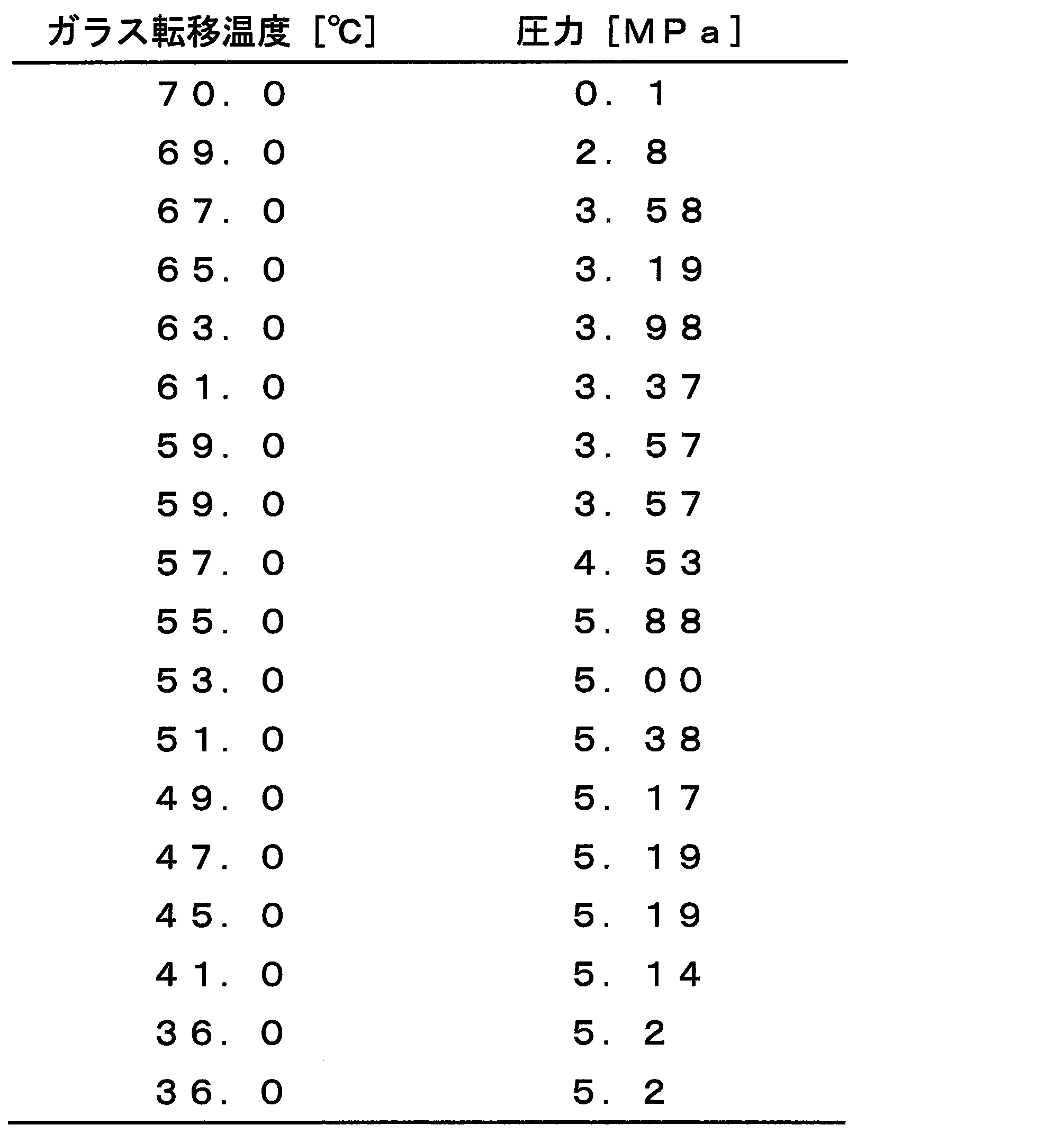
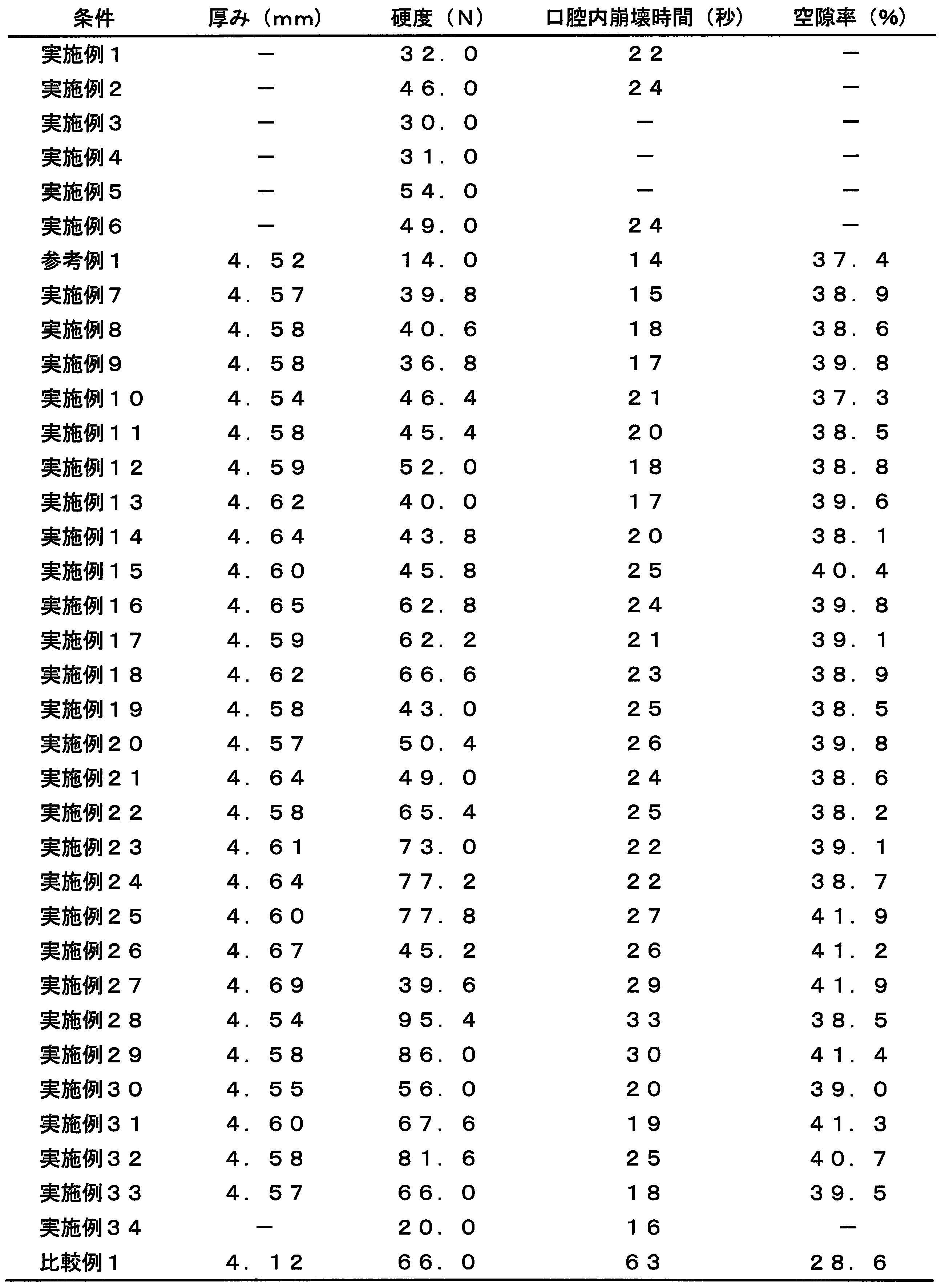
直打用マンニトール(Parteck M100、メルク製)99.0w/w%にステアリン酸マグネシウム(Parteck LUB MST、メルク製、以下特に断りが無い場合は同様)1.0w/w%を配合し、単発打錠機(オートグラフAGS-20kNG、島津製作所製、以下特に断りのない場合は同様)を用いて錠剤硬度約20N、錠剤厚みが約3.9mmとなるように打錠した(錠剤直径8.5mm)。
これらの錠剤を耐圧セルを用いて、二酸化炭素圧力10MPa、40℃で60分間処理後、減圧し、参考例2の錠剤を得た。
直打用マンニトール(Parteck M100、メルク製)79.0w/w%に表4記載の各種医薬添加剤20.0w/w%を混合した。この混合物にステアリン酸マグネシウム1.0w/w%を配合し、単発打錠機を用いて錠剤硬度約20N、錠剤厚みが約3.9mmとなるように打錠した(錠剤直径8.5mm)。
これらの錠剤を耐圧セルを用いて、二酸化炭素圧力6MPa、25℃で45分間処理後、減圧し、参考例3~8の錠剤を得た。
直打用マンニトール(Parteck M100、メルク製)79.0w/w%に表4記載の各種医薬添加剤20.0w/w%を混合した。この混合物にステアリン酸マグネシウム1.0w/w%を配合し、単発打錠機を用いて錠剤硬度約20N、錠剤厚みが約3.9mmとなるように打錠した(錠剤直径8.5mm)。
これらの錠剤を耐圧セルを用いて、二酸化炭素圧力10MPa、40℃で60分間処理後、減圧し、参考例9~24の錠剤を得た。
参考例2~24について二酸化炭素圧力処理前後の錠剤硬度をそれぞれ測定した。硬度は、錠剤硬度計(Tablet Hardness Tester、“Schleuniger”、Model 6D、Schleuniger社製)を用いて測定した。結果は表4に示す。
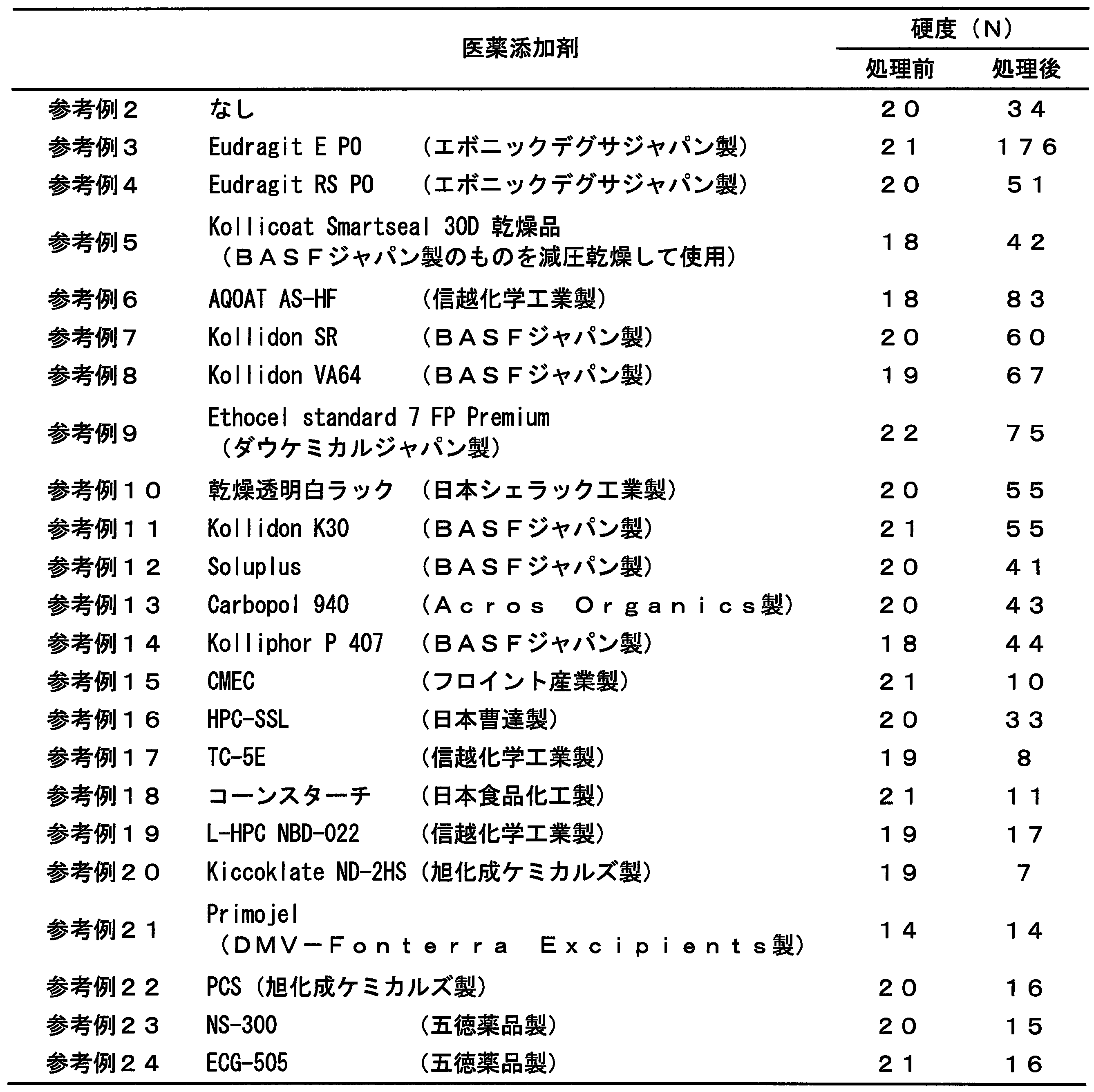
直打用マンニトール(Parteck M100、メルク製)79.0w/w%に平均粒子径10~20μmのコポリビドン(Kollidon VA64 Fine、BASFジャパン製)20.0w/w%を混合した。この混合物にステアリン酸マグネシウム1.0w/w%を配合し、単発打錠機を用いて錠剤硬度19N、錠剤厚みが約3.9mmの錠剤を得た(錠剤直径8.5mm)。この錠剤を耐圧セルを用いて、二酸化炭素圧力6MPa、25℃で45分間処理後、減圧し参考例25の錠剤を得た。
参考例25の錠剤について、打錠品および二酸化炭素処理したものの硬度をそれぞれ測定した。硬度は、錠剤硬度計(Tablet Hardness Tester、“Schleuniger”、Model 6D、Schleuniger社製)を用いて測定した。結果は表5に示す。

直打用マンニトール(Parteck M100、メルク製)79.0w/w%にエチルセルロース(Ethocel standard 7 FP Premium、ダウケミカル製)20.0w/w%を混合した。この混合物にステアリン酸マグネシウム1.0w/w%を配合し、単発打錠機を用いて錠剤硬度約20N、錠剤厚みが約3.9mmとなるように打錠した(錠剤直径8.5mm)。これらの錠剤を耐圧セルを用いて、二酸化炭素圧力6MPa、25℃で45分間処理後、減圧し、参考例26の錠剤を得た。
エチルセルロース(Ethocel standard 7 FP Premium、ダウケミカル製)13.5gとクエン酸トリエチル(Triethyl Citrate、東京化成製)1.5gをエタノール(エタノール99.5%、関東化学製)150gに溶解させ、スプレードライヤー(ミニスプレードライヤー B-290、ビュッヒ製、以下特に断りのない場合は同様)にて噴霧乾燥することでエチルセルロース/クエン酸トリエチル(9/1)噴霧乾燥品を得た。
直打用マンニトール(Parteck M100、メルク製)79.0w/w%にエチルセルロース/クエン酸トリエチル(9/1)噴霧乾燥品20.0w/w%を混合した。この混合物にステアリン酸マグネシウム1.0w/w%を配合し、単発打錠機を用いて錠剤硬度22N、錠剤厚みが約3.9mmの錠剤を得た(錠剤直径8.5mm)。この錠剤を耐圧セルを用いて、二酸化炭素圧力6MPa、25℃で45分間処理後、減圧し参考例27の錠剤を得た。
エチルセルロース(Ethocel standard 7 FP Premium、ダウケミカル製)11.25gとクエン酸トリエチル(Triethyl Citrate、東京化成製)3.75gをエタノール(エタノール99.5%、関東化学製)150gに溶解させ、スプレードライヤーにて噴霧乾燥することでエチルセルロース/クエン酸トリエチル(7.5/2.5)噴霧乾燥品を得た。
直打用マンニトール(Parteck M100、メルク製)79.0w/w%にエチルセルロース/クエン酸トリエチル(7.5/2.5)噴霧乾燥品20.0w/w%を混合した。この混合物にステアリン酸マグネシウム1.0w/w%を配合し、単発打錠機を用いて錠剤硬度20N、錠剤厚みが約3.9mmの錠剤を得た(錠剤直径8.5mm)。この錠剤を耐圧セルを用いて、二酸化炭素圧力6MPa、25℃で45分間処理後、減圧し参考例28の錠剤を得た。
参考例26~28の錠剤について、二酸化炭素処理前後の硬度をそれぞれ測定した。硬度は、錠剤硬度計(Tablet Hardness Tester、“Schleuniger”、Model 6D、Schleuniger社製)を用いて測定した。結果は表6に示す。

D-マンニトール(Pearitol 50C、ロケットジャパン製、以下特に断りが無い場合は同様)410gをコポリビドン(Kollidon VA64、BASFジャパン製)水溶液(10.0w/w%)100gを結合液として流動層造粒機(フローコーター FLO-1、フロイント産業/大河原製作所製、以下特に断りのない場合は同様)を用いて造粒した。この造粒物の一部にアミノアルキルメタクリレートコポリマーE(Eudragit EPO、エボニックデグサジャパン製、以後特に断りがなければ同様)10.0w/w%、クロスポビドン(Kollidon CL-F、BASFジャパン製)5.0w/w%を混合した。この混合物にステアリン酸マグネシウム1.0w/w%を配合し、ロータリー打錠機(HT-EXシリーズ、畑鐵工所製、以下特に断りが無い場合は同様)を用いて打錠圧約1kN/杵にて1錠あたり約170mgの錠剤を製した(錠剤直径8.5mm)。錠剤硬度は11N(n=10)であった。錠剤を耐圧セルを用いて、二酸化炭素圧力5MPa、25℃で5分間処理後、減圧し、本発明の速崩壊性錠剤を得た。なお減圧速度条件は、約1MPa/分で行った。
実施例35の錠剤を耐圧セルを用いて、二酸化炭素圧力4MPa、25℃で60分間処理後、減圧し、本発明の速崩壊性錠剤を得た。なお減圧速度条件は、約1MPa/分で行った。
実施例35の錠剤を耐圧セルを用いて、二酸化炭素圧力3MPa、25℃で840分間処理後、減圧し、本発明の速崩壊性錠剤を得た。なお減圧速度条件は、約1MPa/分で行った。
実施例35の錠剤を耐圧セルを用いて、二酸化炭素圧力4MPa、15℃で45分間処理後、減圧し、本発明の速崩壊性錠剤を得た。なお減圧速度条件は、約1MPa/分で行った。
実施例35の錠剤を耐圧セルを用いて、二酸化炭素圧力4MPa、45℃で45分間処理後、減圧し、本発明の速崩壊性錠剤を得た。なお減圧速度条件は、約1MPa/分で行った。
実施例35の錠剤を耐圧セルを用いて、二酸化炭素圧力3MPa、60℃で45分間処理後、減圧し、本発明の速崩壊性錠剤を得た。なお減圧速度条件は、約1MPa/分で行った。
エフメルト(富士化学製)89.0w/w%、アミノアルキルメタクリレートコポリマーE1.0w/w%、コポリビドン(Kollidon VA64、BASFジャパン製)9.0w/w%を混合した。この混合物にステアリン酸マグネシウム1.0w/w%を配合し、単発打錠機を用いて打錠圧約1.5kN/杵にて1錠あたり170mgの錠剤を製した(錠剤直径8.5mm)。錠剤硬度は12N(n=3)であった。錠剤を耐圧セルを用いて、二酸化炭素圧力3MPa、45℃で120分間処理後、減圧し、本発明の速崩壊性錠剤を得た。なお減圧速度条件は、約1MPa/分で行った。
D-マンニトール410gをコポリビドン(Kollidon VA64、BASFジャパン製)水溶液(10.0w/w%)100gを結合液として流動層造粒機を用いて造粒した。この造粒物の一部にアミノアルキルメタクリレートコポリマーE7.5w/w%、クロスポビドン(Kollidon CL-F、BASFジャパン製)10.0w/w%を混合した。この混合物にステアリン酸マグネシウム1.0w/w%を配合し、単発打錠機を用いて打錠圧約2.5kN/杵にて1錠あたり約190mgの錠剤を製した(錠剤直径8.5mm)。錠剤硬度は27N(n=2)であった。錠剤を耐圧セルを用いて、二酸化炭素圧力3MPa、45℃で120分間処理後、減圧し、本発明の速崩壊性錠剤を得た。なお減圧速度条件は、約1MPa/分で行った。
D-マンニトール410gをコポリビドン(Kollidon VA64、BASFジャパン製)水溶液(10.0w/w%)100gを結合液として流動層造粒機を用いて造粒した。この造粒物の一部にアミノアルキルメタクリレートコポリマーE20.0w/w%、クロスポビドン(Kollidon CL-F、BASFジャパン製)10.0w/w%を混合した。この混合物にステアリン酸マグネシウム1.0w/w%を配合し、単発打錠機を用いて打錠圧約2.0kN/杵にて1錠あたり約176mgの錠剤を製した(錠剤直径8.5mm)。錠剤硬度は37N(n=2)であった。錠剤を耐圧セルを用いて、二酸化炭素圧力1MPa、35℃で840分間処理後、減圧し、本発明の速崩壊性錠剤を得た。なお減圧速度条件は、約1MPa/分で行った。
D-マンニトール410gをコポリビドン(Kollidon VA64、BASFジャパン製)水溶液(5.0w/w%)50gとポビドン(Kollidon K30、BASFジャパン製)水溶液(5.0w/w%)50gの混液を結合液として流動層造粒機を用いて造粒した。この造粒物の一部にアミノアルキルメタクリレートコポリマーE10.0w/w%、クロスポビドン(Kollidon CL-F、BASFジャパン製)5.0w/w%を混合した。この混合物にステアリン酸マグネシウム1.0w/w%を配合し、ロータリー打錠機を用いて打錠圧約1.0kN/杵にて1錠あたり約171mgの錠剤を製した(錠剤直径8.5mm)。錠剤硬度は12N(n=10)であった。錠剤を耐圧セルを用いて、窒素圧力10MPaを加えた後、更に二酸化炭素圧力5.0MPa、25℃で45分間処理後、減圧し、本発明の速崩壊性錠剤を得た。なお減圧速度条件は、約1MPa/分で行った。
実施例44の錠剤を耐圧セルを用いて、二酸化炭素圧力5.0MPaを加えた後、更に窒素圧力5.0MPaを加え、25℃で45分間処理後、減圧し、本発明の速崩壊性錠剤を得た。なお減圧速度条件は、約1MPa/分で行った。
D-マンニトール410gをポビドン(Kollidon K30、BASFジャパン製)水溶液(10.0w/w%)100gを結合液として流動層造粒機を用いて造粒した。この造粒物の一部にアミノアルキルメタクリレートコポリマーE10.0w/w%、クロスポビドン(Kollidon CL-F、BASFジャパン製)5.0w/w%を混合した。この混合物にステアリン酸マグネシウム1.0w/w%を配合し、ロータリー打錠機を用いて打錠圧約1kN/杵にて1錠あたり約170mgの錠剤を製した(錠剤直径8.5mm)。錠剤硬度は13N(n=10)であった。錠剤を耐圧セルを用いて、二酸化炭素圧力4MPa、25℃で30分間処理後、減圧し、本発明の速崩壊性錠剤を得た。なお減圧速度条件は、約1MPa/分で行った。
D-マンニトール320gをポリビニルアルコール・アクリル酸・メタクリル酸メチル共重合体(POVACOAT Type F、大同化成工業製)水溶液(5.0w/w%)80gを結合液として流動層造粒機を用いて造粒した。この造粒物の一部にアミノアルキルメタクリレートコポリマーE10.0w/w%、クロスポビドン(Kollidon CL-F、BASFジャパン製)8.0w/w%を混合した。この混合物にステアリン酸マグネシウム1.0w/w%を配合し、単発打錠機を用いて打錠圧約1kN/杵にて1錠あたり約180mgの錠剤を製した(錠剤直径8.5mm)。錠剤硬度は16N(n=2)であった。錠剤を耐圧セルを用いて、二酸化炭素圧力4MPa、25℃で35分間処理後、減圧し、本発明の速崩壊性錠剤を得た。なお減圧速度条件は、約1MPa/分で行った。
D-マンニトール320gをヒドロキシプロピルセルロース(HPC-SSL、日本曹達製)水溶液(5.0w/w%)80gを結合液として流動層造粒機を用いて造粒した。この造粒物の一部にアミノアルキルメタクリレートコポリマーE10.0w/w%、クロスポビドン(Kollidon CL-F、BASFジャパン製)8.0w/w%を混合した。この混合物にステアリン酸マグネシウム1.0w/w%を配合し、単発打錠機を用いて打錠圧約1kN/杵にて1錠あたり約180mgの錠剤を製した(錠剤直径8.5mm)。錠剤硬度は12N(n=2)であった。錠剤を耐圧セルを用いて、二酸化炭素圧力4MPa、25℃で45分間処理後、減圧し、本発明の速崩壊性錠剤を得た。なお減圧速度条件は、約1MPa/分で行った。
D-マンニトール320gをヒプロメロース(TC-5E、信越化学工業製)水溶液(5.0w/w%)80gを結合液として流動層造粒機を用いて造粒した。この造粒物の一部にアミノアルキルメタクリレートコポリマーE10.0w/w%、クロスポビドン(Kollidon CL-F、BASFジャパン製)8.0w/w%を混合した。この混合物にステアリン酸マグネシウム1.0w/w%を配合し、単発打錠機を用いて打錠圧約1kN/杵にて1錠あたり約180mgの錠剤を製した(錠剤直径8.5mm)。錠剤硬度は12N(n=2)であった。錠剤を耐圧セルを用いて、二酸化炭素圧力4MPa、25℃で45分間処理後、減圧し、本発明の速崩壊性錠剤を得た。なお減圧速度条件は、約1MPa/分で行った。
D-マンニトール320gをポリビニルアルコール・ポリエチレングリコールグラフトコポリマー(Kollicoat IR、BASFジャパン製)水溶液(5.0w/w%)80gを結合液として流動層造粒機を用いて造粒した。この造粒物の一部にアミノアルキルメタクリレートコポリマーE10.0w/w%、クロスポビドン(Kollidon CL-F、BASFジャパン製)8.0w/w%を混合した。この混合物にステアリン酸マグネシウム1.0w/w%を配合し、単発打錠機を用いて打錠圧約1kN/杵にて1錠あたり約180mgの錠剤を製した(錠剤直径8.5mm)。錠剤硬度は12N(n=2)であった。錠剤を耐圧セルを用いて、二酸化炭素圧力4MPa、25℃で45分間処理後、減圧し、本発明の速崩壊性錠剤を得た。なお減圧速度条件は、約1MPa/分で行った。
D-マンニトール410gをコポリビドン(Kollidon VA64、BASFジャパン製)水溶液(10.0w/w%)100gを結合液として流動層造粒機を用いて造粒した。この造粒物の一部にアミノアルキルメタクリレートコポリマーE9.0w/w%、低置換度ヒドロキシプロピルセルロース(L-HPC NBD-022、信越化学工業製)9.0w/w%を混合した。この混合物にステアリン酸マグネシウム1.0w/w%を配合し、単発打錠機を用いて打錠圧約1kN/杵にて1錠あたり約185mgの錠剤を製した(錠剤直径8.5mm)。錠剤硬度は13N(n=3)であった。錠剤を耐圧セルを用いて、二酸化炭素圧力4MPa、25℃で35分間処理後、減圧し、本発明の速崩壊性錠剤を得た。なお減圧速度条件は、約1MPa/分で行った。
D-マンニトール410gをコポリビドン(Kollidon VA64、BASFジャパン製)水溶液(10.0w/w%)100gを結合液として流動層造粒機を用いて造粒した。この造粒物の一部にアミノアルキルメタクリレートコポリマーE10.0w/w%、クロスカルメロースナトリウム(Kiccolate ND-2HS、旭化成ケミカルズ製)5.0w/w%を混合した。この混合物にステアリン酸マグネシウム1.0w/w%を配合し、単発打錠機を用いて打錠圧約1kN/杵にて1錠あたり約180mgの錠剤を製した(錠剤直径8.5mm)。錠剤硬度は12N(n=3)であった。錠剤を耐圧セルを用いて、二酸化炭素圧力4MPa、25℃で10分間処理後、減圧し、本発明の速崩壊性錠剤を得た。なお減圧速度条件は、約1MPa/分で行った。
D-マンニトール410gをコポリビドン(Kollidon VA64、BASFジャパン製)水溶液(10.0w/w%)100gを結合液として流動層造粒機を用いて造粒した。この造粒物の一部にアミノアルキルメタクリレートコポリマーE9.0w/w%、部分アルファー化デンプン(PCS、旭化成ケミカルズ製)9.0w/w%を混合した。この混合物にステアリン酸マグネシウム1.0w/w%を配合し、単発打錠機を用いて打錠圧約1kN/杵にて1錠あたり約180mgの錠剤を製した(錠剤直径8.5mm)。錠剤硬度は9N(n=3)であった。錠剤を耐圧セルを用いて、二酸化炭素圧力4MPa、25℃で35分間処理後、減圧し、本発明の速崩壊性錠剤を得た。なお減圧速度条件は、約1MPa/分で行った。
D-マンニトール410gをコポリビドン(Kollidon VA64、BASFジャパン製)水溶液(10.0w/w%)100gを結合液として流動層造粒機を用いて造粒した。この造粒物の一部にアミノアルキルメタクリレートコポリマーE9.0w/w%、カルボキシメチルスターチナトリウム(Primojel、DMV-Fonterra Excipients製)9.0w/w%を混合した。この混合物にステアリン酸マグネシウム1.0w/w%を配合し、単発打錠機を用いて打錠圧約1kN/杵にて1錠あたり約185mgの錠剤を製した(錠剤直径8.5mm)。錠剤硬度は8N(n=3)であった。錠剤を耐圧セルを用いて、二酸化炭素圧力4MPa、25℃で10分間処理後、減圧し、本発明の速崩壊性錠剤を得た。なお減圧速度条件は、約1MPa/分で行った。
D-マンニトール410gをコポリビドン(Kolidon VA64、BASFジャパン製)水溶液(10.0w/w%)100gを結合液として流動層造粒機を用いて造粒した。この造粒物の一部にアミノアルキルメタクリレートコポリマーE10.0w/w%、カルメロースカルシウム(ECG-505、五徳薬品製)5.0w/w%を混合した。この混合物にステアリン酸マグネシウム1.0w/w%を配合し、単発打錠機を用いて打錠圧約1kN/杵にて1錠あたり約181mgの錠剤を製した(錠剤直径8.5mm)。錠剤硬度は10N(n=3)であった。錠剤を耐圧セルを用いて、二酸化炭素圧力4MPa、25℃で10分間処理後、減圧し、本発明の速崩壊性錠剤を得た。なお減圧速度条件は、約1MPa/分で行った。
D-マンニトール410gをコポリビドン(Kollidon VA64、BASFジャパン製)水溶液(10.0w/w%)100gを結合液として流動層造粒機を用いて造粒した。この造粒物の一部にアミノアルキルメタクリレートコポリマーE9.0w/w%、アルファー化デンプン(SWELSTAR PD-1、旭化成ケミカルズ製)9.0w/w%を混合した。この混合物にステアリン酸マグネシウム1.0w/w%を配合し、単発打錠機を用いて打錠圧約1kN/杵にて1錠あたり約184mgの錠剤を製した(錠剤直径8.5mm)。錠剤硬度は8N(n=3)であった。錠剤を耐圧セルを用いて、二酸化炭素圧力4MPa、25℃で35分間処理後、減圧し、本発明の速崩壊性錠剤を得た。なお減圧速度条件は、約1MPa/分で行った。
D-マンニトール410gをコポリビドン(Kollidon VA64、BASFジャパン製)水溶液(10.0w/w%)100gを結合液として流動層造粒機を用いて造粒した。この造粒物の一部にアミノアルキルメタクリレートコポリマーE9.0w/w%、カルメロース(NS-300、五徳薬品製)9.0w/w%を混合した。この混合物にステアリン酸マグネシウム1.0w/w%を配合し、単発打錠機を用いて打錠圧約1kN/杵にて1錠あたり約181mgの錠剤を製した(錠剤直径8.5mm)。錠剤硬度は11N(n=3)であった。錠剤を耐圧セルを用いて、二酸化炭素圧力4MPa、25℃で10分間処理後、減圧し、本発明の速崩壊性錠剤を得た。なお減圧速度条件は、約1MPa/分で行った。
D-マンニトール410gをポビドン(Kollidon VA64、BASFジャパン製)水溶液(10.0w/w%)100gを結合液として流動層造粒機を用いて造粒した。この造粒物7.59gにアセトアミノフェン(山本化学工業製)0.56g、アミノアルキルメタクリレートコポリマーE1.0g、クロスポビドン(Kollidon CL-F、BASFジャパン製)0.75gを混合した。この混合物にステアリン酸マグネシウム0.10gを配合し、単発打錠機を用いて打錠圧約1kN/杵にて1錠あたり約180mgの錠剤を製した(錠剤直径8.5mm)。錠剤硬度は12N(n=3)であった。錠剤を耐圧セルを用いて、二酸化炭素圧力4MPa、25℃で25分間処理後、減圧し、本発明の速崩壊性錠剤を得た。なお減圧速度条件は、約1MPa/分で行った。
D-マンニトール410gをポビドン(Kollidon K30、BASFジャパン製)水溶液(10.0w/w%)100gを結合液として流動層造粒機を用いて造粒した。この造粒物7.04gにファモチジン(アステラス製薬製)1.11g、アミノアルキルメタクリレートコポリマーE1.0g、クロスポビドン(Kollidon CL-F、BASFジャパン製)0.75gを混合した。この混合物にステアリン酸マグネシウム0.10gを配合し、単発打錠機を用いて打錠圧約1kN/杵にて1錠あたり約180mgの錠剤を製した(錠剤直径8.5mm)。錠剤硬度は16N(n=3)であった。錠剤を耐圧セルを用いて、二酸化炭素圧力4MPa、25℃で25分間処理後、減圧し、本発明の速崩壊性錠剤を得た。なお減圧速度条件は、約1MPa/分で行った。
D-マンニトール410gをポビドン(Kollidon K30、BASFジャパン製)水溶液(10.0w/w%)100gを結合液として流動層造粒機を用いて造粒した。この造粒物8.09gにタムスロシン塩酸塩(アステラス製薬製)0.056g、アミノアルキルメタクリレートコポリマーE1.0g、クロスポビドン(Kollidon CL-F、BASFジャパン製)0.75gを混合した。この混合物にステアリン酸マグネシウム0.10gを配合し、単発打錠機を用いて打錠圧約1kN/杵にて1錠あたり約180mgの錠剤を製した(錠剤直径8.5mm)。錠剤硬度は17N(n=3)であった。錠剤を耐圧セルを用いて、二酸化炭素圧力4MPa、25℃で25分間処理後、減圧し、本発明の速崩壊性錠剤を得た。なお減圧速度条件は、約1MPa/分で行った。
D-マンニトール410gをコポリビドン(Kollidon VA64、BASFジャパン製)水溶液(10.0w/w%)100gを結合液として流動層造粒機を用いて造粒した。この造粒物の一部にHPMCAS(AQOAT AS-HF、信越化学工業製)20.0w/w%、クロスポビドン(Kollidon CL-F、BASFジャパン製)8.0w/w%を混合した。この混合物にステアリン酸マグネシウム1.0w/w%を配合し、単発打錠機を用いて打錠圧約1kN/杵にて1錠あたり約176mgの錠剤を製した(錠剤直径8.5mm)。錠剤硬度は25N(n=3)であった。錠剤を耐圧セルを用いて、二酸化炭素圧力5MPa、25℃で45分間処理後、減圧し、本発明の速崩壊性錠剤を得た。なお減圧速度条件は、約1MPa/分で行った。
D-マンニトール410gをコポリビドン(Kollidon VA64、BASFジャパン製)水溶液(10.0w/w%)100gを結合液として流動層造粒機を用いて造粒した。この造粒物の一部にHPMCAS(AQOAT AS-HF、信越化学工業製)15.0w/w%、クロスポビドン(Kollidon CL-F、BASFジャパン製)8.0w/w%を混合した。この混合物にステアリン酸マグネシウム1.0w/w%を配合し、単発打錠機を用いて打錠圧約1kN/杵にて1錠あたり約176mgの錠剤を製した(錠剤直径8.5mm)。錠剤硬度は25N(n=3)であった。錠剤を耐圧セルを用いて、二酸化炭素圧力5MPa、45℃で840分間処理後、減圧し、本発明の速崩壊性錠剤を得た。なお減圧速度条件は、約1MPa/分で行った。
実施例62の錠剤を耐圧セルを用いて、二酸化炭素圧力5MPa、60℃で45分間処理後、減圧し、本発明の速崩壊性錠剤を得た。なお減圧速度条件は、約1MPa/分で行った。
D-マンニトール410gをポビドン(Kollidon K30、BASFジャパン製)水溶液(10.0w/w%)100gを結合液として流動層造粒機を用いて造粒した。この造粒物の一部にエチルセルロース(Ethocel standard 7 FP Premium、ダウケミカル製)15.0w/w%、クロスポビドン(Kollidon CL-F、BASFジャパン製)8.0w/w%、l-メントール(関東化学製)1.0w/w%を混合した。この混合物にステアリン酸マグネシウム1.0w/w%を配合し、単発打錠機を用いて打錠圧約1kN/杵にて1錠あたり約171mgの錠剤を製した(錠剤直径8.5mm)。錠剤硬度は21N(n=3)であった。錠剤を耐圧セルを用いて、二酸化炭素圧力5MPa、60℃で45分間処理後、減圧し、本発明の速崩壊性錠剤を得た。なお減圧速度条件は、約1MPa/分で行った。
実施例35の錠剤を耐圧セルを用いて、二酸化炭素圧力3.5MPa、25℃で120分間処理後、減圧し、本発明の速崩壊性錠剤を得た。なお減圧速度条件は、約1MPa/分で行った。
実施例46の錠剤を耐圧セルを用いて、二酸化炭素圧力3.5MPa、25℃で120分間処理後、減圧し、本発明の速崩壊性錠剤を得た。なお減圧速度条件は、約1MPa/分で行った。
実施例44の錠剤を耐圧セルを用いて、二酸化炭素圧力3.5MPa、25℃で120分間処理後、減圧し、本発明の速崩壊性錠剤を得た。なお減圧速度条件は、約1MPa/分で行った。
D-マンニトール415gをポビドン(Kollidon K30、BASFジャパン製)水溶液(5.0w/w%)100gを結合液として流動層造粒機を用いて造粒した。この造粒物の一部にアミノアルキルメタクリレートコポリマーE10.0w/w%、クロスポビドン(Kollidon CL-F、BASFジャパン製)5.0w/w%を混合した。この混合物にステアリン酸マグネシウム1.0w/w%を配合し、ロータリー打錠機を用いて打錠圧約1kN/杵にて1錠あたり約171mgの錠剤を製した(錠剤直径8.5mm)。錠剤硬度は10N(n=10)であった。錠剤を耐圧セルを用いて、二酸化炭素圧力4MPa、25℃で40分間処理後、減圧し、本発明の速崩壊性錠剤を得た。なお減圧速度条件は、約1MPa/分で行った。
D-マンニトール415gをポビドン(Kollidon K30、BASFジャパン製)水溶液(5.0w/w%)100gを結合液として流動層造粒機を用いて造粒した。この造粒物の一部にアミノアルキルメタクリレートコポリマーE10.0w/w%、クロスポビドン(Kollidon CL-F、BASFジャパン製)5.0w/w%を混合した。この混合物にステアリン酸マグネシウム1.0w/w%を配合し、ロータリー打錠機を用いて打錠圧約1.8kN/杵にて1錠あたり約186mgの錠剤を製した(錠剤直径8.5mm)。錠剤硬度は19N(n=10)であった。錠剤を耐圧セルを用いて、二酸化炭素圧力3.5MPa、25℃で90分間処理後、減圧し、本発明の速崩壊性錠剤を得た。なお減圧速度条件は、約1MPa/分で行った。
実施例35の錠剤を大気下で、60℃で45分間の処理後、比較例2の錠剤を得た。
実施例69の錠剤を大気下で、70℃で840分間の処理後、比較例3の錠剤を得た。
実施例70の錠剤を大気下で、70℃で840分間の処理後、比較例4の錠剤を得た。
実施例35~69、比較例2~4の錠剤について、硬度をそれぞれ測定した。硬度は、錠剤硬度計(Tablet Hardness Tester、“Schleuniger”、Model 6D、Schleuniger社製)を用いて測定した。結果は表7に示す。
実施例35~69、比較例2~4の錠剤について口腔内崩壊時間を測定した。口腔内崩壊時間は、口腔内崩壊試験機(トリコープテスタ、岡田精工社製)を用いて測定した。結果は表7に示す。
実施例35~69、比較例2~4の錠剤について厚みを測定した(n=5)。錠剤の厚みは、デジマチックインジケータ(Mitutoyo Absolute、ミツトヨ社製)を用いて測定した。結果は表7に示す。
実施例65~69、比較例3~4の速崩壊性錠剤をPTPシート(34×111mm、7錠×2列/枚)に包装し、以下の条件で落下試験を行った。
・落下高さ:150cm
・落下繰り返し回数:10回
・試験を行うPTPシート数:10枚
・PTPシートの向き:薬剤収納部(ポケット)を上とする
・破損率:(割れ及び/または欠けが発生した速崩壊性錠剤数)/140×100
結果は表7に示す。

詳細には実施例35~43においては、アミノアルキルメタクリレートコポリマーEの添加量、二酸化炭素処理圧力、処理温度、処理時間を適切に組み合わせることで本発明の速崩壊性錠剤が得られることを確認した。比較例2においては大気下で60℃45分加熱処理を施したが、錠剤硬度の上昇は認められていなかった。その一方で、実施例35においては二酸化炭素圧力5MPa下で25℃5分の処理をすることで顕著な錠剤硬度の上昇を確認したことから、室温付近のマイルドな温度環境下でも錠剤硬度上昇が達成されることが確認できた。
実施例44~45においては、二酸化炭素を窒素と併用することで同様に錠剤硬度の上昇を誘導できることが確認された。本結果から、本発明には二酸化炭素に加えてその他のガスも利用できる可能性が示された。
実施例46~50においては造粒工程に使用される結合剤としてポビドンやポリビニルアルコール・アクリル酸・メタクリル酸メチル共重合体といった各種汎用結合剤が使用可能であることが示された。
実施例51~57においては、崩壊剤として低置換度ヒドロキシルプロピセルロース、クロスカルメロースナトリウムや部分アルファー化デンプンといった各種汎用崩壊剤を利用することで本発明の速崩壊性錠剤を得られることが示された。
実施例58~60においては、モデル薬物を含有する製剤においても同様の性能を有する速崩壊性錠剤を得られることが確認された。
実施例61~64においては、HPMCASあるいはエチルセルロースと二酸化炭素圧力処理を組み合わせることでもアミノアルキルメタクリレートコポリマーE同様に錠剤硬度を高めることができ、本発明の速崩壊性錠剤が得られることが示された。このことから、参考例で二酸化炭素圧力によって錠剤硬度を高める機能を有した成分に代表される添加剤群についても、適切な処方設計をすることで本発明の速崩壊性錠剤が得られる可能性が示された。
実施例65~69については落下試験における破損率を評価したがいずれも0~0.7%の非常に低い破損率を確認した。その一方で、実施例68、69と同一処方の速崩壊性錠剤を二酸化炭素ではなく加熱処理によって同程度の錠剤硬度に高めた比較例3、4については、2.1~5%と相対的に高い破損率を示した。本発明の速崩壊性錠剤は耐破損性にも優れることが明らかとなった。
コハク酸ソリフェナシン(アステラス製薬製)を含有し、苦みマスキング機能を有する微粒子80.7gをコポリビドン(Kollidon VA64、BASFジャパン製)水溶液(10.0w/w%)100gを結合液として流動層造粒機を用いて造粒した。この造粒物にアミノアルキルメタクリレートコポリマーE10.0w/w%、クロスポビドン(Kollidon CL-F、BASFジャパン製)5.0w/w%を混合した。この混合物にステアリン酸マグネシウム1.0w/w%を配合し、単発打錠機を用いて打錠圧約1kN/杵にて1錠あたり約150mgの錠剤(コハク酸ソリフェナシン含量5mg)を製した(錠剤直径7.5mm)。錠剤硬度は10N(n=3)であった。錠剤を耐圧セルを用いて、二酸化炭素圧力5MPa、35℃で30分間処理後、減圧し、本発明の速崩壊性錠剤を得た。なお減圧速度条件は、約1MPa/分で行った。
実施例70の錠剤を大気下で、70℃で840分間加熱処理を施して比較例5の錠剤を得た。
実施例70の速崩壊性錠剤および比較例5の錠剤について、硬度をそれぞれ測定した。硬度は、錠剤硬度計(Tablet Hardness Tester、“Schleuniger”、Model 6D、Schleuniger社製)を用いて測定した。結果は表8に示す。
実施例70で使用した苦みマスキング粒子、実施例70の速崩壊性錠剤、および比較例5の錠剤について溶出試験を行った。溶出試験装置はDissolution tester NTR-6100A(富山化学製)を使用し、コハク酸ソリフェナシンの溶出率については液体クロマトグラフィー(島津製作所製)を用いて測定した。試験条件を下記に示す。
・パドル法 50rpm
・試験液:日局崩壊試験第2液(pH6.8) 900mL
・試験液温度:37℃±0.5℃
・サンプリングタイム:2分、30分
結果は表8に示す。
実施例70で使用した苦みマスキング粒子、実施例70の速崩壊性錠剤、および比較例5の錠剤について、コハク酸ソリフェナシン及びその分解物の総量に対する、最も量が多い分解物の生成量(以下、主分解物の生成量と略すことがある)、及びコハク酸ソリフェナシン及びその分解物の総量に対する総分解物量(以下、分解物総量と略すことがある)を測定した。結果は表8に示す。
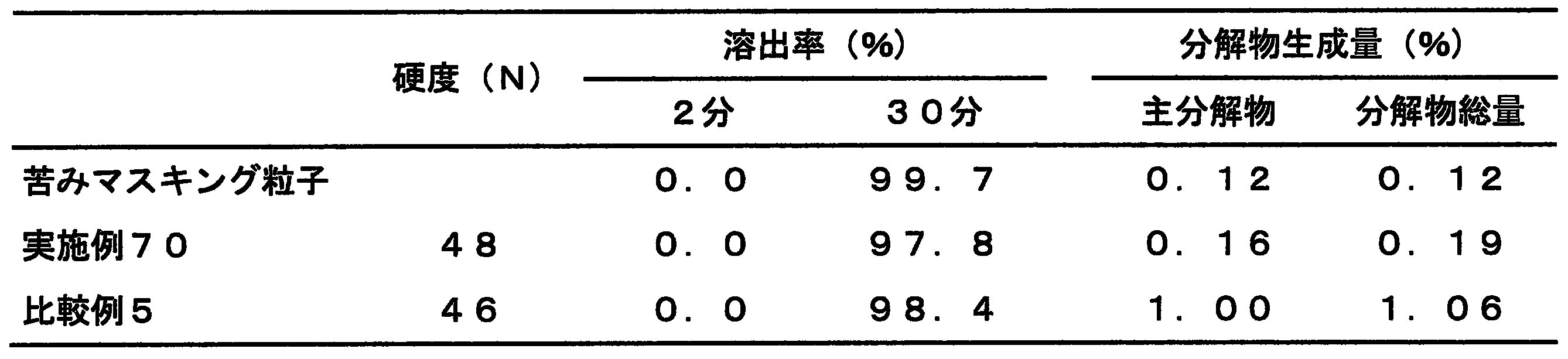
以上、本発明を特定の態様に沿って説明したが、当業者に自明の変形や改良は本発明の範囲に含まれる。
Claims (25)
- 薬物、及び超臨界もしくは亜臨界状態にある二酸化炭素または液体もしくは気体二酸化炭素で処理することにより結合剤の機能を有する物質を含有し、超臨界もしくは亜臨界状態にある二酸化炭素または液体もしくは気体二酸化炭素で処理して得られる速崩壊性錠剤。
- 超臨界もしくは亜臨界状態にある二酸化炭素または液体もしくは気体二酸化炭素で処理することにより結合剤の機能を有する物質が、超臨界もしくは亜臨界状態にある二酸化炭素または液体もしくは気体二酸化炭素で処理することにより融点またはガラス転移温度が降下する物質である、請求項1に記載の速崩壊性錠剤。
- 超臨界もしくは亜臨界状態にある二酸化炭素または液体もしくは気体二酸化炭素で処理することにより結合剤の機能を有する物質が、ビニルピロリドン・酢酸ビニル共重合物、ポリビニルカプロラクタム-ポリビニル酢酸-ポリエチレングリコールグラフトコポリマー、ポビドン、ポビドン/酢酸ビニル樹脂 プレミックス製剤、メタクリル酸コポリマーLD、ポリビニルアルコール・ポリエチレングリコールグラフトコポリマー、ポリビニルアルコール・ポリエチレングリコールグラフトコポリマー/ポリビニルアルコール プレミックス製剤、ポリオキシエチレン(196)ポリオキシプロピレン(67)グリコール、マクロゴール、ポリオキシエチレン硬化ヒマシ油(40)、アミノアルキルメタクリレートコポリマーE、メタクリル酸コポリマーL、乾燥メタクリル酸コポリマーLD、メタクリル酸コポリマーLD、メタクリル酸コポリマーS、アミノアルキルメタクリレートコポリマーRS、アクリル酸エチル・メタクリル酸メチルコポリマー分散液、エチルセルロース、メチルメタクリレート・ジエチルアミノエチルメタクリレート共重合体、ヒドロキシプロピルメチルセルロースアセテートサクシネート、セラック、カーボマー、及びポリビニルアセタールジエチルアミノアセテートからなる群より選択される1種または2種以上である、請求項1または2に記載の速崩壊性錠剤。
- 超臨界もしくは亜臨界状態にある二酸化炭素または液体もしくは気体二酸化炭素で処理することにより結合剤の機能を有する物質が、錠剤の重量に対し0.1重量%以上50重量%以下である、請求項1~3のいずれか一項に記載の速崩壊性錠剤。
- 更に、可塑剤を含む請求項1~4のいずれか一項に記載の速崩壊性錠剤。
- 更に、崩壊剤を含む請求項1~5のいずれか一項に記載の速崩壊性錠剤。
- 錠剤硬度が20N以上である、請求項1~6のいずれか一項に記載の速崩壊性錠剤。
- 落下試験による破損錠数の割合が5%以下の、請求項1~7のいずれか一項に記載の速崩壊性錠剤。
- 速崩壊性錠剤が口腔内崩壊錠である、請求項1~8のいずれか一項に記載の速崩壊性錠剤。
- 口腔内崩壊時間が120秒以内である、請求項9に記載の速崩壊性錠剤。
- 薬物が、温度もしくは湿度に不安定な薬物及び/または機能性粒子を構成する、請求項1~10のいずれか一項に記載の速崩壊性錠剤。
- 機能性粒子が、難溶性薬物からなる固体分散体粒子、苦味マスキング粒子、及び徐放性粒子からなる群より選択される1種または2種以上の粒子である、請求項11に記載の速崩壊性錠剤。
- (1)薬物と、超臨界もしくは亜臨界状態にある二酸化炭素または液体もしくは気体二酸化炭素で処理することにより結合剤の機能を有する物質とを混合する工程、
(2)(1)の混合物を圧縮成形して錠剤を調製する工程、及び
(3)(2)の錠剤を、超臨界もしくは亜臨界状態にある二酸化炭素または液体もしくは気体二酸化炭素で処理する工程
を含む、速崩壊性錠剤の製造方法。 - 超臨界もしくは亜臨界状態にある二酸化炭素または液体もしくは気体二酸化炭素で処理することにより結合剤の機能を有する物質が、超臨界もしくは亜臨界状態にある二酸化炭素または液体もしくは気体二酸化炭素で処理することにより融点またはガラス転移温度が降下する物質である、請求項13に記載の速崩壊性錠剤の製造方法。
- 超臨界もしくは亜臨界状態にある二酸化炭素または液体もしくは気体二酸化炭素で処理することにより結合剤の機能を有する物質が、ビニルピロリドン・酢酸ビニル共重合物、ポリビニルカプロラクタム-ポリビニル酢酸-ポリエチレングリコールグラフトコポリマー、ポビドン、ポビドン/酢酸ビニル樹脂 プレミックス製剤、メタクリル酸コポリマーLD、ポリビニルアルコール・ポリエチレングリコールグラフトコポリマー、ポリビニルアルコール・ポリエチレングリコールグラフトコポリマー/ポリビニルアルコール プレミックス製剤、ポリオキシエチレン(196)ポリオキシプロピレン(67)グリコール、マクロゴール、ポリオキシエチレン硬化ヒマシ油(40)、アミノアルキルメタクリレートコポリマーE、メタクリル酸コポリマーL、乾燥メタクリル酸コポリマーLD、メタクリル酸コポリマーLD、メタクリル酸コポリマーS、アミノアルキルメタクリレートコポリマーRS、アクリル酸エチル・メタクリル酸メチルコポリマー分散液、エチルセルロース、メチルメタクリレート・ジエチルアミノエチルメタクリレート共重合体、ヒドロキシプロピルメチルセルロースアセテートサクシネート、セラック、及びカーボマーからなる群より選択される1種または2種以上である、請求項13または14に記載の速崩壊性錠剤の製造方法。
- 超臨界もしくは亜臨界状態にある二酸化炭素または液体もしくは気体二酸化炭素で処理することにより結合剤の機能を有する物質が、錠剤の重量に対し0.1重量%以上50重量%以下である、請求項13~15のいずれか一項に記載の速崩壊性錠剤の製造方法。
- 更に、可塑剤を含む請求項13~16のいずれか一項に記載の速崩壊性錠剤の製造方法。
- 更に、崩壊剤を含む請求項13~17のいずれか一項に記載の速崩壊性錠剤の製造方法。
- 錠剤硬度が20N以上である、請求項13~18のいずれか一項に記載の速崩壊性錠剤の製造方法。
- 速崩壊性錠剤が口腔内崩壊錠である、請求項13~19のいずれか一項に記載の速崩壊性錠剤の製造方法。
- 口腔内崩壊時間が120秒以内である、請求項20に記載の速崩壊性錠剤の製造方法。
- 薬物が、温度もしくは湿度に不安定な薬物及び/または機能性粒子を構成する、請求項13~21のいずれか一項に記載の速崩壊性錠剤の製造方法。
- 機能性粒子が、難溶性薬物からなる固体分散体粒子、苦味マスキング粒子、及び徐放性粒子からなる群より選択される1種または2種以上の粒子である、請求項22に記載の速崩壊性錠剤の製造方法。
- 0.1MPa以上50MPa以下、かつ-40℃以上100℃以下の二酸化炭素で処理することを含む、請求項13~23のいずれか一項に記載の速崩壊性錠剤の製造方法。
- 気体二酸化炭素により処理した、請求項13~24のいずれか一項に記載の速崩壊性錠剤の製造方法。
Priority Applications (4)
| Application Number | Priority Date | Filing Date | Title |
|---|---|---|---|
| JP2014502409A JP6098634B2 (ja) | 2012-03-02 | 2013-03-01 | 速崩壊性錠剤 |
| KR1020147027362A KR102092423B1 (ko) | 2012-03-02 | 2013-03-01 | 속붕괴성 정제 |
| CN201380012176.2A CN104168891B (zh) | 2012-03-02 | 2013-03-01 | 速崩性片剂 |
| PH12014501772A PH12014501772B1 (en) | 2012-03-02 | 2014-08-06 | Rapidly disintegrating tablet |
Applications Claiming Priority (4)
| Application Number | Priority Date | Filing Date | Title |
|---|---|---|---|
| JP2012046501 | 2012-03-02 | ||
| JP2012-046501 | 2012-03-02 | ||
| JP2012239773 | 2012-10-31 | ||
| JP2012-239773 | 2012-10-31 |
Publications (1)
| Publication Number | Publication Date |
|---|---|
| WO2013129644A1 true WO2013129644A1 (ja) | 2013-09-06 |
Family
ID=49082831
Family Applications (1)
| Application Number | Title | Priority Date | Filing Date |
|---|---|---|---|
| PCT/JP2013/055634 Ceased WO2013129644A1 (ja) | 2012-03-02 | 2013-03-01 | 速崩壊性錠剤 |
Country Status (6)
| Country | Link |
|---|---|
| JP (1) | JP6098634B2 (ja) |
| KR (1) | KR102092423B1 (ja) |
| CN (1) | CN104168891B (ja) |
| PH (1) | PH12014501772B1 (ja) |
| TW (1) | TWI612975B (ja) |
| WO (1) | WO2013129644A1 (ja) |
Cited By (6)
| Publication number | Priority date | Publication date | Assignee | Title |
|---|---|---|---|---|
| WO2014034860A1 (ja) * | 2012-08-31 | 2014-03-06 | アステラス製薬株式会社 | 経口投与用医薬組成物 |
| EP2848242A1 (en) * | 2013-09-12 | 2015-03-18 | Sanovel Ilac Sanayi ve Ticaret A.S. | Orally disintegrating formulations of Linagliptin |
| EP2848241A1 (en) * | 2013-09-12 | 2015-03-18 | Sanovel Ilac Sanayi ve Ticaret A.S. | Effervescent formulations of linagliptin |
| WO2020213589A1 (ja) * | 2019-04-15 | 2020-10-22 | 三生医薬株式会社 | 錠剤及び錠剤の製造方法 |
| US11344562B2 (en) | 2017-08-15 | 2022-05-31 | Nephron Pharmaceuticals Corporation | Aqueous nebulization composition |
| CN116687871A (zh) * | 2023-06-07 | 2023-09-05 | 江西众诚方源制药有限公司 | 一种动物用高载药量非甾体抗炎药口腔崩解片及其制备工艺 |
Families Citing this family (2)
| Publication number | Priority date | Publication date | Assignee | Title |
|---|---|---|---|---|
| CN105194677A (zh) * | 2014-06-23 | 2015-12-30 | 天津金耀集团有限公司 | 乳糖塞来昔布药物组合物 |
| CN112979964B (zh) * | 2021-02-22 | 2022-05-31 | 烟台大学 | 一种高韧性虫胶及其制备方法 |
Citations (3)
| Publication number | Priority date | Publication date | Assignee | Title |
|---|---|---|---|---|
| WO2004096280A1 (ja) * | 2003-04-29 | 2004-11-11 | Kowa Co., Ltd. | 超難水溶性薬物含有組成物及びその製造法 |
| JP2007516977A (ja) * | 2003-12-17 | 2007-06-28 | パンテック・アーゲー | 速崩壊性錠剤 |
| WO2010058924A2 (ko) * | 2008-11-21 | 2010-05-27 | 씨제이 제일제당(주) | 구강내 속붕해정 및 그 제조방법 |
Family Cites Families (6)
| Publication number | Priority date | Publication date | Assignee | Title |
|---|---|---|---|---|
| ATE253899T1 (de) | 1994-01-31 | 2003-11-15 | Yamanouchi Pharma Co Ltd | Intraoral löslicher formpressling und verfahren zu seiner herstellung |
| JPH1133084A (ja) | 1994-02-10 | 1999-02-09 | Yamanouchi Pharmaceut Co Ltd | 口腔内溶解型錠剤およびその製造方法 |
| JP2919771B2 (ja) | 1995-04-17 | 1999-07-19 | 佐藤製薬株式会社 | 速溶解性錠剤の製造方法及び該製造方法により製造した速溶解性錠剤 |
| CN1473036A (zh) | 2001-05-10 | 2004-02-04 | ֮����ҩ��ʽ���� | 口腔内迅速崩解性片剂及其制造方法 |
| JP2006076971A (ja) | 2004-09-13 | 2006-03-23 | Basf Ag | 口腔内崩壊錠 |
| WO2006070845A1 (ja) | 2004-12-28 | 2006-07-06 | Eisai R & D Management Co., Ltd. | 速崩壊性錠剤及びその製造方法 |
-
2013
- 2013-02-26 TW TW102106726A patent/TWI612975B/zh active
- 2013-03-01 CN CN201380012176.2A patent/CN104168891B/zh active Active
- 2013-03-01 WO PCT/JP2013/055634 patent/WO2013129644A1/ja not_active Ceased
- 2013-03-01 KR KR1020147027362A patent/KR102092423B1/ko active Active
- 2013-03-01 JP JP2014502409A patent/JP6098634B2/ja active Active
-
2014
- 2014-08-06 PH PH12014501772A patent/PH12014501772B1/en unknown
Patent Citations (3)
| Publication number | Priority date | Publication date | Assignee | Title |
|---|---|---|---|---|
| WO2004096280A1 (ja) * | 2003-04-29 | 2004-11-11 | Kowa Co., Ltd. | 超難水溶性薬物含有組成物及びその製造法 |
| JP2007516977A (ja) * | 2003-12-17 | 2007-06-28 | パンテック・アーゲー | 速崩壊性錠剤 |
| WO2010058924A2 (ko) * | 2008-11-21 | 2010-05-27 | 씨제이 제일제당(주) | 구강내 속붕해정 및 그 제조방법 |
Cited By (11)
| Publication number | Priority date | Publication date | Assignee | Title |
|---|---|---|---|---|
| WO2014034860A1 (ja) * | 2012-08-31 | 2014-03-06 | アステラス製薬株式会社 | 経口投与用医薬組成物 |
| EP2848242A1 (en) * | 2013-09-12 | 2015-03-18 | Sanovel Ilac Sanayi ve Ticaret A.S. | Orally disintegrating formulations of Linagliptin |
| EP2848241A1 (en) * | 2013-09-12 | 2015-03-18 | Sanovel Ilac Sanayi ve Ticaret A.S. | Effervescent formulations of linagliptin |
| US11344562B2 (en) | 2017-08-15 | 2022-05-31 | Nephron Pharmaceuticals Corporation | Aqueous nebulization composition |
| US12303520B2 (en) | 2017-08-15 | 2025-05-20 | Nephron Pharmaceuticals Corporation | Aqueous nebulization composition |
| WO2020213589A1 (ja) * | 2019-04-15 | 2020-10-22 | 三生医薬株式会社 | 錠剤及び錠剤の製造方法 |
| JPWO2020213589A1 (ja) * | 2019-04-15 | 2020-10-22 | ||
| JP2024128041A (ja) * | 2019-04-15 | 2024-09-20 | 三生医薬株式会社 | 錠剤及び錠剤の製造方法 |
| JP7555333B2 (ja) | 2019-04-15 | 2024-09-24 | 三生医薬株式会社 | 錠剤及び錠剤の製造方法 |
| US12582606B2 (en) | 2019-04-15 | 2026-03-24 | Sunsho Pharmaceutical Co., Ltd. | Tablet and method for producing tablet |
| CN116687871A (zh) * | 2023-06-07 | 2023-09-05 | 江西众诚方源制药有限公司 | 一种动物用高载药量非甾体抗炎药口腔崩解片及其制备工艺 |
Also Published As
| Publication number | Publication date |
|---|---|
| JPWO2013129644A1 (ja) | 2015-07-30 |
| TWI612975B (zh) | 2018-02-01 |
| TW201350141A (zh) | 2013-12-16 |
| PH12014501772A1 (en) | 2014-11-10 |
| CN104168891A (zh) | 2014-11-26 |
| KR102092423B1 (ko) | 2020-03-23 |
| PH12014501772B1 (en) | 2018-11-14 |
| CN104168891B (zh) | 2016-05-11 |
| KR20140130736A (ko) | 2014-11-11 |
| JP6098634B2 (ja) | 2017-03-22 |
Similar Documents
| Publication | Publication Date | Title |
|---|---|---|
| RU2382637C2 (ru) | Фармацевтическая композиция для перорального введения в форме частиц с рассчитанным временем высвобождения и быстро распадающиеся таблетки, содержащие указанную композицию | |
| JP5282772B2 (ja) | 経口投与用粒子状医薬組成物 | |
| JP6098634B2 (ja) | 速崩壊性錠剤 | |
| KR101554374B1 (ko) | 구강 붕해정 | |
| CN101983054B (zh) | 含有咪达那新的口腔内迅速崩解性片剂 | |
| JP4920798B2 (ja) | 2種以上の粒子を含有する口腔内速崩壊錠 | |
| JP7336388B2 (ja) | 錠剤及びその製造方法 | |
| JP2004196829A (ja) | 口腔内速崩壊錠用徐放性微粒子含有組成物およびその製造方法 | |
| JP6866153B2 (ja) | 圧縮成型製剤 | |
| CN107252419A (zh) | 快速崩解的固体包衣剂型 | |
| JPWO2008120548A1 (ja) | 口腔内崩壊錠 | |
| JP2009114113A (ja) | 口腔内崩壊錠及びその製造方法 | |
| CN106913553A (zh) | 口腔崩解片及其制造方法 | |
| KR20050096941A (ko) | 구강내 속붕성 정제 | |
| JPWO2007029376A1 (ja) | 口腔内速崩壊性錠剤 | |
| JP5433295B2 (ja) | キサンタンガム被覆水溶性糖類及び圧縮成形製剤 | |
| HK1220139B (zh) | 口腔崩解片 | |
| WO2017115745A1 (ja) | 圧縮成型製剤 |
Legal Events
| Date | Code | Title | Description |
|---|---|---|---|
| WWE | Wipo information: entry into national phase |
Ref document number: 201380012176.2 Country of ref document: CN |
|
| 121 | Ep: the epo has been informed by wipo that ep was designated in this application |
Ref document number: 13755573 Country of ref document: EP Kind code of ref document: A1 |
|
| WWE | Wipo information: entry into national phase |
Ref document number: 12014501772 Country of ref document: PH |
|
| ENP | Entry into the national phase |
Ref document number: 2014502409 Country of ref document: JP Kind code of ref document: A |
|
| NENP | Non-entry into the national phase |
Ref country code: DE |
|
| ENP | Entry into the national phase |
Ref document number: 20147027362 Country of ref document: KR Kind code of ref document: A |
|
| WWE | Wipo information: entry into national phase |
Ref document number: IDP00201405880 Country of ref document: ID |
|
| 122 | Ep: pct application non-entry in european phase |
Ref document number: 13755573 Country of ref document: EP Kind code of ref document: A1 |