WO2013128699A1 - 生体認証装置および制御装置 - Google Patents
生体認証装置および制御装置 Download PDFInfo
- Publication number
- WO2013128699A1 WO2013128699A1 PCT/JP2012/075760 JP2012075760W WO2013128699A1 WO 2013128699 A1 WO2013128699 A1 WO 2013128699A1 JP 2012075760 W JP2012075760 W JP 2012075760W WO 2013128699 A1 WO2013128699 A1 WO 2013128699A1
- Authority
- WO
- WIPO (PCT)
- Prior art keywords
- external light
- authentication
- level
- biometric
- image sensor
- Prior art date
- Legal status (The legal status is an assumption and is not a legal conclusion. Google has not performed a legal analysis and makes no representation as to the accuracy of the status listed.)
- Ceased
Links
Images



Classifications
-
- A—HUMAN NECESSITIES
- A61—MEDICAL OR VETERINARY SCIENCE; HYGIENE
- A61B—DIAGNOSIS; SURGERY; IDENTIFICATION
- A61B5/00—Measuring for diagnostic purposes; Identification of persons
- A61B5/117—Identification of persons
- A61B5/1171—Identification of persons based on the shapes or appearances of their bodies or parts thereof
-
- G—PHYSICS
- G06—COMPUTING OR CALCULATING; COUNTING
- G06V—IMAGE OR VIDEO RECOGNITION OR UNDERSTANDING
- G06V40/00—Recognition of biometric, human-related or animal-related patterns in image or video data
- G06V40/10—Human or animal bodies, e.g. vehicle occupants or pedestrians; Body parts, e.g. hands
- G06V40/12—Fingerprints or palmprints
- G06V40/13—Sensors therefor
- G06V40/1318—Sensors therefor using electro-optical elements or layers, e.g. electroluminescent sensing
Definitions
- the present invention relates to an authentication method for a biometric authentication device.
- biometric authentication devices have been introduced as means for identifying individuals, and are often used in ATMs (Automated Teller Machines) or CDs (Cash Dispenser), entrance / exit management devices, key management devices, etc. of financial institutions. Yes.
- information unique to a biometric is recorded in advance, collated with information recorded at the time of authentication, and authentication is performed based on the degree of collation.
- Authentication is performed using various types of biological information such as fingerprints, veins, and irises as information unique to the biological body.
- Patent Document 1 a device is devised to reduce the adjustment time according to the environment by recording the environment information and the sensor parameters.
- the present invention has been made in view of the above, and an object thereof is to provide a biometric authentication device and a control device that do not cause a decrease in authentication accuracy.
- a biometric authentication apparatus includes an image sensor that detects biometric information and external light, and an external light level based on external light detected by the image sensor.
- An external light detection unit for setting the personal authentication using the biometric information detected by the image sensor according to the external light level, and the image sensor detected by the changed priority
- an authentication unit that authenticates the person using biometric information.
- the present invention is a control device including the biometric authentication device.
- the present invention it is possible to provide a biometric authentication device and a control device that do not cause a decrease in authentication accuracy.
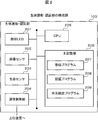
- FIG. 1 is a configuration diagram of an authentication system (apparatus) 101 according to the present embodiment.
- the authentication system 101 controls a display unit 102 that displays an authentication state and an authentication result to a user, a biometric reading / authentication unit 103 that reads biometric information of the user, and processing operations thereof. And a control unit 104.
- a control unit 104 In the authentication system 101, in addition to these components, an input unit, an IC (Integrated Circuit) card reading unit, and the like may be added according to the operation.
- an ATM Automated Teller Machine
- PC Personal Computer
- FIG. 2 is a diagram showing a configuration of the biometric reading / authentication unit 103.
- the biometric reading / authentication unit 103 includes an illumination LED (Light Emitting Diode) 201 for irradiating a living body with light, an image sensor 202 for detecting biometric information and external light, and a fingerprint A biosensor 203 that acquires biometric information that is not easily affected by external light (such as a thermal sensor), a communication control unit 204 that communicates with the authentication system, and a processor that controls these processes.
- a CPU 205 for processing various programs to be described later, and a main storage unit 206 having a program area for performing the operation of the authentication apparatus and detecting outside light.
- the registration program 207 recorded in the main storage unit 206 is a program that controls hardware and acquired data when the authentication device registers biometric information, and is controlled by the CPU 205.
- An authentication program 208 recorded in the main storage unit 206 is a program that controls hardware and acquired data when the authentication device authenticates biometric information, and is controlled by the CPU 205.
- An external light detection program 209 recorded in the main storage unit 206 is a program for determining the state of hardware and external light, and is controlled by the CPU 205.
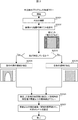
- FIG. 3 is a flowchart showing a processing procedure of processing performed by the external light detection program 209. Hereinafter, each processing step will be described with reference to FIG.
- the external light detection program 209 captures external light using the image sensor 202 of the biometric reading / authentication unit 104. (Step S301). At this time, when only strong external light such as sunlight is detected, the gain (amplification degree) of the camera may be temporarily lowered.
- the external light detection program 209 excludes information other than external light (such as a finger guide of the apparatus) reflected in the image captured by the image sensor 202 (Sstep 302). Thereafter, the external light detection program 209 detects an area where the finger is imaged from the remaining area, and determines whether or not the finger is present (step S303). For checking the presence of a finger, there are a touch sensor and a method of judging from the contour of the finger, but any method can be used.
- the outside light detection program 209 extracts an area outside the outline of the finger from the above-described areas (step 304). On the other hand, when it is determined that the finger does not exist (step S303; No), the outside light detection program 209 extracts the entire area from which the reflection is removed from the above-described areas (step 305).
- a method in which the gain of the camera is increased and the image is taken and discriminated by color a method in which the illumination LED is turned on and the contour is extracted, and either method can be used.
- the external light detection program 209 counts the number of pixels in the extracted area and the number of pixels in which the luminance value in the extracted area is equal to or greater than a threshold value (step S306).
- the outside light detection program 209 sets the level of outside light from the ratio of the luminance values equal to or higher than the threshold value in the extracted area (the number of pixels of the luminance value equal to or higher than the threshold value / the number of pixels in the extracted area) (step S307).
- the number of levels of external light may be set, but it is desirable to divide into the following three levels so that the level of external light can be easily determined. That is, a level where there is no external light in the I detection target area, ii. A level at which external light is inserted into a part of the detection target area, iii. It is desirable to divide the detection area into three levels, that is, the level at which external light is inserted into the entire detection target area.
- the external light detection method may be changed as appropriate in accordance with the characteristics of the device to be mounted and the image sensor. For example, you can divide the captured image into small areas, set the level for each divided small area, or change the camera gain and shoot several images, and set the level from the brightness value of the image for each camera gain. You can do it.
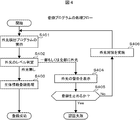
- FIG. 4 is a flowchart showing a processing procedure of processing performed by the registration program 207. Hereinafter, each processing step will be described with reference to FIG.
- the registration program 207 when the registration processing execution command is received from the host device, the registration program 207 causes the external light detection program 209 to execute the processing shown in FIG. 3 (step S401). Since the registration program 207 changes the subsequent processing from the level determination result of the external light detection program 209, the determination result of the external light level is the level without external light (the level of i shown in S307 in FIG. 3). Whether or not (step S402).
- the registration program 207 determines that the external light level is determined to be a level without external light (step S402; Yes), the registration program 207 determines that biometric information can be correctly registered, and performs normal biometric registration processing (step S402). S403).
- the registration program 207 determines that the external light level determination is not a level without external light, that is, a level where there is external light in part or all (the level ii or iii shown in S307 of FIG. 3). In the case (step S402; No), it is determined that there is a possibility that the biological information cannot be correctly registered in the environment, and a warning that strong external light is strong is displayed using the display unit 102 or the like (step S404). It is determined whether or not to stop registration (step S405). This determination may be made when another input device is prepared or when there is no input for a certain period of time.
- step S405 determines not to stop the registration of the biometric information (step S405; No)
- the registration program 207 takes measures such as placing a cover behind the finger so that the user can block outside light, and step S401.
- the process returns to the execution of the external light detection program (step S406).
- the registration program 207 determines that biometric information registration is to be stopped (step S405; Yes)
- the registration program 207 terminates the processing as an authentication failure. Next, processing at the time of authentication will be described.
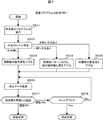
- FIG. 5 is a flowchart showing a processing procedure of processing performed by the authentication program 208. Hereinafter, each processing step will be described with reference to FIG.
- the authentication program 208 causes the external light detection program 209 to execute the process shown in FIG. 3 (step S501). Since the authentication program 208 changes the subsequent processing from the level determination result of the external light detection program 209, the determination result of the external light level is the level without external light (the level of i shown in S307 in FIG. 3). Or the judgment result of the external light level is a level where there is a part of the external light (level ii shown in S307 in FIG. 3), or a level where there is the external light in all (the level iii shown in S307 of FIG. 3). Level) (step S502).
- the authentication program 208 determines that the determination result is a level without external light, the authentication program 208 determines that biometric information using the image sensor 202 such as a finger vein can be acquired correctly, and priority is given to biometric authentication by the image sensor 202. The degree is increased (step S503).
- the priority of the image sensor 202 is ⁇
- the difference between the biometric information at the time of registration by the image sensor 202 and the biometric information at the time of authentication is ⁇ 1
- the priority of the biometric sensor 203 is ⁇
- the biometric information at the time of registration by the biometric sensor 203 and the time of authentication is expressed by the following formula 101.
- the authentication program 208 When raising the priority of the biometric information using the image sensor 202, the authentication program 208 performs control because ⁇ only needs to be increased.
- the biometric information using the image sensor 202 such as a finger vein lowers the priority near the contour where external light easily enters (step S504).
- the image sensor 202 is separated into the contour side of the biological information where external light easily enters and the inside thereof.
- the biometric information is divided into priority ⁇ 1 and biometric information difference ⁇ 11, biometric contour priority ⁇ 2 and biometric information difference ⁇ 12.
- the information difference ⁇ t is calculated by the following formula 102.
- ⁇ t ⁇ 1 ⁇ 11 + ⁇ 2 ⁇ 12 + ⁇ 2 Equation 102
- step S502 if the authentication program 208 determines that there is external light as a whole, the authentication program 208 lowers the priority of biometric information using the image sensor 202 such as a finger vein (step S505).
- the authentication program 208 sets the priority ⁇ of the image sensor 202 to be small, and obtains a difference in biometric information using the mathematical formula 101.
- the authentication program 208 acquires collation data to be used for authentication from the image sensor 202 and the biometric sensor 203 (step S506).
- the authentication program 208 obtains the difference between the biometric information at the time of registration and the biometric information at the time of authentication from the obtained collation data, and calculates the difference between the biometric information using the priority and the mathematical formula determined by the level of external light. Ask.
- the authentication program 208 determines whether or not the difference in the biometric information is equal to or smaller than the threshold (step S507). When the authentication program 208 determines that the difference in the biometric information is equal to or smaller than the threshold (step S507; Yes), the authentication program 208 is authenticated. The process is judged to be successful.
- step S507 determines that the difference in the biometric information is not equal to or less than the threshold (step S507; No)
- the authentication program 208 returns to step S506, repeats from the acquisition of the collation data, and determines whether a timeout has occurred (whether the set number has been reached). If it is determined that a timeout has occurred, it is determined that the authentication has failed, and the process is terminated (step S508).
- the authentication program 208 performs the process of step S504 or S505, and it is determined in step S507 that the difference in biometric information is greater than or equal to the threshold value, the process of step S404 in FIG.
- a warning may be displayed on the display unit 102.
- an external light warning may be displayed and authentication may be suspended until a countermeasure such as covering with a hand is taken.
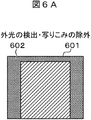
- FIG. 6A is a diagram illustrating an image when the external light detection program 209 performs a process of excluding information other than external light (such as a finger guide of the apparatus) (step S302).
- the external light detection program 209 excludes the imaging part 602 other than the external light in the image 601 captured by the image sensor 202.
- the method of excluding information other than external light by the external light detection program 209 for example, a value in an area where the luminance value is extremely small compared to other areas or an area where the luminance value is more than a predetermined amount is different. Are excluded as areas with information other than external light.
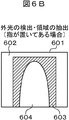
- FIG. 6B is a diagram illustrating an image when the external light detection program 209 performs a process of extracting a region outside the contour of the finger when the finger is present (step S304).
- the external light detection program 209 excludes the image capturing portion 602 other than the external light in the image 601 captured by the image sensor 202 and extracts the portion 603 excluding the finger image 604.
- there are methods for determining the presence of a finger based on a touch sensor or a contour of the finger but any method can be used.
- FIG. 6C is a diagram showing an image when the outside light detection program 209 performs the process of extracting the entire region from which the reflection is removed when the finger is not present (step 305).
- the outside light detection program 209 extracts a region 605 in the image 601 photographed by the image sensor 202 excluding the photographing part 602 other than the outside light.
- the extraction method of the region 605 can be considered in the same manner as in FIG. 6A.
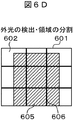
- FIG. 6D is a diagram illustrating a method of dividing a small area when the external light detection program 209 detects external light.
- the external light detection program 209 divides the area 605 excluding the imaging part 602 other than the external light in the image 601 captured by the image sensor 202 into nine small areas by the dividing line 606.
- the division method is not limited to this.
- the level of external light may be set in each region, and authentication may be performed by changing the priority of the biological information in the region where the external light is present, as shown in steps S503 to S505 in FIG.
- FIG. 7 is a diagram showing a method of changing the priority in the vicinity of the contour of the finger performed by the authentication program 208.
- the authentication program 208 acquires the pattern of the area 701 in which vein information is raised in the finger image 604 in the image 601 captured by the image sensor 202 as the verification data.
- the authentication program 208 sets another priority value for the region 702 that is easily affected by external light having a certain width ⁇ from the contour side of the finger near the external light portion 603 in the verification data.
- the ambient light information is obtained using the image sensor used for biometric authentication, and the warning and the priority of a plurality of modalities are dynamically changed. Can be adjusted. As a result, incorrect biometric information is not registered at the time of registration, so that the authentication accuracy can be improved. In addition, it is possible to expect an improvement in accuracy and a reduction in authentication time by changing warnings and priorities according to lighting conditions during authentication.
Landscapes
- Health & Medical Sciences (AREA)
- Life Sciences & Earth Sciences (AREA)
- Engineering & Computer Science (AREA)
- Physics & Mathematics (AREA)
- Surgery (AREA)
- Public Health (AREA)
- Biomedical Technology (AREA)
- Heart & Thoracic Surgery (AREA)
- Medical Informatics (AREA)
- Molecular Biology (AREA)
- Biophysics (AREA)
- Animal Behavior & Ethology (AREA)
- General Health & Medical Sciences (AREA)
- Pathology (AREA)
- Veterinary Medicine (AREA)
- Human Computer Interaction (AREA)
- General Physics & Mathematics (AREA)
- Multimedia (AREA)
- Theoretical Computer Science (AREA)
- Image Input (AREA)
- Collating Specific Patterns (AREA)
- Measurement Of The Respiration, Hearing Ability, Form, And Blood Characteristics Of Living Organisms (AREA)
Applications Claiming Priority (2)
| Application Number | Priority Date | Filing Date | Title |
|---|---|---|---|
| JP2012-045415 | 2012-03-01 | ||
| JP2012045415A JP5829147B2 (ja) | 2012-03-01 | 2012-03-01 | 生体認証装置および制御装置 |
Publications (2)
| Publication Number | Publication Date |
|---|---|
| WO2013128699A1 true WO2013128699A1 (ja) | 2013-09-06 |
| WO2013128699A4 WO2013128699A4 (ja) | 2013-10-24 |
Family
ID=49081926
Family Applications (1)
| Application Number | Title | Priority Date | Filing Date |
|---|---|---|---|
| PCT/JP2012/075760 Ceased WO2013128699A1 (ja) | 2012-03-01 | 2012-10-04 | 生体認証装置および制御装置 |
Country Status (2)
| Country | Link |
|---|---|
| JP (1) | JP5829147B2 (enExample) |
| WO (1) | WO2013128699A1 (enExample) |
Cited By (1)
| Publication number | Priority date | Publication date | Assignee | Title |
|---|---|---|---|---|
| CN106803294A (zh) * | 2016-11-22 | 2017-06-06 | 施冬冬 | 一种供车钥匙自助式管理系统 |
Families Citing this family (1)
| Publication number | Priority date | Publication date | Assignee | Title |
|---|---|---|---|---|
| JP7507659B2 (ja) * | 2020-11-06 | 2024-06-28 | 株式会社日立製作所 | 撮影装置、認証装置及び生体撮影方法 |
Citations (7)
| Publication number | Priority date | Publication date | Assignee | Title |
|---|---|---|---|---|
| JP2002304629A (ja) * | 2001-01-30 | 2002-10-18 | Nec Corp | ロボット装置、照合環境判定方法、及び照合環境判定プログラム |
| JP2003044858A (ja) * | 2001-07-31 | 2003-02-14 | Matsushita Electric Ind Co Ltd | 個人認証装置および方法 |
| JP2003296711A (ja) * | 2002-03-29 | 2003-10-17 | Nec Corp | 顔画像識別方法、装置およびプログラム |
| JP2007128262A (ja) * | 2005-11-02 | 2007-05-24 | Omron Corp | 顔照合装置 |
| JP2007301166A (ja) * | 2006-05-11 | 2007-11-22 | Canon Inc | 撮像装置及びその制御方法及びプログラム及び記憶媒体 |
| JP2009163555A (ja) * | 2008-01-08 | 2009-07-23 | Omron Corp | 顔照合装置 |
| JP2010129030A (ja) * | 2008-12-01 | 2010-06-10 | Mitsubishi Electric Corp | 画像処理装置 |
-
2012
- 2012-03-01 JP JP2012045415A patent/JP5829147B2/ja not_active Expired - Fee Related
- 2012-10-04 WO PCT/JP2012/075760 patent/WO2013128699A1/ja not_active Ceased
Patent Citations (7)
| Publication number | Priority date | Publication date | Assignee | Title |
|---|---|---|---|---|
| JP2002304629A (ja) * | 2001-01-30 | 2002-10-18 | Nec Corp | ロボット装置、照合環境判定方法、及び照合環境判定プログラム |
| JP2003044858A (ja) * | 2001-07-31 | 2003-02-14 | Matsushita Electric Ind Co Ltd | 個人認証装置および方法 |
| JP2003296711A (ja) * | 2002-03-29 | 2003-10-17 | Nec Corp | 顔画像識別方法、装置およびプログラム |
| JP2007128262A (ja) * | 2005-11-02 | 2007-05-24 | Omron Corp | 顔照合装置 |
| JP2007301166A (ja) * | 2006-05-11 | 2007-11-22 | Canon Inc | 撮像装置及びその制御方法及びプログラム及び記憶媒体 |
| JP2009163555A (ja) * | 2008-01-08 | 2009-07-23 | Omron Corp | 顔照合装置 |
| JP2010129030A (ja) * | 2008-12-01 | 2010-06-10 | Mitsubishi Electric Corp | 画像処理装置 |
Cited By (1)
| Publication number | Priority date | Publication date | Assignee | Title |
|---|---|---|---|---|
| CN106803294A (zh) * | 2016-11-22 | 2017-06-06 | 施冬冬 | 一种供车钥匙自助式管理系统 |
Also Published As
| Publication number | Publication date |
|---|---|
| JP2013182388A (ja) | 2013-09-12 |
| WO2013128699A4 (ja) | 2013-10-24 |
| JP5829147B2 (ja) | 2015-12-09 |
Similar Documents
| Publication | Publication Date | Title |
|---|---|---|
| US20220343677A1 (en) | Image processing device, image processing method, face recognition system, program, and storage medium | |
| US8983151B2 (en) | Apparatus for recognizing face based on environment adaptation | |
| KR101222308B1 (ko) | 생체 정보 처리 장치 및 기록 매체 | |
| US9514375B2 (en) | Multi-biometric authentication apparatus, and multi-biometric authentication system | |
| US8816817B2 (en) | Authentication apparatus | |
| US9111152B2 (en) | Verification object specifying apparatus, verification object specifying program, and verification object specifying method | |
| US10242245B2 (en) | System and method of fingerprint anti-spoofing protection using multi-spectral optical sensor array | |
| EP2610820A2 (en) | Authentication apparatus, authentication program, and method of authentication | |
| JP7052256B2 (ja) | 画像処理装置、画像処理方法、及び画像処理プログラム | |
| JP5982311B2 (ja) | 血管画像撮影装置 | |
| US8977009B2 (en) | Biometric authentication device, biometric authentication program, and biometric authentication method | |
| EP3588369A1 (en) | Authentication device and authentication method | |
| US11048915B2 (en) | Method and a device for detecting fraud by examination using two different focal lengths during automatic face recognition | |
| JP5829147B2 (ja) | 生体認証装置および制御装置 | |
| US11645864B2 (en) | Imaging device, authentication device, and biometric imaging method | |
| JP5498096B2 (ja) | 指紋照合装置 | |
| CN110287861B (zh) | 指纹识别方法、装置、存储介质及电子设备 | |
| EP2842489A1 (en) | Biometric authentication apparatus | |
| JP2008015939A (ja) | 非接触型指紋入力装置及び指紋照合装置 | |
| JP7207506B2 (ja) | なりすまし検知装置、なりすまし検知方法、及びプログラム | |
| US11468703B2 (en) | Method, storage media and device for biometric identification driving | |
| JP4972530B2 (ja) | 防犯用応答制御方法 |
Legal Events
| Date | Code | Title | Description |
|---|---|---|---|
| 121 | Ep: the epo has been informed by wipo that ep was designated in this application |
Ref document number: 12870057 Country of ref document: EP Kind code of ref document: A1 |
|
| NENP | Non-entry into the national phase |
Ref country code: DE |
|
| 122 | Ep: pct application non-entry in european phase |
Ref document number: 12870057 Country of ref document: EP Kind code of ref document: A1 |