WO2013115288A1 - ワックスエステル高含有ユーグレナの生産方法 - Google Patents
ワックスエステル高含有ユーグレナの生産方法 Download PDFInfo
- Publication number
- WO2013115288A1 WO2013115288A1 PCT/JP2013/052124 JP2013052124W WO2013115288A1 WO 2013115288 A1 WO2013115288 A1 WO 2013115288A1 JP 2013052124 W JP2013052124 W JP 2013052124W WO 2013115288 A1 WO2013115288 A1 WO 2013115288A1
- Authority
- WO
- WIPO (PCT)
- Prior art keywords
- euglena
- nitrogen
- wax ester
- source
- culture
- Prior art date
- Legal status (The legal status is an assumption and is not a legal conclusion. Google has not performed a legal analysis and makes no representation as to the accuracy of the status listed.)
- Ceased
Links
Images


Classifications
-
- C—CHEMISTRY; METALLURGY
- C12—BIOCHEMISTRY; BEER; SPIRITS; WINE; VINEGAR; MICROBIOLOGY; ENZYMOLOGY; MUTATION OR GENETIC ENGINEERING
- C12N—MICROORGANISMS OR ENZYMES; COMPOSITIONS THEREOF; PROPAGATING, PRESERVING, OR MAINTAINING MICROORGANISMS; MUTATION OR GENETIC ENGINEERING; CULTURE MEDIA
- C12N1/00—Microorganisms; Compositions thereof; Processes of propagating, maintaining or preserving microorganisms or compositions thereof; Processes of preparing or isolating a composition containing a microorganism; Culture media therefor
- C12N1/12—Unicellular algae; Culture media therefor
-
- C—CHEMISTRY; METALLURGY
- C12—BIOCHEMISTRY; BEER; SPIRITS; WINE; VINEGAR; MICROBIOLOGY; ENZYMOLOGY; MUTATION OR GENETIC ENGINEERING
- C12P—FERMENTATION OR ENZYME-USING PROCESSES TO SYNTHESISE A DESIRED CHEMICAL COMPOUND OR COMPOSITION OR TO SEPARATE OPTICAL ISOMERS FROM A RACEMIC MIXTURE
- C12P7/00—Preparation of oxygen-containing organic compounds
- C12P7/64—Fats; Fatty oils; Ester-type waxes; Higher fatty acids, i.e. having at least seven carbon atoms in an unbroken chain bound to a carboxyl group; Oxidised oils or fats
- C12P7/6436—Fatty acid esters
- C12P7/6445—Glycerides
- C12P7/6463—Glycerides obtained from glyceride producing microorganisms, e.g. single cell oil
Definitions
- the present invention relates to a production method of Euglena containing a high amount of wax ester, which can produce a microalga Euglena containing a high amount of wax ester as a raw material for biofuel at low energy and low cost.
- photosynthetic microorganisms and protozoa that inhabit ponds and swamps have the same photosynthetic ability as plants, biosynthesize carbohydrates and lipids from water and carbon dioxide, and accumulate tens of mass% in the cells.
- the production amount is higher than that of plants, and it is known that the production amount per unit area is more than 10 times that of palm, which is said to have high production amount.
- the microalga Euglena a kind of photosynthetic microorganism, is a group of flagellates and includes Euglena, which is famous as a motile algae. Most Euglena has chloroplasts and carries out autotrophic life by photosynthesis, but there are also predatory and absorption nutrients. Euglena is a genus classified into both zoology and botany.
- Euglenoidina includes Euglena, Trachelemonas, Strombonas, Phacus, Lepocinelis, Astasia and Colacium as genera.
- Euglenophyta has Euglenophyta, followed by Euglenophyceae and Euglenales, and the genus included in this eye is similar to that of Euglena and animal taxonomy. is there.
- Euglena accumulates paramylon as a carbohydrate in the cell.
- Paramylon is a polymer particle in which about 700 glucoses are polymerized by ⁇ -1,3-bonds.
- Euglena when placed in an anaerobic state, decomposes paramylon, a stored polysaccharide, and performs wax ester fermentation with a wax ester consisting of fatty acid and fatty alcohol as the final product.
- the components of vegetable oils and fats that contain common algae are equivalent to light oils with a carbon distribution of 16 or more in the main skeleton, or heavy oil fractions, whereas Euglena wax esters are carbon. It is composed of fatty acids and alcohols centered on number 14. This is because the biomass fuel obtained from Euglena wax ester is within the range of carbon number distribution of 10 to 16 of existing jet fuel, and in the production of hydrocarbons by fueling (hydrogenation / isomerization), etc. Compared to vegetable oils and fats, it can be easily refined into jet fuel.
- Patent Document 1 describes that Euglena is cultured aerobically and then put under anaerobic conditions to ferment the stored polysaccharide paramylon and convert it into wax ester (wax ester).
- Japanese Patent Application No. 2010-163370 (an unpublished technique at the time of the present application) that was previously presented by the applicant.
- This includes a first step of aerobic culture of microalgae Euglena under autotrophic culture conditions aerated with carbon dioxide, and a step of further increasing paramylon accumulation per cell by further culturing under nitrogen starvation conditions.
- a method for producing a high-wax ester-containing Euglena comprising a step 2 and a third step in which wax ester fermentation using paramylon as a substrate is carried out by placing it in an anaerobic state is disclosed.
- this technology efficiently produces Euglena with a high wax ester content by executing a series of steps: aerobically culturing ⁇ further culturing in a nitrogen starved state ⁇ keeping cells in an anaerobic state. can do.
- the euglena can sufficiently accumulate carbohydrates by culturing in the nitrogen starvation state in step 2.
- step 3 the cells cultured in step 2 are placed in an anaerobic state, whereby the carbohydrate sufficiently accumulated in step 2 is converted into wax ester. As a result, wax ester accumulation in step 3 is achieved. The amount will increase.
- a Euglena with a high wax ester content can be produced without fail.
- an enzyme related to fermentation is a protein
- a nitrogen source for biosynthesizing amino acids constituting the protein is required.
- a new nitrogen source is not supplied from the outside of the cell. It is thought that the production amount of the enzyme related to fermentation decreased in Euglena cells, leading to a decrease in fermentation efficiency.
- An object of the present invention is to solve the above-mentioned problems, and more efficiently produce a high content of wax ester Euglena by adding nutrients before anaerobic fermentation to restore the fermentation efficiency of the wax ester.
- the object is to provide a method for producing a possible Euglena with a high wax ester content.
- the above-described problem is a first step of aerobically cultivating microalgae Euglena under a nitrogen-deficient condition, and a first step of maintaining cells in an anaerobic state. This is solved by adding a nutrient source to the culture solution that has undergone the first step before performing the second step.
- the ratio of the wax ester to the diglyceride and triglyceride can be secured at a high level, and the fuel oil base material for aviation fuel can be made suitable.
- the addition of the nutrient source is at a timing earlier in time with reference to a time point when the dissolved oxygen concentration of the culture solution in anaerobic state in the second step has decreased to 0.03 mg / L or less.
- the timing which adds a nutrient is too early, the nutrient added during culture
- the timing of adding nutrients is important, and it is desirable to manage the time based on the time when the dissolved oxygen concentration of the culture solution in an anaerobic state drops to 0.03 mg / L or less. Specifically, it is desirable to be within 3 hours before anaerobic fermentation, more preferably within 1 hour before anaerobic fermentation.
- the nutrient source is preferably a nitrogen source.
- the nutrient source may be a carbon source, or a combination of a nitrogen source and a carbon source is more preferable.
- the “nitrogen source” is preferably selected from ammonium compounds such as diammonium hydrogen phosphate and ammonium sulfate, and amino acids such as glycine and glutamic acid. In general, Euglena cannot assimilate nitrate nitrogen, but if it is modified so that nitrate can be assimilated by genetic recombination technology, etc., nitrate nitrogen absorbed from outside the cell is metabolized to ammonia nitrogen. In this case, nitrate compounds may be included as an option as a nitrogen source.
- the “carbon source” is preferably selected from carbohydrates such as glucose and fructose, alcohols such as ethanol, organic compounds such as malic acid, and amino acids such as glutamic acid.
- the nitrogen source is an ammonium compound and the carbon source is glucose.
- the amount of nutrient source to be added is also important. This is because if the amount of nutrients added is too large, the amount of paramylon accumulated will decrease, and if the amount added is too small, it will not lead to improvement in anaerobic fermentation efficiency. For this reason, in this invention, it is good to add an ammonium compound so that ammonium ion concentration may be set to about 10 mg / L.
- the method for producing a high-wax ester Euglena includes a culture step of accumulating carbohydrates by culturing Euglena in a nitrogen-starved state, and bringing the cultured cells into an anaerobic state.
- a culture step of accumulating carbohydrates by culturing Euglena in a nitrogen-starved state, and bringing the cultured cells into an anaerobic state.
- the cultured cells after a sufficient accumulation of carbohydrates in Euglena by culturing in a nitrogen-starved state, the cultured cells are placed in an anaerobic state, thereby converting the sufficiently accumulated carbohydrates into wax esters.
- nutrients were added before anaerobic fermentation to restore the fermentation efficiency of the wax ester, making it possible to produce a wax ester-rich Euglena more effectively.
- the biomass raw material with much fat content can be provided cheaply from the carbon dioxide fixed by photosynthesis.
- biofuel is manufactured by this invention, it will also lead to the improvement of an energy self-sufficiency rate.
- the present embodiment is a method for producing Euglena by culturing Euglena under an aerobic condition and then placing it in an anaerobic state by adding nutrients before anaerobic fermentation to restore the fermentation efficiency of the wax ester.
- the present invention relates to a method for producing Euglena, which makes it possible to produce Euglena with a high content of wax ester more effectively.
- This production method includes a step 1 (equivalent to the first step) in which Euglena is aerobically cultured in a medium under nitrogen-deficient conditions, and a step 2 (second step) in which anaerobic treatment is performed to ferment carbohydrates to wax esters. Equivalent to the process).
- AY medium was used for preculture.
- the AY medium which is an autotrophic medium, is preferably acid conditions, for example, pH 2.5 to 6.5, and more preferably pH 3.0 to 6.0.
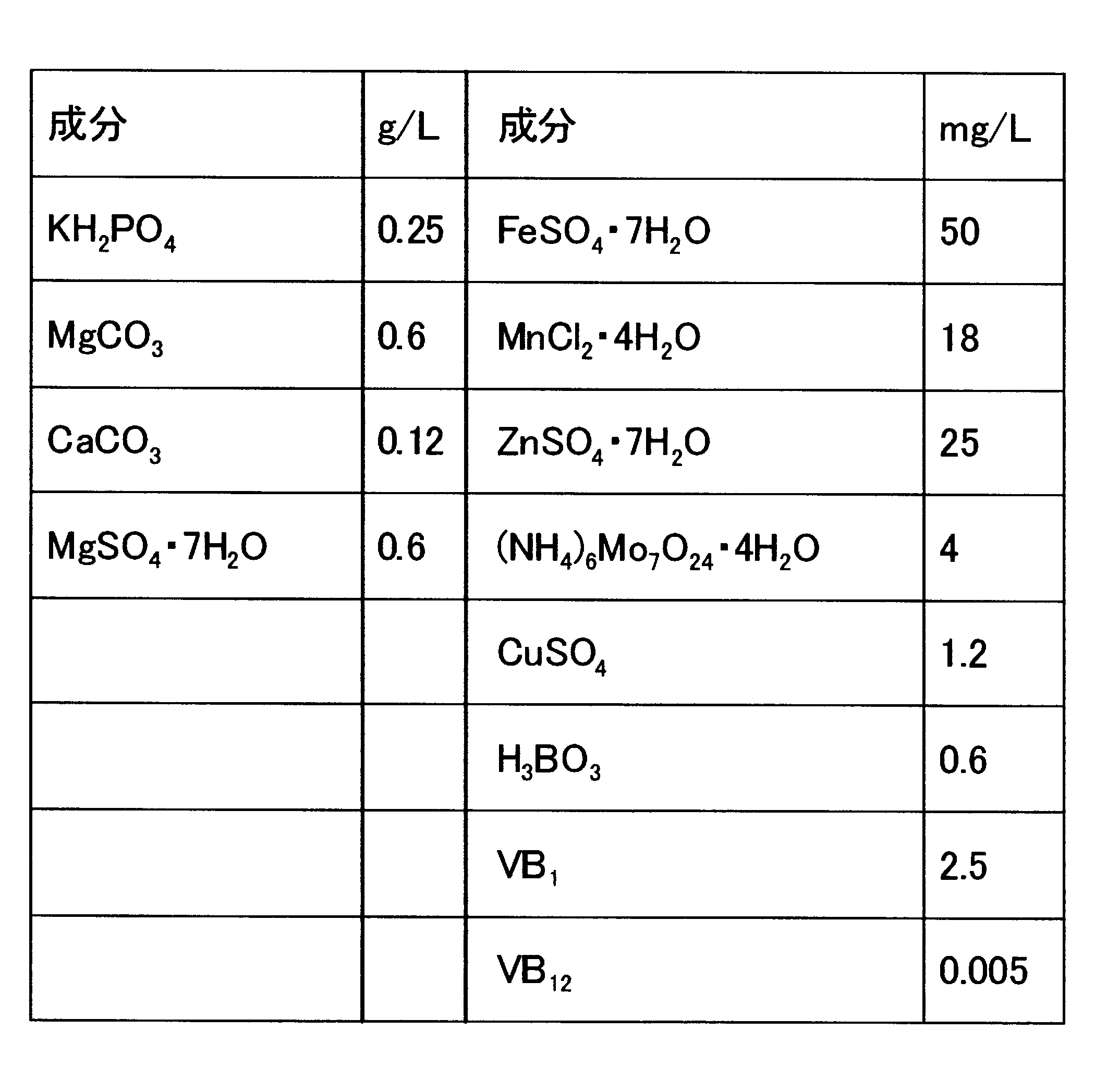
- an AY medium having the composition shown in Table 1 was prepared using deionized water, adjusted to pH 3.5 using dilute sulfuric acid, and then autoclaved.
- the AY medium is an autotrophic medium obtained by removing heterotrophic components such as glucose, malic acid and amino acids from a Koren-Hutner medium generally used as a Euglena heterotrophic medium.
- Table 1 shows an example of the present autotrophic medium, where VB 1 indicates vitamin B 1 and VB 12 indicates vitamin B 12 .
- the culture vessel was placed in a thermostatic water bath placed on a magnetic stirrer SRSB10LA (ADVANTEC), and stirred at a strength of 300 rpm using a 6 cm stir bar.
- SRSB10LA ADVANTEC
- Aeration of CO 2 is preferably performed at a flow rate of 0.05 vvm to 0.2 vvm (100 to 200 mL / min) at a light intensity of 600 to 1200 ⁇ mol / (m 2 ⁇ s).
- Vvm represents “volume per volume mimnute”.
- the light source is a metal halide lamp, Eye Clean Ace BT type (manufactured by Iwasaki Electric Co., Ltd.), placed directly above the culture water surface, and the light poured onto the culture water surface is about 900 ⁇ mol / (m 2 ⁇ s)
- the height was adjusted so that The light irradiation time was set to a light / dark cycle in which the light was turned off for 12 hours after being turned on for 12 hours in order to be close to outdoor daytime and night conditions.
- As a carbon source 15% concentration of CO 2 was aerated at a flow rate of 0.1 vvm (200 mL / min).
- the preculture time is 24 to 120 hours, preferably 48 to 96 hours.
- the culture temperature may be 26-32 ° C, more preferably 28-30 ° C.
- Euglena cells were centrifuged (2,500 rpm, 5 minutes, room temperature) from 2 L of the culture solution, and then washed once with deionized water. The seed algae for each culture were used.
- step 1 Euglena is cultured aerobically under nitrogen-deficient conditions to increase the accumulated amount of paramylon.
- the nitrogen-deficient AY medium is preferably under acidic conditions, for example, pH 2.5 to 6.5, more preferably pH 3.0 to 6.0.
- a nitrogen-deficient AY medium having the composition shown in Table 2 is prepared using deionized water, adjusted to pH 3.5 using dilute sulfuric acid, and then autoclaved.
- a nitrogen-deficient medium refers to a medium having a nitrogen-containing compound content of 5 mg / L or less.
- the initial concentration of Euglena is 0.05 to 5.0 g / L, more preferably 0.2 to 1.0 g / L. Specifically, in this example, the initial concentration is about 0.3 g / L, and the culture conditions such as light irradiation, stirring, and aeration are performed in the same range and method as the preculture.
- the nitrogen-deficient culture time is within 48 hours (within 24 hours of light period). In this embodiment, it is 48 hours.
- step 2 the cultured Euglena is subjected to anaerobic treatment, and the Euglena is maintained under anaerobic conditions.
- the culture solution is concentrated from about 2 L to about 0.5 L using a centrifuge and transferred to a 600 mL tall beaker.
- About 400 mL of culture solution is anaerobically treated by aeration of nitrogen gas at a flow rate of 200 mL / min for about 30 minutes.
- the dissolved oxygen concentration is 0.03 mg / L or less.
- the anaerobic treatment is usually carried out by passing an inert gas such as nitrogen or argon gas through the culture medium after culturing, but treatment such as concentrating the culture solution to increase the cell density. It is also lowered by.
- Anaerobic treatment can also be performed by allowing the medium to stand. That is, if the medium is allowed to stand without stirring, the cells settle and become dense, resulting in a lack of oxygen. Anaerobic treatment may be performed by creating a high density state by centrifugation.
- the pH at this time should not be extremely low or high, and the presence or absence of light irradiation does not affect the wax ester fermentation.
- the holding temperature should not be a high temperature at which Euglena dies or a low temperature at which the medium freezes. Usually, the wax ester fermentation is completed in 6 to 72 hours.
- a nutrient source is added to the Euglena culture solution before performing Step 2, that is, before performing the anaerobic treatment.
- “Before anaerobic treatment (before anaerobic fermentation)” means that the time is the previous timing with respect to the time when the dissolved oxygen concentration of Euglena broth decreased to 0.03 mg / L or less. To do.
- a nitrogen source a carbon source, a mixture of a nitrogen source and a carbon source, or the like is assumed.
- the amount of nitrogen source added as a nutrient source is 7 to 15 mg / L, preferably 8 to 12 mg / L, based on ammonium ions, with respect to the solution to be treated (the culture solution obtained in step 1). Good.
- the amount of carbon source (glucose) added as a nutrient source is 0.2 to 2.0 g / L, preferably 0.5 to 1.5 g / L, relative to the liquid to be treated (the culture solution obtained in step 1). There should be.
- the nitrogen source examples include ammonium compounds such as diammonium hydrogen phosphate and ammonium sulfate, and amino acids such as glycine and glutamic acid.
- ammonium compounds such as diammonium hydrogen phosphate and ammonium sulfate
- amino acids such as glycine and glutamic acid.
- Euglena cannot assimilate nitrate nitrogen, but if it is modified to assimilate nitrate by genetic recombination technology, it is thought that nitrate nitrogen absorbed from the outside of the cell is metabolized to ammonia nitrogen. Therefore, in that case, a nitrate compound is also included as a nitrogen source.
- the “carbon source” includes sugars such as glucose and fructose, alcohols such as ethanol, organic compounds such as malic acid, and amino acids such as glutamic acid.
- an ammonium compound is used as the nitrogen source
- glucose is used as the carbon source.
- diammonium hydrogen phosphate ((NH 4 ) 2 HPO 4 ) is used as a nitrogen source at 47 hours after nitrogen deficient culture 1 hour before anaerobic treatment. )Added. The timing of adding the nitrogen source will be described in detail in “Example 1” below.
- the dark period was set to 0 hours from the start of the culture, and the light / dark cycle was performed with the metal halide lamp turned on after 12 hours, turned off after 24 hours, and turned on again at 36 hours.
- the prepared culture solution was Sample 1-1. Sample 1-1 was collected 48 hours after the start of culture.
- the anaerobic treatment was performed in the same manner as in Step 2 above. Euglena cells were collected from the culture solution after anaerobic treatment by centrifugation (2,500 rpm, 5 minutes, room temperature), and the collected precipitate was frozen and lyophilized to obtain the following specimens.
- the freeze dryer was performed using DRW240DA (Advantec).
- the precipitate was suspended and solubilized in 20 mL of 0.5N NaOH, and the amount of sugar was determined using a suspension that had been allowed to stand for several hours to overnight as an extract. .
- the extract was subjected to sugar determination by the phenol-sulfuric acid method.
- a vortex mixer To 0.5 mL of the extraction solution, 0.5 mL of 5% phenol and 2.5 mL of sulfuric acid were added and suspended with a vortex mixer. This was allowed to stand at room temperature for 20 to 30 minutes, and then the absorbance at 480 nm was read with a spectrophotometer (SHIMADZU, UVmini-1240).
- the calibration curve was prepared using a glucose solution (0 ⁇ g / mL, 10 ⁇ g / mL, 50 ⁇ g / mL, 150 ⁇ g / mL, 250 ⁇ g / mL) or a 0.005% paramylon solution.
- Extraction and quantification of fats and oils from Euglena dry powder were performed by the following methods. 0.2 to 0.3 g of Euglena dry algae was placed in a sealed container, 10 times the weight of n-hexane was added, and the mixture was shaken at room temperature at 200 rpm for 1 hour. The solid and liquid were separated by filtration, and the cake on the funnel was washed with about 20 times the original dry weight of hexane. The filtrate and the washing solution were combined, and n-hexane was distilled off with an evaporator set at a bath temperature of 55 ° C., thereby recovering fats and oils.
- Example 1 ⁇ Examination of nitrogen source addition> (1) Pre-culture, nitrogen-deficient culture, anaerobic treatment From the results of Comparative Example 1, it was found that a nitrogen-deficient culture period was sufficient within 48 hours from the viewpoint of carbohydrate accumulation. On the other hand, the qualitative evaluation of the oil and fat composition was C, and it was considered that there was room for improvement. Therefore, an experiment was performed in which a nitrogen source was added to the culture solution several hours before the anaerobic treatment based on Sample 1-1 of Comparative Example 1. The conditions for pre-culture, nitrogen-deficient culture, and anaerobic treatment were the same as in Comparative Example 1.
- Example 2 ⁇ Examination of carbon source addition> (1) Pre-culture, nitrogen-deficient culture, anaerobic treatment From the results of Comparative Example 1, it was found that a nitrogen-deficient culture period was sufficient within 48 hours from the viewpoint of carbohydrate accumulation. Moreover, from the results of Example 1, it was found that the anaerobic fermentation ability of Euglena cells was recovered by adding a nitrogen source before anaerobic. In this example, an experiment was conducted in which glucose was added to examine whether the anaerobic fermentation ability was restored by the addition of a carbon source instead of a nitrogen source. The conditions for pre-culture, nitrogen-deficient culture, and anaerobic treatment were the same as in Comparative Example 1.
- the addition of glucose one hour before the anaerobic treatment was an oil / fat content rate of 52% and an oil / fat composition qualitative evaluation B.
- the oil / fat content rate was greatly improved as compared with Sample 1-1, and the oil / fat composition was also improved. This is presumably because the anaerobic fermentation ability was restored by the addition of the carbon source.
- Example 3 ⁇ Examination of addition of nitrogen source and carbon source>
- Pre-culture, nitrogen-deficient culture, anaerobic treatment From the results of Comparative Example 1 above, it was found that a nitrogen-deficient culture period was sufficient within 48 hours from the viewpoint of carbohydrate accumulation. Moreover, from the results of Example 1 and Example 2 above, it was found that the anaerobic fermentation ability of Euglena cells was recovered by adding a nitrogen source or a carbon source before anaerobic. Furthermore, in this example, the following experiment was conducted as Example 3 in order to examine what influence the simultaneous addition of the nitrogen source and the carbon source has on the oil content and the oil composition. The conditions for pre-culture, nitrogen-deficient culture, and anaerobic treatment were the same as in Comparative Example 1.
- Sample 4-1 had 1 g of glucose per liter of culture medium as a carbon source at 48 hours of nitrogen-deficient culture, which was 0 hours before anaerobic treatment, and diammonium hydrogen phosphate (( NH 4 ) 2 HPO 4 ) was added at 0.1643 g (corresponding to 10 mg / L) per liter of culture solution.
- glucose was used as a carbon source at 1 g per liter of the culture solution and diammonium hydrogen phosphate ((NH 4 ) 2 HPO 4 ) was cultured as a nitrogen source at 36 hours after nitrogen deficient culture 12 hours before anaerobic treatment. 0.1643 g (equivalent to 10 mg / L) was added per liter of liquid.
- diammonium hydrogen phosphate (NH 4 ) 2 HPO 4 ) was cultured as a nitrogen source at 36 hours after nitrogen deficient culture 12 hours before anaerobic treatment. 0.1643 g (equivalent to 10 mg / L) was added per liter of liquid.
- the amount of nutrients added is also important. This is because when the added amount is too large, the accumulated amount of paramylon decreases, and when the added amount is too small, the anaerobic fermentation efficiency is not improved. For this reason, in the present invention, diammonium hydrogen phosphate was added so that the ammonium ion concentration was about 10 mg / L. This is because when the Euglena concentration is about 0.3 g / L, the consumption rate of ammonia is about 1.5 g ⁇ L ⁇ 1 ⁇ h ⁇ 1 , so 10 mg / L is the amount consumed in 6 to 7 hours.
- Euglena is a microorganism that can be easily obtained as used in health foods and the like, and can be cultured in large quantities. According to the present invention, clean energy can be stably supplied by recovering a large amount of wax ester of higher quality than Euglena, which is such a microorganism.
Landscapes
- Life Sciences & Earth Sciences (AREA)
- Chemical & Material Sciences (AREA)
- Engineering & Computer Science (AREA)
- Organic Chemistry (AREA)
- Biotechnology (AREA)
- Zoology (AREA)
- Health & Medical Sciences (AREA)
- Wood Science & Technology (AREA)
- Genetics & Genomics (AREA)
- Bioinformatics & Cheminformatics (AREA)
- General Engineering & Computer Science (AREA)
- Cell Biology (AREA)
- Biochemistry (AREA)
- Microbiology (AREA)
- General Health & Medical Sciences (AREA)
- Oil, Petroleum & Natural Gas (AREA)
- Biomedical Technology (AREA)
- Medicinal Chemistry (AREA)
- Tropical Medicine & Parasitology (AREA)
- Botany (AREA)
- Virology (AREA)
- Chemical Kinetics & Catalysis (AREA)
- General Chemical & Material Sciences (AREA)
- Preparation Of Compounds By Using Micro-Organisms (AREA)
- Micro-Organisms Or Cultivation Processes Thereof (AREA)
Abstract
Description
このような状況下、固定化された二酸化炭素を含有する化石燃料をエネルギーとして使用することは、固定した二酸化炭素を再度大気中へ放出することにつながり、環境問題となっている。また化石燃料は有限な資源であるため、枯渇の問題もある。
上記のような問題を解決するために、化石燃料以外の燃料源が必要とされており、高等植物や藻類を原料としたバイオ燃料の開発に対する期待が高まっている。
一方、ジャトロファ、カメリナなどの非食性植物からの生産も進められているが、単位面積当りの生産量が低いことが問題となっている。
Euglenoidinaには、属としてEuglena、Trachelemonas、Strombonas、Phacus、Lepocinelis、Astasia、Colaciumが含まれる。植物学では、ミドリムシ植物門(Euglenophyta)があり、その下にミドリムシ藻類綱(Euglenophyceae)、ミドリムシ目(Euglenales)があって、この目に含まれる属としてはEuglenaの他、動物分類表と同様である。
パラミロンは、約700個のグルコースが、β-1,3-結合により重合した高分子体の粒子である。
一般的な藻類を含む植物油脂の成分は、主骨格の炭素分布が16以上となる軽油、あるいはそれよりも重質な石油留分であるのに相当するのに対し、ユーグレナのワックスエステルは炭素数14を中心とした脂肪酸及びアルコールで構成されている。これは、ユーグレナのワックスエステルから得られるバイオマス燃料が、既存ジェット燃料の炭素数分布10~16の範囲内であること、及び、燃料化(水素化・異性化)による炭化水素の製造において、他の植物油脂に比べ容易にジェット燃料に精製可能であることを示している。
特許文献1には、ユーグレナを好気的に培養し、その後嫌気条件下に置くことで貯蔵多糖パラミロンを発酵させてロウ・エステル(ワックスエステル)に変換させることが記載されている。
このような技術では、バイオ燃料の製造について、グルコース等の炭素源を用いる培養法はコストに合わず、二酸化炭素の固定につながらない。
ここには、二酸化炭素を通気した独立栄養培養条件下で微細藻ユーグレナの好気的培養を行う第1の工程と、窒素飢餓状態でさらに培養することで細胞あたりのパラミロン蓄積量を増加させる第2の工程と、その後嫌気状態に置くことでパラミロンを基質としたワックスエステル発酵を行わせる第3の工程からなるワックスエステル高含有ユーグレナの製造方法が開示されている。
つまり、本技術においては、好気的に培養→窒素飢餓状態においてさらに培養→細胞を嫌気状態下に保持という一連の工程を実行することにより、ワックスエステルの含有量が高いユーグレナを効率的に生産することができる。
本技術では、工程2の窒素飢餓状態における培養により、ユーグレナに炭水化物を十分に蓄積させることができる。
そして、工程3にて、工程2で培養した細胞を嫌気状態に置くことにより、工程2で十分に蓄積された炭水化物をワックスエステルに変換させることとなるため、結果的に工程3におけるワックスエステル蓄積量は増加することとなる。
しかし、窒素飢餓状態に長時間置くとワックスエステル発酵の効率が落ちるという問題があった。発酵に関する酵素はタンパク質であるため、タンパク質を構成するアミノ酸を生合成するための窒素源を必要とするが、窒素飢餓状態では細胞外部から新たに窒素源が供給されなくなる。ユーグレナ細胞内において発酵に関する酵素の生産量が低下し、発酵効率の低下につながったと考えられる。
つまり、第1の工程である窒素飢餓状態における培養により、ユーグレナに炭水化物を十分に蓄積させることができる。
このため、第2の工程にて、培養した細胞を嫌気状態に置くことで、十分に蓄積された炭水化物をワックスエステルに変換させることが可能となる。
しかし、窒素飢餓状態に長時間置くと、発酵に関する酵素を構築するアミノ酸生合成に寄与する窒素源の供給が絶たれ、ワックスエステル発酵の効率が落ちてしまう。
つまり、酵素を構成するタンパク質の生合成量が減少し、発酵効率が低下する。
また、第1の工程で培養されたユーグレナを用いて、そのまま第2の工程に移行させた場合、ワックスエステルの原料となるパラミロン蓄積量は増加するものの、第2の工程の嫌気発酵におけるワックスエステルの生産効率が低下し、ジグリセリド及びトリグリセリドに対するワックスエステルの割合が低水準にとどまるという問題点があった。
よって、第2の工程にて嫌気発酵を行う前に、栄養源を添加することにより、第2の工程での発酵効率の低下を抑制し、よりワックスエステル含有量の高いユーグレナを効率的に生産することが可能となるとともに、ジグリセリド及びトリグリセリドに対するワックスエステルの割合を高水準に確保し、航空燃料用燃料油基材の製造に適するものとすることができる。
栄養素を添加すると、窒素欠乏状態が解消されることになるため、蓄積したパラミロンの分解が促されることとなる。
このため、栄養素を添加するタイミングが早過ぎると培養中に添加した栄養素を消費してしまい、窒素欠乏状態に戻ってしまうことになる。
このように、栄養素を添加するタイミングは重要であり、嫌気状態である培養液の溶存酸素濃度が0.03mg/L以下に下がった時点を基準として、時間で管理されると望ましい。
具体的には、嫌気発酵の3時間前、より好ましくは嫌気発酵前1時間以内であることが望ましい。
また、前記栄養源は、炭素源であってもよいし、窒素源と炭素源との併用であっても更に好ましい。
「窒素源」としては、リン酸水素二アンモニウム、硫酸アンモニウム等のアンモニウム化合物、グリシン、グルタミン酸等のアミノ酸が選択されると好適である。
なお、一般的にユーグレナは硝酸態窒素を資化できないが、遺伝子組換え技術等で硝酸を資化できるように改変した場合、細胞外から吸収した硝酸態窒素はアンモニア態窒素に代謝されると考えられるため、その場合は窒素源として硝酸化合物も選択肢として含まれ得る。
「炭素源」としては、グルコース、フルクトース等の糖質、エタノール等のアルコール、リンゴ酸等の有機化合物、グルタミン酸等のアミノ酸が選択されると好適である。
また、上記条件に加えて、添加する栄養源の量も重要である。
栄養源の添加量が多過ぎるとパラミロンの蓄積量が少なくなり、添加量が少なすぎると嫌気発酵効率の改善につながらないからである。
このため、本発明では、アンモニウムイオン濃度が10mg/L程度になるようにアンモニウム化合物を添加するとよい。
このため、光合成によって固定化した二酸化炭素から油脂含有量の多いバイオマス原料を安価に提供することができることとなる。
また、本発明によってバイオ燃料を製造すればエネルギー自給率の向上にもつながる。
なお、以下に説明する構成は本発明を限定するものでなく、本発明の趣旨の範囲内で種々改変することができるものとする。
本実施形態は、好気的条件下でユーグレナを培養し、その後、嫌気状態に置くことでユーグレナを生産する方法において、嫌気発酵前に栄養素を添加してワックスエステルの発酵効率を回復させることによってワックスエステル高含有ユーグレナをより効果的に生産することが可能としたユーグレナの生産方法に関するものである。
図1により、本発明に係るワックスエステル高含有ユーグレナの生産方法の第1の実施形態について説明する。
本生産方法は、ユーグレナを窒素欠乏条件下の培地で好気的に培養する工程1(第1の工程に相当)と、嫌気処理を行い、炭水化物をワックスエステルに発酵させる工程2(第2の工程に相当)とを含んでいる。
前培養には、AY培地を使用した。
なお、独立栄養培地であるAY培地は、酸性条件にすることが好ましく、例えば、pH2.5~6.5、より好ましくはpH3.0~6.0に調整するとよい。
具体的に、本例においては、脱イオン水を用いて、表1に示す組成のAY培地を作製し、希硫酸を用いてpH3.5に調整してからオートクレーブ滅菌を行った。
AY培地とは、ユーグレナの従属栄養培地として一般的に使用されるKoren-Hutner培地からグルコース、リンゴ酸、アミノ酸等の従属栄養成分を除いた独立栄養培地である。
表1は、本独立栄養培地の一例であり、VB1はビタミンB1を示し、VB12はビタミンB12を示す。

培養容器はマグネチックスターラーSRSB10LA(ADVANTEC)の上に置いた恒温水槽内に設置し、6cmの撹拌子を用いて300rpmの強度で攪拌した。
「vvm」は、「単位体積あたりのガス通気量(volume per volume mimnute)」を表す。
具体的に本例においては、光源はメタルハライドランプ・アイクリーンエースBT型(岩崎電気製)を培養液水面の真上に設置し、培養液水面に注ぐ光が約900μmol/(m2・s)の強度となるように高さを調節した。
光の照射時間は、屋外の昼夜条件に近づけるため、12時間点灯後に12時間消灯する明暗サイクルとした。炭素源として0.1vvm(200mL/min)の流量で15%濃度のCO2を通気した。
なお、前培養時間は、24~120時間、好ましくは48~96時間とするとよい。
同様に、培養温度は、26~32℃、より好ましくは28~30℃とするとよい。
具体的に本例においては、AY培地による前培養を3日間行った後、2Lの培養液からユーグレナ細胞を遠心分離(2,500rpm、5分間、室温)した後、脱イオン水で1回洗浄し、各培養の種藻体とした。
なお、窒素欠乏AY培地は、酸性条件にすることが好ましく、例えば、pH2.5~6.5、より好ましくはpH3.0~6.0に調整するとよい。
具体的に本例においては、脱イオン水を用いて、表2に示す組成の窒素欠乏AY培地を作製し、希硫酸を用いてpH3.5に調整してからオートクレーブ滅菌を行う。
窒素欠乏培地とは、窒素含有化合物の含有量が5mg/L以下である培地をさす。
ユーグレナの初期濃度は、0.05~5.0g/L、より好ましくは0.2~1.0g/Lとするとよい。
具体的に本例においては、初期濃度は、約0.3g/Lとし、光照射、攪拌、通気等の培養条件は、前培養と同一の範囲及び方法で実施する。
窒素欠乏培養時間は、48時間以内(明期24時間以内)とする。
本実施形態においては、48時間とした。
この窒素欠乏培養期間の選択に関しては、後記「比較例1」において詳述する。
なお、光照射は、暗期の開始を培養開始0時間とし、12時間後にメタルハライドランプが点灯、24時間後に消灯、36時間目に再度点灯という明暗サイクルで実施した。
まず、培養液は、遠心分離機を用いて2Lから0.5L程度に濃縮し、600mL容量のトールビーカーに移す。
約400mL程度の培養液について窒素ガスを200mL/minの流量で30分程度通気して嫌気処理を行う。
嫌気処理においては、溶存酸素濃度が0.03mg/L以下となったことを確認して終了とする。
窒素ガス通気後のビーカーの上部はパラフィルムで覆った後、全体を遮光するためにアルミホイルで覆い、室温で3日間静置する。
その際の室温は26℃~27℃とする。
なお、嫌気処理は、通常、上記記載の通り、培養後の培地に窒素やアルゴンガス等ガス等の不活性ガスを通気することにより行うが、培養液を濃縮して細胞密度を高める等の処理によっても低下する。
また、嫌気処理は培地を静置することによっても行うことができる。
つまり、培地を攪拌せずに静置すると細胞が沈降し、高密度になることによって結果的に酸素不足となるためである。遠心分離により高密度状態を作り出すことで嫌気処理を行ってもよい。
このときのpHは、極端に低い、又は高い値でなければよく、光照射の有無はワックスエステル発酵には影響がない。保持温度はユーグレナが死滅するような高温、培地が凍結するような低温でなければ良い。通常、6時間~72時間でワックスエステル発酵は終わる。
なお、「嫌気処理前(嫌気発酵前)」とは、ユーグレナ培養液の溶存酸素濃度が0.03mg/L以下に下がった時点を基準として、時間的に前のタイミングであることを意味するものとする。
栄養源としての窒素源の添加量は、被処理液(工程1にて得られた培養液)に対して、アンモニウムイオン基準で、7~15mg/L、好ましくは、8~12mg/Lであるとよい。
また、栄養源としての炭素源(グルコース)添加量は、被処理液(工程1にて得られた培養液)に対して、0.2~2.0g/L、好ましくは、0.5~1.5g/Lであるとよい。
窒素源としては、リン酸水素二アンモニウム、硫酸アンモニウム等のアンモニウム化合物、グリシン、グルタミン酸等のアミノ酸が含まれる。
一般的にユーグレナは硝酸態窒素を資化できないが、遺伝子組換え技術等で硝酸を資化できるように改変した場合、細胞外から吸収した硝酸態窒素はアンモニア態窒素に代謝されると考えられるため、その場合は窒素源として硝酸化合物も含まれる。
本例においては、窒素源としてアンモニウム化合物を使用し、炭素源としてはグルコースを使用する。
窒素源を加える場合は、嫌気処理1時間前である窒素欠乏培養47時間目に窒素源としてリン酸水素二アンモニウム((NH4)2HPO4)を培養液1L当たり0.1643g(10mg/L相当)添加する。
この窒素源添加のタイミングに関しては、後記「実施例1」において詳述する。
この炭素源添加のタイミングに関しては、後記「実施例2」において詳述する。
更に、窒素源及び炭素源を併せて加える場合には、嫌気処理0~1時間前である窒素欠乏培養48時間目~47時間目に、グルコース及びリン酸水素二アンモニウムを添加する。
この窒素源及び炭素源添加のタイミングに関しては、後記「実施例3」において詳述する。
また、油脂組成定性評価においても、高い評価を示すワックスエステルを製造することが可能となる。
以下、比較例及び各実施例において、各条件の選定根拠を説明する。
<窒素欠乏培養期間の検討>
(1)前培養、窒素欠乏培養、嫌気処理
前培養は、上記と同様である。
AY培地による前培養を3日間行った後、2Lの培養液からユーグレナ細胞を遠心分離(2,500rpm、5分間、室温)し、脱イオン水で1回洗浄し、窒素欠乏培養の種藻体とした。
脱イオン水を用いて上記表2に示す組成の窒素欠乏AY培地を作製し、上記工程1と同様に、窒素欠乏培養を行った。
暗期の開始を培養開始0時間とし、12時間後にメタルハライドランプが点灯、24時間後に消灯、36時間目に再度点灯という明暗サイクルで実施した。用意した培養液はサンプル1-1とした。
サンプル1-1は、培養開始48時間目に回収した。
嫌気処理に関しては、上記工程2と同様に行った。
なお、嫌気処理後の培養液からユーグレナ細胞を遠心分離(2,500rpm、5分間、室温)により回収し、回収した沈殿は冷凍した後、凍結乾燥して下記検体とした。
凍結乾燥機はDRW240DA(Advantec)を用いて行った。
ユーグレナ乾燥粉末の炭水化物含有率は以下の手法で定量した。
ユーグレナ細胞に含まれる炭水化物の90%程度はパラミロンなので、この定量は、実質的にはパラミロンを定量しているとも考えられる。
乾燥したユーグレナ粉末約0.1gを50mL容ファルコン型遠心チューブに入れ、アセトン10mLを加えた。
超音波破砕機(Tomy製,UD-201)にて90秒間破砕し、遠心分離した(2,000rpm、5分間、室温)。
上澄みを捨てた後、沈殿物にアセトン10mLを加え、再び上記の条件で超音波破砕を行い、遠心した。
再度上澄みを捨てた後、沈殿物に1%、SDS溶液20mLを加え、ボルテックスミキサーにて撹拌・懸濁した後、沸騰水にて30分間湯浴した。
これを遠心分離(2,000rpm、5分間、室温)した後、遠心沈殿物に0.1%SDS溶液10mLを加え、ボルテックスミキサーにて撹拌・懸濁した。
これを再度遠心分離(2,000rpm、5分間、室温)し、遠心沈殿物にRO水20mLを加え、ボルテックスミキサーにて撹拌・懸濁し、沈殿物を洗浄した。
遠心分離(2,000rpm、5分間、室温)を行った後、沈殿物を0.5N NaOH20mLに懸濁・可溶化し、数時間から一晩静置した懸濁液を抽出物として糖定量を行った。
抽出物はフェノール硫酸法にて糖定量した。
抽出溶液0.5mLに5%フェノール0.5mL、硫酸2.5mLを加え、ボルテックスミキサーにて懸濁した。
これを室温にて20~30分間静置した後、分光光度計(SHIMADZU,UVmini-1240)にて480nmの吸光度を読み取った。
なお、検量線の作成はグルコース溶液(0μg/mL,10μg/mL,50μg/mL,150μg/mL,250μg/mL)あるいは0.005%paramylon溶液を用いた。
ユーグレナ乾燥粉末からの油脂の抽出および定量は以下の手法で行った。
密閉容器にユーグレナ乾燥藻体0.2~0.3gを入れ、その10倍の重量のn-ヘキサンを加え、室温で200rpm、1時間振とうした。
ろ過で固液を分離し、漏斗上のケーキを、元の乾燥重量の約20倍量のヘキサンを用いて洗浄した。
ろ液と洗浄液を合わせ、バス温55℃に設定したエバポレーターによりn-ヘキサンを留去することにより、油脂を回収した。
上記操作を2回繰り返し、1回目と2回目の抽出油脂をひとつにまとめた。
回収した油分の重量とヘキサン抽出に用いたユーグレナ乾燥藻体の重量から、嫌気処理後の乾燥藻体における油脂の含有率を算出した。
なお、ユーグレナの嫌気発酵ではピルビン酸からアセチル-CoAを生成する過程でCO2が放出されるため1細胞当たりの重量が減少するが、表1では嫌気処理前後の重量減少による補正は行なっていない。
ユーグレナ乾燥粉末から抽出した油脂の成分を調べるため、以下の手法でゲル浸透クロマトグラフィー(GPC)分析を行った。
ヘキサン抽出後の油脂乾固物にクロロホルム10mLを加え溶解後、ろ過したものを測定溶液とした。
HPLCシステムはAllience2695(Waters)を用い、カラムはG2000H8(東ソー)とした。
測定はカラム温度23℃、流速1mL/min、濃度:1.0mass%、注入量:100μLの条件で実施し、検出器はRIを用いた。
このGPC分析の結果は図2に示す。
なお、嫌気処理前後における炭水化物定量結果、嫌気処理前後の油脂含有率、油脂組成の定性評価を表3に示す。
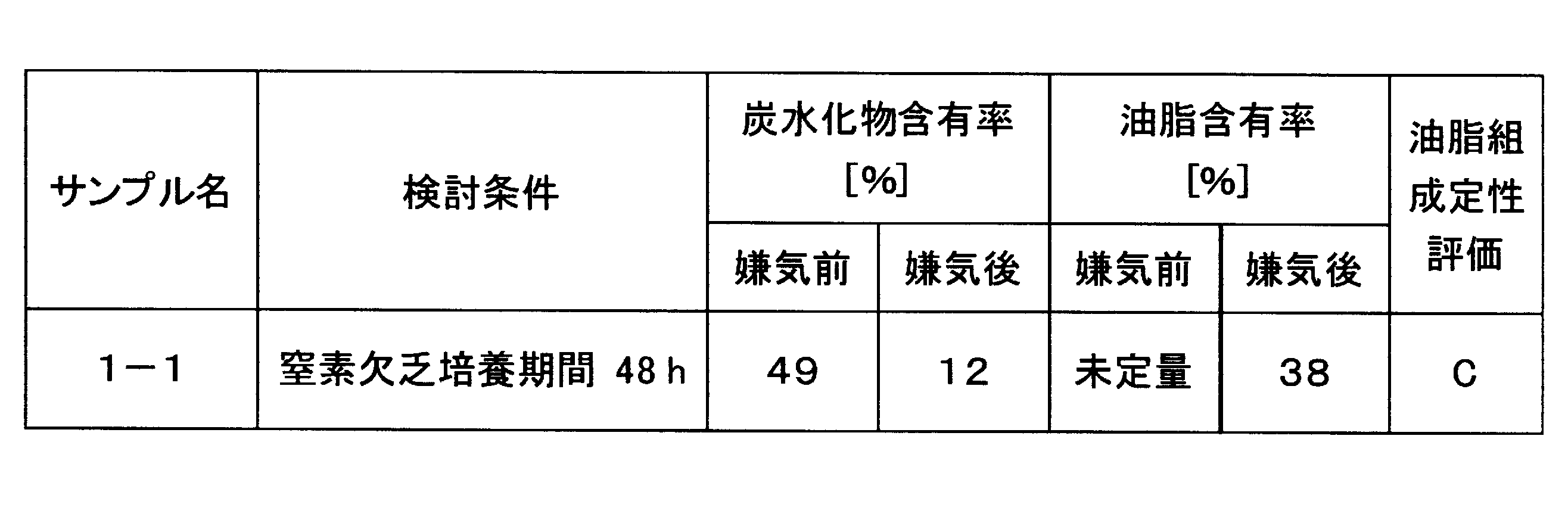
従って、炭水化物の蓄積を考えると窒素欠乏培養期間は48時間以内(明期24時間以内)が良いと判断できた。
一方、サンプル1-1は、嫌気前に比べて嫌気後の炭水化物含有率は大きく低下している。これは、ユーグレナに含まれる炭水化物のほとんどがパラミロンであり、パラミロンは嫌気処理によって分解されるという知見と整合する。
また、一方、油脂組成においても、図2のワックスエステルのピークに示されるように、サンプル1-1において良好な結果が見受けられた。
なお、窒素欠乏培養期間が長くなると、ワックスエステルのピークは小さくなる。
これは、窒素欠乏ストレスによりユーグレナ細胞内で新規のアミノ酸が生合成されにくくなり、嫌気発酵に関わる酵素をコードする遺伝子の発現又はタンパク質の翻訳量が減るか、酵素活性が落ちるためであると考えられる。
これらの知見を勘案すると、窒素欠乏期間を48時間以上にしても大きな効果はないと考えられ、窒素欠乏培養期間を48時間として以下、比較実験を行うこととした。
<窒素源添加の検討>
(1)前培養、窒素欠乏培養、嫌気処理
比較例1の結果より、炭水化物蓄積の観点において窒素欠乏培養期間は48時間以内で十分であることがわかった。
一方、油脂組成の定性評価はCであり、改善の余地があると考えられた。
そこで、比較例1のサンプル1―1を基準とし、嫌気処理の数時間前に窒素源を培養液に添加する実験を行った。
前培養および窒素欠乏培養、嫌気処理の条件は比較例1と同一とした。
本例においては、嫌気処理前に、窒素源を添加する。
サンプル2-1では、嫌気処理1時間前である窒素欠乏培養47時間目に窒素源としてリン酸水素二アンモニウム((NH4)2HPO4)を培養液1L当たり0.1643g(10mg/L相当)添加した。
同様に、サンプル2-2では、嫌気処理12時間前である窒素欠乏培養36時間目に窒素源としてリン酸水素二アンモニウム((NH4)2HPO4)を培養液1L当たり0.1643g(10mg/L相当)添加した。
これらの分析は、比較例1と同一条件で行った。
嫌気処理前後の油脂含有率を表4に示す。
また、GPC分析の結果を図3に示す。
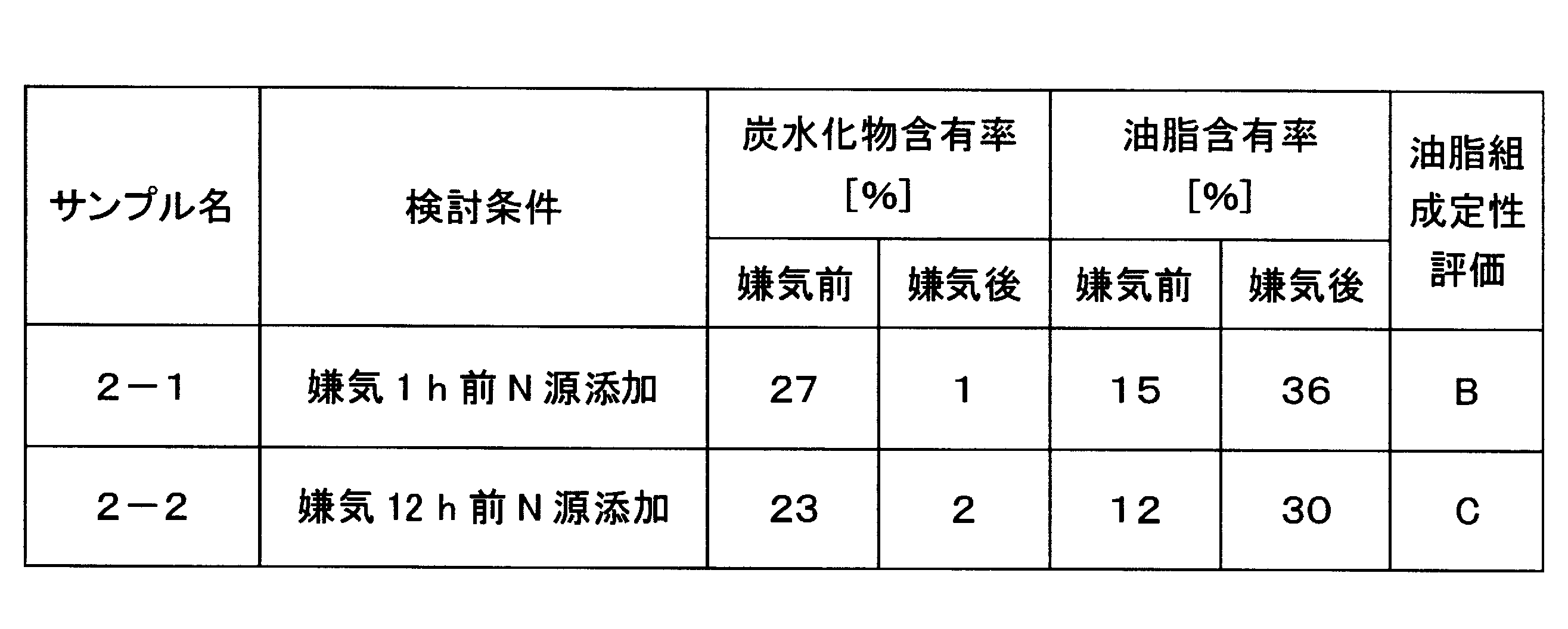
一方、嫌気処理1時間前のリン酸水素二アンモニウムの添加は、油脂含有率38%、油脂組成定性評価Bであり、サンプル1-1に比べて油脂含有率はやや下がったものの、油脂組成の改善効果があった(表4のサンプル2-1参照)。
これは、窒素欠乏培養期間が長くなると嫌気発酵に関わる酵素をコードする遺伝子の発現又はタンパク質の翻訳量が減るが、嫌気処理前に窒素源を添加することによって、嫌気発酵に関わる酵素をコードする遺伝子の発現及び翻訳が促進され、嫌気発酵能が回復したためと考えられる。
<炭素源添加の検討>
(1)前培養、窒素欠乏培養、嫌気処理
比較例1の結果より、炭水化物蓄積の観点において窒素欠乏培養期間は48時間以内で十分であることがわかった。
また、実施例1の結果より、嫌気前に窒素源を添加することによりユーグレナ細胞の嫌気発酵能が回復することがわかった。
本例では、窒素源ではなく炭素源の添加によっても嫌気発酵能が回復するかどうかを調べるため、グルコースを添加する実験を行った。
前培養および窒素欠乏培養、嫌気処理の条件は比較例1と同一とした。
本例においては、嫌気処理前に、炭素源を添加する。
サンプル3-1は、嫌気処理1時間前である窒素欠乏培養47時間目に炭素源としてグルコースを培養液1L当たり1g添加した。
これらの分析は、比較例1と同一条件で行った。
嫌気処理前後の油脂含有率を表5に示す。
また、GPC分析の結果を図4に示す。

これは、炭素源の添加によっても嫌気発酵能が回復したためと考えられる。
<窒素源及び炭素源添加の検討>
(1)前培養、窒素欠乏培養、嫌気処理
上記比較例1の結果より、炭水化物蓄積の観点において窒素欠乏培養期間は48時間以内で十分であることがわかった。
また、上記実施例1および実施例2の結果より、嫌気前に窒素源又は炭素源を添加することによりユーグレナ細胞の嫌気発酵能が回復することがわかった。
更に、本例では、窒素源および炭素源の同時添加によって油脂含有率および油脂組成にどのような影響があるかを調べるため、実施例3として、以下の実験を行った。
前培養および窒素欠乏培養、嫌気処理の条件は比較例1と同一とした。
サンプル4-1は、嫌気処理0時間前である窒素欠乏培養48時間目に炭素源としてグルコースを培養液1L当たり1g、窒素源としてリン酸水素二アンモニウム((NH4)2HPO4)を培養液1L当たり0.1643g(10mg/L相当)添加した。
サンプル4-2は、嫌気処理0.5時間前である窒素欠乏培養47.5時間目に炭素源としてグルコースを培養液1L当たり1g、窒素源としてリン酸水素二アンモニウム((NH4)2HPO4)を培養液1L当たり0.1643g(10mg/L相当)添加した。
サンプル4-3は、嫌気処理1時間前である窒素欠乏培養47時間目に炭素源としてグルコースを培養液1L当たり1g、窒素源としてリン酸水素二アンモニウム((NH4)2HPO4)を培養液1L当たり0.1643g(10mg/L相当)添加した。サンプル4―4は、嫌気処理12時間前である窒素欠乏培養36時間目に炭素源としてグルコースを培養液1L当たり1g、窒素源としてリン酸水素二アンモニウム((NH4)2HPO4)を培養液1L当たり0.1643g(10mg/L相当)添加した。
これらの分析は、比較例1と同一条件で行った。
嫌気処理前後の油脂含有率を表6に示す。
また、GPC分析の結果を図5に示す。
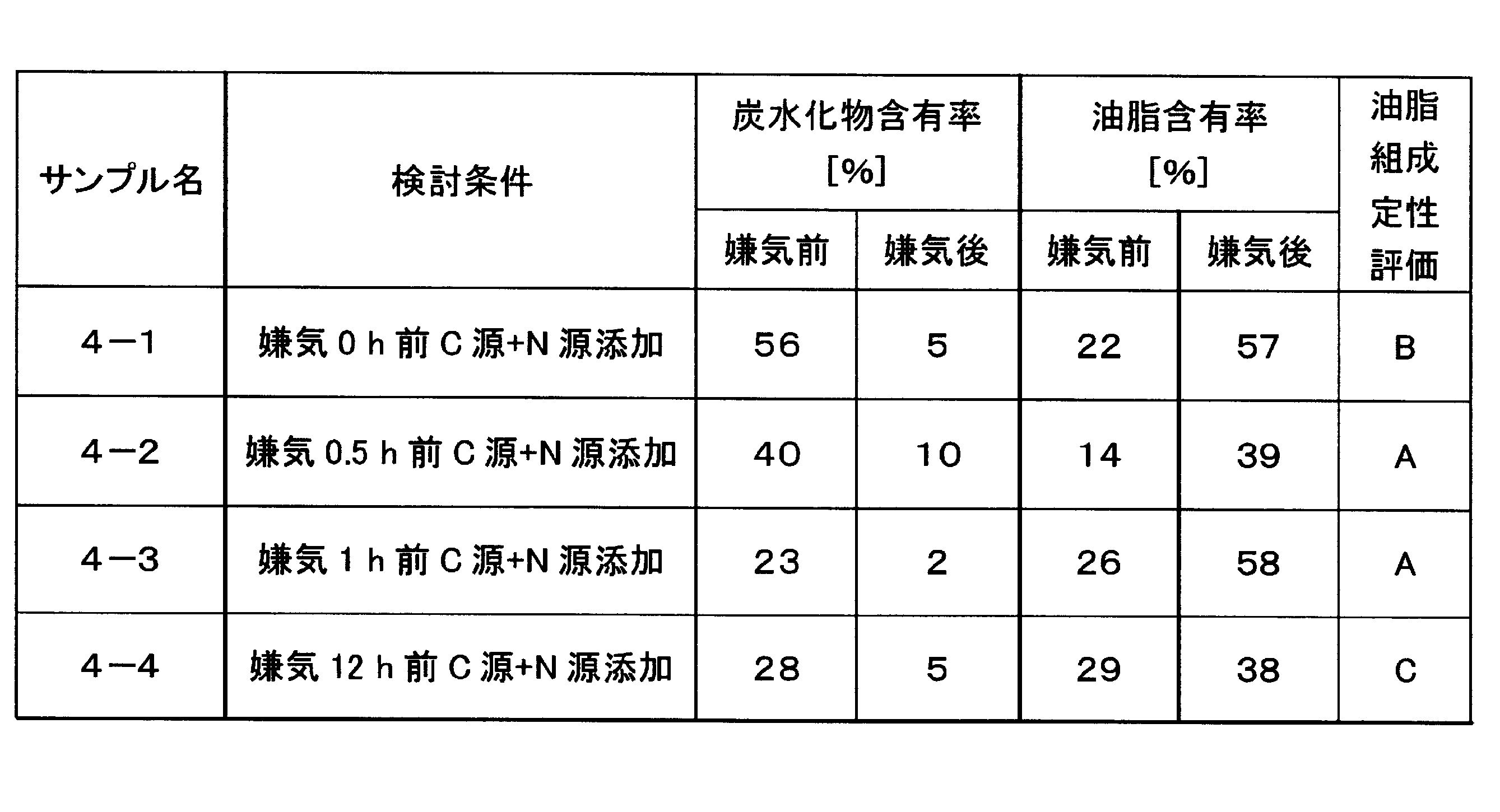
サンプル4-3では油脂含有率58%、油脂組成定性評価Aであり、グルコースのみの添加およびリン酸水素二アンモニウムの添加よりも油脂含有率が大幅に向上し、油脂組成も大きく改善した。
一方、嫌気処理12時間前のグルコースおよびリン酸水素二アンモニウムの添加はサンプル1-1と同程度であり、油脂含有率および油脂組成の改善効果はなかった(表6、サンプル4-4参照)。
窒素源に加えて炭素源を添加することにより、油脂含有率の向上および油脂組成の改善に相乗効果があったものと考えられる。
添加する栄養素としては、窒素源であることが好ましいが、炭素源であっても良いことがわかった。
更に、窒素源と炭素源を同時に添加すると、それぞれを単独で添加した場合よりも油脂組成が向上することが検証された。
よって、栄養素を添加するタイミングが早過ぎると培養中に添加した栄養素を消費してしまい、窒素欠乏状態に戻ってしまうことになる。
このため、上記検証を行い、栄養素を添加するタイミングは、嫌気発酵の3時間前、より好ましくは嫌気発酵前1時間以内であることが立証された。
添加量が多過ぎるとパラミロンの蓄積量が少なくなり、添加量が少なすぎると嫌気発酵効率の改善につながらないからである。
このため、本発明では、アンモニウムイオン濃度が10mg/L程度になるようにリン酸水素二アンモニウムを添加した。
これは、ユーグレナ濃度が0.3g/L程度の場合、アンモニアの消費速度は約1.5g・L-1・h-1であるため、10mg/Lは6~7時間で消費する量である。
ユーグレナは、健康食品等にも使用されているとおり、簡易に手に入る微生物であるとともに、大量に培養することが可能である。
本発明によれば、このような微生物であるユーグレナより良質なワックスエステルを大量に回収することにより、クリーンなエネルギーを安定的に供給することができる。
Claims (9)
- 微細藻ユーグレナを窒素欠乏条件下で好気的に培養する第1の工程と、細胞を嫌気状態下に保持する第2の工程と、を少なくとも行い、
前記第2の工程を行う前に、前記第1の工程を経た培養液に栄養源を添加することを特徴とするワックスエステル高含有ユーグレナの生産方法。 - 前記栄養源の添加は、前記第2の工程における嫌気状態である前記培養液の溶存酸素濃度が0.03mg/L以下に下がった時点を基準として、時間的に前のタイミングであることを特徴とする請求項1に記載のワックスエステル高含有ユーグレナの生産方法。
- 前記栄養源が窒素源であることを特徴とする請求項1又は請求項2に記載のワックスエステル高含有ユーグレナの生産方法。
- 前記栄養源が炭素源であることを特徴とする請求項1又は請求項2に記載のワックスエステル高含有ユーグレナの生産方法。
- 前記栄養源が窒素源及び炭素源であることを特徴とする請求項1又は請求項2に記載のワックスエステル高含有ユーグレナの生産方法。
- 前記窒素源がアンモニウム化合物であることを特徴とする請求項3に記載のワックスエステル高含有ユーグレナの生産方法。
- 前記窒素源がアンモニウム化合物であることを特徴とする請求項5に記載のワックスエステル高含有ユーグレナの生産方法。
- 前記炭素源がグルコースであることを特徴とする請求項4に記載のワックスエステル高含有ユーグレナの生産方法。
- 前記炭素源がグルコースであることを特徴とする請求項5に記載のワックスエステル高含有ユーグレナの生産方法。
Priority Applications (3)
| Application Number | Priority Date | Filing Date | Title |
|---|---|---|---|
| US14/375,500 US20150010987A1 (en) | 2012-01-31 | 2013-01-31 | Method for producing euglena having high wax ester content |
| BR112014018787A BR112014018787A8 (pt) | 2012-01-31 | 2013-01-31 | Método para produzir euglena com alto teor de éster de cera |
| AU2013216014A AU2013216014B2 (en) | 2012-01-31 | 2013-01-31 | Method for producing Euglena having high wax ester content |
Applications Claiming Priority (2)
| Application Number | Priority Date | Filing Date | Title |
|---|---|---|---|
| JP2012019026A JP5946647B2 (ja) | 2012-01-31 | 2012-01-31 | ワックスエステル高含有ユーグレナの生産方法 |
| JP2012-019026 | 2012-01-31 |
Publications (1)
| Publication Number | Publication Date |
|---|---|
| WO2013115288A1 true WO2013115288A1 (ja) | 2013-08-08 |
Family
ID=48905320
Family Applications (1)
| Application Number | Title | Priority Date | Filing Date |
|---|---|---|---|
| PCT/JP2013/052124 Ceased WO2013115288A1 (ja) | 2012-01-31 | 2013-01-31 | ワックスエステル高含有ユーグレナの生産方法 |
Country Status (7)
| Country | Link |
|---|---|
| US (1) | US20150010987A1 (ja) |
| JP (1) | JP5946647B2 (ja) |
| AU (1) | AU2013216014B2 (ja) |
| BR (1) | BR112014018787A8 (ja) |
| MY (1) | MY162426A (ja) |
| TW (1) | TWI564391B (ja) |
| WO (1) | WO2013115288A1 (ja) |
Cited By (4)
| Publication number | Priority date | Publication date | Assignee | Title |
|---|---|---|---|---|
| WO2015190116A1 (ja) * | 2014-06-13 | 2015-12-17 | 株式会社デンソー | 微細藻類の培養方法、微細藻類、及び油脂の製造方法 |
| WO2016181902A1 (ja) * | 2015-05-08 | 2016-11-17 | 国立研究開発法人理化学研究所 | ユーグレナを用いた有機酸の生産方法 |
| JP2017070239A (ja) * | 2015-10-07 | 2017-04-13 | 株式会社神鋼環境ソリューション | ユーグレナの培養方法 |
| WO2020162502A1 (ja) * | 2019-02-07 | 2020-08-13 | 学校法人近畿大学 | ユーグレナによるバイオ燃料の製造方法 |
Families Citing this family (6)
| Publication number | Priority date | Publication date | Assignee | Title |
|---|---|---|---|---|
| JP6063362B2 (ja) * | 2013-09-10 | 2017-01-18 | 株式会社日立製作所 | 光合成微生物の分離システム及びその分離方法 |
| KR20170024307A (ko) * | 2015-08-25 | 2017-03-07 | 삼성전자주식회사 | 내장형 리프레쉬 콘트롤러 및 이를 포함하는 메모리 장치 |
| JP6625370B2 (ja) * | 2015-08-24 | 2019-12-25 | 岡山県 | 藻類の培養密度を向上させるための組成物およびその利用 |
| JP6740590B2 (ja) * | 2015-10-23 | 2020-08-19 | 株式会社デンソー | 光合成微生物の培養装置及び培養方法 |
| JP2017184698A (ja) * | 2016-04-08 | 2017-10-12 | 株式会社ユーグレナ | 油脂高含有ユーグレナ |
| JP7149137B2 (ja) * | 2018-09-03 | 2022-10-06 | 株式会社ユーグレナ | ユーグレナ及びワックスエステルの製造方法 |
Citations (4)
| Publication number | Priority date | Publication date | Assignee | Title |
|---|---|---|---|---|
| JPS61254193A (ja) * | 1985-05-07 | 1986-11-11 | Harima Chem Inc | 不飽和ワツクスエステルの製造方法 |
| JPS63119409A (ja) * | 1986-11-08 | 1988-05-24 | Harima Chem Inc | 皮膚化粧料 |
| JPH0889260A (ja) * | 1994-09-22 | 1996-04-09 | Iwase Cosfa Kk | スクアレン類の製法 |
| WO2012011421A1 (ja) * | 2010-07-20 | 2012-01-26 | 株式会社ユーグレナ | ワックスエステル高含有ユーグレナの生産方法及びワックスエステル製造方法 |
Family Cites Families (1)
| Publication number | Priority date | Publication date | Assignee | Title |
|---|---|---|---|---|
| JP5513748B2 (ja) * | 2009-01-13 | 2014-06-04 | 花王株式会社 | 凹凸補正用油性化粧料 |
-
2012
- 2012-01-31 JP JP2012019026A patent/JP5946647B2/ja active Active
-
2013
- 2013-01-31 MY MYPI2014002108A patent/MY162426A/en unknown
- 2013-01-31 BR BR112014018787A patent/BR112014018787A8/pt not_active IP Right Cessation
- 2013-01-31 WO PCT/JP2013/052124 patent/WO2013115288A1/ja not_active Ceased
- 2013-01-31 US US14/375,500 patent/US20150010987A1/en not_active Abandoned
- 2013-01-31 TW TW102103607A patent/TWI564391B/zh not_active IP Right Cessation
- 2013-01-31 AU AU2013216014A patent/AU2013216014B2/en not_active Ceased
Patent Citations (4)
| Publication number | Priority date | Publication date | Assignee | Title |
|---|---|---|---|---|
| JPS61254193A (ja) * | 1985-05-07 | 1986-11-11 | Harima Chem Inc | 不飽和ワツクスエステルの製造方法 |
| JPS63119409A (ja) * | 1986-11-08 | 1988-05-24 | Harima Chem Inc | 皮膚化粧料 |
| JPH0889260A (ja) * | 1994-09-22 | 1996-04-09 | Iwase Cosfa Kk | スクアレン類の製法 |
| WO2012011421A1 (ja) * | 2010-07-20 | 2012-01-26 | 株式会社ユーグレナ | ワックスエステル高含有ユーグレナの生産方法及びワックスエステル製造方法 |
Non-Patent Citations (1)
| Title |
|---|
| COLEMAN L.W. ET AL.: "Environmental Control of Carbohydrate and Lipid Synthesis in Euglena", PLANT CELL PHYSIOL., vol. 29, no. 3, 1988, pages 423 - 432 * |
Cited By (8)
| Publication number | Priority date | Publication date | Assignee | Title |
|---|---|---|---|---|
| WO2015190116A1 (ja) * | 2014-06-13 | 2015-12-17 | 株式会社デンソー | 微細藻類の培養方法、微細藻類、及び油脂の製造方法 |
| WO2016181902A1 (ja) * | 2015-05-08 | 2016-11-17 | 国立研究開発法人理化学研究所 | ユーグレナを用いた有機酸の生産方法 |
| CN107614693A (zh) * | 2015-05-08 | 2018-01-19 | 国立研究开发法人理化学研究所 | 使用裸藻生产有机酸的方法 |
| JPWO2016181902A1 (ja) * | 2015-05-08 | 2018-02-22 | 国立研究開発法人理化学研究所 | ユーグレナを用いた有機酸の生産方法 |
| JP2017070239A (ja) * | 2015-10-07 | 2017-04-13 | 株式会社神鋼環境ソリューション | ユーグレナの培養方法 |
| WO2020162502A1 (ja) * | 2019-02-07 | 2020-08-13 | 学校法人近畿大学 | ユーグレナによるバイオ燃料の製造方法 |
| JPWO2020162502A1 (ja) * | 2019-02-07 | 2021-12-09 | 学校法人近畿大学 | ユーグレナによるバイオ燃料の製造方法 |
| JP7343194B2 (ja) | 2019-02-07 | 2023-09-12 | 学校法人近畿大学 | ユーグレナによるバイオ燃料の製造方法 |
Also Published As
| Publication number | Publication date |
|---|---|
| TWI564391B (zh) | 2017-01-01 |
| JP5946647B2 (ja) | 2016-07-06 |
| AU2013216014A1 (en) | 2014-08-14 |
| US20150010987A1 (en) | 2015-01-08 |
| TW201335373A (zh) | 2013-09-01 |
| BR112014018787A8 (pt) | 2017-07-11 |
| BR112014018787A2 (ja) | 2017-06-20 |
| MY162426A (en) | 2017-06-15 |
| AU2013216014B2 (en) | 2017-11-23 |
| JP2013153730A (ja) | 2013-08-15 |
Similar Documents
| Publication | Publication Date | Title |
|---|---|---|
| JP5946647B2 (ja) | ワックスエステル高含有ユーグレナの生産方法 | |
| Patel et al. | Biodiesel production from non-edible lignocellulosic biomass of Cassia fistula L. fruit pulp using oleaginous yeast Rhodosporidium kratochvilovae HIMPA1 | |
| AU2011280618B2 (en) | Process for production of euglena containing wax ester at high content, and process for production of wax ester | |
| EP2619304B1 (en) | Bicarbonate trigger for inducing lipid accumulation in algal systems | |
| Abu Hajar et al. | Cultivation of the microalga Neochloris oleoabundans for biofuels production and other industrial applications (a review) | |
| Liu et al. | Microalgae as feedstocks for biodiesel production | |
| KR101563148B1 (ko) | 감마선 조사에 의해 바이오매스, 전분 및 지질 함량이 증진된 미세조류 클라미도모나스 레인하드티아이 변이체 및 이의 용도 | |
| Hakim et al. | The Effect of IAA Phytohormone (Indole-3-Acetic Acid) on the Growth, Lipid, Protein, Carbohydrate, and Pigment Content in Euglena sp. | |
| Almutairi | Evaluation of halophilic microalgae isolated from Rabigh Red Sea coastal area for biodiesel production: screening and biochemical studies | |
| Manzoor et al. | Sugarcane bagasse hydrolysate as organic carbon substrate for mixotrophic cultivation of Nannochloropsis sp. BR2 | |
| Abdullah et al. | Algal biotechnology for bioenergy, environmental remediation and high-value biochemicals | |
| Gastelum-Franco et al. | Preliminary evaluation of the green microalga Dunaliella salina as a potential feedstock for biodiesel: effect of molasses on growth and lipid profile | |
| Work | Metabolic and physiological engineering of photosynthetic microorganisms for the synthesis of bioenergy feedstocks: development, characterization, and optimization | |
| KR102864657B1 (ko) | 신규한 유트렙티엘라 속 균주 및 이를 이용한 지방산의 생산방법 | |
| Okcu | The impact of nitrogen starvation on the dynamics of lipid and biomass production in Scenedesmus sp. | |
| Aboudi et al. | Polyhydroxyalkanoate production from algal biomass | |
| Abeln | Advancing the industrial relevance of the oleaginous yeast Metschnikowia pulcherrima | |
| Bwatanglang et al. | Algae-derived biomass for sustainable and renewable biofuel production | |
| Mohanty et al. | A Biorefinery Approach to Algal Biomass Conversion for Biofuels and Bioproducts | |
| Taremie et al. | A statistical approach for the production of lipid, biomass, and phenolic from a newly isolated Pichia kudriavzevii strain from Caspian Sea fish | |
| TAMIZHAZHAGAN | DIFFERENT VEGETABLE OIL SOURCES EFFECTS ON BIOMASS PRODUCTION OF YEAST | |
| Ehimen | An Investigation on the Co-production of Biodiesel and Methane from Microalgae | |
| Silvestro | Biochemical analyses of the marine diatom Cyclotella cryptica grown under different nutritional condition for biotechnological applications | |
| Theantana et al. | The preliminary study of lipid production of Nostoc sp. from Bueng Boraphet, Nakhon Sawan Province | |
| Sestric | Investigations of Single Cell Oils (SCOs): an analysis of growth and lipid biosynthesis in oleaginous microbes for biodiesel production |
Legal Events
| Date | Code | Title | Description |
|---|---|---|---|
| 121 | Ep: the epo has been informed by wipo that ep was designated in this application |
Ref document number: 13743678 Country of ref document: EP Kind code of ref document: A1 |
|
| WWE | Wipo information: entry into national phase |
Ref document number: 14375500 Country of ref document: US |
|
| NENP | Non-entry into the national phase |
Ref country code: DE |
|
| ENP | Entry into the national phase |
Ref document number: 2013216014 Country of ref document: AU Date of ref document: 20130131 Kind code of ref document: A |
|
| REG | Reference to national code |
Ref country code: BR Ref legal event code: B01A Ref document number: 112014018787 Country of ref document: BR |
|
| 122 | Ep: pct application non-entry in european phase |
Ref document number: 13743678 Country of ref document: EP Kind code of ref document: A1 |
|
| ENP | Entry into the national phase |
Ref document number: 112014018787 Country of ref document: BR Kind code of ref document: A2 Effective date: 20140730 |