WO2012176955A1 - 음이온으로 하전된 극성 사이드 체인을 갖는 아미노산 또는 비전하 극성 사이드 체인을 갖는 아미노산이 태그 형태로 리파아제의 n-말단에 결합하고 있는 재조합 리파아제 및 대장균을 이용한 이의 생산방법 - Google Patents
음이온으로 하전된 극성 사이드 체인을 갖는 아미노산 또는 비전하 극성 사이드 체인을 갖는 아미노산이 태그 형태로 리파아제의 n-말단에 결합하고 있는 재조합 리파아제 및 대장균을 이용한 이의 생산방법 Download PDFInfo
- Publication number
- WO2012176955A1 WO2012176955A1 PCT/KR2011/006824 KR2011006824W WO2012176955A1 WO 2012176955 A1 WO2012176955 A1 WO 2012176955A1 KR 2011006824 W KR2011006824 W KR 2011006824W WO 2012176955 A1 WO2012176955 A1 WO 2012176955A1
- Authority
- WO
- WIPO (PCT)
- Prior art keywords
- lipase
- amino acid
- side chain
- polar side
- recombinant
- Prior art date
- Legal status (The legal status is an assumption and is not a legal conclusion. Google has not performed a legal analysis and makes no representation as to the accuracy of the status listed.)
- Ceased
Links
Images


Classifications
-
- C—CHEMISTRY; METALLURGY
- C12—BIOCHEMISTRY; BEER; SPIRITS; WINE; VINEGAR; MICROBIOLOGY; ENZYMOLOGY; MUTATION OR GENETIC ENGINEERING
- C12N—MICROORGANISMS OR ENZYMES; COMPOSITIONS THEREOF; PROPAGATING, PRESERVING, OR MAINTAINING MICROORGANISMS; MUTATION OR GENETIC ENGINEERING; CULTURE MEDIA
- C12N15/00—Mutation or genetic engineering; DNA or RNA concerning genetic engineering, vectors, e.g. plasmids, or their isolation, preparation or purification; Use of hosts therefor
- C12N15/09—Recombinant DNA-technology
- C12N15/11—DNA or RNA fragments; Modified forms thereof; Non-coding nucleic acids having a biological activity
-
- C—CHEMISTRY; METALLURGY
- C12—BIOCHEMISTRY; BEER; SPIRITS; WINE; VINEGAR; MICROBIOLOGY; ENZYMOLOGY; MUTATION OR GENETIC ENGINEERING
- C12N—MICROORGANISMS OR ENZYMES; COMPOSITIONS THEREOF; PROPAGATING, PRESERVING, OR MAINTAINING MICROORGANISMS; MUTATION OR GENETIC ENGINEERING; CULTURE MEDIA
- C12N15/00—Mutation or genetic engineering; DNA or RNA concerning genetic engineering, vectors, e.g. plasmids, or their isolation, preparation or purification; Use of hosts therefor
- C12N15/09—Recombinant DNA-technology
- C12N15/63—Introduction of foreign genetic material using vectors; Vectors; Use of hosts therefor; Regulation of expression
- C12N15/70—Vectors or expression systems specially adapted for E. coli
-
- C—CHEMISTRY; METALLURGY
- C12—BIOCHEMISTRY; BEER; SPIRITS; WINE; VINEGAR; MICROBIOLOGY; ENZYMOLOGY; MUTATION OR GENETIC ENGINEERING
- C12N—MICROORGANISMS OR ENZYMES; COMPOSITIONS THEREOF; PROPAGATING, PRESERVING, OR MAINTAINING MICROORGANISMS; MUTATION OR GENETIC ENGINEERING; CULTURE MEDIA
- C12N9/00—Enzymes; Proenzymes; Compositions thereof; Processes for preparing, activating, inhibiting, separating or purifying enzymes
- C12N9/14—Hydrolases (3)
- C12N9/16—Hydrolases (3) acting on ester bonds (3.1)
- C12N9/18—Carboxylic ester hydrolases (3.1.1)
- C12N9/20—Triglyceride splitting, e.g. by means of lipase
Definitions
- the present invention relates to a lipase and a method for producing the same, more particularly, an amino acid having a negatively charged polar side chain or an amino acid having an uncharged polar side chain is tagged.
- the present invention relates to a method for producing the recombinant lipase using recombinant lipase bound to the N-terminus and recombinant E. coli transformed with the recombinant lipase.
- Lipase (EC 3.1.1.3) is a biocatalyst that produces a variety of reactions, as well as hydrolysis titers that break down fats, as well as esterification, interesterification, acidolysis, alcohololysis and Catalyze reactions such as aminolysis.
- Lipase can also be used in organic solvents because it can act at the interface between water and oil, and has various substrate applications with substrate specificity and high stability at high temperatures. Indeed, lipases have been used the most as a raw material for detergents. In 1995, detergent enzymes accounted for 30% of the total $ 30 million enzyme market, and in 2000 the market reached $ 1.5 billion. Kirk et al, Curr. Opin. Biotechnol. 13: 345-351, 2002.
- lipases Although a large number of commercial lipases are currently used, their industrial applications are limited due to high manufacturing costs, insufficient feedstock for industrial use, and low process parameters of lipase catalyzed reactions. Nevertheless, lipases are currently used most frequently in the food, detergent and pharmaceutical industries. To solve the above problems, it is necessary to drastically lower the price of lipase production, develop a mass production process of lipase, and change lipase characteristics. You must devise ways to increase process variables.
- lipases are produced by culturing natural microorganisms, most of which have a lipase-producing ability, except in some cases.
- the cultivation method is not easy, and the unit yield is mostly low, and there is a problem in that lipase cannot be stably produced due to the natural variation of microorganisms over time.
- artificial genetic modification is difficult, there is a problem in that the enzymatic properties cannot be improved by using the latest genetic engineering techniques.
- Escherichia coli also called Escherichia coli
- Escherichia coli is a gram-negative bacterium and is the most widely used microorganism for research and industrial use. Due to its rapid growth rate, consumption of various carbon sources, readiness of the genome sequence and development of various foreign gene expression systems, it has been used as an optimal host cell (cell) for the expression of foreign proteins (target proteins).
- target proteins foreign proteins
- U.S. Patent Publication No. US 2010/0151502 A1 expresses lipase B from Candida antarctica (hereinafter referred to as 'CalB'), the first enzymatic activity in the cytoplasm of Escherichia coli.
- 'CalB' Candida antarctica
- the present inventors such as Mdh ( E. coli malate dehydrogenase), PotD ( E. coli spermidine / putrescine-binding periplasmic protein), SlyD ( E. coli FKBP-type peptidyl-prolyl cis- The entire gene sequence of trans isomerase), GST (glutathione-S-transferase) and MBP ( E. coli maltose binding protein) were fused to the N-terminus of the CalB gene, and the His-6 tag was attached to the C-terminus. We have constructed a conjugated CalB expression system.
- a lipase production system using Escherichia coli as a host cell requires the use of various fusion partners to improve water solubility, which leads to a decrease in the yield of protein production, thereby essentially expressing lipase in E. coli cells. Because of the use of the system to make, after the incubation, additional processes that require crushing the cells are required, which inevitably causes a problem of reduced productivity.
- the present invention intends to develop and provide a technology for releasing lipase into E. coli cells outside, that is, in the culture solution.
- the present invention is to develop and provide a technology that can be purified at low cost lipase recovered through the culture.
- a signal peptide sequence for secreting the protein produced in E. coli into the periplasm of E. coli is bound to the N-terminal of the lipase, and charged with anion Recombinant lipase, characterized in that the amino acid having a negatively charged polar side chain or an amino acid sequence having an uncharged polar side chain is bound so as to be located between the signal peptide and lipase to provide.
- the present invention binds to the N-terminus of the lipase, a signal peptide sequence that allows the protein produced in E. coli to secrete into the periplasm of E. coli, and is negatively charged polar side chain (negatively).
- a recombinant lipase having an amino acid having a charged polar side chain or an amino acid sequence having an uncharged polar side chain is located between the signal peptide and the lipase. It provides a method for producing a recombinant lipase characterized in that.
- a protein peptide using a signal peptide is the second type of the E. coli secretion method, and the signal peptides used at this time are PelB, OmpA, PhoA and the like.
- the signal peptide is composed of a positively charged amino acid terminal (n-region), a hydrophobic center (h-region), and a polar cleavage (c-region).
- n-region is known to play a role in transferring the protein to be secreted into the lipid bilayer having a negative charge.
- the lipase secretion in the medium was increased compared to the case where it was not, but as a factor of the increase in the secretion amount by the negative charge (for example, five) We can infer the following possibilities.
- signal peptides eg, PelB
- the lipase of the present invention has an additional negative charge at the lipase N-terminus even after the signal peptide is cleaved. . At this time, it can be inferred that the extraneous charge remaining and the lipid bilayer having negative charge interact with each other to increase secretion out of the cells.
- the amount of lipase migration from the periplasm to the medium increased over time, which is not a phenomenon caused by the simple migration of the lipase present in the periplasm into the medium due to the difference in density. It refers to a phenomenon caused by continuously discharged to the medium by the specific interaction with the outer membrane.
- Factors that secrete proteins from the surrounding cytoplasm into the medium include osmotic pressure, cell division and destruction, and main terminal branch (MTB). Branches (MTB).
- the main terminal branch (MTB) is a secreton consisting of 12 to 16 proteins (secreton) to recognize the tertiary or quaternary structure of the protein to secrete the target protein to the outside.
- secreton a secreton consisting of 12 to 16 proteins (secreton) to recognize the tertiary or quaternary structure of the protein to secrete the target protein to the outside.
- the structural change of the lipase is induced by the negative charge attached to the N-terminus, thereby promoting the secretion to the outside of the cells.
- the signal peptide may be PelB as an example.
- the amino acid having an anion-charged polar side chain may be aspartate or glutamate.
- the amino acid having an uncharged polar side chain may be asparagine or glutamine.
- an amino acid having a negatively charged polar side chain (negatively charged polar side chain) or an amino acid having an uncharged polar side chain (uncharged polar side chain), 4-5 amino acids are preferably bound to lipase in the form of a tag.
- the recombinant lipase of the present invention or a production method thereof is preferably a amino acid tag for purification at the C-terminus of the lipase.
- the purification amino acid is preferably an amino acid having a negatively charged polar side chain (negatively charged polar side chain).
- E. coli which is used as a host, has a signal peptide (signal peptide) sequence for secreting the protein produced in E. coli into the periplasm of E. coli. So that an amino acid sequence having a terminally charged, negatively charged polar side chain or an amino acid sequence with an uncharged polar side chain is located between the signal peptide and the lipase It may be E. coli transformed with the recombinant lipase bound.
- signal peptide signal peptide
- the culture is preferably carried out by fed-batch culture.
- recombinant lipase can be produced in large quantities.
- the recombinant lipase can be recovered by secreting it out of Escherichia coli, that is, in a culture solution.
- the recombinant lipase recovered through the culture can be purified at low cost.
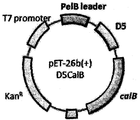
- FIG. 1 is a schematic diagram of a vector constructed according to an embodiment of the present invention.
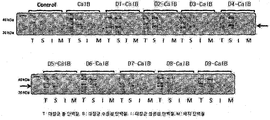
- Figure 2 is expressed in recombinant E. coli, SDS-PAGE results of the recombinant lipase of the present invention in which the anionic tag is fused to the N-terminus.
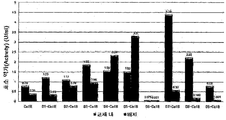
- Figure 3 shows the enzyme titer of wild type lipase (CalB) and the enzyme titer in cells and medium of the recombinant lipase of the present invention in which an anionic tag is fused at the N-terminus.
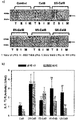
- FIG. 4 a) shows the results of SDS-PAGE confirming the degree of water-soluble expression of lipase in cells and the amount of secretion into the medium by tags tagged with five amino acids of aspartate, glutamate, asrapagine and glutamine. , b) is the result of measuring enzyme titers of the samples.
- Figure 5 shows the enzyme titer of lipase (CalB) when OmpA was used as the signal peptide.
- 'CalB' is a control sample using OmpA as the signal peptide
- 'D4CalB' and 'D5CalB' are experimental groups samples in which 4 and 5 aspartates are respectively coupled between the signal peptide OmpA and lipase (CalB).
- Figure 6 shows the enzyme titer of lipase (CalB) when PhoA was used as the signal peptide.
- 'CalB' is a control sample using PhoA as a signal peptide
- 'D4CalB' and 'D5CalB' are experimental groups samples in which 4 and 5 aspartates are respectively coupled between the signal peptide PhoA and lipase (CalB).
- Figure 7 is a fed-batch culture results of the present invention and the control E. coli.
- a) is E. coli strain expressing D5-CalB of the present invention
- b) is a recombinant E. coli strain expressing wild type CalB as a control.
- Aspartate fusion lipase library with 1 to 9 lengths between the Pelb signal peptide sequence and the lipase gene to identify the optimal secretion conditions and increase the secretion efficiency of the lipase along the length of the N-terminal anionic fusion tag. was constructed as follows.
- the PelB gene a signal peptide that secretes the lipase gene into the peripheral cytoplasm of Escherichia coli, is amplified at the N-terminus of the amplified Candida antarctica ATCC 32657. Combined.
- the above-described CalB expressing vector was introduced into E. coli BL21 (DE3) star strain and transformed.
- the transformed BL21 (DE3) star strain was transformed into 5 mL Reisenberg containing kanamycin. Inoculated into the liquid medium and shaken at 37 °C, 250 rpm for 12 hours. This precultured E. coli was inoculated 1% in 100 mL Ryzenberg liquid medium containing kanamycin. When the OD reached 0.8 to 1.0 by shaking culture at 37 ° C. and 250 rpm, the culture temperature was changed to 20 ° C., and finally the culture medium was 0.2 mM isopropyl ⁇ -D-1-thiogalactopy. Induction was carried out so as to be a lanoside (Isopropyl ⁇ -D-1-thiogalactopyranoside (IPTG). After IPTG induction, shaking culture was continued for 18 hours.
- IPTG Isopropyl ⁇ -D-1-thiogalactopyran
- the lipase expression pattern and the enzyme activity of the lipase were confirmed by SDS-PAGE and activity measurement.
- p-NPP para-nitrophenyl palmitate
- p-NPB para-nitrophenyl butyrate
- p-NPB Para-nitrophenyl butyrate
- a titer method using p-NPB as a substrate is used. Selected.
- the measurement principle is as follows. When the fusion lipase expressed in recombinant E. coli is active, it hydrolyzes p-NPB to form para-nitrophenol, which is yellow, which is absorbed by an absorber at a wavelength of 405 nm. Is to determine the enzyme titer.
- Lipase expression analysis of recombinant Escherichia coli via SDS-PAGE was performed as follows. First, lipase expression-derived recombinant E. coli cells were purely obtained by centrifugation, and then mixed with 50 mM sodium phosphate buffer (pH 7.5). cells were disrupted using a processor. The ground cell mixture was centrifuged at 4 ° C., 12,000 rpm for 30 minutes to separate cellular proteins into soluble and insoluble portions. Proteins in the fractionated cells and medium were subjected to SDS-PAGE, protein one-dimensional electrophoresis. At this time, the SDS-PAGE gel used was a 12% arylamide gel (acrylamide gel). Band densities of lipases and recombinant lipases were measured using Total Lab software from Biosystematica.
- 2 is an SDS-PAGE result of a lipase in which an anionic tag expressed in recombinant E. coli is fused to the N-terminus, wherein 'CalB', 'D1-CalB' to 'D9-CalB' are sample names, and 'D' It is an abbreviation of "aspartate,” and "1" to "9" mean the number of aspartate.
- Protein secretion into the medium is advantageous in that industrial separation and purification can be easily performed. Therefore, we attempted to analyze the mechanism of increasing secretion efficiency of five aspartate tags that significantly increased protein secretion into the medium.
- Example 1 cell culture in the present Example was carried out in the same manner as in Example 1, enzyme titer and SDS-PAGE was performed in the same manner as in Example 1.
- 'CalB', 'D5-CalB' and the like are sample names
- 'CalB' is a wild type without an amino acid tag
- 'D' is an abbreviation of 'aspartate'
- 'E' is an abbreviation of glutamate
- 'N' stands for asparagine
- 'Q' stands for glutamine
- '5' stands for the number of amino acids bound in tag form.
- asparagine and glutamine tags also increased the secretion efficiency of lipase.
- the increased secretion efficiency in negatively charged asparagine and glutamine tags is due to the fact that they have a high electron density, side chain, although not negatively charged.
- the secretion efficiency of lipase according to the type of signal peptide was investigated.
- the experiment was performed according to the method of Example 1 except that OmpA or PhoA was used instead of PelB as the signal peptide, and 4 or 5 aspartate sequences were used as the N-terminal anionic tag inserted between the signal peptide and the lipase. .
- FIGS. 5 and 6 The experimental results of measuring enzyme titers are shown in FIGS. 5 (using OmpA signal peptide) and 6 (using PhoA signal peptide).
- 'CalB' is a control sample using OmpA or PhoA as a signal peptide
- 'D4CalB' and 'D5CalB' are 4 or 5 aspartate conjugated between the signal peptide and lipase (CalB), respectively.
- E. coli BL21 (DE3) Star strain transformed with pET-26b (+)-D5-CalB vector was used as a control.
- the fed-batch culture was performed by a pH-stat method using a bench-top bioreactor manufactured by Kobiotech in an environment of 1 L of Ryzenberg medium, pH 6.8, 1200 rpm.
- the culture temperature was changed to 20 ° C.
- IPTG induction was performed so that the culture medium became IPTG with a concentration of 0.2 mM.
- Incubation was continued for 18 hours after IPTG induction. Thereafter, after separating the medium and E. coli cells by centrifugation, the lipase expression pattern and lipase enzyme activity in each part were measured.
- SDS-PAGE and enzyme titers were used for the titer determination method based on SDS-PAGE and (p-NPB) described in Example 1 above.
- Figure 7 shows the dry weight (DCW) of the cultured E. coli, as a result of enzymatic activity in the cells and the medium, the strain expressing D5-CalB (a) of Figure 7) finally 107 g / L, 223 U / ml , 65 U / ml. This is 1.4 times, 5.0 times, 8.1 times improved results compared to the wild-type CalB-expressing strain (b) of Figure 7, respectively.
- the concentration of D5-CalB in the cells and the medium was 8.7 g / L and 2.6 g / L, respectively. This is the highest level of lipase research reported to date.
- D5-CalB which was confirmed to be secreted into the medium, was purified using anion exchange resin chromatography. At this time, purification was not performed only with the N-terminal anionic fusion tag attached to increase the secretion efficiency of D5-CalB, and 10 aspartate tags were additionally attached to the C-terminus of D5-CalB. In other words, by preparing D5-CalB-D10 attached with five aspartate tags at the N-terminus and 10 C-terminus of CalB, it satisfies the improvement of secretion efficiency in E. coli and purification using anion exchange resin simultaneously. I did it.
- E. coli proteins have an isoelectric point (pI) of about 6, with a weakly acidic pi.
- pI isoelectric point
- most proteins are cationic at acidic pH (pH 4.5)
- only proteins that are anionic are attached to the anion exchange resin and can be easily separated.
- the general wild type intracellular protein having a cation is separated from the anion exchange resin, whereas the fusion protein associated with the anionic tag, even though the target protein site is cationic, the fusion partner moiety becomes anionic. Strong electron coupling with the exchange resin is achieved.
- a lipase D5-CalB-D10 was prepared by further fusion of a tag in which 10 aspartates were bound to CalB having 5 aspartates bound to the N-terminus to the C-terminus.
- E. coli was transformed with this recombinant lipase and cultured.
- the culture method was the same as the method described in Example 1.
- the recombinant E. coli cells induced with the expression of D5-CalB-D10 were centrifuged to obtain pure media components, and then mixed with 20 mM N-methylpiperazine (pH 4.5) buffer. This mixture was then filtered through a 0.45 ⁇ m filter.
- His-6 tags can be efficiently purified using stationary phases bound to Ni 2+ , but most commercial fusions (eg His-6 tags, protein A / G, GST tags) are expensive. Because of this, there is an economic problem to use for large-scale protein purification.
- the purification method using the anion exchange resin devised in the present invention is about four times cheaper than the method using the His-6 tag, and in this respect, industrial utilization may be high.
Landscapes
- Health & Medical Sciences (AREA)
- Life Sciences & Earth Sciences (AREA)
- Genetics & Genomics (AREA)
- Engineering & Computer Science (AREA)
- Chemical & Material Sciences (AREA)
- Organic Chemistry (AREA)
- Bioinformatics & Cheminformatics (AREA)
- Wood Science & Technology (AREA)
- Zoology (AREA)
- Biomedical Technology (AREA)
- Biotechnology (AREA)
- General Engineering & Computer Science (AREA)
- Molecular Biology (AREA)
- Microbiology (AREA)
- Biochemistry (AREA)
- General Health & Medical Sciences (AREA)
- Medicinal Chemistry (AREA)
- Physics & Mathematics (AREA)
- Biophysics (AREA)
- Plant Pathology (AREA)
- Enzymes And Modification Thereof (AREA)
- Micro-Organisms Or Cultivation Processes Thereof (AREA)
Abstract
본 발명은 음이온으로 하전된 극성 사이드 체인(negatively charged polar side chain)을 갖는 아미노산 또는 비전하 극성 사이드 체인(uncharged polar side chain)을 갖는 아미노산이 태그 형태로 N-말단에 결합하고 있는 재조합 리파아제 및 상기 재조합 리파아제로 형질전환된 재조합 대장균을 이용한 상기 재조합 리파아제의 생산방법에 관한 것으로, 리파아제를 대장균 외, 즉 배양액 중으로 분비시켜 회수할 수 있고, 배양액을 통해 회수되는 리파아제를 저가로 정제할 수 있으며, 리파아제를 대량으로 생산할 수도 있다.
Description
본 발명은 리파아제 및 이의 생산방법에 관한 것으로, 더욱 상세하게는 음이온으로 하전된 극성 사이드 체인(negatively charged polar side chain)을 갖는 아미노산 또는 비전하 극성 사이드 체인(uncharged polar side chain)을 갖는 아미노산이 태그 형태로 N-말단에 결합하고 있는 재조합 리파아제 및 상기 재조합 리파아제로 형질전환된 재조합 대장균을 이용한 상기 재조합 리파아제의 생산방법에 관한 것이다.
리파아제(EC 3.1.1.3)는 다양한 반응을 일으키는 생물촉매로서 지방을 분해하는 가수분해 역가뿐만 아니라, 에스테르화(esterification), 에스테르교환(interesterification), 산가수분해(acidolysis), 알코올분해(alcoholysis) 및 아미노분해(aminolysis) 등의 반응을 촉매한다. 리파아제는 물과 기름의 계면에서도 작용할 수 있어 유기용매에서도 이용 가능한데, 기질 특이성과 고온에서 높은 안정성을 지녀 다양한 산업적 적용이 가능하다. 실제로 리파아제는 세제의 원료로 가장 많이 사용되어 왔는데, 1995년에는 세제용 효소가 전체 3천만 달러의 효소시장 중 30%를 차지하였고, 2000년에는 시장이 15억 달러에 도달하였다. (Kirk et al, Curr. Opin. Biotechnol. 13:345-351, 2002).
현재 많은 수의 상업용 리파아제가 사용되고 있지만, 높은 제조가격, 산업적으로 사용하기에 부족한 공급량 및 리파아제로 촉매된 반응의 낮은 공정변수 등으로 인해 산업적 응용이 제한적이다. 그럼에도 불구하고 리파아제는 현재 식품, 세제 및 의약 산업에서 가장 많이 사용되고 있는데, 상기의 문제점을 해결하기 위해서는 리파아제의 생산가격을 획기적으로 낮추고, 리파아제의 대량 생산공정을 개발해야 하며, 리파아제의 특성을 변이시켜 공정변수를 높일 수 있는 방법을 고안해야한다.
현재 리파아제는 일부의 경우를 제외하고, 대부분 리파아제 생산능이 있는 천연 미생물을 배양하여 생산하고 있다. 하지만, 천연 미생물의 경우 배양방법이 용이하지 않고, 단위 생산량이 대부분 낮으며, 시간에 따른 미생물의 자연적인 변이로 인해 안정적으로 리파아제를 생산할 수 없는 문제가 있다. 또한, 인위적인 유전적 변형이 어렵기 때문에, 최신의 유전공학기법을 이용하여 효소적 특성을 개선할 수 없는 문제도 있다.
이에 많은 기업에서는 리파아제의 대량 생산, 안정적 생산 및 효소적 성능 개선을 위하여 유전공학기술을 이용한 재조합 미생물 발현시스템을 개발하고 있다. 일 예로, 열 안전성, 산도 안전성 및 효소 역가의 증대를 위해 생물공학기술이 사용되고 있고, 아스퍼질러스 나이거(Aspergillus niger), 사카로마이세스 세레비지애(Saccharomyces cerevisiae), 피키아 파스톨리스(Pichia pastoris) 등의 다양한 미생물이 리파아제 발현을 위한 숙주(호스트) 균주로 사용되고 있다.
한편, 대장균으로도 불리우는 에스케리치아 콜라이(Escherichia coli)는 그람 음성 박테리아로서, 연구용 및 산업용으로 가장 널리 사용되는 미생물이다. 빠른 성장률, 다양한 탄소원의 소비능력, 유전체 서열의 완독 및 다양한 외래유전자 발현시스템의 개발 등으로 인하여 외래 단백질(목적 단백질)의 발현을 위한 최적의 숙주 균체(세포)로 이용되고 있다. 하지만, 현재까지 재조합 대장균을 이용한 리파아제의 발현에는 여러 가지 문제점이 있는 것으로 알려져 있다.
미국 특허공개번호 US 2010/0151502 A1 (2010. 06. 17)에서는 대장균의 세포질에서 처음으로 효소활성이 있는 캔디다 안타르크티카(Candida antarctica) 유래의 리파아제 B (이하, 'CalB'이라 함)를 발현한 기술을 제시하였다. 대장균 오르가미(Orgami) B 숙주 세포를 이용하여 IPTG-유도 lac 프로모터를 이용할 경우, 2 U/mg의 리파아제 역가가 나타났고, 티오레독신(thioredoxin)을 융합 파트너(fusion partner)로 이용한 티오레독신-CalB의 경우, 17 U/mg의 비효소역가가 나타났다. 또한, 다양한 샤페론(GroEL, GroES, DnaK, DnaJ, GrpE)을 동시발현시킨 경우, 57~81 U/mg의 비효소역가가 나타났다. 다만, 코돈 최적화(codon optimization)를 통하여 유전자 서열이 변형된 CalB를 발현하였으나, 효소 역가의 차이는 나타나지 않았다.
한편, 본 발명자 등은 CalB를 재조합 대장균에서 발현하기 위해서 Mdh (E. coli malate dehydrogenase), PotD (E. coli spermidine/putrescine-binding periplasmic protein), SlyD (E. coli FKBP-type peptidyl-prolyl cis-trans isomerase), GST(glutathione-S-transferase)와 MBP(E. coli maltose binding protein)의 전체 유전자 서열을 CalB 유전자의 N-말단에 융합을 하였고, C-말단에 His-6 태그(tag)를 접합한 CalB 발현시스템을 구축한 적이 있다. T7 프로모터를 이용하여 발현할 경우, 모든 융합 리파아제가 30배 정도의 수용성 증가를 나타냈고, Mdh가 융합된 CalB는 상업적인 CalB와 유사한 반응속도 지표(kinetic parameter)를 보였다 (Seo et al., Biochim. Biophy. Acta 1794:519-525, 2009). 하지만, 상기 시스템의 경우, CalB보다 2배 이상 큰 융합 단백질이 발현되기 때문에, 세포 성장 저해가 예상되고, 융합체(fusion partner)를 제거하기 위해서 고가의 단백질 절단효소를 추가적으로 사용해야 하며, 융합체의 제거로 인해 단백질의 수율이 1/2 감소하는 문제를 발생시켰다. 또한, His-6 태그를 정제용 태그로 사용하여 고가의 정제용 컬럼 (Ni2+-NTA)이 필요한 문제도 있었다.
상기에서 언급하였듯이 대장균을 호스트 균체로 이용하는 리파아제 생산 시스템은 수용성의 향상을 위해 다양한 융합체(fusion partner)의 사용이 요구되는데, 이로 말미암아 단백질 생산수율 감소를 초래하고, 근본적으로 리파아제를 대장균 균체 내에서 발현시키는 시스템을 이용하였기 때문에, 배양 후, 균체를 파쇄해야 하는 추가적인 공정이 요구되어 생산성이 감소하는 문제를 야기할 수밖에 없다.
이에 본 발명에서는 리파아제를 대장균의 균체 외부, 즉 배양액 중으로 분비시킬 수 있는 기술을 개발하여 제공하고자 한다.
또한, 본 발명에서는 배양액을 통해 회수되는 리파아제를 저가로 정제할 수 있는 기술을 개발하여 제공하고자 한다.
상기 목적을 달성하기 위하여 본 발명은, 대장균 내에서 생산된 단백질을 대장균의 주변세포질(periplasm)로 분비하게 해주는 시그날 펩타이드(signal peptide) 서열이 리파아제의 N-말단에 결합하여 있고, 음이온으로 하전된 극성 사이드 체인(negatively charged polar side chain)을 갖는 아미노산 또는 비전하 극성 사이드 체인(uncharged polar side chain)을 갖는 아미노산 서열이 상기의 시그날 펩타이드와 리파아제 사이에 위치하도록 결합되어 있는 것을 특징으로 하는 재조합 리파아제를 제공한다.
또한, 본 발명은 대장균 내에서 생산된 단백질을 대장균의 주변세포질(periplasm)로 분비하게 해주는 시그날 펩타이드(signal peptide) 서열이 리파아제의 N-말단에 결합하여 있고, 음이온으로 하전된 극성 사이드 체인(negatively charged polar side chain)을 갖는 아미노산 또는 비전하 극성 사이드 체인(uncharged polar side chain)을 갖는 아미노산 서열이 상기의 시그날 펩타이드와 리파아제 사이에 위치하도록 결합되어 있는 재조합 리파아제를 대장균을 호스트로 이용해 배양함으로써 생산하는 것을 특징으로 하는 재조합 리파아제의 생산방법을 제공한다.
대장균에 있어 시그날 펩타이드(분비서열, signal peptide)을 이용한 단백질의 분비방법은 대장균의 5가지 분비방법 중 2번째 유형으로, 이때 이용되는 시그날 펩타이드에는 PelB, OmpA, PhoA 등이 있다. 이러한 시그날 펩타이드는 양전하의 아미노산 말단(n-region), 소수성의 중심부(h-region), 극성의 절단부(c-region)으로 구성되어 있다. 이 중, n-지역(n-region)은 분비하고자 하는 단백질을 음전하를 지니는 지질 이중막으로 이동시키는 역할을 하는 것으로 알려져 있다.
한편, 본 발명에서는 리파아제의 N-말단에 음전하를 붙임으로써, 그렇지 않은 경우에 비해, 배지 중으로의 리파아제 분비량이 증가하는 결과를 얻었는데, 음전하(일 예로, 5개)에 의한 분비량 증가의 요인으로는 다음과 같은 가능성을 추론해 볼 수 있다.
주변세포질(periplasm)로 단백질이 분비될 때, 시그날 펩타이드(일 예로, PelB)이 절단되면서 분비가 이루어지는데, 본 발명의 리파아제는 시그날 펩타이드가 절단된 후에도, 리파아제 N-말단에 추가적인 음전하가 존재한다. 이때, 잔존하는 추가적인 음전하와 음전하를 지니는 지질 이중막이 상호 작용을 일으켜 세포 외로 분비가 증가한 것으로 추론할 수 있는 것이다.
본 발명에서는 시간의 경과에 따라 주변세포질에서 배지로의 리파아제 이동량이 증가하였는데, 이것은 주변세포질 내에 존재하는 리파아제가 축적량이 증가함에 따라 밀도 차이에 의해 배지로 단순 이동하여 발생한 현상이 아니라, 리파아제가 세포 외막과의 특이적 상호 작용에 의해 연속적으로 배지로 배출되어 발생한 현상을 의미한다.
단백질이 주변세포질로부터 배지로 분비되는 요인으로는 삼투압, 세포의 분열 및 파괴, 주 말단 가지(main terminal branch, MTB) 등이 있는데, 이 중, 단백질 분비의 특이성을 부여할 수 있는 요소는 주 말단 가지(MTB)이다. 주 말단 가지(MTB)는 12~16개의 단백질로 이루어진 시크리톤(secreton)으로 단백질의 삼차 또는 4차 구조를 인지하여 표적 단백질을 외부로 분비시킨다. 그러나 아직까지 특정한 신호서열이나 일관된 구조가 밝혀지지는 않았다. 실제로 5개의 음전하를 부착시켰을 경우, 본래 리파아제의 4차 구조인 육량체에서 삼량체로 구조가 변화하는 것을 본 발명에서 확인할 수 있었다.
이상의 결과들로부터, 본 발명에서는 N-말단에 추가적으로 부착된 음전하에 의해 리파아제의 구조 변화가 유발되고, 이로 말미암아, 균체 외부로의 분비가 촉진된 것으로 결론낼 수 있었다.
한편, 상기 본 발명의 재조합 리파아제 또는 이의 생산방법에 있어서, 시그날 펩타이드는 일 예로 PelB일 수 있다.
한편, 상기 본 발명의 재조합 리파아제 또는 이의 생산방법에 있어서, 음이온으로 하전된 극성 사이드 체인을 갖는 아미노산은, 아스파테이트(aspartate) 또는 글루타메이트(glutamate)일 수 있다.
한편, 상기 본 발명의 재조합 리파아제 또는 이의 생산방법에 있어서, 비전하 극성 사이드 체인(uncharged polar side chain)을 갖는 아미노산은, 아스파라긴(asparagine) 또는 글루타민(glutamine)일 수 있다.
한편, 상기 본 발명의 재조합 리파아제 또는 이의 생산방법에 있어서, 음이온으로 하전된 극성 사이드 체인(negatively charged polar side chain)을 갖는 아미노산 또는 비전하 극성 사이드 체인(uncharged polar side chain)을 갖는 아미노산은, 상기 아미노산 4~5개가 태그 형태로 리파아제에 결합하여 있는 것이 좋다.
한편, 상기 본 발명의 재조합 리파아제 또는 이의 생산방법에 있어서, 재조합 리파아제는, 리파아제의 C-말단에 정제용 아미노산 태그가 결합하여 있는 것이 좋다. 이때, 상기 정제용 아미노산은, 음이온으로 하전된 극성 사이드 체인(negatively charged polar side chain)을 갖는 아미노산인 것이 좋다.
한편, 상기 본 발명의 재조합 리파아제 생산방법에 있어서, 호스트로 사용되는 대장균은, 대장균 내에서 생산된 단백질을 대장균의 주변세포질(periplasm)로 분비하게 해주는 시그날 펩타이드(signal peptide) 서열이 리파아제의 N-말단에 결합하여 있고, 음이온으로 하전된 극성 사이드 체인(negatively charged polar side chain)을 갖는 아미노산 또는 비전하 극성 사이드 체인(uncharged polar side chain)을 갖는 아미노산 서열이 상기의 시그날 펩타이드와 리파아제 사이에 위치하도록 결합되어 있는 재조합 리파아제로 형질전환된 대장균일 수 있다.
한편, 상기 본 발명의 재조합 리파아제 생산방법에 있어서, 배양은 유가식 배양에 의해 수행되는 것이 좋다.
본 발명에 의할 경우, 재조합 리파아제를 대량으로 생산할 수 있다.
본 발명에 의할 경우, 재조합 리파아제를 대장균 외, 즉 배양액 중으로 분비시켜 회수할 수 있다.
또한, 본 발명에 의할 경우, 배양액을 통해 회수되는 재조합 리파아제를 저가로 정제할 수 있다.
도 1은 본 발명의 일 실시예에 따라 구축한 벡터의 모식도이다.
도 2는 재조합 대장균에서 발현된 것으로, 음이온성 태그가 N-말단에 융합한 본 발명 재조합 리파아제의 SDS-PAGE 결과이다.
도 3은 야생형 리파아제(CalB)의 효소 역가와 음이온성 태그가 N-말단에 융합된 본 발명 재조합 리파아제의 균체 내와 배지에서의 효소 역가를 보여준다.
도 4에서 a)는 아스파테이트, 글루타메이트, 아스라파긴 및 글루타민의 4종류 아미노산이 각각 5개 붙은 태그에 의한, 리파아제의 균체 내 수용성 발현 정도와 배지로의 분비량을 확인시켜 주는 SDS-PAGE 결과이고, b)는 상기 샘플들의 효소 역가 측정 결과이다.
도 5는 시그날 펩타이드로 OmpA를 사용한 경우, 리파아제(CalB)의 효소 역가를 나타낸다. 도 5에서 'CalB'는 시그날 펩타이드로 OmpA를 사용한 대조군 샘플이고, 'D4CalB' 및 'D5CalB'는 시그날 펩타이드 OmpA와 리파아제(CalB) 사이에 아스파테이트가 각각 4개 및 5개 결합된 실험군 샘플이다.
도 6은 시그날 펩타이드로 PhoA를 사용한 경우, 리파아제(CalB)의 효소 역가를 나타낸다. 'CalB'는 시그날 펩타이드로 PhoA를 사용한 대조군 샘플이고, 'D4CalB' 및 'D5CalB'는 시그날 펩타이드 PhoA와 리파아제(CalB) 사이에 아스파테이트가 각각 4개 및 5개 결합된 실험군 샘플이다.
도 7은 본 발명 및 대조군 대장균의 유가식 배양 결과이다. a)는 본 발명의 D5-CalB를 발현하는 대장균 균주고, b)는 대조군인 야생형 CalB를 발현하는 재조합 대장균 균주이다.
도 8에서 a)는 D5-CalB-D10의 정제 프로파일이고, b)는 정제된 D5-CalB-D10의 SDS-PAGE 분석 결과이다.
실시예 1: N-말단의 음이온성 태그의 길이에 따른 리파아제의 분비 효율 조사
N-말단의 음이온성 융합 태그의 길이에 따른 리파아제의 분비 효율의 증가와 최적의 분비 조건을 확인하기 위해, Pelb 시그날 펩타이드 서열과 리파아제 유전자 사이에 1개에서 9개의 길이를 가지는 아스파테이트 융합 리파아제 라이브러리를 하기와 같이 구축하였다.
먼저, 증폭된 캔디다 안타르크티카(Candida antarctica) ATCC 32657 유래의 리파아제 유전자의 N-말단에 리파아제 유전자를 대장균의 주변세포질로 분비시켜 주는 시그날 펩타이드인 PelB 유전자를 pET-26b(+) 벡터를 이용하여 결합시켰다.
또한, CalB의 배지로의 분비량을 증대시키기 위해 N-말단의 PelB와 리파아제 사이에 아스파테이트 1~9개를 각각 결합시켰다. (도 1)
상기에서 제작한 CalB를 발현시키는 벡터를 대장균 BL21(DE3) star 균주에 도입하여 형질전환시켰으며, 형질전환된 BL21(DE3) star 균주를 카나마이신(kanamycin)이 포함되어 있는 5 mL 라이젠버그(Reisenberg) 액체 배지에 접종하여 12시간 동안 37℃, 250 rpm으로 진탕배양하였다. 이렇게 전배양된 대장균을 카나마이신이 포함되어 있는 100 mL 라이젠버그 액체 배지에 1% 접종하였다. 37℃, 250 rpm 조건에서 진탕 배양하여 OD가 0.8에서 1.0 사이에 도달하였을 때, 배양 온도를 20℃로 전환한 후 최종적으로 배양액이 0.2 mM 농도의 이소프로필 β-D-1-티오갈락토피라노사이드(Isopropyl β-D-1-thiogalactopyranoside; IPTG)가 되도록 유도(induction)를 실시하였다. IPTG 유도(induction) 이후, 18시간 동안 진탕배양을 지속하였다.
배양 완료 후, 리파아제 발현 양상과 리파아제의 효소 활성은 SDS-PAGE와 활성측정을 통해 확인하였다.
리파아제의 효소 역가 측정을 위해서, 원래 인공기질인 파라-니트로페닐 팔미테이트(para-nitrophenyl palmitate; p-NPP)를 이용한 방법을 사용하고자 하였으나, 수용성의 환경에서는 p-NPP보다 파라-니트로페닐 부티레이트(para-nitrophenyl butyrate; p-NPB)가 기질로 적합하다는 보고가 있어 (Seo et al., Biochim. Biophy. Acta 1794:519-525, 2009), 본 발명에서는 p-NPB를 기질로 하는 역가 측정법을 택하였다. 측정 원리는 다음과 같은데, 재조합 대장균에서 발현된 융합 리파아제가 활성을 갖는 경우에 p-NPB를 가수분해하여 노란색을 나타내는 파라-니트로페놀(para-nitrophenol)을 형성하고, 이를 405nm의 파장에서 흡광기로 측정하여 효소 역가를 결정하는 것이다.
한편, SDS-PAGE를 통한 재조합 대장균의 리파아제 발현 분석은 하기와 같이 수행하였다. 먼저, 리파아제의 발현 유도된 재조합 대장균 세포들을 원심분리를 통해 세포들만을 순수하게 얻어내어 50mM 소디움 포스페이트(sodium phosphate) 버퍼(pH 7.5)를 섞어준 뒤 콜 파머(Cole parmer) 제품의 초음파 분쇄기(ultrasonic processor)를 이용하여 세포들을 파괴하였다. 분쇄된 세포 혼합물을 4℃, 12,000 rpm으로 30분 동안 원심분리를 수행하여 세포 단백질들을 가용성 부분과 불용성 부분으로 분획하였다. 분획된 세포와 배지에서의 단백질들은 단백질 일차원 전기영동인 SDS-PAGE을 수행하였다. 이때, 사용된 SDS-PAGE 겔은 12% 아그릴아미드(acrylamide gel)이었다. 리파아제와 재조합 리파아제의 밴드 농도(band density)는 바이오시스테마티카(Biosystematica) 제품의 토탈 랩 소프트웨어(Total lab software)를 이용하여 측정하였다.
실험 결과, 음이온성 태그가 리파아제의 N-말단에 융합됨에 따라, 재조합 대장균 균체 내에서 수용성 리파아제의 발현량이 증가하는 것을 확인할 수 있었다.
한편, 4개와 5개의 아스파테이트 태그가 결합한 경우에는 배지에서도 발현이 현저히 증가함이 확인되었다. 도 2는 재조합 대장균에서 발현된 음이온성 태그가 N-말단에 융합한 리파아제의 SDS-PAGE 결과인데, 'CalB', 'D1-CalB' 내지 'D9-CalB'는 샘플 명칭으로, 'D'는 '아스파테이트'의 약어이고, '1' 내지 '9'는 아스파테이트의 숫자를 의미한다.
한편, 발현량의 정확한 분석을 위해 효소 활성을 추가적으로 측정하였다. 그 결과, 5개의 아스파테이트 태그가 결합한 경우 대조군인 야생형(wild type)의 경우보다 8배가량 배지로의 분비량이 증가함을 확인할 수 있었다. (도 3).
실시예 2: N-말단에 삽입한 음전하에 종류에 따른 리파아제 분비 효율 조사
배지로의 단백질 분비는 산업적인 측면에서 분리, 정제 등의 과정을 수월하게 진행할 수 있다는 점에서 유리하다. 따라서, 배지로의 단백질 분비를 크게 증대시킨 아스파테이트 5개 태그의 분비효율 증가 메커니즘을 분석해 보고자 하였다.
아스파테이트 5개 태그의 음전하에 의해 리파아제의 분비량이 증가했음을 증명하기 위해 다음과 같이 실험을 설계하였다. 사이드 체인 사슬의 길이는 다르나 아스파테이트와 같이 음전하를 지니는 글루타메이트로 태그를 만들어 그 효과를 확인하고자 하였다.
또한, 분비량의 증가가 아스파테이트 혹은 글루타메이트의 사이드 체인 구조 자체에 의한 것이 아니라 음전하에 의한 것 임을 증명하기 위해 사이드 체인의 구조는 같으나, 음전하를 지니지 않는 아스파라긴과 글루타민에 대해서도 효과를 확인해 보고자 하였다.
한편, 본 실시예에서의 균체 배양은 상기 실시예 1과 동일한 방법으로 수행하였고, 효소 역가 및 SDS-PAGE도 상기 실시예 1과 동일한 방법으로 수행하였다.
SDS-PAGE를 통해 발현양상을 확인한 결과, 도 4의 a)에서 보는 바와 같이 4종류의 태그 모두에서 균체 내 수용성 발현 정도와 배지로의 리파아제 분비가 증가하였다. 정확한 정량분석을 위해 역가를 측정해 본 결과, 도 4의 b)에서 보는 바와 같이, 5개의 아스파테이트 태그와 같은 음전하를 지니는 5개의 글루타메이트 태그도 분비 효율을 증가시켰다. 도 4에서 'CalB', 'D5-CalB' 등은 샘플 명칭으로, 'CalB'는 아미노산 태그가 붙지 않은 야생형 타입이고, 'D'는 '아스파테이트'의 약어, 'E'는 글루타메이트의 약어, 'N'은 아스파라긴의 약어, 'Q'는 글루타민의 약어이고, '5'는 태그 형태로 결합한 아미노산의 숫자를 의미한다.
또한, 음전하를 지니지 않지만, 아스파라긴과 글루타민 태그도 리파아제의 분비 효율을 증가시켰다. 음전하를 지니지 않는 아스파라긴과 글루타민 태그에서 분비효율이 증가한 것은, 이들이 비록 음전하를 지니지는 않지만, 전자밀도가 높은 극성의 사이드 체인을 지니고 있기 때문인 것으로 사료되었다.
아스파테이트 태그와 글루타메이트 태그, 아스파라긴 태그와 글루타민 태그를 비교하여 보았을 때는 사이드 체인의 길이가 더 짧은 아스파테이트 태그와 아스파라긴 태그가 더 효과적이었다. 이와 같은 현상은, 이 두 종류 태그의 사이드 체인 길이가 다른 두 종류의 사이드 체인 길이보다 더 짧아, 음전하의 밀도가 더 높게 되어 발생한 것으로 사료되었다.
한편, 양전하를 지니는 5개의 라이신(lysine) 태그를 결합시킨 리파아제를 발현하는 실험을 추가적으로 진행하여 보았는데, 이 경우에는 활성을 지니는 리파아제가 전혀 확인되지 않았다.
이를 종합하면 리파아제의 분비효율은 전자밀도가 높은 태그에 의해서 증가하는 것으로 결론내릴 수 있었다.
실시예 3: 시그날 펩타이드의 종류에 따른 리파아제 분비 효율 조사
본 실시예에서는 시그날 펩타이드의 종류에 따른 리파아제의 분비 효율을 조사하고자 하였다. 실험은 시그날 펩타이드로 PelB 대신 OmpA 또는 PhoA를 사용한 것 외에는 실시예 1의 방법대로 수행하였고, 시그날 펩타이드와 리파아제 사이에 삽입되는 N-말단 음이온성 태그로는 4개 또는 5개의 아스파테이트 서열을 사용하였다.
효소 역가를 측정해 본 실험 결과는 도 5(OmpA 시그날 펩타이드 사용) 및 도 6(PhoA 시그날 펩타이드 사용)과 같이 나타났다. 도 5 및 도 6에서 'CalB'는 시그날 펩타이드로 OmpA 또는 PhoA를 사용한 대조군 샘플이고, 'D4CalB' 및 'D5CalB'는 시그날 펩타이드와 리파아제(CalB) 사이에 아스파테이트가 각각 4개 또는 5개 결합된 실험군 샘플이다.
PhoA와 OmpA의 분비서열을 이용하였을 경우, CalB의 N-말단에 음이온성 태그로 아스파테이트 태그를 부착하였을 때, 분비되는 CalB의 양은 대조군에 비해 오히려 감소하는 것으로 확인되었다. 다만, 세포 내에서 생성된 양 대비 배지로 분비된 양의 비율은 음이온성 태그가 부착되었을 경우, PelB를 사용한 경우와 같이 증가하는 경향을 나타내었다.
이는 PhoA와 OmpA의 분비서열을 이용하였을 경우, 음이온성 태그에 의한 대장균 내막의 이동량 감소에 의해 전체적인 CalB의 발현양은 감소하지만, 외막을 통한 배지로의 분비 효과 증대는 유지되어 배지로의 발현 비율은 높게 나타났음을 의미하는 것이다.
실시예 4: 유가식 배양을 이용한 리파아제의 고농도 생산
고농도의 리파아제를 생산하고자 pET-26b(+)-D5-CalB 벡터로 형질전환된 대장균 BL21(DE3) Star 균주로 유가식 배양을 수행하였다. 이때, pET-26b(+)-CalB 벡터로 형질전환된 대장균 BL21(DE3) Star 균주를 대조군으로 하였다.
유가식 배양은 1 L의 라이젠버그 배지, pH 6.8, 1200 rpm의 환경에서 코바이오테크(Kobiotech) 사의 벤치-탑 반응조(bench-top bioreactor)를 이용하여 pH-스탯(stat) 방법으로 수행하였다. 37℃, 1200 rpm 조건에서 배양하여 OD가 120 정도에 도달하였을 때, 배양온도를 20℃로 전환한 후, 최종적으로 배양액이 0.2 mM 농도의 IPTG가 되도록 IPTG 유도를 실시하였다. IPTG 유도 후에 18시간 배양을 지속하였다. 이후에 원심분리를 통하여 배지와 대장균 세포를 분리한 후, 각 부분에서의 리파아제 발현 양상과 리파아제 효소 활성을 측정하였다. SDS-PAGE 및 효소 역가는 상기 실시예 1에 기재된 SDS-PAGE와 (p-NPB)를 기질로 한 역가 측정 방법을 이용하였다.
도 7은 배양한 대장균의 건조중량(DCW), 세포 내와 배지에서의 효소활성 결과로, D5-CalB를 발현하는 균주(도 7의 a))는 최종적으로 107 g/L, 223 U/ml, 65 U/ml을 나타냈다. 이는 야생형의 CalB를 발현하는 균주(도 7의 b))에 비해 각각 1.4배, 5.0배, 8.1배 향상된 결과이다. 비활성(Specific activity) 값을 이용하여 효소 활성을 농도로 변환한 결과, D5-CalB의 세포 내와 배지에서의 농도는 각각 8.7 g/L와 2.6 g/L로 나타났다. 이 결과는 현재까지 보고된 리파아제를 생산하는 연구 중 가장 높은 수치이다.
현재 리파아제의 생산에 주로 이용되는 균주는 피키아 파스토리스(Pichia pastoris)인데, 자힉(Jahic) 등은 이 균주를 이용하여 1.3 g/L의 CalB를 배지 내에서 생산하였다. (M. Jahic et al., Journal of Biotechnology 102:45-53, 2003). 이 시스템과 음이온성 융합 태그를 이용한 본 발명의 시스템에서의 재료비를 포함한 전 생산성(whole productivity)을 계산해본 결과, 각각 3.0×10⁻² g/L·만원, 8.6×10⁻¹ g/L·만원으로 나타났는데, 본 발명의 시스템이 자힉 시스템에 비해 29배가량 높은 것이다.
실시예 5: 음이온성 융합 태그(polyanionic fusion tag)를 이용한 정제
상기에서 배지로 분비됨이 확인된 D5-CalB를 음이온 교환수지 크로마토그래피를 이용하여 정제하고자 하였다. 이때, D5-CalB의 분비 효율을 증대시키기 위해 부착시켰던 N-말단의 음이온성 융합 태그만으로는 정제가 이루어지지 않아, D5-CalB의 C-말단에 10개의 아스파테이트 태그를 추가적으로 부착시켰다. 즉, CalB의 N-말단에 5개, C-말단에 10개의 아스파테이트 태그가 각각 부착된 D5-CalB-D10를 제작하여, 대장균에서의 분비 효율 증대와 음이온 교환수지를 이용한 정제를 동시에 만족시키고자 한 것이다.
대부분의 대장균 세포 내 단백질의 등전점 (pI)은 6 정도로, 약한 산성의 pI를 가지고 있다. 따라서, 산성 pH (pH 4.5)에서 대부분의 단백질이 양이온성으로 존재하게 되기 때문에 음이온성으로 존재하는 단백질만이 음이온 교환수지에 부착하게 되어 쉽게 분리할 수 있다. 즉, 양이온을 갖는 일반 야생형의 세포 내 단백질은 음이온 교환수지와 분리되는 반면, 음이온성 태그와 결합된 융합단백질은 비록 목적 단백질 부위가 양이온성으로 존재하더라도, 융합 파트너 부분은 음이온을 띄게 되어, 음이온 교환수지와 강한 전자 결합을 이루게 되는 것이다.
실험을 위해, 우선 아스파테이트가 N-말단에 5개 결합된 CalB에 아스파테이트 10개 결합한 태그를 C-말단에 추가로 융합하여, 재조합 리파아제 D5-CalB-D10를 제조하였다. 이 재조합 리파아제로 대장균을 형질전환하고, 이를 배양하였다. 배양 방법은 실시예 1에 기재한 방법과 동일하게 하였다. 배양 후, D5-CalB-D10의 발현이 유도된 재조합 대장균 세포들을 원심분리하여 배지 성분을 순수하게 얻어낸 후, 20 mM N-메틸피퍼라진(N-methylpiperazine, pH 4.5) 버퍼로 섞어주었다. 이 후, 이 혼합물을 0.45 μm의 필터로 여과해 주었다. 그 후 GE 헬스케어 바이오사이언스(GE Healthcare Biosciences)사의 Q FF 1 ml이 설치된 AKTA FPLC SYSTEM을 이용하여 정제하였는데, 이때 사용된 용출(elution) 버퍼의 성분은 20 mM N-메틸피퍼라진(N-methylpiperazine), 1M NaCl (pH4.5) 이었다.
실험 결과, 도 8에서 보는 바와 같이 89%의 순도(purity)로 정제됨을 확인할 수 있었다. 도 8에서 a)는 음이온교환수지를 이용한 정제 프로파일을 보여주고, b)는 SDS-PAGE 결과이다. SDS-PAGE는 실시예 1의 방법과 동일하게 수행하였다.
His-6 태그를 이용한 융합 단백질은 Ni2+가 결합된 고정상을 이용하여 효율적으로 정제할 수 있지만, 대부분의 상업적인 융합체(예로서, His-6 tag, protein A/G, GST tag)는 높은 가격으로 인하여 대규모의 단백질 정제에 사용하기에는 경제적인 문제점을 지닌다.
그런데, 본 발명에서 고안한 음이온 교환수지를 이용한 정제방법은 His-6 태그를 이용한 방법보다 4배가량 저렴하며, 이러한 점에서 산업적인 활용도가 높다 할 수 있다.
Claims (12)
- 대장균 내에서 생산된 단백질을 대장균의 주변세포질(periplasm)로 분비하게 해주는 시그날 펩타이드(signal peptide) 서열이 리파아제의 N-말단에 결합하여 있고,음이온으로 하전된 극성 사이드 체인(negatively charged polar side chain)을 갖는 아미노산으로 아스파테이트(aspartate) 및 글루타메이트(glutamate) 중 선택되는 어느 하나; 또는,비전하 극성 사이드 체인(uncharged polar side chain)을 갖는 아미노산으로 아스파라긴(asparagine) 및 글루타민(glutamine) 중 선택되는 어느 하나;가,상기의 시그날 펩타이드와 리파아제 사이에 위치하도록 결합되어 있는 것을 특징으로 하는 재조합 리파아제
- 제1항에 있어서,상기 시그날 펩타이드는,PelB인 것을 특징으로 하는 재조합 리파아제
- 제1항에 있어서,상기 음이온으로 하전된 극성 사이드 체인(negatively charged polar side chain)을 갖는 아미노산 또는 비전하 극성 사이드 체인(uncharged polar side chain)을 갖는 아미노산은,상기 아미노산 4~5개가 태그 형태로 리파아제에 결합하여 있는 것을 특징으로 하는 재조합 리파아제
- 제1항에 있어서,상기 재조합 리파아제는,리파아제의 C-말단에 정제용 아미노산 태그가 결합하여 있는 것을 특징으로 하는 재조합 리파아제
- 제4항에 있어서,상기 정제용 아미노산은,음이온으로 하전된 극성 사이드 체인(negatively charged polar side chain)을 갖는 아미노산인 것을 특징으로 하는 재조합 리파아제
- 대장균 내에서 생산된 단백질을 대장균의 주변세포질(periplasm)로 분비하게 해주는 시그날 펩타이드(signal peptide) 서열이 리파아제의 N-말단에 결합하여 있고,음이온으로 하전된 극성 사이드 체인(negatively charged polar side chain)을 갖는 아미노산으로 아스파테이트(aspartate) 및 글루타메이트(glutamate) 중 선택되는 어느 하나; 또는,비전하 극성 사이드 체인(uncharged polar side chain)을 갖는 아미노산으로 아스파라긴(asparagine) 및 글루타민(glutamine) 중 선택되는 어느 하나;가상기의 시그날 펩타이드와 리파아제 사이에 위치하도록 결합되어 있는 재조합 리파아제를 대장균을 호스트로 이용해 배양함으로써 생산하는 것을 특징으로 하는 재조합 리파아제의 생산방법.
- 제6항에 있어서,상기 대장균은,대장균 내에서 생산된 단백질을 대장균의 주변세포질(periplasm)로 분비하게 해주는 시그날 펩타이드(signal peptide) 서열이 리파아제의 N-말단에 결합하여 있고,음이온으로 하전된 극성 사이드 체인(negatively charged polar side chain)을 갖는 아미노산으로 아스파테이트(aspartate) 및 글루타메이트(glutamate) 중 선택되는 어느 하나; 또는,비전하 극성 사이드 체인(uncharged polar side chain)을 갖는 아미노산으로 아스파라긴(asparagine) 및 글루타민(glutamine) 중 선택되는 어느 하나;가,상기의 시그날 펩타이드와 리파아제 사이에 위치하도록 결합되어 있는 재조합 리파아제로,형질전환된 대장균인 것을 특징으로 하는 재조합 리파아제의 생산방법
- 제6항에 있어서,상기 배양은,유가식 배양인 것을 특징으로 하는 재조합 리파아제의 생산방법
- 제6항 또는 제7항에 있어서,상기 시그날 펩타이드는,PelB인 것을 특징으로 하는 재조합 리파아제
- 제6항 또는 제7항에 있어서,상기 음이온으로 하전된 극성 사이드 체인(negatively charged polar side chain)을 갖는 아미노산 또는 비전하 극성 사이드 체인(uncharged polar side chain)을 갖는 아미노산은,상기 아미노산 4~5개가 태그 형태로 리파아제에 결합하여 있는 것을 특징으로 하는 재조합 리파아제의 생산방법
- 제6항 또는 제7항에 있어서,상기 재조합 리파아제는,리파아제의 C-말단에 정제용 아미노산 태그가 결합하여 있는 것을 특징으로 하는 재조합 리파아제의 생산방법
- 제11항에 있어서,상기 정제용 아미노산은,음이온으로 하전된 극성 사이드 체인(negatively charged polar side chain)을 갖는 아미노산인 것을 특징으로 하는 재조합 리파아제의 생산방법
Applications Claiming Priority (2)
| Application Number | Priority Date | Filing Date | Title |
|---|---|---|---|
| KR10-2011-0059830 | 2011-06-20 | ||
| KR20110059830 | 2011-06-20 |
Publications (1)
| Publication Number | Publication Date |
|---|---|
| WO2012176955A1 true WO2012176955A1 (ko) | 2012-12-27 |
Family
ID=46272394
Family Applications (1)
| Application Number | Title | Priority Date | Filing Date |
|---|---|---|---|
| PCT/KR2011/006824 Ceased WO2012176955A1 (ko) | 2011-06-20 | 2011-09-15 | 음이온으로 하전된 극성 사이드 체인을 갖는 아미노산 또는 비전하 극성 사이드 체인을 갖는 아미노산이 태그 형태로 리파아제의 n-말단에 결합하고 있는 재조합 리파아제 및 대장균을 이용한 이의 생산방법 |
Country Status (2)
| Country | Link |
|---|---|
| KR (1) | KR101147838B1 (ko) |
| WO (1) | WO2012176955A1 (ko) |
Cited By (1)
| Publication number | Priority date | Publication date | Assignee | Title |
|---|---|---|---|---|
| EP3680343A4 (en) * | 2017-09-07 | 2020-11-11 | Korea Advanced Institute of Science and Technology | PROCESS FOR INCREASING RECOMBINANT PROTEIN SECRETION |
Citations (2)
| Publication number | Priority date | Publication date | Assignee | Title |
|---|---|---|---|---|
| KR970070205A (ko) * | 1996-04-02 | 1997-11-07 | 김은영 | 표면 발현 벡터 및 이를 이용한 단백질의 미생물 표면 발현 방법 |
| US20030109019A1 (en) * | 2001-09-21 | 2003-06-12 | Rey-Chang Chang | Mutant-type lipases and applications thereof |
-
2011
- 2011-09-15 WO PCT/KR2011/006824 patent/WO2012176955A1/ko not_active Ceased
- 2011-09-15 KR KR1020110093134A patent/KR101147838B1/ko not_active Expired - Fee Related
Patent Citations (2)
| Publication number | Priority date | Publication date | Assignee | Title |
|---|---|---|---|---|
| KR970070205A (ko) * | 1996-04-02 | 1997-11-07 | 김은영 | 표면 발현 벡터 및 이를 이용한 단백질의 미생물 표면 발현 방법 |
| US20030109019A1 (en) * | 2001-09-21 | 2003-06-12 | Rey-Chang Chang | Mutant-type lipases and applications thereof |
Non-Patent Citations (2)
| Title |
|---|
| HYUN-JUNG JUNG ET AL.: "Polycationic amino acid tags enhance soluble expression of Candida antarctica lipase B in recombinant Escherichia coli.", BIOPROCESS AND BIOSYSTEMS ENGINEERING., vol. 34, no. 7, 16 March 2011 (2011-03-16), pages 833 - 839 * |
| SUHYUN JUNG ET AL.: "Improving the expression yield of Candida antarctica lipase Bin Escherichia coli by mutagenesis", BIOTECHNOLOGY LETTERS., vol. 30, no. 4, 2008, pages 717 - 722, XP019570039 * |
Cited By (1)
| Publication number | Priority date | Publication date | Assignee | Title |
|---|---|---|---|---|
| EP3680343A4 (en) * | 2017-09-07 | 2020-11-11 | Korea Advanced Institute of Science and Technology | PROCESS FOR INCREASING RECOMBINANT PROTEIN SECRETION |
Also Published As
| Publication number | Publication date |
|---|---|
| KR101147838B1 (ko) | 2012-05-18 |
Similar Documents
| Publication | Publication Date | Title |
|---|---|---|
| Kim et al. | Screening and characterization of a novel esterase from a metagenomic library | |
| CN102286441B (zh) | 一种低温酯酶及其编码基因与应用 | |
| CN106011103A (zh) | 一种深海沉积物来源酯酶est4及其编码基因与应用 | |
| US20240191221A1 (en) | Method for producing tagatose by immobilizing multiple enzymes by using artificial oil body | |
| Ju et al. | Characterization and preparation of highly stable aggregates of a novel type of hydrolase (BL28) from Bacillus licheniformis | |
| Alnoch et al. | Co-expression, purification and characterization of the lipase and foldase of Burkholderia contaminans LTEB11 | |
| CN117987391A (zh) | 一种脂肪酶突变体及其应用 | |
| CN103952385A (zh) | 一种来源于海洋放线菌的热稳定脂肪酶及其应用 | |
| CN102329745B (zh) | 高稳定性耐有机溶剂脂肪酶产生菌及脂肪酶和其基因与应用 | |
| Neang et al. | Homologous yeast lipases/acyltransferases exhibit remarkable cold-active properties | |
| CN103882046A (zh) | 一种羧酸酯酶D-1CarE3细胞表面展示系统及全细胞催化剂其制备方法及应用 | |
| KR101147838B1 (ko) | 음이온으로 하전된 극성 사이드 체인을 갖는 아미노산 또는 비전하 극성 사이드 체인을 갖는 아미노산이 태그 형태로 리파아제의 n-말단에 결합하고 있는 재조합 리파아제 및 대장균을 이용한 이의 생산방법 | |
| CN106350494B (zh) | 一种用黄素荧光蛋白锚定并优化制备甲基对氧硫磷水解酶的方法 | |
| CN105062909A (zh) | 双脂肪酶细胞表面共展示工程菌及其构建方法和应用 | |
| CN104762306B (zh) | 一种海洋酯酶及其编码基因e32与应用 | |
| CN101353649B (zh) | 一种酯酶及其编码基因与应用 | |
| RU2447151C1 (ru) | ПЛАЗМИДА 40Ph, ОПРЕДЕЛЯЮЩАЯ СИНТЕЗ ЩЕЛОЧНОЙ ФОСФАТАЗЫ CmAP, ШТАММ E.coli rosetta(DE3)/40Ph - ПРОДУЦЕНТ ХИМЕРНОГО БЕЛКА, ВКЛЮЧАЮЩЕГО АМИНОКИСЛОТНУЮ ПОСЛЕДОВАТЕЛЬНОСТЬ РЕКОМБИНАНТНОЙ ЩЕЛОЧНОЙ ФОСФАТАЗЫ CmAP, И СПОСОБ ЕЕ ПОЛУЧЕНИЯ | |
| US11629173B2 (en) | Compositions and methods using methanotrophic S-layer proteins for expression of heterologous proteins | |
| CN118931876A (zh) | 一种枯草芽孢杆菌脂肪酶突变体及其制备方法与应用 | |
| KR100877962B1 (ko) | 재조합 플라스미드 벡터, 재조합 플라스미드 벡터로형질전환된 세라티아 마슨스속 재조합 균주 및 이를 이용한리파아제 생산방법 | |
| CN111117980B (zh) | 一种南极土壤来源的酯酶及其编码基因和应用 | |
| CN112575023B (zh) | 一种在链霉菌中高效表达磷脂酶d的方法及重组链霉菌 | |
| CN104328132A (zh) | 一种脂肪酶与其编码基因和应用 | |
| CN115772510A (zh) | 一种环己烯甲酸酯水解酶突变体及其制备方法与应用 | |
| KR101383546B1 (ko) | 심해 해저에서 분리된 에스터라제 ktl 4 |
Legal Events
| Date | Code | Title | Description |
|---|---|---|---|
| 121 | Ep: the epo has been informed by wipo that ep was designated in this application |
Ref document number: 11868019 Country of ref document: EP Kind code of ref document: A1 |
|
| NENP | Non-entry into the national phase |
Ref country code: DE |
|
| 122 | Ep: pct application non-entry in european phase |
Ref document number: 11868019 Country of ref document: EP Kind code of ref document: A1 |