WO2012169074A1 - 金属膜形成方法 - Google Patents
金属膜形成方法 Download PDFInfo
- Publication number
- WO2012169074A1 WO2012169074A1 PCT/JP2011/063398 JP2011063398W WO2012169074A1 WO 2012169074 A1 WO2012169074 A1 WO 2012169074A1 JP 2011063398 W JP2011063398 W JP 2011063398W WO 2012169074 A1 WO2012169074 A1 WO 2012169074A1
- Authority
- WO
- WIPO (PCT)
- Prior art keywords
- treatment
- polyimide
- alkali
- fluoride
- treated
- Prior art date
- Legal status (The legal status is an assumption and is not a legal conclusion. Google has not performed a legal analysis and makes no representation as to the accuracy of the status listed.)
- Ceased
Links
Images
Classifications
-
- C—CHEMISTRY; METALLURGY
- C23—COATING METALLIC MATERIAL; COATING MATERIAL WITH METALLIC MATERIAL; CHEMICAL SURFACE TREATMENT; DIFFUSION TREATMENT OF METALLIC MATERIAL; COATING BY VACUUM EVAPORATION, BY SPUTTERING, BY ION IMPLANTATION OR BY CHEMICAL VAPOUR DEPOSITION, IN GENERAL; INHIBITING CORROSION OF METALLIC MATERIAL OR INCRUSTATION IN GENERAL
- C23C—COATING METALLIC MATERIAL; COATING MATERIAL WITH METALLIC MATERIAL; SURFACE TREATMENT OF METALLIC MATERIAL BY DIFFUSION INTO THE SURFACE, BY CHEMICAL CONVERSION OR SUBSTITUTION; COATING BY VACUUM EVAPORATION, BY SPUTTERING, BY ION IMPLANTATION OR BY CHEMICAL VAPOUR DEPOSITION, IN GENERAL
- C23C18/00—Chemical coating by decomposition of either liquid compounds or solutions of the coating forming compounds, without leaving reaction products of surface material in the coating; Contact plating
- C23C18/16—Chemical coating by decomposition of either liquid compounds or solutions of the coating forming compounds, without leaving reaction products of surface material in the coating; Contact plating by reduction or substitution, e.g. electroless plating
- C23C18/18—Pretreatment of the material to be coated
- C23C18/20—Pretreatment of the material to be coated of organic surfaces, e.g. resins
- C23C18/2006—Pretreatment of the material to be coated of organic surfaces, e.g. resins by other methods than those of C23C18/22 - C23C18/30
- C23C18/2046—Pretreatment of the material to be coated of organic surfaces, e.g. resins by other methods than those of C23C18/22 - C23C18/30 by chemical pretreatment
- C23C18/2073—Multistep pretreatment
- C23C18/2086—Multistep pretreatment with use of organic or inorganic compounds other than metals, first
-
- C—CHEMISTRY; METALLURGY
- C23—COATING METALLIC MATERIAL; COATING MATERIAL WITH METALLIC MATERIAL; CHEMICAL SURFACE TREATMENT; DIFFUSION TREATMENT OF METALLIC MATERIAL; COATING BY VACUUM EVAPORATION, BY SPUTTERING, BY ION IMPLANTATION OR BY CHEMICAL VAPOUR DEPOSITION, IN GENERAL; INHIBITING CORROSION OF METALLIC MATERIAL OR INCRUSTATION IN GENERAL
- C23C—COATING METALLIC MATERIAL; COATING MATERIAL WITH METALLIC MATERIAL; SURFACE TREATMENT OF METALLIC MATERIAL BY DIFFUSION INTO THE SURFACE, BY CHEMICAL CONVERSION OR SUBSTITUTION; COATING BY VACUUM EVAPORATION, BY SPUTTERING, BY ION IMPLANTATION OR BY CHEMICAL VAPOUR DEPOSITION, IN GENERAL
- C23C18/00—Chemical coating by decomposition of either liquid compounds or solutions of the coating forming compounds, without leaving reaction products of surface material in the coating; Contact plating
- C23C18/16—Chemical coating by decomposition of either liquid compounds or solutions of the coating forming compounds, without leaving reaction products of surface material in the coating; Contact plating by reduction or substitution, e.g. electroless plating
- C23C18/18—Pretreatment of the material to be coated
- C23C18/20—Pretreatment of the material to be coated of organic surfaces, e.g. resins
- C23C18/28—Sensitising or activating
- C23C18/30—Activating or accelerating or sensitising with palladium or other noble metal
-
- H—ELECTRICITY
- H05—ELECTRIC TECHNIQUES NOT OTHERWISE PROVIDED FOR
- H05K—PRINTED CIRCUITS; CASINGS OR CONSTRUCTIONAL DETAILS OF ELECTRIC APPARATUS; MANUFACTURE OF ASSEMBLAGES OF ELECTRICAL COMPONENTS
- H05K3/00—Apparatus or processes for manufacturing printed circuits
- H05K3/02—Apparatus or processes for manufacturing printed circuits in which the conductive material is applied to the surface of the insulating support and is thereafter removed from such areas of the surface which are not intended for current conducting or shielding
- H05K3/022—Processes for manufacturing precursors of printed circuits, i.e. copper-clad substrates
-
- H—ELECTRICITY
- H05—ELECTRIC TECHNIQUES NOT OTHERWISE PROVIDED FOR
- H05K—PRINTED CIRCUITS; CASINGS OR CONSTRUCTIONAL DETAILS OF ELECTRIC APPARATUS; MANUFACTURE OF ASSEMBLAGES OF ELECTRICAL COMPONENTS
- H05K3/00—Apparatus or processes for manufacturing printed circuits
- H05K3/38—Improvement of the adhesion between the insulating substrate and the metal
- H05K3/381—Improvement of the adhesion between the insulating substrate and the metal by special treatment of the substrate
-
- H—ELECTRICITY
- H05—ELECTRIC TECHNIQUES NOT OTHERWISE PROVIDED FOR
- H05K—PRINTED CIRCUITS; CASINGS OR CONSTRUCTIONAL DETAILS OF ELECTRIC APPARATUS; MANUFACTURE OF ASSEMBLAGES OF ELECTRICAL COMPONENTS
- H05K2201/00—Indexing scheme relating to printed circuits covered by H05K1/00
- H05K2201/01—Dielectrics
- H05K2201/0137—Materials
- H05K2201/0154—Polyimide
-
- H—ELECTRICITY
- H05—ELECTRIC TECHNIQUES NOT OTHERWISE PROVIDED FOR
- H05K—PRINTED CIRCUITS; CASINGS OR CONSTRUCTIONAL DETAILS OF ELECTRIC APPARATUS; MANUFACTURE OF ASSEMBLAGES OF ELECTRICAL COMPONENTS
- H05K2203/00—Indexing scheme relating to apparatus or processes for manufacturing printed circuits covered by H05K3/00
- H05K2203/07—Treatments involving liquids, e.g. plating, rinsing
- H05K2203/0703—Plating
- H05K2203/072—Electroless plating, e.g. finish plating or initial plating
Definitions
- the present invention relates to a metal film forming method, and more particularly to a metal film forming method capable of forming a metal film having high adhesive strength on polyimide by a wet method.
- FCCL Flexible copper clad laminate
- a metal conductor layer using polyimide film as a mounting material for electronic components
- electronic components such as flexible printed circuit boards, TAB (Tape Automated Bonding), COF (Chip on Film), etc.
- TAB Transmission Automated Bonding
- COF Chip on Film
- FCCL The mainstream of FCCL is a three-layer FCCL in which a copper foil and a polyimide film whose surfaces are roughened for the purpose of improving the adhesive strength by the anchor effect are bonded together with an epoxy or acrylic adhesive.
- a copper foil and a polyimide film whose surfaces are roughened for the purpose of improving the adhesive strength by the anchor effect are bonded together with an epoxy or acrylic adhesive.
- Non-Patent Document 1 As a manufacturing method of the two-layer FCCL, after forming a thin metal layer directly on the polyimide film by metallizing such as sputtering method or ion plating method, a metalizing method for increasing the required film thickness of the metal foil by electrolytic plating (Sputtering / plating method), casting method in which polyimide varnish is coated on roughened copper foil and cured by curing, laminating method in which roughened copper foil and polyimide film are bonded together by thermocompression bonding with thermoplastic polyimide A method is known (for example, Non-Patent Document 1).
- the casting method and the laminating method obtain the adhesion between the copper foil and the polyimide film by the anchor effect, the surface of the copper foil needs to be uneven. On the other hand, such surface irregularities lead to deterioration of high dielectric characteristics, and there is a problem that sufficient high frequency characteristics cannot be obtained with some printed wiring boards and the like.
- the existing copper foil is used, the copper film thickness is limited, and in order to produce a narrow pitch circuit, it is necessary to thin the copper foil by etching, which is disadvantageous for narrowing the pitch.
- the metalizing method is advantageous for high dielectric properties because the metal / polyimide interface is smooth, and after forming an ultrathin metal conductive film on the polyimide surface by sputtering, the conductor layer is formed by electrolytic copper plating. Therefore, the film thickness can be set freely, which is advantageous for narrowing the pitch.
- the bond strength is 0.35 kN / m or more as a JPCA standard (JPCA-BM03: copper foil peeling strength by sputtering / plating method, copper foil thickness is 8 ⁇ m or more and less than 18 ⁇ m), and the copper foil thickness is substantially 8 ⁇ m.
- the metalizing method two-layer FCCL has a smooth metal / polyimide interface in the first place. Compared with the laminating method and casting method having an adhesive strength of 1kN / m or more. Therefore, further improvement in adhesive strength is desired. Moreover, since a large-scale vacuum sputtering apparatus etc. are required, there also existed the subject that production cost increased.
- an object of the present invention is to develop a method for producing a two-layer FCCL in which a metal conductor layer is laminated on polyimide by a highly economical wet process.
- the inventors of the present invention have been studying various conditions for increasing the adhesive strength with respect to the wet process, and surprisingly found that the adhesive strength is increased by treating the polyimide with an acidic fluoride solution.
- the present invention has been completed.
- the present invention relates to a method for metallizing a polyimide comprising an alkali reforming treatment, a catalyst imparting treatment, and an electroless plating, before the alkali reforming treatment, between the alkali reforming treatment and the catalyst imparting treatment,
- the polyimide to be treated is treated with an acidic fluoride solution at any stage during plating.
- the adhesive strength can be increased and a more practical two-layer FCCL can be obtained as compared with the case of not treating with an acidic fluoride solution.
- excellent adhesive strength can be obtained by treating with hydrofluoric acid as an acid fluoride before and after the alkali modification treatment.
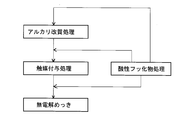
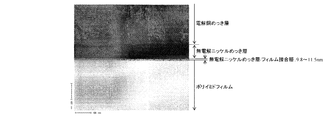
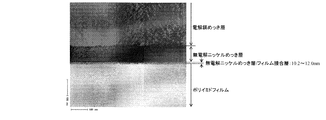
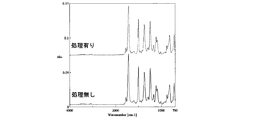
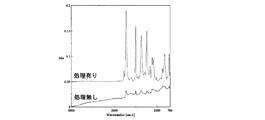
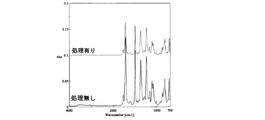
- FIG. 1 It is a figure which shows the process process (process which can perform an acid fluoride process) of this invention. It is a figure which shows the TEM photograph of the cross section by the focused ion beam (FIB) of the sample which is not processed with acid fluoride. It is a figure which shows the TEM photograph of the cross section by FIB of the sample which processed the acid fluoride. It is a figure which shows the IR spectrum of the film by FT / IR-ATR analysis. It is a figure which shows the IR spectrum of the peeling metal surface by FT / IR-ATR analysis. It is a figure which shows IR spectrum of the peeling film surface by FT / IR-ATR analysis.
- the present invention relates to a method for wet metallization of polyimide, that is, a method for metallization of polyimide in which polyimide is sequentially subjected to alkali reforming treatment, catalyst application treatment and electroless plating.
- this wet metallization method of polyimide undergoes three steps of an alkali reforming treatment step, a catalyst application treatment step, and an electroless plating, and the treatment liquid used in this step and the conditions thereof are already known.
- An example is shown as follows.
- Alkali reforming treatment is a solution containing polyimide resin as an active ingredient such as an inorganic compound such as lithium hydroxide, sodium hydroxide or potassium hydroxide, or an alkali compound such as organic hydroxide salt such as tetramethylammonium hydroxide. This is done by processing.
- concentration of the alkaline compound solution used is about 0.01 to 5 mol / L, and the temperature is about room temperature to about 100 ° C.
- the treatment time is about 10 to 600 seconds in the case of immersion treatment, and about 10 to 600 seconds in the case of spray treatment.
- alcohols such as methanol, ethanol and propanol
- amines such as monoethanolamine can be added for the purpose of improving the alkali reforming rate.
- Catalyst application treatment As the catalyst application treatment, a conventional sensitizer-activator method, a catalyzer-accelerator method, a catalyzing-reducing method, or the like can be used.
- the sensitizer-activator method the surface is immersed in a sensitizer solution (SnCl 2 hydrochloric acid aqueous solution) to adsorb Sn 2+ , washed with water, and then immersed in an activator solution (PdCl 2 hydrochloric acid aqueous solution) to cause a redox reaction.
- a metal Pd nucleus serving as a catalyst for the electroless plating reaction is imparted to the substrate.
- the catalyzer-accelerator method is immersed in a catalyzer solution (palladium / tin colloid solution) to adsorb the metal Pd colloid protected by Sn 2+ and the like, washed with water, and then immersed in an accelerator solution (hydrochloric acid or sulfuric acid) for protection.
- a catalyzer solution palladium / tin colloid solution
- an accelerator solution hydrochloric acid or sulfuric acid
- the palladium complex is adsorbed by immersing it in a catalytic solution (ionic palladium complex), washed with water, and then a reducing solution (dimethylamine borane, sodium borohydride, sodium hypophosphite, etc.) ) To form metal Pd nuclei by reduction.
- a catalytic solution ionic palladium complex
- a reducing solution dimethylamine borane, sodium borohydride, sodium hypophosphite, etc.
- the catalyst application treatment can be carried out at a concentration, temperature and time recommended in each method.
- Electroless nickel plating can also be performed using a known electroless nickel plating bath, and the conditions may be the concentration, temperature, time, etc. recommended for each electroless nickel plating bath.
- electroless nickel plating bath electroless Ni—P plating, electroless Ni—B plating, electroless pure Ni plating, etc. can be used, but there is no particular limitation. It is preferable to use a bath.
- the acidic fluoride solution treatment is performed using a solution of an acidic fluoride salt such as hydrofluoric acid, potassium hydrogen fluoride, or ammonium hydrogen fluoride.
- an acidic fluoride salt such as hydrofluoric acid, potassium hydrogen fluoride, or ammonium hydrogen fluoride.
- the concentration of the acidic fluoride solution used for this acidic fluoride solution treatment is 0.1 to 20 mol / L, preferably 0.1 to 5 mol / L when hydrofluoric acid is used. When potassium hydrofluoride is used, it is 0.1 to 5 mol / L, preferably 0.5 mol / L to 5 mol / L.
- the temperature of the acid fluoride solution is 0 to 100 ° C., preferably 20 to 60 ° C.
- the acid fluoride treatment time varies depending on the stage of (1) to (3) above and the type of polyimide, but generally it is about 1 to 60 minutes, preferably 1 to 1 It is about 30 minutes.
- the polyimide whose adhesive strength is increased by the method of the present invention various types can be mentioned regardless of the basic structure.
- PMDA which is a condensate of pyromellitic dianhydride and 4,4′-diaminodiphenyl ether.
- ODA type Kapton manufactured by Toray DuPont Co., Ltd.
- BPDA / PDA type Iupilex manufactured by Ube Industries
- the adhesive strength can be increased.
- Alkali reforming treatment Agent used 0.5 mol / L potassium hydroxide solution
- Treatment temperature 50 ° C
- Processing time 2 minutes
- Catalyst application treatment (catalysis) Agents used: ES-300 (manufactured by Ebara Eugleite Co., Ltd.) Processing temperature: 50 ° C Processing time: 2 minutes
- Electroless plating Agents used ES-500 (manufactured by Ebara Eugene Corporation) Processing temperature: 40 ° C Treatment time: 5 minutes Note: The concentrations of ES-300, ES-400 and ES-500 were the recommended concentrations of the product.
- Reference example 1 Polyimide film (Kapton 150EN-C; manufactured by Toray DuPont Co., Ltd.) is subjected to alkali modification treatment, catalyst application treatment (catalysis and reduction), and electroless plating under the above conditions (necessary water washing between each step) And dried at 150 ° C. for 2 minutes. Next, electroplating was performed at 2 A / dm 2 for about 19 minutes using a copper sulfate plating bath to form a copper layer of about 8 ⁇ m.
- the tensile strength of the obtained flexible laminate was measured according to JIS C-6481. First, the flexible laminate was cut into a 10 mm width strip with a cutter. It was attached to a resin plate with double-sided tape. Next, using a tensile strength tester AGS-H500N (manufactured by Shimadzu Corporation), the peel strength when the 10 mm wide copper film was peeled at 90 ° was measured. As a result, the peel strength was 0.60 kN / m.
- Example 1 Using the same polyimide film as used in Reference Example 1 and immersing in a 2 mol / L hydrofluoric acid aqueous solution at 25 ° C. for 5 minutes, alkali reforming treatment and catalyst application treatment (catalysis and reduction) under the above conditions And electroless plating was performed.
- the copper sulfate plating was performed in the same manner as in Reference Example 1 and the peel strength was measured, it was 0.73 kN / m, which was about 22% higher than that in Reference Example 1.
- Example 2 Using the same polyimide film as used in Reference Example 1, after alkali modification treatment as in Example 1, it was immersed in a 2 mol / L hydrofluoric acid aqueous solution at 25 ° C. for 5 minutes. The catalyst was subjected to catalyst application treatment (catalysis and reduction) and electroless plating. When the copper sulfate plating was performed in the same manner as in Reference Example 1 and the peel strength was measured, it was 0.76 kN / m, which was about 27% higher than that in Reference Example 1.
- Example 3 The same polyimide film as used in Reference Example 1 was used, and after alkali reforming treatment and catalyst application treatment (catalysis and reduction) in the same manner as in Reference Example 1, a 2 mol / L hydrofluoric acid aqueous solution at 25 ° C. And then electroless plating was performed in the same manner as in Reference Example 1.
- the copper sulfate plating was performed in the same manner as in Reference Example 1 and the peel strength was measured, it was 0.70 kN / m, which was about 17% higher than that in Reference Example 1.
- Example 4 The same polyimide film as used in Reference Example 1 was immersed for 5 minutes, 10 minutes, and 30 minutes at 25 ° C. using a 2 mol / L hydrofluoric acid aqueous solution as the acidic fluoride solution. Next, in the same manner as in Reference Example 1, alkali reforming treatment, catalyst application treatment (catalysis and reduction), electroless plating and copper sulfate plating were performed.
- the peel strength of the obtained sample was measured in the same manner as in Reference Example 1, the peel strength after 5-minute treatment was 0.73 kN / m, and the peel strength after 10-minute treatment was 0.84 kN / m, 30-minute treatment. The peel strength was 0.67 kN / m.
- Example 5 About the same polyimide film as the reference example 1, the sample was obtained like Example 4 except using 25 degreeC and 1 mol / L hydrofluoric acid aqueous solution as an acidic fluoride solution.
- peel strength was measured in the same manner as in Reference Example 1, the peel strength after 5 minutes treatment was 0.72 kN / m, the peel strength after 10 minutes treatment was 0.73 kN / m, and the peel strength after 30 minutes treatment was 0. It was .87 kN / m.
- Example 6 About the same polyimide film as the reference example 1, the sample was obtained like Example 4 except using 25 degreeC and 1 mol / L potassium hydrogen fluoride aqueous solution as an acidic fluoride solution.
- peel strength was measured in the same manner as in Reference Example 1, the peel strength after 5 minutes treatment was 0.61 kN / m, the peel strength after 10 minutes treatment was 0.63 kN / m, and the peel strength after 30 minutes treatment was 0. It was .77 kN / m.
- Example 7 About the same polyimide film as the reference example 1, the sample was obtained like Example 4 except using 25 degreeC and 1 mol / L ammonium hydrogen fluoride aqueous solution as an acidic fluoride solution.
- peel strength was measured in the same manner as in Reference Example 1, the peel strength after 5 minutes treatment was 0.60 kN / m, the peel strength after 10 minutes treatment was 0.64 kN / m, and the peel strength after 30 minutes treatment was 0. .75 kN / m.
- Reference example 2 A polyimide film (Upilex 25SGA; manufactured by Ube Industries, Ltd.) was subjected to alkali reforming treatment and catalyst application treatment (catalysis and reduction) under the above conditions, and electroless plating was performed. Subsequently, copper sulfate plating was performed in the same manner as in Reference Example 1, and the peel strength of the obtained sample was measured to find that it was 0.71 kN / m.
- Example 8 The same polyimide film as used in Reference Example 2 was immersed in an aqueous solution of hydrofluoric acid at 25 ° C. and 1 mol / L for 2 minutes, 5 minutes, 10 minutes and 30 minutes as an acidic fluoride solution. . Next, in the same manner as in Reference Example 2, alkali reforming treatment, catalyst application treatment (catalysis and reduction), electroless plating and copper sulfate plating were performed. When the peel strength of the obtained sample was measured in the same manner as in Reference Example 2, the peel strength after 2 minutes treatment was 0.84 kN / m, and the peel strength after 5 minutes treatment was 0.96 kN / m. . These values were about 18% and 35% higher than Reference Example 2, respectively.
- Comparative Examples A 2 mol / L potassium fluoride aqueous solution and a 2 mol / L tetrafluoroboric acid aqueous solution were prepared.
- the same polyimide film as in Reference Example 1 was treated with these aqueous solutions at 25 ° C. for 2 minutes and 30 minutes, respectively, and thereafter treated in the same manner as in Reference Example 1 to obtain samples.
- the peel strength of the obtained sample was measured, it was 0.60 kN / m when an aqueous potassium fluoride solution was used, and 0.59 kN / m and 0 when an aqueous tetrafluoroboric acid solution was used.
- the adhesive strength was not improved at all at .58 kN / m.
- the adhesion strength of the metal film on the polyimide can be easily increased as compared with the conventional metal film forming method by a wet method.
- the method of the present invention can be used as an economical method in the manufacture of FCCL, etc., in which a metal conductor layer is laminated on a polyimide film, which is used as a mounting material for electronic components such as flexible printed circuit boards, TAB, and COF. It is.
Landscapes
- Chemical & Material Sciences (AREA)
- Engineering & Computer Science (AREA)
- Manufacturing & Machinery (AREA)
- Microelectronics & Electronic Packaging (AREA)
- General Chemical & Material Sciences (AREA)
- Chemical Kinetics & Catalysis (AREA)
- Materials Engineering (AREA)
- Mechanical Engineering (AREA)
- Metallurgy (AREA)
- Organic Chemistry (AREA)
- Inorganic Chemistry (AREA)
- Chemically Coating (AREA)
Abstract
経済性の高い湿式法により、ポリイミド上に金属導体層を積層した2層FCCLを製造する方法を提供することを目的する。当該方法は、アルカリ改質処理、触媒付与処理および無電解めっきよりなるポリイミドの金属化方法において、アルカリ改質処理の前、アルカリ改質処理と触媒付与処理の間、触媒付与処理と無電解めっきの間のいずれかの段階において、被処理ポリイミドを酸性フッ化物溶液で処理することを特徴とする金属皮膜形成方法である。
Description
本発明は、金属膜形成方法に関し、更に詳細には、接着強度の高い金属皮膜を湿式法によりポリイミド上へ形成することのできる金属皮膜形成方法に関する。
フレキシブルプリント基板、TAB(Tape Automated Bonding)、COF(Chip on Film)等の電子部品の実装素材として、ポリイミドフィルムを利用し、金属導体層を積層したフレキシブル銅張積層板(Flexible Copper Clad Laminate;FCCL)は、電子産業における回路基板の素材として広く用いられている。
FCCLの主流は、アンカー効果による接着強度向上を目的として表面が粗化された銅箔とポリイミドフィルムを、エポキシ系、アクリル系接着剤で張り合わせた3層FCCLである。だが、近年の電子機器の小型化、モバイル化及び高密度化の加速により、プリント配線の狭ピッチ化、高誘電特性化の需要が高まり、ポリイミドフィルムと銅箔の2層構造の、接着剤を用いないFCCLの開発が盛んに進められている(2層FCCL)。
2層FCCLの製造方法として、ポリイミドフィルムに、スパッタリング法、イオンプレーティング法等のメタライジングにより直接薄い金属層を形成した後、金属箔の必要膜厚分を電解めっきにより増膜するメタライジング法(スパッタ・めっき法)、ポリイミドワニスを粗化銅箔上に塗布し、キュアにより硬化させるキャスティング法、粗化銅箔とポリイミドフィルムを熱可塑性ポリイミドで熱圧着により張り合わせるラミネート法等、種々の製造方法が知られている(例えば、非特許文献1)。
しかし、キャスティング法、ラミネート法は銅箔とポリイミドフィルムとの接着をアンカー効果により得ているので、銅箔表面に凹凸が必要となる。一方、このような表面凹凸は、高誘電特性劣化の原因に繋がり、一部のプリント配線板等で必要な高周波特性が十分に得ることが出来ないという問題があった。また、既存の銅箔を使用する為、銅膜厚に制限があり、狭ピッチ回路を作製するには銅箔をエッチングにより薄膜化する必要があるため、狭ピッチ化には不利であった。
また、メタライジング法は金属/ポリイミド界面が平滑なため高誘電特性化に有利で、且つスパッタリング法によりポリイミド表面に極薄金属導電膜を形成した後電解銅めっきで導体層を厚膜して形成するため、膜厚を自由に設定できるので狭ピッチ化に有利である。しかし、その接着強度はJPCA規格として0.35kN/m以上(JPCA-BM03:スパッタ・めっき法の銅箔引き剥がし強度、銅箔厚み8μm以上、18μm未満)、実質的には銅箔厚み8μmで0.5kN/m以上が必要と言われているが、そもそもメタライジング法2層FCCLは金属/ポリイミド界面が平滑であることもあり、ラミネート法、キャスティング法の接着強度1kN/m以上と比較して低く、更なる接着強度向上が望まれている。また、大掛かりな真空スパッタ装置などを必要とするため、生産コストが増大するという課題もあった。
そのため、狭ピッチ化、高誘電特性に優れ、且つ、低コスト生産可能な製造方法として、乾式法であるスパッタリングによる金属膜形成を安価な湿式法である無電解めっきで行う試みが以前からなされていた。
ところで、ポリイミド上に接着性良く無電解めっきを行う方法として、アルカリ金属水酸化物の水溶液や、アルカリ金属水酸化物に抱水ヒドラジンなどを添加した混合溶液にポリイミドを浸漬する改質処理が知られている(例えば、特許文献1)。無電解めっき皮膜とポリイミドの接着性が良くなる理由は、アルカリ金属水酸化物溶液にポリイミドを浸漬することにより、ポリイミドを構成するイミド環がアルカリ加水分解により開環してポリアミック酸が形成、ポリアミック酸のカルボキシル基が金属めっき皮膜と化学結合して接着性が向上するというものであるが、必ずしも十分な接着強度を維持できないという問題があり、また抱水ヒドラジンは毒性が強いため、作業性が悪い。それ故、改質処理に先立って紫外線照射を行って密着強度を向上させる方法などが開示されているが(例えば、特許文献2)、乾式法の適用は生産コスト増大につながる。
「表面技術」、第55巻、第12号、第915~918頁(2004) 土橋 誠;2層フレキシブル銅張積層板技術の動向
従って本発明は、経済性の高い湿式法により、ポリイミド上に金属導体層を積層した2層FCCLを製造する方法の開発をその課題とするものである。
本発明者らは、湿式法の工程に関し、接着強度を上げるための条件等を種々検討していたところ、意外にも酸性フッ化物溶液でポリイミドを処理することにより接着強度が上昇することを見出し、本発明を完成した。
すなわち本発明は、アルカリ改質処理、触媒付与処理および無電解めっきよりなるポリイミドの金属化方法において、アルカリ改質処理の前、アルカリ改質処理と触媒付与処理の間、触媒付与処理と無電解めっきの間のいずれかの段階において、被処理ポリイミドを酸性フッ化物溶液で処理することを特徴とする金属皮膜形成方法である。
本発明によれば、酸性フッ化物溶液で処理しない場合に比べ、接着強度を高めることができ、より実用的な2層FCCLを得ることができる。特に、アルカリ改質処理前後に、酸性フッ化物としてのフッ化水素酸で処理することにより、優れた接着強度が得られる。
本発明は、ポリイミドの湿式金属化方法、すなわち、ポリイミドに、アルカリ改質処理、触媒付与処理および無電解めっきを順次施すポリイミドの金属化方法において、(1)アルカリ改質処理の前、(2)アルカリ改質処理と触媒付与処理の間、または(3)触媒付与処理と無電解めっきの間のいずれかの段階において、被処理ポリイミドを酸性フッ化物溶液で処理するものである(図1)。
このポリイミドの湿式金属化方法は、上記のようにアルカリ改質処理工程、触媒付与処理工程および無電解めっきの3工程を経るものであり、これで用いる処理液やその条件等も既に公知のものを利用することができるが、その一例を示せば次の通りである。
アルカリ改質処理:
アルカリ改質処理は、ポリイミド樹脂を水酸化リチウム、水酸化ナトリウム、水酸化カリウム等の無機水酸化物塩や水酸化テトラメチルアンモニウム等の有機水酸化物塩等のアルカリ化合物を有効成分とする溶液で処理することにより行われる。使用されるアルカリ化合物溶液の濃度は、0.01ないし5mol/L程度であり、その温度は、室温ないし100℃程度である。また処理時間は、浸漬処理の場合10ないし600秒程度であり、噴霧処理の場合は、10ないし600秒程度である。また、アルカリ改質速度向上を目的としてメタノール、エタノール、プロパノールなどのアルコール類や、モノエタノールアミンなどのアミン類を添加することもできる。
アルカリ改質処理は、ポリイミド樹脂を水酸化リチウム、水酸化ナトリウム、水酸化カリウム等の無機水酸化物塩や水酸化テトラメチルアンモニウム等の有機水酸化物塩等のアルカリ化合物を有効成分とする溶液で処理することにより行われる。使用されるアルカリ化合物溶液の濃度は、0.01ないし5mol/L程度であり、その温度は、室温ないし100℃程度である。また処理時間は、浸漬処理の場合10ないし600秒程度であり、噴霧処理の場合は、10ないし600秒程度である。また、アルカリ改質速度向上を目的としてメタノール、エタノール、プロパノールなどのアルコール類や、モノエタノールアミンなどのアミン類を添加することもできる。
触媒付与処理:
触媒付与処理としては、慣用のセンシタイザー-アクチベータ法、キャタライザー-アクセレータ法、触媒化-還元法などを利用することができる。センシタイザー-アクチベータ法は、センシタイザー液(SnCl2塩酸酸性水溶液)に浸漬してSn2+を吸着させ、水洗後、アクチベータ液(PdCl2塩酸酸性水溶液)に浸漬してレドックス反応を起こさせて表面に無電解めっき反応の触媒となる金属Pdの核を付与する方法である。キャタライザー-アクセレータ法はキャタライザー液(パラジウム/スズコロイド溶液)に浸漬して、周りをSn2+などにより保護された金属Pdコロイドを吸着させ、水洗後、アクセレータ液(塩酸または硫酸)に浸漬して保護していたSn2+などを取り除いて活性化する方法である。また、触媒化-還元法は触媒化液(イオン性パラジウム錯体)に浸漬してパラジウム錯体を吸着させ、水洗後、還元液(ジメチルアミンボラン、水素化ホウ素ナトリウム、次亜リン酸ナトリウムなどの溶液)に浸漬して還元により金属Pd核を形成する方法である。触媒付与処理は各方法で推奨される濃度、温度及び時間で実施することができる。
触媒付与処理としては、慣用のセンシタイザー-アクチベータ法、キャタライザー-アクセレータ法、触媒化-還元法などを利用することができる。センシタイザー-アクチベータ法は、センシタイザー液(SnCl2塩酸酸性水溶液)に浸漬してSn2+を吸着させ、水洗後、アクチベータ液(PdCl2塩酸酸性水溶液)に浸漬してレドックス反応を起こさせて表面に無電解めっき反応の触媒となる金属Pdの核を付与する方法である。キャタライザー-アクセレータ法はキャタライザー液(パラジウム/スズコロイド溶液)に浸漬して、周りをSn2+などにより保護された金属Pdコロイドを吸着させ、水洗後、アクセレータ液(塩酸または硫酸)に浸漬して保護していたSn2+などを取り除いて活性化する方法である。また、触媒化-還元法は触媒化液(イオン性パラジウム錯体)に浸漬してパラジウム錯体を吸着させ、水洗後、還元液(ジメチルアミンボラン、水素化ホウ素ナトリウム、次亜リン酸ナトリウムなどの溶液)に浸漬して還元により金属Pd核を形成する方法である。触媒付与処理は各方法で推奨される濃度、温度及び時間で実施することができる。
無電解ニッケルめっき:
無電解ニッケルめっきも、公知の無電解ニッケルめっき浴を利用して行うことができ、その条件も各無電解ニッケルめっき浴で推薦される濃度、温度、時間等とすれば良い。なお、無電解ニッケルめっき浴としては、無電解Ni-Pめっき、無電解Ni-Bめっき、無電解純Niめっきなどが使用でき特に限定されるものではないが、Ni-P系無電解ニッケルめっき浴を利用することが好ましい。
無電解ニッケルめっきも、公知の無電解ニッケルめっき浴を利用して行うことができ、その条件も各無電解ニッケルめっき浴で推薦される濃度、温度、時間等とすれば良い。なお、無電解ニッケルめっき浴としては、無電解Ni-Pめっき、無電解Ni-Bめっき、無電解純Niめっきなどが使用でき特に限定されるものではないが、Ni-P系無電解ニッケルめっき浴を利用することが好ましい。
本発明方法における、酸性フッ化物溶液処理は、フッ化水素酸やフッ化水素カリウム、フッ化水素アンモニウム等の酸性フッ化物塩の溶液を利用して行われる。同じフッ化物を含有する化合物であっても、フッ化カリウム、フッ化アンモニウム、テトラフルオロホウ酸等では、剥離強度改善の効果を得ることができない。
この酸性フッ化物溶液処理に用いられる酸性フッ化物溶液の濃度は、フッ化水素酸を用いる場合は、0.1ないし20mol/Lであり、好ましくは、0.1ないし5mol/Lである。また、フッ化水素酸カリウムを用いる場合は、0.1ないし5mol/L、好ましくは、0.5mol/Lないし5mol/Lである。また、酸性フッ化物溶液の温度は、0ないし100℃であり、好ましくは、20ないし60℃である。更に、酸性フッ化物処理の時間は、上記(1)ないし(3)の何れの段階で行うかや、ポリイミドの種類によっても相違するが、一般には、1ないし60分間程度、好ましくは、1ないし30分程度である。
本発明方法により接着強度が上昇するポリイミドとしては、その基本構造を問わず種々のものを挙げることができ、例えば、ピロメリット酸二無水物と4,4‘-ジアミノジフェニルエーテルの縮合物であるPMDA/ODA型のカプトン(東レ・デュポン株式会社製)や、ビフェニルテトラカルボン酸二無水物とp-フェニレンジアミンの縮合物であるBPDA/PDA型のユーピレックス(宇部興産株式会社製)、またはそれらの混合物等の何れであっても接着強度を上げることができる。
本発明方法により接着強度が高まる理由は、未だ不明であるが、例えば、透過電子顕微鏡(TEM)を用いた無電解ニッケルめっきおよび硫酸銅めっき後の断面観察では、未処理のもの(図2)でも、酸性フッ化物処理(2mol/Lのフッ化水素酸、25℃、10分)したもの(図3)でも、無電解ニッケルめっきにより形成したNi-P層とポリイミドフィルムの界面に粗さなどの変化はなく、この点からもエッチング作用でないことが確認され、またNi-P層/フィルム接着界面構造に違いが無いことが確認された。
一方、酸性フッ化物処理を行わずにアルカリ改質処理を行った試料と、酸性フッ化物処理後にアルカリ改質処理を行った試料とについて、そのポリイミドフィルム表面を赤外分光光度計全反射法(FT/IR-ATR)で測定したところ、酸性フッ化物処理の有無でスペクトルに変化が観測されなかった(図4)。
しかし、無電解ニッケルめっきおよび硫酸銅めっき後の試料について、ニッケルめっき層とポリイミドの間を引きはがし、それぞれのニッケル金属面をFT/IR-ATRで測定したところ、酸性フッ化物処理を行わない場合ではポリイミドのピークと共にアルカリ改質処理により生成したポリアミック酸由来のピーク(1500~1700cm-1)が認められたが、酸性フッ化物処理を行ったものでは、ポリイミドのピークしか観察されなかった(図5)。また、引き剥がしたフィルム面からは、酸性フッ化物処理の有無に関わらずポリイミドのスペクトルのみが観測された(図6)。これは、酸性フッ化物処理を行わなかった場合、アルカリ改質層とポリイミド層の間で剥離しているが、酸性フッ化物処理を行った場合はポリイミド層間で剥離が生じていることを示すことから、酸性フッ化物処理によりポリイミド層がなんらかの変化を起こし、引き剥がしによる剥離場所が異なったと推定された。
次に実施例、参考例を挙げ、本発明を更に詳しく説明するが、本発明はこれら実施例に何ら制約されるものではない。
なお、実施例および参考例での、アルカリ改質処理、触媒付与処理(触媒化および還元)および無電解めっきに用いた薬剤およびその条件は、下記の通りである。
アルカリ改質処理
使用薬剤:0.5mol/L 水酸化カリウム溶液
処理温度:50℃
処理時間:2分
使用薬剤:0.5mol/L 水酸化カリウム溶液
処理温度:50℃
処理時間:2分
触媒付与処理
(触媒化)
使用薬剤:ES-300(荏原ユージライト株式会社製)
処理温度:50℃
処理時間:2分
(触媒化)
使用薬剤:ES-300(荏原ユージライト株式会社製)
処理温度:50℃
処理時間:2分
(還元)
使用薬剤:ES-400(荏原ユージライト株式会社製)
処理温度:35℃
処理時間:2分
使用薬剤:ES-400(荏原ユージライト株式会社製)
処理温度:35℃
処理時間:2分
無電解めっき
使用薬剤:ES-500(荏原ユージライト株式会社製)
処理温度:40℃
処理時間:5分
注:ES-300、ES-400およびES-500の濃度は、製品 の推薦濃度とした。
使用薬剤:ES-500(荏原ユージライト株式会社製)
処理温度:40℃
処理時間:5分
注:ES-300、ES-400およびES-500の濃度は、製品 の推薦濃度とした。
参 考 例 1
ポリイミドフィルム(カプトン150EN-C;東レデュポン株式会社製)を、上記条件により、アルカリ改質処理、触媒付与処理(触媒化および還元)および無電解めっきを行い(各工程間では必要な水洗を行った)、150℃で2分間乾燥した。次いで、硫酸銅めっき浴により、2A/dm2で約19分間電気めっきを行い、約8μmの銅層を形成した。
ポリイミドフィルム(カプトン150EN-C;東レデュポン株式会社製)を、上記条件により、アルカリ改質処理、触媒付与処理(触媒化および還元)および無電解めっきを行い(各工程間では必要な水洗を行った)、150℃で2分間乾燥した。次いで、硫酸銅めっき浴により、2A/dm2で約19分間電気めっきを行い、約8μmの銅層を形成した。
得られたフレキシブルラミネートについて、JIS C-6481に従って引っ張り強度を測定した。まず、カッターでフレキシブルラミネートを10mm幅の短冊状に切断した。それを樹脂板に両面テープで張り合わせた。次いで、引っ張り強度試験器AGS-H500N(株式会社島津製作所製)を用いて、10mm幅の銅皮膜を90°に引き剥がした際のピール強度を測定した。その結果、ピール強度は0.60kN/mであった。
実 施 例 1
参考例1で用いたのと同じポリイミドフィルムを用い、25℃の2mol/Lのフッ化水素酸水溶液に5分間浸漬した後、前記条件でアルカリ改質処理、触媒付与処理(触媒化および還元)および無電解めっきを行った。参考例1と同様に硫酸銅めっきを行い、ピール強度を測定したところ、0.73kN/mであり、参考例1よりピール強度が約22%上昇していた。
参考例1で用いたのと同じポリイミドフィルムを用い、25℃の2mol/Lのフッ化水素酸水溶液に5分間浸漬した後、前記条件でアルカリ改質処理、触媒付与処理(触媒化および還元)および無電解めっきを行った。参考例1と同様に硫酸銅めっきを行い、ピール強度を測定したところ、0.73kN/mであり、参考例1よりピール強度が約22%上昇していた。
実 施 例 2
参考例1で用いたのと同じポリイミドフィルムを用い、実施例1と同様にアルカリ改質処理後、25℃の2mol/Lのフッ化水素酸水溶液に5分間浸漬し、更に実施例1と同様に触媒付与処理(触媒化および還元)および無電解めっきを行った。参考例1と同様に硫酸銅めっきを行い、ピール強度を測定したところ、0.76kN/mであり、参考例1より約27%ピール強度が上昇していた。
参考例1で用いたのと同じポリイミドフィルムを用い、実施例1と同様にアルカリ改質処理後、25℃の2mol/Lのフッ化水素酸水溶液に5分間浸漬し、更に実施例1と同様に触媒付与処理(触媒化および還元)および無電解めっきを行った。参考例1と同様に硫酸銅めっきを行い、ピール強度を測定したところ、0.76kN/mであり、参考例1より約27%ピール強度が上昇していた。
実 施 例 3
参考例1で用いたのと同じポリイミドフィルムを用い、参考例1と同様にアルカリ改質処理、触媒付与処理(触媒化および還元)をした後、25℃の2mol/Lのフッ化水素酸水溶液に5分間浸漬し、更に参考例1と同様に無電解めっきを行った。参考例1と同様に硫酸銅めっきを行い、ピール強度を測定したところ、0.70kN/mであり、参考例1より約17%ピール強度が上昇していた。
参考例1で用いたのと同じポリイミドフィルムを用い、参考例1と同様にアルカリ改質処理、触媒付与処理(触媒化および還元)をした後、25℃の2mol/Lのフッ化水素酸水溶液に5分間浸漬し、更に参考例1と同様に無電解めっきを行った。参考例1と同様に硫酸銅めっきを行い、ピール強度を測定したところ、0.70kN/mであり、参考例1より約17%ピール強度が上昇していた。
実 施 例 4
参考例1で用いたのと同じポリイミドフィルムについて、酸性フッ化物溶液として、25℃、2mol/Lのフッ化水素酸水溶液を用い、5分、10分および30分浸漬処理を行った。次いで、参考例1と同様にアルカリ改質処理、触媒付与処理(触媒化および還元)、無電解めっきおよび硫酸銅めっきを行った。得られたサンプルについて、参考例1と同様にピール強度を測定したところ、5分処理のピール強度は、0.73kN/m、10分処理のピール強度は、0.84kN/m、30分処理のピール強度は、0.67kN/mであった。
参考例1で用いたのと同じポリイミドフィルムについて、酸性フッ化物溶液として、25℃、2mol/Lのフッ化水素酸水溶液を用い、5分、10分および30分浸漬処理を行った。次いで、参考例1と同様にアルカリ改質処理、触媒付与処理(触媒化および還元)、無電解めっきおよび硫酸銅めっきを行った。得られたサンプルについて、参考例1と同様にピール強度を測定したところ、5分処理のピール強度は、0.73kN/m、10分処理のピール強度は、0.84kN/m、30分処理のピール強度は、0.67kN/mであった。
実 施 例 5
参考例1と同じポリイミドフィルムについて、酸性フッ化物溶液として、25℃、1mol/Lのフッ化水素酸水溶液を用いる以外は、実施例4と同様にしてサンプルを得た。参考例1と同様にピール強度を測定したところ、5分処理のピール強度は、0.72kN/m、10分処理のピール強度は、0.73kN/m、30分処理のピール強度は、0.87kN/mであった。
参考例1と同じポリイミドフィルムについて、酸性フッ化物溶液として、25℃、1mol/Lのフッ化水素酸水溶液を用いる以外は、実施例4と同様にしてサンプルを得た。参考例1と同様にピール強度を測定したところ、5分処理のピール強度は、0.72kN/m、10分処理のピール強度は、0.73kN/m、30分処理のピール強度は、0.87kN/mであった。
実 施 例 6
参考例1と同じポリイミドフィルムについて、酸性フッ化物溶液として、25℃、1mol/Lのフッ化水素カリウム水溶液を用いる以外は、実施例4と同様にしてサンプルを得た。参考例1と同様にピール強度を測定したところ、5分処理のピール強度は、0.61kN/m、10分処理のピール強度は、0.63kN/m、30分処理のピール強度は、0.77kN/mであった。
参考例1と同じポリイミドフィルムについて、酸性フッ化物溶液として、25℃、1mol/Lのフッ化水素カリウム水溶液を用いる以外は、実施例4と同様にしてサンプルを得た。参考例1と同様にピール強度を測定したところ、5分処理のピール強度は、0.61kN/m、10分処理のピール強度は、0.63kN/m、30分処理のピール強度は、0.77kN/mであった。
実 施 例 7
参考例1と同じポリイミドフィルムについて、酸性フッ化物溶液として、25℃、1mol/Lのフッ化水素アンモニウム水溶液を用いる以外は、実施例4と同様にしてサンプルを得た。参考例1と同様にピール強度を測定したところ、5分処理のピール強度は、0.60kN/m、10分処理のピール強度は、0.64kN/m、30分処理のピール強度は、0.75kN/mであった。
参考例1と同じポリイミドフィルムについて、酸性フッ化物溶液として、25℃、1mol/Lのフッ化水素アンモニウム水溶液を用いる以外は、実施例4と同様にしてサンプルを得た。参考例1と同様にピール強度を測定したところ、5分処理のピール強度は、0.60kN/m、10分処理のピール強度は、0.64kN/m、30分処理のピール強度は、0.75kN/mであった。
参 考 例 2
ポリイミドフィルム(ユーピレックス25SGA;宇部興産株式会社製)を、前記条件により、アルカリ改質処理、触媒付与処理(触媒化および還元)し、無電解めっきを行った。次いで、参考例1と同様に硫酸銅めっきを行ない、得られたサンプルについて、そのピール強度を測定したところ、0.71kN/mであった。
ポリイミドフィルム(ユーピレックス25SGA;宇部興産株式会社製)を、前記条件により、アルカリ改質処理、触媒付与処理(触媒化および還元)し、無電解めっきを行った。次いで、参考例1と同様に硫酸銅めっきを行ない、得られたサンプルについて、そのピール強度を測定したところ、0.71kN/mであった。
実 施 例 8
参考例2で用いたのと同じポリイミドフィルムについて、酸性フッ化物溶液として、25℃、1mol/Lのフッ化水素酸水溶液を用い、2分、5分、10分および30分浸漬処理を行った。次いで、参考例2と同様にアルカリ改質処理、触媒付与処理(触媒化および還元)、無電解めっきおよび硫酸銅めっきを行った。得られたサンプルについて、参考例2と同様にピール強度を測定したところ、2分処理後のピール強度は、0.84kN/m、5分処理のピール強度は、0.96kN/mであった。これらは参考例2よりそれぞれ約18%および35%高い値であった。
参考例2で用いたのと同じポリイミドフィルムについて、酸性フッ化物溶液として、25℃、1mol/Lのフッ化水素酸水溶液を用い、2分、5分、10分および30分浸漬処理を行った。次いで、参考例2と同様にアルカリ改質処理、触媒付与処理(触媒化および還元)、無電解めっきおよび硫酸銅めっきを行った。得られたサンプルについて、参考例2と同様にピール強度を測定したところ、2分処理後のピール強度は、0.84kN/m、5分処理のピール強度は、0.96kN/mであった。これらは参考例2よりそれぞれ約18%および35%高い値であった。
比 較 例
それぞれ2mol/Lのフッ化カリウム水溶液、および2mol/Lのテトラフルオロホウ酸水溶液を調製した。25℃のこれらの水溶液で参考例1と同一のポリイミドフィルムを、それぞれ2分および30分処理し、以後は参考例1と同様に処理し、サンプルを得た。得られたサンプルについて、そのピール強度を測定したところ、フッ化カリウム水溶液を使用した場合は、いずれも0.60kN/m、テトラフルオロホウ酸水溶液を使用した場合は、0.59kN/mおよび0.58kN/mで、全く接着強度向上が認められなかった。
それぞれ2mol/Lのフッ化カリウム水溶液、および2mol/Lのテトラフルオロホウ酸水溶液を調製した。25℃のこれらの水溶液で参考例1と同一のポリイミドフィルムを、それぞれ2分および30分処理し、以後は参考例1と同様に処理し、サンプルを得た。得られたサンプルについて、そのピール強度を測定したところ、フッ化カリウム水溶液を使用した場合は、いずれも0.60kN/m、テトラフルオロホウ酸水溶液を使用した場合は、0.59kN/mおよび0.58kN/mで、全く接着強度向上が認められなかった。
本発明によれば、従来の湿式法による金属皮膜形成法に比べ、簡単にポリイミド上での金属皮膜の接着強度を高めることができる。
従って本発明方法は、フレキシブルプリント基板、TAB、COF等の電子部品の実装素材として使用される、ポリイミドフィルム上に金属導体層を積層したFCCLなどの製造において、経済性高い方法として利用可能なものである。
Claims (4)
- アルカリ改質処理、触媒付与処理および無電解めっきよりなるポリイミドの金属化方法において、アルカリ改質処理の前、アルカリ改質処理と触媒付与処理の間または触媒付与処理と無電解めっきの間のいずれかの段階において、被処理ポリイミドを酸性フッ化物溶液で処理することを特徴とする金属皮膜形成方法。
- アルカリ改質処理と触媒付与処理の間に被処理ポリイミドを酸性フッ化物溶液で処理する請求項1記載の金属皮膜形成方法。
- アルカリ改質処理の前に被処理ポリイミドを酸性フッ化物溶液で処理する請求項1記載の金属皮膜形成方法。
- 酸性フッ化物が、フッ化水素酸、フッ化水素カリウムまたはフッ化水素アンモニウムである請求項1ないし3のいずれかの項に記載の金属皮膜形成方法。
Priority Applications (1)
| Application Number | Priority Date | Filing Date | Title |
|---|---|---|---|
| PCT/JP2011/063398 WO2012169074A1 (ja) | 2011-06-10 | 2011-06-10 | 金属膜形成方法 |
Applications Claiming Priority (1)
| Application Number | Priority Date | Filing Date | Title |
|---|---|---|---|
| PCT/JP2011/063398 WO2012169074A1 (ja) | 2011-06-10 | 2011-06-10 | 金属膜形成方法 |
Publications (1)
| Publication Number | Publication Date |
|---|---|
| WO2012169074A1 true WO2012169074A1 (ja) | 2012-12-13 |
Family
ID=47295673
Family Applications (1)
| Application Number | Title | Priority Date | Filing Date |
|---|---|---|---|
| PCT/JP2011/063398 Ceased WO2012169074A1 (ja) | 2011-06-10 | 2011-06-10 | 金属膜形成方法 |
Country Status (1)
| Country | Link |
|---|---|
| WO (1) | WO2012169074A1 (ja) |
Cited By (3)
| Publication number | Priority date | Publication date | Assignee | Title |
|---|---|---|---|---|
| CN111816608A (zh) * | 2020-07-09 | 2020-10-23 | 电子科技大学 | 玻璃盲孔加工方法 |
| CN115928166A (zh) * | 2022-12-27 | 2023-04-07 | 深圳市华之美科技有限公司 | 聚酰亚胺管膜表面金属化电镀方法 |
| EP4211292A4 (en) * | 2020-09-08 | 2024-09-11 | Nanyang Technological University | SURFACE CONDITIONING PRODUCT FOR AUTOCATALYTIC DEPOSITION |
Citations (4)
| Publication number | Priority date | Publication date | Assignee | Title |
|---|---|---|---|---|
| JPH05295142A (ja) * | 1991-01-22 | 1993-11-09 | Internatl Business Mach Corp <Ibm> | ポリイミド表面に対する接着性を高めるための構造および方法 |
| JP2006028484A (ja) * | 2004-06-18 | 2006-02-02 | Mec Kk | 樹脂表面処理剤および樹脂表面処理法 |
| JP2008034430A (ja) * | 2006-07-26 | 2008-02-14 | Sharp Corp | ポリイミド配線板の製造方法 |
| JP2011014801A (ja) * | 2009-07-03 | 2011-01-20 | Mitsui Mining & Smelting Co Ltd | フレキシブル銅張積層板及びcof用フレキシブルプリント配線板並びにこれらの製造方法 |
-
2011
- 2011-06-10 WO PCT/JP2011/063398 patent/WO2012169074A1/ja not_active Ceased
Patent Citations (4)
| Publication number | Priority date | Publication date | Assignee | Title |
|---|---|---|---|---|
| JPH05295142A (ja) * | 1991-01-22 | 1993-11-09 | Internatl Business Mach Corp <Ibm> | ポリイミド表面に対する接着性を高めるための構造および方法 |
| JP2006028484A (ja) * | 2004-06-18 | 2006-02-02 | Mec Kk | 樹脂表面処理剤および樹脂表面処理法 |
| JP2008034430A (ja) * | 2006-07-26 | 2008-02-14 | Sharp Corp | ポリイミド配線板の製造方法 |
| JP2011014801A (ja) * | 2009-07-03 | 2011-01-20 | Mitsui Mining & Smelting Co Ltd | フレキシブル銅張積層板及びcof用フレキシブルプリント配線板並びにこれらの製造方法 |
Cited By (5)
| Publication number | Priority date | Publication date | Assignee | Title |
|---|---|---|---|---|
| CN111816608A (zh) * | 2020-07-09 | 2020-10-23 | 电子科技大学 | 玻璃盲孔加工方法 |
| CN111816608B (zh) * | 2020-07-09 | 2023-05-09 | 电子科技大学 | 玻璃盲孔加工方法 |
| EP4211292A4 (en) * | 2020-09-08 | 2024-09-11 | Nanyang Technological University | SURFACE CONDITIONING PRODUCT FOR AUTOCATALYTIC DEPOSITION |
| US12281391B2 (en) | 2020-09-08 | 2025-04-22 | Nanyang Technological University | Surface conditioner for electroless deposition |
| CN115928166A (zh) * | 2022-12-27 | 2023-04-07 | 深圳市华之美科技有限公司 | 聚酰亚胺管膜表面金属化电镀方法 |
Similar Documents
| Publication | Publication Date | Title |
|---|---|---|
| CN101688308B (zh) | 金属层叠聚酰亚胺底座及其制造方法 | |
| JP5402939B2 (ja) | 銅の表面処理方法及び銅 | |
| JP4283882B2 (ja) | 耐熱エージング特性に優れた金属被覆ポリイミド樹脂基板の製造方法 | |
| CN104191804B (zh) | 一种无胶型挠性双面覆铜板的制备方法 | |
| JP5983825B2 (ja) | フレキシブルプリント基板の製法 | |
| JP2006188761A (ja) | 伝導性金属めっきポリイミド基板及びその製造方法 | |
| CN102333908B (zh) | 耐热老化特性优良的金属包覆聚酰亚胺树脂基板 | |
| JP5447271B2 (ja) | 銅配線基板およびその製造方法 | |
| CN101657072B (zh) | 电路板制作方法 | |
| JP2006104504A (ja) | ポリイミド樹脂材の無電解めっき前処理方法および表面金属化方法、並びにフレキシブルプリント配線板およびその製造方法 | |
| JPH07321457A (ja) | ポリイミド基板の製造方法 | |
| JP5129111B2 (ja) | 積層体の製造方法及び回路配線基板の製造方法 | |
| JP5004336B2 (ja) | 無電解めっき法で用いる触媒溶液及びその触媒溶液を用いた無電解めっき法並びにその無電解めっき法を用いて金属皮膜を形成した被めっき物 | |
| JP2005060772A (ja) | フレキシブルプリント基板の製法およびそれに用いられる回路用基材 | |
| JPWO2001038086A1 (ja) | 金属層を有する部材およびその製造方法、並びにその用途 | |
| JP2009173999A (ja) | 耐熱エージング特性に優れた金属被覆ポリイミド樹脂基板の製造方法 | |
| TW202117074A (zh) | 覆銅積層體及其製造方法 | |
| JP2011208239A (ja) | 金属膜形成方法 | |
| JP4572363B2 (ja) | 銅と配線基板用樹脂との接着層形成液及びその液を用いた銅と配線基板用樹脂との接着層の製造方法 | |
| JP2000151096A (ja) | プリント配線板の製造方法 | |
| KR100747627B1 (ko) | 2 층 구조를 가지는 전도성 금속 도금 폴리이미드 기판의제조 방법 | |
| KR100798870B1 (ko) | 커플링 에이전트를 포함하는 전도성 금속 도금 폴리이미드기판 및 그 제조 방법 | |
| TW201300572A (zh) | 金屬膜形成方法 | |
| JP2007262481A (ja) | ポリイミド樹脂材の表面金属化方法 | |
| JP2004349693A (ja) | 銅表面の対樹脂接着層 |
Legal Events
| Date | Code | Title | Description |
|---|---|---|---|
| 121 | Ep: the epo has been informed by wipo that ep was designated in this application |
Ref document number: 11867260 Country of ref document: EP Kind code of ref document: A1 |
|
| NENP | Non-entry into the national phase |
Ref country code: DE |
|
| 122 | Ep: pct application non-entry in european phase |
Ref document number: 11867260 Country of ref document: EP Kind code of ref document: A1 |
|
| NENP | Non-entry into the national phase |
Ref country code: JP |