WO2012161124A1 - マイクロrna又はその発現系を含む組成物 - Google Patents
マイクロrna又はその発現系を含む組成物 Download PDFInfo
- Publication number
- WO2012161124A1 WO2012161124A1 PCT/JP2012/062825 JP2012062825W WO2012161124A1 WO 2012161124 A1 WO2012161124 A1 WO 2012161124A1 JP 2012062825 W JP2012062825 W JP 2012062825W WO 2012161124 A1 WO2012161124 A1 WO 2012161124A1
- Authority
- WO
- WIPO (PCT)
- Prior art keywords
- mir
- hsa
- microrna
- cancer
- human
- Prior art date
- Legal status (The legal status is an assumption and is not a legal conclusion. Google has not performed a legal analysis and makes no representation as to the accuracy of the status listed.)
- Ceased
Links
Images




Classifications
-
- A—HUMAN NECESSITIES
- A61—MEDICAL OR VETERINARY SCIENCE; HYGIENE
- A61K—PREPARATIONS FOR MEDICAL, DENTAL OR TOILETRY PURPOSES
- A61K31/00—Medicinal preparations containing organic active ingredients
- A61K31/70—Carbohydrates; Sugars; Derivatives thereof
- A61K31/7088—Compounds having three or more nucleosides or nucleotides
- A61K31/7105—Natural ribonucleic acids, i.e. containing only riboses attached to adenine, guanine, cytosine or uracil and having 3'-5' phosphodiester links
-
- A—HUMAN NECESSITIES
- A61—MEDICAL OR VETERINARY SCIENCE; HYGIENE
- A61P—SPECIFIC THERAPEUTIC ACTIVITY OF CHEMICAL COMPOUNDS OR MEDICINAL PREPARATIONS
- A61P35/00—Antineoplastic agents
-
- C—CHEMISTRY; METALLURGY
- C12—BIOCHEMISTRY; BEER; SPIRITS; WINE; VINEGAR; MICROBIOLOGY; ENZYMOLOGY; MUTATION OR GENETIC ENGINEERING
- C12N—MICROORGANISMS OR ENZYMES; COMPOSITIONS THEREOF; PROPAGATING, PRESERVING, OR MAINTAINING MICROORGANISMS; MUTATION OR GENETIC ENGINEERING; CULTURE MEDIA
- C12N15/00—Mutation or genetic engineering; DNA or RNA concerning genetic engineering, vectors, e.g. plasmids, or their isolation, preparation or purification; Use of hosts therefor
- C12N15/09—Recombinant DNA-technology
- C12N15/11—DNA or RNA fragments; Modified forms thereof; Non-coding nucleic acids having a biological activity
- C12N15/113—Non-coding nucleic acids modulating the expression of genes, e.g. antisense oligonucleotides; Antisense DNA or RNA; Triplex- forming oligonucleotides; Catalytic nucleic acids, e.g. ribozymes; Nucleic acids used in co-suppression or gene silencing
-
- C—CHEMISTRY; METALLURGY
- C12—BIOCHEMISTRY; BEER; SPIRITS; WINE; VINEGAR; MICROBIOLOGY; ENZYMOLOGY; MUTATION OR GENETIC ENGINEERING
- C12N—MICROORGANISMS OR ENZYMES; COMPOSITIONS THEREOF; PROPAGATING, PRESERVING, OR MAINTAINING MICROORGANISMS; MUTATION OR GENETIC ENGINEERING; CULTURE MEDIA
- C12N2310/00—Structure or type of the nucleic acid
- C12N2310/10—Type of nucleic acid
- C12N2310/14—Type of nucleic acid interfering nucleic acids [NA]
- C12N2310/141—MicroRNAs, miRNAs
Definitions
- the present invention relates to a composition containing microRNA or an expression system thereof and a head and neck cancer marker.
- Micro RNA is a small molecule RNA consisting of 18 to 25 bases, and inhibits translation into the protein by binding to the target mRNA.
- miRNA / miRNA is a small molecule RNA consisting of 18 to 25 bases, and inhibits translation into the protein by binding to the target mRNA.
- miRBase® http://www.miRbase.org/
- these miRNA expression or functional abnormalities are involved in various diseases.
- Patent Document 1 In particular, regarding cancer, many miRNAs whose expression is enhanced or suppressed in cancer tissues or cancer cells have been identified by comprehensive expression analysis using miRNA microarrays (Patent Document 1).
- MiR-21, miR-155, miR-17-5p, miR-19, etc. are known as miRNAs whose expression is enhanced in cancer.
- miR-19 is necessary and sufficient for cell carcinogenesis, and its target One of them was shown to be a tumor suppressor gene PTEN.
- PTEN a tumor suppressor gene
- TS-miR Tumor suppressor miR
- MiR-137 and miR-193a have been suggested as TS-miR for oral cancer (Non-patent Document 2).
- a microRNA that not only reduces expression in cancer but also can inhibit the growth of the cancer cell by being expressed in the cancer cell is more advantageous for the treatment and prevention of cancer.
- microRNA can be used as a cancer marker in serum or saliva, it will be useful for cancer diagnosis.
- the present invention provides, as one aspect, microRNA capable of inhibiting the growth of head and neck cancer cells and use thereof. Moreover, this invention provides the microRNA which can be utilized as a head and neck cancer marker in a bodily fluid sample as another aspect, and its utilization. Moreover, this invention provides the microRNA which can inhibit the growth of a human cancer cell as another aspect, and its utilization.
- One aspect of the present invention is a composition comprising microRNA or an expression system capable of expressing microRNA in a cell, wherein the microRNA is hsa-miR-1289, hsa-miR-892b, hsa-miR.
- the present invention relates to a composition for suppressing the growth of selected human head and neck cancer cells.
- the present invention provides a method for inhibiting the growth of human head and neck cancer cells, wherein the cancer cell is contacted with a composition comprising microRNA or an expression system capable of expressing microRNA in the cell.
- Said microRNA is hsa-miR-1289, hsa-miR-892b, hsa-miR-661, hsa-miR-193b *, hsa-miR-671-5p, hsa-miR-124 *, hsa-miR-1908, hsa-miR-876-5p, hsa-miR-192 *, hsa-miR-124, hsa-miR-760, hsa-miR-192, hsa-miR-206, hsa-miR-629 , Hsa-miR-1, hsa-miR-708 *, and hsa-miR-629
- the present invention further includes, as other embodiments, hsa-miR-1289, hsa-miR-876-5p, hsa-miR-1, hsa-miR-892b, hsa-miR-124, hsa-miR-124 *, hsa -Use of a microRNA selected from the group consisting of miR-206, hsa-miR-193b *, hsa-miR-192 *, and hsa-miR-192, as a head and neck cancer marker in a body fluid sample About the use of.
- the present invention provides a composition comprising microRNA or an expression system capable of expressing microRNA in a cell, wherein the microRNA comprises hsa-miR-1289, hsa-miR-892b, hsa -miR-661, hsa-miR-193b *, hsa-miR-671-5p, hsa-miR-124 *, hsa-miR-1908, hsa-miR-876-5p, hsa-miR-192 *, hsa- Consists of miR-124, hsa-miR-760, hsa-miR-192, hsa-miR-206, hsa-miR-629, hsa-miR-1, hsa-miR-708 *, and hsa-miR-629 *
- the present invention relates to a composition for suppressing the growth of human cancer
- a method for inhibiting the growth of human cancer cells wherein a composition comprising microRNA or an expression system capable of expressing microRNA in the cell is contacted with the cancer cells.
- the microRNA is hsa-miR-1289, hsa-miR-892b, hsa-miR-661, hsa-miR-193b *, hsa-miR-671-5p, hsa-miR-124 *, hsa -miR-1908, hsa-miR-876-5p, hsa-miR-192 *, hsa-miR-124, hsa-miR-760, hsa-miR-192, hsa-miR-206, hsa-miR-629,
- the present invention relates to a method for suppressing the growth of human cancer cells selected from the group consisting of hsa-miR-892b, hs
- the present invention can contribute to diagnosis, treatment, prevention, or recurrence prevention of head and neck cancer. Moreover, according to the present invention, for example, it can contribute to the diagnosis, treatment, prevention, or recurrence prevention of cancers other than human head and neck cancer.
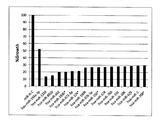
- FIG. 1 is an example of a graph showing the effect of growth inhibition by TS-miR on human oral squamous cell carcinoma cell GFP-SAS.
- FIG. 2 is an example of a graph showing the effect of growth inhibition by TS-miR on human salivary gland cancer cells GFP-ACCM.
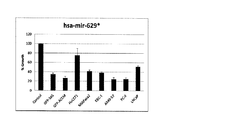
- FIG. 3 is an example of a graph showing the effects of hsa-miR-629 * growth inhibition on various human cancer cells.
- FIG. 4 is an example of a graph showing the influence of growth inhibition by hsa-miR-1289 on various human cancer cells.
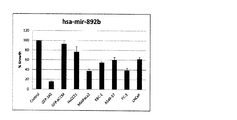
- FIG. 5 is an example of a graph showing the effect of hsa-miR-892b growth inhibition on various human cancer cells.
- FIG. 6A is an example of a graph showing the expression of hsa-miR-1289 in oral squamous cell carcinoma tissue at each stage
- FIG. 6B is an example of a graph showing the expression of hsa-miR-1289 in salivary gland cancer tissue. It is.
- FIG. 7A is an example of a graph showing expression of hsa-miR-892b in oral squamous cell carcinoma tissues at each stage
- FIG. 7B is an example of a graph showing expression of hsa-miR-892b in salivary gland cancer tissues. It is.
- the present invention includes the following aspects: [1] A composition comprising microRNA or an expression system capable of expressing microRNA in a cell, wherein the microRNA comprises hsa-miR-1289, hsa-miR-892b, hsa-miR-661, hsa- miR-193b *, hsa-miR-671-5p, hsa-miR-124 *, hsa-miR-1908, hsa-miR-876-5p, hsa-miR-192 *, hsa-miR-124, hsa-miR -760, hsa-miR-192, hsa-miR-206, hsa-miR-629, hsa-miR-1, hsa-miR-708 *, and hsa-miR-629 *, human A composition for inhibiting the growth of head and neck cancer cells; [2]
- a method for suppressing the growth of human cancer cells comprising contacting the cancer cells with a composition comprising microRNA or an expression system capable of expressing microRNA in the cells, Is hsa-miR-1289, hsa-miR-892b, hsa-miR-661, hsa-miR-193b *, hsa-miR-671-5p, hsa-miR-124 *, hsa-miR-1908, hsa- miR-876-5p, hsa-miR-192 *, hsa-miR-124, hsa-miR-760, hsa-miR-192, hsa-miR-206, hsa-miR-629, hsa-miR-1, hsa a method for inhibiting the growth of human cancer cells selected from the group consisting of -miR-708 * and hs
- microRNA / miRNA refers to a kind of low-molecular non-coding RNA, and has a normal meaning used in the technical field.
- the microRNA referred to using an ID can refer to a database (for example, miRBase® (http://www.miRbase.org/)).
- microRNA refers to mature microRNA consisting of 18 to 25 bases.
- composition containing microRNA or an expression system capable of expressing microRNA in a cell refers to a composition in a form in which a desired microRNA can be introduced into a cell.
- composition containing microRNA include a composition for directly introducing a single-stranded or double-stranded mature microRNA into a cell, and “a microRNA can be expressed in a cell”.
- composition comprising a simple expression system include a composition comprising a vector in which a polynucleotide encoding a microRNA precursor is linked so as to allow expression.
- a known method can be adopted as a method for introducing microRNA or a vector into a cell.
- “suppression of cell growth” includes inhibition of cell growth and cell death, and includes suppression of cell growth in in vivo, in vitro, and ex vivo.
- “cell” can include human cells and non-human cells, with human cells being preferred.
- head and neck cancer refers to cancer that can be formed from the neck, excluding the brain and eyes.
- oral cancer nasal sinus cancer, lip cancer, and pharyngeal cancer. Including laryngeal cancer, cervical tumor, ear cancer.
- oral cancer generally refers to cancer that is caused by the mucous membrane of a part constituting the oral cavity, such as gingiva, tongue, cheek, palate, floor of mouth, and salivary gland.
- human cancer is not particularly limited, and for example, head and neck cancer, malignant melanoma, basal cell cancer, ovarian cancer, breast cancer, non-small cell lung cancer, renal cell cancer, bladder Cancer, recurrent superficial bladder cancer, stomach cancer, prostate cancer, biliary tract cancer, pancreatic cancer, lung cancer, cervical cancer, cervical dysplasia, laryngeal papillomatosis, colon cancer, colorectal Includes cancer and carcinoid tumors.
- the microRNA relates to a composition selected from the group consisting of hsa-miR-1289, hsa-miR-892b, and hsa-miR-629 *.
- the sequences of the microRNA (mature type) registered in the database are shown in SEQ ID NOS: 1 to 17 in Table 1 below, respectively.
- the composition of the present invention is in the form of a “composition containing micromicroRNA”, as one embodiment, the mature microRNA represented by the RNA of Table 1 above is included in a single-stranded or double-stranded state. It is.
- the mature microRNA is double-stranded, from the viewpoint of cell growth inhibition of head and neck cancer cells, double-stranded RNA (ie, between complementary strands) that assumes the state after the precursor has been cleaved into Dicer It is preferable to use a native or near-native double-stranded RNA) that maintains a mismatch.
- These microRNAs can be synthesized.
- composition of the present invention is in the form of “a composition containing an expression system capable of expressing microRNA in a cell”, as one embodiment of “an expression system capable of expressing microRNA in a cell”, RNA Examples thereof include a composition comprising a vector that encodes a precursor or an analogous sequence thereof that expresses the mature microRNA of Table 1 above.
- a known microRNA expression vector may be used as the expression vector for linking the RNA precursor or a similar sequence thereof.
- the composition of this embodiment is a composition for suppressing the growth of human head and neck cancer cells, and the expression system capable of expressing the microRNA contained in the composition of this embodiment or the microRNA in the cell is a human head and neck.
- Introduce into cancer cells The introduction can be performed using a known transfection method.
- the introduction may be any of in vivo, in vitro, and ex vivo.
- the present invention provides a pharmaceutical composition for treating or preventing human head and neck cancer, comprising microRNA or an expression system capable of expressing microRNA in a cell, wherein the microRNA comprises: hsa-miR-1289, hsa-miR-892b, hsa-miR-661, hsa-miR-193b *, hsa-miR-671-5p, hsa-miR-124 *, hsa-miR-1908, hsa-miR- 876-5p, hsa-miR-192 *, hsa-miR-124, hsa-miR-760, hsa-miR-192, hsa-miR-206, hsa-miR-629, hsa-miR-1, hsa-miR
- the present invention relates to
- the pharmaceutical composition of the present invention may further contain a pharmaceutically acceptable carrier.
- the pharmaceutical carrier is not particularly limited.
- a carrier that can increase the efficiency with which a microRNA or an expression system capable of expressing microRNA in a cell enters a target site, tissue, cell, etc. Atelocollagen, liposome, cationic liposome and the like.
- the dosage form of the pharmaceutical composition of this embodiment is not particularly limited, and examples thereof include injections, creams, ointments, tablets, suspensions and the like.
- the administration method is not particularly limited, and examples thereof include injection, oral, topical, intranasal, rectal, intravenous, and intraarterial administration.
- known dosage forms of microRNA and / or siRNA supplements can be used as the dosage form of the pharmaceutical composition of the present invention.
- the composition of the present invention the growth of human head and neck cancer cells can be suppressed. Therefore, this invention relates to the method of suppressing the growth of the cancer cell including making the composition of this invention contact the object human cancer cell as another aspect.
- the contact method is not particularly limited, and a method that can be introduced into a cancer cell intended for the microRNA in the composition or an expression system capable of expressing the microRNA in the cell can be employed.
- One embodiment of introducing a microRNA or an expression system capable of expressing microRNA in a cell into a cancer cell is a lipofection method.
- the dosage of the microRNA or an expression system capable of expressing the microRNA in the cell during the lipofection method and other introduction methods is, for example, 10 to 25 nM.
- composition of the present invention it is possible to treat or prevent human head and neck cancer. Therefore, this invention relates to the method of suppressing the growth of the cancer cell including administering the pharmaceutical composition of this invention to object as another aspect.
- the dosage form of the composition to be administered is not particularly limited, and examples thereof include injections, creams, ointments, tablets, suspensions and the like.
- the administration method is not particularly limited, and examples thereof include injection, oral, topical, intranasal, rectal, intravenous, and intraarterial administration. Administration will depend on the severity and responsiveness of the condition being treated and the course of treatment.
- Optimal dosing schedules can be calculated from measurements of drug accumulation in the subject's body.
- the optimal dose may vary depending on the relative effectiveness of the individual oligonucleotides. In general, it can be estimated based on the EC50 found to be effective in in vitro and in vivo animal models. Generally, the dose is 0.01 ⁇ g to 1 g / kg body weight, preferably 0.01 to 100 mg / kg body weight, more preferably 1 to 10 mg / kg body weight.
- the administration frequency may be one or more times per day, one week, one month or one year, or once every 2 to 10 years, or by continuous infusion for several hours to several months. The number of repeated administrations can be estimated based on the measured drug concentration in the body fluid or tissue and the residence time. After successful treatment, it may be desirable for the subject to receive maintenance therapy to prevent recurrence of the condition.
- the present invention relates to a head and neck cancer marker (hereinafter also referred to as “the head and neck cancer marker of the present invention”) in a body fluid sample, which is composed of a part of the microRNA of Table 1.
- Head and neck cancer markers of the present invention are hsa-miR-1289, hsa-miR-876-5p, hsa-miR-1, hsa-miR-892b, hsa-miR-124, hsa-miR-124 *, hsa It consists of a microRNA selected from the group consisting of -miR-206, hsa-miR-193b *, hsa-miR-192 *, and hsa-miR-192.
- the present invention provides hsa-miR-1289, hsa-miR-876-5p, hsa-miR-1, hsa-miR-892b, hsa-miR-124, hsa-miR-124 *, hsa in body fluid samples.
- -Use of a microRNA selected from the group consisting of miR-206, hsa-miR-193b *, hsa-miR-192 *, and hsa-miR-192 as a head and neck cancer marker in a body fluid sample About the use of.
- the “body fluid sample” includes a blood sample and / or a saliva sample.
- the “blood sample” include whole blood, plasma, and serum.
- the blood sample is preferably serum because it easily functions as a head and neck cancer marker.
- the head and neck cancer marker of the present invention is an indicator of the presence or absence of head and neck cancer.
- the present invention is a method for analyzing the presence or absence of head and neck cancer, comprising detecting microRNA in a body fluid sample and comparing the measured value with a reference value, MicroRNAs are hsa-miR-1289, hsa-miR-876-5p, hsa-miR-1, hsa-miR-892b, hsa-miR-124, hsa-miR-124 *, hsa-miR-206, hsa
- the present invention relates to a method for analyzing the presence or absence of head and neck cancer, which is at least one selected from the group consisting of -miR-193b *, hsa-miR-192 *, and hsa-miR-192.
- the measurement value includes a measurement value of the amount or concentration of the microRNA in the analysis target body fluid sample, and may be an absolute amount or a relative value.
- the method for measuring the amount or concentration of microRNA is not particularly limited, and can be performed by, for example, a quantitative PCR method or a DNA microarray method.
- a measurement value obtained by measuring the amount or concentration of each microRNA of a healthy subject and / or a head and neck cancer patient in the same manner as the analysis target can be used.
- hsa-miR-1289, hsa-miR-876-5p, and hsa-miR-1 are not detected in body fluid samples of healthy individuals, A type of marker that is detected in a body fluid sample.
- a type of marker that is detected in a body fluid sample for example, if 0 is set as the reference value, and the measured value of the analysis target body fluid sample is higher than the reference value, it can be determined that there is a possibility that head and neck cancer exists.
- hsa-miR-124 * and hsa-miR-206 are not detected in a body fluid sample of a head and neck cancer patient, but are detected in a body fluid sample of a healthy person It is a marker.
- a marker for this type of marker, for example, if the reference value is set to 0 or less than the detection limit, and the measurement value of the analysis target body fluid sample is the same as the reference value, head and neck cancer may be present. Can be judged.
- hsa-miR-892b, hsa-miR-124, hsa-miR-193b *, sa-miR-192 *, and hsa-miR-192 are It is a type of marker that is detected in both patients but has a significant difference in its measurements.
- hsa-miR-892b and hsa-miR-124 are markers whose measured values are increased in body fluid samples of head and neck cancer patients compared to healthy individuals.
- This type of marker for example, sets a measurement value of a body fluid sample of a healthy person and a head and neck cancer patient as the reference value, and the measurement value of the analysis body fluid sample is higher than the measurement value of the healthy person. If it is close to or more than the measured value, it can be determined that head and neck cancer may be present.
- the previous measured value of the individual to be measured is set as a reference value, and the measured value of the body fluid sample to be analyzed is higher than the reference value (for example, 1.2 times or more, preferably 1.3 times or more, more preferably Is 1.4 times or more), it can be determined that head and neck cancer may be present.
- Hsa-miR-193b *, hsa-miR-192 *, and hsa-miR-192 increase in measured values in body fluid samples of healthy subjects compared to head and neck cancer patients.
- This type of marker for example, sets a measurement value of a body fluid sample of a healthy person and a head and neck cancer patient as the reference value, and the measurement value of the analysis body fluid sample is higher than the measurement value of the healthy person. If it is close to or less than the measured value, it can be determined that head and neck cancer may be present.
- the previous measured value of the individual to be measured is set as a reference value, and the measured value of the body fluid sample to be analyzed is lower than the reference value (for example, 0.8 times or less, preferably 0.7 times or less, more preferably Is 0.6 times or less), it can be determined that head and neck cancer may be present.
- the present invention is also referred to as a head or neck cancer determination or diagnostic kit (hereinafter referred to as “the determination or diagnosis kit of the present invention”) that includes a reagent for detecting the head and neck cancer marker of the present invention. )
- the determination or diagnosis kit of the present invention can employ, for example, a known microarray method or quantitative PCR method.
- the microarray method is not particularly limited as long as the expression level of the microRNA that is the head and neck cancer marker of the present invention can be measured, but the RNA extracted from the body fluid sample is labeled with a label (preferably a fluorescent label). Then, the RNA is brought into contact with a microarray on which a polynucleotide consisting of a nucleic acid sequence complementary to the microRNA to be identified (preferably DNA) or a probe comprising a part thereof is immobilized, and then hybridization is performed. A method of washing the microarray and measuring the expression level of the microRNA remaining on the microarray can be exemplified.
- the nucleotide type of the nucleic acid sequence is not particularly limited as long as it can specifically hybridize to the microRNA that is the head and neck cancer marker of the present invention, but is preferably DNA because of its high stability.
- the length of a part of the polynucleotide is not particularly limited as long as it can specifically hybridize to the microRNA which is the head and neck cancer marker of the present invention, but a viewpoint of ensuring the stability of hybridization. Therefore, it is preferably 10 to 100 mer, more preferably 10 to 40 mer.
- said polynucleotide or its one part can be obtained by chemically synthesizing using a well-known method in the said technical field.
- the array for immobilizing the polynucleotide or a part thereof is not particularly limited, but a glass substrate, a silicon substrate, and the like can be preferably exemplified, and a glass substrate can be more suitably exemplified.
- the method for immobilizing the above polynucleotide or a part thereof on the array is not particularly limited, and a known method can be used.
- the determination or diagnosis kit of the present invention includes, in addition to the above-described microarray, for example, a reagent used for RNA labeling reaction, a reagent used for hybridization reaction, a reagent used for washing, a reagent used for RNA extraction from tissue, etc. Any element such as a reagent used in the microarray method may be further included.
- the quantitative PCR method is a method using a primer set that can amplify the sequence of the microRNA that is the head and neck cancer marker of the present invention, and in particular, as long as the expression level of the microRNA can be measured.
- a normal quantitative PCR method such as an agarose electrophoresis method, a SYBR green method, or a fluorescent probe method can be used, but the fluorescent probe method is most preferable in terms of accuracy and reliability of quantification.
- the primer set in the quantitative PCR method means a combination of primers (polynucleotides) capable of amplifying the microRNA sequence that is the head and neck cancer marker of the present invention.
- the primer is not particularly limited as long as the sequence of the present microRNA can be amplified, but a primer (forward primer) comprising a partial sequence on the 5 ′ side of the sequence of the microRNA that is the head and neck cancer marker of the present invention.
- a primer set comprising a primer (reverse primer) composed of a sequence complementary to a partial sequence on the 3 ′ side of the sequence of the microRNA.
- the fluorescent probe is not particularly limited as long as it contains a polynucleotide consisting of a nucleic acid sequence complementary to the sequence of the present microRNA or a part thereof.
- the TaqMan (registered trademark) probe method using the FRET principle
- fluorescent probes that can be used in the cycling probe method can be preferably exemplified, and in particular, fluorescent probes that can be used in the TaqMan (registered trademark) probe method (including those using the FRET principle) are more preferably exemplified. can do.
- the primer set and the fluorescent probe can be obtained by chemical synthesis or the like using a method well known in the art based on the sequence information.
- a method of quantitative PCR using the above primer set and fluorescent probe a method of using TaqMan (registered trademark) microRNA Assays (Applied Biosystems) according to the attached protocol is preferably exemplified. Can do.
- the head and neck tumor determination kit of the present invention provided with a primer set and a fluorescent probe further includes an optional element such as a reagent used in a quantitative PCR reaction such as polymerase in addition to the primer set described above. May be.
- the present invention provides a composition comprising microRNA or an expression system capable of expressing microRNA in a cell, wherein the microRNA comprises hsa-miR-1289, hsa-miR-892b, hsa -miR-661, hsa-miR-193b *, hsa-miR-671-5p, hsa-miR-124 *, hsa-miR-1908, hsa-miR-876-5p, hsa-miR-192 *, hsa- Consists of miR-124, hsa-miR-760, hsa-miR-192, hsa-miR-206, hsa-miR-629, hsa-miR-1, hsa-miR-708 *, and hsa-miR-629 *
- the present invention comprises hsa-miR-1289, hsa
- the target cancer to suppress growth is a human cancer selected from the group consisting of lung cancer, pancreatic cancer, and prostate cancer.
- the microRNA that can be included in the second composition of the invention is selected from the group consisting of hsa-miR-1289, hsa-miR-892b, and hsa-miR-629 *.
- the second composition of the present invention is a microRNA selected from the group consisting of hsa-miR-1289, hsa-miR-892b, and hsa-miR-629 *, or a microRNA within a cell.
- the present invention relates to a composition for suppressing the growth of human cancer cells selected from the group consisting of human lung cancer cells, human pancreatic cancer cells, and human prostate cancer cells, comprising an expression system capable of expressing RNA.
- the present invention provides a pharmaceutical composition comprising microRNA or an expression system capable of expressing microRNA in a cell, wherein the microRNA comprises hsa-miR-1289, hsa-miR-892b, hsa-miR-661, hsa-miR-193b *, hsa-miR-671-5p, hsa-miR-124 *, hsa-miR-1908, hsa-miR-876-5p, hsa-miR-192 *, hsa -From miR-124, hsa-miR-760, hsa-miR-192, hsa-miR-206, hsa-miR-629, hsa-miR-1, hsa-miR-708 *, and hsa-miR-629 *
- the present invention comprises hsa-miR-1289, hsa-m
- the human cancer to be treated or prevented is selected from the group consisting of lung cancer, pancreatic cancer, and prostate cancer.
- the microRNA that can be included in the second pharmaceutical composition of the present invention is, in one embodiment, selected from the group consisting of hsa-miR-1289, hsa-miR-892b, and hsa-miR-629 *.
- the second pharmaceutical composition of the present invention is a microRNA selected from the group consisting of hsa-miR-1289, hsa-miR-892b, and hsa-miR-629 * or intracellularly.
- a pharmaceutical composition for treating or preventing human cancer selected from the group consisting of human lung cancer, human pancreatic cancer, and human prostate cancer, comprising an expression system capable of expressing microRNA.
- the growth of human cancer cells can be suppressed. Therefore, this invention relates to the method of suppressing the growth of a human cancer cell including making the 2nd composition of this invention contact a human cancer cell in another aspect.
- the second pharmaceutical composition of the present invention it is possible to treat or prevent human cancer. Therefore, this invention relates to the treatment or prevention method of a human cancer including administering the 2nd pharmaceutical composition of this invention to a subject as another aspect.
- the cancer is selected from the group consisting of lung cancer, pancreatic cancer, and prostate cancer.
- GFP stable expression strains GFP-SAS and GFP-ACCM which were isolated and established by introducing a green fluorescent protein (GFP) gene into human oral squamous cell carcinoma cell line SAS and human salivary gland carcinoma cell line ACCM, were used. These cell lines were cultured in Dulbecco's modified Eagle containing 10% fetal bovine serum (FBS, Biosource International), 100 ⁇ g / ml streptomycin, 100 U / ml penicillin, and 0.25 mg / ml amphotericin B (Invitrogen). Medium (DMEM) or RPMI1640 medium (manufactured by Sigma-Aldrich) was used as a growth culture solution, and this was performed at 37 ° C. in an incubator containing carbon dioxide gas at a rate of 5% in air.
- FBS Dulbecco's modified Eagle containing 10% fetal bovine serum
- FBS fetal bovine serum
- streptomycin 100 U / ml penicillin
- TS-miR detected only in head and neck cancer patients and detected only in healthy individuals by TS-miR expression analysis using serum derived from head and neck cancer patients and healthy individuals 2 types of TS-miR, and 5 types of TS-miR that show significant variation in the expression level between the two groups (2 types that increase in head and neck cancer patients and 3 types that increase in healthy subjects) ) was identified.
- FIGS. 3 to 5 are examples of graphs showing the effects of TS-miR on proliferation of human cancer cells shown in Table 4, wherein FIG. 3 is a graph of hsa-miR-629 *, and FIG. 4 is a graph of hsa-miR. -1289 graph, FIG. 5 shows the hsa-miR-892b graph.
- FIGS. 3 to 5 the growth of various human cancer cells shown in Table 4 was suppressed by hsa-miR-629 *, hsa-miR-1289 and hsa-miR-892b.
- Hsa-miR-629 * and hsa-miR-1289 are human pancreatic cancer cells MIAPaca2, human lung squamous cell carcinoma cells EBC-1, human lung adenocarcinoma cells A549-57, and human prostate cancer cells PC-3, LNCaP shows a growth inhibition rate of 40% or more.
- hsa-miR-629 * is 70% or more in human lung adenocarcinoma cell A549-57 and human prostate cancer cell PC-3. It showed a growth inhibition rate, and hsa-miR-1289 showed a growth inhibition rate of 70% or more in human lung squamous cell carcinoma cell EBC-1.
- hsa-miR-892b is 30% or more in human pancreatic cancer cell MIAPaca2, human lung squamous cell carcinoma cell EBC-1, human lung adenocarcinoma cell A549-57, and human prostate cancer cell PC-3, LNCaP
- the human pancreatic cancer cell MIAPaca2 and the human prostate cancer cell PC-3 exhibited a growth inhibition rate of 60% or more.
- FIG. 6 is an example of a graph showing the expression of hsa-miR-1289 in human head and neck cancer tissue
- FIG. 6A shows the expression of hsa-miR-1289 in oral squamous cell carcinoma tissue at each stage
- FIG. 6B shows the expression of hsa-miR-1289 in salivary gland cancer tissue.
- 6A and 6B TS-miR expression is shown as a relative value with RNU6B expression as an internal control.
- hsa-miR-1289 tends to clearly decrease in oral squamous cell carcinoma tissue and salivary gland cancer tissue regardless of stage as compared with normal oral mucosal tissue.
- hsa-miR-1289 replacement therapy may be effective in cases where hsa-miR-1289 expression is decreased.
- FIG. 7 is an example of a graph showing the expression of hsa-miR-892b in human head and neck cancer tissue
- FIG. 7A shows the expression of hsa-miR-892b in oral squamous cell carcinoma tissue at each stage
- FIG. 7B shows hsa-miR-892b expression in salivary gland cancer tissue.
- 7A and 7B the expression of TS-miR is shown as a relative value with the expression of RNU6B as an internal control.
- FIGS. 7A and B there were cases where the expression of hsa-miR-892b was clearly reduced in oral squamous cell carcinoma tissue and salivary gland cancer tissue compared to normal oral mucosal tissue.
- the expression of hsa-miR-892b was markedly decreased in all cases except one case regardless of the stage.
- the present invention is useful in drug development related to head and neck cancer, medical field of head and neck cancer, research field of head and neck cancer, and the like.
- SEQ ID NO: 1-18 Sequence of mature miRNA registered in miRBase (Release 17: April 2011)
Landscapes
- Health & Medical Sciences (AREA)
- Life Sciences & Earth Sciences (AREA)
- Chemical & Material Sciences (AREA)
- Genetics & Genomics (AREA)
- Engineering & Computer Science (AREA)
- General Health & Medical Sciences (AREA)
- Molecular Biology (AREA)
- Biomedical Technology (AREA)
- Organic Chemistry (AREA)
- Pharmacology & Pharmacy (AREA)
- Bioinformatics & Cheminformatics (AREA)
- Public Health (AREA)
- Veterinary Medicine (AREA)
- Biochemistry (AREA)
- Medicinal Chemistry (AREA)
- Zoology (AREA)
- Wood Science & Technology (AREA)
- Animal Behavior & Ethology (AREA)
- General Engineering & Computer Science (AREA)
- Biotechnology (AREA)
- Biophysics (AREA)
- Plant Pathology (AREA)
- Physics & Mathematics (AREA)
- Microbiology (AREA)
- Chemical Kinetics & Catalysis (AREA)
- General Chemical & Material Sciences (AREA)
- Nuclear Medicine, Radiotherapy & Molecular Imaging (AREA)
- Epidemiology (AREA)
- Measuring Or Testing Involving Enzymes Or Micro-Organisms (AREA)
Abstract
頭頸部がん細胞の生育阻害が可能なTS-miR及びその利用。 マイクロRNA又は細胞内でマイクロRNAを発現可能な発現系を含む組成物であって、前記マイクロRNAが、hsa-miR-1289、hsa-miR-892b、hsa-miR-661、hsa-miR-193b*、hsa-miR-671-5p、hsa-miR-124*、hsa-miR-1908、hsa-miR-876-5p、hsa-miR-192*、hsa-miR-124、hsa-miR-760、hsa-miR-192、hsa-miR-206、hsa-miR-629、hsa-miR-1、hsa-miR-708*、及びhsa-miR-629*からなる群から選択される、ヒト頭頸部がん細胞の生育を抑制するための組成物に関する。
Description
本発明は、マイクロRNA又はその発現系を含む組成物及び頭頸部がんマーカーに関する。
マイクロRNA(microRNA/miRNA)は、18~25塩基からなる小分子RNAであり、標的mRNAに結合することで、そのタンパク質への翻訳を阻害する。現在までに約1,100種類のヒトmiRNAがデータベース(例えば、miRBase (http://www.miRbase.org/))に登録されており、これらmiRNAの発現或いは機能異常が種々の疾患に関与していることが明らかにされている(非特許文献1参照)。特に、がんに関しては、miRNAマイクロアレイを用いた網羅的発現解析によって、がん組織又はがん細胞で発現亢進又は発現抑制されているmiRNAが多数同定されている(特許文献1)。
がんで発現亢進するmiRNAとしては、miR-21、miR-155、miR-17-5p、miR-19等が知られており、中でもmiR-19は細胞がん化に必要十分であり、その標的の一つががん抑制遺伝子PTENであることが示された。このようにがん抑制遺伝子を標的としてがん遺伝子的な性質を有するmiRNAは、OncomiRと呼ばれている。
また、多くのmiRNAはがんで発現低下しており、そのようなmiRNAとしては、let-7、miR-15a、miR-34a、miR-143、miR-145等が報告されている。なかでも、let-7は、肺がんにおいて発現低下と予後とが相関することが明らかにされており、その標的にがん遺伝子Rasが含まれていることが知られている。がん遺伝子を標的としてがん抑制遺伝子様の機能を発揮するmiRNAは、Tumor suppressor miR(TS-miR)と呼ばれる。
口腔がんのTS-miRとしては、miR-137とmiR-193aが示唆されている(非特許文献2)。
Schickel R, et al. Oncogene 27: 5959-5974, 2008.
小崎健一ら、「口腔癌の新たな診断・治療体系の確立を目指したmicroRNAに関する網羅的解析」科学研究費補助金データベース(http://kaken.nii.ac.jp)、研究課題番号:18591997
がんにおいて発現が低下するのみならず、がん細胞内で発現させることによりそのがん細胞の生育を阻害でききるマイクロRNAであれば、がんの治療や予防にいっそう有利となる。また、そのようなマイクロRNAが血清や唾液中のがんマーカーとして利用できれば、がんの診断に有用となる。
そこで、本発明は、一態様として、頭頸部がん細胞の生育阻害が可能なマイクロRNA及びその利用を提供する。また、本発明は、その他の態様として、体液試料中の頭頸部がんマーカーとして利用できるマイクロRNA及びその利用を提供する。また、本発明は、さらにその他の態様として、ヒトのがん細胞の生育阻害が可能なマイクロRNA及びその利用を提供する。
本発明は、一態様として、マイクロRNA又は細胞内でマイクロRNAを発現可能な発現系を含む組成物であって、前記マイクロRNAが、hsa-miR-1289、hsa-miR-892b、hsa-miR-661、hsa-miR-193b*、hsa-miR-671-5p、hsa-miR-124*、hsa-miR-1908、hsa-miR-876-5p、hsa-miR-192*、hsa-miR-124、hsa-miR-760、hsa-miR-192、hsa-miR-206、hsa-miR-629、hsa-miR-1、hsa-miR-708*、及びhsa-miR-629*からなる群から選択される、ヒト頭頸部がん細胞の生育を抑制するための組成物に関する。
本発明は、その他の態様として、ヒト頭頸部がん細胞の生育を抑制する方法であって、マイクロRNA又は細胞内でマイクロRNAを発現可能な発現系を含む組成物を前記がん細胞に接触させることを含み、前記マイクロRNAが、hsa-miR-1289、hsa-miR-892b、hsa-miR-661、hsa-miR-193b*、hsa-miR-671-5p、hsa-miR-124*、hsa-miR-1908、hsa-miR-876-5p、hsa-miR-192*、hsa-miR-124、hsa-miR-760、hsa-miR-192、hsa-miR-206、hsa-miR-629、hsa-miR-1、hsa-miR-708*、及びhsa-miR-629*からなる群から選択される、ヒト頭頸部がん細胞の生育を抑制する方法に関する。
本発明は、さらにその他の態様として、hsa-miR-1289、hsa-miR-876-5p、hsa-miR-1、hsa-miR-892b、hsa-miR-124、hsa-miR-124*、hsa-miR-206、hsa-miR-193b*、hsa-miR-192*、及びhsa-miR-192からなる群から選択されるマイクロRNAの使用であって、体液試料中の頭頸部がんマーカーとしての使用に関する。
本発明は、さらにその他の態様として、マイクロRNA又は細胞内でマイクロRNAを発現可能な発現系を含む組成物であって、前記マイクロRNAが、hsa-miR-1289、hsa-miR-892b、hsa-miR-661、hsa-miR-193b*、hsa-miR-671-5p、hsa-miR-124*、hsa-miR-1908、hsa-miR-876-5p、hsa-miR-192*、hsa-miR-124、hsa-miR-760、hsa-miR-192、hsa-miR-206、hsa-miR-629、hsa-miR-1、hsa-miR-708*、及びhsa-miR-629*からなる群から選択される、ヒトがん細胞の生育を抑制するための組成物に関する。
本発明は、さらにその他の態様として、ヒトがん細胞の生育を抑制する方法であって、マイクロRNA又は細胞内でマイクロRNAを発現可能な発現系を含む組成物を前記がん細胞に接触させることを含み、前記マイクロRNAが、hsa-miR-1289、hsa-miR-892b、hsa-miR-661、hsa-miR-193b*、hsa-miR-671-5p、hsa-miR-124*、hsa-miR-1908、hsa-miR-876-5p、hsa-miR-192*、hsa-miR-124、hsa-miR-760、hsa-miR-192、hsa-miR-206、hsa-miR-629、hsa-miR-1、hsa-miR-708*、及びhsa-miR-629*からなる群から選択される、ヒトがん細胞の生育を抑制する方法に関する。
本発明によれば、例えば、頭頸部がんの診断、治療、予防、又は再発予防などに寄与できる。また、本発明によれば、例えば、ヒトの頭頸部がん以外のがんの診断、治療、予防、又は再発予防などに寄与できる。
本発明は、以下の態様、すなわち、
[1]マイクロRNA又は細胞内でマイクロRNAを発現可能な発現系を含む組成物であって、前記マイクロRNAが、hsa-miR-1289、hsa-miR-892b、hsa-miR-661、hsa-miR-193b*、hsa-miR-671-5p、hsa-miR-124*、hsa-miR-1908、hsa-miR-876-5p、hsa-miR-192*、hsa-miR-124、hsa-miR-760、hsa-miR-192、hsa-miR-206、hsa-miR-629、hsa-miR-1、hsa-miR-708*、及びhsa-miR-629*からなる群から選択される、ヒト頭頸部がん細胞の生育を抑制するための組成物;
[2]マイクロRNA又は細胞内でマイクロRNAを発現可能な発現系を含む医薬組成物であって、前記マイクロRNAが、hsa-miR-1289、hsa-miR-892b、hsa-miR-661、hsa-miR-193b*、hsa-miR-671-5p、hsa-miR-124*、hsa-miR-1908、hsa-miR-876-5p、hsa-miR-192*、hsa-miR-124、hsa-miR-760、hsa-miR-192、hsa-miR-206、hsa-miR-629、hsa-miR-1、hsa-miR-708*、及びhsa-miR-629*からなる群から選択される、ヒト頭頸部がんの治療又は予防のための医薬組成物;
[3]ヒト頭頸部がん細胞の生育を抑制する方法であって、マイクロRNA又は細胞内でマイクロRNAを発現可能な発現系を含む組成物を前記がん細胞に接触させることを含み、前記マイクロRNAが、hsa-miR-1289、hsa-miR-892b、hsa-miR-661、hsa-miR-193b*、hsa-miR-671-5p、hsa-miR-124*、hsa-miR-1908、hsa-miR-876-5p、hsa-miR-192*、hsa-miR-124、hsa-miR-760、hsa-miR-192、hsa-miR-206、hsa-miR-629、hsa-miR-1、hsa-miR-708*、及びhsa-miR-629*からなる群から選択される、ヒト頭頸部がん細胞の生育を抑制する方法;
[4]ヒトの頭頸部がんの治療又は予防方法であって、マイクロRNA又は細胞内でマイクロRNAを発現可能な発現系を含む組成物を対象に投与することを含み、前記マイクロRNAが、hsa-miR-1289、hsa-miR-892b、hsa-miR-661、hsa-miR-193b*、hsa-miR-671-5p、hsa-miR-124*、hsa-miR-1908、hsa-miR-876-5p、hsa-miR-192*、hsa-miR-124、hsa-miR-760、hsa-miR-192、hsa-miR-206、hsa-miR-629、hsa-miR-1、hsa-miR-708*、及びhsa-miR-629*からなる群から選択される、ヒトの頭頸部がんの治療又は予防方法;
[5]頭頸部がんの有無を分析する方法であって、体液試料中のマイクロRNAを検出し、その測定値を基準値と比較することを含み、前記マイクロRNAは、hsa-miR-1289、hsa-miR-876-5p、hsa-miR-1、hsa-miR-892b、hsa-miR-124、hsa-miR-124*、hsa-miR-206、hsa-miR-193b*、hsa-miR-192*、及びhsa-miR-192からなる群から選択される少なくとも1つである、頭頸部がんの有無の分析方法;
[6]体液試料中のhsa-miR-1289、hsa-miR-876-5p、hsa-miR-1、hsa-miR-892b、hsa-miR-124、hsa-miR-124*、hsa-miR-206、hsa-miR-193b*、hsa-miR-192*、及びhsa-miR-192からなる群から選択されるマイクロRNAの使用であって、体液試料中の頭頸部がんマーカーとしての使用;
[7]マイクロRNA又は細胞内でマイクロRNAを発現可能な発現系を含む組成物であって、前記マイクロRNAが、hsa-miR-1289、hsa-miR-892b、hsa-miR-661、hsa-miR-193b*、hsa-miR-671-5p、hsa-miR-124*、hsa-miR-1908、hsa-miR-876-5p、hsa-miR-192*、hsa-miR-124、hsa-miR-760、hsa-miR-192、hsa-miR-206、hsa-miR-629、hsa-miR-1、hsa-miR-708*、及びhsa-miR-629*からなる群から選択される、ヒトがん細胞の生育を抑制するための組成物;
[8]マイクロRNA又は細胞内でマイクロRNAを発現可能な発現系を含む医薬組成物であって、前記マイクロRNAが、hsa-miR-1289、hsa-miR-892b、hsa-miR-661、hsa-miR-193b*、hsa-miR-671-5p、hsa-miR-124*、hsa-miR-1908、hsa-miR-876-5p、hsa-miR-192*、hsa-miR-124、hsa-miR-760、hsa-miR-192、hsa-miR-206、hsa-miR-629、hsa-miR-1、hsa-miR-708*、及びhsa-miR-629*からなる群から選択される、ヒトのがんの治療又は予防のための医薬組成物;
[9]前記がんが、肺がん、膵臓がん、及び前立腺がんからなる群から選択される、[7]又は[8]に記載の組成物;
[10]前記マイクロRNAが、hsa-miR-1289、hsa-miR-892b、及びhsa-miR-629*からなる群から選択される、[7]から[9]のいずれかに記載の組成物;
[11]ヒトがん細胞の生育を抑制する方法であって、マイクロRNA又は細胞内でマイクロRNAを発現可能な発現系を含む組成物を前記がん細胞に接触させることを含み、前記マイクロRNAが、hsa-miR-1289、hsa-miR-892b、hsa-miR-661、hsa-miR-193b*、hsa-miR-671-5p、hsa-miR-124*、hsa-miR-1908、hsa-miR-876-5p、hsa-miR-192*、hsa-miR-124、hsa-miR-760、hsa-miR-192、hsa-miR-206、hsa-miR-629、hsa-miR-1、hsa-miR-708*、及びhsa-miR-629*からなる群から選択される、ヒトがん細胞の生育を抑制する方法;
[12]ヒトのがんの治療又は予防方法であって、マイクロRNA又は細胞内でマイクロRNAを発現可能な発現系を含む組成物を対象に投与することを含み、前記マイクロRNAが、hsa-miR-1289、hsa-miR-892b、hsa-miR-661、hsa-miR-193b*、hsa-miR-671-5p、hsa-miR-124*、hsa-miR-1908、hsa-miR-876-5p、hsa-miR-192*、hsa-miR-124、hsa-miR-760、hsa-miR-192、hsa-miR-206、hsa-miR-629、hsa-miR-1、hsa-miR-708*、及びhsa-miR-629*からなる群から選択される、ヒトのがんの治療又は予防方法;
[13]前記がんが、肺がん、膵臓がん、及び前立腺がんからなる群から選択される、[11]又は[12]に記載の方法;
[14]前記マイクロRNAが、hsa-miR-1289、hsa-miR-892b、及びhsa-miR-629*からなる群から選択される、[11]から[13]のいずれかに記載の方法;
に関する。
[1]マイクロRNA又は細胞内でマイクロRNAを発現可能な発現系を含む組成物であって、前記マイクロRNAが、hsa-miR-1289、hsa-miR-892b、hsa-miR-661、hsa-miR-193b*、hsa-miR-671-5p、hsa-miR-124*、hsa-miR-1908、hsa-miR-876-5p、hsa-miR-192*、hsa-miR-124、hsa-miR-760、hsa-miR-192、hsa-miR-206、hsa-miR-629、hsa-miR-1、hsa-miR-708*、及びhsa-miR-629*からなる群から選択される、ヒト頭頸部がん細胞の生育を抑制するための組成物;
[2]マイクロRNA又は細胞内でマイクロRNAを発現可能な発現系を含む医薬組成物であって、前記マイクロRNAが、hsa-miR-1289、hsa-miR-892b、hsa-miR-661、hsa-miR-193b*、hsa-miR-671-5p、hsa-miR-124*、hsa-miR-1908、hsa-miR-876-5p、hsa-miR-192*、hsa-miR-124、hsa-miR-760、hsa-miR-192、hsa-miR-206、hsa-miR-629、hsa-miR-1、hsa-miR-708*、及びhsa-miR-629*からなる群から選択される、ヒト頭頸部がんの治療又は予防のための医薬組成物;
[3]ヒト頭頸部がん細胞の生育を抑制する方法であって、マイクロRNA又は細胞内でマイクロRNAを発現可能な発現系を含む組成物を前記がん細胞に接触させることを含み、前記マイクロRNAが、hsa-miR-1289、hsa-miR-892b、hsa-miR-661、hsa-miR-193b*、hsa-miR-671-5p、hsa-miR-124*、hsa-miR-1908、hsa-miR-876-5p、hsa-miR-192*、hsa-miR-124、hsa-miR-760、hsa-miR-192、hsa-miR-206、hsa-miR-629、hsa-miR-1、hsa-miR-708*、及びhsa-miR-629*からなる群から選択される、ヒト頭頸部がん細胞の生育を抑制する方法;
[4]ヒトの頭頸部がんの治療又は予防方法であって、マイクロRNA又は細胞内でマイクロRNAを発現可能な発現系を含む組成物を対象に投与することを含み、前記マイクロRNAが、hsa-miR-1289、hsa-miR-892b、hsa-miR-661、hsa-miR-193b*、hsa-miR-671-5p、hsa-miR-124*、hsa-miR-1908、hsa-miR-876-5p、hsa-miR-192*、hsa-miR-124、hsa-miR-760、hsa-miR-192、hsa-miR-206、hsa-miR-629、hsa-miR-1、hsa-miR-708*、及びhsa-miR-629*からなる群から選択される、ヒトの頭頸部がんの治療又は予防方法;
[5]頭頸部がんの有無を分析する方法であって、体液試料中のマイクロRNAを検出し、その測定値を基準値と比較することを含み、前記マイクロRNAは、hsa-miR-1289、hsa-miR-876-5p、hsa-miR-1、hsa-miR-892b、hsa-miR-124、hsa-miR-124*、hsa-miR-206、hsa-miR-193b*、hsa-miR-192*、及びhsa-miR-192からなる群から選択される少なくとも1つである、頭頸部がんの有無の分析方法;
[6]体液試料中のhsa-miR-1289、hsa-miR-876-5p、hsa-miR-1、hsa-miR-892b、hsa-miR-124、hsa-miR-124*、hsa-miR-206、hsa-miR-193b*、hsa-miR-192*、及びhsa-miR-192からなる群から選択されるマイクロRNAの使用であって、体液試料中の頭頸部がんマーカーとしての使用;
[7]マイクロRNA又は細胞内でマイクロRNAを発現可能な発現系を含む組成物であって、前記マイクロRNAが、hsa-miR-1289、hsa-miR-892b、hsa-miR-661、hsa-miR-193b*、hsa-miR-671-5p、hsa-miR-124*、hsa-miR-1908、hsa-miR-876-5p、hsa-miR-192*、hsa-miR-124、hsa-miR-760、hsa-miR-192、hsa-miR-206、hsa-miR-629、hsa-miR-1、hsa-miR-708*、及びhsa-miR-629*からなる群から選択される、ヒトがん細胞の生育を抑制するための組成物;
[8]マイクロRNA又は細胞内でマイクロRNAを発現可能な発現系を含む医薬組成物であって、前記マイクロRNAが、hsa-miR-1289、hsa-miR-892b、hsa-miR-661、hsa-miR-193b*、hsa-miR-671-5p、hsa-miR-124*、hsa-miR-1908、hsa-miR-876-5p、hsa-miR-192*、hsa-miR-124、hsa-miR-760、hsa-miR-192、hsa-miR-206、hsa-miR-629、hsa-miR-1、hsa-miR-708*、及びhsa-miR-629*からなる群から選択される、ヒトのがんの治療又は予防のための医薬組成物;
[9]前記がんが、肺がん、膵臓がん、及び前立腺がんからなる群から選択される、[7]又は[8]に記載の組成物;
[10]前記マイクロRNAが、hsa-miR-1289、hsa-miR-892b、及びhsa-miR-629*からなる群から選択される、[7]から[9]のいずれかに記載の組成物;
[11]ヒトがん細胞の生育を抑制する方法であって、マイクロRNA又は細胞内でマイクロRNAを発現可能な発現系を含む組成物を前記がん細胞に接触させることを含み、前記マイクロRNAが、hsa-miR-1289、hsa-miR-892b、hsa-miR-661、hsa-miR-193b*、hsa-miR-671-5p、hsa-miR-124*、hsa-miR-1908、hsa-miR-876-5p、hsa-miR-192*、hsa-miR-124、hsa-miR-760、hsa-miR-192、hsa-miR-206、hsa-miR-629、hsa-miR-1、hsa-miR-708*、及びhsa-miR-629*からなる群から選択される、ヒトがん細胞の生育を抑制する方法;
[12]ヒトのがんの治療又は予防方法であって、マイクロRNA又は細胞内でマイクロRNAを発現可能な発現系を含む組成物を対象に投与することを含み、前記マイクロRNAが、hsa-miR-1289、hsa-miR-892b、hsa-miR-661、hsa-miR-193b*、hsa-miR-671-5p、hsa-miR-124*、hsa-miR-1908、hsa-miR-876-5p、hsa-miR-192*、hsa-miR-124、hsa-miR-760、hsa-miR-192、hsa-miR-206、hsa-miR-629、hsa-miR-1、hsa-miR-708*、及びhsa-miR-629*からなる群から選択される、ヒトのがんの治療又は予防方法;
[13]前記がんが、肺がん、膵臓がん、及び前立腺がんからなる群から選択される、[11]又は[12]に記載の方法;
[14]前記マイクロRNAが、hsa-miR-1289、hsa-miR-892b、及びhsa-miR-629*からなる群から選択される、[11]から[13]のいずれかに記載の方法;
に関する。
本明細書において「マイクロRNA(microRNA/miRNA)」とは、低分子non-codingRNAの一種をいい、当該技術分野において使用される通常の意味を示す。本明細書においてIDを用いて言及するマイクロRNAは、データベース(例えば、miRBase (http://www.miRbase.org/))を参照できる。本明細書においてマイクロRNAは、特に言及がない場合、成熟型の18~25塩基からなるマイクロRNAをいう。
本明細書において「マイクロRNA又は細胞内でマイクロRNAを発現可能な発現系を含む組成物」とは、所期のマイクロRNAを細胞内に導入し得る形態の組成物をいう。「マイクロRNAを含む組成物」としては、一実施形態として、1本鎖又は2本鎖の成熟マイクロRNAを直接細胞に導入するための組成物が挙げられ、「細胞内でマイクロRNAを発現可能な発現系を含む組成物」としては、一実施形態として、マイクロRNA前駆体をコードするポリヌクレオチドが発現可能に連結されたベクターを含む組成物が挙げられる。マイクロRNA又はベクターを細胞内に導入する方法は、公知の方法を採用し得る。
本明細書において「細胞の生育の抑制」は、細胞の増殖の阻害及び細胞の死滅を含み、in vivo、in vitro、ex vivoにおける細胞の生育の抑制を含む。本明細書において「細胞」は、ヒト細胞及び非ヒト細胞を含みうるが、ヒト細胞が好ましい。
本明細書において「頭頸部がん」とは、脳と眼を除いた首から上にできるがんをいい、一般的に、口腔がん、鼻副鼻腔がん、口唇がん、咽頭がん、喉頭がん、頸部腫瘍、耳のがんを含む。また、本明細書において、口腔がんとは、一般に、歯肉、舌、頬部、口蓋、口底、唾液腺等の口腔を構成する部位の粘膜により発生するがんをいう。本明細書において「ヒトのがん」は、特に制限されず、例えば、頭頸部がん、悪性黒色腫、基底細胞がん、卵巣がん、乳がん、非小細胞肺がん、腎細胞がん、膀胱がん、再発性表在性膀胱がん、胃がん、前立腺がん、胆道がん、膵臓がん、肺がん、子宮頸がん、子宮頸部形成異常、喉頭乳頭腫症、結腸がん、結腸直腸がん、及びカルチノイド腫瘍を含む。
[ヒト頭頸部がん細胞の生育を抑制するための組成物]
本発明は、一態様において、ヒト頭頸部がん細胞の生育を抑制するための組成物であって、マイクロRNA又は細胞内でマイクロRNAを発現可能な発現系を含み、前記マイクロRNAが、hsa-miR-1289、hsa-miR-892b、hsa-miR-661、hsa-miR-193b*、hsa-miR-671-5p、hsa-miR-124*、hsa-miR-1908、hsa-miR-876-5p、hsa-miR-192*、hsa-miR-124、hsa-miR-760、hsa-miR-192、hsa-miR-206、hsa-miR-629、hsa-miR-1、hsa-miR-708*、及びhsa-miR-629*からなる群から選択される組成物(以下、「本発明の組成物」ともいう。)に関する。本発明の組成物の一実施形態において、マイクロRNAが、hsa-miR-1289、hsa-miR-892b、及びhsa-miR-629*からなる群から選択される組成物に関する。データベース(miRBase、Release 17: April 2011)に登録されている前記マイクロRNA(成熟型)の配列を、それぞれ、下記表1の配列番号1~17に示す。
本発明は、一態様において、ヒト頭頸部がん細胞の生育を抑制するための組成物であって、マイクロRNA又は細胞内でマイクロRNAを発現可能な発現系を含み、前記マイクロRNAが、hsa-miR-1289、hsa-miR-892b、hsa-miR-661、hsa-miR-193b*、hsa-miR-671-5p、hsa-miR-124*、hsa-miR-1908、hsa-miR-876-5p、hsa-miR-192*、hsa-miR-124、hsa-miR-760、hsa-miR-192、hsa-miR-206、hsa-miR-629、hsa-miR-1、hsa-miR-708*、及びhsa-miR-629*からなる群から選択される組成物(以下、「本発明の組成物」ともいう。)に関する。本発明の組成物の一実施形態において、マイクロRNAが、hsa-miR-1289、hsa-miR-892b、及びhsa-miR-629*からなる群から選択される組成物に関する。データベース(miRBase、Release 17: April 2011)に登録されている前記マイクロRNA(成熟型)の配列を、それぞれ、下記表1の配列番号1~17に示す。

本発明の組成物が、「マイクロマイクロRNAを含む組成物」の形態である場合、一実施形態として、上記表1のRNAで表わされる成熟マイクロRNAが1本鎖又は2本鎖の状態で含まれる。成熟マイクロRNAが2本鎖の場合、頭頸部がん細胞の細胞生育抑制の点からは、前駆体がDicerに切断された後の状態を想定した2本鎖RNA(すなわち、相補鎖との間にミスマッチを保ったよりネイティブ又はネイティブに近い2本鎖RNA)とすることが好ましい。これらのマイクロRNAは合成したものを使用できる。
本発明の組成物が、「細胞内でマイクロRNAを発現可能な発現系を含む組成物」の形態である場合、「細胞内でマイクロRNAを発現可能な発現系」の一実施形態として、RNA前駆体又はその類似配列であって上記表1の成熟マイクロRNAを発現するものを発現可能にコードするベクターを含む組成物があげられる。前記RNA前駆体又はその類似配列を連結する発現ベクターは、公知のマイクロRNA発現用ベクターを使用してもよい。
本態様の組成物は、ヒト頭頸部がん細胞の生育を抑制するための組成物であり、本態様の組成物が含有するマイクロRNA又は細胞内でマイクロRNAを発現可能な発現系をヒト頭頸部がん細胞に導入して使用する。前記導入は公知のトランスフェクション方法を採用して行える。前記導入は、in vivo、in vitro、ex vivoのいずれであってもよい。
[ヒト頭頸部がんの治療又は予防のための医薬組成物]
本発明は、その他の態様において、ヒト頭頸部がんの治療又は予防のための医薬組成物であって、マイクロRNA又は細胞内でマイクロRNAを発現可能な発現系を含み、前記マイクロRNAが、hsa-miR-1289、hsa-miR-892b、hsa-miR-661、hsa-miR-193b*、hsa-miR-671-5p、hsa-miR-124*、hsa-miR-1908、hsa-miR-876-5p、hsa-miR-192*、hsa-miR-124、hsa-miR-760、hsa-miR-192、hsa-miR-206、hsa-miR-629、hsa-miR-1、hsa-miR-708*、及びhsa-miR-629*からなる群から選択される医薬組成物(以下、「本発明の医薬組成物」ともいう。)に関する。本明細書において、がんの予防は、がんの再発の予防を含む。
本発明は、その他の態様において、ヒト頭頸部がんの治療又は予防のための医薬組成物であって、マイクロRNA又は細胞内でマイクロRNAを発現可能な発現系を含み、前記マイクロRNAが、hsa-miR-1289、hsa-miR-892b、hsa-miR-661、hsa-miR-193b*、hsa-miR-671-5p、hsa-miR-124*、hsa-miR-1908、hsa-miR-876-5p、hsa-miR-192*、hsa-miR-124、hsa-miR-760、hsa-miR-192、hsa-miR-206、hsa-miR-629、hsa-miR-1、hsa-miR-708*、及びhsa-miR-629*からなる群から選択される医薬組成物(以下、「本発明の医薬組成物」ともいう。)に関する。本明細書において、がんの予防は、がんの再発の予防を含む。
本発明の医薬組成物には、さらに、薬学的に許容されるキャリアを含んでもよい。前記薬学的キャリアとしては、特に制限されないが、例えば、マイクロRNA又は細胞内でマイクロRNAを発現可能な発現系が、標的の部位、組織、細胞等に侵入する効率を高めることができるキャリア、例えば、アテロコラーゲン、リポソーム、カチオンリポソーム等が挙げられる。本態様の医薬組成物の剤形は、特に制限されず、例えば、注射剤、クリーム剤、軟膏、錠剤、懸濁剤等が挙げられる。また、投与方法も特に制限されず、例えば、注射、経口、局所、鼻内、直腸、静脈内、動脈内投与等が挙げられる。本発明の医薬組成物の剤形は、公知のマイクロRNA及び/又はsiRNAの補充剤の剤形を利用できる。
[ヒト頭頸部がん細胞の増殖抑制方法]
本発明の組成物によれば、ヒト頭頸部がん細胞の生育を抑制できる。したがって、本発明は、その他の態様として、本発明の組成物を対象のヒトがん細胞と接触させることを含むがん細胞の生育を抑制する方法に関する。接触方法は特に制限されず、前記組成物中のマイクロRNA又は細胞内でマイクロRNAを発現可能な発現系を対象とするがん細胞に導入できる方法が採用できる。マイクロRNA又は細胞内でマイクロRNAを発現可能な発現系をがん細胞に導入する実施形態の一つとしてリポフェクション法が挙げられる。また、リポフェクション法及びその他の導入方法時における前記マイクロRNA又は細胞内でマイクロRNAを発現可能な発現系の細胞への投与量としては、例えば、10~25nMが挙げられる。
本発明の組成物によれば、ヒト頭頸部がん細胞の生育を抑制できる。したがって、本発明は、その他の態様として、本発明の組成物を対象のヒトがん細胞と接触させることを含むがん細胞の生育を抑制する方法に関する。接触方法は特に制限されず、前記組成物中のマイクロRNA又は細胞内でマイクロRNAを発現可能な発現系を対象とするがん細胞に導入できる方法が採用できる。マイクロRNA又は細胞内でマイクロRNAを発現可能な発現系をがん細胞に導入する実施形態の一つとしてリポフェクション法が挙げられる。また、リポフェクション法及びその他の導入方法時における前記マイクロRNA又は細胞内でマイクロRNAを発現可能な発現系の細胞への投与量としては、例えば、10~25nMが挙げられる。
[ヒトの頭頸部がんの治療及び又は予防方法]
本発明の医薬組成物によれば、ヒトの頭頸部がんの治療や予防が可能となる。したがって、本発明は、その他の態様として、本発明の医薬組成物を対象に投与することを含むがん細胞の生育を抑制する方法に関する。投与する組成物の剤形は、特に制限されず、例えば、注射剤、クリーム剤、軟膏、錠剤、懸濁剤等が挙げられる。また、投与方法も特に制限されず、例えば、注射、経口、局所、鼻内、直腸、静脈内、動脈内投与等が挙げられる。投与は、治療する病状の重症度と反応性、及び治療経過に依存する。最適な投薬スケジュールは、対象の体内への薬剤の蓄積量の測定値から計算することができる。最適用量は、個々のオリゴヌクレオチドの相対的有効性によって異なりうる。一般的には、in vitro及びin vivo動物モデルで有効であることが分かったEC50に基づいて推定することができる。一般的には、用量は0.01μg~1g/kg体重、好ましくは0.01~100mg/kg体重であり、より好ましくは1~10mg/kg体重である。投与回数としては、1日、1週間、1月間又は1年間に1回又はそれ以上、又は2~10年間に1回投与するか、あるいは数時間~数カ月間連続注入により投与することができる。投与の反復回数は、測定した体液又は組織中の薬剤濃度と滞留時間に基づいて推定することができる。治療の成功後、病状の再発を防ぐために対象は維持療法を受けることが望ましい場合もある。
本発明の医薬組成物によれば、ヒトの頭頸部がんの治療や予防が可能となる。したがって、本発明は、その他の態様として、本発明の医薬組成物を対象に投与することを含むがん細胞の生育を抑制する方法に関する。投与する組成物の剤形は、特に制限されず、例えば、注射剤、クリーム剤、軟膏、錠剤、懸濁剤等が挙げられる。また、投与方法も特に制限されず、例えば、注射、経口、局所、鼻内、直腸、静脈内、動脈内投与等が挙げられる。投与は、治療する病状の重症度と反応性、及び治療経過に依存する。最適な投薬スケジュールは、対象の体内への薬剤の蓄積量の測定値から計算することができる。最適用量は、個々のオリゴヌクレオチドの相対的有効性によって異なりうる。一般的には、in vitro及びin vivo動物モデルで有効であることが分かったEC50に基づいて推定することができる。一般的には、用量は0.01μg~1g/kg体重、好ましくは0.01~100mg/kg体重であり、より好ましくは1~10mg/kg体重である。投与回数としては、1日、1週間、1月間又は1年間に1回又はそれ以上、又は2~10年間に1回投与するか、あるいは数時間~数カ月間連続注入により投与することができる。投与の反復回数は、測定した体液又は組織中の薬剤濃度と滞留時間に基づいて推定することができる。治療の成功後、病状の再発を防ぐために対象は維持療法を受けることが望ましい場合もある。
[頭頸部がんマーカー]
本発明は、その他の態様として、上記表1の一部のマイクロRNAからなる、体液試料中の頭頸部がんマーカー(以下、「本発明の頭頸部がんマーカー」ともいう。)に関する。本発明の頭頸部がんマーカーは、hsa-miR-1289、hsa-miR-876-5p、hsa-miR-1、hsa-miR-892b、hsa-miR-124、hsa-miR-124*、hsa-miR-206、hsa-miR-193b*、hsa-miR-192*、及びhsa-miR-192からなる群から選択されるマイクロRNAからなる。よって、本発明は、体液試料中のhsa-miR-1289、hsa-miR-876-5p、hsa-miR-1、hsa-miR-892b、hsa-miR-124、hsa-miR-124*、hsa-miR-206、hsa-miR-193b*、hsa-miR-192*、及びhsa-miR-192からなる群から選択されるマイクロRNAの使用であって、体液試料中の頭頸部がんマーカーとしての使用に関する。
本発明は、その他の態様として、上記表1の一部のマイクロRNAからなる、体液試料中の頭頸部がんマーカー(以下、「本発明の頭頸部がんマーカー」ともいう。)に関する。本発明の頭頸部がんマーカーは、hsa-miR-1289、hsa-miR-876-5p、hsa-miR-1、hsa-miR-892b、hsa-miR-124、hsa-miR-124*、hsa-miR-206、hsa-miR-193b*、hsa-miR-192*、及びhsa-miR-192からなる群から選択されるマイクロRNAからなる。よって、本発明は、体液試料中のhsa-miR-1289、hsa-miR-876-5p、hsa-miR-1、hsa-miR-892b、hsa-miR-124、hsa-miR-124*、hsa-miR-206、hsa-miR-193b*、hsa-miR-192*、及びhsa-miR-192からなる群から選択されるマイクロRNAの使用であって、体液試料中の頭頸部がんマーカーとしての使用に関する。
前記「体液試料」としては、血液試料及び/又は唾液試料が挙げられる。前記「血液試料」としては、全血、血漿、血清が挙げられるが、頭頸部がんマーカーとしての機能を発揮しやすい点から、前記血液試料は血清が好ましい。本発明の頭頸部がんマーカーは、頭頸部がんの有無の指標となる。したがって、本発明は、さらにその他の態様において、頭頸部がんの有無を分析する方法であって、体液試料中のマイクロRNAを検出し、その測定値を基準値と比較することを含み、前記マイクロRNAは、hsa-miR-1289、hsa-miR-876-5p、hsa-miR-1、hsa-miR-892b、hsa-miR-124、hsa-miR-124*、hsa-miR-206、hsa-miR-193b*、hsa-miR-192*、及びhsa-miR-192からなる群から選択される少なくとも1つである、頭頸部がんの有無の頭頸部がんの有無の分析方法に関する。
前記測定値は、分析対象体液試料中の前記マイクロRNAの量又は濃度の測定値が挙げられ、絶対量であってもよく、相対的な値であってもよい。マイクロRNAの量又は濃度の測定方法は、特に制限されず、例えば、定量PCR法やDNAマイクロアレイ法によって行うことができる。基準としては、予め健常者及び/又は頭頸部がん患者の各マイクロRNAの量又は濃度を分析対象と同様に測定して得られた測定値を使用できる。
本発明の頭頸部がんマーカーにおいて、hsa-miR-1289、hsa-miR-876-5p、及びhsa-miR-1は、健常者の体液試料中には検出されず、頭頸部がん患者の体液試料中に検出されるタイプのマーカーである。このタイプのマーカーは、例えば、前記基準値として0を設定し、分析対象体液試料の測定値が前記基準値より高ければ、頭頸部がんが存在する可能性があると判定できる。
本発明の頭頸部がんマーカーにおいて、hsa-miR-124*及びhsa-miR-206は、頭頸部がん患者の体液試料中には検出されず、健常者の体液試料中に検出されるタイプのマーカーである。このタイプのマーカーは、例えば、前記基準値として0又は検出限界以下を設定し、分析対象体液試料の測定値が前記基準値と同じであれば、頭頸部がんが存在する可能性があると判定できる。
本発明の頭頸部がんマーカーにおいて、hsa-miR-892b、hsa-miR-124、hsa-miR-193b*、sa-miR-192*、及びhsa-miR-192は、健常者及び頭頸部がん患者の双方で検出されるが、その測定値に優位な差があるタイプのマーカーである。
前記マーカーのうち、hsa-miR-892b及びhsa-miR-124は、頭頸部がん患者の体液試料中で健常者に比べてその測定値が増加するマーカーである。このタイプのマーカーは、例えば、前記基準値として健常者及び頭頸部がん患者の体液試料の測定値を設定し、分析対象体液試料の測定値が健常者の測定値よりも頭頸部がん患者の測定値に近い又はそれ以上であれば、頭頸部がんが存在する可能性があると判定できる。あるいは、測定対象個体の従前の測定値を基準値とし、分析対象体液試料の測定値が前記基準値よりも高くなれば(例えば、1.2倍以上、好ましくは1.3倍以上、より好ましくは1.4倍以上)、頭頸部がんが存在する可能性があると判定できる。
hsa-miR-193b*、hsa-miR-192*、及びhsa-miR-192は、健常者の体液試料中で頭頸部がん患者に比べてその測定値が増加する。このタイプのマーカーは、例えば、前記基準値として健常者及び頭頸部がん患者の体液試料の測定値を設定し、分析対象体液試料の測定値が健常者の測定値よりも頭頸部がん患者の測定値に近い又はそれ以下であれば、頭頸部がんが存在する可能性があると判定できる。あるいは、測定対象個体の従前の測定値を基準値とし、分析対象体液試料の測定値が前記基準値よりも低くなれば(例えば、0.8倍以下、好ましくは0.7倍以下、より好ましくは0.6倍以下)、頭頸部がんが存在する可能性があると判定できる。
[頭頸部がんの判定又は診断キット]
本発明は、さらにその他の態様として、本発明の頭頸部がんマーカーを検出するための試薬を含む頭頸部がんの判定又は診断キット(以下、「本発明の判定又は診断キット」ともいう。)に関する。本発明の判定又は診断キットは、例えば、公知のマイクロアレイ法や定量PCR法を採用しうる。
本発明は、さらにその他の態様として、本発明の頭頸部がんマーカーを検出するための試薬を含む頭頸部がんの判定又は診断キット(以下、「本発明の判定又は診断キット」ともいう。)に関する。本発明の判定又は診断キットは、例えば、公知のマイクロアレイ法や定量PCR法を採用しうる。
マイクロアレイ法としては、本発明の頭頸部がんマーカーであるマイクロRNAの発現量を測定することが可能である限り特に制限されないが、体液試料から抽出したRNAをラベル(好ましくは蛍光ラベル)で標識し、そのRNAを、同定対象とするマイクロRNAに相補的な核酸配列からなるポリヌクレオチド(好ましくはDNA)又はその一部からなるプローブが固定されたマイクロアレイに接触させてハイブリダイゼーションを行った後、マイクロアレイを洗浄して、マイクロアレイ上に残ったマイクロRNAの発現量を測定する方法を例示することができる。
上記の核酸配列のヌクレオチドの種類としては、本発明の頭頸部がんマーカーであるマイクロRNAに特異的にハイブリダイズし得る限り特に制限されないが、安定性が高いことからDNAであることが好ましい。また、上記のポリヌクレオチドの一部の長さとしては、本発明の頭頸部がんマーカーであるマイクロRNAに特異的にハイブリダイズし得る限り特に制限されないが、ハイブリダイゼーションの安定性を確保する観点から、10~100merであることが好ましく、10~40merであることがより好ましい。なお、上記のポリヌクレオチド又はその一部は、当該技術分野において周知の方法を用いて化学合成等することにより得ることができる。
上記のポリヌクレオチド又はその一部を固定するアレイとしては特に制限されないが、ガラス基板やシリコン基板等を好適に例示することができ、ガラス基板をより好適に例示することができる。上記のポリヌクレオチド又はその一部をアレイに固定する方法としては特に制限されず、公知の方法を用いることができる。
また、本発明の判定又は診断キットには、前述のマイクロアレイの他に、例えばRNAのラベル化反応に用いる試薬、ハイブリダイゼーション反応に用いる試薬、洗浄に用いる試薬、組織からのRNA抽出に用いる試薬等の、マイクロアレイ法に用いる試薬などの任意の要素をさらに含んでいてもよい。
定量PCR法としては、本発明の頭頸部がんマーカーであるマイクロRNAの配列を増幅し得るプライマーセットを用いる方法であり、かつ、前記マイクロRNAの発現量を測定することが可能である限り特に制限されず、アガロース電気泳動法、SYBRグリーン法、蛍光プローブ法等の通常の定量PCR法を用いることができるが、定量の精度や信頼性の点で、蛍光プローブ法が最も好ましい。
定量PCR法におけるプライマーセットとは、本発明の頭頸部がんマーカーであるマイクロRNAの配列を増幅し得るプライマー(ポリヌクレオチド)の組合せを意味する。上記プライマーとしては、本件マイクロRNAの配列を増幅し得る限り特に制限されないが、本発明の頭頸部がんマーカーであるマイクロRNAの配列の5’側の一部の配列からなるプライマー(フォワードプライマー)と、そのマイクロRNAの配列の3’側の一部の配列に相補的な配列からなるプライマー(リバースプライマー)とからなるプライマーセットを例示することができる。
上記の蛍光プローブとしては、本件マイクロRNAの配列に相補的な核酸配列からなるポリヌクレオチド又はその一部を含んでいる限り特に制限されず、TaqMan(登録商標)プローブ法(FRET原理を利用したものも含む)や、サイクリングプローブ法に用いうる蛍光プローブを好適に例示することができ、特にTaqMan(登録商標)プローブ法(FRET原理を利用したものも含む)に用いうる蛍光プローブをより好適に例示することができる。
上記プライマーセットや、上記の蛍光プローブは、その配列情報に基づき当該技術分野において周知の方法を用いて化学合成等することにより得ることができる。上記のプライマーセットや蛍光プローブを用いた定量PCRの具体的な方法としては、TaqMan(登録商標)マイクロRNA Assays(Applied Biosystems社製)を、添付のプロトコールにしたがって使用する方法を好適に例示することができる。また、プライマーセットと蛍光プローブとを備えた本発明の頭頸部腫瘍の判定キットには、前述のプライマーセットの他に、例えばポリメラーゼ等の定量PCR反応に用いる試薬などの任意の要素をさらに含んでいてもよい。
[ヒトがん細胞の生育を抑制するための組成物]
本発明は、さらにその他の態様において、マイクロRNA又は細胞内でマイクロRNAを発現可能な発現系を含む組成物であって、前記マイクロRNAが、hsa-miR-1289、hsa-miR-892b、hsa-miR-661、hsa-miR-193b*、hsa-miR-671-5p、hsa-miR-124*、hsa-miR-1908、hsa-miR-876-5p、hsa-miR-192*、hsa-miR-124、hsa-miR-760、hsa-miR-192、hsa-miR-206、hsa-miR-629、hsa-miR-1、hsa-miR-708*、及びhsa-miR-629*からなる群から選択される、ヒトがん細胞の生育を抑制するための組成物(以下、「本発明の第2の組成物」ともいう。)に関する。
本発明は、さらにその他の態様において、マイクロRNA又は細胞内でマイクロRNAを発現可能な発現系を含む組成物であって、前記マイクロRNAが、hsa-miR-1289、hsa-miR-892b、hsa-miR-661、hsa-miR-193b*、hsa-miR-671-5p、hsa-miR-124*、hsa-miR-1908、hsa-miR-876-5p、hsa-miR-192*、hsa-miR-124、hsa-miR-760、hsa-miR-192、hsa-miR-206、hsa-miR-629、hsa-miR-1、hsa-miR-708*、及びhsa-miR-629*からなる群から選択される、ヒトがん細胞の生育を抑制するための組成物(以下、「本発明の第2の組成物」ともいう。)に関する。
生育を抑制する対象のがんは、一実施形態において、肺がん、膵臓がん、及び前立腺がんからなる群から選択されるヒトのがんである。本発明の第2の組成物に含まれうるマイクロRNAは、その他の実施形態において、hsa-miR-1289、hsa-miR-892b、及びhsa-miR-629*からなる群から選択される。本発明の第2の組成物は、さらにその他の実施形態において、hsa-miR-1289、hsa-miR-892b、及びhsa-miR-629*からなる群から選択されるマイクロRNAまたは細胞内でマイクロRNAを発現可能な発現系を含む、ヒト肺がん細胞、ヒト膵臓がん細胞、及びヒト前立腺がん細胞からなる群から選択されるヒトがん細胞の生育を抑制するための組成物に関する。
[ヒトのがんの治療又は予防のための医薬組成物]
本発明は、さらにその他の態様において、マイクロRNA又は細胞内でマイクロRNAを発現可能な発現系を含む医薬組成物であって、前記マイクロRNAが、hsa-miR-1289、hsa-miR-892b、hsa-miR-661、hsa-miR-193b*、hsa-miR-671-5p、hsa-miR-124*、hsa-miR-1908、hsa-miR-876-5p、hsa-miR-192*、hsa-miR-124、hsa-miR-760、hsa-miR-192、hsa-miR-206、hsa-miR-629、hsa-miR-1、hsa-miR-708*、及びhsa-miR-629*からなる群から選択される、ヒトのがんの治療又は予防のための医薬組成物(以下、「本発明の第2の医薬組成物」ともいう。)に関する。
本発明は、さらにその他の態様において、マイクロRNA又は細胞内でマイクロRNAを発現可能な発現系を含む医薬組成物であって、前記マイクロRNAが、hsa-miR-1289、hsa-miR-892b、hsa-miR-661、hsa-miR-193b*、hsa-miR-671-5p、hsa-miR-124*、hsa-miR-1908、hsa-miR-876-5p、hsa-miR-192*、hsa-miR-124、hsa-miR-760、hsa-miR-192、hsa-miR-206、hsa-miR-629、hsa-miR-1、hsa-miR-708*、及びhsa-miR-629*からなる群から選択される、ヒトのがんの治療又は予防のための医薬組成物(以下、「本発明の第2の医薬組成物」ともいう。)に関する。
治療又は予防の対象となるヒトのがんは、一実施形態において、肺がん、膵臓がん、及び前立腺がんからなる群から選択される。本発明の第2の医薬組成物に含まれうるマイクロRNAは、一実施形態において、hsa-miR-1289、hsa-miR-892b、及びhsa-miR-629*からなる群から選択される。本発明の第2の医薬組成物は、さらにその他の実施形態において、hsa-miR-1289、hsa-miR-892b、及びhsa-miR-629*からなる群から選択されるマイクロRNAまたは細胞内でマイクロRNAを発現可能な発現系を含む、ヒト肺がん、ヒト膵臓がん、及びヒト前立腺がんからなる群から選択されるヒトのがん治療又は予防のための医薬組成物である。
[ヒトがん細胞の増殖抑制方法、ヒトのがん細胞の治療及び予防方法]
本発明の第2の組成物によれば、ヒトのがん細胞の生育を抑制できる。したがって、本発明は、さらにその他の態様において、本発明の第2の組成物をヒトがん細胞に接触させることを含む、ヒトがん細胞の生育を抑制する方法に関する。また、本発明の第2の医薬組成物によれば、ヒトのがんの治療や予防が可能となる。したがって、本発明は、さらにその他の態様として、本発明の第2の医薬組成物を対象に投与することを含む、ヒトのがんの治療又は予防方法に関する。これらの態様の本発明の方法における一実施形態において、前記がんが、肺がん、膵臓がん、及び前立腺がんからなる群から選択される。
本発明の第2の組成物によれば、ヒトのがん細胞の生育を抑制できる。したがって、本発明は、さらにその他の態様において、本発明の第2の組成物をヒトがん細胞に接触させることを含む、ヒトがん細胞の生育を抑制する方法に関する。また、本発明の第2の医薬組成物によれば、ヒトのがんの治療や予防が可能となる。したがって、本発明は、さらにその他の態様として、本発明の第2の医薬組成物を対象に投与することを含む、ヒトのがんの治療又は予防方法に関する。これらの態様の本発明の方法における一実施形態において、前記がんが、肺がん、膵臓がん、及び前立腺がんからなる群から選択される。
1.ヒト頭頸部がん細胞の増殖を阻害するTS-miRの同定
合成miRNA libraryを用いて下記2種類のヒト頭頸部がん細胞株にマイクロRNAを導入し、ヒト頭頸部がん細胞の増殖阻害に関して網羅的に解析した。具体的には下記の条件で行った。
合成miRNA libraryを用いて下記2種類のヒト頭頸部がん細胞株にマイクロRNAを導入し、ヒト頭頸部がん細胞の増殖阻害に関して網羅的に解析した。具体的には下記の条件で行った。
〔使用した細胞株〕
ヒト口腔扁平上皮がん細胞株SAS及びヒト唾液腺がん細胞株ACCMにgreen fluorescent protein(GFP)遺伝子を導入して分離樹立したGFP安定発現株GFP-SAS及びGFP-ACCMを使用した。これら細胞株の培養には、10%牛胎児血清(FBS、Biosource International社製)、100μg/ml ストレプトマイシン、100U/ml ペニシリン、及び0.25mg/ml アンホテリシンB(Invitrogen社製)を含むダルベッコ改変イーグル培地(DMEM)若しくはRPMI1640培地(Sigma-Aldrich社製)を増殖培養液として用い、空気中に5%の割合で炭酸ガスを含む培養器内で、37℃にて行った。
ヒト口腔扁平上皮がん細胞株SAS及びヒト唾液腺がん細胞株ACCMにgreen fluorescent protein(GFP)遺伝子を導入して分離樹立したGFP安定発現株GFP-SAS及びGFP-ACCMを使用した。これら細胞株の培養には、10%牛胎児血清(FBS、Biosource International社製)、100μg/ml ストレプトマイシン、100U/ml ペニシリン、及び0.25mg/ml アンホテリシンB(Invitrogen社製)を含むダルベッコ改変イーグル培地(DMEM)若しくはRPMI1640培地(Sigma-Aldrich社製)を増殖培養液として用い、空気中に5%の割合で炭酸ガスを含む培養器内で、37℃にて行った。
〔合成miRNA libraryを用いた網羅的機能解析〕
96ウェルプラスチックプレート(商品名:BD Falcon、BD社製)の各ウェルに、ヒト頭頸部がん細胞株GFP-SAS又はGFP-ACCMを2x10³個含む10%FBS含有DMEM培地160μlと1000種類のヒト合成マイクロRNA(商品名:Synthetic microRNA Library-Human v13.0、Hokkaido System Science社製)各4pmol及びRNAiMAX (Invitrogen社製)0.4μlを含む Opti-MEM(Invitrogen社製)40μlとを混合して加えた。80時間培養した後、各ウェルのGFP蛍光強度をWallac ARVO MX 1420 Multilabel Counter(PerkinElmer社製)にて測定し、つづいてCell Counting Kit-8(Dojindo社製)を用いて細胞数を定量した。
96ウェルプラスチックプレート(商品名:BD Falcon、BD社製)の各ウェルに、ヒト頭頸部がん細胞株GFP-SAS又はGFP-ACCMを2x10³個含む10%FBS含有DMEM培地160μlと1000種類のヒト合成マイクロRNA(商品名:Synthetic microRNA Library-Human v13.0、Hokkaido System Science社製)各4pmol及びRNAiMAX (Invitrogen社製)0.4μlを含む Opti-MEM(Invitrogen社製)40μlとを混合して加えた。80時間培養した後、各ウェルのGFP蛍光強度をWallac ARVO MX 1420 Multilabel Counter(PerkinElmer社製)にて測定し、つづいてCell Counting Kit-8(Dojindo社製)を用いて細胞数を定量した。
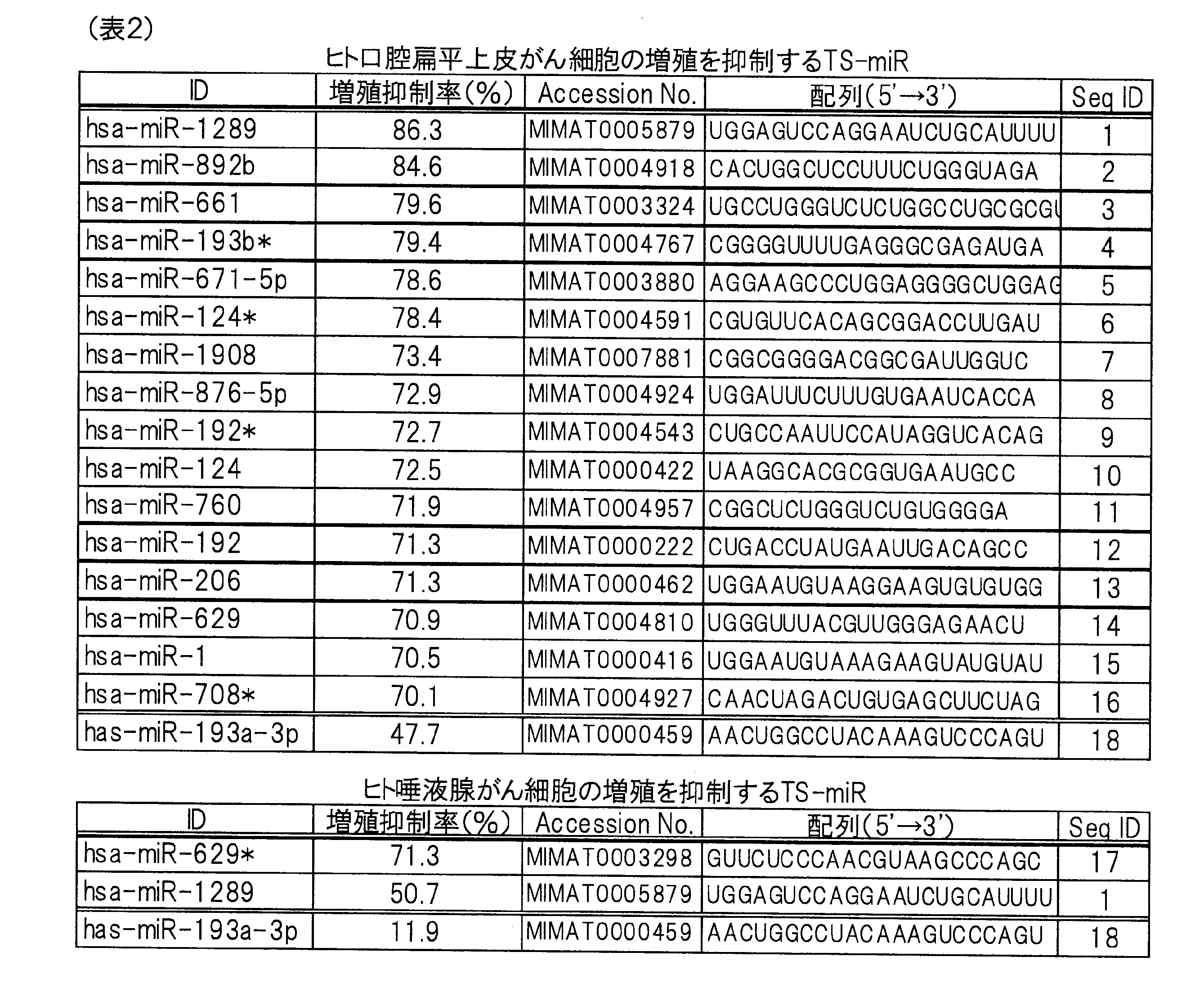
上記の合成miRNA libraryを用いた網羅的機能解析により、ヒト口腔扁平上皮がん細胞GFP-SASにおいて70%以上の増殖抑制率を示す16種類、ヒト唾液腺がん細胞GFP-ACCMにおいて50%以上の増殖抑制率を示す2種類のTS-miRを同定した。その結果を、図1及び下記表2に示す。なお、図1及び表2におけるhas-miR-193a-3pは、非特許文献2において頭頸部がんのTS-miRであることが示唆されたマイクロRNAである。
〔ヒト血清中のTS-miRの発現量解析〕
未治療の頭頸部がん患者10名と健常者10名より血清0.5mlを採取し、各検体よりmiRNAを抽出し、上記表2中のTS-miRの発現量について、マイクロアレイ解析を行った。その結果を下記表3に示す。なお、下記表3において数値は、相対シグナル強度を示す。
未治療の頭頸部がん患者10名と健常者10名より血清0.5mlを採取し、各検体よりmiRNAを抽出し、上記表2中のTS-miRの発現量について、マイクロアレイ解析を行った。その結果を下記表3に示す。なお、下記表3において数値は、相対シグナル強度を示す。
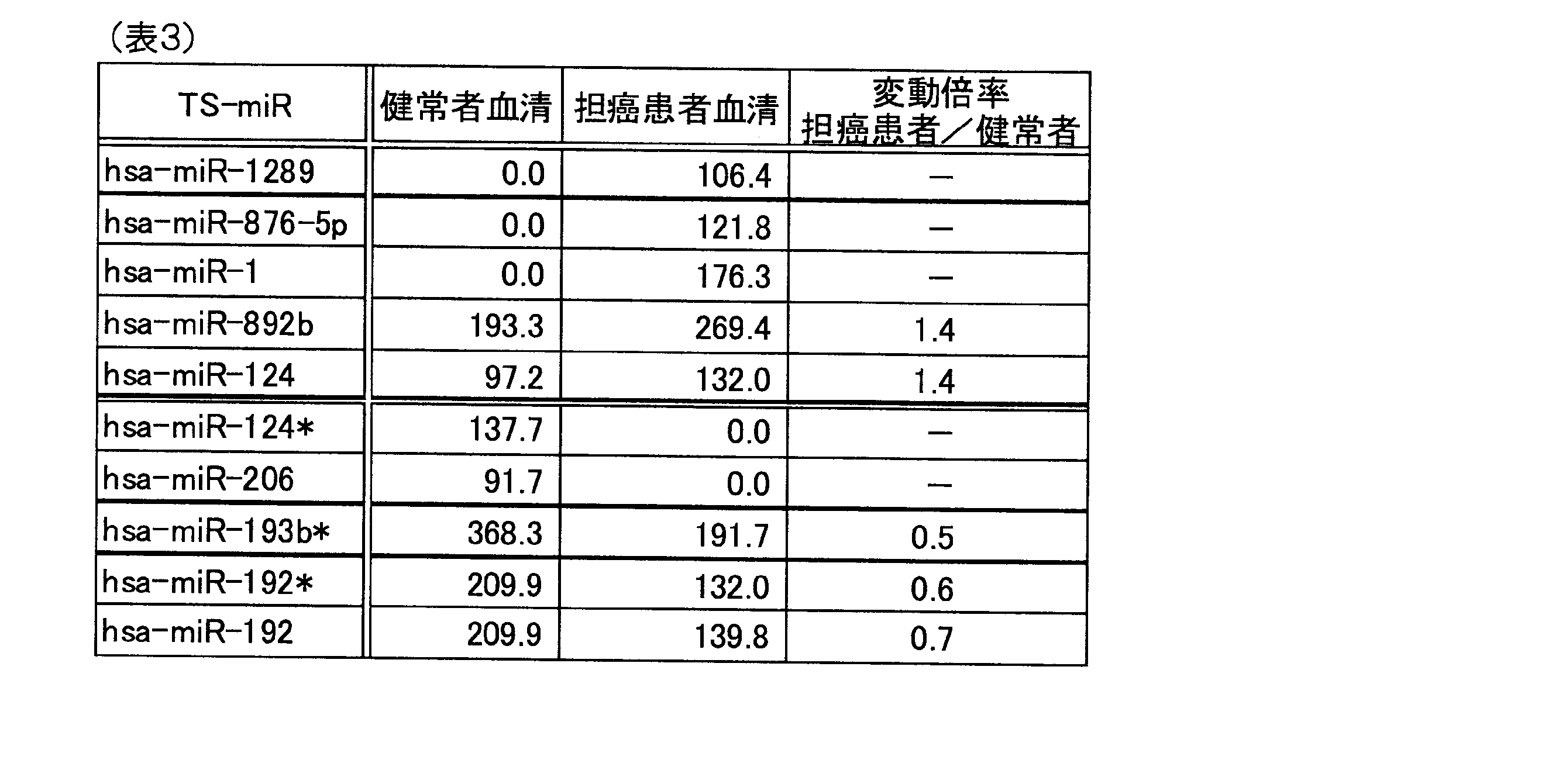
上記表3に示すとおり、頭頸部がん患者及び健常者由来血清を用いたTS-miRの発現解析により、頭頸部がん患者のみに検出される3種類のTS-miR、健常者のみに検出される2種類のTS-miR、及び、両群間において有意な発現量の変動を認める5種類のTS-miR(頭頸部がん患者で増加する2種類、及び、健常者で増加する3種類)を同定した。
2.TS-miR導入による種々のがん細胞に対する増殖阻害の確認
下記表4に示す8種類のヒトがん細胞株に、hsa-miR-629*、hsa-miR-1289又はhsa-miR-892bを導入し、各ヒトがん細胞の増殖阻害効果を検討した。細胞株は、下記表4に示す8種類の細胞株を用いた以外は、上記1.の〔使用した細胞株〕と同様に細胞株を準備した。また、ヒトがん細胞の増殖の解析は、上記3種類のTS-miR、及び細胞株を用いた以外は、上記1.の〔ヒトがん細胞の増殖の解析〕と同様に行った。その結果を図3から5に示す。
下記表4に示す8種類のヒトがん細胞株に、hsa-miR-629*、hsa-miR-1289又はhsa-miR-892bを導入し、各ヒトがん細胞の増殖阻害効果を検討した。細胞株は、下記表4に示す8種類の細胞株を用いた以外は、上記1.の〔使用した細胞株〕と同様に細胞株を準備した。また、ヒトがん細胞の増殖の解析は、上記3種類のTS-miR、及び細胞株を用いた以外は、上記1.の〔ヒトがん細胞の増殖の解析〕と同様に行った。その結果を図3から5に示す。

図3から5は、表4に示すヒトがん細胞に対するTS-miRによる増殖への影響を示すグラフの一例であって、図3はhsa-miR-629*のグラフ、図4はhsa-miR-1289のグラフ、図5はhsa-miR-892bのグラフを示す。図3から5に示すように、表4に示す種々のヒトがん細胞の増殖が、hsa-miR-629*、hsa-miR-1289及びhsa-miR-892bによって抑制された。また、hsa-miR-629*及びhsa-miR-1289は、ヒト膵がん細胞MIAPaca2、ヒト肺扁平上皮がん細胞EBC-1、ヒト肺腺がん細胞A549-57、及びヒト前立腺がん細胞PC-3,LNCaPにおいて40%以上の増殖抑制率を示し、特に、hsa-miR-629*は、ヒト肺腺がん細胞A549-57、及びヒト前立腺がん細胞PC-3において70%以上の増殖抑制率を示し、hsa-miR-1289は、ヒト肺扁平上皮がん細胞EBC-1において70%以上の増殖抑制率を示した。hsa-miR-892bは、ヒト膵がん細胞MIAPaca2、ヒト肺扁平上皮がん細胞EBC-1、ヒト肺腺がん細胞A549-57、及びヒト前立腺がん細胞PC-3,LNCaPにおいて30%以上の増殖抑制率を示し、特にヒト膵がん細胞MIAPaca2及びヒト前立腺がん細胞PC-3において60%以上の増殖抑制率を示した。
3.ヒト頭頸部がん組織におけるhsa-miR-1289の発現の解析
未治療の口腔扁平上皮がん患者及び唾液腺がん患者からそれぞれがん組織を採取し、各検体よりmiRNAを抽出し、hsa-miR-1289の発現量についてマイクロアレイ解析を行った。口腔扁平上皮がん組織は、ステージI、II、III、及びIVの口腔扁平上皮がん患者からそれぞれ採取し(計11名)、唾液腺がん組織は、唾液腺がん患者5名から採取した。また、健常者から口腔粘膜組織を採取し、同様にhsa-miR-1289の発現についてマイクロアレイ解析を行った。その結果を図6に示す。図6は、ヒト頭頸部がん組織におけるhsa-miR-1289の発現を示すグラフの一例であって、図6Aは各ステージの口腔扁平上皮がん組織におけるhsa-miR-1289の発現を示し、図6Bは、唾液腺がん組織におけるhsa-miR-1289の発現を示す。図6A及びBにおいて、TS-miRの発現は、RNU6Bの発現を内部コントロールとした相対値として示す。
未治療の口腔扁平上皮がん患者及び唾液腺がん患者からそれぞれがん組織を採取し、各検体よりmiRNAを抽出し、hsa-miR-1289の発現量についてマイクロアレイ解析を行った。口腔扁平上皮がん組織は、ステージI、II、III、及びIVの口腔扁平上皮がん患者からそれぞれ採取し(計11名)、唾液腺がん組織は、唾液腺がん患者5名から採取した。また、健常者から口腔粘膜組織を採取し、同様にhsa-miR-1289の発現についてマイクロアレイ解析を行った。その結果を図6に示す。図6は、ヒト頭頸部がん組織におけるhsa-miR-1289の発現を示すグラフの一例であって、図6Aは各ステージの口腔扁平上皮がん組織におけるhsa-miR-1289の発現を示し、図6Bは、唾液腺がん組織におけるhsa-miR-1289の発現を示す。図6A及びBにおいて、TS-miRの発現は、RNU6Bの発現を内部コントロールとした相対値として示す。
図6A及びBに示すように、hsa-miR-1289の発現は、正常口腔粘膜組織と比較して口腔扁平上皮がん組織及び唾液腺がん組織において、ステージに関わりなく明らかに低下している傾向が認められた。したがって、hsa-miR-1289の発現が低下している症例では、hsa-miR-1289の補充療法が有効である可能性が示唆された。
4.ヒト頭頸部がん組織におけるhsa-miR-892bの発現の解析
未治療の口腔扁平上皮がん患者及び唾液腺がん患者からそれぞれがん組織を採取し、各検体よりmiRNAを抽出し、hsa-miR-892bの発現についてマイクロアレイ解析を行った。口腔扁平上皮がん組織は、ステージI、II、III、及びIVの口腔扁平上皮がん患者からそれぞれ採取し(計11名)、唾液腺がん組織は、唾液腺がん患者5名から採取した。また、健常者から口腔粘膜組織を採取し、同様にhsa-miR-892bの発現についてマイクロアレイ解析を行った。その結果を図7に示す。図7は、ヒト頭頸部がん組織におけるhsa-miR-892bの発現を示すグラフの一例であって、図7Aは各ステージの口腔扁平上皮がん組織におけるhsa-miR-892bの発現を示し、図7Bは、唾液腺がん組織におけるhsa-miR-892bの発現を示す。図7A及びBにおいて、TS-miRの発現は、RNU6Bの発現を内部コントロールとした相対値として示す。
未治療の口腔扁平上皮がん患者及び唾液腺がん患者からそれぞれがん組織を採取し、各検体よりmiRNAを抽出し、hsa-miR-892bの発現についてマイクロアレイ解析を行った。口腔扁平上皮がん組織は、ステージI、II、III、及びIVの口腔扁平上皮がん患者からそれぞれ採取し(計11名)、唾液腺がん組織は、唾液腺がん患者5名から採取した。また、健常者から口腔粘膜組織を採取し、同様にhsa-miR-892bの発現についてマイクロアレイ解析を行った。その結果を図7に示す。図7は、ヒト頭頸部がん組織におけるhsa-miR-892bの発現を示すグラフの一例であって、図7Aは各ステージの口腔扁平上皮がん組織におけるhsa-miR-892bの発現を示し、図7Bは、唾液腺がん組織におけるhsa-miR-892bの発現を示す。図7A及びBにおいて、TS-miRの発現は、RNU6Bの発現を内部コントロールとした相対値として示す。
図7A及びBに示すように、hsa-miR-892bの発現は、正常口腔粘膜組織と比較して口腔扁平上皮がん組織及び唾液腺がん組織において明らかに低下している症例が認められた。特に、口腔扁平上皮がん組織では、1つの症例を除くすべての症例においてステージに関わりなくhsa-miR-892bの発現が著明に低下していた。これらのことから、hsa-miR-892bの発現が低下している症例では、hsa-miR-892bの補充療法が有効である可能性が示唆された。
本発明は、頭頸部がんに関する医薬開発、頭頸部がんの医療分野、頭頸部がんの研究分野等において有用である。
配列番号1-18:miRBase(Release 17: April 2011)に登録されている成熟miRNAの配列
Claims (14)
- マイクロRNA又は細胞内でマイクロRNAを発現可能な発現系を含む組成物であって、前記マイクロRNAが、hsa-miR-1289、hsa-miR-892b、hsa-miR-661、hsa-miR-193b*、hsa-miR-671-5p、hsa-miR-124*、hsa-miR-1908、hsa-miR-876-5p、hsa-miR-192*、hsa-miR-124、hsa-miR-760、hsa-miR-192、hsa-miR-206、hsa-miR-629、hsa-miR-1、hsa-miR-708*、及びhsa-miR-629*からなる群から選択される、ヒト頭頸部がん細胞の生育を抑制するための組成物。
- マイクロRNA又は細胞内でマイクロRNAを発現可能な発現系を含む医薬組成物であって、前記マイクロRNAが、hsa-miR-1289、hsa-miR-892b、hsa-miR-661、hsa-miR-193b*、hsa-miR-671-5p、hsa-miR-124*、hsa-miR-1908、hsa-miR-876-5p、hsa-miR-192*、hsa-miR-124、hsa-miR-760、hsa-miR-192、hsa-miR-206、hsa-miR-629、hsa-miR-1、hsa-miR-708*、及びhsa-miR-629*からなる群から選択される、ヒト頭頸部がんの治療又は予防のための医薬組成物。
- ヒト頭頸部がん細胞の生育を抑制する方法であって、マイクロRNA又は細胞内でマイクロRNAを発現可能な発現系を含む組成物を前記がん細胞に接触させることを含み、前記マイクロRNAが、hsa-miR-1289、hsa-miR-892b、hsa-miR-661、hsa-miR-193b*、hsa-miR-671-5p、hsa-miR-124*、hsa-miR-1908、hsa-miR-876-5p、hsa-miR-192*、hsa-miR-124、hsa-miR-760、hsa-miR-192、hsa-miR-206、hsa-miR-629、hsa-miR-1、hsa-miR-708*、及びhsa-miR-629*からなる群から選択される、ヒト頭頸部がん細胞の生育を抑制する方法。
- ヒトの頭頸部がんの治療又は予防方法であって、マイクロRNA又は細胞内でマイクロRNAを発現可能な発現系を含む組成物を対象に投与することを含み、前記マイクロRNAが、hsa-miR-1289、hsa-miR-892b、hsa-miR-661、hsa-miR-193b*、hsa-miR-671-5p、hsa-miR-124*、hsa-miR-1908、hsa-miR-876-5p、hsa-miR-192*、hsa-miR-124、hsa-miR-760、hsa-miR-192、hsa-miR-206、hsa-miR-629、hsa-miR-1、hsa-miR-708*、及びhsa-miR-629*からなる群から選択される、ヒトの頭頸部がんの治療又は予防方法。
- 頭頸部がんの有無を分析する方法であって、
体液試料中のマイクロRNAを検出し、その測定値を基準値と比較することを含み、
前記マイクロRNAは、hsa-miR-1289、hsa-miR-876-5p、hsa-miR-1、hsa-miR-892b、hsa-miR-124、hsa-miR-124*、hsa-miR-206、hsa-miR-193b*、hsa-miR-192*、及びhsa-miR-192からなる群から選択される少なくとも1つである、頭頸部がんの有無の分析方法。 - 体液試料中のhsa-miR-1289、hsa-miR-876-5p、hsa-miR-1、hsa-miR-892b、hsa-miR-124、hsa-miR-124*、hsa-miR-206、hsa-miR-193b*、hsa-miR-192*、及びhsa-miR-192からなる群から選択されるマイクロRNAの使用であって、体液試料中の頭頸部がんマーカーとしての使用。
- マイクロRNA又は細胞内でマイクロRNAを発現可能な発現系を含む組成物であって、前記マイクロRNAが、hsa-miR-1289、hsa-miR-892b、hsa-miR-661、hsa-miR-193b*、hsa-miR-671-5p、hsa-miR-124*、hsa-miR-1908、hsa-miR-876-5p、hsa-miR-192*、hsa-miR-124、hsa-miR-760、hsa-miR-192、hsa-miR-206、hsa-miR-629、hsa-miR-1、hsa-miR-708*、及びhsa-miR-629*からなる群から選択される、ヒトがん細胞の生育を抑制するための組成物。
- マイクロRNA又は細胞内でマイクロRNAを発現可能な発現系を含む医薬組成物であって、前記マイクロRNAが、hsa-miR-1289、hsa-miR-892b、hsa-miR-661、hsa-miR-193b*、hsa-miR-671-5p、hsa-miR-124*、hsa-miR-1908、hsa-miR-876-5p、hsa-miR-192*、hsa-miR-124、hsa-miR-760、hsa-miR-192、hsa-miR-206、hsa-miR-629、hsa-miR-1、hsa-miR-708*、及びhsa-miR-629*からなる群から選択される、ヒトのがんの治療又は予防のための医薬組成物。
- 前記がんが、肺がん、膵臓がん、及び前立腺がんからなる群から選択される、請求項7又は8に記載の組成物。
- 前記マイクロRNAが、hsa-miR-1289、hsa-miR-892b、及びhsa-miR-629*からなる群から選択される、請求項7から9のいずれかに記載の組成物。
- ヒトがん細胞の生育を抑制する方法であって、マイクロRNA又は細胞内でマイクロRNAを発現可能な発現系を含む組成物を前記がん細胞に接触させることを含み、前記マイクロRNAが、hsa-miR-1289、hsa-miR-892b、hsa-miR-661、hsa-miR-193b*、hsa-miR-671-5p、hsa-miR-124*、hsa-miR-1908、hsa-miR-876-5p、hsa-miR-192*、hsa-miR-124、hsa-miR-760、hsa-miR-192、hsa-miR-206、hsa-miR-629、hsa-miR-1、hsa-miR-708*、及びhsa-miR-629*からなる群から選択される、ヒトがん細胞の生育を抑制する方法。
- ヒトのがんの治療又は予防方法であって、マイクロRNA又は細胞内でマイクロRNAを発現可能な発現系を含む組成物を対象に投与することを含み、前記マイクロRNAが、hsa-miR-1289、hsa-miR-892b、hsa-miR-661、hsa-miR-193b*、hsa-miR-671-5p、hsa-miR-124*、hsa-miR-1908、hsa-miR-876-5p、hsa-miR-192*、hsa-miR-124、hsa-miR-760、hsa-miR-192、hsa-miR-206、hsa-miR-629、hsa-miR-1、hsa-miR-708*、及びhsa-miR-629*からなる群から選択される、ヒトのがんの治療又は予防方法。
- 前記がんが、肺がん、膵臓がん、及び前立腺がんからなる群から選択される、請求項11又は12に記載の方法。
- 前記マイクロRNAが、hsa-miR-1289、hsa-miR-892b、及びhsa-miR-629*からなる群から選択される、請求項11から13のいずれかに記載の方法。
Priority Applications (1)
| Application Number | Priority Date | Filing Date | Title |
|---|---|---|---|
| JP2013516348A JP6011945B2 (ja) | 2011-05-20 | 2012-05-18 | マイクロrna又はその発現系を含む組成物 |
Applications Claiming Priority (2)
| Application Number | Priority Date | Filing Date | Title |
|---|---|---|---|
| JP2011113348 | 2011-05-20 | ||
| JP2011-113348 | 2011-05-20 |
Publications (1)
| Publication Number | Publication Date |
|---|---|
| WO2012161124A1 true WO2012161124A1 (ja) | 2012-11-29 |
Family
ID=47217201
Family Applications (1)
| Application Number | Title | Priority Date | Filing Date |
|---|---|---|---|
| PCT/JP2012/062825 Ceased WO2012161124A1 (ja) | 2011-05-20 | 2012-05-18 | マイクロrna又はその発現系を含む組成物 |
Country Status (2)
| Country | Link |
|---|---|
| JP (1) | JP6011945B2 (ja) |
| WO (1) | WO2012161124A1 (ja) |
Cited By (7)
| Publication number | Priority date | Publication date | Assignee | Title |
|---|---|---|---|---|
| JPWO2015099122A1 (ja) * | 2013-12-26 | 2017-03-23 | 学校法人東京医科大学 | 遺伝子発現制御のための人工ミミックmiRNAおよびその用途 |
| WO2019117270A1 (ja) | 2017-12-13 | 2019-06-20 | 国立大学法人広島大学 | 頭頸部がんの検出を補助する方法 |
| US10934542B2 (en) | 2013-12-27 | 2021-03-02 | Bonac Corporation | Artificial match-type miRNA for controlling gene expression and use therefor |
| JP2021513508A (ja) * | 2018-02-12 | 2021-05-27 | インテアールエヌエー テクノロジーズ ビー.ヴイ.InteRNA Technologies B.V. | 抗がんマイクロrna及びその脂質製剤 |
| US11027023B2 (en) | 2014-12-27 | 2021-06-08 | Bonac Corporation | Natural type miRNA for controlling gene expression, and use of same |
| US11142769B2 (en) | 2015-03-27 | 2021-10-12 | Bonac Corporation | Single-stranded nucleic acid molecule having delivery function and gene expression regulating ability |
| EP3976058A4 (en) * | 2019-06-03 | 2023-07-19 | Carmel-Haifa University Economic Corporation Ltd. | TREATMENT OF HEAD AND NECK CANCER IN HUMAN |
Citations (3)
| Publication number | Priority date | Publication date | Assignee | Title |
|---|---|---|---|---|
| WO2009044899A1 (ja) * | 2007-10-03 | 2009-04-09 | Kyowa Hakko Kirin Co., Ltd. | 細胞の増殖を制御する核酸 |
| WO2009070805A2 (en) * | 2007-12-01 | 2009-06-04 | Asuragen, Inc. | Mir-124 regulated genes and pathways as targets for therapeutic intervention |
| JP2011093892A (ja) * | 2009-09-30 | 2011-05-12 | Japan Health Science Foundation | がん抑制的マイクロrnaを含む腫瘍増殖抑制剤 |
Family Cites Families (8)
| Publication number | Priority date | Publication date | Assignee | Title |
|---|---|---|---|---|
| WO2007148235A2 (en) * | 2006-05-04 | 2007-12-27 | Rosetta Genomics Ltd | Cancer-related nucleic acids |
| EP2198050A1 (en) * | 2007-09-14 | 2010-06-23 | Asuragen, INC. | Micrornas differentially expressed in cervical cancer and uses thereof |
| WO2009100430A2 (en) * | 2008-02-08 | 2009-08-13 | Asuragen, Inc | miRNAs DIFFERENTIALLY EXPRESSED IN LYMPH NODES FROM CANCER PATIENTS |
| US8222221B2 (en) * | 2008-06-04 | 2012-07-17 | The Board Of Regents Of The University Of Texas System | Modulation of gene expression through endogenous small RNA targeting of gene promoters |
| CN102308004A (zh) * | 2008-10-30 | 2012-01-04 | 卡里斯生命科学卢森堡控股有限责任公司 | 评价rna图案的方法 |
| CN102333888B (zh) * | 2008-12-24 | 2013-07-10 | 姜桥 | 用于肿瘤样本起源组织分类的基因表达签名 |
| EP2336353A1 (en) * | 2009-12-17 | 2011-06-22 | febit holding GmbH | miRNA fingerprints in the diagnosis of diseases |
| US20120219958A1 (en) * | 2009-11-09 | 2012-08-30 | Yale University | MicroRNA Signatures Differentiating Uterine and Ovarian Papillary Serous Tumors |
-
2012
- 2012-05-18 JP JP2013516348A patent/JP6011945B2/ja active Active
- 2012-05-18 WO PCT/JP2012/062825 patent/WO2012161124A1/ja not_active Ceased
Patent Citations (3)
| Publication number | Priority date | Publication date | Assignee | Title |
|---|---|---|---|---|
| WO2009044899A1 (ja) * | 2007-10-03 | 2009-04-09 | Kyowa Hakko Kirin Co., Ltd. | 細胞の増殖を制御する核酸 |
| WO2009070805A2 (en) * | 2007-12-01 | 2009-06-04 | Asuragen, Inc. | Mir-124 regulated genes and pathways as targets for therapeutic intervention |
| JP2011093892A (ja) * | 2009-09-30 | 2011-05-12 | Japan Health Science Foundation | がん抑制的マイクロrnaを含む腫瘍増殖抑制剤 |
Non-Patent Citations (9)
Cited By (9)
| Publication number | Priority date | Publication date | Assignee | Title |
|---|---|---|---|---|
| JPWO2015099122A1 (ja) * | 2013-12-26 | 2017-03-23 | 学校法人東京医科大学 | 遺伝子発現制御のための人工ミミックmiRNAおよびその用途 |
| US10934542B2 (en) | 2013-12-27 | 2021-03-02 | Bonac Corporation | Artificial match-type miRNA for controlling gene expression and use therefor |
| US11027023B2 (en) | 2014-12-27 | 2021-06-08 | Bonac Corporation | Natural type miRNA for controlling gene expression, and use of same |
| US11142769B2 (en) | 2015-03-27 | 2021-10-12 | Bonac Corporation | Single-stranded nucleic acid molecule having delivery function and gene expression regulating ability |
| WO2019117270A1 (ja) | 2017-12-13 | 2019-06-20 | 国立大学法人広島大学 | 頭頸部がんの検出を補助する方法 |
| JPWO2019117270A1 (ja) * | 2017-12-13 | 2020-12-24 | 国立大学法人広島大学 | 頭頸部がんの検出を補助する方法 |
| JP7390002B2 (ja) | 2017-12-13 | 2023-12-01 | 国立大学法人広島大学 | 頭頸部がんの検出を補助する方法 |
| JP2021513508A (ja) * | 2018-02-12 | 2021-05-27 | インテアールエヌエー テクノロジーズ ビー.ヴイ.InteRNA Technologies B.V. | 抗がんマイクロrna及びその脂質製剤 |
| EP3976058A4 (en) * | 2019-06-03 | 2023-07-19 | Carmel-Haifa University Economic Corporation Ltd. | TREATMENT OF HEAD AND NECK CANCER IN HUMAN |
Also Published As
| Publication number | Publication date |
|---|---|
| JP6011945B2 (ja) | 2016-10-25 |
| JPWO2012161124A1 (ja) | 2014-07-31 |
Similar Documents
| Publication | Publication Date | Title |
|---|---|---|
| Diao et al. | miR-203, a tumor suppressor frequently down-regulated by promoter hypermethylation in rhabdomyosarcoma | |
| JP6011945B2 (ja) | マイクロrna又はその発現系を含む組成物 | |
| Friedman et al. | MicroRNAs: critical mediators of differentiation, development and disease | |
| Davalos et al. | MicroRNAs and cancer epigenetics: a macrorevolution | |
| Bronze-da-Rocha | MicroRNAs expression profiles in cardiovascular diseases | |
| Liu et al. | MicroRNA-138 suppresses invasion and promotes apoptosis in head and neck squamous cell carcinoma cell lines | |
| Xu et al. | MicroRNA-193b regulates proliferation, migration and invasion in human hepatocellular carcinoma cells | |
| Beveridge et al. | Down-regulation of miR-17 family expression in response to retinoic acid induced neuronal differentiation | |
| US8889649B2 (en) | Composition containing antisense oligonucleotide to micro RNA | |
| EP3030548B1 (en) | Transcriptome-wide design of selective, bioactive small molecules targeting rna | |
| US9056135B2 (en) | MicroRNA biomarkers for human breast and lung cancer | |
| CA3134991A1 (en) | Pharmaceutical composition for treating cancer comprising microrna as active ingredient | |
| WO2011076143A1 (en) | Compositions and methods for microrna expression profiling of lung cancer | |
| US20120178791A1 (en) | MODULATION OF HUMAN CYTOMEGALOVIRUS REPLICATION BY MICRO-RNA 132 (miR132), MICRO-RNA 145 (miR145) AND MICRO-RNA 212 (miR212) | |
| Liu et al. | miR-371-5p down-regulates pre mRNA processing factor 4 homolog B (PRPF4B) and facilitates the G1/S transition in human hepatocellular carcinoma cells | |
| US20230038202A1 (en) | Targeting microrna for cancer treatment | |
| B Greene et al. | Small players with big roles: microRNAs as targets to inhibit breast cancer progression | |
| US9487781B2 (en) | Compositions and methods for treatment of ovarian cancer | |
| US20140045924A1 (en) | Melanoma treatments | |
| US9157080B2 (en) | Compositions and methods for treatment, diagnosis and prognosis of mesothelioma | |
| JP2011093892A (ja) | がん抑制的マイクロrnaを含む腫瘍増殖抑制剤 | |
| KR101343616B1 (ko) | 췌장암 치료용 약제학적 조성물 및 췌장암 치료제 스크리닝 방법 | |
| CN102451474A (zh) | 一种miRNA的抗肿瘤作用、实施方法及用途 | |
| CN101418293A (zh) | 微小rna-21的反义寡聚核苷酸及其应用 | |
| CN107488735B (zh) | miR-339-5p在抑制前列腺癌骨转移及TGF-β信号通路中的应用 |
Legal Events
| Date | Code | Title | Description |
|---|---|---|---|
| 121 | Ep: the epo has been informed by wipo that ep was designated in this application |
Ref document number: 12788917 Country of ref document: EP Kind code of ref document: A1 |
|
| DPE1 | Request for preliminary examination filed after expiration of 19th month from priority date (pct application filed from 20040101) | ||
| ENP | Entry into the national phase |
Ref document number: 2013516348 Country of ref document: JP Kind code of ref document: A |
|
| NENP | Non-entry into the national phase |
Ref country code: DE |
|
| 122 | Ep: pct application non-entry in european phase |
Ref document number: 12788917 Country of ref document: EP Kind code of ref document: A1 |