WO2012137591A1 - 高分子化合物製造用のモノマー及び高分子化合物の製造方法 - Google Patents
高分子化合物製造用のモノマー及び高分子化合物の製造方法 Download PDFInfo
- Publication number
- WO2012137591A1 WO2012137591A1 PCT/JP2012/056968 JP2012056968W WO2012137591A1 WO 2012137591 A1 WO2012137591 A1 WO 2012137591A1 JP 2012056968 W JP2012056968 W JP 2012056968W WO 2012137591 A1 WO2012137591 A1 WO 2012137591A1
- Authority
- WO
- WIPO (PCT)
- Prior art keywords
- group
- formula
- same
- different
- compound
- Prior art date
- Legal status (The legal status is an assumption and is not a legal conclusion. Google has not performed a legal analysis and makes no representation as to the accuracy of the status listed.)
- Ceased
Links
Images
Classifications
-
- C—CHEMISTRY; METALLURGY
- C07—ORGANIC CHEMISTRY
- C07F—ACYCLIC, CARBOCYCLIC OR HETEROCYCLIC COMPOUNDS CONTAINING ELEMENTS OTHER THAN CARBON, HYDROGEN, HALOGEN, OXYGEN, NITROGEN, SULFUR, SELENIUM OR TELLURIUM
- C07F5/00—Compounds containing elements of Groups 3 or 13 of the Periodic Table
- C07F5/02—Boron compounds
- C07F5/025—Boronic and borinic acid compounds
-
- C—CHEMISTRY; METALLURGY
- C08—ORGANIC MACROMOLECULAR COMPOUNDS; THEIR PREPARATION OR CHEMICAL WORKING-UP; COMPOSITIONS BASED THEREON
- C08G—MACROMOLECULAR COMPOUNDS OBTAINED OTHERWISE THAN BY REACTIONS ONLY INVOLVING UNSATURATED CARBON-TO-CARBON BONDS
- C08G61/00—Macromolecular compounds obtained by reactions forming a carbon-to-carbon link in the main chain of the macromolecule
- C08G61/02—Macromolecular compounds containing only carbon atoms in the main chain of the macromolecule, e.g. polyxylylenes
-
- C—CHEMISTRY; METALLURGY
- C08—ORGANIC MACROMOLECULAR COMPOUNDS; THEIR PREPARATION OR CHEMICAL WORKING-UP; COMPOSITIONS BASED THEREON
- C08G—MACROMOLECULAR COMPOUNDS OBTAINED OTHERWISE THAN BY REACTIONS ONLY INVOLVING UNSATURATED CARBON-TO-CARBON BONDS
- C08G61/00—Macromolecular compounds obtained by reactions forming a carbon-to-carbon link in the main chain of the macromolecule
- C08G61/12—Macromolecular compounds containing atoms other than carbon in the main chain of the macromolecule
- C08G61/122—Macromolecular compounds containing atoms other than carbon in the main chain of the macromolecule derived from five- or six-membered heterocyclic compounds, other than imides
- C08G61/123—Macromolecular compounds containing atoms other than carbon in the main chain of the macromolecule derived from five- or six-membered heterocyclic compounds, other than imides derived from five-membered heterocyclic compounds
-
- C—CHEMISTRY; METALLURGY
- C08—ORGANIC MACROMOLECULAR COMPOUNDS; THEIR PREPARATION OR CHEMICAL WORKING-UP; COMPOSITIONS BASED THEREON
- C08G—MACROMOLECULAR COMPOUNDS OBTAINED OTHERWISE THAN BY REACTIONS ONLY INVOLVING UNSATURATED CARBON-TO-CARBON BONDS
- C08G61/00—Macromolecular compounds obtained by reactions forming a carbon-to-carbon link in the main chain of the macromolecule
- C08G61/12—Macromolecular compounds containing atoms other than carbon in the main chain of the macromolecule
- C08G61/122—Macromolecular compounds containing atoms other than carbon in the main chain of the macromolecule derived from five- or six-membered heterocyclic compounds, other than imides
- C08G61/123—Macromolecular compounds containing atoms other than carbon in the main chain of the macromolecule derived from five- or six-membered heterocyclic compounds, other than imides derived from five-membered heterocyclic compounds
- C08G61/126—Macromolecular compounds containing atoms other than carbon in the main chain of the macromolecule derived from five- or six-membered heterocyclic compounds, other than imides derived from five-membered heterocyclic compounds with a five-membered ring containing one sulfur atom in the ring
-
- H—ELECTRICITY
- H10—SEMICONDUCTOR DEVICES; ELECTRIC SOLID-STATE DEVICES NOT OTHERWISE PROVIDED FOR
- H10K—ORGANIC ELECTRIC SOLID-STATE DEVICES
- H10K10/00—Organic devices specially adapted for rectifying, amplifying, oscillating or switching; Organic capacitors or resistors having potential barriers
- H10K10/40—Organic transistors
- H10K10/46—Field-effect transistors, e.g. organic thin-film transistors [OTFT]
- H10K10/462—Insulated gate field-effect transistors [IGFETs]
- H10K10/484—Insulated gate field-effect transistors [IGFETs] characterised by the channel regions
-
- H—ELECTRICITY
- H10—SEMICONDUCTOR DEVICES; ELECTRIC SOLID-STATE DEVICES NOT OTHERWISE PROVIDED FOR
- H10K—ORGANIC ELECTRIC SOLID-STATE DEVICES
- H10K85/00—Organic materials used in the body or electrodes of devices covered by this subclass
- H10K85/10—Organic polymers or oligomers
- H10K85/151—Copolymers
-
- C—CHEMISTRY; METALLURGY
- C08—ORGANIC MACROMOLECULAR COMPOUNDS; THEIR PREPARATION OR CHEMICAL WORKING-UP; COMPOSITIONS BASED THEREON
- C08G—MACROMOLECULAR COMPOUNDS OBTAINED OTHERWISE THAN BY REACTIONS ONLY INVOLVING UNSATURATED CARBON-TO-CARBON BONDS
- C08G2261/00—Macromolecular compounds obtained by reactions forming a carbon-to-carbon link in the main chain of the macromolecule
- C08G2261/10—Definition of the polymer structure
- C08G2261/12—Copolymers
- C08G2261/124—Copolymers alternating
-
- C—CHEMISTRY; METALLURGY
- C08—ORGANIC MACROMOLECULAR COMPOUNDS; THEIR PREPARATION OR CHEMICAL WORKING-UP; COMPOSITIONS BASED THEREON
- C08G—MACROMOLECULAR COMPOUNDS OBTAINED OTHERWISE THAN BY REACTIONS ONLY INVOLVING UNSATURATED CARBON-TO-CARBON BONDS
- C08G2261/00—Macromolecular compounds obtained by reactions forming a carbon-to-carbon link in the main chain of the macromolecule
- C08G2261/30—Monomer units or repeat units incorporating structural elements in the main chain
- C08G2261/31—Monomer units or repeat units incorporating structural elements in the main chain incorporating aromatic structural elements in the main chain
- C08G2261/314—Condensed aromatic systems, e.g. perylene, anthracene or pyrene
- C08G2261/3142—Condensed aromatic systems, e.g. perylene, anthracene or pyrene fluorene-based, e.g. fluorene, indenofluorene, or spirobifluorene
-
- C—CHEMISTRY; METALLURGY
- C08—ORGANIC MACROMOLECULAR COMPOUNDS; THEIR PREPARATION OR CHEMICAL WORKING-UP; COMPOSITIONS BASED THEREON
- C08G—MACROMOLECULAR COMPOUNDS OBTAINED OTHERWISE THAN BY REACTIONS ONLY INVOLVING UNSATURATED CARBON-TO-CARBON BONDS
- C08G2261/00—Macromolecular compounds obtained by reactions forming a carbon-to-carbon link in the main chain of the macromolecule
- C08G2261/30—Monomer units or repeat units incorporating structural elements in the main chain
- C08G2261/32—Monomer units or repeat units incorporating structural elements in the main chain incorporating heteroaromatic structural elements in the main chain
- C08G2261/322—Monomer units or repeat units incorporating structural elements in the main chain incorporating heteroaromatic structural elements in the main chain non-condensed
- C08G2261/3223—Monomer units or repeat units incorporating structural elements in the main chain incorporating heteroaromatic structural elements in the main chain non-condensed containing one or more sulfur atoms as the only heteroatom, e.g. thiophene
-
- C—CHEMISTRY; METALLURGY
- C08—ORGANIC MACROMOLECULAR COMPOUNDS; THEIR PREPARATION OR CHEMICAL WORKING-UP; COMPOSITIONS BASED THEREON
- C08G—MACROMOLECULAR COMPOUNDS OBTAINED OTHERWISE THAN BY REACTIONS ONLY INVOLVING UNSATURATED CARBON-TO-CARBON BONDS
- C08G2261/00—Macromolecular compounds obtained by reactions forming a carbon-to-carbon link in the main chain of the macromolecule
- C08G2261/30—Monomer units or repeat units incorporating structural elements in the main chain
- C08G2261/32—Monomer units or repeat units incorporating structural elements in the main chain incorporating heteroaromatic structural elements in the main chain
- C08G2261/324—Monomer units or repeat units incorporating structural elements in the main chain incorporating heteroaromatic structural elements in the main chain condensed
- C08G2261/3246—Monomer units or repeat units incorporating structural elements in the main chain incorporating heteroaromatic structural elements in the main chain condensed containing nitrogen and sulfur as heteroatoms
-
- C—CHEMISTRY; METALLURGY
- C08—ORGANIC MACROMOLECULAR COMPOUNDS; THEIR PREPARATION OR CHEMICAL WORKING-UP; COMPOSITIONS BASED THEREON
- C08G—MACROMOLECULAR COMPOUNDS OBTAINED OTHERWISE THAN BY REACTIONS ONLY INVOLVING UNSATURATED CARBON-TO-CARBON BONDS
- C08G2261/00—Macromolecular compounds obtained by reactions forming a carbon-to-carbon link in the main chain of the macromolecule
- C08G2261/40—Polymerisation processes
- C08G2261/41—Organometallic coupling reactions
- C08G2261/411—Suzuki reactions
-
- C—CHEMISTRY; METALLURGY
- C08—ORGANIC MACROMOLECULAR COMPOUNDS; THEIR PREPARATION OR CHEMICAL WORKING-UP; COMPOSITIONS BASED THEREON
- C08G—MACROMOLECULAR COMPOUNDS OBTAINED OTHERWISE THAN BY REACTIONS ONLY INVOLVING UNSATURATED CARBON-TO-CARBON BONDS
- C08G2261/00—Macromolecular compounds obtained by reactions forming a carbon-to-carbon link in the main chain of the macromolecule
- C08G2261/90—Applications
- C08G2261/92—TFT applications
Definitions
- the present invention relates to a monomer for producing a polymer compound and a method for producing the polymer compound.
- Conjugated polymer compounds have been studied for application to organic semiconductor elements such as organic transistor elements, organic solar cell elements, and organic electroluminescence elements, and various types of conjugated polymer compounds have been actively researched and developed. ing.
- the molecular weight of conjugated polymer compounds is known as a factor that greatly affects the characteristics of organic semiconductor elements.
- Non-Patent Document 1 when a plurality of organic transistor elements having a repeating unit represented by the formula (A) and having different molecular weights are produced, a polymer compound having a high molecular weight is used. It is described that the field effect mobility of the organic transistor increases.
- Non-Patent Document 2 includes an organic solar cell element having a repeating unit represented by the formula (B) and having a high molecular weight and a high molecular compound having a low molecular weight.
- the photocurrent (J ph ) of the organic solar cell element produced using a polymer compound having a high molecular weight is larger.
- Examples of a method for producing a conjugated polymer compound having a high molecular weight using the Suzuki coupling method include a method of reacting a 1,3-propanediol ester derivative of thiophene diboronic acid with a dihalide of an aromatic compound, and A method of reacting a pinacol ester derivative of thiophene diboronic acid with a dihalide of an aromatic compound has been proposed (Non-patent Document 3).
- Patent Document 1 discloses that a boronic acid group contained in an organic boronic acid can be protected with N-methyliminodiacetic acid or the like, and an organic compound in which the boronic acid group is protected with N-methyliminodiacetic acid or the like. Boronic acids are described to react with organic halides (Suzuki coupling method) to give cross-coupling products.
- the conventional method has a problem that it is difficult to sufficiently increase the molecular weight of the conjugated polymer compound.
- the aromatic compound when a conjugated polymer compound is produced by polycondensation of an aromatic compound diboronic acid or a derivative thereof and a dihalide of an aromatic compound using the Suzuki coupling method, the aromatic compound is particularly preferred.
- the group compound has a heterocyclic structure, the bond between the aromatic compound and the boron atom is cleaved before the polymerization reaction, so that the coupling reaction hardly occurs. This is presumably because the boron atom of diboronic acid has a vacant coordination position, and nucleophilic reagents such as water are easy to attack.
- Non-Patent Document 3 it is difficult to increase the molecular weight of the conjugated polymer compound.
- the organic group of diboronic acid is a heteroaryl group, it becomes more difficult to increase the molecular weight of the conjugated polymer compound.
- an object of the present invention is to provide a diboronic acid derivative capable of producing a conjugated polymer compound having a high molecular weight by using the Suzuki coupling method.
- the present invention has the formula (1)
- A represents an arylene group, heteroarylene group, —C ⁇ C— or —CR 31 ⁇ CR 32 —.
- R 31 and R 32 each independently represents a hydrogen atom, an alkyl group, an aryl group, a heteroaryl group or a cyano group.
- R 11 and R 12 each independently represents a hydrogen atom, an alkyl group, an aryl group or a heteroaryl group.
- R 21 , R 22 , R 23 , R 24 , R 25 , R 26 , R 27 and R 28 are each independently a hydrogen atom, alkyl group, alkoxy group, alkylthio group, halogen atom, aryl group or heteroaryl group Represents.
- R 21 s When there are a plurality of R 21 s , they may be the same or different. When there are a plurality of R 22 s , they may be the same or different. When there are a plurality of R 23 , they may be the same or different. When there are a plurality of R 24 , they may be the same or different. When there are a plurality of R 25 , they may be the same or different. When there are a plurality of R 26 , they may be the same or different. When there are a plurality of R 27 , they may be the same or different. When there are a plurality of R 28 , they may be the same or different. m1, m2, m3 and m4 each independently represents an integer of 1 to 5. n1, n2, n3 and n4 each independently represents 0 or 1. ] The compound represented by these is provided.
- the present invention provides the compound of the formula (5) in the presence of a transition metal complex and a base.
- E represents an arylene group, a heteroarylene group, —C ⁇ C— or —CR 91 ⁇ CR 92 —.
- R 91 and R 92 each independently represent a hydrogen atom, an alkyl group, an aryl group, a heteroaryl group or a cyano group.
- X 1 and X 2 each independently represent a halogen atom, an alkyl sulfonate group or an aryl sulfonate group.
- a polymer compound having a high molecular weight can be produced using the Suzuki coupling method, and therefore the present invention is extremely useful.
- A represents an arylene group, a heteroarylene group, —C ⁇ C— or —CR 31 ⁇ CR 32 —.
- R 31 and R 32 each independently represents a hydrogen atom, an alkyl group, an aryl group, a heteroaryl group or a cyano group.
- R 11 and R 12 each independently represents a hydrogen atom, an alkyl group, an aryl group or a heteroaryl group.
- R 21 , R 22 , R 23 , R 24 , R 25 , R 26 , R 27 and R 28 are each independently a hydrogen atom, alkyl group, alkoxy group, alkylthio group, halogen atom, aryl group or heteroaryl group Represents.
- R 21 s they may be the same or different.
- R 22 s they may be the same or different.
- R 23 they may be the same or different.
- R 24 they may be the same or different.
- R 25 they may be the same or different.
- R 26 When there are a plurality of R 26 , they may be the same or different. When there are a plurality of R 27 , they may be the same or different. When there are a plurality of R 28 , they may be the same or different.
- m1, m2, m3 and m4 each independently represents an integer of 1 to 5.
- n1, n2, n3 and n4 each independently represents 0 or 1.
- the arylene group represented by A is an atomic group obtained by removing two hydrogen atoms directly bonded to a carbon atom constituting an aromatic ring from an aromatic hydrocarbon compound, and includes a group containing a benzene ring and a condensed ring. Group having a structure in which two or more independent aromatic rings or two or more condensed rings are directly bonded.
- the arylene group may have a substituent.
- the arylene group usually has 6 to 60 carbon atoms, preferably 6 to 20 carbon atoms. The carbon number does not include the carbon number of the substituent that the arylene group has.
- the arylene group include a phenylene group, a naphthalenediyl group, an anthracenediyl group, a phenanthenediyl group, a tetracenediyl group, a pyrenediyl group, a pentacenediyl group, a perylenediyl group, a fluorenediyl group, a biphenyldiyl group, and a terphenyldiyl group. And a quaterphenyldiyl group.
- the heteroarylene group represented by A is an atomic group obtained by removing two hydrogen atoms directly bonded to an atom constituting an aromatic ring from a heterocyclic compound having aromaticity, and a group containing a single ring, It includes a group containing a condensed ring, a group containing a structure in which two or more independent aromatic rings or two or more condensed rings are directly bonded.
- the heteroarylene group may have a substituent.
- the heteroarylene group usually has 2 to 60 carbon atoms, and preferably 2 to 20 carbon atoms. The carbon number of the substituent which the heteroarylene group has is not included in the carbon number.
- heteroarylene group examples include an oxadiazole diyl group, a thiadiazole diyl group, an oxazole diyl group, a thiazole diyl group, a thiophene diyl group, a bithiophene diyl group, a terthiophene diyl group, a quaterthiophene diyl group, a pyrrole diyl group, Flangedyl group, selenophenediyl group, pyridinediyl group, pyrazinediyl group, pyrimidinediyl group, triazinediyl group, benzothiophenediyl group, benzopyrrolediyl group, benzofurandiyl group, quinolinediyl group, isoquinolinediyl group, thienothiophenediyl group, Examples thereof include a benzothiadiazole diyl group, a benzodithiophene diyl group, an
- the alkyl group represented by R 11 , R 12 , R 21 , R 22 , R 23 , R 24 , R 25 , R 26 , R 27 , R 28 , R 31 and R 32 may be linear or branched. It may be a cycloalkyl group.
- the alkyl group may have a substituent.
- the alkyl group usually has 1 to 60 carbon atoms, preferably 1 to 20 carbon atoms. The carbon number does not include the carbon number of the substituent that the alkyl group has.
- alkyl group examples include a straight chain alkyl group such as a methyl group, an ethyl group, an n-propyl group, an n-butyl group, an n-hexyl group, an n-octyl group, an n-dodecyl group, and an n-octadecyl group, Examples thereof include branched alkyl groups such as isopropyl group, isobutyl group, sec-butyl group, tert-butyl group, 2-ethylhexyl group and 3,7-dimethyloctyl group, and cycloalkyl groups such as cyclopentyl group and cyclohexyl group.
- the aryl group represented by R 11 , R 12 , R 21 , R 22 , R 23 , R 24 , R 25 , R 26 , R 27 , R 28 , R 31, and R 32 is an aromatic hydrocarbon compound.
- An atomic group excluding one hydrogen atom directly bonded to the carbon atoms constituting the ring, a group containing a benzene ring, a group containing a condensed ring, two independent aromatic rings or two or more condensed rings directly bonded A group containing the above structure.
- the aryl group may have a substituent.
- the aryl group usually has 6 to 60 carbon atoms, preferably 6 to 20 carbon atoms.
- the number of carbon atoms does not include the number of carbon atoms of the substituent that the aryl group has.
- Specific examples of the aryl group include phenyl group, 1-naphthyl group, 2-naphthyl group, 1-anthracenyl group, 2-anthracenyl group, 9-anthracenyl group, 1-pyrenyl group, 2-pyrenyl group, 4-pyrenyl group. 2-fluorenyl group, 3-fluorenyl group, 4-fluorenyl group, 4-phenylphenyl group.
- the heteroaryl group represented by R 11 , R 12 , R 21 , R 22 , R 23 , R 24 , R 25 , R 26 , R 27 , R 28 , R 31 and R 32 is a complex having aromaticity.
- the heteroaryl group may have a substituent.
- the heteroaryl group usually has 2 to 60 carbon atoms, preferably 2 to 20 carbon atoms.
- This carbon number does not include the carbon number of the substituent that the heteroaryl group has.
- the heteroaryl group include 2-furyl group, 3-furyl group, 2-thienyl group, 3-thienyl group, 2-pyrrolyl group, 3-pyrrolyl group, 2-oxazolyl group, 2-thiazolyl group, 2 -Imidazolyl group, 2-pyridyl group, 3-pyridyl group, 4-pyridyl group, 2-benzofuryl group, 2-benzothienyl group, 2-thienothienyl group.
- the alkoxy group represented by R 21 , R 22 , R 23 , R 24 , R 25 , R 26 , R 27 and R 28 may be either linear or branched, and may be a cycloalkoxy group.
- the alkoxy group may have a substituent.
- the alkoxy group usually has 1 to 60 carbon atoms, preferably 1 to 20 carbon atoms.
- the carbon number does not include the carbon number of the substituent that the alkoxy group has.
- Specific examples of the alkoxy group include a methoxy group, n-butyloxy group, n-hexyloxy group, 2-ethylhexyloxy group, 3,7-dimethyloctyloxy group, and n-dodecyloxy group.
- the alkylthio group represented by R 21 , R 22 , R 23 , R 24 , R 25 , R 26 , R 27 and R 28 may be either linear or branched, and may be a cycloalkylthio group.
- the alkylthio group may have a substituent.
- the alkylthio group usually has 1 to 60 carbon atoms, preferably 1 to 20 carbon atoms. The carbon number does not include the carbon number of the substituent that the alkylthio group has.
- alkylthio group examples include n-butylthio group, n-hexylthio group, 2-ethylhexylthio group, 3,7-dimethyloctylthio group, n-dodecylthio group and the like.
- Examples of the halogen atom represented by R 21 , R 22 , R 23 , R 24 , R 25 , R 26 , R 27 and R 28 include a fluorine atom, a chlorine atom, a bromine atom and an iodine atom.
- A is preferably a heteroarylene group, more preferably a benzothiadiazole diyl group, a thiophene diyl group, a bithiophene diyl group, a terthiophene diyl group, or a quaterthiophene diyl group.
- R 11 and R 12 are preferably alkyl groups from the viewpoint of ease of synthesis of the compound represented by the formula (1).
- R 21 , R 22 , R 23 , R 24 , R 25 , R 26 , R 27 and R 28 are each a hydrogen atom or an alkyl group from the viewpoint of ease of synthesis of the compound represented by formula (1).
- a hydrogen atom is more preferable.
- the nitrogen atom represented by N in the formula (1) may be coordinated with the boron atom represented by B in the formula (1).
- the compound represented by the formula (1) because the nitrogen atom (N) protects the vacant coordination position of the boron atom (B) when it has a coordination bond from the nitrogen atom (N) to the boron atom (B).
- the rate at which the bond between the group represented by A and the boron atom (B) is cleaved before the polymerization reaction can be suppressed.
- the effect of suppressing the bond breakage between the group represented by A and the boron atom is particularly effective when the group represented by A is a heteroarylene group. To be demonstrated.
- the sum of m1 and n1 is 2, the sum of m2 and n2 is 2, and the sum of m3 and n3 is 2.
- the sum of m4 and n4 is preferably 2, and m1, n1, m2, n2, m3, n3, m4, and n4 are more preferably 1.
- Examples of the compound represented by the formula (1) include compounds represented by the formula (1-001) to the formula (1-041). Of these, compounds represented by formulas (1-014) to (1-039) are preferable.
- R represents a hydrogen atom, an alkyl group, an alkoxy group, an alkylthio group, an aryl group, or a heteroaryl group.
- a plurality of R may be the same or different.
- R a represents a hydrogen atom, an alkyl group, an aryl group or a heteroaryl group.
- a plurality of R a may be the same or different.
- the definitions and specific examples of the alkyl group, aryl group, and heteroaryl group represented by R and R a are the same as the definitions and specific examples of the alkyl group, aryl group, and heteroaryl group represented by R 21 described above. .
- G represents a structural unit represented by formula (G-001) to formula (G-006). From the viewpoint of ease of synthesis of the compound represented by the formula (1), a structural unit represented by the formula (G-004) is preferable, and a structural unit represented by the formula (G-004), A structural unit in which R in the formula is a hydrogen atom and R a is a methyl group is more preferable. A plurality of G may be the same or different.
- R and R a have the same meaning as described above.
- a preferred embodiment of A in the formula (1) is a group represented by the formula (2).
- R 41 and R 42 each independently represent a hydrogen atom, an alkyl group, an alkoxy group, an alkylthio group, an aryl group, a heteroaryl group, a halogen atom, a cyano group or a nitro group. Carbon atoms in R 41 and the carbon atoms in R 42 may bond to form a cyclic structure.
- Y represents —S—, —O—, —Se—, —NR 51 — or —CR 61 ⁇ CR 62 —.
- R 51 , R 61 and R 62 each independently represent a hydrogen atom, an alkyl group, an aryl group or a heteroaryl group.
- alkyl group, alkoxy group, alkylthio group, aryl group, heteroaryl group, and halogen atom represented by R 41 and R 42 include the alkyl group, alkoxy group, alkylthio represented by R 21 described above. Definitions of groups, aryl groups, heteroaryl groups, halogen atoms, and specific examples are the same.
- the definitions and specific examples of the alkyl group, aryl group, and heteroaryl group represented by R 51 , R 61, and R 62 include the definitions and specific examples of the alkyl group, aryl group, and heteroaryl group represented by R 21 described above. Same as example.
- Examples of the compound represented by formula (2) include compounds represented by formula (1-028) to formula (1-032) and a compound represented by formula (1-037).
- the other preferable embodiment of A in the formula (1) is a group represented by the formula (3).
- R 71 and R 72 each independently represent a hydrogen atom, an alkyl group, an alkoxy group, an alkylthio group, an aryl group or a heteroaryl group.
- u represents an integer of 1 to 5.
- R 71 s they may be the same or different.
- R 72 s they may be the same or different.
- R 71 and R 72 Metropolitan bonded to two carbon atoms bonded directly to each other to form a ring structure by bonding with carbon atoms in the carbon atoms and R 72 in R 71 .
- alkyl groups, alkoxy groups, alkylthio groups, aryl groups, and heteroaryl groups represented by R 71 and R 72 are the alkyl groups, alkoxy groups, alkylthio groups, and aryls represented by R 21 described above.
- the definition and specific examples of the group and heteroaryl group are the same.
- Examples of the compound in which A is a group represented by the formula (3) include a compound represented by the formula (1-019), a compound represented by the formula (1-025) to the formula (1-027), And a compound represented by the formula (1-038) and a compound represented by the formula (1-039).
- Another preferred embodiment of A is a group represented by the formula (4).
- R 81 , R 82 , R 83 and R 84 each independently represent a hydrogen atom, an alkyl group, an alkoxy group, an alkylthio group, an aryl group or a heteroaryl group.
- v represents an integer of 1 to 5.
- R 81 they may be the same or different.
- R 82 they may be the same or different.
- R 83 they may be the same or different.
- R 81 and R 82 Metropolitan bonded to two carbon atoms bonded directly to each other to form a ring structure by bonding with carbon atoms of carbon atoms and in R 82 in R 81 .
- R 83 and R 84 Metropolitan bonded to two carbon atoms bonded directly to each other to form a ring structure by bonding with carbon atoms of carbon atoms and in R 84 in R 83 .
- alkyl group, alkoxy group, alkylthio group, aryl group, and heteroaryl group represented by R 81 , R 82 , R 83 and R 84 are the alkyl group, alkoxy represented by R 21 described above.
- the definitions and specific examples of the group, alkylthio group, aryl group and heteroaryl group are the same.
- Examples of the compound in which A is a group represented by the formula (4) include a compound represented by the formula (1-001), a compound represented by the formula (1-012), and a formula (1-013). And the compounds represented.
- the compound represented by the formula (1) is produced, for example, as follows. That is, the formula
- the boronic acid protection compound represented by this is reacted.
- the reaction may be carried out by dissolving an appropriate amount of both compounds in an appropriate solvent and heating for a certain time.
- Conditions for conducting the reaction between the boronic acid group and the boronic acid protecting compound are known and described in Patent Document 1.
- the reaction amount of the organic diboronic acid and the boronic acid protecting compound is such that (amount of organic diboronic acid) / (amount of boronic acid protecting compound) is 1 ⁇ 2 or less so that a free boronic acid group does not remain. Adjust the amount to become.
- a compound represented by formula (1) and a compound represented by formula (5) are polymerized in the presence of a transition metal complex and a base.
- E represents an arylene group, a heteroarylene group, —C ⁇ C— or —CR 91 ⁇ CR 92 —.
- R 91 and R 92 each independently represent a hydrogen atom, an alkyl group, an aryl group, a heteroaryl group or a cyano group.
- X 1 and X 2 each independently represent a halogen atom, an alkyl sulfonate group or an aryl sulfonate group.
- arylene group and heteroarylene group represented by E are the same as the definitions and specific examples of the arylene group and heteroarylene group represented by A described above.
- E is preferably an arylene group or a heteroarylene group from the viewpoint of increasing the molecular weight of the polymer compound to be produced.
- alkyl group, aryl group and heteroaryl group represented by R 91 and R 92 are the same as the definitions and specific examples of the alkyl group, aryl group and heteroaryl group represented by R 21 described above. is there.
- examples of the halogen atom represented by X 1 and X 2 include a fluorine atom, a chlorine atom, a bromine atom, and an iodine atom.
- examples of the alkyl sulfonate group represented by X 1 and X 2 include a methane sulfonate group and a trifluoromethane sulfonate group.
- examples of the aryl sulfonate group represented by X 1 and X 2 include a benzene sulfonate group and a paratoluene sulfonate group.
- X 1 and X 2 are preferably a chlorine atom, a bromine atom, and an iodine atom, and more preferably a bromine atom and an iodine atom, from the viewpoint of increasing the molecular weight of the polymer compound to be produced.
- Examples of the compound represented by the formula (5) include compounds represented by the formula (5-001) to the formula (5-041).
- R and R a have the same meaning as described above.
- X represents a halogen atom, an alkyl sulfonate group or an aryl sulfonate group. A plurality of X may be the same or different.
- halogen atom, alkyl sulfonate group and aryl sulfonate group represented by X are the same as the definitions and specific examples of the halogen atom, alkyl sulfonate group and aryl sulfonate group represented by X 1 .
- the base used in the method for producing the polymer compound of the present invention may be an inorganic base or an organic base, but is preferably an inorganic base.
- Examples of the inorganic base include alkali metal hydroxides such as sodium hydroxide and potassium hydroxide, alkaline earth metal hydroxides such as calcium hydroxide, acetates such as sodium acetate and potassium acetate, sodium carbonate, potassium carbonate, Examples thereof include carbonates such as cesium carbonate, phosphates such as sodium phosphate and potassium phosphate, and fluorides such as sodium fluoride and potassium fluoride.
- alkali metal hydroxides such as sodium hydroxide and potassium hydroxide
- alkaline earth metal hydroxides such as calcium hydroxide
- acetates such as sodium acetate and potassium acetate
- sodium carbonate potassium carbonate
- Examples thereof include carbonates such as cesium carbonate, phosphates such as sodium phosphate and potassium phosphate, and fluorides such as sodium fluoride and potassium fluoride.
- inorganic bases carbonates such as sodium carbonate and potassium carbonate, and phosphates such as sodium phosphate and potassium phosphate are preferable. More preferred inorganic bases are sodium carbonate and potassium phosphate.
- organic base examples include tetraethylammonium hydroxide and tetrabutylammonium hydroxide.
- the amount of the base used is preferably 2 to 20 mol, more preferably 2 to 10 mol, per 1 mol of the compound represented by the formula (1).
- the transition metal complex used in the method for producing the polymer compound of the present invention is preferably a transition metal complex containing a Group 8 to 10 element, more preferably a transition metal complex containing a Group 10 element, a palladium complex, nickel Complexes are more preferred, and palladium complexes are particularly preferred.
- the transition metal complex preferably has at least one phosphine ligand.
- the transition metal complex includes a transition metal complex precursor.
- the transition metal complex precursor is a composition that is converted into a transition metal complex in the reaction system.
- the composition include a composition containing a precursor transition metal complex and a phosphine ligand or phosphonium salt.
- Examples of the palladium complex include tetrakis (triphenylphosphine) palladium (0), tetrakis (tristolylphosphine) palladium (0) (including various substituted isomers of ortho, meta, and para), bis (triphenylphosphine) palladium.
- (II) dichloride bis (tricyclohexylphosphine) palladium (II) dichloride, bis (triethylphosphine) palladium (II) dichloride, [1,2-bis (diphenylphosphino) ethane] palladium (II) dichloride, [1, 1'-bis (diphenylphosphino) ferrocene] palladium (II) dichloride, bis (acetonitrile) palladium (II) dichloride, bis (benzonitrile) palladium (II) dichloride, and the like.
- tetrakis (triphenylphosphine) palladium (0), bis (triphenylphosphine) palladium (II) dichloride, and [1,1′-bis (diphenylphosphino) ferrocene] palladium (II) dichloride are preferable.
- nickel complex examples include tetrakis (triphenylphosphine) nickel (0), bis (triphenylphosphine) nickel (II) dichloride, [1,2-bis (diphenylphosphino) ethane] nickel (II) dichloride, [1 , 3-Bis (diphenylphosphino) propane] nickel (II) dichloride, [1,4-bis (diphenylphosphino) butane] nickel (II) dichloride, [1,1′-bis (diphenylphosphino) ferrocene] Nickel (II) dichloride etc. are mentioned.
- transition metal complex for the precursor examples include Pd 2 (dba) 3 (where dba represents trans, trans-dibenzylideneacetone), Pd (dba) 2 , palladium (II) acetate, bis (1, 5-cyclooctadiene) nickel (0) and the like.
- Pd 2 (dba) 3 , Pd (dba) 2 , and palladium (II) acetate are preferable.
- the phosphine ligand means a compound that can coordinate to a transition metal.
- the phosphine ligand include trialkylphosphines such as tri-n-butylphosphine, tri-tert-butylphosphine, tricyclohexylphosphine, tricyclopentylphosphine, tribenzylphosphine, triphenylphosphine, and tritolylphosphine (ortho , Including meta- and para-substituted isomers), tris (methoxyphenyl) phosphine (including ortho-, meta-, and para-substituted isomers), and diarylalkylphosphines such as diphenylcyclohexylphosphine Dialkylarylphosphines such as dicyclohexylphenylphosphine, (2-biphenylyl) di-tert-butylphosphine, 1,2-
- tri-tert-butylphosphine tricyclohexylphosphine, tolylphosphine (including ortho, meta, and para substituted isomers), tris (methoxyphenyl) phosphine (ortho, meta, and para substituted isomers) are preferred).
- the phosphonium salt is a salt obtained from the phosphine ligand and an acid such as HBF 4 , HPF 6 , HSbF 6 , tri-n-butylphosphonium tetrafluoroborate, tri-tert-butylphosphonium tetrafluoroborate, Examples include triphenylphosphonium hexafluorophosphate and triphenylphosphonium hexafluoroantimonate.
- the phosphonium salt is converted into a phosphine ligand by the base present in the reaction solution.
- sodium hydroxide, potassium hydroxide, sodium acetate, potassium acetate, sodium carbonate, potassium carbonate, cesium carbonate, sodium fluoride, potassium fluoride, sodium phosphate It is preferable to use potassium phosphate, and sodium carbonate, potassium carbonate, cesium carbonate, sodium phosphate, and potassium phosphate are more preferable.
- the amount of the transition metal complex used is preferably 0.0001 to 10 mol, more preferably 0.001 to 1 mol, relative to 1 mol of the compound represented by the formula (1).
- the amount of the precursor transition metal complex used is preferably 0.0001 to 10 mol, more preferably 0.001 to 1 mol, per 1 mol of the compound represented by the formula (1).
- the amount of the phosphine ligand used is preferably 1 to 10 mol, more preferably 1 to 4 mol, relative to 1 mol of the transition metal complex for precursor.
- the amount of the phosphonium salt used is preferably 1 to 10 mol, more preferably 1 to 4 mol, relative to 1 mol of the precursor transition metal complex.
- a transition metal complex may be used individually by 1 type, or may use 2 or more types together.
- the polymerization reaction temperature in the method for producing a polymer compound of the present invention is preferably 20 to 200 ° C. From the viewpoint of efficiently proceeding the polymerization reaction, 50 ° C. or higher is more preferable, and 80 ° C. or higher is more preferable. Moreover, from a viewpoint of suppressing a side reaction, 180 degrees C or less is more preferable, and 160 degrees C or less is further more preferable.
- the polymerization reaction time is usually 1 minute to 200 hours. From the viewpoint of sufficiently allowing the polymerization reaction to proceed, one hour or longer is preferable.
- the polymerization reaction may be performed in the absence of a solvent or in the presence of a solvent, but is preferably performed in the presence of a solvent.
- the solvent used should just be a reaction inert solvent, and may be used individually by 1 type, or may be used as a mixed solvent which mixed several solvent.
- the solvent examples include aliphatic hydrocarbon solvents such as cyclohexane and methylcyclohexane, aromatic hydrocarbon solvents such as benzene and toluene, ether solvents such as tetrahydrofuran and anisole, 1-methyl-2-pyrrolidone, N, N—
- aliphatic hydrocarbon solvents such as cyclohexane and methylcyclohexane
- aromatic hydrocarbon solvents such as benzene and toluene
- ether solvents such as tetrahydrofuran and anisole
- 1-methyl-2-pyrrolidone 1-methyl-2-pyrrolidone
- N, N— examples include aprotic polar solvents such as dimethylformamide, N, N-dimethylacetamide, dimethyl sulfoxide, and acetonitrile, and water.
- Aromatic hydrocarbon solvents, ether solvents, and aprotic polar solvents are preferred.
- the polymerization reaction may be performed in air or in an inert gas atmosphere, but is preferably performed in an inert gas atmosphere such as nitrogen or argon.
- Organic transistor has a source electrode and a drain electrode, a current path between these electrodes, an active layer containing the polymer compound of the present invention, and a gate electrode that controls the amount of current passing through the current path The thing which has is mentioned.
- Examples of the organic transistor having such a configuration include a field effect organic transistor.
- a field effect organic transistor usually has a source electrode and a drain electrode, a current path between these electrodes, an active layer containing the polymer compound of the present invention, and a gate electrode that controls the amount of current passing through the current path.
- the organic transistor having an active layer and an insulating layer disposed between the gate electrode.
- an organic transistor in which a source electrode and a drain electrode are provided in contact with an active layer and a gate electrode is provided with an insulating layer in contact with the active layer interposed therebetween is preferable.
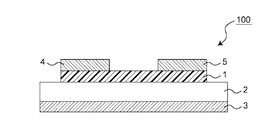
- FIG. 1 is a schematic cross-sectional view showing an example of an organic transistor (field effect organic transistor).
- An organic transistor 100 shown in FIG. 1 has a gate electrode 3, an insulating layer 2 formed on the gate electrode 3, an active layer 1 formed on the insulating layer 2, and a predetermined interval on the active layer 1.
- the number average molecular weight and the weight average molecular weight of the polymer compound were determined using gel permeation chromatography (GPC, manufactured by Shimadzu Corporation, trade name: LC-10AD).
- GPC gel permeation chromatography
- the polymer compound to be measured was dissolved in tetrahydrofuran and injected into GPC. Tetrahydrofuran was used for the mobile phase of GPC.
- PLgel MIXED-B manufactured by Polymer Laboratories
- a UV detector manufactured by Shimadzu Corporation, trade name: SPD-M10A was used as the detector.
- NMR analysis NMR measurement was performed by dissolving the compound in dimethyl sulfoxide-d 6 and using an NMR apparatus (Varian, INOVA300).
- a polymer compound F was obtained in the same manner as in Example 4 except that 25.1 mg (0.112 mmol) of 2,1,3-benzothiadiazole-4,7-diboronic acid was used in place of Compound A. It was.
- the number average molecular weight of polystyrene conversion of the high molecular compound F was 4.8 * 10 ⁇ 3 >, and the weight average molecular weight of polystyrene conversion was 6.8 * 10 ⁇ 3 >.
- a polymer compound I was obtained in the same manner as in Example 5 except that 25.1 mg (0.112 mmol) of 2,1,3-benzothiadiazole-4,7-diboronic acid was used in place of Compound A. It was.
- the number average molecular weight of polystyrene conversion of the high molecular compound I was 5.4 * 10 ⁇ 3 >, and the weight average molecular weight of polystyrene conversion was 7.2 * 10 ⁇ 3 >.
- a polymer compound K was obtained in the same manner as in Example 6 except that 26.1 mg (0.108 mmol) of biphenyl-4,4′-diboronic acid was used in place of Compound B.
- the number average molecular weight of polystyrene conversion of the high molecular compound K was 5.6 * 10 ⁇ 3 >, and the weight average molecular weight of polystyrene conversion was 1.1 * 10 ⁇ 4 >.
- a polymer compound M was obtained in the same manner as in Example 7 except that 21.8 mg (0.127 mmol) of thiophene-2,5-diboronic acid was used in place of the compound C.
- the polymer compound M had a polystyrene-equivalent number average molecular weight of 5.4 ⁇ 10 3 and a polystyrene-equivalent weight average molecular weight of 1.0 ⁇ 10 4 .
- Reference example 1 (Production and Evaluation of Organic Transistor 1) An organic transistor 1 having the structure shown in FIG. 1 was produced using a solution containing the polymer compound L as a charge transporting compound.
- thermal oxide film The surface of the heavily doped n-type silicon substrate to be the gate electrode was thermally oxidized to form a silicon oxide film (hereinafter referred to as “thermal oxide film”).
- the thermal oxide film functions as an insulating layer.
- a source electrode and a drain electrode were formed on the thermal oxide film by a photolithography process.
- the source electrode and the drain electrode had a chromium (Cr) layer and a gold (Au) layer from the thermal oxide film side, and had a channel length of 20 ⁇ m and a channel width of 2 mm.
- the substrate on which the thermal oxide film, the source electrode, and the drain electrode thus obtained were ultrasonically cleaned with acetone, and UV ozone treatment was performed with an ozone UV cleaner.
- the surface of the thermal oxide film was modified with ⁇ -phenethyltrichlorosilane, and the surfaces of the source electrode and the drain electrode were modified with pentafluorobenzenethiol.
- an organic semiconductor layer was formed by spin-coating a 0.5 wt% ortho-dichlorobenzene solution of the polymer compound L at a rotational speed of 1000 rpm on the surface-treated thermal oxide film, source electrode and drain electrode. . Thereafter, the organic semiconductor layer was heated at 230 ° C. for 1 hour to manufacture the organic transistor 1.
- the transistor characteristics were measured by changing the gate voltage Vg and the source-drain voltage Vsd of the organic transistor 1 obtained.
- the field effect mobility was 1.8 ⁇ 10 ⁇ 2 cm 2 / Vs.
- Reference example 2 (Production and Evaluation of Organic Transistor 2) An organic transistor 2 was produced in the same manner as in Reference Example 1 except that the polymer compound M was used instead of the polymer compound L.
- the transistor characteristics were measured by changing the gate voltage Vg and the source-drain voltage Vsd of the organic transistor 2 obtained.
- the field effect mobility was 2.0 ⁇ 10 ⁇ 3 cm 2 / Vs.
Landscapes
- Chemical & Material Sciences (AREA)
- Organic Chemistry (AREA)
- Health & Medical Sciences (AREA)
- Chemical Kinetics & Catalysis (AREA)
- Medicinal Chemistry (AREA)
- Polymers & Plastics (AREA)
- Engineering & Computer Science (AREA)
- Materials Engineering (AREA)
- Polyoxymethylene Polymers And Polymers With Carbon-To-Carbon Bonds (AREA)
Abstract
発明の課題は、鈴木カップリング法を用いて分子量の高い共役高分子化合物を製造しうるジボロン酸の誘導体を提供することである。課題の解決手段は、式 (1)〔式中、Aは、アリーレン基、ヘテロアリーレン基、-C≡C-又は-CR31=CR32-を表す。R31及びR32は、それぞれ独立に、水素原子、アルキル基、アリール基、ヘテロアリール基又はシアノ基を表す。R11及びR12は、それぞれ独立に、水素原子、アルキル基、アリール基又はヘテロアリール基を表す。R21、R22、R23、R24、R25、R26、R27及びR28は、それぞれ独立に、水素原子、アルキル基、アルコキシ基、アルキルチオ基、ハロゲン原子、アリール基又はヘテロアリール基を表す。m1、m2、m3及びm4は、それぞれ独立に、1から5の整数を表す。n1、n2、n3及びn4は、それぞれ独立に、0又は1を表す。〕で表される化合物である。
Description
本発明は、高分子化合物製造用のモノマー及び高分子化合物の製造方法に関する。
共役高分子化合物は、有機トランジスタ素子や、有機太陽電池素子、有機エレクトロルミネッセンス素子等の有機半導体素子への適用が検討されており、様々な種類の共役高分子化合物の研究開発が盛んに行われている。
有機半導体素子の特性に大きな影響を与える要因として、共役高分子化合物の分子量が知られている。
例えば、非特許文献1には、式(A)で表される繰り返し単位を有し、分子量の異なる高分子化合物を用いて複数の有機トランジスタ素子を作製したところ、分子量が高い高分子化合物を用いるほど、有機トランジスタの電界効果移動度が高くなることが記載されている。
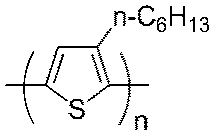
また、非特許文献2には、式(B)で表される繰り返し単位を有し、分子量が高い高分子化合物を用いて作製した有機太陽電池素子と分子量が低い高分子化合物を用いて作製した有機太陽電池素子の特性を比較したところ、分子量が高い高分子化合物を用いて作製した有機太陽電池素子の光電流(Jph)の方が大きくなることが記載されている。

共役高分子化合物の製造方法としては、パラジウム触媒存在下で芳香族化合物のジボロン酸又はその誘導体と、芳香族化合物のジハロゲン化物とを、連続的にカップリングさせる鈴木カップリング法が検討されている。
鈴木カップリング法を用いて分子量が高い共役高分子化合物を製造する方法として、例えば、チオフェンジボロン酸の1,3-プロパンジオールエステル誘導体と芳香族化合物のジハロゲン化物とを反応させる方法、及び、チオフェンジボロン酸のピナコールエステル誘導体と芳香族化合物のジハロゲン化物とを反応させる方法が提案されている(非特許文献3)。
他方、特許文献1には、有機ボロン酸に含まれるボロン酸基はN-メチルイミノ二酢酸等で保護することが可能であること、及びN-メチルイミノ二酢酸等でボロン酸基が保護された有機ボロン酸は、有機ハロゲン化物と反応して(鈴木カップリング法)、クロスカップリング生成物を与えることが記載されている。
アドバンスド マテリアルズ(Advanced Materials)、2003年、第15巻、p.1519-1522
オーガニック エレクトロニクス(Organic Electronics)、2009年、第10巻、p.1275-1281
マクロモレキュールズ(Macromolecules)、2001年、第34巻、p.5386-5393
しかしながら、実際に有機半導体素子へ適用可能な共役高分子化合物の合成を目的とする場合、上記従来の方法では、共役高分子化合物の分子量を十分に高めることが困難という問題がある。
より詳しくは、鈴木カップリング法を用いて、芳香族化合物のジボロン酸又はその誘導体と、芳香族化合物のジハロゲン化物の重縮合を行うことによって、共役高分子化合物を製造する場合、特に、該芳香族化合物が複素環式構造である場合は、芳香族化合物とホウ素原子との結合が重合反応前に切断されてカップリング反応が生じ難い。これは、ジボロン酸のホウ素原子は空配位座を有し、水等の求核試薬が攻撃し易いためと考えられる。また、理由は明確でないが、有機化合物のジボロン酸の有機基が芳香族性を有する複素環式構造である場合は、水等の求核試薬が、ホウ素原子の空配位座に対し、更に攻撃し易くなると考えられる。
つまり、非特許文献3に示されているような、有機ジボロン酸のアルキレンジオールエステル誘導体と有機ジハロゲン化物を使用する鈴木カップリング法では、共役高分子化合物の分子量を高めることが困難であり、有機ジボロン酸の有機基がヘテロアリール基である場合は、共役高分子化合物の分子量を高めることが更に困難になる。
そこで、本発明は、鈴木カップリング法を用いて分子量の高い共役高分子化合物を製造しうるジボロン酸の誘導体を提供することを目的とする。
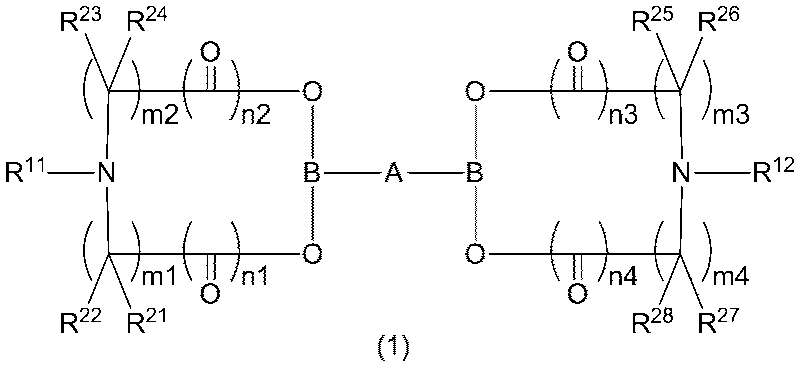
即ち、本発明は、式(1)
〔式中、Aは、アリーレン基、ヘテロアリーレン基、-C≡C-又は-CR31=CR32-を表す。R31及びR32は、それぞれ独立に、水素原子、アルキル基、アリール基、ヘテロアリール基又はシアノ基を表す。R11及びR12は、それぞれ独立に、水素原子、アルキル基、アリール基又はヘテロアリール基を表す。R21、R22、R23、R24、R25、R26、R27及びR28は、それぞれ独立に、水素原子、アルキル基、アルコキシ基、アルキルチオ基、ハロゲン原子、アリール基又はヘテロアリール基を表す。R21が複数個ある場合、それらは同一でも相異なってもよい。R22が複数個ある場合、それらは同一でも相異なってもよい。R23が複数個ある場合、それらは同一でも相異なってもよい。R24が複数個ある場合、それらは同一でも相異なってもよい。R25が複数個ある場合、それらは同一でも相異なってもよい。R26が複数個ある場合、それらは同一でも相異なってもよい。R27が複数個ある場合、それらは同一でも相異なってもよい。R28が複数個ある場合、それらは同一でも相異なってもよい。m1、m2、m3及びm4は、それぞれ独立に、1から5の整数を表す。n1、n2、n3及びn4は、それぞれ独立に、0又は1を表す。〕
で表される化合物を提供する。
で表される化合物を提供する。
また、本発明は、遷移金属錯体及び塩基の存在下で、前記化合物と、式(5)

〔式中、Eは、アリーレン基、ヘテロアリーレン基、-C≡C-又は-CR91=CR92-を表す。R91及びR92は、それぞれ独立に、水素原子、アルキル基、アリール基、ヘテロアリール基又はシアノ基を表す。X1及びX2は、それぞれ独立に、ハロゲン原子、アルキルスルホネート基又はアリールスルホネート基を表す。〕
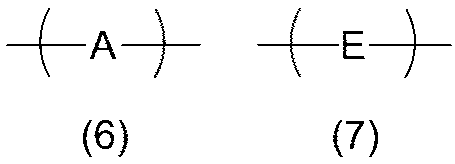
で表される化合物とを重合させる式(6)で表される繰り返し単位と式(7)で表される繰り返し単位とを含有する高分子化合物の製造方法を提供する。
で表される化合物とを重合させる式(6)で表される繰り返し単位と式(7)で表される繰り返し単位とを含有する高分子化合物の製造方法を提供する。

〔式(6)及び式(7)中、A及びEは、前述と同じ意味を表す。〕
本発明によれば、鈴木カップリング法を用いて分子量の高い高分子化合物を製造することができるため、本発明は極めて有用である。
以下、本発明を説明する。
<式(1)で表される化合物>
前記式(1)中、Aは、アリーレン基、ヘテロアリーレン基、-C≡C-又は-CR31=CR32-を表す。R31及びR32は、それぞれ独立に、水素原子、アルキル基、アリール基、ヘテロアリール基又はシアノ基を表す。R11及びR12は、それぞれ独立に、水素原子、アルキル基、アリール基又はヘテロアリール基を表す。R21、R22、R23、R24、R25、R26、R27及びR28は、それぞれ独立に、水素原子、アルキル基、アルコキシ基、アルキルチオ基、ハロゲン原子、アリール基又はヘテロアリール基を表す。R21が複数個ある場合、それらは同一でも相異なってもよい。R22が複数個ある場合、それらは同一でも相異なってもよい。R23が複数個ある場合、それらは同一でも相異なってもよい。R24が複数個ある場合、それらは同一でも相異なってもよい。R25が複数個ある場合、それらは同一でも相異なってもよい。R26が複数個ある場合、それらは同一でも相異なってもよい。R27が複数個ある場合、それらは同一でも相異なってもよい。R28が複数個ある場合、それらは同一でも相異なってもよい。m1、m2、m3及びm4は、それぞれ独立に、1から5の整数を表す。n1、n2、n3及びn4は、それぞれ独立に、0又は1を表す。
前記式(1)中、Aは、アリーレン基、ヘテロアリーレン基、-C≡C-又は-CR31=CR32-を表す。R31及びR32は、それぞれ独立に、水素原子、アルキル基、アリール基、ヘテロアリール基又はシアノ基を表す。R11及びR12は、それぞれ独立に、水素原子、アルキル基、アリール基又はヘテロアリール基を表す。R21、R22、R23、R24、R25、R26、R27及びR28は、それぞれ独立に、水素原子、アルキル基、アルコキシ基、アルキルチオ基、ハロゲン原子、アリール基又はヘテロアリール基を表す。R21が複数個ある場合、それらは同一でも相異なってもよい。R22が複数個ある場合、それらは同一でも相異なってもよい。R23が複数個ある場合、それらは同一でも相異なってもよい。R24が複数個ある場合、それらは同一でも相異なってもよい。R25が複数個ある場合、それらは同一でも相異なってもよい。R26が複数個ある場合、それらは同一でも相異なってもよい。R27が複数個ある場合、それらは同一でも相異なってもよい。R28が複数個ある場合、それらは同一でも相異なってもよい。m1、m2、m3及びm4は、それぞれ独立に、1から5の整数を表す。n1、n2、n3及びn4は、それぞれ独立に、0又は1を表す。
Aで表されるアリーレン基は、芳香族炭化水素化合物から、芳香環を構成する炭素原子に直接結合する水素原子2個を除いた原子団であり、ベンゼン環を含有する基、縮合環を含有する基、独立した芳香族環又は縮合環2個以上が直接結合した構造を含有する基を含む。アリーレン基は置換基を有していてもよい。アリーレン基が有する炭素数は、通常6~60であり、6~20であることが好ましい。該炭素数にはアリーレン基が有する置換基の炭素数は含まれない。アリーレン基の具体例としては、フェニレン基、ナフタレンジイル基、アントラセンジイル基、フェナントレンジイル基、テトラセンジイル基、ピレンジイル基、ペンタセンジイル基、ペリレンジイル基、フルオレンジイル基、ビフェニルジイル基、テルフェニルジイル基、クアテルフェニルジイル基が挙げられる。
Aで表されるヘテロアリーレン基は、芳香族性を有する複素環式化合物から、芳香環を構成する原子に直接結合する水素原子2個を除いた原子団であり、単環を含有する基、縮合環を含有する基、独立した芳香族環又は縮合環2個以上が直接結合した構造を含有する基を含む。ヘテロアリーレン基は置換基を有していてもよい。ヘテロアリーレン基が有する炭素数は、通常2~60であり、2~20であることが好ましい。該炭素数にはヘテロアリーレン基が有する置換基の炭素数は含まれない。ヘテロアリーレン基の具体例としては、オキサジアゾールジイル基、チアジアゾールジイル基、オキサゾールジイル基、チアゾールジイル基、チオフェンジイル基、ビチオフェンジイル基、テルチオフェンジイル基、クアテルチオフェンジイル基、ピロールジイル基、フランジイル基、セレノフェンジイル基、ピリジンジイル基、ピラジンジイル基、ピリミジンジイル基、トリアジンジイル基、ベンゾチオフェンジイル基、ベンゾピロールジイル基、ベンゾフランジイル基、キノリンジイル基、イソキノリンジイル基、チエノチオフェンジイル基、ベンゾチアジアゾールジイル基、ベンゾジチオフェンジイル基、シクロペンタジチオフェンジイル基が挙げられる。
R11、R12、R21、R22、R23、R24、R25、R26、R27、R28、R31及びR32で表されるアルキル基は、直鎖、分岐のいずれでもよく、シクロアルキル基であってもよい。アルキル基は置換基を有していてもよい。アルキル基が有する炭素数は、通常1~60であり、1~20であることが好ましい。該炭素数にはアルキル基が有する置換基の炭素数は含まれない。アルキル基の具体例としては、メチル基、エチル基、n-プロピル基、n-ブチル基、n-ヘキシル基、n-オクチル基、n-ドデシル基、n-オクタデシル基等の直鎖アルキル基、イソプロピル基、イソブチル基、sec-ブチル基、tert-ブチル基、2-エチルヘキシル基、3,7-ジメチルオクチル基等の分岐アルキル基、シクロペンチル基、シクロヘキシル基等のシクロアルキル基が挙げられる。
R11、R12、R21、R22、R23、R24、R25、R26、R27、R28、R31及びR32で表されるアリール基は、芳香族炭化水素化合物から芳香環を構成する炭素原子に直接結合する水素原子1個を除いた原子団であり、ベンゼン環を含有する基、縮合環を含有する基、独立した芳香族環又は縮合環2個以上が直接結合した構造を含有する基を含む。アリール基は置換基を有していてもよい。アリール基が有する炭素数は、通常6~60であり、6~20であることが好ましい。該炭素数にはアリール基が有する置換基の炭素数は含まれない。アリール基の具体例としては、フェニル基、1-ナフチル基、2-ナフチル基、1-アントラセニル基、2-アントラセニル基、9-アントラセニル基、1-ピレニル基、2-ピレニル基、4-ピレニル基、2-フルオレニル基、3-フルオレニル基、4-フルオレニル基、4-フェニルフェニル基が挙げられる。
R11、R12、R21、R22、R23、R24、R25、R26、R27、R28、R31及びR32で表されるヘテロアリール基は、芳香族性を有する複素環式化合物から、芳香環を構成する原子に直接結合する水素原子1個を除いた原子団であり、単環を含有する基、縮合環を含有する基、独立した複素芳香族環又は縮合環2個以上が直接結合した構造を含有する基を含む。ヘテロアリール基は置換基を有していてもよい。ヘテロアリール基が有する炭素数は、通常2~60であり、2~20であることが好ましい。該炭素数にはヘテロアリール基が有する置換基の炭素数は含まれない。ヘテロアリール基の具体例としては、2-フリル基、3-フリル基、2-チエニル基、3-チエニル基、2-ピロリル基、3-ピロリル基、2-オキサゾリル基、2-チアゾリル基、2-イミダゾリル基、2-ピリジル基、3-ピリジル基、4-ピリジル基、2-ベンゾフリル基、2-ベンゾチエニル基、2-チエノチエニル基が挙げられる。
R21、R22、R23、R24、R25、R26、R27及びR28で表されるアルコキシ基は、直鎖、分岐いずれでもよく、シクロアルコキシ基であってもよい。アルコキシ基は置換基を有していてもよい。アルコキシ基が有する炭素数は、通常1~60であり、1~20であることが好ましい。該炭素数にはアルコキシ基が有する置換基の炭素数は含まれない。アルコキシ基の具体例としては、メトキシ基、n-ブチルオキシ基、n-ヘキシルオキシ基、2-エチルヘキシルオキシ基、3,7-ジメチルオクチルオキシ基、n-ドデシルオキシ基が挙げられる。
R21、R22、R23、R24、R25、R26、R27及びR28で表されるアルキルチオ基は、直鎖、分岐いずれでもよく、シクロアルキルチオ基であってもよい。アルキルチオ基は置換基を有していてもよい。アルキルチオ基が有する炭素数は、通常1~60であり、1~20であることが好ましい。該炭素数にはアルキルチオ基が有する置換基の炭素数は含まれない。アルキルチオ基の具体例としては、n-ブチルチオ基、n-ヘキシルチオ基、2-エチルヘキシルチオ基、3,7-ジメチルオクチルチオ基、n-ドデシルチオ基等が挙げられる。
R21、R22、R23、R24、R25、R26、R27及びR28で表されるハロゲン原子としては、フッ素原子、塩素原子、臭素原子、ヨウ素原子が挙げられる。
Aは、ヘテロアリーレン基が好ましく、ベンゾチアジアゾールジイル基、チオフェンジイル基、ビチオフェンジイル基、テルチオフェンジイル基、クアテルチオフェンジイル基がより好ましい。
R11及びR12は、式(1)で表される化合物の合成の容易さの観点からは、アルキル基が好ましい。
R21、R22、R23、R24、R25、R26、R27及びR28は、式(1)で表される化合物の合成の容易さの観点からは、水素原子、アルキル基が好ましく、水素原子がより好ましい。
式(1)で表される化合物は、式(1)中のNで表される窒素原子が式(1)中のBで表されるホウ素原子と配位結合していてもよい。窒素原子(N)からホウ素原子(B)への配位結合を有すると、ホウ素原子(B)の空配位座を窒素原子(N)が保護するため、式(1)で表される化合物を重合反応のモノマーとして用いた場合に、Aで表される基とホウ素原子(B)との結合が重合反応前に切断される割合を抑制することができる。
窒素原子がホウ素原子の空配位座を保護する結果、Aで表される基とホウ素原子の結合切断を抑制する効果は、Aで表される基がヘテロアリーレン基である場合に、特に有効に発揮される。
窒素原子(N)からホウ素原子(B)への配位結合を形成する観点からは、m1とn1の和が2であり、m2とn2の和が2であり、m3とn3の和が2であり、かつ、m4とn4の和が2であることが好ましく、m1、n1、m2、n2、m3、n3、m4及びn4が1であることがより好ましい。
式(1)で表される化合物としては、例えば、式(1-001)~式(1-041)で表される化合物が挙げられる。中でも、式(1-014)~式(1-039)で表される化合物が好ましい。
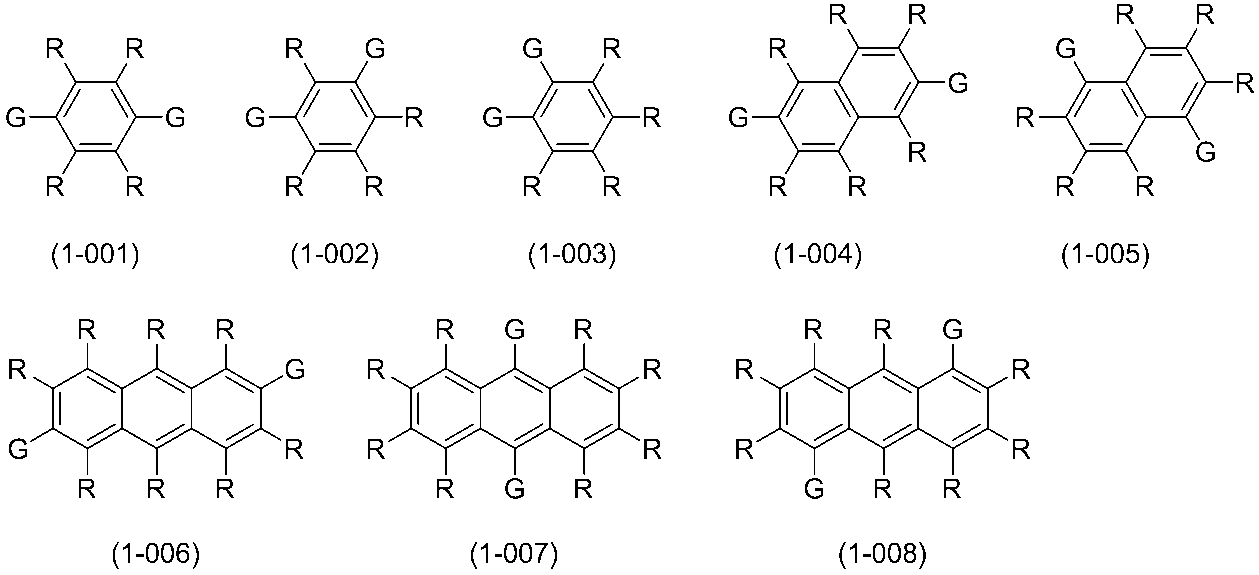
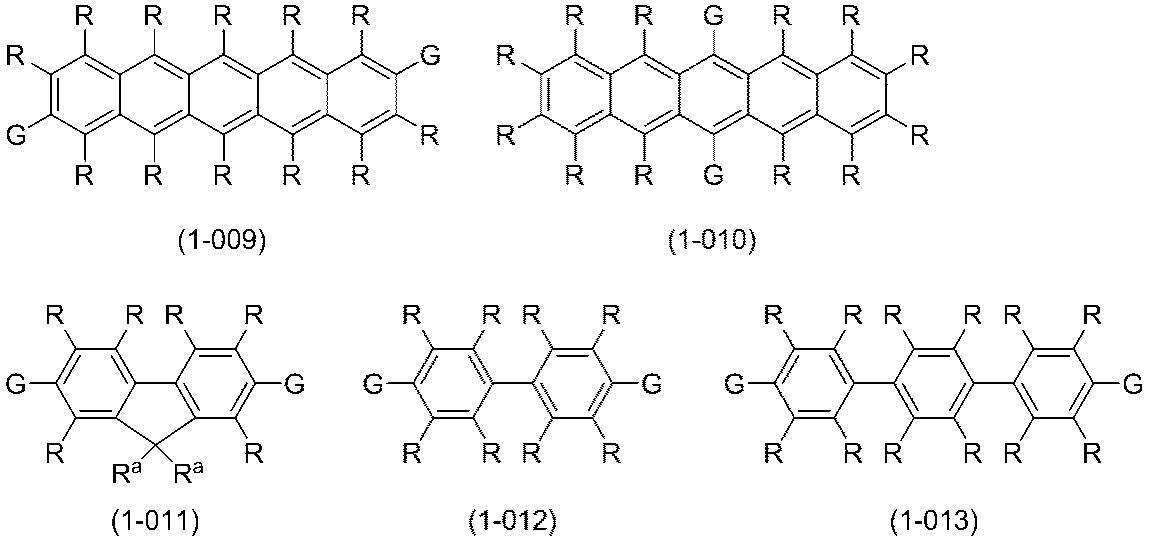

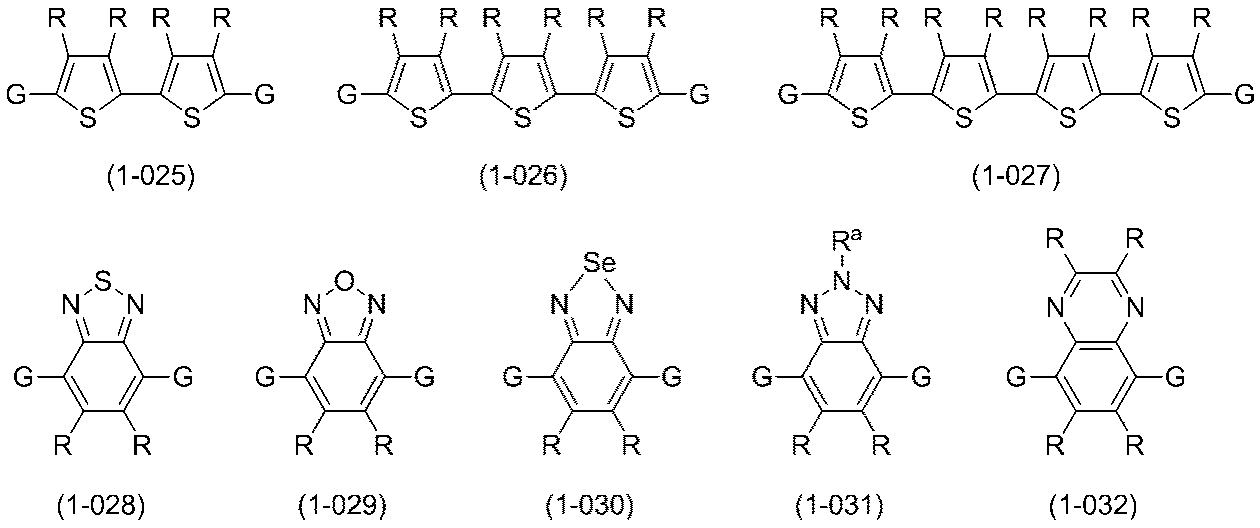
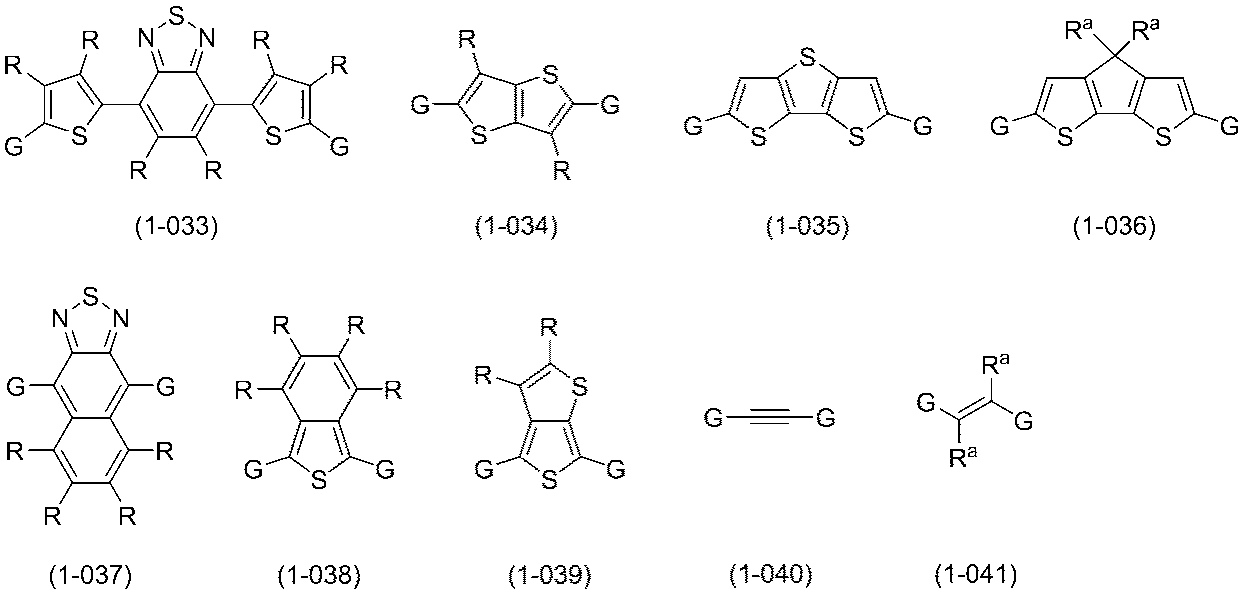
式(1-001)~式(1-041)中、Rは、水素原子、アルキル基、アルコキシ基、アルキルチオ基、アリール基又はヘテロアリール基を表す。複数存在するRは、同一でも異なっていてもよい。Raは、水素原子、アルキル基、アリール基又はヘテロアリール基を表す。複数存在するRaは、同一でも異なっていてもよい。R及びRaで表されるアルキル基、アリール基、ヘテロアリール基の定義、具体例は、前述のR21で表されるアルキル基、アリール基、ヘテロアリール基の定義、具体例と同じである。Rで表されるアルコキシ基、アルキルチオ基の定義、具体例は、前述のR21で表されるアルコキシ基、アルキルチオ基の定義、具体例と同じである。Gは、式(G-001)~式(G-006)で表される構造単位を表す。式(1)で表される化合物の合成の容易さの観点からは、式(G-004)で表される構造単位が好ましく、式(G-004)で表される構造単位であって、式中のRが水素原子であり、かつ、Raがメチル基である構造単位がより好ましい。複数存在するGは、同一でも異なっていてもよい。
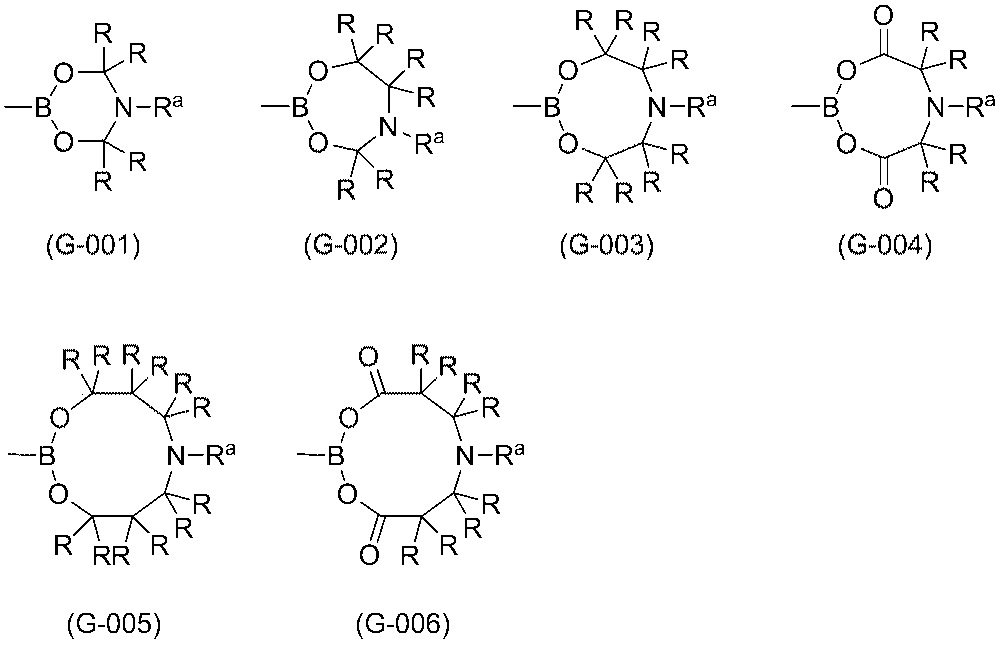
式(1-001)~式(1-031)中、R及びRaは、前述と同じ意味を表す。
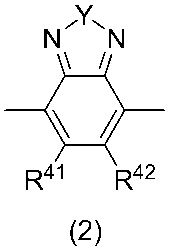
式(1)中のAの好ましい一態様は、式(2)で表される基である。

式(2)中、R41及びR42は、それぞれ独立に、水素原子、アルキル基、アルコキシ基、アルキルチオ基、アリール基、ヘテロアリール基、ハロゲン原子、シアノ基又はニトロ基を表す。R41中の炭素原子とR42中の炭素原子とが結合して環状構造を形成してもよい。Yは、-S-、-O-、-Se-、-NR51-又は-CR61=CR62-を表す。R51、R61及びR62は、それぞれ独立に、水素原子、アルキル基、アリール基又はヘテロアリール基を表す。
R41及びR42で表される、アルキル基、アルコキシ基、アルキルチオ基、アリール基、ヘテロアリール基、ハロゲン原子の定義、具体例は、前述のR21で表されるアルキル基、アルコキシ基、アルキルチオ基、アリール基、ヘテロアリール基、ハロゲン原子の定義、具体例と同じである。
R51、R61及びR62で表される、アルキル基、アリール基、ヘテロアリール基の定義、具体例は、前述のR21で表されるアルキル基、アリール基、ヘテロアリール基の定義、具体例と同じである。
式(2)で表される化合物としては、例えば、式(1-028)~式(1-032)で表される化合物及び式(1-037)で表される化合物が挙げられる。
式(1)中のAの好ましい他の態様は、式(3)で表される基である。

式(3)中、R71及びR72は、それぞれ独立に、水素原子、アルキル基、アルコキシ基、アルキルチオ基、アリール基又はヘテロアリール基を表す。uは1~5の整数を表す。R71が複数個ある場合、それらは同一でも相異なってもよい。R72が複数個ある場合、それらは同一でも相異なってもよい。互いに直接結合している2つの炭素原子にそれぞれ結合しているR71とR72とにおいて、R71中の炭素原子とR72中の炭素原子とが結合して環状構造を形成してもよい。
R71及びR72で表される、アルキル基、アルコキシ基、アルキルチオ基、アリール基、ヘテロアリール基の定義、具体例は、前述のR21で表されるアルキル基、アルコキシ基、アルキルチオ基、アリール基、ヘテロアリール基の定義、具体例と同じである。
Aが式(3)で表される基である化合物としては、例えば、式(1-019)で表される化合物、式(1-025)~式(1-027)で表される化合物、式(1-038)で表される化合物及び式(1-039)で表される化合物が挙げられる。
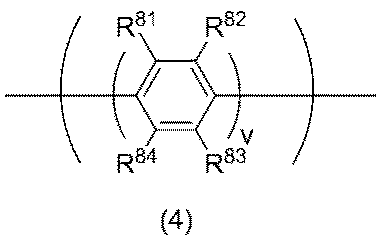
式(1)中のAの好ましい他の態様は、式(4)で表される基である。
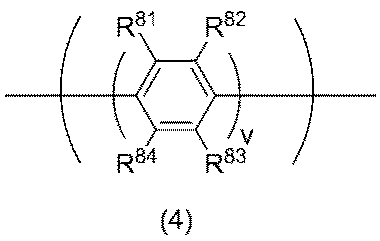
式(4)中、R81、R82、R83及びR84は、それぞれ独立に、水素原子、アルキル基、アルコキシ基、アルキルチオ基、アリール基又はヘテロアリール基を表す。vは1~5の整数を表す。R81が複数個ある場合、それらは同一でも相異なってもよい。R82が複数個ある場合、それらは同一でも相異なってもよい。R83が複数個ある場合、それらは同一でも相異なってもよい。R84が複数個ある場合、それらは同一でも相異なってもよい。互いに直接結合している2つの炭素原子にそれぞれ結合しているR81とR82とにおいて、R81中の炭素原子とR82中の炭素原子とが結合して環状構造を形成してもよい。互いに直接結合している2つの炭素原子にそれぞれ結合しているR83とR84とにおいて、R83中の炭素原子とR84中の炭素原子とが結合して環状構造を形成してもよい。
R81、R82、R83及びR84で表される、アルキル基、アルコキシ基、アルキルチオ基、アリール基、ヘテロアリール基の定義、具体例は、前述のR21で表されるアルキル基、アルコキシ基、アルキルチオ基、アリール基、ヘテロアリール基の定義、具体例と同じである。
Aが式(4)で表される基である化合物としては、例えば、式(1-001)で表される化合物、式(1-012)で表される化合物及び式(1-013)で表される化合物が挙げられる。
式(1)で表される化合物は、例えば、次のようにして製造される。即ち、式
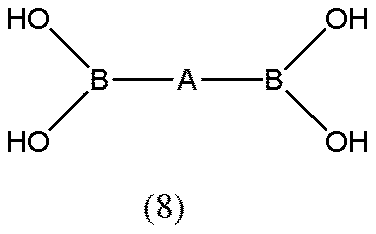
[式中、Aは上記と同意義である。]
で表される有機ジボロン酸と、式
で表される有機ジボロン酸と、式
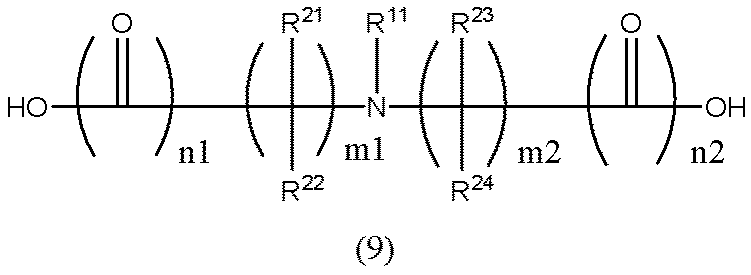
[式中、R11、R21、R22、R23、R24、m1、m2、n1及びn2は上記と同意義である。]
で表されるボロン酸保護化合物及び/又は、式
で表されるボロン酸保護化合物及び/又は、式

[式中、R12、R25、R26、R27、R28、m3、m4、n3及びn4は上記と同意義である。]
で表されるボロン酸保護化合物を反応させる。反応の操作は、例えば、両化合物を適量、適当な溶媒に溶解させて一定時間加熱すればよい。ボロン酸基とボロン酸保護化合物の反応を行う条件は公知であり、特許文献1に記載されている。但し、有機ジボロン酸とボロン酸保護化合物の反応量は、遊離のボロン酸基が残存しないように、(有機ジボロン酸の量)/(ボロン酸保護化合物の量)がモル比で1/2以下になる量に調節する。
で表されるボロン酸保護化合物を反応させる。反応の操作は、例えば、両化合物を適量、適当な溶媒に溶解させて一定時間加熱すればよい。ボロン酸基とボロン酸保護化合物の反応を行う条件は公知であり、特許文献1に記載されている。但し、有機ジボロン酸とボロン酸保護化合物の反応量は、遊離のボロン酸基が残存しないように、(有機ジボロン酸の量)/(ボロン酸保護化合物の量)がモル比で1/2以下になる量に調節する。
<高分子化合物の製造方法>
本発明の高分子化合物の製造方法は、遷移金属錯体及び塩基の存在下で、式(1)で表される化合物と、式(5)で表される化合物とを重合させる、式(6)で表される繰り返し単位と式(7)で表される繰り返し単位とを含有する高分子化合物の製造方法である。
本発明の高分子化合物の製造方法は、遷移金属錯体及び塩基の存在下で、式(1)で表される化合物と、式(5)で表される化合物とを重合させる、式(6)で表される繰り返し単位と式(7)で表される繰り返し単位とを含有する高分子化合物の製造方法である。
<式(5)で表される化合物>
式(5)中、Eは、アリーレン基、ヘテロアリーレン基、-C≡C-又は-CR91=CR92-を表す。R91及びR92は、それぞれ独立に、水素原子、アルキル基、アリール基、ヘテロアリール基又はシアノ基を表す。X1及びX2は、それぞれ独立に、ハロゲン原子、アルキルスルホネート基又はアリールスルホネート基を表す。
式(5)中、Eは、アリーレン基、ヘテロアリーレン基、-C≡C-又は-CR91=CR92-を表す。R91及びR92は、それぞれ独立に、水素原子、アルキル基、アリール基、ヘテロアリール基又はシアノ基を表す。X1及びX2は、それぞれ独立に、ハロゲン原子、アルキルスルホネート基又はアリールスルホネート基を表す。
Eで表される、アリーレン基、ヘテロアリーレン基の定義、具体例は、前述のAで表されるアリーレン基、ヘテロアリーレン基の定義、具体例と同じである。
Eは、製造される高分子化合物の分子量を高める観点からは、アリーレン基、ヘテロアリーレン基が好ましい。
R91及びR92で表されるアルキル基、アリール基、ヘテロアリール基の定義、具体例は、前述のR21で表されるアルキル基、アリール基、ヘテロアリール基の定義、具体例と同じである。
式(5)中、X1及びX2で表されるハロゲン原子としては、フッ素原子、塩素原子、臭素原子、ヨウ素原子が挙げられる。
式(5)中、X1及びX2で表されるアルキルスルホネート基としては、メタンスルホネート基、トリフルオロメタンスルホネート基等が挙げられる。
式(5)中、X1及びX2で表されるアリールスルホネート基としては、ベンゼンスルホネート基、パラトルエンスルホネート基等が挙げられる。
X1及びX2としては、製造される高分子化合物の分子量を高める観点からは、塩素原子、臭素原子、ヨウ素原子が好ましく、臭素原子、ヨウ素原子がさらに好ましい。
式(5)で表される化合物としては、例えば、式(5-001)~式(5-041)で表される化合物が挙げられる。


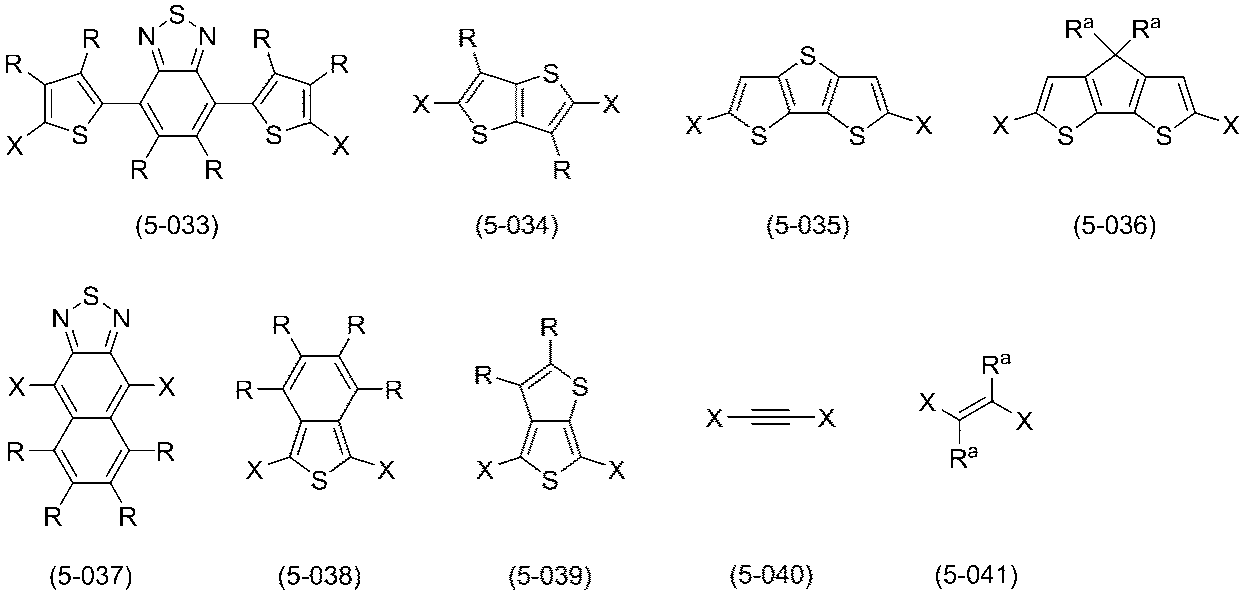
式(5-001)~式(5-041)中、R及びRaは、前述と同じ意味を表す。Xは、ハロゲン原子、アルキルスルホネート基又はアリールスルホネート基を表す。複数存在するXは、同一でも異なっていてもよい。
Xで表されるハロゲン原子、アルキルスルホネート基、アリールスルホネート基の定義、具体例は、X1で表されるハロゲン原子、アルキルスルホネート基、アリールスルホネート基の定義、具体例と同じである。
<塩基>
本発明の高分子化合物の製造方法に用いられる塩基は、無機塩基であっても有機塩基であってもよいが、無機塩基が好ましい。
本発明の高分子化合物の製造方法に用いられる塩基は、無機塩基であっても有機塩基であってもよいが、無機塩基が好ましい。
無機塩基としては、水酸化ナトリウム、水酸化カリウム、等のアルカリ金属水酸化物、水酸化カルシウム等のアルカリ土類金属水酸化物、酢酸ナトリウム、酢酸カリウム等の酢酸塩、炭酸ナトリウム、炭酸カリウム、炭酸セシウム等の炭酸塩、リン酸ナトリウム、リン酸カリウム等のリン酸塩、フッ化ナトリウム、フッ化カリウム等のフッ化物が挙げられる。
無機塩基の中でも、炭酸ナトリウム及び炭酸カリウム等の炭酸塩、及びリン酸ナトリウム及びリン酸カリウム等のリン酸塩が好ましい。より好ましい無機塩基は、炭酸ナトリウム及びリン酸カリウムである。
有機塩基としては、テトラエチルアンモニウムヒドロキシド、テトラブチルアンモニウムヒドロキシド等が挙げられる。
塩基の使用量は、式(1)で表される化合物1モルに対して、2~20モルであることが好ましく、より好ましくは2~10モルである。
<遷移金属錯体>
本発明の高分子化合物の製造方法に用いられる遷移金属錯体は、第8~10族の元素を含む遷移金属錯体が好ましく、第10族の元素を含む遷移金属錯体がより好ましく、パラジウム錯体、ニッケル錯体がさらに好ましく、パラジウム錯体が特に好ましい。
本発明の高分子化合物の製造方法に用いられる遷移金属錯体は、第8~10族の元素を含む遷移金属錯体が好ましく、第10族の元素を含む遷移金属錯体がより好ましく、パラジウム錯体、ニッケル錯体がさらに好ましく、パラジウム錯体が特に好ましい。
前記遷移金属錯体は、少なくともひとつのホスフィン配位子を有することが好ましい。
前記遷移金属錯体には、遷移金属錯体前駆体も含まれる。ここで、遷移金属錯体前駆体とは、反応系中で遷移金属錯体に変換される組成物である。該組成物としては、例えば、前駆体用遷移金属錯体とホスフィン配位子又はホスホニウム塩とを含む組成物が挙げられる。
前記パラジウム錯体としては、テトラキス(トリフェニルホスフィン)パラジウム(0)、テトラキス(トリストリルホスフィン)パラジウム(0)(オルト、メタ、およびパラの各種置換異性体を含む)、ビス(トリフェニルホスフィン)パラジウム(II)ジクロリド、ビス(トリシクロヘキシルホスフィン)パラジウム(II)ジクロリド、ビス(トリエチルホスフィン)パラジウム(II)ジクロリド、[1,2-ビス(ジフェニルホスフィノ)エタン]パラジウム(II)ジクロリド、[1,1'-ビス(ジフェニルホスフィノ)フェロセン]パラジウム(II)ジクロリド、ビス(アセトニトリル)パラジウム(II)ジクロリド、及びビス(ベンゾニトリル)パラジウム(II)ジクロリド等が挙げられる。
中でも、テトラキス(トリフェニルホスフィン)パラジウム(0)、ビス(トリフェニルホスフィン)パラジウム(II)ジクロリド、[1,1'-ビス(ジフェニルホスフィノ)フェロセン]パラジウム(II)ジクロリドが好ましい。
前記ニッケル錯体としては、テトラキス(トリフェニルホスフィン)ニッケル(0)、ビス(トリフェニルホスフィン)ニッケル(II)ジクロリド、[1,2-ビス(ジフェニルホスフィノ)エタン]ニッケル(II)ジクロリド、[1,3-ビス(ジフェニルホスフィノ)プロパン]ニッケル(II)ジクロリド、[1,4-ビス(ジフェニルホスフィノ)ブタン]ニッケル(II)ジクロリド、[1,1'-ビス(ジフェニルホスフィノ)フェロセン]ニッケル(II)ジクロリド等が挙げられる。
前記前駆体用遷移金属錯体としては、Pd2(dba)3(ここでdbaは、トランス、トランス-ジベンジリデンアセトンを表す。)、Pd(dba)2、酢酸パラジウム(II)、ビス(1,5-シクロオクタジエン)ニッケル(0)等が挙げられる。
中でも、Pd2(dba)3、Pd(dba)2、酢酸パラジウム(II)が好ましい。
中でも、Pd2(dba)3、Pd(dba)2、酢酸パラジウム(II)が好ましい。
前記ホスフィン配位子とは、遷移金属に配位しうる化合物を意味する。該ホスフィン配位子としては、トリ-n-ブチルホスフィン、トリ-tert-ブチルホスフィン、トリシクロヘキシルホスフィン、トリシクロペンチルホスフィン、トリベンジルホスフィン等のトリアルキルホスフィン類や、トリフェニルホスフィン、トリトリルホスフィン(オルト、メタ、およびパラの各種置換異性体を含む)、トリス(メトキシフェニル)ホスフィン(オルト、メタ、およびパラの各種置換異性体を含む)等のトリアリールホスフィン類、ジフェニルシクロヘキシルホスフィン等のジアリールアルキルホスフィン類、ジシクロヘキシルフェニルホスフィン、(2-ビフェニリル)ジ-tert-ブチルホスフィン等のジアルキルアリールホスフィン類、1,2-ビス(ジフェニルホスフィノ)エタン、1,3-ビス(ジフェニルホスフィノ)プロパン、1,2-ビス(ジフェニルホスフィノ)シクロヘキサン、1,3-ビス(ジフェニルホスフィノ)ベンゼン、1,1’-ビス(ジフェニルホスフィノ)フェロセン等の二座配位ホスフィン類が挙げられる。
中でも、トリ-tert-ブチルホスフィン、トリシクロヘキシルホスフィン、トリトリルホスフィン(オルト、メタ、およびパラの各種置換異性体を含む)、トリス(メトキシフェニル)ホスフィン(オルト、メタ、およびパラの各種置換異性体を含む)が好ましい。
前記ホスホニウム塩は、上記ホスフィン配位子とHBF4、HPF6、HSbF6等の酸とから得られる塩であり、トリ-n-ブチルホスホニウムテトラフルオロボレート、トリ-tert-ブチルホスホニウムテトラフルオロボレート、トリフェニルホスホニウムヘキサフルオロホスフェート、トリフェニルホスホニウムヘキサフルオロアンチモネート等が挙げられる。
本発明の製造方法にホスホニウム塩を用いる場合、反応液中に存在する塩基によりホスホニウム塩がホスフィン配位子へと変換される。
本発明の製造方法にホスホニウム塩を用いる場合は、塩基として、水酸化ナトリウム、水酸化カリウム、酢酸ナトリウム、酢酸カリウム、炭酸ナトリウム、炭酸カリウム、炭酸セシウム、フッ化ナトリウム、フッ化カリウム、リン酸ナトリウム、リン酸カリウムを用いることが好ましく、炭酸ナトリウム、炭酸カリウム、炭酸セシウム、リン酸ナトリウム、リン酸カリウムがより好ましい。
遷移金属錯体の使用量は、式(1)で表される化合物1モルに対して、0.0001~10モルであることが好ましく、より好ましくは0.001~1モルである。
前駆体用遷移金属錯体の使用量は、式(1)で表される化合物1モルに対して、0.0001~10モルであることが好ましく、より好ましくは0.001~1モルである。
ホスフィン配位子の使用量は、前駆体用遷移金属錯体1モルに対して、1~10モルであることが好ましく、より好ましくは1~4モルである。
ホスホニウム塩の使用量は、前駆体用遷移金属錯体1モルに対して、1~10モルであることが好ましく、より好ましくは1~4モルである。
なお、遷移金属錯体は、一種単独で用いても二種以上を併用してもよい。
<重合反応条件>
本発明の高分子化合物の製造方法における重合反応温度は、20~200℃であることが好ましい。重合反応を効率的に進行させる観点からは、50℃以上がより好ましく、80℃以上がさらに好ましい。また、副反応を抑える観点からは、180℃以下がより好ましく、160℃以下がさらに好ましい。
本発明の高分子化合物の製造方法における重合反応温度は、20~200℃であることが好ましい。重合反応を効率的に進行させる観点からは、50℃以上がより好ましく、80℃以上がさらに好ましい。また、副反応を抑える観点からは、180℃以下がより好ましく、160℃以下がさらに好ましい。
重合反応時間は、通常、1分~200時間である。重合反応を十分に進行させる観点からは、1時間以上が好ましい。
前記重合反応は、無溶媒で行っても溶媒の存在下で行ってもよいが、溶媒の存在下で行うことが好ましい。溶媒を使用する場合、用いる溶媒は反応不活性な溶媒であればよく、一種単独で用いても複数の溶媒を混合した混合溶媒として用いてもよい。溶媒としては、例えば、シクロヘキサン、メチルシクロヘキサン等の脂肪族炭化水素溶媒、ベンゼン、トルエン等の芳香族炭化水素溶媒、テトラヒドロフラン、アニソール等のエーテル系溶媒、1-メチル-2-ピロリドン、N,N-ジメチルホルムアミド、N,N-ジメチルアセトアミド、ジメチルスルホキシド、アセトニトリル等の非プロトン性極性溶媒、水が挙げられ、芳香族炭化水素溶媒、エーテル系溶媒、非プロトン性極性溶媒が好ましい。
前記重合反応は、空気中で行っても、不活性ガス雰囲気下で行ってもよいが、窒素、アルゴン等の不活性ガス雰囲気下で行うことが好ましい。
<有機トランジスタ>
有機トランジスタとしては、ソース電極及びドレイン電極と、これらの電極間の電流経路となり、本発明の高分子化合物を含む活性層と、該電流経路を通る電流量を制御するゲート電極とを備えた構成を有するものが挙げられる。このような構成を有する有機トランジスタとしては、例えば、電界効果型有機トランジスタが挙げられる。
有機トランジスタとしては、ソース電極及びドレイン電極と、これらの電極間の電流経路となり、本発明の高分子化合物を含む活性層と、該電流経路を通る電流量を制御するゲート電極とを備えた構成を有するものが挙げられる。このような構成を有する有機トランジスタとしては、例えば、電界効果型有機トランジスタが挙げられる。
電界効果型有機トランジスタは、通常、ソース電極及びドレイン電極と、これらの電極間の電流経路となり、本発明の高分子化合物を含む活性層と、該電流経路を通る電流量を制御するゲート電極と、活性層とゲート電極との間に配置される絶縁層とを有する有機トランジスタである。特に、ソース電極及びドレイン電極が、活性層に接して設けられており、さらに活性層に接した絶縁層を挟んでゲート電極が設けられている有機トランジスタが好ましい。
図1は、有機トランジスタ(電界効果型有機トランジスタ)の一例を示す模式断面図である。図1に示す有機トランジスタ100は、ゲート電極3と、ゲート電極3上に形成された絶縁層2と、絶縁層2上に形成された活性層1と、活性層1上に所定の間隔を持って形成されたソース電極4及びドレイン電極5と、を備えるものである。
以下、本発明をさらに詳細に説明するために実施例を示すが、本発明はこれらに限定されるものではない。
(分子量分析)
高分子化合物の数平均分子量及び重量平均分子量は、ゲル透過クロマトグラフィ(GPC、島津製作所製、商品名:LC-10AD)を用いて求めた。測定する高分子化合物は、テトラヒドロフランに溶解させ、GPCに注入した。GPCの移動相にはテトラヒドロフランを用いた。カラムは、PLgel MIXED-B(ポリマーラボラトリーズ製)を用いた。検出器にはUV検出器(島津製作所製、商品名:SPD-M10A)を用いた。
高分子化合物の数平均分子量及び重量平均分子量は、ゲル透過クロマトグラフィ(GPC、島津製作所製、商品名:LC-10AD)を用いて求めた。測定する高分子化合物は、テトラヒドロフランに溶解させ、GPCに注入した。GPCの移動相にはテトラヒドロフランを用いた。カラムは、PLgel MIXED-B(ポリマーラボラトリーズ製)を用いた。検出器にはUV検出器(島津製作所製、商品名:SPD-M10A)を用いた。
(NMR分析)
NMR測定は、化合物をジメチルスルホキシド-d6に溶解させ、NMR装置(Varian社製、INOVA300)を用いて行った。
NMR測定は、化合物をジメチルスルホキシド-d6に溶解させ、NMR装置(Varian社製、INOVA300)を用いて行った。
実施例1
(化合物Aの合成)
(化合物Aの合成)

フラスコに、2,1,3-ベンゾチアジアゾール-4,7-ジボロン酸を1.50g(6.70mmol)、N-メチルイミノ二酢酸を2.07g(14.1mmol)、トルエンを30mL入れ、5時間還流させた。その後、生成した析出物をろ取し、析出物を水で洗浄し、次いで、メタノールで洗浄した。その後、析出物を乾燥させて化合物Aを得た。化合物Aの得量は2.75gであり、収率は92%であった。
1H-NMR(300MHz,DMSO-d6)δ7.92(s,2H),4.28-4.56(m,8H),2.57(s,6H)
実施例2
(化合物Bの合成)
(化合物Bの合成)

フラスコに、ビフェニル-4,4’-ジボロン酸を1.50g(6.20mmol)、N-メチルイミノ二酢酸を1.91g(13.0mmol)、トルエンを30mL入れ、5時間還流させた。その後、生成した析出物をろ取し、析出物を水で洗浄し、次いで、メタノールで洗浄した。これを乾燥させて化合物Bを得た。化合物Bの得量は2.59gであり、収率は90%であった。
1H-NMR(300MHz,DMSO-d6)δ7.71(d,4H),7.56(d,4H),4.14-4.42(m,8H),2.57(s,6H)
実施例3
(化合物Cの合成)
(化合物Cの合成)

フラスコに、チオフェン-2,5-ジボロン酸を1.50g(8.73mmol)、N-メチルイミノ二酢酸を2.70g(18.3mmol)、トルエンを30mL入れ、5時間還流させた。その後、生成した析出物をろ取し、析出物を水で洗浄し、メタノールで洗浄した。これを乾燥させて化合物Cを得た。化合物Cの得量は3.16gであり、収率は92%であった。
1H-NMR(300MHz,DMSO-d6)δ7.30(s,2H),4.00-4.41(m,8H),2.60(s,6H)
実施例4
(高分子化合物Dの合成)
(高分子化合物Dの合成)

フラスコ内の気体を窒素で置換したフラスコに、化合物Aを50.0mg(0.112mmol)、2,7-ジブロモ-9,9-ジオクチルフルオレンを61.5mg(0.112mmol)、テトラヒドロフランを50mL、酢酸パラジウムを0.25mg、トリス(2-メトキシフェニル)ホスフィンを0.79mg入れて撹拌した。この反応液に、リン酸カリウム119mg(0.561mmol)を水10mLに溶解させた溶液を滴下し、9時間還流させて、高分子化合物Dを得た。高分子化合物Dのポリスチレン換算の数平均分子量は1.9×10⁴であり、ポリスチレン換算の重量平均分子量は6.1×10⁴であった。
比較例1
(高分子化合物Eの合成)
(高分子化合物Eの合成)
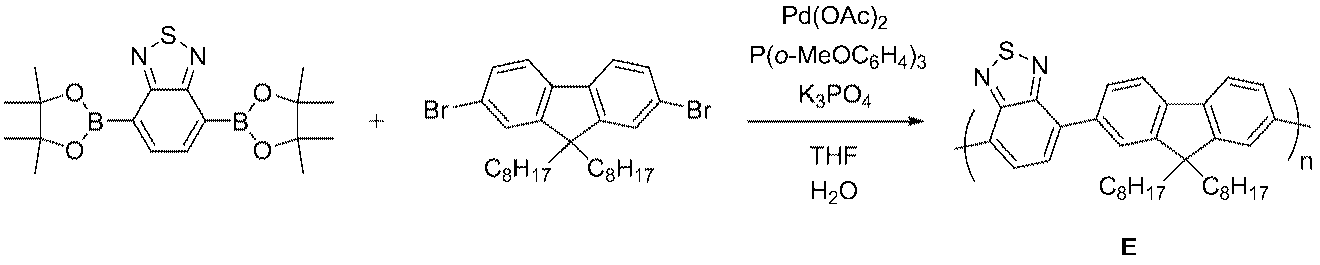
化合物Aに代えて、4,7-ビス(4,4,5,5-テトラメチル-1,3,2-ジオキサボロラン-2-イル)-2,1,3-ベンゾチアジアゾールを43.5mg(0.112mmol)用いた以外は実施例4と同様に反応を行い、高分子化合物Eを得た。高分子化合物Eのポリスチレン換算の数平均分子量は7.4×10³であり、ポリスチレン換算の重量平均分子量は1.5×10⁴であった。
比較例2
(高分子化合物Fの合成)
(高分子化合物Fの合成)
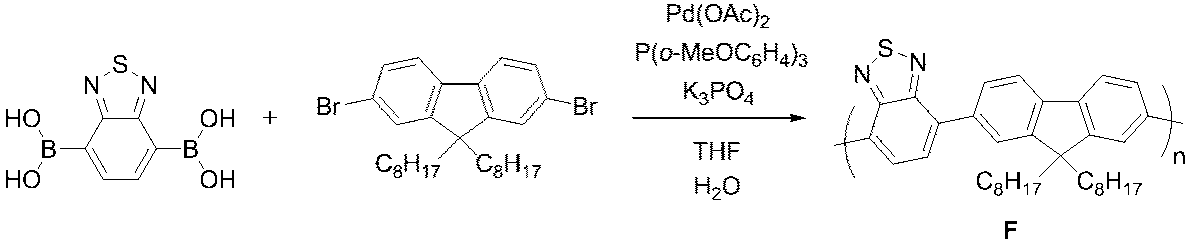
化合物Aに代えて、2,1,3-ベンゾチアジアゾール-4,7-ジボロン酸を25.1mg(0.112mmol)用いた以外は実施例4と同様に反応を行い、高分子化合物Fを得た。高分子化合物Fのポリスチレン換算の数平均分子量は4.8×10³であり、ポリスチレン換算の重量平均分子量は6.8×10³であった。
実施例5
(高分子化合物Gの合成)
(高分子化合物Gの合成)

フラスコ内の気体を窒素で置換したフラスコに、化合物Aを50.0mg(0.112mmol)、2,7-ジブロモ-9,9-ジオクチルフルオレンを61.5mg(0.112mmol)、テトラヒドロフランを50mL、酢酸パラジウムを0.25mg、トリス(2-メトキシフェニル)ホスフィンを0.79mg入れて撹拌した。この反応液に、炭酸ナトリウム59.4mg(0.561mmol)を水10mLに溶解させた溶液を滴下し、9時間還流させて、高分子化合物Gを得た。高分子化合物Gのポリスチレン換算の数平均分子量は3.0×10⁴であり、ポリスチレン換算の重量平均分子量は1.5×10⁵であった。
比較例3
(高分子化合物Hの合成)
(高分子化合物Hの合成)

化合物Aに代えて、4,7-ビス(4,4,5,5-テトラメチル-1,3,2-ジオキサボロラン-2-イル)-2,1,3-ベンゾチアジアゾールを43.5mg(0.112mmol)用いた以外は実施例5と同様に反応を行い、高分子化合物Hを得た。高分子化合物Hのポリスチレン換算の数平均分子量は1.7×10⁴であり、ポリスチレン換算の重量平均分子量は5.1×10⁴であった。
比較例4
(高分子化合物Iの合成)
(高分子化合物Iの合成)

化合物Aに代えて、2,1,3-ベンゾチアジアゾール-4,7-ジボロン酸を25.1mg(0.112mmol)用いた以外は実施例5と同様に反応を行い、高分子化合物Iを得た。高分子化合物Iのポリスチレン換算の数平均分子量は5.4×10³であり、ポリスチレン換算の重量平均分子量は7.2×10³であった。
実施例6
(高分子化合物Jの合成)
(高分子化合物Jの合成)
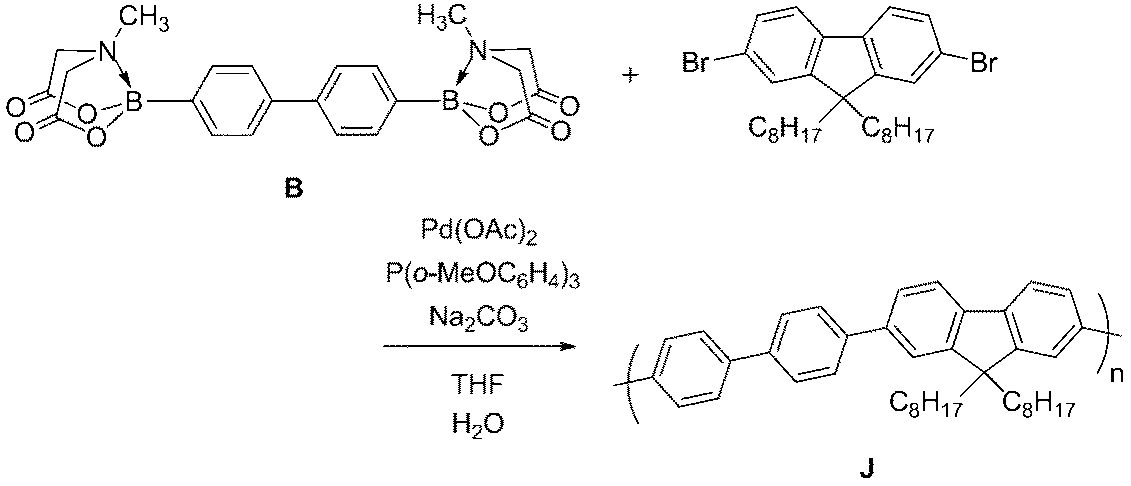
フラスコ内の気体を窒素で置換したフラスコに、化合物Bを50.0mg(0.108mmol)、2,7-ジブロモ-9,9-ジオクチルフルオレンを59.1mg(0.108mmol)、テトラヒドロフランを50mL、酢酸パラジウムを0.24mg、トリス(2-メトキシフェニル)ホスフィンを0.60mg入れて撹拌した。この反応液に、炭酸ナトリウム57.1mg(0.539mmol)を水10mLに溶解させた溶液を滴下し、9時間還流させて、高分子化合物Jを得た。高分子化合物Jのポリスチレン換算の数平均分子量は5.6×10⁴であり、重量平均分子量は1.5×10⁵であった。
比較例5
(高分子化合物Kの合成)
(高分子化合物Kの合成)
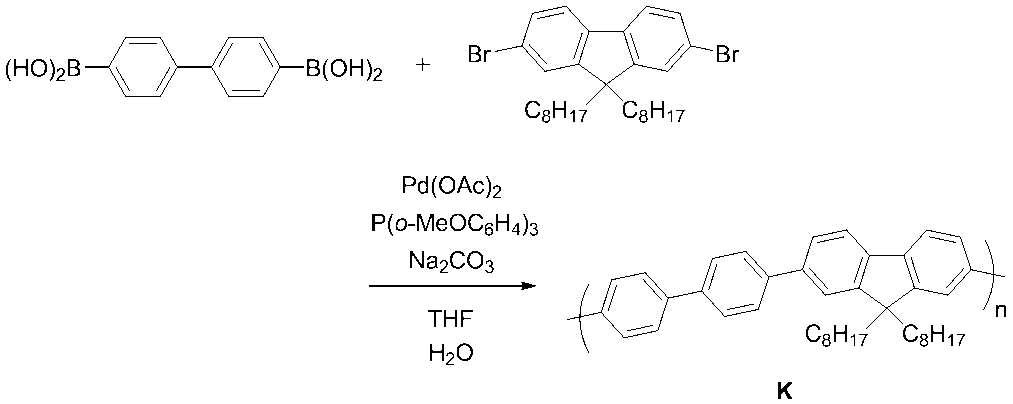
化合物Bに代えて、ビフェニル-4,4’-ジボロン酸を26.1mg(0.108mmol)用いた以外は実施例6と同様に反応を行い、高分子化合物Kを得た。高分子化合物Kのポリスチレン換算の数平均分子量は5.6×10³であり、ポリスチレン換算の重量平均分子量は1.1×10⁴であった。
実施例7
(高分子化合物Lの合成)
(高分子化合物Lの合成)

フラスコ内の気体を窒素で置換したフラスコに、化合物Cを50.0mg(0.127mmol)、5,5’-ジブロモ-4,4’-ジテトラデシル-2,2’-ビチオフェンを69.6mg(0.127mmol)、テトラヒドロフランを50mL、酢酸パラジウムを0.28mg、トリス(2-メトキシフェニル)ホスフィンを0.71mg入れて撹拌した。この反応液に、炭酸ナトリウム67.3mg(0.635mmol)を水10mLに溶解させた溶液を滴下し、9時間還流させて、高分子化合物Lを得た。高分子化合物Lのポリスチレン換算の数平均分子量は3.7×10⁴であり、ポリスチレン換算の重量平均分子量は8.7×10⁴であった。
比較例6
(高分子化合物Mの合成)
(高分子化合物Mの合成)

化合物Cに代えて、チオフェン-2,5-ジボロン酸を21.8mg(0.127mmol)用いた以外は実施例7と同様に反応を行い、高分子化合物Mを得た。高分子化合物Mのポリスチレン換算の数平均分子量は5.4×10³であり、ポリスチレン換算の重量平均分子量は1.0×10⁴であった。
参考例1
(有機トランジスタ1の作製及び評価)
電荷輸送性化合物として高分子化合物Lを含む溶液を用いて、図1に示す構造を有する有機トランジスタ1を作製した。
(有機トランジスタ1の作製及び評価)
電荷輸送性化合物として高分子化合物Lを含む溶液を用いて、図1に示す構造を有する有機トランジスタ1を作製した。
ゲート電極となる高濃度にドーピングされたn-型シリコン基板の表面を熱酸化し、シリコン酸化膜(以下、「熱酸化膜」という。)を形成した。熱酸化膜は絶縁層として機能する。次に、フォトリソグラフィ工程により熱酸化膜上にソース電極及びドレイン電極を作製した。該ソース電極及び該ドレイン電極は、熱酸化膜側からクロム(Cr)層と金(Au)層とを有し、チャネル長が20μm、チャネル幅が2mmであった。こうして得られた熱酸化膜、ソース電極及びドレイン電極を形成した基板をアセトンで超音波洗浄を行ない、オゾンUVクリーナーでUVオゾン処理を行なった。その後、β-フェネチルトリクロロシランで熱酸化膜の表面を修飾し、ペンタフルオロベンゼンチオールでソース電極及びドレイン電極の表面を修飾した。次に、上記表面処理した熱酸化膜、ソース電極及びドレイン電極上に、0.5重量%の高分子化合物Lのオルトジクロロベンゼン溶液を1000rpmの回転速度でスピンコートし、有機半導体層を形成した。その後、有機半導体層を230℃で1時間加熱し、有機トランジスタ1を製造した。
得られた有機トランジスタ1のゲート電圧Vg、ソース・ドレイン間電圧Vsdを変化させ、トランジスタ特性を測定した。電界効果移動度は、1.8×10⁻²cm2/Vsであった。
参考例2
(有機トランジスタ2の作製及び評価)
高分子化合物Lにかえて高分子化合物Mを用いた以外は参考例1と同様に有機トランジスタ2を作製した。
(有機トランジスタ2の作製及び評価)
高分子化合物Lにかえて高分子化合物Mを用いた以外は参考例1と同様に有機トランジスタ2を作製した。
得られた有機トランジスタ2のゲート電圧Vg、ソース・ドレイン間電圧Vsdを変化させ、トランジスタ特性を測定した。電界効果移動度は、2.0×10⁻³cm2/Vsであった。
1…活性層、
2…絶縁層、
3…ゲート電極、
4…ソース電極、
5…ドレイン電極、
100…有機トランジスタ。
2…絶縁層、
3…ゲート電極、
4…ソース電極、
5…ドレイン電極、
100…有機トランジスタ。
Claims (11)
- 式(1)

で表される化合物。 - Aが、ヘテロアリーレン基である請求項1に記載の化合物。
- Aが、式(2)
で表される基である請求項2に記載の化合物。 - Aが、式(3)

で表される基である請求項2に記載の化合物。 - Aが、式(4)
- m1とn1の和が2であり、m2とn2の和が2であり、m3とn3の和が2であり、かつ、m4とn4の和が2である請求項1~5のいずれか一項に記載の化合物。
- 遷移金属錯体及び塩基の存在下で、請求項1~6のいずれか一項に記載の化合物と、式(5)

で表される化合物とを重合させる式(6)で表される繰り返し単位と式(7)で表される繰り返し単位とを含有する高分子化合物の製造方法。
- Eが、アリーレン基又はヘテロアリーレン基である請求項7に記載の高分子化合物の製造方法。
- X1及びX2が、塩素原子、臭素原子又はヨウ素原子である請求項7又は8に記載の高分子化合物の製造方法。
- 塩基が、炭酸塩又はリン酸塩である請求項7~9のいずれか一項に記載の高分子化合物の製造方法。
- 前記遷移金属錯体が、パラジウム錯体である請求項7~10のいずれか一項に記載の高分子化合物の製造方法。
Applications Claiming Priority (2)
| Application Number | Priority Date | Filing Date | Title |
|---|---|---|---|
| JP2011081397A JP5766487B2 (ja) | 2011-04-01 | 2011-04-01 | 高分子化合物製造用のモノマー及び高分子化合物の製造方法 |
| JP2011-081397 | 2011-04-01 |
Publications (1)
| Publication Number | Publication Date |
|---|---|
| WO2012137591A1 true WO2012137591A1 (ja) | 2012-10-11 |
Family
ID=46968994
Family Applications (1)
| Application Number | Title | Priority Date | Filing Date |
|---|---|---|---|
| PCT/JP2012/056968 Ceased WO2012137591A1 (ja) | 2011-04-01 | 2012-03-19 | 高分子化合物製造用のモノマー及び高分子化合物の製造方法 |
Country Status (3)
| Country | Link |
|---|---|
| JP (1) | JP5766487B2 (ja) |
| TW (1) | TW201247688A (ja) |
| WO (1) | WO2012137591A1 (ja) |
Citations (3)
| Publication number | Priority date | Publication date | Assignee | Title |
|---|---|---|---|---|
| US2939877A (en) * | 1959-01-29 | 1960-06-07 | American Potash & Chem Corp | Stable esters of polyboronic acids |
| DE102008052315A1 (de) * | 2008-10-15 | 2010-04-22 | Syntatec Chemicals Gmbh | Bor-substituierte Butadiine |
| JP2010534240A (ja) * | 2007-07-23 | 2010-11-04 | ザ ボード オブ トラスティーズ オブ ザ ユニバーシティ オブ イリノイ | ボロン酸の反応性の調節系 |
-
2011
- 2011-04-01 JP JP2011081397A patent/JP5766487B2/ja active Active
-
2012
- 2012-03-19 WO PCT/JP2012/056968 patent/WO2012137591A1/ja not_active Ceased
- 2012-03-29 TW TW101111026A patent/TW201247688A/zh unknown
Patent Citations (3)
| Publication number | Priority date | Publication date | Assignee | Title |
|---|---|---|---|---|
| US2939877A (en) * | 1959-01-29 | 1960-06-07 | American Potash & Chem Corp | Stable esters of polyboronic acids |
| JP2010534240A (ja) * | 2007-07-23 | 2010-11-04 | ザ ボード オブ トラスティーズ オブ ザ ユニバーシティ オブ イリノイ | ボロン酸の反応性の調節系 |
| DE102008052315A1 (de) * | 2008-10-15 | 2010-04-22 | Syntatec Chemicals Gmbh | Bor-substituierte Butadiine |
Non-Patent Citations (4)
| Title |
|---|
| BIEN, J. T. ET AL.: "A Neutral Paraquat Receptor That Uses Oriented Dipoles Produced by Dative B-N Bonds", J. ORG. CHEM., vol. 60, no. 14, 1995, pages 4525 - 4529 * |
| CAIRNS, J. F. ET AL.: "Derivatives of 1,4-Xylene -2,5-diboronic Acid and 1,4-Xylene-2-boronic Acid", J. ORG. CHEM., vol. 29, no. 9, 1964, pages 2810 - 2812, XP002376199, DOI: doi:10.1021/jo01032a536 * |
| COUTTS, I. G. C. ET AL.: "Organoboron Compounds. Part VIII. Aliphatic and Aromatic Diboronic Acids", J. CHEM. SOC. (C), 1970, pages 488 - 493, XP002151523 * |
| FARFAN, N. ET AL.: "NMR and X-ray diffraction studies of two bicyclic borates containing boron and nitrogen atoms", JOURNAL OF ORGANOMETALLIC CHEMISTRY, vol. 381, no. 1, 1990, pages 1 - 13 * |
Also Published As
| Publication number | Publication date |
|---|---|
| JP2012214421A (ja) | 2012-11-08 |
| TW201247688A (en) | 2012-12-01 |
| JP5766487B2 (ja) | 2015-08-19 |
Similar Documents
| Publication | Publication Date | Title |
|---|---|---|
| KR102257780B1 (ko) | 사이클로헥사디엔 풀러렌 유도체 | |
| KR102059702B1 (ko) | 공액 중합체 | |
| JP6101263B2 (ja) | 有機半導体 | |
| CN106164127B (zh) | 有机半导体化合物 | |
| JP5779233B2 (ja) | ブロック共重合体および光電変換素子 | |
| KR102605581B1 (ko) | 융합형 비스-아릴 풀러렌 유도체 | |
| US9520565B2 (en) | Indaceno derivatives as organic semiconductors | |
| CN102471262A (zh) | 菲并[1,10,9,8-c,d,e,f,g]咔唑聚合物及其作为有机半导体的用途 | |
| EP3681889A1 (en) | Organic semiconducting compounds | |
| CN103687861B (zh) | 共轭聚合物 | |
| JP2013189602A (ja) | π電子共役重合体および光電変換素子 | |
| US12193317B2 (en) | Organic semiconducting compounds | |
| WO2013005614A1 (ja) | 共役ブロック共重合体及びそれを用いた光電変換素子 | |
| JP6946280B2 (ja) | 熱的に開裂されうるオキサレート側基を含む共役ポリマー | |
| JP5766487B2 (ja) | 高分子化合物製造用のモノマー及び高分子化合物の製造方法 | |
| US11098050B2 (en) | Organic semiconducting compounds comprising a tetraazapyrene core | |
| CN107108651A (zh) | 制备噻二唑并‑异吲哚‑二酮衍生物的方法 | |
| JP5413711B2 (ja) | 新規なアリールアミン重合体 |
Legal Events
| Date | Code | Title | Description |
|---|---|---|---|
| 121 | Ep: the epo has been informed by wipo that ep was designated in this application |
Ref document number: 12767691 Country of ref document: EP Kind code of ref document: A1 |
|
| NENP | Non-entry into the national phase |
Ref country code: DE |
|
| 122 | Ep: pct application non-entry in european phase |
Ref document number: 12767691 Country of ref document: EP Kind code of ref document: A1 |