WO2012132529A1 - アニオンのスクリーニング方法 - Google Patents
アニオンのスクリーニング方法 Download PDFInfo
- Publication number
- WO2012132529A1 WO2012132529A1 PCT/JP2012/051911 JP2012051911W WO2012132529A1 WO 2012132529 A1 WO2012132529 A1 WO 2012132529A1 JP 2012051911 W JP2012051911 W JP 2012051911W WO 2012132529 A1 WO2012132529 A1 WO 2012132529A1
- Authority
- WO
- WIPO (PCT)
- Prior art keywords
- group
- anion
- absorption
- acid
- calculation
- Prior art date
- Legal status (The legal status is an assumption and is not a legal conclusion. Google has not performed a legal analysis and makes no representation as to the accuracy of the status listed.)
- Ceased
Links
Images


Classifications
-
- G—PHYSICS
- G03—PHOTOGRAPHY; CINEMATOGRAPHY; ANALOGOUS TECHNIQUES USING WAVES OTHER THAN OPTICAL WAVES; ELECTROGRAPHY; HOLOGRAPHY
- G03F—PHOTOMECHANICAL PRODUCTION OF TEXTURED OR PATTERNED SURFACES, e.g. FOR PRINTING, FOR PROCESSING OF SEMICONDUCTOR DEVICES; MATERIALS THEREFOR; ORIGINALS THEREFOR; APPARATUS SPECIALLY ADAPTED THEREFOR
- G03F7/00—Photomechanical, e.g. photolithographic, production of textured or patterned surfaces, e.g. printing surfaces; Materials therefor, e.g. comprising photoresists; Apparatus specially adapted therefor
- G03F7/004—Photosensitive materials
- G03F7/0046—Photosensitive materials with perfluoro compounds, e.g. for dry lithography
-
- G—PHYSICS
- G03—PHOTOGRAPHY; CINEMATOGRAPHY; ANALOGOUS TECHNIQUES USING WAVES OTHER THAN OPTICAL WAVES; ELECTROGRAPHY; HOLOGRAPHY
- G03F—PHOTOMECHANICAL PRODUCTION OF TEXTURED OR PATTERNED SURFACES, e.g. FOR PRINTING, FOR PROCESSING OF SEMICONDUCTOR DEVICES; MATERIALS THEREFOR; ORIGINALS THEREFOR; APPARATUS SPECIALLY ADAPTED THEREFOR
- G03F7/00—Photomechanical, e.g. photolithographic, production of textured or patterned surfaces, e.g. printing surfaces; Materials therefor, e.g. comprising photoresists; Apparatus specially adapted therefor
- G03F7/004—Photosensitive materials
- G03F7/0045—Photosensitive materials with organic non-macromolecular light-sensitive compounds not otherwise provided for, e.g. dissolution inhibitors
-
- G—PHYSICS
- G16—INFORMATION AND COMMUNICATION TECHNOLOGY [ICT] SPECIALLY ADAPTED FOR SPECIFIC APPLICATION FIELDS
- G16C—COMPUTATIONAL CHEMISTRY; CHEMOINFORMATICS; COMPUTATIONAL MATERIALS SCIENCE
- G16C20/00—Chemoinformatics, i.e. ICT specially adapted for the handling of physicochemical or structural data of chemical particles, elements, compounds or mixtures
- G16C20/70—Machine learning, data mining or chemometrics
-
- G—PHYSICS
- G16—INFORMATION AND COMMUNICATION TECHNOLOGY [ICT] SPECIALLY ADAPTED FOR SPECIFIC APPLICATION FIELDS
- G16C—COMPUTATIONAL CHEMISTRY; CHEMOINFORMATICS; COMPUTATIONAL MATERIALS SCIENCE
- G16C10/00—Computational theoretical chemistry, i.e. ICT specially adapted for theoretical aspects of quantum chemistry, molecular mechanics, molecular dynamics or the like
Definitions
- the present invention relates to a screening method for efficiently developing and producing an anionic molecule constituting a photoacid generator used for a chemically amplified resist in a microfabrication process.
- a chemically amplified resist is used in photolithography using an ArF excimer laser (wavelength: 193 nm) as an exposure light source.
- a strong acid is generated from a photoacid generator (hereinafter referred to as PAG) contained in the resist by exposure to radiation such as far ultraviolet light, and this strong acid is used as a catalyst.
- PAG photoacid generator
- the solubility of the irradiated portion and the non-irradiated portion with respect to the developer is changed using a change in polarity of the functional group in the resin or a cross-linking reaction to form a pattern on the substrate.
- PAG is a photosensitizer that has the function of generating acid when irradiated with light.
- the physical properties and functions required of PAG include acid generation efficiency (light absorption efficiency, photolysis quantum efficiency), resist resin The dispersibility, the acidity of the generated acid, the diffusibility of the generated acid, etc. are mentioned, and a material excellent in these various properties is required.
- the PAG is composed of a portion that absorbs irradiated light and a portion that is a source of acid, and has an ionic property and a nonionic property.
- the ionic PAG is composed of a cation and an anion, and the cation and anion are appropriately selected according to the use, purpose, and required performance.
- the cation part plays a role of absorbing the irradiated light.
- the anion portion is important because it serves as a source of acid that serves as an acid catalyst that reacts with the resist resin.
- JP 2010-282189 A (Claims 1 to 4)
- JP2011-13479A (Claims 1 to 4)
- An object of the present invention is to provide a screening method for efficiently developing and producing anion molecules in PAG.
- a first aspect of the present invention is a screening method for selecting an anion constituting a PAG used in a chemically amplified resist, and a compound comprising an anion and its acid with respect to an anion group that can be a constituent element of the PAG.
- the free energy change ( ⁇ G) satisfies 298 kcal / mol or less, and the wavelength at which exposure is performed is ⁇ [nm].
- the molar extinction coefficient is ⁇ , and the method further comprises a step of selecting from the group of compounds that both the acid and the anion satisfy ⁇ of 20000 L / (mol cm) or less.
- the second aspect of the present invention is an invention based on the first aspect, wherein the free energy change ( ⁇ G) of the acid dissociation reaction is calculated according to the respective anions (A ⁇ ) and A normal vibration analysis is performed on the acid (HA) to calculate free energies G (A ⁇ ) and G (HA).
- the free energy change ⁇ G of the acid dissociation reaction is obtained from the free energy G (H + ) of the acid using the following equation (1).
- the third aspect of the present invention is an invention based on the first aspect, and further, the absorption spectrum is calculated by evaluating the absorption characteristics, and each anion (A ⁇ ) of the most stable compound group and its acid (HA ) To calculate the wavelength at which molecular absorption occurs and the oscillator strength at the absorption, and from the calculated absorption wavelength and oscillator strength, the following equation (2) is used. It is characterized by being performed by performing conversion to an absorption spectrum.
- ⁇ n ( ⁇ ) is the molar extinction coefficient at the nth absorption
- fn is the oscillator strength at the nth absorption
- ⁇ n is the absorption wavelength of the absorption at the nth absorption.
- n is counted with absorption of the longest wavelength as the first.
- h is a Planck constant
- c is the speed of light.
- the fourth aspect of the present invention is an invention based on the first aspect, characterized in that the anion group further contains fluorine.
- the fifth aspect of the present invention is an invention based on the first aspect, and is characterized in that the anion group further has a group that can easily introduce a substituent.
- a sixth aspect of the present invention there is provided production of a compound comprising an anion selected from an anion group using a screening method based on the first to fifth aspects and a metal selected from Li, Na or K. Is the method.
- a seventh aspect of the present invention is a photoacid generator composed of an anion selected from an anion group using a screening method based on the first to fifth aspects and a metal selected from Li, Na, or K. It is a metal salt that is a precursor of the agent.
- An eighth aspect of the present invention is a salt which is a precursor of a photoacid generator composed of an anion selected from an anion group using the screening method based on the first to fifth aspects and its acid.
- the acid generated from the PAG after exposure from the anion group that can be a constituent element of the PAG has sufficient acid strength to react with the resist material in the photoresist process, and absorbs exposure. It is possible to select an appropriate compound that does not occur. As a result, since the number of experiments can be reduced, the anion constituting the PAG can be efficiently developed with reduced time and cost.
- the anion screening method of the present invention is a screening method for selecting an anion constituting a PAG used in a chemically amplified resist.
- the structure optimization step shown in FIG. 1 and the first calculation step shown in FIG. And a second calculation step and a sorting step.
- the acid generated from the PAG after exposure in the photoresist process has sufficient acid strength to react with the resist material from the anion group that can be a constituent element of the PAG, and absorbs exposure.
- Appropriate compounds can be screened for without As a result, since the number of experiments can be reduced, the anion constituting the PAG can be efficiently developed with reduced time and cost.
- an anion group that can be a constituent element of the PAG it is preferable to prepare an anion containing fluorine.
- a fluorine-containing compound a compound obtained by electrolytic fluorination of an organic compound is suitable. Electrolytic fluorination of an organic compound is performed, for example, by allowing an organic compound, an electrolytic solution, and a fluorinated inert solvent to coexist in an electrolytic bath and performing an electrolytic reaction.
- the anion group has a group that can easily introduce a substituent.
- functional groups that can be easily substituted include a hydroxy group, an ether group, a carbonyl group, a carboxy group, an ester group, an amino group, a sulfo group, and a sulfonyl group.
- the molecular orbital calculation used for obtaining the most stable structure is an approximate solution of the Schroedinger wave equation in the target molecule, and predicts the energy and molecular properties resulting from the electronic state from this solution.
- a semi-empirical molecular orbital method for the molecular orbital calculation in this structure optimization process, a semi-empirical molecular orbital method, a non-empirical molecular orbital method, or a density functional method (Density Functional Theory; DFT) may be used.
- Examples of the semi-empirical molecular orbital method include a PPP (Pariser-Parr-Pople) method, an INDO (Intermediate Neglect of Differential Overlap) method, an AM1 (Austin Model 1) method, and a PM3 (Parametric Method 3) method.
- Examples of the density functional method include B3LYP and PBEPBE methods.
- the MP2 method is preferable for the non-empirical molecular orbital method
- the B3LYP method is preferable for the density functional method.
- a function including a polarization function is preferably used, and examples thereof include 6-311 + G (d, p) and aug-cc-pvDz.
- programs such as Gaussian and GAMESS are used for this molecular orbital calculation.
- the initial structure of the molecule is input, and optimization calculation of the structure is performed. If the calculation has not converged, the structure optimization calculation is performed again. Next, a reference vibration analysis is performed based on the converged calculation result to confirm that it does not have a negative frequency. If it has a negative frequency, it returns to the input of the initial structure again, and if it does not have a negative frequency, the result is taken as an optimized structure.
- the optimized structure depends on the initial structure which is an input condition for calculation. Accordingly, a plurality of optimized structures are obtained with several initial structures, and the one with the most stable energy is selected, and this is set as the most stable structure.
- ⁇ G free energy change
- the free energy change ( ⁇ G) of the acid dissociation reaction is calculated because of the acidity of the acid generated by exposure as a characteristic required for the PAG used in the chemically amplified resist.
- the acidity of the generated acid is related to the acid decomposition reaction, and if the acidity is low, the acid decomposition does not proceed effectively, resulting in poor image formation.
- the free energy change ( ⁇ G) of the acid dissociation reaction is calculated by first performing a normal vibration analysis on each anion (A ⁇ ) and its acid (HA) of the compound group having the most stable structure to obtain the free energy G (A - ) And G (HA) are calculated.
- the reference vibration analysis here needs to use the same calculation method as the calculation method performed in the structure optimization step.
- the calculation result of the free energy is obtained by the calculation of the reference vibration analysis for examining whether or not the negative frequency is performed in the structure optimization process. Note that the temperature and pressure for obtaining free energy are 25 ° C. and 1 atm.
- the free acid dissociation reaction can be carried out using the following equation (1).
- An energy change ⁇ G is calculated.
- the free energy of H + is ⁇ 6.27 kcal / mol.
- HA ⁇ H + + A - ⁇ G [G (H + ) + G (A ⁇ )] ⁇ G (HA) (1)
- the calculated ⁇ G is Gibbs free energy change at the time of deprotonation of the acid (HA), and indicates the acidity of the acid (HA) in the gas phase.
- the absorption characteristics of the compound group having the most stable structure are evaluated according to the flow shown in FIG. 2, and the absorption spectrum of the compound group is calculated.
- the absorption spectrum of the compound group is calculated by the acid generation efficiency (light absorption efficiency) as a characteristic required for the PAG used in the chemically amplified resist.
- This acid generation efficiency (light absorption) This is because (efficiency) relates to the amount of effective acid necessary to decompose the acid-decomposable protecting group of the resin and is directly reflected in the resist sensitivity.
- the PAG exhibits an appropriate absorbance and the generated acid does not absorb light.
- the calculation of the absorption spectrum by the evaluation of the absorption characteristics is performed by calculating the excited state for each anion (A ⁇ ) and its acid (HA) for the compound group having the most stable structure. By this calculation, the wavelength at which molecular absorption occurs and the oscillator strength at the absorption are calculated.
- the time-dependent (TD) method is suitable for the calculation of the excited state, but other methods such as MCQDPT (Multi-configurational-quasi-degenerate-perturbation-theory) method and MS- It is also possible to use a CASPT2 method, an MRMP2 method, or the like.
- the excited state calculation needs to be performed so that the target wavelength region is sufficiently covered.
- ⁇ n ( ⁇ ) is the molar extinction coefficient at the nth absorption
- fn is the oscillator strength at the nth absorption
- ⁇ n is the absorption wavelength of the absorption at the nth absorption.
- n is counted with absorption of the longest wavelength as the first.
- h is a Planck constant
- c is the speed of light.
- one set of ⁇ n and fn is obtained for n which is calculated from the excited state calculation.
- ⁇ n and fn corresponding to a certain n are substituted into equation (2), and h, c, and ⁇ are also substituted.
- ⁇ is set within a range that sufficiently covers the wavelength of interest, and is finely divided within the set range.
- ⁇ n ( ⁇ ) is determined with respect to ⁇ thus determined. The operation is repeated for all n.
- all ⁇ n ( ⁇ ) are added for each ⁇ .
- the relationship of the molar extinction coefficient ⁇ with respect to ⁇ is obtained, and the absorption spectrum can be converted.
- the unit of the molar extinction coefficient obtained is L / (mol cm).
- the selection range of the molar extinction coefficient ⁇ has a width before and after the wavelength to be exposed.
- the absorption peak shifts by about several tens of nm. This is because it may happen.
- the selection condition is to satisfy 298 kcal / mol or less because when ⁇ G exceeds the above numerical value, the acid strength of the generated acid becomes higher than the functional group in the resist resin. This is because the polarity change and the cross-linking reaction do not sufficiently occur, and the desired fine processing cannot be performed.
- the selection condition is that both the acid and the anion satisfy the molar extinction coefficient ⁇ of 20000 L / (mol cm) or less. If the numerical value is exceeded, the anion absorbs exposure and acid cannot be efficiently generated from the PAG.
- B3LYP / 6-311 + G (d, p) was used for the compound group consisting of an anion and its acid by B3LYP / 6-311 + G (d, p), and the optimization calculation of the structure was performed.
- a reference vibration analysis was performed, and after confirming that there was no negative frequency, several types of optimized structures were obtained. Among them, the most stable structure of energy was selected, and this was made the most stable structure.
- the gas phase acidity ⁇ G was determined by using the free energy obtained from the result of normal vibration analysis of those structures and the above formula (1).
- the free energy of H + was ⁇ 6.27 kcal / mol.
- the absorption characteristic evaluation was performed with respect to the anion and acid of the compound group of the said most stable structure, and the absorption spectrum of the compound group was computed.
- the most stable structure a structure obtained by B3LYP / 6-311 + G (d, p) was used.
- the calculation of the excited state performed by calculating the absorption wavelength and the oscillator strength was performed by TD-B3LYP / 6-311 + G (d, p) using the TD method. Based on the calculated absorption wavelength and vibrator strength, conversion to an absorption spectrum was performed using the equation shown in the above equation (2).
- the compound group was selected based on the results calculated in the first calculation step and the second calculation step.
- the selection conditions are that the gas phase acidity ⁇ G is 298 kcal / mol or less and the molar extinction coefficient ⁇ in the range of the exposure wavelength ⁇ ⁇ 10 nm is 20000 L / (mol cm) or less.
- the exposure wavelength ⁇ is set to 193 nm. The results are shown in Table 2 below.
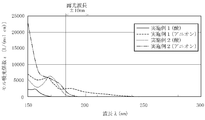
- the compounds of Examples 1 to 4 are expected to have a high acidity in which gas phase acidity ⁇ G satisfies the selection condition of 298 kcal / mol or less and protons are likely to dissociate.
- the compounds of Examples 1 to 4 satisfy the selection condition with a molar extinction coefficient ⁇ of 20000 L / (mol cm) or less in the exposure wavelength range of 193 nm ⁇ 10 nm, and are excellent in absorption characteristics related to acid generation efficiency. Be expected.
- the compounds of Comparative Examples 1 and 2 satisfy the selection conditions for the molar extinction coefficient ⁇ , but the gas phase acidity ⁇ G does not satisfy the selection conditions and does not show sufficient acid strength. Is used as a PAG, the sensitivity is poor and image formation may be poor.
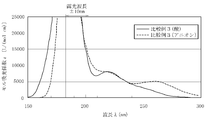
- the compound of Comparative Example 3 satisfies the selection conditions for gas phase acidity ⁇ G, but the molar extinction coefficient ⁇ does not satisfy the selection conditions, is inferior in acid generation efficiency, and when this compound is used as a PAG, There is a risk of not showing sufficient resolution.
- 2-alkyl-2-adamantyl (meth) acrylate generally used for ArF resist is used for the resin
- triethanolamine is used for the nitrogen-containing organic compound
- propylene glycol is used for the organic solvent.
- Monomethyl ether acetate (PGMEA) was used.
- a silicon wafer coated with an antireflection film (Brewer Science; ARC29) is prepared as a substrate, and the prepared resist composition is applied onto the substrate by spin coating, and 100 ° C. / A resist film having a thickness of 300 nm was formed by pre-baking in 60 seconds and drying.
- an ArF exposure apparatus Nakon Corp .; NRS-S302
- ArF excimer laser was irradiated to selectively expose through a mask.
- the film is heated at 100 ° C./60 seconds, further developed with a developer ZTMA100-5L (manufactured by ZEON Corporation) at 25 ° C. for 30 seconds, then rinsed with pure water and dried.
- a resist pattern having a line pattern of 110 nm was formed.
- the performance evaluation was performed by observing the formed line pattern with an SEM.
- the free energy change ⁇ G is calculated from the compound group having the most stable structure by the screening method of the present invention, the absorption spectrum is calculated, and the compound satisfying the selection condition is selected from the anion group. It was confirmed that it can be developed and manufactured efficiently.
- C 4 F 9 SO 3 H of Example 3 has a small molar extinction coefficient ⁇ and a sufficient acidity even at 243 nm, so that it can be used as a constituent of a photoacid generator in KrF excimer laser lithography. It is.
- the screening method for anions of the present invention can be used for efficiently developing and producing anion molecules constituting a photoacid generator used for a chemically amplified resist in a fine processing step.
Landscapes
- Physics & Mathematics (AREA)
- Engineering & Computer Science (AREA)
- General Physics & Mathematics (AREA)
- Medical Informatics (AREA)
- Chemical & Material Sciences (AREA)
- Computer Vision & Pattern Recognition (AREA)
- Data Mining & Analysis (AREA)
- Databases & Information Systems (AREA)
- Evolutionary Computation (AREA)
- General Health & Medical Sciences (AREA)
- Health & Medical Sciences (AREA)
- Software Systems (AREA)
- Artificial Intelligence (AREA)
- Crystallography & Structural Chemistry (AREA)
- Life Sciences & Earth Sciences (AREA)
- Bioinformatics & Cheminformatics (AREA)
- Bioinformatics & Computational Biology (AREA)
- Computing Systems (AREA)
- Theoretical Computer Science (AREA)
- Spectroscopy & Molecular Physics (AREA)
- Materials For Photolithography (AREA)
Abstract
本発明のアニオンのスクリーニング方法は、化学増幅型レジストに使用されるPAGを構成するアニオンを選別するための方法であり、構成要素となりうるアニオン群について、アニオンとその酸からなる化合物群に対して分子軌道計算を用い、化合物群の最安定構造を求める構造最適化工程と、最安定構造の化合物群に対して基準振動解析を行い、酸解離反応の自由エネルギー変化(ΔG)を算出する第1算出工程と、最安定構造の化合物群に対して吸収特性評価を行い、化合物群の吸収スペクトルを算出する第2算出工程と、上記算出した結果に基づいて、ΔGが298kcal/mol以下を満たし、かつ露光を行う波長をλ[nm]とし、λ±10nmの範囲におけるモル吸光係数をεとするとき、酸とアニオンがともにεが20000L/(mol cm)以下を満たす化合物を化合物群から選別する工程とを含む。この方法により、PAGにおけるアニオン分子を効率良く開発することができる。
Description
本発明は、微細加工工程の化学増幅型レジストに使用される光酸発生剤を構成するアニオン分子を効率良く開発・製造するためのスクリーニング方法に関する。
現在半導体微細加工技術として、ArFエキシマレーザー(波長193nm)等を露光光源とするフォトリソグラフィーでは、化学増幅型レジストが用いられている。
化学増幅型レジストでは、遠紫外光等の放射線照射による露光でレジスト中に含ませた光酸発生剤(Photo Acid Generator;以下、PAGという。)から強酸を発生させ、この強酸を触媒とするレジスト樹脂中の官能基の極性変化や架橋反応を利用して、照射部と非照射部の現像液に対する溶解性を変化させ、パターンを基板上に形成させる。
PAGは光を照射することにより酸を発生する機能を持つ感光剤であり、PAGに求められる物性や機能としては、酸発生効率(光吸収効率、光分解の量子効率)、レジスト樹脂中での分散性、発生酸の酸性度、発生酸の拡散性等が挙げられ、これらの諸特性が優れた材料が求められている。
その用途や目的に合わせて、効率の良い微細加工のために、現在も更に特性の優れたPAGの開発が行われている(例えば、特許文献1~3参照。)。
PAGは照射した光を吸収する部分と酸の発生源となる部分から構成され、イオン性を示すものと非イオン性を示すものがある。イオン性PAGは、カチオンとアニオンから構成され、用途や目的、要求性能に合わせてカチオンとアニオンが適宜選択される。カチオン部は照射された光を吸収する役割を果たす。また、アニオン部はレジスト樹脂と反応する酸触媒の役割を果たす酸の発生源となるため重要である。
フォトレジストにおいて、露光によりPAGはアニオンとカチオンに解離し、解離したアニオンは酸として働くが、その酸は一般的に超強酸であり、取扱いが容易ではないので、酸化合物そのものの性能評価を実験にて行うことは非常に難しい。
一方、PAGを合成して材料の評価を行うにも、露光装置等が必要で、ターゲット分子の合成から評価までに時間とコストがかかっていた。
本発明の目的は、PAGにおけるアニオン分子を効率良く開発・製造するためのスクリーニング方法を提供することにある。
本発明の第1の観点は、化学増幅型レジストに使用されるPAGを構成するアニオンを選別するためのスクリーニング方法であって、PAGの構成要素となりうるアニオン群について、アニオンとその酸からなる化合物群に対して分子軌道計算を用い、化合物群の最安定構造を求める構造最適化工程と、最安定構造の化合物群に対して基準振動解析を行い、それぞれの酸解離反応の自由エネルギー変化(ΔG)を算出する第1算出工程と、最安定構造の化合物群に対して吸収特性評価を行い、化合物群の吸収スペクトルを算出する第2算出工程と、第1及び第2算出工程でそれぞれ算出した結果に基づいて、自由エネルギー変化(ΔG)が298kcal/mol以下を満たし、かつ露光を行う波長をλ[nm]とし、λ±10nmの範囲におけるモル吸光係数をεとするとき、酸とアニオンがともにεが20000L/(mol cm)以下を満たす化合物を化合物群から選別する工程とを含むことを特徴とする。
本発明の第2の観点は、第1の観点に基づく発明であって、更に酸解離反応の自由エネルギー変化(ΔG)の算出が、最安定構造の化合物群のそれぞれのアニオン(A-)及びその酸(HA)に対して基準振動解析を行って自由エネルギーG(A-)及びG(HA)を算出し、算出したG(A-)及びG(HA)と、水素イオン(H+)の自由エネルギーG(H+)から、次の式(1)に示す式を用いて酸解離反応の自由エネルギー変化ΔGを求めることにより行われることを特徴とする。
ΔG = [G(H+) + G(A-)] - G(HA) (1)
本発明の第3の観点は、第1の観点に基づく発明であって、更に吸収特性評価による吸収スペクトルの算出が、最安定構造の化合物群のそれぞれのアニオン(A-)及びその酸(HA)に対して励起状態の計算を行って分子の吸収が起こる波長とその吸収における振動子強度を算出し、算出した吸収波長と振動子強度から、次の式(2)に示す式を用いて吸収スペクトルへの変換を行うことにより行われることを特徴とする。
本発明の第3の観点は、第1の観点に基づく発明であって、更に吸収特性評価による吸収スペクトルの算出が、最安定構造の化合物群のそれぞれのアニオン(A-)及びその酸(HA)に対して励起状態の計算を行って分子の吸収が起こる波長とその吸収における振動子強度を算出し、算出した吸収波長と振動子強度から、次の式(2)に示す式を用いて吸収スペクトルへの変換を行うことにより行われることを特徴とする。

本発明の第4の観点は、第1の観点に基づく発明であって、更にアニオン群がフッ素を含んでいることを特徴とする。
本発明の第5の観点は、第1の観点に基づく発明であって、更にアニオン群が置換基を導入し易い基を有していることを特徴とする。
本発明の第6の観点は、第1ないし第5の観点に基づくスクリーニング方法を用いてアニオン群から選別されたアニオンと、Li,Na又はKから選ばれた金属とから構成される化合物の製造方法である。
本発明の第7の観点は、第1ないし第5の観点に基づくスクリーニング方法を用いてアニオン群から選別されたアニオンと、Li,Na又はKから選ばれた金属とから構成された光酸発生剤の前駆体である金属塩である。
本発明の第8の観点は、第1ないし第5の観点に基づくスクリーニング方法を用いてアニオン群から選別されたアニオン及びその酸から構成された光酸発生剤の前駆体である塩である。
本発明のアニオンのスクリーニング方法では、PAGの構成要素となりうるアニオン群から、フォトレジスト工程において、露光後PAGより発生した酸が、レジスト材料と反応するのに十分な酸強度を持ち、露光を吸収することがない、適切な化合物を選別することができる。結果として、実験回数を減らすことができるため、時間とコストを抑えて、PAGを構成するアニオンを効率良く開発することができる。
次に本発明を実施するための形態を図面に基づいて説明する。
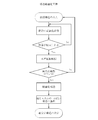
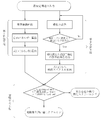
本発明のアニオンのスクリーニング方法は、化学増幅型レジストに使用されるPAGを構成するアニオンを選別するためのスクリーニング方法であり、図1に示す構造最適化工程と、図2に示す第1算出工程、第2算出工程及び選別する工程とを含むことを特徴とする。上記工程を経ることにより、PAGの構成要素となりうるアニオン群から、フォトレジスト工程において、露光後PAGより発生した酸が、レジスト材料と反応するのに十分な酸強度を持ち、露光を吸収することがない、適切な化合物を選別することができる。結果として、実験回数を減らすことができるため、時間とコストを抑えて、PAGを構成するアニオンを効率良く開発することができる。
<構造最適化工程>
先ず、光酸発生剤の構成要素となりうるアニオン群について、アニオンとその酸からなる化合物群に対して図1に示すようなフローで分子軌道(Molecular Orbital;MO)計算を用い、化合物群の最安定構造を求める。
<構造最適化工程>
先ず、光酸発生剤の構成要素となりうるアニオン群について、アニオンとその酸からなる化合物群に対して図1に示すようなフローで分子軌道(Molecular Orbital;MO)計算を用い、化合物群の最安定構造を求める。
PAGの構成要素となりうるアニオン群としては、フッ素を含んでいるアニオンを用意することが好適である。このようなフッ素含有化合物としては、有機化合物の電解フッ素化を行うことで得られる化合物が好適である。有機化合物の電解フッ素化は、例えば、電解槽に有機化合物、電解液及びフッ素化不活性溶媒を共存させ、電解反応することにより行われる。
また、アニオン群が置換基を導入し易い基を有していることが好適である。置換しやすい官能基としては、ヒドロキシ基、エーテル基、カルボニル基、カルボキシ基、エステル基、アミノ基、スルホ基、スルホニル基が挙げられる。
最安定構造を求める際に使用する分子軌道計算とは、対象分子におけるシュレーディンガーの波動方程式の近似解法であり、この解より電子状態に起因するエネルギーや分子の性質を予測するものである。
この構造最適化工程での分子軌道計算には、半経験的分子軌道法、非経験的分子軌道法、更には密度汎関数法(Density Functional Theory;DFT)を用いてもよい。半経験的分子軌道法としてはPPP(Pariser-Parr-Pople)法、INDO(Intermediate Neglect of Differential Overlap)法、AM1(Austin Model 1)法、PM3(Parametric Method 3)法等が挙げられる。非経験的分子軌道法としてはHF(Hertree-Fock)法、MPn(Moller-Plesset)法(n=2,3,4,……)、CI(Configuration interaction)法等が挙げられる。密度汎関数法としては、B3LYP、PBEPBE法等が挙げられる。その中でも非経験的分子軌道法ではMP2法、密度汎関数法ではB3LYP法が好ましい。また、基底関数については、分極関数を含んだものを用いるのがよく、例えば6-311+G(d,p)やaug-cc-pvDz等がある。また、この分子軌道計算には、GaussianやGAMESS等のプログラムが使用される。
具体的には、先ず、アニオンとその酸からなる化合物群について、分子の初期構造をそれぞれ入力し、構造の最適化計算を行う。計算が収束していない場合、再度構造の最適化計算を行う。次に、収束した計算結果を基に基準振動解析を行い、負の振動数を持っていないことを確認する。負の振動数を持っている場合は、再び初期構造の入力に戻り、負の振動数を持っていない場合は、その結果を最適化構造とする。なお、最適化構造は計算の入力条件である初期構造に依存する。従って、幾つかの初期構造で最適化構造を複数求め、最もエネルギーが安定なものを選択し、これを最安定構造とする。
<第1算出工程>
次いで、最安定構造の化合物群に対して図2に示すようなフローで基準振動解析を行い、それぞれの酸解離反応の自由エネルギー変化(ΔG)を算出する。この第1算出工程で酸解離反応の自由エネルギー変化(ΔG)を算出するのは、化学増幅型レジストで使用されるPAGに要求される特性として、露光により発生する酸の酸性度があり、この発生酸の酸性度は、酸分解の反応に関わり、酸性度が低いと酸分解が有効に進行せず、画像形成が不良となるためである。
<第1算出工程>
次いで、最安定構造の化合物群に対して図2に示すようなフローで基準振動解析を行い、それぞれの酸解離反応の自由エネルギー変化(ΔG)を算出する。この第1算出工程で酸解離反応の自由エネルギー変化(ΔG)を算出するのは、化学増幅型レジストで使用されるPAGに要求される特性として、露光により発生する酸の酸性度があり、この発生酸の酸性度は、酸分解の反応に関わり、酸性度が低いと酸分解が有効に進行せず、画像形成が不良となるためである。
酸解離反応の自由エネルギー変化(ΔG)の算出は、先ず、最安定構造の化合物群のそれぞれのアニオン(A-)及びその酸(HA)に対して基準振動解析を行って自由エネルギーG(A-)及びG(HA)を算出する。ここでの基準振動解析は、上記構造最適化工程で行われる計算手法と同じ計算手法を用いる必要がある。通常、上記構造最適化工程で行われる負の振動数を持っていないか調べるための基準振動解析の計算で、自由エネルギーの計算結果は得られる。なお、自由エネルギーを求める際の温度及び圧力は25℃、1atmとする。
次に、算出したG(A-)及びG(HA)と、水素イオン(H+)の自由エネルギーG(H+)から、次の式(1)に示す式を用いて酸解離反応の自由エネルギー変化ΔGを算出する。H+の自由エネルギーは-6.27kcal/molとする。
HA ⇔ H+ + A-
ΔG = [G(H+) + G(A-)] - G(HA) (1)
算出したΔGは、酸(HA)の脱プロトン時のギブズの自由エネルギー変化であり、気相中での酸(HA)の酸性度を示す。このΔGの値が小さいほどプロトンの解離が起こり易い。つまり、酸(HA)の酸性度が高いことを示している。
ΔG = [G(H+) + G(A-)] - G(HA) (1)
算出したΔGは、酸(HA)の脱プロトン時のギブズの自由エネルギー変化であり、気相中での酸(HA)の酸性度を示す。このΔGの値が小さいほどプロトンの解離が起こり易い。つまり、酸(HA)の酸性度が高いことを示している。
なお、全電子エネルギーのみを上記構造最適化工程やこの第1算出工程の自由エネルギー算出で用いた計算手法よりも、精度の高い計算手法を用いることも可能である。
<第2算出工程>
次に、最安定構造の化合物群に対して図2に示すようなフローで吸収特性評価を行い、化合物群の吸収スペクトルを算出する。この第2算出工程で化合物群の吸収スペクトルを算出するのは、化学増幅型レジストで使用されるPAGに要求される特性として酸発生効率(光吸収効率)があり、この酸発生効率(光吸収効率)は、樹脂の酸分解性保護基を分解するのに必要な有効酸量に関わり、レジスト感度に直接反映されるためである。効率良く酸が発生する、即ち光の利用率を高めるためには、PAGが適度な吸収度を示し、発生する酸は光を吸収しない方が良い。
<第2算出工程>
次に、最安定構造の化合物群に対して図2に示すようなフローで吸収特性評価を行い、化合物群の吸収スペクトルを算出する。この第2算出工程で化合物群の吸収スペクトルを算出するのは、化学増幅型レジストで使用されるPAGに要求される特性として酸発生効率(光吸収効率)があり、この酸発生効率(光吸収効率)は、樹脂の酸分解性保護基を分解するのに必要な有効酸量に関わり、レジスト感度に直接反映されるためである。効率良く酸が発生する、即ち光の利用率を高めるためには、PAGが適度な吸収度を示し、発生する酸は光を吸収しない方が良い。
吸収特性評価による吸収スペクトルの算出は、上記最安定構造の化合物群について、それぞれのアニオン(A-)及びその酸(HA)に対して励起状態の計算を行う。この計算により、分子の吸収が起こる波長とその吸収における振動子強度が算出される。
励起状態計算としては現在の計算機の性能を考えると、時間依存(Time-dependent;TD)法が適しているが、その他の方法、例えば、MCQDPT(Multi configurational quasi-degenerate perturbation theory)法やMS-CASPT2法、MRMP2法等を用いることも可能である。なお、励起状態計算は、対象としている波長領域が十分にカバーされるように計算する必要がある。
次に、算出した吸収波長と振動子強度から、次の式(2)に示す式を用いて吸収スペクトルへの変換を行う。

より具体的には、励起状態計算よりあるnに対して、1組のλnとfnが求められる。あるnに対応するλnとfnを式(2)に代入し、h、c、δも合わせて代入する。λは、注目している波長を十分にカバーする範囲で設定し、設定した範囲で細かく分割する。そのように決められたλに対してεn(λ)を決定する。その作業を全てのnに対して繰り返し行う。求められた全てのεn(λ)について、λごとにεn(λ)を全て足し込む。そうすると、λに対するモル吸光係数εの関係が得られ、吸収スペクトルの変換を行うことができる。得られるモル吸光係数の単位はL/(mol cm)である。
なお、計算手法によっては、数十nmほど吸収ピークにシフトが起こる可能性がある。そのため、類似構造の化合物で吸収スペクトルを測定し、計算に用いようとする計算手法との比較を行い、その差を前もって見積もっておき、その差を考慮して吸収の評価を行うと、より効果的なスクリーニングが可能である。
<算出する工程>
更に、図2に示すように、第1及び第2算出工程でそれぞれ算出した結果に基づいて、自由エネルギー変化(ΔG)が298kcal/mol以下を満たし、かつ露光を行う波長をλ[nm]とし、λ±10nmの範囲におけるモル吸光係数をεとするとき、酸とアニオンがともにεが20000L/(mol cm)以下を満たす化合物を化合物群から選別する。このモル吸光係数εの選別条件で、露光を行う波長の前後に幅を持たせているのは、上記第2算出工程で述べたが、計算手法によっては、数十nmほど吸収ピークにシフトが起こる可能性があるためである。
<算出する工程>
更に、図2に示すように、第1及び第2算出工程でそれぞれ算出した結果に基づいて、自由エネルギー変化(ΔG)が298kcal/mol以下を満たし、かつ露光を行う波長をλ[nm]とし、λ±10nmの範囲におけるモル吸光係数をεとするとき、酸とアニオンがともにεが20000L/(mol cm)以下を満たす化合物を化合物群から選別する。このモル吸光係数εの選別条件で、露光を行う波長の前後に幅を持たせているのは、上記第2算出工程で述べたが、計算手法によっては、数十nmほど吸収ピークにシフトが起こる可能性があるためである。
ここで、第1算出工程から算出されたΔGについて、選別条件を298kcal/mol以下を満たすこととしたのは、ΔGが上記数値を越えると、発生酸の酸強度が、レジスト樹脂中の官能基の極性変化や架橋反応が十分に起こらず、目的の微細加工が行えないためである。また、第2算出工程から算出された光吸収スペクトルについて、選別条件を酸とアニオンがともにモル吸光係数εが20000 L/(mol cm)以下を満たすこととしたのは、モル吸光係数εが上記数値を越えると、アニオンが露光を吸収してしまい、PAGから効率よく酸が発生することができないためである。
なお、用意した化合物群の全てが選別から外れてしまった場合は、異なる化合物で再度スクリーニングを行うこととなる。
次に本発明の実施例を比較例とともに詳しく説明する。
<実施例1~4,比較例1~3>
・構造最適化工程と第1算出工程
先ず、光酸発生剤の構成要素となりうるアニオン群として、次の表1に示す化合物を用意した。
・構造最適化工程と第1算出工程
先ず、光酸発生剤の構成要素となりうるアニオン群として、次の表1に示す化合物を用意した。
次いで、用意したアニオン群について、アニオンとその酸からなる化合物群に対してGaussian09プログラムによりB3LYP/6-311+G(d,p)を用いて、初期構造を幾つか変えて、構造の最適化計算、基準振動解析を行い、更に、負の振動数を持たないか確認した上で、最適化構造を数種求めた。その中でエネルギーの最も安定な構造を選択し、これを最安定構造とした。
次に、最安定構造の化合物群に対して、それらの構造の基準振動解析結果より得られる自由エネルギーと上記式(1)を用いて気相酸性度ΔGを求めた。なお、H+の自由エネルギーは-6.27kcal/molとした。
また、幾つかの実施例,比較例については、上記B3LYP/6-311+G(d,p)以外の方法(HF/6-311+G(d,p)とMP2/aug-cc-pvDz)を用いて気相酸性度ΔGを求めた。それらの結果を表1に示す。
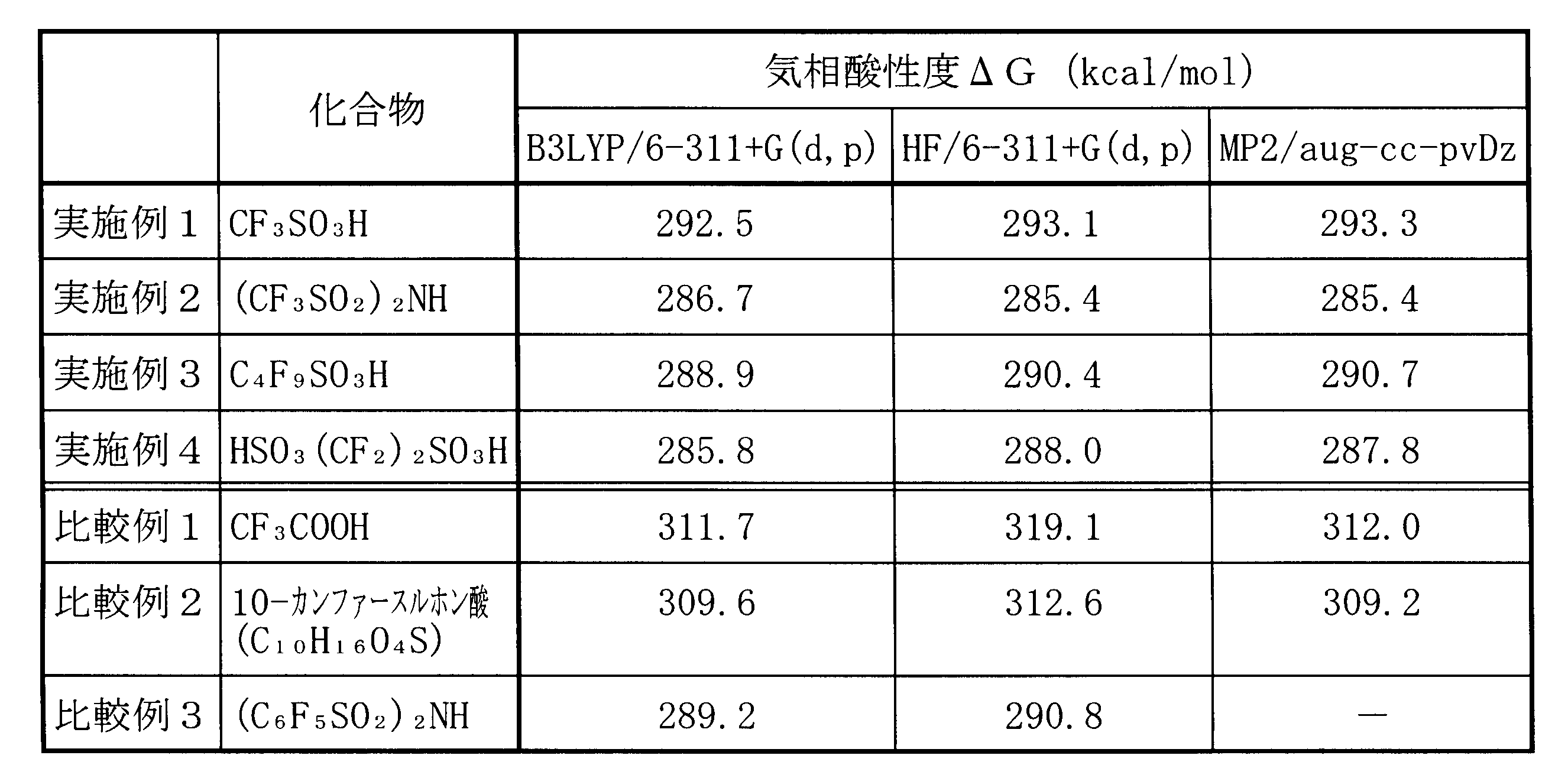
次に、上記最安定構造の化合物群のアニオンと酸に対して吸収特性評価を行い、化合物群の吸収スペクトルを算出した。なお、最安定構造はB3LYP/6-311+G(d,p)により求められた構造を用いた。吸収波長と振動子強度の算出で行われた励起状態の計算は、TD法を用いてTD-B3LYP/6-311+G(d,p)により行った。算出された吸収波長と振動子強度を基に上記式(2)に示す式を用いて吸収スペクトルへの変換を行った。
なお、Gaussianでは計算する励起状態の数を指定する必要がある(nstateキーワード)が、ここではArFエキシマレーザーリソグラフィーでのPAGとして用いることを考え、対象とする193nmの領域が十分に計算されるように、比較例3では75を指定し、それ以外は50を指定して計算を行った。Gaussian09より得られた吸収波長と振動子強度の結果を上記式(2)を用いてスペクトル形状に変換してスペクトルを得た。ここで、スペクトル変換時のλは、0~400nmの範囲で0.5nm刻みで計算した。実施例1~4及び比較例1~3のアニオンと酸の光吸収スペクトルを図3~図6に示す。
・選別する工程
次に上記第1算出工程及び第2算出工程でそれぞれ算出した結果に基づいて化合物群の選別を行った。選別条件は、気相酸性度ΔGが298kcal/mol以下、露光波長λ±10nmの範囲におけるモル吸光係数εが20000L/(mol cm)以下である。なお、ここではArFエキシマレーザーリソグラフィーでのPAGとして用いることを考え、露光波長λを193nmに設定した。その結果を次の表2に示す。
・選別する工程
次に上記第1算出工程及び第2算出工程でそれぞれ算出した結果に基づいて化合物群の選別を行った。選別条件は、気相酸性度ΔGが298kcal/mol以下、露光波長λ±10nmの範囲におけるモル吸光係数εが20000L/(mol cm)以下である。なお、ここではArFエキシマレーザーリソグラフィーでのPAGとして用いることを考え、露光波長λを193nmに設定した。その結果を次の表2に示す。

一方、比較例1,2の化合物ではモル吸光係数εの選別条件は満たしているが、気相酸性度ΔGが選別条件を満たしておらず、十分な酸強度を示していないため、これらの化合物をPAGとして使用した場合、感度が悪く、画像形成が不良になるおそれがある。また、比較例3の化合物では気相酸性度ΔGの選別条件は満たしているが、モル吸光係数εが選別条件を満たしておらず、酸発生効率に劣り、この化合物をPAGとして使用した場合、十分な解像度を示さないおそれがある。
・レジストにおける性能評価
次に、スクリーニングしたアニオン分子のうち、実施例3のC4F9SO3H(以下、PAG-1という。)及び比較例2の10-カンファースルホン酸(以下、PAG-2という。)をそれぞれPAGとして用いてポジ型フォトレジスト組成物を調製した後、レジストパターンを形成して評価した。
・レジストにおける性能評価
次に、スクリーニングしたアニオン分子のうち、実施例3のC4F9SO3H(以下、PAG-1という。)及び比較例2の10-カンファースルホン酸(以下、PAG-2という。)をそれぞれPAGとして用いてポジ型フォトレジスト組成物を調製した後、レジストパターンを形成して評価した。
なおフォトレジスト組成物の調製では、樹脂にはArFレジストで一般的に用いられる2-アルキル-2-アダマンチル(メタ)アクリレートを、含窒素有機化合物にはトリエタノールアミンを、有機溶剤にはプロピレングリコールモノメチルエーテルアセテート(PGMEA)を用いた。
またレジストパターン形成では、先ず、反射防止膜(Brewer Science社製;ARC29)を塗布したシリコンウェハーを基板として用意し、この基板上に上記調製したレジスト組成物をスピンコートにより塗布し、100℃/60秒でプレベークして、乾燥させることにより、膜厚300nmのレジスト膜を形成した。次いで、露光機にはArF露光装置(Nikon社製;NRS-S302)を用い、ArFエキシマレーザーを照射してマスクを介して選択的に露光した。そして、露光後、100℃/60秒で加熱し、更に、25℃にて現像液ZTMA100-5L(日本ゼオン社製)で30秒間現像し、その後、純水でリンスし、乾燥を行うことで、110nmのラインパターンを有するレジストパターンを形成した。
また性能評価は、形成したラインパターンをSEM観察することにより行った。
PAG-1を導入したレジストでは良好な解像度が得られるのに対し、PAG-2を導入したレジストでは十分な解像度が得られていないことが確認された。つまり、「ΔG≦298kcal/mol」と「ε≦20000L/(mol cm)(193±10nm)」の選別条件でスクリーニングした実施例3のC4F9SO3HはPAGとして優れたレジスト特性を示し、条件を満たさない比較例2の10-カンファースルホン酸はPAGとして十分なレジスト特性を示さないことが判った。
以上、本発明のスクリーニング方法により、最安定構造の化合物群から自由エネルギー変化ΔGを算出し、吸収スペクトルを算出し、選別条件を満たす化合物をアニオン群から選別することで、PAGに適したアニオン分子を効率よく開発・製造することができることが確認された。
なお、実施例3のC4F9SO3Hは、243nmにおいてもモル吸光係数εが小さく、酸性度も十分であるのでKrFエキシマレーザーリソグラフィーでの光酸発生剤の構成要素で用いることも可能である。
本発明のアニオンのスクリーニング方法は、微細加工工程の化学増幅型レジストに使用される光酸発生剤を構成するアニオン分子を効率良く開発・製造する際に利用できる。
Claims (8)
- 化学増幅型レジストに使用される光酸発生剤を構成するアニオンを選別するためのスクリーニング方法であって、
前記光酸発生剤の構成要素となりうるアニオン群について、アニオンとその酸からなる化合物群に対して分子軌道計算を用い、前記化合物群の最安定構造を求める構造最適化工程と、
前記最安定構造の化合物群に対して基準振動解析を行い、それぞれの酸解離反応の自由エネルギー変化(ΔG)を算出する第1算出工程と、
前記最安定構造の化合物群に対して吸収特性評価を行い、前記化合物群の吸収スペクトルを算出する第2算出工程と、
前記第1及び第2算出工程でそれぞれ算出した結果に基づいて、自由エネルギー変化(ΔG)が298kcal/mol以下を満たし、かつ露光を行う波長をλ[nm]とし、λ±10nmの範囲におけるモル吸光係数をεとするとき、酸とアニオンがともにεが20000L/(mol cm)以下を満たす化合物を前記化合物群から選別する工程と
を含むことを特徴とするアニオンのスクリーニング方法。 - 前記酸解離反応の自由エネルギー変化(ΔG)の算出が、
前記最安定構造の化合物群のそれぞれのアニオン(A-)及びその酸(HA)に対して基準振動解析を行って自由エネルギーG(A-)及びG(HA)を算出し、
前記算出したG(A-)及びG(HA)と、水素イオン(H+)の自由エネルギーG(H+)から、次の式(1)に示す式を用いて酸解離反応の自由エネルギー変化ΔGを求めることにより行われる請求項1記載のスクリーニング方法。
ΔG = [G(H+) + G(A-)] - G(HA) (1) - 前記吸収特性評価による吸収スペクトルの算出が、
前記最安定構造の化合物群のそれぞれのアニオン(A-)及びその酸(HA)に対して励起状態の計算を行って分子の吸収が起こる波長とその吸収における振動子強度を算出し、
前記算出した吸収波長と振動子強度から、次の式(2)に示す式を用いて吸収スペクトルへの変換を行うことにより行われる請求項1記載のスクリーニング方法。

- 前記アニオン群がフッ素を含んでいる請求項1記載のスクリーニング方法。
- 前記アニオン群が置換基を導入し易い基を有している請求項1記載のスクリーニング方法。
- 請求項1ないし5いずれか1項に記載のスクリーニング方法を用いて前記アニオン群から選別されたアニオンと、Li,Na又はKから選ばれた金属とから構成される化合物の製造方法。
- 請求項1ないし5いずれか1項に記載のスクリーニング方法を用いて前記アニオン群から選別されたアニオンと、Li,Na又はKから選ばれた金属とから構成された光酸発生剤の前駆体である金属塩。
- 請求項1ないし5いずれか1項に記載のスクリーニング方法を用いて前記アニオン群から選別されたアニオン及びその酸から構成された光酸発生剤の前駆体である塩。
Priority Applications (1)
| Application Number | Priority Date | Filing Date | Title |
|---|---|---|---|
| JP2012504969A JP5283782B2 (ja) | 2011-03-30 | 2012-01-30 | アニオンのスクリーニング方法 |
Applications Claiming Priority (2)
| Application Number | Priority Date | Filing Date | Title |
|---|---|---|---|
| JP2011-075681 | 2011-03-30 | ||
| JP2011075681 | 2011-03-30 |
Publications (1)
| Publication Number | Publication Date |
|---|---|
| WO2012132529A1 true WO2012132529A1 (ja) | 2012-10-04 |
Family
ID=46930296
Family Applications (1)
| Application Number | Title | Priority Date | Filing Date |
|---|---|---|---|
| PCT/JP2012/051911 Ceased WO2012132529A1 (ja) | 2011-03-30 | 2012-01-30 | アニオンのスクリーニング方法 |
Country Status (2)
| Country | Link |
|---|---|
| JP (1) | JP5283782B2 (ja) |
| WO (1) | WO2012132529A1 (ja) |
Cited By (1)
| Publication number | Priority date | Publication date | Assignee | Title |
|---|---|---|---|---|
| CN115579077A (zh) * | 2022-10-20 | 2023-01-06 | 多氟多新材料股份有限公司 | 一种基于密度泛函理论设计筛选新型钠盐的方法 |
Citations (5)
| Publication number | Priority date | Publication date | Assignee | Title |
|---|---|---|---|---|
| WO2004065377A1 (ja) * | 2003-01-22 | 2004-08-05 | Jsr Corporation | スルホニウム塩化合物、感放射線性酸発生剤およびポジ型感放射線性樹脂組成物 |
| JP2005331714A (ja) * | 2004-05-20 | 2005-12-02 | Sumitomo Chemical Co Ltd | 酸発生剤の選別方法 |
| JP2007241121A (ja) * | 2006-03-10 | 2007-09-20 | Lion Corp | 極端紫外線用レジスト組成物 |
| JP2009143852A (ja) * | 2007-12-14 | 2009-07-02 | Asahi Glass Co Ltd | 新規な電解質および含フッ素化合物 |
| JP2010139662A (ja) * | 2008-12-10 | 2010-06-24 | Tokyo Ohka Kogyo Co Ltd | レジスト組成物、レジストパターン形成方法、新規な化合物および酸発生剤 |
-
2012
- 2012-01-30 JP JP2012504969A patent/JP5283782B2/ja not_active Expired - Fee Related
- 2012-01-30 WO PCT/JP2012/051911 patent/WO2012132529A1/ja not_active Ceased
Patent Citations (5)
| Publication number | Priority date | Publication date | Assignee | Title |
|---|---|---|---|---|
| WO2004065377A1 (ja) * | 2003-01-22 | 2004-08-05 | Jsr Corporation | スルホニウム塩化合物、感放射線性酸発生剤およびポジ型感放射線性樹脂組成物 |
| JP2005331714A (ja) * | 2004-05-20 | 2005-12-02 | Sumitomo Chemical Co Ltd | 酸発生剤の選別方法 |
| JP2007241121A (ja) * | 2006-03-10 | 2007-09-20 | Lion Corp | 極端紫外線用レジスト組成物 |
| JP2009143852A (ja) * | 2007-12-14 | 2009-07-02 | Asahi Glass Co Ltd | 新規な電解質および含フッ素化合物 |
| JP2010139662A (ja) * | 2008-12-10 | 2010-06-24 | Tokyo Ohka Kogyo Co Ltd | レジスト組成物、レジストパターン形成方法、新規な化合物および酸発生剤 |
Cited By (1)
| Publication number | Priority date | Publication date | Assignee | Title |
|---|---|---|---|---|
| CN115579077A (zh) * | 2022-10-20 | 2023-01-06 | 多氟多新材料股份有限公司 | 一种基于密度泛函理论设计筛选新型钠盐的方法 |
Also Published As
| Publication number | Publication date |
|---|---|
| JPWO2012132529A1 (ja) | 2014-07-24 |
| JP5283782B2 (ja) | 2013-09-04 |
Similar Documents
| Publication | Publication Date | Title |
|---|---|---|
| KR102148074B1 (ko) | 레지스트 재료 및 패턴 형성 방법 | |
| JP6648726B2 (ja) | レジスト材料及びパターン形成方法 | |
| JP6720926B2 (ja) | レジスト材料及びパターン形成方法 | |
| JP6028716B2 (ja) | レジスト材料及びパターン形成方法 | |
| JP7318129B2 (ja) | 感活性光線性又は感放射線性樹脂組成物、レジスト膜、パターン形成方法、電子デバイスの製造方法 | |
| KR20200032659A (ko) | 레지스트 재료 및 패턴 형성 방법 | |
| JP2017219836A (ja) | レジスト材料及びパターン形成方法 | |
| WO2022024928A1 (ja) | 感活性光線性又は感放射線性樹脂組成物、レジスト膜、パターン形成方法、電子デバイスの製造方法 | |
| JP2018087971A (ja) | 化学増幅レジスト材料及びパターン形成方法 | |
| Peng et al. | Molecular glass photoresists with high resolution, low LER, and high sensitivity for EUV lithography | |
| EP4282886A1 (en) | Actinic-ray-sensitive or radiation-sensitive resin composition, actinic-ray-sensitive or radiation-sensitive film, method for forming pattern, method for producing electronic device, compound, and resin | |
| EP4282885A1 (en) | Actinic-ray-sensitive or radiation-sensitive resin composition, actinic-ray-sensitive or radiation-sensitive film, method for forming pattern, and method for producing electronic device | |
| EP4159716A1 (en) | Actinic-ray-sensitive or radiation-sensitive resin composition, pattern formation method, resist film, electronic device manufacturing method, compound, and compound production method | |
| JP2018084812A (ja) | 化学増幅レジスト材料及びパターン形成方法 | |
| WO2022024929A1 (ja) | 感活性光線性又は感放射線性樹脂組成物、レジスト膜、パターン形成方法、電子デバイスの製造方法 | |
| Grzeskowiak et al. | Polymer effects on PAG acid yield in EUV resists | |
| KR20230139332A (ko) | 레지스트 재료 및 패턴 형성 방법 | |
| Ayothi et al. | Arylonium photoacid generators containing environmentally compatible aryloxyperfluoroalkanesulfonate groups | |
| KR20220142364A (ko) | 레지스트 재료 및 패턴 형성 방법 | |
| WO2022070997A1 (ja) | 感活性光線性又は感放射線性樹脂組成物、レジスト膜、パターン形成方法、電子デバイスの製造方法 | |
| JP7794190B2 (ja) | 半導体基板の製造方法及びレジスト下層膜形成用組成物 | |
| JP5283782B2 (ja) | アニオンのスクリーニング方法 | |
| KR20230139333A (ko) | 레지스트 재료 및 패턴 형성 방법 | |
| EP4446811A1 (en) | Actinic-ray-sensitive or radiation-sensitive resin composition, resist film, method for forming pattern, and method for producing electronic device | |
| Vesters et al. | Sensitizers in EUV chemically amplified resist: mechanism of sensitivity improvement |
Legal Events
| Date | Code | Title | Description |
|---|---|---|---|
| ENP | Entry into the national phase |
Ref document number: 2012504969 Country of ref document: JP Kind code of ref document: A |
|
| 121 | Ep: the epo has been informed by wipo that ep was designated in this application |
Ref document number: 12763130 Country of ref document: EP Kind code of ref document: A1 |
|
| NENP | Non-entry into the national phase |
Ref country code: DE |
|
| 122 | Ep: pct application non-entry in european phase |
Ref document number: 12763130 Country of ref document: EP Kind code of ref document: A1 |