WO2012128246A1 - 液晶ポリエステル成形体の製造方法 - Google Patents
液晶ポリエステル成形体の製造方法 Download PDFInfo
- Publication number
- WO2012128246A1 WO2012128246A1 PCT/JP2012/056996 JP2012056996W WO2012128246A1 WO 2012128246 A1 WO2012128246 A1 WO 2012128246A1 JP 2012056996 W JP2012056996 W JP 2012056996W WO 2012128246 A1 WO2012128246 A1 WO 2012128246A1
- Authority
- WO
- WIPO (PCT)
- Prior art keywords
- liquid crystal
- crystal polyester
- group
- mol
- producing
- Prior art date
- Legal status (The legal status is an assumption and is not a legal conclusion. Google has not performed a legal analysis and makes no representation as to the accuracy of the status listed.)
- Ceased
Links
Images
Classifications
-
- C—CHEMISTRY; METALLURGY
- C08—ORGANIC MACROMOLECULAR COMPOUNDS; THEIR PREPARATION OR CHEMICAL WORKING-UP; COMPOSITIONS BASED THEREON
- C08J—WORKING-UP; GENERAL PROCESSES OF COMPOUNDING; AFTER-TREATMENT NOT COVERED BY SUBCLASSES C08B, C08C, C08F, C08G or C08H
- C08J5/00—Manufacture of articles or shaped materials containing macromolecular substances
-
- B—PERFORMING OPERATIONS; TRANSPORTING
- B29—WORKING OF PLASTICS; WORKING OF SUBSTANCES IN A PLASTIC STATE IN GENERAL
- B29C—SHAPING OR JOINING OF PLASTICS; SHAPING OF MATERIAL IN A PLASTIC STATE, NOT OTHERWISE PROVIDED FOR; AFTER-TREATMENT OF THE SHAPED PRODUCTS, e.g. REPAIRING
- B29C48/00—Extrusion moulding, i.e. expressing the moulding material through a die or nozzle which imparts the desired form; Apparatus therefor
- B29C48/03—Extrusion moulding, i.e. expressing the moulding material through a die or nozzle which imparts the desired form; Apparatus therefor characterised by the shape of the extruded material at extrusion
- B29C48/05—Filamentary, e.g. strands
-
- B—PERFORMING OPERATIONS; TRANSPORTING
- B29—WORKING OF PLASTICS; WORKING OF SUBSTANCES IN A PLASTIC STATE IN GENERAL
- B29C—SHAPING OR JOINING OF PLASTICS; SHAPING OF MATERIAL IN A PLASTIC STATE, NOT OTHERWISE PROVIDED FOR; AFTER-TREATMENT OF THE SHAPED PRODUCTS, e.g. REPAIRING
- B29C48/00—Extrusion moulding, i.e. expressing the moulding material through a die or nozzle which imparts the desired form; Apparatus therefor
- B29C48/03—Extrusion moulding, i.e. expressing the moulding material through a die or nozzle which imparts the desired form; Apparatus therefor characterised by the shape of the extruded material at extrusion
- B29C48/07—Flat, e.g. panels
- B29C48/08—Flat, e.g. panels flexible, e.g. films
-
- B—PERFORMING OPERATIONS; TRANSPORTING
- B29—WORKING OF PLASTICS; WORKING OF SUBSTANCES IN A PLASTIC STATE IN GENERAL
- B29C—SHAPING OR JOINING OF PLASTICS; SHAPING OF MATERIAL IN A PLASTIC STATE, NOT OTHERWISE PROVIDED FOR; AFTER-TREATMENT OF THE SHAPED PRODUCTS, e.g. REPAIRING
- B29C48/00—Extrusion moulding, i.e. expressing the moulding material through a die or nozzle which imparts the desired form; Apparatus therefor
- B29C48/25—Component parts, details or accessories; Auxiliary operations
- B29C48/27—Cleaning; Purging; Avoiding contamination
- B29C48/2725—Cleaning; Purging; Avoiding contamination of filters
-
- B—PERFORMING OPERATIONS; TRANSPORTING
- B29—WORKING OF PLASTICS; WORKING OF SUBSTANCES IN A PLASTIC STATE IN GENERAL
- B29C—SHAPING OR JOINING OF PLASTICS; SHAPING OF MATERIAL IN A PLASTIC STATE, NOT OTHERWISE PROVIDED FOR; AFTER-TREATMENT OF THE SHAPED PRODUCTS, e.g. REPAIRING
- B29C48/00—Extrusion moulding, i.e. expressing the moulding material through a die or nozzle which imparts the desired form; Apparatus therefor
- B29C48/25—Component parts, details or accessories; Auxiliary operations
- B29C48/36—Means for plasticising or homogenising the moulding material or forcing it through the nozzle or die
- B29C48/50—Details of extruders
- B29C48/69—Filters or screens for the moulding material
- B29C48/694—Cylindrical or conical filters
-
- B—PERFORMING OPERATIONS; TRANSPORTING
- B29—WORKING OF PLASTICS; WORKING OF SUBSTANCES IN A PLASTIC STATE IN GENERAL
- B29C—SHAPING OR JOINING OF PLASTICS; SHAPING OF MATERIAL IN A PLASTIC STATE, NOT OTHERWISE PROVIDED FOR; AFTER-TREATMENT OF THE SHAPED PRODUCTS, e.g. REPAIRING
- B29C48/00—Extrusion moulding, i.e. expressing the moulding material through a die or nozzle which imparts the desired form; Apparatus therefor
- B29C48/001—Combinations of extrusion moulding with other shaping operations
- B29C48/0017—Combinations of extrusion moulding with other shaping operations combined with blow-moulding or thermoforming
-
- B—PERFORMING OPERATIONS; TRANSPORTING
- B29—WORKING OF PLASTICS; WORKING OF SUBSTANCES IN A PLASTIC STATE IN GENERAL
- B29C—SHAPING OR JOINING OF PLASTICS; SHAPING OF MATERIAL IN A PLASTIC STATE, NOT OTHERWISE PROVIDED FOR; AFTER-TREATMENT OF THE SHAPED PRODUCTS, e.g. REPAIRING
- B29C48/00—Extrusion moulding, i.e. expressing the moulding material through a die or nozzle which imparts the desired form; Apparatus therefor
- B29C48/001—Combinations of extrusion moulding with other shaping operations
- B29C48/0018—Combinations of extrusion moulding with other shaping operations combined with shaping by orienting, stretching or shrinking, e.g. film blowing
-
- B—PERFORMING OPERATIONS; TRANSPORTING
- B29—WORKING OF PLASTICS; WORKING OF SUBSTANCES IN A PLASTIC STATE IN GENERAL
- B29C—SHAPING OR JOINING OF PLASTICS; SHAPING OF MATERIAL IN A PLASTIC STATE, NOT OTHERWISE PROVIDED FOR; AFTER-TREATMENT OF THE SHAPED PRODUCTS, e.g. REPAIRING
- B29C48/00—Extrusion moulding, i.e. expressing the moulding material through a die or nozzle which imparts the desired form; Apparatus therefor
- B29C48/25—Component parts, details or accessories; Auxiliary operations
- B29C48/256—Exchangeable extruder parts
-
- B—PERFORMING OPERATIONS; TRANSPORTING
- B29—WORKING OF PLASTICS; WORKING OF SUBSTANCES IN A PLASTIC STATE IN GENERAL
- B29C—SHAPING OR JOINING OF PLASTICS; SHAPING OF MATERIAL IN A PLASTIC STATE, NOT OTHERWISE PROVIDED FOR; AFTER-TREATMENT OF THE SHAPED PRODUCTS, e.g. REPAIRING
- B29C48/00—Extrusion moulding, i.e. expressing the moulding material through a die or nozzle which imparts the desired form; Apparatus therefor
- B29C48/25—Component parts, details or accessories; Auxiliary operations
- B29C48/36—Means for plasticising or homogenising the moulding material or forcing it through the nozzle or die
- B29C48/395—Means for plasticising or homogenising the moulding material or forcing it through the nozzle or die using screws surrounded by a cooperating barrel, e.g. single screw extruders
- B29C48/40—Means for plasticising or homogenising the moulding material or forcing it through the nozzle or die using screws surrounded by a cooperating barrel, e.g. single screw extruders using two or more parallel screws or at least two parallel non-intermeshing screws, e.g. twin screw extruders
-
- B—PERFORMING OPERATIONS; TRANSPORTING
- B29—WORKING OF PLASTICS; WORKING OF SUBSTANCES IN A PLASTIC STATE IN GENERAL
- B29K—INDEXING SCHEME ASSOCIATED WITH SUBCLASSES B29B, B29C OR B29D, RELATING TO MOULDING MATERIALS OR TO MATERIALS FOR MOULDS, REINFORCEMENTS, FILLERS OR PREFORMED PARTS, e.g. INSERTS
- B29K2067/00—Use of polyesters or derivatives thereof, as moulding material
-
- C—CHEMISTRY; METALLURGY
- C08—ORGANIC MACROMOLECULAR COMPOUNDS; THEIR PREPARATION OR CHEMICAL WORKING-UP; COMPOSITIONS BASED THEREON
- C08J—WORKING-UP; GENERAL PROCESSES OF COMPOUNDING; AFTER-TREATMENT NOT COVERED BY SUBCLASSES C08B, C08C, C08F, C08G or C08H
- C08J2367/00—Characterised by the use of polyesters obtained by reactions forming a carboxylic ester link in the main chain; Derivatives of such polymers
Definitions
- the present invention relates to a method for producing a liquid crystal polyester molded body.
- Liquid crystalline polyester is attracting attention as a material that can realize excellent low moisture absorption, heat resistance, and mechanical strength, and is widely used for precision electronic parts such as connectors, films, fibers, etc., and various studies have been made.
- Patent Document 1 discloses that 30 to 80 mol% of repeating units derived from 6-hydroxy-2-naphthoic acid and 10 to 35 mol of repeating units derived from an aromatic diol.
- liquid crystal polyester consisting essentially of 10 to 35 mol% of a repeating unit derived from an aromatic dicarboxylic acid, specifically, a repeating unit derived from 6-hydroxy-2-naphthoic acid of 50
- a liquid crystal polyester composed of 25% by mole, a repeating unit derived from hydroquinone, 25% by mole, and a repeating unit derived from 2,6-naphthalenedicarboxylic acid, and a repeating unit derived from 6-hydroxy-2-naphthoic acid.
- Liquid crystal polyester consisting of units 20 mole% return is disclosed.
- Patent Document 2 discloses a repeating unit 30 derived from p-hydroxybenzoic acid, 6-hydroxy-2-naphthoic acid or 4-hydroxy-4′-biphenylcarboxylic acid.
- a liquid crystal polyester consisting essentially of ⁇ 60 mol%, 20-35 mol% of repeating units derived from 4,4′-dihydroxybiphenyl, and 20-35 mol% of repeating units derived from naphthalenedicarboxylic acid has been proposed.
- a liquid crystal polyester comprising 25 mol% of repeating units derived therefrom is disclosed.
- JP 2004-196930 A Japanese Patent Application Laid-Open No. 2004-244452
- the present invention has the following aspects.
- a first aspect of the present invention is a method for producing a liquid crystal polyester molded article,
- the liquid crystalline polyester has repeating units represented by the following general formulas (1), (2) and (3),
- the method for producing the liquid crystal polyester molded body includes a step of melt-extruding the liquid crystal polyester and then melt-filtering using a filter, and a step of molding the liquid crystal polyester using an injection molding machine after drying the liquid crystal polyester,
- Ar 1 is a phenylene group, a naphthylene group or a biphenylylene group
- Ar 2 and Ar 3 are each independently a phenylene group, a naphthylene group, a biphenylylene group or a group represented by the following general formula (4): Yes
- X and Y are each independently an oxygen atom or imino group
- one or more hydrogen atoms in Ar 1 , Ar 2 and Ar 3 are each independently substituted with a halogen atom, an alkyl group or an aryl group May be.
- Ar 4 and Ar 5 are each independently a phenylene group or a naphthylene group; Z is an oxygen atom, a sulfur atom, a carbonyl group, a sulfonyl group, or an alkylidene group.
- the content of the repeating unit containing 2,6-naphthylene group in the liquid crystal polyester is 40 mol% or more based on the total amount of all the repeating units constituting the liquid crystal polyester.
- the liquid crystalline polyester comprises 30 to 80 mol% of the repeating unit represented by the general formula (1) based on the total amount of all repeating units constituting the liquid crystalline polyester.
- a fourth aspect of the present invention is the method for producing a liquid crystal polyester molded article according to any one of the first to third aspects, wherein X and Y in the general formula (3) are oxygen atoms.
- a fifth aspect of the present invention is the method for producing a liquid crystal polyester molded body according to any one of the first to fourth aspects, wherein the filter medium of the filter is a metal fiber sintered body.
- a sixth aspect of the present invention is the method for producing a liquid crystal polyester molded body according to any one of the first to fifth aspects, wherein the filter is a leaf disk type.
- a seventh aspect of the present invention is the liquid crystal polyester molded body according to any one of the first to sixth aspects, wherein the liquid crystal polyester molded body contains 0.01 to 10 parts by mass of a filler with respect to 100 parts by mass of the liquid crystal polyester. This is a method for producing a liquid crystal polyester molded article.
- An eighth aspect of the present invention is the method for producing a liquid crystal polyester molded article according to the seventh aspect, wherein the filler is at least one selected from the group consisting of titanium oxide, silicon oxide and aluminum oxide. .
- a ninth aspect of the present invention is the method for producing a liquid crystal polyester molded body according to any one of the first to eighth aspects, wherein the liquid crystalline polyester molded body is a film or a fiber.
- a method for producing a liquid crystal polyester molded article having excellent heat resistance and mechanical strength can be provided.
- the liquid crystal polyester is a repeating unit represented by the following general formulas (1), (2) and (3) (hereinafter referred to as “repeating unit (1)”, “ A process of producing the liquid crystalline polyester molded article by melt-extruding the liquid crystalline polyester, and then melt-filtering it using a filter, which may be referred to as “repeating unit (2)” and “repeating unit (3)”. And a method for producing a liquid crystal polyester molded body, comprising drying the liquid crystal polyester and molding the liquid crystal polyester using an injection molding machine, wherein the filtration accuracy of the filter is 1 to 50 ⁇ m.
- Ar 1 is a phenylene group, a naphthylene group or a biphenylylene group
- Ar 2 and Ar 3 are each independently a phenylene group, a naphthylene group, a biphenylylene group or a group represented by the following general formula (4): Yes
- X and Y are each independently an oxygen atom or imino group
- one or more hydrogen atoms in Ar 1 , Ar 2 and Ar 3 are each independently substituted with a halogen atom, an alkyl group or an aryl group May be.
- Ar 4 and Ar 5 are each independently a phenylene group or a naphthylene group; Z is an oxygen atom, a sulfur atom, a carbonyl group, a sulfonyl group, or an alkylidene group.
- halogen atom a fluorine atom, a chlorine atom, a bromine atom, and an iodine atom are mentioned.
- alkyl group examples include methyl group, ethyl group, n-propyl group, isopropyl group, n-butyl group, isobutyl group, sec-butyl group, tert-butyl group, n-pentyl group, n-hexyl group, An n-heptyl group, a 2-ethylhexyl group, an n-octyl group, an n-nonyl group and an n-decyl group can be mentioned, and the carbon number is preferably 1 to 10.
- aryl group examples include a phenyl group, an o-tolyl group, an m-tolyl group, a p-tolyl group, a 1-naphthyl group, and a 2-naphthyl group, and the carbon number thereof is 6 to 20. Is preferred.
- the hydrogen atom is substituted with these groups, the number is preferably 2 or less independently for each of the groups represented by Ar 1 , Ar 2 or Ar 3. More preferably.
- alkylidene group examples include a methylene group, an ethylidene group, an isopropylidene group, an n-butylidene group, and a 2-ethylhexylidene group, and the number of carbon atoms is preferably 1 to 10.
- the repeating unit (1) is a repeating unit derived from a predetermined aromatic hydroxycarboxylic acid.
- the repeating unit (1) those ones Ar 1 is 1,4-phenylene group (repeating units derived from p- hydroxybenzoic acid), and Ar 1 is 2,6-naphthylene group (6-hydroxy -2-naphthoic acid-derived repeating units) are preferred, and those in which Ar 1 is a 2,6-naphthylene group are more preferred.
- the repeating unit (2) is a repeating unit derived from a predetermined aromatic dicarboxylic acid.
- Ar 2 is a 1,4-phenylene group (repeating unit derived from terephthalic acid), Ar 2 is a 1,3-phenylene group (repeating unit derived from isophthalic acid) ), Ar 2 is a 2,6-naphthylene group (repeating unit derived from 2,6-naphthalenedicarboxylic acid), and Ar 2 is a diphenyl ether-4,4′-diyl group (diphenyl)
- a repeating unit derived from ether-4,4′-dicarboxylic acid) is preferred, and those in which Ar 2 is a 1,4-phenylene group and those in which Ar 2 is a 2,6-naphthylene group are more preferred.
- the repeating unit (3) is a repeating unit derived from a predetermined aromatic diol, aromatic hydroxylamine or aromatic diamine.
- Ar 3 is a 1,4-phenylene group (a repeating unit derived from hydroquinone, p-aminophenol or p-phenylenediamine), and Ar 3 is a 2,6-naphthylene group.
- Ar 3 is 4,4 A biphenylylene group (a repeating unit derived from 4,4′-dihydroxybiphenyl, 4-amino-4′-hydroxybiphenyl or 4,4′-diaminobiphenyl) is preferred, and Ar 3 is a 1,4-phenylene group. More preferred are those in which Ar 3 is a 4,4′-biphenylylene group.
- the content of repeating units containing 2,6-naphthylene groups in the liquid crystalline polyester is the total amount of all repeating units constituting the liquid crystalline polyester (the mass of each repeating unit constituting the liquid crystalline polyester is expressed by the formula weight of each repeating unit).
- the substance equivalent amount (mole) of each repeating unit is obtained, and the sum of them is preferably 40 mol% or more, more preferably 50 mol% or more, and still more preferably 60 mol. % Or more, particularly preferably 70 mol% or more.
- the preferred liquid crystalline polyester the repeating units (1) Ar 1 is 2,6-naphthylene group, repeating unit Ar 2 is a 2,6-naphthylene group (2), and Ar 3 is 2,6-naphthylene
- the total content of the repeating unit (3) as a group is preferably 40 mol% or more, more preferably 50 mol% or more, and still more preferably 60, based on the total amount of all repeating units constituting the liquid crystal polyester. More than mol%, particularly preferably more than 70 mol%. All the repeating units containing 2,6-naphthylene groups in the liquid crystalline polyester are preferably any of the repeating units (1) to (3).
- the content of the repeating unit (1) is the total amount of all repeating units constituting the liquid crystal polyester (the substance of each repeating unit is obtained by dividing the mass of each repeating unit constituting the liquid crystal polyester by the formula weight of each repeating unit).
- the equivalent amount (mole) is obtained and the total of these is preferably 30 mol% or more, more preferably 30 to 80 mol%, still more preferably 40 to 70 mol%, particularly preferably 45 to 65 mol%. Mol%.
- the content of the repeating unit (2) is preferably 35 mol% or less, more preferably 10 to 35 mol%, still more preferably 15 to 30 mol%, based on the total amount of all repeating units constituting the liquid crystal polyester. Particularly preferred is 17.5 to 27.5 mol%.
- the content of the repeating unit (3) is preferably 35 mol% or less, more preferably 10 to 35 mol%, still more preferably 15 to 30 mol%, based on the total amount of all repeating units constituting the liquid crystal polyester. Particularly preferred is 17.5 to 27.5 mol%.
- the ratio between the content of the repeating unit (2) and the content of the repeating unit (3) is expressed as [content of repeating unit (2)] / [content of repeating unit (3)] (mol / mol).
- the ratio is preferably 0.9 / 1 to 1 / 0.9, more preferably 0.95 / 1 to 1 / 0.95, and still more preferably 0.98 / 1 to 1 / 0.98.
- the liquid crystal polyester may have two or more repeating units (1) to (3) independently.
- the liquid crystal polyester may have a repeating unit other than the repeating units (1) to (3), but the content thereof is preferably 10 with respect to the total amount of all repeating units constituting the liquid crystal polyester.
- the mol% or less more preferably 5 mol% or less.
- a typical example of a liquid crystal polyester having high heat resistance is a repeating unit (1) in which Ar 1 is a 2,6-naphthylene group with respect to the total amount of all repeating units constituting the liquid crystal polyester, that is, 6-hydroxy- repeating units derived from 2-naphthoic acid, preferably from 40 to 74.8 mol%, more preferably from 40 to 64.5 mol%, more preferably having 50-58 mol%, Ar 2 is 2,6 It preferably has 12.5 to 30 mol%, more preferably 17.5 to 30 mol% of repeating units derived from naphthylene groups (2), that is, 2,6-naphthalenedicarboxylic acid, and Ar 2
- the repeating unit (2) in which is a 1,4-phenylene group, that is, a repeating unit derived from terephthalic acid, is preferably 0.2 to 15 mol%, more preferably 0.5 to 12 mol%.
- the repeating units Ar 3 is 1,4-phenylene group (3), i.e. hydroquinone, repeating units derived from p- aminophenol or p- phenylenediamine, preferably 12
- the liquid crystal polyester preferably has, as the repeating unit (3), X and Y each having an oxygen atom, that is, a repeating unit derived from a predetermined aromatic diol.
- X and Y each have only an oxygen atom.
- the liquid crystal polyester includes, for example, an aromatic hydroxycarboxylic acid (a monomer that provides the repeating unit (1)), an aromatic dicarboxylic acid (a monomer that provides the repeating unit (2)), an aromatic diol, an aromatic hydroxyamine, and an aromatic. It can be produced by polymerizing (polycondensation) at least one compound selected from the group consisting of diamines (monomer that gives the repeating unit (3)).
- the aromatic hydroxycarboxylic acid, the aromatic dicarboxylic acid, the aromatic diol, the aromatic hydroxyamine, and the aromatic diamine are each independently replaced with a part or all of the polymerizable derivative. Also good.
- Examples of polymerizable derivatives of a compound having a carboxyl group such as aromatic hydroxycarboxylic acid and aromatic dicarboxylic acid include those obtained by converting a carboxyl group into an alkoxycarbonyl group or an aryloxycarbonyl group (ester), carboxyl Examples include those obtained by converting a group into a haloformyl group (acid halide), and those obtained by converting a carboxyl group into an acyloxycarbonyl group (acid anhydride).
- polymerizable derivatives of hydroxyl group-containing compounds such as aromatic hydroxycarboxylic acids, aromatic diols and aromatic hydroxyamines include those obtained by acylating hydroxyl groups and converting them to acyloxyl groups (acylated products) ).
- polymerizable derivatives of amino group-containing compounds such as aromatic hydroxyamines and aromatic diamines include those obtained by acylating an amino group and converting it to an acylamino group (acylated product).
- the liquid crystal polyester is preferably produced by melt polymerizing raw material monomers corresponding to the repeating units constituting the liquid crystal polyester and solid-phase polymerizing the obtained polymer (prepolymer). Thereby, high molecular weight liquid crystal polyester having high heat resistance, strength and rigidity can be produced with good operability.
- Melt polymerization may be carried out in the presence of a catalyst.
- the catalyst in this case include metals such as magnesium acetate, stannous acetate, tetrabutyl titanate, lead acetate, sodium acetate, potassium acetate, and antimony trioxide.
- nitrogen-containing heterocyclic compounds such as 4- (dimethylamino) pyridine and 1-methylimidazole, and nitrogen-containing heterocyclic compounds are preferably used.
- the liquid crystal polyester has a flow start temperature of preferably 280 ° C. or higher, more preferably 290 ° C. or higher, further preferably 295 ° C. or higher, and preferably 380 ° C. or lower, more preferably 350 ° C. or lower.
- a flow start temperature preferably 280 ° C. or higher, more preferably 290 ° C. or higher, further preferably 295 ° C. or higher, and preferably 380 ° C. or lower, more preferably 350 ° C. or lower.
- the flow start temperature is higher, the heat resistance, strength, and rigidity are more likely to be improved. However, if the flow start temperature is too high, the filtration pressure when passing through the filter tends to increase, making extrusion difficult. On the other hand, if the flow start temperature is too low, the heat resistance may be insufficient.
- the flow start temperature is also called flow temperature or flow temperature, and the temperature is raised at a rate of 4 ° C./min under a load of 9.8 MPa (100 kg / cm 2 ) using a capillary rheometer while liquid crystal polyester is used.
- the liquid crystal polyester may further be mixed with other components such as a filler, an additive, and a resin other than the liquid crystal polyester to form a composition.
- the other component may be one kind or two or more kinds.
- the filler examples include inorganic fillers such as silicon oxide (silica), aluminum oxide (alumina), titanium oxide, barium titanate, strontium titanate, aluminum hydroxide, calcium carbonate; cured epoxy resin, crosslinked benzoguanamine resin And organic fillers such as crosslinked acrylic resins.
- inorganic fillers such as silicon oxide (silica), aluminum oxide (alumina), titanium oxide, barium titanate, strontium titanate, aluminum hydroxide, calcium carbonate
- cured epoxy resin crosslinked benzoguanamine resin
- organic fillers such as crosslinked acrylic resins.
- one or more selected from the group consisting of titanium oxide, silicon oxide and aluminum oxide are preferable from the viewpoint of mechanical strength and color tone.
- the content of the filler is preferably 0.001 to 10 parts by mass, more preferably 0.005 to 5 parts by mass with respect to 100 parts by mass of the liquid crystalline polyester.
- the average particle size is preferably 0.05 to 2 ⁇ m, more preferably 0.05 to 1.5 ⁇ m. By setting it as such a range, melt filtration of liquid crystalline polyester becomes easier.
- additives examples include leveling agents, antifoaming agents, antioxidants, ultraviolet absorbers, flame retardants, colorants, release agents such as fluororesins and metal soaps, nucleating agents, stabilizers, plasticizers. , Lubricants, anti-coloring agents, antistatic agents and lubricants, and the content thereof is preferably 0 to 5 parts by mass with respect to 100 parts by mass of the liquid crystalline polyester.
- the resin other than the liquid crystal polyester examples include polypropylene, polyamide, polyester other than the liquid crystal polyester, thermoplastic resin such as polyphenylene sulfide, polyether ketone, polycarbonate, polyphenylene ether, and polyetherimide; phenol resin, epoxy resin, polyimide resin And a thermosetting resin such as cyanate resin, and the content thereof is preferably 0 to 20 parts by mass with respect to 100 parts by mass of the liquid crystalline polyester.
- the other components may be mixed with a liquid crystal polyester by, for example, mixing in advance using a Henschel mixer, a tumbler, etc., and then supplying the mixture to an extruder, or by side feed. It is good also as a composition with liquid crystalline polyester by supplying.
- Examples of preferable materials for the filter medium include metals such as stainless steel, bronze, copper, and iron. Among these, stainless steel is more preferable from the viewpoints of reactivity with liquid crystal polyester, corrosion resistance, and heat resistance. Of stainless steel, SUS304, SUS316, SUS316L, SUS430, and the like are particularly preferable.
- the material of the structure other than the filter medium of the filter, such as the support and the welded portion, is preferably the same as the filter medium.
- a filter medium in the present invention there can be exemplified a structure in which the passage route of the filtrate is randomly arranged in the thickness direction of the filter medium, such as a porous body.
- a metal fiber sintered body is more preferable because it is excellent in mechanical strength and heat resistance and can provide a better melt filtration effect.
- the thickness of the said filter medium is not specifically limited, It is preferable that it is 5 mm or more from the point which is excellent in mechanical strength and the effect of the more outstanding melt filtration is acquired.
- the filtration accuracy of the filter is 1 to 50 ⁇ m, preferably 5 to 25 ⁇ m. If it is less than 1 ⁇ m, the filtration pressure of the liquid crystal polyester when passing through the filter tends to be too large and extrusion tends to be difficult, and if it exceeds 50 ⁇ m, the effect of melt filtration may be insufficient.
- Filtration accuracy is determined by the following method. That is, a plurality of slurries containing contaminants and having different particle diameters are each filtered by a filter, and the number of particles before and after passing through the slurry of the filter is counted by a particle counter to calculate the collection efficiency. And the collection efficiency with respect to each particle diameter is plotted on a graph, a collection efficiency curve is created, and the particle diameter whose collection efficiency is 95% is made into filtration accuracy.
- the filter examples include a leaf disk type filter in which a support such as a metal net is sandwiched from above and below by a filter medium; a pleated cylindrical filter in which a filter medium is creased; a flat cylinder type in which the filter medium is processed into a cylindrical shape A filter; a disk type filter obtained by punching a filter medium or the like.
- a leaf disk type filter is preferable because it has a high degree of freedom in designing a filtration device and is excellent in heat resistance, pressure resistance and filtration area.
- the ratio of the volume of the support to the volume of the internal space of the leaf disk filter is preferably 20 to 50%.
- the lower limit value or more the ability of the support for supporting the filter medium is improved, and the deformation or breakage of the filter due to the filter pressure is further suppressed.
- the raise of the filtration pressure at the time of the filter passage of liquid crystalline polyester is suppressed, and extrusion becomes easier.
- the most downstream filter medium in the resin flow direction is in direct contact with the support.
- the filter medium is not in direct contact with the support.
- the portion may become a staying place of the liquid crystalline polyester.
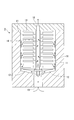
- FIG. 1 is a schematic cross-sectional view illustrating a filtration device suitable for use in the present invention.
- the filtration device 1 shown here is substantially cylindrical and has a plurality of leaf disk filters 11, 11,... Built in an internal space, and has a known configuration.
- the plurality of leaf disk type filters 11, 11,... Are coaxially stacked in the space inside the filtration device 1, and the secondary flow path 14 for the filtrate is inserted so as to penetrate the central portion thereof. Has been. Since the leaf disk type filter 11 and the secondary flow path 14 are assembled, they can be disassembled. After use, the leaf disk type filter 11 and the secondary flow path 14 can be repeatedly used several times by taking out from the inside of the filtration device 1 and washing. Yes.
- the filtration object introduced from the inlet 13 of the filtration device moves in the temporary flow path 12 and is taken in from the surface of the plurality of leaf disk type filters 11, 11. After being removed, the filtrate is introduced into the secondary flow path 14. All the filtrate is collected in the secondary flow path 14 and finally taken out from the outlet 15 through the outlet 15.
- arrows indicate the movement of the filtration object or filtrate. In this way, the filtration object 1 is simultaneously filtered by the plurality of leaf disk type filters 11, 11,.
- the filtration apparatus shown here is only an example, and various filtration apparatuses can be used according to the objective in this invention.
- the melt extrusion of the liquid crystalline polyester may be performed using a known extruder.
- the extruder may be either a single screw or a twin screw depending on the required discharge amount.
- the cylinder may be provided with a vent part and a supply port.
- a melt molding method is preferable.
- the liquid crystal polyester molded product obtained by melt filtration of the liquid crystal polyester using a filter is excellent in heat resistance and mechanical strength.
- liquid crystal polyester molded products include: optical pickup bobbins, transformer bobbins, etc .; relay parts such as relay cases, relay bases, relay sprues, relay armatures; RIMM, DDR, CPU socket, S / O, DIMM, Board to Board connectors, FPC connectors, card connectors, etc .; lamp reflectors, LED reflectors, etc .; lamp holders, heater holders, etc .; speaker diaphragms, etc .; Camera module parts; switch parts; motor parts; sensor parts; hard disk drive parts; tableware such as ovenware; vehicle parts; aircraft parts; sealing for semiconductor element sealing members, coil sealing members, etc. Wood; films; fibers and the like.
- a liquid crystalline polyester molded object is a film or a fiber.
- the flow start temperature of the liquid crystal polyester was measured by the following method. (Measurement of flow start temperature of liquid crystal polyester) Using a flow tester (manufactured by Shimadzu Corp., CFT-500 type), about 2 g of liquid crystal polyester was filled into a cylinder equipped with a die having a nozzle having an inner diameter of 1 mm and a length of 10 mm, and 9.8 MPa (100 kg / cm 2 ). The liquid crystal polyester was melted while being heated at a rate of 4 ° C./min under a load of 4 ° C. and extruded from a nozzle, and a temperature showing a viscosity of 4800 Pa ⁇ s (48000 poise) was measured.
- Example 1 Manufacture of liquid crystal polyester molding
- a filtration device (leaf disk type filter, manufactured by Nippon Seisen Co., Ltd.) is connected to the outlet of a twin screw extruder (Ikegai Iron Works Co., Ltd., PCM30 type), and the liquid crystal polyester obtained in Production Example 1 is used as the biaxial extruder.
- the liquid crystal polyester 1 was obtained by extruding from the above and filtering with the filtration device and then granulating.
- the filtration device used was a stack of 16 Naslon filters LF4-0 NF2M-05D2 (manufactured by Nippon Seisen Co., Ltd., filtration accuracy 5.0 ⁇ m).
- Example 2 Manufacture of liquid crystal polyester composition for molding
- a Henschel mixer manufactured by Kawata, SMG-100 type
- 100 parts by mass of the liquid crystalline polyester obtained in Production Example 1 and 5.0 parts by mass of titanium oxide Ishihara Sangyo Co., Ltd., CR-60
- the liquid crystal polyester composition 2 was obtained by filtering the obtained composition using the same twin-screw extruder and filtration apparatus as Example 1, and then granulating.
- Example 3 Manufacture of liquid crystalline polyester for molding
- a filtration device (leaf disk type filter, manufactured by Nippon Seisen Co., Ltd.) is connected to the outlet of a twin screw extruder (Ikegai Iron Works Co., Ltd., PCM30 type), and the liquid crystal polyester obtained in Production Example 2 is used as the biaxial extruder.
- the liquid crystal polyester 3 was obtained by extruding from the above, filtering with the said filtration apparatus, and then granulating.
- the filtration device used was a stack of 16 Naslon filters LF4-0 NF2M-05D2 (manufactured by Nippon Seisen Co., Ltd., filtration accuracy 5.0 ⁇ m).
- Example 1 Manufacture of liquid crystalline polyester for molding
- a liquid crystal polyester R1 was obtained in the same manner as in Example 1 except that the liquid crystal polyester was not melt filtered. That is, liquid crystal polyester R1 was obtained by granulating the liquid crystal polyester obtained in Production Example 1 using a twin-screw extruder (manufactured by Ikekai Tekko Co., Ltd., PCM30 type).
- a liquid crystal polyester composition R2 was obtained in the same manner as in Example 2 except that the liquid crystal polyester composition was not melt filtered. That is, using a Henschel mixer (manufactured by Kawata, SMG-100 type), 100 parts by mass of the liquid crystal polyester obtained in Production Example 1, and 5.0 parts by mass of titanium oxide (manufactured by Ishihara Sangyo Co., Ltd., CR-60) Were mixed. And liquid crystal polyester composition R2 was obtained by granulating the obtained composition using the twin-screw extruder (Ikegai Iron Works company make, PCM30 type
- Example 3 Manufacture of liquid crystal polyester composition for molding
- a liquid crystal polyester R3 was obtained in the same manner as in Example 3 except that the liquid crystal polyester was not melt filtered. That is, liquid crystal polyester R3 was obtained by granulating the liquid crystal polyester obtained in Production Example 2 using a twin-screw extruder (manufactured by Ikekai Tekko Co., Ltd., PCM30 type).
- the tensile strength of ASTM No. 4 dumbbells (molded bodies 1A, 2A, 3A, R1A, R2A, R3A) was measured according to ASTM D638.
- the bending strength of a molded product (molded body 1B, 2B, 3B, R1B, R2B, R3B) having a length of 127 mm, a width of 12.7 mm, and a thickness of 6.4 mm was measured in accordance with ASTM D790.
- the deflection temperature under load of a molded article (molded body 11B, 2B, 3B, R1B, R2B, R3B) having a length of 127 mm, a width of 12.7 mm, and a thickness of 6.4 mm is compliant with ASTM D648 and is a load of 1.82 MPa. It was measured.
- the liquid crystal polyester molded articles of each Example obtained by melt-extruding and filtering the liquid crystal polyester were excellent in both heat resistance and mechanical strength.
- the liquid crystal polyester molded body of each comparative example in which the liquid crystal polyester was not melt-filtered was inferior to the liquid crystal polyester molded body of the examples in both heat resistance and mechanical strength.
- the present invention can be used for manufacturing various parts that require heat resistance.
Landscapes
- Engineering & Computer Science (AREA)
- Mechanical Engineering (AREA)
- Chemical & Material Sciences (AREA)
- Manufacturing & Machinery (AREA)
- Materials Engineering (AREA)
- Health & Medical Sciences (AREA)
- Chemical Kinetics & Catalysis (AREA)
- Medicinal Chemistry (AREA)
- Polymers & Plastics (AREA)
- Organic Chemistry (AREA)
- Polyesters Or Polycarbonates (AREA)
- Processing And Handling Of Plastics And Other Materials For Molding In General (AREA)
Abstract
本発明は、液晶ポリエステル成形体の製造方法であって、前記液晶ポリエステルが、下記一般式(1)、(2)及び(3)で表される繰返し単位を有し、 前記液晶ポリエステル成形体の製造方法が、液晶ポリエステルを溶融押出した 後、フィルタを用いて溶融ろ過する工程、及び、液晶ポリエステルを乾燥後、射 出成形機を用いて液晶ポリエステルを成形する工程を含み、 前記フィルタのろ過精度が1~50μmである、液晶ポリエステル成形体の製造方法に関する。
Description
本発明は、液晶ポリエステル成形体の製造方法に関する。本願は、2011年3月22日に、日本に出願された特願2011-062437号に基づき優先権を主張し、その内容をここに援用する。
液晶ポリエステルは、優れた低吸湿性、耐熱性、機械的強度を実現できる素材として注目され、コネクター等の精密電子部品やフィルム、繊維等に幅広く利用されおり、種々の検討がなされている。
例えば、高周波特性を向上させた液晶ポリエステルとして、特許文献1には、6-ヒドロキシ-2-ナフトエ酸に由来する繰返し単位30~80モル%と、芳香族ジオールに由来する繰返し単位10~35モル%と、芳香族ジカルボン酸に由来する繰返し単位10~35モル%とから実質的になる液晶ポリエステルが提案されており、具体的には、6-ヒドロキシ-2-ナフトエ酸に由来する繰返し単位50モル%と、ヒドロキノンに由来する繰返し単位25モル%と、2,6-ナフタレンジカルボン酸に由来する繰返し単位25モル%とからなる液晶ポリエステルや、6-ヒドロキシ-2-ナフトエ酸に由来する繰返し単位60モル%と、4,4’-ジヒドロキシビフェニルに由来する繰返し単位20モル%と、イソフタル酸に由来する繰返し単位20モル%とからなる液晶ポリエステルが開示されている。
また、寸法安定性を向上させた液晶ポリエステルとして、特許文献2には、p-ヒドロキシ安息香酸、6-ヒドロキシ-2-ナフトエ酸又は4-ヒドロキシ-4’-ビフェニルカルボン酸に由来する繰返し単位30~60モル%と、4,4’-ジヒドロキシビフェニルに由来する繰返し単位20~35モル%と、ナフタレンジカルボン酸に由来する繰返し単位20~35モル%とから実質的になる液晶ポリエステルが提案されており、具体的には、6-ヒドロキシ-2-ナフトエ酸に由来する繰返し単位50モル%と、4,4’-ジヒドロキシビフェニルに由来する繰返し単位25モル%と、2,6-ナフタレンジカルボン酸に由来する繰返し単位25モル%とからなる液晶ポリエステルが開示されている。
しかし、特許文献1及び2に記載の如き、2,6-ナフチレン基を含む繰返し単位の含有量が多い液晶ポリエステルは、寸法安定性や高周波特性に優れてはいるものの、成形体とした時の機械的強度や耐熱性が十分ではなく、この点で尚改善の余地があった。
本発明は、上記事情に鑑みてなされたものであり、耐熱性及び機械的強度に優れる液晶ポリエステル成形体の製造方法を提供することを課題とする。
本発明は、上記事情に鑑みてなされたものであり、耐熱性及び機械的強度に優れる液晶ポリエステル成形体の製造方法を提供することを課題とする。
上記課題を解決するため、本発明は以下の態様を有する。
本発明の第1の態様は、液晶ポリエステル成形体の製造方法であって、
前記液晶ポリエステルが、下記一般式(1)、(2)及び(3)で表される繰返し単位を有し、
前記液晶ポリエステル成形体の製造方法が、液晶ポリエステルを溶融押出した後、フィルタを用いて溶融ろ過する工程、及び、液晶ポリエステルを乾燥後、射出成形機を用いて液晶ポリエステルを成形する工程を含み、
前記フィルタのろ過精度が1~50μmである、液晶ポリエステル成形体の製造方法。
前記液晶ポリエステルが、下記一般式(1)、(2)及び(3)で表される繰返し単位を有し、
前記液晶ポリエステル成形体の製造方法が、液晶ポリエステルを溶融押出した後、フィルタを用いて溶融ろ過する工程、及び、液晶ポリエステルを乾燥後、射出成形機を用いて液晶ポリエステルを成形する工程を含み、
前記フィルタのろ過精度が1~50μmである、液晶ポリエステル成形体の製造方法。



(式中、Ar1は、フェニレン基、ナフチレン基又はビフェニリレン基であり;Ar2及びAr3は、それぞれ独立にフェニレン基、ナフチレン基、ビフェニリレン基又は下記一般式(4)で表される基であり;X及びYは、それぞれ独立に酸素原子又はイミノ基であり;前記Ar1、Ar2及びAr3中の一つ以上の水素原子は、それぞれ独立にハロゲン原子、アルキル基又はアリール基で置換されていてもよい。)

(式中、Ar4及びAr5は、それぞれ独立にフェニレン基又はナフチレン基であり;Zは、酸素原子、硫黄原子、カルボニル基、スルホニル基又はアルキリデン基である。)
本発明の第2の態様は、前記液晶ポリエステル中の2,6-ナフチレン基を含む繰返し単位の含有量が、前記液晶ポリエステルを構成する全繰返し単位の合計量に対して40モル%以上である、前記第1の態様に記載の液晶ポリエステル成形体の製造方法である。
本発明の第3の態様は、前記液晶ポリエステルが、これを構成する全繰返し単位の合計量に対して、前記一般式(1)で表される繰返し単位を30~80モル%、前記一般式(2)で表される繰返し単位を10~35モル%、前記一般式(3)で表される繰返し単位を10~35モル%有する、前記第1又は2の態様に記載の液晶ポリエステル成形体の製造方法である。
本発明の第4の態様は、前記一般式(3)において、X及びYが酸素原子である、前記第1~3のいずれか1つの態様に記載の液晶ポリエステル成形体の製造方法である。
本発明の第5の態様は、前記フィルタのろ材が金属繊維焼結体である、前記第1~4のいずれか1つの態様に記載の液晶ポリエステル成形体の製造方法である。
本発明の第6の態様は、前記フィルタがリーフディスク型である、前記第1~5のいずれか1つの態様に記載の液晶ポリエステル成形体の製造方法である。
本発明の第7の態様は、前記液晶ポリエステル成形体が、液晶ポリエステル100質量部に対して充填材を0.01~10質量部含有する、前記第1~6のいずれか1つの態様に記載の液晶ポリエステル成形体の製造方法である。
本発明の第8の態様は、前記充填材が酸化チタン、酸化ケイ素及び酸化アルミニウムからなる群より選択される一種以上である、前記第7の態様に記載の液晶ポリエステル成形体の製造方法である。
本発明の第9の態様は、前記液晶ポリエステル成形体がフィルム又は繊維である、前記第1~8のいずれか1つの態様に記載の液晶ポリエステル成形体の製造方法である。
本発明によれば、耐熱性及び機械的強度に優れる液晶ポリエステル成形体の製造方法を提供できる。
以下、本発明について詳細に説明する。
本発明の液晶ポリエステル成形体の製造方法は、前記液晶ポリエステルが、下記一般式(1)、(2)及び(3)で表される繰返し単位(以下、それぞれ「繰返し単位(1)」、「繰返し単位(2)」及び「繰返し単位(3)」ということがある)を有し、前記液晶ポリエステル成形体の製造方法が、液晶ポリエステルを溶融押出した後、フィルタを用いて溶融ろ過する工程、及び、液晶ポリエステルを乾燥後、射出成形機を用いて液晶ポリエステルを成形する工程を含み、前記フィルタのろ過精度が1~50μmである、液晶ポリエステル成形体の製造方法である。
本発明の液晶ポリエステル成形体の製造方法は、前記液晶ポリエステルが、下記一般式(1)、(2)及び(3)で表される繰返し単位(以下、それぞれ「繰返し単位(1)」、「繰返し単位(2)」及び「繰返し単位(3)」ということがある)を有し、前記液晶ポリエステル成形体の製造方法が、液晶ポリエステルを溶融押出した後、フィルタを用いて溶融ろ過する工程、及び、液晶ポリエステルを乾燥後、射出成形機を用いて液晶ポリエステルを成形する工程を含み、前記フィルタのろ過精度が1~50μmである、液晶ポリエステル成形体の製造方法である。


(式中、Ar1は、フェニレン基、ナフチレン基又はビフェニリレン基であり;Ar2及びAr3は、それぞれ独立にフェニレン基、ナフチレン基、ビフェニリレン基又は下記一般式(4)で表される基であり;X及びYは、それぞれ独立に酸素原子又はイミノ基であり;前記Ar1、Ar2及びAr3中の一つ以上の水素原子は、それぞれ独立にハロゲン原子、アルキル基又はアリール基で置換されていてもよい。)

(式中、Ar4及びAr5は、それぞれ独立にフェニレン基又はナフチレン基であり;Zは、酸素原子、硫黄原子、カルボニル基、スルホニル基又はアルキリデン基である。)
前記ハロゲン原子としては、フッ素原子、塩素原子、臭素原子及びヨウ素原子が挙げられる。
前記アルキル基の例としては、メチル基、エチル基、n-プロピル基、イソプロピル基、n-ブチル基、イソブチル基、sec-ブチル基、tert-ブチル基、n-ペンチル基、n-ヘキシル基、n-ヘプチル基、2-エチルヘキシル基、n-オクチル基、n-ノニル基及びn-デシル基が挙げられ、その炭素数は、1~10であることが好ましい。
前記アリール基の例としては、フェニル基、o-トリル基、m-トリル基、p-トリル基、1-ナフチル基及び2-ナフチル基が挙げられ、その炭素数は、6~20であることが好ましい。
前記水素原子がこれらの基で置換されている場合、その数は、Ar1、Ar2又はAr3で表される前記基毎に、それぞれ独立に2個以下であることが好ましく、1個であることがより好ましい。
前記アルキル基の例としては、メチル基、エチル基、n-プロピル基、イソプロピル基、n-ブチル基、イソブチル基、sec-ブチル基、tert-ブチル基、n-ペンチル基、n-ヘキシル基、n-ヘプチル基、2-エチルヘキシル基、n-オクチル基、n-ノニル基及びn-デシル基が挙げられ、その炭素数は、1~10であることが好ましい。
前記アリール基の例としては、フェニル基、o-トリル基、m-トリル基、p-トリル基、1-ナフチル基及び2-ナフチル基が挙げられ、その炭素数は、6~20であることが好ましい。
前記水素原子がこれらの基で置換されている場合、その数は、Ar1、Ar2又はAr3で表される前記基毎に、それぞれ独立に2個以下であることが好ましく、1個であることがより好ましい。
前記アルキリデン基の例としては、メチレン基、エチリデン基、イソプロピリデン基、n-ブチリデン基及び2-エチルヘキシリデン基が挙げられ、その炭素数は1~10であることが好ましい。
繰返し単位(1)は、所定の芳香族ヒドロキシカルボン酸に由来する繰返し単位である。繰返し単位(1)としては、Ar1が1,4-フェニレン基であるもの(p-ヒドロキシ安息香酸に由来する繰返し単位)、及びAr1が2,6-ナフチレン基であるもの(6-ヒドロキシ-2-ナフトエ酸に由来する繰返し単位)が好ましく、Ar1が2,6-ナフチレン基であるものがより好ましい。
繰返し単位(2)は、所定の芳香族ジカルボン酸に由来する繰返し単位である。繰返し単位(2)としては、Ar2が1,4-フェニレン基であるもの(テレフタル酸に由来する繰返し単位)、Ar2が1,3-フェニレン基であるもの(イソフタル酸に由来する繰返し単位)、Ar2が2,6-ナフチレン基であるもの(2,6-ナフタレンジカルボン酸に由来する繰返し単位)、及びAr2がジフェニルエ-テル-4,4’-ジイル基であるもの(ジフェニルエ-テル-4,4’-ジカルボン酸に由来する繰返し単位)が好ましく、Ar2が1,4-フェニレン基であるもの、及びAr2が2,6-ナフチレン基であるものがより好ましい。
繰返し単位(3)は、所定の芳香族ジオール、芳香族ヒドロキシルアミン又は芳香族ジアミンに由来する繰返し単位である。繰返し単位(3)としては、Ar3が1,4-フェニレン基であるもの(ヒドロキノン、p-アミノフェノール又はp-フェニレンジアミンに由来する繰返し単位)、Ar3が2,6-ナフチレン基であるもの(2,6-ジヒドロキシナフタレンに由来する繰返し単位、2-アミノ-6-ヒドロキシナフタレンに由来する繰返し単位、2,6-ジアミノナフタレンに由来する繰返し単位)、及びAr3が4,4’-ビフェニリレン基であるもの(4,4’-ジヒドロキシビフェニル、4-アミノ-4’-ヒドロキシビフェニル又は4,4’-ジアミノビフェニルに由来する繰返し単位)が好ましく、Ar3が1,4-フェニレン基であるもの、及びAr3が4,4’-ビフェニリレン基であるものがより好ましい。
液晶ポリエステル中、2,6-ナフチレン基を含む繰返し単位の含有量は、液晶ポリエステルを構成する全繰返し単位の合計量(液晶ポリエステルを構成する各繰返し単位の質量をその各繰返し単位の式量で割ることにより、各繰返し単位の物質量相当量(モル)を求め、それらを合計した値)に対して、好ましくは40モル%以上であり、より好ましくは50モル%以上、さらに好ましくは60モル%以上、特に好ましくは70モル%以上である。
そして、好ましい液晶ポリエステルは、Ar1が2,6-ナフチレン基である繰返し単位(1)、Ar2が2,6-ナフチレン基である繰返し単位(2)、及びAr3が2,6-ナフチレン基である繰返し単位(3)の合計含有量が、液晶ポリエステルを構成する全繰返し単位の合計量に対して、好ましくは40モル%以上であり、より好ましくは50モル%以上、さらに好ましくは60モル%以上、特に好ましくは70モル%以上のものである。液晶ポリエステル中の2,6-ナフチレン基を含む繰返し単位は、すべて繰返し単位(1)~(3)のいずれかであることが好ましい。繰返し単位の含有量を上記のような範囲とすることで、液晶ポリエステル成形体は、寸法安定性及び高周波特性により優れたものとなる。
そして、好ましい液晶ポリエステルは、Ar1が2,6-ナフチレン基である繰返し単位(1)、Ar2が2,6-ナフチレン基である繰返し単位(2)、及びAr3が2,6-ナフチレン基である繰返し単位(3)の合計含有量が、液晶ポリエステルを構成する全繰返し単位の合計量に対して、好ましくは40モル%以上であり、より好ましくは50モル%以上、さらに好ましくは60モル%以上、特に好ましくは70モル%以上のものである。液晶ポリエステル中の2,6-ナフチレン基を含む繰返し単位は、すべて繰返し単位(1)~(3)のいずれかであることが好ましい。繰返し単位の含有量を上記のような範囲とすることで、液晶ポリエステル成形体は、寸法安定性及び高周波特性により優れたものとなる。
繰返し単位(1)の含有量は、液晶ポリエステルを構成する全繰返し単位の合計量(液晶ポリエステルを構成する各繰返し単位の質量をその各繰返し単位の式量で割ることにより、各繰返し単位の物質量相当量(モル)を求め、それらを合計した値)に対して、好ましくは30モル%以上、より好ましくは30~80モル%、さらに好ましくは40~70モル%、特に好ましくは45~65モル%である。
繰返し単位(2)の含有量は、液晶ポリエステルを構成する全繰返し単位の合計量に対して、好ましくは35モル%以下、より好ましくは10~35モル%、さらに好ましくは15~30モル%、特に好ましくは17.5~27.5モル%である。
繰返し単位(3)の含有量は、液晶ポリエステルを構成する全繰返し単位の合計量に対して、好ましくは35モル%以下、より好ましくは10~35モル%、さらに好ましくは15~30モル%、特に好ましくは17.5~27.5モル%である。
繰返し単位(1)~(3)の含有量を上記のような範囲とすることで、液晶ポリエステルは耐熱性と成形性とのバランスにより優れたものとなる。
繰返し単位(2)の含有量は、液晶ポリエステルを構成する全繰返し単位の合計量に対して、好ましくは35モル%以下、より好ましくは10~35モル%、さらに好ましくは15~30モル%、特に好ましくは17.5~27.5モル%である。
繰返し単位(3)の含有量は、液晶ポリエステルを構成する全繰返し単位の合計量に対して、好ましくは35モル%以下、より好ましくは10~35モル%、さらに好ましくは15~30モル%、特に好ましくは17.5~27.5モル%である。
繰返し単位(1)~(3)の含有量を上記のような範囲とすることで、液晶ポリエステルは耐熱性と成形性とのバランスにより優れたものとなる。
繰返し単位(2)の含有量と繰返し単位(3)の含有量との割合は、[繰返し単位(2)の含有量]/[繰返し単位(3)の含有量](モル/モル)で表して、好ましくは0.9/1~1/0.9、より好ましくは0.95/1~1/0.95、さらに好ましくは0.98/1~1/0.98である。
なお、液晶ポリエステルは、繰返し単位(1)~(3)を、それぞれ独立に二種以上有してもよい。また、液晶ポリエステルは、繰返し単位(1)~(3)以外の繰返し単位を有してもよいが、その含有量は、液晶ポリエステルを構成する全繰返し単位の合計量に対して、好ましくは10モル%以下、より好ましくは5モル%以下である。
耐熱性が高い液晶ポリエステルの典型的な例は、液晶ポリエステルを構成する全繰返し単位の合計量に対して、Ar1が2,6-ナフチレン基である繰返し単位(1)、すなわち6-ヒドロキシ-2-ナフトエ酸に由来する繰返し単位を、好ましくは40~74.8モル%、より好ましくは40~64.5モル%、さらに好ましくは50~58モル%有し、Ar2が2,6-ナフチレン基である繰返し単位(2)、すなわち2,6-ナフタレンジカルボン酸に由来する繰返し単位を、好ましくは12.5~30モル%、より好ましくは17.5~30モル%有し、Ar2が1,4-フェニレン基である繰返し単位(2)、すなわちテレフタル酸に由来する繰返し単位を、好ましくは0.2~15モル%、より好ましくは0.5~12モル%、さらに好ましくは2~10モル%有し、Ar3が1,4-フェニレン基である繰返し単位(3)、すなわちヒドロキノン、p-アミノフェノール又はp-フェニレンジアミンに由来する繰返し単位を、好ましくは12.5~30モル%、より好ましくは17.5~30モル%、さらに好ましくは20~25モル%有し、かつ、Ar2が2,6-ナフチレン基である繰返し単位(2)の含有量が、Ar2が2,6-ナフチレン基である繰返し単位(2)及びAr2が1,4-フェニレン基である繰返し単位(2)の合計含有量に対して、好ましくは0.5モル倍以上、より好ましくは0.6モル倍以上のものである。
液晶ポリエステルは、繰返し単位(3)として、X及びYがそれぞれ酸素原子であるものを有すること、すなわち、所定の芳香族ジオールに由来する繰返し単位を有することが好ましく、繰返し単位(3)として、X及びYがそれぞれ酸素原子であるもののみを有することがより好ましい。このようにすることで、液晶ポリエステルは、溶融粘度が低くなり易い。
液晶ポリエステルは、例えば、芳香族ヒドロキシカルボン酸(繰返し単位(1)を与えるモノマー)と、芳香族ジカルボン酸(繰返し単位(2)を与えるモノマー)と、芳香族ジオール、芳香族ヒドロキシアミン及び芳香族ジアミンからなる群から選ばれる少なくとも1種の化合物(繰返し単位(3)を与えるモノマー)と、を重合(重縮合)させることで製造できる。
ここで、芳香族ヒドロキシカルボン酸、芳香族ジカルボン酸、芳香族ジオール、芳香族ヒドロキシアミン及び芳香族ジアミンは、それぞれ独立に、その一部又は全部に代えて、その重合可能な誘導体が用いられてもよい。
ここで、芳香族ヒドロキシカルボン酸、芳香族ジカルボン酸、芳香族ジオール、芳香族ヒドロキシアミン及び芳香族ジアミンは、それぞれ独立に、その一部又は全部に代えて、その重合可能な誘導体が用いられてもよい。
芳香族ヒドロキシカルボン酸及び芳香族ジカルボン酸のようなカルボキシル基を有する化合物の重合可能な誘導体の例としては、カルボキシル基をアルコキシカルボニル基又はアリールオキシカルボニル基に変換してなるもの(エステル)、カルボキシル基をハロホルミル基に変換してなるもの(酸ハロゲン化物)、及びカルボキシル基をアシルオキシカルボニル基に変換してなるもの(酸無水物)が挙げられる。
芳香族ヒドロキシカルボン酸、芳香族ジオール及び芳香族ヒドロキシアミンのようなヒドロキシル基を有する化合物の重合可能な誘導体の例としては、ヒドロキシル基をアシル化してアシルオキシル基に変換してなるもの(アシル化物)が挙げられる。
芳香族ヒドロキシアミン及び芳香族ジアミンのようなアミノ基を有する化合物の重合可能な誘導体の例としては、アミノ基をアシル化してアシルアミノ基に変換してなるもの(アシル化物)が挙げられる。
芳香族ヒドロキシカルボン酸、芳香族ジオール及び芳香族ヒドロキシアミンのようなヒドロキシル基を有する化合物の重合可能な誘導体の例としては、ヒドロキシル基をアシル化してアシルオキシル基に変換してなるもの(アシル化物)が挙げられる。
芳香族ヒドロキシアミン及び芳香族ジアミンのようなアミノ基を有する化合物の重合可能な誘導体の例としては、アミノ基をアシル化してアシルアミノ基に変換してなるもの(アシル化物)が挙げられる。
液晶ポリエステルは、これを構成する繰返し単位に対応する原料モノマーを溶融重合させ、得られた重合物(プレポリマー)を固相重合させることにより、製造することが好ましい。これにより、耐熱性や強度・剛性が高い高分子量の液晶ポリエステルを操作性良く製造することができる。溶融重合は、触媒の存在下で行ってもよく、この場合の触媒の例としては、酢酸マグネシウム、酢酸第一錫、テトラブチルチタネート、酢酸鉛、酢酸ナトリウム、酢酸カリウム、三酸化アンチモン等の金属化合物や、4-(ジメチルアミノ)ピリジン、1-メチルイミダゾール等の含窒素複素環式化合物が挙げられ、含窒素複素環式化合物が好ましく用いられる。
液晶ポリエステルは、その流動開始温度が、好ましくは280℃以上、より好ましくは290℃以上、さらに好ましくは295℃以上であり、また、好ましくは380℃以下、より好ましくは350℃以下である。流動開始温度が高いほど、耐熱性や強度・剛性が向上し易いが、高過ぎると、フィルタ通過時のろ圧が上昇して押出が困難になる傾向がある。また、流動開始温度が低過ぎると、耐熱性が不十分となる可能性がある。
なお、流動開始温度は、フロー温度又は流動温度とも呼ばれ、毛細管レオメーターを用いて、9.8MPa(100kg/cm2)の荷重下、4℃/分の速度で昇温しながら、液晶ポリエステルを溶融させ、内径1mm及び長さ10mmのノズルから押し出すときに、4800Pa・s(48000ポイズ)の粘度を示す温度であり、液晶ポリエステルの分子量の目安となるものである(小出直之編、「液晶ポリマー-合成・成形・応用-」、株式会社シーエムシー、1987年6月5日、p.95参照)。
液晶ポリエステルは、さらに充填材、添加剤、液晶ポリエステル以外の樹脂等の他の成分が配合され、組成物とされてもよい。前記他の成分は一種でもよいし、二種以上でもよい。
前記充填材の例としては、酸化ケイ素(シリカ)、酸化アルミニウム(アルミナ)、酸化チタン、チタン酸バリウム、チタン酸ストロンチウム、水酸化アルミニウム、炭酸カルシウム等の無機充填材;硬化エポキシ樹脂、架橋ベンゾグアナミン樹脂、架橋アクリル樹脂等の有機充填材が挙げられ、これらのなかでも、機械的強度や色調の観点から、酸化チタン、酸化ケイ素及び酸化アルミニウムからなる群より選択される一種以上であることが好ましい。
前記充填材の含有量は、液晶ポリエステル100質量部に対して、好ましくは0.001~10質量部、より好ましくは0.005~5質量部である。
前記充填材が粒状である場合、その平均粒径は、好ましくは0.05~2μm、より好ましくは0.05~1.5μmである。このような範囲とすることで、液晶ポリエステルの溶融ろ過がより容易となる。
前記添加剤の例としては、レベリング剤、消泡剤、酸化防止剤、紫外線吸収剤、難燃剤、着色剤、フッ素樹脂、金属石鹸類等の離型改良剤、核剤、安定剤、可塑剤、滑剤、着色防止剤、帯電防止剤及び潤滑剤が挙げられ、その含有量は、液晶ポリエステル100質量部に対して、好ましくは0~5質量部である。
前記液晶ポリエステル以外の樹脂の例としては、ポリプロピレン、ポリアミド、液晶ポリエステル以外のポリエステル、ポリフェニレンスルフィド、ポリエーテルケトン、ポリカーボネート、ポリフェニレンエーテル、ポリエーテルイミド等の熱可塑性樹脂;フェノール樹脂、エポキシ樹脂、ポリイミド樹脂、シアネート樹脂等の熱硬化性樹脂が挙げられ、その含有量は、液晶ポリエステル100質量部に対して、好ましくは0~20質量部である。
前記他の成分は必要に応じて、例えば、予めヘンシェルミキサー、タンブラー等を用いて混合した後、この混合物を押出機に供給することで、液晶ポリエステルとの組成物としてもよいし、サイドフィードにより供給することで、液晶ポリエステルとの組成物としてもよい。
前記フィルタのろ材で好ましい材質としては、ステンレス、ブロンズ、銅、鉄等の金属が例示できる。なかでも、液晶ポリエステルとの反応性や耐腐食性、耐熱性の観点からステンレスがより好ましい。そして、ステンレスの中でもSUS304、SUS316、SUS316L、SUS430等が特に好ましい。
支持体、溶接部等、前記フィルタのろ材以外の構造の材質も、ろ材と同様であることが好ましい。
支持体、溶接部等、前記フィルタのろ材以外の構造の材質も、ろ材と同様であることが好ましい。
本発明において好ましいろ材としては、多孔質体のように、ろ液の通過経路がろ材の厚さ方向において無秩序に入り組んだ構成のものが例示できる。
そして、前記ろ材の好ましい例としては、直径が数μm~数10μmの繊維を重ね合わせて焼結した金属繊維焼結体;粒径が数10μm~数100μmの金属粉末を焼結した金属粉末焼結体が挙げられる。これらのなかでも、機械的強度や耐熱性に優れ、より優れた溶融ろ過の効果が得られる点から、金属繊維焼結体がより好ましい。
前記ろ材の厚さは特に限定されないが、機械的強度に優れ、より優れた溶融ろ過の効果が得られる点から、5mm以上であることが好ましい。
そして、前記ろ材の好ましい例としては、直径が数μm~数10μmの繊維を重ね合わせて焼結した金属繊維焼結体;粒径が数10μm~数100μmの金属粉末を焼結した金属粉末焼結体が挙げられる。これらのなかでも、機械的強度や耐熱性に優れ、より優れた溶融ろ過の効果が得られる点から、金属繊維焼結体がより好ましい。
前記ろ材の厚さは特に限定されないが、機械的強度に優れ、より優れた溶融ろ過の効果が得られる点から、5mm以上であることが好ましい。
前記フィルタのろ過精度は、1~50μmであり、好ましくは5~25μmである。1μm未満であると、液晶ポリエステルのフィルタ通過時のろ圧が大き過ぎて押出が困難になる傾向があり、50μmを超えると、溶融ろ過の効果が不十分になる可能性がある。
ろ過精度は、以下の方法で求められる。すなわち、コンタミナントを含み、その粒子径が互いに異なる複数のスラリーを、それぞれフィルタでろ過し、フィルタのスラリー通過前後の粒子数をパーティクルカウンターでカウントして、捕集効率を算出する。そして、グラフ上に各粒子径に対する捕集効率をプロットして、捕集効率曲線を作成し、捕集効率が95%の粒子径をろ過精度とする。
ろ過精度は、以下の方法で求められる。すなわち、コンタミナントを含み、その粒子径が互いに異なる複数のスラリーを、それぞれフィルタでろ過し、フィルタのスラリー通過前後の粒子数をパーティクルカウンターでカウントして、捕集効率を算出する。そして、グラフ上に各粒子径に対する捕集効率をプロットして、捕集効率曲線を作成し、捕集効率が95%の粒子径をろ過精度とする。
前記フィルタの例としては、金属製の網等の支持体を上下からろ材で挟み込んだリーフディスク型フィルタ;ろ材にヒダ付き加工を施したプリーツ円筒型フィルタ;ろ材を円筒状に加工したフラット円筒型フィルタ;ろ材を打ち抜き等で加工したディスク型フィルタが挙げられる。これらのなかでも、ろ過装置の設計自由度が高く、耐熱性、耐圧性及びろ過面積に優れる点から、リーフディスク型フィルタが好ましい。
リーフディスク型フィルタの内部空間の体積に占める支持体の体積の割合は、20~50%であることが好ましい。下限値以上とすることで、ろ材を支持する支持体の能力が向上し、ろ圧によるフィルタの変形又は破損がより抑制される。また、上限値以下とすることで、液晶ポリエステルのフィルタ通過時におけるろ圧の上昇が抑制され、押出がより容易となる。
前記フィルタにおいて、樹脂流れ方向の最下流側のろ材は、支持体と直接接触していることが好ましい。ろ材が支持体と直接接触せず、例えば、ろ材と支持体との間に金属多孔板などが用いられていると、その部分が液晶ポリエステルの滞留箇所となることがあるが、上記のように直接接触していることで滞留が抑制され、物性がより良好なろ液が得られる。
図1は、本発明で用いるのに好適なろ過装置を例示する概略断面図である。
ここに示すろ過装置1は、略円筒状で、内部の空間に複数のリーフディスク型フィルタ11,11・・を内蔵したものであり、公知の構成のものである。これら複数のリーフディスク型フィルタ11,11・・は、ろ過装置1内部の空間に同軸状に積層されると共に、その中心部を貫通するように、ろ液のための二次流路14が挿通されている。リーフディスク型フィルタ11及び二次流路14は、組み立て式となっているので分解可能であり、使用後はろ過装置1の内部から取り出し、洗浄することにより、複数回繰り返して使用可能となっている。リーフディスク型フィルタ11,11・・の数は、目的に応じて任意に設定できる。
ろ過装置の入り口13から導入されたろ過対象物は、一時流路12内を移動し、複数のリーフディスク型フィルタ11,11・・にその表面から取り込まれ、ろ材(図示略)で固形物が除去されて、ろ液が二次流路14内に導入される。そして、すべてのろ液が二次流路14内で集められ、最終的には出口15からろ過装置1の外部へ取り出される。図1中、矢印はろ過対象物又はろ液の動きを示す。
このようにして、複数のリーフディスク型フィルタ11,11・・で同時にろ過対象物がろ過されるため、ろ過装置1はろ過効率が非常に高い。
なお、ここに示すろ過装置は一例に過ぎず、本発明においては目的に応じて種々のろ過装置が使用可能である。
ここに示すろ過装置1は、略円筒状で、内部の空間に複数のリーフディスク型フィルタ11,11・・を内蔵したものであり、公知の構成のものである。これら複数のリーフディスク型フィルタ11,11・・は、ろ過装置1内部の空間に同軸状に積層されると共に、その中心部を貫通するように、ろ液のための二次流路14が挿通されている。リーフディスク型フィルタ11及び二次流路14は、組み立て式となっているので分解可能であり、使用後はろ過装置1の内部から取り出し、洗浄することにより、複数回繰り返して使用可能となっている。リーフディスク型フィルタ11,11・・の数は、目的に応じて任意に設定できる。
ろ過装置の入り口13から導入されたろ過対象物は、一時流路12内を移動し、複数のリーフディスク型フィルタ11,11・・にその表面から取り込まれ、ろ材(図示略)で固形物が除去されて、ろ液が二次流路14内に導入される。そして、すべてのろ液が二次流路14内で集められ、最終的には出口15からろ過装置1の外部へ取り出される。図1中、矢印はろ過対象物又はろ液の動きを示す。
このようにして、複数のリーフディスク型フィルタ11,11・・で同時にろ過対象物がろ過されるため、ろ過装置1はろ過効率が非常に高い。
なお、ここに示すろ過装置は一例に過ぎず、本発明においては目的に応じて種々のろ過装置が使用可能である。
液晶ポリエステルの溶融押出は、公知の押出機を用いて行えばよい。押出機は、必要とする吐出量に応じて、単軸スクリュー及び2軸スクリューのいずれでもよい。また、シリンダーにはベント部や供給口を設けてもよい。
液晶ポリエステルの成形方法としては、溶融成形法が好ましく、具体的には、射出成形法;Tダイ法、インフレーション法等の押出成形法;圧縮成形法;ブロー成形法;真空成形法;プレス成形法が例示できる。
本発明によれば、フィルタを用いて液晶ポリエステルを溶融ろ過することで、得られる液晶ポリエステル成形体は、耐熱性及び機械的強度に優れたものとなる。
液晶ポリエステル成形体の用途としては、光ピックアップボビン、トランスボビン等のボビン;リレーケース、リレーベース、リレースプルー、リレーアーマチャー等のリレー部品;RIMM、DDR、CPUソケット、S/O、DIMM、Board to Boardコネクター、FPCコネクター、カードコネクター等のコネクター;ランプリフレクター、LEDリフレクター等のリフレクター;ランプホルダー、ヒーターホルダー等のホルダー;スピーカー振動板等の振動板;コピー機用分離爪、プリンター用分離爪等の分離爪;カメラモジュール部品;スイッチ部品;モーター部品;センサー部品;ハードディスクドライブ部品;オーブンウェア等の食器;車両部品;航空機部品;半導体素子用封止部材、コイル用封止部材等の封止部材;フィルム;繊維等が例示できる。
これらのなかでも、液晶ポリエステル成形体は、フィルム又は繊維であることが好ましい。
これらのなかでも、液晶ポリエステル成形体は、フィルム又は繊維であることが好ましい。
以下、具体的実施例により、本発明についてさらに詳しく説明する。ただし、本発明は、以下に示す実施例に何ら限定されるものではない。
なお、以下の実施例において、液晶ポリエステルの流動開始温度は、以下の方法で測定した。
(液晶ポリエステルの流動開始温度の測定)
フローテスター(島津製作所製、CFT-500型)を用いて、液晶ポリエステル約2gを、内径1mm及び長さ10mmのノズルを有するダイを取り付けたシリンダーに充填し、9.8MPa(100kg/cm2)の荷重下、4℃/分の速度で昇温しながら、液晶ポリエステルを溶融させ、ノズルから押し出し、4800Pa・s(48000ポイズ)の粘度を示す温度を測定した。
なお、以下の実施例において、液晶ポリエステルの流動開始温度は、以下の方法で測定した。
(液晶ポリエステルの流動開始温度の測定)
フローテスター(島津製作所製、CFT-500型)を用いて、液晶ポリエステル約2gを、内径1mm及び長さ10mmのノズルを有するダイを取り付けたシリンダーに充填し、9.8MPa(100kg/cm2)の荷重下、4℃/分の速度で昇温しながら、液晶ポリエステルを溶融させ、ノズルから押し出し、4800Pa・s(48000ポイズ)の粘度を示す温度を測定した。
<原料用液晶ポリエステルの製造>
[製造例1]
攪拌装置、トルクメータ、窒素ガス導入管、温度計及び還流冷却器を備えた反応器に、6-ヒドロキシ-2-ナフトエ酸(1034.99g、5.5モル)、2,6-ナフタレンジカルボン酸(378.33g、1.75モル)、テレフタル酸(83.07g、0.5モル)、ヒドロキノン(272.52g、2.475モル、2,6-ナフタレンジカルボン酸及びテレフタル酸の合計量に対して0.225モル過剰)、無水酢酸(1226.87g、12モル)、及び触媒として1-メチルイミダゾール(0.17g)を入れ、反応器内のガスを窒素ガスで置換した後、窒素ガス気流下、攪拌しながら、室温から145℃まで15分間かけて昇温し、145℃で1時間還流させた。次いで、副生酢酸及び未反応の無水酢酸を留去しながら、145℃から310℃まで3.5時間かけて昇温し、310℃で3時間保持した後、内容物を取り出し、これを室温まで冷却した。得られた固形物を、粉砕機で粒径約0.1~1mmに粉砕後、窒素雰囲気下、室温から250℃まで1時間かけて昇温し、250℃から310℃まで10時間かけて昇温し、310℃で5時間保持することにより、固相重合を行った。固相重合後、冷却して、粉末状の液晶ポリエステルを得た。この液晶ポリエステルは、全繰り返し単位の合計量に対して、Ar1が2,6-ナフチレン基である繰返し単位(1)を55モル%、Ar2が2,6-ナフチレン基である繰返し単位(2)を17.5モル%、Ar2が1,4-フェニレン基である繰返し単位(2)を5モル%、及びAr3が1,4-フェニレン基である繰返し単位(3)を22.5モル%有し、その流動開始温度は324℃であった。
[製造例1]
攪拌装置、トルクメータ、窒素ガス導入管、温度計及び還流冷却器を備えた反応器に、6-ヒドロキシ-2-ナフトエ酸(1034.99g、5.5モル)、2,6-ナフタレンジカルボン酸(378.33g、1.75モル)、テレフタル酸(83.07g、0.5モル)、ヒドロキノン(272.52g、2.475モル、2,6-ナフタレンジカルボン酸及びテレフタル酸の合計量に対して0.225モル過剰)、無水酢酸(1226.87g、12モル)、及び触媒として1-メチルイミダゾール(0.17g)を入れ、反応器内のガスを窒素ガスで置換した後、窒素ガス気流下、攪拌しながら、室温から145℃まで15分間かけて昇温し、145℃で1時間還流させた。次いで、副生酢酸及び未反応の無水酢酸を留去しながら、145℃から310℃まで3.5時間かけて昇温し、310℃で3時間保持した後、内容物を取り出し、これを室温まで冷却した。得られた固形物を、粉砕機で粒径約0.1~1mmに粉砕後、窒素雰囲気下、室温から250℃まで1時間かけて昇温し、250℃から310℃まで10時間かけて昇温し、310℃で5時間保持することにより、固相重合を行った。固相重合後、冷却して、粉末状の液晶ポリエステルを得た。この液晶ポリエステルは、全繰り返し単位の合計量に対して、Ar1が2,6-ナフチレン基である繰返し単位(1)を55モル%、Ar2が2,6-ナフチレン基である繰返し単位(2)を17.5モル%、Ar2が1,4-フェニレン基である繰返し単位(2)を5モル%、及びAr3が1,4-フェニレン基である繰返し単位(3)を22.5モル%有し、その流動開始温度は324℃であった。
[製造例2]
攪拌装置、トルクメータ、窒素ガス導入管、温度計及び還流冷却器を備えた反応器に、p-ヒドロキシ安息香酸(994.5g、7.2モル)、テレフタル酸(299.1g、1.8モル)、イソフタル酸(99.7g、0.6モル)、4,4’-ジヒドロキシビフェニル(446.9g、2.4モル)、無水酢酸(1347.6g、13.2モル)及び1-メチルイミダゾール0.2gを入れ、窒素ガス気流下、攪拌しながら、室温から150℃まで30分間かけて昇温し、150℃で1時間還流させた。次いで、1-メチルイミダゾールを0.9g添加し、副生酢酸及び未反応の無水酢酸を留去しながら、320℃まで2時間50分かけて昇温し、320℃でトルクの上昇が認められるまで保持した後、反応器から内容物を取り出し、これを室温まで冷却した。得られた固形物を、粉砕機で粉砕して、粉末状のプレポリマーを得た。次いで、このプレポリマーを、窒素ガス雰囲気下、室温から250℃まで1時間かけて昇温し、250℃から285℃まで5時間かけて昇温して、285℃で3時間保持することにより、固相重合させた後、冷却して、粉末状の液晶ポリエステルを得た。この液晶ポリエステルの流動開始温度は327℃であった。
攪拌装置、トルクメータ、窒素ガス導入管、温度計及び還流冷却器を備えた反応器に、p-ヒドロキシ安息香酸(994.5g、7.2モル)、テレフタル酸(299.1g、1.8モル)、イソフタル酸(99.7g、0.6モル)、4,4’-ジヒドロキシビフェニル(446.9g、2.4モル)、無水酢酸(1347.6g、13.2モル)及び1-メチルイミダゾール0.2gを入れ、窒素ガス気流下、攪拌しながら、室温から150℃まで30分間かけて昇温し、150℃で1時間還流させた。次いで、1-メチルイミダゾールを0.9g添加し、副生酢酸及び未反応の無水酢酸を留去しながら、320℃まで2時間50分かけて昇温し、320℃でトルクの上昇が認められるまで保持した後、反応器から内容物を取り出し、これを室温まで冷却した。得られた固形物を、粉砕機で粉砕して、粉末状のプレポリマーを得た。次いで、このプレポリマーを、窒素ガス雰囲気下、室温から250℃まで1時間かけて昇温し、250℃から285℃まで5時間かけて昇温して、285℃で3時間保持することにより、固相重合させた後、冷却して、粉末状の液晶ポリエステルを得た。この液晶ポリエステルの流動開始温度は327℃であった。
<液晶ポリエステル成形体の製造>
[実施例1]
(成形用液晶ポリエステルの製造)
二軸押出機(池貝鉄工社製、PCM30型)の出口にろ過装置(リーフディスク型フィルタ、日本精線社製)を接続し、製造例1で得られた液晶ポリエステルを、前記二軸押出機から押し出すと共に前記ろ過装置でろ過し、次いで造粒することで、液晶ポリエステル1を得た。前記ろ過装置には、ナスロンフィルタLF4-0 NF2M-05D2(日本精線社製、ろ過精度5.0μm)を16枚積層して用いた。
[実施例1]
(成形用液晶ポリエステルの製造)
二軸押出機(池貝鉄工社製、PCM30型)の出口にろ過装置(リーフディスク型フィルタ、日本精線社製)を接続し、製造例1で得られた液晶ポリエステルを、前記二軸押出機から押し出すと共に前記ろ過装置でろ過し、次いで造粒することで、液晶ポリエステル1を得た。前記ろ過装置には、ナスロンフィルタLF4-0 NF2M-05D2(日本精線社製、ろ過精度5.0μm)を16枚積層して用いた。
(成形体1Aの製造)
得られた液晶ポリエステル1を120℃で3時間乾燥後、射出成形機(日精樹脂工業社製、PS40E5ASE)を用いて、シリンダー温度340℃、金型温度130℃でASTM4号ダンベル(成形体1A)を製造した。
(成形体1Bの製造)
得られた液晶ポリエステル1を120℃で3時間乾燥後、射出成形機(日精樹脂工業社製、PS40E5ASE)を用いて、シリンダー温度340℃、金型温度130℃で、長さ127mm、幅12.7mm、厚さ6.4mmの成形品(成形体1B)を製造した。
得られた液晶ポリエステル1を120℃で3時間乾燥後、射出成形機(日精樹脂工業社製、PS40E5ASE)を用いて、シリンダー温度340℃、金型温度130℃でASTM4号ダンベル(成形体1A)を製造した。
(成形体1Bの製造)
得られた液晶ポリエステル1を120℃で3時間乾燥後、射出成形機(日精樹脂工業社製、PS40E5ASE)を用いて、シリンダー温度340℃、金型温度130℃で、長さ127mm、幅12.7mm、厚さ6.4mmの成形品(成形体1B)を製造した。
[実施例2]
(成形用液晶ポリエステル組成物の製造)
ヘンシェルミキサー(カワタ社製、SMG―100型)を用いて、製造例1で得られた液晶ポリエステル100質量部と、酸化チタン(石原産業社製、CR-60)5.0質量部とを混合した。そして、実施例1と同様の二軸押出機及びろ過装置を用いて、得られた組成物をろ過し、次いで造粒することで、液晶ポリエステル組成物2を得た。この時、実施例1と同様に、前記ろ過装置には、ナスロンフィルタLF4-0 NF2M-05D2(日本精線社製、ろ過精度5.0μm)を16枚積層して用いた。
(成形用液晶ポリエステル組成物の製造)
ヘンシェルミキサー(カワタ社製、SMG―100型)を用いて、製造例1で得られた液晶ポリエステル100質量部と、酸化チタン(石原産業社製、CR-60)5.0質量部とを混合した。そして、実施例1と同様の二軸押出機及びろ過装置を用いて、得られた組成物をろ過し、次いで造粒することで、液晶ポリエステル組成物2を得た。この時、実施例1と同様に、前記ろ過装置には、ナスロンフィルタLF4-0 NF2M-05D2(日本精線社製、ろ過精度5.0μm)を16枚積層して用いた。
(成形体2A及び2Bの製造)
得られた液晶ポリエステル組成物2を用いて、実施例1と同様の方法で、ASTM4号ダンベル(成形体2A)、及び長さ127mm、幅12.7mm、厚さ6.4mmの成形品(成形体2B)を製造した。
得られた液晶ポリエステル組成物2を用いて、実施例1と同様の方法で、ASTM4号ダンベル(成形体2A)、及び長さ127mm、幅12.7mm、厚さ6.4mmの成形品(成形体2B)を製造した。
[実施例3]
(成形用液晶ポリエステルの製造)
二軸押出機(池貝鉄工社製、PCM30型)の出口にろ過装置(リーフディスク型フィルタ、日本精線社製)を接続し、製造例2で得られた液晶ポリエステルを、前記二軸押出機から押し出すと共に前記ろ過装置でろ過し、次いで造粒することで、液晶ポリエステル3を得た。前記ろ過装置には、ナスロンフィルタLF4-0 NF2M-05D2(日本精線社製、ろ過精度5.0μm)を16枚積層して用いた。
(成形用液晶ポリエステルの製造)
二軸押出機(池貝鉄工社製、PCM30型)の出口にろ過装置(リーフディスク型フィルタ、日本精線社製)を接続し、製造例2で得られた液晶ポリエステルを、前記二軸押出機から押し出すと共に前記ろ過装置でろ過し、次いで造粒することで、液晶ポリエステル3を得た。前記ろ過装置には、ナスロンフィルタLF4-0 NF2M-05D2(日本精線社製、ろ過精度5.0μm)を16枚積層して用いた。
(成形体3A及び3Bの製造)
得られた液晶ポリエステル3を用いて、実施例1と同様の方法で、ASTM4号ダンベル(成形体3A)、及び長さ127mm、幅12.7mm、厚さ6.4mmの成形品(成形体3B)を製造した。
得られた液晶ポリエステル3を用いて、実施例1と同様の方法で、ASTM4号ダンベル(成形体3A)、及び長さ127mm、幅12.7mm、厚さ6.4mmの成形品(成形体3B)を製造した。
[比較例1]
(成形用液晶ポリエステルの製造)
液晶ポリエステルを溶融ろ過しなかったこと以外は、実施例1と同様の方法で液晶ポリエステルR1を得た。すなわち、二軸押出機(池貝鉄工社製、PCM30型)を用いて、製造例1で得られた液晶ポリエステルを造粒することで、液晶ポリエステルR1を得た。
(成形用液晶ポリエステルの製造)
液晶ポリエステルを溶融ろ過しなかったこと以外は、実施例1と同様の方法で液晶ポリエステルR1を得た。すなわち、二軸押出機(池貝鉄工社製、PCM30型)を用いて、製造例1で得られた液晶ポリエステルを造粒することで、液晶ポリエステルR1を得た。
(成形体R1A及びR1Bの製造)
得られた液晶ポリエステルR1を用いて、実施例1と同様の方法で、ASTM4号ダンベル(成形体R1A)、及び長さ127mm、幅12.7mm、厚さ6.4mmの成形品(成形体R1B)を製造した。
得られた液晶ポリエステルR1を用いて、実施例1と同様の方法で、ASTM4号ダンベル(成形体R1A)、及び長さ127mm、幅12.7mm、厚さ6.4mmの成形品(成形体R1B)を製造した。
[比較例2]
(成形用液晶ポリエステル組成物の製造)
液晶ポリエステル組成物を溶融ろ過しなかったこと以外は、実施例2と同様の方法で液晶ポリエステル組成物R2を得た。すなわち、ヘンシェルミキサー(カワタ社製、SMG―100型)を用いて、製造例1で得られた液晶ポリエステル100質量部と、酸化チタン(石原産業社製、CR-60)5.0質量部とを混合した。そして、二軸押出機(池貝鉄工社製、PCM30型)を用いて、得られた組成物を造粒することで、液晶ポリエステル組成物R2を得た。
(成形用液晶ポリエステル組成物の製造)
液晶ポリエステル組成物を溶融ろ過しなかったこと以外は、実施例2と同様の方法で液晶ポリエステル組成物R2を得た。すなわち、ヘンシェルミキサー(カワタ社製、SMG―100型)を用いて、製造例1で得られた液晶ポリエステル100質量部と、酸化チタン(石原産業社製、CR-60)5.0質量部とを混合した。そして、二軸押出機(池貝鉄工社製、PCM30型)を用いて、得られた組成物を造粒することで、液晶ポリエステル組成物R2を得た。
(成形体R2A及びR2Bの製造)
得られた液晶ポリエステル組成物R2を用いて、実施例1と同様の方法で、ASTM4号ダンベル(成形体R2A)、及び長さ127mm、幅12.7mm、厚さ6.4mmの成形品(成形体R2B)を製造した。
得られた液晶ポリエステル組成物R2を用いて、実施例1と同様の方法で、ASTM4号ダンベル(成形体R2A)、及び長さ127mm、幅12.7mm、厚さ6.4mmの成形品(成形体R2B)を製造した。
[比較例3]
(成形用液晶ポリエステル組成物の製造)
液晶ポリエステルを溶融ろ過しなかったこと以外は、実施例3と同様の方法で液晶ポリエステルR3を得た。すなわち、二軸押出機(池貝鉄工社製、PCM30型)を用いて、製造例2で得られた液晶ポリエステルを造粒することで、液晶ポリエステルR3を得た。
(成形用液晶ポリエステル組成物の製造)
液晶ポリエステルを溶融ろ過しなかったこと以外は、実施例3と同様の方法で液晶ポリエステルR3を得た。すなわち、二軸押出機(池貝鉄工社製、PCM30型)を用いて、製造例2で得られた液晶ポリエステルを造粒することで、液晶ポリエステルR3を得た。
(成形体R3A及びR3Bの製造)
得られた液晶ポリエステルR3を用いて、実施例1と同様の方法で、ASTM4号ダンベル(成形体R3A)、及び長さ127mm、幅12.7mm、厚さ6.4mmの成形品(成形体R3B)を製造した。
得られた液晶ポリエステルR3を用いて、実施例1と同様の方法で、ASTM4号ダンベル(成形体R3A)、及び長さ127mm、幅12.7mm、厚さ6.4mmの成形品(成形体R3B)を製造した。
<液晶ポリエステル成形体の耐熱性及び機械的強度の評価>
上記実施例及び比較例の液晶ポリエステル成形体について、下記方法により引張強度、曲げ強度及び荷重たわみ温度を測定し、耐熱性及び機械的強度を評価した。結果を表1に示す。
上記実施例及び比較例の液晶ポリエステル成形体について、下記方法により引張強度、曲げ強度及び荷重たわみ温度を測定し、耐熱性及び機械的強度を評価した。結果を表1に示す。
(引張強度の測定方法)
ASTM4号ダンベル(成形体1A、2A、3A、R1A、R2A、R3A)の引張強度を、ASTM D638に準拠して測定した。
(曲げ強度の測定方法)
長さ127mm、幅12.7mm、厚さ6.4mmの成形品(成形体1B、2B、3B、R1B、R2B、R3B)の曲げ強度を、ASTM D790に準拠して測定した。
(荷重たわみ温度の測定方法)
長さ127mm、幅12.7mm、厚さ6.4mmの成形品(成形体11B、2B、3B、R1B、R2B、R3B)の荷重たわみ温度を、ASTM D648に準拠し、1.82MPaの荷重で測定した。
ASTM4号ダンベル(成形体1A、2A、3A、R1A、R2A、R3A)の引張強度を、ASTM D638に準拠して測定した。
(曲げ強度の測定方法)
長さ127mm、幅12.7mm、厚さ6.4mmの成形品(成形体1B、2B、3B、R1B、R2B、R3B)の曲げ強度を、ASTM D790に準拠して測定した。
(荷重たわみ温度の測定方法)
長さ127mm、幅12.7mm、厚さ6.4mmの成形品(成形体11B、2B、3B、R1B、R2B、R3B)の荷重たわみ温度を、ASTM D648に準拠し、1.82MPaの荷重で測定した。

上記結果から明らかなように、液晶ポリエステルを溶融押出し、溶融ろ過した各実施例の液晶ポリエステル成形体は、耐熱性及び機械的強度のいずれにも優れていた。これに対して、液晶ポリエステルを溶融ろ過していない各比較例の液晶ポリエステル成形体は、耐熱性及び機械的強度がいずれも、実施例の液晶ポリエステル成形体よりも劣っていた。
本発明は、耐熱性が求められる各種部品の製造に利用可能である。
1・・・ろ過装置、11・・・リーフディスク型フィルタ、13・・・入り口、14・・・二次流路、出口15
Claims (9)
- 液晶ポリエステル成形体の製造方法であって、
前記液晶ポリエステルが、下記一般式(1)、(2)及び(3)で表される繰返し単位を有し、
前記液晶ポリエステル成形体の製造方法が、液晶ポリエステルを溶融押出した後、フィルタを用いて溶融ろ過する工程、及び、液晶ポリエステルを乾燥後、射出成形機を用いて液晶ポリエステルを成形する工程を含み、
前記フィルタのろ過精度が1~50μmである、液晶ポリエステル成形体の製造方法。




- 前記液晶ポリエステル中の2,6-ナフチレン基を含む繰返し単位の含有量が、前記液晶ポリエステルを構成する全繰返し単位の合計量に対して40モル%以上である、請求項1に記載の液晶ポリエステル成形体の製造方法。
- 前記液晶ポリエステルが、これを構成する全繰返し単位の合計量に対して、前記一般式(1)で表される繰返し単位を30~80モル%、前記一般式(2)で表される繰返し単位を10~35モル%、前記一般式(3)で表される繰返し単位を10~35モル%有する、請求項1に記載の液晶ポリエステル成形体の製造方法。
- 前記一般式(3)において、X及びYが酸素原子である、請求項1に記載の液晶ポリエステル成形体の製造方法。
- 前記フィルタのろ材が金属繊維焼結体である、請求項1に記載の液晶ポリエステル成形体の製造方法。
- 前記フィルタがリーフディスク型である、請求項1に記載の液晶ポリエステル成形体の製造方法。
- 前記液晶ポリエステル成形体が、液晶ポリエステル100質量部に対して充填材を0.01~10質量部含有する、請求項1に記載の液晶ポリエステル成形体の製造方法。
- 前記充填材が酸化チタン、酸化ケイ素及び酸化アルミニウムからなる群より選択される一種以上である、請求項7に記載の液晶ポリエステル成形体の製造方法。
- 前記液晶ポリエステル成形体がフィルム又は繊維である、請求項1に記載の液晶ポリエステル成形体の製造方法。
Applications Claiming Priority (2)
| Application Number | Priority Date | Filing Date | Title |
|---|---|---|---|
| JP2011062437 | 2011-03-22 | ||
| JP2011-062437 | 2011-03-22 |
Publications (1)
| Publication Number | Publication Date |
|---|---|
| WO2012128246A1 true WO2012128246A1 (ja) | 2012-09-27 |
Family
ID=46879393
Family Applications (1)
| Application Number | Title | Priority Date | Filing Date |
|---|---|---|---|
| PCT/JP2012/056996 Ceased WO2012128246A1 (ja) | 2011-03-22 | 2012-03-19 | 液晶ポリエステル成形体の製造方法 |
Country Status (3)
| Country | Link |
|---|---|
| JP (1) | JP5903733B2 (ja) |
| TW (1) | TW201302421A (ja) |
| WO (1) | WO2012128246A1 (ja) |
Cited By (1)
| Publication number | Priority date | Publication date | Assignee | Title |
|---|---|---|---|---|
| WO2021029268A1 (ja) * | 2019-08-09 | 2021-02-18 | 住友化学株式会社 | 液晶ポリエステル樹脂ペレット、及び液晶ポリエステル樹脂成形体 |
Families Citing this family (1)
| Publication number | Priority date | Publication date | Assignee | Title |
|---|---|---|---|---|
| KR102321544B1 (ko) * | 2016-05-27 | 2021-11-03 | 스미또모 가가꾸 가부시끼가이샤 | 액츄에이터 |
Citations (3)
| Publication number | Priority date | Publication date | Assignee | Title |
|---|---|---|---|---|
| JPH04227722A (ja) * | 1990-04-27 | 1992-08-17 | Hoechst Ag | シート状成形物およびその製法 |
| JP2004256673A (ja) * | 2003-02-26 | 2004-09-16 | Sumitomo Chem Co Ltd | 反射板用液晶性ポリエステル樹脂 |
| JP2006241446A (ja) * | 2005-02-02 | 2006-09-14 | Mitsubishi Gas Chem Co Inc | ポリエステルフィルム、及びその製造方法、ならびにその用途 |
Family Cites Families (1)
| Publication number | Priority date | Publication date | Assignee | Title |
|---|---|---|---|---|
| JP5503915B2 (ja) * | 2009-07-30 | 2014-05-28 | 住友化学株式会社 | 液晶ポリエステル組成物およびこれを用いた電子回路基板 |
-
2012
- 2012-03-19 JP JP2012062413A patent/JP5903733B2/ja active Active
- 2012-03-19 WO PCT/JP2012/056996 patent/WO2012128246A1/ja not_active Ceased
- 2012-03-21 TW TW101109694A patent/TW201302421A/zh unknown
Patent Citations (3)
| Publication number | Priority date | Publication date | Assignee | Title |
|---|---|---|---|---|
| JPH04227722A (ja) * | 1990-04-27 | 1992-08-17 | Hoechst Ag | シート状成形物およびその製法 |
| JP2004256673A (ja) * | 2003-02-26 | 2004-09-16 | Sumitomo Chem Co Ltd | 反射板用液晶性ポリエステル樹脂 |
| JP2006241446A (ja) * | 2005-02-02 | 2006-09-14 | Mitsubishi Gas Chem Co Inc | ポリエステルフィルム、及びその製造方法、ならびにその用途 |
Cited By (1)
| Publication number | Priority date | Publication date | Assignee | Title |
|---|---|---|---|---|
| WO2021029268A1 (ja) * | 2019-08-09 | 2021-02-18 | 住友化学株式会社 | 液晶ポリエステル樹脂ペレット、及び液晶ポリエステル樹脂成形体 |
Also Published As
| Publication number | Publication date |
|---|---|
| TW201302421A (zh) | 2013-01-16 |
| JP5903733B2 (ja) | 2016-04-13 |
| JP2012210808A (ja) | 2012-11-01 |
Similar Documents
| Publication | Publication Date | Title |
|---|---|---|
| JP6500140B2 (ja) | 液晶ポリエステル組成物 | |
| JP6671869B2 (ja) | 液晶ポリエステル樹脂組成物、コネクターおよび液晶ポリエステル樹脂組成物の製造方法 | |
| JP5633338B2 (ja) | 液晶ポリエステル組成物 | |
| KR101986075B1 (ko) | 액정 폴리에스테르 조성물, 액정 폴리에스테르 조성물의 제조 방법 및 성형체 | |
| CN102510879B (zh) | 液晶聚酯树脂组合物 | |
| KR101821415B1 (ko) | 액정 폴리에스테르 조성물 | |
| CN109863202B (zh) | 液晶聚酯树脂组合物 | |
| CN109071958B (zh) | 树脂组合物 | |
| JP6052671B2 (ja) | 樹脂組成物および成形体 | |
| KR20120059382A (ko) | 액정 폴리에스테르 조성물 | |
| JP5979534B2 (ja) | 液晶高分子射出成形体及びその製造方法 | |
| JP5903733B2 (ja) | 液晶ポリエステル成形体の製造方法 | |
| TWI754049B (zh) | 液晶聚酯組成物 | |
| TWI761500B (zh) | 液晶聚酯組成物的製造方法及液晶聚酯組成物 | |
| KR20130108143A (ko) | 액정 폴리에스테르 필름의 제조 방법 및 액정 폴리에스테르 필름 | |
| JP2013193438A (ja) | 液晶ポリエステルフィルムの製造方法及び液晶ポリエステルフィルム | |
| JP2013193066A (ja) | フィルタの洗浄方法 | |
| WO2012102334A1 (ja) | 筒状成形体用樹脂組成物及び筒状成形体 |
Legal Events
| Date | Code | Title | Description |
|---|---|---|---|
| 121 | Ep: the epo has been informed by wipo that ep was designated in this application |
Ref document number: 12760060 Country of ref document: EP Kind code of ref document: A1 |
|
| NENP | Non-entry into the national phase |
Ref country code: DE |
|
| 122 | Ep: pct application non-entry in european phase |
Ref document number: 12760060 Country of ref document: EP Kind code of ref document: A1 |