WO2012124785A1 - 無機・有機複合体着色組成物及びその製造方法 - Google Patents
無機・有機複合体着色組成物及びその製造方法 Download PDFInfo
- Publication number
- WO2012124785A1 WO2012124785A1 PCT/JP2012/056776 JP2012056776W WO2012124785A1 WO 2012124785 A1 WO2012124785 A1 WO 2012124785A1 JP 2012056776 W JP2012056776 W JP 2012056776W WO 2012124785 A1 WO2012124785 A1 WO 2012124785A1
- Authority
- WO
- WIPO (PCT)
- Prior art keywords
- inorganic
- coloring composition
- organic
- organic composite
- fibrous clay
- Prior art date
- Legal status (The legal status is an assumption and is not a legal conclusion. Google has not performed a legal analysis and makes no representation as to the accuracy of the status listed.)
- Ceased
Links
Images

Classifications
-
- A—HUMAN NECESSITIES
- A61—MEDICAL OR VETERINARY SCIENCE; HYGIENE
- A61K—PREPARATIONS FOR MEDICAL, DENTAL OR TOILETRY PURPOSES
- A61K8/00—Cosmetics or similar toiletry preparations
- A61K8/18—Cosmetics or similar toiletry preparations characterised by the composition
- A61K8/19—Cosmetics or similar toiletry preparations characterised by the composition containing inorganic ingredients
- A61K8/26—Aluminium; Compounds thereof
-
- A—HUMAN NECESSITIES
- A61—MEDICAL OR VETERINARY SCIENCE; HYGIENE
- A61Q—SPECIFIC USE OF COSMETICS OR SIMILAR TOILETRY PREPARATIONS
- A61Q19/00—Preparations for care of the skin
-
- C—CHEMISTRY; METALLURGY
- C09—DYES; PAINTS; POLISHES; NATURAL RESINS; ADHESIVES; COMPOSITIONS NOT OTHERWISE PROVIDED FOR; APPLICATIONS OF MATERIALS NOT OTHERWISE PROVIDED FOR
- C09B—ORGANIC DYES OR CLOSELY-RELATED COMPOUNDS FOR PRODUCING DYES, e.g. PIGMENTS; MORDANTS; LAKES
- C09B67/00—Influencing the physical, e.g. the dyeing or printing properties of dyestuffs without chemical reactions, e.g. by treating with solvents grinding or grinding assistants, coating of pigments or dyes; Process features in the making of dyestuff preparations; Dyestuff preparations of a special physical nature, e.g. tablets, films
- C09B67/0001—Post-treatment of organic pigments or dyes
- C09B67/0002—Grinding; Milling with solid grinding or milling assistants
-
- C—CHEMISTRY; METALLURGY
- C09—DYES; PAINTS; POLISHES; NATURAL RESINS; ADHESIVES; COMPOSITIONS NOT OTHERWISE PROVIDED FOR; APPLICATIONS OF MATERIALS NOT OTHERWISE PROVIDED FOR
- C09B—ORGANIC DYES OR CLOSELY-RELATED COMPOUNDS FOR PRODUCING DYES, e.g. PIGMENTS; MORDANTS; LAKES
- C09B67/00—Influencing the physical, e.g. the dyeing or printing properties of dyestuffs without chemical reactions, e.g. by treating with solvents grinding or grinding assistants, coating of pigments or dyes; Process features in the making of dyestuff preparations; Dyestuff preparations of a special physical nature, e.g. tablets, films
- C09B67/0071—Process features in the making of dyestuff preparations; Dehydrating agents; Dispersing agents; Dustfree compositions
- C09B67/0084—Dispersions of dyes
- C09B67/0085—Non common dispersing agents
-
- C—CHEMISTRY; METALLURGY
- C09—DYES; PAINTS; POLISHES; NATURAL RESINS; ADHESIVES; COMPOSITIONS NOT OTHERWISE PROVIDED FOR; APPLICATIONS OF MATERIALS NOT OTHERWISE PROVIDED FOR
- C09B—ORGANIC DYES OR CLOSELY-RELATED COMPOUNDS FOR PRODUCING DYES, e.g. PIGMENTS; MORDANTS; LAKES
- C09B67/00—Influencing the physical, e.g. the dyeing or printing properties of dyestuffs without chemical reactions, e.g. by treating with solvents grinding or grinding assistants, coating of pigments or dyes; Process features in the making of dyestuff preparations; Dyestuff preparations of a special physical nature, e.g. tablets, films
- C09B67/0071—Process features in the making of dyestuff preparations; Dehydrating agents; Dispersing agents; Dustfree compositions
- C09B67/0084—Dispersions of dyes
- C09B67/0091—Process features in the making of dispersions, e.g. ultrasonics
-
- C—CHEMISTRY; METALLURGY
- C09—DYES; PAINTS; POLISHES; NATURAL RESINS; ADHESIVES; COMPOSITIONS NOT OTHERWISE PROVIDED FOR; APPLICATIONS OF MATERIALS NOT OTHERWISE PROVIDED FOR
- C09B—ORGANIC DYES OR CLOSELY-RELATED COMPOUNDS FOR PRODUCING DYES, e.g. PIGMENTS; MORDANTS; LAKES
- C09B67/00—Influencing the physical, e.g. the dyeing or printing properties of dyestuffs without chemical reactions, e.g. by treating with solvents grinding or grinding assistants, coating of pigments or dyes; Process features in the making of dyestuff preparations; Dyestuff preparations of a special physical nature, e.g. tablets, films
- C09B67/0096—Purification; Precipitation; Filtration
-
- C—CHEMISTRY; METALLURGY
- C09—DYES; PAINTS; POLISHES; NATURAL RESINS; ADHESIVES; COMPOSITIONS NOT OTHERWISE PROVIDED FOR; APPLICATIONS OF MATERIALS NOT OTHERWISE PROVIDED FOR
- C09B—ORGANIC DYES OR CLOSELY-RELATED COMPOUNDS FOR PRODUCING DYES, e.g. PIGMENTS; MORDANTS; LAKES
- C09B67/00—Influencing the physical, e.g. the dyeing or printing properties of dyestuffs without chemical reactions, e.g. by treating with solvents grinding or grinding assistants, coating of pigments or dyes; Process features in the making of dyestuff preparations; Dyestuff preparations of a special physical nature, e.g. tablets, films
- C09B67/0097—Dye preparations of special physical nature; Tablets, films, extrusion, microcapsules, sheets, pads, bags with dyes
-
- A—HUMAN NECESSITIES
- A61—MEDICAL OR VETERINARY SCIENCE; HYGIENE
- A61K—PREPARATIONS FOR MEDICAL, DENTAL OR TOILETRY PURPOSES
- A61K2800/00—Properties of cosmetic compositions or active ingredients thereof or formulation aids used therein and process related aspects
- A61K2800/10—General cosmetic use
-
- A—HUMAN NECESSITIES
- A61—MEDICAL OR VETERINARY SCIENCE; HYGIENE
- A61K—PREPARATIONS FOR MEDICAL, DENTAL OR TOILETRY PURPOSES
- A61K2800/00—Properties of cosmetic compositions or active ingredients thereof or formulation aids used therein and process related aspects
- A61K2800/40—Chemical, physico-chemical or functional or structural properties of particular ingredients
- A61K2800/42—Colour properties
- A61K2800/43—Pigments; Dyes
Definitions
- the present invention relates to an inorganic / organic composite coloring composition that is excellent in weather resistance and chemical resistance, and has little fading (discoloration) over time, and a method for producing the same.
- Maya Blue exhibits the vibrant blue color found in mesoamerican ruins and murals.
- Maya Blue is a composite of an inorganic compound and an organic compound. Specifically, it is composed of palygorskite which is a clay mineral and indigo which is an organic dye.
- Palygorskite is a clay mineral having a channel structure.
- Indigo on the other hand, is a blue-indigo dye.
- Maya Blue is an inorganic / organic composite coloring material formed by indigo being incorporated into a palygorskite channel.
- Maya Blue can be obtained by the following method.
- the indigo is first reduced and mixed with the clay mineral, and then the mixture is exposed to air to oxidize. By passing through this step, an inorganic / organic composite exhibiting a blue color is obtained. Furthermore, the blue coloration is stabilized by heating the inorganic / organic composite.
- the Maya Blue obtained by the above-mentioned method has a vivid blue color, but is not excellent in weather resistance, and there is a problem that the initial vivid blue color cannot be maintained by fading over time. Similar problems have also been encountered with coloring materials of inorganic / organic composites exhibiting red and yellow.
- Patent Document 1 describes a coating composition comprising a molecular derivative of indigo and fibrous or layered clay and a method for producing the same.
- a complex of indigo and clay mineral is heated at a temperature of 100 to 300 ° C. for several hours to 4 days. The coloration is stabilized by performing this heat treatment.
- a coating composition having a blue fading of 10% or less in one year can be obtained.
- the color of the coloring object colored by the coloring composition is most often faded at the initial stage after coloring. In other words, it fades exponentially.
- the technology disclosed in Patent Document 1 cannot prevent such a large initial fading.
- the color forming composition described in Patent Document 1 has a fading degree of 10% or less in one year. The fading at such a ratio causes a color change that can be visually recognized. That is, with the technique described in Patent Document 1, a color composition having a small color difference ( ⁇ E) (for example, 2 or less) and cannot be visually recognized cannot be obtained.
- ⁇ E small color difference
- the present invention has been made to solve the problems of the prior art described above, and provides an inorganic / organic composite coloring composition that has less fading after coloring a coloring object and has excellent weather resistance, and a method for producing the same. It is to provide.
- the invention according to claim 1 is an inorganic / organic composite coloring composition comprising a clay mineral and an organic dye, wherein the clay mineral is a fibrous clay, and the coloring composition JIS K5600 is colored.
- the present invention relates to an inorganic / organic composite coloring composition characterized in that a color difference ⁇ E at an irradiation time of 500 hours in a weather resistance test according to -7-7 is 2 or less.
- the invention according to claim 2 is the inorganic / organic composite according to claim 1, wherein the organic dye comprises at least one selected from the group consisting of indigo, indirubin, herringdon pink CN, methyl red, and quinoline dye.
- the present invention relates to a coloring composition.
- the invention according to claim 3 relates to an inorganic / organic composite coloring composition according to claim 1 or 2, characterized in that it contains rare earth element ions.
- the invention according to claim 4 relates to the inorganic / organic composite coloring composition according to claim 3, wherein the rare earth element ion includes a lanthanum ion.
- the rare earth element ion is selected from trivalent cerium, praseodymium, neodymium, samarium, europium, gadolinium, terbium, dysprosium, holmium, erbium, thulium and ytterbium, and divalent europium.
- the invention according to claim 6 is a method for producing an inorganic / organic composite coloring composition comprising a fibrous clay, which is a clay mineral, and an organic dye
- the present invention relates to a method for producing an inorganic / organic composite coloring composition comprising the following steps (1) and (2), and (2A) and / or (3).
- (1) The step of pulverizing the fibrous clay and the organic dye to 0.1 to 70 ⁇ m and mixing the fibrous clay and the organic dye (2)
- the fibrous clay obtained in the step (1) The step of heating the colored material comprising the organic dye at 120 to 200 ° C.
- the colored material comprising the fibrous clay and the organic dye Prior to the step (2), the colored material comprising the fibrous clay and the organic dye is added to the step (2) A step of dispersing in a solvent having a boiling point higher than the heating temperature of (2) (3) The crude colored composition comprising the fibrous clay obtained in the step (2) and the organic dye is washed to obtain an inorganic Step of obtaining an organic composite coloring composition
- the invention according to claim 7 is a wet manufacturing method of an inorganic / organic composite coloring composition comprising a fibrous clay which is a clay mineral and an organic dye, It has the following process (1B), It is related with the manufacturing method of the inorganic and organic composite coloring composition of Claim 6.
- (1B) After the step (1), the solution containing the reduced organic dye and the fibrous clay was subjected to the reduction by applying ultrasonic waves while stirring so as not to entrain air in the solution. Step of sufficiently blending the organic dye and the fibrous clay, and then stirring the solution so as to take in air and oxidizing the organic dye with air
- the organic dye is indigo
- the crude colored composition comprising the fibrous clay obtained in the step (2) and the organic dye is converted into an alkaline solution containing a reducing agent.
- the invention according to claim 9 is characterized in that the organic dye comprises at least one selected from the group consisting of indirubin, herringdon pink CN and methyl red, and the fibrous clay obtained in the step (2) and the organic dye.
- the method comprises a step of washing a crude coloring composition comprising a dye with an alkaline solution containing a reducing agent or washing with a Soxhlet extraction with water to obtain an inorganic / organic composite coloring composition. It relates to a method for producing an inorganic / organic composite coloring composition according to claim 6.
- the invention according to claim 10 is characterized in that the organic dye is a quinoline dye, and the crude colored composition comprising the fibrous clay obtained in the step (2) and the organic dye contains a reducing agent.
- the inorganic / organic composite coloring composition according to claim 6, comprising a step of washing with an alkaline solution or washing with Soxhlet extraction with ethanol to obtain an inorganic / organic composite coloring composition. It relates to a manufacturing method.
- the invention according to claim 11 is characterized in that, in the step (1), the rare earth element ions are incorporated into the fibrous clay by ion exchange, and then the rare earth element ions are incorporated by ion exchange and the organic clay.
- the present invention relates to a method for producing an inorganic / organic composite coloring composition according to any one of claims 6 to 10, wherein a dye is mixed.
- the invention according to claim 12 relates to a method for producing an inorganic / organic composite coloring composition according to claim 11, wherein the rare earth element ion includes a lanthanum ion.
- the rare earth element ion is selected from trivalent cerium, praseodymium, neodymium, samarium, europium, gadolinium, terbium, dysprosium, holmium, erbium, thulium and ytterbium, and divalent europium. It is at least 1 type of ion, It is related with the manufacturing method of the inorganic and organic complex coloring composition of Claim 11 or 12.
- the invention according to claim 14 relates to the method for producing an inorganic / organic composite coloring composition according to any one of claims 7 to 13, wherein the reducing agent is sodium hydrosulfite.
- an inorganic / organic composite coloring composition comprising a clay mineral and an organic dye, wherein the clay mineral is a fibrous clay, and the coloring composition is a coloring object. Since the color difference ⁇ E at an irradiation time of 500 hours according to a weather resistance test according to JIS K5600-7-7 is 2 or less, it is possible to obtain a colored composition having excellent weather resistance with little color fading.
- the organic / dye composite coloring composition wherein the organic dye is at least one selected from the group consisting of indigo, indirubin, herringdon pink CN, methyl red, and quinoline dye. Therefore, it can be set as the blue, red, and yellow coloring composition excellent in the weather resistance with few fading of a coloring target object.
- the surface area and acidity of the inorganic / organic composite coloring composition can be increased, and the weather resistance is improved. It can be set as the outstanding coloring composition.
- the surface area and acidity of the inorganic / organic composite coloring composition can be increased, and the weather resistance is excellent.
- a colored composition since it is an inorganic / organic composite coloring composition containing lanthanum ions, the surface area and acidity of the inorganic / organic composite coloring composition can be increased, and the weather resistance is excellent.
- the coloring composition can be provided with light-emitting properties, and the coloring composition can be colored more vividly. Therefore, the visibility of the colored object can be increased.
- the inorganic and organic composite coloring composition which consists of the fibrous clay which is a clay mineral, and organic dye, Comprising: (1) Said fibrous clay and said organic dye A step of pulverizing to 0.1 to 70 ⁇ m and mixing the fibrous clay and the organic dye; and (2) a colored material comprising the fibrous clay obtained in the step (1) and the organic dye is 120 to A step of heating at 200 ° C. for 1 to 24 hours; and (3) an inorganic / organic composite coloring composition by washing the crude coloring composition comprising the fibrous clay obtained in the step (2) and the organic dye.
- a colored composition having excellent weather resistance with less fading of the coloring object can be obtained.
- the inorganic and organic complex coloring composition which consists of fibrous clay which is a clay mineral, and organic dye, Comprising: (1A) Before the said process (1) The organic dye is dissolved in an aqueous solvent by dispersing the organic dye in an aqueous solvent and reducing the organic dye with a reducing agent to prepare a solution containing the reduced organic dye. The organic dye can be efficiently incorporated into the fibrous clay.
- the reduced organic dye and the fibrous clay are sufficiently blended, and then the solution is stirred so as to take in air, and the organic dye is air-oxidized.
- the organic dye is air-oxidized.
- the said organic dye is indigo, Comprising: The crude coloring composition which consists of the said fibrous clay obtained at the said process (2) and the said organic dye contains a reducing agent.
- the organic dye comprises at least one selected from the group consisting of indirubin, herringdon pink CN and methyl red, and the fibrous clay obtained in the step (2)
- An inorganic / organic composite coloring composition obtained by washing the crude coloring composition comprising the organic dye with the alkaline coloring composition by washing with an alkaline solution containing a reducing agent or by Soxhlet extraction with water.
- the organic dye in a state where it is not taken into the channel of the fibrous clay and is simply attached, thereby eliminating the fading of the coloring object, and thereby providing a red coloring composition with excellent weather resistance. Can be obtained.
- the organic dye is a quinoline dye
- the crude coloring composition comprising the fibrous clay obtained in the step (2) and the organic dye is used as a reducing agent.
- the fibrous clay in which the rare earth element ions are incorporated by ion exchange since it is a manufacturing method of an inorganic / organic composite coloring composition in which the organic dye is mixed, a coloring composition having excellent weather resistance can be obtained because the surface area and acidity of the inorganic / organic composite coloring composition can be increased. Obtainable.
- the fibrous clay into which the lanthanum ions are taken in by ion exchange and the organic dye are mixed. Since it is a manufacturing method, the surface area and acidity of an inorganic and organic composite coloring composition can be increased, and the coloring composition excellent in the weather resistance can be obtained.
- a three-primary-colored three-primary-color light-emitting composition that is bright in color and excellent in visibility can be obtained.
- the reducing agent is a method for producing an inorganic / organic composite coloring composition that is sodium hydrosulfite, the organic dye can be completely reduced and dissolved. Therefore, when the coloring composition is washed, it is possible to remove excess organic dye having poor weather resistance that adheres to the fibrous clay. Therefore, it can be set as the coloring composition with little fading.
- the inorganic / organic composite coloring composition and the method for producing the same according to the present invention will be described in detail below.
- the inorganic / organic composite coloring composition according to the present invention comprises a clay mineral that is an inorganic compound and an organic dye that is an organic compound.
- the clay mineral palygorskite and sepiolite are used.
- Palygorskite and sepiolite are fibrous clay minerals that grow with unit cells connected in a chain. These clay minerals have a channel structure. The channel is formed in the b-axis direction of the unit cell. Since the above clay mineral has a channel structure, an organic dye described later can be taken into the channel.
- Palygorskite and sepiolite may be used singly or in combination.
- clay minerals similar in structure to palygorskite and sepiolite can be used. That is, a fibrous clay mineral having a channel structure can be used.
- a clay mineral that is not fibrous that is, a layered clay mineral.
- Specific examples include kaolinite and bentonite.
- Layered clay minerals can incorporate organic dyes between layers, but lack stability compared to channel structures. For this reason, the organic dye may not be fixed between the layers.
- indigo, indirubin, herringdon pink CN, methyl red and quinoline dyes are preferably used, but other organic dyes may be used.
- Indigo is an organic dye exhibiting a blue-blue color and has a structure represented by the following formula (Chemical Formula 1).
- Indigo has an insoluble property in water, alcohol and ether in the state shown in the following formula (Chemical Formula 1).
- it is soluble in trichloromethane, nitrobenzene and concentrated sulfuric acid even in the state shown in the following formula (Chemical Formula 1).
- leucoin digo has a light yellow color and is soluble in water.
- a solution containing leucoin digo (hereinafter referred to as leucoin digo solution) is colorless and transparent.
- leucoin jig is oxidized, it returns to indigo and again exhibits a blue-blue color. That is, indigo and roycoin jigo have a reversible relationship.
- Indirubin, herringdon pink CN and methyl red are used as organic dyes exhibiting red color.
- Indirubin has the chemical name ⁇ (2,3 ′)-biindolin) -2 ′, 3-dione ((delta (2,3 ′)-Biindoline) -2 ′, 3-dione), CAS. No. Is 479-41-4 and has a structure represented by the following formula (Formula 3).
- Herringdon Pink CN is an organic pigment generally referred to as Red No. 226. Chemical name 6,6′-Dichloro-4,4′-dimethylthioindigo, CAS No. Is 2379-74-0 and has the structure shown in the following formula (Formula 4).
- Methyl red is one of the azo dyes and has the chemical name p-dimethylaminoazobenzene-o-carboxylic acid, CAS. No. Is 493-52-7 and has the structure shown in the following formula (Formula 5).
- a quinoline dye is used as the organic dye exhibiting a yellow color.
- the quinoline dye is not limited to this, but Disperse Yellow 54 is preferably used.
- Disperse Yellow 54 has the chemical name 3-Hydroxyquinophthalone, CAS No. Is 12223-85-7 and has the structure shown in the following formula (Formula 6).
- the inorganic / organic composite coloring composition according to the present invention is composed of the above-described fibrous clay mineral (palygorskite, sepiolite) and an organic dye.
- Organic dye molecules are incorporated into the palygorskite and sepiolite (fibrous clay) channels.
- the organic dye molecules incorporated into the fibrous clay are stabilized in the channel by hydrogen bonding or van der Waals force (interaction) with oxygen constituting the fibrous clay.
- the color difference ⁇ E after coloring is an accelerated weathering tester for xenon lamps. Is measured according to JIS K5600-7-7, and the irradiation time is 500 or less and is 2 or less.
- the complex coloring composition of the above-described fibrous clay and organic dye has a color difference ⁇ E exceeding 2 by a known technique. That is, fading starts after coloring, and it becomes difficult to maintain the original color of the colored composition.
- the color difference ⁇ E in the present invention is based on JIS Z8730.
- the inorganic / organic composite coloring composition according to the present invention is obtained by a method for producing an inorganic / organic composite coloring composition described later.
- the rare earth element ions are selected from lanthanide ions.
- the rare earth element ions contained in the inorganic / organic composite coloring composition according to the present invention include lanthanum ions and / or trivalent cerium, praseodymium, neodymium, samarium, europium, gadolinium, terbium, dysprosium, holmium, erbium, It is at least one ion selected from thulium and ytterbium, and divalent europium.
- the surface area and acidity of the inorganic / organic composite coloring composition can be increased.
- Trivalent cerium, praseodymium, neodymium, samarium, europium, gadolinium, terbium, dysprosium, holmium, erbium, thulium and ytterbium, and divalent europium ions can impart luminescence to the colored composition.
- the inorganic / organic composite coloring composition containing the rare earth element ion described above has a color difference ⁇ E after coloring of an irradiation time of 500 in a weather resistance test according to JIS K5600-7-7. 2 or less in time.
- the inorganic / organic composite coloring composition according to the present invention is produced by a dry method and a wet method using a fibrous clay (palygorskite, sepiolite) and an organic dye.
- indigo, indirubin, herringdon pink CN, methyl red and quinoline dyes are preferably used as the organic dye.
- the manufacturing method of the blue-red-yellow primary color inorganic / organic composite coloring composition described below the manufacturing method when indigo is used as the organic dye is described, but the manufacturing method is the same when other organic dyes are used. It is.
- the method for producing an inorganic / organic composite coloring composition according to the present invention mainly comprises (1) pulverization and mixing of fibrous clay and indigo, (2) heating step, and (3) washing step.
- the steps (1) to (3) will be described in the order of the steps common to the dry method and the wet method, the step based on the dry method, and the step based on the wet method.
- Step (1C) Step of incorporating rare earth element ions When taking in rare earth element ions, a compound containing rare earth element ions is added. By doing so, rare earth element ions are ion-exchanged with magnesium ions of the fibrous clay.
- the rare earth element ions added in the present invention are lanthanum ions and / or trivalent cerium, praseodymium, neodymium, samarium, europium, gadolinium, terbium, dysprosium, holmium, erbium, thulium and ytterbium, and divalent europium. At least one ion selected.
- the surface area and acidity of the inorganic / organic composite coloring composition can be increased.
- Trivalent cerium, praseodymium, neodymium, samarium, europium, gadolinium, terbium, dysprosium, holmium, erbium, thulium and ytterbium, and divalent europium ions can impart luminescence to the colored composition.
- the rare earth element ions to be added are added in the form of a salt such as nitrate. Specifically, lanthanum nitrate hexahydrate, neodymium nitrate hexahydrate, and europium nitrate hexahydrate.
- a salt such as nitrate.
- the salt concentration described above the amount of rare earth element ions incorporated into the fibrous clay by ion exchange changes.
- acid pretreated fibrous clay obtained by removing calcium carbonate, which is an impurity in the fibrous clay, with concentrated hydrochloric acid.
- the fibrous clay It is preferable to remove calcium carbonate, which is an impurity, from the fibrous clay with concentrated hydrochloric acid.
- this acid pretreated fibrous clay When this acid pretreated fibrous clay is used, rare earth element ions can be efficiently incorporated.
- the fibrous clay incorporating the rare earth element ions is preferably filtered and washed with water. Thereby, the rare earth element ion which is not taken in by the fibrous clay can be removed.
- Step (1) in the dry method fibrous clay and indigo are mixed by a mechanical method using, for example, a mixer, and the fibrous clay and indigo are mixed by a mechanical method using a dry pulverizer such as a ball mill. Finely pulverize to 0.1 to 70 ⁇ m.
- the mechanical method of pulverization is not limited to the above method.
- Step of reducing indigo The manufacturing method by the wet method includes a step (step (1A)) of preparing a leucoin digo solution by dispersing indigo in a solvent and reducing indigo with a reducing agent before the step (1).
- step (1A) first, indigo is dispersed in an aqueous solvent, and the indigo is reduced with a reducing agent. Indigo does not dissolve in water as it is (see (Chemical Formula 1) above). However, in the state of leucoin digo (see above (Chemical Formula 2)) obtained by reducing indigo, it becomes soluble in water. Therefore, first, indigo is reduced with a reducing agent.
- a predetermined amount of indigo is added to an aqueous solvent and dispersed.
- an aqueous solvent in which indigo is dispersed it is preferable to use water.
- the water used for the aqueous solvent is preferably purified water such as pure water or ultrapure water. By using purified water, the amount of impurities in the final inorganic / organic composite coloring composition can be reduced.
- Indigo is in a dispersed state without being dissolved in an aqueous solvent.
- a reducing agent is added to the dispersion medium in which the indigo is dispersed.
- the amount of indigo added is preferably 3 to 10 parts by weight with respect to 100 parts by weight of clay mineral described later. When added in the above range, indigo is taken into the structure of the fibrous clay without excess or deficiency, and a vividly colored coloring composition can be obtained.
- the amount of indigo is less than 3 parts by weight, there is a possibility that sufficient color development cannot be obtained because the amount of dye incorporated into the fibrous clay becomes too small. Moreover, when it exceeds 10 weight part, the dye which is not taken in in fibrous clay will arise.
- the excess indigo that is not taken up adheres to the surface of the fibrous clay. This indigo adhering to the surface of the fibrous clay is not preferable because it becomes one of the causes of color change (fading) after coloring the coloring object, as will be described later.
- sodium hydrosulfite sodium dithionite
- Sodium hydrosulfite has the property of being acidic and decomposing. By making the aqueous solvent alkaline, it is possible to prevent the decomposition of sodium hydrosulfite. Therefore, indigo can be reliably reduced.
- the addition amount of the reducing agent is preferably 100 to 3000% by weight with respect to indigo.
- indigo can be completely reduced and dissolved in the solvent. If it is less than 100% by weight, the reduction of indigo becomes insufficient, and there is a possibility that indigo will remain without being reduced (see (Chemical Formula 1)). Therefore, there is a possibility that indigo that is not taken into the fibrous clay is generated. On the other hand, if it exceeds 3000% by weight, no further effect can be expected.
- fibrous clay is added to the leuco indigo solution.
- the fibrous clay is preferably dispersed in water and then added to the solution. However, the fibrous clay may be added directly, or the leucoin digo solution may be added to a solution containing clay minerals.
- Indigo reduced in the step (1A) is dissolved in an aqueous solvent. That is, the dye is present in the aqueous solvent in the form of leucoin digo.
- the aqueous solvent (leucoin digo solution) containing leucoin digo is light yellow.
- the fibrous clay added to the leucoin digo solution is the aforementioned palygorskite and sepiolite. Since these fibrous clays are described in the description of the inorganic / organic composite coloring composition according to the present invention, they are omitted here.
- the fibrous clay is preferably pulverized to a particle size in the range of 0.1 to 70 ⁇ m and added to the leucoin digo solution. Micronization can be performed by a mechanical method similar to the dry method or by application of ultrasonic waves. By setting the particle size of the fibrous clay in the above range, the contact area with the leuco coin jig in the solution can be increased.
- Step (1B) ultrasonic application and stirring step in wet method An ultrasonic wave is applied to the solution containing leuco indigo and fibrous clay obtained in the above step.
- ultrasonic waves By applying ultrasonic waves to the above solution, leuco indigo is more efficiently taken into the channel of the fibrous clay. Cavitation occurs when ultrasonic waves are applied to the solution. Therefore, the dispersibility of fibrous clay improves and the contact with leucoin digo and fibrous clay increases.
- roy coin jig is inserted into the fibrous clay channel by pressure by cavitation. That is, it can be prevented from adhering to the surface without being taken into the channel of the fibrous clay. Therefore, weather resistance can be improved.
- the frequency of the ultrasonic wave applied to the leuco indigo and the fibrous clay is preferably 28 to 100 kHz, and more preferably 30 to 40 kHz. If it is less than 28 kHz, the dispersion of the fibrous clay may be insufficient. On the other hand, even if it exceeds 100 kHz, the dispersion of fibrous clay and the insertion of leuco digo into the channel cannot be further promoted.
- the application time of the ultrasonic wave is desirably 10 minutes or more, and more preferably 60 minutes or more. If it is less than 10 minutes, the dispersion of the fibrous clay may be insufficient.
- the application of ultrasonic waves is performed while stirring the leuco indigo solution to which fibrous clay is added so that air is not involved in the solution.
- leuco indigo is easily taken into the channel of fibrous clay.
- the reason why the air is stirred so as not to get caught in the solution is to prevent the leucoin digo from being oxidized before being taken into the fibrous clay.
- leuco coin jig is not efficiently taken into the channel.
- it is not taken up by the channel and only adheres to the surface of the clay mineral. This is not preferable because it causes discoloration after coloring the coloring object.
- the solution is then agitated to entrain air and oxidized by exposing the leuco digo to air.
- the leucoin jigs present in the channel of the fibrous clay are oxidized and become indigo (see (Chemical Formula 1)) again.
- the dye that is oxidized to indigo has a blue-blue color. Therefore, it looks as if the fibrous clay itself is colored indigo blue.
- the colored material composed of fibrous clay and indigo obtained in the above step (1) is heated and dried.
- the heating temperature is preferably 120 to 200 ° C, and more preferably 150 to 180 ° C.
- indigo attached to the fibrous clay does not get stuck in the channel, and the weather resistance of the coloring composition is deteriorated.
- the temperature exceeds 200 ° C., the discoloration of indigo may increase, which is not preferable. It is preferable to heat in the above temperature range for 1 to 24 hours. Indigo can be stabilized by heating under such conditions.
- the solvent is removed and dried.
- This solvent can be removed using aspirator suction filtration or a centrifuge, but the removal method is not limited thereto.
- Step (3) Cleaning step> The crude colored composition composed of fibrous clay and indigo obtained by heating in the above step (2) is washed with a solution containing a reducing agent. That is, in the step (3), indigo that is simply attached is removed without being taken into the channel of the fibrous clay. By using a reducing agent, indigo attached to the fibrous clay is reduced to leucoin digo and can be dissolved. Leucoin digo is dissolved and removed in a solution containing a reducing agent.
- Indigo that is simply attached without being taken into the channel of fibrous clay causes discoloration.
- Indigo taken into the channel is stabilized in the fibrous clay (channel) by interactions such as hydrogen bonds and van der Waals forces.
- the indigo adhering to the surface of the fibrous clay is not stabilized and is only physically adsorbed with the fibrous clay mineral, and is the interaction (hydrogen bond or van der Waals force) weak? Few.
- Such indigo is decomposed or oxidized by, for example, ultraviolet rays or acids. If it does so, since it will not be indigo which exhibits a blue indigo color, the change of the color of a coloring target object will become large apparently. By removing the excess indigo, the cause of color change (fading) can be eliminated.
- the reducing agent it is preferable to use the same reducing agent as in the above step (1A). That is, sodium hydrosulfite (sodium dithionite) is suitable. By using sodium hydrosulfite, indigo can be reduced to leucoin digo and easily removed (dissolved). As described above, by passing through this step (3), the crude coloring composition can be purified, and an inorganic / organic composite coloring composition having excellent weather resistance and less fading can be obtained.
- this washing step must be performed.
- red dye indirubin When one or more selected from the group consisting of red dye indirubin, herringdon pink CN, and methyl red is used as the organic dye, it is washed with an alkaline solution containing a reducing agent, or washed with Soxhlet extraction with water
- a quinoline dye which is a yellow dye
- Soxhlet extraction with ethanol When a quinoline dye, which is a yellow dye, is used as the organic dye, it is preferably washed with an alkaline solution containing a reducing agent or by Soxhlet extraction with ethanol. Thereby, excess organic dye can be removed and the cause of a color change (fading) can be removed.
- Example 1 Production Method 1 for Coloring Composition of Inorganic / Organic Complex by Dry Method Process
- Indigo (Dystar Indigo Gr, manufactured by Dystar Japan) 0.5 g was added to 10 g of palygorskite (Atagel # 40, manufactured by Engelhard) and mixed with a mixer. The mixture was pulverized using a ball mill and pulverized, and then mixed well with a mixer.
- Process (2) The colored product composed of palygorskite and indigo obtained in the above step (1) was heated at 170 ° C. for 6 hours to obtain 10 g of a crude colored composition composed of palygorskite and indigo.
- Step (3) The crude coloring composition composed of palygorskite and indigo obtained in the above step (2) is washed with a solution composed of 1.5 g of sodium hydrosulfite, 10 g of 2M aqueous sodium hydroxide solution and 100 g of distilled water, and colored with an inorganic / organic complex. 9.0 g of the composition was purified. In addition, the amount of indigo loss before and after washing was reduced by about 30% from the result of CHN analysis.
- Example 2 Production Method 1 of Inorganic / Organic Complex Coloring Composition by Wet Method Step (1A) 0.5 g of Indigo (Dystar Indigo Gr, manufactured by Dystar Japan) was added to 22.5 g of distilled water, and 10 g of 2M aqueous sodium hydroxide solution was added to this solution. Next, a solution composed of 100 g of distilled water and 1.5 g of sodium hydrosulfite as a reducing agent was added with the air shut off to reduce indigo to obtain 134.5 g of leucoin digo solution.
- Indigo Dystar Indigo Gr, manufactured by Dystar Japan
- Step (1B) After incubating the solution obtained in the above step (1) at 50 ° C. for 40 minutes, an ultrasonic wave having a frequency of 37 to 42 kHz was applied to the solution for 30 minutes while stirring the solution so that air was not involved in the solution. Then, the mixture was stirred for 60 minutes so that air was taken into the solution, and leucoin digo was oxidized and insolubilized.
- Process (2) The solution containing the colored product composed of palygorskite and indigo obtained in the above step (1B) was suction filtered, washed with water, dried at 50 ° C. to obtain a powder, and the powder was heated at 170 ° C. for 6 hours.
- Step (3) The crude coloring composition consisting of palygorskite and indigo obtained in the above step (2) was washed with a solution consisting of 1.5 g of sodium hydrosulfite, 10 g of 2M aqueous sodium hydroxide solution and 100 g of distilled water at 50 ° C. for 40 minutes, 8.7 g of the inorganic / organic composite coloring composition was purified. In addition, the amount of indigo loss before and after washing was reduced by about 30% from the result of CHN analysis.
- Example 3 Method 2 for producing an inorganic / organic composite coloring composition by a dry method Process (1) 0.5 g of Indigo (Dystar Indigo Gr, manufactured by Dystar Japan) was added to 10 g of sepiolite (Pangel AD, manufactured by TOLSA) and mixed with a mixer. The mixture was pulverized using a ball mill and pulverized, and then mixed well with a mixer.
- Indigo Dystar Indigo Gr, manufactured by Dystar Japan
- Pangel AD sepiolite
- Process (2) The colored product composed of sepiolite and indigo obtained in the above step (1) was heated at 170 ° C. for 6 hours to obtain 10 g of a crude colored composition composed of sepiolite and indigo.
- Step (3) The crude colored composition composed of sepiolite and indigo obtained in the above step (2) is washed with a solution composed of 1.5 g of sodium hydrosulfite, 10 g of 2M aqueous sodium hydroxide solution and 100 g of distilled water, and colored with an inorganic / organic complex. 9 g of the composition was purified.
- Example 4 Method 3 for producing inorganic / organic composite coloring composition by dry method Process (1) To 10 g of palygorskite (Zemex 601-P, manufactured by Zemex), 0.5 g of Herringdon Pink CN (Red 226, manufactured by Kasei Kasei) was added and mixed with a mixer. The mixture was pulverized using a ball mill and pulverized, and then mixed well with a mixer.
- palygorskite Zemex 601-P, manufactured by Zemex
- Herringdon Pink CN Red 226, manufactured by Kasei Kasei
- Step (2A) 10 g of a colored product composed of palygorskite and herringdon pink CN obtained in the above step (1) was added to 100 g of propylene glycol and dispersed.
- Process (2) The propylene glycol solution containing the colored product composed of palygorskite and herringdon pink CN obtained in the above step (2A) is heated at 170 ° C. for 6 hours, filtered with suction, washed with water, dried at 50 ° C. 9.6 g of a crude coloring composition comprising palygorskite and red 226 was obtained.
- Step (3) The crude colored composition composed of palygorskite and herringdon pink CN obtained in the above step (2) was washed with a solution composed of 1.5 g of sodium hydrosulfite, 10 g of 2M aqueous sodium hydroxide solution and 100 g of distilled water, and inorganic and organic The complex coloring composition 8.0g was refine
- Example 5 Method 2 for producing an inorganic / organic composite coloring composition by a wet method Step (1A) 0.5 g of Indigo (Dystar Indigo Gr, manufactured by Dystar Japan) was added to 22.5 g of distilled water, and 10 g of 2M aqueous sodium hydroxide solution was added to this solution. Next, a solution consisting of 100 g of distilled water and 1.5 g of sodium hydrosulfite was added as a reducing agent to reduce indigo to obtain 134.5 g of leucoin digo solution.
- Indigo Dystar Indigo Gr, manufactured by Dystar Japan
- Step (1C) 10 g of palygorskite (Atagel # 40, manufactured by Engelhard) was added to 115 g of distilled water, and a solution consisting of 285 g of distilled water and 0.52 g of lanthanum nitrate hexahydrate was added to this solution. The solution was stirred at 80 ° C. for 4 hours.
- palygorskite Atagel # 40, manufactured by Engelhard
- Process (1) The solution obtained in the step (1C) and 134.5 g of the leucoin digo solution obtained in the step (1A) were mixed to obtain 545 g of a solution containing indigo and palygorskite.
- Step (1B) After incubating the solution obtained in the above step (1) at 50 ° C. for 40 minutes, an ultrasonic wave having a frequency of 37 to 42 kHz was applied to the solution for 30 minutes while stirring the solution so as not to entrain air in the solution. Then, stirring was performed so that air was taken into the solution for 60 minutes, and leuco digo was oxidized and insolubilized.
- Process (2) The solution containing the colored product composed of palygorskite and indigo obtained in the above step (1B) was suction filtered, washed with water, dried at 50 ° C. to obtain a powder, and the powder was heated at 170 ° C. for 6 hours.
- Step (3) The crude coloring composition consisting of palygorskite and indigo obtained in the above step (2) was washed with a solution consisting of 1.5 g of sodium hydrosulfite, 10 g of 2M aqueous sodium hydroxide solution and 100 g of distilled water at 50 ° C. for 40 minutes, 9.0 g of the inorganic / organic composite coloring composition was purified.
- Example 6 Method 3 of Manufacturing Inorganic / Organic Complex Colored Composition by Wet Method Step (1A) 0.5 g of Indigo (Dystar Indigo Gr, manufactured by Dystar Japan) was added to 22.5 g of distilled water, and 10 g of 2M aqueous sodium hydroxide solution was added to this solution. Next, a solution consisting of 100 g of distilled water and 1.5 g of sodium hydrosulfite was added as a reducing agent to reduce indigo to obtain 134.5 g of leucoin digo solution.
- Indigo Dystar Indigo Gr, manufactured by Dystar Japan
- Step (1C) 10 g of palygorskite (Atagel # 40, manufactured by Engelhard) was added to 115 g of distilled water, and a solution consisting of 285 g of distilled water and 0.52 g of lanthanum nitrate hexahydrate was stirred at 80 ° C. for 4 hours. In exchange, lanthanum ions were incorporated into the palygorskite. This solution was filtered, and the palygorskite was thoroughly washed with water and dried.
- palygorskite Atagel # 40, manufactured by Engelhard
- Process (1) The palygorskite obtained in the step (1C) and 134.5 g of the leucoin digo solution obtained in the step (1A) were mixed to obtain 545 g of a slurry solution.
- Step (1B) After incubating the solution obtained in the above step (1) at 50 ° C. for 40 minutes, an ultrasonic wave having a frequency of 37 to 42 kHz was applied to the solution for 30 minutes while stirring the solution so as not to entrain air in the solution. Then, stirring was performed so that air was taken into the solution for 60 minutes, and indigo was oxidized and insolubilized.
- Process (2) The solution containing the colored product composed of palygorskite and indigo obtained in the above step (1B) was suction filtered, washed with water, dried at 50 ° C. to obtain a powder, and the powder was heated at 170 ° C. for 6 hours.
- Step (3) The crude coloring composition consisting of palygorskite and indigo obtained in the above step (2) was washed with a solution consisting of 1.5 g of sodium hydrosulfite, 10 g of 2M aqueous sodium hydroxide solution and 100 g of distilled water at 50 ° C. for 40 minutes, 9.0 g of the inorganic / organic composite coloring composition was purified. In addition, the amount of indigo loss before and after washing was reduced by about 30% from the result of CHN analysis.
- Example 7 Method 4 for producing inorganic / organic composite coloring composition by dry method 4
- calcium carbonate which is an impurity in palygorskite (Atagel # 40, manufactured by Engelhard) is removed with concentrated hydrochloric acid, and this acid pretreated palygorskite is used in step (1).
- cerium nitrate hexahydrate was used in place of lanthanum nitrate hexahydrate, and there was no step (1A), 9.0 g of the inorganic / organic composite coloring composition was used. Purified.
- Example 8 Method 5 for producing inorganic / organic composite coloring composition by dry method 5 Process (1) 0.5 g of methyl red (Johnson Matthey Company) 0.5 g was added to 10 g of palygorskite (Atagel # 50, manufactured by Engelhard) and mixed with a mixer. The mixture was pulverized using a ball mill and pulverized, and then mixed well with a mixer.
- palygorskite Atagel # 50, manufactured by Engelhard
- Process (2) The colored product composed of palygorskite and methyl red obtained in the above step (1) was heated at 170 ° C. for 6 hours.
- Step (3) The crude colored composition composed of palygorskite and methyl red obtained in the above step (2) was washed by Soxhlet extraction with water to purify 9.0 g of the inorganic / organic composite colored composition. The amount of methyl red lost before and after washing was reduced by about 50% from the result of CHN analysis.
- Example 9 Production Method 6 for Coloring Composition of Inorganic / Organic Complex by Dry Method 6
- 10 g of palygorskite (Atagel # 40, manufactured by Engelhard) was added to 115 g of distilled water, and a solution consisting of 285 g of distilled water and 0.52 g of lanthanum nitrate hexahydrate was stirred at 80 ° C. for 4 hours. In exchange, lanthanum ions were incorporated into the palygorskite. This solution was filtered, and the palygorskite was thoroughly washed with water and dried.
- Disperse Yellow 54 (Arimoto Chemical Co., Ltd.) 0.5 g was added to 10 g of the palygorskite (Atagel # 50, manufactured by Engelhard Co., Ltd.) obtained in the step (1C), and mixed with a mixer. The mixture was pulverized using a ball mill and pulverized, and then mixed well with a mixer.
- Process (2) The colored product composed of palygorskite and disperse yellow 54 obtained in the above step (1) was heated at 170 ° C. for 6 hours.
- Step (3) The crude colored composition composed of palygorskite and disperse yellow 54 obtained in the above step (2) was washed by Soxhlet extraction with ethanol to purify 9.0 g of the inorganic / organic composite colored composition. Incidentally, the amount of 54 disperse yellow reduced before and after washing was reduced by about 30% from the result of CHN analysis.
- Comparative Example 1 Method 7 for producing inorganic / organic composite coloring composition by dry method 7 Under the same conditions as Example 1 except that the washing in the step (3) was not performed, 9.0 g of the inorganic / organic composite coloring composition was purified.
- Example 2 Production Method 8 for Coloring Composition of Inorganic / Organic Complex by Dry Method 8
- the washing in step (3) was performed with chloroform, and before step (1), calcium carbonate which is an impurity in palygorskite (Atagel # 40) was removed with concentrated hydrochloric acid.
- the acid pretreatment palygorskite was used in step (1), 9.0 g of the inorganic / organic composite coloring composition was purified.
- Example 8 Comparative Example 3 Production Method 9 for Coloring Composition with Inorganic / Organic Complex by Dry Method 9
- the washing in step (3) was performed by Soxhlet extraction with ethanol, and before step (1), calcium carbonate which is an impurity in the palygorskite (Atagel # 40) was removed with concentrated hydrochloric acid. Then, 9.0 g of the inorganic / organic composite coloring composition was purified under the same conditions except that this acid pretreated palygorskite was used in step (1).
- Comparative Example 4 Method 10 for Manufacturing Inorganic / Organic Complex Colored Composition by Dry Method the washing in step (3) was not performed, and before step (1), calcium carbonate, which is an impurity in the palygorskite (Atagel # 40), was removed with concentrated hydrochloric acid. Under the same conditions except that the treated palygorskite was used in the step (1), 9.0 g of the inorganic / organic composite coloring composition was purified.
- the color difference due to bleed was measured by measuring the color difference of the paint surface dyed by bleed with respect to the color of the white paint alone. A larger color difference indicates a larger bleed. If the color difference ⁇ E is 1.0 or less, there is almost no change in color and it can be determined that there is no bleeding. Therefore, a color difference ⁇ E of 1.0 or less was accepted.
- the paint containing the inorganic / organic composite coloring composition of Example 2 passed without clear discoloration.
- Weight resistance test 1 1.71 parts by weight of the inorganic / organic composite coloring composition obtained in Example 1 above, 0.17 parts by weight of 10% Emulgen A-500 aqueous solution (manufactured by Kao Corporation), BYK028 (manufactured by Big Chemie Japan Co., Ltd.) ) 0.03 parts by weight, Movinyl 727 (made by Nippon Synthetic Chemical Co., Ltd.) 6.41 parts by weight, Cs-12 (made by Chisso Chemical Co., Ltd.) 0.45 parts by weight, and Big Art White (made by Turner Color Co., Ltd.) ) A paint was prepared from 91.23 parts by weight.
- paints were prepared with the same composition.
- a paint was prepared with the same composition. These paints were applied to a white acrylic plate with a 250 ⁇ m applicator, dried, and then subjected to a weather resistance test according to JIS K5600-7-7 using an accelerated weather resistance tester of a xenon lamp. The color difference ⁇ E after 300 hours was measured. In the weather resistance test described below, the color difference ⁇ E was measured by the same method. The results are shown in Table 2.
- the color difference ⁇ E of the inorganic / organic composite coloring compositions obtained in Examples 1 and 4 was 2.0 or less even after 300 hours, and showed excellent weather resistance.
- the color difference ⁇ E of the inorganic / organic composite coloring composition obtained in Example 9 also showed excellent weather resistance equivalent to that in Examples 1 and 4 at 100 hr.
- the water-washed product of Example 8 showed significantly superior weather resistance compared with no washing and ethanol washing.
- the color difference ⁇ E after 500 hours was 2 or less even without washing, but when compared with after 100 hours, better weather resistance was obtained with the washing step.
- FIG. 1 shows that Example 5 did not have a washing step, Disperse Yellow 54 and indirubin were used instead of indigo, and Europium nitrate hexahydrate was used instead of lanthanum nitrate hexahydrate.
- the inorganic / organic composite coloring composition produced under the same conditions and the one obtained by incorporating europium (III) ions into Atagel # 40 were excited by 457.9 nm, 5 mW, exposure time 10 ⁇ It is the emission spectrum measured in 30 sec. The sharp peak at 16000-17400 cm-1 is the 4f-4f emission characteristic of europium (III) ions.
- the inorganic / organic composite coloring composition in which europium (III) ions are incorporated by ion exchange emits laser excitation light.
- the blue / yellow / yellow primary inorganic / organic composite coloring composition based on the same palygorskite clay according to the present invention enables expression of various colors, excellent weather resistance, hydrophilicity / lipophilicity, and high dispersibility -A basic colorant with low sedimentation and easy handling at high concentrations. Therefore, taking advantage of the safety of this coloring material, unique and various colors, etc., it is suitably used for products such as paints, stationery, and cosmetics.
- the method for producing an inorganic / organic composite coloring composition according to the present invention is suitably used for producing a coloring composition with little fading over time.
Landscapes
- Chemical & Material Sciences (AREA)
- Chemical Kinetics & Catalysis (AREA)
- Organic Chemistry (AREA)
- Health & Medical Sciences (AREA)
- Dispersion Chemistry (AREA)
- Life Sciences & Earth Sciences (AREA)
- General Health & Medical Sciences (AREA)
- Veterinary Medicine (AREA)
- Public Health (AREA)
- Animal Behavior & Ethology (AREA)
- Inorganic Chemistry (AREA)
- Epidemiology (AREA)
- Birds (AREA)
- Dermatology (AREA)
- Silicates, Zeolites, And Molecular Sieves (AREA)
- Coloring (AREA)
Abstract
(課題) 着色対象を着色した後の退色が少なく、耐候性に優れる無機・有機複合体着色組成物及びその製造方法を提供すること。 (解決手段) 粘土鉱物と有機染料とからなる無機・有機複合体着色組成物であって、前記粘土鉱物は繊維状粘土であり、着色対象を着色した前記着色組成物のJIS K5600-7-7に従う耐候性試験による照射時間500時間の色差ΔEが2以下であることを特徴とする無機・有機複合体着色組成物とする。
Description
本発明は、耐候性及び耐薬品性に優れるとともに、経時的な退色(変色)が少ない無機・有機複合体着色組成物及びその製造方法に関する。
青色の顔料として、フタロシアニン、ウルトラマリン、紺青、マヤブルー(Maya blue)等が知られている。中でも、マヤブルーは、メソアメリカの遺跡や壁画等に見られる鮮やかな青色を呈するものである。
マヤブルーは、無機化合物と有機化合物との複合体である。具体的には、粘土鉱物であるパリゴルスカイトと有機染料であるインジゴとから構成される。パリゴルスカイトは、チャンネル構造を有する粘土鉱物である。一方、インジゴは、青藍色を呈する染料である。
マヤブルーは、インジゴが、パリゴルスカイトのチャンネルに取り込まれて形成される無機・有機の複合体の着色材料である。
マヤブルーは、無機化合物と有機化合物との複合体である。具体的には、粘土鉱物であるパリゴルスカイトと有機染料であるインジゴとから構成される。パリゴルスカイトは、チャンネル構造を有する粘土鉱物である。一方、インジゴは、青藍色を呈する染料である。
マヤブルーは、インジゴが、パリゴルスカイトのチャンネルに取り込まれて形成される無機・有機の複合体の着色材料である。
マヤブルーは以下の方法により得ることができる。
先ずインジゴを還元して粘土鉱物と混合し、次いでこの混合物を空気に曝露して酸化させる。この工程を経ることで、青色を呈する無機・有機複合体が得られる。
更に、この無機・有機複合体を加熱することで、青の呈色が安定化される。
先ずインジゴを還元して粘土鉱物と混合し、次いでこの混合物を空気に曝露して酸化させる。この工程を経ることで、青色を呈する無機・有機複合体が得られる。
更に、この無機・有機複合体を加熱することで、青の呈色が安定化される。
上記した方法により得られたマヤブルーは、鮮やかな青色を呈するが、耐候性に優れるものではなく、経時的に退色して初期の鮮やかな青色を維持できないという問題があった。赤色及び黄色を呈する無機・有機複合体の着色材料についても同様の問題があった。
特許文献1には、インジゴの分子誘導体及び繊維状又は層状の粘土からなるコーティング組成物とその製造方法が記載されている。特許文献1では、インジゴ及び粘土鉱物の複合体は、100~300℃の温度で且つ数時間~4日の間加熱される。この加熱処理を行うことにより呈色の安定化を図っている。このような加熱条件でインジゴ及び粘土鉱物の複合体を加熱することにより、青色の退色が1年間で10%以下のコーティング組成物を得ることができる。
一般的に、着色組成物により着色された着色対象の色は、着色後初期の段階で最も多く退色する。つまり、指数関数的に退色していく。
特許文献1の開示技術は、このような初期の大きな退色を防ぐことができるものではなかった。特許文献1に記載の呈色組成物は、上記したように退色の程度が1年間で10%以下のものである。このような割合での退色は、視認できる程度の色の変化が生じる。つまり、特許文献1に記載の技術では、色差(ΔE)が小さく(例えば2以下)視認できない程度の呈色組成物を得ることはできなかった。
特許文献1の開示技術は、このような初期の大きな退色を防ぐことができるものではなかった。特許文献1に記載の呈色組成物は、上記したように退色の程度が1年間で10%以下のものである。このような割合での退色は、視認できる程度の色の変化が生じる。つまり、特許文献1に記載の技術では、色差(ΔE)が小さく(例えば2以下)視認できない程度の呈色組成物を得ることはできなかった。
本発明は、上記した従来技術の問題点を解決すべくなされたものであって、着色対象を着色した後の退色が少なく、耐候性に優れる無機・有機複合体着色組成物及びその製造方法を提供するものである。
請求項1に係る発明は、粘土鉱物と有機染料とからなる無機・有機複合体着色組成物であって、前記粘土鉱物は繊維状粘土であり、着色対象を着色した前記着色組成物のJIS K5600-7-7に従う耐候性試験による照射時間500時間の色差ΔEが2以下であることを特徴とする無機・有機複合体着色組成物に関する。
請求項2に係る発明は、前記有機染料が、インジゴ、インジルビン、ヘリンドンピンクCN、メチルレッド及びキノリン系染料からなる群から選択される少なくとも一つからなる請求項1記載の無機・有機複合体着色組成物に関する。
請求項3に係る発明は、希土類元素イオンを含むことを特徴とする請求項1又は2記載の無機・有機複合体着色組成物に関する。
請求項4に係る発明は、前記希土類元素イオンが、ランタンイオンを含むことを特徴とする請求項3記載の無機・有機複合体着色組成物に関する。
請求項5に係る発明は、前記希土類元素イオンが、3価のセリウム、プラセオジム、ネオジム、サマリウム、ユウロピウム、ガドリニウム、テルビウム、ジスプロシウム、ホルミウム、エルビウム、ツリウム及びイッテルビウム、並びに2価のユウロピウムから選択される少なくとも一種のイオンであることを特徴とする請求項3又は4記載の無機・有機複合体着色組成物に関する。
請求項6に係る発明は、粘土鉱物である繊維状粘土と有機染料とからなる無機・有機複合体着色組成物の製造方法であって、
下記の工程(1)及び(2)、並びに(2A)及び/又は(3)を備えていることを特徴とする無機・有機複合体着色組成物の製造方法に関する。
(1)前記繊維状粘土及び前記有機染料を0.1~70μmに微粉化、並びに前記繊維状粘土及び前記有機染料を混合する工程
(2)前記工程(1)で得た前記繊維状粘土と前記有機染料からなる着色物を120~200℃で1~24時間加熱する工程
(2A)前記工程(2)の前に、前記繊維状粘土と前記有機染料とからなる前記着色物を、前記工程(2)の加熱温度よりも高い沸点を有する溶媒に分散させる工程
(3)前記工程(2)で得た前記繊維状粘土と前記有機染料とからなる粗製の着色組成物を洗浄して無機・有機複合体着色組成物を得る工程
下記の工程(1)及び(2)、並びに(2A)及び/又は(3)を備えていることを特徴とする無機・有機複合体着色組成物の製造方法に関する。
(1)前記繊維状粘土及び前記有機染料を0.1~70μmに微粉化、並びに前記繊維状粘土及び前記有機染料を混合する工程
(2)前記工程(1)で得た前記繊維状粘土と前記有機染料からなる着色物を120~200℃で1~24時間加熱する工程
(2A)前記工程(2)の前に、前記繊維状粘土と前記有機染料とからなる前記着色物を、前記工程(2)の加熱温度よりも高い沸点を有する溶媒に分散させる工程
(3)前記工程(2)で得た前記繊維状粘土と前記有機染料とからなる粗製の着色組成物を洗浄して無機・有機複合体着色組成物を得る工程
請求項7に係る発明は、粘土鉱物である繊維状粘土と有機染料とからなる無機・有機複合体着色組成物の湿式の製造方法であって、
下記の工程(1B)を備えていることを特徴とする請求項6記載の無機・有機複合体着色組成物の製造方法に関する。
(1B)前記工程(1)の後に、前記還元された有機染料と前記繊維状粘土とを含有する溶液を、空気を溶液中に巻き込まないように攪拌しながら超音波を印加し前記還元された有機染料と前記繊維状粘土を十分になじませ、次いで前記溶液を、空気を取り込むように攪拌し、前記有機染料を空気酸化させる工程
下記の工程(1B)を備えていることを特徴とする請求項6記載の無機・有機複合体着色組成物の製造方法に関する。
(1B)前記工程(1)の後に、前記還元された有機染料と前記繊維状粘土とを含有する溶液を、空気を溶液中に巻き込まないように攪拌しながら超音波を印加し前記還元された有機染料と前記繊維状粘土を十分になじませ、次いで前記溶液を、空気を取り込むように攪拌し、前記有機染料を空気酸化させる工程
請求項8に係る発明は、前記有機染料がインジゴであって、前記工程(2)で得た前記繊維状粘土と前記有機染料とからなる粗製の着色組成物を、還元剤を含有するアルカリ性溶液により洗浄して無機・有機複合体着色組成物を得る工程を備えることを特徴とする請求項6又は7記載の無機・有機複合体着色組成物の製造方法に関する。
請求項9に係る発明は、前記有機染料が、インジルビン、ヘリンドンピンクCN及びメチルレッドからなる群から選択される少なくとも一つからなり、前記工程(2)で得た前記繊維状粘土と前記有機染料とからなる粗製の着色組成物を、還元剤を含有するアルカリ性溶液により洗浄するか、又は水によるソックスレー抽出により洗浄して無機・有機複合体着色組成物を得る工程を備えることを特徴とする請求項6又は7記載の無機・有機複合体着色組成物の製造方法に関する。
請求項10に係る発明は、前記有機染料がキノリン系染料であって、前記工程(2)で得た前記繊維状粘土と前記有機染料とからなる粗製の着色組成物を、還元剤を含有するアルカリ性溶液により洗浄するか、又はエタノールによるソックスレー抽出により洗浄して無機・有機複合体着色組成物を得る工程を備えることを特徴とする請求項6又は7記載の無機・有機複合体着色組成物の製造方法に関する。
請求項11に係る発明は、前記工程(1)において、希土類元素イオンを前記繊維状粘土にイオン交換で取り込ませた後、前記希土類元素イオンをイオン交換で取り込ませた前記繊維状粘土と前記有機染料を混合させることを特徴とする請求項6乃至10いずれか一つに記載の無機・有機複合体着色組成物の製造方法に関する。
請求項12に係る発明は、前記希土類元素イオンが、ランタンイオンを含むことを特徴とする請求項11記載の無機・有機複合体着色組成物の製造方法に関する。
請求項13に係る発明は、前記希土類元素イオンが、3価のセリウム、プラセオジム、ネオジム、サマリウム、ユウロピウム、ガドリニウム、テルビウム、ジスプロシウム、ホルミウム、エルビウム、ツリウム及びイッテルビウム、並びに2価のユウロピウムから選択される少なくとも一種のイオンであることを特徴とする請求項11又は12に記載の無機・有機複合体着色組成物の製造方法に関する。
請求項14に係る発明は、前記還元剤が、ナトリウムハイドロサルファイトであることを特徴とする請求項7乃至13いずれか一つに記載の無機・有機複合体着色組成物の製造方法に関する。
請求項1に係る発明によれば、粘土鉱物と有機染料とからなる無機・有機複合体着色組成物であって、前記粘土鉱物は繊維状粘土であり、着色対象を着色した前記着色組成物のJIS K5600-7-7に従う耐候性試験による照射時間500時間の色差ΔEが2以下であるため、着色対象物の退色が少ない耐候性に優れた着色組成物とすることができる。
請求項2に係る発明によれば、前記有機染料が、インジゴ、インジルビン、ヘリンドンピンクCN、メチルレッド及びキノリン系染料からなる群から選択される少なくとも一つからなる無機・有機複合体着色組成物であるため、着色対象物の退色が少ない耐候性に優れた青色、赤色及び黄色の着色組成物とすることができる。
請求項3に係る発明によれば、希土類元素イオンを含む無機・有機複合体着色組成物であるため、無機・有機複合体着色組成物の表面積と酸性度を増大することができ、耐候性に優れた着色組成物とすることができる。
請求項4に係る発明によれば、ランタンイオンを含む無機・有機複合体着色組成物であるため、無機・有機複合体着色組成物の表面積と酸性度を増大することができ、耐候性に優れた着色組成物とすることができる。
請求項5に係る発明によれば、3価のセリウム、プラセオジム、ネオジム、サマリウム、ユウロピウム、ガドリニウム、テルビウム、ジスプロシウム、ホルミウム、エルビウム、ツリウム及びイッテルビウム、並びに2価のユウロピウムから選択される少なくとも一種のイオンを含む無機・有機複合体着色組成物であるため、着色組成物に発光性を付与することができ、着色組成物の発色をより鮮やかにすることができる。そのため、着色対象物の視認性を高めることができる。
請求項6に係る発明によれば、粘土鉱物である繊維状粘土と有機染料とからなる無機・有機複合体着色組成物の製造方法であって、(1)前記繊維状粘土及び前記有機染料を0.1~70μmに微粉化、並びに前記繊維状粘土及び前記有機染料を混合する工程及び(2)前記工程(1)で得た前記繊維状粘土と前記有機染料とからなる着色物を120~200℃で1~24時間加熱する工程、並びに(3)前記工程(2)で得た前記繊維状粘土と前記有機染料とからなる粗製の着色組成物を洗浄して無機・有機複合体着色組成物を得る工程を備えていることにより、着色対象物の退色が少ない耐候性に優れた着色組成物を得ることができる。
請求項7に係る発明によれば、粘土鉱物である繊維状粘土と有機染料とからなる無機・有機複合体着色組成物の湿式の製造方法であって、(1A)前記工程(1)の前に、前記有機染料を水系溶媒に分散させて還元剤により有機染料を還元し、還元された有機染料を含有する溶液を調製する工程、を備えていることにより、有機染料を水系溶媒に溶解させることができ、有機染料を繊維状粘土に効率よく取り込むことができる。
該製造方法が、(1B)前記工程(1)の後に、前記還元された有機染料と前記繊維状粘土とを含有する溶液を、空気を溶液中に巻き込まないように攪拌しながら超音波を印加し前記還元された有機染料と前記繊維状粘土を十分になじませ、次いで前記溶液を、空気を取り込むように攪拌し、前記有機染料を空気酸化させる工程、を備えていることにより、繊維状粘土と染料の分散性を良くすることができるため、着色対象物の退色がより少ない耐候性に優れた着色組成物を得ることができ、且つ有機染料が酸化して不溶化するので、無機・有機複合体着色組成物を効率よく取り出すことができる。
該製造方法が、(1B)前記工程(1)の後に、前記還元された有機染料と前記繊維状粘土とを含有する溶液を、空気を溶液中に巻き込まないように攪拌しながら超音波を印加し前記還元された有機染料と前記繊維状粘土を十分になじませ、次いで前記溶液を、空気を取り込むように攪拌し、前記有機染料を空気酸化させる工程、を備えていることにより、繊維状粘土と染料の分散性を良くすることができるため、着色対象物の退色がより少ない耐候性に優れた着色組成物を得ることができ、且つ有機染料が酸化して不溶化するので、無機・有機複合体着色組成物を効率よく取り出すことができる。
請求項8に係る発明によれば、前記有機染料がインジゴであって、前記工程(2)で得た前記繊維状粘土と前記有機染料とからなる粗製の着色組成物を、還元剤を含有するアルカリ性溶液により洗浄して無機・有機複合体着色組成物を得る工程を備えることにより、繊維状粘土のチャンネルに取り込まれず単に付着した状態のインジゴを除去することができ、これにより、着色対象物の退色が少ない耐候性に優れた青色の着色組成物を得ることができる。
請求項9に係る発明によれば、前記有機染料が、インジルビン、ヘリンドンピンクCN及びメチルレッドからなる群から選択される少なくとも一つからなり、前記工程(2)で得た前記繊維状粘土と前記有機染料とからなる粗製の着色組成物を、前記粗製の着色組成物を、還元剤を含有するアルカリ性溶液により洗浄するか、又は水によるソックスレー抽出により洗浄して無機・有機複合体着色組成物を得る工程を備えることにより、繊維状粘土のチャンネルに取り込まれず単に付着した状態の有機染料を除去することができ、これにより、着色対象物の退色が少ない耐候性に優れた赤色の着色組成物を得ることができる。
請求項10に係る発明によれば、前記有機染料がキノリン系染料であって、前記工程(2)で得た前記繊維状粘土と前記有機染料とからなる粗製の着色組成物を、還元剤を含有するアルカリ性溶液により洗浄するか、又はエタノールによるソックスレー抽出により洗浄して無機・有機複合体着色組成物を得る工程を備えることにより、繊維状粘土のチャンネルに取り込まれず単に付着した状態の有機染料を除去することができ、これにより、着色対象物の退色が少ない耐候性に優れた黄色の着色組成物を得ることができる。
請求項11に係る発明によれば、前記工程(1)において、希土類元素イオンを前記繊維状粘土にイオン交換で取り込ませた後、前記希土類元素イオンをイオン交換で取り込ませた前記繊維状粘土と前記有機染料を混合させる無機・有機複合体着色組成物の製造方法であるため、無機・有機複合体着色組成物の表面積と酸性度を増大することができ、耐候性に優れた着色組成物を得ることができる。
請求項12に係る発明によれば、ランタンイオンをイオン交換で取り込ませた後、ランタンイオンをイオン交換で取り込ませた前記繊維状粘土と前記有機染料を混合させる無機・有機複合体着色組成物の製造方法であるため、無機・有機複合体着色組成物の表面積と酸性度を増大することができ、耐候性に優れた着色組成物を得ることができる。
請求項13に係る発明によれば、3価のセリウム、プラセオジム、ネオジム、サマリウム、ユウロピウム、ガドリニウム、テルビウム、ジスプロシウム、ホルミウム、エルビウム、ツリウム及びイッテルビウム、並びに2価のユウロピウムから選択される少なくとも一種のイオンをイオン交換で取り込ませた後、該イオンをイオン交換で取り込ませた前記繊維状粘土と前記有機染料を混合させる無機・有機複合体着色組成物の製造方法であるため、着色組成物に発光性を付与することができ、発色が鮮やかで視認性に優れる三原色着色三原色発光組成物を得ることができる。
請求項14に係る発明によれば、前記還元剤が、ナトリウムハイドロサルファイトである無機・有機複合体着色組成物の製造方法であるため、有機染料を完全に還元して溶解させることができる。そのため、着色組成物を洗浄した際に、繊維状粘土に付着する耐候性の悪い余剰の有機染料を除くことができる。従って、退色の少ない着色組成物とすることができる。
以下に、本発明に係る無機・有機複合体着色組成物及びその製造方法について詳細に説明する。
本発明に係る無機・有機複合体着色組成物は、無機化合物である粘土鉱物と有機化合物である有機染料とから構成される。
本発明に係る無機・有機複合体着色組成物は、無機化合物である粘土鉱物と有機化合物である有機染料とから構成される。
粘土鉱物としては、パリゴルスカイト、セピオライトが使用される。
パリゴルスカイト及びセピオライトは、単位格子が鎖状に繋がって成長する繊維状の粘土鉱物である。これらの粘土鉱物は、チャンネル構造を有している。チャンネルは、単位格子のb軸方向に形成されている。
上記した粘土鉱物はチャンネル構造を有しているため、後述の有機染料をそのチャンネル内に取り込むことができる。
パリゴルスカイト及びセピオライトは、単位格子が鎖状に繋がって成長する繊維状の粘土鉱物である。これらの粘土鉱物は、チャンネル構造を有している。チャンネルは、単位格子のb軸方向に形成されている。
上記した粘土鉱物はチャンネル構造を有しているため、後述の有機染料をそのチャンネル内に取り込むことができる。
パリゴルスカイト及びセピオライトは、夫々単独で使用してもよいし、両方を混合して使用してもよい。
また、パリゴルスカイトやセピオライトと構造が類似する粘土鉱物も使用することができる。つまり、チャンネル構造を有する繊維状の粘土鉱物が使用され得る。但し、繊維状ではない粘土鉱物、即ち層状の粘土鉱物を使用することは好ましくない。具体的には例えばカオリナイト、ベントナイト等が挙げられる。層状の粘土鉱物は、有機染料を層間に取り込むことができるが、チャンネル構造と比較すると安定性に欠ける。そのため、有機染料が層間に固定されない虞がある。
また、パリゴルスカイトやセピオライトと構造が類似する粘土鉱物も使用することができる。つまり、チャンネル構造を有する繊維状の粘土鉱物が使用され得る。但し、繊維状ではない粘土鉱物、即ち層状の粘土鉱物を使用することは好ましくない。具体的には例えばカオリナイト、ベントナイト等が挙げられる。層状の粘土鉱物は、有機染料を層間に取り込むことができるが、チャンネル構造と比較すると安定性に欠ける。そのため、有機染料が層間に固定されない虞がある。
有機染料としては、インジゴ、インジルビン、ヘリンドンピンクCN、メチルレッド及びキノリン系染料を使用するのが好ましいが、その他の有機染料を使用しても良い。
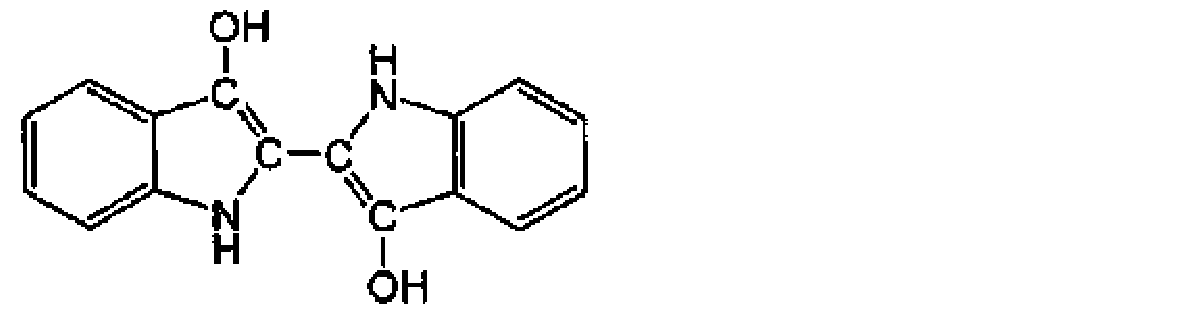
インジゴは青藍色を呈する有機染料であり、下式(化1)に示す構造を有している。インジゴは下式(化1)に示す状態のままでは、水、アルコール、エーテルに対して不溶の性質を有している。一方、下式(化1)に示す状態のままであっても、トリクロロメタン、ニトロベンゼン、濃硫酸には可溶である。
インジゴは青藍色を呈する有機染料であり、下式(化1)に示す構造を有している。インジゴは下式(化1)に示す状態のままでは、水、アルコール、エーテルに対して不溶の性質を有している。一方、下式(化1)に示す状態のままであっても、トリクロロメタン、ニトロベンゼン、濃硫酸には可溶である。

(化1)に示すインジゴを還元すると、下式(化2)で示す還元型のロイコインジゴとなる。ロイコインジゴは淡黄色を呈するものであり、水に可溶の性質を有している。ロイコインジゴを含有する溶液(以下、ロイコインジゴ溶液と称する)は無色透明である。
このロイコインジゴを酸化するとインジゴに戻り、再び青藍色を呈する。つまり、インジゴとロイコインジゴは、可逆的な関係にある。
このロイコインジゴを酸化するとインジゴに戻り、再び青藍色を呈する。つまり、インジゴとロイコインジゴは、可逆的な関係にある。
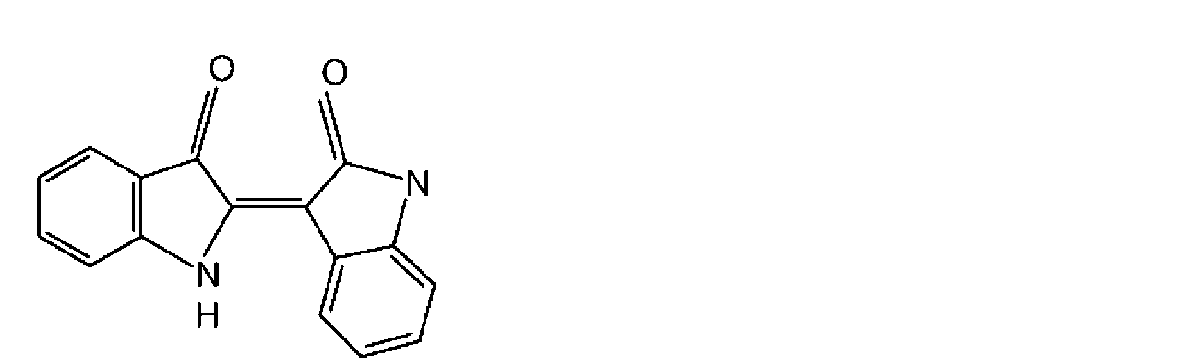
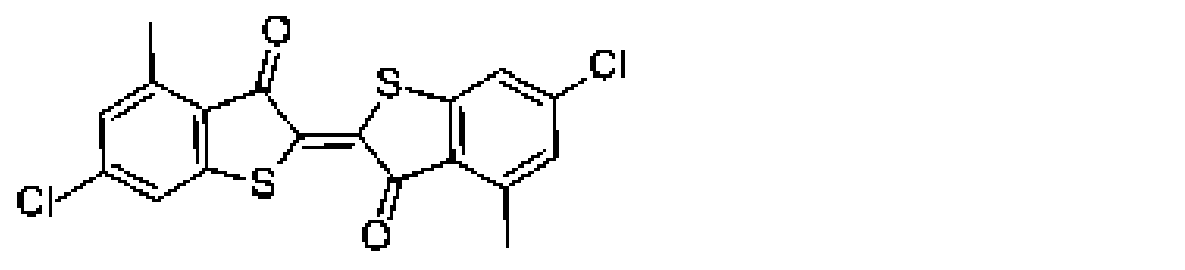
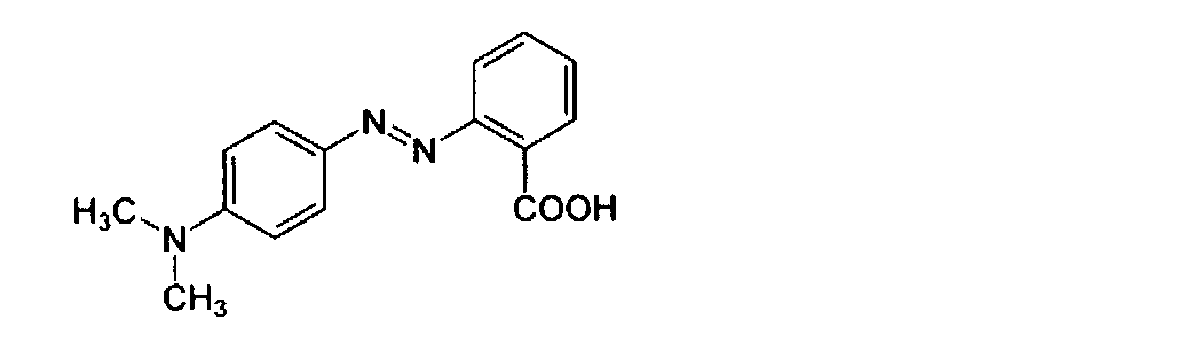
赤色を呈する有機染料としてはインジルビン、ヘリンドンピンクCN及びメチルレッドが用いられる。インジルビンは、化学名δ(2,3')-ビインドリン)-2',3-ジオン((delta(2,3')-Biindoline)-2',3-dione)、CAS.No.は479-41-4であり、下式(化3)に示す構造を有している。ヘリンドンピンクCNは、一般的には赤色226号と言われる有機色素であり、化学名6,6'-Dichloro-4,4'-dimethylthioindigo、CAS No.は2379-74-0であり、下式(化4)に示す構造を有している。メチルレッドは、アゾ染料の一つであり、化学名p-ジメチルアミノアゾベンゼン-o-カルボン酸、CAS.No.は493-52-7であり、下式(化5)に示す構造を有している。
黄色を呈する有機染料としてはキノリン系染料が用いられる。キノリン系染料としては、これに限定されるわけではないが、ディスパーズイエロー54が好適に用いられる。ディスパーズイエロー54は、化学名3-Hydroxyquinophthalone、CAS No.は12223-85-7であり、下式(化6)に示す構造を有している。

本発明に係る無機・有機複合体着色組成物は、上記した繊維状の粘土鉱物(パリゴルスカイト、セピオライト)と有機染料とから構成される。
パリゴルスカイトやセピオライト(繊維状粘土)のチャンネルに有機染料分子が取り込まれている。繊維状粘土に取り込まれた有機染料分子は、繊維状粘土を構成する酸素との水素結合あるいはファンデルワールス力(相互作用)によりチャンネル内に安定化される。
パリゴルスカイトやセピオライト(繊維状粘土)のチャンネルに有機染料分子が取り込まれている。繊維状粘土に取り込まれた有機染料分子は、繊維状粘土を構成する酸素との水素結合あるいはファンデルワールス力(相互作用)によりチャンネル内に安定化される。
本発明に係る無機・有機複合体着色組成物、即ち繊維状粘土と有機染料との複合体着色組成物により着色対象を着色した場合、着色後の色差ΔEは、キセノンランプの促進耐候性試験機を使用してJIS K5600-7-7に従って測定し、 照射時間500時間で2以下である。
上記した繊維状粘土と有機染料との複合体着色組成物は、公知の技術では色差ΔEは2を超えてしまう。つまり、着色後から退色が始まり、着色組成物本来の発色を維持することが困難となる。
尚、本発明における色差ΔEは、JIS Z8730に基づくものである。
また、本発明に係る無機・有機複合体着色組成物は、後述の無機・有機複合体着色組成物の製造方法により得られる。
上記した繊維状粘土と有機染料との複合体着色組成物は、公知の技術では色差ΔEは2を超えてしまう。つまり、着色後から退色が始まり、着色組成物本来の発色を維持することが困難となる。
尚、本発明における色差ΔEは、JIS Z8730に基づくものである。
また、本発明に係る無機・有機複合体着色組成物は、後述の無機・有機複合体着色組成物の製造方法により得られる。
希土類元素イオンとしては、ランタニドのイオンから選択される。本発明に係る無機・有機複合体着色組成物に含有される希土類元素イオンは、ランタンイオン、及び/又は3価のセリウム、プラセオジム、ネオジム、サマリウム、ユウロピウム、ガドリニウム、テルビウム、ジスプロシウム、ホルミウム、エルビウム、ツリウム及びイッテルビウム、並びに2価のユウロピウムから選択される少なくとも一種のイオンである。
ランタン等の希土類元素イオンをイオン交換させることで、無機・有機複合体着色組成物の表面積と酸性度を増大することができる。
3価のセリウム、プラセオジム、ネオジム、サマリウム、ユウロピウム、ガドリニウム、テルビウム、ジスプロシウム、ホルミウム、エルビウム、ツリウム及びイッテルビウム、並びに2価のユウロピウムのイオンは、着色組成物に発光性を付与することができる。
上記した希土類元素イオンを含有した無機・有機複合体着色組成物は、希土類元素イオンを含有しないものと同様に、着色後の色差ΔEは、JIS K5600-7-7に従う耐候性試験において照射時間500時間で2以下である。
ランタン等の希土類元素イオンをイオン交換させることで、無機・有機複合体着色組成物の表面積と酸性度を増大することができる。
3価のセリウム、プラセオジム、ネオジム、サマリウム、ユウロピウム、ガドリニウム、テルビウム、ジスプロシウム、ホルミウム、エルビウム、ツリウム及びイッテルビウム、並びに2価のユウロピウムのイオンは、着色組成物に発光性を付与することができる。
上記した希土類元素イオンを含有した無機・有機複合体着色組成物は、希土類元素イオンを含有しないものと同様に、着色後の色差ΔEは、JIS K5600-7-7に従う耐候性試験において照射時間500時間で2以下である。
次に、本発明に係る無機・有機複合体着色組成物の製造方法について詳述する。本発明に係る無機・有機複合体着色組成物は、繊維状粘土(パリゴルスカイト、セピオライト)と有機染料を用いて、乾式法及び湿式法により製造される。
有機染料としては上記したようにインジゴ、インジルビン、ヘリンドンピンクCN、メチルレッド及びキノリン系染料を用いるのが好ましい。以下に記述する青赤黄三原色無機・有機複合体着色組成物の製造方法においては、有機染料としてインジゴを用いたときの製造方法について記述するが、他の有機染料を用いるときも製造方法は同様である。
本発明に係る無機・有機複合体着色組成物の製造方法は、主に(1)繊維状粘土とインジゴの微粉化並びに混合工程、(2)加熱工程、(3)洗浄工程から構成される。
以下に、乾式法と湿式法共通の工程、乾式法による工程、湿式法による工程、の順で工程(1)乃至(3)夫々を説明する。
以下に、乾式法と湿式法共通の工程、乾式法による工程、湿式法による工程、の順で工程(1)乃至(3)夫々を説明する。
<工程(1)繊維状粘土とインジゴの微粉化並びに混合工程>
繊維状粘土とインジゴを微粉化並びに混合する。繊維状粘土とインジゴを夫々微粉化してから混合してもよく、或いは繊維状粘土とインジゴを混合してから微粉化してもよい。
繊維状粘土とインジゴは、0.1~70μmに微粉化する。この微粉化処理により繊維状粘土とインジゴの接触が多くなり、繊維状粘土にインジゴが染着しやすくなる。
繊維状粘土とインジゴを微粉化並びに混合する。繊維状粘土とインジゴを夫々微粉化してから混合してもよく、或いは繊維状粘土とインジゴを混合してから微粉化してもよい。
繊維状粘土とインジゴは、0.1~70μmに微粉化する。この微粉化処理により繊維状粘土とインジゴの接触が多くなり、繊維状粘土にインジゴが染着しやすくなる。
<工程(1C)希土類元素イオンの取り込み工程>
希土類元素イオンを取り込む場合は、希土類元素イオンを含有する化合物を添加する。そうすることで、希土類元素イオンが繊維状粘土のマグネシウムイオンとイオン交換される。
本発明において添加される希土類元素イオンは、ランタンイオン、及び/又は3価のセリウム、プラセオジム、ネオジム、サマリウム、ユウロピウム、ガドリニウム、テルビウム、ジスプロシウム、ホルミウム、エルビウム、ツリウム及びイッテルビウム、並びに2価のユウロピウムから選択される少なくとも一つのイオンである。
ランタン等の希土類元素イオンをイオン交換させることで、無機・有機複合体着色組成物の表面積と酸性度を増大することができる。
3価のセリウム、プラセオジム、ネオジム、サマリウム、ユウロピウム、ガドリニウム、テルビウム、ジスプロシウム、ホルミウム、エルビウム、ツリウム及びイッテルビウム、並びに2価のユウロピウムのイオンは、着色組成物に発光性を付与することができる。
希土類元素イオンを取り込む場合は、希土類元素イオンを含有する化合物を添加する。そうすることで、希土類元素イオンが繊維状粘土のマグネシウムイオンとイオン交換される。
本発明において添加される希土類元素イオンは、ランタンイオン、及び/又は3価のセリウム、プラセオジム、ネオジム、サマリウム、ユウロピウム、ガドリニウム、テルビウム、ジスプロシウム、ホルミウム、エルビウム、ツリウム及びイッテルビウム、並びに2価のユウロピウムから選択される少なくとも一つのイオンである。
ランタン等の希土類元素イオンをイオン交換させることで、無機・有機複合体着色組成物の表面積と酸性度を増大することができる。
3価のセリウム、プラセオジム、ネオジム、サマリウム、ユウロピウム、ガドリニウム、テルビウム、ジスプロシウム、ホルミウム、エルビウム、ツリウム及びイッテルビウム、並びに2価のユウロピウムのイオンは、着色組成物に発光性を付与することができる。
添加される希土類元素イオンは、例えば硝酸塩のような塩の状態で添加される。
具体的には、硝酸ランタン六水和物、硝酸ネオジム六水和物、硝酸ユウロピウム六水和物である。上記した塩の濃度を調節することにより、繊維状粘土にイオン交換で取り込まれる希土類元素イオンの量が変化する。
希土類元素イオンを繊維状粘土に効率的に取り込む場合は、濃塩酸で繊維状粘土中の不純物である炭酸カルシウムを除去した酸前処理繊維状粘土(酸前処理パリゴルスカイト)を用いることが好ましい。
具体的には、硝酸ランタン六水和物、硝酸ネオジム六水和物、硝酸ユウロピウム六水和物である。上記した塩の濃度を調節することにより、繊維状粘土にイオン交換で取り込まれる希土類元素イオンの量が変化する。
希土類元素イオンを繊維状粘土に効率的に取り込む場合は、濃塩酸で繊維状粘土中の不純物である炭酸カルシウムを除去した酸前処理繊維状粘土(酸前処理パリゴルスカイト)を用いることが好ましい。
繊維状粘土は不純物である炭酸カルシウムを濃塩酸で除去することが好ましい。この酸前処理した繊維状粘土を用いると、希土類元素イオンを効率よく取り込むことができる。
また、希土類元素イオンを取り込んだ繊維状粘土は、ろ過してよく水で洗浄することが好ましい。これにより、繊維状粘土に取り込まれていない希土類元素イオンを除去することができる。
また、希土類元素イオンを取り込んだ繊維状粘土は、ろ過してよく水で洗浄することが好ましい。これにより、繊維状粘土に取り込まれていない希土類元素イオンを除去することができる。
<乾式法における工程(1)繊維状粘土とインジゴの微粉化並びに混合工程>
乾式法における工程(1)においては、繊維状粘土とインジゴを、例えばミキサー等を用いた機械的方法により混合し、繊維状粘土とインジゴを例えばボールミル等の乾式粉砕機を用いた機械的方法により、0.1~70μmに微粉化する。微粉化の機械的方法は上記方法に限定されるものではない。
乾式法における工程(1)においては、繊維状粘土とインジゴを、例えばミキサー等を用いた機械的方法により混合し、繊維状粘土とインジゴを例えばボールミル等の乾式粉砕機を用いた機械的方法により、0.1~70μmに微粉化する。微粉化の機械的方法は上記方法に限定されるものではない。
<湿式法における工程(1A)インジゴを還元する工程>
湿式法による製造方法は、上記工程(1)の前に、インジゴを溶媒に分散させて還元剤によりインジゴを還元し、ロイコインジゴ溶液を調製する工程(工程(1A))を備えている。
工程(1A)において、先ずインジゴを水系溶媒に分散させて還元剤によりインジゴを還元する。
インジゴは、そのままの状態(上記(化1)参照)では水には溶解しない。しかし、インジゴを還元したロイコインジゴ(上記(化2)参照)の状態では、水に可溶となる。従って、先ずインジゴを還元剤により還元する。
湿式法による製造方法は、上記工程(1)の前に、インジゴを溶媒に分散させて還元剤によりインジゴを還元し、ロイコインジゴ溶液を調製する工程(工程(1A))を備えている。
工程(1A)において、先ずインジゴを水系溶媒に分散させて還元剤によりインジゴを還元する。
インジゴは、そのままの状態(上記(化1)参照)では水には溶解しない。しかし、インジゴを還元したロイコインジゴ(上記(化2)参照)の状態では、水に可溶となる。従って、先ずインジゴを還元剤により還元する。
所定量秤量したインジゴを水系溶媒に添加し、分散させる。
インジゴを分散させる水系溶媒としては、水を使用することが好ましい。
水系溶媒に使用する水は、純水や超純水等の精製水であることが好ましい。精製水を使用することで、最終の無機・有機複合体着色組成物中の不純物量を低減することができる。
インジゴを分散させる水系溶媒としては、水を使用することが好ましい。
水系溶媒に使用する水は、純水や超純水等の精製水であることが好ましい。精製水を使用することで、最終の無機・有機複合体着色組成物中の不純物量を低減することができる。
インジゴは水溶媒に溶解せずに分散した状態となる。このインジゴが分散した分散媒に還元剤を添加する。
インジゴの添加量は、後述する粘土鉱物100重量部に対して3~10重量部であることが好ましい。上記した範囲で添加すると、繊維状粘土の構造中にインジゴが過不足なく取り込まれることとなり、鮮やかな発色の着色組成物を得ることができる。一方、インジゴの量が3重量部未満であると、繊維状粘土中に取り込まれる染料が過少となるため十分な発色を得られない虞がある。また、10重量部を超えると、繊維状粘土中に取り込まれない染料が生じる。取り込まれない余剰分のインジゴは、繊維状粘土の表面に付着する。この繊維状粘土表面に付着したインジゴは、後述するように、着色対象を着色した後の色の変化(退色)の原因の一つとなるため、好ましくない。
インジゴの添加量は、後述する粘土鉱物100重量部に対して3~10重量部であることが好ましい。上記した範囲で添加すると、繊維状粘土の構造中にインジゴが過不足なく取り込まれることとなり、鮮やかな発色の着色組成物を得ることができる。一方、インジゴの量が3重量部未満であると、繊維状粘土中に取り込まれる染料が過少となるため十分な発色を得られない虞がある。また、10重量部を超えると、繊維状粘土中に取り込まれない染料が生じる。取り込まれない余剰分のインジゴは、繊維状粘土の表面に付着する。この繊維状粘土表面に付着したインジゴは、後述するように、着色対象を着色した後の色の変化(退色)の原因の一つとなるため、好ましくない。
還元剤としては公知のものを使用することができる。具体的には、ナトリウムハイドロサルファイト(亜ジチオン酸ナトリウム)が好適である。
ナトリウムハイドロサルファイトを水系溶媒に添加する前に、水系溶媒をアルカリ性とすることが好ましい。ナトリウムハイドロサルファイトは、酸性で分解するという性質を有している。水系溶媒をアルカリ性とすることで、ナトリウムハイドロサルファイトの分解を防止することができる。従って、インジゴを確実に還元することができる。
ナトリウムハイドロサルファイトを水系溶媒に添加する前に、水系溶媒をアルカリ性とすることが好ましい。ナトリウムハイドロサルファイトは、酸性で分解するという性質を有している。水系溶媒をアルカリ性とすることで、ナトリウムハイドロサルファイトの分解を防止することができる。従って、インジゴを確実に還元することができる。
還元剤の添加量は、インジゴに対して100~3000重量%であることが好ましい。100~3000重量%とすることで、インジゴを完全に還元して溶媒に溶解させることができる。
100重量%未満であると、インジゴの還元が不十分となり、還元されずにインジゴがそのままの状態((化1)参照)で残存する可能性がある。そのため、繊維状粘土に取り込まれないインジゴが生じる虞がある。一方、3000重量%を超えると、それ以上の効果が望めない。
100重量%未満であると、インジゴの還元が不十分となり、還元されずにインジゴがそのままの状態((化1)参照)で残存する可能性がある。そのため、繊維状粘土に取り込まれないインジゴが生じる虞がある。一方、3000重量%を超えると、それ以上の効果が望めない。
<湿式法における工程(1)繊維状粘土と有機染料の微粉化並びに混合工程>
上記工程(1A)でロイコインジゴ溶液を得た後、繊維状粘土をロイコインジゴ溶液に添加する。繊維状粘土はあらかじめ水に分散させてから前記溶液に添加するのが好ましいが、直接添加してもよく、粘土鉱物を含む溶液にロイコインジゴ溶液を添加してもよい。
工程(1A)で還元したインジゴは、水系溶媒に溶解している。つまり、水系溶媒中にロイコインジゴの状態で染料が存在している。ロイコインジゴを含有する水系溶媒(ロイコインジゴ溶液)は淡黄色である。
上記工程(1A)でロイコインジゴ溶液を得た後、繊維状粘土をロイコインジゴ溶液に添加する。繊維状粘土はあらかじめ水に分散させてから前記溶液に添加するのが好ましいが、直接添加してもよく、粘土鉱物を含む溶液にロイコインジゴ溶液を添加してもよい。
工程(1A)で還元したインジゴは、水系溶媒に溶解している。つまり、水系溶媒中にロイコインジゴの状態で染料が存在している。ロイコインジゴを含有する水系溶媒(ロイコインジゴ溶液)は淡黄色である。
ロイコインジゴ溶液に添加される繊維状粘土は、前述したパリゴルスカイト及びセピオライトである。これらの繊維状粘土については、本発明に係る無機・有機複合体着色組成物に関する説明において述べたので、ここでは省略する。
繊維状粘土は、0.1~70μmの範囲の粒子サイズに微粉化してロイコインジゴ溶液に添加することが好ましい。微粉化は、乾式法と同様の機械的方法、或いは超音波の印加によって行うことができる。繊維状粘土の粒子サイズを上記の範囲とすることで、溶液中のロイコインジゴとの接触面積を大きくすることができる。
繊維状粘土は、0.1~70μmの範囲の粒子サイズに微粉化してロイコインジゴ溶液に添加することが好ましい。微粉化は、乾式法と同様の機械的方法、或いは超音波の印加によって行うことができる。繊維状粘土の粒子サイズを上記の範囲とすることで、溶液中のロイコインジゴとの接触面積を大きくすることができる。
<湿式法における工程(1B)超音波印加及び攪拌工程>
上記工程で得たロイコインジゴと繊維状粘土を含有する溶液に超音波を印加する。超音波を上記の溶液に印加することで、ロイコインジゴがより効率的に繊維状粘土のチャンネルに取り込まれることとなる。
超音波を溶液に印加することにより、キャビテーションが生じる。そのため、繊維状粘土の分散性が向上し、ロイコインジゴと繊維状粘土との接触が多くなる。また、キャビテーションによりロイコインジゴが繊維状粘土のチャンネルに加圧的に挿入される。つまり、繊維状粘土のチャンネルに取り込まれずに表面に付着するのを防ぐことができる。従って、耐候性を向上することができる。
上記工程で得たロイコインジゴと繊維状粘土を含有する溶液に超音波を印加する。超音波を上記の溶液に印加することで、ロイコインジゴがより効率的に繊維状粘土のチャンネルに取り込まれることとなる。
超音波を溶液に印加することにより、キャビテーションが生じる。そのため、繊維状粘土の分散性が向上し、ロイコインジゴと繊維状粘土との接触が多くなる。また、キャビテーションによりロイコインジゴが繊維状粘土のチャンネルに加圧的に挿入される。つまり、繊維状粘土のチャンネルに取り込まれずに表面に付着するのを防ぐことができる。従って、耐候性を向上することができる。
ロイコインジゴ及び繊維状粘土に印加する超音波の周波数は、28~100kHzであることが好ましく、30~40kHzであることがより好ましい。
28kHz未満であると、繊維状粘土の分散が不十分となる可能性がある。一方、100kHzを超えても、繊維状粘土の分散及びチャンネルへのロイコインジゴの挿入をそれ以上促進することができない。
超音波の印加時間は、10分以上が望ましく、より好ましくは60分以上である。
10分未満であると、繊維状粘土の分散が不十分となる可能性がある。
28kHz未満であると、繊維状粘土の分散が不十分となる可能性がある。一方、100kHzを超えても、繊維状粘土の分散及びチャンネルへのロイコインジゴの挿入をそれ以上促進することができない。
超音波の印加時間は、10分以上が望ましく、より好ましくは60分以上である。
10分未満であると、繊維状粘土の分散が不十分となる可能性がある。
超音波の印加は、繊維状粘土を添加したロイコインジゴ溶液を、空気を溶液中に巻き込まないように攪拌しながら行う。超音波の印加と攪拌により、ロイコインジゴが繊維状粘土のチャンネルに取り込まれ易くなる。空気を溶液中に巻き込まないように攪拌するのは、繊維状粘土に取り込まれる前にロイコインジゴが酸化されるのを防ぐためである。
超音波の印加と攪拌をせずに行ってもよいが、その場合はロイコインジゴがチャンネルに効率的に取り込まれない。更に、チャンネルに取り込まれずに粘土鉱物の表面に付着するにとどまる。これは、着色対象を着色した後の退色の原因となるため好ましくない。
次いで、空気を取り込むようにこの溶液を攪拌し、ロイコインジゴを空気に曝すことによって空気酸化させる。
これにより、繊維状粘土のチャンネルに存在するロイコインジゴは酸化して再びインジゴ((化1)参照)となる。酸化されてインジゴの状態となった染料は、青藍色を呈する。そのため、繊維状粘土自体が青藍色に発色しているかのように見える。
超音波の印加と攪拌をせずに行ってもよいが、その場合はロイコインジゴがチャンネルに効率的に取り込まれない。更に、チャンネルに取り込まれずに粘土鉱物の表面に付着するにとどまる。これは、着色対象を着色した後の退色の原因となるため好ましくない。
次いで、空気を取り込むようにこの溶液を攪拌し、ロイコインジゴを空気に曝すことによって空気酸化させる。
これにより、繊維状粘土のチャンネルに存在するロイコインジゴは酸化して再びインジゴ((化1)参照)となる。酸化されてインジゴの状態となった染料は、青藍色を呈する。そのため、繊維状粘土自体が青藍色に発色しているかのように見える。
<工程(2A)分散工程>
後述する工程(2)加熱工程の前に、工程(1)で得られた繊維状粘土とインジゴとからなる着色物を、高沸点を有する溶媒に分散させることが好ましく、特に変色しやすい有機染料を使用する場合にはより好ましい。これにより、後述する工程(2)の加熱によりインジゴが変色するのを防ぐことができる。溶媒としては、加熱により沸騰しないような加熱温度よりも高い沸点を有する溶媒を使用し、使用する有機染料との相性を考慮して、例えばプロピレングリコールが好適に用いられる。
有機染料としてヘリンドンピンクCNを用いるときには、この工程(2A)を行うことが好ましい。
後述する工程(2)加熱工程の前に、工程(1)で得られた繊維状粘土とインジゴとからなる着色物を、高沸点を有する溶媒に分散させることが好ましく、特に変色しやすい有機染料を使用する場合にはより好ましい。これにより、後述する工程(2)の加熱によりインジゴが変色するのを防ぐことができる。溶媒としては、加熱により沸騰しないような加熱温度よりも高い沸点を有する溶媒を使用し、使用する有機染料との相性を考慮して、例えばプロピレングリコールが好適に用いられる。
有機染料としてヘリンドンピンクCNを用いるときには、この工程(2A)を行うことが好ましい。
<工程(2)加熱工程>
上記工程(1)で得た繊維状粘土とインジゴとからなる着色物を加熱し、乾燥する。
加熱温度は、120~200℃であることが好ましく、150~180℃であることがより好ましい。120℃未満であると、繊維状粘土に付着したインジゴがチャンネルの中にはまりこまず、着色組成物の耐候性が悪くなる。一方、200℃を超えると、インジゴの変色が大きくなる虞があるため好ましくない。
上記した温度範囲で1~24時間加熱することが好ましい。このような条件で加熱することにより、インジゴの安定化を図ることができる。
上記工程(2A)で繊維状粘土とインジゴとからなる着色物をプロピレングリコール等の高沸点溶媒に分散させた場合は、この溶媒を除去し、乾燥させる。この溶媒は、アスピレーターの吸引ろ過或いは遠心分離機を用いて除去することができるが、除去方法はこれらに限定されない。
上記工程(1)で得た繊維状粘土とインジゴとからなる着色物を加熱し、乾燥する。
加熱温度は、120~200℃であることが好ましく、150~180℃であることがより好ましい。120℃未満であると、繊維状粘土に付着したインジゴがチャンネルの中にはまりこまず、着色組成物の耐候性が悪くなる。一方、200℃を超えると、インジゴの変色が大きくなる虞があるため好ましくない。
上記した温度範囲で1~24時間加熱することが好ましい。このような条件で加熱することにより、インジゴの安定化を図ることができる。
上記工程(2A)で繊維状粘土とインジゴとからなる着色物をプロピレングリコール等の高沸点溶媒に分散させた場合は、この溶媒を除去し、乾燥させる。この溶媒は、アスピレーターの吸引ろ過或いは遠心分離機を用いて除去することができるが、除去方法はこれらに限定されない。
<工程(3)洗浄工程>
上記工程(2)で加熱して得た繊維状粘土とインジゴとからなる粗製の着色組成物を、還元剤を含有する溶液により洗浄する。つまり、工程(3)では、繊維状粘土のチャンネルに取り込まれずに、単に付着した状態のインジゴを除去する。還元剤を使用することで、繊維状粘土に付着したインジゴがロイコインジゴに還元されて溶解可能となる。ロイコインジゴは、還元剤を含有する溶液に溶解して除去される。
上記工程(2)で加熱して得た繊維状粘土とインジゴとからなる粗製の着色組成物を、還元剤を含有する溶液により洗浄する。つまり、工程(3)では、繊維状粘土のチャンネルに取り込まれずに、単に付着した状態のインジゴを除去する。還元剤を使用することで、繊維状粘土に付着したインジゴがロイコインジゴに還元されて溶解可能となる。ロイコインジゴは、還元剤を含有する溶液に溶解して除去される。
繊維状粘土のチャンネルに取り込まれずに、単に付着した状態のインジゴは退色の原因となる。
チャンネルに取り込まれたインジゴは、水素結合やファンデルワールス力等の相互作用により繊維状粘土内(チャンネル)に安定化されている。一方、繊維状粘土の表面に付着したインジゴは、安定化されておらず、繊維状粘土鉱物と主に物理吸着しているだけであり、相互作用(水素結合やファンデルワールス力)が弱いか少ない。このようなインジゴは、例えば紫外線や酸等により分解あるいは酸化されてしまう。そうすると、青藍色を呈するインジゴではなくなるため、着色対象物の色の変化が見かけ上大きくなる。
余剰のインジゴを除去することで、色の変化(退色)の要因を除くことができる。
チャンネルに取り込まれたインジゴは、水素結合やファンデルワールス力等の相互作用により繊維状粘土内(チャンネル)に安定化されている。一方、繊維状粘土の表面に付着したインジゴは、安定化されておらず、繊維状粘土鉱物と主に物理吸着しているだけであり、相互作用(水素結合やファンデルワールス力)が弱いか少ない。このようなインジゴは、例えば紫外線や酸等により分解あるいは酸化されてしまう。そうすると、青藍色を呈するインジゴではなくなるため、着色対象物の色の変化が見かけ上大きくなる。
余剰のインジゴを除去することで、色の変化(退色)の要因を除くことができる。
還元剤としては、上記工程(1A)と同じ還元剤を使用することが好ましい。つまり、ナトリウムハイドロサルファイト(亜ジチオン酸ナトリウム)が好適である。
ナトリウムハイドロサルファイトを用いることで、インジゴを還元してロイコインジゴとし、容易に除去(溶解)することができる。
上記したように、この工程(3)を経ることで、粗製の着色組成物を精製することができ、耐候性に優れた退色の少ない無機・有機複合体着色組成物とすることができる。
上記工程(2A)分散工程を行わない場合は、単に付着した状態のインジゴが多く存在するため、必ずこの洗浄工程を行う必要がある。
ナトリウムハイドロサルファイトを用いることで、インジゴを還元してロイコインジゴとし、容易に除去(溶解)することができる。
上記したように、この工程(3)を経ることで、粗製の着色組成物を精製することができ、耐候性に優れた退色の少ない無機・有機複合体着色組成物とすることができる。
上記工程(2A)分散工程を行わない場合は、単に付着した状態のインジゴが多く存在するため、必ずこの洗浄工程を行う必要がある。
有機染料として赤色染料であるインジルビン、ヘリンドンピンクCN、メチルレッドからなる群から選択される1種以上を用いる場合は、還元剤を含有するアルカリ性溶液により洗浄するか、又は水によるソックスレー抽出により洗浄することが好ましく、有機染料として黄色染料であるキノリン系染料を用いる場合は、還元剤を含有するアルカリ性溶液により洗浄するか、又はエタノールによるソックスレー抽出により洗浄することが好ましい。これにより、余剰の有機染料を除去することができ、色の変化(退色)の要因を除くことができる。
以下、実施例に基づいて本発明を詳細に説明するが、本発明は以下の実施例に限定されない。
実施例1 乾式法による無機・有機複合体着色組成物の製造方法1
工程(1)
パリゴルスカイト(アタゲル#40、エンゲルハード社製)10gに、インジゴ(Dystar Indigo Gr、ダイスタージャパン社製)0.5gを添加し、ミキサーによって混合した。この混合物を、ボールミルを用いて粉砕し、微粉化した後、再びミキサーにてよく混合した。
工程(1)
パリゴルスカイト(アタゲル#40、エンゲルハード社製)10gに、インジゴ(Dystar Indigo Gr、ダイスタージャパン社製)0.5gを添加し、ミキサーによって混合した。この混合物を、ボールミルを用いて粉砕し、微粉化した後、再びミキサーにてよく混合した。
工程(2)
上記工程(1)で得たパリゴルスカイトとインジゴとからなる着色物を170℃で6時間加熱し、パリゴルスカイトとインジゴとからなる粗製の着色組成物10gを得た。
上記工程(1)で得たパリゴルスカイトとインジゴとからなる着色物を170℃で6時間加熱し、パリゴルスカイトとインジゴとからなる粗製の着色組成物10gを得た。
工程(3)
上記工程(2)で得たパリゴルスカイトとインジゴとからなる粗製の着色組成物を、ナトリウムハイドロサルファイト1.5g、2M苛性ソーダ水溶液10g及び蒸留水100gからなる溶液で洗浄し、無機・有機複合体着色組成物9.0gを精製した。
尚、洗浄前後のインジゴ減量分は、CHN分析の結果から約30%減であった。
上記工程(2)で得たパリゴルスカイトとインジゴとからなる粗製の着色組成物を、ナトリウムハイドロサルファイト1.5g、2M苛性ソーダ水溶液10g及び蒸留水100gからなる溶液で洗浄し、無機・有機複合体着色組成物9.0gを精製した。
尚、洗浄前後のインジゴ減量分は、CHN分析の結果から約30%減であった。
実施例2 湿式法による無機・有機複合体着色組成物の製造方法1
工程(1A)
インジゴ(Dystar Indigo Gr、ダイスタージャパン社製)0.5gを、蒸留水22.5gに添加し、この溶液に2M苛性ソーダ水溶液10gを添加した。次いで、還元剤として蒸留水100g及びナトリウムハイドロサルファイト1.5gからなる溶液を空気を遮断して添加してインジゴを還元し、ロイコインジゴ溶液134.5gを得た。
工程(1A)
インジゴ(Dystar Indigo Gr、ダイスタージャパン社製)0.5gを、蒸留水22.5gに添加し、この溶液に2M苛性ソーダ水溶液10gを添加した。次いで、還元剤として蒸留水100g及びナトリウムハイドロサルファイト1.5gからなる溶液を空気を遮断して添加してインジゴを還元し、ロイコインジゴ溶液134.5gを得た。
工程(1)
パリゴルスカイト(アタゲル#40、エンゲルハード社製)10gを蒸留水400gに添加し、この溶液を攪拌しながら周波数37~42kHzの超音波を80℃で、40分間印加した。この溶液と上記工程(1A)で得たロイコインジゴ溶液134.5gを混合し、ロイコインジゴとパリゴルスカイトを含む溶液544.5gを得た。
パリゴルスカイト(アタゲル#40、エンゲルハード社製)10gを蒸留水400gに添加し、この溶液を攪拌しながら周波数37~42kHzの超音波を80℃で、40分間印加した。この溶液と上記工程(1A)で得たロイコインジゴ溶液134.5gを混合し、ロイコインジゴとパリゴルスカイトを含む溶液544.5gを得た。
工程(1B)
上記工程(1)で得た溶液を50℃で40分間インキュベートした後、この溶液を、空気を溶液中に巻き込まないように攪拌しながら、この溶液に周波数37~42kHzの超音波を30分間印加し、次いで60分間、溶液に空気を取り込むように攪拌をし、ロイコインジゴを酸化し不溶化した。
上記工程(1)で得た溶液を50℃で40分間インキュベートした後、この溶液を、空気を溶液中に巻き込まないように攪拌しながら、この溶液に周波数37~42kHzの超音波を30分間印加し、次いで60分間、溶液に空気を取り込むように攪拌をし、ロイコインジゴを酸化し不溶化した。
工程(2)
上記工程(1B)で得たパリゴルスカイトとインジゴとからなる着色物を含有する溶液を、吸引ろ過、水洗浄後、50℃乾燥して粉末にし、その粉末を170℃で6時間加熱した。
上記工程(1B)で得たパリゴルスカイトとインジゴとからなる着色物を含有する溶液を、吸引ろ過、水洗浄後、50℃乾燥して粉末にし、その粉末を170℃で6時間加熱した。
工程(3)
上記工程(2)で得たパリゴルスカイトとインジゴとからなる粗製の着色組成物を、ナトリウムハイドロサルファイト1.5g、2M苛性ソーダ水溶液10g及び蒸留水100gからなる溶液で、50℃で40分間洗浄し、無機・有機複合体着色組成物8.7gを精製した。
尚、洗浄前後のインジゴ減量分は、CHN分析の結果から約30%減であった。
上記工程(2)で得たパリゴルスカイトとインジゴとからなる粗製の着色組成物を、ナトリウムハイドロサルファイト1.5g、2M苛性ソーダ水溶液10g及び蒸留水100gからなる溶液で、50℃で40分間洗浄し、無機・有機複合体着色組成物8.7gを精製した。
尚、洗浄前後のインジゴ減量分は、CHN分析の結果から約30%減であった。
実施例3 乾式法による無機・有機複合体着色組成物の製造方法2
工程(1)
セピオライト(パンゲルAD、TOLSA社製)10gに、インジゴ(Dystar Indigo Gr、ダイスタージャパン社製)0.5gを添加し、ミキサーによって混合した。この混合物を、ボールミルを用いて粉砕し、微粉化した後、再びミキサーにてよく混合した。
工程(1)
セピオライト(パンゲルAD、TOLSA社製)10gに、インジゴ(Dystar Indigo Gr、ダイスタージャパン社製)0.5gを添加し、ミキサーによって混合した。この混合物を、ボールミルを用いて粉砕し、微粉化した後、再びミキサーにてよく混合した。
工程(2)
上記工程(1)で得たセピオライトとインジゴとからなる着色物を170℃で6時間加熱し、セピオライトとインジゴからなる粗製の着色組成物10gを得た。
上記工程(1)で得たセピオライトとインジゴとからなる着色物を170℃で6時間加熱し、セピオライトとインジゴからなる粗製の着色組成物10gを得た。
工程(3)
上記工程(2)で得たセピオライトとインジゴとからなる粗製の着色組成物を、ナトリウムハイドロサルファイト1.5g、2M苛性ソーダ水溶液10g及び蒸留水100gからなる溶液で洗浄し、無機・有機複合体着色組成物9gを精製した。
上記工程(2)で得たセピオライトとインジゴとからなる粗製の着色組成物を、ナトリウムハイドロサルファイト1.5g、2M苛性ソーダ水溶液10g及び蒸留水100gからなる溶液で洗浄し、無機・有機複合体着色組成物9gを精製した。
実施例4 乾式法による無機・有機複合体着色組成物の製造方法3
工程(1)
パリゴルスカイト(ゼメックス601-P、ゼメックス社製)10gに、ヘリンドンピンクCN(赤色226号、癸巳化成社製)0.5gを添加し、ミキサーによって混合した。この混合物を、ボールミルを用いて粉砕し、微粉化した後、再びミキサーにてよく混合した。
工程(1)
パリゴルスカイト(ゼメックス601-P、ゼメックス社製)10gに、ヘリンドンピンクCN(赤色226号、癸巳化成社製)0.5gを添加し、ミキサーによって混合した。この混合物を、ボールミルを用いて粉砕し、微粉化した後、再びミキサーにてよく混合した。
工程(2A)
上記工程(1)で得たパリゴルスカイトとヘリンドンピンクCNとからなる着色物10gを、プロピレングリコール100gに添加し、分散させた。
上記工程(1)で得たパリゴルスカイトとヘリンドンピンクCNとからなる着色物10gを、プロピレングリコール100gに添加し、分散させた。
工程(2)
上記工程(2A)で得たパリゴルスカイトとヘリンドンピンクCNとからなる着色物を含有するプロピレングリコール溶液を、170℃で6時間加熱し、プロピレングリコールを吸引ろ過、水洗浄後、50℃で乾燥させ、パリゴルスカイトと赤色226号からなる粗製の着色組成物9.6gを得た。
上記工程(2A)で得たパリゴルスカイトとヘリンドンピンクCNとからなる着色物を含有するプロピレングリコール溶液を、170℃で6時間加熱し、プロピレングリコールを吸引ろ過、水洗浄後、50℃で乾燥させ、パリゴルスカイトと赤色226号からなる粗製の着色組成物9.6gを得た。
工程(3)
上記工程(2)で得たパリゴルスカイトとヘリンドンピンクCNとからなる粗製の着色組成物を、ナトリウムハイドロサルファイト1.5g、2M苛性ソーダ水溶液10g及び蒸留水100gからなる溶液で洗浄し、無機・有機複合体着色組成物8.0gを精製した。
上記工程(2)で得たパリゴルスカイトとヘリンドンピンクCNとからなる粗製の着色組成物を、ナトリウムハイドロサルファイト1.5g、2M苛性ソーダ水溶液10g及び蒸留水100gからなる溶液で洗浄し、無機・有機複合体着色組成物8.0gを精製した。
実施例5 湿式法による無機・有機複合体着色組成物の製造方法2
工程(1A)
インジゴ(Dystar Indigo Gr、ダイスタージャパン社製)0.5gを、蒸留水22.5gに添加し、この溶液に2M苛性ソーダ水溶液10gを添加した。次いで、還元剤として蒸留水100g及びナトリウムハイドロサルファイト1.5gからなる溶液を添加してインジゴを還元し、ロイコインジゴ溶液134.5gを得た。
工程(1A)
インジゴ(Dystar Indigo Gr、ダイスタージャパン社製)0.5gを、蒸留水22.5gに添加し、この溶液に2M苛性ソーダ水溶液10gを添加した。次いで、還元剤として蒸留水100g及びナトリウムハイドロサルファイト1.5gからなる溶液を添加してインジゴを還元し、ロイコインジゴ溶液134.5gを得た。
工程(1C)
パリゴルスカイト(アタゲル#40、エンゲルハード社製)10gを蒸留水115gに添加し、この溶液に蒸留水285g及び硝酸ランタン六水和物0.52gからなる溶液を添加した。この溶液を80℃で4時間攪拌した。
パリゴルスカイト(アタゲル#40、エンゲルハード社製)10gを蒸留水115gに添加し、この溶液に蒸留水285g及び硝酸ランタン六水和物0.52gからなる溶液を添加した。この溶液を80℃で4時間攪拌した。
工程(1)
上記工程(1C)で得た溶液と上記工程(1A)で得たロイコインジゴ溶液134.5gを混合し、インジゴとパリゴルスカイトを含む溶液545gを得た。
上記工程(1C)で得た溶液と上記工程(1A)で得たロイコインジゴ溶液134.5gを混合し、インジゴとパリゴルスカイトを含む溶液545gを得た。
工程(1B)
上記工程(1)で得た溶液を50℃で40分間インキュベートした後、この溶液を、空気を溶液中に巻き込まないように攪拌しながらこの溶液に周波数37~42kHzの超音波を30分間印加し、次いで60分間、溶液に空気を取り込むように攪拌をし、ロイコインジゴを酸化し不溶化した。
上記工程(1)で得た溶液を50℃で40分間インキュベートした後、この溶液を、空気を溶液中に巻き込まないように攪拌しながらこの溶液に周波数37~42kHzの超音波を30分間印加し、次いで60分間、溶液に空気を取り込むように攪拌をし、ロイコインジゴを酸化し不溶化した。
工程(2)
上記工程(1B)で得たパリゴルスカイトとインジゴとからなる着色物を含有する溶液を、吸引ろ過、水洗浄後、50℃乾燥して粉末にし、その粉末を170℃で6時間加熱した。
上記工程(1B)で得たパリゴルスカイトとインジゴとからなる着色物を含有する溶液を、吸引ろ過、水洗浄後、50℃乾燥して粉末にし、その粉末を170℃で6時間加熱した。
工程(3)
上記工程(2)で得たパリゴルスカイトとインジゴとからなる粗製の着色組成物を、ナトリウムハイドロサルファイト1.5g、2M苛性ソーダ水溶液10g及び蒸留水100gからなる溶液で、50℃で40分間洗浄し、無機・有機複合体着色組成物9.0gを精製した。
上記工程(2)で得たパリゴルスカイトとインジゴとからなる粗製の着色組成物を、ナトリウムハイドロサルファイト1.5g、2M苛性ソーダ水溶液10g及び蒸留水100gからなる溶液で、50℃で40分間洗浄し、無機・有機複合体着色組成物9.0gを精製した。
実施例6 湿式法による無機・有機複合体着色組成物の製造方法3
工程(1A)
インジゴ(Dystar Indigo Gr、ダイスタージャパン社製)0.5gを、蒸留水22.5gに添加し、この溶液に2M苛性ソーダ水溶液10gを添加した。次いで、還元剤として蒸留水100g及びナトリウムハイドロサルファイト1.5gからなる溶液を添加してインジゴを還元し、ロイコインジゴ溶液134.5gを得た。
工程(1A)
インジゴ(Dystar Indigo Gr、ダイスタージャパン社製)0.5gを、蒸留水22.5gに添加し、この溶液に2M苛性ソーダ水溶液10gを添加した。次いで、還元剤として蒸留水100g及びナトリウムハイドロサルファイト1.5gからなる溶液を添加してインジゴを還元し、ロイコインジゴ溶液134.5gを得た。
工程(1C)
パリゴルスカイト(アタゲル#40、エンゲルハード社製)10gを蒸留水115gに添加し、この溶液に蒸留水285g及び硝酸ランタン六水和物0.52gからなる溶液を80℃で4時間攪拌して、イオン交換でランタンイオンをパリゴルスカイトに取込ませた。この溶液をろ過して、パリゴルスカイトをよく水で洗浄して、乾燥した。
パリゴルスカイト(アタゲル#40、エンゲルハード社製)10gを蒸留水115gに添加し、この溶液に蒸留水285g及び硝酸ランタン六水和物0.52gからなる溶液を80℃で4時間攪拌して、イオン交換でランタンイオンをパリゴルスカイトに取込ませた。この溶液をろ過して、パリゴルスカイトをよく水で洗浄して、乾燥した。
工程(1)
上記工程(1C)で得たパリゴルスカイトと上記工程(1A)で得たロイコインジゴ溶液134.5gを混合し、スラリー状溶液545gを得た。
上記工程(1C)で得たパリゴルスカイトと上記工程(1A)で得たロイコインジゴ溶液134.5gを混合し、スラリー状溶液545gを得た。
工程(1B)
上記工程(1)で得た溶液を50℃で40分間インキュベートした後、この溶液を、空気を溶液中に巻き込まないように攪拌しながらこの溶液に周波数37~42kHzの超音波を30分間印加し、次いで60分間、溶液に空気を取り込むように攪拌をし、インジゴを酸化し不溶化した。
上記工程(1)で得た溶液を50℃で40分間インキュベートした後、この溶液を、空気を溶液中に巻き込まないように攪拌しながらこの溶液に周波数37~42kHzの超音波を30分間印加し、次いで60分間、溶液に空気を取り込むように攪拌をし、インジゴを酸化し不溶化した。
工程(2)
上記工程(1B)で得たパリゴルスカイトとインジゴとからなる着色物を含有する溶液を、吸引ろ過、水洗浄後、50℃乾燥して粉末にし、その粉末を170℃で6時間加熱した。
上記工程(1B)で得たパリゴルスカイトとインジゴとからなる着色物を含有する溶液を、吸引ろ過、水洗浄後、50℃乾燥して粉末にし、その粉末を170℃で6時間加熱した。
工程(3)
上記工程(2)で得たパリゴルスカイトとインジゴとからなる粗製の着色組成物を、ナトリウムハイドロサルファイト1.5g、2M苛性ソーダ水溶液10g及び蒸留水100gからなる溶液で、50℃で40分間洗浄し、無機・有機複合体着色組成物9.0gを精製した。
尚、洗浄前後のインジゴ減量分は、CHN分析の結果から約30%減であった。
上記工程(2)で得たパリゴルスカイトとインジゴとからなる粗製の着色組成物を、ナトリウムハイドロサルファイト1.5g、2M苛性ソーダ水溶液10g及び蒸留水100gからなる溶液で、50℃で40分間洗浄し、無機・有機複合体着色組成物9.0gを精製した。
尚、洗浄前後のインジゴ減量分は、CHN分析の結果から約30%減であった。
実施例7 乾式法による無機・有機複合体着色組成物の製造方法4
実施例6とは、工程(1C)の前に、濃塩酸でパリゴルスカイト(アタゲル#40、エンゲルハード社製)中の不純物である炭酸カルシウムを除去し、この酸前処理パリゴルスカイトを工程(1)で使用したこと、硝酸ランタン六水和物の代わりに硝酸セリウム六水和物を用いたこと、及び工程(1A)がないこと以外は同じ条件で、無機・有機複合体着色組成物9.0gを精製した。
実施例6とは、工程(1C)の前に、濃塩酸でパリゴルスカイト(アタゲル#40、エンゲルハード社製)中の不純物である炭酸カルシウムを除去し、この酸前処理パリゴルスカイトを工程(1)で使用したこと、硝酸ランタン六水和物の代わりに硝酸セリウム六水和物を用いたこと、及び工程(1A)がないこと以外は同じ条件で、無機・有機複合体着色組成物9.0gを精製した。
実施例8 乾式法による無機・有機複合体着色組成物の製造方法5
工程(1)
パリゴルスカイト(アタゲル#50、エンゲルハード社製)10gに、メチルレッド(Johnson Matthey Company社製)0.5gを添加し、ミキサーによって混合した。この混合物を、ボールミルを用いて粉砕し、微粉化した後、再びミキサーにてよく混合した。
工程(1)
パリゴルスカイト(アタゲル#50、エンゲルハード社製)10gに、メチルレッド(Johnson Matthey Company社製)0.5gを添加し、ミキサーによって混合した。この混合物を、ボールミルを用いて粉砕し、微粉化した後、再びミキサーにてよく混合した。
工程(2)
上記工程(1)で得たパリゴルスカイトとメチルレッドとからなる着色物を、170℃で6時間加熱した。
上記工程(1)で得たパリゴルスカイトとメチルレッドとからなる着色物を、170℃で6時間加熱した。
工程(3)
上記工程(2)で得たパリゴルスカイトとメチルレッドとからなる粗製の着色組成物を、水によるソックスレー抽出により洗浄し、無機・有機複合体着色組成物9.0gを精製した。
尚、洗浄前後のメチルレッド減量分は、CHN分析の結果から約50%減であった。
上記工程(2)で得たパリゴルスカイトとメチルレッドとからなる粗製の着色組成物を、水によるソックスレー抽出により洗浄し、無機・有機複合体着色組成物9.0gを精製した。
尚、洗浄前後のメチルレッド減量分は、CHN分析の結果から約50%減であった。
実施例9 乾式法による無機・有機複合体着色組成物の製造方法6
工程(1C)
パリゴルスカイト(アタゲル#40、エンゲルハード社製)10gを蒸留水115gに添加し、この溶液に蒸留水285g及び硝酸ランタン六水和物0.52gからなる溶液を80℃で4時間攪拌して、イオン交換でランタンイオンをパリゴルスカイトに取込ませた。この溶液をろ過して、パリゴルスカイトをよく水で洗浄して、乾燥した。
工程(1C)
パリゴルスカイト(アタゲル#40、エンゲルハード社製)10gを蒸留水115gに添加し、この溶液に蒸留水285g及び硝酸ランタン六水和物0.52gからなる溶液を80℃で4時間攪拌して、イオン交換でランタンイオンをパリゴルスカイトに取込ませた。この溶液をろ過して、パリゴルスカイトをよく水で洗浄して、乾燥した。
工程(1)
上記工程(1C)で得たパリゴルスカイト(アタゲル#50、エンゲルハード社製)10gに、ディスパーズイエロー54(有本化学社製)0.5gを添加し、ミキサーによって混合した。この混合物を、ボールミルを用いて粉砕し、微粉化した後、再びミキサーにてよく混合した。
上記工程(1C)で得たパリゴルスカイト(アタゲル#50、エンゲルハード社製)10gに、ディスパーズイエロー54(有本化学社製)0.5gを添加し、ミキサーによって混合した。この混合物を、ボールミルを用いて粉砕し、微粉化した後、再びミキサーにてよく混合した。
工程(2)
上記工程(1)で得たパリゴルスカイトとディスパーズイエロー54とからなる着色物を、170℃で6時間加熱した。
上記工程(1)で得たパリゴルスカイトとディスパーズイエロー54とからなる着色物を、170℃で6時間加熱した。
工程(3)
上記工程(2)で得たパリゴルスカイトとディスパーズイエロー54とからなる粗製の着色組成物を、エタノールによるソックスレー抽出により洗浄し、無機・有機複合体着色組成物9.0gを精製した。
尚、洗浄前後のディスパーズイエロー54減量分は、CHN分析の結果から約30%減であった。
上記工程(2)で得たパリゴルスカイトとディスパーズイエロー54とからなる粗製の着色組成物を、エタノールによるソックスレー抽出により洗浄し、無機・有機複合体着色組成物9.0gを精製した。
尚、洗浄前後のディスパーズイエロー54減量分は、CHN分析の結果から約30%減であった。
(比較例)
比較例1 乾式法による無機・有機複合体着色組成物の製造方法7
実施例1とは、工程(3)の洗浄を行わなかったこと以外は同じ条件で、無機・有機複合体着色組成物9.0gを精製した。
比較例1 乾式法による無機・有機複合体着色組成物の製造方法7
実施例1とは、工程(3)の洗浄を行わなかったこと以外は同じ条件で、無機・有機複合体着色組成物9.0gを精製した。
比較例2 乾式法による無機・有機複合体着色組成物の製造方法8
実施例1とは、工程(3)の洗浄を、クロロホルムにより行ったこと、及び工程(1)の前に、濃塩酸でパリゴルスカイト(アタゲル#40)中の不純物である炭酸カルシウムを除去し、この酸前処理パリゴルスカイトを工程(1)で使用したこと以外は同じ条件で、無機・有機複合体着色組成物9.0gを精製した。
実施例1とは、工程(3)の洗浄を、クロロホルムにより行ったこと、及び工程(1)の前に、濃塩酸でパリゴルスカイト(アタゲル#40)中の不純物である炭酸カルシウムを除去し、この酸前処理パリゴルスカイトを工程(1)で使用したこと以外は同じ条件で、無機・有機複合体着色組成物9.0gを精製した。
比較例3 乾式法による無機・有機複合体着色組成物の製造方法9
実施例8とは、工程(3)の洗浄を、エタノールによるソックスレー抽出により行ったこと、及び工程(1)の前に、濃塩酸でパリゴルスカイト(アタゲル#40)中の不純物である炭酸カルシウムを除去し、この酸前処理パリゴルスカイトを工程(1)で使用したこと以外は同じ条件で、無機・有機複合体着色組成物9.0gを精製した。
実施例8とは、工程(3)の洗浄を、エタノールによるソックスレー抽出により行ったこと、及び工程(1)の前に、濃塩酸でパリゴルスカイト(アタゲル#40)中の不純物である炭酸カルシウムを除去し、この酸前処理パリゴルスカイトを工程(1)で使用したこと以外は同じ条件で、無機・有機複合体着色組成物9.0gを精製した。
比較例4 乾式法による無機・有機複合体着色組成物の製造方法10
実施例8とは、工程(3)の洗浄を行わなかったこと、及び工程(1)の前に、濃塩酸でパリゴルスカイト(アタゲル#40)中の不純物である炭酸カルシウムを除去し、この酸前処理パリゴルスカイトを工程(1)で使用したこと以外は同じ条件で、無機・有機複合体着色組成物9.0gを精製した。
実施例8とは、工程(3)の洗浄を行わなかったこと、及び工程(1)の前に、濃塩酸でパリゴルスカイト(アタゲル#40)中の不純物である炭酸カルシウムを除去し、この酸前処理パリゴルスカイトを工程(1)で使用したこと以外は同じ条件で、無機・有機複合体着色組成物9.0gを精製した。
比較例5 乾式法による無機・有機複合体着色組成物の製造方法11
実施例9とは、工程(3)の洗浄を行わなかったこと以外は同じ条件で、無機・有機複合体着色組成物9.0gを精製した。
実施例9とは、工程(3)の洗浄を行わなかったこと以外は同じ条件で、無機・有機複合体着色組成物9.0gを精製した。
(試験例)
(ブリード試験)
上記実施例2により得た無機・有機複合体着色組成物7.7重量部、顔料分散液63.5重量部及びアクリル樹脂であるモビニール727TXNL(日本合成化学社製)28.8重量部から、原色塗料を作成し、塗布、乾燥後、その上に白色塗料を塗布しブリードの有無の確認試験を行った。
比較例として、青色塗料であるB1000(Mayan Pigments社製)についても同様の試験を行った。
結果を表1に示す。ブリードによる色差は、白色塗料単独の色に対する、ブリードにより染められた塗料面の色差を測定した。色差が大きいほど、ブリードが大であることを示す。色差ΔEが1.0以下であれば色の変化がほとんどなく、ブリードがないと判断できるため、色差ΔE1.0以下を合格とした。実施例2の無機・有機複合体着色組成物を含む塗料では明確な変色は見られず、合格であった。
(ブリード試験)
上記実施例2により得た無機・有機複合体着色組成物7.7重量部、顔料分散液63.5重量部及びアクリル樹脂であるモビニール727TXNL(日本合成化学社製)28.8重量部から、原色塗料を作成し、塗布、乾燥後、その上に白色塗料を塗布しブリードの有無の確認試験を行った。
比較例として、青色塗料であるB1000(Mayan Pigments社製)についても同様の試験を行った。
結果を表1に示す。ブリードによる色差は、白色塗料単独の色に対する、ブリードにより染められた塗料面の色差を測定した。色差が大きいほど、ブリードが大であることを示す。色差ΔEが1.0以下であれば色の変化がほとんどなく、ブリードがないと判断できるため、色差ΔE1.0以下を合格とした。実施例2の無機・有機複合体着色組成物を含む塗料では明確な変色は見られず、合格であった。

(耐候性試験1)
上記実施例1により得た無機・有機複合体着色組成物1.71重量部、10%エマルゲンA-500水溶液(花王(株)製)0.17重量部、BYK028(ビッグケミー・ジャパン(株)製)0.03重量部、モビニール727(日本合成化学社製)6.41重量部、Cs-12(チッソ化学(株)製)0.45重量部、及びビッグアートホワイト(ターナー色彩(株)製)91.23重量部から塗料を作成した。上記実施例4及び9により得た無機・有機複合体着色組成物においても同様の配合で塗料を作成した。
尚、以下に記述する耐候性試験に用いる無機・有機複合体着色組成物においても同様の配合で塗料を作成した。
これらの塗料を250μmのアプリケーターで白色のアクリル板に塗布し、乾燥後、キセノンランプの促進耐候性試験機を使用してJIS K5600-7-7に従って耐候性試験を行い、24、100、200、300時間後の色差ΔEを測定した。
尚、以下に記述する耐候性試験においても同様の方法で色差ΔEを測定した。
結果を表2に示す。実施例1及び4で得た無機・有機複合体着色組成物の色差ΔEは、300時間後でも2.0以下であり、優れた耐候性を示した。実施例9で得た無機・有機複合体着色組成物の色差ΔEも100hrにおいて、実施例1及び4と同等の優れた耐候性を示した。
上記実施例1により得た無機・有機複合体着色組成物1.71重量部、10%エマルゲンA-500水溶液(花王(株)製)0.17重量部、BYK028(ビッグケミー・ジャパン(株)製)0.03重量部、モビニール727(日本合成化学社製)6.41重量部、Cs-12(チッソ化学(株)製)0.45重量部、及びビッグアートホワイト(ターナー色彩(株)製)91.23重量部から塗料を作成した。上記実施例4及び9により得た無機・有機複合体着色組成物においても同様の配合で塗料を作成した。
尚、以下に記述する耐候性試験に用いる無機・有機複合体着色組成物においても同様の配合で塗料を作成した。
これらの塗料を250μmのアプリケーターで白色のアクリル板に塗布し、乾燥後、キセノンランプの促進耐候性試験機を使用してJIS K5600-7-7に従って耐候性試験を行い、24、100、200、300時間後の色差ΔEを測定した。
尚、以下に記述する耐候性試験においても同様の方法で色差ΔEを測定した。
結果を表2に示す。実施例1及び4で得た無機・有機複合体着色組成物の色差ΔEは、300時間後でも2.0以下であり、優れた耐候性を示した。実施例9で得た無機・有機複合体着色組成物の色差ΔEも100hrにおいて、実施例1及び4と同等の優れた耐候性を示した。
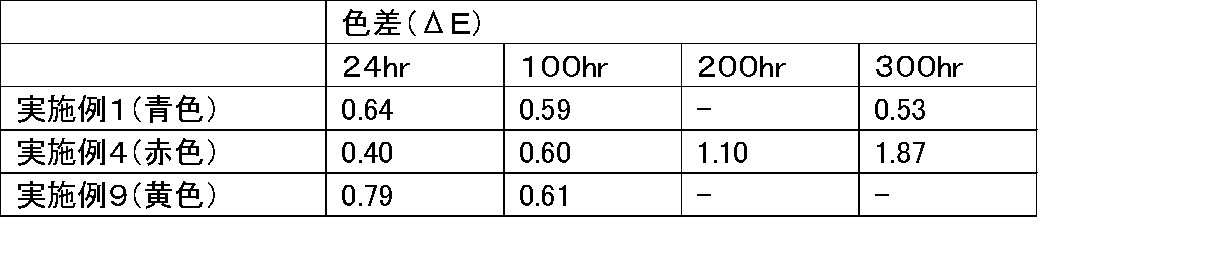
(耐候性試験2)
上記実施例1~3で得た無機・有機複合体着色組成物を含有する塗料、並びに比較例としてB1000(Mayan Pigments社製)、RB1000(Mayan Pigments社製)及びフタロシアニンであるユニスパースブルーGS(BASF製)の24、100、200、300、400、500時間後の色差ΔEを測定した。実施例1のみ600、700時間後まで測定した。
結果を表3に示す。実施例1及び2で得た無機・有機複合体着色組成物は、フタロシアニンに匹敵し、実施例1、2及び3で得た無機・有機複合体着色組成物は、B1000及びRB1000よりも優れた耐候性を示した。
上記実施例1~3で得た無機・有機複合体着色組成物を含有する塗料、並びに比較例としてB1000(Mayan Pigments社製)、RB1000(Mayan Pigments社製)及びフタロシアニンであるユニスパースブルーGS(BASF製)の24、100、200、300、400、500時間後の色差ΔEを測定した。実施例1のみ600、700時間後まで測定した。
結果を表3に示す。実施例1及び2で得た無機・有機複合体着色組成物は、フタロシアニンに匹敵し、実施例1、2及び3で得た無機・有機複合体着色組成物は、B1000及びRB1000よりも優れた耐候性を示した。
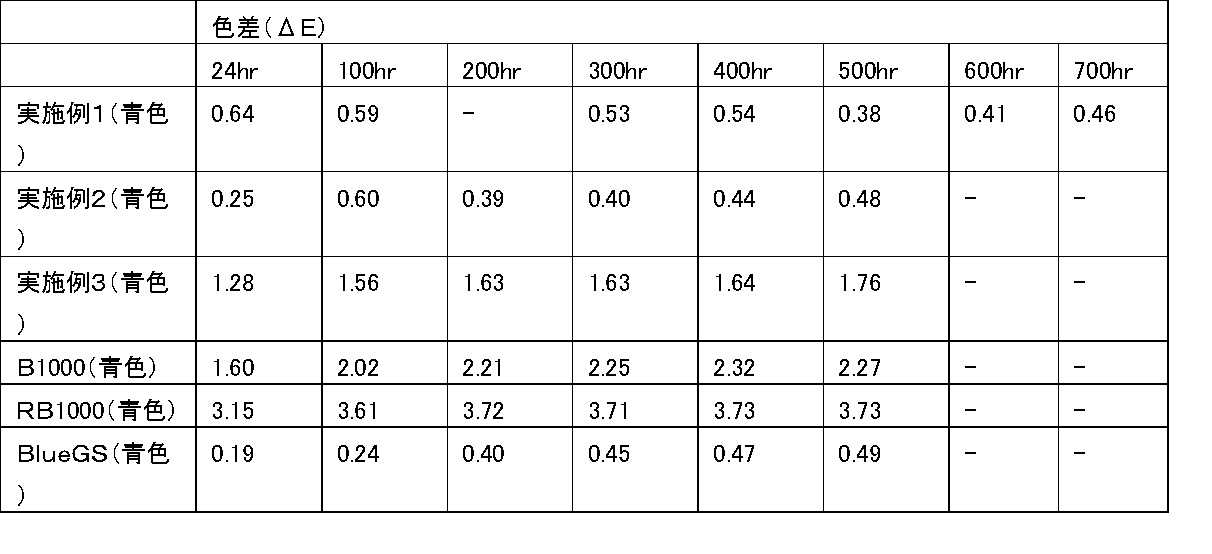
(耐候性試験3)
上記実施例5及び7で得た無機・有機複合体着色組成物を含有する塗料の24、100(124)、200(224)、300(324)、400(424)、500(524)時間後の色差ΔEを測定した。
結果を表4に示す。ランタンイオンをイオン交換した実施例5で得た無機・有機複合体着色組成物の色差ΔEは、500時間後でも1.5以下であり、優れた耐候性を示した。La濃度1.6%以下の場合、La濃度0%と比べて耐候性が向上した。
上記実施例5及び7で得た無機・有機複合体着色組成物を含有する塗料の24、100(124)、200(224)、300(324)、400(424)、500(524)時間後の色差ΔEを測定した。
結果を表4に示す。ランタンイオンをイオン交換した実施例5で得た無機・有機複合体着色組成物の色差ΔEは、500時間後でも1.5以下であり、優れた耐候性を示した。La濃度1.6%以下の場合、La濃度0%と比べて耐候性が向上した。
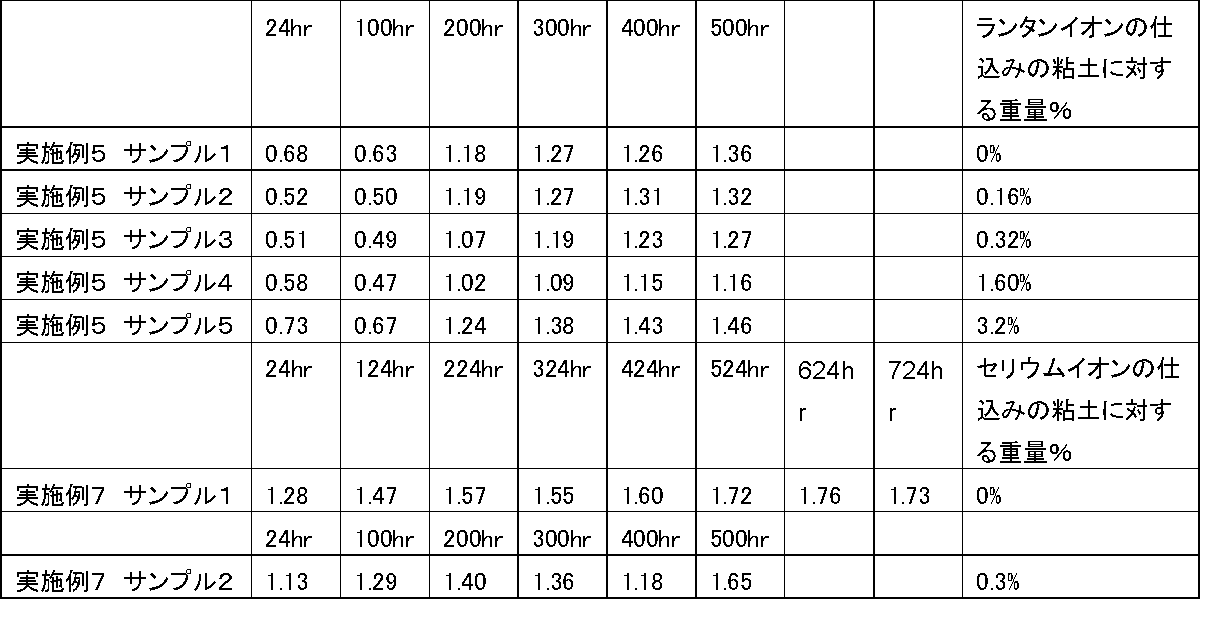
(耐候性試験4)
上記比較例1~5で得た無機・有機複合体着色組成物を含有する塗料、及び上記実施例2,5,8,9で得た無機・有機複合体着色組成物を含有する塗料の24、100、200、300、400、500時間後の色差ΔEを測定した。
結果を表5に示す。比較例1~5で得た無機・有機複合体着色組成物の色差ΔEは2を超えた。よって、工程(3)洗浄工程が耐候性に大きく寄与していることがわかった。
青色については、洗浄無しやクロロホルム洗浄に比べ、実施例2のアルカリ洗浄のものが顕著に優れた耐候性を示した。
赤色については、洗浄無しやエタノール洗浄に比べ、実施例8の水洗浄のものが顕著に優れた耐候性を示した。
黄色については、洗浄無しでも500時間後の色差ΔEは2以下であったが、100時間後で比較すると、洗浄工程がある方が優れた耐候性を示した。
上記比較例1~5で得た無機・有機複合体着色組成物を含有する塗料、及び上記実施例2,5,8,9で得た無機・有機複合体着色組成物を含有する塗料の24、100、200、300、400、500時間後の色差ΔEを測定した。
結果を表5に示す。比較例1~5で得た無機・有機複合体着色組成物の色差ΔEは2を超えた。よって、工程(3)洗浄工程が耐候性に大きく寄与していることがわかった。
青色については、洗浄無しやクロロホルム洗浄に比べ、実施例2のアルカリ洗浄のものが顕著に優れた耐候性を示した。
赤色については、洗浄無しやエタノール洗浄に比べ、実施例8の水洗浄のものが顕著に優れた耐候性を示した。
黄色については、洗浄無しでも500時間後の色差ΔEは2以下であったが、100時間後で比較すると、洗浄工程がある方が優れた耐候性を示した。
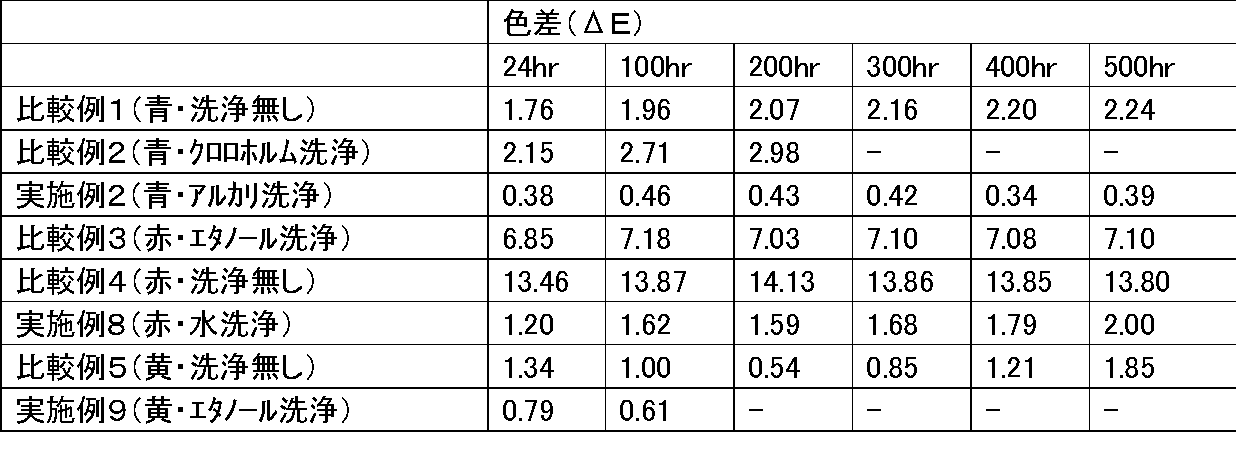
図1は、実施例5とは洗浄工程がないこと、インジゴの代わりにそれぞれディスパーズイエロー54、インジルビンを用いたこと、及び硝酸ランタン六水和物の代わりに硝酸ユウロピウム六水和物を用いたこと以外は同じ条件で製造した無機・有機複合体着色組成物、及びアタゲル#40にユウロピウム(III)イオンを取り込ませたものをラマンスペクトル分光器によって、457.9nm励起、5mW、露光時間10-30secで測定した発光スペクトルである。
16000-17400cm-1のシャープなピークはユウロピウム(III)イオン特有の4f-4f発光である。
これにより、ユウロピウム(III)イオンがイオン交換により取り込まれた無機・有機複合体着色組成物は、レーザ励起発光していることがわかる。
16000-17400cm-1のシャープなピークはユウロピウム(III)イオン特有の4f-4f発光である。
これにより、ユウロピウム(III)イオンがイオン交換により取り込まれた無機・有機複合体着色組成物は、レーザ励起発光していることがわかる。
尚、実施例及び比較例を整理すると以下のようになる。

本発明に係る同じパリゴルスカイト粘土を基材とする青赤黄三原色の無機・有機複合体着色組成物は、多様な色彩の発現を可能にし、耐候性、親水性・親油性に優れ、高分散性・低沈降性で高濃度の取扱いが容易な基盤的な色材である。従って、この色材の安全性、ユニークで多彩な色調などを生かし、絵具、文具、化粧品などの製品に好適に利用される。さらには、三原色着色三原色発光性を付与することで、白色LED蛍光体としての照明器具や液晶化によるディスプレイへの応用ばかりでなく、長残光性をもたらすことで、従来にない高耐候性・耐水性で屋外の使用可能な着色蓄光色材の製造が可能となり、防犯・防災誘導表示板、掲示板を既製品よりも低コストで製造することができる。
また、本発明に係る無機・有機複合体着色組成物の製造方法は、経時的な退色が少ない着色組成物の製造に好適に利用される。
また、本発明に係る無機・有機複合体着色組成物の製造方法は、経時的な退色が少ない着色組成物の製造に好適に利用される。
Claims (14)
- 粘土鉱物と有機染料とからなる無機・有機複合体着色組成物であって、
前記粘土鉱物は繊維状粘土であり、
着色対象を着色した前記着色組成物のJIS K5600-7-7に従う耐候性試験による照射時間500時間の色差ΔEが2以下であることを特徴とする無機・有機複合体着色組成物。 - 前記有機染料が、インジゴ、インジルビン、ヘリンドンピンクCN、メチルレッド及びキノリン系染料からなる群から選択される少なくとも一つからなる請求項1記載の無機・有機複合体着色組成物。
- 希土類元素イオンを含むことを特徴とする請求項1又は2記載の無機・有機複合体着色組成物。
- 前記希土類元素イオンが、ランタンイオンを含むことを特徴とする請求項3記載の無機・有機複合体着色組成物。
- 前記希土類元素イオンが、3価のセリウム、プラセオジム、ネオジム、サマリウム、ユウロピウム、ガドリニウム、テルビウム、ジスプロシウム、ホルミウム、エルビウム、ツリウム及びイッテルビウム、並びに2価のユウロピウムから選択される少なくとも一種のイオンであることを特徴とする請求項3又は4記載の無機・有機複合体着色組成物。
- 粘土鉱物である繊維状粘土と有機染料とからなる無機・有機複合体着色組成物の製造方法であって、
下記の工程(1)及び(2)、並びに(2A)及び/又は(3)を備えていることを特徴とする無機・有機複合体着色組成物の製造方法。
(1)前記繊維状粘土及び前記有機染料を0.1~70μmに微粉化、並びに前記繊維状粘土及び前記有機染料を混合する工程
(2)前記工程(1)で得た前記繊維状粘土と前記有機染料からなる着色物を120~200℃で1~24時間加熱する工程
(2A)前記工程(2)の前に、前記繊維状粘土と前記有機染料とからなる前記着色物を、前記工程(2)の加熱温度よりも高い沸点を有する溶媒に分散させる工程
(3)前記工程(2)で得た前記繊維状粘土と前記有機染料とからなる粗製の着色組成物を洗浄して無機・有機複合体着色組成物を得る工程 - 粘土鉱物である繊維状粘土と有機染料とからなる無機・有機複合体着色組成物の湿式の製造方法であって、
下記の工程(1B)を備えていることを特徴とする請求項6記載の無機・有機複合体着色組成物の製造方法。
(1B)前記工程(1)の後に、前記還元された有機染料と前記繊維状粘土とを含有する溶液を、空気を溶液中に巻き込まないように攪拌しながら超音波を印加し前記還元された有機染料と前記繊維状粘土を十分になじませ、次いで前記溶液を、空気を取り込むように攪拌し、前記有機染料を空気酸化させる工程 - 前記有機染料がインジゴであって、
前記工程(2)で得た前記繊維状粘土と前記有機染料とからなる粗製の着色組成物を、還元剤を含有するアルカリ性溶液により洗浄して無機・有機複合体着色組成物を得る工程を備えることを特徴とする請求項6又は7記載の無機・有機複合体着色組成物の製造方法。 - 前記有機染料が、インジルビン、ヘリンドンピンクCN及びメチルレッドからなる群から選択される少なくとも一つからなり、
前記工程(2)で得た前記繊維状粘土と前記有機染料とからなる粗製の着色組成物を、還元剤を含有するアルカリ性溶液により洗浄するか、又は水によるソックスレー抽出により洗浄して無機・有機複合体着色組成物を得る工程を備えることを特徴とする請求項6又は7記載の無機・有機複合体着色組成物の製造方法。 - 前記有機染料がキノリン系染料であって、
前記工程(2)で得た前記繊維状粘土と前記有機染料とからなる粗製の着色組成物を、還元剤を含有するアルカリ性溶液により洗浄するか、又はエタノールによるソックスレー抽出により洗浄して無機・有機複合体着色組成物を得る工程を備えることを特徴とする請求項6又は7記載の無機・有機複合体着色組成物の製造方法。 - 前記工程(1)において、希土類元素イオンを前記繊維状粘土にイオン交換で取り込ませた後、前記希土類元素イオンをイオン交換で取り込ませた前記繊維状粘土と前記有機染料を混合させることを特徴とする請求項6乃至10いずれか一つに記載の無機・有機複合体着色組成物の製造方法。
- 前記希土類元素イオンが、ランタンイオンを含むことを特徴とする請求項11記載の無機・有機複合体着色組成物の製造方法。
- 前記希土類元素イオンが、3価のセリウム、プラセオジム、ネオジム、サマリウム、ユウロピウム、ガドリニウム、テルビウム、ジスプロシウム、ホルミウム、エルビウム、ツリウム及びイッテルビウム、並びに2価のユウロピウムから選択される少なくとも一種のイオンであることを特徴とする請求項11又は12に記載の無機・有機複合体着色組成物の製造方法。
- 前記還元剤が、ナトリウムハイドロサルファイトであることを特徴とする請求項7乃至13いずれか一つに記載の無機・有機複合体着色組成物の製造方法。
Priority Applications (1)
| Application Number | Priority Date | Filing Date | Title |
|---|---|---|---|
| JP2013504779A JPWO2012124785A1 (ja) | 2011-03-15 | 2012-03-15 | 無機・有機複合体着色組成物及びその製造方法 |
Applications Claiming Priority (2)
| Application Number | Priority Date | Filing Date | Title |
|---|---|---|---|
| JP2011056986 | 2011-03-15 | ||
| JP2011-056986 | 2011-03-15 |
Publications (1)
| Publication Number | Publication Date |
|---|---|
| WO2012124785A1 true WO2012124785A1 (ja) | 2012-09-20 |
Family
ID=46830849
Family Applications (1)
| Application Number | Title | Priority Date | Filing Date |
|---|---|---|---|
| PCT/JP2012/056776 Ceased WO2012124785A1 (ja) | 2011-03-15 | 2012-03-15 | 無機・有機複合体着色組成物及びその製造方法 |
Country Status (2)
| Country | Link |
|---|---|
| JP (1) | JPWO2012124785A1 (ja) |
| WO (1) | WO2012124785A1 (ja) |
Cited By (4)
| Publication number | Priority date | Publication date | Assignee | Title |
|---|---|---|---|---|
| JPWO2023053980A1 (ja) * | 2021-09-28 | 2023-04-06 | ||
| JPWO2023053982A1 (ja) * | 2021-09-28 | 2023-04-06 | ||
| JPWO2023053983A1 (ja) * | 2021-09-28 | 2023-04-06 | ||
| JPWO2023053981A1 (ja) * | 2021-09-28 | 2023-04-06 |
Citations (2)
| Publication number | Priority date | Publication date | Assignee | Title |
|---|---|---|---|---|
| WO2008097837A2 (en) * | 2007-02-02 | 2008-08-14 | Board Of Regents, The University Of Texas System | Organic/inorganic complexes as color compositions |
| WO2009092103A1 (en) * | 2008-01-17 | 2009-07-23 | Mayan Pigments, Inc. | Organic-inorganic hybrid pigment compositions |
-
2012
- 2012-03-15 WO PCT/JP2012/056776 patent/WO2012124785A1/ja not_active Ceased
- 2012-03-15 JP JP2013504779A patent/JPWO2012124785A1/ja active Pending
Patent Citations (2)
| Publication number | Priority date | Publication date | Assignee | Title |
|---|---|---|---|---|
| WO2008097837A2 (en) * | 2007-02-02 | 2008-08-14 | Board Of Regents, The University Of Texas System | Organic/inorganic complexes as color compositions |
| WO2009092103A1 (en) * | 2008-01-17 | 2009-07-23 | Mayan Pigments, Inc. | Organic-inorganic hybrid pigment compositions |
Non-Patent Citations (1)
| Title |
|---|
| DOMENECH, ANTONIO ET AL.: "Evidence of topological indigo/dehydroindigo isomers in Maya Blue-like complexes prepared from palygorskite and sepiolite", JOURNAL OF PHYSICAL CHEMISTRY C, vol. 113, no. 28, 2009, pages 12118 - 12131 * |
Cited By (10)
| Publication number | Priority date | Publication date | Assignee | Title |
|---|---|---|---|---|
| JPWO2023053980A1 (ja) * | 2021-09-28 | 2023-04-06 | ||
| JPWO2023053982A1 (ja) * | 2021-09-28 | 2023-04-06 | ||
| JPWO2023053983A1 (ja) * | 2021-09-28 | 2023-04-06 | ||
| JPWO2023053981A1 (ja) * | 2021-09-28 | 2023-04-06 | ||
| WO2023053980A1 (ja) * | 2021-09-28 | 2023-04-06 | Dic株式会社 | 非水溶性色素組成物 |
| WO2023053981A1 (ja) * | 2021-09-28 | 2023-04-06 | Dic株式会社 | 非水溶性、非油溶性色素組成物 |
| JP7552925B2 (ja) | 2021-09-28 | 2024-09-18 | Dic株式会社 | 非水溶性、非油溶性色素組成物 |
| JP7552927B2 (ja) | 2021-09-28 | 2024-09-18 | Dic株式会社 | 非水溶性色素組成物 |
| JP7552924B2 (ja) | 2021-09-28 | 2024-09-18 | Dic株式会社 | 非水溶性色素組成物 |
| JP7552926B2 (ja) | 2021-09-28 | 2024-09-18 | Dic株式会社 | 非水溶性、非油溶性色素組成物 |
Also Published As
| Publication number | Publication date |
|---|---|
| JPWO2012124785A1 (ja) | 2014-07-24 |
Similar Documents
| Publication | Publication Date | Title |
|---|---|---|
| DE2012152C3 (de) | Verfahren zur Herstellung von Pigmentfarbstoffgemischen aus Disazofarbstoffen und deren Verwendung | |
| Khattab et al. | Photoluminescent spray-coated paper sheet: Write-in-the-dark | |
| EP0374655B1 (de) | Lichtpolarisierende Filme oder Folien enthaltende Stilbenfarbstoffe | |
| CN104357931B (zh) | 一种荧光沙柳再生纤维素纤维及其制备方法 | |
| JP2018035035A (ja) | 炭素量子ドットの製造方法及びその方法で得られる炭素量子ドット | |
| DE112007000656B4 (de) | Leuchtstoff, Verfahren zur Herstellung desselben und lichtemittierende Vorrichtungen unter Verwendung desselben | |
| CN106521679A (zh) | 碳点@无机氧化物在制备防紫外线产品中的应用 | |
| Li et al. | Design and assembly of AIE-active fluorescent organic nanoparticles for anti-counterfeiting fluorescent hydrogels and inks | |
| JPWO2012124785A1 (ja) | 無機・有機複合体着色組成物及びその製造方法 | |
| DE102009026746A1 (de) | Sprühgetrocknete Farbstoffkomposite, Verfahren zu ihrer Herstellung und ihre Verwendung | |
| TWI472581B (zh) | Triarylmethane and rosy red pigment compositions, and the use of such pigment dispersions | |
| CN110157412B (zh) | 一种长寿命室温磷光材料及其制备方法 | |
| CN102134485B (zh) | 一种大量制备水溶性荧光碳纳米粒子的方法 | |
| CN102702853B (zh) | 一种水性荧光增强防伪油墨的制备方法 | |
| CN104357934B (zh) | 一种荧光Lyocell纤维及其制备方法 | |
| Al-Senani et al. | Preparation of multifunctional and mechanically-reliable smart wood infiltrated with cellulose nanocrystal-reinforced polyvinyl alcohol nanocomposite | |
| Al-Senani et al. | Development of smart adhesive using lanthanide-doped phosphor and carboxymethyl cellulose-reinforced gum Arabic | |
| Dong et al. | Maya blue pigments derived from clay minerals | |
| CN106243835A (zh) | 一种水性稀土配合物复合微球荧光油墨及其制备工艺 | |
| JP2003082256A (ja) | ベンツイミダゾロン系混晶顔料 | |
| JP4759966B2 (ja) | モノアゾレーキ顔料組成物の製造方法 | |
| CN1927945A (zh) | 双偶氮染料化合物及其应用 | |
| CN108485656B (zh) | 一种x射线成像材料 | |
| Al‐Qahtani et al. | Development of glass nanofiber and lanthanide phosphor–embedded natural polymer nanocomposite coating for ultraviolet filtering smart windows and optical data encryption | |
| CN112775433B (zh) | 一种酶合成荧光金纳米簇的制备方法 |
Legal Events
| Date | Code | Title | Description |
|---|---|---|---|
| 121 | Ep: the epo has been informed by wipo that ep was designated in this application |
Ref document number: 12758297 Country of ref document: EP Kind code of ref document: A1 |
|
| DPE1 | Request for preliminary examination filed after expiration of 19th month from priority date (pct application filed from 20040101) | ||
| ENP | Entry into the national phase |
Ref document number: 2013504779 Country of ref document: JP Kind code of ref document: A |
|
| NENP | Non-entry into the national phase |
Ref country code: DE |
|
| 122 | Ep: pct application non-entry in european phase |
Ref document number: 12758297 Country of ref document: EP Kind code of ref document: A1 |