WO2012118062A1 - 脂肪酸ポリオキシアルキレンアルキル(アルケニル)エーテルの製造方法 - Google Patents
脂肪酸ポリオキシアルキレンアルキル(アルケニル)エーテルの製造方法 Download PDFInfo
- Publication number
- WO2012118062A1 WO2012118062A1 PCT/JP2012/054887 JP2012054887W WO2012118062A1 WO 2012118062 A1 WO2012118062 A1 WO 2012118062A1 JP 2012054887 W JP2012054887 W JP 2012054887W WO 2012118062 A1 WO2012118062 A1 WO 2012118062A1
- Authority
- WO
- WIPO (PCT)
- Prior art keywords
- alkenyl
- acid
- ether
- fatty acid
- polyoxyalkylene alkyl
- Prior art date
- Legal status (The legal status is an assumption and is not a legal conclusion. Google has not performed a legal analysis and makes no representation as to the accuracy of the status listed.)
- Ceased
Links
Images
Classifications
-
- C—CHEMISTRY; METALLURGY
- C07—ORGANIC CHEMISTRY
- C07C—ACYCLIC OR CARBOCYCLIC COMPOUNDS
- C07C67/00—Preparation of carboxylic acid esters
- C07C67/08—Preparation of carboxylic acid esters by reacting carboxylic acids or symmetrical anhydrides with the hydroxy or O-metal group of organic compounds
Definitions
- the present invention relates to a method for producing a fatty acid polyoxyalkylene alkyl (alkenyl) ether.
- Fatty acid polyoxyalkylene alkyl ethers or fatty acid polyoxyalkylene alkenyl ethers are known as ester-type nonionic surfactants. Widely used as a dispersant and the like.
- a direct addition method in which a fatty acid alkyl ester or a fatty acid alkenyl ester (hereinafter, fatty acid alkyl (alkenyl) ester) is reacted with an alkylene oxide to directly add an oxyalkylene group
- a fatty acid alkyl ester or a fatty acid alkenyl ester hereinafter, fatty acid alkyl (alkenyl) ester
- transesterification by transesterification of fatty acid alkyl (alkenyl) ester with polyoxyalkylene alkyl ether or polyoxyalkylene alkenyl ether hereinafter, polyoxyalkylene alkyl (alkenyl) ether
- Patent Document 3 an esterification method by reaction of a fatty acid and a polyoxyalkylene alkyl (alkenyl) ether is known (for example, Patent Document 3).
- a specific heterogeneous catalyst such as a calcined alumina hydroxide / magnesium catalyst disclosed in Patent Document 1 is used.
- the direct addition method requires a step for removing the heterogeneous catalyst and by-products. Furthermore, equipment for removing heterogeneous catalysts and by-products is required.
- the transesterification method since the transesterification method is not highly reactive, it is necessary to charge the fatty acid alkyl (alkenyl) ester excessively and to heat and reduce the pressure after the reaction to remove the remaining fatty acid alkyl (alkenyl) ester. In addition, an alkylene glycol monoalkyl monoether component and a dialkylene glycol monoalkyl monoether component are produced as by-products. For this reason, in the transesterification method, as in the technique of Patent Document 2, a process for removing excess fatty acid alkyl (alkenyl) ester is provided, a process for removing by-products is provided, or the removed by-products are recycled. It is necessary to provide a process.
- esterification method uses a general-purpose homogeneous catalyst, it does not require a step for removing the catalyst, but produces a by-product having a low molecular weight (weight average molecular weight of less than 1000). For this reason, the esterification method requires a step for removing low molecular weight by-products. In addition, a facility for removing by-products is required.
- the present invention provides a fatty acid polyoxyalkylene alkyl (alkenyl) ether that can suppress the formation of by-products without providing any special equipment and can easily obtain a fatty acid polyoxyalkylene alkyl (alkenyl) ether in high yield.
- An object is to provide a manufacturing method.
- the present invention has the following aspects.
- a fatty acid polyoxyalkylene alkyl (alkenyl) ether is produced by reacting a fatty acid with a polyoxyalkylene alkyl (alkenyl) ether in the presence of an acid catalyst and an antioxidant. Is the method.
- the fatty acid is one or more selected from the group consisting of caprylic acid, capric acid, lauric acid, myristic acid, palmitic acid, stearic acid, and oleic acid. It is the manufacturing method of the fatty-acid polyoxyalkylene alkyl (alkenyl) ether as described in an aspect.
- the polyoxyalkylene alkyl (alkenyl) ether is polyoxyethylene methyl ether. It is.
- the antioxidant is one or more selected from the group consisting of dibutylhydroxytoluene, butylhydroxyanisole and tocopherol. This is a method for producing a fatty acid polyoxyalkylene alkyl (alkenyl) ether.
- a fifth aspect of the present invention is the process for producing a fatty acid polyoxyalkylene alkyl (alkenyl) ether according to any one of the first to fourth aspects, wherein the acid catalyst is a homogeneous catalyst.
- the sixth aspect of the present invention is the fatty acid according to any one of the first to fifth aspects, wherein the residual amount of the fatty acid after the reaction is in the range of 0.01 to 5.0% by mass.
- This is a method for producing a polyoxyalkylene alkyl (alkenyl) ether.
- the seventh aspect of the present invention is the fatty acid polyoxyalkylene alkyl (alkenyl) according to any one of the first to sixth aspects, wherein the amount of methyl cellosolve after the reaction is from the detection lower limit to 20 ppm by mass. It is a manufacturing method of ether.
- the production of by-products can be suppressed without requiring any special equipment, and the fatty acid polyoxyalkylene alkyl (alkenyl) can be easily produced in a high yield. ) Ether can be obtained.
- the fatty acid polyoxyalkylene alkyl (alkenyl) ether obtained by the production method of the present invention is represented by the following formula (1).
- R 1 and R 2 each independently represents an alkyl group or an alkenyl group
- R 3 represents an alkylene group
- n is an integer of 1 or more.
- the alkyl group or alkenyl group represented by R 1 may be linear or branched.
- the carbon number of R 1 is not particularly limited, but is preferably 3 to 40, more preferably 5 to 21. If the carbon number of R 1 is within the above range, the production method of the present invention can be suitably applied.
- the alkyl group or alkenyl group represented by R 2 may be linear or branched.
- the carbon number of R 2 is not particularly limited, but is preferably 1 to 30, and more preferably 1 to 4. If the carbon number of R 2 is within the above range, the production method of the present invention can be suitably applied.
- R 3 is an alkylene group.
- the number of carbon atoms of the alkylene group represented by R 3 is not particularly limited, but is preferably 2 to 8, and more preferably 2 to 3. That is, R 3 is more preferably an ethylene group or a propylene group. If the number of carbon atoms in R 3 is within the above range, the production method of the present invention can be suitably applied.
- OR 3 may be composed of only one oxyalkylene group, for example, an oxyethylene group or an oxypropylene group, or two or more oxyalkylene groups may be mixed. When two or more kinds of oxyalkylene groups are mixed, OR 3 may be one obtained by randomly polymerizing two or more different oxyalkylene groups or one obtained by block polymerization.
- n is a number of 1 or more indicating the average number of added moles of the oxyalkylene group represented by OR 3 .
- n is not particularly limited as long as it is 1 or more, but is preferably 1 to 30, and more preferably 3 to 20. If n is in the above range, the production method of the present invention can be suitably applied.
- the fatty acid polyoxyalkylene alkyl (alkenyl) ether of the present invention is adjusted in hydrophilicity and hydrophobicity by the combination of the carbon number of R 1 , R 2 , R 3 and n.
- the surface activity of various detergents The agent is suitable.
- fatty acid polyoxyalkylene alkyl (alkenyl) ethers examples include caprylic acid polyoxyethylene methyl ether (R 1 : C 7 H 15 , R 2 : CH 3 , R 3 : C 2 H 4 , n: 1.
- capric acid polyoxyethylene methyl ether (R 1 : C 9 H 19 , R 2 : CH 3 , R 3 : C 2 H 4 , n: 1 to 30), lauric acid polyoxyethylene methyl ether (R 1 : C 11 H 23 , R 2 : CH 3 , R 3 : C 2 H 4 , n: 1 to 30), myristic acid polyoxyethylene methyl ether (R 1 : C 13 H 27 , R 2 : CH 3 , R 3 : C 2 H 4 , n: 1-30), palmitic acid polyoxyethylene methyl ether (R 1 : C 15 H 31 , R 2 : CH 3 , R 3 : C 2 H 4 , n: 1 to 30), stearic acid polyoxyethylene methyl ether (R 1 : C 17 H 35 , R 2 : CH 3 , R 3 : C 2 H 4 , n: 1 to 30), polyoxyoleate Fatty acid polyoxyethylene methyl ether such as
- palmitic acid polyoxyethylene ethyl ether (R 1 : C 15 H 31 , R 2 : C 2 H 5 , R 3 : C 2 H 4 , n: 1 to 30), myristic acid polyoxyethylene isopropyl ether (R 1 : C 13 H 27 , R 2 : C 3 H 7 , R 3 : C 2 H 4 , n: 1 to 30), polyoxyethylene-2-ethylhexyl ether laurate (R 1 : C 11 H 23 , R 2 : C 8 H 17 , R 3 : C 2 H 4 , n: 1 to 30) and the like.
- the pH of the fatty acid polyoxyalkylene alkyl (alkenyl) ether is preferably from 4 to 10, more preferably from 5 to 8. If it is in the said range, it can prevent that a fatty-acid polyoxyalkylene alkyl (alkenyl) ether hydrolyzes.
- a general-purpose pH adjuster can be used. As the pH adjuster, hydrochloric acid, sulfuric acid, phosphoric acid, acetic acid, citric acid, methanesulfonic acid, sodium hydroxide, potassium hydroxide, monoethanolamine And diethanolamine.
- the pH of the fatty acid polyoxyalkylene alkyl (alkenyl) ether is a value obtained by measuring a 5% by mass aqueous solution (25 ° C.) with a pH meter (product name: docometer, manufactured by SARTORUS).
- the viscosity of the fatty acid polyoxyalkylene alkyl (alkenyl) ether is not particularly limited, but is preferably 0.1 to 1000 mPa ⁇ s, more preferably 1 to 500 mPa ⁇ s. If it is in the said range, handling will be favorable.
- the viscosity of the fatty acid polyoxyalkylene alkyl (alkenyl) ether is the hydrocarbon chain length of the fatty acid (carbon number of R 1 ) described later, the added mole number of oxyalkylene of the polyoxyalkylene alkyl (alkenyl) ether (number of n), It can be adjusted by a combination of reaction rates.
- the viscosity of the fatty acid polyoxyalkylene alkyl (alkenyl) ether is a value measured under the following measurement conditions using a BL type rotary viscometer manufactured by Tokyo Keiki Co., Ltd. Rotor: No. 2 Rotation speed: 30rpm Measurement temperature: 50 ° C Measurement time: 20 seconds later (10th rotation value)
- the method for producing a fatty acid polyoxyalkylene alkyl (alkenyl) ether of the present invention (hereinafter sometimes simply referred to as a production method) is a fatty acid (hereinafter referred to as component (A)) in the presence of an acid catalyst and an antioxidant. And a polyoxyalkylene alkyl (alkenyl) ether (hereinafter sometimes referred to as component (B)) and a step (esterification step).
- the component (A) is represented by the following formula (2).
- R 1 is the same as R 1 in the formula (1).
- (A) component used in the production method of the present invention may be selected depending on the fatty acid polyoxyalkylene alkyl (alkenyl) ether of interest, for example, caprylic acid (R 1: C 7 H 15), capric acid (R 1 : C 9 H 19 ), lauric acid (R 1 : C 11 H 23 ), myristic acid (R 1 : C 13 H 27 ), palmitic acid (R 1 : C 15 H 31 ), stearic acid (R 1 : C 17 H 35 ), oleic acid (R 1 : C 17 H 33 ) and the like.
- the above component (A) can be used singly or in appropriate combination of two or more.
- the component (B) is represented by the following formula (3).
- R 2 is the same as R 2 in the formula (1)
- R 3 is the same as R 3 in the formula (1)
- n is in the formula (1). It is the same as n in the above.
- (B) component used for the manufacturing method of this invention can be selected according to the target fatty-acid polyoxyalkylene alkyl (alkenyl) ether, for example, polyoxyethylene methyl ether (7), polyoxyethylene methyl ether (15) And polyoxyalkylene alkyl ethers such as polyoxypropylene methyl ether such as polyoxyethylene methyl ether and polyoxypropylene methyl ether (10).
- polyoxyethylene methyl ether is preferable from the viewpoint of improving detergency due to moderate hydrophilicity.
- the numerical value in the parenthesis of the above-described component (B) represents the average added mole number of the oxyalkylene group.
- said (B) component can be used individually by 1 type or in combination of 2 or more types as appropriate.
- Component (B) can be prepared by a conventionally known method. For example, a method in which an alkylene oxide gas is reacted with a starting material such as an aliphatic monohydric alcohol, ethylene glycol alkyl ether, diethylene glycol alkyl ether or the like in the presence of a basic catalyst so as to have a desired average addition mole number.
- a starting material such as an aliphatic monohydric alcohol, ethylene glycol alkyl ether, diethylene glycol alkyl ether or the like
- a basic catalyst include sodium hydroxide, potassium hydroxide, sodium methylate, sodium ethylate and the like.
- the amount of the basic catalyst with respect to 100 parts by mass of the starting material is, for example, 0.01 to 20 parts by mass.
- the reaction temperature between the starting material and the alkylene oxide is not particularly limited and is, for example, 50 to 200 ° C.
- the acid catalyst is not particularly limited as long as it can promote the esterification reaction between the component (A) and the component (B).
- Lewis acid such as boron trifluoride, sulfuric acid, hydrochloric acid, nitric acid, phosphoric acid, etc.
- Homogeneous catalysts such as mineral acids, p-toluenesulfonic acid, benzenesulfonic acid, dodecylbenzenesulfonic acid, methanesulfonic acid, camphorsulfonic acid, trifluoromethanesulfonic acid and other heterogeneous catalysts, phosphotungstic acid, silicotungstic acid
- heterogeneous catalysts such as acids and strongly acidic ion exchange resins.
- homogeneous catalysts are preferable, and paratoluenesulfonic acid, sulfuric acid, and methanesulfonic acid are more preferable. This is because the homogeneous catalyst does not require physical removal of the acid catalyst after the production of the fatty acid polyoxyalkylene alkyl (alkenyl) ether.
- p-toluenesulfonic acid, sulfuric acid, and methanesulfonic acid are less colored in the reaction solution and are inexpensive.
- These acid catalysts can be used individually by 1 type or in combination of 2 or more types as appropriate.
- the antioxidant is not particularly limited, and examples thereof include phenolic antioxidants such as dibutylhydroxytoluene (BHT) and butylhydroxyanisole (BHA), amine antioxidants such as dioctyldiphenylamine and phenyl- ⁇ -naphthylamine, and ascorbine. Acid (vitamin C), tocopherol (vitamin E) and the like can be mentioned. Among them, phenolic antioxidants and tocopherol are preferable, and BHT, BHA and tocopherol are more preferable. This is because the phenol-based oxidizing agent and tocopherol are excellent in solubility, heat stability, and odor. These antioxidants can be used individually by 1 type or in combination of 2 or more types as appropriate.
- esterification reaction examples include a method in which a catalyst, an antioxidant, a component (A), and a component (B) are mixed and heated.
- a vessel or reactor equipped with a stirrer that can be heated to an arbitrary temperature while stirring a mixture (primary mixture) of an acid catalyst, an antioxidant, a component (A), and a component (B). Etc. can be used.
- This reaction apparatus preferably includes means for depressurizing the inside of the reaction vessel in which the primary mixture is stored and circulating nitrogen gas in the reaction vessel.
- the acid catalyst, the antioxidant, the component (A) and the component (B) are charged into the reaction vessel.
- the ratio of the component (A) and the component (B) charged into the reaction vessel is preferably a molar ratio (A / B charging ratio) represented by [(A) component] / [(B) component]. It is 0.8 to 1.2, more preferably 0.9 to 1.1, and still more preferably 0.95 to 1.05. If it is in the said range, an unreacted (A) component or (B) component will decrease, and the improvement of the yield of fatty acid polyoxyalkylene alkyl (alkenyl) ether can be aimed at.
- the remaining amount of the component (A) can be reduced, and by increasing the A / B feed ratio within the above range, (B) The remaining amount of components can be increased.
- the A / B charge ratio can be appropriately adjusted according to the application scene of the present fatty residue polyoxyalkylene alkyl (alkenyl) ether.
- the amount of the acid catalyst can be determined in consideration of the type of the catalyst and the like. For example, 0.01 to 5 parts by mass is preferable with respect to 100 parts by mass of the total amount of the component (A) and the component (B). 05 to 2 parts by mass is more preferable, and 0.1 to 1 part by mass is more preferable. If it is less than the above lower limit, the esterification reaction is too slow and the production efficiency may be reduced. Even if it exceeds the above upper limit, there is a possibility that further improvement in the rate of esterification reaction cannot be expected. On the other hand, if the value exceeds the upper limit, a large amount of neutralizing agent for neutralizing the homogeneous catalyst is required, and the removal of the heterogeneous catalyst may become complicated.
- the amount of the antioxidant can be determined in consideration of the kind of the antioxidant and the acid catalyst. For example, 0.001 to 1 mass per 100 mass parts of the total amount of the component (A) and the component (B). Part is preferable, and 0.01 to 0.5 part by mass is more preferable. If it is less than the lower limit, the production of by-products may not be sufficiently suppressed. Even if it exceeds the upper limit, there is a possibility that the effect of adding the antioxidant is saturated and further suppression of by-products cannot be expected.
- the remaining amount of the component (A) after the reaction is preferably in the range of 0.01 to 5.0% by mass, and in the range of 0.01 to 2.5% by mass. More preferably.
- the amount is more than 5.0% by mass
- the storage temperature is set to 5 ° C. or less.
- (A) component may precipitate in this, and the external appearance may become cloudy.
- the remaining amount of the component (B) after the reaction is preferably in the range of 0.5 to 10% by mass, and more preferably in the range of 1 to 8% by mass.
- the amount of methyl cellosolve as a by-product is preferably in the range of the detection lower limit to 20 mass ppm, more preferably in the range of the detection lower limit to 5 mass ppm. preferable.
- the yield of the product fatty acid polyoxyalkylene alkyl (alkenyl) ether is preferably 80% by weight or more, and more preferably 90% by weight or more.
- a solvent can be added to the primary mixture.
- the solvent include xylene, dimethyl sulfoxide, N-methylpyrrolidone and the like.
- the inside of the reaction vessel is, for example, a nitrogen atmosphere, and the acid catalyst, the antioxidant, the component (A) and the component (B) charged in the reaction vessel are mixed, and further heated and reacted while stirring.
- the reaction temperature is preferably 60 to 200 ° C, more preferably 100 to 170 ° C.
- the inside of the reaction vessel is in a reduced pressure state, a state in which nitrogen gas is circulated in the reaction vessel, or a combination thereof.
- the pressure in the reaction vessel is not limited as long as water generated in the esterification step can be removed. If it is less than the above lower limit value, the pressure resistance of the reaction vessel may be strengthened or a special vacuum pump may be required, and if it exceeds the upper limit value, water produced in the esterification step may not be efficiently removed. is there.
- the nitrogen gas flow rate is only required to be able to remove water generated in the esterification step.
- 0.1 to 10 L / min is preferable, and 0.5 to 5 L / min is more preferable. preferable. If it is less than the lower limit, water produced in the esterification step may not be efficiently removed, and even if the upper limit is exceeded, further improvement in water removal efficiency may not be expected.
- the reaction time of the esterification step can be determined in consideration of the type and amount of the acid catalyst, the type and amount of the component (A) and the component (B), and is preferably 1 to 20 hours, for example, 5 to 10 hours. More preferred.
- fatty acid polyoxyalkylene alkyl (alkenyl) ether is produced by subjecting the component (A) and the component (B) to an esterification reaction represented by the following formula (I) under such conditions.
- an antioxidant suppresses the formation of various by-products such as methyl cellosolve.
- a reaction stopping step for stopping the esterification reaction can be provided.
- the reaction stopping step can be determined according to the type of the acid catalyst. For example, when a homogeneous catalyst is used as the acid catalyst, the basic catalyst is added to neutralize the acid catalyst and stop the esterification reaction. .
- the basic compound include sodium hydroxide, potassium hydroxide, monoethanolamine, diethanolamine and the like. These basic compounds may be added as a solid or an aqueous solution.
- the reaction stopping step includes a method of removing the heterogeneous catalyst by filtering the reaction product.
- the product fatty acid polyoxyalkylene alkyl (alkenyl) ether is acid-decomposed to produce low molecular weight by-products such as methyl cellosolve, ethyl cellosolve, methyl carbitol, and ethyl carbitol.
- the fatty acid polyoxyalkylene alkyl (alkenyl) ether obtained by the conventional esterification method is subjected to purification processes such as adsorption treatment by ion exchange to remove by-products, coagulation precipitation treatment with silicate clay, and distillation treatment. It was necessary.
- the production of by-products can be suppressed by a simple method in which the esterification reaction is performed in the presence of an antioxidant. For this reason, fatty acid polyoxyalkylene alkyl (alkenyl) ether can be easily produced without providing a special process for removing by-products.
- the esterification step and the reaction stop step can be performed consistently in one reaction kettle.
- the production method of the present invention can stop the esterification reaction by a simple method of neutralization by using a homogeneous catalyst.
- fatty acid polyoxyalkylene alkyl (alkenyl) ether can be manufactured with simple equipment.
- the heterogeneous catalyst and auxiliary agent removed from the product are generated as waste. Since the production method of the present invention uses a homogeneous catalyst, the waste is only water generated during the esterification reaction.
- PTS acid Paratoluenesulfonic acid monohydrate
- PTS acid 96 mass% sulfuric acid
- reagent grade manufactured by Wako Pure Chemical Industries, Ltd.
- Methodhanesulfonic acid reagent grade, Wako Pure Chemical Industries, Ltd. Made by Co., Ltd.
- BHT Dibutylhydroxytoluene
- BHA Degussa Butylhydroxyanisole
- -Tocopherol DL- ⁇ -tocopherol, reagent grade, manufactured by Junsei Co., Ltd.
- fatty acid polyoxyalkylene alkyl (alkenyl) ethers were produced by the following method.
- a reflux tube was attached to a 1 L capacity four-necked flask, a condenser tube was attached to the tip of the reflux tube to make a reaction vessel, and a magnetic stirrer was attached to this reaction vessel to make a reaction device.
- the components (A) and (B) are placed in a reaction vessel so that the total amount is 500 g, the temperature is raised to 70 ° C., an acid catalyst and an antioxidant are added to the reaction vessel, and the reaction vessel is filled with nitrogen gas. Replaced with.
- (A) component mixes lauric acid and myristic acid by the molar ratio as described in a table
- (B) component is measured according to the A / B preparation ratio shown in a table
- the inside of the reaction vessel was set to 26660 Pa.
- the temperature was raised to the reaction temperatures shown in Tables 1 and 2 over 1 hour, and then heated at the reaction temperature for 1 hour. After heating for 1 hour, the pressure in the reaction vessel was reduced to 1330 Pa over 2 hours. Thereafter, the esterification reaction was carried out while maintaining the reaction temperature and the atmospheric pressure of 1330 Pa (esterification step).
- reaction time in the table passed after reaching the reaction temperature
- the reaction product in the reaction vessel was cooled to 60 ° C.
- 90 g of the cooled reaction product was taken out, 5 g of water was added, and 1N aqueous sodium hydroxide solution (titration reagent) was added dropwise to adjust the pH to 8.0 (50 ° C.).
- 1N aqueous sodium hydroxide solution titration reagent
- the acid catalyst was neutralized and the esterification reaction was stopped (reaction stopping step).
- water was added so that the total amount became 100 g, and a product sample was obtained.
- the product composition and the amount of by-products were measured.
- the residual amount of component (A) is calculated based on a calibration curve prepared for each of lauric acid and myristic acid. Further, the remaining amount of the component (B) is calculated based on the calibration curve prepared for each of AE (15) and AE (7).
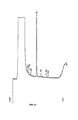
- FIGS. 1 is a graph showing the measurement results of Example 2
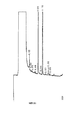
- FIG. 2 is a graph showing the measurement results of Comparative Example 2
- FIGS. 1 and 2 both show time (minutes) on the vertical axis. It is.
- the solvent detected at 1.5 to 4.5 minutes is the solvent methanol
- the one detected at 9.5 minutes is the internal standard.
- the amount of methyl cellosolve found in 11.2 minutes of the measurement results of each example was calculated, and this was used as a representative amount of by-product, which was used as an index of the amount of by-product produced.
- the amount of methyl cellosolve produced was calculated based on a calibration curve of methyl cellosolve prepared in advance. For by-products other than methyl cellosolve, no compound was specified.
- the method for producing a fatty acid polyoxyalkylene alkyl (alkenyl) ether of the present invention can suppress the formation of by-products without providing any special purification equipment or process, and can easily produce a fatty acid polyoxyalkylene alkyl in a high yield. Since (alkenyl) ether can be produced, it can be suitably used, for example, as a method for producing industrial fatty acid polyoxyalkylene alkyl (alkenyl) ether.
Landscapes
- Chemical & Material Sciences (AREA)
- Organic Chemistry (AREA)
- Organic Low-Molecular-Weight Compounds And Preparation Thereof (AREA)
- Low-Molecular Organic Synthesis Reactions Using Catalysts (AREA)
Abstract
酸触媒及び酸化防止剤の存在下で、式(2)で表される脂肪酸と式(3)で表されるポリオキシアルキレンアルキル(アルケニル)エーテルとを反応させることを特徴とする式(1)で表される脂肪酸ポリオキシアルキレンアルキル(アルケニル)エーテルの製造方法。 (式(1)中、R1およびR2は、それぞれ独立にアルキル基又はアルケニル基を表し、R3はアルキレン基を表し、nは1以上の整数を表す。) (式(2)中、R1は、式(1)中のR1と同じである。) (式(3)中、R2、R3及びnは、それぞれ式(1)中のR2、R3及びnと同じである。)
Description
本発明は、脂肪酸ポリオキシアルキレンアルキル(アルケニル)エーテルの製造方法に関する。本願は、2011年3月1日に、日本に出願された特願2011-044028号に基づき優先権を主張し、その内容をここに援用する。
脂肪酸ポリオキシアルキレンアルキルエーテル又は脂肪酸ポリオキシアルキレンアルケニルエーテル(以下、脂肪酸ポリオキシアルキレンアルキル(アルケニル)エーテル)は、エステル型のノニオン界面活性剤として知られ、各種洗浄剤における洗浄成分、化粧品における乳化剤や分散剤等として広く用いられている。
脂肪酸ポリオキシアルキレンアルキル(アルケニル)エーテルの製造方法としては、脂肪酸アルキルエステル又は脂肪酸アルケニルエステル(以下、脂肪酸アルキル(アルケニル)エステル)とアルキレンオキサイドとを反応させ、オキシアルキレン基を直接付加する直接付加法(例えば、特許文献1)、脂肪酸アルキル(アルケニル)エステルとポリオキシアルキレンアルキルエーテル又はポリオキシアルキレンアルケニルエーテル(以下、ポリオキシアルキレンアルキル(アルケニル)エーテル)とのエステル交換によるエステル交換法(例えば、特許文献2)、脂肪酸とポリオキシアルキレンアルキル(アルケニル)エーテルとの反応によるエステル化法(例えば、特許文献3)が知られている。
脂肪酸ポリオキシアルキレンアルキル(アルケニル)エーテルの製造方法としては、脂肪酸アルキルエステル又は脂肪酸アルケニルエステル(以下、脂肪酸アルキル(アルケニル)エステル)とアルキレンオキサイドとを反応させ、オキシアルキレン基を直接付加する直接付加法(例えば、特許文献1)、脂肪酸アルキル(アルケニル)エステルとポリオキシアルキレンアルキルエーテル又はポリオキシアルキレンアルケニルエーテル(以下、ポリオキシアルキレンアルキル(アルケニル)エーテル)とのエステル交換によるエステル交換法(例えば、特許文献2)、脂肪酸とポリオキシアルキレンアルキル(アルケニル)エーテルとの反応によるエステル化法(例えば、特許文献3)が知られている。
ところで、直接付加法では、特許文献1に示された焼成水酸化アルミナ・マグネシウム触媒等の特定の不均一系触媒を用いる。加えて、アルキレンオキサイドの重合物である高分子量(重量平均分子量1000以上)のポリアルキレングリコールが副生物として生成する。このため、直接付加法では、不均一系触媒や副生物を除去するための工程が必要である。さらに、不均一系触媒や副生物を除去する設備が必要となる。
また、エステル交換法は、反応性が高くないため、脂肪酸アルキル(アルケニル)エステルを過剰に仕込み、反応後に加熱減圧して、残存した脂肪酸アルキル(アルケニル)エステルを除去する必要がある。加えて、アルキレングリコールモノアルキルモノエーテル成分及びジアルキレングリコールモノアルキルモノエーテル成分等を副生物として生成する。
このため、エステル交換法では、特許文献2の技術のように、余剰の脂肪酸アルキル(アルケニル)エステルを除去する工程を設けたり、副生物を除去する工程を設けたり、除去した副生物をリサイクルする工程を設ける必要がある。加えて、副生物を除去する設備、副生物をリサイクルする設備が必要である。
エステル化法は、汎用の均一系触媒を用いるため、触媒を除去する工程を設ける必要がないものの、低分子量(重量平均分子量1000未満)の副生物を生成する。このため、エステル化法では、低分子量の副生物を除去するための工程が必要となる。加えて、副生物を除去する設備が必要となる。
また、エステル交換法は、反応性が高くないため、脂肪酸アルキル(アルケニル)エステルを過剰に仕込み、反応後に加熱減圧して、残存した脂肪酸アルキル(アルケニル)エステルを除去する必要がある。加えて、アルキレングリコールモノアルキルモノエーテル成分及びジアルキレングリコールモノアルキルモノエーテル成分等を副生物として生成する。
このため、エステル交換法では、特許文献2の技術のように、余剰の脂肪酸アルキル(アルケニル)エステルを除去する工程を設けたり、副生物を除去する工程を設けたり、除去した副生物をリサイクルする工程を設ける必要がある。加えて、副生物を除去する設備、副生物をリサイクルする設備が必要である。
エステル化法は、汎用の均一系触媒を用いるため、触媒を除去する工程を設ける必要がないものの、低分子量(重量平均分子量1000未満)の副生物を生成する。このため、エステル化法では、低分子量の副生物を除去するための工程が必要となる。加えて、副生物を除去する設備が必要となる。
そこで、本発明は、特段の設備を設けることなく、副生物の生成を抑制でき、容易に高収率で脂肪酸ポリオキシアルキレンアルキル(アルケニル)エーテルを得られる脂肪酸ポリオキシアルキレンアルキル(アルケニル)エーテルの製造方法を提供することを目的とする。
本発明は、以下の態様を有する。
本発明の第1の態様は、酸触媒及び酸化防止剤の存在下で、脂肪酸とポリオキシアルキレンアルキル(アルケニル)エーテルとを反応させることを特徴とする脂肪酸ポリオキシアルキレンアルキル(アルケニル)エーテルの製造方法である。
本発明の第2の態様は、前記脂肪酸が、カプリル酸、カプリン酸、ラウリン酸、ミリスチン酸、パルミチン酸、ステアリン酸及びオレイン酸からなる群より選択される1種以上である、前記第1の態様に記載の脂肪酸ポリオキシアルキレンアルキル(アルケニル)エーテルの製造方法である。
本発明の第3の態様は、前記ポリオキシアルキレンアルキル(アルケニル)エーテルが、ポリオキシエチレンメチルエーテルである、前記第1又は2の態様に記載の脂肪酸ポリオキシアルキレンアルキル(アルケニル)エーテルの製造方法である。
本発明の第4の態様は、前記酸化防止剤が、ジブチルヒドロキシトルエン、ブチルヒドロキシアニソール及びトコフェロールからなる群より選択される1種以上である前記第1~3のいずれか1つの態様に記載の脂肪酸ポリオキシアルキレンアルキル(アルケニル)エーテルの製造方法である。
本発明の第5の態様は、前記酸触媒が均一系触媒である前記第1~4のいずれか1つの態様に記載の脂肪酸ポリオキシアルキレンアルキル(アルケニル)エーテルの製造方法である。
また、本発明の第6の態様は、反応後の前記脂肪酸の残存量が、0.01~5.0質量%の範囲内である前記第1~5のいずれか1つの態様に記載の脂肪酸ポリオキシアルキレンアルキル(アルケニル)エーテルの製造方法である。
また、本発明の第7の態様は、反応後メチルセロソルブの量が検出下限以下~20質量ppmである、前記第1~6のいずれか1つの態様に記載の脂肪酸ポリオキシアルキレンアルキル(アルケニル)エーテルの製造方法である。
本発明の脂肪酸ポリオキシアルキレンアルキル(アルケニル)エーテルの製造方法によれば、特段の設備を必要とすることなく、副生物の生成を抑制でき、容易に高収率で脂肪酸ポリオキシアルキレンアルキル(アルケニル)エーテルを得られる。
(脂肪酸ポリオキシアルキレンアルキル(アルケニル)エーテル)
本発明の製造方法で得られる脂肪酸ポリオキシアルキレンアルキル(アルケニル)エーテルは、下記(1)式で表されるものである。
本発明の製造方法で得られる脂肪酸ポリオキシアルキレンアルキル(アルケニル)エーテルは、下記(1)式で表されるものである。

(上記(1)式中、R1およびR2は、それぞれ独立にアルキル基又はアルケニル基を表し、R3はアルキレン基を表し、nは1以上の整数である。)
R1で表されるアルキル基又はアルケニル基は、直鎖又は分岐鎖のいずれであってもよい。R1の炭素数は、特に限定されないが、3~40が好ましく、5~21がより好ましい。R1の炭素数が上記範囲内であれば、本発明の製造方法を好適に適用できる。
R2で表されるアルキル基又はアルケニル基は、直鎖又は分岐鎖のいずれであってもよい。R2の炭素数は、特に限定されないが、1~30が好ましく、1~4がより好ましい。R2の炭素数が上記範囲内であれば、本発明の製造方法を好適に適用できる。
上記(1)式中、R3は、アルキレン基である。R3で表されるアルキレン基の炭素数は、特に限定されないが、2~8が好ましく、2~3がより好ましい。即ち、R3は、エチレン基又はプロピレン基がより好ましい。R3の炭素数が上記範囲内であれば、本発明の製造方法を好適に適用できる。
OR3は、1種のオキシアルキレン基、例えば、オキシエチレン基又はオキシプロピレン基のみで構成されていてもよいし、2種以上のオキシアルキレン基が混在していてもよい。2種以上のオキシアルキレン基が混在している場合、OR3は、2種以上の異なるオキシアルキレン基がランダム重合したものであってもよいし、ブロック重合したものであってもよい。
OR3は、1種のオキシアルキレン基、例えば、オキシエチレン基又はオキシプロピレン基のみで構成されていてもよいし、2種以上のオキシアルキレン基が混在していてもよい。2種以上のオキシアルキレン基が混在している場合、OR3は、2種以上の異なるオキシアルキレン基がランダム重合したものであってもよいし、ブロック重合したものであってもよい。
上記(1)式中、nは、OR3で表されるオキシアルキレン基の平均付加モル数を示す1以上の数である。nは、1以上であれば特に限定されないが、1~30が好ましく、3~20がより好ましい。nが上記範囲内であれば、本発明の製造方法を好適に適用できる。
本発明の脂肪酸ポリオキシアルキレンアルキル(アルケニル)エーテルは、R1、R2、R3の炭素数とnとの組み合わせにより、親水性、疎水性の調節がされ、例えば、各種洗浄剤の界面活性剤として好適なものとされる。
本発明の脂肪酸ポリオキシアルキレンアルキル(アルケニル)エーテルは、R1、R2、R3の炭素数とnとの組み合わせにより、親水性、疎水性の調節がされ、例えば、各種洗浄剤の界面活性剤として好適なものとされる。
このような脂肪酸ポリオキシアルキレンアルキル(アルケニル)エーテルとしては、例えば、カプリル酸ポリオキシエチレンメチルエーテル(R1:C7H15、R2:CH3、R3:C2H4、n:1~30)、カプリン酸ポリオキシエチレンメチルエーテル(R1:C9H19、R2:CH3、R3:C2H4、n:1~30)、ラウリン酸ポリオキシエチレンメチルエーテル(R1:C11H23、R2:CH3、R3:C2H4、n:1~30)、ミリスチン酸ポリオキシエチレンメチルエーテル(R1:C13H27、R2:CH3、R3:C2H4、n:1~30)、パルミチン酸ポリオキシエチレンメチルエーテル(R1:C15H31、R2:CH3、R3:C2H4、n:1~30)、ステアリン酸ポリオキシエチレンメチルエーテル(R1:C17H35、R2:CH3、R3:C2H4、n:1~30)、オレイン酸ポリオキシエチレンメチルエーテル(R1:C17H33、R2:CH3、R3:C2H4、n:1~30)等の脂肪酸ポリオキシエチレンメチルエーテル、カプリル酸ポリオキシプロピレンメチルエーテル(R1:C7H15、R2:CH3、R3:C3H6、n:1~30)、カプリン酸ポリオキシプロピレンメチルエーテル(R1:C9H19、R2:CH3、R3:C3H6、n:1~30)、ラウリン酸ポリオキシプロピレンメチルエーテル(R1:C11H23、R2:CH3、R3:C3H6、n:1~30)、ミリスチン酸ポリオキシプロピレンメチルエーテル(R1:C13H27、R2:CH3、R3:C3H6、n:1~30)、パルミチン酸ポリオキシプロピレンメチルエーテル(R1:C15H31、R2:CH3、R3:C3H6、n:1~30)、ステアリン酸ポリオキシプロピレンメチルエーテル(R1:C17H35、R2:CH3、R3:C3H6、n:1~30)、オレイン酸ポリオキシプロピレンメチルエーテル(R1:C17H33、R2:CH3、R3:C3H6、n:1~30)等の脂肪酸ポリオキシプロピレンメチルエーテル等が挙げられる。更に、パルミチン酸ポリオキシエチレンエチルエーテル(R1:C15H31、R2:C2H5、R3:C2H4、n:1~30)、ミリスチン酸ポリオキシエチレンイソプロピルエーテル(R1:C13H27、R2:C3H7、R3:C2H4、n:1~30)、ラウリン酸ポリオキシエチレン-2-エチルヘキシルエーテル(R1:C11H23、R2:C8H17、R3:C2H4、n:1~30)等の脂肪酸ポリオキシエチレンアルキレンエーテルが挙げられる。
脂肪酸ポリオキシアルキレンアルキル(アルケニル)エーテルのpHは、4~10が好ましく、5~8がより好ましい。上記範囲内であれば、脂肪酸ポリオキシアルキレンアルキル(アルケニル)エーテルが加水分解するのを防止できる。
pHの調整には、汎用のpH調整剤を用いることができ、pH調整剤としては、塩酸、硫酸、リン酸、酢酸、クエン酸、メタンスルホン酸、水酸化ナトリウム、水酸化カリウム、モノエタノールアミン、ジエタノールアミン等が挙げられる。
なお、脂肪酸ポリオキシアルキレンアルキル(アルケニル)エーテルのpHは、5質量%水溶液(25℃)をpHメーター(製品名:ドキュメータ、SARTORIUS社製)で測定した値である。
pHの調整には、汎用のpH調整剤を用いることができ、pH調整剤としては、塩酸、硫酸、リン酸、酢酸、クエン酸、メタンスルホン酸、水酸化ナトリウム、水酸化カリウム、モノエタノールアミン、ジエタノールアミン等が挙げられる。
なお、脂肪酸ポリオキシアルキレンアルキル(アルケニル)エーテルのpHは、5質量%水溶液(25℃)をpHメーター(製品名:ドキュメータ、SARTORIUS社製)で測定した値である。
脂肪酸ポリオキシアルキレンアルキル(アルケニル)エーテルの粘度は、特に限定されないが、0.1~1000mPa・sが好ましく、1~500mPa・sがより好ましい。上記範囲内であれば、ハンドリングが良好である。
脂肪酸ポリオキシアルキレンアルキル(アルケニル)エーテルの粘度は、後述する脂肪酸の炭化水素鎖長(R1の炭素数)、ポリオキシアルキレンアルキル(アルケニル)エーテルのオキシアルキレンの付加モル数(nの数)、反応率の組み合わせにより調節できる。
脂肪酸ポリオキシアルキレンアルキル(アルケニル)エーテルの粘度は、後述する脂肪酸の炭化水素鎖長(R1の炭素数)、ポリオキシアルキレンアルキル(アルケニル)エーテルのオキシアルキレンの付加モル数(nの数)、反応率の組み合わせにより調節できる。
なお、脂肪酸ポリオキシアルキレンアルキル(アルケニル)エーテルの粘度は、株式会社東京計器製のBL型回転式粘度計を用い、以下に示す測定条件で測定される値である。
ローター:No.2
回転数:30rpm
測定温度:50℃
測定時間:20秒後(10回転目の値)
ローター:No.2
回転数:30rpm
測定温度:50℃
測定時間:20秒後(10回転目の値)
(製造方法)
本発明の脂肪酸ポリオキシアルキレンアルキル(アルケニル)エーテルの製造方法(以下、単に製造方法ということがある)は、酸触媒及び酸化防止剤の存在下で、脂肪酸(以下、(A)成分ということがある)と、ポリオキシアルキレンアルキル(アルケニル)エーテル(以下、(B)成分ということがある)とを反応させる工程(エステル化工程)を有するものである。
本発明の脂肪酸ポリオキシアルキレンアルキル(アルケニル)エーテルの製造方法(以下、単に製造方法ということがある)は、酸触媒及び酸化防止剤の存在下で、脂肪酸(以下、(A)成分ということがある)と、ポリオキシアルキレンアルキル(アルケニル)エーテル(以下、(B)成分ということがある)とを反応させる工程(エステル化工程)を有するものである。
(A)成分は、下記(2)式で表されるものである。

(上記(2)式中、R1は、(1)式中のR1と同じである。)
本発明の製造方法に用いる(A)成分は、目的とする脂肪酸ポリオキシアルキレンアルキル(アルケニル)エーテルに応じて選択でき、例えば、カプリル酸(R1:C7H15)、カプリン酸(R1:C9H19)、ラウリン酸(R1:C11H23)、ミリスチン酸(R1:C13H27)、パルミチン酸(R1:C15H31)、ステアリン酸(R1:C17H35)、オレイン酸(R1:C17H33)等が挙げられる。
本発明の製造方法には、上記の(A)成分を1種単独で、又は2種以上を適宜組み合わせて用いることができる。
本発明の製造方法には、上記の(A)成分を1種単独で、又は2種以上を適宜組み合わせて用いることができる。
(B)成分は、下記(3)式で表されるものである。

(上記(3)式中、R2は、(1)式中のR2と同じであり、R3は、(1)式中のR3と同じであり、nは、(1)式中のnと同じである。)
本発明の製造方法に用いる(B)成分は、目的とする脂肪酸ポリオキシアルキレンアルキル(アルケニル)エーテルに応じて選択でき、例えば、ポリオキシエチレンメチルエーテル(7)、ポリオキシエチレンメチルエーテル(15)等のポリオキシエチレンメチルエーテル、ポリオキシプロピレンメチルエーテル(10)等のポリオキシプロピレンメチルエーテル等のポリオキシアルキレンアルキルエーテル等が挙げられる。中でも、適度な親水性により洗浄力を向上させる観点から、ポリオキシエチレンメチルエーテルが好ましい。なお、上記した(B)成分のカッコ内の数値は、オキシアルキレン基の平均付加モル数を表す。
本発明の製造方法には、上記の(B)成分を1種単独で、又は2種以上を適宜組み合わせて用いることができる。
本発明の製造方法には、上記の(B)成分を1種単独で、又は2種以上を適宜組み合わせて用いることができる。
(B)成分は、従来公知の方法で調製できる。例えば、塩基性触媒の存在下で、脂肪族一価アルコール、エチレングリコールアルキルエーテル、ジエチレングリコールアルキルエーテル等の出発原料に、アルキレンオキサイドガスを所望の平均付加モル数になるように反応させて調製する方法が挙げられる。
塩基性触媒としては、水酸化ナトリウム、水酸化カリウム、ナトリウムメチラート、ナトリウムエチラート等が挙げられる。出発原料100質量部に対する塩基性触媒の量は、例えば、0.01~20質量部とされる。
出発原料とアルキレンオキサイドとの反応温度は、特に限定されず、例えば、50~200℃とされる。
塩基性触媒としては、水酸化ナトリウム、水酸化カリウム、ナトリウムメチラート、ナトリウムエチラート等が挙げられる。出発原料100質量部に対する塩基性触媒の量は、例えば、0.01~20質量部とされる。
出発原料とアルキレンオキサイドとの反応温度は、特に限定されず、例えば、50~200℃とされる。
酸触媒は、(A)成分と(B)成分とのエステル化反応を促進できるものであれば特に限定されず、例えば、三フッ化ホウ素等のルイス酸、硫酸、塩酸、硝酸、リン酸等の鉱酸、パラトルエンスルホン酸、ベンゼンスルホン酸、ドデシルベンゼンスルホン酸、メタンスルホン酸、カンファースルホン酸、トリフルオロメタンスルホン酸等の有機酸等の均一系触媒、リンタングステン酸、ケイタングステン酸等のヘテロポリ酸、強酸性イオン交換樹脂等の不均一系触媒が挙げられ、中でも、均一系触媒が好ましく、パラトルエンスルホン酸、硫酸、メタンスルホン酸がより好ましい。均一系触媒であれば、脂肪酸ポリオキシアルキレンアルキル(アルケニル)エーテルの製造後に、酸触媒を物理的に除去する必要がないためである。加えて、パラトルエンスルホン酸、硫酸、メタンスルホン酸は、反応液への着色が少なく、かつ安価なためである。
これらの酸触媒は、1種単独で、又は2種以上を適宜組み合わせて用いることができる。
これらの酸触媒は、1種単独で、又は2種以上を適宜組み合わせて用いることができる。
酸化防止剤は、特に限定されず、例えば、ジブチルヒドロキシトルエン(BHT)、ブチルヒドロキシアニソール(BHA)等のフェノール系酸化防止剤、ジオクチルジフェニルアミン、フェニル-α-ナフチルアミン等のアミン系酸化防止剤、アスコルビン酸(ビタミンC)、トコフェロール(ビタミンE)等が挙げられ、中でも、フェノール系酸化防止剤、トコフェロールが好ましく、BHT、BHA、トコフェロールがより好ましい。フェノール系酸化剤、トコフェロールは、溶解性、熱安定性、臭気に優れているためである。
これらの酸化防止剤は、1種単独で、又は2種以上を適宜組み合わせて用いることができる。
これらの酸化防止剤は、1種単独で、又は2種以上を適宜組み合わせて用いることができる。
エステル化反応としては、例えば、触媒と、酸化防止剤と、(A)成分と、(B)成分とを混合し、加熱する方法が挙げられる。
エステル化工程には、例えば、酸触媒と酸化防止剤と(A)成分と(B)成分との混合物(一次混合物)を攪拌しつつ、任意の温度に加熱できる、攪拌機付きのベッセルや反応釜等の反応装置を用いることができる。この反応装置は、一次混合物が貯留された反応容器内を減圧し、反応容器内に窒素ガスを流通する手段を備えていることが好ましい。
まず、酸触媒、酸化防止剤、(A)成分及び(B)成分を反応容器内に投入する。反応容器内に投入する(A)成分と(B)成分の比率としては、[(A)成分]/[(B)成分]で表されるモル比(A/B仕込み比)が、好ましくは0.8~1.2、より好ましくは0.9~1.1、さらに好ましくは0.95~1.05である。上記範囲内であれば、未反応の(A)成分又は(B)成分が少なくなり、脂肪酸ポリオキシアルキレンアルキル(アルケニル)エーテルの収率の向上を図ることができる。また、A/B仕込み比を前記範囲内で小さくすることにより、(A)成分の残存量をより少なくすることができ、A/B仕込み比を前記範囲内で大きくすることにより、(B)成分の残存量をより多くすることができる。A/B仕込み比は、本脂肪残ポリオキシアルキレンアルキル(アルケニル)エーテルの活用場面に応じて適宜調整することができる。
酸触媒の量は、触媒の種類等を勘案して決定でき、例えば、(A)成分と(B)成分との合計量100質量部に対し、0.01~5質量部が好ましく、0.05~2質量部がより好ましく、0.1~1質量部がさらに好ましい。上記下限値未満であると、エステル化反応が遅すぎて、製造効率が低下するおそれがある。上記上限値超としても、さらなるエステル化反応の速度の向上が望めないおそれがある。また、上記上限値超とすると、均一系触媒を中和する中和剤が多量に必要となり、不均一系触媒の除去が煩雑になるおそれがある。
酸化防止剤の量は、酸化防止剤や酸触媒の種類等を勘案して決定でき、例えば、(A)成分と(B)成分との合計量100質量部に対し、0.001~1質量部が好ましく、0.01~0.5質量部がより好ましい。上記下限値未満であると、副生物の生成を十分に抑制できないおそれがある。上記上限値超としても、酸化防止剤の添加効果が飽和し、さらなる副生物の抑制が望めないおそれがある。
本発明の製造方法において、反応後の(A)成分の残存量は、0.01~5.0質量%の範囲内であることが好ましく、0.01~2.5質量%の範囲内であることがより好ましい。5.0質量%より多い場合は、本発明の製造方法で得られた脂肪酸ポリオキシアルキレンアルキル(アルケニル)エーテルを用いて洗浄剤組成を製造した場合に、その保管温度を5℃以下にした際に(A)成分が析出してしまい、外観が白濁化してしまうことがある。
本発明の製造方法において、反応後の(B)成分の残存量は、0.5~10質量%の範囲内であることが好ましく、1~8質量%の範囲内であることがより好ましい。
また、本発明の製造方法において、副生物であるメチルセロソルブの量は、検出下限以下~20質量ppmの範囲内であることが好ましく、検出下限以下~5質量ppmの範囲内であることがより好ましい。
また、本発明の製造方法において、生成物の脂肪酸ポリオキシアルキレンアルキル(アルケニル)エーテルの収率は、80重量%以上であることが好ましく、90重量%以上であることがより好ましい。
また、本発明の製造方法において、生成物の脂肪酸ポリオキシアルキレンアルキル(アルケニル)エーテルの収率は、80重量%以上であることが好ましく、90重量%以上であることがより好ましい。
必要に応じ、一次混合物に溶剤を添加することができる。溶剤を添加することで、一次混合物中における各成分の分散を均一にできる。
溶剤としては、例えば、キシレン、ジメチルスルホキシド、N-メチルピロリドン等が挙げられる。
溶剤としては、例えば、キシレン、ジメチルスルホキシド、N-メチルピロリドン等が挙げられる。
次いで、反応容器内を例えば窒素雰囲気とし、反応容器内に投入した酸触媒、酸化防止剤、(A)成分及び(B)成分を混合し、さらに攪拌しつつ加熱し反応させる。反応温度は、60~200℃が好ましく、100~170℃がより好ましい。
エステル化工程では、反応容器内が減圧された状態、反応容器内に窒素ガスが流通された状態、又はこれらを組み合わせた状態であることが好ましい。このような反応条件とすることで、(A)成分と(B)成分との反応で生じる水を効率的に除去できる。
反応容器内を減圧する場合、反応容器内の圧力は、エステル化工程で生じる水を除去できればよく、例えば、133Pa(1torr)~53320Pa(400torr)が好ましく、133Pa~33325Pa(250torr)がより好ましい。上記下限値未満であると、反応容器の耐圧性の強化や、特殊な真空ポンプを必要とする場合があり、上記上限値超では、エステル化工程で生成する水を効率的に除去できないおそれがある。
反応容器内を減圧する場合、反応容器内の圧力は、エステル化工程で生じる水を除去できればよく、例えば、133Pa(1torr)~53320Pa(400torr)が好ましく、133Pa~33325Pa(250torr)がより好ましい。上記下限値未満であると、反応容器の耐圧性の強化や、特殊な真空ポンプを必要とする場合があり、上記上限値超では、エステル化工程で生成する水を効率的に除去できないおそれがある。
反応容器内に窒素ガスを流通させる場合、窒素ガスの流通速度は、エステル化工程で生じる水を除去できればよく、例えば、0.1~10L/minが好ましく、0.5~5L/minがより好ましい。上記下限値未満では、エステル化工程で生成する水を効率的に除去できないおそれがあり、上記上限値超としても、水の除去効率のさらなる向上が望めないおそれがある。
エステル化工程の反応時間は、酸触媒の種類や量、(A)成分、(B)成分の種類や量等を勘案して決定でき、例えば、1~20時間が好ましく、5~10時間がより好ましい。
エステル化工程では、このような条件で、(A)成分と(B)成分とを下記(I)式に示すエステル化反応させることで、脂肪酸ポリオキシアルキレンアルキル(アルケニル)エーテルが生成する。この反応時に、酸化防止剤が存在することで、例えばメチルセロソルブ等の様々な副生物の生成が抑制される。

エステル化工程の後、エステル化反応を停止させる反応停止工程を設けることができる。
反応停止工程は、酸触媒の種類に応じて決定でき、例えば、酸触媒に均一系触媒を用いた場合、塩基性化合物を添加することで、酸触媒を中和し、エステル化反応を停止する。
塩基性化合物としては、水酸化ナトリウム、水酸化カリウム、モノエタノールアミン、ジエタノールアミン等が挙げられる。これらの塩基性化合物は、固体で添加されてもよいし、水溶液で添加されてもよい。
反応停止工程は、酸触媒の種類に応じて決定でき、例えば、酸触媒に均一系触媒を用いた場合、塩基性化合物を添加することで、酸触媒を中和し、エステル化反応を停止する。
塩基性化合物としては、水酸化ナトリウム、水酸化カリウム、モノエタノールアミン、ジエタノールアミン等が挙げられる。これらの塩基性化合物は、固体で添加されてもよいし、水溶液で添加されてもよい。
あるいは、酸触媒として不均一系触媒を用いた場合、反応停止工程としては、反応物を濾過して、不均一系触媒を除去する方法が挙げられる。
従来のエステル化法は、生成物の脂肪酸ポリオキシアルキレンアルキル(アルケニル)エーテルが酸分解し、メチルセロソルブ、エチルセロソルブ、メチルカルビトール、エチルカルビトール等の低分子量の副生物を生成する。このため、従来のエステル化法で得られた脂肪酸ポリオキシアルキレンアルキル(アルケニル)エーテルは、副生物を取り除くためのイオン交換による吸着処理、ケイ酸白土による凝集沈殿処理、蒸留処理等の精製工程が必要であった。
上述の通り、本発明によれば、エステル化反応を酸化防止剤の存在下で行うという簡便な方法で、副生物の生成を抑制できる。このため、副生物を取り除くための特段の工程を設けることなく、容易に脂肪酸ポリオキシアルキレンアルキル(アルケニル)エーテルを製造できる。例えば、1つの反応釜で、エステル化工程と反応停止工程とを一貫して行える。
加えて、本発明の製造方法は、均一系触媒を用いることで、中和という簡単な方法でエステル化反応を停止できる。このため、直接付加法等に比べて、簡易な設備で脂肪酸ポリオキシアルキレンアルキル(アルケニル)エーテルを製造できる。
直接付加法では、生成物から除去した不均一系触媒や助剤が廃棄物として発生する。本発明の製造方法は、均一系触媒を用いるため、廃棄物はエステル化反応の際に生じる水のみである。
加えて、本発明の製造方法は、均一系触媒を用いることで、中和という簡単な方法でエステル化反応を停止できる。このため、直接付加法等に比べて、簡易な設備で脂肪酸ポリオキシアルキレンアルキル(アルケニル)エーテルを製造できる。
直接付加法では、生成物から除去した不均一系触媒や助剤が廃棄物として発生する。本発明の製造方法は、均一系触媒を用いるため、廃棄物はエステル化反応の際に生じる水のみである。
以下、実施例を示して本発明を詳細に説明するが、本発明は以下の記載によって限定されるものではない。
(使用原料)
[(A)成分:脂肪酸]
・ラウリン酸:純度98質量%以上、P.T.MUSIM MAS社(インドネシア)製
・ミリスチン酸:純度98質量%以上、P.T.MUSIM MAS社(インドネシア)製
[(A)成分:脂肪酸]
・ラウリン酸:純度98質量%以上、P.T.MUSIM MAS社(インドネシア)製
・ミリスチン酸:純度98質量%以上、P.T.MUSIM MAS社(インドネシア)製
[(B)成分:ポリオキシアルキレンアルキル(アルケニル)エーテル]
・ポリオキシエチレンメチルエーテル(15)(AE(15)):水酸化カリウムを触媒として、メチルアルコール1モルに対しエチレンオキサイドガスを平均15モル付加したもの。
・ポリオキシエチレンメチルエーテル(7)(AE(7)):水酸化カリウムを触媒として、メチルアルコール1モルに対しエチレンオキサイドガスを平均7モル付加したもの。
・ポリオキシエチレンメチルエーテル(15)(AE(15)):水酸化カリウムを触媒として、メチルアルコール1モルに対しエチレンオキサイドガスを平均15モル付加したもの。
・ポリオキシエチレンメチルエーテル(7)(AE(7)):水酸化カリウムを触媒として、メチルアルコール1モルに対しエチレンオキサイドガスを平均7モル付加したもの。
[酸触媒]
・パラトルエンスルホン酸・1水塩(PTS酸):協和発酵ケミカル株式会社製
・硫酸:96質量%硫酸、試薬グレード、和光純薬工業株式会社製
・メタンスルホン酸:試薬グレード、和光純薬工業株式会社製
・パラトルエンスルホン酸・1水塩(PTS酸):協和発酵ケミカル株式会社製
・硫酸:96質量%硫酸、試薬グレード、和光純薬工業株式会社製
・メタンスルホン酸:試薬グレード、和光純薬工業株式会社製
[酸化防止剤]
・ジブチルヒドロキシトルエン(BHT):K-NOX BHT(商品名)、Degussa製
・ブチルヒドロキシアニソール(BHA):3(2)-t-ブチル-4-ヒドロキシアニソール、試薬グレード、和光純薬工業株式会社製
・トコフェロール:DL-α-トコフェロール、試薬グレード、純正化学株式会社製
・ジブチルヒドロキシトルエン(BHT):K-NOX BHT(商品名)、Degussa製
・ブチルヒドロキシアニソール(BHA):3(2)-t-ブチル-4-ヒドロキシアニソール、試薬グレード、和光純薬工業株式会社製
・トコフェロール:DL-α-トコフェロール、試薬グレード、純正化学株式会社製
(実施例1~13)
表1~2に示す一次混合物組成に従い、以下の方法で脂肪酸ポリオキシアルキレンアルキル(アルケニル)エーテルを製造した。
1L容量の4つ口フラスコに還流管を取り付け、還流管の先に凝縮管を取り付けて反応容器とし、この反応容器にマグネット式攪拌機を取り付けて反応装置とした。
反応容器内に(A)成分及び(B)成分を計500gとなるように入れ、70℃まで昇温させた後、酸触媒及び酸化防止剤を反応容器に添加し、反応容器内を窒素ガスで置換した。なお、(A)成分は、ラウリン酸とミリスチン酸とを表中に記載のモル比で混合したものである。また、(B)成分は、表中に示すA/B仕込み比に従って計量されたものである。
還流管に80℃の水を通流させると共に、反応容器内を26660Paとした。さらに表1~2に記載の反応温度まで1時間かけて昇温させた後、その反応温度で1時間加熱した。1時間加熱後、反応容器内を2時間かけて1330Paまで減圧した。その後、反応温度と1330Paの気圧を保ち、エステル化反応を行った(エステル化工程)。
表1~2に示す一次混合物組成に従い、以下の方法で脂肪酸ポリオキシアルキレンアルキル(アルケニル)エーテルを製造した。
1L容量の4つ口フラスコに還流管を取り付け、還流管の先に凝縮管を取り付けて反応容器とし、この反応容器にマグネット式攪拌機を取り付けて反応装置とした。
反応容器内に(A)成分及び(B)成分を計500gとなるように入れ、70℃まで昇温させた後、酸触媒及び酸化防止剤を反応容器に添加し、反応容器内を窒素ガスで置換した。なお、(A)成分は、ラウリン酸とミリスチン酸とを表中に記載のモル比で混合したものである。また、(B)成分は、表中に示すA/B仕込み比に従って計量されたものである。
還流管に80℃の水を通流させると共に、反応容器内を26660Paとした。さらに表1~2に記載の反応温度まで1時間かけて昇温させた後、その反応温度で1時間加熱した。1時間加熱後、反応容器内を2時間かけて1330Paまで減圧した。その後、反応温度と1330Paの気圧を保ち、エステル化反応を行った(エステル化工程)。
反応温度に達してから表中の反応時間が経過した時点で、反応容器内の反応物を60℃まで冷却した。冷却した反応物90gを取り出し、水5gを加え、1N水酸化ナトリウム水溶液(滴定用試薬)を滴下してpH8.0(50℃)に調整した。こうして、酸触媒を中和し、エステル化反応を停止させた(反応停止工程)。さらに、全量が100gとなるように水を加え、生成物の試料とした。得られた生成物について、生成物組成及び副生物量を測定した。
(比較例1~2)
エステル化工程で酸化防止剤を用いなかった以外は、実施例1と同様にして生成物の試料を得た。得られた生成物について、生成物組成及び副生物量を測定した。
エステル化工程で酸化防止剤を用いなかった以外は、実施例1と同様にして生成物の試料を得た。得られた生成物について、生成物組成及び副生物量を測定した。
(測定方法)
[生成物組成の測定]
ピリジンに溶解した各例の試料をN,O-ビス(トリメチルシリル)トリフルオロアセトアミドでシリル化処理を行い、これを組成測定用試料とした。この組成測定用試料をキャピラリーカラムガスクロマトグラフィーで下記測定条件にて測定した。得られたピーク面積から、(A)成分と(B)成分との残存量をそれぞれ算出すると共に、全ピーク面積から算出される質量から(A)成分の残存量及び(B)成分の残存量を減じて、脂肪酸ポリオキシアルキレンアルキル(アルケニル)エーテルの生成量を求めた。
なお、(A)成分の残存量は、ラウリン酸及びミリスチン酸のそれぞれについて検量線を作成し、この検量線に基づいて算出されたものである。また、(B)成分の残存量は、AE(15)及びAE(7)のそれぞれについて検量性を作成し、この検量線に基づいて算出されたものである。
[生成物組成の測定]
ピリジンに溶解した各例の試料をN,O-ビス(トリメチルシリル)トリフルオロアセトアミドでシリル化処理を行い、これを組成測定用試料とした。この組成測定用試料をキャピラリーカラムガスクロマトグラフィーで下記測定条件にて測定した。得られたピーク面積から、(A)成分と(B)成分との残存量をそれぞれ算出すると共に、全ピーク面積から算出される質量から(A)成分の残存量及び(B)成分の残存量を減じて、脂肪酸ポリオキシアルキレンアルキル(アルケニル)エーテルの生成量を求めた。
なお、(A)成分の残存量は、ラウリン酸及びミリスチン酸のそれぞれについて検量線を作成し、この検量線に基づいて算出されたものである。また、(B)成分の残存量は、AE(15)及びAE(7)のそれぞれについて検量性を作成し、この検量線に基づいて算出されたものである。
<測定条件>
検出器:FID、Agilent-Technologies社製
カラム:DB-1HT、Agilent-Technologies社製
キャリアガス:ヘリウム
検出器:FID、Agilent-Technologies社製
カラム:DB-1HT、Agilent-Technologies社製
キャリアガス:ヘリウム
[副生物の測定]
各例の試料と、内部標準物質として1-ブタノールとを10質量%メタノールに溶解し、これを副生物測定用試料とした。
この副生物測定用試料をキャピラリーカラムガスクロマトグラフィーで下記測定条件にて測定した。
測定例を図1~2に示す。図1は、実施例2の測定結果を示すグラフであり、図2は、比較例2の測定結果を示すグラフであり、図1、2は、いずれも縦軸が時間(分)を表すものである。
図1中、1.5~4.5分に検出されたものが溶媒のメタノールであり、9.5分に検出されたものが内部標準物質である。また、5.9分、6.2分、11.2分、13.4分、13.9分に検出されたものが、低分子量の副生物である。
図2中、1.5~4.5分に検出されたものが溶媒のメタノールであり、9.5分に検出されたものが内部標準物質である。また、6.1分、8.3分、11.2分、13.4分、14.0分に検出されたものが、低分子量の副生物である。
この内、11.2分に見られるものは、メチルセロソルブを単独で分析したものとピークが一致したことから、メチルセロソルブと判断された。
そこで、各例の測定結果の11.2分に見られるメチルセロソルブの量を算出し、これを代表的な副生物の量とし、副生物の生成量の指標とした。メチルセロソルブの生成量は、予め作成したメチルセロソルブの検量線に基づき算出した。
なお、メチルセロソルブ以外の副生物については、化合物を特定しなかった。
各例の試料と、内部標準物質として1-ブタノールとを10質量%メタノールに溶解し、これを副生物測定用試料とした。
この副生物測定用試料をキャピラリーカラムガスクロマトグラフィーで下記測定条件にて測定した。
測定例を図1~2に示す。図1は、実施例2の測定結果を示すグラフであり、図2は、比較例2の測定結果を示すグラフであり、図1、2は、いずれも縦軸が時間(分)を表すものである。
図1中、1.5~4.5分に検出されたものが溶媒のメタノールであり、9.5分に検出されたものが内部標準物質である。また、5.9分、6.2分、11.2分、13.4分、13.9分に検出されたものが、低分子量の副生物である。
図2中、1.5~4.5分に検出されたものが溶媒のメタノールであり、9.5分に検出されたものが内部標準物質である。また、6.1分、8.3分、11.2分、13.4分、14.0分に検出されたものが、低分子量の副生物である。
この内、11.2分に見られるものは、メチルセロソルブを単独で分析したものとピークが一致したことから、メチルセロソルブと判断された。
そこで、各例の測定結果の11.2分に見られるメチルセロソルブの量を算出し、これを代表的な副生物の量とし、副生物の生成量の指標とした。メチルセロソルブの生成量は、予め作成したメチルセロソルブの検量線に基づき算出した。
なお、メチルセロソルブ以外の副生物については、化合物を特定しなかった。
<測定条件>
検出器:FID、Agilent-Technologies社製
カラム:HP-INNOWax、Agilent-Technologies社製
キャリアガス:ヘリウム
検出器:FID、Agilent-Technologies社製
カラム:HP-INNOWax、Agilent-Technologies社製
キャリアガス:ヘリウム
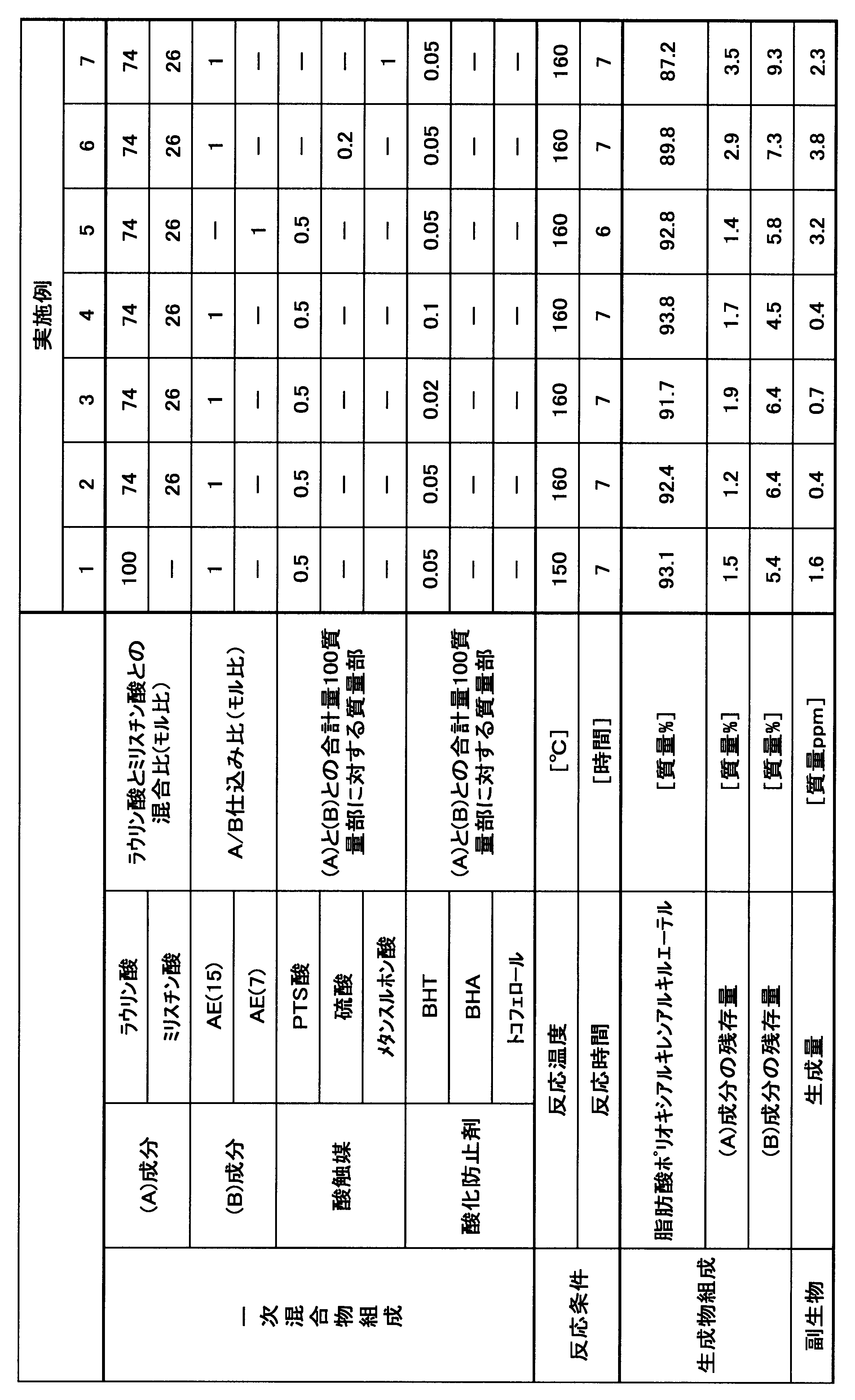

表1~2に示すように、本発明を適用した実施例1~13は、生成物の脂肪酸ポリオキシアルキレンアルキルエーテルの収率が82%以上と高く、(A)成分の残存量は、3.5%以下と低く、(B)成分の残存量もA/B仕込み比によって違いはあるが、17.6%以下と低くなった。そして、いずれもメチルセロソルブ(副生物)の生成量が4.7質量ppm以下であった。
一方、酸化防止剤を添加せずにエステル化反応を行った比較例1~2は、いずれもメチルセロソルブ(副生物)の生成量が183質量ppm以上であった。
図1示す実施例2で得られた生成物の測定結果、及び図2に示す比較例2で得られた生成物の測定結果との比較から、酸化防止剤を反応時に添加することで、6.1分、8.3分、13.4分、14.0分に検出されたメチルセロソルブ以外の副生物についても、生成を抑制できることが判った。
これらの結果から、本発明を適用することで、特段の精製設備や工程等を設けることなく、副生物の生成を抑制でき、容易に高収率で脂肪酸ポリオキシアルキレンアルキル(アルケニル)エーテルを得られることが判った。
一方、酸化防止剤を添加せずにエステル化反応を行った比較例1~2は、いずれもメチルセロソルブ(副生物)の生成量が183質量ppm以上であった。
図1示す実施例2で得られた生成物の測定結果、及び図2に示す比較例2で得られた生成物の測定結果との比較から、酸化防止剤を反応時に添加することで、6.1分、8.3分、13.4分、14.0分に検出されたメチルセロソルブ以外の副生物についても、生成を抑制できることが判った。
これらの結果から、本発明を適用することで、特段の精製設備や工程等を設けることなく、副生物の生成を抑制でき、容易に高収率で脂肪酸ポリオキシアルキレンアルキル(アルケニル)エーテルを得られることが判った。
本発明の脂肪酸ポリオキシアルキレンアルキル(アルケニル)エーテルの製造方法は、特段の精製設備や工程等を設けることなく、副生物の生成を抑制でき、かつ、容易に高収率で脂肪酸ポリオキシアルキレンアルキル(アルケニル)エーテルを製造できることから、例えば、工業的な脂肪酸ポリオキシアルキレンアルキル(アルケニル)エーテルの製造方法として好適に用いることができる。
Claims (7)
- 酸触媒及び酸化防止剤の存在下で、式(2)で表される脂肪酸と式(3)で表されるポリオキシアルキレンアルキル(アルケニル)エーテルとを反応させることを特徴とする式(1)で表される脂肪酸ポリオキシアルキレンアルキル(アルケニル)エーテルの製造方法。



- 前記脂肪酸は、カプリル酸、カプリン酸、ラウリン酸、ミリスチン酸、パルミチン酸、ステアリン酸及びオレイン酸からなる群より選択される1種以上であることを特徴とする、請求項1に記載の脂肪酸ポリオキシアルキレンアルキル(アルケニル)エーテルの製造方法。
- 前記ポリオキシアルキレンアルキル(アルケニル)エーテルは、ポリオキシエチレンメチルエーテルであることを特徴とする、請求項1又は2に記載の脂肪酸ポリオキシアルキレンアルキル(アルケニル)エーテルの製造方法。
- 前記酸化防止剤は、ジブチルヒドロキシトルエン、ブチルヒドロキシアニソール及びトコフェロールからなる群より選択される1種以上であることを特徴とする、請求項1~3のいずれか1項に記載の脂肪酸ポリオキシアルキレンアルキル(アルケニル)エーテルの製造方法。
- 前記酸触媒は、均一系触媒であることを特徴とする、請求項1~4のいずれか1項に記載の脂肪酸ポリオキシアルキレンアルキル(アルケニル)エーテルの製造方法。
- 反応後の前記脂肪酸の残存量が、0.01~5.0質量%の範囲内である、請求項1~5のいずれか1項に記載の脂肪酸ポリオキシアルキレンアルキル(アルケニル)エーテルの製造方法。
- 反応後メチルセロソルブの量が、検出限界以下~20質量ppmである、請求項1~6のいずれか1項に記載の脂肪酸ポリオキシアルキレンアルキル(アルケニル)エーテルの製造方法。
Applications Claiming Priority (2)
| Application Number | Priority Date | Filing Date | Title |
|---|---|---|---|
| JP2011044028A JP2014111547A (ja) | 2011-03-01 | 2011-03-01 | 脂肪酸ポリオキシアルキレンアルキル(アルケニル)エーテルの製造方法 |
| JP2011-044028 | 2011-03-01 |
Publications (1)
| Publication Number | Publication Date |
|---|---|
| WO2012118062A1 true WO2012118062A1 (ja) | 2012-09-07 |
Family
ID=46757994
Family Applications (1)
| Application Number | Title | Priority Date | Filing Date |
|---|---|---|---|
| PCT/JP2012/054887 Ceased WO2012118062A1 (ja) | 2011-03-01 | 2012-02-28 | 脂肪酸ポリオキシアルキレンアルキル(アルケニル)エーテルの製造方法 |
Country Status (2)
| Country | Link |
|---|---|
| JP (1) | JP2014111547A (ja) |
| WO (1) | WO2012118062A1 (ja) |
Citations (4)
| Publication number | Priority date | Publication date | Assignee | Title |
|---|---|---|---|---|
| JP2002371297A (ja) * | 2001-06-14 | 2002-12-26 | Kao Corp | 固形洗浄剤基剤 |
| JP2003292997A (ja) * | 2002-04-02 | 2003-10-15 | Kao Corp | 固形洗浄剤基剤 |
| JP2006104168A (ja) * | 2004-10-08 | 2006-04-20 | Osaka Organic Chem Ind Ltd | (メタ)アクリル酸エステルの製造法 |
| JP2008201761A (ja) * | 2007-02-22 | 2008-09-04 | Sanyo Chem Ind Ltd | エステル化物の製造方法 |
-
2011
- 2011-03-01 JP JP2011044028A patent/JP2014111547A/ja not_active Withdrawn
-
2012
- 2012-02-28 WO PCT/JP2012/054887 patent/WO2012118062A1/ja not_active Ceased
Patent Citations (4)
| Publication number | Priority date | Publication date | Assignee | Title |
|---|---|---|---|---|
| JP2002371297A (ja) * | 2001-06-14 | 2002-12-26 | Kao Corp | 固形洗浄剤基剤 |
| JP2003292997A (ja) * | 2002-04-02 | 2003-10-15 | Kao Corp | 固形洗浄剤基剤 |
| JP2006104168A (ja) * | 2004-10-08 | 2006-04-20 | Osaka Organic Chem Ind Ltd | (メタ)アクリル酸エステルの製造法 |
| JP2008201761A (ja) * | 2007-02-22 | 2008-09-04 | Sanyo Chem Ind Ltd | エステル化物の製造方法 |
Also Published As
| Publication number | Publication date |
|---|---|
| JP2014111547A (ja) | 2014-06-19 |
Similar Documents
| Publication | Publication Date | Title |
|---|---|---|
| EP1747183B1 (en) | Method of preparing alkoxylation catalysts and their use in alkoxylation processes | |
| JP5806314B2 (ja) | 脂肪酸アルキルエステルのアルコキシ化法 | |
| TWI359806B (en) | Polyglycerin monoether and method for producing th | |
| JP2012525439A (ja) | アルコールのアルコキシル化方法 | |
| TW201908367A (zh) | 聚伸烷二醇衍生物之製造方法及純化方法 | |
| JP5081625B2 (ja) | 純粋なアルファ−アルコキシ−オメガ−ヒドロキシ−ポリアルキレングリコールの製造方法 | |
| EP2463322B1 (en) | Production method for nonionic surfactant | |
| JP5500977B2 (ja) | 潤滑油基油およびその製造方法 | |
| CN107921421B (zh) | 乙氧基化催化剂及其制造方法 | |
| US20100288167A1 (en) | Low diol content monofunctional alkoxypolyalkylene glycols and process for producing them | |
| AU2005288959B2 (en) | Process for preparing an alkoxylated alcohol or phenol | |
| WO2012118062A1 (ja) | 脂肪酸ポリオキシアルキレンアルキル(アルケニル)エーテルの製造方法 | |
| US8058481B2 (en) | Alkyl alkoxylates containing unique end groups | |
| JP5302809B2 (ja) | 脂肪族アミンアルキレンオキサイド付加物の製造方法 | |
| JP5358835B2 (ja) | 副生成物の少ない脂肪酸ポリオキシアルキレンアルキルエーテルの製造方法 | |
| KR101878433B1 (ko) | 알킬글리세릴 에테르의 제조 방법 | |
| JP2013100265A (ja) | エポキシ付加物の製造方法 | |
| JP2020084129A (ja) | (ポリ)アルキレングリコール系(メタ)アクリレートの製造方法 | |
| JP4602042B2 (ja) | 非イオン界面活性剤組成物の製造方法 | |
| JP7618426B2 (ja) | 化合物、及び組成物 | |
| WO2025250401A1 (en) | Calcium catalyst concentrates for synthesis of narrow range ethoxylates | |
| US20230235119A1 (en) | Improved alkoxylation process | |
| JP5833363B2 (ja) | エポキシ化合物付加物の製造方法 | |
| CN121800637A (zh) | 一种脂肪酸甲酯乙氧基化物的制备方法 | |
| JP2009504580A (ja) | アルキレングリコールジエーテルの製造方法 |
Legal Events
| Date | Code | Title | Description |
|---|---|---|---|
| 121 | Ep: the epo has been informed by wipo that ep was designated in this application |
Ref document number: 12751747 Country of ref document: EP Kind code of ref document: A1 |
|
| NENP | Non-entry into the national phase |
Ref country code: DE |
|
| 122 | Ep: pct application non-entry in european phase |
Ref document number: 12751747 Country of ref document: EP Kind code of ref document: A1 |
|
| NENP | Non-entry into the national phase |
Ref country code: JP |