WO2012117971A1 - 脂質膜構造体、脂質膜構造体の製造方法および1の目的物質を1枚の脂質膜で封入する方法 - Google Patents
脂質膜構造体、脂質膜構造体の製造方法および1の目的物質を1枚の脂質膜で封入する方法 Download PDFInfo
- Publication number
- WO2012117971A1 WO2012117971A1 PCT/JP2012/054602 JP2012054602W WO2012117971A1 WO 2012117971 A1 WO2012117971 A1 WO 2012117971A1 JP 2012054602 W JP2012054602 W JP 2012054602W WO 2012117971 A1 WO2012117971 A1 WO 2012117971A1
- Authority
- WO
- WIPO (PCT)
- Prior art keywords
- lipid
- modified
- lipid membrane
- liposome
- cationic surfactant
- Prior art date
- Legal status (The legal status is an assumption and is not a legal conclusion. Google has not performed a legal analysis and makes no representation as to the accuracy of the status listed.)
- Ceased
Links
- DUESHMGVWMPEKO-UHFFFAOYSA-N CCCN(Cc(cc1)ccc1OC)c1ncccn1 Chemical compound CCCN(Cc(cc1)ccc1OC)c1ncccn1 DUESHMGVWMPEKO-UHFFFAOYSA-N 0.000 description 2
Images







Classifications
-
- C—CHEMISTRY; METALLURGY
- C12—BIOCHEMISTRY; BEER; SPIRITS; WINE; VINEGAR; MICROBIOLOGY; ENZYMOLOGY; MUTATION OR GENETIC ENGINEERING
- C12N—MICROORGANISMS OR ENZYMES; COMPOSITIONS THEREOF; PROPAGATING, PRESERVING, OR MAINTAINING MICROORGANISMS; MUTATION OR GENETIC ENGINEERING; CULTURE MEDIA
- C12N15/00—Mutation or genetic engineering; DNA or RNA concerning genetic engineering, vectors, e.g. plasmids, or their isolation, preparation or purification; Use of hosts therefor
- C12N15/09—Recombinant DNA-technology
- C12N15/87—Introduction of foreign genetic material using processes not otherwise provided for, e.g. co-transformation
- C12N15/88—Introduction of foreign genetic material using processes not otherwise provided for, e.g. co-transformation using microencapsulation, e.g. using amphiphile liposome vesicle
-
- A—HUMAN NECESSITIES
- A61—MEDICAL OR VETERINARY SCIENCE; HYGIENE
- A61K—PREPARATIONS FOR MEDICAL, DENTAL OR TOILETRY PURPOSES
- A61K9/00—Medicinal preparations characterised by special physical form
- A61K9/10—Dispersions; Emulsions
- A61K9/127—Synthetic bilayered vehicles, e.g. liposomes or liposomes with cholesterol as the only non-phosphatidyl surfactant
- A61K9/1271—Non-conventional liposomes, e.g. PEGylated liposomes or liposomes coated or grafted with polymers
- A61K9/1272—Non-conventional liposomes, e.g. PEGylated liposomes or liposomes coated or grafted with polymers comprising non-phosphatidyl surfactants as bilayer-forming substances, e.g. cationic lipids or non-phosphatidyl liposomes coated or grafted with polymers
Definitions
- the present invention relates to a lipid membrane structure, a method for producing a lipid membrane structure, and a method for encapsulating one target substance in a single lipid membrane, and more specifically, a lipid obtained by modifying a cationic surfactant
- the present invention relates to a lipid membrane structure having a single membrane or a plurality of outermost membranes, a method for producing the lipid membrane structure, and a method for encapsulating one target substance with a single lipid membrane.
- Vectors developed so far are roughly classified into viral vectors and non-viral vectors.
- Viral vectors are generally excellent in gene transfer ability to introduce the target gene into the nucleus of the target cell, but there are problems such as difficulty in mass production, antigenicity, and toxicity.
- lipid membrane structures represented by liposomes have attracted attention.
- Liposomes are lipid membrane structures based on lipid membranes consisting of artificially prepared lipid bilayers, and have the ability to encapsulate various substances and send them into target cells.
- liposomes can improve the directivity to the target site by introducing functional molecules such as antibodies, proteins, sugar chains, etc. on the surface, liposomes can be decomposed in vivo. It has the advantage of being protected from action and metabolic action, and the advantage of preventing the substance from acting at a site other than the target (side effects). So far, for example, a liposome having a peptide containing a plurality of continuous arginine residues on its surface and having a nuclear translocation ability has been developed (Patent Document 1).
- SPLP Stabilized plasmid-lipid-particles
- the particle diameter is preferably about 100 nm to 150 nm (Liu D. et al., Biochim Biophys Acta., Vol. 1104, No. 1). 95-101, 1992; Akinc A. et al., Mol. Ther., 17, No. 5, 872-879, 2009).
- the liposome described in Patent Document 1 is easily produced by a method (hydration method) in which a lipid film is prepared and then hydrated and stirred or sonicated.
- the average particle diameter becomes excessively about 300 nm, which can be efficiently delivered to the diseased site. It is difficult.
- Non-Patent Document 1 The SPLP described in Non-Patent Document 1 is so small that it can be efficiently delivered to a disease site, but it takes a long time for the dialysis operation and changes in slight conditions such as pH of the buffer solution. This makes it difficult to put it to practical use because the efficiency of gene encapsulation into the lipid membrane structure is significantly reduced by the above (Jeffs LB, Pharm Res., Vol. 22, No. 3, pages 362-72). 2005).
- the present invention has been made in order to solve such problems, and can be easily produced and includes a lipid membrane structure having a minute and uniform particle diameter and a substance to be encapsulated (target substance). It is an object to provide a lipid membrane structure in which the number and the number of lipid membranes are controlled, a method for producing the same, and a method for encapsulating one target substance with one lipid membrane.
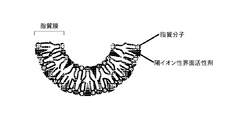
- the present inventors have a fine and uniform particle size by performing a hydration method using a lipid film modified with a cationic surfactant, as shown in the lower part of FIG.
- the ability to obtain liposomes in which the number of liposomes and substances to be encapsulated (target substances) and the number of lipid membranes are controlled, the ability to encapsulate one target substance with a single lipid membrane, and cationic surface activity The inventors found that the transfection activity of liposomes having a lipid membrane modified with an agent as a single membrane or as the outermost membrane of a plurality of membranes was remarkably improved, and completed the following inventions.
- a lipid membrane structure having a lipid membrane modified with a cationic surfactant as a single membrane or as an outermost membrane of a plurality of membranes.
- the cationic surfactant is represented by the following formula (Formula 1) [Wherein, R 1 is an alkyl group, and R 2 is a hydrophobic group.
- R 1 is an alkyl group having 12 or more carbon atoms
- R 2 is represented by the following formula (Formula 2): Or the following formula (Formula 3)
- R 1 is an alkyl group having 16 carbon atoms
- R 2 is represented by the following formula (Formula 4)
- the lipid membrane structure according to (2) which is a group of
- a method for producing a lipid membrane structure having a lipid membrane modified with a cationic surfactant as a single membrane or as an outermost membrane of a plurality of membranes comprising the following (i), (ii) Or (iii) the method having the step; (i) a step of preparing a lipid film in which a cationic surfactant is modified by mixing a lipid and a cationic surfactant; A step of preparing a lipid film in which the cationic surfactant is modified by adding a cationic surfactant; (iii) a single membrane or a plurality of lipid membrane structures having a single membrane or a plurality of membranes A step of modifying the outermost membrane of the membrane with a cationic surfactant.
- a method of encapsulating one target substance with a single lipid membrane comprising the following step (i) or (ii): (i) mixing a lipid and a cationic surfactant A step of preparing a lipid film modified with a cationic surfactant, and (ii) a step of preparing a lipid film modified with a cationic surfactant by adding a cationic surfactant to the lipid film. .
- the cationic surfactant is represented by the following formula (Formula 5): [Wherein, R 1 is an alkyl group, and R 2 is a hydrophobic group. ] The method in any one of (7) to (10) which is a cationic surfactant.
- R 1 is an alkyl group having 12 or more carbon atoms
- R 2 is represented by the following formula (Formula 6): Or the following formula (Formula 7) The method according to (11), wherein
- R 1 is an alkyl group having 16 carbon atoms
- R 2 is represented by the following formula (Formula 8): The method according to (11), wherein
- lipid membrane structure and the method for producing the same According to the lipid membrane structure and the method for producing the same according to the present invention, a fine and uniform lipid membrane structure, and a lipid membrane structure in which the number of substances to be encapsulated (target substance) and the number of lipid membranes are controlled are obtained. be able to. Moreover, according to the minute and uniform lipid membrane structure, it can be efficiently delivered to a disease site such as a tumor or liver parenchyma, and according to the lipid membrane structure in which the number of lipid membranes is controlled, the target site Can be delivered efficiently. For example, when the number of the lipid membranes of the lipid membrane structure according to the present invention is 3, the membrane or mitochondria is obtained by membrane fusion three times, and when the number of lipid membranes is one, the membrane is one time.
- the target substance can be efficiently delivered to the cytoplasm.
- the lipid membrane structure according to the present invention can deliver a target substance to a target site without damaging the target substance, and can exert the function of the target substance at the target site. Can be applied.
- a lipid membrane structure having the above-described characteristics can be produced easily and inexpensively under mild preparation conditions.
- a lipid membrane structure corresponding to the size of the target substance can be obtained, and this method is performed one or more times.
- the method for producing a lipid membrane structure according to the present invention and the method for encapsulating one target substance with a single lipid membrane can be performed regardless of the type of lipid.
- the lipid composition of the lipid membrane can be appropriately selected according to the above.
- FIG. 2 is a diagram showing the structures of (TB) and n-Octyl ⁇ -D-glucopyranoside (OG).
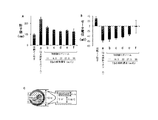
- TB unmodified liposomes (a), and TB modified liposomes (b, c, d, e and f) with modified concentrations of 11, 16.5, 22, 27.5 and 55 mol%
- a diagram showing the result of measuring the particle size (A)
- a diagram showing the result of measuring the zeta potential (B)
- Lipofectamine PLUS (LFN PLUS; A, B), TB unmodified liposome (C, D), 11 mol% TB modified liposome (E, F), 16.5 mol% TB modified liposome (G, H) and 22 mol% TB modified liposome (I, J) shows the results of measuring luciferase activity in HeLa cells transfected with a plasmid DNA (pDNA) encoded with Enhanced Green luorescenceesProtein (EGFP) -luciferase fusion protein gene (right diagram); It is a figure (left figure) which shows the result of having calculated the cell viability.
- pDNA plasmid DNA
- EGFP Enhanced Green luorescenceesProtein
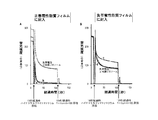
- TB-modified liposomes (a), TB-unmodified liposomes (b), multilamellar liposomes (MLV; c), and unilamellar liposomes (SUV; labeled with Nitro-2-1,3-Benzoxadiazol-4-yl (NBD);
- NBD Nitro-2-1,3-Benzoxadiazol-4-yl
- the TB modified positively charged lipid film (a), the TB unmodified positively charged lipid film (b), the TB modified negatively charged lipid film (c) and the TB unmodified negatively charged lipid film (d) are negatively charged. It is a figure which shows the result of having measured the fluorescence intensity of NBD continuously about each sample which sealed the membrane liposome. It is a figure which shows the outline
- the fluorescence intensity of NBD was continuously measured for the TB-modified trilamellar liposome encapsulating the PLL-stabilized bilayer liposome (a) and the BSA-stabilized bilayer liposome (b) and the negatively charged bilayer liposome, respectively. It is a figure which shows the measurement result.
- the lipid membrane structure according to the present invention has a lipid membrane modified with a cationic surfactant as a single membrane or as an outermost membrane of a plurality of membranes.
- the “lipid membrane” refers to a membrane having a lipid membrane structure, the main component of which is lipid.
- the lipid membrane in the present invention may be composed of a lipid bilayer in which lipid molecules are associated with each other to form a hydrophobic portion, and the hydrophobic portion is formed inward or outward. It may consist of a single layer.
- lipid membrane structure in the present invention a closed vesicle having a lipid membrane composed of a lipid bilayer can be mentioned, and as such a lipid membrane structure, for example, a liposome can be mentioned.
- the number of lipid membranes included in the lipid membrane structure may be one, or two or more.
- the lipid membrane structure according to the present invention has a plurality of membranes, at least the outermost membrane has a lipid membrane in which a cationic surfactant is modified, but not only the outermost membrane but also one other than the outermost membrane.
- a plurality of membranes may be lipid membranes obtained by modifying a cationic surfactant.
- the “cationic surfactant” refers to a surfactant having a cationic hydrophilic group, and the ionic value is not particularly limited, but is preferably monovalent.
- Specific examples of the cationic surfactant include alkyltrimethylammonium salts such as trimethyltetradecylammonium chloride and cetyltrimethylammonium bromide, dialkyldimethylammonium such as dodecylethyldimethylammonium bromide and ethylhexadecyldimethylammonium bromide.
- alkyldimethylbenzylammonium salt such as benzyldodecyldimethylammonium bromide, benzyltetradecyldimethylammonium bromide, benzylhexadecyldimethylammonium bromide, benzyloctadecyldimethylammonium bromide, benzalkonium chloride, tonzonium bromide, benzethonium chloride, cetyl chloride Pyridinium, decalinium chloride, second Grade amine salts, secondary amine salts, there may be mentioned cations such as from tertiary amine salts such as N-methyl-bis-hydroxyethyl amine fatty acid ester hydrochloride salt, of which the following formula (Formula 1) [Wherein, R 1 is an alkyl group, and R 2 is a hydrophobic group.
- R 1 is an alkyl group having 12 or more carbon atoms
- R 2 is represented by the following formula (Formula 2).
- R 2 represents the following formula (Formula 3)
- the surfactant be a cationic surfactant.
- the “hydrophobic group” in the present invention includes, for example, groups represented by the above formulas (Chemical Formula 2) and (Chemical Formula 3), alkyl groups such as methyl group, ethyl group, propyl group, and isopropyl group, and alkenyl groups.
- a hydrocarbon group such as vinyl group, aryl group such as phenyl group or naphthyl group, a heterocyclic ring, or a combination of a hydrophilic group and a hydrophobic group can be cited as a group which is hydrophobic as a whole.
- the cationic surfactant is located in the gap between the lipid molecules constituting the lipid membrane.
- a cationic surfactant is bound to a lipid molecule constituting the lipid membrane by a covalent bond, a hydrogen bond, an ionic bond, a hydrophobic bond, or a van der Waals bond.
- the lipid membrane structure may be any of positive chargeability, nonchargeability, both (positive / negative) chargeability, and negative chargeability, but is preferably negatively chargeable.
- the “negatively charged lipid membrane structure” in the present invention refers to a lipid membrane structure that is negatively charged as a whole.
- positively charged lipids or both (positive and negatively) chargeable lipids as lipids constituting the lipid membrane. Because it contains lipids, non-charged lipids, or because the cationic surfactant is modified, even if it is locally positively charged, both (positive and negative) charged, or uncharged, If it is negatively charged as a whole, it is included in the “negatively charged lipid membrane structure”.
- the lipid constituting the lipid membrane structure in the present invention may be any of positively charged lipids, neutral (including both positive and negative) charged lipids and uncharged lipids, and negatively charged lipids. Examples thereof include phospholipids, glycolipids, sterols, long-chain aliphatic alcohols and glycerin fatty acid esters, and one or more of these can be used.
- phospholipid examples include phosphatidylcholine (for example, dioleoylphosphatidylcholine, dilauroylphosphatidylcholine, dimyristoylphosphatidylcholine, dipalmitoylphosphatidylcholine, distearoylphosphatidylcholine), phosphatidylglycerol (for example, dioleoylphosphatidylglycerol, dilauroylphosphatidylglycerol, Dimyristoyl phosphatidylglycerol, dipalmitoyl phosphatidylglycerol, distearoyl phosphatidylglycerol, etc., phosphatidylethanolamine (eg dioleoylphosphatidylethanolamine, dilauroylphosphatidylethanolamine, dimyristoylphosphatidylethanolamine, dipasto) Mitoylphosphatidylethanolamine, di
- glycolipids examples include glyceroglycolipids such as sphingomyelin, sulfoxyribosyl glyceride, diglycosyl diglyceride, digalactosyl diglyceride, galactosyl diglyceride and glycosyl diglyceride, and sphingoglycolipids such as galactosyl cerebroside, lactosyl cerebroside and ganglioside. 1 type, or 2 or more types of these can be used.
- glyceroglycolipids such as sphingomyelin, sulfoxyribosyl glyceride, diglycosyl diglyceride, digalactosyl diglyceride, galactosyl diglyceride and glycosyl diglyceride
- sphingoglycolipids such as galactosyl cerebroside, lactosyl cerebroside and ganglioside. 1 type, or 2
- sterols examples include sterols derived from animals such as cholesterol, cholesterol succinic acid, lanosterol, dihydrolanosterol, desmosterol, dihydrocholesterol, sterols derived from plants such as stigmasterol, sitosterol, campesterol, and brassicasterol (tytosterol). And sterols derived from microorganisms such as ergosterol, and one or more of these can be used. In addition, these sterols can generally be used to physically or chemically stabilize the lipid bilayer or to adjust the fluidity of the membrane.
- long-chain fatty acid or long-chain aliphatic alcohol a fatty acid having 10 to 20 carbon atoms or an alcohol thereof can be used.
- long-chain fatty acids or long-chain aliphatic alcohols include palmitic acid, stearic acid, lauric acid, myristic acid, pentadecylic acid, arachidic acid, margaric acid, tuberculostearic acid and other saturated fatty acids, palmitoleic acid, Mention of unsaturated fatty acids such as oleic acid, arachidonic acid, vaccenic acid, linoleic acid, linolenic acid, arachidonic acid, eleostearic acid, oleyl alcohol, stearyl alcohol, lauryl alcohol, myristyl alcohol, cetyl alcohol, linolyl alcohol 1 type, or 2 or more types of these can be used.
- glycerin fatty acid ester examples include monoacyl glycerides, diacyl glycerides, and triacyl glycerides, and one or more of these can be used.
- Examples of the positively charged lipid include dioctadecyldimethylammonium chloride (DODAC), N- (2,3-oleyloxy) propyl-N, N, N-trimethylammonium (N-) in addition to the above-described lipids.
- DODAC dioctadecyldimethylammonium chloride
- N- N- (2,3-oleyloxy) propyl-N
- N- N-trimethylammonium
- Examples of neutral lipids including both (positive and negative) charged lipids and non-charged lipids include diacylphosphatidylcholine, diacylphosphatidylethanolamine, ceramide and the like in addition to the above-described lipids. Or 2 or more types can be used.
- Examples of the negatively charged lipid include diacylphosphatidylserine, diacylphosphatidic acid, N-succinylphosphatidylethanolamine (N-succinylPE), phosphatidylethylene glycol, cholesteryl hemisuccinate (CHEMS), etc. 1 type, or 2 or more types of these can be used.
- the lipid membrane of the lipid membrane structure according to the present invention has positive charges such as tocopherol, propyl gallate, ascorbyl palmitate, butylated hydroxytoluene, stearylamine, oleylamine and the like.
- Positive charges such as tocopherol, propyl gallate, ascorbyl palmitate, butylated hydroxytoluene, stearylamine, oleylamine and the like.
- Charged substances to be added, charged substances to give negative charges such as dicetyl phosphate, membrane proteins such as membrane surface proteins and integral membrane proteins, and peptides that impart cell permeability and nuclear translocation ability to lipid membrane structures It can be combined or contained, and the amount and content of the bond can be adjusted as appropriate.
- the lipid membrane structure having a lipid membrane modified with the cationic surfactant according to the present invention as a single membrane or as an outermost membrane of a plurality of membranes is a hydration method, an ultrasonic treatment method, an ethanol injection method, although it can be produced using a known method such as an ether injection method, a reverse phase evaporation method, a surfactant method, or a freezing / thawing method, in particular, as shown in the lower part of FIG.
- a hydration method such as an ether injection method, a reverse phase evaporation method, a surfactant method, or a freezing / thawing method, in particular, as shown in the lower part of FIG.
- the “lipid film” is mainly composed of lipid molecules formed so as to stick to the bottom surface or side surface of the container by dissolving the lipid in the organic solvent and then evaporating and removing the organic solvent.
- This refers to a membrane as a constituent component.
- the present invention provides a method for producing a lipid membrane structure.
- the method for producing a lipid membrane structure according to the present invention is a method for producing a lipid membrane structure having a lipid membrane modified with a cationic surfactant as a single membrane or as an outermost membrane of a plurality of membranes.
- a step of preparing a lipid film in which a cationic surfactant is modified by mixing a lipid and a cationic surfactant (Ii) adding a cationic surfactant to the lipid film to prepare a lipid film in which the cationic surfactant is modified; (Iii) modifying the cationic surfactant on the outermost membrane of one or more membranes of a lipid membrane structure having one or more membranes;
- the process (i), (ii), or (iii) is included.
- the description of the same or equivalent configuration as the configuration of the above-described lipid membrane structure according to the present invention is omitted.
- a method for preparing a lipid film in which a cationic surfactant is modified by mixing a lipid and a cationic surfactant is obtained by, for example, dissolving a lipid in an organic solvent.
- the cationic surfactant is added to the lipid solution.
- examples of the organic solvent for dissolving the lipid and the cationic surfactant include hydrocarbons such as pentane, hexane, heptane and cyclohexane, halogenated hydrocarbons such as methylene chloride and chloroform, and benzene.
- Aromatic hydrocarbons such as toluene, lower alcohols such as methanol and ethanol, esters such as methyl acetate and ethyl acetate, ketones such as acetone, etc. may be used alone or in combination of two or more. it can.
- step (ii) as a method for preparing a lipid film in which a cationic surfactant is modified by adding a cationic surfactant to the lipid film, for example, a cationic surfactant solution is added to the lipid film.
- a method of removing the solvent by evaporation after the addition can be mentioned.
- step (iii) as a method of modifying the cationic surfactant on the outermost membrane of the single membrane or the plural membranes of the lipid membrane structure having a single membrane or a plurality of lipid membranes, for example, Examples thereof include a method of adding a cationic surfactant to a lipid membrane structure having a membrane or a plurality of membranes.
- the method for producing a lipid membrane structure according to the present invention includes the step (i) or the step (ii), (Iv) hydrating the prepared lipid film to prepare a lipid membrane structure;
- the step (iv) can also be included.
- the lipid film structure is prepared by hydrating the lipid film.
- a method of adding a liquid such as water to the lipid film for hydration, followed by stirring or ultrasonic treatment That is, the hydration method can be mentioned.
- the present invention provides a method of encapsulating one target substance with one lipid membrane.
- the method of encapsulating one target substance according to the present invention with one lipid membrane is as follows: (I) a step of preparing a lipid film in which a cationic surfactant is modified by mixing a lipid and a cationic surfactant; (Ii) adding a cationic surfactant to the lipid film to prepare a lipid film in which the cationic surfactant is modified; The step (i) or (ii) is included.
- the method of encapsulating one target substance according to the present invention with one lipid membrane is as follows: (Iv) hydrating the prepared lipid film to prepare a lipid membrane structure; The step (iv) can also be included.
- the “target substance” means a substance to be encapsulated in the lipid membrane structure or an encapsulated substance.
- the target substance may be any substance, and examples thereof include various physiologically active substances such as drugs, nucleic acids, peptides, proteins, sugars or complexes thereof, and lipid membrane structures such as liposomes and micelles, It can select suitably according to the objectives, such as a diagnosis and treatment.
- the target substance can be encapsulated in the aqueous phase inside the lipid membrane structure, for example, by adding it to an aqueous solvent used when the lipid membrane is hydrated in the production of the lipid membrane structure.
- a liposome having one lipid membrane is the target substance
- a liposome having two lipid films can be obtained.
- liposomes having two lipid membranes are used as the target substance
- liposomes having three lipid membranes can be obtained.
- the lipid membrane structure of the target substance may be modified with various functional molecules. Examples of the modifying substance include peptides that improve migration to a target site and cell permeability, and lipid membrane structures. Examples include PLL, BSA, and charged substances that improve body stability.
- the lipid membrane structure according to the present invention can be used by being dispersed in an appropriate aqueous solvent such as physiological saline, phosphate buffer, citrate buffer, and acetate buffer.
- Additives such as saccharides, polyhydric alcohols, water-soluble polymers, nonionic surfactants, antioxidants, pH adjusters, and hydration accelerators may be appropriately added to the dispersion.
- the lipid membrane structure according to the present invention can be stored in a state in which the dispersion is dried.
- the lipid membrane structure according to the present invention can be administered orally, and can also be administered parenterally to veins, intraperitoneally, subcutaneously, nasally and the like.
- the method for producing a lipid membrane structure, and the method of encapsulating one target substance in one lipid membrane, a cationic surfactant to be added to the lipid film can be controlled in the range of approximately 50 nm to 200 nm by adjusting the amount of the lipid to the range of 10 to 30 mol% with respect to the total lipid. Is possible.
- lipid membrane structure according to the present invention a method for producing the lipid membrane structure, and a method for encapsulating one target substance with a single lipid membrane will be described based on examples. Note that the technical scope of the present invention is not limited to the features shown by these examples.
- pDNA plasmid DNA
- EGFP Enhanced Green luminescence Protein
- the second E. coli suspension was centrifuged at 4 ° C. and 4000 ⁇ g for 15 minutes, and then the supernatant was removed to prepare an E. coli pellet. Subsequently, DNA was extracted and purified using EndoFree Plasmid Mega Kit according to the attached specifications to prepare a crude purified pDNA aqueous solution.
- the concentration of the purified pDNA aqueous solution was adjusted to 1.0 mg / mL by diluting with sterilized water. Thereafter, 100 ⁇ L each was dispensed into an Eppendorf tube and stored at ⁇ 20 ° C.
- nucleic acid nanoparticles of [1-2] were subjected to a dynamic light scattering method using Zetasizer Nano ZS (Malvern Instruments). Were used to measure the particle size, and the zeta potential was measured by electrophoresis.
- DOPE Dioleoyl glycerophosphoethanolamine
- a DOPE solution was prepared by dissolving in an ethanol / chloroform solution mixed so as to be 15 mmol / L.
- CHEMS cholesteryl hemisuccinate
- CHEMS cholesteryl hemisuccinate
- lipid film with an unmodified surfactant ( a), BB-1 modified lipid film (b and c), BB-2 modified lipid film (d and e), BB-3 modified lipid film (f and g), BB- Lipid films modified with 4 (h and i) and lipid films modified with OG (j and k) were prepared.
- Example (1) [1-2] to (4) was repeated three times or more, and the average value and standard deviation (SD) of the results obtained for each sample were calculated.
- SD standard deviation
- the particle size of the liposomes is small for b, c, d, e, f, g, h and i compared to a, while j and k are a and It was almost the same in comparison.
- b> c, d> e, f> g and h> i In comparison with liposomes having lipid membranes modified with the same type of surfactant, b> c, d> e, f> g and h> i, whereas j ⁇ k.
- the liposome having a lipid membrane modified with a cationic surfactant has a smaller particle size than the liposome having a lipid membrane not modified with a surfactant, and a cationic interface. It was found that the particle size decreases as the modified concentration of the active agent increases. On the other hand, liposomes having lipid membranes modified with nonionic surfactants, compared with liposomes having lipid membranes not modified with surfactants, regardless of the modified concentration of nonionic surfactants, It became clear that the particle size was almost the same.
- liposomes having a minute particle diameter can be obtained by performing a hydration method using a lipid film modified with a cationic surfactant.
- the nucleic acid nanoparticles are positive for zeta potential, whereas a, b, c, d, e, f, g, h, i, j and k. Were both negative. From these results, the liposome having a lipid membrane modified with a cationic surfactant has a lipid membrane with no surfactant modified when the modification concentration is at least 11 mol% and 16.5 mol%. It was also revealed that negatively charged liposomes that maintain the negative chargeability derived from the constituent lipids were obtained in the same manner as liposomes having lipid membranes modified with nonionic surfactants.
- Example 2 Examination of particle diameter of liposome having lipid membrane modified with tonzonium bromide (TB) (1) Preparation of nucleic acid nanoparticles Example 1 (1) [1-2] and [1-3] ], Nucleic acid nanoparticles were prepared, and the particle diameter and zeta potential were measured.
- Example (2) [2-3] Preparation of lipid film About a, b, c, d, e and f of Example (2) [2-2], the method described in Example 1 (2) [2-3] A lipid film was prepared. However, instead of the BB-1 solution, the BB-2 solution, the BB-3 solution, the BB-4 solution, and the OG solution, the TB solution of Example (2) [2-1] was used. The amount of TB solution added and the modification concentration of TB were as follows.
- Modification concentration (mol%) a: not added (control) 0 b: TB solution 5 ⁇ L 11 c: TB solution 7.5 ⁇ L 16.5 d: TB solution 10 ⁇ L 22 e; TB solution 12.5 ⁇ L 27.5 f; TB solution 25 ⁇ L 55
- Example 1 (2) For a, b, c, d, e and f of [2-3], Example 1 According to the method described in 3), as a liposome encapsulating a nucleic acid nanoparticle, a liposome having a lipid membrane not modified with TB (TB unmodified liposome; a) and a liposome having a lipid membrane modified with TB (TB modified liposome; b, c, d, e and f) were prepared. Thereafter, the particle diameter and zeta potential were measured by the method described in Example 1 (1) [1-3].
- the particle size of the liposome was a> b> c> d ⁇ e ⁇ f.
- the particle diameter of the TB modified liposome is smaller than that of the TB unmodified liposome.
- the modification concentration of TB is at least 22 mol%
- the liposome particle size decreases as the modification concentration increases.
- the modification concentration is at least 22 mol%, the liposome particle size does not decrease any more. It became clear that it was almost constant.
- the particle diameters of d, e, and f were about 130 nm, which was a value very close to about 100 nm, which is the particle diameter of nucleic acid nanoparticles.
- the thickness of the lipid membrane is about 4 nm, and the total thickness of the inner aqueous phase is about 15 nm. Therefore, one nucleic acid nanoparticle is added to one lipid membrane.
- d, e, and f are liposomes in which one nucleic acid nanoparticle is encapsulated with one lipid membrane. That is, it is clear that the liposome obtained by performing the hydration method using a lipid film in which TB is modified by at least about 22 mol% is a liposome in which one target substance is encapsulated by one lipid membrane. became.
- one target substance can be encapsulated with one lipid membrane by performing a hydration method using a lipid film modified with a cationic surfactant.
- the zeta potential was negative for nucleic acid nanoparticles, whereas a, b, c, d, e, and f were all negative. From these results, it becomes clear that TB-modified liposomes having a modified TB concentration of less than 55 mol% become negatively charged liposomes that maintain the negative chargeability derived from the constituent lipids, as in the case of TB-unmodified liposomes. It was.
- Example (4) [4-1] to [4-3] was repeated three times or more, and the average value and standard deviation (SD) of the results obtained for each sample were calculated.
- SD standard deviation
- FIG. 6A shows a graph of the measurement result of the particle diameter
- FIG. 6B shows a graph of the measurement result of the zeta potential.
- the particle size of the empty liposome was smaller than the particle size of g in all of h, i, j, k, and l. Further, h> i> k> j> l. From these results, it was revealed that TB-modified empty liposomes have a smaller particle size than TB unmodified empty liposomes.
- a liposome having a minute particle size can be obtained regardless of whether the target substance is encapsulated or not. It was revealed.
- the zeta potentials of g, h, i and j were all negative, whereas k and l were positive. From these results, TB-modified empty liposomes having a modified TB concentration of at least 55 mol% or more are positively charged liposomes, whereas TB-modified empty liposomes having a modified TB concentration of less than 55 mol% are not modified with TB. It became clear that it becomes a negatively charged liposome in which the negatively charged property derived from the constituent lipid is maintained, like the empty liposome.
- Example 3 Examination of transfection activity of TB modified liposome (1) Preparation of R8 / TB modified liposome [1-1] Preparation of TB modified liposome and TB unmodified liposome Example 2 (1), (2) [ 2-1], [2-2], [2-3] and (3), as a nucleic acid nanoparticle-encapsulated liposome, TB unmodified liposome, modified concentrations of 11 mol%, 16.5 mol% and 22 mol% TB modified liposomes (11 mol% TB modified liposome, 16.5 mol% TB modified liposome and 22 mol% TB modified liposome) were prepared.
- R8 R8 (RRRRRRRR; SEQ ID NO: 6), a peptide known to confer a certain cell permeability to liposomes (Kentaro Kogure, Pharmaceutical Journal, Vol. 127, No. 10, 1685-1691 (2007), a peptide-modified fatty acid (STR-R8) in which stearic acid (STR) is added to the C-terminal is purchased from KUROBO and dissolved in sterile water to 2.0 mg / mL. Thus, an STR-R8 solution was prepared.
- each liposome-containing solution 100 mL was mixed with 2.33 mL of the STR-R8 solution, and then incubated at room temperature for 30 minutes, whereby the total lipids of the liposomes were obtained.
- R8 was modified to 5 mol%.
- luciferase assay reagent Promega
- the amount of luminescence was measured using a luminometer (Lumensecens-PSN; ATTO) according to the attached specifications.
- the protein concentration of the cell lysate was measured using BCA protein assay kit (PIERCE) according to the attached specifications. Based on these results, the value of luciferase activity was determined using the following formula (1).
- cell viability is calculated using the following formula (2), assuming that K is set to 100% for A, C, E, G and I, and L is set to 100% for B, D, F, H and J Calculated.
- the luciferase activity when 0.04 ⁇ g of DNA was transfected was C ⁇ A ⁇ E ⁇ G ⁇ I. Further, the luciferase activity when 0.1 ⁇ g of DNA was transfected was D ⁇ F ⁇ H ⁇ B ⁇ J.
- the TB modified liposome has an activity to introduce a gene into the nucleus of the cell (transfection activity) as compared with the TB unmodified liposome and a commercially available transfection reagent. Became clear.
- TB modified liposomes were found to have higher transfection activity than TB unmodified liposomes.
- the cell viability was higher than 80% for all of A, B, C, D, E, F, G, H, I, J, K, and L. From these results, it was revealed that TB modified liposomes having modified concentrations of at least 11 mol%, 16.5 mol% and 22 mol% are not cytotoxic.
- lipid film DOPE (NBD-labeled DOPE; conjugated with fluorescent dye Nitro-2-1,3-Benzoxadiazol-4-yl (NBD); NBD-labeled DOPE solution was prepared by dissolving (Avanti Polar Lipids) in ethanol so as to be 0.1 mmol / L.
- NBD-labeled DOPE solution was added to the mixed lipid solution prepared by the method described in Example 1 (2) [2-2], and 1 mol% of the total lipid was NBD-labeled DOPE.
- Example 2 (2) [2-3] the amount of TB solution added and the modification concentration of TB were changed as follows to modify TB. Lipid films (a) and lipid films (b, c and d) not modified with TB were prepared.
- TB modification was carried out as a nucleic acid nanoparticle enclosure liposome labeled with NBD by the method as described in Example 1 (3).
- Liposomes (a) and TB unmodified liposomes (b) were prepared.
- Fluorescence intensity of NBD was continuously measured for 200 seconds using a luminometer for a and b in this example (2), c in this example (3), and d in this example (4). During 10 seconds from the start of the measurement, 2.75 ⁇ L of the hydrosulfite sodium solution was added to each sample and mixed for 5 seconds. Furthermore, 12.5 ⁇ L of 10% (v / v) Triton X-100 solution was added to each sample when 105 seconds had elapsed from the start of measurement, and mixed for 5 seconds. The results are shown in Table 6 below. Moreover, the measurement result of fluorescence intensity is shown in the upper diagram of FIG.
- hydrosulfite sodium is a quencher that reduces the chromophore of NBD by a reducing action and loses its fluorescence.
- hydrosulfite sodium added to the liposome solution is the outermost lipid bilayer of the liposome. Only the fluorescence of NBD present in the layer in contact with the aqueous phase disappears. Therefore, it is considered that the greater the number of lipid membranes possessed by the liposome, the greater the fluorescence intensity after addition of hydrosulfite sodium.
- TB-modified liposomes are smaller than that of SUV, which is a single-membrane liposome.
- lipid-molecule flip-flop occurs due to the modification of TB in the lipid membrane, This is probably because the NBD existing on the side in contact with the inner aqueous phase was exposed to the liposome surface and quenched.
- An NBD-labeled DOPE solution was added thereto to prepare an NBD negatively charged mixed lipid solution (total 152.5 nmol) in which 1 mol% of the total lipid was NBD-labeled DOPE.
- an SUV was prepared by the method described in Example 4 (4). After gently adding a half amount (v / v) of the nucleic acid nanoparticle solution prepared by the method described in Example 1 (1) [1-1] and [1-2] to this SUV-containing solution, By vortexing for 5 seconds, negatively charged bilayer liposomes encapsulating nucleic acid nanoparticles and labeled with NBD were prepared.
- a, b, c, and d are liposomes prepared with the intention of encapsulating liposomes labeled with NBD (labeled liposomes) with lipid membranes not labeled with NBD (unlabeled lipid membranes). Therefore, when the fluorescence of NBD is reduced by the addition of sodium hydrosulfite, the labeled liposome is not encapsulated with the unlabeled lipid membrane, or the membrane fusion between the lipid membrane of the labeled liposome and the unlabeled lipid membrane occurs. Conceivable.
- the negatively charged bilayer liposome has a constant fluorescence intensity after the addition of sodium hydrosulfite and before the addition of Triton X-100, whereas a and b The fluorescence intensity decreased significantly shortly after the addition of sodium hydrosulfite, and almost no fluorescence was detected immediately before the addition of Triton X-100. From these results, when negatively charged bilayer liposomes are encapsulated with a positively charged lipid membrane, it becomes clear that membrane fusion occurs regardless of the presence or absence of TB modification in the positively charged lipid membrane. It was.
- negatively charged liposomes can be encapsulated with a negatively charged lipid membrane by performing a hydration method using a negatively charged lipid film modified with a cationic surfactant. became.
- a hydration method is performed using a lipid film in which a cationic surfactant is modified, whereby one bilayer liposome is obtained. It was revealed that a triple membrane liposome can be obtained by encapsulating with a single lipid membrane.
- Example 6 Examination of Transfection Activity of TB Modified Trilamellar Liposomes
- Preparation of TB Modified Trilamellar Liposomes Negatively charged 2 encapsulating nucleic acid nanoparticles by the method described in Example 5 (1) Sheet membrane liposomes were prepared. However, NBD-labeled DOPE solution was not added. Subsequently, negatively chargeable bilayer liposomes were encapsulated in a TB-modified negatively charged lipid film by the method described in Example 5 (2) [2-2], [2-3] and [2-4]. This was designated as a TB-modified trilamellar liposome. Subsequently, the TB modification trilamellar liposome was modified with R8 by the method described in Example 3 (1) [1-2].
- ⁇ -MEM ( ⁇ ) medium and ⁇ -MEM (+) medium were stored at 4 ° C. until use.
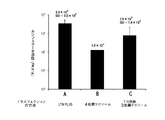
- the luciferase activity was 3.3 ⁇ 10 6 (3258833) for A, 1.2 ⁇ 10 5 for B, and 7.5 ⁇ 10 5 for C. From these results, it was revealed that the transfection activity of TB-modified trilamellar liposomes is lower than that of commercially available transfection reagents, but is about 6 times higher than that of tetralamellar liposomes.
- Example 7 Examination of optimization of TB-modified trilamellar liposome (1) Preparation of PLL-stabilized bilayer liposome and BSA-stabilized bilamellar liposome Negative chargeability by the method described in Example 5 (1) A solution containing bilamellar liposomes was prepared. Two samples of 100 ⁇ L each of the solution containing the negatively charged bilamellar liposomes were prepared, and 1.0 mg / mL PLL solution 4 prepared by the method described in Example 1 (1) [1-2] was added to one of them. 0.0 ⁇ L was added and 0.5 mg / mL bovine serum albumin (BSA) solution was added to the other half.
- BSA bovine serum albumin
- the solution containing negatively charged bilayer liposomes (PLL-stabilized bilayer liposomes) stabilized by electrostatically binding PLL and non-specifically adsorbing BSA are incubated at room temperature for 15 minutes.
- a solution containing negatively charged bilayer liposomes (BSA-stabilized bilayer liposomes) that had been stabilized was prepared.
- Example 5 (2) Preparation of TB-modified trilamellar liposomes
- two samples of negatively charged lipid films modified with TB were prepared as a and b.
- a is used in this Example (2).
- a solution containing a PLL-stabilized bilayer liposome was added, and for b, a solution containing a BSA-stabilized bilayer liposome was added to prepare a TB-modified trilamellar liposome.
- the outline of the preparation process of these TB modified trilamellar liposomes is shown in FIG.
- Example 8 Examination of transfection activity of optimized TB-modified trilamellar liposomes (1) Preparation of TB-modified trilamellar liposomes By the method described in Example 7 (1), negatively charged bilayer liposomes Then, a solution containing each of the PLL-stabilized bilayer liposome and the BSA-stabilized bilayer liposome was prepared. However, NBD-labeled DOPE solution was not added.
- Example 5 (2) [2-3] three samples of negatively charged lipid film modified with TB were prepared by the method described in Example 5 (2) [2-3], and designated as a, b and c.
- a is a negatively charged bilayer membrane.
- a solution containing liposomes, a solution containing PLL-stabilized bilayer liposomes for b, and a solution containing BSA-stabilized bilayer liposomes for c were added to prepare TB-modified trilamellar liposomes.
- Example 6 (2) Examination of transfection activity Using a, b and c of this Example (1), it was described in Example 6 (3) [3-1], [3-2] and [3-3]. The method was used to transfect JAWSII cells. Thereafter, the luciferase activity was measured by the method described in Example 4 (3).
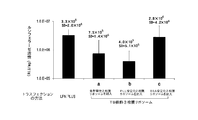
- the luciferase activity when transfection is performed with a and b is lower than that of a commercially available transfection reagent, whereas the luciferase activity when transfection is performed with c is commercially available. Compared to the transfection reagent.
- the transfection activity of TB-modified trilamellar liposomes encapsulating BSA-stabilized bilayer liposomes is as follows: TB-encapsulated PLL-stabilized bilayer liposomes and non-stabilized negatively charged bilayer liposomes It was found to be higher than the modified trilamellar liposome and equivalent to a commercially available transfection reagent.
- Example 9 Photomicrograph of single-membrane liposome 10 ⁇ L of the TB modified liposome d / HEPES suspension of the present invention prepared in Example 2 (3) was rapidly frozen using liquid nitrogen and fixed. The observation was made with a transmission electron microscope. A part of the observation photograph is shown in FIG.
- the average particle diameter of the particles observed in the microscope field was in the range of 50 to 100 nm. This value is consistent with the particle diameter measurement data measured in Example 2 (3), considering that the liquid encapsulated in the TB modified liposome is removed by rapid freezing.
- all the observed particles had an inner black outline and an outer white outline.
- the black outline is considered to correspond to the encapsulated core particle.
- the white outline had a thickness of about 3.5 nm, and this value approximates the theoretical thickness of one lipid membrane of 4.0 nm.
Landscapes
- Health & Medical Sciences (AREA)
- Life Sciences & Earth Sciences (AREA)
- Chemical & Material Sciences (AREA)
- Genetics & Genomics (AREA)
- Engineering & Computer Science (AREA)
- Organic Chemistry (AREA)
- Biomedical Technology (AREA)
- Biotechnology (AREA)
- General Engineering & Computer Science (AREA)
- Molecular Biology (AREA)
- General Health & Medical Sciences (AREA)
- Bioinformatics & Cheminformatics (AREA)
- Biophysics (AREA)
- Wood Science & Technology (AREA)
- Zoology (AREA)
- Biochemistry (AREA)
- Microbiology (AREA)
- Plant Pathology (AREA)
- Physics & Mathematics (AREA)
- Dispersion Chemistry (AREA)
- Medicinal Chemistry (AREA)
- Pharmacology & Pharmacy (AREA)
- Epidemiology (AREA)
- Animal Behavior & Ethology (AREA)
- Public Health (AREA)
- Veterinary Medicine (AREA)
- Medicinal Preparation (AREA)
Abstract
【課題】 簡便に製造することができ、微小かつ均一な粒子径を有する脂質膜構造体や封入する物質(目的物質)の数および脂質膜の枚数が制御された脂質膜構造体、その製造方法ならびに1の目的物質を1枚の脂質膜で封入する方法を提供する。 【解決手段】 陽イオン性界面活性剤が修飾されてなる脂質膜を1枚膜としてまたは複数膜の最外膜として有する脂質膜構造体。本発明に係る脂質膜構造体やその製造方法によれば、微小かつ均一な脂質膜構造体や、封入する物質(目的物質)の数および脂質膜の枚数が制御された脂質膜構造体を得ることができる。
Description
本発明は、脂質膜構造体、脂質膜構造体の製造方法および1の目的物質を1枚の脂質膜で封入する方法に関し、より詳細には、陽イオン性界面活性剤が修飾されてなる脂質膜を1枚膜としてまたは複数膜の最外膜として有する脂質膜構造体、当該脂質膜構造体の製造方法および1の目的物質を1枚の脂質膜で封入する方法に関する。
タンパク質、薬剤、あるいは核酸などの物質を、生物個体の標的部位に確実に送達するためのベクターの開発が盛んに行われている。これまでに開発されたベクターは、ウイルスベクターと非ウイルスベクターとに大別される。ウイルスベクターは、一般に、目的の遺伝子を標的細胞の核内へ導入する遺伝子導入能が優れているが、大量生産の困難性、抗原性、毒性などの問題があるため、このような問題点が少ない非ウイルスベクターとして、リポソームに代表される脂質膜構造体が注目を集めている。
リポソームは、人工的に調製される脂質二重層からなる脂質膜を基本構成とする脂質膜構造体であり、様々な物質を内包して標的細胞内に送り込む能力を有している。リポソームは、その表面に抗体、タンパク質、糖鎖などの機能性分子を導入することにより、標的部位に対する指向性を向上させることができるという利点の他、物質が内包されるために生体内の分解作用や代謝作用から保護されるという利点や、標的以外の部位で物質が作用を奏すること(副作用)を防止するという利点を有している。これまでに、リポソームとして、例えば、連続した複数個のアルギニン残基を含むペプチドを表面に有し、核移行能を有するリポソームが開発されている(特許文献1)。
また、遺伝子を封入した脂質膜構造体として、Stabilized plasmid-lipid particles(SPLP)が開発されている(非特許文献1)。SPLPは、正帯電性脂質と非イオン性界面活性剤とを含む緩衝液中で遺伝子をインキュベートした後、緩衝液によって透析を行うことにより製造される、粒子径60-70nmの微小な脂質膜構造体である。
Wheeler J.J.ら、Gene Ther.、第6巻、第2号、第271-281頁、1999年
一般に、粒子を癌や炎症といった疾患部位へ効率的に送達させるためには、粒子径は100nm~150nm程度であることが好ましい(Liu D.ら、Biochim Biophys Acta.、第1104巻、第1号、第95-101頁、1992年;Akinc A.ら、Mol.Ther.、第17巻、第5号、第872-879頁、2009年)。しかしながら、特許文献1に記載されたリポソームは、図1上段に示すように、脂質フィルムを調製した後、これを水和させ、攪拌または超音波処理する方法(水和法)により簡便に製造することができるが、封入する物質(目的物質)の数や脂質膜の枚数を制御することが困難であるため、粒子径が平均約300nmと過大になってしまい、疾患部位へ効率的に送達させるのは困難である。
また、非特許文献1に記載されたSPLPは、疾患部位へ効率的に送達可能な程度に微小であるが、透析操作に長時間を要することや、緩衝液のpHなどの僅かな条件の変化によって脂質膜構造体への遺伝子の封入効率が顕著に低下することなどから、実用化が困難である(Jeffs L.B.、Pharm Res.、第22巻、第3号、第362-72頁、2005年)。
本発明は、このような問題点を解決するためになされたものであって、簡便に製造することができ、微小かつ均一な粒子径を有する脂質膜構造体や封入する物質(目的物質)の数および脂質膜の枚数が制御された脂質膜構造体、その製造方法ならびに1の目的物質を1枚の脂質膜で封入する方法を提供することを目的とする。
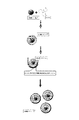
本発明者らは、鋭意研究の結果、図1下段に示すように、陽イオン性界面活性剤が修飾された脂質フィルムを用いて水和法を行うことにより、微小かつ均一な粒子径を有するリポソームや封入する物質(目的物質)の数および脂質膜の枚数が制御されたリポソームが得られること、および1の目的物質を1枚の脂質膜で封入することができること、ならびに陽イオン性界面活性剤が修飾された脂質膜を1枚膜としてまたは複数膜の最外膜として有するリポソームのトランスフェクション活性が顕著に向上することを見出し、下記の各発明を完成した。
(1)陽イオン性界面活性剤が修飾されてなる脂質膜を1枚膜としてまたは複数膜の最外膜として有する脂質膜構造体。
(2)陽イオン性界面活性剤が次式(化1)

[式中:R1はアルキル基であり、R2は疎水基である。]の陽イオン性界面活性剤である、(1)に記載の脂質膜構造体。
(3)R1が炭素数が12以上のアルキル基であり、かつR2が次式(化2)

または次式(化3)

の基である、(2)に記載の脂質膜構造体。
(4)R1が炭素数が16のアルキル基であり、かつR2が次式(化4)

の基である、(2)に記載の脂質膜構造体。
(5)負帯電性脂質膜構造体である、(1)から(4)のいずれかに記載の脂質膜構造体。
(6)リポソームである、(1)から(5)のいずれかに記載の脂質膜構造体。
(7)陽イオン性界面活性剤が修飾されてなる脂質膜を1枚膜としてまたは複数膜の最外膜として有する脂質膜構造体を製造する方法であって、下記(i)、(ii)または(iii)の工程を有する前記方法;(i)脂質と陽イオン性界面活性剤とを混合して陽イオン性界面活性剤が修飾された脂質フィルムを調製する工程、(ii)脂質フィルムに陽イオン性界面活性剤を加えて陽イオン性界面活性剤が修飾された脂質フィルムを調製する工程、(iii)1枚膜または複数膜の脂質膜を有する脂質膜構造体の1枚膜または複数膜の最外膜に陽イオン性界面活性剤を修飾する工程。
(8)(i)脂質と陽イオン性界面活性剤とを混合して陽イオン性界面活性剤が修飾された脂質フィルムを調製する工程または(ii)脂質フィルムに陽イオン性界面活性剤を加えて陽イオン性界面活性剤が修飾された脂質フィルムを調製する工程を有する場合において、下記(iv)の工程を有する、(7)に記載の方法;(iv)前記調製した脂質フィルムを水和させて脂質膜構造体を調製する工程。
(9)1の目的物質を1枚の脂質膜で封入する方法であって、下記(i)または(ii)の工程を有する前記方法;(i)脂質と陽イオン性界面活性剤とを混合して陽イオン性界面活性剤が修飾された脂質フィルムを調製する工程、(ii)脂質フィルムに陽イオン性界面活性剤を加えて陽イオン性界面活性剤が修飾された脂質フィルムを調製する工程。
(10)下記(iv)の工程を有する、(9)に記載の方法;(iv)前記調製した脂質フィルムを水和させて脂質膜構造体を調製する工程。
(11)陽イオン性界面活性剤が次式(化5)

[式中:R1はアルキル基であり、R2は疎水基である。]の陽イオン性界面活性剤である、(7)から(10)のいずれかに記載の方法。
(12)R1が炭素数が12以上のアルキル基であり、かつR2が次式(化6)

または次式(化7)

の基である、(11)に記載の方法。
(13)R1が炭素数が16のアルキル基であり、かつR2が次式(化8)

の基である、(11)に記載の方法。
本発明に係る脂質膜構造体やその製造方法によれば、微小かつ均一な脂質膜構造体や、封入する物質(目的物質)の数および脂質膜の枚数が制御された脂質膜構造体を得ることができる。また、微小かつ均一な脂質膜構造体によれば、腫瘍や肝臓実質などの疾患部位へ効率的に送達させることができ、脂質膜の枚数が制御された脂質膜構造体によれば、標的部位へ効率的に送達させることができる。例えば、本発明に係る脂質膜構造体の脂質膜の枚数が3枚である場合は、3回の膜融合により核やミトコンドリアに、脂質膜の枚数が1枚である場合は、1回の膜融合により細胞質に、それぞれ目的物質を効率的に送達させることができる。さらに、本発明に係る脂質膜構造体は、目的物質を損傷させずに標的部位へ送達して、標的部位において目的物質の機能を発揮させることができるうえ、細胞毒性が低く、安全に生体に適用することができる。一方、本発明に係る脂質膜構造体を製造する方法によれば、上述の特徴を有する脂質膜構造体を、穏やかな調製条件で、簡便に、かつ廉価に製造することができる。さらに、本発明に係る1の目的物質を1枚の脂質膜で封入する方法によれば、目的物質のサイズに応じた脂質膜構造体を得ることができる他、この方法を1または複数回行うことにより、目的の枚数の脂質膜を有する脂質膜構造体を得ることができる。なお、本発明に係る脂質膜構造体を製造する方法および1の目的物質を1枚の脂質膜で封入する方法は、脂質の種類を問わず行うことができることから、標的とする部位や細胞腫などに応じて脂質膜の脂質組成を適宜選択することができる。
以下、本発明に係る脂質膜構造体、脂質膜構造体の製造方法および1の目的物質を1枚の脂質膜で封入する方法について詳細に説明する。本発明に係る脂質膜構造体は陽イオン性界面活性剤が修飾されてなる脂質膜を1枚膜としてまたは複数膜の最外膜として有する。
本発明において、「脂質膜」とは、脂質膜構造体が有する、脂質を主な構成成分とする膜をいう。本発明における脂質膜は、脂質分子が疎水性部分同士を会合させて二層に並んで形成する脂質二重層(lipid bilayer)からなるものでもよく、疎水性部分を内側または外側に向けて形成する一重層からなるものでもよい。
本発明における脂質膜構造体の好ましい形態としては、脂質二重層からなる脂質膜を有する閉鎖小胞を挙げることができ、そのような脂質膜構造体としては、例えば、リポソームを挙げることができる。
本発明において、脂質膜構造体が有する脂質膜の枚数は1枚であってもよく、2以上の複数枚であってもよい。本発明に係る脂質膜構造体が複数膜を有する場合、少なくとも最外膜に陽イオン性界面活性剤が修飾されてなる脂質膜を有するが、最外膜のみならず、最外膜以外の1または複数の膜が陽イオン性界面活性剤が修飾されてなる脂質膜であってもよい。
本発明において、「陽イオン性界面活性剤」は、界面活性剤のうち、陽イオン性の親水基を有するものをいい、イオン価は特に限定されないが、1価であることが好ましい。陽イオン性界面活性剤としては、具体的には、例えば、トリメチルテトラデシルアンモニウムクロライド、セチルトリメチルアンモニウムブロマイドなどのアルキルトリメチルアンモニウム塩、ドデシルエチルジメチルアンモニウムブロマイド、エチルヘキサデシルジメチルアンモニウムブロマイドなどのジアルキルジメチルアンモニウム塩、ベンジルドデシルジメチルアンモニウムブロマイド、ベンジルテトラデシルジメチルアンモニウムブロマイド、ベンジルヘキサデシルジメチルアンモニウムブロマイド、ベンジルオクタデシルジメチルアンモニウムブロマイド、塩化ベンザルコニウムなどのアルキルジメチルベンジルアンモニウム塩、トンゾニウムブロマイド、塩化ベンゼトニウム、塩化セチルピリジニウム、塩化デカリニウム、第1級アミン塩、第2級アミン塩、Nメチルビスヒドロキシエチルアミン脂肪酸エステル塩酸塩などの第3級アミン塩などに由来する陽イオンを挙げることができるが、このうち、下記式(化1)

[式中:R1はアルキル基であり、R2は疎水基である。]で示される陽イオン性界面活性剤が好ましく、上記式(化1)において、R1が炭素数が12以上のアルキル基であり、かつR2が次式(化2)

またはR2が次式(化3)

で示される陽イオン性界面活性剤であることがさらに好ましい。
なお、本発明における「疎水基」としては、例えば、上記式(化2)および(化3)で示される基のほか、メチル基、エチル基、プロピル基、イソプロピル基などのアルキル基、アルケニル基、ビニール基、フェニル基やナフチル基などのアリール基といった炭化水素基や複素環、または親水基と疎水基が組み合わされて、全体として疎水性である基を挙げることができる。
本発明において、陽イオン性界面活性剤が修飾されてなる脂質膜の態様としては、例えば、図2に示すように、脂質膜を構成する脂質分子の間隙に陽イオン性界面活性剤が位置する態様の他、脂質膜を構成する脂質分子に、共有結合、水素結合、イオン結合、疎水結合、あるいはファンデルワールス結合により陽イオン性界面活性剤が結合する態様などを挙げることができる。
また、本発明において、脂質膜構造体は、正帯電性、非帯電性、両(正負)帯電性および負帯電性のいずれでもよいが、負帯電性であることが好ましい。なお、本発明における「負帯電性脂質膜構造体」とは、全体として負帯電性である脂質膜構造体をいい、例えば、脂質膜の構成脂質として正帯電性脂質や両(正負)帯電性脂質、非帯電性脂質を含むため、または陽イオン性界面活性剤が修飾されているために、局所的に正帯電性や両(正負)帯電性、非帯電性であるものであっても、全体として負帯電性であれば「負帯電性脂質膜構造体」に包含される。
本発明における脂質膜構造体を構成する脂質は、正帯電性脂質、両(正負)帯電性脂質や非帯電性脂質を含む中性脂質、負帯電性脂質のいずれでもよく、脂質の種類としては、例えば、リン脂質、糖脂質、ステロール、長鎖脂肪族アルコールあるいはグリセリン脂肪酸エステルなどを挙げることができ、これらの1種または2種以上を用いることができる。
リン脂質としては、例えば、ホスファチジルコリン(例えば、ジオレオイルホスファチジルコリン、ジラウロイルホスファチジルコリン、ジミリストイルホスファチジルコリン、ジパルミトイルホスファチジルコリン、ジステアロイルホスファチジルコリンなど)、ホスファチジルグリセロール(例えば、ジオレオイルホスファチジルグリセロール、ジラウロイルホスファチジルグリセロール、ジミリストイルホスファチジルグリセロール、ジパルミトイルホスファチジルグリセロール、ジステアロイルホスファチジルグリセロールなど)、ホスファチジルエタノールアミン(例えば、ジオレオイルホスファチジルエタノールアミン、ジラウロイルホスファチジルエタノールアミン、ジミリストイルホスファチジルエタノールアミン、ジパルミトイルホスファチジルエタノールアミン、ジステアロイルホスファチジルエタノールアミン(DSPE)、ジオレオイルグリセロフォスフォエタノールアミン(DOPE)など)、ホスファチジルセリン、ホスファチジルイノシトール、ホスファチジン酸(PA)、カルジオリピン、またはこれらの水素添加物、卵黄、大豆その他の動植物に由来する天然脂質(例えば、卵黄レシチン、大豆レシチンなど)などを挙げることができ、これらのうちの1種または2種以上を用いることができる。
糖脂質としては、スフィンゴミエリン、スルホキシリボシルグリセリド、ジグリコシルジグリセリド、ジガラクトシルジグリセリド、ガラクトシルジグリセリド、グリコシルジグリセリドなどのグリセロ糖脂質、ガラクトシルセレブロシド、ラクトシルセレブロシド、ガングリオシドなどのスフィンゴ糖脂質などを挙げることができ、これらの1種または2種以上を用いることができる。
ステロールとしては、コレステロール、コレステロールコハク酸、ラノステロール、ジヒドロラノステロール、デスモステロール、ジヒドロコレステロールなどの動物由来のステロール、スチグマステロール、シトステロール、カンペステロール、ブラシカステロールなどの植物由来のステロール(フィトステロール)、チモステロール、エルゴステロールなどの微生物由来のステロールなどを挙げることができ、これらの1種または2種以上を用いることができる。また、これらのステロールは、一般には脂質二重層を物理的または化学的に安定させるために、あるいは膜の流動性を調節するために用いることができる。
長鎖脂肪酸または長鎖脂肪族アルコールとしては、炭素数10~20の脂肪酸またはそのアルコールを使用することができる。そのような長鎖脂肪酸または長鎖脂肪族アルコールとしては、例えば、パルミチン酸、ステアリン酸、ラウリン酸、ミリスチン酸、ペンタデシル酸、アラキジン酸、マルガリン酸、ツベルクロステアリン酸などの飽和脂肪酸、パルミトレイン酸、オレイン酸、アラキドン酸、バクセン酸、リノール酸、リノレン酸、アラキドン酸、エレオステアリン酸などの不飽和脂肪酸、オレイルアルコール、ステアリルアルコール、ラウリルアルコール、ミリスチルアルコール、セチルアルコール、リノリルアルコールなどを挙げることができ、これらの1種または2種以上を用いることができる。
グリセリン脂肪酸エステルとしては、モノアシルグリセリド、ジアシルグリセリド、トリアシルグリセリドを挙げることができ、これらの1種または2種以上を用いることができる。
正帯電性脂質としては、上述した脂質の他、例えば、ジオクタデシルジメチルアンモニウムクロライド(dioctadecyldimethylammonium chloride、DODAC)、N-(2,3-オレイルオキシ)プロピル-N,N,N-トリメチルアンモニウム(N-(2,3-dioleyloxy)propyl-N,N,N-trimethylammonium、DOTMA)、ジドデシルアンモニウムブロミド(didodecylammonium bromide、DDAB)、1,2-ジオレイルオキシ-3-トリメチルアンモニウムプロパン(1,2-dioleoyloxy-3-trimethylammonio propane、DOTAP)、3β-N-(N’,N’-ジメチルアミノエタン)カルバモールコレステロール(3β-N-(N’,N’,-dimethyl-aminoethane)-carbamol cholesterol、DC-Chol)、1,2-ジミリストイルオキシプロピル-3-ジメチルヒドロキシエチルアンモニウム(1,2-dimyristoyloxypropyl-3-dimethylhydroxyethyl ammonium、DMRIE)、2,3-ジオレイルオキシ-N-[2(スペルミンカルボキサミド)エチル]-N,N-ジメチル-1-プロパンアンモニウムトリフルオロアセテート(2,3-dioleyloxy-N-[2(sperminecarboxamido)ethyl]-N,N-dimethyl-1-propanaminum trifluoroacetate、DOSPA)などを挙げることができ、これらの1種または2種以上を用いることができる。
また、両(正負)帯電性脂質や非帯電性脂質を含む中性脂質としては、上述した脂質の他、例えば、ジアシルホスファチジルコリン、ジアシルホスファチジルエタノールアミン、セラミドなどを挙げることができ、これらの1種または2種以上を用いることができる。また、負帯電性脂質としては、上述した脂質の他、例えば、ジアシルホスファチジルセリン、ジアシルホスファチジン酸、N-スクシニルホスファチジルエタノールアミン(N-スクシニルPE)、ホスファチジルエチレングリコール、コレステリルヘミスクシネート(CHEMS)などを挙げることができ、これらの1種または2種以上を用いることができる。
本発明に係る脂質膜構造体の脂質膜には、上述した脂質の他に、トコフェロール、没食子酸プロピル、パルミチン酸アスコルビル、ブチル化ヒドロキシトルエンなどの抗酸化剤、ステアリルアミン、オレイルアミンなどの正荷電を付与する荷電物質、ジセチルホスフェートなどの負電荷を付与する荷電物質、膜表在性タンパク質、膜内在性タンパク質などの膜タンパク質、脂質膜構造体に細胞透過能や核移行能を付与するペプチドを結合または含有させることができ、その結合量や含有量は適宜調節することができる。
本発明に係る陽イオン性界面活性剤が修飾されてなる脂質膜を1枚膜としてまたは複数膜の最外膜として有する脂質膜構造体は、水和法、超音波処理法、エタノール注入法、エーテル注入法、逆相蒸発法、界面活性剤法、凍結・融解法などの公知の方法を用いて製造することができるが、特に、図1下段に示すように、陽イオン性界面活性剤が修飾された脂質フィルムを調製して水和法を行うことにより、簡便に製造することができる。なお、本発明において、「脂質フィルム」は、脂質を有機溶剤に溶解させた後、有機溶剤を蒸発除去することにより、容器の底面または側面に張り付くようなかたちで形成される、脂質分子を主な構成成分とする膜をいう。
次に、本発明は脂質膜構造体を製造する方法を提供する。本発明に係る脂質膜構造体を製造する方法は、陽イオン性界面活性剤が修飾されてなる脂質膜を1枚膜としてまたは複数膜の最外膜として有する脂質膜構造体を製造する方法であって、
(i)脂質と陽イオン性界面活性剤とを混合して陽イオン性界面活性剤が修飾された脂質フィルムを調製する工程、
(ii)脂質フィルムに陽イオン性界面活性剤を加えて陽イオン性界面活性剤が修飾された脂質フィルムを調製する工程、
(iii)1枚膜または複数膜の脂質膜を有する脂質膜構造体の1枚膜または複数膜の最外膜に陽イオン性界面活性剤を修飾する工程、
以上(i)、(ii)または(iii)の工程を有する。なお、本発明に係る脂質膜構造体を製造する方法において、上述した本発明に係る脂質膜構造体の構成と同等または相当する構成については再度の説明を省略する。
(i)脂質と陽イオン性界面活性剤とを混合して陽イオン性界面活性剤が修飾された脂質フィルムを調製する工程、
(ii)脂質フィルムに陽イオン性界面活性剤を加えて陽イオン性界面活性剤が修飾された脂質フィルムを調製する工程、
(iii)1枚膜または複数膜の脂質膜を有する脂質膜構造体の1枚膜または複数膜の最外膜に陽イオン性界面活性剤を修飾する工程、
以上(i)、(ii)または(iii)の工程を有する。なお、本発明に係る脂質膜構造体を製造する方法において、上述した本発明に係る脂質膜構造体の構成と同等または相当する構成については再度の説明を省略する。
工程(i)において、脂質と陽イオン性界面活性剤とを混合して陽イオン性界面活性剤が修飾された脂質フィルムを調製する方法としては、例えば、脂質を有機溶媒に溶解させて得た溶液(脂質溶液)と陽イオン性界面活性剤を有機溶媒に溶解させて得た溶液(陽イオン性界面活性剤溶液)とを混合した後に、脂質溶液に陽イオン性界面活性剤を添加して混合ないし溶解させた後に、陽イオン性界面活性剤溶液に脂質を添加して混合ないし溶解させた後に、あるいは脂質と陽イオン性界面活性剤とを同時に有機溶媒に溶解させた後に、それぞれ有機溶剤を蒸発させて除去する方法を挙げることができる。
なお、本発明において、脂質および陽イオン性界面活性剤を溶解させる有機溶媒としては、例えば、ペンタン、ヘキサン、ヘプタン、シクロヘキサンなどの炭化水素類、塩化メチレン、クロロホルムなどのハロゲン化炭化水素類、ベンゼン、トルエンなどの芳香族炭化水素類、メタノール、エタノールなどの低級アルコール類、酢酸メチル、酢酸エチルなどのエステル類、アセトンなどのケトン類などを、単独でまたは2種以上を組み合わせて使用することができる。
工程(ii)において、脂質フィルムに陽イオン性界面活性剤を加えて陽イオン性界面活性剤が修飾された脂質フィルムを調製する方法としては、例えば、脂質フィルムに陽イオン性界面活性剤溶液を添加した後、溶媒を蒸発させて除去する方法を挙げることができる。
工程(iii)において、1枚膜または複数膜の脂質膜を有する脂質膜構造体の1枚膜または複数膜の最外膜に陽イオン性界面活性剤を修飾する方法としては、例えば、1枚膜または複数膜の脂質膜を有する脂質膜構造体に陽イオン性界面活性剤を添加する方法を挙げることができる。
また、本発明に係る脂質膜構造体を製造する方法が、工程(i)または工程(ii)を有する場合には、
(iv)前記調製した脂質フィルムを水和させて脂質膜構造体を調製する工程、
以上(iv)の工程を有することもできる。
(iv)前記調製した脂質フィルムを水和させて脂質膜構造体を調製する工程、
以上(iv)の工程を有することもできる。
工程(iv)において、脂質フィルムを水和させて脂質膜構造体を調製する方法としては、例えば、脂質フィルムに水などの液体を添加して水和させた後、攪拌または超音波処理する方法、すなわち水和法を挙げることができる。
次に、本発明は、1の目的物質を1枚の脂質膜で封入する方法を提供する。本発明に係る1の目的物質を1枚の脂質膜で封入する方法は、
(i)脂質と陽イオン性界面活性剤とを混合して陽イオン性界面活性剤が修飾された脂質フィルムを調製する工程、
(ii)脂質フィルムに陽イオン性界面活性剤を加えて陽イオン性界面活性剤が修飾された脂質フィルムを調製する工程、
以上(i)または(ii)の工程を有する。なお、本発明に係る1の目的物質を1枚の脂質膜で封入する方法において、上述した本発明に係る脂質膜構造体または脂質膜構造体の製造方法の構成と同等または相当する構成については再度の説明を省略する。
(i)脂質と陽イオン性界面活性剤とを混合して陽イオン性界面活性剤が修飾された脂質フィルムを調製する工程、
(ii)脂質フィルムに陽イオン性界面活性剤を加えて陽イオン性界面活性剤が修飾された脂質フィルムを調製する工程、
以上(i)または(ii)の工程を有する。なお、本発明に係る1の目的物質を1枚の脂質膜で封入する方法において、上述した本発明に係る脂質膜構造体または脂質膜構造体の製造方法の構成と同等または相当する構成については再度の説明を省略する。
また、本発明に係る1の目的物質を1枚の脂質膜で封入する方法は、
(iv)前記調製した脂質フィルムを水和させて脂質膜構造体を調製する工程、
以上(iv)の工程を有することもできる。
(iv)前記調製した脂質フィルムを水和させて脂質膜構造体を調製する工程、
以上(iv)の工程を有することもできる。
本発明において、「目的物質」とは、脂質膜構造体に封入される予定の物質または封入された物質をいう。本発明において目的物質はいかなる物質でもよく、例えば、薬剤、核酸、ペプチド、タンパク質、糖またはこれらの複合体などの種々の生理活性物質やリポソーム、ミセルなどの脂質膜構造体を挙げることができ、診断、治療などの目的に応じて適宜選択することができる。目的物質は、例えば、脂質膜構造体の製造にあたり脂質膜を水和する際に使用される水性溶媒に添加することにより、脂質膜構造体内部の水相に封入することができる。
例えば、本発明に係る1の目的物質を1枚の脂質膜で封入する方法において、1枚の脂質膜を有するリポソームを目的物質とすれば、2枚の脂質膜を有するリポソームを得ることができ、2枚の脂質膜を有するリポソームを目的物質とすれば、3枚の脂質膜を有するリポソームを得ることができる。なお、目的物質の脂質膜構造体には、種々の機能性分子によって修飾をしてもよく、修飾物質としては、例えば、標的部位への移行性や細胞透過能を向上させるペプチド、脂質膜構造体の安定性を向上させるPLLやBSA、荷電物質などを挙げることができる。
本発明に係る脂質膜構造体は、生理食塩水、リン酸緩衝液,クエン緩衝液,酢酸緩衝液などの適当な水性溶媒に分散させて使用することができる。分散液には、糖類、多価アルコール、水溶性高分子、非イオン界面活性剤、抗酸化剤、pH調節剤、水和促進剤などの添加剤を適宜添加してもよい。また、本発明に係る脂質膜構造体は、前記の分散液を乾燥させた状態で保存することができる。さらに、本発明に係る脂質膜構造体は、経口投与することができる他、静脈、腹腔内、皮下、経鼻などへの非経口投与も可能である。
なお、これまでに記載した本発明の脂質膜構造体、脂質膜構造体の製造方法および1の目的物質を1枚の脂質膜で封入する方法においては、脂質フィルムに加える陽イオン性界面活性剤の量を総脂質に対して10~30mol%の範囲とすることで、製造される、あるいは目的物質が封入される脂質膜構造体の粒子径を、おおよそ50nm~200nmの範囲で制御することも可能である。また、核酸などの粒子を封入するときは、封入される粒子のサイズに応じ前記の範囲で陽イオン界面活性剤の量を調節することが好ましい。
以下、本発明に係る脂質膜構造体、脂質膜構造体の製造方法および1の目的物質を1枚の脂質膜で封入する方法について、実施例に基づいて説明する。なお、本発明の技術的範囲は、これらの実施例によって示される特徴に限定されない。
<実施例1>陽イオン性界面活性剤が修飾された脂質膜を有するリポソームの粒子径の検討
(1)核酸ナノ粒子の調製
[1-1]プラスミドDNA(pDNA)の調製
10mg/mLのカナマイシン水溶液10μLを添加したLB培地10mLに、CMVプロモーターの下流にEnhanced Green luorescence Protein(EGFP)-ルシフェラーゼ融合タンパク質遺伝子がコードされたプラスミドDNAを有する大腸菌(BD Bioscience Clontech社)を植菌して、37℃にて8-9時間振とう培養を行うことにより、第1大腸菌懸濁液を調製した。
(1)核酸ナノ粒子の調製
[1-1]プラスミドDNA(pDNA)の調製
10mg/mLのカナマイシン水溶液10μLを添加したLB培地10mLに、CMVプロモーターの下流にEnhanced Green luorescence Protein(EGFP)-ルシフェラーゼ融合タンパク質遺伝子がコードされたプラスミドDNAを有する大腸菌(BD Bioscience Clontech社)を植菌して、37℃にて8-9時間振とう培養を行うことにより、第1大腸菌懸濁液を調製した。
続いて、10mg/mLのカナマイシン水溶液1mLを添加したLB培地1Lに、第1大腸菌懸濁液5mLを添加した後、37℃にて約16時間振とう培養を行うことにより、第2大腸菌懸濁液を調製した。
次に、第2大腸菌懸濁液について、4℃、4000×gの条件下で15分間遠心分離を行った後、上清を除去して大腸菌ペレットを調製した。続いて、EndoFree Plasmid Mega Kitを用いて、添付の仕様書に従ってDNAの抽出および精製を行い、粗精製pDNA水溶液を調製した。
続いて、粗精製pDNA水溶液17.5mLにイソプロパノール17.5mLを添加した後、直ちに、4℃、15000×gの条件下で30分間遠心分離を行った。上清を慎重に除去した後、エンドトキシン未含有水で調製した70%(v/v)エタノール水溶液7.5mLを添加し、再度4℃、15000×gの条件下で30分間遠心分離を行った。上清を慎重に除去して、得られたペレットを適度に乾燥させた後、適量の滅菌水を添加して溶解させ、これを精製pDNA水溶液とした。続いて、精製pDNA水溶液から適量をとり、これを滅菌水で200倍に希釈した後、260nmで吸光度測定を行って、精製pDNA水溶液の濃度を測定した。濃度の測定結果に基づき、滅菌水で希釈することにより、精製pDNA水溶液の濃度を1.0mg/mLに調製した。その後、エッペンドルフチューブに100μLずつ分注し、-20℃で保存した.
[1-2]核酸ナノ粒子の調製
陽イオン性ポリマーであるPoly-L-Lysine(PLL;分子量27400;Sigma-Aldrich社)を滅菌水に溶解して、1.0mg/mLのPLL水溶液を調製した。続いて、PLL水溶液および本実施例(1)[1-1]の精製pDNA水溶液を、10mmol/LのHEPES緩衝液(pH7.35-7.40)で希釈することにより、0.1mg/mLのPLL溶液および0.1mg/mLのpDNA溶液を調製した。
陽イオン性ポリマーであるPoly-L-Lysine(PLL;分子量27400;Sigma-Aldrich社)を滅菌水に溶解して、1.0mg/mLのPLL水溶液を調製した。続いて、PLL水溶液および本実施例(1)[1-1]の精製pDNA水溶液を、10mmol/LのHEPES緩衝液(pH7.35-7.40)で希釈することにより、0.1mg/mLのPLL溶液および0.1mg/mLのpDNA溶液を調製した。
ボルテックスしながら、PLL溶液に同量のpDNA溶液を穏やかに滴下することにより、PLLとpDNAとが静電的相互作用により結合して凝縮した粒子(核酸ナノ粒子)を含む溶液(核酸ナノ粒子溶液;終濃度0.05mg/mL)を調製した。
[1-3]核酸ナノ粒子の粒子径およびゼータ電位の測定
本実施例(1)[1-2]の核酸ナノ粒子について、Zetasizer Nano ZS(Malvern Instruments社)を用いて、動的光散乱法により粒子径を、電気泳動法によりゼータ電位をそれぞれ測定した。
本実施例(1)[1-2]の核酸ナノ粒子について、Zetasizer Nano ZS(Malvern Instruments社)を用いて、動的光散乱法により粒子径を、電気泳動法によりゼータ電位をそれぞれ測定した。
(2)脂質フィルムの調製
[2-1]界面活性剤溶液の調製
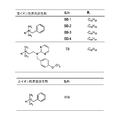
陽イオン性界面活性剤であるベンジルドデシルジメチルアンモニウムブロマイド(BB-1;Sigma-Aldrich社)、ベンジルテトラデシルジメチルアンモニウムブロマイド(BB-2;Sigma-Aldrich社)、ベンジルヘキサデシルジメチルアンモニウムブロマイド(BB-3;Sigma-Aldrich社)、ベンジルヘキサデシルジメチルアンモニウムブロマイド(BB-3;Sigma-Aldrich社)およびベンジルオクタデシルジメチルアンモニウムブロマイド(BB-4;Sigma-Aldrich社)、ならびに非イオン性界面活性剤であるn-Octyl β-D-glucopyranoside(OG;東京化成工業社)をそれぞれ3.03mmol/Lとなるようにエタノールに溶解することにより、BB-1溶液、BB-2溶液、BB-3溶液、BB-4溶液およびOG溶液を調製した。なお、BB-1、BB-2、BB-3およびBB-4の構造を図3最上段に、OGの構造を図3最下段にそれぞれ示す。
[2-1]界面活性剤溶液の調製
陽イオン性界面活性剤であるベンジルドデシルジメチルアンモニウムブロマイド(BB-1;Sigma-Aldrich社)、ベンジルテトラデシルジメチルアンモニウムブロマイド(BB-2;Sigma-Aldrich社)、ベンジルヘキサデシルジメチルアンモニウムブロマイド(BB-3;Sigma-Aldrich社)、ベンジルヘキサデシルジメチルアンモニウムブロマイド(BB-3;Sigma-Aldrich社)およびベンジルオクタデシルジメチルアンモニウムブロマイド(BB-4;Sigma-Aldrich社)、ならびに非イオン性界面活性剤であるn-Octyl β-D-glucopyranoside(OG;東京化成工業社)をそれぞれ3.03mmol/Lとなるようにエタノールに溶解することにより、BB-1溶液、BB-2溶液、BB-3溶液、BB-4溶液およびOG溶液を調製した。なお、BB-1、BB-2、BB-3およびBB-4の構造を図3最上段に、OGの構造を図3最下段にそれぞれ示す。
[2-2]混合脂質溶液の調製
両(正負)帯電性脂質であるジオレオイルグリセロフォスフォエタノールアミン(DOPE;Avanti Polar Lipids社)をエタノール:クロロホルム=1:1(v/v)となるように混合したエタノール/クロロホルム溶液に15mmol/Lとなるように溶解することにより、DOPE溶液を調製した。また、負帯電性脂質であるコレステリルヘミスクシネート(CHEMS;Sigma-Aldrich社)をエタノールに1mmol/Lとなるように溶解することにより、CHEMS溶液を調製した。
両(正負)帯電性脂質であるジオレオイルグリセロフォスフォエタノールアミン(DOPE;Avanti Polar Lipids社)をエタノール:クロロホルム=1:1(v/v)となるように混合したエタノール/クロロホルム溶液に15mmol/Lとなるように溶解することにより、DOPE溶液を調製した。また、負帯電性脂質であるコレステリルヘミスクシネート(CHEMS;Sigma-Aldrich社)をエタノールに1mmol/Lとなるように溶解することにより、CHEMS溶液を調製した。
DOPE溶液7.5μLとCHEMS溶液25μLとを混合して、mol比がDOPE:CHEMS=9:2である混合脂質溶液(終濃度0.55mmol/L)を11サンプル調製し、それぞれa、b、c、d、e、f、g、h、i、jおよびkとした。
[2-3]脂質フィルムの調製
本実施例(2)[2-2]のa、b、c、d、e、f、g、h、i、jおよびkに、本実施例(2)[2-1]のBB-1溶液、BB-2溶液、BB-3溶液、BB-4溶液およびOG溶液を下記のとおり添加して、界面活性剤の脂質に対するmol%(修飾濃度)が0、11および16.5である界面活性剤/混合脂質溶液を調製した。
本実施例(2)[2-2]のa、b、c、d、e、f、g、h、i、jおよびkに、本実施例(2)[2-1]のBB-1溶液、BB-2溶液、BB-3溶液、BB-4溶液およびOG溶液を下記のとおり添加して、界面活性剤の脂質に対するmol%(修飾濃度)が0、11および16.5である界面活性剤/混合脂質溶液を調製した。
修飾濃度(mol%)
a;添加せず(コントロール) 0
b;BB-1溶液 5 μL 11
c;BB-1溶液 7.5μL 16.5
d;BB-2溶液 5 μL 11
e;BB-2溶液 7.5μL 16.5
f;BB-3溶液 5 μL 11
g;BB-3溶液 7.5μL 16.5
h;BB-4溶液 5 μL 11
i;BB-4溶液 7.5μL 16.5
j;OG溶液 5 μL 11
k;OG溶液 7.5μL 16.5
a;添加せず(コントロール) 0
b;BB-1溶液 5 μL 11
c;BB-1溶液 7.5μL 16.5
d;BB-2溶液 5 μL 11
e;BB-2溶液 7.5μL 16.5
f;BB-3溶液 5 μL 11
g;BB-3溶液 7.5μL 16.5
h;BB-4溶液 5 μL 11
i;BB-4溶液 7.5μL 16.5
j;OG溶液 5 μL 11
k;OG溶液 7.5μL 16.5
続いて、真空ポンプを用いた減圧乾燥処理によって乾燥を行った後、250μLずつクロロホルムを添加して再溶解させ、再度、減圧乾燥処理を行うことにより、界面活性剤が修飾されていない脂質フィルム(a)、BB-1が修飾された脂質フィルム(bおよびc)、BB-2が修飾された脂質フィルム(dおよびe)、BB-3が修飾された脂質フィルム(fおよびg)、BB-4が修飾された脂質フィルム(hおよびi)ならびにOGが修飾された脂質フィルム(jおよびk)を調製した。
(3)核酸ナノ粒子を封入したリポソームの調製
本実施例(2)のa、b、c、d、e、f、g、h、i、jおよびkに、本実施例(1)[1-2]の核酸ナノ粒子溶液を250μLずつ添加して、室温にて15分間静置することにより、各脂質フィルムを水和させた。続いて、バスタイプソニケータ(AU-25C;アイワ医科工業社)を用いて超音波処理を行うことにより、核酸ナノ粒子が封入されたリポソーム(核酸ナノ粒子封入リポソーム)として、界面活性剤が修飾されていない脂質膜を有するリポソーム(a)、BB-1が修飾された脂質膜を有するリポソーム(b、c)、BB-2が修飾された脂質膜を有するリポソーム(d、e)、BB-3が修飾された脂質膜を有するリポソーム(f、g)、BB-4が修飾された脂質膜を有するリポソーム(h、i)およびOGが修飾された脂質膜を有するリポソーム(j、k)を調製した。
本実施例(2)のa、b、c、d、e、f、g、h、i、jおよびkに、本実施例(1)[1-2]の核酸ナノ粒子溶液を250μLずつ添加して、室温にて15分間静置することにより、各脂質フィルムを水和させた。続いて、バスタイプソニケータ(AU-25C;アイワ医科工業社)を用いて超音波処理を行うことにより、核酸ナノ粒子が封入されたリポソーム(核酸ナノ粒子封入リポソーム)として、界面活性剤が修飾されていない脂質膜を有するリポソーム(a)、BB-1が修飾された脂質膜を有するリポソーム(b、c)、BB-2が修飾された脂質膜を有するリポソーム(d、e)、BB-3が修飾された脂質膜を有するリポソーム(f、g)、BB-4が修飾された脂質膜を有するリポソーム(h、i)およびOGが修飾された脂質膜を有するリポソーム(j、k)を調製した。
(4)リポソームの粒子径およびゼータ電位の測定
本実施例(3)のa、b、c、d、e、f、g、h、i、jおよびkについて、本実施例(1)[1-3]に記載の方法により、粒子径およびゼータ電位を測定した。
本実施例(3)のa、b、c、d、e、f、g、h、i、jおよびkについて、本実施例(1)[1-3]に記載の方法により、粒子径およびゼータ電位を測定した。
本実施例(1)[1-2]~(4)の実験を3回以上繰り返し、各サンプルについて得られた結果の平均値および標準偏差(SD)を算出した。その結果を下記表1に示す。また、粒子径の測定結果について、グラフ化したものを図4AおよびBに、ゼータ電位の測定結果について、グラフ化したものを図4CおよびDにそれぞれ示す。
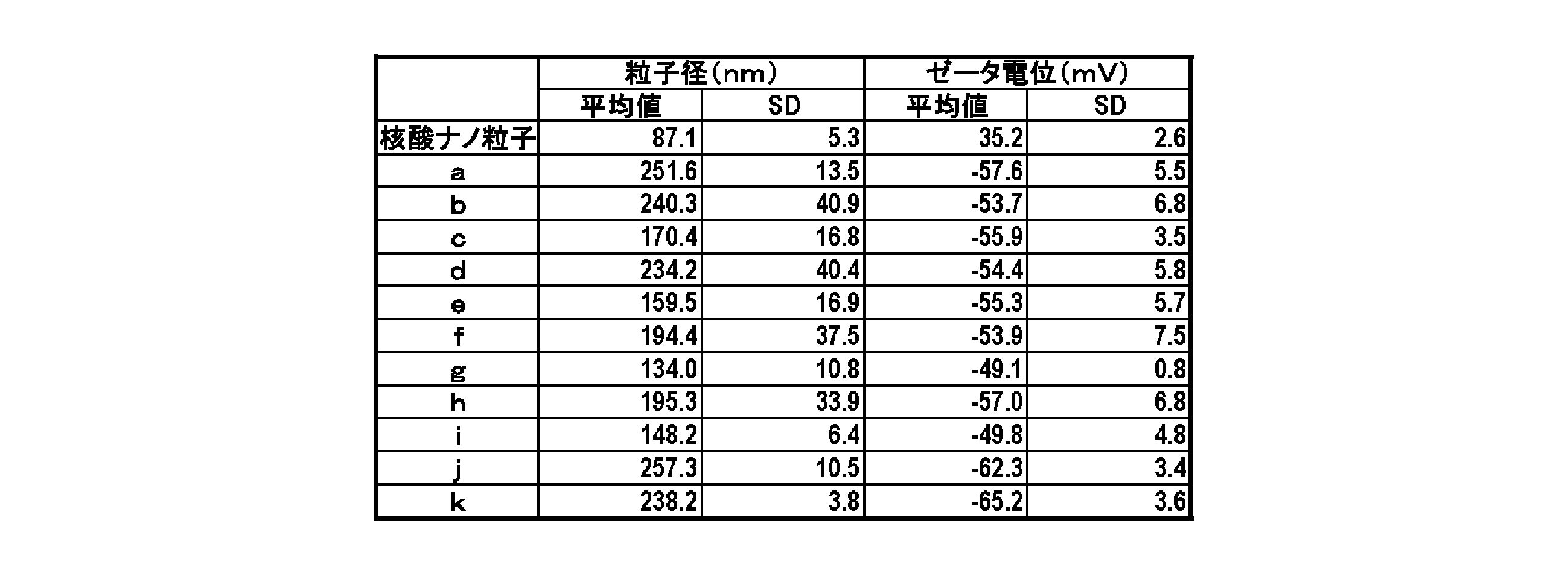
表1、図4AおよびBに示すように、リポソームの粒子径は、b、c、d、e、f、g、hおよびiはaと比較して小さいのに対し、jおよびkはaと比較してほとんど同じであった。また、同種の界面活性剤が修飾された脂質膜を有するリポソームにおいて比較すると、b>c、d>e、f>gおよびh>iであるのに対し、j≒kであった。
これらの結果から、陽イオン性界面活性剤が修飾された脂質膜を有するリポソームは、界面活性剤が修飾されていない脂質膜を有するリポソームと比較して粒子径が小さいこと、および陽イオン性界面活性剤の修飾濃度が大きいほど粒子径が小さくなることが明らかになった。一方、非イオン性界面活性剤が修飾された脂質膜を有するリポソームは、界面活性剤が修飾されていない脂質膜を有するリポソームと比較して、非イオン性界面活性剤の修飾濃度にかかわらず、粒子径がほとんど同じであることが明らかになった。
すなわち、陽イオン性界面活性剤が修飾された脂質フィルムを用いて水和法を行うことにより、微小な粒子径を有するリポソームが得られることが明らかになった。
また、表1および図4Aに示すように、界面活性剤の修飾濃度が同じであるリポソーム同士を比較すると、粒子径はb>d>f≒hおよびc>e>g≒iであった。これらの結果から、脂質膜に修飾された陽イオン性界面活性剤が有するアルキル基の炭素数が16より小さい場合は、炭素数が大きいほどリポソームの粒子径が小さくなるのに対し、炭素数が16より大きい場合は、リポソームの粒子径はそれ以上減少せず、ほぼ一定となることが明らかになった。
また、表1、図4CおよびDに示すように、ゼータ電位について、核酸ナノ粒子が正であるのに対し、a、b、c、d、e、f、g、h、i、jおよびkはいずれも負であった。これらの結果から、陽イオン性界面活性剤が修飾された脂質膜を有するリポソームは、修飾濃度が少なくとも11mol%および16.5mol%の場合は、界面活性剤が修飾されていない脂質膜を有するリポソームおよび非イオン性界面活性剤が修飾された脂質膜を有するリポソームと同様に、構成脂質に由来する負帯電性が維持された負帯電性リポソームとなることが明らかになった。
<実施例2>トンゾニウムブロマイド(TB)が修飾された脂質膜を有するリポソームの粒子径の検討
(1)核酸ナノ粒子の調製
実施例1(1)[1-2]および[1-3]に記載の方法により、核酸ナノ粒子を調製して、粒子径およびゼータ電位を測定した。
(1)核酸ナノ粒子の調製
実施例1(1)[1-2]および[1-3]に記載の方法により、核酸ナノ粒子を調製して、粒子径およびゼータ電位を測定した。
(2)脂質フィルムの調製
[2-1]界面活性剤溶液の調製
陽イオン性界面活性剤であるトンゾニウムブロマイド(TB;Sigma-Aldrich社)を3.03mmol/Lとなるようにエタノールに溶解することにより、TB溶液を調製した。なお、TBの構造を図3中段に示す。
[2-1]界面活性剤溶液の調製
陽イオン性界面活性剤であるトンゾニウムブロマイド(TB;Sigma-Aldrich社)を3.03mmol/Lとなるようにエタノールに溶解することにより、TB溶液を調製した。なお、TBの構造を図3中段に示す。
[2-2]混合脂質溶液の調製
実施例1(2)[2-2]に記載の方法により、混合脂質溶液を6サンプル調製し、それぞれa、b、c、d、eおよびfとした。
実施例1(2)[2-2]に記載の方法により、混合脂質溶液を6サンプル調製し、それぞれa、b、c、d、eおよびfとした。
[2-3]脂質フィルムの調製
本実施例(2)[2-2]のa、b、c、d、eおよびfについて、実施例1(2)[2-3]に記載の方法により、脂質フィルムの調製を行った。ただし、BB-1溶液、BB-2溶液、BB-3溶液、BB-4溶液およびOG溶液に代えて、本実施例(2)[2-1]のTB溶液を用いた。また、TB溶液を添加した量およびTBの修飾濃度は下記のとおりとした。
本実施例(2)[2-2]のa、b、c、d、eおよびfについて、実施例1(2)[2-3]に記載の方法により、脂質フィルムの調製を行った。ただし、BB-1溶液、BB-2溶液、BB-3溶液、BB-4溶液およびOG溶液に代えて、本実施例(2)[2-1]のTB溶液を用いた。また、TB溶液を添加した量およびTBの修飾濃度は下記のとおりとした。
修飾濃度(mol%)
a;添加せず(コントロール) 0
b;TB溶液 5 μL 11
c;TB溶液 7.5μL 16.5
d;TB溶液 10 μL 22
e;TB溶液 12.5μL 27.5
f;TB溶液 25 μL 55
a;添加せず(コントロール) 0
b;TB溶液 5 μL 11
c;TB溶液 7.5μL 16.5
d;TB溶液 10 μL 22
e;TB溶液 12.5μL 27.5
f;TB溶液 25 μL 55
(3)核酸ナノ粒子を封入したリポソームの調製、ならびに粒子径およびゼータ電位の測定
本実施例(2)[2-3]のa、b、c、d、eおよびfについて、実施例1(3)に記載の方法により、核酸ナノ粒子封入リポソームとして、TBが修飾されていない脂質膜を有するリポソーム(TB未修飾リポソーム;a)ならびにTBが修飾された脂質膜を有するリポソーム(TB修飾リポソーム;b、c、d、eおよびf)を調製した。その後、実施例1(1)[1-3]に記載の方法により、粒子径およびゼータ電位を測定した。
本実施例(2)[2-3]のa、b、c、d、eおよびfについて、実施例1(3)に記載の方法により、核酸ナノ粒子封入リポソームとして、TBが修飾されていない脂質膜を有するリポソーム(TB未修飾リポソーム;a)ならびにTBが修飾された脂質膜を有するリポソーム(TB修飾リポソーム;b、c、d、eおよびf)を調製した。その後、実施例1(1)[1-3]に記載の方法により、粒子径およびゼータ電位を測定した。
本実施例(1)~(3)の実験を3回以上繰り返し、各サンプルについて得られた結果の平均値および標準偏差(SD)を算出した。その結果を下記表2に示す。また、粒子径の測定結果について、グラフ化したものを図5Aに、ゼータ電位の測定結果について、グラフ化したものを図5Bにそれぞれ示す。

表2および図5Aに示すように、リポソームの粒子径は、a>b>c>d≒e≒fであった。
これらの結果から、TB修飾リポソームは、TB未修飾リポソームと比較して、粒子径が小さくなることが明らかになった。また、TBの修飾濃度が少なくとも22mol%より小さい場合は、修飾濃度が大きいほど、リポソームの粒子径が小さくなるのに対し、少なくとも22mol%より大きい場合は、リポソームの粒子径はそれ以上減少せず、ほぼ一定となることが明らかになった。
さらに、表2および図5Aに示すように、d、eおよびfの粒子径は、約130nmであり、核酸ナノ粒子の粒子径である約100nmにかなり近い値であった。ここで、図5Cに示すように、脂質膜の厚さは約4nmであり、これに内水相の厚さを合わせると約15nmであることから、1の核酸ナノ粒子を1枚の脂質膜で封入したリポソームの粒子径は、約100nm+約15nm×2=約130nmとなると考えられる。このことから、d、eおよびfは、1の核酸ナノ粒子を1枚の脂質膜で封入したリポソームであることが明らかになった。すなわち、TBが少なくとも22mol%程度修飾された脂質フィルムを用いて水和法を行うことにより得られたリポソームは、1の目的物質が1枚の脂質膜で封入されたリポソームであることが明らかになった。
以上の結果から、陽イオン性界面活性剤が修飾された脂質フィルムを用いて水和法を行うことにより、1の目的物質を1枚の脂質膜で封入することができることが明らかになった。
また、表2および図5Bに示すように、ゼータ電位は、核酸ナノ粒子は正であるのに対し、a、b、c、d、eおよびfはいずれも負であった。これらの結果から、TBの修飾濃度が55mol%より小さいTB修飾リポソームは、TB未修飾リポソームと同様に、構成脂質に由来する負帯電性が維持された負帯電性リポソームとなることが明らかになった。
(4)核酸ナノ粒子を封入していないリポソーム(空リポソーム)の調製、ならびに粒子径およびゼータ電位の測定
[4-1]混合脂質溶液の調製
実施例1(2)[2-2]に記載の方法により、混合脂質溶液を6サンプル調製し、それぞれg、h、i、j、kおよびlとした。
[4-1]混合脂質溶液の調製
実施例1(2)[2-2]に記載の方法により、混合脂質溶液を6サンプル調製し、それぞれg、h、i、j、kおよびlとした。
[4-2]脂質フィルムの調製
本実施例(4)[4-1]のg、h、i、j、kおよびlについて、本実施例(2)[2-3]に記載の方法により、脂質フィルムの調製を行った。ただし、TB溶液を添加した量およびTBの修飾濃度は下記のとおりとした。
本実施例(4)[4-1]のg、h、i、j、kおよびlについて、本実施例(2)[2-3]に記載の方法により、脂質フィルムの調製を行った。ただし、TB溶液を添加した量およびTBの修飾濃度は下記のとおりとした。
修飾濃度(mol%)
g;添加せず(コントロール) 0
h;TB溶液 5 μL 11
i;TB溶液 7.5μL 16.5
j;TB溶液 10 μL 27.5
k;TB溶液 12.5μL 55
l;TB溶液 25 μL 110
g;添加せず(コントロール) 0
h;TB溶液 5 μL 11
i;TB溶液 7.5μL 16.5
j;TB溶液 10 μL 27.5
k;TB溶液 12.5μL 55
l;TB溶液 25 μL 110
[4-3]空リポソームの調製、ならびに粒子径およびゼータ電位の測定
本実施例(4)[4-1]のg、h、i、j、kおよびlについて、実施例1(3)に記載の方法において、核酸ナノ粒子溶液を滅菌水に代えて、核酸ナノ粒子を封入していないリポソーム(空リポソーム)として、TBが修飾されていない脂質膜を有するリポソーム(TB未修飾空リポソーム;g)ならびにTBが修飾された脂質膜を有するリポソーム(TB修飾空リポソーム;h、i、j、kおよびl)を調製した。その後、実施例1(1)[1-3]に記載の方法により、粒子径およびゼータ電位を測定した。
本実施例(4)[4-1]のg、h、i、j、kおよびlについて、実施例1(3)に記載の方法において、核酸ナノ粒子溶液を滅菌水に代えて、核酸ナノ粒子を封入していないリポソーム(空リポソーム)として、TBが修飾されていない脂質膜を有するリポソーム(TB未修飾空リポソーム;g)ならびにTBが修飾された脂質膜を有するリポソーム(TB修飾空リポソーム;h、i、j、kおよびl)を調製した。その後、実施例1(1)[1-3]に記載の方法により、粒子径およびゼータ電位を測定した。
本実施例(4)[4-1]~[4-3]の実験を3回以上繰り返し、各サンプルについて得られた結果の平均値および標準偏差(SD)を算出した。その結果を表3に示す。また、粒子径の測定結果について、グラフ化したものを図6Aに、ゼータ電位の測定結果について、グラフ化したものを図6Bにそれぞれ示す。

表3および図6Aに示すように、空リポソームの粒子径は、h、i、j、kおよびlのいずれも、gの粒子径と比較して小さかった。また、h>i>k>j>lであった。これらの結果から、TB修飾空リポソームは、TB未修飾空リポソームと比較して、粒子径が小さくなることが明らかになった。
すなわち、陽イオン性界面活性剤が修飾された脂質フィルムを用いて水和法を行うことにより、目的物質が封入されているか否かにかかわらず、微小な粒子径を有するリポソームが得られることが明らかになった。
また、図6Bに示すように、ゼータ電位は、g、h、iおよびjはいずれも負であるのに対し、kおよびlは正であった。これらの結果から、TBの修飾濃度が少なくとも55mol%以上であるTB修飾空リポソームは、正帯電性リポソームとなるのに対し、TBの修飾濃度が55mol%より小さいTB修飾空リポソームは、TB未修飾空リポソームと同様に、構成脂質に由来する負帯電性が維持された負帯電性リポソームとなることが明らかになった。
<実施例3>TB修飾リポソームのトランスフェクション活性の検討
(1)R8/TB修飾リポソームの調製
[1-1]TB修飾リポソームおよびTB未修飾リポソームの調製
実施例2(1)、(2)[2-1]、[2-2]、[2-3]および(3)に記載の方法により、核酸ナノ粒子封入リポソームとして、TB未修飾リポソーム、修飾濃度11mol%、16.5mol%および22mol%のTB修飾リポソーム(11mol%TB修飾リポソーム、16.5mol%TB修飾リポソームおよび22mol%TB修飾リポソーム)を調製した。
(1)R8/TB修飾リポソームの調製
[1-1]TB修飾リポソームおよびTB未修飾リポソームの調製
実施例2(1)、(2)[2-1]、[2-2]、[2-3]および(3)に記載の方法により、核酸ナノ粒子封入リポソームとして、TB未修飾リポソーム、修飾濃度11mol%、16.5mol%および22mol%のTB修飾リポソーム(11mol%TB修飾リポソーム、16.5mol%TB修飾リポソームおよび22mol%TB修飾リポソーム)を調製した。
[1-2]R8の修飾
リポソームに一定の細胞透過能を付与することが知られているペプチドであるR8(RRRRRRRR;配列番号6)(小暮健太郎、薬学雑誌、第127巻、第10号、第1685-1691頁、2007年)のC末にステアリン酸(STR)が付加されたペプチド修飾脂肪酸(STR-R8)をKUROBO社より購入し、滅菌水に2.0mg/mLとなるよう溶解してSTR-R8溶液を調製した。
リポソームに一定の細胞透過能を付与することが知られているペプチドであるR8(RRRRRRRR;配列番号6)(小暮健太郎、薬学雑誌、第127巻、第10号、第1685-1691頁、2007年)のC末にステアリン酸(STR)が付加されたペプチド修飾脂肪酸(STR-R8)をKUROBO社より購入し、滅菌水に2.0mg/mLとなるよう溶解してSTR-R8溶液を調製した。
本実施例(1)[1-1]の各リポソームを含む溶液100mLに、STR-R8溶液を2.33mLずつ添加して混和した後、室温にて30分間インキュベーションすることにより、リポソームの全脂質の5mol%にR8を修飾した。
(2)トランスフェクション活性の検討
[2-1]培地の調製
抗生物質を含有しないDulbecco’s modified Eagle medium(DMEM)を常法に従って調製した後、クリーンベンチ内で濾過滅菌を行い、これをDMEM(-)培地とした。また、DMEMに20%(v/v)となるようFetal bovine serum(FBS)を添加し、これをDMEM(+)培地とした。DMEM(-)培地およびDMEM(+)培地は使用時まで4 ℃で保存した。
[2-1]培地の調製
抗生物質を含有しないDulbecco’s modified Eagle medium(DMEM)を常法に従って調製した後、クリーンベンチ内で濾過滅菌を行い、これをDMEM(-)培地とした。また、DMEMに20%(v/v)となるようFetal bovine serum(FBS)を添加し、これをDMEM(+)培地とした。DMEM(-)培地およびDMEM(+)培地は使用時まで4 ℃で保存した。
[2-2]リポソーム含有培地の調製
本実施例(1)[1-2]の各リポソームについて、pDNA0.04μg相当量およびpDNA0.1μg相当量を本実施例(2)[2-1]のDMEM(-)培地に添加して、0.25mLのリポソーム含有培地を調製し、a-1、a-2、b-1、b-2、c-1、c-2、d-1およびd-2とした。各リポソーム含有培地に含まれるリポソームの種類およびpDNA量は下記のとおりである。
本実施例(1)[1-2]の各リポソームについて、pDNA0.04μg相当量およびpDNA0.1μg相当量を本実施例(2)[2-1]のDMEM(-)培地に添加して、0.25mLのリポソーム含有培地を調製し、a-1、a-2、b-1、b-2、c-1、c-2、d-1およびd-2とした。各リポソーム含有培地に含まれるリポソームの種類およびpDNA量は下記のとおりである。
リポソームの種類 pDNA量
a-1;TB未修飾リポソーム 0.04μg
a-2;TB未修飾リポソーム 0.1 μg
b-1;11mol%TB修飾リポソーム 0.04μg
b-2;11mol%TB修飾リポソーム 0.1 μg
c-1;16.5mol%TB修飾リポソーム 0.04μg
c-2;16.5mol%TB修飾リポソーム 0.1 μg
d-1;22mol%TB修飾リポソーム 0.04μg
d-2;22mol%TB修飾リポソーム 0.1 μg
a-1;TB未修飾リポソーム 0.04μg
a-2;TB未修飾リポソーム 0.1 μg
b-1;11mol%TB修飾リポソーム 0.04μg
b-2;11mol%TB修飾リポソーム 0.1 μg
c-1;16.5mol%TB修飾リポソーム 0.04μg
c-2;16.5mol%TB修飾リポソーム 0.1 μg
d-1;22mol%TB修飾リポソーム 0.04μg
d-2;22mol%TB修飾リポソーム 0.1 μg
[2-3]HeLa細胞の前培養
ヒト子宮頸癌由来のHeLa細胞懸濁液0.5mL(4×10⁴ 個相当)を24ウェルプレート(Corning社)に播種したものを12枚調製し、A、B、C、D、E、F、G、H、I、J、KおよびLとした。これらに本実施例(2)[2-1]のDMEM(+)培地を添加して、37℃、5%CO2の環境下で24時間前培養した。
ヒト子宮頸癌由来のHeLa細胞懸濁液0.5mL(4×10⁴ 個相当)を24ウェルプレート(Corning社)に播種したものを12枚調製し、A、B、C、D、E、F、G、H、I、J、KおよびLとした。これらに本実施例(2)[2-1]のDMEM(+)培地を添加して、37℃、5%CO2の環境下で24時間前培養した。
[2-4]HeLa細胞へのトランスフェクション
本実施例(2)[2-3]のA、B、C、D、E、F、G、H、I、J、KおよびLの培地を除去し、0.5mLずつPBSを添加して洗浄した。次に、AおよびBについて、市販のトランスフェクション試薬であるLipofectamine PLUS(LFN PLUS)を用いて、添付の仕様書に従い、実施例1(1)[1-1]の精製pDNA水溶液のpDNA0.04μg相当量およびpDNA0.1μg相当量をそれぞれトランスフェクションした。また、C、D、E、F、G、H、IおよびJには、a-1、a-2、b-1、b-2、c-1、c-2、d-1、d-2をそれぞれ添加し、KおよびLには実施例1(1)[1-1]の精製pDNA水溶液のpDNA0.04μg相当量およびpDNA0.1μg相当量をそれぞれ添加して、37℃、5%CO2の環境下で3時間インキュベートすることにより、リポソームを用いたトランスフェクションを行った。
本実施例(2)[2-3]のA、B、C、D、E、F、G、H、I、J、KおよびLの培地を除去し、0.5mLずつPBSを添加して洗浄した。次に、AおよびBについて、市販のトランスフェクション試薬であるLipofectamine PLUS(LFN PLUS)を用いて、添付の仕様書に従い、実施例1(1)[1-1]の精製pDNA水溶液のpDNA0.04μg相当量およびpDNA0.1μg相当量をそれぞれトランスフェクションした。また、C、D、E、F、G、H、IおよびJには、a-1、a-2、b-1、b-2、c-1、c-2、d-1、d-2をそれぞれ添加し、KおよびLには実施例1(1)[1-1]の精製pDNA水溶液のpDNA0.04μg相当量およびpDNA0.1μg相当量をそれぞれ添加して、37℃、5%CO2の環境下で3時間インキュベートすることにより、リポソームを用いたトランスフェクションを行った。
その後、A、B、C、D、E、F、G、H、I、J、KおよびLの培地を本実施例(2)[2-1]のDMEM(+)培地に交換し、同環境下でさらに21時間後培養した。
(3)ルシフェラーゼ活性の測定および細胞生存率の算出
本実施例(2)[2-4]のA、B、C、D、E、F、G、H、I、J、KおよびLの培地を除去した後、0.5mLずつPBSを添加して細胞を洗浄し、reporter lysis buffer(Promega社)を75μLずつ添加した。パラフィルムを用いて24ウェルプレートに封をした後、-80℃にて30分間以上インキュベートした。その後、4℃、15000×gの条件下で5分間遠心分離を行って、上清を50μLずつ回収し、各サンプルの細胞ライセートとした。
本実施例(2)[2-4]のA、B、C、D、E、F、G、H、I、J、KおよびLの培地を除去した後、0.5mLずつPBSを添加して細胞を洗浄し、reporter lysis buffer(Promega社)を75μLずつ添加した。パラフィルムを用いて24ウェルプレートに封をした後、-80℃にて30分間以上インキュベートした。その後、4℃、15000×gの条件下で5分間遠心分離を行って、上清を50μLずつ回収し、各サンプルの細胞ライセートとした。
回収した細胞ライセート20μLに luciferase assay reagent(Promega社)を50μLずつ添加した後、ルミノメーター(Luminescencer-PSN;ATTO社)を用いて、添付の仕様書に従って発光量を測定した。また、細胞ライセートのタンパク質濃度を、BCA protein assay kit(PIERCE社)を用いて、添付の仕様書に従って測定した。これらの結果に基づき、下記式(1)を用いて、ルシフェラーゼ活性の値を求めた。
式(1);ルシフェラーゼ活性(RLU/mg)=発光量(RLU/20μL)×50/タンパク質濃度(mg/mL)
また、A、C、E、GおよびIに対してはKを、B、D、F、HおよびJに対してはLをそれぞれ100%として、下記式(2)を用いて細胞生存率を算出した。
式(2);細胞生存率(%)={A、B、C、D、E、F、G、H、IまたはJのタンパク質濃度(mg/mL)/KまたはLのタンパク質濃度(mg/mL)}×100
本実施例(1)および(2)[2-2]~(3)の実験を3回以上繰り返し、各サンプルについて得られた結果の平均値および標準偏差(SD)を算出した。ルシフェラーゼ活性の測定結果を下記表4に、細胞生存率の算出結果を表5にそれぞれ示す。また、ルシフェラーゼ活性について、グラフ化したものを図7左図に、細胞生存率の算出結果について、グラフ化したものを図7右図にそれぞれ示す。

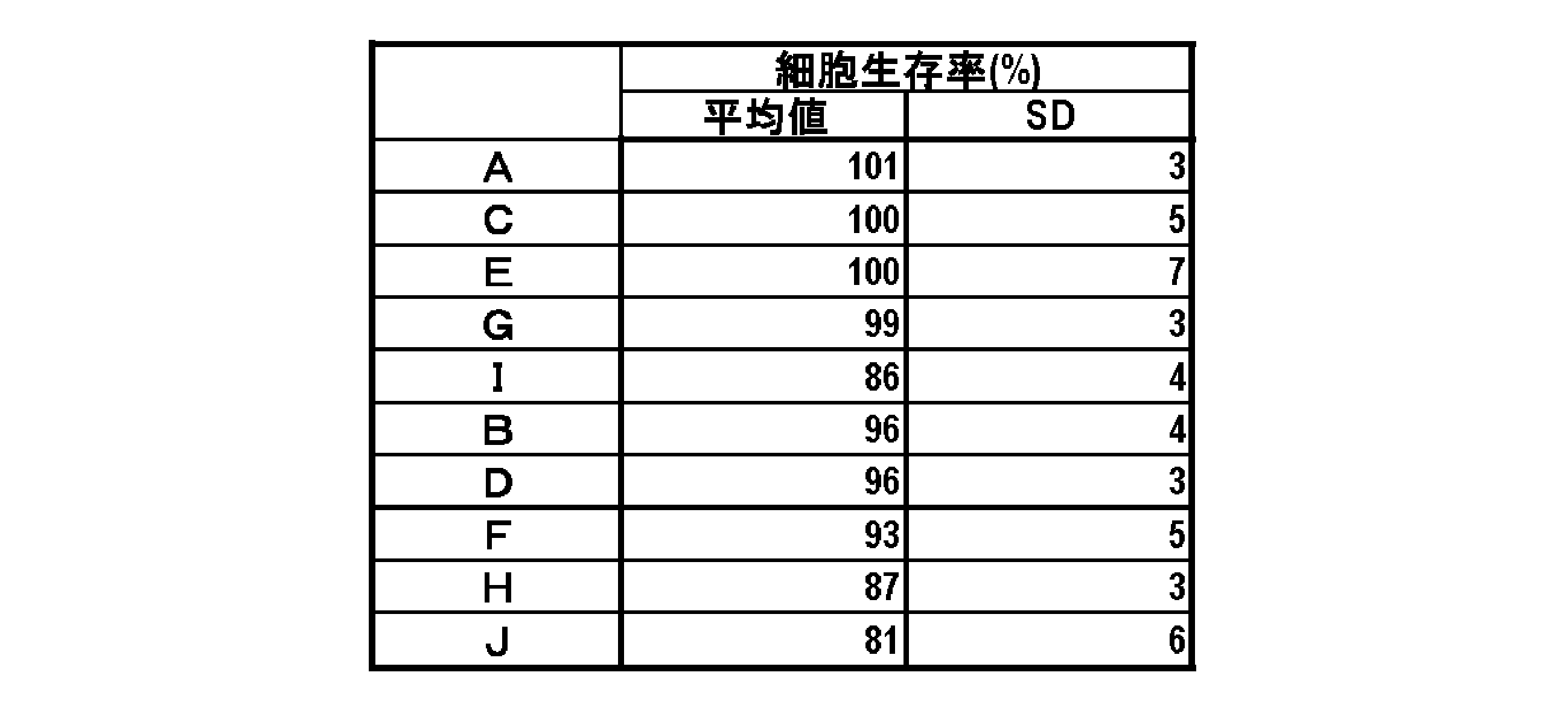
表4および図7左図に示すように、0.04μgのDNAをトランスフェクションした場合のルシフェラーゼ活性は、C<A<E<G<Iであった。また、0.1μgのDNAをトランスフェクションした場合のルシフェラーゼ活性は、D<F<H<B<Jであった。
これらの結果から、0.04μgのDNAをトランスフェクションする場合、TB修飾リポソームは、TB未修飾リポソームおよび市販のトランスフェクション試薬と比較して、細胞の核へ遺伝子を導入する活性(トランスフェクション活性)が高いことが明らかになった。また、0.1μgのDNAをトランスフェクションする場合も、TB修飾リポソームは、TB未修飾リポソームと比較して、トランスフェクション活性が高いことが明らかになった。さらに、0.1μgのDNAをトランスフェクションする場合、22mol%TB修飾リポソームは市販のトランスフェクション試薬と比較してトランスフェクション活性が高いことが明らかになった。
すなわち、陽イオン性界面活性剤が修飾された脂質膜を1枚膜としてまたは複数膜として有するリポソームのトランスフェクション活性が顕著に向上することが明らかになった。
また、表5および図7右図に示すように、細胞生存率はA、B、C、D、E、F、G、H、I、J、KおよびLのいずれも80%より大きかった。これらの結果から、修飾濃度が少なくとも11mol%、16.5mol%および22mol%であるTB修飾リポソームはいずれも細胞毒性がないことが明らかになった。
<実施例4>リポソームの脂質膜の枚数についての検討
(1)脂質フィルムの調製
蛍光色素であるNitro-2-1,3-Benzoxadiazol-4-yl(NBD)が結合したDOPE(NBD標識DOPE;Avanti Polar Lipids社)をエタノールに0.1mmol/Lとなるように溶解することにより、NBD標識DOPE溶液を調製した。
(1)脂質フィルムの調製
蛍光色素であるNitro-2-1,3-Benzoxadiazol-4-yl(NBD)が結合したDOPE(NBD標識DOPE;Avanti Polar Lipids社)をエタノールに0.1mmol/Lとなるように溶解することにより、NBD標識DOPE溶液を調製した。
続いて、実施例1(2)[2-2]に記載の方法により調製した混合脂質溶液にNBD標識DOPE溶液を添加して、全脂質のうち1mol%がNBD標識DOPEであるNBD混合脂質溶液を4サンプル調製し、a、b、cおよびdとした。
次に、a、b、cおよびdについて、実施例2(2)[2-3]に記載の方法において、TB溶液を添加した量およびTBの修飾濃度を下記のとおりとして、TBが修飾された脂質フィルム(a)ならびにTBが修飾されていない脂質フィルム(b、cおよびd)を調製した。
修飾濃度(mol%)
a;TB溶液 10 μL 22
b;添加せず 0
c;添加せず 0
d;添加せず 0
a;TB溶液 10 μL 22
b;添加せず 0
c;添加せず 0
d;添加せず 0
(2)TB修飾リポソームおよびTB未修飾リポソームの調製
本実施例(1)のaおよびbについて、実施例1(3)に記載の方法により、NBDで標識した核酸ナノ粒子封入リポソームとして、TB修飾リポソーム(a)およびTB未修飾リポソーム(b)を調製した。
本実施例(1)のaおよびbについて、実施例1(3)に記載の方法により、NBDで標識した核酸ナノ粒子封入リポソームとして、TB修飾リポソーム(a)およびTB未修飾リポソーム(b)を調製した。
(3)多重膜リポソーム(MLV)の調製
本実施例(1)のcに、10mmol/LのHEPES緩衝液(pH7.4)250μLを添加して、室温にて15分間静置することにより、脂質フィルムを水和させた。続いて、ボルテックスを1分間行うことにより、NBDで標識した多重膜リポソーム(MLV)を調製した。
本実施例(1)のcに、10mmol/LのHEPES緩衝液(pH7.4)250μLを添加して、室温にて15分間静置することにより、脂質フィルムを水和させた。続いて、ボルテックスを1分間行うことにより、NBDで標識した多重膜リポソーム(MLV)を調製した。
(4)1枚膜リポソーム(SUV)の調製
本実施例(1)のdに、10mmol/LのHEPES緩衝液(pH7.4)2mLを添加して、室温にて15分間静置することにより、脂質フィルムを水和させた。続いて、バスタイプソニケータ(AU-25C;アイワ医科工業社)を用いて1分間超音波処理を行った。さらに、プローブタイプソニケーターを用いて、氷水冷却下にて10分間超音波処理を行った。次に、全量を2.0mL容量のエッペンドルフチューブへ移して、4℃、15000rpmの条件下で5分間遠心分離行い、超音波処理によって発生したチタンナノ粒子を沈降させた。下層の100μLを残して上清を回収し、別のエッペンドルフチューブへ移した。この遠心分離および上清回収の操作を計3回行うことにより、NBDで標識した1枚膜リポソーム(SUV)を調製した。
本実施例(1)のdに、10mmol/LのHEPES緩衝液(pH7.4)2mLを添加して、室温にて15分間静置することにより、脂質フィルムを水和させた。続いて、バスタイプソニケータ(AU-25C;アイワ医科工業社)を用いて1分間超音波処理を行った。さらに、プローブタイプソニケーターを用いて、氷水冷却下にて10分間超音波処理を行った。次に、全量を2.0mL容量のエッペンドルフチューブへ移して、4℃、15000rpmの条件下で5分間遠心分離行い、超音波処理によって発生したチタンナノ粒子を沈降させた。下層の100μLを残して上清を回収し、別のエッペンドルフチューブへ移した。この遠心分離および上清回収の操作を計3回行うことにより、NBDで標識した1枚膜リポソーム(SUV)を調製した。
(5)蛍光強度測定
1mmol/LのTris緩衝液(pH10)に0.5mol/Lとなるようハイドロサルファイトナトリウム(和光純薬社)を溶解してハイドロサルファイトナトリウム溶液を調製した。
1mmol/LのTris緩衝液(pH10)に0.5mol/Lとなるようハイドロサルファイトナトリウム(和光純薬社)を溶解してハイドロサルファイトナトリウム溶液を調製した。
本実施例(2)のaおよびb、本実施例(3)のc、ならびに本実施例(4)のdについて、ルミノメーターを用いてNBDの蛍光強度を200秒間連続して測定した。その間の測定開始から10秒経過時に、ハイドロサルファイトナトリウム溶液を各サンプルに2.75μLずつ添加して5秒間混和した。さらに、測定開始から105秒経過時に10%(v/v)Triton X-100溶液を各サンプルに12.5μLずつ添加して5秒間混和した。その結果を下記表6に示す。また、蛍光強度の測定結果を図8上図に示す。

なお、ハイドロサルファイトナトリウムは還元作用によってNBDの発色団を還元し、その蛍光を消失させる消光剤である。図8下図に示すように、ハイドロサルファイトナトリウムは脂質膜透過性をもたないため、本実施例において、リポソーム溶液に添加したハイドロサルファイトナトリウムはリポソームの最外膜の脂質二重層のうち外水相と接触する側の層に存在するNBDの蛍光のみを消失させる。従って、リポソームが有する脂質膜の枚数が多いほど、ハイドロサルファイトナトリウム添加後の蛍光強度が大きいと考えられる。
表6および図8上図に示すように、ハイドロサルファイトナトリウム添加後、TritonX-100を添加するまでの間の蛍光強度はc>b>d>aであった。これらの結果から、TB修飾リポソームは、TB未修飾リポソームおよび従来の方法により調製したリポソームであるMLVよりも、脂質膜の枚数が少ないことが明らかになった。
すなわち、陽イオン性界面活性剤が修飾された脂質フィルムを用いて水和法を行うことにより得られたリポソームでは、脂質膜の枚数が抑制されることが明らかになった。
なお、1枚膜リポソームであるSUVと比較してTB修飾リポソームの蛍光強度が小さいのは、TB修飾リポソームにおいては、脂質膜にTBが修飾されていることにより脂質分子のflip-flopが起こり、内水相と接触する側に存在していたNBDがリポソーム表面へ露出して消光されたためであると考えられる。
<実施例5>TB修飾脂質膜でのリポソームの封入
(1)負帯電性2枚膜リポソームの調製
既報(国際公開WO2007/037444号パンフレット)に従って、負帯電性2枚膜リポソームを調製した。具体的には、まず、エタノール:クロロホルム=1:1(v/v)となるように混合したエタノール/クロロホルム溶液に、負帯電性脂質であるホスファチジン酸(PA)を1mmol/Lとなるように溶解することにより、PA溶液を調製した。また、実施例1(2)[2-2]に記載の方法により、DOPE溶液およびCHEMS溶液を、実施例4(1)に記載の方法によりNBD標識DOPE溶液をそれぞれ調製した。
(1)負帯電性2枚膜リポソームの調製
既報(国際公開WO2007/037444号パンフレット)に従って、負帯電性2枚膜リポソームを調製した。具体的には、まず、エタノール:クロロホルム=1:1(v/v)となるように混合したエタノール/クロロホルム溶液に、負帯電性脂質であるホスファチジン酸(PA)を1mmol/Lとなるように溶解することにより、PA溶液を調製した。また、実施例1(2)[2-2]に記載の方法により、DOPE溶液およびCHEMS溶液を、実施例4(1)に記載の方法によりNBD標識DOPE溶液をそれぞれ調製した。
DOPE溶液60μL、CHEMS溶液200μLおよびPA溶液120μLを混合して、mol比がDOPE:CHEMS:PA=9:2:1.2である負帯電性混合脂質溶液(計152.5nmol)を調製した。ここに、NBD標識DOPE溶液を添加して、全脂質のうち1mol%がNBD標識DOPEであるNBD負帯電性混合脂質溶液(計152.5nmol)を調製した。
NBD負帯電性混合脂質溶液について、実施例4(4)に記載の方法によりSUVを調製した。このSUVを含む溶液に、半量(v/v)の、実施例1(1)[1-1]および[1-2]に記載の方法により調製した核酸ナノ粒子溶液を穏やかに添加した後、5秒間ボルテックスを行うことにより、核酸ナノ粒子を封入してNBDで標識した負帯電性2枚膜リポソームを調製した。
(2)脂質膜でのリポソームの封入
[2-1]正帯電性混合脂質溶液の調製
非帯電性脂質であるコレステロール(Chol)およびを正帯電性脂質である1,2-ジオレイルオキシ-3-トリメチルアンモニウムプロパン(1,2-dioleoyloxy-3-trimethyl ammonio propane;DOTAP;Avanti Polar Lipids社)をそれぞれエタノールおよびエタノール/クロロホルム=1:1(v/v)となるように混合したエタノール/クロロホルム溶液に15mmol/Lとなるように溶解することにより、Chol溶液およびDOTAP溶液を調製した。また、実施例1(2)[2-2]に記載の方法により、DOPE溶液を調製した。
[2-1]正帯電性混合脂質溶液の調製
非帯電性脂質であるコレステロール(Chol)およびを正帯電性脂質である1,2-ジオレイルオキシ-3-トリメチルアンモニウムプロパン(1,2-dioleoyloxy-3-trimethyl ammonio propane;DOTAP;Avanti Polar Lipids社)をそれぞれエタノールおよびエタノール/クロロホルム=1:1(v/v)となるように混合したエタノール/クロロホルム溶液に15mmol/Lとなるように溶解することにより、Chol溶液およびDOTAP溶液を調製した。また、実施例1(2)[2-2]に記載の方法により、DOPE溶液を調製した。
DOPE溶液29.4μL、DOTAP溶液22μLおよびChol溶液22μLを混合して、mol比がDOPE:CHEMS:Chol=3:4:3である正帯電性混合脂質溶液(計137.5nmol)を2サンプル調製し、それぞれaおよびbとした。
[2-2]負帯電性混合脂質溶液の調製
本実施例(1)に記載の方法により、mol比がDOPE:CHEMS:PA=9:2:1.2である負帯電性混合脂質溶液を2サンプル調製し、それぞれcおよびdとした。
本実施例(1)に記載の方法により、mol比がDOPE:CHEMS:PA=9:2:1.2である負帯電性混合脂質溶液を2サンプル調製し、それぞれcおよびdとした。
[2-3]負帯電性脂質フィルムおよび正帯電性脂質フィルムの調製
本実施例(2)[2-1]のaおよびb、ならびに本実施例(2)[2-2]のcおよびdについて、実施例2(2)[2-3]に記載の方法において、TB溶液を添加した量およびTBの修飾濃度を下記のとおりとして、TBが修飾された正帯電性脂質フィルム(a;TB修飾正帯電性脂質フィルム)、TBが修飾されていない正帯電性脂質フィルム(b;TB未修飾正帯電性脂質フィルム)、TBが修飾された負帯電性脂質フィルム(c;TB修飾負帯電性脂質フィルム)およびTBが修飾されていない負帯電性脂質フィルム(d;TB未修飾負帯電性脂質フィルム)を調製した。
本実施例(2)[2-1]のaおよびb、ならびに本実施例(2)[2-2]のcおよびdについて、実施例2(2)[2-3]に記載の方法において、TB溶液を添加した量およびTBの修飾濃度を下記のとおりとして、TBが修飾された正帯電性脂質フィルム(a;TB修飾正帯電性脂質フィルム)、TBが修飾されていない正帯電性脂質フィルム(b;TB未修飾正帯電性脂質フィルム)、TBが修飾された負帯電性脂質フィルム(c;TB修飾負帯電性脂質フィルム)およびTBが修飾されていない負帯電性脂質フィルム(d;TB未修飾負帯電性脂質フィルム)を調製した。
修飾濃度(mol%)
a;TB溶液 10 μL 22
b;添加せず 0
c;TB溶液 10 μL 22
d;添加せず 0
a;TB溶液 10 μL 22
b;添加せず 0
c;TB溶液 10 μL 22
d;添加せず 0
[2-4]リポソームの封入
本実施例(2)[2-3]のTB修飾正帯電性脂質フィルム(a)、TB未修飾正帯電性脂質フィルム(b)、TB修飾負帯電性脂質フィルム(c)およびTB未修飾負帯電性脂質フィルム(d)に、本実施例(1)の負帯電性2枚膜リポソームを含む溶液を250μLずつ添加して、室温にて15分間インキュベーショトすることにより、負帯電性2枚膜リポソームの封入を行った。
本実施例(2)[2-3]のTB修飾正帯電性脂質フィルム(a)、TB未修飾正帯電性脂質フィルム(b)、TB修飾負帯電性脂質フィルム(c)およびTB未修飾負帯電性脂質フィルム(d)に、本実施例(1)の負帯電性2枚膜リポソームを含む溶液を250μLずつ添加して、室温にて15分間インキュベーショトすることにより、負帯電性2枚膜リポソームの封入を行った。
(3)蛍光強度測定
本実施例(2)[2-4]のa、b、c、dおよび本実施例(1)の負帯電性2枚膜リポソームについて、実施例4(5)に記載の方法により、蛍光強度測定を行った。その結果を下記表7に示す。また、a、bおよび負帯電性2枚膜リポソームについての結果をグラフ化したものを図9Aに、c、dおよび負帯電性2枚膜リポソームについての結果をグラフ化したものを図9Bにそれぞれ示す。
本実施例(2)[2-4]のa、b、c、dおよび本実施例(1)の負帯電性2枚膜リポソームについて、実施例4(5)に記載の方法により、蛍光強度測定を行った。その結果を下記表7に示す。また、a、bおよび負帯電性2枚膜リポソームについての結果をグラフ化したものを図9Aに、c、dおよび負帯電性2枚膜リポソームについての結果をグラフ化したものを図9Bにそれぞれ示す。

なお、a、b、c、dはNBDで標識したリポソーム(標識リポソーム)をNBDで標識していない脂質膜(未標識脂質膜)で封入することを意図して調製したリポソームである。従って、ハイドロサルファイトナトリウムの添加によりNBDの蛍光が減少した場合は、標識リポソームが未標識脂質膜で封入されていないか、または標識リポソームの脂質膜と未標識脂質膜とが膜融合を生じたと考えられる。一方、ハイドロサルファイトナトリウムの添加によるNBDの蛍光減少の程度が標識リポソームよりも小さい場合は、標識リポソームが未標識脂質膜で封入されたと考えられる。
表7および図9Aに示すように、ハイドロサルファイトナトリウム添加後、TritonX-100を添加するまでの間において、負帯電性2枚膜リポソームが一定の蛍光強度を有するのに対し、aおよびbは、ハイドロサルファイトナトリウム添加後まもなく蛍光強度が著しく低下して、TritonX-100を添加する直前においては、ほとんど蛍光が検出されなかった。これらの結果から、負帯電性2枚膜リポソームを正帯電性脂質膜で封入する場合は、正帯電性脂質膜におけるTBの修飾の有無にかかわらず、膜融合が生じてしまうことが明らかになった。
一方、表7および図9Bに示すように、ハイドロサルファイトナトリウム添加後、TritonX-100を添加するまでの間において、cの蛍光強度は負帯電性2枚膜リポソームと比較して大きく、dの蛍光強度は負帯電性2枚膜リポソームと比較してほぼ同じであった。これらの結果から、負帯電性2枚膜リポソームを負帯電性脂質膜で封入する場合は、負帯電性脂質膜にTBが修飾されていれば封入することができるのに対し、TBが修飾されていなければ封入することができないことが明らかになった。
以上の結果より、陽イオン性界面活性剤が修飾された負帯電性脂質フィルムを用いて水和法を行うことにより、負帯電性脂質膜で負帯電性リポソームを封入することができることが明らかになった。
すなわち、図10に示すように、既報に従い2枚膜リポソームを得た後、陽イオン性界面活性剤が修飾された脂質フィルムを用いて水和法を行うことにより、1の2枚膜リポソームを1枚の脂質膜で封入して、3枚膜リポソームを得ることができることが明らかになった。
<実施例6>TB修飾3枚膜リポソームのトランスフェクション活性の検討
(1)TB修飾3枚膜リポソームの調製
実施例5(1)に記載の方法により、核酸ナノ粒子を封入した負帯電性2枚膜リポソームを調製した。ただし、NBD標識DOPE溶液は添加しなかった。続いて、実施例5(2)[2-2]、[2-3]および[2-4]に記載の方法により、TB修飾負帯電性脂質フィルムに負帯電性2枚膜リポソームを封入して、これをTB修飾3枚膜リポソームとした。続いて、実施例3(1)[1-2]に記載の方法により、TB修飾3枚膜リポソームにR8の修飾を行った。
(1)TB修飾3枚膜リポソームの調製
実施例5(1)に記載の方法により、核酸ナノ粒子を封入した負帯電性2枚膜リポソームを調製した。ただし、NBD標識DOPE溶液は添加しなかった。続いて、実施例5(2)[2-2]、[2-3]および[2-4]に記載の方法により、TB修飾負帯電性脂質フィルムに負帯電性2枚膜リポソームを封入して、これをTB修飾3枚膜リポソームとした。続いて、実施例3(1)[1-2]に記載の方法により、TB修飾3枚膜リポソームにR8の修飾を行った。
(2)4枚膜リポソームの調製
既報(Akita H.ら、Biomaterials、第15号、第30巻、第2940-2949頁、2009年)に記載の方法において、脂質膜の組成をDOPE:CHEMS:PA=9:2:1.2として、R8が修飾された4枚膜リポソームを調製した。
既報(Akita H.ら、Biomaterials、第15号、第30巻、第2940-2949頁、2009年)に記載の方法において、脂質膜の組成をDOPE:CHEMS:PA=9:2:1.2として、R8が修飾された4枚膜リポソームを調製した。
(3)トランスフェクション活性の検討
[3-1]培地の調製
α-modified minimal essential medium(α-MEM)に下記の試薬を下記の終濃度となるよう添加し、これをα-MEM(-)培地とした。
[3-1]培地の調製
α-modified minimal essential medium(α-MEM)に下記の試薬を下記の終濃度となるよう添加し、これをα-MEM(-)培地とした。
L-グルタミン 4mmol/L
ピルビン酸ナトリウム 1mmol/L
Granulocyte macrophage colony-stimulating factor
5ng/mL
ピルビン酸ナトリウム 1mmol/L
Granulocyte macrophage colony-stimulating factor
5ng/mL
また、α-MEMに下記の試薬を下記の終濃度となるよう添加し、これをα-MEM(+)培地とした。
非働化FBS 20%(v/v)
L-グルタミン 4mmol/L
ピルビン酸ナトリウム 1mmol/L
ペニシリン 100U/mL
ストレプトマイシン 100μg/mL
L-グルタミン 4mmol/L
ピルビン酸ナトリウム 1mmol/L
ペニシリン 100U/mL
ストレプトマイシン 100μg/mL
α-MEM(-)培地およびα-MEM(+)培地は使用時まで4 ℃で保存した。
[3-2]リポソーム含有培地の調製
本実施例(1)のTB修飾3枚膜リポソームおよび本実施例(2)の4枚膜リポソームについて、pDNA0.04μg相当量を、本実施例(3)[3-1]のα-MEM(-)培地に添加して、0.25mLの3枚膜リポソーム含有培地および4枚膜リポソーム含有培地を調製した。
本実施例(1)のTB修飾3枚膜リポソームおよび本実施例(2)の4枚膜リポソームについて、pDNA0.04μg相当量を、本実施例(3)[3-1]のα-MEM(-)培地に添加して、0.25mLの3枚膜リポソーム含有培地および4枚膜リポソーム含有培地を調製した。
[3-3]JAWSII細胞の前培養
非分裂細胞であるJAWSII細胞(American Type Culture Collection)を24ウェルプレート(Corning社)に1.6×10⁴ 個/ウェルとなるよう播種したものを3枚調製し、A、BおよびCとした。これらに本実施例(3)[3-1]のα-MEM(+)培地を添加して、37℃、5%CO2の環境下で48時間前培養した。
非分裂細胞であるJAWSII細胞(American Type Culture Collection)を24ウェルプレート(Corning社)に1.6×10⁴ 個/ウェルとなるよう播種したものを3枚調製し、A、BおよびCとした。これらに本実施例(3)[3-1]のα-MEM(+)培地を添加して、37℃、5%CO2の環境下で48時間前培養した。
[3-4]JAWSII細胞へのトランスフェクション
本実施例(3)[3-2]のA、BおよびCの培地を除去し、0.5mLずつPBSを添加して洗浄した。次に、Aについて、LFN PLUSを用いて、添付の仕様書に従い、実施例1(1)[1-1]の精製pDNA水溶液のpDNA0.04μg相当量をトランスフェクションした。また、BおよびCには、本実施例(3)[3-2]の3枚膜リポソーム含有培地および4枚膜リポソーム含有培地をそれぞれ添加して、37℃、5%CO2の環境下で3時間インキュベートすることにより、トランスフェクションを行った。
本実施例(3)[3-2]のA、BおよびCの培地を除去し、0.5mLずつPBSを添加して洗浄した。次に、Aについて、LFN PLUSを用いて、添付の仕様書に従い、実施例1(1)[1-1]の精製pDNA水溶液のpDNA0.04μg相当量をトランスフェクションした。また、BおよびCには、本実施例(3)[3-2]の3枚膜リポソーム含有培地および4枚膜リポソーム含有培地をそれぞれ添加して、37℃、5%CO2の環境下で3時間インキュベートすることにより、トランスフェクションを行った。
その後、A、BおよびCの培地を本実施例(3)[3-1]のα-MEM(+)培地に交換し、同環境下でさらに21時間後培養した。
(4)ルシフェラーゼ活性の測定
本実施例(3)[3-3]のA、BおよびCについて、実施例4(3)に記載の方法により、ルシフェラーゼ活性を測定した。
本実施例(3)[3-3]のA、BおよびCについて、実施例4(3)に記載の方法により、ルシフェラーゼ活性を測定した。
本実施例(1)、(2)および(3)[3-2]~(4)の実験を3回以上繰り返し、各サンプルについて得られた結果の平均値および標準偏差(SD)を算出した。その結果を図11に示す。
図11に示すように、ルシフェラーゼ活性は、Aは3.3×10⁶(3258833)、Bは1.2×10⁵およびCは7.5×10⁵であった。これらの結果から、TB修飾3枚膜リポソームのトランスフェクション活性は、市販のトランスフェクション試薬よりは低いものの、4枚膜リポソームと比較して、約6倍も高いことが明らかになった。
すなわち、HeLa細胞などの分裂細胞においてのみならず、非分裂細胞においても、陽イオン性界面活性剤が修飾された脂質膜を複数膜の最外膜として有するリポソームのトランスフェクション活性が顕著に向上することが明らかになった。
<実施例7>TB修飾3枚膜リポソームの最適化の検討
(1)PLL安定化2枚膜リポソームおよびBSA安定化2枚膜リポソームの調製
実施例5(1)に記載の方法により負帯電性2枚膜リポソームを含む溶液を調製した。この負帯電性2枚膜リポソームを含む溶液を100μLずつ2サンプル調製し、このうち片方に実施例1(1)[1-2]に記載の方法により調製した1.0mg/mLのPLL溶液4.0μLを添加し、残りの片方には、0.5mg/mLのウシ血清アルブミン(BSA)溶液を添加した。その後、室温にて15分間インキュベートすることにより、PLLを静電気的に結合させて安定化した負帯電性2枚膜リポソーム(PLL安定化2枚膜リポソーム)を含む溶液およびBSAを非特異的に吸着させて安定化した負帯電性2枚膜リポソーム(BSA安定化2枚膜リポソーム)を含む溶液を調製した。
(1)PLL安定化2枚膜リポソームおよびBSA安定化2枚膜リポソームの調製
実施例5(1)に記載の方法により負帯電性2枚膜リポソームを含む溶液を調製した。この負帯電性2枚膜リポソームを含む溶液を100μLずつ2サンプル調製し、このうち片方に実施例1(1)[1-2]に記載の方法により調製した1.0mg/mLのPLL溶液4.0μLを添加し、残りの片方には、0.5mg/mLのウシ血清アルブミン(BSA)溶液を添加した。その後、室温にて15分間インキュベートすることにより、PLLを静電気的に結合させて安定化した負帯電性2枚膜リポソーム(PLL安定化2枚膜リポソーム)を含む溶液およびBSAを非特異的に吸着させて安定化した負帯電性2枚膜リポソーム(BSA安定化2枚膜リポソーム)を含む溶液を調製した。
(2)TB修飾3枚膜リポソームの調製
実施例5(2)[2-3]に記載の方法により、TBが修飾された負帯電性脂質フィルムを2サンプル調製し、aおよびbとした。続いて、実施例5(2)[2-4]に記載の方法において、実施例5(1)の負帯電性2枚膜リポソームを含む溶液に代えて、aについては本実施例(2)のPLL安定化2枚膜リポソームを含む溶液を、bについてはBSA安定化2枚膜リポソームを含む溶液をそれぞれ添加して、TB修飾3枚膜リポソームを調製した。これらのTB修飾3枚膜リポソームの調製過程の概要を図12に示す。
実施例5(2)[2-3]に記載の方法により、TBが修飾された負帯電性脂質フィルムを2サンプル調製し、aおよびbとした。続いて、実施例5(2)[2-4]に記載の方法において、実施例5(1)の負帯電性2枚膜リポソームを含む溶液に代えて、aについては本実施例(2)のPLL安定化2枚膜リポソームを含む溶液を、bについてはBSA安定化2枚膜リポソームを含む溶液をそれぞれ添加して、TB修飾3枚膜リポソームを調製した。これらのTB修飾3枚膜リポソームの調製過程の概要を図12に示す。
(3)蛍光強度測定
本実施例(2)のa、bおよび本実施例(1)の負帯電性2枚膜リポソームについて、実施例4(5)に記載の方法により、蛍光強度測定を行った。その結果を下記表8に示す。また、蛍光強度の測定結果を図13に示す。
本実施例(2)のa、bおよび本実施例(1)の負帯電性2枚膜リポソームについて、実施例4(5)に記載の方法により、蛍光強度測定を行った。その結果を下記表8に示す。また、蛍光強度の測定結果を図13に示す。
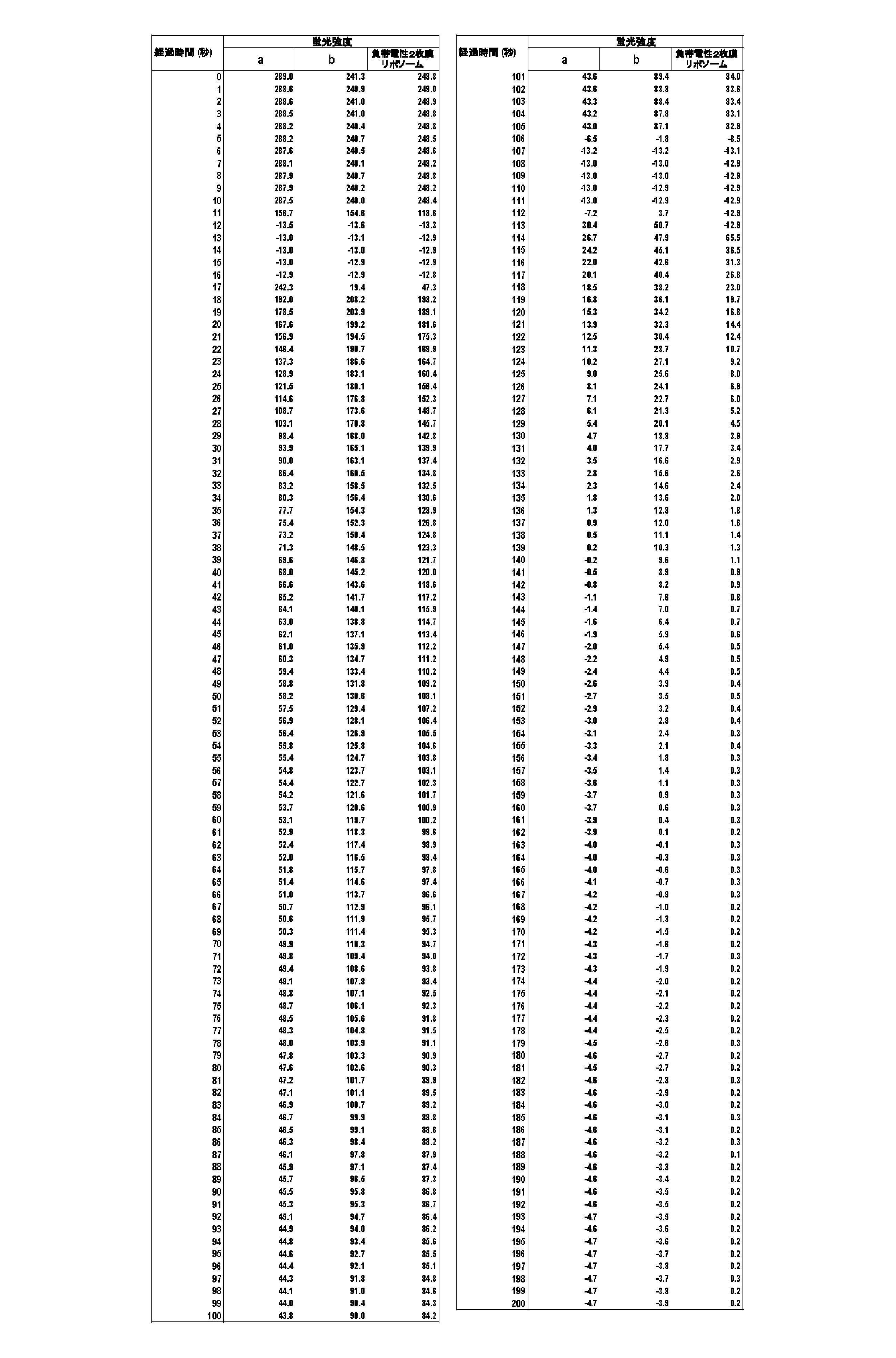
表8および図13に示すように、ハイドロサルファイトナトリウム添加後、TritonX-100を添加するまでの間において、aの蛍光強度は負帯電性2枚膜リポソームと比較して小さいのに対し、bの蛍光強度は負帯電性2枚膜リポソームと比較して大きかった。
これらの結果から、TBが修飾された負帯電性脂質フィルムを用いて封入する際に、PLL安定化2枚膜リポソームは膜融合を生じさせるのに対し、BSA安定化2枚膜リポソームは膜融合をほとんど生じさせずに封入することができることが明らかになった。
<実施例8>最適化したTB修飾3枚膜リポソームのトランスフェクション活性の検討
(1)TB修飾3枚膜リポソームの調製
実施例7(1)に記載の方法により、負帯電性2枚膜リポソーム、PLL安定化2枚膜リポソームおよびBSA安定化2枚膜リポソームをそれぞれ含む溶液を調製した。ただし、NBD標識DOPE溶液は添加しなかった。
(1)TB修飾3枚膜リポソームの調製
実施例7(1)に記載の方法により、負帯電性2枚膜リポソーム、PLL安定化2枚膜リポソームおよびBSA安定化2枚膜リポソームをそれぞれ含む溶液を調製した。ただし、NBD標識DOPE溶液は添加しなかった。
次に、実施例5(2)[2-3]に記載の方法により、TBが修飾された負帯電性脂質フィルムを3サンプル調製し、a、bおよびcとした。続いて、実施例5(2)[2-4]に記載の方法において、実施例5(1)の負帯電性2枚膜リポソームを含む溶液に代えて、aについては負帯電性2枚膜リポソームを含む溶液を、bについてはPLL安定化2枚膜リポソームを含む溶液を、cについてはBSA安定化2枚膜リポソームを含む溶液をそれぞれ添加して、TB修飾3枚膜リポソームを調製した。
続いて、a、bおよびcについて、実施例3(1)[1-2]に記載の方法により、R8の修飾を行った。
(2)トランスフェクション活性の検討
本実施例(1)のa、bおよびcを用いて、実施例6(3)[3-1]、[3-2]および[3-3]に記載の方法により、JAWSII細胞へのトランスフェクションを行った。その後、実施例4(3)に記載の方法により、ルシフェラーゼ活性を測定した。
本実施例(1)のa、bおよびcを用いて、実施例6(3)[3-1]、[3-2]および[3-3]に記載の方法により、JAWSII細胞へのトランスフェクションを行った。その後、実施例4(3)に記載の方法により、ルシフェラーゼ活性を測定した。
本実施例(1)および(2)の実験を3回以上繰り返し、各サンプルについて得られた結果の平均値および標準偏差(SD)を算出した。その結果を図14に示す。
図14に示すように、aおよびbによりトランスフェクションを行った場合のルシフェラーゼ活性は、市販のトランスフェクション試薬と比較して低いのに対し、cによりトランスフェクションを行った場合のルシフェラーゼ活性は、市販のトランスフェクション試薬と比較して同等であった。
これらの結果から、BSA安定化2枚膜リポソームを封入したTB修飾3枚膜リポソームのトランスフェクション活性は、PLL安定化2枚膜リポソームおよび安定化していない負帯電性2枚膜リポソームを封入したTB修飾3枚膜リポソームと比較して高く、市販のトランスフェクション試薬と同等であることが明らかになった。
すなわち、2枚膜リポソームをBSAによって安定化することにより、陽イオン性界面活性剤が修飾された脂質フィルムを用いてその2枚膜リポソームを封入した3枚膜リポソームのトランスフェクション活性が、顕著に向上することが明らかになった。
<実施例9>1枚膜リポソームの顕微鏡写真
実施例2(3)で調製した本発明であるTB修飾リポソームd/HEPES懸濁液10μLを、液体窒素を用いて急速凍結し、固定操作を行なわずそのまま透過型電子顕微鏡で観察した。その観察写真の一部を図15に示す。
実施例2(3)で調製した本発明であるTB修飾リポソームd/HEPES懸濁液10μLを、液体窒素を用いて急速凍結し、固定操作を行なわずそのまま透過型電子顕微鏡で観察した。その観察写真の一部を図15に示す。
顕微鏡視野において観察される粒子(本発明のリポソーム)の平均粒子径は50~100nmの範囲内にあった。この値は、急速凍結によってTB修飾リポソームの内部に封入されている液体が除去されることを考慮すれば、実施例2(3)で測定した粒子径測定のデータと整合する値である。また、観察された粒子は全て内側の黒い輪郭と外側の白い輪郭とを有していた。黒い輪郭は封入されたコア粒子に相当すると考えられる。また白い輪郭部分は約3.5nmの厚みを有していたが、この値は脂質膜一枚の理論的な厚みである4.0nmに近似するものである。
以上の顕微鏡観察結果は、本発明のリポソームが一枚の脂質膜を備えていることを示すものである。
Claims (13)
- 陽イオン性界面活性剤が修飾されてなる脂質膜を1枚膜としてまたは複数膜の最外膜として有する脂質膜構造体。
- 陽イオン性界面活性剤が次式(化1)

R1はアルキル基であり、
R2は疎水基である。]
の陽イオン性界面活性剤である、請求項1に記載の脂質膜構造体。 - R1が炭素数が12以上のアルキル基であり、かつR2が次式(化2)


- R1が炭素数が16のアルキル基であり、かつR2が次式(化4)

- 負帯電性脂質膜構造体である、請求項1から請求項4のいずれかに記載の脂質膜構造体。
- リポソームである、請求項1から請求項5のいずれかに記載の脂質膜構造体。
- 陽イオン性界面活性剤が修飾されてなる脂質膜を1枚膜としてまたは複数膜の最外膜として有する脂質膜構造体を製造する方法であって、下記(i)、(ii)または(iii)の工程を有する前記方法;
(i)脂質と陽イオン性界面活性剤とを混合して陽イオン性界面活性剤が修飾された脂質フィルムを調製する工程、
(ii)脂質フィルムに陽イオン性界面活性剤を加えて陽イオン性界面活性剤が修飾された脂質フィルムを調製する工程、
(iii)1枚膜または複数膜の脂質膜を有する脂質膜構造体の1枚膜または複数膜の最外膜に陽イオン性界面活性剤を修飾する工程。 - (i)脂質と陽イオン性界面活性剤とを混合して陽イオン性界面活性剤が修飾された脂質フィルムを調製する工程または(ii)脂質フィルムに陽イオン性界面活性剤を加えて陽イオン性界面活性剤が修飾された脂質フィルムを調製する工程を有する場合において、下記(iv)の工程を有する、請求項7に記載の方法;
(iv)前記調製した脂質フィルムを水和させて脂質膜構造体を調製する工程。 - 1の目的物質を1枚の脂質膜で封入する方法であって、下記(i)または(ii)の工程を有する前記方法;
(i)脂質と陽イオン性界面活性剤とを混合して陽イオン性界面活性剤が修飾された脂質フィルムを調製する工程、
(ii)脂質フィルムに陽イオン性界面活性剤を加えて陽イオン性界面活性剤が修飾された脂質フィルムを調製する工程。 - 下記(iv)の工程を有する、請求項9に記載の方法;
(iv)前記調製した脂質フィルムを水和させて脂質膜構造体を調製する工程。 - 陽イオン性界面活性剤が次式(化5)

R1はアルキル基であり、
R2は疎水基である。]
の陽イオン性界面活性剤である、請求項7から請求項10のいずれかに記載の方法。 - R1が炭素数が12以上のアルキル基であり、かつR2が次式(化6)


- R1が炭素数が16のアルキル基であり、かつR2が次式(化8)

Priority Applications (1)
| Application Number | Priority Date | Filing Date | Title |
|---|---|---|---|
| JP2013502293A JPWO2012117971A1 (ja) | 2011-02-28 | 2012-02-24 | 脂質膜構造体、脂質膜構造体の製造方法および1の目的物質を1枚の脂質膜で封入する方法 |
Applications Claiming Priority (2)
| Application Number | Priority Date | Filing Date | Title |
|---|---|---|---|
| JP2011-042549 | 2011-02-28 | ||
| JP2011042549 | 2011-02-28 |
Publications (1)
| Publication Number | Publication Date |
|---|---|
| WO2012117971A1 true WO2012117971A1 (ja) | 2012-09-07 |
Family
ID=46757908
Family Applications (1)
| Application Number | Title | Priority Date | Filing Date |
|---|---|---|---|
| PCT/JP2012/054602 Ceased WO2012117971A1 (ja) | 2011-02-28 | 2012-02-24 | 脂質膜構造体、脂質膜構造体の製造方法および1の目的物質を1枚の脂質膜で封入する方法 |
Country Status (2)
| Country | Link |
|---|---|
| JP (1) | JPWO2012117971A1 (ja) |
| WO (1) | WO2012117971A1 (ja) |
Citations (4)
| Publication number | Priority date | Publication date | Assignee | Title |
|---|---|---|---|---|
| WO2005092388A1 (ja) * | 2004-03-26 | 2005-10-06 | Terumo Kabushiki Kaisha | リポソーム製剤 |
| WO2006077857A1 (ja) * | 2005-01-18 | 2006-07-27 | National University Corporation Hokkaido University | 粒子を脂質膜で被覆する方法 |
| WO2007037444A1 (ja) * | 2005-09-30 | 2007-04-05 | National University Corporation Hokkaido University | 目的物質を核内又は細胞内に送達するためのベクター |
| JP2009221165A (ja) * | 2008-03-17 | 2009-10-01 | Hokkaido Univ | 一遺伝子ナノ粒子のパッケージング法 |
-
2012
- 2012-02-24 WO PCT/JP2012/054602 patent/WO2012117971A1/ja not_active Ceased
- 2012-02-24 JP JP2013502293A patent/JPWO2012117971A1/ja active Pending
Patent Citations (4)
| Publication number | Priority date | Publication date | Assignee | Title |
|---|---|---|---|---|
| WO2005092388A1 (ja) * | 2004-03-26 | 2005-10-06 | Terumo Kabushiki Kaisha | リポソーム製剤 |
| WO2006077857A1 (ja) * | 2005-01-18 | 2006-07-27 | National University Corporation Hokkaido University | 粒子を脂質膜で被覆する方法 |
| WO2007037444A1 (ja) * | 2005-09-30 | 2007-04-05 | National University Corporation Hokkaido University | 目的物質を核内又は細胞内に送達するためのベクター |
| JP2009221165A (ja) * | 2008-03-17 | 2009-10-01 | Hokkaido Univ | 一遺伝子ナノ粒子のパッケージング法 |
Non-Patent Citations (2)
| Title |
|---|
| KUCZERA, J. ET AL., APPLIED ORGANOMETALLIC CHEMISTRY, vol. 11, 1997, pages 591 - 600 * |
| SUZUKI, R. ET AL., BIOL. PHARM. BULL., vol. 31, no. 6, 2008, pages 1237 - 1243 * |
Also Published As
| Publication number | Publication date |
|---|---|
| JPWO2012117971A1 (ja) | 2014-07-07 |
Similar Documents
| Publication | Publication Date | Title |
|---|---|---|
| Eygeris et al. | Deconvoluting lipid nanoparticle structure for messenger RNA delivery | |
| RU2493874C2 (ru) | Транслегочная липосома для регулирования доставки лекарственного средства | |
| CN1349402A (zh) | 生物活性络合物于脂质体中囊封工艺 | |
| US20100166840A1 (en) | Liposome having lipid membrane containing bacterial cell component | |
| JP6570188B2 (ja) | siRNA細胞内送達のための脂質膜構造体 | |
| WO2007102481A1 (ja) | 目的物質の核内送達用ベクター | |
| US20090305409A1 (en) | Liposome Capable of Effective Delivery of Given Substance Into Nucleus | |
| KR101916941B1 (ko) | 플라스미드 디엔에이 전달용 고분자 나노입자 조성물 및 그의 제조방법 | |
| EP2891495B1 (en) | Lipid membrane structure including bacterial cell component having dispersibility in non-polar solvent, and method for producing same | |
| WO2012117971A1 (ja) | 脂質膜構造体、脂質膜構造体の製造方法および1の目的物質を1枚の脂質膜で封入する方法 | |
| CN114832117A (zh) | 一种细胞穿透肽修饰的核酸-阳离子热敏脂质体及其制备方法 | |
| JP4450656B2 (ja) | リポソームからなる遺伝子導入用キャリア | |
| JPWO2006077857A1 (ja) | 粒子を脂質膜で被覆する方法 | |
| JP2006238839A (ja) | 核酸の細胞内送達効率又は細胞内発現効率を向上させた組成物 | |
| JP2014114267A (ja) | 脂質膜構造体に対して肝臓血管内皮細胞への移行能を付与および/または増強するペプチド、肝臓血管内皮細胞への移行能を有するまたは肝臓血管内皮細胞への移行能が増強された脂質膜構造体、ならびに脂質膜構造体に対して肝臓血管内皮細胞への移行能を付与および/または増強する剤 | |
| WO2009131216A1 (ja) | オリゴアルキレングリコールで修飾された脂質膜構造体 | |
| CN121950934A (zh) | 一种核酸递送载体、组合物及其制备方法 | |
| JP2007166946A (ja) | 標的遺伝子の発現を抑制するための組成物 | |
| HK1191219A (en) | Transpulmonary liposome for controlling drug arrival | |
| HK1139042A (en) | Transpulmonary liposome for controlling drug arrival |
Legal Events
| Date | Code | Title | Description |
|---|---|---|---|
| 121 | Ep: the epo has been informed by wipo that ep was designated in this application |
Ref document number: 12752748 Country of ref document: EP Kind code of ref document: A1 |
|
| DPE1 | Request for preliminary examination filed after expiration of 19th month from priority date (pct application filed from 20040101) | ||
| ENP | Entry into the national phase |
Ref document number: 2013502293 Country of ref document: JP Kind code of ref document: A |
|
| NENP | Non-entry into the national phase |
Ref country code: DE |
|
| 122 | Ep: pct application non-entry in european phase |
Ref document number: 12752748 Country of ref document: EP Kind code of ref document: A1 |