WO2012115430A2 - 알루미늄-질화알루미늄 또는 알루미늄합금-질화알루미늄 복합재료의 제조방법 - Google Patents
알루미늄-질화알루미늄 또는 알루미늄합금-질화알루미늄 복합재료의 제조방법 Download PDFInfo
- Publication number
- WO2012115430A2 WO2012115430A2 PCT/KR2012/001304 KR2012001304W WO2012115430A2 WO 2012115430 A2 WO2012115430 A2 WO 2012115430A2 KR 2012001304 W KR2012001304 W KR 2012001304W WO 2012115430 A2 WO2012115430 A2 WO 2012115430A2
- Authority
- WO
- WIPO (PCT)
- Prior art keywords
- aluminum
- aluminum nitride
- arc
- nitride
- alloy
- Prior art date
- Legal status (The legal status is an assumption and is not a legal conclusion. Google has not performed a legal analysis and makes no representation as to the accuracy of the status listed.)
- Ceased
Links
Classifications
-
- C—CHEMISTRY; METALLURGY
- C22—METALLURGY; FERROUS OR NON-FERROUS ALLOYS; TREATMENT OF ALLOYS OR NON-FERROUS METALS
- C22C—ALLOYS
- C22C1/00—Making non-ferrous alloys
- C22C1/10—Alloys containing non-metals
- C22C1/1036—Alloys containing non-metals starting from a melt
- C22C1/1068—Making hard metals based on borides, carbides, nitrides, oxides or silicides
-
- C—CHEMISTRY; METALLURGY
- C22—METALLURGY; FERROUS OR NON-FERROUS ALLOYS; TREATMENT OF ALLOYS OR NON-FERROUS METALS
- C22C—ALLOYS
- C22C32/00—Non-ferrous alloys containing at least 5% by weight but less than 50% by weight of oxides, carbides, borides, nitrides, silicides or other metal compounds, e.g. oxynitrides, sulfides, whether added as such or formed in situ
- C22C32/0047—Non-ferrous alloys containing at least 5% by weight but less than 50% by weight of oxides, carbides, borides, nitrides, silicides or other metal compounds, e.g. oxynitrides, sulfides, whether added as such or formed in situ with carbides, nitrides, borides or silicides as the main non-metallic constituents
- C22C32/0068—Non-ferrous alloys containing at least 5% by weight but less than 50% by weight of oxides, carbides, borides, nitrides, silicides or other metal compounds, e.g. oxynitrides, sulfides, whether added as such or formed in situ with carbides, nitrides, borides or silicides as the main non-metallic constituents only nitrides
-
- C—CHEMISTRY; METALLURGY
- C22—METALLURGY; FERROUS OR NON-FERROUS ALLOYS; TREATMENT OF ALLOYS OR NON-FERROUS METALS
- C22F—CHANGING THE PHYSICAL STRUCTURE OF NON-FERROUS METALS AND NON-FERROUS ALLOYS
- C22F1/00—Changing the physical structure of non-ferrous metals or alloys by heat treatment or by hot or cold working
- C22F1/04—Changing the physical structure of non-ferrous metals or alloys by heat treatment or by hot or cold working of aluminium or alloys based thereon
Definitions
- the present invention relates to a method for producing an aluminum-aluminum nitride or an aluminum alloy-aluminum nitride composite material, and more particularly, to quickly produce an aluminum-aluminum nitride or an aluminum alloy-aluminum nitride composite material. It relates to a new manufacturing method that can easily adjust the ratio.
- LED light emitting diode
- the light efficiency of the LED is about 20 ⁇ 30%, and even if the light efficiency is assumed to be 30%, 70% of the power consumption per one LED is dissipated by heat. This heating problem of the LED is acting as a big factor to shorten the life and efficiency of the LED.
- the amount of use of LEDs has been increasing, and due to environmental problems, the interest in LED light sources is increasing as a substitute for fluorescent lamps.
- a heat dissipation method for dissipating heat generated from an LED to the outside a method of rapidly dissipating heat by attaching a heat dissipation material having high thermal conductivity to the LED is generally used.
- copper and aluminum which are widely used as heat dissipating materials because of their high thermal conductivity, have a higher coefficient of thermal expansion than those used as LED elements, resulting in thermal stress in the attached LEDs. It is becoming.
- Aluminum nitride (A1N) is a representative high thermal conductivity ceramic material with a theoretical thermal conductivity of 320 W / mK, and its thermal expansion coefficient is as small as 4.6 ppm / K. Efforts to use heat dissipating materials such as these continue. However, aluminum nitride is difficult to form a thick film, and its use is limited because of its low formability.
- a method of manufacturing a heat-dissipating material having a high thermal conductivity and a low coefficient of thermal expansion has been proposed by forming an aluminum-aluminum nitride composite material in which aluminum nitride is deposited on an aluminum base.
- the method of depositing aluminum nitride on the aluminum alloy matrix by adding an alloying element and a catalytic element increased the amount of aluminum nitride produced than using pure aluminum, but still injected nitrogen or ammonia gas into the aluminum molten metal.
- Complex equipment is needed to increase, and the reaction time is very long.
- In order to induce the nitriding reaction of aluminum maintaining the molten state at a high temperature of about loocrc or more for a long time has caused the manufacturing cost of the aluminum-aluminum nitride or aluminum alloy-aluminum nitride composite material. Practical application of aluminum nitride or aluminum alloy-aluminum nitride composites was difficult. ⁇
- the present invention has been made to solve the above-mentioned problems of the prior art, and an object thereof is to provide a new method for manufacturing an aluminum-aluminum nitride or an aluminum alloy-aluminum nitride composite material.
- Aluminum-nitride or aluminum according to the present invention for achieving the above object
- the production method of the aluminum alloy-aluminum nitride composite material is nitrogen (N 2 ) gas atmosphere, ammonia
- the melting method at high temperature is preferably arc melting.
- Arc melting is a melting method in which the melting operation is carried out using arc as a heat source.
- the temperature applied by arc is high temperature of about 2500 ° C or higher, and it is widely used to dissolve high melting point materials such as titanium and iron, but it has low melting point like aluminum and boiling point of about 250CTC. It is not used for.
- the inventors of the present invention because the temperature of the arc melting instantaneously apply a high temperature similar to the boiling point of aluminum, the reaction between the gas containing nitrogen and the aluminum molten metal, as well as the reaction between the gas containing nitrogen and aluminum gas The present invention has been invented from the idea that the gas and aluminum will react quickly.
- the present invention has been conceived in utilizing the high temperature of arc melting, the present invention is not limited to arc melting as long as it can be heated to 2500 ° C. or higher, which is the boiling point of aluminum.
- argon (Ar) gas is required for arc generation, and in general arc melting, the inside of the furnace is completely formed in an argon gas atmosphere to prevent reaction of the dissolving material, or at least in a vacuum state.
- Argon gas only.
- the interior of the furnace is nitrogen (N 2 ) gas or ammonia.
- a gas atmosphere is used to induce the reaction of aluminum, and at least one argon gas for arc generation is injected.
- the present invention controls the amount of aluminum nitride by adjusting the time for performing arc melting.
- the time for performing arc melting In the manufacturing method of the aluminum-aluminum nitride or aluminum alloy-aluminum nitride composite material of the present invention, since aluminum and nitrogen are reacted in a short time, the arc dissolution time and the amount of aluminum nitride formed are proportional to each other.
- Various composite materials can be produced by a simple method.
- the aluminum-aluminum nitride composite material of the present invention can be rolled into a plate shape after being homogenized through a heat treatment process and then re-dissolved. You may roll and shape
- an aluminum-aluminum nitride or an aluminum alloy-aluminum nitride composite material which can be formed into a sheet through a rolling roll while having a fast manufacturing time. It can work.
- phase fraction of aluminum nitride can be controlled by controlling the arc dissolution time, it is possible to prepare aluminum-aluminum nitride or aluminum alloy-aluminum nitride composite materials in various ratios.
- the manufacturing method of the present invention can significantly reduce the manufacturing time of the aluminum-aluminum nitride or aluminum alloy-aluminum nitride composite material and can be easily formed into a plate shape, aluminum-aluminum nitride or aluminum alloy-nitride which is excellent heat dissipation material There is an effect that can greatly expand the field of use of aluminum composite material.
- 1 is a photograph showing the appearance of the specimen prepared according to this embodiment by arc dissolution time.
- FIG. 2 is a cross-sectional view of the inner cross section of the specimen prepared according to this embodiment by arc melting time.
- 3 is an X-ray diffraction graph of the specimen prepared according to the present embodiment.
- Fig. 4 is an enlarged photograph of a cross section of a specimen manufactured according to the present embodiment.
- FIG. 6 is a graph showing a change according to the amount of aluminum nitride of the coefficient of thermal expansion exhibited by the tube member and the aluminum sheet member of this example measured using a dilator.
- FIG. 7 illustrates a state in which a composite material manufactured according to the present embodiment is rolled to produce a sheet.
- Al-aluminum nitride composite About 10 g of pure aluminum pieces were prepared to prepare an aluminum-aluminum nitride composite according to an embodiment of the present invention.
- the inside of the arc furnace containing the aluminum pieces was vacuumed, followed by 700 mmHg of nitrogen (N 2 ) gas and 20 mmHg of argon (Ar) gas.
- Argon gas has a minimum amount of arc generation, and the higher the amount of nitrogen, the better.
- a high voltage was applied to an arc furnace in a nitrogen gas atmosphere to induce dissolution of aluminum and reaction of nitriding. At this time, it was prepared by adjusting the arc dissolution time to 15 seconds, 30 seconds and 60 seconds to determine the amount 'of aluminum nitride according to the arc dissolution time.
- 1 is a photograph showing the appearance of the specimen prepared according to this embodiment by arc dissolution time.
- FIG. 2 is a photograph showing the inner cross section of the specimen prepared according to this embodiment by arc dissolution time.
- Figure 3 is a graph X- ray diffraction analysis of the resulting specimen in accordance with the present embodiment.
- FIG. 4 is an enlarged photograph of a cross section of a specimen manufactured according to the present embodiment.
- the dark part in the picture is the part where aluminum nitride is deposited, and the bright part is aluminum.
- an aluminum nitride aluminum nitride precipitated material can be produced in a short time of 15 to 60 seconds, and the arc melting time can be improved. It can be seen that by controlling the phase fraction of aluminum nitride.
- the light gray part is aluminum nitride
- the dark gray part is aluminum.
- the specimen prepared according to the present embodiment had a large amount of spherical aluminum nitride of several f ⁇ sizes deposited.
- the specimen subjected to arc melting for 15 seconds was subjected to homogenization by heat treatment at 350 ° C. for 1 hour. And rolled to form a plate.
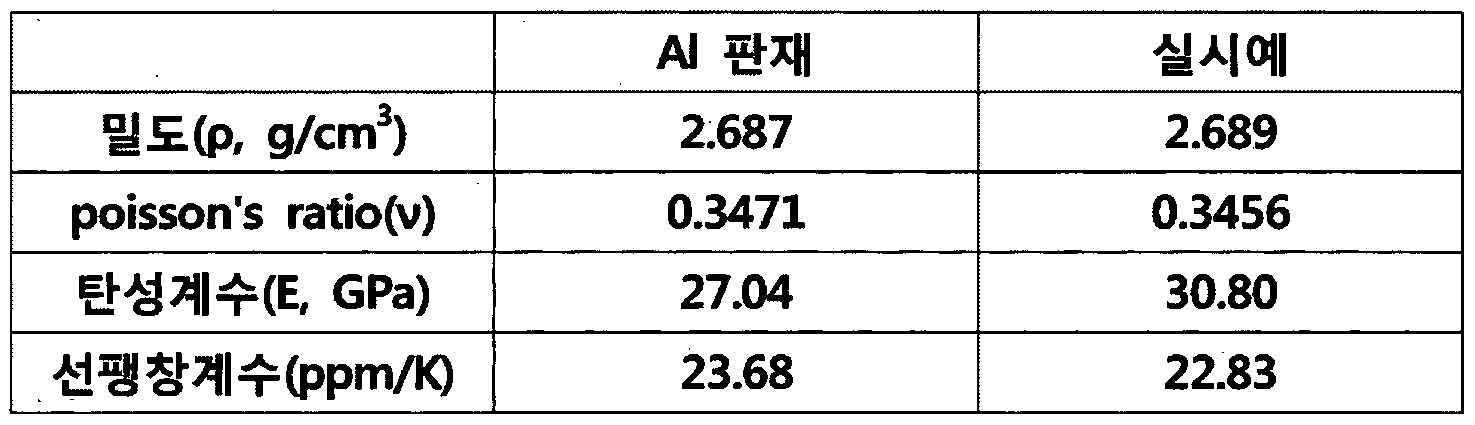
- Table 1 compares the mechanical properties of the pure aluminum sheet and the aluminum-aluminum nitride sheet subjected to arc dissolution for 15 seconds in this example.
- the aluminum-aluminum nitride composite prepared by performing arc melting for 15 seconds
- FIG. 6 is a graph showing a change according to the amount of aluminum nitride of the coefficient of thermal expansion exhibited by the plate and aluminum plates of the present example measured using a dilometer.
- the plate of this Example showed a lower value to 22.83 ppm / K. Since the decrease in the coefficient of linear expansion is proportional to the amount of silicon nitride formed therein, the plate of the present embodiment subjected to arc melting for 15 seconds can be expected to contain about 5% of aluminum nitride. Arc melting Increasing the content of aluminum nitride by increasing the time will allow the production of composites with proportionately lower coefficients of linear expansion, as shown in the accompanying figures.
- FIG. 7 shows a state in which a composite material manufactured according to the present embodiment is rolled to manufacture a plate.
- the composite material prepared according to the present embodiment can be made into a plate-like material by direct rolling without re-melting even when arc melting is performed for 30 seconds.
- the amount of aluminum nitride precipitated in the composite material increases.
- Table 2 shows the results of analyzing the amount of aluminum nitride included in the composite material prepared according to the present embodiment through FPM Evaluation using the intensity and half width of the X-ray diffraction peak according to the arc dissolution time.
- the manufacturing method of the present embodiment can produce a composite material having a high fraction of aluminum nitride in a short time, and can significantly shorten the manufacturing time of the aluminum-aluminum nitrate composite material.
- Figure 8 is a result of measuring the coefficient of linear expansion of the composite materials prepared according to the present embodiment
- Figure 9 is a result of measuring the thermal conductivity of the composite materials prepared according to the present embodiment All.
- the aluminum-nitride aluminum composite material prepared according to the present embodiment has high thermal conductivity and low coefficient of thermal expansion and good moldability, and thus has suitable properties as a heat dissipating material.
- the present invention has been conceived in utilizing the high temperature of arc melting, the present invention is not limited to arc melting as long as it can be heated to 2500 ° C. or higher, which is the boiling point of aluminum.
Landscapes
- Chemical & Material Sciences (AREA)
- Engineering & Computer Science (AREA)
- Materials Engineering (AREA)
- Mechanical Engineering (AREA)
- Metallurgy (AREA)
- Organic Chemistry (AREA)
- Physics & Mathematics (AREA)
- Thermal Sciences (AREA)
- Crystallography & Structural Chemistry (AREA)
- Ceramic Products (AREA)
- Manufacture Of Alloys Or Alloy Compounds (AREA)
- Metal Rolling (AREA)
Abstract
본 발명은 알루미늄-질화알루미늄 또는 알루미늄합금-질화알루미늄 복합재료의 제조방법에 관한 것으로, 질소 (N2) 가스 분위기, 암모니아 (NH3) 가스 분위기 또는 상기 두 가스의 흔합가스 분위기에서 알루미늄 또는 알루미늄합금을 2500°C 이상의 고온에서 용해하여 고온의 알루미늄 용탕 및 일부 알루미늄 가스와 질소의 반응을 유도하는 것을 특징으로 하며, 고온으로 용해하는 방법은 아크 용해 (arc melting)인 것이 바람직하다. 본 발명은, 끓는점 근방의 고온으로 용해함으로써, 제조시간이 빠르면서도 넁간압연을 통해 판재로 성형할 수 있는 알루미늄-질화알루미늄 또는 알루미늄합금-질화알루미늄 복합재료를 제조할 수 있는 효과가 있다. 그리고 아크 용해 시간을 조절하여 질화알루미늄의 상분율을 조절할 수 있기 때문에 다양한 비율의 알루미늄-질화알루미늄 또는 알루미늄합금-질화알루미늄 복합재료를 제조할 수 있는 효과가 있다.
Description
【명세서】
【발명의 명칭】
알루미늄-질화알루미늄 또는 알루미늄합금-질화알루미늄 복합재료의 제조방 법
[기술분야】
<1> 본 발명은 알루미늄-질화알루미늄 또는 알루미늄합금-질화알루미늄 복합재료 의 제조방법에 관한 것으로, 더욱 자세하게는 빠르게 알루미늄-질화알루미늄 또는 알루미늄합금-질화알루미늄 복합재료를 제조할 수 있으며, 질화알루미늄의 비율을 쉽게 조절할 수 있는 새로운 제조방법에 관한 것이다.
【배경기술】
<2> 일반적으로, 엘이디 (LED, light emitting diode) 소자는 엘이디에서 발생하 는 열 문제로 인해 사용에 제약이 많다. 엘이디의 광 효율은 약 20~30%정도이며, 광 효율을 30%로 가정하여도 엘이디 1개당 소모 전력의 70%는 열로 발산된다. 엘 이디의 이러한 발열문제는 엘이디의 수명과 효율을 단축시키는 큰 요인으로 작용하 고 있다. 최근에는 엘이디의 사용량이 증가하고 있으며, 환경문제 등으로 인하여 형광등의 대체재로서 엘이디 광원에 대한 관심이 증가하고 있어서 엘이디의 발열문 제에 대한 연구가 활발하게 진행되고 있다.
<3> 엘이디에서 발생하는 열을 외부로 배출시키는 방열 방법으로 열전도도가 높 은 방열 재료를 엘이디에 부착하여 빠르게 열을 배출하는 방법이 일반적으로 사용 된다. 그러나 현재 열전도도가 높아 방열 재료로 많이 사용되는 구리와 알루미늄 은 엘이디 소자로 사용되는 재료들에 비하여 열팽창계수가 크기 때문에, 부착된 엘 이디에 열응력을 발생시키며 이는 엘이디의 수명을 단축시키는 원인이 되고 있다.
<4> 질화알루미늄 (A1N)은 이론적인 열전도도가 320W/mK에 달하는 대표적인 고 열 전도도의 세라믹 소재이고, 열팽창계수도 4.6ppm/K 정도로 작기 때문에 세라믹 적 층 소재로 이루어진 전자소자 및 반도체와 엘이디 등의 방열 재료로 사용하려는 노 력이 계속되고 있다. 그러나 질화알루미늄은 후막을 형성하기 어렵고, 성형성이 낮기 때문에 활용이 제한되고 있다.
<5> 이를 해결하기 위하여 알루미늄 기지에 질화알루미늄이 석출된 알루미늄-질 화알루미늄 복합재료를 형성하여 가볍고 성형성이 좋으며 높은 열전도도와 낮은 열 팽창계수를 갖는 방열 재료를 제조하는 방법이 제안되었다.
<6> 알루미늄-질화알루미늄 복합재료를 형성하는 방법으로 알루미늄과 질소 또는 암모니아 가스가 반응하여 질화알루미늄을 형성하는 반응이 고온에서 열역학적으로
안정한 자발반웅 (발열반웅)이어서 알루미늄 용탕에 질소 또는 암모니아 가스를 주 입하는 방법이 개발되었으나 알루미늄과 질소의 반웅이 속도론적으로 빠르게 이루 어지지 않아서 제조 효율이 높지 못하였다. 이러한 문제를 해결하기 위하여 알루 미늄에 합금원소 및 촉매원소를 첨가하여 질소와의 반웅성을 높이려는 시도가 계속 되고 있다. 합금원소 및 촉매원소를 첨가하여 알루미늄합금 기지에 질화알루미늄 을 석출시키는 방법은 순수한 알루미늄을 이용하는 경우보다 질화알루미늄이 생성 되는 양이 증가하였지만, 여전히 알루미늄 용탕 내부에 질소 또는 암모니아 가스를 주입하면서 반웅성을 높이기 위한 복잡한 장비를 이용하여야 하며, 반웅시간도 매 우 오래 걸린다. 이렇듯 알루미늄의 질화반응을 유도하기 위하여 약 loocrc 이상 고온의 용탕 상태를 장시간 유지하는 것은 알루미늄-질화알루미늄 또는 알루미늄합 금-질화알루미늄 복합재료의 제조비용을 높이는 원인이 되었으며, 높은 제조비용으 로 인하여 알루미늄-질화알루미늄 또는 알루미늄합금-질화알루미늄 복합재료의 실 용화를 어렵게 하였다. ■
<7> 한편 최근에는 알루미늄 또는 알루미늄합금원소의 분말을 질소가스 또는 암 모니아가스 분위기에서 기계적 밀링한 뒤에 열처리 공정을 거치는 방법이 제안되어 특허 받은 바 있다. (대한민국 등록특허 제 10-0721780호)
<8> 기계적 밀링을 이용하는 방법은 용탕의 반웅을 유도하는 방법에 비하여 고온 을 사용하지 않으나, 알루미늄 또는 알루미늄합금원소의 분말을 제조해야 하며, 기 계적 밀링 자체가 장시간이 필요한 공정이고 추가적으로 길게는 48시간정도의 열처 리를 필요로 하기 때문에 제조시간이 매우 길다. 특히 제조된 알루미늄-질화알루 미늄 또는 알루미늄합금-질화알루미늄 복합재료가 분말형태이기 때문에 열간성형공 정이 필수적이라는 단점이 있다.
<9> 따라서 제조시간을 즐이면서도 일반적인 넁간가공이 가능한 알루미늄-질화알 루미늄 또는 알루미늄합금-질화알루미늄 복합재료를 제조하는 방법에 대한 요구가 이어지고 있다.
【발명의 상세한 설명】
【기술적 과제]
<ιο> 본 발명은 전술한 종래 기술의 문제점을 해결하기 위한 것으로서 알루미늄- 질화알루미늄 또는 알루미늄합금-질화알루미늄 복합재료의 새로운 제조방법을 제공 하는데 그 목적이 있다.
[기술적 해결방법】
<ιι> 상기 목적을 달성하기 위한 본 발명에 의한 알루마늄-질화알루미늄 또는 알
루미늄합금-질화알루미늄 복합재료의 제조방법은, 질소 (N2) 가스 분위기, 암모니아
(NH3) 가스 분위기 또는 상기 두 가스의 흔합가스 분위기에서 알루미늄 또는 알루미 늄합금을 2500°C 이상의 고온에서 용해하여 고온의 알루미늄 용탕 및 일부 알루미 늄 가스와 질소의 반응을 휴도하는 것을 특징으로 한다.
<12> 이때, 고온으로 용해하는 방법은 아크 용해인 것이 바람직하다.
<13> 아크 용해 (arc melting)는 아크 (arc)를 열원으로 하여 용해 작업을 실사하는 용해 방법이다. 아크 용해 시에 아크에 의하여 가해지는 온도는 약 2500 °C 이상의 고온이며, 티타늄과 철과 같이 융점이 높은 재료를 용해하기 위하여 많이 사용되지 만 알루미늄과 같이 융점이 낮고 약 250CTC 정도의 끓는점을 는 재료에 대해서는 사용되지 않고 있다. 그러나 본 발명의 발명자들은 아크 용해의 온도가 알루미늄 의 끓는점과 비슷한 고온을 순간적으로 가하기 때문에, 질소를 포함하는 가스와 알 루미늄 용탕간의 반응 뿐 아니라 질소를 포함하는 가스와 알루미늄 기체와의 반웅 을 통해 질소를 포함하는 가스와 알루미늄이 빠르게 반웅할 것이라는 생각으로부터 본 발명을 발명하게 되었다.
<14> 본 발명은 아크 용해의 고온을 이용하는 것에서 착안되었지만, 알루미늄의 끓는점인 2500°C 이상으로 가열할 수 있는 것이면 아크 용해에 한정되지 않고 적용 이 가능하다.
<15> 아크 용해 공정에서는 아크 발생을 위하여 아르곤 (Ar) 가스가 필요하며, 일 반적인 아크 용해에서는 용해되는 재료의 반응을 막기 위하여 용해로 내부를 완전 히 아르곤 가스 분위기로 형성하거나, 진공상태에서 최소한의 아르곤 가스만을 주 입하고 있다. 반면에 본 발명에서는 용해로 내부를 질소 (N2) 가스 또는 암모니아
(NH3) 가스 분위기로 조성하여 알루미늄의 반응을 유도하며, 아크 발생을 위한 최소 한꾀 아르곤 가스만을 주입한다. 질소 가스 또는 암모니아 가스의 양이 많을수록 질화알루미늄의 석출에 유리하다.
<16> 본 발명은 아크 용해를 실시하는 시간을 조절하여 질화알루미늄의 양을 조절 한다. 본 발명의 알루미늄-질화알루미늄 또는 알루미늄합금-질화알루미늄 복합재 료의 제조방법은 짧은 시간에 알루미늄과 질소를 반응시키기 때문에 아크 용해 시 간과 형성된 질화알루미늄의 양이 비례하며, 이를 이용하여 질화알루미늄의 비율이 다양한 복합재료를 간단한 방법으로 제조할 수 있다.
<17> 그리고 본 발명의 알루미늄-질화알루미늄 복합재료는 열처리 공정을 통해 균 질화 처리한 뒤에 넁간 압연하여 판상으로 성형할 수 있으몌 재용해한 뒤에 넁간
압연하여 판상으로 성형할 수도 있다.
【유리한 효과】
<18> 상술한 바와 같이 구성된 본 발명은, 끓는점 근방의 고온으로 용해함으로써, 제조시간이 빠르면서도 넁각압연을 통해 판재로 성형할 수 있는 알루미늄-질화알루 미늄 또는 알루미늄합금-질화알루미늄 복합재료를 제조할 수 있는 효과가 있다.
<19> 그리고 아크 용해 시간을 조절하여 질화알루미늄의 상분율을 조절할 수 있기 때문에 다양한 비율의 알루미늄-질화알루미늄 또는 알루미늄합금-질화알루미늄 복 합재료를 제조할 수 있는 효과가 있다.
<20> 또한, 본 발명의 제조방법은 알루미늄-질화알루미늄 또는 알루미늄합금 -질화 알루미늄 복합재료의 제조시간을 크게 줄이고 손쉽게 판상으로 성형이 가능하여 우 수한 방열 재료인 알루미늄-질화알루미늄 또는 알루미늄합금-질화알루미늄 복합재 료의 사용분야를 크게 넓힐 수 있는 효과가 있다.
【도면의 간단한 설명】
<21> 도 1은 본 실시예에 따라 제조된 시편의 외관을 아크 용해 시간별로 나타낸 사진이다.
<22> 도 2는 본 실시예에 따라 제조된 시편의 내부 단면을 아크 용해 시간별로 나
.나타낸 사진이다.
<23> 도 3은 본 실시예에 따라 제조된 시편의 X-선 회절분석 그래프이다.
<24> 로 4는 본 실시예에 따라 제조된 시편의 단면을 확대한사진이다.
<25> 도 5는 본 실시예에 따라 제조된 시편의 SEM사진이다.
<26> 도 6은 딜라토미터를 이용하여 측정한 본 실시예의 관재와 알루미늄 판재가 나타내는 열팽창계수의 질화알루미늄의 양에 따른 변화를 나타낸 그래프이다.
<27> - 도 7은 본 실시예에 따라 제조된 복합재료를 넁간 압연하여 판재로 제조한 모습을 나타낸다.
<28> 도 8은 본 실시예에 따라서 제조된 복합재료들의 선팽창계수를 측정한 결과 이다.
<29> 도 9는 본 실시예에 따라서 제조된 복합재료들의 열전도도를 측정한 결과이 다.
【발명의 실시를 위한 형태】
<30> 첨부된 도면을 참조하여 본 발명에 따른 실시예를 상세히 설명한다.
<31> 본 발명의 실시예에 따라서 알루미늄-질화알루미늄 복합재료를 제조하기 위 하여 약 10 g의 순수한 알루미늄 조각을 준비하였다.
<32> 알루미늄 조각을 넣은 아크로 (arc furnace) 내부를 진공으로 만든 다음, 질 소 (N2)가스 700mmHg와 아르곤 (Ar) 가스 20mmHg를 넣었다. 아르곤 가스는 아크 발생 을 위한 최소량을 넣고, 질소의 양이 많을수록 좋다.
<33> 질소 가스 분위기의 아크로에 고전압을 걸어 알루미늄의 용해와 질화반웅을 유도하였다. 이때, 아크 용해 시간에 따른 질화알루미늄의' 생성량을 확인하기 위 하여 아크 용해를 실시한 시간을 15초, 30초 및 60초로 조절하여 제조하였다.
<34> 도 1은 본 실시예에 따라 제조된 시편의 외관을 아크 용해 시간별로 나타낸 사진이다ᅳ
<35> 아크 용해 시간이 길수록 표면이 부풀어 오르는 양이 많아져, 크기가 커지고 외면 복잡해진 것을 확인할 수 있다. 특히 아크 용해 시간이 길수록 알루미늄 특 유의 광택이 감소하는 것을 알 수 있다.
<36> 도 2는 본 실시예에 따라 제조된 시편의 내부 단면을 아크 용해 시간별로 나 나타낸 사진이다.
<37> 제조된 시편을 폴리싱 (polishing)하여 내부를 살펴본 결과, 아크 용해로 인 하여 시편의 외부가 부풀어 오른 것은 내부에 형성된 공간 때문인 것을 알 수 있으 며, 내부 공간의 표면이 알루미늄의 광택을 나타내지 않는 것으로 보아'질화알루미 늄이 석출된 것으로 보인다. 이러한 내부의 공간은 아크에 의하여 순간적으로 끓 는점 이상으로 가열된 알루미늄에 의해 형성된 것으로 보이며, 내부 공간에 질화알 루미늄의 석출이 많은 이유는 기화된 알루미늄과 가스 속에 포함된 질소원소가 자 발적인 반웅을 하였기 때문인 것으로 판단된다.
<38> 이상의 사진에 따르면, 아크 용해 시간이 증가할수록 알루미늄 내부의 공간 이 많아지고, 그에 따라서 질소 가스와의 접촉 면적이 늘어나기 때문에 질화알루미 늄의 생성량도 많아질 것으로 예상할 수 있다.
<39> '도 3은 본 실시예에 따라 제조된 시편의 X-선 회절분석 그래프이다.
<40> 모든 시편에서 알루미늄 (Al, 과 질화알루미늄 (A1N, 會)의 피크만 관찰되 어, 질화알루미늄만 석출된 알루미늄-질화알루미늄 복합재료가 형성된 것을 확인할 수 있다. 특히, 아크 용해 시간이 길수록 질화알루미늄 피크가 커진 것으로 보아 용해 시간이 증가함에 따라서 질화알루미늄이 더 많이 생성된 것을 알 수 있다.
<41> 도 4는 본 실시예에 따라 제조된 시편의 단면을 확대한 사진이다. 사진에서 어두운 부분이 질화알루미늄이 석출된 부분이며, 밝은 부분이 알루미늄이다.
<42> 15초 동안 아크 용해를 실시한 시편은 단면의 중앙부분이 알루미늄만 관찰되 고, 질화알루미늄은 단면의 외곽부분에서만 관찰되는 것을 확인할 수 있다.
<43> 30초와 60초 동안 아크 용해를 실시한 시편은 단면의 전체에서 질화알루미늄 이 발견되는 것을 확인할 수 있으며, 60초 동안 아크 용해를 실시한 시편의 질화알 루미늄 밀도가 더 높은 것을 알수 있다.
<44> 이상의 결과를 통하여, 아크 용해의 방법으로 질화반응을 유도하는 경우 15 초 내지 60초의 짧은 시간으로도 질화알루미늄이 석출된 알루미늄-질화알루미늄 복 합재료를 제조할 수 있으며, 아크 용해 시간을 조절하여 질화알루미늄의 상분율을 조절할 수 있음을 알 수 있다.
<45> 도 5는 본 실시예에 따라 제조된 시편의 SEM사진이다.
<46> 사진 상에 밝은 회색으로 나타난 부분이 질화알루미늄이고, 어두운 회색을 나타난 부분이 알루미늄이다. 사진에서 보이듯이 본 실시예에 의해 제조된 시편은 수 f皿크기의 구형 질화알루미늄이 다량 석출된 것을 확인할 수 있다.
<47> 그리고 본 실시예에 따라 제조된 시편의 특성과 시편에 포함된 질화알루미늄 의 양을 확인하기 위하여, 15초 동안 아크 용해를 실시한 시편을 350°C에서 1시간 동안 열처리하여 균질화처리를 실시하고 넁간 압연하여 판재로 성형하였다.
<48> 표 1은 순수한 알루미늄 판재와 본 실시예의 15초간 아크 용해를 실시한 알 루미늄-질화알루미늄 판재의 기계적 특성을 비교한 것이다.
<49> [표 1] '
<50>
<51> 15초 동안 아크 용해를 실시하여 제조된 알루미늄-질화알루미늄 복합재료는
35CTC에서 1시간 동안 균질화 처리 후 넁간압연을 통해 판상재료로 만들 수 있었으 며, 순수한 알루미늄 판재와 기계적 특성에서 차이가 있는 것을 확인할 수 있다. 여기서 균질화 처리과정은 필요에 따라 생략할 수 있다.
<52> 도 6은 딜라토미터를 이용하여 측정한 본 실시예의 판재와 알루미늄 판재가 나타내는 열팽창계수의 질화알루미늄의 양에 따른 변화를 나타낸 그래프이다.
<53> 순수한 알루미늄 판재의 선팽창계수 23.68 ppm/K에 비하여, 본 실시예의 판 재는 22.83 ppm/K로 낮아진 값을 보였다. 선팽창계수의 감소는 내부에 형성된 질 화실리콘의 양에 비례하므로, 15초 동안 아크 용해를 실시한 본 실시예의 판재는 약 5%의 질화알루미늄을 포함하는 것으로 예상할수 있다. 이와 더불어 아크 용해
시간을 늘려 질화알루미늄의 함량을 증가시키는 경우, 첨부된 그림에서와 같이 비 례적으로 더 낮은 선팽창계수를 갖는 복합재의 제조가 가능할 것이다.
<54> 도 7은 본 실시예에 따라 제조된 복합재료를 넁간 압연하여 판재로 제조한 모습을 나타낸다.
<55> 본 실시예에 따라서 제조된 복합재료는 30초 동안 아크 용해를 실시한 경우 에도, 재 용해 없이 바로 넁간압연을 통해 판상재료로 만들 수 있음을 확인할 수 있다.
<56> 아크 용해 시간이 증가할수록 복합재료 내에 석출되는 질화알루미늄의 양이 증가하며, 질화알루미늄이 많이 포함된 복합재료의 경우는 단순한 균질화처리만을 거친 뒤에 냉간압연하기 어렵다. 질화알루미늄의 양이 많은 복합재료의 경우에는 재 용해 공정을 거친 뒤에 판재로 제조하는 것이 바람직할 것이다.
<57>
<58> 표 2는 본 실시예에 따라서 제조된 복합재료에 포함된 질화알루미늄의 양을 아크 용해 시간에 따라서 X-선 회절 peak의 intensity와 반가폭을 이용해 FPM Evaluation을 통해 분석한 결과이다.
<59> [표 2]

<6i> 상기 표에 따르면, 120초 정도의 아크 용해 시간만으로도 41.56%의 질화알루 미늄을 포함하는 복합재료를 제조할 수 있다. 따라서 본 실시예의 제조방법으로 짧은 시간에 질화알루미늄의 분률이 높은 복합재료를 제조할 수 있으며, 알루미늄- 질산알루미늄 복합재료의 제조시간을 크게 단축시킬 수 있다.
<62> 도 8은 본 실시예에 따라서 제조된 복합재료들의 선팽창계수를 측정한 결과 이고, 도 9는 본 실시예에 따라서 제조된 복합재료들의 열전도도를 측정한 결과이
다.
<63> 이에 따르면, 아크 용해 시간을 늘려서 복합재료에 포함된 질화알루미늄의 양이 많을수록 선팽창계수가 크게 감소하는 것을 확인할 수 있다. 반면에, 질화알 루미늄의 양이 많아져도 열전도도의 감소는 크지 않은 것을 확인할 수 있다.
<64> 이상의 결과로부터, 본 실시예에 따라 제조된 알루미늄-질화알루미늄 복합재 료는 높은 열전도도와 낮은 열팽창계수를 가짐과 동시에 성형성이 좋기 때문에 방 열 재료로서 적합한 특성을 가지는 것을 알 수 있다.
<65>
<66> 본 발명은 아크 용해의 고온을 이용하는 것에서 착안되었지만, 알루미늄의 끓는점인 2500°C 이상으로 가열할 수 있는 것이면 아크 용해에 한정되지 않고 적용 이 가능하다.
<67>
<68> 이상 본 발명을 바람직한 실시예를 통하여 설명하였는데, 상술한 실시예는 본 발명의 기술적 사상을 예시적으로 설명한 것에 불과하며, 본 발명의 기술적 사 상을 벗어나지 않는 범위 내에서 다양한 변화가 가능함은 이 분야에서 퉁상의 지식 을 가진 자라면 이해할 수 있을 것이다. 따라서 본 발명의 보호범위는 특정 실시예 가 아니라 특허청구범위에 기재된 사항에 의해 해석되어야 하며, 그와 동등한 범위 내에 있는 모든 기술적 사상도 본 발명의 권리범위에 포함되는 것으로 해석되어야 할 것이다.
Claims
【청구항 1]
질소 (N2) 가스 분위기, 암모니아 (N¾) 가스 분위기 또는 상기 두 가스의 흔 합가스 분위 기 에서 알루미늄 또는 알루미늄합금을 2500°C 이상의 고온에서 용해하 여 고온의 알루미늄 용탕 및 일부 알루미늄 가스와 질소의 반웅을 유도하는 것을 특징으로 하는 알루미늄-질화알루미늄 또는 알루미늄합금—질화알루미늄 복합재료의 제조방법 .
【청구항 2]
청구항 1에 있어서 ,
상기 고온 용해가 아크 용해 (arc mel t ing)로 이루어지는 것을 특징으로 하는 알루미늄-질화알루미늄 또는 알루미늄합금-질화알루미늄 복합재료의 제조방법 .
【청구항 3]
청구항 2에 있어서,
상기 아크 용해를 실시하는 시 간을 조절하여 질화알루미늄의 양을 조절하는 것을 특징으로 하는 알루미늄-질화알루미늄 또는 알루미늄합금-질화알루미늄 복합 재료의 제조방법 .
【청구항 4】
청구항 2에 있어서,
상기 아크 용해를 실시 한 재료를 열처 리 공정을 통해 균질화 처 리 한 뒤 에 넁 간 압연하여 판상으로 성 형하는 것을 특징으로 하는 알루미늄-질화알루미늄 또는 알루미늄합금-질화알루미늄 복합재료의 제조방법 .
【청구항 5】
청구항 2에 있어서,
상기 아크 용해를 실시한 재료를 재용해한 뒤에 냉간 압연하여 판상으로 성 형하는 것을 특징으로 하는 알루미늄-질화알루미늄 또는 알루미늄합금 -질화알루미 늄 복합재료의 제조방법 .
Applications Claiming Priority (2)
| Application Number | Priority Date | Filing Date | Title |
|---|---|---|---|
| KR10-2011-0015055 | 2011-02-21 | ||
| KR1020110015055A KR101267793B1 (ko) | 2011-02-21 | 2011-02-21 | 알루미늄-질화알루미늄 또는 알루미늄합금-질화알루미늄 복합재료의 제조방법 |
Publications (3)
| Publication Number | Publication Date |
|---|---|
| WO2012115430A2 true WO2012115430A2 (ko) | 2012-08-30 |
| WO2012115430A3 WO2012115430A3 (ko) | 2012-12-20 |
| WO2012115430A4 WO2012115430A4 (ko) | 2013-02-07 |
Family
ID=46721327
Family Applications (1)
| Application Number | Title | Priority Date | Filing Date |
|---|---|---|---|
| PCT/KR2012/001304 Ceased WO2012115430A2 (ko) | 2011-02-21 | 2012-02-21 | 알루미늄-질화알루미늄 또는 알루미늄합금-질화알루미늄 복합재료의 제조방법 |
Country Status (2)
| Country | Link |
|---|---|
| KR (1) | KR101267793B1 (ko) |
| WO (1) | WO2012115430A2 (ko) |
Cited By (2)
| Publication number | Priority date | Publication date | Assignee | Title |
|---|---|---|---|---|
| CN116623061A (zh) * | 2023-07-25 | 2023-08-22 | 杭州圣钘能源有限公司 | 一种复合相变储热材料及储热装置 |
| CN116656995A (zh) * | 2023-07-25 | 2023-08-29 | 杭州圣钘能源有限公司 | 一种复合相变材料作为相变储热材料保护层的用途 |
Families Citing this family (3)
| Publication number | Priority date | Publication date | Assignee | Title |
|---|---|---|---|---|
| KR20160023003A (ko) * | 2014-08-20 | 2016-03-03 | 현대모비스 주식회사 | 알루미늄 합금의 제조 방법 |
| KR101659188B1 (ko) | 2014-12-31 | 2016-09-23 | 서울대학교산학협력단 | 자발 치환 반응을 통해 형성된 질화물로 강화된 금속기지 복합재료의 제조방법 및 그에 따라 제조된 복합재료 |
| KR102225786B1 (ko) * | 2020-11-26 | 2021-03-10 | 유한회사 원진알미늄 | 알루미늄 복합분말 표면에 균일한 질화물처리를 위한 진공 회전 열처리 장치 |
Family Cites Families (4)
| Publication number | Priority date | Publication date | Assignee | Title |
|---|---|---|---|---|
| JPS62282635A (ja) * | 1986-05-31 | 1987-12-08 | Natl Res Inst For Metals | 窒化アルミニウム超微粉と耐酸化性アルミニウム超微粉の混合超微粉の製造法 |
| JPS62283805A (ja) * | 1986-05-31 | 1987-12-09 | Natl Res Inst For Metals | 窒化アルミニウム超微粉の製造法 |
| JPH06321511A (ja) * | 1993-03-16 | 1994-11-22 | Takeshi Masumoto | 窒化アルミニウム超微粒子及びその製造方法と超微粒子焼結体 |
| JP4014562B2 (ja) | 2003-11-19 | 2007-11-28 | 電気化学工業株式会社 | 窒化アルミニウム粉末の製造方法 |
-
2011
- 2011-02-21 KR KR1020110015055A patent/KR101267793B1/ko not_active Expired - Fee Related
-
2012
- 2012-02-21 WO PCT/KR2012/001304 patent/WO2012115430A2/ko not_active Ceased
Cited By (2)
| Publication number | Priority date | Publication date | Assignee | Title |
|---|---|---|---|---|
| CN116623061A (zh) * | 2023-07-25 | 2023-08-22 | 杭州圣钘能源有限公司 | 一种复合相变储热材料及储热装置 |
| CN116656995A (zh) * | 2023-07-25 | 2023-08-29 | 杭州圣钘能源有限公司 | 一种复合相变材料作为相变储热材料保护层的用途 |
Also Published As
| Publication number | Publication date |
|---|---|
| KR20120095622A (ko) | 2012-08-29 |
| WO2012115430A4 (ko) | 2013-02-07 |
| KR101267793B1 (ko) | 2013-06-04 |
| WO2012115430A3 (ko) | 2012-12-20 |
Similar Documents
| Publication | Publication Date | Title |
|---|---|---|
| Liu et al. | Effect of Al content on high temperature oxidation resistance of AlxCoCrCuFeNi high entropy alloys (x= 0, 0.5, 1, 1.5, 2) | |
| Nakagawa et al. | Thermal emission properties of Al2O3/Er3Al5O12 eutectic ceramics | |
| Dong et al. | Effects of annealing treatment on microstructure and hardness of bulk AlCrFeNiMo0. 2 eutectic high-entropy alloy | |
| Xiao et al. | Synthesis and thermal stability of Cr2AlC | |
| WO2012115430A2 (ko) | 알루미늄-질화알루미늄 또는 알루미늄합금-질화알루미늄 복합재료의 제조방법 | |
| Yang et al. | Synthesis of filled skutterudite compound La0. 75Fe3CoSb12 by spark plasma sintering and effect of porosity on thermoelectric properties | |
| JP5420609B2 (ja) | スパッタリング用チタンターゲット | |
| TWI658146B (zh) | 蒸汽腔體之製造方法 | |
| JP6860768B2 (ja) | 鋳造用アルミニウム合金、アルミニウム合金部材、及びアルミニウム合金部材の製造方法 | |
| Liu et al. | Realization of zero thermal expansion in La (Fe, Si) 13-based system with high mechanical stability | |
| JP2009068077A (ja) | 合金材料、磁性材料、磁性材料の製造方法およびその製造方法により製造した磁性材料 | |
| CN107164653A (zh) | 一种具有负热膨胀性能的富钛含量钛镍合金及其制备方法 | |
| Yao et al. | Making High Thermoelectric and Superior Mechanical Performance Nb0. 88Hf0. 12FeSb Half‐Heusler via Additive Manufacturing | |
| Akasaka et al. | Composition dependent thermoelectric properties of sintered Mg2Si1− xGex (x= 0 to 1) initiated from a melt-grown polycrystalline source | |
| JP2019203197A (ja) | 積層造形物の熱処理方法および銅合金造形物の製造方法 | |
| CN108034849B (zh) | 一种金刚石-镁复合散热材料及其制备方法和应用 | |
| CN107354415B (zh) | 一种制备优良热电性能合金的方法及优良热电性能合金 | |
| JP2007070733A (ja) | 冷間加工材 | |
| Matsunaga et al. | Nitridation behavior of silicon powder compacts of various thicknesses with Y2O3 and MgO as sintering additives | |
| TWI740611B (zh) | 均溫板用鈦銅合金板及均溫板 | |
| JP5086592B2 (ja) | 冷間加工材 | |
| Tang et al. | The interfacial stability of the coated-SiC/Fe couple | |
| Pandey et al. | Effect of sintering temperature on microstructure and flexural strength of alumina borate whiskers | |
| JP2021050391A (ja) | Cu−Al−Mn系合金およびCu−Al−Mn系合金の製造方法 | |
| Zhao et al. | Properties of negative thermal expansion β-eucryptite ceramics prepared by spark plasma sintering |
Legal Events
| Date | Code | Title | Description |
|---|---|---|---|
| 121 | Ep: the epo has been informed by wipo that ep was designated in this application |
Ref document number: 12748897 Country of ref document: EP Kind code of ref document: A2 |
|
| NENP | Non-entry into the national phase |
Ref country code: DE |
|
| 122 | Ep: pct application non-entry in european phase |
Ref document number: 12748897 Country of ref document: EP Kind code of ref document: A2 |