WO2012115281A1 - 耐候性に優れた鋼材 - Google Patents
耐候性に優れた鋼材 Download PDFInfo
- Publication number
- WO2012115281A1 WO2012115281A1 PCT/JP2012/055299 JP2012055299W WO2012115281A1 WO 2012115281 A1 WO2012115281 A1 WO 2012115281A1 JP 2012055299 W JP2012055299 W JP 2012055299W WO 2012115281 A1 WO2012115281 A1 WO 2012115281A1
- Authority
- WO
- WIPO (PCT)
- Prior art keywords
- less
- steel
- weather resistance
- steel material
- inclusive
- Prior art date
- Legal status (The legal status is an assumption and is not a legal conclusion. Google has not performed a legal analysis and makes no representation as to the accuracy of the status listed.)
- Ceased
Links
Images
Classifications
-
- C—CHEMISTRY; METALLURGY
- C22—METALLURGY; FERROUS OR NON-FERROUS ALLOYS; TREATMENT OF ALLOYS OR NON-FERROUS METALS
- C22C—ALLOYS
- C22C38/00—Ferrous alloys, e.g. steel alloys
- C22C38/16—Ferrous alloys, e.g. steel alloys containing copper
-
- C—CHEMISTRY; METALLURGY
- C22—METALLURGY; FERROUS OR NON-FERROUS ALLOYS; TREATMENT OF ALLOYS OR NON-FERROUS METALS
- C22C—ALLOYS
- C22C38/00—Ferrous alloys, e.g. steel alloys
- C22C38/002—Ferrous alloys, e.g. steel alloys containing In, Mg, or other elements not provided for in one single group C22C38/001 - C22C38/60
-
- C—CHEMISTRY; METALLURGY
- C22—METALLURGY; FERROUS OR NON-FERROUS ALLOYS; TREATMENT OF ALLOYS OR NON-FERROUS METALS
- C22C—ALLOYS
- C22C38/00—Ferrous alloys, e.g. steel alloys
- C22C38/18—Ferrous alloys, e.g. steel alloys containing chromium
- C22C38/40—Ferrous alloys, e.g. steel alloys containing chromium with nickel
- C22C38/52—Ferrous alloys, e.g. steel alloys containing chromium with nickel with cobalt
-
- C—CHEMISTRY; METALLURGY
- C22—METALLURGY; FERROUS OR NON-FERROUS ALLOYS; TREATMENT OF ALLOYS OR NON-FERROUS METALS
- C22C—ALLOYS
- C22C38/00—Ferrous alloys, e.g. steel alloys
- C22C38/005—Ferrous alloys, e.g. steel alloys containing rare earths, i.e. Sc, Y, Lanthanides
-
- C—CHEMISTRY; METALLURGY
- C22—METALLURGY; FERROUS OR NON-FERROUS ALLOYS; TREATMENT OF ALLOYS OR NON-FERROUS METALS
- C22C—ALLOYS
- C22C38/00—Ferrous alloys, e.g. steel alloys
- C22C38/008—Ferrous alloys, e.g. steel alloys containing tin
-
- C—CHEMISTRY; METALLURGY
- C22—METALLURGY; FERROUS OR NON-FERROUS ALLOYS; TREATMENT OF ALLOYS OR NON-FERROUS METALS
- C22C—ALLOYS
- C22C38/00—Ferrous alloys, e.g. steel alloys
- C22C38/02—Ferrous alloys, e.g. steel alloys containing silicon
-
- C—CHEMISTRY; METALLURGY
- C22—METALLURGY; FERROUS OR NON-FERROUS ALLOYS; TREATMENT OF ALLOYS OR NON-FERROUS METALS
- C22C—ALLOYS
- C22C38/00—Ferrous alloys, e.g. steel alloys
- C22C38/04—Ferrous alloys, e.g. steel alloys containing manganese
-
- C—CHEMISTRY; METALLURGY
- C22—METALLURGY; FERROUS OR NON-FERROUS ALLOYS; TREATMENT OF ALLOYS OR NON-FERROUS METALS
- C22C—ALLOYS
- C22C38/00—Ferrous alloys, e.g. steel alloys
- C22C38/06—Ferrous alloys, e.g. steel alloys containing aluminium
-
- C—CHEMISTRY; METALLURGY
- C22—METALLURGY; FERROUS OR NON-FERROUS ALLOYS; TREATMENT OF ALLOYS OR NON-FERROUS METALS
- C22C—ALLOYS
- C22C38/00—Ferrous alloys, e.g. steel alloys
- C22C38/08—Ferrous alloys, e.g. steel alloys containing nickel
-
- C—CHEMISTRY; METALLURGY
- C22—METALLURGY; FERROUS OR NON-FERROUS ALLOYS; TREATMENT OF ALLOYS OR NON-FERROUS METALS
- C22C—ALLOYS
- C22C38/00—Ferrous alloys, e.g. steel alloys
- C22C38/10—Ferrous alloys, e.g. steel alloys containing cobalt
- C22C38/105—Ferrous alloys, e.g. steel alloys containing cobalt containing Co and Ni
-
- C—CHEMISTRY; METALLURGY
- C22—METALLURGY; FERROUS OR NON-FERROUS ALLOYS; TREATMENT OF ALLOYS OR NON-FERROUS METALS
- C22C—ALLOYS
- C22C38/00—Ferrous alloys, e.g. steel alloys
- C22C38/12—Ferrous alloys, e.g. steel alloys containing tungsten, tantalum, molybdenum, vanadium, or niobium
-
- C—CHEMISTRY; METALLURGY
- C22—METALLURGY; FERROUS OR NON-FERROUS ALLOYS; TREATMENT OF ALLOYS OR NON-FERROUS METALS
- C22C—ALLOYS
- C22C38/00—Ferrous alloys, e.g. steel alloys
- C22C38/14—Ferrous alloys, e.g. steel alloys containing titanium or zirconium
-
- C—CHEMISTRY; METALLURGY
- C22—METALLURGY; FERROUS OR NON-FERROUS ALLOYS; TREATMENT OF ALLOYS OR NON-FERROUS METALS
- C22C—ALLOYS
- C22C38/00—Ferrous alloys, e.g. steel alloys
- C22C38/18—Ferrous alloys, e.g. steel alloys containing chromium
- C22C38/40—Ferrous alloys, e.g. steel alloys containing chromium with nickel
-
- C—CHEMISTRY; METALLURGY
- C22—METALLURGY; FERROUS OR NON-FERROUS ALLOYS; TREATMENT OF ALLOYS OR NON-FERROUS METALS
- C22C—ALLOYS
- C22C38/00—Ferrous alloys, e.g. steel alloys
- C22C38/18—Ferrous alloys, e.g. steel alloys containing chromium
- C22C38/40—Ferrous alloys, e.g. steel alloys containing chromium with nickel
- C22C38/42—Ferrous alloys, e.g. steel alloys containing chromium with nickel with copper
-
- C—CHEMISTRY; METALLURGY
- C22—METALLURGY; FERROUS OR NON-FERROUS ALLOYS; TREATMENT OF ALLOYS OR NON-FERROUS METALS
- C22C—ALLOYS
- C22C38/00—Ferrous alloys, e.g. steel alloys
- C22C38/18—Ferrous alloys, e.g. steel alloys containing chromium
- C22C38/40—Ferrous alloys, e.g. steel alloys containing chromium with nickel
- C22C38/44—Ferrous alloys, e.g. steel alloys containing chromium with nickel with molybdenum or tungsten
-
- C—CHEMISTRY; METALLURGY
- C22—METALLURGY; FERROUS OR NON-FERROUS ALLOYS; TREATMENT OF ALLOYS OR NON-FERROUS METALS
- C22C—ALLOYS
- C22C38/00—Ferrous alloys, e.g. steel alloys
- C22C38/18—Ferrous alloys, e.g. steel alloys containing chromium
- C22C38/40—Ferrous alloys, e.g. steel alloys containing chromium with nickel
- C22C38/48—Ferrous alloys, e.g. steel alloys containing chromium with nickel with niobium or tantalum
-
- C—CHEMISTRY; METALLURGY
- C22—METALLURGY; FERROUS OR NON-FERROUS ALLOYS; TREATMENT OF ALLOYS OR NON-FERROUS METALS
- C22C—ALLOYS
- C22C38/00—Ferrous alloys, e.g. steel alloys
- C22C38/18—Ferrous alloys, e.g. steel alloys containing chromium
- C22C38/40—Ferrous alloys, e.g. steel alloys containing chromium with nickel
- C22C38/58—Ferrous alloys, e.g. steel alloys containing chromium with nickel with more than 1.5% by weight of manganese
Definitions
- the present invention mainly relates to steel structures (Steel Structures) used outdoors such as bridges, and particularly requires high weather resistance in a high salinity environment such as coastal environments.
- the present invention relates to a steel material suitable as a member.
- weathering steel has been used.
- Weatherproof steel is corrosion-induced by covering the surface with a highly protective rust layer enriched with alloy elements such as Cu, P, Cr, Ni, etc. in an atmosphere exposure environment (atmospheric environment). rate) is a steel material with a significant reduction. Due to its excellent weather resistance, it is known that bridges using weather resistant steel often withstand service for decades while still being paintless.
- the amount of incoming salt is a value measured by the method of JIS Z2382.
- Non-Patent Document 1 conventional weathering steel (JIS G3114: weathering hot rolled steel for welded structure) has an incoming salt content of 0.05 mg ⁇ NaCl / dm 2 / day (hereinafter, unit (mg ⁇ (In some cases, NaCl / dm 2 / day) may be expressed in mdd). Therefore, in an environment with a large amount of salinity such as the vicinity of the coast, ordinary steel (JIS G3106: rolled steel for welded structure) is used after being subjected to anticorrosion measures such as painting. Note that dm means a decimator.
- Patent Document 1 discloses a high weather resistance steel material to which Cu and 1 wt% or more of Ni are added as a weather resistance improving element.
- Patent Document 2 discloses a steel material excellent in weather resistance to which 1 mass% or more of Ni and Mo are added.
- Patent Document 3 discloses a weather-resistant steel material in which Ti is added in addition to Cu and Ni.
- Patent Document 4 discloses a steel material for welded structure containing a large amount of Ni and additionally containing Cu, Mo, Sn, Sb, P, and the like.
- Japanese Patent No. 3785271 Japanese Patent No. 3846218 Japanese Patent No. 3466076 Japanese Patent Laid-Open No. 10-251797
- Patent Documents 1, 2, and 3 when the Ni content is increased, there is a problem that the price of the steel material increases due to an increase in alloy cost.
- an object of the present invention is to provide a steel material that is low in cost and excellent in weather resistance.
- the component composition of steel materials has been intensively studied from the viewpoint of weather resistance in a high salt environment.
- the weather resistance of a steel material in a high salinity environment is improved by compositely containing Mo and Nb in a base steel containing Cu and Ni.
- the present invention has been made on the basis of the following knowledge, and the gist thereof is as follows.
- 1st invention is mass%, C: more than 0.06% and less than 0.14%, Si: 0.05% or more and 2.00% or less, Mn: 0.20% or more and 2.00% or less, P : 0.005% to 0.030%, S: 0.0001% to 0.0200%, Al: 0.001% to 0.100%, Cu: 0.10% to 1.00% Ni: 0.10% or more and 0.65% or less, Mo: 0.001% or more and 1.000% or less, preferably Mo: 0.005% or more and 1.000% or less, Nb: 0.005% or more It is a steel material excellent in weather resistance characterized by containing 0.200% or less and the balance being iron and inevitable impurities.
- the third invention further includes, in mass%, Ti: 0.005% to 0.200%, V: 0.005% to 0.200%, Zr: 0.005% to 0.200%.
- B 0.0001% or more and 0.0050% or less; Mg: one or more selected from 0.0001% or more and 0.0100% or less; This steel material is excellent in weather resistance as described in the invention.
- a structural steel material having a low cost and excellent weather resistance can be obtained.
- the structural steel material of the present invention has a practical weldability at a low cost without containing a large amount of an expensive element such as Ni by containing a combination of elements effective for improving weather resistance, It can have excellent weather resistance in a high salinity environment such as the vicinity. In particular, it has a remarkable effect in a high flying salt environment where the flying salt amount exceeds 0.05 mdd.
- C More than 0.06% and less than 0.14% C is an element that improves the strength of the structural steel material, and needs to be contained more than 0.06% in order to ensure a predetermined strength. On the other hand, if it is 0.14% or more, weldability and toughness deteriorate. Therefore, the C content is in the range of more than 0.06% and less than 0.14%. Preferably, it is 0.08% or more from the viewpoint of securing strength, more preferably less than 0.10% from the viewpoint of weldability and toughness.
- Si 0.05% or more and 2.00% or less Si should be contained in an amount of 0.05% or more as a deoxidizer during steelmaking and as an element for improving the strength of the structural steel material and ensuring a predetermined strength. is there. On the other hand, if it exceeds 2.00% and it contains excessively, toughness and weldability will deteriorate remarkably. Therefore, the Si amount is set in the range of 0.05% or more and 2.00% or less. Preferably, it is 0.10% or more and 0.80% or less.
- Mn 0.20% or more and 2.00% or less
- Mn is an element that improves the strength of the structural steel material, and it is necessary to contain 0.20% or more in order to ensure a predetermined strength.
- the Mn content is in the range of 0.20% or more and 2.00% or less.
- it is 0.20% or more and 1.50% or less.
- P 0.005% or more and 0.030% or less
- P is an element that improves the weather resistance of the structural steel. In order to acquire such an effect, it is necessary to contain 0.005% or more. On the other hand, if it exceeds 0.030%, weldability deteriorates. Therefore, the P content is in the range of 0.005% to 0.030%. Preferably, it is 0.005% or more and 0.025% or less.
- S 0.0001% or more and 0.0200% or less If S exceeds 0.0200%, weldability and toughness deteriorate. On the other hand, when the content is reduced to less than 0.0001%, the production cost increases. Therefore, the S content is in the range of 0.0001% to 0.0200%. Preferably, it is 0.0003% or more and 0.0050% or less.
- Al 0.001% or more and 0.100% or less
- Al is an element necessary for deoxidation during steelmaking. In order to acquire such an effect, it is necessary to contain 0.001% or more as Al content. On the other hand, if it exceeds 0.100%, the weldability is adversely affected. Therefore, the Al content is in the range of 0.001% to 0.100%. Preferably, it is 0.010% or more and 0.050% or less. In addition, Al content measured acid-soluble Al.
- Cu 0.10% or more and 1.00% or less Cu has an effect of forming a dense rust layer by refining rust grains and improving the weather resistance of the structural steel material. Such an effect is obtained when the content is 0.10% or more. On the other hand, when it exceeds 1.00%, the cost rises with an increase in Cu consumption. Therefore, the amount of Cu is made 0.10% or more and 1.00% or less. Preferably, it is 0.20% or more and 0.50% or less.
- Ni 0.10% or more and 0.65% or less Ni has the effect of forming a dense rust layer by refining rust grains and improving the weather resistance of the structural steel material. In order to obtain this effect sufficiently, it is necessary to contain 0.10% or more. On the other hand, if it exceeds 0.65%, the cost will increase due to an increase in the consumption of Ni. Therefore, the Ni content is in the range of 0.10% to 0.65%. Preferably, it is 0.15% or more and 0.50 or less.
- Mo 0.001% or more and 1.000% or less Mo is an important requirement in the present invention, and coexisting with Nb has an effect of remarkably improving the weather resistance of the steel material in a high salinity environment. Moreover, the formation of molybdate ions in the rust layer prevents chloride ions, which are corrosion-promoting factors, from passing through the rust layer and reaching the base iron. Further, MoO 4 2 ⁇ is eluted with the anode reaction of the steel material, and the compound containing Mo is precipitated on the steel material surface, thereby suppressing the anode reaction of the steel material. In order to obtain these effects sufficiently, it is necessary to contain 0.001% or more.
- the Mo amount is set to a range of 0.001% to 1.000%. Preferably, they are 0.005% or more and 1.000% or less, More preferably, they are 0.10% or more and 0.70% or less.
- Nb 0.005% or more and 0.200% or less
- Nb is an important requirement in the present invention.
- Nb has an effect of remarkably improving the weather resistance of a steel material in a high salinity environment.
- Nb has the effect of concentrating in the rust layer near the steel surface and suppressing the anode reaction of the steel. In order to obtain these effects sufficiently, it is necessary to contain 0.005% or more.
- the Nb content is in the range of 0.005% to 0.200%. Preferably, it is 0.010% or more and 0.030% or less.
- one or more of Cr, Co, REM, and Sn can be included as a selective element.
- Cr 0.2% or more and 1.0% or less Cr is effective for forming a dense rust layer by refining rust grains and improving weather resistance. When the effect is exhibited and the content exceeds 1.0%, the weldability is deteriorated. Therefore, when it contains Cr, it is preferable to make the quantity into the range of 0.2% or more and 1.0% or less. More preferably, it is 0.2% or more and 0.7% or less.
- Co 0.01% or more and 1.00% or less Co is distributed over the entire rust layer, and is effective in improving the weather resistance of structural steel by forming a fine rust layer by refining rust grains. If it is contained in an amount of 0.01% or more, the effect is exhibited, and if it is contained in excess of 1.00%, the cost is increased due to an increase in Co consumption. Therefore, when it contains Co, it is preferable to make the quantity into the range of 0.01% or more and 1.00% or less. More preferably, it is 0.10% or more and 0.50% or less.
- REM 0.0001% or more and 0.1000% or less REM is distributed over the entire rust layer and is effective in improving the weather resistance of structural steel by forming a dense rust layer by refining rust grains. Yes, when the content is 0.0001% or more, the effect is exhibited, and when the content exceeds 0.1000%, the effect is saturated. Therefore, when it contains REM, it is preferable to make the quantity into the range of 0.0001% or more and 0.1000% or less. More preferably, it is 0.0010% or more and 0.0100% or less.
- Sn 0.005% or more and 0.200% or less Sn concentrates in the rust lower layer and is effective in suppressing the anode reaction of the steel material, and when 0.005% or more is contained, the effect is exhibited, 0.200% Exceeding this causes deterioration of toughness. Therefore, when it contains Sn, it is preferable to make the quantity into 0.005% or more and 0.200% or less of range. More preferably, it is 0.010% or more and 0.100% or less.
- one or more of Ti, V, Zr, B, and Mg can be included as a selective element.
- Ti 0.005% or more and 0.200% or less
- Ti is an effective element for increasing the strength of the steel material, and when 0.005% or more is contained, the effect is exhibited. It causes deterioration. Therefore, when Ti is contained, the amount is preferably in the range of 0.005% or more and 0.200% or less. More preferably, it is 0.010% or more and 0.100% or less.
- V 0.005% or more and 0.200% or less
- V is an effective element for increasing the strength, and when 0.005% or more is contained, the effect is exhibited, and when it exceeds 0.200%, the effect is saturated. . Therefore, when V is contained, the amount is preferably in the range of 0.005% to 0.200%. More preferably, it is 0.010% or more and 0.100% or less.
- Zr 0.005% or more and 0.200% or less
- Zr is an effective element for increasing the strength, and when 0.005% or more is contained, the effect is exhibited, and when it exceeds 0.200%, the effect is saturated. . Therefore, when Zr is contained, the amount is preferably in the range of 0.005% to 0.200%. More preferably, it is 0.010% or more and 0.100% or less.
- B 0.0001% or more and 0.0050% or less B is an element necessary for increasing the strength, but if the amount is less than 0.0001%, the effect cannot be sufficiently obtained. On the other hand, if it exceeds 0.0050%, the toughness is deteriorated. Therefore, when it contains B, it is preferable to make the quantity into 0.0001 to 0.0050% of range. More preferably, it is 0.0005% or more and 0.0040% or less.
- Mg 0.0001% or more and 0.0100% or less Mg is an element effective for fixing the S in the steel and improving the toughness of the weld heat affected zone, and exhibits the effect of containing 0.0001 or more. If it exceeds 0.0100%, the amount of inclusions in the steel increases, but the toughness deteriorates. Therefore, when it contains Mg, it is preferable to make the quantity into 0.0001% or more and 0.0100% or less of range. More preferably, it is 0.0005% or more and 0.0030% or less.
- the balance other than the above components is composed of Fe and inevitable impurities.
- N 0.010% or less and 0: 0.010% or less are acceptable as inevitable impurities.
- Ca contained as an unavoidable impurity is present in a large amount in steel, the toughness of the weld heat affected zone is deteriorated, so 0.0010% or less is preferable.
- the steel material having excellent weather resistance according to the present invention is a hot rolling of a slab obtained by ordinary continuous casting or a lump method with a steel having the above composition. Accordingly, steel plates such as a steel plate, a shaped steel, a steel sheet, and a bar steel are manufactured.
- the heating and rolling conditions may be appropriately determined according to the required material, and a combination of heat treatment such as controlled rolling, accelerated cooling, or reheating is also possible. .
- a corrosion test was performed that simulates the environment inside a girder without rain, which is considered to be the most severe environment in structures such as actual bridges.
- the corrosion test was performed by repeating the temperature and humidity cycle in a state where salt was attached to the surface of the test piece.
- the temperature and humidity cycle has a drying process at a temperature of 40 ° C. and a relative humidity of 40% RH for 11 hours, and then a transition time of 1 hour, followed by a temperature of 25 ° C. and a relative humidity of 95% RH.
- the wetting process was taken as 11 hours, then a transition time of 1 hour was taken, and a total of 24 hours was taken as one cycle, simulating the actual temperature and humidity cycle.
- the average thickness reduction amount obtained in the period of this corrosion test is 22 ⁇ m or less, 100 years The subsequent reduction in the average thickness is expected to be 0.5 mm or less with no occurrence of delamination rust.
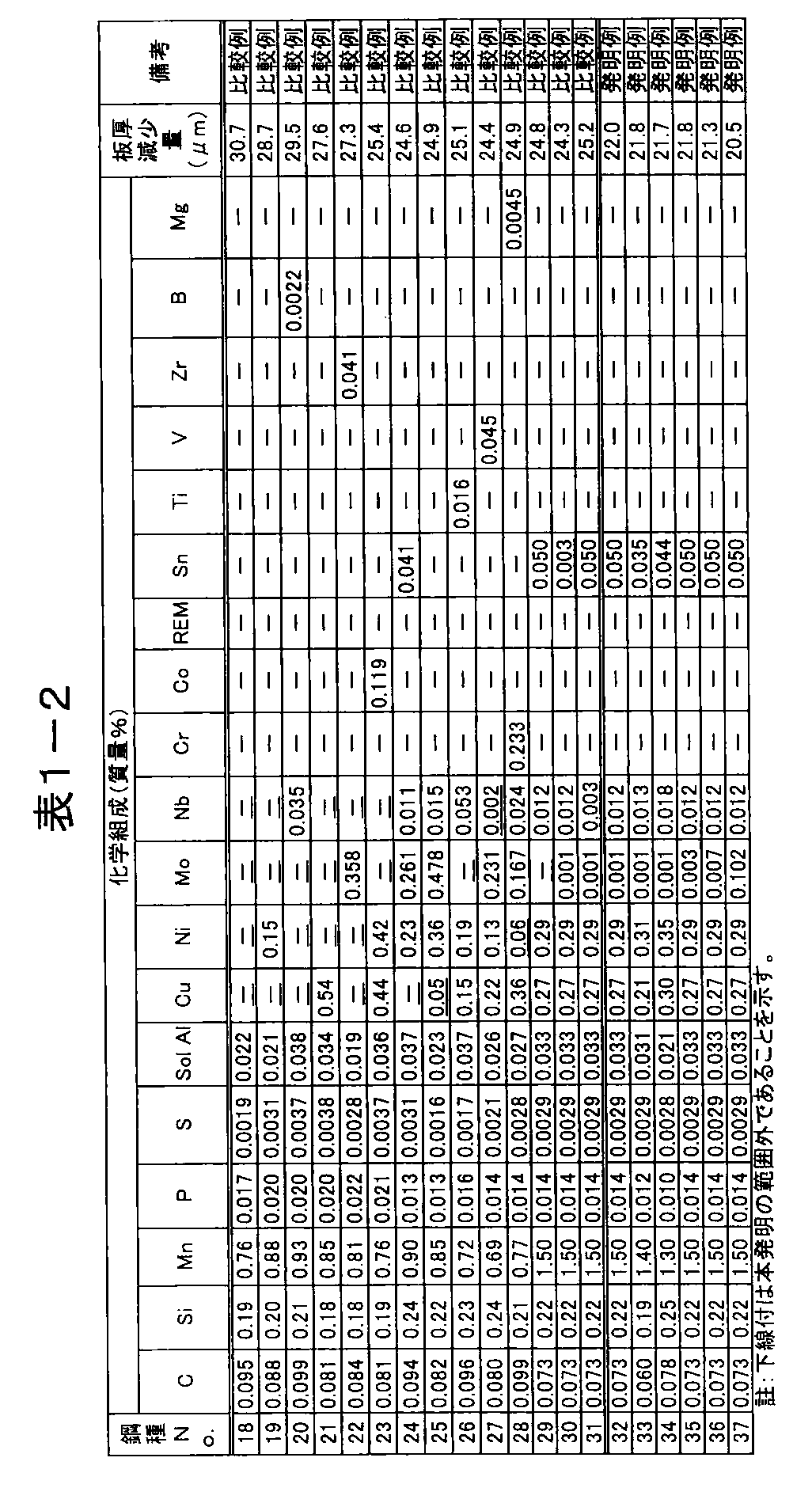
- the standard of applicability of unpainted weathering steel to bridges is known to have a thickness reduction of 0.5 mm or less after 100 years. If the average thickness reduction amount obtained is 22 ⁇ m or less, application to a bridge made of unpainted weathering steel becomes possible. From the above, in Table 1-1 and Table 1-2, it was determined that the weather resistance was excellent with respect to steel materials having an average thickness reduction of 22 ⁇ m or less.
- steel type No. which is an invention example In 1 to 17 and 32 to 37, the reduction in plate thickness was 19.7 to 22.0 ⁇ m, both being 22 ⁇ m or less, and excellent weather resistance.
- steel type No. which is a comparative example In 18 to 31, the steel type No. Since 18 to 24 do not contain any one or more of the essential components Cu, Ni, Mo, and Nb, steel type No. No. 25 has Cu less than the lower limit. Nos. 26 and 29 have a Mo of less than the lower limit. 27, Nb is less than the lower limit. In No. 28, Ni is less than the lower limit. No. 30 has a Sn of less than the lower limit. Since Nb is less than the lower limit of No. 31, the thickness reduction amount is 24.3 to 30.7 ⁇ m, which exceeds 22 ⁇ m, indicating that the weather resistance is greatly inferior to that of the inventive examples.
Landscapes
- Chemical & Material Sciences (AREA)
- Engineering & Computer Science (AREA)
- Materials Engineering (AREA)
- Mechanical Engineering (AREA)
- Metallurgy (AREA)
- Organic Chemistry (AREA)
- Heat Treatment Of Steel (AREA)
- Soft Magnetic Materials (AREA)
Abstract
Description
例えば、特許文献1では、耐候性向上元素として、Cuと1重量%以上のNiを添加した高耐候性鋼材が開示されている。特許文献2では、1mass%以上のNiとMoを添加した耐候性に優れた鋼材が開示されている。
本発明の構造用鋼材は、耐候性向上に有効な元素を複合含有させることで、Niなどの高価な元素を多量に含有することなく低コストで、実用的な溶接性を有し、かつ海岸近傍などの高塩分環境おいて優れた耐候性を有することができる。特に、飛来塩分量が0.05mdd超えの高飛来塩分環境で顕著な効果を有する。
1.成分組成について
はじめに、本発明の鋼の成分組成を規定した理由を説明する。なお、成分%は、すべて質量%を意味する。
Cは構造用鋼材の強度を向上させる元素であり、所定の強度を確保するため0.06%を超えて含有する必要がある。一方、0.14%以上では溶接性および靭性が劣化する。したがって、C量は0.06%超え0.14%未満の範囲とする。好ましくは強度確保の点から0.08%以上、さらに好ましくは溶接性および靱性の点から0.10%未満である。
Siは製鋼時の脱酸剤として、また、構造用鋼材の強度を向上させ所定の強度を確保する元素として、0.05%以上含有する必要がある。一方、2.00%を超えて過剰に含有すると靭性および溶接性が著しく劣化する。したがって、Si量は0.05%以上2.00%以下の範囲とする。好ましくは、0.10%以上0.80%以下である。
Mnは構造用鋼材の強度を向上させる元素であり、所定の強度を確保するために0.20%以上含有する必要がある。一方、2.00%を超えて過剰に含有すると靭性および溶接性が劣化する。したがって、Mn量は0.20%以上2.00%以下の範囲とする。
好ましくは、0.20%以上1.50%以下である。
Pは構造用鋼材の耐候性を向上させる元素である。このような効果を得るためには0.005%以上含有する必要がある。一方、0.030%を超えて含有すると溶接性が劣化する。したがって、P量は0.005%以上0.030%以下の範囲とする。好ましくは、0.005%以上0.025%以下である。
Sは0.0200%を超えて含有すると溶接性および靭性が劣化する。一方、含有量を0.0001%未満まで低下させると、生産コストが増大する。したがって、S量は0.0001%以上0.0200%以下の範囲とする。好ましくは、0.0003%以上0.0050%以下である。
Alは、製鋼時の脱酸に必要な元素である。このような効果を得るため、Al含有量として0.001%以上含有する必要がある。一方、0.100%を超えると溶接性に悪影響を及ぼす。したがって、Al量は0.001%以上0.100%以下の範囲とする。好ましくは、0.010%以上0.050%以下である。なお、Al含有量は酸可溶Alを測定した。
Cuは錆粒を微細化することで緻密な錆層を形成し、構造用鋼材の耐候性を向上させる効果を有する。このような効果は含有量が0.10%以上で得られる。一方、1.00%を超えるとCu消費量増加に伴うコスト上昇を招く。したがって、Cu量は0.10%以上1.00%以下の範囲とする。好ましくは、0.20%以上0.50%以下である。
Niは錆粒を微細化することで緻密な錆層を形成し、構造用鋼材の耐候性を向上させる効果を有する。この効果を充分に得るためには0.10%以上含有する必要がある。一方、0.65%を超えるとNiの消費量増加によるコストの増大を招く。したがって、Ni量は0.10%以上0.65%以下の範囲とする。好ましくは、0.15%以上0.50以下である。
Moは、本発明において重要な要件であり、Nbと共存することにより、高塩分環境における鋼材の耐候性を著しく向上させる効果がある。また、錆層中でモリブデン酸イオンを形成することによって、腐食促進因子の塩化物イオンが錆層を透過して地鉄に到達するのを防止する。また、鋼材のアノード反応に伴ってMoO4 2−が溶出し、鋼材表面にMoを含む化合物が沈殿することで、鋼材のアノード反応を抑制する。これらの効果を充分に得るためには、0.001%以上含有する必要がある。一方、1.000%を超えるとMo消費量増加に伴うコスト上昇を招く。したがって、Mo量は0.001%以上1.000%以下の範囲とする。好ましくは、0.005%以上1.000%以下、さらに好ましくは、0.10%以上0.70%以下である。
Nbは、本発明において重要な要件であり、Moと共存することにより、高塩分環境における鋼材の耐候性を著しく向上させる効果がある。Nbは、鋼材表面近傍の錆層中に濃化し、鋼材のアノード反応を抑制する効果を有する。これらの効果を充分に得るためには、0.005%以上含有する必要がある。一方、0.200%を超えると鋼の靱性の劣化を招く。したがって、Nb量は0.005%以上0.200%以下の範囲とする。好ましくは、0.010%以上0.030%以下である。
Crは、錆粒を微細化することで緻密な錆層を形成し、耐侯性を向上させるのに有効であり、0.2%以上含有するとその効果を発揮し、1.0%を超えると、溶接性の低下を招く。したがって、Crを含有する場合は、その量は0.2%以上1.0%以下の範囲とすることが好ましい。より好ましくは、0.2%以上0.7%以下である。
Coは錆層全体に分布し、錆粒を微細化することで緻密な錆層を形成し、構造用鋼材の耐候性を向上させるのに有効であり、0.01%以上含有するとその効果を発揮し、1.00%を超えて含有するとCo消費量増加に伴うコスト上昇を招く。したがって、Coを含有する場合は、その量は0.01%以上1.00%以下の範囲とすることが好ましい。より好ましくは、0.10%以上0.50%以下である。
REMは錆層全体に分布し、錆粒を微細化することで緻密な錆層を形成し、構造用鋼材の耐候性を向上させるのに有効であり、0.0001%以上含有するとその効果を発揮し、0.1000%を超えるとその効果は飽和する。したがって、REMを含有する場合、その量は0.0001%以上0.1000%以下の範囲とすることが好ましい。より好ましくは、0.0010%以上0.0100%以下である。
Snは錆下層に濃化し、鋼材のアノード反応を抑制するのに有効であり、0.005%以上含有するとその効果を発揮し、0.200%を超えると、靱性の劣化を招く。したがって、Snを含有する場合、その量は0.005%以上0.200%以下の範囲とすることが好ましい。より好ましくは、0.010%以上0.100%以下である。
Tiは、鋼材の強度を高めるために有効な元素であり、0.005%以上含有するとその効果を発揮し、0.200%を超えると靭性の劣化を招く。したがって、Tiを含有する場合、その量は0.005%以上0.200%以下の範囲とすることが好ましい。より好ましくは、0.010%以上0.100%以下である。
Vは、強度を高めるために有効な元素であり、0.005%以上含有するとその効果を発揮し、0.200%を超えると効果が飽和する。したがって、Vを含有する場合、その量は0.005%以上0.200%以下の範囲とすることが好ましい。より好ましくは、0.010%以上0.100%以下である。
Zrは、強度を高めるために有効な元素であり、0.005%以上含有するとその効果を発揮し、0.200%を超えると効果が飽和する。したがって、Zrを含有する場合は、その量は0.005%以上0.200%以下の範囲とすることが好ましい。より好ましくは、0.010%以上0.100%以下である。
Bは、強度を高めるために必要な元素であるが、その量が0.0001%未満であると、その効果は十分に得られない。一方、0.0050%を超えると靭性の劣化を招く。したがって、Bを含有する場合は、その量は0.0001以上0.0050%以下の範囲とすることが好ましい。より好ましくは、0.0005%以上0.0040%以下である。
Mgは、鋼中のSを固定して溶接熱影響部の靭性向上に有効な元素であり、0.0001以上含有するその効果を発揮し、0.0100%を超えると鋼中の介在物の量が増加しかえって靭性の劣化を招く。したがって、Mgを含有する場合は、その量は0.0001%以上0.0100%以下の範囲とすることが好ましい。より好ましくは、0.0005%以上0.0030%以下である。
不可避的不純物として含有するCaは、鋼中に多量に存在すると溶接熱影響部の靭性を劣化させるため0.0010%以下が好ましい。
本発明の耐候性に優れた鋼材は、上記成分組成を有する鋼を通常の連続鋳造(continuous casting)や分塊法により得られたスラブ(slab)を熱間圧延(hot rolling)することにより厚板(steel plate)や形鋼(shaped steel)、薄鋼板(steel sheet)、棒鋼(bar steel)等の鋼材に製造される。なお、加熱、圧延条件は、要求される材質に応じて適宜決定すればよく、制御圧延(controlled rolling)、加速冷却(accelerated cooling)、あるいは再加熱(reheating)の熱処理等の組合せも可能である。
以上により得られた試験片について、耐候性評価試験を行い、耐候性を評価した。
以上より、表1−1および表1−2において、平均板厚減少量が22μm以下の鋼材に対して耐侯性が優れていると判定した。
一方、比較例である鋼種No.18~31では、鋼種No.18~24は必須成分であるCu、Ni、Mo、Nbのうち、いずれか1種以上を含有していないため、鋼種No.25はCuが下限未満で、鋼種No.26、29は、Moが下限未満で、鋼種No.27はNbが下限未満で、鋼種No.28はNiが下限未満で、鋼種No.30はSnが下限未満で、鋼種No.31はNbが下限未満であるため、板厚減少量が24.3~30.7μmと22μmを上回っており、発明例に比べ大きく耐候性が劣っていることがわかる。

Claims (4)
- 質量%で、C:0.06%超え0.14%未満、Si:0.05%以上2.00%以下、Mn:0.20%以上2.00%以下、P:0.005%以上0.030%以下、S:0.0001%以上0.0200%以下、Al:0.001%以上0.100%以下、Cu:0.10%以上1.00%以下、Ni:0.10%以上0.65%以下、Mo:0.001%以上1.000%以下、Nb:0.005%以上0.200%以下を含有し、残部が鉄および不可避的不純物からなる鋼材。
- さらに、質量%で、Mo:0.005%以上1.000%以下を含有する請求項1に記載の鋼材。
- さらに、質量%で、Cr:0.2%以上1.0%以下、Co:0.01%以上1.00%以下、REM:0.0001%以上0.1000%以下、Sn:0.005%以上0.200%以下の中から選ばれる1種または2種以上を含有する請求項1または2に記載の鋼材。
- さらに、質量%で、Ti:0.005%以上0.200%以下、V:0.005%以上0.200%以下、Zr:0.005%以上0.200%以下、B:0.0001%以上0.0050%以下、Mg:0.0001%以上0.0100%以下の中から選ばれる1種または2種以上を含有する請求項1~3に記載の鋼材。
Priority Applications (4)
| Application Number | Priority Date | Filing Date | Title |
|---|---|---|---|
| US14/000,646 US20140056752A1 (en) | 2011-02-25 | 2012-02-24 | Steel material having excellent atmospheric corrosion resistance |
| KR1020157014717A KR20150068500A (ko) | 2011-02-25 | 2012-02-24 | 내후성이 우수한 강재 |
| KR1020137023587A KR20130123432A (ko) | 2011-02-25 | 2012-02-24 | 내후성이 우수한 강재 |
| CN201280010270.XA CN103403211B (zh) | 2011-02-25 | 2012-02-24 | 耐候性优良的钢材 |
Applications Claiming Priority (4)
| Application Number | Priority Date | Filing Date | Title |
|---|---|---|---|
| JP2011039152 | 2011-02-25 | ||
| JP2011-039152 | 2011-02-25 | ||
| JP2012-035950 | 2012-02-22 | ||
| JP2012035950A JP5120510B2 (ja) | 2011-02-25 | 2012-02-22 | 耐候性に優れた鋼材 |
Publications (1)
| Publication Number | Publication Date |
|---|---|
| WO2012115281A1 true WO2012115281A1 (ja) | 2012-08-30 |
Family
ID=46721046
Family Applications (1)
| Application Number | Title | Priority Date | Filing Date |
|---|---|---|---|
| PCT/JP2012/055299 Ceased WO2012115281A1 (ja) | 2011-02-25 | 2012-02-24 | 耐候性に優れた鋼材 |
Country Status (6)
| Country | Link |
|---|---|
| US (1) | US20140056752A1 (ja) |
| JP (1) | JP5120510B2 (ja) |
| KR (2) | KR20150068500A (ja) |
| CN (1) | CN103403211B (ja) |
| MY (1) | MY153707A (ja) |
| WO (1) | WO2012115281A1 (ja) |
Cited By (2)
| Publication number | Priority date | Publication date | Assignee | Title |
|---|---|---|---|---|
| CN103882307A (zh) * | 2012-12-21 | 2014-06-25 | 鞍钢股份有限公司 | 一种原油船货油舱底板用耐腐蚀钢 |
| CN105229189A (zh) * | 2013-05-10 | 2016-01-06 | 杰富意钢铁株式会社 | 焊接结构用钢材 |
Families Citing this family (7)
| Publication number | Priority date | Publication date | Assignee | Title |
|---|---|---|---|---|
| CN106191669A (zh) * | 2016-07-08 | 2016-12-07 | 首钢总公司 | 一种耐候结构钢板及其生产方法 |
| CN107177787B (zh) * | 2017-05-24 | 2019-01-18 | 首钢集团有限公司 | 免涂装钢结构用耐工业大气腐蚀高强螺栓钢及制造方法 |
| CN107747045A (zh) * | 2017-11-29 | 2018-03-02 | 安徽工业大学 | 一种400MPa级耐Cl‑环境腐蚀钢筋及其制造方法 |
| JP7453498B2 (ja) * | 2019-01-15 | 2024-03-21 | 日本製鉄株式会社 | 船舶用lng貯蔵タンクの管理方法 |
| CN113046627B (zh) * | 2021-02-01 | 2022-03-01 | 南京钢铁股份有限公司 | 一种345MPa级耐候桥梁钢及其制造方法 |
| CN113025879B (zh) * | 2021-02-01 | 2022-03-01 | 南京钢铁股份有限公司 | 一种耐候桥梁钢及其冶炼方法 |
| CN113278869A (zh) * | 2021-05-07 | 2021-08-20 | 石横特钢集团有限公司 | 一种耐大气腐蚀钢筋用坯冶炼工艺及其生产方法 |
Citations (3)
| Publication number | Priority date | Publication date | Assignee | Title |
|---|---|---|---|---|
| JP2005281840A (ja) * | 2004-03-31 | 2005-10-13 | Jfe Steel Kk | 高耐食鋼 |
| JP2006118011A (ja) * | 2004-10-22 | 2006-05-11 | Sumitomo Metal Ind Ltd | 海浜耐候性に優れた鋼材と構造物 |
| JP2010163643A (ja) * | 2009-01-14 | 2010-07-29 | Jfe Steel Corp | 耐候性に優れた構造用鋼材 |
Family Cites Families (6)
| Publication number | Priority date | Publication date | Assignee | Title |
|---|---|---|---|---|
| KR101115692B1 (ko) * | 2004-11-12 | 2012-04-13 | 주식회사 포스코 | 해변 내후성이 우수한 고강도 강재 및 그 제조방법 |
| JP4555694B2 (ja) * | 2005-01-18 | 2010-10-06 | 新日本製鐵株式会社 | 加工性に優れる焼付け硬化型熱延鋼板およびその製造方法 |
| JP4868916B2 (ja) * | 2006-04-04 | 2012-02-01 | 株式会社神戸製鋼所 | 耐食性に優れた船舶用鋼材 |
| CN103276291A (zh) * | 2009-01-30 | 2013-09-04 | 杰富意钢铁株式会社 | 耐hic性优良的厚壁高强度热轧钢板及其制造方法 |
| JP5481980B2 (ja) * | 2009-07-16 | 2014-04-23 | Jfeスチール株式会社 | 耐塗膜膨れ性に優れた船舶用鋼材 |
| JP5779847B2 (ja) * | 2009-07-29 | 2015-09-16 | Jfeスチール株式会社 | 化成処理性に優れた高強度冷延鋼板の製造方法 |
-
2012
- 2012-02-22 JP JP2012035950A patent/JP5120510B2/ja active Active
- 2012-02-24 CN CN201280010270.XA patent/CN103403211B/zh active Active
- 2012-02-24 MY MYPI2013002947A patent/MY153707A/en unknown
- 2012-02-24 US US14/000,646 patent/US20140056752A1/en not_active Abandoned
- 2012-02-24 KR KR1020157014717A patent/KR20150068500A/ko not_active Ceased
- 2012-02-24 WO PCT/JP2012/055299 patent/WO2012115281A1/ja not_active Ceased
- 2012-02-24 KR KR1020137023587A patent/KR20130123432A/ko not_active Ceased
Patent Citations (3)
| Publication number | Priority date | Publication date | Assignee | Title |
|---|---|---|---|---|
| JP2005281840A (ja) * | 2004-03-31 | 2005-10-13 | Jfe Steel Kk | 高耐食鋼 |
| JP2006118011A (ja) * | 2004-10-22 | 2006-05-11 | Sumitomo Metal Ind Ltd | 海浜耐候性に優れた鋼材と構造物 |
| JP2010163643A (ja) * | 2009-01-14 | 2010-07-29 | Jfe Steel Corp | 耐候性に優れた構造用鋼材 |
Cited By (4)
| Publication number | Priority date | Publication date | Assignee | Title |
|---|---|---|---|---|
| CN103882307A (zh) * | 2012-12-21 | 2014-06-25 | 鞍钢股份有限公司 | 一种原油船货油舱底板用耐腐蚀钢 |
| CN105229189A (zh) * | 2013-05-10 | 2016-01-06 | 杰富意钢铁株式会社 | 焊接结构用钢材 |
| KR20160003165A (ko) * | 2013-05-10 | 2016-01-08 | 제이에프이 스틸 가부시키가이샤 | 용접 구조용 강재 |
| KR101723459B1 (ko) * | 2013-05-10 | 2017-04-05 | 제이에프이 스틸 가부시키가이샤 | 용접 구조용 강재 |
Also Published As
| Publication number | Publication date |
|---|---|
| JP5120510B2 (ja) | 2013-01-16 |
| KR20130123432A (ko) | 2013-11-12 |
| US20140056752A1 (en) | 2014-02-27 |
| MY153707A (en) | 2015-03-11 |
| CN103403211A (zh) | 2013-11-20 |
| CN103403211B (zh) | 2016-03-02 |
| KR20150068500A (ko) | 2015-06-19 |
| JP2012188754A (ja) | 2012-10-04 |
Similar Documents
| Publication | Publication Date | Title |
|---|---|---|
| JP5120510B2 (ja) | 耐候性に優れた鋼材 | |
| JP5120472B2 (ja) | 耐候性に優れた構造用鋼材 | |
| JP5950037B2 (ja) | 耐候性に優れた鋼材 | |
| WO2011040621A1 (ja) | 耐候性に優れた構造用鋼材および鋼構造物 | |
| JP6556163B2 (ja) | 耐候性に優れた構造用鋼材 | |
| JP5891892B2 (ja) | 高塩分環境下で耐候性に優れたさび層付き鋼材 | |
| JP6094669B2 (ja) | 溶接構造用鋼材 | |
| JP5796403B2 (ja) | 耐候性に優れた溶接構造用鋼材 | |
| JP2012214871A (ja) | 耐食性に優れたさび層付き鋼材 | |
| JP5797877B2 (ja) | 高湿潤環境下において耐食性に優れる耐候性鋼材 | |
| JP5600986B2 (ja) | 耐候性に優れた構造用鋼材 | |
| WO2011145741A1 (ja) | 耐食性に優れる溶接継手および原油タンク | |
| JP6432607B2 (ja) | 耐候性に優れた構造用鋼材 | |
| JP2002226948A (ja) | 融雪塩散布環境下における耐候性に優れた鋼材 | |
| JP2011179022A (ja) | 塗装耐食性に優れた鋼材 |
Legal Events
| Date | Code | Title | Description |
|---|---|---|---|
| 121 | Ep: the epo has been informed by wipo that ep was designated in this application |
Ref document number: 12750198 Country of ref document: EP Kind code of ref document: A1 |
|
| NENP | Non-entry into the national phase |
Ref country code: DE |
|
| ENP | Entry into the national phase |
Ref document number: 20137023587 Country of ref document: KR Kind code of ref document: A |
|
| WWE | Wipo information: entry into national phase |
Ref document number: 14000646 Country of ref document: US |
|
| 122 | Ep: pct application non-entry in european phase |
Ref document number: 12750198 Country of ref document: EP Kind code of ref document: A1 |