WO2012111356A1 - 2液混合型の第1,第2の液及びプリント配線板の製造方法 - Google Patents
2液混合型の第1,第2の液及びプリント配線板の製造方法 Download PDFInfo
- Publication number
- WO2012111356A1 WO2012111356A1 PCT/JP2012/050105 JP2012050105W WO2012111356A1 WO 2012111356 A1 WO2012111356 A1 WO 2012111356A1 JP 2012050105 W JP2012050105 W JP 2012050105W WO 2012111356 A1 WO2012111356 A1 WO 2012111356A1
- Authority
- WO
- WIPO (PCT)
- Prior art keywords
- liquid
- distillation properties
- organic solvent
- naphtha
- group
- Prior art date
- Legal status (The legal status is an assumption and is not a legal conclusion. Google has not performed a legal analysis and makes no representation as to the accuracy of the status listed.)
- Ceased
Links
Images

Classifications
-
- C—CHEMISTRY; METALLURGY
- C08—ORGANIC MACROMOLECULAR COMPOUNDS; THEIR PREPARATION OR CHEMICAL WORKING-UP; COMPOSITIONS BASED THEREON
- C08K—Use of inorganic or non-macromolecular organic substances as compounding ingredients
- C08K3/00—Use of inorganic substances as compounding ingredients
- C08K3/18—Oxygen-containing compounds, e.g. metal carbonyls
- C08K3/20—Oxides; Hydroxides
- C08K3/22—Oxides; Hydroxides of metals
-
- C—CHEMISTRY; METALLURGY
- C08—ORGANIC MACROMOLECULAR COMPOUNDS; THEIR PREPARATION OR CHEMICAL WORKING-UP; COMPOSITIONS BASED THEREON
- C08L—COMPOSITIONS OF MACROMOLECULAR COMPOUNDS
- C08L63/00—Compositions of epoxy resins; Compositions of derivatives of epoxy resins
-
- G—PHYSICS
- G03—PHOTOGRAPHY; CINEMATOGRAPHY; ANALOGOUS TECHNIQUES USING WAVES OTHER THAN OPTICAL WAVES; ELECTROGRAPHY; HOLOGRAPHY
- G03F—PHOTOMECHANICAL PRODUCTION OF TEXTURED OR PATTERNED SURFACES, e.g. FOR PRINTING, FOR PROCESSING OF SEMICONDUCTOR DEVICES; MATERIALS THEREFOR; ORIGINALS THEREFOR; APPARATUS SPECIALLY ADAPTED THEREFOR
- G03F7/00—Photomechanical, e.g. photolithographic, production of textured or patterned surfaces, e.g. printing surfaces; Materials therefor, e.g. comprising photoresists; Apparatus specially adapted therefor
- G03F7/004—Photosensitive materials
- G03F7/0045—Photosensitive materials with organic non-macromolecular light-sensitive compounds not otherwise provided for, e.g. dissolution inhibitors
-
- G—PHYSICS
- G03—PHOTOGRAPHY; CINEMATOGRAPHY; ANALOGOUS TECHNIQUES USING WAVES OTHER THAN OPTICAL WAVES; ELECTROGRAPHY; HOLOGRAPHY
- G03F—PHOTOMECHANICAL PRODUCTION OF TEXTURED OR PATTERNED SURFACES, e.g. FOR PRINTING, FOR PROCESSING OF SEMICONDUCTOR DEVICES; MATERIALS THEREFOR; ORIGINALS THEREFOR; APPARATUS SPECIALLY ADAPTED THEREFOR
- G03F7/00—Photomechanical, e.g. photolithographic, production of textured or patterned surfaces, e.g. printing surfaces; Materials therefor, e.g. comprising photoresists; Apparatus specially adapted therefor
- G03F7/004—Photosensitive materials
- G03F7/0047—Photosensitive materials characterised by additives for obtaining a metallic or ceramic pattern, e.g. by firing
-
- G—PHYSICS
- G03—PHOTOGRAPHY; CINEMATOGRAPHY; ANALOGOUS TECHNIQUES USING WAVES OTHER THAN OPTICAL WAVES; ELECTROGRAPHY; HOLOGRAPHY
- G03F—PHOTOMECHANICAL PRODUCTION OF TEXTURED OR PATTERNED SURFACES, e.g. FOR PRINTING, FOR PROCESSING OF SEMICONDUCTOR DEVICES; MATERIALS THEREFOR; ORIGINALS THEREFOR; APPARATUS SPECIALLY ADAPTED THEREFOR
- G03F7/00—Photomechanical, e.g. photolithographic, production of textured or patterned surfaces, e.g. printing surfaces; Materials therefor, e.g. comprising photoresists; Apparatus specially adapted therefor
- G03F7/004—Photosensitive materials
- G03F7/0048—Photosensitive materials characterised by the solvents or agents facilitating spreading, e.g. tensio-active agents
-
- G—PHYSICS
- G03—PHOTOGRAPHY; CINEMATOGRAPHY; ANALOGOUS TECHNIQUES USING WAVES OTHER THAN OPTICAL WAVES; ELECTROGRAPHY; HOLOGRAPHY
- G03F—PHOTOMECHANICAL PRODUCTION OF TEXTURED OR PATTERNED SURFACES, e.g. FOR PRINTING, FOR PROCESSING OF SEMICONDUCTOR DEVICES; MATERIALS THEREFOR; ORIGINALS THEREFOR; APPARATUS SPECIALLY ADAPTED THEREFOR
- G03F7/00—Photomechanical, e.g. photolithographic, production of textured or patterned surfaces, e.g. printing surfaces; Materials therefor, e.g. comprising photoresists; Apparatus specially adapted therefor
- G03F7/004—Photosensitive materials
- G03F7/027—Non-macromolecular photopolymerisable compounds having carbon-to-carbon double bonds, e.g. ethylenic compounds
-
- G—PHYSICS
- G03—PHOTOGRAPHY; CINEMATOGRAPHY; ANALOGOUS TECHNIQUES USING WAVES OTHER THAN OPTICAL WAVES; ELECTROGRAPHY; HOLOGRAPHY
- G03F—PHOTOMECHANICAL PRODUCTION OF TEXTURED OR PATTERNED SURFACES, e.g. FOR PRINTING, FOR PROCESSING OF SEMICONDUCTOR DEVICES; MATERIALS THEREFOR; ORIGINALS THEREFOR; APPARATUS SPECIALLY ADAPTED THEREFOR
- G03F7/00—Photomechanical, e.g. photolithographic, production of textured or patterned surfaces, e.g. printing surfaces; Materials therefor, e.g. comprising photoresists; Apparatus specially adapted therefor
- G03F7/004—Photosensitive materials
- G03F7/038—Macromolecular compounds which are rendered insoluble or differentially wettable
-
- G—PHYSICS
- G03—PHOTOGRAPHY; CINEMATOGRAPHY; ANALOGOUS TECHNIQUES USING WAVES OTHER THAN OPTICAL WAVES; ELECTROGRAPHY; HOLOGRAPHY
- G03F—PHOTOMECHANICAL PRODUCTION OF TEXTURED OR PATTERNED SURFACES, e.g. FOR PRINTING, FOR PROCESSING OF SEMICONDUCTOR DEVICES; MATERIALS THEREFOR; ORIGINALS THEREFOR; APPARATUS SPECIALLY ADAPTED THEREFOR
- G03F7/00—Photomechanical, e.g. photolithographic, production of textured or patterned surfaces, e.g. printing surfaces; Materials therefor, e.g. comprising photoresists; Apparatus specially adapted therefor
- G03F7/004—Photosensitive materials
- G03F7/09—Photosensitive materials characterised by structural details, e.g. supports, auxiliary layers
- G03F7/11—Photosensitive materials characterised by structural details, e.g. supports, auxiliary layers having cover layers or intermediate layers, e.g. subbing layers
-
- G—PHYSICS
- G03—PHOTOGRAPHY; CINEMATOGRAPHY; ANALOGOUS TECHNIQUES USING WAVES OTHER THAN OPTICAL WAVES; ELECTROGRAPHY; HOLOGRAPHY
- G03F—PHOTOMECHANICAL PRODUCTION OF TEXTURED OR PATTERNED SURFACES, e.g. FOR PRINTING, FOR PROCESSING OF SEMICONDUCTOR DEVICES; MATERIALS THEREFOR; ORIGINALS THEREFOR; APPARATUS SPECIALLY ADAPTED THEREFOR
- G03F7/00—Photomechanical, e.g. photolithographic, production of textured or patterned surfaces, e.g. printing surfaces; Materials therefor, e.g. comprising photoresists; Apparatus specially adapted therefor
- G03F7/16—Coating processes; Apparatus therefor
-
- H—ELECTRICITY
- H05—ELECTRIC TECHNIQUES NOT OTHERWISE PROVIDED FOR
- H05K—PRINTED CIRCUITS; CASINGS OR CONSTRUCTIONAL DETAILS OF ELECTRIC APPARATUS; MANUFACTURE OF ASSEMBLAGES OF ELECTRICAL COMPONENTS
- H05K3/00—Apparatus or processes for manufacturing printed circuits
- H05K3/22—Secondary treatment of printed circuits
- H05K3/28—Applying non-metallic protective coatings
- H05K3/285—Permanent coating compositions
- H05K3/287—Photosensitive compositions
-
- H—ELECTRICITY
- H10—SEMICONDUCTOR DEVICES; ELECTRIC SOLID-STATE DEVICES NOT OTHERWISE PROVIDED FOR
- H10H—INORGANIC LIGHT-EMITTING SEMICONDUCTOR DEVICES HAVING POTENTIAL BARRIERS
- H10H20/00—Individual inorganic light-emitting semiconductor devices having potential barriers, e.g. light-emitting diodes [LED]
- H10H20/80—Constructional details
- H10H20/85—Packages
- H10H20/857—Interconnections, e.g. lead-frames, bond wires or solder balls
-
- H—ELECTRICITY
- H10—SEMICONDUCTOR DEVICES; ELECTRIC SOLID-STATE DEVICES NOT OTHERWISE PROVIDED FOR
- H10W—GENERIC PACKAGES, INTERCONNECTIONS, CONNECTORS OR OTHER CONSTRUCTIONAL DETAILS OF DEVICES COVERED BY CLASS H10
- H10W72/00—Interconnections or connectors in packages
- H10W72/071—Connecting or disconnecting
- H10W72/072—Connecting or disconnecting of bump connectors
- H10W72/07251—Connecting or disconnecting of bump connectors characterised by changes in properties of the bump connectors during connecting
-
- H—ELECTRICITY
- H10—SEMICONDUCTOR DEVICES; ELECTRIC SOLID-STATE DEVICES NOT OTHERWISE PROVIDED FOR
- H10W—GENERIC PACKAGES, INTERCONNECTIONS, CONNECTORS OR OTHER CONSTRUCTIONAL DETAILS OF DEVICES COVERED BY CLASS H10
- H10W72/00—Interconnections or connectors in packages
- H10W72/20—Bump connectors, e.g. solder bumps or copper pillars; Dummy bumps; Thermal bumps
Definitions
- the present invention relates to a two-component mixed type first and second solution for obtaining a photosensitive composition as a mixture.
- the present invention is a two-liquid mixture suitably used for forming a solder resist film on a substrate or forming a resist film that reflects light on a substrate on which a light emitting diode chip is mounted.
- the present invention relates to a method for manufacturing a printed wiring board using first and second liquids of a mold and the first and second liquids of the two liquid mixture type.
- Solder resist films are widely used as protective films for protecting printed wiring boards from high-temperature solder.
- a light emitting diode (hereinafter abbreviated as LED) chip is mounted on the upper surface of a printed wiring board.
- a white solder resist film may be formed on the upper surface of the printed wiring board in order to use light that has reached the upper surface side of the printed wiring board among the light emitted from the LEDs.
- not only light directly irradiated from the surface of the LED chip to the opposite side of the printed wiring board but also reflected light that reaches the upper surface side of the printed wiring board and is reflected by the white solder resist film can be used. . Therefore, the utilization efficiency of the light generated from the LED can be increased.
- Patent Document 1 contains an alkoxy group-containing silane-modified epoxy resin obtained by a dealcoholization reaction between an epoxy resin and a hydrolyzable alkoxysilane.
- a resist material further containing an unsaturated group-containing polycarboxylic acid resin, a diluent, a photopolymerization initiator, and a cured adhesion-imparting agent is disclosed.
- Patent Document 2 discloses a white solder resist material containing a carboxyl group-containing resin having no aromatic ring, a photopolymerization initiator, an epoxy compound, a rutile titanium oxide, and a diluent. Yes.
- An object of the present invention is a two-liquid mixed type first and second liquid, which is excellent in the mixing property of the first and second liquids, and is a mixture in which the first and second liquids are mixed.
- the two-liquid mixed type first and second liquids that can be uniformly coated while suppressing unevenness, and the two-liquid mixing It is to provide a method for manufacturing a printed wiring board using first and second liquids of a mold.
- the two-liquid mixed type first and second liquids for obtaining a photosensitive composition which is a mixture
- the two-liquid mixed type first and second liquids are The photosensitive composition which is a liquid before the first and second liquids are mixed, and is a mixture in which the first and second liquids are mixed, and a polymerizable polymer having a carboxyl group as a whole
- a photopolymerization initiator, a compound having a cyclic ether group, titanium oxide, and an organic solvent wherein the photosensitive composition includes dipropylene glycol monomethyl ether, diethylene glycol monoethyl ether acetate, and distillation properties as the organic solvent.
- the second liquid contains a compound having the cyclic ether group, and as part of the organic solvent, diethylene glycol monoethyl ether acetate, dipropylene glycol monomethyl ether, and the initial boiling point in the distillation property is 150. At least one selected from the group consisting of naphtha having an endpoint in distillation properties of 220 ° C. or lower, and the first liquid contains the photopolymerization initiator or the titanium oxide, Or both the photopolymerization initiator and the titanium oxide And when the first liquid does not contain the photopolymerization initiator, the second liquid contains the photopolymerization initiator, and when the first liquid does not contain the titanium oxide, A two-liquid mixed type first and second liquid containing two titanium oxides are provided.
- a method of manufacturing a printed wiring board according to the present invention is a manufacturing of a printed wiring board including a printed wiring board main body having a circuit on the surface and a solder resist film laminated on the surface of the printed wiring board main body provided with the circuit.
- a photosensitive composition, which is a solder resist composition in which the first and second liquids are mixed, is applied onto the surface of the main body provided with the circuit, and the circuit of the printed wiring board main body is provided.
- the photosensitive composition which is a solder resist composition in which the first and second liquids are mixed, has a polymerizable weight having a carboxyl group as a whole.
- Coalescence A photopolymerization initiator, a compound having a cyclic ether group, titanium oxide, and an organic solvent, wherein the photosensitive composition includes dipropylene glycol monomethyl ether, diethylene glycol monoethyl ether acetate, and distillation as the organic solvent.
- the photosensitive composition includes dipropylene glycol monomethyl ether, diethylene glycol monoethyl ether acetate, and distillation as the organic solvent.
- the first liquid includes the polymerizable polymer
- the organic solvent As part of the organic solvent, at least selected from the group consisting of dipropylene glycol monomethyl ether, diethylene glycol monoethyl ether acetate and naphtha having an initial boiling point of 150 ° C. or more in distillation properties and an end point in distillation properties of 290 ° C. or less. 1 type is included
- the second liquid is the ring Including a compound having an ether group, and as part of the organic solvent, diethylene glycol monoethyl ether acetate, dipropylene glycol monomethyl ether, and an initial boiling point in distillation properties of 150 ° C. or higher, and an end point in distillation properties of 220 ° C. or lower.
- the first liquid contains the photopolymerization initiator, the titanium oxide, or the photopolymerization initiator and the titanium oxide.
- the second liquid contains the photopolymerization initiator, and the first liquid does not contain the titanium oxide.
- the second liquid contains the titanium oxide.
- the first liquid may be used as a part of the organic solvent. It includes at least two selected from the group consisting of propylene glycol monomethyl ether, diethylene glycol monoethyl ether acetate and naphtha having an initial boiling point of 150 ° C. or more in distillation properties and an end point in distillation properties of 290 ° C. or less.
- the first liquid is a part of the organic solvent, Dipropylene glycol monomethyl ether and diethylene glycol monoethyl ether acetate at least, or diethylene glycol monoethyl ether acetate and naphtha having an initial boiling point of 150 ° C. or more in distillation properties and an end point of 290 ° C. or less in distillation properties Including at least.
- the first liquid is a part of the organic solvent, It contains at least dipropylene glycol monomethyl ether and naphtha having an initial boiling point of 150 ° C. or more in distillation properties and an end point of 290 ° C. or less in distillation properties.
- the photosensitive composition contains dipropylene glycol as the organic solvent.
- a naphtha having an initial distillation point in the distillation property of 150 ° C. or more and an end point in the distillation property of 290 ° C. or less is a naphtha having an initial distillation point in the distillation property of 150 ° C. or more and an end point in the distillation property of 220 ° C. or less.
- the first liquid contains the photopolymerization initiator.
- the first liquid contains the titanium oxide.
- the first liquid includes the photopolymerization initiator and the oxidation. Including both titanium.
- the photosensitive composition in which the first and second liquids are mixed is suitably used as the solder resist composition.
- the photosensitive composition in which the first and second liquids are mixed is preferably a solder resist composition.
- the two-liquid mixed type first and second liquids according to the present invention are two-liquid mixed type first and second liquids for obtaining a photosensitive composition as a mixture.
- the first and second liquids are liquids before the first and second liquids are mixed, and the photosensitive composition, which is a mixture of the first and second liquids, is a carboxyl group as a whole.
- the first liquid is the polymerizable polymer Including and As part of the organic solvent, at least selected from the group consisting of dipropylene glycol monomethyl ether, diethylene glycol monoethyl ether acetate and naphtha having an initial boiling point of 150 ° C. or more in distillation properties and an end point in distillation properties of 290 ° C. or less.
- the second liquid contains the compound having the cyclic ether group and, as a part of the organic solvent, diethylene glycol monoethyl ether acetate, dipropylene glycol monomethyl ether, and the initial boiling point in distillation properties are Whether the first liquid contains the photopolymerization initiator or the titanium oxide, including at least one selected from the group consisting of naphtha having a distillation property of 150 ° C. or higher and an end point in distillation property of 220 ° C. or lower. Or the photopolymerization initiator and the titanium oxide Therefore, when the photosensitive composition after mixing is coated on the coating target member, the coating is uniformly performed while suppressing unevenness. can do.
- FIG. 1 is a partially cutaway front sectional view schematically showing an example of an LED device having a resist film using a two-liquid mixed type first and second liquid according to an embodiment of the present invention.
- the two-liquid mixed type first and second liquids according to the present invention are used to obtain a photosensitive composition which is a mixture.
- the two-liquid mixed type first and second liquids according to the present invention are kits used for obtaining a photosensitive composition as a mixture.
- the two-liquid mixed type first and second liquids according to the present invention are mixed and used.
- the two-liquid mixed type first and second liquids according to the present invention are liquids before the first and second liquids are mixed.
- the first and second liquids before being mixed are the photosensitive compositions before being mixed.
- the photosensitive composition which is a mixture in which the first and second liquids of the two liquid mixture type according to the present invention are mixed as a whole is a polymerizable polymer (A) having a carboxyl group and a photopolymerization initiator (B ), A compound (C) having a cyclic ether group, titanium oxide (D), and an organic solvent (E) (hereinafter, the organic solvent contained in the entire photosensitive composition is referred to as an organic solvent (E). May be included).
- the mixture in which the first and second liquids are mixed is a photosensitive composition, and the mixed photosensitive composition as a whole is a polymerizable polymer (A) having a carboxyl group and a photopolymerization initiator.
- B the compound (C) which has a cyclic ether group, a titanium oxide (D), and the organic solvent (E) are included.
- the photosensitive composition includes, as the organic solvent (E), dipropylene glycol monomethyl ether, diethylene glycol monoethyl ether acetate, and naphtha having an initial boiling point of 150 ° C. or higher in distillation properties and 290 ° C. or lower in distillation properties. At least two selected from the group consisting of:
- the first liquid contains the polymerizable polymer (A) and, as a part of the organic solvent (E), dipropylene glycol monomethyl ether, diethylene glycol monoethyl ether acetate and an initial boiling point of 150 in distillation properties are 150. It contains at least one selected from the group consisting of naphtha having an end point in the distillation property of 290 ° C. or lower.
- the second liquid contains the compound (C) having the cyclic ether group, and as part of the organic solvent (E), diethylene glycol monoethyl ether acetate, dipropylene glycol monomethyl ether, and an initial distillation in distillation properties. It includes at least one selected from the group consisting of naphtha having a point of 150 ° C. or higher and an end point in distillation properties of 220 ° C. or lower.
- the first liquid contains the photopolymerization initiator (B), contains the titanium oxide (D), or contains both the photopolymerization initiator (B) and the titanium oxide (D). .
- the second liquid contains the photopolymerization initiator (B).
- the first liquid does not contain the titanium oxide (D)
- the second liquid contains the titanium oxide (D).
- the photopolymerization initiator (B) and the titanium oxide (D) may each be contained in the first liquid, may be contained in the second liquid, the first liquid, and the second liquid It may be contained in both of the liquid.
- the two-liquid mixed type first and second liquids according to the present invention contain a polymerizable monomer described later or an antioxidant described later
- the polymerizable monomer And the antioxidant may be contained in the first liquid, may be contained in the second liquid, or may be contained in both the first liquid and the second liquid.
- the mixing properties of the first and second liquids can be enhanced. Furthermore, when the photosensitive composition after mixing is applied onto a coating target member such as a substrate, it can be uniformly applied while suppressing unevenness caused largely by titanium oxide. In particular, when the photosensitive composition after mixing is applied by screen printing, streaky unevenness can be suppressed.
- the two-liquid mixed type first and second liquids according to the present invention are preferably two-liquid mixed type first and second liquids to be applied by screen printing.
- the photopolymerization initiator (B) is contained in the first liquid, not the second liquid. In this case, the mixing properties of the first and second liquids are further enhanced, and the photosensitive composition can be applied more uniformly.
- the titanium oxide (D) is preferably contained in the first liquid, not the second liquid. In this case, the dispersibility of titanium oxide (D) is increased, the mixing properties of the first and second liquids are further increased, and the photosensitive composition can be applied more uniformly.
- both the photopolymerization initiator (B) and the titanium oxide (D) are contained in the first liquid instead of the second liquid.
- the dispersibility of titanium oxide (D) is further enhanced, the mixing properties of the first and second liquids are further enhanced, and the photosensitive composition can be applied more uniformly.
- the polymerizable polymer (A) has a carboxyl group.
- the polymerizable polymer (A) having a carboxyl group has polymerizability and can be polymerized. When the polymerizable polymer (A) has a carboxyl group, the developability of the photosensitive composition is improved.
- Examples of the polymerizable polymer (A) include an acrylic resin having a carboxyl group, an epoxy resin having a carboxyl group, and an olefin resin having a carboxyl group.
- the “resin” is not limited to a solid resin, and includes a liquid resin and an oligomer.
- the polymerizable polymer (A) is preferably the following carboxyl group-containing resins (a) to (e).
- (E) A resin obtained by reacting an epoxy compound having an aromatic ring with a saturated polybasic acid anhydride or an unsaturated polybasic acid anhydride, or an epoxy compound having an aromatic ring and at least one unsaturated double bond Resin obtained by further reacting with a saturated polybasic acid anhydride or an unsaturated polybasic acid anhydride after reacting with a carboxyl group-containing compound Polymerization having the carboxyl group in 100% by weight of the photosensitive composition
- the content of the polymer (A) is preferably 3% by weight or more, more preferably 5% by weight or more, preferably 50% by weight or less, more preferably 40% by weight or less.
- Photopolymerization initiator (B) Since the said photosensitive composition contains a photoinitiator (B), a photosensitive composition can be hardened by irradiation of light.
- the photopolymerization initiator (B) is not particularly limited. As for a photoinitiator (B), only 1 type may be used and 2 or more types may be used together.
- Examples of the photopolymerization initiator (B) include acylphosphine oxide, halomethylated triazine, halomethylated oxadiazole, imidazole, benzoin, benzoin alkyl ether, anthraquinone, benzanthrone, benzophenone, acetophenone, thioxanthone, benzoic acid ester , Acridine, phenazine, titanocene, ⁇ -aminoalkylphenone, oxime, and derivatives thereof.
- the said photoinitiator (B) only 1 type may be used and 2 or more types may be used together.
- the content of the photopolymerization initiator (B) is preferably 0.1 parts by weight or more, more preferably 1 part by weight or more, preferably 100 parts by weight of the polymerizable polymer (A) having a carboxyl group. 30 parts by weight or less, more preferably 15 parts by weight or less.
- the photosensitivity of the photosensitive composition can be further enhanced.
- the photosensitive composition contains a compound (C) having a cyclic ether skeleton. Further, the use of the compound (C) having the cyclic ether skeleton also improves the curability of the photosensitive composition.
- Examples of the compound (C) having a cyclic ether skeleton include heterocyclic epoxy resins such as bisphenol S type epoxy resin, diglycidyl phthalate resin, triglycidyl isocyanurate, bixylenol type epoxy resin, biphenol type epoxy resin, tetra Glycidyl xylenoyl ethane resin, bisphenol A type epoxy resin, hydrogenated bisphenol A type epoxy resin, bisphenol F type resin, brominated bisphenol A type epoxy resin, phenol novolac type epoxy resin, cresol novolac type epoxy resin, alicyclic epoxy Resin, bisphenol A novolak type epoxy resin, chelate type epoxy resin, glyoxal type epoxy resin, amino group-containing epoxy resin, rubber-modified epoxy resin, dicyclopentadiene resin Norick type epoxy resins, silicone-modified epoxy resin and ⁇ - caprolactone-modified epoxy resin. Only 1 type may be used for the compound (C) which has the said cyclic ether ske
- the compound (C) having the cyclic ether skeleton reacts with the carboxyl group of the polymerizable polymer (A) having the carboxyl group to act to cure the photosensitive composition.
- the content of the compound (C) having a cyclic ether skeleton is preferably 0.1 parts by weight or more, more preferably 1 part by weight or more with respect to 100 parts by weight of the polymerizable polymer (A) having a carboxyl group. Preferably it is 50 weight part or less, More preferably, it is 30 weight part or less.
- the content of the compound (C) having the cyclic ether skeleton is not less than the above lower limit and not more than the above upper limit, the electrical insulation of the resist film can be further enhanced.
- titanium oxide (D) Since the said photosensitive composition contains titanium oxide (D), hardened
- the titanium oxide (D) contained in the said photosensitive composition is not specifically limited. As for titanium oxide (D), only 1 type may be used and 2 or more types may be used together.
- titanium oxide (D) By using the above titanium oxide (D), it is possible to form a resist film having a high reflectance as compared with the case where an inorganic filler other than titanium oxide (D) is used.
- the titanium oxide (D) is preferably rutile titanium oxide or anatase titanium oxide.
- rutile type titanium oxide By using rutile type titanium oxide, a more excellent resist film can be formed by heat-resistant yellowing.
- the anatase type titanium oxide has a lower hardness than the rutile type titanium oxide. For this reason, the use of anatase-type titanium oxide can improve the processability of the resist film.
- the titanium oxide (D) preferably contains rutile titanium oxide that has been surface-treated with silicon oxide or a silicone compound.
- the content of the rutile titanium oxide surface-treated with the silicon oxide or the silicone compound is preferably 10% by weight or more, more preferably 30% by weight or more and 100% by weight or less. It is.
- the total amount of the titanium oxide (D) may be rutile titanium oxide surface-treated with the silicon oxide or the silicone compound.
- rutile titanium oxide surface-treated with silicon oxide or silicone compound examples include, for example, product number: CR-90 manufactured by Ishihara Sangyo Co., Ltd., which is a rutile chlorine method titanium oxide, and manufactured by Ishihara Sangyo Co., Ltd., which is a rutile sulfuric acid method titanium oxide.
- the content of titanium oxide (D) is preferably 3% by weight or more, more preferably 10% by weight or more, still more preferably 15% by weight or more, preferably 80% by weight or less. More preferably, it is 75 weight% or less, More preferably, it is 70 weight% or less.
- the content of titanium oxide (D) is not less than the above lower limit and not more than the above upper limit, the resist film is hardly yellowed when exposed to high temperatures. Furthermore, a photosensitive composition having a viscosity suitable for coating can be easily prepared.
- the photosensitive composition contains an organic solvent (E).
- the photosensitive composition in which the first and second liquids are mixed contains an organic solvent (E).
- the photosensitive composition contains at least two organic solvents.
- the organic solvent (E1) contained in the first liquid hereinafter, the organic solvent contained in the first liquid may be referred to as an organic solvent (E1)
- the second liquid Is different from the organic solvent (E2) contained in the organic solvent (hereinafter, the organic solvent contained in the second liquid may be referred to as the organic solvent (E2)).
- organic solvents include ketones such as methyl ethyl ketone and cyclohexanone, aromatic hydrocarbons such as toluene, xylene and tetramethylbenzene, cellosolve, methyl cellosolve, butyl cellosolve, carbitol, methylcarbitol, butyl Carbitol, propylene glycol monomethyl ether, dipropylene glycol monomethyl ether, dipropylene glycol diethyl ether, glycol ethers such as tripropylene glycol monomethyl ether, ethyl acetate, butyl acetate, butyl lactate, cellosolve acetate, butyl cellosolve acetate, carbitol acetate, Butyl carbitol acetate, propylene glycol monomethyl ether acetate, diethylene glycol monoethyl ester Ether acetate, dipropylene glycol monomethyl ether acetate, esters such
- the first liquid is distilled as a part of the organic solvent (E) with dipropylene glycol monomethyl ether, diethylene glycol monoethyl ether acetate and an initial boiling point of 150 ° C. or more in distillation properties. At least one selected from the group consisting of naphtha whose end point in properties is 290 ° C. or lower is essential. At least one of dipropylene glycol monomethyl ether, diethylene glycol monoethyl ether acetate and naphtha having an initial boiling point of 150 ° C. or higher in distillation properties and an end point of 290 ° C. or lower in distillation properties is an organic solvent (E1).
- the second liquid has diethylene glycol monoethyl ether acetate, dipropylene glycol monomethyl ether, and an initial boiling point of 150 ° C. as a part of the organic solvent (E).
- at least 1 sort (s) selected from the group which consists of naphtha whose end point in distillation property is 220 degrees C or less is included.
- At least one selected from the group consisting of diethylene glycol monoethyl ether acetate, dipropylene glycol monomethyl ether, and naphtha having an initial distillation point of 150 ° C. or more in distillation properties and an end point of distillation properties of 220 ° C. or less is an organic solvent ( E2).
- ⁇ / RTI> By including such organic solvents (E1) and (E2) in the first and second liquids, the mixing properties of the first and second liquids are remarkably improved.
- the use of the specific organic solvent (E1) or (E2) further includes the specific organic solvent (E1) or (E2) separately in the first liquid and the second liquid. This greatly contributes to the improvement of the mixing properties of the first and second liquids and the suppression of unevenness after the application of the mixed photosensitive composition.
- the “initial boiling point in distillation properties” and the “end point in distillation properties” mean values measured by JIS K2254 “Petroleum products—distillation test method”.
- the first liquid is dipropylene glycol monomethyl ether as a part of the organic solvent (E), and naphtha having an initial boiling point of 150 ° C. or more in distillation properties and an end point of 220 ° C. or less in distillation properties. It is also preferable to include at least one kind. Both the first liquid as a part of the organic solvent (E), dipropylene glycol monomethyl ether, and naphtha having an initial boiling point of 150 ° C. or more in distillation properties and an end point of 220 ° C. or less in distillation properties In the case of containing, the first liquid may or may not contain titanium oxide.
- the first liquid may contain dipropylene glycol monomethyl ether or diethylene glycol monoethyl ether acetate as a part of the organic solvent (E), and has an initial boiling point of 150 in the distillation property.
- a naphtha having an end point in distillation properties of 150 ° C. or more may be included, and an naphtha having an end point in distillation properties of 220 ° C. or less may be included.
- the second liquid may contain diethylene glycol monoethyl ether acetate or dipropylene glycol monomethyl ether as a part of the organic solvent (E), and may have an initial boiling point in distillation properties. May contain naphtha having a temperature of 150 ° C. or higher and an end point in distillation properties of 220 ° C. or lower.
- the photosensitive composition is at least 2 selected from the group consisting of dipropylene glycol monomethyl ether, diethylene glycol monoethyl ether acetate, and naphtha having an initial boiling point of 150 ° C. or higher in distillation properties and an end point of 290 ° C. or lower in distillation properties. Including species.
- the photosensitive composition includes three kinds of dipropylene glycol monomethyl ether, diethylene glycol monoethyl ether acetate, and naphtha having an initial boiling point of 150 ° C. or more in distillation properties and an end point of 290 ° C. or less in distillation properties. May be.
- the photosensitive composition contains at least dipropylene glycol monomethyl ether and diethylene glycol monoethyl ether acetate, or diethylene glycol monoethyl ether acetate and distilled. It is preferable to include at least naphtha having an initial boiling point of 150 ° C. or more in properties and an end point of 290 ° C. or less in distillation properties.
- the photosensitive composition preferably contains at least dipropylene glycol monomethyl ether and diethylene glycol monoethyl ether acetate.
- the photosensitive composition may contain naphtha having an initial boiling point of 150 ° C. or more in distillation properties and an end point of 290 ° C. or less in distillation properties.
- the photosensitive composition is composed of diethylene glycol monoethyl ether acetate and an initial boiling point of 150 ° C. or more in distillation properties and an end point of 290 ° C. or less in distillation properties. It preferably contains at least some naphtha.
- the first liquid preferably contains dipropylene glycol monomethyl ether.
- the photosensitive composition has dipropylene glycol monomethyl ether and an initial boiling point of 150 ° C. or more in distillation properties and an end point of 290 ° C. or less in distillation properties. It preferably contains at least some naphtha.
- the first liquid may contain diethylene glycol monoethyl ether acetate.
- naphtha having an initial boiling point of 150 ° C. or more in the distillation property and an end point of distillation property of 290 ° C. or less in the photosensitive composition is the first in the distillation property.
- a naphtha having a boiling point of 150 ° C. or higher and an end point in distillation properties of 220 ° C. or lower is preferable.
- the first liquid is dipropylene glycol monomethyl ether, diethylene glycol monoethyl ether acetate as a part of the organic solvent (E), has an initial boiling point of 150 ° C. or more in distillation properties, and an end point in distillation properties of 290 ° C. It is preferable to include at least two selected from the group consisting of the following naphtha. In this case, the mixing property of the first and second liquids can be further improved, and the photosensitive composition can be applied more uniformly.
- the first liquid is dipropylene glycol monomethyl ether, diethylene glycol monoethyl ether acetate as a part of the organic solvent (E), has an initial boiling point of 150 ° C. or more in distillation properties, and an end point in distillation properties of 290 ° C. You may include three types with the following naphtha.
- the first liquid contains, as a part of the organic solvent (E), at least dipropylene glycol monomethyl ether and diethylene glycol monoethyl ether acetate, or diethylene glycol monoethyl ether acetate and an initial boiling point in distillation properties. It is preferable that at least 150 degreeC and the naphtha whose end point in distillation property is 290 degrees C or less are included. In this case, the mixing property of the first and second liquids can be further improved, and the photosensitive composition can be applied more uniformly.
- the first liquid is used as a part of the organic solvent (E). It is preferable to contain at least dipropylene glycol monomethyl ether and diethylene glycol monoethyl ether acetate. In this case, the first liquid may contain naphtha having an initial boiling point of 150 ° C. or more in distillation properties and an end point of 290 ° C. or less in distillation properties.
- the first liquid is used as a part of the organic solvent (E). It is preferable to contain at least diethylene glycol monoethyl ether acetate and naphtha having an initial boiling point of 150 ° C. or higher in distillation properties and an end point of 290 ° C. or lower in distillation properties.
- the first liquid preferably contains dipropylene glycol monomethyl ether.
- the first liquid is used as a part of the organic solvent (E). It is preferable to contain at least dipropylene glycol monomethyl ether and naphtha having an initial boiling point of 150 ° C. or more in distillation properties and an end point of 290 ° C. or less in distillation properties.
- the first liquid may contain diethylene glycol monoethyl ether acetate.
- the photosensitive composition may be dipropylene glycol monomethyl ether as the organic solvent. And diethylene glycol monoethyl ether acetate and at least two selected from the group consisting of naphtha having an initial boiling point of 150 ° C. or higher in distillation properties and an end point in distillation properties of 220 ° C. or lower. Distillation properties in the first liquid
- the naphtha having an initial boiling point of 150 ° C. or higher and an end point in distillation properties of 290 ° C. or lower is preferably a naphtha having an initial boiling point of 150 ° C. or higher in distillation properties and an end point in distillation properties of 220 ° C. or lower.
- the first liquid may not contain diethylene glycol monoethyl ether acetate.
- the initial boiling point in distillation properties is 150 ° C. or higher, and the end point in distillation properties is 220 ° C. It may contain at least two kinds selected from the group consisting of the following naphtha.
- the second liquid is diethylene glycol monoethyl ether acetate and dipropylene glycol monomethyl ether as part of the organic solvent (E), the initial boiling point in the distillation property is 150 ° C. or higher, and the end point in the distillation property is 220 ° C. You may include three types with the following naphtha.
- the second liquid is used as a part of the organic solvent (E). It is preferable to contain at least diethylene glycol monoethyl ether acetate and dipropylene glycol monomethyl ether. In this case, the second liquid may contain naphtha having an initial boiling point of 150 ° C. or higher in distillation properties and an end point of 220 ° C. or lower in distillation properties.
- the second liquid is used as a part of the organic solvent (E). It is preferable to contain at least diethylene glycol monoethyl ether acetate and naphtha having an initial boiling point of 150 ° C. or higher in distillation properties and an end point of 220 ° C. or lower in distillation properties.
- the second liquid preferably contains dipropylene glycol monomethyl ether.
- the second liquid is used as a part of the organic solvent (E). It is preferable to include at least dipropylene glycol monomethyl ether and naphtha having an initial boiling point of 150 ° C. or more in distillation properties and an end point of 220 ° C. or less in distillation properties.
- the second liquid may contain diethylene glycol monoethyl ether acetate.
- the second liquid may not contain diethylene glycol monoethyl ether acetate.
- the content of the organic solvent (E) is not particularly limited. In consideration of the coating properties of the photosensitive composition, the organic solvent (E) can be used in an appropriate content. In 100% by weight of the photosensitive composition after mixing, the total content of the organic solvent (E) (the total content of the organic solvent (E1) and the organic solvent (E2)) is preferably 10% by weight. Above, more preferably 15% by weight or more, preferably 60% by weight or less, more preferably 50% by weight or less.
- the first and second liquids of the two-liquid mixed type are used in the first and second liquids as a whole.
- the content of the organic solvent (E1) contained in the first liquid and the content of the organic solvent (E2) contained in the second liquid are 1:99 to 99: 1 in a weight ratio. It is preferably 1: 9 to 9: 1, more preferably 2: 8 to 8: 2, and particularly preferably 3: 7 to 7: 3.
- the organic solvent (E) contained in the first liquid in a total content of 100% by weight of the organic solvent (E) contained in the photosensitive composition (
- the weight ratio of the content of E1) and the content of the organic solvent (E2) contained in the second liquid is preferably 1:99 to 99: 1, and 1: 9 to 9 : 1 is more preferable, 2: 8 to 8: 2 is still more preferable, and 3: 7 to 7: 3 is particularly preferable.
- the content of diethylene glycol monoethyl ether acetate may be 30% by weight or more in 100% by weight of the whole of the first and second liquids of the two-component mixed type and 100% by weight of the photosensitive composition after mixing. In 100% by weight of the first liquid, the content of diethylene glycol monoethyl ether acetate may be 50% by weight or less, or 55% by weight or more.
- the first liquid contains two kinds of organic solvents
- the second liquid contains two kinds of organic solvents
- the first liquid and the second liquid have a large content.
- the content of the organic solvent and the content of the organic solvent having a lower content are preferably in a weight ratio of 1:99 to 99: 1, more preferably 1: 9 to 9: 1.
- it is 2: 8 to 8: 2, more preferably 3: 7 to 7: 3.
- the content of the first liquid and the second liquid is the highest.
- the content of the organic solvent having the largest amount and the content of the organic solvent having the second largest content are preferably 1:99 to 99: 1 by weight, more preferably 1: 9 to 9: 1.
- it is 2: 8 to 8: 2, more preferably 3: 7 to 7: 3.
- the lower limit of the content of the organic solvent having the smallest content is not particularly limited.
- the photosensitive composition preferably contains a polymerizable monomer as a component different from the polymerizable polymer (A) having a carboxyl group.
- the photosensitive composition preferably contains both a polymerizable polymer (A) having a carboxyl group and a polymerizable monomer.
- the polymerizable monomer is polymerizable and can be polymerized.
- the polymerizable monomer is not particularly limited. As for the said polymerizable monomer, only 1 type may be used and 2 or more types may be used together.
- the polymerizable monomer is preferably a polymerizable unsaturated group-containing monomer.
- the polymerizable unsaturated group in the polymerizable monomer include functional groups having a polymerizable unsaturated double bond such as a (meth) acryloyl group and a vinyl ether group.
- a (meth) acryloyl group is preferable because the crosslinking density of the resist film can be increased.
- the polymerizable unsaturated group-containing monomer is preferably a compound having a (meth) acryloyl group.
- the compound having the (meth) acryloyl group include a di (meth) acrylate modified product of glycol such as ethylene glycol, methoxytetraethylene glycol, polyethylene glycol or propylene glycol, polyhydric alcohol, and ethylene oxide adduct of polyhydric alcohol.
- a polyhydric (meth) acrylate modified product of a propylene oxide adduct of a polyhydric alcohol a (meth) acrylate modified product of phenol, an ethylene oxide adduct of phenol or a propylene oxide adduct of phenol, glycerin diglycidyl ether or (Meth) acrylate modified products of glycidyl ether such as trimethylolpropane triglycidyl ether and melamine (meth) acrylate are exemplified.
- Examples of the polyhydric alcohol include hexanediol, trimethylolpropane, pentaerythritol, dipentaerythritol, and tris-hydroxyethyl isocyanurate.
- Examples of the (meth) acrylate of phenol include phenoxy (meth) acrylate and di (meth) acrylate modified products of bisphenol A.
- (Meth) acryloyl means acryloyl and methacryloyl.
- (Meth) acryl means acrylic and methacrylic.
- (Meth) acrylate means acrylate and methacrylate.
- the content of the polymerizable monomer is 100% by weight in total of the polymerizable monomer and the polymerizable polymer (A) having a carboxyl group.
- it is 5 weight% or more, Preferably it is 50 weight% or less.
- a photosensitive composition can fully be hardened as content of the said polymerizable monomer is more than the said minimum and below the said upper limit. Furthermore, the crosslink density of the resist film becomes appropriate, sufficient resolution can be obtained, and the resist film is hardly yellowed.
- the photosensitive composition preferably contains an antioxidant.
- the antioxidant preferably has a Lewis basic site.
- the antioxidant is at least one selected from the group consisting of phenolic antioxidants, phosphorus antioxidants, and amine antioxidants. Is preferred.
- the antioxidant is preferably a phenolic antioxidant. That is, the photosensitive composition preferably contains a phenolic antioxidant.
- IRGANOX 1010 Commercially available products of the above-mentioned phenolic antioxidants include IRGANOX 1010, IRGANOX 1035, IRGANOX 1076, IRGANOX 1135, IRGANOX 245, IRGANOX 259, and IRGANOX 295 (all of which are manufactured by Ciba Japan), ADK STAB AO-30, ADK STAB AO-40, ADK STAB AO-50, ADK STAB AO-60, ADK STAB AO-70, ADK STAB AO-80, ADK STAB AO-90, and ADK STAB AO-330 (all of which are manufactured by ADEKA), Sumilizer GA-80, and Sumizer MDP-S, Sumilizer BBM-S, Sumilizer GM, Sumilizer GS (F), and S milizer GP (all of which are manufactured by Sumitomo Chemical Co., Ltd.), HOSTANOX O10, HOSTANOX O16, HOSTANO
- Examples of the phosphorus antioxidant include cyclohexylphosphine and triphenylphosphine.
- Commercially available phosphoric antioxidants include ADK STAB PEP-4C, ADK STAB PEP-8, ADK STAB PEP-24G, ADK STAB PEP-36, ADK STAB HP-10, ADK STAB 2112, ADK STAB 260, ADK STAB 522A, ADK STAB 1178, and ADK STAB 1178 1500, ADK STAB C, ADK STAB 135A, ADK STAB 3010, and ADK STAB TPP (all of which are manufactured by ADEKA), Sandstub P-EPQ, and Hostanox PAR24 (all of which are manufactured by Clariant), and JP-312L, JP -318-0, JPM-308, JPM-313, JPP-613M, JPP-31, JPP-2000PT, and JPH-3800 Re also be mentioned Johoku Chemical Industry Co., Ltd.), and the like.
- amine antioxidant examples include triethylamine, dicyandiamide, melamine, ethyldiamino-S-triazine, 2,4-diamino-S-triazine, 2,4-diamino-6-tolyl-S-triazine, 2,4- And diamino-6-xylyl-S-triazine and quaternary ammonium salt derivatives.
- the content of the antioxidant is preferably 0.1 parts by weight or more, more preferably 5 parts by weight or more, and preferably 30 parts by weight or less with respect to 100 parts by weight of the polymerizable polymer (A) having a carboxyl group. More preferably, it is 15 parts by weight or less.
- the content of the antioxidant is not less than the above lower limit and not more than the upper limit, a more excellent resist film can be formed by heat yellowing.
- the photosensitive composition includes a colorant, a filler, an antifoaming agent, a curing agent, a curing accelerator, a mold release agent, a surface treatment agent, a flame retardant, a viscosity modifier, a dispersant, a dispersion aid, a surface modification agent.
- a quality agent, a plasticizer, an antibacterial agent, an antifungal agent, a leveling agent, a stabilizer, a coupling agent, an anti-sagging agent, or a phosphor may be included.
- the above-mentioned photosensitive composition can be prepared, for example, by stirring and mixing the blending components and then uniformly mixing with three rolls.
- Examples of the light source used for curing the photosensitive composition include an irradiation device that emits active energy rays such as ultraviolet rays or visible rays.
- Examples of the light source include an ultrahigh pressure mercury lamp, a deep UV lamp, a high pressure mercury lamp, a low pressure mercury lamp, a metal halide lamp, and an excimer laser. These light sources are appropriately selected according to the photosensitive wavelength of the constituent components of the photosensitive composition.
- the irradiation energy of light is appropriately selected depending on the desired film thickness or the constituent components of the photosensitive composition.
- the irradiation energy of light is generally in the range of 10 to 3000 mJ / cm 2 .
- the two-liquid mixed type first and second liquids according to the present invention are preferably used for forming a resist film of an LED device, and more preferably used for forming a solder resist film.
- the two-liquid mixed type first and second liquids according to the present invention are preferably resist compositions, and are preferably solder resist compositions.
- a method for manufacturing a printed wiring board according to the present invention is a method for manufacturing a printed wiring board comprising a printed wiring board main body having a circuit on its surface and a resist film laminated on the surface of the printed wiring board main body provided with the circuit. Is the method.
- the resist film is formed of a two-liquid mixed type first and second liquid according to the present invention.
- FIG. 1 schematically shows an example of an LED device having a solder resist film formed using a two-liquid mixed type first and second liquid according to an embodiment of the present invention in a partially cutaway front sectional view. .
- a resist film 3 formed of a two-liquid mixed type first and second liquid is laminated on an upper surface 2a of a substrate 2.
- the resist film 3 is a pattern film. Therefore, the resist film 3 is not formed in a part of the upper surface 2 a of the substrate 2.
- Electrodes 4a and 4b are provided on the upper surface 2a of the substrate 2 where the resist film 3 is not formed.
- the substrate 2 is preferably a printed wiring board body.
- the LED chip 7 is laminated on the upper surface 3 a of the resist film 3.
- An LED chip 7 is laminated on the substrate 2 via the resist film 3.
- Terminals 8 a and 8 b are provided on the outer peripheral edge of the lower surface 7 a of the LED chip 7.
- the terminals 8a and 8b are electrically connected to the electrodes 4a and 4b by the solder 9a and 9b. By this electrical connection, power can be supplied to the LED chip 7.
- Acrylic polymer 1 (polymer having a carboxyl group, acrylic polymer 1 obtained in Synthesis Example 1 below)
- Glycidyl acrylate was added in such an amount that the molar ratio of the total amount of all the monomer units of the obtained resin was 10 and then heated at 100 ° C. for 30 hours using tetrabutylammonium bromide as a catalyst. The group was subjected to an addition reaction. After cooling, it was taken out from the flask to obtain a solution containing 50 wt% (nonvolatile content) of a carboxyl group-containing resin having a solid content acid value of 60 mg KOH / g, a weight average molecular weight of 15000, and a double bond equivalent of 1000.
- this solution is referred to as acrylic polymer 1.
- Acrylic polymer 2 (polymerizable polymer having a carboxyl group, acrylic polymer 2 obtained in Synthesis Example 2 below)
- TMPTA (acrylic monomer, trimethylolpropane triacrylate, specific gravity 1.1)
- TPO photopolymerization initiator that is a photo radical generator, manufactured by BASF Japan
- Irgacure 819 photopolymerization initiator that is a photoradical generator, manufactured by BASF Japan Ltd.
- R-830 titanium oxide, manufactured by Ishihara Sangyo Co., Ltd., rutile titanium oxide manufactured by the sulfuric acid method
- Ethyl carbitol acetate (diethylene glycol monoethyl ether acetate, manufactured by Daicel Chemical Industries, dipole moment 1 Debye or more, specific gravity 1.0)
- Solvesso 150 Naphtha, ExxonMobil Corporation, initial boiling point 189 ° C. in distillation properties, end point 210 ° C. in distillation properties
- Solvesso 100 (naphtha, manufactured by ExxonMobil, initial boiling point 165 ° C. in distillation properties, end point 174 ° C. in distillation properties)
- Solvesso 200 Naphtha, ExxonMobil Corporation, initial boiling point 230 ° C. in distillation properties, end point 283 ° C. in distillation properties
- Example 1 15 g of the acrylic polymer 1 obtained in Synthesis Example 1, 5 g of DPHA (dipentaerythritol hexaacrylate), 2 g of TPO (a photopolymerization initiator that is a photoradical generator, manufactured by BASF Japan), and CR-50 ( 40 g of titanium oxide (manufactured by Ishihara Sangyo Co., Ltd.) and 25 g of Solvesso 150 (naphtha, manufactured by ExxonMobil Corp.) are mixed and mixed for 3 minutes with a blender (Nentaro SP-500, manufactured by Shinky Corp.) The mixture was obtained by a roll to obtain a mixture. Thereafter, the obtained mixture was degassed for 3 minutes using SP-500 to obtain a first liquid.
- DPHA dipentaerythritol hexaacrylate
- TPO a photopolymerization initiator that is a photoradical generator, manufactured by BASF Japan
- CR-50 40 g of titanium oxide
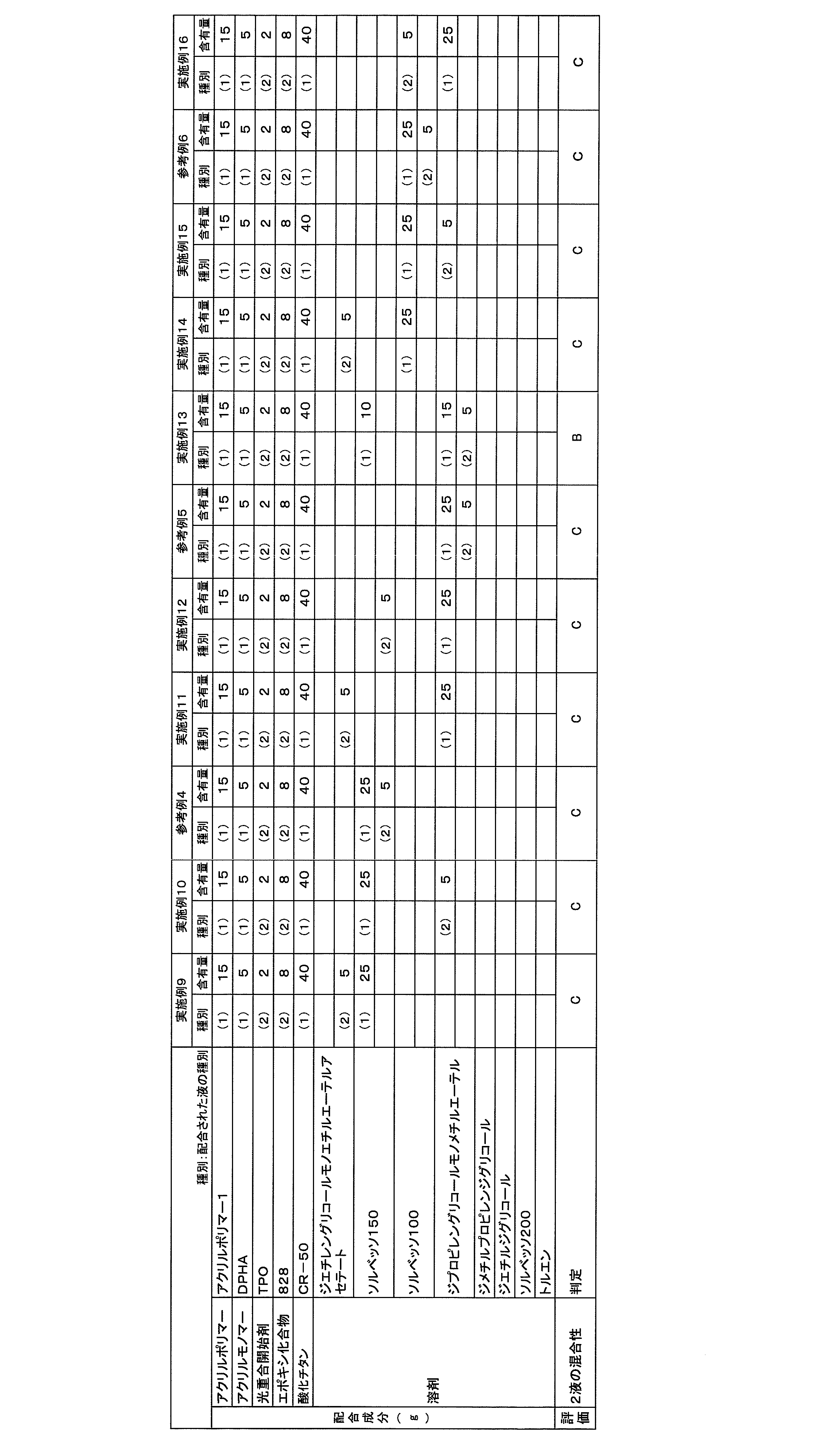
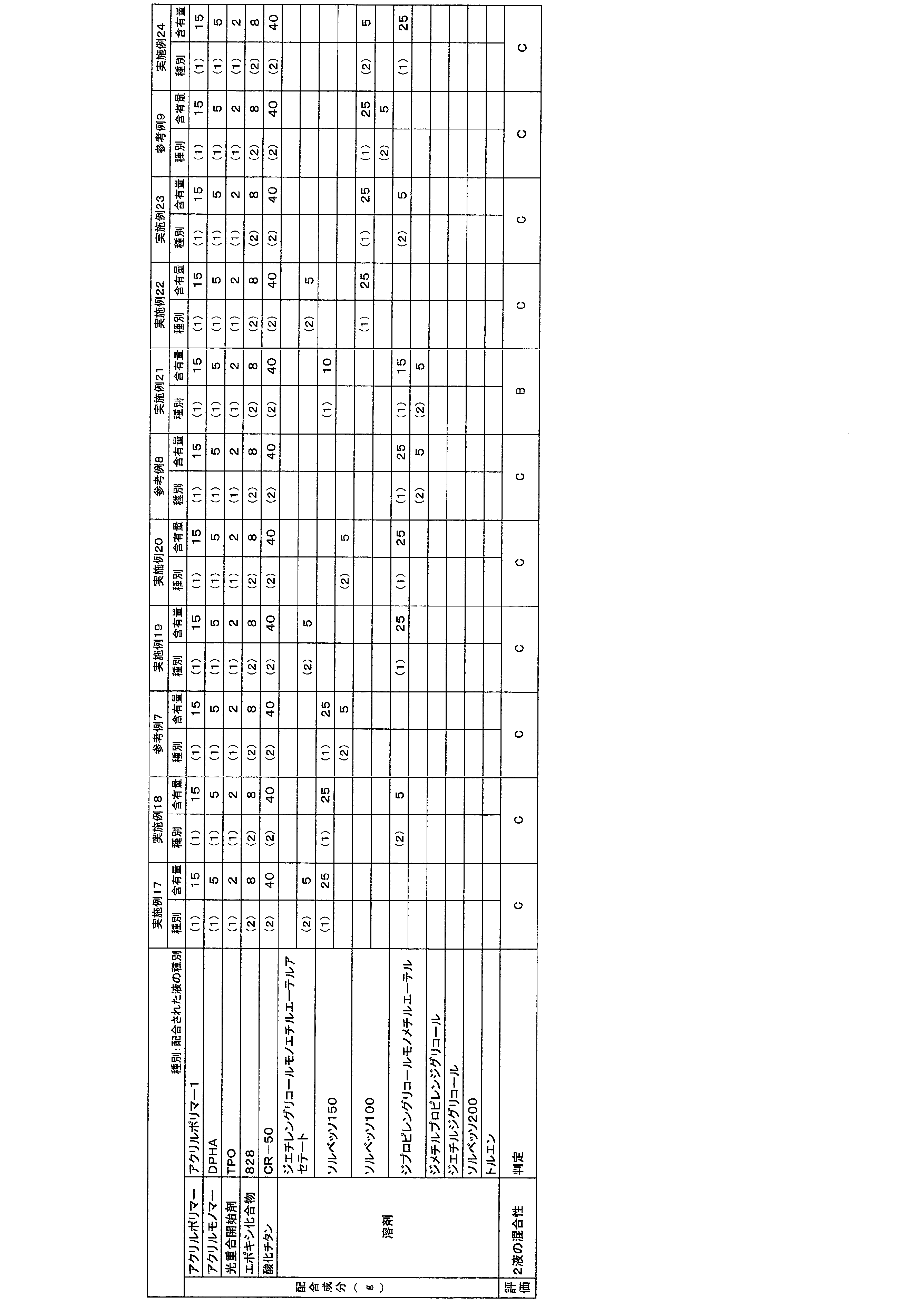
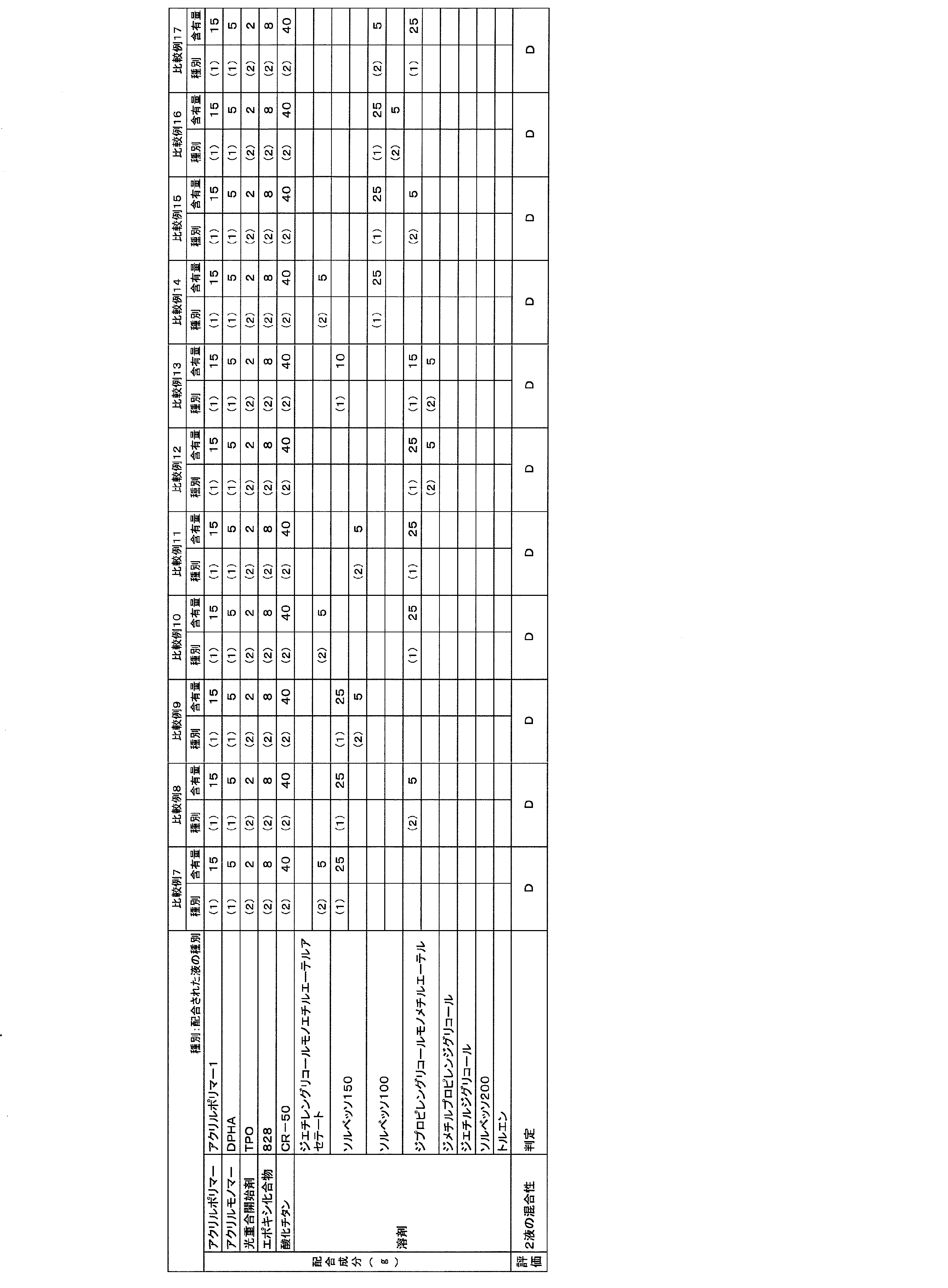
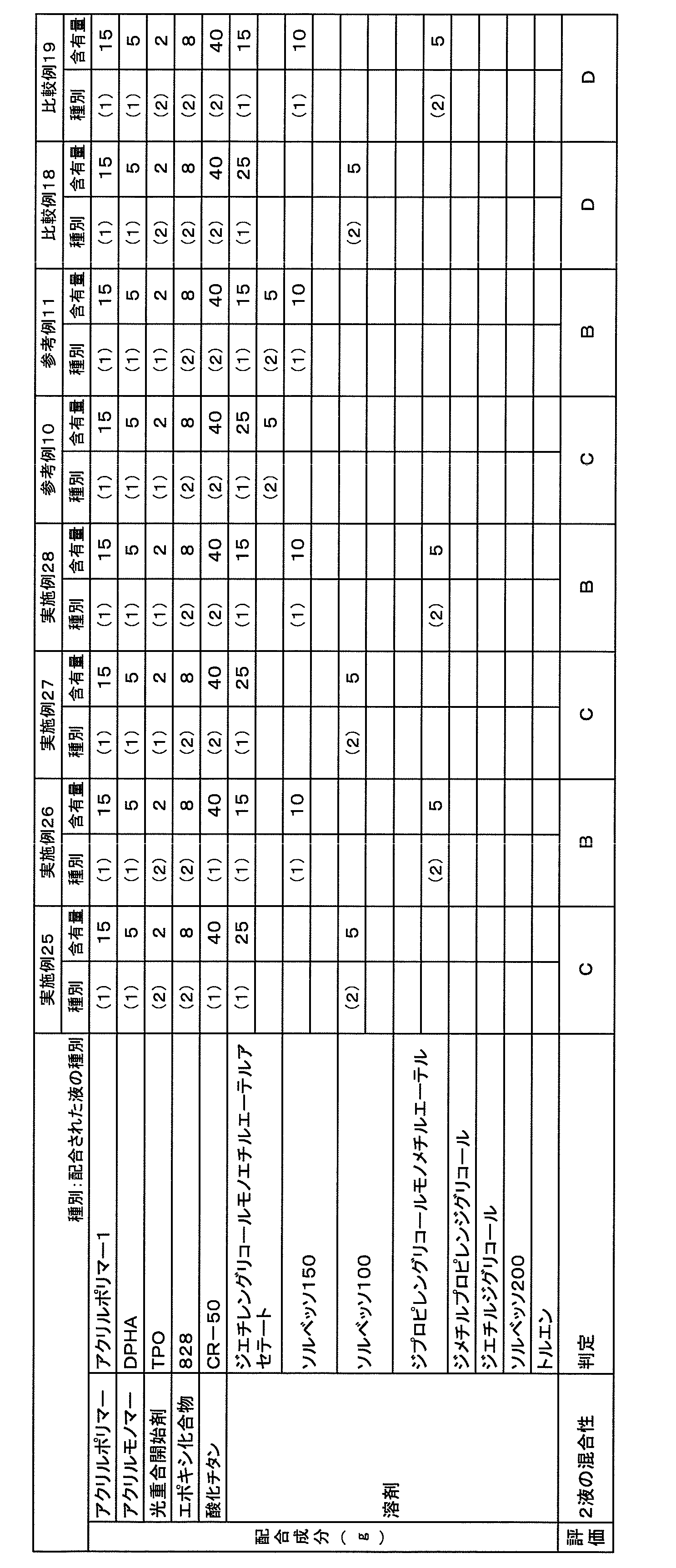
- Examples 2 to 49 Reference Examples 1 to 11 and Comparative Examples 1 to 19
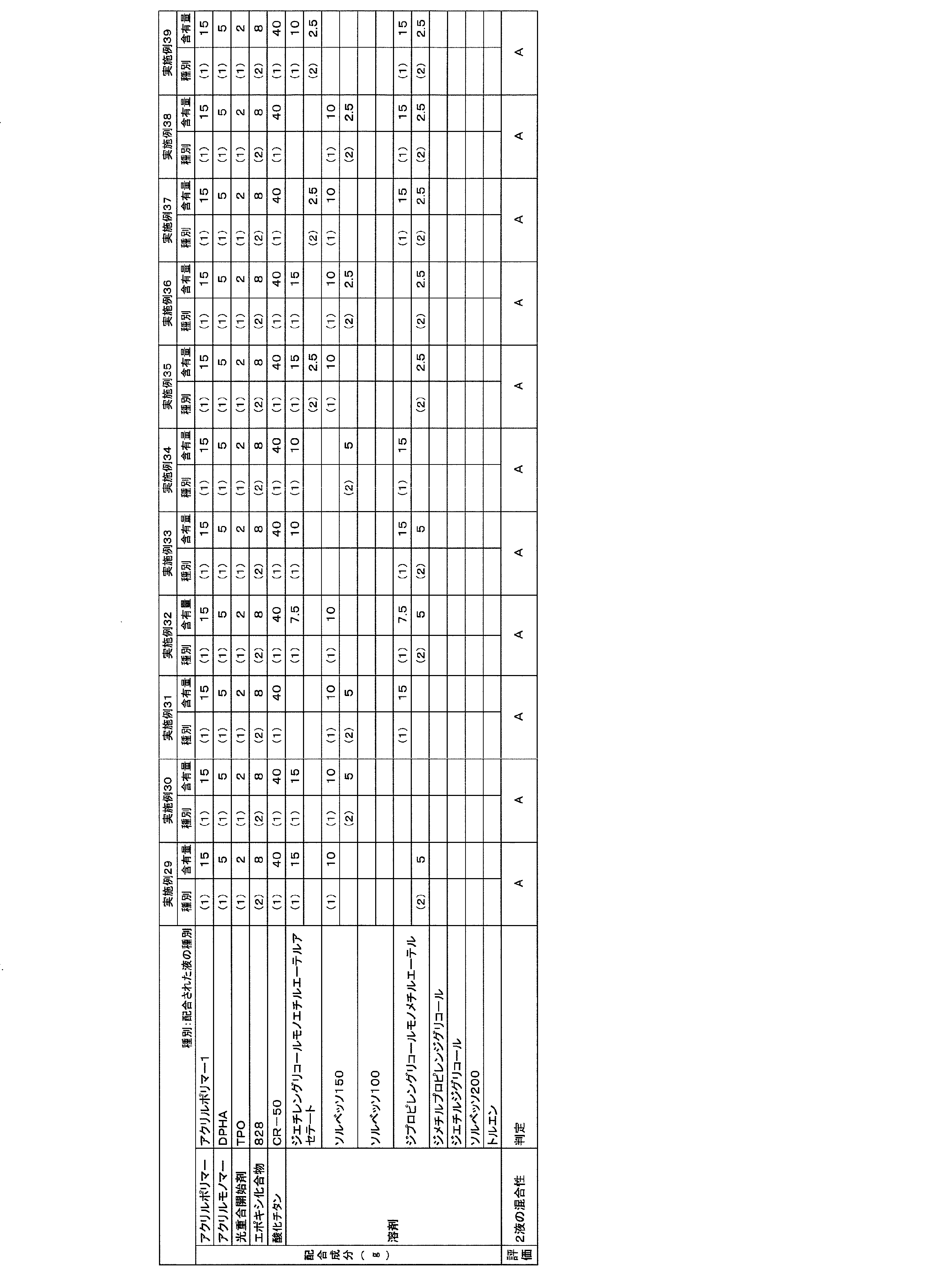
- the first and second liquids were the same as in Example 1 except that the types and amounts of the materials used in the first liquid and the second liquid were changed as shown in Tables 1 to 8 below.
- a two-liquid mixed type first and second liquid photosensitive composition before mixing
- the first liquid and the second liquid are placed in a 1 L round plastic container (BHS-1200, manufactured by Kinki Container Co., Ltd.), and the resist material is stirred for 1 minute at 50 rpm by an automatic ink kneader manufactured by Mesh Co., Ltd.
- a photosensitive composition after mixing was prepared. Further, the first liquid and the second liquid are put into a 1 L round plastic container (BHS-1200, manufactured by Kinki Container Co., Ltd.), and the resist is stirred for 5 minutes at 50 rpm by an automatic ink kneader manufactured by Mesh Co.
- a material (photosensitive composition after mixing) was prepared.
- a 100 ⁇ 100 mm FR-4 substrate with a copper foil attached to the surface was prepared.
- the resist material immediately after stirring was applied to the surface of the FR-4 substrate on which the copper foil was attached by screen printing to form a resist material layer. The appearance of the resist material layer on the substrate was visually observed.
- the mixing property of the first and second liquids was determined according to the following criteria.
- Example 5 and Example 29 are more preferable than Example 33.
- the photosensitive composition was uniformly mixed.
- the evaluation results of the mixing properties of the two liquids of Example 30, Example 31 and Example 34 are all “A”, but Example 30 and Example 31 are much shorter than Example 34.
- the photosensitive composition was uniformly mixed.
- the evaluation results of the mixing properties of the two liquids of Example 35, Example 37, and Example 39 are all “A”, but Example 35 and Example 37 are much shorter than Example 39. Over time, the photosensitive composition was uniformly mixed.
Landscapes
- Physics & Mathematics (AREA)
- General Physics & Mathematics (AREA)
- Chemical & Material Sciences (AREA)
- Engineering & Computer Science (AREA)
- Spectroscopy & Molecular Physics (AREA)
- Health & Medical Sciences (AREA)
- Organic Chemistry (AREA)
- Polymers & Plastics (AREA)
- Medicinal Chemistry (AREA)
- Chemical Kinetics & Catalysis (AREA)
- Ceramic Engineering (AREA)
- Microelectronics & Electronic Packaging (AREA)
- Manufacturing & Machinery (AREA)
- Structural Engineering (AREA)
- Architecture (AREA)
- Materials For Photolithography (AREA)
Abstract
Description
本発明の目的は、2液混合型の第1,第2の液であって、該第1,第2の液の混合性に優れており、第1,第2の液が混合された混合物である感光性組成物を塗工対象部材上に塗工したときに、むらを抑制して均一に塗工することができる2液混合型の第1,第2の液、並びに該2液混合型の第1,第2の液を用いたプリント配線板の製造方法を提供することである。
本発明に係る2液混合型の第1,第2の液及び本発明に係るプリント配線板の製造方法の別の特定の局面では、上記感光性組成物が、上記有機溶剤として、ジプロピレングリコールモノメチルエーテル、ジエチレングリコールモノエチルエーテルアセテート及び蒸留性状における初留点が150℃以上、蒸留性状における終点が220℃以下であるナフサからなる群から選択された少なくとも2種を含み、上記第1の液における上記蒸留性状における初留点が150℃以上、蒸留性状における終点が290℃以下であるナフサが、蒸留性状における初留点が150℃以上、蒸留性状における終点が220℃以下であるナフサである。
上記重合性重合体(A)はカルボキシル基を有する。カルボキシル基を有する重合性重合体(A)は重合性を有し、重合可能である。上記重合性重合体(A)がカルボキシル基を有することで、感光性組成物の現像性が良好になる。上記重合性重合体(A)としては、例えば、カルボキシル基を有するアクリル樹脂、カルボキシル基を有するエポキシ樹脂及びカルボキシル基を有するオレフィン樹脂が挙げられる。なお、「樹脂」は、固形樹脂に限定されず、液状樹脂及びオリゴマーも含む。
上記感光性組成物100重量%中、上記カルボキシル基を有する重合性重合体(A)の含有量は、好ましくは3重量%以上、より好ましくは5重量%以上、好ましくは50重量%以下、より好ましくは40重量%以下である。上記カルボキシル基を有する重合性重合体(A)の含有量が上記下限以上及び上記上限以下であると、感光性組成物の硬化性が良好になる。
上記感光性組成物は、光重合開始剤(B)を含むので、光の照射により感光性組成物を硬化させることができる。光重合開始剤(B)は特に限定されない。光重合開始剤(B)は、1種のみが用いられてもよく、2種以上が併用されてもよい。
レジスト膜の切り出し加工性を高めることなどを目的として、上記感光性組成物は、環状エーテル骨格を有する化合物(C)を含む。また、上記環状エーテル骨格を有する化合物(C)の使用により、感光性組成物の硬化性も良好になる。
上記感光性組成物は、酸化チタン(D)を含むので、反射率が高いレジスト膜などの硬化物膜を形成できる。上記感光性組成物に含まれている酸化チタン(D)は特に限定されない。酸化チタン(D)は、1種のみが用いられてもよく、2種以上が併用されてもよい。
上記感光性組成物は、有機溶剤(E)を含む。上記第1,第2の液を混合した感光性組成物は、有機溶剤(E)を含む。上記感光性組成物は、少なくとも2種の有機溶剤を含む。上記第1の液に含まれている有機溶剤(E1)(以下、第1の液に含まれている有機溶剤を、有機溶剤(E1)と記載することがある)と、上記第2の液に含まれている有機溶剤(E2)(以下、第2の液に含まれている有機溶剤を、有機溶剤(E2)と記載することがある)とは異なることが好ましい。
上記第1の液は、上記有機溶剤(E)の一部として、ジプロピレングリコールモノメチルエーテル、及び蒸留性状における初留点が150℃以上、蒸留性状における終点が220℃以下であるナフサの内の少なくとも1種を含むことも好ましい。上記第1の液が、上記有機溶剤(E)の一部として、ジプロピレングリコールモノメチルエーテル、及び蒸留性状における初留点が150℃以上、蒸留性状における終点が220℃以下であるナフサとの双方を含む場合に、上記第1の液は酸化チタンを含んでいてもよく、含んでいなくてもよい。
硬化性をより一層高めるために、上記感光性組成物は、カルボキシル基を有する重合性重合体(A)とは異なる成分として、重合性単量体を含むことが好ましい。上記感光性組成物は、カルボキシル基を有する重合性重合体(A)と重合性単量体との双方を含むことが好ましい。上記重合性単量体は重合性を有し、重合可能である。上記重合性単量体は特に限定されない。上記重合性単量体は、1種のみが用いられてもよく、2種以上が併用されてもよい。
本発明に係る2液混合型の第1,第2の液は、LEDデバイスのレジスト膜を形成するために好適に用いられ、ソルダーレジスト膜を形成するためにより好適に用いられる。本発明に係る2液混合型の第1,第2の液は、レジスト組成物であることが好ましく、ソルダーレジスト組成物であることが好ましい。
温度計、攪拌機、滴下ロート及び還流冷却器を備えたフラスコに、溶剤であるエチルカルビトールアセテートと、触媒であるアゾビスイソブチロニトリルとを入れ、窒素雰囲気下で80℃に加熱し、メタクリル酸とメチルメタクリレートとを30:70のモル比で混合したモノマーを2時間かけて滴下した。滴下後、1時間攪拌し、温度を120℃に上げた。その後、冷却した。得られた樹脂の全てのモノマー単位の総量のモル量に対するモル比が10となる量のグリシジルアクリレートを加え、触媒として臭化テトラブチルアンモニウムを用い100℃で30時間加熱して、グリシジルアクリレートとカルボキシル基とを付加反応させた。冷却後、フラスコから取り出して、固形分酸価60mgKOH/g、重量平均分子量15000、二重結合当量1000のカルボキシル基含有樹脂を50重量%(不揮発分)含む溶液を得た。以下、この溶液をアクリルポリマー1と呼ぶ。
エチルカルビトールアセテート139重量部中で、触媒としてジメチルベンジルアミン0.5重量部と、重合禁止剤としてハイドロキノン0.1重量部とを用いて、エポキシ当量210、軟化点80℃のクレゾールノボラック型エポキシ樹脂(「エポトートYDCN-704」、新日鐵化学社製)210重量部と、アクリル酸50重量部と、酢酸18重量部とを反応させて、エポキシアクリレートを得た。得られたエポキシアクリレート278重量部と、テトラヒドロ無水フタル酸46重量部(エポキシアクリレートの水酸基1.0モルに対して0.3モル)とを反応させ、固形分酸価が52mgKOH/gの芳香環を有するカルボキシル基含有樹脂を65重量%(不揮発分)含む溶液を得た。以下、この溶液をアクリルポリマー2と呼ぶ。
合成例1で得られたアクリルポリマー1を15gと、DPHA(ジペンタエリスリトールヘキサアクリレート)5gと、TPO(光ラジカル発生剤である光重合開始剤、BASFジャパン社製)2gと、CR-50(酸化チタン、石原産業社製)40gと、ソルベッソ150(ナフサ、エクソンモービル社製)25gとを配合し、混合機(練太郎SP-500、シンキー社製)にて3分間混合した後、3本ロールにて混合し、混合物を得た。その後、SP-500を用いて、得られた混合物を3分間脱泡することにより、第1の液を得た。
第1の液及び第2の液で使用した材料の種類及び配合量を下記の表1~8に示すように変更したこと以外は、実施例1と同様にして、第1,第2の液を有する2液混合型の第1,第2の液(混合前の感光性組成物)を得た。
2液の混合性:
第1の液と第2の液とを、1Lの丸型のプラスチックス容器(近畿容器社製BHS-1200)に入れ、メッシュ社製自動インキ練機により、50rpmで10秒間攪拌したレジスト材料(混合後の感光性組成物)を作製した。第1の液と第2の液とを、1Lの丸型のプラスチックス容器(近畿容器社製BHS-1200)に入れ、メッシュ社製自動インキ練機により、50rpmで20秒間攪拌したレジスト材料(混合後の感光性組成物)を作製した。第1の液と第2の液とを、1Lの丸型のプラスチックス容器(近畿容器社製BHS-1200)に入れ、メッシュ社製自動インキ練機により、50rpmで1分間攪拌したレジスト材料(混合後の感光性組成物)を作製した。さらに、第1の液と第2の液とを、1Lの丸型のプラスチックス容器(近畿容器社製BHS-1200)に入れ、メッシュ社製自動インキ練機により、50rpmで5分間攪拌したレジスト材料(混合後の感光性組成物)を作製した。
A:10秒間撹拌したレジスト材料、20秒間撹拌したレジスト材料、1分間撹拌したレジスト材料及び5分間撹拌したレジスト材料のいずれを用いた場合でも、レジスト材料層は均一であった



2…基板
2a…上面
3…レジスト膜
3a…上面
4a,4b…電極
7…LEDチップ
7a…下面
8a,8b…端子
9a,9b…はんだ
Claims (21)
- 混合物である感光性組成物を得るための2液混合型の第1,第2の液であり、該2液混合型の第1,第2の液は該第1,第2の液が混合される前の液であり、
前記第1,第2の液が混合された混合物である感光性組成物が全体で、カルボキシル基を有する重合性重合体と、光重合開始剤と、環状エーテル基を有する化合物と、酸化チタンと、有機溶剤とを含み、
前記感光性組成物が、前記有機溶剤として、ジプロピレングリコールモノメチルエーテル、ジエチレングリコールモノエチルエーテルアセテート及び蒸留性状における初留点が150℃以上、蒸留性状における終点が290℃以下であるナフサからなる群から選択された少なくとも2種を含み、
前記第1の液が、前記重合性重合体を含み、かつ前記有機溶剤の一部として、ジプロピレングリコールモノメチルエーテル、ジエチレングリコールモノエチルエーテルアセテート及び蒸留性状における初留点が150℃以上、蒸留性状における終点が290℃以下であるナフサからなる群から選択された少なくとも1種を含み、
前記第2の液が、前記環状エーテル基を有する化合物を含み、かつ前記有機溶剤の一部として、ジエチレングリコールモノエチルエーテルアセテート、ジプロピレングリコールモノメチルエーテル、及び蒸留性状における初留点が150℃以上、蒸留性状における終点が220℃以下であるナフサからなる群から選択された少なくとも1種を含み、
前記第1の液が、前記光重合開始剤を含むか、前記酸化チタンを含むか、又は前記光重合開始剤と前記酸化チタンとの双方を含み、
前記第1の液が前記光重合開始剤を含まない場合には前記第2の液が前記光重合開始剤を含み、前記第1の液が前記酸化チタンを含まない場合には前記第2の液が前記酸化チタンを含む、2液混合型の第1,第2の液。 - 前記第1の液が、前記有機溶剤の一部として、ジプロピレングリコールモノメチルエーテル、ジエチレングリコールモノエチルエーテルアセテート及び蒸留性状における初留点が150℃以上、蒸留性状における終点が290℃以下であるナフサからなる群から選択された少なくとも2種を含む、請求項1に記載の2液混合型の第1,第2の液。
- 前記第1の液が、前記有機溶剤の一部として、ジプロピレングリコールモノメチルエーテルと、ジエチレングリコールモノエチルエーテルアセテートとを少なくとも含むか、又はジエチレングリコールモノエチルエーテルアセテートと、蒸留性状における初留点が150℃以上、蒸留性状における終点が290℃以下であるナフサとを少なくとも含む、請求項1に記載の2液混合型の第1,第2の液。
- 前記第1の液が、前記有機溶剤の一部として、ジプロピレングリコールモノメチルエーテルと、蒸留性状における初留点が150℃以上、蒸留性状における終点が290℃以下であるナフサとを少なくとも含む、請求項1に記載の2液混合型の第1,第2の液。
- 前記感光性組成物が、前記有機溶剤として、ジプロピレングリコールモノメチルエーテル、ジエチレングリコールモノエチルエーテルアセテート及び蒸留性状における初留点が150℃以上、蒸留性状における終点が220℃以下であるナフサからなる群から選択された少なくとも2種を含み、
前記第1の液が、前記有機溶剤の一部として、ジプロピレングリコールモノメチルエーテル、ジエチレングリコールモノエチルエーテルアセテート及び蒸留性状における初留点が150℃以上、蒸留性状における終点が220℃以下であるナフサからなる群から選択された少なくとも2種を含む、請求項1に記載の2液混合型の第1,第2の液。 - 前記感光性組成物が、前記有機溶剤として、ジプロピレングリコールモノメチルエーテル、ジエチレングリコールモノエチルエーテルアセテート及び蒸留性状における初留点が150℃以上、蒸留性状における終点が220℃以下であるナフサからなる群から選択された少なくとも2種を含み、
前記第1の液が、前記有機溶剤の一部として、ジプロピレングリコールモノメチルエーテルと、ジエチレングリコールモノエチルエーテルアセテートとを含むか、又はジエチレングリコールモノエチルエーテルアセテートと、蒸留性状における初留点が150℃以上、蒸留性状における終点が220℃以下であるナフサとを少なくとも含む、請求項1に記載の2液混合型の第1,第2の液。 - 前記感光性組成物が、前記有機溶剤として、ジプロピレングリコールモノメチルエーテル、ジエチレングリコールモノエチルエーテルアセテート及び蒸留性状における初留点が150℃以上、蒸留性状における終点が220℃以下であるナフサからなる群から選択された少なくとも2種を含み、
前記第1の液が、前記有機溶剤の一部として、ジプロピレングリコールモノメチルエーテルと、蒸留性状における初留点が150℃以上、蒸留性状における終点が220℃以下であるナフサとを少なくとも含む、請求項1に記載の2液混合型の第1,第2の液。 - 前記第1の液が前記光重合開始剤を含む、請求項1~7のいずれか1項に記載の2液混合型の第1,第2の液。
- 前記第1の液が前記酸化チタンを含む、請求項1~7のいずれか1項に記載の2液混合型の第1,第2の液。
- 前記第1の液が前記光重合開始剤と前記酸化チタンとの双方を含む、請求項1~7のいずれか1項に記載の2液混合型の第1,第2の液。
- 前記第1,第2の液が混合された感光性組成物がソルダーレジスト組成物である、請求項1~7のいずれか1項に記載の2液混合型の第1,第2の液。
- 回路を表面に有するプリント配線板本体と、該プリント配線板本体の回路が設けられた表面に積層されたソルダーレジスト膜とを備えるプリント配線板の製造方法であって、
第1,第2の液を混合し、前記第1,第2の液が混合されたソルダーレジスト組成物である感光性組成物を得る工程と、
回路を表面に有するプリント配線板本体の回路が設けられた表面上に、前記第1,第2の液が混合されたソルダーレジスト組成物である感光性組成物を塗工して、前記プリント配線板本体の前記回路が設けられた表面に積層されたソルダーレジスト膜を形成する工程とを備え、
前記第1,第2の液が混合されたソルダーレジスト組成物である感光性組成物が全体で、カルボキシル基を有する重合性重合体と、光重合開始剤と、環状エーテル基を有する化合物と、酸化チタンと、有機溶剤とを含み、
前記感光性組成物が、前記有機溶剤として、ジプロピレングリコールモノメチルエーテル、ジエチレングリコールモノエチルエーテルアセテート及び蒸留性状における初留点が150℃以上、蒸留性状における終点が290℃以下であるナフサからなる群から選択された少なくとも2種を含み、
前記第1の液が、前記重合性重合体を含み、かつ前記有機溶剤の一部として、ジプロピレングリコールモノメチルエーテル、ジエチレングリコールモノエチルエーテルアセテート及び蒸留性状における初留点が150℃以上、蒸留性状における終点が290℃以下であるナフサからなる群から選択された少なくとも1種を含み、
前記第2の液が、前記環状エーテル基を有する化合物を含み、かつ前記有機溶剤の一部として、ジエチレングリコールモノエチルエーテルアセテート、ジプロピレングリコールモノメチルエーテル、及び蒸留性状における初留点が150℃以上、蒸留性状における終点が220℃以下であるナフサからなる群から選択された少なくとも1種を含み、
前記第1の液が、前記光重合開始剤を含むか、前記酸化チタンを含むか、又は前記光重合開始剤と前記酸化チタンとの双方を含み、
前記第1の液が前記光重合開始剤を含まない場合には前記第2の液が前記光重合開始剤を含み、前記第1の液が前記酸化チタンを含まない場合には前記第2の液が前記酸化チタンを含む、プリント配線板の製造方法。 - 前記第1の液が、前記有機溶剤の一部として、ジプロピレングリコールモノメチルエーテル、ジエチレングリコールモノエチルエーテルアセテート及び蒸留性状における初留点が150℃以上、蒸留性状における終点が290℃以下であるナフサからなる群から選択された少なくとも2種を含む、請求項12に記載のプリント配線板の製造方法。
- 前記第1の液が、前記有機溶剤の一部として、ジプロピレングリコールモノメチルエーテルと、ジエチレングリコールモノエチルエーテルアセテートとを少なくとも含むか、又はジエチレングリコールモノエチルエーテルアセテートと、蒸留性状における初留点が150℃以上、蒸留性状における終点が290℃以下であるナフサとを少なくとも含む、請求項12に記載のプリント配線板の製造方法。
- 前記第1の液が、前記有機溶剤の一部として、ジプロピレングリコールモノメチルエーテルと、蒸留性状における初留点が150℃以上、蒸留性状における終点が290℃以下であるナフサとを少なくとも含む、請求項12に記載のプリント配線板の製造方法。
- 前記感光性組成物が、前記有機溶剤として、ジプロピレングリコールモノメチルエーテル、ジエチレングリコールモノエチルエーテルアセテート及び蒸留性状における初留点が150℃以上、蒸留性状における終点が220℃以下であるナフサからなる群から選択された少なくとも2種を含み、
前記第1の液が、前記有機溶剤の一部として、ジプロピレングリコールモノメチルエーテル、ジエチレングリコールモノエチルエーテルアセテート及び蒸留性状における初留点が150℃以上、蒸留性状における終点が220℃以下であるナフサからなる群から選択された少なくとも2種を含む、請求項12に記載のプリント配線板の製造方法。 - 前記感光性組成物が、前記有機溶剤として、ジプロピレングリコールモノメチルエーテル、ジエチレングリコールモノエチルエーテルアセテート及び蒸留性状における初留点が150℃以上、蒸留性状における終点が220℃以下であるナフサからなる群から選択された少なくとも2種を含み、
前記第1の液が、前記有機溶剤の一部として、ジプロピレングリコールモノメチルエーテルと、ジエチレングリコールモノエチルエーテルアセテートとを少なくとも含むか、又はジエチレングリコールモノエチルエーテルアセテートと、蒸留性状における初留点が150℃以上、蒸留性状における終点が220℃以下であるナフサとを少なくとも含む、請求項12に記載のプリント配線板の製造方法。 - 前記感光性組成物が、前記有機溶剤として、ジプロピレングリコールモノメチルエーテル、ジエチレングリコールモノエチルエーテルアセテート及び蒸留性状における初留点が150℃以上、蒸留性状における終点が220℃以下であるナフサからなる群から選択された少なくとも2種を含み、
前記第1の液が、前記有機溶剤の一部として、ジプロピレングリコールモノメチルエーテルと、蒸留性状における初留点が150℃以上、蒸留性状における終点が220℃以下であるナフサとを少なくとも含む、請求項12に記載のプリント配線板の製造方法。 - 前記第1の液が前記光重合開始剤を含む、請求項12~18のいずれか1項に記載のプリント配線板の製造方法。
- 前記第1の液が前記酸化チタンを含む、請求項12~18のいずれか1項に記載のプリント配線板の製造方法。
- 前記第1の液が前記光重合開始剤と前記酸化チタンとの双方を含む、請求項12~18のいずれか1項に記載のプリント配線板の製造方法。
Priority Applications (2)
| Application Number | Priority Date | Filing Date | Title |
|---|---|---|---|
| CN201280000309.XA CN102762627B (zh) | 2011-02-14 | 2012-01-05 | 二液混合型的第一、第二液体及印刷布线板的制造方法 |
| KR1020127016064A KR101250736B1 (ko) | 2011-02-14 | 2012-01-05 | 2액 혼합형의 제1, 제2 액 및 인쇄 배선판의 제조 방법 |
Applications Claiming Priority (8)
| Application Number | Priority Date | Filing Date | Title |
|---|---|---|---|
| JP2011028924 | 2011-02-14 | ||
| JP2011-028924 | 2011-02-14 | ||
| JP2011-092713 | 2011-04-19 | ||
| JP2011-092714 | 2011-04-19 | ||
| JP2011092714 | 2011-04-19 | ||
| JP2011092713A JP4850313B1 (ja) | 2011-02-14 | 2011-04-19 | 2液混合型の第1,第2の液及びプリント配線板の製造方法 |
| JP2011200946 | 2011-09-14 | ||
| JP2011-200946 | 2011-09-14 |
Publications (1)
| Publication Number | Publication Date |
|---|---|
| WO2012111356A1 true WO2012111356A1 (ja) | 2012-08-23 |
Family
ID=46672299
Family Applications (1)
| Application Number | Title | Priority Date | Filing Date |
|---|---|---|---|
| PCT/JP2012/050105 Ceased WO2012111356A1 (ja) | 2011-02-14 | 2012-01-05 | 2液混合型の第1,第2の液及びプリント配線板の製造方法 |
Country Status (4)
| Country | Link |
|---|---|
| KR (1) | KR101250736B1 (ja) |
| CN (1) | CN102762627B (ja) |
| TW (1) | TWI506358B (ja) |
| WO (1) | WO2012111356A1 (ja) |
Cited By (2)
| Publication number | Priority date | Publication date | Assignee | Title |
|---|---|---|---|---|
| KR20160115718A (ko) | 2015-03-25 | 2016-10-06 | 세키스이가가쿠 고교가부시키가이샤 | 2액 혼합형의 제1, 제2 액 및 프린트 배선판의 제조 방법 |
| KR20160115719A (ko) | 2015-03-25 | 2016-10-06 | 세키스이가가쿠 고교가부시키가이샤 | 2액 혼합형의 제1, 제2 액 및 프린트 배선판의 제조 방법 |
Citations (4)
| Publication number | Priority date | Publication date | Assignee | Title |
|---|---|---|---|---|
| JPH0882930A (ja) * | 1994-09-09 | 1996-03-26 | Taiyo Ink Mfg Ltd | 光硬化性熱硬化性樹脂組成物 |
| JPH08291152A (ja) * | 1995-04-24 | 1996-11-05 | Taiyo Ink Mfg Ltd | シアノグアニジン誘導体及びそれを用いた熱硬化性又は光硬化性熱硬化性樹脂組成物 |
| JPH1121327A (ja) * | 1997-06-27 | 1999-01-26 | Nikka Chem Co Ltd | 光硬化性樹脂及び該樹脂を含有するソルダーフォトレジストインキ組成物 |
| WO2001058977A1 (en) * | 2000-02-14 | 2001-08-16 | Taiyo Ink Manufacturing Co., Ltd. | Photocurable/thermosetting composition for forming matte film |
Family Cites Families (9)
| Publication number | Priority date | Publication date | Assignee | Title |
|---|---|---|---|---|
| JP3954402B2 (ja) * | 2002-02-07 | 2007-08-08 | ソニー株式会社 | 感光性樹脂組成物 |
| KR100904348B1 (ko) * | 2006-10-24 | 2009-06-23 | 다이요 잉키 세이조 가부시키가이샤 | 광 경화성 열 경화성 수지 조성물 및 이것을 사용한 인쇄배선판 |
| TWI357536B (en) * | 2006-10-24 | 2012-02-01 | Taiyo Ink Mfg Co Ltd | Photosetting and thermosetting solder resist ink c |
| JP5089426B2 (ja) | 2008-02-15 | 2012-12-05 | 電気化学工業株式会社 | アルカリ現像型光硬化性・熱硬化性ソルダーレジスト組成物およびそれを用いた金属ベース回路基板 |
| KR101727101B1 (ko) * | 2008-08-26 | 2017-04-14 | 타무라 카켄 코포레이션 | 감광성 수지 조성물, 프린트 배선판용의 솔더 레지스트 조성물 및 프린트 배선판 |
| TWI408150B (zh) * | 2008-10-17 | 2013-09-11 | Taiyo Ink Mfg Co Ltd | A solder resist composition and a printed circuit board using the same |
| TW201016777A (en) * | 2008-10-17 | 2010-05-01 | Taiyo Ink Mfg Co Ltd | Curable resin composition and reflective sheet |
| JP5183425B2 (ja) | 2008-11-07 | 2013-04-17 | 太陽ホールディングス株式会社 | 難燃性光硬化性樹脂組成物、そのドライフィルム及び硬化物並びにそれらを用いたプリント配線板 |
| JP5117416B2 (ja) | 2009-01-21 | 2013-01-16 | 株式会社タムラ製作所 | 感光性樹脂組成物、プリント配線板用のソルダーレジスト組成物およびプリント配線板 |
-
2012
- 2012-01-05 CN CN201280000309.XA patent/CN102762627B/zh active Active
- 2012-01-05 WO PCT/JP2012/050105 patent/WO2012111356A1/ja not_active Ceased
- 2012-01-05 KR KR1020127016064A patent/KR101250736B1/ko active Active
- 2012-01-09 TW TW101100839A patent/TWI506358B/zh active
Patent Citations (4)
| Publication number | Priority date | Publication date | Assignee | Title |
|---|---|---|---|---|
| JPH0882930A (ja) * | 1994-09-09 | 1996-03-26 | Taiyo Ink Mfg Ltd | 光硬化性熱硬化性樹脂組成物 |
| JPH08291152A (ja) * | 1995-04-24 | 1996-11-05 | Taiyo Ink Mfg Ltd | シアノグアニジン誘導体及びそれを用いた熱硬化性又は光硬化性熱硬化性樹脂組成物 |
| JPH1121327A (ja) * | 1997-06-27 | 1999-01-26 | Nikka Chem Co Ltd | 光硬化性樹脂及び該樹脂を含有するソルダーフォトレジストインキ組成物 |
| WO2001058977A1 (en) * | 2000-02-14 | 2001-08-16 | Taiyo Ink Manufacturing Co., Ltd. | Photocurable/thermosetting composition for forming matte film |
Cited By (2)
| Publication number | Priority date | Publication date | Assignee | Title |
|---|---|---|---|---|
| KR20160115718A (ko) | 2015-03-25 | 2016-10-06 | 세키스이가가쿠 고교가부시키가이샤 | 2액 혼합형의 제1, 제2 액 및 프린트 배선판의 제조 방법 |
| KR20160115719A (ko) | 2015-03-25 | 2016-10-06 | 세키스이가가쿠 고교가부시키가이샤 | 2액 혼합형의 제1, 제2 액 및 프린트 배선판의 제조 방법 |
Also Published As
| Publication number | Publication date |
|---|---|
| KR20120109513A (ko) | 2012-10-08 |
| KR101250736B1 (ko) | 2013-04-03 |
| CN102762627B (zh) | 2014-03-26 |
| TWI506358B (zh) | 2015-11-01 |
| TW201239519A (en) | 2012-10-01 |
| CN102762627A (zh) | 2012-10-31 |
Similar Documents
| Publication | Publication Date | Title |
|---|---|---|
| JP4891434B2 (ja) | 感光性組成物及びプリント配線板 | |
| JP4657358B2 (ja) | 感光性組成物及びソルダーレジスト組成物 | |
| JP4762374B1 (ja) | 感光性組成物及びプリント配線板 | |
| JP2012212039A (ja) | 感光性組成物及びプリント配線板 | |
| JP6145232B1 (ja) | 硬化性組成物及び電子部品の製造方法 | |
| WO2011018907A1 (ja) | 感光性組成物及びソルダーレジスト組成物 | |
| JP4991960B1 (ja) | 2液混合型の第1,第2の液及びプリント配線板の製造方法 | |
| JP4850313B1 (ja) | 2液混合型の第1,第2の液及びプリント配線板の製造方法 | |
| KR101250736B1 (ko) | 2액 혼합형의 제1, 제2 액 및 인쇄 배선판의 제조 방법 | |
| JP2011059391A (ja) | 感光性組成物及びプリント配線板 | |
| JP2012168251A (ja) | 感光性組成物及び基板 | |
| JP2011248322A (ja) | 感光性組成物、ソルダーレジスト組成物及び基板 | |
| JP6618829B2 (ja) | 2液混合型の第1,第2の液及びプリント配線板の製造方法 | |
| JP6947492B2 (ja) | 2液混合型の第1,第2の液及びプリント配線板の製造方法 | |
| KR102625987B1 (ko) | 2액 혼합형의 제1, 제2 액 및 프린트 배선판의 제조 방법 | |
| JP2016136248A (ja) | 感光性組成物及びプリント配線板 | |
| KR101104994B1 (ko) | 감광성 조성물 및 인쇄 배선판 | |
| KR20160115718A (ko) | 2액 혼합형의 제1, 제2 액 및 프린트 배선판의 제조 방법 |
Legal Events
| Date | Code | Title | Description |
|---|---|---|---|
| WWE | Wipo information: entry into national phase |
Ref document number: 201280000309.X Country of ref document: CN |
|
| ENP | Entry into the national phase |
Ref document number: 20127016064 Country of ref document: KR Kind code of ref document: A |
|
| 121 | Ep: the epo has been informed by wipo that ep was designated in this application |
Ref document number: 12746551 Country of ref document: EP Kind code of ref document: A1 |
|
| NENP | Non-entry into the national phase |
Ref country code: DE |
|
| 122 | Ep: pct application non-entry in european phase |
Ref document number: 12746551 Country of ref document: EP Kind code of ref document: A1 |
|
| NENP | Non-entry into the national phase |
Ref country code: JP |