WO2012108359A1 - コンクリートひび割れ補修用注入材及び注入工法 - Google Patents
コンクリートひび割れ補修用注入材及び注入工法 Download PDFInfo
- Publication number
- WO2012108359A1 WO2012108359A1 PCT/JP2012/052535 JP2012052535W WO2012108359A1 WO 2012108359 A1 WO2012108359 A1 WO 2012108359A1 JP 2012052535 W JP2012052535 W JP 2012052535W WO 2012108359 A1 WO2012108359 A1 WO 2012108359A1
- Authority
- WO
- WIPO (PCT)
- Prior art keywords
- silica fume
- parts
- dispersant
- concrete
- zirconia
- Prior art date
- Legal status (The legal status is an assumption and is not a legal conclusion. Google has not performed a legal analysis and makes no representation as to the accuracy of the status listed.)
- Ceased
Links
Classifications
-
- C—CHEMISTRY; METALLURGY
- C04—CEMENTS; CONCRETE; ARTIFICIAL STONE; CERAMICS; REFRACTORIES
- C04B—LIME, MAGNESIA; SLAG; CEMENTS; COMPOSITIONS THEREOF, e.g. MORTARS, CONCRETE OR LIKE BUILDING MATERIALS; ARTIFICIAL STONE; CERAMICS; REFRACTORIES; TREATMENT OF NATURAL STONE
- C04B41/00—After-treatment of mortars, concrete, artificial stone or ceramics; Treatment of natural stone
- C04B41/45—Coating or impregnating, e.g. injection in masonry, partial coating of green or fired ceramics, organic coating compositions for adhering together two concrete elements
- C04B41/50—Coating or impregnating, e.g. injection in masonry, partial coating of green or fired ceramics, organic coating compositions for adhering together two concrete elements with inorganic materials
- C04B41/5025—Coating or impregnating, e.g. injection in masonry, partial coating of green or fired ceramics, organic coating compositions for adhering together two concrete elements with inorganic materials with ceramic materials
- C04B41/5035—Silica
-
- C—CHEMISTRY; METALLURGY
- C04—CEMENTS; CONCRETE; ARTIFICIAL STONE; CERAMICS; REFRACTORIES
- C04B—LIME, MAGNESIA; SLAG; CEMENTS; COMPOSITIONS THEREOF, e.g. MORTARS, CONCRETE OR LIKE BUILDING MATERIALS; ARTIFICIAL STONE; CERAMICS; REFRACTORIES; TREATMENT OF NATURAL STONE
- C04B28/00—Compositions of mortars, concrete or artificial stone, containing inorganic binders or the reaction product of an inorganic and an organic binder, e.g. polycarboxylate cements
- C04B28/18—Compositions of mortars, concrete or artificial stone, containing inorganic binders or the reaction product of an inorganic and an organic binder, e.g. polycarboxylate cements containing mixtures of the silica-lime type
-
- C—CHEMISTRY; METALLURGY
- C04—CEMENTS; CONCRETE; ARTIFICIAL STONE; CERAMICS; REFRACTORIES
- C04B—LIME, MAGNESIA; SLAG; CEMENTS; COMPOSITIONS THEREOF, e.g. MORTARS, CONCRETE OR LIKE BUILDING MATERIALS; ARTIFICIAL STONE; CERAMICS; REFRACTORIES; TREATMENT OF NATURAL STONE
- C04B41/00—After-treatment of mortars, concrete, artificial stone or ceramics; Treatment of natural stone
- C04B41/009—After-treatment of mortars, concrete, artificial stone or ceramics; Treatment of natural stone characterised by the material treated
-
- C—CHEMISTRY; METALLURGY
- C04—CEMENTS; CONCRETE; ARTIFICIAL STONE; CERAMICS; REFRACTORIES
- C04B—LIME, MAGNESIA; SLAG; CEMENTS; COMPOSITIONS THEREOF, e.g. MORTARS, CONCRETE OR LIKE BUILDING MATERIALS; ARTIFICIAL STONE; CERAMICS; REFRACTORIES; TREATMENT OF NATURAL STONE
- C04B41/00—After-treatment of mortars, concrete, artificial stone or ceramics; Treatment of natural stone
- C04B41/60—After-treatment of mortars, concrete, artificial stone or ceramics; Treatment of natural stone of only artificial stone
- C04B41/61—Coating or impregnation
- C04B41/65—Coating or impregnation with inorganic materials
-
- E—FIXED CONSTRUCTIONS
- E04—BUILDING
- E04G—SCAFFOLDING; FORMS; SHUTTERING; BUILDING IMPLEMENTS OR AIDS, OR THEIR USE; HANDLING BUILDING MATERIALS ON THE SITE; REPAIRING, BREAKING-UP OR OTHER WORK ON EXISTING BUILDINGS
- E04G23/00—Working measures on existing buildings
- E04G23/02—Repairing, e.g. filling cracks; Restoring; Altering; Enlarging
- E04G23/0203—Arrangements for filling cracks or cavities in building constructions
-
- C—CHEMISTRY; METALLURGY
- C04—CEMENTS; CONCRETE; ARTIFICIAL STONE; CERAMICS; REFRACTORIES
- C04B—LIME, MAGNESIA; SLAG; CEMENTS; COMPOSITIONS THEREOF, e.g. MORTARS, CONCRETE OR LIKE BUILDING MATERIALS; ARTIFICIAL STONE; CERAMICS; REFRACTORIES; TREATMENT OF NATURAL STONE
- C04B2111/00—Mortars, concrete or artificial stone or mixtures to prepare them, characterised by specific function, property or use
- C04B2111/00474—Uses not provided for elsewhere in C04B2111/00
- C04B2111/00663—Uses not provided for elsewhere in C04B2111/00 as filling material for cavities or the like
-
- C—CHEMISTRY; METALLURGY
- C04—CEMENTS; CONCRETE; ARTIFICIAL STONE; CERAMICS; REFRACTORIES
- C04B—LIME, MAGNESIA; SLAG; CEMENTS; COMPOSITIONS THEREOF, e.g. MORTARS, CONCRETE OR LIKE BUILDING MATERIALS; ARTIFICIAL STONE; CERAMICS; REFRACTORIES; TREATMENT OF NATURAL STONE
- C04B2111/00—Mortars, concrete or artificial stone or mixtures to prepare them, characterised by specific function, property or use
- C04B2111/72—Repairing or restoring existing buildings or building materials
-
- Y—GENERAL TAGGING OF NEW TECHNOLOGICAL DEVELOPMENTS; GENERAL TAGGING OF CROSS-SECTIONAL TECHNOLOGIES SPANNING OVER SEVERAL SECTIONS OF THE IPC; TECHNICAL SUBJECTS COVERED BY FORMER USPC CROSS-REFERENCE ART COLLECTIONS [XRACs] AND DIGESTS
- Y02—TECHNOLOGIES OR APPLICATIONS FOR MITIGATION OR ADAPTATION AGAINST CLIMATE CHANGE
- Y02W—CLIMATE CHANGE MITIGATION TECHNOLOGIES RELATED TO WASTEWATER TREATMENT OR WASTE MANAGEMENT
- Y02W30/00—Technologies for solid waste management
- Y02W30/50—Reuse, recycling or recovery technologies
- Y02W30/91—Use of waste materials as fillers for mortars or concrete
Definitions
- the present invention is an injection material and method for repairing concrete cracks, and in particular for repairing concrete cracks that have excellent permeability even for fine concrete cracks of 100 ⁇ m or less, and can provide a high water stop effect and durability.
- the present invention relates to an injection material and an injection method.
- a solution type silica injection material using water glass as a raw material is known.
- a water glass alkaline injection material an injection material mainly composed of acidic silica sol, an injection material mainly composed of active silica obtained by treating water glass with a cation exchange resin or an ion exchange membrane, and active silica Silica colloidal injection materials and the like that have been concentrated and granulated and have a pH of 9 to 10 and have been stabilized with weak alkalinity have been used.
- the above-mentioned solution-type silica injecting material has a small strength (homogel strength) of 0.01 N / mm 2 or less, and the solution-type silica injecting material injected into concrete cracks is pushed out by water pressure, resulting in water blocking properties.
- the solution-type silica injecting material injected into concrete cracks is pushed out by water pressure, resulting in water blocking properties.
- Ultra-fine cement may be used instead of solution-type silica injection material, but the average particle size of fine cement is as large as about 5 ⁇ m, so it has poor permeability to concrete cracks of 100 ⁇ m or less. Therefore, there is a demand for an injection material having high permeability, water stop effect, and durability.
- Patent Documents 1 to 6 Non-Patent Document 1
- Patent Document 1 there is a description of using silica as a by-product when producing silicon metal or ferrosilicon as silica fume and calcium hydroxide or the like as a curing agent.
- Silica fume is a silica fume derived from zirconia. There is no description of this, and there is no description of a grout comprising a silica fume solution combined with a dispersant and a curing agent solution combined with a dispersant.
- Patent Document 2 states that “the addition of water and a dispersant to a powdered ultrafine particle material, pulverizing and stirring the ultrafine particle material, adding a dispersant, pulverizing and stirring the ultrafine particle material.
- a dispersant is added, and the ultrafine particle material is crushed and mixed with the second highly dispersed low viscosity ultrafine particle slurry, and the ultrafine particle material is crushed and stirred.
- Patent Document 2 repeats crushing, stirring, and adding a dispersing agent of ultrafine particle materials (silica fume and slaked lime) as described above in order to make the average particle size 1 ⁇ m or less.
- a dispersing agent of ultrafine particle materials sica fume and slaked lime
- a slurry is mixed with a ball (bead) as a medium. It was necessary to apply the method of stirring at (paragraph [0021]).
- Patent Document 2 does not describe that the silica fume is a zirconia-derived silica fume.
- Patent Document 3 describes calcium hydroxide and the like as silica fume, sulfate, and alkali salt, but there is no specific description that the silica fume is a silica fume of zirconia origin, and silica fume using a dispersant in combination. There is no description of an injection material composed of a liquid such as calcium hydroxide combined with a dispersant.
- Patent Document 4 describes an injection material containing silica fume, calcium aluminosilicate, gypsum, and slaked lime, and having a maximum particle size of 20 ⁇ m or less.
- silica fume is a silica fume derived from zirconia.
- Patent Document 5 states that “a method for applying an injection material in which a material A containing pozzolanic material and water in advance and a material B containing calcium-containing material and water in advance are separately injected” (Claim 1), “ The invention of claim 1 in which the A material contains a dispersant in advance. (Claim 2) describes the invention, "In addition, in order to improve dispersibility, a dispersant may be used in combination with the B material. (Paragraph [0014]), but there is no specific description of using a dispersant in combination with a calcium-containing substance and water-containing B material. In the case of simultaneous injection, there was a problem that the injection material hardened immediately and injection was impossible (paragraph [0022]).
- Patent Document 5 describes that “it can be applied to the application of crack repair of concrete” (paragraph [0026]), but there is no specific description, and silica fume is used as a pozzolanic material. However, there is no description that the silica fume is a silica fume derived from zirconia.
- Patent Document 6 describes silica, lime, and a dispersant, but does not describe the inclusion of a dispersant in each of the A material and the B material.
- Non-Patent Document 1 discloses a grout material (injection material) made of a mixture of ultrafine particle spherical silica and water-containing agent A, ultrafine particle calcium hydroxide, a dispersing agent, and water-containing agent B. Although described, there is no description about using silica fume derived from zirconia other than ultrafine-particle spherical silica or containing a dispersant in agent A.
- Patent Document 7 there is a description that silica fume derived from zirconia can be used as a grout, but there is no specific description used in the grout, and there is no description that a calcium compound such as slaked lime or a dispersant is used in combination.
- Patent Document 8 there is a description of using zirconia-derived silica fume and slaked lime in combination, but there is no description of using it as an injecting material, and using a dispersant together, a silica fume liquid combined with a dispersant and a dispersant are used together. There is no description of a grout made of a liquid of a cured curing agent.
- the object of the present invention is to provide a pouring method that provides high permeability even for cracks in concrete of 100 ⁇ m or less and exhibits an excellent water stop effect and durability.
- a material containing silica fume derived from zirconia having an average particle size of 1.0 ⁇ m or less, a dispersant, and water, and a B material containing a calcium compound having an average particle size of 1.0 ⁇ m or less, a dispersant, and water It is an injection material for repairing concrete cracks characterized by comprising a mixture of the above.
- the amount of the dispersant for the A material used is 0.1 to 30 parts by mass in terms of solid content with respect to 100 parts by mass of silica fume derived from zirconia. It is an injection material for repairing a concrete crack according to any one of the above.
- the amount of the dispersant for the B material used is 1 to 30 parts by mass in terms of solid content with respect to 100 parts by mass of the calcium compound. It is an injection material for repairing concrete cracks according to any one item.
- a method for producing an injection material for repairing a concrete crack, characterized by being a treatment by a machine. (9) An injection method using the concrete crack repairing injection material according to any one of (1) to (7) above, wherein the A material and the B material are divided into a one-shot method and a 1.5-shot method. And an injection method for injecting material for repairing concrete cracks, which is mixed by any of the two-shot methods and injected into concrete cracks.
- a concrete crack repairing injection material an injection material manufacturing method, and an injection method are provided which have high permeability in concrete having fine cracks of 100 ⁇ m or less and have excellent water-stopping effect and durability. Is possible.
- the silica fume derived from zirconia of the present invention is obtained as a silica fume by-produced in the production process of zirconia, and is a material that has a primary particle size larger than that of a conventional general silica fume but hardly aggregates.
- the silica fume derived from zirconia of the present invention does not need to satisfy the quality specified in JIS A 6207 “Silica fume for concrete”.
- the amount of silicon dioxide which is the main component of the zirconia-derived silica fume of the present invention is preferably 85% or more, more preferably 90% or more.
- the silica fume derived from zirconia has an average particle size of 1.0 ⁇ m or less, preferably 0.05 to 0.8 ⁇ m, in order to improve permeability and compressive strength.
- Zirconia-derived silica fume is a by-product in the production process of zirconia, so it is difficult to control the particle size, but a suspension of zirconia-derived silica fume, a dispersing agent, and water can be left standing to elutriate or a hydrocyclone.
- Silica fume derived from zirconia having different average particle diameters can be produced by centrifugal separation.
- Examples of the calcium compound of the present invention include calcium hydroxide, calcium chloride, inorganic substances such as gypsum, and calcium salts of organic acids such as calcium formate.
- calcium hydroxide is preferable in terms of compressive strength.
- the calcium compound is pulverized to an average particle size of 1.0 ⁇ m or less in order to improve permeability and compressive strength, but is preferably pulverized to an average particle size of 0.05 to 0.8 ⁇ m.
- the calcium compound is calcium hydroxide
- a soluble calcium salt such as calcium chloride and a soluble alkali salt such as sodium hydroxide and potassium hydroxide are dissolved and mixed, respectively, and manufactured by a so-called build-up method. Fine calcium hydroxide can be used.
- silica fume and a dispersant derived from zirconia, a calcium compound and a dispersant are dispersed in water, and manufactured as A material and B material, respectively.
- the concentration of zirconia-derived silica fume in the A material of the present invention is preferably 50% or less, more preferably 5 to 40%. If the concentration of zirconia-derived silica fume exceeds 60%, the viscosity becomes high and the permeability to concrete cracks may decrease.
- silica fume derived from zirconia having a high concentration can be produced in advance and diluted with water during construction. Moreover, when it does not penetrate into concrete cracks at a high concentration, it can be surely injected into small concrete cracks by continuing the injection at a low concentration of 5% or less for a long time.
- the amount of the calcium compound in the B material of the present invention is preferably 20 to 250 parts, more preferably 50 to 200 parts with respect to 100 parts of silica fume derived from zirconia. If the amount of the calcium compound is less than 20 parts, the compressive strength may be reduced, and if it exceeds 250 parts, the permeability to concrete cracks may be reduced.
- the concentration of the calcium compound in the B material of the present invention is preferably 50% or less, more preferably 2 to 40%.
- concentration of the calcium compound exceeds 50%, the viscosity becomes high and the permeability to cracks in the concrete may be lowered.
- the gel time can be shortened by reducing the amount of the dispersant used to an extremely small amount, or it can be used as an anti-leakage or limited injection.
- the reason why good permeability can be obtained when both dispersants A and B are used is unknown, but the dispersant reacts on the surface of zirconia-derived silica fume and calcium compounds, and the zirconia-derived silica fume and calcium compounds come into contact with each other. Even so, the cure is delayed so that it does not hydrate immediately.
- naphthalene sulfonic acid-based dispersant lignin sulfonic acid-based dispersant, melamine sulfonic acid-based dispersant, polycarboxylic acid-based dispersant, and polyether-based dispersant
- naphthalenesulfonic acid-based dispersants or polycarboxylic acid-based dispersants are preferable in terms of permeability to cracks and compressive strength of concrete.
- the amount of the dispersant for the A material used is preferably 0.1 to 30 parts, more preferably 1 to 20 parts in terms of solid content with respect to 100 parts of the silica fume derived from the zirconia of the A material. If it is less than 0.1 part, it reacts and solidifies as soon as it is mixed with the other liquid, and the permeability to the cracks of concrete may be poor, and if it exceeds 30 parts, the compressive strength may be low.
- the amount of the B-material dispersant used is preferably 1 to 30 parts, more preferably 5 to 20 parts in terms of solid content with respect to 100 parts of the calcium compound. If it is less than 1 part, it reacts and solidifies at the moment of mixing with the other liquid, and the permeability to cracks in the concrete may be poor, and if it exceeds 30 parts, the compressive strength may be low.
- a polymer dispersion in combination from the viewpoint of maintaining moderate plasticity and preventing the flow of the concrete cracking injection material, and preventing the compression strength of the injection material after hardening from decreasing.
- the polymer dispersion is usually used together with the A material, but when used together with the B material, it reacts immediately with the calcium compound and thickens. Therefore, if a predetermined viscosity is required, use it with the B material. Is also possible.
- the polymer dispersion is selected from the group consisting of styrene acrylic copolymer, acrylic copolymer, epoxy resin, ethylene-vinyl acetate copolymer, ethylene-acrylic acid copolymer, and ethylene-acrylic acid ester copolymer. It is preferable to contain 1 type, or 2 or more types. Of these, an ethylene-vinyl acetate copolymer is more preferable because it is effective in a small amount.
- the amount of polymer dispersion used is preferably 0 to 10 parts, more preferably 0.1 to 5 parts, based on 100 parts of silica fume derived from zirconia of the A material, in terms of solid content. If the added amount exceeds 10 parts, the viscosity becomes high and the permeability to concrete cracks may be poor.
- the concrete crack injection material of the present invention can contain a curing time adjusting agent in order to adjust the curing time.
- a curing time regulator for example, inorganic salts, such as well-known alkali metal sulfate, alkali metal carbonate, alkali metal bicarbonate, and alkali metal phosphate, gluconic acid, tartaric acid, One type or two or more types selected from organic acids such as citric acid, malic acid, and lactic acid or salts thereof may be used.
- alkali metal sulfates and / or alkali metal carbonates are preferable from the viewpoint of compressive strength, and alkali metal sulfates are more preferable.
- the alkali metal sulfate include sodium sulfate and potassium sulfate.
- the amount of curing time regulator used is preferably 30 parts or less, more preferably 0.1 to 30 parts, and most preferably 1 to 10 parts, per 100 parts of silica fume derived from zirconia. If the curing time adjusting agent exceeds 30 parts, the permeability to concrete cracks may be poor.
- the mixing ratio of the A material and the B material is preferably 5: 1 to 1: 5, more preferably 2: 1 to 1: 2, in terms of mass ratio.
- silica fume and calcium compounds derived from zirconia are dispersed or pulverized and dispersed by various wet pulverizers to reduce the average particle size.
- the average particle size referred to here is usually a suspension obtained by wet dispersion treatment or wet pulverization dispersion treatment using a laser diffraction type particle size distribution analyzer (for example, “LA-920 type” manufactured by Horiba, Ltd.). It is the value measured in the aqueous medium without performing the ultrasonic dispersion treatment as the treatment.
- the permeability may be poor even if it is actually injected into the cracks in the concrete. Therefore, by measuring without performing ultrasonic dispersion treatment, the result is close to the permeability to concrete cracks.
- the average particle diameter of zirconia-derived silica fume or calcium compound measured without performing ultrasonic dispersion treatment is 1.0 ⁇ m or less, the permeability to concrete cracks is improved.
- the sedimentation property of the suspension differs depending on the viscosity of the suspension and the charged state of the particle surface depending on the type of dispersant, so-called zeta potential.
- the suspension subjected to wet dispersion treatment or wet pulverization dispersion treatment refers to A material obtained by wet dispersion treatment of silica fume derived from zirconia and B material obtained by wet pulverization dispersion treatment of a calcium compound.
- the wet pulverizer used in the present invention may be a method using any one of a high-speed stirrer, a medium stirring mill, a pulverizer using high-pressure water, etc., and is selected alone or in combination. From the viewpoint of high permeability, a pulverizer using high-pressure water is preferable.
- the high-speed stirrer a structure in which not only the stirrer simply rotates at a high speed but also a so-called turbulent state and a shearing force acts on the particles is preferable.
- trade names “Sharp Flow Mill” manufactured by Taiheiyo Kiko Co., Ltd., trade names “Homomixer”, “Homomic Line Mill”, and “Homo Dispers” manufactured by Tokushu Kika Kogyo Co., Ltd. are similar.
- Examples of the medium agitating mill include a trade name “Micros” manufactured by Nara Machinery Co., Ltd.
- a pulverizer using high-pressure water applies a high pressure of 50 to 500 MPa to the slurry, divides the slurry into two flow paths, and pulverizes it by colliding oppositely at the part where it rejoins.
- a crusher examples include Sugino Machine's product names “Starburst” and “Ultimizer”, Nanomizer's product name “Nanomizer”, and Microfluidic Corporation's product name “Microfluidizer”. .
- the trade name “Starburst” manufactured by Sugino Machine Co. is preferable from the viewpoint of permeability to concrete cracks.
- the A material and the B material are merged and mixed at the tip using a double pipe.
- So-called two-shot method for injecting both A-material and B-material are mixed and injected on the way from the injection pump to the injection tube, so-called 1.5-shot method, and further in the mixing tank such as a mixer After the B material is prepared, other liquids are added and mixed, and the liquid is injected as a single liquid.
- the method for injecting a concrete crack repairing injection material according to the present invention is characterized by injecting the concrete crack repairing injection material into a concrete crack.
- the method for injecting a concrete crack repairing injection material according to the present invention is, for example, excellent in permeability to fine cracks of 100 ⁇ m or less in concrete, and can be stopped for a long time without being pushed out even if high penetration water pressure acts.
- the present invention relates to an injection method that can maintain aqueous properties, and can obtain the above-mentioned effect.
- the injection method of the present invention can be applied not only to concrete but also to fine cracks such as mortar and rock.
- Experimental example 1 Mixing 100 parts of zirconia-derived silica fume, 5 parts of dispersant ⁇ (solid content conversion) and 100 parts of water, and wet-dispersing with the brand name “Starburst” manufactured by Sugino Machine Co., Ltd.
- the average particle size of silica fume in the A material was adjusted to 0.05 ⁇ m, 0.1 ⁇ m, 0.5 ⁇ m, 0.8 ⁇ m, 1.0 ⁇ m, and 1.5 ⁇ m by using the centrifuge H-130A, and further, the zirconia origin With respect to 100 parts of silica fume, 3 parts of polymer dispersion was added in conversion of solid content, and A material was produced.
- the A material and the B material were mixed so that the amount of the calcium compound used was 75 parts with respect to 100 parts of silica fume derived from zirconia, to prepare an injection material.
- the curing time, compressive strength, and penetration width of the injection material were confirmed.
- the formulation and results are shown in Table 1.
- the same experiment was conducted using ferrosilicon by-product silica fume instead of zirconia-derived silica fume, but ferrosilicon by-product silica fume was agglomerated and difficult to break, and the average particle size was 20 ⁇ m. When the ultrasonic dispersion treatment was performed, the average particle size was 5.5 ⁇ m.
- An experiment using silica fume derived from zirconia without wet dispersion treatment is also described.
- Zirconia-derived silica fume Chinese zirconia-derived silica fume, SiO 2 95.2%, Al 2 O 3 0.71%, CaO 0.15%, Fe 2 O 3 0.29%, MgO 0.07%, ZrO 2 2.72%, specific surface area 15.1m 2 / g Ferrosilicon byproduct silica fume: Norwegian ferrosilicon byproduct silica fume, SiO 2 96.3%, Al 2 O 3 0.98%, CaO 0.25%, Fe 2 O 3 0.09%, MgO 0.55%, ZrO 2 0%, specific surface area 18.4m 2 / g Calcium compound: Calcium hydroxide, commercial product, average particle size 9.5 ⁇ m Dispersant ⁇ : naphthalenesulfonic acid-based dispersant, commercially available product, liquid, solid concentration 40% Polymer dispersion: Polymer dispersion made of ethylene-vinyl acetate copolymer, commercial product, solid content concentration 46% Cur
- Average particle diameter A laser diffraction particle size distribution meter (“LA-920 type” manufactured by Horiba, Ltd.) was used. The A material and the B material were measured in an aqueous medium without performing ultrasonic dispersion treatment. Curing time: The time until the injection material was put in a plastic container and fluidity disappeared even when tilted was defined as the curing time. Compressive strength: A specimen of 4 ⁇ 4 ⁇ 16 cm was prepared, cured for 20 days at 20 ° C. in water, dried for 3 days at 20 ° C. and a relative humidity of 80%, and the compressive strength of the injected material was measured.
- Penetration width A bending load was applied to a 10 ⁇ 10 ⁇ 40 cm concrete specimen centered on an 11 mm diameter reinforcing bar to create a crack of 100 ⁇ m or less, and an injection material was injected. The concrete was cut after the injection material was cured, and the state of penetration into the cracks was confirmed with a stereomicroscope. The minimum crack crack width that can be confirmed as injection was defined as the penetration width. The smaller the value, the better the permeability to concrete cracks.
- zirconia-derived silica fume and calcium compounds with an average particle size of 1.0 ⁇ m or less, it can be seen that the injected material penetrates into fine concrete cracks of 100 ⁇ m or less, and the compressive strength after drying is also high. .
- Experimental example 2 Use amount of calcium compound using A material containing silica fume of zirconia origin with an average particle size of 0.5 ⁇ m wet-dispersed and B material containing calcium compound with an average particle size of 0.5 ⁇ m wet-dispersed and dispersed
- the curing time, compressive strength, and penetration width were determined in the same manner as in Experimental Example 1 except that the A material and the B material were mixed so as to have the amounts shown in Table 2. confirmed.
- the formulation and results are shown in Table 2.
- Experimental example 3 Zirconia in A material using A material containing silica fume derived from zirconia having an average particle size of 0.5 ⁇ m wet-dispersed and B material containing calcium compound having an average particle size of 0.5 ⁇ m wet-dispersed and dispersed
- the curing time, compressive strength, and penetration width were confirmed in the same manner as in Experimental Example 1 except that the concentration of the silica compound in the origin and the concentration of the calcium compound in the B material was as shown in Table 3.
- the formulation and results are shown in Table 3.
- concentration of silica fume derived from zirconia is 50% or less and the concentration of calcium compound is 40% or less, the higher the concentration, the higher the compressive strength after drying.
- Experimental Example 4 A zirconia-derived silica fume 100 using a wet-dispersed A-material containing zirconia-derived silica fume with an average particle size of 0.5 ⁇ m and a B-material containing a calcium compound with an average particle diameter of 0.5 ⁇ m wet-dispersed and dispersed. Part of or 100 parts of calcium compound, using the dispersant in the amount shown in Table 4 in terms of solid content, so that the amount of calcium compound used is 75 parts with respect to 100 parts of silica fume derived from zirconia, The curing time, compressive strength, and penetration width were confirmed in the same manner as in Experimental Example 1 except that the A material and the B material were mixed. The formulation and results are shown in Table 4.
- Dispersant ⁇ polycarboxylic acid-based dispersant, commercial product, liquid, solid concentration 40%
- Experimental Example 5 A material dispersion containing a zirconia-derived silica fume having an average particle diameter of 0.5 ⁇ m subjected to a wet dispersion treatment is mixed with 100 parts of zirconia-derived silica fume in the amount of polymer dispersion shown in Table 5 in terms of solid content.
- Experimental example except that the wet time pulverized and dispersed B material containing a calcium compound with an average particle size of 0.5 ⁇ m was mixed with 100 parts of zirconia-derived silica fume in an amount shown in Table 5 in the setting time adjusting agent. As in 1, the curing time, compressive strength, and penetration width were confirmed. The formulation and results are shown in Table 5.
- the compression strength after drying can be increased, and by using a curing time adjusting agent in combination, the curing time can be adjusted.
- the material A and the material B were mixed so that the amount of the calcium compound used was 75 parts with respect to 100 parts of silica fume derived from zirconia, an injection material was prepared, and the permeability to concrete cracks was confirmed.
- the formulation and results are shown in Table 6.
- the injection material of the present invention is used for the following applications, for example. It is an injection material for repairing concrete cracks that has excellent permeability even for fine concrete cracks of 100 ⁇ m or less, and can provide a high water-stopping effect and durability, and can be applied to any concrete structure.
Landscapes
- Chemical & Material Sciences (AREA)
- Engineering & Computer Science (AREA)
- Ceramic Engineering (AREA)
- Structural Engineering (AREA)
- Architecture (AREA)
- Organic Chemistry (AREA)
- Materials Engineering (AREA)
- Inorganic Chemistry (AREA)
- Chemical Kinetics & Catalysis (AREA)
- Civil Engineering (AREA)
- Mechanical Engineering (AREA)
- Electrochemistry (AREA)
- Curing Cements, Concrete, And Artificial Stone (AREA)
- Working Measures On Existing Buildindgs (AREA)
Abstract
100μm以下の微細なコンクリートひび割れに対しても、高い浸透性が得られ、優れた止水効果や耐久性を有するコンクリートひび割れ補修用注入材及び注入工法の提供することを課題とする。 平均粒径が1.0μm以下であるジルコニア起源のシリカフューム、分散剤、及び水を含有したA材と、平均粒径1.0μm以下のカルシウム化合物、分散剤、及び水を含有したB材とを混合したものからなるコンクリートひび割れ補修用注入材であり、カルシウム化合物が、水酸化カルシウムである該コンクリートひび割れ補修用注入材であり、分散剤の使用量が、ジルコニア起源のシリカフューム又はカルシウム化合物100質量部に対して、固形分換算で、0.1~30質量部又は1~30質量部である該コンクリートひび割れ補修用注入材であり、該コンクリートひび割れ補修用注入材を用いた注入工法である。
Description
本発明は、コンクリートひび割れ補修用注入材及び注入工法、特に、100μm以下の微細なコンクリートひび割れに対しても、優れた浸透性を有し、高い止水効果や耐久性が得られるコンクリートひび割れ補修用注入材及び注入工法に関する。
コンクリートは硬化時の温度収縮、硬化後の温度変化、及び乾燥等により、ひび割れが発生する場合が多い。そして、外観上問題にはならない100μm以下の微細なひび割れであっても、そのひび割れから水が侵入したり、封じ込めたガスが漏れたりすることがあるため、用途によっては、100μm以下の微細なひび割れを補修する高浸透性の注入材が求められている。
従来、高浸透性の注入材として、水ガラスを原料とした溶液型シリカ注入材が知られている。例えば、水ガラス系アルカリ性注入材、酸性シリカゾルを主成分とした注入材、水ガラスを陽イオン交換樹脂又はイオン交換膜で処理して得られる活性シリカを主成分とした注入材、及び活性シリカを濃縮増粒してpHが9~10の弱アルカリ性で安定化したシリカコロイド注入材等が用いられてきた。
しかしながら、上記溶液型シリカ注入材は、注入材自体の強度(ホモゲル強度)が0.01N/mm2以下と小さく、コンクリートのひび割れに注入した溶液型シリカ注入材が水圧で押し出されてしまい、止水性や長期耐久性が低減する課題があった。
溶液型シリカ注入材に代えて、超微粒子セメントが用いられる場合があるが、微粒子セメントの平均粒子径は5μm程度と大きいため、100μm以下のコンクリートのひび割れに対しては浸透性が悪く、より優れた浸透性、止水効果、及び耐久性を持つ注入材が求められている。
そこで、平均粒子径が小さいシリカフュームと硬化剤からなる注入材が提案された(特許文献1~特許文献6、非特許文献1)。
特許文献1には、シリカフュームとして、シリコンメタルやフェロシリコンを製造するときの副生物であるシリカと、硬化剤として、水酸化カルシウムなどを使用する記載があるが、シリカフュームがジルコニア起源のシリカフュームであることの記載は無く、分散剤を併用したシリカフュームの液と、分散剤を併用した硬化剤の液からなるグラウトの記載は無い。
特許文献2には、「粉体の超微粒子材料に水と分散剤とを添加し、超微粒子材料を解砕し攪拌し、さらに分散剤を添加し、超微粒子材料を解砕し攪拌した第1の高分散化低粘性超微粒子スラリーと、第1の高分散化低粘性超微粒子スラリーの微粒子材料と異なる粉体の超微粒子材料に水と分散剤とを添加し、超微粒子材料を解砕し攪拌し、さらに分散剤を添加し、超微粒子材料を解砕し攪拌した第2の高分散化低粘性超微粒子スラリーとを混合し、超微粒子材料を解砕し攪拌し、さらに分散剤を添加し、超微粒子材料を解砕し攪拌することを特徴とする高分散化低粘性超微粒子スラリーの製造方法。」(請求項3)の発明が記載され、「超微粒子材料が、シリカフュームおよび/または消石灰であること」(請求項6、段落[0034]、[0068])が記載され、レーザー回折/散乱式粒度分析装置で測定したシリカライム(消石灰/シリカフューム=1)の一次粒子平均粒径が0.10μmであること(段落[0068]、[0072]表1)、浸透率は平均凝集粒子径が1μm程度以下で100%になること([0070])も記載されている。
しかしながら、特許文献2に記載された発明は、平均粒径を1μm以下とするために、上記のように、超微粒子材料(シリカフュームや消石灰)の解砕、攪拌、分散剤の添加を繰り返し行うという複雑な工程を経なければならないという問題があり、また、一次粒子に近い高分散化低粘性超微粒子グラウトを作製するためには、解砕方式として、ボール(ビーズ)を媒体にしてスラリーをミキサーで撹拌するという方式を適用する必要があった(段落[0021])。
さらに、特許文献2には、シリカフュームがジルコニア起源のシリカフュームであることの記載は無い。
しかしながら、特許文献2に記載された発明は、平均粒径を1μm以下とするために、上記のように、超微粒子材料(シリカフュームや消石灰)の解砕、攪拌、分散剤の添加を繰り返し行うという複雑な工程を経なければならないという問題があり、また、一次粒子に近い高分散化低粘性超微粒子グラウトを作製するためには、解砕方式として、ボール(ビーズ)を媒体にしてスラリーをミキサーで撹拌するという方式を適用する必要があった(段落[0021])。
さらに、特許文献2には、シリカフュームがジルコニア起源のシリカフュームであることの記載は無い。
特許文献3には、シリカフューム、硫酸塩、及びアルカリ塩として、水酸化カルシウムなどが記載されているが、シリカフュームがジルコニア起源のシリカフュームであることの具体的な記載は無く、分散剤を併用したシリカフュームの液と、分散剤を併用した水酸化カルシウムなどの液からなる注入材の記載は無い。
特許文献4には、シリカフュームと、アルミノケイ酸カルシウム、石膏、及び消石灰を含有し、最大粒径が20μm以下の注入材が記載されているが、シリカフュームがジルコニア起源のシリカフュームであることの具体的な記載は無く、1μm以下の、シリカフュームやアルミノケイ酸カルシウム、石膏、及び消石灰についての、また、分散剤を併用したシリカフュームの液と、分散剤を併用した消石灰等の液からなる注入材の記載は無い。
特許文献5には、「予めポゾラン物質と水を含有するA材と、予めカルシウム含有物質と水を含有するB材を、別々に注入する注入材の施工方法。」(請求項1)、「A材が予め分散剤を含有する請求項1記載の注入材の施工方法。」(請求項2)の発明が記載され、「又、分散性を高めるためB材に分散剤を併用することも可能である。」(段落[0014])と記載されているが、カルシウム含有物質と水を含有するB材に分散剤を併用することについては具体的な記載がなく、A材とB材を同時注入した場合は、注入材が直ちに硬化してしまい、注入ができない(段落[0022])という問題があった。また、A材中に分散したポゾラン物質の平均粒径が1μm以下であることは示されていない。カルシウム含有物質を1μm以下に粉砕し、分散させることも示されていない。さらに、特許文献5には、「コンクリートのひび割れ補修の用途にも適応できる。」(段落[0026])と記載されているが、具体的な記載はなく、また、ポゾラン物質としてシリカフュームを使用することが記載されているが、シリカフュームがジルコニア起源のシリカフュームであることの記載は無い。
特許文献6には、シリカ、ライム、分散剤の記載はあるが、A材、B材のそれぞれに分散剤を含有することの記載は無い。
非特許文献1には、超微粒子球状シリカと水を含有するA剤と、超微粒子水酸化カルシウム、分散剤、及び水を含有するB剤とを混合したものからなるグラウト材料(注入材)が記載されているが、超微粒子球状シリカ以外のジルコニア起源のシリカフュームを使用することや、A剤に分散剤を含有させることについては記載がない。
一方、ジルコニア起源のシリカフュームは、セメント混和材として使用されている(特許文献7、特許文献8)。
特許文献7には、ジルコニア起源のシリカフュームがグラウトとして使用できるとの記載はあるが、グラウトに使用した具体的な記載は無く、消石灰等のカルシウム化合物や分散剤を併用することは記載が無い。
特許文献8には、ジルコニア起源のシリカフュームと消石灰を併用する記載はあるが、注入材として使用する記載はなく、分散剤を併用すること、分散剤を併用したシリカフュームの液と、分散剤を併用した硬化剤の液からなるグラウトの記載は無い。
土木学会第64回年次学術講演会講演概要集(CD-ROM)平成21年8月3日、第145頁~第146頁
本発明は、100μm以下のコンクリートのひび割れに対しても、高い浸透性が得られ、優れた止水効果や耐久性を示す注入工法を提供することを課題とする。
本発明は、上記課題を解決するために、以下の手段を採用する。
(1)平均粒径が1.0μm以下であるジルコニア起源のシリカフューム、分散剤、及び水を含有したA材と、平均粒径1.0μm以下のカルシウム化合物、分散剤、及び水を含有したB材とを混合したものからなることを特徴とするコンクリートひび割れ補修用注入材である。
(2)前記A材が湿式分散処理したものであり、かつ、前記B材が湿式粉砕分散処理したものであることを特徴とする前記(1)のコンクリートひび割れ補修用注入材である。
(3)前記カルシウム化合物が、水酸化カルシウムであることを特徴とする前記(1)又は(2)のコンクリートひび割れ補修用注入材である。
(4)前記A材の分散剤の使用量が、ジルコニア起源のシリカフューム100質量部に対して、固形分換算で0.1~30質量部であることを特徴とする前記(1)~(3)のうちのいずれか1項のコンクリートひび割れ補修用注入材である。
(5)前記B材の分散剤の使用量が、カルシウム化合物100質量部に対して、固形分換算で1~30質量部であることを特徴とする前記(1)~(4)のうちのいずれか1項のコンクリートひび割れ補修用注入材である。
(6)さらに、ポリマーディスパージョンを含有してなることを特徴とする前記(1)~(5)のうちのいずれか1項のコンクリートひび割れ補修用注入材である。
(7)さらに、硬化時間調整剤を含有してなることを特徴とする前記(1)~(6)のうちのいずれか1項のコンクリートひび割れ補修用注入材である。
(8)前記(2)~(7)のうちのいずれか1項のコンクリートひび割れ補修用注入材の製造方法であって、前記湿式分散処理又は前記湿式粉砕分散処理が、高圧水を用いた粉砕機による処理であることを特徴とする前記コンクリートひび割れ補修用注入材の製造方法である。
(9)前記(1)~(7)のうちのいずれか1項のコンクリートひび割れ補修用注入材を用いる注入工法であって、前記A材と前記B材とを、1ショット方式、1.5ショット方式、及び2ショット方式のいずれかの方式により混合し、コンクリートひび割れに注入することを特徴とするコンクリートひび割れ補修用注入材の注入工法である。
(1)平均粒径が1.0μm以下であるジルコニア起源のシリカフューム、分散剤、及び水を含有したA材と、平均粒径1.0μm以下のカルシウム化合物、分散剤、及び水を含有したB材とを混合したものからなることを特徴とするコンクリートひび割れ補修用注入材である。
(2)前記A材が湿式分散処理したものであり、かつ、前記B材が湿式粉砕分散処理したものであることを特徴とする前記(1)のコンクリートひび割れ補修用注入材である。
(3)前記カルシウム化合物が、水酸化カルシウムであることを特徴とする前記(1)又は(2)のコンクリートひび割れ補修用注入材である。
(4)前記A材の分散剤の使用量が、ジルコニア起源のシリカフューム100質量部に対して、固形分換算で0.1~30質量部であることを特徴とする前記(1)~(3)のうちのいずれか1項のコンクリートひび割れ補修用注入材である。
(5)前記B材の分散剤の使用量が、カルシウム化合物100質量部に対して、固形分換算で1~30質量部であることを特徴とする前記(1)~(4)のうちのいずれか1項のコンクリートひび割れ補修用注入材である。
(6)さらに、ポリマーディスパージョンを含有してなることを特徴とする前記(1)~(5)のうちのいずれか1項のコンクリートひび割れ補修用注入材である。
(7)さらに、硬化時間調整剤を含有してなることを特徴とする前記(1)~(6)のうちのいずれか1項のコンクリートひび割れ補修用注入材である。
(8)前記(2)~(7)のうちのいずれか1項のコンクリートひび割れ補修用注入材の製造方法であって、前記湿式分散処理又は前記湿式粉砕分散処理が、高圧水を用いた粉砕機による処理であることを特徴とする前記コンクリートひび割れ補修用注入材の製造方法である。
(9)前記(1)~(7)のうちのいずれか1項のコンクリートひび割れ補修用注入材を用いる注入工法であって、前記A材と前記B材とを、1ショット方式、1.5ショット方式、及び2ショット方式のいずれかの方式により混合し、コンクリートひび割れに注入することを特徴とするコンクリートひび割れ補修用注入材の注入工法である。
本発明により、100μm以下の微細なひび割れを有するコンクリートにおいて、高い浸透性が得られ、優れた止水効果や耐久性を有するコンクリートひび割れ補修用注入材、注入材の製造方法、及び注入工法を提供することが可能である。
以下、本発明の実施の形態につき具体的に説明する。
なお、本発明に記載する部や%は、記載が無い限りは、質量部、質量%を意味する。
なお、本発明に記載する部や%は、記載が無い限りは、質量部、質量%を意味する。
本発明のジルコニア起源のシリカフュームは、ジルコニアの製造工程において副生するシリカフュームとして得られ、従来の一般的なシリカフュームと比較して一次粒子径は大きいが、凝集しにくい材料である。なお、本発明のジルコニア起源のシリカフュームは、JIS A 6207「コンクリート用シリカフューム」に規定された品質を満足する必要はない。
本発明のジルコニア起源のシリカフュームの主成分である二酸化ケイ素の量は、85%以上が好ましく、90%以上がより好ましい。
本発明において、ジルコニア起源のシリカフュームの粒度は、浸透性、圧縮強さを向上させるために、平均粒径1.0μm以下とするが、0.05~0.8μmが好ましい。
ジルコニア起源のシリカフュームは、ジルコニアの製造工程において副生するため、粒度のコントロールは難しいが、ジルコニア起源のシリカフューム、分散剤、及び水からなる懸濁液を静置して水簸したり、液体サイクロンや遠心分離により平均粒径の異なるジルコニア起源のシリカフュームを製造することができる。
ジルコニア起源のシリカフュームは、ジルコニアの製造工程において副生するため、粒度のコントロールは難しいが、ジルコニア起源のシリカフューム、分散剤、及び水からなる懸濁液を静置して水簸したり、液体サイクロンや遠心分離により平均粒径の異なるジルコニア起源のシリカフュームを製造することができる。
本発明のカルシウム化合物としては、水酸化カルシウム、塩化カルシウム、及び石膏等の無機物質、ギ酸カルシウムなどの有機酸のカルシウム塩等が挙げられる。これらの中では、圧縮強さの点で、水酸化カルシウムが好ましい。
本発明において、カルシウム化合物は、浸透性、圧縮強さを向上させるために、平均粒径1.0μm以下に粉砕するが、平均粒径0.05~0.8μmに粉砕することが好ましい。
なお、カルシウム化合物が水酸化カルシウムの場合は、塩化カルシウムなどの可溶性カルシウム塩と、水酸化ナトリウム、水酸化カリウムなどの可溶性アルカリ塩とを、それぞれ溶解し混合する、いわゆる、ビルドアップ法によって製造した微細な水酸化カルシウムを使用することができる。
なお、カルシウム化合物が水酸化カルシウムの場合は、塩化カルシウムなどの可溶性カルシウム塩と、水酸化ナトリウム、水酸化カリウムなどの可溶性アルカリ塩とを、それぞれ溶解し混合する、いわゆる、ビルドアップ法によって製造した微細な水酸化カルシウムを使用することができる。
本発明では、ジルコニア起源のシリカフュームと分散剤、及びカルシウム化合物と分散剤を、水に分散し、それぞれA材及びB材として製造する。
本発明のA材中のジルコニア起源のシリカフュームの濃度は50%以下が好ましく、5~40%がより好ましい。ジルコニア起源のシリカフュームの濃度が60%を超えると高粘度となりコンクリートひび割れへの浸透性が低下する場合がある。
本発明では、あらかじめ、高濃度のジルコニア起源のシリカフュームを製造し、施工時に水により希釈して使用することも可能である。また、高濃度でコンクリートひび割れに浸透しない場合は、5%以下の低濃度で長時間注入を継続することで小さなコンクリートのひび割れにも確実に注入することができる。
本発明では、あらかじめ、高濃度のジルコニア起源のシリカフュームを製造し、施工時に水により希釈して使用することも可能である。また、高濃度でコンクリートひび割れに浸透しない場合は、5%以下の低濃度で長時間注入を継続することで小さなコンクリートのひび割れにも確実に注入することができる。
本発明のB材中のカルシウム化合物の量は、ジルコニア起源のシリカフューム100部に対して、20~250部が好ましく、50~200部がより好ましい。カルシウム化合物の量が20部未満では圧縮強さが低下する場合があり、250部を超えるとコンクリートのひび割れへの浸透性が低下する場合がある。
本発明のB材中のカルシウム化合物の濃度は50%以下が好ましく、2~40%がより好ましい。カルシウム化合物の濃度が50%を超えると高粘度となり、コンクリートのひび割れへの浸透性が低下する場合がある。
本発明では、あらかじめ、高濃度のカルシウム化合物スラリーを製造し、施工時に水により希釈して使用することも可能である。また、高濃度でコンクリートのひび割れに浸透しない場合は、2%以下の低濃度で長時間注入を継続することで小さなコンクリートのひび割れにも確実に注入することができる。
本発明では、あらかじめ、高濃度のカルシウム化合物スラリーを製造し、施工時に水により希釈して使用することも可能である。また、高濃度でコンクリートのひび割れに浸透しない場合は、2%以下の低濃度で長時間注入を継続することで小さなコンクリートのひび割れにも確実に注入することができる。
本発明では、A材、B材それぞれに、分散剤を併用することが必要である。A材のみ、あるいは、B材のみに、分散剤を添加すると他方の液と混合した瞬間に反応固化してしまい、好ましくない。ただし、注入状況によっては、分散剤の使用量を極少量に低下させることでゲルタイムを短くし、又は、瞬結とし、リーク防止や限定注入として活用することができる。
分散剤をA材とB材の両方に使用すると良好な浸透性が得られる理由は不明だが、分散剤がジルコニア起源のシリカフュームやカルシウム化合物の表面で反応し、ジルコニア起源のシリカフュームとカルシウム化合物が接触しても直ちに水和反応しないよう、硬化遅延しているためと考えられる。
分散剤をA材とB材の両方に使用すると良好な浸透性が得られる理由は不明だが、分散剤がジルコニア起源のシリカフュームやカルシウム化合物の表面で反応し、ジルコニア起源のシリカフュームとカルシウム化合物が接触しても直ちに水和反応しないよう、硬化遅延しているためと考えられる。
本発明で使用する分散剤としては、ナフタレンスルホン酸系分散剤、リグニンスルホン酸系分散剤、メラミンスルホン酸系分散剤、ポリカルボン酸系分散剤、及びポリエーテル系分散剤が使用可能であるが、これらのうち、ナフタレンスルホン酸系分散剤又はポリカルボン酸系分散剤がコンクリートのひび割れへの浸透性、圧縮強さの点で好ましい。
A材の分散剤の使用量は、A材のジルコニア起源のシリカフューム100部に対して、固形分換算で0.1~30部が好ましく、1~20部がより好ましい。0.1部未満だと他方の液と混合した瞬間に反応固化してしまい、コンクリートのひび割れへの浸透性が悪い場合があり、30部を超えると圧縮強さが低い場合がある。
B材の分散剤の使用量は、カルシウム化合物100部に対して、固形分換算で1~30部が好ましく、5~20部がより好ましい。1部未満だと、他方の液と混合した瞬間に反応固化してしまい、コンクリートのひび割れへの浸透性が悪い場合があり、30部を超えると圧縮強さが低い場合がある。
さらに、本発明では、適度な可塑性を保持しコンクリートのひび割れ注入材の逸流を防止することや、硬化後の注入材の圧縮強さ低下を防止する点から、ポリマーディスパージョンを併用することが好ましい。
ポリマーディスパージョンは、通常、A材に併用するが、B材に併用することにより、カルシウム化合物と直ちに反応し、増粘するため、所定の粘性を必要とする場合は、B材に併用することも可能である。
ポリマーディスパージョンは、通常、A材に併用するが、B材に併用することにより、カルシウム化合物と直ちに反応し、増粘するため、所定の粘性を必要とする場合は、B材に併用することも可能である。
ポリマーディスパージョンとしては、スチレンアクリル共重合体、アクリル共重合体、エポキシ樹脂、エチレン-酢酸ビニル共重合体、エチレン-アクリル酸共重合体、及びエチレン-アクリル酸エステル共重合体からなる群より選ばれた一種又は二種以上を含有することが好ましい。これらのうち、少量で効果のある点から、エチレン-酢酸ビニル共重合体がより好ましい。
ポリマーディスパージョンの使用量は、固形分換算で、A材のジルコニア起源のシリカフューム100部に対して、0~10部が好ましく、0.1~5部がより好ましい。添加量が10部を超えると粘性が高くなり、コンクリートのひび割れへの浸透性が悪い場合がある。
本発明のコンクリートのひび割れ注入材は、硬化時間を調整するために、硬化時間調整剤を含有することができる。
硬化時間調整剤としては特に限定されるものではないが、例えば公知のアルカリ金属硫酸塩、アルカリ金属炭酸塩、アルカリ金属重炭酸塩、及びアルカリ金属燐酸塩等の無機塩や、グルコン酸、酒石酸、クエン酸、リンゴ酸、及び乳酸等の有機酸又はその塩から選ばれる一種又は二種以上が挙げられる。これらの中では、圧縮強さの点から、アルカリ金属硫酸塩及び/又はアルカリ金属炭酸塩が好ましく、アルカリ金属硫酸塩がより好ましい。アルカリ金属硫酸塩としては、硫酸ナトリウムや硫酸カリウムなどが挙げられる。
硬化時間調整剤としては特に限定されるものではないが、例えば公知のアルカリ金属硫酸塩、アルカリ金属炭酸塩、アルカリ金属重炭酸塩、及びアルカリ金属燐酸塩等の無機塩や、グルコン酸、酒石酸、クエン酸、リンゴ酸、及び乳酸等の有機酸又はその塩から選ばれる一種又は二種以上が挙げられる。これらの中では、圧縮強さの点から、アルカリ金属硫酸塩及び/又はアルカリ金属炭酸塩が好ましく、アルカリ金属硫酸塩がより好ましい。アルカリ金属硫酸塩としては、硫酸ナトリウムや硫酸カリウムなどが挙げられる。
硬化時間調整剤の使用量は、ジルコニア起源のシリカフューム100部に対して、30部以下が好ましく、0.1~30部がより好ましく、1~10部が最も好ましい。硬化時間調整剤が30部を超えるとコンクリートのひび割れへの浸透性が悪い場合がある。
A材とB材の混合比率は質量比で、5:1~1:5が好ましく、2:1~1:2がより好ましい。
コンクリートのひび割れへの浸透性を向上させるために、ジルコニア起源のシリカフュームやカルシウム化合物は、各種湿式粉砕機で分散処理又は粉砕分散処理して平均粒径を小さくすることが好ましい。
なお、ここで言う平均粒径とは、レーザー回折式粒度分布計(例えば、堀場製作所社製「LA-920型」)を用い、湿式分散処理又は湿式粉砕分散処理した懸濁液を、通常前処理として行う超音波分散処理を行わずに、水媒中で測定した値である。JIS R 1629では、超音波をかけて凝集物を分散処理してから粒度を測定するため、実際にコンクリートのひび割れに注入しても浸透性が悪い場合がある。そこで、超音波分散処理を行わずに測定することでコンクリートのひび割れへの浸透性と近い結果となる。超音波分散処理を行わずに測定したジルコニア起源のシリカフュームやカルシウム化合物の平均粒径が1.0μm以下である場合、コンクリートのひび割れへの浸透性が向上する。
なお、懸濁液の沈降性は、懸濁液の粘度や、分散剤の種類による粒子表面の帯電状態、いわゆる、ゼータ電位等により相違するため、一概にはいえないが、最大粒径で1.0μm程度を境に、それよりも粗いものは懸濁液に沈降し、細かいものは懸濁液に浮遊することから、沈降物を除去したものをコンクリートのひび割れ注入材としても良い。湿式分散処理又は湿式粉砕分散処理した懸濁液とは、ジルコニア起源のシリカフュームを湿式分散処理したA材、カルシウム化合物を湿式粉砕分散処理したB材をいう。
なお、ここで言う平均粒径とは、レーザー回折式粒度分布計(例えば、堀場製作所社製「LA-920型」)を用い、湿式分散処理又は湿式粉砕分散処理した懸濁液を、通常前処理として行う超音波分散処理を行わずに、水媒中で測定した値である。JIS R 1629では、超音波をかけて凝集物を分散処理してから粒度を測定するため、実際にコンクリートのひび割れに注入しても浸透性が悪い場合がある。そこで、超音波分散処理を行わずに測定することでコンクリートのひび割れへの浸透性と近い結果となる。超音波分散処理を行わずに測定したジルコニア起源のシリカフュームやカルシウム化合物の平均粒径が1.0μm以下である場合、コンクリートのひび割れへの浸透性が向上する。
なお、懸濁液の沈降性は、懸濁液の粘度や、分散剤の種類による粒子表面の帯電状態、いわゆる、ゼータ電位等により相違するため、一概にはいえないが、最大粒径で1.0μm程度を境に、それよりも粗いものは懸濁液に沈降し、細かいものは懸濁液に浮遊することから、沈降物を除去したものをコンクリートのひび割れ注入材としても良い。湿式分散処理又は湿式粉砕分散処理した懸濁液とは、ジルコニア起源のシリカフュームを湿式分散処理したA材、カルシウム化合物を湿式粉砕分散処理したB材をいう。
本発明で使用する湿式粉砕機は、高速攪拌機、媒体攪拌式ミル、及び高圧水を使用した粉砕機等のいずれを使用する方法でも良く、単独又は併用して選択するものであり、コンクリートへの浸透性が高い点で、高圧水を使用した粉砕機が好ましい。
高速攪拌機としては、単純に攪拌子が高速で回転するだけではなく、いわゆる、乱流状態となり、粒子に剪断力が働くような構造が好ましい。例えば、太平洋機工社製商品名「シャープフローミル」、特殊機化工業社製商品名「ホモミクサー」、「ホモミックラインミル」、及び「ホモディスパー」などがそれに類する。
媒体攪拌式ミルとしては、奈良機械製作所社製商品名「マイクロス」などが挙げられる。
高圧水を使用した粉砕機は、スラリーに50~500MPaの高圧を加え、このスラリーを二つの流路に分岐させ、再度合流する部分で対向衝突させて粉砕するものである。このような粉砕機としては、スギノマシン社製商品名「スターバースト」や「アルティマイザー」、ナノマイザー社製商品名「ナノマイザー」、及びマイクロフルイディスク社製商品名「マイクロフルイタイザー」などが挙げられる。これらの中では、コンクリートのひび割れへの浸透性の点でスギノマシン社製商品名「スターバースト」が好ましい。
本発明のコンクリートひび割れ補修用注入材をコンクリートのひび割れに注入するにあたっては、A材とB材とを混合する方法として、二重管を用いて先端部でA材とB材を合流混合して注入するいわゆる2ショット方式、A材とB材の両液を、注入ポンプから注入管に至る途中で合流混合して注入する、いわゆる、1.5ショット方式、さらに、ミキサーなどの調合槽でA材又はB材を調合した後、他液を加えて混合し、1液としてから注入する、いわゆる、1ショット方式いずれの方式でも行うことができる。
本発明のコンクリートひび割れ補修用注入材の注入工法は、上記コンクリートひび割れ補修用注入材をコンクリートのひび割れに注入することを特徴とするものである。
本発明のコンクリートひび割れ補修用注入材の注入工法は、例えば、コンクリートの100μm以下の微細なひび割れへの浸透性に優れ、かつ、高浸透水圧が作用しても注入材が押し出されることなく長期止水性を維持することができる注入工法にかかわるものであって、上記効果を得られるものである。なお、本発明の注入工法は、コンクリートのみならず、モルタルや岩盤等の微細なひび割れなどにも適用できる。
本発明のコンクリートひび割れ補修用注入材の注入工法は、例えば、コンクリートの100μm以下の微細なひび割れへの浸透性に優れ、かつ、高浸透水圧が作用しても注入材が押し出されることなく長期止水性を維持することができる注入工法にかかわるものであって、上記効果を得られるものである。なお、本発明の注入工法は、コンクリートのみならず、モルタルや岩盤等の微細なひび割れなどにも適用できる。
以下、本発明を実験例によって説明するが、本発明はこれらの実験例に限定されるものではない。
実験例は特記しない限り、20℃で行った。
実験例1
ジルコニア起源のシリカフューム100部、分散剤α5部(固形分換算)、及び水100部を混合し、スギノマシン社製商品名「スターバースト」で湿式分散処理し、コクサン社製商品名「上部排出型遠心分離機H-130A」により、A材中のシリカフュームの平均粒径が、0.05μm、0.1μm、0.5μm、0.8μm、1.0μm、及び1.5μmになるように調整し、さらに、ジルコニア起源のシリカフューム100部に対して、固形分換算で3部のポリマーディスパージョンを加え、A材を作製した。
一方、カルシウム化合物100部、分散剤α10部(固形分換算)、及び水150部を混合し、スギノマシン社製商品名「スターバースト」で粉砕時間を変えて湿式粉砕分散処理し、B材中のカルシウム化合物の平均粒径が、0.05μm、0.1μm、0.5μm、0.8μm、1.0μm、及び1.5μmになるようにし、さらに、ジルコニア起源のシリカフューム100部に対して、5部の硬化時間調整剤を加えて、B材を作製した。
スギノマシン社製商品名「スターバースト」のスラリーに加えた圧力は全て245MPaとした。
カルシウム化合物の使用量が、ジルコニア起源のシリカフューム100部に対して、75部になるように、A材とB材を混合し、注入材を作製した。注入材の、硬化時間、圧縮強さ、及び浸透幅を確認した。配合及び結果を表1に示す。
なお、比較のため、ジルコニア起源のシリカフュームの代わりにフェロシリコン副生シリカフュームを使用して同様に実験を行ったが、フェロシリコン副生シリカフュームは凝集して解砕しにくく、平均粒径は20μmで、超音波分散処理をした場合の平均粒径は5.5μmであった。また、湿式分散処理を行わないジルコニア起源のシリカフュームを使用した実験も併記する。
ジルコニア起源のシリカフューム100部、分散剤α5部(固形分換算)、及び水100部を混合し、スギノマシン社製商品名「スターバースト」で湿式分散処理し、コクサン社製商品名「上部排出型遠心分離機H-130A」により、A材中のシリカフュームの平均粒径が、0.05μm、0.1μm、0.5μm、0.8μm、1.0μm、及び1.5μmになるように調整し、さらに、ジルコニア起源のシリカフューム100部に対して、固形分換算で3部のポリマーディスパージョンを加え、A材を作製した。
一方、カルシウム化合物100部、分散剤α10部(固形分換算)、及び水150部を混合し、スギノマシン社製商品名「スターバースト」で粉砕時間を変えて湿式粉砕分散処理し、B材中のカルシウム化合物の平均粒径が、0.05μm、0.1μm、0.5μm、0.8μm、1.0μm、及び1.5μmになるようにし、さらに、ジルコニア起源のシリカフューム100部に対して、5部の硬化時間調整剤を加えて、B材を作製した。
スギノマシン社製商品名「スターバースト」のスラリーに加えた圧力は全て245MPaとした。
カルシウム化合物の使用量が、ジルコニア起源のシリカフューム100部に対して、75部になるように、A材とB材を混合し、注入材を作製した。注入材の、硬化時間、圧縮強さ、及び浸透幅を確認した。配合及び結果を表1に示す。
なお、比較のため、ジルコニア起源のシリカフュームの代わりにフェロシリコン副生シリカフュームを使用して同様に実験を行ったが、フェロシリコン副生シリカフュームは凝集して解砕しにくく、平均粒径は20μmで、超音波分散処理をした場合の平均粒径は5.5μmであった。また、湿式分散処理を行わないジルコニア起源のシリカフュームを使用した実験も併記する。
<使用材料>
ジルコニア起源のシリカフューム:中国産ジルコニア起源のシリカフューム、SiO2 95.2%、Al2O3 0.71%、CaO 0.15%、Fe2O3 0.29%、MgO 0.07%、ZrO2 2.72%、比表面積15.1m2/g
フェロシリコン副生シリカフューム:ノルウェー産フェロシリコン副生シリカフューム、SiO2 96.3%、Al2O3 0.98%、CaO 0.25%、Fe2O3 0.09%、MgO 0.55%、ZrO2 0%、比表面積18.4m2/g
カルシウム化合物:水酸化カルシウム、市販品、平均粒径9.5μm
分散剤α :ナフタレンスルホン酸系分散剤、市販品、液状、固形分濃度40%
ポリマーディスパージョン:エチレン-酢酸ビニル共重合体からなるポリマーディスパージョン、市販品、固形分濃度46%
硬化時間調整剤:硫酸ナトリウム、市販品
水 :水道水
ジルコニア起源のシリカフューム:中国産ジルコニア起源のシリカフューム、SiO2 95.2%、Al2O3 0.71%、CaO 0.15%、Fe2O3 0.29%、MgO 0.07%、ZrO2 2.72%、比表面積15.1m2/g
フェロシリコン副生シリカフューム:ノルウェー産フェロシリコン副生シリカフューム、SiO2 96.3%、Al2O3 0.98%、CaO 0.25%、Fe2O3 0.09%、MgO 0.55%、ZrO2 0%、比表面積18.4m2/g
カルシウム化合物:水酸化カルシウム、市販品、平均粒径9.5μm
分散剤α :ナフタレンスルホン酸系分散剤、市販品、液状、固形分濃度40%
ポリマーディスパージョン:エチレン-酢酸ビニル共重合体からなるポリマーディスパージョン、市販品、固形分濃度46%
硬化時間調整剤:硫酸ナトリウム、市販品
水 :水道水
(評価方法)
平均粒径 :レーザー回折式粒度分布計(堀場製作所社製「LA-920型」)を用いた。A材及びB材を、超音波分散処理を行わずに、水媒中で測定した。
硬化時間 :注入材をプラスチック容器に入れ、傾倒しても流動性が無くなるまでの時間を硬化時間とした。
圧縮強さ :4×4×16cmの供試体を作製し、28日間20℃水中養生後、3日間20℃-相対湿度80%下で乾燥させ、注入材の圧縮強さを測定した。
浸透幅 :直径11mmの鉄筋を中心に入れた、10×10×40cmのコンクリート供試体に曲げ荷重を加えて100μm以下のひび割れを作製し、注入材を注入した。注入材が硬化後にコンクリートを切断し、実体顕微鏡にてひび割れへの浸透状況を確認した。注入が確認できる亀裂のひび割れ最小幅を浸透幅とした。小さい数値ほどコンクリートのひび割れへの浸透性が良好である。
平均粒径 :レーザー回折式粒度分布計(堀場製作所社製「LA-920型」)を用いた。A材及びB材を、超音波分散処理を行わずに、水媒中で測定した。
硬化時間 :注入材をプラスチック容器に入れ、傾倒しても流動性が無くなるまでの時間を硬化時間とした。
圧縮強さ :4×4×16cmの供試体を作製し、28日間20℃水中養生後、3日間20℃-相対湿度80%下で乾燥させ、注入材の圧縮強さを測定した。
浸透幅 :直径11mmの鉄筋を中心に入れた、10×10×40cmのコンクリート供試体に曲げ荷重を加えて100μm以下のひび割れを作製し、注入材を注入した。注入材が硬化後にコンクリートを切断し、実体顕微鏡にてひび割れへの浸透状況を確認した。注入が確認できる亀裂のひび割れ最小幅を浸透幅とした。小さい数値ほどコンクリートのひび割れへの浸透性が良好である。

平均粒径が1.0μm以下の、ジルコニア起源のシリカフュームとカルシウム化合物を用いることにより、100μm以下の微細なコンクリートのひび割れに注入材が浸透することが、また、乾燥後の圧縮強さも高いことがわかる。
実験例2
湿式分散処理した平均粒径が0.5μmのジルコニア起源のシリカフュームを含有するA材と、湿式粉砕分散処理した平均粒径が0.5μmのカルシウム化合物を含有するB材とを用い、カルシウム化合物の使用量が、ジルコニア起源のシリカフューム100部に対して、表2に示す量になるように、A材とB材を混合したこと以外は実験例1と同様に硬化時間、圧縮強さ、及び浸透幅を確認した。配合及び結果を表2に示す。
湿式分散処理した平均粒径が0.5μmのジルコニア起源のシリカフュームを含有するA材と、湿式粉砕分散処理した平均粒径が0.5μmのカルシウム化合物を含有するB材とを用い、カルシウム化合物の使用量が、ジルコニア起源のシリカフューム100部に対して、表2に示す量になるように、A材とB材を混合したこと以外は実験例1と同様に硬化時間、圧縮強さ、及び浸透幅を確認した。配合及び結果を表2に示す。
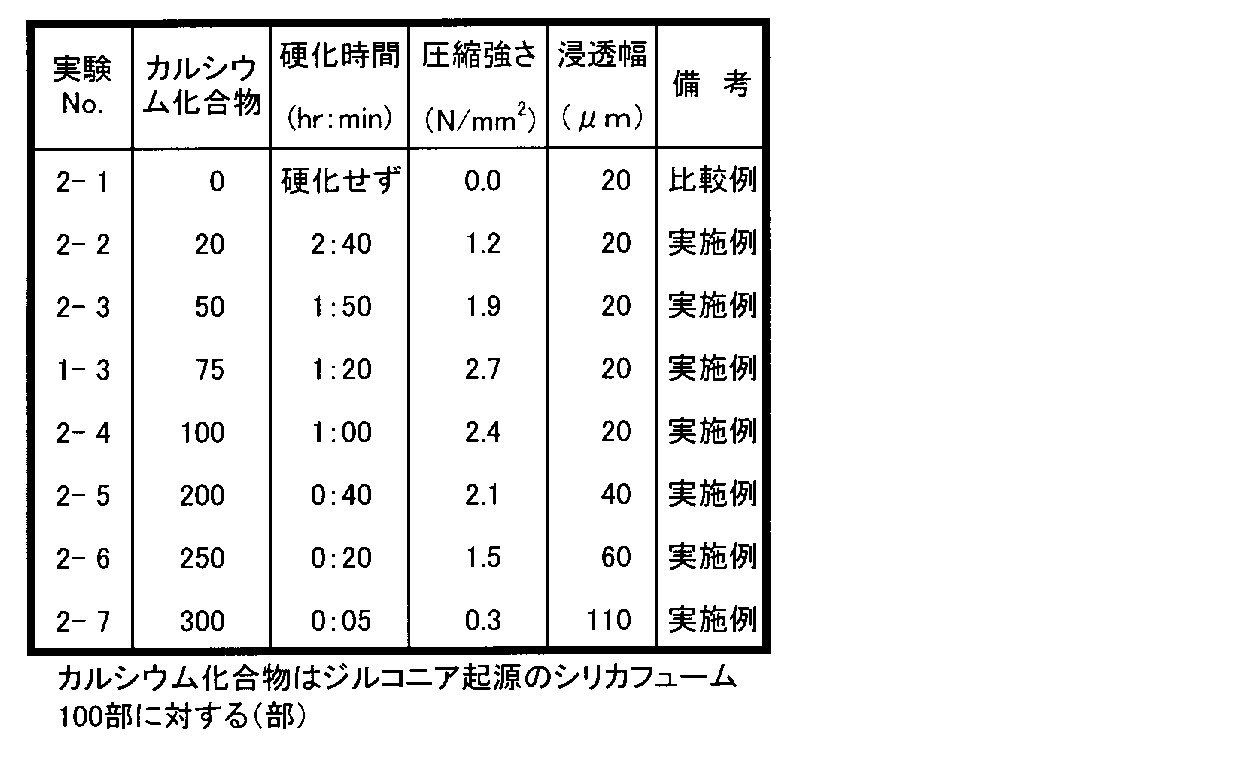
ジルコニア起源のシリカフュームに対する、カルシウム化合物の割合を変えることにより、ひび割れへの浸透幅や、乾燥後の圧縮強さが向上することがわかる。
実験例3
湿式分散処理した平均粒径が0.5μmのジルコニア起源のシリカフュームを含有するA材と、湿式粉砕分散処理した平均粒径が0.5μmのカルシウム化合物を含有するB材とを用い、A材中のジルコニア起源のシリカフュームとB材中のカルシウム化合物の濃度を表3に示すようにしたこと以外は実験例1と同様に硬化時間、圧縮強さ、及び浸透幅を確認した。配合及び結果を表3に示す。
湿式分散処理した平均粒径が0.5μmのジルコニア起源のシリカフュームを含有するA材と、湿式粉砕分散処理した平均粒径が0.5μmのカルシウム化合物を含有するB材とを用い、A材中のジルコニア起源のシリカフュームとB材中のカルシウム化合物の濃度を表3に示すようにしたこと以外は実験例1と同様に硬化時間、圧縮強さ、及び浸透幅を確認した。配合及び結果を表3に示す。

ジルコニア起源のシリカフュームの濃度が50%以下、カルシウム化合物の濃度が40%以下であれば、濃度が高いほど乾燥後の圧縮強さは高くなることがわかる。
実験例4
湿式分散処理した平均粒径が0.5μmのジルコニア起源のシリカフュームを含有するA材と、湿式粉砕分散処理した平均粒径が0.5μmのカルシウム化合物を含有するB材とを用い、ジルコニア起源のシリカフューム100部又はカルシウム化合物100部に対して、固形分換算で表4に示す量の分散剤を使用し、カルシウム化合物の使用量が、ジルコニア起源のシリカフューム100部に対して、75部になるように、A材とB材を混合したこと以外は実験例1と同様に硬化時間、圧縮強さ、及び浸透幅を確認した。配合及び結果を表4示す。
湿式分散処理した平均粒径が0.5μmのジルコニア起源のシリカフュームを含有するA材と、湿式粉砕分散処理した平均粒径が0.5μmのカルシウム化合物を含有するB材とを用い、ジルコニア起源のシリカフューム100部又はカルシウム化合物100部に対して、固形分換算で表4に示す量の分散剤を使用し、カルシウム化合物の使用量が、ジルコニア起源のシリカフューム100部に対して、75部になるように、A材とB材を混合したこと以外は実験例1と同様に硬化時間、圧縮強さ、及び浸透幅を確認した。配合及び結果を表4示す。
<使用材料>
分散剤β :ポリカルボン酸系分散剤、市販品、液状、固形分濃度40%
分散剤β :ポリカルボン酸系分散剤、市販品、液状、固形分濃度40%
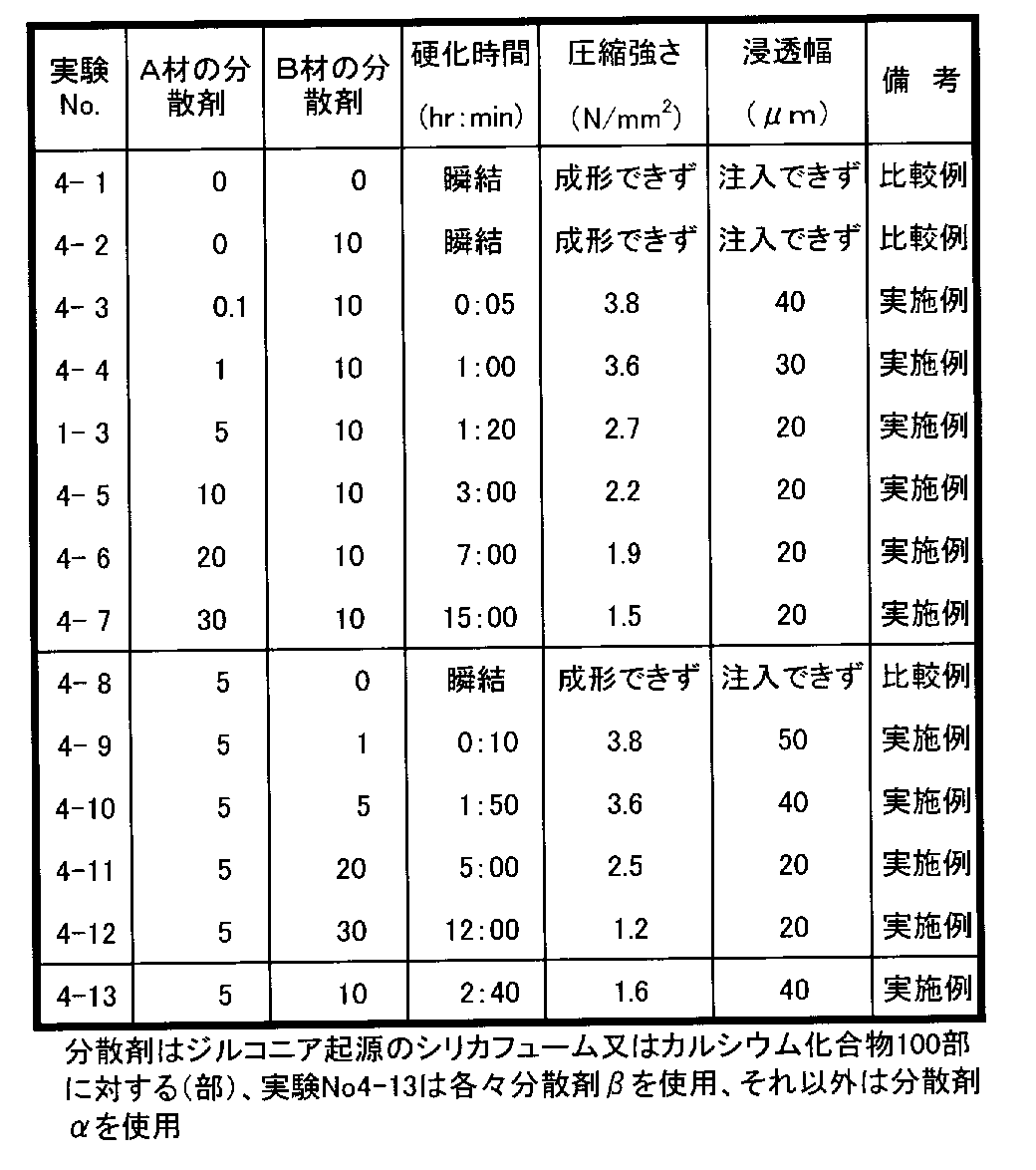
A材、B材それぞれに分散剤を併用することにより、100μm以下の微細なコンクリートのひび割れに注入材が浸透し、また、乾燥後の圧縮強さも高いことがわかる。
実験例5
湿式分散処理した平均粒径が0.5μmのジルコニア起源のシリカフュームを含有するA材に、ジルコニア起源のシリカフューム100部に対して、固形分換算で表5に示す量のポリマーディスパージョンを混合し、また、湿式粉砕分散処理した平均粒径が0.5μmのカルシウム化合物を含有するB材に、ジルコニア起源のシリカフューム100部に対して、表5に示す量の硬化時間調整剤を混合したこと以外は実験例1と同様に硬化時間、圧縮強さ、及び浸透幅を確認した。配合及び結果を表5示す。
湿式分散処理した平均粒径が0.5μmのジルコニア起源のシリカフュームを含有するA材に、ジルコニア起源のシリカフューム100部に対して、固形分換算で表5に示す量のポリマーディスパージョンを混合し、また、湿式粉砕分散処理した平均粒径が0.5μmのカルシウム化合物を含有するB材に、ジルコニア起源のシリカフューム100部に対して、表5に示す量の硬化時間調整剤を混合したこと以外は実験例1と同様に硬化時間、圧縮強さ、及び浸透幅を確認した。配合及び結果を表5示す。

ポリマーディスパージョンを併用することにより、乾燥後の圧縮強さを高くすることが、また、硬化時間調整剤を併用することによって、硬化時間を調整することができる。
実験例6
平均粒径0.8μmのジルコニア起源のシリカフュームを100部、分散剤α5部、及び水100部を混合し、さらに、ジルコニア起源のシリカフューム100部に対して、表6に示すポリマーディスパージョンを加えてA材を作製した。
一方、市販の水酸化カルシウム100部、分散剤α10部、及び水150部を混合し、スギノマシン社製商品名「スターバースト」で湿式粉砕分散処理し、B材中のカルシウム化合物の平均粒径が0.8μmになるようにし、さらに、ジルコニア起源のシリカフューム100部に対して、表6に示す硬化時間調整剤を加えて、B材を作製した。スギノマシン社製商品名「スターバースト」のスラリーに加えた圧力は245MPaとした。
カルシウム化合物の使用量が、ジルコニア起源のシリカフューム100部に対して、75部になるように、A材とB材を混合し、注入材を作製し、コンクリート亀裂への浸透性を確認した。配合及び結果を表6に示す。
平均粒径0.8μmのジルコニア起源のシリカフュームを100部、分散剤α5部、及び水100部を混合し、さらに、ジルコニア起源のシリカフューム100部に対して、表6に示すポリマーディスパージョンを加えてA材を作製した。
一方、市販の水酸化カルシウム100部、分散剤α10部、及び水150部を混合し、スギノマシン社製商品名「スターバースト」で湿式粉砕分散処理し、B材中のカルシウム化合物の平均粒径が0.8μmになるようにし、さらに、ジルコニア起源のシリカフューム100部に対して、表6に示す硬化時間調整剤を加えて、B材を作製した。スギノマシン社製商品名「スターバースト」のスラリーに加えた圧力は245MPaとした。
カルシウム化合物の使用量が、ジルコニア起源のシリカフューム100部に対して、75部になるように、A材とB材を混合し、注入材を作製し、コンクリート亀裂への浸透性を確認した。配合及び結果を表6に示す。

平均粒径が1.0μm以下のジルコニア起源のシリカフュームを用いた場合、湿式分散処理をしなくても、100μm以下のコンクリートひび割れに浸透することがわかる。
本発明の注入材は、例えば、下記用途に使用される。
100μm以下の微細なコンクリートひび割れに対しても優れた浸透性を有し、高い止水効果や耐久性能が得られるコンクリートひび割れ補修用注入材であって、あらゆるコンクリート構造物に適用可能である。
100μm以下の微細なコンクリートひび割れに対しても優れた浸透性を有し、高い止水効果や耐久性能が得られるコンクリートひび割れ補修用注入材であって、あらゆるコンクリート構造物に適用可能である。
Claims (9)
- 平均粒径が1.0μm以下であるジルコニア起源のシリカフューム、分散剤、及び水を含有したA材と、平均粒径1.0μm以下のカルシウム化合物、分散剤、及び水を含有したB材とを混合したものからなることを特徴とするコンクリートひび割れ補修用注入材。
- 前記A材が湿式分散処理したものであり、かつ、前記B材が湿式粉砕分散処理したものであることを特徴とする請求項1に記載のコンクリートひび割れ補修用注入材。
- 前記カルシウム化合物が、水酸化カルシウムであることを特徴とする請求項1に記載のコンクリートひび割れ補修用注入材。
- 前記A材の分散剤の使用量が、ジルコニア起源のシリカフューム100質量部に対して、固形分換算で0.1~30質量部であることを特徴とする請求項1に記載のコンクリートひび割れ補修用注入材。
- 前記B材の分散剤の使用量が、カルシウム化合物100質量部に対して、固形分換算で1~30質量部であることを特徴とする請求項1に記載のコンクリートひび割れ補修用注入材。
- さらに、ポリマーディスパージョンを含有してなることを特徴とする請求項1に記載のコンクリートひび割れ補修用注入材。
- さらに、硬化時間調整剤を含有してなることを特徴とする請求項1に記載のコンクリートひび割れ補修用注入材。
- 請求項2に記載のコンクリートひび割れ補修用注入材の製造方法であって、前記湿式分散処理又は前記湿式粉砕分散処理が、高圧水を用いた粉砕機による処理であることを特徴とするコンクリートひび割れ補修用注入材の製造方法。
- 請求項1~請求項7のうちのいずれか1項に記載のコンクリートひび割れ補修用注入材を用いる注入工法であって、前記A材と前記B材とを、1ショット方式、1.5ショット方式、及び2ショット方式のいずれかの方式により混合し、コンクリートひび割れに注入することを特徴とするコンクリートひび割れ補修用注入材の注入工法。
Priority Applications (1)
| Application Number | Priority Date | Filing Date | Title |
|---|---|---|---|
| JP2012556861A JP5936558B2 (ja) | 2011-02-08 | 2012-02-03 | コンクリートひび割れ補修用注入材の注入工法 |
Applications Claiming Priority (2)
| Application Number | Priority Date | Filing Date | Title |
|---|---|---|---|
| JP2011-025260 | 2011-02-08 | ||
| JP2011025260 | 2011-02-08 |
Publications (1)
| Publication Number | Publication Date |
|---|---|
| WO2012108359A1 true WO2012108359A1 (ja) | 2012-08-16 |
Family
ID=46638575
Family Applications (1)
| Application Number | Title | Priority Date | Filing Date |
|---|---|---|---|
| PCT/JP2012/052535 Ceased WO2012108359A1 (ja) | 2011-02-08 | 2012-02-03 | コンクリートひび割れ補修用注入材及び注入工法 |
Country Status (2)
| Country | Link |
|---|---|
| JP (1) | JP5936558B2 (ja) |
| WO (1) | WO2012108359A1 (ja) |
Cited By (1)
| Publication number | Priority date | Publication date | Assignee | Title |
|---|---|---|---|---|
| JP2015040271A (ja) * | 2013-08-23 | 2015-03-02 | 電気化学工業株式会社 | 注入工法 |
Citations (6)
| Publication number | Priority date | Publication date | Assignee | Title |
|---|---|---|---|---|
| JPH0841455A (ja) * | 1994-07-29 | 1996-02-13 | Japan Found Eng Co Ltd | 高分散化低粘性超微粒子スラリーの製造方法および高分散化低粘性超微粒子スラリーを用いた地盤注入方法 |
| JP2007217453A (ja) * | 2006-02-14 | 2007-08-30 | Denki Kagaku Kogyo Kk | 注入材、その製造方法、及びそれを用いた注入工法 |
| JP2007269536A (ja) * | 2006-03-31 | 2007-10-18 | Sumitomo Osaka Cement Co Ltd | 無機系弾性ひび割れ注入材 |
| JP2009062444A (ja) * | 2007-09-05 | 2009-03-26 | Denki Kagaku Kogyo Kk | 注入材及び注入工法 |
| JP2009299291A (ja) * | 2008-06-10 | 2009-12-24 | Denki Kagaku Kogyo Kk | 注入材の施工方法 |
| JP2010150073A (ja) * | 2008-12-25 | 2010-07-08 | Denki Kagaku Kogyo Kk | セメントモルタル |
Family Cites Families (1)
| Publication number | Priority date | Publication date | Assignee | Title |
|---|---|---|---|---|
| JPH04221116A (ja) * | 1990-12-21 | 1992-08-11 | Nishimatsu Constr Co Ltd | 地盤注入工法 |
-
2012
- 2012-02-03 JP JP2012556861A patent/JP5936558B2/ja not_active Expired - Fee Related
- 2012-02-03 WO PCT/JP2012/052535 patent/WO2012108359A1/ja not_active Ceased
Patent Citations (6)
| Publication number | Priority date | Publication date | Assignee | Title |
|---|---|---|---|---|
| JPH0841455A (ja) * | 1994-07-29 | 1996-02-13 | Japan Found Eng Co Ltd | 高分散化低粘性超微粒子スラリーの製造方法および高分散化低粘性超微粒子スラリーを用いた地盤注入方法 |
| JP2007217453A (ja) * | 2006-02-14 | 2007-08-30 | Denki Kagaku Kogyo Kk | 注入材、その製造方法、及びそれを用いた注入工法 |
| JP2007269536A (ja) * | 2006-03-31 | 2007-10-18 | Sumitomo Osaka Cement Co Ltd | 無機系弾性ひび割れ注入材 |
| JP2009062444A (ja) * | 2007-09-05 | 2009-03-26 | Denki Kagaku Kogyo Kk | 注入材及び注入工法 |
| JP2009299291A (ja) * | 2008-06-10 | 2009-12-24 | Denki Kagaku Kogyo Kk | 注入材の施工方法 |
| JP2010150073A (ja) * | 2008-12-25 | 2010-07-08 | Denki Kagaku Kogyo Kk | セメントモルタル |
Cited By (1)
| Publication number | Priority date | Publication date | Assignee | Title |
|---|---|---|---|---|
| JP2015040271A (ja) * | 2013-08-23 | 2015-03-02 | 電気化学工業株式会社 | 注入工法 |
Also Published As
| Publication number | Publication date |
|---|---|
| JP5936558B2 (ja) | 2016-06-22 |
| JPWO2012108359A1 (ja) | 2014-07-03 |
Similar Documents
| Publication | Publication Date | Title |
|---|---|---|
| US10759716B2 (en) | Accelerator for mineral binders | |
| CA2464901C (en) | Binder admixture, kaolin product and their manufacture | |
| JP5770180B2 (ja) | 注入材、注入材の製造方法及び注入工法 | |
| CN102126840A (zh) | 低温混凝土早强剂 | |
| CN104529225B (zh) | 一种高与超高强混凝土降粘剂、其制备方法及其应用 | |
| JP5909178B2 (ja) | コンクリートのひび割れ補修用注入材、その製造方法、及びそれを用いた注入工法 | |
| KR102650423B1 (ko) | 친환경 재자원화 고로슬래그 자극형 그라우트재 및 이를 이용한 그라우팅 공법 | |
| CN108546009A (zh) | 掺多尺度粒径CaCO3的高性能混凝土浆状掺合料 | |
| JP5956931B2 (ja) | 注入材、注入材の製造方法、及び注入工法 | |
| US5389144A (en) | Admixture for spray concrete and mortar and a method for the manufacture of spray concrete and mortar using this admixture | |
| KR20020045333A (ko) | 고침투성, 고강도 및 고내구성을 부여하는 무기계초미립자 복합실리카 그라우트재와 이것을 이용한그라우팅공법 | |
| JP5936558B2 (ja) | コンクリートひび割れ補修用注入材の注入工法 | |
| JP6159195B2 (ja) | 注入工法 | |
| EP3538499B1 (de) | Erhärtungsbeschleuniger | |
| JP5717945B2 (ja) | 注入材料、注入材及び注入工法 | |
| JPH1161125A (ja) | 地盤注入材 | |
| JP2024074595A (ja) | 地盤固結材およびそれを用いた地盤注入工法 | |
| JP6058505B2 (ja) | 注入工法 | |
| JP5051825B2 (ja) | 止水材 | |
| JP2022131571A (ja) | 注入材 | |
| CH713947A2 (de) | Nichtcalcinierte zementöse Zusammensetzungen, nichtcalcinierte Betonzusammensetzungen, nichtcalcinierter Beton und Verfahren zu deren Herstellung. | |
| JPH11241064A (ja) | 地盤注入用薬液及び地盤への薬液注入工法 | |
| JP5683302B2 (ja) | 接着剤及び接着工法 | |
| CN116903291A (zh) | 具有早强及氯离子固化功能的粉煤灰基浆状掺合料及其制备方法和应用 | |
| Dem'yanova et al. | Water-repelling agents for dry building mixes |
Legal Events
| Date | Code | Title | Description |
|---|---|---|---|
| 121 | Ep: the epo has been informed by wipo that ep was designated in this application |
Ref document number: 12744245 Country of ref document: EP Kind code of ref document: A1 |
|
| ENP | Entry into the national phase |
Ref document number: 2012556861 Country of ref document: JP Kind code of ref document: A |
|
| NENP | Non-entry into the national phase |
Ref country code: DE |
|
| 122 | Ep: pct application non-entry in european phase |
Ref document number: 12744245 Country of ref document: EP Kind code of ref document: A1 |