WO2012105711A1 - 有機化合物の製造方法 - Google Patents
有機化合物の製造方法 Download PDFInfo
- Publication number
- WO2012105711A1 WO2012105711A1 PCT/JP2012/052626 JP2012052626W WO2012105711A1 WO 2012105711 A1 WO2012105711 A1 WO 2012105711A1 JP 2012052626 W JP2012052626 W JP 2012052626W WO 2012105711 A1 WO2012105711 A1 WO 2012105711A1
- Authority
- WO
- WIPO (PCT)
- Prior art keywords
- compound
- enzyme
- amino acid
- activity
- group
- Prior art date
- Legal status (The legal status is an assumption and is not a legal conclusion. Google has not performed a legal analysis and makes no representation as to the accuracy of the status listed.)
- Ceased
Links
Images


Classifications
-
- C—CHEMISTRY; METALLURGY
- C12—BIOCHEMISTRY; BEER; SPIRITS; WINE; VINEGAR; MICROBIOLOGY; ENZYMOLOGY; MUTATION OR GENETIC ENGINEERING
- C12Y—ENZYMES
- C12Y603/00—Ligases forming carbon-nitrogen bonds (6.3)
- C12Y603/02—Acid—amino-acid ligases (peptide synthases)(6.3.2)
-
- C—CHEMISTRY; METALLURGY
- C07—ORGANIC CHEMISTRY
- C07D—HETEROCYCLIC COMPOUNDS
- C07D403/00—Heterocyclic compounds containing two or more hetero rings, having nitrogen atoms as the only ring hetero atoms, not provided for by group C07D401/00
- C07D403/02—Heterocyclic compounds containing two or more hetero rings, having nitrogen atoms as the only ring hetero atoms, not provided for by group C07D401/00 containing two hetero rings
- C07D403/06—Heterocyclic compounds containing two or more hetero rings, having nitrogen atoms as the only ring hetero atoms, not provided for by group C07D401/00 containing two hetero rings linked by a carbon chain containing only aliphatic carbon atoms
-
- C—CHEMISTRY; METALLURGY
- C07—ORGANIC CHEMISTRY
- C07D—HETEROCYCLIC COMPOUNDS
- C07D487/00—Heterocyclic compounds containing nitrogen atoms as the only ring hetero atoms in the condensed system, not provided for by groups C07D451/00 - C07D477/00
- C07D487/02—Heterocyclic compounds containing nitrogen atoms as the only ring hetero atoms in the condensed system, not provided for by groups C07D451/00 - C07D477/00 in which the condensed system contains two hetero rings
- C07D487/04—Ortho-condensed systems
-
- C—CHEMISTRY; METALLURGY
- C07—ORGANIC CHEMISTRY
- C07K—PEPTIDES
- C07K1/00—General methods for the preparation of peptides, i.e. processes for the organic chemical preparation of peptides or proteins of any length
- C07K1/02—General methods for the preparation of peptides, i.e. processes for the organic chemical preparation of peptides or proteins of any length in solution
-
- C—CHEMISTRY; METALLURGY
- C07—ORGANIC CHEMISTRY
- C07K—PEPTIDES
- C07K5/00—Peptides containing up to four amino acids in a fully defined sequence; Derivatives thereof
- C07K5/04—Peptides containing up to four amino acids in a fully defined sequence; Derivatives thereof containing only normal peptide links
- C07K5/06—Dipeptides
- C07K5/06008—Dipeptides with the first amino acid being neutral
- C07K5/06078—Dipeptides with the first amino acid being neutral and aromatic or cycloaliphatic
-
- C—CHEMISTRY; METALLURGY
- C07—ORGANIC CHEMISTRY
- C07K—PEPTIDES
- C07K5/00—Peptides containing up to four amino acids in a fully defined sequence; Derivatives thereof
- C07K5/04—Peptides containing up to four amino acids in a fully defined sequence; Derivatives thereof containing only normal peptide links
- C07K5/12—Cyclic peptides with only normal peptide bonds in the ring
-
- C—CHEMISTRY; METALLURGY
- C12—BIOCHEMISTRY; BEER; SPIRITS; WINE; VINEGAR; MICROBIOLOGY; ENZYMOLOGY; MUTATION OR GENETIC ENGINEERING
- C12P—FERMENTATION OR ENZYME-USING PROCESSES TO SYNTHESISE A DESIRED CHEMICAL COMPOUND OR COMPOSITION OR TO SEPARATE OPTICAL ISOMERS FROM A RACEMIC MIXTURE
- C12P13/00—Preparation of nitrogen-containing organic compounds
- C12P13/02—Amides, e.g. chloramphenicol or polyamides; Imides or polyimides; Urethanes, i.e. compounds comprising N-C=O structural element or polyurethanes
-
- C—CHEMISTRY; METALLURGY
- C12—BIOCHEMISTRY; BEER; SPIRITS; WINE; VINEGAR; MICROBIOLOGY; ENZYMOLOGY; MUTATION OR GENETIC ENGINEERING
- C12P—FERMENTATION OR ENZYME-USING PROCESSES TO SYNTHESISE A DESIRED CHEMICAL COMPOUND OR COMPOSITION OR TO SEPARATE OPTICAL ISOMERS FROM A RACEMIC MIXTURE
- C12P13/00—Preparation of nitrogen-containing organic compounds
- C12P13/04—Alpha- or beta- amino acids
- C12P13/22—Tryptophan; Tyrosine; Phenylalanine; 3,4-Dihydroxyphenylalanine
- C12P13/227—Tryptophan
-
- C—CHEMISTRY; METALLURGY
- C12—BIOCHEMISTRY; BEER; SPIRITS; WINE; VINEGAR; MICROBIOLOGY; ENZYMOLOGY; MUTATION OR GENETIC ENGINEERING
- C12P—FERMENTATION OR ENZYME-USING PROCESSES TO SYNTHESISE A DESIRED CHEMICAL COMPOUND OR COMPOSITION OR TO SEPARATE OPTICAL ISOMERS FROM A RACEMIC MIXTURE
- C12P21/00—Preparation of peptides or proteins
- C12P21/02—Preparation of peptides or proteins having a known sequence of two or more amino acids, e.g. glutathione
Definitions
- the present invention relates to a method for producing an organic compound. Specifically, the present invention relates to a method for producing an arbitrary organic compound by combining an arbitrary compound and a compound having nucleophilic activity.
- the enzymatic method when used, it reflects the substrate specificity of the enzyme, so if it matches the target binding direction and binding order, the target is not incurred in cost or time. Can be achieved.
- the enzyme reaction since the enzyme reaction has high reaction specificity, there is an advantage that generation of unnecessary isomers or intermediate products can be avoided. Therefore, at present, the development of compounds useful as pharmaceuticals and functional foods, in particular, enzymes that can be used for the production of peptides and peptide derivatives is underway.
- a dipeptide containing proline at the C-terminus (Xaa-Pro) is a compound that is expected to have excellent physiological activity such as exhibiting a blood pressure lowering action.
- Xaa-Pro a dipeptide containing proline at the C-terminus
- Patent Document 1 and Non-Patent Documents 1 and 2 a proline-containing dipeptide is used. The generation of has been reported.
- Patent Document 1 reports the production of a proline-containing dipeptide, but the proline-containing dipeptide has proline bound to the N-terminus rather than the C-terminus expected to be useful as a pharmaceutical or functional food. Limited to the production of
- Non-Patent Documents 1 and 2 report the production of C-terminal proline-containing dipeptides, but only disclose the production of cyclic proline-containing dipeptides.
- Diketopiperazine which is a cyclic dipeptide, has attracted attention in recent years for its various functions and has been researched and developed for industrial use.
- the methods disclosed in Non-Patent Documents 1 and 2 only the cyclic dipeptide can be produced as described above, and the other form is known which has many usefulness as a pharmaceutical or functional food. It is not possible to produce a linear dipeptide.
- the present invention has been made in view of such circumstances, and has found a synthesis system that can bind target compounds to each other in a desired binding direction and order, and is simpler and more efficient. It aims at providing the manufacturing method of the organic compound by a method. Another object of the present invention is to provide a method for easily supplying industrially useful dipeptides and diketopiperazines.
- the present inventors have focused on an enzyme or enzyme group having an activity of thioesterifying an arbitrary compound, and as a result, by using such an enzyme or enzyme group, It has been found that the above compound and other compounds can be bonded in a straight chain, and the present invention has been achieved.
- a method for producing an organic compound comprising preparing an arbitrary compound and a compound having a nucleophilic activity, and the arbitrary compound. In the presence of an enzyme or group of enzymes having the activity to thioesterify the compound, and contacting the compound with the nucleophilic activity with the compound having the nucleophilic activity.
- a method is provided, characterized in that it binds to the thioester moiety of any compound by nucleophilic attack.
- the target compound can be produced in an industrially useful yield inexpensively and safely. Further, according to such a configuration, an arbitrary compound and a compound having nucleophilic activity can be bound in the target binding direction depending on the substrate specificity of the enzyme.
- the arbitrary compound is activated by an enzyme or enzyme group having an activity to thioesterify an arbitrary compound
- the compound can be subjected to various nucleophilic substitution reactions. It can be used as an electrophile. This is useful because it supports the supply of organic compounds for which there is no practical synthetic method that can be used industrially and can contribute to functional development and application development research of the organic compounds.
- the enzyme or the enzyme group is a module constituting at least a part of NRPS (non-ribosomal peptide synthetase), and at least an adenylation active domain.
- NRPS non-ribosomal peptide synthetase
- the peptidyl carrier protein site, and the arbitrary compound is one that is linked to the peptidyl carrier protein site of the enzyme or group of enzymes through a thioester bond.
- the arbitrary compound is a compound having a carboxyl group.
- the compound having a carboxyl group is preferably an amino acid, and the amino acid is particularly preferably selected from the group consisting of tryptophan, tyrosine, methionine, leucine, and valine.
- the enzyme or group of enzymes is derived from Brevibacterium parabrevis.
- the enzyme or group of enzymes comprises (A) an enzyme having the amino acid sequence set forth in SEQ ID NO: 1, and (B) a sequence ID number.
- An enzyme having an activity of binding to (C) an amino acid sequence having 60% or more homology with the amino acid sequence of SEQ ID NO: 1, and adenylating a carboxyl group of any compound, and by thioester bond
- the compound having nucleophilic activity comprises a nitrogen-containing compound containing proline, hydroxyproline, proline derivative, hydroxylamine, and pyrrolidine. It is selected from the group.
- an organic compound which is a genetic recombination having the ability to express an enzyme according to any one of the following (A) to (F):
- a step of culturing a body in a medium a step of bringing an arbitrary compound and a compound having nucleophilic activity into contact with the genetic recombinant, and a combination of the arbitrary compound and the compound having nucleophilic activity.
- the compound having the nucleophilic activity is nucleophilic at the thioester site of the arbitrary compound.
- a method is provided, characterized in that it binds by attack, wherein the enzyme is (A) an enzyme having the amino acid sequence described in SEQ ID NO: 1, (B) the enzyme described in SEQ ID NO: 1. 1 in the amino acid sequence
- An enzyme comprising an amino acid sequence containing the above amino acid substitution, deletion, insertion, addition or inversion, adenylating a carboxyl group of any compound, and having an activity of binding to any compound by a thioester bond
- C It consists of an amino acid sequence having 60% or more homology with the amino acid sequence shown in SEQ ID NO: 1, and has an activity to adenylate the carboxyl group of any compound and to bind to the any compound through a thioester bond
- An enzyme, (D) consisting of an amino acid sequence encoded by a polynucleotide comprising a base sequence having 60% or more homology with the base sequence set forth in SEQ ID NO: 3, and adenylating the carboxyl group of any compound; and
- the genetic recombinant is one that has been recombined with the DNA described in any of (A) to (C) below, (A) DNA having the base sequence represented by SEQ ID NO: 3, (B) a base sequence having 60% or more homology with the base sequence represented by SEQ ID NO: 3, and a carboxyl of any compound A DNA encoding an enzyme having an activity of adenylating a group and binding to the above-mentioned arbitrary compound by a thioester bond; (C) a DNA having a base sequence complementary to the base sequence represented by SEQ ID NO: 3 and stringent An enzyme that hybridizes under conditions, adenylates the carboxyl group of any compound, and binds to any compound by a thioester bond.
- Sul DNA DNA that is a.
- the host of the gene recombinant is E. coli.
- FIG. 1 is a schematic diagram showing a non-ribosomal peptide synthetase (NRPS) according to the present invention.
- FIG. 2 is a schematic diagram showing the synthesis of cyclic proline-containing dipeptides by NRPS.
- FIG. 3 is a schematic diagram showing organic compound synthesis by a nucleophilic substitution reaction in one embodiment of the present invention.
- FIG. 4 is a chromatogram of dipeptide production by L-tryptophan and L-proline in an embodiment of the present invention.
- FIG. 5 is a chromatogram of dipeptide production by L-leucine and L-proline and dipeptide production by L-tyrosine and L-proline in an embodiment of the present invention.
- FIG. 6 is a table showing dipeptide production in one embodiment of the present invention.
- FIG. 7 is a chromatogram showing organic compound synthesis using pyrrolidine as a substrate in one embodiment of the present invention.
- FIG. 8 is a graph showing organic synthesis using pyrrolidine as a substrate in one embodiment of the present invention.
- the method for producing an organic compound according to the present embodiment includes a step of preparing an arbitrary compound and a compound having nucleophilic activity, and an enzyme or enzyme having an activity of thioesterifying the arbitrary compound.
- the “arbitrary compound” is a compound that undergoes a nucleophilic attack from a compound having a nucleophilic activity, which will be described later, in the method for producing an organic compound by the enzyme according to the present invention. Binds to compounds with nuclear activity.
- the arbitrary compound has a carboxyl group.
- an “arbitrary compound” is activated by an enzyme or enzyme group according to the present invention described later, thereby enabling a thioester bond with the enzyme or enzyme group.
- the activation of the arbitrary compound is not particularly limited as long as the carboxyl group in the arbitrary compound is activated for the reaction, such as phosphorylation or acetylation, but preferably adenyl is used.
- the arbitrary compound is activated by the enzyme or enzyme group to form a thioester bond with a peptidyl carrier protein site (PCP site) in the enzyme or enzyme group. is there.
- PCP site is used for consent to a thiolation domain (T domain), unless otherwise specified, and the same site when expressed in any language. Or it refers to a domain.
- the arbitrary compound according to the present invention is a compound having a carboxyl group, and the carboxyl group is activated, preferably adenylated by the enzyme or enzyme group, and thereby binds to the PCP site. If it is a thing, it will not specifically limit. Accordingly, an organic acid having at least one carboxyl group such as ⁇ -, ⁇ -, and ⁇ -keto acid can be any compound according to the present invention.
- the “compound having nucleophilic activity” has an unshared electron pair (lone pair), and with respect to the arbitrary compound that forms a thioester with the enzyme or enzyme group according to the present invention.
- a nucleophilic substitution reaction is performed.
- the compound having the nucleophilic activity performs a nucleophilic attack on the thioester site of the arbitrary compound, and thereby the binding with the arbitrary compound is achieved.
- the “compound having nucleophilic activity” according to the present invention is not particularly limited as long as it performs a nucleophilic substitution reaction by having a loan pair as described above.
- the “compound having nucleophilic activity” is preferably D, L-proline, or a proline derivative containing D, L-hydroxyproline, proline methyl ester, proline amide, and dehydroproline. Or a nitrogen-containing compound containing hydroxylamine or pyrrolidine.
- the “enzyme or enzyme group having an activity to thioesterify any compound” includes Non-ribosomal peptide synthetase, Acetate-CoA ligase, O-Succinylbenzoate-CoA ligase, Butyrate-CoA ligase, Long-chain-fatty-acid-CoA ligase, Succinate-CoA ligase, Glutarate-CoA ligase, Choleate-CoA ligase, Oxalate-CoA ligase, Malate-CoAligate CoAligate, Biotinga CoAligate CoA ligase, 6-Carboxyhexanoate-CoA ligase, Arachidonate-CoA ligase, Citrate-CoA ligase, Dicarboxylate-CoA ligase, Phytanate-CoA ligase, Benzoate-CoA ligase, O-Succinyl
- the “enzyme or enzyme group having an activity to thioesterify an arbitrary compound” preferably has a thioester bond with an arbitrary compound as described above to form the arbitrary compound. It catalyzes the bond with the compound having nucleophilic activity.
- the enzyme or group of enzymes phosphorylates and acetylates the arbitrary compound, and preferably adenylates the carboxyl group of the arbitrary compound.
- enzyme refers to a molecule having a function of catalyzing a chemical reaction in a living body, unless otherwise specified.
- an enzyme when an enzyme is composed of a plurality of peptides (subunits), when a plurality of enzymes (complex enzymes) form a cluster to catalyze a series of metabolic processes, a plurality of domains can convert a single enzyme
- a plurality of domains can convert a single enzyme
- one or more molecules function as a single enzyme when they are assembled or linked, such as when they are formed, when the one or more molecules alone have enzyme activity, the molecule having the enzyme activity is expressed as “
- the term “enzyme” refers to a single enzyme associated with or associated with the group or group of enzymes.
- the “enzyme or enzyme group having an activity to thioesterify any compound” is at least one of non-ribosomal peptide synthetase (NRPS) (FIG. 1). It is a module that constitutes a section.
- NRPS non-ribosomal peptide synthetase
- FIG. 1 NRPS is a huge multi-module enzyme complex having a molecular weight of several thousand kDa, and is known for synthesizing short-chain physiologically active peptides without going through ribosomes.
- a module that is a repeating unit that constitutes NRPS is an adenylation domain (A domain) that recognizes and activates a substrate amino acid, and a thiolation domain (T domain) that forms a thioester with an activated amino acid. ) (Peptidyl carrier protein site (PCP site)) and a condensation domain (C domain) that catalyzes the formation of peptide bonds.
- Some modules have an isomerization domain (E domain) that converts L-amino acids into D-forms in the process of peptide synthesis, and the peptides produced have diversity.
- tyrosidin A an antibacterial decapeptide synthesized by Brevibacillus parabrevis.
- the starter module TycA (the amino acid sequence of TycA is shown in SEQ ID NO: 1 and the base sequence is shown in SEQ ID NO: 3)
- the first extension module TycB1 (the amino acid sequence of TycB1 is shown in SEQ ID NO: 2
- a cyclic proline-containing dipeptide cyclo (D-Phe-L-Pro) is synthesized using L-phenylalanine and L-proline as substrates, respectively (the base sequence is shown in SEQ ID NO: 4) (FIG.
- a peptide excision reaction from NRPS is catalyzed by a thioesterase domain (TE domain) of a terminal module.
- TE domain thioesterase domain
- generation of a cyclic peptide by cyclization and hydrolysis of a chain peptide by hydrolysis are performed.
- cyclo (D-Phe-L-Pro) synthesis reaction it is known that the release of the product from the enzyme main body proceeds non-enzymatically by intramolecular self-cyclization. The possibility of synthesizing a chain dipeptide was also predicted by the structure of the intermediate compound.
- NRPS The biggest factor that NRPS has not been industrially used to date, although it has the potential to comprehensively synthesize various dipeptides that could not be synthesized enzymatically, is the production of peptides by this method. It is that the nature was extremely low.
- the yield of reaction products by NRPS is generally as low as ⁇ M, and even in the above-mentioned example of fermentation production of cyclo (D-Phe-L-Pro), the maximum is 38 ⁇ M (9.2 mg / L).
- NRPS-related research with a view to industrialization is scarce, and mainly research with deep academic and analytical hues. Most of them are related to combinatorial peptide synthesis utilizing the characteristics of NRPS.
- the enzyme or group of enzymes has at least the above-mentioned adenylation active domain and peptidyl carrier protein site, and has the same or similar effect as the method according to the present invention. It goes without saying that any module, domain, or site constituting NRPS can be included in addition to these domains and sites.
- the enzyme or group of enzymes is derived from Brevibacillus parabrevis, but as long as the enzyme or group of enzymes or the NRPS has the same function as described above, Any strain may be used as long as it produces an enzyme having an amino acid sequence including amino acid substitution, deletion, insertion, addition, or inversion.
- “Brevibacillus parabrevis” is “Brevibacillus parabrevis NBRC 3331”, unless otherwise specified, and in some cases “Brevibacillus brevis”, “Bacillus brevis”, “AT” 81, “AT” 85, “AT In some cases, they are the same strain.
- the arbitrary compound when a module constituting at least a part of NRPS is used as the enzyme or enzyme group, the arbitrary compound is preferably an amino acid.
- peptide refers to a compound in which two or more amino acids are linked by peptide bonds.
- an amino acid or peptide includes a methyl group-containing alkyl group, a phosphate group, a sugar chain, and / or an ester bond or other covalent bond modification, it is referred to as an amino acid or peptide derivative, respectively.
- amino acids may be represented by compound names such as asparagine and glutamine, and may be represented by conventional three letter codes such as Asn and Gln. When represented by a compound name, it is represented using a prefix (or D-) indicating the configuration of the ⁇ -carbon of the amino acid. When expressed in conventional three-letter notation, the three-letter notation represents an L-amino acid unless otherwise specified.
- an amino acid refers to any compound in which an amino group and a carboxyl group are bonded via at least one carbon atom and can be polymerized by a peptide bond.
- the amino acids in the present specification are 20 consisting of glycine, alanine, cysteine, aspartic acid, glutamic acid, phenylalanine, histidine, isoleucine, lysine, leucine, methionine, asparagine, proline, glutamine, arginine, serine, threonine, valine, tryptophan and tyrosine.
- a variety of amino acids and their stereoisomers D-amino acids, as well as amino acids that do not constitute proteins, ⁇ -alanine, sarcosine, ornithine, citrulline, creatine, ⁇ -aminobutyric acid, opine, etc. It may be any natural or unnatural amino acid that is not.
- any of the amino acids described above can be used.
- the chirality of the amino acid moiety as the arbitrary compound in the organic compound produced by binding with a compound having nucleophilic activity is retained before and after the binding.
- Xaa-Pro can be synthesized according to the method of the present invention.
- Xaa on the N-terminal side is an arbitrary amino acid, but preferably, the N-terminal amino acid Xaa is Trp, Tyr, Met, Leu, Val.
- Xaa may be L-form or D-form
- Xaa of the generated dipeptide Xaa-Pro depends on the chirality of Xaa.
- the dipeptide (product) produced by the method according to the present invention can be any of DL, LD, LL, or DD.
- TycA which is a module constituting at least part of NRPS
- the amino acid (Xaa) as “any compound” May be L-form or D-form.
- the enzyme in a normal enzyme reaction, as shown by the substrate specificity of the enzyme that acts on a specific substrate to catalyze a specific reaction, the enzyme has a configuration of atomic groups in the substrate. It distinguishes loci (D and L, cis and trans, etc.) and recognizes the three-dimensional structure.
- TycA which is a module constituting at least part of NRPS is used as “an enzyme or enzyme group having an activity to thioesterify any compound”
- Phe which is a substrate of D-Phe-L-Pro
- D-Phe-L-Pro- DKP D-Phe-L-Pro- DKP
- L-Trp-L-Pro, L-Tyr-L-Pro, L-Leu-L-Pro, D-Leu-L-Pro , L-Met-L-Pro, D-Met-L-Pro, L-Trp-D-Pro and the like can be synthesized in units of g / L, and cis- When 4-L-HydroxyPro (C4L) or cis-4-D-HydroxyPro (C4D) is used, L-Trp-C4L, L-Trp-C4D, etc.
- a C-terminal proline dipeptide can be produced easily without purification by-products as compared with chemical synthesis combining complicated reactions, which is a normal production method.
- a C-terminal proline-containing peptide can be produced as a chain peptide from an unprotected amino acid in a one-step process.
- by using a gene recombinant as described below production of a C-terminal proline dipeptide does not require ATP or magnesium, and production is possible only by adding a substrate.
- TycA which is a module constituting at least a part of NRPS
- TycB1 is a module constituting at least a part of NRPS and having at least an adenylation active domain and a peptidyl carrier protein site.
- TycA and TycB1 are used in the method according to the present invention, an organic compound is obtained by binding any compound thioester-bonded to the peptidyl carrier protein site of TycB1 to any compound thioester-bonded to the peptidyl carrier protein site of TycA. Is manufactured.
- TycB1 plays a role of bringing a compound bonded to TycB1 into contact with any compound bonded to TycA in order to enable a catalytic reaction, and any compound having a thioester bond with TycB1. Need not have nucleophilic activity. Therefore, in one embodiment according to the present invention, as long as the “compound having nucleophilic activity” uses a compound that binds by nucleophilic attack to the thioester site of any compound according to the present invention, only TycA is used. Of course, it goes without saying that the synthesis reaction is accelerated even when both TycA and TycB1 are used.
- the present invention promotes contact (non-enzymatic reaction) with a compound having nucleophilic activity by activating the compound by thioesterifying an arbitrary compound, thereby making it possible to efficiently and economically use various organic compounds.
- the technology which can be synthesized is provided.
- the remarkable effects or features of the present invention that can be achieved when only TycA is used are similarly achieved even when TycB1 is used in addition to TycA.
- TycB1 is used in addition to TycA.
- an amino acid is used as an “arbitrary compound”, as described above, as an arbitrary compound in an organic compound produced by bonding with a compound having nucleophilic activity, as described above
- the chirality of the amino acid moiety is retained before and after the binding, but when an organic compound using TycA and TycB1 is synthesized, the chirality of any amino acid moiety in the product is retained.
- the chirality of the dipeptide produced using TycA and TycB1 was analyzed by analyzing the hydrolyzate with hydrochloric acid and N ⁇ - (5-fluoro-2,4-dinitrophenyl) -L-alaninamide (FDAA). ) To confirm the retention of chirality when judged by separation on the HPLC chromatogram of the dipeptide derivatized with can do.
- an enzyme or enzyme group having an activity to thioesterify any compound includes (A) an enzyme having the amino acid sequence described in SEQ ID NO: 1, and (B) SEQ ID NO: 1.
- An amino acid sequence comprising one or more amino acid substitutions, deletions, insertions, additions, or inversions, wherein the carboxyl group of any compound is adenylated, and a thioester bond forms the arbitrary compound.
- An enzyme having a binding activity consisting of an amino acid sequence having 60% or more homology with the amino acid sequence described in SEQ ID NO: 1, and adenylating a carboxyl group of an arbitrary compound;
- sequence ID It consists of an amino acid sequence encoded by a base sequence that hybridizes with the base sequence of No.
- the enzyme possessed by introducing a site-specific mutation into DNA encoding a protein comprising the amino acid sequence represented by SEQ ID NO: 1, for example, using a site-directed mutagenesis method well known in the field of molecular biology Can get.
- the number of substitution, deletion, insertion, addition, or inversion amino acid residues is not particularly limited, but substitution, deletion, insertion, addition, or inversion can be performed by a well-known method such as the above-mentioned site-specific mutation method.
- the number is about 1 to several tens, preferably 1 to 20, more preferably 1 to 10, and further preferably 1 to 5.
- the position of the amino acid at which amino acid residues can be deleted or added is such that the enzyme resulting from the deletion or addition is adenylated on the carboxyl group of an arbitrary compound, and the thioester bond is combined with the optional compound. Any position may be used as long as it has an activity of binding, and examples thereof include 10 amino acid residues on the N-terminal side and C-terminal side of the amino acid sequence represented by SEQ ID NO: 1.
- deletion, substitution or addition may occur simultaneously, and the amino acid to be substituted or added may be a natural type or a non-natural type.
- the enzyme or enzyme group according to the present invention has a homology with the amino acid sequence represented by SEQ ID NO: 1 of 60% or more, preferably 65% or more, more preferably 70% or more, and still more preferably 75%. Or more, more preferably 80% or more, still more preferably 90% or more, still more preferably 95% or more, still more preferably 97% or more, particularly preferably 98% or more, and most preferably 99% or more.
- An enzyme having a sequence and having an activity of adenylating a carboxyl group of an arbitrary compound and binding to the arbitrary compound through a thioester bond can be exemplified.
- the homology with the base sequence represented by SEQ ID NO: 3 is 60% or more, preferably 65% or more, more preferably 70% or more, still more preferably 75% or more, More preferably, it is 80% or more, more preferably 90% or more, more preferably 95% or more, further preferably 97% or more, particularly preferably 98% or more, most preferably 99% or more.
- an enzyme having an activity of adenylating a carboxyl group of an arbitrary compound and binding to the arbitrary compound through a thioester bond is 60% or more, preferably 65% or more, more preferably 70% or more, still more preferably 75% or more, More preferably, it is 80% or more, more preferably 90% or more, more preferably 95% or more, further preferably 97% or more, particularly preferably 98% or more, most preferably 99% or more.
- the homology between amino acid sequences and base sequences can be determined using BLAST or FASTA.
- the enzyme or enzyme group according to the present invention comprises an amino acid sequence encoded by a base sequence that hybridizes under stringent conditions with the base sequence shown in SEQ ID NO: 3, and a carboxyl group of any compound And an enzyme having an activity of adenylating and binding to any of the above compounds through a thioester bond.
- hybridize indicates that DNA hybridizes to DNA having a specific base sequence or a part of the DNA. Therefore, the DNA having the specific base sequence or a part of the base sequence of the DNA is useful as a probe for Northern or Southern blot analysis, or has a length that can be used as an oligonucleotide primer for PCR analysis. May be.
- DNA used as a probe for Northern or Southern blot analysis DNA of at least 100 bases or more, preferably 200 bases or more, more preferably 500 bases or more can be mentioned, and DNA used as an oligonucleotide primer is at least 10 bases. As mentioned above, DNA having 15 bases or more can be mentioned.
- a DNA hybridization experiment an experiment can be performed according to hybridization conditions well known in the field of molecular biology.
- the above stringent conditions may be any conditions as long as the effects of the method according to the present invention can be achieved.
- a filter on which DNA is immobilized and a probe DNA are mixed with 50% formamide, 5 ⁇ SSC (750 mM sodium chloride, 75 mmol / L sodium citrate), 50 mmol / L sodium phosphate (pH 7.6), 5 ⁇ Denhardt's solution, 10% dextran sulfate, and 20 ⁇ g / L denatured salmon sperm After overnight incubation at 42 ° C. in a solution containing DNA, conditions such as washing the filter in a 0.2 ⁇ SSC solution at about 65 ° C. can be raised, and lower stringent conditions can be used. it can.
- the enzyme or enzyme group according to the present invention is an enzyme in which the enzyme according to any one of the above (A) to (E) and a specific binding tag peptide are bound, wherein the carboxyl group of any compound is Mention may be made of an enzyme that has the activity of adenylating and binding to any of the above compounds via a thioester bond.
- tag peptide refers to a part that is molecularly or genetically linked to serve as a marker for a specific protein molecule, and can be of any length. good. Moreover, as long as it does not affect the physiological or physicochemical properties of the protein or peptide to be bound, it can be bound at any position, but it is preferably bound to the end of the target protein and has a low molecular weight. It is. In addition, other types of proteins can be used as tag peptides. Furthermore, by using a tag peptide, it is possible to isolate and immobilize proteins, detect protein-protein interactions, visualize protein molecules, etc. according to their properties.
- a method for producing an organic compound comprises culturing a gene recombinant having the ability to express the enzyme according to any one of (A) to (F) above in a medium. Culturing an organic compound obtained by combining a step, a step of bringing an arbitrary compound and a compound having a nucleophilic activity into contact with the gene recombinant, and the arbitrary compound and the compound having a nucleophilic activity And the step of collecting the organic compound from the culture, and the compound having the nucleophilic activity binds to the thioester site of the arbitrary compound by nucleophilic attack It is the method characterized by being.
- the term “gene recombinant” means that an expression vector incorporating a polynucleotide encoding the protein of the present invention is introduced so that a desired trait related to a protein having a desired function can be expressed.
- a transformant or an organism capable of expressing a desired trait by introducing a predetermined gene into the chromosome from the outside, and a living organism having a nucleic acid obtained by genetic recombination technology or the like and a replica thereof. It is what you point to.
- the gene recombinant used in the production method of the present invention is not particularly limited as long as it can be used in the production method of the present invention as long as it is a gene recombinant, but any of the above (A) to (F) A genetic recombination obtained by genetic recombination of a host cell by a known method using a genetic recombinant that expresses the enzyme described in 1. and a DNA described in any of (A) to (C) described later. I can raise my body.
- host cells include prokaryotes such as Escherichia coli, Bacillus subtilis, and filamentous fungi, and eukaryotes such as yeast, fungi, plants, animals, and the like, and preferably microorganisms belonging to the genus Escherichia. be able to.
- the host of the gene recombinant is Escherichia coli.
- the DNA to be recombined with the gene recombinant includes (A) DNA having the base sequence represented by SEQ ID NO: 3 and (B) at least 60% homology with the base sequence represented by SEQ ID NO: 3.
- DNA encoding an enzyme having an activity of adenylating a carboxyl group of an arbitrary compound and binding to the arbitrary compound through a thioester bond (C) a base sequence represented by SEQ ID NO: 3 DNA encoding an enzyme which hybridizes with a DNA having a complementary base sequence under stringent conditions, adenylates the carboxyl group of any compound, and has an activity to bind to the any compound through a thioester bond Is mentioned.
- these DNAs are 60% or more, preferably 65% or more, more preferably 70% or more, further preferably 75% or more, more preferably 80% or more, more than the base sequence represented by SEQ ID NO: 3. More preferably, 90% or more, more preferably 95% or more, more preferably 97% or more, particularly preferably 98% or more, most preferably 99% or more of the sequences having homology are searched and obtained by the search Based on the base sequence, it can also be obtained from a chromosomal DNA or cDNA library of an organism having the base sequence by various methods well known in the field of genetic engineering or molecular biology.
- the obtained DNA is cut as it is or with an appropriate restriction enzyme and incorporated into a vector by a conventional method.
- a commonly used nucleotide sequence analysis method or nucleotide sequence analyzer Can be used to determine the base sequence of the DNA.
- any method can be used as long as it is a method for introducing DNA into the host cell, and for example, a calcium ion method, a protoplast method, an electroporation method, or the like can be used. .
- the cultivation of the genetic recombinant contains a carbon source, a nitrogen source, inorganic salts, etc. that can be assimilated by the genetic recombinant, and the cultivation of the genetic recombinant is efficient.
- the culture can be performed using a natural medium or a synthetic medium that can be prepared in the following manner.
- Any carbon source may be used as long as it can be assimilated by a genetically modified substance.
- Molasses containing glucose, fructose, etc., saccharified liquid of cellulosic biomass, carbohydrates such as glycerol, starch or starch hydrolysate, acetic acid, propion Organic acids such as acids and alcohols such as ethanol and propanol can be used.
- Nitrogen sources include ammonia, ammonium chloride, ammonium sulfate, ammonium acetate, ammonium salts of organic acids such as ammonium phosphate, other nitrogen-containing compounds, peptone, meat extract, yeast extract, corn steep liquor, casein A hydrolyzate, soybean meal, soybean meal hydrolyzate, various fermented cells, digests thereof, and the like can be used.
- monopotassium phosphate dipotassium phosphate
- magnesium phosphate magnesium sulfate
- sodium chloride ferrous sulfate
- manganese sulfate copper sulfate
- calcium carbonate calcium carbonate
- Cultivation is usually performed under aerobic conditions such as shaking culture or deep aeration stirring culture.
- the culture temperature is preferably 15 to 40 ° C., and the culture time is usually 5 hours to 7 days.
- the pH is maintained at 3.0 to 9.0.
- the pH is adjusted using an inorganic or organic acid, an alkaline solution, urea, calcium carbonate, ammonia or the like.
- antibiotics such as ampicillin and tetracycline may be added to the medium as needed during the culture.
- an inducer may be added to the medium as necessary.
- an inducer may be added to the medium as necessary.
- isopropyl- ⁇ -D-thiogalactopyranoside or the like is used for culturing a gene recombinant having an expression vector using the trp promoter.
- Indoleacrylic acid or the like may be added to the medium.
- the organic recombinant in the culture supernatant is subjected to a treatment such as centrifugation or pulverization if necessary.
- a treatment such as centrifugation or pulverization if necessary.
- derivatives such as sugar adducts thereof can be recovered, but various compounds can be employed as long as the target organic compound can be collected.
- a predetermined gene can be further incorporated into a recombinant that produces the organic compound according to the target organic compound.
- the predetermined gene include a gene that promotes activation of the enzyme or enzyme group according to the present invention, a gene of the enzyme group related to the ATP regeneration system, or the decomposition or metabolism of the organic compound in the gene recombinant.
- the gene which inhibits the function of the gene to do can be mentioned.
- a knockout strain of this gene can also be employed. For example, when proline is employed as the above-mentioned “compound having nucleophilic activity” and E.
- pepQ gene-deficient E. coli is used as a gene recombinant, a peptidase called prolidase (PepQ) exists in the E. coli body, and the L-proline-containing peptide is degraded. Therefore, pepQ gene-deficient E. coli can be used for the purpose of increasing the yield.
- PepQ prolidase
- an Sfp gene may be further incorporated into the above gene recombinant.
- the Sfp gene is a gene relating to the synthesis of Surfactin derived from Bacillus subtilis and produces a phosphopantetheine transferase that links Coenzyme A to activate the NRPS module. Therefore, by producing a gene recombinant that co-expresses tycA and sfp, the organic compound according to the present invention can be produced efficiently and inexpensively.
- conditions for efficiently producing the target organic compound are set by adjusting the sfp gene expression intensity and the copy number of the gene expression plasmid. can do.
- TycA Forward Primer: ATA CCATGG TAGCAAATCAGGGCCAATC (SEQ ID NO: 5) (underlined portion is a restriction enzyme site by NcoI)
- the TycA gene amplified by PCR was digested with restriction enzymes NcoI and BamHI and cloned in the same manner into a linearized vector pET21d (+). It was designed so that a vector-derived His ⁇ 6-tag was added at the cloning stage. After confirming the sequence of the prepared plasmid, it was introduced into Escherichia coli BLR (DE3).
- the NRPS modifying enzyme gene sfp was amplified by PCR using the genomic DNA of Bacillus subtilis OKB105 as a template and the following primer set.
- Forward Primer ACGGCA CATATG AAGATTTACGG (sequence ID number 7) (underlined part is a restriction enzyme site by NdeI)
- Reverse Primer ATA GAATTC TTATAAAAGCTCTTCG (SEQ ID NO: 8) (underlined portion is a restriction enzyme site by EcoRI)
- the amplified fragment was digested with NdeI and EcoRI and cloned into the linearized vector pET21a (+) in the same manner. After confirming the sequence of the prepared plasmid, it was introduced into Escherichia coli BLR (DE3).
- Each cultured cell was collected by centrifugation (4 ° C., 3,000 ⁇ g, 10 min), and the washing operation with 50 mM Tris-HCl buffer (pH 8.0) was repeated three times. Thereafter, the bacterial cells resuspended in the same buffer were sonicated, and insoluble proteins and residues were removed by centrifugation (4 ° C., 14,000 rpm, 30 min) to prepare a cell-free extract. In the presence of Coenzyme A and MgCl 2 , Sfp was allowed to act on TycA in the cell-free extract to convert it into an active holoenzyme. Each of the enzymes was purified by Ni 2+ affinity chromatography and used for activity measurement. Confirmation of gene expression status and enzyme purification was performed by SDS-PAGE, and protein quantification was performed based on the Bradford method.
- the FDAA sample was analyzed and quantified using a WH-C18A column (Hitachi Science Systems, 4 ⁇ 150 mm). The following conditions were used for the HPLC analysis conditions.
- the mobile phase included 50 mmol / l potassium phosphate buffer (pH 2.7, pH adjusted with phosphoric acid), acetonitrile and methanol in a mixing ratio of 90: 5: 5, and 50 mmol / l phosphorus.
- Mobile phase C was used.
- the flow rate of the mobile phase is 0.5 ml / min
- the mixing ratio of the mobile phase A, the mobile phase B, and the mobile phase C is a gradient from 100: 0: 0 to 55: 45: 0 from 0 to 24 minutes, 24 to 30 Minutes are constant at 55: 45: 0, slopes from 55: 45: 0 to 0: 100: 0 for 30-50 minutes, constants at 0: 100: 0 for 50-55 minutes, 0 for 55-60 minutes : 100: 0 to 0: 0: 100 slope, 60-62 minutes constant at 0: 0: 100, 62-62.1 minutes slope from 0: 0: 100 to 100: 0: 0, 62 .1 to 80 minutes were changed to a constant value of 100: 0: 0.
- the column temperature was 40 ° C., and ultraviolet absorption at 340 nm was measured.
- FIG. 3 shows that when proline is used as an amino acid having nucleophilic activity, TycA is released by proline nucleophilic attack on any amino acid thioester-bonded to TycA, and any amino acid and proline are separated. It is a schematic diagram showing the scheme to couple
- FIG. 4a is a chromatogram of dipeptide production using L-tryptophan and L-proline (10 mM) as substrates when only TycA is used as an enzyme. The reaction conditions are as shown in the figure.
- FIG. 4b shows the results when the proline concentration is 20 mM. As can be seen from these results, by using TycA, L-tryptophan and L-proline as substrates are combined to produce a dipeptide.
- FIG. 5a is a chromatogram of dipeptide production using L-leucine and L-proline as substrates when only TycA is used as an enzyme.
- the reaction conditions are the same as in the above L-tryptophan example except that the substrate was changed from L-tryptophan.
- L-leucine and L-proline were used, 2.13 mM (reaction time: 24 h)
- a dipeptide which was a product of the two amino acids bound to each other, was obtained.
- FIG. 5b is a chromatogram of dipeptide formation using L-tyrosine and L-proline as substrates, and the reaction conditions are the same as above.
- TycA it can be seen that the amino acid as the substrate may be any amino acid, and dipeptide is produced by nucleophilic substitution reaction of proline to any amino acid.
- FIG. 6 shows the amount of dipeptide produced when the reaction was carried out using only TycA as an enzyme and D-form or hydroxyproline as a substrate.
- TycA which is an enzyme or an enzyme group according to the present invention
- any compound used as a substrate and a compound having nucleophilic activity are either optical isomers of L-form or D-form.
- the organic compound is produced according to the target binding direction.
- the chirality of tryptophan before the reaction and the Trp in the product (Trp-Pro) are the same, when TycA is used in the method of the present invention, the chirality of any compound It can be seen that is retained.
- proline derivatives cis-4-L-hydroxyproline (C4L) and cis-4-D-hydroxyproline (C4D) are used as compounds having nucleophilic activity. From this result, when TycA which is the enzyme or enzyme group according to the present invention is used, the target organic compound can be produced even if proline derivatives are used in addition to proline as a compound having nucleophilic activity. I understood.
- FIG. 7 shows the amount of organic compound produced when the reaction is carried out using only TycA as the enzyme and pyrrolidine as the compound having nucleophilic activity. Note that L-tryptophan is used as a substrate for TycA.
- FIG. 8 identifies this product.
- the assumed product is (S) -2-amino-3- (1H-indol-3-yl) -1- (pyrrolidin-1-yl) propan-1-one (L-Trp-Pyrrolidine) And its exact mass is 257.1528. Therefore, the product was roughly purified from the reaction solution by solid phase extraction and subjected to mass spectrometry. Then, as can be seen from the MS spectrum of the roughly purified reaction product shown in this figure, the peak coincides with m / z (258) of the expected protonated ion of the product, and this reaction product is It was suggested that L-tryptophan and pyrrolidine are compounds in which amide bonds are bound.
- nitrogen-containing compounds containing pyrrolidine can be used as compounds having nucleophilic activity, and binding of such compounds is achieved. Was shown to do.
- the present invention can be variously modified, and is not limited to the above-described embodiment, and can be variously modified without changing the gist of the invention.
Landscapes
- Chemical & Material Sciences (AREA)
- Organic Chemistry (AREA)
- Life Sciences & Earth Sciences (AREA)
- Health & Medical Sciences (AREA)
- Wood Science & Technology (AREA)
- Engineering & Computer Science (AREA)
- Biochemistry (AREA)
- Zoology (AREA)
- General Health & Medical Sciences (AREA)
- Genetics & Genomics (AREA)
- Bioinformatics & Cheminformatics (AREA)
- General Engineering & Computer Science (AREA)
- Molecular Biology (AREA)
- Proteomics, Peptides & Aminoacids (AREA)
- Biophysics (AREA)
- Medicinal Chemistry (AREA)
- Biotechnology (AREA)
- Chemical Kinetics & Catalysis (AREA)
- General Chemical & Material Sciences (AREA)
- Microbiology (AREA)
- Analytical Chemistry (AREA)
- Preparation Of Compounds By Using Micro-Organisms (AREA)
- Enzymes And Modification Thereof (AREA)
Abstract
【課題】 目的の結合方向での結合を可能にし、且つより簡便で効率性の優れた、酵素法による有機化合物の製造方法を提供すること。 【解決手段】 有機化合物を製造する方法であって、任意の化合物と、求核活性を有する化合物とを用意する工程と、前記任意の化合物をチオエステル化する活性を有する酵素または酵素群の存在下において、前記任意の化合物と、前記求核活性を有する化合物とを接触させる工程と、を有し、前記求核活性を有する化合物は、前記任意の化合物のチオエステル部位に求核攻撃して結合するものであることを特徴とする、方法。
Description
本発明は、有機化合物を製造する方法に関する。具体的には、本発明は、任意の化合物と求核活性を有する化合物とを結合させることにより任意の有機化合物を製造する方法に関する。
現在、種々の化合物を用いて目的の化合物を合成することにより、有用な医薬品や機能性食品を製造・生産することが広く一般に行われるようになっている。この合成の際に主に用いられる手段としては化学合成法と酵素合成法の2つが挙げられる。ここで、この化学合成法については、例えばアミノ酸同士の結合の場合には、目的の結合方向・結合順序に沿うように、一方の原料アミノ酸におけるアミノ基を保護し、且つ他方の原料アミノ酸のカルボキシル基を保護する必要がある等、結合に際して所定の作業が必要になる場合が多い。つまり、アミノ酸の例では、原料アミノ酸の官能基の保護、2つのアミノ酸の縮合、保護基の除去という少なくとも三段階の工程が必要になり、さらに、縮合剤の添加やラセミ化に起因して大量の副産物が生成するという課題もある。また、反応は有機溶媒中で行うため環境面からも好ましくない。そして、製法によってはホスゲンのように厳密な取り扱いが要求される危険な化合物を利用する場合もある。このような理由から、化学合成法は経済性、効率、安全性の面でも好適な製造法とは言えない。
一方で、酵素法を用いた場合には、酵素の有する基質特異性を反映するため、目的の結合方向・結合順序に合致するものであれば、費用的または時間的な負担を負うことなく目的の結合を達成することができる。また、酵素反応は反応特異性が高いため、不要な異性体又は中間生成物等の生成を回避することができるというメリットもある。そこで現在では、医薬品や機能性食品として有用な化合物、特にペプチドやペプチド誘導体の製造に利用できる酵素の開発が進められている。
ところで、医薬品や機能性食品として有用な化合物の中でも特に、ジペプチドの機能が注目されており、アミノ酸単体では存在しない機能(例えば安定性、溶解性等の物性や、呈味性、血圧降下、抗酸化、精神ストレス緩和等の整理機能性の発現など)を医薬品等に利用することが検討されている。特に、C末端にプロリンを含有するジペプチド(Xaa-Pro)は、血圧降下作用を示すなど優れた生理活性が期待される化合物であり、特許文献1や非特許文献1および2では、プロリン含有ジペプチドの生成が報告されている。
Stachelhaus T,et al.,J.Biol.Chem.,273(1998)22773-22781
Gruenewald S,et al.,Appl.Environ.Microbiol.,70(2004)3282-3291
しかしながら、特許文献1は、プロリン含有ジペプチドの生成を報告しているが、そのプロリン含有ジペプチドは、医薬品や機能性食品としての有用性が期待されているC末端ではなく、N末端にプロリンが結合したもののみの生成に限られている。
また、非特許文献1および2は、C末端プロリン含有ジペプチドの生成を報告しているものの、環状のプロリン含有ジペプチドの生成しか開示していない。この環状型のジペプチドであるジケトピペラジンは、その多彩な機能性が近年注目され、工業的に利用するために研究開発されている。しかし、非特許文献1および2に開示される方法では、上記のように環状型のジペプチドしか生成できず、医薬品や機能性食品としての有用性を有するものが多く知られているもう一方の形態である直鎖状ジペプチドを生成できるものではない。そこで、有用な医薬品や機能性食品を工業的に生産するために、目的の結合方向での結合を可能にし、且つより簡便で効率性の優れた、酵素法による有機化合物の製造方法の開発が望まれている。さらに、工業的に有用なジケトピペラジンを容易に供給するための方法の開発も望まれている。
本発明は、このような状況を鑑みてなされたものであり、目的の化合物同士を所望の結合方向・結合順序で結合することができる合成システムを見出し、より簡便で効率性の優れた、酵素法による有機化合物の製造方法を提供することを目的とする。また、本願発明は、工業的に有用なジペプチドおよびジケトピペラジンを容易に供給するための方法を提供することを目的とする。
本発明者らは、このような課題を解決するために、任意の化合物をチオエステル化する活性を有する酵素または酵素群に着目した結果、このような酵素または酵素群を利用することにより、当該任意の化合物と他の化合物とを直鎖状に結合させることができることを見出し、本願発明をなし得たものである。
具体的には、本発明の第一の主要な観点によれば、有機化合物を製造する方法であって、任意の化合物と、求核活性を有する化合物とを用意する工程と、前記任意の化合物をチオエステル化する活性を有する酵素または酵素群の存在下において、前記任意の化合物と、前記求核活性を有する化合物とを接触させる工程と、を有し、前記求核活性を有する化合物は、前記任意の化合物のチオエステル部位に求核攻撃して結合するものであることを特徴とする、方法が提供される。
このような構成によれば、安価且つ安全に、工業的に有用な収量で目的の化合物の製造をなし得ている。また、このような構成によれば、酵素の有する基質特異性によって、目的の結合方向で任意の化合物と求核活性を有する化合物とを結合させることができる。
さらに、本願発明に係る方法を利用することにより、任意の化合物をチオエステル化する活性を有する酵素または酵素群によって当該任意の化合物が活性化されさえすれば、その化合物は多種多様な求核置換反応の求電子剤として利用可能となる。これは、工業的に利用可能な実用的な合成法が存在しない有機化合物について、その供給を支援することになり、当該有機化合物の機能開発や用途開発研究に貢献できるため有用である。
また、本発明の一実施形態によれば、このような方法において、前記酵素または酵素群は、NRPS(non-ribosomal peptide synthetase)の少なくとも一部を構成するモジュールであり、且つ少なくともアデニル化活性ドメイン及びペプチジルキャリアタンパク質部位を有するものであり、前記任意の化合物は、前記酵素または酵素群のペプチジルキャリアタンパク質部位とチオエステル結合によって結合しているものである。
また、本発明の他の一実施形態によれば、このような方法において、前記任意の化合物はカルボキシル基を有する化合物である。また、この場合、前記カルボキシル基を有する化合物としてはアミノ酸が好ましく、特に前記アミノ酸は、トリプトファン、チロシン、メチオニン、ロイシン、及びバリンからなる群から選択されるものであることが好ましい。
さらに、本発明の別の一実施形態によれば、このような方法において、前記酵素または酵素群は、Brevibacillus parabrevis由来のものである。
また、本発明の更に他の一実施形態によれば、このような方法において、前記酵素または酵素群は、(A)配列ID番号1に記載のアミノ酸配列を有する酵素、(B)配列ID番号1に記載のアミノ酸配列において、1以上のアミノ酸の置換、欠失、挿入、付加、又は逆位を含むアミノ酸配列からなり、任意の化合物のカルボキシル基をアデニル化し、且つチオエステル結合によって前記任意の化合物と結合する活性を有する酵素、(C)配列ID番号1に記載のアミノ酸配列と60%以上の相同性を有するアミノ酸配列からなり、且つ任意の化合物のカルボキシル基をアデニル化し、且つチオエステル結合によって前記任意の化合物と結合する活性を有する酵素、(D)配列ID番号3に記載の塩基配列と60%以上の相同性を有する塩基配列からなるポリヌクレオチドによってコードされるアミノ酸配列からなり、且つ任意の化合物のカルボキシル基をアデニル化し、且つチオエステル結合によって前記任意の化合物と結合する活性を有する酵素、(E)配列ID番号3に記載の塩基配列とストリンジェントな条件下でハイブリダイズする塩基配列によってコードされるアミノ酸配列からなり、且つ任意の化合物のカルボキシル基をアデニル化し、且つチオエステル結合によって前記任意の化合物と結合する活性を有する酵素、及び(F)前記(A)~(E)のいずれかに記載の酵素と特異的結合タグペプチドとが結合した酵素であって、任意の化合物のカルボキシル基をアデニル化し、且つチオエステル結合によって前記任意の化合物と結合する活性を有する酵素、からなる群から選択されるものである。
また、本発明の更に別の一実施形態によれば、このような方法において、前記求核活性を有する化合物は、プロリン、ハイドロキシプロリン、プロリン誘導体、ヒドロキシルアミン、及びピロリジンを含む含窒素化合物からなる群から選択されるものである。
また、本発明の第二の主要な観点によれば、有機化合物を製造する方法であって、以下の(A)~(F)のいずれかに記載の酵素を発現する能力を有する遺伝子組換え体を培地に培養する工程と、任意の化合物と求核活性を有する化合物とを前記遺伝子組換え体に接触させる工程と、前記任意の化合物と前記求核活性を有する化合物とが結合して得られる有機化合物を培養物中に生成、蓄積させ、且つ当該培養物中から当該有機化合物を採取する工程とを有し、前記求核活性を有する化合物は、前記任意の化合物のチオエステル部位に求核攻撃して結合するものであることを特徴とする、方法が提供され、当該酵素とは、(A)配列ID番号1に記載のアミノ酸配列を有する酵素、(B)配列ID番号1に記載のアミノ酸配列において、1以上のアミノ酸の置換、欠失、挿入、付加、又は逆位を含むアミノ酸配列からなり、任意の化合物のカルボキシル基をアデニル化し、且つチオエステル結合によって前記任意の化合物と結合する活性を有する酵素、(C)配列ID番号1に記載のアミノ酸配列と60%以上の相同性を有するアミノ酸配列からなり、且つ任意の化合物のカルボキシル基をアデニル化し、且つチオエステル結合によって前記任意の化合物と結合する活性を有する酵素、(D)配列ID番号3に記載の塩基配列と60%以上の相同性を有する塩基配列からなるポリヌクレオチドによってコードされるアミノ酸配列からなり、且つ任意の化合物のカルボキシル基をアデニル化し、且つチオエステル結合によって前記任意の化合物と結合する活性を有する酵素、(E)配列ID番号3に記載の塩基配列とストリンジェントな条件下でハイブリダイズする塩基配列によってコードされるアミノ酸配列からなり、且つ任意の化合物のカルボキシル基をアデニル化し、且つチオエステル結合によって前記任意の化合物と結合する活性を有する酵素、及び(F)前記(A)~(E)のいずれかに記載の酵素と特異的結合タグペプチドとが結合した酵素であって、任意の化合物のカルボキシル基をアデニル化し、且つチオエステル結合によって前記任意の化合物と結合する活性を有する酵素、である。
本発明の一実施形態によれば、このような方法において、前記遺伝子組換え体は、以下の(A)~(C)のいずれかに記載のDNAで組み換えられたものであり、そのDNAとは、(A)配列番号3で表される塩基配列を有するDNA、(B)配列番号3で表される塩基配列と60%以上の相同性を有する塩基配列からなり、且つ任意の化合物のカルボキシル基をアデニル化し、且つチオエステル結合によって前記任意の化合物と結合する活性を有する酵素をコードするDNA、(C)配列番号3で表される塩基配列と相補的な塩基配列を有するDNAとストリンジェントな条件下でハイブリダイズし、且つ任意の化合物のカルボキシル基をアデニル化し、且つチオエステル結合によって前記任意の化合物と結合する活性を有する酵素をコードするDNA、である。
また、本発明の他の一実施形態によれば、このような方法において、前記遺伝子組換え体の宿主は大腸菌である。
なお、上記した以外の本発明の特徴及び顕著な作用・効果は、次の発明の実施形態の項及び図面を参照することで、当業者にとって明確となる。
以下に、本願発明に係る一実施形態および実施例を、図面を参照して説明する。
本実施形態に係る有機化合物を製造する方法は、上述したように、任意の化合物と、求核活性を有する化合物とを用意する工程と、前記任意の化合物をチオエステル化する活性を有する酵素または酵素群の存在下において、前記任意の化合物と、前記求核活性を有する化合物とを接触させる工程と、を有し、前記求核活性を有する化合物は、前記任意の化合物のチオエステル部位に求核攻撃して結合するものであることを特徴とするものである。
本実施形態に係る有機化合物を製造する方法は、上述したように、任意の化合物と、求核活性を有する化合物とを用意する工程と、前記任意の化合物をチオエステル化する活性を有する酵素または酵素群の存在下において、前記任意の化合物と、前記求核活性を有する化合物とを接触させる工程と、を有し、前記求核活性を有する化合物は、前記任意の化合物のチオエステル部位に求核攻撃して結合するものであることを特徴とするものである。
ここで、本願発明において、「任意の化合物」とは、本願発明に係る酵素による有機化合物製造方法において、後述の求核活性を有する化合物から求核攻撃を受ける化合物であり、その結果、当該求核活性を有する化合物と結合する。好ましくは、前記任意の化合物はカルボキシル基を有するものである。また、本願発明の一実施形態において、「任意の化合物」は、後述する本願発明に係る酵素または酵素群によって活性化されることにより、当該酵素または酵素群とのチオエステル結合が可能となる。この場合、前記任意の化合物の活性化は、リン酸化やアセチル化など、任意の化合物におけるカルボキシル基が反応のために活性化されるものであれば特に限定されるものではないが、好ましくはアデニル化である。また、本願発明に係る一実施形態において、前記任意の化合物は、前記酵素または酵素群によって活性化されることにより、当該酵素または酵素群におけるペプチジルキャリアタンパク質部位(PCP部位)とチオエステル結合するものである。なお、本願明細書において、「PCP部位」とは、特に言及する場合を除きチオール化ドメイン(Thiolation domain、Tドメイン)と同意に用いられるものであり、いずれの文言で表現したときも同一の部位或いはドメインを指すものである。上記の通り、本願発明に係る任意の化合物は、カルボキシル基を有する化合物であって、且つ当該カルボキシル基が前記酵素または酵素群によって活性化、好ましくはアデニル化され、これにより前記PCP部位に結合するものであれば特に限定されるものではない。従って、α-、β-、γ-ケト酸等の少なくとも1つのカルボキシル基を有する有機酸は、本願発明に係る任意の化合物となり得るものである。
また、本願発明において、「求核活性を有する化合物」は、非共有電子対(ローンペア)を有するものであり、本願発明に係る酵素または酵素群とチオエステルを形成した前記任意の化合物に対して求核置換反応を行うものである。この際、前記求核活性を有する化合物は、前記任意の化合物のチオエステル部位に求核攻撃を行い、そしてこれにより、前記任意の化合物との結合が達成される。ここで、本願発明に係る「求核活性を有する化合物」としては、上述の通り、ローンペアを有することにより求核置換反応を行うものであれば特に限定されるものではなく、各種アミン、アミド、ピリミジン化合物、エチルアミン、αアミノ酸、βアミノ酸、ポリアミド、ジエチルアミド、アゼチジン-2-カルボン酸、ピペリジン-2-カルボン酸、アゼパン-2-カルボン酸、アゼチジン、ピペリジン、アゼパン、アゾカン、ピロール、ピリジン、トリエチルアミン等の含窒素化合物であっても良い。また、本願発明の一実施形態において、「求核活性を有する化合物」は、好ましくは、D,L-プロリン、又はD,L-ハイドロキシプロリン、プロリンメチルエステル、プロリンアミド、デヒドロプロリンを含むプロリン誘導体、又はヒドロキシルアミン、又はピロリジンを含む含窒素化合物である。
本発明の一実施形態において、「任意の化合物をチオエステル化する活性を有する酵素または酵素群」としては、Non-ribosomal peptide synthetase、Acetate-CoA ligase、O-Succinylbenzoate-CoA ligase、Butyrate-CoA ligase、Long-chain-fatty-acid-CoA ligase、Succinate-CoA ligase、Glutarate-CoA ligase、Cholate-CoA ligase、Oxalate-CoA ligase、Malate-CoA ligase、Biotin-CoA ligase、4-Coumarate-CoA ligase、Acetate-CoA ligase、6-Carboxyhexanoate-CoA ligase、Arachidonate-CoA ligase、Citrate-CoA ligase、Dicarboxylate-CoA ligase、Phytanate-CoA ligase、Benzoate-CoA ligase、O-Succinylbenzoate-CoA ligase、4-Hydroxybenzoate-CoA ligase、3a,7a-Dihydroxy-5b-cholestanate-CoA ligase、Phenylacetate-CoA ligase、2-Furoate-CoA ligase、Anthranilate-CoA ligase、4-Chlorobenzoate-CoA ligase、trans-Feruloyl-CoA synthaseが挙げられるが、これらの酵素または酵素群に限られるものではない。また、これらの酵素または酵素群の基質としては表1に掲げられるものを採用することができ、これらの基質は、上述した「任意の化合物」となり得るものである。
[規則26に基づく補充 13.04.2012]
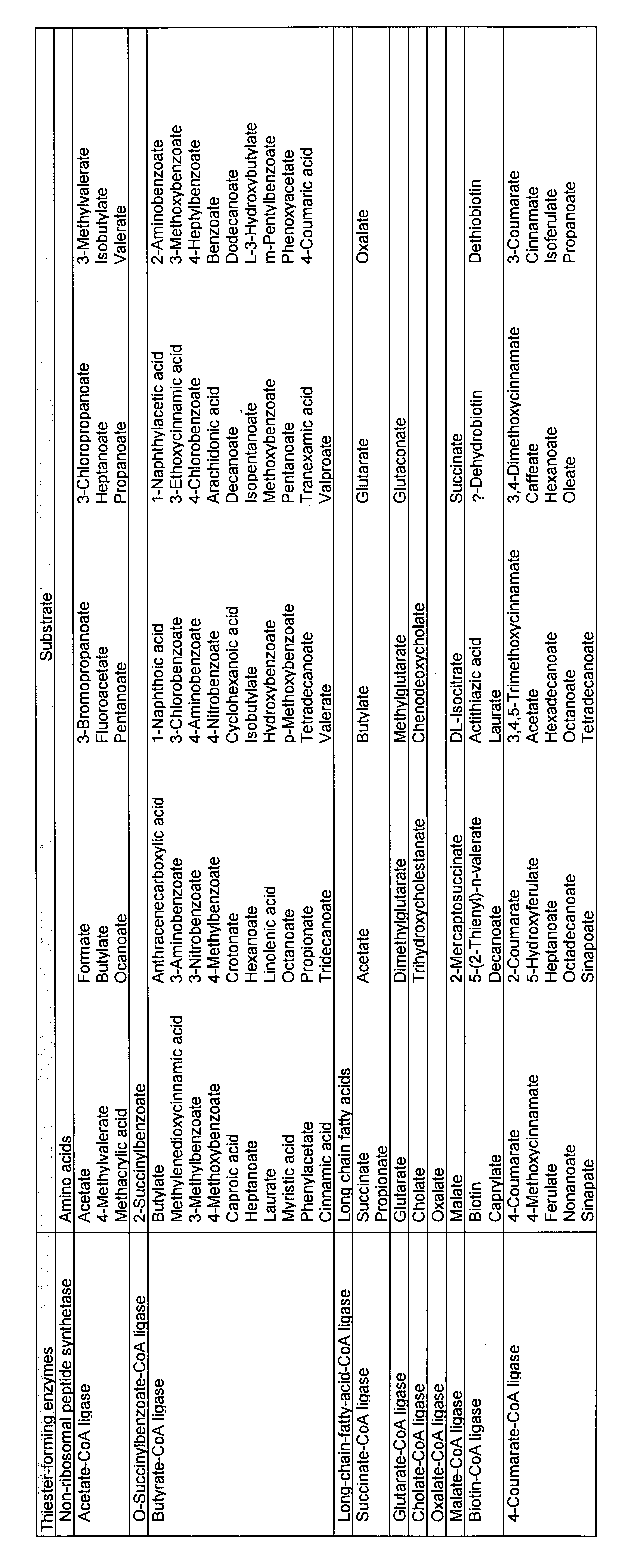
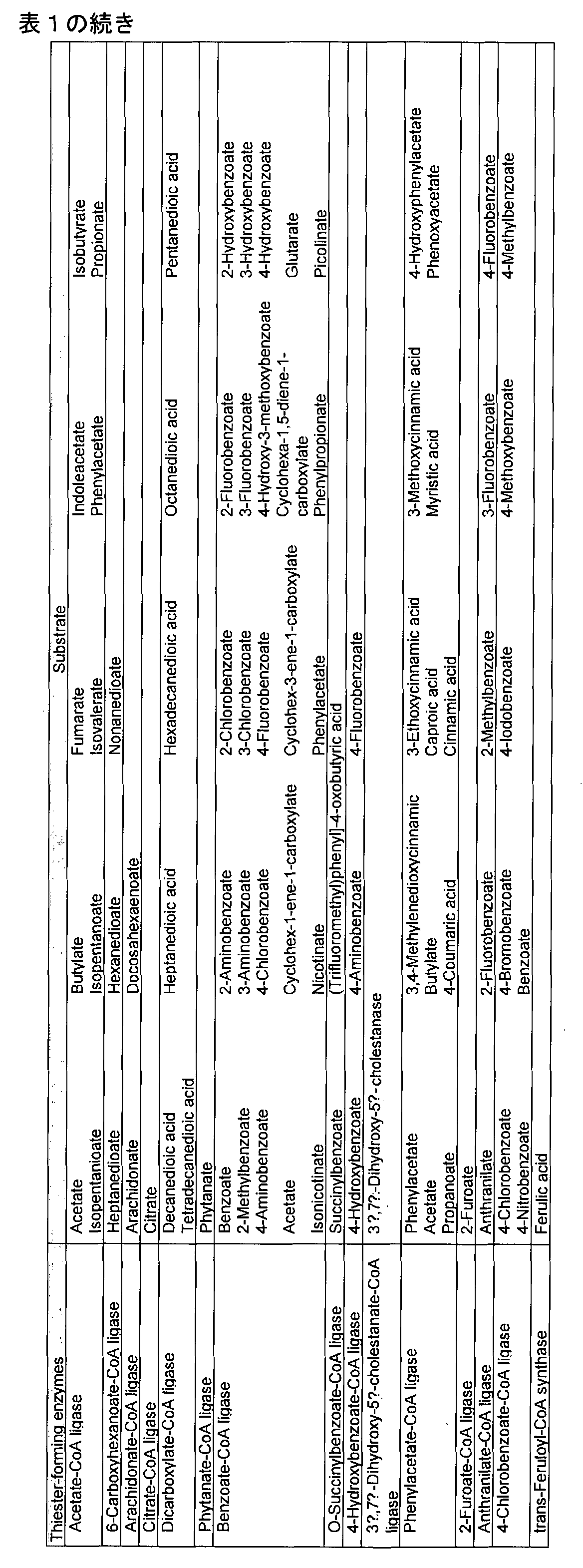
また、本発明の一実施形態において、「任意の化合物をチオエステル化する活性を有する酵素または酵素群」は、好ましくは、上記のように任意の化合物とチオエステル結合することにより、前記任意の化合物と前記求核活性を有する化合物との結合を触媒するものである。また、前記酵素または酵素群は、前記任意の化合物をリン酸化、アセチル化するものであり、好ましくは、前記任意の化合物のカルボキシル基をアデニル化するものである。
また、本願明細書において、「酵素」または「酵素群」と使用した場合には、特に言及する場合を除き、生体内における化学反応を触媒する機能を有する分子を指す。また、例えば、酵素が複数のペプチド(サブユニット)から構成される場合、複数の酵素(複合酵素)がクラスターを形成して一連の代謝過程を触媒する場合、複数のドメインが単一の酵素を形成する場合など、1若しくはそれ以上の分子が集合または連関して単一の酵素として機能する場合に、当該1若しくはそれ以上の分子単体で酵素活性を有するときには、当該酵素活性を有する分子を「酵素」と表現し、当該集合または連関した単一の酵素を「酵素群」と表現する。
また、本発明の一実施形態において、「任意の化合物をチオエステル化する活性を有する酵素または酵素群」は、非リボソーム型ペプチド合成酵素(non-ribosomal peptide synthetase:NRPS)(図1)の少なくとも一部を構成するモジュールである。以下に、NRPSについて説明する。NRPSは、分子量数千kDaにも及ぶ巨大なマルチモジュール酵素複合体であり、リボソームを介することなく短鎖の生理活性ペプチドを合成することで知られている。NRPSを構成する繰返し単位であるモジュールは、基質となるアミノ酸を認識、活性化するアデニル化活性ドメイン(adenylation domain:A domain)、活性化アミノ酸とチオエステルを形成するチオール化ドメイン(thiolation domain:T domain)(ペプチジルキャリアタンパク質部位(PCP部位))、そしてペプチド結合の形成を触媒する縮合ドメイン(condensation domain:C domain)を基本的な構成要素とする。なかには、ペプチド合成の過程でL-アミノ酸をD-体に変換する異性化ドメイン(epimerization domain:E domain)を有するモジュールもあり、産生するペプチドに多様性を持たせている。
NRPSによって合成されるプロリン含有ジペプチドの例として、Brevibacillus parabrevisが合成する抗菌性デカペプチドのチロシジンAが挙げられる。チロシジンA合成酵素群のうち、開始モジュールTycA(TycAのアミノ酸配列を配列ID番号1に、塩基配列を配列ID番号3にそれぞれ示す)および最初の伸長モジュールTycB1(TycB1のアミノ酸配列を配列ID番号2に、塩基配列を配列ID番号4にそれぞれ示す)はそれぞれL-フェニルアラニン、L-プロリンを基質として、環状のプロリン含有ジペプチドcyclo(D-Phe-L-Pro)を合成する(図2)。一般的にNRPSからのペプチドの切り出し反応は、終末モジュールのチオエステラーゼドメイン(thioesterase domain:TE domain)によって触媒され、またペプチドの種類によって、環化による環状ペプチドの生成と加水分解による鎖状ペプチドの生成という2つの様式がある。cyclo(D-Phe-L-Pro)合成反応では、酵素本体からの生成物の遊離は分子内自己環化によって非酵素的に進行することが知られているが、上記の知見は、本反応においても中間体化合物の構造により鎖状ジペプチドの合成可能性を予見させるものであった。
酵素的に合成することができなかった種々のジペプチドを網羅的に合成する潜在性を有していながら、これまでNRPSが工業的に利用されてこなかった最大の要因は、この手法によるペプチドの生産性が極めて低かったことにある。NRPSによる反応生成物収量は総じてμMオーダーと低く、上記cyclo(D-Phe-L-Pro)の発酵生産の例でも最大38μM(9.2mg/L)というのが現状である。このため、工業化を視野に入れたNRPS関連研究は乏しく、主として学術的、解析的な色合いの濃い研究に終始している。その中で大部分を占めるのが、NRPSの特性を活かしたコンビナトリアルなペプチド合成に関するものである。これらは、基質特異性の改変やモジュールの再構成などの手法を駆使して検討が進められてきたが、Aドメインにおいてアミノ酸がアデニル化(活性化)される際の活性値をベースとして、基質となるアミノ酸が特定あるいは選定されてきた。しかし、NRPSは複数の反応を段階的に触媒することに加え、律速点が反応後段にあることが示唆されていることから、Aドメインに対する基質として活性値が低いアミノ酸であってもひとたび活性化さえされてしまえば、以降の反応は従来の基質を利用した場合と比しても遜色ないレベルで進行するものと考えられる。
また、本願発明に係る一実施形態において、前記酵素または酵素群は、少なくとも上述したアデニル化活性ドメイン及びペプチジルキャリアタンパク質部位を有するものであるが、本願発明に係る方法と同一または類似の効果を奏する限り、これらのドメイン・部位以外に、NRPSを構成する任意のモジュール、ドメインまたは部位を含むことができるのは言うまでもない。さらに、本願発明に係る一実施形態において、前記酵素または酵素群は、Brevibacillus parabrevis由来のものであるが、上述した酵素または酵素群、或いはNRPSと同様の機能を奏するものである限り、1以上のアミノ酸の置換、欠失、挿入、付加、又は逆位を含むアミノ酸配列を有する酵素を産生するものであれば、どのような菌株由来のものであっても良い。なお、本願明細書において、「Brevibacillus parabrevis」とは、特に言及する場合を除き「Brevibacillus parabrevis NBRC 3331」であり、場合によっては「Brevibacillus brevis」、「Bacillus brevis」、「ATCC 8185」等と表現されることがあるが、いずれも同一の菌株である。
また、本願発明に係る一実施形態において、前記酵素または酵素群としてNRPSの少なくとも一部を構成するモジュールを利用する場合、前記任意の化合物はアミノ酸であることが好ましい。本願明細書において「ペプチド」とは、2以上のアミノ酸がペプチド結合で連結した化合物を指す。また、アミノ酸又はペプチドが、メチル基を含むアルキル基、リン酸基、糖鎖、及び/又は、エステル結合その他の共有結合による修飾を含む場合には、それぞれ、アミノ酸又はペプチドの誘導体という。
また、本願明細書においてアミノ酸を表す場合、アスパラギン、グルタミン等の化合物名で表す場合と、Asn、Gln等の慣用の3文字表記で表す場合とがある。化合物名で表す場合には、アミノ酸のα炭素に関する立体配置を示す接頭辞(又はD-)を用いて表す。慣用の3文字表記で表す場合には、当該3文字表記は特に断りのない限りL体のアミノ酸を表す。本願明細書において、アミノ酸は、アミノ基とカルボキシル基とが少なくとも1個の炭素原子を介して結合した化合物であって、ペプチド結合により重合することが可能ないずれかの化合物を指す。本願明細書におけるアミノ酸は、グリシン、アラニン、システイン、アスパラギン酸、グルタミン酸、フェニルアラニン、ヒスチジン、イソロイシン、リジン、ロイシン、メチオニン、アスパラギン、プロリン、グルタミン、アルギニン、セリン、スレオニン、バリン、トリプトファン及びチロシンからなる20種類のアミノ酸と、これらの立体異性体であるD-アミノ酸、更にはタンパク質を構成しないアミノ酸であるβ-アラニン、サルコシン、オルニチン、シトルリン、クレアチン、γアミノ酪酸、オパイン等を含むが、これらに限定されないいずれかの天然又は非天然のアミノ酸であっても良い。
また、本発明の一実施形態において、「任意の化合物」としてアミノ酸を用いた場合、上述したアミノ酸のいずれをも利用することができる。そして、この場合、求核活性を有する化合物との結合により製造される有機化合物における当該任意の化合物としてのアミノ酸部分のキラリティーは結合前後において保持されているものである。
具体的には、「任意の化合物」として任意のアミノ酸、「求核活性を有する化合物」としてプロリンを採用した場合、本願発明に係る方法によれば、Xaa-Proを合成することができる。この際、N末端側のXaaは任意のアミノ酸であるが、好ましくは、前記N末端アミノ酸Xaaは、Trp、Tyr、Met、Leu、Valである。この場合、XaaはL体であっても、D体であっても良く、生成するジペプチドXaa-ProのXaaはXaaのキラリティーに依存する。よって、例えば、本願発明に係る方法によって生成されたジペプチド(生成物)は、D-L、L-D、L-L、またはD-Dのいずれでもあり得る。
このように、「任意の化合物をチオエステル化する活性を有する酵素または酵素群」としてNRPSの少なくとも一部を構成するモジュールであるTycAを用いる場合には、「任意の化合物」としてのアミノ酸(Xaa)はL-体でもD-体であっても良い。ここで、通常の酵素反応においては、特定の基質に作用して特定の反応を触媒するという酵素の基質特異性が存在することからもわかるように、酵素は、基質中の原子団の立体配座(DとL、シスとトランス等)を区別し、立体構造を認識している。従って、酵素反応におけるキラリティー認識は通常厳密なものであり、このような酵素の立体特異性が存在するため、通常の酵素反応においては基質としてL-体でもD-体でも採用できることはなく、基質特異性や立体特異性に合致した基質のみが作用を受ける。これに対して、本願発明に係る一実施形態においては、本願の酵素または酵素群としてTycAを用いた場合には、その基質はL-体でもD-体でも良いという、通常の酵素を利用した反応系にはみられない顕著な効果を有するものである。
また、本願発明の一実施形態において、この場合に「任意の化合物をチオエステル化する活性を有する酵素または酵素群」としてNRPSの少なくとも一部を構成するモジュールであるTycAを用いた場合、TycAの本来の基質であるPheでは、L体であっても、D体であっても生成する産物はジペプチドが環状化したD-Phe-L-Proのジケトピペラジン(=D-Phe-L-Pro-DKP)であり、D-Pheの場合のみジケトピペラジンに加えて直鎖状のジペプチドD-Phe-L-Proを生成する。環化したジケトピペラジンを生成するPheの場合とは異なり、Phe以外のアミノ酸を基質とした場合、生成するジペプチドは直鎖状のみであり、また生成物の収率も高い。例えば、「求核活性を有する化合物」としてプロリンを採用した場合には、L-Trp-L-Pro、L-Tyr-L-Pro、L-Leu-L-Pro、D-Leu-L-Pro、L-Met-L-Pro、D-Met-L-Pro、L-Trp-D-Pro等はg/L単位での合成が可能であり、また「求核活性を有する化合物」としてcis-4-L-HydroxyPro(C4L)やcis-4-D-HydroxyPro(C4D)を採用した場合には、L-Trp-C4L、L-Trp-C4D等もg/L単位での合成が可能であり、これらの生成物に限定されず、本願発明に係る方法によって製造した有機化合物はg/L単位での合成が可能である。この本願発明に係る効果は、通常mg/L程度の生産性しかないNRPSを利用したペプチド合成と比較して高い合成収率を達成するものである。また、TycAを用いた場合、通常の製造方法である煩雑な反応を組み合わせる化学合成と比較して副産物がなく精製が容易に、C末端プロリンジペプチドを製造することができる。また、C末端プロリン含有ペプチドを、無保護のアミノ酸から一段階のプロセスで、鎖状ペプチドとして生成することができる。さらに、本願発明の一実施形態において、後述するような遺伝子組換え体を利用することにより、C末端プロリンジペプチドの製造に際して、ATPやマグネシウムを必要とせず、基質添加のみで産生が可能となる。
また、本願発明の一実施形態において、「任意の化合物をチオエステル化する活性を有する酵素または酵素群」としてNRPSの少なくとも一部を構成するモジュールであるTycAを用いる場合、TycAに加えて、更にTycB1を使用することもできる。ここで、TycB1とは、NRPSの少なくとも一部を構成するモジュールであって、少なくともアデニル化活性ドメイン及びペプチジルキャリアタンパク質部位を有するものである。本願発明に係る方法においてTycAとTycB1とを利用した場合、TycB1のペプチジルキャリアタンパク質部位とチオエステル結合した任意の化合物が、TycAのペプチジルキャリアタンパク質部位とチオエステル結合した任意の化合物と結合することにより有機化合物が製造される。この場合、TycB1は、当該TycB1に結合した化合物を、TycAに結合した任意の化合物に対して、触媒反応を可能にするために接触させる役割を担うものであり、TycB1とチオエステル結合した任意の化合物は求核活性を有する必要はない。そのため、本願発明に係る一実施形態において、「求核活性を有する化合物」として、本願発明に係る任意の化合物のチオエステル部位に求核攻撃して結合するものを利用する限り、TycAだけを用いる場合はもちろん、TycA及びTycB1の両者を用いる場合であっても合成反応が促進するのは言うまでもない。すなわち、本願発明は、任意の化合物をチオエステル化して活性化させることにより、求核活性を有する化合物との接触(非酵素的反応)を促進させ、これにより、多様な有機化合物を効率的・経済的に合成できる技術を提供するものである。
以上のように、本発明の一実施形態において、TycAのみを利用した場合に達成し得る本願発明の顕著な効果または特徴については、TycAに加えてTycB1を用いた場合であっても同様に達成し得るものであることは言うまでもない。例えば、本発明の一実施形態において、「任意の化合物」としてアミノ酸を用いた場合には、上述の通り、求核活性を有する化合物との結合により製造される有機化合物における当該任意の化合物としてのアミノ酸部分のキラリティーは結合前後において保持されているものであるが、TycAとTycB1とを用いた有機化合物を合成した場合、その生成物における任意のアミノ酸部分のキラリティーは保持されている、具体的には、TycAとTycB1とを用いて生成したジペプチドのキラリティーを、塩酸による加水分解物の分析と、Nα-(5-フルオロ-2,4-ジニトロフェニル)-L-アラニンアミド(FDAA)で誘導体化したジペプチドのHPLCクロマトグラム上での分離にて判定すると、キラリティーの保持を確認することができる。
本願発明の一実施形態において、「任意の化合物をチオエステル化する活性を有する酵素または酵素群」としては、(A)配列ID番号1に記載のアミノ酸配列を有する酵素、(B)配列ID番号1に記載のアミノ酸配列において、1以上のアミノ酸の置換、欠失、挿入、付加、又は逆位を含むアミノ酸配列からなり、任意の化合物のカルボキシル基をアデニル化し、且つチオエステル結合によって前記任意の化合物と結合する活性を有する酵素、(C)配列ID番号1に記載のアミノ酸配列と60%以上の相同性を有するアミノ酸配列からなり、且つ任意の化合物のカルボキシル基をアデニル化し、且つチオエステル結合によって前記任意の化合物と結合する活性を有する酵素、(D)配列ID番号3に記載の塩基配列と60%以上の相同性を有する塩基配列からなるポリヌクレオチドによってコードされるアミノ酸配列からなり、且つ任意の化合物のカルボキシル基をアデニル化し、且つチオエステル結合によって前記任意の化合物と結合する活性を有する酵素、(E)配列ID番号3に記載の塩基配列とストリンジェントな条件下でハイブリダイズする塩基配列によってコードされるアミノ酸配列からなり、且つ任意の化合物のカルボキシル基をアデニル化し、且つチオエステル結合によって前記任意の化合物と結合する活性を有する酵素、または(F)前記(A)~(E)のいずれかに記載の酵素と特異的結合タグペプチドとが結合した酵素であって、任意の化合物のカルボキシル基をアデニル化し、且つチオエステル結合によって前記任意の化合物と結合する活性を有する酵素、を挙げることができる。
上記において、1以上のアミノ酸の置換、欠失、挿入、付加、又は逆位を含むアミノ酸配列からなり、任意の化合物のカルボキシル基をアデニル化し、且つチオエステル結合によって前記任意の化合物と結合する活性を有する酵素は、分子生物学の分野において周知の部位特異的変異導入法を用いて、例えば配列ID番号1で表されるアミノ酸配列からなるタンパク質をコードするDNAに部位特異的変異を導入することにより、取得することができる。
置換、欠失、挿入、付加、又は逆位のアミノ酸残基の数は特に限定されないが、上記の部位特異的変異法等の周知の方法によって置換、欠失、挿入、付加、又は逆位できる程度の数であり、1個から数十個、好ましくは1~20個、より好ましくは1~10個、さらに好ましくは1~5個である。
アミノ酸残基の欠失や付加等が可能なアミノ酸の位置としては、欠失や付加等がされた結果の酵素が、任意の化合物のカルボキシル基をアデニル化し、且つチオエステル結合によって前記任意の化合物と結合する活性を有するものであれば、如何なる位置出会っても良いが、例えば配列番号1で表されるアミノ酸配列のN末端側およびC末端側の10アミノ酸残基をあげることができる。また、欠失、置換または付加等は同時に生じてもよく、置換や付加等されるアミノ酸は天然型と非天然型とを問わない。
また、本願発明にかかる酵素または酵素群としては、配列ID番号1で表されるアミノ酸配列との相同性が60%以上、好ましくは65%以上、より好ましくは70%以上、さらに好ましくは75%以上、さらに好ましくは80%以上、よりさらに好ましくは90%以上、さらに好ましくは95%以上、さらに好ましくは97%以上、特に好ましくは98%以上、最も好ましくは99%以上の相同性を有するアミノ酸配列からなる酵素であり、かつ任意の化合物のカルボキシル基をアデニル化し、且つチオエステル結合によって前記任意の化合物と結合する活性を有する酵素をあげることができる。
本願発明にかかる酵素または酵素群としては、配列ID番号3で表される塩基配列との相同性が60%以上、好ましくは65%以上、より好ましくは70%以上、さらに好ましくは75%以上、さらに好ましくは80%以上、よりさらに好ましくは90%以上、さらに好ましくは95%以上、さらに好ましくは97%以上、特に好ましくは98%以上、最も好ましくは99%以上の相同性を有する塩基配列からなるポリヌクレオチドによってコードされるアミノ酸配列からなる酵素であり、かつ任意の化合物のカルボキシル基をアデニル化し、且つチオエステル結合によって前記任意の化合物と結合する活性を有する酵素をあげることができる。
アミノ酸配列や塩基配列の相同性は、BLASTやFASTAを用いて決定することができる。
また、本願発明にかかる酵素または酵素群としては、配列ID番号3に記載の塩基配列とストリンジェントな条件下でハイブリダイズする塩基配列によってコードされるアミノ酸配列からなり、且つ任意の化合物のカルボキシル基をアデニル化し、且つチオエステル結合によって前記任意の化合物と結合する活性を有する酵素を挙げることができる。
本願明細書において、「ハイブリダイズする」とは、特定の塩基配列を有するDNAまたは当該DNAの一部にDNAがハイブリダイズすることを指す。したがって、当該特定の塩基配列を有するDNAまたは当該DNAの一部の塩基配列は、ノーザンまたはサザンブロット解析のプローブとして有用であるか、またはPCR解析のオリゴヌクレオチドプライマーとして使用できる長さのDNAであってもよい。ノーザンまたはサザンブロット解析のプローブとして用いるDNAとしては、少なくとも100塩基以上、好ましくは200塩基以上、より好ましくは500塩基以上のDNAをあげることができ、オリゴヌクレオチドプライマーとして用いられるDNAとしては少なくとも10塩基以上、好ましくは15塩基以上のDNAをあげることができる。DNAのハイブリダイゼーション実験としては、分子生物学の分野において周知のハイブリダイゼーションの条件に従って実験を行うことができる。
また、上記のストリンジェントな条件としては、本願発明に係る方法における効果を達成し得る限りいかなる条件であってもよいが、例えばDNAを固定化したフィルターとプローブDNAとを50%ホルムアミド、5×SSC(750mMの塩化ナトリウム、75mmol/Lのクエン酸ナトリウム)、50mmol/Lのリン酸ナトリウム(pH7.6)、5×デンハルト溶液、10%の硫酸デキストラン、および20μg/Lの変性させたサケ精子DNAを含む溶液中で42℃で一晩インキュベートした後、例えば約65℃の0.2×SSC溶液中で該フィルターを洗浄する条件をあげることができ、またより低いストリンジェント条件を用いることもできる。
また、本願発明にかかる酵素または酵素群としては、前記(A)~(E)のいずれかに記載の酵素と特異的結合タグペプチドとが結合した酵素であって、任意の化合物のカルボキシル基をアデニル化し、且つチオエステル結合によって前記任意の化合物と結合する活性を有する酵素を挙げることができる。
本願明細書において、「タグペプチド」とは、特定のタンパク質分子の目印とするために分子生物学的または遺伝子工学的に結合した部分のことを指し、その長短はどのようなものであっても良い。また、結合させる対象となるタンパク質またはペプチドの生理的・物理化学的性質に影響を与えない限り、任意の位置に結合させることができるが、好ましくは目的タンパク質の末端に結合され、低分子量のものである。また、タグペプチドとして他種タンパク質を利用することもできる。さらに、タグペプチドを利用することによって、その性質に応じてタンパク質の単離、固定化、タンパク質間相互作用の検出、タンパク分子の可視化などを可能にする。
また、本願発明に係る一実施形態において、有機化合物を製造する方法は、上述した(A)~(F)のいずれかに記載の酵素を発現する能力を有する遺伝子組換え体を培地に培養する工程と、任意の化合物と求核活性を有する化合物とを前記遺伝子組換え体に接触させる工程と、前記任意の化合物と前記求核活性を有する化合物とが結合して得られる有機化合物を培養物中に生成、蓄積させ、且つ当該培養物中から当該有機化合物を採取する工程とを有し、前記求核活性を有する化合物は、前記任意の化合物のチオエステル部位に求核攻撃して結合するものであることを特徴とする、方法である。
本願明細書において「遺伝子組換え体」とは、本発明のタンパク質をコードするポリヌクレオチドが組み込まれた発現ベクターが導入され、所望の機能を有するタンパク質に関連する所望の形質を表すことができるようになった形質転換体や、染色体に外部から所定の遺伝子を導入して所望の形質を発現することが可能な生物など、遺伝子組換え技術等により得られた核酸及びその複製物を有する生物を指すものである。
本願発明の製造方法に用いられる遺伝子組換え体としては、本願発明の製造方法に用いることができる限り、遺伝子組換え体であれば特に限定されないが、上記(A)~(F)のいずれかに記載の酵素を発現する遺伝子組換え体、および後述する(A)~(C)のいずれかに記載のDNAを利用して宿主細胞を公知の方法で遺伝子組換えして得られる遺伝子組換え体をあげることができる。宿主細胞としては、大腸菌、枯草菌、糸状菌等の原核生物や、酵母、菌類、植物、動物等のような真核生物をあげることができ、好ましくはエシェリヒア(Escherichia)属に属する微生物をあげることができる。また、本願発明の一実施形態において、好ましくは、遺伝子組換え体の宿主は大腸菌(Escherichia coli)である。遺伝子組換え体が組換えられるDNAとしては、(A)配列ID番号3で表される塩基配列を有するDNA、(B)配列ID番号3で表される塩基配列と60%以上の相同性を有する塩基配列からなり、且つ任意の化合物のカルボキシル基をアデニル化し、且つチオエステル結合によって前記任意の化合物と結合する活性を有する酵素をコードするDNA、(C)配列ID番号3で表される塩基配列と相補的な塩基配列を有するDNAとストリンジェントな条件下でハイブリダイズし、且つ任意の化合物のカルボキシル基をアデニル化し、且つチオエステル結合によって前記任意の化合物と結合する活性を有する酵素をコードするDNAが挙げられる。
また、これらのDNAは、配列ID番号3で表される塩基配列と60%以上、好ましくは65%以上、より好ましくは70%以上、さらに好ましくは75%以上、さらに好ましくは80%以上、よりさらに好ましくは90%以上、さらに好ましくは95%以上、さらに好ましくは97%以上、特に好ましくは98%以上、最も好ましくは99%以上の相同性を有する配列を検索し、その検索によって得られた塩基配列に基づき、当該塩基配列を有する生物の染色体DNA、cDNAライブラリー等から、遺伝子工学または分子生物学の分野において周知の種々の方法によって取得することもできる。
取得したDNAをそのまま、あるいは適当な制限酵素などで切断し、常法によりベクターに組み込み、得られた組換え体DNAを宿主細胞に導入した後、通常用いられる塩基配列解析方法や塩基配列分析装置を用いて分析することにより、当該DNAの塩基配列を決定することができる。また、組換え体DNAの導入方法としては、上記宿主細胞へDNAを導入する方法であればいずれも用いることができ、例えば、カルシウムイオン法、プロトプラスト法、エレクトロポレーション法等を用いることができる。
また、本願発明の一実施形態において、遺伝子組換え体の培養は、当該遺伝子組換え体が資化し得る炭素源、窒素源、無機塩類等を含有し、当該遺伝子組換え体の培養を効率的に行える天然培地または合成培地を用いて培養することができる。
炭素源としては、遺伝子組換え体が資化し得るものであればよく、グルコース、フラクトース等を含有する糖蜜、セルロース系バイオマスの糖化液、グリセロール、デンプンあるいはデンプン加水分解物等の炭水化物、酢酸、プロピオン酸等の有機酸、エタノール、プロパノール等のアルコール類等を用いることができる。
窒素源としては、アンモニア、塩化アンモニウム、硫酸アンモニウム、酢酸アンモニウム、リン酸アンモニウム等の無機酸もしくは有機酸のアンモニウム塩、その他の含窒素化合物、並びに、ペプトン、肉エキス、酵母エキス、コーンスチープリカー、カゼイン加水分解物、大豆粕および大豆粕加水分解物、各種発酵菌体、およびその消化物等を用いることができる。
無機塩としては、リン酸第一カリウム、リン酸第二カリウム、リン酸マグネシウム、硫酸マグネシウム、塩化ナトリウム、硫酸第一鉄、硫酸マンガン、硫酸銅、炭酸カルシウム等を用いることができる。
培養は、通常振盪培養または深部通気攪拌培養等の好気的条件下で行う。培養温度は15~40℃がよく、培養時間は、通常5時間~7日間である。培養中pHは3.0~9.0に保持する。pHの調整は、無機または有機の酸、アルカリ溶液、尿素、炭酸カルシウム、アンモニア等を用いて行う。
また、培養中必要に応じて、アンピシリンやテトラサイクリン等の抗生物質を培地に添加してもよい。
プロモーターとして誘導性のプロモーターを用いた発現ベクターを有する遺伝子組換え体を培養するときには、必要に応じてインデューサーを培地に添加してもよい。例えば、lacプロモーターを用いた発現ベクターを有する遺伝子組換え体を培養するときにはイソプロピル-β-D-チオガラクトピラノシド等を、trpプロモーターを用いた発現ベクターを有する遺伝子組換え体を培養するときにはインドールアクリル酸等を培地に添加してもよい。
また、遺伝子組換え体が産生した有機化合物を培養物中から採取する手法としては、必要に応じて当該遺伝子組換え体に対して遠心分離や粉砕等の処理を施し、培養上清における当該有機物またはその糖付加体等の誘導体を回収することができるが、目的の有機化合物を採取することができる限り、種々のものを採用することができる。
また、本願発明に係る一実施形態において、目的の有機化合物に応じて、当該有機化合物を産生する遺伝子組換え体に、所定の遺伝子を更に組み込むことも可能である。この所定の遺伝子としては、本願発明に係る酵素または酵素群の活性化を促進させる遺伝子、ATP再生系に関わる酵素群の遺伝子、或いは、当該遺伝子組換え体において当該有機化合物の分解や代謝を促進する遺伝子の機能を阻害する遺伝子を挙げることができる。また、当該阻害遺伝子の場合には、この遺伝子のノックアウト株を採用することもできる。例えば、上述の「求核活性を有する化合物」としてプロリンを採用し、遺伝子組換え体として大腸菌を用いる場合、大腸菌体内にはprolidase(PepQ)というペプチダーゼが存在し、L-プロリン含有ペプチドを分解してしまうため、収量増加を目的としてpepQ遺伝子欠損大腸菌を利用することができる。
具体的には、大腸菌の無細胞抽出液には種々のペプチド分解酵素が含まれているため、L-アミノ酸のみから成るジペプチドは容易に分解されてしまう。そのため、大腸菌が有するペプチド分解酵素の中で、プロリンをC末端に有するペプチドに特異的に作用する酵素であるPepQを欠損させた大腸菌を造成することができる。そして、この造成した大腸菌の無細胞抽出液を合成した各種ジペプチドXaa-L-Proに作用させると、多くのジペプチドで分解が抑制されることを確認した。そこで、当該菌株に共発現プラスミドpRTYCAB1およびpTSFPを導入し、その無細胞抽出液を用いて、L-Leu-L-ProおよびL-Trp-L-Pro生産試験を実施すると、反応液中のジペプチドの分解を顕著に緩和させることに成功している。このように、無細胞抽出液を用いる簡便な反応系においても、本願発明に係る酵素または酵素群を利用した効率的な有機化合物の合成が可能であることがわかる。
さらに、本願発明に係る一実施形態において、目的の有機化合物を効率的に産生するため、上記遺伝子組換え体にSfp遺伝子をさらに組み込んでも良い。ここで、Sfp遺伝子とはBacillus subtilis由来のSurfactin合成に関する遺伝子であり、NRPSモジュールを活性化するために、Coenzyme Aを連結するホスホパンテテイン基転移酵素を産生する。従って、tycA及びsfpを共発現するような遺伝子組換え体を作製することにより、本願発明に係る有機化合物を効率的に且つ安価に製造することが可能である。例えば、このtycA及びsfpを共発現するような遺伝子組換え体では、sfp遺伝子発現強度や遺伝子発現プラスミドのコピー数を調整することにより、目的の有機化合物を効率的に産生するための条件を設定することができる。
以下に、実施例を用いて、本発明をより詳細に説明するが、本発明はこれらの実施例に限定されるものではない。また、以下に説明する実験手法や物質については例示的なものであり、本実施形態においては以下の実験手法等を用いているが、これら以外の実験手法等を用いても、同様の結果を得ることができる。
(遺伝子クローニング)
TycA遺伝子は、Brevibacillus parabrevis NBRC 3331のゲノムDNAを鋳型とし、下記のプライマーを用いてPCRで増幅した。
(TycA)
Forward Primer:ATACCATGGTAGCAAATCAGGCCAATC(配列ID番号5)(下線部はNcoIによる制限酵素サイト)
Reverse Primer:ATAGGATCCCCGCGCAGTGTATTTGC(配列ID番号6)(下線部はBamHIによる制限酵素サイト)
TycA遺伝子は、Brevibacillus parabrevis NBRC 3331のゲノムDNAを鋳型とし、下記のプライマーを用いてPCRで増幅した。
(TycA)
Forward Primer:ATACCATGGTAGCAAATCAGGCCAATC(配列ID番号5)(下線部はNcoIによる制限酵素サイト)
Reverse Primer:ATAGGATCCCCGCGCAGTGTATTTGC(配列ID番号6)(下線部はBamHIによる制限酵素サイト)
PCRによって増幅したTycA遺伝子を制限酵素NcoIとBamHIで消化し、同様にして直鎖化したベクターpET21d(+)にクローニングした。なおクローニングの段階でベクター由来のHis×6-tagが付加されるように設計した。作製したプラスミドのシークエンスを確認した後、Escherichia coli BLR(DE3)に導入した。
NRPSの修飾酵素遺伝子sfpはBacillus subtilis OKB105のゲノムDNAを鋳型とし、下記のプライマーセットでPCRによって増幅した。
Forward Primer:ACGGCACATATGAAGATTTACGG(配列ID番号7)(下線部はNdeIによる制限酵素サイト)
Reverse Primer:ATAGAATTCTTATAAAAGCTCTTCG(配列ID番号8)(下線部はEcoRIによる制限酵素サイト)
Forward Primer:ACGGCACATATGAAGATTTACGG(配列ID番号7)(下線部はNdeIによる制限酵素サイト)
Reverse Primer:ATAGAATTCTTATAAAAGCTCTTCG(配列ID番号8)(下線部はEcoRIによる制限酵素サイト)
増幅断片をNdeIとEcoRIで消化し、同様にして直鎖化したベクターpET21a(+)にクローングした。作製したプラスミドのシークエンスを確認した後、Escherichia coli BLR(DE3)に導入した。
(精製酵素の調製)
tycA、およびNRPSの修飾酵素遺伝子sfpを高発現する組換え大腸菌をそれぞれ、終濃度50μg/mlのカルベニシリンおよび0.1mMのイソプロピルβ-D(-)-チオガラクトピラノシド(IPTG)を添加した150mlのLB培地(酵母エキス5g、トリプトン10g、NaCl 10g/L)に植菌し、各遺伝子の発現誘導条件下にて18時間培養した(25℃、120rpm)。それぞれの培養菌体を遠心分離(4℃、3,000×g、10min)により回収し、50mM Tris-HClバッファー(pH8.0)での洗菌操作を3回繰返した。その後、同バッファーで再懸濁した菌体を超音波破砕し、遠心分離(4℃、14,000rpm、30min)により不溶性タンパク質および残渣を除去して、無細胞抽出液を調製した。CoenzymeAおよびMgCl2の存在下で、無細胞抽出液中のTycAにそれぞれSfpを作用させ、活性なホロ酵素に変換した。当該酵素をそれぞれNi2+アフィニティークロマトグラフィーにより単一に精製し、活性測定に利用した。遺伝子発現状況および酵素精製度の確認はSDS-PAGEによって行い、タンパク質の定量はBradford法に基づいて行った。
tycA、およびNRPSの修飾酵素遺伝子sfpを高発現する組換え大腸菌をそれぞれ、終濃度50μg/mlのカルベニシリンおよび0.1mMのイソプロピルβ-D(-)-チオガラクトピラノシド(IPTG)を添加した150mlのLB培地(酵母エキス5g、トリプトン10g、NaCl 10g/L)に植菌し、各遺伝子の発現誘導条件下にて18時間培養した(25℃、120rpm)。それぞれの培養菌体を遠心分離(4℃、3,000×g、10min)により回収し、50mM Tris-HClバッファー(pH8.0)での洗菌操作を3回繰返した。その後、同バッファーで再懸濁した菌体を超音波破砕し、遠心分離(4℃、14,000rpm、30min)により不溶性タンパク質および残渣を除去して、無細胞抽出液を調製した。CoenzymeAおよびMgCl2の存在下で、無細胞抽出液中のTycAにそれぞれSfpを作用させ、活性なホロ酵素に変換した。当該酵素をそれぞれNi2+アフィニティークロマトグラフィーにより単一に精製し、活性測定に利用した。遺伝子発現状況および酵素精製度の確認はSDS-PAGEによって行い、タンパク質の定量はBradford法に基づいて行った。
(ジペプチド合成活性測定)
精製したホロ酵素TycA0.1mg/mlを、10mMのグリシンまたは19種類のD-またはL-アミノ酸のいずれかとL-プロリン、20mMのMgCl2、ATPとともに37℃で24時間または48時間インキュベートした。生成物はHPLCによって定量、同定した。
精製したホロ酵素TycA0.1mg/mlを、10mMのグリシンまたは19種類のD-またはL-アミノ酸のいずれかとL-プロリン、20mMのMgCl2、ATPとともに37℃で24時間または48時間インキュベートした。生成物はHPLCによって定量、同定した。
(HPLC解析)
生成した有機化合物は、Nα-(5-フルオロ-2,4-ジニトロフェニル)-L-アラニンアミド(FDAA)を用いて誘導体化した後にHPLCで分析した。FDAAを用いた誘導体化は、試料100μlに、50μlの0.5%のFDAAアセトン溶液と40μlの0.5mol/lの炭酸ナトリウム水溶液を加えて攪拌した後、40℃で60分間静置することにより行った。
生成した有機化合物は、Nα-(5-フルオロ-2,4-ジニトロフェニル)-L-アラニンアミド(FDAA)を用いて誘導体化した後にHPLCで分析した。FDAAを用いた誘導体化は、試料100μlに、50μlの0.5%のFDAAアセトン溶液と40μlの0.5mol/lの炭酸ナトリウム水溶液を加えて攪拌した後、40℃で60分間静置することにより行った。
次に、40μlの1mol/lの塩酸と770μlのメタノールを加えて攪拌したものを、FDAA化試料とした。
当該FDAA化試料を、WH-C18Aカラム(日立サイエンスシステムズ、4×150mm)を用いて分析、定量した。HPLC分析の条件には、下記の条件を用いた。
移動相には、50mmol/lのリン酸カリウム緩衝液(pH2.7、リン酸でpH調整)とアセトニトリルおよびメタノ-ルの混合比が90:5:5の移動相A、50mmol/lのリン酸カリウム緩衝液(pH2.7、リン酸でpH調整)とアセトニトリルおよびメタノ-ルの混合比が60:35:5の移動相B、アセトニトリルとテトラヒドロフランおよび水の混合比が3:1:3の移動相Cを用いた。移動相の流速は0.5ml/min、移動相Aと移動相Bおよび移動相Cの混合比は、0~24分は100:0:0から55:45:0への勾配、24~30分は55:45:0の一定、30~50分は55:45:0から0:100:0への勾配、50~55分は0:100:0の一定で、55~60分は0:100:0から0:0:100への勾配、60~62分は0:0:100の一定、62~62.1分は0:0:100から100:0:0への勾配、62.1~80分は100:0:0の一定に変化させた。カラム温度は40℃、340nmの紫外吸収を測定した。
実験結果
(TycAのみを利用したジペプチド合成)
以下に、TycAのみを利用したジペプチド合成の例を説明する。TycAのみを利用した場合には、TycAにチオエステル結合したアミノ酸に対する、求核活性を有するアミノ酸の求核置換反応によってジペプチドが合成される。図3は、求核活性を有するアミノ酸としてプロリンを用いた場合の、TycAにチオエステル結合した任意のアミノ酸に対してプロリンが求核攻撃を行うことにより、TycAがはずれ、任意のアミノ酸とプロリンとが結合するスキームを表した模式図である。
(TycAのみを利用したジペプチド合成)
以下に、TycAのみを利用したジペプチド合成の例を説明する。TycAのみを利用した場合には、TycAにチオエステル結合したアミノ酸に対する、求核活性を有するアミノ酸の求核置換反応によってジペプチドが合成される。図3は、求核活性を有するアミノ酸としてプロリンを用いた場合の、TycAにチオエステル結合した任意のアミノ酸に対してプロリンが求核攻撃を行うことにより、TycAがはずれ、任意のアミノ酸とプロリンとが結合するスキームを表した模式図である。
図4aは、TycAのみを酵素として用いた場合の、L-トリプトファンとL-プロリン(10mM)を基質としたジペプチド生成のクロマトグラムである。反応条件は図中に示した通りである。また、図4bはプロリン濃度を20mMとした場合の結果である。これらの結果からわかるように、TycAを利用することによって、基質としてのL-トリプトファンとL-プロリンとが結合してジペプチドが生成されている。
図5aは、TycAのみを酵素として用いた場合の、L-ロイシンとL-プロリンを基質としたジペプチド生成のクロマトグラムである。反応条件は、基質をL-トリプトファンから変更した以外は上記L-トリプトファンの例と同じである。L-ロイシンとL-プロリンを用いた場合には、その2つのアミノ酸が結合した生成物であるジペプチドが2.13mM(反応時間:24h)得られた。また、図5bはL-チロシンとL-プロリンを基質としたジペプチド生成のクロマトグラムであり、反応条件についても上記同様である。これらの結果からわかるように、TycAを利用することによって、基質としてのアミノ酸はどのようなアミノ酸であっても良いことがわかり、任意のアミノ酸にプロリンが求核置換反応することによりジペプチドが生成されることがわかる。
(光学異性体およびハイドロキシプロリンを用いた求核置換反応)
図6は、酵素としてTycAだけを用いて、且つ基質としてD-体やヒドロキシプロリンを用いて反応を行なった際のジペプチド生成量である。この実施例では、トリプトファン(生成物におけるN末端側)とプロリン(生成物におけるC末端側)とのL体とD体とをそれぞれ用いることにより、光学異性体を使用した際の、L体とD体との間の生成量における相違を検証している。この結果から、本願発明に係る酵素または酵素群であるTycAを用いた場合には、基質として用いる任意の化合物および求核活性を有する化合物としてはL体またはD体のいずれの光学異性体であっても、目的の結合方向に従って有機化合物が生成されることがわかる。また、反応前のトリプトファンのキラリティーと生成物(Trp-Pro)におけるTrpとのキラリティーが同じであることから、本願発明に係る方法において、TycAを用いた場合には任意の化合物のキラリティーが保持されることがわかる。
図6は、酵素としてTycAだけを用いて、且つ基質としてD-体やヒドロキシプロリンを用いて反応を行なった際のジペプチド生成量である。この実施例では、トリプトファン(生成物におけるN末端側)とプロリン(生成物におけるC末端側)とのL体とD体とをそれぞれ用いることにより、光学異性体を使用した際の、L体とD体との間の生成量における相違を検証している。この結果から、本願発明に係る酵素または酵素群であるTycAを用いた場合には、基質として用いる任意の化合物および求核活性を有する化合物としてはL体またはD体のいずれの光学異性体であっても、目的の結合方向に従って有機化合物が生成されることがわかる。また、反応前のトリプトファンのキラリティーと生成物(Trp-Pro)におけるTrpとのキラリティーが同じであることから、本願発明に係る方法において、TycAを用いた場合には任意の化合物のキラリティーが保持されることがわかる。
また、本実施例においては、求核活性を有する化合物として、プロリン誘導体であるcis-4-L-ハイドロキシプロリン(C4L)およびcis-4-D-ハイドロキシプロリン(C4D)を用いている。この結果から、本願発明に係る酵素または酵素群であるTycAを用いた場合には、求核活性を有する化合物としてプロリン以外にも、プロリン誘導体を用いても目的の有機化合物を製造することができることがわかった。
(ピロリジンを用いた求核置換反応)
図7は、酵素としてTycAだけを用いて、且つ求核活性を有する化合物としてピロリジンを用いて反応を行なった際の有機化合物の生成量である。なお、TycAの基質としてはL-トリプトファンを用いている。本図において(1)と(2)で示す2つのクロマトグラムを比較するとわかるように、L-トリプトファンとピロリジンとをTycAの非存在下において反応させた場合((2)の場合)ではL-トリプトファンのピークしか検出されていないが、L-トリプトファンとピロリジンとをTycAの存在下において反応させた場合((1)の場合)では、L-トリプトファンのピーク以外に、L-トリプトファンとピロリジンとの結合生成物と推測される未知の有機化合物のピークが検出されている。
図7は、酵素としてTycAだけを用いて、且つ求核活性を有する化合物としてピロリジンを用いて反応を行なった際の有機化合物の生成量である。なお、TycAの基質としてはL-トリプトファンを用いている。本図において(1)と(2)で示す2つのクロマトグラムを比較するとわかるように、L-トリプトファンとピロリジンとをTycAの非存在下において反応させた場合((2)の場合)ではL-トリプトファンのピークしか検出されていないが、L-トリプトファンとピロリジンとをTycAの存在下において反応させた場合((1)の場合)では、L-トリプトファンのピーク以外に、L-トリプトファンとピロリジンとの結合生成物と推測される未知の有機化合物のピークが検出されている。
この生成物を同定したのが図8である。ここで、想定される生成物は(S)-2-amino-3-(1H-indol-3-yl)-1-(pyrrolidin-1-yl)propan-1-one(L-Trp-Pyrrolidine)であり、その精密質量は257.1528である。そこで、反応液から固相抽出によって当該生成物を粗精製して質量分析を行なった。すると、本図に示す粗精製した反応生成物のMSスペクトルからも見て取れるように、そのピークは想定される生成物のプロトン付加型イオンのm/z(258)と一致し、この反応生成物はL-トリプトファンとピロリジンとがアミド結合によって結合した化合物であることが示唆された。
以上のことから、本願発明に係る方法を用いることにより、求核活性を有する化合物としてプロリンやプロリン誘導体以外に、ピロリジンを含む含窒素化合物を利用することができ、このような化合物の結合を達成することが示された。
(TycA及びTycB1を利用したジペプチド合成)
以下においては、TycAとTycB1を利用した際の実施例を説明する。上述した通り、TycB1は、化合物を、TycAに結合した任意の化合物に対して、触媒反応を可能にするために接触させる役割を担うものであるため、TycB1なしで同様の実験を行なっても同様の結果が得られることは言うまでもない。
以下においては、TycAとTycB1を利用した際の実施例を説明する。上述した通り、TycB1は、化合物を、TycAに結合した任意の化合物に対して、触媒反応を可能にするために接触させる役割を担うものであるため、TycB1なしで同様の実験を行なっても同様の結果が得られることは言うまでもない。
(Xaa-Proの合成)
TycAとTycB1によるD-Phe-L-Pro-DKP合成反応において、L-フェニルアラニンの代わりに、L-メチオニンおよびL-バリンを利用した場合に、各々対応するジペプチドが著量合成された。具体的には、TycAの他にTycB1を加えた以外、上述のTycAによるXaa-Proの合成と同じ反応条件において、10mMのL-メチオニンを10mMのL-プロリンと反応させると、3.6mMのL-Met-L-Proの合成に成功した。また、D-メチオニンを用いた場合でも同様に、D-メチオニン(10mM)をL-プロリン(10mM)と反応させると、3.7mMのD-Met-L-Proを著量合成できた。さらに、L-バリンの場合でも、10mMのL-バリンを10mMのL-プロリンと反応させると、1.1mMのL-Val-L-Proを著量合成でき、D-バリンの場合でも、L-バリン(10mM)をL-プロリン(10mM)と反応させると、0.14mMのD-Val-L-Proを著量合成できた。そして、これらのジペプチドは、鎖状構造を形成していた。これらのことから、TycAとTycB1を利用した場合でも、TycAだけを用いた場合と同様に、基質の光学活性を制御することによりL-Xaa-L-ProとD-Xaa-L-Proを作り分けられることが明らかとなった。
TycAとTycB1によるD-Phe-L-Pro-DKP合成反応において、L-フェニルアラニンの代わりに、L-メチオニンおよびL-バリンを利用した場合に、各々対応するジペプチドが著量合成された。具体的には、TycAの他にTycB1を加えた以外、上述のTycAによるXaa-Proの合成と同じ反応条件において、10mMのL-メチオニンを10mMのL-プロリンと反応させると、3.6mMのL-Met-L-Proの合成に成功した。また、D-メチオニンを用いた場合でも同様に、D-メチオニン(10mM)をL-プロリン(10mM)と反応させると、3.7mMのD-Met-L-Proを著量合成できた。さらに、L-バリンの場合でも、10mMのL-バリンを10mMのL-プロリンと反応させると、1.1mMのL-Val-L-Proを著量合成でき、D-バリンの場合でも、L-バリン(10mM)をL-プロリン(10mM)と反応させると、0.14mMのD-Val-L-Proを著量合成できた。そして、これらのジペプチドは、鎖状構造を形成していた。これらのことから、TycAとTycB1を利用した場合でも、TycAだけを用いた場合と同様に、基質の光学活性を制御することによりL-Xaa-L-ProとD-Xaa-L-Proを作り分けられることが明らかとなった。
その他、本発明は、さまざまに変形可能であることは言うまでもなく、上述した一実施形態に限定されず、発明の要旨を変更しない範囲で種々変形可能である。
Claims (7)
- 有機化合物を製造する方法であって、
任意の化合物と、求核活性を有する化合物とを用意する工程と、
前記任意の化合物をチオエステル化する活性を有する酵素または酵素群の存在下において、前記任意の化合物と、前記求核活性を有する化合物とを接触させる工程と、
を有し、
前記求核活性を有する化合物は、前記任意の化合物のチオエステル部位に求核攻撃して結合するものである
ことを特徴とする、方法。 - 請求項1記載の方法において、
前記酵素または酵素群は、NRPS(non-ribosomal peptide synthetase)の少なくとも一部を構成するモジュールであり、且つ少なくともアデニル化活性ドメイン及びペプチジルキャリアタンパク質部位を有するものであり、
前記任意の化合物は、前記酵素または酵素群のペプチジルキャリアタンパク質部位とチオエステル結合によって結合しているものである
ことを特徴とする、方法。 - 請求項1記載の方法において、
前記任意の化合物はアミノ酸である
ことを特徴とする、方法。 - 請求項1記載の方法において、
前記酵素または酵素群は、Brevibacillus parabrevis由来のものである
ことを特徴とする、方法。 - 請求項1記載の方法において、
前記酵素または酵素群は、
(A)配列ID番号1に記載のアミノ酸配列を有する酵素、
(B)配列ID番号1に記載のアミノ酸配列において、1以上のアミノ酸の置換、欠失、挿入、付加、又は逆位を含むアミノ酸配列からなり、任意の化合物のカルボキシル基をアデニル化し、且つチオエステル結合によって前記任意の化合物と結合する活性を有する酵素、
(C)配列ID番号1に記載のアミノ酸配列と60%以上の相同性を有するアミノ酸配列からなり、且つ任意の化合物のカルボキシル基をアデニル化し、且つチオエステル結合によって前記任意の化合物と結合する活性を有する酵素、
(D)配列ID番号3に記載の塩基配列と60%以上の相同性を有する塩基配列からなるポリヌクレオチドによってコードされるアミノ酸配列からなり、且つ任意の化合物のカルボキシル基をアデニル化し、且つチオエステル結合によって前記任意の化合物と結合する活性を有する酵素、
(E)配列ID番号3に記載の塩基配列とストリンジェントな条件下でハイブリダイズする塩基配列によってコードされるアミノ酸配列からなり、且つ任意の化合物のカルボキシル基をアデニル化し、且つチオエステル結合によって前記任意の化合物と結合する活性を有する酵素、及び
(F)前記(A)~(E)のいずれかに記載の酵素と特異的結合タグペプチドとが結合した酵素であって、任意の化合物のカルボキシル基をアデニル化し、且つチオエステル結合によって前記任意の化合物と結合する活性を有する酵素、
からなる群から選択されるものである
ことを特徴とする、方法。 - 請求項3記載の方法において、
前記アミノ酸は、トリプトファン、チロシン、メチオニン、ロイシン、及びバリンからなる群から選択されるものである
ことを特徴とする、方法。 - 請求項1記載の方法において、
前記求核活性を有する化合物は、プロリン、ハイドロキシプロリン、プロリン誘導体、ヒドロキシルアミン、ピロリジンを含む含窒素化合物からなる群から選択されるものである
ことを特徴とする、方法。
Applications Claiming Priority (2)
| Application Number | Priority Date | Filing Date | Title |
|---|---|---|---|
| US201161439444P | 2011-02-04 | 2011-02-04 | |
| US61/439,444 | 2011-02-04 |
Publications (1)
| Publication Number | Publication Date |
|---|---|
| WO2012105711A1 true WO2012105711A1 (ja) | 2012-08-09 |
Family
ID=46602908
Family Applications (1)
| Application Number | Title | Priority Date | Filing Date |
|---|---|---|---|
| PCT/JP2012/052626 Ceased WO2012105711A1 (ja) | 2011-02-04 | 2012-02-06 | 有機化合物の製造方法 |
Country Status (1)
| Country | Link |
|---|---|
| WO (1) | WO2012105711A1 (ja) |
Cited By (1)
| Publication number | Priority date | Publication date | Assignee | Title |
|---|---|---|---|---|
| WO2019208700A1 (ja) * | 2018-04-26 | 2019-10-31 | ゼリア新薬工業株式会社 | ジペプチド及びこれを含有する医薬組成物 |
-
2012
- 2012-02-06 WO PCT/JP2012/052626 patent/WO2012105711A1/ja not_active Ceased
Non-Patent Citations (5)
| Title |
|---|
| DIECKMANN R. ET AL.: "Dipeptide synthesis by an isolated adenylate-forming domain of non-ribosomal peptide synthetases (NRPS).", FEES LETT., vol. 498, no. 1, 2001, pages 42 - 5 * |
| EVA PFEIFER ET AL.: "Characterization of tyrocidine synthetase 1 (TY1): Requirement of posttranslational modification for peptide biosynthesis", BIOCHEMISTRY, vol. 34, no. 22, 1995, pages 7450 - 7459 * |
| R WECKERMANN ET AL.: "Complete nucleotide sequence of the tycA gene coding the tyrocidine synthetase 1 from Bacillus brevis.", NUCLEIC ACIDS RES., vol. 16, no. 24, 1988, pages 11841 * |
| RALF DIECKMANN ET AL.: "Expression of an active adenylate-forming domain of peptide synthetases corresponding to acyl-CoA-synthetases", FEBS LETTERS, vol. 357, 1995, pages 212 - 216 * |
| RALF DIECKMANN ET AL.: "Probing the domain structure and ligand-induced conformational changes by limited proteolysis of tyrocidine synthetase 1", J.MOL.BIOL., vol. 288, 1999, pages 129 - 140 * |
Cited By (2)
| Publication number | Priority date | Publication date | Assignee | Title |
|---|---|---|---|---|
| WO2019208700A1 (ja) * | 2018-04-26 | 2019-10-31 | ゼリア新薬工業株式会社 | ジペプチド及びこれを含有する医薬組成物 |
| JPWO2019208700A1 (ja) * | 2018-04-26 | 2021-04-30 | ゼリア新薬工業株式会社 | ジペプチド及びこれを含有する医薬組成物 |
Similar Documents
| Publication | Publication Date | Title |
|---|---|---|
| CA2706889C (en) | Mutant pyrrolysyl-trna synthetase, and method for production of protein having non-natural amino acid integrated therein by using the same | |
| JP2011139667A (ja) | プロリンおよびβ−アラニンをN末端に有するジペプチド、及びその環化ジペプチドの酵素合成法 | |
| CA2634269A1 (en) | Novel peptide-forming enzyme gene | |
| JP7079018B2 (ja) | D-アミノ酸及びβ-アミノ酸の取り込みを増強するtRNAのD及びTアームの改変 | |
| CN109735522B (zh) | 一种L-天冬氨酸-α-脱羧酶突变体及其应用 | |
| Hamano et al. | NRPSs and amide ligases producing homopoly (amino acid) s and homooligo (amino acid) s | |
| JPWO2016017631A1 (ja) | γ−グルタミルシステイン及びグルタチオンの製造方法 | |
| WO2016002884A1 (ja) | 酸化型γ-グルタミルシステイン及び酸化型グルタチオンの製造方法 | |
| KR20260038286A (ko) | α-아미노산 에스테르 아실트랜스퍼라제의 제조 방법 및 디펩타이드 합성에서 이의 응용 | |
| US20250257376A1 (en) | Generation of acyl alcohols | |
| JP2018102287A (ja) | イミダゾールジペプチド合成活性を有するタンパク質及びイミダゾールジペプチドの製造方法 | |
| WO2009139392A1 (ja) | β-アラニルアミノ酸またはその誘導体の製造方法 | |
| Kino et al. | Poly-α-glutamic acid synthesis using a novel catalytic activity of RimK from Escherichia coli K-12 | |
| CA2509765A1 (en) | Novel peptide-producing enzyme, microbe producing the enzyme and method for dipeptide synthesis using them | |
| JP6675519B2 (ja) | D型アミノ酸脱水素酵素 | |
| CN112522228B (zh) | 一种来源于氨氧化假诺卡氏单胞菌的r-转氨酶及其合成方法 | |
| US12281340B2 (en) | Method of producing N-acyl-amino group-containing compound | |
| WO2012105711A1 (ja) | 有機化合物の製造方法 | |
| KR102910908B1 (ko) | L-아스파르트산염 α-탈탄산효소 변이체 | |
| CN111133105B (zh) | D型氨基酸脱氢酶 | |
| KR101497333B1 (ko) | 탈라세믹화를 이용한 광학 활성 아미노산의 제조방법 | |
| JP2011239686A (ja) | ペプチド及びペプチド誘導体の製造方法 | |
| EP4217474A1 (en) | Bacterial unspecific peroxygenases (bupo's) and methods and uses thereof | |
| JPWO2019216248A1 (ja) | ペプチド類の大環状化酵素 | |
| JP2011239707A (ja) | ペプチドの製造法 |
Legal Events
| Date | Code | Title | Description |
|---|---|---|---|
| 121 | Ep: the epo has been informed by wipo that ep was designated in this application |
Ref document number: 12742242 Country of ref document: EP Kind code of ref document: A1 |
|
| DPE1 | Request for preliminary examination filed after expiration of 19th month from priority date (pct application filed from 20040101) | ||
| NENP | Non-entry into the national phase |
Ref country code: DE |
|
| 122 | Ep: pct application non-entry in european phase |
Ref document number: 12742242 Country of ref document: EP Kind code of ref document: A1 |
|
| NENP | Non-entry into the national phase |
Ref country code: JP |