WO2012102363A1 - 薬物送達システムおよびその利用 - Google Patents
薬物送達システムおよびその利用 Download PDFInfo
- Publication number
- WO2012102363A1 WO2012102363A1 PCT/JP2012/051748 JP2012051748W WO2012102363A1 WO 2012102363 A1 WO2012102363 A1 WO 2012102363A1 JP 2012051748 W JP2012051748 W JP 2012051748W WO 2012102363 A1 WO2012102363 A1 WO 2012102363A1
- Authority
- WO
- WIPO (PCT)
- Prior art keywords
- drug
- apj
- apelin
- delivery system
- cells
- Prior art date
- Legal status (The legal status is an assumption and is not a legal conclusion. Google has not performed a legal analysis and makes no representation as to the accuracy of the status listed.)
- Ceased
Links
Images





Classifications
-
- A—HUMAN NECESSITIES
- A61—MEDICAL OR VETERINARY SCIENCE; HYGIENE
- A61K—PREPARATIONS FOR MEDICAL, DENTAL OR TOILETRY PURPOSES
- A61K9/00—Medicinal preparations characterised by special physical form
- A61K9/10—Dispersions; Emulsions
- A61K9/127—Synthetic bilayered vehicles, e.g. liposomes or liposomes with cholesterol as the only non-phosphatidyl surfactant
-
- A—HUMAN NECESSITIES
- A61—MEDICAL OR VETERINARY SCIENCE; HYGIENE
- A61K—PREPARATIONS FOR MEDICAL, DENTAL OR TOILETRY PURPOSES
- A61K47/00—Medicinal preparations characterised by the non-active ingredients used, e.g. carriers or inert additives; Targeting or modifying agents chemically bound to the active ingredient
- A61K47/50—Medicinal preparations characterised by the non-active ingredients used, e.g. carriers or inert additives; Targeting or modifying agents chemically bound to the active ingredient the non-active ingredient being chemically bound to the active ingredient, e.g. polymer-drug conjugates
- A61K47/51—Medicinal preparations characterised by the non-active ingredients used, e.g. carriers or inert additives; Targeting or modifying agents chemically bound to the active ingredient the non-active ingredient being chemically bound to the active ingredient, e.g. polymer-drug conjugates the non-active ingredient being a modifying agent
- A61K47/62—Medicinal preparations characterised by the non-active ingredients used, e.g. carriers or inert additives; Targeting or modifying agents chemically bound to the active ingredient the non-active ingredient being chemically bound to the active ingredient, e.g. polymer-drug conjugates the non-active ingredient being a modifying agent the modifying agent being a protein, peptide or polyamino acid
-
- A—HUMAN NECESSITIES
- A61—MEDICAL OR VETERINARY SCIENCE; HYGIENE
- A61K—PREPARATIONS FOR MEDICAL, DENTAL OR TOILETRY PURPOSES
- A61K47/00—Medicinal preparations characterised by the non-active ingredients used, e.g. carriers or inert additives; Targeting or modifying agents chemically bound to the active ingredient
- A61K47/50—Medicinal preparations characterised by the non-active ingredients used, e.g. carriers or inert additives; Targeting or modifying agents chemically bound to the active ingredient the non-active ingredient being chemically bound to the active ingredient, e.g. polymer-drug conjugates
- A61K47/69—Medicinal preparations characterised by the non-active ingredients used, e.g. carriers or inert additives; Targeting or modifying agents chemically bound to the active ingredient the non-active ingredient being chemically bound to the active ingredient, e.g. polymer-drug conjugates the conjugate being characterised by physical or galenical forms, e.g. emulsion, particle, inclusion complex, stent or kit
- A61K47/6905—Medicinal preparations characterised by the non-active ingredients used, e.g. carriers or inert additives; Targeting or modifying agents chemically bound to the active ingredient the non-active ingredient being chemically bound to the active ingredient, e.g. polymer-drug conjugates the conjugate being characterised by physical or galenical forms, e.g. emulsion, particle, inclusion complex, stent or kit the form being a colloid or an emulsion
- A61K47/6911—Medicinal preparations characterised by the non-active ingredients used, e.g. carriers or inert additives; Targeting or modifying agents chemically bound to the active ingredient the non-active ingredient being chemically bound to the active ingredient, e.g. polymer-drug conjugates the conjugate being characterised by physical or galenical forms, e.g. emulsion, particle, inclusion complex, stent or kit the form being a colloid or an emulsion the form being a liposome
-
- A—HUMAN NECESSITIES
- A61—MEDICAL OR VETERINARY SCIENCE; HYGIENE
- A61P—SPECIFIC THERAPEUTIC ACTIVITY OF CHEMICAL COMPOUNDS OR MEDICINAL PREPARATIONS
- A61P35/00—Antineoplastic agents
-
- A—HUMAN NECESSITIES
- A61—MEDICAL OR VETERINARY SCIENCE; HYGIENE
- A61P—SPECIFIC THERAPEUTIC ACTIVITY OF CHEMICAL COMPOUNDS OR MEDICINAL PREPARATIONS
- A61P9/00—Drugs for disorders of the cardiovascular system
Definitions
- the present invention relates to a drug delivery system and use thereof, and more particularly, to a drug delivery system targeting APJ-expressing cells and use thereof.
- Cancer tissue growth is induced by inducing new blood vessel formation / angiogenesis within the tumor and supplying oxygen and nutrients to the tumor. From this, the concept of treating cancer by destroying tumor blood vessels has been created since the 1970s. After this period, elucidation of the molecular mechanism of angiogenesis has become active, and together with the elucidation of the mechanism of fetal angiogenesis and physiological angiogenesis, the mechanism of angiogenesis in cancer tissues has also been elucidated. It was. In the fetal period, angiogenesis is first induced by vasculogenesis in which vascular endothelial cells gather together to form new blood vessels in areas where there are no blood vessels, and then new blood vessels are needed. When this happens, blood vessels are formed mainly in the process of angiogenesis in which new blood vessel branches germinate and extend from existing blood vessels.
- VEGF vascular endothelial growth factor
- the development of therapeutic agents that suppress phosphorylation of VEGF receptors has been actively promoted, and in the United States, about 11 types of therapeutic agents related to VEGF are currently included in the phase III study of clinical trials (see Non-Patent Document 2).
- angiogenesis inhibitors there are limits to the current treatment with angiogenesis inhibitors. In other words, since most molecules involved in angiogenesis are also involved in the maintenance mechanism of blood vessels, administration of a large amount of angiogenesis inhibitor enough to completely destroy tumor blood vessels can avoid damage to normal blood vessels. In contrast, in order to avoid damage to normal blood vessels, a large amount of angiogenesis inhibitor enough to completely destroy tumor blood vessels cannot be administered.
- DDS drug delivery system
- DDS into tumors is a method of encapsulating anticancer drugs in small nanometer-sized capsules such as liposomes, nanopolymer micelles, carbon nanotubes / carbon nanohorns, and selectively transporting them to cancer tissues. It has been devised. However, this is not intended to target a specific antigen of the tumor, but is mostly used as an effect that is easily taken into the tumor and difficult to be excreted. In other words, cancer tissue has a fast tissue growth speed and angiogenesis speed, so there are many immature blood vessels in which the adhesion between vascular endothelial cells itself and the adhesion between the endothelial cells and the wall cells are rough, which is 1 than that of healthy blood vessels.
- the method of delivering an anticancer drug by nanocapsule is a method using the dynamics of a drug in cancer tissue.
- cancer stem cells that can be said to be a malignant body of cancer as described above even if the drug is encapsulated in nanocapsules or the capsule is modified with an antibody against an antigen expressed in cancer cells. Is present around mature blood vessels, and the vascular permeability of these mature blood vessels is suppressed, so that an EPR effect cannot be expected. Therefore, in order to enhance the EPR effect on cancer stem cells, it is optimal to induce the blood vessels of the entire tumor to be in a destroyed state.
- the drug is specifically delivered to the tumor blood vessels including mature blood vessels, and normal tissue Development of a drug delivery system that does not damage mature blood vessels is eagerly desired.
- Tozer GM Kanthou C, Baguley BC. Disrupting tumour blood vessels. Nat. Rev Cancer, 5: 423-435, 2005 Hayden EC.Cutting off cancer's supply lines. Nature 458, 686-687, 2009 Okamoto R, Ueno M, Yamada Y, Takahashi N, Sano H, and Takakura N. Hematopoietic cells regulate the angiogenic switch during tumorigenesis. Blood 105: 2757-2763, 2005 Satoh N, Yamada Y, Kinugasa Y and Takakura N. Angiopoietin-1 alters tumor growth by stabilizing blood vessels or by promoting angiogenesis. Cancer Sci. 99: 2373-2379, 2008.
- the present invention provides a drug delivery system capable of delivering a drug to a blood vessel of a tumor tissue containing a mature blood vessel without delivering the drug to a mature blood vessel of a normal tissue, and a solid cancer using the drug delivery system It is an object to provide a medicine such as a therapeutic drug.
- a drug delivery system for delivering a drug to APJ-expressing cells comprising an APJ-binding substance and a drug.
- a drug delivery system for delivering a drug to APJ-expressing cells comprising an APJ-binding substance and a drug.
- APJ binding substance and the drug are integrated.
- APJ-binding substance is apelin or an anti-APJ antibody.
- the drug is selected from the group consisting of a fluorescent substance, a radioactive substance, a chemiluminescent substance, and a magnetic substance.
- a vascular cytotoxic agent comprising the drug delivery system according to [4] above.
- a solid cancer blood vessel visualization agent comprising the drug delivery system according to [4].
- a therapeutic agent for a disease that develops or worsens due to angiogenesis comprising the drug delivery system according to [5].
- a solid cancer therapeutic agent comprising the drug delivery system according to [5].
- a drug delivery system capable of delivering a drug to a blood vessel of a tumor tissue including a mature blood vessel without delivering the drug to a mature blood vessel of a normal tissue.
- tumor blood vessels including mature blood vessels of tumor tissue can be visualized, and tumor blood vessels including mature blood vessels of tumor tissue can be destroyed without damaging normal blood vessels. It is possible to guide.
- FIG. 1 Schematic diagram of the experiment for confirming uptake of apelin-modified liposomes in NIH3T3 cells forcibly expressing APJ (top), and GFP before addition of apelin-modified liposomes (bottom left) and after addition of apelin-modified liposomes (bottom right)
- FIG. 1 In an experiment for confirming uptake of apelin-modified liposomes in NIH3T3 cells forcibly expressing APJ, the upper row shows the localization of GFP and Cy3 before addition of apelin-modified liposomes (0 min), and the lower row shows 10 after addition of apelin-modified liposomes. It is a figure which shows localization of GFP and Cy3 of a minute (10min).
- the present inventors searched for a molecule that is hardly expressed in adult normal blood vessels and whose expression is increased in vascular endothelial cells when angiogenesis occurs, among molecules involved in angiogenesis.
- molecules that are expressed in mature blood vessels as well as immature (neoplastic) blood vessels were selected.
- APJ was isolated as meeting these conditions.
- APJ is a seven-transmembrane G protein-coupled receptor whose binding factor is apelin (TakakuraakaN, Kidoya H, Hinuma S. Isolation, ationtissue distribution and in vitro function of apelin. Pathophysiology of Apelin Signalling, all2008 : 1-13 ISBN: 978-81-7895-387-8 Editor: Yves Audigier).
- Apelin is a molecule isolated from bovine stomach cell extract in 1998 as a binding factor for APJ, which has long been an orphan receptor.
- the apelin cDNA encodes 77 amino acids, from which long form (42-77) and short form (65-77) are formed.
- APJ receptor ligand that was first discovered was named Apelin-36, which is a novel bioactive peptide consisting of 36 amino acids. Furthermore, among the C-terminal 13 residues (Apelin-13) of Apelin-36, position 24 [Pyr1] -Apelin-13 in which Gln is replaced with Pyr has been reported to be about 60 times stronger than Apelin-36. Both apelins are known to induce APJ activation.
- APJ angiotensin
- APJ is expressed in vascular endothelial cells and mural cells in the vasculature, and gene knockdown experiments using Xenopus showed that the apelin / APJ system plays an essential role in vascular development. ing.
- APJ expression is observed in mouse and human vascular endothelial cells, it has been predicted that the apelin / APJ system is involved in blood vessel formation in mammals.
- APJ is expressed in vascular endothelial cells in the neonatal process in the fetal period, but is hardly expressed in vascular endothelial cells of mature blood vessels in normal tissues.
- the present inventors have proposed that the action of apelin on vascular endothelial cells when such angiogenesis occurs, such as the action of increasing the blood vessel diameter (Kidoya H, Ueno M, Yamada Y, Mochizuki N, Nakata M , Yano T, Fujii R, and Takakura N. Spatial and temporal role of the apelin / APJ system in the caliber size regulation of blood vessels during angiogenesis.
- APJ is a molecule that is rarely expressed in blood vessels in adults after adults, and is induced when ischemia is induced or when vascular endothelial cells are stimulated with VEGF. Since hypoxia persisted and VEGF production was induced, it was thought that it was expressed in newly formed blood vessels in the tumor, but not in mature blood vessels in the tumor. However, the present inventors have obtained an unexpected finding that in tumors, unlike normal tissues, APJ expression is strongly induced in mature blood vessels. That is, it was found that APJ expression was observed in almost all vascular endothelial cells in tumors.
- the present inventors sought a method using apelin for the purpose of delivering a drug specifically to a blood vessel in a tumor without carrying the drug to a normal blood vessel.
- APJ was confirmed in all vascular endothelial cells from capillaries to mature blood vessels with a large vascular diameter throughout the tumor (see Example 1).
- APJ is forcibly expressed in NIH3T3 cells that are fibroblasts and do not express APJ
- apelin labeled with TAMRA fluorescent protein
- the surface protein of NIH3T3 cells is cleaved with trypsin.
- TAMRA TAMRA
- apelin TAMRA
- APJ Intracellular movement of the modified liposome was observed and confirmed to be taken up (see Example 3 (2)). Therefore, intravenous administration of apelin-modified liposomes or apelin-unmodified liposomes encapsulating fluorescent proteins was performed on tumor-bearing mice.
- the present invention provides a drug delivery system that includes an APJ binding agent and a drug and delivers the drug to APJ-expressing cells.
- APJ (O'Dowd. BF, et al., Gene, 436, 355-359, 1993) is a receptor having apelin as a ligand as described above.
- Human APJ has the amino acid sequence represented by SEQ ID NO: 1 (GenBank ACCESSION: AAA18954), but may be a mutant as long as it has the ability to bind to apelin.
- APJ (Apelin Receptor) has a wide range of organisms other than humans, and the amino acid sequence information thereof can be obtained from known databases (GenBank, etc.).
- the target site of the drug delivery system of the present invention is an APJ-expressing cell.
- APJ-expressing cells mean cells that express APJ, and include, but are not particularly limited to, vascular endothelial cells in neovascularization and placental trophoblasts that have been reported so far. Furthermore, vascular endothelial cells of mature blood vessels in the tumor newly found by the present inventors are also included in the cells expressing APJ. As described above, since APJ is hardly expressed in vascular endothelial cells of mature blood vessels of normal tissues, the drug delivery system of the present invention does not deliver drugs to mature blood vessels of normal tissues, and does not deliver drugs to mature blood vessels in tumors. It can be said that this is a system capable of delivering
- the APJ binding substance used in the drug delivery system of the present invention is not particularly limited as long as it is a substance that can specifically bind to APJ.
- Examples thereof include peptides that specifically bind to APJ, and specific examples include apelin and antibodies against APJ.
- “Peptide” means a peptide in which two or more amino acids are bound by peptide bonds, and the number of bound amino acids is not limited. That is, the “peptide” in the present invention includes a polypeptide.
- the apelin may be a peptide having a binding ability to APJ.
- it is a human apelin precursor consisting of the amino acid sequence represented by SEQ ID NO: 2 or a peptide consisting of a partial sequence thereof.
- the peptide consisting of the partial sequence of the amino acid sequence represented by SEQ ID NO: 2 may be any partial sequence as long as it has an ability to bind to APJ, but preferably the amino acid sequence represented by SEQ ID NO: 2 A peptide consisting of positions 42 to 77 (Apelin-36) and a peptide consisting of positions 65 to 77 (Apelin-13).
- Apelin may be a peptide consisting of an amino acid sequence substantially the same as the amino acid sequence represented by SEQ ID NO: 2 or a peptide consisting of a partial sequence thereof.
- the substantially identical amino acid sequence means an amino acid sequence constituting a peptide that is not identical to the amino acid sequence represented by SEQ ID NO: 2, but has substantially the same activity, specifically, APJ binding activity.
- the substantially identical amino acid sequence examples include an amino acid sequence in which one to several amino acids are deleted, substituted or added in the amino acid sequence represented by SEQ ID NO: 2. “One to several amino acids have been deleted, substituted or added” means that the number can be deleted, substituted or added by a known mutant peptide production method such as site-directed mutagenesis (preferably 10 Or less, more preferably 7 or less, and even more preferably 5 or less) amino acids are deleted, substituted or added.
- a mutant protein is not limited to a protein having a mutation artificially introduced by a known mutant polypeptide production method, and may be a protein obtained by isolating and purifying a naturally occurring protein.
- the substantially identical amino acid sequence is at least 80% identical to the amino acid sequence represented by SEQ ID NO: 2, more preferably at least 85%, 90%, 92%, 95%, 96%, 97%, 98% Or an amino acid sequence that is 99% identical.
- Apelin is not limited to human-derived apelin, and any tissue (eg, pituitary, pancreas, brain, kidney, etc.) of a warm-blooded animal other than human (eg, guinea pig, rat, mouse, pig, sheep, cow, monkey, etc.) , Liver, gonad, thyroid, gallbladder, bone marrow, adrenal gland, skin, muscle, lung, gastrointestinal tract, blood vessel, heart, etc.) or cells can be used.
- tissue eg, pituitary, pancreas, brain, kidney, etc.
- a warm-blooded animal eg, guinea pig, rat, mouse, pig, sheep, cow, monkey, etc.
- Liver, gonad, thyroid, gallbladder, bone marrow, adrenal gland skin, muscle, lung, gastrointestinal tract, blood vessel, heart, etc.
- amino acid sequence of the mouse-derived apelin precursor is shown in SEQ ID NO: 4
- amino acid sequence of the rat-derived apelin precursor is shown in SEQ ID NO: 6
- amino acid sequence of the bovine-derived apelin precursor is shown in SEQ ID NO: 8, respectively.
- a peptide consisting of these amino acid sequences or a peptide consisting essentially of the same amino acid sequence or a partial sequence thereof can also be suitably used in the drug delivery system of the present invention.
- Apelin can be produced by (I) constructing a recombinant expression vector of apelin by a known genetic engineering technique, introducing it into an appropriate host cell, and expressing it as a recombinant protein. Alternatively, it can be produced by (II) in vitro transcription / translation system. Alternatively, it can be produced by (III) a solid phase synthesis method (Fmoc method, Boc method) or a liquid phase synthesis method according to a known general peptide synthesis protocol. In the case of (I) and (II), an apelin precursor may be obtained first and then cleaved with an appropriate peptidase.
- sequence number 3 human
- sequence number 5 mouse
- sequence number 7 rat
- sequence number 9 bovine
- Apelin may be any one of carboxyl group (—COOH), carboxylate (—COO ⁇ ), amide (—CONH 2 ) or ester (—COOR) at the C-terminus.
- R in the ester is, for example, a C 1-6 alkyl group such as methyl, ethyl, n-propyl, isopropyl or n-butyl, for example, a C 3-8 cycloalkyl group such as cyclopentyl, cyclohexyl, for example, phenyl, ⁇ - C 6-12 aryl group such as naphthyl, for example, benzyl, C 7 - 14 aralkyl such as ⁇ - naphthyl -C 1-2 alkyl group such as a phenyl -C 1-2 alkyl or ⁇ - naphthylmethyl such phenethyl
- a pivaloyloxymethyl group which is widely used as an oral
- the amino group of the N-terminal methionine residue may be protected with a protecting group (for example, a C 1-6 acyl group such as a C 2-6 alkanoyl group such as formyl group or acetyl), N-terminal side cleaved in vivo with glutamyl group pyroglutamine oxidized, substituent on amino acid side chain in molecule (eg —OH, —SH, amino group, imidazole group, indole group, guanidino group Etc.) may be protected with an appropriate protecting group (for example, a C 1-6 acyl group such as a formyl group or a C 2-6 alkanoyl group such as acetyl).
- a protecting group for example, a C 1-6 acyl group such as a C 2-6 alkanoyl group such as formyl group or acetyl
- Apelin may form a pharmaceutically acceptable salt, such as hydrochloric acid, sulfuric acid, phosphoric acid, lactic acid, tartaric acid, maleic acid, fumaric acid, oxalic acid, malic acid, citric acid, Salts with acids such as oleic acid, palmitic acid; salts with alkali or alkaline earth metals such as sodium, potassium, calcium, or hydroxides or carbonates of aluminum; triethylamine, benzylamine, diethanolamine, t- And salts with butylamine, dicyclohexylamine, arginine and the like.
- a pharmaceutically acceptable salt such as hydrochloric acid, sulfuric acid, phosphoric acid, lactic acid, tartaric acid, maleic acid, fumaric acid, oxalic acid, malic acid, citric acid, Salts with acids such as oleic acid, palmitic acid; salts with alkali or alkaline earth metals such as sodium, potassium, calcium, or hydro
- the antibody against APJ may be a polyclonal antibody or a monoclonal antibody. Further, it may be a complete antibody molecule or an antibody fragment (for example, Fab, F (ab ′) 2 , Fab ′, Fv, scFv, etc.) that can specifically bind to an antigen.
- a polyclonal antibody can be prepared and obtained, for example, as follows. That is, a mammal in which an antigen (for example, a peptide consisting of the amino acid sequence represented by SEQ ID NO: 1 or a fragment thereof) is dissolved in PBS and mixed with an appropriate amount of a normal adjuvant (for example, Freund's complete adjuvant) as desired is used as an immunogen.
- an antigen for example, a peptide consisting of the amino acid sequence represented by SEQ ID NO: 1 or a fragment thereof
- a normal adjuvant for example, Freund's complete adjuvant
- a monoclonal antibody can be obtained by fusing immune cells (eg, spleen cells) obtained from the immunized mammal with myeloma cells to obtain a hybridoma, and collecting the antibody from the hybridoma culture.
- immune cells eg, spleen cells
- an antibody gene can be cloned from a hybridoma, incorporated into an appropriate vector, introduced into a host cell, and a recombinant monoclonal antibody can be produced using gene recombination techniques. Furthermore, it can also be prepared using a phage display method.
- the antibody is preferably a human chimeric antibody or a humanized antibody.
- a human chimeric antibody refers to an antibody comprising a heavy chain variable region and a light chain variable region of an antibody derived from a non-human animal, and a heavy chain constant region and a light chain constant region of a human antibody.
- a humanized antibody is obtained by grafting a CDR (complementarity determining region) of an antibody derived from a non-human animal into a CDR of a human antibody, and is also referred to as a CDR-grafted antibody, a reconstituted antibody, or the like.
- the FR (framework region) of the humanized antibody is selected so that CDR forms a favorable antigen-binding site.
- amino acid sequence of FW in the variable region of the antibody may be substituted so that the CDR of the humanized antibody forms an appropriate antigen-binding site.
- the amino acid sequence of the constant region of a human antibody can be obtained from a known database (Protein Data Bank, etc.).
- the drug delivery system of the present invention can be in the form of a mixed composition in which the APJ binding substance and the drug are not integrated, but the APJ binding substance and the drug are integrated by some interaction. It is preferable.
- the means for integration is not particularly limited, and examples thereof include a conjugate of a liposome encapsulating a drug and an APJ binding substance, and a conjugate of a nanomaterial carrying a drug and an APJ binding substance.
- the APJ binding substance and the drug may be directly bound.
- the drug is a protein
- a fusion protein of the drug and an APJ binding substance is preferable.
- the conjugate of the liposome encapsulating the drug and the APJ binding substance may be any substance in which the APJ binding substance is bound to the surface of the liposome membrane encapsulating the drug, such as a peptide, protein, nucleic acid, or low molecular weight compound.
- the lipid composition and size of the liposome and the method of binding with the APJ binding substance are not particularly limited. Liposomes can be produced by known methods using, for example, phosphatidylcholine, cholesterol, polyethylene glycol-binding lipids, and the like as raw materials. Moreover, it is preferable to use a lipid having a lipid terminal carboxyl group or a maleimide group for binding to an APJ binding substance.
- Encapsulation of the drug in the liposome can be performed by a known freeze-thaw method, reverse phase evaporation method, hydration method or the like.
- An APJ binding substance is added to the prepared drug-encapsulated liposome, and a conjugate of the liposome and the APJ binding substance can be prepared by a peptide condensation reaction or an SH group reaction system.
- the conjugate of the nanomaterial carrying the drug and the APJ binding substance is not particularly limited, and the drug may be carried on an appropriate nanomaterial and bonded to the APJ binding substance.
- the drug may be carried on an appropriate nanomaterial and bonded to the APJ binding substance.
- self-organized nanomaterials using conjugates of various known terminal-modified polymers and APJ-binding substances lysine and cysteine can be used.
- the method for directly binding the APJ binding substance and the drug is not particularly limited.
- the molecules to be bound are bound to each other by a disulfide bond, or a linker molecule is attached to one molecule and the other molecule is bound by a disulfide bond.
- the bonding method include, but are not limited to, a hydrophobic bond, a hydrogen bond, and an ionic bond.
- a fusion protein of a protein drug and an APJ binding substance can be produced by a known gene recombination technique.
- a fusion gene hybrid gene in which a gene encoding an APJ binding substance and a gene encoding a drug are artificially linked is prepared, and the fusion gene is inserted downstream of the promoter of the expression vector, and an appropriate host is obtained. It can be obtained by introducing it into a cell and expressing it.
- the binding order of the APJ-binding substance and the drug is not limited, and the N-terminal side may be a drug and the C-terminal side may be an APJ-binding substance.
- the drug used in the drug delivery system of the present invention is not particularly limited as long as it is a drug that is preferably delivered to the APJ-expressing cell that is the target site.
- APJ is expressed in vascular endothelial cells in neovascularization vessels, vascular endothelial cells in mature blood vessels in tumors, etc., and as a drug, a vascular cytotoxic agent, an angiogenesis inhibitor or the like is preferably used.
- a vascular cytotoxic agent, an angiogenesis inhibitor or the like is preferably used.
- therapeutic agents for diseases that develop or worsen due to angiogenesis such as anticancer drugs, antiviral drugs, and anti-inflammatory drugs, can be preferably used.
- the drug delivery system of the present invention preferably uses at least one selected from the group consisting of a fluorescent substance, a radioactive substance, a chemiluminescent substance, and a magnetic substance as a drug. These drugs may be used alone or in combination of two or more. By selecting these as drugs, APJ-expressing cells can be visualized. Specifically, when a fluorescent substance is used, for example, GFP or the like is used as a substance to be included and delivered, and laser irradiation is performed with near infrared light as excitation light to measure fluorescence tomographic images. The site can be visualized.
- a fluorescent substance for example, GFP or the like is used as a substance to be included and delivered, and laser irradiation is performed with near infrared light as excitation light to measure fluorescence tomographic images. The site can be visualized.
- nuclei such as 15 O, 13 N, 11 C, and 18 F can be visualized using positron tomography (PET) to visualize the site of APJ-expressing cells.
- PET positron tomography
- a chemiluminescent substance for example, luciferin / luciferase and indocyanine green are delivered to target cells, and detection at a long wavelength is performed by a detector, thereby visualizing the site of APJ-expressing cells.
- a magnetic substance for example, the site of APJ-expressing cells can be visualized by delivering a contrast agent or a gadolinium compound to target cells and applying nuclear magnetic resonance imaging (MRI).
- MRI nuclear magnetic resonance imaging
- the present invention includes a drug delivery system including one or more drugs selected from the group consisting of a fluorescent substance, a radioactive substance, a chemiluminescent substance, and a magnetic substance and an APJ binding substance. And a new blood vessel visualization agent.
- a drug delivery system including one or more drugs selected from the group consisting of a fluorescent substance, a radioactive substance, a chemiluminescent substance, and a magnetic substance and an APJ binding substance.
- a new blood vessel visualization agent In the conventional technique for visualizing blood vessels using a contrast agent, it has been difficult to visualize minute new blood vessels, but the present invention makes it possible to easily visualize minute new blood vessels.
- a minute lesion area can be similarly recognized at a lesion site of a disease characterized by angiogenesis.
- the present invention includes a drug delivery system including one or more drugs selected from the group consisting of a fluorescent substance, a radioactive substance, a chemiluminescent substance, and a magnetic substance and an APJ binding substance. And a blood vessel visualization agent for solid cancer.
- capillaries are important blood vessels that supply oxygen and nutrients to tissues, if the density of capillaries can be confirmed before treatment, it can be a judgment material for determining the dose of a therapeutic agent such as an angiogenesis inhibitor. Moreover, it can be judged how much the therapeutic agent has been successful after the treatment. Rather than administering a uniform therapeutic drug amount to the patient as in the current therapy, taking into account the development level of the capillaries in the criteria for determining the therapeutic effect, The administration method becomes possible.
- the present invention includes a drug comprising one or more drugs selected from the group consisting of vascular cytotoxic drugs, angiogenesis inhibitors, anticancer drugs, antiviral drugs, and anti-inflammatory drugs, and APJ-binding substances. Included are therapeutic agents for diseases that develop or worsen due to angiogenesis, characterized by containing a delivery system.
- diseases that develop due to angiogenesis include diabetic retinopathy, age-related macular degeneration, retinopathy of prematurity, glaucoma, arteriovenous malformation, and hemangioma.
- diseases that deteriorate due to angiogenesis include various autoimmune diseases such as solid cancer, infection, arteriosclerosis, rheumatoid arthritis / scleroderma, diabetic retinopathy, and age-related macular degeneration.
- Retinopathy of prematurity glaucoma, arteriovenous malformation, hemangioma, osteoarthritis, keloid, psoriasis, allergic dermatitis, obesity, pulmonary hypertension, asthma, emphysema, chronic bronchitis, cirrhosis, ascites It is done.
- Angiogenesis occurs at each lesion site, leading to tissue growth at the lesion site and leading to lesion expansion.
- blood vessels with increased permeability are formed when angiogenesis occurs rapidly, causing leakage of intravascular components outside the tissue, leading to edema in the tissue, and even normal tissue around the lesion area. Bring disability. It is possible to suppress the progression of various pathologies caused by angiogenesis by specifically delivering a drug to a blood vessel causing such angiogenesis to cause damage to the blood vessel. .
- the drug delivery system of the present invention can deliver a desired drug to mature blood vessels in a tumor, and thus is very useful for treatment of solid cancer.
- cancer stem cells are present around mature blood vessels, so they can effectively destroy cancer stem cells by delivering vascular cytotoxic drugs and anticancer drugs to mature blood vessels of solid cancer.
- solid cancer can be treated.
- the present invention includes a drug comprising one or more drugs selected from the group consisting of vascular cytotoxic drugs, angiogenesis inhibitors, anticancer drugs, antiviral drugs, and anti-inflammatory drugs, and APJ-binding substances.
- a therapeutic agent for solid cancer characterized by containing a delivery system is included.
- Solid cancer means cancer with solid shape, for example, breast cancer, liver cancer, stomach cancer, lung cancer, head and neck cancer, cervical cancer, prostate cancer, retinoblastoma, malignant lymphoma , Esophageal cancer, brain tumor, bone tumor and the like.
- APJ is expressed in vascular endothelial cells not only in newly formed blood vessels but also in mature blood vessels that have undergone neovascularization. It is possible to prevent the formation of blood vessels during angiogenesis and induce the breakdown of mature blood vessels.
- the drug delivery system of the present invention by using the drug delivery system of the present invention to break down mature blood vessels, it is localized in the vicinity of mature blood vessels. It is possible to destroy the growth site of the most malignant cancer stem cells that have been found to be, and can be expected to lead to the cure of cancer.
- vascular cytotoxic agent drug that kills vascular endothelial cells
- an anticancer drug cancer cell and / or cancer stem cell
- the drug delivery system of the present invention is related to the type of cancer. It is a very useful drug delivery system that can be provided to all solid cancers.
- the angiogenesis inhibitor or angiogenesis inhibitor is not particularly limited as long as it is a drug having an action of damaging vascular cells or an action of inhibiting angiogenesis.
- a drug clinically applied as an angiogenesis inhibitor, etc. can be suitably used.
- the anticancer drug is not particularly limited, and examples thereof include a chemotherapeutic agent, an immunotherapeutic agent, a hormonal therapeutic agent, a molecular target drug, and the like, and any anticancer drug that is clinically applied should be preferably used. Can do. Of these, molecular target drugs are preferred.
- any molecular target drug currently applied clinically can be used conveniently.
- the antiviral drug is not particularly limited as long as it is a drug having an antiviral action, and for example, a drug that is clinically applied as a therapeutic drug for viral infection can be preferably used.
- action which suppresses inflammation As an anti-inflammatory drug, for example, the chemical
- nucleic acid drugs are also suitable as drugs used in the drug delivery system of the present invention. Although it does not specifically limit as a nucleic acid pharmaceutical, For example, siRNA, shRNA, antisense oligonucleotide, etc. are mentioned.
- the drug containing the drug delivery system of the present invention can be formulated by appropriately blending a pharmaceutically acceptable carrier or additive.
- oral preparations such as tablets, coated tablets, pills, powders, granules, capsules, solutions, suspensions, emulsions; parenterals such as injections, infusions, suppositories, ointments, patches, etc. can do.
- What is necessary is just to set suitably about the mixture ratio of a carrier or an additive based on the range normally employ
- Carriers or additives that can be blended are not particularly limited.
- various carriers such as water, physiological saline, other aqueous solvents, aqueous or oily bases; excipients, binders, pH adjusters, disintegrants, absorption
- Various additives such as an accelerator, a lubricant, a colorant, a corrigent, and a fragrance are included.
- the dosage and administration frequency of the drug containing the drug delivery system of the present invention are appropriately set according to the purpose, dosage form, dosage form, condition of the recipient, the type of drug included in the drug delivery system, and the like. .
- the dose per administration may be an effective amount. Further, the total dose per day may be a single dose or divided doses.
- Example 1 Analysis of APJ expression in tumor blood vessels
- the present inventors have reported that the expression of APJ disappears in mature blood vessels, and even in tumors, APJ expression is observed in mature thick blood vessels whose permeability is suppressed.
- APJ was expected to be expressed in vascular endothelial cells only in the nascent thin capillaries with enhanced permeability, and the following experiment was conducted to confirm this.
- Colon 26 cells a mouse colon cancer cell line, were transplanted subcutaneously into the back of 1 ⁇ 10 6 BALB / c female mice aged 8 weeks. Two weeks after the transplantation, the tumor formed subcutaneously was removed, and a tissue section was prepared. The sections were stained with PE-labeled anti-CD31 antibody (manufactured by phaemingen) and FITC-labeled anti-APJ antibody (Kidoya H, et al. EMBO J 27: 522-534, 2008.). The results are shown in FIG.
- the left is a stained image with a PE-labeled anti-CD31 antibody
- the center is a stained image with a FITC-labeled anti-APJ antibody
- the right is a composite image of both.
- the arrows in the figure indicate mature blood vessels.
- CD31 which is a vascular endothelial cell marker
- APJ was also expressed in the entire tumor from capillary blood vessels to mature blood vessels with a thick lumen, like CD31.
- Example 2 Apelin labeled with a fluorescent protein is taken into cells via APJ]
- apelin which is a binding factor of APJ, binds to APJ and is taken up into cells. That is, NIH3T3, which is a fibroblast, is selected as a representative cell that does not express APJ, APJ is forcibly expressed in this cell, and apelin is taken into the cell depending on whether APJ is expressed on the cell surface. It was confirmed whether a difference was recognized.
- NIH3T3-APJ cells expressing APJ
- NIH3T3 mouse fetal skin cells
- DMEM Dulbecco's modified Eagle's medium
- FBS FBS
- PS Penicillin, Stereptomycine
- NIH3T3 cells DNA encoding mouse-derived APJ (Kidoya H, et al. EMBO J 27: 522-534, 2008.) was transferred to the HindIII-BamHI site of the pEGFP-N1 vector (Clontech).
- a plasmid vector (pEGFP-N1-APJ) was prepared that inserted and expressed a protein fused with GFP at the C-terminus of APJ in the introduced cells.
- gene transfer was performed using 2.0 mg of pEGFP-N1-APJ and Lipofectamine 2000 (invitrogen) per 1 ⁇ 10 6 NIH3T3 cells. Cells were seeded in 10 cm dishes 24 hours after gene introduction, and Geneticin (G418) was added to 700 mg / ml to select drugs.
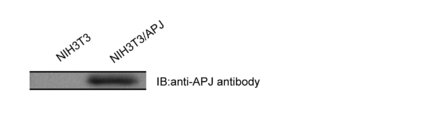
- APJ expression in the collected APJ-expressing NIH3T3 cells was confirmed by Western blot. Specifically, membrane fraction samples of APJ-expressing NIH3T3 cells and control GFP-stable NIH3T3 cells were prepared using RIPA Buffer (Lysis Buffer) and ProteoExtract Transmembrane Protein Extraction Kit, respectively.
- TAMRA-labeled apelin Uptake of TAMRA-labeled apelin into NIH3T3-APJ cells Apelin labeled with TAMRA (fluorescent protein, fluorescence wavelength 560 nm) was produced by consigning to Invitrogen. After 1 ⁇ 10 6 cells of NIH3T3-APJ cells and stably expressing GFP (NIH3T3-GFP) were plated on each well in a glass dish (IWAKI) coated with poly-L-lysine, it was incubated at 37 ° C. for 24 hours. did.
- TAMRA fluorescent protein, fluorescence wavelength 560 nm
- the medium was replaced with DMEM containing 10% or 1% FCS, Opti-MEM, or serum-free medium (DMEM containing 0.1% BSA, 20 mM HEPES, Penicillin), and incubated again at 37 ° C. for 24 hours.
- TAMRA labeled apelin was added to each well and again incubated at 37 ° C. for 24 hours.
- the cells were collected and the cell surface protein was cleaved with trypsin, and then FACS analysis was performed.
- FIG. 3 Schematic diagram of experimental technique and FACS analysis results are shown in FIG.
- the uptake of TAMRA into the cells was confirmed in the NIH3T3-APJ cells expressing APJ, but the TAMRA of NIH3T3-GFP cells not expressing APJ was confirmed. No uptake was seen. From this result, it was confirmed that when an imaging drug such as a fluorescent substance is administered in combination with apelin, blood vessels in the tumor expressing APJ can be visualized.
- FIG. 3 shows the result of Apelin-36, it is considered that the same result can be obtained with Apelin-13.
- Example 3 Uptake of apelin-modified liposome into APJ positive cells and tumor
- Vascular endothelium that expresses APJ in a tumor even when apelin is modified and bound to the surface of a nanocarrier such as a liposome encapsulating fluorescent protein instead of directly labeling fluorescent protein with apelin It was considered possible to visualize the cells.
- Apelin-13 (manufactured by Bachem) or Apelin-36 (manufactured by PHOENIX PHARMACEUTICALS, INC.) was added to 1 ml of the liposome solution and reacted at room temperature for 2 hours. Thereto, 40 ml of Solution B was added and stirred at room temperature for 2 hours, and further stirred at 4 ° C. for 20 hours. This was again concentrated to 100 to 200 ml using a centrifugal ultrafiltration filter (NMWL, Da: 300,000), and then solution C was added to make 1 ml (also this operation was performed twice in total). After filtration through a 0.45 ⁇ m filtration filter, it was stored refrigerated under light shielding until use.
- a frozen tissue section of the excised tumor tissue was prepared, and immunofluorescent staining was performed using FITC-labeled anti-mouse CD31 antibody (Pharmingen) in order to stain CD31 which is a marker of vascular endothelial cells.
- FIG. 8 The results of observing the localization of vascular endothelial cells and liposomes in the tumor tissue are shown in FIG.
- the signal of the liposome was observed inside the signal of the vascular endothelial cell, and it was confirmed that the liposome leaked from the blood vessel ( (See upper arrow head).
- the vascular endothelial cell signal and the liposome signal overlapped, and the liposome had entered the blood vessel (see the arrow at the bottom).
- apelin-modified liposomes can be incorporated into mature blood vessels and neoplastic vascular endothelial cells via APJ to visualize all blood vessels of the tumor, and liposomes can be used as vascular cytotoxic agents, anticancer agents. It has been found that a method for specifically destroying tumor blood vessels can be provided by including drugs and the like.
Landscapes
- Health & Medical Sciences (AREA)
- Chemical & Material Sciences (AREA)
- Life Sciences & Earth Sciences (AREA)
- General Health & Medical Sciences (AREA)
- Animal Behavior & Ethology (AREA)
- Medicinal Chemistry (AREA)
- Pharmacology & Pharmacy (AREA)
- Veterinary Medicine (AREA)
- Public Health (AREA)
- Engineering & Computer Science (AREA)
- Bioinformatics & Cheminformatics (AREA)
- Epidemiology (AREA)
- Dispersion Chemistry (AREA)
- Chemical Kinetics & Catalysis (AREA)
- General Chemical & Material Sciences (AREA)
- Nuclear Medicine, Radiotherapy & Molecular Imaging (AREA)
- Organic Chemistry (AREA)
- Cardiology (AREA)
- Heart & Thoracic Surgery (AREA)
- Proteomics, Peptides & Aminoacids (AREA)
- Medicines That Contain Protein Lipid Enzymes And Other Medicines (AREA)
- Medicinal Preparation (AREA)
Abstract
APJ結合物質および薬物を包含することを特徴とする薬物送達システムは、正常組織の成熟血管には薬物を送達せず、成熟した血管を含む腫瘍組織の血管に薬物を送達可能な薬物送達システムである。当該薬物送達システムは、任意の薬物をAPJ発現細胞に送達することができる。APJ発現細胞には、腫瘍における成熟血管の血管内皮細胞が含まれるので、当該薬物送達システムの薬物として、血管細胞障害薬や抗がん薬を用いることにより、固形がんの有効な治療薬を提供することができる。
Description
本発明は、薬物送達システムおよびその利用に関するものであり、詳細には、APJ発現細胞を標的とする薬物送達システムおよびその利用に関するものである。
がん組織の成長は、腫瘍内に新しい血管形成/血管新生が誘導され、腫瘍に酸素および養分を供給することで誘導される。このことから、1970年代より腫瘍血管を破壊することでがんを治療する概念が創出された。この時期以後、血管形成の分子機序の解明が活発となり、胎児期の血管形成や生理的な血管形成のメカニズムの解明とともに、がん組織での血管形成のメカニズムの解明があわせて行われてきた。胎児期には、まず最初に、血管が全くない領域において、血管内皮細胞同士が集合して新しい血管を形成するという脈管形成(vasculogenesis)により血管形成が誘導され、その後、新しい血管が必要になった際には、主に、既存の血管から新しい血管分枝が発芽して伸長する血管新生(angiogenesis)という過程で血管が形成される。
成体内では組織の成長が終了した後には、女性の性周期における子宮脱落膜形成や卵巣の黄体形成時に血管新生が誘導される以外では、病的な低酸素・炎症が生じない限り新しい血管形成が誘導されることはない。病的な低酸素・炎症とは、がん組織の形成であり、がん組織では他の正常組織に観察されない血管新生が旺盛に生じている。そこで、がんの血管新生を抑制するがん治療法は、従来の正常細胞を含む単なる増殖細胞をターゲットとした抗がん剤によるがん治療法より副作用が少ないと考えられ、血管新生はより至適ながん治療標的とされてきた(非特許文献1参照)。
このような観点から、従来解析されてきた血管新生の分子メカニズムのなかで、特に血管新生に重要であることが判明している血管内皮成長因子(vascular endothelial growth factor:VEGF)に関して、その中和やあるいはVEGF受容体のリン酸化を抑制する治療薬の開発が旺盛に進められ、現に米国ではVEGFに関連する治療薬11種類ほどが臨床試験のphase III studyに入っている(非特許文献2参照)。しかし、現行の血管新生抑制剤による治療法には限界がある。すなわち、血管新生に関与するほとんどの分子は血管の維持機構にも関わっていることから、腫瘍血管が全滅するほどの大量の血管新生抑制剤を投与すると、正常血管への障害を回避することができず、逆に、正常血管への障害を回避するためには、腫瘍血管が全滅するほどの大量の血管新生抑制剤が投与できない。
確かに、本発明者らは、従来の研究において、正常血管に副作用のでない程度の血管新生抑制では、血管内皮細胞への壁細胞の裏打ちを伴わないような未成熟な血管は破壊できても、腫瘍周囲領域の壁細胞の裏打ちを伴う成熟段階にある血管は破壊できないことを示してきた(非特許文献3、4参照)。また、がん細胞の中では最も悪性であるがん幹細胞は、本発明者らの研究により、腫瘍中の成熟している血管の周囲に存在して増殖していることが判明しているので(非特許文献5参照)、現行の血管新生抑制方法では、がん幹細胞が生態学的に適所としている成熟血管を破壊できていないことになる。そこで、このような成熟血管を含め、腫瘍組織の血管全体を破壊するためには、正常組織の血管内皮細胞には全く発現していないか、発現していてもごくわずかであるが、腫瘍内の成熟血管を含む血管内皮細胞で発現が亢進している抗原を分子標的として、薬物を選択的に腫瘍の血管内皮細胞に送達する薬物送達システム(Drug Delivery System:DDS)が必要とされる。
現在、腫瘍内へのDDSとしては、リポソーム、ナノポリマーミセル、カーボンナノチューブ/カーボンナノホーンなどのナノメートル単位の小さなカプセルに抗がん薬を内包させて、がん組織に選択的に運搬させる方法が考案されている。しかし、これは腫瘍の特殊な抗原を標的とするのではなく、腫瘍内に取り込まれやすく排出されにくい効果として利用するものがほとんどである。つまり、がん組織は組織の成長スピードも血管新生のスピードも速いので、血管内皮細胞同士の接着自体も、また内皮細胞と壁細胞の接着も粗な未成熟血管が多く、健常血管よりも1桁以上広い数百ナノメートルの隙間が開いている。したがって、ナノサイズの抗がん薬は、正常な血管壁からは漏れず、がん組織だけに入り、病変部位の濃度だけが上がる(Enhanced Permeation)。また、がん組織はリンパ管が未発達で、薬物を排出する能力が不足しており結果的に長時間薬物が残存する(Enhanced Retention)。これら二つの効果をあわせてEPR効果という(非特許文献6参照)。
このように、ナノカプセルにより抗がん薬を運搬する方法は、がん組織の薬物の動態を利用した方法と言える。しかし、やみくもにナノカプセル内に薬物を内包して、あるいはカプセルをがん細胞に発現する抗原に対する抗体などを用いて修飾したとしても、前述のようにがんの悪性の本体といえるがん幹細胞は、成熟した血管の周囲に存在しており、この成熟血管は血管透過性が抑制されていることからEPR効果は望めない。よって、がん幹細胞に対するEPR効果を高めるためには、腫瘍全体の血管を破壊状態に誘導することが最適であり、成熟した血管を含む腫瘍血管に特異的に薬物を送達して、正常組織の成熟血管には傷をつけない薬物送達システムの開発が切望されている。
Tozer GM, Kanthou C, Baguley BC. Disrupting tumour blood vessels. Nat. Rev Cancer, 5: 423-435, 2005
Hayden EC.Cutting off cancer's supply lines. Nature 458, 686-687, 2009
Okamoto R, Ueno M, Yamada Y, Takahashi N, Sano H, and Takakura N. Hematopoietic cells regulate the angiogenic switch during tumorigenesis. Blood 105: 2757-2763, 2005
Satoh N, Yamada Y, Kinugasa Y and Takakura N. Angiopoietin-1 alters tumor growth by stabilizing blood vessels or by promoting angiogenesis. Cancer Sci. 99:2373-2379, 2008.
Nagahama Y, Ueno M, Miyamoto S, Morii E, Minami T, Mochizuki N, Saya H, and Takakura N. PSF1, a DNA replication factor expressed widely in stem and progenitor cells, drives tumorigenic and metastatic properties. Cancer Res 70, 1215-1224, 2010.
Matsumura Y, and Maeda H. A New Concept for Macromolecular Therapeutics in Cancer Chemotherapy: Mechanism of Tumoritropic Accumulation of Proteins and the Antitumor Agent Smancs Cancer Res 46:6387-6392, 1986.
本発明は、正常組織の成熟血管には薬物を送達せず、成熟した血管を含む腫瘍組織の血管に薬物を送達可能な薬物送達システムを提供するとともに、当該薬物送達システムを利用した固形がん治療薬等の医薬を提供することを課題とする。
本発明は、上記課題を解決するために、以下の各発明を包含する。
[1]APJ発現細胞に薬物を送達するシステムであって、APJ結合物質および薬物を包含することを特徴とする薬物送達システム。
[2]APJ結合物質と薬物が一体化していることを特徴とする前記[1]に記載の薬物送達システム。
[3]APJ結合物質がアペリンまたは抗APJ抗体であることを特徴とする前記[1]または[2]に記載の薬物送達システム。
[4]薬物が、蛍光性物質、放射性物質、化学発光性物質および磁性物質からなる群より選択されることを特徴とする前記[1]~[3]のいずれかに記載の薬物送達システム。
[5]薬物が、血管細胞障害薬、血管新生阻害薬、抗がん薬、抗ウイルス薬および抗炎症薬からなる群より選択される1種以上であることを特徴とする前記[1]~[3]のいずれかに記載の薬物送達システム。
[6]前記[4]に記載の薬物送達システムを含有することを特徴とする新生血管の可視化剤。
[7]前記[4]に記載の薬物送達システムを含有することを特徴とする固形がんの血管可視化剤。
[8]前記[5]に記載の薬物送達システムを含有することを特徴とする血管新生に起因して発症または悪化する疾患の治療薬。
[9]前記[5]に記載の薬物送達システムを含有することを特徴とする固形がんの治療薬。
[1]APJ発現細胞に薬物を送達するシステムであって、APJ結合物質および薬物を包含することを特徴とする薬物送達システム。
[2]APJ結合物質と薬物が一体化していることを特徴とする前記[1]に記載の薬物送達システム。
[3]APJ結合物質がアペリンまたは抗APJ抗体であることを特徴とする前記[1]または[2]に記載の薬物送達システム。
[4]薬物が、蛍光性物質、放射性物質、化学発光性物質および磁性物質からなる群より選択されることを特徴とする前記[1]~[3]のいずれかに記載の薬物送達システム。
[5]薬物が、血管細胞障害薬、血管新生阻害薬、抗がん薬、抗ウイルス薬および抗炎症薬からなる群より選択される1種以上であることを特徴とする前記[1]~[3]のいずれかに記載の薬物送達システム。
[6]前記[4]に記載の薬物送達システムを含有することを特徴とする新生血管の可視化剤。
[7]前記[4]に記載の薬物送達システムを含有することを特徴とする固形がんの血管可視化剤。
[8]前記[5]に記載の薬物送達システムを含有することを特徴とする血管新生に起因して発症または悪化する疾患の治療薬。
[9]前記[5]に記載の薬物送達システムを含有することを特徴とする固形がんの治療薬。
本発明によれば、正常組織の成熟血管には薬物を送達せず、成熟した血管を含む腫瘍組織の血管に薬物を送達可能な薬物送達システムを提供することができる。本発明の薬物送達システムを利用することにより、腫瘍組織の成熟血管を含む腫瘍血管を可視化することができ、また、正常血管を傷つけることなく、腫瘍組織の成熟血管を含む腫瘍血管を破壊状態に誘導することが可能となる。
最初に、本発明完成に至る経緯を説明する。
本発明者らは、血管新生に関わる分子のなかで、成体の正常血管にはほとんど発現せず、血管新生が生じる際に血管内皮細胞で発現が亢進する分子を探索した。そしてそのような分子の中で、腫瘍の血管においては成熟した血管にも、未成熟な(新生過程の)血管にも発現している分子を選別した。このような条件に合致するものとして、APJを単離した。
本発明者らは、血管新生に関わる分子のなかで、成体の正常血管にはほとんど発現せず、血管新生が生じる際に血管内皮細胞で発現が亢進する分子を探索した。そしてそのような分子の中で、腫瘍の血管においては成熟した血管にも、未成熟な(新生過程の)血管にも発現している分子を選別した。このような条件に合致するものとして、APJを単離した。
APJは7回膜貫通型のG蛋白共役受容体であり、その結合因子はアペリンである(Takakura N, Kidoya H, Hinuma S. Isolation, tissue distribution and in vitro function of apelin. Pathophysiology of Apelin Signalling, 2008: 1-13 ISBN: 978-81-7895-387-8 Editor: Yves Audigier)。アペリンは1998年に、長らくオーファン受容体であったAPJに対する結合因子として牛の胃の細胞抽出液から単離された分子である。アペリンのcDNAは77アミノ酸をコードするが、この前駆体からlong form(42-77)とshort form(65-77)が形成される。最初に発見されたAPJ受容体のリガンドは、36アミノ酸から成る新規生理活性ペプチドでApelin-36と命名され、さらに、Apelin-36のC末端13残基(Apelin-13)のうち、24位のGlnをPyrに置換した[Pyr1]-Apelin-13はApelin-36より約60倍強い活性を持つことが報告されてきた。どちらのアペリンもAPJの活性化を誘導することが知られている。
これまで、心血管系や中枢神経系でAPJの発現が報告されてきており、心臓では心筋収縮作用、神経系ではバソプレッシンの発現を制御するなど、体液の調節機構に関与することが示唆されてきている。また、APJはエイズウイルスの受容体として感染にも関与することが見出され、種々の観点から創薬のターゲットとしてにわかに注目を浴びつつある受容体である。APJ受容体はヒトのchromosome11に存在し、その膜貫通領域はangiotensin(AT1)受容体と40-50%のホモロジーがある。APJは、血管系においては血管内皮細胞や壁細胞に発現するとされており、アフリカツメガエルを用いた遺伝子ノックダウンの実験にて、アペリン/APJシステムが血管発生に必須の役割を果たすことが示されている。また、マウスやヒトの血管内皮細胞にAPJの発現が認められることから、哺乳類においてもアペリン/APJシステムが血管形成に関与することが予想されてきた。
しかし、本発明者らは、APJは胎児期において新生過程の血管内皮細胞に発現しているが、正常組織における成熟血管の血管内皮細胞にはほとんど発現していないことを報告してきた。さらに、本発明者らは、このような血管新生が生じている際の血管内皮細胞に対するアペリンの作用として、血管径を太くする作用や(Kidoya H, Ueno M, Yamada Y, Mochizuki N, Nakata M, Yano T, Fujii R, and Takakura N. Spatial and temporal role of the apelin/APJ system in the caliber size regulation of blood vessels during angiogenesis. EMBO J 27:522-534, 2008.)、血管透過性を抑制する作用(Kidoya H, Naito H, and Takakura N. Apelin induces enlarged and non-leaky blood vessels for functional recovery from ischemia. Blood 115, 3166-3174, 2010.)を見出し、報告してきた。つまり、APJは、成人後の成体における血管にはほとんど発現が観察されず、虚血を誘導したり、血管内皮細胞がVEGFで刺激を受けると発現が誘導されてくる分子であり、腫瘍内部では低酸素状態が持続してVEGFの産生が誘導されるために、腫瘍内の新生過程の血管には発現しているが、腫瘍内の成熟血管には発現していないと考えられていた。しかし、本発明者らは、腫瘍においては、正常組織とは異なり、成熟している血管にもAPJの発現が強く誘導されているという、予想外の知見を得た。つまり、腫瘍においては、ほぼ全ての血管内皮細胞にAPJの発現が観察されていることが判明した。
そこで、本発明者らは正常血管には薬物を運搬せず、腫瘍内血管に特異的に薬物を送達することを目的に、アペリンを利用した方法を模索した。まず、腫瘍内全域において、毛細血管から血管径の大きな成熟血管まで、すべての血管内皮細胞にAPJの発現を確認した(実施例1参照)。続いて、線維芽細胞でありAPJを発現していないNIH3T3細胞にAPJを強制発現させ、その細胞にTAMRA(蛍光蛋白質)で標識したアペリンを添加し、その後NIH3T3細胞の表面蛋白質をトリプシンで切断して、細胞内にTAMRAが観察されるか否かを検討したところ、APJを発現する細胞内にはTAMRA、つまりアペリンが取り込まれていることを確認した(実施例2参照)。そこで、蛍光蛋白質を内包するリポソームの表面にアペリンを修飾したものとしていないものを作製し、これらが前述のAPJを発現するNIH3T3細胞にAPJを介して取り込まれるかどうかを確認したところ、APJおよびアペリン修飾リポソームの細胞内移行が観察され、取り込まれることが確認された(実施例3(2)参照)。そこで、担がんマウスに対して蛍光蛋白質を内包するアペリン修飾リポソームまたはアペリン非修飾リポソームの静脈内投与を行った。すると、アペリン修飾リポソームにおいては、96時間という長期間後でも腫瘍内に蛍光蛋白質が貯留していることが確認され、このような長期貯留の効果はアペリン非修飾リポソームでは観察されなかった(実施例3(3)参照)。従来の方法では、EPR効果で腫瘍へのナノ粒子の運搬を誘導することは可能であったものの、腫瘍内の血管内皮細胞に特異的に薬物を送達することはできなかったが、今回これを可能とする方法を確立し、本発明を完成するに至った。
以下、本発明について詳細に説明する。
本発明は、APJ結合物質および薬物を包含し、APJ発現細胞に薬物を送達する薬物送達システムを提供する。APJ(O'Dowd. B.F., et al., Gene, 436, 355-359, 1993)は、上述のとおり、アペリンをリガンドとする受容体である。ヒトAPJは配列番号1で表されるアミノ酸配列(GenBank ACCESSION: AAA18954)を有するが、アペリンとの結合能を有する限り、その変異体でもよい。APJ(アペリン受容体)は、ヒト以外の生物も広く有しており、これらのアミノ酸配列情報等は、公知のデータベース(GenBank等)から取得することができる。
本発明は、APJ結合物質および薬物を包含し、APJ発現細胞に薬物を送達する薬物送達システムを提供する。APJ(O'Dowd. B.F., et al., Gene, 436, 355-359, 1993)は、上述のとおり、アペリンをリガンドとする受容体である。ヒトAPJは配列番号1で表されるアミノ酸配列(GenBank ACCESSION: AAA18954)を有するが、アペリンとの結合能を有する限り、その変異体でもよい。APJ(アペリン受容体)は、ヒト以外の生物も広く有しており、これらのアミノ酸配列情報等は、公知のデータベース(GenBank等)から取得することができる。
本発明の薬物送達システムの標的部位はAPJ発現細胞である。APJ発現細胞は、APJを発現している細胞を意味し、特に限定されないが、これまでに発現が報告されている、新生過程の血管における血管内皮細胞や胎盤の栄養芽細胞などが含まれる。さらに、本発明者らが新たに見出した腫瘍内の成熟血管の血管内皮細胞も、APJを発現している細胞に含まれる。上述の通り、正常組織の成熟血管の血管内皮細胞ではAPJがほとんど発現していないので、本発明の薬物送達システムは、正常組織の成熟血管には薬物を送達せず、腫瘍における成熟血管に薬物を送達できるシステムであると言える。
本発明の薬物送達システムに用いられるAPJ結合物質は、APJと特異的に結合可能な物質であれば特に限定されない。例えば、APJと特異的に結合するペプチドなどが挙げられ、具体的には、アペリン、APJに対する抗体などが挙げられる。なお、「ペプチド」は、2個以上のアミノ酸がペプチド結合によって結合したものを意味し、結合するアミノ酸の数は問わない。すなわち、本発明における「ペプチド」にはポリペプチドが含まれる。
アペリンは、APJに対して結合能を有するペプチドであればよい。好ましくは、配列番号2で表されるアミノ酸配列からなるヒトアペリン前駆体またはその部分配列からなるペプチドである。配列番号2で表されるアミノ酸配列の部分配列からなるペプチドは、APJに対して結合能を有するものであればどのような部分配列でもよいが、好ましくは、配列番号2で表されるアミノ酸配列の第42位~第77位からなるペプチド(Apelin-36)、第65位~第77位からなるペプチド(Apelin-13)である。
また、アペリンは、配列番号2で表されるアミノ酸配列と実質的に同一のアミノ酸配列からなるペプチドまたはその部分配列からなるペプチドであってもよい。実質的に同一のアミノ酸配列とは、配列番号2で表されるアミノ酸配列と同一でないが、実質的に同質の活性、具体的にはAPJ結合活性を有するペプチドを構成するアミノ酸配列を意味する。
また、アペリンは、配列番号2で表されるアミノ酸配列と実質的に同一のアミノ酸配列からなるペプチドまたはその部分配列からなるペプチドであってもよい。実質的に同一のアミノ酸配列とは、配列番号2で表されるアミノ酸配列と同一でないが、実質的に同質の活性、具体的にはAPJ結合活性を有するペプチドを構成するアミノ酸配列を意味する。
実質的に同一のアミノ酸配列としては、例えば、配列番号2で表されるアミノ酸配列において、1~数個のアミノ酸が欠失、置換もしくは付加されたアミノ酸配列が挙げられる。「1~数個のアミノ酸が欠失、置換もしくは付加された」とは、部位特異的突然変異誘発法等の公知の変異ペプチド作製法により欠失、置換もしくは付加できる程度の数(好ましくは10個以下、より好ましくは7個以下、さらに好ましくは5個以下)のアミノ酸が欠失、置換もしくは付加されることを意味する。このような変異タンパク質は、公知の変異ポリペプチド作製法により人為的に導入された変異を有するタンパク質に限定されるものではなく、天然に存在するタンパク質を単離精製したものであってもよい。また、実質的に同一のアミノ酸配列は、配列番号2で表されるアミノ酸配列と少なくとも80%同一、より好ましくは少なくとも85%、90%、92%、95%、96%、97%、98%または99%同一であるアミノ酸配列が挙げられる。
アペリンは、ヒト由来のアペリンに限定されず、ヒト以外の温血動物(例えば、モルモット、ラット、マウス、ブタ、ヒツジ、ウシ、サル等)のあらゆる組織(例えば、下垂体、膵臓、脳、腎臓、肝臓、生殖腺、甲状腺、胆のう、骨髄、副腎、皮膚、筋肉、肺、消化管、血管、心臓等)または細胞に由来するものを用いることができる。マウス由来のアペリン前駆体のアミノ酸配列を配列番号4に、ラット由来のアペリン前駆体のアミノ酸配列を配列番号6に、ウシ由来のアペリン前駆体のアミノ酸配列を配列番号8に、それぞれ示す。これらのアミノ酸配列またはこれらと実質的に同一のアミノ酸配列からなるペプチドまたはその部分配列からなるペプチドも、本発明の薬物送達システムに好適に用いることができる。
アペリンは、(I)公知の遺伝子工学的手法によりアペリンの組み換え発現ベクターを構築し、これを適当な宿主細胞に導入して組み換えタンパク質として発現させることにより製造することができる。または、(II)in vitro転写・翻訳系によって製造することができる。または、(III)公知の一般的なペプチド合成のプロトコールに従って、固相合成法(Fmoc法、Boc法)または液相合成法により製造することができる。(I)、(II)の場合は、最初にアペリン前駆体を取得し、これを適当なペプチダーゼで切断して製造してもよい。なお、アペリン前駆体をコードするDNAの塩基配列としては、例えば、配列番号3(ヒト)、配列番号5(マウス)、配列番号7(ラット)、配列番号9(ウシ)でそれぞれ表される塩基配列が挙げられるが、これらに限定されるものではない。
アペリンは、C末端がカルボキシル基(-COOH)、カルボキシレート(-COO-)、アミド(-CONH2)またはエステル(-COOR)の何れであってもよい。エステルにおけるRとしては、例えば、メチル、エチル、n-プロピル、イソプロピルもしくはn-ブチルなどのC1-6アルキル基、例えば、シクロペンチル、シクロヘキシルなどのC3-8シクロアルキル基、例えば、フェニル、α-ナフチルなどのC6-12アリール基、例えば、ベンジル、フェネチルなどのフェニル-C1-2アルキル基もしくはα-ナフチルメチルなどのα-ナフチル-C1-2アルキル基などのC7-14アラルキル基のほか、経口用エステルとして汎用されるピバロイルオキシメチル基などが挙げられる。本発明のペプチドがC末端以外にカルボキシル基またはカルボキシレートを有している場合、それらの基がアミド化またはエステル化されていてもよい。
さらに、アペリンは、N末端のメチオニン残基のアミノ基が保護基(例えば、ホルミル基、アセチルなどのC2-6アルカノイル基などのC1-6アシル基など)で保護されていてもよく、N末端側が生体内で切断され生成したグルタミル基がピログルタミン酸化したもの、分子内のアミノ酸の側鎖上の置換基(例えば、-OH、-SH、アミノ基、イミダゾール基、インドール基、グアニジノ基など)が適当な保護基(例えば、ホルミル基、アセチルなどのC2-6アルカノイル基などのC1-6アシル基など)で保護されているものでもよい。
アペリンは、薬学的に許容される塩を形成していてもよく、その塩としては、例えば、塩酸、硫酸、燐酸、乳酸、酒石酸、マレイン酸、フマル酸、シュウ酸、リンゴ酸、クエン酸、オレイン酸、パルミチン酸などの酸との塩;ナトリウム、カリウム、カルシウムなどのアルカリ金属もしくはアルカリ土類金属の、またはアルミニウムの水酸化物または炭酸塩との塩;トリエチルアミン、ベンジルアミン、ジエタノールアミン、t-ブチルアミン、ジシクロヘキシルアミン、アルギニンなどとの塩などが挙げられる。
APJに対する抗体は、ポリクローナル抗体でもモノクローナル抗体でもよい。また、完全な抗体分子でもよく、抗原に特異的に結合し得る抗体フラグメント(例えば、Fab、F(ab’)2、Fab’、Fv、scFv等)でもよい。ポリクローナル抗体は、例えば以下のようにして作製し、取得することができる。すなわち、抗原(例えば、配列番号1で表されるアミノ酸配列からなるペプチドまたはそのフラグメント)をPBSに溶解し、所望により通常のアジュバント(例えばフロイント完全アジュバント)を適量混合したものを免疫原として哺乳動物(マウス、ラット、ウサギ、ヤギ、ウマ等)を免疫する。免疫方法は特に限定されないが、例えば、1回または適当な間隔で複数回、皮下注射または腹腔内注射する方法が好ましい。次いで、常法に従い、免疫した動物から血液を採取して血清を分離し、ポリクローナル抗体画分を精製することにより取得することができる。モノクローナル抗体は、上記免疫された哺乳動物から得た免疫細胞(例えば脾細胞)とミエローマ細胞とを融合させてハイブリドーマを得、当該ハイブリドーマの培養物から抗体を採取することによって得ることができる。また、抗体遺伝子をハイブリドーマからクローニングし、適当なベクターに組み込んで、これを宿主細胞に導入し、遺伝子組換え技術を用いて組換え型のモノクローナル抗体を産生させることもできる。さらに、ファージディスプレイ法を用いて作製することもできる。
抗体はヒト型キメラ抗体またはヒト化抗体が好ましい。ヒト型キメラ抗体は、ヒト以外の動物由来の抗体の重鎖可変領域および軽鎖可変領域と、ヒト抗体の重鎖定常領域および軽鎖定常領域からなる抗体をいう。ヒト化抗体は、ヒト以外の動物由来の抗体のCDR(相補性決定領域:complementarity determining region)をヒト抗体のCDRへ移植したものをいい、CDR移植抗体、再構成抗体などとも称される。ヒト化抗体のFR(フレームワーク領域:framework region)は、CDRが良好な抗原結合部位を形成するものが選択される。必要に応じ、ヒト化抗体のCDRが適切な抗原結合部位を形成するように、抗体の可変領域におけるFWのアミノ酸配列を置換してもよい。ヒト抗体の定常領域のアミノ酸配列は、公知のデータベース(Protein Data Bank 等)から取得することができる。
本発明の薬物送達システムは、APJ結合物質と薬物とが一体化していない混合組成物の形態とすることも可能であるが、APJ結合物質と薬物とが何らかの相互作用により一体化した形態とすることが好ましい。一体化のための手段は特に限定されないが、例えば、薬物を封入したリポソームとAPJ結合物質の結合体、薬物を担持したナノマテリアルとAPJ結合物質の結合体などの形態が挙げられる。また、APJ結合物質と薬物とが直接結合した形態でもよい。薬物がタンパク質である場合は、薬物とAPJ結合物質との融合タンパク質が好適である。
薬物を封入したリポソームとAPJ結合物質の結合体は、ペプチド、タンパク質、核酸、低分子化合物などの薬物を封入したリポソーム膜表面にAPJ結合物質を結合させたものであればよく、薬物の種類、リポソームの脂質組成やサイズ、およびAPJ結合物質との結合方法は特に限定されない。リポソームは、例えば、ホスファチジルコリン、コレステロール、ポリエチレングリコール結合脂質などを原料として公知の方法で作製することができる。また、APJ結合物質との結合用に脂質末端カルボキシル基もしくはマレイミド基を有する脂質を使用することが好ましい。リポソーム内への薬物の封入は公知の凍結融解法、逆相蒸発法、水和法などにより行うことができる。作製した薬物内封リポソームにAPJ結合物質を加え、ペプチド縮合反応もしくはSH基反応系によりリポソームとAPJ結合物質との結合体を作製することができる。
薬物を担持したナノマテリアルとAPJ結合物質との結合体は、特に限定されず、適当なナノマテリアルに薬物を担持させ、APJ結合物質と結合させればよい。例えば、公知の各種末端修飾ポリマーとAPJ結合物質のリジン、システインとの結合体を用いた自己組織化ナノマテリアルなどが挙げられる。
APJ結合物質と薬物とを直接結合させる方法は、特に限定されず、例えば、結合させたい分子同士をジスルフィド結合で結合させる、あるいは一方の分子にリンカー分子を付けそれと他方の分子とをジスルフィド結合で結合させるなどが挙げられるが、結合させる方法はこれらに限定されず、疎水結合、水素結合、イオン結合等であってもよい。
タンパク性薬物とAPJ結合物質との融合タンパク質は、公知の遺伝子組換え技術により製造することができる。例えば、APJ結合物質をコードする遺伝子と薬物をコードする遺伝子とを人工的に連結した融合遺伝子(ハイブリッド遺伝子)を作製し、当該融合遺伝子を、発現ベクターのプロモーターの下流に挿入し、適当な宿主細胞に導入して発現させることにより取得することができる。融合タンパク質において、APJ結合物質と薬物との結合順序は限定されず、N末端側が薬物でC末端側がAPJ結合物質としてもよく、逆にN末端側がAPJ結合物質でC末端側が薬物としてもよい。
本発明の薬物送達システムに用いられる薬物は、標的部位であるAPJ発現細胞に送達することが好ましい薬物であればよく、特に限定されない。上述のように、APJは、新生過程の血管における血管内皮細胞、腫瘍内の成熟血管における血管内皮細胞などに発現しているので、薬物として、血管細胞障害薬、血管新生阻害薬などを好適に用いることができる。また、血管新生に起因して発症または悪化する疾患の治療薬、例えば抗がん薬、抗ウイルス薬、抗炎症薬などを好適に用いることができる。
本発明の薬物送達システムは、薬物として蛍光性物質、放射性物質、化学発光性物質および磁性物質からなる群より選択される1種以上を用いることが好ましい。これらの薬物は、1種のみを用いてもよく、2種以上を組み合わせて用いてもよい。薬物として、これらを選択することにより、APJ発現細胞を可視化することが可能となる。具体的には、蛍光性物質を用いた場合には、例えば、内包送達する物質としてGFPなどを用い、近赤外光を励起光としてレーザー照射して蛍光断層画像計測することによりAPJ発現細胞の部位を可視化することができる。放射性物質を用いた場合には、例えば、ポジトロン断層法(PET)を用いて15O、13N、11C、18Fなどの核種を描出し、APJ発現細胞の部位を可視化することができる。化学発光性物質を用いた場合には、例えば、ルシフェリン/ルシフェラーゼとインドシアニングリーンを標的細胞に送達して、検出器により長波長での検出を行うことにより、APJ発現細胞の部位を可視化することができる。磁性物質を用いた場合には、例えば、造影剤やガドリニウム化合物を標的細胞に送達して、核磁気共鳴画像法(MRI)を適用するにより、APJ発現細胞の部位を可視化することができる。
本発明の薬物送達システムに、蛍光性物質、放射性物質、化学発光性物質および磁性物質からなる群より選択される1種以上を用いた場合、APJは新生過程の血管の血管内皮細胞に発現していることから、新生血管を可視化することが可能となる。したがって、本発明には、蛍光性物質、放射性物質、化学発光性物質および磁性物質からなる群より選択される1種以上の薬物とAPJ結合物質とを包含する薬物送達システムを含有することを特徴とする新生血管の可視化剤が含まれる。
造影剤を用いて血管を可視化する従来の技術では、微小な新生血管を可視化することは困難であったが、本発明により微小な新生血管の可視化を容易に行うことができる。これにより、病変部位において、血管新生が生じている領域の判断に利用することができる。つまり、まだ太い血管が成長していないような微細ながんにおいても、血管新生が生じていればAPJが内皮細胞で発現してくるために、従来のMRIなどの検査でも認識できなかった微小ながん病変などを可視化することができるようになる。その他に、血管新生を合併することを特徴とする疾患の病変部位においても同様に、微小な病変領域を認識することが可能となる。
造影剤を用いて血管を可視化する従来の技術では、微小な新生血管を可視化することは困難であったが、本発明により微小な新生血管の可視化を容易に行うことができる。これにより、病変部位において、血管新生が生じている領域の判断に利用することができる。つまり、まだ太い血管が成長していないような微細ながんにおいても、血管新生が生じていればAPJが内皮細胞で発現してくるために、従来のMRIなどの検査でも認識できなかった微小ながん病変などを可視化することができるようになる。その他に、血管新生を合併することを特徴とする疾患の病変部位においても同様に、微小な病変領域を認識することが可能となる。
また、本発明の薬物送達システムに、蛍光性物質、放射性物質、化学発光性物質および磁性物質からなる群より選択される1種以上を用いた場合、APJは腫瘍内の新生過程の未熟血管および成熟血管の血管内皮細胞に発現していることから、固形がんのすべての血管を可視化することが可能となる。したがって、本発明には、蛍光性物質、放射性物質、化学発光性物質および磁性物質からなる群より選択される1種以上の薬物とAPJ結合物質とを包含する薬物送達システムを含有することを特徴とする固形がんの血管可視化剤が含まれる。
造影剤を用いて固形がんの血管を可視化する従来の技術では、成熟血管は可視化できても微小な新生血管を可視化することは困難であったが、本発明により微小な新生血管を含む固形がん中のすべての血管の可視化を容易に行うことができ、固形がんの内部における血管の発達の程度の判断が可能となる。それゆえ、現在臨床応用されている血管新生抑制の治療前後でのバイオマーカーに用いることができる。つまり、現行の治療法においては、造影剤などによる比較的径の太い血管の描出は可能であるが、血管径が10μm程度の細い毛細血管を描出するのは困難である。そのため、腫瘍などの組織においてどの程度毛細血管が発達している病変であるのかを、治療前に容易に判断することが困難である。毛細血管が組織に酸素や養分を供給する重要な血管であることから、治療前に毛細血管密度が確認できれば、血管新生抑制剤などの治療薬の投与量を決める判断材料となり得る。また、治療後に、治療薬がどの程度奏功したのかを判断できる。現行の治療法のような一律の治療薬量を患者に投与するのではなく、治療効果の判断基準に毛細血管の発達度を加味して、一人一人の患者の血管密度に応じた治療薬の投与法が可能になる。
造影剤を用いて固形がんの血管を可視化する従来の技術では、成熟血管は可視化できても微小な新生血管を可視化することは困難であったが、本発明により微小な新生血管を含む固形がん中のすべての血管の可視化を容易に行うことができ、固形がんの内部における血管の発達の程度の判断が可能となる。それゆえ、現在臨床応用されている血管新生抑制の治療前後でのバイオマーカーに用いることができる。つまり、現行の治療法においては、造影剤などによる比較的径の太い血管の描出は可能であるが、血管径が10μm程度の細い毛細血管を描出するのは困難である。そのため、腫瘍などの組織においてどの程度毛細血管が発達している病変であるのかを、治療前に容易に判断することが困難である。毛細血管が組織に酸素や養分を供給する重要な血管であることから、治療前に毛細血管密度が確認できれば、血管新生抑制剤などの治療薬の投与量を決める判断材料となり得る。また、治療後に、治療薬がどの程度奏功したのかを判断できる。現行の治療法のような一律の治療薬量を患者に投与するのではなく、治療効果の判断基準に毛細血管の発達度を加味して、一人一人の患者の血管密度に応じた治療薬の投与法が可能になる。
本発明の薬物送達システムは、薬物として血管細胞障害薬、血管新生阻害薬、抗がん薬、抗ウイルス薬および抗炎症薬からなる群より選択される1種以上を用いることが好ましい。これらの薬物は、1種のみを用いてもよく、2種以上を組み合わせて用いてもよい。薬物として、これらを選択することにより、血管新生に起因して発症または悪化する疾患を治療することが可能となる。したがって、本発明には、血管細胞障害薬、血管新生阻害薬、抗がん薬、抗ウイルス薬および抗炎症薬からなる群より選択される1種以上の薬物とAPJ結合物質とを包含する薬物送達システムを含有することを特徴とする血管新生に起因して発症または悪化する疾患の治療薬が含まれる。
血管新生に起因して発症する疾患としては、例えば、糖尿病性網膜症、加齢性黄斑変性症、未熟児網膜症、緑内障、動静脈奇形、血管腫等が挙げられる。また、血管新生に起因して悪化する疾患としては、例えば、固形がん、感染症、動脈硬化、慢性関節リウマチ・強皮症などの各種自己免疫疾患、糖尿病性網膜症、加齢性黄斑変性症、未熟児網膜症、緑内障、動静脈奇形、血管腫、変形性関節症、ケロイド、乾癬、アレルギー性皮膚炎、肥満、肺高血圧、喘息、肺気腫、慢性気管支炎、肝硬変、腹水症等が挙げられる。血管新生が各病変部位に生じることにより、病変部位の組織の成長を誘導して病変の拡大につながる。また、血管新生が急速に生じる際には透過性の亢進した血管が形成されるために、組織外に血管内成分の漏出が生じ、組織における浮腫の原因となり、病変領域周辺の正常組織まで組織障害をもたらす。このような血管新生を生じている血管に、特異的に薬物を送達して血管に障害をもたらせることにより、血管新生に起因して生じる様々な病態の進行を抑制することが可能になる。
血管新生に起因して発症する疾患としては、例えば、糖尿病性網膜症、加齢性黄斑変性症、未熟児網膜症、緑内障、動静脈奇形、血管腫等が挙げられる。また、血管新生に起因して悪化する疾患としては、例えば、固形がん、感染症、動脈硬化、慢性関節リウマチ・強皮症などの各種自己免疫疾患、糖尿病性網膜症、加齢性黄斑変性症、未熟児網膜症、緑内障、動静脈奇形、血管腫、変形性関節症、ケロイド、乾癬、アレルギー性皮膚炎、肥満、肺高血圧、喘息、肺気腫、慢性気管支炎、肝硬変、腹水症等が挙げられる。血管新生が各病変部位に生じることにより、病変部位の組織の成長を誘導して病変の拡大につながる。また、血管新生が急速に生じる際には透過性の亢進した血管が形成されるために、組織外に血管内成分の漏出が生じ、組織における浮腫の原因となり、病変領域周辺の正常組織まで組織障害をもたらす。このような血管新生を生じている血管に、特異的に薬物を送達して血管に障害をもたらせることにより、血管新生に起因して生じる様々な病態の進行を抑制することが可能になる。
本発明の薬物送達システムは、腫瘍内の成熟血管に所望の薬物を送達できることから、固形がんの治療に非常に有用である。上述の通り、がん幹細胞は成熟した血管の周囲に存在しているので、固形がんの成熟血管に血管細胞障害薬や抗がん薬を送達することにより、効果的にがん幹細胞を破壊し、固形がんを治療することが可能となる。したがって、本発明には、血管細胞障害薬、血管新生阻害薬、抗がん薬、抗ウイルス薬および抗炎症薬からなる群より選択される1種以上の薬物とAPJ結合物質とを包含する薬物送達システムを含有することを特徴とする固形がんの治療薬が含まれる。固形がんは、固形の形状があるがんを意味し、例えば、乳がん、肝がん、胃がん、肺がん、頭頸部がん、子宮頸部がん、前立腺がん、網膜芽細胞腫、悪性リンパ腫、食道がん、脳腫瘍、骨腫瘍などが挙げられるが、これらに限定されない。
予想に反して、腫瘍組織では、APJは新生過程の血管以外に、血管新生の終了した成熟血管においても、血管内皮細胞に発現を認めることから、本発明の薬物送達システムを用いれば、固形がんにおいて血管新生進行中の血管の形成を阻止するとともに、成熟血管の破綻を誘導することが可能となる。特に、従来の治療法では固形がんの成熟血管を破綻させることは不可能であったことから、本発明の薬物送達システムを用いて成熟血管を破綻させることにより、成熟血管の近傍に局在していることが判明している最も悪性度の高いがん幹細胞の増殖現場を破壊することが可能となり、がんの根治につながることが期待できる。具体的には、例えば、本発明の薬物送達システムに用いられるナノデバイスの内部に血管細胞障害薬(血管内皮細胞を殺傷する薬物)と抗がん薬(がん細胞および/またはがん幹細胞を殺傷する薬物)を同時に内包させることにより、殺傷された血管内皮細胞から放出された抗がん薬は、破壊された血管の近傍に存在するがん細胞やがん幹細胞に取り込まれることになり、血管、並びにがん細胞およびがん幹細胞を一気に破壊することが可能となり得る。このような薬物送達システムは、これまで存在しておらず、そしてあらゆる固形がんにおいて血管内皮細胞にAPJの発現が誘導されることから、本発明の薬物送達システムは、がんの種類に関わらず、すべての固形がんに提供可能な、極めて有用な薬物送達システムである。
血管細胞障害薬、血管新生阻害薬としては、血管細胞を障害する作用や血管新生を阻害する作用を有する薬剤であれば特に限定されないが、例えば、血管新生阻害剤として臨床応用されている薬剤などを好適に用いることができる。抗がん薬としては、特に限定されないが、例えば、化学療法剤、免疫療法剤、ホルモン療法剤、分子標的薬などが挙げられ、臨床応用されている抗がん薬はいずれも好適に用いることができる。なかでも分子標的薬が好ましい。分子標的薬としては、特に限定されないが、例えば、ゲフィチニブ、イマチニブ、リツキシマブ、トラスツズマブなどの公知の分子標的薬が挙げられ、臨床応用されている分子標的薬はいずれも好適に用いることができる。抗ウイルス薬としては、抗ウイルス作用を有する薬剤であれば特に限定されないが、例えば、ウイルス感染症治療薬として臨床応用されている薬剤などを好適に用いることができる。抗炎症薬としては、炎症を抑制する作用を有する薬剤であれば特に限定されないが、例えば、抗炎症薬として臨床応用されている薬剤などを好適に用いることができる。さらに、核酸医薬も本発明の薬物送達システムに用いられる薬物として好適である。核酸医薬としては、特に限定されないが、例えば、siRNA、shRNA、アンチセンスオリゴヌクレオチドなどが挙げられる。
本発明の薬物送達システムを含有する薬剤は、薬学的に許容される担体または添加剤を適宜配合して製剤化することができる。具体的には錠剤、被覆錠剤、丸剤、散剤、顆粒剤、カプセル剤、液剤、懸濁剤、乳剤等の経口剤;注射剤、輸液、坐剤、軟膏、パッチ剤等の非経口剤とすることができる。担体または添加剤の配合割合については、医薬品分野において通常採用されている範囲に基づいて適宜設定すればよい。配合できる担体または添加剤は特に制限されないが、例えば、水、生理食塩水、その他の水性溶媒、水性または油性基剤等の各種担体;賦形剤、結合剤、pH調整剤、崩壊剤、吸収促進剤、滑沢剤、着色剤、矯味剤、香料等の各種添加剤が挙げられる。
本発明の薬物送達システムを含有する薬剤の投与量および投与頻度は、目的、投与形態、剤型、被投与者の状態、薬物送達システムに包含される薬物の種類等に応じて適宜設定される。1回あたりの投与量は有効量であればよい。また、1日当たりの総投与量は、単一投与量であっても分割投与量であってもよい。
以下、実施例により本発明を詳細に説明するが、本発明はこれらに限定されるものではない。
〔実施例1:腫瘍血管におけるAPJの発現解析〕
本発明者らは、従来の解析において、APJは成熟血管では発現が消失することを報告しており、腫瘍内においても、透過性が抑制されている成熟した太い血管ではAPJの発現は観察されず、透過性の亢進している新生過程の細い毛細血管にのみ血管内皮細胞にAPJが発現すると予想し、これを確認するために以下の実験を行った。
本発明者らは、従来の解析において、APJは成熟血管では発現が消失することを報告しており、腫瘍内においても、透過性が抑制されている成熟した太い血管ではAPJの発現は観察されず、透過性の亢進している新生過程の細い毛細血管にのみ血管内皮細胞にAPJが発現すると予想し、これを確認するために以下の実験を行った。
マウス大腸ガン細胞株であるcolon26細胞を1×10⁶個、8週齢のBALB/cメスマウスの背部皮下に移植した。移植後2週間で皮下に形成された腫瘍を摘出して、組織切片を作成した。切片をPE標識抗CD31抗体(phaemingen社製)およびFITC標識抗APJ抗体(Kidoya H, et al. EMBO J 27:522-534, 2008.)でそれぞれ染色した。
結果を図1に示した。左はPE標識抗CD31抗体による染色像、中央はFITC標識抗APJ抗体による染色像、右は両者の合成像である。図中の矢印は成熟血管を示す。図1から明らかなように、血管内皮細胞のマーカーであるCD31は成熟血管を含む大中小の血管全てに発現していた。一方、予想に反して、APJもCD31と同様に毛細血管から成熟している管腔の太い血管にまで腫瘍全体において発現していることが判明した。
結果を図1に示した。左はPE標識抗CD31抗体による染色像、中央はFITC標識抗APJ抗体による染色像、右は両者の合成像である。図中の矢印は成熟血管を示す。図1から明らかなように、血管内皮細胞のマーカーであるCD31は成熟血管を含む大中小の血管全てに発現していた。一方、予想に反して、APJもCD31と同様に毛細血管から成熟している管腔の太い血管にまで腫瘍全体において発現していることが判明した。
〔実施例2:蛍光蛋白質で標識したアペリンはAPJを介して細胞内に取り込まれる〕
次いで、APJの結合因子であるアペリンは、APJに結合して、細胞内に取り込まれるかどうかを確認した。すなわち、APJが発現していない細胞の代表として線維芽細胞であるNIH3T3を選択し、この細胞にAPJを強制発現して、APJの細胞表面での発現の有無によりアペリンが細胞に取り込まれる様子に差が認められるかどうかを確認した。
次いで、APJの結合因子であるアペリンは、APJに結合して、細胞内に取り込まれるかどうかを確認した。すなわち、APJが発現していない細胞の代表として線維芽細胞であるNIH3T3を選択し、この細胞にAPJを強制発現して、APJの細胞表面での発現の有無によりアペリンが細胞に取り込まれる様子に差が認められるかどうかを確認した。
(1)APJを発現するNIH3T3細胞(NIH3T3-APJ細胞)の作成
NIH3T3(マウス胎児皮膚細胞)は、10%FBSおよびPS(Penicillin, Stereptomycine)を加えたDMEM(Dulbecco’s modified Eagle’s medium)を用いて37℃、5%CO2の条件で培養した。NIH3T3細胞にAPJを発現させるため、マウス由来のAPJ(Kidoya H, et al. EMBO J 27:522-534, 2008.)をコードするDNAを、pEGFP-N1ベクター(Clontech)のHindIII-BamHIサイトに挿入し、導入細胞においてAPJのC末端にGFP融合した蛋白質を発現させるプラスミドベクター(pEGFP-N1-APJ)を作製した。APJ-GFP安定発現形質転換細胞株を作製するためにNIH3T3細胞1×10⁶個あたり2.0mgのpEGFP-N1-APJとLipofectamine2000(invitrogen)を用いて遺伝子導入を行った。遺伝子導入の24時間後に10cmディッシュに細胞を播種し、Geneticin(G418)を700mg/mlになるように添加して薬剤選択を行った。1~2週間後に細胞をはがして新しいディッシュに撒き直し、10cmディッシュ数枚が90%コンフルエントになるまでG418を加えずに培養した。その後フローサイトメトリーによりGFP陽性細胞を回収して、APJ発現細胞を単離した。回収されたAPJ発現NIH3T3細胞におけるAPJの発現をウエスタンブロットにて確認した。
すなわち、RIPA Buffer(Lysis Buffer)とProteoExtract Transmembrane Protein Extraction Kitを用いて、APJ発現NIH3T3細胞およびコントロールのGFP安定発現NIH3T3細胞の膜分画サンプルをそれぞれ作製した。ラピダス・ミニスラブ電気泳動層と自作アクリルアミドゲルを用いて、調製した各サンプルをロード後、電気泳動(300V, 20mA, 90分)し、このゲルをPVDF転写膜(Amersham Biosciences)に転写(100V, 400mA, 90分)した。転写後、5%スキムミルク/TBSTで1時間ブロッキングを行った。洗浄後、さらに一次抗体(anti-GFP抗体、1時間)、洗浄3回、二次抗体(HRP標識anti-rabbit抗体、1時間)、洗浄3回を行った。この膜をECLにより化学発光させLAS3000を用いて検出した。これにより、APJを安定発現するNIH3T3細胞を作製した。
NIH3T3(マウス胎児皮膚細胞)は、10%FBSおよびPS(Penicillin, Stereptomycine)を加えたDMEM(Dulbecco’s modified Eagle’s medium)を用いて37℃、5%CO2の条件で培養した。NIH3T3細胞にAPJを発現させるため、マウス由来のAPJ(Kidoya H, et al. EMBO J 27:522-534, 2008.)をコードするDNAを、pEGFP-N1ベクター(Clontech)のHindIII-BamHIサイトに挿入し、導入細胞においてAPJのC末端にGFP融合した蛋白質を発現させるプラスミドベクター(pEGFP-N1-APJ)を作製した。APJ-GFP安定発現形質転換細胞株を作製するためにNIH3T3細胞1×10⁶個あたり2.0mgのpEGFP-N1-APJとLipofectamine2000(invitrogen)を用いて遺伝子導入を行った。遺伝子導入の24時間後に10cmディッシュに細胞を播種し、Geneticin(G418)を700mg/mlになるように添加して薬剤選択を行った。1~2週間後に細胞をはがして新しいディッシュに撒き直し、10cmディッシュ数枚が90%コンフルエントになるまでG418を加えずに培養した。その後フローサイトメトリーによりGFP陽性細胞を回収して、APJ発現細胞を単離した。回収されたAPJ発現NIH3T3細胞におけるAPJの発現をウエスタンブロットにて確認した。
すなわち、RIPA Buffer(Lysis Buffer)とProteoExtract Transmembrane Protein Extraction Kitを用いて、APJ発現NIH3T3細胞およびコントロールのGFP安定発現NIH3T3細胞の膜分画サンプルをそれぞれ作製した。ラピダス・ミニスラブ電気泳動層と自作アクリルアミドゲルを用いて、調製した各サンプルをロード後、電気泳動(300V, 20mA, 90分)し、このゲルをPVDF転写膜(Amersham Biosciences)に転写(100V, 400mA, 90分)した。転写後、5%スキムミルク/TBSTで1時間ブロッキングを行った。洗浄後、さらに一次抗体(anti-GFP抗体、1時間)、洗浄3回、二次抗体(HRP標識anti-rabbit抗体、1時間)、洗浄3回を行った。この膜をECLにより化学発光させLAS3000を用いて検出した。これにより、APJを安定発現するNIH3T3細胞を作製した。
ウエスタンブロットの結果を図2に示した。図2に明らかなように、単離したAPJ発現NIH3T3細胞に、確かにAPJが発現していることが認められた。
(2)TAMRAで標識したアペリンのNIH3T3-APJ細胞への取込み
TAMRA(蛍光蛋白質、蛍光波長 560 nm)で標識したアペリンは、インビトロゲン社へ委託して作製した。ポリ-L-リジンでコーティングしたガラス製ディッシュ(IWAKI社)にNIH3T3-APJ細胞およびGFP安定発現細胞(NIH3T3-GFP)を1×10⁶個ずつ各wellに播いた後、24時間37℃でインキュベートした。その後10%または1%FCS入りDMEM、またはOpti-MEM、または無血清培地(0.1% BSA, 20mM HEPES, Penicillin入りDMEM)に置換し、再び24時間37℃でインキュベートした。TAMRA標識アペリンを各wellに添加し、再度24時間37℃でインキュベートした。細胞を回収し、細胞表面の蛋白質をトリプシンで切断した後、FACS解析を行った。
TAMRA(蛍光蛋白質、蛍光波長 560 nm)で標識したアペリンは、インビトロゲン社へ委託して作製した。ポリ-L-リジンでコーティングしたガラス製ディッシュ(IWAKI社)にNIH3T3-APJ細胞およびGFP安定発現細胞(NIH3T3-GFP)を1×10⁶個ずつ各wellに播いた後、24時間37℃でインキュベートした。その後10%または1%FCS入りDMEM、またはOpti-MEM、または無血清培地(0.1% BSA, 20mM HEPES, Penicillin入りDMEM)に置換し、再び24時間37℃でインキュベートした。TAMRA標識アペリンを各wellに添加し、再度24時間37℃でインキュベートした。細胞を回収し、細胞表面の蛋白質をトリプシンで切断した後、FACS解析を行った。
実験手技の模式図およびFACS解析結果を図3に示した。図3のFACS解析結果から明らかなように、APJを発現しているNIH3T3-APJ細胞では、TAMRAの細胞内への取込みが確認されたが、APJを発現していないNIH3T3-GFP細胞ではTAMRAの取り込みは見られなかった。この結果から、蛍光性物質等のイメージング用薬物をアペリンと組み合わせて投与すると、APJを発現している腫瘍内の血管を可視化できることが確認された。図3ではApelin-36の結果を示したが、Apelin-13でも同様の結果が得られると考えられる。
〔実施例3:アペリン修飾リポソームのAPJ陽性細胞および腫瘍への取込み〕
アペリンに直接蛍光蛋白質などを標識したものでなく、例えば蛍光蛋白質を内包したリポソームなどのナノキャリアの表面にアペリンを修飾して結合させたものを用いても、腫瘍内のAPJを発現する血管内皮細胞を描出することが可能であると考えられた。また、リポソーム内に内包する薬物として、抗がん薬、血管細胞障害薬、アイソトープなどを選択することで、腫瘍血管選択的に障害を入れる薬物の送達が可能であると考えられた。そこで、まずアペリン修飾リポソームを作製した。
アペリンに直接蛍光蛋白質などを標識したものでなく、例えば蛍光蛋白質を内包したリポソームなどのナノキャリアの表面にアペリンを修飾して結合させたものを用いても、腫瘍内のAPJを発現する血管内皮細胞を描出することが可能であると考えられた。また、リポソーム内に内包する薬物として、抗がん薬、血管細胞障害薬、アイソトープなどを選択することで、腫瘍血管選択的に障害を入れる薬物の送達が可能であると考えられた。そこで、まずアペリン修飾リポソームを作製した。
(1)アペリン修飾リポソームの作製
GLYCOLIPOTM抗体ラベリングキット(片山化学工業株式会社製)に付属している粉体Aに精製水を500ml添加して溶解し、このうち50mlをリポソーム溶液1mlに添加して室温で2時間撹拌した。これを遠心限外濾過フィルター(NMWL, Da : 300000)を用いて脱塩を行い、100~200mlに濃縮した後、溶液Aを加えて1mlとした(この操作は計2回行った)。リポソーム溶液1mlに対しApelin-13(Bachem社製)またはApelin-36(PHOENIX PHARMACEUTICALS,INC.製)を3.3nmol添加して室温で2時間反応させた。そこへ溶液Bを40ml添加して室温で2時間撹拌し、さらに4℃で20時間撹拌した。これを再び遠心限外濾過フィルター(NMWL, Da : 300000)を用いて100~200mlに濃縮した後、溶液Cを加えて1mlとした(同じくこの操作は計2回行った)。0.45μm濾過フィルターで濾過した後、使用まで遮光下、冷蔵保管した。
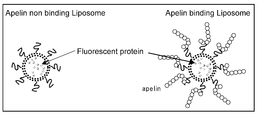
アペリン非修飾リポソームおよびアペリン修飾リポソームの模式図を図4に示した。
GLYCOLIPOTM抗体ラベリングキット(片山化学工業株式会社製)に付属している粉体Aに精製水を500ml添加して溶解し、このうち50mlをリポソーム溶液1mlに添加して室温で2時間撹拌した。これを遠心限外濾過フィルター(NMWL, Da : 300000)を用いて脱塩を行い、100~200mlに濃縮した後、溶液Aを加えて1mlとした(この操作は計2回行った)。リポソーム溶液1mlに対しApelin-13(Bachem社製)またはApelin-36(PHOENIX PHARMACEUTICALS,INC.製)を3.3nmol添加して室温で2時間反応させた。そこへ溶液Bを40ml添加して室温で2時間撹拌し、さらに4℃で20時間撹拌した。これを再び遠心限外濾過フィルター(NMWL, Da : 300000)を用いて100~200mlに濃縮した後、溶液Cを加えて1mlとした(同じくこの操作は計2回行った)。0.45μm濾過フィルターで濾過した後、使用まで遮光下、冷蔵保管した。
アペリン非修飾リポソームおよびアペリン修飾リポソームの模式図を図4に示した。
(2)リポソームの細胞取込み実験
1~2×10⁵個/0.5ml培養液/wellでAPJ-GFPを安定発現するAPJ発現NIH3T3細胞を播き、37℃、5%CO2下で一晩培養した。ここにApelin-36修飾リポソームおよびアペリン非修飾リポソームをそれぞれ10ml添加し、APJと連結しているGFPが細胞表面から細胞内に移行するかを確認した。
結果を図5に示した。上段は実験の模式図であり、下段左はApelin-36修飾リポソーム添加前、左はApelin-36修飾リポソーム添加後のGFPの局在を確認した写真である。図5の写真から明らかように、Apelin-36修飾リポソーム添加前には細胞膜に存在したAPJは、Apelin-36修飾リポソーム添加後に、アペリンと結合して細胞内に移行していることが確認された。データを示していないが、Apelin-13修飾リポソームも同様の結果であった。
1~2×10⁵個/0.5ml培養液/wellでAPJ-GFPを安定発現するAPJ発現NIH3T3細胞を播き、37℃、5%CO2下で一晩培養した。ここにApelin-36修飾リポソームおよびアペリン非修飾リポソームをそれぞれ10ml添加し、APJと連結しているGFPが細胞表面から細胞内に移行するかを確認した。
結果を図5に示した。上段は実験の模式図であり、下段左はApelin-36修飾リポソーム添加前、左はApelin-36修飾リポソーム添加後のGFPの局在を確認した写真である。図5の写真から明らかように、Apelin-36修飾リポソーム添加前には細胞膜に存在したAPJは、Apelin-36修飾リポソーム添加後に、アペリンと結合して細胞内に移行していることが確認された。データを示していないが、Apelin-13修飾リポソームも同様の結果であった。
また、Apelin-36修飾リポソーム添加前(0分)と添加10分後に、共焦点レーザー顕微鏡でGFPおよびCy3(リポソーム内に内包した蛍光蛋白質)の局在を観察した。結果を図6に示した。図6から明らかなように、Apelin-36修飾リポソーム添加10分後には、リポソーム内に内包したCy3が細胞内に存在することが確認された。データを示していないが、Apelin-13修飾リポソームも同様の結果であった。
以上の結果から、アペリン修飾リポソームが細胞内にAPJを介して取り込まれることが明らかとなった。
以上の結果から、アペリン修飾リポソームが細胞内にAPJを介して取り込まれることが明らかとなった。
(3)担がんマウスへのアペリン修飾リポソームの投与
実施例1と同様に、colon26大腸ガン細胞をBALB/cCrSlcマウスに移植して担がんマウスを作製した。この担がんマウスに、非修飾またはApelin-36修飾リポソーム(Cy3内包)100μlを尾静脈から投与し、24、48、72、96時間後に光蛍光in vivoイメージングシステムを用いて写真を撮影した。
別途、リポソーム投与から24時間後に、担がんマウスから腫瘍組織を摘出した。摘出した腫瘍組織の凍結組織切片を作製し、血管内皮細胞のマーカーであるCD31を染色するために、FITC標識抗マウスCD31抗体(Pharmingen社製)を用いて免疫蛍光染色を施した。
実施例1と同様に、colon26大腸ガン細胞をBALB/cCrSlcマウスに移植して担がんマウスを作製した。この担がんマウスに、非修飾またはApelin-36修飾リポソーム(Cy3内包)100μlを尾静脈から投与し、24、48、72、96時間後に光蛍光in vivoイメージングシステムを用いて写真を撮影した。
別途、リポソーム投与から24時間後に、担がんマウスから腫瘍組織を摘出した。摘出した腫瘍組織の凍結組織切片を作製し、血管内皮細胞のマーカーであるCD31を染色するために、FITC標識抗マウスCD31抗体(Pharmingen社製)を用いて免疫蛍光染色を施した。
リポソーム投与から96時間後に、光蛍光in vivoイメージングシステムを用いて観察した結果を図7に示した。示していないが、24時間後には、アペリン修飾のいかんに関わらずEPR効果にて腫瘍にうすく蛍光色素の取込みが観察された。一方、96時間後には、図7から明らかなように、アペリン非修飾リポソームを投与したマウスでは腫瘍内に蛍光色素が認められなかったのに対し、アペリン修飾リポソームを投与したマウスでは腫瘍内での蛍光色素の貯留が観察された。データを示していないが、Apelin-13修飾リポソームも同様の結果であった。
腫瘍組織における血管内皮細胞およびリポソームの局在を観察した結果を図8に示した。図8から明らかなように、アペリン非修飾リポソームを投与したマウスの腫瘍組織では、血管内皮細胞のシグナルの内側にリポソームのシグナルが観察され、リポソームが血管から漏出していることが確認された(上段のアローヘッド参照)。一方、アペリン修飾リポソームを投与したマウスの腫瘍組織では、血管内皮細胞のシグナルとリポソームのシグナルが重なっており、リポソームが血管内に入り込んでいることが確認された(下段の矢印参照)。
以上の結果から、アペリン修飾リポソームは、APJを介して腫瘍内の成熟血管および新生中の血管内皮細胞にとりこまれ、腫瘍のすべての血管を可視化できること、そしてリポソームに血管細胞障害薬、抗がん薬などを内包することで、腫瘍血管を特異的に破壊する方法を提供できることが判明した。
なお本発明は上述した各実施形態および実施例に限定されるものではなく、請求項に示した範囲で種々の変更が可能であり、異なる実施形態にそれぞれ開示された技術的手段を適宜組み合わせて得られる実施形態についても本発明の技術的範囲に含まれる。また、本明細書中に記載された学術文献および特許文献の全てが、本明細書中において参考として援用される。
Claims (9)
- APJ発現細胞に薬物を送達するシステムであって、APJ結合物質および薬物を包含することを特徴とする薬物送達システム。
- APJ結合物質と薬物が一体化していることを特徴とする請求項1に記載の薬物送達システム。
- APJ結合物質がアペリンまたは抗APJ抗体であることを特徴とする請求項1または2に記載の薬物送達システム。
- 薬物が、蛍光性物質、放射性物質、化学発光性物質および磁性物質からなる群より選択される1種以上であることを特徴とする請求項1~3のいずれかに記載の薬物送達システム。
- 薬物が、血管細胞障害薬、血管新生阻害薬、抗がん薬、抗ウイルス薬および抗炎症薬からなる群より選択される1種以上であることを特徴とする請求項1~3のいずれかに記載の薬物送達システム。
- 請求項4に記載の薬物送達システムを含有することを特徴とする新生血管の可視化剤。
- 請求項4に記載の薬物送達システムを含有することを特徴とする固形がんの血管可視化剤。
- 請求項5に記載の薬物送達システムを含有することを特徴とする血管新生に起因して発症または悪化する疾患の治療薬。
- 請求項5に記載の薬物送達システムを含有することを特徴とする固形がんの治療薬。
Applications Claiming Priority (2)
| Application Number | Priority Date | Filing Date | Title |
|---|---|---|---|
| JP2011-016437 | 2011-01-28 | ||
| JP2011016437 | 2011-01-28 |
Publications (1)
| Publication Number | Publication Date |
|---|---|
| WO2012102363A1 true WO2012102363A1 (ja) | 2012-08-02 |
Family
ID=46580926
Family Applications (1)
| Application Number | Title | Priority Date | Filing Date |
|---|---|---|---|
| PCT/JP2012/051748 Ceased WO2012102363A1 (ja) | 2011-01-28 | 2012-01-27 | 薬物送達システムおよびその利用 |
Country Status (1)
| Country | Link |
|---|---|
| WO (1) | WO2012102363A1 (ja) |
Cited By (5)
| Publication number | Priority date | Publication date | Assignee | Title |
|---|---|---|---|---|
| JP2015232118A (ja) * | 2014-05-14 | 2015-12-24 | 積水化学工業株式会社 | 水溶性硬化剤及び/又は硬化促進剤内包カプセル、並びに、熱硬化性樹脂組成物 |
| JP2017516490A (ja) * | 2014-03-20 | 2017-06-22 | セントル ナショナル デ ラ ルシュルシュ サイエンティフィーク(シーエヌアールエス) | 癌を治療するためのアペリン/apj/gp130シグナル伝達を阻害する化合物の使用 |
| WO2019238093A1 (zh) * | 2018-06-13 | 2019-12-19 | 鸿运华宁(杭州)生物医药有限公司 | APJ抗体及其与Elabela的融合蛋白质,以及其药物组合物和应用 |
| EP3528820A4 (en) * | 2016-10-19 | 2020-05-27 | Avive, Inc. | NEW PEGYLATED LIPOSOMAL APELINE FORMULATIONS FOR THE TREATMENT OF HEART CIRCULAR DISEASES |
| WO2021255282A1 (en) * | 2020-06-18 | 2021-12-23 | Universite D'aix Marseille | Conjugated and labelled apelin, preparation and uses thereof |
Citations (2)
| Publication number | Priority date | Publication date | Assignee | Title |
|---|---|---|---|---|
| JP2008013436A (ja) * | 2004-10-14 | 2008-01-24 | Kanazawa Univ | 血管形成促進剤 |
| US20080182779A1 (en) * | 2003-05-22 | 2008-07-31 | Ashley Euan A | Apelin and uses thereof |
-
2012
- 2012-01-27 WO PCT/JP2012/051748 patent/WO2012102363A1/ja not_active Ceased
Patent Citations (2)
| Publication number | Priority date | Publication date | Assignee | Title |
|---|---|---|---|---|
| US20080182779A1 (en) * | 2003-05-22 | 2008-07-31 | Ashley Euan A | Apelin and uses thereof |
| JP2008013436A (ja) * | 2004-10-14 | 2008-01-24 | Kanazawa Univ | 血管形成促進剤 |
Non-Patent Citations (1)
| Title |
|---|
| KIDOYA, H. ET AL., EMBO JOURNAL, vol. 27, 2008, pages 522 - 534 * |
Cited By (7)
| Publication number | Priority date | Publication date | Assignee | Title |
|---|---|---|---|---|
| JP2017516490A (ja) * | 2014-03-20 | 2017-06-22 | セントル ナショナル デ ラ ルシュルシュ サイエンティフィーク(シーエヌアールエス) | 癌を治療するためのアペリン/apj/gp130シグナル伝達を阻害する化合物の使用 |
| JP2015232118A (ja) * | 2014-05-14 | 2015-12-24 | 積水化学工業株式会社 | 水溶性硬化剤及び/又は硬化促進剤内包カプセル、並びに、熱硬化性樹脂組成物 |
| EP3528820A4 (en) * | 2016-10-19 | 2020-05-27 | Avive, Inc. | NEW PEGYLATED LIPOSOMAL APELINE FORMULATIONS FOR THE TREATMENT OF HEART CIRCULAR DISEASES |
| US11400049B2 (en) | 2016-10-19 | 2022-08-02 | Avive, Inc. | Pegylated liposomal formulations of apelin for treatment of cardiovascular-related diseases |
| WO2019238093A1 (zh) * | 2018-06-13 | 2019-12-19 | 鸿运华宁(杭州)生物医药有限公司 | APJ抗体及其与Elabela的融合蛋白质,以及其药物组合物和应用 |
| US12221488B2 (en) | 2018-06-13 | 2025-02-11 | Gmax Biopharm Llc | APJ antibody, fusion protein thereof with Elabela, and pharmaceutical compositions and use thereofus01 |
| WO2021255282A1 (en) * | 2020-06-18 | 2021-12-23 | Universite D'aix Marseille | Conjugated and labelled apelin, preparation and uses thereof |
Similar Documents
| Publication | Publication Date | Title |
|---|---|---|
| US12084518B2 (en) | Trispecific binding proteins and methods of use | |
| US7897351B2 (en) | Peptides and antibodies to MUC 1 proteins | |
| JP6447887B2 (ja) | 二重特異性抗体及びその使用 | |
| US12201692B2 (en) | Targeted protease compositions and uses related thereto | |
| US10420820B2 (en) | Targeting of pharmaceutical agents to pathologic areas using bifunctional fusion polypeptides | |
| JP2018015002A (ja) | モジュラー認識ドメインを介してターゲティングする抗体 | |
| US20190002516A1 (en) | Drug Design Method, Obtained Drug and Application Thereof | |
| CN112805036A (zh) | 通过施用抗体-药物缀合物对转移性脑肿瘤的治疗 | |
| CN117919197A (zh) | 一种低免疫原性靶向囊泡递送系统及其制备方法与应用 | |
| US12156918B2 (en) | Neuroendocrine cancer targeted therapy | |
| CN105939724B (zh) | 用于治疗和预防转移癌的药物组合物和方法 | |
| KR102654035B1 (ko) | 도펠 단백질 억제제 | |
| US20210077575A1 (en) | Nanoparticles for the targeted delivery of therapeutic polypeptides | |
| US20260060935A1 (en) | Therapeutic effect enhancer for enhancing effect of car-t therapy | |
| JP7429454B2 (ja) | ペプチド及びその使用 | |
| Goodwin | Treatment of Liver Metastasis Via Nanoparticle Delivery of Engineered Gene Immunotherapies Expressed Locally and Transiently by the Liver Hepatocytes | |
| EA045483B1 (ru) | Взаимодействующие с гликанами соединения и способы их применения | |
| AU2002307755A1 (en) | Peptides and antibodies to MUC 1 proteins |
Legal Events
| Date | Code | Title | Description |
|---|---|---|---|
| 121 | Ep: the epo has been informed by wipo that ep was designated in this application |
Ref document number: 12738742 Country of ref document: EP Kind code of ref document: A1 |
|
| DPE2 | Request for preliminary examination filed before expiration of 19th month from priority date (pct application filed from 20040101) | ||
| NENP | Non-entry into the national phase |
Ref country code: DE |
|
| 122 | Ep: pct application non-entry in european phase |
Ref document number: 12738742 Country of ref document: EP Kind code of ref document: A1 |
|
| NENP | Non-entry into the national phase |
Ref country code: JP |