WO2012098951A1 - 電子線硬化性組成物及びその硬化物 - Google Patents
電子線硬化性組成物及びその硬化物 Download PDFInfo
- Publication number
- WO2012098951A1 WO2012098951A1 PCT/JP2012/050270 JP2012050270W WO2012098951A1 WO 2012098951 A1 WO2012098951 A1 WO 2012098951A1 JP 2012050270 W JP2012050270 W JP 2012050270W WO 2012098951 A1 WO2012098951 A1 WO 2012098951A1
- Authority
- WO
- WIPO (PCT)
- Prior art keywords
- meth
- electron beam
- acrylate
- curable composition
- vinyl compound
- Prior art date
- Legal status (The legal status is an assumption and is not a legal conclusion. Google has not performed a legal analysis and makes no representation as to the accuracy of the status listed.)
- Ceased
Links
Classifications
-
- C—CHEMISTRY; METALLURGY
- C08—ORGANIC MACROMOLECULAR COMPOUNDS; THEIR PREPARATION OR CHEMICAL WORKING-UP; COMPOSITIONS BASED THEREON
- C08F—MACROMOLECULAR COMPOUNDS OBTAINED BY REACTIONS ONLY INVOLVING CARBON-TO-CARBON UNSATURATED BONDS
- C08F2/00—Processes of polymerisation
- C08F2/46—Polymerisation initiated by wave energy or particle radiation
- C08F2/52—Polymerisation initiated by wave energy or particle radiation by electric discharge, e.g. voltolisation
-
- C—CHEMISTRY; METALLURGY
- C08—ORGANIC MACROMOLECULAR COMPOUNDS; THEIR PREPARATION OR CHEMICAL WORKING-UP; COMPOSITIONS BASED THEREON
- C08K—Use of inorganic or non-macromolecular organic substances as compounding ingredients
- C08K3/00—Use of inorganic substances as compounding ingredients
- C08K3/02—Elements
- C08K3/04—Carbon
Definitions
- the present invention relates to an electron beam curable composition used for applications requiring conductivity, thermal conductivity and solvent resistance, and a cured product thereof.
- Patent Document 1 JP-A-60-60166 discloses a coating binder mainly composed of one or more (meth) acryl oligomers having two or more (meth) acryloyl groups in the molecule, and tin oxide.
- An electrically conductive coating composition containing an electrically conductive powder having a particle size of 0.2 ⁇ m or less, which is mainly composed of is disclosed.
- the hardness and scratch resistance of the coating film can be improved by having a (meth) acryl oligomer having a urethane bond.
- the scratch resistance and hardness of the coating film can be improved by crosslinking the composition by photocuring or radiation curing.
- the composition containing an isocyanate compound and a photosensitizer is irradiated with ultraviolet rays. Thus, a cured product is formed.
- this composition has a urethane bond, the solvent resistance is not sufficient, and when a solvent (particularly a polar organic solvent) is used, the coating film swells and distortion occurs between the fillers. descend. Moreover, since it is ultraviolet curing, curing with a filler having an ultraviolet absorbing ability (such as carbon black) does not proceed sufficiently, and the use of a conductive filler is limited. Further, since tin oxide is used, absorption of ultraviolet rays is suppressed, but in order to suppress light scattering, it is necessary to control the particle size. Furthermore, this composition requires a polymerization catalyst such as a photosensitizer and an initiator.
- Patent Document 2 JP-A-63-33470 discloses a conductive resin composition containing polyphenylene oxide and a crosslinkable polymer and / or a crosslinkable monomer, in which a conductive filler is dispersed.
- radiation crosslinking is also described, specifically, a composition containing an isocyanate compound and an initiator is heat-cured.
- this composition also has low solvent resistance because it contains thermoplastic fat and has a urethane bond. Furthermore, this composition also requires an initiator in curing.
- JP-A-2000-86728 discloses 3 to 12 An amine-modified (meth) acrylate compound (A) in which a primary or secondary amine is added to a (meth) acrylate compound having a (meth) acryloyl group and a molecular weight of less than 500, and hydrogen such as ethylene oxide are extracted.
- An electron beam curable composition containing a polymerizable unsaturated compound (B) having an easy skeleton is disclosed.
- an amine-modified (meth) acrylate compound is used to prevent oxygen inhibition in electron beam curing.
- the filler is only described as an example of an optional additive to be added for curing properties, viscosity adjustment, and cost reduction.
- JP-A-60-60166 (Claims, Examples)
- JP 63-33470 A (Claims, Examples)
- JP 2000-86728 A (claims, paragraphs [0020] [0021] [0041], Examples)
- an object of the present invention is to provide an electron beam curable composition having high conductivity and solvent resistance of a cured product, a method for producing a cured product using the composition, and a cured product.
- Another object of the present invention is to use an electron beam curable composition that can suppress swelling and maintain high conductivity even when the cured product is brought into contact with a polar organic solvent for a long period of time, and this composition. It is in providing the manufacturing method and hardened
- Still another object of the present invention is to provide an electron beam curable composition capable of improving the solvent resistance, conductivity, and hardness of a cured product without limiting the type of conductive filler, and a cured product using the composition. It is in providing a manufacturing method and hardened
- the present inventors have obtained a trifunctional or higher polyfunctional vinyl compound, a monofunctional and / or bifunctional vinyl compound having an alicyclic and / or aromatic skeleton, The inventors have found that when the conductive filler is combined and cured with an electron beam, the conductivity and solvent resistance of the cured product can be improved, and the present invention has been completed.
- the electron beam curable composition of the present invention comprises a trifunctional or higher polyfunctional vinyl compound, a monofunctional and / or bifunctional vinyl compound having an alicyclic and / or aromatic skeleton, and a conductive filler.
- the monofunctional and / or bifunctional vinyl compound is a bifunctional (meth) acrylate having a polycyclic alicyclic and / or bisphenol skeleton (particularly a bicyclic to tetracyclic C 8-12 bridged alicyclic ring).
- the polyfunctional vinyl compound may be a tri- to hexa-functional (meth) acrylate.
- the conductive filler may be conductive carbon black.
- the ratio of the conductive filler may be about 5 to 50 parts by weight based on 100 parts by weight of the total amount of the polyfunctional vinyl compound and the monofunctional and / or bifunctional vinyl compound.
- the ratio of the monofunctional and / or bifunctional vinyl compound may be about 10 to 100 parts by weight with respect to 100 parts by weight of the polyfunctional vinyl compound.
- the polyfunctional vinyl compound may be a polyfunctional vinyl compound not modified with an amine.
- the electron beam curable composition of the present invention may be a composition that does not substantially contain a polymerization initiator (particularly, a composition that does not contain a polymerization initiator).
- the electron beam curable composition of the present invention is a composition that does not substantially contain a compound having an isocyanate group and / or a urethane bond (particularly, a composition that does not contain a compound having an isocyanate group and / or a urethane bond). It may be. Furthermore, the electron beam curable composition of the present invention may be a composition that does not substantially contain a polyphenylene oxide resin (in particular, a composition that does not contain a thermoplastic resin such as a polyphenylene oxide resin). The electron beam curable composition of this invention is suitable for the use for forming the hardened
- the present invention includes a method for producing a cured product by irradiating the electron beam curable composition with an electron beam. Furthermore, the hardened
- the cured product of the present invention may be a cured product that does not substantially contain a urethane bond.
- acryloyl group and methacryloyl group are collectively referred to as (meth) acryloyl group, and acrylate and methacrylate are collectively referred to as (meth) acrylate.
- a trifunctional or higher polyfunctional vinyl compound, a monofunctional and / or bifunctional vinyl compound having an alicyclic and / or aromatic skeleton, and a conductive filler are combined and cured with an electron beam.
- cured material can be improved.
- swelling and the like are suppressed, and high conductivity can be maintained.
- the solvent resistance, conductivity, and hardness of the cured product can be improved without limiting the type of conductive filler.
- the electron beam curable composition of the present invention comprises a trifunctional or higher polyfunctional vinyl compound, a monofunctional and / or bifunctional vinyl compound having an alicyclic and / or aromatic skeleton, and a conductive filler. Including.
- the polyfunctional vinyl-based compound may have 3 or more (for example, about 3 to 8) polymerizable groups (for example, vinyl group, (meth) acryloyl group, etc.) in the molecule.
- a polyfunctional (meth) acrylate having 3 or more (meth) acryloyl groups is widely used.
- polyfunctional (meth) acrylate esterified product of polyhydric alcohol and (meth) acrylic acid
- examples include pentaerythritol tri (meth) acrylate; ditrimethylolpropane tetra (meth) acrylate, pentaerythritol tetra (meth) acrylate; dipentaerythritol penta (meth) acrylate; dipentaerythritol hexa (meth) acrylate, and the like.
- the polyhydric alcohol may be an adduct of alkylene oxide (for example, C 2-4 alkylene oxide such as ethylene oxide or propylene oxide).
- alkylene oxide for example, C 2-4 alkylene oxide such as ethylene oxide or propylene oxide.
- the average number of moles of alkylene oxide added can be selected, for example, from a range of about 0 to 30 moles (particularly 1 to 10 moles).
- These polyfunctional (meth) acrylates can be used alone or in combination of two or more.
- polyfunctional vinyl compounds tri- to 6-functional (meth) acrylates such as trimethylolpropane tri (meth) acrylate, pentaerythritol tri (meth) acrylate, and pentaerythritol tetra (meth) acrylate are preferable.
- Pentaerythritol tris A tri- to tetrafunctional (meth) acrylate such as (meth) acrylate is widely used.
- the polyfunctional vinyl compound is preferably a polyfunctional vinyl compound that has not been modified with an amine (polyfunctional vinyl compound to which no amine has been added by Michael addition or the like).
- the monofunctional and / or bifunctional vinyl compound may have one or two polymerizable groups in the molecule and may have an alicyclic and / or aromatic skeleton.
- monofunctional or bifunctional (meth) acrylates having two (meth) acryloyl groups, aromatic vinyl compounds such as styrene and divinylbenzene, and the like are widely used.
- Examples of the monofunctional (meth) acrylate having an alicyclic and / or aromatic skeleton include cycloalkyl (meth) acrylates such as cyclohexyl (meth) acrylate; dicyclopentanyl (meth) acrylate, dicyclopentenyl (meta ) Acrylate, dicyclopentenyloxyethyl (meth) acrylate, bornyl (meth) acrylate, isobornyl (meth) acrylate, tricyclodecanyl (meth) acrylate, etc., bridged cyclic (meth) acrylate; phenyl (meth) acrylate, Aryl (meth) acrylates such as nonylphenyl (meth) acrylate; Aralkyl (meth) acrylates such as benzyl (meth) acrylate; Aryloxyalkyl (meth) such as phenoxyethyl (meth) acrylate Acrylate; phen
- bifunctional (meth) acrylate having an alicyclic and / or aromatic skeleton examples include 2 to 4 ring C 6-20 such as tricyclodecane dimethanol di (meth) acrylate and adamantane di (meth) acrylate.
- polycyclic alicyclic rings such as tricyclodecane dimethanol di (meth) acrylate and adamantane di (meth) acrylate are used because of the high solvent resistance and strength of the cured product.
- Di (meth) acrylates having a bisphenol skeleton such as di (meth) acrylate having a group skeleton, 2,2-bis (4- (meth) acryloyloxyethoxyphenyl) propane, bisphenol A type epoxy (meth) acrylate, Di (meth) acrylates having a bridged alicyclic skeleton such as tricyclodecane dimethanol di (meth) acrylate (especially a bicyclic to tetracyclic C 8-12 bridged alicyclic skeleton) are particularly preferred. preferable.
- the ratio of the monofunctional and / or bifunctional vinyl compound having an alicyclic and / or aromatic skeleton can be selected from the range of about 1 to 200 parts by weight with respect to 100 parts by weight of the polyfunctional vinyl compound, for example
- the amount is about 5 to 150 parts by weight, preferably about 10 to 100 parts by weight (for example, 10 to 80 parts by weight), and more preferably about 15 to 50 parts by weight (particularly 20 to 30 parts by weight).
- conductive filler examples include carbon materials (for example, artificial graphite, expanded graphite, natural graphite, coke, and conductive carbon black), simple metals or alloys (for example, iron, copper, magnesium, aluminum, gold, platinum, Zinc, manganese, stainless steel, etc.) and ceramics (eg, ferrite, tourmaline, diatomaceous earth, etc.). These conductive fillers can be used alone or in combination of two or more.
- the shape of the conductive filler examples include particulate (powder), plate (or scale), fiber, and indefinite shape. Of these shapes, particle shapes such as a substantially spherical shape and a polygonal shape are widely used.
- the average particle diameter of the conductive filler can be appropriately selected from the range of about 10 nm to 10 ⁇ m. However, from the viewpoint of mechanical properties and conductivity of the cured product, for example, 10 to 500 nm, preferably 20 to 300 nm, more preferably It is about 30 to 100 nm (particularly 40 to 80 nm).
- conductive carbon black can be preferably used as the particulate conductive filler having such an average particle diameter and excellent conductivity.
- Examples of conductive carbon black include furnace black, channel black, gas black, acetylene black, arc black, and ketjen black. Of these conductive carbon blacks, furnace black, ketjen black, acetylene black and the like are preferable from the viewpoint of conductivity. Further, the conductive carbon black may be a conductive composite carbon black obtained by combining these conductive carbon blacks.
- Conductive carbon black DBP (dibutyl phthalate) oil absorption amount (A method), depending on the application, 10 ⁇ 1000cm 3 / 100g (e.g., 30 ⁇ 500cm 3 / 100g) may be selected from the range of about nitrogen adsorption BET specific
- the surface area can be selected from a range of about 5 to 1000 m 2 / g (for example, 10 to 300 m 2 / g).
- the ratio of the conductive filler can be selected from a range of about 1 to 100 parts by weight with respect to 100 parts by weight of the total amount of the polyfunctional vinyl compound and the monofunctional and / or bifunctional vinyl compound.
- the amount is about 80 parts by weight, preferably about 5 to 50 parts by weight, more preferably about 10 to 40 parts by weight (especially 15 to 35 parts by weight).
- the electron beam curable composition of the present invention may contain other vinyl compounds as long as the effects of the present invention are not impaired.
- Other vinyl compounds include monofunctional vinyl compounds, bifunctional vinyl compounds, and the like.
- Other monofunctional vinyl compounds include, for example, (meth) acrylic acid; C 1-24 alkyl (meth) acrylates such as methyl (meth) acrylate and ethyl (meth) acrylate; hydroxyethyl (meth) acrylate and hydroxypropyl Hydroxy C 2-10 alkyl (meth) acrylate such as (meth) acrylate, hydroxybutyl (meth) acrylate or C 2-10 alkanediol mono (meth) acrylate; fluoro C 1-10 such as trifluoroethyl (meth) acrylate Alkyl (meth) acrylate; alkoxyalkyl (meth) acrylate such as methoxyethyl (meth) acrylate; polyalkylene glycol mono (meth) acrylate such as polyethylene glycol mono (meth) acrylate; Examples include alkane polyol mono (meth) acrylates such as serine mono (meth) acrylate; (
- bifunctional vinyl compounds include, for example, allyl (meth) acrylate; alkanediol di (meth) acrylate such as ethylene glycol di (meth) acrylate and propylene glycol di (meth) acrylate; glycerin di (meth) acrylate and the like Alkane polyol di (meth) acrylates of polyalkylene glycol di (meth) acrylates such as diethylene glycol di (meth) acrylate, triethylene glycol di (meth) acrylate and polyethylene glycol di (meth) acrylate; acids such as fatty acid modified pentaerythritol Examples include di (meth) acrylates of modified alkane polyols; polyester (meth) acrylates and the like.
- the proportion of the other vinyl compound is 100 parts by weight or less with respect to 100 parts by weight as a total of the polyfunctional vinyl compound and the monofunctional and / or bifunctional vinyl compound having an alicyclic and / or aromatic skeleton.
- it may be 50 parts by weight or less, preferably 30 parts by weight or less, and more preferably 10 parts by weight or less (eg, about 0.1 to 10 parts by weight).
- the electron beam curable composition of the present invention may contain an organic solvent.
- the organic solvent include ketones (acetone, methyl ethyl ketone, methyl isobutyl ketone, cyclohexanone, etc.), ethers (dioxane, tetrahydrofuran, etc.), aliphatic hydrocarbons (hexane, etc.), alicyclic hydrocarbons (cyclohexane, etc.) ), Aromatic hydrocarbons (benzene, toluene, xylene, etc.), halogenated carbons (dichloromethane, dichloroethane, etc.), esters (methyl acetate, ethyl acetate, etc.), water, alcohols (ethanol, isopropanol, butanol, cyclo Hexanol, etc.), cellosolves (methyl cellosolve, ethyl cellosolve, etc.), cellosolve acetates,
- organic solvents can be used alone or in combination of two or more.
- ketones such as methyl ethyl ketone, aromatic hydrocarbons such as toluene, etc. are widely used.
- monofunctional vinyl compounds such as styrene and other vinyl compounds such as (meth) acrylic acid may be used as the reactive diluent.
- the ratio of the solvent is in the range of about 10 to 1000 parts by weight with respect to 100 parts by weight as a total of the polyfunctional vinyl compound and the monofunctional and / or bifunctional vinyl compound having an alicyclic and / or aromatic skeleton.
- it is about 50 to 500 parts by weight, preferably about 80 to 300 parts by weight, more preferably about 100 to 200 parts by weight (particularly 120 to 180 parts by weight).
- the electron beam curable composition of the present invention further contains conventional additives such as stabilizers (antioxidants, ultraviolet absorbers, light stabilizers, heat stabilizers, etc.), crystal nucleating agents, flame retardants, hardeners. It may contain a fuel aid, filler, plasticizer, impact resistance improver, reinforcing agent, dispersant, antistatic agent, foaming agent, antibacterial agent and the like. These additives can be used alone or in combination of two or more.
- the electron beam curable composition of the present invention is cured with an electron beam, it substantially contains a polymerization initiator (for example, a photopolymerization initiator, a photosensitizer, a thermal polymerization initiator, etc.). Absent. Moreover, the compound (urethane (meth) acrylate, polyisocyanate, etc.) which has an isocyanate group and / or a urethane bond is not contained substantially. Therefore, the cured product is excellent in solvent resistance. Furthermore, it is preferable that the electron beam curable composition of the present invention does not substantially contain a thermoplastic resin (particularly, a polyphenylene oxide resin) as a resin component from the viewpoint of solvent resistance.
- a polymerization initiator for example, a photopolymerization initiator, a photosensitizer, a thermal polymerization initiator, etc.
- Absent for example, a photopolymerization initiator, a photosensitizer, a thermal polymerization initiator, etc.
- the electron beam cured product of the present invention is obtained by irradiating the electron beam curable composition with an electron beam (EB).
- EB electron beam
- coating process which apply
- hardening process which irradiates and hardens
- a coating method of the curable composition conventional methods such as roll coater, air knife coater, blade coater, rod coater, reverse coater, bar coater, comma coater, dip squeeze coater, die coater, gravure coater, microgravure coater Examples include coater, silk screen coater method, dip method, spray method, spinner method and the like. Of these methods, the bar coater method and the gravure coater method are widely used. If necessary, the coating solution may be applied a plurality of times.
- the curable composition may be dried as necessary after application.
- the drying may be performed at a temperature of about 30 to 150 ° C., preferably 40 to 100 ° C., more preferably about 50 to 70 ° C., for example.
- a method of irradiating an electron beam with an exposure source such as an electron beam irradiation apparatus can be used.
- the irradiation amount (dose) varies depending on the thickness of the coating film, but is, for example, about 1 to 200 kGy (gray), preferably 10 to 180 kGy, and more preferably about 30 to 150 kGy (particularly 50 to 120 kGy).
- the acceleration voltage is, for example, about 10 to 1000 kV, preferably about 50 to 500 kV, and more preferably about 100 to 300 kV.
- inert gas for example, nitrogen gas, argon gas, helium gas etc.
- the electron beam cured product of the present invention is excellent in conductivity and may have a volume resistivity of 10 5 ⁇ ⁇ cm or less (for example, about 0.01 to 10 5 ⁇ ⁇ cm), for example, 10 4 ⁇ ⁇ cm. cm or less (for example, about 0.1 to 10 4 ⁇ ⁇ cm), preferably 10 3 ⁇ ⁇ cm or less (for example, about 1 to 10 3 ⁇ ⁇ cm), more preferably 10 2 ⁇ ⁇ cm or less (particularly 10 ⁇ ). -Cm or less).
- the electron beam cured product of the present invention preferably contains substantially no urethane bond from the viewpoint of solvent resistance.
- the electron beam cured product of the present invention may be a laminate with a substrate sheet, for example, a laminate in which a layer formed of the electron beam cured product of the present invention is formed on one surface of the substrate sheet. Moreover, the laminated body etc. in which the layer formed with the electron beam hardened
- the base sheet may be formed of glass, ceramic, metal, plastic, or the like, but plastic is preferable from the viewpoint of adhesion to a cured product.
- plastics examples include olefin resins (polyethylene, polypropylene, amorphous polyolefin, etc.), styrene resins (polystyrene, acrylonitrile-styrene copolymers, etc.), polyester resins (polyethylene terephthalate, polybutylene terephthalate, polyethylene naphthalate).
- olefin resins polyethylene, polypropylene, amorphous polyolefin, etc.
- styrene resins polystyrene, acrylonitrile-styrene copolymers, etc.
- polyester resins polyethylene terephthalate, polybutylene terephthalate, polyethylene naphthalate.
- polyalkylene arylate resin polyarylate resin, liquid crystalline polyester, etc.
- polyamide resin polyamide 6, polyamide 66, polyamide 12, etc.
- vinyl chloride resin polyvinyl chloride, etc.
- polycarbonate resin bisphenol A type polycarbonate
- polyvinyl alcohol resin cellulose ester resin
- polyimide resin polysulfone resin
- polyphenylene ether resin poly E double sulfide resins
- fluorine resins polypropylene resins such as polypropylene, polyamide resins, polyester resins and the like are preferable from the viewpoint of excellent heat resistance.
- the plastic may contain the conductive filler.
- the thickness of the layer (cured product layer) formed of the electron beam cured product of the present invention can be selected depending on the application, but for example, 1 to 100 ⁇ m, preferably 2 to 50 ⁇ m, and more preferably 3 to It is about 30 ⁇ m.
- the thickness of the base sheet is, for example, about 1 to 300 ⁇ m, preferably 10 to 200 ⁇ m, and more preferably about 20 to 150 ⁇ m.
- solvent immersion test Put 10 ml of solvent in a petri dish, immerse the glass plate on which the cured coating film was laminated in methyl ethyl ketone (MEK) or N-methyl-2-pyrrolidone (NMP), and let stand at 25 ° C. for 24 hours. The weight change rate before and after immersion was determined. In this test, when the weight change (%) is 1.5% or less, the solvent resistance is excellent.
- MEK methyl ethyl ketone
- NMP N-methyl-2-pyrrolidone
- Weight change rate (%) ⁇ [(weight of coating film after immersion in solvent) ⁇ (weight of coating film before immersion in solvent)] / (weight of coating film before immersion in solvent) ⁇ ⁇ 100 [Solvent resistance: Appearance] About the cured coating film produced on the glass plate or the resin sheet (polyacrylamide, corona discharge treatment polypropylene), the state change of the coating film at the time of completion
- solvent resistance results comprehensive evaluation
- the evaluation items of the solvent resistance result are: a coating film satisfying both [solvent resistance: solvent immersion test] and [solvent resistance: appearance]; The coating film in which a problem occurred in the test was evaluated as x.
- Trifunctional acrylate Pentaerythritol triacrylate, “PETIA” manufactured by Daicel Cytec Co., Ltd.
- Alicyclic bifunctional acrylate Tricyclodecane dimethanol diacrylate (manufactured by Daicel Cytec Co., Ltd.) “IRR214-K”
- Aromatic bifunctional acrylate 1 bisphenol A type epoxy acrylate, "EBECRYL3700” manufactured by Daicel-Cytec Co., Ltd.
- Aromatic bifunctional acrylate 2 modified bisphenol A diacrylate, “EBECRYL150” manufactured by Daicel-Cytec Co., Ltd.
- Bifunctional urethane acrylate Aliphatic urethane acrylate, “EBECRYL230” manufactured by Daicel-Cytec Co., Ltd.
- Photopolymerization initiator hydroxycyclohexyl phenyl ketone, “Irgacure 184” manufactured by BASF Japan Ltd.
- Carbon black conductive carbon black, average particle size 50 nm, surface area 33 m 2 / g, “# 4300” manufactured by Tokai Carbon Co., Ltd.
- the obtained composition was coated on a 40 mm ⁇ 50 mm glass plate with a bar coater to a thickness of about 50 ⁇ m, and dried at 60 ° C.
- the dried composition was irradiated with an electron beam with an acceleration voltage of 150 kV and a dose of 100 kGy in a nitrogen atmosphere to prepare a cured coating film.
- the evaluation results of the cured coating film are shown in Table 1.
- Examples 1 to 8 and Comparative Examples 1 to 3 For the acrylates of Reference Examples 1 to 5, cured coatings were prepared in the same manner as Reference Examples 1 to 5 by combining acrylates as shown in Tables 2 to 3. The evaluation results of the obtained cured coating film are shown in Tables 2 to 3.
- MEK methyl ethyl ketone
- TOL toluene
- Carbon black was added to this solution, and a dispersion composition was prepared using a self-revolving mixing and defoaming machine (“ARE-250” manufactured by Shinkey Co., Ltd.).
- the obtained composition was coated on a 40 mm ⁇ 50 mm glass plate with a bar coater to a thickness of about 50 ⁇ m, and dried at 60 ° C.
- the dried composition was irradiated with an electron beam having an acceleration voltage of 150 kV and a dose of 100 kGy in a nitrogen atmosphere to prepare a cured coating film.
- Table 4 shows the evaluation results of the cured coating film.
- the electron beam cured products of the examples have high solvent resistance and electrical conductivity.
- the electron beam curable composition of the present invention is used in various fields that require electrical conductivity and solvent resistance, and is used in contact with a solvent, such as a storage container for a semiconductor wafer, a gasoline tank, an electronic / electrical device, and a semiconductor. It can be used as a material for floor materials and wall materials in manufacturing plants, various battery members, and the like.
- a solvent such as a storage container for a semiconductor wafer, a gasoline tank, an electronic / electrical device, and a semiconductor. It can be used as a material for floor materials and wall materials in manufacturing plants, various battery members, and the like.
Landscapes
- Chemical & Material Sciences (AREA)
- Health & Medical Sciences (AREA)
- Chemical Kinetics & Catalysis (AREA)
- Medicinal Chemistry (AREA)
- Polymers & Plastics (AREA)
- Organic Chemistry (AREA)
- Polymerisation Methods In General (AREA)
- Paints Or Removers (AREA)
- Compositions Of Macromolecular Compounds (AREA)
Abstract
3官能以上の多官能ビニル系化合物と、脂環族及び/又は芳香族骨格を有する単官能及び/又は2官能ビニル系化合物と、導電性フィラーとを組み合わせて電子線硬化性組成物を調製する。前記単官能及び/又は2官能ビニル系化合物は、橋架け環式及び/又はビスフェノール骨格を有する(メタ)アクリレートであってもよい。前記多官能ビニル系化合物は、3~6官能(メタ)アクリレートであってもよい。前記導電性フィラーは、導電性カーボンブラックであってもよい。本発明の電子線硬化性組成物は、電子線を照射して硬化物を製造するために用いられ、硬化物の導電性及び耐溶剤性が高く、溶媒と接触して使用される用途に適している。
Description
本発明は、導電性、熱伝導性、耐溶剤性を要求される用途に利用される電子線硬化性組成物及びその硬化物に関する。
半導体ウエハーの保存容器、ガソリンタンク、電子・電気機器や半導体製造工場における床材や壁材などの材料には、帯電防止などの点から要求される導電性や熱伝導性に加えて、使用時に有機溶媒と接触するため、耐溶剤性も要求される。従来から、これらの用途に利用される材料としては、導電性フィラーとバインダー樹脂との組み合わせが広く利用されているが、耐溶剤性を向上させる点から、バインダー樹脂として硬化樹脂が使用されている。
特開昭60-60166号公報(特許文献1)には、分子内に2個以上の(メタ)アクリロイル基を有する(メタ)アクリルオリゴマーの1種以上を主成分とする塗料バインダー、及び酸化スズを主成分とする粒径0.2μm以下の導電性粉末を含有する導電性塗料組成物が開示されている。この文献には、(メタ)アクリルオリゴマーがウレタン結合を有することにより塗膜の硬度及び耐擦過傷性を向上できると記載されている。さらに、前記組成物を光硬化もしくは放射線硬化により架橋することにより塗膜の耐擦過傷性及び硬度を向上できると記載され、具体的には、イソシアネート化合物及び光増感剤を含む組成物を紫外線照射して硬化物を形成している。
しかし、この組成物では、ウレタン結合を有するため、耐溶剤性が充分でなく、溶媒(特に極性の有機溶媒)を用いると、塗膜が膨潤してフィラー間に歪みが発生し、導電性が低下する。また、紫外線硬化であるため、紫外線吸収能を有するフィラー(カーボンブラックなど)では硬化が充分に進行せず、導電性フィラーの使用が制限される。また、酸化スズを用いるため、紫外線の吸収は抑制されているが、光の散乱を抑制するために、粒径を制御する必要がある。さらに、この組成物は、光増感剤などの重合触媒や開始剤が必要となる。
特開昭63-33470号公報(特許文献2)には、ポリフェニレンオキシド並びに架橋性ポリマー及び/又は架橋性モノマーを含み、導電性フィラーが分散されている導電性樹脂組成物が開示されている。この文献では、放射線架橋についても記載されているが、具体的には、イソシアネート化合物及び開始剤を含む組成物を加熱硬化している。
しかし、この組成物でも、熱可塑脂を含み、かつウレタン結合を有するため、耐溶剤性が低い。さらに、この組成物も、硬化において開始剤が必要である。
一方、開始剤を用いることなく、硬化可能な組成物として、電子線硬化性組成物も提案されており、例えば、特開2000-86728号公報(特許文献3)には、3~12個の(メタ)アクリロイル基を有し、かつ分子量が500未満の(メタ)アクリレート化合物に、1級又は2級アミンを付加させたアミン変性(メタ)アクリレート化合物(A)と、エチレンオキシドなどの水素を引き抜き易い骨格を有する重合性不飽和化合物(B)を含む電子線硬化性組成物が開示されている。この文献では、アミン変性させた(メタ)アクリレート化合物を用いて、電子線硬化における酸素阻害を防止している。
しかし、この文献には、フィラーに関しては、硬化物性、粘度調節、コストダウンのために添加する任意の添加剤の一例として記載されているにすぎない。
従って、本発明の目的は、硬化物の導電性及び耐溶剤性が高い電子線硬化性組成物並びにこの組成物を用いた硬化物の製造方法及び硬化物を提供することにある。
本発明の他の目的は、硬化物を極性の有機溶媒と長期間に亘り接触しても、膨潤などが抑制され、高い導電性を保持できる電子線硬化性組成物並びにこの組成物を用いた硬化物の製造方法及び硬化物を提供することにある。
本発明のさらに他の目的は、導電性フィラーの種類を限定することなく、硬化物の耐溶剤性、導電性及び硬度を向上できる電子線硬化性組成物並びにこの組成物を用いた硬化物の製造方法及び硬化物を提供することにある。
本発明者は、前記課題を達成するため鋭意検討した結果、3官能以上の多官能ビニル系化合物と、脂環族及び/又は芳香族骨格を有する単官能及び/又は2官能ビニル系化合物と、導電性フィラーとを組み合わせて電子線で硬化させると、硬化物の導電性及び耐溶剤性を向上できることを見出し、本発明を完成した。
すなわち、本発明の電子線硬化性組成物は、3官能以上の多官能ビニル系化合物と、脂環族及び/又は芳香族骨格を有する単官能及び/又は2官能ビニル系化合物と、導電性フィラーとを含む。前記単官能及び/又は2官能ビニル系化合物は、多環式脂環族及び/又はビスフェノール骨格を有する2官能(メタ)アクリレート(特に、2環~4環C8-12橋架け環式脂環族骨格などの橋架け環式脂環族骨格を有する2官能(メタ)アクリレート)であってもよい。前記多官能ビニル系化合物は、3~6官能(メタ)アクリレートであってもよい。前記導電性フィラーは、導電性カーボンブラックであってもよい。前記導電性フィラーの割合は、前記多官能ビニル系化合物と前記単官能及び/又は2官能ビニル系化合物との総量100重量部に対して5~50重量部程度であってもよい。前記単官能及び/又は2官能ビニル系化合物の割合は、前記多官能ビニル系化合物100重量部に対して10~100重量部程度であってもよい。前記多官能ビニル系化合物は、アミンで変性されていない多官能ビニル系化合物であってもよい。本発明の電子線硬化性組成物は、重合開始剤を実質的に含有しない組成物(特に、重合開始剤を含有しない組成物)であってもよい。また、本発明の電子線硬化性組成物は、イソシアネート基及び/又はウレタン結合を有する化合物を実質的に含有しない組成物(特に、イソシアネート基及び/又はウレタン結合を有する化合物を含有しない組成物)であってもよい。さらに、本発明の電子線硬化性組成物は、ポリフェニレンオキシド系樹脂を実質的に含有しない組成物(特に、ポリフェニレンオキシド系樹脂などの熱可塑性樹脂を含有しない組成物)であってもよい。本発明の電子線硬化性組成物は、溶媒と接触して使用される硬化物を形成するための用途に適している。
本発明には、前記電子線硬化性組成物に電子線を照射して硬化物を製造する方法も含まれる。さらに、本発明には、この方法で得られた硬化物も含まれる。本発明の硬化物は、ウレタン結合を実質的に含有していない硬化物であってもよい。
なお、本明細書では、アクリロイル基及びメタクリロイル基を(メタ)アクリロイル基と総称し、アクリレート及びメタクリレートを(メタ)アクリレートと総称する。
本発明では、3官能以上の多官能ビニル系化合物と、脂環族及び/又は芳香族骨格を有する単官能及び/又は2官能ビニル系化合物と、導電性フィラーとを組み合わせて、電子線で硬化させることにより、硬化物の導電性及び耐溶剤性を向上できる。また、硬化物を極性の有機溶媒と長期間に亘り接触しても、膨潤などが抑制され、高い導電性を保持できる。さらに、導電性フィラーの種類を限定することなく、硬化物の耐溶剤性、導電性及び硬度を向上できる。
[電子線硬化性組成物]
本発明の電子線硬化性組成物は、3官能以上の多官能ビニル系化合物と、脂環族及び/又は芳香族骨格を有する単官能及び/又は2官能ビニル系化合物と、導電性フィラーとを含む。
本発明の電子線硬化性組成物は、3官能以上の多官能ビニル系化合物と、脂環族及び/又は芳香族骨格を有する単官能及び/又は2官能ビニル系化合物と、導電性フィラーとを含む。
(多官能ビニル系化合物)
多官能ビニル系化合物としては、分子内に3以上(例えば、3~8程度)の重合性基(例えば、ビニル基、(メタ)アクリロイル基など)を有していればよく、具体的には、3以上の(メタ)アクリロイル基を有する多官能(メタ)アクリレートが汎用される。
多官能ビニル系化合物としては、分子内に3以上(例えば、3~8程度)の重合性基(例えば、ビニル基、(メタ)アクリロイル基など)を有していればよく、具体的には、3以上の(メタ)アクリロイル基を有する多官能(メタ)アクリレートが汎用される。
多官能(メタ)アクリレートとしては、多価アルコールと(メタ)アクリル酸とのエステル化物、例えば、グリセリントリ(メタ)アクリレート、トリメチロールプロパントリ(メタ)アクリレート、トリメチロールエタントリ(メタ)アクリレート、ペンタエリスリトールトリ(メタ)アクリレート;ジトリメチロールプロパンテトラ(メタ)アクリレート、ペンタエリスリトールテトラ(メタ)アクリレート;ジペンタエリスリトールペンタ(メタ)アクリレート;ジペンタエリスリトールヘキサ(メタ)アクリレートなどが挙げられる。さらに、これらの多官能(メタ)アクリレートにおいて、多価アルコールは、アルキレンオキシド(例えば、エチレンオキシドやプロピレンオキシドなどのC2-4アルキレンオキシド)の付加体であってもよい。アルキレンオキシドの平均付加モル数は、例えば、0~30モル(特に1~10モル)程度の範囲から選択できる。これらの多官能(メタ)アクリレートは、単独で又は二種以上組み合わせて使用できる。
これらの多官能ビニル系化合物のうち、トリメチロールプロパントリ(メタ)アクリレート、ペンタエリスリトールトリ(メタ)アクリレート、ペンタエリスリトールテトラ(メタ)アクリレートなどの3~6官能(メタ)アクリレートが好ましく、ペンタエリスリトールトリ(メタ)アクリレートなどの3~4官能(メタ)アクリレートが汎用される。さらに、多官能ビニル系化合物は、アミンで変性されていない多官能ビニル化合物(マイケル付加などによりアミン類が付加していない多官能ビニル化合物)が好ましい。
(単官能及び/又は2官能ビニル系化合物)
単官能及び/又は2官能ビニル系化合物としては、分子内に1又は2つの重合性基を有するとともに、脂環族及び/又は芳香族骨格を有していればよく、具体的には、1又は2つの(メタ)アクリロイル基を有する単官能又は2官能(メタ)アクリレート、スチレンやジビニルベンゼンなどの芳香族ビニル化合物などが汎用される。
単官能及び/又は2官能ビニル系化合物としては、分子内に1又は2つの重合性基を有するとともに、脂環族及び/又は芳香族骨格を有していればよく、具体的には、1又は2つの(メタ)アクリロイル基を有する単官能又は2官能(メタ)アクリレート、スチレンやジビニルベンゼンなどの芳香族ビニル化合物などが汎用される。
脂環族及び/又は芳香族骨格を有する単官能(メタ)アクリレートとしては、例えば、シクロヘキシル(メタ)アクリレートなどのシクロアルキル(メタ)アクリレート;ジシクロペンタニル(メタ)アクリレート、ジシクロペンテニル(メタ)アクリレート、ジシクロペンテニルオキシエチル(メタ)アクリレート、ボルニル(メタ)アクリレート、イソボルニル(メタ)アクリレート、トリシクロデカニル(メタ)アクリレートなどの橋架け環式(メタ)アクリレート;フェニル(メタ)アクリレート、ノニルフェニル(メタ)アクリレートなどのアリール(メタ)アクリレート;ベンジル(メタ)アクリレートなどのアラルキル(メタ)アクリレート;フェノキシエチル(メタ)アクリレートなどのアリールオキシアルキル(メタ)アクリレート;フェニルカルビトール(メタ)アクリレート、ノニルフェニルカルビトール(メタ)アクリレート、ノニルフェノキシポリエチレングリコール(メタ)アクリレートなどのアリールオキシ(ポリ)アルコキシアルキル(メタ)アクリレート;フェノキシヒドロキシプロピル(メタ)アクリレートなどのアリールオキシヒドロキシアルキル(メタ)アクリレートなどが挙げられる。これらの単官能(メタ)アクリレートは、単独で又は二種以上組み合わせて使用できる。
脂環族及び/又は芳香族骨格を有する2官能(メタ)アクリレートとしては、例えば、トリシクロデカンジメタノールジ(メタ)アクリレート、アダマンタンジ(メタ)アクリレートなどの2~4環C6-20(特にC6-12)橋架け環式ジ(メタ)アクリレート;2,2-ビス(4-(メタ)アクリロイルオキシエトキシフェニル)プロパン、2,2-ビス(4-(メタ)アクリロイルオキシプロポキシフェニル)プロパン、2,2-ビス(4-(メタ)アクリロキシジエトキシフェニル)プロパン、2,2-ビス(4-(メタ)アクリロイルオキシポリエトキシフェニル)プロパンなどのビスフェノール類(ビスフェノールA、Sなど)-C2-4アルキレンオキシド付加体[アルキレンオキシドの平均付加モル数0~30モル(特に1~10モル)程度]のジ(メタ)アクリレート;オリゴマー[ビスフェノールA型エポキシ(メタ)アクリレート、ノボラック型エポキシ(メタ)アクリレートなどの芳香族エポキシ(メタ)アクリレートなど]、脂環族及び/又は芳香族骨格を有するポリウレタン(メタ)アリレートやポリエステル(メタ)アリレートなどが挙げられる。これらの2官能(メタ)アクリレートは、単独で又は二種以上組み合わせて使用できる。
これらの単官能及び2官能ビニル系化合物のうち、硬化物の耐溶剤性及び強度が高い点から、トリシクロデカンジメタノールジ(メタ)アクリレート、アダマンタンジ(メタ)アクリレートなどの多環式脂環族骨格を有するジ(メタ)アクリレート、2,2-ビス(4-(メタ)アクリロイルオキシエトキシフェニル)プロパン、ビスフェノールA型エポキシ(メタ)アクリレートなどのビスフェノール骨格を有するジ(メタ)アクリレートが好ましく、トリシクロデカンジメタノールジ(メタ)アクリレートなどの橋架け環式脂環族骨格(特に、2環~4環C8-12橋架け環式脂環族骨格)を有するジ(メタ)アクリレートが特に好ましい。
脂環族及び/又は芳香族骨格を有する単官能及び/又は2官能ビニル系化合物の割合は、前記多官能ビニル系化合物100重量部に対して1~200重量部程度の範囲から選択でき、例えば、5~150重量部、好ましくは10~100重量部(例えば、10~80重量部)、さらに好ましくは15~50重量部(特に20~30重量部)程度である。
(導電性フィラー)
導電性フィラーとしては、例えば、炭素材(例えば、人造黒鉛、膨張黒鉛、天然黒鉛、コークス、導電性カーボンブラックなど)、金属単体又は合金(例えば、鉄、銅、マグネシウム、アルミニウム、金、白金、亜鉛、マンガン、ステンレスなど)、セラミックス類(例えば、フェライト、トルマリン、珪藻土など)などが挙げられる。これらの導電性フィラーは、単独で又は二種以上組み合わせて使用できる。
導電性フィラーとしては、例えば、炭素材(例えば、人造黒鉛、膨張黒鉛、天然黒鉛、コークス、導電性カーボンブラックなど)、金属単体又は合金(例えば、鉄、銅、マグネシウム、アルミニウム、金、白金、亜鉛、マンガン、ステンレスなど)、セラミックス類(例えば、フェライト、トルマリン、珪藻土など)などが挙げられる。これらの導電性フィラーは、単独で又は二種以上組み合わせて使用できる。
導電性フィラーの形状は、例えば、粒子状(粉末状)、板状(又は鱗片状)、繊維状、不定形状などが挙げられる。これらの形状のうち、略球状や多角体状などの粒子状が汎用される。
導電性フィラーの平均粒径は、10nm~10μm程度の範囲から適宜選択できるが、硬化物の機械的特性や導電性などの点から、例えば、10~500nm、好ましくは20~300nm、さらに好ましくは30~100nm(特に40~80nm)程度である。
本発明では、このような平均粒径を有し、かつ導電性に優れる粒子状導電性フィラーとして、導電性カーボンブラックを好ましく使用できる。
導電性カーボンブラックとしては、例えば、ファーネスブラック、チャンネルブラック、ガスブラック、アセチレンブラック、アークブラック、ケッチェンブラックなどが例示できる。これらの導電性カーボンブラックのうち、導電性などの点から、ファーネスブラック、ケッチェンブラック、アセチレンブラックなどが好ましい。さらに、導電性カーボンブラックは、これらの導電性カーボンブラックを組合せた導電性複合カーボンブラックでもよい。
導電性カーボンブラックのDBP(ジブチルフタレート)吸油量(A法)は、用途に応じて、10~1000cm3/100g(例えば、30~500cm3/100g)程度の範囲から選択でき、窒素吸着BET比表面積は5~1000m2/g(例えば、10~300m2/g)程度の範囲から選択できる。
導電性フィラーの割合は、前記多官能ビニル系化合物と前記単官能及び/又は2官能ビニル系化合物との総量100重量部に対して1~100重量部程度の範囲から選択でき、例えば、3~80重量部、好ましくは5~50重量部、さらに好ましくは10~40重量部(特に15~35重量部)程度である。
(他の添加剤)
本発明の電子線硬化性組成物には、本発明の効果を損なわない範囲で、他のビニル系化合物を含んでいてもよい。他のビニル系化合物には、単官能ビニル系化合物、2官能ビニル系化合物などが含まれる。
本発明の電子線硬化性組成物には、本発明の効果を損なわない範囲で、他のビニル系化合物を含んでいてもよい。他のビニル系化合物には、単官能ビニル系化合物、2官能ビニル系化合物などが含まれる。
他の単官能ビニル系化合物としては、例えば、(メタ)アクリル酸;メチル(メタ)アクリレートやエチル(メタ)アクリレートなどのC1-24アルキル(メタ)アクリレート;ヒドロキシエチル(メタ)アクリレートやヒドロキシプロピル(メタ)アクリレート、ヒドロキシブチル(メタ)アクリレートなどのヒドロキシC2-10アルキル(メタ)アクリレート又はC2-10アルカンジオールモノ(メタ)アクリレート;トリフルオロエチル(メタ)アクリレートなどのフルオロC1-10アルキル(メタ)アクリレート;メトキシエチル(メタ)アクリレートなどのアルコキシアルキル(メタ)アクリレート;ポリエチレングリコールモノ(メタ)アクリレートなどのポリアルキレングリコールモノ(メタ)アクリレート;グリセリンモノ(メタ)アクリレートなどのアルカンポリオールモノ(メタ)アクリレート;2-ジメチルアミノエチル(メタ)アクリレートなどのアミノ基を有する(メタ)アクリレート;グリシジル(メタ)アクリレート;ビニルピロリドンなどが挙げられる。
他の2官能ビニル系化合物としては、例えば、アリル(メタ)アクリレート;エチレングリコールジ(メタ)アクリレート、プロピレングリコールジ(メタ)アクリレートなどのアルカンジオールジ(メタ)アクリレート;グリセリンジ(メタ)アクリレートなどのアルカンポリオールジ(メタ)アクリレート;ジエチレングリコールジ(メタ)アクリレート、トリエチレングリコールジ(メタ)アクリレート、ポリエチレングリコールジ(メタ)アクリレートなどのポリアルキレングリコールジ(メタ)アクリレート;脂肪酸変性ペンタエリスリトールなどの酸変性アルカンポリオールのジ(メタ)アクリレート;ポリエステル(メタ)アクリレートなどが挙げられる。
他のビニル系化合物の割合は、前記多官能ビニル系化合物と脂環族及び/又は芳香族骨格を有する単官能及び/又は2官能ビニル系化合物との総量100重量部に対して100重量部以下であってもよく、例えば、50重量部以下、好ましくは30重量部以下、さらに好ましくは10重量部以下(例えば、0.1~10重量部程度)であってもよい。
本発明の電子線硬化性組成物は有機溶媒を含んでいてもよい。有機溶媒としては、例えば、ケトン類(アセトン、メチルエチルケトン、メチルイソブチルケトン、シクロヘキサノンなど)、エーテル類(ジオキサン、テトラヒドロフランなど)、脂肪族炭化水素類(ヘキサンなど)、脂環式炭化水素類(シクロヘキサンなど)、芳香族炭化水素類(ベンゼン、トルエン、キシレンなど)、ハロゲン化炭素類(ジクロロメタン、ジクロロエタンなど)、エステル類(酢酸メチル、酢酸エチルなど)、水、アルコール類(エタノール、イソプロパノール、ブタノール、シクロヘキサノールなど)、セロソルブ類(メチルセロソルブ、エチルセロソルブなど)、セロソルブアセテート類、アミド類(ジメチルホルムアミド、ジメチルアセトアミドなど)などが挙げられる。これらの有機溶媒は、単独で又は二種以上組み合わせて使用できる。これらの有機溶媒のうち、メチルエチルケトンなどのケトン類、トルエンなどの芳香族炭化水素などが汎用される。なお、塗布性などの特性を改良する目的を兼ねて、スチレンなどの単官能ビニル系化合物や、(メタ)アクリル酸などの前記他のビニル系化合物を反応性希釈剤として使用してもよい。
溶媒の割合は、前記多官能ビニル系化合物と脂環族及び/又は芳香族骨格を有する単官能及び/又は2官能ビニル系化合物との総量100重量部に対して10~1000重量部程度の範囲から選択でき、例えば、50~500重量部、好ましくは80~300重量部、さらに好ましくは100~200重量部(特に120~180重量部)程度である。
本発明の電子線硬化性組成物は、さらに慣用の添加剤、例えば、安定化剤(酸化防止剤、紫外線吸収剤、耐光安定剤、熱安定化剤など)、結晶核剤、難燃剤、難燃助剤、充填剤、可塑剤、耐衝撃改良剤、補強剤、分散剤、帯電防止剤、発泡剤、抗菌剤などを含んでいてもよい。これらの添加剤は、単独で又は二種以上組み合わせて使用できる。
但し、本発明の電子線硬化性組成物は、電子線で硬化されるため、重合開始剤(例えば、光重合開始剤、光増感剤、熱重合開始剤など)を実質的に含有していない。また、イソシアネート基及び/又はウレタン結合を有する化合物(ウレタン(メタ)アクリレート、ポリイソシアネート類など)を実質的に含有していない。そのため、硬化物は、耐溶剤に優れている。さらに、本発明の電子線硬化性組成物は、耐溶剤性の点から、樹脂成分として、熱可塑性樹脂(特に、ポリフェニレンオキシド系樹脂)を実質的に含有しないのが好ましい。
[電子線硬化物及びその製造方法]
本発明の電子線硬化物は、前記電子線硬化性組成物に電子線(EB)を照射して得られる。詳しくは、基材の上に液状の電子線硬化性組成物を塗布する塗布工程、塗布された前記硬化性組成物に電子線を照射して硬化する硬化工程を経て製造される。
本発明の電子線硬化物は、前記電子線硬化性組成物に電子線(EB)を照射して得られる。詳しくは、基材の上に液状の電子線硬化性組成物を塗布する塗布工程、塗布された前記硬化性組成物に電子線を照射して硬化する硬化工程を経て製造される。
硬化性組成物の塗布方法としては、慣用の方法、例えば、ロールコーター、エアナイフコーター、ブレードコーター、ロッドコーター、リバースコーター、バーコーター、コンマコーター、ディップ・スクイズコーター、ダイコーター、グラビアコーター、マイクログラビアコーター、シルクスクリーンコーター法、ディップ法、スプレー法、スピナー法などが挙げられる。これらの方法のうち、バーコーター法やグラビアコーター法などが汎用される。なお、必要であれば、塗布液は複数回に亘り塗布してもよい。
硬化性組成物が有機溶媒を含有する場合など、塗布後は、必要に応じて乾燥を行ってもよい。乾燥は、例えば、30~150℃、好ましくは40~100℃、さらに好ましくは50~70℃程度の温度で行ってもよい。
硬化工程において、硬化性組成物に電子線を照射する方法は、電子線照射装置などの露光源によって電子線を照射する方法などが利用できる。照射量(線量)は、塗膜の厚みにより異なるが、例えば、1~200kGy(グレイ)、好ましくは10~180kGy、さらに好ましくは30~150kGy(特に50~120kGy)程度である。加速電圧は、例えば、10~1000kV、好ましくは50~500kV、さらに好ましくは100~300kV程度である。
なお、電子線の照射は、必要であれば、不活性ガス(例えば、窒素ガス、アルゴンガス、ヘリウムガスなど)雰囲気中で行ってもよい。
本発明の電子線硬化物は、導電性に優れ、体積抵抗率が105Ω・cm以下(例えば、0.01~105Ω・cm程度)であってもよく、例えば、104Ω・cm以下(例えば、0.1~104Ω・cm程度)、好ましくは103Ω・cm以下(例えば、1~103Ω・cm程度)、さらに好ましくは102Ω・cm以下(特に10Ω・cm以下)であってもよい。
本発明の電子線硬化物は、耐溶剤性の点から、ウレタン結合を実質的に含有していないのが好ましい。
本発明の電子線硬化物は、基材シートとの積層体であってもよく、例えば、基材シートの一方の面に本発明の電子線硬化物で形成された層が形成された積層体、基材フィルムの両面に本発明の電子線硬化物で形成された層が形成された積層体などであってもよい。前記基材シートは、ガラス、セラミック、金属、プラスチックなどで形成されていてもよいが、硬化物との密着性などの点から、プラスチックが好ましい。プラスチックとしては、例えば、オレフィン系樹脂(ポリエチレン、ポリプロピレン、非晶質ポリオレフィンなど)、スチレン系樹脂(ポリスチレン、アクリロニトリル-スチレン共重合体など)、ポリエステル系樹脂(ポリエチレンテレフタレート、ポリブチレンテレフタレート、ポリエチレンナフタレートなどのポリアルキレンアリレート系樹脂、ポリアリレート系樹脂、液晶性ポリエステルなど)、ポリアミド系樹脂(ポリアミド6、ポリアミド66、ポリアミド12など)、塩化ビニル系樹脂(ポリ塩化ビニルなど)、ポリカーボネート系樹脂(ビスフェノールA型ポリカーボネートなど)、ポリビニルアルコール系樹脂、セルロースエステル系樹脂、ポリイミド系樹脂、ポリスルホン系樹脂、ポリフェニレンエーテル系樹脂、ポリフェニレンスルフィド系樹脂、フッ素樹脂などが挙げられる。これらのうち、耐熱性などに優れる点から、ポリプロピレンなどのポリプロピレン系樹脂、ポリアミド系樹脂、ポリエステル系樹脂などが好ましい。さらに、プラスチックは、前記導電性フィラーを含有していてもよい。
積層体において、本発明の電子線硬化物で形成された層(硬化物層)の厚みは、用途に応じて選択できるが、例えば、1~100μm、好ましくは2~50μm、さらに好ましくは3~30μm程度である。基材シートの厚みは、例えば、1~300μm、好ましくは10~200μm、さらに好ましくは20~150μm程度である。両者の比率は、例えば、基材シート/硬化物層=10/1~1/1、好ましくは8/1~1/1、さらに好ましくは5/1~1/1程度である。
以下に、実施例に基づいて本発明をより詳細に説明するが、本発明はこれらの実施例によって限定されるものではない。実施例及び参考例で用いた配合成分、実施例及び参考例で得られた硬化物の耐溶剤性及び導電性の評価は、以下の方法で測定した。
[耐溶剤性:溶媒浸漬試験]
シャーレに溶媒10mlを入れ、硬化塗膜が積層されたガラス板をメチルエチルケトン(MEK)又はN-メチル-2-ピロリドン(NMP)中に浸漬し、25℃で24時間静置後、下記式により溶媒浸漬前後の重量変化率を求めた。なお、この試験において、重量変化量(%)が1.5%以下であれば耐溶剤性に優れることを示す。
シャーレに溶媒10mlを入れ、硬化塗膜が積層されたガラス板をメチルエチルケトン(MEK)又はN-メチル-2-ピロリドン(NMP)中に浸漬し、25℃で24時間静置後、下記式により溶媒浸漬前後の重量変化率を求めた。なお、この試験において、重量変化量(%)が1.5%以下であれば耐溶剤性に優れることを示す。
重量変化率(%)={[(溶媒浸漬後の塗膜重量)-(溶媒浸漬前の塗膜重量)]/(溶媒浸漬前の塗膜重量)}×100
[耐溶剤性:外観]
ガラス板又は樹脂シート(ポリアクリルアミド、コロナ放電処理ポリプロピレン)上に作製した硬化塗膜について、耐溶剤性試験終了時の塗膜の状態変化を目視で確認した。
[耐溶剤性:外観]
ガラス板又は樹脂シート(ポリアクリルアミド、コロナ放電処理ポリプロピレン)上に作製した硬化塗膜について、耐溶剤性試験終了時の塗膜の状態変化を目視で確認した。
○:特に変化が認められない
△:ひび割れが認められた
×:剥離、あるいは膨潤が認められた。
△:ひび割れが認められた
×:剥離、あるいは膨潤が認められた。
[耐溶剤性結果:総合評価]
耐溶剤性結果の評価項目は、[耐溶剤性:溶媒浸漬試験]と[耐溶剤性:外観]の双方を満足する塗膜を○、一方の試験で問題が生じた塗膜を△、双方の試験で問題が生じた塗膜を×として評価した。
耐溶剤性結果の評価項目は、[耐溶剤性:溶媒浸漬試験]と[耐溶剤性:外観]の双方を満足する塗膜を○、一方の試験で問題が生じた塗膜を△、双方の試験で問題が生じた塗膜を×として評価した。
[導電性]
JIS K7194に従い、溶媒浸漬試験後の塗膜について、抵抗率測定装置(三菱化学(株)製「Loresta-GP」)を用いて表面抵抗率を測定し、体積抵抗率を求めた。
JIS K7194に従い、溶媒浸漬試験後の塗膜について、抵抗率測定装置(三菱化学(株)製「Loresta-GP」)を用いて表面抵抗率を測定し、体積抵抗率を求めた。
[配合成分]
3官能アクリレート:ペンタエリスリトールトリアクリレート、ダイセル・サイテック(株)製「PETIA」
脂環族2官能アクリレート:トリシクロデカンジメタノールジアクリレート、ダイセル・サイテック(株)製)「IRR214-K」
芳香族2官能アクリレート1:ビスフェノールA型エポキシアクリレート、ダイセル・サイテック(株)製「EBECRYL3700」
芳香族2官能アクリレート2:変性ビスフェノールAジアクリレート、ダイセル・サイテック(株)製「EBECRYL150」
2官能ウレタンアクリレート:脂肪族ウレタンアクリレート、ダイセル・サイテック(株)製「EBECRYL230」
光重合開始剤:ヒドロキシシクロヘキシルフェニルケトン、BASFジャパン(株)製「Irgacure184」
カーボンブラック:導電性カーボンブラック、平均粒経50nm、表面積33m2/g、東海カーボン(株)製「#4300」。
3官能アクリレート:ペンタエリスリトールトリアクリレート、ダイセル・サイテック(株)製「PETIA」
脂環族2官能アクリレート:トリシクロデカンジメタノールジアクリレート、ダイセル・サイテック(株)製)「IRR214-K」
芳香族2官能アクリレート1:ビスフェノールA型エポキシアクリレート、ダイセル・サイテック(株)製「EBECRYL3700」
芳香族2官能アクリレート2:変性ビスフェノールAジアクリレート、ダイセル・サイテック(株)製「EBECRYL150」
2官能ウレタンアクリレート:脂肪族ウレタンアクリレート、ダイセル・サイテック(株)製「EBECRYL230」
光重合開始剤:ヒドロキシシクロヘキシルフェニルケトン、BASFジャパン(株)製「Irgacure184」
カーボンブラック:導電性カーボンブラック、平均粒経50nm、表面積33m2/g、東海カーボン(株)製「#4300」。
[参考例1~5]
まず、本発明の電子線硬化性組成物の硬化特性を、電子線照射による硬化物について評価した。すなわち、150mlの蓋付容器に、表1に示すように、アクリレートを秤量し、メチルエチルケトン(MEK)及びトルエン(TOL)の混合溶媒[MEK/TOL=50/50(重量比)]に溶解した。この溶液にカーボンブラックを添加し、自公転式混合脱泡機((株)シンキー製「ARE-250」)で分散組成物を作製した。得られた組成物を、40mm×50mmのガラス板上にバーコーターにより約50μmの厚みに塗工し、60℃で乾燥した。乾燥後の組成物に、窒素雰囲気中で、加速電圧150kV、線量100kGyの電子線を照射し、硬化塗膜を作製した。硬化塗膜の評価結果を表1に示す。
まず、本発明の電子線硬化性組成物の硬化特性を、電子線照射による硬化物について評価した。すなわち、150mlの蓋付容器に、表1に示すように、アクリレートを秤量し、メチルエチルケトン(MEK)及びトルエン(TOL)の混合溶媒[MEK/TOL=50/50(重量比)]に溶解した。この溶液にカーボンブラックを添加し、自公転式混合脱泡機((株)シンキー製「ARE-250」)で分散組成物を作製した。得られた組成物を、40mm×50mmのガラス板上にバーコーターにより約50μmの厚みに塗工し、60℃で乾燥した。乾燥後の組成物に、窒素雰囲気中で、加速電圧150kV、線量100kGyの電子線を照射し、硬化塗膜を作製した。硬化塗膜の評価結果を表1に示す。
[実施例1~8及び比較例1~3]
参考例1~5のアクリレートについて、表2~3に示すように、アクリレートを組み合わせて、参考例1~5と同様にして硬化塗膜を作製した。得られた硬化塗膜の評価結果を表2~3に示す。
参考例1~5のアクリレートについて、表2~3に示すように、アクリレートを組み合わせて、参考例1~5と同様にして硬化塗膜を作製した。得られた硬化塗膜の評価結果を表2~3に示す。

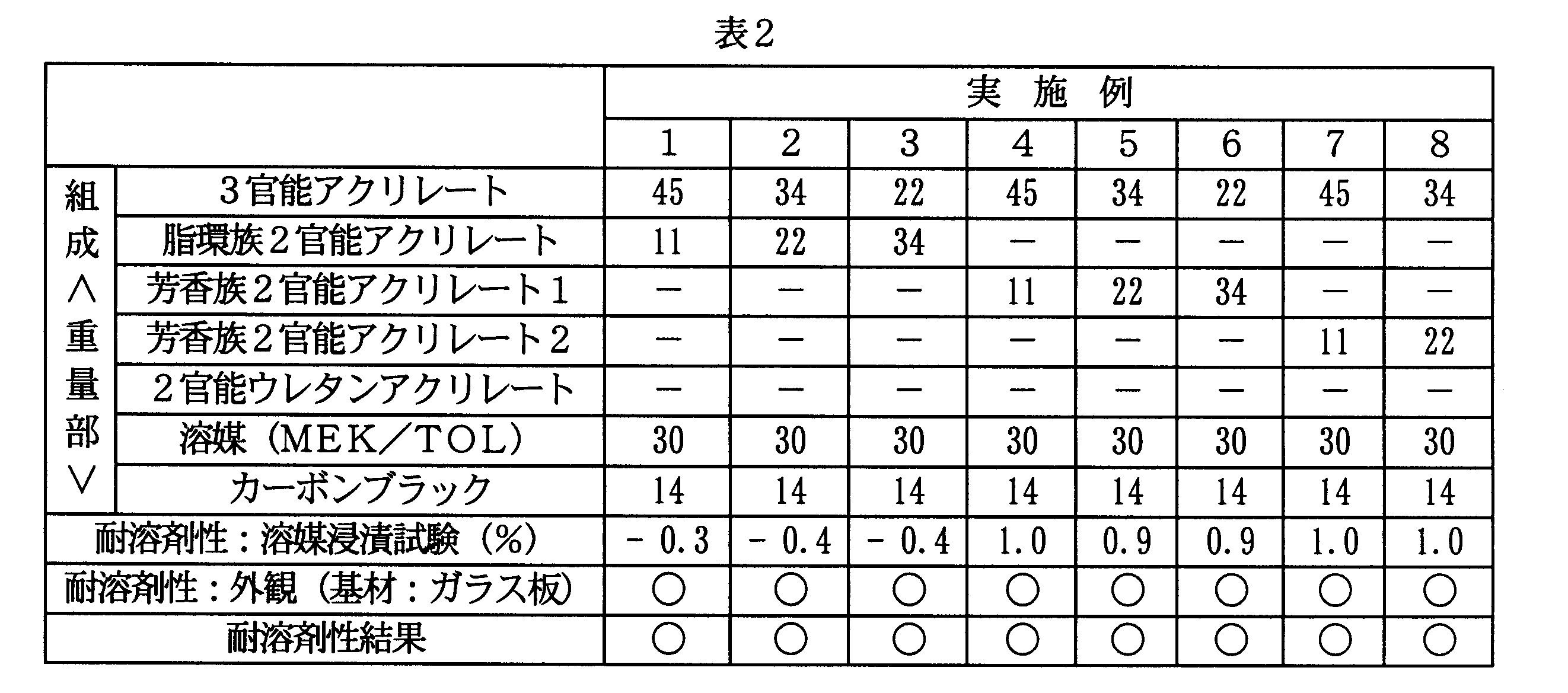

表1の参考例の結果から明らかな通り、脂環族2官能アクリレートを用いた場合には耐溶剤性結果が良好である。また、表2の実施例1~3の結果から明らかな通り、脂環族2官能アクリレートと3官能アクリレートを用いた場合には3官能アクリレートの量的割合に関わらず耐溶剤性結果が良好である。実施例4~6と実施例7~8との対比から芳香族2官能アクリレートを用いた場合には脂環族2官能アクリレートを用いた場合に比べ、溶媒浸漬試験の結果が若干低下する。
[実施例9~16]
上記の実施例、比較例のうち、耐溶剤性に優れていた3官能アクリレートと脂環族又は芳香族2官能アクリレートとの組み合わせについて次の実験を行った。すなわち、150mlの蓋付容器に、表4に示すように、アクリレートを秤量し、メチルエチルケトン(MEK)及びトルエン(TOL)の混合溶媒[MEK/TOL=50/50(重量比)]に溶解した。この溶液にカーボンブラックを添加し、自公転式混合脱泡機((株)シンキー製「ARE-250」)で分散組成物を作製した。得られた組成物を、40mm×50mmのガラス板上にバーコーターにより約50μmの厚みに塗工し、60℃で乾燥した。乾燥後の組成物に、窒素雰囲気中で、加速電圧150kV、線量100kGyの電子線を照射し、硬化塗膜を作製した。硬化塗膜の評価結果を表4に示す。
上記の実施例、比較例のうち、耐溶剤性に優れていた3官能アクリレートと脂環族又は芳香族2官能アクリレートとの組み合わせについて次の実験を行った。すなわち、150mlの蓋付容器に、表4に示すように、アクリレートを秤量し、メチルエチルケトン(MEK)及びトルエン(TOL)の混合溶媒[MEK/TOL=50/50(重量比)]に溶解した。この溶液にカーボンブラックを添加し、自公転式混合脱泡機((株)シンキー製「ARE-250」)で分散組成物を作製した。得られた組成物を、40mm×50mmのガラス板上にバーコーターにより約50μmの厚みに塗工し、60℃で乾燥した。乾燥後の組成物に、窒素雰囲気中で、加速電圧150kV、線量100kGyの電子線を照射し、硬化塗膜を作製した。硬化塗膜の評価結果を表4に示す。
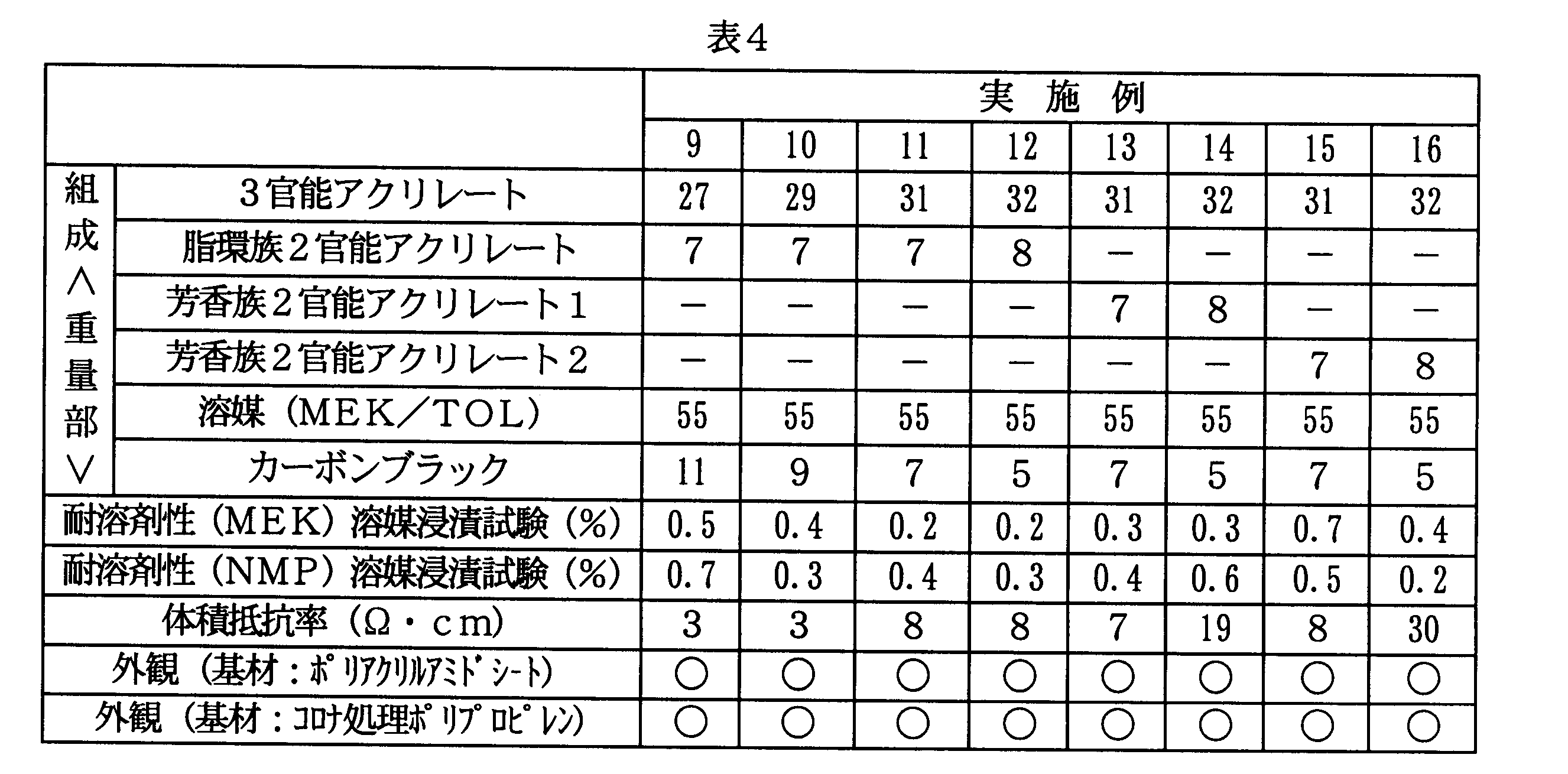
表4の結果から明らかなように、実施例の電子線硬化物は、耐溶剤性及び導電性が高い。
本発明の電子線硬化性組成物は、導電性及び耐溶剤を要求される各種の分野に利用され、溶媒と接触する用途、例えば、半導体ウエハーの保存容器、ガソリンタンク、電子・電気機器や半導体製造工場における床材や壁材、各種の電池用部材などの材料として利用できる。
Claims (15)
- 3官能以上の多官能ビニル系化合物と、脂環族及び/又は芳香族骨格を有する単官能及び/又は2官能ビニル系化合物と、導電性フィラーとを含む電子線硬化性組成物。
- 単官能及び/又は2官能ビニル系化合物が、多環式脂環族及び/又はビスフェノール骨格を有する2官能(メタ)アクリレートである請求項1記載の電子線硬化性組成物。
- 単官能及び/又は2官能ビニル系化合物が、橋架け環式脂環族骨格を有する2官能(メタ)アクリレートである請求項1又は2記載の電子線硬化性組成物。
- 多官能ビニル系化合物が、3~6官能(メタ)アクリレートである請求項1~3のいずれかに記載の電子線硬化性組成物。
- 導電性フィラーが、導電性カーボンブラックである請求項1~4のいずれかに記載の電子線硬化性組成物。
- 導電性フィラーの割合が、多官能ビニル系化合物と単官能及び/又は2官能ビニル系化合物との総量100重量部に対して5~50重量部である請求項1~5のいずれかに記載の電子線硬化性組成物。
- 単官能及び/又は2官能ビニル系化合物の割合が、多官能ビニル系化合物100重量部に対して10~100重量部である請求項1~6のいずれかに記載の電子線硬化性組成物。
- 多官能ビニル系化合物が、アミンで変性されていない請求項1~7のいずれかに記載の電子線硬化性組成物。
- 重合開始剤を実質的に含有しない請求項1~8のいずれかに記載の電子線硬化性組成物。
- イソシアネート基及び/又はウレタン結合を有する化合物を実質的に含有しない請求項1~9のいずれかに記載の電子線硬化性組成物。
- ポリフェニレンオキシド系樹脂を実質的に含有しない請求項1~10のいずれかに記載の電子線硬化性組成物。
- 溶媒と接触して使用される硬化物を形成するための請求項1~11のいずれかに記載の電子線硬化性組成物。
- 請求項1~12のいずれかに記載の電子線硬化性組成物に電子線を照射して硬化物を製造する方法。
- 請求項13記載の方法で得られた硬化物。
- ウレタン結合を実質的に含有していない請求項14記載の硬化物。
Applications Claiming Priority (2)
| Application Number | Priority Date | Filing Date | Title |
|---|---|---|---|
| JP2011-009178 | 2011-01-19 | ||
| JP2011009178A JP2012149177A (ja) | 2011-01-19 | 2011-01-19 | 電子線硬化性組成物及びその硬化物 |
Publications (1)
| Publication Number | Publication Date |
|---|---|
| WO2012098951A1 true WO2012098951A1 (ja) | 2012-07-26 |
Family
ID=46515582
Family Applications (1)
| Application Number | Title | Priority Date | Filing Date |
|---|---|---|---|
| PCT/JP2012/050270 Ceased WO2012098951A1 (ja) | 2011-01-19 | 2012-01-10 | 電子線硬化性組成物及びその硬化物 |
Country Status (2)
| Country | Link |
|---|---|
| JP (1) | JP2012149177A (ja) |
| WO (1) | WO2012098951A1 (ja) |
Citations (5)
| Publication number | Priority date | Publication date | Assignee | Title |
|---|---|---|---|---|
| JPS5069189A (ja) * | 1973-10-02 | 1975-06-09 | ||
| JPS56155238A (en) * | 1980-05-02 | 1981-12-01 | Bridgestone Corp | Polymer composition for electron beam crosslinking |
| JPS63228525A (ja) * | 1987-03-17 | 1988-09-22 | 東洋インキ製造株式会社 | 電子線硬化型導電性ペ−スト |
| JPH05320283A (ja) * | 1992-05-15 | 1993-12-03 | Nippon Kayaku Co Ltd | 水中油滴型放射線硬化性樹脂エマルション組成物 |
| JPH06157945A (ja) * | 1992-11-17 | 1994-06-07 | Ajinomoto Co Inc | 電子線硬化型導電性ペ−スト |
-
2011
- 2011-01-19 JP JP2011009178A patent/JP2012149177A/ja active Pending
-
2012
- 2012-01-10 WO PCT/JP2012/050270 patent/WO2012098951A1/ja not_active Ceased
Patent Citations (5)
| Publication number | Priority date | Publication date | Assignee | Title |
|---|---|---|---|---|
| JPS5069189A (ja) * | 1973-10-02 | 1975-06-09 | ||
| JPS56155238A (en) * | 1980-05-02 | 1981-12-01 | Bridgestone Corp | Polymer composition for electron beam crosslinking |
| JPS63228525A (ja) * | 1987-03-17 | 1988-09-22 | 東洋インキ製造株式会社 | 電子線硬化型導電性ペ−スト |
| JPH05320283A (ja) * | 1992-05-15 | 1993-12-03 | Nippon Kayaku Co Ltd | 水中油滴型放射線硬化性樹脂エマルション組成物 |
| JPH06157945A (ja) * | 1992-11-17 | 1994-06-07 | Ajinomoto Co Inc | 電子線硬化型導電性ペ−スト |
Also Published As
| Publication number | Publication date |
|---|---|
| JP2012149177A (ja) | 2012-08-09 |
Similar Documents
| Publication | Publication Date | Title |
|---|---|---|
| TWI527859B (zh) | 硬塗膜 | |
| KR20210042118A (ko) | 하드 코트 조성물, 적층체 필름, 및 경화 필름 | |
| JPWO2010090116A1 (ja) | 活性エネルギー線硬化型ハードコート用樹脂組成物とその用途 | |
| JP2013173871A (ja) | 組成物、帯電防止性コート剤及び帯電防止性積層体 | |
| JP2009024168A (ja) | 紫外線硬化型ハードコート樹脂組成物 | |
| JP7013680B2 (ja) | ハードコートフィルム、電離放射線硬化性樹脂組成物、及びディスプレイ | |
| JP2017128688A (ja) | 活性エネルギー線硬化型樹脂組成物、その硬化物及びレンズシート | |
| KR20130140725A (ko) | 활성 에너지선 경화성 수지 조성물 및 코팅제 | |
| JP2010260905A (ja) | 光硬化性組成物 | |
| CN113039070A (zh) | 层叠体、活性能量线硬化性组合物及层叠体的制造方法 | |
| KR20230162016A (ko) | 대전방지 하드코트층 및 경화성 조성물 | |
| JP2022087177A (ja) | 活性エネルギー線硬化性樹脂組成物及びコーティング剤 | |
| WO2012098951A1 (ja) | 電子線硬化性組成物及びその硬化物 | |
| KR102033930B1 (ko) | 고성능 대전방지성 광경화형 수지 조성물, 이를 적용한 무정전 판넬 및 무정전 판넬의 제조방법 | |
| JP5605305B2 (ja) | 重合性フッ素表面修飾シリカ粒子及びそれを用いた活性エネルギー線硬化性組成物 | |
| JPWO2016104079A1 (ja) | ベース基材シート及び透明導電性積層体 | |
| JP2009263410A (ja) | 活性エネルギー線硬化型樹脂組成物、活性エネルギー線硬化型塗料及び成形物 | |
| TW201716491A (zh) | 導電性層疊體及金屬氧化物組成物 | |
| JP2009066891A (ja) | 帯電防止性防弦性ハードコートフィルム及びその製造方法 | |
| CN110225932A (zh) | 活性能量射线固化型水性树脂组合物及无机材料薄膜用底涂剂 | |
| JP5930261B2 (ja) | 金属表面用被覆材組成物及び積層成型品 | |
| JP6390817B2 (ja) | 光学物品用活性エネルギー線硬化型樹脂組成物、硬化物及び光学シート | |
| JP2012177023A (ja) | 光硬化性組成物及びその硬化物 | |
| JP2021070716A (ja) | 活性エネルギー線硬化性組成物、コーティング剤および被覆物品 | |
| JP4783993B2 (ja) | 帯電防止ハードコート樹脂組成物およびその形成品 |
Legal Events
| Date | Code | Title | Description |
|---|---|---|---|
| 121 | Ep: the epo has been informed by wipo that ep was designated in this application |
Ref document number: 12736496 Country of ref document: EP Kind code of ref document: A1 |
|
| NENP | Non-entry into the national phase |
Ref country code: DE |
|
| 122 | Ep: pct application non-entry in european phase |
Ref document number: 12736496 Country of ref document: EP Kind code of ref document: A1 |