WO2012090727A1 - 非水電解質二次電池 - Google Patents
非水電解質二次電池 Download PDFInfo
- Publication number
- WO2012090727A1 WO2012090727A1 PCT/JP2011/079162 JP2011079162W WO2012090727A1 WO 2012090727 A1 WO2012090727 A1 WO 2012090727A1 JP 2011079162 W JP2011079162 W JP 2011079162W WO 2012090727 A1 WO2012090727 A1 WO 2012090727A1
- Authority
- WO
- WIPO (PCT)
- Prior art keywords
- positive electrode
- composite oxide
- aqueous electrolyte
- active material
- secondary battery
- Prior art date
- Legal status (The legal status is an assumption and is not a legal conclusion. Google has not performed a legal analysis and makes no representation as to the accuracy of the status listed.)
- Ceased
Links
Images
Classifications
-
- H—ELECTRICITY
- H01—ELECTRIC ELEMENTS
- H01M—PROCESSES OR MEANS, e.g. BATTERIES, FOR THE DIRECT CONVERSION OF CHEMICAL ENERGY INTO ELECTRICAL ENERGY
- H01M10/00—Secondary cells; Manufacture thereof
- H01M10/05—Accumulators with non-aqueous electrolyte
- H01M10/052—Li-accumulators
- H01M10/0525—Rocking-chair batteries, i.e. batteries with lithium insertion or intercalation in both electrodes; Lithium-ion batteries
-
- H—ELECTRICITY
- H01—ELECTRIC ELEMENTS
- H01M—PROCESSES OR MEANS, e.g. BATTERIES, FOR THE DIRECT CONVERSION OF CHEMICAL ENERGY INTO ELECTRICAL ENERGY
- H01M10/00—Secondary cells; Manufacture thereof
- H01M10/05—Accumulators with non-aqueous electrolyte
- H01M10/056—Accumulators with non-aqueous electrolyte characterised by the materials used as electrolytes, e.g. mixed inorganic/organic electrolytes
- H01M10/0564—Accumulators with non-aqueous electrolyte characterised by the materials used as electrolytes, e.g. mixed inorganic/organic electrolytes the electrolyte being constituted of organic materials only
- H01M10/0566—Liquid materials
- H01M10/0567—Liquid materials characterised by the additives
-
- H—ELECTRICITY
- H01—ELECTRIC ELEMENTS
- H01M—PROCESSES OR MEANS, e.g. BATTERIES, FOR THE DIRECT CONVERSION OF CHEMICAL ENERGY INTO ELECTRICAL ENERGY
- H01M4/00—Electrodes
- H01M4/02—Electrodes composed of, or comprising, active material
- H01M4/36—Selection of substances as active materials, active masses, active liquids
- H01M4/48—Selection of substances as active materials, active masses, active liquids of inorganic oxides or hydroxides
- H01M4/52—Selection of substances as active materials, active masses, active liquids of inorganic oxides or hydroxides of nickel, cobalt or iron
- H01M4/525—Selection of substances as active materials, active masses, active liquids of inorganic oxides or hydroxides of nickel, cobalt or iron of mixed oxides or hydroxides containing iron, cobalt or nickel for inserting or intercalating light metals, e.g. LiNiO2, LiCoO2 or LiCoOxFy
-
- Y—GENERAL TAGGING OF NEW TECHNOLOGICAL DEVELOPMENTS; GENERAL TAGGING OF CROSS-SECTIONAL TECHNOLOGIES SPANNING OVER SEVERAL SECTIONS OF THE IPC; TECHNICAL SUBJECTS COVERED BY FORMER USPC CROSS-REFERENCE ART COLLECTIONS [XRACs] AND DIGESTS
- Y02—TECHNOLOGIES OR APPLICATIONS FOR MITIGATION OR ADAPTATION AGAINST CLIMATE CHANGE
- Y02E—REDUCTION OF GREENHOUSE GAS [GHG] EMISSIONS, RELATED TO ENERGY GENERATION, TRANSMISSION OR DISTRIBUTION
- Y02E60/00—Enabling technologies; Technologies with a potential or indirect contribution to GHG emissions mitigation
- Y02E60/10—Energy storage using batteries
Definitions
- the present invention relates to a non-aqueous electrolyte secondary battery using a lithium nickel composite oxide as a positive electrode active material, and more particularly, a non-aqueous electrolyte secondary battery having excellent cycle characteristics and suppressing expansion of the battery during high-temperature charge storage.
- a non-aqueous electrolyte secondary battery using a lithium nickel composite oxide as a positive electrode active material, and more particularly, a non-aqueous electrolyte secondary battery having excellent cycle characteristics and suppressing expansion of the battery during high-temperature charge storage.
- non-aqueous electrolyte secondary batteries that are lightweight and have high energy density have been widely used as driving power sources for portable electronic devices such as mobile phones, portable music players, and notebook computers. With the widespread use of these electronic devices, it is strongly desired to further increase the capacity of nonaqueous electrolyte secondary batteries.
- a negative electrode active material of a non-aqueous electrolyte secondary battery a carbonaceous material that occludes and releases Li ions between layers, Si and Sn alloyed with Li, or an alloy containing these are used.
- a Li-containing transition metal composite oxide capable of reversibly occluding and releasing Li ions is used, and in particular, lithium cobalt composite oxide has an excellent balance of battery characteristics. Is widely used.
- Lithium-nickel composite oxide is a promising material as a positive electrode active material because it has a higher capacity than lithium cobalt composite oxide and has the advantage of reducing the amount of cobalt with many resource limitations.
- a nonaqueous electrolyte secondary battery using a lithium nickel composite oxide as a positive electrode active material has a problem that the battery swells due to gas generation during high-temperature charge storage. This is considered to be caused by the fact that carbonic acid compounds such as lithium carbonate adhering to the surface of the lithium nickel composite oxide are decomposed to generate carbon dioxide gas. Further, the lithium nickel composite oxide has a problem that the cycle characteristics are inferior to the lithium cobalt composite oxide.
- Patent Document 1 the general formula Li x Ni y M 1-y O 2 (M represents at least one of transition metals, B, Al, Co, Cr, Ga, and In, and 0.05 ⁇ x ⁇ 1.10, 0.7 ⁇ y ⁇ 1.0)
- a method for producing a positive electrode active material is disclosed in which a lithium nickel composite oxide is washed with 500 ml or more of water with respect to 100 g of the lithium nickel composite oxide. ing. According to this manufacturing method, since lithium carbonate and the like generated during the synthesis of the lithium nickel composite oxide are removed, it is shown that a nonaqueous electrolyte secondary battery in which gas generation in a high temperature environment is suppressed can be obtained. Yes.
- Patent Document 2 discloses that in a lithium secondary battery, the nonaqueous solvent contains cyclic carbonate and chain carbonate as main components, and 0.1 wt% to 4 wt% of 1,4-butanesultone is contained in the nonaqueous solvent.
- a containing lithium secondary battery is disclosed. It has been shown that the cycle characteristics are improved by adding 1,4-butane sultone to a non-aqueous solvent.
- Patent Document 3 discloses a non-aqueous electrolyte containing at least one selected from the group of cyclic carbonates such as ethylene carbonate and vinylene carbonate, one of dibutyl carbonate and dipropyl carbonate, and 1,4-butane sultone.
- An electrolyte secondary battery is disclosed. According to this configuration, it is shown that a nonaqueous electrolyte secondary battery having excellent cycle characteristics and suppressing expansion of the battery during high temperature storage can be obtained.
- Patent Document 4 discloses a non-aqueous electrolyte secondary battery containing 1,2-diethoxyethane and 1,4-butane sultone as non-aqueous solvents. According to this configuration, it is shown that expansion of the battery during high temperature storage can be suppressed.
- Patent Document 5 the amount of carbon dioxide generated when the lithium nickel composite oxide is heated to 200 to 1500 ° C. is measured, and the heating temperature and the amount of carbon dioxide generated per gram of the positive electrode active material satisfy a predetermined relationship.
- An evaluation method of a positive electrode for a non-aqueous electrolyte secondary battery that determines that a material is compatible with a positive electrode active material is disclosed.
- the carbonic acid compound is decomposed at 200 to 1500 ° C. in an inert gas atmosphere to generate carbonic acid gas.
- such a carbonic acid compound is referred to as a “thermally decomposable carbonic acid compound”, and its content is used as an index for determining the quality of the positive electrode active material.
- JP 2003-17054 A Japanese Patent Laid-Open No. 2000-3724 JP 2002-33117 A JP 2003-17119 A JP 2009-123448 A
- Patent Document 2 shows that the addition of 1,4-butane sultone improves the cycle characteristics, but this is based on the fact that 1,4-butane sultone forms a passive film on the negative electrode.
- a conventional lithium nickel composite oxide is used as the positive electrode active material, sufficient cycle characteristics cannot be obtained.
- Patent Documents 3 and 4 show that the expansion of the battery can be suppressed by adding 1,4-butane sultone to the nonaqueous electrolyte. However, these suppress the expansion of the battery due to the specific solvent, and when the conventional lithium nickel composite oxide is used as the positive electrode active material, the expansion of the battery cannot be sufficiently suppressed.
- Patent Document 5 describes that the expansion of the battery can be suppressed by regulating the amount of the pyrolytic carbonic acid compound. However, it does not suggest any means for improving other characteristics.
- the present invention has been made in view of the above. Even when a lithium nickel composite oxide is used as a positive electrode active material, the non-aqueous electrolyte secondary battery has excellent cycle characteristics and suppresses expansion of the battery during high-temperature charge storage. The purpose is to provide.
- a non-aqueous electrolyte comprising a positive electrode plate including a positive electrode mixture layer including a positive electrode active material, a negative electrode plate including a negative electrode mixture layer including a negative electrode active material, and a non-aqueous electrolyte including an electrolyte salt in a non-aqueous solvent.
- the positive electrode active material includes a lithium nickel composite oxide
- the lithium nickel composite oxide includes 13 ⁇ mol / g or more and 40 ⁇ mol / g or less of a thermally decomposable carbonate compound
- the nonaqueous electrolyte is 0.
- a nonaqueous electrolyte secondary battery comprising 1,4-butane sultone in an amount of 5% by mass to 2.0% by mass.
- the lithium nickel composite oxide used in the present invention the general formula Li x Ni 1-y M y O z (0.9 ⁇ x ⁇ 1.2, 0 ⁇ y ⁇ 0.8, 1.9 ⁇ z ⁇ 2) .1, M is at least one of Co and Mn).
- M is at least one of Co and Mn.
- the thermally decomposable carbonic acid compound contained in the lithium nickel composite oxide of the present invention is used in the same meaning as described in Patent Document 5. That is, the thermally decomposable carbonate compound means a carbonate compound that generates carbon dioxide gas when the lithium nickel composite oxide is heated to 300 to 500 ° C. Since it is considered that equimolar carbon dioxide gas is generated when the pyrolytic carbonic acid compound is decomposed, the amount of pyrolytic carbonic acid compound contained in the lithium nickel composite oxide is calculated from the amount of carbon dioxide gas measured by pyrolytic gas chromatography. Can be calculated.
- the amount of the thermally decomposable carbonic acid compound defined in the present invention is calculated from the amount of carbon dioxide generated when the positive electrode material mixture peeled off from the positive electrode plate is heated to 300 ° C. If the pyrolytic carbonic acid compound is 13 ⁇ mol / g or more and 40 ⁇ mol / g or less, the interaction with 1,4-butane sultone contained in the electrolyte suppresses the expansion of the battery beyond the expected range, and the cycle characteristics are also improved. Can be improved.
- 1,4-butane sultone contained in the nonaqueous electrolyte is less than 0.5% by mass, the effect is not exhibited. If it exceeds 2.0% by mass, the cycle characteristics deteriorate. It is preferable that it is 0.0 mass% or less.
- the negative electrode active material of the present invention can be used without particular limitation as long as it can electrochemically occlude and release lithium ions.
- carbonaceous materials such as natural graphite and artificial graphite, silicon, Tin or an alloy containing these can be used.
- non-aqueous solvent used in the non-aqueous electrolyte of the present invention it is preferable to use a non-aqueous solvent containing a cyclic carbonate and a chain carbonate.
- a cyclic carbonate include ethylene carbonate (EC), propylene carbonate (PC), butylene carbonate (BC), and fluoroethylene carbonate (FEC).
- the chain carbonate include dimethyl carbonate (DMC), methyl ethyl carbonate ( MEC), diethyl carbonate (DEC), methyl propyl carbonate (MPC), methyl butyl carbonate (MBC) and the like.
- a cyclic carbonate and a chain carbonate in a volume ratio of 5:95 to 40:60.
- cyclic carboxylic acid esters such as ⁇ -butyrolactone (BL) and ⁇ -valerolactone (VL)
- chain carboxylic acids such as methyl pivalate, ethyl pivalate, methyl isobutyrate, and methyl propionate. Esters can also be used.
- LiPF 6 , LiBF 4 , LiAsF 6 , LiClO 4 , LiCF 3 SO 3 , Li (CF 3 SO 2 ) 2 , LiN (CF 3 SO 2 ) 2 , LiN (C 2 F 5 SO 2 ) 2 or the like can be used.
- VEC vinylene carbonate
- VEC vinyl ethyl carbonate
- Example 1 Preparation of positive electrode
- Nickel, cobalt and manganese sulfates were coprecipitated to obtain nickel cobalt manganese hydroxide.
- lithium hydroxide as a lithium source was added and fired at 700 ° C. to prepare a cobalt-manganese-containing lithium-nickel composite oxide.
- the composition formula of the lithium nickel composite oxide was confirmed to be LiNi 0.5 Co 0.2 Mn 0.3 O 2 by ICP-AES (inductively coupled plasma emission analysis).
- a predetermined amount of the positive electrode mixture is peeled off from the positive electrode plate, and the amount of carbon dioxide generated when heated to 300 ° C. is measured by pyrolytic gas chromatography.
- the amount of pyrolytic carbon dioxide is 24 ⁇ mol / g. It was confirmed that.
- the amount of thermally decomposable carbonic acid compound can be controlled by utilizing the fact that water or carbon dioxide gas in the atmosphere reacts with the lithium nickel composite oxide to produce a thermally decomposable carbonic acid compound. In the examples and comparative examples, the correlation between the time when the lithium nickel composite oxide was left in a dry air atmosphere of ⁇ 40 ° C. or less and the amount of the pyrolytic carbonic acid compound was examined in advance, and the time left was adjusted.
- the amount of the thermally decomposable carbonic acid compound was controlled.
- the reason why it was left in the dry air atmosphere is that the production reaction of the pyrolyzable carbonic acid compound proceeds more slowly than in the air, and it is easy to control the production amount.
- the above-described positive electrode plate and negative electrode plate were wound through a separator made of a polypropylene microporous film in a dry air atmosphere having a dew point of ⁇ 40 ° C. or less, and then pressed to produce a flat wound electrode body. .
- the electrode body produced as described above is inserted into an aluminum laminate exterior body in which a laminate film is previously formed into a cup shape (concave shape), the laminate film is folded back to form the bottom, and both sides intersecting the bottom are heat welded Thus, a sealing portion was formed.
- the nonaqueous electrolyte was injected from the opening, and the opening was sealed to obtain a nonaqueous electrolyte secondary battery having a height of 62 mm, a width of 35 mm, and a thickness of 3.6 mm.
- the design capacity is 800 mAh.
- Example 2 A nonaqueous electrolyte secondary battery according to Example 2 was produced in the same manner as in Example 1 except that the thermally decomposable carbonic acid compound contained in the lithium nickel composite oxide was 13 ⁇ mol / g.
- Example 3 A nonaqueous electrolyte secondary battery according to Example 3 was produced in the same manner as in Example 1 except that the thermally decomposable carbonic acid compound contained in the lithium nickel composite oxide was changed to 40 ⁇ mol / g.
- Example 4 A nonaqueous electrolyte secondary battery according to Example 4 was fabricated in the same manner as in Example 1, except that 1,4-butane sultone contained in the nonaqueous electrolyte was changed to 0.5 mass%.
- Example 5 A nonaqueous electrolyte secondary battery according to Example 5 was produced in the same manner as in Example 1 except that the amount of 1,4-butane sultone contained in the nonaqueous electrolyte was 2.0% by mass.
- Comparative Example 1 A non-aqueous electrolyte secondary battery according to Comparative Example 1 was produced in the same manner as Example 1 except that 1,4-butane sultone was not mixed with the non-aqueous electrolyte.
- Comparative Example 2 A nonaqueous electrolyte secondary battery according to Comparative Example 2 was produced in the same manner as in Example 1 except that the thermally decomposable carbonic acid compound contained in the lithium nickel composite oxide was changed to 45 ⁇ mol / g.
- Comparative Example 3 A nonaqueous electrolyte secondary battery according to Comparative Example 3 was produced in the same manner as in Example 1 except that the thermally decomposable carbonic acid compound contained in the lithium nickel composite oxide was changed to 10 ⁇ mol / g.
- Comparative Example 4 A non-aqueous electrolyte secondary battery according to Comparative Example 4 was produced in the same manner as in Example 1 except that 1,4-butane sultone contained in the non-aqueous electrolyte was changed to 3.0% by mass.
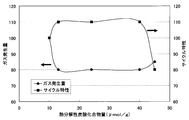
- FIG. 1 shows the gas generation amount and cycle characteristics when the amount of 1,4-butane sultone is fixed at 1.5% by mass and the amount of the pyrolytic carbonic acid compound is changed.
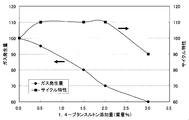
- FIG. 2 shows the gas generation amount and cycle characteristics when the amount of thermally decomposable carbonate compound is fixed at 24 ⁇ mol / g and the amount of 1,4-butane sultone added is changed.
- Examples 1 to 5 have a reduced gas generation amount and superior cycle characteristics as compared with Comparative Example 1. Further, from FIG. 1, when the amount of the pyrolytic carbonic acid compound contained in the lithium nickel composite oxide is in the range of 13 ⁇ mol / g or more and 40 ⁇ mol / g or less, the gas generation amount is specifically suppressed and the cycle characteristics are also improved. I understand that. Although the cause is not clear, it is presumed that the thermally decomposable carbonic acid compound contained in the lithium nickel composite oxide interacts with 1,4-butane sultone to exert a function of protecting the positive electrode surface.
- FIG. 2 shows that the amount of 1,4-butane sultone added is preferably 0.5% by mass or more and 2.0% by mass or less in order to obtain the effect of improving the cycle characteristics.
- FIG. 2 is a plot of gas generation and cycle characteristics when the amount of 1,4-butane sultone added is fixed and the amount of pyrolytic carbonic acid compound is changed.
- 2 is a plot of gas generation and cycle characteristics when the amount of pyrolytic carbonic acid compound is fixed and the amount of 1,4-butane sultone added is changed.
Landscapes
- Chemical & Material Sciences (AREA)
- Electrochemistry (AREA)
- Engineering & Computer Science (AREA)
- General Chemical & Material Sciences (AREA)
- Chemical Kinetics & Catalysis (AREA)
- Manufacturing & Machinery (AREA)
- Inorganic Chemistry (AREA)
- Materials Engineering (AREA)
- Physics & Mathematics (AREA)
- Condensed Matter Physics & Semiconductors (AREA)
- General Physics & Mathematics (AREA)
- Battery Electrode And Active Subsutance (AREA)
- Secondary Cells (AREA)
Abstract
【課題】リチウムニッケル複合酸化物を正極活物質としても、充放電サイクル特性に優れ、電池の膨化が抑制された非水電解質二次電池を提供すること。 【解決手段】本発明の非水電解質二次電池は、正極活物質を含む正極と、負極活物質を含む負極と、非水溶媒中に電解質塩を含む非水電解質を備える非水電解質二次電池であって、前記正極活物質はリチウムニッケル複合酸化物を含み、前記リチウムニッケル複合酸化物は、13μmol/g以上40μmol/g以下の熱分解性炭酸化合物を含み、前記非水電解質が0.5質量%以上2.0質量%以下の1,4-ブタンスルトンを含むことを特徴とする。
Description
本発明は、正極活物質にリチウムニッケル複合酸化物を用いた非水電解質二次電池に関し、さらに詳しくはサイクル特性に優れ、高温充電保存時の電池の膨化が抑制された非水電解質二次電池に関する。
近年、携帯電話機、携帯型音楽プレイヤーやノートパソコンといった携帯型の電子機器の駆動電源として、軽量で、高エネルギー密度を有する非水電解質二次電池が広く利用されている。これら電子機器の普及に伴い、非水電解質二次電池のさらなる高容量化が強く望まれている。
非水電解質二次電池の負極活物質としては、Liイオンを層間に吸蔵、放出する炭素質材料や、Liと合金化するSiやSn又はこれらを含む合金が用いられている。また、正極活物質としては、Liイオンを可逆的に吸蔵、放出することが可能なLi含有遷移金属複合酸化物が用いられており、特に、リチウムコバルト複合酸化物が、電池特性のバランスに優れていることから広く利用されている。
近年の高容量化の要求に応えるために、リチウムコバルト複合酸化物に代替する正極活物質材料として、リチウムニッケル複合酸化物の技術開発が活発になっている。リチウムニッケル複合酸化物はリチウムコバルト複合酸化物に比べて高容量であるとともに、資源的な制約の多いコバルト量を削減することができるメリットもあり、正極活物質としては有望な材料である。
しかし、リチウムニッケル複合酸化物を正極活物質とする非水電解質二次電池は、高温充電保存時のガス発生に起因して電池が膨化するという課題を有している。これは、リチウムニッケル複合酸化物の表面に付着している炭酸リチウム等の炭酸化合物が分解して、炭酸ガスを発生することが原因であると考えられている。また、リチウムニッケル複合酸化物は、リチウムコバルト複合酸化物に比べてサイクル特性が劣るとの課題も有している。
特許文献1には、一般式LixNiyM1-yO2(Mは遷移金属、B、Al、Co、Cr、Ga、Inの内の少なくとも1種を表し、0.05≦x≦1.10、0.7≦y≦1.0)で表されるリチウムニッケル複合酸化物を、当該リチウムニッケル複合酸化物100gに対し500ml以上の水で水洗する正極活物質の製造方法が開示されている。この製造方法によれば、リチウムニッケル複合酸化物の合成時に生成する炭酸リチウム等が除去されるため、高温環境下におけるガス発生が抑えられた非水電解質二次電池が得られることが示されている。
特許文献2には、リチウム二次電池において、非水溶媒が環状カーボネート及び鎖状カーボネートを主成分とし、かつ非水溶媒中に0.1重量%以上4重量%以下の1,4-ブタンスルトンを含有しているリチウム二次電池が開示されている。1,4-ブタンスルトンを非水溶媒に添加することによりサイクル特性が向上することが示されている。
特許文献3には、非水電解質として、炭酸エチレン、炭酸ビニレン等の環状炭酸エステルの群から選ばれる少なくとも一つと、炭酸ジブチル、炭酸ジプロピルのうちの一つと、1,4-ブタンスルトンを含む非水電解質二次電池が開示されている。この構成によれば、サイクル特性に優れ、高温保存時の電池の膨化が抑えられた非水電解質二次電池が得られることが示されている。
特許文献4には、非水溶媒として1,2-ジエトキシエタン及び1,4-ブタンスルトンを含む非水電解質二次電池が開示されている。この構成によれば、高温保存時の電池の膨化を抑えられることが示されている。
特許文献5には、リチウムニッケル複合酸化物を200~1500℃に加熱したときに発生する炭酸ガス量を測定し、加熱温度と、正極活物質1gあたりの炭酸ガス発生量が所定の関係を満たすものを正極活物質に適合するものと判定する非水電解質二次電池用正極の評価方法が開示されている。同文献によれば、リチウムニッケル複合酸化物中のリチウムと大気中の水が反応すると、水酸化リチウムが生成し、さらに水酸化リチウムが大気中の炭酸ガスと反応して、炭酸化合物を生成する。そして、この炭酸化合物は、不活性ガス雰囲気中で200~1500℃で分解して、炭酸ガスを発生することとなる。同文献では、そのような炭酸化合物を「熱分解性炭酸化合物」と称し、その含有量を正極活物質の品質判定の指標に用いることが示されている。
特許文献1に開示された正極活物質の製造方法によれば、リチウムニッケル複合酸化物粒子表面に残存する炭酸リチウム等を除去できるため、高温保存時の電池の膨化を抑えることができる。しかし、水洗が過剰であると、活物質粒子からLiイオンが溶出して電池性能を低下させてしまうため、この製造方法では電池の膨化を十分に抑えることができない。
特許文献2には、1,4-ブタンスルトンの添加によりサイクル特性が向上することが示されているが、これは1,4-ブタンスルトンが負極上で不働態被膜を形成することに着目したものであり、従来のリチウムニッケル複合酸化物を正極活物質として用いた場合には、十分なサイクル特性を得ることができない。
特許文献3及び4には、非水電解質に1,4-ブタンスルトンを添加することにより電池の膨化を抑制しうることが示されている。しかし、これらは特定の溶媒に起因する電池の膨化を抑制するものであり、従来のリチウムニッケル複合酸化物を正極活物質として用いた場合に、電池の膨化を十分に抑制することはできない。
特許文献5には、熱分解性炭酸化合物量を規定することで電池の膨化を抑えうることが記載されている。しかし、それ以外の特性を改善するための手段を示唆するものではない。
本発明は、上記に鑑みなされたもので、正極活物質としてリチウムニッケル複合酸化物を用いた場合でも、サイクル特性に優れ、高温充電保存時の電池の膨化が抑制された非水電解質二次電池を提供することを目的とする。
正極活物質を含む正極合剤層を備える正極極板と、負極活物質を含む負極合剤層を備える負極極板と、非水溶媒中に電解質塩を含む非水電解質を備える非水電解質二次電池であって、前記正極活物質はリチウムニッケル複合酸化物を含み、前記リチウムニッケル複合酸化物は、13μmol/g以上40μmol/g以下の熱分解性炭酸化合物を含み、前記非水電解質が0.5質量%以上2.0質量%以下の1,4-ブタンスルトンを含むことを特徴とする、非水電解質二次電池である。
本発明で使用するリチウムニッケル複合酸化物として、一般式LixNi1-yMyOz(0.9<x≦1.2、0<y≦0.8、1.9<z≦2.1、MはCo、Mnの少なくとも1種)で表されるものを使用することができる。Niの一部をCoやMnで置換することで、結晶構造を安定化させ、サイクル特性や安全性を向上させることができる。さらに、同じ目的でAl、Mgの少なくとも1種を少量添加することもできる。
本発明のリチウムニッケル複合酸化物に含まれる熱分解性炭酸化合物とは、特許文献5に記載されているものと同じ意義で使用している。即ち、熱分解性炭酸化合物とは、リチウムニッケル複合酸化物を300~500℃に加熱したときに炭酸ガスを発生する炭酸化合物を意味するものである。熱分解性炭酸化合物が分解すると、等モルの炭酸ガスが発生すると考えられるため、熱分解ガスクロマトグラフィーによって測定された炭酸ガス量から、リチウムニッケル複合酸化物に含まれる熱分解性炭酸化合物量を算出することができる。
本発明で規定される熱分解性炭酸化合物量は、正極極板から剥がしとった正極合剤を300℃まで加熱したときに発生する炭酸ガス量から算出したものである。熱分解性炭酸化合物が、13μmol/g以上40μmol/g以下であれば、電解質に含まれる1,4-ブタンスルトンとの相互作用により、予測の範囲を超えて電池の膨化を抑えつつ、サイクル特性も向上させることができる。
非水電解質に含まれる1,4-ブタンスルトンは0.5質量%未満だと、その効果は発揮されず、2.0質量%を超えるとサイクル特性が低下するため、0.5質量%以上2.0質量%以下であることが好ましい。
本発明の負極活物質としては、リチウムイオンを電気化学的に吸蔵、放出できるものなら特に限定されず使用することができ、具体的には天然黒鉛、人造黒鉛などの炭素質材料や、ケイ素、スズ又はこれらを含む合金を使用することができる。
本発明の非水電解質に用いる非水溶媒としては、環状カーボネート、鎖状カーボネートを含む非水溶媒を使用することが好ましい。環状カーボネートとしては、エチレンカーボネート(EC)、プロピレンカーボネート(PC)、ブチレンカーボネート(BC)、フルオロエチレンカーボネート(FEC)などが挙げられ、鎖状カーボネートとしては、ジメチルカーボネート(DMC)、メチルエチルカーボネート(MEC)、ジエチルカーボネート(DEC)、メチルプロピルカーボネート(MPC)、メチルブチルカーボネート(MBC)などが挙げられる。溶媒の粘度、イオン伝導度の観点から、環状カーボネートと鎖状カーボネートを体積比5:95~40:60の範囲で使用することが好ましい。さらに非水溶媒として、γ-ブチロラクトン(BL)、γ-バレロラクトン(VL)などの環状カルボン酸エステルやピバリン酸メチル、ピバリン酸エチル、メチルイソブチレート、メチルプロピオネートなどの鎖状カルボン酸エステルを使用することもできる。
本発明の非水電解質に用いる電解質塩としてはLiPF6、LiBF4、LiAsF6、LiClO4、LiCF3SO3、Li(CF3SO2)2、LiN(CF3SO2)2、LiN(C2F5SO2)2等を使用することができる。特に、LiPF6又はLiBF4の少なくとも一方を電解質塩とし、その濃度が0.5~2mol/Lであることが好ましい。
さらに、本発明の非水電解質には、電極保護剤として、ビニレンカーボネート(VC)、ビニルエチルカーボネート(VEC)などを添加することもできる。
以下、本発明を実施するための最良の形態を実施例及び比較例を用いて詳細に説明する。ただし、以下に示す実施例は、本発明の技術思想を具体化するための非水電解質二次電池の製造方法の一例を例示するものであって、本発明をこの実施例に限定することを意図するものではなく、本発明は特許請求の範囲に示した技術思想を逸脱することなく種々の変更を行ったものにも均しく適用し得るものである。
(実施例)
(実施例1)
(正極の作製)
ニッケル、コバルト及びマンガンのそれぞれの硫酸塩を用いて、これらを共沈させることで、ニッケルコバルトマンガン水酸化物を得た。これに、リチウム源としての水酸化リチウムを添加し、700℃で焼成して、コバルト、マンガン含有リチウムニッケル複合酸化物を作製した。当該リチウムニッケル複合酸化物の組成式は、ICP-AES(誘導結合プラズマ発光分析)により、LiNi0.5Co0.2Mn0.3O2であることを確認した。
(実施例1)
(正極の作製)
ニッケル、コバルト及びマンガンのそれぞれの硫酸塩を用いて、これらを共沈させることで、ニッケルコバルトマンガン水酸化物を得た。これに、リチウム源としての水酸化リチウムを添加し、700℃で焼成して、コバルト、マンガン含有リチウムニッケル複合酸化物を作製した。当該リチウムニッケル複合酸化物の組成式は、ICP-AES(誘導結合プラズマ発光分析)により、LiNi0.5Co0.2Mn0.3O2であることを確認した。
次に、露点が-40℃以下のドライエアー雰囲気下で、リチウムニッケル複合酸化物95質量部と、導電剤としての炭素粉末2.5質量部と、結着剤としてのポリフッ化ビニリデン(PVdF)2.5質量部とを、分散媒としてのN-メチル-2-ピロリドン(NMP)と混合して正極活物質スラリーとした。この正極活物質スラリーを、相対湿度43%、温度25℃の大気雰囲気中で、アルミニウム製の集電体の両面に塗布して正極合剤層を形成して、乾燥させた。その後、露点が-40℃以下であるドライエアー雰囲気下で、圧延ローラーを用いて圧延し、切断して正極極板とした。
上記正極極板から、所定量の正極合剤を剥がしとり、300℃まで加熱したときに発生する炭酸ガス量を熱分解性ガスクロマトグラフィーで測定して、熱分解性炭酸化合物量が24μmol/gであることを確認した。なお、熱分解性炭酸化合物量は、大気中の水分や炭酸ガスとリチウムニッケル複合酸化物が反応して熱分解性炭酸化合物が生成することを利用して、制御することができる。実施例及び比較例においては、リチウムニッケル複合酸化物を-40℃以下のドライエアー雰囲気中に放置した時間と、熱分解性炭酸化合物量との相関を予め調べておき、その放置時間を調整することで、熱分解性炭酸化合物量を制御した。ドライエアー雰囲気中に放置したのは、大気中に比べて熱分解性炭酸化合物の生成反応が緩やかに進行するため、その生成量を制御するのが容易であるためである。
(負極の作製)
負極活物質としての黒鉛97.5質量部と、結着剤としてのスチレンブタジエンゴム(SBR)1.5質量部と、増粘剤としてのカルボキシメチルセルロース(CMC)1質量部とを、分散媒としての水と混合して負極活物質スラリーとした。この負極活物質スラリーを銅製の集電体の両面に塗布して負極合剤層を形成して、乾燥させた。その後、圧延ローラーを用いて圧延し、切断して負極極板とした。
負極活物質としての黒鉛97.5質量部と、結着剤としてのスチレンブタジエンゴム(SBR)1.5質量部と、増粘剤としてのカルボキシメチルセルロース(CMC)1質量部とを、分散媒としての水と混合して負極活物質スラリーとした。この負極活物質スラリーを銅製の集電体の両面に塗布して負極合剤層を形成して、乾燥させた。その後、圧延ローラーを用いて圧延し、切断して負極極板とした。
(電極体の作製)
上記正極極板及び負極極板を、露点-40℃以下のドライエアー雰囲気下で、ポリプロピレン製微多孔膜からなるセパレータを介して巻回し、その後プレスすることにより、扁平巻回電極体を作製した。
上記正極極板及び負極極板を、露点-40℃以下のドライエアー雰囲気下で、ポリプロピレン製微多孔膜からなるセパレータを介して巻回し、その後プレスすることにより、扁平巻回電極体を作製した。
(非水電解質の調製)
非水溶媒としてのエチレンカーボネートとエチルメチルカーボネートとジメチルカーボネートを体積比2:5:3(25℃)で混合し、電解質塩としてのLiPF6を1.2mol/Lとなるように溶解した。さらに当該溶解物に対して、1.5質量%に相当する量の1,4-ブタンスルトンを添加して、非水電解質とした。
非水溶媒としてのエチレンカーボネートとエチルメチルカーボネートとジメチルカーボネートを体積比2:5:3(25℃)で混合し、電解質塩としてのLiPF6を1.2mol/Lとなるように溶解した。さらに当該溶解物に対して、1.5質量%に相当する量の1,4-ブタンスルトンを添加して、非水電解質とした。
(電池の作製)
上記のようにして作製した電極体を、ラミネートフィルムを予めカップ状(凹形状)に成形したアルミニウムラミネート外装体に挿入し、ラミネートフィルムを折り返して底部を形成し、底部と交わる両側辺を熱溶着して封止部を形成した。次いで、開口部から上記非水電解質を注液し、開口部を封止して、高さ62mm、幅35mm、厚み3.6mmの非水電解質二次電池を得た。なお、設計容量は800mAhである。
上記のようにして作製した電極体を、ラミネートフィルムを予めカップ状(凹形状)に成形したアルミニウムラミネート外装体に挿入し、ラミネートフィルムを折り返して底部を形成し、底部と交わる両側辺を熱溶着して封止部を形成した。次いで、開口部から上記非水電解質を注液し、開口部を封止して、高さ62mm、幅35mm、厚み3.6mmの非水電解質二次電池を得た。なお、設計容量は800mAhである。
(実施例2)
リチウムニッケル複合酸化物に含まれる熱分解性炭酸化合物を13μmol/gとしたこと以外は実施例1と同様にして、実施例2にかかる非水電解質二次電池を作製した。
リチウムニッケル複合酸化物に含まれる熱分解性炭酸化合物を13μmol/gとしたこと以外は実施例1と同様にして、実施例2にかかる非水電解質二次電池を作製した。
(実施例3)
リチウムニッケル複合酸化物に含まれる熱分解性炭酸化合物を40μmol/gとしたこと以外は実施例1と同様にして、実施例3にかかる非水電解質二次電池を作製した。
リチウムニッケル複合酸化物に含まれる熱分解性炭酸化合物を40μmol/gとしたこと以外は実施例1と同様にして、実施例3にかかる非水電解質二次電池を作製した。
(実施例4)
非水電解質に含まれる1,4-ブタンスルトンを0.5質量%としたこと以外は実施例1と同様にして、実施例4にかかる非水電解質二次電池を作製した。
非水電解質に含まれる1,4-ブタンスルトンを0.5質量%としたこと以外は実施例1と同様にして、実施例4にかかる非水電解質二次電池を作製した。
(実施例5)
非水電解質に含まれる1,4-ブタンスルトンを2.0質量%としたこと以外は実施例1と同様にして、実施例5にかかる非水電解質二次電池を作製した。
非水電解質に含まれる1,4-ブタンスルトンを2.0質量%としたこと以外は実施例1と同様にして、実施例5にかかる非水電解質二次電池を作製した。
(比較例1)
非水電解質に1,4-ブタンスルトンを混合しなかったこと以外は実施例1と同様にして、比較例1にかかる非水電解質二次電池を作製した。
非水電解質に1,4-ブタンスルトンを混合しなかったこと以外は実施例1と同様にして、比較例1にかかる非水電解質二次電池を作製した。
(比較例2)
リチウムニッケル複合酸化物に含まれる熱分解性炭酸化合物を45μmol/gとしたこと以外は実施例1と同様にして、比較例2にかかる非水電解質二次電池を作製した。
リチウムニッケル複合酸化物に含まれる熱分解性炭酸化合物を45μmol/gとしたこと以外は実施例1と同様にして、比較例2にかかる非水電解質二次電池を作製した。
(比較例3)
リチウムニッケル複合酸化物に含まれる熱分解性炭酸化合物を10μmol/gとしたこと以外は実施例1と同様にして、比較例3にかかる非水電解質二次電池を作製した。
リチウムニッケル複合酸化物に含まれる熱分解性炭酸化合物を10μmol/gとしたこと以外は実施例1と同様にして、比較例3にかかる非水電解質二次電池を作製した。
(比較例4)
非水電解質に含まれる1,4-ブタンスルトンを3.0質量%としたこと以外は実施例1と同様にして、比較例4にかかる非水電解質二次電池を作製した。
非水電解質に含まれる1,4-ブタンスルトンを3.0質量%としたこと以外は実施例1と同様にして、比較例4にかかる非水電解質二次電池を作製した。
(高温充電保存試験)
実施例1~5及び比較例1~4の各電池について、定電流1It(800mA)で電圧が4.2Vに達した後は、4.2Vの定電圧で、電流が0.05It(40mA)になるまで充電した。この充電状態の電池を85℃の恒温槽に投入して、3時間保存した。保存後の電池を室温(25℃)になるまで放置した後、プロピレンカーボネート中で電池の外装体の一部を開口して電池内部のガスを捕集し、その量を測定した。
実施例1~5及び比較例1~4の各電池について、定電流1It(800mA)で電圧が4.2Vに達した後は、4.2Vの定電圧で、電流が0.05It(40mA)になるまで充電した。この充電状態の電池を85℃の恒温槽に投入して、3時間保存した。保存後の電池を室温(25℃)になるまで放置した後、プロピレンカーボネート中で電池の外装体の一部を開口して電池内部のガスを捕集し、その量を測定した。
(サイクル特性試験)
実施例1~5及び比較例1~4の各電池について、45℃で、1It(800mA)の定電流で充電し、電圧が4.2Vに達した後は、4.2Vの定電圧で、電流が0.05It(40mA)になるまで充電した。その後、1It(800mA)の定電流で、電圧が2.75Vになるまで放電し、1サイクル目の放電容量を求めた。さらに、この充放電サイクルを500回繰り返し、500サイクル目の放電容量を求め、以下の計算式によりサイクル特性を算出した。
サイクル特性(%)=(500サイクル目の放電容量)÷(1サイクル目の放電容量)
×100
実施例1~5及び比較例1~4の各電池について、45℃で、1It(800mA)の定電流で充電し、電圧が4.2Vに達した後は、4.2Vの定電圧で、電流が0.05It(40mA)になるまで充電した。その後、1It(800mA)の定電流で、電圧が2.75Vになるまで放電し、1サイクル目の放電容量を求めた。さらに、この充放電サイクルを500回繰り返し、500サイクル目の放電容量を求め、以下の計算式によりサイクル特性を算出した。
サイクル特性(%)=(500サイクル目の放電容量)÷(1サイクル目の放電容量)
×100
上記の方法で得られた高温充電保存時のガス量及びサイクル特性について、比較例1の結果を100とした相対的な指数として表1にまとめて示す。また、図1には、1,4-ブタンスルトンの添加量を1.5質量%と固定し、熱分解性炭酸化合物量を変化させたときのガス発生量及びサイクル特性を示す。図2には、熱分解性炭酸化合物量を24μmol/gと固定し、1,4-ブタンスルトン添加量を変化させたときのガス発生量及びサイクル特性を示す。

表1から、実施例1~5は比較例1に比べてガス発生量が抑えられており、サイクル特性も優れていることがわかる。また図1から、リチウムニッケル複合酸化物に含まれる熱分解性炭酸化合物量が、13μmol/g以上40μmol/g以下の範囲では、特異的にガス発生量が抑えられ、サイクル特性も向上していることがわかる。原因は定かではないが、リチウムニッケル複合酸化物に含まれる熱分解性炭酸化合物と1,4-ブタンスルトンが相互に作用して、正極表面を保護する機能を発揮していることが推察される。一方、比較例3のように熱分解性炭酸化合物量が13μmol/g未満では、上述の相互作用を発揮するには熱分解性炭酸化合物量が不足しているものと考えられる。また、比較例2のように熱分解性炭酸化合物量が40μmol/gを超えると、サイクル特性が大きく低下している。これは、正極への保護作用が過剰なために反応性が阻害されたためではないかと考えられる。
図2からは、サイクル特性の改善効果を得るためには、1,4-ブタンスルトンの添加量は、0.5質量%以上2.0質量%以下が好ましいことがわかる。
Claims (2)
- 正極活物質を含む正極合剤層を備える正極極板と、負極活物質を含む負極合剤層を備える負極極板と、非水溶媒中に電解質塩を含む非水電解質を備える非水電解質二次電池であって、前記正極活物質はリチウムニッケル複合酸化物を含み、
前記リチウムニッケル複合酸化物は、13μmol/g以上40μmol/g以下の熱分解性炭酸化合物を含み、
前記非水電解質が0.5質量%以上2.0質量%以下の1,4-ブタンスルトンを含むことを特徴とする、
非水電解質二次電池。 - 請求項1記載のリチウムニッケル複合酸化物は、一般式LixNi1-yMyOz(0.9<x≦1.2、0<y≦0.8、1.9<z≦2.1、MはCo、Mnの少なくとも1種)で表される非水電解質二次電池。
Applications Claiming Priority (2)
| Application Number | Priority Date | Filing Date | Title |
|---|---|---|---|
| JP2010294551 | 2010-12-29 | ||
| JP2010-294551 | 2010-12-29 |
Publications (1)
| Publication Number | Publication Date |
|---|---|
| WO2012090727A1 true WO2012090727A1 (ja) | 2012-07-05 |
Family
ID=46382840
Family Applications (1)
| Application Number | Title | Priority Date | Filing Date |
|---|---|---|---|
| PCT/JP2011/079162 Ceased WO2012090727A1 (ja) | 2010-12-29 | 2011-12-16 | 非水電解質二次電池 |
Country Status (1)
| Country | Link |
|---|---|
| WO (1) | WO2012090727A1 (ja) |
Cited By (1)
| Publication number | Priority date | Publication date | Assignee | Title |
|---|---|---|---|---|
| JP2020017534A (ja) * | 2014-10-30 | 2020-01-30 | 住友化学株式会社 | 正極活物質の製造方法、リチウムイオン二次電池用正極の製造方法及びリチウムイオン二次電池の製造方法 |
Citations (2)
| Publication number | Priority date | Publication date | Assignee | Title |
|---|---|---|---|---|
| JP2006344390A (ja) * | 2005-06-07 | 2006-12-21 | Hitachi Maxell Ltd | 非水電解液二次電池 |
| JP2009140909A (ja) * | 2007-11-13 | 2009-06-25 | Sanyo Electric Co Ltd | 非水電解質二次電池用正極の製造方法及び非水電解質二次電池の製造方法 |
-
2011
- 2011-12-16 WO PCT/JP2011/079162 patent/WO2012090727A1/ja not_active Ceased
Patent Citations (2)
| Publication number | Priority date | Publication date | Assignee | Title |
|---|---|---|---|---|
| JP2006344390A (ja) * | 2005-06-07 | 2006-12-21 | Hitachi Maxell Ltd | 非水電解液二次電池 |
| JP2009140909A (ja) * | 2007-11-13 | 2009-06-25 | Sanyo Electric Co Ltd | 非水電解質二次電池用正極の製造方法及び非水電解質二次電池の製造方法 |
Cited By (1)
| Publication number | Priority date | Publication date | Assignee | Title |
|---|---|---|---|---|
| JP2020017534A (ja) * | 2014-10-30 | 2020-01-30 | 住友化学株式会社 | 正極活物質の製造方法、リチウムイオン二次電池用正極の製造方法及びリチウムイオン二次電池の製造方法 |
Similar Documents
| Publication | Publication Date | Title |
|---|---|---|
| JP7027629B2 (ja) | リチウム二次電池用非水電解液及びこれを含むリチウム二次電池 | |
| JP7045547B2 (ja) | 高温貯蔵特性が向上されたリチウム二次電池 | |
| JP7038967B2 (ja) | 高温貯蔵特性が向上されたリチウム二次電池 | |
| CN103733415B (zh) | 非水电解质及使用其的锂二次电池 | |
| JP4697382B2 (ja) | 非水電解質二次電池 | |
| JP2025502386A (ja) | 非水電解液およびそれを含むリチウム二次電池 | |
| JP5310711B2 (ja) | 非水電解質二次電池 | |
| WO2025190162A1 (zh) | 一种锂离子电池 | |
| JP7668889B2 (ja) | リン酸鉄リチウム電池 | |
| CN114843512B (zh) | 一种正极片及锂离子电池 | |
| CN115461905B (zh) | 锂二次电池用非水电解液和包含其的锂二次电池 | |
| CN114400375A (zh) | 电解液、电化学装置及电子装置 | |
| EP3968414A1 (en) | Positive electrode material, and electrochemical device and electronic device using same | |
| JP2005203341A (ja) | 二次電池 | |
| JP5012767B2 (ja) | 二次電池 | |
| JP2005203342A (ja) | 二次電池 | |
| WO2026016715A1 (zh) | 一种锂离子电池 | |
| CN118281326A (zh) | 一种非水电解液及二次电池 | |
| JP2022523945A (ja) | リチウム二次電池用非水電解質及びこれを含むリチウム二次電池 | |
| JP2024539299A (ja) | 電気化学装置およびそれを含む電子装置 | |
| JP5421220B2 (ja) | 二次電池用電解液および二次電池 | |
| JP4819409B2 (ja) | 非水電解液二次電池の充放電方法 | |
| WO2024255698A1 (zh) | 二次电池和装置 | |
| JP7551221B2 (ja) | 化合物、これを含む非水電解液およびリチウム二次電池 | |
| JP2010186716A (ja) | 非水電解質二次電池用負極活物質合剤の製造方法及び非水電解質二次電池 |
Legal Events
| Date | Code | Title | Description |
|---|---|---|---|
| 121 | Ep: the epo has been informed by wipo that ep was designated in this application |
Ref document number: 11853943 Country of ref document: EP Kind code of ref document: A1 |
|
| NENP | Non-entry into the national phase |
Ref country code: DE |
|
| 122 | Ep: pct application non-entry in european phase |
Ref document number: 11853943 Country of ref document: EP Kind code of ref document: A1 |
|
| NENP | Non-entry into the national phase |
Ref country code: JP |