WO2012086679A1 - バレル研磨用無機質メディア - Google Patents
バレル研磨用無機質メディア Download PDFInfo
- Publication number
- WO2012086679A1 WO2012086679A1 PCT/JP2011/079621 JP2011079621W WO2012086679A1 WO 2012086679 A1 WO2012086679 A1 WO 2012086679A1 JP 2011079621 W JP2011079621 W JP 2011079621W WO 2012086679 A1 WO2012086679 A1 WO 2012086679A1
- Authority
- WO
- WIPO (PCT)
- Prior art keywords
- polishing
- inorganic medium
- barrel polishing
- media
- inorganic
- Prior art date
- Legal status (The legal status is an assumption and is not a legal conclusion. Google has not performed a legal analysis and makes no representation as to the accuracy of the status listed.)
- Ceased
Links
Images

Classifications
-
- B—PERFORMING OPERATIONS; TRANSPORTING
- B24—GRINDING; POLISHING
- B24B—MACHINES, DEVICES, OR PROCESSES FOR GRINDING OR POLISHING; DRESSING OR CONDITIONING OF ABRADING SURFACES; FEEDING OF GRINDING, POLISHING, OR LAPPING AGENTS
- B24B31/00—Machines or devices designed for polishing or abrading surfaces on work by means of tumbling apparatus or other apparatus in which the work and/or the abrasive material is loose; Accessories therefor
- B24B31/12—Accessories; Protective equipment or safety devices; Installations for exhaustion of dust or for sound absorption specially adapted for machines covered by group B24B31/00
- B24B31/14—Abrading-bodies specially designed for tumbling apparatus, e.g. abrading-balls
Definitions
- the present invention relates to an inorganic medium for barrel polishing used for barrel polishing performed for deburring, rounding, smoothing, glossing and the like of articles to be polished.
- Barrel polishing media (also called “abrasive stone”) is a polishing force formed into an arbitrary shape such as a sphere, cylinder, triangular pyramid, triangular prism, etc. It is a small particle having.
- This barrel polishing medium is generally composed of an abrasive mainly responsible for the polishing force and a binder that essentially contains the abrasive and constitutes a grinding stone.
- An inorganic medium is formed by sintering a mixed material of abrasive grains such as alumina and an inorganic binder such as bauxite, and is inexpensive and has high polishing power. It is often used for rough finish polishing (see Patent Documents 1 and 2).
- barrel polishing a mass composed of an article to be polished, a polishing media and polishing water is put in a polishing tank, and the polishing layer is rotated, revolved, or vibrated, or the bottom is rotated to rotate the mass. This is done by flowing. That is, deburring, rounding, smoothing, glossing, etc. of the article to be polished are performed by the frictional force between the article to be polished and the media generated as a result of the mass flow.
- Such barrel polishing has been widely used in the manufacturing process of articles since it can process a large number of articles having complicated shapes at a time.
- the sludge generated by polishing is treated as industrial waste, there is a problem that the impact on the environment is large and the cost is high.
- An object of the present invention is to provide an inorganic medium for barrel polishing that enables rough finish polishing and is excellent in wear resistance.
- the barrel polishing inorganic medium according to the present invention is a sintered barrel polishing inorganic medium comprising 60 to 80% by weight of aluminum oxide and 10 to 30% by weight of dioxide dioxide. It is characterized by containing at least silicon, 4 to 8% by weight of zirconium oxide, and 1 to 3% by weight of calcium oxide.
- the inorganic material for barrel polishing as a sintered body contains 60 to 80% by weight of aluminum oxide as a main component and 4 to 8% by weight of zirconium oxide as a component.
- the sintered body is a sintered body obtained by sintering a mixed material including clayey fine particles and abrasive particles.
- the present invention realizes improvement in wear resistance performance while enabling rough finish polishing, thereby realizing cost reduction and environmental load reduction by reducing industrial waste.
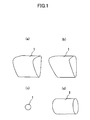
- FIG. 1 It is a perspective view which shows the example of the inorganic medium for barrel grinding
- FIG. 1 is a perspective view illustrating an example of an inorganic medium for barrel polishing according to an embodiment of the present invention.
- the inorganic medium for barrel polishing according to the present embodiment is formed into an arbitrary shape such as a spherical shape, a cylindrical shape, a triangular pyramid shape, a triangular prism shape, etc. of several millimeters to several tens of millimeters according to the purpose of polishing.
- An example of the shape is shown in FIGS. 1A is a triangular prism shape
- FIG. 1B is a shape obtained by obliquely cutting an intermediate portion of the triangular prism
- FIG. 1C is a spherical shape
- FIG. 1D is a cylindrical shape. is there.
- the mixed material of clay particles and abrasive particles is 60 to 80% by weight (polishing).
- the mixture is adjusted to contain at least 3% by weight of calcium oxide (CaO), and the mixed material having such a composition is sintered.
- a medium obtained by sintering a mixed material having such a composition has 60 to 80% by weight of aluminum oxide (Al 2 O 3 ), 10 to 30% by weight of silicon dioxide (SiO 2 ), 4 ⁇ 8 wt% zirconium oxide (ZrO 2 ) and 1 to 3 wt% calcium oxide (CaO).
- the wear rate can be greatly improved while maintaining the polishing force as compared with the conventional media.
- the clayey fine particles are fine particles that can be collected to form a clay.
- it means a state in which aluminum oxide, zirconium oxide, silicon dioxide, calcium oxide, magnesium oxide and the like are mixed.
- the abrasive particles may be particles containing at least aluminum oxide.
- Comparative Example 1 is an example of a medium composition that has been widely used for rough finishing.
- Comparative Example 2 is an example in which abrasive particles are mixed with a binder mainly composed of aluminum oxide used for gloss finish so that the polishing power can be roughly finished.
- Table 1 shows the ratio of each component in Examples 1 to 3 and Comparative Examples 1 and 2.
- the media of Examples 1 to 3 and the media of Comparative Examples 1 and 2 can be obtained by a method similar to the conventional method as described below, for example. Note that the manufacturing method is not limited to this, and a method conventionally conventionally used can be selected as appropriate according to the shape of the medium determined according to the purpose of polishing.
- each raw material is mixed so as to achieve each blending ratio in Table 1, and kneaded as a slurry to which about 15% of water is added, and the obtained slurry is put into an extrusion molding machine, and one side is about 15 mm. Are cut into a length (the height of the triangular prism) of about 15 mm and dried to obtain a media green body.
- the obtained media green body is put into a heat-resistant container, and each medium is obtained by firing at a temperature of 1300-1500 ° C. for about 2 hours in a temperature-controlled firing furnace.
- a suitable firing temperature for example, about 1400 ° C.
- FIG. 2 shows the result of the wear rate obtained by measuring the rate of weight reduction of the grinding stone.
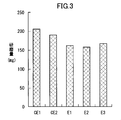
- FIG. 3 shows the result of the polishing amount (assuming the polishing power) obtained by measuring the weight reduction amount of the test piece.
- E1, E2, and E3 show the results of Examples 1, 2, and 3, respectively
- CE1 and CE2 show the results of Comparative Examples 1 and 2, respectively.
- the vertical axis in FIG. 2 indicates the wear rate (%)
- the vertical axis in FIG. 3 indicates the polishing amount (mg).
- the wear rate is 8.62% in Comparative Example 1 (an example widely used in the past), whereas it is 5.20% in Comparative Example 2 (an example of a composition mainly composed of aluminum oxide). It is shown that it is improved (about 60% of Comparative Example 1) over Comparative Example 1. In Example 1, by adding a zirconium oxide component, the wear rate can be 3.34%, which is a significant improvement over Comparative Examples 1 and 2 (about 39% of Comparative Example 1, Comparative Example 2). (About 64%). In the cases of Examples 2 and 3, the same results as in Example 1 were obtained.
- Comparative Example 1 has a polishing amount of 207 mg and Comparative Example 2 has a polishing amount of 191.5 mg, whereas Example 1 has a polishing amount of 162.5 mg, and the wear rate is reduced. At the same time, the polishing power decreases.
- the wear rate and the polishing force are in a proportional relationship.
- the polishing amount with respect to the media wear rate of 1% is compared, it is 24.0 in Comparative Example 1 and in Comparative Example 2. While it was 36.8, it was 48.7 in Example 1, and it was confirmed that the polishing efficiency of Example 1 was very high.
- substantially the same result as in Example 1 was obtained, and it was confirmed that the polishing efficiency of the Example was very large.
- the media of Examples 1 to 3 achieve improved wear resistance while enabling rough finish polishing.
- the wear rate is about 40%, so the service life is more than doubled and the amount of sludge generated is reduced, greatly reducing the amount of industrial waste generated. , Can contribute to the reduction of environmental impact.
- the present inventors have found that wear resistance is improved by adding zirconium oxide having high toughness to aluminum oxide having low toughness (toughness), and based on this finding, aluminum oxide is used as the main medium of media.
- zirconium oxide component was appropriately added as a component, it was possible to obtain a range in which the wear resistance performance was improved while enabling rough finish polishing.
- An inorganic medium for barrel polishing to which the present invention is applied is obtained by sintering a mixed material of clayey fine particles and abrasive particles to form the above-described component states of aluminum oxide, silicon dioxide, zirconium oxide, and oxidation.
- a mixed material of clayey fine particles and abrasive particles to form the above-described component states of aluminum oxide, silicon dioxide, zirconium oxide, and oxidation.
- the above-mentioned media is not limited to a triangular prism shape, but a spherical shape, a cylindrical shape, an elliptical cross section, various pyramid shapes including a triangular pyramid shape, and various types including a triangular prism shape.
- a prismatic shape or the like may be used.
- a cylinder or a prism is cut by a plane having a predetermined angle with respect to a plane perpendicular to its axis (here, the axis means a direction orthogonal to a cross section, for example, a circle or a triangle). It may be a simple shape.
- each apex portion constituting the substantially triangular prism shape triangle may be an arc shape (see, for example, Japanese Patent Application Laid-Open No. 2003-231053). These shapes may be cut by a plane having a predetermined angle with respect to a plane perpendicular to the axis.
Landscapes
- Engineering & Computer Science (AREA)
- Mechanical Engineering (AREA)
- Finish Polishing, Edge Sharpening, And Grinding By Specific Grinding Devices (AREA)
- Compositions Of Oxide Ceramics (AREA)
- Polishing Bodies And Polishing Tools (AREA)
Abstract
Description
このように構成された本発明においては、焼結体であるバレル研磨用無機質メディアが、60~80重量%の酸化アルミニウムを主成分として含み且つ4~8重量%の酸化ジルコニウムを成分として含むので、粗仕上げ研磨を可能としながら耐磨耗性能の向上を実現することが出来る。
本実施形態によるバレル研磨用無機質メディアは、研磨目的に合わせて数ミリから数十ミリの球形、円柱形、三角錐形、三角柱形等の任意形状に成形される。図1(a)~(d)に、その形状の例を示す。図1(a)は、三角柱形、図1(b)は、三角柱の中間部を斜めに切断して得られる形状、図1(c)は、球形、図1(d)は、円柱形である。
ここで、粘土質微粒子とは、集まって粘土状となり得る微粒子である。例えば、酸化アルミニウム、酸化ジルコニウム、二酸化珪素、酸化カルシウム、酸化マグネシウム等が混ざっている状態を意味する。また、研磨材粒子は、少なくとも酸化アルミニウムを含む粒子であれば良い。

E1,E2,E3 実施例1,2,3の結果
CE1,CE2 比較例1,2の結果
Claims (2)
- 焼結体であるバレル研磨用無機質メディアであって、
60~80重量%の酸化アルミニウムと、10~30重量%の二酸化珪素と、4~8重量%の酸化ジルコニウムと、1~3重量%の酸化カルシウムとを少なくとも含むことを特徴とするバレル研磨用無機質メディア。 - 上記焼結体は、粘土質微粒子と研磨材粒子とを含む混合材料を焼結させた焼結体である請求項1記載のバレル研磨用無機質メディア。
Priority Applications (3)
| Application Number | Priority Date | Filing Date | Title |
|---|---|---|---|
| KR1020137019489A KR101856273B1 (ko) | 2010-12-24 | 2011-12-21 | 배럴 연마용 무기질 매체 |
| JP2012549845A JP5720903B2 (ja) | 2010-12-24 | 2011-12-21 | バレル研磨用無機質メディア |
| CN2011800625676A CN103282159A (zh) | 2010-12-24 | 2011-12-21 | 滚筒研磨用无机介质 |
Applications Claiming Priority (2)
| Application Number | Priority Date | Filing Date | Title |
|---|---|---|---|
| JP2010-287487 | 2010-12-24 | ||
| JP2010287487 | 2010-12-24 |
Publications (1)
| Publication Number | Publication Date |
|---|---|
| WO2012086679A1 true WO2012086679A1 (ja) | 2012-06-28 |
Family
ID=46313947
Family Applications (1)
| Application Number | Title | Priority Date | Filing Date |
|---|---|---|---|
| PCT/JP2011/079621 Ceased WO2012086679A1 (ja) | 2010-12-24 | 2011-12-21 | バレル研磨用無機質メディア |
Country Status (4)
| Country | Link |
|---|---|
| JP (1) | JP5720903B2 (ja) |
| KR (1) | KR101856273B1 (ja) |
| CN (1) | CN103282159A (ja) |
| WO (1) | WO2012086679A1 (ja) |
Cited By (3)
| Publication number | Priority date | Publication date | Assignee | Title |
|---|---|---|---|---|
| WO2015156034A1 (ja) * | 2014-04-07 | 2015-10-15 | 新東工業株式会社 | バレル研磨用メディア及びその製造方法 |
| JP2019018285A (ja) * | 2017-07-18 | 2019-02-07 | 株式会社チップトン | バレル研磨用研磨石 |
| TWI670140B (zh) * | 2014-04-07 | 2019-09-01 | 日商新東工業股份有限公司 | 乾式筒式研磨方法及介質之製造方法 |
Families Citing this family (1)
| Publication number | Priority date | Publication date | Assignee | Title |
|---|---|---|---|---|
| CN110372353A (zh) * | 2019-08-21 | 2019-10-25 | 嘉兴纳美新材料有限公司 | 一种锆铝复合陶瓷球及其生产工艺 |
Citations (5)
| Publication number | Priority date | Publication date | Assignee | Title |
|---|---|---|---|---|
| JPS4835595B1 (ja) * | 1968-05-14 | 1973-10-29 | ||
| JPS5617975A (en) * | 1979-07-19 | 1981-02-20 | Nippon Kokan Kk | Artificial media for barrel working and manufacture thereof |
| JPH10146749A (ja) * | 1996-11-15 | 1998-06-02 | Sinto Brator Co Ltd | 乾式バレル研磨用無機質メディア |
| JP2000079564A (ja) * | 1998-09-03 | 2000-03-21 | Mikura Bussan Kk | 研磨剤及びその製造方法 |
| JP2004042217A (ja) * | 2002-07-12 | 2004-02-12 | Ebara Corp | 研磨方法、研磨装置および研磨工具の製造方法 |
Family Cites Families (3)
| Publication number | Priority date | Publication date | Assignee | Title |
|---|---|---|---|---|
| CN1060145C (zh) * | 1994-04-12 | 2001-01-03 | 南京化工学院陶瓷厂 | 陶瓷微珠及其制造方法 |
| JP4009339B2 (ja) * | 1996-01-29 | 2007-11-14 | 関西マテック株式会社 | アルミナ−ジルコニア系焼結体、その製造法及びアルミナ−ジルコニア系焼結体を用いた衝撃式粉砕機 |
| BR0211579A (pt) * | 2001-08-02 | 2004-07-13 | 3M Innovative Properties Co | Vidro-cerâmica, contas, pluralidade de partìculas abrasivas, artigo abrasivo, e, métodos para abradar uma superfìcie, para fabricar vidro-cerâmica, para fabricar um artigo de vidro-cerâmica e para fabricar partìculas abrasivas |
-
2011
- 2011-12-21 JP JP2012549845A patent/JP5720903B2/ja active Active
- 2011-12-21 CN CN2011800625676A patent/CN103282159A/zh active Pending
- 2011-12-21 KR KR1020137019489A patent/KR101856273B1/ko active Active
- 2011-12-21 WO PCT/JP2011/079621 patent/WO2012086679A1/ja not_active Ceased
Patent Citations (5)
| Publication number | Priority date | Publication date | Assignee | Title |
|---|---|---|---|---|
| JPS4835595B1 (ja) * | 1968-05-14 | 1973-10-29 | ||
| JPS5617975A (en) * | 1979-07-19 | 1981-02-20 | Nippon Kokan Kk | Artificial media for barrel working and manufacture thereof |
| JPH10146749A (ja) * | 1996-11-15 | 1998-06-02 | Sinto Brator Co Ltd | 乾式バレル研磨用無機質メディア |
| JP2000079564A (ja) * | 1998-09-03 | 2000-03-21 | Mikura Bussan Kk | 研磨剤及びその製造方法 |
| JP2004042217A (ja) * | 2002-07-12 | 2004-02-12 | Ebara Corp | 研磨方法、研磨装置および研磨工具の製造方法 |
Cited By (5)
| Publication number | Priority date | Publication date | Assignee | Title |
|---|---|---|---|---|
| WO2015156034A1 (ja) * | 2014-04-07 | 2015-10-15 | 新東工業株式会社 | バレル研磨用メディア及びその製造方法 |
| TWI643700B (zh) * | 2014-04-07 | 2018-12-11 | 日商新東工業股份有限公司 | Cartridge grinding medium and manufacturing method thereof |
| TWI670140B (zh) * | 2014-04-07 | 2019-09-01 | 日商新東工業股份有限公司 | 乾式筒式研磨方法及介質之製造方法 |
| JP2019018285A (ja) * | 2017-07-18 | 2019-02-07 | 株式会社チップトン | バレル研磨用研磨石 |
| JP7056902B2 (ja) | 2017-07-18 | 2022-04-19 | 株式会社チップトン | バレル研磨用研磨石 |
Also Published As
| Publication number | Publication date |
|---|---|
| JP5720903B2 (ja) | 2015-05-20 |
| CN103282159A (zh) | 2013-09-04 |
| KR20130130800A (ko) | 2013-12-02 |
| JPWO2012086679A1 (ja) | 2014-05-22 |
| KR101856273B1 (ko) | 2018-05-09 |
Similar Documents
| Publication | Publication Date | Title |
|---|---|---|
| CN103702800B (zh) | 包括氮化硅磨粒的磨料制品 | |
| JP6113167B2 (ja) | 結合研磨物品 | |
| CN1050589C (zh) | 熔融陶瓷球及其用途 | |
| JP2016513591A (ja) | 結合研磨物品 | |
| JP5720903B2 (ja) | バレル研磨用無機質メディア | |
| CN1185128A (zh) | 有改进转角维持的氧化铝磨轮 | |
| JP6755239B2 (ja) | 焼結体およびそれを含む切削工具 | |
| RU2588919C2 (ru) | Абразивное изделие для операций шлифования с ультравысокой скоростью удаления материала | |
| JP5739425B2 (ja) | 融解されたアルミナ−ジルコニアグリット | |
| CN106715360A (zh) | 烧结体和切削工具 | |
| JP2001348271A (ja) | 研磨用成形体及びこれを用いた研磨用定盤 | |
| CN111320465A (zh) | 一种氧化铝基微晶陶瓷颗粒及其制备方法和应用 | |
| CN106132632A (zh) | 筒式研磨用介质及其制造方法 | |
| TWI705947B (zh) | 帶負電性基板之硏磨方法、及高表面平滑性之帶負電性基板之製造方法 | |
| JP2777356B2 (ja) | 乾式バレル研磨用無機質メディア | |
| JP4284771B2 (ja) | 金属研磨用αアルミナ研磨材およびその製法 | |
| TWI670140B (zh) | 乾式筒式研磨方法及介質之製造方法 | |
| JP2011140097A (ja) | 砥石 | |
| JP2024105400A (ja) | 結合研磨剤及びその形成方法 | |
| JP3203311B2 (ja) | 砥石及びその製造方法 | |
| JPH07206514A (ja) | 耐摩耗性アルミナ質セラミックス | |
| WO2023127561A1 (ja) | 良研磨性の歯科用酸化物セラミックス仮焼体及びその製造方法 | |
| CN114193590A (zh) | 一种耐磨磨粒及其制备方法 | |
| WO2024127652A1 (ja) | 優れた機械加工性を有する歯科用酸化物セラミックス仮焼体及びその製造方法 | |
| JP2003165058A (ja) | 研磨用成形体及びそれを用いた研磨用定盤 |
Legal Events
| Date | Code | Title | Description |
|---|---|---|---|
| 121 | Ep: the epo has been informed by wipo that ep was designated in this application |
Ref document number: 11849911 Country of ref document: EP Kind code of ref document: A1 |
|
| ENP | Entry into the national phase |
Ref document number: 2012549845 Country of ref document: JP Kind code of ref document: A |
|
| NENP | Non-entry into the national phase |
Ref country code: DE |
|
| ENP | Entry into the national phase |
Ref document number: 20137019489 Country of ref document: KR Kind code of ref document: A |
|
| 122 | Ep: pct application non-entry in european phase |
Ref document number: 11849911 Country of ref document: EP Kind code of ref document: A1 |