WO2012033156A1 - β型サイアロン及び発光装置 - Google Patents
β型サイアロン及び発光装置 Download PDFInfo
- Publication number
- WO2012033156A1 WO2012033156A1 PCT/JP2011/070444 JP2011070444W WO2012033156A1 WO 2012033156 A1 WO2012033156 A1 WO 2012033156A1 JP 2011070444 W JP2011070444 W JP 2011070444W WO 2012033156 A1 WO2012033156 A1 WO 2012033156A1
- Authority
- WO
- WIPO (PCT)
- Prior art keywords
- sialon
- light
- lattice constant
- emitting device
- light source
- Prior art date
- Legal status (The legal status is an assumption and is not a legal conclusion. Google has not performed a legal analysis and makes no representation as to the accuracy of the status listed.)
- Ceased
Links
Images
Classifications
-
- C—CHEMISTRY; METALLURGY
- C09—DYES; PAINTS; POLISHES; NATURAL RESINS; ADHESIVES; COMPOSITIONS NOT OTHERWISE PROVIDED FOR; APPLICATIONS OF MATERIALS NOT OTHERWISE PROVIDED FOR
- C09K—MATERIALS FOR MISCELLANEOUS APPLICATIONS, NOT PROVIDED FOR ELSEWHERE
- C09K11/00—Luminescent materials, e.g. electroluminescent or chemiluminescent
- C09K11/08—Luminescent materials, e.g. electroluminescent or chemiluminescent containing inorganic luminescent materials
- C09K11/0883—Arsenides; Nitrides; Phosphides
-
- C—CHEMISTRY; METALLURGY
- C09—DYES; PAINTS; POLISHES; NATURAL RESINS; ADHESIVES; COMPOSITIONS NOT OTHERWISE PROVIDED FOR; APPLICATIONS OF MATERIALS NOT OTHERWISE PROVIDED FOR
- C09K—MATERIALS FOR MISCELLANEOUS APPLICATIONS, NOT PROVIDED FOR ELSEWHERE
- C09K11/00—Luminescent materials, e.g. electroluminescent or chemiluminescent
- C09K11/08—Luminescent materials, e.g. electroluminescent or chemiluminescent containing inorganic luminescent materials
- C09K11/77—Luminescent materials, e.g. electroluminescent or chemiluminescent containing inorganic luminescent materials containing rare earth metals
- C09K11/7728—Luminescent materials, e.g. electroluminescent or chemiluminescent containing inorganic luminescent materials containing rare earth metals containing europium
- C09K11/77348—Silicon Aluminium Nitrides or Silicon Aluminium Oxynitrides
-
- H—ELECTRICITY
- H10—SEMICONDUCTOR DEVICES; ELECTRIC SOLID-STATE DEVICES NOT OTHERWISE PROVIDED FOR
- H10H—INORGANIC LIGHT-EMITTING SEMICONDUCTOR DEVICES HAVING POTENTIAL BARRIERS
- H10H20/00—Individual inorganic light-emitting semiconductor devices having potential barriers, e.g. light-emitting diodes [LED]
- H10H20/80—Constructional details
- H10H20/85—Packages
- H10H20/851—Wavelength conversion means
- H10H20/8511—Wavelength conversion means characterised by their material, e.g. binder
- H10H20/8512—Wavelength conversion materials
Definitions
- the present invention relates to ⁇ -sialon suitable as a phosphor and a light-emitting device using ⁇ -sialon.
- Patent Document 1 describes ⁇ -sialon in which a rare earth element is dissolved in a host crystal of ⁇ -sialon represented by the general formula: Si 6-z Al z O z N 8-z .
- Patent Document 2 describes a method of producing ⁇ -sialon by mixing silicon nitride, aluminum nitride, and europium oxide, firing at about 2000 ° C., and performing heat treatment or acid treatment after firing.
- Patent Document 3 describes that when the oxygen solid solution amount of ⁇ -sialon is reduced, the fluorescence spectrum is shortened and narrowed.
- An object of the present invention is to provide ⁇ -sialon having higher luminous efficiency and a light-emitting device using the ⁇ -sialon.
- the present invention is represented by the general formula: Si 6-z Al z O z N 8-z : Eu, and the D10 value and D90 value of the particle size distribution measured by the laser diffraction scattering method are (D90-D10) / It is a ⁇ -type sialon that satisfies the relationship (D90 + D10) ⁇ 0.8.
- the ⁇ -type sialon of the present invention satisfies the relationship of (D90 ⁇ D10) / (D90 + D10) ⁇ 0.8, and the relationship between the a-axis lattice constant and the chromaticity x is a-axis lattice constant ( ⁇ ) ⁇ 0. It is preferable that 1075 ⁇ chromaticity x + 7.5742 is satisfied.
- the ⁇ -type sialon of the present invention preferably has an a-axis lattice constant of 7.6020 ⁇ to 7.6085 ⁇ and a c-axis lattice constant of 2.9040 to 2.9100 ⁇ .
- the light-emitting device of the present invention includes a light-emitting light source and a sealing resin containing the ⁇ -sialon disposed on the light-emitting light source.
- the ⁇ -sialon of the present invention is useful as a phosphor having a high emission peak intensity.
- the ⁇ -sialon of the present invention it is possible to realize a high luminance of the light emitting device, and furthermore, when applied to a light source of a liquid crystal display, high color reproducibility can be obtained.
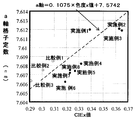
- FIG. 6 is a graph showing distribution states of Examples 1 to 8 and Comparative Examples 1 to 3 when the horizontal axis is CIEx and the vertical axis is a lattice constant.
- the ⁇ -type sialon of the present embodiment is obtained by dissolving Eu as a light emission center in a ⁇ -type sialon host crystal represented by the general formula: Si 6-z Al z O z N 8-z (hereinafter referred to as “emission center”). Simply called ⁇ -sialon).
- the ⁇ -sialon is obtained, for example, by firing a raw material mixture of silicon oxide and / or aluminum oxide, silicon nitride, aluminum nitride, and Eu compound in a nitrogen atmosphere in the range of 1800 ° C. to 2200 ° C. After the process, part or all of crushing treatment, classification treatment, annealing treatment, and acid treatment may be performed.
- the present inventors have found that higher emission peak intensity can be obtained when the relationship of the following formula 1 is satisfied, and the present invention has been completed. As the value on the left side of Equation 1 is smaller, the distribution width of the particle size is narrowed, and the emission peak intensity tends to be improved.
- the D90 value and the D10 value are a particle size corresponding to a 90% cumulative value and a particle size corresponding to a 10% cumulative value in the number particle size distribution of ⁇ -sialon measured by a laser diffraction scattering method.
- O / Al molar ratio the molar ratio of oxygen and aluminum in the raw material mixture
- O / Al molar ratio the molar ratio of oxygen and aluminum in the raw material mixture
- ⁇ -sialon satisfying the relationship of Formula 1 in addition to the adjustment of the O / Al molar ratio, means for removing particles by classifying ⁇ -sialon by an operation such as water tank may be used. You may perform both operation of adjustment of O / Al molar ratio, and a classification process.
- the number of moles of oxygen can be determined from the amount of oxygen measured by an oxygen analyzer, and the number of moles of aluminum can be determined from the amount of aluminum measured by ICP emission analysis.
- the particle size distribution of ⁇ -sialon preferably has a D50 value in the range of 10 ⁇ m to 30 ⁇ m.
- the average particle size decreases, the absorption rate of ⁇ -sialon tends to decrease and the emission peak intensity tends to decrease, and when the average particle size increases, the dispersion state deteriorates when used in a light emitting device, and the luminous efficiency Reduction and chromaticity variation increase.
- the control of the a-axis lattice constant can be performed by an annealing process which is one of the manufacturing processes of ⁇ -type sialon.
- a ⁇ -sialon powder is heat-treated in a vacuum at a temperature range of 1200 ° C. or higher and 1600 ° C. or lower, or in an inert gas atmosphere containing a rare gas other than nitrogen as a main component, 1200 ° C. or higher and 1600 ° C.
- There is a rare gas annealing process in which heat treatment is performed at a temperature of less than or equal to 0 ° C., and either or both of them may be performed.
- nitrogen gas may be contained in the inert gas atmosphere, and the nitrogen partial pressure in this case is preferably 10 kPa or less.
- the processing conditions such as processing temperature, processing time, degree of vacuum, nitrogen partial pressure in inert gas, gas flow rate, etc. are adjusted so that the a-axis lattice constant is in the range of Equation 2.
- the luminescence of the ⁇ -type sialon is short. It was found that the wavelength was narrowed and the band was narrowed.
- the ⁇ -type sialon of the present embodiment satisfies the above-described formulas 1 and 2, the a-axis lattice constant is 7.6020 ⁇ to 7.6085 ⁇ , and the c-axis lattice constant is 2.9040 ⁇ to 2.9100 ⁇ .
- ⁇ -sialon satisfying this condition has a high emission peak intensity, and the emission has a shorter wavelength and a narrower band.
- the spin density is low, the crystallinity of ⁇ -sialon is improved and the emission peak intensity is higher.
- it is only necessary to suppress the occurrence of distortion of the ⁇ -sialon crystal. Specifically, it can be achieved by performing the firing step at a rate of temperature increase from 1500 ° C. in the firing step to the firing temperature of 2 ° C./min or less.
- ⁇ -type sialon satisfying Equation 2 and the a-axis lattice constant of 7.6020 ⁇ to 7.6085 ⁇ has light emission on the short wavelength side and high emission peak intensity.
- the light emitting device of this embodiment is a light emitting device having a light emitting light source and a sealing resin in which the above-described ⁇ -sialon is blended on the light emitting light source.
- ⁇ -sialon since ⁇ -sialon has little luminance decrease at high temperature, luminance decrease and chromaticity deviation are small, it does not deteriorate even when exposed to high temperature, and it has excellent heat resistance, and is in an oxidizing atmosphere and moisture environment. It has excellent long-term stability, high brightness and long life.
- the light-emitting device of this embodiment is suitable for backlights of liquid crystal display devices, LEDs, phosphor lamps, traffic lights, outdoor lighting devices, indoor lighting devices, large screens, electronic notice boards, and the like.
- FIG. 1 shows the x-value of CIE chromaticity on the horizontal axis and the a lattice constant on the vertical axis.
- a-axis lattice constant ( ⁇ ) ⁇ 0.1075 ⁇ chromaticity x + 7.5742 (formula 2)
- ⁇ -type silicon nitride powder (NP-400 grade manufactured by Denki Kagaku Kogyo Co., Ltd., oxygen solid solution amount 0.96% by mass, ⁇ phase solid solution amount 14.8% by mass), aluminum nitride powder (Tokuyama) F grade, oxygen solid solution amount 0.84% by mass), aluminum oxide powder (TM-DAR grade, manufactured by Daimei Chemical Co., Ltd.) and europium oxide powder (RU grade, manufactured by Shin-Etsu Chemical Co., Ltd.) were used.
- the z value for Si calculated from the amount of Al in each raw material is 0.25
- the z value for N calculated from the amount of oxygen other than the europium oxide powder is 0.25
- the europium oxide powder is 0.29 mol%
- the raw material mixture was dry-mixed for 60 minutes with a rocking mixer (RM-10, manufactured by Aichi Electric Co., Ltd.) and passed through a stainless steel sieve having an opening of 150 ⁇ m to obtain a raw material powder.
- a rocking mixer (RM-10, manufactured by Aichi Electric Co., Ltd.) and passed through a stainless steel sieve having an opening of 150 ⁇ m to obtain a raw material powder.
- the raw material powder is filled in a boron nitride container (N-1 grade, manufactured by Denki Kagaku Kogyo Co., Ltd.), and the heating rate from 1500 ° C. to firing temperature is 5 ° C./min. Was fired at 2000 ° C. for 10 hours in a pressurized nitrogen atmosphere. The obtained fired product was crushed, and ⁇ -sialon powder was obtained through a sieve having an opening of 45 ⁇ m.
- the fluorescence spectrum of ⁇ -sialon was measured with a spectrofluorometer (F4500, manufactured by Hitachi High-Technologies Corporation). Fluorescence spectrum peak wavelength height was measured using 455 nm blue light as excitation light, and the relative value to the peak wavelength height of Kasei Opto YAG: Ce phosphor (P46-Y3) measured under the same conditions was emitted. The peak intensity was obtained. A spectral xenon lamp light source was used as the excitation light.
- CIE chromaticity was obtained by measuring the total luminous flux emission spectrum for excitation at 455 nm using an integrating sphere with an instantaneous multi-photometry system (MCPD-7000 manufactured by Otsuka Electronics Co., Ltd.) Volume 83 Number 2 1999 p87-93, Measurement of quantum efficiency of NBS standard phosphor, Kazuaki Okubo et al.
- the particle size distribution of ⁇ -sialon of Example 1 was determined by particle size distribution measurement based on the laser scattering method. D10 was 7.2 ⁇ m, D50 was 20.5 ⁇ m, and D90 was 40.8 ⁇ m.
- the ⁇ -type sialon was subjected to powder X-ray diffraction measurement (XRD) using Cu K ⁇ rays.
- XRD powder X-ray diffraction measurement
- the highest diffraction line intensity was 1% or less with respect to the diffraction line intensity of the (101) plane of ⁇ -sialon.
- the a-axis lattice constant was 7.6120, and the c-axis lattice constant was 2.9127.
- the spin density was determined as follows. 50 mg of ⁇ -sialon was placed in a sample tube for electron spin resonance (hereinafter abbreviated as ESR), and ESR measurement was performed at 25 ° C.
- ESR electron spin resonance
- an ESR measuring device JES-FE2XG type manufactured by JEOL Ltd. was used. The measurement conditions were as follows. Magnetic field sweep range: 3200-3400gauss (320-340mT) Magnetic field modulation: 100kHz, 5gauss Irradiation microwave: frequency 9.25 GHz, output 10 mW Sweep time: 240 seconds Number of data points: 2056 points Standard sample: A sample obtained by thermally diffusing Mn 2+ into MgO was measured simultaneously with the sample of Example 1.
- the ESR spectrum is usually observed as a first-order differential curve because the unevenness of the absorption spectrum of electromagnetic waves is sensitively observed. Since the absorption intensity is proportional to the number of spins, the ESR spectrum was integrated twice, the differential curve was corrected to an integral curve, and quantified from the area ratio with the standard sample.
- the spin number of the standard sample is 1 of 1,1-diphenyl-2-picrylhydrazyl ((C 6 H 5 ) 2 NNC 6 H 2 (NO 2 ) 3 , called DPPH) whose spin number is known.
- An ESR measurement was performed on 0.5 mL (3.0 ⁇ 10 15 spins) of a 0.0 ⁇ 10 ⁇ 5 mol / L benzene solution, and the peak area ratio of the standard sample and the DPPH solution was obtained.
- the spin density of the ⁇ -type sialon of Example 1 was 2.2 ⁇ 10 17 .
- Example 2 is a ⁇ -type sialon obtained by further pulverizing the ⁇ -type sialon of Example 1 to adjust the particle size, and performing an annealing step and an underwater classification treatment.
- the following Examples and Comparative Examples were produced and measured by the same formulation and production method as Example 1 unless otherwise specified.
- the ⁇ -sialon calcined in Example 1 was pulverized with a sonic jet pulverizer (PJM-80SP manufactured by Nippon Pneumatic Industry Co., Ltd.) to adjust the particle size.
- Example 3 [Beta] -sialon of Example 3 was produced under the same conditions as Example 2 except that fine powder of 15 [mu] m or less was removed by water classification.
- Comparative Example 1 The ⁇ -sialon of Comparative Example 1 was manufactured under the same conditions as in Example 1 except that the z value for Si calculated from the Al content was 0.1 and the O / Al molar ratio was 1.9.
- Comparative Example 2 Comparative Example 2 was produced under the same conditions as in Example 1 except that the z value for Si calculated from the Al content was 0.08 and the O / Al molar ratio was 2.4.
- Comparative Example 3 Comparative Example 3 was produced under the same conditions as in Example 1 except that the z value for Si calculated from the Al amount was 0.06 and the O / Al molar ratio was 3.1.
- Example 4 ⁇ -type silicon nitride powder (prototype manufactured by Denki Kagaku Kogyo), aluminum nitride powder (F grade manufactured by Tokuyama Co., Ltd., oxygen solid solution amount 0.84% by mass), europium oxide powder (manufactured by Shin-Etsu Chemical Co., Ltd.) RU grade) under the same conditions as in Example 1 except that the z value for Si calculated from the Al amount was 0.06, the europium oxide powder was 0.55 mol%, and the O / Al molar ratio was 1.1. It is manufactured. After firing, the ⁇ -sialon of Example 4 was manufactured by carrying out the treatment by the annealing step and the acid treatment step of Example 2, but neither pulverization nor classification in water was performed.
- Example 5 was manufactured under the same conditions as Example 4 except that the z value for Si calculated from the Al amount was 0.08 and the O / Al molar ratio was 1.1.
- Example 6 was manufactured under the same conditions as Example 4 except that the z value for Si calculated from the Al amount was 0.06 and the O / Al molar ratio was 1.1.
- Example 7 was produced under the same conditions as in Example 5 except that the baking was performed at an O / Al molar ratio of 1.2 and a heating rate from 1500 ° C. to the baking temperature in the baking step of 1 ° C./min. It is a thing.
- Example 8 except that the O / Al molar ratio was 1.1, ⁇ -sialon was calcined under the same conditions as in Example 6, classified in water to remove fine powder of 15 ⁇ m or less, and then dried. It is a thing.
- Examples 2, 3 and 8 in which the particle size was adjusted by classification treatment showed high emission peak intensity.
- Examples 1 to 8 subjected to the annealing treatment are located on the lower side of the straight line of Formula 2 and show high emission peak intensity. It can be seen that Examples 7 and 8 have high emission peak intensity and the emission wavelength is located on the short wavelength side.
- the firing step was performed under the condition that the temperature increase rate from 1500 ° C. to the firing temperature was 2 ° C./min or less, and the axial lattice constant was 7.6020 ⁇ or more and 7.6085 ⁇ or less.
- the c-axis lattice constant is not less than 2.9040 and not more than 2.9100 and the spin density is not more than 2.0 ⁇ 10 17 atoms / g, the emission peak intensity is higher than those of Examples 1 to 6. It was.
- Example 9 to 12 The white light emitting devices of Examples 9 to 12 were manufactured using the ⁇ -sialons of Examples 3, 4, 6, and 8 instead of the ⁇ -sialon of Comparative Example 2.
- the light emitting devices of Comparative Example 4 and Examples 9 to 12 were caused to emit light under the same energization conditions, and the central illuminance and chromaticity (CIE 1931) under the same conditions were measured with a luminance meter.
- the brightness of the light emitting devices of Examples 9 to 12 is a white light emitting device with chromaticity coordinates (x, y) of (0.32, 0.32), and the central illuminance is 100 times the brightness of the light emitting device of Comparative Example 4.
- Example 9 uses ⁇ -sialon of Example 3
- Example 10 uses ⁇ -sialon of Example 4
- 126% in Example 11 uses ⁇ -sialon of Example 4
- 141% in Example 12 using ⁇ -sialon of Example 8.
- the light-emitting devices of Examples 9 to 12 are capable of emitting green light with strong intensity using an ultraviolet LED or blue LED that emits light with a wavelength of 350 to 500 nm as excitation light, in combination with phosphors that emit other colors. Thus, a white LED having good light emission characteristics was obtained.
Landscapes
- Chemical & Material Sciences (AREA)
- Inorganic Chemistry (AREA)
- Engineering & Computer Science (AREA)
- Materials Engineering (AREA)
- Organic Chemistry (AREA)
- Luminescent Compositions (AREA)
- Led Device Packages (AREA)
Abstract
一般式:Si6-zAlzOzN8-z:Euで示され、レーザー回折散乱法で測定した粒径分布のD10値とD90値が、(D90-D10)/(D90+D10)<0.8の関係を満たすβ型サイアロン。
Description
本発明は、蛍光体として好適なβ型サイアロン及びβ型サイアロンを用いた発光装置に関する。
特許文献1には、一般式:Si6-zAlzOzN8-zで示されるβ型サイアロンのホスト結晶に希土類元素を固溶させたβ型サイアロンが記載されている。特許文献2には、窒化ケイ素と、窒化アルミニウムと、酸化ユーロピウムとを混合して約2000℃で焼成し、焼成後に熱処理や酸処理を行うことでβ型サイアロンを製造する方法が記載されている。特許文献3には、β型サイアロンの酸素固溶量を低減させると、蛍光スペクトルが短波長化及び狭帯域化することが記載されている。
しかし、上述した製造方法では、十分な発光効率を備えたβ型サイアロンは再現性良く得られていなかった。
本発明は、より高い発光効率を有するβ型サイアロン及びこのβ型サイアロンを用いた発光装置を提供することを目的とする。
本発明は、より高い発光効率を有するβ型サイアロン及びこのβ型サイアロンを用いた発光装置を提供することを目的とする。
本発明は、一般式:Si6-zAlzOzN8-z:Euで示され、レーザー回折散乱法で測定した粒径分布のD10値とD90値とが、(D90-D10)/(D90+D10)<0.8の関係を満たすβ型サイアロンである。
本発明のβ型サイアロンは、(D90-D10)/(D90+D10)<0.8の関係を満たし、かつ、a軸格子定数と色度xの関係が、a軸格子定数(Å)≦0.1075×色度x+7.5742を満たすことが好ましい。
本発明のβ型サイアロンのa軸格子定数は、7.6020Å以上7.6085Å以下、c軸格子定数が、2.9040以上2.9100Å以下が好ましい。
本発明のβ型サイアロンは、電子スピン共鳴スペクトルによる計測における25℃でのg=2.00±0.02の吸収に対応するスピン密度が、2.0×10¹⁷個/g以下であるのが好ましい。
本発明のβ型サイアロンは、(D90-D10)/(D90+D10)<0.8の関係を満たし、かつ、a軸格子定数と色度xの関係が、a軸格子定数(Å)≦0.1075×色度x+7.5742を満たすことが好ましい。
本発明のβ型サイアロンのa軸格子定数は、7.6020Å以上7.6085Å以下、c軸格子定数が、2.9040以上2.9100Å以下が好ましい。
本発明のβ型サイアロンは、電子スピン共鳴スペクトルによる計測における25℃でのg=2.00±0.02の吸収に対応するスピン密度が、2.0×10¹⁷個/g以下であるのが好ましい。
また、本発明の発光装置は、発光光源と、該発光光源上に配置された上記β型サイアロンを配合させた封止樹脂とを備える。
本発明のβ型サイアロンは、高い発光ピーク強度を有する蛍光体として有用である。本発明のβ型サイアロンを用いることにより、発光装置の高輝度化を実現でき、更に液晶ディスプレイの光源に応用した際、高い色再現性が得られる。
以下、本発明の実施の形態について説明する。
本実施形態のβ型サイアロンは、一般式:Si6-zAlzOzN8-zで示されるβ型サイアロンのホスト結晶に、発光中心としてEuが固溶されたものである(以下、単にβ型サイアロンと称する。)。β型サイアロンは、例えば、酸化ケイ素及び/又は酸化アルミニウムと、窒化ケイ素と、窒化アルミニウムと、Eu化合物との原料混合物を窒素雰囲気下、1800℃から2200℃の範囲で焼成して得られ、焼成工程後には解砕処理、分級処理、アニール処理、酸処理の一部又は全部を行ってもよい。
本発明者らは、下記に示す式1の関係を満たすとき、より高い発光ピーク強度が得られることを見出し、本発明を完成するに至った。式1の左辺の値が小さいほど、粒度の分布幅が狭くなり、発光ピーク強度が向上する傾向にある。
(D90-D10)/(D90+D10)<0.8 (式1)
D90値及びD10値は、レーザー回折散乱法にて測定したβ型サイアロンの個数粒径分布における90%累積値に対応する粒径及び10%累積値に対応する粒径である。
原料混合物中の酸素とアルミニウムとのモル比(以下、O/Alモル比という。)を0.9以上1.3以下の範囲とすることで、焼成時の粒子成長が制御され、式1の関係を満たすβ型サイアロンが得られる。O/Alモル比が小さいと焼成時に粒子成長が十分に起きず、β型サイアロンの発光ピーク強度が低下する。逆に大きいと粒子のアスペクト比が大きくなり、β型サイアロンの発光ピーク強度が低下する。
式1の関係を満たすβ型サイアロンを得るために、O/Alモル比の調整以外に、β型サイアロンを水簸等の操作で分級処理して微粒子を除去する手段を用いてもよい。O/Alモル比の調整と分級処理の両方の操作を行ってもよい。酸素のモル数は酸素分析装置で測定した酸素量から求めることができ、アルミニウムのモル数はICP発光分析法で測定したアルミニウム量から求めることができる。
β型サイアロンの粒径分布は、式1の関係を満たすことに加え、D50値が10μm以上30μm以下の範囲にあることが好ましい。平均粒径が小さくなると、β型サイアロンの吸収率が低下して発光ピーク強度が低くなる傾向があり、また、平均粒径が大きくなると発光装置に用いた場合に分散状態が悪くなり、発光効率の低下や色度のバラツキが大きくなる。
β型サイアロンにあっては、式1の条件に加え、a軸格子定数と色度xの関係における次の式2を満たすものが、より高い発光ピーク強度を有するため、好ましい。
a軸格子定数(Å)≦0.1075×色度x+7.5742 (式2)
a軸格子定数の制御は、β型サイアロンの製造工程の一つであるアニール工程によって行うことができる。アニール工程としては、β型サイアロンの粉末を真空中1200℃以上1600℃以下の温度範囲で熱処理する真空アニール工程、又は、窒素以外の希ガスを主成分とする不活性ガス雰囲気中1200℃以上1600℃以下の温度で熱処理する希ガスアニール工程があり、そのいずれか一方又は双方を行ってもよい。希ガスアニール工程では、不活性ガス雰囲気下には窒素ガスが含まれていてもよく、この場合の窒素分圧は10kPa以下が望ましい。a軸格子定数が式2の範囲になるように、処理温度、処理時間、真空度、不活性ガス中の窒素分圧、ガス流量、等の処理条件の調整を行う。
本発明者らは、β型サイアロンのa軸格子定数が7.6020Å以上7.6085Å以下、かつ、c軸格子定数が2.9040Å以上2.9100Å以下である場合、β型サイアロンの発光が短波長化及び狭帯域化することを見出した。
本実施形態のβ型サイアロンは、上述の式1、式2を満足し、a軸格子定数が7.6020Å以上7.6085Å以下、かつ、c軸格子定数が2.9040Å以上2.9100Å以下であることが好ましい。この条件を満たすβ型サイアロンは、発光ピーク強度が高く、かつ、発光が短波長化及び狭帯域化している。
本実施形態のβ型サイアロンは、少なくとも上述の式1又は式2を満足し、電子スピン共鳴スペクトルによる計測における25℃でのg=2.00±0.02の吸収に対応するスピン密度が2.0×10¹⁷個/g以下であることが好ましい。スピン密度が低いとβ型サイアロンの結晶性が向上し、さらに高い発光ピーク強度を有する。スピン密度を低くするには、β型サイアロンの結晶の歪の発生を抑制すればよい。具体的には、焼成工程での1500℃から焼成温度までの昇温速度を2℃/min以下として焼成工程を行うことによって達成できる。焼成工程後は、上述したアニール工程と酸処理工程を行うことが望ましい。特に、式2及びa軸格子定数が7.6020Å以上7.6085Å以下の条件を満たすβ型サイアロンは、発光が短波長側にあり発光ピーク強度が高い。
<発光装置>
本実施形態の発光装置は、発光光源と、発光光源上に上述したβ型サイアロンを配合させた封止樹脂とを有する発光装置である。
本実施形態の発光装置は、発光光源と、発光光源上に上述したβ型サイアロンを配合させた封止樹脂とを有する発光装置である。
この発光装置は、β型サイアロンが高温での輝度低下が少ないので、輝度低下及び色度ズレが小さく、高温にさらしても劣化せず、更に、耐熱性に優れており酸化雰囲気及び水分環境下における長期間の安定性にも優れ、高輝度で長寿命なものである。
本実施形態の発光装置は、液晶表示装置のバックライト、LED、蛍光体ランプ、信号機、屋外での照明装置、室内照明装置、大型スクリーン、電子公告板などに好適である。
以下、本発明に係る実施例を表1及び図1を参照しつつ、比較例と対比しながら詳細に説明する。表1は、実施例及び比較例における製造条件と製造されたβ型サイアロンの評価を示したものであり、図1は、横軸をCIE色度のx値、縦軸をa格子定数としたときの、実施例、比較例の分布を示したものであり、図1中の破線は、式2の不等号が「=」のときを示す線である。
a軸格子定数(Å)≦0.1075×色度x+7.5742 (式2)
a軸格子定数(Å)≦0.1075×色度x+7.5742 (式2)

<β型サイアロンの焼成>
β型サイアロンの原料として、α型窒化ケイ素粉末(電気化学工業社製NP-400グレード、酸素固溶量0.96質量%、β相固溶量14.8質量%)、窒化アルミニウム粉末(トクヤマ社製Fグレード、酸素固溶量0.84質量%)、酸化アルミニウム粉末(大明化学社製TM-DARグレード)、酸化ユーロピウム粉末(信越化学工業社製RUグレード)を用いた。各原料中のAl量から計算したSiに対するz値が0.25、酸化ユーロピウム粉末以外の酸素量から計算したNに対するz値が0.25、酸化ユーロピウム粉末が0.29モル%、O/Alが1.0となるように配合して、原料混合物1kgを得た。
β型サイアロンの原料として、α型窒化ケイ素粉末(電気化学工業社製NP-400グレード、酸素固溶量0.96質量%、β相固溶量14.8質量%)、窒化アルミニウム粉末(トクヤマ社製Fグレード、酸素固溶量0.84質量%)、酸化アルミニウム粉末(大明化学社製TM-DARグレード)、酸化ユーロピウム粉末(信越化学工業社製RUグレード)を用いた。各原料中のAl量から計算したSiに対するz値が0.25、酸化ユーロピウム粉末以外の酸素量から計算したNに対するz値が0.25、酸化ユーロピウム粉末が0.29モル%、O/Alが1.0となるように配合して、原料混合物1kgを得た。
原料混合物をロッキングミキサー(愛知電機社製RM-10)により60分間乾式で混合し、目開き150μmのステンレス製篩を全通させて原料粉末を得た。
原料粉末を窒化ホウ素製容器(電気化学工業社製N-1グレード)に充填し、カーボンヒーターの電気炉にて、1500℃~焼成温度までの昇温速度を5℃/分として、0.9MPaの加圧窒素雰囲気中、2000℃で10時間の焼成を行った。得られた焼成物を解砕し、目開き45μmの篩を通してβ型サイアロンの粉末を得た。
β型サイアロンの蛍光スペクトルを、分光蛍光光度計(日立ハイテクノロジーズ社製F4500)で測定した。455nmの青色光を励起光として蛍光スペクトルのピーク波長の高さを測定し、同条件にて測定した化成オプト社製YAG:Ce蛍光体(P46-Y3)のピーク波長高さに対する相対値を発光ピーク強度として求めた。励起光には、分光したキセノンランプ光源を使用した。CIE色度については、瞬間マルチ測光システム(大塚電子社製MCPD-7000)にて、積分球を用いて455nmの励起に対する光全光束発光スペクトル測定を行って求めた(参考文献:照明学会誌、第83巻 第2号 平成
11年 p87-93、NBS標準蛍光体の量子効率の測定、大久保和明他、著)。
実施例1のβ型サイアロンの発光ピーク強度は123%、色度x=0.339、色度y=0.636であった。
11年 p87-93、NBS標準蛍光体の量子効率の測定、大久保和明他、著)。
実施例1のβ型サイアロンの発光ピーク強度は123%、色度x=0.339、色度y=0.636であった。
実施例1のβ型サイアロンの粒度分布をレーザー散乱法に基づく粒度分布測定により求めた。D10が7.2μm、D50が20.5μm、D90が40.8μmであった。
β型サイアロンについて、CuのKα線を用いた粉末X線回折測定(XRD)を行った。
結晶相の同定及びβ型サイアロンの格子定数測定を行った結果、結晶相としてβ型サイアロンと、第二相として、2θ=33°から38°付近に複数の微小な回折線が観察された。
その中で最も高い回折線強度はβ型サイアロンの(101)面の回折線強度に対して、1%以下であった。a軸格子定数の値は、7.6120、c軸格子定数は2.9127であった。
結晶相の同定及びβ型サイアロンの格子定数測定を行った結果、結晶相としてβ型サイアロンと、第二相として、2θ=33°から38°付近に複数の微小な回折線が観察された。
その中で最も高い回折線強度はβ型サイアロンの(101)面の回折線強度に対して、1%以下であった。a軸格子定数の値は、7.6120、c軸格子定数は2.9127であった。
スピン密度は以下のようにして求めた。
β型サイアロン50mgを電子スピン共鳴(以下、ESRと略記する。)測定用の試料管に入れ、25℃でESR測定を行った。測定には、日本電子株式会社製のESR測定装置(JES-FE2XG型)を使用した。測定条件は、以下の通りであった。
磁場掃引範囲:3200から3400gauss(320から340mT)
磁場変調:100kHz、5gauss
照射マイクロ波:周波数9.25GHz、出力10mW
掃引時間:240秒
データポイント数:2056ポイント
標準試料:MgOにMn2+を熱拡散させたものを実施例1の試料と同時に測定した。
β型サイアロン50mgを電子スピン共鳴(以下、ESRと略記する。)測定用の試料管に入れ、25℃でESR測定を行った。測定には、日本電子株式会社製のESR測定装置(JES-FE2XG型)を使用した。測定条件は、以下の通りであった。
磁場掃引範囲:3200から3400gauss(320から340mT)
磁場変調:100kHz、5gauss
照射マイクロ波:周波数9.25GHz、出力10mW
掃引時間:240秒
データポイント数:2056ポイント
標準試料:MgOにMn2+を熱拡散させたものを実施例1の試料と同時に測定した。
ESRスペクトルは、電磁波の吸収スペクトルの凹凸を鋭敏に観測するため、通常、一次微分曲線として観測される。その吸収強度がスピン数に比例するので、ESRスペクトルを2回積分して微分曲線を積分曲線に直し、標準試料との面積比から定量した。
標準試料のスピン数は、スピン数が既知である1,1-ジフェニル-2-ピクリルヒドラジル((C6H5)2NNC6H2(NO2)3、DPPHと呼ぶ。)の1.0×10⁻⁵mol/Lベンゼン溶液0.5mL(3.0×1015spins)についてESR測定を行い、標準試料とDPPH溶液のピーク面積比から求めた。実施例1のβ型サイアロンのスピン密度は2.2×1017であった。
実施例2は、実施例1のβ型サイアロンをより粉砕して粒度を調整し、アニール工程、水中分級処理を行ったβ型サイアロンである。以下の実施例、比較例は、特に言及しない限り、実施例1と同じ配合、製造方法で製造され、測定されたものである。
実施例1で焼成したβ型サイアロンを、音速ジェット粉砕機(日本ニューマチック工業社製PJM-80SP)により粉砕して、粒度の調整を行った。粒度調整を行ったβ型サイアロンを円筒型窒化ホウ素製容器(電気化学工業社製N-1グレード)に充填し、カーボンヒーターの電気炉で大気圧のAr雰囲気中、1450℃で8時間のアニール工程を行い、目開き45μmの篩を通過させた。
粉砕したβ型サイアロンのXRD測定を行ったところ、微量のSiが検出された。粉末をさらに、50%フッ化水素酸と70%硝酸の1:1混酸中で酸処理し、水洗して乾燥させた。
乾燥後に水中分級処理を行って、10μm以下の微粉を除去した後、乾燥を行って実施例2のβ型サイアロンを製造した。
実施例1で焼成したβ型サイアロンを、音速ジェット粉砕機(日本ニューマチック工業社製PJM-80SP)により粉砕して、粒度の調整を行った。粒度調整を行ったβ型サイアロンを円筒型窒化ホウ素製容器(電気化学工業社製N-1グレード)に充填し、カーボンヒーターの電気炉で大気圧のAr雰囲気中、1450℃で8時間のアニール工程を行い、目開き45μmの篩を通過させた。
粉砕したβ型サイアロンのXRD測定を行ったところ、微量のSiが検出された。粉末をさらに、50%フッ化水素酸と70%硝酸の1:1混酸中で酸処理し、水洗して乾燥させた。
乾燥後に水中分級処理を行って、10μm以下の微粉を除去した後、乾燥を行って実施例2のβ型サイアロンを製造した。
実施例3のβ型サイアロンは、水中分級処理で15μm以下の微粉を除去した以外は実施例2と同じ条件で製造したものである。
(比較例1)
比較例1のβ型サイアロンは、Al量から計算したSiに対するz値を0.1、O/Alモル比を1.9とした以外は、実施例1と同じ条件で製造したものである。
比較例1のβ型サイアロンは、Al量から計算したSiに対するz値を0.1、O/Alモル比を1.9とした以外は、実施例1と同じ条件で製造したものである。
(比較例2)
比較例2は、Al量から計算したSiに対するz値を0.08、O/Alモル比を2.4とした以外は、実施例1と同じ条件で製造したものである。
比較例2は、Al量から計算したSiに対するz値を0.08、O/Alモル比を2.4とした以外は、実施例1と同じ条件で製造したものである。
(比較例3)
比較例3は、Al量から計算したSiに対するz値を0.06、O/Alモル比を3.1とした以外は、実施例1と同じ条件で製造したものである。
比較例3は、Al量から計算したSiに対するz値を0.06、O/Alモル比を3.1とした以外は、実施例1と同じ条件で製造したものである。
実施例4は、α型窒化ケイ素粉末(電気化学工業社製試作品)、窒化アルミニウム粉末(トクヤマ社製Fグレード、酸素固溶量0.84質量%)、酸化ユーロピウム粉末(信越化学工業社製RUグレード)を用い、Al量から計算したSiに対するz値を0.06、酸化ユーロピウム粉末を0.55モル%、O/Alモル比を1.1とした以外は実施例1と同じ条件で製造したものである。焼成後は、実施例2のアニール工程による処理と酸処理工程による処理を行って実施例4のβ型サイアロンを製造したが、粉砕処理及び水中分級は行わなかった。
実施例5は、Al量から計算したSiに対するz値を0.08、O/Alモル比を1.1とした以外は実施例4と同じ条件で製造したものである。
実施例6は、Al量から計算したSiに対するz値を0.06、O/Alモル比を1.1とした以外は実施例4と同じ条件で製造したものである。
実施例7は、O/Alモル比を1.2、焼成工程での1500℃から焼成温度までの昇温速度を1℃/分として焼成を行ったこと以外は実施例5と同条件で製造したものである。
実施例8は、O/Alモル比を1.1とした以外は、実施例6と同じ条件でβ型サイアロンを焼成し、水中分級処理して15μm以下の微粉を除去した後、乾燥を行ったものである。
実施例1~8のβ型サイアロンは、何れも式1の関係を満たし、比較例1~3に比べ、高い発光ピーク強度を示していた。
(D90-D10)/(D90+D10)<0.8 (式1)
(D90-D10)/(D90+D10)<0.8 (式1)
分級処理により粒度の調整を行った実施例2、3及び8は、高い発光ピーク強度を示した。
アニール処理を行った実施例1乃至8は式2の直線の下側に位置し高い発光ピーク強度を示すことがわかる。実施例7及び8は発光ピーク強度が高く、かつ、発光波長が短波長側に位置していることがわかる。
実施例7及び8のβ型サイアロンは、1500℃から焼成温度までの昇温速度を2℃/min以下の条件で焼成工程を行っており、軸格子定数が7.6020Å以上、7.6085Å以下、且つ、c軸格子定数が2.9040Å以上、2.9100Å以下の条件及びスピン密度が2.0×1017個/g以下であるため、実施例1~6よりも高い発光ピーク強度を示していた。
(比較例4)
比較例2のβ型サイアロンと、Ca0.66Eu0.04Si9.9Al2.1O0.7N15.3の組成を持つCa-α型サイアロン:Eu蛍光体(発光ピーク波長:585nm、450nm励起での発光効率:60%)を、それぞれシランカップリング剤(信越シリコーン社製KBE402)で処理し、二種類の蛍光体をエポキシ樹脂(サンユレック社製NLD-SL-2101)に混練し、発光波長450nmの青色LED素子の上にポッティングし、真空脱気、加熱硬化し、比較例4の表面実装型LEDを製造した。
比較例2のβ型サイアロンと、Ca0.66Eu0.04Si9.9Al2.1O0.7N15.3の組成を持つCa-α型サイアロン:Eu蛍光体(発光ピーク波長:585nm、450nm励起での発光効率:60%)を、それぞれシランカップリング剤(信越シリコーン社製KBE402)で処理し、二種類の蛍光体をエポキシ樹脂(サンユレック社製NLD-SL-2101)に混練し、発光波長450nmの青色LED素子の上にポッティングし、真空脱気、加熱硬化し、比較例4の表面実装型LEDを製造した。
(実施例9乃至12)
比較例2のβ型サイアロンの代わりに、実施例3、4、6、8のβ型サイアロンを用いて、実施例9乃至12の白色光の発光装置を製造した。
比較例2のβ型サイアロンの代わりに、実施例3、4、6、8のβ型サイアロンを用いて、実施例9乃至12の白色光の発光装置を製造した。
比較例4及び実施例9乃至12の発光装置を同一通電条件で発光させ、輝度計により同一条件下での中心照度及び色度(CIE1931)を測定した。実施例9から12の発光装置の明るさは、色度座標(x、y)が(0.32、0.32)の白色発光装置で中心照度を比較例4の発光装置の明るさを100%として表すと、実施例9では145%(実施例3のβ型サイアロンを使用)、実施例10では133%(実施例4のβ型サイアロンを使用)、実施例11では126%(実施例6のβ型サイアロンを使用)、実施例12では141%(実施例8のβ型サイアロンを使用)であった。
本実施例9から12の発光装置は、350乃至500nmの波長の光を発する紫外LED又は青色LEDを励起光として、強度の強い緑色発光させることができ、他色を発光する蛍光体と組み合わせて、発光特性の良好な白色LEDとなった。
Claims (11)
- 一般式:Si6-zAlzOzN8-z:Euで示されるβ型サイアロンであって、レーザー回折散乱法で測定した粒径分布のD10値とD90値が(D90-D10)/(D90+D10)<0.8の関係を満たすβ型サイアロン。
- 前記β型サイアロンのa軸格子定数と色度xが、a軸格子定数(Å)≦0.1075×色度x+7.5742の関係を満たす請求項1記載のβ型サイアロン。
- 前記a軸格子定数が7.6020Å以上7.6085Å以下、且つ、c軸格子定数が2.9040Å以上2.9100Å以下である請求項1記載のβ型サイアロン。
- 前記a軸格子定数が7.6020Å以上7.6085Å以下、且つ、c軸格子定数が2.9040Å以上2.9100Å以下である請求項2記載のβ型サイアロン。
- 電子スピン共鳴スペクトルによる計測における25℃でのg=2.00±0.02の吸収に対応するスピン密度が2.0×10¹⁷個/g以下である請求項1記載のβ型サイアロン。
- 電子スピン共鳴スペクトルによる計測における25℃でのg=2.00±0.02の吸収に対応するスピン密度が2.0×10¹⁷個/g以下である請求項2に記載のβ型サイアロン。
- 電子スピン共鳴スペクトルによる計測における25℃でのg=2.00±0.02の吸収に対応するスピン密度が2.0×10¹⁷個/g以下である請求項3記載のβ型サイアロン。
- 発光光源と該発光光源上に請求項1記載のβ型サイアロンを配合した封止樹脂とを有する発光装置。
- 発光光源と該発光光源上に請求項2記載のβ型サイアロンを配合した封止樹脂とを有する発光装置。
- 発光光源と該発光光源上に請求項3記載のβ型サイアロンを配合した封止樹脂とを有する発光装置。
- 発光光源と該発光光源上に請求項4記載のβ型サイアロンを配合した封止樹脂とを有する発光装置。
Applications Claiming Priority (2)
| Application Number | Priority Date | Filing Date | Title |
|---|---|---|---|
| JP2010202509A JP2013241478A (ja) | 2010-09-09 | 2010-09-09 | β型サイアロン及び発光装置 |
| JP2010-202509 | 2010-09-09 |
Publications (1)
| Publication Number | Publication Date |
|---|---|
| WO2012033156A1 true WO2012033156A1 (ja) | 2012-03-15 |
Family
ID=45810752
Family Applications (1)
| Application Number | Title | Priority Date | Filing Date |
|---|---|---|---|
| PCT/JP2011/070444 Ceased WO2012033156A1 (ja) | 2010-09-09 | 2011-09-08 | β型サイアロン及び発光装置 |
Country Status (3)
| Country | Link |
|---|---|
| JP (1) | JP2013241478A (ja) |
| TW (1) | TWI443868B (ja) |
| WO (1) | WO2012033156A1 (ja) |
Families Citing this family (1)
| Publication number | Priority date | Publication date | Assignee | Title |
|---|---|---|---|---|
| WO2019150910A1 (ja) * | 2018-02-02 | 2019-08-08 | デンカ株式会社 | β型サイアロン蛍光体及びその製造方法、並びに発光装置 |
Citations (6)
| Publication number | Priority date | Publication date | Assignee | Title |
|---|---|---|---|---|
| JP2005255895A (ja) * | 2004-03-12 | 2005-09-22 | National Institute For Materials Science | 蛍光体とその製造方法 |
| WO2006121083A1 (ja) * | 2005-05-12 | 2006-11-16 | National Institute For Materials Science | β型サイアロン蛍光体 |
| JP2007326981A (ja) * | 2006-06-09 | 2007-12-20 | Denki Kagaku Kogyo Kk | 蛍光体の製造方法、蛍光体と照明器具 |
| JP2007332324A (ja) * | 2006-06-19 | 2007-12-27 | Denki Kagaku Kogyo Kk | サイアロン蛍光体とその製造方法、およびそれを用いた発光素子 |
| WO2008062781A1 (en) * | 2006-11-20 | 2008-05-29 | Denki Kagaku Kogyo Kabushiki Kaisha | Fluorescent substance and production method thereof, and light emitting device |
| JP2010241995A (ja) * | 2009-04-08 | 2010-10-28 | Denki Kagaku Kogyo Kk | β型サイアロン蛍光体とその製造方法、およびその用途 |
-
2010
- 2010-09-09 JP JP2010202509A patent/JP2013241478A/ja active Pending
-
2011
- 2011-09-08 WO PCT/JP2011/070444 patent/WO2012033156A1/ja not_active Ceased
- 2011-09-09 TW TW100132516A patent/TWI443868B/zh active
Patent Citations (6)
| Publication number | Priority date | Publication date | Assignee | Title |
|---|---|---|---|---|
| JP2005255895A (ja) * | 2004-03-12 | 2005-09-22 | National Institute For Materials Science | 蛍光体とその製造方法 |
| WO2006121083A1 (ja) * | 2005-05-12 | 2006-11-16 | National Institute For Materials Science | β型サイアロン蛍光体 |
| JP2007326981A (ja) * | 2006-06-09 | 2007-12-20 | Denki Kagaku Kogyo Kk | 蛍光体の製造方法、蛍光体と照明器具 |
| JP2007332324A (ja) * | 2006-06-19 | 2007-12-27 | Denki Kagaku Kogyo Kk | サイアロン蛍光体とその製造方法、およびそれを用いた発光素子 |
| WO2008062781A1 (en) * | 2006-11-20 | 2008-05-29 | Denki Kagaku Kogyo Kabushiki Kaisha | Fluorescent substance and production method thereof, and light emitting device |
| JP2010241995A (ja) * | 2009-04-08 | 2010-10-28 | Denki Kagaku Kogyo Kk | β型サイアロン蛍光体とその製造方法、およびその用途 |
Also Published As
| Publication number | Publication date |
|---|---|
| TWI443868B (zh) | 2014-07-01 |
| TW201218427A (en) | 2012-05-01 |
| JP2013241478A (ja) | 2013-12-05 |
Similar Documents
| Publication | Publication Date | Title |
|---|---|---|
| JP4891336B2 (ja) | 蛍光体及びその製造方法、並びに発光装置 | |
| JP7045192B2 (ja) | 蛍光体および発光装置 | |
| KR101417566B1 (ko) | β형 사이알론 및 그 제조방법 및 발광 장치 | |
| US9028719B2 (en) | β- sialon, and light emitting device and applications thereof | |
| KR20150133702A (ko) | 산질화물 형광체 분말 및 그 제조 방법 | |
| JP7766176B2 (ja) | 蛍光体粉末、蛍光体粉末の製造方法、及び発光装置 | |
| KR20100102064A (ko) | 청색 발광 형광체 | |
| WO2012033156A1 (ja) | β型サイアロン及び発光装置 | |
| CN102933683B (zh) | β 型赛隆的制备方法 | |
| JP2018150487A (ja) | 蛍光体の製造方法、蛍光体及び発光素子と発光装置 | |
| WO2012032824A1 (ja) | β型サイアロン、発光装置及びβ型サイアロンの製造方法 | |
| CN104479673B (zh) | 氮氧化物荧光粉及其制备方法和发光装置 | |
| JP2019011428A (ja) | Eu付活β型サイアロン蛍光体の製造方法 |
Legal Events
| Date | Code | Title | Description |
|---|---|---|---|
| 121 | Ep: the epo has been informed by wipo that ep was designated in this application |
Ref document number: 11823630 Country of ref document: EP Kind code of ref document: A1 |
|
| NENP | Non-entry into the national phase |
Ref country code: DE |
|
| 122 | Ep: pct application non-entry in european phase |
Ref document number: 11823630 Country of ref document: EP Kind code of ref document: A1 |
|
| NENP | Non-entry into the national phase |
Ref country code: JP |