WO2011152347A1 - 通信システムおよび通信方法 - Google Patents
通信システムおよび通信方法 Download PDFInfo
- Publication number
- WO2011152347A1 WO2011152347A1 PCT/JP2011/062370 JP2011062370W WO2011152347A1 WO 2011152347 A1 WO2011152347 A1 WO 2011152347A1 JP 2011062370 W JP2011062370 W JP 2011062370W WO 2011152347 A1 WO2011152347 A1 WO 2011152347A1
- Authority
- WO
- WIPO (PCT)
- Prior art keywords
- base station
- mobile station
- lte
- base stations
- communication
- Prior art date
- Legal status (The legal status is an assumption and is not a legal conclusion. Google has not performed a legal analysis and makes no representation as to the accuracy of the status listed.)
- Ceased
Links
Images




Classifications
-
- H—ELECTRICITY
- H04—ELECTRIC COMMUNICATION TECHNIQUE
- H04B—TRANSMISSION
- H04B7/00—Radio transmission systems, i.e. using radiation field
- H04B7/02—Diversity systems; Multi-antenna system, i.e. transmission or reception using multiple antennas
- H04B7/022—Site diversity; Macro-diversity
-
- H—ELECTRICITY
- H04—ELECTRIC COMMUNICATION TECHNIQUE
- H04B—TRANSMISSION
- H04B7/00—Radio transmission systems, i.e. using radiation field
- H04B7/02—Diversity systems; Multi-antenna system, i.e. transmission or reception using multiple antennas
- H04B7/022—Site diversity; Macro-diversity
- H04B7/024—Co-operative use of antennas of several sites, e.g. in co-ordinated multipoint or co-operative multiple-input multiple-output [MIMO] systems
-
- H—ELECTRICITY
- H04—ELECTRIC COMMUNICATION TECHNIQUE
- H04J—MULTIPLEX COMMUNICATION
- H04J11/00—Orthogonal multiplex systems, e.g. using WALSH codes
- H04J11/0023—Interference mitigation or co-ordination
- H04J11/005—Interference mitigation or co-ordination of intercell interference
- H04J11/0053—Interference mitigation or co-ordination of intercell interference using co-ordinated multipoint transmission/reception
-
- H—ELECTRICITY
- H04—ELECTRIC COMMUNICATION TECHNIQUE
- H04W—WIRELESS COMMUNICATION NETWORKS
- H04W36/00—Hand-off or reselection arrangements
- H04W36/0005—Control or signalling for completing the hand-off
- H04W36/0055—Transmission or use of information for re-establishing the radio link
- H04W36/0069—Transmission or use of information for re-establishing the radio link in case of dual connectivity, e.g. decoupled uplink/downlink
- H04W36/00692—Transmission or use of information for re-establishing the radio link in case of dual connectivity, e.g. decoupled uplink/downlink using simultaneous multiple data streams, e.g. cooperative multipoint [CoMP], carrier aggregation [CA] or multiple input multiple output [MIMO]
-
- H—ELECTRICITY
- H04—ELECTRIC COMMUNICATION TECHNIQUE
- H04J—MULTIPLEX COMMUNICATION
- H04J11/00—Orthogonal multiplex systems, e.g. using WALSH codes
- H04J11/0069—Cell search, i.e. determining cell identity [cell-ID]
- H04J11/0093—Neighbour cell search
-
- H—ELECTRICITY
- H04—ELECTRIC COMMUNICATION TECHNIQUE
- H04W—WIRELESS COMMUNICATION NETWORKS
- H04W36/00—Hand-off or reselection arrangements
- H04W36/0005—Control or signalling for completing the hand-off
- H04W36/0083—Determination of parameters used for hand-off, e.g. generation or modification of neighbour cell lists
Definitions
- the present invention relates to a communication system in which a plurality of different communication methods coexist and a communication method therefor, and particularly relates to a handover process between different communication methods.
- LTE-A Long Term Evolution
- LTE Long Term Evolution
- LTE-A it is considered that a plurality of base stations share information and communicate with mobile stations in cooperation.
- Such a technique is called multi-point coordinated transmission / reception (Coordinated multiple point transmission and reception: hereinafter also referred to as “CoMP”).
- LTE-A is expected to improve user throughput and cell throughput at the cell edge as compared to LTE (see Non-Patent Document 1). Therefore, the use of the above-described CoMP for each of the downlink (line) and the uplink (line) has been studied.
- Non-Patent Document 2 discloses a method in which a mobile station required even when using CoMP acquires a neighboring cell list.
- Non-Patent Document 3 discloses an example of a CoMP start method in LTE-A.
- Non-Patent Document 4 states that, at the start of LTE-A, CoMP (Inter-eNB) across cells is not implemented, but only inter-sector (Intra-eNB) CoMP within a cell is implemented. Proposed. Details of these non-patent documents will be described later.
- LTE and LTE-A are assumed to be introduced by network operators that provide services using a so-called third generation communication method.
- LTE / LTE-A it is a natural stance to try to reduce equipment costs by utilizing current assets as much as possible. Therefore, it is assumed that the LTE / LTE-A base station is installed in the same location as the current base station (typically, the same equipment storage location).
- the cell range of the LTE / LTE-A base station is narrower than the cell range of the corresponding existing base station (third generation), an area where the LTE / LTE-A service cannot be used occurs. End up. Therefore, generally, the cell range of the LTE / LTE-A base station is designed to be equal to or larger than that of the existing base station.
- a mobile station User Equipment: communication terminal
- the existing third-generation service and the LTE / LTE-A service
- handover can be performed between the two communication methods.
- 3GPP Organizational Partners "3rd Generation Partnership Project; Technical Specification Group Radio Access Network; Further Advancements for E-UTRA Physical Layer Aspects (Release 9)", 3GGP TR36.814 v1.5.0 (2009-11), pp. 12-16 (8. Coordinated multiple point transmission and reception) 3GPP Organizational Partners, "3rd Generation Partnership Project; Technical Specification Group Radio Access Network; Radio Resource Control (RRC); Protocol Specification (Release 9)", 3GGP TS25.331 V9.1.0 (2009-12), pp. 53-520 (8.
- the present invention has been made to solve such a problem, and its object is to have two or more base stations conforming to the second communication method at the time of handover from the first communication method to the second communication method.
- a communication system performs wireless communication according to a second communication method between a plurality of first base stations that perform wireless communication according to a first communication method with a mobile station, and the mobile station.
- the plurality of second base stations are arranged in association with the plurality of first base stations, respectively, and in each pair of the associated first base station and second base station, both bases
- the cell ranges of the stations are configured to be substantially the same.
- the communication system further includes means for initiating parallel wireless communication between the mobile station and the two or more first base stations and the two or more first base stations.
- a second base station associated with one of the two or more first base stations is designated for the mobile station, and the first communication method Based on the measurement result for the designated second base station and the means for requesting the measurement for the designated second base station by temporarily interrupting the wireless communication according to
- the coordinated mode in which two or more second base stations including the designated second base station cooperate to communicate with the mobile station is started.
- the request for starting the cooperative mode includes information on how to report the measurement results for two or more second base stations to the second base station.
- the information on the reporting method to the second base station includes a definition of a communication method for transmitting information on each channel measured by the mobile station.
- the communication system is based on a measurement result of two or more second base stations, and the two or more second base stations can perform communication in cooperation with each other. , Further comprising means for selecting any one of them.
- the communication system measures for two or more first base stations measured at a mobile station during a period of parallel wireless communication with two or more first base stations. Based on the result, further includes means for determining whether or not a handover from the first communication method to the second communication method is necessary.
- the mobile station when the mobile station is notified of the handover from the first communication method to the second communication method, the mobile station ends the operation of temporarily interrupting the wireless communication according to the first communication method.
- a second base station associated with the first base station which is a serving cell in parallel wireless communication with two or more first base stations is designated.
- wireless communication according to the second communication method is performed between a plurality of first base stations that perform wireless communication according to the first communication method with the mobile station, and the mobile station.
- a communication method in a communication system including a plurality of second base stations is provided.
- the plurality of second base stations are arranged in association with the plurality of first base stations, respectively, and in each pair of the associated first base station and second base station, both bases
- the cell ranges of the stations are configured to be substantially the same.
- the communication method includes the steps of initiating parallel wireless communication between a mobile station and two or more first base stations, wherein the first base station and two or more first base stations In the period of the parallel wireless communication between the first base station and the mobile station, the second base station associated with one of the two or more first base stations is designated, and the first Temporarily interrupting wireless communication in accordance with the communication method and requesting measurement for the designated second base station, and the first base station receiving the measurement result for the designated second base station And the first base station notifies the mobile station of the handover from the first communication scheme to the second communication scheme, and two or more second bases including the designated second base station.
- the mobile station sends a request for starting a cooperative mode in which the stations cooperate to communicate with the mobile station. And a step of notification.
- two or more base stations according to the second communication method can communicate with the mobile station in cooperation with each other.
- FIG. 6 is a diagram (No. 1) for describing a CoMP operation in LTE-A; FIG.
- FIG. 6 is a diagram (No. 2) for describing the CoMP operation in LTE-A;
- FIG. 10 is a sequence diagram illustrating an operation example of processing at the start in LTE-A. It is a figure which shows the relationship between Measurement set and CoMP reporting set in LTE-A. It is a figure for demonstrating the SHO operation
- FIG. 3 is a diagram schematically illustrating a positional relationship when a mobile station performs handover to an LTE-A system during W-CDMA system communication.
- FIG. 10 is a sequence diagram showing an operation example of handover processing from the W-CDMA system to the LTE-A system related to the embodiment of the present invention.
- FIG. 10 is a sequence diagram showing an operation example of handover processing from the W-CDMA system to the LTE-A system related to the embodiment of the present invention.
- FIG. 11 is a sequence diagram showing an operation example of handover processing (CoMP validation) from the W-CDMA scheme to the LTE-A scheme according to the embodiment of the present invention.
- FIG. 10 is a sequence diagram showing an operation example of handover processing (CoMP invalidation) from the W-CDMA scheme to the LTE-A scheme according to the embodiment of the present invention.
- FIG. 1 is a diagram for explaining a cell arrangement of an existing communication system assumed in an embodiment of the present invention.
- FIG. 2 is a diagram for explaining a case where a new communication system is installed with respect to the cell arrangement of the existing communication system shown in FIG.
- LTE-A system may include “LTE system” having backward compatibility.
- the present invention is not limited to the above-described example, and any communication system can be used as long as it is a communication system capable of cooperative transmission / reception between a plurality of mobile stations or between a plurality of sectors included in a certain mobile station. It is also applicable to.
- cells 10-1, 10-2,..., 10-N each having a predetermined cell range are laid out.
- cells 10-1, 10-2,..., 10-N W-CDMA base stations 200-1, 200-2,..., 200-N (hereinafter also collectively referred to as “base station 200”).
- base station 200 Each is installed.
- the cell range for the cell 10 depends on the magnitude of the transmission power of the corresponding base station 200.
- the mobile station 100 which is a communication terminal performs wireless communication with at least one of the base station 200 of the cell in which the terminal is present and the base station 200 of the cell adjacent to the cell, Provides communication / calls with the other party.
- data communication between the mobile station 100 and the other party (or relay destination) and voice communication between the mobile station 100 and the other party (or relay destination) are collectively referred to as “communication”. Also referred to as “communication” data is also referred to as “user data”.
- W-CDMA communication system when there is a W-CDMA communication system as shown in FIG. 1, it is considered to further install an LTE-A communication system.
- LTE-A communication system when introducing a LTE-A communication system, a network operator that provides an existing W-CDMA service naturally uses the current assets (W-CDMA communication system). Use as much as possible to reduce equipment costs.
- the network operator generally has base stations 200-1, 200-2,..., 200-N set in an existing W-CDMA communication system as shown in FIG.
- the LTE base stations 300-1, 300-2,..., 300-N are installed in the same locations (cells 10-1, 10-2,..., 10-N). That is, the LTE base station 300-1 is installed and set so as to cover substantially the same range as the cell 10-1 covered by the W-CDMA base station 200-1.
- the mobile station 100 that can support both the W-CDMA system and the LTE-A system (dual system) is used.
- the communication system according to the present embodiment shown in FIG. 2 is between a mobile station 100 and a plurality of base stations 200 that perform wireless communication with mobile station 100 according to W-CDMA (first communication scheme). And a plurality of base stations 300 that perform wireless communication according to LTE-A (second communication method).
- the LTE-A base stations 300.1, 300-2,..., 300-N are arranged in association with the W-CDMA base stations 200-1, 200-2,.
- the cell ranges of both base stations are configured to be substantially the same.
- the mobile station 100 can use a function (handover) capable of switching between communication using the W-CDMA scheme and communication using the LTE-A scheme (depending on the communication status). .
- a handover between different communication systems is also referred to as “Inter-RAT handover” in the sense of contrasting with a handover (Intra-RAT (Radio Access Technology) handover) within the same communication system.
- Inter-RAT handover Intra-RAT (Radio Access Technology) handover
- switching from the W-CDMA system to the LTE-A system and / or switching from the LTE-A system to the W-CDMA system is possible.
- this Inter-RAT handover process generally, the communication between the mobile station 100 and the other party performed immediately before is maintained. That is, in the Inter-RAT handover process, the other party that establishes wireless communication with the mobile station 100 is switched between the base station 200 and the base station 300. This means that a telephone call or data communication can be continued without knowing that the Inter-RAT handover process has been executed from the viewpoint of the user of the mobile station 100.
- FIG. 3 is a diagram showing a network configuration for realizing the communication system according to the embodiment of the present invention.
- FIG. 4 is a block diagram of base stations 200 and 300 used in the communication system according to the embodiment of the present invention.
- a plurality of W-CDMA base stations 200 and a plurality of TLE-A base stations 300 are connected to a common network 20 so that they can perform Inter-RAT handover processing. Yes.
- the user data is sequentially relayed between these exchanges 21, 22, 23,... Or between the exchanges (not shown) connected to the backbone network at a higher level, so that the mobile station 100 and the other party Communication / calls to and from the destination are provided.
- the W-CDMA base stations 200 are configured to be capable of data communication with each other via the control network 42 in order to exchange control data for performing handover and roaming as will be described later.
- the control network 42 is further connected to a radio network controller (RNC: Radio Network Controller) 40. Basically, the radio network controller 40 determines whether or not handover or roaming is permitted.
- RNC Radio Network Controller
- the LTE-A system base stations 300 are also configured to be able to communicate data with each other via the control network 46 in order to exchange control data for performing CoMP and roaming as will be described later.
- control data may be directly exchanged and negotiated between related base stations 300, or the radio network controller 44 may be used as in the W-CDMA system. You may make it judge through this. In the latter case, the wireless network control device 44 is connected to the control network 46.
- control network 42 and the control network 46 are connected via the gateway 30 so that the Inter-RAT handover can be performed between the W-CDMA method and the LTE-A method. Connected.
- Inter-RAT handover When Inter-RAT handover is performed in the communication system according to the present embodiment, between W-CDMA side radio network control apparatus 40 and LTE-A side base station 300 or radio network control apparatus 44. Control data is exchanged, and based on the result, whether or not Inter-RAT handover is permitted is determined.
- FIG. 3 shows a configuration in which the network 20 for carrying voice and the like and the control networks 42 and 52 for controlling wireless access are provided independently for ease of explanation.
- the control networks 42 and 52 for controlling wireless access are provided independently for ease of explanation.
- a configuration in which these networks are shared can be employed.
- a more complicated network configuration can be adopted by using various packet transfer technologies.
- each of W-CDMA base stations 200 includes a control unit 210, a transmission unit 222, a reception unit 224, a transmission antenna 232, a reception antenna 234, and an exchange interface (I / F) 240 and a control interface (I / F) 250.
- the control unit 210 includes a processor 212, a memory 214, and a storage unit 216, and controls the entire base station 200.
- the memory 214 holds a program and various data to be transmitted and received, and the processor 212 executes various processes using the various data held in the memory 214.
- the storage unit 216 holds a list of other base stations 200 (neighboring cell list 218) located around each base station 200 and location data of the mobile station 100.
- the processor 212 refers to the neighboring cell list 218 and performs processing such as (Inter-RAT and Intra-RAT) handover and roaming.
- the transmission unit 222 is connected to the transmission antenna 232, generates a radio signal corresponding to user data or control data received from the control unit 210, and radiates the radio signal from the transmission antenna 232.
- the receiving unit 224 demodulates the radio signal received from the mobile station 100 via the receiving antenna 234 into user data or control data, and outputs the demodulated data to the control unit 210.
- the exchange interface 240 exchanges user data with the exchange 21 (see FIG. 3) connected to the host station.
- the control interface 250 exchanges control data with the radio network controller 40 or another base station 200 via the control network 42 (see FIG. 3) to which the own station is connected.
- the LTE-A base station 300 has a configuration similar to that of the above-described base station 200, and thus detailed description thereof will not be repeated.
- FIG. 5 is a block diagram of mobile station 100 used in the communication system according to the embodiment of the present invention.
- mobile station 100 includes a casing 110 provided with a transmission antenna 102 for transmitting a radio signal and a reception antenna 104 for receiving a radio signal.
- the case 110 includes a switching control unit 112, a W-CDMA control unit 114, an LTE-A control unit 116, a transmission module 130, and a reception module 140.
- the transmission module 130 includes a W-CDMA transmission unit 132 and an LTE-A transmission unit 134.
- the reception module 140 includes a W-CDMA reception unit 142 and an LTE-A reception unit 144.
- switching control unit 112 is a part that performs switching control between the W-CDMA system and the LTE-A system, and is exchanged between W-CDMA control unit 114 and LTE-A control unit 116. Based on the control data, a command is given to the transmission module 130 and the reception module 140 as to which of the W-CDMA scheme and the LTE-A scheme is to be validated.
- the W-CDMA control unit 114 controls communication according to the W-CDMA system. More specifically, the W-CDMA control unit 114 outputs user data or control data to be transmitted to the W-CDMA transmission unit 132 of the transmission module 130, and also the W-CDMA reception unit of the reception module 140. At 142, the received and decoded data is received.
- the LTE-A control unit 116 controls communication in accordance with the LTE-A method. More specifically, the LTE-A control unit 116 outputs user data or control data to be transmitted to the LTE-A transmission unit 134 of the transmission module 130, and the LTE-A reception unit of the reception module 140. At 144, the received and decoded data is received.
- the transmission module 130 includes a switch 136, and is directed to the base station 200 or 300 using either the W-CDMA transmission unit 132 or the LTE-A transmission unit 134 in accordance with a command from the switching control unit 112. Send a wireless signal. That is, the switching control unit 112 performs W-CDMA scheme and LTE-A scheme for the base station based on control data on a control channel established between the mobile station 100 and the base station 200 or 300. It is determined in advance which radio signal should be transmitted, and the switch 136 is switched appropriately.
- the W-CDMA transmitter 132 performs encoding and modulation, and radiates the result from the transmission antenna 102.
- LTE-A transmitter 134 performs encoding and modulation, and radiates the result from the transmitting antenna 102.
- the reception module 140 includes a switch 146, and a radio signal received from the base station 200 or 300 is either one of the W-CDMA reception unit 142 and the LTE-A reception unit 144 according to a command from the switching control unit 112. Passed to. That is, the switching control unit 112 receives either the W-CDMA scheme or the LTE-A scheme from the base station based on the control data on the control channel established between the mobile station 100 and the base station 200 or 300. It is determined in advance whether a radio signal is transmitted, and the switch 146 is appropriately switched. When a W-CDMA radio signal is received, the W-CDMA receiver 142 performs demodulation and decoding, and outputs the result to the W-CDMA controller 114. On the other hand, when an LTE-A wireless signal is received, the LTE-A receiving unit 144 performs demodulation and decoding, and outputs the result to the LTE-A control unit 116.
- the switching control unit 112 the W-CDMA control unit 114, the LTE-A control unit 116, the transmission module 130, and the reception module 140 may be implemented as software.
- an arithmetic device such as a CPU (Central Processing Unit) or a DSP (Digital Signal Processor) executes a preinstalled instruction set.
- SoC System On a Chip
- components such as a processor, a memory, and a controller for peripheral devices are integrated into one chip can be used.
- all or part of these parts may be implemented as dedicated hardware.
- the casing 110 further includes a display unit 118 for displaying various types of information, a microphone 120 for acquiring user's voice, a speaker 122 for reproducing received voice, and a user operation. And an input unit 124. These parts are typically arranged so as to be exposed from the housing 110.
- Physical layer in LTE / LTE-A> Next, the physical layer in the LTE scheme and the LTE-A scheme will be described with reference to FIG. Physical channels (downlink and uplink) and physical signals (downlink and uplink) are defined as physical layers in the LTE scheme and the LTE-A scheme.
- PDSCH Physical Downlink Shared Channel
- user data and control data are mainly transmitted.
- PBCH Physical Broadcast Channel
- PMCH Physical Multichannel
- PCFICH Physical Control Format Indicator Channel: Control Format Indicator Channel
- PDCCH Physical Downlink Control Channel: Downlink control channel
- PDSCH and PUSCH scheduling In PDCCH, PDSCH and PUSCH scheduling, TPC (Transmission Power Control) command, and the like are transmitted.
- TPC Transmission Power Control
- PHICH Physical Hybrid ARQ Indicator Channel: Hybrid ARQ Indicator Channel
- ACK / NACK of HARQ Hybrid Automatic Repeat request
- PUSCH Physical Uplink Shared Channel
- user data and control data are mainly transmitted.
- PUCCH Physical Uplink Control Channel: uplink control channel
- HARQ ACK / NACK for PDSCH CQI (Channel Quality Information), PMI (Precoding Matrix Indicator), RI (Rank Indicator), etc. are transmitted. Is done.
- PRACH Physical Random Access Channel
- RS Reference Signal
- the RS is used for channel estimation and CQI measurement.
- Sync signal (Synchronization Signal) The synchronization signal is used for a cell search described later.
- Physical signal (upstream) One type of physical signal 73 is defined as the uplink physical signal.
- the RS is used for channel estimation and CQI measurement.
- CoMP multipoint coordinated transmission / reception
- FIG. 7 and 8 are diagrams for explaining the CoMP operation in LTE-A.
- a mobile station communicates with a base station on a one-to-one basis, but by sharing information with a plurality of adjacent base stations, scheduling and beamforming are performed in cooperation, This is a method of reducing interference.
- the mobile station 100 can receive radio signals from the base station 300-1 in the cell 10-1 and the base station 300-2 in the cell 10-2. Therefore, if a signal from the other base station is received while receiving a signal from one base station 300, the received signal becomes an interference source.
- the base station 300-1 and the base station 300-2 cooperate to control signal transmission timing, radio wave transmission range, and the like, thereby reducing interference with the mobile station 100.
- the second method improves the reception quality by transmitting a plurality of base stations simultaneously to one mobile station, and the mobile station combines and demodulates these signals. It is a method to make it.
- the mobile station 100 can receive radio signals from the base station 300-1 in the cell 10-1 and the base station 300-2 in the cell 10-2. Therefore, in CoMP according to the second method, the base station 300-1 and the base station 300-2 cooperate with each other to synchronize the signal transmission timing, so that different data (data 1 and data 1) are transmitted to the mobile station 100. Send data 2). Thereby, the downlink speed between the base station 300 and the mobile station 100 can be increased.
- E2. Uplink CoMP As a method of using CoMP for the uplink, a method in which a plurality of base stations 300 receive signals transmitted from the mobile station 100 and combine these signals to improve reception quality has been proposed and studied. .
- FIG. 9 is a sequence diagram illustrating an operation example of processing at the start of LTE-A.
- a mobile station measures neighboring cells of a cell to which it belongs based on information provided from a base station (serving cell).
- Information provided from this base station includes a neighboring cell list 218. This information is transmitted from the base station to the mobile station via a broadcast channel or a dedicated channel (PDSCH / downlink shared channel).
- the neighbor cell list 218 includes information for causing an offset based on the cell ID and the reception level.
- the base station (serving cell) transmits information including the neighboring cell list 218 to the mobile station (sequence SQ10).
- the mobile station stores a neighboring cell list 218 included in the received information (sequence SQ12).
- Non-Patent Document 2 when the information provided from the base station is transmitted to the mobile station via the broadcast channel, the neighboring cell list 218 is included in the SYSTEM INFORMATION message.
- the mobile station receives a SYSTEM INFORMATION message including such a neighboring cell list, the mobile station stores the received neighboring cell list in its own memory.
- the neighboring cell list is included in the MEASUREMENT CONFIGURATION message.
- the mobile station receives a MEASUREMENT CONFIGURATION message including such a neighboring cell list, the mobile station stores the received neighboring cell list in its own memory.
- the base station can update the neighboring cell list even if the mobile station is communicating by creating a new neighboring cell list and sending a MEASUREMENT CONFIGURATION message.
- the mobile station receives the MEASUREMENT CONFIGURATION message
- receives a reception level referred to as “Reference Signal Received Power” hereinafter
- radio quality Refer
- the mobile station transmits necessary information to the base station via the MEASUREMENT REPORT message according to the content of the MEASUREMENT CONFIGURATION message.
- Non-Patent Document 3 described above discloses a general procedure for starting CoMP. More specifically, Non-Patent Document 3 discloses a method of performing CoMP by feeding back a report (Reporting) from a mobile station.
- the mobile station measures the RSRP of each cell using CRS (Cell-Specific Reference Signal) or CSI-RS (Channel State / Statistical-Reference Signal) transmitted by the base station (sequence SQ16). ). That is, each of the serving cell base station and the neighboring cell base stations transmits CRS or CSI-RS periodically or in an event manner (sequence SQ14).
- CRS Cell-Specific Reference Signal
- CSI-RS Channel State / Statistical-Reference Signal
- the mobile station transmits the measured RSRP value of each cell to the serving cell base station via the MEASUREMENT REPORT message (sequence SQ18).
- the base station determines whether or not the RSRP value for cells other than the serving cell (neighboring cells) exceeds a predetermined threshold (sequence SQ20).
- the base station does not perform the switching process to CoMP Mode. As a result, the processes of sequences SQ14 to SQ18 are repeated.
- the base station determines that it is better to perform CoMP, and a CoMP start request specifying CoMP reporting set, and CSI (Channel State / Statistical Information: channel quality information) Report method information is transmitted to the mobile station (sequences SQ22 and SQ24).
- CSI Channel State / Statistical Information: channel quality information
- the information on the CSI reporting method to be transmitted is a request for starting CoMP which is a cooperative mode, and includes a method for reporting the measurement result for each base station to one of the base stations. That is, the information on the reporting method includes designation of a communication method for transmitting information on each channel measured by the mobile station.
- LTE-A stipulates that neighboring cells can be divided into a plurality of categories. Therefore, a neighboring cell that measures reception level (RSRP) and radio quality (RSRQ) necessary for performing handover and cell reselection is defined as “Measurement set”, and neighboring cells that may perform CoMP are defined. It is defined as “CoMP reporting set”. In CoMP reporting set, in addition to RSRP measurement and RSPQ measurement, it is necessary to report CSI necessary for implementing CoMP.
- RSRP reception level
- RSRQ radio quality
- the range of Measurement set is wider than the range of CoMP reporting set, and the cell group of CoMP reporting set is included in the cell group of Measurement set.
- each of the neighboring cell base stations transmits CSI-RS periodically or eventically (sequence SQ26), and the mobile station uses the CSI-RS to perform CoMP reporting set. Are measured (sequence SQ28), and the CSI value is transmitted by the notified CSI reporting method (sequence SQ30). Then, the base station determines whether or not communication should be performed using one of the two types of CoMP described above based on the communication status with other users (sequence SQ32). That is, the base station can select any one of a plurality of modes (CoMP Mode) in which two or more base stations can perform communication in cooperation based on the measurement results of two or more base stations. Select.
- CoMP Mode a plurality of modes
- SHO Soft Handover
- SHO soft handover
- 3GPP 3rd Generation Partnership Project
- SHO transmits the same data by a plurality of base stations. That is, SHO is parallel wireless communication between a mobile station and two or more base stations.
- FIG. 11 is a diagram for explaining the SHO operation in W-CDMA.
- the mobile station 100 is located at a cell edge where the cells 10-1 and 10-2 are adjacent as shown in FIG.
- the mobile station 100 can receive radio signals from the base station 200-1 of the cell 10-1 and the base station 200-2 of the cell 10-2. Therefore, in SHO, mobile station 100 receives signals transmitted from base station 200-1 and base station 200-2, respectively.
- DCH Dedicated Channel: Dedicated Channel
- DPDCH Dedicated Physical Data Channel
- HS-DSCH High Speed Downlink Packet Access
- HSUPA High Speed Uplink Packet Access
- E-DCH Enhanced Dedicated Channel
- DPCCH Dedicated Physical Control Channel
- DPDCH, E-DCH, and DPCCH can perform SHO, but HS-DSCH cannot perform SHO. That is, data transmitted via the HS-DSCH is transmitted from one base station. Therefore, when HS-DSCH is used as a physical channel for downlink data transmission as in the HSDPA scheme, user data is transmitted from one base station and control data is transmitted from a plurality of base stations.
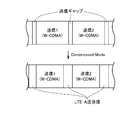
- ⁇ G. Handover to other system in W-CDMA system In the W-CDMA system, handover to another system (Inter-RAT handover) can be performed. In this case, a time during which data communication called “Compressed Mode” is not performed is set, and a cell of another system is searched within this time. That is, in the compressed mode, the wireless communication according to the W-CDMA system is temporarily interrupted, and measurements on other communication systems are performed.
- Inter-RAT handover Inter-RAT handover
- the following method is specified as a method for realizing such a compressed mode.
- FIG. 12 is a diagram for explaining a compressed mode in W-CDMA. As shown in FIG. 12, when a transmission frame of a certain time interval is defined, the transmission gap between the preceding transmission frame and the subsequent transmission frame is expanded, and the transmission / reception section (this embodiment) In the embodiment, the LTE-A system) is provided.
- the mobile station 100 transmits (or receives) data in the W-CDMA system during the specified gap period. Interrupt. That is, by controlling the switch 136 of the transmission module 130 and the switch 146 of the reception module 140 according to the timing, the LTE-A communication is validated and the LTE-A base station is searched only during the transmission gap period.
- Inter-RAT handover processing (related technology)>
- a certain mobile station performs handover (Inter-RAT handover) to the LTE-A system and starts CoMP during communication in the W-CDMA system. explain.
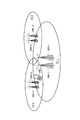
- FIG. 13 is a diagram schematically illustrating a positional relationship when the mobile station performs handover to the LTE-A system during W-CDMA system communication.
- FIG. 14 is a sequence diagram showing an operation example of handover processing from the W-CDMA system to the LTE-A system related to the embodiment of the present invention.
- a W-CDMA base station 200-1 and an LTE-A base station 300-1 are installed in the cell 10-1, and covers these base stations 200-1 and 300-1.
- the ranges (service provision ranges) are assumed to be substantially the same.
- a W-CDMA base station 200-2 and an LTE-A base station 300-2 are installed in the cell 10-2, and the base stations 200-2 and 300-2 cover these base stations 200-2 and 300-2.
- the ranges are assumed to be substantially the same.
- the W-CDMA base station 200-1 and the LTE-A base station 300-1 are arranged at substantially the same location, and the W-CDMA base station 200-2
- the LTE-A base station 300-2 is also arranged at substantially the same location.
- the W-CDMA base station 200-1 and the LTE-A base station 300-1 have substantially the same cell radius, and the W-CDMA base station 200-2 And the LTE-A base station 300-2 also have substantially the same cell radius.
- the mobile station 100 In the initial state, it is assumed that the mobile station 100 is communicating in the SHO mode. That is, it is assumed that the mobile station 100 performs parallel wireless communication between the base station 200-1 and the base station 200-2 of the W-CDMA system.
- the reception quality from the W-CDMA base station 200-1 is better than the reception quality from the W-CDMA base station 200-2. To do.
- the reception level (Received Signal Code Power: RSCP) and the radio quality Ec / N0 (energy-to-band reception power density ratio) reported from the mobile station 100 are used.
- RSCP Receiveived Signal Code Power
- Ec / N0 energy-to-band reception power density ratio
- SIR Signal to Interference Ratio
- the base station 200-1 of the W-CDMA system is a serving cell that transmits the HS-DSCH.
- the W-CDMA base station 200-1 is expressed as “W-CDMA base station (1)” in accordance with the description in FIG. 14 to FIG.
- 200-2 is expressed as “W-CDMA base station (2)”.
- the LTE-A base station 300-1 is expressed as “LTE-A base station (1)”
- the LTE-base station 300-2 is expressed as “LTE-A base station (2)”. In some cases.
- mobile station 100 is communicating with W-CDMA base station (1) and W-CDMA base station (2) according to the W-CDMA system (SHO mode) (sequence SQ200).
- W-CDMA system SHO mode
- the W-CDMA base station (1) deteriorates the quality of uplink data (DCH) (SIR: Signal to Interference Ratio) during communication with the mobile station 100 located in the cell. Suppose that it is detected (sequence SQ202). If the W-CDMA base station (1) determines that it is preferable to communicate with the LTE-A system based on an event such as quality degradation of the uplink data, the W-CDMA base station (1) transmits a compressed mode start request to the mobile station 100. (Sequence SQ204).
- DCH Downlink data
- SQ202 Signal to Interference Ratio
- the mobile station 100 When receiving the Compressed Mode start request, the mobile station 100 starts the Compressed Mode (sequence SQ206). Subsequently, mobile station 100 transmits a compressed mode start response to W-CDMA base station (1) and W-CDMA base station (2) (sequence SQ208).
- the W-CDMA base station (1) transmits a neighbor cell search request to the mobile station by using a Measurement Control message (sequence SQ210).
- a Measurement Control message (sequence SQ210).
- mobile station 100 starts searching for the requested neighbor cell (sequence SQ212). That is, the mobile station 100 measures the reception level (RSRP) and radio quality (RSRQ) of neighboring cells and determines whether or not the required condition is satisfied. Then, when there is a neighboring cell that satisfies the required condition, mobile station 100 transmits the measurement result to W-CDMA base station (1) using the Measurement Report message (sequence SQ214).
- RSRP reception level
- RSRQ radio quality
- the search target includes LTE-A base stations (1) and (2), and the reception level (RSRP) or radio quality (RSRQ) measured for the base station satisfies the conditions for performing handover To do.
- RSRP reception level
- RSRQ radio quality
- the W-CDMA base station (1) (or the radio network control device 40 shown in FIG. 3), the LTE-A base stations (1) and (2) (or Judgment is made as to whether or not handover from the W-CDMA system to the LTE-A system is permitted with the radio network control apparatus 44) shown in FIG. 3 (sequence SQ216).
- the W-CDMA base station (1) transmits a handover request to the mobile station 100 (sequence SQ218).
- the mobile station 100 When receiving the handover request, the mobile station 100 ends the Compressed Mode (sequence SQ220). It is assumed that the LTE-A base station (1) is designated as a serving cell. Then, mobile station 100 transmits a random access request to LTE-A base station (1) requested as the handover destination (sequence SQ222). When receiving the random access request, the LTE-A base station (1) transmits a random access response to the mobile station 100 (sequence SQ224). When receiving the random access response, the mobile station 100 transmits a handover completion notification to the LTE-A base station (1) (sequence SQ226).
- the above procedure is a handover process from the W-CDMA system to the LTE-A system. Subsequently, communication using the LTE-A method is started. In the LTE-A communication, CoMP is started depending on the situation.
- the reception level (RSRP) and the radio quality (RSRQ) are reported from the mobile station 100 to the LTE-A base station at a predetermined cycle or every predetermined event.
- the LTE-A base station of the serving cell can also determine the deterioration of communication quality.
- the mobile station 100 When receiving the Measurement Control message, the mobile station 100 starts searching for the requested neighboring cell (sequence SQ234). That is, the mobile station 100 measures the reception level (RSRP) and radio quality (RSRQ) of neighboring cells and determines whether or not the required condition is satisfied. Then, when there is a neighboring cell that satisfies the required condition, the mobile station 100 transmits the measurement result to the LTE-A base station (1) using the Measurement Report message (sequence SQ236).
- RSRP reception level
- RSRQ radio quality
- the LTE-A base station (1) When the LTE-A base station (1) receives the Measurement Report message, it determines whether or not to switch to CoMP Mode. That is, the LTE-A base station (1) should perform CoMP by determining whether the reception level (RSRP) and radio quality (RSRQ) of other cells exceed a certain threshold value. Determine whether or not.
- RSRP reception level
- RSRQ radio quality
- the LTE-A base station (1) transmits a CoMP Mode start request including a cell group of CoMP reporting set to the mobile station (sequence SQ238).
- the mobile station 100 measures the channel of the CoMP reporting set based on the CSI-RS from each cell included in the CoMP reporting set (sequence SQ240). Then, the mobile station 100 transmits a CoMP Mode start response to the LTE-A base station (1) (sequence SQ242). At this time, the mobile station 100 transmits CSI to the LTE-A base station (1) by the CSI reporting method notified in advance.
- the LTE-A base station (1) determines whether one of the two types of CoMP described above should be performed based on the communication status with other users and the like, and provides information necessary for performing the selected CoMP. Notification is made to another LTE-A base station that performs CoMP (sequence SQ244). At this time, it is assumed that the LTE-A base station (1) and the LTE-A base station (2) perform CoMP with the mobile station 100.
- the mobile station 100 communicates with the LTE-A base station (1) and / or the LTE-A base station (2) in the CoMP Mode in the LTE-A scheme. Starts communication (sequence SQ246).
- SF / 2 which is an example of the compressed mode
- the power is transmitted approximately twice to increase the transmission rate. For this reason, there is a problem that power consumption at the mobile station increases and the mobile station becomes an interference source for other mobile stations.
- high layer scheduling which is an example of a compressed mode, has a problem that the amount of data per unit time that can be transmitted is reduced. Therefore, it is preferable to shorten the time for turning on the Compressed Mode as much as possible.
- One object is to provide an Inter-RAT handover method that can be improved.
- Inter-RAT handover process (this embodiment)> As described above, in an environment where W-CDMA and LTE-A base stations are arranged in the same cell, if the mobile station 100 performs WHO in the W-CDMA SHO, -LTE-A bases located at the same positions as the W-CDMA base station 200 involved in the SHO after the handover from the CDMA system to the LTE-A system (Inter-RAT handover) There is a high possibility that CoMP can be implemented using the station 300.
- a base station participating in the SHO is designated as CoMP Reporting Set, It is determined whether CoMP can be performed after Inter-RAT handover in a shorter time. A more specific operation will be described with reference to the following sequence diagram.
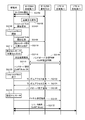
- FIG. 15 is a sequence diagram showing an operation example of handover processing (CoMP validation) from the W-CDMA system to the LTE-A system according to the embodiment of the present invention.
- FIG. 16 is a sequence diagram showing an operation example of handover processing (CoMP invalidation) from the W-CDMA system to the LTE-A system according to the embodiment of the present invention.
- mobile station 100 performs communication (SHO mode) in accordance with the W-CDMA system with W-CDMA base station (1) and W-CDMA base station (2).
- SHO mode communication
- W-CDMA base station (1) and W-CDMA base station (2) communication
- SQ100 sequence SQ100
- the W-CDMA base station (1) deteriorates the quality of uplink data (DCH) (SIR: Signal to Interference Ratio) during communication with the mobile station 100 located in the cell. Suppose that it is detected (sequence SQ102).
- DCH Downlink data
- SIR Signal to Interference Ratio
- the W-CDMA base station (1) or the W-CDMA base station (2) is connected in parallel between the mobile station 100 and the W-CDMA base station (1) and the W-CDMA base station (2). Based on the measurement result of the W-CDMA base station measured by the mobile station 100 during the wireless communication period, it is determined whether or not a handover from the W-CDMA scheme to the LTE-A scheme is necessary.
- the W-CDMA base station (1) determines that it is preferable to communicate with the LTE-A system based on an event such as quality degradation of the uplink data, the W-CDMA base station (1) transmits a compressed mode start request to the mobile station 100. (Sequence SQ104). When receiving the Compressed Mode start request, the mobile station 100 starts the Compressed Mode (sequence SQ106). Subsequently, mobile station 100 transmits a compressed mode start response to W-CDMA base station (1) and W-CDMA base station (2) (sequence SQ108).
- the W-CDMA base station (1) transmits a neighbor cell search request to the mobile station 100 using the Measurement Control message (sequence SQ110).
- the W-CDMA base station (1) has one LTE-A among the LTE-A base stations corresponding to each of the W-CDMA base stations currently involved in SHO with the mobile station 100.
- a base station is designated as a search target cell.
- an LTE-A base station (1) corresponding to the W-CDMA base station (1) and an LTE-A base station (2) corresponding to the W-CDMA base station (2) Assume that the LTE-A base station (1) corresponding to the W-CDMA base station (1) serving as the serving cell is designated.
- one LTE-A base station to be searched specified in the Measurement Control message is associated with a W-CDMA base station that is a serving cell in SHO with two or more W-CDMA base stations. It corresponds to an LTE-A base station.
- the mobile station 100 When receiving the neighbor cell search request, the mobile station 100 starts searching only the requested neighbor cell (LTE-A base station (1) in the example of FIG. 15) (sequence SQ112). That is, the mobile station 100 measures the reception level (RSRP) and radio quality (RSRQ) of the requested neighboring cell, and uses the Measurement Report message to send the measurement result report to the W-CDMA base station (1). Transmit (sequence SQ114).
- RSRP reception level
- RSRQ radio quality
- the wireless communication according to the W-CDMA scheme is temporarily interrupted to perform the LTE-A wireless communication.
- the mobile station 100 corresponds to one of the two or more W-CDMA base stations.
- the attached LTE-A base station is designated, and wireless communication according to the W-CDMA system is temporarily interrupted to request measurement for the designated LTE-A base station.
- the W-CDMA base station (1) (or the radio network control device 40 shown in FIG. 3), the LTE-A base stations (1) and (2) (or Judgment is made on whether or not handover from the W-CDMA system to the LTE-A system and CoMP Mode are validated with the radio network control apparatus 44) shown in FIG. 3 (sequence SQ116).
- the W-CDMA base station When it is determined that the handover from the W-CDMA scheme to the LTE-A scheme is permitted and the CoMP Mode after the handover to the LTE-A is to be enabled, the W-CDMA base station (1) A handover request is transmitted to mobile station 100 (sequence SQ118).
- the handover request includes a request for starting CoMP Mode.
- the W-CDMA base station (1) can change from the W-CDMA system to the LTE-A based on the measurement result of the designated LTE-A base station (LTE-A base station (1) in the example of FIG.
- a handover to the A method is notified to the mobile station 100, and two or more LTE-A base stations including the designated LTE-A base station communicate with each other in cooperation with the mobile station 100.
- the mobile station 100 is notified of a request for starting the cooperative mode (CoMP) in which the mobile station 100 is performed.
- CoMP cooperative mode
- the request for starting the cooperative mode included in the handover request includes information on a reporting method for reporting measurement results for two or more LTE-A base stations to the LTE-A base station. More specifically, the information on the reporting method to the LTE-A base station is a communication method for transmitting information of each channel measured by the mobile station 100 such as a feedback format and a transmission cycle regarding the LTE-A base station. Including the specification.
- the mobile station 100 When receiving the handover request, the mobile station 100 ends the Compressed Mode (sequence SQ120). That is, when the mobile station 100 is notified of the handover from the W-CDMA scheme to the LTE-A scheme, the mobile station 100 ends the operation of temporarily interrupting wireless communication according to the W-CDMA scheme.
- mobile station 100 transmits a random access request to LTE-A base station (1) (sequence SQ122).
- the LTE-A base station (1) transmits a random access response to the mobile station 100 (sequence SQ124).
- the mobile station 100 transmits a handover completion notification to the LTE-A base station (1) (sequence SQ126).
- the mobile station 100 performs processing necessary for starting CoMP Mode and then starts LTE-A communication (sequence SQ132).
- the mobile station 100 uses the LTE-A base stations (1) and (2) (CoMP reporting set) specified in the reporting method included in the information for turning on the CoMP Mode in the handover request. ) From CSI-RS. That is, when receiving the CoMP Mode start request, the mobile station 100 measures the channel of the CoMP reporting set based on the CSI-RS from each cell included in the CoMP reporting set (sequence SQ128). Then, mobile station 100 feeds back the channel estimation result measured based on the received CSI-RS to LTE-A base stations (1) and (2) according to the designated reporting method (feedback method) (sequence SQ130). ).
- PUSCH uplink shared channel
- PUCCH uplink control channel
- the LTE-A base stations (1) and (2) perform communication using one of the two types of CoMP described above. As described above, when the CoMP Mode start process is completed, the mobile station 100 communicates with the LTE-A base station (1) and the LTE-A base station (2) in the CoMP Mode according to the LTE-A system. Is started (sequence SQ130).
- the mobile station 100 adopts the first method in which communication is performed with only one LTE-A base station 300 instead of the plurality of LTE-A base stations 300, and if not, the second method is adopted. Can do.
- either the mobile station 100 or the LTE-A base station 300 has only one of the two types of CoMP described above. In such a case, information regarding the function restriction is transmitted to the LTE-A base station at the time of location registration of the mobile station.
- CoMP can be performed without performing cell measurement for other LTE-A base stations. That is, by setting the LTE-A base station located in the cell covered by the W-CDMA base station that has just performed SHO to CoMP Reporting Set, and making a determination based on feedback about these, CoMP can be performed immediately after the Inter-RAT handover while reducing the time of the compressed mode at the time of the Inter-RAT handover.
- a processing procedure as shown in FIG. 16 is executed. That is, referring to FIG. 16, when it is determined in sequence SQ116 that the handover from the W-CDMA scheme to the LTE-A scheme is permitted but the CoMP Mode after the handover to LTE-A cannot be validated, W-CDMA base station (1) transmits a handover request not including a request for starting CoMP Mode to mobile station 100 (sequence SQ218). When receiving the handover request, the mobile station 100 ends the Compressed Mode (sequence SQ220).
- the processing in the Inter-RAT handover according to the present embodiment is performed under predetermined conditions, that is, (a) the cell ranges of the W-CDMA scheme and the LTE-A scheme are substantially the same. b) It is directed to the fact that SHO (soft handover) in the W-CDMA system is performed immediately before handover. Therefore, it is determined in advance whether or not the Inter-RAT handover is necessary, whether or not the cell shape is applicable, and whether or not the SHO in the W-CDMA system is performed immediately before the handover. It may be determined whether the sequence as shown in FIG. 15 should be performed or the sequence as shown in FIG. 14 should be executed.
- one base station W-CDMA scheme and LTE-A scheme
- one cell includes a plurality of base stations. It may be divided into sectors and the above-described method may be performed on a sector-by-sector basis. That is, by providing a plurality of antennas having different directivities for each base station, one cell can be divided into a plurality of units called sectors.
- Rel-10 at the start of LTE-A does not implement CoMP (Inter-eNB) across cells, and does not implement CoMP (Intra) between sectors in a cell. Only eNB) may be implemented.
- CoMP Inter-eNB
- CoMP Intra
- the corresponding sets of sectors are not only arranged at the same position, but also configured to include antennas at the same position and having the same directivity.
- SF / 2 which is an example of the compressed mode
- power consumption can be reduced and the amount of interference with other mobile stations can be reduced.
- the amount of transmission data can be reduced.
Landscapes
- Engineering & Computer Science (AREA)
- Computer Networks & Wireless Communication (AREA)
- Signal Processing (AREA)
- Mobile Radio Communication Systems (AREA)
Abstract
Description
果に基づいて、第1の通信方式から第2の通信方式へのハンドオーバの要否を判断する手段をさらに含む。
図1は、本発明の実施の形態において想定している既存の通信システムのセル配置を説明するための図である。図2は、図1に示す既存の通信システムのセル配置に対して、新たな通信システムを設置する場合を説明するための図である。
図3は、本発明の実施の形態に従う通信システムを実現するためのネットワーク構成を示す図である。図4は、本発明の実施の形態に従う通信システムにおいて利用される基地局200,300のブロック図である。
図5は、本発明の実施の形態に従う通信システムにおいて利用される移動局100のブロック図である。
次に、図6を参照して、LTE方式およびLTE-A方式における物理レイヤについて説明する。LTE方式およびLTE-A方式における物理レイヤとしては、物理チャネル(下りおよび上り)ならびに物理シグナル(下りおよび上り)が定義されている。
下りの物理チャネル50としては、6種類の物理チャネル51~56が定義されている。
PDSCHでは、主として、ユーザデータおよび制御データが送信される。
PBCHでは、報知情報が送信される。
PMCHでは、放送などのマルチキャストデータが送信される。
PCFICHでは、PDCCHのシンボル数が通知される。
PDCCHでは、PDSCHおよびPUSCHのスケジューリング、ならびに、TPC(Transmission Power Control:送信電力制御)コマンドなどが送信される。
PHICHでは、PUSCHに対するHARQ(Hybrid Automatic Repeat reQuest:ハイブリッド自動再送要求)のACK/NACKが送信される。
上りの物理チャネル60としては、3種類の物理チャネル61~63が定義されている。
PUSCHでは、主として、ユーザデータおよび制御データが送信される。
PUCCHでは、PDSCHに対するHARQのACK/NACK、CQI(Channel Quality Information:チャネル品質情報)、PMI(Precoding Matrix Indication:プリコーディング・マトリックス・インディケータ)、および、RI(Rank Indication:ランク・インディケータ)などが送信される。
PRACHでは、ランダムアクセスのプリアンブルが送信される。
下りの物理シグナルとしては、2種類の物理シグナル71,72が定義されている。
RSは、チャネル推定やCQIの測定に使用される。
同期信号は、後述するセルサーチに使用される。
上りの物理シグナルとしては、1種類の物理シグナル73が定義されている。
RSは、チャネル推定やCQIの測定に使用される。
LTE-A方式においては、2つ以上のLTE-A基地局300が協調して移動局100との間で通信を行なう協調モードである、多地点協調送受信(CoMP)を実施可能である。このようなCoMPの方式としては、現時点では、以下のような内容が提案されている。
現在、下りリンクにCoMPを用いる方法として、主として、以下に示すような2種類の方法が検討されている。
第1の方法は、LTEと同様に、移動局は基地局と一対一で通信するが、隣接した複数の基地局が情報を共有することにより、スケジューリングやビームフォーミングを協調して行なうことで、干渉を低減させる方法である。
上りリンクにCoMPを用いる方法として、複数の基地局300が、移動局100から送信される信号を受信し、それらの信号を結合することによって、受信品質を向上させる方法が提案・検討されている。
次に、LTE-AにおけるCoMPの開始方法の一例について説明する。
LTEにおいて、移動局は、基地局(サービングセル)から提供される情報に基づいて、自身の属するセルの周辺セルを測定する。この基地局から提供される情報は、周辺セルリスト218を含む。この情報は、ブロードキャスト・チャネルまたは専用チャネル(PDSCH/下り共有チャネル)を介して基地局から移動局へ送信される。なお、周辺セルリスト218には、セルIDや受信レベルに基づいてオフセットを生じさせるための情報を含む。
次に、W-CDMA方式におけるソフトハンドオーバ(Soft Handover:以下「SHO」とも称す)について説明する。現在サービスが提供されているW-CDMA方式についても、1つの移動局が複数の基地局と通信する動作が3GPPによって規定されており、この動作がSHOである。但し、SHOは、上述のCoMPとは異なり、複数の基地局が同じデータを送信する。すなわち、SHOは、移動局と2つ以上の基地局との間での並列的な無線通信である。
(1) DCH(Dedicated Channel:個別チャネル)方式
ユーザデータの送信には、物理チャネルとしてDPDCH(Dedicated Physical Data Channel:個別物理データチャネル)が用いられる。
下りデータ送信には、物理チャネルとしてHS-DSCH(High Speed Downlink Shared Channel)が用いられる。
上りデータ送信には、物理チャネルとしてE-DCH(Enhanced Dedicated Channel)が用いられる。
W-CDMA方式では、他システムへのハンドオーバ(Inter-RATハンドオーバ)を行なうことも可能である。この場合には、Compressed Modeというデータ通信を行なわない時間を設定し、この時間内に他システムのセルが探索される。すなわち、Compressed Modeでは、W-CDMA方式に従う無線通信を一時的に中断して他の通信システムについての測定などが実施される。
(2) higher layer scheduling:送信ギャップ以外のスロットで送信できるビット数に合わせてTFC(Transport Format Set)を決定する方式
図12は、W-CDMAにおけるCompressed Modeを説明するための図である。図12に示すように、ある時間間隔の送信フレームが定義されている場合に、先行する送信フレームと後続の送信フレームとの間の送信ギャップを拡大して、他システムにおける送受信区間(本実施の形態においては、LTE-A方式)を設けることになる。
次に、上述のような処理動作に基づいて、ある移動局がW-CDMAのシステムで通信中にLTE-Aのシステムへハンドオーバ(Inter-RATハンドオーバ)し、CoMPを開始する場合の動作例について説明する。
上述したように、W-CDMAのシステムから他のシステムのセルへハンドオーバ(Inter-RATハンドオーバ)を行なうためには、Compressed Modeを使ってハンドオーバ先のセルを検出する必要がある。
上述したように、同一のセルにW-CDMAおよびLTE-Aの基地局がそれぞれ配置されているような環境下においては、移動局100がW-CDMA方式のSHOを実施していれば、W-CDMAのシステムからLTE-Aのシステムへのハンドオーバ(Inter-RATハンドオーバ)の実施後に、当該SHOに関わっていたW-CDMAの基地局200とそれぞれ同じ位置に配置されているLTE-Aの基地局300を用いて、CoMPを実施できる可能性が高い。
(1) 上述したように、本実施の形態に従うInter-RATハンドオーバにおける処理は、所定の条件下、すなわち、(a)W-CDMA方式およびLTE-A方式のセル範囲が実質的に同一、(b)ハンドオーバ直前にW-CDMA方式でのSHO(ソフトハンドオーバ)が実施されていること、に向けられたものである。そのため、Inter-RATハンドオーバが必要な状況であるか否か、適用可能なセル形状になっているか否か、ハンドオーバ直前にW-CDMA方式でのSHOが実施されているか否かといった条件を予め判断しておき、図15に示すようなシーケンスを実施すべきか、あるいは、図14に示すようなシーケンスを実施すべきかを判断してもよい。
本実施の形態によれば、W-CDMA方式からLTE-A方式へのInter-RATハンドオーバ時に、W-CDMA方式におけるCompressed ModeがONされている時間を短縮することができる。同時に、Inter-RATハンドオーバ先のLTE-A方式においてCoMP Modeを有効化した状態で通信を開始することができる。
Claims (8)
- 移動局(100)との間で第1の通信方式に従う無線通信を行なう複数の第1の基地局(200)と、
前記移動局との間で第2の通信方式に従う無線通信を行なう複数の第2の基地局(300)とを備え、前記複数の第2の基地局は、前記複数の第1の基地局とそれぞれ対応付けて配置されるとともに、対応付けられた前記第1の基地局と前記第2の基地局との各組においては、両基地局のセル範囲(10)は実質的に同一となるように構成されており、
前記移動局と2つ以上の前記第1の基地局との間での並列的な無線通信を開始するための手段と、
前記2つ以上の第1の基地局との間での並列的な無線通信の期間中において、前記移動局に対して、前記2つ以上の第1の基地局のうち1つに対応付けられた第2の基地局を指定するとともに、前記第1の通信方式に従う無線通信を一時的に中断して当該指定した第2の基地局についての測定を要求するための手段と、
前記指定した第2の基地局についての測定結果に基づいて、前記第1の通信方式から前記第2の通信方式へのハンドオーバを前記移動局へ通知するとともに、前記指定した第2の基地局を含む2つ以上の前記第2の基地局が協調して前記移動局との間で通信を行なう協調モードを開始するための要求を前記移動局へ通知するための手段とを備える、通信システム。 - 前記協調モードを開始するための要求は、前記2つ以上の第2の基地局についての測定結果の前記第2の基地局への報告方法の情報を含む、請求項1に記載の通信システム。
- 前記第2の基地局への報告方法の情報は、前記移動局で測定された各チャネルの情報を送信する通信方式の指定を含む、請求項2に記載の通信システム。
- 前記2つ以上の第2の基地局についての測定結果に基づいて、当該2つ以上の第2の基地局が協調して通信を行なうことができる複数の形態のうち、いずれか1つを選択する手段をさらに備える、請求項1~3のいずれか1項に記載の通信システム。
- 前記2つ以上の第1の基地局との間での並列的な無線通信の期間中において、前記移動局において測定される前記2つ以上の第1の基地局についての測定結果に基づいて、前記第1の通信方式から前記第2の通信方式へのハンドオーバの要否を判断する手段をさらに備える、請求項1~3のいずれか1項に記載の通信システム。
- 前記移動局は、前記第1の通信方式から前記第2の通信方式へのハンドオーバが通知されると、前記第1の通信方式に従う無線通信を一時的に中断する動作を終了する、請求項1~3のいずれか1項に記載の通信システム。
- 前記2つ以上の第1の基地局との間での並列的な無線通信におけるサービングセルである第1の基地局に対応付けられた第2の基地局が指定される、請求項1~3のいずれか1項に記載の通信システム。
- 移動局(100)との間で第1の通信方式に従う無線通信を行なう複数の第1の基地局(200)と、前記移動局との間で第2の通信方式に従う無線通信を行なう複数の第2の基地局(300)とを備えた通信システムにおける通信方法であって、前記複数の第2の基地局は、前記複数の第1の基地局とそれぞれ対応付けて配置されるとともに、対応付けられた前記第1の基地局と前記第2の基地局との各組においては、両基地局のセル範囲(10)は実質的に同一となるように構成されており、前記通信方法は、
前記移動局と2つ以上の前記第1の基地局との間での並列的な無線通信を開始するステップ(SQ100)と、
前記第1の基地局が、前記2つ以上の第1の基地局との間での並列的な無線通信の期間中において、前記移動局に対して、前記2つ以上の第1の基地局のうち1つに対応付けられた第2の基地局を指定するとともに、前記第1の通信方式に従う無線通信を一時的に中断して当該指定した第2の基地局についての測定を要求するステップ(SQ104,SQ110)と、
前記第1の基地局が、前記指定した第2の基地局についての測定結果を受信するステップ(SQ114)と、
前記第1の基地局が、前記第1の通信方式から前記第2の通信方式へのハンドオーバを前記移動局へ通知するとともに、前記指定した第2の基地局を含む2つ以上の前記第2の基地局が協調して前記移動局との間で通信を行なう協調モードを開始するための要求を前記移動局へ通知するステップ(SQ118)とを備える、通信方法。
Priority Applications (3)
| Application Number | Priority Date | Filing Date | Title |
|---|---|---|---|
| US13/637,886 US9215635B2 (en) | 2010-06-04 | 2011-05-30 | Communication system and communication method |
| JP2012518378A JP5792719B2 (ja) | 2010-06-04 | 2011-05-30 | 通信システムおよび通信方法 |
| CN201180023318.6A CN102893661B (zh) | 2010-06-04 | 2011-05-30 | 通信系统及通信方法 |
Applications Claiming Priority (2)
| Application Number | Priority Date | Filing Date | Title |
|---|---|---|---|
| JP2010128876 | 2010-06-04 | ||
| JP2010-128876 | 2010-06-04 |
Publications (1)
| Publication Number | Publication Date |
|---|---|
| WO2011152347A1 true WO2011152347A1 (ja) | 2011-12-08 |
Family
ID=45066714
Family Applications (1)
| Application Number | Title | Priority Date | Filing Date |
|---|---|---|---|
| PCT/JP2011/062370 Ceased WO2011152347A1 (ja) | 2010-06-04 | 2011-05-30 | 通信システムおよび通信方法 |
Country Status (4)
| Country | Link |
|---|---|
| US (1) | US9215635B2 (ja) |
| JP (1) | JP5792719B2 (ja) |
| CN (1) | CN102893661B (ja) |
| WO (1) | WO2011152347A1 (ja) |
Cited By (12)
| Publication number | Priority date | Publication date | Assignee | Title |
|---|---|---|---|---|
| CN103200629A (zh) * | 2012-01-10 | 2013-07-10 | 华为技术有限公司 | 基站切换方法、x2接口建立方法、基站、用户终端及系统 |
| WO2014012206A1 (en) * | 2012-07-16 | 2014-01-23 | Nec (China) Co., Ltd. | Method and apparatus for transmission mode switching in a wireless communication system |
| JP2014120782A (ja) * | 2012-12-13 | 2014-06-30 | Nippon Telegr & Teleph Corp <Ntt> | 分散無線通信基地局システムの制御方法及び集中制御局 |
| WO2014162357A1 (ja) * | 2013-04-04 | 2014-10-09 | 富士通株式会社 | 無線通信方法、無線通信システム、無線局および無線端末 |
| WO2014203298A1 (ja) * | 2013-06-21 | 2014-12-24 | 富士通株式会社 | 無線通信方法、無線通信システム、無線局および無線端末 |
| JP2015511100A (ja) * | 2012-03-19 | 2015-04-13 | クゥアルコム・インコーポレイテッドQualcomm Incorporated | 多地点協調送信スキームのためのチャネル状態情報基準信号の構成および報告 |
| JP2015512576A (ja) * | 2012-03-19 | 2015-04-27 | アルカテル−ルーセント | 協調マルチポイントを管理するための方法およびデバイス |
| JPWO2013141146A1 (ja) * | 2012-03-19 | 2015-08-03 | 京セラ株式会社 | 移動通信システム及び移動通信方法 |
| JP2016521524A (ja) * | 2013-05-06 | 2016-07-21 | クゥアルコム・インコーポレイテッドQualcomm Incorporated | 2次リンクがwlanリンクであるlteデュアル接続性の場合のハンドオーバの調整 |
| JP2018038016A (ja) * | 2016-09-02 | 2018-03-08 | 株式会社Nttドコモ | 基地局及び測定指示方法 |
| JP2018191335A (ja) * | 2018-08-06 | 2018-11-29 | 株式会社Nttドコモ | ユーザ端末 |
| JP2019115082A (ja) * | 2012-01-27 | 2019-07-11 | 三菱電機株式会社 | 移動体通信システム、基地局および移動端末 |
Families Citing this family (21)
| Publication number | Priority date | Publication date | Assignee | Title |
|---|---|---|---|---|
| US8787484B2 (en) * | 2010-06-18 | 2014-07-22 | Nec Corporation | Precoding techniques for downlink coordinated multipoint transmission in radio communications system |
| US9750010B2 (en) * | 2012-01-19 | 2017-08-29 | Kyocera Corporation | Base station and communication control method for managing CoMP cooperating set |
| CN103298051B (zh) * | 2012-02-24 | 2015-12-09 | 华为技术有限公司 | 一种切换方法及相关用户设备、系统 |
| EP2849521B1 (en) * | 2012-05-11 | 2019-02-20 | Huawei Technologies Co., Ltd. | Reference signal processing method, user equipment, and base station |
| CN104053165B (zh) * | 2013-03-14 | 2018-10-30 | 电信科学技术研究院 | 一种基站间测量时的通信处理方法及设备 |
| US9351211B2 (en) * | 2014-08-18 | 2016-05-24 | Telefonaktiebolaget L M Ericsson (Publ) | Release with redirect to LTE |
| EP3446515B1 (en) * | 2016-04-20 | 2020-12-02 | Convida Wireless, LLC | System information provisioning |
| JP6837492B2 (ja) | 2016-04-20 | 2021-03-03 | コンヴィーダ ワイヤレス, エルエルシー | 新しい無線における物理チャネル |
| WO2017184865A1 (en) | 2016-04-20 | 2017-10-26 | Convida Wireless, Llc | Configurable reference signals |
| KR102153077B1 (ko) | 2016-04-20 | 2020-09-07 | 콘비다 와이어리스, 엘엘씨 | 다운링크 동기화 |
| EP3455985B1 (en) | 2016-05-11 | 2022-03-09 | Convida Wireless, LLC | New radio downlink control channel |
| WO2017218847A1 (en) | 2016-06-15 | 2017-12-21 | Convida Wireless, Llc | Grant-less operations |
| JP2019518392A (ja) | 2016-06-15 | 2019-06-27 | コンヴィーダ ワイヤレス, エルエルシー | 新しい無線のための許可不要アップリンク伝送 |
| WO2017218849A1 (en) | 2016-06-15 | 2017-12-21 | Convida Wireless, Llc | Network slice discovery and selection |
| CN109565370B (zh) | 2016-06-15 | 2021-06-15 | 康维达无线有限责任公司 | 用于新无线电的上传控制信令的装置 |
| US10840982B2 (en) | 2016-08-11 | 2020-11-17 | Convidia Wireless, LLC | Beamforming sweeping and training in a flexible frame structure for new radio |
| CN109891772B (zh) | 2016-11-03 | 2022-10-04 | 康维达无线有限责任公司 | Nr中的帧结构 |
| CN108156609B (zh) * | 2016-12-02 | 2022-08-19 | 中兴通讯股份有限公司 | 小区合并、拆分方法、装置及基站 |
| US10797731B2 (en) * | 2017-03-10 | 2020-10-06 | Microsoft Technology Licensing, Llc | Software defined radio for auxiliary receiver |
| CN112753265B (zh) | 2018-09-27 | 2025-02-11 | 交互数字专利控股公司 | 新无线电的未经许可的频谱中的子频带操作 |
| WO2021093098A1 (en) * | 2019-12-23 | 2021-05-20 | Zte Corporation | Systems and methods for multi-node communication in wireless communication networks |
Citations (2)
| Publication number | Priority date | Publication date | Assignee | Title |
|---|---|---|---|---|
| JP2001169330A (ja) * | 1999-10-22 | 2001-06-22 | Hyundai Electronics Ind Co Ltd | 移動通信システムおよび該システムにおける非同期式基地局と同期式基地局との間のハンドオフ処理方法 |
| JP2007259238A (ja) * | 2006-03-24 | 2007-10-04 | Nec Corp | 異周波セルを有する移動通信システムにおけるハードハンドオーバ方法 |
Family Cites Families (10)
| Publication number | Priority date | Publication date | Assignee | Title |
|---|---|---|---|---|
| FI91345C (fi) * | 1992-06-24 | 1994-06-10 | Nokia Mobile Phones Ltd | Menetelmä kanavanvaihdon tehostamiseksi |
| US7245919B2 (en) * | 2003-06-19 | 2007-07-17 | Lucent Technologies Inc. | Parallel multiple measurement message handling for soft handoff in CDMA systems |
| EP1713206A1 (en) * | 2005-04-11 | 2006-10-18 | Last Mile Communications/Tivis Limited | A distributed communications network comprising wirelessly linked base stations |
| US7649869B2 (en) | 2005-08-12 | 2010-01-19 | Qualcomm, Incorporated | Efficient cell measurements during transmission gaps in a compressed mode |
| CN101064956B (zh) * | 2006-04-28 | 2011-06-15 | 华为技术有限公司 | 长期演进网络的用户设备在相异系统间的切换方法 |
| US8078171B2 (en) * | 2007-06-15 | 2011-12-13 | Intel Corporation | Handoff of a mobile station from a first to a second type of wireless network |
| US8620320B2 (en) * | 2007-06-19 | 2013-12-31 | Motorola Mobility Llc | Methods for handing over calls between communication networks using dissimilar air interfaces |
| JP2009077287A (ja) * | 2007-09-21 | 2009-04-09 | Ntt Docomo Inc | 移動通信システムで使用されるユーザ装置、基地局装置及び方法 |
| KR101425440B1 (ko) * | 2008-01-14 | 2014-08-04 | 삼성전자주식회사 | 멀티-스테이션의 연합 자원 할당 및 연합 그룹 핸드오버를위한 이동통신 시스템 및 연합 자원 할당 방법 |
| CN101640901B (zh) * | 2009-04-29 | 2013-05-08 | 北京邮电大学 | 基于上行协作多点的数据合并接收方法 |
-
2011
- 2011-05-30 CN CN201180023318.6A patent/CN102893661B/zh not_active Expired - Fee Related
- 2011-05-30 US US13/637,886 patent/US9215635B2/en not_active Expired - Fee Related
- 2011-05-30 WO PCT/JP2011/062370 patent/WO2011152347A1/ja not_active Ceased
- 2011-05-30 JP JP2012518378A patent/JP5792719B2/ja not_active Expired - Fee Related
Patent Citations (2)
| Publication number | Priority date | Publication date | Assignee | Title |
|---|---|---|---|---|
| JP2001169330A (ja) * | 1999-10-22 | 2001-06-22 | Hyundai Electronics Ind Co Ltd | 移動通信システムおよび該システムにおける非同期式基地局と同期式基地局との間のハンドオフ処理方法 |
| JP2007259238A (ja) * | 2006-03-24 | 2007-10-04 | Nec Corp | 異周波セルを有する移動通信システムにおけるハードハンドオーバ方法 |
Cited By (19)
| Publication number | Priority date | Publication date | Assignee | Title |
|---|---|---|---|---|
| CN103200629A (zh) * | 2012-01-10 | 2013-07-10 | 华为技术有限公司 | 基站切换方法、x2接口建立方法、基站、用户终端及系统 |
| US9743329B2 (en) | 2012-01-10 | 2017-08-22 | Huawei Technologies Co., Ltd. | Base station handover method, X2 interface setup method, base station, user equipment and system |
| US12375131B2 (en) | 2012-01-27 | 2025-07-29 | Mitsubishi Electric Corporation | Mobile communication system |
| JP2019115082A (ja) * | 2012-01-27 | 2019-07-11 | 三菱電機株式会社 | 移動体通信システム、基地局および移動端末 |
| JPWO2013141146A1 (ja) * | 2012-03-19 | 2015-08-03 | 京セラ株式会社 | 移動通信システム及び移動通信方法 |
| JP2015511100A (ja) * | 2012-03-19 | 2015-04-13 | クゥアルコム・インコーポレイテッドQualcomm Incorporated | 多地点協調送信スキームのためのチャネル状態情報基準信号の構成および報告 |
| JP2015512576A (ja) * | 2012-03-19 | 2015-04-27 | アルカテル−ルーセント | 協調マルチポイントを管理するための方法およびデバイス |
| US9544878B2 (en) | 2012-03-19 | 2017-01-10 | Kyocera Corporation | Mobile communication system and mobile communication method |
| US10154478B2 (en) | 2012-03-19 | 2018-12-11 | Kyocera Corporation | Mobile communication system and mobile communication method |
| CN104272798B (zh) * | 2012-07-16 | 2018-06-15 | 日电(中国)有限公司 | 用于在无线通信系统中进行传输模式切换的方法和装置 |
| WO2014012206A1 (en) * | 2012-07-16 | 2014-01-23 | Nec (China) Co., Ltd. | Method and apparatus for transmission mode switching in a wireless communication system |
| CN104272798A (zh) * | 2012-07-16 | 2015-01-07 | 日电(中国)有限公司 | 用于在无线通信系统中进行传输模式切换的方法和装置 |
| JP2014120782A (ja) * | 2012-12-13 | 2014-06-30 | Nippon Telegr & Teleph Corp <Ntt> | 分散無線通信基地局システムの制御方法及び集中制御局 |
| JPWO2014162357A1 (ja) * | 2013-04-04 | 2017-02-16 | 富士通株式会社 | 無線通信方法、無線通信システム、無線局および無線端末 |
| WO2014162357A1 (ja) * | 2013-04-04 | 2014-10-09 | 富士通株式会社 | 無線通信方法、無線通信システム、無線局および無線端末 |
| JP2016521524A (ja) * | 2013-05-06 | 2016-07-21 | クゥアルコム・インコーポレイテッドQualcomm Incorporated | 2次リンクがwlanリンクであるlteデュアル接続性の場合のハンドオーバの調整 |
| WO2014203298A1 (ja) * | 2013-06-21 | 2014-12-24 | 富士通株式会社 | 無線通信方法、無線通信システム、無線局および無線端末 |
| JP2018038016A (ja) * | 2016-09-02 | 2018-03-08 | 株式会社Nttドコモ | 基地局及び測定指示方法 |
| JP2018191335A (ja) * | 2018-08-06 | 2018-11-29 | 株式会社Nttドコモ | ユーザ端末 |
Also Published As
| Publication number | Publication date |
|---|---|
| US9215635B2 (en) | 2015-12-15 |
| CN102893661B (zh) | 2016-05-11 |
| JPWO2011152347A1 (ja) | 2013-08-01 |
| JP5792719B2 (ja) | 2015-10-14 |
| US20130017833A1 (en) | 2013-01-17 |
| CN102893661A (zh) | 2013-01-23 |
Similar Documents
| Publication | Publication Date | Title |
|---|---|---|
| JP5792719B2 (ja) | 通信システムおよび通信方法 | |
| TWI744439B (zh) | 波束改變指令接收失敗期間的回退波束選擇程序 | |
| JP6185476B2 (ja) | 協調マルチポイント(comp)無線リソース管理(rrm)測定 | |
| US9025487B2 (en) | Reference signal port discovery involving transmission points | |
| US20150263836A1 (en) | Method of mobility management for mobile terminal in a heterogeneous network environment | |
| US20170332427A1 (en) | Mobile communication system | |
| JP5069283B2 (ja) | 移動通信システムにおけるユーザ装置、基地局装置及び通信制御方法 | |
| US9763157B2 (en) | User terminal, cellular base station, and processor | |
| JP6174285B1 (ja) | 移動通信方法及び無線基地局 | |
| JP2015520527A (ja) | 複数ポイント協調リソース管理測定 | |
| JP2020145718A (ja) | マルチショットcsi−rsを送信する方法,及びユーザ装置 | |
| JP2015526913A (ja) | 複数ポイント協調リソース管理測定 | |
| US20200187104A1 (en) | Terminal, radio communication method, and base station | |
| CN103384386A (zh) | 上行通信方法及终端 | |
| CN103220119B (zh) | 一种检测载波同步的方法及装置 | |
| US9596070B2 (en) | Methods and apparatuses for device-to-device communication | |
| CN107809770B (zh) | 传输数据的方法、基站和用户设备 | |
| CN103384388B (zh) | 确定主小区主站点方法、测量方法、信息发送方法及装置 | |
| US20230130847A1 (en) | Aligning du/mt transmission timing | |
| US20230089106A1 (en) | Systems and methods for operating during a transition phase when a wireless device transitions between operational scenarios | |
| WO2014203298A1 (ja) | 無線通信方法、無線通信システム、無線局および無線端末 |
Legal Events
| Date | Code | Title | Description |
|---|---|---|---|
| WWE | Wipo information: entry into national phase |
Ref document number: 201180023318.6 Country of ref document: CN |
|
| 121 | Ep: the epo has been informed by wipo that ep was designated in this application |
Ref document number: 11789750 Country of ref document: EP Kind code of ref document: A1 |
|
| WWE | Wipo information: entry into national phase |
Ref document number: 2012518378 Country of ref document: JP |
|
| WWE | Wipo information: entry into national phase |
Ref document number: 13637886 Country of ref document: US |
|
| NENP | Non-entry into the national phase |
Ref country code: DE |
|
| 122 | Ep: pct application non-entry in european phase |
Ref document number: 11789750 Country of ref document: EP Kind code of ref document: A1 |