WO2011136268A1 - 新規なセフェム誘導体 - Google Patents
新規なセフェム誘導体 Download PDFInfo
- Publication number
- WO2011136268A1 WO2011136268A1 PCT/JP2011/060259 JP2011060259W WO2011136268A1 WO 2011136268 A1 WO2011136268 A1 WO 2011136268A1 JP 2011060259 W JP2011060259 W JP 2011060259W WO 2011136268 A1 WO2011136268 A1 WO 2011136268A1
- Authority
- WO
- WIPO (PCT)
- Prior art keywords
- compound
- group
- amino group
- substituent
- ring
- Prior art date
- Legal status (The legal status is an assumption and is not a legal conclusion. Google has not performed a legal analysis and makes no representation as to the accuracy of the status listed.)
- Ceased
Links
- 0 CC(C)C(C1)CC(C2)C1CC2(CC1)CC11C(CCCC2(C*CC3CC3)CCC2)CC1 Chemical compound CC(C)C(C1)CC(C2)C1CC2(CC1)CC11C(CCCC2(C*CC3CC3)CCC2)CC1 0.000 description 17
- BSPQCADUVHIGSI-UHFFFAOYSA-N CC(C)C(c1nccc(O)c1O)=O Chemical compound CC(C)C(c1nccc(O)c1O)=O BSPQCADUVHIGSI-UHFFFAOYSA-N 0.000 description 1
- ZGRPYMWLBUTCPI-UHFFFAOYSA-O CC(c(cc(c(O)c1)O)[n+]1OC)=O Chemical compound CC(c(cc(c(O)c1)O)[n+]1OC)=O ZGRPYMWLBUTCPI-UHFFFAOYSA-O 0.000 description 1
- BNDZAWBMBNYZFE-UHFFFAOYSA-N CC(c(cncc1O)c1O)=O Chemical compound CC(c(cncc1O)c1O)=O BNDZAWBMBNYZFE-UHFFFAOYSA-N 0.000 description 1
- QAQQXMMSCNGAEJ-UHFFFAOYSA-N CC(c(nc1O)ccc1O)=O Chemical compound CC(c(nc1O)ccc1O)=O QAQQXMMSCNGAEJ-UHFFFAOYSA-N 0.000 description 1
- HWQPOUOOBLCEFX-UHFFFAOYSA-N CC(c1cnc(CCO)c(O)c1)=O Chemical compound CC(c1cnc(CCO)c(O)c1)=O HWQPOUOOBLCEFX-UHFFFAOYSA-N 0.000 description 1
- IJEAVDULOVRJBH-KAMYIIQDSA-N CCCN(CCCC[N+](C1)(C(/C=C(/C)\S(C(C)C)(=O)=O)=O)[O-])C1=O Chemical compound CCCN(CCCC[N+](C1)(C(/C=C(/C)\S(C(C)C)(=O)=O)=O)[O-])C1=O IJEAVDULOVRJBH-KAMYIIQDSA-N 0.000 description 1
- UAIBKAJJHZCVNP-UHFFFAOYSA-N CCCS(NC(c1cnc(C)cc1O)=O)(=O)=O Chemical compound CCCS(NC(c1cnc(C)cc1O)=O)(=O)=O UAIBKAJJHZCVNP-UHFFFAOYSA-N 0.000 description 1
- OFUIFLZWMQEMFY-UHFFFAOYSA-N Oc(ccnn1)c1O Chemical compound Oc(ccnn1)c1O OFUIFLZWMQEMFY-UHFFFAOYSA-N 0.000 description 1
Classifications
-
- C—CHEMISTRY; METALLURGY
- C07—ORGANIC CHEMISTRY
- C07D—HETEROCYCLIC COMPOUNDS
- C07D501/00—Heterocyclic compounds containing 5-thia-1-azabicyclo [4.2.0] octane ring systems, i.e. compounds containing a ring system of the formula:, e.g. cephalosporins; Such ring systems being further condensed, e.g. 2,3-condensed with an oxygen-, nitrogen- or sulfur-containing hetero ring
- C07D501/14—Compounds having a nitrogen atom directly attached in position 7
- C07D501/16—Compounds having a nitrogen atom directly attached in position 7 with a double bond between positions 2 and 3
- C07D501/20—7-Acylaminocephalosporanic or substituted 7-acylaminocephalosporanic acids in which the acyl radicals are derived from carboxylic acids
- C07D501/24—7-Acylaminocephalosporanic or substituted 7-acylaminocephalosporanic acids in which the acyl radicals are derived from carboxylic acids with hydrocarbon radicals, substituted by hetero atoms or hetero rings, attached in position 3
- C07D501/48—Methylene radicals, substituted by hetero rings
- C07D501/56—Methylene radicals, substituted by hetero rings with the 7-amino radical acylated by carboxylic acids containing hetero rings
-
- A—HUMAN NECESSITIES
- A61—MEDICAL OR VETERINARY SCIENCE; HYGIENE
- A61P—SPECIFIC THERAPEUTIC ACTIVITY OF CHEMICAL COMPOUNDS OR MEDICINAL PREPARATIONS
- A61P31/00—Antiinfectives, i.e. antibiotics, antiseptics, chemotherapeutics
- A61P31/04—Antibacterial agents
-
- C—CHEMISTRY; METALLURGY
- C07—ORGANIC CHEMISTRY
- C07D—HETEROCYCLIC COMPOUNDS
- C07D501/00—Heterocyclic compounds containing 5-thia-1-azabicyclo [4.2.0] octane ring systems, i.e. compounds containing a ring system of the formula:, e.g. cephalosporins; Such ring systems being further condensed, e.g. 2,3-condensed with an oxygen-, nitrogen- or sulfur-containing hetero ring
- C07D501/14—Compounds having a nitrogen atom directly attached in position 7
- C07D501/16—Compounds having a nitrogen atom directly attached in position 7 with a double bond between positions 2 and 3
- C07D501/20—7-Acylaminocephalosporanic or substituted 7-acylaminocephalosporanic acids in which the acyl radicals are derived from carboxylic acids
- C07D501/24—7-Acylaminocephalosporanic or substituted 7-acylaminocephalosporanic acids in which the acyl radicals are derived from carboxylic acids with hydrocarbon radicals, substituted by hetero atoms or hetero rings, attached in position 3
- C07D501/38—Methylene radicals, substituted by nitrogen atoms; Lactams thereof with the 2-carboxyl group; Methylene radicals substituted by nitrogen-containing hetero rings attached by the ring nitrogen atom; Quaternary compounds thereof
- C07D501/42—Methylene radicals, substituted by nitrogen atoms; Lactams thereof with the 2-carboxyl group; Methylene radicals substituted by nitrogen-containing hetero rings attached by the ring nitrogen atom; Quaternary compounds thereof with the 7-amino radical acylated by an araliphatic carboxylic acid
-
- C—CHEMISTRY; METALLURGY
- C07—ORGANIC CHEMISTRY
- C07D—HETEROCYCLIC COMPOUNDS
- C07D501/00—Heterocyclic compounds containing 5-thia-1-azabicyclo [4.2.0] octane ring systems, i.e. compounds containing a ring system of the formula:, e.g. cephalosporins; Such ring systems being further condensed, e.g. 2,3-condensed with an oxygen-, nitrogen- or sulfur-containing hetero ring
- C07D501/14—Compounds having a nitrogen atom directly attached in position 7
- C07D501/16—Compounds having a nitrogen atom directly attached in position 7 with a double bond between positions 2 and 3
- C07D501/20—7-Acylaminocephalosporanic or substituted 7-acylaminocephalosporanic acids in which the acyl radicals are derived from carboxylic acids
- C07D501/24—7-Acylaminocephalosporanic or substituted 7-acylaminocephalosporanic acids in which the acyl radicals are derived from carboxylic acids with hydrocarbon radicals, substituted by hetero atoms or hetero rings, attached in position 3
- C07D501/38—Methylene radicals, substituted by nitrogen atoms; Lactams thereof with the 2-carboxyl group; Methylene radicals substituted by nitrogen-containing hetero rings attached by the ring nitrogen atom; Quaternary compounds thereof
- C07D501/44—Methylene radicals, substituted by nitrogen atoms; Lactams thereof with the 2-carboxyl group; Methylene radicals substituted by nitrogen-containing hetero rings attached by the ring nitrogen atom; Quaternary compounds thereof with the 7-amino radical acylated by an araliphatic carboxylic acid, which is substituted on the aliphatic radical by hetero atoms
-
- C—CHEMISTRY; METALLURGY
- C07—ORGANIC CHEMISTRY
- C07D—HETEROCYCLIC COMPOUNDS
- C07D501/00—Heterocyclic compounds containing 5-thia-1-azabicyclo [4.2.0] octane ring systems, i.e. compounds containing a ring system of the formula:, e.g. cephalosporins; Such ring systems being further condensed, e.g. 2,3-condensed with an oxygen-, nitrogen- or sulfur-containing hetero ring
- C07D501/14—Compounds having a nitrogen atom directly attached in position 7
- C07D501/16—Compounds having a nitrogen atom directly attached in position 7 with a double bond between positions 2 and 3
- C07D501/20—7-Acylaminocephalosporanic or substituted 7-acylaminocephalosporanic acids in which the acyl radicals are derived from carboxylic acids
- C07D501/24—7-Acylaminocephalosporanic or substituted 7-acylaminocephalosporanic acids in which the acyl radicals are derived from carboxylic acids with hydrocarbon radicals, substituted by hetero atoms or hetero rings, attached in position 3
- C07D501/38—Methylene radicals, substituted by nitrogen atoms; Lactams thereof with the 2-carboxyl group; Methylene radicals substituted by nitrogen-containing hetero rings attached by the ring nitrogen atom; Quaternary compounds thereof
- C07D501/46—Methylene radicals, substituted by nitrogen atoms; Lactams thereof with the 2-carboxyl group; Methylene radicals substituted by nitrogen-containing hetero rings attached by the ring nitrogen atom; Quaternary compounds thereof with the 7-amino radical acylated by carboxylic acids containing hetero rings
-
- C—CHEMISTRY; METALLURGY
- C07—ORGANIC CHEMISTRY
- C07D—HETEROCYCLIC COMPOUNDS
- C07D501/00—Heterocyclic compounds containing 5-thia-1-azabicyclo [4.2.0] octane ring systems, i.e. compounds containing a ring system of the formula:, e.g. cephalosporins; Such ring systems being further condensed, e.g. 2,3-condensed with an oxygen-, nitrogen- or sulfur-containing hetero ring
- C07D501/14—Compounds having a nitrogen atom directly attached in position 7
- C07D501/16—Compounds having a nitrogen atom directly attached in position 7 with a double bond between positions 2 and 3
- C07D501/20—7-Acylaminocephalosporanic or substituted 7-acylaminocephalosporanic acids in which the acyl radicals are derived from carboxylic acids
- C07D501/24—7-Acylaminocephalosporanic or substituted 7-acylaminocephalosporanic acids in which the acyl radicals are derived from carboxylic acids with hydrocarbon radicals, substituted by hetero atoms or hetero rings, attached in position 3
- C07D501/48—Methylene radicals, substituted by hetero rings
- C07D501/54—Methylene radicals, substituted by hetero rings with the 7-amino radical acylated by an araliphatic carboxylic acid, which is substituted on the aliphatic radical by hetero atoms
-
- C—CHEMISTRY; METALLURGY
- C07—ORGANIC CHEMISTRY
- C07D—HETEROCYCLIC COMPOUNDS
- C07D519/00—Heterocyclic compounds containing more than one system of two or more relevant hetero rings condensed among themselves or condensed with a common carbocyclic ring system not provided for in groups C07D453/00 or C07D455/00
-
- C—CHEMISTRY; METALLURGY
- C07—ORGANIC CHEMISTRY
- C07D—HETEROCYCLIC COMPOUNDS
- C07D519/00—Heterocyclic compounds containing more than one system of two or more relevant hetero rings condensed among themselves or condensed with a common carbocyclic ring system not provided for in groups C07D453/00 or C07D455/00
- C07D519/06—Heterocyclic compounds containing more than one system of two or more relevant hetero rings condensed among themselves or condensed with a common carbocyclic ring system not provided for in groups C07D453/00 or C07D455/00 containing at least one condensed beta-lactam ring system, provided for by groups C07D463/00, C07D477/00 or C07D499/00 - C07D507/00, e.g. a penem or a cepham system
Definitions
- the present invention relates to a cephem compound having a broad antibacterial spectrum against gram-negative bacteria and gram-positive bacteria, particularly showing strong antibacterial activity against ⁇ -lactamase-producing gram-negative bacteria, and a pharmaceutical composition containing the same.
- ⁇ -lactamases are roughly classified into four classes. That is, Class A (TEM type, SHV type, CTX-M type, etc.), Class B (IMP type, VIM type, L-1 type, etc.), Class C (AmpC type, etc.), Class D (OXA type, etc.) is there. Of these, class A, C, and D types are broadly classified into serine- ⁇ -lactamases, while class B types are broadly classified into metallo- ⁇ -lactamases, which are known to hydrolyze ⁇ -lactam drugs by different mechanisms. ing.
- Class A TEM type, SHV type, CTX-M type, etc.
- Class B IMP type, VIM type, L-1 type, etc.
- Class C AmpC type, etc.
- Class D OXA type, etc.
- class A type ESBL
- class D type serine- ⁇ -lactamases and class B type metallo- ⁇ -lactamases with an extended substrate range has led to the enhancement of many ⁇ -lactam drugs including cephem and carbapenem.
- ⁇ -lactam drugs including cephem and carbapenem.
- the presence of resistant gram-negative bacteria is becoming a clinical problem.
- metallo- ⁇ -lactamase is known to contribute to multidrug resistance of Gram-negative bacteria.
- Cephem compounds that show moderate activity against metallo- ⁇ -lactamase-producing gram-negative bacteria are known (eg, Patent Document 1 and Non-Patent Document 1), but have stronger antibacterial activity, especially various ⁇ -
- cephem compounds having a catechol group in the molecule are known (eg, Non-Patent Documents 2 to 4).
- the action is due to the fact that the catechol group forms a chelate with Fe 3+ , so that the compound is efficiently taken up into the cell body via the Fe 3+ transport system (tonB-dependent iron transport system) on the cell membrane.
- Fe 3+ transport system nonB-dependent iron transport system
- Patent Documents 2 to 8 and Non-Patent Document 5 describe compounds having a partial structure of the 7-position side chain and a quaternary salt structure in the cephem skeleton. However, in these documents, only the pyridinium structure is described, and most of them only have a formamide group at the 7-position. For example, most of those disclosed in Patent Document 2 have a penicillin skeleton.
- Non-Patent Document 1 and Patent Documents 8 to 12 and 15 include catechol-type derivatives having catechol at the 3-position side chain site of the cephem skeleton, and Patent Documents 10, 11, 13, and 14 describe the 3-position side chain of the cephem skeleton. Pseudo catechol type derivatives having a hydroxypyridone group at the site are described. Patent Documents 16 and 17 disclose cephem compounds having a quaternary ammonium group, but do not describe catechol-type derivatives.
- the applicant has filed a cephem compound having a catechol type substituent (international patent application PCT / JP2009 / 068400).
- the applicant has already filed a cephem antibacterial agent having strong antibacterial activity against ⁇ -lactamase-producing gram-negative bacteria (Japanese Patent Application Nos. 2010-087130 and 2010-087131).
- the present invention provides a cephem compound exhibiting a strong antibacterial spectrum against various bacteria including Gram negative bacteria and / or Gram positive bacteria.
- a cephem compound is provided that exhibits a strong antibacterial spectrum against both Gram negative and Gram positive bacteria. More preferably, a cephem compound that exhibits strong antibacterial activity against ⁇ -lactamase-producing gram-negative bacteria is provided. More preferably, a cephem compound exhibiting strong antibacterial activity against multi-drug resistant bacteria, particularly class B type metallo- ⁇ -lactamase-producing gram-negative bacteria is provided. Most preferably, a cephem compound that exhibits effective antibacterial activity also against a substrate-specific extended ⁇ -lactamase (ESBL) -producing bacterium is provided.
- ESBL substrate-specific extended ⁇ -lactamase
- the present invention provides a cephem compound having the following structure and solving the above problems.
- R 1 is a carbocyclic group that may have a substituent, or a heterocyclic group that may have a substituent
- R 2A and R 2B a) R 2A may have a hydrogen atom, an amino group that may have a substituent, —SO 3 H, an aminosulfonyl group that may have a substituent, a carboxyl group, or a substituent.
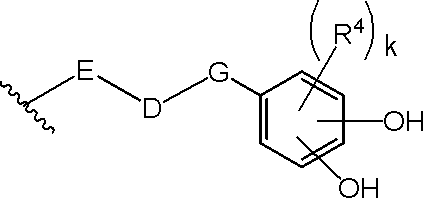
- Ring A is a benzene ring or a 6-membered aromatic heterocyclic group having 1 to 3 nitrogen atoms
- R 3 is a hydrogen atom, —OCH 3 or —NH—CH ( ⁇ O)
- k is an integer from 0 to 2
- R 4 each independently represents a hydrogen atom, a halogen, a hydroxyl group, —CN, —C ( ⁇ O) —R 6 , —C ( ⁇ O) —OH, —C ( ⁇ O) —OR 6 or —OR 6.
- R 6 is lower alkyl or halo lower alkyl
- D is a single bond, —N (R 8 ) — or —R 7 —N (R 8 ) —
- R 7 is an optionally substituted lower alkylene
- R 8 is hydrogen or Lower alkyl
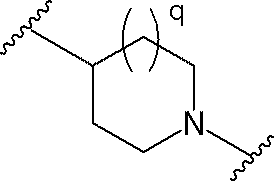
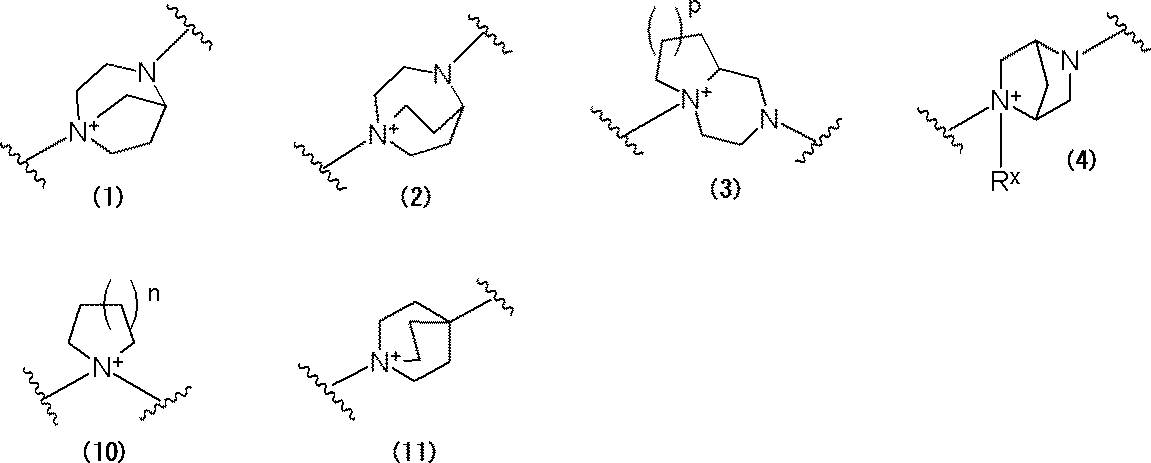
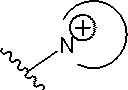
- E is a quaternary ammonium group which may have a substituent selected from the following formulas (1) to (40) and (42) to (53), or
- D is the group shown below:
- E is a quaternary ammonium group represented by the following formula (10) or (41).
- a quaternary ammonium group of E in the following formula, the binding site on the left side binds to methylene and the binding site on the right side binds to D):
- D is a single bond, —NH—, or —R 7 —NH— (wherein R 7 is as defined in item 1),
- R 7 is as defined in item 1
- the compound according to item 1 an ester, or a protected form of the amino group or a pharmaceutically acceptable salt or solvate thereof when an amino group is present on the ring of the 7-position side chain.
- D is -NH -, - is CH 2 -NH- or -CH 2 -CH 2 -NH-,
- the compound according to item 1 or 2 an ester, or a protected form of the amino group when an amino group is present on the ring of the 7-position side chain, or a pharmaceutically acceptable salt or solvate thereof.
- D is a single bond, The compound according to item 1 or 2, an ester, or a protected form of the amino group when an amino group is present on the ring of the 7-position side chain, or a pharmaceutically acceptable salt or solvate thereof. .
- (Item 6) E is selected from the formulas (1) to (9), (11) to (40), (47) to (49) and (51) to (52).
- (Item 7) E is selected from the formulas (5), (6), (9) to (11), (26), (29) to (34), (36), (37) and (50), The compound according to any one of items 1 to 5, an ester, or a protected body of the amino group when an amino group is present on the ring of the 7-position side chain, or a pharmaceutically acceptable salt thereof, or a Solvate.
- (Item 8) E is selected from formulas (5), (6), (10) and (11), The compound according to any one of items 1 to 5, an ester, or a protected body of the amino group when an amino group is present on the ring of the 7-position side chain, or a pharmaceutically acceptable salt thereof, or a Solvate.
- (Item 9) E represents the formulas (1) to (4), (7), (8), (12) to (25), (27), (28), (35), (38) to (40), (47) And (48) The compound according to any one of items 1 to 5, an ester, or a protected body of the amino group when an amino group is present on the ring of the 7-position side chain, or a pharmaceutically acceptable salt thereof, or a Solvate.
- E is selected from formulas (1) to (3), (7) and (12), The compound according to any one of items 1 to 5, an ester, or a protected body of the amino group when an amino group is present on the ring of the 7-position side chain, or a pharmaceutically acceptable salt thereof, or a Solvate.
- U is -S- The compound according to any one of Items 1 to 10, an ester, or a protected form of the amino group when the amino group is present on the ring of the 7-position side chain, or a pharmaceutically acceptable salt thereof, or their Solvate.
- (Item 12) W is —CH 2 —.
- R 3 is a hydrogen atom or —OCH 3 ,
- R 1 is phenyl which may have a substituent, The compound according to any one of Items 1 to 16, an ester, or a protected form of the amino group when an amino group is present on the ring of the 7-position side chain, or a pharmaceutically acceptable salt thereof, or their Solvate.
- R 2A is a hydrogen atom, an optionally substituted amino group, —SO 3 H, an optionally substituted aminosulfonyl group, a carboxyl group, and an optionally substituted carbamoyl group. , A hydroxyl group, or a carbonyloxy group having a substituent, The compound according to any one of Items 1 to 17, an ester, or a protected form of the amino group when the amino group is present on the ring of the 7-position side chain, or a pharmaceutically acceptable salt thereof, or a Solvate.
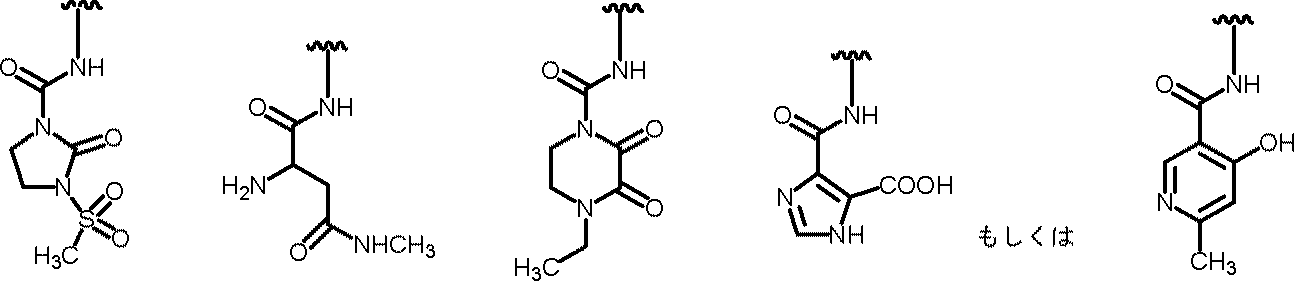
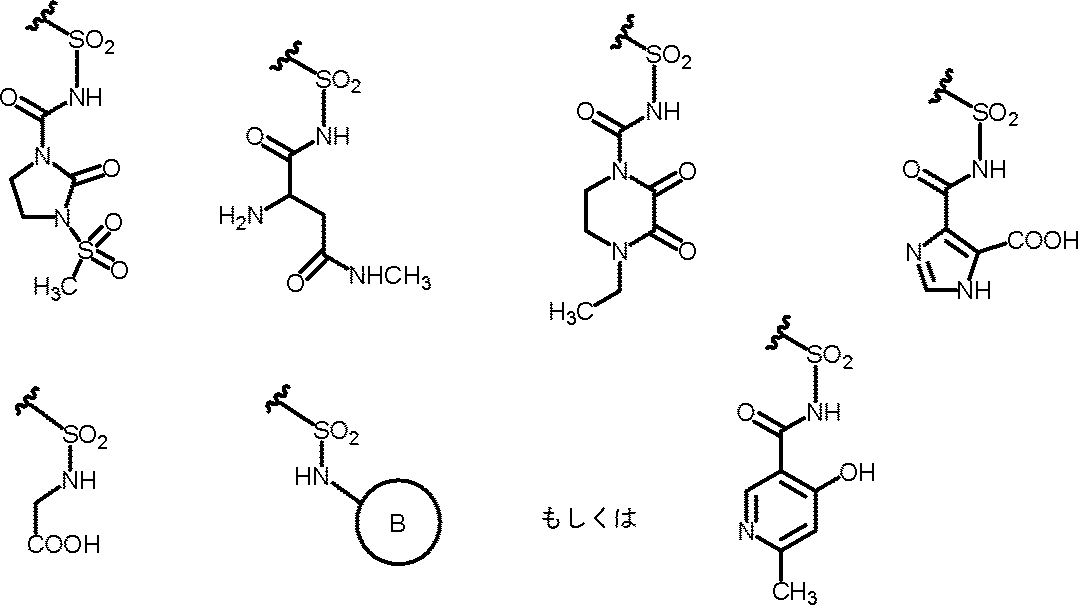
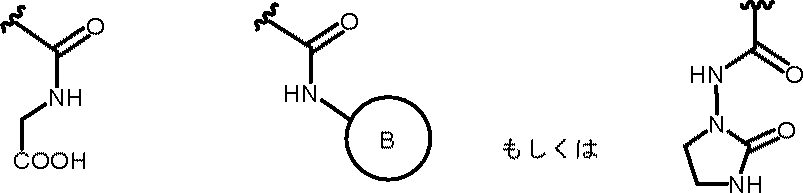
- R 2A is an amino group having a substituent shown below
- ring B represents a heterocyclic group which may have a substituent
- ring B represents a heterocyclic group which may have a substituent
- Is The compound according to any one of Items 1 to 17, an ester, or a protected form of the amino group when the amino group is present on the ring of the 7-position side chain, or a pharmaceutically acceptable salt thereof, or a Solvate.
- R 2A and R 2B together represent the following alkenyl group having a substituent
- R 7 and R 8 each independently represent a hydrogen atom, halogen, hydroxy, carboxy, an optionally substituted lower alkyl, an optionally substituted carbocyclic group, or a substituent. Which may have a heterocyclic group, or R 7 and R 8 may have a carbocyclic group or a substituent which may have a substituent together with an adjacent atom. May form a heterocyclic group, R 9 is an optionally substituted lower alkyl, m represents an integer of 0 to 3); Is, The compound according to any one of Items 1 to 17, an ester, or a protected form of the amino group when the amino group is present on the ring of the 7-position side chain, or a pharmaceutically acceptable salt thereof, or a Solvate.
- Item 22 Item 22.
- (Item 23) A method for treating an infectious disease, comprising administering an antibacterial effective amount of the compound according to any one of items 1 to 20 to a human.
- the compound according to the present invention is useful as a pharmaceutical in that it has at least one of the following characteristics. 1) It exhibits a strong antibacterial spectrum against various bacteria including Gram negative bacteria and / or Gram positive bacteria. 2) Strong antibacterial activity against ⁇ -lactamase-producing gram-negative bacteria. 3) Strong antibacterial activity against multi-drug resistant bacteria, especially class B type metallo- ⁇ -lactamase producing Gram-negative bacteria. 4) It shows strong antibacterial activity against substrate-specific extended ⁇ -lactamase (ESBL) -producing bacteria. 5) No cross-resistance with existing cephem and / or carbapenem drugs. 6) Does not show side effects such as fever after in vivo administration.
- ESBL substrate-specific extended ⁇ -lactamase
- Halogen includes fluorine, chlorine, bromine and iodine. Preferred are fluorine, chlorine and bromine, and more preferred is chlorine.
- “Lower alkyl” includes linear or branched alkyl having 1 to 8, preferably 1 to 6 and more preferably 1 to 4 carbon atoms, such as methyl, ethyl, n-propyl, isopropyl. N-butyl, isobutyl, sec-butyl, tert-butyl, n-pentyl, isopentyl, neopentyl, hexyl, isohexyl, n-heptyl, isoheptyl, n-octyl and the like.
- “Lower alkylene” includes linear alkylene having 1 to 8, preferably 1 to 6, more preferably 1 to 4 and most preferably 1 or 2 carbon atoms, such as methylene, ethylene, n-propylene. N-butylene, n-pentylene, n-hexylene and the like.
- halo lower alkyl is a group substituted with one or more of the “halogen” at any position of the “lower alkyl”, and examples thereof include monofluoromethyl, difluoromethyl, trifluoromethyl, monochloromethyl, Examples include dichloromethyl, trichloromethyl, monobromomethyl, monofluoroethyl, monochloroethyl, chlorodifluoromethyl and the like. Preferred are trifluoromethyl and trichloromethyl.
- substituents of “optionally substituted amino” or “optionally substituted carbamoyl” include mono- or di-lower alkyl, lower alkylcarbonyl or lower alkylsulfonyl, and substituents.
- Lower alkyl eg, methyl, ethyl, isopropyl, benzyl, carbamoylalkyl (eg, carbamoylmethyl), mono- or di-lower alkylcarbamoyl lower alkyl (eg, dimethylcarbamoylethyl), hydroxy lower alkyl, heterocycle lower Alkyl (e.g., morpholinoethyl, tetrahydropyranylethyl), alkoxycarbonyl lower alkyl (e.g., ethoxycarbonylmethyl, ethoxycarbonylethyl), mono- or di-lower alkylamino lower alkyl (e.g., dimethylaminoethyl)),
- Alkenyl means a linear or branched alkenyl having 2 to 8 carbon atoms having one or more double bonds to the “lower alkyl”, and examples thereof include vinyl, 1-propenyl, Examples include 2-propenyl, 1-butenyl, 2-butenyl, 3-butenyl, 1,3-butadienyl, 3-methyl-2-butenyl and the like. Preferably, it is lower alkenyl, and lower alkenyl is alkenyl having 2 to 6 carbon atoms, more preferably 2 to 4 carbon atoms.
- the amino group of “optionally substituted amino” or “optionally substituted carbamoyl” includes a sulfur atom and / or oxygen together with two adjacent nitrogen atoms of the amino group.
- a nitrogen-containing heterocycle preferably a 5- to 7-membered ring and preferably saturated which may contain atoms in the ring may be formed, and the ring is substituted with oxo or hydroxy. You may have.
- the sulfur atom forming the ring may have oxo as a substituent.
- a 5-membered or 6-membered ring such as piperazinyl, piperidino, morpholino, pyrrolidino, 2-oxopiperidino, 2-oxopyrrolidino, 4-hydroxymorpholino and the like are preferable.
- the substituent of “lower alkyl optionally having substituent (s)” includes one or more groups selected from substituent group ⁇ . When substituted with a plurality of substituent groups ⁇ , the substituent groups ⁇ may be the same or different.
- lower alkylene optionally having substituent (s) includes lower alkyl optionally having substituent (s) and one or more groups selected from substituent group ⁇ . When substituted with a plurality of substituents, the substituents may be the same or different.
- lower alkyloxycarbonyl optionally having substituent (s) includes lower alkyl optionally having substituent (s) and one or more groups selected from substituent group ⁇ .
- the substituent of “carbonyloxy having a substituent” is 1 selected from lower alkyl which may have a substituent, amino having a heterocyclic group as a substituent, and substituent group ⁇ . The above groups are mentioned.
- substituent of “optionally substituted oxime” lower alkyl (methyl, ethyl, isopropyl etc.) optionally having substituent (particularly carboxyl etc.), heterocyclic as substituent And amino having a group, and one or more groups selected from the substituent group ⁇ .
- the substituent of the “quaternary ammonium group optionally having substituent (s) the lower alkyl optionally having substituent (s), one or more groups selected from the substituent group ⁇ , or two The above substituents together form a carbocyclic group or a heterocyclic group.
- the “substituent group ⁇ ” is halogen, hydroxy, lower alkoxy, hydroxy lower alkoxy, lower alkoxy lower alkoxy, carboxy, amino, acylamino, lower alkylamino, imino, hydroxyimino, lower alkoxyimino, lower alkylthio, carbamoyl. , Lower alkylcarbamoyl, hydroxy lower alkylcarbamoyl, sulfamoyl, lower alkylsulfamoyl, lower alkylsulfinyl, cyano, nitro, carbocyclic group and heterocyclic group.
- substituent in the “lower alkyl optionally having substituent (s)” are fluorine atom, chlorine atom, bromine atom, hydroxy, carboxy, methoxy, ethoxy, hydroxymethoxy, hydroxyethoxy, methoxymethoxy, methoxyethoxy Amino, acetylamino, methylamino, dimethylamino, imino, hydroxyimino, methoxyimino, methylthio, carbamoyl, methylcarbamoyl, hydroxymethylcarbamoyl, sulfamoyl, methylsulfamoyl, lower alkylsulfamoyl, cyano, nitro, phenyl, Examples include cyclopropyl, cyclobutyl, cyclohexyl, pyridyl, morpholinyl and the like.
- Preferred embodiments of “optionally substituted lower alkyl” include methyl, ethylisopropyl, tert-butyl, monofluoromethyl, difluoromethyl, trifluoromethyl, carboxymethyl, carboxyethyl, carbamoylmethyl, carbamoylethyl Hydroxymethyl, hydroxyethyl, methoxymethyl, ethoxymethyl, methoxyethyl, ethoxyethyl, methylthiomethyl, ethylthiomethyl, benzyl, phenethyl, 4-hydroxybenzyl, 4-methoxybenzyl, 4-carboxybenzyl and the like.
- Carbocyclic group includes cycloalkyl, cycloalkenyl, aryl, non-aromatic fused carbocyclic group, and the like.
- “Cycloalkyl” is a carbocyclic group having 3 to 10 carbon atoms, preferably 3 to 8 carbon atoms, more preferably 4 to 8 carbon atoms.
- Cycloalkenyl includes those having one or more double bonds at any position in the ring of the cycloalkyl, specifically, cyclopropenyl, cyclobutenyl, cyclopentenyl, cyclohexenyl, cyclo Examples include heptynyl, cyclooctynyl and cyclohexadienyl.
- Aryl includes phenyl, naphthyl, anthryl, phenanthryl and the like, with phenyl being particularly preferred.
- non-aromatic fused carbocyclic group includes a group in which two or more cyclic groups selected from the above “cycloalkyl”, “cycloalkenyl” and “aryl” are condensed, specifically indanyl , Indenyl, tetrahydronaphthyl, fluorenyl and the like.
- Heterocyclic group includes a heterocyclic group having one or more heteroatoms arbitrarily selected from O, S and N, specifically, pyrrolyl, imidazolyl, pyrazolyl, pyridyl, pyridazinyl.
- substituents of “optionally substituted carbocyclic group” and “optionally substituted heterocyclic group” include lower alkyl optionally having substituent, And one or more groups selected from the substituent group ⁇ .
- Preferred embodiments of the substituents in the “optionally substituted carbocyclic group” and the “optionally substituted heterocyclic group” include methyl, ethylisopropyl, tert-butyl, Fluorine atom, chlorine atom, bromine atom, hydroxy, carboxy, methoxy, ethoxy, hydroxymethoxy, hydroxyethoxy, methoxymethoxy, methoxyethoxy, amino, acetylamino, methylamino, dimethylamino, imino, hydroxyimino, methoxyimino, methylthio, Carbamoyl, methylcarbamoyl, hydroxymethylcarbamoyl, sulfamoyl, methylsulfamoyl, tecum alkylsulfamoyl, cyano, nitro, phenyl, cyclopropyl, cyclobutyl, cyclohexyl, pyrid
- Examples of the “6-membered aromatic heterocyclic group having 1 to 3 nitrogen atoms” include pyridine, pyrimidine, pyridazine, pyrazine, 1,3,5-triazine, 1,2,4-triazine, 1,2,2, Examples include 3-triazine.
- R 1 optionally substituted carbocyclic group or optionally substituted heterocyclic group
- R 1 include, for example, phenyl, hydroxyphenyl, and halogen as a substituent.
- examples thereof include phenyl, hydroxyphenyl, aminothiazole, aminothiazole having halogen as a substituent, aminothiadiazole, thiophene, furan, benzothiazole, pyridine, pyrimidine, pyridazine, and aminopyridine.
- R 2A and R 2B are defined as follows. That is, a) R 2A may have a hydrogen atom, an amino group that may have a substituent, —SO 3 H, an aminosulfonyl group that may have a substituent, a carboxyl group, or a substituent.
- R 2A examples include a hydrogen atom, an amino group that may have a substituent, —SO 3 H, an aminosulfonyl group that may have a substituent, a carboxyl group, and a substituent.
- ring B represents a heterocyclic group which may have a substituent
- ring B represents a heterocyclic group which may have a substituent
- R 2A and R 2B together represent the following alkenyl group having a substituent
- R 7 and R 8 each independently represent a hydrogen atom, halogen, hydroxy, carboxy, an optionally substituted lower alkyl, an optionally substituted carbocyclic group, or a substituent. Which may have a heterocyclic group, or R 7 and R 8 may have a carbocyclic group or a substituent which may have a substituent together with an adjacent atom. May form a heterocyclic group, R 9 is an optionally substituted lower alkyl, m represents an integer of 0 to 3.
- R 7 and R 8 together with adjacent atoms form an optionally substituted carbocyclic group or optionally substituted heterocyclic group include:
- R 7 and R 8 form a cycloalkyl, cycloalkenyl, or non-aromatic heterocyclic group which may have a group selected from the substituent group ⁇ on the ring.
- R 7 and R 8 form a cycloalkyl, cycloalkenyl, or non-aromatic heterocyclic group which may have a group selected from the substituent group ⁇ on the ring.
- the “cyclic group optionally having a substituent selected from any one of the formulas (1) to (40) or (42) to (53)” of E is a carbon atom on each cyclic group.
- Preferred embodiments of the substituent include methyl, ethylisopropyl, tert-butyl, fluorine atom, chlorine atom, bromine atom, hydroxy, carboxy, methoxy, ethoxy, hydroxymethoxy, hydroxyethoxy, methoxymethoxy, methoxyethoxy, amino, acetylamino , Methylamino, dimethylamino, imino, hydroxyimino, methoxyimino, methylthio, carbamoyl, methylcarbamoyl, hydroxymethylcarbamoyl, sulfamoyl, methylsulfamoyl, lower alkylsulfamoyl, cyano, nitro, phenyl, cyclopropyl, cyclobutyl, Examples include cyclohexyl, pyridyl, morpholinyl and the like.
- a more preferred embodiment is unsubstituted.
- W is —CH 2 —
- U is —CH 2 —, —S— or —O—. More preferably, “W” is —CH 2 —, “U” is —S— or —O—, and more preferably, “W” is —CH 2 — and “U” is —S—.
- R 7 and R 8 examples include hydrogen atom, fluorine atom, chlorine atom, hydroxy, carboxy, methyl, ethyl, isopropyl, tert-butyl, monofluoromethyl, difluoromethyl, trifluoromethyl, carboxymethyl, carboxy Ethyl, carbamoylmethyl, carbamoylethyl, hydroxymethyl, hydroxyethyl, methoxymethyl, ethoxymethyl, methoxyethyl, ethoxyethyl, methylthiomethyl, ethylthiomethyl, benzyl, 4-hydroxybenzyl, 4-methoxybenzyl, 4-carboxybenzyl, Phenyl, naphthyl, cyclopropyl, cyclobutyl, cyclopentyl, cyclohexyl, pyrrolyl, imidazolyl, pyrazolyl, pyridyl, pyridazinyl,
- R 7 and R 8 is that (R 7 , R 8 ) is (hydrogen atom, hydrogen atom), (methyl, hydrogen atom), (hydrogen atom, methyl), (methyl, methyl), (ethyl, (Hydrogen atom), (hydrogen atom, ethyl), (ethyl, ethyl), (phenyl, hydrogen atom), (hydrogen atom, phenyl), (carboxymethyl, hydrogen atom), (hydrogen atom, carboxymethyl), (carboxyethyl) , Hydrogen atom), (hydrogen atom, carboxyethyl), (hydroxyethyl, hydrogen atom), (hydrogen atom, hydroxylethyl), (carbamoylmethyl, hydrogen atom), (hydrogen atom, carbamoylmethyl), (trifluoromethyl, (Hydrogen atom), (carboxy, hydrogen atom), (carbamoylethyl, hydrogen atom), (benzyl
- R 7 and R 8 together with adjacent atoms form a carbocyclic group which may have a substituent or a heterocyclic group which may have a substituent”
- Embodiments include 3- to 8-membered cycloalkyl, 3- to 8-membered cycloalkenyl, or 3- to 8-membered non-aromatic heterocyclic groups. More preferably the formula:
- R 3 is preferably a hydrogen atom or —OCH 3 , more preferably a hydrogen atom.
- R 4 include hydrogen atom, chlorine atom, fluorine atom, bromine atom, cyano, hydroxy, acetyl, methoxy, ethoxy, trifluoromethyl and the like.
- R 4 is a hydrogen atom, hydroxy, or chlorine atom.
- D is a single bond, —N (R 8 ) — or —R 7 —N (R 8 ) —, R 7 is an optionally substituted lower alkylene, and R 8 is hydrogen or Lower alkyl, and E is a quaternary ammonium group which may have a substituent selected from the formulas (1) to (40) and (42) to (53) of Item 1, or b) D is the group shown below:
- E is a quaternary ammonium group represented by the formula (10) or (41) of item 1.
- Examples of “—ED— (C ⁇ O) —” include the following formulas (1A) to (53A):
- R x include methyl, ethyl, trifluoromethyl, carboxymethyl, carbamoylmethyl, hydroxyethyl and the like.
- Preferred embodiments of “—ED— (C ⁇ O) —” include the following formulas (1B) to (53B):
- a preferred embodiment of the ring A is a 6-membered aromatic heterocyclic group having 1 to 3 nitrogen atoms.
- R 4 is a hydrogen atom, a chlorine atom or hydroxy.
- K is preferably 0 or 1.
- the ester form of the formula (I) preferably includes an ester form on the 7-position side chain and / or the 4-position carboxyl group.
- the ester in the carboxyl group on the 7-position side chain has the formula:
- each symbol has the same meaning as item 1.
- R 1 or R 2A or R 2B represented by the formula it has an amino group which may have a substituent, an aminosulfonyl group which may have a substituent, a carboxyl group, and a substituent.
- carboxyl (—COOH ) represented by a structure of —COOR a shown together with R a indicating an ester residue such as a carboxyl protecting group, etc.
- the ester at the 4-position carboxyl group of formula (I) is the formula:
- each symbol has the same meaning as in item 1, and R b represents an ester residue such as a carboxyl protecting group.
- R b represents an ester residue such as a carboxyl protecting group.
- esters include esters that are readily metabolized in the body to the carboxy state.
- Protecting groups such as carboxyl described above include Protective Groups in Organic Synthesis, T. et al. W. By Green, John Wiley & Sons Inc. (1991) and the like, and any group that can be protected and / or deprotected, such as lower alkyl (eg, methyl, ethyl, t-butyl), lower alkylcarbonyloxymethyl (eg, pivaloyl), Examples thereof include an optionally substituted aralkyl (eg, benzyl, benzhydryl, phenethyl, p-methoxybenzyl, p-nitrobenzyl), a silyl group (eg, t-butyldimethylsilyl, diphenyl t-butylsilyl) and the like.
- lower alkyl eg, methyl, ethyl, t-butyl
- lower alkylcarbonyloxymethyl eg, pivaloyl
- Examples thereof include an
- the protector in the amino group on the 7-position side chain of formula (I) is the formula:
- each symbol has the same meaning as item 1, and when R 1 and / or R 2A has an amino group, the protector is represented by the formula —NHR c , where R c Represents an amino protecting group.
- R c represents an amino protecting group.
- the amino protecting group also includes groups that are easily metabolized in the body to become amino. Examples of the amino protecting group include Protective Groups in Organic Synthesis, T. et al. W. By Green, John Wiley & Sons Inc. (1991) and the like, and any group that can be protected and / or deprotected can be used.
- R 1 is aminothiazole whose amino group may be protected or aminothiadiazole whose amino group may be protected” means the following formula:
- R c is an amino protecting group
- the salt of formula (I) is a salt in which the hydrogen atom of the carboxyl group at the 4-position, the carboxyl group at the 7-position and / or the hydroxyl group of the pyridone derivative is dissociated to form a salt with the counter cation, the 7-position side
- Examples of the pharmaceutically acceptable salt of the formula (I) include salts formed with inorganic bases, ammonia, organic bases, inorganic acids, organic acids, basic amino acids, halogen ions, and the like, or intramolecular salts.
- Examples of the inorganic base include alkali metals (Na, K, etc.), alkaline earth metals (Mg, etc.), and examples of organic bases include procaine, 2-phenylethylbenzylamine, dibenzylethylenediamine, ethanolamine, diethanolamine, and trishydroxymethyl. Examples include aminomethane, polyhydroxyalkylamine, N-methylglucosamine and the like.
- Examples of the inorganic acid include hydrochloric acid, hydrobromic acid, sulfuric acid, nitric acid, phosphoric acid and the like.
- Examples of the organic acid include p-toluenesulfonic acid, methanesulfonic acid, formic acid, acetic acid, trifluoroacetic acid, maleic acid and the like.
- Examples of basic amino acids include lysine, arginine, ornithine, histidine and the like.
- solvate means a solvate with water or an organic solvent (for example, methanol, ethanol, isopropyl alcohol, acetone), preferably a hydrate.
- the compound (I) of the present invention is not limited to a specific isomer, but includes all possible isomers, racemates and resonance structures as exemplified below.
- Y represents a leaving group (for example, hydroxy, halogen (Cl, Br, I), optionally substituted carbamoyloxy, acyloxy, methanesulfonyloxy, toluenesulfonyloxy, etc.)
- Re represents hydrogen or an amino protecting group.
- Compound (IX) is obtained by reacting a compound represented by the formula (wherein R pro is hydrogen or a carboxy protecting group, and other symbols are as defined above). In this case, preferably R b is a carboxy protecting group and R pro and R e are hydrogen.
- the compound of formula (VI) can be obtained using commercially available reagents and / or known methods.
- the amount of compound (VI) to be used is generally about 1 to 5 mol, preferably 1 to 2 mol, per 1 mol of compound (VII).
- reaction solvent examples include ethers (eg, dioxane, tetrahydrofuran, diethyl ether, tert-butyl methyl ether, diisopropyl ether), esters (eg, ethyl formate, ethyl acetate, isopropyl acetate), halogenated hydrocarbons (eg, : Dichloromethane, chloroform, carbon tetrachloride), hydrocarbons (eg n-hexane, benzene, toluene), amides (eg formamide, N, N-dimethylformamide, N, N-dimethylacetamide, N-methylpyrrolidone) ), Ketones (eg, acetone, methyl ethyl ketone), nitriles (eg, MeCN, propionitrile), dimethyl sulfoxide, water, or a mixed solvent thereof.
- ethers eg, dioxane
- the reaction temperature is usually about ⁇ 40 to 80 ° C., preferably about ⁇ 20 to 50 ° C., more preferably about ⁇ 10 to 30 ° C.
- the carboxyl moiety is converted into a reactive derivative (eg, inorganic base salt, organic base salt, acid halide, acid azide, acid anhydride, mixed acid anhydride, active amide, active ester, active thioester). You may go.
- a reactive derivative eg, inorganic base salt, organic base salt, acid halide, acid azide, acid anhydride, mixed acid anhydride, active amide, active ester, active thioester.
- Examples of the inorganic base include alkali metals (eg, Na, K, etc.), alkaline earth metals (eg, Ca, Mg), and examples of the organic base include trimethylamine, triethylamine, tert-butyldimethylamine, dibenzylmethylamine, benzyl Dimethylamine, N-methylmorpholine, diisopropylethylamine, etc., as acid halide, acid chloride, acid bromide, etc., as mixed acid anhydride, monoalkyl carbonate mixed acid anhydride, aliphatic carboxylic acid mixed acid anhydride, aromatic
- active amides include carboxylic acid mixed acid anhydrides and organic sulfonic acid mixed acid anhydrides, and amides with nitrogen-containing heterocyclic compounds.
- Examples of the active ester include organic phosphates (eg, diethoxyphosphate, diphenoxyphosphate, etc.), p-nitrophenyl ester, 2,4-dinitrophenyl ester, cyanomethyl ester and the like.
- Examples of the active thioester include an ester with an aromatic heterocyclic thiol compound (eg, 2-pyridylthiol ester). In the above reaction, an appropriate condensing agent may be used if desired.
- condensing agent examples include 1-dimethylaminopropyl-3-ethylcarbodiimide / hydrochloride (WSCD / HCl), N, N′-dicyclohexylcarbodiimide, N, N′-carbonyldiimidazole, N, N′-thiocarbonyldi Imidazole, N-ethoxycarbonyl-2-ethoxy-1,2-dihydroquinoline, phosphorus oxychloride, alkoxyacetylene, 2-chloropyridinium methyl iodide, 2-fluoropyridinium methyl iodide, trifluoroacetic anhydride and the like are used.
- R b is a carboxy protecting group.
- the amount of the corresponding tertiary amine to be used is generally 1 to 5 mol, preferably 1 to 2 mol, per 1 mol of compound (IX).
- reaction solvent examples include ethers (eg, dioxane, tetrahydrofuran, diethyl ether, tert-butyl methyl ether, diisopropyl ether), esters (eg, ethyl formate, ethyl acetate, isopropyl acetate), halogenated hydrocarbons (eg, : Dichloromethane, chloroform, carbon tetrachloride), hydrocarbons (eg n-hexane, benzene, toluene), amides (eg formamide, N, N-dimethylformamide, N, N-dimethylacetamide, N-methylpyrrolidone) ), Ketones (eg, acetone, methyl ethyl ketone), nitriles (eg, acetonitrile (MeCN), propionitrile), dimethyl sulfoxide, water, or a mixed solvent thereof.
- ethers
- the reaction temperature is usually ⁇ 20 to 60 ° C., preferably ⁇ 10 to 40 ° C., more preferably 0 to 20 ° C.
- the reducing agent include potassium iodide-acetyl chloride.
- R b is a carboxy protecting group and R e is an amino protecting group.
- the amount of the corresponding tertiary amine to be used is generally 1 to 5 mol, preferably 1 to 2 mol, per 1 mol of compound (VII).
- reaction solvent examples include ethers (eg, dioxane, tetrahydrofuran, diethyl ether, tert-butyl methyl ether, diisopropyl ether), esters (eg, ethyl formate, ethyl acetate, isopropyl acetate), halogenated hydrocarbons (eg, : Dichloromethane, chloroform, carbon tetrachloride), hydrocarbons (eg n-hexane, benzene, toluene), amides (eg formamide, N, N-dimethylformamide, N, N-dimethylacetamide, N-methylpyrrolidone) ), Ketones (eg, acetone, methyl ethyl ketone), nitriles (eg, MeCN, propionitrile), dimethyl sulfoxide, water, or a mixed solvent thereof.
- ethers eg, dioxane
- the reaction temperature is usually ⁇ 20 to 60 ° C., preferably ⁇ 10 to 40 ° C., more preferably 0 to 20 ° C.
- the tertiary amine moiety (corresponding to the substituent E in Item 1) used in the 3rd-position side chain formation reaction in the second step and the third step are all commercially available reagents, known methods and / or the present specification. Can be obtained by the method described in 1. above.
- Compound (X) is obtained by reacting compound (VIII) and compound (VI).
- R b is a carboxy protecting group
- R c is an amino protecting group
- R pro and R e are hydrogen.
- the amount of compound (VI) to be used is generally about 1 to 5 mol, preferably 1 to 2 mol, per 1 mol of compound (VIII).
- reaction solvent examples include ethers (eg, dioxane, tetrahydrofuran, diethyl ether, tert-butyl methyl ether, diisopropyl ether), esters (eg, ethyl formate, ethyl acetate, isopropyl acetate), halogenated hydrocarbons (eg, : Dichloromethane, chloroform, carbon tetrachloride), hydrocarbons (eg n-hexane, benzene, toluene), amides (eg formamide, N, N-dimethylformamide, N, N-dimethylacetamide, N-methylpyrrolidone) ), Ketones (eg, acetone, methyl ethyl ketone), nitriles (eg, MeCN, propionitrile), dimethyl sulfoxide, water, or a mixed solvent thereof.
- ethers eg, dioxane
- the reaction temperature is usually about ⁇ 40 to 80 ° C., preferably about ⁇ 20 to 50 ° C., more preferably about ⁇ 10 to 30 ° C.
- the carboxyl moiety is converted into a reactive derivative (eg, inorganic base salt, organic base salt, acid halide, acid azide, acid anhydride, mixed acid anhydride, active amide, active ester, active thioester). You may go.
- a reactive derivative eg, inorganic base salt, organic base salt, acid halide, acid azide, acid anhydride, mixed acid anhydride, active amide, active ester, active thioester.
- Examples of the inorganic base include alkali metals (eg, Na, K, etc.), alkaline earth metals (eg, Ca, Mg), and examples of the organic base include trimethylamine, triethylamine, tert-butyldimethylamine, dibenzylmethylamine, benzyl Dimethylamine, N-methylmorpholine, diisopropylethylamine, etc., as acid halide, acid chloride, acid bromide, etc., as mixed acid anhydride, monoalkyl carbonate mixed acid anhydride, aliphatic carboxylic acid mixed acid anhydride, aromatic
- active amides include carboxylic acid mixed acid anhydrides and organic sulfonic acid mixed acid anhydrides, and amides with nitrogen-containing heterocyclic compounds.
- Examples of the active ester include organic phosphates (eg, diethoxyphosphate, diphenoxyphosphate, etc.), p-nitrophenyl ester, 2,4-dinitrophenyl ester, cyanomethyl ester and the like.
- Examples of the active thioester include an ester with an aromatic heterocyclic thiol compound (eg, 2-pyridylthiol ester). In the above reaction, an appropriate condensing agent may be used if desired.
- condensing agent examples include 1-dimethylaminopropyl-3-ethylcarbodiimide / hydrochloride (WSCD / HCl), N, N′-dicyclohexylcarbodiimide, N, N′-carbonyldiimidazole, N, N′-thiocarbonyldi Imidazole, N-ethoxycarbonyl-2-ethoxy-1,2-dihydroquinoline, phosphorus oxychloride, alkoxyacetylene, 2-chloropyridinium methyl iodide, 2-fluoropyridinium methyl iodide, trifluoroacetic anhydride and the like are used.
- reaction solvent examples include ethers (eg, anisole, dioxane, tetrahydrofuran, diethyl ether, tert-butyl methyl ether, diisopropyl ether), esters (eg, ethyl formate, ethyl acetate, n-butyl acetate), halogenated carbonization Hydrogens (eg, dichloromethane, chloroform, carbon tetrachloride), hydrocarbons (eg, n-hexane, benzene, toluene), amides (eg, formamide, N, N-dimethylformamide, N, N-dimethylacetamide, N-methylpyrrolidone), ketones (eg acetone, methyl ethyl ketone), nitriles (eg MeCN, propionitrile), nitros (eg nitromethane, nitroethane, nitrobenzene), dimethyl sulf
- the reaction temperature is usually about ⁇ 30 to 100 ° C., preferably about 0 to 50 ° C., more preferably about 0 to 10 ° C.
- a Lewis acid eg, AlCl 3 , SnCl 4 , TiCl 4
- a protonic acid eg, HCl, HBr, H 2 SO 4 , HCOOH
- the resulting compound (I) can be further chemically modified to synthesize an ester, or a protected form of the amino on the thiazole ring at the 7-position, or a pharmaceutically acceptable salt or solvate thereof. .
- protecting groups include protecting groups in Organic Synthesis, T., such as ethoxycarbonyl, t-butoxycarbonyl, acetyl, benzyl and the like. W. By Green, John Wiley & Sons Inc. (1991) and the like. Methods for introducing and removing protecting groups are those commonly used in organic synthetic chemistry [for example, Protective Groups in Organic Synthesis, T. et al. W. By Greene, John Wiley & Sons Inc. (See (1991))] or the like. Moreover, the conversion of the functional group contained in each substituent can be performed by a known method other than the above production method [for example, Comprehensive Organic Transformations, R.C.
- the intermediates and target compounds in each of the above production methods are isolated and purified by purification methods commonly used in synthetic organic chemistry, such as neutralization, filtration, extraction, washing, drying, concentration, recrystallization, and various chromatography. be able to.
- the intermediate can be subjected to the next reaction without any particular purification.
- the compounds of the present invention have a broad spectrum of antibacterial activity, and various diseases caused by pathogenic bacteria in various mammals including humans, such as respiratory tract infections, urinary tract infections, respiratory infections, sepsis, nephritis, cholecystitis It can be used for prevention or treatment of oral infection, endocarditis, pneumonia, osteomyelitis, otitis media, enteritis, empyema, wound infection, opportunistic infection and the like.
- the compound of the present invention is a gram-negative bacterium, preferably a gram-negative bacterium belonging to the family Enterobacteriaceae (E. coli, Klebsiella, Serratia, Enterobacter, Citrobacter, Morganella, Providencia, Proteus, etc.) (Hemophilus, Moraxella, etc.) and non-fermentative gram-negative bacteria (Pseudomonas aeruginosa, Pseudomonas other than Pseudomonas aeruginosa, Stenotrophomonas, Burkholderia, Acinetobacter, etc.).
- Enterobacteriaceae E. coli, Klebsiella, Serratia, Enterobacter, Citrobacter, Morganella, Providencia, Proteus, etc.
- Hemophilus, Moraxella, etc. Hemophilus, Moraxella, etc.
- non-fermentative gram-negative bacteria Pseu
- the compound of the present invention also has antibacterial activity against gram-positive bacteria including methicillin-sensitive Staphylococcus aureus (MRSA), penicillin-resistant pneumococcus (PRSP) and the like. Further preferable compounds have characteristics such as high blood concentration, long duration of effect, and / or remarkable tissue transferability as pharmacokinetics. Preferred compounds are safe in terms of side effects. Further, preferred compounds have high water solubility and are particularly suitable as injections.
- the compound of the present invention can be administered orally or parenterally.
- the compound of the present invention is any of ordinary preparations, for example, solid preparations such as tablets, powders, granules and capsules; liquid preparations; oil suspensions; or liquid preparations such as syrups or elixirs. It can also be used as a dosage form.
- the compound of the present invention can be used as an aqueous or oily suspension injection or nasal solution.
- conventional excipients, binders, lubricants, aqueous solvents, oily solvents, emulsifiers, suspending agents, preservatives, stabilizers and the like can be arbitrarily used.
- an oral preparation is particularly preferable.
- the formulations of the present invention are prepared by combining (eg, mixing) a therapeutically effective amount of a compound of the present invention with a pharmaceutically acceptable carrier or diluent.
- the compound of the present invention can be administered parenterally or orally as an injection, capsule, tablet, or granule, but is preferably administered as an injection.
- the dose is usually about 0.1 to 100 mg / day, preferably about 0.5 to 50 mg / day per kg of the body weight of the patient or animal, if desired divided into 2 to 4 times a day.
- the carrier is, for example, distilled water, physiological saline or the like, and a base for adjusting pH may be used.
- Carriers when used as capsules, granules, tablets are known excipients (eg, starch, lactose, sucrose, calcium carbonate, calcium phosphate, etc.), binders (eg, starch, gum arabic, carboxymethyl cellulose) , Hydroxypropyl cellulose, crystalline cellulose, etc.), lubricants (eg, magnesium stearate, talc, etc.).
- excipients eg, starch, lactose, sucrose, calcium carbonate, calcium phosphate, etc.
- binders eg, starch, gum arabic, carboxymethyl cellulose) , Hydroxypropyl cellulose, crystalline cellulose, etc.
- lubricants eg, magnesium stearate, talc, etc.
- Compound (I-1) is produced from Compound 2 + Compound 3 via Compound 4.
- a solution of Compound 2 (1.07 g, 1.0 mmol) in methylene chloride (10 ml) is cooled to 0 ° C., and Compound 3 (303 mg, 0.95 mmol) is prepared.
- Pyridine 105 ⁇ l, 1.3 mmol
- 1-ethyl-3- (3-dimethylaminopropyl) carbodiimide hydrochloride 230 mg, 1.2 mmol
- Compound (1-2) is produced from Compound 2+ Compound 6 through Compound 7.
- a solution of Compound 6 (238 mg, 1.1 mmol) in methylene chloride (10 ml) is cooled to 0 ° C., and diisopropylethylamine (480 ⁇ l, 2.75 mmol) is prepared.
- trimethylchlorosilane (422 ⁇ l, 3.3 mmol) were sequentially added, followed by stirring at room temperature for 2 hours.
- the reaction mixture was then cooled to ⁇ 30 ° C., thionyl chloride (96 ⁇ l, 1.32 mmol) was added, and the mixture was stirred at 0 ° C. for 1 hr to obtain an acid chloride solution.
- Compound (I-3) was prepared from Compound 2+ Compound 9 via Compound 10.
- a solution of compound 4a (1.07 g, 1.00 mmol) in methylene chloride (10 ml) was cooled with ice, compound 4b (258 mg, 1.00 mmol), pyridine (105 ⁇ l, 1.30 mmol), 1-ethyl-3- (3- Dimethylaminopropyl) carbodiimide hydrochloride (230 mg, 1.20 mmol) was sequentially added, and the mixture was stirred for 3.5 hours under ice cooling.
- reaction solution was diluted with ethyl acetate / tetrahydrofuran, washed in turn with hydrochloric acid, water, aqueous sodium hydrogensulfite solution and saturated brine, and dried over magnesium sulfate. Magnesium sulfate was filtered and then concentrated under reduced pressure to obtain compound 4c.
- the total amount of compound 4c obtained was dissolved in methylene chloride (10 ml) and cooled to ⁇ 40 ° C., then anisole (874 ⁇ l, 8.00 mmol) and 2 mol / l aluminum chloride / nitromethane solution (4.00 ml, 8.00 mmol) were added. It added in order and stirred under ice-cooling for 1 hour.
- the reaction solution was dissolved in water, a 2 mol / l hydrochloric acid aqueous solution and acetonitrile, and then washed with diisopropyl ether.
- Step (1) Compound 5a + Compound 5b ⁇ Compound 5c Synthesis was performed in the same manner as in Example 4 using Compound 5a (1.07 g, 1.00 mmol) and Compound 5b (259 mg, 1.00 mmol).
- Step (1) Compound 6a + Compound 6b ⁇ Compound 6c Synthesis was performed in the same manner as in Example 4 using Compound 6a (1.07 g, 1.00 mmol) and Compound 6b (152 mg, 1.00 mmol).
- the compound was synthesized in the same manner as in Example 4 using Compound 7a (1.07 g, 1.00 mmol) and Compound 7b (439 mg, 1.00 mmol).
- the compound was synthesized in the same manner as in Example 4 using Compound 8a (1.07 g, 1.00 mmol) and Compound 8b (430 mg, 1.00 mmol).
- anisole 1.092 ml, 10.0 mmol
- 2 mol / l aluminum chloride / nitromethane solution 5.00 ml, 10.0 mmol
- the mixture was further stirred for 1 hour under ice cooling.
- 2 mol / l aluminum chloride / nitromethane solution (5.00 ml, 10.0 mmol) was added, and the mixture was stirred at room temperature for 1 hour.
- the reaction solution was dissolved in water, a 2 mol / l hydrochloric acid aqueous solution and acetonitrile, and then washed with diisopropyl ether.
- HP20SS resin was added to the aqueous layer, and acetonitrile was distilled off under reduced pressure.
- Step (1) Compound 9a ⁇ Compound 9b Selenium dioxide (9.81 g, 88 mmol) was added to a solution of compound 9a (10.0 g, 44.2 mmol) in pyridine (100 ml), followed by stirring at 80 ° C. for 10 hours. After the reaction solution was filtered, the filtrate was concentrated under reduced pressure. The residue was diluted with ethyl acetate, washed successively with hydrochloric acid, water and saturated brine, and dried over magnesium sulfate. Magnesium sulfate was filtered and then concentrated under reduced pressure to obtain Compound 9b (10.37 g, 92%).
- methylene chloride 30 ml
- methylhydrazine 575 ⁇ l, 10.8 mmol
- Methanol 30 ml
- compound 9b 2.52 g, 9.83 mmol
- the compound was synthesized in the same manner as in Example 4 using Compound 9f (1.07 g, 1.00 mmol) and Compound 9e (413 mg, 1.00 mmol).
- the total amount of 9 g of the obtained compound was dissolved in methylene chloride (10 ml) and cooled to ⁇ 40 ° C., then anisole (1.092 ml, 10.0 mmol) and 2 mol / l aluminum chloride / nitromethane solution (5.00 ml, 10.0 mmol) were sequentially added.
- the mixture was further stirred for 1 hour under ice cooling.
- the reaction solution was dissolved in water, a 2 mol / l hydrochloric acid aqueous solution and acetonitrile, and then washed with diisopropyl ether.
- the reaction mixture was slowly added to ice-cooled 5% brine (600 ml) containing sodium bisulfite (20.8 g, 200 mmol).
- the precipitated solid was collected by filtration, washed with water, suspended in water, and lyophilized to obtain Compound 10c (28.5 g) as a pale orange solid.
- the obtained compound 10c was used in the next reaction without purification.
- the total amount (28.5 g) of the obtained compound 10c was dissolved in acetone (80 ml), 6N hydrochloric acid aqueous solution (5.00 ml, 30.0 mmol) was added, and the mixture was stirred at room temperature for 6 hours.
- the reaction solution was diluted with methylene chloride and dried over magnesium sulfate. Magnesium sulfate was filtered and then concentrated under reduced pressure to obtain compound 10d (26.96 g, 125%).
- the compound was synthesized in the same manner as in Example 4 using Compound 10d (1.08 g, 1.00 mmol) and Compound 10e (258 mg, 1.00 mmol).
- Step (1) Compound 11a + Compound 11b ⁇ Compound 11c Synthesis was performed in the same manner as in Example 4 using Compound 11a (1.08 g, 1.00 mmol) and Compound 11b (259 mg, 1.00 mmol).
- Step (1) Compound 12a + Compound 12b ⁇ Compound 12c Synthesis was performed in the same manner as in Example 4 using Compound 12a (1.08 g, 1.00 mmol) and Compound 12b (152 mg, 1.00 mmol).
- Step (1) Compound 13a + Compound 13b ⁇ Compound 13c
- the compound was synthesized in the same manner as in Example 4 using Compound 13a (1.08 g, 1.00 mmol) and Compound 13b (439 mg, 1.00 mmol).
- Step (1) Compound 14a + Compound 14b ⁇ Compound 14c
- the compound was synthesized in the same manner as in Example 4 using Compound 14a (1.08 g, 1.00 mmol) and Compound 14b (430 mg, 1.00 mmol).
- the compound 14c was synthesized in the same manner as in Example 4 using the total amount of the compound 14c obtained. Yield 96.9 mg, (11%) 1 H-NMR (D 2 O) ⁇ : 6.96-6.47 (4H, m), 5.87-5.77 (1H, m), 5.37-5.27 (1H, m), 4.41-4.23 (1H, m), 3.98-3.21 (12H, m), 2.87 (1H, s), 2.50-2.04 (5H, m).
- Step (1) Compound 15a + Compound 15b ⁇ Compound 15c
- the compound was synthesized in the same manner as in Example 4 using Compound 15a (1.08 g, 1.00 mmol) and Compound 15b (413 mg, 1.00 mmol).
- Step (1) Compound 16a ⁇ Compound 16b Selenium dioxide (4.16 g) was added to a solution of compound 16a (1.85 g) in pyridine (18 ml), and the mixture was stirred at 80 ° C. for 6 hours. After cooling to room temperature, unnecessary materials were removed by filtration, and the filtrate was concentrated to dryness. The obtained crude product containing compound 16b was used in the next reaction as it was.
- Compound 16f (6.77 g) was added to a solution of compound 16e (4.2 g) in ethyl acetate, and phenylphosphoric dichloride (5.74 g) and then N-methylmorpholine (7.59 g) were added at ⁇ 40 ° C.
- the reaction mixture was stirred at ⁇ 40 ° C. for 1 hour, and 10% aqueous citric acid solution was added.
- the organic layer was washed with water and brine, dried over anhydrous magnesium sulfate, and the filtered filtrate was concentrated.
- Compound (I-16) was synthesized by a method similar to the method for synthesizing the final product.
- Step (1) Compound 17a ⁇ Compound 17b
- 18-crown-6-ether (4.23 g)
- potassium carbonate (44.3 g)
- the reaction solution was stirred at 120 ° C. for 2 hours, ice water and ethyl acetate were added.
- the water bath was extracted with ethyl acetate, and the ethyl acetate solution combined with the previous organic layer was dried over anhydrous magnesium sulfate.
- the filtrate obtained after filtration was concentrated and the solid residue was collected by filtration using diethyl ether. This solid was dried under reduced pressure to obtain Compound 17b (36.0 g, 82% yield).
- Compound 17f was obtained from compound 17c (4.56 g) and compound 17d (4.58 g) in the same manner as in Example 16.
- Compound 17f was a mixture of geometric isomers and used as such in the next step.
- Compound 17h (6.0 g) was synthesized from Compound 17f (6.92 g) and Compound 16f (6.77 g) via Compound 17g in the same manner as in the synthesis method of Example 16.
- Compound 17h was a mixture of geometric isomers and used as such in the next step.
- Compound (I-17) was synthesized by a method similar to that for other final products.
- the concentrated suspension is subjected to HP20SS-ODS column chromatography, the fraction containing the target compound eluted with water-acetonitrile is concentrated under reduced pressure, and the concentrated solution is lyophilized to obtain compound (I-23) as a powder. It was.
- the present invention relates to the following formulas (II-A), (II-B), (II-C), (II-D), (II-E), (II-F), (II-G) , (II-H), (II-I), (II-J), (II-K), (II-L), (II-M), (II-N), (II-O), ( II-P):
- R 1 , R 2A , or R 2A and R 2B , and —ED— are represented by (R1-1) to (R1-6), (R2A-1) to Also included are compounds of combinations selected from (R2A-11) or (R2AB-1) to (R2AB-37), and (ED1) to (ED104).
- Test example 1 The in vitro antibacterial activity of the compound (I) of the present invention was confirmed.
- the minimum growth inhibitory concentration (MIC: ⁇ g / ml) is measured according to the CLSI (Clinical and Laboratory Standards Institute) method, the inoculum is 10,000 cfu / spot, the test medium is Mueller Hinton agar, and the agar plate dilution method is used. Carried out.
- the minimum growth inhibitory concentration (MIC: ⁇ g / mL) is measured according to the CLSI (Clinical and Laboratory Standards Institute) method, the amount of test bacteria is 5 ⁇ 10 5 cfu / mL, and the test medium is a cation-adjusted Mueller Hinton liquid medium. This was carried out by a micro liquid dilution method.
- Table 11 shows the test results.
- the unit of the numerical value of the inhibitory activity is ⁇ g / ml.
- Table 12 shows representative bacterial species in the above table, enzymes produced by the strain ( ⁇ -lactamase), and strains.
- Test example 2 In Vivo antibacterial activity of the compound (I) of the present invention is confirmed by the following method.
- Test method Infection is caused by intraperitoneal inoculation of mice (ICR strain, male, 5 weeks old) with P. aeruginosa SR27001 (multidrug-resistant Pseudomonas aeruginosa; IMP-1 producing strain). Treatment is given by intravenous administration a total of 2 times 1, 5 hours after infection, and the ED 50 value is calculated from the survival rate after 7 days.
- the compound of the present invention has a broad antibacterial spectrum, particularly exhibits a strong antibacterial spectrum against gram-negative bacteria, and / or is effective against multidrug-resistant bacteria, and produces ⁇ -lactamase It is shown to have high stability against gram-negative bacteria.
- the compound of the present invention exhibits high antibacterial activity when compared with a compound commercially available as a ⁇ -lactamase resistant cephalosporin antibiotic having a similar structure (cefepime hydrochloride hydrochloride; CFPM), the compound of the present invention It is shown to be useful as a pharmaceutical.
- Formulation Example 1 An injection is prepared by powder filling the compound of the present invention.
- the compound according to the present invention has a broad antibacterial spectrum against gram-negative and gram-positive bacteria and is effective as an antibacterial agent having high stability against ⁇ -lactamase-producing gram-negative bacteria. In addition, since it has good pharmacokinetics and high water solubility, it is particularly effective as an injection.
Landscapes
- Chemical & Material Sciences (AREA)
- Organic Chemistry (AREA)
- Health & Medical Sciences (AREA)
- Nuclear Medicine, Radiotherapy & Molecular Imaging (AREA)
- Life Sciences & Earth Sciences (AREA)
- Chemical Kinetics & Catalysis (AREA)
- General Chemical & Material Sciences (AREA)
- Medicinal Chemistry (AREA)
- Communicable Diseases (AREA)
- Pharmacology & Pharmacy (AREA)
- Oncology (AREA)
- Animal Behavior & Ethology (AREA)
- General Health & Medical Sciences (AREA)
- Public Health (AREA)
- Veterinary Medicine (AREA)
- Pharmaceuticals Containing Other Organic And Inorganic Compounds (AREA)
- Cephalosporin Compounds (AREA)
- Nitrogen And Oxygen Or Sulfur-Condensed Heterocyclic Ring Systems (AREA)
Abstract
Description
抗グラム陰性菌活性が高い抗菌剤の一つとしては、分子内にカテコール基を有するセフェム化合物が公知である(例:非特許文献2~4)。その作用は、カテコール基がFe3+とキレート体を形成するため、該化合物が細胞膜上のFe3+輸送系(tonB-dependent iron transport system)を介して効率よく菌体内に取り込まれることによる。このことから、セフェム骨格の3位側鎖または7位側鎖部位に、カテコール基またはそれに類似する構造を有する化合物の研究が行なわれてきた。
式:

Wは-CH2-、-S-または-O-であり、
a)Wが-CH2-のときは、Uは-CH2-、-S-もしくは-O-であり、または
b)Wが-S-もしくは-O-のときは、Uは-CH2-であり、
R1は、置換基を有していてもよい炭素環式基、または置換基を有していてもよい複素環式基であり、
R2AおよびR2Bについては、
a)R2Aは、水素原子、置換基を有していてもよいアミノ基、-SO3H、置換基を有していてもよいアミノスルホニル基、カルボキシル基、置換基を有していてもよい低級アルキルオキシカルボニル基、置換基を有していてもよいカルバモイル基、ヒドロキシル基、もしくは置換基を有しているカルボニルオキシ基であり、および、
R2Bは、水素原子であるか、または、
b)R2AおよびR2Bが、一緒になって置換基を有していてもよいアルケニル基、もしくは置換基を有していてもよいオキシム基であり、
ただし、R1がアミノ基が保護されていてもよいアミノチアゾールまたはアミノ基が保護されていてもよいアミノチアジアゾールの場合は、R2AおよびR2Bが、一緒になって置換基を有していてもよいオキシム基ではなく、
環Aはベンゼン環、または窒素原子を1~3個有する6員の芳香族複素環式基であり、
R3は水素原子、-OCH3または-NH-CH(=O)であり、
kは0~2の整数であり、
R4はそれぞれ独立して水素原子、ハロゲン、ヒドロキシル基、-CN、-C(=O)-R6、-C(=O)-OH、-C(=O)-OR6または-OR6であり、
R6は低級アルキルまたはハロ低級アルキルであり、ならびに、
DおよびEについては、
a)Dは単結合、-N(R8)-もしくは-R7-N(R8)-であり、R7は置換基を有していてもよい低級アルキレンであり、R8は水素もしくは低級アルキルであり、および、
Eは以下の式(1)~(40)および(42)~(53)から選ばれる、置換基を有していてもよい4級アンモニウム基であるか、または、
b)Dは以下に示される基:
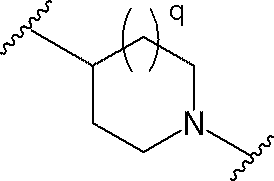
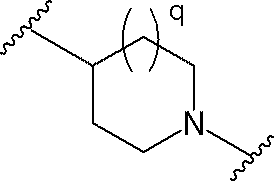
であり、および、
Eは以下の式(10)もしくは式(41)で示される4級アンモニウム基である。
Eの4級アンモニウム基(以下の式中、左側の結合部位がメチレンに結合し、右側の結合部位がDに結合する。):

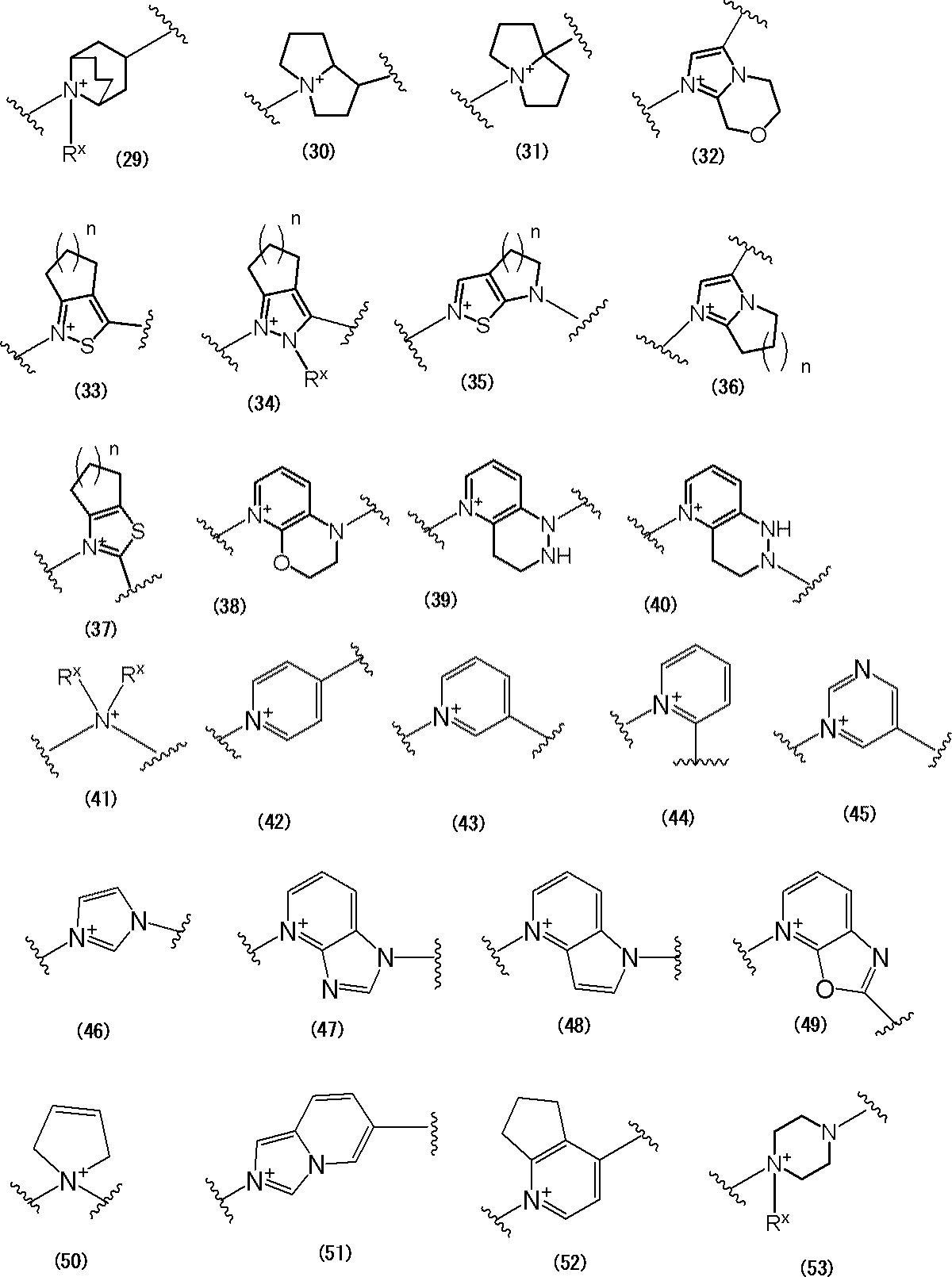
ただし、R1がフェニルかつEが式(53)の場合を除く。)
で示される化合物、エステル体、もしくはその7位側鎖の環上にアミノ基が存在する場合の該アミノ基における保護体またはそれらの製薬上許容される塩もしくはそれらの溶媒和物。
Dが単結合、-NH-、もしくは-R7-NH-(式中、R7は項目1と同意義である)である、
項目1に記載の化合物、エステル体、もしくはその7位側鎖の環上にアミノ基が存在する場合の該アミノ基における保護体またはそれらの製薬上許容される塩もしくはそれらの溶媒和物。
Dが-NH-、-CH2-NH-または-CH2-CH2-NH-である、
項目1または2に記載の化合物、エステル体、もしくはその7位側鎖の環上にアミノ基が存在する場合の該アミノ基における保護体またはそれらの製薬上許容される塩もしくはそれらの溶媒和物。
Dが単結合である、
項目1または2に記載の化合物、エステル体、もしくはその7位側鎖の環上にアミノ基が存在する場合の該アミノ基における保護体またはそれらの製薬上許容される塩もしくはそれらの溶媒和物。
Dが以下に示される基:
項目1に記載の化合物、エステル体、もしくはその7位側鎖の環上にアミノ基が存在する場合の該アミノ基における保護体またはそれらの製薬上許容される塩もしくはそれらの溶媒和物。
Eが式(1)~(9)、(11)~(40)、(47)~(49)および(51)~(52)から選ばれる、
項目1~5のいずれかに記載の化合物、エステル体、もしくはその7位側鎖の環上にアミノ基が存在する場合の該アミノ基における保護体またはそれらの製薬上許容される塩もしくはそれらの溶媒和物。
Eが式(5)、(6)、(9)~(11)、(26)、(29)~(34)、(36)、(37)および(50)から選ばれる、
項目1~5のいずれかに記載の化合物、エステル体、もしくはその7位側鎖の環上にアミノ基が存在する場合の該アミノ基における保護体またはそれらの製薬上許容される塩もしくはそれらの溶媒和物。
Eが式(5)、(6)、(10)および(11)から選ばれる、
項目1~5のいずれかに記載の化合物、エステル体、もしくはその7位側鎖の環上にアミノ基が存在する場合の該アミノ基における保護体またはそれらの製薬上許容される塩もしくはそれらの溶媒和物。
Eが式(1)~(4)、(7)、(8)、(12)~(25)、(27)、(28)、(35)、(38)~(40)、(47)および(48)から選ばれる、
項目1~5のいずれかに記載の化合物、エステル体、もしくはその7位側鎖の環上にアミノ基が存在する場合の該アミノ基における保護体またはそれらの製薬上許容される塩もしくはそれらの溶媒和物。
Eが式(1)~(3)、(7)および(12)から選ばれる、
項目1~5のいずれかに記載の化合物、エステル体、もしくはその7位側鎖の環上にアミノ基が存在する場合の該アミノ基における保護体またはそれらの製薬上許容される塩もしくはそれらの溶媒和物。
Uが-S-である、
項目1~10のいずれかに記載の化合物、エステル体、もしくはその7位側鎖の環上にアミノ基が存在する場合の該アミノ基における保護体またはそれらの製薬上許容される塩もしくはそれらの溶媒和物。
Wが-CH2-である、
項目1~11のいずれかに記載の化合物、エステル体、もしくはその7位側鎖の環上にアミノ基が存在する場合の該アミノ基における保護体またはそれらの製薬上許容される塩もしくはそれらの溶媒和物。
R3が水素原子または-OCH3である、
項目1~12のいずれかに記載の化合物、エステル体、もしくはその7位側鎖の環上にアミノ基が存在する場合の該アミノ基における保護体またはそれらの製薬上許容される塩もしくはそれらの溶媒和物。
式:

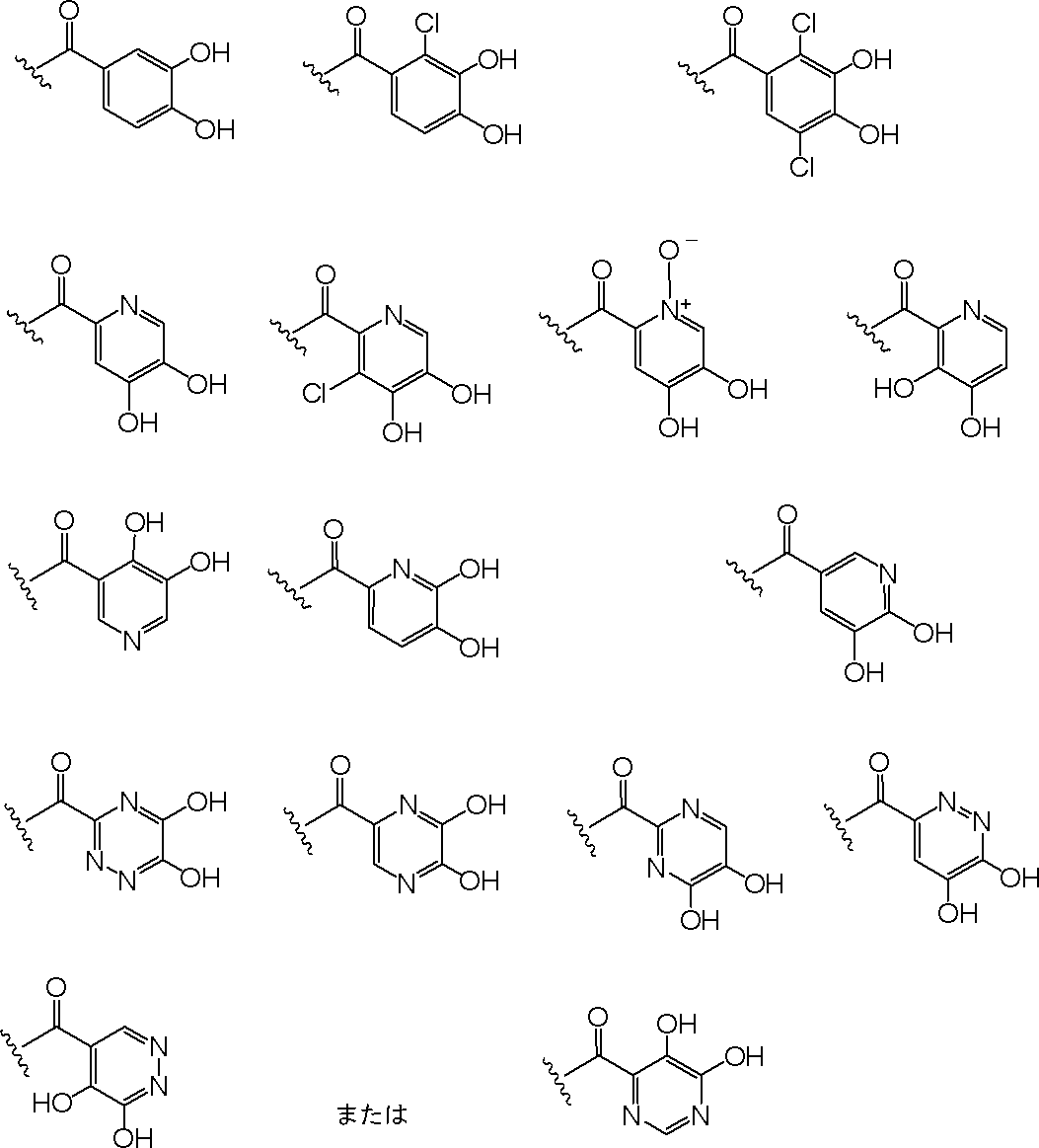
項目1~13のいずれかに記載の化合物、エステル体、もしくはその7位側鎖の環上にアミノ基が存在する場合の該アミノ基における保護体またはそれらの製薬上許容される塩もしくはそれらの溶媒和物。
式:


項目1~13のいずれかに記載の化合物、エステル体、もしくはその7位側鎖の環上にアミノ基が存在する場合の該アミノ基における保護体またはそれらの製薬上許容される塩もしくはそれらの溶媒和物。
式:
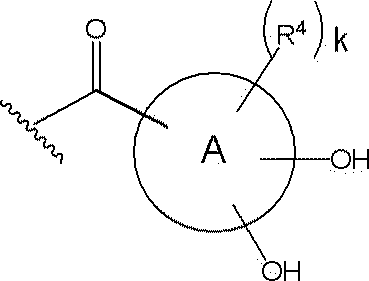

項目1~13のいずれかに記載の化合物、エステル体、もしくはその7位側鎖の環上にアミノ基が存在する場合の該アミノ基における保護体またはそれらの製薬上許容される塩もしくはそれらの溶媒和物。
R1が置換基を有していてもよいフェニルである、
項目1~16のいずれかに記載の化合物、エステル体、もしくはその7位側鎖の環上にアミノ基が存在する場合の該アミノ基における保護体またはそれらの製薬上許容される塩もしくはそれらの溶媒和物。
R2Aが水素原子、置換基を有していてもよいアミノ基、-SO3H、置換基を有していてもよいアミノスルホニル基、カルボキシル基、置換基を有していてもよいカルバモイル基、ヒドロキシル基、または置換基を有しているカルボニルオキシ基である、
項目1~17のいずれかに記載の化合物、エステル体、もしくはその7位側鎖の環上にアミノ基が存在する場合の該アミノ基における保護体またはそれらの製薬上許容される塩もしくはそれらの溶媒和物。
R2Aが以下に示す、置換基を有するアミノ基
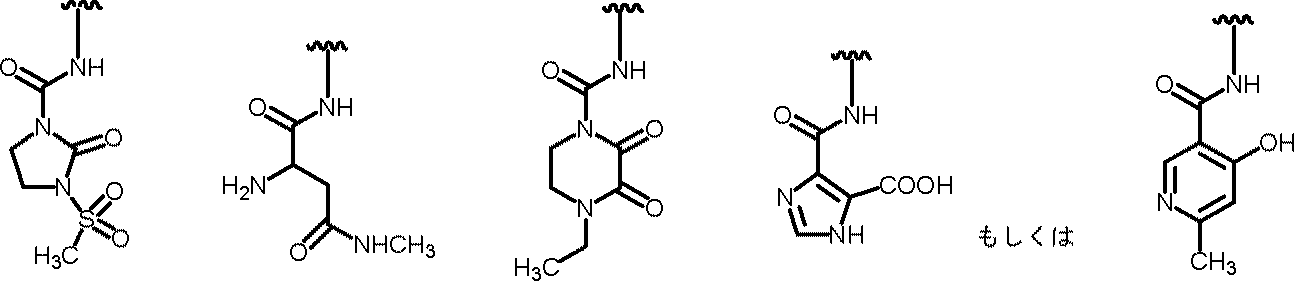
以下に示す、置換基を有するアミノスルホニル基
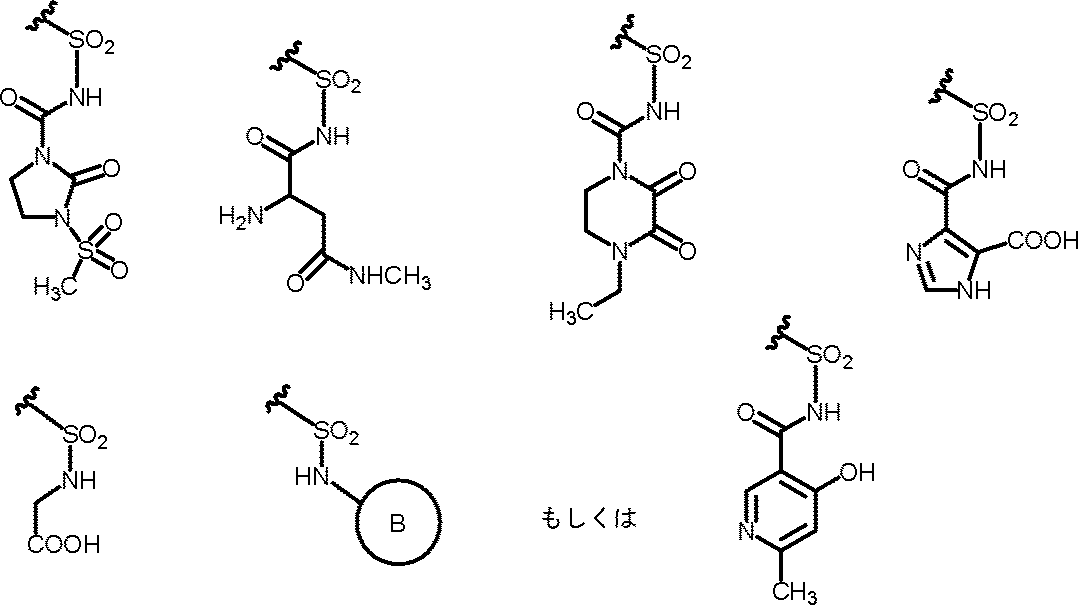
以下に示す、置換基を有するカルバモイル基
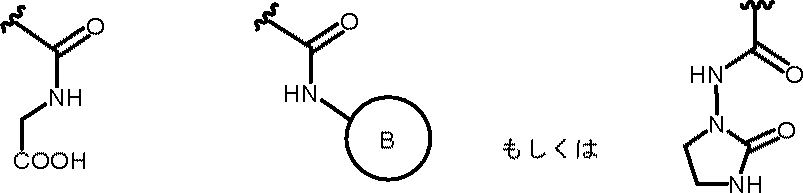
以下に示す、置換基を有するカルボニルオキシ基

である、
項目1~17のいずれかに記載の化合物、エステル体、もしくはその7位側鎖の環上にアミノ基が存在する場合の該アミノ基における保護体またはそれらの製薬上許容される塩もしくはそれらの溶媒和物。
R2AおよびR2Bが、一緒になって以下に示す、置換基を有するアルケニル基

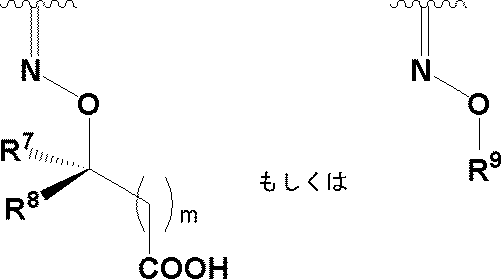
R7およびR8は、それぞれ独立して水素原子、ハロゲン、ヒドロキシ、カルボキシ、置換基を有していてもよい低級アルキル、置換基を有していてもよい炭素環式基、もしくは置換基を有していてもよい複素環式基であり、または
R7およびR8は隣接原子と一緒になって置換基を有していてもよい炭素環式基もしくは置換基を有していてもよい複素環式基を形成していてもよく、
R9は置換基を有していてもよい低級アルキルであり、
mは0~3の整数を表す);
である、
項目1~17のいずれかに記載の化合物、エステル体、もしくはその7位側鎖の環上にアミノ基が存在する場合の該アミノ基における保護体またはそれらの製薬上許容される塩もしくはそれらの溶媒和物。
項目1~20のいずれかに記載の化合物、エステル体、もしくはその7位側鎖の環上にアミノ基が存在する場合の該アミノ基における保護体またはそれらの製薬上許容される塩もしくはそれらの溶媒和物を含有する医薬組成物。
抗菌作用を有する、項目21に記載の医薬組成物。
抗菌的に有効量の項目1~20のいずれかに記載の化合物をヒトに投与することを特徴とする、感染症の治療方法。
感染症の予防または治療における使用のための項目1~20のいずれかに記載の化合物。
感染症の予防または治療のための医薬を製造するための項目1~20のいずれかに記載の化合物の使用。
1)グラム陰性菌および/またはグラム陽性菌を含む種々の細菌に対して、強力な抗菌スペクトルを示す。
2)β-ラクタマーゼ産生グラム陰性菌に対し強い抗菌活性を示す。
3)多剤耐性菌、特にクラスB型のメタロ-β-ラクタマーゼ産生グラム陰性菌に対し強い抗菌活性を示す。
4)基質特異性拡張型βラクタマーゼ(ESBL)産生菌に対し強い抗菌活性を示す。
5)既存のセフェム薬および/またはカルバペネム薬と交叉耐性を示さない。
6)生体内への投与後に、発熱などの副作用を示さない。
「窒素原子を1~3個有する6員の芳香族複素環式基」としては、ピリジン、ピリミジン、ピリダジン、ピラジン、1,3,5-トリアジン、1,2,4-トリアジン、1,2,3-トリアジンなどが挙げられる。
a)R2Aは、水素原子、置換基を有していてもよいアミノ基、-SO3H、置換基を有していてもよいアミノスルホニル基、カルボキシル基、置換基を有していてもよい低級アルキルオキシカルボニル基、置換基を有していてもよいカルバモイル基、ヒドロキシル基、もしくは置換基を有しているカルボニルオキシ基であり、および、
R2Bは、水素原子であるか、または、
b)R2AおよびR2Bが、一緒になって置換基を有していてもよいアルケニル基、もしくは置換基を有していてもよいオキシム基であり、
ただし、R1がアミノ基が保護されていてもよいアミノチアゾールまたはアミノ基が保護されていてもよいアミノチアジアゾールの場合は、R2AおよびR2Bが、一緒になって置換基を有していてもよいオキシム基ではない。
以下に示す、置換基を有するアミノスルホニル基
以下に示す、置換基を有するカルバモイル基
以下に示す、置換基を有するカルボニルオキシ基
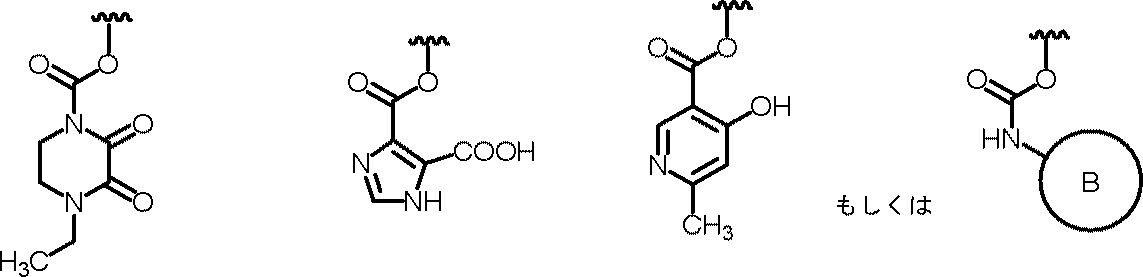
である。

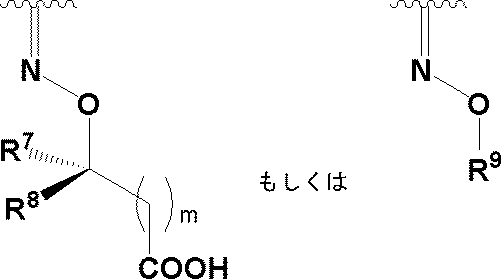
R7およびR8は、それぞれ独立して水素原子、ハロゲン、ヒドロキシ、カルボキシ、置換基を有していてもよい低級アルキル、置換基を有していてもよい炭素環式基、もしくは置換基を有していてもよい複素環式基であり、または
R7およびR8は隣接原子と一緒になって置換基を有していてもよい炭素環式基もしくは置換基を有していてもよい複素環式基を形成していてもよく、
R9は置換基を有していてもよい低級アルキルであり、
mは0~3の整数を表す)である。

におけるR7およびR8が、環上に置換基群αから選択される基を有していてもよいシクロアルキル、シクロアルケニル、もしくは非芳香族複素環式基を形成しているものが挙げられ、例えば、環上に置換基群αから選択される基を有していてもよい以下の式:
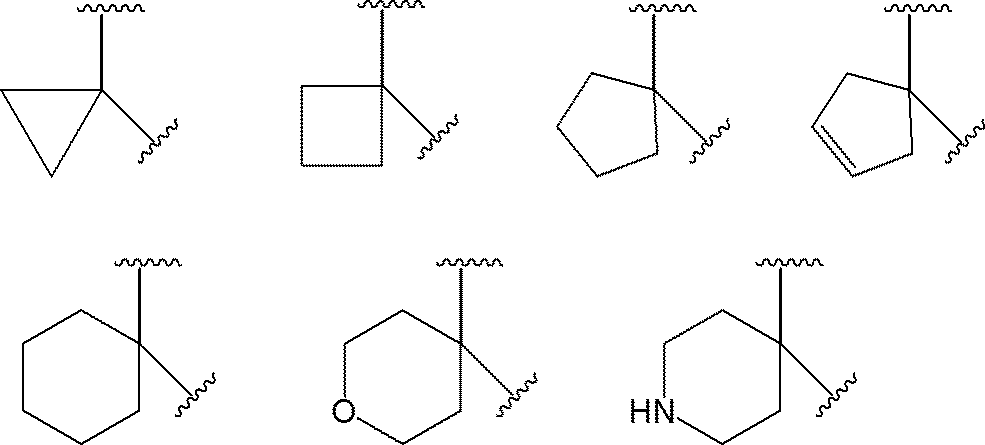
Eの「式(1)~式(40)または(42)~(53)のいずれかから選ばれる置換基を有していてもよい環式基」とは、各環式基の炭素原子上の水素原子が、置換基を有していてもよい低級アルキルもしくは置換基群αから選択される同一又は異なる1以上の基で置き換わったものを包含する。置換基の好ましい態様としては、メチル、エチルイソプロピル、tert-ブチル、フッ素原子、塩素原子、臭素原子、ヒドロキシ、カルボキシ、メトキシ、エトキシ、ヒドロキシメトキシ、ヒドロキシエトキシ、メトキシメトキシ、メトキシエトキシ、アミノ、アセチルアミノ、メチルアミノ、ジメチルアミノ、イミノ、ヒドロキシイミノ、メトキシイミノ、メチルチオ、カルバモイル、メチルカルバモイル、ヒドロキシメチルカルバモイル、スルファモイル、メチルスルファモイル、低級アルキルスルファモイル、シアノ、ニトロ、フェニル、シクロプロピル、シクロブチル、シクロヘキシル、ピリジル、モルホリニル等が挙げられる。より好ましい態様は、無置換である。
以下に式(I)の各部位における例または態様を示すが、本発明の範囲は下記に記載されるものに限定されない。
「W」の好ましい態様は-CH2-であり、「U」は-CH2-、-S-もしくは-O-である。より好ましくは、「W」が-CH2-、「U」が-S-もしくは-O-であり、さらに好ましくは、「W」が-CH2-、「U」が-S-である。
「R7およびR8」の例としては、水素原子、フッ素原子、塩素原子、ヒドロキシ、カルボキシ、メチル、エチル、イソプロピル、tert-ブチル、モノフルオロメチル、ジフルオロメチル、トリフルオロメチル、カルボキシメチル、カルボキシエチル、カルバモイルメチル、カルバモイルエチル、ヒドロキシメチル、ヒドロキシエチル、メトキシメチル、エトキシメチル、メトキシエチル、エトキシエチル、メチルチオメチル、エチルチオメチル、ベンジル、4-ヒドロキシベンジル、4-メトキシベンジル、4-カルボキシベンジル、フェニル、ナフチル、シクロプロピル、シクロブチル、シクロペンチル、シクロヘキシル、ピロリル、イミダゾリル、ピラゾリル、ピリジル、ピリダジニル、ピリミジニル、ピラジニル、トリアゾリル、トリアジニル、テトラゾリル、イソオキサゾリル、オキサゾリル、オキサジアゾリル、イソチアゾリル、チアゾリル、チアジアゾリル、フリルおよびチエニル等が挙げられる。
R7およびR8の好ましい組合せは、(R7、R8)が、(水素原子、水素原子)、(メチル、水素原子)、(水素原子、メチル)、(メチル、メチル)、(エチル、水素原子)、(水素原子、エチル)、(エチル、エチル)、(フェニル、水素原子)、(水素原子、フェニル)、(カルボキシメチル、水素原子)、(水素原子、カルボキシメチル)、(カルボキシエチル、水素原子)、(水素原子、カルボキシエチル)、(ヒドロキシエチル、水素原子)、(水素原子、ヒドロキシルエチル)、(カルバモイルメチル、水素原子)、(水素原子、カルバモイルメチル)、(トリフルオロメチル、水素原子)、(カルボキシ、水素原子)、(カルバモイルエチル、水素原子)、(ベンジル、水素原子)、(4-ヒドロキシベンジル、水素原子)等が挙げられる。
「R7およびR8は隣接原子と一緒になって置換基を有していてもよい炭素環式基もしくは置換基を有していてもよい複素環式基を形成」している場合の好ましい態様としては、3~8員のシクロアルキル、3~8員のシクロアルケニルもしくは3~8員の非芳香族複素環式基が挙げられる。より好ましくは式:
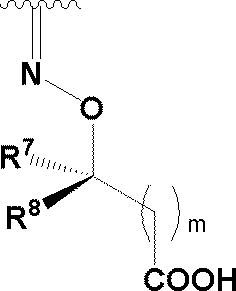
におけるR7およびR8が

「R3」は水素原子、または-OCH3が好ましく、より好ましくは水素原子である。 「R4」の例としては、水素原子、塩素原子、フッ素原子、臭素原子、シアノ、ヒドロキシ、アセチル、メトキシ、エトキシ、トリフルオロメチル等が挙げられる。好ましくは、R4は水素原子、ヒドロキシ、または塩素原子である。
a)Dは単結合、-N(R8)-もしくは-R7-N(R8)-であり、R7は置換基を有していてもよい低級アルキレンであり、R8は水素もしくは低級アルキルであり、および、
Eは項目1の式(1)~(40)および(42)~(53)から選ばれる、置換基を有していてもよい4級アンモニウム基であるか、または、
b)Dは以下に示される基:
であり、および、
Eは項目1の式(10)もしくは式(41)で示される4級アンモニウム基である。
「-E-D-(C=O)-」の例としては、以下の式(1A)~(53A):
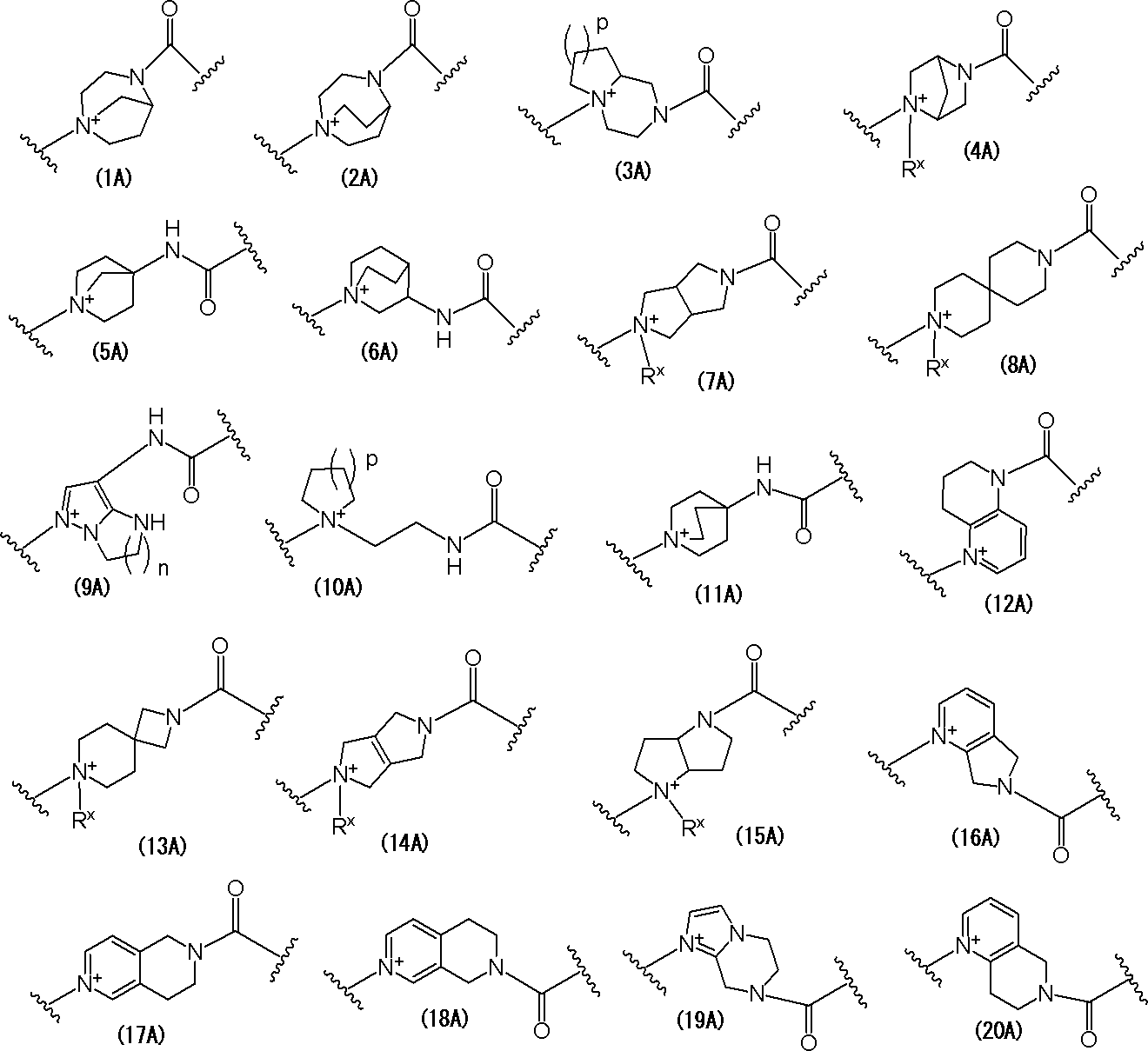
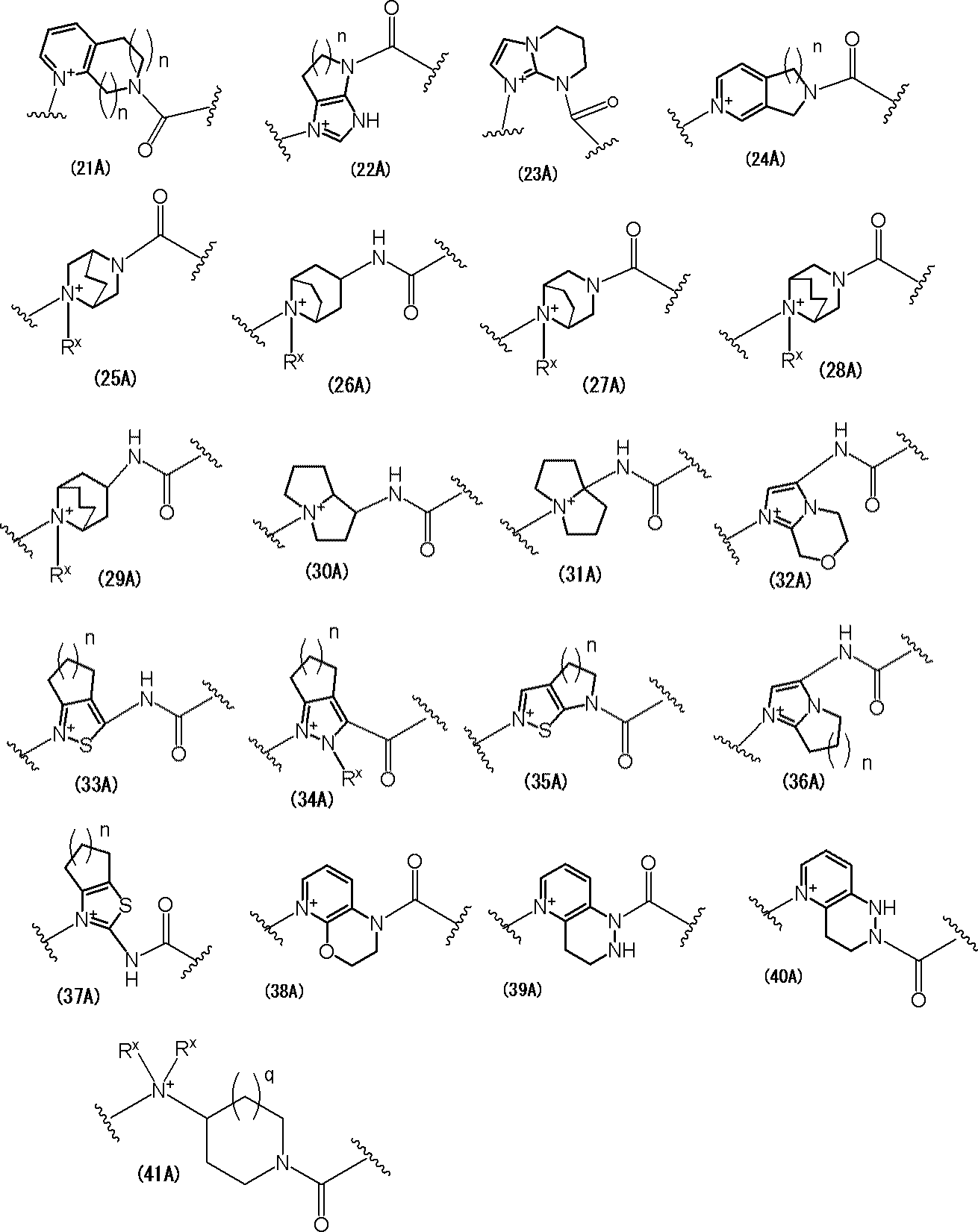
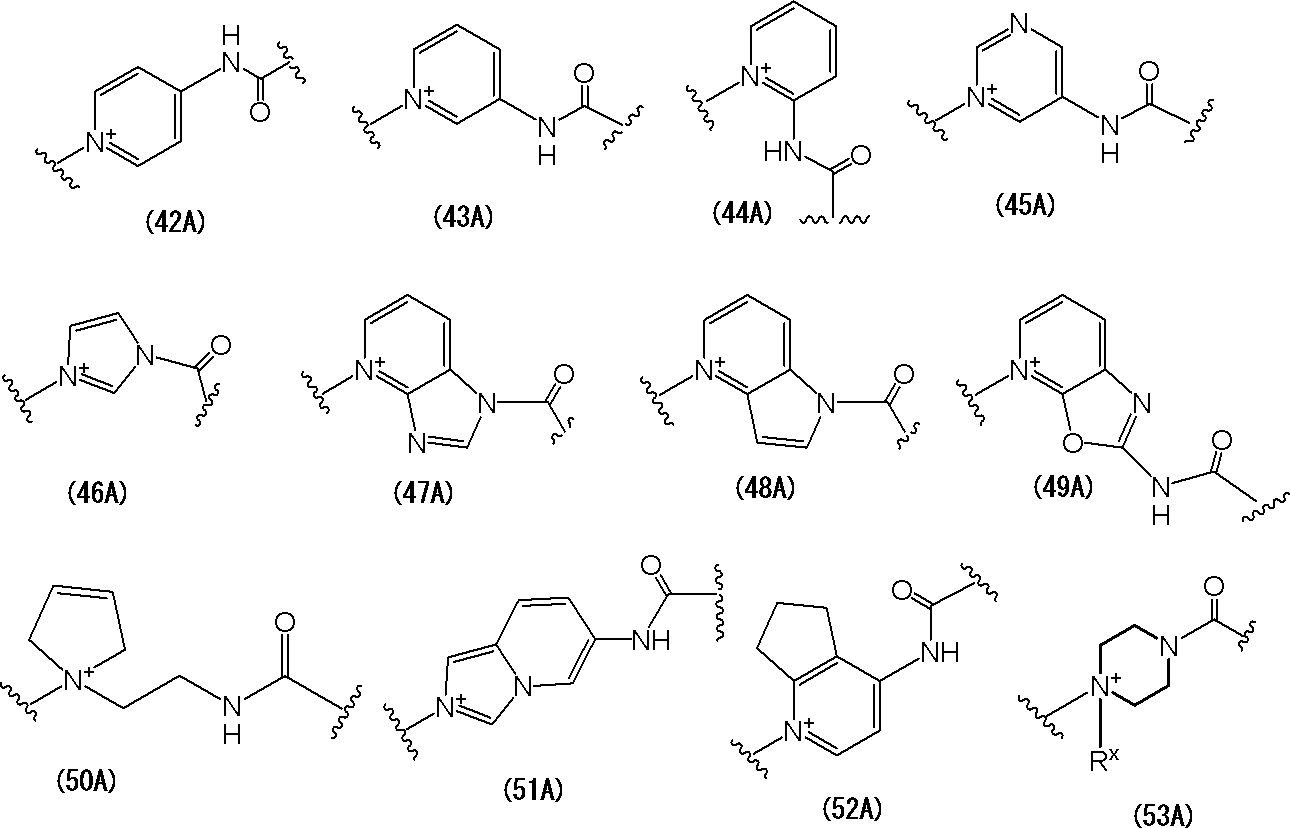
ここで、Rxの好ましい例としては、メチル、エチル、トリフルオロメチル、カルボキシメチル、カルバモイルメチル、ヒドロキシエチル等が挙げられる。
「-E-D-(C=O)-」の好ましい態様は、以下の式(1B)~(53B):

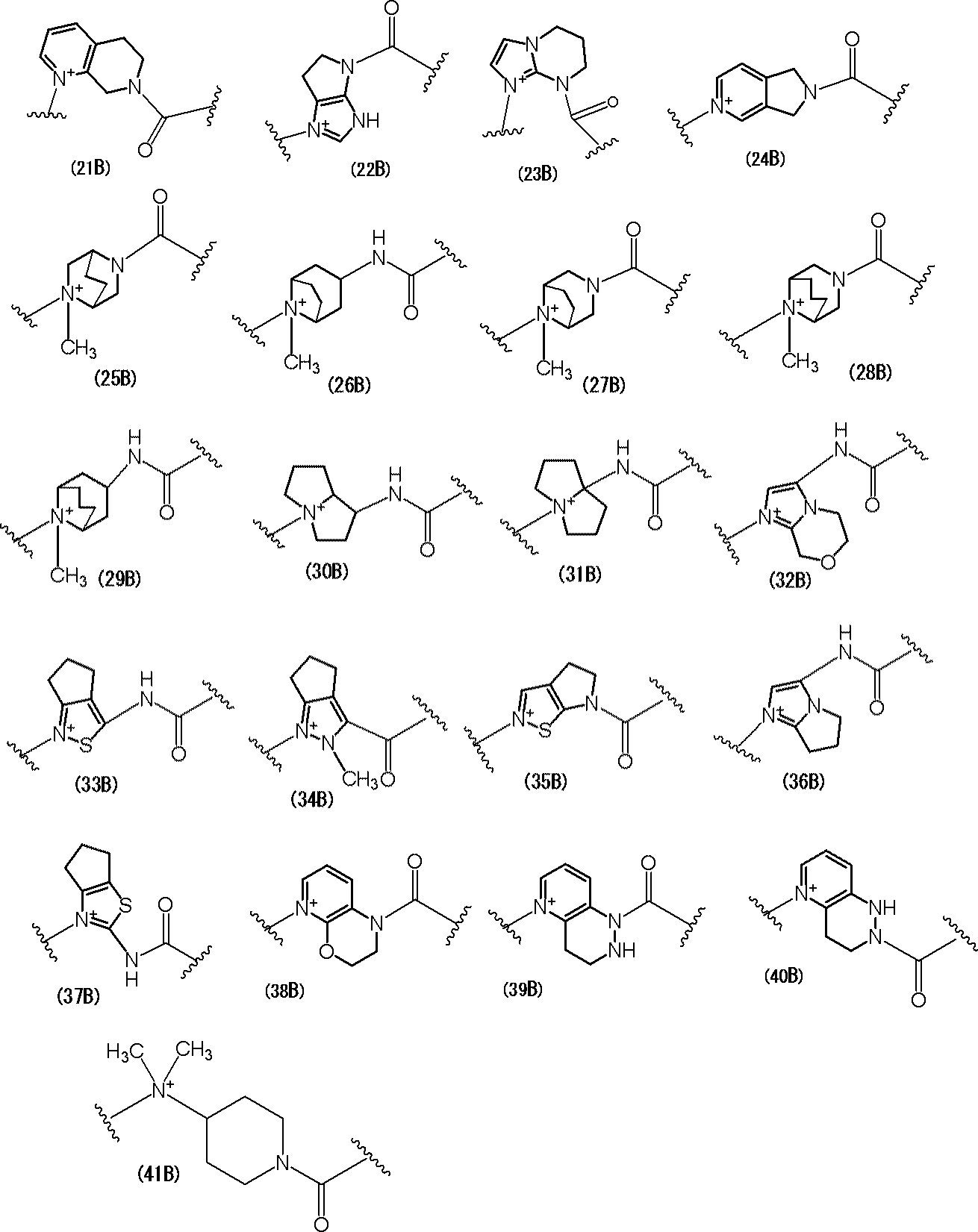
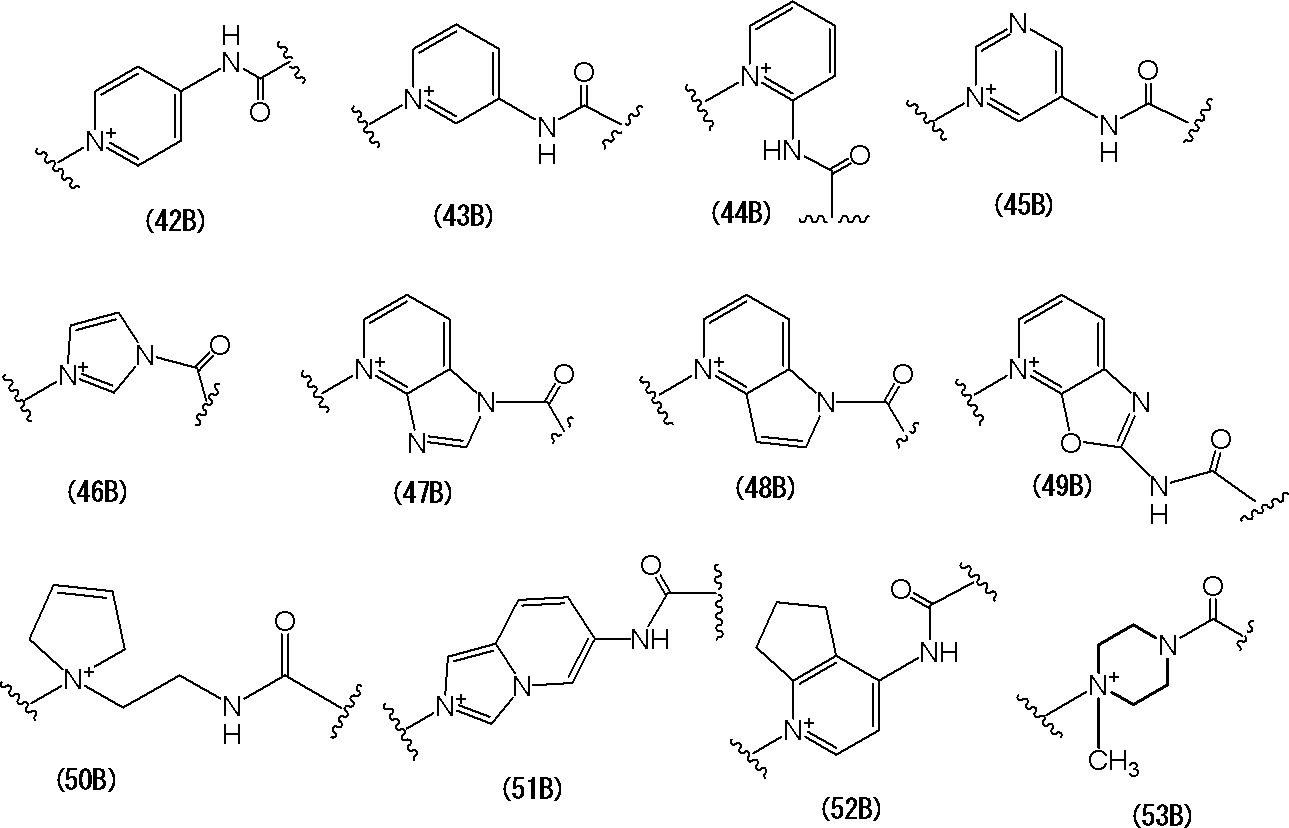
「-E-D-(C=O)-」のさらに好ましい態様は、以下の式:
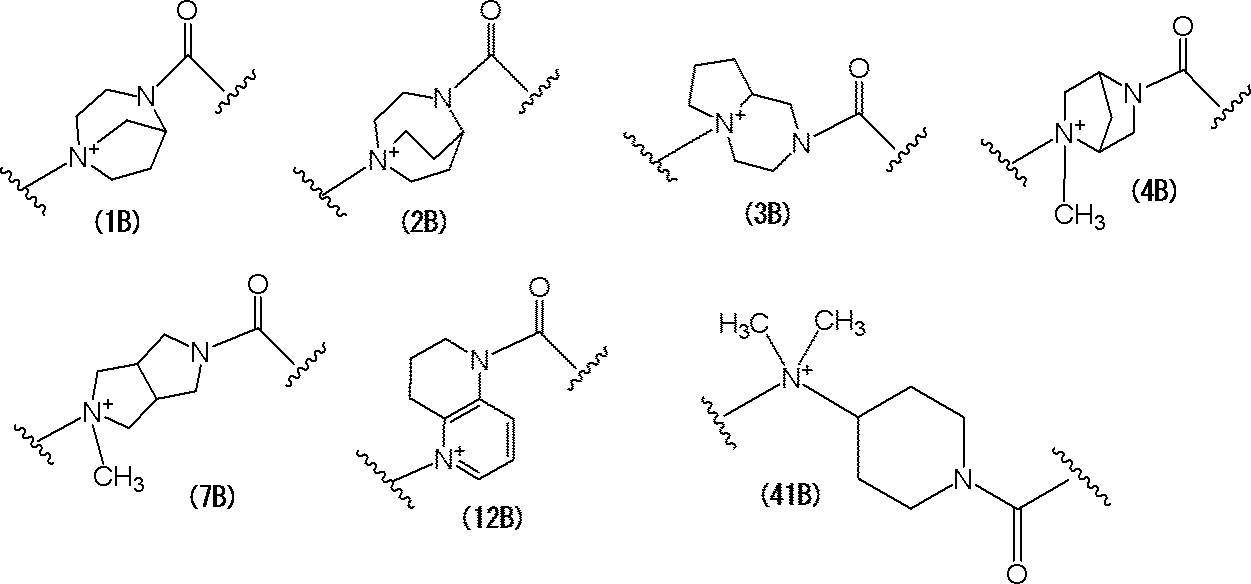
式:

の環Aにおける好ましい態様は、窒素原子を1~3個有する6員の芳香族複素環式基である。

のより好ましい態様は、
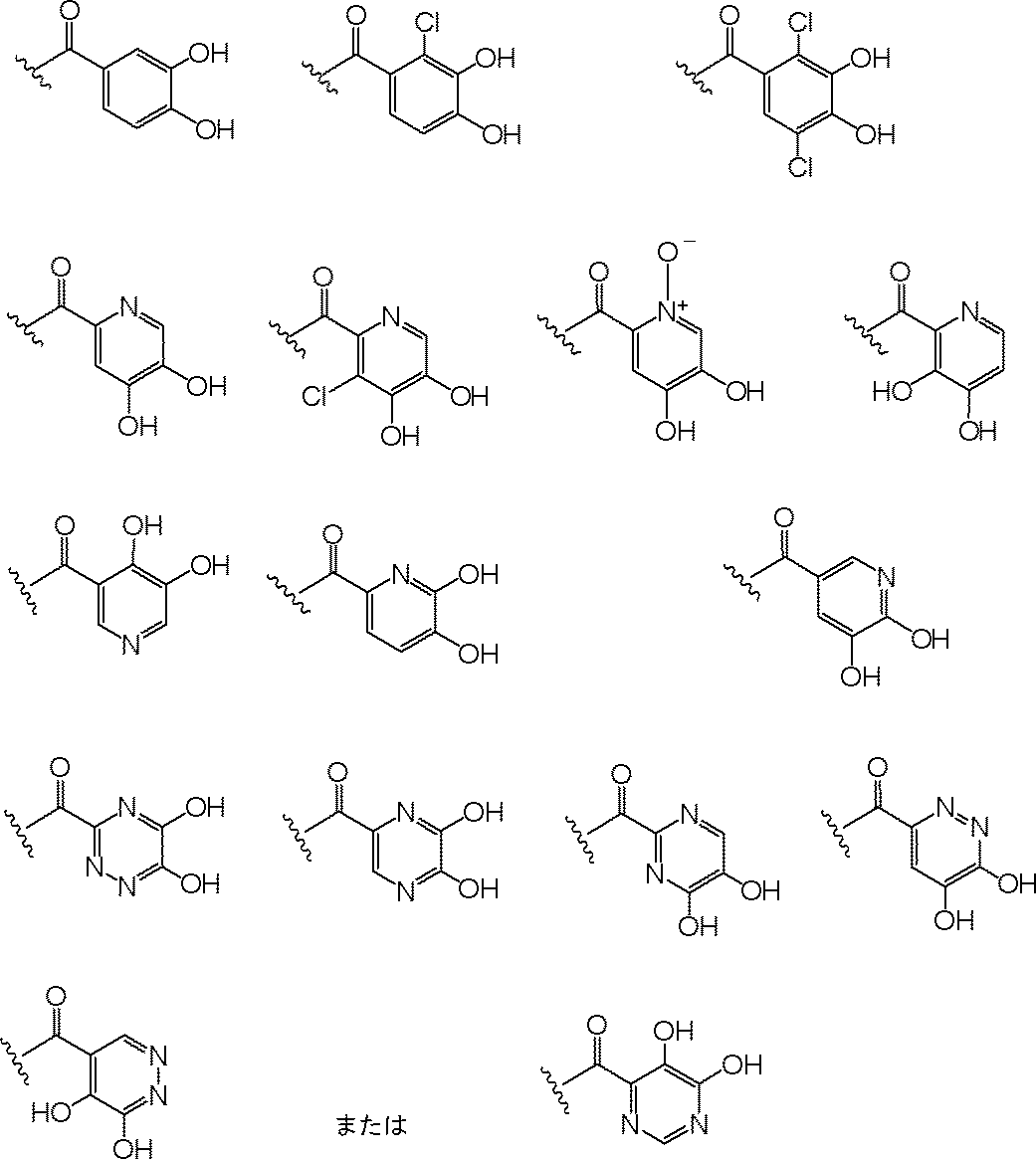
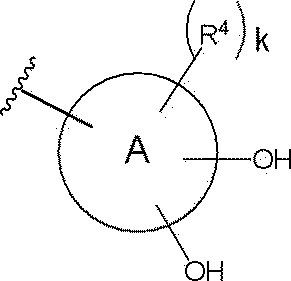
のさらに好ましい態様は、

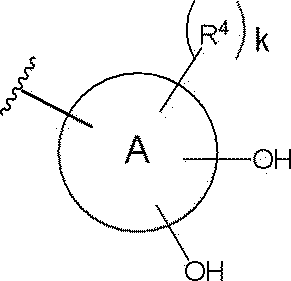
の最も好ましい態様は、


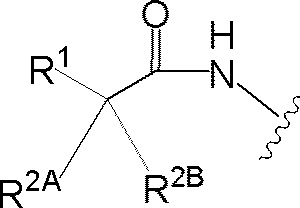
で示されるR1またはR2AもしくはR2Bの末端において、置換基を有していてもよいアミノ基、置換基を有していてもよいアミノスルホニル基、カルボキシル基、置換基を有していてもよい低級アルキルオキシカルボニル基、置換基を有していてもよいカルバモイル基、置換基を有しているカルボニルオキシ基等におけるカルボキシル基がエステル構造を有しているもの(例えば、カルボキシル(-COOH)の場合、カルボキシル保護基等のエステル残基を示すRaとともに示される-COORaという構造で示される。)などを挙げることができ、体内で容易に代謝されてカルボキシの状態になるエステルを包含する。
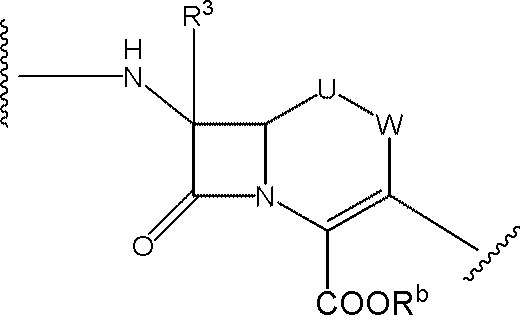
で示されるようにセフェム骨格の4位カルボキシル基がエステル構造になっている化合物を意味する。該エステルは、体内で容易に代謝されてカルボキシの状態になるエステルを包含する。
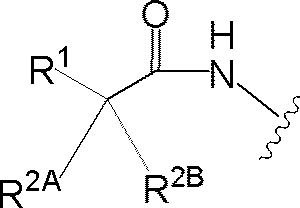
で示される、環上のアミノ基が保護されている構造を意味する。該アミノ保護基は、体内で容易に代謝されてアミノになる基も包含する。上記のアミノ保護基としては、Protective Groups in Organic Synthesis、T.W.Green著、John Wiley & Sons Inc.(1991年)等に記載の方法で保護および/または脱保護できる基であればよく、例えば、低級アルコキシカルボニル(例:t-ブトキシカルボニル、ベンジルオキシカルボニル、p-ニトロベンジルオキシカルボニル)、置換されていてもよいアラルカノイル(例:ベンゾイル、p-ニトロベンゾイル)、アシル(例:ホルミル、クロロアセチル)等が挙げられる。
「R1がアミノ基が保護されていてもよいアミノチアゾールまたはアミノ基が保護されていてもよいアミノチアジアゾール」とは、以下の式:

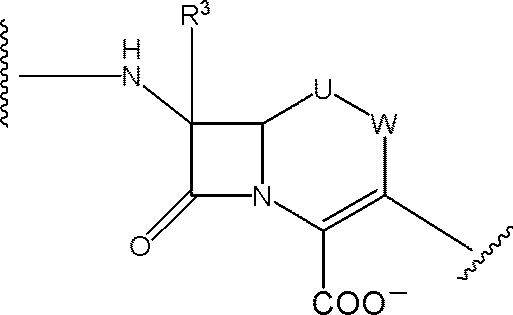
は、

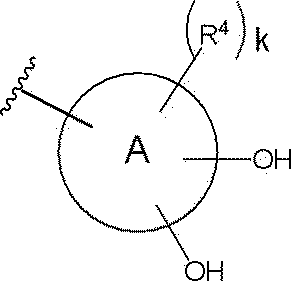
を包含する。
は、

などの共鳴構造を包含する。
本発明に係る式(I)で示される化合物は、例えば、下記に示す一般的合成法によって製造することができる。

オンであり、
式:
Yは脱離基(例えば、ヒドロキシ、ハロゲン(Cl、Br、I)、置換されていてもよいカルバモイルオキシ、アシルオキシ、メタンスルホニルオキシ、トルエンスルホニルオキシ等)を示し、
Reは水素またはアミノ保護基を示す。]
1)7位アミド化および3位側鎖形成;化合物(X)の合成
第一工程(7位アミド化反応):
市販または文献(例:特開昭60-231684、特開昭62-149682など)に記載の方法に準じて合成される化合物(VII)および所望の側鎖に対応する式:

化合物(IX)と対応する3級アミンを反応させることにより化合物(X)が得られる。この場合、好ましくは、Rbはカルボキシ保護基である。
3)3位側鎖形成および7位アミド化;化合物(X)の合成
第三工程(3位側鎖形成反応):
化合物(VII)と対応する3級アミンを反応させることにより化合物(VIII)が得られる。この場合、好ましくは、Rbはカルボキシ保護基であり、Reはアミノ保護基である。
なお、第二工程および第三工程の3位側鎖形成反応において用いる3級アミン部分(項目1の置換基Eに対応する)は、いずれも市販の試薬、公知の方法および/または本明細書に記載の方法によって得ることができる。
化合物(VIII)および化合物(VI)を反応させることにより、化合物(X)が得られる。この場合、好ましくは、Rbはカルボキシ保護基、Rcはアミノ保護基、RproおよびReは水素である。
4)脱保護反応:
第五工程:
化合物(X)を当業者周知の方法により脱保護反応に付すことにより化合物(I)が得られる。
ODS:オクタドデシルシリル
PMB:パラメトキシベンジル
BH:ベンズヒドリル
Boc:tert-ブトキシカルボニル
t-Bu:tert-ブチル
Bn:ベンジル
Trt:トリチル
Me:メチル
Cbz:ベンジルオキシカルボニル

化合物2(1.07 g, 1.0 mmol)の塩化メチレン (10 ml)溶液を0℃に冷却し、化合物3(303 mg, 0.95 mmol)、ピリジン(105 μl, 1.3 mmol)、1-エチル-3-(3-ジメチルアミノプロピル)カルボジイミド塩酸塩(230 mg, 1.2 mmol)を順に加えた後、0℃にて3.5時間攪拌した。反応混合物に0.1mol/l塩酸、酢酸エチル、テトラヒドロフランを加えた後、減圧下で塩化メチレンを留去し、酢酸エチル/テトラヒドロフラン混合溶媒で抽出した。有機層を、0.1mol/l塩酸、亜硫酸水素ナトリウム水溶液、飽和食塩水で順に洗浄し、減圧下で溶媒を留去した。得られた濃縮残渣を塩化メチレンに溶解させた後、無水硫酸マグネシウムにより乾燥した。無機物をろ過により除き、減圧濃縮した後、減圧下で乾燥することにより化合物4を褐色フォームとして得た。
MS (m+1) = 798.35
元素分析:C36H40ClN7O10S・3.4H2O
計算値:C,50.31; H,5.49;Cl,4.12; N,11.41; S,3.73 (%)
実験値:C,50.27; H,5.35;Cl,4.22; N,11.31; S,3.88 (%)

化合物6(238 mg, 1.1 mmol)の塩化メチレン (10 ml)溶液を0℃に冷却し、ジイソプロピルエチルアミン(480 μl, 2.75 mmol)、トリメチルクロロシラン(422 μl, 3.3 mmol)を順に加えた後、室温で2時間攪拌した。次いで反応混合物を-30 ℃まで冷却し、塩化チオニル(96 μl, 1.32 mmol)を加えた後、0 ℃で1時間攪拌し、酸塩化物の溶液とした。一方、化合物2(1.07 g, 1.0 mmol)は塩化メチレン (10 ml)に溶液させた後-60 ℃まで冷却し、トリブチルアミン(951 μl, 4.0 mmol)を加えた。得られた混合液に前述の酸塩化物の溶液を30分かけて滴下した。0℃で1時間攪拌した後、反応混合物に0.5mol/l塩酸を加え、塩化メチレンで抽出した。有機層を、0.2mol/l塩酸、亜硫酸水素ナトリウム水溶液、飽和食塩水で順に洗浄し、無水硫酸マグネシウムにより乾燥した。無機物をろ過により除き、減圧濃縮した後、減圧下で乾燥することにより化合物7を褐色泡状固体として得た。
MS (m+1) = 695.27
元素分析:C29H30ClN4O10S2Na・0.1NaHCO3・4.3H2O
計算値:C,43.72; H,4.83;Cl,4.43; N,7.01; S,8.02; Na,3.16 (%)
実験値:C,43.60; H,4.70;Cl,4.46; N,7.26; S,8.08; Na,3.30 (%)
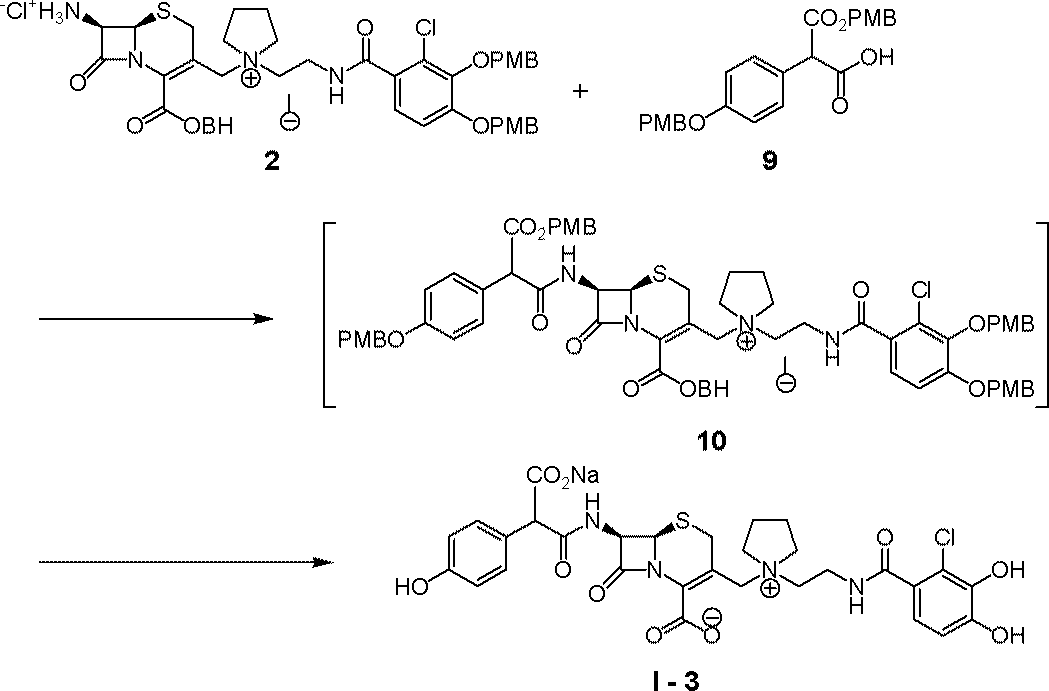
化合物2(1.07 g, 1.0 mmol)及び化合物9(415 mg, 0.95mmol)を用い実施例1と同様にして合成した。ODSカラムクロマトグラフィにて精製した後、所望の化合物を含む分画に0.2mol/l水酸化ナトリウム水溶液.を加えpH=6.0に調整した後、ドライアイス一片を加えた。得られた溶液を減圧濃縮した後、凍結乾燥することにより化合物(I-3)を白色粉末として得た。収量 160 mg, (23%)
MS (m+1) = 675.27
元素分析:C30H30ClN4O10SNa・4.0H2O
計算値:C,46.85; H,4.98;Cl,4.61; N,7.28; S,4.17; Na,2.99 (%)
実験値:C,46.83; H,4.88;Cl,4.88; N,7.20; S,3.78; Na,3.00 (%)

化合物4a (1.07 g, 1.00 mmol)の塩化メチレン (10 ml)溶液に氷冷下、化合物4b (258 mg, 1.00 mmol)、ピリジン (105 μl, 1.30 mmol)、1-エチル-3-(3-ジメチルアミノプロピル)カルボジイミド塩酸塩 (230 mg, 1.20 mmol)を順に加えた後、氷冷下3.5時間攪拌した。反応液を酢酸エチル/テトラヒドロフランで希釈し、塩酸、水、亜硫酸水素ナトリウム水溶液、飽和食塩水で順に洗浄し、硫酸マグネシウムで乾燥した。硫酸マグネシウムをろ過した後、減圧濃縮し、化合物4cを得た。
得られた化合物4c全量を塩化メチレン (10 ml)に溶かし、-40 ℃まで冷却した後、アニソール (874 μl, 8.00 mmol)と、2mol/l塩化アルミニウム/ニトロメタン溶液 (4.00 ml, 8.00 mmol)を順に加え、氷冷下1時間攪拌した。反応液を水、2mol/l塩酸水溶液、アセトニトリルに溶解させた後、ジイソプロピルエーテルで洗浄した。水層にHP20SS樹脂を加えアセトニトリルを減圧留去した。得られた混合液をODSカラムクロマトグラフィにより精製した。得られた溶液を減圧濃縮した後、凍結乾燥することにより化合物(I-4)を淡橙色粉末として得た。
収量 186.4 mg, (29%)
1H-NMR (DMSO-d6) δ: 10.31 (1H, br s), 9.36 (1H, br s), 8.84 (1H, d, J = 8.39 Hz), 8.42 (1H, br s), 6.91 (2H, br s), 6.77 (2H, s), 6.24 (1H, s), 5.58 (1H, dd, J = 8.16, 5.11 Hz), 5.09-5.07 (2H, m), 3.92-3.76 (3H, m), 3.41-3.57 (7H, m), 1.97-2.15 (4H, m).
元素分析:C26H29ClN6O7S2(H2O)2.1
計算値:C,46.27; H,4.96; Cl,5.25; N,12.45; S,9.50 (%)
実験値:C,46.42; H,5.02; Cl,5.16; N,12.43; S,9.29 (%)
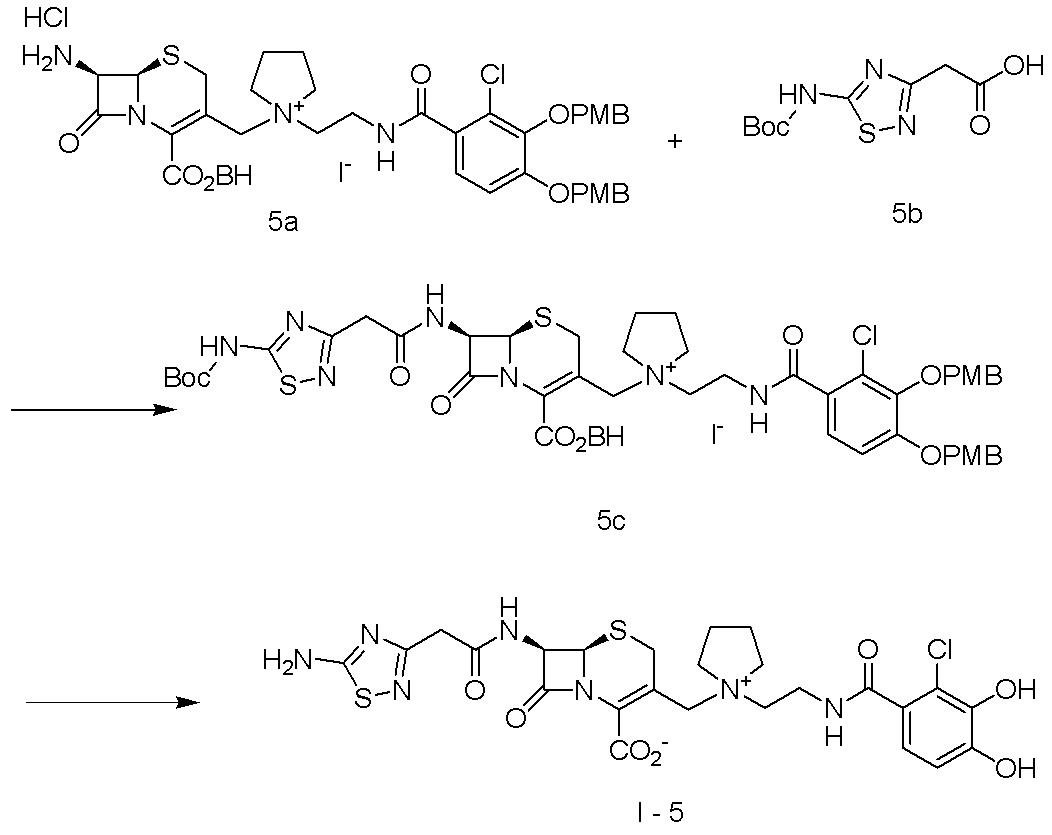
化合物5a (1.07 g, 1.00 mmol)と化合物5b (259 mg, 1.00 mmol)を用いて、実施例4と同様にして合成した。
得られた化合物5c全量を用いて実施例4と同様にして合成した。
収量 133.0 mg, (18%)
1H-NMR (DMSO-d6) δ: 10.33 (1H, br s), 9.36 (1H, br s), 9.00 (1H, d, J = 8.39 Hz), 8.42 (1H, t, J = 5.49 Hz), 7.92 (2H, br s), 6.77 (2H, s), 5.59 (1H, dd, J = 8.39, 5.03 Hz), 5.10-5.08 (2H, m), 3.93-3.42 (13H, m), 1.96-2.15 (4H, m).
元素分析:C25H28ClN7O7S2(H2O)2.2
計算値:C,44.30; H,4.82; Cl,5.23; N,14.47; S,9.46 (%)
実験値:C,44.36; H,4.82; Cl,5.26; N,14.36; S,9.41 (%)
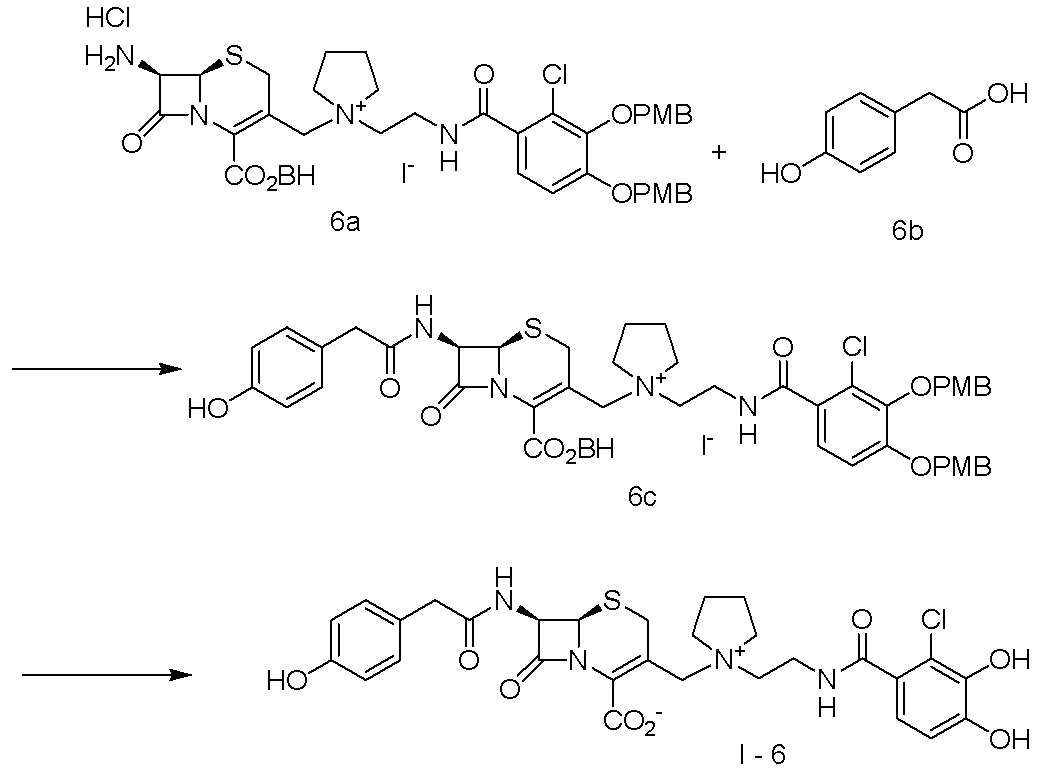
化合物6a (1.07 g, 1.00 mmol)と化合物6b (152 mg, 1.00 mmol)を用いて実施例4と同様にして合成した。
得られた化合物6c全量を用いて実施例4と同様にして合成した。
収量 110.0 mg, (15%)
1H-NMR (DMSO-d6) δ: 10.15 (1H, br s), 9.25 (2H, br s), 8.95 (1H, d, J = 8.23 Hz), 8.40 (1H, t, J = 5.46 Hz), 7.05 (2H, d, J = 8.39 Hz), 6.79 (1H, d, J = 8.39 Hz), 6.75 (1H, d, J = 8.39 Hz), 6.66 (2H, d, J = 8.39 Hz), 5.52 (1H, dd, J = 8.06, 5.04 Hz), 5.09 (1H, d, J = 13.43 Hz), 5.05 (1H, d, J = 5.04 Hz), 3.91-3.74 (3H, m), 3.57-3.44 (7H, m), 2.14-1.99 (4H, m).
元素分析:C29H31ClN4O8S(H2O)2.5
計算値:C,51.51; H,5.37; Cl,5.24; N,8.29; S,4.74 (%)
実験値:C,51.57; H,5.36; Cl,5.23; N,8.19; S,4.86 (%)
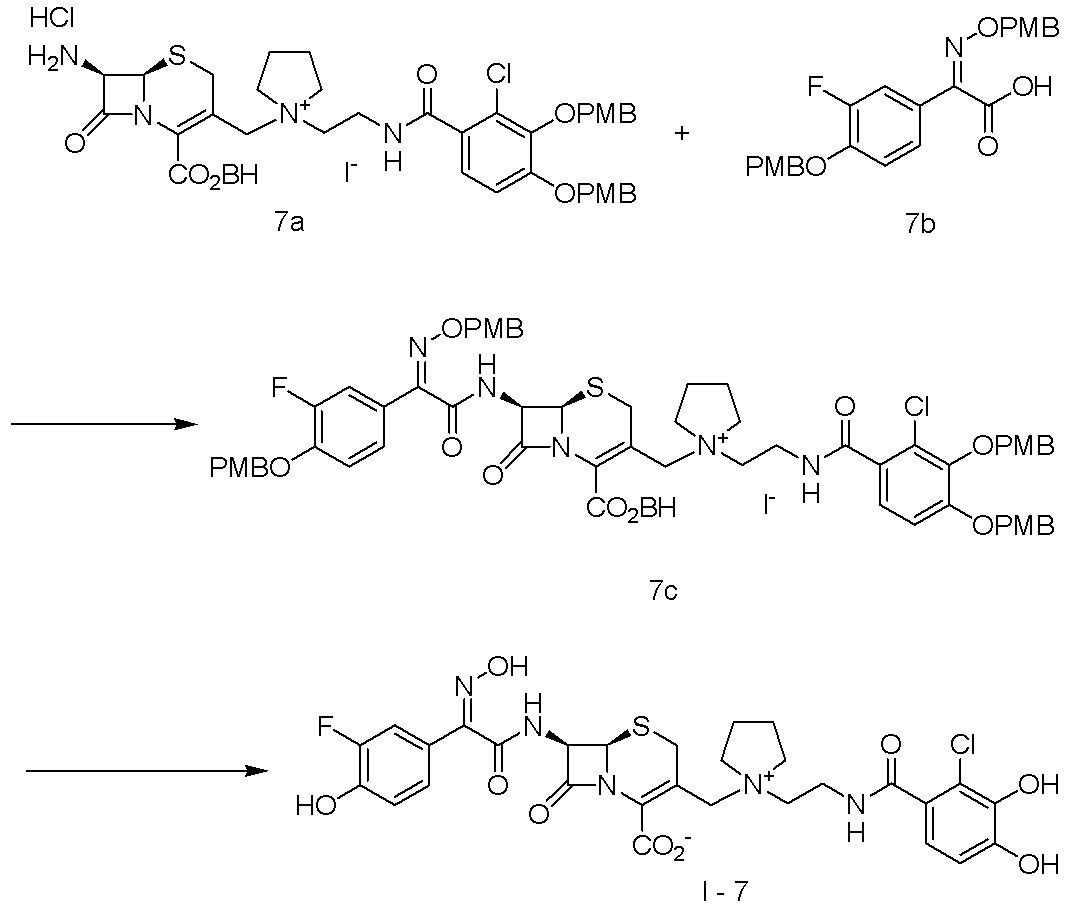
化合物7a (1.07 g, 1.00 mmol)と化合物7b (439 mg, 1.00 mmol)を用いて実施例4と同様にして合成した。
得られた化合物7c全量を用いて実施例4と同様にして合成した。
収量 206.3 mg, (28%)
1H-NMR (DMSO-d6) δ: 11.45 (1H, br s), 10.47 (1H, br s), 9.59 (1H, d, J = 7.89 Hz), 8.42 (1H, t, J = 5.46 Hz), 7.25 (1H, dd, J = 12.42, 2.01 Hz), 7.15 (1H, dd, J = 8.39, 1.68 Hz), 7.00 (1H, t, J = 8.73 Hz), 6.78 (2H, s), 5.72 (1H, dd, J = 7.72, 5.04 Hz), 5.17 (1H, d, J = 5.04 Hz), 5.06 (1H, d, J = 13.43 Hz), 3.95-3.73 (4H, m), 3.59-3.44 (9H, m), 1.97-2.15 (4H, m).
元素分析:C29H29ClFN5O9S(H2O)2.2
計算値:C,48.53; H,4.69; Cl,4.94; F,2.65; N,9.76; S,4.47 (%)
実験値:C,48.51; H,4.78; Cl,4.95; F,2.54; N,9.69; S,4.52 (%)

化合物8a (1.07 g, 1.00 mmol)と化合物8b (430 mg, 1.00 mmol)を用いて実施例4と同様にして合成した。
得られた化合物8c全量を塩化メチレン (10 ml)に溶かし、-40 ℃まで冷却した後、アニソール (1.092 ml, 10.0 mmol)と2mol/l塩化アルミニウム/ニトロメタン溶液 (5.00 ml, 10.0 mmol)を順に加え、氷冷下1時間攪拌した。さらに2mol/l塩化アルミニウム/ニトロメタン溶液 (5.00 ml, 10.0 mmol)を加え、室温で1時間攪拌した。反応液を水、2mol/l塩酸水溶液、アセトニトリルに溶解させた後、ジイソプロピルエーテルで洗浄した。水層にHP20SS樹脂を加えアセトニトリルを減圧留去した。得られた混合液をODSカラムクロマトグラフィにより精製した。得られた目的化合物の溶液に0.2mol/l水酸化ナトリウム水溶液をpH=6.0まで加えた後、ドライアイスを1欠片加えた。得られた溶液を減圧濃縮した後、凍結乾燥することにより化合物(I-8)を淡黄色粉末として得た。
収量 96.9 mg, (11%)
1H-NMR (D2O) δ: 6.97-6.87 (2H, m), 6.68-6.59 (1H, m), 6.52-6.47 (1H, m), 5.85-5.78 (1H, m), 5.37-5.29 (1H, m), 4.17-4.11 (1H, m), 3.97-3.50 (10H, m), 3.24-3.22 (2H, m), 2.87 (1H, s), 2.23 (4H, br s).
元素分析:C29H30ClN6O9S2Na(H2O)3.7
計算値:C,43.77; H,4.74; Cl,4.45; N,10.56; S,8.06; Na,2.89 (%)
実験値:C,43.57; H,4.83; Cl,4.41; N,10.84; S,8.06; Na,2.39 (%)

化合物9a (10.0 g, 44.2 mmol)のピリジン (100 ml)溶液に二酸化セレン (9.81 g, 88 mmol)を加えた後、80℃で10時間攪拌した。反応液を濾過した後、ろ液を減圧濃縮した。残渣を酢酸エチルで希釈し、塩酸、水、飽和食塩水で順に洗浄し、硫酸マグネシウムで乾燥した。硫酸マグネシウムをろ過した後、減圧濃縮し、化合物9b (10.37 g, 92%)を得た。
1H-NMR (DMSO-d6) δ: 7.90 (2H, d, J = 8.90 Hz), 7.32-7.48 (5H, m), 7.22 (2H, d, J = 8.90 Hz), 5.25 (2H, s).
化合物9c (3.00 g, 9.83 mmol)の塩化メチレン (30 ml)溶液を-30℃に冷却した後、メチルヒドラジン (575 μl, 10.8 mmol)を加え室温で30分間撹拌した。反応溶液をろ過した後、ろ液にトルエンを加え減圧濃縮した。残渣にメタノール (30 ml)、化合物9b (2.52 g, 9.83 mmol)を加え室温で1時間撹拌した。減圧濃縮した後、ジイソプロピルエーテルで結晶化させ、濾取する事により、化合物9e (1.83 g, 45%)を得た。
1H-NMR (DMSO-d6) δ: 13.95 (1H, s), 7.33-7.46 (7H, m), 7.11 (2H, d, J = 8.90 Hz), 5.15 (2H, s), 1.43 (6H, s), 1.38 (9H, s).
化合物9f (1.07 g, 1.00 mmol)と化合物9e (413 mg, 1.00 mmol)を用いて実施例4と同様にして合成した。
得られた化合物9g全量を塩化メチレン (10 ml)に溶かし、-40 ℃まで冷却した後、アニソール (1.092 ml, 10.0 mmol)と2mol/l塩化アルミニウム/ニトロメタン溶液 (5.00 ml, 10.0 mmol)を順に加え、氷冷下1時間攪拌した。反応液を水、2mol/l塩酸水溶液、アセトニトリルに溶解させた後、ジイソプロピルエーテルで洗浄した。水層にHP20SS樹脂を加えアセトニトリルを減圧留去した。得られた混合液をODSカラムクロマトグラフィにより精製した。得られた目的化合物の溶液に0.2mol/l水酸化ナトリウム水溶液をpH=6.0まで加えた後、ドライアイスを1欠片加えた。得られた溶液を減圧濃縮した後、凍結乾燥することにより化合物(I-9)を淡黄色粉末として得た。
収量 132.6 mg, (15%)
1H-NMR (D2O) δ: 7.55 (2H, d, J = 8.73 Hz), 6.96-6.86 (4H, m), 5.90 (1H, d, J = 4.95 Hz), 5.39 (1H, d, J = 4.95 Hz), 4.15 (1H, d, J = 14.27 Hz), 3.99-3.48 (11H, m), 2.24 (4H, br s), 1.51 (3H, s), 1.50 (3H, s).
元素分析:C33H35ClN5O11SNa(H2O)5.3
計算値:C,45.89; H,5.32; Cl,4.11; N,8.11; S,3.71; Na,2.66 (%)
実験値:C,45.74; H,5.06; Cl,4.94; N,8.04; S,3.86; Na,2.54 (%)
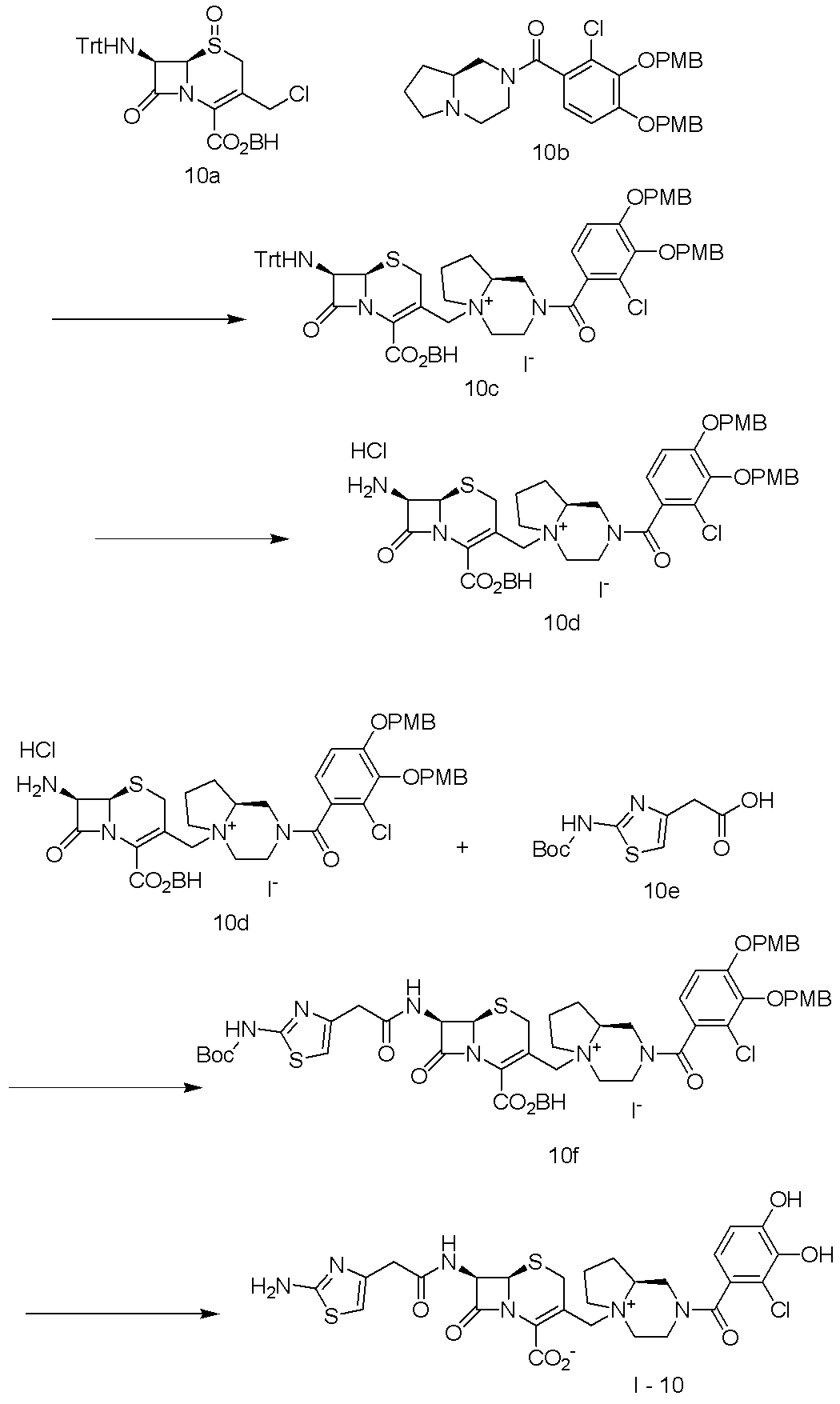
化合物10a (13.5 g, 20.0 mmol)、化合物10b (10.7 g, 20.0 mmol)のジメチルアセトアミド (60 ml)溶液に、ヨウ化ナトリウム (8.99 g, 60.0 mmol)を加え、室温にて3時間攪拌した。氷冷下、反応液にジメチルホルムアミド (60 ml)を加えた後、ヨウ化カリウム (26.6 g, 160 mmol)、塩化アセチル (8.56 ml, 120 mmol)を順次加え、氷冷下2時間攪拌した。反応混合物を氷冷した亜硫酸水素ナトリウム (20.8 g, 200 mmol)を含む5%食塩水 (600 ml)にゆっくりと加えた。析出した固体をろ取し、水洗した後、水に懸濁させ、凍結乾燥することにより化合物10c (28.5 g)を淡橙色固体として得た。得られた化合物10cは精製せずそのまま次の反応に用いた。
得られた化合物10c全量 (28.5 g)をアセトン (80 ml)に溶解させ、6規定塩酸水溶液 (5.00 ml, 30.0 mmol)を加え室温で6時間攪拌した。反応液を塩化メチレンで希釈し、硫酸マグネシウムにより乾燥した。硫酸マグネシウムをろ過した後、減圧濃縮し、化合物10d (26.96 g, 125%)を得た。
化合物10d (1.08 g, 1.00 mmol)と化合物10e (258 mg, 1.00 mmol)を用いて実施例4と同様にして合成した。
得られた化合物10f全量を用いて実施例4と同様にして合成した。
収量 183.0 mg, (25%)
1H-NMR (DMSO-d6) δ: 10.27 (1H, br s), 9.52 (1H, br s), 8.83 (1H, d, J = 8.39 Hz), 6.91 (2H, br s), 6.81 (1H, d, J = 8.16 Hz), 6.63 (1H, d, J = 8.16 Hz), 6.24 (1H, s), 5.60-5.55 (1H, m), 5.21-5.01 (2H, m), 4.31-3.45 (10H, m), 1.87-2.27 (5H, m).
元素分析:C27H29ClN6O7S2(H2O)3
計算値:C,46.12; H,5.02; Cl,5.04; N,11.95; S,9.12 (%)
実験値:C,46.17; H,5.07; Cl,5.08; N,11.89; S,9.00 (%)
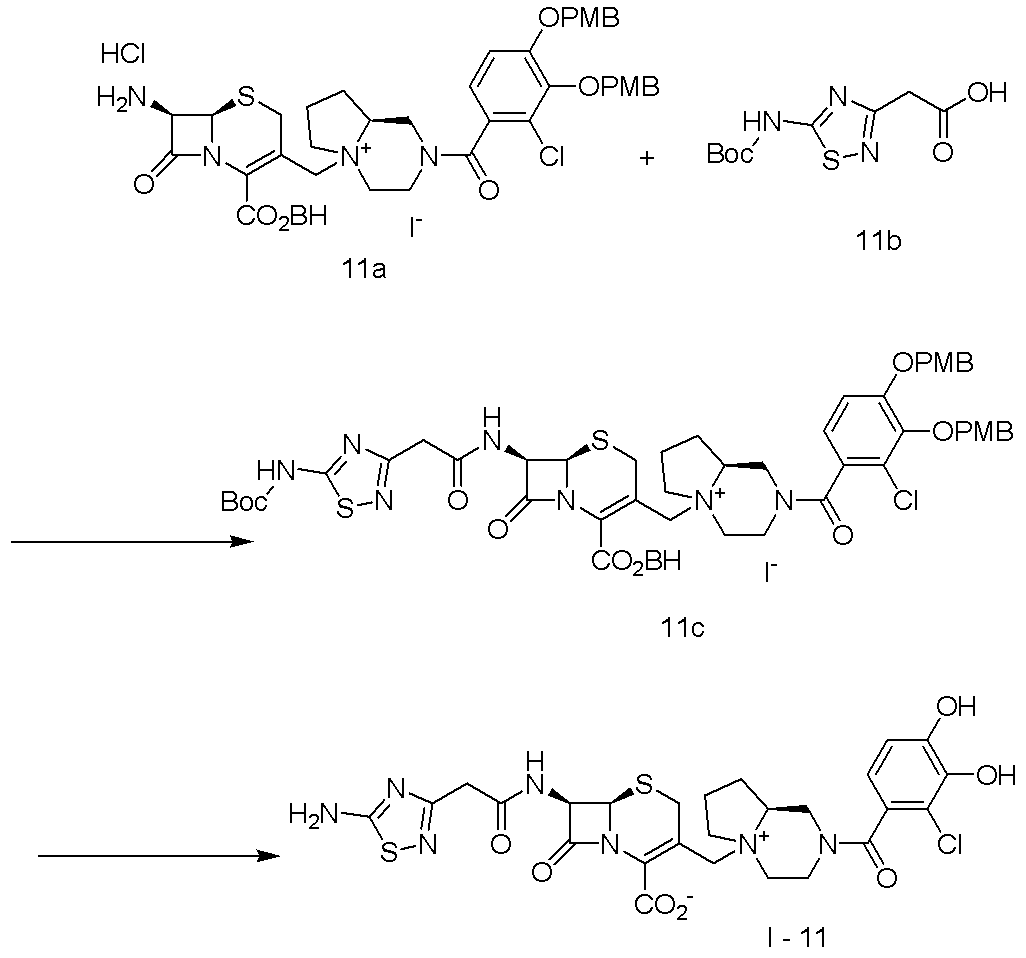
化合物11a (1.08 g, 1.00 mmol)と化合物11b (259 mg, 1.00 mmol)を用いて実施例4と同様にして合成した。
得られた化合物11c全量を用いて実施例4と同様にして合成した。
収量 301.9 mg, (39%)
1H-NMR (DMSO-d6) δ: 10.41 (1H, br s), 9.56 (1H, br s), 9.01 (1H, d, J = 8.08 Hz), 7.93 (2H, br s), 6.83 (1H, d, J = 8.16 Hz), 6.63 (1H, d, J = 8.16 Hz), 5.61-5.57 (1H, m), 5.22-5.02 (2H, m), 4.29-3.47 (12H, m), 1.91-2.27 (5H, m).
元素分析:C26H28ClN7O7S2(H2O)3.3
計算値:C,44.01; H,4.91; Cl,5.00; N,13.82; S,9.04 (%)
実験値:C,44.00; H,4.88; Cl,5.04; N,13.67; S,9.21 (%)

化合物12a (1.08 g, 1.00 mmol)と化合物12b (152 mg, 1.00 mmol)を用いて実施例4と同様にして合成した。
得られた化合物12c全量を用いて実施例4と同様にして合成した。
収量 153.1 mg, (21%)
1H-NMR (DMSO-d6) δ: 10.31 (1H, br s), 9.52 (1H, br s), 9.27 (1H, br s), 8.97 (1H, d, J = 8.39 Hz), 7.06-7.02 (2H, m), 6.82 (1H, d, J = 8.24 Hz), 6.68-6.62 (3H, m), 5.54-5.50 (1H, m), 5.18-4.98 (2H, m), 4.32-3.44 (11H, m), 1.88-2.27 (5H, m).
元素分析:C30H31ClN4O8S(H2O)2.9
計算値:C,51.82; H,5.33; Cl,5.10; N,8.06; S,4.61 (%)
実験値:C,51.81; H,5.31; Cl,5.11; N,8.15; S,4.63 (%)
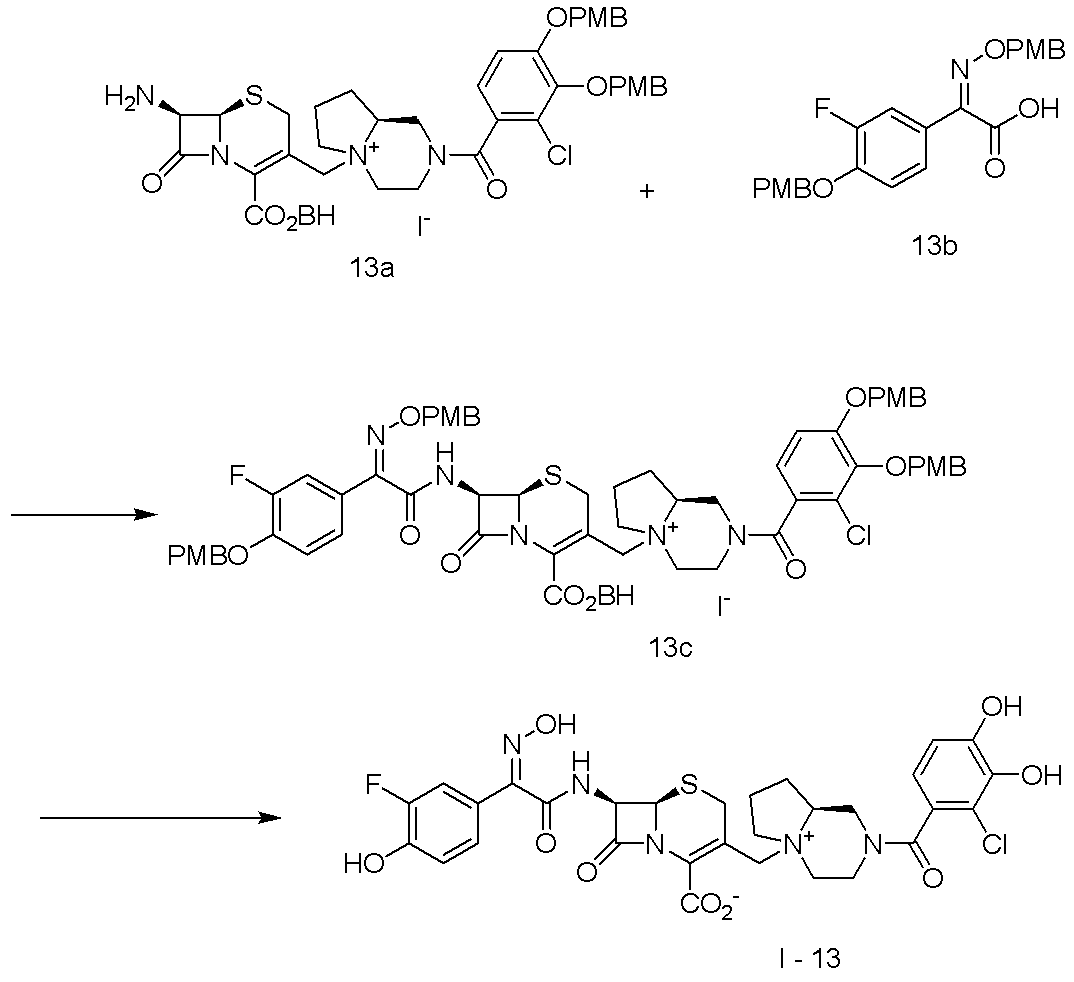
化合物13a (1.08 g, 1.00 mmol)と化合物13b (439 mg, 1.00 mmol)を用いて実施例4と同様にして合成した。
得られた化合物13c全量を用いて実施例4と同様にして合成した。
収量 172.3 mg, (19%)
1H-NMR (DMSO-d6) δ: 11.45 (1H, br s), 10.43 (1H, br s), 10.25 (1H, br s), 9.60-9.42 (2H, m), 7.27-7.13 (2H, m), 6.98 (1H, t, J = 8.31 Hz), 6.83-6.62 (3H, m), 5.72-5.69 (1H, m), 5.15-5.02 (2H, m), 3.90-3.45 (11H, m), 2.27-1.85 (5H, m).
元素分析:C30H29ClFN5O9S(H2O)3.5
計算値:C,47.84; H,4.82; Cl,4.71; F,2.52; N,9.30; S,4.26 (%)
実験値:C,47.86; H,4.73; Cl,4.73; F,2.53; N,9.29; S,4.42 (%)

化合物14a (1.08 g, 1.00 mmol)と化合物14b (430 mg, 1.00 mmol)を用いて実施例4と同様にして合成した。
得られた化合物14c全量を用いて実施例4と同様にして合成した。
収量 96.9 mg, (11%)
1H-NMR (D2O) δ: 6.96-6.47 (4H, m), 5.87-5.77 (1H, m), 5.37-5.27 (1H, m), 4.41-4.23 (1H, m), 3.98-3.21 (12H, m), 2.87 (1H, s), 2.50-2.04 (5H, m).
元素分析:C30H30ClN6O9S2Na(H2O)5.2
計算値:C,43.16; H,4.88; Cl,4.25; N,10.07; S,7.68; Na,2.75 (%)
実験値:C,43.09; H,4.90; Cl,4.18; N,10.26; S,7.80; Na,2.28 (%)

化合物15a (1.08 g, 1.00 mmol)と化合物15b (413 mg, 1.00 mmol)を用いて実施例4と同様にして合成した。
得られた化合物15c全量を用いて実施例9と同様にして合成した。
収量 48.0 mg, (5%)
1H-NMR (D2O) δ: 7.54 (2H, d, J = 8.85 Hz), 6.98-6.82 (4H, m), 5.91 (1H, d, J = 4.92 Hz), 5.37 (1H, dd, J = 8.01, 4.92 Hz), 4.33 (1H, d, J = 12.81 Hz), 3.97-3.44 (11H, m), 2.02-2.50 (5H, m), 1.51 (6H, s).
元素分析:C34H35ClN5O11SNa(H2O)5.1
計算値:C,46.83; H,5.22; Cl,4.07; N,8.03; S,3.68; Na,2.64 (%)
実験値:C,46.79; H,5.25; Cl,4.21; N,8.13; S,3.78; Na,2.24 (%)
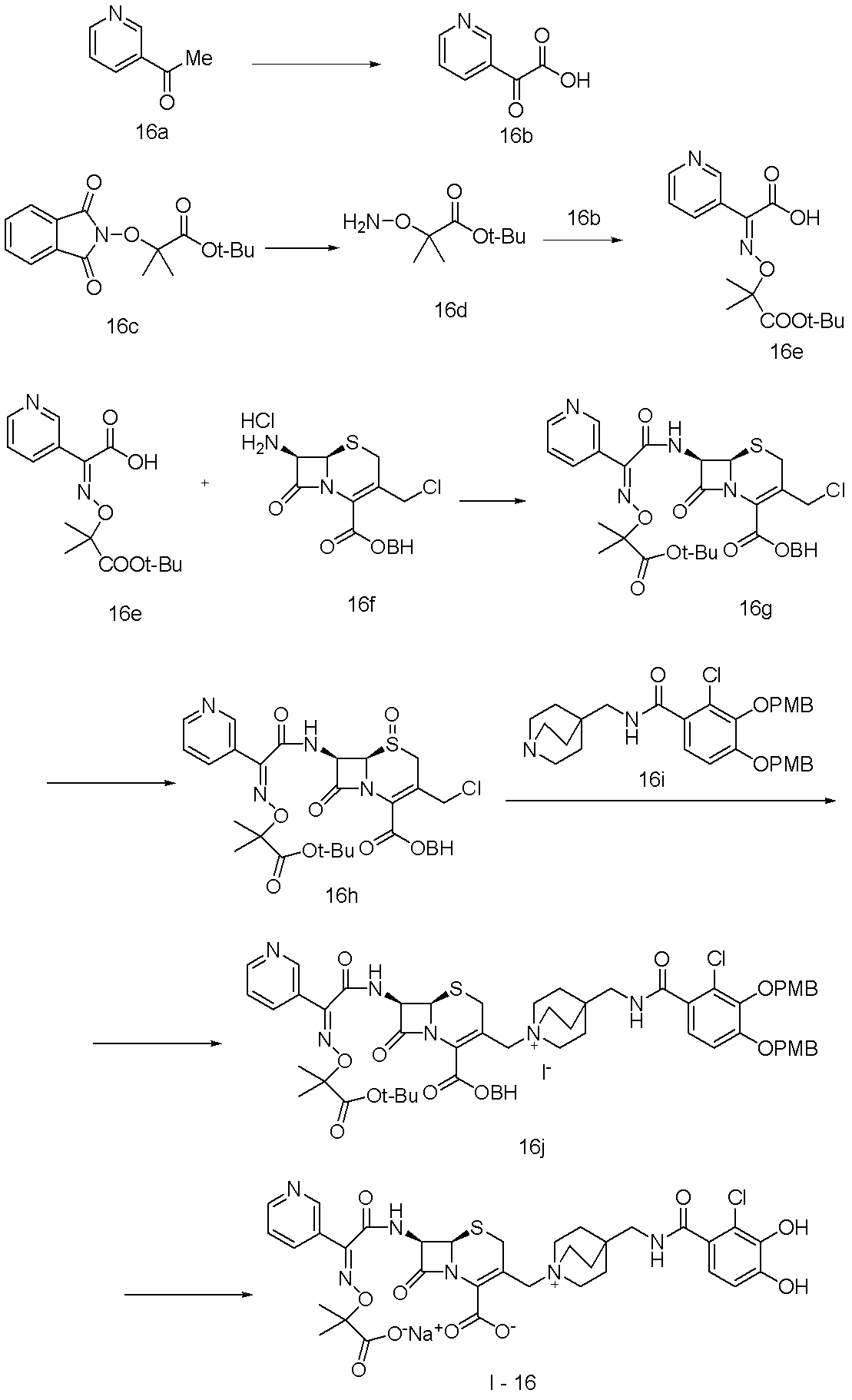
化合物16a (1.85 g)のピリジン (18 ml)溶液に二酸化セレン (4.16 g)を加え80℃で6時間攪拌した。室温まで冷却後、不用物を濾去し、濾液を濃縮乾固した。得られた化合物16bを含む粗生成物はそのまま次の反応に用いた。
化合物16c (4.58 g)のジクロロメタン (17 ml)溶液にメチルヒドラジン (0.76 g)を加えて30分間攪拌した。析出した不溶物を濾去し、濾液を濃縮した。残渣をメタノール (35 ml)に溶解し、氷冷攪拌下、上で合成した化合物16bのメタノール溶液を加えた。反応液を3時間攪拌した後、酢酸エチルと水で希釈し、水槽のpHを3に希塩酸で調整した。有機層を食塩水で洗浄し、無水硫酸マグネシウムで乾燥、濾過した濾液を濃縮して化合物16e (4.2 g)を得た。化合物16eは精製されることなく次の反応に用いた。
化合物16e (4.2 g) の酢酸エチル溶液に化合物16f (6.77 g)を加えて-40℃下、フェニルリン酸ジクロリド (5.74 g)、次いでN‐メチルモルホリン (7.59 g) を加えた。反応液を-40℃で1時間攪拌した後、10%クエン酸水溶液を加えた。有機層を水及び食塩水で洗浄し、無水硫酸マグネシウムで乾燥した後、濾過した濾液を濃縮した。残渣をシリカゲルカラムクロマトグラフィ(n-hexane / ethyl acetate)で精製し、目的の化合物16g (3.74 g, 4工程、35%収率)を得た。
1H-NMR (CDCl3) δ: 8.84 (1H, d, J = 1.17 Hz), 8.63 (1H, dd, J = 4.87, 1.80 Hz), 7.89 (1H, dt, J = 8.06, 1.80 Hz), 7.47-7.30 (12H, m), 7.00 (1H, s), 5.98 (1H, dd, J = 9.74, 5.04 Hz), 5.06 (1H, d, J = 5.04 Hz), 4.46 (1H, d, J = 11.83 Hz), 4.40 (1H, d, J = 11.83 Hz), 3.69 (1H, d, J = 18.46 Hz), 3.53 (1H, d, J = 18.46 Hz), 1.54 (3H, s), 1.52 (3H, s), 1.47 (9H, s).
化合物16g (3.74 g) のジクロロメタン溶液にm‐クロロ過安息香酸 (1.55 g) のジクロロメタン溶液を-40℃下加えた。反応液を同温で1時間攪拌した後、10%チオ硫酸ナトリウム水溶液及び酢酸エチルを加えた。ジクロロメタンを減圧留去した後、有機層を食塩水で洗浄して、無水硫酸マグネシウムで乾燥した。濾過して得られた濾液を濃縮後、残渣をシリカゲルカラムクロマトグラフィ(n-hexane / ethyl acetate)で精製し、目的の化合物16h (2.77 g, 68%収率)を得た。
1H-NMR (CDCl3) δ: 8.85 (1H, dd, J = 2.14, 0.76 Hz), 8.62 (1H, dd, J = 4.88, 1.79 Hz), 8.14 (1H, d, J = 10.60 Hz), 7.91 (1H, dt, J = 8.03, 1.79 Hz), 7.47-7.29 (11H, m), 6.97 (1H, s), 6.20 (1H, dd, J = 10.60, 4.88 Hz), 4.98 (1H, d, J = 12.43 Hz), 4.59 (1H, dd, J = 4.88, 1.37 Hz), 4.18 (1H, d, J = 12.43 Hz), 3.85 (1H, d, J = 18.53 Hz), 3.45 (1H, d, J = 18.53 Hz), 1.55 (3H, s), 1.53 (3H, s), 1.47 (9H, s).
化合物(I-16)は前記の最終物の合成法と同様の手法により合成した。
1H-NMR (D2O) δ: 8.65 (1H, s), 8.58 (1H, d, J = 3.81 Hz), 8.03 (1H, dt, J = 7.87, 1.87 Hz), 7.56 (1H, dd, J = 7.87, 4.96 Hz), 6.92 (1H, d, J = 8.31 Hz), 6.88 (1H, d, J = 8.31 Hz), 5.74 (1H, d, J = 5.03 Hz), 5.30 (1H, d, J = 5.03 Hz), 4.60 (1H, d, J = 13.88 Hz), 3.91 (1H, d, J = 6.86 Hz), 3.86 (1H, d, J = 9.76 Hz), 3.34-3.56 (9H, m), 1.95 (6H, t, J = 7.55 Hz), 1.49 (3H, s), 1.48 (3H, s).
元素分析 : C34H36ClN6O10SNa(H2O)9.0
計算値 : C,43.38; H,5.78; Cl,3.77; N,8.93; S,3.41; Na,2.44 (%)
実測値 : C,43.36; H,5.60; Cl,3.86; N,8.91; S,3.43; Na,2.60 (%)
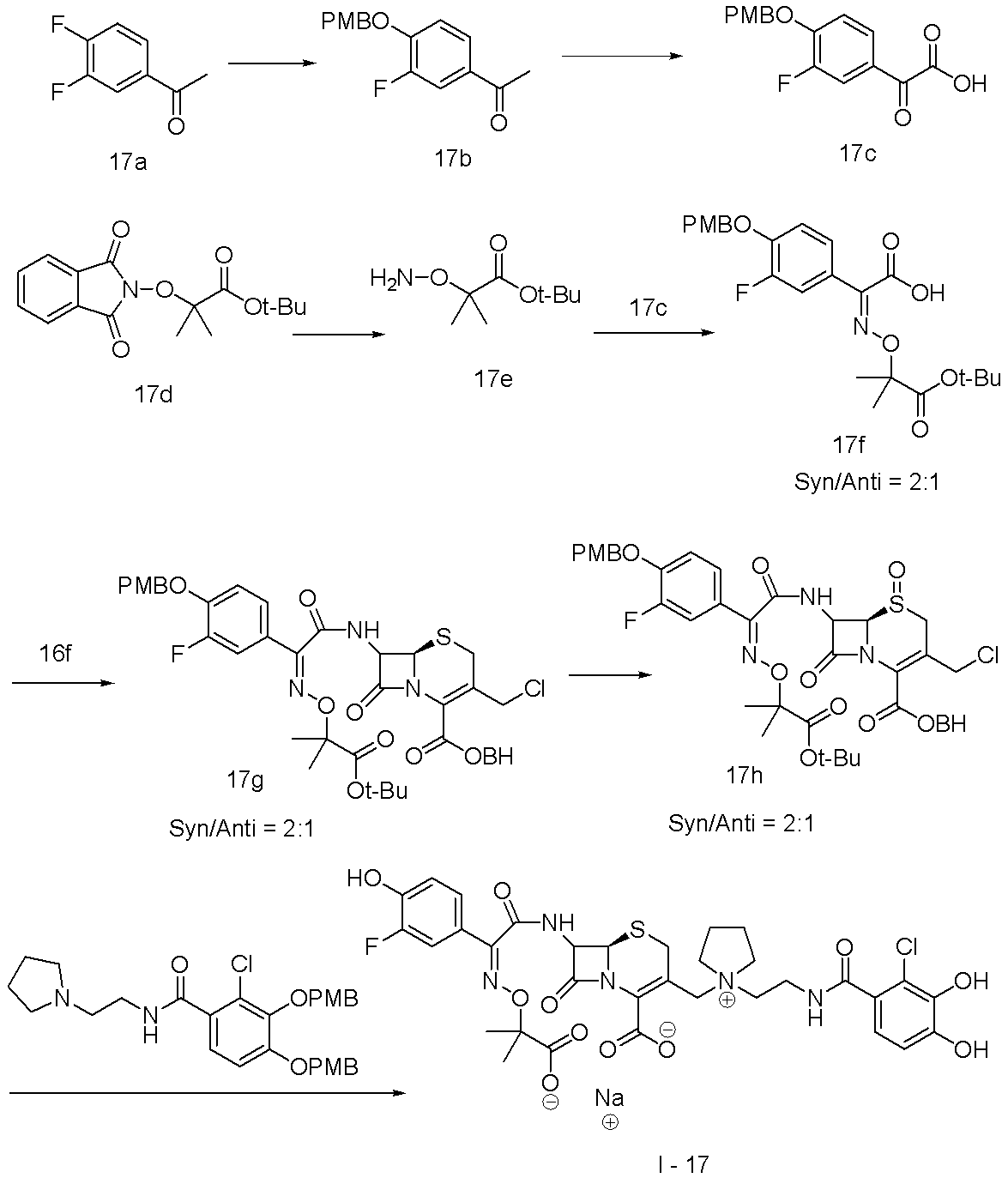
化合物17a (25 g) と4‐メトキシベンジルアルコール (24.3 g)の混合物に18‐クラウン‐6‐エーテル (4.23 g) 及び炭酸カリウム (44.3 g) を加えた。反応液を120℃で2時間攪拌した後、氷水、酢酸エチルを加えた。水槽を酢酸エチルで抽出し、先の有機層と合わせた酢酸エチル溶液を無水硫酸マグネシウムで乾燥した。濾過後得られた濾液を濃縮し、固体となった残渣をジエチルエーテルを用いて濾取した。この固体を減圧乾燥して化合物17b (36.0 g, 82%収率)を得た。
1H-NMR (CDCl3) δ: 7.67-7.72 (2H, m), 7.37 (2H, d, J = 8.79 Hz), 7.04 (1H, t, J = 8.38 Hz), 6.92 (2H, d, J = 8.79 Hz), 5.14 (2H, s), 3.82 (3H, s), 2.54 (3H, s).
化合物17b (32.0 g) のピリジン (200 ml) 溶液に二酸化セレン (25.9 g) を加えて、80℃で3時間攪拌した。さらに二酸化セレン (2.6 g) を追加して、80℃で4時間攪拌した。不溶物を濾去して濾液を濃縮後、酢酸エチル、2規定塩酸で希釈した。有機層を水、食塩水で洗浄後、無水硫酸マグネシウムで乾燥、濾過して得られた濾液を減圧下濃縮、乾燥して化合物17c (34 g, 96%収率)を得た。
1H-NMR (DMSO-d6) δ: 7.71-7.79 (2H, m), 7.48 (1H, t, J = 8.62 Hz), 7.42 (2H, d, J = 8.54 Hz), 6.96 (2H, d, J = 8.54 Hz), 5.23 (2H, s), 3.76 (3H, s).
化合物17f は実施例16と同様な手法により化合物17c (4.56 g) 及び化合物17d (4.58 g)から得た。化合物17f は幾何異性体の混合物であり、そのまま次の工程で用いた。
化合物17h (6.0 g) は実施例16の合成法と同様な手法により化合物17f (6.92 g) 及び化合物16f (6.77 g)から化合物17gを経て合成した。化合物17hは幾何異性体の混合物で、次の工程でそのまま用いた。
化合物(I-17)は他の最終物と同様な手法により合成した。
1H-NMR (D2O) δ: 7.46 (1H, dd, J = 12.28, 1.91 Hz), 7.26 (1H, dd, J = 8.54, 2.14 Hz), 7.02 (1H, t, J = 8.77 Hz), 6.95 (1H, d, J = 8.31 Hz), 6.87 (1H, d, J = 8.31 Hz), 5.88 (1H, d, J = 4.88 Hz), 5.38 (1H, d, J = 4.88 Hz), 4.14 (1H, d, J = 14.18 Hz), 3.97-3.47 (10H, m), 2.23 (4H, br s), 1.52 (3H, s), 1.50 (3H, s).
元素分析: C33H34ClFN5O11SNa(H2O)7.8(NaCl)0.1
計算値 : C,42.50; H,5.36; Cl,4.18; F,2.04; N,7.51; S,3.44; Na,2.71 (%)
実測値 : C,42.44; H,5.23; Cl,4.33; F,2.11; N,7.57; S,3.34; Na,2.74 (%)

化合物18b (441 mg, 0.80 mmol)のジメチルアセトアミド (1.5 ml)溶液を15 ℃まで冷却した後、化合物18a (549 mg, 0.80 mmol)を加え、減圧脱気した。ヨウ化ナトリウム (240 mg, 1.6 mmol) を加え、15 ℃で6時間攪拌した。ジメチルホルムアミド (4.5 ml)を加えた後、-40 ℃に冷却し、三臭化リン (151 μl, 1.6 mmol)を加え、-40 ℃で30分間攪拌した。反応混合物を氷冷した5%食塩水にゆっくりと加えた。析出した固体をろ取し、水洗した後、水に懸濁させ、凍結乾燥することにより化合物18cを褐色固体として得た。得られた化合物18cは精製せずそのまま次の反応に用いた。
得られた化合物18c全量をジクロロメタン (10 ml)に溶解させ、-40 ℃まで冷却した後、アニソール (847 μl, 8.0 mmol)と2mol/l塩化アルミニウム/ニトロメタン溶液 (4.0 ml, 8.0 mmol)を順に加え、0 ℃で30分間攪拌した。反応液にジイソプロピルエーテル、及び少量の水を加えて攪拌し沈殿を生成させ、デカンテーションにより上澄みを除いた。容器に付着した不溶物に希塩酸水、アセトニトリルを加えて攪拌し、完全に溶解させた後、ジイソプロピルエーテルを加え、水層を分取した。有機層を再度水で抽出した後、すべての水層を合せHP20SS樹脂を加えアセトニトリルを減圧留去した。得られた混合液をODSカラムクロマトグラフィにより精製した。所望の化合物を含む分画を集め、減圧濃縮した後、凍結乾燥することにより化合物(I-18)を白色粉末として得た。
収量 390 mg, (59%)
1H-NMR (DMSO-d6) δ: 1.08 (3H, t, J = 7.2 Hz), 1.91-1.98 (2H, m), 2.30-2.53 (6H, m), 2.95 (3H, s), 3.53-4.00 (12H, m), 4.84 (1H, d, J = 12.2 Hz), 4.99 (1H, d, J = 5.0 Hz), 5.58-5.65 (2H, m), 6.70 (1H, d, J = 8.2 Hz), 6.77 (1H, d, J = 8.2 Hz), 7.29-7.44 (5H, m), 8.32 (1H, d, J = 3.8 Hz), 9.46 (1H, d, J = 8.2 Hz), 9.85 (1H, d, J = 7.6 Hz).
MS (m+1) = 824.44
元素分析:C38H42ClN7O10S・5.0H2O
計算値:C,49.91; H,5.73; Cl,3.88; N,10.72; S,3.51 (%)
実験値:C,49.95; H,5.65; Cl,4.09; N,10.61; S,3.55 (%)
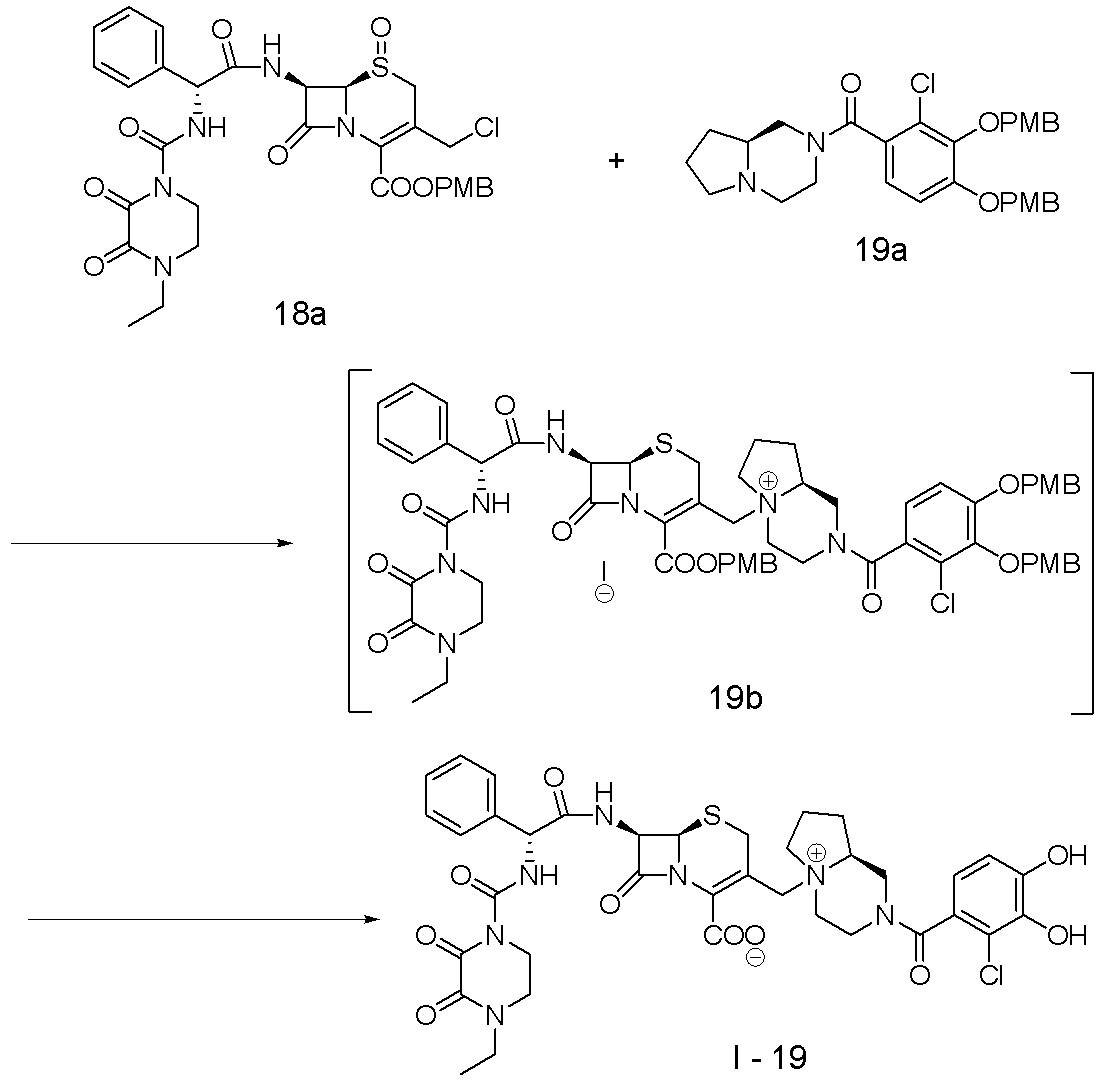
化合物18a (549 mg, 0.80 mmol)と化合物19a (430 mg, 0.80 mmol)から実施例18と同様にして化合物(I-19)を白色粉末として得た。
収量 456 mg, (70%)
1H-NMR (DMSO-d6) δ: 1.08 (3H, t, J = 7.1 Hz), 1.95-2.23 (4H, m), 3.53-4.25 (18H, m), 4.93-5.12 (2H, m), 5.57-5.65 (2H, m), 6.62 (1H, d, J = 8.1 Hz), 6.82 (1H, d, J = 8.1 Hz), 7.28-7.44 (5H, m), 9.46 (1H, d, J = 5.5 Hz), 9.85 (1H, d, J = 7.0 Hz).
MS (m+1) = 810.30
元素分析:C37H40ClN7O10S・4.9H2O
計算値:C,49.46; H,5.59; Cl,3.95; N,10.91; S,3.57 (%)
実験値:C,49.41; H,5.43; Cl,3.97; N,10.88; S,3.59 (%)

化合物18a (343 mg, 0.50 mmol)と化合物20a (261 mg, 0.50 mmol)から実施例18と同様にして化合物(I-20)を白色粉末として得た。
収量 136 mg, (36%)
1H-NMR (DMSO-d6) δ: 1.08 (3H, t, J = 7.1 Hz), 1.95-2.10 (4H, m), 3.47-3.93 (17H, m), 4.99-5.04 (2H, m), 5.58-5.66 (2H, m), 7.28-7.45 (5H, m), 7.97 (1H, s), 8.81 (1H, s), 9.46 (1H, d, J = 8.1 Hz), 9.85 (1H, d, J = 7.4 Hz).
MS (m+1) = 765.33
元素分析:C35H40N8O10S・3.9H2O
計算値:C,50.34; H,5.77; N,13.42; S,3.84 (%)
実験値:C,50.34; H,5.64; N,13.19; S,3.75 (%)

化合物21a (221 mg, 0.40 mmol)のジメチルアセトアミド (1 ml)溶液を15 ℃まで冷却した後、化合物18a (274 mg, 0.40 mmol)を加え、減圧脱気した。ヨウ化ナトリウム (120 mg, 0.80 mmol)を加え、15 ℃で1時間攪拌した後、冷蔵庫で終夜静置した。ジメチルホルムアミド (3.0 ml)を加えた後、0 ℃に冷却し、ヨウ化カリウム (475 mg, 2.8 mmol)、塩化アセチル (114 μl, 1.6 mmol)を順に加え、0 ℃で3時間攪拌した。反応混合物を氷冷した5%食塩水にゆっくりと加えた。析出した固体をろ取し、水洗した後、水に懸濁させ、凍結乾燥することにより化合物21bを褐色固体として得た。得られた化合物21bは精製せずそのまま次の反応に用いた。
得られた化合物21b全量をジクロロメタン (6 ml)に溶解させ、-40 ℃まで冷却した後、アニソール (437 μl, 4.0 mmol)と2mol/l塩化アルミニウム/ニトロメタン溶液 (2.0 ml, 4.0 mmol)を順に加え、0 ℃で30分間攪拌した。反応液にジイソプロピルエーテル、及び少量の水を加えて攪拌し沈殿を生成させ、デカンテーションにより上澄みを除いた。容器に付着した不溶物に希塩酸水、アセトニトリルを加えて攪拌し、完全に溶解させた後、ジイソプロピルエーテルを加え、水層を分取した。有機層を再度水で抽出した後、すべての水層を合せHP20SS樹脂を加えアセトニトリルを減圧留去した。得られた混合液をODSカラムクロマトグラフィにより精製した。所望の化合物を含む分画を集め、減圧濃縮した後、凍結乾燥することにより化合物(I-21)を白色粉末として得た。
収量 73 mg, (23%)
1H-NMR (DMSO-d6) δ: 1.08 (3H, t, J = 7.2 Hz), 1.96-2.07 (4H, br m), 3.38-4.03 (17H, m), 4.96-5.02 (2H, m), 5.61-5.65 (2H, m), 7.27-7.45 (5H, m), 7.51 (1H, s), 7.87 (1H, s), 9.49 (1H, d, J = 8.2 Hz), 9.85 (1H, d, J = 7.3 Hz), 11.80 (1H, s).
MS (m+1) = 781.37
元素分析:C35H40N8O11S・3.0H2O
計算値:C,50.35; H,5.55; N,13.42; S,3.84 (%)
実験値:C,50.44; H,5.54; N,13.17; S,3.80 (%)
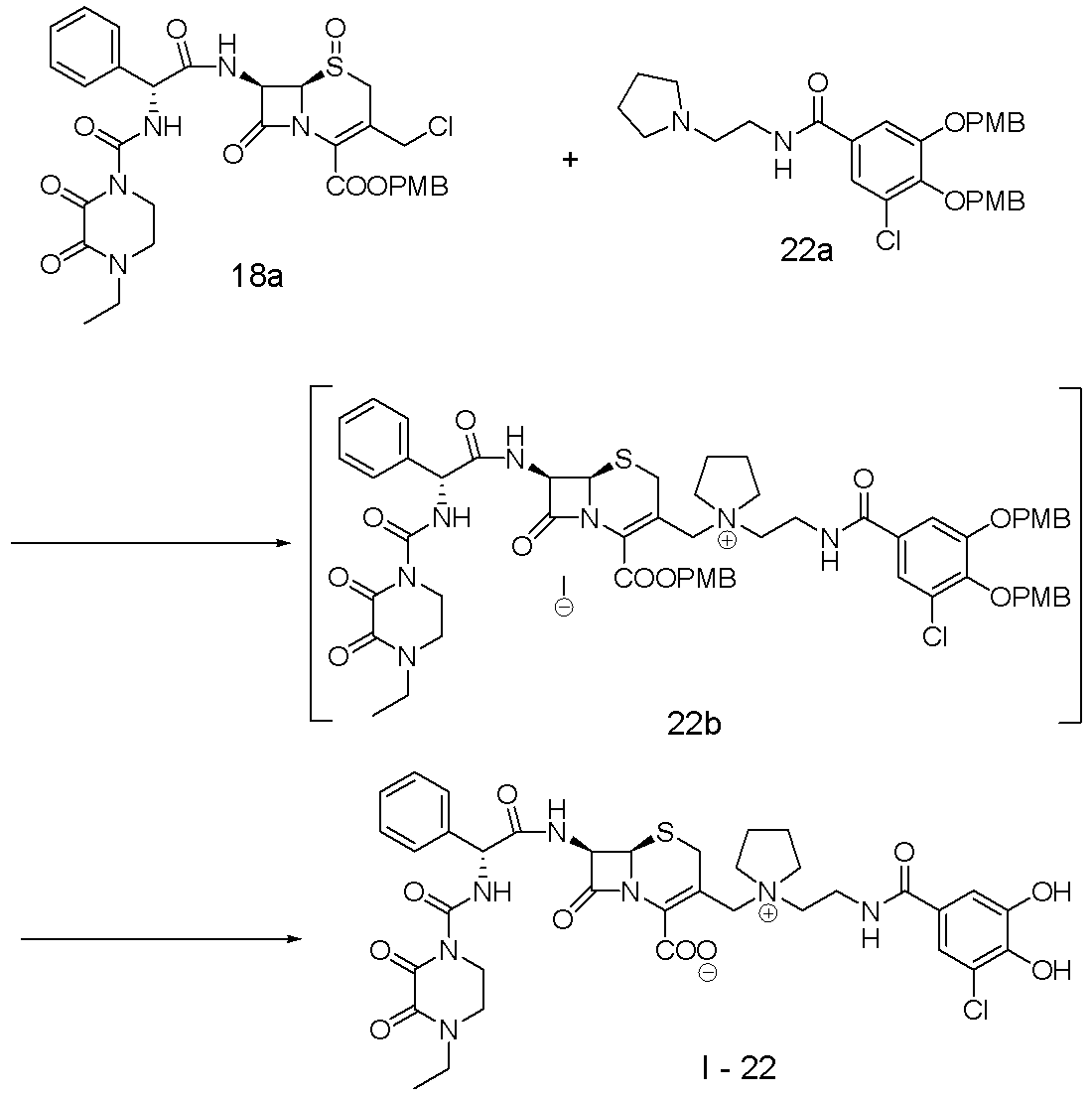
化合物18a (343 mg, 0.50 mmol)と化合物22a (263 mg, 0.50 mmol)から実施例18と同様にして化合物(I-22)を白色粉末として得た。
収量 242 mg, (61%)
1H-NMR (DMSO-d6) δ: 1.08 (3H, t, J = 7.1 Hz), 1.94-2.10 (4H, m), 3.23-3.91 (17H, m), 5.00 (1H, d, J = 5.0 Hz), 5.06 (1H, d, J = 13.4 Hz), 5.60-5.65 (2H, m), 7.28-7.44 (7H, m), 8.68 (1H, s), 9.48 (1H, d, J = 8.4 Hz), 9.85 (1H, d, J = 7.3 Hz).
MS (m+1) = 798.39
元素分析:C36H40ClN7O10S・3.7H2O
計算値:C,49.99; H,5.52; Cl,4.10; N,11.34; S,3.71 (%)
実験値:C,49.99; H,5.50; Cl,4.48; N,11.22; S,3.67 (%)

化合物23a (0.35g, 0.5mmol)をN,N-ジメチルホルムアミド (0.75ml)に溶解し、ヨウ化ナトリウム (0.15g, 1mmol)を加え-20℃で10分間撹拌した。反応液に化合物23b (0.248g, 1mmol)を加え-20℃で5時間撹拌した。反応液を酸性5%食塩水に注加し、得られた残渣をろ取し、精製水で洗浄し、減圧下乾燥し化合物23cを得た。
化合物23cをジクロロメタンに溶解し-40℃に冷却した。溶液にアニソール(1.09ml, 10mmol)、2M塩化アルミニウム ニトロメタン溶液 (5ml, 10mmol) を加え、0℃で撹拌した。反応液に精製水 (30ml)、ジイソプロピルエーテル (50ml)を加えた。反応液にアセトニトリル、2M塩酸を加え、析出物を溶解させた後、水層を分離した。有機層を水/アセトニトリル/希塩酸混液で抽出し、合わせた水槽にHP20SSを加えて濃縮した。濃縮した懸濁液をHP20SS-ODSカラムクロマトグラフィに付し、水-アセトニトリルで溶離した目的物を含む分画を減圧濃縮し、濃縮液を凍結乾燥することによって化合物(I-23)を粉末として得た。(収量178mg, 収率24%)
MS (m+1) = 808.50
1H-NMR (DMSO-d6) δ: 9.85 (2H, d, J = 7.6 Hz), 9.22 (1H, d, J = 8.6 Hz), 8.30-8.20 (2H, br m), 7.53-7.23 (10H, m), 6.74 (3H, s), 5.67 (1H, d, J = 7.6 Hz), 5.47-5.38 (1H, m), 5.07 (2H, d, J = 4.2 Hz), 4.42 (1H, d, J = 17.3 Hz), 4.19 (1H, d, J = 15.9 Hz), 3.97-3.83 (4H, m), 3.11 (4H, d, J = 5.0 Hz), 1.82-1.65 (9H, m), 1.08 (6H, t, J = 7.1 Hz).
元素分析:
計算値:C, 50.71; H, 5.85; N, 10.89; Cl, 3.94 (%)
実験値:C, 50.58; H, 5.67; N, 11.15; Cl, 4.04 (%)
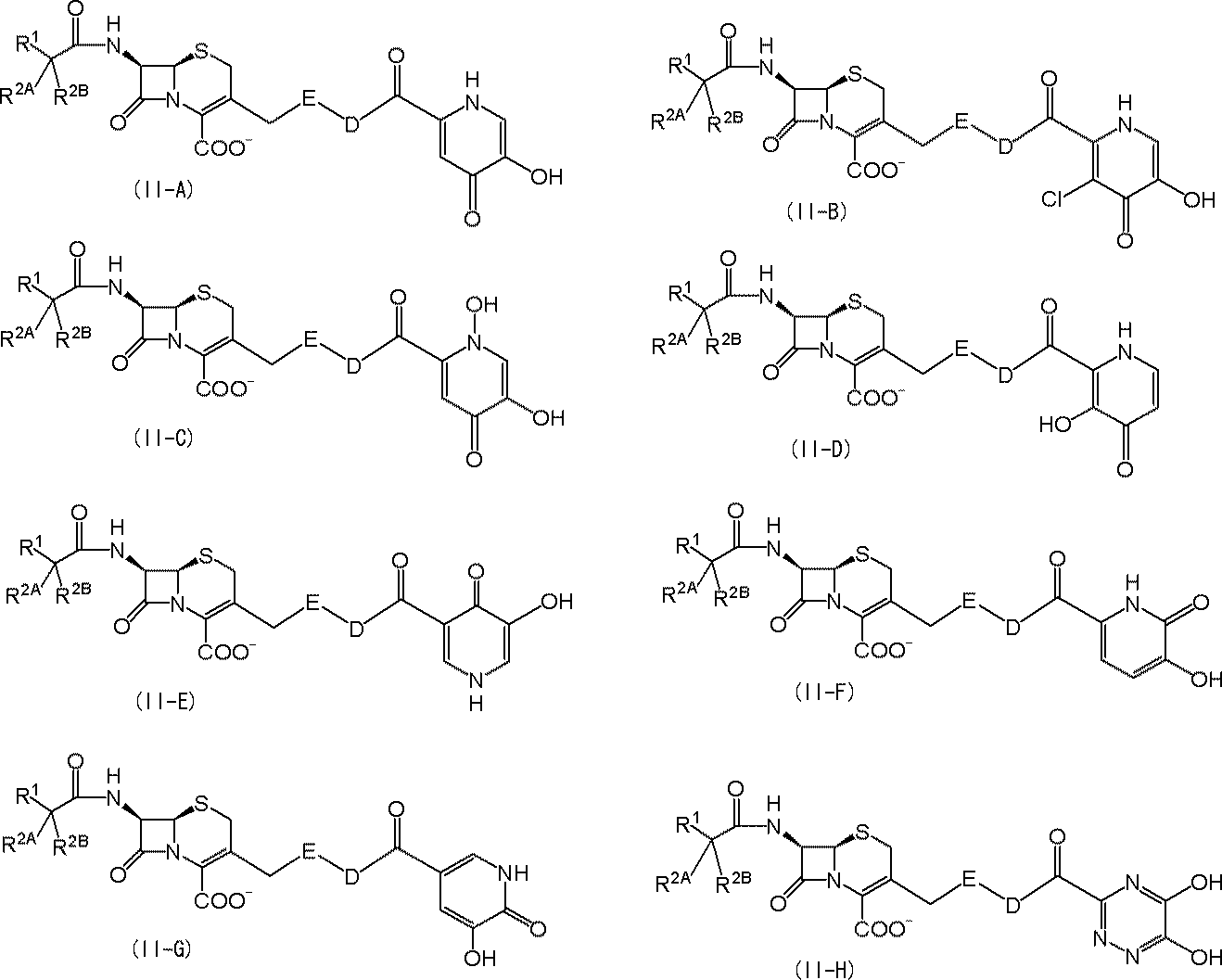
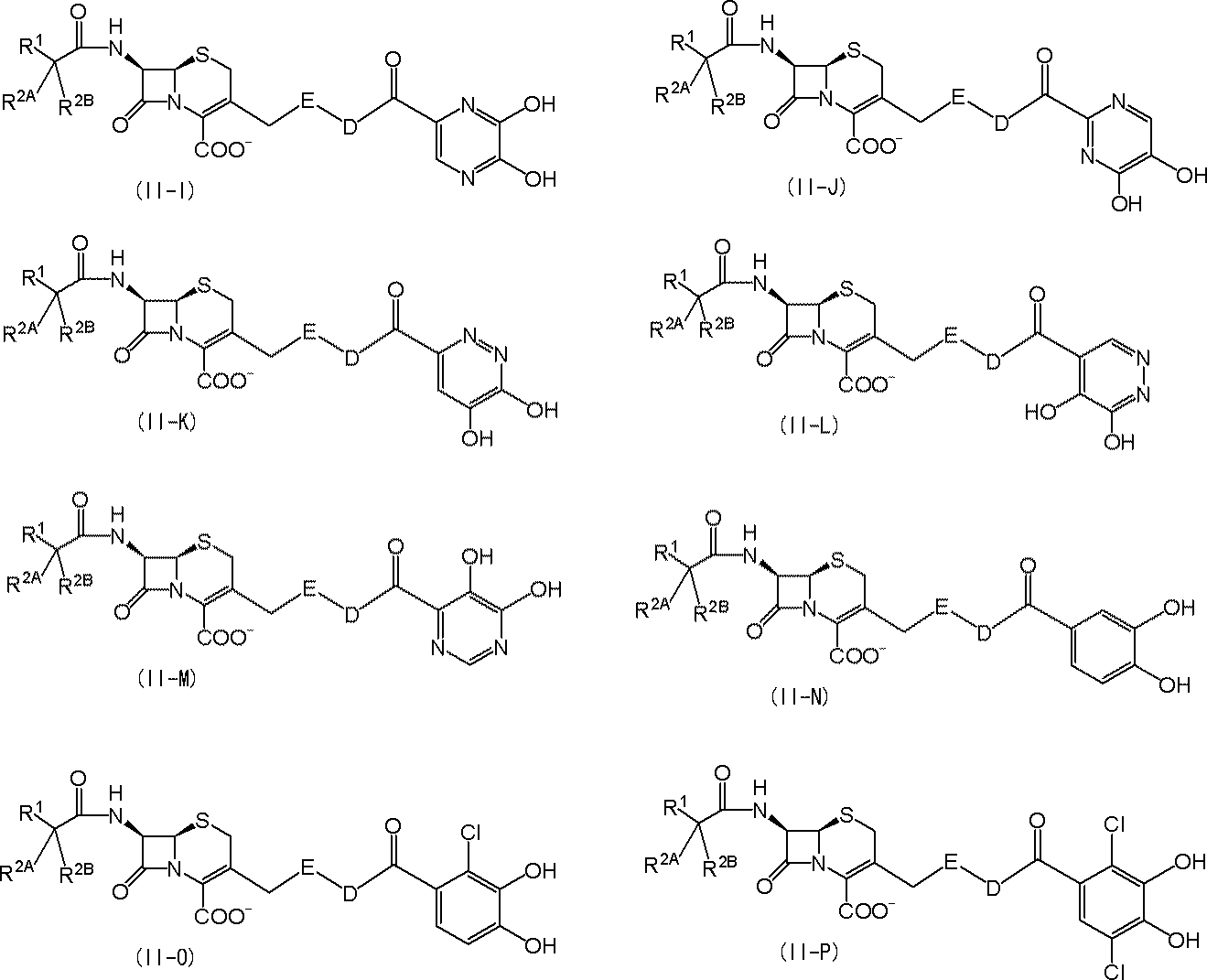
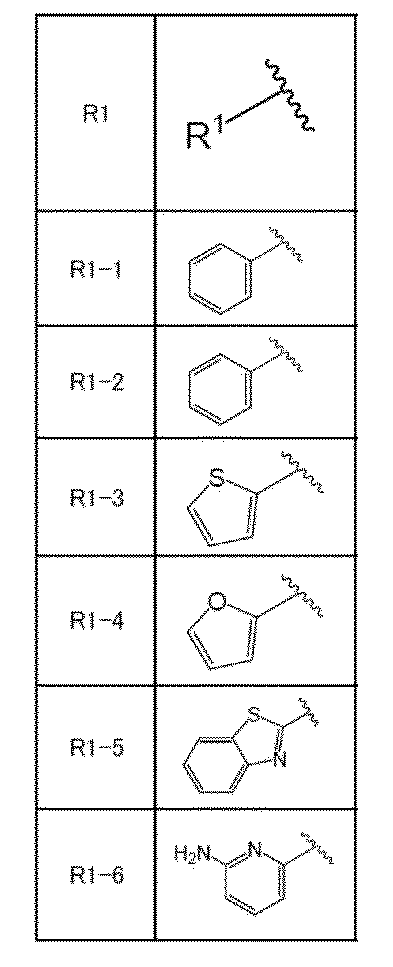
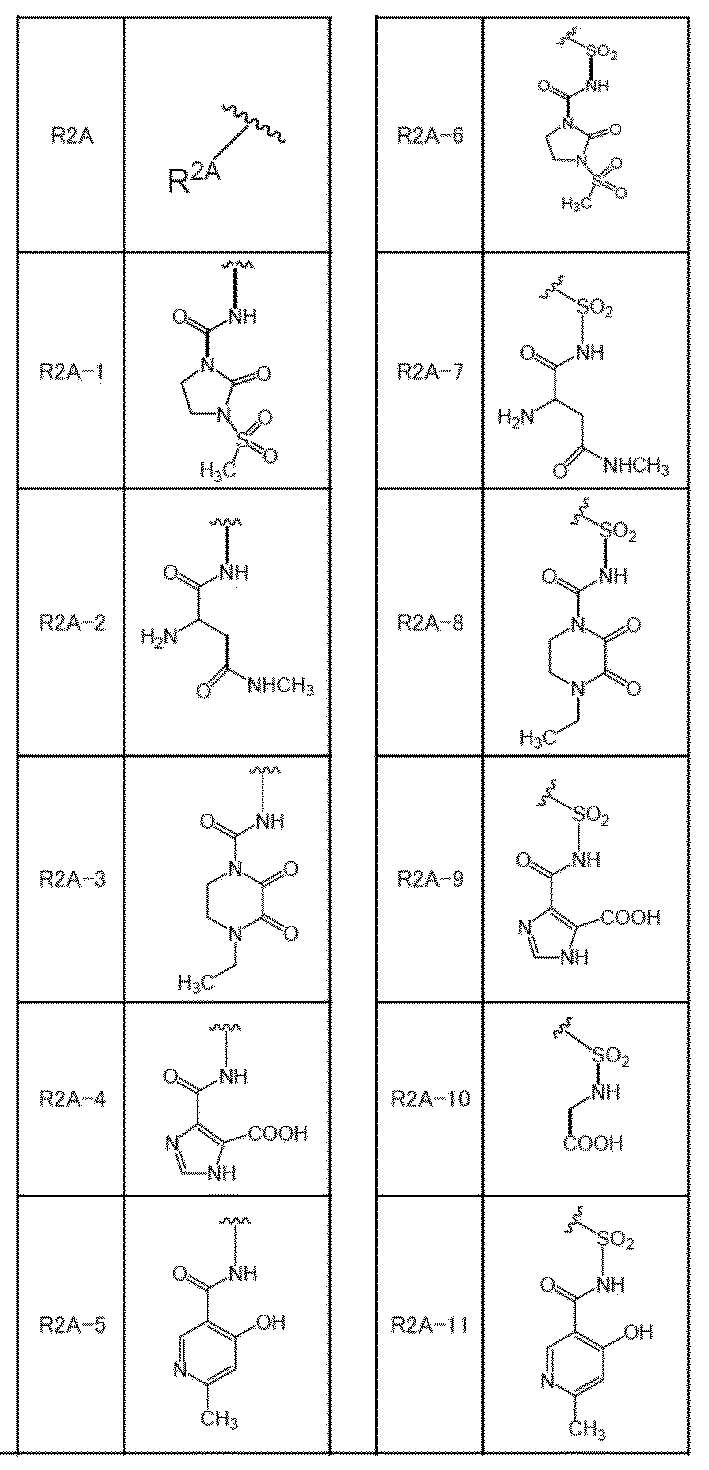


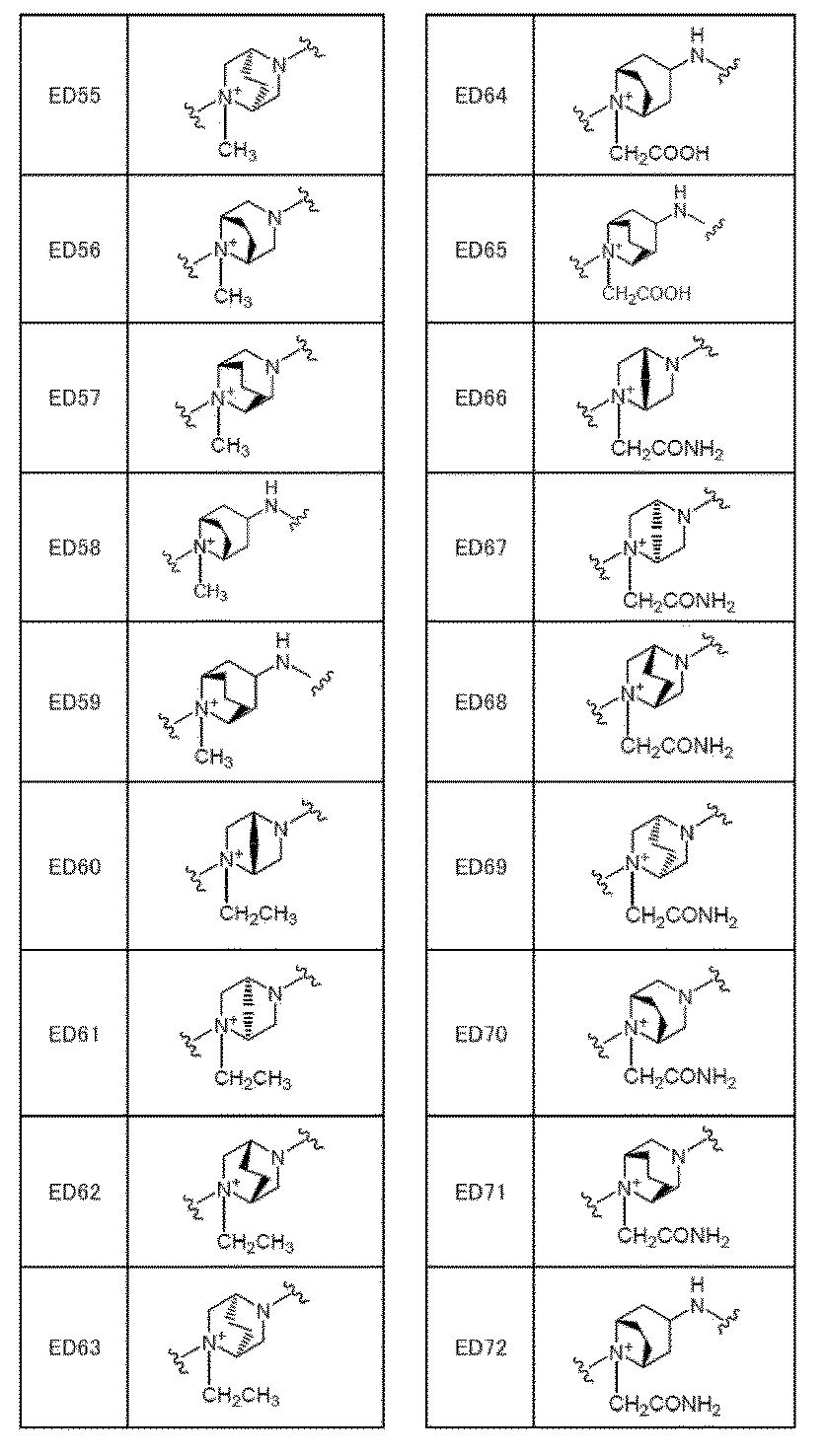


本発明化合物(I)のIn Vitro抗菌活性を確認した。
(菌・株番号1~4および6~8):
最小発育阻止濃度(MIC:μg/ml)の測定は日本化学療法学会標準法に準じ、接種菌量は1000cfu/spot,試験培地は感受性ディスク培地を用いて、寒天平板希釈法により実施した。
(菌・株番号5):
最小発育阻止濃度(MIC:μg/ml)の測定はCLSI(Clinical and Laboratory Standards Institute)法に準じ、接種菌量は10000cfu/spot,試験培地はミューラーヒントン寒天培地を用いて、寒天平板希釈法により実施した。
(菌・株番号1~5):
最小発育阻止濃度 (MIC:μg/mL)の測定はCLSI(Clinical and Laboratory Standards Institute) 法に準じ、試験菌量は5×10⁵ cfu/mL、試験培地はヒトApo-transferrin を添加したカチオン調整ミューラーヒントン液体培地を用いて、微量液体希釈法により実施した。
(菌・株番号6~8):
最小発育阻止濃度 (MIC:μg/mL)の測定はCLSI(Clinical and Laboratory Standards Institute) 法に準じ、試験菌量は5×10⁵ cfu/mL、試験培地はカチオン調整ミューラーヒントン液体培地を用いて、微量液体希釈法により実施した。
(菌・株番号1~5):
最小発育阻止濃度 (MIC:μg/mL)の測定はCLSI(Clinical and Laboratory Standards Institute) 法に準じ、試験菌量は5×10⁵ cfu/mL、試験培地はヒトApo-transferrin を添加したカチオン調整ミューラーヒントン液体培地を用いて、微量液体希釈法により実施した。
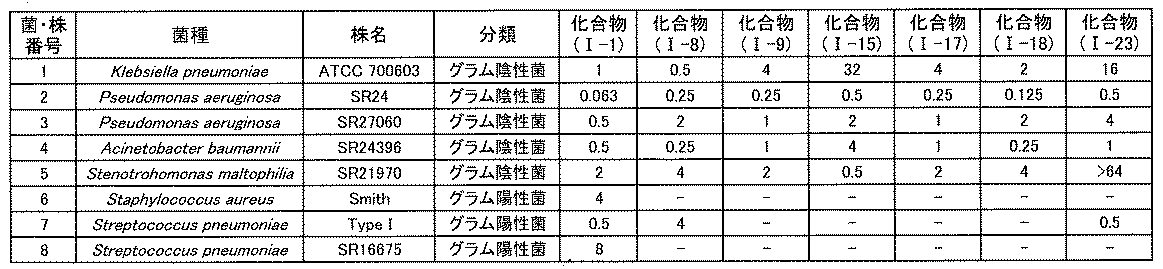

本発明化合物(I)のIn Vivo抗菌活性は以下の方法で確認する。
(試験方法)
感染は,P.aeruginosa SR27001(多剤耐性緑膿菌; IMP-1産生株)をマウス(ICR系,雄,5週齢) 腹腔内に接種することにより惹起する。感染1,5時間後の計2回静脈内投与で治療を行ない,7日後の生存率からED50値を算出する。
本発明化合物を粉末充填することにより注射剤を調製する。
Claims (22)
- 式:
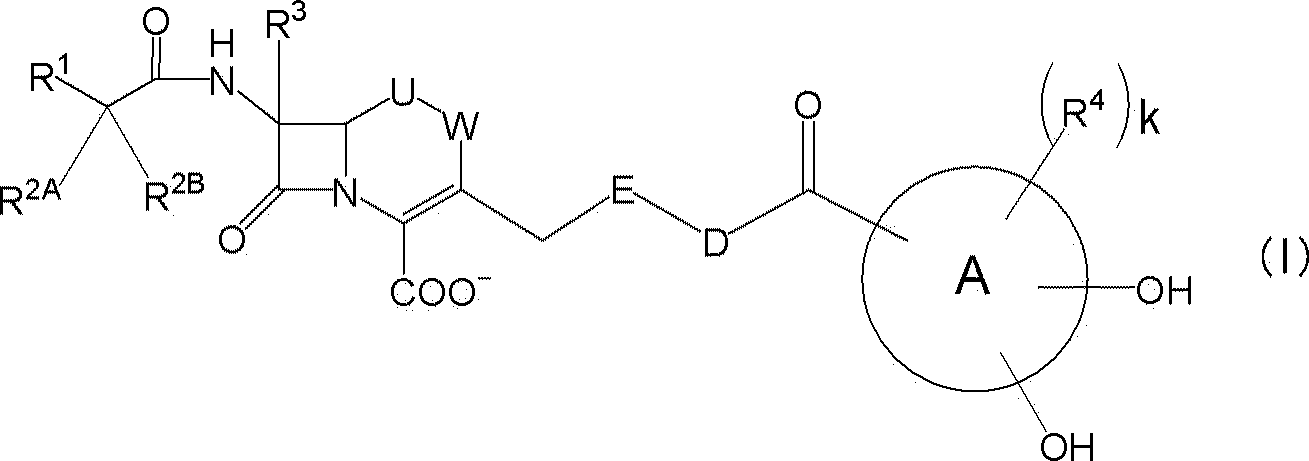
Wは-CH2-、-S-または-O-であり、
a)Wが-CH2-のときは、Uは-CH2-、-S-もしくは-O-であり、または
b)Wが-S-もしくは-O-のときは、Uは-CH2-であり、
R1は、置換基を有していてもよい炭素環式基、または置換基を有していてもよい複素環式基であり、
R2AおよびR2Bについては、
a)R2Aは、水素原子、置換基を有していてもよいアミノ基、-SO3H、置換基を有していてもよいアミノスルホニル基、カルボキシル基、置換基を有していてもよい低級アルキルオキシカルボニル基、置換基を有していてもよいカルバモイル基、ヒドロキシル基、もしくは置換基を有しているカルボニルオキシ基であり、および、
R2Bは、水素原子であるか、または、
b)R2AおよびR2Bが、一緒になって置換基を有していてもよいアルケニル基、もしくは置換基を有していてもよいオキシム基であり、
ただし、R1がアミノ基が保護されていてもよいアミノチアゾールまたはアミノ基が保護されていてもよいアミノチアジアゾールの場合は、R2AおよびR2Bが、一緒になって置換基を有していてもよいオキシム基ではなく、
環Aはベンゼン環、または窒素原子を1~3個有する6員の芳香族複素環式基であり、
R3は水素原子、-OCH3または-NH-CH(=O)であり、
kは0~2の整数であり、
R4はそれぞれ独立して水素原子、ハロゲン、ヒドロキシル基、-CN、-C(=O)-R6、-C(=O)-OH、-C(=O)-OR6または-OR6であり、
R6は低級アルキルまたはハロ低級アルキルであり、ならびに、
DおよびEについては、
a)Dは単結合、-N(R8)-もしくは-R7-N(R8)-であり、R7は置換基を有していてもよい低級アルキレンであり、R8は水素もしくは低級アルキルであり、および、
Eは以下の式(1)~(40)および(42)~(53)から選ばれる、置換基を有していてもよい4級アンモニウム基であるか、または、
b)Dは以下に示される基:
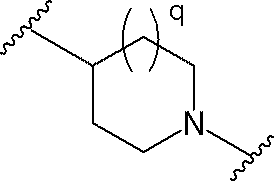
(式中、qは、0または1の整数を表す)
であり、および、
Eは以下の式(10)もしくは式(41)で示される4級アンモニウム基である。
Eの4級アンモニウム基(以下の式中、左側の結合部位がメチレンに結合し、右側の結合部位がDに結合する。):

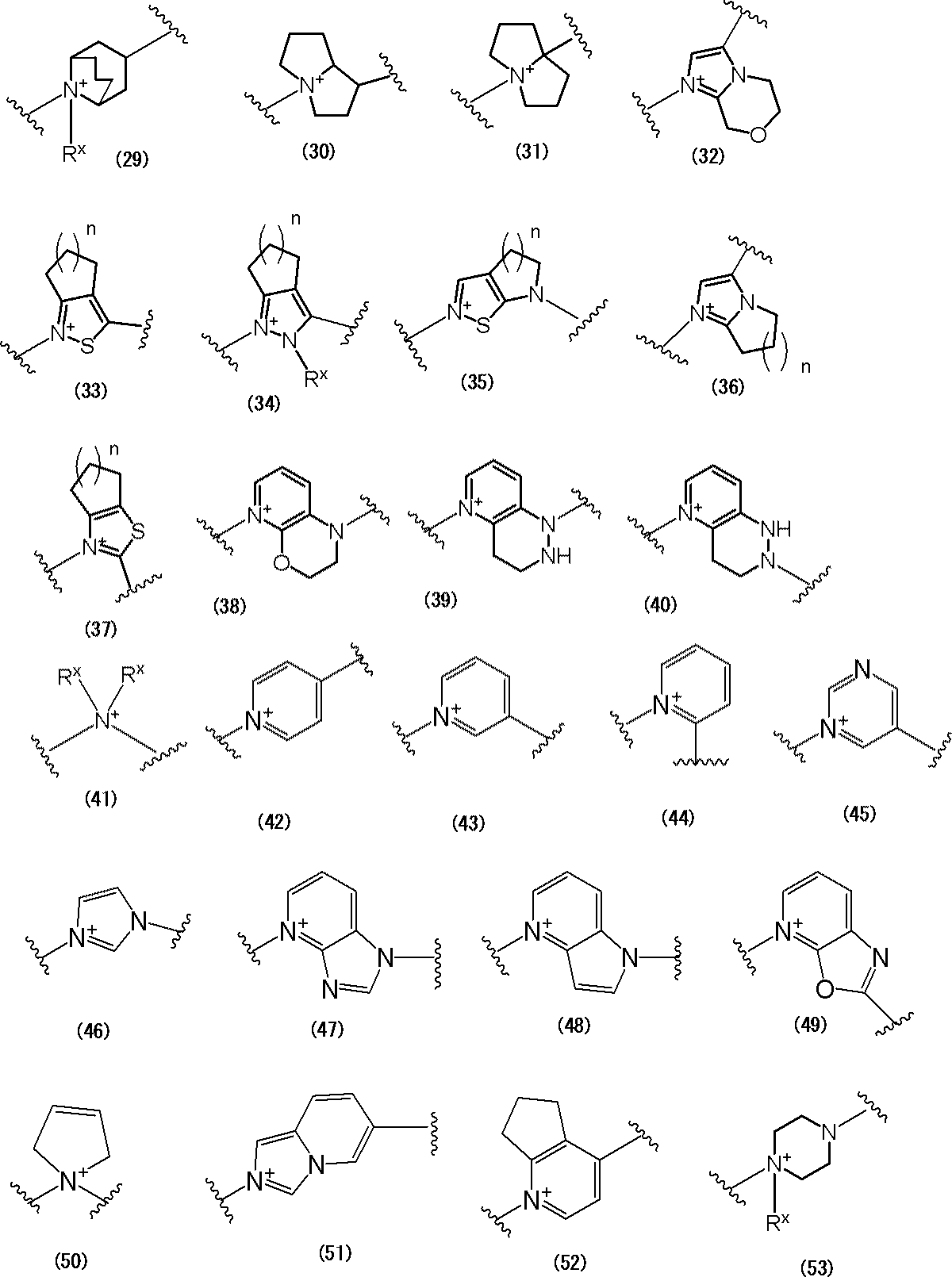
ただし、R1がフェニルかつEが式(53)の場合を除く。)
で示される化合物、エステル体、もしくはその7位側鎖の環上にアミノ基が存在する場合の該アミノ基における保護体またはそれらの製薬上許容される塩もしくはそれらの溶媒和物。
- Dが単結合、-NH-、もしくは-R7-NH-(式中、R7は請求項1と同意義である)である、
請求項1に記載の化合物、エステル体、もしくはその7位側鎖の環上にアミノ基が存在する場合の該アミノ基における保護体またはそれらの製薬上許容される塩もしくはそれらの溶媒和物。
- Dが-NH-、-CH2-NH-または-CH2-CH2-NH-である、
請求項1に記載の化合物、エステル体、もしくはその7位側鎖の環上にアミノ基が存在する場合の該アミノ基における保護体またはそれらの製薬上許容される塩もしくはそれらの溶媒和物。
- Dが単結合である、
請求項1に記載の化合物、エステル体、もしくはその7位側鎖の環上にアミノ基が存在する場合の該アミノ基における保護体またはそれらの製薬上許容される塩もしくはそれらの溶媒和物。
- Dが以下に示される基:
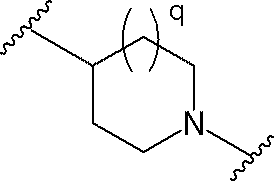
(式中、qは請求項1と同意義である)である、
請求項1に記載の化合物、エステル体、もしくはその7位側鎖の環上にアミノ基が存在する場合の該アミノ基における保護体またはそれらの製薬上許容される塩もしくはそれらの溶媒和物。
- Eが式(1)~(9)、(11)~(40)、(47)~(49)および(51)~(52)から選ばれる、
請求項1に記載の化合物、エステル体、もしくはその7位側鎖の環上にアミノ基が存在する場合の該アミノ基における保護体またはそれらの製薬上許容される塩もしくはそれらの溶媒和物。
- Eが式(5)、(6)、(9)~(11)、(26)、(29)~(34)、(36)、(37)および(50)から選ばれる請求項1に記載の化合物、エステル体、もしくはその7位側鎖の環上にアミノ基が存在する場合の該アミノ基における保護体またはそれらの製薬上許容される塩もしくはそれらの溶媒和物。
- Eが式(5)、(6)、(10)および(11)から選ばれる請求項1に記載の化合物、エステル体、もしくはその7位側鎖の環上にアミノ基が存在する場合の該アミノ基におけ
る保護体またはそれらの製薬上許容される塩もしくはそれらの溶媒和物。
- Eが式(1)~(4)、(7)、(8)、(12)~(25)、(27)、(28)、(35)、(38)~(40)、(47)および(48)から選ばれる、
請求項1に記載の化合物、エステル体、もしくはその7位側鎖の環上にアミノ基が存在する場合の該アミノ基における保護体またはそれらの製薬上許容される塩もしくはそれらの溶媒和物。
- Eが式(1)~(3)、(7)および(12)から選ばれる、
請求項1に記載の化合物、エステル体、もしくはその7位側鎖の環上にアミノ基が存在する場合の該アミノ基における保護体またはそれらの製薬上許容される塩もしくはそれらの溶媒和物。
- Uが-S-である、請求項1~10のいずれかに記載の化合物、エステル体、もしくはその7位側鎖の環上にアミノ基が存在する場合の該アミノ基における保護体またはそれらの製薬上許容される塩もしくはそれらの溶媒和物。
- Wが-CH2-である、請求項1~11のいずれかに記載の化合物、エステル体、もしくはその7位側鎖の環上にアミノ基が存在する場合の該アミノ基における保護体またはそれらの製薬上許容される塩もしくはそれらの溶媒和物。
- R3が水素原子または-OCH3である、請求項1~12のいずれかに記載の化合物、エステル体、もしくはその7位側鎖の環上にアミノ基が存在する場合の該アミノ基における保護体またはそれらの製薬上許容される塩もしくはそれらの溶媒和物。
- 式:
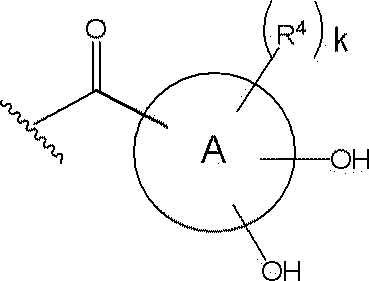
が、
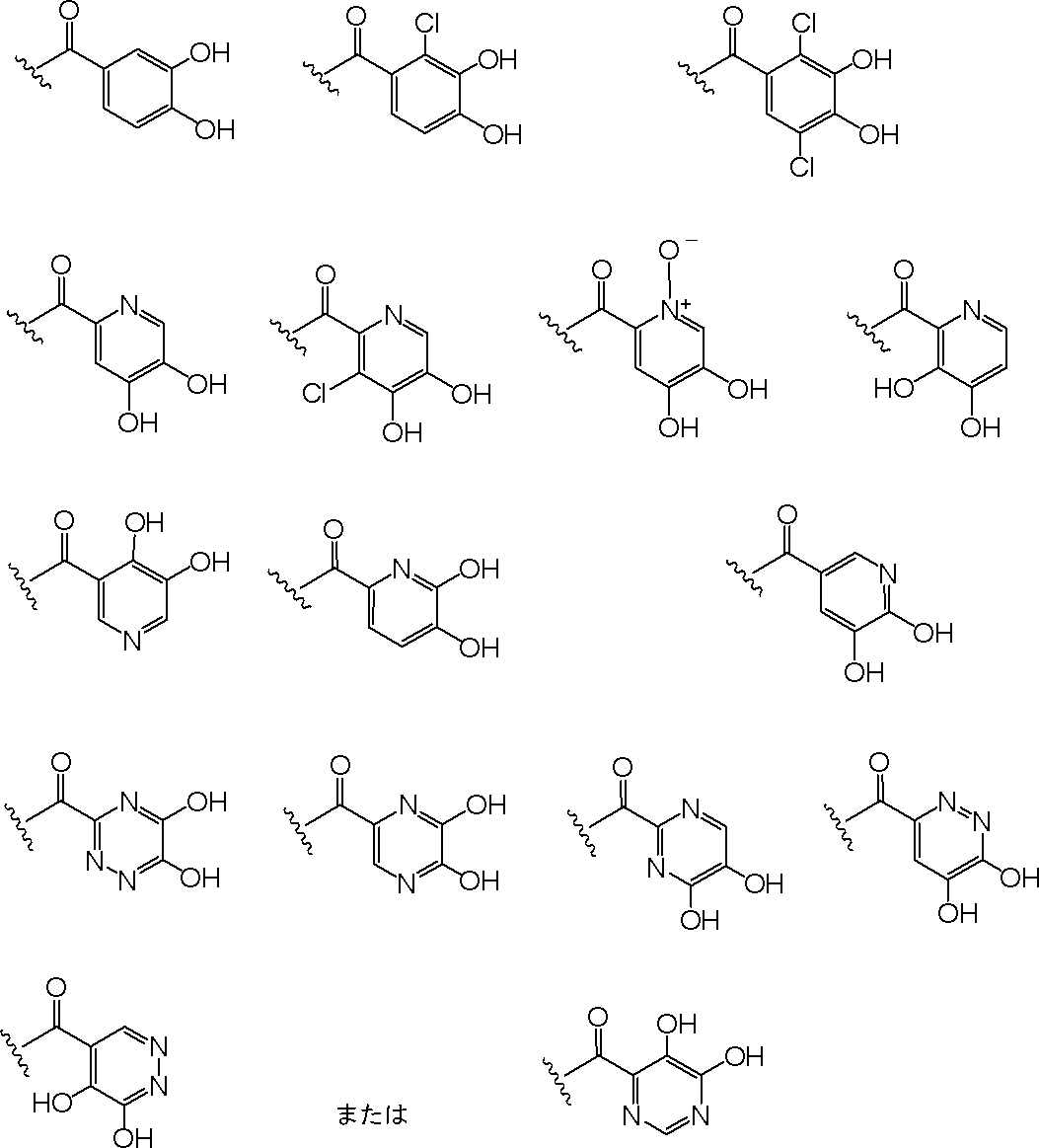
である、請求項1~13のいずれかに記載の化合物、エステル体、もしくはその7位側鎖の環上にアミノ基が存在する場合の該アミノ基における保護体またはそれらの製薬上許容される塩もしくはそれらの溶媒和物。
- 式:
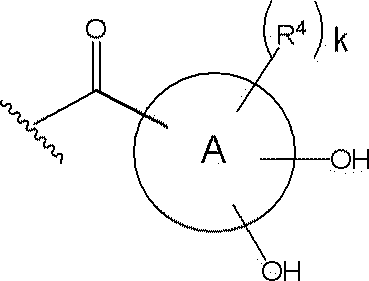
が、

である、請求項1~13のいずれかに記載の化合物、エステル体、もしくはその7位側鎖の環上にアミノ基が存在する場合の該アミノ基における保護体またはそれらの製薬上許容される塩もしくはそれらの溶媒和物。
- 式:
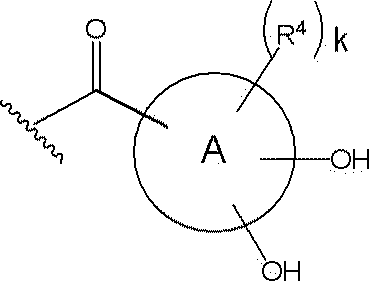
が、

である、請求項1~13のいずれかに記載の化合物、エステル体、もしくはその7位側鎖の環上にアミノ基が存在する場合の該アミノ基における保護体またはそれらの製薬上許容される塩もしくはそれらの溶媒和物。
- R1が置換基を有していてもよいフェニルである、請求項1~16のいずれかに記載の化合物、エステル体、もしくはその7位側鎖の環上にアミノ基が存在する場合の該アミノ基における保護体またはそれらの製薬上許容される塩もしくはそれらの溶媒和物。
- R2Aが水素原子、置換基を有していてもよいアミノ基、-SO3H、置換基を有していてもよいアミノスルホニル基、カルボキシル基、置換基を有していてもよいカルバモイル基、ヒドロキシル基、または置換基を有しているカルボニルオキシ基である、請求項1~17のいずれかに記載の化合物、エステル体、もしくはその7位側鎖の環上にアミノ基が存在する場合の該アミノ基における保護体またはそれらの製薬上許容される塩もしくはそれらの溶媒和物。
- R2Aが以下に示す、置換基を有するアミノ基

以下に示す、置換基を有するアミノスルホニル基
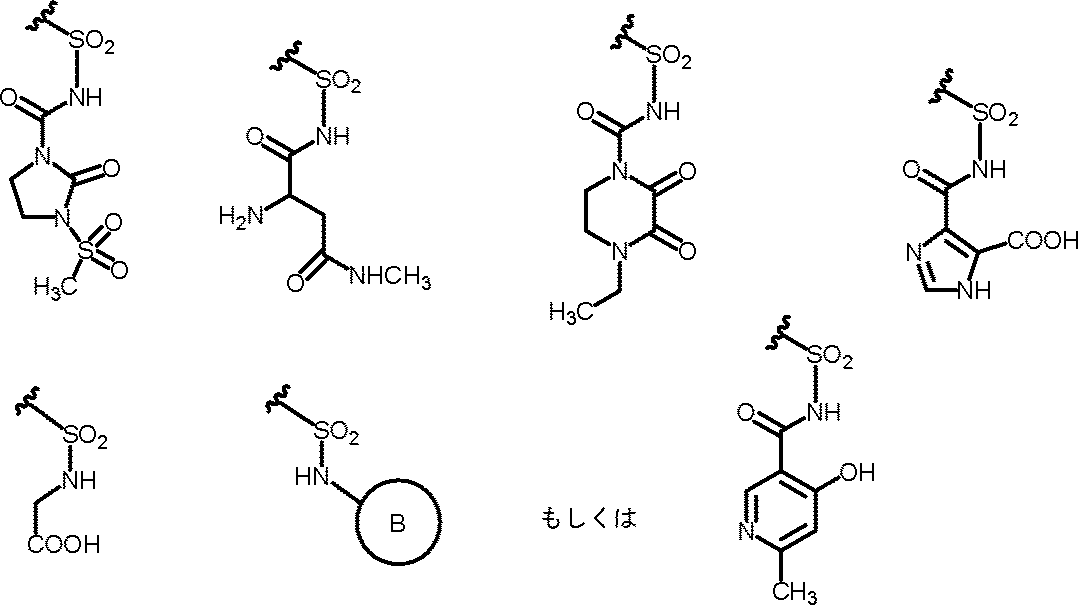
(式中、環Bは置換基を有していてもよい複素環式基を表す);
以下に示す、置換基を有するカルバモイル基

以下に示す、置換基を有するカルボニルオキシ基
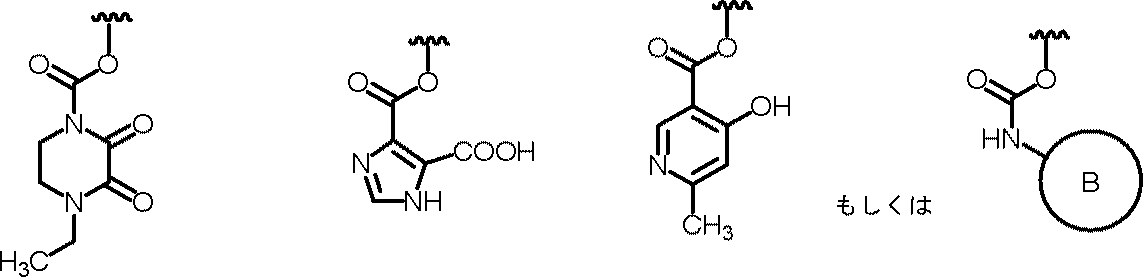
(式中、環Bは置換基を有していてもよい複素環式基を表す);
である、請求項1~17のいずれかに記載の化合物、エステル体、もしくはその7位側鎖の環上にアミノ基が存在する場合の該アミノ基における保護体またはそれらの製薬上許容される塩もしくはそれらの溶媒和物。
- R2AおよびR2Bが、一緒になって以下に示す、置換基を有するアルケニル基
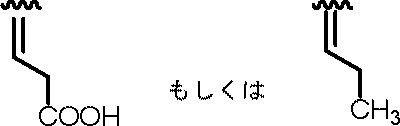
;または、以下に示す、置換基を有するオキシム基

(式中、
R7およびR8は、それぞれ独立して水素原子、ハロゲン、ヒドロキシ、カルボキシ、置換基を有していてもよい低級アルキル、置換基を有していてもよい炭素環式基、もしくは置換基を有していてもよい複素環式基であり、または
R7およびR8は隣接原子と一緒になって置換基を有していてもよい炭素環式基もしくは置換基を有していてもよい複素環式基を形成していてもよく、
R9は置換基を有していてもよい低級アルキルであり、
mは0~3の整数を表す);
である、請求項1~17のいずれかに記載の化合物、エステル体、もしくはその7位側鎖の環上にアミノ基が存在する場合の該アミノ基における保護体またはそれらの製薬上許容される塩もしくはそれらの溶媒和物。
- 請求項1~20のいずれかに記載の化合物、エステル体、もしくはその7位側鎖の環上にアミノ基が存在する場合の該アミノ基における保護体またはそれらの製薬上許容される塩もしくはそれらの溶媒和物を含有する医薬組成物。
- 抗菌作用を有する、請求項21に記載の医薬組成物。
Priority Applications (2)
| Application Number | Priority Date | Filing Date | Title |
|---|---|---|---|
| US13/642,959 US9085589B2 (en) | 2010-04-28 | 2011-04-27 | Cephem derivative |
| JP2012512883A JP5852562B2 (ja) | 2010-04-28 | 2011-04-27 | 新規なセフェム誘導体 |
Applications Claiming Priority (2)
| Application Number | Priority Date | Filing Date | Title |
|---|---|---|---|
| JP2010-104035 | 2010-04-28 | ||
| JP2010104035 | 2010-04-28 |
Publications (1)
| Publication Number | Publication Date |
|---|---|
| WO2011136268A1 true WO2011136268A1 (ja) | 2011-11-03 |
Family
ID=44861566
Family Applications (1)
| Application Number | Title | Priority Date | Filing Date |
|---|---|---|---|
| PCT/JP2011/060259 Ceased WO2011136268A1 (ja) | 2010-04-28 | 2011-04-27 | 新規なセフェム誘導体 |
Country Status (3)
| Country | Link |
|---|---|
| US (1) | US9085589B2 (ja) |
| JP (1) | JP5852562B2 (ja) |
| WO (1) | WO2011136268A1 (ja) |
Cited By (11)
| Publication number | Priority date | Publication date | Assignee | Title |
|---|---|---|---|---|
| WO2012147773A1 (ja) | 2011-04-28 | 2012-11-01 | 塩野義製薬株式会社 | カテコールまたは擬似カテコール構造を有する新規セフェム化合物 |
| WO2014068388A1 (en) | 2012-10-29 | 2014-05-08 | Glaxo Group Limited | 2 substituted cephem compounds |
| JP2015221788A (ja) * | 2014-04-28 | 2015-12-10 | 塩野義製薬株式会社 | 2−置換セフェム化合物を含有する医薬組成物 |
| US9242999B2 (en) | 2011-06-27 | 2016-01-26 | Shionogi & Co., Ltd. | Cephem compound having pyridinium group |
| US9527866B2 (en) | 2012-10-29 | 2016-12-27 | Shionogi & Co., Ltd. | Processes for production of intermediates for 2-alkyl cephem compounds |
| US9751894B2 (en) | 2015-12-10 | 2017-09-05 | Naeja-Rgm Pharmaceuticals Inc. | Cephem compounds, their production and use |
| WO2019093522A1 (ja) * | 2017-11-13 | 2019-05-16 | 株式会社クレハ | アゾール誘導体、中間体化合物、及びアゾール誘導体の製造方法、ならびに農園芸用薬剤及び工業用材料保護剤 |
| WO2021043973A1 (en) | 2019-09-06 | 2021-03-11 | Nabriva Therapeutics GmbH | Siderophore cephalosporin conjugates and uses thereof |
| US12207654B2 (en) | 2019-04-19 | 2025-01-28 | Kureha Corporation | Bactericidal agent for agricultural or horticultural use, plant disease control method, and product for plant disease control use |
| US12225906B1 (en) | 2024-09-26 | 2025-02-18 | Terry Earl Brady | Pathogenic affinity pathway of infectious or parasitic organisms for nanogram and picogram dosimetry prophylaxis or cure |
| US12428387B2 (en) | 2020-08-06 | 2025-09-30 | Kureha Corporation | Method for producing compound |
Families Citing this family (5)
| Publication number | Priority date | Publication date | Assignee | Title |
|---|---|---|---|---|
| CA2702257C (en) | 2007-10-09 | 2016-07-12 | Sopharmia, Inc. | Broad spectrum beta-lactamase inhibitors |
| CN102203100B (zh) * | 2008-10-31 | 2014-08-27 | 盐野义制药株式会社 | 具有邻苯二酚基团的头孢菌素 |
| WO2011125966A1 (ja) | 2010-04-05 | 2011-10-13 | 塩野義製薬株式会社 | 擬似カテコール基を有するセフェム化合物 |
| KR20130018845A (ko) | 2010-04-05 | 2013-02-25 | 시오노기세야쿠 가부시키가이샤 | 카테콜기를 갖는 세펨 화합물 |
| JPWO2013051597A1 (ja) * | 2011-10-04 | 2015-03-30 | 塩野義製薬株式会社 | カテコール基を有するセフェム誘導体 |
Citations (7)
| Publication number | Priority date | Publication date | Assignee | Title |
|---|---|---|---|---|
| JPS62158291A (ja) * | 1986-01-07 | 1987-07-14 | Sagami Chem Res Center | セフアロスポリン誘導体 |
| JPH0215090A (ja) * | 1988-06-13 | 1990-01-18 | Fujisawa Pharmaceut Co Ltd | 新規セフェム化合物 |
| JPH02117678A (ja) * | 1988-07-25 | 1990-05-02 | Fujisawa Pharmaceut Co Ltd | 新規セフェム化合物 |
| JPH03173893A (ja) * | 1989-09-07 | 1991-07-29 | Shionogi & Co Ltd | ピペラジニオセファロスポリン |
| JPH06510523A (ja) * | 1991-05-28 | 1994-11-24 | 藤沢薬品工業株式会社 | 新規なセフェム化合物 |
| WO2003078440A1 (fr) * | 2002-03-18 | 2003-09-25 | Shionogi & Co., Ltd. | Composes cepheme a large spectre |
| WO2010050468A1 (ja) * | 2008-10-31 | 2010-05-06 | 塩野義製薬株式会社 | カテコール基を有するセファロスポリン類 |
Family Cites Families (21)
| Publication number | Priority date | Publication date | Assignee | Title |
|---|---|---|---|---|
| IL47168A (en) | 1974-05-09 | 1979-07-25 | Toyama Chemical Co Ltd | Mono or dioxo piperazino(thio)carbonylamino derivatives ofpenicillins and cephalosporins and process for producing the same |
| JPS57118588A (en) | 1981-11-26 | 1982-07-23 | Toyama Chem Co Ltd | Novel cephalosporin |
| DE3207840A1 (de) | 1982-03-04 | 1983-09-15 | Hoechst Ag, 6230 Frankfurt | "cephalosporinderivate und verfahren zu ihrer herstellung" |
| AU2361184A (en) | 1983-01-21 | 1984-07-26 | Beecham Group Plc | Disubstituted 6-penicillins and 7-cephalosporins |
| EP0168177A3 (en) | 1984-06-28 | 1987-04-01 | Pfizer Limited | Cephalosporin antibiotics |
| EP0211656A3 (en) | 1985-08-10 | 1988-03-09 | Beecham Group Plc | Cephalosporin derivatives, process for their preparation and pharmaceutical compositions containing them |
| GB8719875D0 (en) | 1987-08-22 | 1987-09-30 | Beecham Group Plc | Compounds |
| JPH0228185A (ja) | 1988-04-14 | 1990-01-30 | Tanabe Seiyaku Co Ltd | セファロスポリン化合物及びその合成中間体 |
| GB8811055D0 (en) | 1988-05-10 | 1988-06-15 | Ici Plc | Antibiotic compounds |
| PH25965A (en) | 1988-06-06 | 1992-01-13 | Fujisawa Pharmaceutical Co | New cephem compounds which have antimicrobial activities |
| JPH02275886A (ja) | 1988-12-29 | 1990-11-09 | Tanabe Seiyaku Co Ltd | セファロスポリン化合物及びその製法 |
| CA2005787A1 (en) | 1988-12-29 | 1990-06-29 | Masao Wada | Cephalosporin compounds |
| GB9005246D0 (en) | 1990-03-08 | 1990-05-02 | Fujisawa Pharmaceutical Co | New cephem compounds and processes for preparation thereof |
| US5126336A (en) | 1990-08-23 | 1992-06-30 | Bristol-Myers Squibb Company | Antibiotic c-3 catechol-substituted cephalosporin compounds, compositions and method of use thereof |
| US5095012A (en) | 1990-08-23 | 1992-03-10 | Bristol-Myers Squibb Company | Antibiotic c-7 catechol-substituted cephalosporin compounds, compositions, and method of use thereof |
| US5234920A (en) | 1990-08-23 | 1993-08-10 | Bristol-Myers Squibb Company | Antibiotic C-7 catechol-substituted cephalosporin compounds, compositions, and method of use thereof |
| GB9118672D0 (en) | 1991-08-30 | 1991-10-16 | Fujisawa Pharmaceutical Co | New cephem compounds and processes for preparation thereof |
| WO2007096740A2 (en) | 2006-02-20 | 2007-08-30 | Orchid Research Laboratories Limited | Novel cephalosporins |
| EP1994035A1 (en) | 2006-03-16 | 2008-11-26 | Astellas Pharma Inc. | Cephem compounds and use as antimicrobial agents |
| WO2011125966A1 (ja) * | 2010-04-05 | 2011-10-13 | 塩野義製薬株式会社 | 擬似カテコール基を有するセフェム化合物 |
| KR20130018845A (ko) * | 2010-04-05 | 2013-02-25 | 시오노기세야쿠 가부시키가이샤 | 카테콜기를 갖는 세펨 화합물 |
-
2011
- 2011-04-27 JP JP2012512883A patent/JP5852562B2/ja not_active Expired - Fee Related
- 2011-04-27 WO PCT/JP2011/060259 patent/WO2011136268A1/ja not_active Ceased
- 2011-04-27 US US13/642,959 patent/US9085589B2/en not_active Expired - Fee Related
Patent Citations (7)
| Publication number | Priority date | Publication date | Assignee | Title |
|---|---|---|---|---|
| JPS62158291A (ja) * | 1986-01-07 | 1987-07-14 | Sagami Chem Res Center | セフアロスポリン誘導体 |
| JPH0215090A (ja) * | 1988-06-13 | 1990-01-18 | Fujisawa Pharmaceut Co Ltd | 新規セフェム化合物 |
| JPH02117678A (ja) * | 1988-07-25 | 1990-05-02 | Fujisawa Pharmaceut Co Ltd | 新規セフェム化合物 |
| JPH03173893A (ja) * | 1989-09-07 | 1991-07-29 | Shionogi & Co Ltd | ピペラジニオセファロスポリン |
| JPH06510523A (ja) * | 1991-05-28 | 1994-11-24 | 藤沢薬品工業株式会社 | 新規なセフェム化合物 |
| WO2003078440A1 (fr) * | 2002-03-18 | 2003-09-25 | Shionogi & Co., Ltd. | Composes cepheme a large spectre |
| WO2010050468A1 (ja) * | 2008-10-31 | 2010-05-06 | 塩野義製薬株式会社 | カテコール基を有するセファロスポリン類 |
Cited By (16)
| Publication number | Priority date | Publication date | Assignee | Title |
|---|---|---|---|---|
| WO2012147773A1 (ja) | 2011-04-28 | 2012-11-01 | 塩野義製薬株式会社 | カテコールまたは擬似カテコール構造を有する新規セフェム化合物 |
| US9242999B2 (en) | 2011-06-27 | 2016-01-26 | Shionogi & Co., Ltd. | Cephem compound having pyridinium group |
| WO2014068388A1 (en) | 2012-10-29 | 2014-05-08 | Glaxo Group Limited | 2 substituted cephem compounds |
| US9527866B2 (en) | 2012-10-29 | 2016-12-27 | Shionogi & Co., Ltd. | Processes for production of intermediates for 2-alkyl cephem compounds |
| JP2015221788A (ja) * | 2014-04-28 | 2015-12-10 | 塩野義製薬株式会社 | 2−置換セフェム化合物を含有する医薬組成物 |
| US9751894B2 (en) | 2015-12-10 | 2017-09-05 | Naeja-Rgm Pharmaceuticals Inc. | Cephem compounds, their production and use |
| USRE48097E1 (en) | 2015-12-10 | 2020-07-14 | Naeja-Rgm Pharmaceuticals Ulc | Cephem compounds, their production and use |
| JPWO2019093522A1 (ja) * | 2017-11-13 | 2020-04-02 | 株式会社クレハ | アゾール誘導体、中間体化合物、及びアゾール誘導体の製造方法、ならびに農園芸用薬剤及び工業用材料保護剤 |
| AU2018365928B2 (en) * | 2017-11-13 | 2020-02-27 | Kureha Corporation | Azole derivative, intermediate compound, method for producing azole derivative, agent for agricultural and horticultural use, and material protection agent for industrial use |
| WO2019093522A1 (ja) * | 2017-11-13 | 2019-05-16 | 株式会社クレハ | アゾール誘導体、中間体化合物、及びアゾール誘導体の製造方法、ならびに農園芸用薬剤及び工業用材料保護剤 |
| US10945434B2 (en) | 2017-11-13 | 2021-03-16 | Kureha Corporation | Azole derivative, intermediate compound, method for producing azole derivative, agricultural or horticultural chemical agent, and protective agent for industrial material |
| US12207654B2 (en) | 2019-04-19 | 2025-01-28 | Kureha Corporation | Bactericidal agent for agricultural or horticultural use, plant disease control method, and product for plant disease control use |
| WO2021043973A1 (en) | 2019-09-06 | 2021-03-11 | Nabriva Therapeutics GmbH | Siderophore cephalosporin conjugates and uses thereof |
| US12371441B2 (en) | 2019-09-06 | 2025-07-29 | Ariva Med Gmbh | Siderophore cephalosporin conjugates and uses thereof |
| US12428387B2 (en) | 2020-08-06 | 2025-09-30 | Kureha Corporation | Method for producing compound |
| US12225906B1 (en) | 2024-09-26 | 2025-02-18 | Terry Earl Brady | Pathogenic affinity pathway of infectious or parasitic organisms for nanogram and picogram dosimetry prophylaxis or cure |
Also Published As
| Publication number | Publication date |
|---|---|
| JP5852562B2 (ja) | 2016-02-03 |
| JPWO2011136268A1 (ja) | 2013-07-22 |
| US9085589B2 (en) | 2015-07-21 |
| US20130096299A1 (en) | 2013-04-18 |
Similar Documents
| Publication | Publication Date | Title |
|---|---|---|
| JP5852562B2 (ja) | 新規なセフェム誘導体 | |
| JP5852559B2 (ja) | 擬似カテコール基を有するセフェム化合物 | |
| JP5498393B2 (ja) | カテコール基を有するセファロスポリン類 | |
| EP2917223B1 (en) | 2 substituted cephem compounds | |
| JP4433383B2 (ja) | 広域セフェム化合物 | |
| KR20140039202A (ko) | 카테콜 또는 의사 카테콜 구조를 갖는 신규 세펨 화합물 | |
| JPWO1997037996A1 (ja) | セフェム化合物及び該化合物を含有する医薬 | |
| EP0264091B1 (en) | 3-propenylcephem derivative, preparation thereof, chemical intermediates therein, pharmaceutical composition and use | |
| WO2013051597A1 (ja) | カテコール基を有するセフェム誘導体 | |
| US9242999B2 (en) | Cephem compound having pyridinium group | |
| JP2016079098A (ja) | セフェム化合物 | |
| JPWO2014104148A1 (ja) | セフェム化合物 | |
| EP0098615B1 (en) | 1-oxadethiacephalosporin compound and antibacterial agent containing the same | |
| KR100449775B1 (ko) | 신규세팔로스포린유도체및그중간체 | |
| JPH06100568A (ja) | セフェム化合物、その製造法およびその抗菌組成物 | |
| HK1154242A (en) | Cephalosporin having catechol group |
Legal Events
| Date | Code | Title | Description |
|---|---|---|---|
| 121 | Ep: the epo has been informed by wipo that ep was designated in this application |
Ref document number: 11775049 Country of ref document: EP Kind code of ref document: A1 |
|
| WWE | Wipo information: entry into national phase |
Ref document number: 2012512883 Country of ref document: JP |
|
| NENP | Non-entry into the national phase |
Ref country code: DE |
|
| WWE | Wipo information: entry into national phase |
Ref document number: 13642959 Country of ref document: US |
|
| 122 | Ep: pct application non-entry in european phase |
Ref document number: 11775049 Country of ref document: EP Kind code of ref document: A1 |