WO2011111807A1 - 重合性単量体、重合体およびそれを用いたレジスト材料およびそのパターン形成方法 - Google Patents
重合性単量体、重合体およびそれを用いたレジスト材料およびそのパターン形成方法 Download PDFInfo
- Publication number
- WO2011111807A1 WO2011111807A1 PCT/JP2011/055723 JP2011055723W WO2011111807A1 WO 2011111807 A1 WO2011111807 A1 WO 2011111807A1 JP 2011055723 W JP2011055723 W JP 2011055723W WO 2011111807 A1 WO2011111807 A1 WO 2011111807A1
- Authority
- WO
- WIPO (PCT)
- Prior art keywords
- group
- carbon atoms
- atoms
- replaced
- atom
- Prior art date
- Legal status (The legal status is an assumption and is not a legal conclusion. Google has not performed a legal analysis and makes no representation as to the accuracy of the status listed.)
- Ceased
Links
- 0 C*(*)C(OC(CCCC1)C1C(C(F)(F)F)C(F)(F)F)=O Chemical compound C*(*)C(OC(CCCC1)C1C(C(F)(F)F)C(F)(F)F)=O 0.000 description 21
- CMOLYPWZQAIKCT-UHFFFAOYSA-N CC(C(OC1C(O)OCC1)=O)=C Chemical compound CC(C(OC1C(O)OCC1)=O)=C CMOLYPWZQAIKCT-UHFFFAOYSA-N 0.000 description 1
Classifications
-
- C—CHEMISTRY; METALLURGY
- C07—ORGANIC CHEMISTRY
- C07C—ACYCLIC OR CARBOCYCLIC COMPOUNDS
- C07C69/00—Esters of carboxylic acids; Esters of carbonic or haloformic acids
- C07C69/52—Esters of acyclic unsaturated carboxylic acids having the esterified carboxyl group bound to an acyclic carbon atom
- C07C69/533—Monocarboxylic acid esters having only one carbon-to-carbon double bond
- C07C69/54—Acrylic acid esters; Methacrylic acid esters
-
- C—CHEMISTRY; METALLURGY
- C08—ORGANIC MACROMOLECULAR COMPOUNDS; THEIR PREPARATION OR CHEMICAL WORKING-UP; COMPOSITIONS BASED THEREON
- C08F—MACROMOLECULAR COMPOUNDS OBTAINED BY REACTIONS ONLY INVOLVING CARBON-TO-CARBON UNSATURATED BONDS
- C08F220/00—Copolymers of compounds having one or more unsaturated aliphatic radicals, each having only one carbon-to-carbon double bond, and only one being terminated by only one carboxyl radical or a salt, anhydride ester, amide, imide or nitrile thereof
- C08F220/02—Monocarboxylic acids having less than ten carbon atoms; Derivatives thereof
- C08F220/10—Esters
- C08F220/26—Esters containing oxygen in addition to the carboxy oxygen
- C08F220/28—Esters containing oxygen in addition to the carboxy oxygen containing no aromatic rings in the alcohol moiety
- C08F220/282—Esters containing oxygen in addition to the carboxy oxygen containing no aromatic rings in the alcohol moiety and containing two or more oxygen atoms
-
- G—PHYSICS
- G03—PHOTOGRAPHY; CINEMATOGRAPHY; ANALOGOUS TECHNIQUES USING WAVES OTHER THAN OPTICAL WAVES; ELECTROGRAPHY; HOLOGRAPHY
- G03F—PHOTOMECHANICAL PRODUCTION OF TEXTURED OR PATTERNED SURFACES, e.g. FOR PRINTING, FOR PROCESSING OF SEMICONDUCTOR DEVICES; MATERIALS THEREFOR; ORIGINALS THEREFOR; APPARATUS SPECIALLY ADAPTED THEREFOR
- G03F7/00—Photomechanical, e.g. photolithographic, production of textured or patterned surfaces, e.g. printing surfaces; Materials therefor, e.g. comprising photoresists; Apparatus specially adapted therefor
- G03F7/004—Photosensitive materials
- G03F7/0045—Photosensitive materials with organic non-macromolecular light-sensitive compounds not otherwise provided for, e.g. dissolution inhibitors
-
- G—PHYSICS
- G03—PHOTOGRAPHY; CINEMATOGRAPHY; ANALOGOUS TECHNIQUES USING WAVES OTHER THAN OPTICAL WAVES; ELECTROGRAPHY; HOLOGRAPHY
- G03F—PHOTOMECHANICAL PRODUCTION OF TEXTURED OR PATTERNED SURFACES, e.g. FOR PRINTING, FOR PROCESSING OF SEMICONDUCTOR DEVICES; MATERIALS THEREFOR; ORIGINALS THEREFOR; APPARATUS SPECIALLY ADAPTED THEREFOR
- G03F7/00—Photomechanical, e.g. photolithographic, production of textured or patterned surfaces, e.g. printing surfaces; Materials therefor, e.g. comprising photoresists; Apparatus specially adapted therefor
- G03F7/004—Photosensitive materials
- G03F7/039—Macromolecular compounds which are photodegradable, e.g. positive electron resists
- G03F7/0392—Macromolecular compounds which are photodegradable, e.g. positive electron resists the macromolecular compound being present in a chemically amplified positive photoresist composition
- G03F7/0397—Macromolecular compounds which are photodegradable, e.g. positive electron resists the macromolecular compound being present in a chemically amplified positive photoresist composition the macromolecular compound having an alicyclic moiety in a side chain
-
- G—PHYSICS
- G03—PHOTOGRAPHY; CINEMATOGRAPHY; ANALOGOUS TECHNIQUES USING WAVES OTHER THAN OPTICAL WAVES; ELECTROGRAPHY; HOLOGRAPHY
- G03F—PHOTOMECHANICAL PRODUCTION OF TEXTURED OR PATTERNED SURFACES, e.g. FOR PRINTING, FOR PROCESSING OF SEMICONDUCTOR DEVICES; MATERIALS THEREFOR; ORIGINALS THEREFOR; APPARATUS SPECIALLY ADAPTED THEREFOR
- G03F7/00—Photomechanical, e.g. photolithographic, production of textured or patterned surfaces, e.g. printing surfaces; Materials therefor, e.g. comprising photoresists; Apparatus specially adapted therefor
- G03F7/004—Photosensitive materials
- G03F7/0046—Photosensitive materials with perfluoro compounds, e.g. for dry lithography
-
- Y—GENERAL TAGGING OF NEW TECHNOLOGICAL DEVELOPMENTS; GENERAL TAGGING OF CROSS-SECTIONAL TECHNOLOGIES SPANNING OVER SEVERAL SECTIONS OF THE IPC; TECHNICAL SUBJECTS COVERED BY FORMER USPC CROSS-REFERENCE ART COLLECTIONS [XRACs] AND DIGESTS
- Y02—TECHNOLOGIES OR APPLICATIONS FOR MITIGATION OR ADAPTATION AGAINST CLIMATE CHANGE
- Y02P—CLIMATE CHANGE MITIGATION TECHNOLOGIES IN THE PRODUCTION OR PROCESSING OF GOODS
- Y02P20/00—Technologies relating to chemical industry
- Y02P20/50—Improvements relating to the production of bulk chemicals
- Y02P20/55—Design of synthesis routes, e.g. reducing the use of auxiliary or protecting groups
Definitions
- the present invention is a novel acid-decomposable polymerizable monomer useful as a chemically amplified resist material suitable for microfabrication technology, particularly photolithography, in the manufacturing process of semiconductor elements, etc., and is polymerized or copolymerized using the same
- the present invention relates to a polymer, a resist material using the polymer, and a pattern forming method thereof.
- lithography refers to exposing a substrate surface on which a photosensitive material (photoresist, hereinafter simply referred to as a resist) is applied to form a resist film in a desired pattern.
- a photosensitive material photoresist, hereinafter simply referred to as a resist
- Lithography technology is a technology for forming a resist pattern on a substrate based on a difference in solubility in a developing solution between an exposed portion and an unexposed portion of a resist.
- EUV Extreme Ultra Violet
- a stepper type exposure apparatus reduces a reticle pattern, which is a kind of high-definition photomask, with a reduction projection lens, and exposes a resist on a wafer.
- the resolution of a lens used in a stepper type exposure apparatus is represented by NA (numerical aperture), but in the air, NA of about 0.9 is regarded as a physical limit and has already been achieved.
- a double patterning (double exposure) method which is a lithography technique for finely patterning one circuit by performing exposure twice
- immersion lithography A method that combines the double patterning method with the above has been studied.
- Chemically amplified resists are used as such resists suitable for lithography using ultraviolet light by an ArF excimer laser, immersion lithography and double patterning method thereof, EUV lithography using extreme ultraviolet light, etc.
- a monomer having an acid-decomposable group hereinafter referred to as an acid-decomposable monomer or an acid-decomposable polymerizable monomer
- an acid-decomposable monomer or an acid-decomposable polymerizable monomer that becomes soluble in alkali by elimination of a protecting group by the action of a photoacid generator is used for pattern formation.
- Indispensable each company energetically continues to research and develop new acid-decomposable monomers.
- the feature of the repeating unit (unit) of the (meth) acrylic acid resist polymer used as the acid-decomposable monomer is that the alcohol part of the (meth) acrylic acid ester is protected by a protective group which is a tertiary alcohol. .
- the protective group is decomposed and liberated by exposure with high energy light such as ultraviolet light to generate (meth) acrylic acid, and the resist film after the exposure is dissolved in an alkali developer to form a resist pattern.
- high energy light such as ultraviolet light
- this unit will be referred to as an acid-decomposable unit in this specification.
- monomers corresponding to such units for example, 2-ethyl-2-adamantyl methacrylate or 1-ethylcyclooctyl methacrylate is already known.
- 2-ethyl-2-adamantyl methacrylate is frequently used because of its high dry etching resistance, and is described in Non-Patent Document 1, for example.
- Patent Document 1 2-ethyl-2-adamantyl methacrylate is frequently used because of its high dry etching resistance, and is described in Non-Patent Document 1, for example.
- 2-ethyl-2-adamantyl methacrylate is frequently used because of its high dry etching resistance, and is described in Non-Patent Document 1, for example.
- 1-ethylcyclooctyl methacrylate from which a protecting group is eliminated with low sensitivity has been reported and attracted attention.
- a method for producing 2-alkyl-2-adamantyl ester is disclosed in Patent Document 1.
- Patent Document 2 discloses a method for producing trans-4-amino-1-methylcyclohexanols.
- Resist resin with these acid-decomposable units as constituent elements is an excellent resin that enables fine pattern formation in photolithography, but from the viewpoint of defect suppression corresponding to miniaturization of microfabrication pattern size, Still not enough. (See comparative example).
- the protective group released from the acid-decomposable group due to the reaction with the photoacid generator remains after development and scum is generated, and troubles such as roughness cannot be improved due to defects derived therefrom are becoming prominent. is there.
- the scum is the resist residue remaining on the substrate surface after development, and the roughness is the unevenness at the end of the pattern.
- the resist resin having the conventional “acid-decomposable unit” as a constituent element has a problem that defect suppression corresponding to miniaturization of a fine processing pattern size is not sufficient.
- An object of the present invention is to find a novel acid-decomposable polymerizable monomer and polymer useful as a chemically amplified resist material, a resist material using the same, and a pattern forming method thereof.
- an object of the present invention is to provide a novel acid-decomposable monomer (polymerizable monomer) used for a resist resin capable of forming a fine pattern in photolithography in order to solve the above problems.
- exposure with ultraviolet light having a wavelength of 300 nm or less in lithography for example, lithography using a krypton fluoride (hereinafter abbreviated as KrF) excimer laser or ArF excimer laser as a light source of an exposure apparatus, immersion lithography using an ArF excimer laser,
- KrF krypton fluoride
- ArF ArF excimer laser
- a novel acid-decomposable polymerizable monomer useful as a chemically amplified resist material, as an acid-decomposable monomer for resists suitable for double patterning using an ArF excimer laser and pattern fine processing by EUV lithography It is an object of the present invention to provide a polymer polymerized or copolymerized, a resist material using
- the obtained resin exhibits excellent water repellency compared to conventional examples (comparative examples), and also has very good solubility in polar solvents after exposure decomposition, and as a result, there is no scum. It was found that a good resist pattern can be obtained. This is presumably due to the moderate polarity of the introduced carbonyl group.
- PGMEA propylene glycol monomethyl ether acetate
- the carbonyl group is present in the protecting group of the acid-decomposable unit.
- desired performance cannot be obtained even if units other than the acid-decomposable unit in the copolymer resin have a carbonyl group (see Comparative Example).
- water repellency of the resin before exposure it was found that a specific high performance can be obtained by the presence of the carbonyl group in the protective group of the acid-decomposable unit.
- the present inventors have found a polymerizable monomer (monomer), a polymer (resin), a resist material using the same, and a pattern forming method thereof, and have completed the present invention.
- the present inventors are non-polar polymerizable monomers having acid decomposability used for resist materials, and by using a specific monomer having a carbonyl group, Compared to the case of only an alkyl group, the polarity of the carbonyl group shows a balanced water repellency and hydrophilicity when used as a resist, which is sufficient for alcohol solvents. It shows solubility, and after exposure, the carbonyl group in the protective group remains undegraded and retained, so the carbonyl group's high polarity makes it much easier to dissolve in a highly polar developer than conventional products. Thus, it was found that a good resist pattern can be formed without scum.
- the present invention relates to a (meth) acrylate compound which is a novel acid-decomposable polymerizable monomer having a carbonyl group as a protecting group which is eliminated after exposure, a polymer polymerized or copolymerized using the same, and a And a pattern forming method thereof.
- the present invention is shown in [Invention 1] to [Invention 15] below.
- R 1 represents a hydrogen atom, a halogen atom, a methyl group or a trifluoromethyl group.
- R 2 is a straight chain hydrocarbon having 1 to 20 carbon atoms, a branched or cyclic hydrocarbon having 3 to 20 carbon atoms.
- R 3 ⁇ R 10 may be substituted to all of the fluorine atoms of the hydrogen atoms are each independently Represents a hydrogen atom, a straight chain of 1 to 20 carbon atoms, a branched or cyclic hydrocarbon group of 3 to 20 carbon atoms, and a part of the carbon atoms constituting them may be replaced by an oxygen atom ,
- R 3 to R 10 may combine to form a cyclic compound, and n and m are each a carbon number, and each independently represents an integer of 0 to 5.
- A has a carbonyl group (C ⁇ O) or the following acetal structure in which the carbonyl group is protected by a protecting group.
- X 1 and X 2 each independently represents an alkyl group having 1 to 6 carbon atoms.
- a part or all of the hydrogen atoms of the alkyl group may be substituted with a fluorine, chlorine, bromine atom, phenyl group or substituted phenyl group, and a part of the C—C bond of the alkyl group is a C ⁇ C double bond. It may be a bond, and X 1 and X 2 may be connected to form a cyclic acetal structure as a whole.
- X 1 and X 2 each independently represents an alkyl group having 1 to 6 carbon atoms. Some or all of the hydrogen atoms of the alkyl group may be substituted with fluorine, chlorine, bromine atoms, phenyl groups, or substituted phenyl groups. A part of the C—C bond of the alkyl group may be a C ⁇ C double bond.
- X 1 and X 2 may be connected to form a cyclic acetal structure as a whole.
- the polymerizable monomer of invention 1 represented by any one of:
- R 1 is a hydrogen atom, a halogen atom, a methyl group or a trifluoromethyl group
- R 2 is a methyl group, an ethyl group or an isopropyl group.
- a polymer obtained by polymerization using these polymerizable monomers is useful as a resist material.
- R 3 ⁇ R 10 may be substituted to all of the fluorine atoms of the hydrogen atoms are each independently Represents a hydrogen atom, a straight chain of 1 to 20 carbon atoms, a branched or cyclic hydrocarbon group of 3 to 20 carbon atoms, and a part of the carbon atoms constituting them may be replaced by an oxygen atom ,
- R 3 to R 10 may combine to form a cyclic compound, and n and m are each a carbon number, and each independently represents an integer of 0 to 5.
- A has a carbonyl group (C ⁇ O) or the following acetal structure in which the carbonyl group is protected by a protecting group.
- X 1 and X 2 each independently represents an alkyl group having 1 to 6 carbon atoms. Some or all of the hydrogen atoms of the alkyl group may be substituted with fluorine, chlorine, bromine atoms, phenyl groups, or substituted phenyl groups. A part of the C—C bond of the alkyl group may be a C ⁇ C double bond.
- X 1 and X 2 may be connected to form a cyclic acetal structure as a whole. ) The polymer characterized by including the repeating unit represented by these.
- X 1 and X 2 each independently represents an alkyl group having 1 to 6 carbon atoms. Part or all of the hydrogen atoms of the alkyl group may be substituted with a fluorine, chlorine, bromine atom, phenyl group or substituted phenyl group. A part of the C—C bond of the alkyl group may be a C ⁇ C double bond.
- X 1 and X 2 may be connected to form a cyclic acetal structure as a whole.
- R 2 is represented by a methyl group, an ethyl group, or an isopropyl group, The polymer of Invention 4 or Invention 5.
- the polymer according to any one of Inventions 4 to 6 further includes a repeating unit having a 1,1,1,3,3,3-hexafluoro-2-hydroxyisopropyl group (—C (CF 3 ) 2 OH).
- the polymer of the invention 7 includes any one of the polymerizable monomers of the inventions 1 to 3, a 1,1,1,3,3,3-hexafluoro-2-hydroxyisopropyl group (—C (CF 3 )). It is obtained by polymerizing a polymerizable monomer having 2 OH). In the polymerization, another polymerizable monomer may be added.
- the polymer according to any one of Inventions 4 to 7 is further represented by General Formula (9) or General Formula (10):
- R 1 is a hydrogen atom, a halogen atom, a methyl group or a trifluoromethyl group
- B is a single bond, a methylene group, a phenylene group, —O—, — (C ⁇ O) —O—, or — (C ⁇ O) —NR 16 —
- R 16 is a hydrogen atom, a linear, branched, or cyclic hydrocarbon group having 1 to 20 carbon atoms, and a part or all of the hydrogen atoms are fluorine atom, hydroxyl group, or alkoxyl group.
- R 11 to R 13 are each independently a linear or branched alkyl group having 1 to 30 carbon atoms which may have a substituent, or a carbon number which may have a substituent.
- a cyclic monovalent hydrocarbon group having 3 to 30 carbon atoms, an aryl group having 6 to 30 carbon atoms which may have a substituent, or a monovalent hetero group having 4 to 30 atoms which may have a substituent .R 11, R 12 and any two or more good .R 14 and R 15 may form a ring bonded to each other through a sulfur atom of R 13 which indicates a cyclic organic group mutually Germany
- R 14 and R 15 may be bonded to each other through an iodine atom to form a ring.
- the polymer of the invention 8 includes the polymerizable monomer of the invention 1 to 3 or the invention 7, and the general formula (11) or the general formula (12):
- R 1 is a hydrogen atom, a halogen atom, a methyl group or a trifluoromethyl group
- B is a single bond, a methylene group, a phenylene group, —O—, — (C ⁇ O) —O—, or — (C ⁇ O) —NR 16 —
- R 16 is a hydrogen atom, a linear, branched, or cyclic hydrocarbon group having 1 to 20 carbon atoms, and a part or all of the hydrogen atoms are a fluorine atom, a hydroxyl group, or an alkoxyl group.
- R 11 ⁇ R 13 are independently of one another, may be substituted linear or branched alkyl group having 1 to 30 carbon atoms, which may have a substituent A cyclic monovalent hydrocarbon group having 3 to 30 carbon atoms, an aryl group having 6 to 30 carbon atoms which may have a substituent, or a monovalent group having 4 to 30 atoms which may have a substituent.
- R 11 showing a heterocyclic organic group
- R 12 and any two or more good .
- R 14 and R 15 may form a ring bonded to each other through a sulfur atom of R 13 is Mutual Independently having 1 to 30 carbon atoms which may have a substituent or a branched alkyl group having 1 to 20 carbon atoms, or 3 to 30 carbon atoms which may have a substituent.
- a cyclic monovalent hydrocarbon group, an aryl group having 6 to 30 carbon atoms which may have a substituent, or a monovalent heterocyclic organic group having 4 to 30 carbon atoms which may have a substituent Or R 14 and R 15 may be bonded to each other through an iodine atom to form a ring.) And obtained by copolymerizing a polymerizable monomer having a salt represented by It is done. In the polymerization, another polymerizable monomer may be added.
- invention 9 A resist material comprising the polymer of inventions 4-8.
- invention 10 The resist material according to invention 9, comprising at least one of an acid generator, a basic compound, and an organic solvent.
- the resist material according to invention 10 wherein an alcohol solvent having 5 to 20 carbon atoms is used as the organic solvent.
- the resist material of the present invention is a lithography using ultraviolet light (wavelength 193 nm) by KrF excimer laser (wavelength 248 nm), ArF excimer laser, particularly immersion lithography and double patterning method, extreme ultraviolet light (wavelength 13.5 nm). It is used as a resist material suitable for EUV lithography and the like.
- invention 12 A double patterning method for forming a second resist pattern on a first resist pattern formed on a substrate, wherein the resist material of inventions 9 to 11 is used.
- invention 14 An immersion lithography method using a resist material according to inventions 9 to 11, wherein water is inserted between a wafer and a projection lens, and an ultraviolet ray having a wavelength of 193 nm oscillated from an ArF excimer laser is irradiated using an exposure machine.
- the resist material using the acid-decomposable polymerizable monomer of the present invention has an appropriate water repellency with respect to water before exposure and solubility in an alcohol solvent, and a protective group that is eliminated after exposure is a polar group. Because it has a certain carbonyl group, it easily dissolves in a polar developer or rinse solution, leaving no scum on the resist and showing rapid solubility, and has a deep depth of focus not only in dry exposure but also in immersion exposure. Focus control is easy, mask error factor and line edge roughness are small, and high resolution pattern formation is possible.
- the solvent solubility in the solvent is high.
- it is useful as a chemically amplified resist material that can be dissolved in a solvent that does not dissolve conventional resist materials such as alcohol solvents having 5 to 20 carbon atoms.
- it is useful as a resist for immersion or a double patterning process.
- the polymerizable monomer of the present invention has water repellency, and in lithography using an immersion exposure apparatus, water intrusion into the resist is prevented to generate watermark defects (defects caused by residual water droplets after rinsing during development). Can be suppressed.
- the polymerizable monomer of this invention is a polymerizable monomer represented by General formula (1).
- R 1 represents a hydrogen atom, a halogen atom, a methyl group or a trifluoromethyl group.
- R 2 is a straight chain hydrocarbon having 1 to 20 carbon atoms, a branched or cyclic hydrocarbon having 3 to 20 carbon atoms.
- R 3 ⁇ R 10 may be substituted to all of the fluorine atoms of the hydrogen atoms are each independently Represents a hydrogen atom, a straight chain of 1 to 20 carbon atoms, a branched or cyclic hydrocarbon group of 3 to 20 carbon atoms, and a part of the carbon atoms constituting them may be replaced by an oxygen atom ,
- H in a hydrocarbon C—H bond may be replaced by OH to form C—OH
- a part or all of hydrogen atoms may be replaced by fluorine atoms.
- some or all of R 3 to R 10 may combine to form a
- R 2 to R 10 are exemplified.
- the hydrocarbon group include a methyl group, an ethyl group, a propyl group, an isopropyl group, a cyclopropyl group, an n-propyl group, an iso group.
- An allyl group, a butenyl group, a pentenyl group, an ethynyl group, a phenyl group, a benzyl group or a 4-methoxybenzyl group may be mentioned, and a part or all of the functional groups may be substituted with a fluorine atom.
- Examples of those containing oxygen atoms include methoxy group, ethoxy group, n-propoxy group, iso-propoxy group, sec-butoxy group, tert-butoxy group, n-pentyloxy group, cyclopentyloxy group, sec-pentyl group.
- acyl group acetyl group, propionyl group, butyryl group, heptanoyl group, hexanoyl group, valeryl group, pivaloyl group, isovaleryl group, lauryl group, myristoyl group, palmitoyl group, stearoyl group, oxalyl group, malonyl group, succinyl group, Glutaryl group, adipoyl group, piperoyl group, suberoyl group, azelaoil group, sebacoyl group, acryloyl group, propioroyl group, methacryloyl group, crotonoyl group, oleoyl group, maleoyl group, fumaroyl group, mesaconoyl group, camphoroyl group, benzoyl group, phthaloyl group Group, isophthaloyl group, terephthaloyl group, naphthoyl group, toluoyl group
- A has a carbonyl group (C ⁇ O) or the following acetal structure in which the carbonyl group is protected by a protecting group.
- X 1 and X 2 each independently represents an alkyl group having 1 to 6 carbon atoms. Some or all of the hydrogen atoms of the alkyl group may be substituted with fluorine, chlorine, bromine atoms, phenyl groups or substituted phenyl groups, and a part of the C—C bond of the alkyl group may be C ⁇ C double. It may be a bond, and X 1 and X 2 may be connected to form a cyclic acetal structure as a whole. )
- Examples of the polymerizable monomer X 1 and X 2 represented by the general formula (1) are each independently —CH 3 , —CH 2 CH 3 , —CH 2 CCl 3 or —CH 2 Ph.
- Examples in which X 1 and X 2 are bonded include —CH 2 CH 2 —, —CH 2 CH 2 CH 2 —, —CH 2 C (CH 2 ) 2 CH 2 —, —CH 2 CH (CH 2 Br ) —, —CH 2 CH (CH 2 CH 2 CH ⁇ CH) — or —CH 2 CH (Ph) O—.
- —CH 3 , —CH 2 CH 3 , —CH 2 Ph, —CH 2 CH 2 —, —CH 2 CH 2 CH 2 — or —CH 2 C (CH 2 ) 2 CH 2 — is preferably used.
- the polymerizable monomer represented by the general formula (1) is an acid-decomposable monomer, and further, X 1 or X 2 is simultaneously eliminated during the acid decomposition, so that it is represented by the general formula (1).
- the polymerizable monomer is expected to have a defect reducing function.
- the polymerizable monomer of the general formula (1) includes a cyclic structure in which a part or all of R 2 to R 10 are bonded, and the cyclic structure is known to be resistant to the lithography etching process, A cyclic polymerizable monomer represented by the general formula (1) having the formula is preferably used.
- inventions 2 and 3 describe polymerizable monomers represented by general formulas (2) to (4).
- n and m are each independently an integer in the range of 0 to 5 and thus have a 4 to 14 membered ring, but considering the availability of raw materials, A 5-membered ring or a 6-membered ring is preferable, and the polymerizable monomers represented by the general formulas (2) to (4) represented by the 6-membered ring are preferable in view of raw material costs.
- R 2 is preferably a methyl group, an ethyl group or an isopropyl group, more preferably a methyl group and an ethyl group for ease of synthesis, particularly ethyl.
- an ethyl group is preferable because the polymerizable monomer is easily decomposed by an acid generated from the photoacid generator upon irradiation with ultraviolet light or extreme ultraviolet light.
- a metal reagent is allowed to act on the compound in which one side of the corresponding diketone body is acetal protected, followed by methacrylic esterification and acetal desorption. It can be derived from protection (Patent Documents 1 and 2).
- the monomer copolymerizable with the polymerizable monomer of the present invention is copolymerizable with the polymerizable monomer represented by the general formula (1).
- maleic anhydride acrylic esters, fluorine-containing acrylic esters, methacrylic esters, fluorine-containing methacrylate esters, styrene compounds, fluorine-containing styrene compounds, vinyl ethers, fluorine-containing vinyl ethers
- Examples include allyl ethers, fluorine-containing allyl ethers, olefins, fluorine-containing olefins, norbornene compounds, fluorine-containing norbornene compounds, sulfur dioxide, vinyl silanes, vinyl sulfonic acid, and vinyl sulfonic acid esters.
- any ester side chain can be used without particular limitation.
- the fluorine-containing acrylic ester or the fluorine-containing methacrylate ester may be a monomer containing a fluorine atom or a fluorine atom-containing group at the ⁇ -position of acrylic, or a substituent containing a fluorine atom at the ester site.
- a fluorine-containing compound containing fluorine at both the ⁇ -position and the ester site is also suitable.
- a cyano group may be introduced at the ⁇ -position.
- a monomer having a fluorine-containing alkyl group introduced at the ⁇ -position a trifluoromethyl group, a trifluoroethyl group, or a nonafluoro-n— is introduced at the ⁇ -position of the non-fluorinated acrylic acid ester or methacrylic acid ester described above.
- a monomer provided with a butyl group is employed.
- the monomer containing fluorine at the ester site has a fluoroalkyl group containing a perfluoroalkyl group at the ester site, or has a cyclic structure that may contain a fluorine atom at the ester site, for example, Acrylic acid ester or methacrylic acid in which the cyclic structure is a fluorine-containing benzene ring, fluorine-containing cyclopentane ring, fluorine-containing cyclohexane ring or fluorine-containing cycloheptane ring substituted with a fluorine atom, a trifluoromethyl group or a hexafluoroisopropyl hydroxyl group
- esters include esters.
- acrylic acid ester or methacrylic acid ester in which the ester moiety is a fluorine-containing t-butyl ester group can also be mentioned.
- These acrylic acid esters or methacrylic acid esters may have a fluorine-containing alkyl group at the ⁇ -position.
- Such monomers include 2,2,2-trifluoroethyl acrylate, 2,2,3,3-tetrafluoropropyl acrylate, 1,1,1,3,3,3-hexafluoroisopropyl acrylate, Heptafluoroisopropyl acrylate, 1,1-dihydroheptafluoro-n-butyl acrylate, 1,1,5-trihydrooctafluoro-n-pentyl acrylate, 1,1,2,2-tetrahydrotridecafluoro-n-octyl Acrylate, 1,1,2,2-tetrahydroheptadecafluoro-n-decyl acrylate, 2,2,2-trifluoroethyl methacrylate, 2,2,3,3-tetrafluoropropyl methacrylate, 1,1,1, 3,3,3-hexafluoroisopropyl methacrylate, heptaful Roisopropyl methacrylate, 1,1-dihydr
- the polymerizable monomer copolymerizable with the polymerizable monomer of the present invention is 1,1,1,3,3,3-hexafluoro-2-hydroxyisopropyl group (—C (CF 3 ) 2
- a polymerizable monomer having OH) is preferable, and it has an effect of reducing scum when it is used as a resist material and patterned by photolithography because of adhesion by the alcohol site and alkali solubility of the detached alcohol site.
- Specific examples of the body include the following compounds.
- R 1 represents a hydrogen atom, a halogen atom, a methyl group, or a trifluoromethyl group.
- the hydroxyl group in the hexafluoroisopropyl group may be partially or entirely protected with a protecting group.
- Styrene, fluorinated styrene, hydroxystyrene and the like can be used as the styrene compound and fluorine-containing styrene compound copolymerizable with the polymerizable monomer of the present invention.
- pentafluorostyrene, trifluoromethylstyrene or bistrifluoromethylstyrene, or hexafluoroisopropyl hydroxyl group or a functional group in which the hydroxyl group is protected is styrene in which an aromatic ring hydrogen is substituted with a fluorine atom or a trifluoromethyl group.
- the styrene include a halogen, an alkyl group, and a fluorine-containing alkyl group bonded to the ⁇ -position, and styrene containing a perfluorovinyl group.
- vinyl ether, fluorine-containing vinyl ether, and allyl ether copolymerizable with the polymerizable monomer of the present invention can be used.
- fluorine-containing allyl ether as a hydroxyl group, a methyl group, an ethyl group, a propyl group, a butyl group, An alkyl vinyl ether or alkyl allyl ether containing a hydroxyethyl group or a hydroxybutyl group can be used.
- cyclohexyl group, norbornyl group, aromatic ring or cyclic vinyl having hydrogen or carbonyl bond in its cyclic structure allyl ether, fluorine-containing vinyl ether in which part or all of hydrogen of the above functional group is substituted with fluorine atom
- fluorine-containing allyl ether can also be used.
- vinyl esters vinyl silanes, olefins, fluorine-containing olefins, norbornene compounds or fluorine-containing norbornene compounds, and other compounds containing a polymerizable unsaturated bond can also be used in the present invention.
- Examples of the olefin copolymerizable with the polymerizable monomer of the present invention include ethylene, propylene, isobutene, cyclopentene or cyclohexene, and examples of the fluorinated olefin include vinyl fluoride, vinylidene fluoride, trifluoroethylene, and chlorotrifluoro. Ethylene, tetrafluoroethylene, hexafluoropropylene or hexafluoroisobutene can be used.
- the norbornene compound and fluorine-containing norbornene compound copolymerizable with the polymerizable monomer of the present invention are norbornene monomers having a mononuclear structure or a plurality of nuclear structures.
- fluorine-containing olefin, allyl alcohol, fluorine-containing allyl alcohol, homoallyl alcohol or fluorine-containing homoallyl alcohol is an unsaturated compound such as acrylic acid, ⁇ -fluoroacrylic acid, ⁇ -trifluoromethylacrylic acid, Methacrylic acid, all acrylic esters, methacrylic esters, fluorine-containing acrylic esters or fluorine-containing methacrylates described in this specification, 2- (benzoyloxy) pentafluoropropane, 2- (methoxyethoxymethyloxy) penta Fluoropropene, 2- (tetrahydroxypyranyloxy) pentafluoropropene, 2- (benzoyloxy) trifluoroethylene or 2- (methoxymethyloxy) trifluoroethylene and cyclopentadiene or cyclo 3- (5-bicyclo [2.2.1] hepten-2-yl) -1,1,1-trifluoro-2- (trifluoromethyl), which
- a unit containing a lactone structure can be used for the purpose of improving the adhesion to the substrate.
- lactone-containing cyclic polymers are preferably used.
- Such a lactone-containing cyclic polymerizable monomer includes a monomer having a monocyclic lactone structure in which one hydrogen atom is removed from ⁇ -butyrolactone, and a polycyclic monomer in which one hydrogen atom is removed from norbornane lactone. Examples thereof include monomers having a cyclic lactone structure.
- the monomer copolymerizable with the above polymerizable monomer of the present invention may be used alone or in combination of two or more.
- a polymerizable monomer that is polymerized with the polymerizable monomer of the present invention represented by the general formula (1) includes a photoacid generator (Photo Acid Generator or less). , Abbreviated as PAG), and a polymerizable monomer having a salt that generates an acid upon exposure.
- PAG Photoacid Generator
- PAG a polymerizable monomer having a salt that generates an acid upon exposure.
- PAG is contained in the chemical structure of a copolymer obtained by copolymerizing a polymerizable monomer
- PAG is an acid-decomposable group in the chemical structure as compared with an additive type PAG added separately to the copolymer.
- the exposure sensitivity increases because it is located in the vicinity of the light source, in the exposure, the intensity of the irradiation light is low, it decomposes even in a low energy state, it is possible to generate an acid, and furthermore, the diffusion distance of the PAG itself is short, When used as a resist material and patterned by photolithography, there is an effect of reducing line edge roughness.
- Examples of the polymerizable monomer having a salt copolymerizable with the polymerizable monomer of the present invention are represented by general formulas (11) and (12).
- R 1 is a hydrogen atom, a halogen atom, a methyl group or a trifluoromethyl group
- B is a single bond, a methylene group, a phenylene group, —O—, — (C ⁇ O) —O—, — (C ⁇ O ) Or —NR 16 —.
- R 16 is a hydrogen atom, a linear, branched or cyclic hydrocarbon group having 1 to 20 carbon atoms, and part or all of the hydrogen atoms may be substituted with a fluorine atom, a hydroxyl group or an alkoxyl group.
- D is a single bond, a linear, branched or cyclic alkylene group having 1 to 20 carbon atoms or a phenylene group, and a part or all of the hydrogen atoms may be substituted with a fluorine atom, a hydroxyl group or an alkoxyl group.
- R 11 to R 13 are each independently a linear or branched alkyl group having 1 to 30 carbon atoms which may have a substituent, or 3 to 30 carbon atoms which may have a substituent.
- R 14 and R 15 are each independently a linear or branched alkyl group having 1 to 30 carbon atoms which may have a substituent, or 3 to 30 carbon atoms which may have a substituent.
- a monovalent heterocyclic organic group is shown.
- R 14 and R 15 may be bonded to each other through an iodine atom to form a ring.
- R 1 is a hydrogen atom, a halogen atom, a methyl group or a trifluoromethyl group
- X is an oxygen atom or NR 16 .
- R 16 is a hydrogen atom, a linear, branched or cyclic hydrocarbon group having 1 to 20 carbon atoms, and a part or all of the hydrogen atoms may be substituted with a fluorine atom, a hydroxyl group or an alkoxyl group.
- the onium salt of the present invention limits the structure of the acid generated, that is, the anion side, but the cation side is not particularly limited.
- the valent hydrocarbon group include methyl group, ethyl group, n-propyl group, i-propyl group, n-butyl group, 1-methylpropyl group, 2-methylpropyl group, t-butyl group, n- Pentyl group, i-pentyl group, 1,1-dimethylpropyl group, 1-methylbutyl group, 1,1-dimethylbutyl group, n-hexyl group, n-heptyl group, i-hexyl group, n-octyl group, i Alkyl groups such as -octyl group, 2-ethylhexyl group, n-nonyl group, n-decyl group, n
- substituent of the hydrocarbon group examples include an aryl group having 6 to 30 carbon atoms, a linear, branched or cyclic alkenyl group having 2 to 30 carbon atoms, a halogen atom, an oxygen atom, a nitrogen atom, and sulfur. And a group having 1 to 30 atoms including a hetero atom such as an atom, a phosphorus atom, or a silicon atom.
- substituents can also have arbitrary substituents, for example, 1 or more types of the above-mentioned substituents.
- linear, branched or cyclic monovalent hydrocarbon group having 1 to 30 carbon atoms substituted with the substituent include, for example, benzyl group, methoxymethyl group, methylthiomethyl group, ethoxymethyl group, ethylthio group.
- Examples of the unsubstituted aryl group having 6 to 30 carbon atoms of R 11 to R 15 include a phenyl group, a 1-naphthyl group, a 2-naphthyl group, a 1-anthryl group, and a -phenanthryl group. it can.
- Examples of the unsubstituted monovalent heterocyclic organic group having 4 to 30 atoms of R 11 to R 15 include a furyl group, a thienyl group, a pyranyl group, a pyrrolyl group, a thiantenyl group, a pyrazolyl group, an isothiazolyl group, Examples include isoxazolyl group, pyrazinyl group, pyrimidinyl group, pyridazinyl group, tetrahydropyranyl group, tetrahydrofuranyl group, tetrahydrothiopyranyl group, tetrahydrothiofuranyl group, or 3-tetrahydrothiophene-1,1-dioxide group. .
- substituents for the aryl group and the monovalent heterocyclic organic group include a linear, branched or cyclic alkyl group having 1 to 30 carbon atoms, a halogen atom, an oxygen atom, a nitrogen atom, a sulfur atom, and a phosphorus atom. Or a group having 1 to 30 atoms containing a heteroatom such as a silicon atom.
- substituents may further have an arbitrary substituent, for example, one or more of the above-described substituents.
- Examples of the aryl group having 6 to 30 carbon atoms substituted with the substituent include, for example, o-tolyl group, m-tolyl group, p-tolyl group, p-hydroxyphenyl group, p-methoxyphenyl group, mesityl group, o-cumenyl, 2,3-xylyl, 2,4-xylyl, 2,5-xylyl, 2,6-xylyl, 3,4-xylyl, 3,5-xylyl, p-fluoro Examples thereof include a phenyl group, a p-trifluoromethylphenyl group, a p-chlorophenyl group, a p-bromophenyl group, and a p-iodophenyl group.
- Examples of the monovalent heterocyclic organic group having 4 to 30 atoms substituted with the substituent include a 2-bromofuryl group, a 3-methoxythienyl group, a 3-bromotetrahydropyranyl group, and a 4-methoxytetrahydropyranyl group.
- the monovalent onium cation moiety can be produced according to a general method described in, for example, Advances® Polymer® Science, Vol. 62, pp. 1-48 (1984).
- Preferred monovalent onium cations include, for example, sulfonium cations represented by the following formulas (3-1) to (3-64), iodonium cations represented by the following formulas (4-1) to (4-37) Etc.
- the onium salt portion functions as an acid generator, and has an action of generating sulfonic acid by exposure or heating, It can be very suitably used as a radiation sensitive acid generator in the radiation sensitive resin composition described below.
- the polymer of the present invention is a polymer containing repeating units represented by, for example, general formulas (5) to (8), and includes the general formulas (1) to (4) described above. ) Can be produced by cleaving and copolymerizing alone or with another monomer having a polymerizable double bond.
- the polymer having the repeating unit of the general formula (5) is obtained, for example, by subjecting an acid-decomposable monomer represented by the general formula (1) to a polymerization reaction.
- the structure shown is also applicable to general formula (5).
- R 1 represents a hydrogen atom, a halogen atom, a methyl group or a trifluoromethyl group.
- R 2 is a straight chain hydrocarbon having 1 to 20 carbon atoms, a branched or cyclic hydrocarbon having 3 to 20 carbon atoms.
- R 3 ⁇ R 10 may be substituted to all of the fluorine atoms of the hydrogen atoms are each independently Represents a hydrogen atom, a straight chain of 1 to 20 carbon atoms, a branched or cyclic hydrocarbon group of 3 to 20 carbon atoms, and a part of the carbon atoms constituting them may be replaced by an oxygen atom ,
- R 3 to R 10 may be bonded to form a cyclic compound, and n and m are each a carbon number, and each independently represents an integer of 0 to 5.
- X 1 and X 2 each independently represents an alkyl group having 1 to 6 carbon atoms. Part or all of the hydrogen atoms of the alkyl group may be substituted with a fluorine, chlorine, bromine atom, phenyl group or substituted phenyl group. A part of the C—C bond of the alkyl group may be a C ⁇ C double bond.
- X 1 and X 2 may be connected to form a cyclic acetal structure as a whole. )
- the polymers represented by the general formulas (6) to (8) for the resist material of the present invention.
- a polymer having R 2 as an ethyl group is preferable. Used for.
- the polymer of the present invention may be composed of repeating units composed of a plurality of monomers. Although the ratio is set without particular limitation, for example, the following ranges are preferably employed.
- the polymer of the present invention contains 1 mol% or more and 100 mol% or less, more preferably 5 mol% or more and 90 mol% or less of a repeating unit composed of a polymerizable monomer represented by the general formulas (1) to (4).
- the repeating unit having an acid labile group can be contained in the range of 1 mol% to 100 mol%, preferably 5 mol% to 80 mol%, more preferably 10 mol% to 60 mol%.
- the repeating unit composed of the fluorine-containing polymerizable monomer represented by the general formulas (1) to (4) is smaller than 1 mol%, it is because the monomer of the present invention was used when forming a resist. A clear effect cannot be expected.
- the repeating unit having an acid labile group when the repeating unit having an acid labile group is smaller than 1 mol%, the change in solubility in an alkali developer due to exposure is too small, so that an improvement in contrast in patterning cannot be expected.
- a general monomer may be used as the repeating unit having an acid labile group, and the monomer represented by the general formulas (1) to (4) of the present invention may be added to the acid labile group. Or an acid labile group may be added after polymerization.
- the polymer polymerization method of the present invention is not particularly limited as long as it is a commonly used method, but radical polymerization and ionic polymerization are preferred, and in some cases, coordinate anion polymerization and living anion polymerization. Cationic polymerization, ring-opening metathesis polymerization, or vinylene polymerization may be employed.
- Radical polymerization is carried out in the presence of a radical polymerization initiator or radical initiator, for example, by batch polymerization, solution polymerization, suspension polymerization, or emulsion polymerization, in a batch, semi-continuous or continuous operation. Good.
- the radical polymerization initiator is not particularly limited, and examples thereof include azo compounds, peroxide compounds, and redox compounds. Particularly, azobisisobutyronitrile, t-butylperoxypivalate, Di-t-butyl peroxide, i-butyryl peroxide, lauroyl peroxide, succinic acid peroxide, dicinnamyl peroxide, di-n-propyl peroxydicarbonate, t-butyl peroxyallyl monocarbonate, benzoyl peroxide, It is preferable to use hydrogen peroxide or ammonium persulfate.
- the reaction vessel used for the polymerization reaction is not particularly limited.
- a polymerization solvent may be used.
- the polymerization solvent those that do not inhibit radical polymerization are preferable, and typical examples include ester solvents such as ethyl acetate, n-butyl acetate, ketone solvents such as acetone or methyl isobutyl ketone, and aromatic solvents.
- ester solvents such as ethyl acetate, n-butyl acetate, ketone solvents such as acetone or methyl isobutyl ketone
- aromatic solvents aromatic solvents.
- Specific toluene, cyclohexane which is a hydrocarbon solvent, methanol, isopropyl alcohol or ethylene glycol monomethyl ether which are alcohol solvents.
- water, ether-based, cyclic ether-based, or freon-based solvents may be used.
- the reaction temperature of the copolymerization reaction is appropriately changed depending on the radical polymerization initiator or radical polymerization initiator, and is usually preferably 20 ° C. or higher and 200 ° C. or lower, particularly preferably 30 ° C. or higher and 140 ° C. or lower.
- the ring-opening metathesis polymerization may be performed using a transition metal catalyst of group 4 to 7 in the presence of a cocatalyst, and a known method may be used in the presence of a solvent.
- the polymerization catalyst is not particularly limited, and examples thereof include Ti-based, V-based, Mo-based, and W-based catalysts.
- titanium (IV) chloride, vanadium (IV) chloride, vanadium trisacetylacetonate. Vanadium bisacetylacetonate dichloride, molybdenum (VI) chloride or tungsten (VI) chloride is preferred.
- a catalyst amount it is 0.001 mol% or more and 10 mol% or less with respect to a use monomer, Preferably, it is the range of 0.01 mol% or more and 1 mol% or less.
- cocatalysts examples include alkylaluminum and alkyltin.
- alkylaluminum trialkylaluminums such as trimethylaluminum, triethylaluminum, tripropylaluminum, triisopropylaluminum, triisobutylaluminum, tri-2-methylbutylaluminum, tri-3-methylbutylaluminum, tri- 2-methylpentylaluminum, tri-3-methylpentylaluminum, tri-4-methylpentylaluminum, tri-2-methylhexylaluminum, tri-3-methylhexylaluminum or trioctylaluminum, dimethylaluminum which is a dialkylaluminum halide Chloride, diethylaluminum chloride, diisopropylaluminum chloride or diisobutylaluminum Methyl chloride, methyl aluminum dichloride, ethyl aluminum dichloride, e
- alkyl tin examples include tetra-n-butyltin, tetraphenyltin, and triphenylchlorotin.
- the amount of the cocatalyst is 100 equivalents or less, preferably 30 equivalents or less, in molar ratio with respect to the transition metal catalyst.
- the polymerization solvent is not limited to the polymerization reaction, and aromatic hydrocarbon solvents such as benzene, toluene, xylene, chlorobenzene or dichlorobenzene, hydrocarbon solvents such as hexane, heptane or cyclohexane, and halogenated hydrocarbons.
- aromatic hydrocarbon solvents such as benzene, toluene, xylene, chlorobenzene or dichlorobenzene
- hydrocarbon solvents such as hexane, heptane or cyclohexane
- halogenated hydrocarbons examples include carbon tetrachloride, chloroform, methylene chloride, and 1,2-dichloroethane. These solvents can be used alone or in combination of two or more.
- the reaction temperature is usually preferably from ⁇ 70 ° C. to 200 ° C., particularly preferably from ⁇ 30 ° C. to 60 ° C.
- vinylene polymerization involves the transition metal catalyst of iron, nickel, rhodium, palladium or platinum in the presence of a co-catalyst, zirconium, titanium, vanadium, chromium, molybdenum or tungsten as metal catalysts of group 4-6. What is necessary is just to use and it may carry out by a well-known method in solvent presence.
- the polymerization catalyst is not particularly limited, but iron (II) chloride, iron (III) chloride, iron (II) bromide, iron (III) bromide, iron (II) containing a transition metal of group 8 to 10 Acetate, iron (III) acetylacetonate, ferrocene, nickelocene, nickel (II) acetate, nickel bromide, nickel chloride, dichloronickel acetate, nickel lactate, nickel oxide, nickel tetrafluoroborate, bis (allyl) nickel, bis ( Cyclopentadienyl) nickel, nickel (II) hexafluoroacetylacetonate tetrahydrate, nickel (II) trifluoroacetylacetonate dihydrate, nickel (II) acetylacetonate tetrahydrate Rate, rhodium (III) chloride, rhodium tris (triphenylphosphine) trichloride, palladium (I
- Examples of the cocatalyst include alkylaluminoxane and alkylaluminum.
- methylaluminoxane (MAO) which is a trialkylaluminum, trimethylaluminum, triethylaluminum, tripropylaluminum, triisopropylaluminum, triisobutylaluminum, tri-2-methylbutylaluminum, tri-3-methylbutylaluminum, tri- 2-methylpentylaluminum, tri-3-methylpentylaluminum, tri-4-methylpentylaluminum, tri-2-methylhexylaluminum, tri-3-methylhexylaluminum or trioctylaluminum, dimethylaluminum which is a dialkylaluminum halide Chloride, diethylaluminum chloride, diisopropylaluminum chloride or diisobutylaluminum chloride Methyl aluminum dichloride, eth
- the amount of the cocatalyst used is 50 equivalents or more and 500 equivalents or less in terms of Al.
- the molar ratio with respect to the transition metal catalyst is 100 equivalents or less, preferably 30 equivalents or less. use.
- the polymerization solvent is not limited to the polymerization reaction, and aromatic hydrocarbons such as benzene, toluene, xylene, chlorobenzene or dichlorobenzene, hydrocarbons hexane, heptane, nonane, decane or cyclohexane, and ketone acetone.
- aromatic hydrocarbons such as benzene, toluene, xylene, chlorobenzene or dichlorobenzene, hydrocarbons hexane, heptane, nonane, decane or cyclohexane, and ketone acetone.
- Methyl ethyl ketone methyl isopropyl ketone, methyl isobutyl ketone, cyclohexanone or cyclopentanone, ester ethyl acetate, butyl acetate, alcohol methanol, ethanol, propanol, isopropanol, butanol, isobutanol, pentanol, hexanol, nonanol, octanol 1-octanol, 2-octanol, 3-octanol, 4-methyl-2-pentanol or ethylene glycol, halogenated hydrocarbon Carbon tetrachloride, chloroform, methylene chloride or 1,2-dichloroethane, diethyl ether, diisopropyl ether, tetrahydrofuran, diglyme, propylene glycol monomethyl ether acetate (PEGMEA), propylene glycol monoe (P
- the number average molecular weight of the polymer of the present invention is usually 1,000 or more and 100,000 or less, preferably 3,000 or more and 50,000 or less.
- the polymer of the present invention is particularly suitably used as a photosensitized positive resist material.
- the present invention provides a resist material containing the above-mentioned fluoropolymer, particularly a positive resist material.
- the resist material preferably contains (A) the above polymer as the base resin, (B) a photoacid generator, (C) a basic compound, and (D) a solvent. Moreover, you may contain surfactant (E) as needed.
- surfactant (E) as needed.
- the photoacid generator is a photosensitizer having a function of generating an acid by irradiation with ultraviolet light or extreme ultraviolet light, and is used for the resist material of the present invention.
- the repeating units of the general formulas (5) to (8) are decomposed and solubilized in a solvent by the generated acid. Any one can be selected and used.
- Such acid generators are iodonium sulfonates or sulfonium sulfonates which are onium sulfonates, as well as sulfonate esters, N-imido sulfonates, N-oxime sulfonates, o-nitrobenzyl sulfonates or pyrogallol trismethane sulfonates. it can.
- the acids generated by irradiating these photoacid generators with high energy light are alkane sulfonic acid, aryl sulfonic acid, partially or fully fluorinated aryl sulfonic acid, and alkane sulfonic acid.
- Photoacid generators that generate partially or fully fluorinated alkanesulfonic acids are effective because they have sufficient acid strength for protecting groups that are difficult to deprotect. Specifically, triphenylsulfonium trifluoromethanesulfonate or triphenylsulfonium perfluoro-n-octanesulfonate can be used.
- Basic compound A basic compound can be mix
- the basic compound functions to suppress the diffusion rate when the acid generated from the acid generator diffuses into the resist film. This function is expected to improve the resist pattern shape by adjusting the acid diffusion distance and to improve the stability at the time of placement.
- Such basic compounds include aliphatic amines, aromatic amines, heterocyclic amines or aliphatic polycyclic amines. Secondary or tertiary aliphatic amines are preferred, and alkyl alcohol amines are more preferred.
- the blending amount is preferably 0.001 part by weight or more and 2 parts by weight or less, more preferably 0.01 part by weight or more and 1 part by weight for 100 parts by weight of the polymer. It is as follows. When the blending amount is less than 0.001 part by weight, the effect as an additive cannot be obtained sufficiently, and when it exceeds 2 parts by weight, resolution and sensitivity may be lowered.
- the solvent used for the resist material of the present invention is only required to dissolve each component to be blended into a uniform solution, and can be selected from conventional resist solvents. Moreover, it is also possible to mix and use two or more types of solvents. Specifically, the acetone acetone, methyl ethyl ketone, cyclopentanone, cyclohexanone, methyl isobutyl ketone, methyl isopentyl ketone, 2-heptanone, alcohol isopropanol, butanol, isobutanol, n-pentanol, isopentanol, tert-pentanol, 4-methyl-2-pentanol, 3-methyl-3-pentanol, 2,3-dimethyl-2-pentanol, n-hexanol, n-heptanol, 2-heptanol, n-octanol, n-decanol, s-a
- propylene glycol monomethyl ether acetate PGMEA
- propylene glycol monomethyl ether PGME
- ethyl lactate EL
- cyclohexanone cyclohexanone
- the amount of the solvent to be blended in the resist solution of the present invention is not particularly limited, but preferably the solid content concentration of the resist solution is 3% by mass or more and 25% by mass or less, more preferably 5% by mass or more and 15% by mass or less. It is used like By adjusting the solid content concentration of the resist, it is possible to adjust the film thickness of the formed resin film.
- the polymer of the present invention is excellent in solubility in a wide range of solvents, and it should be noted that among the above-mentioned alcohol solvents, it is soluble in alcohol solvents having 5 to 20 carbon atoms.
- alcohol solvents having 5 to 20 carbon atoms.
- Specific examples of such alcohols include n-pentanol, isopentanol, tert-pentanol, 4-methyl-2-pentanol, 3-methyl-3-pentanol, and 2,3-dimethyl-2-pentanol.
- s-amyl alcohol t-amyl alcohol
- isoamyl alcohol 2-ethyl-1-butanol
- lauryl alcohol hexyl decanol or oleyl alcohol.
- the resist material of the present invention uses a wide range of solvents in ordinary resist pattern formation methods. It is useful as a resist material for a pattern formation method by a double patterning method to be described later, and can be developed for new applications.
- a surfactant may be added if necessary.
- a surfactant either a fluorine-based surfactant or a silicon-based surfactant, a surfactant having both a fluorine atom and a silicon atom, or two or more of them can be contained.
- a method for forming a pattern using the resist material of the present invention includes a step of applying the resist material (resist liquid) on the substrate, and heat-treating the coated substrate to form a resist film. After that, using an exposure machine, a step of exposing the resist film with high energy rays including ultraviolet light and extreme ultraviolet light having a wavelength of 300 nm or less through a photomask, and dissolving the resist film with an alkali developer after heat-treating the substrate And a step of forming a resist pattern by development, and any of them can be performed by employing a known lithography technique.
- a resist material is applied onto a silicon wafer by spin coating to form a thin film, and this is formed on a hot plate at 60 ° C. or higher, 200 ° C. or lower, 10 seconds or longer, 10 minutes or shorter, preferably 80 ° C.
- prebaking is performed under heating conditions of 150 ° C. or lower, 30 seconds or longer, and 2 minutes or shorter.
- a photomask for forming a desired resist pattern is installed, and an ultraviolet ray, excimer laser, X-ray or other high energy beam or electron beam (Electron Beam, hereinafter abbreviated as EB) is exposed to 1 mJ / cm.
- EB Electro Beam
- post-exposure baking under heating conditions of 80 ° C. or higher, 130 ° C. or lower, 30 seconds or longer and 3 minutes or shorter (bake after exposure to diffuse the acid generated by exposure into the resist. Abbreviated).
- a developer of an alkaline aqueous solution of 0.1% by mass or more and 5% by mass or less, preferably 2% by mass or more and 3% by mass or less of tetramethylammonium hydroxide (TMAH) is used for 10 seconds or more and 3 minutes.
- the target pattern is preferably formed by developing by an existing method such as a dipping method, a paddle method, or a spray method, preferably for 30 seconds or more and 2 minutes or less.
- the PEB may be performed as necessary.
- the substrate used in the pattern forming method of the present invention can be a metal or glass substrate in addition to a silicon wafer.
- An organic or inorganic film may be provided on the substrate.
- there may be an antireflection film, a lower layer of a multilayer resist, or a pattern may be formed.
- the light source and wavelength used for exposure are not particularly limited, but KrF excimer laser (wavelength 248 nm), ArF excimer laser (wavelength 193 nm), F 2 excimer laser (wavelength 157 nm), EUV (wavelength) 13.5 nm), and can be suitably used for fine patterning by lithography using EB and X-ray, and is particularly suitably used for lithography by KrF excimer laser, ArF excimer laser, and EUV.
- the resist material of the present invention can also be suitably used as a resist material for immersion lithography. That is, in immersion lithography in which the space between the resist and the lens is filled with water, which is a medium having a higher refractive index than air, and exposed, the resist material of the present invention has high water resistance and moderate water repellency. Because of the affinity for the developer, it is possible to form a fine pattern. In the immersion lithography, there are cases where a top coat which is a resist protective film is used and cases where it is not used. In any case, the resist material of the present invention can be applied by adjusting the composition and formulation. In particular, the resist material of the present invention can be suitably used as a resist material for immersion lithography using a KrF excimer laser and an ArF excimer laser.
- the resist material of the present invention can be used as a resist material for the double patterning method.
- a pattern forming method using a double patterning method is presented.
- many pattern forming methods are still under development and are not limited to the following methods.
- the resist material of the present invention can be suitably used as a resist material for a double patterning method using a KrF excimer laser and an ArF excimer laser.
- the “first resist film” refers to a resist film formed earlier in the pattern formation process shown below, and is formed on the resist film by lithography.
- the resist pattern is referred to as a “first resist pattern”.
- the “second resist film” is a second-layer resist film formed by lithography on the “first resist pattern”, and the “second resist pattern” is formed on the resist film. Represents the resist pattern formed.
- first resist material for convenience
- second resist material for convenience
- the first resist film formed on the silicon wafer is exposed by lithography, and after the heat treatment, the exposed portion is dissolved and developed to form a pattern.
- a second resist film is formed, the second resist film is exposed with a pattern different from the first resist film, and then developed in the same manner to form a pattern.
- a finer pattern than the conventional resist pattern can be formed.
- a freezing process may be performed for the purpose of holding the pattern formed on the first resist film.
- the pattern forming method by the double patterning method will be further described.
- coating of each process, heat processing, exposure, and a development process it can carry out with the method similar to the above-mentioned "pattern formation method".
- a first resist film is formed by applying heat treatment to a silicon wafer by spin coating using a first resist material.
- a first resist pattern is formed on the first resist film by lithography by exposure through irradiation with a high energy ray having a wavelength of 300 nm or less through a photomask, and by dissolving the exposed portion in a developing solution and performing development processing. Is done.
- a second resist material dissolved in a solvent is applied onto the first resist pattern by a spin coating method, followed by heat treatment to form a second resist film. At this time, it is required that the solvent does not attack the first resist pattern.
- the second resist film is exposed with high energy rays having a wavelength of 300 nm or less through a photomask by lithography. At this time, exposure for forming a fine pattern is performed by using a photomask having a pattern different from that of the first resist film.
- a second resist pattern is formed through a process of performing heat treatment, that is, PEB as necessary, and then developing with a developer.
- a developer an alkaline aqueous solution such as tetramethylammonium hydroxide (TMAH) is preferably used as described above.
- the pattern forming method by double patterning of the present invention proposes that a resist material containing a polymer having a specific repeating unit of the present invention is prepared using a specific solvent and used as a second resist material. There are some suitable combinations below.
- the solvent used for the second resist material is not particularly limited as long as it does not attack the first resist pattern, but as the first resist composition, a general-purpose resist is used.
- a general-purpose resist is used as the first resist composition.
- an alcohol solvent having 5 to 20 carbon atoms can be preferably used.
- the general-purpose resist composition here refers to a resist composition using a resin having a repeating unit in which a soluble group such as a carboxyl group is protected by an alicyclic hydrocarbon-based unit such as adamantane or cyclopentane.
- a resist composition for example, there is a resist composition containing as a component a copolymer of hydroxyadamantyl methacrylate (MA-HAD), ethyladamantyl methacrylate (MA-EAD) or ⁇ -butyrolactone methacrylate (MA-GBL).
- MA-HAD hydroxyadamantyl methacrylate
- MA-EAD ethyladamantyl methacrylate
- MA-GBL ⁇ -butyrolactone methacrylate
- Such copolymers are soluble in polyhydric alcohol derivatives such as propylene glycol monomethyl ether acetate (PGMEA), propylene glycol monomethyl ether (PGME), or esters such as acid ethyl (EL), It is insoluble in alcohol solvents having 5 to 20 carbon atoms, for example, insoluble in 4-methyl-2-pentanol having 6 carbon atoms (Reference Example 2).
- polyhydric alcohol derivatives such as propylene glycol monomethyl ether acetate (PGMEA), propylene glycol monomethyl ether (PGME), or esters such as acid ethyl (EL)
- EL acid ethyl
- the polymer of the present invention has excellent solubility in a wide range of solvents and is soluble in alcoholic solvents having 5 to 20 carbon atoms such as 4-methyl-2-pentanol (MIBC). .
- MIBC 4-methyl-2-pentanol
- Examples of the alcohol solvent having 5 to 20 carbon atoms include n-pentanol, isopentanol, tert-pentanol, 4-methyl-2-pentanol, 3-methyl-3-pentanol, and 2,3-dimethyl.
- Examples include hexyl decanol or oleyl alcohol.
- tert-pentanol 4-methyl-2-pentanol, 3-methyl-3-pentanol or 2,3-dimethyl-2 is excellent because the polymer of the present invention is excellent in solubility and easy to handle.
- -Pentanol is preferably used.
- a resist composition prepared by using the polymer of the present invention using an alcohol solvent having 5 to 20 carbon atoms is a resist composition applied to the second layer of the double patterning method (the second resist composition described above). ) Is useful.
- the double patterning method it is also possible to use a substrate in which a first resist material is applied in advance to form a resist film, and a pattern is formed by lithography.
- the subsequent process may be performed after the above-described process of applying the second resist material.
- the step of applying the resist material on the substrate on which the resist pattern has been previously formed, and the photomask after the heat treatment are performed.
- a pattern can be formed by performing a step of exposing with a high energy ray having a wavelength of 300 nm or less and a step of developing using a developer after heat treatment as necessary.
- the resist material of the present invention can be used, and the above-mentioned alcohol solvent having 5 to 20 carbon atoms is preferably used as a solvent for preparing the resist material.
- the substrate on which the pattern is formed in advance is not necessarily developed, and it is sufficient that the pattern is held by a freezing process or the like.
- THF tetrahydrofuran
- the polymer 1 includes a unit (repeating unit) in which the compound 4, MA35, and MNLA are polymerized.
- the above compounds 9, 12.6 g, MA35, 25.0 g, MNLA, 13.0 g and n-dodecyl mercaptan 0.6 g were dissolved in 2-butanone, 101.2 g.
- AIBN as a polymerization initiator
- the mixture was deaerated while being stirred and nitrogen gas was introduced, followed by reaction at 75 ° C. for 16 hours.
- the solution after completion of the reaction was added dropwise to 607.2 g of n-heptane to obtain a white precipitate.
- This precipitate was separated by filtration and dried under reduced pressure at 60 ° C. to obtain 40.6 g of a white solid (polymer 2).
- the polymer 2 includes a knit obtained by polymerizing the compound 8, MA35 and MNLA.
- the compound 3 15.2 g, MA35, 25.0 g, MNLA, 13.0 g, and n-dodecyl mercaptan 0.55 g were dissolved in 2-butanone, 106.4 g.
- AIBN 1.2 g of AIBN was added to this solution as a polymerization initiator, the mixture was deaerated while being stirred and nitrogen gas was introduced, followed by a reaction at a temperature of 75 ° C. for 16 hours.
- the solution after completion of the reaction was added dropwise to 638.4 g of n-heptane to obtain a white precipitate.
- the precipitate was filtered off and dried under reduced pressure at a temperature of 60 ° C. to obtain 48.6 g of the polymer 3 as a white solid.
- the polymer 3 includes a unit in which the compound 3, MA35 and MNLA are polymerized.
- the polymer 4 includes a unit in which the compound 4, MA3-4OH, and MA-GBL are polymerized.
- the above compound 4 12.6 g, MA-ADOH, 14.5 g, MA-GBL, 10.0 g and n-dodecyl mercaptan 0.6 g were dissolved in 74.2 g of 2-butanone.
- 1.3 g of AIBN as a polymerization initiator was added and deaerated while being stirred. After introducing nitrogen gas, the reaction was carried out at a temperature of 75 ° C. for 16 hours. The solution after completion of the reaction was added dropwise to 452.8 g of n-heptane to obtain a white precipitate. This precipitate was separated by filtration and dried under reduced pressure at a temperature of 60 ° C. to obtain 30.4 g of the polymer 5 as a white solid.
- the polymer 5 includes a unit in which the compound 4, MA-ADOH and MA-GBL are polymerized.
- the polymer 6 includes a unit in which the compound 4, MA-ADOH, MA-GBL and TPS-IMA are polymerized.
- the polymer 7 includes a unit in which the compound 4, MA35, MA-GBL and TPS-IMA are polymerized.
- Comparative Example 1 Synthesis of Comparative Polymer 1 MA-ECp was used in place of Compound 4 in Polymer 1, and Comparative Polymer 1 not belonging to the category of the present invention was synthesized.
- Comparative Polymer 1 includes units in which MA-ECp, MA35 and MNLA are polymerized.
- Comparative Example 2 Comparative Polymer 2 Synthetic Polymer 2 that does not belong to the category of the present invention was synthesized using MA-EAD instead of Compound 4 in Polymer 4.
- the comparative polymer 2 includes units in which MA-MAD, MA3-4OH and MA-GBL are polymerized.
- Comparative Example 3 Synthesis of Comparative Polymer 3 A comparative polymer 3 not belonging to the category of the present invention was synthesized using MA-EAD instead of the compound 4 in the polymer 5.
- Comparative Polymer 4 not belonging to the category of the present invention was synthesized using MA-EAD instead of compound 4 in polymer 6.
- the comparative polymer 4 includes units in which MA-EAD, MA-ADOH, MA-GBL, and TPS-IMA are polymerized.
- the molecular weight and composition of the polymers 1 to 7 and the comparative polymers 1 to 4 were measured.
- the molecular weight (number average molecular weight Mn) and molecular weight dispersion (ratio Mw / Mn of Mn and weight average molecular weight Mw) of the polymer are the same as those of Tosoh Corporation, high speed GPC device, product number, HLC-8320GPC, ALPHA- M column and ALPHA-2500 column were connected in series one by one, and measurement was performed using tetrahydrofuran as a developing solvent.
- a refractive index difference detector was used as a detector.
- the composition of the polymer was confirmed by 1 H-NMR and 19 F-NMR.
- Table 1 shows the measurement results.
- resist formulation Using Polymers 1-7 and Comparative Polymers 1-4, PAG, a basic compound, and a solvent were added, respectively, and blended in the proportions shown in Examples 1 to 7 and Comparative Examples 1 to 4 in Table 2. Prepared (respectively, resists 1 to 7 and comparative resists 1 to 4).
- the prepared resist solution is filtered through a membrane filter having a pore size of 0.2 ⁇ m, and then an antireflection film (Nissan Chemical Industries, ARC29A) and a thickness of 78 nm are applied, followed by baking at a temperature of 200 ° C. for 60 seconds and drying. On the silicon wafer, it was applied at a rotation speed of 1,500 rpm using a spinner, and then dried on a hot plate at 100 ° C. for 90 seconds.
- an antireflection film Nisan Chemical Industries, ARC29A
- the resists 1 to 7 containing the novel acid-decomposable polymer of the present invention had a higher contact angle than the resin films obtained from the comparative resists 1 to 4.
- the difference in the contact angle between the resists 1 to 7 and the comparative resists 1 to 4 is the difference in the acid-decomposable groups having a carbonyl group (resist-1 to 7) and not (comparative resists 1 to 4).
- the difference is the presence or absence of a carbonyl group, and it is clear that the carbonyl group contributed to the improvement in water repellency.
- this improvement in water repellency it is expected to prevent the occurrence of watermark defects (defects caused by residual water droplets after rinsing during development) by preventing water from entering the resist in lithography using an immersion exposure apparatus.
- Resists-1 to 7 and comparative resists 1 to 4 were insoluble in an alkaline developer when unexposed and became soluble after exposure. This indicated that all tested resists had a dissolution contrast as a photosensitive resin.
- the obtained pattern was observed with a scanning electron microscope (SEM), and the resolution was evaluated.
- Examples 1 to 7 using the resists 1 to 7 a pattern having a rectangular cross section without roughness and defects was formed, and very good resolution was exhibited. This is because the protective group that is eliminated from the acid-decomposable groups in the resists 1 to 7 after exposure has a carbonyl group that is a polar group, so that it is easily dissolved in a polar developer and does not leave scum on the resist This is a result caused by having rapid solubility.
- Comparative Examples 1 to 4 using the comparative resists 1 to 4 a head beam shape that seems to be due to poor solubility of the developer (the head beam shape is the upper part of the cross section of the resist pattern).
- the line width is larger than the lower line width), and a pattern with many defects due to residues was observed. This is because the protective group that is released from the acid-decomposable groups in the comparative resists 1 to 4 after exposure is a nonpolar hydrocarbon, so that it is difficult to dissolve in a polar developer, leaving scum on the resist. It is a result.
- the solvent (in this case, MIBC) used for the second resist material does not attack the resist pattern formed on the first resist film, the second resist film is not affected without affecting the first resist pattern. Can be formed.
- the light source and wavelength used for exposure are not particularly limited, but KrF excimer laser (wavelength 248 nm), ArF excimer laser (wavelength 193 nm), F 2 excimer laser (wavelength 157 nm), EUV (wavelength 13.2 nm). 5 nm), and can be suitably used for fine patterning by lithography using EB and X-rays, and is particularly suitably used for lithography by KrF excimer laser, ArF excimer laser, and EUV.
- the resist material of the present invention is particularly useful as an ArF excimer laser, a resist material for immersion lithography using an ArF excimer laser, a double patterning method, and EUV.
Landscapes
- Chemical & Material Sciences (AREA)
- Organic Chemistry (AREA)
- Physics & Mathematics (AREA)
- Spectroscopy & Molecular Physics (AREA)
- Chemical Kinetics & Catalysis (AREA)
- Polymers & Plastics (AREA)
- Medicinal Chemistry (AREA)
- Health & Medical Sciences (AREA)
- General Physics & Mathematics (AREA)
- Addition Polymer Or Copolymer, Post-Treatments, Or Chemical Modifications (AREA)
- Photosensitive Polymer And Photoresist Processing (AREA)
- Exposure And Positioning Against Photoresist Photosensitive Materials (AREA)
- Materials For Photolithography (AREA)
Abstract
一般式(6)、一般式(7)または一般式(8)のいずれかで表される繰り返し単位を含む重合性単量体は、ドライ露光、液浸露光やダブルパターンニングプロセスで行われる微細加工に適するレジスト用重合性単量体である。(R1は水素原子、ハロゲン原子、メチル基またはトリフルオロメチル基を表し、R2はメチル基、エチル基またはイソプロピル基を表し、Aは、カルボニル基(C=O)または、当該カルボニル基が保護基によって保護されたアセタール構造をとる。)
Description
本願発明は半導体素子等の製造工程における微細加工技術、特にフォトリソグラフィーに適した化学増幅型レジスト材料として有用な新規酸分解性をもつ重合性単量体、これを用いて重合または共重合された重合体、およびそれを用いたレジスト材料およびそのパターン形成方法に関する。
最近のマイクロプロセッサー製造技術の進歩は目覚しく、高度に集積化されたIC上には6億個を超えるトランジスタが形成されている。この急速な進歩は、電子回路パターンの最小線幅の微細化によってなされており、リソグラフィーに用いる紫外光の短波長化によるところ、レジストの高感度化、高性能化によるところが大きい。尚、リソグラフィーとは、感光性の物質(フォトレジスト、以後、単にレジストと呼ぶ)を塗布しレジスト膜を形成した基板表面を、所望のパターンに露光することである。リソグラフィー技術は、レジストの露光された部分と露光されていない部分の現像液に対する溶解度の差異によりレジストからなるパターンを基板上に形成させる技術である。
現在、波長193nmの紫外光を発振するフッ化アルゴン(以後、ArFと略する)エキシマレーザ用いたリソグラフィーが本格的に導入されつつある。光源としては、今後はさらに波長の短い極紫外光(波長13.5nm)を用いるExtreme Ultra Violet(以後、EUVと略する)リソグラフィーの実用化を目指して研究が進められている。
また、半導体素子製造装置であるステッパー型露光装置(縮小投影型露光装置)に用いられる縮小投影レンズにおいては、レンズの光学設計技術の進歩により解像度が大きく向上し、フォトリソグラフィー技術による半導体素子の高密度、高集積化に貢献している。ステッパー型露光装置は、高精細フォトマスクの一種であるレチクルのパターンを縮小投影レンズにて縮小させ、ウェハー上のレジストに露光する。ステッパー型露光装置に使用されるレンズの分解能は、NA(開口数)で表されるが、空気中ではNA0.9程度が物理的な限界とされており、すでに達成されている。
例えば、ArFエキシマレーザを使用したリソグラフィーにおいては、レンズとウェハーの間の空間を空気よりも屈折率の高い媒体で満たすことによって、NAを1.0以上に引き上げる試みがなされており、特に媒体として純水(以後、単に水という場合もある)を使った液浸方式による露光、即ち、液浸リソグラフィーが注目されている。
また、ArFエキシマレーザを使用したリソグラフィーにおいては、液浸リソグラフィーに加え、1つの回路を2回の露光を行うことにより細かくパターニングするリソグラフィー技術であるダブルパターニング(二重露光)法、および液浸リソグラフィーとダブルパターニング法を組合せた方法が研究されている。
このような、ArFエキシマレーザによる紫外光を用いたリソグラフィー、その液浸リソグラフィーおよびダブルパターニング法、極紫外光を用いるEUVリソグラフィー等に適したレジストとして、化学増幅型レジストが使用されており、中でも、光酸発生剤の作用により保護基が脱離してアルカリ可溶になる酸分解性基を有するモノマー(以後、酸分解性モノマーあるいは酸分解性重合性単量体と呼ぶ)は、パターン形成には必須で、各社、精力的に新規な酸分解性モノマーの研究開発を続けている。
酸分解性モノマーとして使われる(メタ)アクリル酸系レジストポリマーの繰り返し単位(ユニット)の特徴は、(メタ)アクリル酸エステルのアルコール部位が第3級アルコールである保護基によって保護されることである。
該保護基は、紫外光等の高エネルギー光による露光により分解遊離し、(メタ)アクリル酸を発生、露光後のレジスト膜はアルカリ現像液に溶解し、レジストパターンが形成される。このため、当該ユニットを、本明細書においては、酸分解性ユニットと呼ぶことにする。そのようなユニットに対応する単量体としては、例えば、2-エチル-2-アダマンチルメタクリレートまたは1-エチルシクロオクチルメタクリレートが既に知られている。
例えば、2-エチル-2-アダマンチルメタクリレートは、そのドライエッチング耐性が高いこともあり頻繁に使用され、例えば、非特許文献1に記載されている。最近では、低感度で保護基が脱離する1-エチルシクロオクチルメタクリレートが報告され注目を集め、例えば、2-アルキル-2-アダマンチルエステルの製造方法が特許文献1に開示されている。
また、特許文献2には、トランス-4-アミノ-1-メチルシクロヘキサノール類の製造方法が開示されている。
これらの酸分解性ユニットを構成要素とするレジスト用樹脂は、フォトリソグラフィーにおいて微細なパターン形成を可能とする優れた樹脂であるが、微細加工パターンサイズの微小化に対応した欠陥抑制という観点では、未だに十分とは言えなかった。(比較例参照)。
即ち、近年の微細加工パターンサイズの微小化に伴い、これまで重要視されなかった現象が原因の欠陥が増加してきている。中でも、光酸発生剤との反応により酸分解性基から脱離した保護基が現像後も残留しスカムが発生し、それ由来の欠陥のためにラフネスが改善できない等のトラブルが顕著になりつつある。尚、スカムとは現像の後、基板表面に残るレジスト残さであり、ラフネスとはパターン端部の凹凸である。
Nozaki, et al. J. Photopolym. Sci. Technol., Vol.13, No.3, 2000, 397-403
前述のように、従来の「酸分解性ユニット」を構成要素とするレジスト用樹脂は、微細加工パターンサイズの微小化に対応した欠陥抑制が十分でないという問題があった。
本願発明は、化学増幅レジスト材料として有用な新規な酸分解性をもつ重合性単量体、重合体およびそれを用いたレジスト材料およびそのパターン形成方法を見出すことを課題とする。
即ち、本願発明は、上記課題の解決のために、フォトリソグラフィーにおいて微細なパターン形成を可能とするレジスト樹脂に用いる新規な酸分解性モノマー(重合性単量体)を提供することを課題とする。特に、リソグラフィーにおける波長300nm以下の紫外光での露光、たとえば、露光装置の光源にフッ化クリプトン(以下、KrFと略する)エキシマレーザまたはArFエキシマレーザを用いるリソグラフィー、ArFエキシマレーザによる液浸リソグラフィー、ArFエキシマレーザを用いてのダブルパターンニング法およびEUVリソグラフィーによるパターン微細加工に適するレジスト用の酸分解性モノマーとしての、化学増幅レジスト材料として有用且つ新規な酸分解性重合性単量体、これを用いて重合または共重合された重合体、およびそれを用いたレジスト材料およびそのパターン形成方法を提供することを課題とする。
具体的には、露光前に水に対する適度な撥水性とアルコール系溶剤に対する溶解性を有し、露光後には現像液に対する速やかな溶解性を示し、ドライ露光のみならず液浸露光においても、焦点深度が深く合焦の制御を行いやすく、マスクエラーファクター(マスク上のパターンと、転写された基板上のパターンとの寸法差異)、ラインエッジラフネス(レジストのエッジが直線から凹凸にずれる現象)が少なく、高い解像度のパターン形成が可能であり、さらに、炭素数5~20のアルコール系溶剤等の従来のレジスト材料を溶解しない溶剤で溶液化できるためダブルパターニング法にも適用できる化学増幅レジスト材料として有用且つ新規な酸分解性重合性単量体、これを用いて重合または共重合された重合体、およびそれを用いたレジスト材料およびそのパターン形成方法を提供することを課題とする。
本発明者らは上記課題に鑑み、鋭意検討を行った。その結果、酸分解性ユニットの保護基部分として、カルボニル基(カルボニル基がアセタールとしてさらに保護されたものも含む)を有する新規な構成ユニットが有用であることを見出すに至り、このようなユニットを有する重合性単量体(以下、酸分解性単量体と呼ぶことがある)、ならびにそれを用いた重合体(以下、樹脂と呼ぶことがある)を得た。
得られた樹脂は、従来の類例(比較例)に比較して優れた撥水性能を示し、露光分解後の極性溶媒への溶解性も格段に良好であり、その結果、スカムもなく、良好なレジストパターンが得られることが判明した。これは導入されたカルボニル基の持つ適度な極性に起因すると推測される。
即ち、露光前は水に対してよりバランスの取れた撥水性と親水性を示し、露光後も該カルボニル基は分解されず保持されたままであるため、脱離した保護基がレジストの洗浄液として用いられる高極性有機溶媒、例えば、プロピレングリコールモノメチルエーテルアセテート(以下、PGMEAと略する)等への高い親和性を示し、溶解性の改善に寄与したものと考えられる。
また、レジスト上にスカムを残さず、速やかな溶解性を有するために、レジストパターン形成において頭はり形状と呼ばれる、レジストパターンの断面において、上部の線幅が下部の線幅よりも大きくなる現象も大幅に抑制されることとなった。
本願発明においては、カルボニル基が酸分解性ユニットの保護基中に存在することが重要である。その証拠として、共重合樹脂中の、該酸分解性ユニット以外のユニットがカルボニル基を有していても所望の性能は得られない(比較例を参照)。例えば、露光前の樹脂の撥水性に関しても、カルボニル基が酸分解性ユニットの保護基中に存在することで、特異的に高い性能が得られることが分かった。
即ち、本発明者らは重合性単量体(モノマー)、重合体(樹脂)およびそれを用いたレジスト材料およびそのパターン形成方法を見出し、本願発明の完成に到達した。
本発明者らは、レジスト材料に用いる酸分解性を有する重合性単量体であって、カルボニル基を有する特定の単量体を用いることで、以前から保護基として使用されている非極性のアルキル基のみの場合と比較して、カルボニル基の極性により、レジストとした際に、水に対してバランスの取れた撥水性と親水性を示すようになり、アルコール系溶媒に対しても充分な溶解性を示し、さらに露光後、その保護基中のカルボニル基は分解されず保持されたままなので、カルボニル基が有する高極性により、極性の高い現像液に、従来品と比べ格段に溶解しやすくなり、スカムもなく、良好なレジストパターンを形成し得ることを見出した。
本願発明の特徴は、レジスト材料として使用される重合体の構成ユニットとしての(メタ)アクリル酸エステル系重合性単量体のアルコール部位(=保護基)が3級アルコールであり、且つそのアルコール部位が環状化合物を有し、少なくとも一つのC=O(アセタール化された形態も含む)を持つことである。
即ち、本願発明は、露光後に脱離する保護基としてカルボニル基を有する新規な酸分解性重合性単量体である(メタ)アクリレート化合物、これを用いて重合または共重合された重合体およびそれを用いたレジスト材料およびそのパターン形成方法に関するものである。
本願発明を、以下、[発明1]~[発明15]に示す。
[発明1]
一般式(1):
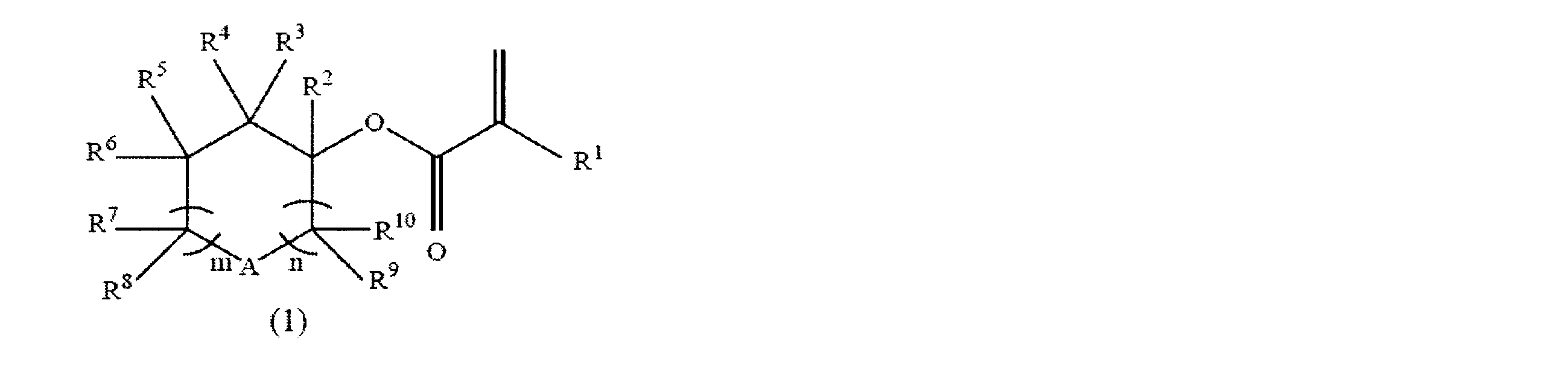
(式中、R1は水素原子、ハロゲン原子、メチル基またはトリフルオロメチル基を表す。R2は炭素数1~20の直鎖状、炭素数3~20の分岐鎖状または環状の炭化水素基を示し、それらを構成する炭素原子の一部が酸素原子に置き換わっていてもよく、同一炭素に結合する2個の水素原子が酸素原子と置き換わって=Oとなってもよく、さらに炭化水素のC-H結合のHがOHと置き換わってC-OHとなっていてもよく、水素原子の一部または全部がフッ素原子に置換されてもよい。R3~R10は、それぞれ独立して、水素原子、炭素数1~20の直鎖状、炭素数3~20の分岐鎖状または環状の炭化水素基を示し、それらを構成する炭素原子の一部が酸素原子に置き換わっていてもよく、同一炭素に結合する2個の水素原子が酸素原子と置き換わって=Oとなってもよく、さらに炭化水素のC-H結合のHがOHと置き換わってC-OHとなっていてもよく、水素原子の一部または全部がフッ素原子に置換されてもよい。また、R3~R10の一部あるいは全部が結合して、環状化合物を形成してもよく、nとmは炭素数であり、それぞれが独立して0~5の整数である。Aはカルボニル基(C=O)または、当該カルボニル基が保護基によって保護された次のアセタール構造をとる。

但し、X1、X2はそれぞれ独立して、炭素数1~6のアルキル基を表す。該アルキル基の水素原子の一部または全部はフッ素、塩素、臭素原子、フェニル基、置換フェニル基に置換されていてもよく、該アルキル基のC-C結合の一部がC=C二重結合となっていてもよく、X1、X2はつながって全体として環状アセタール構造をとってもよい。)
で表される重合性単量体。
一般式(1):
で表される重合性単量体。
[発明2]
一般式(2)、一般式(3)または一般式(4):

(式(2)、式(3)または式(4)中、R1は水素原子、ハロゲン原子、メチル基またはトリフルオロメチル基を表し、R2は、炭素数1~20の直鎖状、炭素数3~20の分岐鎖状または環状の炭化水素基を示しそれらを構成する炭素原子の一部が酸素原子に置き換わっていてもよく、同一炭素に結合する2個の水素原子が酸素原子と置き換わって=Oとなってもよく、さらに炭化水素のC-H結合のHがOHと置き換わってC-OHとなっていてもよく、水素原子の一部または全部がフッ素原子に置換されてもよい。
Aはカルボニル基(C=O)または、当該カルボニル基が保護基によって保護された次のアセタール構造をとる。

但し、X1、X2はそれぞれ独立して、炭素数1~6のアルキル基を表す。該アルキル基の水素原子の一部または全部が、フッ素、塩素、臭素原子、フェニル基、置換フェニル基に置換されていてもよい。また該アルキル基のC-C結合の一部がC=C二重結合となっていてもよい。またX1、X2はつながって全体として環状アセタール構造をとってもよい。)のいずれかで表される発明1の重合性単量体。
一般式(2)、一般式(3)または一般式(4):
Aはカルボニル基(C=O)または、当該カルボニル基が保護基によって保護された次のアセタール構造をとる。
[発明3]
R1が水素原子、ハロゲン原子、メチル基またはトリフルオロメチル基、R2がメチル基、エチル基またはイソプロピル基であることを特徴とする発明1または発明2の重合性単量体。
これら重合性単量体を用い重合してなる重合体は、レジストの材料として有用である。
R1が水素原子、ハロゲン原子、メチル基またはトリフルオロメチル基、R2がメチル基、エチル基またはイソプロピル基であることを特徴とする発明1または発明2の重合性単量体。
これら重合性単量体を用い重合してなる重合体は、レジストの材料として有用である。
[発明4]
(発明1に記載の一般式(1)に記載の重合性単量体が重合してなる)一般式(5):

(式中、R1は水素原子、ハロゲン原子、メチル基またはトリフルオロメチル基を表す。R2は炭素数1~20の直鎖状、炭素数3~20の分岐鎖状または環状の炭化水素基を示し、それらを構成する炭素原子の一部が酸素原子に置き換わっていてもよく、同一炭素に結合する2個の水素原子が酸素原子と置き換わって=Oとなってもよく、さらに炭化水素のC-H結合のHがOHと置き換わってC-OHとなっていてもよく、水素原子の一部または全部がフッ素原子に置換されてもよい。R3~R10は、それぞれ独立して、水素原子、炭素数1~20の直鎖状、炭素数3~20の分岐鎖状または環状の炭化水素基を示し、それらを構成する炭素原子の一部が酸素原子に置き換わっていてもよく、同一炭素に結合する2個の水素原子が酸素原子と置き換わって=Oとなってもよく、さらに炭化水素のC-H結合のHがOHと置き換わってC-OHとなっていてもよく、水素原子の一部または全部がフッ素原子に置換されてもよい。また、R3~R10の一部あるいは全部が結合して、環状化合物を形成してもよく、nとmは炭素数であり、それぞれが独立して0~5の整数である。Aはカルボニル基(C=O)または、当該カルボニル基が保護基によって保護された次のアセタール構造をとる。

但し、X1、X2はそれぞれ独立して、炭素数1~6のアルキル基を表す。該アルキル基の水素原子の一部または全部が、フッ素、塩素、臭素原子、フェニル基、置換フェニル基に置換されていてもよい。また該アルキル基のC-C結合の一部がC=C二重結合となっていてもよい。またX1、X2はつながって全体として環状アセタール構造をとってもよい。)
で表される繰り返し単位を含むことを特徴とする重合体。
(発明1に記載の一般式(1)に記載の重合性単量体が重合してなる)一般式(5):
で表される繰り返し単位を含むことを特徴とする重合体。
[発明5]
一般式(6)、一般式(7)または一般式(8):

(R1は水素原子、ハロゲン原子、メチル基またはトリフルオロメチル基を表し、R2は炭素数1~20の直鎖状、炭素数3~20の分岐鎖状または環状の炭化水素基を示し、それらを構成する炭素原子の一部が酸素原子に置き換わっていてもよく、同一炭素に結合する2個の水素原子が酸素原子と置き換わって=Oとなってもよく、さらに炭化水素のC-H結合のHがOHと置き換わってC-OHとなっていてもよく、水素原子の一部または全部がフッ素原子に置換されてもよい。
Aはカルボニル基(C=O)または、当該カルボニル基が保護基によって保護された次のアセタール構造をとる。

但し、X1、X2はそれぞれ独立して、炭素数1~6のアルキル基を表す。該アルキル基の水素原子の一部または全部がフッ素、塩素、臭素原子、フェニル基、置換フェニル基に置換されていてもよい。また該アルキル基のC-C結合の一部がC=C二重結合となっていてもよい。またX1、X2はつながって全体として環状アセタール構造をとってもよい。)のいずれかで表される繰り返し単位を含む発明4の重合体。
一般式(6)、一般式(7)または一般式(8):
Aはカルボニル基(C=O)または、当該カルボニル基が保護基によって保護された次のアセタール構造をとる。
[発明6]
R2はメチル基、エチル基またはイソプロピル基で表されることを特徴とする発明4または発明5の重合体。
R2はメチル基、エチル基またはイソプロピル基で表されることを特徴とする発明4または発明5の重合体。
[発明7]
発明4~6のいずれか1つの重合体が、さらに1,1,1,3,3,3-ヘキサフルオロ-2-ヒドロキシイソプロピル基(-C(CF3)2OH)を有する繰り返し単位を含むことを特徴とする重合体。
発明4~6のいずれか1つの重合体が、さらに1,1,1,3,3,3-ヘキサフルオロ-2-ヒドロキシイソプロピル基(-C(CF3)2OH)を有する繰り返し単位を含むことを特徴とする重合体。
発明7の重合体は、発明1~3のいずれか1つの重合性単量体と、1,1,1,3,3,3-ヘキサフルオロ-2-ヒドロキシイソプロピル基(-C(CF3)2OH)を有する重合性単量体を重合させることにより得られる。尚、重合の際、他の重合性単量体を加えてもよい。
[発明8]
発明4~7のいずれか1つの重合体が、さらに一般式(9)または一般式(10):
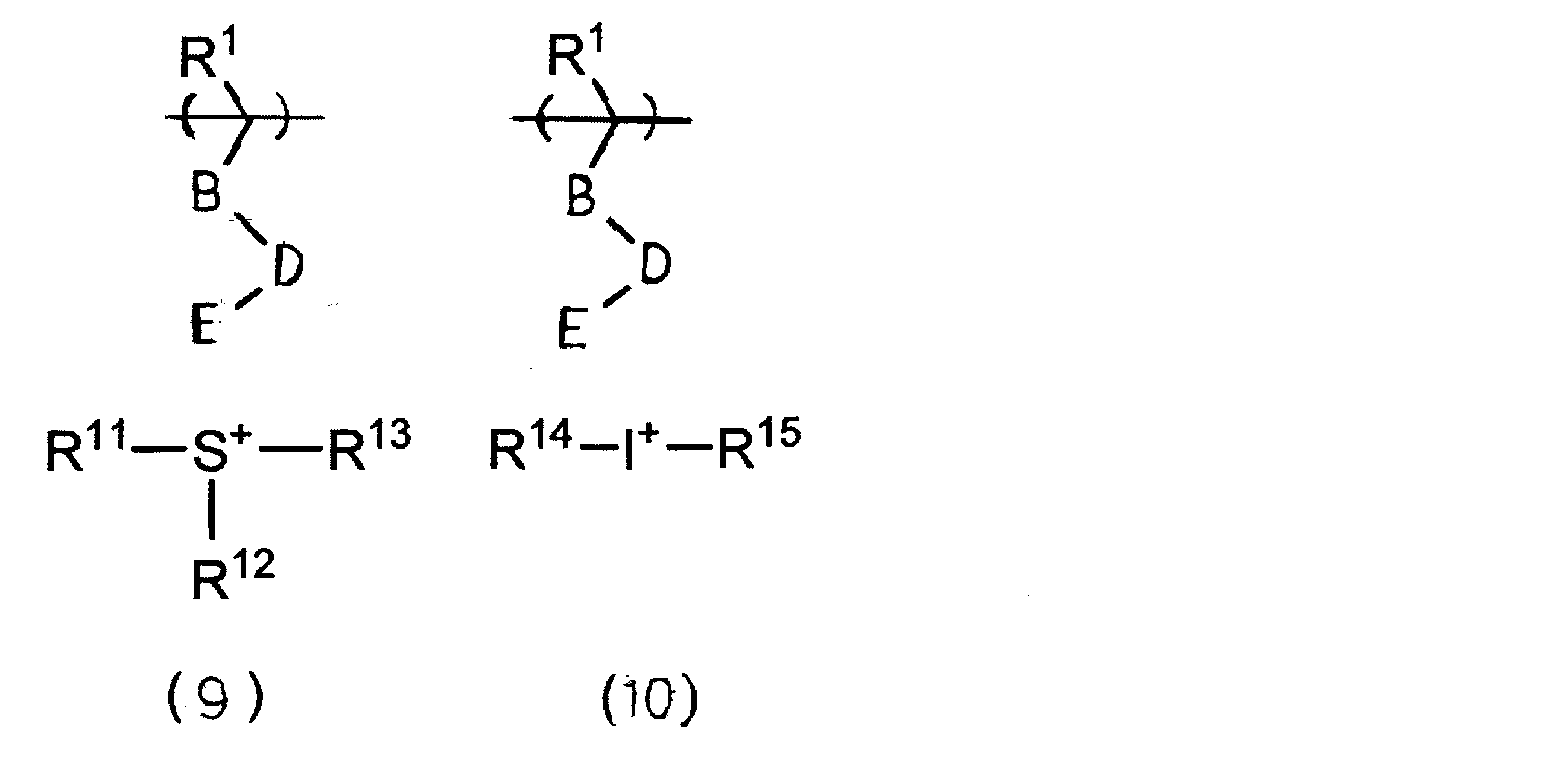
(R1は水素原子、ハロゲン原子、メチル基またはトリフルオロメチル基、Bは単結合、メチレン基、フェニレン基、-O-、-(C=O)-O-、または-(C=O)-NR16-を表す。R16は水素原子、炭素数1~20の直鎖状、分岐状、環状の炭化水素基であり、一部または全部の水素原子がフッ素原子、水酸基、アルコキシル基で置換されていてもよく、-O-、-(C=O)-O-、-(C=O)-NH-、-(C=O)-、-O-(C=O)-NH-、または-NH-(C=O)-NH-の少なくとも1種以上を含有してもよい。Dは単結合、炭素数1~20の直鎖状、炭素数3~20の分岐状、環状のアルキレン基またはフェニレン基であり、一部または全部の水素原子がフッ素原子、水酸基、またはアルコキシル基で置換されていてもよく、-O-、-(C=O)-O-、-(C=O)-NH-、-(C=O)-、-O-(C=O)-NH-、または-NH-(C=O)-NH-のうち少なくとも1以上を含有してもよく、EはSO3
-、CO2
-、(CF3SO2)2C-、またはCF3SO2N-である。R11~R13は相互に独立に、置換基を有していてもよい炭素数1~30の直鎖状もしくは分岐状のアルキル基、置換基を有していてもよい炭素数3~30の環状の1価の炭化水素基、置換基を有していてもよい炭素数6~30のアリール基、または置換基を有してもよい原子数4~30の1価のヘテロ環状有機基を示す。R11、R12およびR13のうちの何れか2つ以上が硫黄原子を介して相互に結合して環を形成していてもよい。R14およびR15は相互に独立に、置換基を有していてもよい炭素数1~30の直鎖状または単総数1~20の分岐鎖状のアルキル基、置換基を有していてもよい炭素数3~30の環状の1価の炭化水素基、置換基を有していてもよい炭素数6~30のアリール基、または置換基を有してもよい炭素数4~30の1価のヘテロ環状有機基を示す。またはR14とR15とがヨウ素原子を介して相互に結合して環を形成していてもよい。)で表される繰り返し単位を含むことを特徴とする重合体。
発明4~7のいずれか1つの重合体が、さらに一般式(9)または一般式(10):
発明8の重合体は、発明1~3または発明7の重合性単量体と、一般式(11)または一般式(12):

(R1は水素原子、ハロゲン原子、メチル基またはトリフルオロメチル基、Bは単結合、メチレン基、フェニレン基、-O-、-(C=O)-O-、または-(C=O)-NR16-を表す。R16は水素原子、炭素数1~20の直鎖状、分岐状、環状の炭化水素基であり、一部または全部の水素原子が、フッ素原子、水酸基、アルコキシル基で置換されていてもよく、-O-、-(C=O)-O-、-(C=O)-NH-、-(C=O)-、-O-(C=O)-NH-、または-NH-(C=O)-NH-の少なくとも1種以上を含有してもよい。Dは単結合、炭素数1~20の直鎖状、炭素数3~20の分岐状、環状のアルキレン基またはフェニレン基であり、一部または全部の水素原子がフッ素原子、水酸基、またはアルコキシル基で置換されていてもよく、-O-、-(C=O)-O-、-(C=O)-NH-、-(C=O)-、-O-(C=O)-NH-、または-NH-(C=O)-NH-のうち少なくとも1以上を含有してもよく、EはSO3
-、CO2
-、(CF3SO2)2C-、またはCF3SO2N-である。R11~R13は相互に独立に、置換基を有していてもよい。炭素数1~30の直鎖状もしくは分岐状のアルキル基、置換基を有していてもよい炭素数3~30の環状の1価の炭化水素基、置換基を有していてもよい炭素数6~30のアリール基、または置換基を有してもよい原子数4~30の1価のヘテロ環状有機基を示す。R11、R12およびR13のうちの何れか2つ以上が硫黄原子を介して相互に結合して環を形成していてもよい。R14およびR15は相互に独立に、置換基を有していてもよい炭素数1~30の直鎖状または単総数1~20の分岐鎖状のアルキル基、置換基を有していてもよい炭素数3~30の環状の1価の炭化水素基、置換基を有していてもよい炭素数6~30のアリール基、または置換基を有してもよい炭素数4~30の1価のヘテロ環状有機基を示す。またはR14とR15とがヨウ素原子を介して相互に結合して環を形成していてもよい。)で表される塩を有する重合性単量体を共重合させることで得られる。尚、重合の際、他の重合性単量体を加えてもよい。
[発明9]
発明4~8の重合体を含有することを特徴とするレジスト材料。
発明4~8の重合体を含有することを特徴とするレジスト材料。
[発明10]
酸発生剤、塩基性化合物、有機溶媒のうち少なくとも一種を含むことを特徴とする発明9に記載のレジスト材料。
酸発生剤、塩基性化合物、有機溶媒のうち少なくとも一種を含むことを特徴とする発明9に記載のレジスト材料。
[発明11]
有機溶媒に炭素数5~20のアルコール系溶剤を用いたことを特徴とする発明10に記載のレジスト材料。
尚、本願発明のレジスト材料は、KrFエキシマレーザ(波長248nm)、ArFエキシマレーザによる紫外光(波長193nm)を用いたリソグラフィー、特に液浸リソグラフィーおよびダブルパターニング法、極紫外光(波長13.5nm)を用いるEUVリソグラフィー等に適したレジスト材料として使用される。
有機溶媒に炭素数5~20のアルコール系溶剤を用いたことを特徴とする発明10に記載のレジスト材料。
尚、本願発明のレジスト材料は、KrFエキシマレーザ(波長248nm)、ArFエキシマレーザによる紫外光(波長193nm)を用いたリソグラフィー、特に液浸リソグラフィーおよびダブルパターニング法、極紫外光(波長13.5nm)を用いるEUVリソグラフィー等に適したレジスト材料として使用される。
[発明12]
基板上に形成された第1のレジストパターン上に第2のレジストパターンを形成するダブルパターニング法であって、発明9~11のレジスト材料を用いることを特徴とするパターン形成方法。
基板上に形成された第1のレジストパターン上に第2のレジストパターンを形成するダブルパターニング法であって、発明9~11のレジスト材料を用いることを特徴とするパターン形成方法。
[発明13]
発明9~11のレジスト材料を基板上に塗布する第1の工程と、当該基板を加熱処理してレジスト膜を形成し、露光機を用いて波長300nm以下の紫外光でフォトマスクを介しレジスト膜を露光する第2の工程と、レジスト膜の露光部位を現像液に溶解させて現像し、基板上にパターン形成する第3の工程を含むことを特徴とするパターン形成方法。
発明9~11のレジスト材料を基板上に塗布する第1の工程と、当該基板を加熱処理してレジスト膜を形成し、露光機を用いて波長300nm以下の紫外光でフォトマスクを介しレジスト膜を露光する第2の工程と、レジスト膜の露光部位を現像液に溶解させて現像し、基板上にパターン形成する第3の工程を含むことを特徴とするパターン形成方法。
[発明14]
ウェハーと投影レンズの間に水を挿入し、露光機を用いて、ArFエキシマレーザから発振させた波長193nmの紫外光を照射する、発明9~11のレジスト材料を用いた液浸リソグラフィー法。
ウェハーと投影レンズの間に水を挿入し、露光機を用いて、ArFエキシマレーザから発振させた波長193nmの紫外光を照射する、発明9~11のレジスト材料を用いた液浸リソグラフィー法。
[発明15]
波長13.5nmの紫外光を用いる、発明9~11のレジスト材料を用いたEUVリソグラフィー法。
波長13.5nmの紫外光を用いる、発明9~11のレジスト材料を用いたEUVリソグラフィー法。
本願発明の酸分解性重合性単量体を用いてなるレジスト材料は、露光前に水に対する適度な撥水性とアルコール系溶剤に対する溶解性を有し、露光後に脱離する保護基が極性基であるカルボニル基を有するため、極性のある現像液やリンス液に溶解し易くなりレジスト上にスカムを残さず、速やかな溶解性を示し、ドライ露光のみならず液浸露光においても、焦点深度が深く合焦の制御を行いやすく、マスクエラーファクターおよびラインエッジラフネスが少なく、高い解像度のパターン形成が可能である。
特に、本願発明の重合性単量体は、以前から使用されている非極性のアルキル基のみを有する従来の酸分解性の重合性単量体、例えば、2-エチル-2-アダマンチルメタクリレート、1-エチルシクロオクチルメタクリレートと比較して、その構造中に(メタ)アクリル酸エステル系重合性単量体のアルコール部位(=保護基)が3級アルコールであり、且つそのアルコール部位が環状化合物を有し、少なくとも一つのC=O(アセタール化された形態も含む)を持つことにより、溶剤に対する溶剤溶解性が高い。
また、炭素数5~20のアルコール系溶剤等の従来のレジスト材料を溶解しない溶剤で溶液化することが可能な化学増幅レジスト材料として有用である。特に、液浸用やダブルパターニングプロセス用のレジストとして有用である。
また、本願発明の重合性単量体は撥水性があり、液浸露光装置によるリソグラフィーにおいて、レジストへの水の浸入を防いでウォーターマーク欠陥(現像時、リンス後の水滴残りによる欠陥)の発生を抑制できる。
以下、本願発明を実施するための形態について詳細に説明する。
1 重合性単量体
本願発明の重合性単量体は、一般式(1)で表される重合性単量体である。
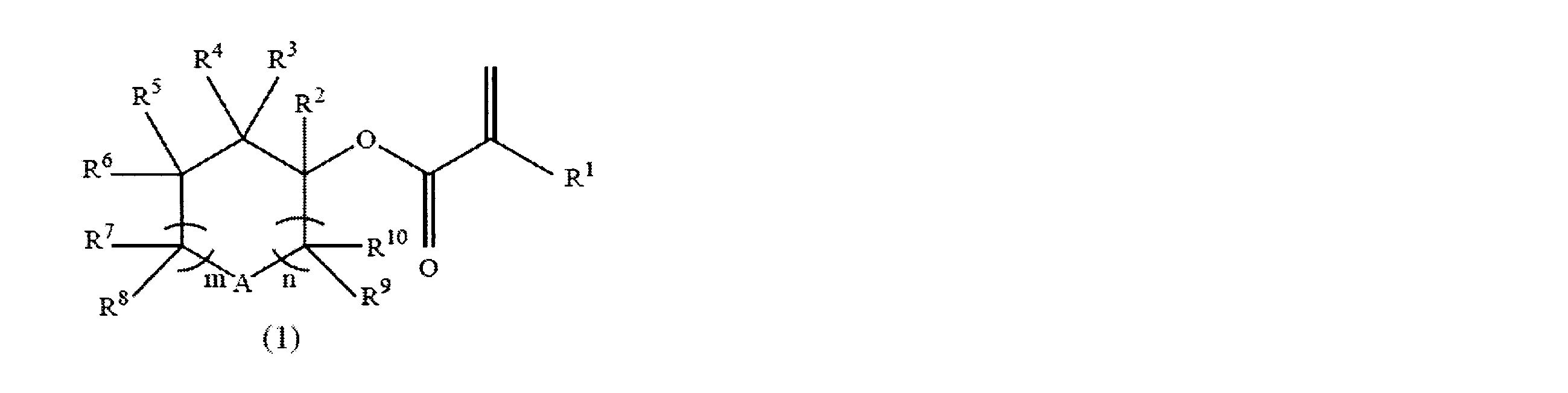
(式中、R1は水素原子、ハロゲン原子、メチル基またはトリフルオロメチル基を表す。R2は炭素数1~20の直鎖状、炭素数3~20の分岐鎖状または環状の炭化水素基を示し、それらを構成する炭素原子の一部が酸素原子に置き換わっていてもよく、同一炭素に結合する2個の水素原子が酸素原子と置き換わって=Oとなってもよく、さらに炭化水素のC-H結合のHがOHと置き換わってC-OHとなっていてもよく、水素原子の一部または全部がフッ素原子に置換されてもよい。R3~R10は、それぞれ独立して、水素原子、炭素数1~20の直鎖状、炭素数3~20の分岐鎖状または環状の炭化水素基を示し、それらを構成する炭素原子の一部が酸素原子に置き換わっていてもよく、同一炭素に結合する2個の水素原子が酸素原子と置き換わって=Oとなってもよく、さらに炭化水素のC-H結合のHがOHと置き換わってC-OHとなっていてもよく、水素原子の一部または全部がフッ素原子に置換されてもよい。また、R3~R10の一部あるいは全部が結合して、環状化合物を形成してもよく、nとmは炭素数であり、それぞれが独立して0~5の整数である。
本願発明の重合性単量体は、一般式(1)で表される重合性単量体である。
一般式(1)の重合性単量体において、酸素原子の導入は溶剤への溶解性、ハロゲン原子の中でもフッ素原子への置換は、撥水性および透明性を調整するのに有用で、必要に応じて任意に導入される。
一般式(1)の重合性単量体において、R2~R10を例示すると、炭化水素基としては、メチル基、エチル基、プロピル基、イソプロピル基、シクロプロピル基、n-プロピル基、iso-プロピル基、sec-ブチル基、tert-ブチル基、n-ペンチル基、シクロペンチル基、sec-ペンチル基,ネオペンチル基、ヘキシル基、シクロへキシル基、エチルヘキシル基、ノルボルネル基、アダマンチル基、ビニル基、アリル基、ブテニル基、ペンテニル基、エチニル基、フェニル基、ベンジル基または4-メトキシベンジル基が挙げられ、上記官能基の一部または全部がフッ素原子で置換されたものでもよい。また、酸素原子を含むものを例示すると、メトキシ基、エトキシ基、n-プロポキシ基、iso-プロポキシ基、sec-ブチトキシ基、tert-ブチトキシ基、n-ペンチルオキシ基、シクロペンチルオキシ基、sec-ペンチルオキシ基,ネオペンチルオキシ基、ヘキシルオキシ基、シクロへキシルオキシ基、エチルヘキシルオキシ基、ノルボルネルオキシ基、アダマンチルオキシ基、アリルオキシ基、ブテニルオキシ基、ペンテニルオキシ基、エチニルオキシ基、フェニルオキシ基、ベンジルオキシ基、4-メトキシベンジルオキシ基、メトキシメチル基、メトキシエトキシメチル基、エトキシエチル基、ブトキシエチル基、シクロヘキシルオキシエチル基、ベンジルオキシエチル基、フェネチルオキシエチル基、エトキシプロピル基、ベンジルオキシプロピル基、フェネチルオキシプロピル基、エトキシブチル基、エトキシイソブチル基の鎖状のエーテル、テトラヒドロフラニル基またはテトラヒドロピラニル基の環状エーテルが挙げられる。アシル基としては、アセチル基、プロピオニル基、ブチリル基、ヘプタノイル基、ヘキサノイル基、バレリル基、ピバロイル基、イソバレリル基、ラウリロイル基、ミリストイル基、パルミトイル基、ステアロイル基、オキサリル基、マロニル基、スクシニル基、グルタリル基、アジポイル基、ピペロイル基、スベロイル基、アゼラオイル基、セバコイル基、アクリロイル基、プロピオロイル基、メタクリロイル基、クロトノイル基、オレオイル基、マレオイル基、フマロイル基、メサコノイル基、カンホロイル基、ベンゾイル基、フタロイル基、イソフタロイル基、テレフタロイル基、ナフトイル基、トルオイル基、ヒドロアトロポイル基、アトロポイル基、シンナモイル基、フロイル基、テノイル基、ニコチノイル基またはイソニコチノイル基を挙げることができる。さらに、上記置換基の水素原子の一部または全部がフッ素原子で置換されたものを使用することもできる。
また、一般式(1)において、Aはカルボニル基(C=O)または、当該カルボニル基が保護基によって保護された次のアセタール構造をとる。

但し、X1、X2はそれぞれ独立して、炭素数1~6のアルキル基を表す。該アルキル基の水素原子の一部または全部がフッ素、塩素、臭素原子、フェニル基、置換フェニル基に置換されていてもよく、該アルキル基のC-C結合の一部がC=C二重結合となっていてもよく、X1、X2はつながって全体として環状アセタール構造をとってもよい。)
一般式(1)で表される重合性単量体のX1およびX2を例示すると、それぞれ独立に、-CH3、-CH2CH3、-CH2CCl3または-CH2Phが挙げられ、X1とX2が結合した例は、-CH2CH2-、-CH2CH2CH2-、-CH2C(CH2)2CH2-、-CH2CH(CH2Br)-、-CH2CH(CH2CH2CH=CH)-または-CH2CH(Ph)O-挙げられる。
入手の容易さやコスト面を考量すると、-CH3,-CH2CH3,-CH2Ph、-CH2CH2-、-CH2CH2CH2-または-CH2C(CH2)2CH2-、が好適に用いられる。
また、一般式(1)で表される重合性単量体は酸分解性モノマーであり、さらに酸分解中にX1またはX2も同時に脱離するので、一般式(1)で表される重合性単量体は、欠陥低減機能を有すると期待される。
一般式(1)の重合性単量体は、R2~R10の一部または全部が結合した環状構造を含み、環状構造がリソグラフィーのエッチング工程に耐性があることは既知なため、環状構造を有する一般式(1)で表される環状重合性単量体が好適に用いられる。
次いで、発明2、3に記載の重合性単量体について説明する。発明2、3には、一般式(2)~(4)で表される重合性単量体が記載される。
一般式(1)で表される重合性単量体で、nとmはそれぞれが独立して0~5の整数の範囲なので4~14員環となるが、原料の入手容易さを考慮すると、5員環あるいは6員環が好ましく、原料コストまで考えると6員環で示される一般式(2)~(4)の重合性単量体が好ましい。
一般式(2)~(4)で表される重合性単量体において、R2はメチル基、エチル基またはイソプロピル基が好ましく、合成の容易さでメチル基およびエチル基がより好ましく、特にエチル基を用いると紫外光、極紫外光の照射により、光酸発生剤より発生した酸により、当該重合性単量体が分解しやすいことから、エチル基が好適である。
一般式(1)~(4)で表される重合性単量体の製造に関しては、相当するジケトン体の片側をアセタール保護した化合物に、金属反応剤を作用し、続くメタクリルエステル化とアセタール脱保護から導くことができる(特許文献1,2)。
2 本願発明の重合性単量体と共重合可能な重合性単量体
次いで、本願発明の重合性単量体と共重合可能な重合性単量体について説明する。
次いで、本願発明の重合性単量体と共重合可能な重合性単量体について説明する。
2.1重合性単量体
本願発明の重合性単量体と共重合可能な単量体は、一般式(1)で表される重合性単量体と共重合可能なものであり、具体的には、無水マレイン酸、アクリル酸エステル類、含フッ素アクリル酸エステル類、メタクリル酸エステル類、含フッ素メタクリル酸エステル類、スチレン系化合物、含フッ素スチレン系化合物、ビニルエーテル類、含フッ素ビニルエーテル類、アリルエーテル類、含フッ素アリルエーテル類、オレフィン類、含フッ素オレフィン類、ノルボルネン化合物、含フッ素ノルボルネン化合物、二酸化硫黄、ビニルシラン類、ビニルスルホン酸またはビニルスルホン酸エステルが挙げられる。
本願発明の重合性単量体と共重合可能な単量体は、一般式(1)で表される重合性単量体と共重合可能なものであり、具体的には、無水マレイン酸、アクリル酸エステル類、含フッ素アクリル酸エステル類、メタクリル酸エステル類、含フッ素メタクリル酸エステル類、スチレン系化合物、含フッ素スチレン系化合物、ビニルエーテル類、含フッ素ビニルエーテル類、アリルエーテル類、含フッ素アリルエーテル類、オレフィン類、含フッ素オレフィン類、ノルボルネン化合物、含フッ素ノルボルネン化合物、二酸化硫黄、ビニルシラン類、ビニルスルホン酸またはビニルスルホン酸エステルが挙げられる。
一般式(1)で表される重合性単量体と共重合可能なアクリル酸エステルまたはメタクリル酸エステルとしては、エステル側鎖について特に制限なく使用できるが、公知の化合物を例示するならば、メチルアクリレート、メチルメタクリレート、エチルアクリレート、エチルメタクリレート、n-プロピルアクリレート、n-プロピルメタクリレート、イソプロピルアクリレート、イソプロピルメタクリレート、n-ブチルアクリレート、n-ブチルメタクリレート、イソブチルアクリレート、イソブチルメタクリレート、n-ヘキシルアクリレート、n-ヘキシルメタクリレート、n-オクチルアクリレート、n-オクチルメタクリレート、2-エチルヘキシルアクリレート、2-エチルヘキシルメタクリレート、ラウリルアクリレート、ラウリルメタクリレート、2-ヒドロキシエチルアクリレート、2-ヒドロキシエチルメタクリレート、2-ヒドロキシプロピルアクリレート、2-ヒドロキシプロピルメタクリレート、3-オキソシクロヘキシルアクリレート、3-オキソシクロヘキシルメタクリレート、アダマンチルアクリレート、アダマンチルメタクリレート、ヒドロキシアダマンチルアクリレート、ヒドロキシアダマンチルメタクリレート、シクロヘキシルアクリレート、シクロヘキシルメタクリレート、トリシクロデカニルアクリレート、トリシクロデカニルメタクリレートのアクリル酸またはメタクリル酸のアルキルエステル、エチレングリコール、プロピレングリコール、テトラメチレングリコール基を含有したアクリレートまたはメタクリレート、さらにアクリルアミド、メタクリルアミド、N-メチロールアクリルアミド、N-メチロールメタクリルアミド、ジアセトンアクリルアミド等の不飽和アミド、アクリロニトリル、メタクリロニトリル、アルコキシシラン含有のビニルシラン、アクリル酸またはメタクリル酸エステル、酸分解性基を含有したアクリレートまたはメタクリレートとしては、tert-ブチルアクリレート、tert-ブチルメタクリレート、メチルシクロペンチルアクリレート、メチルシクロペンチルメタクリレート、エチルシクロペンチルメタクリレート、エチルシクロペンチルアクリレート、メチルシクロヘキシルアクリレート、メチルシクロヘキシルメタクリレート、エチルシクロヘキシルアクリレート、エチルシクロヘキシルメタクリレート、メチルシクロペプチルアクリレート、メチルシクロペプチルメタクリレート、エチルシクロペプチルアクリレート、エチルシクロペプチルメタクリレート、メチルシクロオクチルアクリレート、メチルシクロオクチルメタクリレート、エチルシクロオクチルアクリレート、エチルシクロオクチルメタクリレート、メチルシクロノニルアクリレート、メチルシクロノニルメタクリレート、エチルシクロノニルアクリレート、エチルシクロノニルメタクリレート、メチルシクロデカニルアクリレート、メチルシクロデカニルメタクリレート、エチルシクロデカニルアクリレート、エチルシクロデカニルメタクリレート、メチルアダマンチルアクリレート、メチルアダマンチルメタクリレート、エチルアダマンチルアクリレートまたはエチルアダマンチルメタクリレートを例示でき、γ-ブチロラクトン、γ-バレロラクトン、δ-バレロラクトン、ノルボルナンブチロラクトンまたはノルボルナンバレロラクトン基等の密着性基となるラクトン構造を含有したアクリレート、メタクリレート、アクリル酸またはメタクリル酸が使用できる。さらにα位にシアノ基を含有した上記アクリレート類化合物、類似化合物としてマレイン酸、フマル酸または無水マレイン酸を共重合することも可能である。
また、上記の含フッ素アクリル酸エステルまたは含フッ素メタクリル酸エステルとしては、フッ素原子またはフッ素原子を有する基がアクリルのα位に含有した単量体、あるいはエステル部位にフッ素原子を含有した置換基からなるアクリル酸エステルまたはメタクリル酸エステルであって、α位とエステル部位ともにフッ素を含有した含フッ素化合物も好適である。さらにα位にシアノ基が導入されていてもよい。例えば、α位に含フッ素アルキル基が導入された単量体としては、上述した非フッ素系のアクリル酸エステルまたはメタクリル酸エステルのα位にトリフルオロメチル基、トリフルオロエチル基、ノナフルオロ-n-ブチル基が付与された単量体が採用される。
一方、そのエステル部位にフッ素を含有する単量体としては、エステル部位にパーフルオロアルキル基を含むフルオロアルキル基を有し、またはエステル部位にフッ素原子を含んでもよい環状構造を有し、例えば、前記環状構造が、フッ素原子、トリフルオロメチル基またはヘキサフルオロイソプロピル水酸基で置換された含フッ素ベンゼン環、含フッ素シクロペンタン環、含フッ素シクロヘキサン環または含フッ素シクロヘプタン環であるアクリル酸エステルあるいはメタクリル酸エステルが挙げられる。
また、エステル部位が含フッ素のt-ブチルエステル基である、アクリル酸エステルまたはメタクリル酸エステルも挙げられる。これらのアクリル酸エステルまたはメタクリル酸エステルのα位に含フッ素アルキル基を有していてもよい。
このような単量体としては、2,2,2-トリフルオロエチルアクリレート、2,2,3,3-テトラフルオロプロピルアクリレート、1,1,1,3,3,3-ヘキサフルオロイソプロピルアクリレート、ヘプタフルオロイソプロピルアクリレート、1,1-ジヒドロヘプタフルオロ-n-ブチルアクリレート、1,1,5-トリヒドロオクタフルオロ-n-ペンチルアクリレート、1,1,2,2-テトラヒドロトリデカフルオロ-n-オクチルアクリレート、1,1,2,2-テトラヒドロヘプタデカフルオロ-n-デシルアクリレート、2,2,2-トリフルオロエチルメタクリレート、2,2,3,3-テトラフルオロプロピルメタクリレート、1,1,1,3,3,3-ヘキサフルオロイソプロピルメタクリレート、ヘプタフルオロイソプロピルメタクリレート、1,1-ジヒドロヘプタフルオロ-n-ブチルメタクリレート、1,1,5-トリヒドロオクタフルオロ-n-ペンチルメタクリレート、1,1,2,2-テトラヒドロトリデカフルオロ-n-オクチルメタクリレート、1,1,2,2-テトラヒドロヘプタデカフルオロ-n-デシルメタクリレート、パーフルオロシクロヘキシルメチルアクリレート、パーフルオロシクロヘキシルメチルメタクリレート、6-[3,3,3-トリフルオロ-2-ヒドロキシ-2-(トリフルオロメチル)プロピル]ビシクロ[2.2.1]ヘプチル-2-イルアクリレート、6-[3,3,3-トリフルオロ-2-ヒドロキシ-2-(トリフルオロメチル)プロピル]ビシクロ[2.2.1]ヘプチル-2-イル 2-(トリフルオロメチル)アクリレート、6-[3,3,3-トリフルオロ-2-ヒドロキシ-2-(トリフルオロメチル)プロピル]ビシクロ[2.2.1]ヘプチル-2-イルメタクリレート、1,4-ビス(1,1,1,3,3,3-ヘキサフルオロ-2-ヒドロキシイソプロピル)シクロヘキシルアクリレート、1、4-ビス(1,1,1,3,3,3-ヘキサフルオロ-2-ヒドロキシイソプロピル)シクロヘキシルメタクリレート、または1,4-ビス(1,1,1,3,3,3-ヘキサフルオロ-2-ヒドロキシイソプロピル)シクロヘキシル 2-トリフルオロメチルアクリレートが挙げられる。
また、本願発明の重合性単量体と共重合可能な重合性単量体は、1,1,1,3,3,3-ヘキサフルオロ-2-ヒドロキシイソプロピル基(-C(CF3)2OH)を有する重合性単量体が好ましく、そのアルコール部位による密着性および離脱したアルコール部位のアルカリ溶解性から、レジスト材料として用いフォトリソグラフィーによりパターニングした際、スカム低減の効果がある。
本願発明の重合性単量体と共重合可能な、1,1,1,3,3,3-ヘキサフルオロ-2-ヒドロキシイソプロピル基(-C(CF3)2OH)を有する重合性単量体として、具体的に下記に示す化合物が挙げられる。

これらの式中、R1は水素原子、ハロゲン原子、メチル基、またはトリフルオロメチル基を表す。また、ヘキサフルオロイソプロピル基中の水酸基は、その一部または全部が保護基で保護されていてもよい。
本願発明の重合性単量体と共重合可能なスチレン系化合物、含フッ素スチレン系化合物としては、スチレン、フッ素化スチレン、ヒドロキシスチレン等が使用できる。具体的には、フッ素原子またはトリフルオロメチル基で芳香環の水素を置換したスチレンである、ペンタフルオロスチレン、トリフルオロメチルスチレンまたはビストリフルオロメチルスチレ、あるいはヘキサフルオロイソプロピル水酸基またはその水酸基を保護した官能基で芳香環の水素を置換したスチレンが挙げられる。また、α位にハロゲン、アルキル基、含フッ素アルキル基が結合した上記スチレン、パーフルオロビニル基含有のスチレンが挙げられる。
また、本願発明の重合性単量体と共重合可能なビニルエーテル、含フッ素ビニルエーテル、アリルエーテルが使用でき、含フッ素アリルエーテルとしては、ヒドロキシル基として、メチル基、エチル基、プロピル基、ブチル基、ヒドロキシエチル基またはヒドロキシブチル基を含有するアルキルビニルエーテルあるいはアルキルアリルエーテルが使用できる。また、シクロヘキシル基、ノルボルニル基、芳香環またはその環状構造内に水素やカルボニル結合を有した環状型ビニル、アリルエーテル、上記官能基の水素の一部または全部がフッ素原子で置換された含フッ素ビニルエーテルあるいは含フッ素アリルエーテルも使用できる。
尚、ビニルエステル、ビニルシラン、オレフィン、含フッ素オレフィン、ノルボルネン化合物または含フッ素ノルボルネン化合物、その他の重合性不飽和結合を含有した化合物も本願発明において、使用することが可能である。
上記、本願発明の重合性単量体と共重合可能なオレフィンとしては、エチレン、プロピレン、イソブテン、シクロペンテンまたはシクロヘキセン、含フッ素オレフィンとしては、フッ化ビニル、フッ化ビニリデン、トリフルオロエチレン、クロロトリフルオロエチレン、テトラフルオロエチレン、ヘキサフルオロプロピレンまたはヘキサフルオロイソブテンを使用できる。
上記、本願発明の重合性単量体と共重合可能なノルボルネン化合物、含フッ素ノルボルネン化合物は、一核または複数の核構造を有するノルボルネン単量体である。
具体的には、含フッ素オレフィン、アリルアルコール、含フッ素アリルアルコール、ホモアリルアルコールまたは含フッ素ホモアリルアルコールが、不飽和化合物であるアクリル酸、α-フルオロアクリル酸、α-トリフルオロメチルアクリル酸、メタクリル酸、本明細書で記載した全部のアクリル酸エステル、メタクリル酸エステル、含フッ素アクリル酸エステルもしくは含フッ素メタクリル酸エステル、2-(ベンゾイルオキシ)ペンタフルオロプロパン、2-(メトキシエトキシメチルオキシ)ペンタフルオロプロペン、2-(テトラヒドロキシピラニルオキシ)ペンタフルオロプロペン、2-(ベンゾイルオキシ)トリフルオロエチレンまたは2-(メトキメチルオキシ)トリフルオロエチレンと、シクロペンタジエンあるいはシクロヘキサジエンのDiels-Alder付加反応で生成するノルボルネン化合物である、3-(5-ビシクロ[2.2.1]ヘプテン-2-イル)-1,1,1-トリフルオロ-2-(トリフルオロメチル)-2-プロパノールが挙げられる。
本願発明において、本願発明の重合体単量体と共重合可能な重合性単量体として、基板との密着性の向上を目的にラクトン構造を含むユニットを用いることができる。
かかるユニットには、ラクトン含有の環式重合体が好適に用いられる。このようなラクトン含有の環式重合性単量体としては、γ-ブチロラクトンから水素原子1つを除いた単環式のラクトン構造を有する単量体、ノルボルナンラクトンから水素原子1つを除いた多環式のラクトン構造を有する単量体が挙げられる。ラクトン構造をレジストに含有することによって、基板との密着性を向上するばかりでなく、現像液との親和性を高めることが可能となる。
尚、以上の本願発明の重合性単量体と共重合可能な単量体は、単独でも2種以上を併用してもよい。
2.2 塩を有する重合性単量体
また、一般式(1)で表される本願発明の重合性単量体と重合する重合性単量体には、光酸発生剤(Photo Acid Generator以下、PAGと略する)として露光により酸を発生する、塩を有する重合性単量体が挙げられる。重合性単量体が共重合してなる共重合体の化学構造中にPAGが含有されると、共重合体に別途添加する添加型PAGと比較して、化学構造においてPAGが酸分解性基の近傍に位置することから露光感度が上昇するため、露光において、照射光の強度が低く、低エネルギーの状態でも分解し、酸の発生が可能になり、さらにPAG自身の拡散距離が短いため、レジスト材料として用いフォトリソグラフィーによりパターニングした際、ラインエッジラフネス低減の効果がある。
また、一般式(1)で表される本願発明の重合性単量体と重合する重合性単量体には、光酸発生剤(Photo Acid Generator以下、PAGと略する)として露光により酸を発生する、塩を有する重合性単量体が挙げられる。重合性単量体が共重合してなる共重合体の化学構造中にPAGが含有されると、共重合体に別途添加する添加型PAGと比較して、化学構造においてPAGが酸分解性基の近傍に位置することから露光感度が上昇するため、露光において、照射光の強度が低く、低エネルギーの状態でも分解し、酸の発生が可能になり、さらにPAG自身の拡散距離が短いため、レジスト材料として用いフォトリソグラフィーによりパターニングした際、ラインエッジラフネス低減の効果がある。
本願発明の重合性単量体と共重合可能な塩を有する重合性単量体としては、一般式(11)、(12)に例示される。

式中、R1は水素原子、ハロゲン原子、メチル基またはトリフルオロメチル基、Bは単結合、メチレン基、フェニレン基、-O-、-(C=O)-O-、-(C=O)または-NR16-を表す。R16は水素原子、炭素数1~20の直鎖状、分岐状または環状の炭化水素基であり、一部または全部の水素原子がフッ素原子、水酸基、またはアルコキシル基で置換されていてもよく、-O-、-(C=O)-O-、-(C=O)-NH-、-(C=O)-、-O-(C=O)-NH-、または-NH-(C=O)-NH-から選ばれた少なくとも1種以上を含有してもよい。Dは単結合、炭素数1~20の直鎖状、分岐状、環状のアルキレン基またはフェニレン基であり、一部または全部の水素原子がフッ素原子、水酸基、アルコキシル基で置換されていてもよく、-O-、-(C=O)-O-、-(C=O)-NH-、-(C=O)-、-O-(C=O)-NH-、または-NH-(C=O)-NH-から選ばれた少なくとも1種以上を含有してもよく、EはSO3
-、CO2
-、(CF3SO2)2C-、またはCF3SO2N-である。R11~R13は相互に独立に、置換基を有していてもよい炭素数1~30の直鎖状もしくは分岐状のアルキル基、置換基を有していてもよい炭素数3~30の環状の1価の炭化水素基、置換基を有していてもよい炭素数6~30のアリール基、または置換基を有してもよい原子数4~30の1価のヘテロ環状有機基を示す、R11、R12およびR13のうちの何れか2つ以上が硫黄原子を介して相互に結合して環を形成していてもよい。R14およびR15は相互に独立に、置換基を有していてもよい炭素数1~30の直鎖状もしくは分岐状のアルキル基、置換基を有していてもよい炭素数3~30の環状の1価の炭化水素基の1価の炭化水素基、置換基を有していてもよい炭素数6~30のアリール基、または置換基を有してもよい原子数4~30の1価のヘテロ環状有機基を示す。R14とR15とがヨウ素原子を介して相互に結合して環を形成していてもよい。
上記一般式(11)および(12)におけるアニオンは、具体的には下記のものを例示することができる。

R1は水素原子、ハロゲン原子、メチル基またはトリフルオロメチル基、Xは酸素原子あるいはNR16である。R16は水素原子、炭素数1~20の直鎖状、分岐状、環状の炭化水素基であり、一部または全部の水素原子がフッ素原子、水酸基、またはアルコキシル基で置換されていてもよく、-O-、-(C=O)-O-、-(C=O)-NH-、-(C=O)-、-O-(C=O)-NH-、または-NH-(C=O)-NH-から選ばれた少なくとも1種以上を含有してもよい。
本願発明のオニウム塩は発生する酸の構造すなわちアニオン側を限定するものであるが、カチオン側は特に限定しない。
一般式(11)または(12)において、R11~R15の非置換の炭素数1~30の直鎖状、分岐状の1価の炭化水素基、または炭素数3~30の環状の1価の炭化水素基としては、例えば、メチル基、エチル基、n-プロピル基、i-プロピル基、n-ブチル基、1-メチルプロピル基、2-メチルプロピル基、t-ブチル基、n-ペンチル基、i-ペンチル基、1,1-ジメチルプロピル基、1-メチルブチル基、1,1-ジメチルブチル基、n-ヘキシル基、n-ヘプチル基、i-ヘキシル基、n-オクチル基、i-オクチル基、2-エチルヘキシル基、n-ノニル基、n-デシル基、n-ウンデシル基、n-ドデシル基、シクロプロピル基、シクロペンチル基、シクロヘキシル基、4-t-ブチルシクロヘキシル基等のアルキル基、シクロヘキセニル基、ノルボルネン骨格を有する基、ノルボルナン骨格を有する基、イソボルニル骨格を有する基、トリシクロデカン骨格を有する基、テトラシクロドデカン骨格を有する基、またはアダマンタン骨格を有する基を挙げることができる。
前記炭化水素基の置換基としては、例えば、炭素数6~30のアリール基、炭素数2~30の直鎖状、分岐状もしくは環状のアルケニル基や、ハロゲン原子、酸素原子、窒素原子、硫黄原子、リン原子、またはケイ素原子等のヘテロ原子を含む原子数1~30の基等を挙げることができる。なお、これらの置換基はさらに任意の置換基、例えば前記した置換基を1種以上有することもできる。
前記置換基で置換された炭素数1~30の直鎖状、分岐状もしくは環状の1価の炭化水素基としては、例えば、ベンジル基、メトキシメチル基、メチルチオメチル基、エトキシメチル基、エチルチオメチル基、フェノキシメチル基、メトキシカルボニルメチル基、エトキシカルボニルメチル基、アセチルメチル基、フルオロメチル基、トリフルオロメチル基、クロロメチル基、トリクロロメチル基、2-フルオロプロピル基、(トリフルオロアセチル)メチル基、(トリクロロアセチル)メチル基、(ペンタフルオロベンゾイル)メチル基、アミノメチル基、(シクロヘキシルアミノ)メチル基、(ジフェニルホスフィノ)メチル基、(トリメチルシリル)メチル基、2-フェニルエチル基、または3-フェニルプロピル基、2-アミノエチル基を挙げることができる。
また、R11~R15の非置換の炭素数6~30のアリール基としては、例えば、フェニル基、1-ナフチル基、2-ナフチル基、1-アントリル基、または-フェナントリル基を挙げることができる。
また、R11~R15の非置換の原子数4~30の1価のヘテロ環状有機基としては、例えば、フリル基、チエニル基、ピラニル基、ピロリル基、チアントレニル基、ピラゾリル基、イソチアゾリル基、イソオキサゾリル基、ピラジニル基、ピリミジニル基、ピリダジニル基、テトラヒドロピラニル基、テトラヒドロフラニル基、テトラヒドロチオピラニル基、テトラヒドロチオフラニル基、または3-テトラヒドロチオフェン-1,1-ジオキシド基を挙げることができる。
前記アリール基および1価のヘテロ環状有機基の置換基としては、炭素数1~30の直鎖状、分岐状もしくは環状のアルキル基や、ハロゲン原子、酸素原子、窒素原子、硫黄原子、リン原子、またはケイ素原子等のヘテロ原子を含む原子数1~30の基等を挙げることができる。なお、これらの置換基はさらに任意の置換基、例えば前記した置換基を1種以上有してもよい。
前記置換基で置換された炭素数6~30のアリール基としては、例えば、o-トリル基、m-トリル基、p-トリル基、p-ヒドロキシフェニル基、p-メトキシフェニル基、メシチル基、o-クメニル基、2,3-キシリル基、2,4-キシリル基、2,5-キシリル基、2,6-キシリル基、3,4-キシリル基、3,5-キシリル基、p-フルオロフェニル基、p-トリフルオロメチルフェニル基、p-クロロフェニル基、p-ブロモフェニル基、またはp-ヨードフェニル基等を挙げることができる。
前記置換基で置換された原子数4~30の1価のヘテロ環状有機基としては、例えば、2-ブロモフリル基、3-メトキシチエニル基、3-ブロモテトラヒドロピラニル基、4-メトキシテトラヒドロピラニル基、または4-メトキシテトラヒドロチオピラニル基等を挙げることができる。
1価のオニウムカチオン部位は、例えばAdvances in Polymer Science, Vol.62, p.1-48(1984)に記載されている一般的な方法に準じて製造することができる。
好ましい1価のオニウムカチオンとしては、例えば、下記式(3-1)~(3-64)で表されるスルホニウムカチオン、下記式(4-1)~(4-37)で表されるヨードニウムカチオン等を挙げることができる。
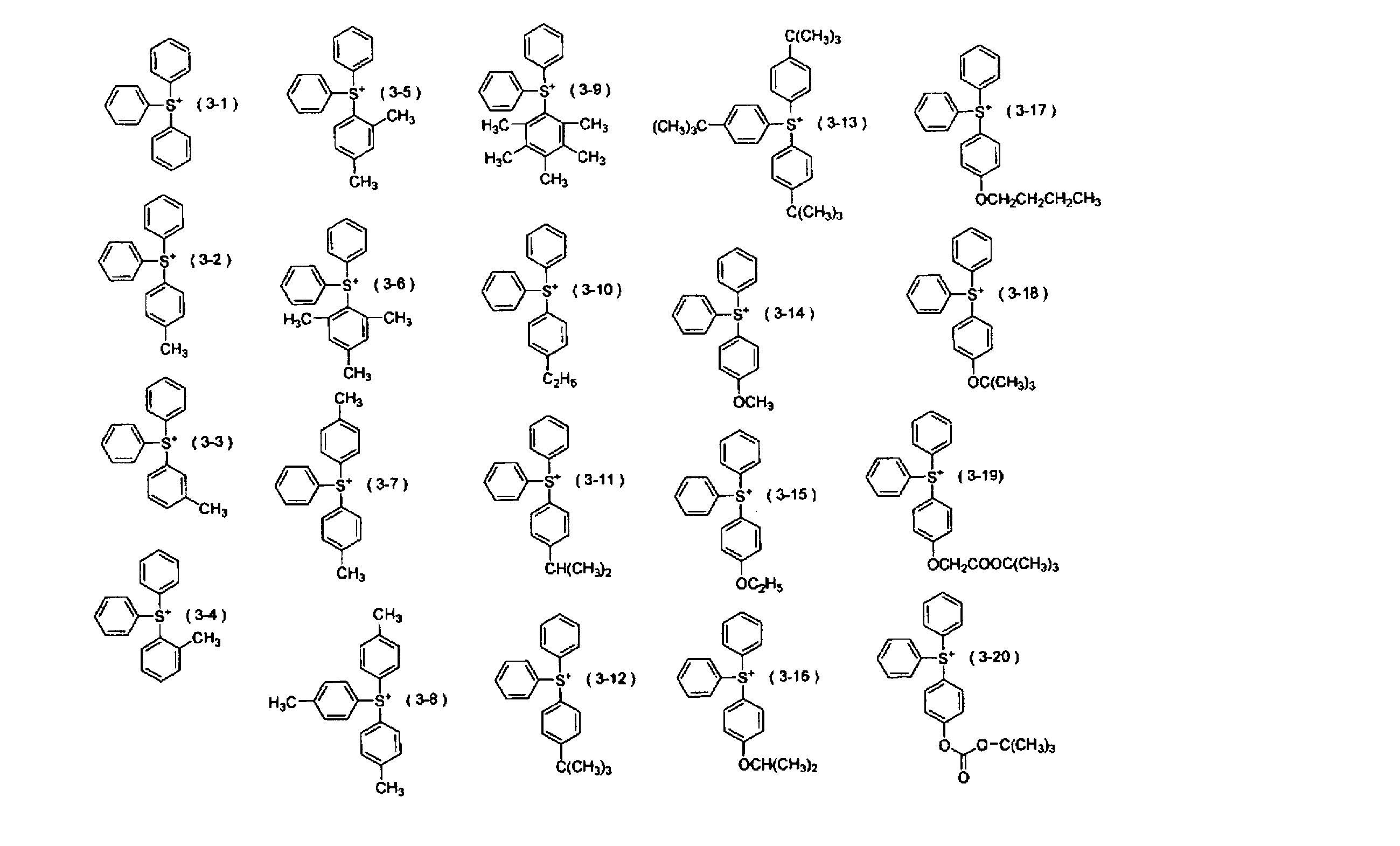
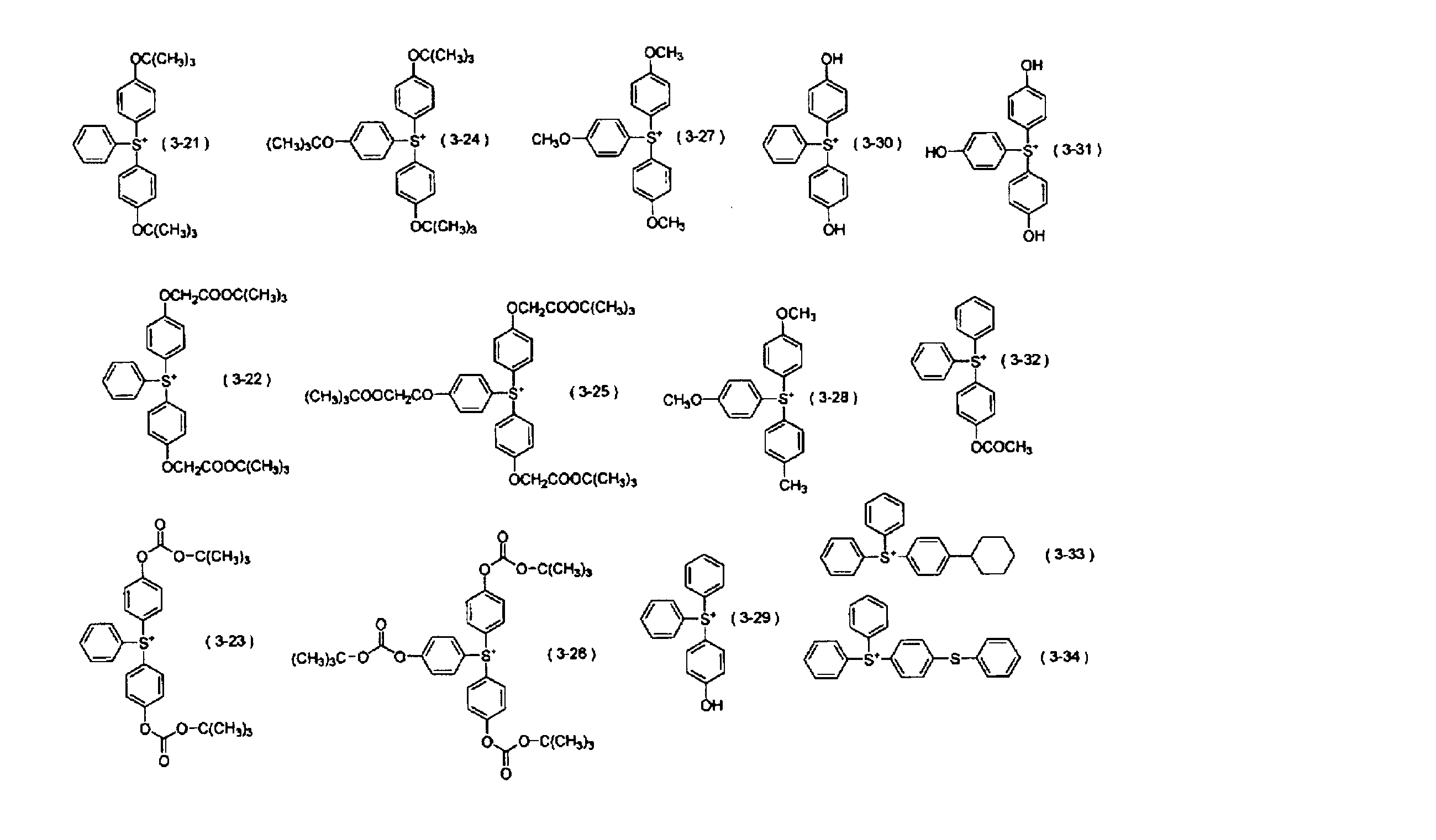

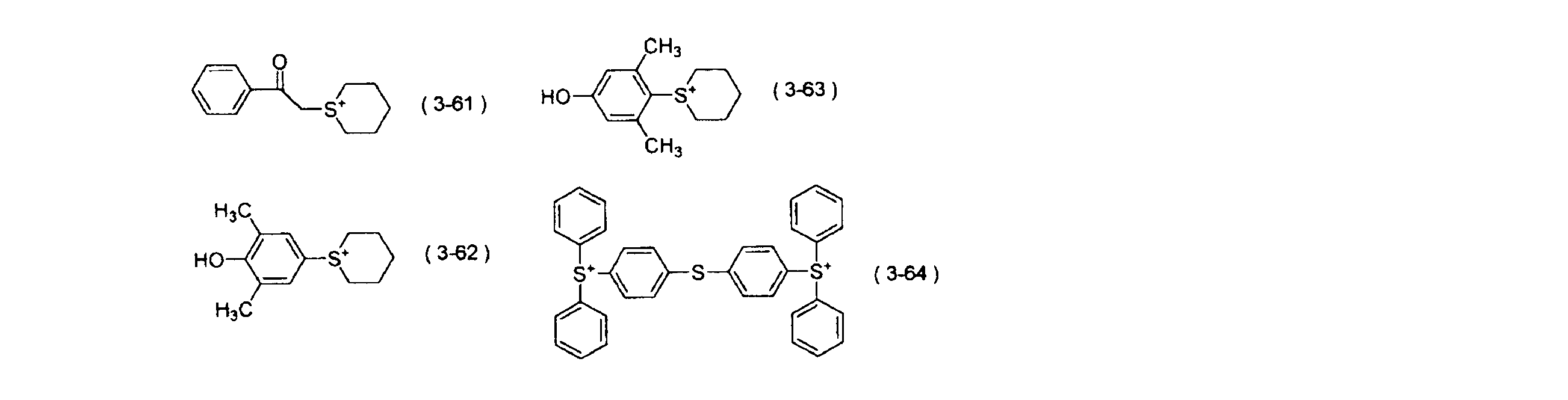

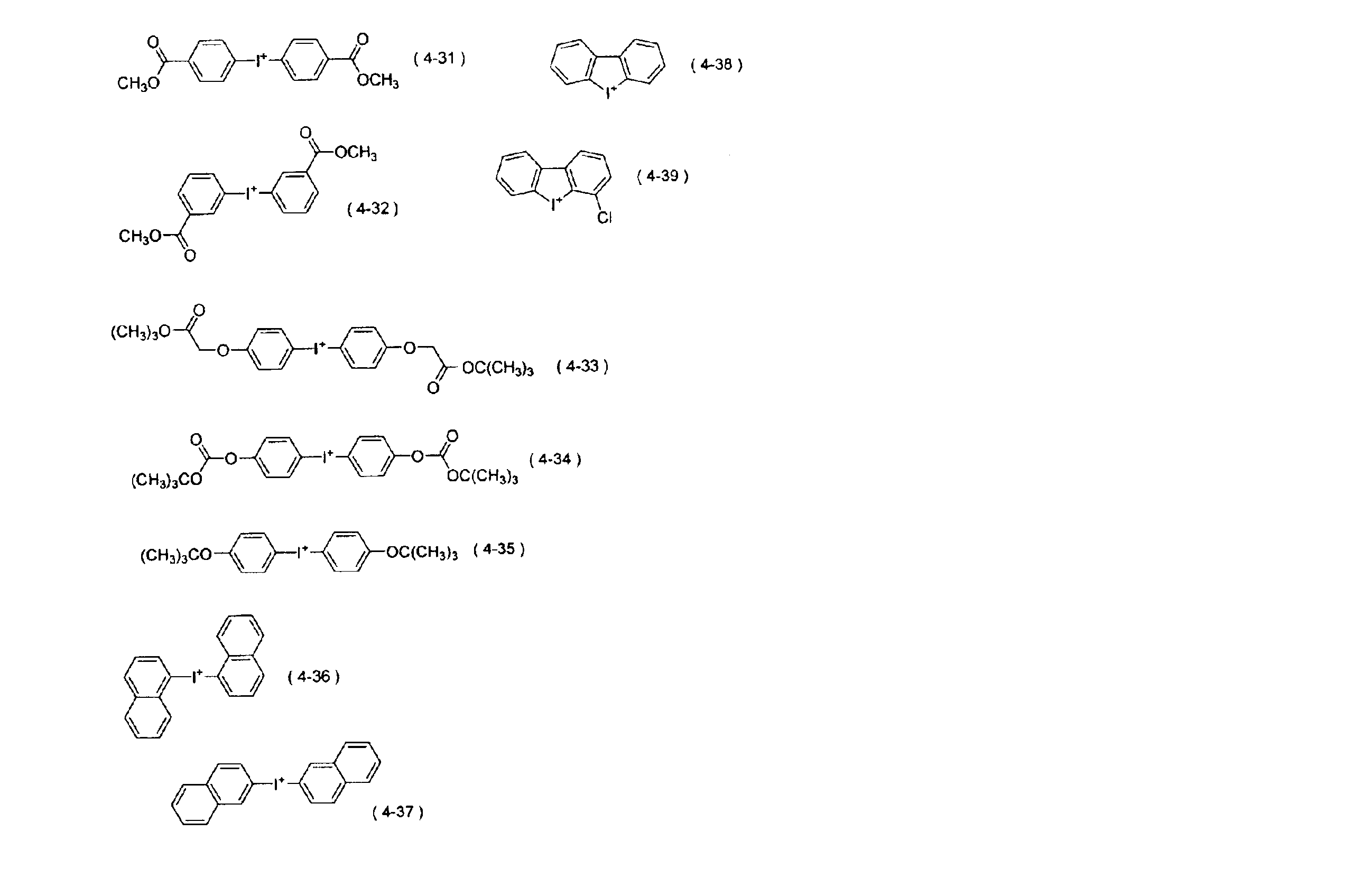
これらの1価のオニウムカチオンのうち、前記式(3-1)、式(3-2)、式(3-6)、式(3-8)、式(3-13)、式(3-19)、式(3-25)、式(3-27)、式(3-29)、式(3-51)または式(3-54)で表されるスルホニウムカチオン;前記式(4-1)または式(4-11)で表されるヨードニウムカチオン等が好ましく、前記式(3-1)で表されるトリフェニルスルホニウムカチオンが特に好ましい。
本願発明の一般式(1)で表される繰り返し構造単位を有するオニウム塩の樹脂において、オニウム塩の部分は酸発生剤として機能し、露光ないしは加熱によりスルホン酸を発生する作用を有し、特に、後述する感放射線性樹脂組成物における感放射線性酸発生剤として極めて好適に使用することができる。
3.重合体
本願発明の重合体は、例えば、一般式(5)~(8)で表される繰返し単位を含むことを特徴とする重合体のことであり、前述の一般式(1)~(4)で表される重合性単量体の有する二重結合が開裂して単独でまたは他の重合性二重結合を有する単量体と共重合することにより製造できる。
本願発明の重合体は、例えば、一般式(5)~(8)で表される繰返し単位を含むことを特徴とする重合体のことであり、前述の一般式(1)~(4)で表される重合性単量体の有する二重結合が開裂して単独でまたは他の重合性二重結合を有する単量体と共重合することにより製造できる。
一般式(5)の繰り返し単位を有する重合体は、たとえば、一般式(1)で示される酸分解性単量体を重合反応に供して得られ、以下のように、一般式(1)であらわされる構造が同様に一般式(5)にも適用される。
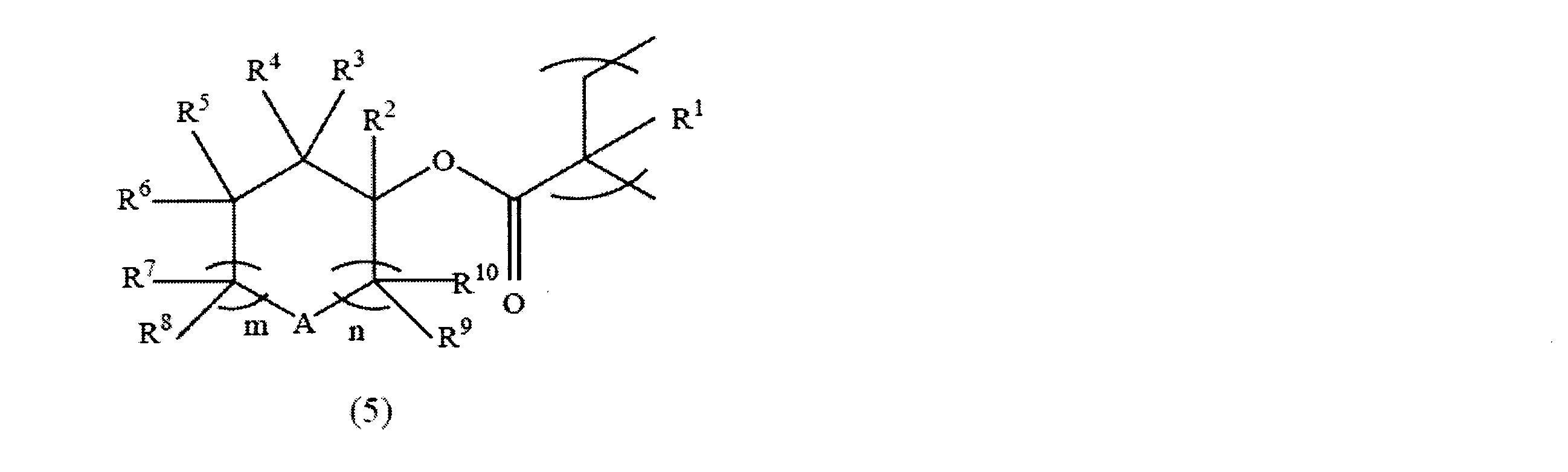
(式中、R1は水素原子、ハロゲン原子、メチル基またはトリフルオロメチル基を表す。R2は炭素数1~20の直鎖状、炭素数3~20の分岐鎖状または環状の炭化水素基を示し、それらを構成する炭素原子の一部が酸素原子に置き換わっていてもよく、同一炭素に結合する2個の水素原子が酸素原子と置き換わって=Oとなってもよく、さらに炭化水素のC-H結合のHがOHと置き換わってC-OHとなっていてもよく、水素原子の一部または全部がフッ素原子に置換されてもよい。R3~R10は、それぞれ独立して、水素原子、炭素数1~20の直鎖状、炭素数3~20の分岐鎖状または環状の炭化水素基を示し、それらを構成する炭素原子の一部が酸素原子に置き換わっていてもよく、同一炭素に結合する2個の水素原子が酸素原子と置き換わって=Oとなってもよく、さらに炭化水素のC-H結合のHがOHと置き換わってC-OHとなっていてもよく、水素原子の一部または全部がフッ素原子に置換されてもよい。また、R3~R10の一部あるいは全部結合して、環状化合物を形成してもよく、n、mは炭素数であり、それぞれが独立して0~5の整数である。Aはカルボニル基(C=O)または、当該カルボニル基が保護基によって保護された次のアセタール構造をとる。

但し、X1、X2はそれぞれ独立して、炭素数1~6のアルキル基を表す。該アルキル基の水素原子の一部または全部がフッ素、塩素、臭素原子、フェニル基、置換フェニル基に置換されていてもよい。また該アルキル基のC-C結合の一部がC=C二重結合となっていてもよい。またX1、X2はつながって全体として環状アセタール構造をとってもよい。)
重合性単量体と同様の理由で、一般式(6)~(8)で示される重合体を本願発明のレジスト材料に使用することが望ましく、中でも、R2がエチル基の重合体が好適に用いられる。
本願発明の重合体は、複数の単量体からなる繰り返し単位で構成されていてもよい。その割合は特に制限なく設定されるが、例えば以下に示す範囲は好ましく採用される。
本願発明の重合体において、一般式(1)~(4)で表される重合性単量体からなる繰り返し単位を1mol%以上、100mol%以下、より好ましくは5mol%以上、90mol%以下含有し、酸不安定性基を有する繰り返し単位を1mol%以上100mol%以下、好ましくは5mol%以上、80mol%以下、より好ましくは10mol%以上、60mol%以下の範囲で含有することができる。一般式(1)~(4)で表される含フッ素重合性単量体からなる繰り返し単位が1mol%よりも小さい場合には、レジストとした際に本願発明の単量体を用いたことによる明確な効果が期待できない。また、酸不安定性基を有する繰り返し単位が1mol%よりも小さい場合には、露光によるアルカリ現像液に対する溶解性の変化が小さすぎて、パターニングにおけるコントラスト向上が期待できない。このときに、酸不安定基を有する繰り返し単位として一般的な単量体を用いてもよいし、本願発明の一般式(1)~(4)で表される単量体に酸不安定性基を付加してもよく、重合後に酸不安定基を付加してもよい。
4. 重合体の重合方法
本願発明の重合体の重合方法としては、一般的に使用される方法であれば特に制限されないが、ラジカル重合、イオン重合が好ましく、場合により、配位アニオン重合、リビングアニオン重合、カチオン重合、開環メタセシス重合またはビニレン重合を採用してもよい。
本願発明の重合体の重合方法としては、一般的に使用される方法であれば特に制限されないが、ラジカル重合、イオン重合が好ましく、場合により、配位アニオン重合、リビングアニオン重合、カチオン重合、開環メタセシス重合またはビニレン重合を採用してもよい。
ラジカル重合は、ラジカル重合開始剤あるいはラジカル開始源の存在下で、例えば、塊状重合、溶液重合、懸濁重合または乳化重合により、回分式、半連続式または連続式のいずれかの操作で行えばよい。
ラジカル重合開始剤としては特に限定されるものではないが、例としてアゾ系化合物、過酸化物系化合物、レドックス系化合物が挙げられ、とくにアゾビスイソブチロニトリル、t-ブチルパーオキシピバレート、ジ-t-ブチルパーオキシド、i-ブチリルパーオキシド、ラウロイルパーオキサイド、スクシン酸パーオキシド、ジシンナミルパーオキシド、ジ-n-プロピルパーオキシジカーボネート、t-ブチルパーオキシアリルモノカーボネート、過酸化ベンゾイル、過酸化水素または過硫酸アンモニウムを用いることが好ましい。
重合反応に用いる反応容器は特に限定されない。また、重合反応においては、重合溶媒を用いてもよい。重合溶媒としては、ラジカル重合を阻害しないものが好ましく、代表的なものとしては、エステル系溶剤である酢酸エチル、酢酸n-ブチル、ケトン系溶剤であるアセトンまたはメチルイソブチルケトン、芳香族系溶剤であるトルエン、炭化水素系溶剤であるシクロヘキサン、アルコール系溶剤であるメタノール、イソプロピルアルコールまたはエチレングリコールモノメチルエーテルが挙げられる。また、水、エーテル系、環状エーテル系、フロン系の溶媒を使用してもよい。これらの溶剤は単独あるいは2種類以上を混合してもよい。また、メルカプタンのような分子量調整剤を併用してもよい。共重反応の反応温度はラジカル重合開始剤あるいはラジカル重合開始源により適宜変更され、通常は20℃以上、200℃以下が好ましく、特に30℃以上、140℃以下の範囲が好ましい。
一方、開環メタセシス重合は、共触媒存在下、4~7属の遷移金属触媒を用いればよく、溶媒存在下、公知の方法を用いればよい。
重合触媒としては特に限定されるものではないが、例としてTi系、V系、Mo系またはW系触媒が挙げられ、特に、塩化チタン(IV)、塩化バナジウム(IV)、バナジウムトリスアセチルアセトナート、バナジウムビスアセチルアセトナートジクロリド、塩化モリブデン(VI)または塩化タングステン(VI)が好ましい。触媒量としては、使用モノマーに対して0.001mol%以上、10mol%以下、好ましくは、0.01mol%以上、1mol%以下の範囲である。
共触媒としては、アルキルアルミニウム、アルキルスズが挙げられる。特に、アルキルアルミニウムにおいては、トリアルキルアルアルミニウム類であるトリメチルアルミニウム、トリエチルアルミニウム、トリプロピルアルミニウム、トリイソプロピルアルミニウム、トリイソブチルアルミニウム、トリ-2-メチルブチルアルミニウム、トリ-3-メチルブチルアルミニウム、トリ-2-メチルペンチルアルミニウム、トリ-3-メチルペンチルアルミニウム、トリ-4-メチルペンチルアルミニウム、トリ-2-メチルヘキシルアルミニウム、トリ-3-メチルヘキシルアルミニウムまたはトリオクチルアルミニウム、ジアルキルアルミニウムハライド類であるジメチルアルミニウムクロライド、ジエチルアルミニウムクロライド、ジイソプロピルアルミニウムクロライドまたはジイソブチルアルミニウムクロライド、モノアルキルアルミニウムハライド類であるメチルアルミニウムジクロライド、エチルアルミニウムジクロライド、エチルアルミニウムジアイオダイド、プロピルアルミニウムジクロライド、イソプロピルアルミニウムジクロライド、ブチルアルミニウムジクロライドまたはイソブチルアルミニウムジクロライド、アルキルアルミニウムセスキクロライド類であるメチルアルミニウムセスキクロライド、エチルアルミニウムセスキクロライド、プロピルアルミニウムセスキクロライド、イソブチルアルミニウムセスキクロライドが挙げられる。アルキルスズにおいては、テトラ-n-ブチルスズ、テトラフェニルスズ、トリフェニルクロロスズが挙げられる。共触媒量は、遷移金属触媒に対して、モル比で、100当量以下、好ましくは30当量以下である。
また、重合溶媒としては重合反応を阻害しなければよく、芳香族炭化水素系溶媒であるベンゼン、トルエン、キシレン、クロロベンゼンまたはジクロロベンゼン、炭化水素系溶媒であるヘキサン、ヘプタンまたはシクロヘキサン、ハロゲン化炭化水素溶媒である四塩化炭素、クロロホルム、塩化メチレンまたは1,2-ジクロロエタンが挙げられる。また、これらの溶剤は単独でもあるいは2種類以上を混合しても使用できる。反応温度は、通常は-70℃以上、200℃以下が好ましく、特に-30℃以上、60℃以下の範囲が好ましい。
ビニレン重合は、共触媒存在下、8~10属の遷移金属触媒である鉄、ニッケル、ロジウム、パラジウムまたは白金、4~6属の金属触媒であるジルコニウム、チタン、バナジウム、クロム、モリブデンまたはタングステンを用いればよく、溶媒存在下、公知の方法で行えばよい。
重合触媒としては特に限定されるものではないが、8~10属の遷移金属を含む鉄(II)クロライド、鉄(III)クロライド、鉄(II)ブロマイド、鉄(III)ブロマイド、鉄(II)アセテート、鉄(III)アセチルアセトナート、フェロセン、ニッケロセン、ニッケル(II)アセテート、ニッケルブロマイド、ニッケルクロライド、ジクロロヘキシルニッケルアセテート、ニッケルラクテート、ニッケルオキサイド、ニッケルテトラフルオロボレート、ビス(アリル)ニッケル、ビス(シクロペンタジエニル)ニッケル、ニッケル(II)ヘキサフルオロアセチルアセトナートテトラハイドレート、ニッケル(II)トリフルオロアセチルアセトナートジハイドレート、ニッケル(II)アセチルアセトナートテトラハイドレート、塩化ロジウム(III)、ロジウムトリス(トリフェニルホスフィン)トリクロライド、パラジウム(II)ビス(トリフルオロアセテート)、パラジウム(II)ビス(アセチルアセトナート)、パラジウム(II)2-エチルヘキサノエート、パラジウム(II)ブロマイド、パラジウム(II)クロライド、パラジウム(II)アイオダイド、パラジウム(II)オキサイド、モノアセトニトリルトリス(トリフェニルホスフィン)パラジウム(II)テトラフルオロボレート、テトラキス(アセトニトリル)パラジウム(II)テトラフルオロボレート、ジクロロビス(アセトニトリル)パラジウム(II)、ジクロロビス(トリフェニルホスフィン)パラジウム(II)、ジクロロビス(ベンゾニトリル)パラジウム(II)、パラジウムアセチルアセトナート、パラジウムビス(アセトニトリル)ジクロライド、パラジウムビス(ジメチルスルホキサイド)ジクロライドまたはプラチニウムビス(トリエチルホスフィン)ハイドロブロマイド、4~6属の遷移金属を含む塩化バナジウム(IV)、バナジウムトリスアセチルアセトナート、バナジウムビスアセチルアセトナートジクロリド、トリメトキシ(ペンタメチルシクロペンタジエニル)チタニウム(IV)、ビス(シクロペンタジエニル)チタニウムジクロリドまたビス(シクロペンタジエニル)ジルコニウムジクロリドを用いることが好ましい。触媒の使用量としては、使用モノマー(単量体)に対して0.001mol%以上、10mol%以下、好ましくは0.01mol%以上、1mol%以下の範囲である。
共触媒は、アルキルアルミノキサン、アルキルアルミニウムが挙げられる。特に、トリアルキルアルアルミニウムであるメチルアルミノキサン(MAO)、トリメチルアルミニウム、トリエチルアルミニウム、トリプロピルアルミニウム、トリイソプロピルアルミニウム、トリイソブチルアルミニウム、トリ-2-メチルブチルアルミニウム、トリ-3-メチルブチルアルミニウム、トリ-2-メチルペンチルアルミニウム、トリ-3-メチルペンチルアルミニウム、トリ-4-メチルペンチルアルミニウム、トリ-2-メチルヘキシルアルミニウム、トリ-3-メチルヘキシルアルミニウムまたはトリオクチルアルミニウム、ジアルキルアルミニウムハライド類であるジメチルアルミニウムクロライド、ジエチルアルミニウムクロライド、ジイソプロピルアルミニウムクロライドまたはジイソブチルアルミニウムクロライド、モノアルキルアルミニウムハライドであるメチルアルミニウムジクロライド、エチルアルミニウムジクロライド、エチルアルミニウムジアイオダイド、プロピルアルミニウムジクロライド、イソプロピルアルミニウムジクロライド、ブチルアルミニウムジクロライドまたはイソブチルアルミニウムジクロライド、アルキルアルミニウムセスキクロライドであるメチルアルミニウムセスキクロライド、エチルアルミニウムセスキクロライド、プロピルアルミニウムセスキクロライドまたはイソブチルアルミニウムセスキクロライドが好適に使用される。共触媒の使用量は、メチルアルミノキサンの場合、Al換算で50当量以上、500当量以下、その他のアルキルアルミニウムにおいては、遷移金属触媒に対してモル比で、100当量以下、好ましくは30当量以下を使用する。
また、重合溶媒としては重合反応を阻害しなければよく、芳香族炭化水素であるベンゼン、トルエン、キシレン、クロロベンゼンまたはジクロロベンゼン、炭化水素であるヘキサン、ヘプタン、ノナン、デカンまたはシクロヘキサン、ケトンであるアセトン、メチルエチルケトン、メチルイソプロピルケトン、メチルイソブチルケトン、シクロヘキサノンまたはシクロペンタノン、エステルである酢酸エチル、酢酸ブチル、アルコールであるメタノール、エタノール、プロパノール、イソプロパノール、ブタノール、イソブタノール、ペンタノール、ヘキサノール、ノナノール、オクタノール、1-オクタノール、2-オクタノール、3-オクタノール、4-メチル-2-ペンタノールまたはエチレングリコール、ハロゲン化炭化水素である四塩化炭素、クロロホルム、塩化メチレンまたは1,2-ジクロロエタン、他にジエチルエーテル、ジイソプロピルエーテル、テトラヒドロフラン、ジグリム、プロピレングリコールモノメチルエーテルアセテート(PEGMEA)、プロピレングリコールモノエチルエーテルアセテート、プロピレングリコールモノエチルエーテル、プロピレングリコールモノメチルエーテル(PEGME)、プロピレングリコールジアセテート、プロピレングリコールモノエチルエーテル、乳酸エチル(EL)、ジメチルホルムアミド、N-メチルピロリドンまたはN-シクロヘキシルピロリドンが使用できる。また、これらの溶剤は単独でもあるいは2種類以上を混合してもよい。反応温度は、通常は-70℃以上、200℃以下が好ましく、特に-40℃以上、80℃以下が好ましい。
このようにして得られる本願発明の重合体の溶液または分散液から、媒質である有機溶媒または水を除去する方法としては、公知の方法を利用でき、再沈殿ろ過または減圧下での加熱留出を行う。
本願発明の重合体の数平均分子量としては、通常、1,000以上、100,000以下、好ましくは3,000以上、50,000以下が好ましい。
5. レジスト材料
次いで、本願発明のレジスト材料について説明する。
次いで、本願発明のレジスト材料について説明する。
5.1 レジスト配合
本願発明の重合体は、特に光増感ポジ型レジスト材料として好適に用いられ、本願発明は、上記含フッ素重合体を含有するレジスト材料、とりわけポジ型レジスト材料を提供する。この場合、レジスト材料としては、(A)ベース樹脂として上記重合体、(B)光酸発生剤、(C)塩基性化合物および(D)溶剤を含有するものが望ましい。また、必要により(E)界面活性剤を含有してもよい。(B)~(C)各々について説明する。
本願発明の重合体は、特に光増感ポジ型レジスト材料として好適に用いられ、本願発明は、上記含フッ素重合体を含有するレジスト材料、とりわけポジ型レジスト材料を提供する。この場合、レジスト材料としては、(A)ベース樹脂として上記重合体、(B)光酸発生剤、(C)塩基性化合物および(D)溶剤を含有するものが望ましい。また、必要により(E)界面活性剤を含有してもよい。(B)~(C)各々について説明する。
5.2 (B)光酸発生剤
光酸発生剤は紫外光または極紫外光を照射することで、酸を発生する機能を有する感光剤であり、本願発明のレジスト材料に用いる光酸発生剤には、特に制限はなく、化学増幅型レジストの酸発生剤として用いられるものの中から、発生した酸により、一般式(5)~(8)の繰り返し単位を分解し溶剤に可溶化するものであれば、任意のものを選択して使用することができる。このような酸発生剤の例としては、オニウムスルホネートであるヨードニウムスルホネートまたはスルホニウムスルホネート、他にスルホン酸エステル、N-イミドスルホネート、N-オキシムスルホネート、o-ニトロベンジルスルホネートまたはピロガロールのトリスメタンスルホネートが使用できる。
光酸発生剤は紫外光または極紫外光を照射することで、酸を発生する機能を有する感光剤であり、本願発明のレジスト材料に用いる光酸発生剤には、特に制限はなく、化学増幅型レジストの酸発生剤として用いられるものの中から、発生した酸により、一般式(5)~(8)の繰り返し単位を分解し溶剤に可溶化するものであれば、任意のものを選択して使用することができる。このような酸発生剤の例としては、オニウムスルホネートであるヨードニウムスルホネートまたはスルホニウムスルホネート、他にスルホン酸エステル、N-イミドスルホネート、N-オキシムスルホネート、o-ニトロベンジルスルホネートまたはピロガロールのトリスメタンスルホネートが使用できる。
これらの光酸発生剤に、高エネルギー光を照射することで発生する酸は、アルカンスルホン酸、アリールスルホン酸、部分的にまたは完全にフッ素化されたアリールスルホン酸、アルカンスルホン酸である。部分的にまたは完全にフッ素化されたアルカンスルホン酸を発生する光酸発生剤は、脱保護しにくい保護基に対しても十分な酸強度を有することから有効である。具体的には、トリフェニルスルホニウムトリフルオロメタンスルホナートまたはトリフェニルスルホニウムパーフルオロ-n-オクタンスルホナートが使用できる。
5.3 (C)塩基性化合物
本願発明のレジスト材料に塩基性化合物を配合することができる。当該塩基性化合物は、酸発生剤より発生する酸がレジスト膜中に拡散する際の拡散速度を抑制する働きがある。この働きにより、酸拡散距離を調整してレジストパターン形状の改善や、引き置き時の安定性を向上する効果が期待される。このような塩基性化合物は、脂肪族アミン、芳香族アミン、複素環式アミンまたは脂肪族多環式アミンが挙げられる。第2級または第3級の脂肪族アミンが好ましく、アルキルアルコールアミンがより好ましく採用される。具体的には、トリメチルアミン、トリエチルアミン、トリプロピルアミン、トリブチルアミン、トリペンチルアミン、トリヘキシルアミン、トリヘプチルアミン、トリオクチルアミン、トリノニルアミン、トリデカニルアミン、トリドデシルアミン、ジメチルアミン、ジエチルアミン、ジプロピルアミン、ジブチルアミン、ジペンチルアミン、ジヘキシルアミン、ジヘプチルアミン、ジオクチルアミン、ジノニルアミン、ジデカニルアミン、ジドデシルアミン、ジシクロヘキシルアミン、メチルアミン、エチルアミン、プロピルアミン、ブチルアミン、ペンチルアミン、ヘキシルアミン、ヘプチルアミン、オクチルアミン、ノニルアミン、デカニルアミン、ドデシルアミン、ジエタノールアミン、トリエタノールアミン、ジイソプロパノールアミン、トリイソプロパノールアミン、ジオクタノールアミン、トリオクタノールアミン、アニリン、ピリジン、ピコリン、ルチジン、ビピリジン、ピロール、ピペリジン、ピペラジン、インドールまたはヘキサメチレンテトラミンが挙げられる。これらは単独でも2種以上組み合わせて使用してもよい。また、その配合量は、好ましくは重合体100重量部に対して0.001重量部以上、2重量部以下、より好ましくは重合体100重量部に対して0.01重量部以上、1重量部以下である。配合量が0.001重量部よりも少ないと添加剤としての効果が十分得られず、2重量部を超えると解像性および感度が低下する場合がある。
本願発明のレジスト材料に塩基性化合物を配合することができる。当該塩基性化合物は、酸発生剤より発生する酸がレジスト膜中に拡散する際の拡散速度を抑制する働きがある。この働きにより、酸拡散距離を調整してレジストパターン形状の改善や、引き置き時の安定性を向上する効果が期待される。このような塩基性化合物は、脂肪族アミン、芳香族アミン、複素環式アミンまたは脂肪族多環式アミンが挙げられる。第2級または第3級の脂肪族アミンが好ましく、アルキルアルコールアミンがより好ましく採用される。具体的には、トリメチルアミン、トリエチルアミン、トリプロピルアミン、トリブチルアミン、トリペンチルアミン、トリヘキシルアミン、トリヘプチルアミン、トリオクチルアミン、トリノニルアミン、トリデカニルアミン、トリドデシルアミン、ジメチルアミン、ジエチルアミン、ジプロピルアミン、ジブチルアミン、ジペンチルアミン、ジヘキシルアミン、ジヘプチルアミン、ジオクチルアミン、ジノニルアミン、ジデカニルアミン、ジドデシルアミン、ジシクロヘキシルアミン、メチルアミン、エチルアミン、プロピルアミン、ブチルアミン、ペンチルアミン、ヘキシルアミン、ヘプチルアミン、オクチルアミン、ノニルアミン、デカニルアミン、ドデシルアミン、ジエタノールアミン、トリエタノールアミン、ジイソプロパノールアミン、トリイソプロパノールアミン、ジオクタノールアミン、トリオクタノールアミン、アニリン、ピリジン、ピコリン、ルチジン、ビピリジン、ピロール、ピペリジン、ピペラジン、インドールまたはヘキサメチレンテトラミンが挙げられる。これらは単独でも2種以上組み合わせて使用してもよい。また、その配合量は、好ましくは重合体100重量部に対して0.001重量部以上、2重量部以下、より好ましくは重合体100重量部に対して0.01重量部以上、1重量部以下である。配合量が0.001重量部よりも少ないと添加剤としての効果が十分得られず、2重量部を超えると解像性および感度が低下する場合がある。
5.4 (D)溶剤
本願発明のレジスト材料に用いる溶剤としては、配合する各成分を溶解して均一な溶液にできればよく、従来のレジスト用溶剤の中から選択して用いることができる。また、2種類以上の溶剤を混合して用いることも可能である。具体的には、ケトンであるアセトン、メチルエチルケトン、シクロペンタノン、シクロヘキサノン、メチルイソブチルケトン、メチルイソペンチルケトン、2-ヘプタノン、アルコールであるイソプロパノール、ブタノール、イソブタノール、n-ペンタノール、イソペンタノール、tert-ペンタノール、4-メチル-2-ペンタノール、3-メチル-3-ペンタノール、2,3-ジメチル-2-ペンタノール、n-ヘキサノール、n-ヘプタノール、2-ヘプタノール、n-オクタノール、n-デカノール、s-アミルアルコール、t-アミルアルコール、イソアミルアルコール、2-エチル-1-ブタノール、ラウリルアルコール、ヘキシルデカノール、オレイルアルコール、多価アルコールおよびその誘導体であるエチレングリコール、ジエチレングリコール、プロピレングリコール、ジプロピレングリコール、エチレングリコールモノアセテート、ジエチレングリコールモノアセテート、プロピレングリコールモノアセテート、ジプロピレングリコールモノアセテート、プロピレングリコールモノメチルエーテル、プロピレングリコールモノエチルエーテル、プロピレングリコールモノプロピルエーテル、プロピレングリコールモノブチルエーテル、プロピレングリコールモノメチルエーテルアセテート(PGMEA)またはプロピレングリコールモノメチルエーテル(PGME)、エステルである乳酸メチル、乳酸エチル(EL)、酢酸メチル、酢酸エチル、酢酸ブチル、ピルビン酸メチル、ピルビン酸エチル、メトキシプロピオン酸メチルまたはエトキシプロピオン酸エチル、芳香族系溶剤であるトルエン、キシレン、エーテルであるジエチルエーテル、ジオキサン、アニソールまたはジイソプロピルエーテル、フッ素系溶剤であるフロン、代替フロン、パーフルオロ化合物またはヘキサフルオロイソプロピルアルコール、他に、塗布性を高める目的で高沸点弱溶剤であるターペン系の石油ナフサ溶媒またはパラフィン系溶媒等が使用可能である。
本願発明のレジスト材料に用いる溶剤としては、配合する各成分を溶解して均一な溶液にできればよく、従来のレジスト用溶剤の中から選択して用いることができる。また、2種類以上の溶剤を混合して用いることも可能である。具体的には、ケトンであるアセトン、メチルエチルケトン、シクロペンタノン、シクロヘキサノン、メチルイソブチルケトン、メチルイソペンチルケトン、2-ヘプタノン、アルコールであるイソプロパノール、ブタノール、イソブタノール、n-ペンタノール、イソペンタノール、tert-ペンタノール、4-メチル-2-ペンタノール、3-メチル-3-ペンタノール、2,3-ジメチル-2-ペンタノール、n-ヘキサノール、n-ヘプタノール、2-ヘプタノール、n-オクタノール、n-デカノール、s-アミルアルコール、t-アミルアルコール、イソアミルアルコール、2-エチル-1-ブタノール、ラウリルアルコール、ヘキシルデカノール、オレイルアルコール、多価アルコールおよびその誘導体であるエチレングリコール、ジエチレングリコール、プロピレングリコール、ジプロピレングリコール、エチレングリコールモノアセテート、ジエチレングリコールモノアセテート、プロピレングリコールモノアセテート、ジプロピレングリコールモノアセテート、プロピレングリコールモノメチルエーテル、プロピレングリコールモノエチルエーテル、プロピレングリコールモノプロピルエーテル、プロピレングリコールモノブチルエーテル、プロピレングリコールモノメチルエーテルアセテート(PGMEA)またはプロピレングリコールモノメチルエーテル(PGME)、エステルである乳酸メチル、乳酸エチル(EL)、酢酸メチル、酢酸エチル、酢酸ブチル、ピルビン酸メチル、ピルビン酸エチル、メトキシプロピオン酸メチルまたはエトキシプロピオン酸エチル、芳香族系溶剤であるトルエン、キシレン、エーテルであるジエチルエーテル、ジオキサン、アニソールまたはジイソプロピルエーテル、フッ素系溶剤であるフロン、代替フロン、パーフルオロ化合物またはヘキサフルオロイソプロピルアルコール、他に、塗布性を高める目的で高沸点弱溶剤であるターペン系の石油ナフサ溶媒またはパラフィン系溶媒等が使用可能である。
これらの中でも特に、プロピレングリコールモノメチルエーテルアセテート(PGMEA)、プロピレングリコールモノメチルエーテル(PGME)、乳酸エチル(EL)またはシクロヘキサノンが好ましく採用される。
本願発明のレジスト液に配合する溶剤の量は特に限定されないが、好ましくはレジスト液の固形分濃度が3質量%以上、25質量%以下、より好ましくは5質量%以上、15質量%以下になる様に用いられる。レジストの固形分濃度を調整することによって、形成される樹脂膜の膜厚を調整することが可能である。
さらに、本願発明重合体は、幅広い溶剤に対する溶解性に優れており、上記のアルコール系溶剤の中でも、炭素数5~20のアルコール系溶剤に溶解することは特筆すべきことである。かかるアルコールの具体例としては、n-ペンタノール、イソペンタノール、tert-ペンタノール、4-メチル-2-ペンタノール、3-メチル-3-ペンタノール、2,3-ジメチル-2-ペンタノール、n-ヘキサノール、n-ヘプタノール、2-ヘプタノール、n-オクタノール、n-デカノール、s-アミルアルコール、t-アミルアルコール、イソアミルアルコール、2-エチル-1-ブタノール、ラウリルアルコール、ヘキシルデカノールまたはオレイルアルコールが挙げられる。
汎用的に用いられているレジスト材料は、このような炭素原子を5以上有するアルコール系溶剤には溶解しないことを考え合わせると、本願発明のレジスト材料は通常のレジストパターン形成方法において幅広い溶剤の使用を可能にするばかりでなく、後述するダブルパターニング法によるパターン形成方法のレジスト材料として有用であり、新たな用途に展開できる。
5.5(E)界面活性剤
本願発明のレジスト材料においては、必要により界面活性剤を添加してもよい。かかる界面活性剤としては、フッ素系界面活性剤またはシリコン系界面活性剤、あるいはフッ素原子とケイ素原子の両方を有する界面活性剤のいずれか、あるいはそれらの2種以上を含有することができる。
本願発明のレジスト材料においては、必要により界面活性剤を添加してもよい。かかる界面活性剤としては、フッ素系界面活性剤またはシリコン系界面活性剤、あるいはフッ素原子とケイ素原子の両方を有する界面活性剤のいずれか、あるいはそれらの2種以上を含有することができる。
6 パターン形成方法
次いで本願発明のパターン形成方法について説明する。
次いで本願発明のパターン形成方法について説明する。
6.1パターン形成方法
本願発明のレジスト材料を使用してパターンを形成する方法は、基板上に該レジスト材料(レジスト液)を塗布する工程、塗布後の基板を加熱処理してレジスト膜を成形した後、露光機を用い、フォトマスクを介して波長300nm以下の紫外光および極紫外光を含む高エネルギー線でレジスト膜を露光する工程、基板を加熱処理後にアルカリ現像液でレジスト膜を溶解し、現像してレジストパターンを形成する工程から成っており、何れも公知のリソグラフィー技術を採用して行うことができる。
本願発明のレジスト材料を使用してパターンを形成する方法は、基板上に該レジスト材料(レジスト液)を塗布する工程、塗布後の基板を加熱処理してレジスト膜を成形した後、露光機を用い、フォトマスクを介して波長300nm以下の紫外光および極紫外光を含む高エネルギー線でレジスト膜を露光する工程、基板を加熱処理後にアルカリ現像液でレジスト膜を溶解し、現像してレジストパターンを形成する工程から成っており、何れも公知のリソグラフィー技術を採用して行うことができる。
例えば、先ず、シリコンウェハー上にスピンコートの手法によってレジスト材料を塗布して薄膜を形成し、これをホットプレート上で60℃以上、200℃以下、10秒以上、10分以下、好ましくは80℃以上、150℃以下、30秒以上、2分以下の加熱条件でプリベークする。次いで、目的のレジストパターンを形成するためのフォトマスクを設置し、紫外光、エキシマレーザ、X線等の高エネルギー線もしくは電子線(Electoron Beam、以下、EBと略する)を露光量1mJ/cm2以上、200mJ/cm2以下、好ましくは10mJ/cm2以上、100mJ/cm2以下となるように照射した後、ホットプレート上で60℃以上、150℃以下、10秒以上、5分間以下、好ましくは、80℃以上、130℃以下、30秒以上、3分以下の加熱条件でポストエクスポーザーベーク(露光により生じた酸をレジスト内に拡散させるため、露光後ベークすること。以後、PEBと略する。)を行う。その後、例えば0.1質量%以上、5質量%以下、好ましくは2質量%以上、3質量%以下のテトラメチルアンモニウムヒドロキシド(TMAH)のアルカリ水溶液の現像液を用い、10秒以上、3分間以下、好ましくは30秒以上、2分以下、ディップ法、パドル法、スプレー法等の既存の方法で現像することによって目的のパターンが形成される。尚、上記PEBは、必要に応じて行えばよい。
本願発明のパターン形成方法で用いられる基板は、シリコンウェハーの他にも金属やガラスの基板を用いることが可能である。また、基板上には有機系あるいは無機系の膜が設けられていてもよい。例えば、反射防止膜、多層レジストの下層があってもよく、パターンが形成されていてもよい。
尚、本願発明のレジスト材料は、露光に用いる光源および波長は、特に限定されないが、KrFエキシマレーザ(波長248nm)、ArFエキシマレーザ(波長193nm)、F2エキシマレーザ(波長157nm)、EUV(波長13.5nm)、EB、X線によるリソグラフィーによる微細パターニングに好適に使用でき、特に、KrFエキシマレーザ、ArFエキシマレーザおよびEUVによるリソグラフィーに好適に採用される。
6.2 液浸リソグラフィー
また、本願発明のレジスト材料は、液浸リソグラフィーのレジスト材料としても好適に使用できる。即ち、レジストとレンズの間を、空気よりも屈折率の大きい媒体である水で満たして露光する液浸リソグラフィーにおいて、本願発明のレジスト材料は、耐水性が高く、適度な撥水性を有しながら現像液親和性があることから、微細なパターン形成が可能である。液浸リソグラフィーにおいては、レジストの保護膜であるトップコートを用いる場合と用いない場合があるが、本願発明のレジスト材料はいずれの場合にも組成と配合を調整することによって適用することができる。特に、本願発明のレジスト材料は、KrFエキシマレーザおよびArFエキシマレーザによる液浸リソグラフィーのレジスト材料としても好適に使用できる。
また、本願発明のレジスト材料は、液浸リソグラフィーのレジスト材料としても好適に使用できる。即ち、レジストとレンズの間を、空気よりも屈折率の大きい媒体である水で満たして露光する液浸リソグラフィーにおいて、本願発明のレジスト材料は、耐水性が高く、適度な撥水性を有しながら現像液親和性があることから、微細なパターン形成が可能である。液浸リソグラフィーにおいては、レジストの保護膜であるトップコートを用いる場合と用いない場合があるが、本願発明のレジスト材料はいずれの場合にも組成と配合を調整することによって適用することができる。特に、本願発明のレジスト材料は、KrFエキシマレーザおよびArFエキシマレーザによる液浸リソグラフィーのレジスト材料としても好適に使用できる。
液浸リソグラフィーの媒体としては、水の他にもフッ素系溶剤、シリコン系溶剤、炭化水素系溶剤または含硫黄溶剤が挙げられ、本願発明のレジスト材料は広く適用できる。
6.3ダブルパターニング法
本願発明のレジスト材料は、ダブルパターニング法のレジスト材料として使用することが可能である。本願発明の別の態様として、ダブルパターニング法によるパターン形成方法を提示するが、パターン形成法は現在もなお多数開発中であり、以下の方法に限定されない。本願発明のレジスト材料は、KrFエキシマレーザおよびArFエキシマレーザによるダブルパターニング法のレジスト材料としても好適に使用できる。
本願発明のレジスト材料は、ダブルパターニング法のレジスト材料として使用することが可能である。本願発明の別の態様として、ダブルパターニング法によるパターン形成方法を提示するが、パターン形成法は現在もなお多数開発中であり、以下の方法に限定されない。本願発明のレジスト材料は、KrFエキシマレーザおよびArFエキシマレーザによるダブルパターニング法のレジスト材料としても好適に使用できる。
尚、本願発明のレジスト材料を用いたダブルパターニング法において、「第1のレジスト膜」とは、以下に示すパターン形成プロセスにおいて、先に形成されるレジスト膜をいい、リソグラフィーによりレジスト膜に形成されたレジストパターンを「第1のレジストパターン」という。同様に、「第2のレジスト膜」とは、「第1のレジストパターン」上にリソグラフィーにより形成された2層目のレジスト膜であり、「第2のレジストパターン」とはそのレジスト膜に形成されたレジストパターンを表す。
また、後述する説明において、第1のレジスト膜を与えるレジスト材料を便宜上「第1のレジスト材料」といい、第2のレジスト膜を与えるレジスト材料を便宜上「第2のレジスト材料」ということもある。
ダブルパターンニング法の一形態として、リソグラフィーにより、シリコンウェハー上に形成した第1のレジスト膜を露光し、加熱処理後に露光部を溶解させて現像してパターンを形成後、次いで、その上に第2のレジスト膜を形成し、第1のレジスト膜とは異なるパターンで第2のレジスト膜を露光し、次いで同様に現像しパターンを形成する方法が挙げられる。この操作により、従来のレジストパターンよりも微細なパターンを形成することができる。尚、第2のレジスト膜の塗布前に、第1のレジスト膜に形成したパターンの保持を目的にフリージング処理をすることもある。
以下に、ダブルパターンニング法によるパターン形成方法について、さらに説明する。尚、各工程の塗布、熱処理、露光、現像プロセスについては、前述の「パターン形成方法」と同様の手法で行うことができる。
先ず、第1のレジスト材料を用い、スピンコート法によりシリコンウェハーに塗布後、加熱処理をすることにより第1のレジスト膜を形成する。次いで、リソグラフィーにより、フォトマスクを介して波長300nm以下の高エネルギー線の照射による露光、露光部を現像液に溶解して現像処理をすることにより第1のレジスト膜に第1のレジストパターンが形成される。
次に、第1のレジストパターン上に、溶媒に溶解した第2のレジスト材料をスピンコート法により塗布後、加熱処理をして第2のレジスト膜を形成する。このとき、前記溶剤は第1のレジストパターンを侵さないことが要求される。
さらに、リソグラフィーにより、上記第2のレジスト膜にフォトマスクを介して波長300nm以下の高エネルギー線で露光する。このとき、第1のレジスト膜とは異なるパターンのフォトマスクを使用することにより、微細なパターン形成のための露光がなされる。
その後、必要に応じて加熱処理、即ち、PEBを行い、次いで現像液で現像するプロセスを経て第2のレジストパターンが形成される。現像液としては、上記のようにテトラメチルアンモニウムヒドロキシド(TMAH)等のアルカリ水溶液の現像液が好適に用いられる。
上記のダブルパターニング法によるパターン形成方法においては、第1のレジスト材料、および溶剤、第2のレジスト材料および溶剤の組合せについて、最適化を図る必要がある。
本願発明のダブルパターニングによるパターン形成方法は、本願発明の特定の繰返し単位を有する重合体を含むレジスト材料を特定の溶剤を用いて調製して第2のレジスト材料として使用することを提唱するものであるが、以下に適当な組合せについて説明する。
本願発明のダブルパターニング法によるパターン形成方法においては、第2のレジスト材料に用いる溶剤は第1のレジストパターンを侵さない溶剤であれば特に限定されないが、 第1のレジスト組成物として、汎用のレジスト組成物を用いた場合は、炭素数5~20のアルコール系溶媒を好適に用いることができる。
ここでいう汎用のレジスト組成物とは、カルボキシル基等の溶解性基をアダマンタン、シクロペンタン等の脂環式炭化水素系のユニットで保護した繰返し単位を有する樹脂を用いたレジスト組成物を言う。そこのようなレジスト組成物として、例えば、ヒドロキシアダマンチルメタクリレート(MA-HAD)、エチルアダマンチルメタクリレート(MA-EAD)またはγブチロラクトンメタクリレート(MA-GBL)よりなる共重合体を成分とするレジスト組成物が好適に用いられる。このような共重合体は、プロピレングリコールモノメチルエーテルアセテート(PGMEA)、プロピレングリコールモノメチルエーテル(PGME)のような多価アルコール誘導体、または酸エチル(EL)等のエステル類には可溶であるものの、炭素数5~20のアルコール系溶媒には不溶であり、例えば、炭素数6の4-メチル-2-ペンタノールには不溶である(参考例2)。
一方、前述のように本願発明の重合体は、幅広い溶剤に対する溶解性に優れており、4-メチル-2-ペンタノール(MIBC)等の炭素数5~20のアルコール系溶剤に可溶である。
上記炭素数5~20のアルコール系溶剤としては、n-ペンタノール、イソペンタノール、tert-ペンタノール、4-メチル-2-ペンタノール、3-メチル-3-ペンタノール、2,3-ジメチル-2-ペンタノール、n-ヘキサノール、n-ヘプタノール、2-ヘプタノール、n-オクタノール、n-デカノール、s-アミルアルコール、t-アミルアルコール、イソアミルアルコール、2-エチル-1-ブタノール、ラウリルアルコール、ヘキシルデカノールまたはオレイルアルコールが挙げられる。特に、本願発明の重合体の溶解性に優れ、取り扱いが容易なことより、tert-ペンタノール、4-メチル-2-ペンタノール、3-メチル-3-ペンタノールまたは2,3-ジメチル-2-ペンタノールを用いることが好ましい。
即ち、本願発明の重合体を炭素数5~20のアルコール系溶剤を用いて調製したレジスト組成物は、ダブルパターンニング法の2層目に塗布するレジスト組成物(上記、第2のレジスト組成物)として有用である。
上記ダブルパターンニング法において、基板として第1のレジスト材料を予め塗布してレジスト膜とし、リソグラフィーにより、パターン形成したものを使用することも可能である。この場合、その後に続くプロセスは上記の第2レジスト材料を塗布するプロセス以降の操作を行えばよく、予めレジストパターンが形成された基板上にレジスト材料を塗布する工程と、加熱処理後フォトマスクを介して波長300nm以下の高エネルギー線で露光する工程と、必要に応じて加熱処理した後、現像液を用いて現像する工程を行うことにより、パターンが形成できる。このとき使用するレジスト材料としては本願発明のレジスト材料を用いることができ、当該レジスト材料を調製する際の溶剤として、上記の炭素数5~20のアルコール系溶剤が好適に用いられる。尚、ここでいう予めパターンを形成してある基板とは、必ずしも現像したものである必要はなく、フリージング処理等でパターンの保持がなされていればよい。
以下、実施例にて本願発明を詳細に説明する。ただし、本願発明は以下の実施例に限定されるものではない。
[単量体合成例1] 化合物4の合成

窒素雰囲気下、氷冷下でTHF80gと2モル濃度のエチルマグネシウムクロリドのTHF溶液176mlを加えた後、テトラヒドロフラン(以下、THFとする。)170gに溶かした状態の上記化合物1を50.0g滴下し、室温(約20℃)にて1時間撹拌した。反応液にジイソプロピルエーテル150gを加えて、飽和塩化アンモニウム水、飽和食塩水の順に洗浄した。得られた溶液を濃縮した後、温度110℃、減圧度1.333hPa以下の条件で減圧蒸留を行い、50.4gの化合物2を収率85%で得た。窒素雰囲気下、50.4gの上記化合物2をTHF100gに溶かした後、ドライアイス-アセトンバスにて冷却し、1.67モル濃度のn-ブチルリチウムのヘキサン溶液170mlを滴下した。20分間撹拌後、THF50gに溶かしたメタクリロイルクロリド30.0gを加え、室温まで昇温した。反応液にジイソプロピルエーテル150gを加えて、飽和重曹水で洗浄した。得られた溶液を減圧濃縮することにより、62.0gの上記化合物3を収率90質量%で得た。尚、化合物3は、前述の一般式(4)で表される化合物に含まれる。
化合物3のNMR測定結果
1H-NMR(溶媒:CDCl3,基準物質:TMS);δ(ppm)0.85(3H,t),1.61(2H,m),1.93(3H,s),2.06(2H,m)2.32(2H,m),2.52(2H,m),2.70(2H,m),3.96(4H,m),5.58(1H,s),6.10(1H,s).
1H-NMR(溶媒:CDCl3,基準物質:TMS);δ(ppm)0.85(3H,t),1.61(2H,m),1.93(3H,s),2.06(2H,m)2.32(2H,m),2.52(2H,m),2.70(2H,m),3.96(4H,m),5.58(1H,s),6.10(1H,s).
次いで、62.0gの化合物3に、アセトン90g、水60gおよびp-トルエンスルホン酸一水和物6.0gを加え、温度50℃下で6時間撹拌を続けた。反応液に飽和重曹水を加えアセトンを減圧濃縮した後、ジイソプロピルエーテルを180g加えて、飽和食塩水で洗浄した。得られた溶液を濃縮した後、温度125℃、減圧度、1.333hPa以下の条件で減圧蒸留を行い、21.2gの化合物4を収率41%で得た。尚、化合物4は、前述の一般式(4)で表される化合物の中に含まれる。
化合物4のNMR測定結果
1H-NMR(溶媒:CDCl3,基準物質:TMS);δ(ppm)0.91(3H,t),1.78(2H,m),1.93(3H,s),2.06(2H,m)2.32(2H,m),2.52(2H,m),2.70(2H,m),5.58(1H,s),6.10(1H,s).
1H-NMR(溶媒:CDCl3,基準物質:TMS);δ(ppm)0.91(3H,t),1.78(2H,m),1.93(3H,s),2.06(2H,m)2.32(2H,m),2.52(2H,m),2.70(2H,m),5.58(1H,s),6.10(1H,s).
[単量体合成例2] 化合物9の合成
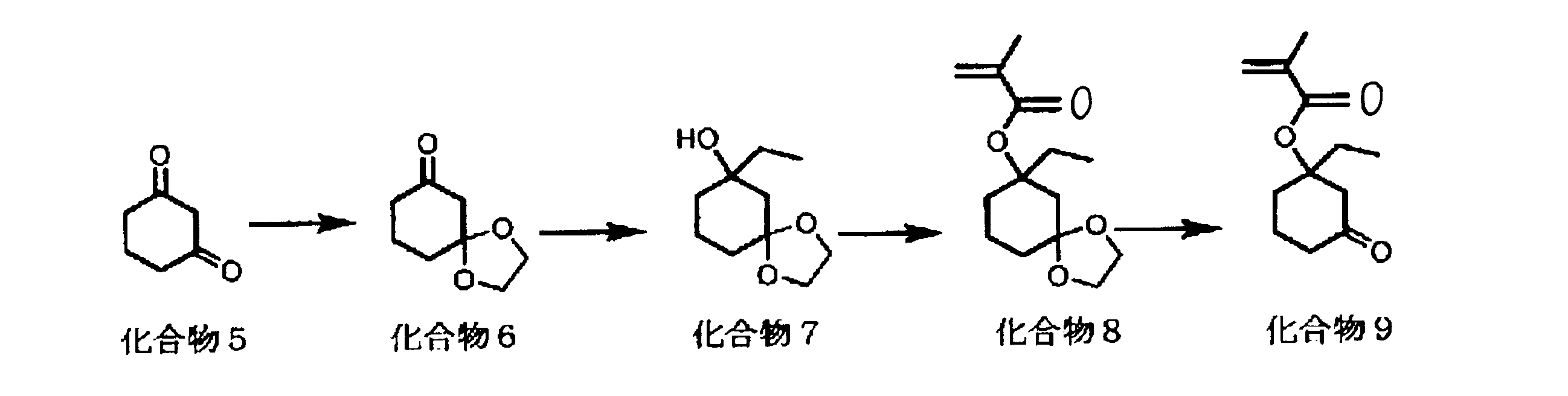
100.0gの上記化合物5に、トルエン400g、エチレングリコール55.4g、p-トルエンスルホン酸一水和物17.0gおよびピリジン7.1gを加え、温度115℃でトルエンを還流させつつ、水を共沸させた。反応液にジイソプロピルエーテルを200g加えて重曹水、飽和食塩水の順に洗浄した。得られた溶液を濃縮した後、温度120℃、減圧度、1.333hPa以下の条件で減圧蒸留を行い、49.1gの上記化合物6を収率35質量%で得た。
窒素雰囲気下、氷冷下、THF180gと2モル濃度のエチルマグネシウムクロリドのTHF溶液131mlを加えた後、THF40gに溶かした状態の上記化合物6を34.0g滴下し、1時間撹拌した。反応液にジイソプロピルエーテル100gを加え、飽和塩化アンモニウム水、飽和食塩水の順に洗浄した。得られた溶液を濃縮した後、温度110℃、減圧度、1.333hPa以下の条件で減圧蒸留し、34.4gの上記化合物7を収率85質量%で得た。
窒素雰囲気下、30.0gの上記化合物7を、THF60gに溶かした後、ドライアイス-アセトンバスにて冷却した。次いで、n-ブチルリチウムが1.67モル濃度のヘキサン溶液を100ml滴下した。20分間撹拌後、THF30gに溶かしたメタクリロイルクロリド17.9gを加え、室温まで昇温した。反応液にジイソプロピルエーテル90gを加えて、飽和重曹水で洗浄した。得られた溶液を減圧濃縮することにより、上記化合物8の粗体36.0gを得た。尚、化合物8は前述の一般式(3)で表される化合物に含まれる。
36.0gの上記化合物8に、アセトン54g、水36gおよびp-トルエンスルホン酸一水和物3.6gを加え、50℃で6時間撹拌を続けた。反応液に飽和重曹水を加えアセトンを減圧濃縮した後、ジイソプロピルエーテル100gを加えて、飽和食塩水で洗浄した。得られた溶液を濃縮した後、温度115℃、減圧度、1.333hPa以下の条件で減圧蒸留を行い、7.4gの上記化合物9を収率25質量%で得た。尚、化合物9は、前述の一般式(3)で表される化合物に含まれる。
化合物9のNMR測定結果
1H-NMR(溶媒:CDCl3,基準物質:TMS);δ(ppm)0.93(3H,t),1.69(2H,m),1.92(3H,s),1.98(2H,m)2.30(2H,m),2.66(2H,m),2.98(2H,m),5.51(1H,s),6.00(1H,s).
1H-NMR(溶媒:CDCl3,基準物質:TMS);δ(ppm)0.93(3H,t),1.69(2H,m),1.92(3H,s),1.98(2H,m)2.30(2H,m),2.66(2H,m),2.98(2H,m),5.51(1H,s),6.00(1H,s).
[実施例1]
重合体1の合成
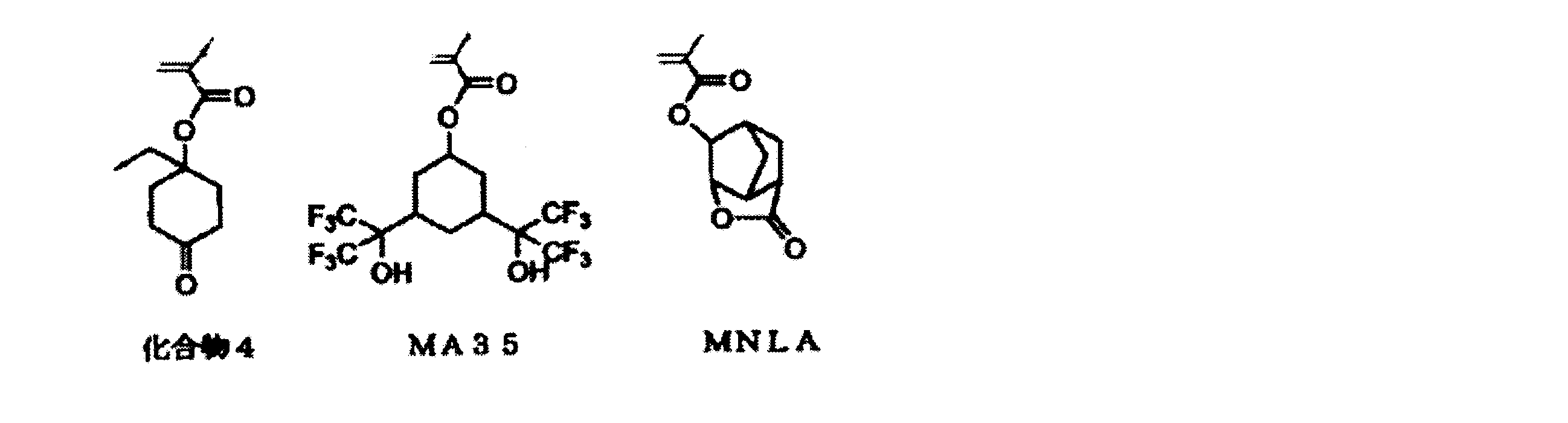
重合体1の合成
ガラス製フラスコ中で、2-ブタノン、101.2gに、上記化合物4、12.6g、MA35、25.0g、MNLA、13.0gおよびn-ドデシルメルカプタン(東京化成株式会社製、以下同じ)0.6gを溶解した。この溶液に重合開始剤として、2,2’-アゾビス(イソブチロニトリル)(和光純薬株式会社製、以下同じ、以後AIBNと略する)を1.4g加えてから撹拌しながら脱気し、窒素ガスを導入した後に75℃にて16時間の反応を行った。反応終了後の溶液を607.2gのn-ヘプタンに滴下し、白色の沈殿を得た。この沈殿を濾別し、60℃にて減圧乾燥を行い38.7gの白色固体(重合体1)を得た。以下の示すように、重合体1は、化合物4、MA35、MNLAが重合したユニット(繰り返し単位)を含む。

[実施例2]
重合体2の合成
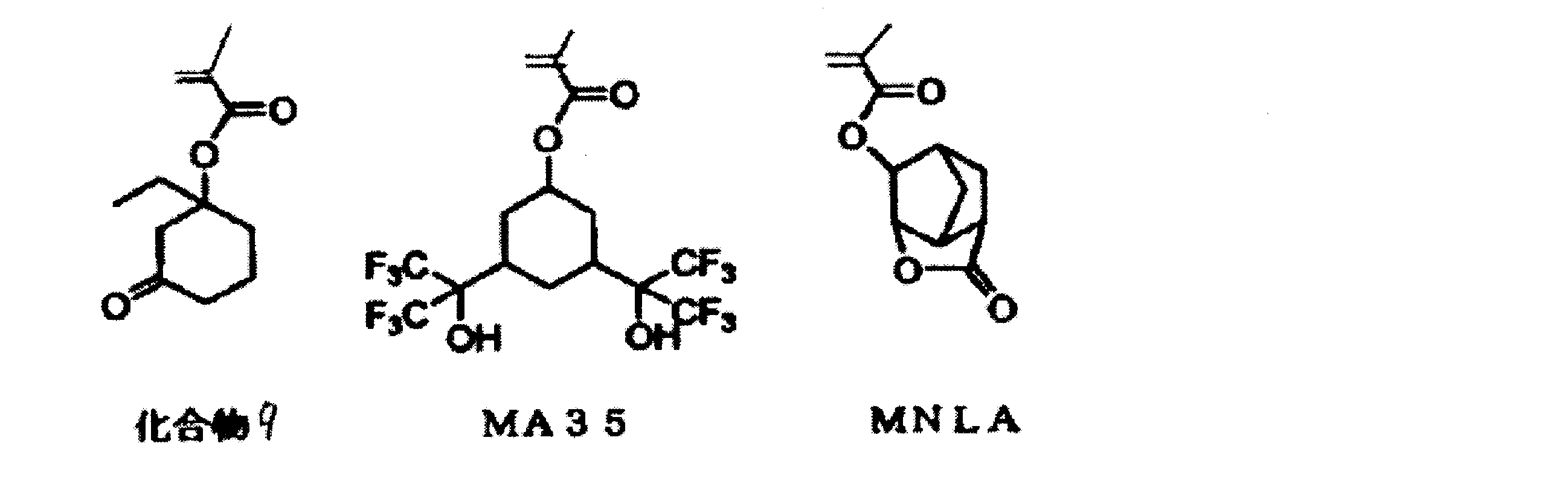
重合体2の合成
ガラス製フラスコ中で、2-ブタノン、101.2gに、上記化合物9、12.6g、MA35、25.0g、MNLA、13.0gおよびn-ドデシルメルカプタン0.6gを溶解した。この溶液に重合開始剤として前記AIBNを1.4g加えてから撹拌しながら脱気し窒素ガスを導入した後、75℃にて16時間の反応を行った。反応終了後の溶液を607.2gのn-ヘプタンに滴下し、白色の沈殿を得た。この沈殿を濾別し、60℃にて減圧乾燥を行い40.6gの白色固体(重合体2)を得た。以下に示すように、重合体2は、化合物8、MA35およびMNLAが重合したニットを含む。

[実施例3]
重合体3の合成

重合体3の合成
ガラス製フラスコ中で、2-ブタノン、106.4gに、上記化合物3、15.2g、MA35、25.0g、MNLA、13.0gおよびn-ドデシルメルカプタン0.55gを溶解した。この溶液に重合開始剤としてAIBNを1.2g加えてから撹拌しながら脱気し窒素ガスを導入した後、温度75℃にて16時間の反応を行った。反応終了後の溶液を638.4gのn-ヘプタンに滴下し、白色の沈殿を得た。この沈殿を濾別し、温度60℃にて減圧乾燥を行い48.6gの重合体3を白色固体として得た。以下に示すように、重合体3は、化合物3、MA35およびMNLAが重合したユニットを含む。

[実施例4]
重合体4の合成
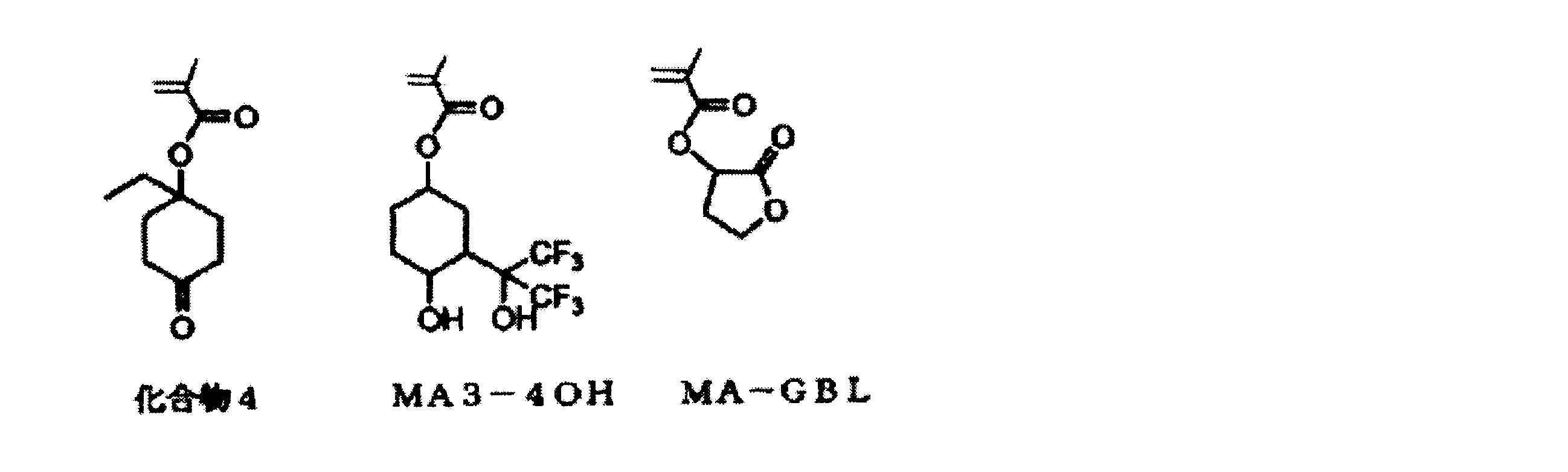
重合体4の合成
ガラス製フラスコ中で、2-ブタノンに、80.2g、上記化合物4、12.6g、MA3-4OH、17.5g、MA-GBL、10.0gおよびn-ドデシルメルカプタン0.6gを溶解した。この溶液に重合開始剤としてAIBNを1.3g加え撹拌しながら脱気し、窒素ガスを導入した後に温度75℃にて16時間の反応を行った。反応終了後の溶液を481.2gのn-ヘプタンに滴下し、白色の沈殿を得た。この沈殿を濾別し、温度60℃にて減圧乾燥を行い36.4gの重合体4を白色固体として得た。以下に示すように、重合体4は、化合物4、MA3-4OH、MA-GBLが重合したユニットを含む。
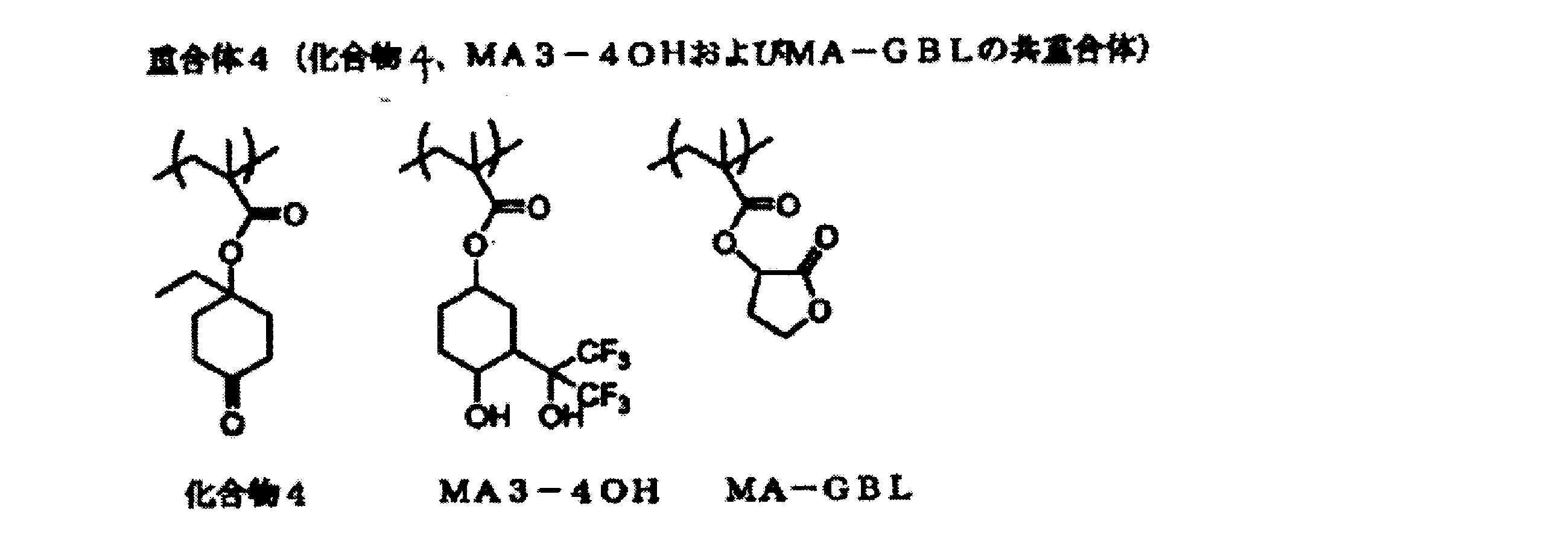
[実施例5]
重合体5の合成

重合体5の合成
ガラス製フラスコ中で、2-ブタノン74.2gに、上記化合物4、12.6g、MA-ADOH、14.5g、MA-GBL、10.0gおよびn-ドデシルメルカプタン0.6gを溶解した。この溶液に重合開始剤としてAIBNを1.3g加え撹拌しながら脱気し、窒素ガスを導入した後に温度75℃にて16時間の反応を行った。反応終了後の溶液を452.8gのn-ヘプタンに滴下し、白色の沈殿を得た。この沈殿を濾別し、温度60℃にて減圧乾燥を行い30.4gの重合体5を白色固体として得た。以下に示すように、重合体5は化合物4、MA-ADOHおよびMA-GBLが重合したユニットを含む。
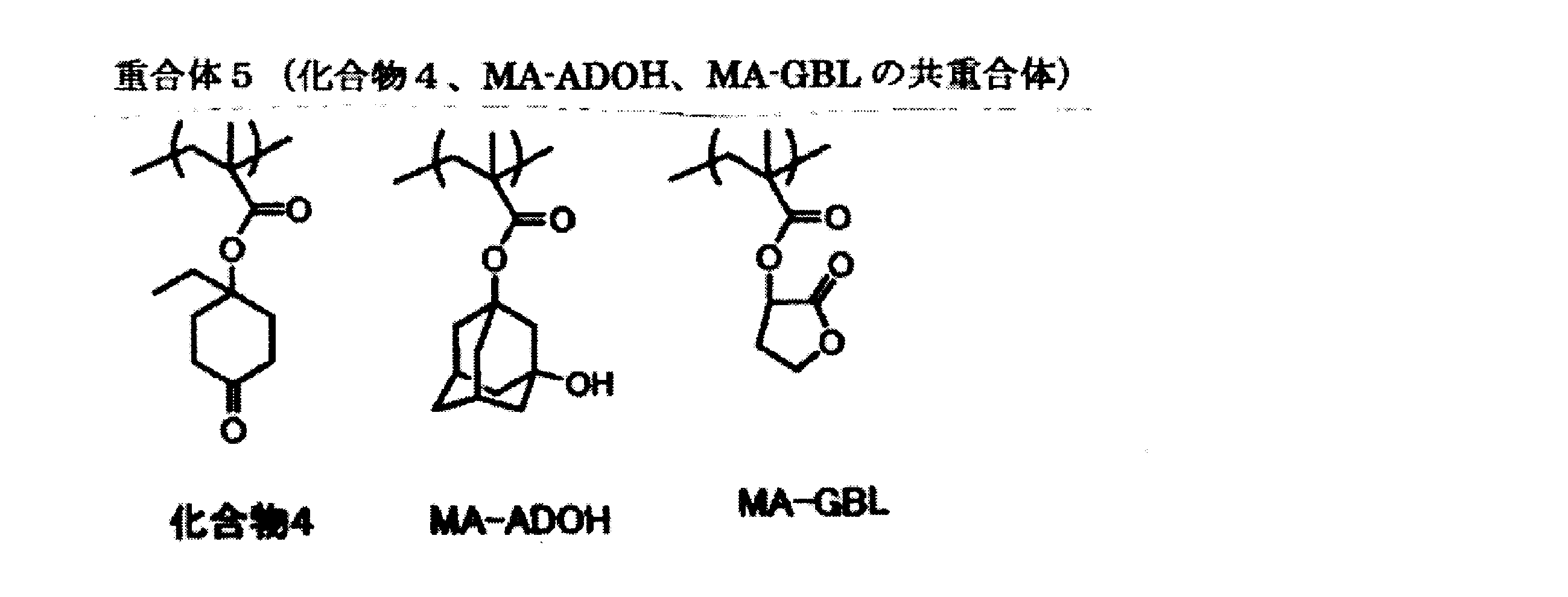
[実施例6]
重合体6の合成
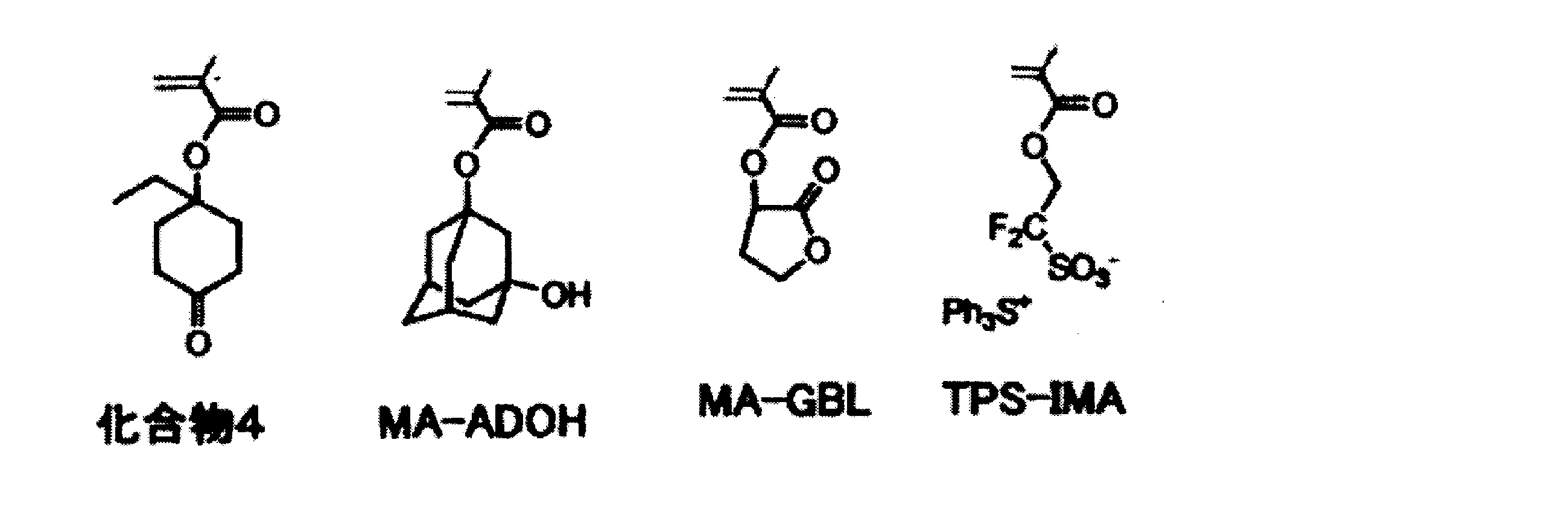
重合体6の合成
ガラス製フラスコ中で、2-ブタノン69.4gに、上記化合物4、11.6g、 MA-ADOHを12.5g、MA-GBLを8.7g、TPS-IMAを1.9g及びn-ドデシルメルカプタン(東京化成株式会社製)を0.6g溶解した。この溶液に重合開始剤としてAIBNを1.3g加えてから撹拌しながら脱気し、窒素ガスを導入した後に温度75℃にて16時間の反応を行った。反応終了後の溶液を555.2gのn-ヘプタンに滴下し、白色の沈殿を得た。この沈殿を濾別し、温度60℃にて減圧乾燥を行い25.3gの重合体6を白色固体として得た。下記のように、重合体6は、化合物4、MA-ADOH、MA-GBLおよびTPS-IMAが重合したユニットを含む。
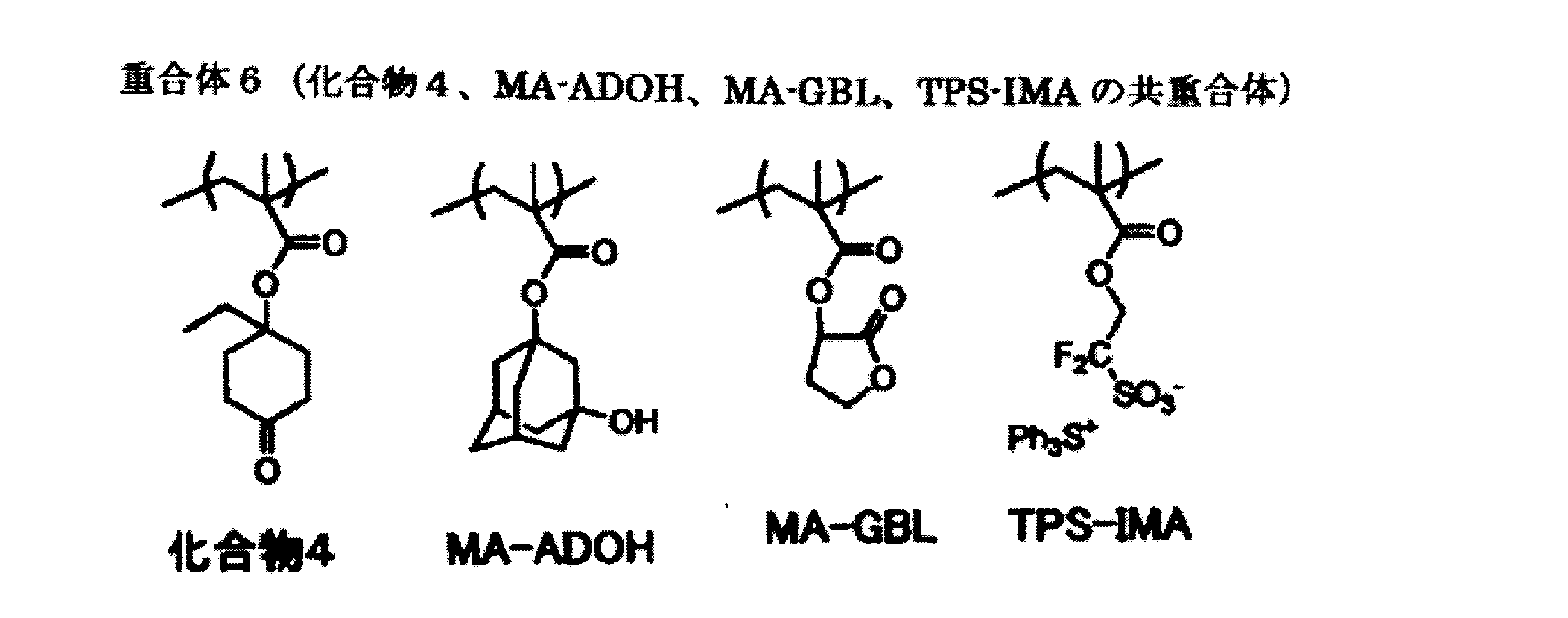
[実施例7]
重合体7の合成
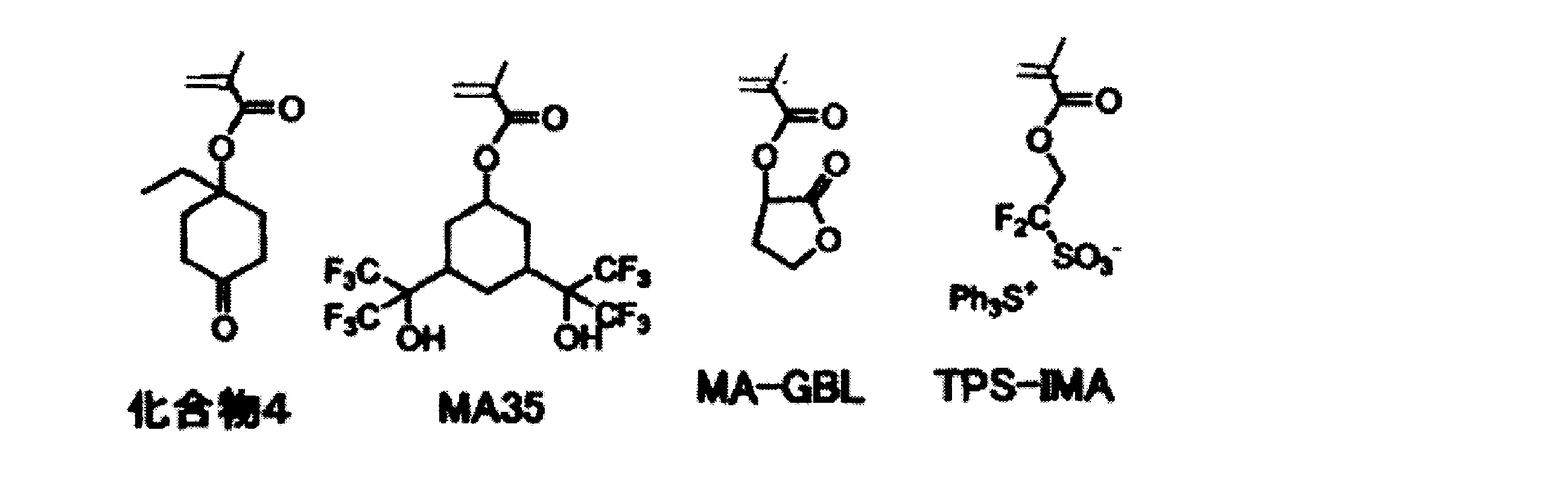
重合体7の合成
ガラス製フラスコ中で、2-ブタノン、91.2gに、上記化合物4、11.6g、MA35、22.4g、MA-GBL、8.7g、TPS-IMA、1.9gおよびn-ドデシルメルカプタン0.6gを溶解した。この溶液に重合開始剤としてAIBNを1.3g加え撹拌しながら脱気し、窒素ガスを導入した後に温度75℃にて16時間の反応を行った。反応終了後の溶液を729.6gのn-ヘプタンに滴下し、白色の沈殿を得た。この沈殿を濾別し、温度60℃にて減圧乾燥を行い38.4gの重合体7を白色固体として得た。以下に示すように、重合体7は、化合物4、MA35、MA-GBLおよびTPS-IMAが重合したユニットを含む。

[比較例1]
比較重合体1の合成
重合体1における化合物4の替わりに、MA-ECpを用い、本願発明の範疇に属さない比較重合体1を合成した。

比較重合体1の合成
重合体1における化合物4の替わりに、MA-ECpを用い、本願発明の範疇に属さない比較重合体1を合成した。
ガラス製フラスコ中で、2-ブタノン97.8gに、上記MA-ECp、10.9g、MA35、25.0g、MNLA、13.0gおよびn-ドデシルメルカプタン0.6gを溶解した。この溶液に重合開始剤としてAIBNを1.4g加えてから撹拌しながら脱気し、窒素ガスを導入した後に、温度75℃にて16時間の反応を行った。反応終了後の溶液を586.8gのn-ヘプタンに滴下し、白色の沈殿を得た。この沈殿を濾別し、温度60℃にて減圧乾燥を行い、34.9gの比較重合体1を白色固体として得た。以下に示すように、比較重合体1は、MA-ECp、MA35およびMNLAが重合したユニットを含む。
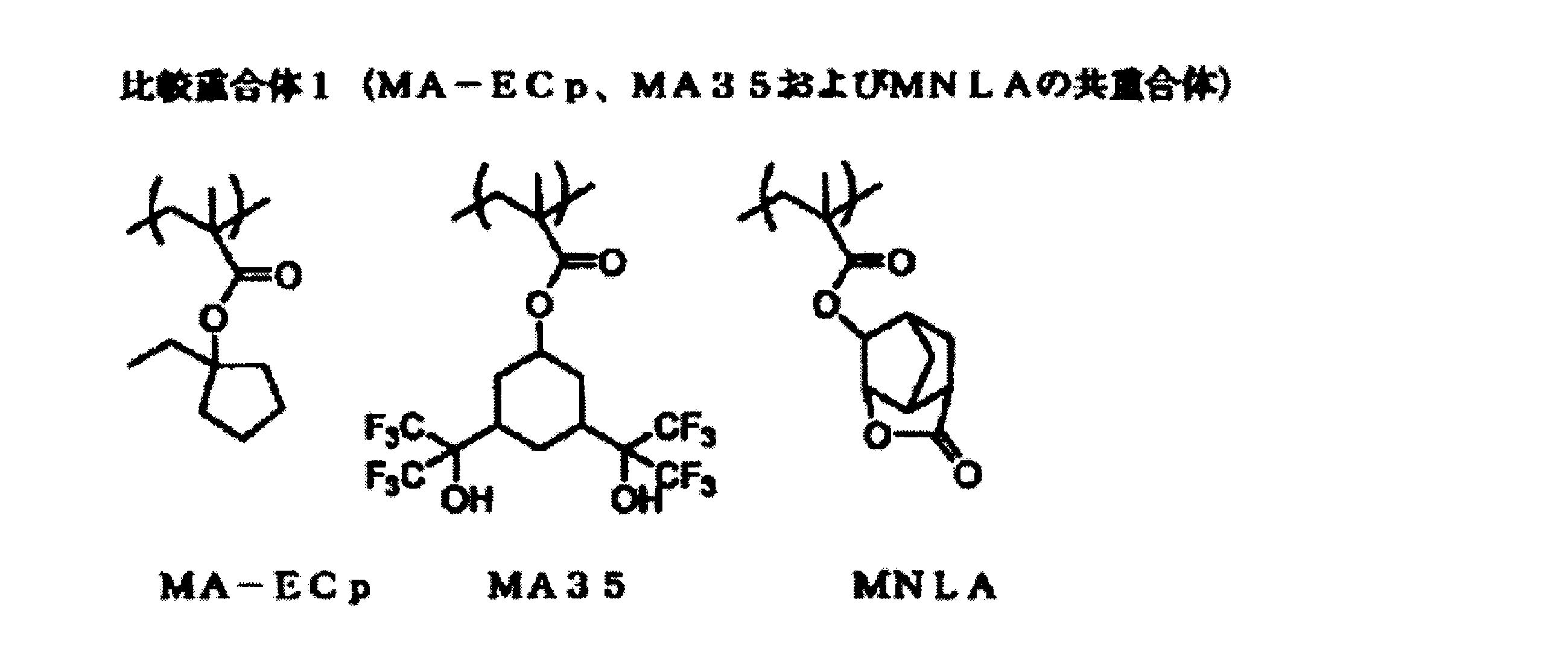
[比較例2]
比較重合体2の合成
重合体4における化合物4の変わりに、MA-EADを用いて本願発明の範疇に属さない比較重合体2を合成した。

比較重合体2の合成
重合体4における化合物4の変わりに、MA-EADを用いて本願発明の範疇に属さない比較重合体2を合成した。
ガラス製フラスコ中で、2-ブタノン84.8gに、上記MA-MAD、14.9g、MA3-4OH、17.5g、MA-GBL、10.0gおよびn-ドデシルメルカプタン0.6gを溶解した。この溶液に重合開始剤としてAIBNを1.3g加え撹拌しながら脱気し、窒素ガスを導入した後に、温度75℃にて16時間の反応を行った。反応終了後の溶液を254.4gのn-ヘプタンに滴下し、白色の沈殿を得た。この沈殿を濾別し、温度60℃にて減圧乾燥を行い31.8gの白色固体(比較重合体2)を得た。以下に示すように、比較重合体2は、MA-MAD、MA3-4OHおよびMA-GBLが重合したユニットを含む。

[比較例3]
比較重合体3の合成
重合体5における化合物4の変わりに、MA-EADを用いて本願発明の範疇に属さない比較重合体3を合成した。
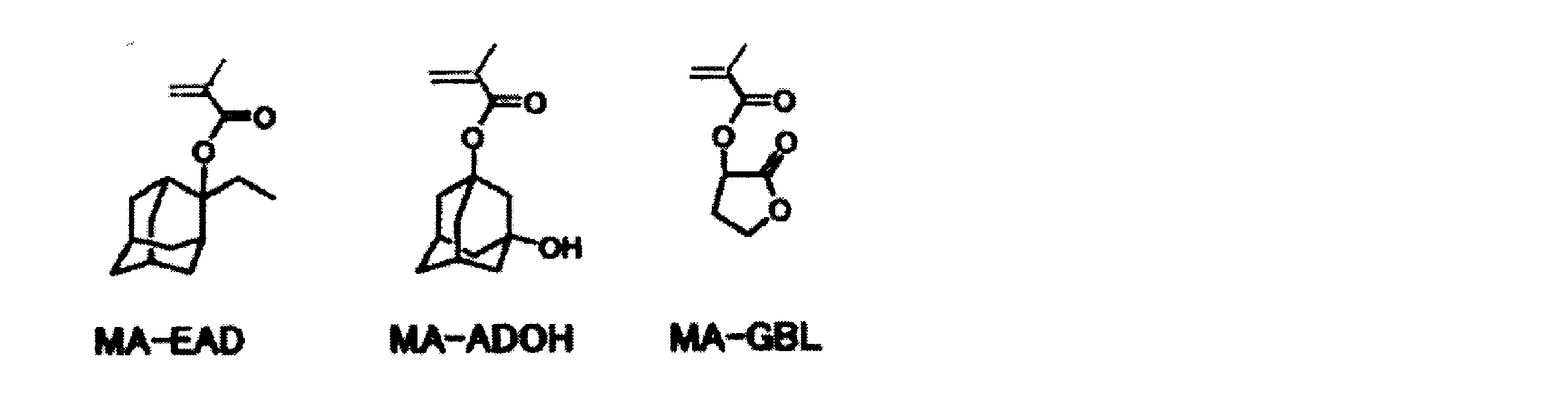
比較重合体3の合成
重合体5における化合物4の変わりに、MA-EADを用いて本願発明の範疇に属さない比較重合体3を合成した。
ガラス製フラスコ中で、2-ブタノン98.8gに、上記MA-EAD、21.9g、MA-ADOH、17.5g、MA-GBL、10.0gおよびn-ドデシルメルカプタン0.6gを溶解した。この溶液に重合開始剤としてAIBNを1.3g加え撹拌しながら脱気し、窒素ガスを導入した後に、温度75℃にて16時間の反応を行った。反応終了後の溶液を395.2gのn-ヘプタンに滴下し、白色の沈殿を得た。この沈殿を濾別し、温度60℃にて減圧乾燥を行い34.1gの白色固体(比較重合体3)を得た。以下に示すように、比較重合体3は、MA-EAD、MA-ADOHおよびMA-GBLが重合したユニットを含む。

[比較例4]
比較重合体4の合成
重合体6における化合物4の変わりに、MA-EADを用いて本願発明の範疇に属さない比較重合体4を合成した。
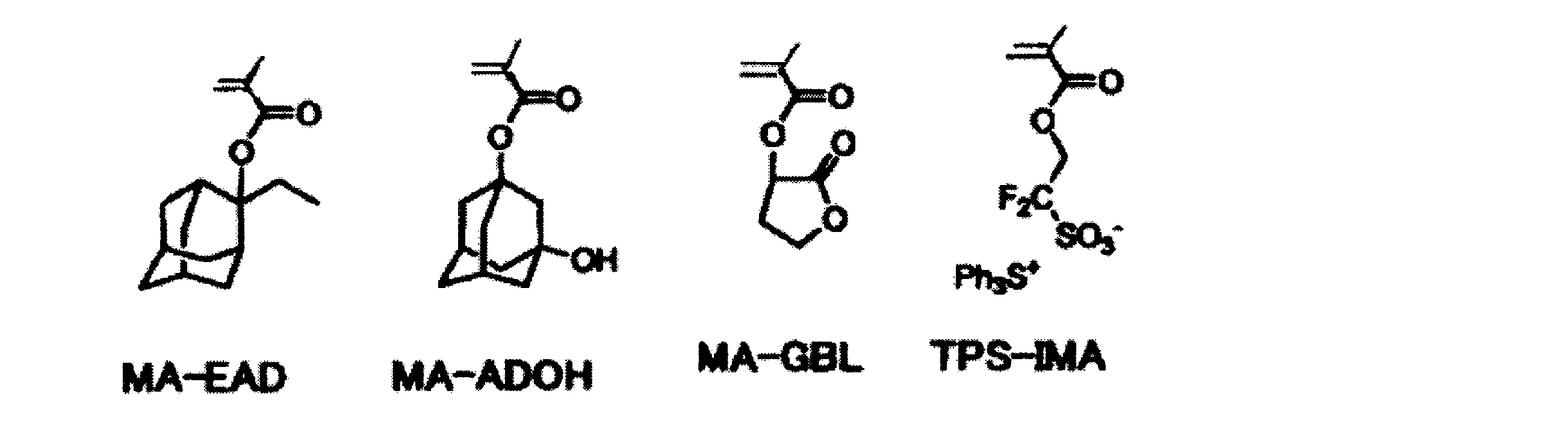
比較重合体4の合成
重合体6における化合物4の変わりに、MA-EADを用いて本願発明の範疇に属さない比較重合体4を合成した。
ガラス製フラスコ中で、2-ブタノン、77.0gに、上記MA-EAD、15.4g、MA-ADOH、12.5g、MA-GBL、8.7g、TPS-IMA、1.9gおよびn-ドデシルメルカプタン0.6gを溶解した。この溶液に重合開始剤としてAIBNを1.3g加え撹拌しながら脱気し、窒素ガスを導入した後に、温度75℃にて16時間の反応を行った。反応終了後の溶液を308.0gのn-ヘプタンに滴下し、白色の沈殿を得た。この沈殿を濾別し、温度60℃にて減圧乾燥を行い23.1gの白色固体(比較重合体2)を得た。以下に示すように、比較重合体4は、MA-EAD、MA-ADOH、MA-GBLおよびTPS-IMAが重合したユニットを含む。

[重合結果]
重合体1~7および比較重合体1~4について、分子量と組成を測定した。重合体の分子量(数平均分子量Mn)と分子量分散(Mnと重量平均分子量Mwの比Mw/Mn)は、東ソー株式会社製、高速GPC装置、品番、HLC-8320GPCにおいて、東ソー株式会社製ALPHA-MカラムとALPHA-2500カラムを1本ずつ直列に繋ぎ、展開溶媒としてテトラヒドロフランを用いて測定した。検出器は屈折率差検出器を用いた。また、重合体の組成は1H-NMRおよび19F-NMRによって確認した。
重合体1~7および比較重合体1~4について、分子量と組成を測定した。重合体の分子量(数平均分子量Mn)と分子量分散(Mnと重量平均分子量Mwの比Mw/Mn)は、東ソー株式会社製、高速GPC装置、品番、HLC-8320GPCにおいて、東ソー株式会社製ALPHA-MカラムとALPHA-2500カラムを1本ずつ直列に繋ぎ、展開溶媒としてテトラヒドロフランを用いて測定した。検出器は屈折率差検出器を用いた。また、重合体の組成は1H-NMRおよび19F-NMRによって確認した。
測定した結果を表1に示す。

[レジスト配合]
重合体1~7および比較重合体1~4を用い、各々PAG、塩基性化合物、溶剤を加え、表2の実施例1~7、比較例1~4に示す割合で配合してレジスト溶液を調製した(各々、レジスト-1~7、比較レジスト-1~4とする)。
重合体1~7および比較重合体1~4を用い、各々PAG、塩基性化合物、溶剤を加え、表2の実施例1~7、比較例1~4に示す割合で配合してレジスト溶液を調製した(各々、レジスト-1~7、比較レジスト-1~4とする)。
調製したレジスト溶液は、孔径0.2μmのメンブランフィルターでろ過した後、反射防止膜(日産化学工業株式会社製、ARC29A)、厚さ78nmを塗布した後、温度200℃で60秒間焼成して乾燥したシリコンウェハー上に、スピナーを用いて、回転数1,500rpmで塗布し、次いで、ホットプレート上で100℃、90秒間乾燥した。
[接触角測定]
得られたシリコンウェハー上の樹脂膜は、接触角計(協和界面科学株式会社製)を用いて水滴の接触角を測定した。結果を表2に示す。
得られたシリコンウェハー上の樹脂膜は、接触角計(協和界面科学株式会社製)を用いて水滴の接触角を測定した。結果を表2に示す。
表2に示すように、本願発明の新規酸分解性重合体を配合したレジスト-1~7は、比較レジスト-1~4から得られた樹脂膜よりも接触角が高いことがわかった。レジスト-1~7と比較レジスト-1~4との接触角の差は、カルボニル基を有する(レジスト-1~7)、有しない(比較レジスト-1~4)ことによる酸分解性基中のカルボニル基の有無の違いであり、カルボニル基が撥水性向上に寄与したことは明らかである。この撥水性向上の結果、液浸露光装置によるリソグラフィーにおいて、レジストへの水の浸入を防いでウォーターマーク欠陥(現像時、リンス後の水滴残りによる欠陥)の発生を抑制することが期待される。
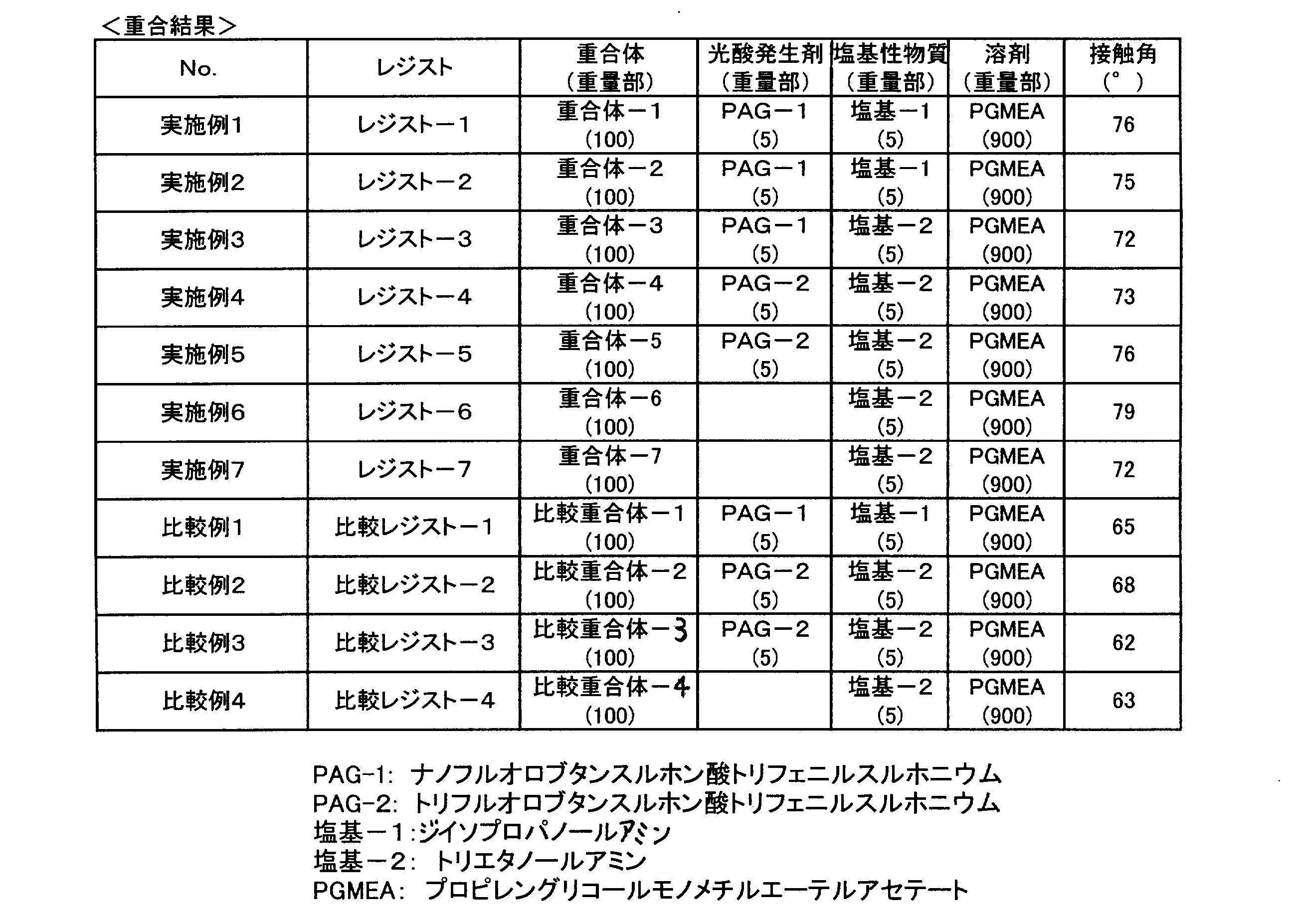
[現像液溶解性試験]
前述と同様に、レジストを塗布して樹脂膜を形成したシリコンウェハーを、アルカリ現像液に浸漬し溶解性を試験した。樹脂の溶解は、浸漬後の膜の残存を光干渉型の膜厚計で測定することによって調べた。結果を表3に示した。
前述と同様に、レジストを塗布して樹脂膜を形成したシリコンウェハーを、アルカリ現像液に浸漬し溶解性を試験した。樹脂の溶解は、浸漬後の膜の残存を光干渉型の膜厚計で測定することによって調べた。結果を表3に示した。
レジスト-1~7、および比較レジスト-1~4は、いずれも未露光の状態ではアルカリ現像液に不溶であり、露光後は可溶となった。このことから、試験したレジスト全てが感光性樹脂としての溶解コントラストを有していることが示された。
[露光解像試験]
前述と同様に、レジストを塗布して樹脂膜を形成したシリコンウェハーを、100℃で60秒間プリベークを行った後、フォトマスクを介して、ArFレーザによる波長193nmの紫外光で露光した。露光後のウェハーを回転させながら純水を2分間滴下した。その後、120℃で60秒間PEBを行い、アルカリ現像液で現像した。
前述と同様に、レジストを塗布して樹脂膜を形成したシリコンウェハーを、100℃で60秒間プリベークを行った後、フォトマスクを介して、ArFレーザによる波長193nmの紫外光で露光した。露光後のウェハーを回転させながら純水を2分間滴下した。その後、120℃で60秒間PEBを行い、アルカリ現像液で現像した。
得られたパターンを走査型電子顕微鏡(SEM)で観察し、解像性の評価を行った。
レジスト-1~7を用いた実施例1~7の場合には、ラフネスや欠陥がなく断面が矩形のパターンが形成され、非常に良好な解像性を示した。これは、露光後にレジスト-1~7中の酸分解性基から脱離する保護基が極性基であるカルボニル基を有するため、極性のある現像液に溶解し易くなりレジスト上にスカムを残さず、速やかな溶解性を有することに起因した結果である。これに対して、比較レジスト-1~4を用いた比較例1~4では、現像液の溶解性不良によるものと思われる頭はり形状(頭はり形状とは、レジストパターンの断面において、上部の線幅が下部の線幅より大きいことである)で、また、残渣による欠陥が多数あるパターンが観測された。これは、露光後に比較レジスト-1~4中の酸分解性基から脱離する保護基が非極性の炭化水素であるため、極性のある現像液に溶解し難くなりレジスト上にスカムを残した結果である。

[4-メチル-2-ペンタノール(MIBC)への溶剤溶解性試験]
前述と同様のレジスト配合で、レジスト材料を塗布して樹脂膜を形成したシリコンウェハーを、4-メチル-2-ペンタノール(MIBC)に浸漬し、溶解性を試験した。結果を表3に示す。
前述と同様のレジスト配合で、レジスト材料を塗布して樹脂膜を形成したシリコンウェハーを、4-メチル-2-ペンタノール(MIBC)に浸漬し、溶解性を試験した。結果を表3に示す。
レジスト-1~7を用いた実施例1~7の場合には、レジスト-1~7中の酸分解性基に極性基のカルボニル基を有するので、若干の極性を有するアルコール系溶剤であるMIBCに速やかに溶解し、各々良好な溶解性を示した。これに対して、比較レジスト-1~4を用いた比較例1~4では、酸分解性基が非極性の炭化水素基であるため、極性を有するMIBCへの溶剤溶解性はなく、不溶であることが判った。
これらの実験結果より、第1のレジスト膜にパターンを形成した後に第2のレジスト膜を塗布して露光処理するパターン形成方法、即ち、ダブルパターニング法において、例えば、第1のレジスト膜に汎用レジスト組成物を用いた場合、第2のレジスト膜形成用のレジスト材料として、本願発明の重合体を使用したMIBCに溶解して調製したレジスト材料、例えば、前述のレジスト1~7を使用可能なことが示唆された。
即ち、第2のレジスト材料に用いる溶媒(この場合、MIBC)は、第1のレジスト膜に形成されたレジストパターンを侵さないので、第1のレジストパターンに影響を与えることなく第2のレジスト膜を形成することが可能となる。
本願発明のレジスト材料は、露光に用いる光源および波長は、特に限定されないが、KrFエキシマレーザ(波長248nm)、ArFエキシマレーザ(波長193nm)、F2エキシマレーザ(波長157nm)、EUV(波長13.5nm)、EB、X線によるリソグラフィーによる微細パターニングに好適に使用でき、特に、KrFエキシマレーザ、ArFエキシマレーザおよびEUVによるリソグラフィーに好適に採用される。
本願発明のレジスト材料は、特に、ArFエキシマレーザ、ArFエキシマレーザを用いた液浸リソグラフィー用やダブルパターニング法およびEUV用のレジスト材料として有用である。
Claims (15)
- 一般式(1):

Aはカルボニル基(C=O)または、当該カルボニル基が保護基によって保護された次のアセタール構造をとる。

で表される重合性単量体。 - 一般式(2)、一般式(3)または一般式(4):
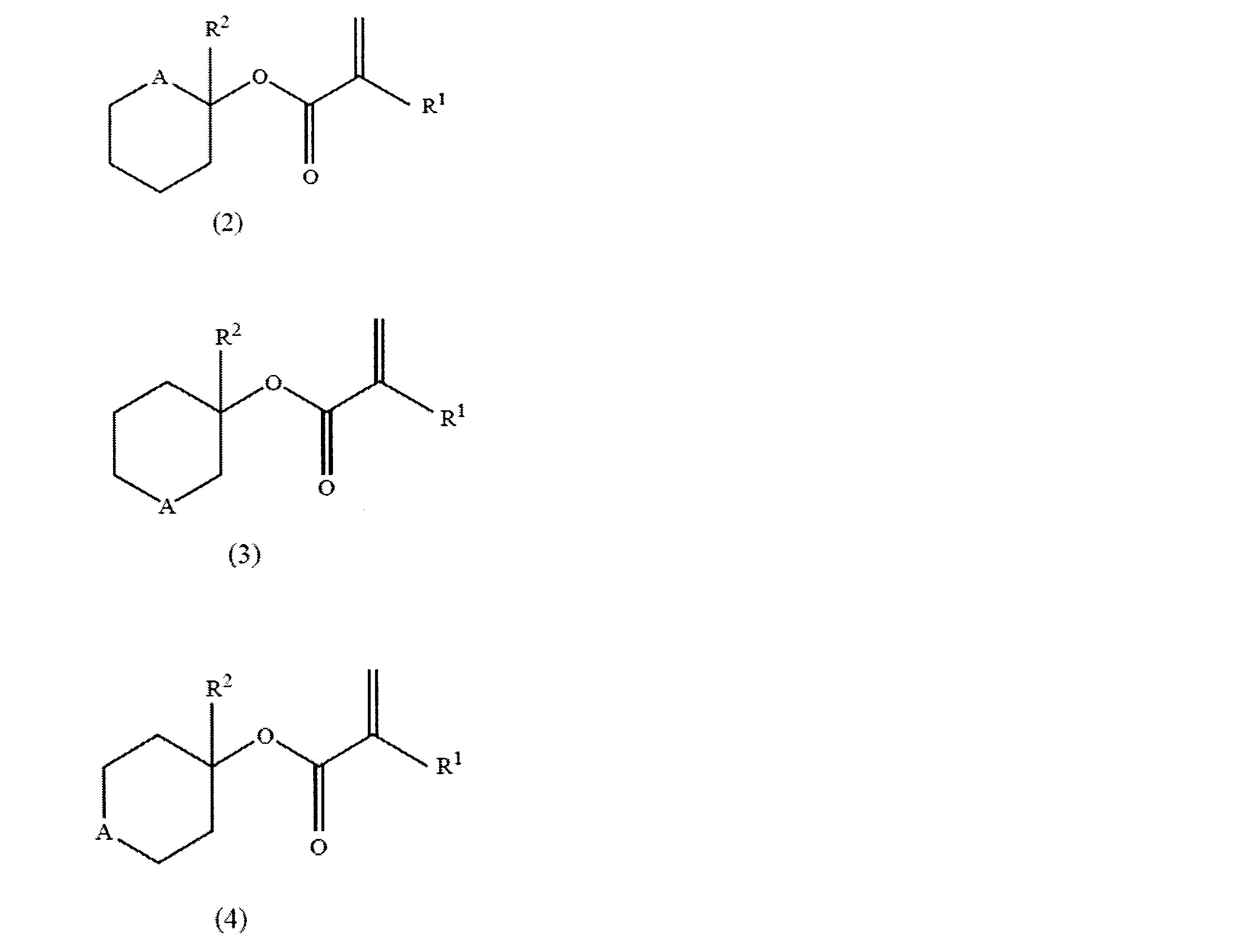
Aはカルボニル基(C=O)または、当該カルボニル基が保護基によって保護された次のアセタール構造をとる。

のいずれかで表される重合性単量体。 - R1が水素原子、ハロゲン原子、メチル基またはトリフルオロメチル基、R2がメチル基、エチル基またはイソプロピル基であることを特徴とする請求項1または請求項2に記載の重合性単量体。
- 一般式(5):

Aはカルボニル基(C=O)または、当該カルボニル基が保護基によって保護された次のアセタール構造をとる。

で表される繰り返し単位を含むことを特徴とする重合体。 - 一般式(6)、一般式(7)または一般式(8):

Aはカルボニル基(C=O)または、当該カルボニル基が保護基によって保護された次のアセタール構造をとる。

のいずれかで表される繰り返し単位を含む請求項4に記載の重合体。 - R1は水素原子、ハロゲン原子、メチル基またはトリフルオロメチル基、R2はメチル基、エチル基またはイソプロピル基で表されることを特徴とする請求項4または請求項5に記載の重合体。
- 請求項4乃至請求項6のいずれか1項に記載の重合体が、さらに1,1,1,3,3,3-ヘキサフルオロ-2-ヒドロキシイソプロピル基(-C(CF3)2OH)を含むことを特徴とする重合体。
- 請求項4乃至請求項7のいずれか1項に記載の重合体が、さらに一般式(9)または一般式(10):

- 請求項4乃至請求項8のいずれか1項に記載の重合体を含有することを特徴とするレジスト材料。
- 酸発生剤、塩基性化合物、有機溶剤のうち少なくとも一種を含むことを特徴とする請求項9に記載のレジスト材料。
- 有機溶媒に炭素数5~20のアルコール系溶剤を用いたことを特徴とする請求項10に記載のレジスト材料。
- 基板上に形成された第1のレジストパターン上に第2のレジストパターンを形成するダブルパターニング法であって、請求項9乃至請求項11のいずれか1項に記載のレジスト材料を用いることを特徴とするパターン形成方法。
- 請求項9乃至請求項11のいずれか1項に記載のレジスト材料を基板上に塗布する第1の工程と、当該基板を加熱処理してレジスト膜を形成し、露光機を用いて波長300nm以下の紫外光および極紫外光でフォトマスクを介しレジスト膜を露光する第2の工程と、レジスト膜の露光部位を現像液に溶解させて現像し、基板上にパターン形成する第3の工程からなることを特徴とするパターン形成方法。
- ウェハーと投影レンズの間に水を挿入し、露光機を用いて、ArFエキシマレーザから発振させた波長193nmの紫外光を照射する、請求項9乃至請求項11のいずれか1項に記載のレジスト材料を用いた液浸リソグラフィー法。
- 波長13.5nmの紫外光を用いる、請求項9乃至請求項11のいずれか1項に記載のレジスト材料を用いたEUVリソグラフィー法。
Applications Claiming Priority (6)
| Application Number | Priority Date | Filing Date | Title |
|---|---|---|---|
| JP2010056477 | 2010-03-12 | ||
| JP2010-056477 | 2010-03-12 | ||
| JP2010154055 | 2010-07-06 | ||
| JP2010-154055 | 2010-07-06 | ||
| JP2011051774A JP2012031381A (ja) | 2010-03-12 | 2011-03-09 | 重合性単量体、重合体およびそれを用いたレジスト材料およびそのパターン形成方法 |
| JP2011-051774 | 2011-03-09 |
Publications (1)
| Publication Number | Publication Date |
|---|---|
| WO2011111807A1 true WO2011111807A1 (ja) | 2011-09-15 |
Family
ID=44563605
Family Applications (1)
| Application Number | Title | Priority Date | Filing Date |
|---|---|---|---|
| PCT/JP2011/055723 Ceased WO2011111807A1 (ja) | 2010-03-12 | 2011-03-11 | 重合性単量体、重合体およびそれを用いたレジスト材料およびそのパターン形成方法 |
Country Status (2)
| Country | Link |
|---|---|
| JP (1) | JP2012031381A (ja) |
| WO (1) | WO2011111807A1 (ja) |
Cited By (3)
| Publication number | Priority date | Publication date | Assignee | Title |
|---|---|---|---|---|
| WO2014077097A1 (ja) * | 2012-11-19 | 2014-05-22 | 富士フイルム株式会社 | アセタール系化合物及びアセタール系高分子化合物 |
| US11487203B2 (en) | 2016-12-30 | 2022-11-01 | Rohm And Haas Electronic Materials Korea Ltd. | Monomers, polymers and photoresist compositions |
| US12276910B2 (en) | 2020-07-15 | 2025-04-15 | Dupont Electronic Materials International, Llc | Photoresist compositions and pattern formation methods |
Families Citing this family (4)
| Publication number | Priority date | Publication date | Assignee | Title |
|---|---|---|---|---|
| KR101744608B1 (ko) * | 2011-03-28 | 2017-06-08 | 후지필름 가부시키가이샤 | 감활성 광선성 또는 감방사선성 수지 조성물, 및 이 조성물을 이용한 감활성 광선성 또는 감방사선성 막 및 패턴 형성 방법 |
| JP5618924B2 (ja) | 2011-06-30 | 2014-11-05 | 富士フイルム株式会社 | 感活性光線性又は感放射線性樹脂組成物、該組成物を用いたレジスト膜及びパターン形成方法、並びに電子デバイスの製造方法及び電子デバイス |
| JP2014156530A (ja) * | 2013-02-15 | 2014-08-28 | Dic Corp | フッ素系界面活性剤及びポジ型レジスト組成物。 |
| US11822251B2 (en) * | 2016-02-09 | 2023-11-21 | Taiwan Semiconductor Manufacturing Co., Ltd. | Photoresist with polar-acid-labile-group |
Citations (5)
| Publication number | Priority date | Publication date | Assignee | Title |
|---|---|---|---|---|
| JPH1184663A (ja) * | 1996-12-24 | 1999-03-26 | Toshiba Corp | 感光性組成物、およびこれを用いたパターン形成方法ならびに電子部品の製造方法 |
| JP2002327013A (ja) * | 2001-02-28 | 2002-11-15 | Shin Etsu Chem Co Ltd | 高分子化合物、レジスト材料及びパターン形成方法 |
| JP2004339521A (ja) * | 1996-08-20 | 2004-12-02 | Tokyo Ohka Kogyo Co Ltd | 2‐ヒドロキシ‐3‐ピナノンのアクリレート又はメタクリレート及びその重合体又は共重合体 |
| WO2006121096A1 (ja) * | 2005-05-11 | 2006-11-16 | Jsr Corporation | 新規化合物および重合体、ならびに感放射線性樹脂組成物 |
| JP2010053163A (ja) * | 2008-08-26 | 2010-03-11 | Shin-Etsu Chemical Co Ltd | ナフタレン環を有する単量体、高分子化合物、レジスト材料及びパターン形成方法 |
-
2011
- 2011-03-09 JP JP2011051774A patent/JP2012031381A/ja not_active Withdrawn
- 2011-03-11 WO PCT/JP2011/055723 patent/WO2011111807A1/ja not_active Ceased
Patent Citations (5)
| Publication number | Priority date | Publication date | Assignee | Title |
|---|---|---|---|---|
| JP2004339521A (ja) * | 1996-08-20 | 2004-12-02 | Tokyo Ohka Kogyo Co Ltd | 2‐ヒドロキシ‐3‐ピナノンのアクリレート又はメタクリレート及びその重合体又は共重合体 |
| JPH1184663A (ja) * | 1996-12-24 | 1999-03-26 | Toshiba Corp | 感光性組成物、およびこれを用いたパターン形成方法ならびに電子部品の製造方法 |
| JP2002327013A (ja) * | 2001-02-28 | 2002-11-15 | Shin Etsu Chem Co Ltd | 高分子化合物、レジスト材料及びパターン形成方法 |
| WO2006121096A1 (ja) * | 2005-05-11 | 2006-11-16 | Jsr Corporation | 新規化合物および重合体、ならびに感放射線性樹脂組成物 |
| JP2010053163A (ja) * | 2008-08-26 | 2010-03-11 | Shin-Etsu Chemical Co Ltd | ナフタレン環を有する単量体、高分子化合物、レジスト材料及びパターン形成方法 |
Cited By (4)
| Publication number | Priority date | Publication date | Assignee | Title |
|---|---|---|---|---|
| WO2014077097A1 (ja) * | 2012-11-19 | 2014-05-22 | 富士フイルム株式会社 | アセタール系化合物及びアセタール系高分子化合物 |
| JP2014101438A (ja) * | 2012-11-19 | 2014-06-05 | Fujifilm Corp | アセタール系化合物及びアセタール系高分子化合物 |
| US11487203B2 (en) | 2016-12-30 | 2022-11-01 | Rohm And Haas Electronic Materials Korea Ltd. | Monomers, polymers and photoresist compositions |
| US12276910B2 (en) | 2020-07-15 | 2025-04-15 | Dupont Electronic Materials International, Llc | Photoresist compositions and pattern formation methods |
Also Published As
| Publication number | Publication date |
|---|---|
| JP2012031381A (ja) | 2012-02-16 |
Similar Documents
| Publication | Publication Date | Title |
|---|---|---|
| JP5577684B2 (ja) | 含フッ素重合性単量体、含フッ素重合体、レジスト材料及びパターン形成方法 | |
| JP5861336B2 (ja) | 重合体、およびそれを含むレジスト材料、ならびにそれを用いるパターン形成方法 | |
| JP5223775B2 (ja) | 液浸レジスト用撥水性添加剤 | |
| JP5771224B2 (ja) | フォトレジスト組成物およびフォトレジストをパターニングする方法(スルホンアミド含有フォトレジスト組成物およびその使用方法) | |
| WO2013031878A1 (ja) | 重合性単量体、重合体およびそれを用いたレジストならびにそのパターン形成方法 | |
| US8663903B2 (en) | Top coating composition | |
| WO2011111807A1 (ja) | 重合性単量体、重合体およびそれを用いたレジスト材料およびそのパターン形成方法 | |
| JP2005029527A (ja) | フッ素系環状化合物、フッ素系重合性単量体、フッ素系高分子化合物、並びにそれを用いたレジスト材料及びパターン形成方法 | |
| JP2005029527A5 (ja) | ||
| US7122292B2 (en) | Lactone compounds, lactone-containing monomers, their polymers, resist compositions using same, and processes for forming patterns using same | |
| JP5556160B2 (ja) | トップコート組成物 | |
| KR100756400B1 (ko) | 함불소 환상화합물, 함불소 중합성 단량체, 함불소고분자화합물 및 이를 이용한 레지스트 재료 및 패턴형성방법 | |
| JP2015193594A (ja) | 含フッ素ヒドロキシアルデヒド、含フッ素プロパンジオールおよび含フッ素アルコール単量体の製造方法 | |
| JP2018044034A (ja) | 含フッ素単量体およびその含フッ素重合体、それを用いたレジストおよびパターン形成方法 | |
| JP2004099689A (ja) | 含フッ素多環式化合物、それを原料とした高分子化合物、及びそれを用いたフォトレジスト材料 | |
| JP5664319B2 (ja) | 含フッ素ラクトンモノマー化合物、含フッ素ラクトンポリマー化合物およびそのレジスト液およびそれを用いたパターン形成方法 |
Legal Events
| Date | Code | Title | Description |
|---|---|---|---|
| 121 | Ep: the epo has been informed by wipo that ep was designated in this application |
Ref document number: 11753465 Country of ref document: EP Kind code of ref document: A1 |
|
| NENP | Non-entry into the national phase |
Ref country code: DE |
|
| 122 | Ep: pct application non-entry in european phase |
Ref document number: 11753465 Country of ref document: EP Kind code of ref document: A1 |