WO2011105465A1 - メイラード反応抑制剤、α-ジカルボニル化合物分解剤、およびメイラード反応抑制方法 - Google Patents
メイラード反応抑制剤、α-ジカルボニル化合物分解剤、およびメイラード反応抑制方法 Download PDFInfo
- Publication number
- WO2011105465A1 WO2011105465A1 PCT/JP2011/054069 JP2011054069W WO2011105465A1 WO 2011105465 A1 WO2011105465 A1 WO 2011105465A1 JP 2011054069 W JP2011054069 W JP 2011054069W WO 2011105465 A1 WO2011105465 A1 WO 2011105465A1
- Authority
- WO
- WIPO (PCT)
- Prior art keywords
- maillard reaction
- terpenes
- terpene
- peroxide
- dicarbonyl compound
- Prior art date
- Legal status (The legal status is an assumption and is not a legal conclusion. Google has not performed a legal analysis and makes no representation as to the accuracy of the status listed.)
- Ceased
Links
Classifications
-
- C—CHEMISTRY; METALLURGY
- C07—ORGANIC CHEMISTRY
- C07C—ACYCLIC OR CARBOCYCLIC COMPOUNDS
- C07C409/00—Peroxy compounds
- C07C409/02—Peroxy compounds the —O—O— group being bound between a carbon atom, not further substituted by oxygen atoms, and hydrogen, i.e. hydroperoxides
- C07C409/14—Peroxy compounds the —O—O— group being bound between a carbon atom, not further substituted by oxygen atoms, and hydrogen, i.e. hydroperoxides the carbon atom belonging to a ring other than a six-membered aromatic ring
-
- A—HUMAN NECESSITIES
- A61—MEDICAL OR VETERINARY SCIENCE; HYGIENE
- A61P—SPECIFIC THERAPEUTIC ACTIVITY OF CHEMICAL COMPOUNDS OR MEDICINAL PREPARATIONS
- A61P17/00—Drugs for dermatological disorders
- A61P17/16—Emollients or protectives, e.g. against radiation
-
- A—HUMAN NECESSITIES
- A61—MEDICAL OR VETERINARY SCIENCE; HYGIENE
- A61P—SPECIFIC THERAPEUTIC ACTIVITY OF CHEMICAL COMPOUNDS OR MEDICINAL PREPARATIONS
- A61P3/00—Drugs for disorders of the metabolism
- A61P3/08—Drugs for disorders of the metabolism for glucose homeostasis
- A61P3/10—Drugs for disorders of the metabolism for glucose homeostasis for hyperglycaemia, e.g. antidiabetics
-
- A—HUMAN NECESSITIES
- A61—MEDICAL OR VETERINARY SCIENCE; HYGIENE
- A61P—SPECIFIC THERAPEUTIC ACTIVITY OF CHEMICAL COMPOUNDS OR MEDICINAL PREPARATIONS
- A61P43/00—Drugs for specific purposes, not provided for in groups A61P1/00-A61P41/00
-
- C—CHEMISTRY; METALLURGY
- C07—ORGANIC CHEMISTRY
- C07C—ACYCLIC OR CARBOCYCLIC COMPOUNDS
- C07C407/00—Preparation of peroxy compounds
-
- C—CHEMISTRY; METALLURGY
- C07—ORGANIC CHEMISTRY
- C07C—ACYCLIC OR CARBOCYCLIC COMPOUNDS
- C07C2601/00—Systems containing only non-condensed rings
- C07C2601/12—Systems containing only non-condensed rings with a six-membered ring
- C07C2601/14—The ring being saturated
-
- C—CHEMISTRY; METALLURGY
- C07—ORGANIC CHEMISTRY
- C07C—ACYCLIC OR CARBOCYCLIC COMPOUNDS
- C07C2601/00—Systems containing only non-condensed rings
- C07C2601/12—Systems containing only non-condensed rings with a six-membered ring
- C07C2601/16—Systems containing only non-condensed rings with a six-membered ring the ring being unsaturated
Definitions
- the present invention relates to a Maillard reaction inhibitor, an ⁇ -dicarbonyl compound decomposing agent, and a Maillard reaction suppression method.
- the Maillard reaction has long been known as a browning reaction for foods, etc., and is a reaction in which amino groups such as amino acids, proteins, and peptides and carbonyl groups such as reducing sugars are non-enzymatically bound. It is divided into an early stage and a late stage (Drug Discovery Today, 11, 646-654 (2006)).
- the initial stage is a reaction in which an amino group and a carbonyl group react to form a Schiff base, and an amadori compound such as ketoamine is formed through 1,2-enaminol.
- an amadori compound such as ketoamine is formed through 1,2-enaminol.
- the above-mentioned Amadori compound is subjected to irreversible reactions such as dehydration, rearrangement, condensation, and oxidative cleavage, and is highly reactive and forms ⁇ -like protein such as 3-deoxyglucosone.
- -A reaction which finally changes to a late reaction product (AGE: advanced glycation end products) such as pentosidine having physicochemical characteristics such as brown and fluorescence through a dicarbonyl compound.
- the series of reactions deteriorates the color, fragrance, physical properties, etc. of the food. Therefore, the quality degradation of the food can be prevented by effectively suppressing the Maillard reaction.
- Maillard reaction also occurs in vivo, especially in diabetic patients, accumulation of AGE due to hyperglycemia and protein cross-linking formation occurs, causing diabetic complications such as neuropathy, retinopathy, and atherosclerosis ( J. Neuropathol. Exp., 59, 1094-1105 (2000), Diabetes, 24, 479-482 (2001), Cardiovasc. Res., 63, 582-592 (2004), and Nature, 414, 813-820 ⁇ (2004) 2001)).
- the same reaction progresses with aging, and it is said that it causes aging symptoms such as skin firmness and reduced elasticity (J. Clin. Invest., 91, 2463-2469 (1993 ) And Archives of Biochemistry and Biophysics, 419, 89-96 (2003)). Therefore, it is important to inhibit the progress of the Maillard reaction.
- ⁇ -Dicarbonyl compounds exist as intermediates in the AGEs formation pathway.
- 3-Deoxyglucosone (3-DG), methylglyoxal (MG), etc. are mainly produced in vivo.
- These ⁇ -dicarbonyl compounds are important because they have 10,000 times higher reactivity than glucose and contribute to the formation of AGEs by modifying lysine, arginine, tryptophan residues and the like of proteins.
- the abundance of these ⁇ -dicarbonyl compounds is increased, and is considered to be greatly involved in the development of complications.
- 3-DG is thought to cause dysfunction through modification / inactivation of intracellular and extracellular enzymes or oxidative stress.
- AGE formation inhibitor capable of decomposing and removing a cross-linking product such as an ⁇ -dicarbonyl compound which is a late reaction product of the Maillard reaction, N-phenacylthiazolium bromide (PTB) (Nature, 382, 275- 278 (1996)), 4,5-dimethylthiazolium derivative (ALT-711) (Pro. Natl. Acd. Sci. USA, 95, 4630-4634 (1998)).
- PTB N-phenacylthiazolium bromide
- ALT-711 4,5-dimethylthiazolium derivative
- Citrus volatile oils and terpenes are known to have ⁇ -dicarbonyl compound cleavage activity and are useful as Maillard reaction inhibitors (Patent Document 1). Since these terpenes are substances derived from natural products, they are excellent in safety.
- the present inventors have been interested in mere monoterpenes cleaving diketones even though they are weak, and as a result of diligent research to clarify the cleavage mechanism, the peroxides of such terpenes are particularly prominent dicarbonyl compounds.
- the present invention was completed by finding that it has a cleavage activity and exhibits an excellent Maillard reaction suppression effect.
- a Maillard reaction inhibitor containing at least one terpene peroxide as an active ingredient is provided.
- a Maillard reaction inhibitor contains a peroxide of a terpene having a markedly superior ⁇ -dicarbonyl compound cleavage activity compared to a terpene that has not been peroxided, so that the Maillard reaction can be effectively and reproduced. It can be suppressed with good properties and exhibits an excellent Maillard reaction suppression effect. Further, since the starting material is derived from a natural product and hardly causes side effects, it can be advantageously used.
- the present invention also provides an ⁇ -dicarbonyl compound decomposing agent containing at least one terpene peroxide as an active ingredient.
- an ⁇ -dicarbonyl compound decomposing agent containing at least one terpene peroxide as an active ingredient.
- it contains a peroxide of a terpene having a markedly superior ⁇ -dicarbonyl compound cleavage activity as compared with a terpene that has not been peroxided.
- the ⁇ -dicarbonyl compound decomposition effect can be obtained.
- a Maillard reaction suppression method characterized in that the terpene is peroxided.
- a Maillard reaction suppression method by peroxide formation of terpenes, it is possible to obtain a terpene peroxide having superior ⁇ -dicarbonyl compound cleavage activity as compared with terpenes that are not peroxideized, The superior Maillard reaction suppression effect will be acquired by the peroxide of the obtained terpene.
- the peroxide of the terpenes of the present invention has significantly superior ⁇ -dicarbonyl compound cleavage activity as compared with terpenes that are not peroxides, and can effectively suppress the Maillard reaction with good reproducibility. .
- PTB and ALT-711 or their derivatives known as Maillard reaction inhibitors can effectively cleave diketones, but the functional groups that cannot exist in the living body will remain as proteins or small molecules due to the cleavage. In principle, side effects are likely to occur.
- the Maillard reaction inhibitor of the present invention contains a substance derived from a natural product as an active ingredient, the protein or small molecule produced by the cleavage of the dicarbonyl compound is a carboxylic acid that normally exists in the living body, It is far less prone to side effects.
- the “Maillard reaction” is a reaction in which amino groups such as amino acids, proteins, and peptides and carbonyl groups such as reducing sugars are non-enzymatically bound (Drug Discovery Today, 11, 646-654 ( 2006)). Specifically, this reaction includes an initial stage and a late stage, and the initial stage starts from a reaction between an amino group and a carbonyl group to form a Schiff base, and then 1,2-enaminol and then an Amadori compound such as ketoamine.
- 3-deoxyglucosone is a highly reactive protein that undergoes irreversible reactions such as dehydration, rearrangement, condensation, and oxidative cleavage, and causes cross-linking of proteins.
- AGE advanced glycation end products
- pentosidine having physicochemical characteristics such as brown color and fluorescence.
- ⁇ -dicarbonyl compound means that at least one ⁇ -dicarbonyl moiety (also referred to as 1,2-dicarbonyl group) is present in the molecule.
- Compound refers to ⁇ -dicarbonyl compounds that exist widely in nature such as living organisms, the environment, and food. Examples of such ⁇ -dicarbonyl compounds include 3-deoxyglucosone (3-DG), which is an intermediate product in the Maillard reaction. , Methylglyoxal (MG) and glyoxal (GO), and dopaquinone (L-dopaquinone) which is an intermediate product in melanin synthesis.
- 3-DG 3-deoxyglucosone
- MG Methylglyoxal
- GO glyoxal
- L-dopaquinone dopaquinone
- ⁇ -Dicarbonyl compound cleaving activity means an activity that cleaves a carbon-carbon bond of an ⁇ -dicarbonyl compound. For example, carbon against 1-phenyl-1,2-propanedione dicarbonyl group (—CO—CO—) under the ⁇ -dicarbonyl compound cleavage activity test conditions of Example 2 described later. This refers to the case where the interlinkage breaking rate is 5% or more, preferably 10% or more.
- “Having excellent ⁇ -dicarbonyl compound cleavage activity” means, for example, that the carbon-carbon bond cleavage rate with respect to the oxalyl group (—CO—CO—) of 1-phenyl-1,2-propanedione is 30% or more Means 50% or more, more preferably 70% or more.
- Terpenes are hydrocarbons having isoprene as a structural unit, and depending on the number of isoprene units (C5), monoterpenes (C10), Sesquiterpene (C15), diterpene (C20), sesterterpene (C25), triterpene (C30), and tetraterpene (C40).
- terpenes include terpene alcohols, terpene esters, and salts thereof.
- Peroxide is a general term for peroxides in a broad sense, and has a peroxy group (—O—O—) in a narrow sense, and the general structural formula is represented as R—O—O—R.
- An organic peroxide A compound of the form R—O—O—H in which hydrogen is substituted on oxygen is called hydroperoxide.
- the Maillard reaction inhibitor which concerns on this embodiment is a Maillard reaction inhibitor which contains the peroxide of at least 1 terpene as an active ingredient.
- the peroxides of terpenes have significantly superior ⁇ -dicarbonyl compound cleavage activity and AGE formation inhibitory activity as compared with terpenes that have not been peroxided in the examples described later. Proven. Therefore, since the Maillard reaction inhibitor which concerns on this embodiment contains the said peroxide, the Maillard reaction suppression effect outstanding also as the whole agent will be acquired.
- terpenes Any terpene can be used as a terpene as a starting material for the Maillard reaction inhibitor of the present invention, but any terpene having an ⁇ -dicarbonyl compound cleavage activity is preferably used. it can. Such terpenes having an ⁇ -dicarbonyl compound cleavage activity are described in JP-A No. 2004-35424, and the contents of JP-A No. 2004-35424 are incorporated herein by reference.
- Such terpenes can be obtained by non-polar organic solvent extraction or steam distillation of citrus fruits, tea tree, juniper or sweet marjoram.
- the terpenes of the present invention can be obtained, for example, by extracting non-polar organic solvent or steam distillation of citrus crushed material, juice juice, and juice residue.
- the terpenes of the present invention can be obtained by nonpolar organic solvent extraction or steam distillation of the fresh leaf or twig tip or its debris.
- juniper the terpenes of the present invention can be obtained by nonpolar organic solvent extraction or steam distillation of fruits or crushed materials thereof.
- sweet marjoram the terpenes of the present invention can be obtained by nonpolar organic solvent extraction or steam distillation of leaves or crushed materials thereof.
- citrus fruits examples include Yuzu, Hassaku, Natsumikan, orange, lemon, and mandarin orange, and Yuzu is more preferable.
- Examples of the extraction solvent used in the case of nonpolar organic solvent extraction include one kind of nonpolar organic solvents such as ethyl ether, n-hexane, cyclohexane, n-pentane, or a mixture of two or more kinds.
- the amount of the solvent to be used is not particularly limited, but is generally about 1 to 1000 parts by mass with respect to 100 parts by mass of the citrus crushed material, juice, and juice residue.
- the extraction condition is about 10 to 300 minutes at room temperature, but is not limited thereto.
- a predetermined amount of nonpolar organic solvent is added to the citrus crushed material, juice, and juice residue, extracted by refluxing, and the solvent is distilled off from the resulting extract to extract citrus fruits by nonpolar organic solvent extraction. Terpenes are obtained.
- terpenes by steam distillation are obtained by steam-distilling the raw material plant using a known steam distillation apparatus, centrifuging the obtained steam-distilled liquid, and collecting the upper layer. Citrus crushed material, juice, and juice residue can be subjected to steam distillation.
- the terpenes thus obtained can be used after further purification by fractionation with various organic solvents, chromatography fractionation with silica gel, and the like. In addition, such terpenes can use chemical compounds as necessary.
- terpenes of the present invention include those contained in commercially available essential oils, aroma oils, yuzu hot water, lemon packs, and the like.
- Such terpenes preferably contain at least one or more selected from the group consisting of monoterpenes, sesquiterpenes, monoterpene alcohols and monoterpene esters (particularly monoterpene acetates).
- sesquiterpenes for example, ⁇ -farnesene, ⁇ -bisabolene, or a mixture thereof.
- Terpinen-4-ol terpinen-4-ol
- ⁇ -terpineol trans-carbenol
- borneol or a mixture of two or more thereof.
- Terpinen-4-ol is preferred because the peroxide is solid and relatively stable.
- Ocymen, d-limonene, ⁇ -terpinene, carene, camphene, ⁇ -farnesene, ⁇ -bisabolen, terpinene-4-ol, ⁇ -terpineol, trans-carbenol, borneol may have ⁇ -dicarbonyl compound cleavage activity JP-A-2004-35424. Therefore, it is preferable to use these terpenes.
- the peroxides of at least one terpene of the present invention can be readily obtained by peroxidizing such terpenes by peroxidation methods known in the art. Obtainable.
- the peroxidation method is not particularly limited. For example, singlet oxygen oxidation by a photosensitization method (or chemical method, microwave discharge, etc.); radical oxygen oxidation by using light irradiation, heat, AIBN, etc .; Oxygen oxidation via a carbon anion using a base catalyst; Method by oxygen oxidation using a base, metal salt, metal complex, etc .; Method of guiding to tosylhydrazine and then treating with hydrogen peroxide in the presence of sodium peroxide; Grignard Examples thereof include a method in which oxygen is oxidized after being introduced into an organic metal compound such as a reagent or an organic boron compound; a method by enzyme oxidation, or the like.
- light irradiation refers to irradiating light to a reaction system. By irradiating with light, a photo-oxygen oxidation reaction can be performed in the presence of oxygen.
- the light is preferably visible light to ultraviolet light, and more preferably visible light.
- an artificial lamp, a high-intensity discharge lamp, and sunlight can be used.
- the irradiation time is not particularly limited, but when a high-intensity discharge lamp is used, it is preferably 10 minutes to 72 hours, more preferably 15 minutes to 48 hours, and more preferably 15 minutes to 10 hours. Particularly preferred. If the irradiation time is within the above range, peroxide is efficiently produced.
- the irradiation temperature is usually 0 to 50 ° C., preferably room temperature.
- oxidation refers to oxidation by bringing a target compound and oxygen into contact with each other, and photooxidation by irradiating light in the presence of oxygen.
- the reaction in contact with oxygen may be carried out under a photosensitized catalyst, and examples of the catalyst used include, but are not limited to, thionin / NaY zeolite.
- the method of shaking or stirring the target compound to contact with oxygen, the method of contacting with oxygen by bubbling, or the physical contact (friction, massage, etc.) when terpenes are applied to the skin to contact with oxygen The oxidation may be carried out by a method such as Oxygen includes oxygen in the air.
- the contact time is not particularly limited, but it is usually preferably 10 minutes to 72 hours, more preferably 15 minutes to 48 hours, and particularly preferably 15 minutes to 10 hours.
- the reaction temperature is synthetically -78 ° C to 100 ° C, usually 0 to 50 ° C, preferably room temperature. Irradiation with light in the presence of oxygen and photo-oxygen oxidation are synonymous with the above-mentioned “light irradiation”.
- hydroperoxide of terpinen-4-ol can be prepared according to the methods described in Tetrahedron 56 (2000) 6927-6943 and Tetrahedron Letters 45 (2004) 5433-5436.
- the terpene is an allylic unsaturated compound or benzylic compound, singlet oxygen oxidation using the photosensitization method (or chemical method, microwave discharge, etc.) as described above; light irradiation, heat, AIBN
- the peroxide can be easily obtained by oxygen oxidation under radical conditions using the above; or oxygen oxidation via a carbon anion using a base catalyst.
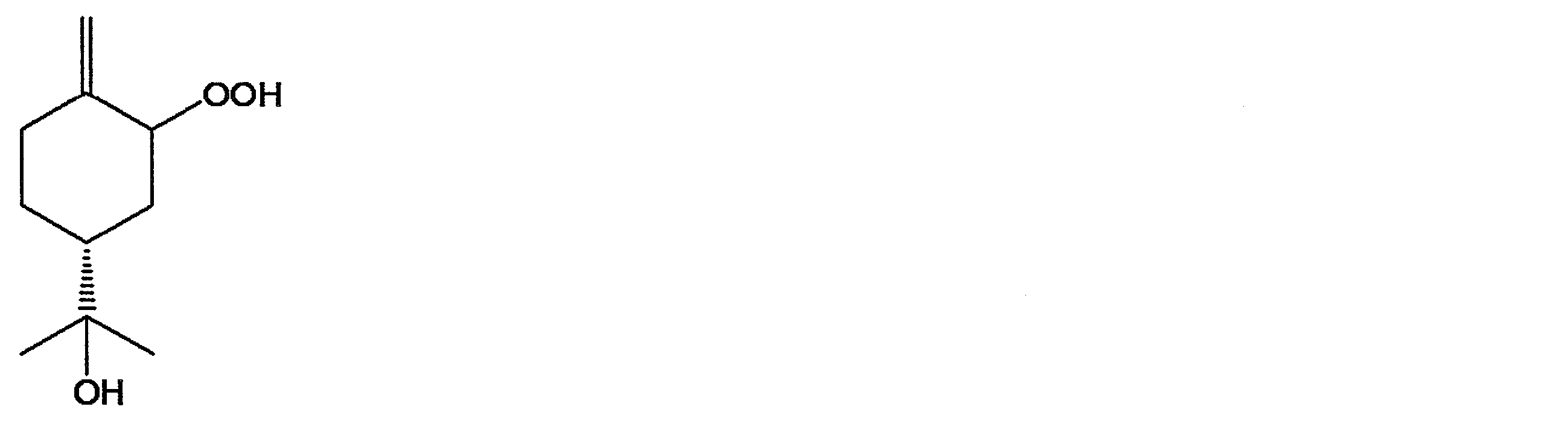
- a peroxide having the following structural formula can be obtained by peroxide formation of terpinen-4-ol, which is an allylic unsaturated compound (Tetrahedron Letters 45 (2004) 5433-5436).
- the hydroperoxide of terpinen-4-ol includes the following peroxide structure.
- oxygen oxidation using a base, metal salt, metal complex, etc. led to tosylhydrazine, and then peroxidized in the presence of sodium peroxide Peroxidation can be performed by a method of treating with hydrogen water, a method of oxidizing oxygen after being led to an organometallic compound such as a Grignard reagent or an organoboron compound, or a method of enzymatic oxidation, but is not limited thereto.
- terpene peroxide in the present invention examples include compounds of the following formulas.
- the Maillard reaction inhibitor which concerns on this embodiment can be added to products, such as a foodstuff, and it can be used for the purpose of suppression of quality degradation, such as browning. That is, the Maillard reaction inhibitor according to this embodiment is a brown inhibitor of food.
- the amount of the Maillard reaction inhibitor added to the food depends on the food component and is not particularly limited.
- the amount of the terpene peroxide as an active ingredient is generally in the range of 0.0001 to 5%, more preferably 0.001 to 0.1. It is desirable to design so that it may become the range of%.
- the Maillard reaction suppression method or the food quality degradation prevention method including adding the Maillard reaction inhibitor which concerns on this embodiment to a foodstuff is also one Embodiment of this invention.
- the Maillard reaction inhibitor according to the present embodiment can be used for the purpose of preventing or treating diabetes or diabetic complications (eg, neuropathy, retinopathy, atherosclerosis). That is, the Maillard reaction inhibitor according to this embodiment is a therapeutic or preventive agent for diabetes or diabetic complications.
- the dose of the Maillard reaction inhibitor can be determined depending on age, symptom level, etc., and is not particularly limited.
- a tablet or a liquid can be administered in a form acceptable as a preparation.
- the effect can be obtained by administering parenterally in the form of subcutaneous injection, nasal administration or the like, and there is no limitation on the intake and administration method.
- a method for treating or preventing diabetes or diabetic complications comprising administering to a subject an effective amount of the Maillard reaction inhibitor according to this embodiment is also an embodiment of the present invention.
- the use of the Maillard reaction inhibitor according to this embodiment in the manufacture of a medicament for the prevention or treatment of diabetes or diabetic complications is also an embodiment of the present invention.
- a peroxide of at least one terpene used for the prevention or treatment of diabetes or diabetic complications is also an embodiment of the present invention.
- the Maillard reaction inhibitor according to the present embodiment can also be used for the purpose of improving skin wrinkles and / or spots. That is, the Maillard reaction inhibitor according to this embodiment is a skin wrinkle and / or a stain improving agent. In that case, the Maillard reaction inhibitor according to the present embodiment can be used alone, skin cosmetics, skin external preparations, emulsions, creams, lotions, emulsions, creams, packs, It can also be used by blending in bathing agents, pharmaceuticals or lotions, emulsions, creams, packs, bathing agents and the like.
- the blending amount of the Maillard reaction inhibitor according to this embodiment is based on the total amount of skin cosmetics or external preparations, and the amount of peroxide of terpenes as active ingredients ranges from 0.01 to 10.0% by mass. It is preferable to design such that it is 0.05 to 5.0% by mass.
- the skin wrinkle and / or stain improving agent of the present invention can be appropriately mixed with a dye, a fragrance, a preservative, a surfactant, a pigment and the like within the range of achieving the object of the present invention.
- the method for skin aging prevention including administering to a subject the effective amount of the Maillard reaction inhibitor which concerns on this embodiment is also one Embodiment of this invention.
- a product package containing at least one terpene as an active ingredient together with instructions for use with light irradiation or oxidation for improving skin wrinkles and / or spots is also included in the present invention. It is an embodiment. As a result, it is possible to obtain a terpene peroxide having superior ⁇ -dicarbonyl compound cleavage activity by peroxidizing the terpene during use, and excellent Maillard reaction suppression by the obtained terpene peroxide. Since an effect is acquired, it is preferable.
- the ⁇ -dicarbonyl compound decomposing agent according to this embodiment is an ⁇ -dicarbonyl compound decomposing agent containing at least one terpene peroxide as an active ingredient.
- the peroxides of the terpenes have significantly superior ⁇ -dicarbonyl compound cleavage activity as compared with terpenes that are not peroxided. Therefore, since the ⁇ -dicarbonyl compound decomposing agent according to this embodiment contains a terpene peroxide, an excellent ⁇ -dicarbonyl compound decomposing effect as a whole can be obtained.
- the peroxide of at least one terpene used in the ⁇ -dicarbonyl compound decomposer according to this embodiment is basically the same as the peroxide of at least one terpene specifically described in Embodiment 1. It has a structure and an operation effect. Therefore, the description similar to that of the first embodiment is omitted as appropriate.
- the ⁇ -dicarbonyl compound decomposing agent can decompose ⁇ -dicarbonyl compounds that exist widely in the natural world such as living organisms, the environment, and food, as described in Embodiment 1, it is an intermediate in the Maillard reaction.
- the products 3-deoxyglucosone (3-DG), methylglyoxal (MG) and glyoxal (GO) can be decomposed to suppress the Maillard reaction.
- the Maillard reaction suppression method according to the present embodiment is a Maillard reaction suppression method characterized in that, in the Maillard reaction suppression method using at least one terpene, the terpene is peroxidized. According to such a method, by peroxide-generating terpenes, it is possible to obtain peroxides of terpenes having significantly superior ⁇ -dicarbonyl compound cleavage activity as compared with terpenes that are not peroxide-modified. The superior Maillard reaction inhibitory effect will be acquired with the peroxide of the obtained terpenes.
- the at least one terpene used in the Maillard reaction suppression method according to the present embodiment and the method for peroxideing the terpene basically include at least one terpene specifically described in the first embodiment, In addition, it has the same configuration and operation effects as the peroxide method. Therefore, the description similar to that of the first embodiment is omitted as appropriate.
- the method for peroxidizing the terpenes also includes using a Maillard reaction inhibitor containing at least one terpene in combination with light irradiation therapy. It is.
- the method of peroxidizing the terpenes includes a physical stimulation (externally applied to the skin) when a Maillard reaction inhibitor containing at least one terpene is applied to the skin. This includes using it while giving friction, massage, etc.). It goes without saying that the amount used and the conditions of use should be determined such that undesirable side effects do not occur or are minimal for the resulting therapeutic effect.
- Example 1 Preparation of hydroperoxides of terpenes 1.
- Preparation of terpinen-4-ol hydroperoxide The terpinen-4-ol hydroperoxide was prepared according to the method described in Tetrahedron 56 (2000) 6927-6943 and Tetrahedron Letters 45 (2004) 5433-5436.
- terpinen-4-ol is also referred to as T4
- terpinen-4-ol hydroperoxide is also referred to as T4-H.
- Example 2 ⁇ -dicarbonyl compound cleavage activity test of hydroperoxide
- hydroperoxide the activity of cleaving the carbon-carbon bond of the ⁇ -dicarbonyl compound, which is an intermediate in the AGE formation pathway, was measured.
- Example 2-1 As an evaluation method, terpinen-4-ol (T4) or terpinen-4-ol hydroperoxide (T4-H) was added to 1-phenyl-1,2-propanedione (PPD), which is an ⁇ -dicarbonyl compound.
- PPD 1-phenyl-1,2-propanedione
- the benzoic acid produced by cleavage was quantified by HPLC. Since 1-phenyl-1,2-propanedione is cleaved by auto-oxidation, the sample without any sample was used as a control.
- the composition of the reaction solution is shown in Table 1 below.
- 1-phenyl-1,2-propanedione was dissolved in 50% MeOH / 50 mM PB (pH 7.4) and adjusted to 100 mM.
- the terpinen-4-ol hydroperoxide was 12.8 mg dissolved in 100% MeOH.
- the final hydroperoxide concentrations of 1-phenyl-1,2-propanedione, terpinen-4-ol, and terpinen-4-ol are 10 mM, 150 mM, and 10 mM, respectively.
- the reaction solution having the above composition was prepared in a 300 ⁇ l PCR tube. The mixture was shaken with a thermomixer at 37 ° C. and 300 rpm. After completion of the reaction, 40 ⁇ l of 2M HCl was added to make acidic conditions. Thereafter, this solution was filtered through a 0.45 ⁇ m filter to obtain an HPLC measurement solution.
- the HPLC measurement conditions are as follows.
- Table 2 shows the results of the experiment performed by the above method.
- the cleavage rate was calculated according to the following formula because it can be assumed that 10 mM benzoic acid is produced when all 1-phenyl-1,2-propanedione is cleaved.
- Cutting rate (%) (Concentration of benzoic acid produced from each sample solution (mM) / 10 (mM)) x 100
- terpinen-4-ol had a cleavage rate of up to 24% even when using a concentration of 150 mM, whereas terpinen-4-ol hydroperoxide had a maximum of 79% despite a concentration of 10 mM.
- the cutting rate was shown. That is, terpinen-4-ol hydroperoxide exhibited about 50-fold cleavage activity as compared with terpinen-4-ol.
- Example 2-2 As an evaluation method, each sample solution was added to 1-phenyl-1,2-propanedione (PPD), which is an ⁇ -dicarbonyl compound, and benzoic acid produced by cleavage was quantified by HPLC. Terpenes and terpenes hydroperoxide were used as sample solutions. N-phenacyl thiazolium bromide (PTB) was used as a positive control. A sample to which no sample was added was used as a control. The terpenes and terpenes hydroperoxide were dissolved in methanol, and PTB and PPD were dissolved in methanol-phosphate buffer. A reaction solution having the composition shown in Table 3 was prepared in a 300 ⁇ l PCR tube and shaken with a thermomixer for 24 hours (37 ° C., 300 rpm).
- HPLC measurement conditions are as follows.
- the terpenes showed no cleavage activity, but the terpenes hydroperoxide showed a high cleavage activity of 68-81%.
- the terpenes hydroperoxide exceeded the 36% cleavage activity of the positive control PTB.
- Example 3 AGE formation inhibitory activity test
- An ⁇ -dicarbonyl compound that is an intermediate of the AGE formation pathway modifies lysine, arginine, tryptophan residues, and the like of proteins to contribute to AGE formation, and the formed AGE causes diabetes and diabetic complications.
- the inhibitory activity of AGE formation was measured.
- Ribonuclease A is an enzyme having 10 lysine residues and 4 arginine residues. It is considered that these residue parts are modified with methylglyoxal (MG) as an ⁇ -dicarbonyl compound, or the formation of AGEs between RNaseA molecules via MG reduces the enzyme activity. Since the catalytic residues of RNase A are histidine-12, histidine-119, and lysine-41, modification of lysine-41 with MG is thought to greatly affect enzyme activity.
- MG methylglyoxal
- Example 3-1 The evaluation method was as follows. To a reaction solution in which bovine ribonuclease A (RNase A) as a protein and methylglyoxal (MG) as an ⁇ -dicarbonyl compound were mixed, aminoguanidine (AG), terpinen-4-ol (T4), Terpinen-4-ol hydroperoxide (T4-H) or N-phenacylthiazolium bromide (PTB) was added and reacted. Thereafter, an enzyme activity test of RNase A was performed to evaluate whether the enzyme activity was retained. Terpenes and terpenes hydroperoxide were dissolved in ethanol, and AG was dissolved in water.
- RNase A bovine ribonuclease A
- MG methylglyoxal
- PTB N-phenacylthiazolium bromide
- the solution was diluted 200-fold with 5% glycerol, and an enzyme experiment was performed using tRNA as a substrate.
- PB and tRNA solutions were added to an Eppendorf tube and pre-incubated with a thermomixer at 37 ° C. for 10 minutes at 300 rpm. Thereafter, the diluted solution was added and incubated at 37 ° C. for 20 minutes at 300 rpm with a thermomixer.
- the enzyme reaction was stopped by adding 250 ⁇ l of Perchloric acid / lanthanum solution.
- the reaction solution was allowed to stand in a refrigerator, and then centrifuged at 13000 rpm for 10 minutes at 4 ° C. The absorbance of this reaction solution was measured at 260 nm. The results are shown in Table 7 below.
- Residual activity (%) (CB) / (AB) * 100
- terpinen-4-ol hydroperoxide (10 mM) retained higher enzyme activity than terpinen-4-ol (100 mM).
- the enzyme activity was more than twice as high as that of PTB (10 mM) and more than that of AG (10 mM) as a positive control.
- the final concentration is shown in parentheses.
- Example 3-2 The evaluation method was as follows. Each sample solution was added and reacted with a reaction solution in which RNase A as a protein and methylglyoxal (MG) as an ⁇ -dicarbonyl compound were mixed. Thereafter, an enzyme activity test of RNase A was performed to evaluate whether each sample solution protected the enzyme activity.
- As the sample solution terpenes, terpenes hydroperoxide, aminoguanidine (AG, positive control) and metformin which is an oral diabetes therapeutic drug were used. The terpenes and terpenes hydroperoxide were dissolved in ethanol, and AG and metformin were dissolved in water.
- the solution was diluted 200 times with a 5% aqueous glycerol solution, and an enzyme experiment was performed using tRNA as a substrate.
- PB and tRNA solutions were prepared in microtubes and pre-incubated for 10 minutes using a thermomixer (37 ° C., 300 ° rpm).
- the diluted reaction solution was added and incubated for 20 minutes using a thermomixer (37 ° C., 300 ° rpm). Thereafter, 250 ⁇ l of perchloric acid / lanthanum solution was added to stop the enzyme reaction.
- the reaction solution was centrifuged for 10 minutes (4 ° C, 13,000 rpm). The absorbance of this reaction solution was measured (260 nm) with a personal spectrum meter Gene Quantpro (GE Healthcare Biosciences). The results are shown in Table 11.
- Residual activity (%) (C -B) / (A-B) x 100
- Table 12 shows the results of the RNase A enzyme activity protection test.
- an excellent Maillard reaction suppression effect can be obtained.
- the Maillard reaction inhibitor of the present invention it is possible to prevent food quality deterioration, prevent or treat diabetes and diabetic complications, and prevent skin aging (improve skin wrinkles and / or spots).
Landscapes
- Health & Medical Sciences (AREA)
- Chemical & Material Sciences (AREA)
- Organic Chemistry (AREA)
- Public Health (AREA)
- Pharmacology & Pharmacy (AREA)
- Bioinformatics & Cheminformatics (AREA)
- Veterinary Medicine (AREA)
- Diabetes (AREA)
- General Health & Medical Sciences (AREA)
- Chemical Kinetics & Catalysis (AREA)
- General Chemical & Material Sciences (AREA)
- Medicinal Chemistry (AREA)
- Nuclear Medicine, Radiotherapy & Molecular Imaging (AREA)
- Animal Behavior & Ethology (AREA)
- Engineering & Computer Science (AREA)
- Life Sciences & Earth Sciences (AREA)
- Emergency Medicine (AREA)
- Endocrinology (AREA)
- Obesity (AREA)
- Hematology (AREA)
- Toxicology (AREA)
- Dermatology (AREA)
- Acyclic And Carbocyclic Compounds In Medicinal Compositions (AREA)
- General Preparation And Processing Of Foods (AREA)
- Coloring Foods And Improving Nutritive Qualities (AREA)
- Pharmaceuticals Containing Other Organic And Inorganic Compounds (AREA)
Abstract
本発明は、優れたメイラード反応抑制効果を発揮する新規なメイラード反応抑制剤及びその使用方法を提供することを目的とする。本発明は、少なくとも1つのテルペン類のペルオキシドを有効成分として含有するメイラード反応抑制剤を提供する。
Description
本発明は、メイラード反応抑制剤、α-ジカルボニル化合物分解剤、およびメイラード反応抑制方法に関する。
メイラード反応は、古くから食品などの褐変化反応として知られており、アミノ酸、タンパク質、ペプチド等のアミノ基と、還元糖などのカルボニル基が非酵素的に結合する反応であって、この反応は初期段階と後期段階とに分けられている(Drug Discovery Today, 11, 646-654 (2006))。
初期段階は、アミノ基とカルボニル基とが反応しシッフ塩基を形成することから始まり、1,2-エナミノールを経てケトアミンなどのアマドリ化合物を形成する反応である。また、後期段階は、前記のアマドリ化合物が脱水、転位、縮合、酸化的解裂など非可逆的反応を受け、非常に反応性に富みタンパク質の架橋形成を起こす3-デオキシグルコソンのようなα-ジカルボニル化合物を経て、最終的に褐色や蛍光などの物理化学的特徴を持つペントシジンなどの後期反応産物(AGE:advanced glycation end products)に変化する反応である。
これらの一連の反応により、食品の色、香り、物性などが劣化するため、メイラード反応を効果的に抑制することにより、食品の品質劣化を防止することができる。
一方、メイラード反応は生体内でも起こっており、特に糖尿病患者においては高血糖によるAGEの蓄積とタンパク質架橋形成物が生じ、神経障害、網膜症、アテローム性動脈硬化などの糖尿病合併症が引き起こされる(J. Neuropathol. Exp., 59, 1094-1105 (2000)、Diabetes, 24, 479-482 (2001)、Cardiovasc. Res., 63, 582-592 (2004)、及びNature, 414, 813-820 (2001))。また老化に伴い、同様な反応が進行し、皮膚のハリや弾力性の低下などの老化症状の原因になっていると云われている(J. Clin. Invest., 91, 2463-2469 (1993)、及びArchives of Biochemistry and Biophysics, 419, 89-96 (2003))。従って、メイラード反応の進行を阻害することは重要である。
AGEs形成経路の中間体としてα-ジカルボニル化合物が存在する。主に3-デオキシグルコソン(3-DG)、メチルグリオキサール(MG)などが生体内で生成する。これらのα-ジカルボニル化合物は、グルコースに比べ1万倍という高い反応性を有し、タンパク質のリシン、アルギニン、トリプトファン残基などを修飾してAGEs形成に寄与しているため重要である。糖尿病患者の血漿中では、これらのα-ジカルボニル化合物の存在量が増加しており、合併症発症に大きく関与していると考えられている。例えば、3-DGは細胞内外の酵素を修飾・失活あるいは酸化ストレスを介して機能障害を引き起こすことが考えられている。よって、AGEs形成経路の中間体として存在するα-ジカルボニル化合物の炭素-炭素間の結合を解裂し、AGEの蓄積及びタンパク質間の架橋形成を阻害する物質を開発することは、糖尿病や合併症の予防や治療に有用であるだけでなく、老化の防止においても重要である。
メイラード反応後期反応産物であるα-ジカルボニル化合物などの架橋形成物の分解除去を可能とする、AGE形成阻害剤としては、N-フェナシルチアゾリウムブロミド(PTB)(Nature, 382, 275-278 (1996))、4,5-ジメチルチアゾリウム誘導体(ALT-711)(Pro. Natl. Acd. Sci. U.S.A., 95, 4630-4634 (1998))などがある。推定されている反応機構によれば、いずれも生体内には存在しない断片がタンパク質に残ることになる。このタイプの薬は、一端認可されたものの、副作用が確認されたため現在使用されていない。
柑橘類の揮発性油状物やテルペン類は、α-ジカルボニル化合物切断活性を有し、メイラード反応抑制剤として有用であることが知られている(特許文献1)。これらテルペン類は、天然物由来の物質であるので、安全性に優れている。
Drug Discovery Today, 11, 646-654 (2006)
J. Neuropathol. Exp., 59, 1094-1105 (2000)
Diabetes, 24, 479-482 (2001)
Cardiovasc. Res., 63, 582-592 (2004)
Nature, 414, 813-820 (2001)
J. Clin. Invest., 91, 2463-2469 (1993)
Archives of Biochemistry and Biophysics, 419, 89-96 (2003)
Nature, 382, 275-278 (1996)
Pro. Natl. Acd. Sci. U.S.A., 95, 4630-4634 (1998)
しかしながら、かかるテルペン類の活性は弱く、十分な効果を再現性よく得ることができなかった。そこで、優れたジカルボニル化合物切断活性を有し、優れたメイラード反応抑制効果を発揮する化合物を特定することを試みた。
本発明者らは、単なるモノテルペンがジケトンを弱いながらも切断することに興味を持ち、その解裂機構を明らかにすべく鋭意研究した結果、かかるテルペン類のペルオキシドが格別に顕著なジカルボニル化合物切断活性を有し、優れたメイラード反応抑制効果を発揮することを見出し、本発明を完成した。
すなわち、本発明によれば、少なくとも1つのテルペン類のペルオキシドを有効成分として含有するメイラード反応抑制剤が提供される。かかるメイラード反応抑制剤によれば、ペルオキシド化していないテルペン類と比較して、顕著に優れたα-ジカルボニル化合物切断活性を有するテルペン類のペルオキシドを含有するので、メイラード反応を効果的にかつ再現性よく抑制することができ、優れたメイラード反応抑制効果が発揮される。また、出発物質が天然物由来であり副作用が生じにくいため、有利に使用することができる。
また、本発明によれば、少なくとも1つのテルペン類のペルオキシドを有効成分として含有するα-ジカルボニル化合物分解剤が提供される。かかるα-ジカルボニル化合物分解剤によれば、ペルオキシド化していないテルペン類と比較して、顕著に優れたα-ジカルボニル化合物切断活性を有するテルペン類のペルオキシドを含有するので、剤全体としても優れたα-ジカルボニル化合物分解効果が得られることになる。
さらに、本発明によれば、少なくとも1つのテルペン類を使用するメイラード反応抑制方法において、該テルペン類をペルオキシド化することを特徴とする、メイラード反応抑制方法が提供される。かかるメイラード反応抑制方法によれば、テルペン類をペルオキシド化することにより、ペルオキシド化していないテルペン類と比較してより優れたα-ジカルボニル化合物切断活性を有するテルペン類のペルオキシドを得ることができ、当該得られたテルペン類のペルオキシドによって優れたメイラード反応抑制効果が得られることになる。
本発明によれば、優れたメイラード反応抑制効果を得ることができる。
<発明の経緯>
これまで、テルペン類によるα-ジカルボニル化合物切断の作用機序は明らかではなかった。本発明者らは、テルペン類の酸素酸化が起こり、そのアリル位にペルオキシドが生成した後、そのペルオキシドがAGEs形成経路の中間体であるα-ジカルボニル化合物を攻撃し、Baeyer-Villigerタイプの反応、次いで加水分解という一連の反応が起こり、ジカルボニルが2つのカルボン酸へと分解するという作業仮説を立て、α-ジカルボニル化合物切断活性を有することが公知のテルペン類のペルオキシド化合物を合成し、ジカルボニルに対する切断反応をみたところ、驚くべきことに、極めて効率的に解裂反応が進行することを見出した。本発明によれば、テルペン類をペルオキシド化することにより、そのα-ジカルボニル化合物切断活性を容易に高めることができる。
これまで、テルペン類によるα-ジカルボニル化合物切断の作用機序は明らかではなかった。本発明者らは、テルペン類の酸素酸化が起こり、そのアリル位にペルオキシドが生成した後、そのペルオキシドがAGEs形成経路の中間体であるα-ジカルボニル化合物を攻撃し、Baeyer-Villigerタイプの反応、次いで加水分解という一連の反応が起こり、ジカルボニルが2つのカルボン酸へと分解するという作業仮説を立て、α-ジカルボニル化合物切断活性を有することが公知のテルペン類のペルオキシド化合物を合成し、ジカルボニルに対する切断反応をみたところ、驚くべきことに、極めて効率的に解裂反応が進行することを見出した。本発明によれば、テルペン類をペルオキシド化することにより、そのα-ジカルボニル化合物切断活性を容易に高めることができる。
本発明のテルペン類のペルオキシドは、ペルオキシド化していないテルペン類と比較して、顕著に優れたα-ジカルボニル化合物切断活性を有し、メイラード反応を効果的にかつ再現性よく抑制することができる。
メイラード反応抑制剤として公知のPTBやALT-711またはそれらの誘導体は、効果的にジケトンを解裂できるが、その解裂により生体内にあり得ない官能基がタンパク質又は小分子として残ることになり、原理的に副作用が生じやすい。一方、本発明のメイラード反応抑制剤は、天然物由来の物質を有効成分とするため、ジカルボニル化合物の解裂によって生成するタンパク質又は小分子は、生体内に普通に存在するカルボン酸であり、はるかに副作用が生じにくい。
<用語の説明>
本明細書及び請求の範囲において、各種用語の意味を以下のとおり定義する。
本明細書及び請求の範囲において、各種用語の意味を以下のとおり定義する。
(1)メイラード反応
「メイラード反応」とは、アミノ酸、タンパク質、ペプチド等のアミノ基と、還元糖などのカルボニル基が非酵素的に結合する反応である(Drug Discovery Today, 11, 646-654 (2006))。詳細には、この反応は初期段階と後期段階とを含み、初期段階は、アミノ基とカルボニル基とが反応しシッフ塩基を形成することから始まり、1,2-エナミノールを経てケトアミンなどのアマドリ化合物を形成する反応である。また、後期段階は、前記のアマドリ化合物が脱水、転位、縮合、酸化的解裂など非可逆的反応を受け、非常に反応性に富みタンパク質の架橋形成を起こす3-デオキシグルコソン(3-DG)のようなα-ジカルボニル化合物を経て、最終的に褐色や蛍光などの物理化学的特徴を持つペントシジンなどの後期反応産物(AGE:advanced glycation end products)に変化する反応である。
「メイラード反応」とは、アミノ酸、タンパク質、ペプチド等のアミノ基と、還元糖などのカルボニル基が非酵素的に結合する反応である(Drug Discovery Today, 11, 646-654 (2006))。詳細には、この反応は初期段階と後期段階とを含み、初期段階は、アミノ基とカルボニル基とが反応しシッフ塩基を形成することから始まり、1,2-エナミノールを経てケトアミンなどのアマドリ化合物を形成する反応である。また、後期段階は、前記のアマドリ化合物が脱水、転位、縮合、酸化的解裂など非可逆的反応を受け、非常に反応性に富みタンパク質の架橋形成を起こす3-デオキシグルコソン(3-DG)のようなα-ジカルボニル化合物を経て、最終的に褐色や蛍光などの物理化学的特徴を持つペントシジンなどの後期反応産物(AGE:advanced glycation end products)に変化する反応である。
(2)α-ジカルボニル化合物
本明細書で使用される場合、「α-ジカルボニル化合物」とは、その分子中にα-ジカルボニル部分(1,2-ジカルボニル基とも呼ぶ)を少なくとも1つ有する化合物をいう。特に、生体、環境、食品など自然界に広く存在するα-ジカルボニル化合物をいい、かかるα-ジカルボニル化合物の例としては、メイラード反応における中間生成物である3-デオキシグルコソン(3-DG)、メチルグリオキサール(MG)及びグリオキサール(GO)、ならびにメラニン合成における中間生成物であるドーパキノン(L-ドーパキノン)等が挙げられる。
本明細書で使用される場合、「α-ジカルボニル化合物」とは、その分子中にα-ジカルボニル部分(1,2-ジカルボニル基とも呼ぶ)を少なくとも1つ有する化合物をいう。特に、生体、環境、食品など自然界に広く存在するα-ジカルボニル化合物をいい、かかるα-ジカルボニル化合物の例としては、メイラード反応における中間生成物である3-デオキシグルコソン(3-DG)、メチルグリオキサール(MG)及びグリオキサール(GO)、ならびにメラニン合成における中間生成物であるドーパキノン(L-ドーパキノン)等が挙げられる。
(3)α-ジカルボニル化合物切断活性
本明細書で使用される場合、「α-ジカルボニル化合物切断活性を有する」とは、α-ジカルボニル化合物の炭素-炭素間の結合を解裂する活性を有することをいい、例えば、後述する実施例2のα-ジカルボニル化合物解裂活性試験条件下で、1-フェニル-1,2-プロパンジオンのジカルボニル基(-CO-CO-)に対する炭素間結合切断率が5%以上、好ましくは10%以上である場合をいう。「優れたα-ジカルボニル化合物切断活性を有する」とは、例えば、1-フェニル-1,2-プロパンジオンのオキサリル基(-CO-CO-)に対する炭素間結合切断率が30%以上、好ましくは50%以上、より好ましくは70%以上であることをいう。
本明細書で使用される場合、「α-ジカルボニル化合物切断活性を有する」とは、α-ジカルボニル化合物の炭素-炭素間の結合を解裂する活性を有することをいい、例えば、後述する実施例2のα-ジカルボニル化合物解裂活性試験条件下で、1-フェニル-1,2-プロパンジオンのジカルボニル基(-CO-CO-)に対する炭素間結合切断率が5%以上、好ましくは10%以上である場合をいう。「優れたα-ジカルボニル化合物切断活性を有する」とは、例えば、1-フェニル-1,2-プロパンジオンのオキサリル基(-CO-CO-)に対する炭素間結合切断率が30%以上、好ましくは50%以上、より好ましくは70%以上であることをいう。
(4)テルペン類
本明細書で使用される場合、「テルペン類」とは、イソプレンを構成単位とする炭化水素であり、イソプレン単位(C5)の数に応じて、それぞれモノテルペン(C10)、セスキテルペン(C15)、ジテルペン(C20)、セスタテルペン(C25)、トリテルペン(C30)、テトラテルペン(C40)と呼ぶ。本明細書中で使用される場合、テルペン類には、テルペンアルコール、テルペンエステル、及びこれらの塩が含まれる。
本明細書で使用される場合、「テルペン類」とは、イソプレンを構成単位とする炭化水素であり、イソプレン単位(C5)の数に応じて、それぞれモノテルペン(C10)、セスキテルペン(C15)、ジテルペン(C20)、セスタテルペン(C25)、トリテルペン(C30)、テトラテルペン(C40)と呼ぶ。本明細書中で使用される場合、テルペン類には、テルペンアルコール、テルペンエステル、及びこれらの塩が含まれる。
(5)ペルオキシド
「ペルオキシド」とは、広義では過酸化物の総称であり、狭義ではペルオキシ基(-O-O-)を有し、一般構造式がR-O-O-Rと表される有機過酸化物をいう。酸素上に水素が置換したR-O-O-Hの形の化合物をヒドロペルオキシドと呼ぶ。
「ペルオキシド」とは、広義では過酸化物の総称であり、狭義ではペルオキシ基(-O-O-)を有し、一般構造式がR-O-O-Rと表される有機過酸化物をいう。酸素上に水素が置換したR-O-O-Hの形の化合物をヒドロペルオキシドと呼ぶ。
以下、本発明の実施の形態について、詳細に説明する。なお、同様な内容については、繰り返しの煩雑を避けるために、適宜説明を省略する。
[実施形態1:メイラード反応抑制剤]
本実施形態に係るメイラード反応抑制剤は、少なくとも1つのテルペン類のペルオキシドを有効成分として含有するメイラード反応抑制剤である。ここで、テルペン類のペルオキシドは、ペルオキシド化していないテルペン類と比較して、顕著に優れたα-ジカルボニル化合物切断活性を有し、かつ、AGE形成阻害活性を有することが後述する実施例で実証されている。したがって、本実施形態に係るメイラード反応抑制剤は、当該ペルオキシドを含有するので、剤全体としても優れたメイラード反応抑制効果が得られることになる。
本実施形態に係るメイラード反応抑制剤は、少なくとも1つのテルペン類のペルオキシドを有効成分として含有するメイラード反応抑制剤である。ここで、テルペン類のペルオキシドは、ペルオキシド化していないテルペン類と比較して、顕著に優れたα-ジカルボニル化合物切断活性を有し、かつ、AGE形成阻害活性を有することが後述する実施例で実証されている。したがって、本実施形態に係るメイラード反応抑制剤は、当該ペルオキシドを含有するので、剤全体としても優れたメイラード反応抑制効果が得られることになる。
(テルペン類)
本発明のメイラード反応抑制剤の出発原料となるテルペン類としては、いずれのテルペン類を使用することができるが、好ましくは、α-ジカルボニル化合物切断活性を有するいずれのテルペン類を使用することができる。かかるα-ジカルボニル化合物切断活性を有するテルペン類は、特開2004-35424号公報に記載されており、特開2004-35424号公報の内容は本明細書中に参照として援用される。
本発明のメイラード反応抑制剤の出発原料となるテルペン類としては、いずれのテルペン類を使用することができるが、好ましくは、α-ジカルボニル化合物切断活性を有するいずれのテルペン類を使用することができる。かかるα-ジカルボニル化合物切断活性を有するテルペン類は、特開2004-35424号公報に記載されており、特開2004-35424号公報の内容は本明細書中に参照として援用される。
かかるテルペン類は、柑橘類、ティーツリー、ジュニパー又はスイートマジョラムを非極性有機溶媒抽出又は水蒸気蒸留することによって得ることができる。柑橘類を使用する場合、本発明のテルペン類は、例えば柑橘類の破砕物、搾汁液、搾汁残渣を非極性有機溶媒抽出又は水蒸気蒸留することによって得ることができる。ティーツリーを使用する場合、本発明のテルペン類は、新鮮な葉もしくは小枝の先端部分又はその破砕物を非極性有機溶媒抽出又は水蒸気蒸留することによって得ることができる。ジュニパーを使用する場合、本発明のテルペン類は、果実又はその破砕物を非極性有機溶媒抽出又は水蒸気蒸留することによって得ることができる。スイートマジョラムを使用する場合、本発明のテルペン類は、葉又はその破砕物を非極性有機溶媒抽出又は水蒸気蒸留することによって得ることができる。
柑橘類としては、例えば、ユズ、ハッサク、ナツミカン、オレンジ、レモン、ミカンなどが挙げられ、ユズがより好ましい。
非極性有機溶媒抽出の場合に用いる抽出溶媒としては、エチルエーテル、n-ヘキサン、シクロヘキサン、n-ペンタンなどの非極性有機溶媒の1種、又は2種以上の混合物が挙げられる。溶媒の使用量は特に制限はないが、一般に柑橘類の破砕物、搾汁液、搾汁残渣100質量部に対して、1~1000質量部程度である。抽出条件は、室温程度で10~300分間程度であるが、これに限定されるものではない。柑橘類の破砕物、搾汁液、搾汁残渣に所定量の非極性有機溶媒を加え、還流して抽出し、得られた抽出液から溶媒を留去することにより、非極性有機溶媒抽出による柑橘類のテルペン類が得られる。
また、水蒸気蒸留による場合、公知の水蒸気蒸留装置を用いて原料植物を水蒸気蒸留し、得られた水蒸気蒸留液を遠心分離し、上層を回収することにより、水蒸気蒸留によるテルペン類が得られる。柑橘類の破砕物、搾汁液、搾汁残渣を水蒸気蒸留に供することができる。
このようにして得られるテルペン類について、更に各種有機溶媒による分画や、シリカゲルによるクロマト分画などによって精製をした後に、溶媒を除去して用いることができる。また、かかるテルペン類は、必要に応じて化学合成物を利用することもできる。
本発明のテルペン類としては、市販品のエッセンシャルオイル、アロマオイル、ユズ湯、レモンパックなどに含まれるものも挙げられる。
かかるテルペン類は、好ましくは、モノテルペン類、セスキテルペン類、モノテルペンアルコール類及びモノテルペンエステル類(特に、モノテルペンアセテート類)からなる群より選択される1種以上を少なくとも含有する。
モノテルペン類としては、様々なものがあるが、例えば、オシメン、d-リモネン、α-テルピネン、カレン、カンフェン、或いはこれらの2種以上の混合物が挙げられる。
セスキテルペン類としては、様々なものがあるが、例えば、β-ファルネセン、β-ビサボレン、或いはこれらの混合物が挙げられる。
モノテルペンアルコール類としては、様々なものがあるが、例えば、テルピネン-4-オール、α-テルピネオール、トランス-カルベノール、ボルネオール、或いはこれらの2種以上の混合物が挙げられる。そのペルオキシドが固体であり比較的安定である点から、テルピネン-4-オールが好ましい。
また、必要に応じて、これらの化学合成物を利用することもできる。
オシメン、d-リモネン、α-テルピネン、カレン、カンフェン、β-ファルネセン、β-ビサボレン、テルピネン-4-オール、α-テルピネオール、トランス-カルベノール、ボルネオールは、α-ジカルボニル化合物切断活性を有することが、特開2004-35424号公報に記載されている。よって、これらテルペン類を使用することが好ましい。
(テルペン類のペルオキシド)
本発明の少なくとも1つのテルペン類のペルオキシド(本明細書中において、単に「テルペン類のペルオキシド」とも呼ぶ)は、かかるテルペン類を当該分野で公知のペルオキシド化方法によりペルオキシド化することにより、容易に得ることができる。
本発明の少なくとも1つのテルペン類のペルオキシド(本明細書中において、単に「テルペン類のペルオキシド」とも呼ぶ)は、かかるテルペン類を当該分野で公知のペルオキシド化方法によりペルオキシド化することにより、容易に得ることができる。
(ペルオキシド化)
ペルオキシド化方法としては、特に限定されないが、例えば、光増感法(あるいは化学的方法、マイクロ波放電など)による一重項酸素酸化;光照射、熱、AIBNなどを用いたによるラジカル的酸素酸化;塩基触媒を用いた炭素アニオンを経る酸素酸化;塩基や金属塩や金属錯体などを用いた酸素酸化による方法;トシルヒドラジンに導いた後、ナトリウムペルオキシドの存在下過酸化水素水で処理する方法;グリニャール試薬や有機ホウ素化合物などの有機金属化合物に導いた後に酸素酸化を行う方法;酵素酸化による方法などが挙げられる。
ペルオキシド化方法としては、特に限定されないが、例えば、光増感法(あるいは化学的方法、マイクロ波放電など)による一重項酸素酸化;光照射、熱、AIBNなどを用いたによるラジカル的酸素酸化;塩基触媒を用いた炭素アニオンを経る酸素酸化;塩基や金属塩や金属錯体などを用いた酸素酸化による方法;トシルヒドラジンに導いた後、ナトリウムペルオキシドの存在下過酸化水素水で処理する方法;グリニャール試薬や有機ホウ素化合物などの有機金属化合物に導いた後に酸素酸化を行う方法;酵素酸化による方法などが挙げられる。
本明細書で使用される場合、「光照射」とは、反応系に光を照射することをいう。光を照射することにより、酸素の存在下、光酸素酸化反応を行うことができる。光は、可視光線~紫外線であることが好ましく、可視光線であることが更に好ましい。具体的には、人工灯、高輝度放電ランプ、太陽光を利用することができる。照射時間は特に制限はないが、高輝度放電ランプを使用する場合、10分~72時間であることが好ましく、15分~48時間であることが更に好ましく、15分~10時間であることが特に好ましい。照射時間が上記の範囲内にあると、効率よくペルオキシドが製造される。照射温度は、通常0~50℃であり、好ましくは室温である。
本明細書で使用される場合、「酸化」とは、対象化合物と酸素とを接触させて酸化すること、及び酸素の存在下で光を照射して光酸素酸化することをいう。酸素と接触させる反応は、光増感触媒下で行ってもよく、使用される触媒としては、チオニン/NaY ゼオライトが挙げられるが、これらに限定されない。または、対象化合物を振盪又は撹拌して酸素と接触させる方法、バブリングすることにより酸素と接触させる方法、テルペン類を皮膚に外用する際に物理的刺激(摩擦、マッサージなど)を与えて酸素と接触させる方法などで酸化を行ってもよい。酸素とは、空気中の酸素を含む。接触時間としては特に制限はないが、通常、10分~72時間であることが好ましく、15分~48時間であることが更に好ましく、15分~10時間であることが特に好ましい。反応温度は、合成的には-78℃~100℃、通常0~50℃であり、好ましくは室温である。酸素の存在下で光を照射して光酸素酸化することとは、上記「光照射」と同義である。
例えば、テルピネン-4-オールのヒドロペルオキシドは、Tetrahedron 56 (2000) 6927-6943並びにTetrahedron Letters 45 (2004) 5433-5436に記載の方法にしたがって調製することができる。
テルペン類がアリル型不飽和化合物やベンジル型化合物である場合は、上記のような光増感法(又は化学的方法、マイクロ波放電など)を用いた一重項酸素酸化;光照射、熱、AIBNなどを用いたラジカル条件による酸素酸化;または塩基触媒を用いた炭素アニオンを経る酸素酸化により、そのペルオキシドを容易に得ることができるので好ましい。
例えば、アリル型不飽和化合物であるテルピネン-4-オールをペルオキシド化することにより、以下の構造式のペルオキシドを得ることができる(Tetrahedron Letters 45 (2004) 5433-5436)。本発明において、テルピネン-4-オールのヒドロペルオキシドとは、下記ペルオキシド構造を包含する。

テルペン類がアリル型不飽和化合物やベンジル型化合物ではない場合であっても、塩基や金属塩や金属錯体などを用いた酸素酸化による方法、トシルヒドラジンに導いた後、ナトリウムペルオキシドの存在下過酸化水素水で処理する方法、グリニャール試薬や有機ホウ素化合物などの有機金属化合物に導いた後に酸素酸化を行う方法、酵素酸化による方法でペルオキシド化を行うことができるが、これらに限定されない。
本発明におけるテルペン類のペルオキシドとしては、例えば、以下の式の化合物が挙げられる。
(1)下記式:

で表されるテルピネン-4-オールのヒドロペルオキシド。
(1)下記式:
(2)下記式:

で表される、α-テルピネオールのヒドロペルオキシド。
(3)下記式:
で表される、α-テルピネオールのヒドロペルオキシド。
(4)下記式:

で表される、α-テルピニルアセテートのヒドロペルオキシド。
(ペルオキシドによるα-ジカルボニル化合物解裂の作用機序)
本発明のペルオキシドによるα-ジカルボニル化合物解裂の作用機序としては、以下が推測され、そして確認された。テルピネン-4-オールによるα-ジカルボニル化合物の解裂機構は、酸化反応で生成したテルピネン-4-オールのヒドロペルオキシドによる求核攻撃、Baeyer-Villiger-like rearrangement、酸無水物の加水分解を経て起こる。この作用機序によれば、ペルオキシド基が導入される位置に関係なく、解裂反応が効果的に進むと考えられる。
(スキーム1)

本発明のペルオキシドによるα-ジカルボニル化合物解裂の作用機序としては、以下が推測され、そして確認された。テルピネン-4-オールによるα-ジカルボニル化合物の解裂機構は、酸化反応で生成したテルピネン-4-オールのヒドロペルオキシドによる求核攻撃、Baeyer-Villiger-like rearrangement、酸無水物の加水分解を経て起こる。この作用機序によれば、ペルオキシド基が導入される位置に関係なく、解裂反応が効果的に進むと考えられる。
(スキーム1)
(メイラード反応抑制剤の使用の態様)
本実施形態に係るメイラード反応抑制剤を食品等の製品に添加して、褐変などの品質劣化の抑制を目的として使用することができる。すなわち、本実施形態に係るメイラード反応抑制剤は、食品の褐色抑制剤である。その場合のメイラード反応抑制剤の食品への添加量は、食品成分によって依存し、特に限定されない。一つの目安としては、例えば、ドレッシングで効果を発揮させるためには、有効成分であるテルペン類のペルオキシドの量を、一般に0.0001~5%の範囲、更に望ましくは0.001~0.1%の範囲となるように設計することが望ましい。また、本実施形態に係るメイラード反応抑制剤を食品に添加することを含む、メイラード反応抑制方法又は食品の品質劣化防止方法もまた、本発明の一実施形態である。
本実施形態に係るメイラード反応抑制剤を食品等の製品に添加して、褐変などの品質劣化の抑制を目的として使用することができる。すなわち、本実施形態に係るメイラード反応抑制剤は、食品の褐色抑制剤である。その場合のメイラード反応抑制剤の食品への添加量は、食品成分によって依存し、特に限定されない。一つの目安としては、例えば、ドレッシングで効果を発揮させるためには、有効成分であるテルペン類のペルオキシドの量を、一般に0.0001~5%の範囲、更に望ましくは0.001~0.1%の範囲となるように設計することが望ましい。また、本実施形態に係るメイラード反応抑制剤を食品に添加することを含む、メイラード反応抑制方法又は食品の品質劣化防止方法もまた、本発明の一実施形態である。
また、本実施形態に係るメイラード反応抑制剤を糖尿病又は糖尿病の合併症(例えば、神経障害、網膜症、アテローム性動脈硬化)の予防、治療を目的として使用することができる。すなわち、本実施形態に係るメイラード反応抑制剤は、糖尿病又は糖尿病合併症の治療剤又は予防剤である。その場合、メイラード反応抑制剤の投与量は、年齢、症状程度などに依存して決定することができ、特に限定されない。なお、摂取形態としては、錠剤でも液剤でも、製剤として許容され得る形態で投与することができる。さらに、非経口的に皮下注射、経鼻投与などの形態で投与することでも効果が得られ、摂取、投与方法に限定はない。また、本実施形態に係るメイラード反応抑制剤の有効量を被検体に投与することを含む、糖尿病又は糖尿病合併症の治療又は予防方法も、本発明の一実施形態である。また、糖尿病又は糖尿病合併症の予防又は治療のための医薬の製造における、本実施形態に係るメイラード反応抑制剤の使用も、本発明の一実施形態である。また、糖尿病又は糖尿病合併症の予防又は治療のために使用される、少なくとも1つのテルペン類のペルオキシドも、本発明の一実施形態である。
本実施形態に係るメイラード反応抑制剤を、皮膚のシワ及び/又はシミ改善を目的として用いることもできる。すなわち、本実施形態に係るメイラード反応抑制剤は、皮膚のシワ及び/又はシミ改善剤である。その場合、本実施形態に係るメイラード反応抑制剤を単独で用いることもできるし、皮膚化粧料、皮膚外用剤、乳剤、クリーム類、ロ-ション類、乳液類、クリ-ム類、パック類、入浴剤、医薬品又はロ-ション類、乳液類、クリ-ム類、パック類、入浴剤などに配合して用いることもできる。本実施形態に係るメイラード反応抑制剤の配合量は、皮膚化粧料又は外用剤の総量を基準として、有効成分であるテルペン類のペルオキシドの量を、0.01~10.0質量%の範囲となるように設計することが好ましく、より好ましくは、0.05~5.0質量%である。なお、本発明の皮膚のシワ及び/又はシミ改善剤には、色素、香料、防腐剤、界面活性剤、顔料等を本発明の目的を達成する範囲内で適宜配合することができる。また、本実施形態に係るメイラード反応抑制剤の有効量を被検体に投与することを含む、皮膚老化防止のための方法も、本発明の一実施形態である。また、少なくとも1つのテルペン類を有効成分として含み、皮膚のシワ及び/又はシミ改善のために光照射又は酸化しながら使用するための指示書をともに含む、商品包装物もまた、本発明の一実施形態である。これにより、使用中テルペン類をペルオキシド化することにより、より優れたα-ジカルボニル化合物切断活性を有するテルペン類のペルオキシドを得ることができ、当該得られたテルペン類のペルオキシドによって優れたメイラード反応抑制効果が得られることになるので好ましい。
[実施形態2:α-ジカルボニル化合物分解剤]
本実施形態に係るα-ジカルボニル化合物分解剤は、少なくとも1つのテルペン類のペルオキシドを有効成分として含有するα-ジカルボニル化合物分解剤である。ここで、当該テルペン類のペルオキシドは、ペルオキシド化していないテルペン類と比較して、顕著に優れたα-ジカルボニル化合物切断活性を有することが後述する実施例で実証されている。したがって、本実施形態に係るα-ジカルボニル化合物分解剤は、テルペン類のペルオキシドを含有するので、剤全体としても優れたα-ジカルボニル化合物分解効果が得られることになる。
本実施形態に係るα-ジカルボニル化合物分解剤は、少なくとも1つのテルペン類のペルオキシドを有効成分として含有するα-ジカルボニル化合物分解剤である。ここで、当該テルペン類のペルオキシドは、ペルオキシド化していないテルペン類と比較して、顕著に優れたα-ジカルボニル化合物切断活性を有することが後述する実施例で実証されている。したがって、本実施形態に係るα-ジカルボニル化合物分解剤は、テルペン類のペルオキシドを含有するので、剤全体としても優れたα-ジカルボニル化合物分解効果が得られることになる。
本実施形態に係るα-ジカルボニル化合物分解剤に使用される少なくとも1つのテルペン類のペルオキシドは、基本的には、実施形態1において具体的に説明された少なくとも1つのテルペン類のペルオキシドと同様の構成及び作用効果を有する。よって、実施形態1と同様の内容については、適宜説明を省略する。
本実施形態に係るα-ジカルボニル化合物分解剤は、生体、環境、食品など自然界に広く存在するα-ジカルボニル化合物を分解することができるので、実施形態1で記載のとおり、メイラード反応における中間生成物である3-デオキシグルコソン(3-DG)、メチルグリオキサール(MG)及びグリオキサール(GO)を分解してメイラード反応を抑制することができる。また、メラニン合成における中間生成物であるドーパキノン(L-ドーパキノン)を分解して皮膚におけるメラニン合成を抑制することができる。
[実施形態3:メイラード反応抑制方法]
本実施形態に係るメイラード反応抑制方法は、少なくとも1つのテルペン類を使用するメイラード反応抑制方法において、該テルペン類をペルオキシド化することを特徴とする、メイラード反応抑制方法である。かかる方法によれば、テルペン類をペルオキシド化することにより、ペルオキシド化していないテルペン類と比較して、顕著に優れたα-ジカルボニル化合物切断活性を有するテルペン類のペルオキシドを得ることができ、当該得られたテルペン類のペルオキシドによって優れたメイラード反応抑制効果が得られることになる。
本実施形態に係るメイラード反応抑制方法は、少なくとも1つのテルペン類を使用するメイラード反応抑制方法において、該テルペン類をペルオキシド化することを特徴とする、メイラード反応抑制方法である。かかる方法によれば、テルペン類をペルオキシド化することにより、ペルオキシド化していないテルペン類と比較して、顕著に優れたα-ジカルボニル化合物切断活性を有するテルペン類のペルオキシドを得ることができ、当該得られたテルペン類のペルオキシドによって優れたメイラード反応抑制効果が得られることになる。
本実施形態に係るメイラード反応抑制方法に使用される少なくとも1つのテルペン類、及び該テルペン類をペルオキシド化する方法は、基本的には、実施形態1において具体的に説明した少なくとも1つのテルペン類、及びペルオキシド化方法と同様の構成及び作用効果を有する。よって、実施形態1と同様の内容については、適宜説明を省略する。
本実施形態に係るメイラード反応抑制方法では、該テルペン類をペルオキシド化する方法には、少なくとも1つのテルペン類を含有してなるメイラード反応抑制剤を、光照射療法と併用して使用することも含まれる。また、本実施形態に係るメイラード反応抑制方法では、該テルペン類をペルオキシド化する方法には、少なくとも1つのテルペン類を含有してなるメイラード反応抑制剤を、皮膚に外用する際に物理的刺激(摩擦、マッサージなど)を与えながら使用することも含まれる。使用する量および使用条件は得られる治療効果に対して望ましくない副作用が起こらないか最小になるよう決定されるべきであることは云うまでもない。
以下、本発明について実施例を挙げて具体的に説明するが、本発明はこれらの実施例に限定されるものではない。
[実施例1:テルペン類のヒドロペルオキシドの調製]
1.テルピネン-4-オールのヒドロペルオキシドの調製
Tetrahedron 56 (2000) 6927-6943並びにTetrahedron Letters 45 (2004) 5433-5436に記載の方法にしたがってテルピネン-4-オールのヒドロペルオキシドを調製した。以下、テルピネン-4-オールをT4と、テルピネン-4-オールのヒドロペルオキシドをT4-Hとも呼ぶ。
1.テルピネン-4-オールのヒドロペルオキシドの調製
Tetrahedron 56 (2000) 6927-6943並びにTetrahedron Letters 45 (2004) 5433-5436に記載の方法にしたがってテルピネン-4-オールのヒドロペルオキシドを調製した。以下、テルピネン-4-オールをT4と、テルピネン-4-オールのヒドロペルオキシドをT4-Hとも呼ぶ。
(チオニン担持 Na-Y ゼオライトの調製)
2.5mgのチオニンアセテートを脱イオン水333mlに加えた。その溶液に5.0gのNa-Y ゼオライトを加え、3時間撹拌した。その後、桐山ロートでろ過し、チオニン担持 Na-Y ゼオライトをオーブン乾燥した。使用する前に1~2時間、サンプルオーブン(120℃)に入れ真空ポンプで乾燥した。
2.5mgのチオニンアセテートを脱イオン水333mlに加えた。その溶液に5.0gのNa-Y ゼオライトを加え、3時間撹拌した。その後、桐山ロートでろ過し、チオニン担持 Na-Y ゼオライトをオーブン乾燥した。使用する前に1~2時間、サンプルオーブン(120℃)に入れ真空ポンプで乾燥した。
(チオニン担持 Na-Y ゼオライトによる光酸化反応)
3.0gのチオニン担持 Na-Y ゼオライトを乾燥させた二口ナスフラスコに入れ、サンプルオーブン(120℃)にて1時間半乾燥した。その後アルゴン置換し、セプタム、三方コックで密閉した。蒸留したヘキサンを30ml、ピリジンを30μl加え5時間半撹拌した。その後テルピネン-4-オールを30μl加え、0℃にて酸素を導入しながら光を照射し(ウシオ高圧UVランプ 型式UM-102)、50分間反応させた。
3.0gのチオニン担持 Na-Y ゼオライトを乾燥させた二口ナスフラスコに入れ、サンプルオーブン(120℃)にて1時間半乾燥した。その後アルゴン置換し、セプタム、三方コックで密閉した。蒸留したヘキサンを30ml、ピリジンを30μl加え5時間半撹拌した。その後テルピネン-4-オールを30μl加え、0℃にて酸素を導入しながら光を照射し(ウシオ高圧UVランプ 型式UM-102)、50分間反応させた。
(ヒドロペルオキシドの単離・精製)
反応終了後、反応溶液にアセトニトリルを加え撹拌し、10~15時間抽出した。その後桐山ロートでろ過しゼオライトを除去し、ろ過溶液をエバポレーターにて濃縮した。濃縮後の液体をフラッシュクロマトグラフィー(クロロホルム:ジエチルエーテル=4:1)にて主ピークを示したRf値0.2付近の化合物を単離した。収率43%にて下記構造式のヒドロペルオキシドを白色固体として得た(1H及び13C NMR)。

反応終了後、反応溶液にアセトニトリルを加え撹拌し、10~15時間抽出した。その後桐山ロートでろ過しゼオライトを除去し、ろ過溶液をエバポレーターにて濃縮した。濃縮後の液体をフラッシュクロマトグラフィー(クロロホルム:ジエチルエーテル=4:1)にて主ピークを示したRf値0.2付近の化合物を単離した。収率43%にて下記構造式のヒドロペルオキシドを白色固体として得た(1H及び13C NMR)。
2.α-テルピネオールのヒドロペルオキシドの調製

(チオニン担持Na-Yゼオライトによる光酸化反応)
チオニン担持 Na-Y ゼオライト 3.0 gを二口フラスコに入れ、120 ℃のサンプルオーブンにて1.5時間真空乾燥した。乾燥後アルゴン置換し、密栓した。蒸留したヘキサン30 ml、ピリジン30 μlを加え、室温にて5時間撹拌した。α-テルピネオール36.7 mg (ヘキサン溶液)を加え、O2を吹き込みながら光分解した(0 ℃, 1時間)。
チオニン担持 Na-Y ゼオライト 3.0 gを二口フラスコに入れ、120 ℃のサンプルオーブンにて1.5時間真空乾燥した。乾燥後アルゴン置換し、密栓した。蒸留したヘキサン30 ml、ピリジン30 μlを加え、室温にて5時間撹拌した。α-テルピネオール36.7 mg (ヘキサン溶液)を加え、O2を吹き込みながら光分解した(0 ℃, 1時間)。
(ヒドロペルオキシドの単離・精製)
反応終了後、アセトニトリル50 mlを加え、12時間以上撹拌し抽出した。その後、セライト濾過し減圧濃縮後、シリカゲルフラッシュカラムクロマトグラフィー(クロロホルム:ジエチルエーテル = 3:1)によってRf = 0.17の画分を回収、減圧濃縮し、α-テルピネオールヒドロペルオキシドジアステレオマー混合物(17.3 mg、収率39%, a : b = 2.9 : 1)を白色固体として得た。以下、α-テルピネオールをT-olと、α-テルピネオールヒドロペルオキシドジアステレオマー混合物をT-ol-Hとも呼ぶ。
反応終了後、アセトニトリル50 mlを加え、12時間以上撹拌し抽出した。その後、セライト濾過し減圧濃縮後、シリカゲルフラッシュカラムクロマトグラフィー(クロロホルム:ジエチルエーテル = 3:1)によってRf = 0.17の画分を回収、減圧濃縮し、α-テルピネオールヒドロペルオキシドジアステレオマー混合物(17.3 mg、収率39%, a : b = 2.9 : 1)を白色固体として得た。以下、α-テルピネオールをT-olと、α-テルピネオールヒドロペルオキシドジアステレオマー混合物をT-ol-Hとも呼ぶ。

3.α-テルピニルアセテートのヒドロペルオキシドの調製

(チオニン担持Na-Yゼオライトによる光酸化反応)
チオニン担持 Na-Y ゼオライト 3.0 gを二口フラスコに入れ、120 ℃のサンプルオーブンにて1.5時間真空乾燥した。乾燥後アルゴン置換し、密栓した。蒸留したヘキサン30 ml、ピリジン30 mlを加え、室温にて5時間撹拌した。α-テルピニルアセテート30.7 mgを加え、O2を吹き込みながら光分解した(0 ℃, 1時間)。
チオニン担持 Na-Y ゼオライト 3.0 gを二口フラスコに入れ、120 ℃のサンプルオーブンにて1.5時間真空乾燥した。乾燥後アルゴン置換し、密栓した。蒸留したヘキサン30 ml、ピリジン30 mlを加え、室温にて5時間撹拌した。α-テルピニルアセテート30.7 mgを加え、O2を吹き込みながら光分解した(0 ℃, 1時間)。
(ヒドロペルオキシドの単離・精製)
反応終了後、アセトニトリル50 mlを加え、12時間以上撹拌し抽出した。その後、セライト濾過し減圧濃縮後、シリカゲルフラッシュカラムクロマトグラフィー(クロロホルム:ジエチルエーテル = 16:1)によってRf = 0.30の画分を回収、減圧濃縮しα-テルピニルアセテートヒドロペルオキシド(17.1 mg、収率48%)を白色固体として得た。以下、α-テルピニルアセテートをT-aceと、α-テルピニルアセテートヒドロペルオキシドをT-ace-Hとも呼ぶ。
反応終了後、アセトニトリル50 mlを加え、12時間以上撹拌し抽出した。その後、セライト濾過し減圧濃縮後、シリカゲルフラッシュカラムクロマトグラフィー(クロロホルム:ジエチルエーテル = 16:1)によってRf = 0.30の画分を回収、減圧濃縮しα-テルピニルアセテートヒドロペルオキシド(17.1 mg、収率48%)を白色固体として得た。以下、α-テルピニルアセテートをT-aceと、α-テルピニルアセテートヒドロペルオキシドをT-ace-Hとも呼ぶ。

[実施例2:ヒドロペルオキシドのα-ジカルボニル化合物解裂活性試験]
ヒドロペルオキシドについて、AGEs形成経路の中間体であるα-ジカルボニル化合物の炭素-炭素間の結合を解裂する活性を測定した。
ヒドロペルオキシドについて、AGEs形成経路の中間体であるα-ジカルボニル化合物の炭素-炭素間の結合を解裂する活性を測定した。
(実施例2-1)
評価方法として、α-ジカルボニル化合物である1-フェニル-1,2-プロパンジオン(PPD)に、テルピネン-4-オール(T4)もしくはテルピネン-4-オールのヒドロペルオキシド(T4-H)を加え、解裂して生成する安息香酸をHPLCで定量した。1-フェニル-1,2-プロパンジオンは自動酸化により解裂するので、試料を加えないものをコントロールとした。反応溶液の組成を、以下の表1に示す。
評価方法として、α-ジカルボニル化合物である1-フェニル-1,2-プロパンジオン(PPD)に、テルピネン-4-オール(T4)もしくはテルピネン-4-オールのヒドロペルオキシド(T4-H)を加え、解裂して生成する安息香酸をHPLCで定量した。1-フェニル-1,2-プロパンジオンは自動酸化により解裂するので、試料を加えないものをコントロールとした。反応溶液の組成を、以下の表1に示す。
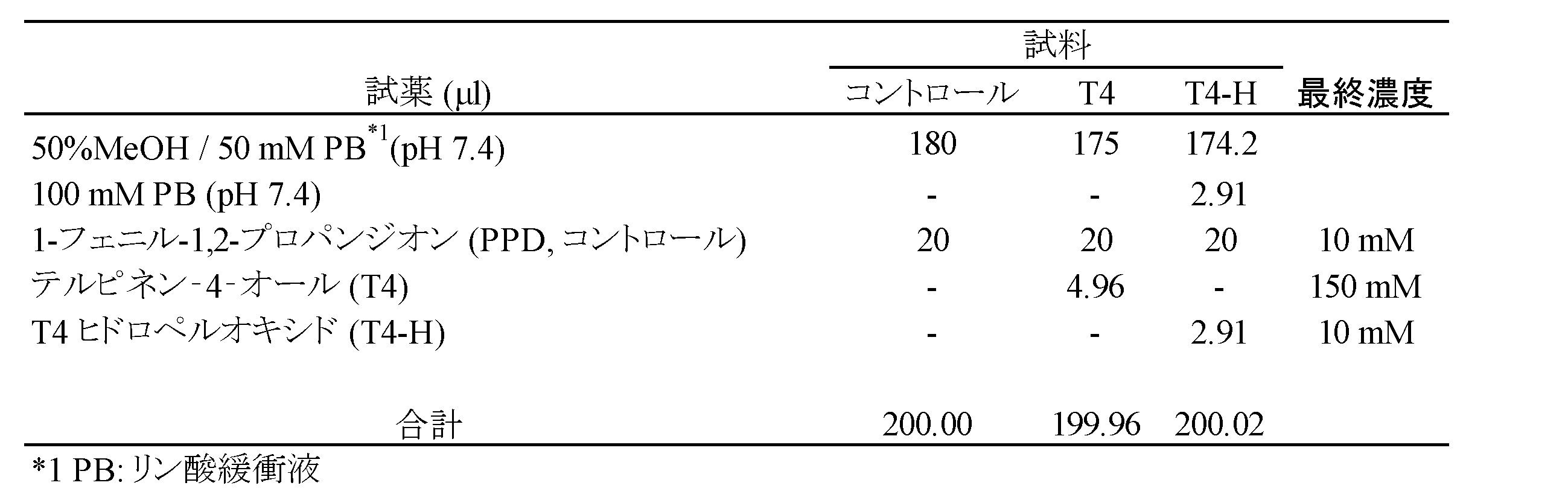
1-フェニル-1,2-プロパンジオンは50%MeOH / 50mM PB(pH 7.4)に溶かし、100mMに調製したものを用いた。またテルピネン-4-オールのヒドロペルオキシドは100% MeOHに12.8mg溶かしたものを用いた。1-フェニル-1,2-プロパンジオン、テルピネン-4-オール、テルピネン-4-オールのヒドロペルオキシドの最終濃度はそれぞれ10 mM、150 mM、10 mMである。
上記の組成の反応溶液を300μlのPCRチューブに調製した。37℃、300rpm、サーモミキサーにて振とうした。反応終了後、2M HClを40μl加えて酸性条件とした。その後、本溶液を0.45μmのフィルターで濾過しHPLC測定溶液とした。HPLC測定条件は以下の通りである。
[HPLC測定条件]
・ポンプ :HITACHI L6200
・カラム :ODS Mightysil RP-18 GP 250-4.6 (5μm)(関東化学社製)
・溶媒 :20% MeOH / 0.1% TFA水溶液
・流速 :1 ml / min
・温度 :40℃
・検出波長 :254nm
・試料注入量:20μl
・ポンプ :HITACHI L6200
・カラム :ODS Mightysil RP-18 GP 250-4.6 (5μm)(関東化学社製)
・溶媒 :20% MeOH / 0.1% TFA水溶液
・流速 :1 ml / min
・温度 :40℃
・検出波長 :254nm
・試料注入量:20μl
以上の方法で実験した結果を表2に示す。切断率は全ての1-フェニル-1,2-プロパンジオンが切断された場合には、10mMの安息香酸が生成すると仮定できるので、以下の式に従って算出した。
切断率(%) = (各試料溶液から生成する安息香酸の濃度(mM) / 10(mM) )×100
切断率(%) = (各試料溶液から生成する安息香酸の濃度(mM) / 10(mM) )×100
また、各試料溶液から生成する安息香酸の濃度は、標品のピーク面積から検量線を作成し、算出した。結果を、以下の表2に示す。
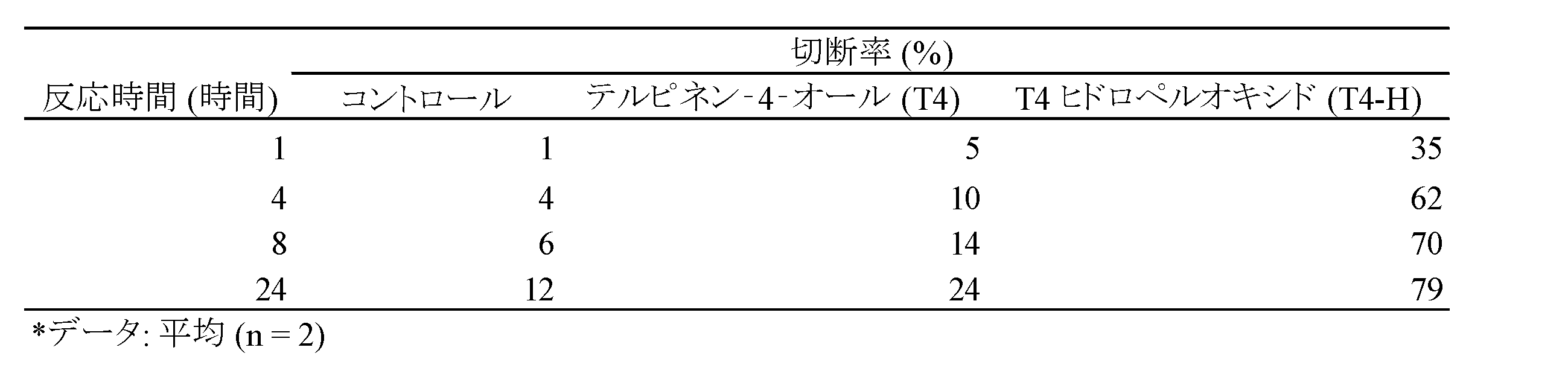
以上の結果、テルピネン-4-オールが150 mMの濃度を用いても最大24%の切断率であったのに対し、テルピネン-4-オールヒドロペルオキシドは10mMの濃度にもかかわらず最大79%の切断率を示した。すなわち、テルピネン-4-オールヒドロペルオキシドは、テルピネン-4-オールと比較して、約50倍の解裂活性を示した。
(実施例2-2)
評価方法として、α-ジカルボニル化合物である1-フェニル-1,2-プロパンジオン(PPD)に各試料溶液を加え、解裂して生成する安息香酸をHPLCで定量した。試料溶液として、テルペン類及びテルペン類ヒドロペルオキシドを使用した。またポジティブコントロールとしてN-フェナシルチアゾリウムブロミド(PTB)を使用した。試料を加えないものをコントロールとした。なお、テルペン類及びテルペン類ヒドロペルオキシドはメタノールに溶解したもの、PTB及びPPDはメタノール-リン酸緩衝液に溶解したものを使用した。表3の組成の反応溶液を300 μlのPCRチューブに調製し、24時間サーモミキサーにて振とうした(37 ℃, 300 rpm)。
評価方法として、α-ジカルボニル化合物である1-フェニル-1,2-プロパンジオン(PPD)に各試料溶液を加え、解裂して生成する安息香酸をHPLCで定量した。試料溶液として、テルペン類及びテルペン類ヒドロペルオキシドを使用した。またポジティブコントロールとしてN-フェナシルチアゾリウムブロミド(PTB)を使用した。試料を加えないものをコントロールとした。なお、テルペン類及びテルペン類ヒドロペルオキシドはメタノールに溶解したもの、PTB及びPPDはメタノール-リン酸緩衝液に溶解したものを使用した。表3の組成の反応溶液を300 μlのPCRチューブに調製し、24時間サーモミキサーにて振とうした(37 ℃, 300 rpm)。

反応終了後、2 M HCl水溶液を40 μl加え酸性条件とした。その後本溶液をメタノール-リン酸緩衝液にて5倍希釈し、0.45 μmのフィルターで濾過しHPLC測定溶液とした。HPLC測定条件は以下の通りである。
[HPLC測定条件]
ポンプ :HITACHI L-6200
カラム :関東化学 ODS. Mightysil RP-18 250 x 4.6 mm (5 μm) lot. 8026375
溶離液 :35% MeOH / 0.1% TFA水溶液
流速 :1.0 ml / min
温度 :40 ℃
検出波長:254 nm
注入量 :20 μl
ポンプ :HITACHI L-6200
カラム :関東化学 ODS. Mightysil RP-18 250 x 4.6 mm (5 μm) lot. 8026375
溶離液 :35% MeOH / 0.1% TFA水溶液
流速 :1.0 ml / min
温度 :40 ℃
検出波長:254 nm
注入量 :20 μl
以上の方法で実験した結果を表4に示す。切断率は全ての1-フェニル-1,2-プロパンジオンが切断された場合には10 mMの安息香酸が生成すると仮定できるので、以下の式に従って算出した。
切断率 (%) = 各試料溶液から生成する安息香酸の濃度 (mM) / 10 (mM) x 100
切断率 (%) = 各試料溶液から生成する安息香酸の濃度 (mM) / 10 (mM) x 100
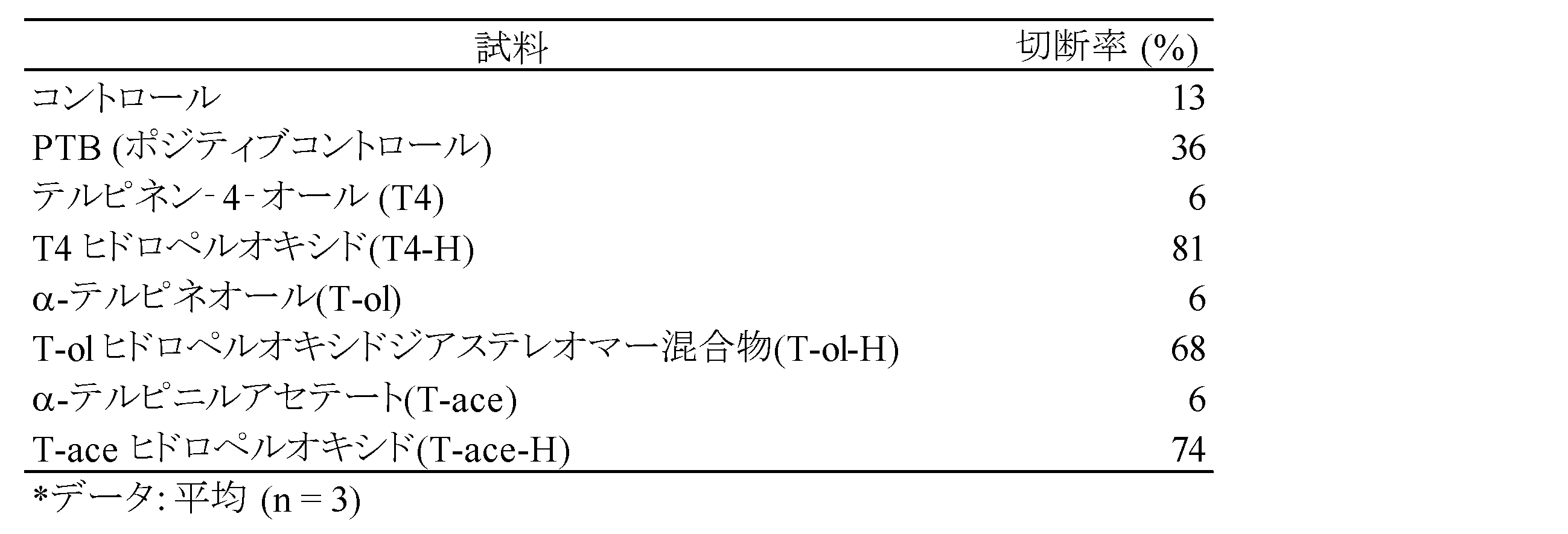
以上の結果、試料溶液の最終濃度が10 mMにおいて、テルペン類には解裂活性がみられなかったが、テルペン類ヒドロペルオキシドには68-81%と高い解裂活性が見られた。またテルペン類ヒドロペルオキシドはポジティブコントロールであるPTBの36%の解裂活性を上回った。
[実施例3:AGE形成阻害活性試験]
AGEs形成経路の中間体であるα-ジカルボニル化合物は、タンパク質のリシン、アルギニン、トリプトファン残基などを修飾してAGEs形成に寄与し、形成されたAGEが糖尿病及び糖尿病合併症を引き起こす。ヒドロペルオキシドについて、AGE形成の阻害活性を測定した。
AGEs形成経路の中間体であるα-ジカルボニル化合物は、タンパク質のリシン、アルギニン、トリプトファン残基などを修飾してAGEs形成に寄与し、形成されたAGEが糖尿病及び糖尿病合併症を引き起こす。ヒドロペルオキシドについて、AGE形成の阻害活性を測定した。
リボヌクレアーゼA(RNase A)は10個のリシン残基、4個のアルギニン残基を持つ酵素である。これらの残基部分がα-ジカルボニル化合物としてメチルグリオキサ-ル(MG)によって修飾される、もしくはMGを介してRNase A分子間でAGEsを形成することで酵素活性が低下すると考えられる。またRNase Aの触媒残基はヒスチジン-12、ヒスチジン-119、リシン-41であるため、リシン-41がMGによって修飾されると酵素活性に大きく影響すると考えられる。
(実施例3-1)
評価方法は以下のようにした。タンパク質としてウシのリボヌクレアーゼA(RNase A)、α-ジカルボニル化合物としてメチルグリオキサ-ル(MG)を混ぜた反応溶液に、試料として、アミノグアニジン(AG)、テルピネン-4-オール(T4)、テルピネン-4-オールのヒドロペルオキシド(T4-H)又はN-フェナシルチアゾリウムブロミド(PTB)を加えて反応させた。その後RNase Aの酵素活性試験を行い、酵素活性を保持しているか評価した。なおテルペン類及びテルペン類ヒドロペルオキシドはエタノールに溶解したもの、AGは水に溶解したものを使用した。RNase Aのみを反応させたものを標準コントロール(C-)、RNase AにMGを加え反応させたものをAGEsコントロール(C+)、MGのみを反応させたものをブランクとした。またポジティブコントロールとしてカルボニル捕捉作用を持つAGを用いた。また、比較として、α-ジカルボニル化合物解裂活性を持つ公知のAGE形成阻害剤としてPTBを用いた。
表5の組成の反応溶液を300 μlのPCRチューブに調製し、24時間インキュベートした(37℃)。
評価方法は以下のようにした。タンパク質としてウシのリボヌクレアーゼA(RNase A)、α-ジカルボニル化合物としてメチルグリオキサ-ル(MG)を混ぜた反応溶液に、試料として、アミノグアニジン(AG)、テルピネン-4-オール(T4)、テルピネン-4-オールのヒドロペルオキシド(T4-H)又はN-フェナシルチアゾリウムブロミド(PTB)を加えて反応させた。その後RNase Aの酵素活性試験を行い、酵素活性を保持しているか評価した。なおテルペン類及びテルペン類ヒドロペルオキシドはエタノールに溶解したもの、AGは水に溶解したものを使用した。RNase Aのみを反応させたものを標準コントロール(C-)、RNase AにMGを加え反応させたものをAGEsコントロール(C+)、MGのみを反応させたものをブランクとした。またポジティブコントロールとしてカルボニル捕捉作用を持つAGを用いた。また、比較として、α-ジカルボニル化合物解裂活性を持つ公知のAGE形成阻害剤としてPTBを用いた。
表5の組成の反応溶液を300 μlのPCRチューブに調製し、24時間インキュベートした(37℃)。

反応終了後の溶液を5%グリセロールにて200倍に希釈し、tRNAを基質として酵素実験を行った。下記の組成(表6)の反応溶液のうち、PBとtRNA溶液をエッペンチューブに加え、37℃、10分間、300rpm、サーモミキサーにてプレインキュベートした。その後希釈溶液を加え、37℃、20分間、300rpm、サーモミキサーにてインキュベートした。Perchloric acid / lanthanum solutionを250μl加え、酵素反応を停止させた。反応溶液を冷蔵庫で静置後、4℃、10分間、13000rpmにて遠心した。この反応溶液を260nmにて吸光度を測定した。結果を以下の表7に示す。
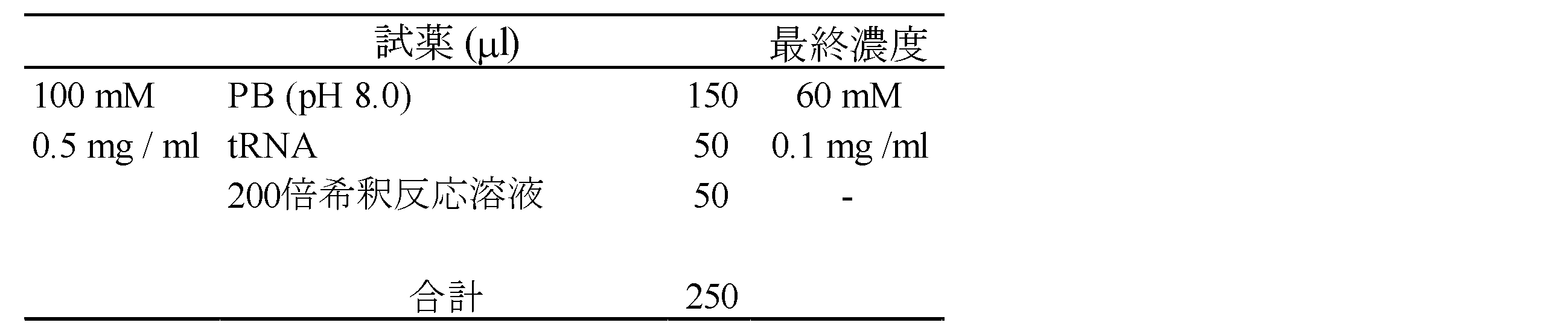

tRNAがRNase Aによって分解されると吸光度が上昇する。またtRNA自身も吸収を持つ。表7の結果より、標準コントロール(C-)の酵素活性を100とした時の相対的な酵素活性を以下の式に従って求めた。
残存活性 (%) = (C-B) / (A-B) * 100
A: (C-の吸光度) - (ブランクの吸光度)
B: (C+の吸光度) - (ブランクの吸光度)
C: (RNase反応溶液と各試料溶液の吸光度) - (ブランクの吸光度)
A: (C-の吸光度) - (ブランクの吸光度)
B: (C+の吸光度) - (ブランクの吸光度)
C: (RNase反応溶液と各試料溶液の吸光度) - (ブランクの吸光度)
RNase A相対活性試験の結果を、以下の表8に示す。

以上の結果、テルピネン-4-オールのヒドロペルオキシド(10mM)は、テルピネン-4-オール(100mM)と比較し、高い酵素活性を保持していた。またPTB(10mM)とは2倍以上、ポジティブコントロールであるAG(10mM)とは同程度以上の酵素活性を保持していた。なお、括弧内は最終濃度を示す。
(実施例3-2)
評価方法は以下のようにした。タンパク質としてRNase A、α-ジカルボニル化合物としてメチルグリオキサール(MG)を混ぜた反応溶液に、各試料溶液を加え反応させた。その後RNase Aの酵素活性試験を行い、各試料溶液によって酵素活性が保護されるか評価した。試料溶液として、テルペン類、テルペン類ヒドロペルオキシド、アミノグアニジン(AG、ポジティブコントロール)及び経口糖尿病治療薬であるメトホルミンを使用した。なおテルペン類及びテルペン類ヒドロペルオキシドはエタノールに溶解したもの、AG及びメトホルミンは水に溶解したものを使用した。またRNase Aのみを反応させたものを標準コントロール(C-)、RNase AにMGを加え反応させたものをAGEsコントロール(C+)、MGのみを反応させたものをブランクとした。
表9の組成の反応溶液を300 μlのPCRチューブに調製し、24時間インキュベートした(37 ℃)。
評価方法は以下のようにした。タンパク質としてRNase A、α-ジカルボニル化合物としてメチルグリオキサール(MG)を混ぜた反応溶液に、各試料溶液を加え反応させた。その後RNase Aの酵素活性試験を行い、各試料溶液によって酵素活性が保護されるか評価した。試料溶液として、テルペン類、テルペン類ヒドロペルオキシド、アミノグアニジン(AG、ポジティブコントロール)及び経口糖尿病治療薬であるメトホルミンを使用した。なおテルペン類及びテルペン類ヒドロペルオキシドはエタノールに溶解したもの、AG及びメトホルミンは水に溶解したものを使用した。またRNase Aのみを反応させたものを標準コントロール(C-)、RNase AにMGを加え反応させたものをAGEsコントロール(C+)、MGのみを反応させたものをブランクとした。
表9の組成の反応溶液を300 μlのPCRチューブに調製し、24時間インキュベートした(37 ℃)。

反応終了後の溶液を5%グリセロール水溶液にて200倍希釈し、tRNAを基質とした酵素実験を行った。下記の組成(表10)の反応溶液のうち、PBとtRNA溶液をマイクロチューブに調製し、サーモミキサーを使用して10分間プレインキュベーションした(37 ℃, 300 rpm)。希釈反応溶液を加え、サーモミキサーを使用して20分間インキュベーションした(37 ℃, 300 rpm)。その後、perchloric acid / lanthanum 溶液を250 μl加え、酵素反応を停止させた。反応溶液を10分間遠心した(4 ℃, 13,000 rpm)。この反応溶液の吸光度をパーソナルスペクトルメーターGene Quant pro (GEヘルスケアバイオサイエンス株式会社)で測定した(260 nm)。結果を表11に示す。


表11の結果より、標準コントロール(C-)の酵素活性を100とした時の相対的な酵素活性を以下の式に従って求めた。
残存活性(%) = (C -B) / (A - B) x 100
A:(C-の吸光度) - (ブランクの吸光度)
B:(C+の吸光度) - (ブランクの吸光度)
C:(RNase A反応溶液+各試料溶液の吸光度) - (ブランクの吸光度)
残存活性(%) = (C -B) / (A - B) x 100
A:(C-の吸光度) - (ブランクの吸光度)
B:(C+の吸光度) - (ブランクの吸光度)
C:(RNase A反応溶液+各試料溶液の吸光度) - (ブランクの吸光度)
RNase A酵素活性保護試験の結果を表12に示す。

以上の結果、テルペン類を添加した溶液では、RNase Aが失活していた(0-4%)が、テルペン類ヒドロペルオキシドを添加した溶液では、酵素活性を保護していた(81-91%)。テルペン類ヒドロペルオキシドはポジティブコントロールであるAGと同程度以上の保護効果が見られた。
本発明によれば、優れたメイラード反応抑制効果を得ることができる。本発明のメイラード反応抑制剤を使用することにより、食品の品質劣化防止、糖尿病及び糖尿病合併症の予防又は治療、並びに皮膚老化防止(皮膚のシワ及び/又はシミの改善)が可能である。
Claims (9)
- 少なくとも1つのテルペン類のペルオキシドを有効成分として含有するメイラード反応抑制剤。
- 前記テルペン類が、オシメン、d-リモネン、α-テルピネン、カレン、カンフェン、β-ファルネセン、β-ビサボレン、テルピネン-4-オール、α-テルピネオール、トランス-カルベノール、ボルネオールからなる群より選択される、請求項1記載のメイラード反応抑制剤。
- テルピネン-4-オールペルオキシドを有効成分として含有する、請求項1記載のメイラード反応抑制剤。
- α-テルピニルアセテートのヒドロペルオキシドを有効成分として含有する、請求項1記載のメイラード反応抑制剤。
- 食品の褐色抑制剤である、請求項1~4のいずれか1項記載のメイラード反応抑制剤。
- 糖尿病又は糖尿病合併症の治療剤又は予防剤である、請求項1~4のいずれか1項記載のメイラード反応抑制剤。
- 皮膚のシワ及び/又はシミ改善剤である、請求項1~4のいずれか1項記載のメイラード反応抑制剤。
- 少なくとも1つのテルペン類のペルオキシドを有効成分として含有するα-ジカルボニル化合物分解剤。
- 少なくとも1つのテルペン類を使用するメイラード反応抑制方法において、該テルペン類をペルオキシド化することを特徴とする、メイラード反応抑制方法。
Priority Applications (1)
| Application Number | Priority Date | Filing Date | Title |
|---|---|---|---|
| JP2012501837A JP5783612B2 (ja) | 2010-02-24 | 2011-02-24 | メイラード反応抑制剤、α−ジカルボニル化合物分解剤、およびメイラード反応抑制方法 |
Applications Claiming Priority (2)
| Application Number | Priority Date | Filing Date | Title |
|---|---|---|---|
| JP2010-038455 | 2010-02-24 | ||
| JP2010038455 | 2010-02-24 |
Publications (1)
| Publication Number | Publication Date |
|---|---|
| WO2011105465A1 true WO2011105465A1 (ja) | 2011-09-01 |
Family
ID=44506866
Family Applications (1)
| Application Number | Title | Priority Date | Filing Date |
|---|---|---|---|
| PCT/JP2011/054069 Ceased WO2011105465A1 (ja) | 2010-02-24 | 2011-02-24 | メイラード反応抑制剤、α-ジカルボニル化合物分解剤、およびメイラード反応抑制方法 |
Country Status (2)
| Country | Link |
|---|---|
| JP (1) | JP5783612B2 (ja) |
| WO (1) | WO2011105465A1 (ja) |
Cited By (2)
| Publication number | Priority date | Publication date | Assignee | Title |
|---|---|---|---|---|
| CN104127394A (zh) * | 2014-07-15 | 2014-11-05 | 沈祥春 | α-蒎烯、β-蒎烯、1,8-桉叶油醇、莰烯中一种以上在制备人血管内皮细胞损伤药物的应用 |
| WO2025070356A1 (ja) * | 2023-09-29 | 2025-04-03 | 株式会社日清製粉グループ本社 | 肉様食品及びその製造方法並びに肉様食品の外観改善方法 |
Citations (1)
| Publication number | Priority date | Publication date | Assignee | Title |
|---|---|---|---|---|
| JP2004035424A (ja) * | 2002-07-01 | 2004-02-05 | Mitsukan Group Honsha:Kk | メイラード反応抑制物質 |
Family Cites Families (1)
| Publication number | Priority date | Publication date | Assignee | Title |
|---|---|---|---|---|
| JP4239126B2 (ja) * | 1999-12-07 | 2009-03-18 | 曽田香料株式会社 | チロシナーゼ活性阻害剤 |
-
2011
- 2011-02-24 WO PCT/JP2011/054069 patent/WO2011105465A1/ja not_active Ceased
- 2011-02-24 JP JP2012501837A patent/JP5783612B2/ja not_active Expired - Fee Related
Patent Citations (1)
| Publication number | Priority date | Publication date | Assignee | Title |
|---|---|---|---|---|
| JP2004035424A (ja) * | 2002-07-01 | 2004-02-05 | Mitsukan Group Honsha:Kk | メイラード反応抑制物質 |
Non-Patent Citations (4)
| Title |
|---|
| RAO T.S.S. ET AL.: "Oxidative cleavage of carbon-carbon triple bond-a review", J. INDIAN CHEM. SOC., vol. 80, December 2003 (2003-12-01), pages 1129 - 1141 * |
| RYUICHIRO NAGAMATSU ET AL.: "Terpinen- 4-ol ni yoru a-dicalbonyl Kagobutsu Kairetsu Kiko no Kaimei", DAI 59 KAI ABSTRACTS OF THE ANNUAL MEETING OF THE JAPAN WOOD RESEARCH SOCIETY, 28 February 1999 (1999-02-28) * |
| SIEGEL B ET AL.: "Kinetics and Mechanisms for the Acid-Catalyzed OxidativeDecarboxylation of Benzoylformic Acid", J. ORG. CHEM., vol. 44, no. 6, 1979, pages 942 - 946 * |
| STRATAKIS M. ET AL.: "Dye-sensitized intrazeolite photooxygenation of 4-substituted cyclohexenes. Remote substituent effects in regioselectivity and diastereoselectivity", TETRAHEDRON LETTERS, vol. 45, no. 28, 5 July 2004 (2004-07-05), pages 5433 - 5436 * |
Cited By (2)
| Publication number | Priority date | Publication date | Assignee | Title |
|---|---|---|---|---|
| CN104127394A (zh) * | 2014-07-15 | 2014-11-05 | 沈祥春 | α-蒎烯、β-蒎烯、1,8-桉叶油醇、莰烯中一种以上在制备人血管内皮细胞损伤药物的应用 |
| WO2025070356A1 (ja) * | 2023-09-29 | 2025-04-03 | 株式会社日清製粉グループ本社 | 肉様食品及びその製造方法並びに肉様食品の外観改善方法 |
Also Published As
| Publication number | Publication date |
|---|---|
| JP5783612B2 (ja) | 2015-09-24 |
| JPWO2011105465A1 (ja) | 2013-06-20 |
Similar Documents
| Publication | Publication Date | Title |
|---|---|---|
| Rudbäck et al. | α-Terpinene, an antioxidant in tea tree oil, autoxidizes rapidly to skin allergens on air exposure | |
| EP0131176B1 (fr) | Protection antioxygène des produits alimentaires et cosmétiques | |
| Curcio et al. | Covalent insertion of antioxidant molecules on chitosan by a free radical grafting procedure | |
| Sorita et al. | Phenolic fraction from peanut (Arachis hypogaea L.) by-product: Innovative extraction techniques and new encapsulation trends for its valorization | |
| JP2008543831A (ja) | シクロデキストリン包接複合体及びその製造方法 | |
| FR2911133A1 (fr) | Nouveaux composes de cyclohexenone provenant d'antrodia camphorata et application de ceux-ci | |
| AU2009329830A1 (en) | Plant extracts from Acronychia species and their use | |
| JP4315650B2 (ja) | メイラード反応抑制物質 | |
| Li et al. | Characterization of the aldehydes and their transformations induced by UV irradiation and air exposure of white guanxi honey pummelo (Citrus grandis (L.) Osbeck) essential oil | |
| KR101021088B1 (ko) | 조목초액의 정제방법, 이로부터 정제된 목초액, 및 상기정제된 목초액을 함유하는 화장품 및 구강 청결제 | |
| Ay et al. | Citral photodegradation in solution: highlighting of a radical pathway in parallel to cyclization pathway | |
| JP5783612B2 (ja) | メイラード反応抑制剤、α−ジカルボニル化合物分解剤、およびメイラード反応抑制方法 | |
| AU2011358128B2 (en) | Composition of monoterpenoids having bactericidal properties | |
| CN103037837B (zh) | 抗氧化剂及化妆品 | |
| JPH11269469A (ja) | 高品質木酢液原料の製造方法 | |
| Ayoub et al. | Recent insights in the importance of limonene and its biotransformed value added compounds | |
| JP2010534227A (ja) | 少なくとも1つのコレスト−4−エン−3−オンオキシム誘導体の酸化防止剤としての使用 | |
| CN115768739A (zh) | 包含茋化合物的水溶液和包含茋化合物的超氧化物生成抑制剂 | |
| JP7188044B2 (ja) | 高圧下での加熱処理によるレスベラトロール誘導体の製造方法 | |
| Shahbazi et al. | Limonene | |
| CN113234049B (zh) | 一种基于葡萄籽提取的酪氨酸酶抑制剂及其提取方法和应用 | |
| KR102344150B1 (ko) | 진저롤과 쇼가올의 함량을 증가시킨 생강 추출농축액의 제조방법 | |
| JP2003160502A (ja) | 木酢液から有効画分を製造する方法とその利用 | |
| JPH11158472A (ja) | 粗木酢液からの高品質木酢液原料の製造方法 | |
| EP0496173A1 (fr) | Extraits de Noix d'Alep, leur préparation et leurs applications |
Legal Events
| Date | Code | Title | Description |
|---|---|---|---|
| 121 | Ep: the epo has been informed by wipo that ep was designated in this application |
Ref document number: 11747425 Country of ref document: EP Kind code of ref document: A1 |
|
| WWE | Wipo information: entry into national phase |
Ref document number: 2012501837 Country of ref document: JP |
|
| NENP | Non-entry into the national phase |
Ref country code: DE |
|
| 122 | Ep: pct application non-entry in european phase |
Ref document number: 11747425 Country of ref document: EP Kind code of ref document: A1 |