WO2011102339A1 - フルカラー液晶表示装置のバックライト用の白色led、フルカラー液晶表示装置用のバックライト、およびフルカラー液晶表示装置 - Google Patents
フルカラー液晶表示装置のバックライト用の白色led、フルカラー液晶表示装置用のバックライト、およびフルカラー液晶表示装置 Download PDFInfo
- Publication number
- WO2011102339A1 WO2011102339A1 PCT/JP2011/053147 JP2011053147W WO2011102339A1 WO 2011102339 A1 WO2011102339 A1 WO 2011102339A1 JP 2011053147 W JP2011053147 W JP 2011053147W WO 2011102339 A1 WO2011102339 A1 WO 2011102339A1
- Authority
- WO
- WIPO (PCT)
- Prior art keywords
- phosphor
- light
- color
- liquid crystal
- blue
- Prior art date
- Legal status (The legal status is an assumption and is not a legal conclusion. Google has not performed a legal analysis and makes no representation as to the accuracy of the status listed.)
- Ceased
Links
Images

Classifications
-
- C—CHEMISTRY; METALLURGY
- C09—DYES; PAINTS; POLISHES; NATURAL RESINS; ADHESIVES; COMPOSITIONS NOT OTHERWISE PROVIDED FOR; APPLICATIONS OF MATERIALS NOT OTHERWISE PROVIDED FOR
- C09K—MATERIALS FOR MISCELLANEOUS APPLICATIONS, NOT PROVIDED FOR ELSEWHERE
- C09K11/00—Luminescent materials, e.g. electroluminescent or chemiluminescent
- C09K11/08—Luminescent materials, e.g. electroluminescent or chemiluminescent containing inorganic luminescent materials
- C09K11/77—Luminescent materials, e.g. electroluminescent or chemiluminescent containing inorganic luminescent materials containing rare earth metals
- C09K11/7728—Luminescent materials, e.g. electroluminescent or chemiluminescent containing inorganic luminescent materials containing rare earth metals containing europium
- C09K11/7737—Phosphates
- C09K11/7738—Phosphates with alkaline earth metals
- C09K11/7739—Phosphates with alkaline earth metals with halogens
-
- C—CHEMISTRY; METALLURGY
- C09—DYES; PAINTS; POLISHES; NATURAL RESINS; ADHESIVES; COMPOSITIONS NOT OTHERWISE PROVIDED FOR; APPLICATIONS OF MATERIALS NOT OTHERWISE PROVIDED FOR
- C09K—MATERIALS FOR MISCELLANEOUS APPLICATIONS, NOT PROVIDED FOR ELSEWHERE
- C09K11/00—Luminescent materials, e.g. electroluminescent or chemiluminescent
- C09K11/08—Luminescent materials, e.g. electroluminescent or chemiluminescent containing inorganic luminescent materials
- C09K11/77—Luminescent materials, e.g. electroluminescent or chemiluminescent containing inorganic luminescent materials containing rare earth metals
- C09K11/7728—Luminescent materials, e.g. electroluminescent or chemiluminescent containing inorganic luminescent materials containing rare earth metals containing europium
- C09K11/77342—Silicates
-
- C—CHEMISTRY; METALLURGY
- C09—DYES; PAINTS; POLISHES; NATURAL RESINS; ADHESIVES; COMPOSITIONS NOT OTHERWISE PROVIDED FOR; APPLICATIONS OF MATERIALS NOT OTHERWISE PROVIDED FOR
- C09K—MATERIALS FOR MISCELLANEOUS APPLICATIONS, NOT PROVIDED FOR ELSEWHERE
- C09K11/00—Luminescent materials, e.g. electroluminescent or chemiluminescent
- C09K11/08—Luminescent materials, e.g. electroluminescent or chemiluminescent containing inorganic luminescent materials
- C09K11/0883—Arsenides; Nitrides; Phosphides
-
- C—CHEMISTRY; METALLURGY
- C09—DYES; PAINTS; POLISHES; NATURAL RESINS; ADHESIVES; COMPOSITIONS NOT OTHERWISE PROVIDED FOR; APPLICATIONS OF MATERIALS NOT OTHERWISE PROVIDED FOR
- C09K—MATERIALS FOR MISCELLANEOUS APPLICATIONS, NOT PROVIDED FOR ELSEWHERE
- C09K11/00—Luminescent materials, e.g. electroluminescent or chemiluminescent
- C09K11/08—Luminescent materials, e.g. electroluminescent or chemiluminescent containing inorganic luminescent materials
- C09K11/58—Luminescent materials, e.g. electroluminescent or chemiluminescent containing inorganic luminescent materials containing copper, silver or gold
- C09K11/582—Chalcogenides
- C09K11/584—Chalcogenides with zinc or cadmium
-
- C—CHEMISTRY; METALLURGY
- C09—DYES; PAINTS; POLISHES; NATURAL RESINS; ADHESIVES; COMPOSITIONS NOT OTHERWISE PROVIDED FOR; APPLICATIONS OF MATERIALS NOT OTHERWISE PROVIDED FOR
- C09K—MATERIALS FOR MISCELLANEOUS APPLICATIONS, NOT PROVIDED FOR ELSEWHERE
- C09K11/00—Luminescent materials, e.g. electroluminescent or chemiluminescent
- C09K11/08—Luminescent materials, e.g. electroluminescent or chemiluminescent containing inorganic luminescent materials
- C09K11/61—Luminescent materials, e.g. electroluminescent or chemiluminescent containing inorganic luminescent materials containing fluorine, chlorine, bromine, iodine or unspecified halogen elements
- C09K11/615—Halogenides
-
- C—CHEMISTRY; METALLURGY
- C09—DYES; PAINTS; POLISHES; NATURAL RESINS; ADHESIVES; COMPOSITIONS NOT OTHERWISE PROVIDED FOR; APPLICATIONS OF MATERIALS NOT OTHERWISE PROVIDED FOR
- C09K—MATERIALS FOR MISCELLANEOUS APPLICATIONS, NOT PROVIDED FOR ELSEWHERE
- C09K11/00—Luminescent materials, e.g. electroluminescent or chemiluminescent
- C09K11/08—Luminescent materials, e.g. electroluminescent or chemiluminescent containing inorganic luminescent materials
- C09K11/77—Luminescent materials, e.g. electroluminescent or chemiluminescent containing inorganic luminescent materials containing rare earth metals
- C09K11/7728—Luminescent materials, e.g. electroluminescent or chemiluminescent containing inorganic luminescent materials containing rare earth metals containing europium
- C09K11/7734—Aluminates
-
- C—CHEMISTRY; METALLURGY
- C09—DYES; PAINTS; POLISHES; NATURAL RESINS; ADHESIVES; COMPOSITIONS NOT OTHERWISE PROVIDED FOR; APPLICATIONS OF MATERIALS NOT OTHERWISE PROVIDED FOR
- C09K—MATERIALS FOR MISCELLANEOUS APPLICATIONS, NOT PROVIDED FOR ELSEWHERE
- C09K11/00—Luminescent materials, e.g. electroluminescent or chemiluminescent
- C09K11/08—Luminescent materials, e.g. electroluminescent or chemiluminescent containing inorganic luminescent materials
- C09K11/77—Luminescent materials, e.g. electroluminescent or chemiluminescent containing inorganic luminescent materials containing rare earth metals
- C09K11/7728—Luminescent materials, e.g. electroluminescent or chemiluminescent containing inorganic luminescent materials containing rare earth metals containing europium
- C09K11/77348—Silicon Aluminium Nitrides or Silicon Aluminium Oxynitrides
-
- C—CHEMISTRY; METALLURGY
- C09—DYES; PAINTS; POLISHES; NATURAL RESINS; ADHESIVES; COMPOSITIONS NOT OTHERWISE PROVIDED FOR; APPLICATIONS OF MATERIALS NOT OTHERWISE PROVIDED FOR
- C09K—MATERIALS FOR MISCELLANEOUS APPLICATIONS, NOT PROVIDED FOR ELSEWHERE
- C09K11/00—Luminescent materials, e.g. electroluminescent or chemiluminescent
- C09K11/08—Luminescent materials, e.g. electroluminescent or chemiluminescent containing inorganic luminescent materials
- C09K11/77—Luminescent materials, e.g. electroluminescent or chemiluminescent containing inorganic luminescent materials containing rare earth metals
- C09K11/7783—Luminescent materials, e.g. electroluminescent or chemiluminescent containing inorganic luminescent materials containing rare earth metals containing two or more rare earth metals one of which being europium
- C09K11/7784—Chalcogenides
- C09K11/7787—Oxides
- C09K11/7789—Oxysulfides
-
- G—PHYSICS
- G02—OPTICS
- G02B—OPTICAL ELEMENTS, SYSTEMS OR APPARATUS
- G02B6/00—Light guides; Structural details of arrangements comprising light guides and other optical elements, e.g. couplings
- G02B6/0001—Light guides; Structural details of arrangements comprising light guides and other optical elements, e.g. couplings specially adapted for lighting devices or systems
- G02B6/0011—Light guides; Structural details of arrangements comprising light guides and other optical elements, e.g. couplings specially adapted for lighting devices or systems the light guides being planar or of plate-like form
- G02B6/0066—Light guides; Structural details of arrangements comprising light guides and other optical elements, e.g. couplings specially adapted for lighting devices or systems the light guides being planar or of plate-like form characterised by the light source being coupled to the light guide
- G02B6/0073—Light emitting diode [LED]
-
- G—PHYSICS
- G02—OPTICS
- G02F—OPTICAL DEVICES OR ARRANGEMENTS FOR THE CONTROL OF LIGHT BY MODIFICATION OF THE OPTICAL PROPERTIES OF THE MEDIA OF THE ELEMENTS INVOLVED THEREIN; NON-LINEAR OPTICS; FREQUENCY-CHANGING OF LIGHT; OPTICAL LOGIC ELEMENTS; OPTICAL ANALOGUE/DIGITAL CONVERTERS
- G02F1/00—Devices or arrangements for the control of the intensity, colour, phase, polarisation or direction of light arriving from an independent light source, e.g. switching, gating or modulating; Non-linear optics
- G02F1/01—Devices or arrangements for the control of the intensity, colour, phase, polarisation or direction of light arriving from an independent light source, e.g. switching, gating or modulating; Non-linear optics for the control of the intensity, phase, polarisation or colour
- G02F1/13—Devices or arrangements for the control of the intensity, colour, phase, polarisation or direction of light arriving from an independent light source, e.g. switching, gating or modulating; Non-linear optics for the control of the intensity, phase, polarisation or colour based on liquid crystals, e.g. single liquid crystal display cells
- G02F1/133—Constructional arrangements; Operation of liquid crystal cells; Circuit arrangements
- G02F1/1333—Constructional arrangements; Manufacturing methods
- G02F1/1335—Structural association of cells with optical devices, e.g. polarisers or reflectors
- G02F1/1336—Illuminating devices
- G02F1/133614—Illuminating devices using photoluminescence, e.g. phosphors illuminated by UV or blue light
-
- G—PHYSICS
- G02—OPTICS
- G02F—OPTICAL DEVICES OR ARRANGEMENTS FOR THE CONTROL OF LIGHT BY MODIFICATION OF THE OPTICAL PROPERTIES OF THE MEDIA OF THE ELEMENTS INVOLVED THEREIN; NON-LINEAR OPTICS; FREQUENCY-CHANGING OF LIGHT; OPTICAL LOGIC ELEMENTS; OPTICAL ANALOGUE/DIGITAL CONVERTERS
- G02F1/00—Devices or arrangements for the control of the intensity, colour, phase, polarisation or direction of light arriving from an independent light source, e.g. switching, gating or modulating; Non-linear optics
- G02F1/01—Devices or arrangements for the control of the intensity, colour, phase, polarisation or direction of light arriving from an independent light source, e.g. switching, gating or modulating; Non-linear optics for the control of the intensity, phase, polarisation or colour
- G02F1/13—Devices or arrangements for the control of the intensity, colour, phase, polarisation or direction of light arriving from an independent light source, e.g. switching, gating or modulating; Non-linear optics for the control of the intensity, phase, polarisation or colour based on liquid crystals, e.g. single liquid crystal display cells
- G02F1/133—Constructional arrangements; Operation of liquid crystal cells; Circuit arrangements
- G02F1/1333—Constructional arrangements; Manufacturing methods
- G02F1/1335—Structural association of cells with optical devices, e.g. polarisers or reflectors
- G02F1/1336—Illuminating devices
- G02F1/133624—Illuminating devices characterised by their spectral emissions
-
- H—ELECTRICITY
- H10—SEMICONDUCTOR DEVICES; ELECTRIC SOLID-STATE DEVICES NOT OTHERWISE PROVIDED FOR
- H10H—INORGANIC LIGHT-EMITTING SEMICONDUCTOR DEVICES HAVING POTENTIAL BARRIERS
- H10H20/00—Individual inorganic light-emitting semiconductor devices having potential barriers, e.g. light-emitting diodes [LED]
- H10H20/80—Constructional details
- H10H20/85—Packages
- H10H20/8506—Containers
-
- H—ELECTRICITY
- H10—SEMICONDUCTOR DEVICES; ELECTRIC SOLID-STATE DEVICES NOT OTHERWISE PROVIDED FOR
- H10H—INORGANIC LIGHT-EMITTING SEMICONDUCTOR DEVICES HAVING POTENTIAL BARRIERS
- H10H20/00—Individual inorganic light-emitting semiconductor devices having potential barriers, e.g. light-emitting diodes [LED]
- H10H20/80—Constructional details
- H10H20/85—Packages
- H10H20/851—Wavelength conversion means
- H10H20/8511—Wavelength conversion means characterised by their material, e.g. binder
- H10H20/8512—Wavelength conversion materials
- H10H20/8513—Wavelength conversion materials having two or more wavelength conversion materials
-
- H—ELECTRICITY
- H10—SEMICONDUCTOR DEVICES; ELECTRIC SOLID-STATE DEVICES NOT OTHERWISE PROVIDED FOR
- H10H—INORGANIC LIGHT-EMITTING SEMICONDUCTOR DEVICES HAVING POTENTIAL BARRIERS
- H10H20/00—Individual inorganic light-emitting semiconductor devices having potential barriers, e.g. light-emitting diodes [LED]
- H10H20/80—Constructional details
- H10H20/85—Packages
- H10H20/855—Optical field-shaping means, e.g. lenses
- H10H20/856—Reflecting means
-
- H—ELECTRICITY
- H10—SEMICONDUCTOR DEVICES; ELECTRIC SOLID-STATE DEVICES NOT OTHERWISE PROVIDED FOR
- H10W—GENERIC PACKAGES, INTERCONNECTIONS, CONNECTORS OR OTHER CONSTRUCTIONAL DETAILS OF DEVICES COVERED BY CLASS H10
- H10W72/00—Interconnections or connectors in packages
- H10W72/071—Connecting or disconnecting
- H10W72/073—Connecting or disconnecting of die-attach connectors
- H10W72/07351—Connecting or disconnecting of die-attach connectors characterised by changes in properties of the die-attach connectors during connecting
- H10W72/07352—Connecting or disconnecting of die-attach connectors characterised by changes in properties of the die-attach connectors during connecting changes in structures or sizes
-
- H—ELECTRICITY
- H10—SEMICONDUCTOR DEVICES; ELECTRIC SOLID-STATE DEVICES NOT OTHERWISE PROVIDED FOR
- H10W—GENERIC PACKAGES, INTERCONNECTIONS, CONNECTORS OR OTHER CONSTRUCTIONAL DETAILS OF DEVICES COVERED BY CLASS H10
- H10W72/00—Interconnections or connectors in packages
- H10W72/30—Die-attach connectors
- H10W72/321—Structures or relative sizes of die-attach connectors
-
- H—ELECTRICITY
- H10—SEMICONDUCTOR DEVICES; ELECTRIC SOLID-STATE DEVICES NOT OTHERWISE PROVIDED FOR
- H10W—GENERIC PACKAGES, INTERCONNECTIONS, CONNECTORS OR OTHER CONSTRUCTIONAL DETAILS OF DEVICES COVERED BY CLASS H10
- H10W72/00—Interconnections or connectors in packages
- H10W72/851—Dispositions of multiple connectors or interconnections
- H10W72/874—On different surfaces
- H10W72/884—Die-attach connectors and bond wires
-
- H—ELECTRICITY
- H10—SEMICONDUCTOR DEVICES; ELECTRIC SOLID-STATE DEVICES NOT OTHERWISE PROVIDED FOR
- H10W—GENERIC PACKAGES, INTERCONNECTIONS, CONNECTORS OR OTHER CONSTRUCTIONAL DETAILS OF DEVICES COVERED BY CLASS H10
- H10W74/00—Encapsulations, e.g. protective coatings
Definitions
- a white LED for backlight of a full-color liquid crystal display device is for solving the above-described problem, and emits primary light having an emission peak in a wavelength region of 360 to 430 nm.
- At least one light-emitting element selected from a light-emitting diode, a blue-violet light-emitting diode, an ultraviolet light-emitting laser, and a blue-violet light-emitting laser, and blue light having an emission peak in a wavelength region of 430 to 470 nm when excited by the primary light.
- a backlight for a full-color liquid crystal display device is for solving the above problem, and is characterized by using the white LED.
- the full-color liquid crystal display device of the embodiment of the present invention is for solving the above-mentioned problem, and is characterized by being manufactured using the backlight.
- the white LED 10 shown in FIG. 1 includes the substrate 6 and the reflective layer 3, but in the present invention, the substrate 6 and the reflective layer 3 may not be provided if necessary.
- a light emitting diode is used as the light emitting element 1
- an ultraviolet light emitting laser or a blue-violet light emitting laser may be used instead of the light emitting diode.
- the green phosphor a phosphor that is excited by primary light having an emission peak in a wavelength region of 360 to 430 nm and emits green light having an emission peak in a wavelength region of 520 to 560 nm is used. Is preferred.
- green phosphor for example, a divalent europium and manganese-activated silicate phosphor substantially represented by the following general formula 1, and a substantial phosphor represented by the following general formula 2 or 3 Europium activated sialon phosphors are used.
- the fired product obtained is washed with pure water to remove unnecessary soluble components. Then, after passing through a pulverization step, the target green phosphor is obtained by filtration and drying.
- the green phosphor it is possible to use a general production method other than the above, or a commercial product having a composition satisfying the general formulas 1 to 3.
- ⁇ Blue phosphor> As the blue phosphor, a phosphor that emits blue light when excited by primary light having an emission peak in a wavelength region of 360 to 430 nm is used.
- blue phosphors examples include divalent europium activated halophosphate phosphors, divalent europium activated aluminate phosphors, silver activated zinc sulfide phosphors, and chlorine activated zinc sulfide phosphors. And at least one phosphor selected from the group.
- the wavelength of the blue light emitted from the blue phosphor powder is suitable as the blue light constituting the white light emitted from the white LED 1 of the embodiment.
- Red phosphor a phosphor that emits red light when excited by primary light having an emission peak in a wavelength region of 360 to 430 nm is used.
- red light having two or more linear emission peaks in the wavelength range of 580 to 740 nm is excited by primary light having an emission peak in the wavelength range of 360 to 430 nm. It is preferable to use a phosphor that emits light.
- the target red phosphor is obtained by filtration and drying.
- the target red phosphor is obtained by filtration and drying.
- the target red phosphor is obtained by filtration and drying.
- the green phosphor, blue phosphor and red phosphor are usually in the form of powder.
- a green phosphor it is preferable to use a combination of two or more phosphors substantially represented by the general formulas 1 to 3.
- a method of increasing the average particle size of the phosphor As a method of increasing the average particle size of the phosphor, a method of granulating using one color of the same or different type of phosphor powder, a method of mixing three colors of the same or different type of phosphor powder, and the like Is mentioned.
- a method of enlarging the phosphor powder itself at the time of firing by using a firing aid when firing the phosphor powder, or firing at a high temperature for a long time, and the like can be mentioned.
- the transmittance of the cured resin is usually 98 to 100%, preferably 99 to 100%.
- the transmittance means a value obtained by measuring 400 nm monochromatic light using a test piece having a thickness of 2 mm.
- the photorefractive index of the cured resin is usually 1.3 to 1.7, preferably 1.4 to 1.6.
- a light refractive index of less than 1.3 is not preferable because light extraction from the light emitting diode element may deteriorate.
- the photorefractive index exceeds 1.7, it tends to change in response to ultraviolet rays used for excitation of the phosphor, which is not preferable. Further, it is desirable that the cured resin has both transmittance and light refractive index within the above ranges.
- Examples of the cured resin having the above characteristics include cured products of resins such as silicone resins and epoxy resins. Among these, a cured resin of a silicone resin is preferable because it is resistant to discoloration by ultraviolet rays and has durability.
- the resin cured product differs depending on the type of resin, it can be obtained by leaving a fluid resin or adding a curing agent or the like to the fluid resin.
- each color light of green light (G), blue light (B) and red light (R) needs to have high brightness.
- the blending ratio of the phosphor is important.
- the mixing ratio of the green phosphor, the blue phosphor and the red phosphor is such that the white LED 10 is ITU-R BT. It is set as appropriate so as to have light characteristics that can be adapted to the color gamut of the 709 standard.
- each color phosphor is usually 1 to 10% by weight for the green phosphor, 40 to 80% by weight for the blue phosphor, and the above for the total amount of all the phosphors.
- the red phosphor is 10 to 50% by weight.
- each color phosphor is preferably 2 to 9% by weight of the green phosphor, 45 to 65% by weight of the blue phosphor, and the red fluorescence with respect to the total amount of all phosphors.
- the body is 26-48% by weight.
- the white LED 10 the backlight incorporating the white LED 10
- the full-color liquid crystal display device produced using the backlight have a desired white point.
- the optical characteristics that can be adapted to the color gamut of the 709 standard are not provided.
- the phosphor layer 2 is produced, for example, by curing a phosphor-resin mixture obtained by blending a green phosphor, a blue phosphor and a red phosphor in a resin.
- the phosphor-resin mixture can be prepared by mixing each color phosphor powder with a resin and then mixing the obtained resins containing phosphor powders of each color to produce a phosphor-resin mixture.
- a method of preparing a phosphor-resin mixture by mixing phosphor powders of respective colors in advance and then mixing the phosphor powder mixture with a resin.
- this liquid crystal display device is an ITU- in a full color liquid crystal display device obtained by combining a backlight incorporating the white LED 10 and a color filter. R BT.
- the white LED 10 alone can also be used as an ITU-R BT. It is possible to emit light having optical characteristics that can be adapted to the color gamut of the 709 standard.
- the light emitted from the full-color liquid crystal display device that is transmitted through the color filter is more ITU-R BT.
- the light has a light characteristic that can be adapted to the color gamut of 709 standard.
- the emission spectrum of the white light emitted from the white LED 10 usually has the following first emission peak group, second emission peak group, third emission peak group, and valley.
- the first emission peak group, the second emission peak group, and the third emission peak group exist in the wavelength region where the transmittance peak of the liquid crystal color filter of each color of blue, green, and red exists.
- An emission peak group is shown.
- the first emission peak group is an emission peak group having at least one emission peak in the wavelength region of 430 to 470 nm in the emission spectrum of white light emitted from the white LED 10.
- the second emission peak group has an emission peak in the wavelength region of 520 to 555 nm because the green luminance is increased. Furthermore, it is more preferable that the second emission peak group has only one emission peak in the wavelength region of 520 to 555 nm because the green luminance is increased.
- the full width at half maximum of the emission peak of the second emission peak group is desirably 50 nm or more and 200 nm or less.
- the third emission peak group has the highest emission intensity among the linear emission peaks in the wavelength region of 590 to 710 nm because the red luminance increases.
- the third emission peak group has at least one linear emission peak in the wavelength region of 620 to 630 nm and at least one linear emission peak in the wavelength region of 700 to 710 nm. Is preferable.
- the emission spectrum of the white light emitted from the white LED 10 is 520 to 560 nm when the maximum value P1 of the emission intensity of the emission peak in the first emission peak group appearing in the wavelength region of 430 to 470 nm is 1.0.
- the maximum value P2 of the emission intensity of the emission peak in the second emission peak group appearing in the wavelength region is usually 0.1 ⁇ P2 ⁇ 1.0, preferably 0.2 ⁇ P2 ⁇ 0.9.
- the white LED 10 uses a backlight incorporating the white LED 10 when the maximum intensity P1, P2 and P3 of each light emission peak group, the minimum value V1 of the light emission intensity at the valley, and the light emission intensity P600 at 600 nm are not in the above relationship.
- the color mixture of the color filter transmitted light becomes large, and the color purity tends to be lowered.
- V1 exceeds the above range, that is, exceeds 0.6
- the green component of the green light is likely to be mixed into the blue color filter transmitted light, and the blue component of the blue light is included in the green color filter transmitted light. It becomes easy to mix.
- V1 is smaller, because mixing of the green component of the green light into the blue color filter transmission light and mixing of the blue component of the blue light into the green color filter transmission light is suppressed, but substantially 0. It is difficult to get below .01. For this reason, the lower limit value of V1 is defined as 0.01.
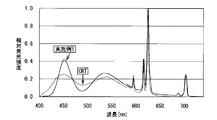
- FIG. 2 is a diagram illustrating an example of an emission spectrum of white light emitted from the white LED 10.
- the white LED 10 shown in FIG. 2 is a white LED manufactured in Example 1 below.
- FIG. 2 also shows the emission spectrum in the white display state of RDS-15X manufactured by Mitsubishi Electric Corporation, which is a typical CRT conforming to the EBU standard.
- the third emission peak group has four main linear emission peaks, and the peak wavelengths are 595 nm, 616 nm, 625 nm, and 704 nm, respectively.
- the white light emission spectrum of the white LED 10 of Example 1 shows that the relationship between the emission wavelength of the light emission peak and the intensity of each light emission peak is a white display state of a typical CRT that conforms to the EBU standard. It can be seen that the emission spectrum is similar. That is, it can be seen that the emission spectrum of white light of the white LED 10 of Example 1 is the same as the emission spectrum necessary to ensure the color reproducibility of the EBU standard.
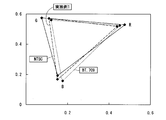
- FIG. 3 shows an ITU-R BT.
- Manufactured by incorporating the white LED 10 according to the embodiment of the present invention It is a figure which shows an example of the color reproduction range of the luminescent color of the full-color liquid crystal display device corresponding to 709 standard.
- FIG. 3 is represented by (u ′, v ′) values in the CIE L * u * v * color system chromaticity diagram.
- the ITU-R BT A full-color liquid crystal display device corresponding to the 709 standard uses a white LED manufactured in Example 1 below as the white LED 10.
- FIG. 3 shows ITU-R BT.
- the color gamut of 709 and NTSC are also shown.
- the ITU-R BT Manufactured by incorporating the white LED 10 according to the embodiment of the present invention.
- the blue chromaticity point of the luminescent color of the full-color liquid crystal display device corresponding to the 709 standard is the (u ′, v ′) value of the CIE L * u * v * color system chromaticity diagram, which is usually 0.15. ⁇ u ′ ⁇ 0.19 and 0.14 ⁇ v ′ ⁇ 0.18.
- ITU-R BT Manufactured by incorporating the white LED 10 of the embodiment of the present invention.
- the u 'value and v' value of the blue chromaticity point of the emission color of the full-color liquid crystal display device corresponding to the 709 standard are respectively ITU-R BT. It is within ⁇ 0.02 or less with respect to the u ′ value and the v ′ value of the blue chromaticity point of 709.
- the ITU-R BT Manufactured by incorporating the white LED 10 according to the embodiment of the present invention.
- the green chromaticity point of the luminescent color of the full-color liquid crystal display device corresponding to the 709 standard is the (u ′, v ′) value of the CIE L * u * v * color system chromaticity diagram, which is usually 0.10. ⁇ u ′ ⁇ 0.14 and 0.54 ⁇ v ′ ⁇ 0.58.
- ITU-R BT Manufactured by incorporating the white LED 10 of the embodiment of the present invention.
- the u 'value and the v' value of the green chromaticity point of the emission color of the full-color liquid crystal display device corresponding to the 709 standard are respectively ITU-R BT. It is within the range of ⁇ 0.02 or less with respect to the u ′ value and the v ′ value of the 709 green chromaticity point.
- the white LED 10 shown as the embodiment since white light has light intensity and a light emission peak exists in an appropriate position at an appropriate size, a blue, green, red color filter for a liquid crystal display device, etc. By combining with a general color filter, ITU-R BT. It is possible to manufacture a full-color liquid crystal display device that realizes color reproducibility in a color gamut having substantially the same position and size as the color gamut defined by the 709 standard. For this reason, according to the white LED 10, a full-color liquid crystal display device manufactured from a backlight using the white LED 10 has a high image quality equivalent to that of a CRT display.
- the backlight is a backlight for a full color liquid crystal display device using the white LED 10.
- the backlight can be produced by using the white LED 10 as a white light source and appropriately using a light guide plate or the like. Moreover, you may produce a backlight using multiple white LED with respect to one backlight as needed. Further, since the white LED has a high luminance, the backlight can be either a sidelight type backlight or a direct type backlight.
- the white LED 10 which is a white light source has a liquid crystal display because the white light has light luminance and the emission peak is present at an appropriate position at an appropriate size.
- ITU-R BT InTU-R BT.
- ITU-R BT. which realizes color reproducibility in a color gamut having substantially the same position and size as the color gamut defined by the 709 standard.
- a full-color liquid crystal display device corresponding to the 709 standard can be manufactured.
- a color filter layer constituting a general color filter such as a blue, green, or red color filter for a liquid crystal display device is usually formed of an organic pigment, an inorganic pigment, or the like.
- the organic pigment used for the color filter layer include azo pigments, metal phthalocyanine pigments, metal complex pigments, and the like.
- inorganic pigments used in the color filter layer include red inorganic pigments such as bengara and molybdenum red; yellow inorganic pigments such as titanium yellow; green inorganic pigments such as titanium cobalt green and cobalt green; blue such as ultramarine and cobalt blue. Inorganic pigments; purple inorganic pigments such as cobalt violet, and the like.
- the liquid crystal display device is an ITU-R BT. It is possible to realize color reproducibility conforming to the 709 standard.
- the white LED 10 that is the white light source of the backlight has a light emission luminance and a light emission peak in an appropriate position at an appropriate size.
- general color filters such as blue, green and red color filters for display devices, ITU-R BT. It becomes possible to realize color reproducibility in a color gamut having substantially the same position and size as the color gamut defined by the 709 standard.
- ITU-R BT Since it is possible to correspond to the color gamut defined by the 709 standard, it can be used in place of a CRT display for broadcasting, video creation or the like.
- Examples 1 to 9 For the evaluation of the white LED, a white LED having a cross section shown in the structure of FIG. 1 was produced. First, an ultraviolet light emitting diode having a size of 300 ⁇ m square was used as the light emitting element 1, and the ultraviolet light emitting diode 1 was arranged on the surface of the substrate 6. Next, a blue phosphor powder having an average particle size of 5 ⁇ m, a green phosphor powder having an average particle size of 5 ⁇ m, and a red phosphor powder having an average particle size of 5 ⁇ m are prepared, and the total amount of these phosphor powders is 70 parts by weight, 30 parts by weight of a silicone resin was mixed to obtain a slurry.
- Table 1 shows the excitation wavelength of the ultraviolet light-emitting diode used in the manufacture of the white LED of each of the above examples, the types of the blue phosphor powder, the green phosphor powder and the red phosphor powder, and the total amount of the phosphor as 100% by weight. The amount (% by weight) of each color phosphor is shown.
- a blue light emitting diode was used as the light emitting element 1, and a white LED having a phosphor layer containing only the green phosphor shown in Table 1 was produced in the same manner as described above.
- P1 Maximum intensity of the first emission peak group (range of 430 to 470 nm)
- P2 Maximum intensity of the second emission peak group (range of 520 to 560 nm)
- P3 Third emission peak group (range of 580 to 740 nm) )
- Maximum intensity V1 Minimum intensity P 600 in the valley (in the range of 480 to 500 nm) between the first emission peak group and the second emission peak group: intensity at a wavelength of 600 nm
- P 600 / P3 is 600 nm The percentage (%) with respect to the maximum intensity P3 of the third emission peak group of intensity is shown.
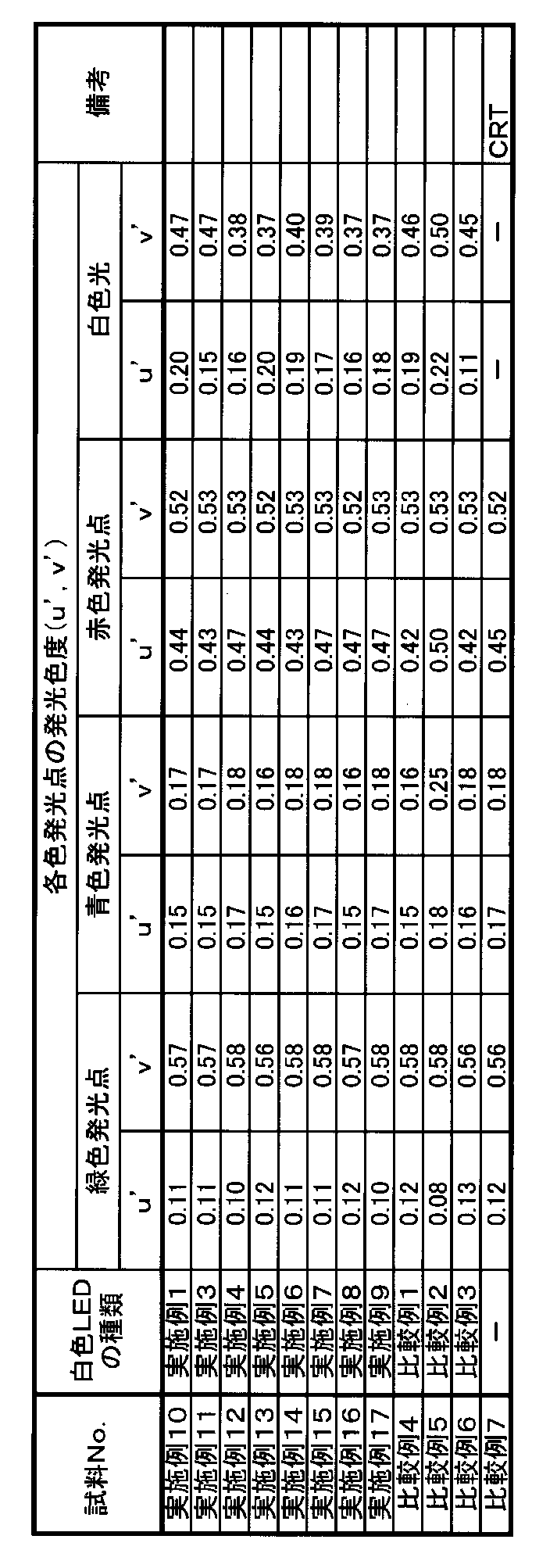
- Examples 7 to 11 and Comparative Examples 4 to 6 The white LEDs of Examples 1 and 3 to 9 and Comparative Examples 1 to 3 were used, and combined with a color filter generally used in industrial applications, ITU-R BT. A full-color liquid crystal display device corresponding to the color gamut of the 709 standard was manufactured.
Landscapes
- Chemical & Material Sciences (AREA)
- Inorganic Chemistry (AREA)
- Engineering & Computer Science (AREA)
- Materials Engineering (AREA)
- Organic Chemistry (AREA)
- Luminescent Compositions (AREA)
- Led Device Packages (AREA)
Abstract
Description
一般式1:(Sr2-x-y-z-uBaxMgyEuzMnu)SiO4
(式中、x、y、zおよびuは、0.1<x<1.0、0≦y<0.21、0.05<z<0.3、0≦u<0.04を満たす値である)
一般式2:(Sr3-xEux)SiyAlzOvNw
(式中、x、y、z、vおよびwは0<x≦3、12<y<14、2<z<3.5、1<v<3、20<w<22を満たす数である)
一般式3:(Si,Al)6(O,N)8:Eux
(式中、xは0<x<0.3を満たす数である)
一般式4:(M2,Eu)10(PO4)6・Cl2
(式中、M2は、Mg、Ca、SrおよびBaから選ばれる少なくとも1種の元素を示す)
一般式5:a(M3,Eu)O・bAl2O3
(式中、M3は、Mg、Ca、Sr、Ba、Zn、Li、RbおよびCsから選ばれる少なくとも1種の元素を示し、aおよびbは、0<a、0<b、0.2≦a/b≦1.5を満たす数である)
一般式6:(Zn1-xAgx)S
(式中、xは0<x<0.01を満たす数である)
一般式7:(Zn1-xClx)S
(式中、xは0<x<0.01を満たす数である)
一般式8:(La1-xーy-zYxSmyEuz)2O2S
(式中、x、yおよびzは、0≦x<0.99、0≦y<0.03、0.01<z<0.15を満たし、かつ1-x-y-z≧0となる値である)
図1は、本発明の実施形態の白色LEDの一例を示す断面図である。
図1に示す白色LED10は、基板6と、基板6の表面に配置された発光素子としての発光ダイオード1と、基板6と発光ダイオード1とを電気的に接続する配線5と、基板6の表面において発光ダイオード1を囲むように設けられた樹脂枠4と、樹脂枠4の内壁面を覆う反射層3と、発光ダイオード1が出射する光で励起される蛍光体が樹脂に埋め込まれた硬化物からなり、基板6と反射層3とで区画された凹部に充填されて発光ダイオード1を被覆する蛍光体層2と、を備える。
本発明では、発光素子1として、360~430nmの波長領域内に発光ピークを有する1次光を出射する、紫外線発光ダイオード、青紫色発光ダイオード、紫外線発光レーザーおよび青紫色発光レーザーから選ばれる少なくとも1種の発光素子が用いられる。ここで、1次光とは、発光素子から出射される光を意味する。また、発光レーザーとは、半導体レーザーまたはレーザーダイオードを意味する。
図1には、発光素子1として、紫外光を出射する紫外線発光ダイオードまたは紫色光を出射する青紫色発光ダイオードを用いた例を示す。
蛍光体層2は、発光素子1から出射された360~430nmの波長領域内に発光ピークを有する1次光により励起されて青色光を発光する青色蛍光体、この1次光により励起されて緑色光を発光する緑色蛍光体、およびこの1次光により励起されて赤色光を発光する赤色蛍光体を含む。
緑色蛍光体としては、360~430nmの波長領域内に発光ピークを有する1次光により励起されて、緑色光を発光する蛍光体が用いられる。
一般式1:(Sr2-x-y-z-uBaxMgyEuzMnu)SiO4
(式中、x、y、zおよびuは、0.1<x<1.0、0≦y<0.21、0.05<z<0.3、0≦u<0.04を満たす値である)
また、一般式1中、yが上記範囲内にあると緑色蛍光体粉末中でMnの固溶が十分に行われることにより、発光効率が高くなるため好ましい。
さらに、一般式1中zが上記範囲内にあると緑色蛍光体粉末の発光効率が高くなるため好ましい。
一般式2:(Sr3-xEux)SiyAlzOvNw
(式中、x、y、z、vおよびwは、0<x≦3、12<y<14、2<z<3.5、1<v<3、20<w<22を満たす数である)
一般式3:(Si,Al)6(O,N)8:Eux
(式中、xは0<x<0.3を満たす数である)
なお、緑色蛍光体としては、上記以外の一般的な製造方法によるものや、一般式1~3を満たす組成の市販品を用いることも可能である。
青色蛍光体としては、360~430nmの波長領域内に発光ピークを有する1次光により励起されて、青色光を発光する蛍光体が用いられる。
一般式4:(M2,Eu)10(PO4)6・Cl2
(式中、M2は、Mg、Ca、SrおよびBaから選ばれる少なくとも1種の元素を示す)
一般式5:a(M3,Eu)O・bAl2O3
一般式6:(Zn1-xAgx)S
(式中、xは0<x<0.01を満たす数である)
一般式7:(Zn1-xClx)S
(式中、xは0<x<0.01を満たす数である)
なお、青色蛍光体としては、上記以外の一般的な製造方法によるものや、一般式4~7を満たす組成の市販品を用いることも可能である。
赤色蛍光体としては、360~430nmの波長領域内に発光ピークを有する1次光により励起されて、赤色光を発光する蛍光体が用いられる。
一般式8:(La1-xーy-zYxSmyEuz)2O2S
(式中、x、yおよびzは、0≦x<0.99、0≦y<0.03、0.01<z<0.15を満たし、かつ1-x-y-z≧0となる値である)
なお、赤色蛍光体としては、前記以外の一般的な製造方法によるものや、一般式8を満たす組成の市販品を用いることも可能である。
また、上記の緑色蛍光体、青色蛍光体および赤色蛍光体は、それぞれ1種以上用いると演色性が高くなるため好ましい。たとえば、緑色蛍光体であれば、一般式1~3で実質的に表される蛍光体を2種以上組み合わせて用いると好ましい。
具体的には、蛍光体の平均粒径は、通常1μm以上、好ましくは10μm以上である。ここで平均粒径とは、重量積算値50%の粒径を示すD50を意味する。
樹脂硬化物としては、白色LED製造に通常用いられる樹脂の硬化物が用いられる。樹脂硬化物は、無色透明なものでありかつ所定の光屈折率を有するものが好ましい。
また、樹脂硬化物の光屈折率は、通常1.3~1.7、好ましくは1.4~1.6である。
さらに、樹脂硬化物は、透過率および光屈折率が、共に上記範囲内のものであることが望ましい。
蛍光体層2は、たとえば、上記の緑色蛍光体、青色蛍光体および赤色蛍光体を、流動性のある樹脂に添加、混合した後、樹脂を硬化させることにより得られる。
一方、蛍光体-樹脂混合物中の蛍光体粉末の含有量が80重量%を超えると、スラリーの粘度が高くなるため、スラリーの取り扱いが困難になりやすい。
白色LED10は、上記構成の発光素子1と蛍光体層2とを備えるため、この白色LED10を組み込んだバックライトとカラーフィルタとを組み合わせて得られたフルカラー液晶表示装置においてこの液晶表示装置がITU-R BT.709規格の色域に適合可能な光特性の光を出射する上、白色LED10単独でもITU-R BT.709規格の色域に適合可能な光特性の光を出射することができるようになっている。
第1の発光ピーク群は、白色LED10の出射する白色光の発光スペクトルにおいて、430~470nmの波長領域内に発光ピークを少なくとも1個有する発光ピーク群である。
さらに、第1の発光ピーク群は、430~460nmの波長領域内に発光ピークを1個だけ有すると青色の輝度が高くなるためさらに好ましい。
第2の発光ピーク群は、白色LED10の出射する白色光の発光スペクトルにおいて、520~560nmの波長領域内に発光ピークを少なくとも1個有する発光ピーク群である。
さらに、第2の発光ピーク群は、520~555nmの波長領域内に発光ピークを1個だけ有すると緑色の輝度が高くなるためさらに好ましい。
また、第2の発光ピーク群の発光ピークの半値全幅は、50nm以上200nm以下であることが望ましい。
第3の発光ピーク群は、白色LED10の出射する白色光の発光スペクトルにおいて、580~740nmの波長領域内に発光ピークを少なくとも2個有し、かつこの発光ピークのうち少なくとも2個は線状の発光ピークである発光ピーク群である。
なお、本明細書において、線状の発光ピークとは、半値全幅が5nm以下の発光ピークを意味する。
谷部は、白色LED10の出射する白色光の発光スペクトルにおいて、470nmを超え520nm未満の波長領域内における発光強度の最低値を示す点である。谷部は、480~500nmの波長領域内に存在する。
白色LED10の出射する白色光の発光スペクトルは、430~470nmの波長領域内に現れる第1の発光ピーク群中の発光ピークの発光強度の最大値P1を1.0としたとき、520~560nmの波長領域内に現れる第2の発光ピーク群中の発光ピークの発光強度の最大値P2が、通常0.1≦P2≦1.0、好ましくは0.2≦P2≦0.9である。
図2において、第2の発光ピーク群は、1つの発光ピークからなりそのピーク波長は、534nmである。
白色LED10を光源とし、この白色LED10と導光板等とを組み合わせることにより、バックライトを作製することができる。また、このバックライトと、フルカラー液晶表示装置用の青色、緑色および赤色のカラーフィルタ等の一般的なカラーフィルタとを組合せることにより、すなわち、白色LED10を組み込むことにより、ITU-R BT.709規格に対応した色再現域を有する光を出射するフルカラー液晶表示装置を作製することができる。以下、ITU-R BT.709規格に対応した色再現域を有する光を出射するフルカラー液晶表示装置を、単にITU-R BT.709規格に対応したフルカラー液晶表示装置という。
実施形態として示した白色LED10によれば、白色光が光輝度であるとともに発光ピークが適切な位置に適切な大きさで存在するから、液晶表示装置用の青色、緑色、赤色のカラーフィルタ等の一般的なカラーフィルタと組み合わせることにより、ITU-R BT.709規格により定められた色域と略同じ位置、大きさの色域での色再現性を実現するフルカラー液晶表示装置を作製することが可能になる。
このため、白色LED10によれば、白色LED10を用いたバックライトから作製したフルカラー液晶表示装置が、CRTディスプレイと同等レベルの高画質になる。
バックライトは、上記白色LED10を用いたフルカラー液晶表示装置用のバックライトである。バックライトは、白色LED10を白色光源として用いるとともに、適宜、導光板等を用いることにより、作製することができる。
また、バックライトは、必要に応じ、バックライト1個に対して、白色LEDを複数個用いて作製してもよい。
さらに、バックライトは、白色LEDが高輝度であるため、サイドライト型バックライト、直下型バックライトのどちらのタイプとすることもできる。
実施形態として示した白色LED10を用いたバックライトによれば、白色光源である白色LED10は、白色光が光輝度であるとともに発光ピークが適切な位置に適切な大きさで存在するため、液晶表示装置用の青色、緑色、赤色のカラーフィルタ等の一般的なカラーフィルタと組み合わせることにより、ITU-R BT.709規格により定められた色域と略同じ位置、大きさの色域での色再現性を実現するITU-R BT.709規格に対応したフルカラー液晶表示装置を作製することが可能になる。
フルカラー液晶表示装置は、上記バックライトを用いて作製したものである。具体的には、フルカラー液晶表示装置は、上記バックライトと、液晶表示装置用の青色、緑色および赤色のカラーフィルタ等の一般的なカラーフィルタとを組合せて作製したものである。フルカラー液晶表示装置は、白色LED10を白色光源として用いたバックライトと、液晶表示装置用の青色、緑色、赤色のカラーフィルタ等の一般的なカラーフィルタと組み合わせることにより、作製される。
カラーフィルタ層に用いられる有機顔料としては、たとえば、アゾ系顔料、金属フタロシアニン系顔料、金属錯体系顔料等が挙げられる。
上記バックライトを用いたフルカラー液晶表示装置によれば、バックライトの白色光源である白色LED10は、白色光が光輝度であるとともに発光ピークが適切な位置に適切な大きさで存在するため、液晶表示装置用の青色、緑色、赤色のカラーフィルタ等の一般的なカラーフィルタと組み合わせることにより、ITU-R BT.709規格により定められた色域と略同じ位置、大きさの色域での色再現性を実現することが可能になる。
白色LEDの評価のために、断面が図1の構造で示される白色LEDを作製した。はじめに、発光素子1としてサイズ300μm四方の紫外線発光ダイオードを用い、この紫外線発光ダイオード1を基板6の表面に配した。次に、平均粒径5μmの青色蛍光体粉末、平均粒径5μmの緑色蛍光体粉末、および平均粒径5μmの赤色蛍光体粉末を用意し、これらの蛍光体粉末の合計量70重量部と、シリコーン樹脂30重量部とを混合してスラリーを得た。ここで、蛍光体粉末の平均粒径は、重量積算値50%の粒径であるD50である。さらに、このスラリーを紫外線発光ダイオード1上に滴下し、100~150℃で熱処理することにより、シリコーン樹脂を硬化し、各実施例に係る白色LEDを形成した。なお、用いたシリコーン樹脂は硬化後における光屈折率が1.4のものであった。
各色の蛍光体の組成を、表1に示す通り本発明の範囲外とした以外は実施例1と同様の白色LEDを作製し、これを比較例1、2に係る白色LEDとした。

各実施例および比較例に係る白色LEDの発光スペクトルを測定した。発現した発光ピークの波長と、各発光ピークの強度比について結果を表2に示す。なお、線状ピークについては、波長の単位nmの後ろに(l)を付し、区別した。また、発光ピーク強度における、P1、P2、P3、V1、P600は、それぞれ以下に示す強度である。
P1:第1の発光ピーク群(430~470nmの範囲)の最大強度
P2:第2の発光ピーク群(520~560nmの範囲)の最大強度
P3:第3の発光ピーク群(580~740nmの範囲)の最大強度
V1:第1の発光ピーク群と第2の発光ピーク群の間の谷間(480~500nmの範囲)の最低強度
P600:波長600nmの強度
また、P600/P3は、600nmの強度の第3の発光ピーク群の最大強度P3に対する百分率(%)を示す。

実施例1および3~9、比較例1~3の白色LEDを用い、産業用途で一般的に用いられるカラーフィルタと組合せることによりITU-R BT.709規格の色域に対応したフルカラー液晶表示装置を作製した。
2 蛍光体層
3 反射層
4 樹脂枠
5 配線
6 基板
10 白色LED
Claims (8)
- 360~430nmの波長領域内に発光ピークを有する1次光を出射する、紫外線発光ダイオード、青紫色発光ダイオード、紫外線発光レーザーおよび青紫色発光レーザーから選ばれる少なくとも1種の発光素子と、
前記1次光により励起されて430~470nmの波長領域内に発光ピークを有する青色光を発光する青色蛍光体、前記1次光により励起されて520~560nmの波長領域内に発光ピークを有する緑色光を発光する緑色蛍光体、および前記1次光により励起されて580~740nmの波長領域内に2つ以上の線状の発光ピークを有する赤色光を発光する赤色蛍光体を含む蛍光体層と、
を具備した、フルカラー液晶表示装置のバックライト用の白色LEDであって、
前記青色蛍光体は、2価のユーロピウム付活ハロ燐酸塩蛍光体、2価のユーロピウム付活アルミン酸塩蛍光体、銀付活硫化亜鉛蛍光体、および塩素付活硫化亜鉛蛍光体、から選ばれる少なくとも1種の蛍光体からなり、
前記緑色蛍光体は、ユーロピウムおよびマンガン付活アルカリ土類オルト珪酸マグネシウム蛍光体、ならびにユーロピウム付活サイアロン蛍光体から選ばれる少なくとも1種の蛍光体からなり、
前記赤色蛍光体は、ユーロピウムおよびサマリウムから選ばれる少なくとも1種で付活された希土類酸硫化物蛍光体であり、
前記白色LEDを用いて作製した前記液晶表示装置は、この液晶表示装置の発光色の色再現域をL*u*v*表色系の色度図の(u’、v’)値で表したとき、前記発光色の青色、緑色および赤色の各原色の色度点が、ITU-R BT.709の青色、緑色および赤色の各原色の色度点に対してそれぞれ±0.02以下の範囲内にあることを特徴とするフルカラー液晶表示装置のバックライト用の白色LED。 - 前記白色LEDの出射する白色光の発光スペクトルは、
430~470nmの波長領域内に発光ピークを少なくとも1個有する第1の発光ピーク群と、
520~560nmの波長領域内に発光ピークを少なくとも1個有する第2の発光ピーク群と、
580~740nmの波長領域内に発光ピークを少なくとも2個有し、かつこの発光ピークのうち少なくとも2個は線状の発光ピークである第3の発光ピーク群と、
470nmを超え520nm未満の波長領域内における発光強度の最低値を、480~500nmの波長領域内で示す谷部とを含み、
前記第1の発光ピーク群中の発光ピークの発光強度の最大値P1を1.0としたとき、第2の発光ピーク群中の発光ピークの発光強度の最大値P2が0.1≦P2≦1.0、第3の発光ピーク群中の発光ピークの発光強度の最大値P3が0.2≦P3≦3.0、および前記谷部の発光強度の最低値V1が0.01≦V1≦0.6であり、かつ、600nmにおける発光強度P600が前記P3の50%以下であることを特徴とする請求項1に記載のフルカラー液晶表示装置のバックライト用の白色LED。 - 前記緑色蛍光体は、下記一般式1で実質的に表される2価のユーロピウムおよびマンガン付活珪酸塩蛍光体、ならびに下記一般式2または3で実質的に表されるユーロピウム付活サイアロン蛍光体から選ばれる少なくとも1種の緑色蛍光体からなることを特徴とする請求項1または2に記載のフルカラー液晶表示装置のバックライト用の白色LED。
[化1]
一般式1:(Sr2-x-y-z-uBaxMgyEuzMnu)SiO4
(式中、x、y、zおよびuは、0.1<x<1.0、0≦y<0.21、0.05<z<0.3、0≦u<0.04を満たす値である)
[化2]
一般式2:(Sr3-xEux)SiyAlzOvNw
(式中、x、y、z、vおよびwは、0<x≦3、12<y<14、2<z<3.5、1<v<3、20<w<22を満たす数である)
[化3]
一般式3:(Si,Al)6(O,N)8:Eux
(式中、xは0<x<0.3を満たす数である) - 前記青色蛍光体は、下記一般式4で実質的に表される2価のユーロピウム付活ハロ燐酸塩蛍光体、下記一般式5で実質的に表される2価のユーロピウム付活アルミン酸塩蛍光体、下記一般式6で実質的に表される銀付活硫化亜鉛蛍光体、および下記一般式7で実質的に表される塩素付活硫化亜鉛蛍光体から選ばれる少なくとも1種の青色蛍光体からなることを特徴とする請求項1乃至3項のいずれか1項に記載のフルカラー液晶表示装置のバックライト用の白色LED。
[化4]
一般式4:(M2,Eu)10(PO4)6・Cl2
(式中、M2は、Mg、Ca、SrおよびBaから選ばれる少なくとも1種の元素を示す)
[化5]
一般式5:a(M3,Eu)O・bAl2O3
(式中、M3は、Mg、Ca、Sr、Ba、Zn、Li、RbおよびCsから選ばれる少なくとも1種の元素を示し、aおよびbは、0<a、0<b、0.2≦a/b≦1.5を満たす数である)
[化6]
一般式6:(Zn1-xAgx)S
(式中、xは0<x<0.01を満たす数である)
[化7]
一般式7:(Zn1-xClx)S
(式中、xは0<x<0.01を満たす数である) - 前記赤色蛍光体は、下記一般式8で実質的に表されるユーロピウムおよびサマリウムから選ばれる少なくとも1種で付活された希土類酸硫化物蛍光体であることを特徴とする請求項1乃至4項のいずれかに1項に記載のフルカラー液晶表示装置のバックライト用の白色LED。
[化8]
一般式8:(La1-xーy-zYxSmyEuz)2O2S
(式中、x、yおよびzは、0≦x<0.99、0≦y<0.03、0.01<z<0.15を満たし、かつ1-x-y-z≧0となる値である) - 360~430nmの波長領域内に発光ピークを有する1次光を出射する、紫外線発光ダイオード、青紫色発光ダイオード、紫外線発光レーザー、および青紫色発光レーザーから選ばれる少なくとも1種の発光素子と、
前記1次光により励起されて緑色光を発光する緑色蛍光体、前記1次光により励起されて青色光を発光する青色蛍光体、および前記1次光により励起されて赤色光を発光する赤色蛍光体を含む蛍光体層と、
を具備した、フルカラー液晶表示装置のバックライト用の白色LEDであって、
前記緑色蛍光体は、下記一般式1で実質的に表される2価のユーロピウムおよびマンガン付活珪酸塩蛍光体、ならびに下記一般式2または3で実質的に表されるユーロピウム付活サイアロン蛍光体から選ばれる少なくとも1種の蛍光体からなり、
前記青色蛍光体は、下記一般式4で実質的に表される2価のユーロピウム付活ハロ燐酸塩蛍光体、下記一般式5で実質的に表される2価のユーロピウム付活アルミン酸塩蛍光体、下記一般式6で実質的に表される銀付活硫化亜鉛蛍光体、および下記一般式7で実質的に表される塩素付活硫化亜鉛蛍光体から選ばれる少なくとも1種の蛍光体からなり、
前記赤色蛍光体は、下記一般式8で実質的に表されるユーロピウムおよびサマリウムから選ばれる少なくとも1種で付活された希土類酸硫化物蛍光体であり、
前記蛍光体層中の各色蛍光体の含有量は、全ての蛍光体の合計量に対して、緑色蛍光体が1~10重量%、青色蛍光体が40~80重量%、および赤色蛍光体が10~50重量%であることを特徴とするフルカラー液晶表示装置のバックライト用の白色LED。
[化9]
一般式1:(Sr2-x-y-z-uBaxMgyEuzMnu)SiO4
(式中、x、y、zおよびuは、0.1<x<1.0、0≦y<0.21、0.05<z<0.3、0≦u<0.04を満たす値である)
[化10]
一般式2:(Sr3-xEux)SiyAlzOvNw
(式中、x、y、z、vおよびwは0<x≦3、12<y<14、2<z<3.5、1<
v<3、20<w<22を満たす数である)
[化11]
一般式3:(Si,Al)6(O,N)8:Eux
(式中、xは0<x<0.3を満たす数である)
[化12]
一般式4:(M2,Eu)10(PO4)6・Cl2
(式中、M2は、Mg、Ca、SrおよびBaから選ばれる少なくとも1種の元素を示す)
[化13]
一般式5:a(M3,Eu)O・bAl2O3
(式中、M3は、Mg、Ca、Sr、Ba、Zn、Li、RbおよびCsから選ばれる少なくとも1種の元素を示し、aおよびbは、0<a、0<b、0.2≦a/b≦1.5を満たす数である)
[化14]
一般式6:(Zn1-xAgx)S
(式中、xは0<x<0.01を満たす数である)
[化15]
一般式7:(Zn1-xClx)S
(式中、xは0<x<0.01を満たす数である)
[化16]
一般式8:(La1-xーy-zYxSmyEuz)2O2S
(式中、x、yおよびzは、0≦x<0.99、0≦y<0.03、0.01<z<0.15を満たし、かつ1-x-y-z≧0となる値である) - 請求項1乃至6項のいずれか1項に記載の白色LEDを用いたことを特徴とするフルカラー液晶表示装置用のバックライト。
- 請求項7に記載のバックライトを用いて作製したことを特徴とするフルカラー液晶表示装置。
Priority Applications (2)
| Application Number | Priority Date | Filing Date | Title |
|---|---|---|---|
| CN2011800097410A CN102763232A (zh) | 2010-02-16 | 2011-02-15 | 全彩液晶显示装置的背光源用的白色led、全彩液晶显示装置用的背光源及全彩液晶显示装置 |
| JP2012500596A JP5732038B2 (ja) | 2010-02-16 | 2011-02-15 | フルカラー液晶表示装置のバックライト用の白色led、フルカラー液晶表示装置用のバックライト、およびフルカラー液晶表示装置 |
Applications Claiming Priority (2)
| Application Number | Priority Date | Filing Date | Title |
|---|---|---|---|
| JP2010031454 | 2010-02-16 | ||
| JP2010-031454 | 2010-12-28 |
Publications (1)
| Publication Number | Publication Date |
|---|---|
| WO2011102339A1 true WO2011102339A1 (ja) | 2011-08-25 |
Family
ID=44482924
Family Applications (1)
| Application Number | Title | Priority Date | Filing Date |
|---|---|---|---|
| PCT/JP2011/053147 Ceased WO2011102339A1 (ja) | 2010-02-16 | 2011-02-15 | フルカラー液晶表示装置のバックライト用の白色led、フルカラー液晶表示装置用のバックライト、およびフルカラー液晶表示装置 |
Country Status (3)
| Country | Link |
|---|---|
| JP (1) | JP5732038B2 (ja) |
| CN (1) | CN102763232A (ja) |
| WO (1) | WO2011102339A1 (ja) |
Cited By (2)
| Publication number | Priority date | Publication date | Assignee | Title |
|---|---|---|---|---|
| JP2016503579A (ja) * | 2012-11-01 | 2016-02-04 | コーニンクレッカ フィリップス エヌ ヴェKoninklijke Philips N.V. | 色域を有するled系デバイス |
| JP2016526583A (ja) * | 2013-06-24 | 2016-09-05 | ジェネラル リサーチ インスティテュート フォア ノンフェラス メタルス | 蛍光粉及びそれを含有する発光装置 |
Families Citing this family (4)
| Publication number | Priority date | Publication date | Assignee | Title |
|---|---|---|---|---|
| JP6338409B2 (ja) * | 2014-03-14 | 2018-06-06 | アルパッド株式会社 | 発光装置及びその製造方法 |
| KR102690508B1 (ko) * | 2014-11-25 | 2024-07-30 | 도요보 가부시키가이샤 | 액정표시장치 및 편광판 |
| KR102602245B1 (ko) * | 2016-02-12 | 2023-11-14 | 삼성디스플레이 주식회사 | 유기 발광 표시 장치 |
| EP3576168B1 (en) * | 2018-05-31 | 2023-05-31 | Nichia Corporation | Light emitting device |
Citations (3)
| Publication number | Priority date | Publication date | Assignee | Title |
|---|---|---|---|---|
| JP2007091958A (ja) * | 2005-09-29 | 2007-04-12 | Toshiba Corp | 白色発光型ledランプの製造方法およびそれを用いたバックライトの製造方法並びに液晶表示装置の製造方法 |
| JP2010004035A (ja) * | 2008-05-22 | 2010-01-07 | Mitsubishi Chemicals Corp | 半導体発光装置、照明装置、および画像表示装置 |
| JP2010031201A (ja) * | 2008-07-31 | 2010-02-12 | Toshiba Corp | 蛍光体およびそれを用いた発光装置 |
Family Cites Families (3)
| Publication number | Priority date | Publication date | Assignee | Title |
|---|---|---|---|---|
| JP4132622B2 (ja) * | 2000-09-28 | 2008-08-13 | 凸版印刷株式会社 | 液晶表示装置用カラーフィルタ及びそれを用いた液晶表示装置 |
| JP3930343B2 (ja) * | 2002-02-27 | 2007-06-13 | 日本電信電話株式会社 | 均等色空間構成処理方法、処理装置、この処理方法を実行する処理プログラムおよび当該処理プログラムを記録した記録媒体 |
| CN100547815C (zh) * | 2004-12-24 | 2009-10-07 | 株式会社东芝 | 白色led、背光和液晶显示器 |
-
2011
- 2011-02-15 JP JP2012500596A patent/JP5732038B2/ja active Active
- 2011-02-15 CN CN2011800097410A patent/CN102763232A/zh active Pending
- 2011-02-15 WO PCT/JP2011/053147 patent/WO2011102339A1/ja not_active Ceased
Patent Citations (3)
| Publication number | Priority date | Publication date | Assignee | Title |
|---|---|---|---|---|
| JP2007091958A (ja) * | 2005-09-29 | 2007-04-12 | Toshiba Corp | 白色発光型ledランプの製造方法およびそれを用いたバックライトの製造方法並びに液晶表示装置の製造方法 |
| JP2010004035A (ja) * | 2008-05-22 | 2010-01-07 | Mitsubishi Chemicals Corp | 半導体発光装置、照明装置、および画像表示装置 |
| JP2010031201A (ja) * | 2008-07-31 | 2010-02-12 | Toshiba Corp | 蛍光体およびそれを用いた発光装置 |
Cited By (3)
| Publication number | Priority date | Publication date | Assignee | Title |
|---|---|---|---|---|
| JP2016503579A (ja) * | 2012-11-01 | 2016-02-04 | コーニンクレッカ フィリップス エヌ ヴェKoninklijke Philips N.V. | 色域を有するled系デバイス |
| US10158052B2 (en) | 2012-11-01 | 2018-12-18 | Lumileds Llc | LED based device with wide color gamut |
| JP2016526583A (ja) * | 2013-06-24 | 2016-09-05 | ジェネラル リサーチ インスティテュート フォア ノンフェラス メタルス | 蛍光粉及びそれを含有する発光装置 |
Also Published As
| Publication number | Publication date |
|---|---|
| JPWO2011102339A1 (ja) | 2013-06-17 |
| JP5732038B2 (ja) | 2015-06-10 |
| CN102763232A (zh) | 2012-10-31 |
Similar Documents
| Publication | Publication Date | Title |
|---|---|---|
| JP5468600B2 (ja) | 白色ledおよびそれを用いたバックライト並びにebu規格対応液晶表示装置 | |
| TWI405359B (zh) | White light emitting diodes and the use of its backlight and liquid crystal display device | |
| JP5732038B2 (ja) | フルカラー液晶表示装置のバックライト用の白色led、フルカラー液晶表示装置用のバックライト、およびフルカラー液晶表示装置 | |
| US7936418B2 (en) | White light-emitting device and manufacturing method thereof, and backlight and liquid crystal display device using the same | |
| JP6558378B2 (ja) | 発光装置 | |
| US20130001628A1 (en) | White light emitting lamp and white led lighting apparatus including the same | |
| JP5330263B2 (ja) | 蛍光体およびそれを用いたled発光装置 | |
| CN101228641B (zh) | 白色led和利用该白色led的背光源以及液晶显示装置 | |
| EP2546897A1 (en) | White light illumination device | |
| JPWO2006033239A1 (ja) | 発光装置とそれを用いたバックライトおよび液晶表示装置 | |
| TW201404868A (zh) | 鹼土類金屬矽酸鹽螢光體及其製造方法 | |
| JP2009081288A (ja) | 照明用白色発光ランプの製造方法 | |
| JP4905627B2 (ja) | 緑色蛍光体、白色ledおよびそれを用いたバックライト並びに液晶表示装置 | |
| JP5235266B2 (ja) | 白色ledの製造方法およびそれを用いたバックライトの製造方法並びに液晶表示装置の製造方法 | |
| CN102399554B (zh) | 氮化物红色发光材料、包括其的发光件以及发光器件 | |
| JP6923816B2 (ja) | 発光装置 | |
| TW201335338A (zh) | 氧氮化物系螢光體及使用其之發光裝置 | |
| JP2007197661A (ja) | 真空紫外線を励起光とする赤色蛍光材料およびその製造方法 | |
| JP2015131898A (ja) | 蛍光体及び発光装置 | |
| JP2015083648A (ja) | 蛍光体、蛍光体含有組成物、発光装置、画像表示装置及び照明装置 | |
| WO2013118331A1 (ja) | 蛍光体及び発光装置 |
Legal Events
| Date | Code | Title | Description |
|---|---|---|---|
| WWE | Wipo information: entry into national phase |
Ref document number: 201180009741.0 Country of ref document: CN |
|
| 121 | Ep: the epo has been informed by wipo that ep was designated in this application |
Ref document number: 11744625 Country of ref document: EP Kind code of ref document: A1 |
|
| WWE | Wipo information: entry into national phase |
Ref document number: 2012500596 Country of ref document: JP |
|
| NENP | Non-entry into the national phase |
Ref country code: DE |
|
| 122 | Ep: pct application non-entry in european phase |
Ref document number: 11744625 Country of ref document: EP Kind code of ref document: A1 |