WO2011096579A1 - ガラスシステム、処理装置およびプログラム - Google Patents
ガラスシステム、処理装置およびプログラム Download PDFInfo
- Publication number
- WO2011096579A1 WO2011096579A1 PCT/JP2011/052668 JP2011052668W WO2011096579A1 WO 2011096579 A1 WO2011096579 A1 WO 2011096579A1 JP 2011052668 W JP2011052668 W JP 2011052668W WO 2011096579 A1 WO2011096579 A1 WO 2011096579A1
- Authority
- WO
- WIPO (PCT)
- Prior art keywords
- temperature
- resistor
- glass
- glass body
- current
- Prior art date
- Legal status (The legal status is an assumption and is not a legal conclusion. Google has not performed a legal analysis and makes no representation as to the accuracy of the status listed.)
- Ceased
Links
Images

Classifications
-
- H—ELECTRICITY
- H05—ELECTRIC TECHNIQUES NOT OTHERWISE PROVIDED FOR
- H05B—ELECTRIC HEATING; ELECTRIC LIGHT SOURCES NOT OTHERWISE PROVIDED FOR; CIRCUIT ARRANGEMENTS FOR ELECTRIC LIGHT SOURCES, IN GENERAL
- H05B3/00—Ohmic-resistance heating
- H05B3/84—Heating arrangements specially adapted for transparent or reflecting areas, e.g. for demisting or de-icing windows, mirrors or vehicle windshields
-
- H—ELECTRICITY
- H05—ELECTRIC TECHNIQUES NOT OTHERWISE PROVIDED FOR
- H05B—ELECTRIC HEATING; ELECTRIC LIGHT SOURCES NOT OTHERWISE PROVIDED FOR; CIRCUIT ARRANGEMENTS FOR ELECTRIC LIGHT SOURCES, IN GENERAL
- H05B1/00—Details of electric heating devices
- H05B1/02—Automatic switching arrangements specially adapted to apparatus ; Control of heating devices
- H05B1/0227—Applications
- H05B1/023—Industrial applications
- H05B1/0236—Industrial applications for vehicles
-
- H—ELECTRICITY
- H05—ELECTRIC TECHNIQUES NOT OTHERWISE PROVIDED FOR
- H05B—ELECTRIC HEATING; ELECTRIC LIGHT SOURCES NOT OTHERWISE PROVIDED FOR; CIRCUIT ARRANGEMENTS FOR ELECTRIC LIGHT SOURCES, IN GENERAL
- H05B2203/00—Aspects relating to Ohmic resistive heating covered by group H05B3/00
- H05B2203/035—Electrical circuits used in resistive heating apparatus
Definitions
- the present invention relates to a glass system having a heat generation function, a processing apparatus, and a program.
- Patent Document 1 A plate glass in which a conductive member capable of generating heat upon energization is formed on the surface has been proposed (see Patent Document 1).
- An object of the present invention is to provide a glass system, a processing apparatus, and a program capable of improving the versatility of the processing apparatus that controls the glass system.
- the glass system of the present invention comprises: A glass body including a resistor; A current measuring unit for measuring a current value of a current flowing through the resistor; A temperature measuring unit for measuring the temperature of the glass body; A storage unit storing temperature rising program data based on the size of the resistor; Based on the current value measured by the current measuring unit and the temperature of the glass body measured by the temperature measuring unit, the processing unit for deriving the state of the glass body with reference to the temperature rise program data Including.
- the temperature rise program data based on the size of the resistor is included, it is not necessary to create a separate processing device for each size of the resistor, and the versatility of the processing device itself can be improved. .
- the storage unit may have relational data between the resistance value of the resistor and the size of the resistor.
- the processing device can recognize the size of the resistor from the resistance value of the resistor, and the input operation of the size of the resistor can be omitted.
- the temperature measuring unit may be a thermocouple. Maintenance can be easily performed by using a thermocouple.
- a transmission / reception unit for connecting to a communication network can be included. Thereby, it is possible to promptly notify a person at a remote place such as a damaged state of the temperature measuring unit.
- Processing apparatus A processing apparatus for a glass system for deriving a state of a glass body including a resistor, A storage unit storing temperature rising program data based on the size of the resistor; Based on the current value measured by the current measuring unit and the temperature of the glass body measured by the temperature measuring unit, the state of the glass body is derived with reference to the temperature rise program data.
- the temperature rise program data based on the size of the resistor is included, it is not necessary to create a separate processing device for each size of the resistor, and the versatility of the processing device itself can be improved. .
- the storage unit has relationship data between a resistance value of the resistor and a size of the resistor.
- the processing device can recognize the size of the resistor from the resistance value of the resistor, and the input operation of the size of the resistor can be omitted.
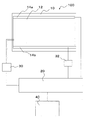
- the glass system 100 includes a glass body 10 provided with a resistor 12, a temperature measuring unit 30 that measures the temperature of the glass body 10, and a current measurement that measures a current value of a current flowing through the resistor 12. And a processing device 20 for deriving the state of the glass body 10 based on the current value measured by the current measuring unit 32.
- the glass body 10 is heated by the resistor 12 when the resistor 12 generates heat by passing a current through the resistor 12.
- the resistor 12 can be composed of a film made of a conductive material.
- a metal such as copper or a metal acid additive such as ITO can be applied.
- the glass body 10 is provided with a plurality of electrodes (for example, two electrodes) 14 a and 14 b for allowing a current to flow through the resistor 12.
- the material of the glass body 10 is not specifically limited, A well-known thing can be applied.
- the glass body 10 can also be configured by bonding a plurality of glasses. In this case, from the viewpoint of protecting the electrodes 14a and 14b, glass can be bonded so as to sandwich the electrodes 14a and 14b.
- the glass body 10 may be not only a flat plate but also a cylindrical or hollow shape.
- the resistor 12 is provided between the electrodes 14a and 14b.
- the electrodes 14 a and 14 b can be provided on the side portions on both sides of the glass body 10.
- the shape of the electrodes 14a and 14b is not particularly limited as long as the function as an electrode can be realized.
- the electrodes 14a and 14b can be provided linearly.
- the material of the electrodes 14a and 14b is not particularly limited as long as it can realize a function as an electrode, but can be made of a metal such as copper.
- a current is supplied from the power supply unit 40 to the electrodes 14a and 14b.
- the temperature measuring unit 30 is not particularly limited as long as the temperature of the glass body 10 can be measured, and can be configured by, for example, a thermocouple.
- the vicinity of the tip may be attached to an adhesive body (such as a seal body) and attached to the glass through the adhesive body for ease of attachment.
- the temperature measurement unit 30 can be provided between the processing apparatus 20 and the amplifier A1.
- the current measuring unit 32 is not particularly limited as long as it can measure the current flowing between the plurality of electrodes 14a and 14b, and a known one can be applied.
- the current measurement unit 32 can be provided between the processing device 20 and the amplifier A2.
- the processing apparatus 20 controls components such as the power supply unit 40 and determines the state of the glass body 10 based on the current value measured by the current measurement unit 32 and the temperature of the glass body 10 measured by the temperature measurement unit 30. To derive.
- the processing device 20 can be realized by a control circuit including a CPU, a ROM, a RAM, and the like.
- the processing device 20 may be realized by a plurality of control circuits.
- the glass system 100 can further include the following components.
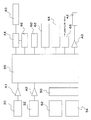
- a temperature setting switch 52 and a temperature display lamp 54 are connected to the processing apparatus 20 via an external terminal connection part (for example, a photocoupler) 50.
- the temperature setting switch 52 is for changing the setting to the high temperature side or the low temperature side with respect to the set temperature of the glass body 10.
- the temperature display lamp 54 is a lamp (for example, a light emitting diode) that displays the degree of temperature change by the temperature setting switch 52.
- the AC / DC converter 44 converts an AC power supply of the power supply unit 40 into a DC power supply.
- the converted DC power supply path includes a path sent to the processing apparatus and a path sent to the DC / DC converter 46 and stepped up or down and sent to the processing apparatus 20.
- the storage unit 60 stores relation data between the resistor 12 and the resistance value, temperature increase program data corresponding to the size of the resistor 12, correspondence data between the current value and the resistance value, correspondence between the current value and the temperature change. Related data, the time to rise to the specified temperature after turning on the power, the time to drop to the prescribed temperature after turning off the power, the maximum temperature reached after the power is turned off, the temperature that is damaged when the power is turned on Corresponding data between the data current value such as the time from power-on to breakage and the temperature at which the glass body is heated is stored.
- the data in the storage unit 60 serves as basic data for deriving appropriate conditions for the control for increasing the temperature of the glass system 100 and the like.
- the temperature raising program data is given conditions for raising the temperature according to the size and thickness of the resistor 12 such as the size and thickness of the glass body 10, A current value, a voltage value, or the like is set according to the current flowing time.
- the storage unit 60 can be configured by a known storage medium such as a hard disk, ROM, or RAM. The function of the storage unit 60 may be realized by a storage area in the processing device 20.
- the display 62 is connected to the processing apparatus 20, and displays the surface temperature of the glass body 10, the energizing current value of the glass body 10, a breakage alarm of the glass body 10, a break alarm of the thermocouple 32, and the like.
- a known display device such as a touch panel display can be applied to the display.
- the computer 64 is connected to the processing apparatus 20 and performs temperature correction of the basic set temperature, the glass body type (thickness, shape, size, etc.), and the thermocouple circuit.
- the transmission / reception unit 66 is connected to the processing device 20.
- the transmission / reception unit 66 transmits / receives information to / from the management terminal through a communication network such as the Internet.
- a known transmission / reception device can be applied to the transmission / reception unit 66.
- the processing apparatus 20 outputs the control output of the solid state relay 42 via the amplifier A3, and controls the solid state relay 42.
- the solid state relay 42 turns on and off power to the resistor 12 of the power supply unit 40. Since the solid state relay 40 is equipped with the zero cross function, it is possible to reduce the noise of the power source and reduce the sound.
- the solid state relay 42 having a zero cross function recognizes the waveform of the power supply and can be turned on / off at 0V.
- warning unit that warns of an abnormal state of the glass system itself (for example, an abnormal state of the temperature measurement unit) by light or sound.
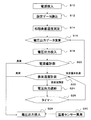
- setting data is read (S12). That is, the processing device 20 reads a temperature raising program based on the size of the glass body.
- the surface temperature of the glass body 10 is measured (S14). Based on the initial surface temperature, voltage output data is calculated (S16), and a voltage is output (S18). Next, the current value flowing through the resistor 12 is measured (S20). If it is normal, the current is kept flowing, and the surface temperature is measured after a predetermined time has passed (S22). The voltage output is cut off (S24). If the surface temperature does not reach the predetermined temperature after a predetermined time, the voltage output data is recalculated (S16), and the voltage is output again (S18). In order to keep the temperature constant, the elapse of a predetermined time after the voltage output is cut off is grasped by a timer (S26), and the surface temperature is measured after the elapse of the predetermined time (S22).
- the voltage output is stopped (S28). Also, when an abnormality occurs in the temperature measuring unit 30 (S30), the voltage output is stopped (S28). That is, if the temperature does not rise when a predetermined current is passed by the temperature raising program, the voltage output is stopped.
- the failure information can be transmitted to the management terminal by the transmission / reception unit 66.
- the size of the glass body 10 may be recognized based on the resistance value. That is, if the thickness of the resistor is the same, the size of the resistor can be recognized from the resistance value of the resistor.
- the damage status of the resistor 12 can be confirmed by confirming the resistance value.
- the program that causes the computer of the processing device 20 to execute these processes can be stored in a ROM or the like that constitutes the processing device 20.
- thermocouple When temperature control of a heat-generating glass having a conductive film is performed by a general technique, in order to maintain the temperature in the heat-generating glass, a certain voltage is applied to the heat-generating glass in advance. Either measure the rise and continue to supply the voltage and current when it reaches the required temperature to the glass you want to warm, or manage the temperature, or apply a general single-phase current such as 100V to the electrode of the heating glass There is a temperature control by a method of shutting off the electricity supplied to the heat generating glass and stopping the temperature rise by a thermocouple for confirming that the temperature rise has reached the required temperature and a temperature controller connected to it.
- the temperature of the glass when heated at a constant voltage and current measured in advance so as to obtain the desired temperature by reducing the voltage as described above.
- the required temperature is not reached, for example, when the temperature rise time to the required temperature is required or when the environmental temperature is low.
- the temperature of the exothermic glass is adjusted by controlling the power supply time to maintain the set temperature, but until the set temperature is reached. Power is supplied when power is supplied and the thermocouple communicates to the temperature controller that the temperature has been achieved.
- This control method is a general method, but when trying to control the temperature of glass with high heat retention effect, etc., it generates heat when energized, and the temperature starts to rise. After the power supply is cut off, the temperature rises, and when the temperature starts to drop and the temperature controller starts energizing the heat-generating glass, the result that the temperature exceeds the set temperature again is repeated.
- Controlling the temperature of the exothermic glass improves the performance of the coating-type and vapor-deposited type conductive coatings that have existed in the market, and the glass that has only been heated to around 30 ° C improves the performance of the exothermic glass. Therefore, the temperature is increased to close to 600 ° C., and the use is increased. In this way, when glass is used as a heating element, the conventional temperature control method is used as it is for heating glass, but its shape, size, thickness and required temperature are different.
- control devices and methods corresponding to each of them are different and required to be developed each time, and it has been manufactured in a form that responds, but there is a problem with the rate of temperature rise, the temperature becomes unstable, power consumption Problems such as large size and cost of development for each control device are inevitable. Considering such a situation further, the present embodiment is very useful. As described above, according to the present embodiment, it is possible to improve the versatility of the processing apparatus that controls the glass system. (2) The temperature measurement unit 30 performs measurement even though a predetermined current flows. If the measured temperature does not match the temperature raising program, it can be recognized that the temperature measuring unit 30 has failed.
- the electrodes 14 a and 14 b can be arranged such that two electrodes are arranged side by side only on one side of the glass body 10.
- the resistor 12 is preferably provided with a notch part.
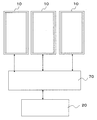
- the processing apparatus 20 may control the plurality of glass bodies 10 via the terminal 70.
- the glass system of the present invention is widely applied to industries as glass for buildings and heat generating materials for heating appliances.
Landscapes
- Control Of Resistance Heating (AREA)
- Surface Heating Bodies (AREA)
Applications Claiming Priority (2)
| Application Number | Priority Date | Filing Date | Title |
|---|---|---|---|
| JP2010-026017 | 2010-02-08 | ||
| JP2010026017A JP4919440B2 (ja) | 2010-02-08 | 2010-02-08 | ガラスシステム、処理装置およびプログラム |
Publications (1)
| Publication Number | Publication Date |
|---|---|
| WO2011096579A1 true WO2011096579A1 (ja) | 2011-08-11 |
Family
ID=44355571
Family Applications (1)
| Application Number | Title | Priority Date | Filing Date |
|---|---|---|---|
| PCT/JP2011/052668 Ceased WO2011096579A1 (ja) | 2010-02-08 | 2011-02-08 | ガラスシステム、処理装置およびプログラム |
Country Status (2)
| Country | Link |
|---|---|
| JP (1) | JP4919440B2 (enExample) |
| WO (1) | WO2011096579A1 (enExample) |
Families Citing this family (4)
| Publication number | Priority date | Publication date | Assignee | Title |
|---|---|---|---|---|
| JP5782606B2 (ja) * | 2011-07-05 | 2015-09-24 | 株式会社Gushout | 加熱装置、ガラスシステム、処理装置およびプログラム |
| JP5807262B2 (ja) * | 2012-03-23 | 2015-11-10 | 株式会社Gushout | ガラスシステム、加熱装置、処理装置およびプログラム |
| CN104105237B (zh) * | 2014-07-23 | 2016-04-06 | 中国科学院国家天文台南京天文光学技术研究所 | 望远镜镜面的导电薄膜多相交流电加热方法 |
| JP7786780B1 (ja) * | 2025-08-01 | 2025-12-16 | 株式会社九州日昌 | ペルチェ素子駆動装置及びペルチェ素子制御システム |
Citations (2)
| Publication number | Priority date | Publication date | Assignee | Title |
|---|---|---|---|---|
| JP2005508072A (ja) * | 2001-10-26 | 2005-03-24 | エンジニアード・グラス・プロダクツ・エルエルシー | 導電性加熱ガラスパネルアセンブリ、制御システム、及びパネル製造法 |
| JP2008293864A (ja) * | 2007-05-28 | 2008-12-04 | Mitsubishi Electric Corp | 加熱装置および加熱装置の制御方法 |
-
2010
- 2010-02-08 JP JP2010026017A patent/JP4919440B2/ja not_active Expired - Fee Related
-
2011
- 2011-02-08 WO PCT/JP2011/052668 patent/WO2011096579A1/ja not_active Ceased
Patent Citations (2)
| Publication number | Priority date | Publication date | Assignee | Title |
|---|---|---|---|---|
| JP2005508072A (ja) * | 2001-10-26 | 2005-03-24 | エンジニアード・グラス・プロダクツ・エルエルシー | 導電性加熱ガラスパネルアセンブリ、制御システム、及びパネル製造法 |
| JP2008293864A (ja) * | 2007-05-28 | 2008-12-04 | Mitsubishi Electric Corp | 加熱装置および加熱装置の制御方法 |
Also Published As
| Publication number | Publication date |
|---|---|
| JP4919440B2 (ja) | 2012-04-18 |
| JP2011165447A (ja) | 2011-08-25 |
Similar Documents
| Publication | Publication Date | Title |
|---|---|---|
| US20190246699A1 (en) | Electronic cigarette temperature control system and method, and electronic cigarette with the same | |
| JP4919440B2 (ja) | ガラスシステム、処理装置およびプログラム | |
| EP2088493A2 (en) | Portable computer and method for preheating portable computer before booting | |
| CN103281836B (zh) | 一种应用在交流led驱动系统中的芯片过温保护电路 | |
| KR20240093907A (ko) | 히터에 공급되는 전력을 제어하는 시스템 및 방법 | |
| WO2010052683A3 (en) | Mems resonator | |
| US20100290184A1 (en) | Temperature control apparatus, information processing apparatus and method for temperature control | |
| ATE495578T1 (de) | Intelligentes heimautomatisierungssystem mit stromspareffekt im bereitschaftsmodus | |
| CN102426823A (zh) | 一种用于控制led背光驱动器温度的主动保护电路 | |
| JP5782606B2 (ja) | 加熱装置、ガラスシステム、処理装置およびプログラム | |
| JP6180213B2 (ja) | 光モジュール及び光モジュールの制御方法 | |
| WO2013001659A1 (ja) | 制御装置、加熱装置制御システム、制御方法、プログラムおよび記録媒体 | |
| JP5751183B2 (ja) | ガラスシステム、処理装置およびプログラム | |
| CN102830734A (zh) | 设备温度调节电路 | |
| RU2372672C1 (ru) | Конструкция lcd для работы при низкой температуре | |
| US7512162B2 (en) | Dynamic thermal management of laser devices | |
| JP5807262B2 (ja) | ガラスシステム、加熱装置、処理装置およびプログラム | |
| CN206773333U (zh) | 智能pdlc调光玻璃 | |
| CN105938974A (zh) | 一种激光变脉宽保护系统 | |
| CN107077820B (zh) | 具有温度补偿的液晶显示器 | |
| KR102058248B1 (ko) | 사물인터넷을 이용하여 외부 환경에 따른 출력 제어를 수행하는 전기 레인지 | |
| KR20150130105A (ko) | 발열 유리 온도 제어 시스템 및 방법 | |
| KR20160068491A (ko) | 헤어 아이론의 온도제어시스템 및 방법 | |
| JP6155078B2 (ja) | レーダ表示装置 | |
| KR101458536B1 (ko) | 엘엔지 선박의 트리플렉스 설치용 히팅 패드 컨트롤러 및 히팅 패드 제어 방법 |
Legal Events
| Date | Code | Title | Description |
|---|---|---|---|
| 121 | Ep: the epo has been informed by wipo that ep was designated in this application |
Ref document number: 11739926 Country of ref document: EP Kind code of ref document: A1 |
|
| NENP | Non-entry into the national phase |
Ref country code: DE |
|
| 122 | Ep: pct application non-entry in european phase |
Ref document number: 11739926 Country of ref document: EP Kind code of ref document: A1 |
|
| NENP | Non-entry into the national phase |
Ref country code: JP |