WO2011096306A1 - 太陽電池裏面封止シート用フィルム - Google Patents
太陽電池裏面封止シート用フィルム Download PDFInfo
- Publication number
- WO2011096306A1 WO2011096306A1 PCT/JP2011/051399 JP2011051399W WO2011096306A1 WO 2011096306 A1 WO2011096306 A1 WO 2011096306A1 JP 2011051399 W JP2011051399 W JP 2011051399W WO 2011096306 A1 WO2011096306 A1 WO 2011096306A1
- Authority
- WO
- WIPO (PCT)
- Prior art keywords
- film
- solar cell
- resin layer
- sealing sheet
- resin
- Prior art date
- Legal status (The legal status is an assumption and is not a legal conclusion. Google has not performed a legal analysis and makes no representation as to the accuracy of the status listed.)
- Ceased
Links
Classifications
-
- C—CHEMISTRY; METALLURGY
- C09—DYES; PAINTS; POLISHES; NATURAL RESINS; ADHESIVES; COMPOSITIONS NOT OTHERWISE PROVIDED FOR; APPLICATIONS OF MATERIALS NOT OTHERWISE PROVIDED FOR
- C09J—ADHESIVES; NON-MECHANICAL ASPECTS OF ADHESIVE PROCESSES IN GENERAL; ADHESIVE PROCESSES NOT PROVIDED FOR ELSEWHERE; USE OF MATERIALS AS ADHESIVES
- C09J7/00—Adhesives in the form of films or foils
- C09J7/20—Adhesives in the form of films or foils characterised by their carriers
- C09J7/21—Paper; Textile fabrics
-
- C—CHEMISTRY; METALLURGY
- C08—ORGANIC MACROMOLECULAR COMPOUNDS; THEIR PREPARATION OR CHEMICAL WORKING-UP; COMPOSITIONS BASED THEREON
- C08K—Use of inorganic or non-macromolecular organic substances as compounding ingredients
- C08K5/00—Use of organic ingredients
- C08K5/16—Nitrogen-containing compounds
- C08K5/34—Heterocyclic compounds having nitrogen in the ring
- C08K5/3467—Heterocyclic compounds having nitrogen in the ring having more than two nitrogen atoms in the ring
- C08K5/3477—Six-membered rings
- C08K5/3492—Triazines
- C08K5/34924—Triazines containing cyanurate groups; Tautomers thereof
-
- C—CHEMISTRY; METALLURGY
- C09—DYES; PAINTS; POLISHES; NATURAL RESINS; ADHESIVES; COMPOSITIONS NOT OTHERWISE PROVIDED FOR; APPLICATIONS OF MATERIALS NOT OTHERWISE PROVIDED FOR
- C09J—ADHESIVES; NON-MECHANICAL ASPECTS OF ADHESIVE PROCESSES IN GENERAL; ADHESIVE PROCESSES NOT PROVIDED FOR ELSEWHERE; USE OF MATERIALS AS ADHESIVES
- C09J7/00—Adhesives in the form of films or foils
- C09J7/20—Adhesives in the form of films or foils characterised by their carriers
- C09J7/203—Adhesives in the form of films or foils characterised by their carriers characterised by the structure of the release feature on the carrier layer
-
- H—ELECTRICITY
- H10—SEMICONDUCTOR DEVICES; ELECTRIC SOLID-STATE DEVICES NOT OTHERWISE PROVIDED FOR
- H10F—INORGANIC SEMICONDUCTOR DEVICES SENSITIVE TO INFRARED RADIATION, LIGHT, ELECTROMAGNETIC RADIATION OF SHORTER WAVELENGTH OR CORPUSCULAR RADIATION
- H10F19/00—Integrated devices, or assemblies of multiple devices, comprising at least one photovoltaic cell covered by group H10F10/00, e.g. photovoltaic modules
- H10F19/80—Encapsulations or containers for integrated devices, or assemblies of multiple devices, having photovoltaic cells
- H10F19/804—Materials of encapsulations
-
- H—ELECTRICITY
- H10—SEMICONDUCTOR DEVICES; ELECTRIC SOLID-STATE DEVICES NOT OTHERWISE PROVIDED FOR
- H10F—INORGANIC SEMICONDUCTOR DEVICES SENSITIVE TO INFRARED RADIATION, LIGHT, ELECTROMAGNETIC RADIATION OF SHORTER WAVELENGTH OR CORPUSCULAR RADIATION
- H10F19/00—Integrated devices, or assemblies of multiple devices, comprising at least one photovoltaic cell covered by group H10F10/00, e.g. photovoltaic modules
- H10F19/80—Encapsulations or containers for integrated devices, or assemblies of multiple devices, having photovoltaic cells
- H10F19/85—Protective back sheets
-
- Y—GENERAL TAGGING OF NEW TECHNOLOGICAL DEVELOPMENTS; GENERAL TAGGING OF CROSS-SECTIONAL TECHNOLOGIES SPANNING OVER SEVERAL SECTIONS OF THE IPC; TECHNICAL SUBJECTS COVERED BY FORMER USPC CROSS-REFERENCE ART COLLECTIONS [XRACs] AND DIGESTS
- Y02—TECHNOLOGIES OR APPLICATIONS FOR MITIGATION OR ADAPTATION AGAINST CLIMATE CHANGE
- Y02E—REDUCTION OF GREENHOUSE GAS [GHG] EMISSIONS, RELATED TO ENERGY GENERATION, TRANSMISSION OR DISTRIBUTION
- Y02E10/00—Energy generation through renewable energy sources
- Y02E10/50—Photovoltaic [PV] energy
Definitions
- This invention relates to the film for solar cell backside sealing sheets which has the light resistance and heat-and-moisture resistance which can endure use in the severe outdoor environment for a long period of time. Moreover, this invention relates to the solar cell backside sealing sheet and solar cell module using the film for solar cell backside sealing sheets of this invention.
- Solar cells used for photovoltaic power generation constitute the heart of a photovoltaic power generation system that converts sunlight energy directly into electrical energy.
- Solar cells are made of semiconductors such as silicon.
- the solar cells are unitized by wiring various solar cell elements in series and in parallel and applying various packaging to protect the elements over a long period of about 20 years.
- the unit incorporated in this package is called a solar cell module.
- the solar cell module has a configuration in which a surface that is exposed to sunlight is covered with glass, a gap is filled with a filler made of a thermoplastic resin, and a back surface is protected with a sealing sheet.
- ethylene-vinyl acetate copolymer resin hereinafter referred to as EVA resin
- EVA resin ethylene-vinyl acetate copolymer resin
- the backside sealing sheet has mechanical strength, weather resistance, heat resistance, water resistance, chemical resistance, light reflectivity, electrical insulation, water vapor barrier properties, and thermal adhesiveness with fillers typified by EVA resin. Further, characteristics such as design properties and adhesion to the outermost terminal box mounting silicone resin are required. In addition to these, the back surface sealing sheet is required to have excellent light resistance because it is exposed to ultraviolet rays.
- Examples of conventionally used films for backside sealing sheets include white polyvinyl fluoride films (DuPont Co., Ltd., trade name: Tedlar (registered trademark)).
- a backside sealing sheet having a laminated structure in which a polyester film is sandwiched with a polyvinyl fluoride film is widely used in solar cell applications.
- a light-resistant film in which an acrylic resin coating film containing an ultraviolet absorber and a light stabilizer is formed on one side or both sides of a polyester film has been proposed and put into practical use (Patent Document 1).
- Patent Document 2 a specification in which an ultraviolet absorber or a light stabilizer is kneaded into a polyester film has been proposed and put into practical use.
- a white film formed by kneading a white pigment such as titanium oxide in a layer such as a polyester film has also been put into practical use (Patent Document 3).
- This white film is known to have light resistance from the viewpoint that the change in the film appearance accompanying ultraviolet exposure is small.
- the polyvinyl fluoride film described above is a film having excellent weather resistance, but on the other hand, its mechanical strength is weak and it is softened by the heat of a hot press at 140 to 150 ° C. applied at the time of manufacturing a solar cell module.
- the protrusion of the element electrode portion may penetrate the filler layer.
- it since it is expensive, it also becomes an obstacle in terms of reducing the cost of the solar cell module.
- it in order to make it a colored film represented by white etc. and to improve the design property of a back surface sealing sheet, it is necessary to combine with a comparatively expensive colored film.
- ultraviolet absorbers or light stabilizers may bleed out on the coating film or film surface in a high-temperature humidified environment or with ultraviolet light reception. For this reason, not only the wettability and the surface adhesion force change, but also the light resistance that was initially expressed is likely to be lost.
- the white film of Patent Document 3 has a certain degree of UV resistance in that the change in film appearance accompanying UV exposure is small due to the light absorption ability of the pigment component, but the main material resin is not light-resistant. For this reason, for example, film properties represented by breaking strength and elongation are gradually lowered with ultraviolet irradiation.
- development related to prolonging the life of solar cell modules itself has been actively carried out, and in addition, the number of solar cell modules installed in a slanting manner on the ground surface is increasing mainly in Europe. In such a case, it is exposed to ultraviolet rays reflected from the ground surface for a long time.
- the sealing sheet turns yellow, and not only the beauty of the film appearance is impaired, but also the extreme In such a case, cracks and the like are generated in the sealing sheet, and there is a concern that various characteristics required for the sheet such as electrical insulation and water vapor barrier properties may be impaired.
- the present invention adopts the following configuration in order to solve such problems. That is, in the film for solar cell backside sealing sheet of the present invention, a resin layer containing a fluororesin, a color pigment, and melamine cyanurate is laminated on at least one side of the base film.
- the solar cell back surface sealing sheet of the present invention includes the film for solar cell back surface sealing sheet of the present invention.
- the solar cell module of the present invention includes the solar cell back surface sealing sheet and the cell filler layer of the present invention, and the solar cell back surface sealing sheet and the cell filler layer are bonded.
- a film for solar cell backside sealing sheet excellent in light resistance and wet heat resistance, and a solar cell backside sealing sheet using the same can be obtained.
- the film for solar cell backside sealing sheets which are further excellent in a flame retardance and have little blocking and choking, and a solar cell backside sealing sheet using the same are obtained.
- the solar cell back surface sealing sheet of this invention is used, the solar cell module excellent in durability will be obtained.
- the film for solar cell backside sealing sheet of the present invention has a light resistance superior to that of the prior art by laminating a resin layer containing a fluorine-based resin, a color pigment and melamine cyanurate on at least one surface of the base film. Moisture and heat resistance can be obtained.
- Base film Various resin films can be used as the base film for the film for solar cell backside sealing sheet.
- Specific examples include polyester resin films such as polyethylene terephthalate (PET) and polyethylene naphthalate (PEN), resin films such as polycarbonate, polymethyl methacrylate, polyacrylate, polypropylene, and polyethylene, and resin films obtained by mixing these resins. It is done.
- a polyester resin film is preferable because it is excellent in strength, dimensional stability, and thermal stability, and a polyester resin film such as PET or PEN is particularly preferable because it is inexpensive.
- the polyester resin may be a copolymer.
- copolymer component examples include diol components such as propylene glycol, diethylene glycol, neopentyl glycol, and cyclohexanedimethanol, isophthalic acid, adipic acid, azelaic acid, and sebacin.
- diol components such as propylene glycol, diethylene glycol, neopentyl glycol, and cyclohexanedimethanol, isophthalic acid, adipic acid, azelaic acid, and sebacin.
- the dicarboxylic acid component of an acid and its ester-forming derivative can be used.
- polyphenylene sulfide (PPS) having high hydrolysis resistance, heat resistance and flame retardancy can also be used.
- the film for solar cell backside sealing sheet is excellent in light resistance, it should be suitably used for the outermost layer that is directly exposed to the outside air (humidity, temperature) or reflected from the ground surface in the solar cell backside sealing sheet configuration. Can do.
- the base film is preferably a resin film having excellent hydrolysis resistance.
- a polyester resin film is formed from a so-called polymer obtained by condensation polymerization of monomers, and contains about 1.5 to 2% by mass of an oligomer positioned between the monomer and the polymer.
- a typical oligomer is a cyclic trimer, and a film with a high content of it causes a decrease in mechanical strength, cracks, breakage of materials, etc. due to the progress of hydrolysis due to rainwater, etc. in long-term exposure such as outdoors. .
- a polyester resin film from a polyester resin having a cyclic trimer content of 1.0% by mass or less obtained by polymerization by a solid phase polymerization method as a raw material, under high temperature and high humidity It is possible to suppress the hydrolysis of the film, and a film having excellent heat resistance and weather resistance can be obtained.
- the cyclic trimer content is measured by, for example, measuring the content (% by mass) relative to the resin mass by measuring by liquid chromatography using a solution obtained by dissolving 100 mg of a polymer in 2 ml of orthochlorophenol. Is required.
- additives such as an antistatic agent, an ultraviolet absorber, a stabilizer, an antioxidant, a plasticizer, a lubricant, a filler, and a coloring pigment are added in a range that does not impair the effects of the present invention. Can be added within.
- the thickness of the base film is not particularly limited, but is preferably in the range of 1 to 250 ⁇ m in view of the voltage resistance characteristics, cost, etc. of the sealing sheet.
- the lower limit of the thickness is more preferably 25 ⁇ m or more.
- a water vapor barrier film in which at least one inorganic oxide layer is formed by vapor deposition or the like may be used for the purpose of imparting water vapor barrier properties.
- the “water vapor barrier film” in the present invention is a resin film having a water vapor transmission rate of 5 g / (m 2 ⁇ day) or less measured by the method B described in JIS K7129 (2000 version).
- the thickness of the resin film is preferably in the range of 1 to 100 ⁇ m, more preferably in the range of 5 to 50 ⁇ m, particularly preferably for reasons such as stability and cost when forming the inorganic oxide layer. It is about 10 to 30 ⁇ m.
- the base film is preferably stretched in the biaxial direction so that the thermal dimensional stability is good. Moreover, you may perform surface treatments, such as discharge treatments, such as corona discharge and plasma discharge, or acid treatment, to a base film as needed.
- stacked on the base film in this invention contains (1) fluororesin, (2) a coloring pigment, and (3) melamine cyanurate.
- an organic ultraviolet absorber or an inorganic ultraviolet absorber alone or a mixture of a plurality of types is mixed with a binder resin, and radicals excited by light are lost.
- a light stabilizer (HALS) is used in combination for the purpose of increasing the light stability by the mechanism to be activated.
- the UV absorber or light stabilizer is applied from the inside of the coating film in a high-temperature humidified environment or with UV light reception. May bleed out to the membrane surface. For this reason, not only the wettability and the adhesion of the coating film surface change, but also the problem that the ultraviolet ray cutting performance that was initially expressed is lost is likely to occur.
- a fluororesin that is extremely excellent in light resistance is used as a binder resin as compared with a polyester resin, an olefin resin, an acrylic resin, and the like.
- a fluorine resin is excellent also in a flame retardance, it also has the effect of improving the flame retardance of the film for solar cell backside sealing sheets.
- a fluororesin having a curable functional group introduced is preferable so that an appropriate cross-linked structure can be introduced into the resin layer. Since the solar cell backside sealing sheet using the solar cell backside sealing sheet film is exposed to high temperature treatment in the solar cell module manufacturing process, the resin layer is required to have heat resistance.
- Examples of the functional group that imparts curability to the fluororesin include a hydroxyl group, a carboxyl group, an amino group, a glycidyl group, a silyl group, a silanate group, an isocyanate group, and the like, as appropriate depending on the ease of resin production and the curing system. Selected. Among these, a hydroxyl group, a cyano group, and a silyl group are preferable from the viewpoint of good curing reactivity, and a hydroxyl group is particularly preferable from the viewpoint of easy availability of the resin and good reactivity. These curable functional groups are usually introduced into the fluororesin by copolymerizing a curable functional group-containing monomer.
- hydroxyl group-containing monomer examples include 2-hydroxyethyl vinyl ether, 3-hydroxypropyl vinyl ether, 2-hydroxypropyl vinyl ether, 2-hydroxy-2-methylpropyl vinyl ether, 4-hydroxybutyl vinyl ether, 4-hydroxy-2-methyl.
- examples include hydroxyl group-containing vinyl ethers such as butyl vinyl ether, 5-hydroxypentyl vinyl ether and 6-hydroxyhexyl vinyl ether, and hydroxyl group-containing allyl ethers such as 2-hydroxyethyl allyl ether, 4-hydroxybutyl allyl ether and glycerol monoallyl ether. .
- hydroxyl group-containing vinyl ethers particularly 4-hydroxybutyl vinyl ether and 2-hydroxyethyl vinyl ether, are preferred in view of excellent polymerization reactivity and curability of functional groups.
- the other hydroxyl group-containing monomer include hydroxyalkyl esters of (meth) acrylic acid such as 2-hydroxyethyl acrylate and 2-hydroxyethyl methacrylate.
- Examples of the fluororesin into which the curable functional group is introduced include a perfluoroolefin resin mainly composed of a perfluoroolefin unit from the viewpoint of a structural unit.
- Specific examples include a homopolymer of tetrafluoroethylene (TFE), a copolymer of TFE and hexafluoropropylene (HFP), perfluoro (alkyl vinyl ether) (PAVE), and the like, and further copolymerizable therewith. Examples thereof include copolymers with other monomers.
- Examples of other copolymerizable monomers include vinyl acetate, vinyl propionate, vinyl butyrate, vinyl isobutyrate, vinyl pivalate, vinyl caproate, vinyl versatate, vinyl laurate, vinyl stearate, and cyclohexyl carboxylic acid.
- Carboxylic acid vinyl esters such as vinyl, vinyl benzoate, vinyl para-t-butylbenzoate, alkyl vinyl ethers such as methyl vinyl ether, ethyl vinyl ether, butyl vinyl ether, cyclohexyl vinyl ether, ethylene, propylene, n-butene, isobutene, etc.
- Fluorine-based monomers such as fluorine-based olefins, vinylidene fluoride (VdF), chlorotrifluoroethylene (CTFE), vinyl fluoride (VF), fluorovinyl ether, and the like. Not limited thereto.
- TFE resin mainly composed of TFE is preferable in terms of excellent pigment dispersibility, weather resistance, copolymerization, and chemical resistance.
- curable functional group-containing perfluoroolefin resin examples include a TFE / isobutylene / hydroxybutyl vinyl ether / other monomer copolymer, TFE / vinyl versatate / hydroxybutyl vinyl ether / other monomer, and the like.
- TFE-based curable resin paint examples include the Zaffle GK series manufactured by Daikin Industries, Ltd.
- the thickness of the resin layer is preferably 0.2 to 20 ⁇ m.
- the lower limit of the thickness of the resin layer is more preferably 5 ⁇ m or more, and particularly preferably 8 ⁇ m or more.
- the upper limit of the thickness of the resin layer is more preferably 15 ⁇ m or less, and particularly preferably 10 ⁇ m or less.
- the thickness of the resin layer exceeds 20 ⁇ m, the light resistance is sufficiently developed, but the coating method is restricted, the production cost becomes high, the coating film adheres to the transport roll, and the coating film peels off accompanying it. There is a concern that it is likely to occur.
- Examples of the solvent of the coating liquid for forming the resin layer by the coating method include toluene, xylene, ethyl acetate, butyl acetate, acetone, methyl ethyl ketone, methyl isobutyl ketone, tetrahydrofuran, dimethylformamide, dimethylacetamide, methanol, ethanol and water. Etc. can be illustrated.
- the properties of the coating liquid may be either an emulsion type or a dissolution type.
- the method for forming the resin layer on the base film is not particularly limited, and a known coating method can be used. Various methods can be applied as the coating method, and a roll coating method, a dip coating method, a bar coating method, a die coating method, a gravure roll coating method, and the like, or a combination of these methods can be used. Among them, the gravure roll coating method is a preferable method because it increases the stability of the resin layer.
- the color pigment used in the present invention is used for the purposes of (1) coloring the resin layer, (2) maintaining the color tone (not fading), (3) cutting ultraviolet rays and / or visible light, and (4) improving flame retardancy. It is done.
- a white sheet is mainly used from the viewpoint of light reflectivity and design, but in recent years, the design is superior to the sheet in which the gap between the power generation elements looks white. For this reason, the demand for black sheets is increasing.
- these pigments themselves also absorb and / or reflect light having a specific wavelength, the effect of protecting the substrate film from ultraviolet rays and / or visible light can be obtained by coloring.
- a design pattern such as an electric wiring pattern in the solar cell module can be hidden.
- the color pigment various color pigments such as inorganic pigments and organic pigments can be used.
- white or black currently in practical use, titanium oxide is preferred as the white pigment and carbon black is preferred as the black pigment from the viewpoints of versatility, price, color development performance, and UV resistance.
- titanium oxide preferably has a number average particle size of 0.1 to 1.0 ⁇ m. From the viewpoint of dispersibility with respect to the fluororesin and cost, it is more preferably 0.2 to 0.5 ⁇ m.
- the number average particle diameter of carbon black is preferably 0.01 to 0.5 ⁇ m. From the viewpoint of dispersibility and cost, it is more preferably 0.02 to 0.1 ⁇ m.
- the content of the color pigment may be appropriately adjusted according to the design of the color tone to be developed.
- the content of the color pigment is too small, a color appearance with excellent design properties cannot be obtained, the ultraviolet and / or visible light cutting performance is poor, or the base film when exposed to the outdoors for a long time. Degradation and yellowing may occur.
- the amount of resin increases, blocking may occur.
- the content of the color pigment is too much, the cost becomes high, or the adhesion strength between the base material and the silicone resin for terminal box adhesion due to the significant improvement in the hardness of the resin layer is likely to occur. There is a concern that choking occurs on the surface of the resin layer.
- the coloring pigment is used also for the purpose of improving the flame retardance of the film for solar cell backside sealing sheets, and flame retardance is provided by increasing content to some extent.
- the content of the color pigment is preferably 30 to 80% by mass with respect to the entire resin layer.
- the lower limit of the content is more preferably 50% by mass or more, and particularly preferably 65% by mass or more.
- the upper limit of the content is more preferably 75% by mass or less, and particularly preferably 70% by mass or less.
- the melamine cyanurate used in the present invention is used for the purpose of (1) improving the blocking resistance of the resin layer and (2) improving the flame retardancy.
- Melamine cyanurate is a non-halogen flame retardant and is also used as a lubricant.
- by adding melamine cyanurate to the fluororesin not only the flame retardancy of the resin layer is improved, but also there is an effect of reducing blocking that occurs when the fluororesin is used.
- As a mechanism for reducing blocking by including melamine cyanurate in the fluororesin it is estimated as follows.
- the melamine cyanurate is phase-separated from the fluororesin having a low polarity in the resin layer, and the low molecular weight melamine cyanurate moves to the opposite side of the base film. Moving. As a result, since a large amount of melamine cyanurate is contained on the surface of the resin layer, it is considered that blocking is reduced.
- the content of melamine cyanurate is preferably 1 to 30% by mass with respect to the entire resin layer.
- the lower limit of the content is more preferably 3% by mass or more, and particularly preferably 5% by mass or more.
- the upper limit of the content is preferably 20% by mass or less, and particularly preferably 10% by mass or less. If the content is less than 1% by mass, sufficient effects of melamine cyanurate may not be obtained. If the content exceeds 30% by mass, the cost may increase, the melamine cyanurate may bleed out to the surface of the coating film, and the solvent resistance required for the resin layer may decrease.
- a crosslinking agent having a functional group capable of reacting with the functional group of the fluororesin may be blended for the purpose of improving the characteristics of the resin layer.
- a cross-linking agent is used in combination, the effect of improving the adhesion between the base film and the resin layer, or improving the solvent resistance and heat resistance of the resin layer accompanying the introduction of the cross-linked structure can be obtained.
- the solar cell back surface sealing sheet is designed so that the resin layer in the present invention is located in the outermost layer, in the solar cell module manufacturing process, specifically in the glass laminating process (cell filling process), Since the resin layer is exposed to a heat treatment of 30 minutes or longer at a high temperature of about 150 ° C.
- the functional group introduced into the fluororesin is preferably a hydroxyl group, and therefore, it is preferable to use a crosslinking agent capable of reacting with the hydroxyl group.
- a crosslinking agent a prescription that uses a polyisocyanate resin as a curing agent and promotes the formation of a urethane bond (crosslinked structure) is preferable.
- the polyisocyanate resin used as the cross-linking agent include aromatic polyisocyanates, araliphatic polyisocyanates, alicyclic polyisocyanates, and aliphatic polyisocyanates. Each of the following diisocyanate compounds is used as a raw material. Resin. These may be used alone or in combination of two or more.
- diisocyanate used as a raw material for the aromatic polyisocyanate examples include m- or p-phenylene diisocyanate, 4,4'-diphenyl diisocyanate, 1,5-naphthalene diisocyanate (NDI), 4,4'-, 2,4.
- NDI 1,5-naphthalene diisocyanate
- Examples include '-or 2,2'-diphenylmethane diisocyanate (MDI), 2,4- or 2,6-tolylene diisocyanate (TDI), and 4,4'-diphenyl ether diisocyanate.
- diisocyanate used as a raw material for the araliphatic polyisocyanate examples include 1,3- or 1,4-xylylene diisocyanate (XDI) and 1,3- or 1,4-tetramethylxylylene diisocyanate (TMXDI). Etc. are exemplified.
- diisocyanate used as a raw material for the alicyclic polyisocyanate examples include 1,4-cyclohexane diisocyanate, 1,3-cyclohexane diisocyanate, 3-isocyanate methyl-3,5,5-trimethylcyclohexyl isocyanate (isophorone diisocyanate; IPDI).
- diisocyanate used as a raw material for the aliphatic polyisocyanate examples include trimethylene diisocyanate, tetramethylene diisocyanate, hexamethylene diisocyanate (HDI), pentamethylene diisocyanate, 1,2-propylene diisocyanate, 1,2-, 2,3- Examples include 1,3-butylene diisocyanate and 2,4,4- or 2,2,4-trimethylhexamethylene diisocyanate.
- a polyisocyanate raw material a combination of a plurality of these diisocyanates may be used, and a modified product such as a burette modified product or a nurate modified product may be used.
- a thermal stabilizer an antioxidant, a reinforcing agent, a deterioration preventing agent, a weathering agent, a flame retardant, a plasticizer, a release agent, a lubricant,
- a crosslinking aid pigment dispersant, antifoaming agent, leveling agent, ultraviolet absorber, light stabilizer, thickener, adhesion improver, delustering agent, and the like may be added.
- heat stabilizers, antioxidants and deterioration inhibitors examples include hindered phenols, phosphorus compounds, hindered amines, sulfur compounds, copper compounds, alkali metal halides, and mixtures thereof.
- reinforcing agents examples include clay, talc, calcium carbonate, zinc carbonate, wollastonite, silica, alumina, magnesium oxide, calcium silicate, sodium aluminate, sodium aluminosilicate, magnesium silicate, glass balloon, carbon black, and oxidation.
- examples include zinc, zeolite, hydrotalcite, metal fiber, metal whisker, ceramic whisker, potassium titanate whisker, boron nitride, graphite, glass fiber, and carbon fiber.
- crosslinking aid that can be used, conventionally known tin-based, other metal-based, organic acid-based, and amino-based crosslinking aids can be used.
- a solar cell back surface sealing sheet is obtained by laminating a film for solar cell back surface sealing sheet and another resin film.
- a known dry laminating method can be used as a method of laminating films and processing into a sheet.
- polyether polyurethanes, polyester polyurethanes, polyesters, polyepoxy resins, etc. are the main ingredients, and known for dry laminates using polyisocyanate resins as curing agents.
- An adhesive can be used. However, the adhesive layer formed using these adhesives does not cause delamination due to deterioration of the adhesive strength after long-term outdoor use, and yellowing that leads to a decrease in light reflectance. It is necessary not to produce such.
- the thickness of the adhesive layer is preferably in the range of 1 to 5 ⁇ m. If the thickness is less than 1 ⁇ m, sufficient adhesive strength may not be obtained. On the other hand, if it exceeds 5 ⁇ m, the coating speed of the adhesive does not increase, the aging performed for the purpose of developing the adhesive strength (promoting the crosslinking reaction between the main agent and the curing agent), and the use of the adhesive Production costs may increase due to increased volume.
- a known dry laminating adhesive can be used as a material used for forming the adhesive layer.
- adhesives for dry laminating are prepared by diluting two resins, a main agent and a cross-linking agent, with a diluting solvent.
- the cross-linking agent is highly reactive with active hydroxyl groups, its reaction rate and initial adhesion.
- the prescription using an isocyanate group-containing polymer with a fast onset is preferred.
- the main resin used in combination with this isocyanate group-containing polymer examples include polyether resins, polyester resins, polyol resins, and other urethane resins and epoxy resins, depending on the detailed required characteristics and suitability for processing conditions. Can be appropriately selected and used. Further, depending on the configuration of the solar cell back surface sealing sheet, it is also conceivable that ultraviolet rays reach the above adhesive layer and induce photodegradation of the resin. From such a viewpoint, the resin used for forming the adhesive layer is preferably an aliphatic resin or an alicyclic resin that does not contain an aromatic ring or has a low content.
- the solar cell back surface sealing sheet using the film for solar cell back surface sealing sheet is demonstrated.
- the solar cell back surface sealing sheet is required to have various characteristics represented by water vapor barrier properties, light reflectivity, long-term moisture and light resistance, adhesion to cell fillers, electrical insulation and the like.
- various company-specific sheet designs laminate designs are made in combination with various functional films, processing techniques such as vapor deposition and wet coating in accordance with the concept of functional division.
- the film for solar cell backside sealing sheet of the present invention is different from the substrate film among the film having hydrolysis resistance, the white film, the film having inorganic oxide deposition, and the film having thermal adhesiveness with EVA.
- a solar cell back surface sealing sheet satisfying various required characteristics can be obtained.
- the portion of the solar cell backside sealing sheet that becomes the outer side when incorporated in the solar cell module is a hydrolysis-resistant film as a base film, and this base film is used for a solar cell backside sealing sheet.
- stacks a film is preferable.
- a resin layer having ultraviolet ray and / or visible light cutting performance and flame retardancy is located on the outermost layer side, the layer inside the resin layer is protected from ultraviolet rays and / or visible light, and further spreads in the event of a fire. Can be reduced.
- a white film, a film having an inorganic oxide vapor deposition, and a film having thermal adhesiveness with EVA are laminated on the surface opposite to the surface on which the resin layer of the base film is laminated.
- a white film is laminated, light reflectivity is imparted, when a film having an inorganic oxide vapor deposition layer is laminated, water vapor barrier property is imparted, and when a film having thermal adhesiveness with EVA is laminated Is provided with adhesion to the cell filler layer.
- the film having thermal adhesiveness with EVA include olefinic films such as EVA film and polyethylene film.
- stacked on the film for solar cell backside sealing sheets of this invention does not necessarily need to be one sheet, According to the characteristic to give, combine each member film suitably and design a solar cell backside sealing sheet. It ’s fine.
- a vapor deposition layer, a sputter layer, a wet coating layer, etc. for the purpose of imparting functionality are formed on any layer as long as it is a portion other than the resin layer in the present invention. May be.
- the following method is mentioned as an example of the manufacturing method of the film for solar cell backside sealing sheets.
- a base film for example, a hydrolysis resistant polyethylene terephthalate film Lumirror (registered trademark) X10S manufactured by Toray Industries, Inc. is prepared.
- the coating agent which mixed the main ingredient which disperse
- the film for solar cell backside sealing sheets can be obtained by coating this coating material on a base film using a gravure roll coating method.
- the solar cell backside sealing sheet is a white film, a film having an inorganic oxide vapor deposition layer on the surface opposite to the side where the resin layer of the film for solar cell backside sealing sheet is laminated, and the heat of EVA. It can be obtained by laminating at least one film selected from the group consisting of adhesive films using a dry laminating method.
- the solar cell backside sealing sheet of the present invention When using the solar cell backside sealing sheet of the present invention for a solar cell module, the solar cell backside sealing sheet and the cell filler layer are made so that the resin layer of the solar cell backside sealing sheet faces the outside of the solar cell module. And are assembled into a solar cell module.
- the characteristic evaluation method used in the present invention is as follows.
- UV protection performance (spectral spectrum measurement) Based on JIS K 7105 (2006 edition), the spectrum was measured.
- an ultraviolet-visible near-infrared spectrophotometer UV-3150 manufactured by Shimadzu Corporation was used as a measuring apparatus.
- the ultraviolet cut performance of the film for solar cell backside sealing sheet was evaluated by measuring the light transmittance at a wavelength of 360 nm.
- Ultraviolet resistance evaluation Ultraviolet irradiation (ultraviolet irradiation accumulated amount 384 kWh / m 2 ) was performed for 240 hours at an ultraviolet intensity of 160 mW / cm 2 in an atmosphere of 60 ° C. ⁇ 50% RH.
- an Isuper UV tester SUV-W151 manufactured by Iwasaki Electric Co., Ltd. was used as a test apparatus.
- the color system b value before and after the ultraviolet irradiation was measured, and the ⁇ b value was determined by the following formula.
- UV irradiation was performed in the same manner for the purpose of evaluating UV resistance of those characteristics. Before and after evaluation.
- the EVA sheet was stacked on the inner layer side (the surface opposite to the surface on which the resin layer of the base film was laminated) of the solar cell back surface sealing sheet, and a 3 mm thick semi-tempered glass was further stacked thereon. Next, a vacuum was drawn using a commercially available glass laminator, and press treatment was performed for 15 minutes under a heating condition of 135 ° C. under a load of 3 kgf / cm 2 to produce a pseudo solar cell module sample.
- As the EVA sheet a 500 ⁇ m thick sheet manufactured by Sanvik Co., Ltd. was used.
- the adhesive force with the EVA sheet was measured based on JIS K 6854-2 (1999 edition).
- the width of the test piece for the adhesive strength test was 10 mm, and each of the two test pieces was measured once.
- the average value of the two measured values was used as the adhesive strength value. Judging that the adhesive strength is 100 N / 50 mm or more is a practically acceptable level.
- a pseudo solar cell module sample was prepared in the same manner as in the above item (10). Light was incident from the glass side of the pseudo solar cell module sample, and the light reflectance was measured on the inner layer side (the surface opposite to the surface on which the resin layer of the base film was laminated) of the back surface sealing sheet. As a measured value of reflectance, the reflectance at a wavelength of 600 nm was used as a representative. As a measuring apparatus, a spectrophotometer MPC-3100 manufactured by Shimadzu Corporation was used.
- Water vapor transmission rate was measured based on the method B (infrared sensor method) described in JIS K7129 (2000 version) under conditions of a temperature of 40 ° C and a humidity of 90% RH.
- the measuring device used was Permatran (registered trademark) W3 / 31, a water vapor transmission rate measuring device manufactured by MOCON, USA. Each of the two test pieces was measured once, and the average value of the two measured values was used as the water vapor transmission rate.
- Resin layer-forming coating material except using Desmodur (registered trademark) N3200 (solid content concentration: 100% by mass) manufactured by Sumika Bayer, which is a burette type hexamethylene diisocyanate resin, instead of a nurate type hexamethylene diisocyanate resin
- a resin layer forming coating 8 was obtained in the same manner as in the preparation of 1.
- a resin layer-forming coating material 10 was obtained in the same manner as in the preparation of the resin layer-forming coating material 1 except that the coloring pigments were not blended and the amounts shown in Table 1 were used.
- Resin layer-forming coating material 11 was obtained in the same manner as in the preparation of resin layer-forming coating material 1 except that melamine cyanurate was not blended and the blending amount shown in Table 1 was used.
- thermo adhesive resin layer coating 20 parts by mass of Aquatex (registered trademark) MC-3800, an aqueous emulsion paint containing EVA ternary copolymer resin manufactured by Chuo Rika Kogyo Co., Ltd., 10.8 parts by mass of isopropyl alcohol, and 22.6 parts of water A part by weight was weighed and stirred for 15 minutes. Thus, a heat-adhesive resin layer-forming coating material having a solid content concentration of 15% by mass was obtained.
- Aquatex registered trademark
- MC-3800 an aqueous emulsion paint containing EVA ternary copolymer resin manufactured by Chuo Rika Kogyo Co., Ltd., 10.8 parts by mass of isopropyl alcohol, and 22.6 parts of water
- Example 1 A hydrolysis-resistant polyethylene terephthalate film Lumirror (registered trademark) X10S (125 ⁇ m) having a cyclic trimer content of 1% by mass or less was prepared as a base film. On one surface of the base film, the resin layer-forming paint 1 was applied using a wire bar, dried at 150 ° C. for 60 seconds, and a resin layer having a coating amount of 15.0 g / m 2 after drying was provided. . Thus, the film 1 for solar cell backside sealing sheets was manufactured.
- Lumirror registered trademark
- X10S 125 ⁇ m
- Example 2 A solar cell backside sealing sheet film 2 was produced in the same manner as in Example 1 except that the resin layer forming paint 2 was applied instead of the resin layer forming paint 1.
- Example 3 A solar cell backside sealing sheet film 3 was produced in the same manner as described in Example 1 except that the resin layer forming paint 3 was applied instead of the resin layer forming paint 1.
- Example 4 A solar cell backside sealing sheet film 4 was produced in the same manner as in Example 1 except that the resin layer forming paint 4 was applied instead of the resin layer forming paint 1.
- Example 5 A solar cell backside sealing sheet film 5 was produced in the same manner as described in Example 1, except that the resin layer forming paint 5 was applied instead of the resin layer forming paint 1.
- Example 6 A solar cell backside sealing sheet film 6 was produced in the same manner as described in Example 1, except that the resin layer forming paint 6 was applied instead of the resin layer forming paint 1.
- Example 7 A solar cell backside sealing sheet film 7 was produced in the same manner as in Example 1 except that the resin layer forming paint 7 was applied instead of the resin layer forming paint 1.
- Example 8 A solar cell backside sealing sheet film 8 was produced in the same manner as described in Example 1, except that the resin layer forming paint 8 was applied instead of the resin layer forming paint 1.
- Example 1 A solar cell backside sealing sheet film 9 was produced in the same manner as in Example 1 except that the resin layer forming paint 9 was applied instead of the resin layer forming paint 1.
- Example 2 A solar cell backside sealing sheet film 10 was produced in the same manner as in Example 1 except that the resin layer forming paint 10 was applied instead of the resin layer forming paint 1.
- Example 3 A solar cell backside sealing sheet film 11 was produced in the same manner as in Example 1 except that the resin layer forming paint 11 was applied instead of the resin layer forming paint 1.
- Each of the solar cell backside sealing sheet films 1 to 8 of Examples 1 to 8 has ultraviolet resistance ( ⁇ b value), coating adhesion after wet heat test and after ultraviolet irradiation, after wet heat test and after ultraviolet irradiation.
- the UV-cutting performance was excellent.
- the content of the color pigment in the resin layer is 30 to 80% by mass and the content of melamine cyanurate is 1 to 30% by mass. It was excellent in flame retardancy, blocking resistance, choking resistance and solvent resistance. In addition, the tendency for the coating-film adhesive force after a moist-heat test to fall by the reduction
- the film for solar cell backside sealing sheet 4 of Example 4 contained 85% by mass of the color pigment in the resin layer, and since the amount of the color pigment was large, choking was observed on the surface of the resin layer. Moreover, since the amount of the resin component in the resin layer was small, the adhesion of the coating film after the wet heat test was slightly reduced.
- the film 5 for solar cell backside sealing sheet of Example 5 had poor flame retardancy compared to Examples 1 to 3 because the color pigment in the resin layer was as small as 20% by mass. Moreover, since the amount of the resin component in the resin layer was as large as 50% by mass, blocking occurred.
- the film for solar cell backside sealing sheet 6 of Example 6 contains 40% by mass of melamine cyanurate in the resin layer and has a large amount of melamine cyanurate, and therefore has poor solvent resistance compared to Examples 1 to 3. became. Since the film 7 for solar cell backside sealing sheets of Example 7 had few melamine cyanurates in a resin layer as 0.5 mass%, blocking generate
- Example 8 The film 8 for solar cell backside sealing sheet of Example 8 has changed the hexamethylene diisocyanate resin which is a hardening
- the film 9 for a solar cell backside sealing sheet of Comparative Example 1 uses an acrylic resin to which an ultraviolet absorber and a light stabilizer (HALS) are added as a resin layer instead of a fluorine-based resin. For this reason, as ultraviolet rays were irradiated, ultraviolet absorbers and light stabilizers bleed out from the resin layer to the surface of the resin layer, so that the ultraviolet cut performance was reduced and the ⁇ b value of the base film was increased. Moreover, the flame retardance was also inferior.
- HALS light stabilizer
- the film 10 for solar cell backside sealing sheets of the comparative example 2 does not contain a color pigment in the resin layer. Therefore, the ultraviolet cut performance was poor, the ⁇ b value of the base film increased after the ultraviolet irradiation, and yellowing occurred. Moreover, since it does not contain a coloring pigment, the flame retardancy was also inferior. Furthermore, since the amount of the resin component in the resin layer was large, blocking occurred.
- the film 12 for solar cell backside sealing sheet of Comparative Example 4 (Lumirror (registered trademark) X10S film itself in which no resin layer is formed) does not have an ultraviolet cut performance, and a colored pigment layer capable of adjusting the color tone of the film is also formed. Not. Therefore, with the irradiation of ultraviolet rays, the ⁇ b value of the base film increased and yellowing occurred. Therefore, when used for the outermost layer of the solar cell backside sealing sheet, in extreme cases, the film is cracked, pinholes, etc., and the functions required for the sealing sheet, such as electrical insulation and water vapor barrier properties In addition to being lost, there is a concern that the operation of the solar cell module may be adversely affected. Moreover, since the resin layer containing a color pigment was not formed, the flame retardance was also inferior.
- Example 9 A white polyethylene terephthalate film Lumirror (registered trademark) E20F (50 ⁇ m) manufactured by Toray Industries, Inc. was prepared as a light reflective film.
- a water vapor barrier film an aluminum oxide vapor-deposited polyethylene terephthalate film manufactured by Toray Film Processing Co., Ltd.
- a film was prepared by sequentially coating the coating material for forming the conductive resin layer using a two-head tandem direct gravure coater under the following conditions.
- Adhesive layer coating conditions Aiming at dry film thickness of 0.2 ⁇ m, drying oven set temperature 120 ° C -Thermal adhesive resin layer coating conditions: Aiming for dry film thickness of 1.0 ⁇ m, drying oven set temperature 100 ° C. ⁇ Coating speed: 100m / min Aging: After application and winding, aging at 40 ° C. for 2 days.
- the adhesive for dry lamination was applied with a wire bar on the surface of the base film opposite to the resin layer of the film for solar cell backside sealing sheet 1 of Example 1, and dried at 80 ° C. for 45 seconds to 3.5 ⁇ m.
- the adhesive layer was formed.
- a light reflective film was bonded to the adhesive layer using a hand roller.
- an adhesive for dry lamination was applied with a wire bar on the light reflective film surface opposite to the resin layer of the laminate film, and dried at 80 ° C. for 45 seconds to form a 3.5 ⁇ m adhesive layer. .
- steam barrier film was bonded together to this adhesive bond layer using the hand roller.
- seat which consists of three films produced was aged in the oven heated at 40 degreeC for 3 days, and the solar cell back surface sealing sheet 1 was obtained.
- Example 10 A solar cell was produced in the same manner as in Example 9 except that a white polyethylene film (150 ⁇ m) manufactured by Toray Film Processing Co., Ltd., which has excellent adhesion to the EVA sheet, was used instead of E20F and the water vapor barrier film. The back surface sealing sheet 2 was obtained.
- the solar cell backside sealing sheet 3 is the same as the method described in Example 9, except that the solar cell backside sealing sheet film 10 of Comparative Example 2 is used instead of the solar cell backside sealing sheet film 1.
- the solar cell backside sealing sheet 4 is the same as the method described in Example 9, except that the solar cell backside sealing sheet film 12 of Comparative Example 4 is used instead of the solar cell backside sealing sheet film 1.
- the solar cell backside sealing sheets 1 and 2 of Examples 9 and 10 are both reduced in adhesion between the base film and the resin layer due to ultraviolet irradiation to the resin layer side located on the outer layer side in the solar cell module configuration.
- the yellowing of the resin layer and the base film was very small.
- the encapsulating sheet 1 including the water vapor barrier film in the constitution was excellent in water vapor barrier properties.
- the film for solar cell backside sealing sheet of the present invention is excellent in light resistance and moisture and heat resistance, and can be suitably used for a solar cell backside sealing sheet. Furthermore, the film for solar cell back surface sealing sheet of the preferable aspect of this invention is excellent also in a flame retardance, and can be used suitably for a solar cell back surface sealing sheet. These solar cell back surface sealing sheets can be used suitably for a solar cell module.
Landscapes
- Chemical & Material Sciences (AREA)
- Organic Chemistry (AREA)
- Health & Medical Sciences (AREA)
- Chemical Kinetics & Catalysis (AREA)
- Medicinal Chemistry (AREA)
- Polymers & Plastics (AREA)
- Photovoltaic Devices (AREA)
- Laminated Bodies (AREA)
Abstract
Description
太陽電池裏面封止シート用フィルムには種々の樹脂フィルムを基材フィルムとして用いることができる。具体的には、ポリエチレンテレフタレート(PET)やポリエチレンナフタレート(PEN)などのポリエステル樹脂フィルムやポリカーボネート、ポリメチルメタクリレート、ポリアクリレート、ポリプロピレン、ポリエチレンなどの樹脂フィルム、これらの樹脂を混合した樹脂フィルムが挙げられる。中でも強度、寸法安定性、熱安定性に優れていることからポリエステル樹脂フィルムが好ましく、さらに安価であることからPETやPEN等のポリエステル樹脂フィルムが特に好ましい。また、ポリエステル系樹脂は共重合体であってもよく、共重合成分としては、例えば、プロピレングリコール、ジエチレングリコール、ネオペンチルグリコール、シクロヘキサンジメタノール等のジオール成分、イソフタル酸、アジピン酸、アゼライン酸、セバシン酸およびそのエステル形成性誘導体のジカルボン酸成分などを使用することができる。さらに高い耐加水分解性、耐熱性、難燃性を持つポリフェニレンサルファィド(PPS)を使用することもできる。また、従来から裏面封止用シート用フィルムとして用いられているポリフッ化ビニルに代表されるフッ素系フィルムを使用することも可能である。
本発明における基材フィルムに積層する樹脂層は、(1)フッ素系樹脂、(2)着色顔料および(3)メラミンシアヌレートを含んでいる。一般に、樹脂層の耐光性を向上させる手法としては、有機系紫外線吸収剤や無機系紫外線吸収剤を単独で、あるいは複数種を混合してバインダー樹脂に混ぜ、さらに光により励起されるラジカルを失活させるメカニズムによって光安定性を増す目的で光安定化剤(HALS)を併用する。しかし、バインダー樹脂に紫外線吸収剤や光安定化剤を後で添加して形成した樹脂層では、高温加湿環境下、あるいは紫外線受光に伴い、紫外線吸収剤や光安定化剤が塗膜中から塗膜表面にブリードアウトすることがある。そのため、ぬれ性、塗膜表面の密着力などが変化するだけでなく、当初発現していた紫外線カット性能が失われるといった不具合を生じやすい。これに対して、本発明ではポリエステル樹脂、オレフィン系樹脂、アクリル系樹脂などと比較して、極めて耐光性に優れるフッ素系樹脂をバインダー樹脂として用いる。そのため、バインダー樹脂に紫外線吸収剤や光安定化剤を後で添加する必要がなく、上記のような問題は生じない。またフッ素系樹脂は難燃性にも優れるため、太陽電池裏面封止シート用フィルムの難燃性を向上させる効果もある。また基材フィルムとの密着力向上、あるいは樹脂層の耐熱性向上のために、樹脂層に適切な架橋構造を導入できるように、硬化性の官能基を導入したフッ素系樹脂が好ましい。太陽電池裏面封止シート用フィルムを用いた太陽電池裏面封止シートは、太陽電池モジュール製造工程において、高温処理に曝されるので、樹脂層には耐熱性が要求される。
本発明に用いる着色顔料は、(1)樹脂層を着色する、(2)色調の維持(退色しない)、(3)紫外線および/または可視光カット、(4)難燃性向上という目的で用いられる。太陽電池用裏面封止シートとしては、光反射性および意匠性の観点から白色のシートが主流であるが、近年、発電素子間の隙間が白色に見える前記シートと比較して意匠性に優れるという理由で黒色のシートの需要も拡大している。また、これらの顔料自体も特定の波長の光線を吸収および/または反射することから、着色することにより紫外線および/または可視光から基材フィルムを保護するという効果が得られる。また、太陽電池モジュール内の電気配線パターンなどの設計パターンを目隠しできるという効果もある。
本発明に用いるメラミンシアヌレートは、(1)樹脂層の耐ブロッキング性向上、(2)難燃性向上という目的で用いられる。メラミンシアヌレートは、非ハロゲン系の難燃剤であり、潤滑剤としても用いられている。本発明では、フッ素系樹脂にメラミンシアヌレートを添加することで、樹脂層の難燃性を向上させるだけでなく、フッ素系樹脂を用いた際に発生するブロッキングを低減させる効果がある。メラミンシアヌレートをフッ素系樹脂に含有することで、ブロッキングが低減するメカニズムとしては次のように推定している。樹脂層を基材フィルムに塗布して加熱乾燥する際に、樹脂層中でメラミンシアヌレートが極性の低いフッ素系樹脂と相分離し、低分子量のメラミンシアヌレートが基材フィルムとは反対側へ移動する。その結果、メラミンシアヌレートが樹脂層表面に多く含有されるため、ブロッキングが低減すると考えられる。
また、前記のとおり、樹脂層の特性向上の目的でフッ素系樹脂の官能基と反応し得る官能基を有する架橋剤を配合しても良い。
架橋剤を併用した場合には、基材フィルムと樹脂層との間の密着力の向上、あるいは架橋構造の導入に伴う樹脂層の耐溶剤性、耐熱性向上といった効果が得られる。特に、本発明における樹脂層が最外層に位置するように太陽電池裏面封止シートの設計を施した場合には、太陽電池モジュール製造工程、具体的にはガラスラミネート工程(セル充填工程)において、樹脂層が最大150℃程度の高温下で、長い場合には30分以上の熱処理に曝されるため、特に耐熱性が要求される。また太陽電池モジュールの製造工程ではモジュール組み立て後に洗浄作業としてエタノールやその他の有機溶媒でのふき取り作業があるため、耐溶剤性が要求される。このような密着性、耐溶剤性、耐熱性の向上の観点からすると、架橋剤を配合することが好ましい。
さらに、フッ素系樹脂を含む樹脂層には、その特性を損なわない限りにおいて、熱安定剤、酸化防止剤、強化剤、劣化防止剤、耐候剤、難燃剤、可塑剤、離型剤、滑剤、架橋助剤、顔料分散剤、消泡剤、レベリング剤、紫外線吸収剤、光安定剤、増粘剤、密着改良剤、つや消し剤などを添加してもよい。
使用できる架橋助剤としては、従来公知のスズ系、他の金属系、有機酸系、アミノ系の架橋助剤が使用できる。
太陽電池裏面封止シート用フィルムと他の樹脂フィルムを積層することで太陽電池裏面封止シートが得られる。フィルムを積層させてシート状に加工する手法としては、公知のドライラミネート法が利用できる。ドライラミネート法を用いた樹脂フィルムの貼り合わせには、ポリエーテルポリウレンタン系、ポリエステルポリウレタン系、ポリエステル系、ポリエポキシ系樹脂などを主剤とし、ポリイソシアネート系樹脂を硬化剤とする公知のドライラミネート用接着剤を用いることができる。ただし、これらの接着剤を用いて形成される接着剤層には、接着強度が長期間の屋外使用で劣化することに起因するデラミネーションなどを生じないこと、光線反射率の低下につながる黄変を生じないことなどが必要である。また、接着剤層の厚みとしては、好ましくは1~5μmの範囲である。1μm未満であると十分な接着強度が得られないことがある。一方、5μmを越えると接着剤塗工のスピードが上がらない、接着力を発現させる(主剤および硬化剤間の架橋反応を促進する)目的で行うエージングに長時間を要すること、さらには接着剤使用量が増加することなどを理由に生産コストが上がることがある。
太陽電池裏面封止シート用フィルムを用いた太陽電池裏面封止シートについて説明する。太陽電池裏面封止シートには水蒸気遮断性、光反射性、長期耐湿熱・耐光耐久性、対セル充填剤密着力、電気絶縁性などに代表される種々の特性が要求される。現在、これらの要求特性を満たすべく、機能分割の考え方に則って、種々の機能性フィルム、蒸着、ウェットコーティングなどの加工技術を組み合わせた各社各様のシート設計(積層設計)がなされている。
本発明で用いた特性の評価方法は、下記の通りである。
樹脂層形成後に太陽電池裏面封止シート用フィルムを500cm2の面積に切り出し、その試験片の質量を質量(1)[g]とした。次に、その試験片から樹脂層をメチルエチルケトンに溶解させ剥がし取り、再び試験片の質量を測定し質量(2)[g]とした。続いて、下式に基づき単位面積当たりの樹脂層の塗布量を算出した。この塗布量測定を3つの試験片について行い、その平均値を塗布量とした。
・塗布量[g/m2]={(質量(1))-(質量(2))}×20。
サンプルをエタノール中に5分間浸し、その後キムワイプを使用して50回こすった。その後、塗膜の状態を観察し、下記のように分類した。
A:処理前と塗膜状態の変化なし。
B:基材と塗膜の剥離がみられる。
JIS K 7105(2006年度版)に基づいて、分光スペクトルの測定を実施した。測定装置は、島津製作所社製紫外可視近赤外分光光度計UV-3150を使用した。太陽電池裏面封止シート用フィルムの紫外線カット性能は、360nmの波長の光線透過率を測定することで評価した。
作製した太陽電池裏面封止シート用フィルムの基材フィルムと樹脂層との間の密着力(塗膜密着力)について、JIS K 5400(1990年版)に記載の方法に基づいてクロスカット試験を実施した。結果を下記のように分類した。
AA:100マス塗膜残存/100マス中
A:81~99マス塗膜残存/100マス中
B:80マス以下の塗膜残存/100マス中。
60℃×50%RH雰囲気にて紫外線強度160mW/cm2で240時間紫外線照射(紫外線照射積算量384kWh/m2)を行った。試験装置は、岩崎電気社製アイスーパーUVテスターSUV-W151を使用した。紫外線照射前後の表色系b値の測定を行い、下記式によりΔb値を求めた。
・Δb=(紫外線照射後のb値)-(紫外線照射前のb値)
また、「(3)紫外線カット性能の評価」、「(4)基材フィルム/樹脂層間の密着強度評価」についても、それらの特性の耐紫外線性評価の目的で同様に紫外線照射を実施しその前後の評価を行った。
120℃、100%RHの環境下で48Hrの熱処理を太陽電池裏面封止シート用フィルムに施した。試験装置は、エスペック社製プレッシャクッカーTPS-211を使用した。その後、太陽電池裏面封止シート用フィルムの「(3)紫外線カット性能の評価」、「(4)基材フィルム/樹脂層間の密着強度評価」について、それらの特性の耐湿熱性評価の目的で実施した。
UL94規格(2010年版)の水平燃焼性HB試験に基づいて試験を実施し、下記分類とした。
A:HB試験合格
B:HB試験不合格。
樹脂層を形成したフィルムを5cm角に10枚カットした。これらを、フィルムの樹脂層面と、他のフィルムの基材フィルム面とが重なるように重ねた。そして、(株)DGエンジニアリング社製インキブロッキングテスターDG-BTにて5kg/cm2の荷重をかけて40℃の環境下で3日間エージングを行った。その後、樹脂層と基材フィルムとの貼り付き具合を評価し、下記分類とした。
A:樹脂層と基材フィルムが貼り付いていない
B:樹脂層と基材フィルムが貼り付いている。
樹脂層を形成したフィルムを40℃の環境下で3日間エージングを行った。エージング後の樹脂層表面を観察して、下記のような分類とした。
A:樹脂層表面にチョーキングが発生していない
B:樹脂層表面にチョーキングが発生している。
太陽電池裏面封止シートの内層側(基材フィルムの樹脂層を積層した面とは反対面)面にEVAシートを重ね、さらにその上に厚さ3mmの半強化ガラスを重ねた。次いで、市販のガラスラミネーターを用いて真空引き後に135℃加熱条件下、3kgf/cm2荷重で15分プレス処理をして、疑似太陽電池モジュールサンプルを作成した。EVAシートは、サンビック(株)製の500μm厚シートを用いた。
この疑似太陽電池モジュールサンプルを使用して、JIS K 6854-2(1999年版)に基づいて、EVAシートとの接着力を測定した。接着強度試験の試験片の幅は10mmとし、2つの試験片について各々測定を1回行った。2つの測定値の平均値を接着強度の値とした。接着強度が100N/50mm以上あることが実用上問題ないレベルであると判断する。
前記(10)項と同様にして擬似太陽電池モジュールサンプルを作成した。この擬似太陽電池モジュールサンプルのガラス側から光を入射し、裏面封止シートの内層側(基材フィルムの樹脂層を積層した面とは反対面)について、光線反射率を測定した。反射率の測定値としては、600nmの波長における反射率を代表して用いた。測定装置は、島津製作所社製分光光度計MPC-3100を使用した。
温度40℃、湿度90%RHの条件で、JIS K7129(2000年版)に記載のB法(赤外センサー法)に基づいて水蒸気透過率を測定した。測定装置は、米国モコン(MOCON)社製の水蒸気透過率測定装置パーマトラン(登録商標)W3/31を使用した。2枚の試験片について各々測定を1回行い、2つの測定値の平均値を水蒸気透過率の値とした。
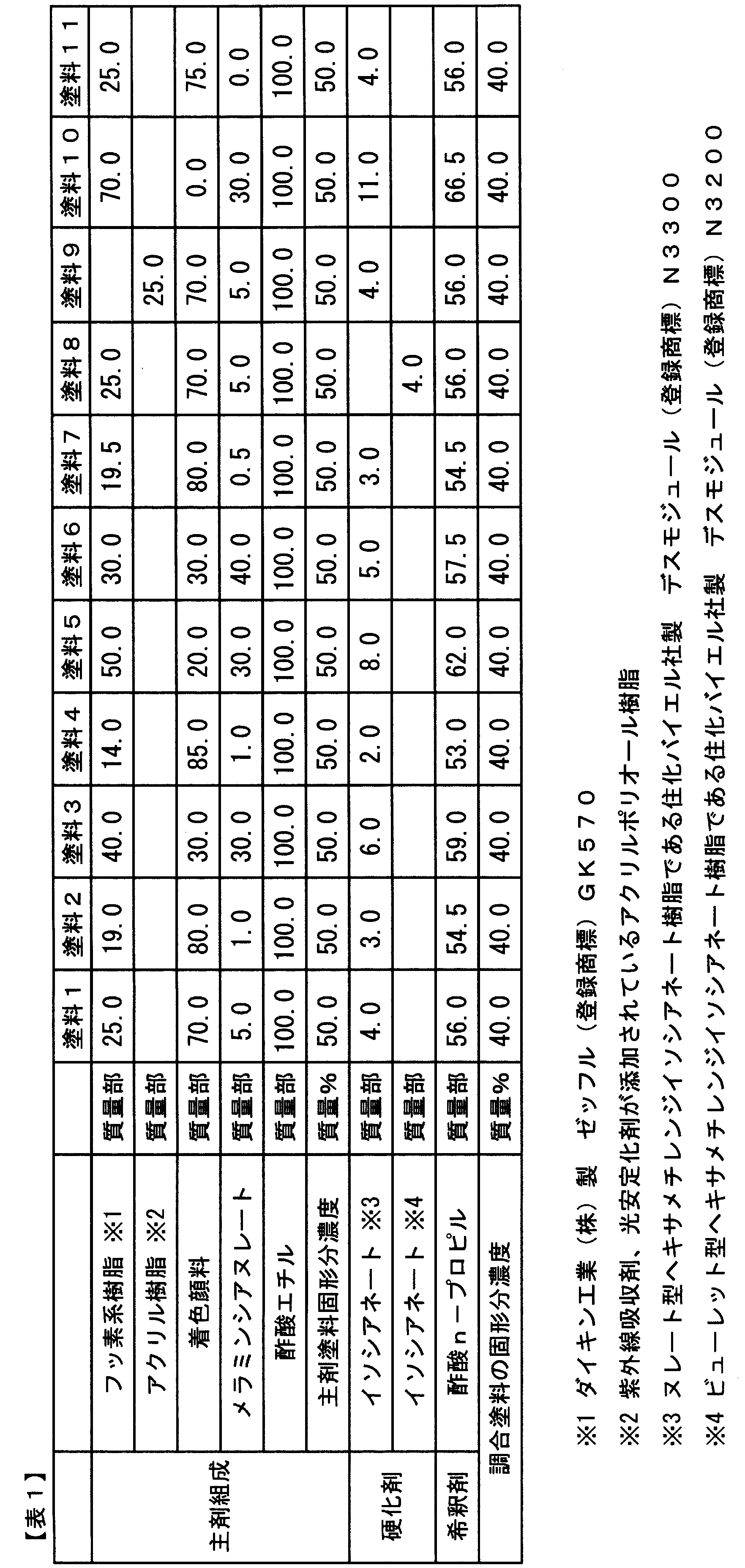
フッ素系樹脂として、ダイキン工業(株)製の、水酸基含有TFE系樹脂のコーティング剤であるゼッフル(登録商標)GK570(固形分濃度:65質量%)を用意した。フッ素系樹脂、着色顔料、メラミンシアヌレートおよび溶剤を表1に示す配合量で一括混合し、ビーズミル機を用いて分散し、固形分濃度が50質量%である主剤塗料を得た。着色顔料としては下記の製品を使用した。
・白色顔料:酸化チタン粒子 テイカ社製 JR-709
・黒色顔料:カーボンブラック粒子 デグサ社製 スペシャルブラック4A
この主剤塗料に、ヌレート型ヘキサメチレンジイソシアネート樹脂である住化バイエル社製 デスモジュール(登録商標)N3300(固形分濃度:100質量%)を、主剤塗料/ヌレート型ヘキサメチレンジイソシアネート樹脂=100/2の質量比になるように配合した。さらに固形分濃度40質量%(樹脂固形分濃度)の塗料となるように希釈剤:酢酸n-プロピルを加え、15分間攪拌した。こうして、固形分濃度40質量%(樹脂固形分濃度)の樹脂層形成用塗料1を得た。
樹脂固形分に対する着色顔料の含有量が80質量%、メラミンシアヌレートの含有量が1質量%となるように表1に示す配合量とする以外は、樹脂層形成用塗料1の調製と同様の方法で樹脂層形成用塗料2を得た。
樹脂固形分に対する着色顔料の含有量が30質量%、メラミンシアヌレートの含有量が30質量%となるように表1に示す配合量とする以外は、樹脂層形成用塗料1の調製と同様の方法で樹脂層形成用塗料3を得た。
樹脂固形分に対する着色顔料の含有量が85質量%、メラミンシアヌレートの含有量が1質量%となるように表1に示す配合量とする以外は、樹脂層形成用塗料1の調製と同様の方法で樹脂層形成用塗料4を得た。
樹脂固形分に対する着色顔料の含有量が20質量%、メラミンシアヌレートの含有量が30質量%となるように表1に示す配合量とする以外は、樹脂層形成用塗料1の調製と同様の方法で樹脂層形成用塗料5を得た。
樹脂固形分に対する着色顔料の含有量が30質量%、メラミンシアヌレートの含有量が40質量%となるように表1に示す配合量とする以外は、樹脂層形成用塗料1の調製と同様の方法で樹脂層形成用塗料6を得た。
樹脂固形分に対する着色顔料の含有量が80質量%、メラミンシアヌレートの含有量が0.5質量%となるように表1に示す配合量とする以外は、樹脂層形成用塗料1の調製と同様の方法で樹脂層形成用塗料7を得た。
ヌレート型ヘキサメチレンジイソシアネート樹脂の代わりに、ビューレット型ヘキサメチレンジイソシアネート樹脂である住化バイエル社製 デスモジュール(登録商標)N3200(固形分濃度:100質量%)を用いる以外は、樹脂層形成用塗料1の調製と同様の方法で樹脂層形成用塗料8を得た。
ダイキン工業(株)製の、水酸基含有TFE系樹脂のコーティング剤であるゼッフル(登録商標)GK570(固形分濃度:65質量%)を用いる代わりに、メチルメタクリル酸および2-ヒドロキシエチルメタクリレートを原料とするアクリル樹脂に、紫外線吸収剤および光安定化剤(HALS)を添加した樹脂(固形分濃度:40質量%)を用いる以外は、樹脂層形成用塗料1の調製と同様の方法で樹脂層形成用塗料9を得た。
着色顔料を配合せず表1に示す配合量とする以外は、樹脂層形成用塗料1の調製と同様の方法で樹脂層形成用塗料10を得た。
メラミンシアヌレートを配合せず表1に示す配合量とする以外は、樹脂層形成用塗料1の調製と同様の方法で樹脂層形成用塗料11を得た。
DIC(株)製ドライラミネート剤 ディックドライ(登録商標)LX-903を16質量部、硬化剤として大日本インキ化学工業(株)製KL-75を2質量部、および酢酸エチルを29.5質量部量りとり、15分間攪拌した。こうして固形分濃度20質量%のドライラミネート用接着剤を得た。
三井化学ポリウレタン(株)製ドライラミネート剤 タケラック(登録商標)A-310(ポリエステルポリウレタン樹脂)を12質量部、三井化学ポリウレタン(株)製の芳香族系ポリイソシアネート樹脂である タケネート(登録商標)A-3を1質量部、および酢酸エチルを212質量部量りとり、15分間攪拌した。こうして固形分濃度3質量%の接着層形成用塗料を得た。
中央理化工業(株)製のEVA系3元共重合樹脂含有水性エマルジョン塗料である アクアテックス(登録商標)MC-3800を20質量部、イソプロピルアルコールを10.8質量部、および水を22.6質量部量りとり、15分間攪拌した。こうして固形分濃度15質量%の熱接着性樹脂層形成用塗料を得た。
基材フィルムとして東レ(株)製の環状三量体の含有量が1質量%以下である耐加水分解性ポリエチレンテレフタレートフィルム ルミラー(登録商標)X10S(125μm)を準備した。この基材フィルムの一方の面に、ワイヤーバーを用いて樹脂層形成用塗料1を塗布し、150℃で60秒間乾燥し、乾燥後塗布量が15.0g/m2の樹脂層を設けた。このようにして太陽電池裏面封止シート用フィルム1を製造した。
樹脂層形成用塗料1の代わりに樹脂層形成用塗料2を塗布する以外は、実施例1に記載の方法と同様にして太陽電池裏面封止シート用フィルム2を製造した。
樹脂層形成用塗料1の代わりに樹脂層形成用塗料3を塗布する以外は、実施例1に記載の方法と同様にして太陽電池裏面封止シート用フィルム3を製造した。
樹脂層形成用塗料1の代わりに樹脂層形成用塗料4を塗布する以外は、実施例1に記載の方法と同様にして太陽電池裏面封止シート用フィルム4を製造した。
樹脂層形成用塗料1の代わりに樹脂層形成用塗料5を塗布する以外は、実施例1に記載の方法と同様にして太陽電池裏面封止シート用フィルム5を製造した。
樹脂層形成用塗料1の代わりに樹脂層形成用塗料6を塗布する以外は、実施例1に記載の方法と同様にして太陽電池裏面封止シート用フィルム6を製造した。
樹脂層形成用塗料1の代わりに樹脂層形成用塗料7を塗布する以外は、実施例1に記載の方法と同様にして太陽電池裏面封止シート用フィルム7を製造した。
樹脂層形成用塗料1の代わりに樹脂層形成用塗料8を塗布する以外は、実施例1に記載の方法と同様にして太陽電池裏面封止シート用フィルム8を製造した。
樹脂層形成用塗料1の代わりに樹脂層形成用塗料9を塗布する以外は、実施例1に記載の方法と同様にして太陽電池裏面封止シート用フィルム9を製造した。
樹脂層形成用塗料1の代わりに樹脂層形成用塗料10を塗布する以外は、実施例1に記載の方法と同様にして太陽電池裏面封止シート用フィルム10を製造した。
樹脂層形成用塗料1の代わりに樹脂層形成用塗料11を塗布する以外は、実施例1に記載の方法と同様にして太陽電池裏面封止シート用フィルム11を製造した。
樹脂層を形成しないで、ルミラー(登録商標)X10S(東レ(株)製、125μm)を太陽電池裏面封止シート用フィルム12とした。
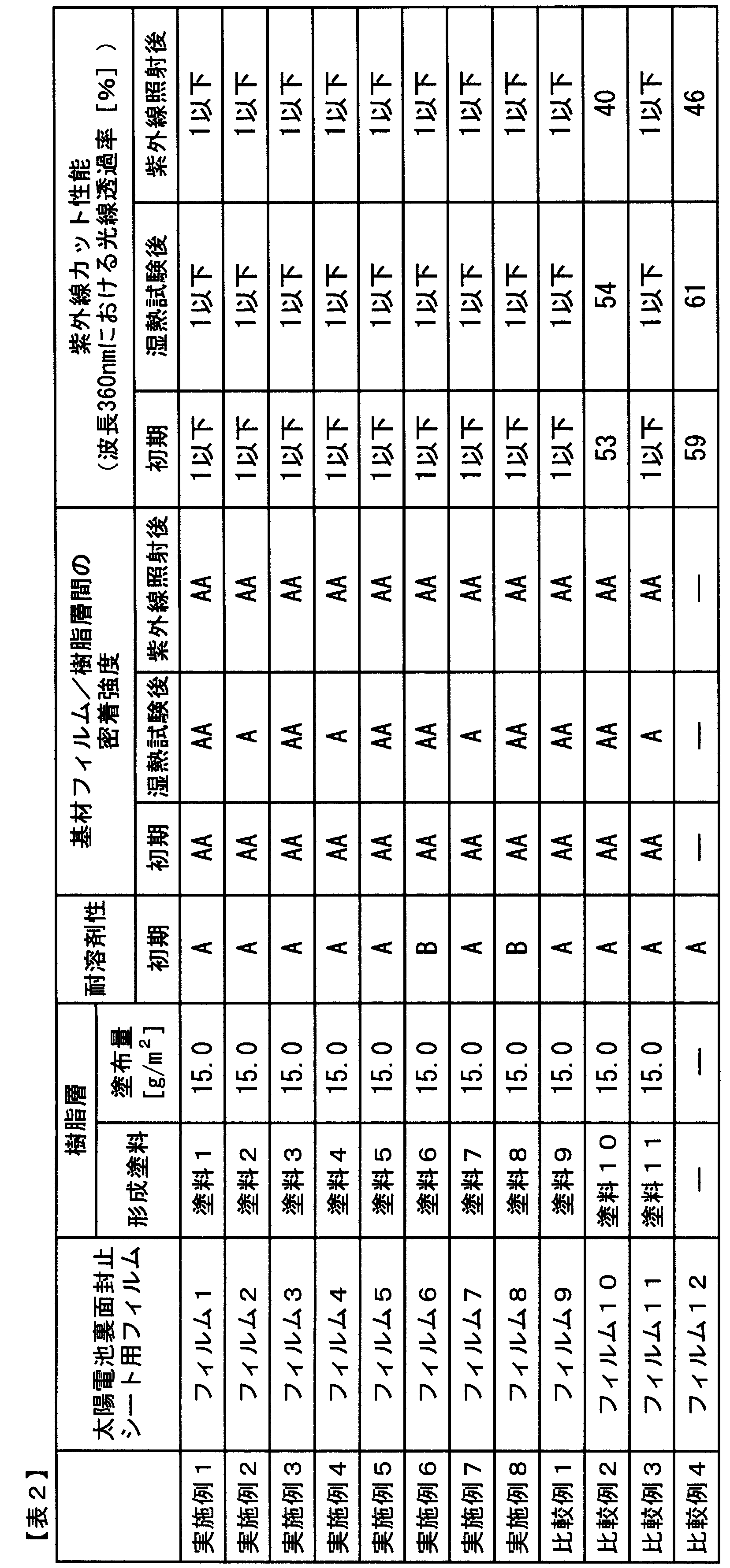
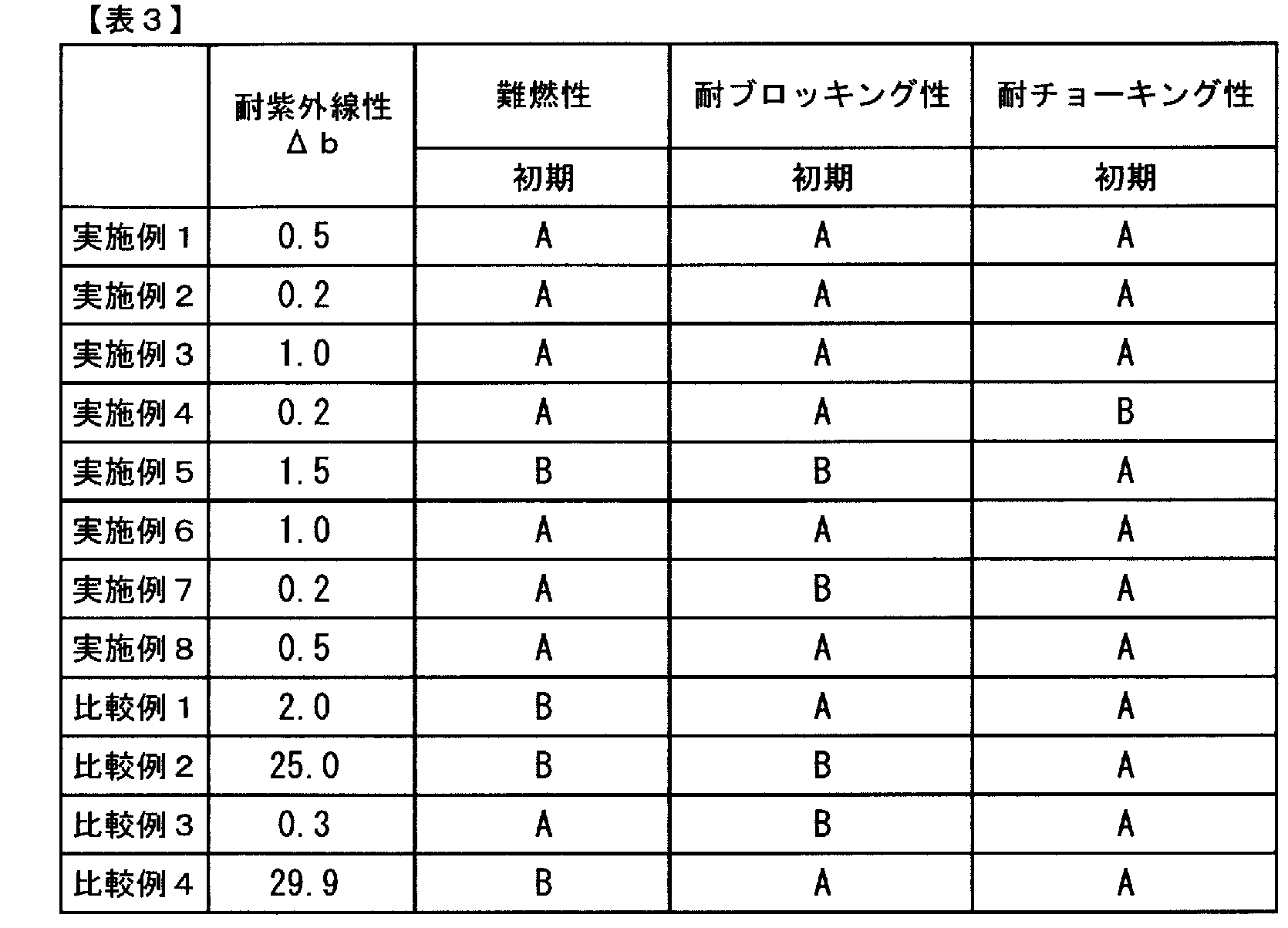
実施例1~8の太陽電池裏面封止シート用フィルム1~8は、いずれも耐紫外線性(Δb値)、湿熱試験後と紫外線照射後の塗膜密着力、湿熱試験後と紫外線照射後の紫外線カット性能が優れていた。
特に実施例1~3の太陽電池裏面封止シート用フィルム1~3は、樹脂層中の着色顔料の含有量が30~80質量%、メラミンシアヌレートの含有量が1~30質量%の範囲内であり、難燃性、耐ブロッキング性、耐チョーキング性、耐溶剤性にも優れていた。なお、着色顔料の含有量が80質量%に近づくほど、樹脂量の減少や塗膜の硬化により湿熱試験後の塗膜密着力が低下する傾向が見られた。また、着書顔料の含有量が30質量%に近づくほど、紫外線カット性能の低下による基材フィルムのΔb値の増加、つまり紫外線照射後の基材フィルムのb値が増加する傾向が見られた。
実施例4の太陽電池裏面封止シート用フィルム4は、樹脂層中に着色顔料を85質量%含み、着色顔料の量が多いため樹脂層表面にチョーキングが見られた。また、樹脂層中の樹脂成分の量が少ないため湿熱試験後の塗膜密着力がやや低下した。
実施例5の太陽電池裏面封止シート用フィルム5は、樹脂層中の着色顔料が20質量%と少ないため、実施例1~3に比べて難燃性が悪くなった。また樹脂層中の樹脂成分の量が50質量%と多いためブロッキングが発生した。
実施例6の太陽電池裏面封止シート用フィルム6は、樹脂層中にメラミンシアヌレート40質量%を含み、メラミンシアヌレートの量が多いため、実施例1~3に比べて耐溶剤性が悪くなった。
実施例7の太陽電池裏面封止シート用フィルム7は、樹脂層中のメラミンシアヌレートが0.5質量%と少ないためブロッキングが発生した。また、樹脂層中の樹脂成分の量が少ないため湿熱試験後の塗膜密着力がやや低下した。
実施例8の太陽電池裏面封止シート用フィルム8は、硬化剤であるヘキサメチレンジイソシアネート樹脂をヌレート型からビューレット型へ変更しており、塗膜の硬化が不十分なため耐溶剤性が悪くなった。
比較例1の太陽電池裏面封止シート用フィルム9は、樹脂層としてフッ素系樹脂の代わりに、紫外線吸収剤および光安定化剤(HALS)を添加したアクリル樹脂が使用されている。そのため、紫外線を照射されるに伴い、紫外線吸収剤や光安定化剤が樹脂層中から樹脂層表面にブリードアウトしたため、紫外線カット性能が低下し、基材フィルムのΔb値が増加した。また難燃性も劣っていた。
比較例2の太陽電池裏面封止シート用フィルム10は、樹脂層中に着色顔料を含んでいない。そのため、紫外線カット性能が乏しく、紫外線照射後に基材フィルムのΔb値が増加し、黄変が発生した。また、着色顔料を含んでいないので、難燃性も劣っていた。さらに、樹脂層中の樹脂成分の量が多いためブロッキングが発生した。
比較例3の太陽電池裏面封止シート用フィルム11は、樹脂層中にメラミンシアヌレートを含んでいない。そのため、ブロッキングが発生した。また、湿熱試験後の塗膜密着力もやや低下した。
比較例4の太陽電池裏面封止シート用フィルム12(樹脂層が形成されていないルミラー(登録商標)X10Sフィルムそのもの)は、紫外線カット性能がなく、フィルムの色調を整え得る着色顔料層も形成されていない。そのため、紫外線の照射に伴い、基材フィルムのΔb値が増加し、黄変が発生した。したがって、太陽電池裏面封止シートの最外層に用いた場合には、極端な場合にはフィルムに割れ、ピンホールなどが生じ、電気絶縁性、水蒸気遮断性など、封止シートに要求される機能が失われるだけでなく、太陽電池モジュールの動作にも悪影響を及ぼす懸念がある。また、着色顔料を含む樹脂層が形成されていないので、難燃性も劣っていた。
光反射性フィルムとして、東レ(株)製白色ポリエチレンテレフタレートフィルム ルミラー(登録商標)E20F(50μm)を用意した。水蒸気バリア性フィルムとして、東レフィルム加工(株)製酸化アルミ蒸着ポリエチレンテレフタレートフィルム バリアロックス(登録商標)1031HGTS(12μm)の酸化アルミ蒸着層とは反対側の面に、接着層形成用塗料および熱接着性樹脂層形成用塗料を下記条件で2ヘッドのタンデム型ダイレクトグラビアコーターを用いて順次、塗工したフィルムを用意した。
・接着層塗工条件:乾燥膜厚0.2μm狙い、乾燥オーブン設定温度120℃
・熱接着性樹脂層塗工条件:乾燥膜厚1.0μm狙い、乾燥オーブン設定温度100℃
・塗工スピード:100m/min
・エージング:塗布・巻取り後、40℃下で2日間エージング。
E20Fおよび水蒸気バリア性フィルムの代わりに、EVAシートとの密着力に優れる東レフィルム加工(株)製白色ポリエチレンフィルム(150μm)を用いた以外は、実施例9に記載の方法と同様にして太陽電池裏面封止シート2を得た。
太陽電池裏面封止シート用フィルム1の代わりに、比較例2の太陽電池裏面封止シート用フィルム10を用いた以外は、実施例9に記載の方法と同様にして太陽電池裏面封止シート3を得た。
太陽電池裏面封止シート用フィルム1の代わりに、比較例4の太陽電池裏面封止シート用フィルム12を用いた以外は、実施例9に記載の方法と同様にして太陽電池裏面封止シート4を得た。
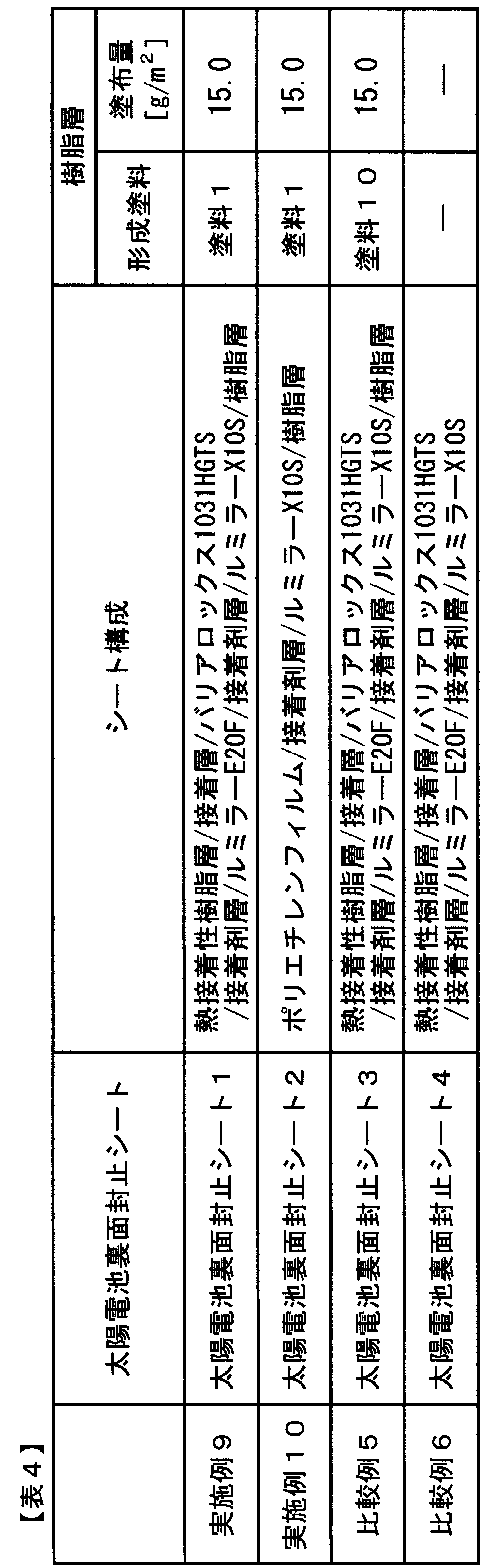
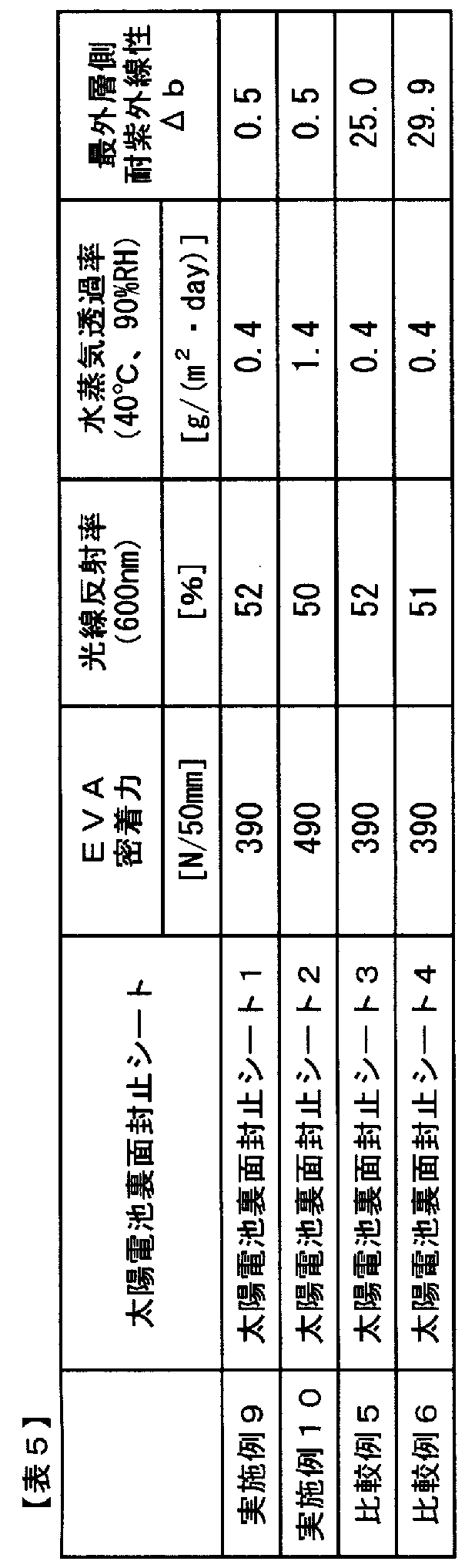
実施例9,10の太陽電池裏面封止シート1,2は、いずれも太陽電池モジュール構成において外層側に位置する樹脂層側への紫外線照射に伴う、基材フィルムと樹脂層間の密着力の低下は見られなかった。また樹脂層および基材フィルムの黄変は非常に小さかった。また、太陽電池裏面封止シートに要求される特性である充填材(EVA樹脂)との密着力にも優れていた。さらに、水蒸気バリア性フィルムを構成中に含む封止シート1は水蒸気遮断性にも優れていた。
比較例5の太陽電池裏面封止シート3は、最外層の樹脂層に着色顔料を含まないため、モジュール内面の配線パターンなどを目隠しする効果は得られず、また紫外線照射に伴う封止シート外観の色調変化(Δb値の増加)が見られた。したがって、長時間紫外線に曝されれば、基材フィルムの樹脂劣化を引き起こすことが予想される。
比較例6の太陽電池裏面封止シート4は、その最外層に樹脂層が形成されていない。すなわち紫外線をカットする樹脂層が形成されていないため、その耐紫外線性は全く無い。したがって、フィールド設置型など地表面などからの照り返しの紫外線に曝される可能性がある設置形態を想定した太陽電池モジュールの用途には使用できない。
Claims (6)
- 基材フィルムの少なくとも片面に、フッ素系樹脂、着色顔料およびメラミンシアヌレートを含む樹脂層が積層された太陽電池裏面封止シート用フィルム。
- 前記樹脂層が、該樹脂層全体に対して着色顔料を30~80質量%、メラミンシアヌレートを1~30質量%含む、請求項1の太陽電池裏面封止シート用フィルム。
- 前記樹脂層が、芳香族系ポリイソシアネート樹脂、芳香脂肪族系ポリイソシアネート樹脂、脂環族系ポリイソシアネート樹脂および脂肪族系ポリイソシアネート樹脂からなる群より選ばれた少なくとも1種のポリイソシアネート樹脂を含む、請求項1または2の太陽電池裏面封止シート用フィルム。
- 請求項1~3のいずれかの太陽電池裏面封止シート用フィルムを含む、太陽電池裏面封止シート。
- 請求項1~3のいずれかの太陽電池裏面封止シート用フィルムの樹脂層が積層された側とは反対側の面に、白色フィルム、無機酸化物蒸着層を有するフィルムおよびエチレン-酢酸ビニル共重合体との熱接着性を有するフィルムからなる群より選ばれた少なくとも1つのフィルムが積層された、太陽電池裏面封止シート。
- 請求項4または5の太陽電池裏面封止シートとセル充填剤層とを含み、該太陽電池裏面封止シートと該セル充填剤層とが接着された、太陽電池モジュール。
Priority Applications (3)
| Application Number | Priority Date | Filing Date | Title |
|---|---|---|---|
| JP2011523241A JP5692706B2 (ja) | 2010-02-05 | 2011-01-26 | 太陽電池裏面封止シート用フィルム |
| KR1020127023096A KR20120123535A (ko) | 2010-02-05 | 2011-01-26 | 태양 전지 이면 밀봉 시트용 필름 |
| CN2011800085428A CN102754219A (zh) | 2010-02-05 | 2011-01-26 | 太阳能电池背面密封片材用膜 |
Applications Claiming Priority (2)
| Application Number | Priority Date | Filing Date | Title |
|---|---|---|---|
| JP2010-023817 | 2010-02-05 | ||
| JP2010023817 | 2010-02-05 |
Publications (1)
| Publication Number | Publication Date |
|---|---|
| WO2011096306A1 true WO2011096306A1 (ja) | 2011-08-11 |
Family
ID=44355306
Family Applications (1)
| Application Number | Title | Priority Date | Filing Date |
|---|---|---|---|
| PCT/JP2011/051399 Ceased WO2011096306A1 (ja) | 2010-02-05 | 2011-01-26 | 太陽電池裏面封止シート用フィルム |
Country Status (5)
| Country | Link |
|---|---|
| JP (1) | JP5692706B2 (ja) |
| KR (1) | KR20120123535A (ja) |
| CN (1) | CN102754219A (ja) |
| TW (1) | TW201133895A (ja) |
| WO (1) | WO2011096306A1 (ja) |
Cited By (4)
| Publication number | Priority date | Publication date | Assignee | Title |
|---|---|---|---|---|
| JP2011210835A (ja) * | 2010-03-29 | 2011-10-20 | Dainippon Printing Co Ltd | 遮光シート、並びにそれを使用した太陽電池モジュール用バックシート及び太陽電池モジュール |
| JP2013039746A (ja) * | 2011-08-17 | 2013-02-28 | Fujifilm Corp | ポリマーシート、太陽電池モジュール用バックシートおよび太陽電池モジュール |
| EP2775535A4 (en) * | 2011-11-04 | 2015-07-22 | Daikin Ind Ltd | REAR FILM FOR A SOLAR CELL MODULE, LAMINATE AND SOLAR CELL MODULE |
| US11746252B2 (en) * | 2017-11-24 | 2023-09-05 | Daikin Fluorochemicals (China) Co., Ltd. | Composition, coating, coating film, back sheet for solar cell module and solar cell module |
Families Citing this family (1)
| Publication number | Priority date | Publication date | Assignee | Title |
|---|---|---|---|---|
| FR3011552B1 (fr) * | 2013-10-09 | 2016-10-07 | Arkema France | Composition fluoree contenant un absorbeur uv et son utilisation en tant que couche protectrice transparente |
Citations (1)
| Publication number | Priority date | Publication date | Assignee | Title |
|---|---|---|---|---|
| JP2000109769A (ja) * | 1998-10-06 | 2000-04-18 | Sony Chem Corp | 難燃性接着フィルム及びフラットケーブル |
Family Cites Families (4)
| Publication number | Priority date | Publication date | Assignee | Title |
|---|---|---|---|---|
| US5741370A (en) * | 1996-06-27 | 1998-04-21 | Evergreen Solar, Inc. | Solar cell modules with improved backskin and methods for forming same |
| WO2005113661A1 (en) * | 2004-05-13 | 2005-12-01 | Ciba Specialty Chemicals Holding Inc. | Flame retardants |
| US20050268961A1 (en) * | 2004-06-04 | 2005-12-08 | Saint-Gobain Performance Plastics Coporation | Photovoltaic device and method for manufacturing same |
| WO2008112529A1 (en) * | 2007-03-09 | 2008-09-18 | 3M Innovative Properties Company | Multilayer film |
-
2011
- 2011-01-26 CN CN2011800085428A patent/CN102754219A/zh active Pending
- 2011-01-26 JP JP2011523241A patent/JP5692706B2/ja not_active Expired - Fee Related
- 2011-01-26 WO PCT/JP2011/051399 patent/WO2011096306A1/ja not_active Ceased
- 2011-01-26 KR KR1020127023096A patent/KR20120123535A/ko not_active Ceased
- 2011-02-01 TW TW100103812A patent/TW201133895A/zh unknown
Patent Citations (1)
| Publication number | Priority date | Publication date | Assignee | Title |
|---|---|---|---|---|
| JP2000109769A (ja) * | 1998-10-06 | 2000-04-18 | Sony Chem Corp | 難燃性接着フィルム及びフラットケーブル |
Cited By (4)
| Publication number | Priority date | Publication date | Assignee | Title |
|---|---|---|---|---|
| JP2011210835A (ja) * | 2010-03-29 | 2011-10-20 | Dainippon Printing Co Ltd | 遮光シート、並びにそれを使用した太陽電池モジュール用バックシート及び太陽電池モジュール |
| JP2013039746A (ja) * | 2011-08-17 | 2013-02-28 | Fujifilm Corp | ポリマーシート、太陽電池モジュール用バックシートおよび太陽電池モジュール |
| EP2775535A4 (en) * | 2011-11-04 | 2015-07-22 | Daikin Ind Ltd | REAR FILM FOR A SOLAR CELL MODULE, LAMINATE AND SOLAR CELL MODULE |
| US11746252B2 (en) * | 2017-11-24 | 2023-09-05 | Daikin Fluorochemicals (China) Co., Ltd. | Composition, coating, coating film, back sheet for solar cell module and solar cell module |
Also Published As
| Publication number | Publication date |
|---|---|
| TW201133895A (en) | 2011-10-01 |
| JPWO2011096306A1 (ja) | 2013-06-10 |
| CN102754219A (zh) | 2012-10-24 |
| KR20120123535A (ko) | 2012-11-08 |
| JP5692706B2 (ja) | 2015-04-01 |
Similar Documents
| Publication | Publication Date | Title |
|---|---|---|
| KR101271382B1 (ko) | 광기전 모듈용 백킹 시트 | |
| JP5609115B2 (ja) | 太陽電池裏面封止材用フィルム、太陽電池裏面封止材および太陽電池モジュール | |
| JP5540840B2 (ja) | 太陽電池裏面封止シート | |
| KR101347547B1 (ko) | 태양전지 모듈용 뒷면 보호시트 및 이를 구비한 태양전지 모듈 | |
| US8507029B2 (en) | Backing sheet for photovoltaic modules | |
| CN102414836A (zh) | 太阳能电池及其背板 | |
| CN103380186A (zh) | 粘接剂组合物、层叠体及太阳能电池模块 | |
| JP5692706B2 (ja) | 太陽電池裏面封止シート用フィルム | |
| JP2023029451A (ja) | 太陽電池モジュール用の透明保護シートの製造方法 | |
| WO2011068067A1 (ja) | 太陽電池裏面封止シート用フィルム | |
| JP2013251427A (ja) | 太陽電池モジュール裏面封止シート用フィルム | |
| WO2010106907A1 (ja) | 太陽電池裏面封止材用フィルム、それを用いた太陽電池裏面封止材および太陽電池モジュール | |
| JP2016043571A (ja) | 塗工フィルムおよびそれを用いた太陽電池モジュール用裏面保護シート | |
| JP2011204842A (ja) | 太陽電池裏面封止材及びそれを用いてなる太陽電池モジュール | |
| JP2012019124A (ja) | 太陽電池表面保護材及びそれを用いてなる太陽電池モジュール | |
| JP2017183618A (ja) | 太陽電池モジュール用裏面保護シート | |
| HK1148707A (en) | Backing sheet for photovoltaic modules |
Legal Events
| Date | Code | Title | Description |
|---|---|---|---|
| WWE | Wipo information: entry into national phase |
Ref document number: 201180008542.8 Country of ref document: CN |
|
| WWE | Wipo information: entry into national phase |
Ref document number: 2011523241 Country of ref document: JP |
|
| 121 | Ep: the epo has been informed by wipo that ep was designated in this application |
Ref document number: 11739655 Country of ref document: EP Kind code of ref document: A1 |
|
| NENP | Non-entry into the national phase |
Ref country code: DE |
|
| WWE | Wipo information: entry into national phase |
Ref document number: 7551/CHENP/2012 Country of ref document: IN |
|
| ENP | Entry into the national phase |
Ref document number: 20127023096 Country of ref document: KR Kind code of ref document: A |
|
| 122 | Ep: pct application non-entry in european phase |
Ref document number: 11739655 Country of ref document: EP Kind code of ref document: A1 |