WO2011078281A1 - 成形材料、成形体、及びその製造方法、並びに電気電子機器用筐体 - Google Patents
成形材料、成形体、及びその製造方法、並びに電気電子機器用筐体 Download PDFInfo
- Publication number
- WO2011078281A1 WO2011078281A1 PCT/JP2010/073236 JP2010073236W WO2011078281A1 WO 2011078281 A1 WO2011078281 A1 WO 2011078281A1 JP 2010073236 W JP2010073236 W JP 2010073236W WO 2011078281 A1 WO2011078281 A1 WO 2011078281A1
- Authority
- WO
- WIPO (PCT)
- Prior art keywords
- group
- molding material
- cellulose
- material according
- hydroxide
- Prior art date
- Legal status (The legal status is an assumption and is not a legal conclusion. Google has not performed a legal analysis and makes no representation as to the accuracy of the status listed.)
- Ceased
Links
Classifications
-
- C—CHEMISTRY; METALLURGY
- C08—ORGANIC MACROMOLECULAR COMPOUNDS; THEIR PREPARATION OR CHEMICAL WORKING-UP; COMPOSITIONS BASED THEREON
- C08L—COMPOSITIONS OF MACROMOLECULAR COMPOUNDS
- C08L1/00—Compositions of cellulose, modified cellulose or cellulose derivatives
- C08L1/08—Cellulose derivatives
- C08L1/32—Cellulose ether-esters
Definitions
- the present invention relates to a molding material, a molded body, a manufacturing method thereof, and a casing for electrical and electronic equipment.
- PC Polycarbonate
- ABS Acrylonitrile-butadiene-styrene resin
- PC / ABS etc.
- These resins are produced by reacting compounds obtained from petroleum as a raw material.
- fossil resources such as oil, coal, and natural gas are mainly composed of carbon that has been fixed in the ground for many years.
- fossil resources or products made from fossil resources are burned and carbon dioxide is released into the atmosphere, carbon that was originally not deep in the atmosphere but fixed deep in the ground Is rapidly released as carbon dioxide, and carbon dioxide in the atmosphere greatly increases, which causes global warming.
- polymers such as ABS and PC made from petroleum, which is a fossil resource, have excellent characteristics as materials for electrical and electronic equipment, but are made from petroleum, which is a fossil resource. Therefore, it is desirable to reduce the amount used from the viewpoint of preventing global warming.
- a plant-derived resin is originally produced by a photosynthesis reaction using carbon dioxide and water in the atmosphere as raw materials. Therefore, even if plant-derived resin is incinerated to generate carbon dioxide, the carbon dioxide is equivalent to carbon dioxide originally in the atmosphere, so the balance of carbon dioxide in the atmosphere is plus or minus zero After all, there is an idea that the total amount of CO 2 in the atmosphere is not increased. Based on this idea, plant-derived resins are referred to as so-called “carbon neutral” materials. The use of carbon-neutral materials in place of petroleum-derived resins is an urgent need to prevent global warming in recent years.
- polysaccharides typified by cellulose are attracting great attention these days as biomass materials that can be regenerated on the earth obtained from plants and as biodegradable materials in the environment.
- Cellulose is not only used for paper, but also its derivatives, such as cellulose acetate, cellulose acetate propionate, cellulose acetate butyrate, and cellulose acetate phthalate are used in many fields as film materials. Is commercially distributed.
- hydroxypropylmethylacetylcellulose is described in Patent Document 3 and Patent Document 4.
- Patent Document 3 and Patent Document 4 describe that this hydroxypropylmethylacetylcellulose is useful as an additive for reducing the vapor pressure of an organic solvent that easily volatilizes.
- the substitution degree of each substituent in hydroxypropylmethylacetylcellulose described in Patent Document 3 and Patent Document 4 is, for example, a molar substitution degree (MS) of hydroxypropyl group in a range of about 2 to 8, a substitution degree of methyl group Is in the range of about 0.1 to 1 and the degree of substitution of the acetyl group is in the range of about 0.8 to 2.5.
- MS molar substitution degree
- Patent Document 5 hydroxypropylmethylpropylcellulose, hydroxypropylmethylbutylcellulose and the like
- Patent Document 6 hydroxypropylmethylserose phthalate and the like
- Patent Document 7 discloses an example of a porous body containing a cellulose derivative such as acetylbutylcellulose and acetylpropylcellulose and a metal hydroxide such as calcium hydroxide, magnesium hydroxide, and aluminum hydroxide.
- Japanese Unexamined Patent Publication No. 56-55425 Japanese Unexamined Patent Publication No. 2008-24919 US Pat. No. 3,979,179 U.S. Pat. No. 3,940,384 International Publication No. 09/010837 Japanese Patent No. 3017412 specification Japanese Unexamined Patent Publication No. 2004-50123
- cellulose generally does not have thermoplasticity, it is difficult to mold by heating or the like, and thus is not suitable for molding. Further, even if thermoplasticity can be imparted, there is a problem that strength such as impact resistance is greatly reduced.
- the cellulose derivatives described in Patent Documents 3, 4, and 6 are water-soluble or swellable and insufficient in strength, which is not preferable as a molding material.
- the cellulose derivative described in Patent Document 5 is poorly water-soluble, only the description is included in the text, and its synthesis method and usage form are specifically disclosed in Examples and the like. Absent.
- a molded body is formed from a resin material containing cellulose ester and metal hydroxide described in Patent Document 7, it is expected to be inferior in impact resistance.
- the object of the present invention is to provide performance such as high rigidity (flexural modulus), good bending strength, and high heat resistance (thermal deformation temperature), and even better impact resistance (Charpy impact strength), excellent flame retardancy, And a molding material and a molded body having scratch resistance.
- Another object of the present invention is to provide a molded body obtained by molding the molding material, a method for producing the molded body, and a housing for electric and electronic equipment composed of the molded body.
- the present inventors pay attention to the molecular structure of cellulose, and make cellulose a cellulose derivative having a specific structure having an ether structure and an ester structure, and a molding material containing the cellulose derivative having the specific structure and a metal hydroxide.
- the present inventors have found that a molding material and a molded body excellent in impact resistance, flame retardancy, and scratch resistance can be provided without lowering performance such as rigidity, bending strength, and heat resistance, and have completed the present invention. . That is, the said subject can be achieved by the following means.
- the metal hydroxide is at least one selected from the group consisting of magnesium hydroxide, aluminum hydroxide, calcium hydroxide, manganese hydroxide, iron hydroxide and zinc hydroxide.
- [15] [1] A molded product obtained by thermoforming the molding material according to any one of [14].
- the molding material of the present invention Since the molding material of the present invention has excellent thermoplasticity, it can be molded by heat molding or the like. In addition, the molding material and the molded body of the present invention are excellent in performance such as rigidity, bending strength, and heat resistance, and have good impact resistance, flame retardancy, and scratch resistance. It can be suitably used as a component part such as an electronic device, a machine part, a house / building material, or the like. Moreover, since the molding material of this invention uses the cellulose derivative obtained from the cellulose which is plant-derived resin, it can substitute for the conventional petroleum-derived resin as a raw material which can contribute to global warming prevention.
- the hydrogen atom of the hydroxyl group contained in cellulose is A cellulose derivative comprising at least one group substituted in A) below and at least one group substituted in B) below;
- the present invention relates to a molding material containing a metal hydroxide.
- Cellulose derivative The cellulose derivative contained in the molding material of the present invention, as described above, the hydrogen atom of the hydroxyl group contained in cellulose, A cellulose derivative having at least one group substituted by A) below and at least one group substituted by B) below.
- R 2 , R 3 and R 6 are each independently a hydrogen atom, A) hydrocarbon group: —R A , B) acyl group: —CO—R B (R B is carbon Represents a hydrogen group) or other substituents. However, at least a part of R 2 , R 3 , and R 6 represents A) a hydrocarbon group, and at least a part of R 2 , R 3 , and R 6 represents B) an acyl group.
- the cellulose derivative in the present invention has thermoplasticity because at least part of the hydroxyl group of the ⁇ -glucose ring is etherified and esterified with A) a hydrocarbon group and B) an acyl group. It can be expressed and is suitable for molding. Furthermore, since cellulose is a completely plant-derived component, it is carbon neutral and can greatly reduce the burden on the environment.
- the “cellulose” referred to in the present invention is a polymer compound in which a large number of glucoses are bonded by ⁇ -1,4-glycosidic bonds, and the carbon atoms at the 2nd, 3rd and 6th positions in the glucose ring of cellulose. Means that the hydroxyl group bonded to is unsubstituted. Further, “hydroxyl group contained in cellulose” refers to a hydroxyl group bonded to carbon atoms at the 2nd, 3rd and 6th positions in the glucose ring of cellulose.
- the cellulose derivative only needs to contain the A) hydrocarbon group and B) acyl group in any part of the whole, and may be composed of the same repeating unit, or a plurality of types. It may consist of repeating units.
- the cellulose derivative does not need to contain all of the A) hydrocarbon group and B) acyl group in one repeating unit. More specific embodiments include the following embodiments, for example. (1) At least one of R 2 , R 3 and R 6 is A) a repeating unit substituted with a hydrocarbon group, and at least one of R 2 , R 3 and R 6 is substituted with B) an acyl group A cellulose derivative composed of repeating units.
- R 2 , R 3 and R 6 of one repeating unit is substituted with A) a hydrocarbon group, and any other one is substituted with B) an acyl group (ie, A cellulose derivative composed of the same type of repeating unit having the substituents of A) and B) in one repeating unit.
- the cellulose derivative may contain an unsubstituted repeating unit (that is, a repeating unit in which R 2 , R 3 and R 6 are all hydrogen atoms in the general formula (A)).
- the cellulose derivative may have other substituents other than a hydrogen atom, A) a hydrocarbon group, and B) an acyl group.
- R A may be an aliphatic group or an aromatic group.
- R A When R A is an aliphatic group, it may be linear, branched, or cyclic, and may have an unsaturated bond. Examples of the aliphatic group include an alkyl group, a cycloalkyl group, an alkenyl group, and an alkynyl group.
- R A When R A is an aromatic group, it may be either a single ring or a condensed ring. In the case where R A is an aromatic group, the preferred carbon number is 6 to 18, more preferably 6 to 14, and still more preferably 6 to 10.
- the aromatic group examples include a phenyl group, a naphthyl group, a phenanthryl group, and an anthryl group.
- the hydrocarbon group is preferably an aliphatic group because the resulting molding material (hereinafter sometimes referred to as “cellulose resin composition” or “resin composition”) has excellent impact resistance. In view of excellent molding processability such as melt flow rate, an alkyl group is more preferable, and an alkyl group having 1 to 4 carbon atoms (lower alkyl group) is more preferable.
- Specific examples include methyl group, ethyl group, propyl group, isopropyl group, butyl group, isobutyl group, pentyl group, hexyl group, heptyl group, 2-ethylhexyl group, tert-butyl group, isoheptyl group, and the like.
- a group or an ethyl group is particularly preferred.
- R B represents a hydrocarbon group.
- R B is an aliphatic group, and may be any aromatic group. If R B is an aliphatic group, straight chain, branched, and may be any of circular, it may have an unsaturated bond. Examples of the aliphatic group include an alkyl group, a cycloalkyl group, an alkenyl group, and an alkynyl group. If R B is an aromatic group may be either monocyclic and condensed. Examples of the aromatic group include a phenyl group, a naphthyl group, a phenanthryl group, and an anthryl group. R B is preferably an alkyl group or an aryl group.
- R B is more preferably an alkyl group having 1 to 12 carbon atoms or an aryl group, still more preferably an alkyl group having 1 to 12 carbon atoms, and particularly preferably an alkyl group having 1 to 4 carbon atoms (preferably a methyl group).
- R B it is also preferably a hydrocarbon group having a branched structure having 3 to 10 carbon atoms, more preferably an alkyl group having a branched structure having 3 to 10 carbon atoms, having 7-9 carbon atoms More preferably, it is an alkyl group having a branched structure.
- the R B specifically, a methyl group, an ethyl group, a propyl group, an isopropyl group, a butyl group, an isobutyl group, a pentyl group, a hexyl group, a heptyl group, 3-heptyl, 2-ethylhexyl group, tert- butyl Group, isoheptyl group, and the like.
- R B is a methyl group, an ethyl group, a propyl group, a 3-heptyl group, or a 2-ethylhexyl group, and more preferably a methyl group, an ethyl group, a 3-heptyl group, or a 2-ethylhexyl group.
- the cellulose derivative in the molding material of the present invention is a cellulose derivative in which the hydrogen atom of the hydroxyl group contained in cellulose contains at least one group substituted with A) and at least one group substituted with B).
- it is preferable from the viewpoint of impact resistance that it further contains at least one group in which the hydrogen atom of the hydroxyl group contained in cellulose is substituted by the following C).
- C) a group containing an alkyleneoxy group: —R C2 —O— and an acyl group: —CO—R C1 (R C1 represents a hydrocarbon group, and R C2 represents an alkylene group having 2 or 3 carbon atoms. )
- R C1 represents a hydrocarbon group.
- R C1 the same groups as those described above for R B can be applied.
- the preferred range of R C1 is the same as R B.
- R C2 represents an alkylene group having 2 to 4 carbon atoms.
- R C2 may be linear, branched or cyclic, but is preferably linear or branched, and more preferably branched.
- the alkyleneoxy group (—R C2 —O—) is preferably an alkyleneoxy group having 2 or 3 carbon atoms. Specific examples of the alkyleneoxy group include the following structures.
- a group represented by the following formula (1) or (2) in which —R C2 —O— is branched is preferable because the obtained resin composition has excellent bending elastic modulus.
- the group of C) may contain a plurality of alkyleneoxy groups or may contain only one.
- the group of C) can be represented by the following general formula (3).
- R C1 represents a hydrocarbon group
- R C2 represents an alkylene group having 2 to 4 carbon atoms.
- the preferred ranges of R C1 and R C2 are the same as those described above.
- n is an integer of 1 or more.
- the upper limit of n is not particularly limited, and varies depending on the amount of alkyleneoxy group introduced, but is about 10, for example.
- n is preferably 1 to 5, more preferably 1 to 3, and still more preferably 1.
- R C2 When a plurality of R C2 are present, they may be the same or different, but are preferably the same.
- the cellulose derivative in the present invention is a group of C) containing only one alkyleneoxy group (a group in which n is 1 in the general formula (3)) and C) containing two or more alkyleneoxy groups. And a group (a group in which n is 2 or more in the above general formula (3)).
- the bonding direction of the alkyleneoxy group to the cellulose derivative in the group C) is not particularly limited, but it is preferable that the alkylene group part (R C2 ) of the alkyleneoxy group is bonded to the ⁇ -glucose ring structure side.
- R A in A), R B in B ), R C1 and R C2 in C) may have a further substituent or may be unsubstituted, but are preferably unsubstituted.
- R A in the A), R B in the B), in the case where the where R C1 and R C2 in the C) has a further substituent examples of the further substituent include a halogen atom (e.g. fluorine atom, chlorine atom, bromine Atoms, iodine atoms), hydroxy groups, alkoxy groups (the alkyl group preferably has 1 to 5 carbon atoms), alkenyl groups, and the like.
- R C2 has 2 to 4 carbon atoms. Note that when R A , R B , and R C1 are other than an alkyl group, they may have an alkyl group (preferably having a carbon number of 1 to 5) as a substituent.
- R B and R C1 have a further substituent, it is preferable that they substantially have no carboxyl group, sulfonic acid group, and salts thereof.
- the molding material of the present invention can be made water-insoluble and the moldability can be further improved.
- the cellulose derivative has a carboxyl group, a sulfonic acid group, and a salt thereof, it is known that the stability as a compound is deteriorated. It is preferably not included.
- substantially free of carboxyl groups, sulfonic acid groups, and salts thereof means only when the cellulose derivative in the present invention has no carboxyl groups, sulfonic acid groups, and salts thereof.
- the case where the cellulose derivative in the present invention has a trace amount of carboxyl groups, sulfonic acid groups, and salts thereof in a range insoluble in water is included.
- the cellulose as a raw material may contain a carboxyl group
- the cellulose derivative using the above-described substituents A) to C) introduced therein may contain a carboxyl group.
- a sulfonic acid group, and a cellulose derivative substantially free of salts thereof may contain 1% by mass or less, more preferably 0.5% by mass or less, based on the cellulose derivative.
- the cellulose derivative in the present invention is preferably insoluble in water.
- “being insoluble in water” means that the solubility in 100 parts by mass of water at 25 ° C. is 5 parts by mass or less.
- cellulose derivative in the present invention examples include acetyl methyl cellulose, acetyl ethyl cellulose, acetyl propyl cellulose, acetyl butyl cellulose, acetyl pentyl cellulose, acetyl hexyl cellulose, acetyl cyclohexyl cellulose, acetyl phenyl cellulose, acetyl naphthyl cellulose,
- butyrylmethylcellulose butyrylethylcellulose, butyrylpropylcellulose, butyrylbutylcellulose, butyrylpentylcellulose, butyrylhexylcellulose, butyrylcyclohexylcellulose, butyrylphenylcellulose, butyrylnaphthylcellulose,
- Propionyloxyethylmethylpropionylcellulose propionyloxyethylethylpropionylcellulose, propionyloxyethylpropylpropionylcellulose, propionyloxyethylbutylpropionylcellulose, propionyloxyethylpentylpropionylcellulose, propionyloxyethylhexylpropionylcellulose, propionyloxyethylcyclohexylpropionylcellulose, Ethylphenylpropionylcellulose, propionyloxyethylnaphthylpropionylcellulose,
- valeroxypropylmethyl valeroyl cellulose examples include valeroxybutyl methyl valeroyl cellulose.
- the molding material of the present invention may contain only one kind of the specific cellulose derivative or two or more kinds.
- substitution degree are not particularly limited.
- a hydrocarbon group the degree of substitution DS A of —R A (the number of RA for the hydroxyl groups at the 2nd, 3rd and 6th positions of the ⁇ -glucose ring in the repeating unit) is 1.0 ⁇ DS A It is preferable that 1.0 ⁇ DS A ⁇ 2.5. Further, DS A is preferably 1.1 or more.
- the number of unsubstituted hydroxyl groups present in the cellulose derivative is not particularly limited.
- the degree of substitution DS H of hydrogen atoms (ratio in which the hydroxyl groups at the 2nd, 3rd and 6th positions in the repeating unit are unsubstituted) can be in the range of 0 to 1.5, preferably 0 to 0.6. And it is sufficient. By the DS H and 0.6 or less, or to improve the fluidity of the molding material, the foaming and the like due to water absorption of the molding material during acceleration and molding of the pyrolysis can or is suppressed.
- the cellulose derivative in the present invention may have a substituent other than A) a hydrocarbon group, B) an acyl group, and C) a group containing an alkyleneoxy group and an acyl group.
- substituents examples include a hydroxyethyl group, a hydroxypropyl group, a hydroxyethoxyethyl group, a hydroxypropoxypropyl group, a hydroxyethoxyethoxyethyl group, and a hydroxypropoxypropoxypropyl group. Therefore, the sum of the degree of substitution of all the substituents of the cellulose derivative is 3, but (DS A + DS B + DS C + DS H ) is 3 or less.
- the amount of alkyleneoxy group introduced in the group C) is expressed in terms of molar substitution (MS: number of moles of substituent introduced per glucose residue) (edited by Cellulose Society, Cellulose Dictionary P142).
- the molar substitution degree MS of the alkyleneoxy group is preferably 0 ⁇ MS, more preferably 0 ⁇ MS ⁇ 1.5, and still more preferably 0 ⁇ MS ⁇ 1.0. When MS is 1.5 or less (MS ⁇ 1.5), heat resistance, moldability and the like can be improved, and a cellulose derivative suitable for a molding material can be obtained.
- the cellulose derivative in the molding material of the present invention is a cellulose derivative in which the hydrogen atom of the hydroxyl group contained in cellulose contains at least one group substituted with A) and at least one group substituted with B).
- a hydrogen atom of a hydroxyl group contained in cellulose is substituted, from the viewpoint of moldability, it is substituted only by A) and B) or A), B), and C.
- the hydrogen atom of the hydroxyl group contained in the cellulose is not substituted with a group other than the above A), B), and C).
- the molecular weight of the cellulose derivative in the present invention is preferably such that the number average molecular weight (Mn) is in the range of 5 ⁇ 10 3 to 1000 ⁇ 10 3 , more preferably in the range of 10 ⁇ 10 3 to 500 ⁇ 10 3 , and 10 ⁇ 10 3 to A range of 200 ⁇ 10 3 is most preferred.
- the weight average molecular weight (Mw) is preferably in the range of 7 ⁇ 10 3 to 10000 ⁇ 10 3 , more preferably in the range of 15 ⁇ 10 3 to 5000 ⁇ 10 3 , and in the range of 100 ⁇ 10 3 to 3000 ⁇ 10 3 . Is most preferred.
- the molecular weight distribution is preferably in the range of 1.1 to 10.0, and more preferably in the range of 1.5 to 8.0. By setting the molecular weight distribution within this range, moldability and the like can be improved.
- the number average molecular weight (Mn), weight average molecular weight (Mw) and molecular weight distribution (MWD) can be measured using gel permeation chromatography (GPC).
- N-methylpyrrolidone is used as a solvent
- a polystyrene gel is used, and the molecular weight can be determined using a conversion molecular weight calibration curve obtained in advance from a standard monodisperse polystyrene constituent curve.
- the method for producing a cellulose derivative in the present invention is not particularly limited, and the cellulose derivative in the present invention can be produced by using cellulose as a raw material and etherifying and esterifying cellulose.
- the raw material for cellulose is not limited, and examples thereof include cotton, linter, and pulp.
- a preferred embodiment of a method for producing a cellulose derivative having the above A) hydrocarbon group: —R A and B) acyl group: —CO—R B includes cellulose ether, base It includes a step of esterification by reacting acid chloride or acid anhydride in the presence.
- R B represents a hydrocarbon group
- the cellulose ether for example, those in which at least a part of the hydrogen atoms of the hydroxyl groups at the 2nd, 3rd and 6th positions of the ⁇ -glucose ring contained in cellulose are substituted with hydrocarbon groups can be used. Specific examples include methyl cellulose, ethyl cellulose, propyl cellulose, butyl cellulose, allyl cellulose, and benzyl cellulose.
- a preferred embodiment of a method for producing a cellulose derivative having a group containing —CO—R C1 (R C1 represents a hydrocarbon group and R C2 represents an alkylene group having 2 to 4 carbon atoms) is a hydrocarbon group.
- a hydroxypropyl cellulose ether having a hydroxypropyl group are reacted with an acid chloride or an acid anhydride, to thereby carry out esterification (acylation).
- alkyl chloride such as methyl chloride or ethyl chloride / alkylene oxide having 3 carbon atoms or the like is allowed to act on cellulose.
- a method including a step of esterification by reacting an acid chloride or an acid anhydride is also included.
- a method for reacting acid chloride for example, the method described in Cellulose 10; 283-296, 2003 can be used.
- cellulose ether having a hydrocarbon group and a hydroxypropyl group examples include hydroxypropylmethylcellulose, hydroxypropylethylcellulose, hydroxypropylpropylcellulose, hydroxypropylallylcellulose, hydroxypropylbenzylcellulose, and the like. Preferred are hydroxypropylmethylcellulose and hydroxypropylethylcellulose.
- acyl group and carboxylic acid chloride corresponding to the acyl group contained in C) can be used.
- carboxylic acid chloride include acetyl chloride, propionyl chloride, butyryl chloride, isobutyryl chloride, pentanoyl chloride, 2-methylbutanoyl chloride, 3-methylbutanoyl chloride, pivaloyl chloride, hexanoyl chloride, 2-methylpentanoyl chloride, 3-methylpentanoyl chloride, 4-methylpentanoyl chloride, 2,2-dimethylbutanoyl chloride, 2,3-dimethylbutanoyl chloride, 3,3-dimethylbutanoyl chloride, 2- Ethylbutanoyl chloride, heptanoyl chloride, 2-methylhexanoyl chloride, 3-methylhexanoyl chloride, 4-methylhexanoyl chloride, 5-methylhex
- carboxylic acid anhydrides corresponding to the acyl group contained in the above B) acyl group and C
- carboxylic anhydrides include acetic anhydride, propionic anhydride, butyric anhydride, valeric anhydride, hexanoic anhydride, heptanoic anhydride, octanoic anhydride, 2-ethylhexanoic acid.
- An anhydride, nonanoic acid anhydride, etc. are mentioned.
- the cellulose derivative in the present invention preferably has no carboxylic acid as a substituent, for example, a dicarboxylic acid such as phthalic anhydride, maleic anhydride, or the like, and a compound that generates a carboxyl group by reacting with cellulose. It is preferable not to use.
- a dicarboxylic acid such as phthalic anhydride, maleic anhydride, or the like
- a compound that generates a carboxyl group by reacting with cellulose It is preferable not to use.
- Metal hydroxide The molding material of the present invention contains a metal hydroxide.
- the impact resistance compared to the case where the specific cellulose derivative is used alone, without reducing the performance such as rigidity, bending strength, and heat resistance. Flame retardancy and scratch resistance can be improved. This is because the hydroxyl group of the metal hydroxide generates water by heating, the crosslinking with the resin occurs, and the addition of the metal hydroxide increases the interaction with the resin such as hydrogen bonding. It is thought that it originates in becoming hard.
- the metal hydroxide used in the present invention is a metal compound containing a hydroxyl group in the molecule, and those that generate water by heating can be suitably used.
- Specific hydroxide is not particularly limited, but magnesium hydroxide, aluminum hydroxide, calcium hydroxide, manganese hydroxide, iron hydroxide, zinc hydroxide, zirconium hydroxide, cobalt hydroxide, copper hydroxide, Cerium hydroxide, titanium hydroxide, barium hydroxide, beryllium hydroxide, strontium hydroxide, gallium hydroxide, hydrotalcite (Mg 6 Al 2 (OH) 16 CO 3 .4H 2 O), etc.
- magnesium hydroxide, aluminum hydroxide, calcium hydroxide, manganese hydroxide, iron hydroxide, and zinc hydroxide are preferable, and magnesium hydroxide and aluminum hydroxide are more preferable. These may be used alone or in combination of two or more.
- the shape of the metal hydroxide used in the present invention is not particularly limited, but is preferably granular.
- the particle diameter can be suitably selected according to the kind of the metal hydroxide.
- the average particle size can be about 100 ⁇ m or less, preferably 0.1 to 70 ⁇ m, more preferably 0.5 to 50 ⁇ m, and still more preferably 2 to 30 ⁇ m.
- the average particle size is measured by a particle size distribution method using laser scattered light.
- the measurement sample was obtained by dispersing a metal hydroxide in water and then irradiating with ultrasonic waves for 3 minutes, obtaining a 50% cumulative value (D 50 ) of the number of particles, and calculating an average value of two measurements. Average particle diameter.
- the metal hydroxide used in the present invention preferably has a purity of about 99.5% or more. This is because the higher the purity, the better the flame retardancy and scratch resistance of the resulting molded article.
- the purity of the metal hydroxide can be measured by a known method.
- the purity of the metal hydroxide can be obtained by measuring the content of impurities contained in the metal hydroxide by a known method and subtracting the content of the impurities from the total amount. More specifically, for example, in the case of aluminum hydroxide, the impurities include Fe 2 O 3 , SiO 2 , T—Na 2 O, S—Na 2 O and the like.
- the content of Fe 2 O 3 is determined by O-phenanthroline spectrophotometry (JIS H 1901) after being melted in a sodium carbonate-boric acid solution.
- the content of SiO 2 is determined by the molybdenum blue absorptiometry (JIS H 1901) after being melted in a sodium carbonate-boric acid solution.
- the content of T-Na 2 O is determined by flame photometry after melting in sulfuric acid, and S-Na 2 O is determined by flame photometry after extraction with hot water.
- the purity of the hydroxide can be obtained by reducing the content determined as described above from the weight of aluminum hydroxide.
- the metal hydroxide used in the present invention preferably uses particles having a BET specific surface area of about 20 m 2 / g or less obtained from a nitrogen gas adsorption method from the viewpoint of moldability.
- the molding material of the present invention contains the cellulose derivative described above and a metal hydroxide, and may contain other additives as necessary.
- the content of the cellulose derivative in the molding material of the present invention is preferably 50 to 99.9% by mass, more preferably 60 to 95% by mass, and still more preferably 65 to 90% by mass in the molding material.
- the content of the metal hydroxide contained in the molding material of the present invention is preferably 0.1 to 50% by mass in the molding material from the viewpoint of improving impact resistance, flame retardancy, and scratch resistance. More preferably, it is 5 to 45% by mass, and still more preferably 10 to 40% by mass. By setting it as this range, sufficient flame retardancy and scratch resistance can be easily obtained, and the possibility of lowering molding processability and flexibility is also reduced.
- the molding material of the present invention may contain various additives such as a filler (reinforcing material) and a flame retardant as required in addition to the cellulose derivative and the metal hydroxide.
- the molding material of the present invention preferably further contains an antioxidant in order to improve the thermal stability of the resin.
- an antioxidant in order to improve the thermal stability of the resin.
- the antioxidant in the present invention may be a low molecular compound or a high molecular compound, for example, a hindered phenol antioxidant, a phosphorus antioxidant, an amine antioxidant, a sulfur oxidation.
- An inhibitor can be used.
- Specific examples of the hindered phenol antioxidant include triethylene glycol-bis [3- (3-tert-butyl-5-methyl-4-hydroxyphenyl) propionate], pentaerythrityl-tetrakis [3- (3 , 5-di-tert-butyl-4-hydroxyphenyl) propionate], 1.6-hexanediol-bis [3- (3,5-di-tert-butyl-4-hydroxyphenyl) propionate, octadodecyl-3 -(3,5-di-tert-butyl-4-hydroxyphenyl) propionate, N, N'-hexamethylenebis (3,5-di-tert-butyl-4-hydroxy-hydr
- Phosphorous antioxidants include calcium hypophosphite, 2,6-di-t-butyl-4-methylphenol, tetrakis (methylene-3- (3,5-di-t-butyl-4-hydroxyphenyl) propionate ) Phenol compounds such as methane, tris (3,5-di-t-butyl-4-hydroxybenzidine) isocyanurate, dilauryl-3,3′-thiodipropionate, dimyristyl-3,3′-thiodipropio Examples thereof include sulfur compounds such as nates, phosphorus compounds such as trisnonylphenyl phosphite and distearyl pentaerythritol diphosphite, among which calcium hypophosphite is preferable.
- sulfur-based antioxidants include sulfur-containing compounds such as thioethers, dithioacid salts such as nickel dithiocarbamate, mercaptobenzimidazoles, thiocarbanilides, and thiodipropion ester.
- sulfur-containing compounds such as thioethers, dithioacid salts such as nickel dithiocarbamate, mercaptobenzimidazoles, thiocarbanilides, and thiodipropion ester.
- the antioxidant in the present invention a phosphorus-based antioxidant, a hindered phenol-based antioxidant (for example, “Irganox 1010” manufactured by Ciba Specialty Chemicals, “Sumilyzer GP” manufactured by Sumitomo Chemical Co., Ltd., etc.) is used. It is preferable.
- the blending amount of the antioxidant is preferably 0.01 to 10% by mass, more preferably 0.03 to 8% by mass in the molding material. If it is 0.01% by mass or more, the effect of adding an antioxidant can be obtained, and if it is 10% by mass or less, the impact resistance, moldability, rigidity, bending strength, heat resistance, etc. of the cellulose derivative are reduced. Since it can suppress, it is preferable.
- the molding material of the present invention can reinforce the mechanical properties of the molded body formed of the molding material.
- a well-known thing can be used as a filler.
- the shape of the filler may be any of fibrous, plate-like, granular, powdery and the like. Further, it may be inorganic or organic.
- the inorganic filler glass fiber, carbon fiber, graphite fiber, metal fiber, potassium titanate whisker, aluminum borate whisker, magnesium whisker, silicon whisker, wollastonite, sepiolite, slag fiber, zonolite, Elastadite, gypsum fiber, silica fiber, silica-alumina fiber, zirconia fiber, boron nitride fiber, silicon nitride fiber, boron fiber, and other fibrous inorganic fillers, glass flakes, non-swellable mica, carbon black, graphite, metal foil , Ceramic beads, talc, clay, mica, sericite, zeolite, bentonite, dolomite, kaolin, fine silicate, feldspar, potassium titanate, shirasu balloon, calcium carbonate, magnesium carbonate, barium sulfate, calcium oxide Beam, aluminum oxide, titanium oxide, magnesium oxide, aluminum silicate, silicon oxide, gypsum, novaculite,
- Organic fillers include synthetic fibers such as polyester fiber, nylon fiber, acrylic fiber, regenerated cellulose fiber, and acetate fiber, and natural fibers such as kenaf, ramie, cotton, jute, hemp, sisal, Manila hemp, flax, linen, silk, and wool. Examples thereof include fibrous organic fillers obtained from microcrystalline cellulose, sugar cane, wood pulp, paper waste, waste paper and the like, and granular organic fillers such as organic pigments.
- the content is not limited, but is usually 30 parts by mass or less, preferably 5 to 10 parts by mass with respect to 100 parts by mass of the cellulose derivative.
- the molding material of the present invention may contain a flame retardant.
- the flame retardant is not particularly limited, and a conventional flame retardant can be used.
- a conventional flame retardant can be used.
- brominated flame retardants, chlorine-based flame retardants, phosphorus-containing flame retardants, silicon-containing flame retardants, nitrogen compound-based flame retardants, inorganic flame retardants and the like can be mentioned.
- hydrogen halides are not generated by thermal decomposition during resin compounding or molding, and do not corrode processing machines or molds or deteriorate the working environment.
- Phosphorus-containing flame retardants and silicon-containing flame retardants are preferred because they are less likely to adversely affect the environment through the generation of harmful substances such as dioxins when they are diffused or decomposed.
- the phosphorus-containing flame retardant is not particularly limited, and a commonly used one can be used. Examples thereof include organic phosphorus compounds such as phosphate esters, phosphate condensation esters, and polyphosphates.
- phosphate esters include trimethyl phosphate, triethyl phosphate, tributyl phosphate, tri (2-ethylhexyl) phosphate, tributoxyethyl phosphate, triphenyl phosphate, tricresyl phosphate, trixylenyl phosphate, tris (isopropylphenyl) Phosphate, tris (phenylphenyl) phosphate, trinaphthyl phosphate, cresyl diphenyl phosphate, xylenyl diphenyl phosphate, diphenyl (2-ethylhexyl) phosphate, di (isopropylphenyl) phenyl phosphate, monoisodecyl phosphate, 2-acryloyloxyethyl Acid phosphate, 2-methacryloyloxyethyl acid phosphate, diphenyl -2-acryloyloxye
- Examples of the phosphoric acid condensed ester include resorcinol polyphenyl phosphate, resorcinol poly (di-2,6-xylyl) phosphate, bisphenol A polycresyl phosphate, hydroquinone poly (2,6-xylyl) phosphate, and condensates thereof. Aromatic phosphoric acid condensed ester and the like.
- polyphosphates composed of salts of phosphoric acid, polyphosphoric acid and metals of Groups 1 to 14 of the periodic table, ammonia, aliphatic amines, and aromatic amines can also be mentioned.
- lithium salts, sodium salts, calcium salts, barium salts, iron (II) salts, iron (III) salts, aluminum salts and the like as metal salts, methylamine salts as aliphatic amine salts examples include ethylamine salts, diethylamine salts, triethylamine salts, ethylenediamine salts, piperazine salts, and examples of aromatic amine salts include pyridine salts and triazines.
- halogen-containing phosphate esters such as trischloroethyl phosphate, trisdichloropropyl phosphate, tris ( ⁇ -chloropropyl) phosphate), and structures in which a phosphorus atom and a nitrogen atom are connected by a double bond Phosphazene compounds having phosphoric acid and phosphoric ester amides.
- phosphorus-containing flame retardants may be used singly or in combination of two or more.
- silicon-containing flame retardant examples include an organic silicon compound having a two-dimensional or three-dimensional structure, polydimethylsiloxane, or a methyl group at a side chain or a terminal of polydimethylsiloxane, a hydrogen atom, a substituted or unsubstituted aliphatic hydrocarbon group, Examples thereof include those substituted or modified with an aromatic hydrocarbon group, so-called silicone oils, or modified silicone oils.
- Examples of the substituted or unsubstituted aliphatic hydrocarbon group and aromatic hydrocarbon group include an alkyl group, a cycloalkyl group, a phenyl group, a benzyl group, an amino group, an epoxy group, a polyether group, a carboxyl group, a mercapto group, Examples include a chloroalkyl group, an alkyl higher alcohol ester group, an alcohol group, an aralkyl group, a vinyl group, or a trifluoromethyl group.
- These silicon-containing flame retardants may be used alone or in combination of two or more.
- Examples of the flame retardant other than the phosphorus-containing flame retardant or the silicon-containing flame retardant include, for example, magnesium hydroxide, aluminum hydroxide, antimony trioxide, antimony pentoxide, sodium antimonate, zinc hydroxystannate, zinc stannate, Metastannic acid, tin oxide, tin oxide salt, zinc sulfate, zinc oxide, ferrous oxide, ferric oxide, stannous oxide, stannic oxide, zinc borate, ammonium borate, ammonium octamolybdate, tungsten Inorganic flame retardants such as acid metal salts, complex oxides of tungsten and metalloid, ammonium sulfamate, ammonium bromide, zirconium compounds, guanidine compounds, fluorine compounds, graphite, and swellable graphite can be used. . These other flame retardants may be used alone or in combination of two or more.
- the content thereof is not limited, but is usually 30 parts by mass or less, preferably 2 to 10 parts by mass with respect to 100 parts by mass of the total cellulose derivatives. By setting it as this range, a sufficient flame retardancy improving effect can be obtained, and the occurrence of pellet blocking can be suppressed.
- the molding material of the present invention may contain other components other than those described above for the purpose of further improving various properties such as moldability and flame retardancy within the range not impairing the object of the present invention.
- other components include polymers other than the cellulose derivatives, plasticizers, stabilizers (antioxidants, UV absorbers, etc.), mold release agents (fatty acids, fatty acid metal salts, oxyfatty acids, fatty acid esters, aliphatic moieties.
- Saponified ester paraffin, low molecular weight polyolefin, fatty acid amide, alkylene bis fatty acid amide, aliphatic ketone, fatty acid lower alcohol ester, fatty acid polyhydric alcohol ester, fatty acid polyglycol ester, modified silicone), antistatic agent, flame retardant aid, Examples include processing aids, anti-drip agents, antibacterial agents, and antifungal agents. Further, a coloring agent containing a dye or a pigment can be added.
- thermoplastic polymer As the polymer other than the cellulose derivative, either a thermoplastic polymer or a thermosetting polymer can be used, but a thermoplastic polymer is preferable from the viewpoint of moldability.
- polymers other than cellulose derivatives include low density polyethylene, linear low density polyethylene, high density polyethylene, polypropylene, ethylene-propylene copolymer, ethylene-propylene-nonconjugated diene copolymer, ethylene-butene- 1 copolymer, polypropylene homopolymer, polypropylene copolymer (such as ethylene-propylene block copolymer), polyolefins such as polybutene-1 and poly-4-methylpentene-1, polybutylene terephthalate, polyethylene terephthalate and other aromatic polyesters, etc.
- Polyamide such as polyester, nylon 6, nylon 46, nylon 66, nylon 610, nylon 612, nylon 6T, nylon 12, etc., polystyrene, high impact polystyrene, polyacetate (Including homopolymers and copolymers), polyurethanes, aromatic and aliphatic polyketones, polyphenylene sulfide, polyether ether ketone, thermoplastic starch resins, polymethyl methacrylate and methacrylate-acrylate copolymers Acrylic resin, AS resin (acrylonitrile-styrene copolymer), ABS resin, AES resin (ethylene rubber reinforced AS resin), ACS resin (chlorinated polyethylene reinforced AS resin), ASA resin (acrylic rubber reinforced AS resin) ), Polyvinyl chloride, polyvinylidene chloride, vinyl ester resin, maleic anhydride-styrene copolymer, MS resin (methyl methacrylate-styrene copolymer), polycarbonate, polyarylate, polysulfone,
- a multi-layer structure polymer called a so-called core-shell rubber which is composed of one or more shell layers to be covered and whose adjacent layers are composed of different types of polymers, can also be used, and further a core-shell rubber containing a silicone compound Can also be used.
- These polymers may be used alone or in combination of two or more.
- the content thereof is preferably 30 parts by mass or less, more preferably 2 to 10 parts by mass with respect to 100 parts by mass of the cellulose derivative.
- the molding material of the present invention may contain a plasticizer.
- a plasticizer those commonly used for polymer molding can be used. Examples thereof include polyester plasticizers, glycerin plasticizers, polycarboxylic acid ester plasticizers, polyalkylene glycol plasticizers, and epoxy plasticizers.
- polyester plasticizer examples include acid components such as adipic acid, sebacic acid, terephthalic acid, isophthalic acid, naphthalenedicarboxylic acid, diphenyldicarboxylic acid, rosin, propylene glycol, 1,3-butanediol, 1,4 -Polyesters composed of diol components such as butanediol, 1,6-hexanediol, ethylene glycol and diethylene glycol, and polyesters composed of hydroxycarboxylic acids such as polycaprolactone. These polyesters may be end-capped with a monofunctional carboxylic acid or monofunctional alcohol, or may be end-capped with an epoxy compound or the like.
- acid components such as adipic acid, sebacic acid, terephthalic acid, isophthalic acid, naphthalenedicarboxylic acid, diphenyldicarboxylic acid, rosin, propylene glycol, 1,3-butanediol, 1,4
- glycerin plasticizer examples include glycerin monoacetomonolaurate, glycerin diacetomonolaurate, glycerin monoacetomonostearate, glycerin diacetomonooleate, and glycerin monoacetomonomontanate.
- polycarboxylic acid plasticizers include phthalates such as dimethyl phthalate, diethyl phthalate, dibutyl phthalate, dioctyl phthalate, diheptyl phthalate, dibenzyl phthalate, butyl benzyl phthalate, and trimellitic acid.
- Trimellitic acid esters such as tributyl, trioctyl trimellitic acid, trihexyl trimellitic acid, diisodecyl adipate, n-octyl-n-decyl adipate, methyl diglycol butyl diglycol adipate, benzyl methyl diglycol adipate, adipic acid
- Adipic acid esters such as benzylbutyl diglycol, citrate esters such as triethyl acetylcitrate and tributyl acetylcitrate, azelaic acid esters such as di-2-ethylhexyl azelate, sebashi Dibutyl, and include di-2-ethylhexyl sebacate and the like.
- polyalkylene glycol plasticizer examples include polyethylene glycol, polypropylene glycol, poly (ethylene oxide / propylene oxide) block and / or random copolymer, polytetramethylene glycol, ethylene oxide addition polymer of bisphenols, and bisphenols.
- a polyalkylene glycol such as a propylene oxide addition polymer, a tetrahydrofuran addition polymer of bisphenol, or a terminal epoxy-modified compound thereof, a terminal ester-modified compound, a terminal ether-modified compound, and the like.
- the epoxy plasticizer generally refers to an epoxy triglyceride composed of an alkyl epoxy stearate and soybean oil, but there are also so-called epoxy resins mainly made of bisphenol A and epichlorohydrin. Can be used.
- plasticizers include benzoate esters of aliphatic polyols such as neopentyl glycol dibenzoate, diethylene glycol dibenzoate, triethylene glycol di-2-ethylbutyrate, fatty acid amides such as stearamide, oleic acid
- aliphatic carboxylic acid esters such as butyl, oxy acid esters such as methyl acetylricinoleate and butyl acetylricinoleate, pentaerythritol, and various sorbitols.
- the content thereof is usually 5 parts by mass or less, preferably 0.005 to 5 parts by mass, more preferably 0.01 to 100 parts by mass of the cellulose derivative. Is 1 part by mass.
- the molded body of the present invention can be obtained by molding a molding material containing the cellulose derivative and the metal hydroxide. More specifically, the cellulose derivative and the metal hydroxide, or the cellulose derivative and the metal hydroxide and, if necessary, a molding material containing various additives are heated and molded by various molding methods. Obtained by a manufacturing method including the step of The method for producing a molded body of the present invention includes a step of heating and molding the molding material. Examples of the molding method include injection molding, extrusion molding, blow molding and the like. The heating temperature is usually 160 to 300 ° C, preferably 180 to 260 ° C.
- the use of the molded product of the present invention is not particularly limited.
- interior or exterior parts of electrical and electronic equipment home appliances, OA / media related equipment, optical equipment, communication equipment, etc.
- automobiles mechanical parts, etc.
- materials for housing and construction for example, from the viewpoint of having excellent heat resistance and impact resistance and low environmental load, for example, exterior parts for electric and electronic devices such as copiers, printers, personal computers, televisions (especially casings) ) Can be suitably used.
- the reaction solution was returned to room temperature and quenched by adding 200 mL of methanol under ice cooling.
- methanol methanol
- a white solid was precipitated.
- the white solid was filtered off by suction filtration and washed 3 times with a large amount of methanol solvent.
- the resulting white solid was vacuum-dried at 100 ° C. for 6 hours to obtain methylcellulose-2-ethylhexanoate (C-5).
- the solubility of the obtained cellulose derivative (C-5) in water at 25 ° C. was less than 0.1% by mass.
- ⁇ Synthesis Example 6 Synthesis of valeroxypropyl methyl valeroyl cellulose (C-6)> In place of methyl cellulose in Synthesis Example 5 (manufactured by Wako Pure Chemical Industries, Ltd .: methyl substitution degree 1.8), hydroxypropylmethyl cellulose (trade name Metroze 90SH-100; manufactured by Shin-Etsu Chemical Co., Ltd.) and valeroyl in place of 2-ethylhexanoyl chloride Valeroxypropylmethylvaleroylcellulose (C-6) was obtained in the same manner as in Synthesis Example 5 except that chloride was used. The solubility of the obtained cellulose derivative (C-6) in water at 25 ° C. was less than 0.1% by mass.
- the degree of substitution of the hydrocarbon group is the number of moles of the hydrocarbon group substituted on the glucose ring unit, and takes a value of 0 or more and less than 3.
- the molar substitution degree of the alkyleneoxy group is the number of moles of the alkyleneoxy group substituted on the glucose ring unit, and takes a value of 0 or more.
- the degree of acylation indicates the degree of substitution with an acyl group by esterifying a hydroxyl group present in the glucose ring or ether substituent of cellulose, and is represented by 0 or more and 100 or less. Further, a colloid titration method is performed, and the degree of substitution of carboxyl groups or sulfonic acid groups in the cellulose derivatives (C-1) to (C-7) is less than 0.02 (that is, the content of carboxyl groups or sulfonic acid groups is It was confirmed that it was less than 0.5% by mass with respect to the cellulose derivative.
- Table 1 summarizes the number average molecular weight (Mn), the weight average molecular weight (Mw), and the degree of substitution.
- additives 1 to 7 and the phenolic antioxidant are as follows.
- Additive 1 magnesium hydroxide: Kyowa Chemical Industry Co., Ltd. Kisuma 5L Additive 2 (aluminum hydroxide): Nippon Light Metal Co., Ltd. B303 Additive 3 (calcium hydroxide): manufactured by Aldrich Co., Ltd.
- Additive 4 iron hydroxide: manufactured by Aldrich Co., Ltd.
- Additive 5 (zinc hydroxide), manufactured by Kishida Chemical Co., Ltd.
- Additive 6 triphenyl phosphate
- TPP Additive 7 decabromodiphenyl ether
- Antioxidant phenolic antioxidant, Ciba Specialty Chemicals Co., Ltd., Irganox 1010
- Heat deformation temperature (HDT) As an index of heat resistance, the heat distortion temperature was measured as follows. In accordance with ISO75, a constant bending load (1.8 MPa) is applied to the center of the multi-purpose test piece (in the flatwise direction), the temperature is increased at a constant speed, and the temperature at which the strain at the center reaches 0.34 mm (° C.) was measured. As a thermal deformation temperature measuring device, HDT tester 6M-2 manufactured by Toyo Seiki Seisakusho Co., Ltd. was used. The measurement is an average of three measurements.
- Table 2 shows that test pieces (Examples 1 to 14) made of a molding material containing the cellulose derivative according to the present invention and a metal hydroxide (Examples 1 to 14) made of a molding material not containing the cellulose derivative (Comparative Example 1). ) And impact resistance without degrading performance such as rigidity, bending strength, and heat resistance compared to test pieces (Comparative Examples 2 to 3) made of molding materials containing flame retardants other than metal hydroxides. It was confirmed that the performance such as property, flame retardancy and scratch resistance was improved.
- the molding material of the present invention Since the molding material of the present invention has excellent thermoplasticity, it can be molded by heat molding or the like. In addition, the molding material and the molded body of the present invention are excellent in performance such as rigidity, bending strength, and heat resistance, and have good impact resistance, flame retardancy, and scratch resistance. It can be suitably used as a component part such as an electronic device, a machine part, a house / building material, or the like. Moreover, since the molding material of this invention uses the cellulose derivative obtained from the cellulose which is plant-derived resin, it can substitute for the conventional petroleum-derived resin as a raw material which can contribute to global warming prevention.
Landscapes
- Chemical & Material Sciences (AREA)
- Health & Medical Sciences (AREA)
- Chemical Kinetics & Catalysis (AREA)
- Medicinal Chemistry (AREA)
- Polymers & Plastics (AREA)
- Organic Chemistry (AREA)
- Compositions Of Macromolecular Compounds (AREA)
- Manufacture Of Macromolecular Shaped Articles (AREA)
Abstract
高い剛性(曲げ弾性率)、良好な曲げ強度、及び耐熱性といった性能と、更に良好な耐衝撃性(シャルピー衝撃強度)、優れた難燃性、及び耐傷性とを有する成形材料及び成形体を提供する。 セルロースに含まれる水酸基の水素原子が、下記A)で置換された基を少なくとも1つ、及び下記B)で置換された基を少なくとも1つ含むセルロース誘導体と、金属水酸化物とを含有する成形材料。 A)炭化水素基:-RA B)アシル基:-CO-RB(RBは炭化水素基を表す。)
Description
本発明は、成形材料、成形体、及びその製造方法、並びに電気電子機器用筐体に関する。
コピー機、プリンター等の電気電子機器を構成する部材には、その部材に求められる特性、機能等を考慮して、各種の素材が使用されている。例えば、電気電子機器の駆動機等を収納し、当該駆動機を保護する役割を果たす部材(筐体)にはPC(Polycarbonate)、ABS(Acrylonitrile-butadiene-styrene)樹脂、PC/ABS等が一般的に多量に使用されている(特許文献1)。これらの樹脂は、石油を原料として得られる化合物を反応させて製造されている。
ところで、石油、石炭、天然ガス等の化石資源は、長年月の間、地中に固定されてきた炭素を主成分とするものである。このような化石資源、又は化石資源を原料とする製品を燃焼させて、二酸化炭素が大気中に放出された場合には、本来、大気中に存在せずに地中深くに固定されていた炭素を二酸化炭素として急激に放出することになり、大気中の二酸化炭素が大きく増加し、これが地球温暖化の原因となっている。したがって、化石資源である石油を原料とするABS、PC等のポリマーは、電気電子機器用部材の素材としては、優れた特性を有するものであるものの、化石資源である石油を原料とするものであるため、地球温暖化の防止の観点からは、その使用量の低減が望ましい。
一方、植物由来の樹脂は、元々、植物が大気中の二酸化炭素と水とを原料として光合成反応によって生成したものである。そのため、植物由来の樹脂を焼却して二酸化炭素が発生しても、その二酸化炭素は元々、大気中にあった二酸化炭素に相当するものであるから、大気中の二酸化炭素の収支はプラスマイナスゼロとなり、結局、大気中のCO2の総量を増加させない、という考え方がある。このような考えから、植物由来の樹脂は、いわゆる「カーボンニュートラル」な材料と称されている。石油由来の樹脂に代わって、カーボンニュートラルな材料を用いることは、近年の地球温暖化を防止する上で急務となっている。
このため、PCポリマーにおいて、石油由来の原料の一部としてデンプン等の植物由来資源を使用することにより石油由来資源を低減する方法が提案されている(特許文献2)。
しかし、より完全なカーボンニュートラルな材料を目指す観点から、さらなる改良が求められている。
しかし、より完全なカーボンニュートラルな材料を目指す観点から、さらなる改良が求められている。
ここで、セルロースに代表される多糖類は、植物から得られる地球上で再生産可能なバイオマス材料として、また環境中にて生分解可能な材料として、昨今の大きな注目を集めつつある。セルロースは紙に用いられるばかりではなく、その誘導体であるセルロースエステルは、例えばセルロースアセテート、セルロースアセテートプロピオネート、セルロースアセテートブチレート、セルロースアセテートフタレート等が、フィルム材料等として多くの分野で用いられおり、商業的に流通している。
公知のセルロース誘導体として、ヒドロキシプロピルメチルアセチルセルロースが特許文献3及び特許文献4に記載されている。特許文献3及び特許文献4では、このヒドロキシプロピルメチルアセチルセルロースは、揮発しやすい有機溶剤の蒸気圧を低減するための添加剤として有用であることが記載されている。また、特許文献3及び特許文献4に記載のヒドロキシプロピルメチルアセチルセルロースにおける各置換基の置換度は、例えばヒドロキシプロピル基のモル置換度(MS)が約2から8の範囲、メチル基の置換度が約0.1から1の範囲、アセチル基の置換度は約0.8から2.5の範囲であることが記載されている。
また、薬剤のコーティング等用途として、ヒドロキシプロピルメチルプロピルセルロース、ヒドロキシプロピルメチルブチルセルロース等(特許文献5)、ヒドロキシプロピルメチルセロースフタレート等(特許文献6)が開示されている。更に特許文献7には、アセチルブチルセルロース、アセチルプロピルセルロース等のセルロース誘導体と、水酸化カルシウム、水酸化マグネシウム、水酸化アルミニウム等の金属水酸化物とを含む多孔質体の例が開示されている。
本発明者らは、カーボンニュートラルな樹脂として、セルロースを使用することに初めて着目した。しかし、セルロースは一般的に熱可塑性を持たないため、加熱等により成形することが困難であるため、成形加工に適さない。また、たとえ熱可塑性を付与できたとしても、耐衝撃性等の強度が大きく衰える問題がある。例えば、上記特許文献3、4、及び6に記載のセルロース誘導体は水可溶性又は膨潤性があり、強度が不足しており成形材料として好ましくない。また、特許文献5に記載のセルロース誘導体は水難溶性であることが記載されているが、本文中に記載があるのみでその合成方法及び使用形態等については実施例等で具体的に開示されていない。更に、特許文献7に記載のセルロースエステルと金属水酸化物を含む樹脂材料から成形体を形成したとしても、耐衝撃性に劣ると予想される。
本発明の目的は、高い剛性(曲げ弾性率)、良好な曲げ強度、及び高い耐熱性(熱変形温度)といった性能と、更に良好な耐衝撃性(シャルピー衝撃強度)、優れた難燃性、及び耐傷性とを有する成形材料及び成形体を提供することである。また、本発明の別の目的は、該成形材料を成形して得られる成形体、該成形体の製造方法、及び該成形体から構成される電気電子機器用筐体を提供することである。
本発明者らは、セルロースの分子構造に着目し、セルロースをエーテル構造とエステル構造を有する特定構造のセルロース誘導体とし、該特定構造のセルロース誘導体と、更に金属水酸化物とを含有する成形材料により、剛性、曲げ強度、耐熱性といった性能を下げずに、耐衝撃性、難燃性、及び耐傷性に優れた成形材料及び成形体を提供しうることを見出し、本発明を完成するに至った。
すなわち、上記課題は以下の手段により達成することができる。
すなわち、上記課題は以下の手段により達成することができる。
[1]
セルロースに含まれる水酸基の水素原子が、
下記A)で置換された基を少なくとも1つ、及び
下記B)で置換された基を少なくとも1つ含むセルロース誘導体と、
金属水酸化物とを含有する成形材料。
A)炭化水素基:-RA
B)アシル基:-CO-RB(RBは炭化水素基を表す。)
[2]
前記セルロース誘導体が、更に、セルロースに含まれる水酸基の水素原子が下記C)で置換された基を少なくとも1つ含む、[1]に記載の成形材料。
C)アルキレンオキシ基:-RC2-O-とアシル基:-CO-RC1とを含む基(RC1は炭化水素基を表し、RC2は炭素数が2~4のアルキレン基を表す。)
[3]
前記C)アルキレンオキシ基とアシル基とを含む基が、下記一般式(3)で表される構造を含む基である、[2]に記載の成形材料。

(式中、RC1は炭化水素基を表し、RC2は炭素数が2~4のアルキレン基を表す。
nは1以上の整数を表す。)
[4]
前記RAが炭素数1~4のアルキル基である、[1]~[3]のいずれか1項に記載の成形材料。
[5]
前記RAがメチル基又はエチル基である、[1]~[4]のいずれか1項に記載の成形材料。
[6]
前記RB及びRC1が、それぞれ独立に、アルキル基又はアリール基である、[2]~[5]のいずれか1項に記載の成形材料。
[7]
前記RB及びRC1が、それぞれ独立に、メチル基、エチル基又はプロピル基である、[2]~[6]のいずれか1項に記載の成形材料。
[8]
前記RBが、炭素数3~10の分岐構造を有する炭化水素基である、[1]~[6]のいずれか1項に記載の成形材料。
[9]
前記アルキレンオキシ基が下記式(1)又は(2)で表される基である、[2]~[8]のいずれか1項に記載の成形材料。

[10]
前記セルロース誘導体が、カルボキシル基、スルホン酸基及びこれらの塩を実質的に有さない、[1]~[9]のいずれか1項に記載の成形材料。
[11]
前記セルロース誘導体が水に不溶である、[1]~[10]のいずれか1項に記載の成形材料。
[12]
前記金属水酸化物が、水酸化マグネシウム、水酸化アルミニウム、水酸化カルシウム、水酸化マンガン、水酸化鉄及び水酸化亜鉛からなる群より選択される少なくとも1つである[1]~[11]のいずれか1項に記載の成形材料。
[13]
前記金属水酸化物の含有量が、成形材料中、0.1~50質量%である[1]~[12]のいずれか1項に記載の成形材料。
[14]
前記金属水酸化物が水酸化マグネシウム及び水酸化アルミニウムから選択される少なくとも1つである[1]~[13]のいずれか1項に記載の成形材料。
[15]
[1]~[14]のいずれか1項に記載の成形材料を加熱成形して得られる成形体。
[16]
[1]~[14]のいずれか1項に記載の成形材料を加熱し、成形する工程を含む、成形体の製造方法。
[17]
[15]に記載の成形体から構成される電気電子機器用筐体。
セルロースに含まれる水酸基の水素原子が、
下記A)で置換された基を少なくとも1つ、及び
下記B)で置換された基を少なくとも1つ含むセルロース誘導体と、
金属水酸化物とを含有する成形材料。
A)炭化水素基:-RA
B)アシル基:-CO-RB(RBは炭化水素基を表す。)
[2]
前記セルロース誘導体が、更に、セルロースに含まれる水酸基の水素原子が下記C)で置換された基を少なくとも1つ含む、[1]に記載の成形材料。
C)アルキレンオキシ基:-RC2-O-とアシル基:-CO-RC1とを含む基(RC1は炭化水素基を表し、RC2は炭素数が2~4のアルキレン基を表す。)
[3]
前記C)アルキレンオキシ基とアシル基とを含む基が、下記一般式(3)で表される構造を含む基である、[2]に記載の成形材料。
nは1以上の整数を表す。)
[4]
前記RAが炭素数1~4のアルキル基である、[1]~[3]のいずれか1項に記載の成形材料。
[5]
前記RAがメチル基又はエチル基である、[1]~[4]のいずれか1項に記載の成形材料。
[6]
前記RB及びRC1が、それぞれ独立に、アルキル基又はアリール基である、[2]~[5]のいずれか1項に記載の成形材料。
[7]
前記RB及びRC1が、それぞれ独立に、メチル基、エチル基又はプロピル基である、[2]~[6]のいずれか1項に記載の成形材料。
[8]
前記RBが、炭素数3~10の分岐構造を有する炭化水素基である、[1]~[6]のいずれか1項に記載の成形材料。
[9]
前記アルキレンオキシ基が下記式(1)又は(2)で表される基である、[2]~[8]のいずれか1項に記載の成形材料。
前記セルロース誘導体が、カルボキシル基、スルホン酸基及びこれらの塩を実質的に有さない、[1]~[9]のいずれか1項に記載の成形材料。
[11]
前記セルロース誘導体が水に不溶である、[1]~[10]のいずれか1項に記載の成形材料。
[12]
前記金属水酸化物が、水酸化マグネシウム、水酸化アルミニウム、水酸化カルシウム、水酸化マンガン、水酸化鉄及び水酸化亜鉛からなる群より選択される少なくとも1つである[1]~[11]のいずれか1項に記載の成形材料。
[13]
前記金属水酸化物の含有量が、成形材料中、0.1~50質量%である[1]~[12]のいずれか1項に記載の成形材料。
[14]
前記金属水酸化物が水酸化マグネシウム及び水酸化アルミニウムから選択される少なくとも1つである[1]~[13]のいずれか1項に記載の成形材料。
[15]
[1]~[14]のいずれか1項に記載の成形材料を加熱成形して得られる成形体。
[16]
[1]~[14]のいずれか1項に記載の成形材料を加熱し、成形する工程を含む、成形体の製造方法。
[17]
[15]に記載の成形体から構成される電気電子機器用筐体。
本発明の成形材料は、優れた熱可塑性を有するため、加熱成形などにより成形することができる。また、本発明の成形材料、及び成形体は、剛性、曲げ強度、耐熱性といった性能に優れ、かつ良好な耐衝撃性、難燃性、耐傷性を有しており、例えば自動車、家電、電気電子機器等の構成部品、機械部品、住宅・建築用材料等として好適に使用することができる。また、本発明の成形材料は、植物由来の樹脂であるセルロースから得られるセルロース誘導体を使用しているため、温暖化防止に貢献できる素材として、従来の石油由来の樹脂に代替できる。
本発明は、セルロースに含まれる水酸基の水素原子が、
下記A)で置換された基を少なくとも1つ、及び
下記B)で置換された基を少なくとも1つ含むセルロース誘導体と、
金属水酸化物とを含有する成形材料に関する。
A)炭化水素基:-RA
B)アシル基:-CO-RB(RBは炭化水素基を表す。)
以下、本発明について詳細に説明する。
下記A)で置換された基を少なくとも1つ、及び
下記B)で置換された基を少なくとも1つ含むセルロース誘導体と、
金属水酸化物とを含有する成形材料に関する。
A)炭化水素基:-RA
B)アシル基:-CO-RB(RBは炭化水素基を表す。)
以下、本発明について詳細に説明する。
1.セルロース誘導体
本発明の成形材料に含まれるセルロース誘導体は、上記の通り、セルロースに含まれる水酸基の水素原子が、
下記A)で置換された基を少なくとも1つ、及び
下記B)で置換された基を少なくとも1つ有するセルロース誘導体である。
A)炭化水素基:-RA
B)アシル基:-CO-RB(RBは炭化水素基を表す。)
すなわち、本発明におけるセルロース誘導体は、セルロースエーテルエステルであり、セルロース{(C6H10O5)n}に含まれる水酸基の水素原子の少なくとも一部が、A)炭化水素基:-RA、B)アシル基:-CO-RB(RBは炭化水素基を表す。)により置換されている。
より詳細には、本発明におけるセルロース誘導体は、下記一般式(A)で表される繰り返し単位を有する。
本発明の成形材料に含まれるセルロース誘導体は、上記の通り、セルロースに含まれる水酸基の水素原子が、
下記A)で置換された基を少なくとも1つ、及び
下記B)で置換された基を少なくとも1つ有するセルロース誘導体である。
A)炭化水素基:-RA
B)アシル基:-CO-RB(RBは炭化水素基を表す。)
すなわち、本発明におけるセルロース誘導体は、セルロースエーテルエステルであり、セルロース{(C6H10O5)n}に含まれる水酸基の水素原子の少なくとも一部が、A)炭化水素基:-RA、B)アシル基:-CO-RB(RBは炭化水素基を表す。)により置換されている。
より詳細には、本発明におけるセルロース誘導体は、下記一般式(A)で表される繰り返し単位を有する。
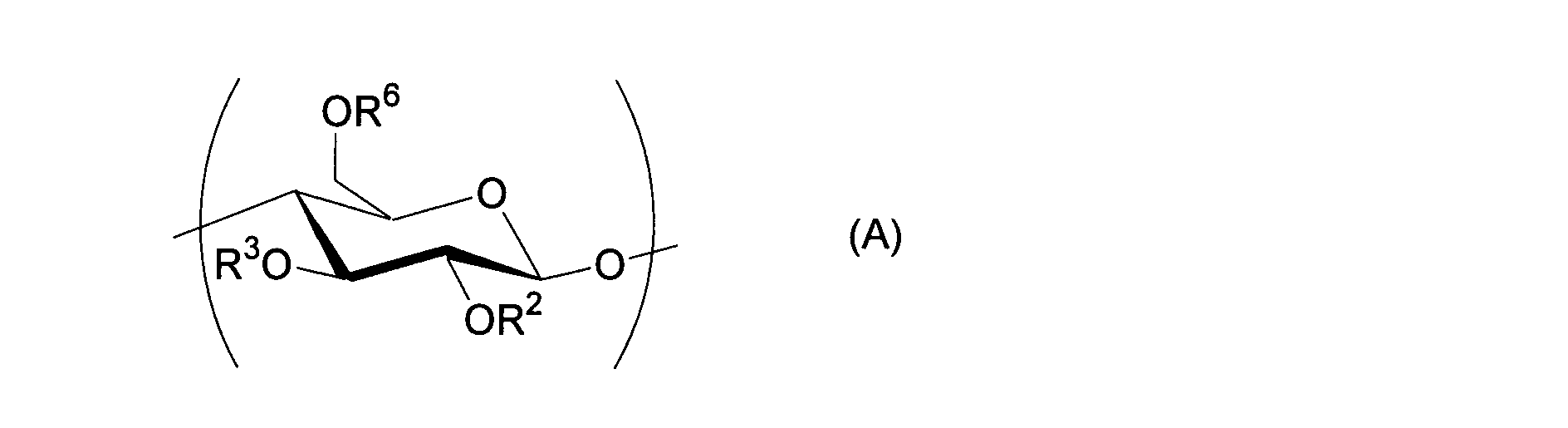
上記一般式(A)において、R2、R3及びR6は、それぞれ独立に、水素原子、A)炭化水素基:-RA、B)アシル基:-CO-RB(RBは炭化水素基を表す。)、又はその他の置換基を表す。ただし、R2、R3、及びR6の少なくとも一部がA)炭化水素基を表し、かつR2、R3、及びR6の少なくとも一部がB)アシル基を表す。
本発明におけるセルロース誘導体は、上記のようにβ-グルコース環の水酸基の少なくとも一部がA)炭化水素基、及びB)アシル基によって、エーテル化、及びエステル化されていることにより、熱可塑性を発現することができ、成形加工に適したものとなる。
更には、セルロースは完全な植物由来成分であるため、カーボンニュートラルであり、環境に対する負荷を大幅に低減することができる。
更には、セルロースは完全な植物由来成分であるため、カーボンニュートラルであり、環境に対する負荷を大幅に低減することができる。
なお、本発明にいう「セルロース」とは、多数のグルコースがβ-1,4-グリコシド結合によって結合した高分子化合物であって、セルロースのグルコース環における2位、3位、6位の炭素原子に結合している水酸基が無置換であるものを意味する。また、「セルロースに含まれる水酸基」とは、セルロースのグルコース環における2位、3位、6位の炭素原子に結合している水酸基を指す。
前記セルロース誘導体は、その全体のいずれかの部分に前記A)炭化水素基、及びB)アシル基とを含んでいればよく、同一の繰り返し単位からなるものであってもよいし、複数の種類の繰り返し単位からなるものであってもよい。また、前記セルロース誘導体は、ひとつの繰り返し単位において前記A)炭化水素基、及びB)アシル基をすべて含有する必要はない。
より具体的な態様としては、例えば以下の態様が挙げられる。
(1)R2、R3及びR6の少なくとも1つが、A)炭化水素基で置換されている繰り返し単位と、R2、R3及びR6の少なくとも1つが、B)アシル基で置換されている繰り返し単位と、から構成されるセルロース誘導体。
(2)ひとつの繰り返し単位のR2、R3及びR6のいずれか1つがA)炭化水素基で置換され、それとは別のいずれか1つがB)アシル基で置換されている(すなわち、ひとつの繰り返し単位中に前記A)及びB)の置換基を有する)同種の繰り返し単位から構成されるセルロース誘導体。
(3)置換位置や置換基の種類が異なる繰り返し単位が、ランダムに結合しているセルロース誘導体。
また、セルロース誘導体には、無置換の繰り返し単位(すなわち、前記一般式(A)において、R2、R3及びR6すべてが水素原子である繰り返し単位)を含んでいてもよい。
また、セルロース誘導体は、水素原子、A)炭化水素基、及びB)アシル基以外のその他の置換基を有していても良い。
より具体的な態様としては、例えば以下の態様が挙げられる。
(1)R2、R3及びR6の少なくとも1つが、A)炭化水素基で置換されている繰り返し単位と、R2、R3及びR6の少なくとも1つが、B)アシル基で置換されている繰り返し単位と、から構成されるセルロース誘導体。
(2)ひとつの繰り返し単位のR2、R3及びR6のいずれか1つがA)炭化水素基で置換され、それとは別のいずれか1つがB)アシル基で置換されている(すなわち、ひとつの繰り返し単位中に前記A)及びB)の置換基を有する)同種の繰り返し単位から構成されるセルロース誘導体。
(3)置換位置や置換基の種類が異なる繰り返し単位が、ランダムに結合しているセルロース誘導体。
また、セルロース誘導体には、無置換の繰り返し単位(すなわち、前記一般式(A)において、R2、R3及びR6すべてが水素原子である繰り返し単位)を含んでいてもよい。
また、セルロース誘導体は、水素原子、A)炭化水素基、及びB)アシル基以外のその他の置換基を有していても良い。
A)炭化水素基:-RAは、脂肪族基、及び芳香族基のいずれでもよい。
RAが脂肪族基である場合は、直鎖、分岐、及び環状のいずれでもよく、不飽和結合を持っていてもよい。脂肪族基としては、例えば、アルキル基、シクロアルキル基、アルケニル基、アルキニル基等が挙げられる。
RAが芳香族基である場合は、単環、及び縮環のいずれでもよい。RAが芳香族基である場合の好ましい炭素数は6~18であり、より好ましくは6~14、更に好ましくは6~10である。芳香族基としては、例えば、フェニル基、ナフチル基、フェナントリル基、アントリル基等が挙げられる。
A)炭化水素基は、得られる成形材料(以下、「セルロース樹脂組成物」又は「樹脂組成物」と称する場合がある。)の耐衝撃性が優れることから、脂肪族基であることが好ましく、メルトフローレート等の成形加工性が優れることから、より好ましくはアルキル基であり、更に好ましくは炭素数1~4のアルキル基(低級アルキル基)である。具体的には、メチル基、エチル基、プロピル基、イソプロピル基、ブチル基、イソブチル基、ペンチル基、ヘキシル基、ヘプチル基、2-エチルヘキシル基、tert-ブチル基、イソヘプチル基等が挙げられ、メチル基又はエチル基が特に好ましい。
RAが脂肪族基である場合は、直鎖、分岐、及び環状のいずれでもよく、不飽和結合を持っていてもよい。脂肪族基としては、例えば、アルキル基、シクロアルキル基、アルケニル基、アルキニル基等が挙げられる。
RAが芳香族基である場合は、単環、及び縮環のいずれでもよい。RAが芳香族基である場合の好ましい炭素数は6~18であり、より好ましくは6~14、更に好ましくは6~10である。芳香族基としては、例えば、フェニル基、ナフチル基、フェナントリル基、アントリル基等が挙げられる。
A)炭化水素基は、得られる成形材料(以下、「セルロース樹脂組成物」又は「樹脂組成物」と称する場合がある。)の耐衝撃性が優れることから、脂肪族基であることが好ましく、メルトフローレート等の成形加工性が優れることから、より好ましくはアルキル基であり、更に好ましくは炭素数1~4のアルキル基(低級アルキル基)である。具体的には、メチル基、エチル基、プロピル基、イソプロピル基、ブチル基、イソブチル基、ペンチル基、ヘキシル基、ヘプチル基、2-エチルヘキシル基、tert-ブチル基、イソヘプチル基等が挙げられ、メチル基又はエチル基が特に好ましい。
B)アシル基:-CO-RBにおいて、RBは炭化水素基を表す。RBは、脂肪族基、及び芳香族基のいずれでもよい。
RBが脂肪族基である場合は、直鎖、分岐、及び環状のいずれでもよく、不飽和結合を持っていてもよい。脂肪族基としては、例えば、アルキル基、シクロアルキル基、アルケニル基、アルキニル基等が挙げられる。
RBが芳香族基である場合は、単環、及び縮環のいずれでもよい。芳香族基としては、フェニル基、ナフチル基、フェナントリル基、アントリル基等が挙げられる。
RBは、好ましくはアルキル基又はアリール基である。RBは、より好ましくは炭素数1~12のアルキル基又はアリール基であり、更に好ましくは炭素数1~12のアルキル基であり、特に好ましくは炭素数1~4のアルキル基(好ましくはメチル基、エチル基、プロピル基)であり、最も好ましくは炭素数1又は2のアルキル基(すなわち、メチル基又はエチル基)である。
また、RBは、炭素数3~10の分岐構造を有する炭化水素基であることも好ましく、炭素数3~10の分岐構造を有するアルキル基であることがより好ましく、炭素数7~9の分岐構造を有するアルキル基であることが更に好ましい。
RBとしては、具体的には、メチル基、エチル基、プロピル基、イソプロピル基、ブチル基、イソブチル基、ペンチル基、ヘキシル基、ヘプチル基、3-ヘプチル基、2-エチルヘキシル基、tert-ブチル基、及びイソヘプチル基等が挙げられる。好ましくは、RBはメチル基、エチル基、プロピル基、3-ヘプチル基、又は2-エチルヘキシル基であり、より好ましくはメチル基、エチル基、3-ヘプチル基、又は2-エチルヘキシル基である。
RBが脂肪族基である場合は、直鎖、分岐、及び環状のいずれでもよく、不飽和結合を持っていてもよい。脂肪族基としては、例えば、アルキル基、シクロアルキル基、アルケニル基、アルキニル基等が挙げられる。
RBが芳香族基である場合は、単環、及び縮環のいずれでもよい。芳香族基としては、フェニル基、ナフチル基、フェナントリル基、アントリル基等が挙げられる。
RBは、好ましくはアルキル基又はアリール基である。RBは、より好ましくは炭素数1~12のアルキル基又はアリール基であり、更に好ましくは炭素数1~12のアルキル基であり、特に好ましくは炭素数1~4のアルキル基(好ましくはメチル基、エチル基、プロピル基)であり、最も好ましくは炭素数1又は2のアルキル基(すなわち、メチル基又はエチル基)である。
また、RBは、炭素数3~10の分岐構造を有する炭化水素基であることも好ましく、炭素数3~10の分岐構造を有するアルキル基であることがより好ましく、炭素数7~9の分岐構造を有するアルキル基であることが更に好ましい。
RBとしては、具体的には、メチル基、エチル基、プロピル基、イソプロピル基、ブチル基、イソブチル基、ペンチル基、ヘキシル基、ヘプチル基、3-ヘプチル基、2-エチルヘキシル基、tert-ブチル基、及びイソヘプチル基等が挙げられる。好ましくは、RBはメチル基、エチル基、プロピル基、3-ヘプチル基、又は2-エチルヘキシル基であり、より好ましくはメチル基、エチル基、3-ヘプチル基、又は2-エチルヘキシル基である。
本発明の成形材料におけるセルロース誘導体は、セルロースに含まれる水酸基の水素原子が、前記A)で置換された基を少なくとも1つ、及び前記B)で置換された基を少なくとも1つ含むセルロース誘導体であるが、更に、セルロースに含まれる水酸基の水素原子が下記C)で置換された基を少なくとも1つ含むことが耐衝撃性の観点から好ましい。
C)アルキレンオキシ基:-RC2-O-とアシル基:-CO-RC1とを含む基(RC1は炭化水素基を表し、RC2は炭素数が2又は3のアルキレン基を表す。)
C)アルキレンオキシ基:-RC2-O-とアシル基:-CO-RC1とを含む基(RC1は炭化水素基を表し、RC2は炭素数が2又は3のアルキレン基を表す。)
前記C)に含まれるアシル基(-CO-RC1)において、RC1は炭化水素基を表す。RC1が表す炭化水素基としては、前記RBで挙げたものと同様のものを適用することができる。RC1の好ましい範囲も前記RBと同様である。
前記C)に含まれるアルキレンオキシ基(-RC2-O-)において、RC2は炭素数が2~4のアルキレン基を表す。RC2は、直鎖状、分岐状、又は環状のいずれでもよいが、直鎖状、又は分岐状が好ましく、分岐状がより好ましい。
アルキレンオキシ基(-RC2-O-)としては、炭素数2又は3のアルキレンオキシ基が好ましい。アルキレンオキシ基としては、具体的には下記構造が挙げられる。
アルキレンオキシ基(-RC2-O-)としては、炭素数2又は3のアルキレンオキシ基が好ましい。アルキレンオキシ基としては、具体的には下記構造が挙げられる。

上記の中でも、得られる樹脂組成物の曲げ弾性率が優れることから、-RC2-O-が分岐状である下記式(1)又は(2)で表される基が好ましい。

前記C)の基は、アルキレンオキシ基を複数含んでいてもよいし、1つだけ含むものであってもよい。好ましくは、前記C)の基は、下記一般式(3)で表すことができる。

前記一般式(3)中、RC1は炭化水素基を表し、RC2は炭素数が2~4のアルキレン基を表す。RC1及びRC2の好ましい範囲は、前記したものと同様である。nは1以上の整数である。nの上限は特に限定されず、アルキレンオキシ基の導入量等により変わるが、例えば10程度である。nは好ましくは1~5であり、より好ましくは1~3であり、更に好ましくは1である。RC2は複数存在する場合は、各々同じでも異なっていてもよいが同じであることが好ましい。
また、本発明におけるセルロース誘導体は、アルキレンオキシ基を1つだけ含む前記C)の基(上記一般式(3)においてnが1である基)と、アルキレンオキシ基を2以上含む前記C)の基(上記一般式(3)においてnが2以上である基)とを含んでいてもよい。
また、本発明におけるセルロース誘導体は、アルキレンオキシ基を1つだけ含む前記C)の基(上記一般式(3)においてnが1である基)と、アルキレンオキシ基を2以上含む前記C)の基(上記一般式(3)においてnが2以上である基)とを含んでいてもよい。
また、前記C)の基におけるアルキレンオキシ基のセルロース誘導体に対する結合向きは特に限定されないが、アルキレンオキシ基のアルキレン基部分(RC2)がβ-グルコース環構造側に結合していることが好ましい。
前記A)におけるRA、前記B)におけるRB、前記C)におけるRC1及びRC2は、さらなる置換基を有していてもよいし無置換でもよいが、無置換であることが好ましい。
前記A)におけるRA、前記B)におけるRB、前記C)におけるRC1及びRC2がさらなる置換基を有する場合、さらなる置換基としては、例えば、ハロゲン原子(例えばフッ素原子、塩素原子、臭素原子、ヨウ素原子)、ヒドロキシ基、アルコキシ基(アルキル基部分の炭素数は好ましくは1~5)、アルケニル基等が挙げられる。ただし、置換基を含む場合でもRC2の炭素数は2~4である。なお、RA、RB、及びRC1がアルキル基以外である場合は、アルキル基(好ましくは炭素数1~5)を置換基として有することもできる。
前記A)におけるRA、前記B)におけるRB、前記C)におけるRC1及びRC2がさらなる置換基を有する場合、さらなる置換基としては、例えば、ハロゲン原子(例えばフッ素原子、塩素原子、臭素原子、ヨウ素原子)、ヒドロキシ基、アルコキシ基(アルキル基部分の炭素数は好ましくは1~5)、アルケニル基等が挙げられる。ただし、置換基を含む場合でもRC2の炭素数は2~4である。なお、RA、RB、及びRC1がアルキル基以外である場合は、アルキル基(好ましくは炭素数1~5)を置換基として有することもできる。
特に、RB及びRC1がさらなる置換基を有する場合、カルボキシル基、スルホン酸基、及びこれらの塩を実質的に有さないことが好ましい。セルロース誘導体がカルボキシル基、スルホン酸基、及びこれらの塩を実質的に有さないことにより、本発明の成形材料を水不溶性とすることができ、成形性を更に向上させることができる。また、セルロース誘導体がカルボキシル基、スルホン酸基、及びこれらの塩を有する場合、化合物としての安定性を悪化させることが知られており、特に熱分解を促進することがあるため、これらの基を含まないことが好ましい。
なお、「カルボキシル基、スルホン酸基、及びこれらの塩を実質的に有さない」とは、本発明におけるセルロース誘導体が全くカルボキシル基、スルホン酸基、及びこれらの塩を有さない場合のみならず、本発明におけるセルロース誘導体が水に不溶な範囲で微量のカルボキシル基、スルホン酸基、及びこれらの塩を有する場合を包含するものとする。例えば、原料であるセルロースにカルボキシル基が含まれる場合があり、これを用いて前記A)~C)の置換基を導入したセルロース誘導体はカルボキシル基が含まれる場合があるが、これは「カルボキシル基、スルホン酸基、及びこれらの塩を実質的に有さないセルロース誘導体」に含まれるものとする。
この場合、カルボキシル基、スルホン酸基、及びこれらの塩の好ましい含有量としては、セルロース誘導体に対して1質量%以下、より好ましくは0.5質量%以下である。
なお、「カルボキシル基、スルホン酸基、及びこれらの塩を実質的に有さない」とは、本発明におけるセルロース誘導体が全くカルボキシル基、スルホン酸基、及びこれらの塩を有さない場合のみならず、本発明におけるセルロース誘導体が水に不溶な範囲で微量のカルボキシル基、スルホン酸基、及びこれらの塩を有する場合を包含するものとする。例えば、原料であるセルロースにカルボキシル基が含まれる場合があり、これを用いて前記A)~C)の置換基を導入したセルロース誘導体はカルボキシル基が含まれる場合があるが、これは「カルボキシル基、スルホン酸基、及びこれらの塩を実質的に有さないセルロース誘導体」に含まれるものとする。
この場合、カルボキシル基、スルホン酸基、及びこれらの塩の好ましい含有量としては、セルロース誘導体に対して1質量%以下、より好ましくは0.5質量%以下である。
また、本発明におけるセルロース誘導体は、水に不溶であることが好ましい。ここで、「水に不溶である」とは、25℃の水100質量部への溶解度が5質量部以下であることとする。
本発明におけるセルロース誘導体の具体例としては、アセチルメチルセルロース、アセチルエチルセルロース、アセチルプロピルセルロース、アセチルブチルセルロース、アセチルペンチルセルロース、アセチルヘキシルセルロース、アセチルシクロヘキシルセルロース、アセチルフェニルセルロース、アセチルナフチルセルロース、
プロピオニルメチルセルロース、プロピオニルエチルセルロース、プロピオニルプロピルセルロース、プロピオニルブチルセルロース、プロピオニルペンチルセルロース、プロピオニルヘキシルセルロース、プロピオニルシクロヘキシルセルロース、プロピオニルフェニルセルロース、プロピオニルナフチルセルロース、
ブチリルメチルセルロース、ブチリルエチルセルロース、ブチリルプロピルセルロース、ブチリルブチルセルロース、ブチリルペンチルセルロース、ブチリルヘキシルセルロース、ブチリルシクロヘキシルセルロース、ブチリルフェニルセルロース、ブチリルナフチルセルロース、
メチルセルロース-2-エチルヘキサノエート、エチルセルロース-2-エチルヘキサノエート、プロピルセルロース-2-エチルヘキサノエート、ブチルセルロース-2-エチルヘキサノエート、ペンチルセルロース-2-エチルヘキサノエート、ヘキシルセルロース-2-エチルヘキサノエート、シクロヘキシルセルロース-2-エチルヘキサノエート、フェニルセルロース-2-エチルヘキサノエート、ナフチルセルロース-2-エチルヘキサノエート、
アセトキシエチルメチルアセチルセルロース、アセトキシエチルエチルアセチルセルロース、アセトキシエチルプロピルアセチルセルロース、アセトキシエチルブチルアセチルセルロース、アセトキシエチルペンチルアセチルセルロース、アセトキシエチルヘキシルアセチルセルロース、アセトキシエチルシクロヘキシルアセチルセルロース、アセトキシエチルフェニルアセチルセルロース、アセトキシエチルナフチルアセチルセルロース、
アセトキシエチルメチルプロピオニルセルロース、アセトキシエチルエチルプロピオニルセルロース、アセトキシエチルプロピルプロピオニルセルロース、アセトキシエチルブチルプロピオニルセルロース、アセトキシエチルペンチルプロピオニルセルロース、アセトキシエチルヘキシルプロピオニルセルロース、アセトキシエチルシクロヘキシルプロピオニルセルロース、アセトキシエチルフェニルプロピオニルセルロース、アセトキシエチルナフチルプロピオニルセルロース、
アセトキシエチルメチルセルロース-2-エチルヘキサノエート、アセトキシエチルエチルセルロース-2-エチルヘキサノエート、アセトキシエチルプロピルセルロース-2-エチルヘキサノエート、アセトキシエチルブチルセルロース-2-エチルヘキサノエート、アセトキシエチルペンチルセルロース-2-エチルヘキサノエート、アセトキシエチルヘキシルセルロース-2-エチルヘキサノエート、アセトキシエチルシクロヘキシルセルロース-2-エチルヘキサノエート、アセトキシエチルフェニルセルロース-2-エチルヘキサノエート、アセトキシエチルナフチルセルロース-2-エチルヘキサノエート、
プロピオニルオキシエチルメチルアセチルセルロース、プロピオニルオキシエチルエチルアセチルセルロース、プロピオニルオキシエチルプロピルアセチルセルロース、プロピオニルオキシエチルブチルアセチルセルロース、プロピオニルオキシエチルペンチルアセチルセルロース、プロピオニルオキシエチルヘキシルアセチルセルロース、プロピオニルオキシエチルシクロヘキシルアセチルセルロース、プロピオニルオキシエチルフェニルアセチルセルロース、プロピオニルオキシエチルナフチルアセチルセルロース、
プロピオニルオキシエチルメチルプロピオニルセルロース、プロピオニルオキシエチルエチルプロピオニルセルロース、プロピオニルオキシエチルプロピルプロピオニルセルロース、プロピオニルオキシエチルブチルプロピオニルセルロース、プロピオニルオキシエチルペンチルプロピオニルセルロース、プロピオニルオキシエチルヘキシルプロピオニルセルロース、プロピオニルオキシエチルシクロヘキシルプロピオニルセルロース、プロピオニルオキシエチルフェニルプロピオニルセルロース、プロピオニルオキシエチルナフチルプロピオニルセルロース、
プロピオニルオキシエチルメチルセルロース-2-エチルヘキサノエート、プロピオニルオキシエチルエチルセルロース-2-エチルヘキサノエート、プロピオニルオキシエチルプロピルセルロース-2-エチルヘキサノエート、プロピオニルオキシエチルブチルセルロース-2-エチルヘキサノエート、プロピオニルオキシエチルペンチルセルロース-2-エチルヘキサノエート、プロピオニルオキシエチルヘキシルセルロース-2-エチルヘキサノエート、プロピオニルオキシエチルシクロヘキシルセルロース-2-エチルヘキサノエート、プロピオニルオキシエチルフェニルセルロース-2-エチルヘキサノエート、プロピオニルオキシエチルナフチルセルロース-2-エチルヘキサノエート、
アセトキシプロピルメチルアセチルセルロース、アセトキシプロピルエチルアセチルセルロース、アセトキシプロピルプロピルアセチルセルロース、アセトキシプロピルブチルアセチルセルロース、アセトキシプロピルペンチルアセチルセルロース、アセトキシプロピルヘキシルアセチルセルロース、アセトキシプロピルシクロヘキシルアセチルセルロース、アセトキシプロピルフェニルアセチルセルロース、アセトキシプロピルナフチルアセチルセルロース、
プロピオニルオキシプロピルメチルアセチルセルロース、プロピオニルオキシプロピルエチルアセチルセルロース、プロピオニルオキシプロピルプロピルアセチルセルロース、プロピオニルオキシプロピルブチルアセチルセルロース、プロピオニルオキシプロピルペンチルアセチルセルロース、プロピオニルオキシプロピルヘキシルアセチルセルロース、プロピオニルオキシプロピルシクロヘキシルアセチルセルロース、プロピオニルオキシプロピルフェニルアセチルセルロース、プロピオニルオキシプロピルナフチルアセチルセルロース、
バレロキシプロピルメチルバレロイルセルロース、バレロキシブチルメチルバレロイルセルロースなどが挙げられる。
本発明の成形材料は、前記特定のセルロース誘導体を1種のみ含んでもよいし、2種以上を含んでもよい。
本発明におけるセルロース誘導体中のA)炭化水素基:-RA、B)アシル基:-CO-RB、及びC)アルキレンオキシ基:-RC2-O-とアシル基:-CO-RC1とを含む基の置換位置、並びにβ-グルコース環単位当たりの各置換基の数(置換度)は特に限定されない。
例えば、A)炭化水素基:-RAの置換度DSA(繰り返し単位中、β-グルコース環の2位、3位及び6位の水酸基に対するRAの数)は、1.0<DSAであることが好ましく、1.0<DSA<2.5がより好ましい。また、DSAは1.1以上であることが好ましい。
B)アシル基(-CO-RB)の置換度DSB(繰り返し単位中、β-グルコース環のセルロース構造の2位、3位及び6位の水酸基に対する-CO-RBの数)は、0.1<DSBであることが好ましく、0.1<DSB<2.0であることがより好ましい。
C)アルキレンオキシ基:-RC2-O-とアシル基:-CO-RC1とを含む基の置換度DSC(繰り返し単位中、β-グルコース環のセルロース構造の2位、3位及び6位の水酸基に対するC)アルキレンオキシ基:-RC2-O-とアシル基:-CO-RC1とを含む基の数)は、0<DSCであることが好ましく、0<DSC<1.0であることがより好ましい。0<DSCであることにより、セルロース誘導体の溶融開始温度を低くできるので、熱成形をより容易に行うことができる。
上記のような範囲の置換度とすることにより、機械強度及び成形性等を向上させることができる。
B)アシル基(-CO-RB)の置換度DSB(繰り返し単位中、β-グルコース環のセルロース構造の2位、3位及び6位の水酸基に対する-CO-RBの数)は、0.1<DSBであることが好ましく、0.1<DSB<2.0であることがより好ましい。
C)アルキレンオキシ基:-RC2-O-とアシル基:-CO-RC1とを含む基の置換度DSC(繰り返し単位中、β-グルコース環のセルロース構造の2位、3位及び6位の水酸基に対するC)アルキレンオキシ基:-RC2-O-とアシル基:-CO-RC1とを含む基の数)は、0<DSCであることが好ましく、0<DSC<1.0であることがより好ましい。0<DSCであることにより、セルロース誘導体の溶融開始温度を低くできるので、熱成形をより容易に行うことができる。
上記のような範囲の置換度とすることにより、機械強度及び成形性等を向上させることができる。
また、セルロース誘導体中に存在する無置換の水酸基の数も特に限定されない。水素原子の置換度DSH(繰り返し単位中、2位、3位及び6位の水酸基が無置換である割合)は0~1.5の範囲とすることができ、好ましくは0~0.6とすればよい。DSHを0.6以下とすることにより、成形材料の流動性を向上させたり、熱分解の加速・成形時の成形材料の吸水による発泡等を抑制させたりできる。
また、本発明におけるセルロース誘導体は、A)炭化水素基、B)アシル基、及びC)アルキレンオキシ基とアシル基とを含む基以外の置換基を有しても良い。有してもよい置換基の例としては、例えばヒドロキシエチル基、ヒドロキシプロピル基、ヒドロキシエトキシエチル基、ヒドロキシプロポキシプロピル基、ヒドロキシエトキシエトキシエチル基、ヒドロキシプロポキシプロポキシプロピル基が挙げられる。よって、セルロース誘導体が有するすべての置換基の各置換度の総和は3であるが、(DSA+DSB+DSC+DSH)は3以下である。
また、前記C)の基におけるアルキレンオキシ基の導入量はモル置換度(MS:グルコース残基あたりの置換基の導入モル数)で表される(セルロース学会編集、セルロース辞典P142)。アルキレンオキシ基のモル置換度MSは、0<MSであることが好ましく、0<MS≦1.5であることがより好ましく、0<MS<1.0であることが更に好ましい。MSが1.5以下(MS≦1.5)であることにより、耐熱性・成形性等を向上させることができ、成形材料に好適なセルロース誘導体が得られる。
本発明の成形材料におけるセルロース誘導体は、セルロースに含まれる水酸基の水素原子が、前記A)で置換された基を少なくとも1つ、及び前記B)で置換された基を少なくとも1つ含むセルロース誘導体であるが、セルロースに含まれる水酸基の水素原子が置換される場合は、成形性の観点から、前記A)及び前記B)のみで置換されているか、又は前記A)、前記B)、及び前記C)のみで置換されている場合が好ましい。すなわち本発明におけるセルロース誘導体は、セルロースに含まれる水酸基の水素原子が前記A)、前記B)、及び前記C)以外の基により置換されていないことが好ましい。
本発明におけるセルロース誘導体の分子量は、数平均分子量(Mn)が5×10³~1000×103の範囲が好ましく、10×103~500×103の範囲が更に好ましく、10×103~200×103の範囲が最も好ましい。また、重量平均分子量(Mw)は、7×10³~10000×103の範囲が好ましく、15×103~5000×103の範囲が更に好ましく、100×103~3000×103の範囲が最も好ましい。この範囲の平均分子量とすることにより、成形体の成形性、力学強度等を向上させることができる。
分子量分布(MWD)は1.1~10.0の範囲が好ましく、1.5~8.0の範囲が更に好ましい。この範囲の分子量分布とすることにより、成形性等を向上させることができる。
本発明における、数平均分子量(Mn)、重量平均分子量(Mw)及び分子量分布(MWD)の測定は、ゲル・パーミエーション・クロマトグラフィー(GPC)を用いて行うことができる。具体的には、N-メチルピロリドンを溶媒とし、ポリスチレンゲルを使用し、標準単分散ポリスチレンの構成曲線から予め求められた換算分子量較正曲線を用いて求めることができる。
分子量分布(MWD)は1.1~10.0の範囲が好ましく、1.5~8.0の範囲が更に好ましい。この範囲の分子量分布とすることにより、成形性等を向上させることができる。
本発明における、数平均分子量(Mn)、重量平均分子量(Mw)及び分子量分布(MWD)の測定は、ゲル・パーミエーション・クロマトグラフィー(GPC)を用いて行うことができる。具体的には、N-メチルピロリドンを溶媒とし、ポリスチレンゲルを使用し、標準単分散ポリスチレンの構成曲線から予め求められた換算分子量較正曲線を用いて求めることができる。
2.セルロース誘導体の製造方法
本発明におけるセルロース誘導体の製造方法は特に限定されず、セルロースを原料とし、セルロースに対しエーテル化及びエステル化することにより本発明におけるセルロース誘導体を製造することができる。セルロースの原料としては限定的でなく、例えば、綿、リンター、パルプ等が挙げられる。
本発明におけるセルロース誘導体の製造方法は特に限定されず、セルロースを原料とし、セルロースに対しエーテル化及びエステル化することにより本発明におけるセルロース誘導体を製造することができる。セルロースの原料としては限定的でなく、例えば、綿、リンター、パルプ等が挙げられる。
前記A)炭化水素基:-RA、及びB)アシル基:-CO-RB(RBは炭化水素基を表す。)を有するセルロース誘導体の好ましい製造方法の態様は、セルロースエーテルに、塩基存在下、酸クロリド又は酸無水物等を反応させることにより、エステル化する工程を含むものである。
前記セルロースエーテルとしては、例えば、セルロースに含まれるβ-グルコース環の2位、3位、及び6位の水酸基の水素原子の少なくとも一部が、炭化水素基に置換されたものを用いることができ、具体的には、メチルセルロース、エチルセルロース、プロピルセルロース、ブチルセルロース、アリルセルロース、ベンジルセルロース等が挙げられる。
前記セルロースエーテルとしては、例えば、セルロースに含まれるβ-グルコース環の2位、3位、及び6位の水酸基の水素原子の少なくとも一部が、炭化水素基に置換されたものを用いることができ、具体的には、メチルセルロース、エチルセルロース、プロピルセルロース、ブチルセルロース、アリルセルロース、ベンジルセルロース等が挙げられる。
前記A)炭化水素基:-RA、B)アシル基:-CO-RB(RBは炭化水素基を表す。)、及びC)アルキレンオキシ基:-RC2-O-とアシル基:-CO-RC1とを含む基(RC1は炭化水素基を表し、RC2は炭素数が2~4のアルキレン基を表す。)を有するセルロース誘導体の好ましい製造方法の態様は、炭化水素基とヒドロキシプロピル基を有するヒドロキシプロピルセルロースエーテルに酸クロライド又は酸無水物等を反応させることにより、エステル化(アシル化)する工程を含む方法によって行うものである。
また、別の態様として、例えばメチルセルロース、エチルセルロース等のセルロースエーテルにプロピレンオキサイド等によりエーテル化するか、又はセルロースにメチルクロライド、エチルクロライド等のアルキルクロライド/炭素数3のアルキレンオキサイド等を作用させた後、更に酸クロライド又は酸無水物等を反応させることにより、エステル化する工程を含む方法も挙げられる。
酸クロライドを反応させる方法としては、例えばCellulose 10;283-296,2003に記載の方法を用いることができる。
炭化水素基とヒドロキシプロピル基を有するセルロースエーテルとしては、具体的には、ヒドロキシプロピルメチルセルロース、ヒドロキシプロピルエチルセルロース、ヒドロキシプロピルプロピルセルロース、ヒドロキシプロピルアリルセルロース、ヒドロキシプロピルベンジルセルロース等が挙げられる。好ましくは、ヒドロキシプロピルメチルセルロース、ヒドロキシプロピルエチルセルロースである。
また、別の態様として、例えばメチルセルロース、エチルセルロース等のセルロースエーテルにプロピレンオキサイド等によりエーテル化するか、又はセルロースにメチルクロライド、エチルクロライド等のアルキルクロライド/炭素数3のアルキレンオキサイド等を作用させた後、更に酸クロライド又は酸無水物等を反応させることにより、エステル化する工程を含む方法も挙げられる。
酸クロライドを反応させる方法としては、例えばCellulose 10;283-296,2003に記載の方法を用いることができる。
炭化水素基とヒドロキシプロピル基を有するセルロースエーテルとしては、具体的には、ヒドロキシプロピルメチルセルロース、ヒドロキシプロピルエチルセルロース、ヒドロキシプロピルプロピルセルロース、ヒドロキシプロピルアリルセルロース、ヒドロキシプロピルベンジルセルロース等が挙げられる。好ましくは、ヒドロキシプロピルメチルセルロース、ヒドロキシプロピルエチルセルロースである。
酸クロリドとしては、前記B)アシル基、及びC)に含まれるアシル基に対応したカルボン酸クロライドを使用することができる。カルボン酸クロリドとしては、例えば、アセチルクロライド、プロピオニルクロライド、ブチリルクロリド、イソブチリルクロリド、ペンタノイルクロリド、2-メチルブタノイルクロリド、3-メチルブタノイルクロリド、ピバロイルクロリド、ヘキサノイルクロリド、2-メチルペンタノイルクロリド、3-メチルペンタノイルクロリド、4-メチルペンタノイルクロリド、2,2-ジメチルブタノイルクロリド、2,3-ジメチルブタノイルクロリド、3,3-ジメチルブタノイルクロリド、2-エチルブタノイルクロリド、ヘプタノイルクロリド、2-メチルヘキサノイルクロリド、3-メチルヘキサノイルクロリド、4-メチルヘキサノイルクロリド、5-メチルヘキサノイルクロリド、2,2-ジメチルペンタノイルクロリド、2,3-ジメチルペンタノイルクロリド、3,3-ジメチルペンタノイルクロリド、2-エチルペンタノイルクロリド、シクロヘキサノイルクロリド、オクタノイルクロリド、2-メチルヘプタノイルクロリド、3-メチルヘプタノイルクロリド、4-メチルヘプタノイルクロリド、5-メチルヘプタノイルクロリド、6-メチルヘプタノイルクロリド、2,2-ジメチルヘキサノイルクロリド、2,3-ジメチルヘキサノイルクロリド、3,3-ジメチルヘキサノイルクロリド、2-エチルヘキサノイルクロリド、2-プロピルペンタノイルクロリド、ノナノイルクロリド、2-メチルオクタノイルクロリド、3-メチルオクタノイルクロリド、4-メチルオクタノイルクロリド、5-メチルオクタノイルクロリド、6-メチルオクタノイルクロリド、2,2-ジメチルヘプタノイルクロリド、2,3-ジメチルヘプタノイルクロリド、3,3-ジメチルヘプタノイルクロリド、2-エチルヘプタノイルクロリド、2-プロピルヘキサノイルクロリド、2-ブチルペンタノイルクロリド、デカノイルクロリド、2-メチルノナノイルクロリド、3-メチルノナノイルクロリド、4-メチルノナノイルクロリド、5-メチルノナノイルクロリド、6-メチルノナノイルクロリド、7-メチルノナノイルクロリド、2,2-ジメチルオクタノイルクロリド、2,3-ジメチルオクタノイルクロリド、3,3-ジメチルオクタノイルクロリド、2-エチルオクタノイルクロリド、2-プロピルヘプタノイルクロリド、2-ブチルヘキサノイルクロリド等が挙げられる。
酸無水物としては、例えば前記B)アシル基、及びC)に含まれるアシル基に対応したカルボン酸無水物を使用することができる。このようなカルボン酸無水物としては、例えば、酢酸無水物、プロピオン酸無水物、酪酸無水物、吉草酸無水物、ヘキサン酸無水物、ヘプタン酸無水物、オクタン酸無水物、2-エチルヘキサン酸無水物、ノナン酸無水物等が挙げられる。
なお、前述したとおり、本発明におけるセルロース誘導体は置換基としてカルボン酸を有さないことが好ましいため、例えば無水フタル酸、無水マレイン酸等のジカルボン酸等、セルロースと反応させてカルボキシル基が生じる化合物を用いないことが好ましい。
なお、前述したとおり、本発明におけるセルロース誘導体は置換基としてカルボン酸を有さないことが好ましいため、例えば無水フタル酸、無水マレイン酸等のジカルボン酸等、セルロースと反応させてカルボキシル基が生じる化合物を用いないことが好ましい。
そのほかの具体的な製造条件等は、常法に従うことができる。例えば、「セルロースの事典」131頁~164頁(朝倉書店、2000年)等に記載の方法を参考にすることができる。
3.金属水酸化物
本発明の成形材料は金属水酸化物を含有する。金属水酸化物を本発明における特定のセルロース誘導体に混合させることにより、剛性、曲げ強度、耐熱性といった性能を低下させることなく、特定のセルロース誘導体を単独で用いた場合よりも、耐衝撃性、難燃性、及び耐傷性を向上させることができる。これは、金属水酸化物の水酸基が加熱によって水を生成することや、樹脂と架橋が生じること、金属水酸化物の添加により水素結合といったような樹脂との相互作用が増加することで樹脂が硬くなることに由来すると考えられる。
本発明の成形材料は金属水酸化物を含有する。金属水酸化物を本発明における特定のセルロース誘導体に混合させることにより、剛性、曲げ強度、耐熱性といった性能を低下させることなく、特定のセルロース誘導体を単独で用いた場合よりも、耐衝撃性、難燃性、及び耐傷性を向上させることができる。これは、金属水酸化物の水酸基が加熱によって水を生成することや、樹脂と架橋が生じること、金属水酸化物の添加により水素結合といったような樹脂との相互作用が増加することで樹脂が硬くなることに由来すると考えられる。
本発明で用いる金属水酸化物は、分子中に水酸基を含む金属化合物であり、加熱により水を生成するものを好適に用いることができる。
具体的な水酸化物としては、特に限定されないが、水酸化マグネシウム、水酸化アルミニウム、水酸化カルシウム、水酸化マンガン、水酸化鉄、水酸化亜鉛、水酸化ジルコニウム、水酸化コバルト、水酸化銅、水酸化セリウム、水酸化チタン、水酸化バリウム、水酸化ベリリウム、水酸化ストロンチウム、水酸化ガリウム、ハイドロタルサイト(Mg6Al2(OH)16CO3・4H2O)等を挙げることができ、これらの中でも水酸化マグネシウム、水酸化アルミニウム、水酸化カルシウム、水酸化マンガン、水酸化鉄、水酸化亜鉛が好ましく、水酸化マグネシウム、水酸化アルミニウムがより好ましい。これらは、単独で用いても良いし、2種以上を組み合わせて用いても良い。
具体的な水酸化物としては、特に限定されないが、水酸化マグネシウム、水酸化アルミニウム、水酸化カルシウム、水酸化マンガン、水酸化鉄、水酸化亜鉛、水酸化ジルコニウム、水酸化コバルト、水酸化銅、水酸化セリウム、水酸化チタン、水酸化バリウム、水酸化ベリリウム、水酸化ストロンチウム、水酸化ガリウム、ハイドロタルサイト(Mg6Al2(OH)16CO3・4H2O)等を挙げることができ、これらの中でも水酸化マグネシウム、水酸化アルミニウム、水酸化カルシウム、水酸化マンガン、水酸化鉄、水酸化亜鉛が好ましく、水酸化マグネシウム、水酸化アルミニウムがより好ましい。これらは、単独で用いても良いし、2種以上を組み合わせて用いても良い。
本発明で用いられる金属水酸化物の形状は特に限定されないが、粒状であることが好ましい。また、その粒子径は、該金属水酸化物の種類に応じて適宜選択することができる。
例えば、平均粒子径は約100μm以下、好ましくは0.1~70μm、より好ましくは0.5~50μm、更に好ましくは2~30μmとすることができる。平均粒径を調整することにより、セルロース誘導体に混合するときの全体の分散性が向上するので、混合作業が容易となるほか、得られる成形体の難燃性や耐傷性のさらなる向上も期待できる。その他、成形プロセスにおける射出成形性の観点からも、平均粒径を調整することが好ましい。
例えば、平均粒子径は約100μm以下、好ましくは0.1~70μm、より好ましくは0.5~50μm、更に好ましくは2~30μmとすることができる。平均粒径を調整することにより、セルロース誘導体に混合するときの全体の分散性が向上するので、混合作業が容易となるほか、得られる成形体の難燃性や耐傷性のさらなる向上も期待できる。その他、成形プロセスにおける射出成形性の観点からも、平均粒径を調整することが好ましい。
なお、平均粒径は、レーザー散乱光による粒度分布法により測定したものである。測定サンプルは、金属水酸化物を水に分散させた後、超音波を3分間照射したものを用い、粒子数の50%累積値(D50)を求めて、2回の測定による平均値を平均粒径とする。
本発明で用いられる金属水酸化物は、その純度が約99.5%以上であることが好ましい。純度が高いほど、得られる成形体の難燃性や耐傷性が向上し得るからである。金属水酸化物の純度は、公知の方法で測定することができる。例えば、金属水酸化物に含まれている不純物の含有量を公知の方法で測定し、全体量から上記不純物の含有量を減じれば、金属水酸化物の純度を得ることができる。より具体的には、例えば水酸化アルミニウムの場合、不純物としてはFe2O3、SiO2、T-Na2O、S-Na2O等が挙げられる。Fe2O3の含有量は炭酸ナトリウム-ホウ酸液に融解後、O-フェナントロリン吸光光度法(JIS H 1901)により求められる。SiO2の含有量は、炭酸ナトリウム-ホウ酸液に融解後、モリブテン青吸光光度法(JIS H 1901)により求められる。T-Na2Oの含有量は、硫酸に融解後、フレーム光度測定法で、S-Na2Oは、温水抽出後、フレーム光度測定法で求められる。上記により求められた含有量を水酸化アルミニウムの重量より減じることにより水酸化物の純度を得ることができる。
更に、本発明で用いられる金属水酸化物は、成形性の観点から、窒素ガス吸着法により求められるBET比表面積が約20m2/g以下の粒子を用いることが好ましい。
4.成形材料、及び成形体
本発明の成形材料は、上記で説明したセルロース誘導体と金属水酸化物とを含有しており、必要に応じてその他の添加剤を含有することができる。
本発明の成形材料におけるセルロース誘導体の含有量は、成形材料中、50~99.9質量%が好ましく、60~95質量%がより好ましく、65~90質量%が更に好ましい。
本発明の成形材料に含まれる金属水酸化物の含有量は、耐衝撃性、難燃性、及び耐傷性の向上の観点から、成形材料中、0.1~50質量%であることが好ましく、より好ましくは5~45質量%、更に好ましくは、10~40質量%である。この範囲とすることにより、十分な難燃性と耐傷性が得られ易く、成形加工性や可撓性を低下させる可能性も低くなる。
本発明の成形材料は、上記で説明したセルロース誘導体と金属水酸化物とを含有しており、必要に応じてその他の添加剤を含有することができる。
本発明の成形材料におけるセルロース誘導体の含有量は、成形材料中、50~99.9質量%が好ましく、60~95質量%がより好ましく、65~90質量%が更に好ましい。
本発明の成形材料に含まれる金属水酸化物の含有量は、耐衝撃性、難燃性、及び耐傷性の向上の観点から、成形材料中、0.1~50質量%であることが好ましく、より好ましくは5~45質量%、更に好ましくは、10~40質量%である。この範囲とすることにより、十分な難燃性と耐傷性が得られ易く、成形加工性や可撓性を低下させる可能性も低くなる。
本発明の成形材料は、セルロース誘導体、及び金属水酸化物のほか、必要に応じて、フィラー(強化材)、難燃剤等の種々の添加剤を含有していてもよい。
本発明の成形材料は、樹脂の熱安定性向上のために更に酸化防止剤を含有することが好ましい。これによって、特定のセルロース誘導体が有する耐衝撃性、成形性、剛性、曲げ強度、耐熱性等の低下を抑え、難燃性、耐傷性、を付与することができる。
本発明における酸化防止剤は、低分子化合物であっても、高分子化合物であってもよく、例えば、ヒンダードフェノール系酸化防止剤、リン系酸化防止剤、アミン系酸化防止剤、イオウ系酸化防止剤を用いることができる。
ヒンダードフェノール系酸化防止剤の具体例としては、トリエチレングリコール-ビス[3-(3-t-ブチル-5-メチル-4-ヒドロキシフェニル) プロピオネート]、ペンタエリスリチル-テトラキス[3-(3,5-ジ-t-ブチル-4-ヒドロキシフェニル)プロピオネート]、1.6-ヘキサンジオール-ビス[3-(3,5-ジ-t-ブチル-4-ヒドロキシフェニル)プロピオネート、オクタドデシル-3-(3,5-ジ-t-ブチル-4-ヒドロキシフェニル)プロピオネート、N,N’-ヘキサメチレンビス(3,5-ジ-t-ブチル-4-ヒドロキシ-ヒドロシンナマミド、3,5-ジ-t-ブチル-4-ヒドロキシ-ベンジルフォスフォネート-ジエチルエステル及び1,3,5-トリメチル-2,4,6-トリス(3,5-ジ-t-ブチル-4-ヒドロキシベンジル)ベンゼンなどが挙げられる。
リン系酸化防止剤としては、次亜リン酸カルシウム、2,6-ジ-t-ブチル-4-メチルフェノール、テトラキス(メチレン-3-(3,5-ジ-t-ブチル-4-ヒドロキシフェニル)プロピオネート)メタン、トリス(3,5-ジ-t-ブチル-4-ヒドロキシベンジン)イソシアヌレート等のフェノール系化合物、ジラウリル-3,3’-チオジプロピオネート、ジミリスチル-3,3’-チオジプロピオネート等のイオウ化合物、トリスノニルフェニルホスファイト、ジステアリルペンタエリスリトールジホスファイト等のリン系化合物などが挙げられるが、中でも次亜リン酸カルシウムが好ましい。
イオウ系酸化防止剤の具体例としては、チオエーテル系、ジチオカルバミン酸ニッケルなどのジチオ酸塩系、メルカプトベンズイミダゾール系、チオカルバニリド系、及びチオジプロピオンエステル系などのイオウを含む化合物を挙げることができる。これらの中でも、特にチオジプロピオンエステル系化合物の使用が好ましい。
本発明における酸化防止剤としては、リン系酸化防止剤、ヒンダードフェノール系酸化防止剤(例えば、チバ・スペシャリティ・ケミカルズ社製「イルガノックス1010」、住友化学社製「スミライザーGP」等)を用いることが好ましい。
酸化防止剤の配合量は、成形材料中、0.01~10質量%が好ましく、0.03~8質量%が更に好ましい。0.01質量%以上であれば酸化防止剤の添加の効果を得ることができ、10質量%以下であればセルロース誘導体の耐衝撃性、成形性、剛性、曲げ強度、耐熱性等の低下を抑えることができるため好ましい。
ヒンダードフェノール系酸化防止剤の具体例としては、トリエチレングリコール-ビス[3-(3-t-ブチル-5-メチル-4-ヒドロキシフェニル) プロピオネート]、ペンタエリスリチル-テトラキス[3-(3,5-ジ-t-ブチル-4-ヒドロキシフェニル)プロピオネート]、1.6-ヘキサンジオール-ビス[3-(3,5-ジ-t-ブチル-4-ヒドロキシフェニル)プロピオネート、オクタドデシル-3-(3,5-ジ-t-ブチル-4-ヒドロキシフェニル)プロピオネート、N,N’-ヘキサメチレンビス(3,5-ジ-t-ブチル-4-ヒドロキシ-ヒドロシンナマミド、3,5-ジ-t-ブチル-4-ヒドロキシ-ベンジルフォスフォネート-ジエチルエステル及び1,3,5-トリメチル-2,4,6-トリス(3,5-ジ-t-ブチル-4-ヒドロキシベンジル)ベンゼンなどが挙げられる。
リン系酸化防止剤としては、次亜リン酸カルシウム、2,6-ジ-t-ブチル-4-メチルフェノール、テトラキス(メチレン-3-(3,5-ジ-t-ブチル-4-ヒドロキシフェニル)プロピオネート)メタン、トリス(3,5-ジ-t-ブチル-4-ヒドロキシベンジン)イソシアヌレート等のフェノール系化合物、ジラウリル-3,3’-チオジプロピオネート、ジミリスチル-3,3’-チオジプロピオネート等のイオウ化合物、トリスノニルフェニルホスファイト、ジステアリルペンタエリスリトールジホスファイト等のリン系化合物などが挙げられるが、中でも次亜リン酸カルシウムが好ましい。
イオウ系酸化防止剤の具体例としては、チオエーテル系、ジチオカルバミン酸ニッケルなどのジチオ酸塩系、メルカプトベンズイミダゾール系、チオカルバニリド系、及びチオジプロピオンエステル系などのイオウを含む化合物を挙げることができる。これらの中でも、特にチオジプロピオンエステル系化合物の使用が好ましい。
本発明における酸化防止剤としては、リン系酸化防止剤、ヒンダードフェノール系酸化防止剤(例えば、チバ・スペシャリティ・ケミカルズ社製「イルガノックス1010」、住友化学社製「スミライザーGP」等)を用いることが好ましい。
酸化防止剤の配合量は、成形材料中、0.01~10質量%が好ましく、0.03~8質量%が更に好ましい。0.01質量%以上であれば酸化防止剤の添加の効果を得ることができ、10質量%以下であればセルロース誘導体の耐衝撃性、成形性、剛性、曲げ強度、耐熱性等の低下を抑えることができるため好ましい。
本発明の成形材料は、フィラーを含有することにより、成形材料によって形成される成形体の機械的特性を強化することができる。
フィラーとしては、公知のものを使用できる。フィラーの形状は、繊維状、板状、粒状、粉末状等いずれでもよい。また、無機物でも有機物でもよい。
具体的には、無機フィラーとしては、ガラス繊維、炭素繊維、グラファイト繊維、金属繊維、チタン酸カリウムウイスカー、ホウ酸アルミニウムウイスカー、マグネシウム系ウイスカー、珪素系ウイスカー、ワラステナイト、セピオライト、スラグ繊維、ゾノライト、エレスタダイト、石膏繊維、シリカ繊維、シリカ・アルミナ繊維、ジルコニア繊維、窒化硼素繊維、窒化硅素繊維及び硼素繊維等の繊維状の無機フィラーや、ガラスフレーク、非膨潤性雲母、カーボンブラック、グラファイト、金属箔、セラミックビーズ、タルク、クレー、マイカ、セリサイト、ゼオライト、ベントナイト、ドロマイト、カオリン、微粉ケイ酸、長石粉、チタン酸カリウム、シラスバルーン、炭酸カルシウム、炭酸マグネシウム、硫酸バリウム、酸化カルシウム、酸化アルミニウム、酸化チタン、酸化マグネシウム、ケイ酸アルミニウム、酸化ケイ素、石膏、ノバキュライト、ドーソナイト、白土等の板状や粒状の無機フィラーが挙げられる。
フィラーとしては、公知のものを使用できる。フィラーの形状は、繊維状、板状、粒状、粉末状等いずれでもよい。また、無機物でも有機物でもよい。
具体的には、無機フィラーとしては、ガラス繊維、炭素繊維、グラファイト繊維、金属繊維、チタン酸カリウムウイスカー、ホウ酸アルミニウムウイスカー、マグネシウム系ウイスカー、珪素系ウイスカー、ワラステナイト、セピオライト、スラグ繊維、ゾノライト、エレスタダイト、石膏繊維、シリカ繊維、シリカ・アルミナ繊維、ジルコニア繊維、窒化硼素繊維、窒化硅素繊維及び硼素繊維等の繊維状の無機フィラーや、ガラスフレーク、非膨潤性雲母、カーボンブラック、グラファイト、金属箔、セラミックビーズ、タルク、クレー、マイカ、セリサイト、ゼオライト、ベントナイト、ドロマイト、カオリン、微粉ケイ酸、長石粉、チタン酸カリウム、シラスバルーン、炭酸カルシウム、炭酸マグネシウム、硫酸バリウム、酸化カルシウム、酸化アルミニウム、酸化チタン、酸化マグネシウム、ケイ酸アルミニウム、酸化ケイ素、石膏、ノバキュライト、ドーソナイト、白土等の板状や粒状の無機フィラーが挙げられる。
有機フィラーとしては、ポリエステル繊維、ナイロン繊維、アクリル繊維、再生セルロース繊維、アセテート繊維等の合成繊維、ケナフ、ラミー、木綿、ジュート、麻、サイザル、マニラ麻、亜麻、リネン、絹、ウール等の天然繊維、微結晶セルロース、さとうきび、木材パルプ、紙屑、古紙等から得られる繊維状の有機フィラーや、有機顔料等の粒状の有機フィラーが挙げられる。
成形材料がフィラーを含有する場合、その含有量は限定的でないが、セルロース誘導体100質量部に対して、通常30質量部以下、好ましくは5~10質量部とすればよい。
本発明の成形材料は、難燃剤を含有してもよい。これによって、その燃焼速度の低下又は抑制といった難燃効果を向上させることができる。
難燃剤は、特に限定されず、常用のものを用いることができる。例えば、臭素系難燃剤、塩素系難燃剤、リン含有難燃剤、ケイ素含有難燃剤、窒素化合物系難燃剤、無機系難燃剤等が挙げられる。これらの中でも、樹脂との複合時や成形加工時に熱分解してハロゲン化水素が発生して加工機械や金型を腐食させたり、作業環境を悪化させたりすることがなく、また、焼却廃棄時にハロゲンが気散したり、分解してダイオキシン類等の有害物質の発生等によって環境に悪影響を与える可能性が少ないことから、リン含有難燃剤及びケイ素含有難燃剤が好ましい。
難燃剤は、特に限定されず、常用のものを用いることができる。例えば、臭素系難燃剤、塩素系難燃剤、リン含有難燃剤、ケイ素含有難燃剤、窒素化合物系難燃剤、無機系難燃剤等が挙げられる。これらの中でも、樹脂との複合時や成形加工時に熱分解してハロゲン化水素が発生して加工機械や金型を腐食させたり、作業環境を悪化させたりすることがなく、また、焼却廃棄時にハロゲンが気散したり、分解してダイオキシン類等の有害物質の発生等によって環境に悪影響を与える可能性が少ないことから、リン含有難燃剤及びケイ素含有難燃剤が好ましい。
リン含有難燃剤としては、特に限定されることはなく、常用のものを用いることができる。例えば、リン酸エステル、リン酸縮合エステル、ポリリン酸塩などの有機リン系化合物が挙げられる。
リン酸エステルの具体例としては、トリメチルホスフェート、トリエチルホスフェート、トリブチルホスフェート、トリ(2-エチルヘキシル)ホスフェート、トリブトキシエチルホスフェート、トリフェニルホスフェート、トリクレジルホスフェート、トリキシレニルホスフェート、トリス(イソプロピルフェニル)ホスフェート、トリス(フェニルフェニル)ホスフェート、トリナフチルホスフェート、クレジルジフェニルホスフェート、キシレニルジフェニルホスフェート、ジフェニル(2-エチルヘキシル)ホスフェート、ジ(イソプロピルフェニル)フェニルホスフェート、モノイソデシルホスフェート、2-アクリロイルオキシエチルアシッドホスフェート、2-メタクリロイルオキシエチルアシッドホスフェート、ジフェニル-2-アクリロイルオキシエチルホスフェート、ジフェニル-2-メタクリロイルオキシエチルホスフェート、メラミンホスフェート、ジメラミンホスフェート、メラミンピロホスフェート、トリフェニルホスフィンオキサイド、トリクレジルホスフィンオキサイド、メタンホスホン酸ジフェニル、フェニルホスホン酸ジエチルなどを挙げることができる。
リン酸縮合エステルとしては、例えば、レゾルシノールポリフェニルホスフェート、レゾルシノールポリ(ジ-2,6-キシリル)ホスフェート、ビスフェノールAポリクレジルホスフェート、ハイドロキノンポリ(2,6-キシリル)ホスフェート並びにこれらの縮合物などの芳香族リン酸縮合エステル等を挙げることができる。
また、リン酸、ポリリン酸と周期律表1族~14族の金属、アンモニア、脂肪族アミン、芳香族アミンとの塩からなるポリリン酸塩を挙げることもできる。ポリリン酸塩の代表的な塩として、金属塩としてリチウム塩、ナトリウム塩、カルシウム塩、バリウム塩、鉄(II)塩、鉄(III)塩、アルミニウム塩など、脂肪族アミン塩としてメチルアミン塩、エチルアミン塩、ジエチルアミン塩、トリエチルアミン塩、エチレンジアミン塩、ピペラジン塩などがあり、芳香族アミン塩としてはピリジン塩、トリアジン等が挙げられる。
また、前記以外にも、トリスクロロエチルホスフェート、トリスジクロロプロピルホスフェート、トリス(β-クロロプロピル)ホスフェート)などの含ハロゲンリン酸エステル、また、リン原子と窒素原子が二重結合で結ばれた構造を有するホスファゼン化合物、リン酸エステルアミドを挙げることができる。
これらのリン含有難燃剤は、1種単独でも2種以上を組み合わせて用いてもよい。
これらのリン含有難燃剤は、1種単独でも2種以上を組み合わせて用いてもよい。
ケイ素含有難燃剤としては、二次元又は三次元構造の有機ケイ素化合物、ポリジメチルシロキサン、又はポリジメチルシロキサンの側鎖又は末端のメチル基が、水素原子、置換又は非置換の脂肪族炭化水素基、芳香族炭化水素基で置換又は修飾されたもの、いわゆるシリコーンオイル、又は変性シリコーンオイルが挙げられる。
置換又は非置換の脂肪族炭化水素基、芳香族炭化水素基としては、例えば、アルキル基、シクロアルキル基、フェニル基、ベンジル基、アミノ基、エポキシ基、ポリエーテル基、カルボキシル基、メルカプト基、クロロアルキル基、アルキル高級アルコールエステル基、アルコール基、アラルキル基、ビニル基、又はトリフロロメチル基等が挙げられる。
これらのケイ素含有難燃剤は1種単独でも2種以上を組み合わせて用いてもよい。
これらのケイ素含有難燃剤は1種単独でも2種以上を組み合わせて用いてもよい。
また、前記リン含有難燃剤又はケイ素含有難燃剤以外の難燃剤としては、例えば、水酸化マグネシウム、水酸化アルミニウム、三酸化アンチモン、五酸化アンチモン、アンチモン酸ソーダ、ヒドロキシスズ酸亜鉛、スズ酸亜鉛、メタスズ酸、酸化スズ、酸化スズ塩、硫酸亜鉛、酸化亜鉛、酸化第一鉄、酸化第二鉄、酸化第一錫、酸化第二スズ、ホウ酸亜鉛、ホウ酸アンモニウム、オクタモリブデン酸アンモニウム、タングステン酸の金属塩、タングステンとメタロイドとの複合酸化物、スルファミン酸アンモニウム、臭化アンモニウム、ジルコニウム系化合物、グアニジン系化合物、フッ素系化合物、黒鉛、膨潤性黒鉛等の無機系難燃剤を用いることができる。これらの他の難燃剤は、1種単独で用いても、2種以上を併用して用いてもよい。
本発明の成形材料が難燃剤を含有する場合、その含有量は限定的でないが、セルロース誘導体合計100質量部に対して、通常30質量部以下、好ましくは2~10質量部とすればよい。この範囲とすることにより、十分な難燃性向上効果を得ることができ、ペレットブロッキングの発生の抑制ができる。
本発明の成形材料は、前記したもの以外にも、本発明の目的を阻害しない範囲で、成形性・難燃性等の各種特性をより一層改善する目的で他の成分を含んでいてもよい。
他の成分としては、例えば、前記セルロース誘導体以外のポリマー、可塑剤、安定剤(酸化防止剤、紫外線吸収剤など)、離型剤(脂肪酸、脂肪酸金属塩、オキシ脂肪酸、脂肪酸エステル、脂肪族部分鹸化エステル、パラフィン、低分子量ポリオレフィン、脂肪酸アミド、アルキレンビス脂肪酸アミド、脂肪族ケトン、脂肪酸低級アルコールエステル、脂肪酸多価アルコールエステル、脂肪酸ポリグリコールエステル、変成シリコーン)、帯電防止剤、難燃助剤、加工助剤、ドリップ防止剤、抗菌剤、防カビ剤等が挙げられる。更に、染料や顔料を含む着色剤などを添加することもできる。
他の成分としては、例えば、前記セルロース誘導体以外のポリマー、可塑剤、安定剤(酸化防止剤、紫外線吸収剤など)、離型剤(脂肪酸、脂肪酸金属塩、オキシ脂肪酸、脂肪酸エステル、脂肪族部分鹸化エステル、パラフィン、低分子量ポリオレフィン、脂肪酸アミド、アルキレンビス脂肪酸アミド、脂肪族ケトン、脂肪酸低級アルコールエステル、脂肪酸多価アルコールエステル、脂肪酸ポリグリコールエステル、変成シリコーン)、帯電防止剤、難燃助剤、加工助剤、ドリップ防止剤、抗菌剤、防カビ剤等が挙げられる。更に、染料や顔料を含む着色剤などを添加することもできる。
前記セルロース誘導体以外のポリマーとしては、熱可塑性ポリマー、熱硬化性ポリマーのいずれも用い得るが、成形性の点から熱可塑性ポリマーが好ましい。セルロース誘導体以外のポリマーの具体例としては、低密度ポリエチレン、直鎖状低密度ポリエチレン、高密度ポリエチレン、ポリプロピレン、エチレン-プロピレン共重合体、エチレン-プロピレン-非共役ジエン共重合体、エチレン-ブテン-1共重合体、ポリプロピレンホモポリマー、ポリプロピレンコポリマー(エチレン-プロピレンブロックコポリマーなど)、ポリブテン-1及びポリ-4-メチルペンテン-1等のポリオレフィン、ポリブチレンテレフタレート、ポリエチレンテレフタレート及びその他の芳香族ポリエステル等のポリエステル、ナイロン6、ナイロン46、ナイロン66、ナイロン610、ナイロン612、ナイロン6T、ナイロン12等のポリアミド、ポリスチレン、ハイインパクトポリスチレン、ポリアセタール(ホモポリマー及び共重合体を含む)、ポリウレタン、芳香族及び脂肪族ポリケトン、ポリフェニレンサルファイド、ポリエーテルエーテルケトン、熱可塑性澱粉樹脂、ポリメタクリル酸メチルやメタクリル酸エステル-アクリル酸エステル共重合体などのアクリル樹脂、AS樹脂(アクリロニトリル-スチレン共重合体)、ABS樹脂、AES樹脂(エチレン系ゴム強化AS樹脂)、ACS樹脂(塩素化ポリエチレン強化AS樹脂)、ASA樹脂(アクリル系ゴム強化AS樹脂)、ポリ塩化ビニル、ポリ塩化ビニリデン、ビニルエステル系樹脂、無水マレイン酸-スチレン共重合体、MS樹脂(メタクリル酸メチル-スチレン共重合体)、ポリカーボネート、ポリアリレート、ポリスルホン、ポリエーテルスルホン、フェノキシ樹脂、ポリフェニレンエーテル、変性ポリフェニレンエーテル、ポリエーテルイミド等の熱可塑性ポリイミド、ポリテトラフルオロエチレン、テトラフルオロエチレン-ヘキサフルオロプロピレン共重合体、テトラフルオロエチレン-エチレン共重合体、テトラフルオロエチレン-パーフルオロアルキルビニルエーテル共重合体、ポリクロロトリフルオロエチレン、ポリフッ化ビニリデン、テトラフルオロエチレン-ヘキサフルオロプロピレン-パーフルオロアルキルビニルエーテル共重合体などのフッ素系ポリマー、酢酸セルロース、ポリビニルアルコール、不飽和ポリエステル、メラミン樹脂、フェノール樹脂、尿素樹脂、ポリイミドなどを挙げることができる。
また、各種アクリルゴム、エチレン-酢酸ビニル共重合体、エチレン-アクリル酸共重合体及びそのアルカリ金属塩(いわゆるアイオノマー)、エチレン-アクリル酸アルキルエステル共重合体(例えば、エチレン-アクリル酸エチル共重合体、エチレン-アクリル酸ブチル共重合体)、ジエン系ゴム(例えば、1,4-ポリブタジエン、1,2-ポリブタジエン、ポリイソプレン、ポリクロロプレン)、ジエンとビニル単量体との共重合体(例えば、スチレン-ブタジエンランダム共重合体、スチレン-ブタジエンブロック共重合体、スチレン-ブタジエン-スチレンブロック共重合体、スチレン-イソプレンランダム共重合体、スチレン-イソプレンブロック共重合体、スチレン-イソプレン-スチレンブロック共重合体、ポリブタジエンにスチレンをグラフト共重合させたもの、ブタジエン-アクリロニトリル共重合体)、ポリイソブチレン、イソブチレンとブタジエン又はイソプレンとの共重合体、ブチルゴム、天然ゴム、チオコールゴム、多硫化ゴム、アクリルゴム、ニトリルゴム、ポリエーテルゴム、エピクロロヒドリンゴム、フッ素ゴム、シリコーンゴム、その他ポリウレタン系やポリエステル系、ポリアミド系などの熱可塑性エラストマー等が挙げられる。
また、各種アクリルゴム、エチレン-酢酸ビニル共重合体、エチレン-アクリル酸共重合体及びそのアルカリ金属塩(いわゆるアイオノマー)、エチレン-アクリル酸アルキルエステル共重合体(例えば、エチレン-アクリル酸エチル共重合体、エチレン-アクリル酸ブチル共重合体)、ジエン系ゴム(例えば、1,4-ポリブタジエン、1,2-ポリブタジエン、ポリイソプレン、ポリクロロプレン)、ジエンとビニル単量体との共重合体(例えば、スチレン-ブタジエンランダム共重合体、スチレン-ブタジエンブロック共重合体、スチレン-ブタジエン-スチレンブロック共重合体、スチレン-イソプレンランダム共重合体、スチレン-イソプレンブロック共重合体、スチレン-イソプレン-スチレンブロック共重合体、ポリブタジエンにスチレンをグラフト共重合させたもの、ブタジエン-アクリロニトリル共重合体)、ポリイソブチレン、イソブチレンとブタジエン又はイソプレンとの共重合体、ブチルゴム、天然ゴム、チオコールゴム、多硫化ゴム、アクリルゴム、ニトリルゴム、ポリエーテルゴム、エピクロロヒドリンゴム、フッ素ゴム、シリコーンゴム、その他ポリウレタン系やポリエステル系、ポリアミド系などの熱可塑性エラストマー等が挙げられる。
更に、各種の架橋度を有するものや、各種のミクロ構造、例えばシス構造、トランス構造等を有するもの、ビニル基などを有するもの、あるいは各種の平均粒径を有するものや、コア層とそれを覆う1以上のシェル層から構成され、また隣接し合った層が異種の重合体から構成されるいわゆるコアシェルゴムと呼ばれる多層構造重合体なども使用することができ、更にシリコーン化合物を含有したコアシェルゴムも使用することができる。
これらのポリマーは、1種単独で用いても、2種以上を併用してもよい。
これらのポリマーは、1種単独で用いても、2種以上を併用してもよい。
本発明の成形材料がセルロース誘導体以外のポリマーを含有する場合、その含有量は、セルロース誘導体100質量部に対して30質量部以下が好ましく、2~10質量部がより好ましい。
本発明の成形材料は、可塑剤を含有してもよい。これにより、難燃性及び成形性をより一層向上させることができる。可塑剤としては、ポリマーの成形に常用されるものを用いることができる。例えば、ポリエステル系可塑剤、グリセリン系可塑剤、多価カルボン酸エステル系可塑剤、ポリアルキレングリコール系可塑剤及びエポキシ系可塑剤等が挙げられる。
ポリエステル系可塑剤の具体例としては、アジピン酸、セバチン酸、テレフタル酸、イソフタル酸、ナフタレンジカルボン酸、ジフェニルジカルボン酸、ロジンなどの酸成分と、プロピレングリコール、1,3-ブタンジオール、1,4-ブタンジオール、1,6-ヘキサンジオール、エチレングリコール、ジエチレングリコールなどのジオール成分からなるポリエステルや、ポリカプロラクトンなどのヒドロキシカルボン酸からなるポリエステル等が挙げられる。これらのポリエステルは単官能カルボン酸若しくは単官能アルコールで末端封鎖されていてもよく、またエポキシ化合物などで末端封鎖されていてもよい。
グリセリン系可塑剤の具体例としては、グリセリンモノアセトモノラウレート、グリセリンジアセトモノラウレート、グリセリンモノアセトモノステアレート、グリセリンジアセトモノオレート及びグリセリンモノアセトモノモンタネート等が挙げられる。
多価カルボン酸系可塑剤の具体例としては、フタル酸ジメチル、フタル酸ジエチル、フタル酸ジブチル、フタル酸ジオクチル、フタル酸ジヘプチル、フタル酸ジベンジル、フタル酸ブチルベンジルなどのフタル酸エステル、トリメリット酸トリブチル、トリメリット酸トリオクチル、トリメリット酸トリヘキシルなどのトリメリット酸エステル、アジピン酸ジイソデシル、アジピン酸n-オクチル-n-デシル、アジピン酸メチルジグリコールブチルジグリコール、アジピン酸ベンジルメチルジグリコール、アジピン酸ベンジルブチルジグリコールなどのアジピン酸エステル、アセチルクエン酸トリエチル、アセチルクエン酸トリブチルなどのクエン酸エステル、アゼライン酸ジ-2-エチルヘキシルなどのアゼライン酸エステル、セバシン酸ジブチル、及びセバシン酸ジ-2-エチルヘキシル等が挙げられる。
ポリアルキレングリコール系可塑剤の具体例としては、ポリエチレングリコール、ポリプロピレングリコール、ポリ(エチレンオキサイド・プロピレンオキサイド)ブロック及び/又はランダム共重合体、ポリテトラメチレングリコール、ビスフェノール類のエチレンオキシド付加重合体、ビスフェノール類のプロピレンオキシド付加重合体、ビスフェノール類のテトラヒドロフラン付加重合体などのポリアルキレングリコールあるいはその末端エポキシ変性化合物、末端エステル変性化合物、及び末端エーテル変性化合物等が挙げられる。
エポキシ系可塑剤とは、一般にはエポキシステアリン酸アルキルと大豆油とからなるエポキシトリグリセリドなどを指すが、その他にも、主にビスフェノールAとエピクロロヒドリンを原料とするような、いわゆるエポキシ樹脂も使用することができる。
その他の可塑剤の具体例としては、ネオペンチルグリコールジベンゾエート、ジエチレングリコールジベンゾエート、トリエチレングリコールジ-2-エチルブチレートなどの脂肪族ポリオールの安息香酸エステル、ステアリン酸アミドなどの脂肪酸アミド、オレイン酸ブチルなどの脂肪族カルボン酸エステル、アセチルリシノール酸メチル、アセチルリシノール酸ブチルなどのオキシ酸エステル、ペンタエリスリトール、各種ソルビトール等が挙げられる。
本発明の成形材料が可塑剤を含有する場合、その含有量は、セルロース誘導体100質量部に対して通常5質量部以下であり、0.005~5質量部が好ましく、より好ましくは0.01~1質量部である。
本発明の成形体は、前記セルロース誘導体と前記金属水酸化物を含む成形材料を成形することにより得られる。より具体的には、前記セルロース誘導体と前記金属水酸化物、又は、前記セルロース誘導体と前記金属水酸化物及び必要に応じて各種添加剤等を含む成形材料を加熱し、各種の成形方法により成形する工程を含む製造方法によって得られる。
本発明の成形体の製造方法は、前記成形材料を加熱し、成形する工程を含む。
成形方法としては、例えば、射出成形、押し出し成形、ブロー成形等が挙げられる。
加熱温度は、通常160~300℃であり、好ましくは180~260℃である。
本発明の成形体の製造方法は、前記成形材料を加熱し、成形する工程を含む。
成形方法としては、例えば、射出成形、押し出し成形、ブロー成形等が挙げられる。
加熱温度は、通常160~300℃であり、好ましくは180~260℃である。
本発明の成形体の用途は、とくに限定されるものではないが、例えば、電気電子機器(家電、OA・メディア関連機器、光学用機器及び通信機器等)の内装又は外装部品、自動車、機械部品、住宅・建築用材料等が挙げられる。これらの中でも、優れた耐熱性及び耐衝撃性を有しており、環境への負荷が小さい観点から、例えば、コピー機、プリンター、パソコン、テレビ等といった電気電子機器用の外装部品(特に筐体)として好適に使用することができる。
以下、本発明に係る実施例及び比較例及びこれらを用いた評価試験の結果を示し、本発明を更に詳細に説明する。なお、本発明はこれら実施例に限定されるものではない。
(合成例)
<合成例1:アセトキシプロピルメチルアセチルセルロース(C-1)の合成>
メカニカルスターラー、温度計、冷却管、滴下ロートをつけた5Lの三ツ口フラスコにヒドロキシプロピルメチルセルロース(商品名メトローズ90SH-100;信越化学製)60g、N,N-ジメチルアセトアミド2100mLを量り取り、室温で攪拌した。反応系が透明になり完溶したことを確認した後、アセチルクロライド101mLをゆっくりと滴下し、系の温度を80~90℃に昇温した。このまま3時間攪拌した後、反応系の温度を室温まで冷却した。反応溶液を水10Lへ激しく攪拌しながら投入すると、白色固体が析出した。白色固体を吸引ろ過によりろ別し、大量の水で3回洗浄を行った。得られた白色固体を100℃で6時間真空乾燥することにより目的のセルロース誘導体(C-1)(アセトキシプロピルメチルアセチルセルロース)を白色粉体として得た。
得られたセルロース誘導体(C-1)の25℃での水への溶解度は0.1質量%未満であった。
<合成例1:アセトキシプロピルメチルアセチルセルロース(C-1)の合成>
メカニカルスターラー、温度計、冷却管、滴下ロートをつけた5Lの三ツ口フラスコにヒドロキシプロピルメチルセルロース(商品名メトローズ90SH-100;信越化学製)60g、N,N-ジメチルアセトアミド2100mLを量り取り、室温で攪拌した。反応系が透明になり完溶したことを確認した後、アセチルクロライド101mLをゆっくりと滴下し、系の温度を80~90℃に昇温した。このまま3時間攪拌した後、反応系の温度を室温まで冷却した。反応溶液を水10Lへ激しく攪拌しながら投入すると、白色固体が析出した。白色固体を吸引ろ過によりろ別し、大量の水で3回洗浄を行った。得られた白色固体を100℃で6時間真空乾燥することにより目的のセルロース誘導体(C-1)(アセトキシプロピルメチルアセチルセルロース)を白色粉体として得た。
得られたセルロース誘導体(C-1)の25℃での水への溶解度は0.1質量%未満であった。
<合成例2、3、4:アセトキシエチルメチルアセチルセルロース(C-2)、メチルアセチルセルロース(C-3)、エチルアセチルセルロース(C-4)の合成>
合成例1におけるヒドロキシプロピルメチルセルロース(商品名メトローズ90SH-100:信越化学製)をヒドロキシエチルメチルセルロース(商品名マーポローズME-250T:松本油脂製)、メチルセルロース(商品名マーポローズM-4000:松本油脂製株式会社製)、エチルセルロース(商品名エトセル300CP:ダウケミカル製)に変更した以外は合成例1と同様にしてアセトキシエチルメチルアセチルセルロース(C-2)、メチルアセチルセルロース(C-3)、エチルアセチルセルロース(C-4)を得た。
得られたセルロース誘導体(C-2)~(C-4)の25℃での水への溶解度はいずれも0.1質量%未満であった。
合成例1におけるヒドロキシプロピルメチルセルロース(商品名メトローズ90SH-100:信越化学製)をヒドロキシエチルメチルセルロース(商品名マーポローズME-250T:松本油脂製)、メチルセルロース(商品名マーポローズM-4000:松本油脂製株式会社製)、エチルセルロース(商品名エトセル300CP:ダウケミカル製)に変更した以外は合成例1と同様にしてアセトキシエチルメチルアセチルセルロース(C-2)、メチルアセチルセルロース(C-3)、エチルアセチルセルロース(C-4)を得た。
得られたセルロース誘導体(C-2)~(C-4)の25℃での水への溶解度はいずれも0.1質量%未満であった。
<合成例5:メチルセルロース-2-エチルヘキサノエート(C-5)の合成>
メカニカルスターラー、温度計、冷却管、滴下ロートをつけた3Lの三ツ口フラスコにメチルセルロース(和光純薬製:メチル置換度1.8)80g、ピリジン1500mLを量り取り、室温で攪拌した。ここに水冷下、2-エチルヘキサノイルクロリド173mLをゆっくりと滴下し、更に60℃で6時間攪拌した。反応後、室温に戻し、氷冷下、メタノール200mLを加えてクエンチした。反応溶液を水12Lへ激しく攪拌しながら投入すると、白色固体が析出した。白色固体を吸引ろ過によりろ別し、大量のメタノール溶媒で3回洗浄を行った。得られた白色固体を100℃で6時間真空乾燥することによりメチルセルロース-2-エチルヘキサノエート(C-5)を得た。
得られたセルロース誘導体(C-5)の25℃での水への溶解度は0.1質量%未満であった。
メカニカルスターラー、温度計、冷却管、滴下ロートをつけた3Lの三ツ口フラスコにメチルセルロース(和光純薬製:メチル置換度1.8)80g、ピリジン1500mLを量り取り、室温で攪拌した。ここに水冷下、2-エチルヘキサノイルクロリド173mLをゆっくりと滴下し、更に60℃で6時間攪拌した。反応後、室温に戻し、氷冷下、メタノール200mLを加えてクエンチした。反応溶液を水12Lへ激しく攪拌しながら投入すると、白色固体が析出した。白色固体を吸引ろ過によりろ別し、大量のメタノール溶媒で3回洗浄を行った。得られた白色固体を100℃で6時間真空乾燥することによりメチルセルロース-2-エチルヘキサノエート(C-5)を得た。
得られたセルロース誘導体(C-5)の25℃での水への溶解度は0.1質量%未満であった。
<合成例6:バレロキシプロピルメチルバレロイルセルロース(C-6)の合成>
合成例5におけるメチルセルロース(和光純薬製:メチル置換度1.8)に変えて、ヒドロキシプロピルメチルセルロース(商品名メトローズ90SH-100;信越化学製)、及び2-エチルヘキサノイルクロリドに変えてバレロイルクロライドを用いた以外、合成例5と同様にして、バレロキシプロピルメチルバレロイルセルロース(C-6)を得た。
得られたセルロース誘導体(C-6)の25℃での水への溶解度は0.1質量%未満であった。
合成例5におけるメチルセルロース(和光純薬製:メチル置換度1.8)に変えて、ヒドロキシプロピルメチルセルロース(商品名メトローズ90SH-100;信越化学製)、及び2-エチルヘキサノイルクロリドに変えてバレロイルクロライドを用いた以外、合成例5と同様にして、バレロキシプロピルメチルバレロイルセルロース(C-6)を得た。
得られたセルロース誘導体(C-6)の25℃での水への溶解度は0.1質量%未満であった。
<合成例7:バレロキシブチルメチルバレロイルセルロース(C-7)の合成>
合成例6におけるヒドロキシプロピルメチルセルロース(商品名メトローズ90SH-100;信越化学製)をヒドロキシブチルメチルセルロースを用いた以外、合成例6と同様にしてバレロキシブチルメチルバレロイルセルロース(C-7)を得た。
得られたセルロース誘導体(C-7)の25℃での水への溶解度は0.1質量%未満であった。
合成例6におけるヒドロキシプロピルメチルセルロース(商品名メトローズ90SH-100;信越化学製)をヒドロキシブチルメチルセルロースを用いた以外、合成例6と同様にしてバレロキシブチルメチルバレロイルセルロース(C-7)を得た。
得られたセルロース誘導体(C-7)の25℃での水への溶解度は0.1質量%未満であった。
なお、以上で得られたセルロース誘導体が有する炭化水素基の種類及び置換度、アルキレンオキシ基の種類及びモル置換度、アシル基の種類及びアシル化度は、Cellulose Communication 6,73-79(1999)に記載の方法を利用して、1H-NMRにより、観測及び決定した。なお、炭化水素基の置換度とはグルコース環ユニットに置換した炭化水素基のモル数であり、0以上3未満の値をとる。アルキレンオキシ基のモル置換度とは、グルコース環ユニットに置換したアルキレンオキシ基のモル数であり、0以上の値をとる。また、アシル化度とは、セルロースのグルコース環又はエーテル置換基に存在する水酸基をエステル化することによりアシル基で置換した程度を示し、0以上100以下で示す。
また、コロイド滴定法を行い、上記セルロース誘導体(C-1)~(C-7)におけるカルボキシル基又はスルホン酸基の置換度が0.02未満(すなわち、カルボキシル基又はスルホン酸基の含有量がセルロース誘導体に対して0.5質量%未満)であることを確認した。
また、コロイド滴定法を行い、上記セルロース誘導体(C-1)~(C-7)におけるカルボキシル基又はスルホン酸基の置換度が0.02未満(すなわち、カルボキシル基又はスルホン酸基の含有量がセルロース誘導体に対して0.5質量%未満)であることを確認した。
<セルロース誘導体の分子量測定>
得られたセルロース誘導体について、数平均分子量(Mn)、重量平均分子量(Mw)、を測定した。これらの測定方法は以下の通りである。
[分子量及び分子量分布]
数平均分子量(Mn)、重量平均分子量(Mw)の測定は、ゲル・パーミエーション・クロマトグラフィー(GPC)を用いた。具体的には、N-メチルピロリドンを溶媒とし、ポリスチレンゲルを使用し、標準単分散ポリスチレンの構成曲線から予め求められた換算分子量較正曲線を用いて求めた。GPC装置は、HLC-8220GPC(東ソー社製)を使用した。
得られたセルロース誘導体について、数平均分子量(Mn)、重量平均分子量(Mw)、を測定した。これらの測定方法は以下の通りである。
[分子量及び分子量分布]
数平均分子量(Mn)、重量平均分子量(Mw)の測定は、ゲル・パーミエーション・クロマトグラフィー(GPC)を用いた。具体的には、N-メチルピロリドンを溶媒とし、ポリスチレンゲルを使用し、標準単分散ポリスチレンの構成曲線から予め求められた換算分子量較正曲線を用いて求めた。GPC装置は、HLC-8220GPC(東ソー社製)を使用した。
数平均分子量(Mn)、重量平均分子量(Mw)及び置換度をまとめて表1に示す。

[成形体の作製]
セルロース誘導体(C-1~C-7、H-2)、添加剤、酸化防止剤を表2に示す配合割合(質量%)で混合し、セルロース樹脂組成物を作製した。この樹脂組成物を二軸混練押出機(テクノベル(株)製、Ultranano)に供給しペレットを作製し、ついで得られたペレットを、射出成形機((株)井元製作所製、半自動射出成形機)に供給して、4×10×80mmの多目的試験片(衝撃試験片、曲げ試験片及び熱変形温度試験片)及び3.1×13×127mmの難燃性試験用試験片を成形した。
セルロース誘導体(C-1~C-7、H-2)、添加剤、酸化防止剤を表2に示す配合割合(質量%)で混合し、セルロース樹脂組成物を作製した。この樹脂組成物を二軸混練押出機(テクノベル(株)製、Ultranano)に供給しペレットを作製し、ついで得られたペレットを、射出成形機((株)井元製作所製、半自動射出成形機)に供給して、4×10×80mmの多目的試験片(衝撃試験片、曲げ試験片及び熱変形温度試験片)及び3.1×13×127mmの難燃性試験用試験片を成形した。
なお、表2において、添加剤1~7、フェノール系酸化防止剤は以下のものを示す。
・添加剤1(水酸化マグネシウム):協和化学工業(株)キスマ5L
・添加剤2(水酸化アルミニウム):日本軽金属(株)B303
・添加剤3(水酸化カルシウム):アルドリッチ社製
・添加剤4(水酸化鉄):アルドリッチ社製
・添加剤5(水酸化亜鉛):キシダ化学社製
・添加剤6(トリフェニルホスフェート):大八化学(株)TPP
・添加剤7(デカブロモジフェニルエーテル):和光純薬工業(株)社製
・酸化防止剤:フェノール系酸化防止剤、チバ・スペシャルティ・ケミカルズ(株)、イルガノックス1010
・添加剤1(水酸化マグネシウム):協和化学工業(株)キスマ5L
・添加剤2(水酸化アルミニウム):日本軽金属(株)B303
・添加剤3(水酸化カルシウム):アルドリッチ社製
・添加剤4(水酸化鉄):アルドリッチ社製
・添加剤5(水酸化亜鉛):キシダ化学社製
・添加剤6(トリフェニルホスフェート):大八化学(株)TPP
・添加剤7(デカブロモジフェニルエーテル):和光純薬工業(株)社製
・酸化防止剤:フェノール系酸化防止剤、チバ・スペシャルティ・ケミカルズ(株)、イルガノックス1010
[評価]
得られた多目的試験片乃至は難燃性評価試験片を用いて、以下の項目について評価した。評価結果等を表2に示す。
得られた多目的試験片乃至は難燃性評価試験片を用いて、以下の項目について評価した。評価結果等を表2に示す。
(曲げ弾性率)
ISO178に準拠して、射出成形にて成形した多目的試験片を23℃±2℃、50%±5%RHで48時間以上調整した後、インストロン((株)東洋精機製作所製、ストログラフV50)によって支点間距離64mm、試験速度2mm/minで曲げ弾性率を測定した。測定は3回測定の平均値である。
ISO178に準拠して、射出成形にて成形した多目的試験片を23℃±2℃、50%±5%RHで48時間以上調整した後、インストロン((株)東洋精機製作所製、ストログラフV50)によって支点間距離64mm、試験速度2mm/minで曲げ弾性率を測定した。測定は3回測定の平均値である。
(曲げ強度)
ISO178に準拠して、射出成形にて成形した多目的試験片を23℃±2℃、50%±5%RHで48時間以上調整した後、インストロン((株)東洋精機製作所製、ストログラフV50)によって支点間距離64mm、試験速度2mm/minで曲げ試験をおこない、試験中の最大応力を曲げ強度とした。測定は3回測定の平均値である。
ISO178に準拠して、射出成形にて成形した多目的試験片を23℃±2℃、50%±5%RHで48時間以上調整した後、インストロン((株)東洋精機製作所製、ストログラフV50)によって支点間距離64mm、試験速度2mm/minで曲げ試験をおこない、試験中の最大応力を曲げ強度とした。測定は3回測定の平均値である。
(熱変形温度(HDT))
耐熱性の指標として、熱変形温度を次のように測定した。ISO75に準拠して、多目的試験片の中央に一定の曲げ荷重(1.8MPa)を加え(フラットワイズ方向)、等速度で昇温させ、中央部のひずみが0.34mmに達したときの温度(℃)を測定した。熱変形温度測定装置は、(株)東洋精機製作所製 HDTテスタ6M-2を用いた。測定は3回測定の平均値である。
耐熱性の指標として、熱変形温度を次のように測定した。ISO75に準拠して、多目的試験片の中央に一定の曲げ荷重(1.8MPa)を加え(フラットワイズ方向)、等速度で昇温させ、中央部のひずみが0.34mmに達したときの温度(℃)を測定した。熱変形温度測定装置は、(株)東洋精機製作所製 HDTテスタ6M-2を用いた。測定は3回測定の平均値である。
(シャルピー衝撃強度)
ISO179に準拠して、射出成形にて成形した多目的試験片に入射角45±0.5°、先端0.25±0.05mmのノッチを形成し、23℃±2℃、50%±5%RHで48時間以上静置した後、シャルピー衝撃試験機((株)東洋精機製作所製)によってエッジワイズにて衝撃強度を測定した。測定は3回測定の平均値である。
ISO179に準拠して、射出成形にて成形した多目的試験片に入射角45±0.5°、先端0.25±0.05mmのノッチを形成し、23℃±2℃、50%±5%RHで48時間以上静置した後、シャルピー衝撃試験機((株)東洋精機製作所製)によってエッジワイズにて衝撃強度を測定した。測定は3回測定の平均値である。
(難燃試験)
難燃性の指標として、難燃性評価試験片を用いてUL94に準拠した垂直燃焼試験をおこなった。試験本数は5本である。自己消火性の無いものをV-not、2回着火を行う燃焼試験時に樹脂組成物のドリップがあり所定時間内(各着火後30秒以内)に自己消火するものをV-2、燃焼時に樹脂組成物の有炎ドリップがなく所定時間内(各着火後30秒以内)に自己消火するものをV-1、燃焼時に樹脂組成物の有炎ドリップがなく所定時間内(各着火後10秒以内)に自己消火するものをV-0とした。
難燃性の指標として、難燃性評価試験片を用いてUL94に準拠した垂直燃焼試験をおこなった。試験本数は5本である。自己消火性の無いものをV-not、2回着火を行う燃焼試験時に樹脂組成物のドリップがあり所定時間内(各着火後30秒以内)に自己消火するものをV-2、燃焼時に樹脂組成物の有炎ドリップがなく所定時間内(各着火後30秒以内)に自己消火するものをV-1、燃焼時に樹脂組成物の有炎ドリップがなく所定時間内(各着火後10秒以内)に自己消火するものをV-0とした。
(耐傷性試験)
耐傷性の指標として、上記多目的試験片を用い、スポンジ擦り2000回を実施し、表面に生じる傷の様子を目視にて観察した。傷が全く観察できないものを「○」、1,2本の短い傷を観察したものを「△~○」、数本の傷を観察したものを「△」、20本程度の傷を観察したものを「△~×」、多くの傷を観察したものを「×」として評価を行った。
結果を表2に示す。
耐傷性の指標として、上記多目的試験片を用い、スポンジ擦り2000回を実施し、表面に生じる傷の様子を目視にて観察した。傷が全く観察できないものを「○」、1,2本の短い傷を観察したものを「△~○」、数本の傷を観察したものを「△」、20本程度の傷を観察したものを「△~×」、多くの傷を観察したものを「×」として評価を行った。
結果を表2に示す。
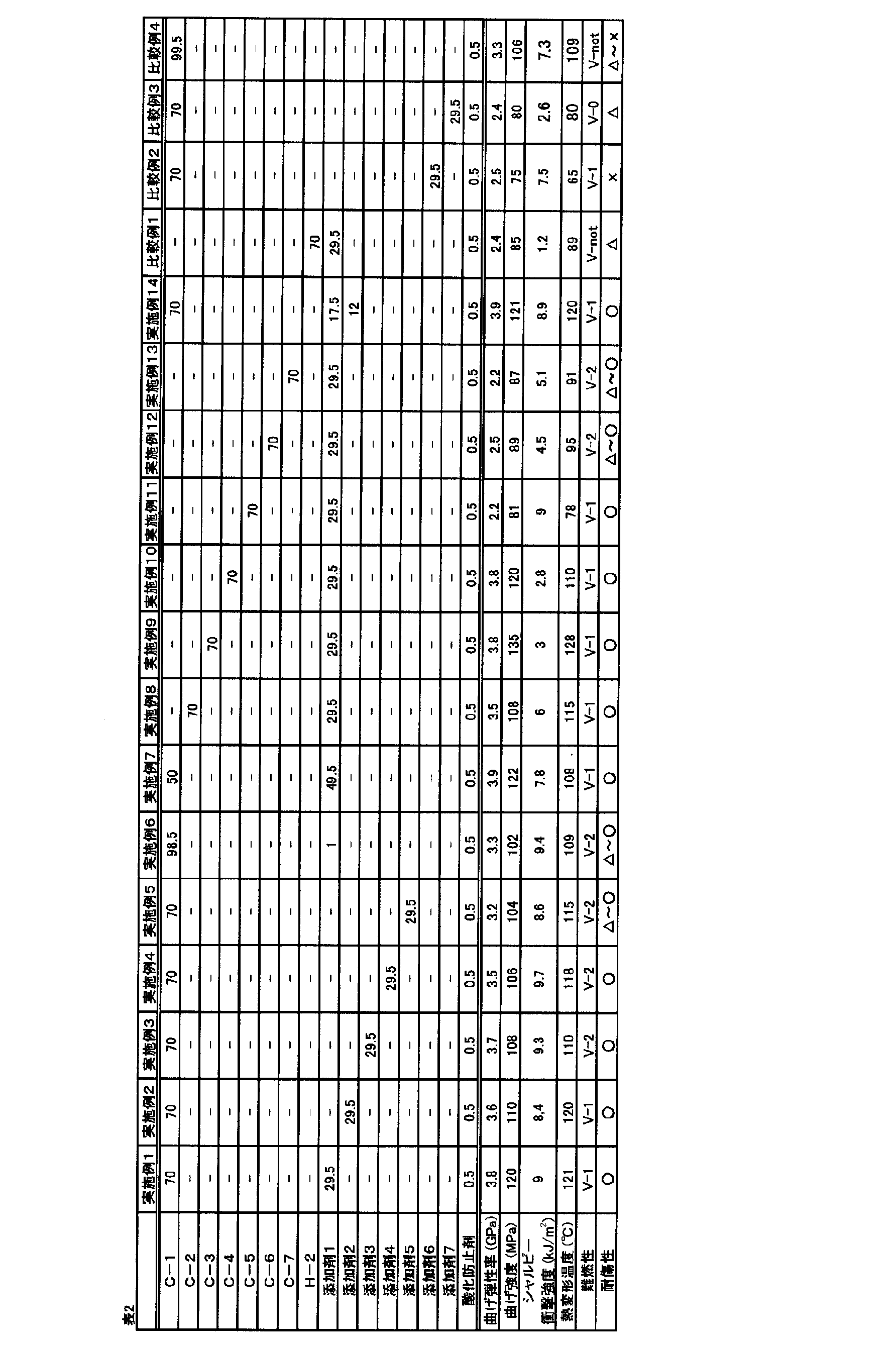
表2より、本発明にかかるセルロース誘導体と金属水酸化物とを配合した成形材料からなる試験片(実施例1~14)について、該セルロース誘導体を含まない成形材料からなる試験片(比較例1)や、金属水酸化物以外の難燃剤を配合した成形材料からなる試験片(比較例2~3)と比して、剛性、曲げ強度、及び耐熱性といった性能を低下させることなく、耐衝撃性、難燃性、耐傷性といった性能が向上していることが確認された。
本発明の成形材料は、優れた熱可塑性を有するため、加熱成形などにより成形することができる。また、本発明の成形材料、及び成形体は、剛性、曲げ強度、耐熱性といった性能に優れ、かつ良好な耐衝撃性、難燃性、耐傷性を有しており、例えば自動車、家電、電気電子機器等の構成部品、機械部品、住宅・建築用材料等として好適に使用することができる。また、本発明の成形材料は、植物由来の樹脂であるセルロースから得られるセルロース誘導体を使用しているため、温暖化防止に貢献できる素材として、従来の石油由来の樹脂に代替できる。
本発明を詳細にまた特定の実施態様を参照して説明したが、本発明の精神と範囲を逸脱することなく様々な変更や修正を加えることができることは当業者にとって明らかである。
本出願は、2009年12月25日出願の日本特許出願(特願2009-295078)、に基づくものであり、その内容はここに参照として取り込まれる。
本出願は、2009年12月25日出願の日本特許出願(特願2009-295078)、に基づくものであり、その内容はここに参照として取り込まれる。
Claims (17)
- セルロースに含まれる水酸基の水素原子が、
下記A)で置換された基を少なくとも1つ、及び
下記B)で置換された基を少なくとも1つ含むセルロース誘導体と、
金属水酸化物とを含有する成形材料。
A)炭化水素基:-RA
B)アシル基:-CO-RB(RBは炭化水素基を表す。) - 前記セルロース誘導体が、更に、セルロースに含まれる水酸基の水素原子が下記C)で置換された基を少なくとも1つ含む、請求項1に記載の成形材料。
C)アルキレンオキシ基:-RC2-O-とアシル基:-CO-RC1とを含む基(RC1は炭化水素基を表し、RC2は炭素数が2~4のアルキレン基を表す。) - 前記C)アルキレンオキシ基とアシル基とを含む基が、下記一般式(3)で表される構造を含む基である、請求項2に記載の成形材料。

nは1以上の整数を表す。) - 前記RAが炭素数1~4のアルキル基である、請求項1~3のいずれか1項に記載の成形材料。
- 前記RAがメチル基又はエチル基である、請求項1~4のいずれか1項に記載の成形材料。
- 前記RB及びRC1が、それぞれ独立に、アルキル基又はアリール基である、請求項2~5のいずれか1項に記載の成形材料。
- 前記RB及びRC1が、それぞれ独立に、メチル基、エチル基又はプロピル基である、請求項2~6のいずれか1項に記載の成形材料。
- 前記RBが、炭素数3~10の分岐構造を有する炭化水素基である、請求項1~6のいずれかに記載の成形材料。
- 前記アルキレンオキシ基が下記式(1)又は(2)で表される基である、請求項2~8のいずれか1項に記載の成形材料。

- 前記セルロース誘導体が、カルボキシル基、スルホン酸基及びこれらの塩を実質的に有さない、請求項1~9のいずれか1項に記載の成形材料。
- 前記セルロース誘導体が水に不溶である、請求項1~10のいずれか1項に記載の成形材料。
- 前記金属水酸化物が、水酸化マグネシウム、水酸化アルミニウム、水酸化カルシウム、水酸化マンガン、水酸化鉄及び水酸化亜鉛からなる群より選択される少なくとも1つである請求項1~11のいずれか1項に記載の成形材料。
- 前記金属水酸化物の含有量が、成形材料中、0.1~50質量%である請求項1~12のいずれか1項に記載の成形材料。
- 前記金属水酸化物が水酸化マグネシウム及び水酸化アルミニウムから選択される少なくとも1つである請求項1~13のいずれか1項に記載の成形材料。
- 請求項1~14のいずれか1項に記載の成形材料を加熱成形して得られる成形体。
- 請求項1~14のいずれか1項に記載の成形材料を加熱し、成形する工程を含む、成形体の製造方法。
- 請求項15に記載の成形体から構成される電気電子機器用筐体。
Applications Claiming Priority (2)
| Application Number | Priority Date | Filing Date | Title |
|---|---|---|---|
| JP2009295078 | 2009-12-25 | ||
| JP2009-295078 | 2009-12-25 |
Publications (1)
| Publication Number | Publication Date |
|---|---|
| WO2011078281A1 true WO2011078281A1 (ja) | 2011-06-30 |
Family
ID=44195807
Family Applications (1)
| Application Number | Title | Priority Date | Filing Date |
|---|---|---|---|
| PCT/JP2010/073236 Ceased WO2011078281A1 (ja) | 2009-12-25 | 2010-12-22 | 成形材料、成形体、及びその製造方法、並びに電気電子機器用筐体 |
Country Status (2)
| Country | Link |
|---|---|
| JP (1) | JP2011149006A (ja) |
| WO (1) | WO2011078281A1 (ja) |
Cited By (1)
| Publication number | Priority date | Publication date | Assignee | Title |
|---|---|---|---|---|
| JPWO2023008551A1 (ja) * | 2021-07-29 | 2023-02-02 |
Citations (5)
| Publication number | Priority date | Publication date | Assignee | Title |
|---|---|---|---|---|
| JPH1180736A (ja) * | 1997-09-05 | 1999-03-26 | Sanyo Chem Ind Ltd | セルロース系材料用難燃剤 |
| JP2005162871A (ja) * | 2003-12-02 | 2005-06-23 | Sony Corp | 樹脂組成物、成形品、電気製品、樹脂組成物の製造方法 |
| JP2005162874A (ja) * | 2003-12-02 | 2005-06-23 | Sony Corp | 樹脂組成物、成形品、電気製品、樹脂組成物の製造方法 |
| JP2005283997A (ja) * | 2004-03-30 | 2005-10-13 | Daicel Chem Ind Ltd | セルロースエーテルアセテート光学フィルム |
| JP2006111858A (ja) * | 2004-09-17 | 2006-04-27 | Toray Ind Inc | 樹脂組成物ならびにそれからなる成形品 |
-
2010
- 2010-12-20 JP JP2010283876A patent/JP2011149006A/ja active Pending
- 2010-12-22 WO PCT/JP2010/073236 patent/WO2011078281A1/ja not_active Ceased
Patent Citations (5)
| Publication number | Priority date | Publication date | Assignee | Title |
|---|---|---|---|---|
| JPH1180736A (ja) * | 1997-09-05 | 1999-03-26 | Sanyo Chem Ind Ltd | セルロース系材料用難燃剤 |
| JP2005162871A (ja) * | 2003-12-02 | 2005-06-23 | Sony Corp | 樹脂組成物、成形品、電気製品、樹脂組成物の製造方法 |
| JP2005162874A (ja) * | 2003-12-02 | 2005-06-23 | Sony Corp | 樹脂組成物、成形品、電気製品、樹脂組成物の製造方法 |
| JP2005283997A (ja) * | 2004-03-30 | 2005-10-13 | Daicel Chem Ind Ltd | セルロースエーテルアセテート光学フィルム |
| JP2006111858A (ja) * | 2004-09-17 | 2006-04-27 | Toray Ind Inc | 樹脂組成物ならびにそれからなる成形品 |
Cited By (3)
| Publication number | Priority date | Publication date | Assignee | Title |
|---|---|---|---|---|
| JPWO2023008551A1 (ja) * | 2021-07-29 | 2023-02-02 | ||
| WO2023008551A1 (ja) * | 2021-07-29 | 2023-02-02 | 日本電気株式会社 | セルロース系樹脂組成物およびこれを用いた成形体 |
| JP7670387B2 (ja) | 2021-07-29 | 2025-04-30 | 日本電気株式会社 | セルロース系樹脂組成物およびこれを用いた成形体 |
Also Published As
| Publication number | Publication date |
|---|---|
| JP2011149006A (ja) | 2011-08-04 |
Similar Documents
| Publication | Publication Date | Title |
|---|---|---|
| WO2011078275A1 (ja) | 成形材料、成形体、及びその製造方法、並びに電気電子機器用筐体 | |
| WO2011078273A1 (ja) | 成形材料、成形体、及びその製造方法、並びに電気電子機器用筐体 | |
| JP5470031B2 (ja) | 成形材料、成形体、及びその製造方法、並びに電気電子機器用筐体 | |
| JP2011132457A (ja) | 成形材料、成形体、及びその製造方法、並びに電気電子機器用筐体 | |
| WO2012073661A1 (ja) | 成形材料、成形体、及びその製造方法、並びに電気電子機器用筐体 | |
| JP2011132448A (ja) | 成形材料、成形体、及びその製造方法、並びに容器およびフィルム | |
| JP2011132445A (ja) | 成形材料、成形体、及びその製造方法、並びに電気電子機器用筐体 | |
| WO2011078283A1 (ja) | 成形材料、成形体、及びその製造方法、並びに電気電子機器用筐体 | |
| WO2011078284A1 (ja) | 成形材料、成形体、及びその製造方法、並びに電気電子機器用筐体 | |
| JP5470030B2 (ja) | 成形材料、成形体、及びその製造方法、並びに電気電子機器用筐体 | |
| JP5486918B2 (ja) | 成形材料、成形体、及びその製造方法、並びに電気電子機器用筐体 | |
| WO2011078278A1 (ja) | 成形材料、成形体、及びその製造方法、並びに電気電子機器用筐体 | |
| JP2011132459A (ja) | 成形材料、成形体、及びその製造方法、並びに電気電子機器用筐体 | |
| JP5364567B2 (ja) | 成形材料、成形体、及びその製造方法、並びに電気電子機器用筐体 | |
| WO2011078281A1 (ja) | 成形材料、成形体、及びその製造方法、並びに電気電子機器用筐体 | |
| JP2011132435A (ja) | 成形材料、成形体、及びその製造方法、並びに電気電子機器用筐体 | |
| WO2011078282A1 (ja) | 成形材料、成形体、及びその製造方法、並びに電気電子機器用筐体 | |
| JP5639862B2 (ja) | 成形材料、成形体、及びその製造方法、並びに電気電子機器用筐体 | |
| JP5486917B2 (ja) | 成形材料、成形体、及びその製造方法、並びに電気電子機器用筐体 | |
| JP2011132444A (ja) | 成形材料、成形体、及びその製造方法、並びに電気電子機器用筐体 | |
| JP2011132452A (ja) | 成形材料、成形体、及びその製造方法、並びに電気電子機器用筐体 | |
| JP2011132456A (ja) | 成形材料、成形体、及びその製造方法、並びに電気電子機器用筐体 | |
| WO2011078276A1 (ja) | 成形材料、成形体、及びその製造方法、並びに電気電子機器用筐体 | |
| JP2011132447A (ja) | 成形材料、その製造方法、成形体、及びその製造方法、並びに電気電子機器用筐体 | |
| JP2011132442A (ja) | 成形材料、成形体、及びその製造方法、並びに電気電子機器用筐体 |
Legal Events
| Date | Code | Title | Description |
|---|---|---|---|
| 121 | Ep: the epo has been informed by wipo that ep was designated in this application |
Ref document number: 10839511 Country of ref document: EP Kind code of ref document: A1 |
|
| NENP | Non-entry into the national phase |
Ref country code: DE |
|
| 122 | Ep: pct application non-entry in european phase |
Ref document number: 10839511 Country of ref document: EP Kind code of ref document: A1 |