WO2011043365A1 - 遺伝子型判定方法 - Google Patents
遺伝子型判定方法 Download PDFInfo
- Publication number
- WO2011043365A1 WO2011043365A1 PCT/JP2010/067522 JP2010067522W WO2011043365A1 WO 2011043365 A1 WO2011043365 A1 WO 2011043365A1 JP 2010067522 W JP2010067522 W JP 2010067522W WO 2011043365 A1 WO2011043365 A1 WO 2011043365A1
- Authority
- WO
- WIPO (PCT)
- Prior art keywords
- gene
- aldh2
- adh1b
- amplification
- pcr
- Prior art date
- Legal status (The legal status is an assumption and is not a legal conclusion. Google has not performed a legal analysis and makes no representation as to the accuracy of the status listed.)
- Ceased
Links
Images






Classifications
-
- C—CHEMISTRY; METALLURGY
- C12—BIOCHEMISTRY; BEER; SPIRITS; WINE; VINEGAR; MICROBIOLOGY; ENZYMOLOGY; MUTATION OR GENETIC ENGINEERING
- C12Q—MEASURING OR TESTING PROCESSES INVOLVING ENZYMES, NUCLEIC ACIDS OR MICROORGANISMS; COMPOSITIONS OR TEST PAPERS THEREFOR; PROCESSES OF PREPARING SUCH COMPOSITIONS; CONDITION-RESPONSIVE CONTROL IN MICROBIOLOGICAL OR ENZYMOLOGICAL PROCESSES
- C12Q1/00—Measuring or testing processes involving enzymes, nucleic acids or microorganisms; Compositions therefor; Processes of preparing such compositions
- C12Q1/68—Measuring or testing processes involving enzymes, nucleic acids or microorganisms; Compositions therefor; Processes of preparing such compositions involving nucleic acids
- C12Q1/6876—Nucleic acid products used in the analysis of nucleic acids, e.g. primers or probes
- C12Q1/6883—Nucleic acid products used in the analysis of nucleic acids, e.g. primers or probes for diseases caused by alterations of genetic material
-
- C—CHEMISTRY; METALLURGY
- C12—BIOCHEMISTRY; BEER; SPIRITS; WINE; VINEGAR; MICROBIOLOGY; ENZYMOLOGY; MUTATION OR GENETIC ENGINEERING
- C12Q—MEASURING OR TESTING PROCESSES INVOLVING ENZYMES, NUCLEIC ACIDS OR MICROORGANISMS; COMPOSITIONS OR TEST PAPERS THEREFOR; PROCESSES OF PREPARING SUCH COMPOSITIONS; CONDITION-RESPONSIVE CONTROL IN MICROBIOLOGICAL OR ENZYMOLOGICAL PROCESSES
- C12Q2600/00—Oligonucleotides characterized by their use
- C12Q2600/156—Polymorphic or mutational markers
-
- C—CHEMISTRY; METALLURGY
- C12—BIOCHEMISTRY; BEER; SPIRITS; WINE; VINEGAR; MICROBIOLOGY; ENZYMOLOGY; MUTATION OR GENETIC ENGINEERING
- C12Q—MEASURING OR TESTING PROCESSES INVOLVING ENZYMES, NUCLEIC ACIDS OR MICROORGANISMS; COMPOSITIONS OR TEST PAPERS THEREFOR; PROCESSES OF PREPARING SUCH COMPOSITIONS; CONDITION-RESPONSIVE CONTROL IN MICROBIOLOGICAL OR ENZYMOLOGICAL PROCESSES
- C12Q2600/00—Oligonucleotides characterized by their use
- C12Q2600/158—Expression markers
Definitions
- the present invention relates to a method for determining the genotype of a gene contained in a solid test sample from a solid test sample containing a gene related to sensitivity to alcohol (alcohol sensitivity-related gene).
- Alcohol dehydrogenase ADH is an enzyme involved in the decomposition of alcohol into acetaldehyde in the body, and a plurality of types are known. Among them, the gene of ADH1B (former name ADH2) has a genotype ADHB1 * 1 / * 1, which is called a low activity type with a slow alcohol metabolism rate. People with such a genotype have face flushing, palpitation, etc. after drinking alcohol The so-called flushing symptom is exhibited, and since the rate of alcohol decomposition is slow, alcohol is likely to remain in the body, and it is said that the constitution tends to cause alcoholism.
- Aldehyde dehydrogenase is one of the enzymes involved in the degradation of acetaldehyde to acetic acid in the body, and a plurality of types are known.
- the ALDH2 gene that acts when the blood concentration of acetaldehyde is low is also known as the inactive genotypes ALDH2 * 1 / * 2 and ALDH2 * 2 / * 2, and such genes People with molds are said to have a constitution that tends to cause a hangover due to red drinking due to the slow degradation rate of acetaldehyde.
- Esophageal cancer, liver cancer, breast cancer, colorectal cancer and other cancers tend to develop, especially those who have both genotype ADHB1 * 1 / * 1 and genotype ALDH2 * 1 / * 2 will double their risk (For example, Akira Yokoyama et al., “Genetic polymorphisms of alcohol and aldehyde dehydrogenases and glutathionee S-transferase M1 and drinking, smoking, and diet in Japanese men with esophageal squamous cell, carcinoma, Vol 23 11, (2002), pp.
- Non-Patent Document 1 Akira Yokoyama et al., “Alcohol and aldehyde dehydrogenase gene polymorphisms and oropharyngolaryngeal, esophageal and stomach cancers in Japanese alcoholics, Carcinogenesis, Vol. 22, no. 3, (2001), pp. 433-439
- Non-patent literature 2 Akira Yokoyama et al., "Macrocytosis, afor new predictor esophageal squamous cell carcinoma in Japanese alcoholic men, Carcinogenesis, Vol. 24, no.
- Non-patent literature 3 Takahiro Asakage et al., “Genetic polymorphisms of alcohol and aldehydedehydrogen. , And drinking, smoking and diet in Japanese men with oral and pharyngeal squamous cell carcinoma, Carcinogenesis, Vol. 28, no. 4, (2007), pp. 865-874 (non-patent document 4). ).
- Cytochrome CYP2E1 (Cytochrome P450 2E1) is known to be related to alcohol metabolism in the liver microsomal oxidation system called the second alcohol metabolism pathway, and two genotypes CYP2E1 * c1 and CYP2E1 differing in alcohol sensitivity. * C2 is known to exist (for example, Fumio Nomura, “Second Alcohol Metabolic Pathway Microsomal Ethanol-Oxidizing System (MEOS) and Cytochrome P450 2E1 (CYP2E1)”, Chiba Medical, 78, (2002), pp.
- MEOS Microsomal Ethanol-Oxidizing System
- Non-Patent Document 5 Yuichi Yamada “Relationship between Genetic Polymorphisms of Japanese Alcohol Metabolizing Enzymes and Alcohol-Drinking Behaviors and Health Disorders”, Kinki University Journal, 30, (2005), pp.448 -455
- Non-Patent Document 6 Yuichi Yamada “Relationship between Genetic Polymorphisms of Japanese Alcohol Metabolizing Enzymes and Alcohol-Drinking Behaviors and Health Disorders”, Kinki University Journal, 30, (2005), pp.448 -455
- Non-Patent Document 6 Yan-Mel Guo et al., “Genetic polymorphisms in cytochrome P4502E1, alcohol and aldehyde dehydrogenases and the risk of es ophageal squamous cell carcinoma in Gansu Chinese males, World J Gastroenterol, 14 (9), (2008), pp.1444-1449 (see Non-Patent Document 7).
- genotype determination of alcohol sensitivity-related genes such as the above-mentioned alcohol dehydrogenase ADH gene, aldehyde dehydrogenase ALDH gene, and cytochrome CYP2E1 gene is particularly useful for diseases and carcinogenesis related to Japanese alcohol consumption. It is considered to be important for risk avoidance and personal health management.
- Patent Document 1 describes an aldehyde dehydrogenase gene polymorphism
- Patent Document 2 Japanese Patent Application Laid-Open No. 2005-245272
- Patent Document 3 Japanese Patent Application Laid-Open No. 2006-75134
- Akira Yokoyama et al. "Genetic polymorphisms of alcohol andaldehyde dealdehydeases and glutathionee S-transferase M1 and drinking, smoking, and diet in Japanese men with esophageal squamous cell carcinoma, 2002, Carcinogenesis, Vol. pp. 1851-1859
- Akira Yokoyama et al. “Alcohol and aldehyde dehydrogenase gene polymorphisms and oropharyngolaryngeal, esophageal and stomach cancers in Japanese alcoholics”, Carcinogenesis, Vol. 22, no. 3, (2001), pp.
- the present invention has been made to solve the above-mentioned problems, and an object of the present invention is to provide a method for determining the genotype of a gene related to susceptibility to alcohol safely, quickly and inexpensively. It is.
- the present invention relates to a method for determining the genotype of an alcohol sensitivity-related gene, wherein a solid test sample containing the gene is directly applied to a solution containing a buffer and a DNA polymerase, and a primer DNA for amplifying the gene.
- Polymerase chain reaction, LAMP method, strand displacement amplification, reverse transcriptase strand displacement amplification, reverse transcriptase polymerase chain reaction, reverse transcriptase LAMP method nucleic acid sequence-based amplification, transcription-mediated amplification and rolling circle amplification method
- the method includes a step of amplifying the gene by applying a method selected from the following, and a step of determining the genotype of the gene from the amplified gene.
- the alcohol sensitivity-related gene is preferably at least one of the gene for alcohol dehydrogenase ADH1B, the gene for aldehyde dehydrogenase ALDH2, and the gene for cytochrome CYP2E1.
- the solid test sample in the present invention is preferably blood dried, hair root, or saliva dried.
- the genotyping method of the present invention is capable of simultaneously amplifying at least any two selected from the gene of alcohol dehydrogenase ADH1B, the gene of aldehyde dehydrogenase ALDH2, and the gene of cytochrome CYP2E1 to simultaneously determine the genotype. ,preferable.
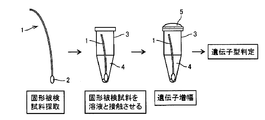
- FIG. 1 is a diagram schematically showing a preferred example of the present invention.
- the present invention relates to a method for determining the genotype of an alcohol sensitivity-related gene, wherein a solid test sample containing the gene is directly applied to a solution containing a buffer and a DNA polymerase, and a primer DNA for amplifying the gene.
- a solid test sample is collected directly or a liquid sample is dried to collect a solid test sample containing an alcohol sensitivity-related gene from the test object.
- the hair root is not particularly limited as long as it is derived from all body hairs including hair, eyebrows, nasal hair, whiskers, pubic hair, and eyelashes. Since the hair root is obtained by removing the hair from the root, it can be collected without pain, and the oral mucosa can be collected without pain by lightly rubbing the skin with a cotton swab etc. It is. Further, the oral mucosa may be in a solid state dried by being left at room temperature after being collected.
- the cell tissue is preferably dried to such an extent that it can be used as it is, and the water content is particularly preferably 0% or more and less than 50%. In addition, the cell tissue is preferably finely pulverized.
- the oral mucosa when collecting a solid test sample by drying the liquid material, nasal discharge, nasal rinse, eye conjunctival wipe, throat swab, sputum, feces, blood, serum, plasma, spinal fluid, saliva ( Usually, the oral mucosa is included), and a solid obtained by drying a liquid selected from urine, sweat, semen and cellular tissue is subjected to the next step.
- the cell tissue contained in the liquid material shall have a water content of 50% or more.
- a known drying method such as a method of allowing the liquid material to soak into the filter paper and evaporating water, natural drying or freeze drying can be selected.
- a plant fiber body it is preferable to apply stool to a plant fiber body, air-dry the plant fiber body, and then seal it with silica gel and hold it for 1 hour or longer.
- the plant fiber body refers to plant fiber bodies such as paper and cotton.
- the number of cells that can be collected is constant, a stable amount of template can be used for genotyping, and from the viewpoint of excellent reproducibility, It is preferable that the test sample is dried blood or saliva, or a hair root, and since it is obtained by removing hair from the root as described above, it is possible to collect relatively without pain. Therefore, it is particularly preferable that the solid test sample is a hair root.
- the solid test sample is obtained by drying blood, there is an advantage that the amount of collected blood can be reduced as compared with the conventional genotype determination method for alcohol sensitivity-related genes.
- FIG. 1 shows an example in which the hair 1 including the hair root 2 is carefully extracted from the test object and collected as a solid test sample.
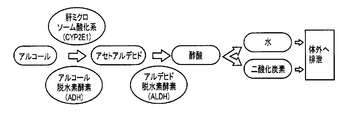
- FIG. 2 is a diagram schematically showing the process until alcohol is decomposed in the body and excreted outside the body.
- Alcohol taken into the body is usually first decomposed into acetaldehyde by alcohol dehydrogenase ADH, liver microsomal oxidation system cytochrome CYP2E1, and the like.
- Acetaldehyde is broken down into acetic acid by aldehyde dehydrogenase (ALDH). Thereafter, acetic acid is decomposed into water and carbon dioxide and then excreted outside the body.
- ADH aldehyde dehydrogenase
- the “alcohol sensitivity-related gene” in the present invention refers to the gene of such an enzyme related to alcohol metabolism.
- the gene of alcohol dehydrogenase ADH1B, the gene of aldehyde dehydrogenase ALDH2, and the gene of cytochrome CYP2E1 At least one of the genes.
- the gene of alcohol dehydrogenase ADHB1 includes genotype ADHB1 * 1 (base sequence shown in SEQ ID NO: 1) and genotype ADHB1 * 2 (base sequence shown in SEQ ID NO: 2), About 60% of Japanese people have the allele ADHB1 * 2 / * 2 in which alcohol dehydrogenase ADH has normal activity (enzyme activity: 200), and about 35% of Japanese people have normal alcohol dehydrogenase ADH Allele ADHB1 * 1 / * 2 with high activity (enzyme activity: 100), about 5% of Japanese allele ADHB1 * 1 with low activity (enzyme activity: 1) of alcohol dehydrogenase ADH It is known to have / * 1.
- the gene for aldehyde dehydrogenase ALDH2 has genotype ALDH2 * 1 (base sequence shown in SEQ ID NO: 3) and genotype ALDH2 * 2 (base sequence shown in SEQ ID NO: 4). About 56% of Japanese whose enzyme ALDH2 has normal activity (enzyme activity: 100) has the allele ALDH2 * 1 / * 1 and has low activity of alcohol dehydrogenase ADH (enzyme activity: 6) about 40 % Of Japanese have the allele ALDH2 * 1 / * 2 and alcohol dehydrogenase ADH is inactive (enzyme activity: 0) About 4% of Japanese have the allele ALDH2 * 2 / * 2 It is known to have.
- genotype CYP2E1 * c1 (base sequence shown in SEQ ID NO: 5) and the genotype CYP2E1 * c2 (base sequence shown in SEQ ID NO: 6) are known as the genes of cytochrome CYP2E1.
- the alcohol sensitivity-related gene in the present invention is usually applicable to a length of about 20 to several hundred thousand bases, but is preferably 50 to 3000 bases.
- the solid test sample collected as described above is directly contacted with a solution containing a buffer and a DNA polymerase, and a primer DNA for amplifying a specific gene, and then the polymerase.
- Chain reaction LAMP method, strand displacement amplification, reverse transcriptase strand displacement amplification, reverse transcriptase polymerase chain reaction, reverse transcription LAMP method, nucleic acid sequence-based amplification, transcription-mediated amplification and rolling circle amplification method And amplify the alcohol sensitivity related gene contained in the solid test sample.
- a reagent is placed on a plate-like or tube-like carrier.
- a reagent is put into the inside thereof, and in the case of a plate-shaped carrier, the reagent is placed on the surface thereof.
- This reagent contains a solution containing a buffer and DNA polymerase and primer DNA.
- the solid test sample is placed on the carrier so that the reagent and the solid test sample are in direct contact with each other, and the polymerase chain reaction, LAMP method, strand displacement amplification, reverse transcriptase strand displacement amplification, reverse transcriptase are performed by known methods.
- the gene is amplified by a method selected from polymerase chain reaction, reverse transcription LAMP method, nucleic acid sequence-based amplification, transcription-mediated amplification, and rolling circle amplification method. Note that a solid test sample may be placed on a carrier, and then a reagent may be placed on the carrier. In FIG.
- the PCR reaction solution 4 is introduced into the inside of the tubular carrier 3, and the hair 1 as the solid test sample is further introduced into the carrier 3, so that the solid test sample is brought into contact with the PCR reaction solution.
- the tube-shaped carrier 3 is covered with a lid 5 and then a PCR reaction is performed.
- the DNA polymerase is not particularly limited as long as it is a thermostable DNA polymerase represented by Taq DNA polymerase, but KOD DNA polymerase is preferably used.
- the buffer is not particularly limited as long as DNA can be amplified even in the presence of a substance that inhibits the PCR reaction contained in the solid test sample, but EzWay TM (KOMA Biotechnology), Ampdirect TM (Shimadzu Corporation) ), Phusion (registered trademark) Blood Direct PCR kit buffer (New ENGLAND Bio-Labs), KOD FX buffer (Toyobo), etc. are preferably used, and KOD FX buffer (Toyobo) developed for KOD DNA polymerase is used. It is particularly preferable to use it.
- the nucleic acid constituting the alcohol sensitivity-related gene is DNA
- a direct PCR method or a LAMP method can be performed.
- a reverse transcription reaction is performed in the case of an RNA chain fragment, followed by polymerase chain reaction (PCR), LAMP method, strand displacement amplification (SDA), reverse transcriptase.
- PCR polymerase chain reaction
- SDA strand displacement amplification
- RT Strand displacement amplification
- RT-PCR reverse transcriptase polymerase chain reaction
- RT-LAMP reverse transcription LAMP method
- NASBA Nucleic Acid Sequence-Based Amplification
- Amplification can be performed using gene amplification methods such as transcription-mediated amplification (TMA) and rolling circle amplification.
- TMA transcription-mediated amplification
- the amplification conditions such as PCR are not particularly limited as long as specific amplification occurs, and can be set as appropriate.
- At least two selected from the gene for alcohol dehydrogenase ADH1B, the gene for aldehyde dehydrogenase ALDH2, and the gene for cytochrome CYP2E1 are simultaneously amplified and simultaneously genotyped. Is preferred.
- the primer DNA used in the PCR method in the present invention is not particularly limited as long as it can specifically amplify an alcohol sensitivity-related gene, and can be appropriately designed by a known method. Since the genotype can be determined by a simple procedure, among the PCR methods, allele specific primer (ASP) -PCR method and PCR-RFLP (Restriction Fragment Length Polymorphism: Restriction Fragment Length Polymorphism) method is preferably used, and primer DNA designed for that purpose is preferably used.
- ASP allele specific primer
- PCR-RFLP Restriction Fragment Length Polymorphism: Restriction Fragment Length Polymorphism
- the TaqMan method can also be used as the PCR method.
- the TaqMan method is a method using PCR using a fluorescently labeled allele-specific oligonucleotide (TaqMan probe) and Taq DNA polymerase (for example, Genet. Anal., 14143-149 (1999), J. Clin. Microbiol., 34, (See 2933-2936 (1996).)
- Primers are designed in a region containing the target sequence, and a TaqMan probe is set between them.
- the prober fluorescent dye (R) is labeled on the 5 'end side of this probe, and the quencher fluorescent dye (Q) is labeled on the 3' end side.
- the probe hybridizes first. Then, the primer hybridizes, and the TaqMan probe is hydrolyzed one by one by the 5'-3 'exonuclease activity of DNA polymerase to release the reporter fluorescent dye. This is based on the fact that the intensity of the released reporter dye is proportional to the PCR product.
- the two fluorescent labeling substances may be any combination that can be distinguished from each other, and such combinations of fluorescent labeling substances are known to each other. Can be used. Suitable specific examples include any combination of 6-FAM®, VIC®, and TET®.
- the target amplification reaction can be performed without any problem if an oligonucleotide primer is used
- the target hybridization reaction can be performed without any problem if the oligonucleotide probe is used.
- some base sequences may be modified such as deletion, substitution, insertion and / or addition.
- the number of bases involved in the modification is, for example, 1 to 5, preferably 1 to 3. Such modification is generally performed at a portion other than the base corresponding to the polymorphic site.
- the polymorphism analysis oligonucleotide a DNA fragment or an RNA fragment is appropriately used depending on the analysis method.
- the nucleotide length of the oligonucleotide for polymorphism analysis is not particularly limited as long as each function is exhibited. Examples of the nucleotide length when used as a primer are 15 to 30 nucleotides, preferably 18 to 25 nucleotides. Degree.
- the length of the polynucleotide to be amplified is appropriately set according to the detection method to be used, but is generally 20 to 500 bases, preferably 20 to 200 bases.
- Primers and probes of the present invention include those to which an appropriate label for detection is added at the end of the sequence.
- the label include ROX (registered trademark), FITC (registered trademark; fluorescein), TET (registered trademark), Cy5 (registered trademark), HEX (registered trademark), NED ((registered trademark)), 6-FAM ( (Registered trademark), ROX (registered trademark), TAMRA (registered trademark), rhodamine (rhodamine), and other fluorescent dyes, enzymes, proteins, radioactive substances, biotin, thiols, etc. can be mentioned, but are not limited thereto .
- a method of labeling a base with a fluorescent dye a known method can be used. Commercially available fluorescent labeling kits can also be used.
- oligonucleotides for polymorphism analysis can be synthesized by chemical synthesis methods such as the usual phosphoramidite method and phosphate triester method, or commercially available automated oligonucleotide synthesis. It can also be synthesized using an apparatus (for example, Pharmacia LKB Gene Assembler Plus: Pharmacia). Alternatively, a custom-synthesized one can be used.
- examples of the “insoluble carrier” in the present invention include a 96-well well in addition to a tube made of plastic, glass, or the like.
- the tube shape means a hollow state, and may be a shape such as a PCR tube with a bottom or an Eppendorf tube.
- the probe DNA is immobilized on the surface of the carrier.
- the alcohol sensitivity-related gene in the solid test sample can be captured by hybridization via an oligo DNA (probe DNA) immobilized on a tube-shaped carrier, and can be amplified by RT-PCR, or Amplify a specific gene in the liquid phase on the carrier, and simultaneously detect specific genes of various organisms or comprehensively detect genetic polymorphisms (SNPs) using multiple types of probe DNA immobilized on a plate-like carrier. This is because there is an advantage.
- the genotype of the gene is then determined from the gene amplified as described above.
- the analysis method in this step is not particularly limited as long as the amplified gene can be detected or quantified.
- the gel electrophoresis method the amount and the size of the PCR amplification product can be evaluated.
- the real-time PCR method the PCR amplification product can be quickly quantified.
- the change in fluorescence intensity is generally a noise level and is equal to zero until the number of amplification cycles is 1 to 10. Therefore, these are regarded as sample blanks with zero amplification products, and their standard deviation SD is calculated.
- the fluorescence value multiplied by 10 is used as a threshold value, and the number of PCR cycles that first exceeds the threshold value is referred to as a cycle threshold value (Ct value). Therefore, the larger the initial DNA template amount in the PCR reaction solution, the smaller the Ct value, and the smaller the template DNA amount, the larger the Ct value. Further, even if the amount of template DNA is the same, the Ct value of the PCR reaction in the same region becomes larger as the rate of cleavage of the specific gene of PCR in the template increases.
- the genotype of an alcohol susceptibility-related gene can be determined safely, quickly, and inexpensively.
- a test system for alcohol sensitivity-related genes that is much safer, quicker, and cheaper than in the past.
- Such genetic testing systems are useful for alcohol health education to prevent underage drinking, educational activities for the spread and understanding of personalized medicine through genetic diagnosis, health management for safety and security against alcohol, etc. it is conceivable that.
- the hair roots were directly put into a PCR reaction solution in a tube-shaped carrier.
- a PCR reaction solution a PCR kit KOD FX (manufactured by Toyobo Co., Ltd.) was used, and a 25 ⁇ L reaction solution containing the following reagents was prepared according to the attached protocol.
- PCR reaction solution for ADH1B gene 2 ⁇ PCR Buffer for KOD FX: 7.5 ⁇ L, DNTPs: 1.5 ⁇ L, Primer 1 (ADH1B-F) (10 ⁇ M): 0.6 ⁇ L Primer 2 (ADH1B-R) (10 ⁇ M): 0.6 ⁇ L, -KOD FX: 0.3 ⁇ L, DW (distilled water): 4.5 ⁇ L.
- PCR reaction solution for ALDH2 gene 2 ⁇ PCR Buffer for KOD FX: 7.5 ⁇ L, DNTPs: 1.5 ⁇ L, Primer 3 (ALDH2-F) (10 ⁇ M): 0.6 ⁇ L, Primer 4 (ALDH2-R) (10 ⁇ M): 0.6 ⁇ L, -KOD FX: 0.3 ⁇ L, DW (distilled water): 4.5 ⁇ L.
- Primer 1 (ADH1B-F): 5′-CCTTGGGGATAAACTGAATCTT-3 ′ (SEQ ID NO: 7)
- Primer 2 (ADH1B-R): 5′-GAAATCCTGGATGGTGAACC-3 ′ (SEQ ID NO: 8).
- Primer 3 (ALDH2-F): 5′-TCAAATTACAGGGTCAACTGCT-3 ′ (SEQ ID NO: 9)
- Primer 4 (ALDH2-R): 5′-GGCTGGGGTCTTTACCCTCTC-3 ′ (SEQ ID NO: 10).
- the tube-shaped carrier was covered and a PCR reaction was performed under the following amplification conditions.
- (Amplification conditions) Thermal denaturation: 95 ° C., 5 minutes, 98 ° C, 10 seconds ⁇ 60 ° C, 30 seconds ⁇ 74 ° C, 45 seconds, 40 cycles, Extension reaction: 74 ° C., 2 minutes.
- the amplification product of the ADH1B gene obtained after the PCR reaction was 349 bp.
- the amplification product of this ADH1B gene was subjected to a restriction enzyme reaction at 37 ° C. for 1 hour in a reaction solution having the following composition.
- the amplification product of ALDH2 gene obtained after the PCR reaction was 430 bp.
- the amplification product of this ALDH2 gene was subjected to a restriction enzyme reaction at 37 ° C. for 1 hour in a reaction solution having the following composition.
- FIG. 3 is an electrophoretogram showing the results of Example 1. It can be seen from FIG. 3 that 189 bp and 160 bp ADH1B gene restriction enzyme-treated pieces, 296 bp and 134 bp ALDH2 gene restriction enzyme-treated pieces were obtained, respectively.
- each lane shows the following results.
- -Lane 1 ADH1B * 2 / * 2 (blood)
- -Lane 2 ADH1B * 2 / * 2 (saliva)
- -Lane 3 ADH1B * 2 / * 2 (hair root)
- -Lane 4 ALDH2 * 2 / * 2 (blood)
- -Lane 5 ALDH2 * 2 / * 2 (saliva)
- Lane 6 ALDH2 * 2 / * 2 (hair root).
- each lane shows the following results.
- -Lane 1 ADH1B * 2 / * 2 (blood)
- -Lane 2 ADH1B * 2 / * 2 (saliva)
- -Lane 3 ADH1B * 2 / * 2 (hair root)
- -Lane 4 ALDH2 * 1 / * 1 (blood)
- -Lane 5 ALDH2 * 1 / * 1 (saliva)
- Lane 6 ALDH2 * 1 / * 1 (hair root).
- each lane shows the following results.
- -Lane 1 ADH1B * 2 / * 2 (blood)
- -Lane 2 ADH1B * 2 / * 2 (saliva)
- -Lane 3 ADH1B * 2 / * 2 (hair root)
- -Lane 4 ALDH2 * 1 / * 2 (blood)
- -Lane 5 ALDH2 * 1 / * 2 (saliva)
- Lane 6 ALDH2 * 1 / * 2 (hair root).
- each lane shows the following results.
- -Lane 1 ADH1B * 1 / * 1 (blood)
- -Lane 2 ADH1B * 1 / * 1 (saliva)
- -Lane 3 ADH1B * 1 / * 1 (hair root)
- -Lane 4 ALDH2 * 1 / * 1 (blood)
- -Lane 5 ALDH2 * 1 / * 1 (saliva)
- Lane 6 ALDH2 * 1 / * 1 (hair root).
- each lane shows the following results.
- -Lane 1 ADH1B * 1 / * 1 (blood)
- -Lane 2 ADH1B * 1 / * 1 (saliva)
- -Lane 3 ADH1B * 1 / * 1 (hair root)
- -Lane 4 ALDH2 * 1 / * 2 (blood)
- -Lane 5 ALDH2 * 1 / * 2 (saliva)
- Lane 6 ALDH2 * 1 / * 2 (hair root).
- each lane shows the following results.
- -Lane 1 ADH1B * 1 / * 2 (blood)
- -Lane 2 ADH1B * 1 / * 2 (saliva)
- -Lane 3 ADH1B * 1 / * 2 (hair root)
- -Lane 4 ALDH2 * 1 / * 1 (blood)
- -Lane 5 ALDH2 * 1 / * 1 (saliva)
- Lane 6 ALDH2 * 1 / * 1 (hair root).
- each lane shows the following results.
- -Lane 1 ADH1B * 1 / * 2 (blood)
- -Lane 2 ADH1B * 1 / * 2 (saliva)
- -Lane 3 ADH1B * 1 / * 2 (hair root)
- -Lane 4 ALDH2 * 1 / * 2 (blood)
- -Lane 5 ALDH2 * 1 / * 2 (saliva)
- Lane 6 ALDH2 * 1 / * 2 (hair root).
- Example 2 As in Example 1, the sample was soaked in filter paper (Advantech Qualitative Filter Paper No. 2), air-dried and collected as a solid test sample, and a punch piece of 1 mm in diameter of the dry filter paper was used as it was in PCR in a tube-shaped carrier. The reaction solution was charged. As a PCR reaction solution, a PCR kit KOD FX (manufactured by Toyobo Co., Ltd.) was used, and a 25 ⁇ L reaction solution containing the following reagents was prepared according to the attached protocol.
- a PCR reaction solution a PCR kit KOD FX (manufactured by Toyobo Co., Ltd.) was used, and a 25 ⁇ L reaction solution containing the following reagents was prepared according to the attached protocol.
- Primer 5 (ADH1B-F): 5′-GGAAGGTAGAGAGGGCTTTAGACTTG-3 ′ (SEQ ID NO: 11)
- Primer 6 (ADH1B-R): 5′-GTGCAAGCACTTTCGTCCTCTATTTG-3 ′ (SEQ ID NO: 12).
- Primer 7 (ALDH2-F): 5′-TGGGCGAGTACGGGCTGCAGGCATAGACT-3 ′ (SEQ ID NO: 13)
- Primer 8 (ALDH2-R): 5′-CCGGCAGGTCCTGAACCTCTGGCAGGC-3 ′ (SEQ ID NO: 14).
- the tube-shaped carrier was covered, and PCR reaction of the ADH1B gene and ALDH2 gene was performed independently under the following amplification conditions.
- the amplification product of the ADH1B gene obtained after the PCR reaction was 428 bp.
- the amplification product of this ADH1B gene was subjected to a restriction enzyme reaction at 37 ° C. for 1 hour in a reaction solution having the following composition.
- the amplification product of the ALDH2 gene obtained after the PCR reaction was 169 bp.
- the amplification product of this ALDH2 gene was subjected to a restriction enzyme reaction at 37 ° C. for 1 hour in a reaction solution having the following composition.
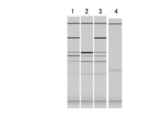
- FIG. 4 is an electrophoretogram showing the results of Example 2.
- FIG. 4 shows that 217 bp and 211 bp ADH1B gene restriction fragments and 48 bp and 121 bp ALDH2 gene restriction fragments were obtained, respectively.
- each lane shows the following results.
- -Lane 1 ADH1B * 1 / * 2
- -Lane 2 ADH1B * 1 / * 1
- -Lane 3 ADH1B * 1 / * 2
- Lane 4 DW.
- each lane shows the following results.
- -Lane 1 ALDH2 * 1 / * 2
- -Lane 2 ALDH2 * 2 / * 2
- -Lane 3 ALDH2 * 2 / * 2
- Lane 4 DW.
- Example 3 The ADH1B gene and ALDH2 gene amplification products obtained in the same manner as in Example 2 were simultaneously subjected to a restriction enzyme reaction at 37 ° C. for 1 hour using the following restriction enzyme reaction solution.
- FIG. 5 is an electrophoretogram showing the results of Example 3.
- each lane shows the following results.
- -Lane 1 ADH1B * 1 / * 2
- ALDH2 * 1 / * 2 ALDH2 * 1 / * 2
- -Lane 2 ADH1B * 1 / * 1, ALDH2 * 2 / * 2
- Lane 3 ADH1B * 1 / * 2
- Lane 4 DW.
- Example 4 As in Example 1, the sample was soaked in filter paper (Advantech Qualitative Filter Paper No. 2), air-dried and collected as a solid test sample, and a punch piece of 1 mm in diameter of the dry filter paper was used as it was in PCR in a tube-shaped carrier. The reaction solution was charged. As a PCR reaction solution, a PCR kit KOD FX (manufactured by Toyobo Co., Ltd.) was used to prepare a 25 ⁇ L reaction solution containing the following reagents according to the attached protocol.
- a PCR kit KOD FX manufactured by Toyobo Co., Ltd.
- the tube-shaped carrier was covered, and PCR reaction was simultaneously performed on the ADH1B gene and the ALDH2 gene under the following amplification conditions.
- the obtained PCR amplification product was subjected to a restriction enzyme reaction at 37 ° C. for 1 hour at the same time using the following restriction enzyme reaction solution.
- FIG. 6 is an electrophoretogram showing the results of Example 4.
- each lane shows the following results.
- -Lane 1 ADH1B * 1 / * 2
- ALDH2 * 1 / * 2 ALDH2 * 1 / * 2
- -Lane 2 ADH1B * 1 / * 1, ALDH2 * 2 / * 2
- Lane 3 ADH1B * 1 / * 2
- Lane 4 DW (distilled water).
- Example 5 As in Example 1, the sample was soaked in filter paper (Advantech Qualitative Filter Paper No. 2), air-dried and collected as a solid test sample, and a punch piece of 1 mm in diameter of the dry filter paper was used as it was in PCR in a tube-shaped carrier. The reaction solution was charged. As a PCR reaction solution, a PCR kit KOD FX (manufactured by Toyobo Co., Ltd.) was used, and 25 ⁇ L reaction solutions containing the following reagents were prepared according to the attached protocol.
- a PCR reaction solution a PCR kit KOD FX (manufactured by Toyobo Co., Ltd.) was used, and 25 ⁇ L reaction solutions containing the following reagents were prepared according to the attached protocol.
- PCR reaction solution 2 ⁇ PCR Buffer for KOD FX: 12.5 ⁇ L, DNTPs: 2.5 ⁇ L, Primer 9 (CYP2E1-F) (10 ⁇ M): 1 ⁇ L, Primer 10 (CYP2E1-R) (10 ⁇ M): 1 ⁇ L, -KOD FX: 0.5 ⁇ L, DW (distilled water): 7.5 ⁇ L.
- PCR-RFLP primers for the CYP2E1 gene were used.
- Primer 9 (CYP2E1-F): 5′-CCAGTCCGAGTCTACATTGTCA-3 ′ (SEQ ID NO: 15)
- Primer 10 (CYP2E1-R): 5′-TTCATTCTGTCTCTCACTACTGG-3 ′ (SEQ ID NO: 16).
- the tube-shaped carrier was covered and a PCR reaction of the CYP2E1 gene was performed under the following amplification conditions.
- the amplification product of CYP2E1 gene obtained after the PCR reaction was 410 bp.
- the amplification product of this CYP2E1 gene was subjected to a restriction enzyme reaction at 37 ° C. for 1 hour in a reaction solution having the following composition.
- FIG. 7 is an electrophoretogram showing the results of Example 5.
- each lane shows the following results.
- Lane 1 CYP2E1 * c1 / * c1
- Lane 2 CYP2E1 * c1 / * c2
- Lane 3 CYP2E1 * c2 / * c2.
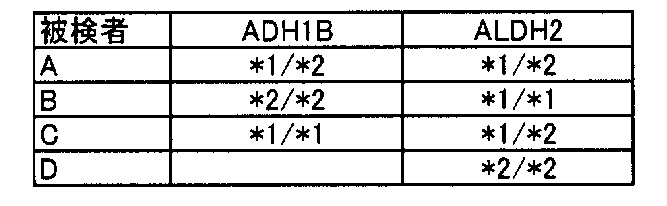
- Example 6 In the following procedure, for saliva (including oral cells) or blood collected from each test subject (subjects A, B, C, D), the gene for alcohol dehydrogenase ADH1B and the gene for aldehyde dehydrogenase ALDH2 Detection of the gene polymorphism was performed by a TaqMan (registered trademark) method using a real-time PCR apparatus ABI7300 (manufactured by Applied Biosystems). Saliva or blood was soaked in filter paper (Advantech Qualitative Filter Paper No. 2), air dried, and collected as a solid test sample.
- filter paper Advancedtech Qualitative Filter Paper No. 2
- Tth DNA polymerase is more advantageous than Taq DNA polymerase
- inhibitors in blood are Hemoglobin and Lactoferrin.
- BSA and Betaine are useful as additives to avoid the influence. It has been reported that.
- heparin an anticoagulant, is also known to inhibit PCR (eg, Michael P. and Andrew L., Nucleic Acids Research, 19, 1151, (1991) (Non-Patent Document 8), Henke W., Herdel K., Jung K., Schnorr D. and Loening A. S., Nucleic Acids Research, 25, 3957, (1997) (Non-Patent Document 9), Waled A. A. and Peter R., J .clin. Microbiol., 39, 485-493, (2001) (see Non-Patent Document 10), etc.).
- the probe and primer set are TaqMan (registered trademark) SNP Genotyping Assays kit from Applied Biosystems, and PCR amplification is Taqman Genotyping Master Mix (Made by Applied Biosystems Migrant, Res. )) Or RNA-direct RT-PCR Master Mix (manufactured by Toyobo Co., Ltd.), 20 ⁇ L reaction solutions containing the following reagents were prepared. Genotyping was determined by the fluorescence intensity of two colors detected according to the attached protocol as a result of this reaction.
- TaqMan reaction solution for ADH1B gene ⁇ When using Taqman Genotyping Master Mix (Applied Biosystems)> Taqman Genotyping Master Mix: 10 ⁇ l, Taqman Assay Mix C_2688467_20: 1 ⁇ l, -Dry filter paper saliva heat treatment supernatant: 5 ⁇ l, DW (distilled water): 4 ⁇ l.
- Realtime PCR Master Mix 10 ⁇ l
- Taqman Assay Mix C_2688467_20 1 ⁇ l
- -Dry filter paper saliva heat treatment supernatant 5 ⁇ l
- DW distilled water
- Realtime PCR Master Mix 10 ⁇ l
- Taqman Assay Mix C_2688467_20 1 ⁇ l
- -Dry filter paper blood heat treatment supernatant 5 ⁇ l
- DW distilled water
- RNA-direct RT-PCR Master Mix 10 ⁇ l, 25 mM MgSO 4 : 1 ⁇ l, Taqman Assay Mix C_2688467_20: 1 ⁇ l, -Dry filter paper saliva heat treatment supernatant: 5 ⁇ l, DW (distilled water): 3 ⁇ l.
- RNA-direct RT-PCR Master Mix 10 ⁇ l, 25 mM MgSO 4 : 1 ⁇ l, Taqman Assay Mix C_2688467_20: 1 ⁇ l, -Dry filter paper blood heat treatment supernatant: 5 ⁇ l, DW (distilled water): 3 ⁇ l.
- Taqman Genotyping Master Mix 10 ⁇ l
- Taqman Assay Mix C 117033892 — 10 ⁇ l
- -Dry filter paper saliva heat treatment supernatant 5 ⁇ l
- DW distilled water
- Realtime PCR Master Mix 10 ⁇ l
- Taqman Assay Mix C 10 ⁇ l
- -Dry filter paper saliva heat treatment supernatant 5 ⁇ l
- DW distilled water
- Realtime PCR Master Mix 10 ⁇ l
- Taqman Assay Mix C 10 ⁇ l
- -Dry filter paper blood heat treatment supernatant 5 ⁇ l
- DW distilled water
- RNA-direct RT-PCR Master Mix 10 ⁇ l, 25 mM MgSO 4 : 1 ⁇ l, Taqman Assay Mix C — 117033892 — 10 ⁇ l, -Dry filter paper saliva heat treatment supernatant: 5 ⁇ l, DW (distilled water): 3 ⁇ l.
- RNA-direct RT-PCR Master Mix 10 ⁇ l, 25 mM MgSO 4 : 1 ⁇ l, Taqman Assay Mix C — 117033892 — 10 ⁇ l, -Dry filter paper blood heat treatment supernatant: 5 ⁇ l, DW (distilled water): 3 ⁇ l.
- the sample was as follows.
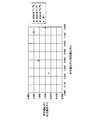
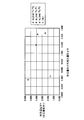
- FIG. 8 is a diagram showing the determination result of ADH1B by TaqMan method using Taqman Genotyping Master Mix (Applied Biosystems)
- FIG. 9 is a diagram using Taqman Genotyping Master Mix (Applied by Applied Bios). It is a figure which shows the determination result of ALDH2 by TaqMan method.
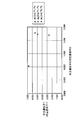
- FIG. 10 is a diagram showing the determination result of ADH1B by TaqMan method using Realtime PCR Master Mix (manufactured by Toyobo Co., Ltd.) (using dry filter paper saliva)
- FIG. 11 is Realtime PCR Master Mix (Toyobo).
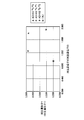
- FIG. 12 is a diagram showing the determination result of ADH1B by TaqMan method using Realtime PCR Master Mix (manufactured by Toyobo Co., Ltd.) (using dry filter paper blood)
- FIG. 13 is Realtime PCR Master Mix (Toyobo ( It is a figure which shows the determination result of ALDH2 by TaqMan method using the product made from Co., Ltd. (Dry filter paper blood use).
- FIG. 12 is a diagram showing the determination result of ADH1B by TaqMan method using Realtime PCR Master Mix (manufactured by Toyobo Co., Ltd.) (using dry filter paper blood)
- FIG. 13 is Realtime PCR Master Mix (Toyobo ( It is a figure which shows the determination result of ALDH2 by TaqMan method using the product made from Co., Ltd. (Dry filter paper blood use).
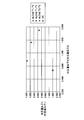
- FIG. 14 is a diagram showing the determination result of ADH1B by TaqMan method using RNA-direct RT-PCR Master Mix (manufactured by Toyobo Co., Ltd.) (using dry filter paper saliva), and FIG. 15 is RNA-direct RT.
- -It is a figure which shows the determination result of ALDH2 by TaqMan method using PCR Master Mix (made by Toyobo Co., Ltd.) (using dry filter paper saliva).
- FIG. 16 is a diagram showing the determination result of ADH1B by TaqMan method using RNA-direct RT-PCR Master Mix (manufactured by Toyobo Co., Ltd.) (using dry filter paper blood), and FIG. 17 is RNA-direct RT.
- -It is a figure which shows the determination result of ALDH2 by TaqMan method using PCR Master Mix (made by Toyobo Co., Ltd.) (Dry filter paper blood use).
Landscapes
- Chemical & Material Sciences (AREA)
- Life Sciences & Earth Sciences (AREA)
- Proteomics, Peptides & Aminoacids (AREA)
- Health & Medical Sciences (AREA)
- Organic Chemistry (AREA)
- Wood Science & Technology (AREA)
- Analytical Chemistry (AREA)
- Zoology (AREA)
- Genetics & Genomics (AREA)
- Engineering & Computer Science (AREA)
- Pathology (AREA)
- Immunology (AREA)
- Microbiology (AREA)
- Molecular Biology (AREA)
- Biotechnology (AREA)
- Biophysics (AREA)
- Physics & Mathematics (AREA)
- Biochemistry (AREA)
- Bioinformatics & Cheminformatics (AREA)
- General Engineering & Computer Science (AREA)
- General Health & Medical Sciences (AREA)
- Measuring Or Testing Involving Enzymes Or Micro-Organisms (AREA)
Abstract
Description
〔1〕PCR-RFLP法による遺伝子型の判定
以下の手順で、検査対象からそれぞれ採取した血液(全血)、唾液(口腔内細胞を含む)、毛根について、アルコール脱水素酵素ADH1Bの遺伝子およびアルデヒド脱水素酵素ALDH2の遺伝子の遺伝子多型の検出を行なった。血液および唾液については、ろ紙(アドバンテック定性ろ紙No.2)にしみこませ、自然乾燥させて、固形被検試料として採取した。通常行なうDNAの抽出・精製する過程を省略し、この乾燥ろ紙の直径1mmのパンチ片をそのまま、チューブ状の担体内のPCR反応液に投入した。また、毛根についてはそのまま、チューブ状の担体内のPCR反応液に投入した。PCR反応液は、PCRキットKOD FX(東洋紡績(株)製)を使用して、添付のプロトコールに従って、それぞれ以下の試薬を含む25μL反応液を調整した。
・2×PCR Buffer for KOD FX:7.5μL、
・dNTPs:1.5μL、
・プライマー1(ADH1B-F)(10μM):0.6μL、
・プライマー2(ADH1B-R)(10μM):0.6μL、
・KOD FX:0.3μL、
・DW(distilled water):4.5μL。
・2×PCR Buffer for KOD FX:7.5μL、
・dNTPs:1.5μL、
・プライマー3(ALDH2-F)(10μM):0.6μL、
・プライマー4(ALDH2-R)(10μM):0.6μL、
・KOD FX:0.3μL、
・DW(distilled water):4.5μL。
・プライマー2(ADH1B-R):5’-GAAATCCTGGATGGTGAACC-3’(配列番号8)。
・プライマー4(ALDH2-R):5’-GGCTGGGTCTTTACCCTCTC-3’(配列番号10)。
(増幅条件)
熱変性:95℃、5分、
98℃、10秒→60℃、30秒→74℃、45秒を40サイクル、
伸長反応:74℃、2分。
・10×NEB Buffer 4:2μL、
・ADH1B遺伝子の増幅産物:6μL、
・Msl 1:0.25μL、
・DW(distilled water):11.75μL。
・10×NEB Buffer 4:2μL、
・8×SAM:2.5μL、
・ALDH2遺伝子の増幅産物:6μL、
・Acu 1:0.25μL、
・DW(distilled water):9.25μL。
・レーン1:ADH1B *2/*2(血液)、
・レーン2:ADH1B *2/*2(唾液)、
・レーン3:ADH1B *2/*2(毛根)、
・レーン4:ALDH2 *2/*2(血液)、
・レーン5:ALDH2 *2/*2(唾液)、
・レーン6:ALDH2 *2/*2(毛根)。
・レーン1:ADH1B *2/*2(血液)、
・レーン2:ADH1B *2/*2(唾液)、
・レーン3:ADH1B *2/*2(毛根)、
・レーン4:ALDH2 *1/*1(血液)、
・レーン5:ALDH2 *1/*1(唾液)、
・レーン6:ALDH2 *1/*1(毛根)。
・レーン1:ADH1B *2/*2(血液)、
・レーン2:ADH1B *2/*2(唾液)、
・レーン3:ADH1B *2/*2(毛根)、
・レーン4:ALDH2 *1/*2(血液)、
・レーン5:ALDH2 *1/*2(唾液)、
・レーン6:ALDH2 *1/*2(毛根)。
・レーン1:ADH1B *1/*1(血液)、
・レーン2:ADH1B *1/*1(唾液)、
・レーン3:ADH1B *1/*1(毛根)、
・レーン4:ALDH2 *1/*1(血液)、
・レーン5:ALDH2 *1/*1(唾液)、
・レーン6:ALDH2 *1/*1(毛根)。
・レーン1:ADH1B *1/*1(血液)、
・レーン2:ADH1B *1/*1(唾液)、
・レーン3:ADH1B *1/*1(毛根)、
・レーン4:ALDH2 *1/*2(血液)、
・レーン5:ALDH2 *1/*2(唾液)、
・レーン6:ALDH2 *1/*2(毛根)。
・レーン1:ADH1B *1/*2(血液)、
・レーン2:ADH1B *1/*2(唾液)、
・レーン3:ADH1B *1/*2(毛根)、
・レーン4:ALDH2 *1/*1(血液)、
・レーン5:ALDH2 *1/*1(唾液)、
・レーン6:ALDH2 *1/*1(毛根)。
・レーン1:ADH1B *1/*2(血液)、
・レーン2:ADH1B *1/*2(唾液)、
・レーン3:ADH1B *1/*2(毛根)、
・レーン4:ALDH2 *1/*2(血液)、
・レーン5:ALDH2 *1/*2(唾液)、
・レーン6:ALDH2 *1/*2(毛根)。
実施例1と同様にろ紙(アドバンテック定性ろ紙No.2)にしみこませ、自然乾燥させて固形被検試料として採取した血液を乾燥ろ紙の直径1mmのパンチ片をそのまま、チューブ状の担体内のPCR反応液に投入した。PCR反応液は、PCRキットKOD FX(東洋紡績(株)製)を使用して、添付のプロトコールに従って、それぞれ以下の試薬を含む25μL反応液を調整した。
・2×PCR Buffer for KOD FX:10μL、
・dNTPs:2μL、
・プライマー5(ADH1B-F)(10μM):0.8μL、
・プライマー6(ADH1B-R)(10μM):0.8μL、
・KOD FX:0.4μL、
・DW(distilled water):6μL。
・2×PCR Buffer for KOD FX:10μL、
・dNTPs:2μL、
・プライマー7(ALDH2-F)(10μM):0.8μL、
・プライマー8(ALDH2-R)(10μM):0.8μL、
・KOD FX:0.4μL、
・DW(distilled water):6μL。
・プライマー6(ADH1B-R):5’-GTGCAAGCACTTTCGTCTCTCATTG-3’(配列番号12)。
・プライマー8(ALDH2-R):5’-CCGGCAGGTCCTGAACCTCTGGCAGGC-3’(配列番号14)。
熱変性:95℃、10分、
98℃、10秒→62℃、30秒→74℃、30秒を40サイクル、
伸長反応:74℃、2分。
・10×NEB Buffer 4:2μL、
・ADH1B遺伝子の増幅産物:6μL、
・Msl 1:0.5μL、
・DW(distilled water):11.5μL。
・10×NEB Buffer 4:2μL、
・8×SAM:2.5μL、
・ALDH2遺伝子の増幅産物:6μL、
・Acu 1:0.5μL、
・DW(distilled water):9.25μL。
・レーン1:ADH1B *1/*2、
・レーン2:ADH1B *1/*1、
・レーン3:ADH1B *1/*2、
・レーン4:DW。
・レーン1:ALDH2 *1/*2、
・レーン2:ALDH2 *2/*2、
・レーン3:ALDH2 *2/*2、
・レーン4:DW。
実施例2と同様にして得られたADH1B遺伝子、ALDH2遺伝子の増幅産物を、以下の制限酵素反応液を用いて同時に37℃、1時間の制限酵素反応を行なった。
・10×NEB Buffer 4:2μL、
・ADH1B遺伝子の増幅産物:3μL、
・ALDH2遺伝子の増幅産物:3μL、
・8×SAM:2.5μL、
・Msl 1:0.5μL、
・Acu 1:0.5μL、
・DW(distilled water):8.5μL。
・レーン1:ADH1B *1/*2、ALDH2 *1/*2、
・レーン2:ADH1B *1/*1、ALDH2 *2/*2、
・レーン3:ADH1B *1/*2、ALDH2 *2/*2、
・レーン4:DW。
実施例1と同様にろ紙(アドバンテック定性ろ紙No.2)にしみこませ、自然乾燥させて固形被検試料として採取した血液を乾燥ろ紙の直径1mmのパンチ片をそのまま、チューブ状の担体内のPCR反応液に投入した。PCR反応液は、PCRキットKOD FX(東洋紡績(株)製)を使用して、添付のプロトコールに従って、以下の試薬を含む25μL反応液を調整した。
・2×PCR Buffer for KOD FX:10μL、
・dNTPs:2μL、
・プライマー5(ADH1B-F)(10μM):0.4μL、
・プライマー6(ADH1B-R)(10μM):0.4μL、
・プライマー7(ALDH2-F)(10μM):0.8μL、
・プライマー8(ALDH2-R)(10μM):0.8μL、
・KOD FX:0.4μL、
・DW(distilled water):5.2μL。
熱変性:95℃、10分、
98℃、10秒→62℃、30秒→74℃、30秒を40サイクル、
伸長反応:74℃、2分。
・10×NEB Buffer 4:2μL、
・PCR増幅産物:6μL、
・8×SAM:2.5μL、
・Msl 1:0.5μL、
・Acu 1:0.5μL、
・DW(distilled water):8.5μL。
・レーン1:ADH1B *1/*2、ALDH2 *1/*2、
・レーン2:ADH1B *1/*1、ALDH2 *2/*2、
・レーン3:ADH1B *1/*2、ALDH2 *2/*2、
・レーン4:DW(distilled water)。
実施例1と同様にろ紙(アドバンテック定性ろ紙No.2)にしみこませ、自然乾燥させて固形被検試料として採取した血液を乾燥ろ紙の直径1mmのパンチ片をそのまま、チューブ状の担体内のPCR反応液に投入した。PCR反応液は、PCRキットKOD FX(東洋紡績(株)製)を使用して、添付のプロトコールに従って、それぞれ以下の試薬を含む25μL反応液を調整した。
・2×PCR Buffer for KOD FX:12.5μL、
・dNTPs:2.5μL、
・プライマー9(CYP2E1-F)(10μM):1μL、
・プライマー10(CYP2E1-R)(10μM):1μL、
・KOD FX:0.5μL、
・DW(distilled water):7.5μL。
・プライマー10(CYP2E1-R):5’-TTCATTCTGTCTTCTAACTGG-3’(配列番号16)。
熱変性:95℃、10分、
98℃、10秒→55℃、30秒→74℃、30秒を40サイクル、
伸長反応:74℃、2分。
・10×NEB Buffer 4:2μL、
・PCR増幅産物:6μL、
・8×SAM:2.5μL、
・Pst 1:0.5μL、
・DW(distilled water):11.5μL。
・レーン1:CYP2E1 *c1/*c1、
・レーン2:CYP2E1 *c1/*c2、
・レーン3:CYP2E1 *c2/*c2。
以下の手順で、検査対象(被検者A、B、C、D)からそれぞれ採取した唾液(口腔内細胞を含む)または血液について、アルコール脱水素酵素ADH1Bの遺伝子およびアルデヒド脱水素酵素ALDH2の遺伝子の遺伝子多型の検出をリアルタイムPCR装置ABI7300(Applied Biosystems社製)を用いてTaqMan(登録商標)法により行なった。唾液または血液については、ろ紙(アドバンテック定性ろ紙No.2)にしみこませ、自然乾燥させて、固形被検試料として採取した。Taqman Genotyping Master Mix(Applied Biosystems社製)の場合、通常行うDNAの抽出・精製過程を省略し、この乾燥ろ紙の直径2mmのパンチ片1枚を水10μLの入っているエッペンドルフチューブに投入し、90℃で10分間加熱した。その上清5μLをTaqMan反応液に投入した。
・TaqMan(登録商標) Drug Metabolism Genotyping Assays(Applied Biosystems社製)、
・Gene Name: alcohol dehydrogenase 1B(class I), beta polypeptide、
・TaqMan(登録商標) SNP Genotyping Assay Mix ID: C_2688467_20。
<Taqman Genotyping Master Mix(Applied Biosystems社製)を使用した場合>
・Taqman Genotyping Master Mix:10μl、
・Taqman Assay Mix C_2688467_20:1μl、
・乾燥ろ紙唾液加熱処理上清:5μl、
・DW(distilled water):4μl。
・Realtime PCR Master Mix:10μl、
・Taqman Assay Mix C_2688467_20:1μl、
・乾燥ろ紙唾液加熱処理上清:5μl、
・DW(distilled water):4μl。
・Realtime PCR Master Mix:10μl、
・Taqman Assay Mix C_2688467_20:1μl、
・乾燥ろ紙血液加熱処理上清:5μl、
・DW(distilled water):4μl。
・RNA-direct RT-PCR Master Mix:10μl、
・25mM MgSO4:1μl、
・Taqman Assay Mix C_2688467_20:1μl、
・乾燥ろ紙唾液加熱処理上清:5μl、
・DW(distilled water):3μl。
・RNA-direct RT-PCR Master Mix:10μl、
・25mM MgSO4:1μl、
・Taqman Assay Mix C_2688467_20:1μl、
・乾燥ろ紙血液加熱処理上清:5μl、
・DW(distilled water):3μl。
・TaqMan(登録商標)Drug Metabolism Genotyping Assays(Applied Biosystems社製)、
・Gene Name:aldehyde dehydrogenase 2 family(mitochondrial)、
・TaqMan(登録商標) SNP Genotyping Assay Mix ID:C_11703892_10。
・Taqman Genotyping Master Mix:10μl、
・Taqman Assay Mix C_11703892_10:1μl、
・乾燥ろ紙唾液加熱処理上清:5μl、
・DW(distilled water):4μl。
・Realtime PCR Master Mix:10μl、
・Taqman Assay Mix C_11703892_10:1μl、
・乾燥ろ紙唾液加熱処理上清:5μl、
・DW(distilled water):4μl。
・Realtime PCR Master Mix:10μl、
・Taqman Assay Mix C_11703892_10:1μl、
・乾燥ろ紙血液加熱処理上清:5μl、
・DW(distilled water):4μl。
・RNA-direct RT-PCR Master Mix:10μl、
・25mM MgSO4:1μl、
・Taqman Assay Mix C_11703892_10:1μl、
・乾燥ろ紙唾液加熱処理上清:5μl、
・DW(distilled water):3μl。
・RNA-direct RT-PCR Master Mix:10μl、
・25mM MgSO4:1μl、
・Taqman Assay Mix C_11703892_10:1μl、
・乾燥ろ紙血液加熱処理上清:5μl、
・DW(distilled water):3μl。
熱変性:95℃、10分、
95℃、15秒→60℃、1分を40サイクル。
Claims (6)
- アルコール感受性関連遺伝子の遺伝子型を判定する方法であって、
前記遺伝子を含む固形被検試料を、バッファーとDNAポリメラーゼとを含む溶液、および前記遺伝子を増幅するためのプライマーDNAに直接接触させて、ポリメラーゼ連鎖反応、LAMP法、鎖置換増幅、逆転写酵素鎖置換増幅、逆転写酵素ポリメラーゼ連鎖反応、逆転写LAMP法、核酸配列に基づく増幅、転写媒介性増幅およびローリングサークル型増幅法から選ばれる方法を施して、前記遺伝子を増幅する工程と、
前記増幅された遺伝子から、当該遺伝子の遺伝子型を判定する工程とを含む、遺伝子型を判定する方法。 - 前記アルコール感受性関連遺伝子が、アルコール脱水素酵素ADH1Bの遺伝子、アルデヒド脱水素酵素ALDH2の遺伝子およびチトクロームCYP2E1の遺伝子の少なくともいずれかの遺伝子である、請求の範囲第1項に記載の方法。
- 前記固形試験試料が血液を乾燥させたものである、請求の範囲第1項に記載の方法。
- 前記固形試験試料が毛根である、請求の範囲第1項に記載の方法。
- 前記固形試験試料が唾液を乾燥させたものである、請求の範囲第1項に記載の方法。
- アルコール脱水素酵素ADH1Bの遺伝子、アルデヒド脱水素酵素ALDH2の遺伝子およびチトクロームCYP2E1の遺伝子から選ばれる少なくともいずれか2つを同時に増幅し、同時に遺伝子型を判定する、請求の範囲第2項に記載の方法。
Priority Applications (2)
| Application Number | Priority Date | Filing Date | Title |
|---|---|---|---|
| JP2011535415A JPWO2011043365A1 (ja) | 2009-10-07 | 2010-10-06 | 遺伝子型判定方法 |
| CN2010800453660A CN102549171A (zh) | 2009-10-07 | 2010-10-06 | 基因型的判断方法 |
Applications Claiming Priority (2)
| Application Number | Priority Date | Filing Date | Title |
|---|---|---|---|
| JP2009-233554 | 2009-10-07 | ||
| JP2009233554 | 2009-10-07 |
Publications (1)
| Publication Number | Publication Date |
|---|---|
| WO2011043365A1 true WO2011043365A1 (ja) | 2011-04-14 |
Family
ID=43856818
Family Applications (1)
| Application Number | Title | Priority Date | Filing Date |
|---|---|---|---|
| PCT/JP2010/067522 Ceased WO2011043365A1 (ja) | 2009-10-07 | 2010-10-06 | 遺伝子型判定方法 |
Country Status (3)
| Country | Link |
|---|---|
| JP (1) | JPWO2011043365A1 (ja) |
| CN (1) | CN102549171A (ja) |
| WO (1) | WO2011043365A1 (ja) |
Cited By (5)
| Publication number | Priority date | Publication date | Assignee | Title |
|---|---|---|---|---|
| JP2015156853A (ja) * | 2014-02-24 | 2015-09-03 | チ メイ メディカル センター | アルコール代謝遺伝子を検出する方法およびキット |
| CN108531574A (zh) * | 2018-04-11 | 2018-09-14 | 杭州艾迪康医学检验中心有限公司 | 检测乙醇脱氢酶adh1b和乙醇脱乙醛脱氢酶aldh2基因多态性的引物和方法 |
| JPWO2019074004A1 (ja) * | 2017-10-10 | 2020-09-17 | 積水メディカル株式会社 | Snp検出方法 |
| JP2022536408A (ja) * | 2019-05-23 | 2022-08-15 | イーケイワイジェイ コンサルティング ツー、エルエルシー | アルコール誘発性皮膚紅潮の治療および緩和のための組成物および方法 |
| JP2022154093A (ja) * | 2021-03-30 | 2022-10-13 | 積水メディカル株式会社 | 乾燥濾紙唾液片を用いた標的核酸の検出方法 |
Families Citing this family (1)
| Publication number | Priority date | Publication date | Assignee | Title |
|---|---|---|---|---|
| CN103849681B (zh) * | 2014-01-13 | 2015-09-16 | 宁波海尔施基因科技有限公司 | 一种指导硝酸甘油用药及健康饮酒的引物组合物、多重基因检测试剂盒及其使用方法 |
Citations (1)
| Publication number | Priority date | Publication date | Assignee | Title |
|---|---|---|---|---|
| JP2008079604A (ja) * | 2006-09-27 | 2008-04-10 | Samsung Electronics Co Ltd | アルコール分解能と宿酔の耐性とを予測するためのプライマーセット、プローブセット、方法及びキット |
Family Cites Families (7)
| Publication number | Priority date | Publication date | Assignee | Title |
|---|---|---|---|---|
| TW200404889A (en) * | 2002-05-31 | 2004-04-01 | Takara Bio Inc | Method of typing gene polymorphisms |
| WO2005084392A2 (en) * | 2004-03-03 | 2005-09-15 | Convivia | 4-methylpyrazole formulations for inhibiting ethanol intolerance |
| CN1268769C (zh) * | 2004-04-21 | 2006-08-09 | 浙江大学 | 乙醇代谢相关酶基因多态性检测芯片 |
| CN101109705A (zh) * | 2006-07-21 | 2008-01-23 | 上海主健生物工程有限公司 | 一种检测酒精中毒和酒精成瘾易感性的试剂盒 |
| EP2151496B1 (en) * | 2007-04-25 | 2012-04-25 | Tokyo Metropolitan Institute of Medical Science | Method for evaluation of drug sensitivity by analysis of pomc gene |
| KR101049193B1 (ko) * | 2008-06-03 | 2011-07-14 | 주식회사 에스엔피 제네틱스 | 알코올 중독의 위험성을 진단 및 예측을 위한 ADH1B His47Arg 및 ALDH2Glu487Lys 유전자 다형성 |
| CN101538606B (zh) * | 2009-02-19 | 2012-03-21 | 上海浩源生物科技有限公司 | 检测一种或多种靶核酸的方法及其试剂盒 |
-
2010
- 2010-10-06 CN CN2010800453660A patent/CN102549171A/zh active Pending
- 2010-10-06 JP JP2011535415A patent/JPWO2011043365A1/ja not_active Withdrawn
- 2010-10-06 WO PCT/JP2010/067522 patent/WO2011043365A1/ja not_active Ceased
Patent Citations (1)
| Publication number | Priority date | Publication date | Assignee | Title |
|---|---|---|---|---|
| JP2008079604A (ja) * | 2006-09-27 | 2008-04-10 | Samsung Electronics Co Ltd | アルコール分解能と宿酔の耐性とを予測するためのプライマーセット、プローブセット、方法及びキット |
Non-Patent Citations (6)
Cited By (6)
| Publication number | Priority date | Publication date | Assignee | Title |
|---|---|---|---|---|
| JP2015156853A (ja) * | 2014-02-24 | 2015-09-03 | チ メイ メディカル センター | アルコール代謝遺伝子を検出する方法およびキット |
| JPWO2019074004A1 (ja) * | 2017-10-10 | 2020-09-17 | 積水メディカル株式会社 | Snp検出方法 |
| JP7235315B2 (ja) | 2017-10-10 | 2023-03-08 | 積水メディカル株式会社 | Snp検出方法 |
| CN108531574A (zh) * | 2018-04-11 | 2018-09-14 | 杭州艾迪康医学检验中心有限公司 | 检测乙醇脱氢酶adh1b和乙醇脱乙醛脱氢酶aldh2基因多态性的引物和方法 |
| JP2022536408A (ja) * | 2019-05-23 | 2022-08-15 | イーケイワイジェイ コンサルティング ツー、エルエルシー | アルコール誘発性皮膚紅潮の治療および緩和のための組成物および方法 |
| JP2022154093A (ja) * | 2021-03-30 | 2022-10-13 | 積水メディカル株式会社 | 乾燥濾紙唾液片を用いた標的核酸の検出方法 |
Also Published As
| Publication number | Publication date |
|---|---|
| CN102549171A (zh) | 2012-07-04 |
| JPWO2011043365A1 (ja) | 2013-03-04 |
Similar Documents
| Publication | Publication Date | Title |
|---|---|---|
| US20230242985A1 (en) | Method and kit for determining the tissue or cell origin of dna | |
| EP4198142A1 (en) | Kit and method for detecting nucleic acid and uses thereof | |
| CN104250663B (zh) | 甲基化CpG岛的高通量测序检测方法 | |
| EP2691775B1 (en) | Telomere length measurement in formalin-fixed, paraffin embedded (ffpe) samples by quantitative pcr | |
| WO2011043365A1 (ja) | 遺伝子型判定方法 | |
| WO2022007224A1 (zh) | 用于荧光定量pcr的方法、组合物、试剂盒及其用途 | |
| CN108026583A (zh) | Hla-b*15:02的单核苷酸多态性及其应用 | |
| CN105745335A (zh) | 用于对cMET核酸进行多模态分析的组合物及方法 | |
| EP4381104A2 (en) | A method of monitoring the health of a subject | |
| US20160108479A1 (en) | Compositions and methods for multiplex analysis of nras and braf nucleic acids | |
| JP7560112B2 (ja) | Pvaスポンジを用いるリキッドバイオプシーの調製方法 | |
| TW200914621A (en) | Oral cancer markers and their detection | |
| WO2018040320A1 (zh) | 一种人果糖二磷酸醛缩酶b基因检测方法及试剂盒 | |
| TW202328459A (zh) | 一種腫瘤檢測方法及應用 | |
| JP2010200670A (ja) | 遺伝子型判定方法 | |
| CN102639717A (zh) | 未甲基化核酸的选择性积累 | |
| CN111411156A (zh) | 用于癌症早期检测的试剂盒及检测方法 | |
| CN112004944A (zh) | 用于急性移植物抗宿主病的供体选择和预后的组合物和方法 | |
| JP2018033324A (ja) | 標的核酸の検出法 | |
| JP2004208661A (ja) | 緑内障発症リスク判断のための遺伝子検査方法 | |
| JP2018029529A (ja) | 標的核酸の検出法 | |
| HK1193647B (en) | Telomere length measurement in formalin-fixed, paraffin embedded (ffpe) samples by quantitative pcr | |
| HK1193647A (en) | Telomere length measurement in formalin-fixed, paraffin embedded (ffpe) samples by quantitative pcr |
Legal Events
| Date | Code | Title | Description |
|---|---|---|---|
| WWE | Wipo information: entry into national phase |
Ref document number: 201080045366.0 Country of ref document: CN |
|
| 121 | Ep: the epo has been informed by wipo that ep was designated in this application |
Ref document number: 10822035 Country of ref document: EP Kind code of ref document: A1 |
|
| WWE | Wipo information: entry into national phase |
Ref document number: 2011535415 Country of ref document: JP |
|
| NENP | Non-entry into the national phase |
Ref country code: DE |
|
| 122 | Ep: pct application non-entry in european phase |
Ref document number: 10822035 Country of ref document: EP Kind code of ref document: A1 |