WO2011043335A1 - 被覆水溶性粒状体の製造方法 - Google Patents
被覆水溶性粒状体の製造方法 Download PDFInfo
- Publication number
- WO2011043335A1 WO2011043335A1 PCT/JP2010/067447 JP2010067447W WO2011043335A1 WO 2011043335 A1 WO2011043335 A1 WO 2011043335A1 JP 2010067447 W JP2010067447 W JP 2010067447W WO 2011043335 A1 WO2011043335 A1 WO 2011043335A1
- Authority
- WO
- WIPO (PCT)
- Prior art keywords
- coating
- water
- layer
- coated
- soluble
- Prior art date
- Legal status (The legal status is an assumption and is not a legal conclusion. Google has not performed a legal analysis and makes no representation as to the accuracy of the status listed.)
- Ceased
Links
Images
Classifications
-
- A—HUMAN NECESSITIES
- A01—AGRICULTURE; FORESTRY; ANIMAL HUSBANDRY; HUNTING; TRAPPING; FISHING
- A01N—PRESERVATION OF BODIES OF HUMANS OR ANIMALS OR PLANTS OR PARTS THEREOF; BIOCIDES, e.g. AS DISINFECTANTS, AS PESTICIDES OR AS HERBICIDES; PEST REPELLANTS OR ATTRACTANTS; PLANT GROWTH REGULATORS
- A01N25/00—Biocides, pest repellants or attractants, or plant growth regulators, characterised by their forms, or by their non-active ingredients or by their methods of application, e.g. seed treatment or sequential application; Substances for reducing the noxious effect of the active ingredients to organisms other than pests
- A01N25/26—Biocides, pest repellants or attractants, or plant growth regulators, characterised by their forms, or by their non-active ingredients or by their methods of application, e.g. seed treatment or sequential application; Substances for reducing the noxious effect of the active ingredients to organisms other than pests in coated particulate form
-
- C—CHEMISTRY; METALLURGY
- C05—FERTILISERS; MANUFACTURE THEREOF
- C05G—MIXTURES OF FERTILISERS COVERED INDIVIDUALLY BY DIFFERENT SUBCLASSES OF CLASS C05; MIXTURES OF ONE OR MORE FERTILISERS WITH MATERIALS NOT HAVING A SPECIFIC FERTILISING ACTIVITY, e.g. PESTICIDES, SOIL-CONDITIONERS, WETTING AGENTS; FERTILISERS CHARACTERISED BY THEIR FORM
- C05G5/00—Fertilisers characterised by their form
- C05G5/30—Layered or coated, e.g. dust-preventing coatings
- C05G5/37—Layered or coated, e.g. dust-preventing coatings layered or coated with a polymer
Definitions
- the present invention relates to a method for coating a water-soluble granular material.
- the coated granular material is one in which elution of internal components is controlled by coating the surface of granular fertilizer or granular agricultural chemical with an organic or inorganic coating material.
- coated granular materials using organic coating materials such as resins have a better elution control function, and such molds occupy the mainstream of coated fertilizers and coated pesticides.
- thermosetting resins such as urethane resins have high coating strength and water resistance, ease of control of elution characteristics, and do not use solvents. It is widely used because it can be applied.
- Patent Document 1 granular fertilizer is coated with a reaction product of a polyhydroxyl compound composed of one or a mixture of wool grease, lanolin, lanolin fatty acid or lanolin alcohol recovered at the time of washing wool and polyisocyanate.
- the coated granular fertilizer is described, and it is proposed to control the elution by repeating the coating process and the spraying and evaporation process of the organic solvent.
- the coating material in a method for producing a fertilizer granule coated with a polyisocyanate and a polyol by applying a layer, the coating material has a layer of 10 to 30 ⁇ m, preferably 15 to 20 ⁇ m.
- coated in the ratio of the grade which has a layer thickness is described, and controlling elution by repeating resin application
- thermosetting resin in the manufacturing method of the covering granular fertilizer coat
- the layer thickness needs to be 10 ⁇ m or less in order to damage the resin surface. It is described that there is.
- Patent Document 4 discloses a method for producing sustained-release fertilizer particles encapsulated with polyurethane in which (1) an isocyanate-reactive component containing a polyester ether polyol is applied to the fertilizer particles, and the fertilizer particles are coated. (2) applying a polyisocyanate composition to the coated fertilizer particles of step (1) to produce polyurethane encapsulated fertilizer particles, optionally including these steps, Using the polyurethane-encapsulated fertilizer particles of step (2) in place of the fertilizer particles of step (1), repeating as many times as necessary (sequentially), based on the total weight of the encapsulated fertilizer composition Forming polyurethane-encapsulated fertilizer particles containing from 2 to about 20% by weight polyurethane, forming polyurethane-encapsulated fertilizer particles Polyurethane is a method of moisture absorption of less than 1% by weight, based on the total weight of the polyurethane encapsulated product is disclosed.
- the conventional method had to increase the thickness of the coating layer by adding the coating material a plurality of times for the purpose of preventing defects on the surface of the coated granular material as described above.
- Patent Document 1 since an organic solvent is used, the coating process is complicated and the production time is increased, and attention must be paid to toxicity, flammability, etc. during production, and removal of the organic solvent. Incompleteness has an adverse effect on the environment, and there has been a problem that complicated operation is required for removal and recovery of the organic solvent.
- Patent Document 3 has a problem that the coating layer is thickened because a small amount of coating material is repeatedly added to the granular fertilizer, and the manufacturing time is increased and the productivity is lowered.
- Patent Document 4 has a problem that the production time is increased and the productivity is lowered because three steps of adding a polyester ether polyol, adding a polyisocyanate component, and drying are repeated for coating each layer.
- the present invention is a method for producing a coated water-soluble granular material in which the thickness of the coating layer can be reduced, defects on the surface of the coating layer are suppressed, no complicated operation is required, production time is reduced, and mass production is realized.
- the purpose is to provide.
- thermosetting resin loses its fluidity with the thermosetting reaction caused by heat and increases the adhesiveness, so that the water-soluble granular material covered with the thermosetting resin is formed on the surface of the thermosetting resin. Are adhered to each other, and the particles adhere to each other to form a lump.
- adherent coating layers are peeled off as described above, or the coating layer is in contact with or adheres to the device that maintains the fluid state or the rolling state, and the coating layer is peeled off or worn.
- thermosetting resin is a urethane resin
- thermosetting resin is a urethane resin
- a coating material that forms a coating layer of the next layer unexpectedly on the coating layer with insufficient thermosetting reaction
- the present invention is a method for producing a coated water-soluble granular material in which two or more coating layers are formed on the surface of the water-soluble granular material, after supplying a first coating material containing a polyol component and an isocyanate component.
- the second coating material was newly supplied to the surface of the first coating body having a coating layer with insufficient thermal curing of the first coating material, and the coating layer of the second coating material was formed. It includes the step A of obtaining a second covering.
- the step A may be repeated 2 to 10 times to form 2 to 10 coating layers.
- a new coating material is supplied to the surface of a coating body having a coating layer with insufficient thermal curing of the supplied coating material, and the coating material surface with a coating layer with insufficient thermal curing of the coating material is applied.
- a plurality of coating layers may be formed by continuously supplying a new coating material in a state in which the preceding coating material is insufficiently cured so as to supply a new coating material.
- the first coating material may include at least a polyol component and an isocyanate component, and may be a material liquid indicating each material component for forming the coating layer having insufficient heat curing. Moreover, a coating layer coat
- the first covering body is one in which a covering layer that is insufficiently thermally cured is formed on at least the surface, and another covering layer is formed in the inner layer rather than the covering layer formed on the surface.
- the coating layer having insufficient heat curing may be formed directly on the surface of the water-soluble granular material.
- the second coating material contains a polyol component and an isocyanate component.
- the second covering body is obtained by supplying the second covering material to the surface of the first covering body to form a covering layer.
- the second coating material includes a polyol component and an isocyanate component
- the second coating formed by the coating material includes a material that is sufficiently heat-cured, a material that is insufficiently cured,
- the time when the coated bodies adhere to each other and a lump is formed is T 0 , and then the lump is formed.
- T a is the time during which the volume of is maximized
- the supply of the second covering material is started within a time range of T x that satisfies the above.
- the “volume of the lump” refers to an apparent volume of the lump formed by visually observing the covering and attaching the coverings to each other through the covering layer on the surface of the covering. Moreover, when the volume of this lump is the maximum, it is guessed that the adhesiveness of the coating layer on the surface of this coating body is the maximum. After a while after the supply of the first coating material, a coating layer that is insufficiently cured by heat becomes a first coating body formed on the surface, the coating bodies start to adhere to each other to form the granular material, The volume of the mass starts to increase (this time is T 0 ).
- the second coating material is within the time range of the T x, it may be that it is preferable to substantially supply the entire amount.
- the “substantially total amount” is usually 90% or more of the second coating material to be added in the operation, preferably 98% or more of the second coating material to be added in the operation, and is added in the operation. It is further preferable that the entire amount of the second covering material to be supplied is supplied within this time range and is not supplied in other time ranges.
- the method for producing the coated water-soluble granular material of the present invention has the following relational expression 0.5 ⁇ (T x ⁇ T 0 ) / (T a ⁇ T 0 ) ⁇ 2.0.
- the supply of the second coating material is started within a time range of T x that satisfies the above condition.
- the method for producing a coated water-soluble granular material of the present invention is characterized in that the first coating material and the second coating material contain an amine compound.
- the method for producing a coated water-soluble granule according to the present invention is characterized in that the mass per layer of the coating layer is 0.5 to 5% by mass with respect to the mass of the coated water-soluble granule. .
- the method for producing a coated water-soluble granule according to the present invention is characterized in that the water-soluble granule has a particle size of 1 to 10 mm.
- the method for producing a coated water-soluble granular material of the present invention can suppress defects on the surface of the coating layer, shorten the production time, and reduce the thickness of the entire coating layer.
- one preferred embodiment of the present invention does not use a solvent, a complicated operation for removing and collecting the solvent is not required.
- one of the preferred embodiments of the present invention can stabilize the quality and withstand mass production.
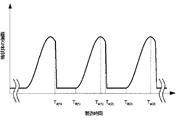
- the schematic diagram showing an example of the relationship between manufacturing time and the volume of a lump.
- a first coating material containing a polyol component and an isocyanate component is supplied to a water-soluble granular material in a fluidized state or a rolling state, and the fluidized state or the rolling state is maintained and the coating is insufficiently cured.
- the whole is heated and sufficiently heat-cured.
- the time T x for supplying the second covering material is expressed by the following equation: 0.5 ⁇ (T x ⁇ T 0 ) / (T a ⁇ T 0 ) ⁇ 3.0 It is preferable to satisfy. Also, 0.5 ⁇ (T x ⁇ T 0 ) / (T a ⁇ T 0 ) ⁇ 2.0 It is more preferable to satisfy.
- T x is less than 0.5, results in the formation of the first coating material coating layer formed by supplying supplies insufficient while the second coating material, a suitable elution performance It may not be obtained.
- said T x is more than 3.0 the first coating material coating layer formed by supplying the curing proceeds, once after the formation of the masses, peeling of the coating layer begins to occur Therefore, defects may increase and good elution performance may not be obtained.
- T x The above-described T x will be described below with reference to FIG.
- T a (1) or T a (2) is the time during which the volume of the first or second covering mass is maximum
- T x (1) or T x (2) indicates the time to start supplying the first or second coating material, respectively.
- the formula of (T x ⁇ T 0 ) / (T a ⁇ T 0 ) is described as follows.
- the supplied covering material starts to increase in viscosity gradually, and the first covering body and the device or the first covering body and the first covering are passed through the covering material.
- the body begins to attach.
- the first covering bodies adhere to each other, and a lump that does not leave even in the fluidized state or the rolling state starts to be confirmed.
- the volume of the masses are gradually increased, at time T a which apparent volume is maximized, ⁇ like body thermosetting insufficient coating layer formed on the surface of The stickiness is the highest. And after a state of the T a, it said agglomerates gradually began loosened, the volume of the masses starts to decrease.
- the first cover member is peeled off the covering bodies of friction, or the first and apparatus Etc., the covering layer formed on the surface starts to be damaged.
- the water-soluble granule When the water-soluble granule is brought into a fluidized state or a rolling state, the water-soluble granule is preheated for a certain period of time with hot air or the like. At this time, the preheating time and the preheating temperature are such that the water content of the water-soluble granular material does not significantly affect the coating materials used such as the first coating material and the second coating material, and the water-soluble granular material. What is necessary is just to adjust suitably so that the temperature of a thing may become coating
- the coating temperature is usually from room temperature (about 25 ° C.) to 150 ° C., preferably about 40 to 100 ° C., and is appropriately determined depending on the formation time, the composition ratio of the coating material used, and the type of water-soluble granular material used. Select. In the case of water-soluble granules containing components that are easily decomposed or altered by heat, it is necessary to coat at a relatively low temperature. For example, when urea is used as the water-soluble granules, the coating is performed at a temperature of 90 ° C. or lower. It is preferable to do.
- a device such as a fluidized bed or a spouted bed for fluidizing the water-soluble granular material
- a device such as a rotating pan or a rotating drum for rolling.
- the present invention can also be carried out in a mass production facility.
- the coating layer can be formed on 100 kg or more of water-soluble granular material.
- the method of the present invention can naturally be applied to equipment other than mass production equipment.
- any material can be used as long as it can be dispersed and added efficiently.
- spraying, dropping and the like can be mentioned, and particularly compressed air is used.
- the method of spray addition using a two-fluid nozzle is preferably used because it is possible to form a good coating layer.
- covering material may be separately supplied for every component, may be mixed within an apparatus, or can also be supplied after mixing one part or all the components previously.
- the coating material is preferably supplied such that the mass per layer of the coating layer is 0.5 to 5% by mass with respect to the mass of the coated water-soluble granular material, more preferably 0.7%. It may be up to 3% by mass. If it is less than 0.5% by mass, it is difficult not only to form a uniform layer but also to increase the number of times the coating layer is laminated in order to obtain the desired elution performance, resulting in operational inefficiency. Further, if it exceeds 5% by mass, the thickness of the layer becomes thick and becomes a non-uniform layer, and the coating material adhering to the inside of the apparatus increases rapidly, so that the utilization efficiency of the coating material may be lowered.
- the coating layer formed on the most surface side (hereinafter sometimes referred to as the outermost layer) may be thin as long as the coating layer formed on the inner side of the outermost layer is not significantly damaged. About 0.2 to 2% by mass.
- the total amount of the coating layer to be formed is preferably 1 to 15% by mass, more preferably 1.5 to 12% by mass with respect to the mass of the coated water-soluble granular material. If it is less than 1% by mass, it is difficult to achieve the target elution performance, and if it exceeds 15% by mass, the thickness becomes thick, so that it is difficult to permeate moisture through the coating layer and to elute the water-soluble particles. It becomes.
- the first coating material preferably includes an aromatic polyisocyanate, a polyol compound, and an amine compound, and the coating material forms a urethane resin.
- covering material also has aromatic polyisocyanate, a polyol compound, and an amine compound.
- the viscosity of the coating material having the above material is preferably low so that the surface of the water-soluble granular material is uniformly covered with the coating material, and is, for example, 0.1 to 200 mPa ⁇ s at the coating temperature. Is preferred.
- aromatic polyisocyanate examples include tolylene diisocyanate (TDI), diphenylmethane diisocyanate (MDI), naphthalene diisocyanate, polyphenyl polymethylene polyisocyanate, phenylene diisocyanate, xylylene diisocyanate, tetramethylxylene diisocyanate, and modified products thereof.
- examples include urea-modified products, dimers, trimers, carbodiimide products, allophanate-modified products, and burette-modified products. These may be used in combination of two or more, and may be so-called “crude” polyisocyanates used industrially.
- MDI crude MDI
- carbodiimidized MDI liquid MDI
- TDI crude TDI
- crude TDI crude TDI
- TDI liquid MDI
- the aromatic polyisocyanate may be used as an isocyanate group-terminated prepolymer prepared from the aromatic polyisocyanate.
- the method for preparing the isocyanate group-terminated prepolymer may be a known method.
- the isocyanate group / active hydrogen group equivalent ratio of polyisocyanate and polyol is 1.1 to 50.0, preferably 1.2 to 25.0 is obtained by carrying out the reaction at 30 to 130 ° C., preferably 40 to 90 ° C. for 1 to 5 hours.
- the compatibility with other components is improved, the reaction is promoted, and the viscosity can be adjusted to be easy to work. is there.
- polyol component examples include castor oil and its derivatives (for example, castor oil, alkylene oxide adduct of castor oil, polyhydric alcohol modified product of castor oil fatty acid, etc.), alkylene oxide adduct of low molecular polyfunctional alcohol (for example, diols, Triols, hexaols, glycerin, trimethylolpropane propylene oxide, butylene oxide, styrene oxide single adduct, coadduct, etc.), low molecular weight polyfunctional carboxylic acid alkylene oxide adduct (eg, propylene of dodecanedioic acid) Oxide, butylene oxide, styrene oxide single adducts, coadducts, etc.) Low molecular weight polyfunctional polyester alkylene oxide adducts (eg polyester propylene glycerol and dodecanedioic acid) Oxide, butylene oxide, alone adduct
- alkylamines or amine-based polyols are used as the amine compound.
- alkylamine include trimethylamine, triethylamine, dimethylethylamine, dimethylisopropylamine and the like.
- the amine compound is preferably an amine polyol.
- examples of such amine polyols include low molecular amine polyols such as di-, tri-, ethanolamine, N-methyl-N, N'-diethanolamine.
- amine-based polyols obtained by adding an alkylene oxide such as propylene oxide (PO) or ethylene oxide (EO) to an amino compound such as ethylenediamine, 1,3-propanediamine, or 1,6-hexanediamine.
- PO propylene oxide
- EO ethylene oxide
- the ratio of addition is not particularly limited, but is 1 to 200, preferably 1 to 50, alkylene oxide per nitrogen atom, but about 2 to 2.4 is for adjusting the physical properties related to the hydrophilicity of the coating layer. Is particularly preferred.
- N, N, N ′, N′-tetrakis [2-hydroxypropyl] ethylenediamine, N, N, N ′, N′-tetrakis [2-hydroxyethyl] ethylenediamine, N, N, N ', N'-tetrakis [2-hydroxypropyl] -1,3-propanediamine, N, N, N', N'-tetrakis [2-hydroxyethyl] -1,6-hexanediamine and the like can be mentioned.
- the above-described amine-based polyol can be suitably used as the polyol component.
- the amine-based polyol is preferable because it accelerates the reaction and also acts as a cross-linking agent and a chain extender, so that good curability and a strong coating layer can be obtained.
- the usage-amount of this amine-type polyol should just be adjusted so that a crosslinking reaction may advance, after coat
- the ratio of the molar ratio of isocyanate groups to hydroxyl groups contained in the total amount of isocyanate component and polyol component is the ratio of isocyanate groups / hydroxyl groups. It is preferable to be 0.6 to 1.5. When this ratio is less than 0.6 or exceeds 1.5, the resulting coating layer is not sufficiently crosslinked, and the elution rate of the components of the water-soluble granular material may not be suitable. It is also preferable to set the ratio of isocyanate group / hydroxyl group to 0.6 to 0.99 for the purpose of leaving unreacted isocyanate groups in the coating layer and imparting flexibility to the coating layer.
- the isocyanate group / hydroxyl group of the outermost layer is set to 1 to 1.5. It is preferable because an excess hydroxyl group on the surface of the layer and an excess isocyanate group in the outermost layer can be reacted to form a coating layer more effectively.
- the coating body is heated to be thermoset while the coating body is maintained in a fluidized state or a rolling state to obtain a coated water-soluble granular material.
- the heating time at this time varies depending on the heating temperature and the type and amount of the coating material, but it is sufficient that heating is performed until at least the outermost layer does not exhibit adhesiveness.
- further heating may be performed to promote the urethane reaction.
- the heating time becomes too long, not only the productivity decreases, but the outermost layer gradually May be worn by contact with the coating apparatus and damage the surface of the outermost layer. Therefore, it is necessary to prevent the damage from occurring. For example, it is good also as 10 times or less of the time when this outermost layer does not show adhesiveness.
- the heating method it is preferable to use conduction heat, hot air, or the like from the coating apparatus.
- a catalyst may be added to the coating materials such as the first coating material and the second coating material in order to promote the formation of urethane bonds.
- organometallic catalysts such as dibutyltin laurate and lead octenoate Can be used.
- a coating material containing a superabsorbent resin, vegetable oil, or the like may be used.
- the vegetable oil is a non-reacting component, and the vegetable oil acts as a void, so that the three-dimensional structure of the urethane resin can be sparse, facilitating water penetration into the void, and when the coating material is cured The tackiness can be reduced.
- the vegetable oil may be added alone, but is preferably mixed in advance with an isocyanate component or a polyol component and supplied as a uniform liquid.
- vegetable oils examples include coconut oil, corn oil, cottonseed oil, olive oil, palm oil, peanut oil, rapeseed oil, canola oil, safflower oil (safflower oil), sesame oil, soybean oil, sunflower oil, linseed oil, tall oil , And mixtures thereof.
- vegetable oils with a high content of oleic acid or linoleic acid components are preferred, rapeseed oil, canola oil, soybean oil and the like are preferred, and rapeseed oil and canola oil are more preferred.
- part or all of the vegetable oil can be used in place of the triglycerides of fatty acids contained in these vegetable oils.
- fatty acid examples include capric acid, lauric acid, myristic acid, palmitic acid, stearic acid, arachidic acid, behenic acid, oleic acid, erucic acid, linoleic acid, linolenic acid, ricinoleic acid and the like.
- the superabsorbent resin is a substance that swells to more than 5 times its dry volume by absorbing a large amount of water.
- a gel that has low solubility upon water absorption and becomes a gel.
- an acrylate polymer for example, Sumikagel S, L, R type manufactured by Sumitomo Chemical Co., Ltd., Aquakeep 10SH, 10SHP, 10SH-NF (20), SA60NTYPE2, manufactured by Sumitomo Seika Co., Ltd., Sekisui) Aquamate AQ-200, AQ-200B-02 manufactured by Kasei Kogyo Co., Ltd., Sunfresh ST-250MPS, ST-500MPSA manufactured by Sanyo Chemical Industries, Ltd.), isobutylene polymer (for example, Kuraray Co., Ltd.) KI gel-201K, KI gel-201K-F2, KI gel solution system, KI gel compound), acrylic acid / vinyl alcohol copolymer, polyethylene oxide modified resin, starch
- the particle size of the superabsorbent resin is preferably 1 to 100 ⁇ m, more preferably 2 to 50 ⁇ m. If it is less than 1 ⁇ m, the change in elution time and elution rate due to the addition of the superabsorbent resin is small, and if it exceeds 100 ⁇ m, a uniform coating layer cannot be obtained, and defects on the coating layer surface are likely to occur. is there.
- the amount of the superabsorbent resin added varies depending on the particle size, but is usually 0.1 to 30% by mass of the total mass of the urethane resin and the superabsorbent resin, preferably 0.5 to 20% by mass, more Preferably, it is 1 to 10% by mass. If it is less than 0.1% by mass, the change in elution time and elution rate due to the addition of the superabsorbent resin is small, and it is not effective to adjust the elution characteristics with this. Moreover, when it exceeds 30 mass%, hydrophilicity will become large and adjustment of the elution start time may become difficult.
- the superabsorbent resin is mixed and dispersed in advance with a polyol component to prepare a dispersion, and the dispersion is added to the water-soluble granular material immediately after mixing with the polyisocyanate component, or separately in the coating apparatus. It is preferable to be supplied by adding to the granular material.
- the superabsorbent resin may be a layer located anywhere as long as the layer containing the superabsorbent resin is other than the outermost layer.
- an organic or inorganic additive is added to the coating material such as the first coating material and the second coating material in addition to the superabsorbent resin. It is also possible to add.
- the additive include alkyd resin, urethane resin, fatty acid ester, rosin and derivatives thereof, ester gum, surfactant, petroleum resin, talc, diatomaceous earth, silica, urea, sulfur powder and the like. These may be added in an amount of 0.1 to 50 parts by mass with respect to 100 parts by mass of the urethane resin of the present invention, and workability or elution characteristics may be adjusted depending on the type and addition amount thereof.
- the surface of the outermost layer may be treated with an inorganic powder for the purpose of preventing the coated water-soluble granular material from sticking to each other.
- the inorganic powder include talc, sulfur, calcium carbonate, silica, zeolite, diatomaceous earth, clay, and metal oxide. These may be used alone or in combination, and are easy to handle. It is preferable to use talc.
- the inorganic powder is preferably used in an amount of 0.1 to 15% by mass, more preferably 1 to 10% by mass, based on the coating layer. If it is less than 0.1% by mass, the effect of preventing sticking is weak, and even if it exceeds 15% by mass, it does not adhere to the surface of the coated water-soluble granular material. Further, after the formation of the outermost layer, when the inorganic powder is sprayed on the coated water-soluble granular material in a rolling or fluid state as the powder, the inorganic powder stays on the surface of the outermost layer and enters the coating layer. Since elution is stable, it is preferable.
- the coated water-soluble granular material of the present invention can be suitably used as a coated granular fertilizer coated with a granular fertilizer because the dissolution pattern of the eluted components can be adjusted.
- the coated granular fertilizer may be a water-soluble granular fertilizer, and examples thereof include urea, ammonium sulfate, ammonium sulfate, ammonium nitrate, potassium chloride, potassium sulfate, potassium nitrate, sodium nitrate, potassium phosphate, ammonia phosphate, and phosphoric acid. Examples include at least one fertilizer or composite fertilizer selected from the group consisting of lime and granular organic fertilizer.
- the coated water-soluble granular material of the present invention is suitably used as a coated granular pesticide coated with a granular pesticide.
- the coated granular pesticide may be a water-soluble granular pesticide, and examples thereof include various insecticides, insect repellents, fungicides, herbicides, insecticides, plant growth regulators, and the like.
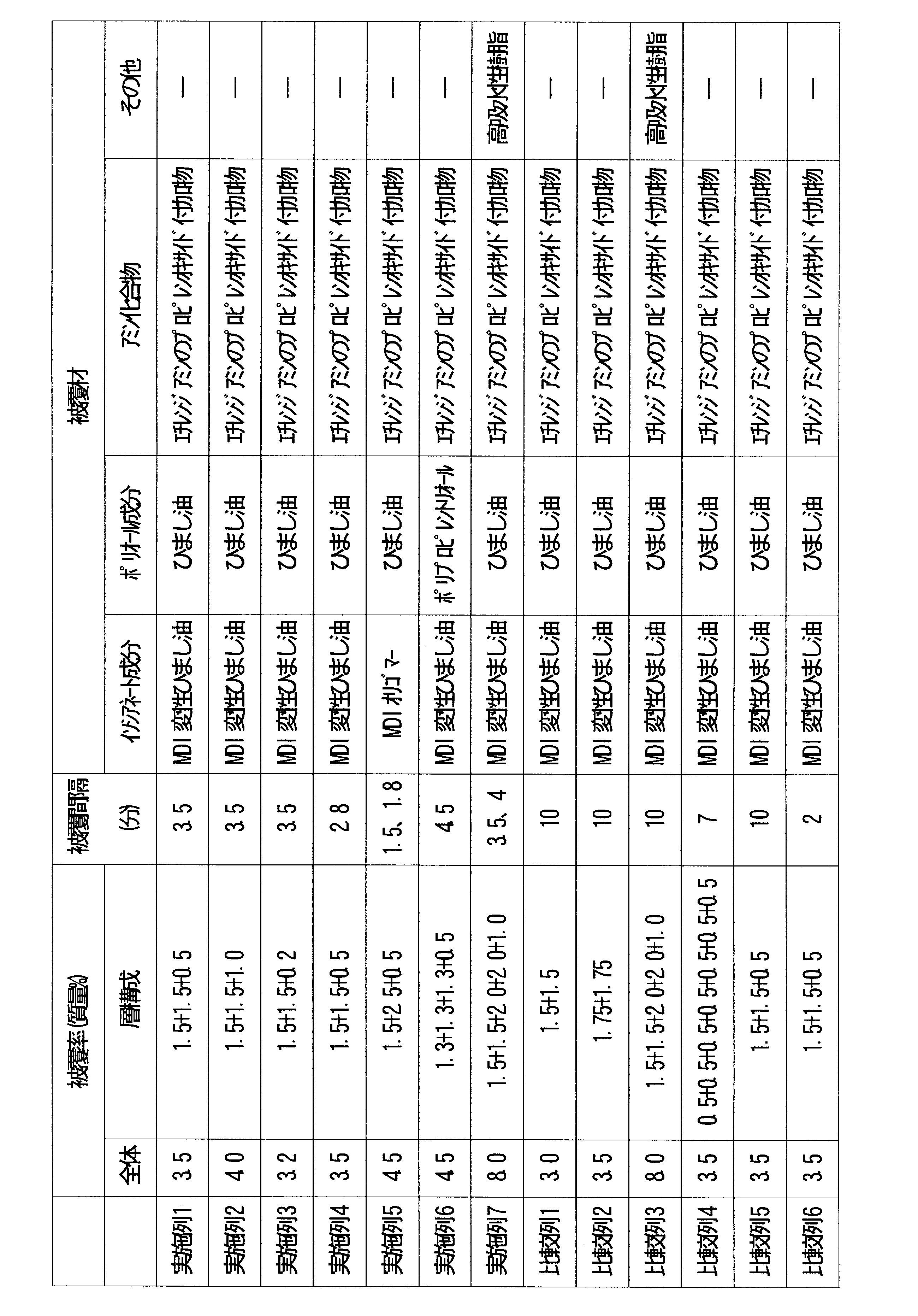
- Example 1 100 kg of granular urea (particle diameter: 2.5 to 4.0 mm) was charged in a drum type rolling coating apparatus having a diameter of 1.4 m, and the granular urea temperature was maintained at 70 ° C. by a hot air generator while rolling at 7 rpm.
- castor oil (hydroxyl value 160 mgKOH / g) and propylene oxide adduct of ethylenediamine (propylene oxide / nitrogen atom ratio; 2.2, hydroxyl value; 760 mgKOH / g) as the first coating layer 764 g of a liquid mixed so that the molar ratio is 8: 2 and 839 g of MDI-modified castor oil (isocyanate group-terminated prepolymer in which castor oil is mixed with an excess amount of MDI so that the mass of isocyanate groups is 19% by mass of the total mass) was coated (applied) as a coating material (total 1,603 g (corresponding to 1.6% by mass, corresponding to a film thickness of 10.8 ⁇ m)) from a two-fluid nozzle into the apparatus for 30 seconds to form a coated body.
- the coated body begins to adhere 2.5 minutes after spraying the coating material, and the apparent volume reaches its maximum after 3 minutes, and after 3.5 minutes, the coated bodies strongly adhere to each
- the same component and the same amount (1.6% by mass) of the coating material as the first layer are applied to the second fluid nozzle as the second layer coating layer. To the apparatus for 30 seconds.
- a coating material having the same component as that of the first layer as the outermost layer (total 534 g (0.5 mass%, film thickness 3.6 ⁇ m was sprayed from the two-fluid nozzle into the apparatus for 10 seconds.
- total 534 g 0.5 mass%, film thickness 3.6 ⁇ m
- the coated body After about 2.5 minutes from the spraying of the outermost layer coating material, the coated body begins to adhere, and after 3.0 minutes, the coated body adheres strongly but does not form a lump, and after 3.5 minutes, the lump is formed. The volume of the body started to decrease, and it was confirmed that no covering was adhered after 7 minutes.
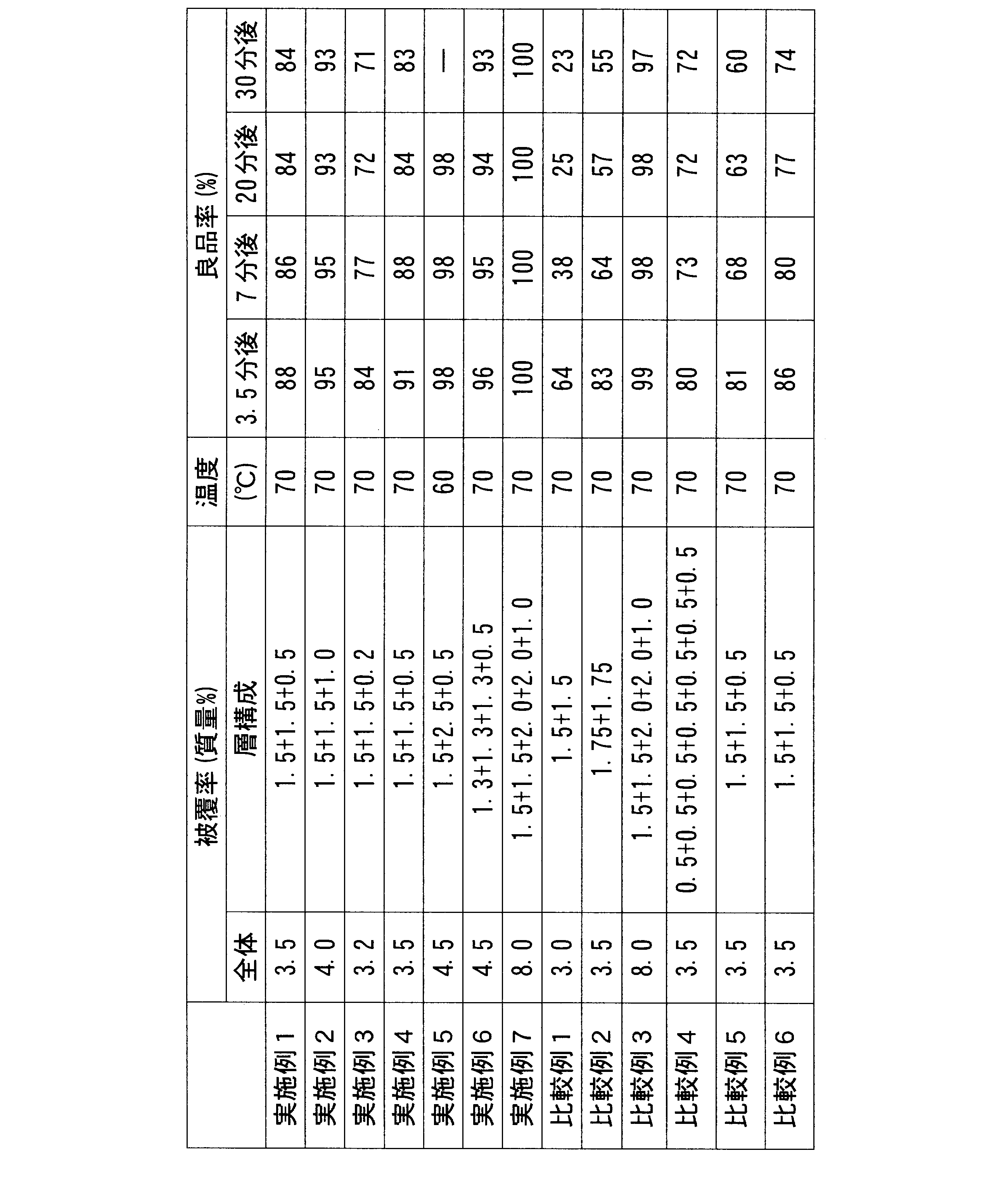
- the yield rate and the coverage rate were measured, and the results are shown in Table 2. From Table 2, it was found that a decrease in the yield rate with time was suppressed and defects in the coating layer could be significantly suppressed. At this time, the coverage was 3.5% by mass, and the thickness of the coating layer at this time was 25 ⁇ m.
- Example 2 A coated granular fertilizer was obtained in the same manner as in Example 1 except that the total mass of the coating material sprayed as the outermost layer was set to 1,074 g (1.0% by mass, corresponding to a film thickness of 7.2 ⁇ m). The obtained coated granular fertilizer was evaluated for the yield rate and the coverage rate. From Table 2, it was found that a decrease in the yield rate with time was suppressed, and further, defects in the coating layer could be greatly suppressed. Further, the coverage was 4.0% by mass, and the thickness of the coating layer at this time was 29 ⁇ m.
- Example 3 A coated granular fertilizer was obtained in the same manner as in Example 1 except that the total mass of the coating material sprayed as the outermost layer was 213 g (0.2 mass%, corresponding to a film thickness of 1.4 ⁇ m). The obtained coated granular fertilizer was evaluated for the yield rate and the coverage rate. From Table 2, it was found that a decrease in the yield rate with time was suppressed and defects in the coating layer could be significantly suppressed. The coverage was 3.2% by mass, and the thickness of the coating layer at this time was 23 ⁇ m.
- Example 4 2.8 minutes after spraying the first layer of the coating material (immediately before the volume of the block is maximized), the spraying of the second layer of the coating material is started.
- a coated granular fertilizer was obtained in the same manner as in Example 1 except that the outermost coating material was started to spray 2.8 minutes after the spraying was completed.
- the obtained coated granular fertilizer was evaluated for the yield rate and the coverage rate. From Table 2, it was found that defects in the coating layer can be greatly suppressed as in Example 1. The coverage was 3.5% by mass, and the thickness of the coating layer at this time was 25 ⁇ m.
- Example 5 When forming the first coating layer while maintaining the temperature of the granular urea at 60 ° C., 967 g of a liquid obtained by mixing castor oil and propylene oxide adduct of ethylenediamine so that the molar ratio of hydroxyl groups is 8: 2. , 653 g of MDI oligomer (average molecular weight of about 400) as a coating material (total 1,620 g (corresponding to 1.6 mass%, film thickness 11.0 ⁇ m)), and it took 30 seconds from the two-fluid nozzle into the apparatus.
- the coating material of the same component as the first layer coating material (total 2,700 g (2.6% by mass, film Is sprayed from the two-fluid nozzle into the apparatus over 30 seconds, and the outermost layer is coated with the same component as the first layer after 1.8 minutes from the second layer spraying.
- Material total of 540 g (corresponding to 0.5 mass%, film thickness of 3.7 ⁇ m
- the coated granular fertilizer was obtained in the same manner as in Example 1 except that the coating was sprayed from the two-fluid nozzle into the apparatus over 10 seconds and then rolled for 20 minutes to harden the coating layer of the coating. .
- the obtained coated granular fertilizer was evaluated for the yield rate and the coverage rate.
- Example 5 the following examination was conducted in advance separately from the above for the coating material of Example 5.
- the coating material of the first layer starts to adhere to the coating 1 minute after spraying, becomes the largest after 1.5 minutes, and after 2 minutes the coatings adhere to each other, but the lump is loosened. became.
- the coating material of the second layer started to adhere to the coating 1.5 minutes after spraying, and the lumps became maximum after 2 minutes, but the lumps were loosened although the coatings adhered to each other after 3 minutes. It became a state.
- the outermost coating material did not adhere to each other after 5 minutes from spraying.
- Example 6 When forming the first coating layer, 562 g of a liquid in which polypropylene triol (hydroxyl value 280 mgKOH / g) and propylene oxide adduct of ethylenediamine were mixed so that the molar ratio of the hydroxyl group was 75:25, and MDI modification 878 g of castor oil was used as a coating material (total 1,440 g (1.4% by mass, corresponding to a film thickness of 9.5 ⁇ m)), 4.5 minutes after spraying the first layer, the same as the first layer The same amount of coating material and the same amount of the coating material are sprayed from the two-fluid nozzle into the apparatus over 30 seconds, the second layer spraying is started, and the second layer spraying is finished 4.5 minutes later.
- polypropylene triol hydroxyl value 280 mgKOH / g
- propylene oxide adduct of ethylenediamine propylene oxide adduct of ethylenediamine
- a coating material having the same components as the first layer (total 540 g (corresponding to 0.5 mass%, film thickness 0.5 ⁇ m)) ) Is sprayed from the two-fluid nozzle into the apparatus over 10 seconds.
- a coated granular fertilizer was obtained in the same manner as in Example 1 except that. The obtained coated granular fertilizer was evaluated for the yield rate and the coverage rate.
- Example 6 was examined separately from the above.
- the coating material of the first to third layers starts to adhere to the coating after 3.5 minutes from spraying, forms a lump after 4 minutes, and adheres to each other after 4.5 minutes, but the lump is loosened. It became a state.
- the outermost layer coating material was not adhered to the other after 10 minutes from the end of spraying.
- Example 7 100 kg of granular urea (particle diameter: 2.5 to 4.0 mm) was charged in a drum type rolling coating apparatus having a diameter of 1.4 m, and the granular urea temperature was maintained at 70 ° C. by a hot air generator while rolling at 7 rpm.
- castor oil hydroxyl value 160 mgKOH / g
- propylene oxide adduct of ethylenediamine ratio of propylene oxide / nitrogen atom; 2.2, hydroxyl value; 760 mgKOH / g
- 64 g of superabsorbent resin cross-linked acrylate polymer having an average particle size of 25 ⁇ m; ST-500MPSA manufactured by Sanyo Chemical Industries
- MDI modified 848 g of castor oil isocyanate group-terminated prepolymer in which castor oil was mixed with an excess amount of MDI to make the mass of the isocyanate group 19% of the total mass
- a coating material total 1,684 g (1.7 mass%, film thickness Sprayed (applied) from the two-fluid nozzle into the apparatus over 30 seconds, and 3.5 minutes after spraying the first layer
- total 1,684 g 1.7 mass%, film thickness Sprayed (applied) from the two-fluid
- castor oil hydroxyl value 160 mgKOH / g
- propylene oxide adduct of ethylenediamine ratio of propylene oxide / nitrogen atoms; 2. 2
- hydroxyl group value: 760 mg KOH / g was mixed so that the molar ratio of hydroxyl group was 8: 2
- MDI modified castor oil castor oil was mixed with an excess amount of MDI to make the total mass of isocyanate groups.
- 1,175 g of an isocyanate group-terminated prepolymer having a mass of 19% was applied as a coating material (total 2,245 g (corresponding to 2.1 mass%, film thickness 15.3 ⁇ m)) from a two-fluid nozzle into the apparatus.
- Example 7 After the spraying of the outermost layer was finished, it was rolled for 30 minutes to form a coating layer on the coating. This was cooled to room temperature (about 25 ° C.) to obtain the desired coated granular fertilizer. The obtained coated granular fertilizer was evaluated for the yield rate and the coverage rate. From Table 2, it was found that a decrease in the yield rate with time was suppressed and defects in the coating layer could be significantly suppressed. The coverage was 8% by mass, and the thickness of the coating layer at this time was 60 ⁇ m. Moreover, the thermosetting reaction of the coating material used in Example 7 showed the same tendency as the coating material used in Example 1.
- Example 1 A coated granular fertilizer was obtained in the same manner as in Example 1 except that the spray interval between the first layer and the second layer coating material was 10 minutes, and the third layer was not formed. Moreover, about the obtained coated granular fertilizer, the quality rate evaluation and the coverage rate measurement were performed. From Table 2, it was found that the non-defective product rate was significantly decreased with the passage of time, and the defects of the coating layer were increased. The coverage was 3.0% by mass, and the thickness of the coating layer at this time was 22 ⁇ m.
- Example 2 The amount of spraying of the first layer and the second layer is 1,870 g (1.75 mass%, corresponding to a film thickness of 12.5 ⁇ m), the spraying interval of the coating is 10 minutes, and the third layer A coated granular fertilizer was obtained in the same manner as in Example 1 except that was not formed. Moreover, about the obtained coated granular fertilizer, the quality rate evaluation and the coverage rate measurement were performed. From Table 2, it was found that the non-defective product rate was significantly decreased with the passage of time, and the defects of the coating layer were increased. The coverage was 3.5% by mass, and the thickness of the coating layer at this time was 25 ⁇ m.
- Example 3 A coated granular fertilizer was obtained in the same manner as in Example 7, except that the spraying interval of the coating material was 10 minutes. Moreover, about the obtained coated granular fertilizer, the quality rate evaluation and the coverage rate measurement were performed. From Table 2, it was found that the yield rate decreased with time and defects in the coating layer were generated. The coverage was 8% by mass, and the thickness of the coating layer at this time was 60 ⁇ m.
- Example 4 There are 7 coating layers, the spraying amount of the coating material is 508 g (corresponding to 0.5 mass%, corresponding to a film thickness of 3.5 ⁇ m), the spraying interval of the coating material is 7 minutes, and the spraying amount of all 7 layers of the coating material
- a coated granular fertilizer was obtained in the same manner as in Example 1 except that the same was used. Moreover, about the obtained coated granular fertilizer, the quality rate evaluation and the coverage rate measurement were performed. From Table 2, it was found that the non-defective product rate was significantly decreased with the passage of time, and the defects of the coating layer were increased. The coverage was 3.5% by mass, and the thickness of the coating layer at this time was 25 ⁇ m.
- Example 5 A coated granular fertilizer was obtained in the same manner as in Example 1 except that the spraying interval of the coating material was 10 minutes. Moreover, about the obtained coated granular fertilizer, the quality rate evaluation and the coverage rate measurement were performed. From Table 2, it was found that the non-defective product rate was significantly decreased with the passage of time, and the defects of the coating layer were increased. The coverage was 3.5% by mass, and the thickness of the coating layer at this time was 25 ⁇ m.
- Example 6 A coated granular fertilizer was obtained in the same manner as in Example 1 except that the spraying interval of the coating material was 2 minutes. Moreover, about the obtained coated granular fertilizer, the quality rate evaluation and the coverage rate measurement were performed. From Table 2, it was found that the non-defective product rate was significantly decreased with the passage of time, and the defects of the coating layer were increased. The coverage was 3.2% by mass, and the thickness of the coating layer at this time was 23 ⁇ m, and satisfactory coating was not achieved.
- Example 1 and Example 4 were performed more than Comparative Example 2 having a smaller number of coating layers.
- the yield of non-defective products was higher in Example 4, and the yield of non-defective products was higher in Examples 1 and 4 than Comparative Examples 4 to 6 having the same number of layers.
- Example 1 and Example 4 are compared and the yield rate is comparable, when forming a coating film, the curing of the thermosetting resin that forms the coating layer is insufficient and the next layer It was found that a good yield rate was maintained even when the coating material was sprayed.
- Example 1 Example 4, Comparative Example 5, and Comparative Example 6 are compared, if the next layer is formed after the coating layer is sufficiently heat-cured, the yield rate is greatly reduced. It was found that even when spraying was too early, a decrease in the yield rate was observed.
- Example 7 having a total coverage of 8% by mass and Comparative Example 3 are compared with each other, both achieve a high yield rate, and it can be seen that the yield rate can be improved by increasing the coverage. .
- Comparative Example 4 also achieves a high non-defective product rate by multilayering at a coverage of 3.5% by mass, Comparative Example 3 and Comparative Example 4 have a coating layer to be laminated for each layer. It can be said that it is not suitable for the purpose of the present invention because it is sufficiently heat-cured and has a long production time.
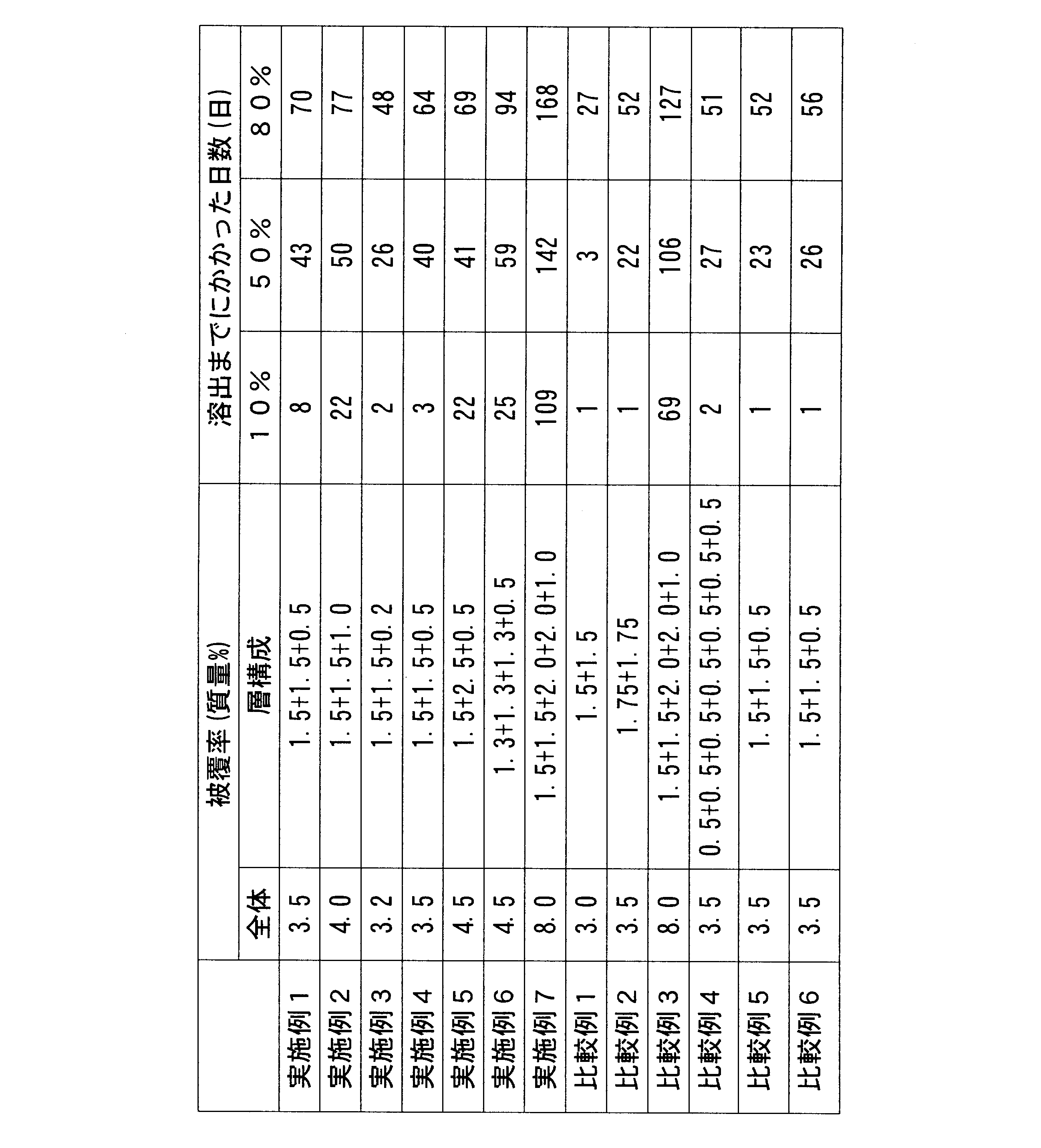
- Example 1 Example 4, and Example 7 were eluted more than Comparative Example 2, Comparative Example 4, Comparative Example 5, Comparative Example 6, and Comparative Example 3. It was shown that the inhibitory effect can be maintained for a long period of time, and that the initial elution is highly effective. Moreover, when Example 7 and Comparative Example 3 are compared, Example 7 can suppress elution of fertilizer components over a longer period than Comparative Example 3 even though the production time is shorter than Comparative Example 3. It became clear that it was possible.
Landscapes
- Life Sciences & Earth Sciences (AREA)
- Health & Medical Sciences (AREA)
- General Health & Medical Sciences (AREA)
- Pest Control & Pesticides (AREA)
- Dentistry (AREA)
- Environmental Sciences (AREA)
- Toxicology (AREA)
- Engineering & Computer Science (AREA)
- Agronomy & Crop Science (AREA)
- Wood Science & Technology (AREA)
- Zoology (AREA)
- Plant Pathology (AREA)
- Chemical & Material Sciences (AREA)
- Organic Chemistry (AREA)
- Fertilizers (AREA)
- Glanulating (AREA)
- Application Of Or Painting With Fluid Materials (AREA)
- Agricultural Chemicals And Associated Chemicals (AREA)
Abstract
Description
0.5≦(Tx-T0)/(Ta-T0)≦3.0
を満たすTxの時間的範囲内に、前記第2の被覆材の供給を開始することを特徴とする。
0.5≦(Tx-T0)/(Ta-T0)≦2.0
を満たすTxの時間的範囲内に、第2の被覆材の供給を開始することを特徴とする。
0.5≦(Tx-T0)/(Ta-T0)≦3.0
を満たすことが好ましい。また、
0.5≦(Tx-T0)/(Ta-T0)≦2.0
を満たすことがより好ましい。該Txが0.5未満であると、第1の被覆材を供給して形成される被覆層の形成が不十分なまま第2の被覆材を供給することになり、好適な溶出性能が得られないことがある。また、該Txが3.0を超えると第1の被覆材を供給して形成される被覆層は硬化が進行し、一度塊状体を形成した後、該被覆層の剥がれ等が生じ始めることから欠陥が増大してしまい、良好な溶出性能が得られないことがある。
(Tx(2)-T0(1))/(Ta(1)-T0(1))
第1の被覆材を供給した後、供給された被覆材は徐々に粘性が増加し始め、当該被覆材を介して、第1の被覆体と装置、あるいは第1の被覆体と第1の被覆体とが付着し始める。ここで、T0では前記の第1の被覆体同士が付着し、流動状態又は転動状態においても付着したまま離れない塊状体が確認され始める。
粒状尿素(粒径2.5~4.0mm)100kgを直径1.4mのドラム型転動被覆装置に仕込み、7rpmで転動させながら、熱風発生機により粒状尿素温度を70℃に保持した。
最外層の被覆材を噴霧後、加熱を行った30分間に発生する欠陥を確認するため、所定時間経過後に被覆粒状肥料を取り出し、良品率の測定を行なった。
得られた被覆粒状肥料を縮分して被覆率((被覆層質量/被覆粒状肥料の質量)×100)を算出した。
最外層として噴霧する被覆材の質量を合計1,074g(1.0質量%、膜厚7.2μmに相当する)とした以外は、実施例1と同様の方法で被覆粒状肥料を得た。得られた被覆粒状肥料について、良品率の評価、被覆率の測定を行った。表2から、時間経過と共に生じる良品率の低下が抑えられ、さらに被覆層の欠陥が大幅に抑制できたことがわかった。また、被覆率は4.0質量%でこのときの被覆層の厚さは29μmであった。
最外層として噴霧する被覆材の質量を合計213g(0.2質量%、膜厚1.4μmに相当する)とした以外は、実施例1と同様の方法で被覆粒状肥料を得た。得られた被覆粒状肥料について、良品率の評価、被覆率の測定を行った。表2から、時間経過と共に生じる良品率の低下が抑えられ、被覆層の欠陥が大幅に抑制できたことがわかった。なお、被覆率は3.2質量%でこのときの被覆層の厚さは23μmであった。
第1層目の被覆材の噴霧から2.8分後(塊状体の体積が最大になる直前)に、第2層目の被覆材の噴霧を開始し、さらに第2層目の被覆材の噴霧を終えてから2.8分後に最外層の被覆材を噴霧し始めた以外は、実施例1と同様の方法で被覆粒状肥料を得た。得られた被覆粒状肥料について、良品率の評価、被覆率の測定を行った。表2より、実施例1と同様に被覆層の欠陥を大幅に抑制することが可能であることがわかった。なお、被覆率は3.5質量%でこのときの被覆層の厚さは25μmであった。
粒状尿素の温度を60℃に保持し、第1層目の被覆層を形成する際、ひまし油と、エチレンジアミンのプロピレンオキサイド付加物を水酸基のモル比が8:2となるように混合した液967gと、MDIオリゴマー(平均分子量約400)653gとを、被覆材(合計1,620g(1.6質量%、膜厚11.0μmに相当する))とし、ニ流体ノズルから装置内に30秒かけて噴霧し、第1層目の被覆材の噴霧から1.5分後に第2層目の被覆材として、第1層目と同一成分の被覆材(合計2,700g(2.6質量%、膜厚18.3μmに相当する))を二流体ノズルから装置内に30秒かけて噴霧し、さらに、第2層目の噴霧から1.8分後に最外層に第1層目と同一成分の被覆材(合計540g(0.5質量%、膜厚3.7μmに相当する))を二流体ノズルから装置内に10秒かけて噴霧した後20分間転動させ、被覆体の被覆層を硬化させた以外は、実施例1と同様の方法で被覆粒状肥料を得た。得られた被覆粒状肥料について、良品率の評価、被覆率の測定を行った。
第1層目の被覆層を形成する際、ポリプロピレントリオール(水酸基価280mgKOH/g)とエチレンジアミンのプロピレンオキサイド付加物とを水酸基のモル比が75:25となるように混合した液562gと、MDI変成ひまし油878gとを、被覆材(合計1,440g(1.4質量%、膜厚9.5μmに相当する))とし、第1層目の噴霧から4.5分後に、第1層目と同一成分、同一量の被覆材を二流体ノズルから装置内に30秒かけて噴霧し、第2層目の噴霧を始め、第2層目の噴霧を終えてから4.5分後に第3層目の噴霧を始め、第3層目の噴霧から4.5分後に最外層として、第1層目と同一成分の被覆材(合計540g(0.5質量%、膜厚0.5μmに相当する))を二流体ノズルから装置内に10秒かけて噴霧した以外は、実施例1と同様の方法で被覆粒状肥料を得た。得られた被覆粒状肥料について、良品率の評価、被覆率の測定を行った。
粒状尿素(粒径2.5~4.0mm)100kgを直径1.4mのドラム型転動被覆装置に仕込み、7rpmで転動させながら、熱風発生機により粒状尿素温度を70℃に保持した。
第1層目と第2層目の被覆材の噴霧間隔を10分とし、第3層目を形成しなかった以外は、実施例1と同様の方法で被覆粒状肥料を得た。また、得られた被覆粒状肥料について、良品率の評価、被覆率の測定を行った。表2より、時間経過と共に良品率が大幅に低下しており、被覆層の欠陥が増大していることがわかった。なお、被覆率は3.0質量%でこのときの被覆層の厚さは22μmであった。
第1層目と第2層目の被覆材の噴霧量を1,870g(1.75質量%、膜厚12.5μmに相当する)、被覆材の噴霧間隔を10分とし、第3層目を形成しなかった以外は、実施例1と同様の方法で被覆粒状肥料を得た。また、得られた被覆粒状肥料について、良品率の評価、被覆率の測定を行った。表2より、時間経過と共に良品率が大幅に低下しており、被覆層の欠陥が増大していることがわかった。なお、被覆率は3.5質量%でこのときの被覆層の厚さは25μmであった。
被覆材の噴霧間隔を10分とした以外は、実施例7と同様の方法で被覆粒状肥料を得た。また、得られた被覆粒状肥料について、良品率の評価、被覆率の測定を行った。表2より、時間経過と共に良品率の低下が見られ、被覆層の欠陥が発生していることがわかった。なお、被覆率は8質量%でこのときの被覆層の厚さは60μmであった。
被覆層を7層とし、被覆材の噴霧量を508g(0.5質量%、膜厚3.5μmに相当する)、被覆材の噴霧間隔を7分とし、7層全ての被覆材の噴霧量を同じとした以外は、実施例1と同様の方法で被覆粒状肥料を得た。また、得られた被覆粒状肥料について、良品率の評価、被覆率の測定を行った。表2より、時間経過と共に良品率が大幅に低下しており、被覆層の欠陥が増大していることがわかった。なお、被覆率は3.5質量%でこのときの被覆層の厚さは25μmであった。
被覆材の噴霧間隔を10分とした以外は、実施例1と同様の方法で被覆粒状肥料を得た。また、得られた被覆粒状肥料について、良品率の評価、被覆率の測定を行った。表2より、時間経過と共に良品率が大幅に低下しており、被覆層の欠陥が増大していることがわかった。なお、被覆率は3.5質量%でこのときの被覆層の厚さは25μmであった。
被覆材の噴霧間隔を2分とした以外は、実施例1と同様の方法で被覆粒状肥料を得た。また、得られた被覆粒状肥料について、良品率の評価、被覆率の測定を行った。表2より、時間経過と共に良品率が大幅に低下しており、被覆層の欠陥が増大していることがわかった。なお、被覆率は3.2質量%でこのときの被覆層の厚さは23μmであり、良好な被覆ができていなかった。
また、実施例1と実施例4とを比較すると、良品率は同程度であることから、被覆膜を形成する際、被覆層を形成する熱硬化性樹脂の硬化が不十分で次層の被覆材を噴霧しても良好な良品率が維持されることがわかった。また、実施例1、実施例4、比較例5、比較例6を比較すると、被覆層を十分熱硬化させた後に次層の形成を行うと良品率は大きく低下し、一方で、被覆材を噴霧するのが早過ぎる場合でも良品率の低下が見られることがわかった。
実施例1~実施例7、及び比較例1~比較例6について、得られた被覆粒状肥料を縮分して溶出試験を行い、その結果を表3に示した。溶出試験は縮分した被覆粒状尿素のうち10gを採取して200ccのイオン交換水に投入し、25℃の恒温槽内に保存して所定時間経過後に取り出し、水中に溶出した尿素を定量して求めた。なお、表3には、それぞれ10%、50%、80%の尿素の溶出が見られた日数を示した。
Claims (10)
- 水溶性粒状体の表面に2層以上の被覆層が形成された被覆水溶性粒状体の製造方法であって、
ポリオール成分及びイソシアネート成分を含む第1の被覆材を供給した後、当該第1の被覆材の熱硬化が不十分な被覆層を有する第1の被覆体の表面に新たに第2の被覆材を供給して、第2の被覆材の被覆層が形成された第2の被覆体を得る工程A、
を含む。 - 前記工程Aを2~10回繰り返して2~10層の被覆層形成する、請求項1に記載の被覆水溶性粒状体の製造方法。
- 前記第2の被覆材がポリオール成分及びイソシアネート成分を含む、請求項1又は請求項2に記載の被覆水溶性粒状体の製造方法。
- 前記第1の被覆材の供給を完了した後、前記第1の被覆体同士が付着して塊状体が形成され始める時間をT0、その後塊状体の体積が最大になる時間をTaとするとき、次の関係式
0.5≦(Tx-T0)/(Ta-T0)≦3.0
を満たすTxの時間的範囲内に、前記第2の被覆材の供給を開始する、請求項1乃至請求項3のいずれか1項に記載の被覆水溶性粒状体の製造方法。 - 次の関係式
0.5≦(Tx-T0)/(Ta-T0)≦2.0
を満たすTxの時間的範囲内に、前記第2の被覆材の供給を開始する、請求項4に記載の被覆水溶性粒状体の製造方法。 - 前記第1の被覆材及び前記第2の被覆材が、アミン化合物を含むものである、請求項1乃至請求項5のいずれか1項に記載の被覆水溶性粒状体の製造方法。
- 前記被覆水溶性粒状体の質量に対して、被覆層の1層あたりの質量が0.5~5質量%である、請求項1乃至請求項6のいずれか1項に記載の被覆水溶性粒状体の製造方法。
- 前記水溶性粒状体の粒径が1~10mmである、請求項1乃至請求項7のいずれか1項に記載の被覆水溶性粒状体の製造方法。
- 前記水溶性粒状体が肥料である、請求項1乃至請求項8のいずれか1項に記載の被覆水溶性粒状体の製造方法によって製造された被覆粒状肥料。
- 前記水溶性粒状体が農薬である、請求項1乃至請求項8のいずれか1項に記載の被覆水溶性粒状体の製造方法によって製造された被覆粒状農薬。
Priority Applications (4)
| Application Number | Priority Date | Filing Date | Title |
|---|---|---|---|
| AU2010304367A AU2010304367B2 (en) | 2009-10-06 | 2010-10-05 | Method for producing coated water-soluble particles |
| US13/500,267 US8906451B2 (en) | 2009-10-06 | 2010-10-05 | Method for producing coated water-soluble particles |
| DE112010003516T DE112010003516T5 (de) | 2009-10-06 | 2010-10-05 | Verfahren zur herstellung von beschichteten wasserlöslichen partikeln |
| CA2776406A CA2776406C (en) | 2009-10-06 | 2010-10-05 | Method for producing coated water-soluble particles |
Applications Claiming Priority (6)
| Application Number | Priority Date | Filing Date | Title |
|---|---|---|---|
| JP2009-232182 | 2009-10-06 | ||
| JP2009232182 | 2009-10-06 | ||
| JP2010-020182 | 2010-02-01 | ||
| JP2010020182 | 2010-02-01 | ||
| JP2010-212340 | 2010-09-22 | ||
| JP2010212340A JP5760357B2 (ja) | 2009-10-06 | 2010-09-22 | 被覆水溶性粒状体の製造方法 |
Publications (1)
| Publication Number | Publication Date |
|---|---|
| WO2011043335A1 true WO2011043335A1 (ja) | 2011-04-14 |
Family
ID=43856788
Family Applications (1)
| Application Number | Title | Priority Date | Filing Date |
|---|---|---|---|
| PCT/JP2010/067447 Ceased WO2011043335A1 (ja) | 2009-10-06 | 2010-10-05 | 被覆水溶性粒状体の製造方法 |
Country Status (6)
| Country | Link |
|---|---|
| US (1) | US8906451B2 (ja) |
| JP (1) | JP5760357B2 (ja) |
| AU (1) | AU2010304367B2 (ja) |
| CA (1) | CA2776406C (ja) |
| DE (1) | DE112010003516T5 (ja) |
| WO (1) | WO2011043335A1 (ja) |
Cited By (1)
| Publication number | Priority date | Publication date | Assignee | Title |
|---|---|---|---|---|
| US20140255605A1 (en) * | 2011-08-26 | 2014-09-11 | Ekompany Agro B.V. | Process for producing a coated fertilizer |
Families Citing this family (6)
| Publication number | Priority date | Publication date | Assignee | Title |
|---|---|---|---|---|
| CN103626569A (zh) * | 2012-08-30 | 2014-03-12 | 北京东辰瑞丰化工有限公司 | 一种制备缓释肥的方法 |
| WO2015167988A1 (en) | 2014-04-28 | 2015-11-05 | Basf Se | Method of forming an encapsulated fertilizer |
| US9688586B1 (en) * | 2016-09-11 | 2017-06-27 | Aicardo Roa-Espinosa | Modified fertilizer and a method of manufacturing thereof |
| BR112020017193A2 (pt) * | 2018-02-22 | 2021-03-23 | Upl Limited | composições fertilizantes |
| US12473242B2 (en) * | 2019-07-11 | 2025-11-18 | Upl Ltd | System for coating fertilizer substrates |
| JP7315833B2 (ja) * | 2019-09-04 | 2023-07-27 | セントラル硝子株式会社 | 被覆肥料 |
Citations (3)
| Publication number | Priority date | Publication date | Assignee | Title |
|---|---|---|---|---|
| JPH09202683A (ja) * | 1996-01-23 | 1997-08-05 | Sumitomo Chem Co Ltd | 被覆肥料の製造方法 |
| JPH10291881A (ja) * | 1997-04-15 | 1998-11-04 | Central Glass Co Ltd | 被覆粒状肥料およびその製造方法 |
| JP2000044377A (ja) * | 1998-05-22 | 2000-02-15 | Sumitomo Chem Co Ltd | 粒状被覆肥料およびその製造方法 |
Family Cites Families (8)
| Publication number | Priority date | Publication date | Assignee | Title |
|---|---|---|---|---|
| US3475154A (en) * | 1964-11-30 | 1969-10-28 | Dainippon Toryo Kk | Plural coated pellet form products and process of making |
| DE3544451C1 (de) | 1985-12-16 | 1987-01-15 | Ashland Suedchemie Kernfest | Verfahren zum Erzeugen einer wasserdurchlaessigen Umhuellung auf koernigen,wasserloeslichen Stoffen und seine Anwendung |
| JPH04305085A (ja) | 1991-03-29 | 1992-10-28 | Yuukishitsu Hiryo Seibutsu Kassei Riyou Gijutsu Kenkyu Kumiai | 被覆粒状肥料およびその製造方法 |
| DE4127459A1 (de) | 1991-08-20 | 1993-02-25 | Aglukon Spezialduenger Gmbh | Verfahren zur herstellung von membranumhuellten duengemittelgranulaten |
| US5211985A (en) * | 1991-10-09 | 1993-05-18 | Ici Canada, Inc. | Multi-stage process for continuous coating of fertilizer particles |
| US5374292A (en) * | 1993-02-08 | 1994-12-20 | Pursell Industries | Machine system and process for producing attrition resistant slow release fertilizers |
| NO981350L (no) | 1997-03-26 | 1998-09-28 | Central Glass Co Ltd | Belagt granulær kunstgjödsel og fremgangsmåte for dens fremstilling |
| US6364925B1 (en) | 1999-12-10 | 2002-04-02 | Bayer Corporation | Polyurethane encapsulated fertilizer having improved slow-release properties |
-
2010
- 2010-09-22 JP JP2010212340A patent/JP5760357B2/ja active Active
- 2010-10-05 AU AU2010304367A patent/AU2010304367B2/en not_active Ceased
- 2010-10-05 DE DE112010003516T patent/DE112010003516T5/de not_active Withdrawn
- 2010-10-05 CA CA2776406A patent/CA2776406C/en not_active Expired - Fee Related
- 2010-10-05 WO PCT/JP2010/067447 patent/WO2011043335A1/ja not_active Ceased
- 2010-10-05 US US13/500,267 patent/US8906451B2/en not_active Expired - Fee Related
Patent Citations (3)
| Publication number | Priority date | Publication date | Assignee | Title |
|---|---|---|---|---|
| JPH09202683A (ja) * | 1996-01-23 | 1997-08-05 | Sumitomo Chem Co Ltd | 被覆肥料の製造方法 |
| JPH10291881A (ja) * | 1997-04-15 | 1998-11-04 | Central Glass Co Ltd | 被覆粒状肥料およびその製造方法 |
| JP2000044377A (ja) * | 1998-05-22 | 2000-02-15 | Sumitomo Chem Co Ltd | 粒状被覆肥料およびその製造方法 |
Cited By (2)
| Publication number | Priority date | Publication date | Assignee | Title |
|---|---|---|---|---|
| US20140255605A1 (en) * | 2011-08-26 | 2014-09-11 | Ekompany Agro B.V. | Process for producing a coated fertilizer |
| US9328033B2 (en) * | 2011-08-26 | 2016-05-03 | Ekompany International B.V. | Process for producing a coated fertilizer |
Also Published As
| Publication number | Publication date |
|---|---|
| AU2010304367A1 (en) | 2012-05-17 |
| US20120198898A1 (en) | 2012-08-09 |
| DE112010003516T5 (de) | 2012-12-27 |
| JP2011173780A (ja) | 2011-09-08 |
| CA2776406A1 (en) | 2011-04-14 |
| JP5760357B2 (ja) | 2015-08-12 |
| CA2776406C (en) | 2014-09-02 |
| AU2010304367B2 (en) | 2014-04-03 |
| US8906451B2 (en) | 2014-12-09 |
Similar Documents
| Publication | Publication Date | Title |
|---|---|---|
| JP5810544B2 (ja) | 被覆粒状体及び該被覆粒状体の製造方法 | |
| JP5760357B2 (ja) | 被覆水溶性粒状体の製造方法 | |
| US9102573B2 (en) | Encapsulated particle | |
| CN113105604B (zh) | 一种生物基聚合物包膜材料及其包膜控释肥及其制备方法 | |
| US20120240648A1 (en) | Controlled release fertilizer composition | |
| JP2011178650A (ja) | 被覆粒状水溶性物質の製造方法 | |
| JP2002114591A (ja) | 油ポリオールを用いる徐放性のポリウレタン封入された肥料 | |
| US9090517B2 (en) | Controlled-release fertilizer | |
| JP2010202482A (ja) | 被覆粒状肥料およびその製造方法 | |
| JP3496798B2 (ja) | 被覆粒状肥料およびその製造方法 | |
| JP2010120785A (ja) | 被覆粒状肥料およびその製造方法 | |
| JPH10265288A (ja) | 被覆粒状肥料およびその製造方法 | |
| JP4433533B2 (ja) | 被覆粒状肥料及びその製造方法 | |
| JP3836386B2 (ja) | 被覆粒状肥料及びその製造方法 | |
| EP3652131B1 (de) | Mit polyharnstoff und polyurethan beschichtete harnstoffhaltige düngemittelteilchen und verfahren zu deren herstellung | |
| JP2005067904A (ja) | 被覆粒状肥料及び被覆粒状肥料の製造方法 | |
| JP2005001957A (ja) | 粒状被覆肥料およびその製造方法 | |
| JP2005041708A (ja) | 粒状被覆肥料およびその製造方法 | |
| JP5002909B2 (ja) | ポリウレタン被覆粒状肥料 | |
| WO2022131217A1 (ja) | 被覆粒状肥料の製造方法及び被覆粒状肥料 | |
| JP7315833B2 (ja) | 被覆肥料 | |
| JP2000128684A (ja) | 被覆粒状肥料およびその製造方法 | |
| HK40062222A (zh) | 控释肥料合成物 |
Legal Events
| Date | Code | Title | Description |
|---|---|---|---|
| 121 | Ep: the epo has been informed by wipo that ep was designated in this application |
Ref document number: 10822005 Country of ref document: EP Kind code of ref document: A1 |
|
| WWE | Wipo information: entry into national phase |
Ref document number: 2776406 Country of ref document: CA |
|
| WWE | Wipo information: entry into national phase |
Ref document number: 13500267 Country of ref document: US Ref document number: 112010003516 Country of ref document: DE Ref document number: 1120100035164 Country of ref document: DE |
|
| WWE | Wipo information: entry into national phase |
Ref document number: 2010304367 Country of ref document: AU |
|
| ENP | Entry into the national phase |
Ref document number: 2010304367 Country of ref document: AU Date of ref document: 20101005 Kind code of ref document: A |
|
| 122 | Ep: pct application non-entry in european phase |
Ref document number: 10822005 Country of ref document: EP Kind code of ref document: A1 |