WO2011040508A1 - インクジェット用記録媒体 - Google Patents
インクジェット用記録媒体 Download PDFInfo
- Publication number
- WO2011040508A1 WO2011040508A1 PCT/JP2010/067038 JP2010067038W WO2011040508A1 WO 2011040508 A1 WO2011040508 A1 WO 2011040508A1 JP 2010067038 W JP2010067038 W JP 2010067038W WO 2011040508 A1 WO2011040508 A1 WO 2011040508A1
- Authority
- WO
- WIPO (PCT)
- Prior art keywords
- ink
- receiving layer
- ink receiving
- colloidal silica
- support
- Prior art date
- Legal status (The legal status is an assumption and is not a legal conclusion. Google has not performed a legal analysis and makes no representation as to the accuracy of the status listed.)
- Ceased
Links
Images
Classifications
-
- B—PERFORMING OPERATIONS; TRANSPORTING
- B41—PRINTING; LINING MACHINES; TYPEWRITERS; STAMPS
- B41M—PRINTING, DUPLICATING, MARKING, OR COPYING PROCESSES; COLOUR PRINTING
- B41M5/00—Duplicating or marking methods; Sheet materials for use therein
- B41M5/50—Recording sheets characterised by the coating used to improve ink, dye or pigment receptivity, e.g. for ink-jet or thermal dye transfer recording
- B41M5/52—Macromolecular coatings
-
- B—PERFORMING OPERATIONS; TRANSPORTING
- B41—PRINTING; LINING MACHINES; TYPEWRITERS; STAMPS
- B41M—PRINTING, DUPLICATING, MARKING, OR COPYING PROCESSES; COLOUR PRINTING
- B41M5/00—Duplicating or marking methods; Sheet materials for use therein
- B41M5/50—Recording sheets characterised by the coating used to improve ink, dye or pigment receptivity, e.g. for ink-jet or thermal dye transfer recording
- B41M5/52—Macromolecular coatings
- B41M5/5218—Macromolecular coatings characterised by inorganic additives, e.g. pigments, clays
-
- B—PERFORMING OPERATIONS; TRANSPORTING
- B41—PRINTING; LINING MACHINES; TYPEWRITERS; STAMPS
- B41M—PRINTING, DUPLICATING, MARKING, OR COPYING PROCESSES; COLOUR PRINTING
- B41M5/00—Duplicating or marking methods; Sheet materials for use therein
- B41M5/50—Recording sheets characterised by the coating used to improve ink, dye or pigment receptivity, e.g. for ink-jet or thermal dye transfer recording
- B41M5/52—Macromolecular coatings
- B41M5/5245—Macromolecular coatings characterised by the use of polymers containing cationic or anionic groups, e.g. mordants
Definitions
- An ink jet recording medium has a structure in which an ink receiving layer containing a porous pigment such as silica or alumina and a binder is provided on the surface of a support such as paper, and an ink liquid is provided on the ink receiving layer. Drops are fixed. With the remarkable progress of ink jet printers in recent years and the remarkable spread of digital cameras, the quality required for ink jet recording media is increasing year by year. In particular, in an inkjet recording medium having a gloss comparable to that of a conventional silver salt photograph, quality requirements are strict and technological development is actively being carried out.
- the above-mentioned glossy inkjet recording medium is generally produced by a cast coating method using a cast coater from the viewpoint of production cost.
- a coating liquid mainly composed of a pigment and a binder is coated on a support to provide a coating layer, and the coating layer is pressed against a heated cast drum to give a gloss finish.
- This glossy coating layer is the ink receiving layer.
- the cast coating method includes (1) a wet casting method (direct method) in which a coating layer is pressed onto a mirror-finished heating drum while the coating layer is wet, and (2) a wet coating layer is once dried.
- Patent Document 5 A glossy paper having a thickness of / m 2 has been reported (for example, Patent Document 5). Further, the ink-receiving layer containing a pigment and a binder is laminated on both surfaces of the gas-permeable substrate, and a plurality of coating layers are formed by laminating the gloss-expressing layer on the ink-receiving layer. A double-sided ink jet recording sheet having a thickness of 1/10 or less of the thickness of the ink receiving layer has been reported (for example, Patent Document 6).
- the present invention provides an inkjet recording medium having excellent glossiness, high printing density when ink jet recording is performed using a dye ink, excellent ink absorption and water resistance, and uniform glossiness on both sides.
- the purpose is to provide.
- the present inventors have found that the above-mentioned problems can be solved by allowing the cationic colloidal silica to stably exist in the vicinity of the surface of the ink receiving layer.
- the surface on which the ink receiving layer is first formed by the coagulation cast coating method is the surface side of the support
- the surface of the ink receiving layer on the front side and the back side of the support is respectively
- the amount of the cationic colloidal silica present is preferably in the range of 1.4 to 7.5 in the ratio of (the front surface side / the back surface side).
- the support preferably contains 3 to 25% by mass of light calcium carbonate as ash as defined in JIS-P 8251.
- an ink jet recording medium having a high printing density when ink jet recording is performed using a dye ink, excellent ink absorbability and water resistance, and uniform glossiness on both sides.
- the ink jet recording medium of the present invention comprises an ink-receiving layer provided on both surfaces of a gas-permeable support by a coagulation cast coating method.
- any support may be used as long as it has a gas permeability sufficient to allow water vapor generated on the cast drum during the cast coating.
- paper such as coated paper and uncoated paper is preferably used.
- the raw material pulp of the support includes chemical pulp (coniferous bleached or unbleached kraft pulp, hardwood bleached or unbleached kraft pulp, etc.), mechanical pulp (ground pulp, thermomechanical pulp, chemithermomechanical pulp, etc.), deinking Pulp or the like can be used alone or mixed at an arbitrary ratio.
- softwood pulp is contained as raw material pulp.
- the strength of the base paper is improved and the glossiness of the ink receiving layer tends to be improved.
- the surface property of the support tends to decrease as the content of softwood pulp increases, the content of softwood pulp is preferably 30% by mass or less in the total pulp.
- the pH of the support may be acidic, neutral or alkaline.
- the support preferably contains rosette-type light calcium carbonate as a filler.
- Rosetta-type light calcium carbonate is obtained by agglomerating primary particles of spindle-shaped light calcium carbonate in a radial manner to form Rosetta-type secondary particles.
- Specialty Minerals Inc. Products such as Albuquer HO, Albuquer 5970, Albuquer LO, etc. can be preferably mentioned.
- radial means, for example, that the longitudinal direction of each primary particle extends radially from the vicinity of the center of the secondary particle.
- Light calcium carbonate is excellent in terms of production cost and operability, and high opacity can be obtained even when the amount added is small, and Rosetta-type light calcium carbonate has a special shape, so it is contained in the support. When blended at a high ratio, the opacity is greatly improved, and the back-through during ink jet recording is effectively prevented. Furthermore, since Rosetta-type light calcium carbonate has a larger specific surface area than conventional light calcium carbonate, a support excellent in ink absorbability can be obtained. In particular, when the amount of ink-receiving layer applied is small, the effect of increasing the ink absorbability can be obtained by using rosetta-type light calcium carbonate.
- the average particle size of the rosetta type light calcium carbonate is preferably 1.0 to 5.0 ⁇ m.
- the average particle diameter is measured by a laser diffraction / scattering method, and can be measured by, for example, “Mastersizer 2000” manufactured by Sysmex Corporation.
- the average particle size of Rosetta-type light calcium carbonate is less than 1.0 ⁇ m, the transparency of the support is lowered due to the improved light transmission, and as a result, the printed image can be seen through from the back side of the recording paper. , There may be strike-through.
- the oil absorption of Rosetta-type light calcium carbonate is preferably 90 to 300 ml / 100 g, particularly preferably 90 to 140 ml / 100 g.
- the oil absorption of Rosetta-type light calcium carbonate is less than 90 ml / 100 g, the ink absorbability of the obtained inkjet recording medium tends to decrease.
- the oil absorption of Rosetta-type light calcium carbonate exceeds 300 ml / 100 g, the support absorbs too much, and only the binder component penetrates into the paper when the ink receiving layer coating liquid is applied. Cheap. As a result, the surface strength of the ink receiving layer decreases, and problems such as powder falling off during cutting may occur.
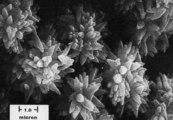
- FIG. 1 is an electron microscopic image showing an example of the form of Rosetta-type light calcium carbonate (secondary particles) in a state dispersed in a liquid.
- the bases of the respective primary particles are aggregated, and each primary particle extends radially toward the tip.
- each primary particle has a slightly larger width (diameter) at the base and narrows toward the tip.
- micron in a figure shows micrometer.
- the density of the support is lowered and the paper becomes bulky, and the cushioning property is improved.
- the ink receiving layer coating layer is pressed against the cast drum at the time of cast coating, the ink receiving layer easily adheres to the surface of the cast drum, and as a result, the glossiness of the obtained ink receiving layer is improved.
- Conceivable The higher the 20 degree gloss value, the better the glossiness.
- the 20 degree gloss is preferably 20% or more.
- the higher the value of image clarity the better the glossiness.
- the image clarity is preferably 50% or more, and particularly preferably 70% or more.
- the image clarity is measured on the surface of the ink receiving layer of the obtained inkjet recording medium using a image clarity measuring instrument (for example, model number: ICM-1DP, manufactured by Suga Test Instruments Co., Ltd.) according to JIS-K 7105. Can be measured. If the image clarity is 50% or more, the reflected image is clearly visible and the glossiness is excellent. When the image clarity is less than 50%, the reflected image appears unclear and the glossiness is inferior.
- the density of the support is preferably 0.8 g / cm 3 or less.
- the content of light calcium carbonate in the support is preferably 3 to 25% by mass, more preferably 10 to 20% by mass as ash as defined in JIS-P 8251.
- the ash content of the rosetta-type light calcium carbonate in the support increases, the glossiness of the surface of the ink receiving layer provided by the cast coating method is greatly improved, and the effect of improving the ink absorbency when printing is increased.
- the light calcium carbonate include other light calcium carbonates (for example, calcite type light calcium carbonate) in addition to the above-mentioned Rosetta type light calcium carbonate.
- the content (ash content) of the light calcium carbonate in the support indicates the total content (ash content) of these multiple types of light calcium carbonate.
- the light calcium carbonate ash content preferably does not exceed 25 mass%.
- the ash content specified in JIS-P 8251 represents the amount of ash residue after burning the sample (paper) at a temperature of 525 ⁇ 25 ° C. as a percentage of the absolute dry weight of the sample.
- fillers such as hydrated silicic acid, white carbon, talc, kaolin, clay, calcium carbonate (other than rosetta-type light calcium carbonate), titanium oxide, and synthetic resin fine particles. It can be appropriately selected and used in combination with the above-mentioned rosetta-type calcium carbonate.
- the filler other than the rosetta-type calcium carbonate is preferably 30% by mass or less of the entire filler in the support, and more preferably contains no filler other than the rosetta-type calcium carbonate.
- the air permeability of the support is preferably 1000 seconds or less from the viewpoint of the production efficiency of the ink jet recording medium, and the sticky size of the support is preferably 10 seconds or more from the viewpoint of coating properties. desirable.
- a liquid containing various additives such as a water-soluble polymer additive is coated on the support by an on-machine or off-machine using a tab size, size press, gate roll coater, film transfer coater, or the like. It is possible to work.
- water-soluble polymer additive examples include starch derivatives such as starch, cationized starch, oxidized starch, etherified starch, and phosphate esterified starch; polyvinyl alcohol derivatives such as polyvinyl alcohol and carboxy-modified polyvinyl alcohol; carboxymethylcellulose Cellulose derivatives such as hydroxymethyl cellulose, hydroxyethyl cellulose, cellulose sulfate; water-soluble natural polymers such as gelatin, casein, soybean protein; sodium polyacrylate, sodium styrene-maleic anhydride copolymer, sodium polystyrene sulfonate, etc. Water-soluble polymers such as maleic anhydride resins; aqueous polymer adhesives such as thermosetting synthetic resins such as melamine resins and urea resins are used.
- starch derivatives such as starch, cationized starch, oxidized starch, etherified starch, and phosphate esterified starch
- additives include petroleum resin emulsion as sizing agent, ammonium salt of styrene-maleic anhydride copolymer alkyl ester, alkyl ketene dimer, alkenyl succinic anhydride, styrene-butadiene copolymer, ethylene-vinyl acetate copolymer Examples thereof include dispersions such as coalescence, polyethylene, and polyvinylidene chloride. Examples of other additives include sodium chloride, calcium chloride, and bow glass, which are antistatic agents and inorganic electrolytes. Moreover, glycerin, polyethylene glycol, etc. are mentioned as a hygroscopic substance.
- additives examples include pigments such as clay, kaolin, talc, barium sulfate, titanium oxide, calcium carbonate, hydrated silicic acid, white carbon, and synthetic resin fine particles.
- pigments such as clay, kaolin, talc, barium sulfate, titanium oxide, calcium carbonate, hydrated silicic acid, white carbon, and synthetic resin fine particles.
- hydrochloric acid, caustic soda, sodium carbonate, etc. which are pH regulators, are used, and other additives such as dyes, fluorescent brighteners, antioxidants, ultraviolet absorbers can be used in combination. is there.
- the pigment of the ink receiving layer As the pigment of the ink receiving layer (the coating layer is made into an ink receiving layer by a coagulation cast coating method, but for convenience, the coating layer and the ink receiving layer are used without distinction), the pigment is colloidal particularly from the viewpoint of color development and gloss It is preferable to use silica. From the viewpoint of ink absorbability, it is preferable to use synthetic amorphous silica in combination with colloidal silica.
- the colloidal silica used in the ink receiving layer is preferably anionic. This is because the colloidal silica in the coagulant described later is cationic, and therefore it is preferable to use an anionic colloidal silica that causes an agglomeration reaction effective in improving the coagulability in the ink receiving layer.
- the primary particle size of the anionic colloidal silica is preferably 5 to 100 nm, more preferably 20 to 70 nm. When the primary particle diameter of the anionic colloidal silica is less than 5 nm, ink colorability may be lowered when printing is performed with an ink jet printer using pigment ink.
- the primary particle diameter of anionic colloidal silica exceeds 100 nm, the voids between the particles increase and the ink absorption of the ink receiving layer is improved. However, since the opacity increases, color development when ink-jet recording with a dye ink is performed. May decrease.
- synthetic amorphous silica may be used in combination as the pigment in the ink receiving layer.
- Synthetic amorphous silica can be roughly classified into wet process silica and gas phase process silica depending on the production method.
- Synthetic amorphous silica produced by a wet method (hereinafter referred to as “wet method synthetic amorphous silica”) is inferior to gas phase method silica in pigment transparency, but polyvinyl alcohol is bound to the ink receiving layer. Excellent paint stability when contained as an agent.
- the wet method synthetic amorphous silica has better dispersibility than the gas phase method silica having no internal voids, and can increase the coating concentration.
- the ratio of the pigment (to the binder) in the ink receiving layer can be increased, and the absorbability of the ink receiving layer can be increased, so that the ink absorbability can be improved and the color developability of the dye ink can be improved.
- the secondary particle diameter of the wet-process synthesized amorphous silica is preferably 1 to 5 ⁇ m, and the BET specific surface area is preferably 100 to 300 m 2 / g.
- the secondary particle diameter is smaller than 1 ⁇ m, the ink absorbability is inferior, and when it exceeds 4 ⁇ m, the glossiness tends to decrease.
- the primary particle diameter of the vapor phase silica is preferably 4 to 30 nm, and the BET specific surface area is preferably 100 to 400 m 2 / g.
- the mass blending ratio of colloidal silica and synthetic amorphous silica is preferably 10:90 to 60:40.
- the blending ratio of the colloidal silica is less than 10% by mass, the color developability and glossiness are inferior, and when the blending ratio of the colloidal silica exceeds 60% by mass, the ink absorbability tends to be inferior.
- inorganic fine particles and organic fine particles can be used in combination as other pigments in the ink receiving layer.
- Other pigments include, for example, alumina hydrate (alumina sol, colloidal alumina, pseudo boehmite, etc.), alumina ( ⁇ type crystal alumina, ⁇ type crystal alumina, ⁇ type crystal alumina, etc.), calcium carbonate, titanium dioxide Etc. can be used.
- alumina hydrate alumina sol, colloidal alumina, pseudo boehmite, etc.
- alumina ⁇ type crystal alumina, ⁇ type crystal alumina, ⁇ type crystal alumina, etc.
- calcium carbonate titanium dioxide Etc.
- the primary particle size of the pigment of the ink receiving layer and the cationic colloidal silica in the coagulant solution described later can be measured by the BET method particle size (measured by a nitrogen adsorption method), and the secondary particle size is determined by dynamic light.
- Each can be measured by a scattering particle size (measurement by laser diffraction / scattering method).
- the binder for the ink receiving layer preferably contains polyvinyl alcohol which is a water-based binder resin having a coagulating action.
- polyvinyl alcohol which is a water-based binder resin having a coagulating action.
- Other water-based binder resins may be used in combination with polyvinyl alcohol as necessary in order to ensure the strength of the ink receiving layer.
- aqueous means that the resin is dissolved or dispersed and stabilized (water-soluble and / or water-dispersible resin emulsion) in water or a medium composed of water and a small amount of an organic solvent.
- the water-based binder resin means a water-soluble resin or a water-dispersible resin.
- the aqueous binder resin is dissolved or dispersed in the coating liquid to be coated on the support, but after coating and drying, it becomes a binder for the pigment and forms an ink receiving layer.
- aqueous binder resins include, for example, polyvinyl pyrrolidone; urethane resin derived from urethane resin emulsion; starches such as oxidized starch and esterified starch; cellulose derivatives such as carboxymethyl cellulose and hydroxyethyl cellulose; casein; gelatin; soy protein; -Acrylic resin and derivatives thereof; styrene-butadiene resin latex; acrylic resin emulsion, vinyl acetate resin emulsion, vinyl chloride resin emulsion, urea resin emulsion, alkyd resin emulsion, and derivatives thereof. These aqueous binder resins can be used by mixing with polyvinyl alcohol.
- the polyvinyl alcohol is preferably partially saponified polyvinyl alcohol.
- the addition amount of polyvinyl alcohol is preferably 5 to 30 parts by mass with respect to 100 parts by mass of the total pigment in the ink receiving layer.
- the type of the binder is not particularly limited as long as the necessary ink receiving layer strength can be obtained.
- the ink receiving layer contains the above-described pigment and binder, but other components such as a thickener, an antifoaming agent, an antifoaming agent, a pigment dispersant, a release agent, a foaming agent, a pH adjusting agent, and a surface.
- Sizing agent, coloring dye, coloring pigment, fluorescent dye, ultraviolet absorber, antioxidant, light stabilizer, preservative, water resistance agent, dye fixing agent, surfactant, wet paper strength enhancer, water retention agent, cation In the range which does not impair the effect of this invention, a conductive polymer electrolyte etc. can be suitably added to the coating layer used as the precursor of an ink receiving layer.
- a known coating machine such as a coater or a short dwell coater can be appropriately selected from the coating methods used on-machine or off-machine.
- the coating amount of the ink receiving layer can be arbitrarily adjusted as long as the surface of the support is covered and sufficient ink absorbability is obtained.
- the coating amount of the ink receiving layer is preferably 3 to 25 g / m 2 in terms of solid content per one side of the support, and in particular, taking productivity into consideration. Then, it is preferably 5 to 20 g / m 2 . If the coating amount of the ink receiving layer exceeds 25 g / m 2 , the peelability from the mirror finish surface of the cast drum will be reduced, and problems such as adhesion of the coating layer to the mirror finish surface of the cast drum may occur. .
- the ink receiving layer when a large coating amount of the ink receiving layer (coating layer) is required, the ink receiving layer can be multilayered. Further, an undercoat layer having various functions such as ink absorptivity, adhesiveness and the like may be provided between the support and the ink receiving layer. Further, a back coat layer having various functions such as ink absorbability, writing property, printer printability and the like may be further provided on the side opposite to the surface on which the ink receiving layer is provided.
- gloss is imparted by forming the outermost ink receiving layer by a solidified cast coating method.
- the coagulation cast coating method is performed as follows, for example. First, an ink receiving layer coating solution is applied to a support to provide a coating layer. Next, a coagulant solution having the action of coagulating the binder (particularly the aqueous binder) in the coating layer is applied to the wet coating layer and gelled, and then applied to the heated mirror-finished surface. Crimp and dry.
- the coagulation cast coating method can provide the ink receiving layer with a surface feel and gloss comparable to silver salt photography.
- the coating layer is in a dry state when applying the coagulant solution, it is difficult to copy the surface of the mirror drum, and the surface of the resulting ink-receiving layer will have many fine irregularities, giving it the same glossiness as a silver salt photograph. Hateful.
- polyvinyl alcohol is used as the water-based binder of the ink receiving layer
- borate is used as the coagulant, so that it is easy to make the hardness at the time of solidification moderate, and the ink receiving layer Good glossiness can be imparted and operability is also improved.
- cationic colloidal silica is added to the coagulant solution in the present invention, when borate is used in the coagulant solution, it aggregates with the cationic colloidal silica. For this reason, when a borate is used, it may be difficult to prepare a coagulant solution.
- anionic colloidal silica is included in the ink-receiving layer coating solution, the coagulation reaction between the anionic coating solution and the cationic coagulant solution further improves print quality and provides high gloss. It is possible to provide an ink receiving layer having a stable operation.
- the coagulant solution used in the present invention contains a boron compound, a cationic resin, and cationic colloidal silica.
- the coagulant solution contains boric acid but does not contain borate.
- (Cationic colloidal silica) When cationic colloidal silica is added to the coagulant solution, the cationic colloidal silica adheres to (is present on) the surface of the ink receiving layer due to the cast coat.
- fine cationic colloidal silica having a primary particle size of 10 to 50 nm is present on the surface of the ink receiving layer, the printing density when printing with dye ink is improved.
- fine cationic colloidal silica having a primary particle diameter of 10 to 50 nm is present on the outermost surface of the ink receiving layer, the surface of the ink receiving layer becomes smooth and gloss is improved.
- Cationic colloidal silica is colloidal silica whose particle surface is highly positively charged.
- Cationic colloidal silica is, for example, aluminum ion, magnesium ion, calcium ion, zirconium ion, etc., compared to colloidal silica obtained by heating and aging silica sol obtained through metathesis or acid exchange resin layer of sodium silicate, etc. It can be obtained by reacting multivalent metal ions.
- Japanese Patent Publication No. 47-26959 discloses cationic colloidal silica by aluminum treatment.
- Examples of the commercially available cationic colloidal silica include LUDOX CL and LUDOX CL-P manufactured by Grace, SNOWTEX AK and SNOWTEX AK-L manufactured by Nissan Chemical Co., Ltd.
- two or more kinds of cationic colloidal silica may be mixed and used.
- the primary particle size of the cationic colloidal silica is preferably 10 to 50 nm.
- the primary particle size of the cationic colloidal silica is smaller than 10 nm, the glossiness of the ink receiving layer is excellent, but the absorbability of the dye ink may be inferior.
- the primary particle size of the cationic colloidal silica is larger than 50 nm, the transparency of the ink receiving layer is lowered, and the printing density when printing with a dye ink may be lowered.
- the primary particle diameter may exceed 50 nm, or the shapes such as tufts and rods may be different (various forms of agglomerated forms), and cationic colloidal silica may be used in combination. .
- the primary particle diameter of the cationic colloidal silica is preferably smaller than the primary particle diameter of the pigment of the ink receiving layer. In this way, the finest cationic colloidal silica covers the outermost surface of the ink receiving layer, so that the glossiness is improved.
- the “primary particle diameter of cationic colloidal silica” means the primary particle diameter of each cationic colloidal silica and the content ratio of each cationic colloidal silica. The weighted average value.
- the “primary particle diameter of the pigment” is a value obtained by weighted averaging the primary particle diameter of each pigment by the content ratio of each pigment.
- boric acid is preferably added to the coagulant solution to control coagulation, but boric acid is more solid (harder than borate). It is difficult to control. Therefore, an anionic colloidal silica is contained in the ink receiving layer coating solution so that the pH of the coating solution is 7 to 10 (30 ° C.), while the pH of the (cationic) coagulant solution is set to 1. By adjusting to ⁇ 4 (30 ° C.), solidification can be easily controlled even when boric acid is used, and stable operation is possible.
- the piping of the coating apparatus or the like may melt.
- the pH of the ink receiving layer coating solution is less than 7 or the pH of the coagulant solution is more than 4
- the coagulation reaction becomes insufficient and stable operation tends to be difficult.
- the cationic colloidal silica is preferably contained in an amount of 2 to 15% by mass in the coagulant solution.
- the content of the cationic colloidal silica is less than 2% by mass, the glossiness is lowered, and the printing density when printing with a dye ink may be lowered.
- the content rate of cationic colloidal silica exceeds 15 mass%, an aggregate (precipitate) will generate
- pigments other than cationic colloidal silica hydrated alumina (alumina sol, colloidal alumina, pseudoboehmite, etc.), alumina ( ⁇ type crystal alumina, ⁇ type crystal alumina, ⁇ type crystal alumina, etc.), etc. are cationic. Although it may be used by mixing with colloidal silica, the mixing ratio of the other pigment to the cationic colloidal silica is preferably 50% by mass or less.
- boric acid As the boron compound in the coagulant solution, boric acid is preferably used. It is preferable that 1 to 10% by mass of boric acid is contained in the coagulant solution. If the boric acid content is less than 1% by mass, the coagulation action may be insufficient. Moreover, when the content rate of boric acid exceeds 10 mass%, it cannot melt
- the cationic resin By including the cationic resin in the coagulant solution, the cationic resin adheres (exists) to the surface of the ink receiving layer by the coagulation cast coat.
- the cationic resin fixes the ink, improves the printing density when using the water-soluble dye ink, and further improves the water resistance.
- the electrically positive cationic resin and the cationic colloidal silica coexist so that they do not aggregate.
- the cationic resin examples include polyamine sulfone, polyalkylene polyamine, polyamine condensate, polyallylamine, polydiallylamine, polyvinylamine, polyethyleneimine, dicyandiamide condensate, cationic acrylic resin, and cationic urethane resin. Species or multiple species can be selected and used.
- the content of the cationic resin in the coagulant solution is not particularly limited, but it is preferably 0.5 to 10% by mass. When the content ratio of the cationic compound is less than 0.5% by mass, the ink fixing function is lowered, and the print density of the printed image may be lowered. When the content ratio of the cationic compound exceeds 10% by mass, the viscosity of the coagulant increases and the coatability may be deteriorated.
- the compounding quantity of the cationic colloidal silica in the coagulant solution applied to the front side is increased as compared with the back side so that the glossiness of the ink receiving layer on the front side becomes high.
- the surface of the support on which the ink receiving layer is first formed by the coagulation cast coating method (the surface on which cast coating is first performed) is referred to as “the surface side of the support”. Since the casting method cannot give gloss to both sides simultaneously, the first cast coated surface comes into contact with the roll and anticipates that the gloss will decrease, and the coagulating liquid is applied a second time to match this glossiness. Reduce the amount of colloidal silica in the coagulation liquid on the surface to match the gloss after casting on both sides.
- the 20 degree gloss of the ink receiving layer on the front side and the back side is adjusted.
- the degree of gloss becomes 20% or more, and the difference in glossiness between 20 degrees is within 5%, so that a double-sided glossy paper having the same glossiness on the front side and back side of the support can be obtained.
- the blending amount of the cationic colloidal silica in the coagulant solution applied to the coating layer on the surface side of the support is 10 to 15% by mass.
- the amount of the cationic colloidal silica can be 2 to 7% by mass. More preferably, the amount of the cationic colloidal silica in the coagulant solution applied to the coating layer on the surface side of the support is 13 to 15% by mass, and the coagulant applied to the coating layer on the back side of the support.
- the amount of the cationic colloidal silica in the solution is 5 to 7% by mass.
- the amount of cationic colloidal silica contained in the coagulant solution applied to the coating layer on the front side and the back side is in the range of 1.4 to 7.5 in terms of the ratio of (front side / back side).
- the amount of cationic colloidal silica present on the surface of the ink receiving layer after cast coating is similarly 1.4 to 7.5 in terms of (surface side / back side).
- the amount of the cationic colloidal silica contained in the coagulant solution applied to the coating layer on the front surface side and the back surface side is in the range of 2.5 to 3 in the ratio of (front surface side / back surface side).
- the amount of the cationic colloidal silica described above is less than 1.4 in the ratio of (front side / back side), the glossiness of the ink receiving layer on the front side tends to be lower than that on the back side. For this reason, the difference in glossiness between the ink-receiving layer on the front side and the back side of the support becomes large, resulting in images with different glossiness when printed on both sides. In the case of the spread state, the left and right glossiness is different.
- the amount of the above-described cationic colloidal silica is larger than 7.5 in the ratio of (front side / back side), the glossiness of the ink receiving layer on the back side tends to be lower than that on the front side. . For this reason, the difference in the glossiness of the ink receiving layer between the front surface side and the back surface side of the support increases.
- the method for applying the coagulant solution is not particularly limited as long as it can be applied to the coating layer, and can be appropriately selected from known methods (for example, roll method, spray method, curtain method, etc.).
- the adhesion amount of the coagulant (solution) is preferably 1 to 10 g / m 2 in terms of solid content.
- the adhesion amount of the coagulant is less than 1 g / m 2 , the coagulation effect is insufficient, and glossiness may not be sufficiently imparted to the ink receiving layer.
- Even when the adhesion amount of the coagulant exceeds 10 g / m 2 the effect of improving the glossiness of the ink receiving layer is saturated and the solid content concentration of the coagulant solution must be increased. There is.
- the concentration of the coagulant solution is preferably 3% by mass or more and less than 30% by mass. If the concentration of the coagulant solution is less than 3% by mass, the adhesion amount of the coagulant to the coating layer (below 1 g / m 2 in solid content) may be insufficient, and the coagulation action may be insufficient. Moreover, when the density
- a release agent can be added to the coating layer and / or the coagulant as necessary.
- the melting point of the release agent is preferably 90 to 150 ° C., and particularly preferably 95 to 120 ° C. In the above temperature range, since the melting point of the release agent is substantially equal to the temperature of the mirror finish surface, the ability as a release agent is maximized.
- the release agent is not particularly limited as long as it has the above characteristics, but it is preferable to use a polyethylene wax emulsion.
- the content of the release agent in the coagulant solution is not particularly limited, but is preferably 0.1 to 5% by mass.
- Example 1 Rosetta-type light calcium carbonate (Albuquer 5970) as a filler for a 350 ml Canadian standard freeness (CSF) pulp slurry consisting of 90 parts hardwood bleached kraft pulp (L-BKP) and 10 parts softwood bleached kraft pulp (N-BKP) : SMI) was added so that the ash content was 20%, and 1.0 part of aluminum sulfate, 0.20 part of alkyl ketene dimer (AKD), and 0.05 part of a yield improver were added. The slurry was used for paper making with a paper machine.
- CSF Canadian standard freeness
- the coating liquid A was coated on the surface of the support with a roll coater so that the coating amount was 12 g / m 2 in terms of solid content. While this coating layer is in a wet state, the coagulant solution B1 is solidified so that the amount of adhesion is 3.0 g / m 2 , solidified, and then heated through a press roll to a mirror finish The mirror surface was copied by pressure bonding to the surface to obtain a 195 g / m 2 single-sided glossy paper. Subsequently, the coating liquid A was coated on the back surface by a roll coater so that the coating amount was 12 g / m 2 in terms of solid content.
- the coagulant solution B2 is solidified so as to have an adhesion amount of 3.0 g / m 2 and solidified, and then heated through a press roll to a mirror finish.
- the mirror surface was copied by pressure bonding to the surface to obtain a recording medium for double-sided ink jet of 210 g / m 2 .
- ⁇ Coating liquid A> As a pigment, 20 parts of anionic colloidal silica (Quarton PL-3: manufactured by Fuso Chemical Industry Co., Ltd., average primary particle size 30 m), gas phase synthetic amorphous silica (Aerosil 200V: Nippon Aerosil) 10 parts manufactured by Co., Ltd., average primary particle diameter 12 nm) and 70 parts wet-process synthetic amorphous silica (Fine Seal X-37: manufactured by Tokuyama Co., Ltd., average secondary particle diameter 2.3 ⁇ m), polyvinyl as a binder 12 parts of alcohol (PVA217: manufactured by Kuraray Co., Ltd.), 1.5 parts of fluorescent dye (BLANKOPHORP liquid01: manufactured by LANXESS), 0.5 part of mold release agent (Maycatex HP68: manufactured by Meisei Chemical Co., Ltd.) 0.1 parts of a foaming agent (SN deformer 480: manufactured by San Nopco) was blended to prepare a coating solution having a
- ⁇ Coagulant solution B1> boric acid 4%, cationic resin (Saftomer ST3300: manufactured by Mitsubishi Chemical Corporation) 1%, cationic colloidal silica (LUDOX CL-P: manufactured by Grace, average primary particle size 22 nm) 15%
- a coagulant solution having a pH of 3 was prepared by blending 0.5 part of a release agent (Maycatex HP68: manufactured by Meisei Chemical Co., Ltd.) and 0.1% of an antifoaming agent (SN deformer 480: manufactured by San Nopco).
- ⁇ Coagulant solution B2> boric acid 4%, cationic resin (Saftomer ST3300: manufactured by Mitsubishi Chemical Corporation) 1%, cationic colloidal silica (LUDOX CL-P: manufactured by Grace, average primary particle size 22 nm) 2%
- a coagulant solution having a pH of 3 was prepared by blending 0.5 part of a release agent (Maycatex HP68: manufactured by Meisei Chemical Co., Ltd.) and 0.1% of an antifoaming agent (SN deformer 480: manufactured by San Nopco).
- Example 2 An inkjet recording medium was obtained in the same manner as in Example 1 except that the amount of the cationic colloidal silica (LUDOX CL-P: manufactured by Grace) in the coagulant solution B2 was changed to 5%.
- the amount of the cationic colloidal silica (LUDOX CL-P: manufactured by Grace) in the coagulant solution B2 was changed to 5%.
- Example 3 An ink jet recording medium was obtained in the same manner as in Example 1 except that the amount of the cationic colloidal silica (LUDOX CL-P: manufactured by Grace) in the coagulant solution B2 was changed to 7%.
- the amount of the cationic colloidal silica (LUDOX CL-P: manufactured by Grace) in the coagulant solution B2 was changed to 7%.
- Example 4 The blending amount of the cationic colloidal silica (LUDOX CL-P Grace, average primary particle size 22 nm) in the coagulant solution B1 was changed to 12.5%, and the cationic colloidal silica (LUDOX in the coagulant solution B2) An inkjet recording medium was obtained in the same manner as in Example 1 except that the blending amount of CL-P Grace, average primary particle size 22 nm) was changed to 5%.
- Example 5 The amount of the cationic colloidal silica (LUDOX CL-P, manufactured by Grace Co., Ltd., average primary particle size 22 nm) in the coagulant solution B1 was changed to 10%, and the cationic colloidal silica (LUDOX CL- in the coagulant solution B2) was changed.
- An ink jet recording medium was obtained in the same manner as in Example 1 except that the blending amount of P Grace (average primary particle size 22 nm) was changed to 5%.
- Example 6 The amount of the cationic colloidal silica (LUDOX CL-P, manufactured by Grace Co., Ltd., average primary particle size 22 nm) in the coagulant solution B1 was changed to 10%, and the cationic colloidal silica (LUDOX CL- in the coagulant solution B2) was changed.
- An ink jet recording medium was obtained in the same manner as in Example 1 except that the blending amount of P Grace Co., Ltd. (average primary particle size 22 nm) was changed to 7%.
- Example 7 An ink jet recording medium was obtained in the same manner as in Example 1 except that the cationic colloidal silica in each of the coagulant solutions B1 and B2 was changed to LUDOX CL (manufactured by Grace, average primary particle diameter: 12 nm).
- Example 8 An ink jet recording medium was obtained in the same manner as in Example 1 except that the cationic colloidal silica in each of the coagulant solutions B1 and B2 was changed to Snowtex AK (manufactured by Nissan Chemical Co., Ltd., average primary particle size: 12 nm).
- Example 11 Rosetta type light calcium carbonate (Albuquer 5970: manufactured by SMI Co.) as an ash content 15%, calcite type light calcium carbonate (PC: manufactured by Shiroishi Kogyo Co., Ltd.) as a filler in the paper support to have an ash content of 5%, and An ink jet recording medium was obtained in the same manner as in Example 1, except that the total amount of ash was 20%.
- Example 1 An inkjet recording medium was obtained in the same manner as in Example 11 except that no cationic colloidal silica was added to the coagulant solution B2.
- Example 6 Inkjet recording as in Example 1 except that the cationic colloidal silica in each of the coagulant solutions B1 and B2 was changed to colloidal silica having a primary particle size of 60 nm (Snowtex AK-YL: manufactured by Nissan Chemical Industries). A medium was obtained.
- Example 7 An ink jet recording medium was obtained in the same manner as in Example 1 except that boric acid was not blended in each of the coagulant solutions B1 and B2.
- the 20 ° glossiness of the unprinted portions of the surface of the ink-receiving layer on the front side and the back side of the obtained inkjet recording medium is determined according to JIS Z 8741. (Manufactured by True GLOSS GM-26PRO). If the 20 degree glossiness is 20% or more, there is no practical problem.
- Comparative Example 6 In the case of Comparative Example 6 in which the primary particle size of the cationic colloidal silica in the coagulant solution exceeded 50 nm, the 20-degree glossiness of the surface of the ink receiving layer on the front side and the back side was significantly reduced, and the print density was also reduced. . In the case of Comparative Example 7 in which boric acid was not blended in the coagulant solution, the coating layer was insufficiently solidified to deteriorate the cast coating property, and the glossiness could not be imparted to the ink receiving layer.
Landscapes
- Ink Jet Recording Methods And Recording Media Thereof (AREA)
Abstract
【課題】光沢感に優れ、染料インクを用いてインクジェット記録を行った際の印字濃度が高く、さらにインク吸収性および耐水性に優れると共に、両面の光沢感が均一なインクジェット用記録媒体を提供する。 【解決手段】透気性を有する支持体の表面及び裏面に、顔料及び結着剤を含む塗工層をそれぞれ設けた後、該塗工層の表面に前記結着剤と凝固する凝固剤溶液を塗布して凝固キャストコート法によりインク受理層を形成してなり、前記凝固剤溶液に含まれるホウ素化合物、カチオン性樹脂、及びカチオン性コロイダルシリカが前記インク受理層の表面に存在し、前記支持体の表面側及び裏面側の前記インク受理層表面の20度光沢度がそれぞれ20%以上であり、かつ各20度光沢度の差が5%以内であるインクジェット用記録媒体である。
Description
本発明は、両面に光沢を有するインクジェット用記録媒体に関する。
インクジェット用記録媒体は、紙等の支持体表面にシリカ、アルミナなどの多孔質の顔料と結着剤とを含有するインク受理層を設けた構成になっていて、このインク受理層にインクの液滴が定着するようになっている。そして、近年のインクジェットプリンターの目覚しい進歩や、デジタルカメラの著しい普及により、インクジェット用記録媒体に要求される品質も年々高くなってきている。特に、従来の銀塩写真に匹敵する光沢を有するインクジェット用記録媒体においては、品質要求が厳しく、技術開発が活発に行われている。
また、昨今のデジタルカメラやカメラ付き携帯電話の高品質化と目覚しい普及により、従来のように片面に印字する写真用紙としての使用以外に、両面に印字してアルバムにして写真鑑賞するなど、従来片面のみ印字されていたものが、両面印字で使用される機会が増えてきている。
また、昨今のデジタルカメラやカメラ付き携帯電話の高品質化と目覚しい普及により、従来のように片面に印字する写真用紙としての使用以外に、両面に印字してアルバムにして写真鑑賞するなど、従来片面のみ印字されていたものが、両面印字で使用される機会が増えてきている。
上記した光沢を有するインクジェット用記録媒体は、製造コストの点からキャストコーターを用いるキャストコート法で製造するのが一般的である。キャストコート法は、顔料と結着剤とを主成分とする塗工液を支持体上に塗工して塗工層を設け、その塗工層を加熱したキャストドラムに圧接して光沢仕上げする方法であり、この光沢塗工層が上記インク受理層となる。キャストコート法としては、(1)塗工層が湿潤状態にある間に鏡面仕上げした加熱ドラムに圧着して乾燥するウェットキャスト法(直接法)、(2)湿潤状態の塗工層を一旦乾燥又は半乾燥した後に再湿潤液により膨潤可塑化させ、鏡面仕上げした加熱ドラムに圧着し乾燥するリウェット法、(3)湿潤状態の塗工層を凝固処理によりゲル状態にして、鏡面仕上げした加熱ドラムに圧着し乾燥するゲル化キャスト法(凝固法)、の3種類が一般に知られている。各方法の原理は、湿潤状態の塗工層を鏡面仕上げの面に押し当てて、塗工層表面に光沢を付与するという点では同一である。
そして、このような光沢インクジェット用記録媒体に要求される品質特性としては、記録媒体表面の光沢感が高いこと、印字濃度が高いこと、インクの溢れや滲みがないこと、印字ムラ(濃淡ムラ)がないこと、耐候性が優れること等が挙げられ、これら特性を向上するためには、インク受理層の改善が必要となってくる。例えば、インク受理層を1層以上の層構成とし、少なくとも1層が300nm以下の平均粒径を有するコロイド粒子とカチオン性樹脂を含有する技術が報告されている(例えば、特許文献1参照)。又、キャスト塗工層中に、一次粒子径が30~100nmであるコロイダルシリカを含有する技術が報告されている(例えば、特許文献2参照)。
また、塗工層の接着剤と凝固し得る凝固剤を塗布し凝固法でインク受理層を形成する際、凝固剤にホウ素化合物、コロイダルシリカ及び樹脂を含有させる技術が報告されている(例えば、特許文献3参照)。
また、塗工層の接着剤と凝固し得る凝固剤を塗布し凝固法でインク受理層を形成する際、凝固剤にホウ素化合物、コロイダルシリカ及び樹脂を含有させる技術が報告されている(例えば、特許文献3参照)。
また、両面印字用の写真用紙への要求特性として、用紙の表面と裏面の光沢感がともに高く、かつ各面の光沢度が同等であることが求められている。
例えば、支持体の両面に、顔料とバインダー樹脂とを含有するインク受容層を設け、その上層に弱カチオン性あるいはアニオン性樹脂を含有する光沢度調整層を積層した両面インクジェット記録用媒体が報告されている(例えば特許文献4)。また、支持体上の一方の面に1層以上のインク受理層を設け、その反対面に塗工層を設け、該インク受理層と該塗工層との質量分塗布量差を4~10g/m2にした光沢紙が報告されている(例えば特許文献5)。さらに、透気性基材の両面に、顔料とバインダーとを含有するインク受容層を積層し、インク受容層上に光沢発現層を積層してなる複数の塗工層を有し、光沢発現層の厚さがインク受容層の厚さの1/10以下である両面インクジェット記録用シートが報告されている(例えば特許文献6)。
例えば、支持体の両面に、顔料とバインダー樹脂とを含有するインク受容層を設け、その上層に弱カチオン性あるいはアニオン性樹脂を含有する光沢度調整層を積層した両面インクジェット記録用媒体が報告されている(例えば特許文献4)。また、支持体上の一方の面に1層以上のインク受理層を設け、その反対面に塗工層を設け、該インク受理層と該塗工層との質量分塗布量差を4~10g/m2にした光沢紙が報告されている(例えば特許文献5)。さらに、透気性基材の両面に、顔料とバインダーとを含有するインク受容層を積層し、インク受容層上に光沢発現層を積層してなる複数の塗工層を有し、光沢発現層の厚さがインク受容層の厚さの1/10以下である両面インクジェット記録用シートが報告されている(例えば特許文献6)。
しかしながら、上記した特許文献1、2記載の技術の場合、インクジェット用記録媒体の高光沢化の点で改善の余地があり、さらに染料インクでインクジェット記録を行った場合にインク受理層に含有される顔料の平均粒子径が大きいため、印字濃度が低下するという問題がある。
また、特許文献3記載の技術の場合、インク受理層表面に平均粒子径が小さいコロイダルシリカが存在するため、染料インクの印字濃度は向上するが、インク受理層表面にインクを定着させるカチオン性樹脂が存在しないため、耐水性が悪化するという問題がある。
さらに、特許文献3記載の技術において、凝固剤中のコロイダルシリカがアニオン性の場合には、カチオン性樹脂と凝集を起こす。このため、カチオン性樹脂を添加できないのでインクの定着性が悪化し、インク吸収性および耐水性に劣る。また、上記コロイダルシリカがカチオン性の場合には、ホウ酸塩と凝集を起こすため、凝固剤中にホウ酸塩を添加できないので、凝固作用が不十分となり操業性に問題が発生する。
また、特許文献3記載の技術の場合、インク受理層表面に平均粒子径が小さいコロイダルシリカが存在するため、染料インクの印字濃度は向上するが、インク受理層表面にインクを定着させるカチオン性樹脂が存在しないため、耐水性が悪化するという問題がある。
さらに、特許文献3記載の技術において、凝固剤中のコロイダルシリカがアニオン性の場合には、カチオン性樹脂と凝集を起こす。このため、カチオン性樹脂を添加できないのでインクの定着性が悪化し、インク吸収性および耐水性に劣る。また、上記コロイダルシリカがカチオン性の場合には、ホウ酸塩と凝集を起こすため、凝固剤中にホウ酸塩を添加できないので、凝固作用が不十分となり操業性に問題が発生する。
一方、特許文献4記載の技術においては、支持体の表裏面に同一のインク受容層をそれぞれ塗工し、フィルム転写法により光沢を付与しているが、支持体の表裏面の光沢等に差があるため、表側と裏側のインク受容層の表面光沢が同一にならず、更にフィルム転写法で光沢を付与しているために製造効率が劣る。
また、特許文献5記載の技術の場合、支持体上の一方の面にインク受理層を設け、その反対面に塗工層を設けており、各層の構成が異なるために光沢度も表裏面で著しく異なる。
また、特許文献6記載の技術の場合も、透気性基材の両面に同一のインク受容層をそれぞれ設けているため、特許文献4記載の技術と同様に基材の表裏面の影響を受け、インク受容層の両面の光沢度が同一にならない。
また、特許文献5記載の技術の場合、支持体上の一方の面にインク受理層を設け、その反対面に塗工層を設けており、各層の構成が異なるために光沢度も表裏面で著しく異なる。
また、特許文献6記載の技術の場合も、透気性基材の両面に同一のインク受容層をそれぞれ設けているため、特許文献4記載の技術と同様に基材の表裏面の影響を受け、インク受容層の両面の光沢度が同一にならない。
従って、本発明は光沢感に優れ、染料インクを用いてインクジェット記録を行った際の印字濃度が高く、さらにインク吸収性および耐水性に優れると共に、両面の光沢感が均一なインクジェット用記録媒体を提供することを目的とする。
本発明者等は種々検討した結果、インク受理層の表面近傍にカチオン性コロイダルシリカを安定して存在させることで、上記課題を解決できることを見出した。
すなわち、本発明のインクジェット用記録媒体は、透気性を有する支持体の表面及び裏面に、顔料及び結着剤を含む塗工層をそれぞれ設けた後、該塗工層の表面に前記結着剤と凝固する凝固剤溶液を塗布して凝固キャストコート法によりインク受理層を形成してなるインクジェット用記録媒体であって、前記凝固剤溶液に含まれるホウ素化合物、カチオン性樹脂、及びカチオン性コロイダルシリカが前記インク受理層の表面に存在し、前記支持体の表面側及び裏面側の前記インク受理層表面の20度光沢度がそれぞれ20%以上であり、かつ各20度光沢度の差が5%以内であるインクジェット用記録媒体である。
前記支持体のうち最初に前記インク受理層を前記凝固キャストコート法により形成した面を前記支持体の表面側としたとき、前記支持体の表面側及び裏面側の前記インク受理層の表面にそれぞれ存在する前記カチオン性コロイダルシリカの量が、(前記表面側/前記裏面側)の比で1.4~7.5の範囲にあることが好ましい。
前記支持体は、軽質炭酸カルシウムをJIS-P 8251に規定される灰分として3~25質量%含有することが好ましい。
前記支持体は、軽質炭酸カルシウムをJIS-P 8251に規定される灰分として3~25質量%含有することが好ましい。
本発明によれば、染料インクを用いてインクジェット記録を行った際の印字濃度が高く、さらにインク吸収性および耐水性に優れると共に、両面の光沢感が均一なインクジェット用記録媒体が得られる。
以下本発明の実施形態について説明する。本発明のインクジェット用記録媒体は、透気性を有する支持体の両面に、凝固キャストコート法によりインク受理層を設けてなるものである。
(支持体)
本発明に使用される支持体は、キャストコート時にキャストドラムで発生する水蒸気を透過できる程度の透気性を有すれば、いずれのものを用いることが可能である。支持体としては、塗工紙、未塗工紙等の紙が好ましく用いられる。支持体の原料パルプとしては、化学パルプ(針葉樹の晒または未晒クラフトパルプ、広葉樹の晒または未晒クラフトパルプ等)、機械パルプ(グランドパルプ、サーモメカニカルパルプ、ケミサーモメカニカルパルプ等)、脱墨パルプ等を単独または任意の割合で混合して使用することが可能である。
又、原料パルプとして針葉樹パルプが含有されることが好ましい。支持体中に針葉樹パルプを配合すると、原紙の強度が向上するほか、インク受理層の光沢感が向上する傾向にある。但し、針葉樹パルプの含有量が多くなると支持体の表面性が低下する傾向にあるため、針葉樹パルプの含有量は全パルプ中30質量%以下であることが好ましい。尚、前記支持体のpHは、酸性、中性、アルカリ性のいずれでも良い。
本発明に使用される支持体は、キャストコート時にキャストドラムで発生する水蒸気を透過できる程度の透気性を有すれば、いずれのものを用いることが可能である。支持体としては、塗工紙、未塗工紙等の紙が好ましく用いられる。支持体の原料パルプとしては、化学パルプ(針葉樹の晒または未晒クラフトパルプ、広葉樹の晒または未晒クラフトパルプ等)、機械パルプ(グランドパルプ、サーモメカニカルパルプ、ケミサーモメカニカルパルプ等)、脱墨パルプ等を単独または任意の割合で混合して使用することが可能である。
又、原料パルプとして針葉樹パルプが含有されることが好ましい。支持体中に針葉樹パルプを配合すると、原紙の強度が向上するほか、インク受理層の光沢感が向上する傾向にある。但し、針葉樹パルプの含有量が多くなると支持体の表面性が低下する傾向にあるため、針葉樹パルプの含有量は全パルプ中30質量%以下であることが好ましい。尚、前記支持体のpHは、酸性、中性、アルカリ性のいずれでも良い。
支持体は、ロゼッタ(rosette)型軽質炭酸カルシウムを填料として含有することが好ましい。ロゼッタ型軽質炭酸カルシウムとは、紡錘形状の軽質炭酸カルシウムの一次粒子が放射状に凝集してロゼッタ型の二次粒子を形成したものであり、具体的にはSpecialty Minerals Inc.社のアルバカーHO、アルバカー5970、アルバカーLO等の製品を好ましく挙げることができる。ここで、放射状とは、例えば、前記二次粒子の中心近傍から、各一次粒子の長手方向が放射状に伸びたものである。
軽質炭酸カルシウムは生産コストや操業性の点、及び添加量が少ない場合でも高い不透明度が得られる点で優れており、さらにロゼッタ型の軽質炭酸カルシウムはその特殊な形状のため、支持体中に高い割合で配合させると不透明度が大きく向上し、インクジェット記録の際の裏抜けを有効に防止する。さらに、ロゼッタ型軽質炭酸カルシウムは、従来の軽質炭酸カルシウムと比較して比表面積も大きいため、インク吸収性に優れた支持体が得られる。特に、インク受理層の塗工量が少ない場合に、ロゼッタ型軽質炭酸カルシウムを用いるとインク吸収性が大きくなる効果を得ることができる。
ロゼッタ型軽質炭酸カルシウムの平均粒子径は1.0~5.0μmであることが好ましい。平均粒子径はレーザー回折・散乱法によって測定され、例えば、シスメックス社製「マスターサイザー2000」にて測定することができる。ロゼッタ型軽質炭酸カルシウムの平均粒子径が1.0μm未満である場合、光の透過性が向上するために支持体の不透明性が低下し、結果として記録用紙の裏面から印字画像が透けて見えたり、裏抜けが発生することがある。また、ロゼッタ型軽質炭酸カルシウムの平均粒子径が5.0μmを超える場合、填料であるロゼッタ型軽質炭酸カルシウムの分布が不均一となり、支持体の不透明性が低下し、裏抜けが発生したり品質安定性が低下する傾向にある。
ロゼッタ型軽質炭酸カルシウムの吸油量は、90~300ml/100gであることが好ましく、90~140ml/100gであることが特に好ましい。ロゼッタ型軽質炭酸カルシウムの吸油量が90ml/100g未満の場合、得られたインクジェット用記録媒体のインク吸収性が低下する傾向にある。一方、ロゼッタ型軽質炭酸カルシウムの吸油量が300ml/100gを超える場合、支持体の吸収性が大きくなり過ぎ、インク受理層用塗工液を塗工した際にバインダー成分のみが紙中に浸透しやすい。その結果としてインク受理層の表面強度が低下し、断裁時の粉落ちなどの問題が生じることがある。
図1は、液中に分散した状態のロゼッタ型軽質炭酸カルシウム(二次粒子)の形態の一例を示す電子顕微鏡像である。この図において、各一次粒子の基部同士が凝集し、各一次粒子がその先端へ向かって放射状に伸びている。また、各一次粒子は基部の幅(径)がやや大きく、先端に向かって細くなっている。なお、図中のmicronは、μmを示す。
填料としてロゼッタ型軽質炭酸カルシウムを含有する支持体上に、インク受理層をキャストコート法で設けると、ロゼッタ型軽質炭酸カルシウムを填料として含有しない支持体を用いた場合と比較して、JIS-Z 8741に規定されるインク受理層表面の20度光沢度が向上する。この理由は明らかではないが、次のように考えられる。
填料としてロゼッタ型軽質炭酸カルシウムを含有する支持体上に、インク受理層をキャストコート法で設けると、ロゼッタ型軽質炭酸カルシウムを填料として含有しない支持体を用いた場合と比較して、JIS-Z 8741に規定されるインク受理層表面の20度光沢度が向上する。この理由は明らかではないが、次のように考えられる。
まず、ロゼッタ型軽質炭酸カルシウムを紙中に配合すると、支持体の密度が低下して嵩高な紙となり、クッション性が向上する。このため、キャストコート時にインク受理層用塗工層をキャストドラムに圧接した際、インク受理層がキャストドラム表面に密着し易くなり、その結果として、得られたインク受理層の光沢感が向上すると考えられる。20度光沢度の値が高いほど光沢感が優れており、本発明においては20度光沢度が20%以上であることが好ましい。また、写像性の数値が高いほど光沢感が優れており、本発明において、写像性は50%以上であることが好ましく、特に70%以上であることが好ましい。写像性は、得られたインクジェット用記録媒体のインク受理層表面に対し、JIS-K 7105に準じて、写像性測定器(例えば、型番:ICM-1DP、スガ試験機株式会社製)を用いて測定することができる。写像性が50%以上であれば反射した像が鮮明に写り、光沢感に優れている。写像性が50%未満の場合、反射した像が不鮮明に写り、光沢感に劣る。なお、支持体の密度は0.8g/cm3以下であることが好ましい。
支持体中における軽質炭酸カルシウムの含有量は、JIS-P 8251に規定される灰分として3~25質量%であることが好ましく、10~20質量%であることがより好ましい。支持体中のロゼッタ型軽質炭酸カルシウムの灰分が高くなるほど、キャストコート法で設けたインク受理層表面の光沢感が大きく向上すると共に、印字した場合のインク吸収性向上の効果が大きくなる。軽質炭酸カルシウムとしては、上記したロゼッタ型軽質炭酸カルシウムの他、他の軽質炭酸カルシウム(例えば、カルサイト型軽質炭酸カルシウム)が挙げられる。又、本発明において、複数種類の軽質炭酸カルシウムを用いる場合、支持体中における軽質炭酸カルシウムの含有量(灰分)は、これら複数種類の軽質炭酸カルシウムを合計した含有量(灰分)を示す。
軽質炭酸カルシウムの灰分が3質量%未満の場合は、光沢およびインク吸収性の向上効果が少ない場合がある。また、軽質炭酸カルシウムの灰分が高くなるほど、光沢およびインク吸収性の向上効果が高くなるが、灰分が25質量%を超えると、粉落ちが発生したり、支持体の強度が低下する等の問題が発生する場合がある。従って、製造コストと効果のバランスを考慮すると、軽質炭酸カルシウムの灰分は25質量%を超えないことが好ましい。
なお、JIS-P 8251に規定する灰分は、試料(紙)を525±25℃の温度で燃焼させた後の灰分残留物の量を、試料の絶乾重量に対する百分率で表したものである。
本発明の効果を損なわない範囲で、水和珪酸、ホワイトカーボン、タルク、カオリン、クレー、炭酸カルシウム(ロゼッタ型軽質炭酸カルシウム以外のもの)、酸化チタン、合成樹脂微粒子等の公知の填料の中から適宜選択し、上記ロゼッタ型炭酸カルシウムと併用して紙中に含有させることができる。ロゼッタ型炭酸カルシウム以外の填料は、支持体中の填料全体の30質量%以下であることが好ましく、ロゼッタ型炭酸カルシウム以外の填料を含有しないことがより好ましい。
インクジェット用記録媒体の生産効率の点から、支持体の透気度は1000秒以下であることが好ましく、又、塗工性の点から支持体のステキヒトサイズ度は10秒以上であることが望ましい。
また、上記支持体には、水溶性高分子添加剤等の各種の添加剤を含有する液を、タブサイズ、サイズプレス、ゲートロールコーター又はフィルムトランスファーコーター等を用い、オンマシン又はオフマシンで塗工することが可能である。
上記水溶性高分子添加剤としては、例えば、澱粉、カチオン化澱粉、酸化澱粉、エーテル化澱粉、リン酸エステル化澱粉等の澱粉誘導体;ポリビニルアルコール、カルボキシ変性ポリビニルアルコール等のポリビニルアルコール誘導体;カルボキシメチルセルロース、ヒドロキシメチルセルロース、ヒドロキシエチルセルロース、セルロースサルフェート等のセルロース誘導体;ゼラチン、カゼイン、大豆蛋白等の水溶性天然高分子;ポリアクリル酸ナトリウム、スチレン-無水マレイン酸共重合体ナトリウム塩、ポリスチレンスルフォン酸ナトリウム等、無水マレイン酸樹脂等の水溶性高分子;メラミン樹脂、尿素樹脂等の熱硬化性合成樹脂等の水性高分子接着剤等が用いられる。
上記水溶性高分子添加剤としては、例えば、澱粉、カチオン化澱粉、酸化澱粉、エーテル化澱粉、リン酸エステル化澱粉等の澱粉誘導体;ポリビニルアルコール、カルボキシ変性ポリビニルアルコール等のポリビニルアルコール誘導体;カルボキシメチルセルロース、ヒドロキシメチルセルロース、ヒドロキシエチルセルロース、セルロースサルフェート等のセルロース誘導体;ゼラチン、カゼイン、大豆蛋白等の水溶性天然高分子;ポリアクリル酸ナトリウム、スチレン-無水マレイン酸共重合体ナトリウム塩、ポリスチレンスルフォン酸ナトリウム等、無水マレイン酸樹脂等の水溶性高分子;メラミン樹脂、尿素樹脂等の熱硬化性合成樹脂等の水性高分子接着剤等が用いられる。
その他の添加剤としては、サイズ剤として石油樹脂エマルション、スチレン-無水マレイン酸共重合体アルキルエステルのアンモニウム塩、アルキルケテンダイマー、アルケニル無水コハク酸、スチレン-ブタジエン共重合体、エチレン-酢酸ビニル共重合体、ポリエチレン、ポリ塩化ビニリデン等のディスパーションが挙げられる。
その他の添加剤としては、帯電防止剤であり無機電解質である塩化ナトリウム、塩化カルシウム、ボウ硝等が挙げられる。又、吸湿性物質としてグリセリン、ポリエチレングリコール等が挙げられる。
その他の添加剤としては、顔料であるクレー、カオリン、タルク、硫酸バリウム、酸化チタン、炭酸カルシウム、水和珪酸、ホワイトカーボン、合成樹脂微粒子等が挙げられる。その他の添加剤として、pH調節剤である塩酸、苛性ソーダ、炭酸ソーダ等が用いられ、その他染料、蛍光増白剤、酸化防止剤、紫外線吸収剤等の添加剤を組み合わせて使用することも可能である。
その他の添加剤としては、帯電防止剤であり無機電解質である塩化ナトリウム、塩化カルシウム、ボウ硝等が挙げられる。又、吸湿性物質としてグリセリン、ポリエチレングリコール等が挙げられる。
その他の添加剤としては、顔料であるクレー、カオリン、タルク、硫酸バリウム、酸化チタン、炭酸カルシウム、水和珪酸、ホワイトカーボン、合成樹脂微粒子等が挙げられる。その他の添加剤として、pH調節剤である塩酸、苛性ソーダ、炭酸ソーダ等が用いられ、その他染料、蛍光増白剤、酸化防止剤、紫外線吸収剤等の添加剤を組み合わせて使用することも可能である。
(インク受理層の顔料)
インク受理層(塗工層を凝固キャストコート法によりインク受理層とするが、便宜上、塗工層とインク受理層を区別せずに用いる)の顔料としては、特に発色性および光沢の点からコロイダルシリカを用いることが好ましい。またインク吸収性の点から、合成非晶質シリカをコロイダルシリカと併用することが好ましい。
インク受理層(塗工層を凝固キャストコート法によりインク受理層とするが、便宜上、塗工層とインク受理層を区別せずに用いる)の顔料としては、特に発色性および光沢の点からコロイダルシリカを用いることが好ましい。またインク吸収性の点から、合成非晶質シリカをコロイダルシリカと併用することが好ましい。
上記インク受理層中に使用するコロイダルシリカは、アニオン性であることが好ましい。これは後述する凝固剤中のコロイダルシリカがカチオン性であるため、凝固性の向上に効果がある凝集反応を起こすアニオン性コロイダルシリカをインク受理層中に使用することが好ましいからである。また、アニオン性コロイダルシリカの一次粒子径は5~100nmであることが好ましく、さらに好ましくは20~70nmである。アニオン性コロイダルシリカの一次粒子径が5nm未満であると、顔料インクを用いたインクジェットプリンターで印字した場合にインク発色性が低下する場合がある。アニオン性コロイダルシリカの一次粒子径が100nmを超えると、粒子間の空隙が増えてインク受理層のインク吸収性は良好となるが、不透明性が増大するため、染料インクでインクジェット記録した際の発色性が低下する場合がある。
インク受理層中の顔料として、コロイダルシリカに加えて合成非晶質シリカを併用してもよい。合成非晶質シリカはその製造法により、湿式法シリカと気相法シリカとに大別できる。
湿式法で製造された合成非晶質シリカ(以下、「湿式法合成非晶質シリカ」と称する)は、顔料の透明性が気相法シリカに劣るが、ポリビニルアルコールをインク受理層の結着剤として含有した場合の塗料安定性に優れる。さらに、湿式法合成非晶質シリカは、内部空隙の無い気相法シリカに比べて分散性が良好であり、塗料濃度を高くすることが可能である。そのため、インク受理層中の(結着剤に対する)顔料の割合を高くすることができ、インク受理層の吸収性を高くできるので、インク吸収性を向上できると共に染料インクの発色性を向上できる。高い光沢感を得るという点から湿式法合成非晶質シリカの二次粒子径は1~5μmであることが好ましく、BET比表面積は100~300m2/gであることが好ましい。上記二次粒子径が1μmより小さいとインク吸収性が劣り、4μmを超えると光沢感が低下する傾向にある。
また、透明度の高い塗工層を得るという点から気相法シリカを用いてもよい。気相法シリカの一次粒子径は4~30nmであることが好ましく、そのBET比表面積は100~400m2/gであることが好ましい。
湿式法で製造された合成非晶質シリカ(以下、「湿式法合成非晶質シリカ」と称する)は、顔料の透明性が気相法シリカに劣るが、ポリビニルアルコールをインク受理層の結着剤として含有した場合の塗料安定性に優れる。さらに、湿式法合成非晶質シリカは、内部空隙の無い気相法シリカに比べて分散性が良好であり、塗料濃度を高くすることが可能である。そのため、インク受理層中の(結着剤に対する)顔料の割合を高くすることができ、インク受理層の吸収性を高くできるので、インク吸収性を向上できると共に染料インクの発色性を向上できる。高い光沢感を得るという点から湿式法合成非晶質シリカの二次粒子径は1~5μmであることが好ましく、BET比表面積は100~300m2/gであることが好ましい。上記二次粒子径が1μmより小さいとインク吸収性が劣り、4μmを超えると光沢感が低下する傾向にある。
また、透明度の高い塗工層を得るという点から気相法シリカを用いてもよい。気相法シリカの一次粒子径は4~30nmであることが好ましく、そのBET比表面積は100~400m2/gであることが好ましい。
コロイダルシリカと合成非晶質シリカの質量配合割合(コロイダルシリカ:合成非晶質シリカ)は、10:90~60:40であること好ましい。コロイダルシリカの配合割合が10質量%未満の場合には発色性および光沢感に劣り、コロイダルシリカの配合割合が60質量%を超えるとインク吸収性に劣る傾向にある。
上記したコロイダルシリカや合成非晶質シリカに加え、公知の無機微粒子や有機微粒子を、インク受理層中の他の顔料として併用することができる。他の顔料としては、例えば、アルミナ水和物(アルミナゾル、コロイダルアルミナ、擬ベーマイト等)、アルミナ(α型結晶のアルミナ、θ型結晶のアルミナ、γ型結晶のアルミナ等)、炭酸カルシウム、二酸化チタン等を用いることができる。但し、印字品質および光沢感の観点より、顔料はコロイダルシリカおよび合成非晶質シリカのみを用いることが好ましい。
本発明において、インク受理層の顔料、及び後述する凝固剤溶液中のカチオン性コロイダルシリカの一次粒径はBET法粒子径(窒素吸着法による測定)で測定でき、二次粒子径は動的光散乱法粒子径(レーザー回折・散乱法による測定)でそれぞれ測定できる。
(インク受理層の結着剤)
インク受理層の結着剤としては、凝固作用を有する水系バインダー樹脂であるポリビニルアルコールを含むことが好ましい。その他の水系バインダー樹脂もインク受理層の強度を確保するため、必要に応じてポリビニルアルコールと併用してもよい。なお、「水系」とは、水又は水と少量の有機溶剤からなる媒体中で樹脂が溶解又は分散し、安定化すること(水溶性及び/又は水分散性の樹脂エマルジョン)を意味する。ここで、水系バインダー樹脂とは水溶性樹脂又は水分散性樹脂を意味する。水系バインダー樹脂は、支持体に塗工する塗工液中では溶解又は粒子となって分散しているが、塗工し乾燥した後に顔料の結着剤となり、インク受理層を形成する。
インク受理層の結着剤としては、凝固作用を有する水系バインダー樹脂であるポリビニルアルコールを含むことが好ましい。その他の水系バインダー樹脂もインク受理層の強度を確保するため、必要に応じてポリビニルアルコールと併用してもよい。なお、「水系」とは、水又は水と少量の有機溶剤からなる媒体中で樹脂が溶解又は分散し、安定化すること(水溶性及び/又は水分散性の樹脂エマルジョン)を意味する。ここで、水系バインダー樹脂とは水溶性樹脂又は水分散性樹脂を意味する。水系バインダー樹脂は、支持体に塗工する塗工液中では溶解又は粒子となって分散しているが、塗工し乾燥した後に顔料の結着剤となり、インク受理層を形成する。
その他の水系バインダー樹脂としては、例えば、ポリビニルピロリドン;ウレタン樹脂エマルジョン由来のウレタン樹脂;酸化澱粉、エステル化澱粉等の澱粉類;カルボキシメチルセルロース、ヒドロキシエチルセルロース等のセルロース誘導体;カゼイン;ゼラチン;大豆タンパク;スチレン-アクリル樹脂及びその誘導体;スチレン-ブタジエン樹脂ラテックス;アクリル樹脂エマルジョン、酢酸ビニル樹脂エマルジョン、塩化ビニル樹脂エマルジョン、尿素樹脂エマルジョン、アルキッド樹脂エマルジョン及びこれらの誘導体等が挙げられる。これらの水系バインダー樹脂をポリビニルアルコールと混合して用いることができる。
本発明においては、ポリビニルアルコールは部分鹸化のポリビニルアルコールが好ましい。ポリビニルアルコールの添加量は、インク受理層中の全顔料100質量部に対して5質量部から30質量部であることが好ましい。但し、必要なインク受理層の強度が得られる限り、結着剤の種類は特に限定されるものではない。
インク受理層は、上記した顔料と結着剤を含むが、その他の成分、例えば、増粘剤、消泡剤、抑泡剤、顔料分散剤、離型剤、発泡剤、pH調整剤、表面サイズ剤、着色染料、着色顔料、蛍光染料、紫外線吸収剤、酸化防止剤、光安定化剤、防腐剤、耐水化剤、染料定着剤、界面活性剤、湿潤紙力増強剤、保水剤、カチオン性高分子電解質等を、本発明の効果を損なわない範囲内で、インク受理層の前駆体となる塗工層に適宜添加することができる。
支持体上にインク受理層となる塗工液を塗布する方法としては、ブレードコーター、エアナイフコーター、ロールコーター、ブラッシュコーター、キスコーター、スクイズコーター、カーテンコーター、ダイコーター、バーコーター、グラビアコーター、ゲートロールコーター、ショートドウェルコーター等の公知の塗工機をオンマシン、又はオフマシンで用いた塗工方法の中から適宜選択して使用することができる。
インク受理層の塗工量は、支持体の表面を覆い、かつ充分なインク吸収性が得られる範囲で任意に調整することができる。記録濃度及びインク吸収性を両立させる観点から、インク受理層の塗工量は、支持体の片面当たり、固形分換算で3~25g/m2であることが好ましく、特に、生産性をも加味すると5~20g/m2であることが好ましい。インク受理層の塗工量が25g/m2を超えると、キャストドラム鏡面仕上げ面からの剥離性が低下し、塗工層がキャストドラム鏡面鏡面仕上げ面に付着するなどの問題を生じることがある。
本発明において、インク受理層(塗工層)の塗工量を多く必要とする場合には、インク受理層を多層にすることも可能である。また、支持体とインク受理層の間にインク吸収性、接着性その他の各種機能を有するアンダーコート層を設けても良い。さらに、インク受理層を設けた面の反対側にさらにインク吸収性、筆記性、プリンター印字適性他各種機能を有するバックコート層を設けても良い。
(インク受理層の形成)
本発明においては、最表面のインク受理層を凝固キャストコート法で形成することによって光沢を付与する。凝固キャストコート法は、例えば、以下のようにして行う。まず、インク受理層用塗工液を支持体に塗布して、塗工層を設ける。次に、塗工層中の結着剤(特に水系結着剤)を凝固させる作用を有する凝固剤溶液を湿潤状態の塗工層に塗布してゲル化させてから、加熱した鏡面仕上げ面に圧着、乾燥する。凝固キャストコート法は、銀塩写真に匹敵する面感、光沢をインク受理層に付与することが可能である。
本発明においては、最表面のインク受理層を凝固キャストコート法で形成することによって光沢を付与する。凝固キャストコート法は、例えば、以下のようにして行う。まず、インク受理層用塗工液を支持体に塗布して、塗工層を設ける。次に、塗工層中の結着剤(特に水系結着剤)を凝固させる作用を有する凝固剤溶液を湿潤状態の塗工層に塗布してゲル化させてから、加熱した鏡面仕上げ面に圧着、乾燥する。凝固キャストコート法は、銀塩写真に匹敵する面感、光沢をインク受理層に付与することが可能である。
凝固剤溶液を塗布する際に塗工層が乾燥状態であると鏡面ドラム表面を写し取ることが難しく、得られたインク受理層表面に微小な凹凸が多くなり、銀塩写真並の光沢感を得にくい。特にインク受理層の水系結着剤としてポリビニルアルコールを用いた場合には、凝固剤としてホウ酸塩を用いることにより、凝固時の固さを適度なものとすることが容易となり、インク受理層に良好な光沢感を付与でき、操業性も良好となる。しかしながら、後述するように、本発明ではカチオン性コロイダルシリカを凝固剤溶液に添加するので、凝固剤溶液にホウ酸塩を用いるとカチオン性コロイダルシリカと凝集する。このため、ホウ酸塩を使用すると凝固剤溶液の調製が困難となる場合がある。
そこで、本発明においては、凝固剤溶液にホウ酸塩を加えずにホウ酸を含有し、インク受理層中のポリビニルアルコールと架橋反応で凝固させ、印字品質に優れ、高い光沢を有するインク受理層を付与すると好ましい。さらにアニオン性のコロイダルシリカをインク受理層用塗工液に含む場合は、このアニオン性の塗工液とカチオン性の凝固剤溶液による凝集反応による凝固作用によって、さらに印字品質に優れ、高い光沢を有するインク受理層を付与することが可能となり、安定操業が可能となる。
(凝固剤溶液の成分)
本発明に用いる前記凝固剤溶液は、ホウ素化合物、カチオン性樹脂、及びカチオン性コロイダルシリカを含む。特に、凝固剤溶液がホウ酸を含有する一方で、ホウ酸塩を含有しないことが好ましい。
本発明に用いる前記凝固剤溶液は、ホウ素化合物、カチオン性樹脂、及びカチオン性コロイダルシリカを含む。特に、凝固剤溶液がホウ酸を含有する一方で、ホウ酸塩を含有しないことが好ましい。
(カチオン性コロイダルシリカ)
凝固剤溶液中にカチオン性コロイダルシリカを添加すると、キャストコートによってインク受理層の表面近傍にカチオン性コロイダルシリカが付着(存在)する。一次粒子径10~50nmの微細なカチオン性コロイダルシリカがインク受理層の表面に存在すると、染料インクで印字した際の印字濃度が向上する。又、一次粒子径10~50nmの微細なカチオン性コロイダルシリカがインク受理層の最表面に存在するため、インク受理層の表面が平滑になり、光沢が向上する。
凝固剤溶液中にカチオン性コロイダルシリカを添加すると、キャストコートによってインク受理層の表面近傍にカチオン性コロイダルシリカが付着(存在)する。一次粒子径10~50nmの微細なカチオン性コロイダルシリカがインク受理層の表面に存在すると、染料インクで印字した際の印字濃度が向上する。又、一次粒子径10~50nmの微細なカチオン性コロイダルシリカがインク受理層の最表面に存在するため、インク受理層の表面が平滑になり、光沢が向上する。
カチオン性コロイダルシリカは、その粒子表面が高い陽性電荷を帯びているコロイダルシリカである。カチオン性コロイダルシリカは、例えば、ケイ酸ナトリウムの酸などによる複分解やイオン交換樹脂層を通して得られるシリカゾルを加熱熟成して得られるコロイダルシリカに対し、アルミニウムイオン、マグネシウムイオン、カルシウムイオン、又はジルコニウムイオン等の多価金属イオンを反応させて得られる。例えば、特公昭47-26959号公報にはアルミニウム処理によるカチオン性コロイダルシリカが開示されている。
市販されているカチオン性コロイダルシリカとしては、グレース社のLUDOX CL、LUDOX CL-P、日産化学社製のスノーテックス AK、スノーテックス AK-L等が挙げられる。本発明では2種以上のカチオン性コロイダルシリカを混合して使用してもよい。
市販されているカチオン性コロイダルシリカとしては、グレース社のLUDOX CL、LUDOX CL-P、日産化学社製のスノーテックス AK、スノーテックス AK-L等が挙げられる。本発明では2種以上のカチオン性コロイダルシリカを混合して使用してもよい。
インク受理層の光沢性、透明度を向上させる観点から、カチオン性コロイダルシリカの一次粒子径を10~50nmとすることが好ましい。カチオン性コロイダルシリカの一次粒子径が10nmより小さいと、インク受理層の光沢感は優れるが、染料インクの吸収性が劣る場合がある。一方、カチオン性コロイダルシリカの一次粒子径が50nmより大きいと、インク受理層の透明度が低下し、染料インクで印字した際の印字濃度が低下する場合がある。さらにインク吸収性を補う目的で、一次粒子径が50nmを超えたり、房状や繭状等の形状が異なる(各種の不定形の凝集形態をとるもの)カチオン性コロイダルシリカを併用してもよい。
又、インク受理層の最表面を平滑にし、光沢度を向上させる観点から、カチオン性コロイダルシリカの一次粒子径は、インク受理層の顔料の一次粒子径より小さいことが好ましい。このようにすると、インク受理層の最表面を微細なカチオン性コロイダルシリカが覆うため、光沢度が向上する。
なお、一次粒子径の異なる2種類以上のカチオン性コロイダルシリカを用いる場合、「カチオン性コロイダルシリカの一次粒子径」とは、各カチオン性コロイダルシリカの一次粒子径を各カチオン性コロイダルシリカの含有割合で加重平均した値とする。同様に、インク受理層の顔料として一次粒子径の異なる2種類以上の顔料を用いる場合、「顔料の一次粒子径」とは、各顔料の一次粒子径を各顔料の含有割合で加重平均した値とする。
なお、カチオン性コロイダルシリカは、ホウ酸塩と凝集するため、本発明では好ましくはホウ酸を凝固剤溶液に添加して凝固をコントロールするが、ホウ酸はホウ酸塩に比べて凝固の(硬さの)制御が難しい。そこで、インク受理層用塗工液にアニオン性コロイダルシリカを含有させて、該塗工液のpHを7~10(30℃)とし、一方で、(カチオン性の)凝固剤溶液のpHを1~4(30℃)に調整することで、ホウ酸を用いても凝固を制御し易くなり、安定操業が可能となる。ここで、インク受理層用塗工液のpHが10を超えるか、又は凝固剤溶液のpHが1未満であると、塗工装置等の配管が溶け出す可能性がある。一方、インク受理層用塗工液のpHが7未満か、又は凝固剤溶液のpHが4を超える場合、凝固反応が不十分となり、安定操業が難しくなる傾向にある。
カチオン性コロイダルシリカは凝固剤溶液中に2~15質量%含有されることが好ましい。カチオン性コロイダルシリカの含有割合が2質量%未満であると、光沢度が低下し、染料インクで印字した際の印字濃度が低下する場合がある。また、カチオン性コロイダルシリカの含有割合が15質量%を超えると凝集体(析出物)が発生し、操業トラブルとなる場合がある。
カチオン性コロイダルシリカ以外の顔料として、アルミナ水和物(アルミナゾル、コロイダルアルミナ、擬ベーマイト等)、アルミナ(α型結晶のアルミナ、θ型結晶のアルミナ、γ型結晶のアルミナ等)等を、カチオン性コロイダルシリカと混合して使用してもよいが、カチオン性コロイダルシリカに対するその他の顔料の混合比率は50質量%以下とすることが望ましい。
(ホウ素化合物)
凝固剤溶液中のホウ素化合物としてはホウ酸を用いることが好ましい。凝固剤溶液中にホウ酸が1~10質量%含有されることが好ましい。ホウ酸の含有割合が1質量%未満であると凝固作用が不十分となる場合がある。また、ホウ酸の含有割合が10質量%を超えると水に溶解することができず、凝集体(析出物)が発生し、操業トラブルとなる場合がある。
凝固剤溶液中のホウ素化合物としてはホウ酸を用いることが好ましい。凝固剤溶液中にホウ酸が1~10質量%含有されることが好ましい。ホウ酸の含有割合が1質量%未満であると凝固作用が不十分となる場合がある。また、ホウ酸の含有割合が10質量%を超えると水に溶解することができず、凝集体(析出物)が発生し、操業トラブルとなる場合がある。
(カチオン性樹脂)
凝固剤溶液中にカチオン性樹脂を含有させることにより、凝固キャストコートによってインク受理層の表面にカチオン性樹脂が付着(存在)する。カチオン性樹脂はインクを定着させ、水溶性染料インク使用時の印字濃度が向上し、さらに耐水性が向上する。凝固剤溶液中にいずれも電気的に陽性のカチオン性樹脂とカチオン性コロイダルシリカとが共存するので、両者が凝集することがない。
凝固剤溶液中にカチオン性樹脂を含有させることにより、凝固キャストコートによってインク受理層の表面にカチオン性樹脂が付着(存在)する。カチオン性樹脂はインクを定着させ、水溶性染料インク使用時の印字濃度が向上し、さらに耐水性が向上する。凝固剤溶液中にいずれも電気的に陽性のカチオン性樹脂とカチオン性コロイダルシリカとが共存するので、両者が凝集することがない。
カチオン性樹脂としては、ポリアミンスルホン、ポリアルキレンポリアミン、ポリアミン縮合物、ポリアリルアミン、ポリジアリルアミン、ポリビニルアミン、ポリエチレンイミン、ジシアンジアミド縮合物、カチオン性アクリル樹脂、カチオン性ウレタン樹脂等が挙げられ、これらを1種又は複数種選沢して用いることができる。凝固剤溶液中のカチオン性樹脂の含有量は特に限定されるものではないが、0.5~10質量%含有されることが好ましい。カチオン性化合物の含有割合が0.5質量%未満であると、インク定着機能が低下し、印刷した画像の印字濃度が低下する場合がある。カチオン性化合物の含有割合が10質量%を超えると、凝固剤の粘度が上昇して塗工性が悪化する場合がある。
(両面塗工)
次に、本発明の特徴部分である、支持体の両面に位置する各インク受理層表面の20度光沢度を均一に調整する方法について説明する。
通常、支持体の両面にそれぞれ形成されたインク受理層に凝固剤溶液を塗布してキャストコートする際には、支持体の表面側(原紙抄造時のフェルト面側)のインク受理層に凝固剤溶液を塗布した後、支持体の裏面側(原紙抄造時のワイヤー面側)のインク受理層に凝固剤溶液を塗布する。このとき、凝固剤溶液を先に塗工した表面側は、コーターのロールに接触して最表面の光沢感が低下する。このため、表面側のインク受理層の光沢が高くなるよう、表面側へ塗布する凝固剤溶液中のカチオン性コロイダルシリカの配合量を、裏面側に比べて多くする。ここで、支持体のうち最初にインク受理層を凝固キャストコート法により形成した面(最初にキャスト塗工した面)を「支持体の表面側」と称する。
キャスト法では両面同時に光沢を付与することができないため、最初にキャスト塗工した面がロールに接触して光沢が下がることを見越し、この光沢度に合わせるために2回目に凝固液を塗工する面の凝固液中のコロイダルシリカの量を減らして、キャスト後の光沢度を両面で合わせる。
このように、支持体の表面側と裏面側の塗工層にそれぞれ塗布する凝固剤溶液中のカチオン性コロイダルシリカの量を調整することにより、表面側と裏面側のインク受理層の20度光沢度がそれぞれ20%以上となると共に、各20度光沢度の差が5%以内となり、支持体の表面側と裏面側の光沢感が同等の両面光沢紙を得ることができる。
次に、本発明の特徴部分である、支持体の両面に位置する各インク受理層表面の20度光沢度を均一に調整する方法について説明する。
通常、支持体の両面にそれぞれ形成されたインク受理層に凝固剤溶液を塗布してキャストコートする際には、支持体の表面側(原紙抄造時のフェルト面側)のインク受理層に凝固剤溶液を塗布した後、支持体の裏面側(原紙抄造時のワイヤー面側)のインク受理層に凝固剤溶液を塗布する。このとき、凝固剤溶液を先に塗工した表面側は、コーターのロールに接触して最表面の光沢感が低下する。このため、表面側のインク受理層の光沢が高くなるよう、表面側へ塗布する凝固剤溶液中のカチオン性コロイダルシリカの配合量を、裏面側に比べて多くする。ここで、支持体のうち最初にインク受理層を凝固キャストコート法により形成した面(最初にキャスト塗工した面)を「支持体の表面側」と称する。
キャスト法では両面同時に光沢を付与することができないため、最初にキャスト塗工した面がロールに接触して光沢が下がることを見越し、この光沢度に合わせるために2回目に凝固液を塗工する面の凝固液中のコロイダルシリカの量を減らして、キャスト後の光沢度を両面で合わせる。
このように、支持体の表面側と裏面側の塗工層にそれぞれ塗布する凝固剤溶液中のカチオン性コロイダルシリカの量を調整することにより、表面側と裏面側のインク受理層の20度光沢度がそれぞれ20%以上となると共に、各20度光沢度の差が5%以内となり、支持体の表面側と裏面側の光沢感が同等の両面光沢紙を得ることができる。
例えば、支持体の表面側の塗工層へ塗布する凝固剤溶液中のカチオン性コロイダルシリカの配合量を10~15質量%とし、支持体の裏面側の塗工層へ塗布する凝固剤溶液中のカチオン性コロイダルシリカの配合量を2~7質量%とすることができる。より好ましくは、支持体の表面側の塗工層へ塗布する凝固剤溶液中のカチオン性コロイダルシリカの配合量を13~15質量%とし、支持体の裏面側の塗工層へ塗布する凝固剤溶液中のカチオン性コロイダルシリカの配合量を5~7質量%とする。
上記した場合、表面側と裏面側の塗工層へ塗布する凝固剤溶液に含まれるカチオン性コロイダリシリカの量が、(表面側/裏面側)の比で1.4~7.5の範囲にある。この場合、キャストコート後のインク受理層表面に存在するカチオン性コロイダリシリカの量も同様にして、(表面側/裏面側)の比で1.4~7.5となる。
より好ましくは、表面側と裏面側の塗工層へ塗布する凝固剤溶液に含まれるカチオン性コロイダリシリカの量は、(表面側/裏面側)の比で2.5~3の範囲である。
より好ましくは、表面側と裏面側の塗工層へ塗布する凝固剤溶液に含まれるカチオン性コロイダリシリカの量は、(表面側/裏面側)の比で2.5~3の範囲である。
上記したカチオン性コロイダリシリカの量が、(表面側/裏面側)の比で1.4未満の場合には、裏面側に比べて表面側のインク受理層の光沢度が低くなる傾向にある。このため、支持体の表面側と裏面側でインク受理層の光沢度の差が大きくなり、両面に印字した際に光沢感の異なる画像となり、このような光沢紙を順次重ねてアルバムとした場合には、見開き状態にした際に左右で異なる光沢感になる。
一方、上記したカチオン性コロイダリシリカの量が、(表面側/裏面側)の比で7.5より大きい場合には、表面側に比べて裏面側のインク受理層の光沢度が低くなる傾向にある。このため、支持体の表面側と裏面側でインク受理層の光沢度の差が大きくなる。
一方、上記したカチオン性コロイダリシリカの量が、(表面側/裏面側)の比で7.5より大きい場合には、表面側に比べて裏面側のインク受理層の光沢度が低くなる傾向にある。このため、支持体の表面側と裏面側でインク受理層の光沢度の差が大きくなる。
凝固剤溶液を塗布する方法は、塗工層に塗布できる限り特に制限されず、公知の方法(例えば、ロール方式、スプレー方式、カーテン方式等)の中から適宜選択して用いることができる。
凝固剤(溶液)の付着量は固形分で1~10g/m2とすることが好ましい。凝固剤の付着量が1g/m2未満であると、凝固作用が不十分となり、インク受理層への光沢の付与が不十分となる場合がある。凝固剤の付着量が10g/m2を超えても、インク受理層の光沢の向上効果が飽和すると共に、凝固剤溶液の固形分濃度を高くしなければならないので、後述する問題が発生する場合がある。
凝固剤溶液の濃度は3質量%以上から30質量%未満であることが好ましい。凝固剤溶液の濃度が3質量%未満であると、塗工層への凝固剤の付着量(固形分で1g/m2未満)が不十分となり、凝固作用が不十分となる場合がある。また、凝固剤溶液の濃度が10質量%を超えると水に溶解させることが困難となり、凝集体(析出物)が発生し、操業トラブルとなる場合がある。
凝固剤(溶液)の付着量は固形分で1~10g/m2とすることが好ましい。凝固剤の付着量が1g/m2未満であると、凝固作用が不十分となり、インク受理層への光沢の付与が不十分となる場合がある。凝固剤の付着量が10g/m2を超えても、インク受理層の光沢の向上効果が飽和すると共に、凝固剤溶液の固形分濃度を高くしなければならないので、後述する問題が発生する場合がある。
凝固剤溶液の濃度は3質量%以上から30質量%未満であることが好ましい。凝固剤溶液の濃度が3質量%未満であると、塗工層への凝固剤の付着量(固形分で1g/m2未満)が不十分となり、凝固作用が不十分となる場合がある。また、凝固剤溶液の濃度が10質量%を超えると水に溶解させることが困難となり、凝集体(析出物)が発生し、操業トラブルとなる場合がある。
又、上記塗工層及び/又は凝固剤には、必要に応じて剥離剤を添加することができる。剥離剤の融点は90~150℃であることが好ましく、特に95~120℃であることが好ましい。上記の温度範囲においては、剥離剤の融点が鏡面仕上げ面の温度とほぼ同等であるため、剥離剤としての能力が最大限に発揮される。剥離剤は上記特性を有していれば特に限定されるものではないが、ポリエチレン系のワックスエマルジョンを用いることが好ましい。剥離剤の凝固剤溶液中の含有量は特に限定されるものではないが、0.1~5質量%含有されることが好ましい。
以下に、実施例によって本発明を更に具体的に説明するが、本発明はこれらによって限定されるものではない。なお、「部」及び「%」は、特に明示しない限り、それぞれ「質量部」及び「質量%」を表す。
なお、支持体の抄造時のフェルト面側を「表面(側)」と称し、ワイヤー面側を「表面(側)」と称する。抄造された支持体を目視すると、表面側の方が光沢感が低かった。
なお、支持体の抄造時のフェルト面側を「表面(側)」と称し、ワイヤー面側を「表面(側)」と称する。抄造された支持体を目視すると、表面側の方が光沢感が低かった。
[実施例1]
広葉樹晒クラフトパルプ(L-BKP)90部及び針葉樹晒クラフトパルプ(N-BKP)10部からなるカナダ標準濾水度(CSF)350mlのパルプスラリーに対し、填料としてロゼッタ型軽質炭酸カルシウム(アルバカー5970:SMI社製)を灰分20%となるように添加し、さらに硫酸アルミニウム1.0部、アルキルケテンダイマー(AKD)0.20部、歩留向上剤0.05部を添加した。このスラリーを用いて抄紙機で抄紙した。抄紙の際に固形分濃度5%のデンプンと固形分濃度0.2%の表面サイズ剤(AKD)とを含む塗液を、付着量が固形分で1.5g/m2となるように塗布し、180g/m2の支持体を得た。
広葉樹晒クラフトパルプ(L-BKP)90部及び針葉樹晒クラフトパルプ(N-BKP)10部からなるカナダ標準濾水度(CSF)350mlのパルプスラリーに対し、填料としてロゼッタ型軽質炭酸カルシウム(アルバカー5970:SMI社製)を灰分20%となるように添加し、さらに硫酸アルミニウム1.0部、アルキルケテンダイマー(AKD)0.20部、歩留向上剤0.05部を添加した。このスラリーを用いて抄紙機で抄紙した。抄紙の際に固形分濃度5%のデンプンと固形分濃度0.2%の表面サイズ剤(AKD)とを含む塗液を、付着量が固形分で1.5g/m2となるように塗布し、180g/m2の支持体を得た。
この支持体の表面に対し、塗工液Aをロールコーターで固形分で塗工量が12g/m2となるように塗工した。この塗工層が湿潤状態にある間に、凝固剤溶液B1を固形分で付着量が3.0g/m2となるように塗布して凝固させ、次いでプレスロールを介して加熱された鏡面仕上げ面に圧着して鏡面を写し取り、195g/m2の片面光沢紙を得た。続いて裏面にロールコーターで塗工液Aを固形分で塗工量が12g/m2となるように塗工した。この塗工層が湿潤状態にある間に、凝固剤溶液B2を固形分で付着量が3.0g/m2となるように塗布して凝固させ、次いでプレスロールを介して加熱された鏡面仕上げ面に圧着して鏡面を写し取り、210g/m2の両面インクジェット用記録媒体を得た。
<塗工液A>:顔料として、アニオン性コロイダルシリカ(クォートロンPL-3:扶桑化学工業株式会社製、平均一次粒子径30m)20部、気相法合成非晶質シリカ(アエロジル200V:日本アエロジル株式会社製、平均一次粒子径12nm)10部、及び湿式法合成非晶質シリカ(ファインシールX-37:トクヤマ株式会社製、平均二次粒子径2.3μm)70部、結着剤としてポリビニルアルコール(PVA217:株式会社クラレ製)12部、蛍光染料(BLANKOPHOR P liquid01:LANXESS社製)1.5部、離型剤(メイカテックスHP68:明成化学工業株式会社製)0.5部、及び消泡剤(SNデフォーマー480:サンノプコ社製)0.1部を配合して濃度25%でpH8.3の塗工液を調整した。
<凝固剤溶液B1>:ホウ酸4%、カチオン性樹脂(サフトマーST3300:三菱化学株式会社製)1%、カチオン性コロイダルシリカ(LUDOX CL-P:グレース社製、平均一次粒子径22nm)15%、離型剤(メイカテックスHP68:明成化学工業株式会社製)0.5部、消泡剤(SNデフォーマー480:サンノプコ社製)0.1%を配合してpH3の凝固剤溶液を調製した。
<凝固剤溶液B2>:ホウ酸4%、カチオン性樹脂(サフトマーST3300:三菱化学株式会社製)1%、カチオン性コロイダルシリカ(LUDOX CL-P:グレース社製、平均一次粒子径22nm)2%、離型剤(メイカテックスHP68:明成化学工業株式会社製)0.5部、消泡剤(SNデフォーマー480:サンノプコ社製)0.1%を配合してpH3の凝固剤溶液を調製した。
<凝固剤溶液B2>:ホウ酸4%、カチオン性樹脂(サフトマーST3300:三菱化学株式会社製)1%、カチオン性コロイダルシリカ(LUDOX CL-P:グレース社製、平均一次粒子径22nm)2%、離型剤(メイカテックスHP68:明成化学工業株式会社製)0.5部、消泡剤(SNデフォーマー480:サンノプコ社製)0.1%を配合してpH3の凝固剤溶液を調製した。
[実施例2]
凝固剤溶液B2中のカチオン性コロイダルシリカ(LUDOX CL-P:グレース社製)の配合量を5%に変更したこと以外は実施例1と同様にしてインクジェット用記録媒体を得た。
凝固剤溶液B2中のカチオン性コロイダルシリカ(LUDOX CL-P:グレース社製)の配合量を5%に変更したこと以外は実施例1と同様にしてインクジェット用記録媒体を得た。
[実施例3]
凝固剤溶液B2中のカチオン性コロイダルシリカ(LUDOX CL-P:グレース社製)の配合量を7%に変更したこと以外は実施例1と同様にしてインクジェット用記録媒体を得た。
凝固剤溶液B2中のカチオン性コロイダルシリカ(LUDOX CL-P:グレース社製)の配合量を7%に変更したこと以外は実施例1と同様にしてインクジェット用記録媒体を得た。
[実施例4]
凝固剤溶液B1中のカチオン性コロイダルシリカ(LUDOX CL-P グレース社製、平均一次粒子径22nm)の配合量を12.5%に変更し、また凝固剤溶液B2中のカチオン性コロイダルシリカ(LUDOX CL-P グレース社製、平均一次粒子径22nm)の配合量を5%に変更した以外は実施例1と同様にしてインクジェット用記録媒体を得た。
凝固剤溶液B1中のカチオン性コロイダルシリカ(LUDOX CL-P グレース社製、平均一次粒子径22nm)の配合量を12.5%に変更し、また凝固剤溶液B2中のカチオン性コロイダルシリカ(LUDOX CL-P グレース社製、平均一次粒子径22nm)の配合量を5%に変更した以外は実施例1と同様にしてインクジェット用記録媒体を得た。
[実施例5]
凝固剤溶液B1中のカチオン性コロイダルシリカ(LUDOX CL-P グレース社製、平均一次粒子径22nm)の配合量を10%に変更し、また凝固剤溶液B2中のカチオン性コロイダルシリカ(LUDOX CL-P グレース社製、平均一次粒子径22nm)の配合量を5%に変更した以外は実施例1と同様にしてインクジェット用記録媒体を得た。
凝固剤溶液B1中のカチオン性コロイダルシリカ(LUDOX CL-P グレース社製、平均一次粒子径22nm)の配合量を10%に変更し、また凝固剤溶液B2中のカチオン性コロイダルシリカ(LUDOX CL-P グレース社製、平均一次粒子径22nm)の配合量を5%に変更した以外は実施例1と同様にしてインクジェット用記録媒体を得た。
[実施例6]
凝固剤溶液B1中のカチオン性コロイダルシリカ(LUDOX CL-P グレース社製、平均一次粒子径22nm)の配合量を10%に変更し、また凝固剤溶液B2中のカチオン性コロイダルシリカ(LUDOX CL-P グレース社製、平均一次粒子径22nm)の配合量を7%に変更した以外は実施例1と同様にしてインクジェット用記録媒体を得た。
凝固剤溶液B1中のカチオン性コロイダルシリカ(LUDOX CL-P グレース社製、平均一次粒子径22nm)の配合量を10%に変更し、また凝固剤溶液B2中のカチオン性コロイダルシリカ(LUDOX CL-P グレース社製、平均一次粒子径22nm)の配合量を7%に変更した以外は実施例1と同様にしてインクジェット用記録媒体を得た。
[実施例7]
各凝固剤溶液B1、B2中のカチオン性コロイダルシリカを、LUDOX CL(グレース社製、平均一次粒子径12nm)に変更した以外は実施例1と同様にしてインクジェット記録媒体を得た。
各凝固剤溶液B1、B2中のカチオン性コロイダルシリカを、LUDOX CL(グレース社製、平均一次粒子径12nm)に変更した以外は実施例1と同様にしてインクジェット記録媒体を得た。
[実施例8]
各凝固剤溶液B1、B2中のカチオン性コロイダルシリカを、スノーテックス AK(日産化学社製、平均一次粒子径12nm)に変更した以外は実施例1と同様にしてインクジェット記録媒体を得た。
各凝固剤溶液B1、B2中のカチオン性コロイダルシリカを、スノーテックス AK(日産化学社製、平均一次粒子径12nm)に変更した以外は実施例1と同様にしてインクジェット記録媒体を得た。
[実施例9]
各凝固剤溶液B1、B2中のカチオン性コロイダルシリカを、スノーテックス AK-L(日産化学社製、平均一次粒子径45nm)に変更した以外は実施例1と同様にしてインクジェット記録媒体を得た。
各凝固剤溶液B1、B2中のカチオン性コロイダルシリカを、スノーテックス AK-L(日産化学社製、平均一次粒子径45nm)に変更した以外は実施例1と同様にしてインクジェット記録媒体を得た。
[実施例10]
紙支持体中の填料であるロゼッタ型軽質炭酸カルシウム(アルバカー5970:SMI社製)の灰分を10%に変更したこと以外は、実施例1と同様にしてインクジェット記録媒体を得た。
紙支持体中の填料であるロゼッタ型軽質炭酸カルシウム(アルバカー5970:SMI社製)の灰分を10%に変更したこと以外は、実施例1と同様にしてインクジェット記録媒体を得た。
[実施例11]
紙支持体中の填料としてロゼッタ型軽質炭酸カルシウム(アルバカー5970:SMI社製)を灰分15%、カルサイト型軽質炭酸カルシウム(PC:白石工業株式会社製)を灰分5%となるように、かつ全体の灰分20%となるように添加した以外は、実施例1と同様にしてインクジェット記録媒体を得た。
紙支持体中の填料としてロゼッタ型軽質炭酸カルシウム(アルバカー5970:SMI社製)を灰分15%、カルサイト型軽質炭酸カルシウム(PC:白石工業株式会社製)を灰分5%となるように、かつ全体の灰分20%となるように添加した以外は、実施例1と同様にしてインクジェット記録媒体を得た。
[比較例1]
凝固剤溶液B2中にカチオン性コロイダルシリカを配合しなかったこと以外は実施例11と同様にしてインクジェット用記録媒体を得た。
凝固剤溶液B2中にカチオン性コロイダルシリカを配合しなかったこと以外は実施例11と同様にしてインクジェット用記録媒体を得た。
[比較例2]
凝固剤溶液B1中にカチオン性コロイダルシリカ(LUDOX CL-P:グレース社製)を配合しなかった以外は実施例1と同様にしてインクジェット用記録媒体を得た。
凝固剤溶液B1中にカチオン性コロイダルシリカ(LUDOX CL-P:グレース社製)を配合しなかった以外は実施例1と同様にしてインクジェット用記録媒体を得た。
[比較例3]
凝固剤溶液B1中のカチオン性コロイダルシリカ(LUDOX CL-P グレース社製、平均一次粒子径22nm)の配合量を10%に変更し、また凝固剤溶液B2中のカチオン性コロイダルシリカ(LUDOX CL-P グレース社製、平均一次粒子径22nm)の配合量を10%に変更した以外は実施例1と同様にしてインクジェット用記録媒体を得た。
凝固剤溶液B1中のカチオン性コロイダルシリカ(LUDOX CL-P グレース社製、平均一次粒子径22nm)の配合量を10%に変更し、また凝固剤溶液B2中のカチオン性コロイダルシリカ(LUDOX CL-P グレース社製、平均一次粒子径22nm)の配合量を10%に変更した以外は実施例1と同様にしてインクジェット用記録媒体を得た。
[比較例4]
凝固剤溶液B1中のカチオン性コロイダルシリカ(LUDOX CL-P グレース社製、平均一次粒子径22nm)の配合量を10%に変更し、また凝固剤溶液B2中のカチオン性コロイダルシリカ(LUDOX CL-P グレース社製、平均一次粒子径22nm)の配合量を1%に変更した以外は実施例1と同様にしてインクジェット用記録媒体を得た。
凝固剤溶液B1中のカチオン性コロイダルシリカ(LUDOX CL-P グレース社製、平均一次粒子径22nm)の配合量を10%に変更し、また凝固剤溶液B2中のカチオン性コロイダルシリカ(LUDOX CL-P グレース社製、平均一次粒子径22nm)の配合量を1%に変更した以外は実施例1と同様にしてインクジェット用記録媒体を得た。
[比較例5]
凝固剤溶液B1中のカチオン性コロイダルシリカ(LUDOX CL-P グレース社製、平均一次粒子径22nm)の配合量を7%に変更し、また凝固剤溶液B2中のカチオン性コロイダルシリカ(LUDOX CL-P グレース社製、平均一次粒子径22nm)の配合量を15%に変更した以外は実施例1と同様にしてインクジェット用記録媒体を得た。
凝固剤溶液B1中のカチオン性コロイダルシリカ(LUDOX CL-P グレース社製、平均一次粒子径22nm)の配合量を7%に変更し、また凝固剤溶液B2中のカチオン性コロイダルシリカ(LUDOX CL-P グレース社製、平均一次粒子径22nm)の配合量を15%に変更した以外は実施例1と同様にしてインクジェット用記録媒体を得た。
[比較例6]
各凝固剤溶液B1、B2中のカチオン性コロイダルシリカを、一次粒子径が60nmのコロイダルシリカ(スノーテックスAK-YL:日産化学社製)に変更したこと以外は実施例1と同様にしてインクジェット記録媒体を得た。
各凝固剤溶液B1、B2中のカチオン性コロイダルシリカを、一次粒子径が60nmのコロイダルシリカ(スノーテックスAK-YL:日産化学社製)に変更したこと以外は実施例1と同様にしてインクジェット記録媒体を得た。
[比較例7]
各凝固剤溶液B1、B2中にホウ酸を配合しなかったこと以外は実施例1と同様にしてインクジェット記録媒体を得た。
各凝固剤溶液B1、B2中にホウ酸を配合しなかったこと以外は実施例1と同様にしてインクジェット記録媒体を得た。
(評価)
1.染料インク印字濃度
得られたインクジェット用記録媒体のそれぞれ表面及び裏面に対し、染料インクジェットプリンター(PM―970C:エプソン株式会社製)を用いて所定のパターンを記録し、記録画像部の鮮やかさを目視で下記の基準によって評価した。評価が△以上であれば実用上問題がない。
◎:非常に鮮やか
○:鮮やか
△:若干鮮やかさが劣る
×:鮮やかに見えない
1.染料インク印字濃度
得られたインクジェット用記録媒体のそれぞれ表面及び裏面に対し、染料インクジェットプリンター(PM―970C:エプソン株式会社製)を用いて所定のパターンを記録し、記録画像部の鮮やかさを目視で下記の基準によって評価した。評価が△以上であれば実用上問題がない。
◎:非常に鮮やか
○:鮮やか
△:若干鮮やかさが劣る
×:鮮やかに見えない
2.20°光沢度
得られたインクジェット用記録媒体の表面側及び裏面側のインク受理層表面のそれぞれ未印字部分の20°光沢度を、JIS Z 8741に従い、光沢度計(村上色彩技術研究所製、True GLOSS GM-26PRO)を用いて測定した。20度光沢度が20%以上であれば実用上問題がない。
得られたインクジェット用記録媒体の表面側及び裏面側のインク受理層表面のそれぞれ未印字部分の20°光沢度を、JIS Z 8741に従い、光沢度計(村上色彩技術研究所製、True GLOSS GM-26PRO)を用いて測定した。20度光沢度が20%以上であれば実用上問題がない。
3.インク受理層用塗工液および凝固剤溶液の安定性
インク受理層用塗工液および凝固剤溶液を調製後24時間静置し、凝集体の発生の有無を目視で評価した。いずれの液の評価についても△以上であれば実用上問題がない。
○:凝集体がある。
△:微細な凝集体がある。
×:凝集体がない。
インク受理層用塗工液および凝固剤溶液を調製後24時間静置し、凝集体の発生の有無を目視で評価した。いずれの液の評価についても△以上であれば実用上問題がない。
○:凝集体がある。
△:微細な凝集体がある。
×:凝集体がない。
4.キャスト塗工性
支持体の表面及び裏面に対し、連続ラインで20,000m連続してキャスト塗工後のキャストドラムの曇り状態を目視にて観察し、下記の基準で評価した。
◎: ドラム表面に曇りが、全く無し
○: ドラム表面に僅かに曇りが確認出来るが、ロングラン適性にほぼ問題なし
×:ドラム表面に曇りが確認出来て、問題となるレベル
支持体の表面及び裏面に対し、連続ラインで20,000m連続してキャスト塗工後のキャストドラムの曇り状態を目視にて観察し、下記の基準で評価した。
◎: ドラム表面に曇りが、全く無し
○: ドラム表面に僅かに曇りが確認出来るが、ロングラン適性にほぼ問題なし
×:ドラム表面に曇りが確認出来て、問題となるレベル
得られた結果を表1に示す。

表1から明らかなように、各実施例の場合、染料インク記録時の印字濃度が高く、光沢感に優れ、かつ支持体の表面側と裏面側のインク受理層表面の20度光沢度の差(表面側と裏面側の値の差の絶対値)が5%以下となり、光沢感が両面で同等となった。
なお、支持体の表面側で、凝固剤溶液中のカチオン性コロイダルシリカの配合量を多くした実施例5,6の場合、他の実施例に比べて表面側のインク受理層表面の20度光沢度が若干低下したが、品質上は問題ないレベルである。又、凝固剤溶液中のカチオン性コロイダルシリカの一次粒子径を、インク受理層の顔料の一次粒子径より大きくした実施例9の場合、他の実施例に比べて表面側のインク受理層表面の20度光沢度が若干低下したが、品質上は問題ないレベルである。
支持体中のロゼッタ型軽質炭酸カルシウムの灰分を低くした実施例10の場合、他の実施例に比べて表面側のインク受理層表面の20度光沢度が若干低下したが、品質上は問題ないレベルである。また、支持体中のロゼッタ型軽質炭酸カルシウムの灰分を低くし、他の軽質炭酸カルシウムを含有させて全体の灰分を20%とした実施例11の場合、ロゼッタ型軽質炭酸カルシウムのみで灰分を20%とした実施例1に比べて表面側のインク受理層表面の20度光沢度が若干低下したが、品質上は問題ないレベルである。
なお、支持体の表面側で、凝固剤溶液中のカチオン性コロイダルシリカの配合量を多くした実施例5,6の場合、他の実施例に比べて表面側のインク受理層表面の20度光沢度が若干低下したが、品質上は問題ないレベルである。又、凝固剤溶液中のカチオン性コロイダルシリカの一次粒子径を、インク受理層の顔料の一次粒子径より大きくした実施例9の場合、他の実施例に比べて表面側のインク受理層表面の20度光沢度が若干低下したが、品質上は問題ないレベルである。
支持体中のロゼッタ型軽質炭酸カルシウムの灰分を低くした実施例10の場合、他の実施例に比べて表面側のインク受理層表面の20度光沢度が若干低下したが、品質上は問題ないレベルである。また、支持体中のロゼッタ型軽質炭酸カルシウムの灰分を低くし、他の軽質炭酸カルシウムを含有させて全体の灰分を20%とした実施例11の場合、ロゼッタ型軽質炭酸カルシウムのみで灰分を20%とした実施例1に比べて表面側のインク受理層表面の20度光沢度が若干低下したが、品質上は問題ないレベルである。
表面側と裏面側のいずれか一方の凝固剤溶液中にカチオン性コロイダルシリカを配合しなかった比較例1、2の場合、カチオン性コロイダルシリカを配合していない凝固剤を塗布したインク受理層面で染料プリンタでの印字濃度が低く、また、この面の光沢度も大幅に劣り表裏面の20度光沢度の差が5%を超えた。
表面側と裏面側の凝固剤溶液中のカチオン性コロイダルシリカの配合比(表面側/裏面側)が2.0未満である比較例3、5の場合、表面側のインク受理層の20度光沢度が劣り、表裏面の20度光沢度の差が5%を超えた。
表面側と裏面側の凝固剤溶液中のカチオン性コロイダルシリカの配合比(表面側/裏面側)が7.5を超えた比較例4の場合、裏面側へのカチオン性コロイダルシリカの付着量が極端に少なくなり、裏面側でキャスト塗工性が劣化した。
表面側と裏面側の凝固剤溶液中のカチオン性コロイダルシリカの配合比(表面側/裏面側)が2.0未満である比較例3、5の場合、表面側のインク受理層の20度光沢度が劣り、表裏面の20度光沢度の差が5%を超えた。
表面側と裏面側の凝固剤溶液中のカチオン性コロイダルシリカの配合比(表面側/裏面側)が7.5を超えた比較例4の場合、裏面側へのカチオン性コロイダルシリカの付着量が極端に少なくなり、裏面側でキャスト塗工性が劣化した。
凝固剤溶液中のカチオン性コロイダルシリカの一次粒子径が50nmを超えた比較例6の場合、表面側及び裏面側のインク受理層表面の20度光沢度が大幅に低下し、印字濃度も低下した。
凝固剤溶液中にホウ酸を配合しなかった比較例7の場合、塗工層が凝固不足となってキャスト塗工性が劣化し、インク受理層に光沢を付与できなかった。
凝固剤溶液中にホウ酸を配合しなかった比較例7の場合、塗工層が凝固不足となってキャスト塗工性が劣化し、インク受理層に光沢を付与できなかった。
Claims (3)
- 透気性を有する支持体の表面及び裏面に、顔料及び結着剤を含む塗工層をそれぞれ設けた後、該塗工層の表面に前記結着剤と凝固する凝固剤溶液を塗布して凝固キャストコート法によりインク受理層を形成してなるインクジェット用記録媒体であって、
前記凝固剤溶液に含まれるホウ素化合物、カチオン性樹脂、及びカチオン性コロイダルシリカが前記インク受理層の表面に存在し、前記支持体の表面側及び裏面側の前記インク受理層表面の20度光沢度がそれぞれ20%以上であり、かつ各20度光沢度の差が5%以内であるインクジェット用記録媒体。 - 前記支持体のうち最初に前記インク受理層を前記凝固キャストコート法により形成した面を前記支持体の表面側としたとき、前記支持体の表面側及び裏面側の前記インク受理層の表面にそれぞれ存在する前記カチオン性コロイダルシリカの量が、(前記支持体の表面側/前記支持体の裏面側)の比で1.4~7.5の範囲にある請求項1に記載のインクジェット用記録媒体。
- 前記支持体は、軽質炭酸カルシウムをJIS-P 8251に規定される灰分として3~25質量%含有する請求項1又は2に記載のインクジェット用記録媒体。
Applications Claiming Priority (2)
| Application Number | Priority Date | Filing Date | Title |
|---|---|---|---|
| JP2009-226759 | 2009-09-30 | ||
| JP2009226759 | 2009-09-30 |
Publications (1)
| Publication Number | Publication Date |
|---|---|
| WO2011040508A1 true WO2011040508A1 (ja) | 2011-04-07 |
Family
ID=43826320
Family Applications (1)
| Application Number | Title | Priority Date | Filing Date |
|---|---|---|---|
| PCT/JP2010/067038 Ceased WO2011040508A1 (ja) | 2009-09-30 | 2010-09-30 | インクジェット用記録媒体 |
Country Status (1)
| Country | Link |
|---|---|
| WO (1) | WO2011040508A1 (ja) |
Citations (2)
| Publication number | Priority date | Publication date | Assignee | Title |
|---|---|---|---|---|
| WO2003101746A1 (en) * | 2002-06-04 | 2003-12-11 | Canon Kabushiki Kaisha | Recording medium having ink receptive layer and process for producing the same |
| JP2008062599A (ja) * | 2006-09-11 | 2008-03-21 | Oji Paper Co Ltd | 両面インクジェット記録用シート |
-
2010
- 2010-09-30 WO PCT/JP2010/067038 patent/WO2011040508A1/ja not_active Ceased
Patent Citations (2)
| Publication number | Priority date | Publication date | Assignee | Title |
|---|---|---|---|---|
| WO2003101746A1 (en) * | 2002-06-04 | 2003-12-11 | Canon Kabushiki Kaisha | Recording medium having ink receptive layer and process for producing the same |
| JP2008062599A (ja) * | 2006-09-11 | 2008-03-21 | Oji Paper Co Ltd | 両面インクジェット記録用シート |
Similar Documents
| Publication | Publication Date | Title |
|---|---|---|
| WO2009119651A1 (ja) | インクジェット用記録媒体及びその製造方法 | |
| WO2012043323A1 (ja) | 印刷用塗工紙および印刷画像を形成する方法 | |
| JP2012206328A (ja) | インクジェット記録媒体 | |
| JP2012213924A (ja) | インクジェット記録媒体 | |
| JP3699096B2 (ja) | インクジェット用記録媒体 | |
| JP5528972B2 (ja) | 印刷用塗工紙 | |
| JP2007290390A (ja) | インクジェット用記録媒体とその製造方法 | |
| JP4962210B2 (ja) | 光沢インクジェット記録用シート | |
| JP4082399B2 (ja) | インクジェット用記録媒体 | |
| JP2011213011A (ja) | インクジェット記録媒体 | |
| WO2011040508A1 (ja) | インクジェット用記録媒体 | |
| JPWO2010114009A1 (ja) | インクジェット記録媒体 | |
| JP2009107321A (ja) | インクジェット用記録媒体 | |
| JP2011073369A (ja) | インクジェット記録用紙の製造方法 | |
| JP2010234789A (ja) | インクジェット記録媒体 | |
| JP2008036998A (ja) | インクジェット記録用紙 | |
| JP4301339B2 (ja) | インクジェット記録媒体 | |
| JP2009083335A (ja) | インクジェット用記録媒体 | |
| JP2009101536A (ja) | インクジェット記録媒体 | |
| JP4001037B2 (ja) | インクジェット記録媒体 | |
| JP2008087214A (ja) | インクジェット記録媒体及びその製造方法 | |
| JP2012213931A (ja) | インクジェット用記録媒体 | |
| JP2011213010A (ja) | インクジェット記録用紙 | |
| JP4111530B2 (ja) | インクジェット記録媒体 | |
| JP2006305855A (ja) | インクジェット記録媒体 |
Legal Events
| Date | Code | Title | Description |
|---|---|---|---|
| 121 | Ep: the epo has been informed by wipo that ep was designated in this application |
Ref document number: 10820623 Country of ref document: EP Kind code of ref document: A1 |
|
| NENP | Non-entry into the national phase |
Ref country code: DE |
|
| 122 | Ep: pct application non-entry in european phase |
Ref document number: 10820623 Country of ref document: EP Kind code of ref document: A1 |
|
| NENP | Non-entry into the national phase |
Ref country code: JP |