WO2011040201A1 - 義歯洗浄剤 - Google Patents
義歯洗浄剤 Download PDFInfo
- Publication number
- WO2011040201A1 WO2011040201A1 PCT/JP2010/065505 JP2010065505W WO2011040201A1 WO 2011040201 A1 WO2011040201 A1 WO 2011040201A1 JP 2010065505 W JP2010065505 W JP 2010065505W WO 2011040201 A1 WO2011040201 A1 WO 2011040201A1
- Authority
- WO
- WIPO (PCT)
- Prior art keywords
- denture
- denture cleaning
- weight
- cleaning agent
- perborate
- Prior art date
- Legal status (The legal status is an assumption and is not a legal conclusion. Google has not performed a legal analysis and makes no representation as to the accuracy of the status listed.)
- Ceased
Links
Images
Classifications
-
- A—HUMAN NECESSITIES
- A61—MEDICAL OR VETERINARY SCIENCE; HYGIENE
- A61Q—SPECIFIC USE OF COSMETICS OR SIMILAR TOILETRY PREPARATIONS
- A61Q11/00—Preparations for care of the teeth, of the oral cavity or of dentures; Dentifrices, e.g. toothpastes; Mouth rinses
- A61Q11/02—Preparations for deodorising, bleaching or disinfecting dentures
-
- A—HUMAN NECESSITIES
- A61—MEDICAL OR VETERINARY SCIENCE; HYGIENE
- A61K—PREPARATIONS FOR MEDICAL, DENTAL OR TOILETRY PURPOSES
- A61K8/00—Cosmetics or similar toiletry preparations
- A61K8/18—Cosmetics or similar toiletry preparations characterised by the composition
- A61K8/19—Cosmetics or similar toiletry preparations characterised by the composition containing inorganic ingredients
- A61K8/22—Peroxides; Oxygen; Ozone
-
- A—HUMAN NECESSITIES
- A61—MEDICAL OR VETERINARY SCIENCE; HYGIENE
- A61K—PREPARATIONS FOR MEDICAL, DENTAL OR TOILETRY PURPOSES
- A61K8/00—Cosmetics or similar toiletry preparations
- A61K8/18—Cosmetics or similar toiletry preparations characterised by the composition
- A61K8/19—Cosmetics or similar toiletry preparations characterised by the composition containing inorganic ingredients
- A61K8/23—Sulfur; Selenium; Tellurium; Compounds thereof
-
- A—HUMAN NECESSITIES
- A61—MEDICAL OR VETERINARY SCIENCE; HYGIENE
- A61K—PREPARATIONS FOR MEDICAL, DENTAL OR TOILETRY PURPOSES
- A61K8/00—Cosmetics or similar toiletry preparations
- A61K8/18—Cosmetics or similar toiletry preparations characterised by the composition
- A61K8/30—Cosmetics or similar toiletry preparations characterised by the composition containing organic compounds
- A61K8/49—Cosmetics or similar toiletry preparations characterised by the composition containing organic compounds containing heterocyclic compounds
- A61K8/494—Cosmetics or similar toiletry preparations characterised by the composition containing organic compounds containing heterocyclic compounds with more than one nitrogen as the only hetero atom
- A61K8/496—Triazoles or their condensed derivatives, e.g. benzotriazoles
Definitions
- the present invention relates to a denture cleaning agent.
- Dentures are easily soiled regardless of whether they are complete dentures or partial dentures, and if left untreated, tartar is formed in the bacterial flora formed in the soil, which causes odor and periodontal disease. Sometimes. For this reason, various denture cleaning agents have been developed and used in order to clean the dentures and keep them clean.
- Conventional denture cleaners are mainly composed of granules and tablets containing surfactants and bleaching agents as the main components, and further containing enzymes, foaming agents, and the like. It is carried out by a method of immersing the denture in a denture cleaning water prepared by putting it in
- the gingival part of a denture is generally formed of a material such as polymethacrylic resin, polysulfone resin, polyethersulfone resin, or polycarbonate resin, and the partial denture occupying half of the denture has a metal part such as a clasp or a bar. Yes.
- Conventional denture cleaners are used by immersing dentures in denture cleaning water that has been poured into water for a long period of time, so that the denture gingival material is deformed or discolored, or the metal material is rusted. In general, it is prepared so as to exhibit a neutral to alkaline pH so as not to be blackened or corroded.
- the present inventor bleached (1) hydrogen persulfate and (2) perborate and / or percarbonate even when the denture cleaning water is prepared to have a neutral pH.
- blended as it acquired the knowledge that rust (blackening) tends to arise in the metal part of a denture.
- this inventor examined various rust prevention means in order to suppress the rust of the said metal part, it was difficult to suppress the rust by these bleaching agents effectively.
- (1) hydrogen persulfate and (2) perborate and / or percarbonate are added to a denture cleaning agent, rusting of the metal part of the denture due to these bleaching components is effectively prevented.
- the main object is to provide a denture cleaning agent having an inhibitory action.
- the inventor has (1) hydrogen persulfate and (2) perborate and / or percarbonate in denture cleaning agents, and many more are known. It has been found that when a benzotriazole-based compound is selected from among the rust preventives and is compounded, rusting of the metal portion of the denture can be effectively suppressed while maintaining the cleaning effect of the denture. Furthermore, the present inventor uses a benzotriazole-based compound in combination with a perborate and / or a percarbonate which is usually used as a bleaching agent (oxidizing agent) in a denture cleaning agent. The surprising finding that the rust-inhibiting effect is significantly improved. The present invention has been completed based on these findings and further studies. That is, the present invention relates to a denture cleaning agent, denture cleaning solution, denture cleaning method, rust inhibitor, and rust prevention method of items 1 to 9 below.
- Item 1 (1) hydrogen persulfate, (2) A denture cleaning agent containing perborate and / or percarbonate and (3) a benzotriazole-based compound.
- Item 2. In the benzotriazole-based compound, four hydrogen atoms on the benzene ring are unsubstituted, or at least one hydrogen atom is a linear or branched alkyl group having 1 to 6 carbon atoms, a nitro group, or a carboxyl group.
- the denture cleaning agent according to claim 1 which is substituted.
- Item 3 The perborate and / or percarbonate is 1.4 to 1800 parts by weight and the benzotriazole-based compound is 0.2 to 29 parts by weight with respect to 100 parts by weight of the hydrogen persulfate.
- Item 4. The denture cleaning agent according to any one of claims 1 to 3, wherein the hydrogen persulfate is potassium hydrogen persulfate, the perborate is sodium perborate, and the percarbonate is sodium percarbonate. .
- Item 5. The denture cleaning agent according to any one of claims 1 to 4, which is used for partial dentures.
- Item 6. A denture cleaning solution comprising the denture cleaning agent and water according to any one of claims 1 to 5.
- Item 7. A denture cleaning method using the denture cleaning agent according to any one of claims 1 to 5.
- Rust preventive agent for suppressing rust of denture metal part caused by hydrogen persulfate contained in denture cleaning agent, comprising perborate and / or percarbonate, and benzotriazole compound Agent comprising perborate and / or percarbonate, and benzotriazole compound Agent.
- Item 9. (1) hydrogen persulfate, (2) A method in which denture is immersed in an aqueous solution containing a perborate and / or a percarbonate and (3) a benzotriazole-based compound, and (1) a method of suppressing denture rust caused by hydrogen persulfate.
- the denture cleaning agent of the present invention in addition to (1) hydrogen persulfate and (2) perborate and / or percarbonate, among many known rust preventives, benzotriazole compounds are used.
- the rust of the metal part of a denture can be suppressed effectively, maintaining the cleaning effect of a denture.
- the denture cleaning agent of the present invention is most widely used as a metal part of a denture, and can effectively suppress rust (blackening) of a gold-silver-palladium alloy that is easily rusted by a bleaching agent.
- the denture cleaning agent of the present invention is particularly useful as a cleaning agent for partial dentures that often have a metal part in the denture.
- Denture cleaning agent The denture cleaning agent of this invention is characterized by including (1) hydrogen persulfate, (2) perborate and / or percarbonate, and (3) benzotriazole type compound.
- the denture cleaning agent of the present invention (1) hydrogen persulfate and (2) perborate and / or percarbonate are blended mainly for the purpose of exhibiting a function as a bleaching agent.
- the benzotriazole-based compound is blended mainly for the purpose of preventing rust (blackening) caused by (1) hydrogen persulfate and (2) perborate and / or percarbonate.
- the denture cleaning agent of the present invention may contain a foaming agent, a surfactant and the like that are usually blended in the denture cleaning agent.
- the denture cleaning agent of the present invention contains (1) hydrogen persulfate and (2) perborate and / or percarbonate for the main purpose of bleaching dentures.
- the persulfate is not particularly limited as long as it is a non-toxic physiologically acceptable acid salt.
- alkali metal salts such as sodium salts and potassium salts, ammonium salts, lithium salts, barium salts, and hydrates thereof can be exemplified.
- a hydrogen persulfate can also be mix
- sodium hydrogen persulfate, potassium hydrogen persulfate and hydrates thereof are preferable, and potassium hydrogen persulfate is particularly preferable.
- the hydrogen persulfate may be a hydrogen sulfate or a double salt with a sulfate.
- a double salt for example, a double salt of potassium hydrogen persulfate, potassium hydrogen sulfate and potassium sulfate is particularly preferable.
- Examples of commercially available products of potassium hydrogen persulfate, potassium hydrogen sulfate, and double salt of potassium sulfate include DuPont's Oxone.
- the perborate is not particularly limited as long as it is a non-toxic physiologically acceptable acid salt as described above.
- Specific examples include alkali metal salts of perboric acid such as sodium perborate and potassium perborate, ammonium perborate, and hydrates thereof.
- Perborate can be blended alone or in any combination of two or more. Preferred are alkali metal salts of perboric acid such as sodium perborate and potassium perborate, and particularly preferred is sodium perborate.
- the percarbonate is not particularly limited as long as it is a non-toxic physiologically acceptable acid salt as described above. Specific examples thereof include alkali metal salts of percarbonate such as sodium percarbonate and potassium percarbonate, ammonium percarbonate, and hydrates thereof. A percarbonate can also be mix
- perborate or percarbonate may be used alone, respectively, or perborate and percarbonate. May be mixed and blended.
- the amount of perborate and / or percarbonate is usually 1.4 to 1800 parts by weight, preferably 1.4 to 180 parts by weight, per 100 parts by weight of (1) hydrogen persulfate.
- the amount is preferably about 2.86 to 180 parts by weight, more preferably about 11 to 100 parts by weight, and particularly preferably about 14.3 to 70 parts by weight.
- bleaching agents such as persulfate are commonly used as bleaching agents.
- a bleaching agent may be included.
- bleaching agents are not particularly limited as long as they are non-toxic physiologically acceptable acid salts as described above.
- the persulfate include alkali metal salts of persulfuric acid such as sodium persulfate and potassium persulfate, ammonium persulfate, lithium persulfate, barium persulfate, and hydrates thereof.
- alkali metal salts of persulfuric acid such as sodium persulfate and potassium persulfate.
- Other bleaching agents can be blended alone or in any combination of two or more.
- the denture cleaning agent of the present invention contains (3) a benzotriazole-based compound for the main purpose of preventing rust of the metal constituting the denture.
- a benzotriazole-based compound has four hydrogen atoms on the benzene ring unsubstituted (that is, benzotriazole), or at least one hydrogen atom is a linear or branched alkyl group having 1 to 6 carbon atoms, a nitro group Alternatively, it is preferably substituted with a carboxyl group. When two or more hydrogen atoms are substituted with these groups, each hydrogen atom may be substituted with the same group or may be substituted with different groups.
- benzotriazole-based compound four hydrogen atoms on the benzene ring are unsubstituted (that is, benzotriazole), or one of the four hydrogen atoms is a linear or branched alkyl group having 1 to 6 carbon atoms, More preferred are those substituted with a nitro group or a carboxyl group.
- a preferred benzotriazole-based compound of the present invention can be represented by the following general formula (I).
- R 1 to R 4 are all hydrogen atoms, or at least one of R 1 to R 4 is a linear or branched alkyl group having 1 to 6 carbon atoms, nitro group, carboxyl group , A halogen atom, a hydroxyl group or an amino group.
- R 1 to R 4 are all hydrogen atoms, or three of the four hydrogen atoms are hydrogen atoms, and one is an alkyl group having 1 to 6 carbon atoms, a nitro group, a carboxyl group, a halogen atom, a hydroxyl group, or an amino group. More preferably, it is substituted with a group.
- R 1 to R 4 is a linear or branched alkyl group having 1 to 6 carbon atoms, nitro group, carboxyl group, halogen atom, hydroxyl group or amino group, among these, 1 carbon atom Alkyl groups of ⁇ 6, nitro groups and carboxyl groups are preferred.
- a methyl group, an ethyl group, and an n-propyl group are preferable.
- R 5 is a hydrogen atom or a hydroxyl group. Among these, a hydrogen atom is preferable.
- benzotriazole compounds include benzotriazole, tolyltriazole, 4- or 5-carboxybenzotriazole, and nitrobenzotriazole.
- the benzotriazole-based compounds may be blended singly or in combination of two or more.
- the benzotriazole compound may be a commercially available product.
- C.V.I (1,2,3-benzotriazole) manufactured by Kyrest Co., Ltd. and the like can be mentioned.
- the blending amount of the (3) benzotriazole-based compound contained in the denture cleaning agent of the present invention is usually about 0.2 to 29 parts by weight, preferably 0. 0 to 100 parts by weight of the (1) hydrogen persulfate.
- the amount is about 5 to 29 parts by weight, more preferably about 0.8 to 29 parts by weight.
- the denture cleaning agent of the present invention may contain other rust preventives in addition to the benzotriazole compounds.
- the denture cleaning agent of the present invention may contain a surfactant generally used for denture cleaning agents.
- the surfactant to be blended in the denture cleaning agent of the present invention is not particularly limited as long as it is a non-toxic surfactant used as a component of an oral cleaning agent or a denture cleaning agent from the physiological and pharmaceutical viewpoints.
- any of cationic, anionic, nonionic and amphoteric surfactants can be used.
- cationic surfactant examples include quaternary ammonium salts such as alkyl (C6 to C20) trimethylammonium salts, dialkyl (C6 to C20) dimethylammonium salts, and alkyl (C6 to C20) dimethylbenzylammonium salts, Examples include alkyl (C6 to C20) amine salts, alkyl (C6 to C20) amine ethylene oxide adducts, and alkyl pyridinium salts.
- anionic surfactant examples include linear alkylbenzene sulfonate having an alkyl group having an average carbon number of 10 to 16, olefin sulfonate having an average carbon atom of 10 to 20 in one molecule, and an average carbon number of 10 to 20 Linear alkyl sulfoacetates having an alkyl group, lauryl sulfate having an average of 10 to 20 alkyl groups, alkane sulfonate having an average of 10 to 20 carbon atoms in one molecule, and the like.
- Nonionic surfactants include higher alcohol ethylene oxide adducts, alkylphenol ethylene oxide adducts, fatty acid ethylene oxide adducts, polyhydric alcohol fatty acid ester ethylene oxide adducts, higher alkylamine ethylene oxide adducts, fatty acid amide ethylene oxides.
- Polyethylene glycol type surfactants such as adducts, fat and oil ethylene oxide adducts and polypropylene glycol ethylene oxide adducts, as well as glycerol fatty acid esters, pentaerythritol fatty acid esters, sorbitol and sorbitan fatty acid esters, sucrose fatty acid esters, And polyhydric alcohol surfactants such as alkyl ethers of polyhydric alcohols and fatty acid amides of alkanolamines.
- an amino acid type surfactant such as an alkylaminopropionate having an average alkyl group having 10 to 16 carbon atoms (for example, sodium laurylaminopropionate) or an alkyl group having an average carbon number of 10 to 16 is used.
- alkyldimethylbetaine such as lauryldimethylbetaine and stearyldimethylbetaine
- laurylhydroxyethylbetaine such as laurylhydroxyethylbetaine.
- anionic surfactants and nonionic surfactants are preferable. Furthermore, among the anionic surfactants, lauryl sulfate, lauryl sulfoacetate, and alkylbenzene sulfonate are preferable. Of the nonionic surfactants, polyhydric alcohol type nonionic surfactants are preferred.
- the above surfactants have high detergency and foaming properties, and are used together with the above (1) hydrogen persulfate, (2) perborate and / or percarbonate, and (3) benzotriazole compounds.
- the denture cleaning agent of this invention acts synergistically with the stain
- examples of the salt include alkali metal salts such as sodium and potassium, alkaline earth metal salts such as magnesium and calcium, acid addition salts such as ammonium salts, amine salts, and hydrochlorides. be able to. These surfactants can be used alone or in any combination of two or more.
- the blending amount is usually about 0.2 to 500 parts by weight, preferably about 1 to 400 parts by weight, more preferably 1.4 parts per 100 parts by weight of the hydrogen persulfate. About 250 parts by weight.
- a foaming agent When the denture cleaning agent of the present invention is solid, a foaming agent may be included mainly for the purpose of giving a physical cleaning effect to the denture.
- the foaming agent is not particularly limited as long as it is non-toxic and physiologically acceptable, and those commonly used for denture cleaning agents can be widely used.
- the foaming agent is not particularly limited as long as it becomes a carbon dioxide supply source.
- the foaming agent include carbonates and bicarbonates.
- Preferred examples include alkali metal salts of carbonic acid such as sodium carbonate and potassium carbonate; alkali metal salts of hydrogen carbonate such as sodium hydrogen carbonate and potassium hydrogen carbonate; sodium sesquicarbonate.
- the blowing agent preferably contains both an alkali metal carbonate and an alkali metal bicarbonate, and particularly preferably contains both sodium carbonate and sodium bicarbonate.
- the foaming agent reacts with the acid component to produce carbon dioxide bubbles when the denture cleaning agent is dissolved in water to form a denture cleaning solution.
- the acid component added to the denture cleaning agent is not particularly limited as long as it is non-toxic and physiologically acceptable, and is usually used for a denture cleaning agent.
- the acid component include organic acids such as citric acid, tartaric acid, fumaric acid, malic acid, maleic acid, maleic acid, gluconic acid, succinic acid, and salicylic acid, and inorganic acids such as phosphoric acid and sulfamic acid.
- citric acid, fumaric acid, malic acid, succinic acid and the like are preferable.
- the denture cleaning agent of the present invention can exhibit excellent foamability and stability by blending these foaming agents.
- the blending amount is usually about 25 to 1800 parts by weight, preferably about 50 to 1000 parts by weight, more preferably about 80 to 200 parts by weight with respect to 100 parts by weight of the hydrogen persulfate. It is.
- the amount of the acid component is usually about 10 to 1000 parts by weight, preferably about 25 to 200 parts by weight, and more preferably about 40 to 160 parts by weight with respect to 100 parts by weight of the foaming agent.
- components such as chelating agents, enzymes, coloring agents, fragrances, sweeteners, foaming stabilizers such as fatty acid sugar esters, preservatives, antibacterial / bactericidal agents, etc.
- other components such as various carriers for preparations such as binders, lubricants, excipients, and disintegrants may be included.
- these other components mix
- the chelating agent is not particularly limited, and those widely used for normal denture cleaning agents such as ethylenediaminetetraacetic acid or salts thereof, polyphosphoric acid or salts thereof (for example, tetrasodium pyrophosphate, sodium dihydrogen pyrophosphate, etc.) are widely used. be able to. According to such a chelating agent, the washing and bleaching effect can be stably maintained by keeping metal ions such as calcium and magnesium in a dissolved state, and the dissolved tartar can be prevented from reattaching to the denture. Be expected.
- a protease, alcalase, amylase, lipase, dextranase, mutanase, glucanase and the like are appropriately selected and blended.
- the colorant to be blended is not particularly limited, and examples thereof include synthetic pigments such as various tar pigments such as blue and yellow, and lake pigments such as blue lake and yellow tartarazine lake, and natural pigments.
- fragrances examples include menthol, salicylic acid, carvone, and various essential oils such as spearmint, peppermint, and peppermint oil, but are not particularly limited.
- antibacterial / bactericidal agent examples include cationic surfactants, amphoteric surfactants, triclosan, isopropylmethylphenol, chloroxylenol, thymol, and the like.
- Cationic surfactants that can be blended as antibacterial / bactericidal agents include stearyltrimethylammonium chloride, lauryltrimethylammonium chloride, cetyltrimethylammonium chloride, and alkyltrimethylammonium chloride such as behenyltrimethylammonium; stearyltrimethylammonium bromide, behenyltrimethylammonium bromide Alkyltrimethylammonium bromide such as distearyldimethylammonium chloride, dicocoyldimethylammonium chloride, dioctyldimethylammonium chloride such as di (POE) oleylmethylammonium (2EO) chloride; tetradecyldimethylbenzylammonium chloride Alkyldimethylbenzylammonium chlorides such as stearyldimethylbenzylammonium chloride; benzalkonium chloride, alkylbenzalkonium chloride, alkyldimethylbenz
- Amphoteric surfactants that can be formulated as antibacterial / bactericidal agents include glycine-type amphoteric surfactants such as alkylaminoethyl glycine and its hydrochloride, alkyldi (aminoethyl) glycine and its hydrochloride; N-lauroyl-N′- Hydroxyethyl-N'-carboxymethylethylenediamine sodium, N-oleyl-N'-hydroxyethyl-N'-carboxymethylethylenediamine sodium, N-cocoyl-N'-hydroxyethyl-N'-carboxymethylethylenediamine sodium, N-lauroyl -N'-hydroxyethyl-N'-carboxymethylethylenediamine potassium, N-oleyl-N'-hydroxyethyl-N'-carboxymethylethylenediamine potassium, N-lauroyl-N-hydroxyethyl-N'-cal Xymethylethylened
- a binder can be blended in order to facilitate lamination and complexing of the preparation and to prevent capping.
- binders include polyvinylpyrrolidone, poly (oxyethylene) (molecular weight 20,000 to 500,000), polyethylene glycol (molecular weight about 1000 to 50,000), carbowax (molecular weight 4,000 to 20,000), nonionic surfactant, sodium carboxymethylcellulose, Examples thereof include hydroxypropylcellulose, hydroxypropylmethylcellulose, cellulose, gelatin, clay, and saccharides such as lactose, sorbitol, glucose, and xylitol.
- the denture cleaning agent of the present invention is a solid such as a tablet
- a lubricant such as sodium benzoate, talc and magnesium stearate can be blended in order to improve and improve tableting moldability.
- the excipient include Na sulfate.
- the denture cleaning agent of the present invention may be either solid or liquid.
- the shape is not specifically limited, What is necessary is just to set it as a tablet, a granule, a granule, etc.
- a denture cleaning solution can be obtained by dissolving the denture cleaning agent in water.
- the denture cleaning agent of this invention is a liquid, it may be used as a denture cleaning liquid as it is, or it may be diluted with water and used as a denture cleaning liquid.
- the total content of (1) hydrogen persulfate and (2) perborate and / or percarbonate contained in the denture cleaning solution of the present invention is usually about 0.08 to 1.35% by weight, preferably It is about 0.15 to 0.75% by weight, more preferably about 0.23 to 0.68% by weight.
- the content of the (3) benzotriazole compound contained in the denture cleaning solution of the present invention is usually about 0.00015 to 0.2% by weight, preferably about 0.0015 to 0.1% by weight. Preferably, it is about 0.003 to 0.03% by weight.
- the total content of (1) hydrogen persulfate and (2) perborate and / or percarbonate contained in the denture cleaning agent of the present invention, and (3) the content of the benzotriazole compound are respectively What is necessary is just to set so that the density
- the total content of (1) hydrogen persulfate and (2) perborate and / or percarbonate contained in the denture cleaning agent is usually 5 About 90% by weight, preferably about 10-50% by weight, more preferably about 15-45% by weight.
- the denture cleaning agent of the present invention when the denture cleaning agent of the present invention is a liquid, it may have the same concentration as the above denture cleaning solution (that is, the denture cleaning agent may be used as it is as a denture cleaning solution), and the denture cleaning solution is concentrated. There may be.
- a denture cleaning solution can be obtained by dissolving the denture cleaning agent in water.
- the denture can be cleaned by immersing the denture in the thus obtained denture cleaning solution.
- the mixing ratio of the denture cleaning agent and water is usually about 0.75 to 4 parts by weight, preferably 1.4, to 100 parts by weight of water. It may be about 2 parts by weight.
- the denture cleaning agent of the present invention when the denture cleaning agent of the present invention is a liquid, it may be used as it is as a denture cleaning solution, or may be diluted with water and used as a denture cleaning solution.
- the pH of the denture cleaning solution is usually about 5 to 10, preferably about 6 to 9.
- water tap water, purified water or the like may be used.
- the denture cleaning solution may be prepared by adding a denture cleaning agent to the place where the denture is immersed in water, or the denture may be immersed in the place where the denture cleaning solution is prepared.
- a denture cleaning agent contains a foaming agent, in order to give the physical cleaning effect with respect to a denture, it is more preferable to add a denture cleaning agent to the place where the denture was immersed in water.
- the denture to be cleaned may be either a complete denture or a partial denture.
- the gingival portion of the denture is formed of a material such as polymethacrylic resin, polysulfone resin, polyethersulfone resin, polycarbonate resin or the like.
- metal is mainly used for the floor part in contact with the upper jaw.
- the partial denture generally has a metal part such as a clasp or a bar.
- the denture cleaning agent of the present invention is effective in suppressing rust (blackening) of gold-silver-palladium alloy by the above (1) hydrogen persulfate and (2) perborate and / or percarbonate.
- a gold-silver-palladium alloy is preferable.
- each metal element contained in the gold-silver-palladium alloy is about 12 to 25% by weight of gold, about 30 to 55% by weight of silver, and about 10 to 20% by weight of palladium. Further, the gold-silver-palladium alloy may contain about 5 to 30% by weight of copper and about 0 to 10% by weight of other metals (zinc, tin, indium, iridium, gallium, etc.).
- the denture cleaning agent of the present invention can be suitably used particularly as a cleaning agent for partial dentures.
- the denture cleaning method of the present invention is a method for cleaning a denture using the denture cleaning agent. That is, a denture is immersed in a denture cleaning liquid obtained from the denture cleaning agent to clean the denture.
- the temperature during denture cleaning may be about room temperature.
- the period of time for which the denture is immersed in the denture cleaning solution is usually about 5 minutes to 12 hours, preferably about 30 minutes to 8 hours.
- the cleaning solution may be stirred as necessary, or the denture may be scrubbed with a cleaning tool such as a brush.
- the (2) perborate and / or percarbonate which is blended mainly for the purpose of bleaching denture, and rust prevention of denture mainly.
- the present invention aims to suppress rust of the metal part of the denture caused by the (1) hydrogen persulfate contained in the denture cleaner, (2) perborate and / or percarbonate, And (3) a rust inhibitor containing a benzotriazole-based compound.
- the rust inhibitor of the present invention is applied to (1) a denture cleaning agent containing hydrogen persulfate.
- the type and blending amount of (1) hydrogen persulfate contained in the denture cleaner to which the rust preventive of the present invention is applied are the same as those described in “1. Denture cleaner”.
- the types and amounts of the surfactant, foaming agent and other components contained in the denture cleaning agent are the same as those described in “1. Denture cleaning agent”.
- the dentures to be cleaned by the denture cleaner to which the rust preventive of the present invention is applied, the mixing ratio of the denture cleaner and water, the pH of the denture cleaning solution, the denture cleaning method with the denture cleaner, etc. are the same as those described in “2. How to use denture cleaning agent” and “3. Denture cleaning method”.
- the rust preventive agent of the present invention (2) perborate and / or percarbonate, and (3) types of benzotriazole-based compounds, the rust preventive agent is included in the denture cleaning agent to be applied (1)
- the blending ratios of (2) perborate and / or percarbonate and (3) benzotriazole compound with respect to hydrogen persulfate are the same as those described in “1. Denture cleanser”.
- the blending ratio (weight ratio) of (2) perborate and / or percarbonate and (3) benzotriazole-based compound is (2) perborate and / or With respect to 100 parts by weight of the total amount of percarbonate, the (3) benzotriazole compound is usually about 0.15 to 2000 parts by weight, preferably about 0.25 to 1000 parts by weight, more preferably 0.5 to About 500 parts by weight.
- the rust preventive of the present invention has the same interface as described in “1. Denture cleaning agent”.
- Activators, foaming agents, other components chelating agents, enzymes, coloring agents, flavoring agents, sweeteners, foaming stabilizers such as fatty acid sugar esters, preservatives, antibacterial / bactericidal agents, binders, lubricants , Various carriers for preparations such as excipients and disintegrants).
- the total amount of (2) perborate and / or percarbonate and (3) benzotriazole-based compound contained in the rust preventive of the present invention is usually about 0.1 to 100% by weight, preferably 0.8. It is about 5 to 100% by weight, more preferably about 1 to 100% by weight, particularly preferably about 50 to 100% by weight.
- the denture is immersed in an aqueous solution containing (1) hydrogen persulfate, (2) perborate and / or percarbonate, and (3) a benzotriazole compound, 1)
- the method rust prevention method which suppresses the rust of the metal part of the denture produced by hydrogen persulfate is also provided.
- (1) hydrogen persulfate is obtained by including (2) perborate and / or percarbonate and (3) benzotriazole compound in the denture cleanser containing (1) hydrogen persulfate.
- the method rust prevention method which suppresses the rust of the metal part of the denture produced by is provided.
- the aqueous solution in which dentures are immersed includes (1) hydrogen persulfate, (2) perborate and / or percarbonate, and (3) benzotriazole-based compound.
- foaming agent a foaming stabilizer such as a chelating agent, an enzyme, a coloring agent, a fragrance, a sweetener, a fatty acid sugar ester, Components such as preservatives, antibacterial / bactericidal agents, binders, lubricants, excipients, various carriers for preparations such as disintegrants, etc.
- Denture cleaning agent a foaming stabilizer such as a chelating agent, an enzyme, a coloring agent, a fragrance, a sweetener, a fatty acid sugar ester, Components such as preservatives, antibacterial / bactericidal agents, binders, lubricants, excipients, various carriers for preparations such as disintegrants, etc.
- the dentures targeted by the rust prevention method of the present invention are the same as those described in “2. Usage of denture cleaner”.
- the content of each of these components in an aqueous solution containing (1) hydrogen persulfate, (2) perborate and / or percarbonate, and (3) benzotriazole-based compound is the same as the content in the denture cleaning liquid described in “1. Denture cleaning agent”.
- the pH of the aqueous solution is the same as in the denture cleaning solution described in “1. Denture cleaning agent”.
- Denture Cleaning Method can be applied to the rust prevention method of the present invention.
- Evaluation criteria The degree of rusting on the surface of the test sample obtained by the above test method was visually confirmed and evaluated in the following five stages. ⁇ No rusting (blackening) was observed. ⁇ A very small amount of rust (blackening) was observed. ⁇ Rust (blackening) was partially observed. X Rust (blackening) was observed in many parts. XX Rusting (blackening) was observed on almost the entire surface.
- Test example 1 The amount of potassium hydrogen persulfate (Oxone manufactured by DuPont) is 35% by weight, and sodium perborate and benzotriazole (CVI manufactured by Crest Co., Ltd.) are mixed in the following Table 1 ( % By weight), and powder denture cleaners were prepared so that the balance was sodium sulfate. 3 g of the obtained denture cleaning agent was each dissolved in 150 ml of tap water to obtain a mixed solution (denture cleaning solution). Next, the following two types of gold-silver-palladium alloy pieces as test samples were put into each denture cleaning solution, and the test samples were immersed for 3 days, respectively.
- Table 1 % By weight
- Castwell M.C. C (made by GC Corporation) 12% by weight of gold, 46% by weight of silver, 20% by weight of palladium, 20% by weight of copper, and 2% by weight of other (zinc, indium, iridium). Weight is 1g, shape is 6mm in length, 9mm in width and 2mm in height.
- Palazzet (Yamamoto Precious Metal Bullion Co., Ltd.) Gold 12% by weight, silver 50% by weight, palladium 20% by weight, copper 16.5% by weight, other (zinc, indium, gallium, iridium) 1.5% by weight.
- Weight is 1g, shape is 6mm in length, 13mm in width and 1mm in height.
- test sample was immersed for 3 days, the test sample was taken out from each denture cleaning solution and placed on a filter paper on a petri dish. The test sample was left in the room as it was and dried naturally, and the state of rusting (blackening) of the test sample was visually confirmed. The results are shown in Table 1.
- Test Example 1 As a result of Test Example 1, when the denture cleaning agent does not contain sodium perborate and benzotriazole at all, rusting (blackening) occurs on almost the entire surface of any of the two types of gold-silver-palladium alloys. Admitted. On the other hand, when 0.1% by weight or more of benzotriazole and 1% by weight or more of sodium perborate were contained, an excellent rust inhibitory action was exhibited for any of the two types of gold-silver-palladium alloys.
- Test example 2 The amount of potassium hydrogen persulfate (Oxone manufactured by DuPont) is 35% by weight, and the amount of sodium percarbonate and benzotriazole (CVI manufactured by Kyrest Co.) is shown in Table 2 below (weight) %), And powder denture cleaning agents were prepared so that the remainder was sodium sulfate. 3 g of the obtained denture cleaning agent was each dissolved in 150 ml of tap water to obtain a mixed solution (denture cleaning solution). Next, in the same manner as in Test Example 1, whether or not rust (blackening) occurred in the gold-silver-palladium alloy was confirmed. The results are shown in Table 2.
- Test example 3 The compounding amount of potassium hydrogen persulfate (Oxone manufactured by DuPont) is 35% by weight, and sodium perborate, sodium sulfate and various rust preventive ingredients are compounding amounts (% by weight) shown in Tables 3 and 4 below.
- a powder denture cleaning agent was prepared. 3 g of the obtained denture cleaning agent was each dissolved in 150 ml of tap water to obtain a mixed solution (denture cleaning solution).
- rust blackening
- the results are as shown in Tables 3 and 4.
- the various antirust components in the table are as shown in Table 5 below.
- Test Example 3 Similar results were obtained when sodium percarbonate was used instead of sodium perborate. The same results were obtained with the two types of gold-silver-palladium alloys.
- Test example 4 The amount of potassium hydrogen persulfate (Oxone manufactured by DuPont) is 35% by weight, and sodium perborate, sodium sulfate and various rust preventive ingredients are the amounts (% by weight) shown in Tables 6 and 7 below.
- a powder denture cleaning agent was prepared. 3 g of the obtained denture cleaning agent was each dissolved in 150 ml of tap water to obtain a mixed solution (denture cleaning solution).
- rust blackening
- the results are as shown in Tables 6 and 7.
- the various antirust components in the table are as shown in Table 8 below.
- Test Example 4 Similar results were obtained when sodium percarbonate was used instead of sodium perborate. The same results were obtained with the two types of gold-silver-palladium alloys.
Landscapes
- Health & Medical Sciences (AREA)
- Life Sciences & Earth Sciences (AREA)
- Veterinary Medicine (AREA)
- Public Health (AREA)
- General Health & Medical Sciences (AREA)
- Animal Behavior & Ethology (AREA)
- Epidemiology (AREA)
- Birds (AREA)
- Inorganic Chemistry (AREA)
- Chemical & Material Sciences (AREA)
- Emergency Medicine (AREA)
- Oral & Maxillofacial Surgery (AREA)
- Cosmetics (AREA)
Abstract
【課題】義歯を構成する金属部分が錆びることを抑制する義歯洗浄剤を提供する 【解決手段】(1)過硫酸水素塩、 (2)過ホウ酸塩及び/又は過炭酸塩、並びに (3)ベンゾトリアゾール系化合物 を含む義歯洗浄剤
Description
本発明は義歯洗浄剤に関する。
義歯は、総義歯、部分義歯の別に関わらず汚れが付着しやすく、放置しておくと汚れの中に形成された細菌叢に歯石が形成され、それが臭いや歯周病の誘発原因となることがある。このため、従来、義歯を洗浄し、清潔に保つために種々義歯洗浄剤が開発され使用されている。
従来の義歯洗浄剤は、界面活性剤及び漂白剤を主成分とし、更に酵素や発泡剤等を含有する顆粒剤や錠剤からなるものが主流であり、義歯の洗浄は、通常これらの製剤を水に投入して調製された義歯洗浄水に義歯を浸漬放置する方法によって行われている。
義歯の歯肉部は、一般にポリメタクリル樹脂、ポリサルフォン樹脂、ポリエーテルサルフォン樹脂、ポリカーボネート樹脂といった素材から形成され、また有床義歯の半数を占める部分義歯は、クラスプやバーといった金属部分を有している。
従来の義歯洗浄剤は、それを水に投入した義歯洗浄水に長時間にわたって義歯を浸漬することによって使用されるものであるため、上記義歯の歯肉素材が変形や変色したり、金属素材が錆(黒変)したり腐食することのないよう、中性からアルカリ性pHを呈するように調製されているのが一般である。
本発明者は、義歯洗浄水が中性pHを呈するように調製されている場合であっても、(1)過硫酸水素塩並びに(2)過ホウ酸塩及び/又は過炭酸塩を漂白剤として配合すると、義歯の金属部分に錆(黒変)が生じやすいという知見を得た。さらに、本発明者は、当該金属部分の錆を抑制するために様々な防錆手段を検討したが、これらの漂白剤による錆を効果的に抑制することは困難であった。本発明は、(1)過硫酸水素塩並びに(2)過ホウ酸塩及び/又は過炭酸塩を義歯洗浄剤に配合する場合において、これらの漂白成分による義歯の金属部分の錆を効果的に抑制する作用を有する義歯洗浄剤を提供することを主な課題とする。
本発明者は、上記課題を解決すべく鋭意検討した結果、義歯洗浄剤に(1)過硫酸水素塩並びに(2)過ホウ酸塩及び/又は過炭酸塩を含み、さらに多数知られている防錆剤の中でもベンゾトリアゾール系化合物を選択し、これを配合した場合には、義歯の洗浄効果を保ったまま、義歯の金属部分の錆を効果的に抑制できることを見出した。さらに、本発明者は、ベンゾトリアゾール系化合物と、義歯洗浄剤において通常は漂白剤(酸化剤)として使用される過ホウ酸塩及び/又は過炭酸塩とを併用することにより、義歯の金属部分の錆抑制効果が著しく向上するという驚くべき知見を得た。本発明は、これらの知見に基づき、さらに検討を重ねて完成されたものである。すなわち、本発明は下記項1~9の義歯洗浄剤、義歯洗浄液、義歯洗浄方法、防錆剤、防錆方法に関する。
項1.
(1)過硫酸水素塩、
(2)過ホウ酸塩及び/又は過炭酸塩、並びに
(3)ベンゾトリアゾール系化合物
を含む義歯洗浄剤。
項2. 前記ベンゾトリアゾール系化合物は、ベンゼン環上の4つの水素原子が無置換であるか、または少なくとも1つの水素原子が直鎖又は分岐鎖の炭素数1~6のアルキル基、ニトロ基又はカルボキシル基で置換されている、請求項1に記載の義歯洗浄剤。
項3. 前記過硫酸水素塩100重量部に対して、前記過ホウ酸塩及び/又は過炭酸塩を1.4~1800重量部、前記ベンゾトリアゾール系化合物を0.2~29重量部含む請求項1又は2に記載の義歯洗浄剤。
項4. 前記過硫酸水素塩が過硫酸水素カリウムであり、前記過ホウ酸塩が過ホウ酸ナトリウムであり、前記過炭酸塩が過炭酸ナトリウムである請求項1~3のいずれかに記載の義歯洗浄剤。
項5. 部分義歯用である請求項1~4のいずれかに記載の義歯洗浄剤。
項6. 請求項1~5のいずれかに記載の義歯洗浄剤及び水を含む義歯洗浄液。
項7. 請求項1~5のいずれかに記載の義歯洗浄剤を用いる義歯洗浄方法。
項8. 義歯洗浄剤に含まれる過硫酸水素塩によって生じる義歯の金属部分の錆を抑制するための防錆剤であって、過ホウ酸塩及び/又は過炭酸塩、並びにベンゾトリアゾール系化合物を含む防錆剤。
項9. (1)過硫酸水素塩、
(2)過ホウ酸塩及び/又は過炭酸塩、並びに
(3)ベンゾトリアゾール系化合物
を含む水溶液に義歯を浸積して、(1)過硫酸水素塩によって生じる義歯の錆を抑制する方法。
(1)過硫酸水素塩、
(2)過ホウ酸塩及び/又は過炭酸塩、並びに
(3)ベンゾトリアゾール系化合物
を含む義歯洗浄剤。
項2. 前記ベンゾトリアゾール系化合物は、ベンゼン環上の4つの水素原子が無置換であるか、または少なくとも1つの水素原子が直鎖又は分岐鎖の炭素数1~6のアルキル基、ニトロ基又はカルボキシル基で置換されている、請求項1に記載の義歯洗浄剤。
項3. 前記過硫酸水素塩100重量部に対して、前記過ホウ酸塩及び/又は過炭酸塩を1.4~1800重量部、前記ベンゾトリアゾール系化合物を0.2~29重量部含む請求項1又は2に記載の義歯洗浄剤。
項4. 前記過硫酸水素塩が過硫酸水素カリウムであり、前記過ホウ酸塩が過ホウ酸ナトリウムであり、前記過炭酸塩が過炭酸ナトリウムである請求項1~3のいずれかに記載の義歯洗浄剤。
項5. 部分義歯用である請求項1~4のいずれかに記載の義歯洗浄剤。
項6. 請求項1~5のいずれかに記載の義歯洗浄剤及び水を含む義歯洗浄液。
項7. 請求項1~5のいずれかに記載の義歯洗浄剤を用いる義歯洗浄方法。
項8. 義歯洗浄剤に含まれる過硫酸水素塩によって生じる義歯の金属部分の錆を抑制するための防錆剤であって、過ホウ酸塩及び/又は過炭酸塩、並びにベンゾトリアゾール系化合物を含む防錆剤。
項9. (1)過硫酸水素塩、
(2)過ホウ酸塩及び/又は過炭酸塩、並びに
(3)ベンゾトリアゾール系化合物
を含む水溶液に義歯を浸積して、(1)過硫酸水素塩によって生じる義歯の錆を抑制する方法。
本発明の義歯洗浄剤によれば(1)過硫酸水素塩並びに(2)過ホウ酸塩及び/又は過炭酸塩に加えて、多数知られている防錆剤の中でも、ベンゾトリアゾール系化合物を含有することにより、義歯の洗浄効果を保ったまま、義歯の金属部分の錆を効果的に抑制できる。本発明の義歯洗浄剤は、義歯の金属部分として最も広く使用されており、漂白剤によって錆びを生じやすい金銀パラジウム合金の錆び(黒変)を効果的に抑制することができる。本発明の義歯洗浄剤は、義歯に金属部分を有することの多い部分義歯用の洗浄剤として、特に有用である。
1.義歯洗浄剤
本発明の義歯洗浄剤は、(1)過硫酸水素塩、(2)過ホウ酸塩及び/又は過炭酸塩、並びに(3)ベンゾトリアゾール系化合物を含むことを特徴とする。
本発明の義歯洗浄剤は、(1)過硫酸水素塩、(2)過ホウ酸塩及び/又は過炭酸塩、並びに(3)ベンゾトリアゾール系化合物を含むことを特徴とする。
本発明の義歯洗浄剤において、(1)過硫酸水素塩並びに(2)過ホウ酸塩及び/又は過炭酸塩は、主に漂白剤としての機能を発揮する目的で配合される。また、ベンゾトリアゾール系化合物は、主に(1)過硫酸水素塩並びに(2)過ホウ酸塩及び/又は過炭酸塩によって生じる錆(黒変)を防ぐことを目的として配合される。さらに、本発明の義歯洗浄剤には、義歯洗浄剤に通常配合される、発泡剤、界面活性剤等が含まれていてもよい。以下、本発明の義歯洗浄剤の具体的構成について詳述する。
漂白剤
本発明の義歯洗浄剤は、義歯の漂白を主な目的として、(1)過硫酸水素塩、並びに(2)過ホウ酸塩及び/又は過炭酸塩を含む。
本発明の義歯洗浄剤は、義歯の漂白を主な目的として、(1)過硫酸水素塩、並びに(2)過ホウ酸塩及び/又は過炭酸塩を含む。
過硫酸水素塩は、無毒性の生理学上許容される酸塩であれば特に制限はされない。例えば、ナトリウム塩やカリウム塩等のアルカリ金属塩、アンモニウム塩、リチウム塩、バリウム塩、これらの水和物を例示することができる。過硫酸水素塩は、1種を単独で配合することもでき、2種以上を任意に組み合わせて配合することもできる。過硫酸水素塩は、過硫酸水素ナトリウム、過硫酸水素カリウム及びこれらの水和物が好ましく、過硫酸水素カリウムが特に好ましい。
なお、過硫酸水素塩は、硫酸水素塩や硫酸塩との複塩でもよい。複塩である場合、例えば、過硫酸水素カリウム、硫酸水素カリウム及び硫酸カリウムの複塩であることが特に好ましい。過硫酸水素カリウム、硫酸水素カリウム及び硫酸カリウムの複塩の市販品としては、例えば、デュポン社製のオキソン(Oxone)等が挙げられる。
また、過ホウ酸塩は、上記と同様、無毒性の生理学上許容される酸塩であれば特に制限はされない。具体的には、過ホウ酸ナトリウムや過ホウ酸カリウム等の過ホウ酸のアルカリ金属塩、過ホウ酸アンモニウム、これらの水和物を例示することができる。過ホウ酸塩は、1種単独で配合することもでき、また2種以上を任意に組み合わせて配合することもできる。好ましくは、過ホウ酸ナトリウムや過ホウ酸カリウム等の過ホウ酸のアルカリ金属塩であり、特に好ましくは過ホウ酸ナトリウムである。
過炭酸塩は、上記と同様、無毒性の生理学上許容される酸塩であれば特に制限はされない。具体的には、過炭酸ナトリウムや過炭酸カリウム等の過炭酸のアルカリ金属塩、過炭酸アンモニウム、これらの水和物を例示することができる。過炭酸塩は、1種単独で配合することもでき、また2種以上を任意に組み合わせて配合することもできる。好ましくは、過炭酸ナトリウムや過炭酸カリウム等の過炭酸のアルカリ金属塩であり、特に好ましくは過炭酸ナトリウムである。
本発明においては、(2)過ホウ酸塩及び/又は過炭酸塩として、過ホウ酸塩又は過炭酸塩をそれぞれ1種単独で配合してもよいし、過ホウ酸塩と過炭酸塩とを混合して配合してもよい。
(2)過ホウ酸塩及び/又は過炭酸塩の配合量は、前記(1)過硫酸水素塩100重量部に対して、通常1.4~1800重量部、好ましくは1.4~180重量部程度、より好ましくは2.86~180重量部程度、さらに好ましくは11~100重量部程度、特に好ましくは14.3~70重量部程度である。
また、漂白剤には、前記(1)過硫酸水素塩並びに(2)過ホウ酸塩及び/又は過炭酸塩に加えて、過硫酸塩等の義歯洗浄剤に一般的に使用される他の漂白剤が含まれていてもよい。
他の漂白剤は、上記と同様、無毒性の生理学上許容される酸塩であれば特に制限はされない。例えば、過硫酸塩としては、過硫酸ナトリウムや過硫酸カリウム等の過硫酸のアルカリ金属塩、過硫酸アンモニウム、過硫酸リチウム、過硫酸バリウム、及びこれらの水和物を例示することができる。好ましくは、過硫酸ナトリウムや過硫酸カリウム等の過硫酸のアルカリ金属塩である。他の漂白剤は1種単独で配合することもでき、2種以上を任意に組み合わせて配合することもできる。
防錆剤
本発明の義歯洗浄剤は、義歯を構成する金属の防錆を主な目的として、(3)ベンゾトリアゾール系化合物を含む。
本発明の義歯洗浄剤は、義歯を構成する金属の防錆を主な目的として、(3)ベンゾトリアゾール系化合物を含む。
ベンゾトリアゾール系化合物は、ベンゼン環上の4つの水素原子が無置換(即ち、ベンゾトリアゾール)であるか、少なくとも1つの水素原子が直鎖又は分岐鎖の炭素数1~6のアルキル基、ニトロ基又はカルボキシル基で置換されていることが好ましい。2つ以上の水素原子がこれらの基で置換されている場合、各水素原子は、同一の基で置換されていてもよく、異なる基で置換されていてもよい。ベンゾトリアゾール系化合物は、ベンゼン環上の4つの水素原子が無置換(即ち、ベンゾトリアゾール)であるか、4つのうち1つの水素原子が直鎖又は分岐鎖の炭素数1~6のアルキル基、ニトロ基又はカルボキシル基で置換されているものがさらに好ましい。
本発明の好ましいベンゾトリアゾール系化合物は、下記一般式(I)で表すことができる。

一般式(I)において、R1~R4は全て水素原子であるか、R1~R4のうち少なくとも1つが直鎖又は分岐鎖の炭素数1~6のアルキル基、ニトロ基、カルボキシル基、ハロゲン原子、ヒドロキシル基又はアミノ基である。R1~R4は、全て水素原子であるか、4つの水素原子のうち3つが水素原子で、1つが炭素数1~6のアルキル基、ニトロ基、カルボキシル基、ハロゲン原子、ヒドロキシル基又はアミノ基で置換されていることがさらに好ましい。
R1~R4のうち少なくとも1つが直鎖又は分岐鎖の炭素数1~6のアルキル基、ニトロ基、カルボキシル基、ハロゲン原子、ヒドロキシル基又はアミノ基である場合、これらの中でも、炭素数1~6のアルキル基、ニトロ基及びカルボキシル基が好ましい。また、直鎖又は分岐鎖の炭素数1~6のアルキル基の中でも、メチル基、エチル基、n-プロピル基が好ましい。
一般式(I)において、R5は、水素原子又はヒドロキシル基である。これらの中でも、水素原子が好ましい。
本発明において、特に好ましいベンゾトリアゾール系化合物の具体例としては、ベンゾトリアゾール、トリルトリアゾール、4-又は5-カルボキシベンゾトリアゾール、ニトロベンゾトリアゾールが挙げられる。
本発明の義歯洗浄剤において、ベンゾトリアゾール系化合物は、1種単独で配合してもよいし、2種以上を混合して配合してもよい。
ベンゾトリアゾール系化合物は、市販品を配合すればよい。例えば、ベンゾトリアゾールの市販品としては、キレスト株式会社社製のC.V.I(1,2,3-ベンゾトリアゾール)等が挙げられる。
本発明の義歯洗浄剤に含まれる(3)ベンゾトリアゾール系化合物の配合量は、前記(1)過硫酸水素塩100重量部に対して、通常0.2~29重量部程度、好ましくは0.5~29重量部程度、より好ましくは0.8~29重量部程度である。
本発明の義歯洗浄剤には、ベンゾトリアゾール系化合物に加えて、他の防錆剤が含まれていてもよい。
界面活性剤
本発明の義歯洗浄剤は、義歯洗浄剤に一般的に使用される界面活性剤を含んでいてもよい。
本発明の義歯洗浄剤は、義歯洗浄剤に一般的に使用される界面活性剤を含んでいてもよい。
本発明の義歯洗浄剤に配合される界面活性剤としては、無毒性で生理学及び薬学的観点から口腔洗浄剤もしくは義歯洗浄剤の成分として用いられる界面活性剤であれば特に制限されず、その限りにおいてカチオン性、アニオン性、非イオン性及び両性界面活性剤の別を問わず広く任意のものを用いることができる。
カチオン性界面活性剤の具体例としては、アルキル(C6~C20)トリメチルアンモニウム塩,ジアルキル(C6~C20)ジメチルアンモニウム塩、及びアルキル(C6~C20)ジメチルベンジルアンモニウム塩等の第4級アンモニウム塩、アルキル(C6~C20)アミン塩、アルキル(C6~C20)アミンエチレンオキサイド付加物、アルキルピリジニウム塩等が挙げられる。
アニオン性界面活性剤としては、平均炭素数10~16のアルキル基を有する直鎖アルキルベンゼンスルホン酸塩、平均10~20の炭素原子を1分子中に有するオレフィンスルホン酸塩、平均炭素数10~20のアルキル基を有する直鎖アルキルスルホ酢酸塩、平均10~20のアルキル基を有するラウリル硫酸塩、平均10~20の炭素原子を1分子中に有するアルカンスルホン酸塩等が挙げられる。
非イオン性界面活性剤としては、高級アルコールエチレンオキサイド付加物、アルキルフェノールエチレンオキサイド付加物、脂肪酸エチレンオキサイド付加物、多価アルコール脂肪酸エステルエチレンオキサイド付加物、高級アルキルアミンエチレンオキサイド付加物、脂肪酸アミドエチレンオキサイド付加物、油脂のエチレンオキサイド付加物及びポリプロピレングリコールエチレンオキサイド付加物等のポリエチレングリコール型界面活性剤、並びにグリセロールの脂肪酸エステル、ペンタエリスリトールの脂肪酸エステル、ソルビトール及びソルビタンの脂肪酸エステル、ショ糖の脂肪酸エステル、多価アルコールのアルキルエーテル及びアルカノールアミン類の脂肪酸アミド等の多価アルコール型界面活性剤等が挙げられる。
両性界面活性剤としては、平均炭素数10~16のアルキル基を有するアルキルアミノプロピオン酸塩(例えばラウリルアミノプロピオン酸ナトリウム)等のアミノ酸型界面活性剤、平均炭素数10~16のアルキル基を有するアルキルジメチルベタイン(ラウリルジメチルベタイン、ステアリルジメチルベタイン等)、ラウリルヒドロキシエチルベタイン等のベタイン型界面活性剤等が挙げられる。
これらの界面活性剤の中でも、アニオン性界面活性剤、非イオン性界面活性剤が好ましい。さらに、アニオン性界面活性剤の中でも、ラウリル硫酸塩、ラウリルスルホ酢酸塩、アルキルベンゼンスルホン酸塩が好ましい。また、非イオン性界面活性剤の中でも、多価アルコール型非イオン界面活性剤が好ましい。
上記界面活性剤は高い洗浄性と起泡性を有し、前記の(1)過硫酸水素塩、(2)過ホウ酸塩及び/又は過炭酸塩、並びに(3)ベンゾトリアゾール系化合物とともに使用することにより、本発明の義歯洗浄剤は、義歯由来の汚れに対して相乗的に作用し、優れた洗浄効果と防錆効果を得ることができる。
上記各種の界面活性剤において、塩としては、ナトリウムやカリウム等のアルカリ金属塩、マグネシウムやカルシウム等のアルカリ土類金属塩、アンモニウム塩、アミン塩、及び塩酸塩等の酸付加塩等を例示することができる。これらの界面活性剤は、1種単独で配合することもでき、2種以上を任意に組み合わせて用いることもできる。
界面活性剤を配合する場合、その配合量は、前記過硫酸水素塩100重量部に対して、通常0.2~500重量部程度、好ましくは1~400重量部程度、より好ましくは1.4~250重量部程度である。
発泡剤
本発明の義歯洗浄剤が固体である場合には、義歯に対する物理的な洗浄効果を与えることを主な目的として、発泡剤が含まれていてもよい。当該発泡剤は無毒性の生理学上許容されるものであれば特に制限はされず、通常義歯洗浄剤に使用されるものを広く用いることができる。
本発明の義歯洗浄剤が固体である場合には、義歯に対する物理的な洗浄効果を与えることを主な目的として、発泡剤が含まれていてもよい。当該発泡剤は無毒性の生理学上許容されるものであれば特に制限はされず、通常義歯洗浄剤に使用されるものを広く用いることができる。
発泡剤としては、二酸化炭素の供給源となるものであれば特に限定されない。発泡剤としては、例えば、炭酸塩、炭酸水素塩が挙げられる。好ましくは、炭酸ナトリウムや炭酸カリウム等の炭酸のアルカリ金属塩;炭酸水素ナトリウムや炭酸水素カリウム等の炭酸水素のアルカリ金属塩;セスキ炭酸ナトリウムを挙げることができる。発泡剤には、炭酸のアルカリ金属塩及び炭酸水素のアルカリ金属塩の両方を含むことが好ましく、炭酸ナトリウムと炭酸水素ナトリウムを両方含むことが特に好ましい。
発泡剤は、義歯洗浄剤を水に溶解して義歯洗浄液とする際に、酸成分と反応して、二酸化炭素の泡を生じる。本発明の義歯洗浄剤が発泡剤を含む場合、義歯洗浄剤に配合される酸成分としては、無毒性の生理学上許容されるものであれば特に制限はされず、通常義歯洗浄剤に使用されるものを広く用いることができる。酸成分の具体例としては、例えば、クエン酸、酒石酸、フマル酸、リンゴ酸、マレイン酸、グルコン酸、コハク酸、サリチル酸等の有機酸、リン酸、スルファミン酸等の無機酸等が挙げられる。これらの中でもクエン酸、フマル酸、リンゴ酸、コハク酸等が好ましい。
本発明の義歯洗浄剤は、これらの発泡剤を配合することにより、優れた発泡性と安定性を奏することができる。
発泡剤を配合する場合、その配合量は、前記過硫酸水素塩100重量部に対して、通常25~1800重量部程度、好ましくは50~1000重量部程度、より好ましくは80~200重量部程度である。また、前記酸成分の配合量は、前記発泡剤100重量部に対して、通常10~1000重量部程度、好ましくは25~200重量部程度、より好ましくは40~160重量部程度である。
その他の成分
本発明の義歯洗浄剤には、必要に応じて、キレート剤、酵素、着色料、香料、甘味料、脂肪酸糖エステルのような発泡安定剤、保存剤、抗菌・殺菌剤等の成分、結合剤、滑沢剤、賦形剤、崩壊剤等の製剤用の各種担体等の他の成分を含んでいてもよい。これら必要に応じて配合される他の成分は、1種単独で配合することもできるが、2種以上を任意に組み合わせて配合することもできる。
本発明の義歯洗浄剤には、必要に応じて、キレート剤、酵素、着色料、香料、甘味料、脂肪酸糖エステルのような発泡安定剤、保存剤、抗菌・殺菌剤等の成分、結合剤、滑沢剤、賦形剤、崩壊剤等の製剤用の各種担体等の他の成分を含んでいてもよい。これら必要に応じて配合される他の成分は、1種単独で配合することもできるが、2種以上を任意に組み合わせて配合することもできる。
キレート剤は特に制限されず、例えばエチレンジアミン四酢酸又はそれらの塩、ポリリン酸またはその塩(例えばピロリン酸四ナトリウム、ピロリン酸二水素ナトリウム等)等といった通常義歯洗浄剤に用いられるものを広く利用することができる。かかるキレート剤によれば、カルシウムやマグネシウム等の金属イオンを溶解状態に保つことで洗浄及び漂白効果を安定に維持することができ、また溶解された歯石が義歯に再付着することが防止できると期待される。
酵素としては、例えば、プロテアーゼ、アルカラーゼ、アミラーゼ、リパーゼ、デキストラナーゼ、ムタナーゼ、グルカナーゼ等の中から適宜選択配合される。
配合される着色料としても特に制限されず、例えば青色や黄色等の各種タール系色素、ブルーレーキやイエロータルタラジンレーキ等のレーキ色素等の合成色素や天然色素が挙げられる。
香料としては、メントール、サリチル酸、カルボン等のほか、スペアミント、ペパーミント、ハッカ油等の各種の精油を挙げることができるが、特に制限されない。
抗菌・殺菌剤としては、カチオン性界面活性剤、両性界面活性剤、トリクロサン、イソプロピルメチルフェノール、クロロキシレノール、チモール等が挙げられる。
抗菌・殺菌剤として配合され得るカチオン性界面活性剤としては、ステアリルトリメチルアンモニウムクロライド、ラウリルトリメチルアンモニウムクロライド、セチルトリメチルアンモニウムクロライド、ベヘニルトリメチルアンモニウム等のアルキルトリメチルアンモニウムクロライド;ステアリルトリメチルアンモニウムブロマイド、ベヘニルトリメチルアンモニウムブロマイド等のアルキルトリメチルアンモニウムブロマイド;ジステアリルジメチルアンモニウムクロライド、ジココイルジメチルアンモニウムクロライド、ジオクチルジメチルアンモニウム等のジアルキルジメチルアンモニウムクロライド;ジ(POE)オレイルメチルアンモニウム(2EO)クロライド;テトラデシルジメチルベンジルアンモニウムクロライド、ステアリルジメチルベンジルアンモニウムクロライド等のアルキルジメチルベンジルアンモニウムクロライド;塩化ベンザルコニウム、塩化アルキルベンザルコニウム、塩化アルキルジメチルベンザルコニウム、塩化ベンゼトニウム、ラノリン誘導四級アンモニウム塩、ステアリン酸ジエチルアミノエチルアミド、ステアリン酸ジメチルアミノプロピルアミド、塩化ベヘニン酸アミドプロピルジメチルヒドロキシプロピルアンモニウム、塩化ステアロイルコラミノホルミルメチルピリジニウム、塩化セチルピリジニウム、塩化トール油アルキルベンジルヒドロキシエチルイミダゾリニウム、ベンジルアンモニウム塩等が挙げられる。
抗菌・殺菌剤として配合され得る両性界面活性剤としては、アルキルアミノエチルグリシン及びその塩酸塩、アルキルジ(アミノエチル)グリシン及びその塩酸塩等のグリシン型両性界面活性剤;N-ラウロイル-N’-ヒドロキシエチル-N’-カルボキシメチルエチレンジアミンナトリウム、N-オレイル-N’-ヒドロキシエチル-N’-カルボキシメチルエチレンジアミンナトリウム、N-ココイル-N’-ヒドロキシエチル-N’-カルボキシメチルエチレンジアミンナトリウム、N-ラウロイル-N’-ヒドロキシエチル-N’-カルボキシメチルエチレンジアミンカリウム、N-オレイル-N’-ヒドロキシエチル-N’-カルボキシメチルエチレンジアミンカリウム、N-ラウロイル-N-ヒドロキシエチル-N’-カルボキシメチルエチレンジアミンナトリウム、N-オレイル-N-ヒドロキシエチル-N’-カルボキシメチルエチレンジアミンナトリウム、N-ココイル-N-ヒドロキシエチル-N’-カルボキシメチルエチレンジアミンナトリウム、N-ラウロイル-N-ヒドロキシエチル-N’,N’-ジカルボキシメチルエチレンジアミンモノナトリウム、N-オレイル-N-ヒドロキシエチル-N’,N’-ジカルボキシメチルエチレンジアミンモノナトリウム、N-ココイル-N-ヒドロキシエチル-N’,N’-ジカルボキシメチルエチレンジアミンモノナトリウム、N-ラウロイル-N-ヒドロキシエチル-N’,N’-ジカルボキシメチルエチレンジアミンジナトリウム、N-オレイル-N-ヒドロキシエチル-N’,N’-ジカルボキシメチルエチレンジアミンジナトリウム、N-ココイル-N-ヒドロキシエチル-N’,N’-ジカルボキシメチルエチレンジアミンジナトリウム等のカルボキシメチルアミン型両性界面活性剤;2-ウンデシル-N,N,N-(ヒドロキシエチルカルボキシメチル)-2-イミダゾリンナトリウム、2-ココイル-2-イミタゾリニウムヒドロキサイド-1-カルボキシエチロキシ2ナトリウム塩等のイミダゾリン型両性界面活性剤;ラウリルジメチルアミノ酢酸ベタイン、ミリスチルベタイン等のアルキルベタイン型両性界面活性剤;ヤシ油脂肪酸アミドプロピルジメチルアミノ酢酸ベタイン、パーム核油脂肪酸アミドプロピルジメチルアミノ酢酸ベタイン、牛脂脂肪酸アミドプロピルジメチルアミノ酢酸ベタイン、硬化牛脂脂肪酸アミドプロピルジメチルアミノ酢酸ベタイン、ラウリン酸アミドプロピルジメチルアミノ酢酸ベタイン、ミリスチン酸アミドプロピルジメチルアミノ酢酸ベタイン、パルミチン酸アミドプロピルジメチルアミノ酢酸ベタイン、ステアリン酸アミドプロピルジメチルアミノ酢酸ベタイン、オレイン酸アミドプロピルジメチルアミノ酢酸ベタイン等のアミドベタイン型両性界面活性剤;アルキルベタイン型両性界面活性剤;アルキルアミドベタイン型両性界面活性剤;ヤシ油脂肪酸ジメチルスルホプロピルベタイン等のアルキルスルホベタイン型両性界面活性剤;アミドスルホベタイン型両性界面活性剤;ラウリルジメチルアミノヒドロキシスルホベタイン等のヒドロキシスルホベタイン型両性界面活性剤;カルボベタイン型両性界面活性剤;アミノカルボン酸型両性界面活性剤;ラウリルヒドロキシホスホベタイン等のホスホベタイン型両性界面活性剤等が挙げられる。
また、本発明の義歯洗浄剤が粒剤、顆粒剤、錠剤等の固体である場合、製剤の積層化や複合化を容易にし、またキャッピングを防止するために、結合剤を配合することができる。かかる結合剤としては、ポリビニルピロリドン、ポリ(オキシエチレン)(分子量20,000~500,000)、ポリエチレングルコール(分子量約1000~50,000)、カーボワックス(分子量4,000~20,000)、ノニオン界面活性剤、カルボキシメチルセルロースナトリウム、ヒドロキシプロピルセルロース、ヒドロキシプロピルメチルセルロース、セルロース、ゼラチン、クレー、並びに乳糖、ソルビトール、グルコース、キシリトール等の糖類を例示することができる。
また、本発明の義歯洗浄剤が錠剤等の固体である場合、打錠成型性を改善し、向上するために安息香酸ナトリウム、タルク及びステアリン酸マグネシウム等の滑沢剤を配合することもできる。賦形剤としては、硫酸Na等が挙げられる。
本発明の義歯洗浄剤は、固体、液体のいずれであってもよい。本発明の義歯洗浄剤が固体である場合、その形状は、特に限定されず、錠剤、粒剤、顆粒剤等とすればよい。
後述の通り、本発明の義歯洗浄剤が固体である場合、前記義歯洗浄剤を水に溶解することにより義歯洗浄液が得られる。また、本発明の義歯洗浄剤が液体である場合、そのまま義歯洗浄液として使用してもよいし、水で薄めて義歯洗浄液としてもよい。
本発明の義歯洗浄液中に含まれる(1)過硫酸水素塩並びに(2)過ホウ酸塩及び/又は過炭酸塩の合計含有量は、通常0.08~1.35重量%程度、好ましくは0.15~0.75重量%程度、より好ましくは0.23~0.68重量%程度である。
また、本発明の義歯洗浄液中に含まれる前記(3)ベンゾトリアゾール系化合物の含有量は、通常0.00015~0.2重量%程度、好ましくは0.0015~0.1重量%程度、より好ましくは0.003~0.03重量%程度である。
本発明の義歯洗浄剤中に含まれる(1)過硫酸水素塩並びに(2)過ホウ酸塩及び/又は過炭酸塩の合計含有量、前記(3)ベンゾトリアゾール系化合物の含有量は、それぞれ、義歯洗浄剤を水と混合して得られた義歯洗浄液の濃度が上記範囲になるように設定すればよい。
例えば、本発明の義歯洗浄剤が固体である場合、義歯洗浄剤に含まれる前記(1)過硫酸水素塩並びに(2)過ホウ酸塩及び/又は過炭酸塩の合計含有量は、通常5~90重量%程度、好ましくは10~50重量%程度、より好ましくは15~45重量%程度である。また、本発明の義歯洗浄剤が液体である場合、上記義歯洗浄液と同じ濃度としてもよい(すなわち、義歯洗浄剤をそのまま義歯洗浄液として使用してもよい)し、上記義歯洗浄液を濃縮したものであってもよい。
2.義歯洗浄剤の使用方法
前記の通り、本発明の義歯洗浄剤が固体である場合、前記義歯洗浄剤を水に溶解することにより義歯洗浄液が得られる。このようにして得られた義歯洗浄液に義歯を浸積させることによって、義歯を洗浄することができる。本発明の義歯洗浄剤が固体である場合、義歯洗浄剤と水との混合比は、水100重量部に対して、義歯洗浄剤を通常0.75~4重量部程度、好ましくは1.4~2重量部程度とすればよい。また、前記の通り、本発明の義歯洗浄剤が液体である場合、そのまま義歯洗浄液として使用してもよいし、水で薄めて義歯洗浄液としてもよい。
前記の通り、本発明の義歯洗浄剤が固体である場合、前記義歯洗浄剤を水に溶解することにより義歯洗浄液が得られる。このようにして得られた義歯洗浄液に義歯を浸積させることによって、義歯を洗浄することができる。本発明の義歯洗浄剤が固体である場合、義歯洗浄剤と水との混合比は、水100重量部に対して、義歯洗浄剤を通常0.75~4重量部程度、好ましくは1.4~2重量部程度とすればよい。また、前記の通り、本発明の義歯洗浄剤が液体である場合、そのまま義歯洗浄液として使用してもよいし、水で薄めて義歯洗浄液としてもよい。
義歯洗浄液のpHは、通常5~10程度、好ましくは6~9程度である。水は、水道水、精製水等を使用すればよい。
なお、本発明においては、義歯を水に浸積させたところに義歯洗浄剤を加えて義歯洗浄液を調製してもよいし、義歯洗浄液を調製したところに義歯を浸積してもよい。義歯洗浄剤が発泡剤を含む場合、義歯に対する物理的な洗浄効果を与えるため、義歯を水に浸積させたところに義歯洗浄剤を加えるのがより好ましい。
本発明において洗浄対象となる義歯は、総義歯、部分義歯の何れでもよい。義歯の歯肉部は、ポリメタクリル樹脂、ポリサルフォン樹脂、ポリエーテルサルフォン樹脂、ポリカーボネート樹脂等の素材から形成される。総義歯が金属部分を有する場合、主に上顎に接する床部分に金属が使用されている。また、部分義歯は、一般にクラスプやバーといった金属部分を有している。
本発明の義歯洗浄剤は、前記(1)過硫酸水素塩並びに(2)過ホウ酸塩及び/又は過炭酸塩による金銀パラジウム合金の錆(黒変)の抑制に効果的であるため、本願発明の義歯洗浄剤が洗浄対象とする義歯に含まれる金属部分の素材としては、金銀パラジウム合金が好ましい。
金銀パラジウム合金に含まれる各金属元素の含有量は、金が12~25重量%程度、銀が30~55重量%程度、パラジウムが10~20重量%程度である。さらに、該金銀パラジウム合金には、銅を5~30重量%程度、その他金属(亜鉛、スズ、インジウム、イリジウム、ガリウム等)を0~10重量%程度含み得る。
また、部分義歯は、一般に金属部分を有するため、本発明の義歯洗浄剤は、特に部分義歯用の洗浄剤として好適に使用できる。
3.義歯洗浄方法
本発明の義歯洗浄方法は、前記義歯洗浄剤を用いて義歯を洗浄する方法である。すなわち、前記義歯洗浄剤から得られる義歯洗浄液に義歯を浸積して義歯を洗浄する。
本発明の義歯洗浄方法は、前記義歯洗浄剤を用いて義歯を洗浄する方法である。すなわち、前記義歯洗浄剤から得られる義歯洗浄液に義歯を浸積して義歯を洗浄する。
義歯洗浄時の温度は、室温程度とすればよい。また、前記義歯洗浄液に義歯を浸積する時間は、通常5分~12時間程度、好ましくは30分~8時間程度である。
また、義歯の洗浄中に洗浄液を攪拌等する必要はないが、必要に応じて攪拌してもよいし、ブラシ等の洗浄具で義歯を擦り洗いしてもよい。
4.防錆剤
前記の通り、本発明の義歯洗浄剤においては、主に義歯の漂白を目的として配合される前記(2)過ホウ酸塩及び/又は過炭酸塩と、主に義歯の防錆を目的として配合される(3)ベンゾトリアゾール系化合物とを併用することにより、(1)過硫酸水素塩によって生じる義歯の金属部分の錆抑制効果が著しく向上する。
前記の通り、本発明の義歯洗浄剤においては、主に義歯の漂白を目的として配合される前記(2)過ホウ酸塩及び/又は過炭酸塩と、主に義歯の防錆を目的として配合される(3)ベンゾトリアゾール系化合物とを併用することにより、(1)過硫酸水素塩によって生じる義歯の金属部分の錆抑制効果が著しく向上する。
すなわち、本発明は、義歯洗浄剤に含まれる前記(1)過硫酸水素塩によって生じる義歯の金属部分の錆を抑制することを目的として、(2)過ホウ酸塩及び/又は過炭酸塩、並びに(3)ベンゾトリアゾール系化合物を含む防錆剤をも提供する。
前記(3)ベンゾトリアゾール系化合物を単独で使用しても、(1)過硫酸水素塩によって生じる義歯の金属部分の錆を効果的に抑制することはできない。また、一般的に漂白剤として使用される(2)過ホウ酸塩及び/又は過炭酸塩を単独で使用しても、(1)過硫酸水素塩によって生じる義歯の金属部分の錆を効果的に抑制することはできない。ところが、(2)過ホウ酸塩及び/又は過炭酸塩、並びに(3)ベンゾトリアゾール系化合物を併用することによって、前記(1)過硫酸水素塩によって生じる義歯の金属部分の錆を効果的に抑制できる。
本発明の防錆剤は、(1)過硫酸水素塩を含む義歯洗浄剤に適用される。本発明の防錆剤が適用される義歯洗浄剤に含まれる(1)過硫酸水素塩の種類、配合量等は、前記「1.義歯洗浄剤」の記載と同じである。また、該義歯洗浄剤に含まれる界面活性剤、発泡剤、その他の成分の種類及び配合量についても、「1.義歯洗浄剤」の記載と同じである。さらに、本発明の防錆剤が適用される義歯洗浄剤が洗浄対象とする義歯や、該義歯洗浄剤と水との混合比、義歯洗浄液のpH、該義歯洗浄剤による義歯の洗浄方法等は、前記「2.義歯洗浄剤の使用方法」及び「3.義歯洗浄方法」の記載と同じである。
本発明の防錆剤において、(2)過ホウ酸塩及び/又は過炭酸塩並びに(3)ベンゾトリアゾール系化合物の種類、該防錆剤が適用対象とする義歯洗浄剤に含まれる(1)過硫酸水素塩に対する(2)過ホウ酸塩及び/又は過炭酸塩並びに(3)ベンゾトリアゾール系化合物の配合割合は、それぞれ「1.義歯洗浄剤」の記載と同じである。
本発明の防錆剤において、(2)過ホウ酸塩及び/又は過炭酸塩と、(3)ベンゾトリアゾール系化合物との配合比率(重量比)は、(2)過ホウ酸塩及び/又は過炭酸塩の合計量100重量部に対して、(3)ベンゾトリアゾール系化合物が、通常0.15~2000重量部程度、好ましくは0.25~1000重量部程度、より好ましくは0.5~500重量部程度である。
また、本発明の防錆剤には、(2)過ホウ酸塩及び/又は過炭酸塩、並びに(3)ベンゾトリアゾール系化合物に加えて、前記「1.義歯洗浄剤」の記載と同じ界面活性剤、発泡剤、その他の成分(キレート剤、酵素、着色料、香料、甘味料、脂肪酸糖エステルのような発泡安定剤、保存剤、抗菌・殺菌剤等の成分、結合剤、滑沢剤、賦形剤、崩壊剤等の製剤用の各種担体等)が含まれていてもよい。
本発明の防錆剤に含まれる(2)過ホウ酸塩及び/又は過炭酸塩、並びに(3)ベンゾトリアゾール系化合物の合計量は、通常0.1~100重量%程度、好ましくは0.5~100重量%程度、より好ましくは1~100重量%程度、特に好ましくは50~100重量%程度である。
5.防錆方法
本発明は、前記(1)過硫酸水素塩、(2)過ホウ酸塩及び/又は過炭酸塩、並びに(3)ベンゾトリアゾール系化合物を含む水溶液に義歯を浸積して、(1)過硫酸水素塩によって生じる義歯の金属部分の錆を抑制する方法(防錆方法)をも提供する。
本発明は、前記(1)過硫酸水素塩、(2)過ホウ酸塩及び/又は過炭酸塩、並びに(3)ベンゾトリアゾール系化合物を含む水溶液に義歯を浸積して、(1)過硫酸水素塩によって生じる義歯の金属部分の錆を抑制する方法(防錆方法)をも提供する。
すなわち、前記(1)過硫酸水素塩を含む義歯洗浄剤に(2)過ホウ酸塩及び/又は過炭酸塩、並びに(3)ベンゾトリアゾール系化合物を含むことにより、(1)過硫酸水素塩によって生じる義歯の金属部分の錆を抑制する方法(防錆方法)を提供する。
本発明の防錆方法において、(1)過硫酸水素塩、(2)過ホウ酸塩及び/又は過炭酸塩、並びに(3)ベンゾトリアゾール系化合物の種類、配合量等は、前記「1.義歯洗浄剤」の記載と同じである。
また、本発明の防錆方法において、義歯を浸積する水溶液には、前記(1)過硫酸水素塩、(2)過ホウ酸塩及び/又は過炭酸塩、並びに(3)ベンゾトリアゾール系化合物に加えて、前記「1.義歯洗浄剤」の記載と同じ界面活性剤、発泡剤、その他の成分(キレート剤、酵素、着色料、香料、甘味料、脂肪酸糖エステルのような発泡安定剤、保存剤、抗菌・殺菌剤等の成分、結合剤、滑沢剤、賦形剤、崩壊剤等の製剤用の各種担体等)を含んでいてもよい。
本発明の防錆方法が防錆対象とする義歯は、「2.義歯洗浄剤の使用方法」のものと同じである。
本発明の防錆方法において、前記(1)過硫酸水素塩、(2)過ホウ酸塩及び/又は過炭酸塩、並びに(3)ベンゾトリアゾール系化合物を含む水溶液における、これら各成分の含有量は、前記「1.義歯洗浄剤」に記載の義歯洗浄液中の含有量と同じである。また、該水溶液のpHは前記「1.義歯洗浄剤」に記載の義歯洗浄液中と同じである。
本発明の防錆方法は、前記「3.義歯洗浄方法」の記載の義歯の洗浄方法と同じ方法を適用することができる。
以下の実施例を示し、本発明を具体的に説明する。但し、本発明はこれらに限定されない。
以下の試験例1~4において、各種義歯洗浄剤による金銀パラジウム合金の錆(黒変)の発生の有無を確認した。なお、評価基準は以下の通りである。
評価基準
上記試験方法で得られた試験サンプル表面の発錆の程度を目視で確認し、以下の5段階で評価した。
◎ 発錆(黒変)は認められなかった。
○ ごく微量の錆(黒変)が認められた。
△ 発錆(黒変)が部分的に認められた。
× 発錆(黒変)が多くの部分に認められた。
×× ほぼ全面に発錆(黒変)が認められた。
上記試験方法で得られた試験サンプル表面の発錆の程度を目視で確認し、以下の5段階で評価した。
◎ 発錆(黒変)は認められなかった。
○ ごく微量の錆(黒変)が認められた。
△ 発錆(黒変)が部分的に認められた。
× 発錆(黒変)が多くの部分に認められた。
×× ほぼ全面に発錆(黒変)が認められた。
試験例1
モノ過硫酸水素カリウム(デュポン社製のオキソン(Oxone))の配合量が35重量%、過ホウ酸ナトリウム及びベンゾトリアゾール(キレスト株式会社製のC.V.I)が下記表1の配合量(重量%)、残部が硫酸ナトリウムとなるように、それぞれ粉末状の義歯洗浄剤を調製した。得られた義歯洗浄剤3gをそれぞれ水道水150mlに溶解させて混合液(義歯洗浄液)を得た。次に、試験サンプルとして以下の2種類の金銀パラジウム合金片をそれぞれ各義歯洗浄液に投入し、試験サンプルをそれぞれ3日間浸積させた。
モノ過硫酸水素カリウム(デュポン社製のオキソン(Oxone))の配合量が35重量%、過ホウ酸ナトリウム及びベンゾトリアゾール(キレスト株式会社製のC.V.I)が下記表1の配合量(重量%)、残部が硫酸ナトリウムとなるように、それぞれ粉末状の義歯洗浄剤を調製した。得られた義歯洗浄剤3gをそれぞれ水道水150mlに溶解させて混合液(義歯洗浄液)を得た。次に、試験サンプルとして以下の2種類の金銀パラジウム合金片をそれぞれ各義歯洗浄液に投入し、試験サンプルをそれぞれ3日間浸積させた。
キャストウェルM.C(株式会社ジーシー製)
金12重量%、銀46重量%、パラジウム重量20%、銅20重量%、その他(亜鉛、インジウム、イリジウム)2重量%。重量は1g、形状は縦6mm、横9mm、高さ2mmの直方体。
金12重量%、銀46重量%、パラジウム重量20%、銅20重量%、その他(亜鉛、インジウム、イリジウム)2重量%。重量は1g、形状は縦6mm、横9mm、高さ2mmの直方体。
パラゼット(山本貴金属地金株式会社製)
金12重量%、銀50重量%、パラジウム20重量%、銅16.5重量%、その他(亜鉛、インジウム、ガリウム、イリジウム)1.5重量%。重量は1g、形状は縦6mm、横13mm、高さ1mmの直方体。
金12重量%、銀50重量%、パラジウム20重量%、銅16.5重量%、その他(亜鉛、インジウム、ガリウム、イリジウム)1.5重量%。重量は1g、形状は縦6mm、横13mm、高さ1mmの直方体。
試験サンプルを3日間浸積させた後、各義歯洗浄液から試験サンプルを取り出し、シャーレ上のろ紙に置いた。試験サンプルをそのまま室内で放置し、自然乾燥させ、試験サンプルの発錆(黒変)の様子を目視で確認した。結果を表1に示す。

試験例1の結果、義歯洗浄剤に過ホウ酸ナトリウム及びベンゾトリアゾールを全く含まない場合には、上記2種類の金銀パラジウム合金の何れに対しても、のほぼ全面に発錆(黒変)が認められた。一方、ベンゾトリアゾールを0.1重量%以上、過ホウ酸ナトリウムを1重量%以上含む場合、上記2種類の金銀パラジウム合金の何れに対しても、優れた錆抑制作用を示した。
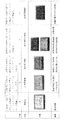
なお、試験例1の過ホウ酸Na5重量%、ベンゾトリアゾール0.3重量%(評価◎)、試験例1の過ホウ酸Na5重量%、ベンゾトリアゾール0.1重量%(評価○)、試験例1の過ホウ酸Na0重量%、ベンゾトリアゾール5重量%(評価△)、試験例1の過ホウ酸Na0重量%、ベンゾトリアゾール0.3重量%(評価×)、及び試験例1の過ホウ酸Na0重量%、ベンゾトリアゾール0重量%(評価××)それぞれにおける、試験後の金銀パラジウム合金(キャストウェルM.C)の写真を図1に示す。
試験例2
モノ過硫酸水素カリウム(デュポン社製のオキソン(Oxone))の配合量が35重量%、過炭酸ナトリウム及びベンゾトリアゾール(キレスト株式会社製のC.V.I)が下記表2の配合量(重量%)、残部が硫酸ナトリウムとなるように、それぞれ粉末状の義歯洗浄剤を調製した。得られた義歯洗浄剤3gをそれぞれ水道水150mlに溶解させて混合液(義歯洗浄液)を得た。次に、試験例1と同様にして金銀パラジウム合金の錆(黒変)の発生の有無を確認した。結果は表2の通りである。
モノ過硫酸水素カリウム(デュポン社製のオキソン(Oxone))の配合量が35重量%、過炭酸ナトリウム及びベンゾトリアゾール(キレスト株式会社製のC.V.I)が下記表2の配合量(重量%)、残部が硫酸ナトリウムとなるように、それぞれ粉末状の義歯洗浄剤を調製した。得られた義歯洗浄剤3gをそれぞれ水道水150mlに溶解させて混合液(義歯洗浄液)を得た。次に、試験例1と同様にして金銀パラジウム合金の錆(黒変)の発生の有無を確認した。結果は表2の通りである。

試験例2の結果、上記2種類の金銀パラジウム合金共に、過ホウ酸ナトリウムの代わりに過炭酸ナトリウムを使用した場合にも、試験例1と同様に優れた防錆効果が得られることを確認した。
試験例3
モノ過硫酸水素カリウム(デュポン社製のオキソン(Oxone))の配合量が35重量%、過ホウ酸ナトリウム、硫酸ナトリウム及び各種防錆成分が下記表3及び表4の配合量(重量%)となるように、それぞれ粉末状の義歯洗浄剤を調製した。得られた義歯洗浄剤3gをそれぞれ水道水150mlに溶解させて混合液(義歯洗浄液)を得た。次に、試験例1と同様にして金銀パラジウム合金の錆(黒変)の発生の有無を確認した。結果は表3及び表4通りである。なお、表中の各種防錆成分は、下表5の通りである。
モノ過硫酸水素カリウム(デュポン社製のオキソン(Oxone))の配合量が35重量%、過ホウ酸ナトリウム、硫酸ナトリウム及び各種防錆成分が下記表3及び表4の配合量(重量%)となるように、それぞれ粉末状の義歯洗浄剤を調製した。得られた義歯洗浄剤3gをそれぞれ水道水150mlに溶解させて混合液(義歯洗浄液)を得た。次に、試験例1と同様にして金銀パラジウム合金の錆(黒変)の発生の有無を確認した。結果は表3及び表4通りである。なお、表中の各種防錆成分は、下表5の通りである。
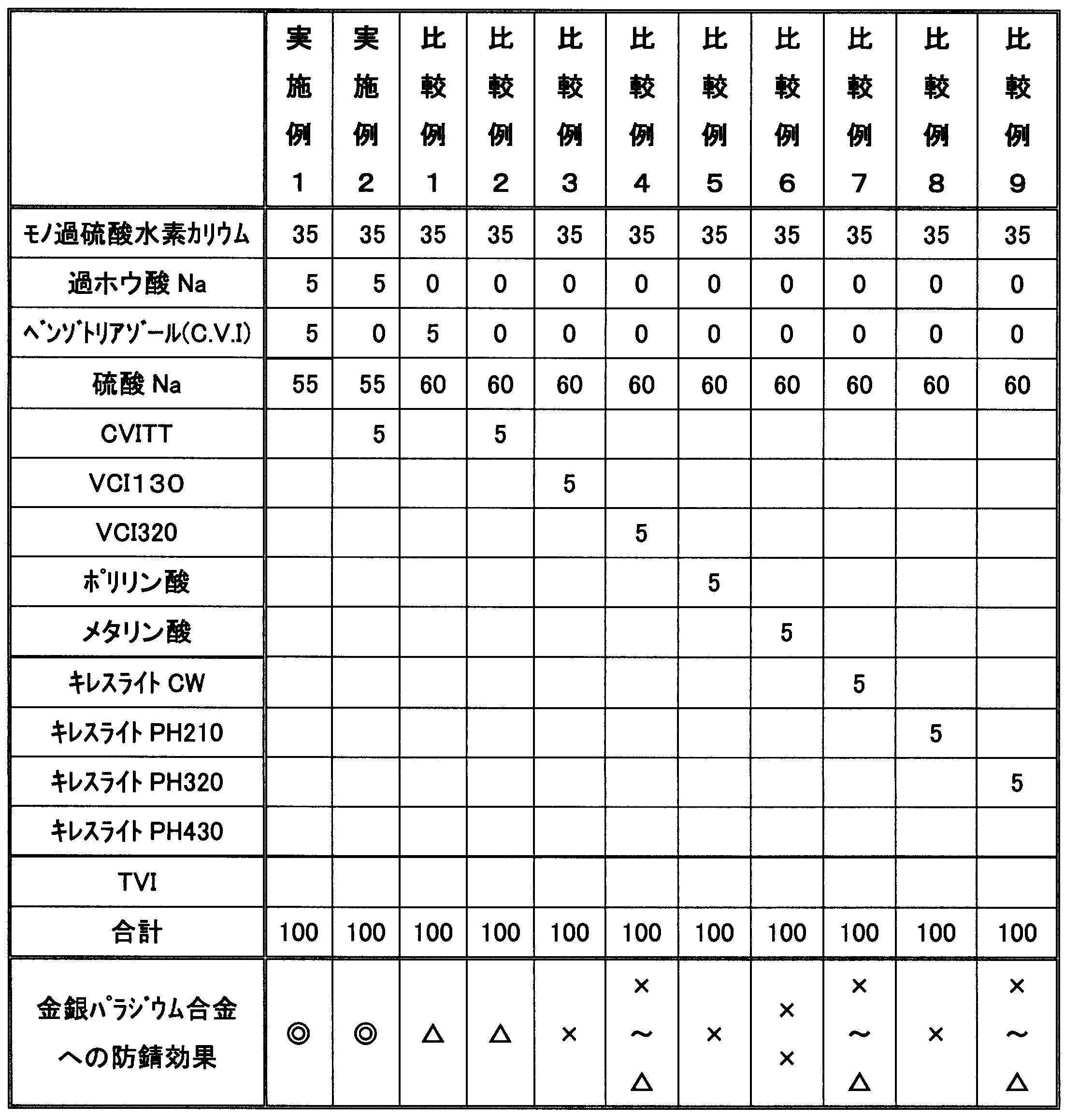
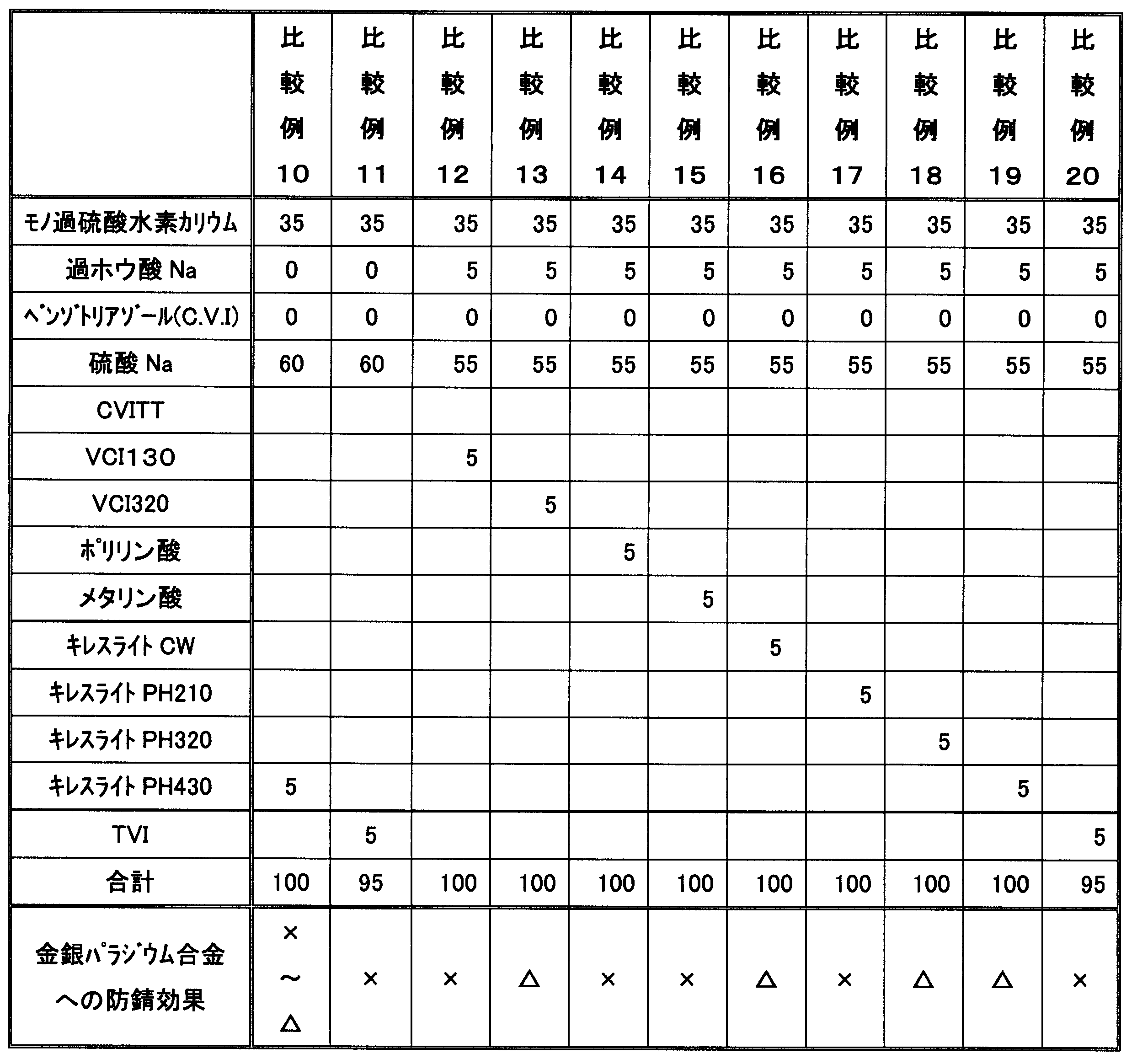

試験例3の結果、義歯洗浄剤にベンゾトリアゾール系化合物(ベンゾトリアゾール、トリルトリアゾール)を配合した場合に、金銀パラジウム合金に対して優れた防錆効果を奏することが確認された。一方、防錆剤として一般的に使用されているアミン類、リン酸塩、ホスホン酸塩、スルホン酸塩、カルボン酸塩、亜硝酸塩を使用した場合には、優れた防錆効果を奏することはなかった。
また、実施例1及び2と比較例1との比較から、過ホウ酸ナトリウムとベンゾトリアゾール系化合物とを併用した場合には、過ホウ酸ナトリウムを配合しない場合に比して、過硫酸水素カリウムによって生じる錆を抑制する効果が著しく向上することがわかる。
なお、試験例3は、過ホウ酸ナトリウムの代わりに、過炭酸ナトリウムを使用した場合にも、同様の結果が得られた。また、上記2種類の金銀パラジウム合金共に同じ結果が得られた。
試験例4
モノ過硫酸水素カリウム(デュポン社製のオキソン(Oxone))の配合量が35重量%、過ホウ酸ナトリウム、硫酸ナトリウム及び各種防錆成分が下記表6及び表7の配合量(重量%)となるように、それぞれ粉末状の義歯洗浄剤を調製した。得られた義歯洗浄剤3gをそれぞれ水道水150mlに溶解させて混合液(義歯洗浄液)を得た。次に、試験例1と同様にして金銀パラジウム合金の錆(黒変)の発生の有無を確認した。結果は表6及び表7通りである。なお、表中の各種防錆成分は、下表8の通りである。
モノ過硫酸水素カリウム(デュポン社製のオキソン(Oxone))の配合量が35重量%、過ホウ酸ナトリウム、硫酸ナトリウム及び各種防錆成分が下記表6及び表7の配合量(重量%)となるように、それぞれ粉末状の義歯洗浄剤を調製した。得られた義歯洗浄剤3gをそれぞれ水道水150mlに溶解させて混合液(義歯洗浄液)を得た。次に、試験例1と同様にして金銀パラジウム合金の錆(黒変)の発生の有無を確認した。結果は表6及び表7通りである。なお、表中の各種防錆成分は、下表8の通りである。
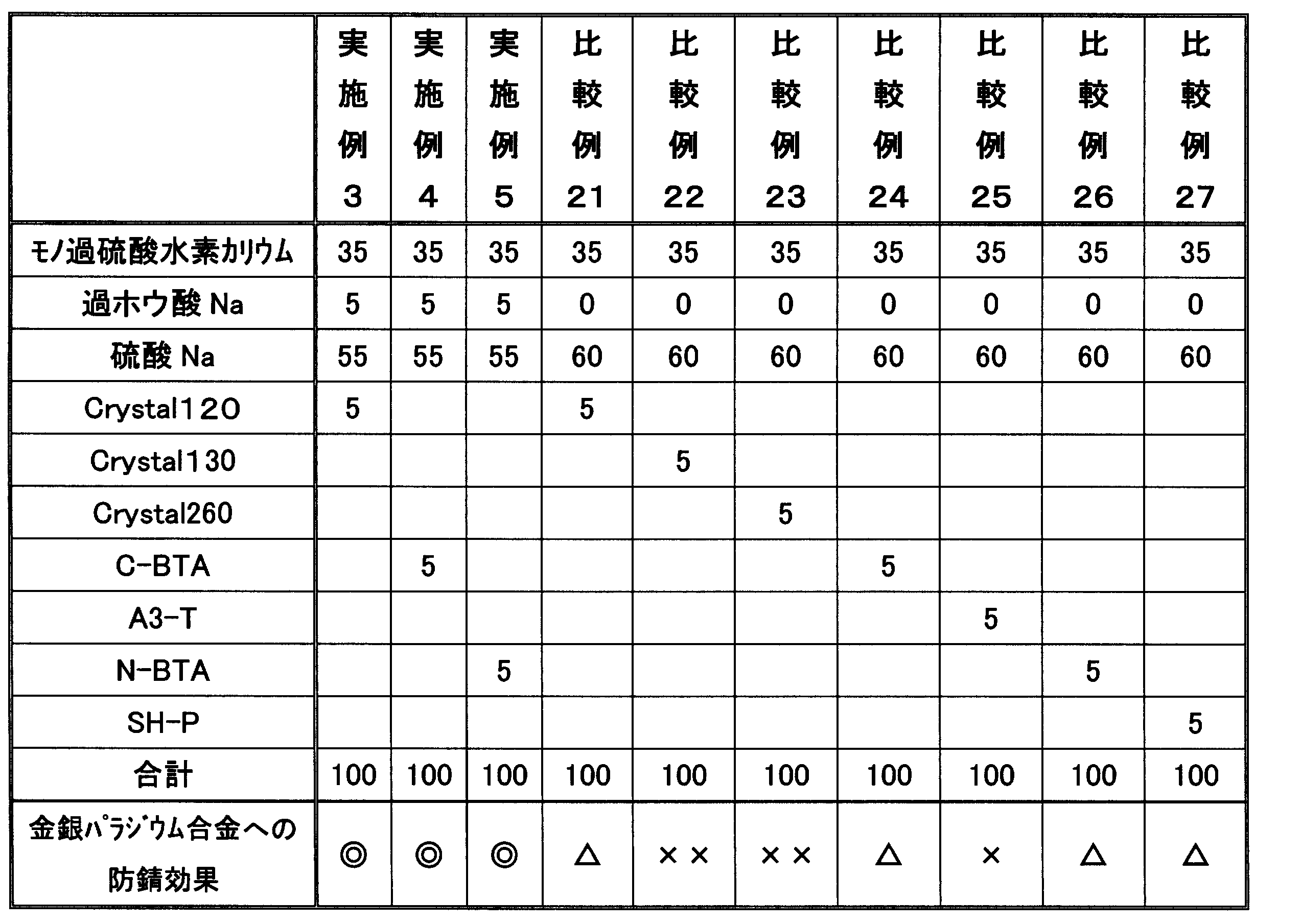

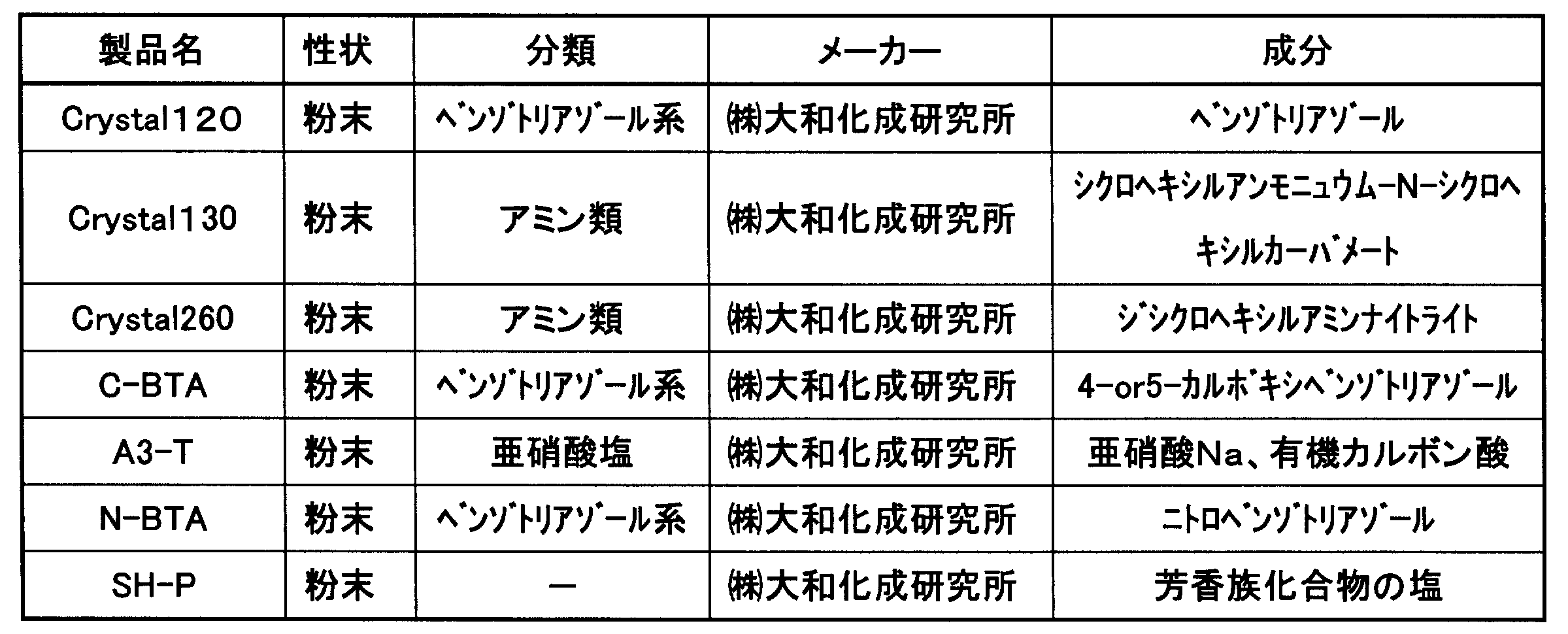
試験例4の結果、義歯洗浄剤にベンゾトリアゾール系化合物(ベンゾトリアゾール、4-又は5カルボキシベンゾトリアゾール、ニトロベンゾトリアゾール)を配合した場合に、金銀パラジウム合金に対して優れた防錆効果を奏することが確認された。一方、防錆剤として一般的に使用されている他の化合物を使用した場合には、優れた防錆効果を奏することはなかった。
なお、試験例4は、過ホウ酸ナトリウムの代わりに、過炭酸ナトリウムを使用した場合にも、同様の結果が得られた。また、上記2種類の金銀パラジウム合金共に同じ結果が得られた。
Claims (7)
- (1)過硫酸水素塩、
(2)過ホウ酸塩及び/又は過炭酸塩、並びに
(3)ベンゾトリアゾール系化合物
を含む義歯洗浄剤。 - 前記ベンゾトリアゾール系化合物は、ベンゼン環上の4つの水素原子が無置換であるか、または少なくとも1つの水素原子が直鎖又は分岐鎖の炭素数1~6のアルキル基、ニトロ基又はカルボキシル基で置換されている、請求項1に記載の義歯洗浄剤。
- 前記過硫酸水素塩100重量部に対して、前記過ホウ酸塩及び/又は過炭酸塩を1.4~1800重量部、前記ベンゾトリアゾール系化合物を0.2~29重量部含む請求項1又は2に記載の義歯洗浄剤。
- 前記過硫酸水素塩が過硫酸水素カリウムであり、前記過ホウ酸塩が過ホウ酸ナトリウムであり、前記過炭酸塩が過炭酸ナトリウムである請求項1~3のいずれかに記載の義歯洗浄剤。
- 部分義歯用である請求項1~4のいずれかに記載の義歯洗浄剤。
- 請求項1~5のいずれかに記載の義歯洗浄剤及び水を含む義歯洗浄液。
- 請求項1~5のいずれかに記載の義歯洗浄剤を用いる義歯洗浄方法。
Applications Claiming Priority (2)
| Application Number | Priority Date | Filing Date | Title |
|---|---|---|---|
| JP2009229079A JP5561987B2 (ja) | 2009-09-30 | 2009-09-30 | 義歯洗浄剤 |
| JP2009-229079 | 2009-09-30 |
Publications (1)
| Publication Number | Publication Date |
|---|---|
| WO2011040201A1 true WO2011040201A1 (ja) | 2011-04-07 |
Family
ID=43826029
Family Applications (1)
| Application Number | Title | Priority Date | Filing Date |
|---|---|---|---|
| PCT/JP2010/065505 Ceased WO2011040201A1 (ja) | 2009-09-30 | 2010-09-09 | 義歯洗浄剤 |
Country Status (2)
| Country | Link |
|---|---|
| JP (1) | JP5561987B2 (ja) |
| WO (1) | WO2011040201A1 (ja) |
Cited By (2)
| Publication number | Priority date | Publication date | Assignee | Title |
|---|---|---|---|---|
| JP2019116460A (ja) * | 2017-12-27 | 2019-07-18 | 小林製薬株式会社 | 錠剤状義歯洗浄剤 |
| JP2019196350A (ja) * | 2018-05-02 | 2019-11-14 | 国立大学法人 鹿児島大学 | 義歯洗浄剤 |
Families Citing this family (2)
| Publication number | Priority date | Publication date | Assignee | Title |
|---|---|---|---|---|
| JP5641759B2 (ja) * | 2010-03-31 | 2014-12-17 | 小林製薬株式会社 | 義歯洗浄剤 |
| JP6067296B2 (ja) * | 2011-10-18 | 2017-01-25 | 小林製薬株式会社 | 義歯洗浄剤 |
Citations (5)
| Publication number | Priority date | Publication date | Assignee | Title |
|---|---|---|---|---|
| JPH08509778A (ja) * | 1993-05-08 | 1996-10-15 | ヘンケル・コマンディットゲゼルシャフト・アウフ・アクチェン | 銀腐食保護剤(▲ii▼) |
| JPH09110665A (ja) * | 1995-10-18 | 1997-04-28 | Lion Corp | 義歯洗浄剤 |
| JP2001288062A (ja) * | 2000-03-31 | 2001-10-16 | Kobayashi Pharmaceut Co Ltd | 義歯洗浄剤 |
| JP2005187852A (ja) * | 2003-12-24 | 2005-07-14 | Asahi Denka Kogyo Kk | 銀器類用洗浄剤組成物 |
| WO2008020234A2 (en) * | 2006-08-18 | 2008-02-21 | Reckitt Benckiser N. V. | Detergent composition |
-
2009
- 2009-09-30 JP JP2009229079A patent/JP5561987B2/ja active Active
-
2010
- 2010-09-09 WO PCT/JP2010/065505 patent/WO2011040201A1/ja not_active Ceased
Patent Citations (5)
| Publication number | Priority date | Publication date | Assignee | Title |
|---|---|---|---|---|
| JPH08509778A (ja) * | 1993-05-08 | 1996-10-15 | ヘンケル・コマンディットゲゼルシャフト・アウフ・アクチェン | 銀腐食保護剤(▲ii▼) |
| JPH09110665A (ja) * | 1995-10-18 | 1997-04-28 | Lion Corp | 義歯洗浄剤 |
| JP2001288062A (ja) * | 2000-03-31 | 2001-10-16 | Kobayashi Pharmaceut Co Ltd | 義歯洗浄剤 |
| JP2005187852A (ja) * | 2003-12-24 | 2005-07-14 | Asahi Denka Kogyo Kk | 銀器類用洗浄剤組成物 |
| WO2008020234A2 (en) * | 2006-08-18 | 2008-02-21 | Reckitt Benckiser N. V. | Detergent composition |
Cited By (2)
| Publication number | Priority date | Publication date | Assignee | Title |
|---|---|---|---|---|
| JP2019116460A (ja) * | 2017-12-27 | 2019-07-18 | 小林製薬株式会社 | 錠剤状義歯洗浄剤 |
| JP2019196350A (ja) * | 2018-05-02 | 2019-11-14 | 国立大学法人 鹿児島大学 | 義歯洗浄剤 |
Also Published As
| Publication number | Publication date |
|---|---|
| JP5561987B2 (ja) | 2014-07-30 |
| JP2011074036A (ja) | 2011-04-14 |
Similar Documents
| Publication | Publication Date | Title |
|---|---|---|
| JP5252826B2 (ja) | 硬質表面用洗浄剤組成物 | |
| JP5483773B2 (ja) | 界面活性組成物 | |
| JP6552784B2 (ja) | 義歯洗浄用発泡組成物 | |
| JP2019123889A (ja) | 洗浄および消毒用液体組成物 | |
| WO1997049792A1 (de) | Mgda-haltige maschinengeschirrspülmittel niederer alkalität | |
| JP5561987B2 (ja) | 義歯洗浄剤 | |
| JP6967447B2 (ja) | 錠剤状義歯洗浄剤 | |
| JP6501394B2 (ja) | 義歯用洗浄剤、義歯用洗浄液、義歯用洗浄ユニット及び義歯の洗浄方法 | |
| US20230190602A1 (en) | Non-soap liquid cleanser composition comprising caprylic acid | |
| DE102007003885A1 (de) | Geschirrreinigungsmittel | |
| JP5067553B2 (ja) | 義歯洗浄用液体組成物 | |
| JP5641759B2 (ja) | 義歯洗浄剤 | |
| JP7190809B2 (ja) | 固形状の義歯洗浄剤 | |
| JP7772373B2 (ja) | 義歯洗浄剤 | |
| JP6746283B2 (ja) | 義歯洗浄剤 | |
| JP4916045B2 (ja) | 義歯洗浄剤 | |
| JP2020050608A (ja) | 義歯洗浄剤 | |
| JP6088301B2 (ja) | 義歯洗浄剤 | |
| JP2023092384A (ja) | 錠剤状の義歯洗浄剤 | |
| EP0225658A1 (en) | Shaped cleansing composition | |
| JP7812149B2 (ja) | 洗浄用固形製剤 | |
| JP7773901B2 (ja) | 義歯洗浄剤 | |
| JP7719600B2 (ja) | 義歯洗浄剤組成物 | |
| JP2024080696A (ja) | 洗浄用固形製剤 | |
| JP2007269633A (ja) | 義歯洗浄剤組成物 |
Legal Events
| Date | Code | Title | Description |
|---|---|---|---|
| 121 | Ep: the epo has been informed by wipo that ep was designated in this application |
Ref document number: 10820321 Country of ref document: EP Kind code of ref document: A1 |
|
| NENP | Non-entry into the national phase |
Ref country code: DE |
|
| 122 | Ep: pct application non-entry in european phase |
Ref document number: 10820321 Country of ref document: EP Kind code of ref document: A1 |