WO2011036282A1 - Procede de determination du rapport isotopique de matiere fissile contenue dans une chambre a fission - Google Patents
Procede de determination du rapport isotopique de matiere fissile contenue dans une chambre a fission Download PDFInfo
- Publication number
- WO2011036282A1 WO2011036282A1 PCT/EP2010/064220 EP2010064220W WO2011036282A1 WO 2011036282 A1 WO2011036282 A1 WO 2011036282A1 EP 2010064220 W EP2010064220 W EP 2010064220W WO 2011036282 A1 WO2011036282 A1 WO 2011036282A1
- Authority
- WO
- WIPO (PCT)
- Prior art keywords
- fissile material
- isotope
- energy
- fission chamber
- impurity
- Prior art date
- Legal status (The legal status is an assumption and is not a legal conclusion. Google has not performed a legal analysis and makes no representation as to the accuracy of the status listed.)
- Ceased
Links
Classifications
-
- G—PHYSICS
- G01—MEASURING; TESTING
- G01T—MEASUREMENT OF NUCLEAR OR X-RADIATION
- G01T3/00—Measuring neutron radiation
-
- G—PHYSICS
- G21—NUCLEAR PHYSICS; NUCLEAR ENGINEERING
- G21C—NUCLEAR REACTORS
- G21C17/00—Monitoring; Testing ; Maintaining
- G21C17/08—Structural combination of reactor core or moderator structure with viewing means, e.g. with television camera, periscope, window
-
- G—PHYSICS
- G21—NUCLEAR PHYSICS; NUCLEAR ENGINEERING
- G21C—NUCLEAR REACTORS
- G21C17/00—Monitoring; Testing ; Maintaining
- G21C17/10—Structural combination of fuel element, control rod, reactor core, or moderator structure with sensitive instruments, e.g. for measuring radioactivity, strain
- G21C17/108—Measuring reactor flux
-
- Y—GENERAL TAGGING OF NEW TECHNOLOGICAL DEVELOPMENTS; GENERAL TAGGING OF CROSS-SECTIONAL TECHNOLOGIES SPANNING OVER SEVERAL SECTIONS OF THE IPC; TECHNICAL SUBJECTS COVERED BY FORMER USPC CROSS-REFERENCE ART COLLECTIONS [XRACs] AND DIGESTS
- Y02—TECHNOLOGIES OR APPLICATIONS FOR MITIGATION OR ADAPTATION AGAINST CLIMATE CHANGE
- Y02E—REDUCTION OF GREENHOUSE GAS [GHG] EMISSIONS, RELATED TO ENERGY GENERATION, TRANSMISSION OR DISTRIBUTION
- Y02E30/00—Energy generation of nuclear origin
- Y02E30/30—Nuclear fission reactors
Definitions
- the invention relates to a method for determining the isotopic ratio of fissile material.
- fission chamber makes it possible to go back to the power of a nuclear reactor or to obtain fission rates characteristic of a neutron flux at certain locations of the core over a given energy range (case of a miniature fission chamber used in an experimental reactor to measure a reflection flux attenuation, for example).
- a fission chamber consists of a sealed enclosure filled with an inert gas with high ionization power. Fissile material is deposited within the fission chamber on an anode member, the cathode sealed enclosure.
- the neutrons whose flux is to be measured come into contact with the fissile material, the fission takes place and two fission fragments are emitted which start at 180 ° from each other. One of the two fragments is stopped in the anode and the other ionizes the gas, before being stopped by the cathode.
- the ionization of the gas leads to the creation of electrons in the fission chamber. Electrons created by ionization are then collected by the cathode and transmitted to an electronic processing chain via a coaxial cable. The number created electrons is directly proportional to the neutron flux that is causing the fission.
- a first method consists of dissolving the material concerned or a sample of this material and performing a chemical analysis of the dissolved material. By this method, it is possible to reach the knowledge of the isotopy of the material with a precision less than the percent.
- a major disadvantage of this method is its destructive nature of the material. In addition to its destructive nature, another disadvantage of this method lies in the generation of effluents that must - in fine - treat.
- Neutron interrogation has the advantage of not being destructive.
- a disadvantage of neutron interrogation is that it can not be performed on a small quantity of material (a few hundred micrograms in the case of a miniature fission chamber).
- the invention does not have the disadvantages mentioned above.
- the invention proposes in fact to measure the isotopic ratio by implementing a method that does not destroy the fission chamber and whose uncertainty is of the order of a few percent (typically less than 10%).
- the invention relates to a method for determining the isotopic ratio of fissile material contained in a fission chamber, the fissile material having a main isotope X and at least one isotope of impurity Y, the X and Y isotopes having a radioactive decay according to two equations:
- spectrometric bench placed in a given measurement configuration it is to be understood that the different elements which make up the spectrometry bench are placed, relative to each other, according to a geometry which is not modified from one measurement to another. 'other.
- the net surface measurements are performed either before the fissile material is introduced into the fission chamber, or after introduction of the fissile material into the fission chamber.
- the measurements are made either on a sample of the fissile material block or on the block of fissile material as a whole.
- measurements are made on the fission chamber as a whole.
- the method of the invention advantageously allows an easy and efficient determination of the isotopic ratio of fissile material based on measurements of gamma radiation and library data.
- the measurement of the net areas is carried out for a sufficiently long duration which makes it possible to obtain a low counting uncertainty (the measurement duration of the net areas is in fact between one hour and a few weeks, for example between one hour and ten weeks).
- FIG. 1 represents a circuit diagram of a device used for the implementation of the method of the invention
- FIG. 2 represents a schematic diagram of the method of the invention
- FIG. 3 represents a detailed view of a first step of the method of the invention
- FIG. 4 represents a detailed view of a second step of the method of the invention.
- FIG. 5 shows a detail view of a third step of the method of the invention.
- the fissile material is Uranium U and the impurities consist of Uranium U.
- the invention however relates to any other fissile material as well as any impurity associated with this other. fissile material.
- the fissile material may be, for example 240 Pu, 242 Pu, 243 Am, 232 Th and the associated impurity may be, for example, 239 Pu, 241 Am, 233 Th.
- the isotopic ratio R is given by equation (1) below:
- a u238 and A u235 are, respectively, the activity of Uranium U and the activity of Uranium 235 U and ⁇ U238 and ⁇ ⁇ 2 are, respectively, the radioactive decay constant of Uranium U and the radioactive decay constant of Uranium U.
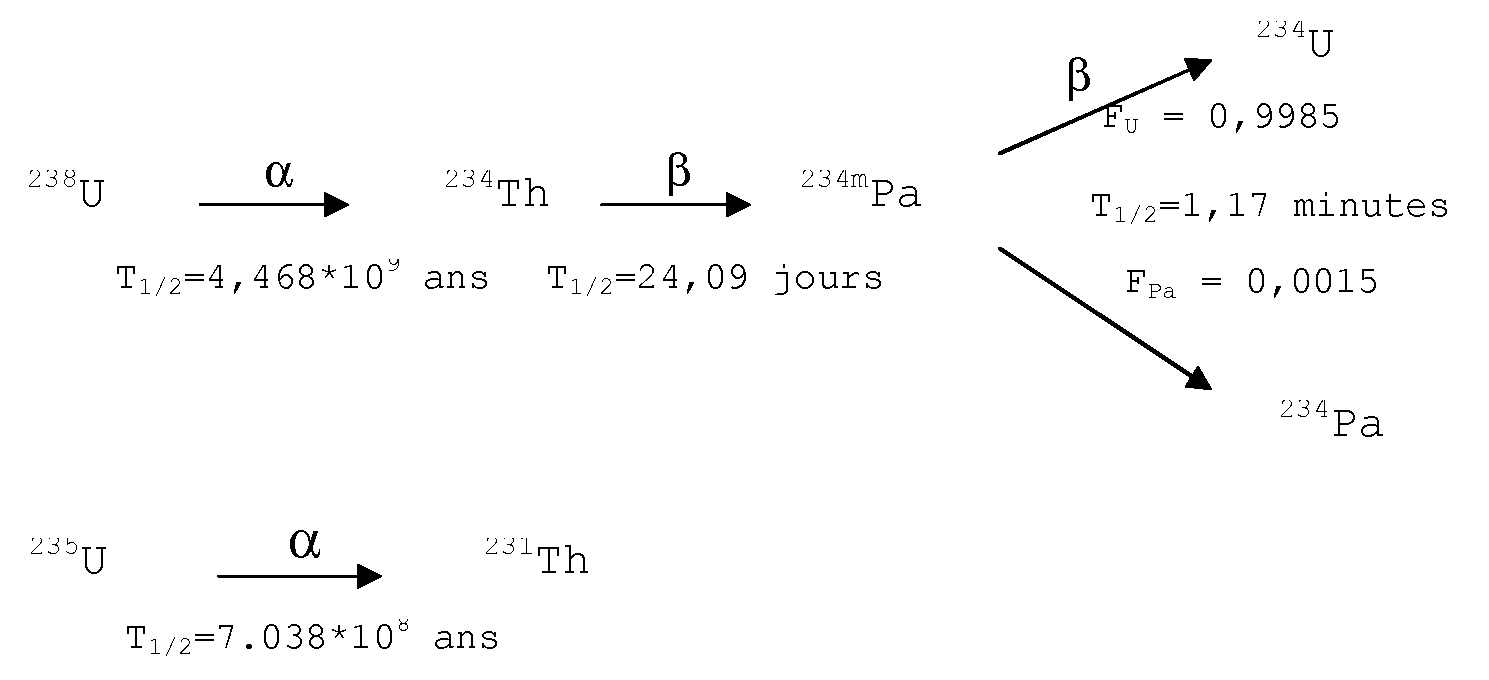
- the decay pattern of Uranium U and Uranium U is:
- the two gamma lines traditionally measured to quantify the activities of Uranium 235 U and Protactinium 234m Pa are the lines at 185.7 kV (57.0% intensity) and 100 kV (intensity of 0.839%). It is these two lines which are measured in the context of the preferred embodiment of the invention.
- S (Eo) is the net area of the gamma peak at energy Eo, in the given measurement configuration
- Ccoinc (Eo) is the correction of true coincidences (simultaneous detection of radiation emitted during the same radioactive decay), in the given measurement configuration;
- ⁇ ( ⁇ ) is the probability of emission or intensity of the energy gamma ray Eo for the isotope son of the isotope considered;
- E 0 the reference total energy absorption efficiency Eo, which is obtained by calibrating the gamma detector using a point standard source, in the given measurement configuration;
- At act is the active measurement time, ie the corrected measurement time of the electronic dead time.
- ⁇ 235 is a known data in international databases (2) / (2 22102 10 16 ) 1 );
- T (100 kV) is a quantity calculated by modeling
- Equation (5) above relates to the case where the fissile material is Uranium U (main isotope) and the impurity Uranium U (isotope of associated impurity), the gamma lines used to quantify the activities of the main isotope and the impurity isotope are respectively the lines at 100 ⁇ V and 185.7 ⁇ V.
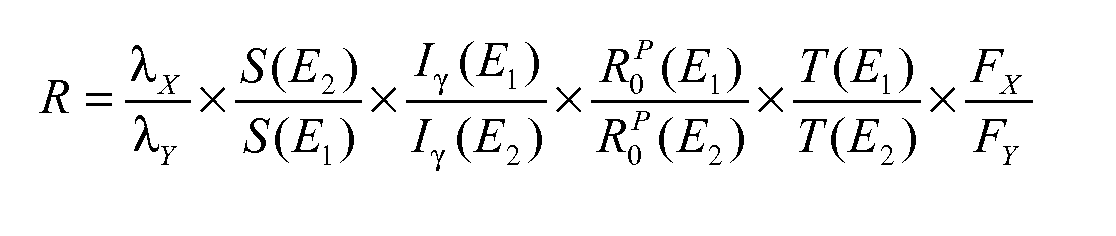
- the gamma lines used to quantify the activities of the main isotope and the isotope of impurity being , respectively, a line of energy E 1 and a line of energy E 2 , the isotopic ratio R is written:
- ⁇ ⁇ is the radioactive decay constant of the main isotope of the fissile material intended to equip the fission chamber
- ⁇ ⁇ is the radioactive decay constant of the impurity isotope associated with the main isotope
- S (E 1 ) is the net area of a first gamma peak of the fissile material at energy E 1
- S (E 2 ) the net area of a second gamma peak of the fissile material at energy E 2 ,
- R 0 P (E 1 ) is the reference total absorption efficiency at energy E 1 and R 0 P (E 2 ) the reference total absorption efficiency at energy E 2 ,
- T (E 1 ) is the integral efficiency of the fissile material at energy E 1 and T (E 2 ) the integral efficiency of the sample of the fissile material at energy E 2 ,
- - ⁇ ⁇ ( ⁇ 1 ) and ⁇ ⁇ ( ⁇ 2 ) are, respectively, the probability of gamma ray emission from the "son" of the main isotope to energy E 1 and the probability of gamma ray emission from the "son” of the impurity isotope to energy E 2 ,
- - F Y is the decay branching factor of an isotope used to measure the activity of the isotope of impurity.
- FIG. 1 represents a device block diagram used for the implementation of the method of the invention.
- the device comprises a gamma spectrometry bench Sp and a calculator K.
- the gamma spectrometry bench Sp delivers measurement signals Sm which are transmitted to the computer K.
- the spectrometry bench Sp consists of an enclosure E in which a detector D is placed.
- the detector D preferably a large germanium diode, is purity, is a gamma ray detector that has good efficiency over a wide range of energy, for example energies ranging from 50keV to 2MeV.
- the detector D also has an ability to limit the Compton effect.
- Fissile material is placed in the enclosure E.
- the fissile material 1 represents this fissile material: it is either a sample of the block of fissile material intended to equip the fission chamber, or of the block of fissile material itself, either of the entire fission chamber equipped with the fissile material block.
- the interaction of the gamma rays from the fissile material B with the detector D leads to an ionization of the atoms of the detector medium.
- the charges thus created are collected by a high-voltage DC power supply, for example a power supply of a few thousand volts (not shown in FIG. 1).
- the enclosure E is preferably a circular enclosure made of materials allowing a very low level of background noise, for example a low lead stack. activity, ultra low activity lead, tin and copper.
- the cooling of the detector is ensured by a cryo-cycle system which allows hybrid electric / liquid nitrogen cooling. This system allows acquisition times of several weeks without disturbance related to the supply of liquid nitrogen.
- Measurement signals Sm constructed from the gamma radiation are transmitted to the computer K for processing.
- the computer K implements processing methods capable of delivering the desired magnitudes.
- the method of the invention comprises (see FIG. 2) a step 1 for determining the net areas S (185.7 keV) and S (100 kV) of the fissile material, a step 2 for determining the total reference absorption efficiencies. at the energies of 185.7 kV and 100 kV, R 0 P (185.7keV) and R 0 P (100 kV), a step 3 of determining the integral efficiency transfers at the energies of 185.7 kV and 100 kV, T (185, 7keV) and T (100 kV), and a step 4 of calculating the isotopic ratio R from the results of steps 1, 2 and 3 and known data D from data libraries.
- the data D are the data ⁇ ⁇ 2 38, ⁇ ⁇ 2 35, ⁇ ⁇ (185, 7keV), I Y (1001keV) and F 0 defined previously.
- Step 1 for determining the net areas S (185.7 keV) and S (100 kV) comprises a gamma spectrum measuring step of the fissile material B.
- the measurement of the gamma spectrum is carried out with the help of the test bench.
- measure Sp on a band of energy which includes useful lines at 185.7keV and 100lkeV.
- Step la ( Figure 3) is followed by a step lb of extraction, using the calculator K, the net surfaces of the lines to 185.7keV and 100lkeV.
- a measurement of gamma background noise is also performed, using the measuring bench Sp, on the same energy band during the step IN, to measure any gamma peaks of the background noise at energies E 1 and E 2 superimposed on the peaks determined in the measure of step la.
- calculator K calculates, in step 1, the net areas S (185.7 keV) and S (100 kV).
- the calculation software used for the calculation of the net areas is, for example, the GENIE2000 software whose user manual is available on the Internet at the following email address:
- FIG. 4 illustrates the various elementary steps that make up step 2 for determining the total reference absorption efficiencies with respect to the energies of 185.7 kV and 100 kV, R 0 P (185, 7 keV) and R 0 P (100 kV).
- Step 2 of determining total reference absorption yields Ro P (185, 7keV) and Ro P (1001keV) is a step known per se.
- Step 2 begins with a point source selection step 2a whose activities are well known.
- Each point source j is characteristic of an emission of gamma particles at an energy Ej chosen in a known energy range, for example the 50keV-2MeV range.
- Each point source j is placed in the enclosure for measuring its activity (step 2b).
- the activity A m p (Ej) of each point source j at the energy Ej is then measured using the measuring bench Sp and the computer K.
- the total absorption efficiency of reference R'o P (Ej ) from each point source to energy Ej is then calculated, in step 2c, from the measured activity A m p (E 1 ) and the activity of the point source which is known a priori A 0 p (E 1 ). He comes :
- the yield curve R'o P (Ej) is then adjusted, using an analytical function Fa, by the calculator K (step 2d).
- the analytic function Fa consists, for example, in expressing the natural logarithm of R ' 0 P as a function of a polynomial of Neperian logarithm of energy. From the adjusted curve delivered in step 2d are deduced, in step 2e, the values of the total reference absorption efficiencies of the desired energies of 185.7keV and 100lkeV, R 0 P (185, 7keV) and R 0 P (1002keV).
- FIG. 5 illustrates the various elementary steps that make up step 3 of determining integral yield transfers.
- Step 3 of determining the integral yield transfers comprises, firstly, a modeling step 3a of the measuring bench equipped with the detector D, a modeling step 3b of the element measured during step 1 of determination of the net surfaces (fission chamber CH or fissile material block sample) and a step 3c of modeling the conditions of use of the point source used when measuring the absorption yields in the same measurement configuration of the gamma bank as in step 3b.
- a calculation step 3d calculates, for example by the Monte Carlo method for solving the photon transport equation, the relative activity of the photon transport equation.
- the calculation step 3d calculates, for example by the Monte Carlo method, the relative activity of the point source determined by the detector D modeled in the 185.7 kV and 100 kV energies calculation, namely the magnitudes A C P (185, 7 keV) and A C P (100 kV).
- a calculation step 3e calculates the quantities T (185.7keV) and T (100 kV) from the calculated activities, namely:
Landscapes
- Physics & Mathematics (AREA)
- Engineering & Computer Science (AREA)
- High Energy & Nuclear Physics (AREA)
- Plasma & Fusion (AREA)
- General Engineering & Computer Science (AREA)
- Health & Medical Sciences (AREA)
- Life Sciences & Earth Sciences (AREA)
- General Physics & Mathematics (AREA)
- Molecular Biology (AREA)
- Spectroscopy & Molecular Physics (AREA)
- Measurement Of Radiation (AREA)
Abstract
Description




Claims
Priority Applications (4)
| Application Number | Priority Date | Filing Date | Title |
|---|---|---|---|
| RU2012117798/28A RU2527137C2 (ru) | 2009-09-28 | 2010-09-27 | Способ определения изотопного отношения делящегося вещества, содержащегося в камере деления |
| US13/395,818 US20120189088A1 (en) | 2009-09-28 | 2010-09-27 | Method for determining the isotope ratio of fissile material |
| JP2012530284A JP2013506122A (ja) | 2009-09-28 | 2010-09-27 | 核分裂チャンバに含有される核分裂性物質の同位体比を決定するための方法 |
| EP10759628.0A EP2483711B1 (fr) | 2009-09-28 | 2010-09-27 | Procede de determination du rapport isotopique de matiere fissile contenue dans une chambre a fission |
Applications Claiming Priority (2)
| Application Number | Priority Date | Filing Date | Title |
|---|---|---|---|
| FR0956692 | 2009-09-28 | ||
| FR0956692A FR2950703B1 (fr) | 2009-09-28 | 2009-09-28 | Procede de determination de rapport isotopique de chambre a fission |
Publications (1)
| Publication Number | Publication Date |
|---|---|
| WO2011036282A1 true WO2011036282A1 (fr) | 2011-03-31 |
Family
ID=42145001
Family Applications (1)
| Application Number | Title | Priority Date | Filing Date |
|---|---|---|---|
| PCT/EP2010/064220 Ceased WO2011036282A1 (fr) | 2009-09-28 | 2010-09-27 | Procede de determination du rapport isotopique de matiere fissile contenue dans une chambre a fission |
Country Status (7)
| Country | Link |
|---|---|
| US (1) | US20120189088A1 (fr) |
| EP (1) | EP2483711B1 (fr) |
| JP (1) | JP2013506122A (fr) |
| KR (1) | KR20120090978A (fr) |
| FR (1) | FR2950703B1 (fr) |
| RU (1) | RU2527137C2 (fr) |
| WO (1) | WO2011036282A1 (fr) |
Cited By (1)
| Publication number | Priority date | Publication date | Assignee | Title |
|---|---|---|---|---|
| JP2014115176A (ja) * | 2012-12-10 | 2014-06-26 | Rpg Technics Kk | γ線測定装置 |
Families Citing this family (2)
| Publication number | Priority date | Publication date | Assignee | Title |
|---|---|---|---|---|
| CN113671556B (zh) * | 2021-07-30 | 2024-02-20 | 中国原子能科学研究院 | 一种铀裂变电离室铀靶铀同位素原子核数量定值方法 |
| CN115356761B (zh) * | 2022-06-23 | 2025-01-28 | 中国原子能科学研究院 | 一种自发裂变源年龄的估算方法 |
Citations (2)
| Publication number | Priority date | Publication date | Assignee | Title |
|---|---|---|---|---|
| EP0596814A1 (fr) * | 1992-11-04 | 1994-05-11 | Schneider Electric Sa | Dispositif de détection neutronique pour mesurer la puissance d'un réacteur nucléaire |
| EP0715186A1 (fr) * | 1994-11-29 | 1996-06-05 | Commissariat A L'energie Atomique | Chambre à fission subminiature avec passage étanche |
Family Cites Families (8)
| Publication number | Priority date | Publication date | Assignee | Title |
|---|---|---|---|---|
| JP2526392B2 (ja) * | 1991-02-26 | 1996-08-21 | 工業技術院長 | 原子炉用燃料棒の非破壊検査装置 |
| JPH05340861A (ja) * | 1992-06-10 | 1993-12-24 | Mitsubishi Nuclear Fuel Co Ltd | 放射性廃棄物に含まれるウラン量の非破壊測定装置及び方法 |
| JP3524203B2 (ja) * | 1995-04-07 | 2004-05-10 | 株式会社東芝 | 中性子モニタ装置及び使用済核燃料の臨界管理方法 |
| US6738446B2 (en) * | 2000-02-24 | 2004-05-18 | General Atomics | System and method for radioactive waste destruction |
| FR2835612B1 (fr) * | 2002-02-06 | 2005-10-28 | Sebia Sa | Masque pour le depot et l'etalement de reactifs sur un support d'analyse |
| US7202478B2 (en) * | 2003-04-10 | 2007-04-10 | Symetrica Limited | Gamma-ray spectrometry |
| RU2267800C1 (ru) * | 2004-08-26 | 2006-01-10 | Государственное унитарное предприятие города Москвы-объединенный эколого-технологический и научно-исследовательский центр по обезвреживанию РАО и охране окружающей среды (ГУП МосНПО "Радон") | Способ идентификации альфа-излучающих радионуклидов |
| GB0506079D0 (en) * | 2005-03-24 | 2005-05-04 | British Nuclear Fuels Plc | Improvements in and relating to providing information |
-
2009
- 2009-09-28 FR FR0956692A patent/FR2950703B1/fr not_active Expired - Fee Related
-
2010
- 2010-09-27 EP EP10759628.0A patent/EP2483711B1/fr not_active Not-in-force
- 2010-09-27 RU RU2012117798/28A patent/RU2527137C2/ru not_active IP Right Cessation
- 2010-09-27 WO PCT/EP2010/064220 patent/WO2011036282A1/fr not_active Ceased
- 2010-09-27 JP JP2012530284A patent/JP2013506122A/ja active Pending
- 2010-09-27 US US13/395,818 patent/US20120189088A1/en not_active Abandoned
- 2010-09-27 KR KR1020127006981A patent/KR20120090978A/ko not_active Withdrawn
Patent Citations (2)
| Publication number | Priority date | Publication date | Assignee | Title |
|---|---|---|---|---|
| EP0596814A1 (fr) * | 1992-11-04 | 1994-05-11 | Schneider Electric Sa | Dispositif de détection neutronique pour mesurer la puissance d'un réacteur nucléaire |
| EP0715186A1 (fr) * | 1994-11-29 | 1996-06-05 | Commissariat A L'energie Atomique | Chambre à fission subminiature avec passage étanche |
Non-Patent Citations (2)
| Title |
|---|
| BOUCHARD J ET AL: "The burn-up and fuel cycle aspects of LMFBR physics assessment", PROGRESS IN NUCLEAR ENERGY, PERGAMON PRESS, OXFORD, GB LNKD- DOI:10.1016/0149-1970(85)90011-3, vol. 16, no. 3, 1 January 1985 (1985-01-01), pages 251 - 285, XP025414445, ISSN: 0149-1970, [retrieved on 19850101] * |
| FILLIATRE P ET AL: "Reasons why Plutonium 242 is the best fission chamber deposit to monitor the fast component of a high neutron flux", NUCLEAR INSTRUMENTS & METHODS IN PHYSICS RESEARCH, SECTION - A:ACCELERATORS, SPECTROMETERS, DETECTORS AND ASSOCIATED EQUIPMENT, ELSEVIER, AMSTERDAM, NL LNKD- DOI:10.1016/J.NIMA.2008.05.049, vol. 593, no. 3, 11 August 2008 (2008-08-11), pages 510 - 518, XP025472040, ISSN: 0168-9002, [retrieved on 20080601] * |
Cited By (1)
| Publication number | Priority date | Publication date | Assignee | Title |
|---|---|---|---|---|
| JP2014115176A (ja) * | 2012-12-10 | 2014-06-26 | Rpg Technics Kk | γ線測定装置 |
Also Published As
| Publication number | Publication date |
|---|---|
| JP2013506122A (ja) | 2013-02-21 |
| US20120189088A1 (en) | 2012-07-26 |
| FR2950703B1 (fr) | 2011-10-28 |
| RU2527137C2 (ru) | 2014-08-27 |
| FR2950703A1 (fr) | 2011-04-01 |
| RU2012117798A (ru) | 2013-11-10 |
| EP2483711A1 (fr) | 2012-08-08 |
| KR20120090978A (ko) | 2012-08-17 |
| EP2483711B1 (fr) | 2013-09-25 |
Similar Documents
| Publication | Publication Date | Title |
|---|---|---|
| EP2771716A1 (fr) | Procede de determination de la dose d'irradiation deposee dans un scintillateur par un rayonnement ionisant et dispositif associe | |
| EP2225590B1 (fr) | Dispositif et procede de mesure de taux de comptage | |
| EP2959316B1 (fr) | Procede de mesure de dose au moyen d'un detecteur de rayonnements, notamment d'un detecteur de rayonnements x ou gamma, utilise en mode spectroscopique, et systeme de mesure de dose, utilisant ce procede | |
| EP3374801A1 (fr) | Dispositif de détermination d'une dose déposée et procédé associé | |
| EP0414587A1 (fr) | Procédé et chaîne de spectrométrie gamma | |
| EP2483711B1 (fr) | Procede de determination du rapport isotopique de matiere fissile contenue dans une chambre a fission | |
| WO2020099472A1 (fr) | Procédé d'évaluation de la concentration massique en uranium d'un échantillon par spectrométrie gamma et dispositif associé | |
| Henriques et al. | Understanding the xenon primary scintillation yield for cutting-edge rare event experiments | |
| EP2393087B1 (fr) | Procédé de détermination d'intensité d'émission de rayonnement gamma d'un radioélément | |
| EP2225588B1 (fr) | Procede de traitement de signaux de mesure de chambres a fission | |
| FR3104737A1 (fr) | Procédé et système d’évaluation d’un paramètre représentatif de la concentration massique en uranium d’un échantillon de matériau uranifère par spectrométrie gamma | |
| EP4341727A1 (fr) | Procédé, système et dispositif de détermination d'une quantité de matière fissile dans une installation | |
| Silva et al. | A gas proportional scintillation counter with annular anode geometry aiming large detection areas for x-and gamma-ray spectroscopy | |
| FR3118494A1 (fr) | Dispositif de détection comportant différentes couches de scintillation | |
| Henriques et al. | Unraveling xenon primary scintillation yield for cutting-edge rare event experiments | |
| EP3347740B1 (fr) | Dispositif d'analyse in situ d'un dechet radiologique contenant l'isotope chlore 36 | |
| EP3237932B1 (fr) | Procédé de calibration d'un détecteur de rayonnement ionisant et dispositif associé | |
| Collaboration et al. | King’s Research Portal | |
| FR3150294A1 (fr) | Dispositif et procédé de détermination d’un absorbant neutronique dans un objet | |
| EP4564062A1 (fr) | Procédé de localisation de zones irradiantes | |
| Henriques et al. | ournal of Cosmology and Astroparticle Physics | |
| WO2017042258A1 (fr) | Dispositif d'analyse in situ d'un dechet radiologique contenant l'isotope carbone 14 | |
| EP4267994A1 (fr) | Dispositif et procédé de caractérisation d'une source neutronique | |
| EP3736609A1 (fr) | Dispositif d'analyse de rayonnement bêta et procédé d'analyse associé | |
| EP3264139A1 (fr) | Tête de détection et activimètre associé |
Legal Events
| Date | Code | Title | Description |
|---|---|---|---|
| 121 | Ep: the epo has been informed by wipo that ep was designated in this application |
Ref document number: 10759628 Country of ref document: EP Kind code of ref document: A1 |
|
| WWE | Wipo information: entry into national phase |
Ref document number: 13395818 Country of ref document: US |
|
| ENP | Entry into the national phase |
Ref document number: 20127006981 Country of ref document: KR Kind code of ref document: A |
|
| WWE | Wipo information: entry into national phase |
Ref document number: 2012530284 Country of ref document: JP |
|
| WWE | Wipo information: entry into national phase |
Ref document number: 2010759628 Country of ref document: EP |
|
| NENP | Non-entry into the national phase |
Ref country code: DE |
|
| WWE | Wipo information: entry into national phase |
Ref document number: 2012117798 Country of ref document: RU |