WO2011027888A1 - ジアミド-フェニル誘導体、またはその薬学的に許容される塩 - Google Patents
ジアミド-フェニル誘導体、またはその薬学的に許容される塩 Download PDFInfo
- Publication number
- WO2011027888A1 WO2011027888A1 PCT/JP2010/065259 JP2010065259W WO2011027888A1 WO 2011027888 A1 WO2011027888 A1 WO 2011027888A1 JP 2010065259 W JP2010065259 W JP 2010065259W WO 2011027888 A1 WO2011027888 A1 WO 2011027888A1
- Authority
- WO
- WIPO (PCT)
- Prior art keywords
- group
- substituted
- alkyl
- optionally substituted
- acceptable salt
- Prior art date
- Legal status (The legal status is an assumption and is not a legal conclusion. Google has not performed a legal analysis and makes no representation as to the accuracy of the status listed.)
- Ceased
Links
- 0 *Nc(cc1)ccc1[N+]([O-])=O Chemical compound *Nc(cc1)ccc1[N+]([O-])=O 0.000 description 6
- HFHRUVBSDNFGQQ-UHFFFAOYSA-N CCN(C(OC(C)(C)C)=O)c(cc1)ccc1[N+]([O-])=O Chemical compound CCN(C(OC(C)(C)C)=O)c(cc1)ccc1[N+]([O-])=O HFHRUVBSDNFGQQ-UHFFFAOYSA-N 0.000 description 1
- XBNNLAWQCMDISJ-UHFFFAOYSA-N CCNc(cc1)ccc1[N+]([O-])=O Chemical compound CCNc(cc1)ccc1[N+]([O-])=O XBNNLAWQCMDISJ-UHFFFAOYSA-N 0.000 description 1
Classifications
-
- C—CHEMISTRY; METALLURGY
- C07—ORGANIC CHEMISTRY
- C07C—ACYCLIC OR CARBOCYCLIC COMPOUNDS
- C07C317/00—Sulfones; Sulfoxides
- C07C317/44—Sulfones; Sulfoxides having sulfone or sulfoxide groups and carboxyl groups bound to the same carbon skeleton
-
- A—HUMAN NECESSITIES
- A61—MEDICAL OR VETERINARY SCIENCE; HYGIENE
- A61P—SPECIFIC THERAPEUTIC ACTIVITY OF CHEMICAL COMPOUNDS OR MEDICINAL PREPARATIONS
- A61P1/00—Drugs for disorders of the alimentary tract or the digestive system
- A61P1/16—Drugs for disorders of the alimentary tract or the digestive system for liver or gallbladder disorders, e.g. hepatoprotective agents, cholagogues, litholytics
-
- A—HUMAN NECESSITIES
- A61—MEDICAL OR VETERINARY SCIENCE; HYGIENE
- A61P—SPECIFIC THERAPEUTIC ACTIVITY OF CHEMICAL COMPOUNDS OR MEDICINAL PREPARATIONS
- A61P11/00—Drugs for disorders of the respiratory system
-
- A—HUMAN NECESSITIES
- A61—MEDICAL OR VETERINARY SCIENCE; HYGIENE
- A61P—SPECIFIC THERAPEUTIC ACTIVITY OF CHEMICAL COMPOUNDS OR MEDICINAL PREPARATIONS
- A61P13/00—Drugs for disorders of the urinary system
- A61P13/12—Drugs for disorders of the urinary system of the kidneys
-
- A—HUMAN NECESSITIES
- A61—MEDICAL OR VETERINARY SCIENCE; HYGIENE
- A61P—SPECIFIC THERAPEUTIC ACTIVITY OF CHEMICAL COMPOUNDS OR MEDICINAL PREPARATIONS
- A61P3/00—Drugs for disorders of the metabolism
- A61P3/04—Anorexiants; Antiobesity agents
-
- A—HUMAN NECESSITIES
- A61—MEDICAL OR VETERINARY SCIENCE; HYGIENE
- A61P—SPECIFIC THERAPEUTIC ACTIVITY OF CHEMICAL COMPOUNDS OR MEDICINAL PREPARATIONS
- A61P3/00—Drugs for disorders of the metabolism
- A61P3/06—Antihyperlipidemics
-
- A—HUMAN NECESSITIES
- A61—MEDICAL OR VETERINARY SCIENCE; HYGIENE
- A61P—SPECIFIC THERAPEUTIC ACTIVITY OF CHEMICAL COMPOUNDS OR MEDICINAL PREPARATIONS
- A61P3/00—Drugs for disorders of the metabolism
- A61P3/08—Drugs for disorders of the metabolism for glucose homeostasis
- A61P3/10—Drugs for disorders of the metabolism for glucose homeostasis for hyperglycaemia, e.g. antidiabetics
-
- A—HUMAN NECESSITIES
- A61—MEDICAL OR VETERINARY SCIENCE; HYGIENE
- A61P—SPECIFIC THERAPEUTIC ACTIVITY OF CHEMICAL COMPOUNDS OR MEDICINAL PREPARATIONS
- A61P43/00—Drugs for specific purposes, not provided for in groups A61P1/00-A61P41/00
-
- A—HUMAN NECESSITIES
- A61—MEDICAL OR VETERINARY SCIENCE; HYGIENE
- A61P—SPECIFIC THERAPEUTIC ACTIVITY OF CHEMICAL COMPOUNDS OR MEDICINAL PREPARATIONS
- A61P9/00—Drugs for disorders of the cardiovascular system
-
- A—HUMAN NECESSITIES
- A61—MEDICAL OR VETERINARY SCIENCE; HYGIENE
- A61P—SPECIFIC THERAPEUTIC ACTIVITY OF CHEMICAL COMPOUNDS OR MEDICINAL PREPARATIONS
- A61P9/00—Drugs for disorders of the cardiovascular system
- A61P9/10—Drugs for disorders of the cardiovascular system for treating ischaemic or atherosclerotic diseases, e.g. antianginal drugs, coronary vasodilators, drugs for myocardial infarction, retinopathy, cerebrovascula insufficiency, renal arteriosclerosis
-
- A—HUMAN NECESSITIES
- A61—MEDICAL OR VETERINARY SCIENCE; HYGIENE
- A61P—SPECIFIC THERAPEUTIC ACTIVITY OF CHEMICAL COMPOUNDS OR MEDICINAL PREPARATIONS
- A61P9/00—Drugs for disorders of the cardiovascular system
- A61P9/12—Antihypertensives
-
- C—CHEMISTRY; METALLURGY
- C07—ORGANIC CHEMISTRY
- C07C—ACYCLIC OR CARBOCYCLIC COMPOUNDS
- C07C235/00—Carboxylic acid amides, the carbon skeleton of the acid part being further substituted by oxygen atoms
- C07C235/02—Carboxylic acid amides, the carbon skeleton of the acid part being further substituted by oxygen atoms having carbon atoms of carboxamide groups bound to acyclic carbon atoms and singly-bound oxygen atoms bound to the same carbon skeleton
- C07C235/04—Carboxylic acid amides, the carbon skeleton of the acid part being further substituted by oxygen atoms having carbon atoms of carboxamide groups bound to acyclic carbon atoms and singly-bound oxygen atoms bound to the same carbon skeleton the carbon skeleton being acyclic and saturated
- C07C235/16—Carboxylic acid amides, the carbon skeleton of the acid part being further substituted by oxygen atoms having carbon atoms of carboxamide groups bound to acyclic carbon atoms and singly-bound oxygen atoms bound to the same carbon skeleton the carbon skeleton being acyclic and saturated having the nitrogen atom of at least one of the carboxamide groups bound to a carbon atom of a six-membered aromatic ring
-
- C—CHEMISTRY; METALLURGY
- C07—ORGANIC CHEMISTRY
- C07C—ACYCLIC OR CARBOCYCLIC COMPOUNDS
- C07C237/00—Carboxylic acid amides, the carbon skeleton of the acid part being further substituted by amino groups
- C07C237/02—Carboxylic acid amides, the carbon skeleton of the acid part being further substituted by amino groups having the carbon atoms of the carboxamide groups bound to acyclic carbon atoms of the carbon skeleton
- C07C237/04—Carboxylic acid amides, the carbon skeleton of the acid part being further substituted by amino groups having the carbon atoms of the carboxamide groups bound to acyclic carbon atoms of the carbon skeleton the carbon skeleton being acyclic and saturated
- C07C237/06—Carboxylic acid amides, the carbon skeleton of the acid part being further substituted by amino groups having the carbon atoms of the carboxamide groups bound to acyclic carbon atoms of the carbon skeleton the carbon skeleton being acyclic and saturated having the nitrogen atoms of the carboxamide groups bound to hydrogen atoms or to acyclic carbon atoms
-
- C—CHEMISTRY; METALLURGY
- C07—ORGANIC CHEMISTRY
- C07D—HETEROCYCLIC COMPOUNDS
- C07D207/00—Heterocyclic compounds containing five-membered rings not condensed with other rings, with one nitrogen atom as the only ring hetero atom
- C07D207/02—Heterocyclic compounds containing five-membered rings not condensed with other rings, with one nitrogen atom as the only ring hetero atom with only hydrogen or carbon atoms directly attached to the ring nitrogen atom
- C07D207/18—Heterocyclic compounds containing five-membered rings not condensed with other rings, with one nitrogen atom as the only ring hetero atom with only hydrogen or carbon atoms directly attached to the ring nitrogen atom having one double bond between ring members or between a ring member and a non-ring member
- C07D207/22—Heterocyclic compounds containing five-membered rings not condensed with other rings, with one nitrogen atom as the only ring hetero atom with only hydrogen or carbon atoms directly attached to the ring nitrogen atom having one double bond between ring members or between a ring member and a non-ring member with hetero atoms or with carbon atoms having three bonds to hetero atoms with at the most one bond to halogen, e.g. ester or nitrile radicals, directly attached to ring carbon atoms
- C07D207/24—Oxygen or sulfur atoms
- C07D207/26—2-Pyrrolidones
- C07D207/273—2-Pyrrolidones with hetero atoms or with carbon atoms having three bonds to hetero atoms with at the most one bond to halogen, e.g. ester or nitrile radicals, directly attached to other ring carbon atoms
- C07D207/277—Carbon atoms having three bonds to hetero atoms with at the most one bond to halogen, e.g. ester or nitrile radicals
- C07D207/28—2-Pyrrolidone-5- carboxylic acids; Functional derivatives thereof, e.g. esters, nitriles
-
- C—CHEMISTRY; METALLURGY
- C07—ORGANIC CHEMISTRY
- C07D—HETEROCYCLIC COMPOUNDS
- C07D207/00—Heterocyclic compounds containing five-membered rings not condensed with other rings, with one nitrogen atom as the only ring hetero atom
- C07D207/02—Heterocyclic compounds containing five-membered rings not condensed with other rings, with one nitrogen atom as the only ring hetero atom with only hydrogen or carbon atoms directly attached to the ring nitrogen atom
- C07D207/30—Heterocyclic compounds containing five-membered rings not condensed with other rings, with one nitrogen atom as the only ring hetero atom with only hydrogen or carbon atoms directly attached to the ring nitrogen atom having two double bonds between ring members or between ring members and non-ring members
- C07D207/34—Heterocyclic compounds containing five-membered rings not condensed with other rings, with one nitrogen atom as the only ring hetero atom with only hydrogen or carbon atoms directly attached to the ring nitrogen atom having two double bonds between ring members or between ring members and non-ring members with hetero atoms or with carbon atoms having three bonds to hetero atoms with at the most one bond to halogen, e.g. ester or nitrile radicals, directly attached to ring carbon atoms
-
- C—CHEMISTRY; METALLURGY
- C07—ORGANIC CHEMISTRY
- C07D—HETEROCYCLIC COMPOUNDS
- C07D211/00—Heterocyclic compounds containing hydrogenated pyridine rings, not condensed with other rings
- C07D211/04—Heterocyclic compounds containing hydrogenated pyridine rings, not condensed with other rings with only hydrogen or carbon atoms directly attached to the ring nitrogen atom
- C07D211/06—Heterocyclic compounds containing hydrogenated pyridine rings, not condensed with other rings with only hydrogen or carbon atoms directly attached to the ring nitrogen atom having no double bonds between ring members or between ring members and non-ring members
- C07D211/36—Heterocyclic compounds containing hydrogenated pyridine rings, not condensed with other rings with only hydrogen or carbon atoms directly attached to the ring nitrogen atom having no double bonds between ring members or between ring members and non-ring members with hetero atoms or with carbon atoms having three bonds to hetero atoms with at the most one bond to halogen, e.g. ester or nitrile radicals, directly attached to ring carbon atoms
- C07D211/60—Carbon atoms having three bonds to hetero atoms with at the most one bond to halogen, e.g. ester or nitrile radicals
-
- C—CHEMISTRY; METALLURGY
- C07—ORGANIC CHEMISTRY
- C07D—HETEROCYCLIC COMPOUNDS
- C07D211/00—Heterocyclic compounds containing hydrogenated pyridine rings, not condensed with other rings
- C07D211/04—Heterocyclic compounds containing hydrogenated pyridine rings, not condensed with other rings with only hydrogen or carbon atoms directly attached to the ring nitrogen atom
- C07D211/06—Heterocyclic compounds containing hydrogenated pyridine rings, not condensed with other rings with only hydrogen or carbon atoms directly attached to the ring nitrogen atom having no double bonds between ring members or between ring members and non-ring members
- C07D211/36—Heterocyclic compounds containing hydrogenated pyridine rings, not condensed with other rings with only hydrogen or carbon atoms directly attached to the ring nitrogen atom having no double bonds between ring members or between ring members and non-ring members with hetero atoms or with carbon atoms having three bonds to hetero atoms with at the most one bond to halogen, e.g. ester or nitrile radicals, directly attached to ring carbon atoms
- C07D211/60—Carbon atoms having three bonds to hetero atoms with at the most one bond to halogen, e.g. ester or nitrile radicals
- C07D211/62—Carbon atoms having three bonds to hetero atoms with at the most one bond to halogen, e.g. ester or nitrile radicals attached in position 4
-
- C—CHEMISTRY; METALLURGY
- C07—ORGANIC CHEMISTRY
- C07D—HETEROCYCLIC COMPOUNDS
- C07D213/00—Heterocyclic compounds containing six-membered rings, not condensed with other rings, with one nitrogen atom as the only ring hetero atom and three or more double bonds between ring members or between ring members and non-ring members
- C07D213/02—Heterocyclic compounds containing six-membered rings, not condensed with other rings, with one nitrogen atom as the only ring hetero atom and three or more double bonds between ring members or between ring members and non-ring members having three double bonds between ring members or between ring members and non-ring members
- C07D213/04—Heterocyclic compounds containing six-membered rings, not condensed with other rings, with one nitrogen atom as the only ring hetero atom and three or more double bonds between ring members or between ring members and non-ring members having three double bonds between ring members or between ring members and non-ring members having no bond between the ring nitrogen atom and a non-ring member or having only hydrogen or carbon atoms directly attached to the ring nitrogen atom
- C07D213/60—Heterocyclic compounds containing six-membered rings, not condensed with other rings, with one nitrogen atom as the only ring hetero atom and three or more double bonds between ring members or between ring members and non-ring members having three double bonds between ring members or between ring members and non-ring members having no bond between the ring nitrogen atom and a non-ring member or having only hydrogen or carbon atoms directly attached to the ring nitrogen atom with hetero atoms or with carbon atoms having three bonds to hetero atoms with at the most one bond to halogen, e.g. ester or nitrile radicals, directly attached to ring carbon atoms
- C07D213/78—Carbon atoms having three bonds to hetero atoms, with at the most one bond to halogen, e.g. ester or nitrile radicals
- C07D213/81—Amides; Imides
-
- C—CHEMISTRY; METALLURGY
- C07—ORGANIC CHEMISTRY
- C07D—HETEROCYCLIC COMPOUNDS
- C07D213/00—Heterocyclic compounds containing six-membered rings, not condensed with other rings, with one nitrogen atom as the only ring hetero atom and three or more double bonds between ring members or between ring members and non-ring members
- C07D213/02—Heterocyclic compounds containing six-membered rings, not condensed with other rings, with one nitrogen atom as the only ring hetero atom and three or more double bonds between ring members or between ring members and non-ring members having three double bonds between ring members or between ring members and non-ring members
- C07D213/04—Heterocyclic compounds containing six-membered rings, not condensed with other rings, with one nitrogen atom as the only ring hetero atom and three or more double bonds between ring members or between ring members and non-ring members having three double bonds between ring members or between ring members and non-ring members having no bond between the ring nitrogen atom and a non-ring member or having only hydrogen or carbon atoms directly attached to the ring nitrogen atom
- C07D213/60—Heterocyclic compounds containing six-membered rings, not condensed with other rings, with one nitrogen atom as the only ring hetero atom and three or more double bonds between ring members or between ring members and non-ring members having three double bonds between ring members or between ring members and non-ring members having no bond between the ring nitrogen atom and a non-ring member or having only hydrogen or carbon atoms directly attached to the ring nitrogen atom with hetero atoms or with carbon atoms having three bonds to hetero atoms with at the most one bond to halogen, e.g. ester or nitrile radicals, directly attached to ring carbon atoms
- C07D213/78—Carbon atoms having three bonds to hetero atoms, with at the most one bond to halogen, e.g. ester or nitrile radicals
- C07D213/81—Amides; Imides
- C07D213/82—Amides; Imides in position 3
-
- C—CHEMISTRY; METALLURGY
- C07—ORGANIC CHEMISTRY
- C07D—HETEROCYCLIC COMPOUNDS
- C07D231/00—Heterocyclic compounds containing 1,2-diazole or hydrogenated 1,2-diazole rings
- C07D231/02—Heterocyclic compounds containing 1,2-diazole or hydrogenated 1,2-diazole rings not condensed with other rings
- C07D231/10—Heterocyclic compounds containing 1,2-diazole or hydrogenated 1,2-diazole rings not condensed with other rings having two or three double bonds between ring members or between ring members and non-ring members
- C07D231/14—Heterocyclic compounds containing 1,2-diazole or hydrogenated 1,2-diazole rings not condensed with other rings having two or three double bonds between ring members or between ring members and non-ring members with hetero atoms or with carbon atoms having three bonds to hetero atoms with at the most one bond to halogen, e.g. ester or nitrile radicals, directly attached to ring carbon atoms
-
- C—CHEMISTRY; METALLURGY
- C07—ORGANIC CHEMISTRY
- C07D—HETEROCYCLIC COMPOUNDS
- C07D307/00—Heterocyclic compounds containing five-membered rings having one oxygen atom as the only ring hetero atom
- C07D307/02—Heterocyclic compounds containing five-membered rings having one oxygen atom as the only ring hetero atom not condensed with other rings
- C07D307/04—Heterocyclic compounds containing five-membered rings having one oxygen atom as the only ring hetero atom not condensed with other rings having no double bonds between ring members or between ring members and non-ring members
-
- C—CHEMISTRY; METALLURGY
- C07—ORGANIC CHEMISTRY
- C07D—HETEROCYCLIC COMPOUNDS
- C07D307/00—Heterocyclic compounds containing five-membered rings having one oxygen atom as the only ring hetero atom
- C07D307/02—Heterocyclic compounds containing five-membered rings having one oxygen atom as the only ring hetero atom not condensed with other rings
- C07D307/34—Heterocyclic compounds containing five-membered rings having one oxygen atom as the only ring hetero atom not condensed with other rings having two or three double bonds between ring members or between ring members and non-ring members
-
- C—CHEMISTRY; METALLURGY
- C07—ORGANIC CHEMISTRY
- C07D—HETEROCYCLIC COMPOUNDS
- C07D307/00—Heterocyclic compounds containing five-membered rings having one oxygen atom as the only ring hetero atom
- C07D307/77—Heterocyclic compounds containing five-membered rings having one oxygen atom as the only ring hetero atom ortho- or peri-condensed with carbocyclic rings or ring systems
- C07D307/78—Benzo [b] furans; Hydrogenated benzo [b] furans
-
- C—CHEMISTRY; METALLURGY
- C07—ORGANIC CHEMISTRY
- C07D—HETEROCYCLIC COMPOUNDS
- C07D309/00—Heterocyclic compounds containing six-membered rings having one oxygen atom as the only ring hetero atom, not condensed with other rings
- C07D309/02—Heterocyclic compounds containing six-membered rings having one oxygen atom as the only ring hetero atom, not condensed with other rings having no double bonds between ring members or between ring members and non-ring members
-
- C—CHEMISTRY; METALLURGY
- C07—ORGANIC CHEMISTRY
- C07D—HETEROCYCLIC COMPOUNDS
- C07D311/00—Heterocyclic compounds containing six-membered rings having one oxygen atom as the only hetero atom, condensed with other rings
- C07D311/02—Heterocyclic compounds containing six-membered rings having one oxygen atom as the only hetero atom, condensed with other rings ortho- or peri-condensed with carbocyclic rings or ring systems
-
- C—CHEMISTRY; METALLURGY
- C07—ORGANIC CHEMISTRY
- C07D—HETEROCYCLIC COMPOUNDS
- C07D319/00—Heterocyclic compounds containing six-membered rings having two oxygen atoms as the only ring hetero atoms
- C07D319/10—1,4-Dioxanes; Hydrogenated 1,4-dioxanes
- C07D319/14—1,4-Dioxanes; Hydrogenated 1,4-dioxanes condensed with carbocyclic rings or ring systems
-
- C—CHEMISTRY; METALLURGY
- C07—ORGANIC CHEMISTRY
- C07D—HETEROCYCLIC COMPOUNDS
- C07D405/00—Heterocyclic compounds containing both one or more hetero rings having oxygen atoms as the only ring hetero atoms, and one or more rings having nitrogen as the only ring hetero atom
- C07D405/02—Heterocyclic compounds containing both one or more hetero rings having oxygen atoms as the only ring hetero atoms, and one or more rings having nitrogen as the only ring hetero atom containing two hetero rings
- C07D405/12—Heterocyclic compounds containing both one or more hetero rings having oxygen atoms as the only ring hetero atoms, and one or more rings having nitrogen as the only ring hetero atom containing two hetero rings linked by a chain containing hetero atoms as chain links
-
- C—CHEMISTRY; METALLURGY
- C07—ORGANIC CHEMISTRY
- C07D—HETEROCYCLIC COMPOUNDS
- C07D413/00—Heterocyclic compounds containing two or more hetero rings, at least one ring having nitrogen and oxygen atoms as the only ring hetero atoms
- C07D413/02—Heterocyclic compounds containing two or more hetero rings, at least one ring having nitrogen and oxygen atoms as the only ring hetero atoms containing two hetero rings
- C07D413/12—Heterocyclic compounds containing two or more hetero rings, at least one ring having nitrogen and oxygen atoms as the only ring hetero atoms containing two hetero rings linked by a chain containing hetero atoms as chain links
-
- C—CHEMISTRY; METALLURGY
- C07—ORGANIC CHEMISTRY
- C07C—ACYCLIC OR CARBOCYCLIC COMPOUNDS
- C07C2602/00—Systems containing two condensed rings
- C07C2602/02—Systems containing two condensed rings the rings having only two atoms in common
- C07C2602/04—One of the condensed rings being a six-membered aromatic ring
- C07C2602/10—One of the condensed rings being a six-membered aromatic ring the other ring being six-membered, e.g. tetraline
Definitions
- the present invention relates to a diamide-phenyl derivative that inhibits soluble epoxide hydrolase (sEH), or a pharmaceutically acceptable salt thereof. More specifically, the present invention relates to a therapeutic agent for circulatory system including hypertension, peripheral vascular system, endocrine metabolic system, respiratory system and autoimmune disease system, which contains a diamide-phenyl derivative effective as an sEH inhibitor as an active ingredient.
- sEH soluble epoxide hydrolase
- EH epoxide hydrolase
- sEH is also expressed in all organs (Non-patent Document 2) and blood (lymphocytes, monocytes, erythrocytes, platelets, plasma, etc.), and most of them are present in lymphocytes.
- Non-patent Document 3 Epoxide hydrolase (EH) converts cis-epoxyeicosatrienoic acids (EETs) that are physiologically produced from arachidonic acid by the P450 metabolic pathway into dihydroeicosatrienoic acids (DHETs), which are inactive substances. It is responsible for the conversion reaction (Non-Patent Document 4).
- EETs cis-epoxyeicosatrienoic acids
- DHETs dihydroeicosatrienoic acids
- EETs that increase due to sEH inhibition activate Ca 2+ -activated K + -channels in blood vessels and act as vascular endothelium-derived hyperpolarization factor (EDHF).
- EDHF vascular endothelium-derived hyperpolarization factor
- sEH inhibitors such as 1-adamantyl-3-dodecyl urea (ADU) and 1-adamantan-3- (5- (2-ethylethoxy) ethoxy) pentyl) urea (AEPU) are deoxycorticosterone acetate (DOCA) and physiological salt Reported to improve vascular endothelial function of water-loading vascular endothelial disorder model (Non-patent Document 8) and markedly improve cardiac hypertrophy due to renal organ disorder and aortic arch stenosis (Non-patent Documents 9 and 10) Has been.
- DOTA deoxycorticosterone acetate
- Non-patent Document 8 markedly improve cardiac hypertrophy due to renal organ disorder and aortic arch stenosis
- EETs are cardiac hypertrophy, angina pectoris, myocardial infarction, cerebral infarction, diabetes, chronic nephropathy, diabetic nephropathy, obstructive arteriosclerosis, obesity, lipid metabolism abnormality, fatty liver, etc. It is expected to show efficacy in sex diseases and endocrine metabolic diseases. Since some of the DHETs produced by sEH are causative substances of adult respiratory distress syndrome, sEH inhibitors have been reported to improve their mortality (Non-patent Document 11). From these facts, sEH inhibitors are expected to prevent or improve respiratory diseases.
- A is a cycloalkyl ring
- m is 0, 1, 2, or 3
- X is a group selected from —NR 3 —CO— and the like
- R 1 and R 3 Each independently represents a hydrogen atom, alkyl, substituted alkyl, cycloalkyl, substituted cycloalkyl, heterocycloalkyl, substituted heterocycloalkyl, aryl, substituted aryl, heteroaryl, and substituted Or R 1 and R 3 together with the nitrogen atom may form a heterocyclo ring with a 3-5 membered carbon atom
- Q is O or S L is a single bond
- n is 0, 1, 2, or 3
- R is selected from an optionally substituted C 6-10 cycloalkyl group and the like.
- the compound differs from the present invention in that it has a cycloalkyl ring as a structural feature.
- Various other sEH inhibitors have been reported, but no sEH inhibitor having a diamide-phenyl skeleton as in the present invention is specifically known.
- Patent Document 2 The compound is only known to be useful in textile products, paper and leather products, and there is no description that the compound is useful as an sEH inhibitor and useful as an antihypertensive agent.
- an object of the present invention is to provide a novel diamido-phenyl derivative having strong sEH inhibitory activity.
- Item 1 A compound represented by formula (I), or a pharmaceutically acceptable salt thereof.
- R a1 , R a2 and R a3 each independently represents a hydrogen atom, a halogen atom, a carboxyl group, a nitro group, a cyano group, an optionally substituted C 1-6 alkyl group, a substituted group which may be a C 2-6 alkenyl group, an optionally substituted C 2-6 alkynyl group, a hydroxyl group, an optionally substituted C 1-6 alkoxy group, an optionally C 3-6 substituted A cycloalkyl group, an optionally substituted C 3-6 cycloalkyloxy group, an optionally substituted C 6-10 aryloxy group, an optionally substituted C 6-10 aryl group, a substituted which may C 7-14 aralkyloxy group, an optionally substituted C 1-4 alkoxycarbonyl group, an optionally substituted C 3-6 cycloalkoxy group, optionally substituted There C 6-10 aryloxycarbonyl group, an optionally substituted C 1-6
- R b4 is a hydrogen atom or C 1-4 alkyl
- R b3 is a hydrogen atom or C 1-4 alkyl.
- 3 C 3-6 cycloalkyl group which may be substituted
- 4 an optionally substituted saturated heterocyclic group
- 5 an optionally substituted 5- to 10-membered monocyclic or polycyclic heteroaryl group
- R 1 is 1: C 1-6 alkyl group (the group is (A) C 1-4 alkoxy (the group may be substituted with C 1-4 alkoxy), (B) C 1-4 alkylsulfonyl, (C) mono- or di- (C 1-6 alkyl) amino, (D) substituted with 4- to 7-membered cyclic amino, or (e) 5- or 6-membered monocyclic heteroaryloxy.
- R 2 is an optionally substituted C 1-6 alkyl group or an optionally substituted C 3-6 cycloalkyl group.
- Item 2 A is the following (a)
- Item 3 The compound according to Item 2, or a pharmaceutically acceptable salt thereof, wherein R a1 , R a2 and R a3 are all hydrogen atoms.
- R b1 is (A) a hydrogen atom, (B) cyano, (C) C 1-4 alkyl (the group may be substituted with a 4- to 7-membered cyclic amino), (D) mono- or di- (C 1-6 alkyl) amino, (E) a 4- to 7-membered cyclic amino, (F) a 4- to 7-membered cyclic aminosulfonyl, (G) a 5- or 6-membered monocyclic heteroaryl, or (h) a 5- to 10-membered monocyclic or polycyclic heteroaryl C 1-4 alkyl, Item 5.
- A is 1: C 3-6 cycloalkyl group (which group may be substituted with C 1-4 alkoxy), 2: Saturated heterocyclic group (the ring is (A) C 1-4 alkyl, (B) 5- or 6-membered monocyclic heteroaryl, or (c) optionally substituted with C 1-4 alkylcarbonyl. Or a 5- to 10-membered monocyclic or polycyclic heteroaryl group (the ring is substituted with a C 1-4 alkyl which may be substituted with a 4- to 7-membered cyclic amino). Or a pharmaceutically acceptable salt thereof.
- R 1 is a 5- to 10-membered monocyclic or polycyclic heteroaryl group (the group includes (A) a halogen atom, (B) C 1-4 alkyl (the group may be substituted with 1 to 3 fluorine atoms), (C) hydroxy, (D) C 1-4 alkoxy (the group may be substituted with 1 to 3 fluorine atoms), (E) C 3-6 cycloalkyloxy, (F) C 6-10 aryloxy, (G) C 6-10 aryl, (H) C 1-4 alkoxysulfonyl, (I) C 3-6 cycloalkoxysulfonyl, (J) 5 or 6 membered monocyclic heteroaryloxy, (K) 5 or 6 membered saturated heterocyclic oxy, (L) amino (the amino is (L1) C 1-6 alkyl, (L2) C 3-6 cycloalkyl, (L3) C 3-6 cycloalkyl C 1-4 alkyl, (L) amino
- (M) 4-7 membered cyclic amino It may be substituted with 1 to 3 groups selected from (n) aminocarbonyl, and (o) aminocarbonyloxy. 7.
- R 1 is a 5- to 10-membered monocyclic or polycyclic heteroaryl group (the group may be substituted with a halogen atom, C 1-4 alkyl or C 1-4 alkoxy).
- Item 8 The compound according to Item 7, or a pharmaceutically acceptable salt thereof.
- Item 9 The member according to any one of Items 1 to 8, wherein the 5-membered to 10-membered monocyclic or polycyclic heteroaryl group in R 1 is a 5-membered or 6-membered monocyclic heteroaryl group. Or a pharmaceutically acceptable salt thereof.
- Item 10 The compound according to Item 9, or a pharmaceutically acceptable salt thereof, which is a group selected from the group consisting of:
- Item 11 The compound according to Item 10, or a pharmaceutically acceptable salt thereof, wherein R 1 is a furyl group.
- R 1 is a 5- or 6-membered saturated heterocyclic group (the group is (A) a halogen atom, (B) hydroxy, (C) cyano, (D) C 1-4 alkyl (the alkyl may be substituted with 1 to 3 fluorine atoms), (E) C 1-4 alkoxy (the alkoxy may be substituted with 1 to 3 fluorine atoms), (F) C 1-4 alkoxycarbonyl, (G) an amino group (the amino may be substituted with C 1-6 alkylsulfonyl or C 6-10 arylsulfonyl), (H) an aminocarbonyl group (the amino may be substituted with one or two groups of the same or different types selected from the group consisting of C 1-6 alkyl and C 6-10 aryl); (I) an aminocarbonyloxy group (the amino may be substituted with 1 to 2 groups of the same or different types selected from the group consisting of C 1-6 alkyl and C 6-10 aryl); (I
- Item 13 The compound according to Item 12, wherein R 1 is a 5- or 6-membered saturated heterocyclic group (which may be substituted with C 1-4 alkyl or oxo), or Its pharmaceutically acceptable salt.
- Item 14 The 5-membered or 6-membered saturated heterocyclic group in R 1 is
- Item 14 The compound according to Item 12 or Item 13, or a pharmaceutically acceptable salt thereof, which is a group selected from the group consisting of:
- Item 15 The compound according to any one of Items 1 to 14, or a pharmaceutically acceptable salt thereof, wherein R 2 is a C 1-6 alkyl group.
- Item 16 The compound according to Item 15, or a pharmaceutically acceptable salt thereof, wherein R 2 is a methyl group or an ethyl group.
- Item 17 The compound according to any one of Items 1 to 14, or a pharmaceutically acceptable salt thereof, wherein R 2 is a C 3-6 cycloalkyl group.
- Item 18 A pharmaceutical composition comprising the compound according to Item 1 to Item 17 or a pharmaceutically acceptable salt thereof as an active ingredient.
- Item 19 An sEH inhibitor comprising the compound according to any one of Items 1 to 17 or a pharmaceutically acceptable salt thereof as an active ingredient.
- Item 20 Hypertension, acute and chronic congestive heart failure, primary and secondary pulmonary hypertension, primary and secondary aldosteronemia, renovascular hypertension, primary and secondary kidney disease, cardiac hypertrophy Left ventricular hypertrophy, left ventricular fibrosis, left ventricular diastolic failure, left ventricular failure, atrial fibrillation, unstable angina, myocardial infarction, cardiomyopathy, stroke, restenosis after vascular reconstruction, diabetic retinopathy, Item 19 is useful for the treatment and / or prevention of a disease selected from the group consisting of cognitive impairment, obstructive arteriosclerosis, diabetes, obesity, dyslipidemia, fatty liver, vascular disorder, and atherosclerosis. The described sEH inhibitor.
- Item 21 The sEH inhibitor according to Item 19 or 20, which is useful for the treatment and / or prevention of hypertension and / or primary and secondary renal diseases.
- Item 22 A therapeutic agent for hypertension and / or primary and secondary renal diseases comprising the compound according to any one of items 1 to 17 or a pharmaceutically acceptable salt thereof as an active ingredient .
- Item 23 Use of the compound according to any one of Items 1 to 17 or a pharmaceutically acceptable salt thereof for the manufacture of an sEH inhibitor.
- Item 24 Hypertensive and / or primary, wherein an effective amount of the compound according to any one of Items 1 to 17 or a pharmaceutically acceptable salt thereof is administered to a patient in need of treatment And methods for treating secondary kidney disease.
- the compound represented by the formula (I) or a pharmaceutically acceptable salt thereof (hereinafter sometimes referred to as the compound of the present invention) is useful as a prophylactic and / or therapeutic agent for hypertension.
- the compounds of the present invention are also useful for the management of acute and chronic congestive heart failure.
- primary and secondary pulmonary hypertension eg, glomerulonephritis, IgA nephropathy, diabetic kidney
- hypertensive nephropathy neurosclerosis, nephrotic syndrome, renal failure, etc.
- left ventricular hypertrophy e.g., left ventricular fibrosis, left ventricular diastolic failure, left ventricular failure, atrial fibrillation, unstable angina, myocardial infarction , Cardiomyopathy, stroke, restenosis after revascularization, diabetic retinopathy, cognitive impairment (eg, Alzheimer's disease, treatment of cerebrovascular dementia), and vascular disorders (eg, migraine, Raynaud's disease)
- cognitive impairment eg, Alzheimer's disease, treatment of cerebrovascular dementia
- vascular disorders eg, migraine, Raynaud's disease
- the number of carbons in the definition of “substituent” may be expressed as “C 1-6 ”, for example.
- C 1-6 alkyl is synonymous with an alkyl group having 1 to 6 carbon atoms.
- a substituent that does not particularly indicate the term “which may be substituted” or “substituted” means an “unsubstituted” substituent.
- C 1-6 alkyl means “unsubstituted”.
- group means a monovalent group.
- alkyl group means a monovalent saturated hydrocarbon group.
- group may be omitted.
- the number of substituents in the group defined as “may be substituted” or “substituted” is not particularly limited as long as substitution is possible, and is one or more.
- the description of each group also applies when the group is a part of another group or a substituent.
- Halogen atom includes, for example, fluorine atom, chlorine atom, bromine atom or iodine atom.
- C 1-6 alkyl group means a straight chain or branched saturated hydrocarbon group having 1 to 6 carbon atoms. Preferable examples include “C 1-4 alkyl group”. Specific examples of “C 1-6 alkyl group” include, for example, methyl, ethyl, propyl, isopropyl, butyl, isobutyl, sec-butyl, tert-butyl, pentyl, isopentyl, neopentyl, 1-ethylpropyl, hexyl and isohexyl. 1,1-dimethylbutyl, 2,2-dimethylbutyl, 3,3-dimethylbutyl, 2-ethylbutyl and the like.
- the “C 2-6 alkenyl group” means a linear or branched unsaturated hydrocarbon group having 2 to 6 carbon atoms and containing one double bond. Specific examples include vinyl, propenyl, methylpropenyl, butenyl and methylbutenyl.
- C 2-6 alkynyl group means a linear or branched unsaturated hydrocarbon group having 2 to 6 carbon atoms and containing one triple bond.
- specific examples include ethynyl, 1-propynyl, 2-propynyl, 2-butynyl, pentynyl, hexynyl and the like.
- C 3-6 cycloalkyl group means a cyclic saturated hydrocarbon group having 3 to 6 carbon atoms. Specific examples include cyclopropyl, cyclobutyl, cyclopentyl, cyclohexyl and the like.
- the “C 3-6 cycloalkyl group” includes one or different hetero atoms selected from “C 3-6 cycloalkyl” and phenyl or 5-membered or 6-membered nitrogen, sulfur or oxygen atoms.
- a group condensed with a ring containing the above (for example, 1 to 4) is also included. Specific examples of the group include groups represented by the following formulas.
- C 3-6 cycloalkyl C 1-4 alkyl group means a group in which “C 3-6 cycloalkyl” is bonded to “C 1-4 alkyl”. Specific examples include cyclopropylmethyl, cyclobutylmethyl, cyclopentylmethyl, cyclohexylmethyl and the like.
- C 6-10 aryl group means an aromatic hydrocarbon group having 6 to 10 carbon atoms.
- C 6 aryl group phenyl
- Specific examples of “C 6-10 aryl group” include, for example, phenyl, 1-naphthyl, 2-naphthyl and the like.
- C 7-14 aralkyl group means a “C 6-10 aryl C 1-4 alkyl group”, and means a group in which the “aryl group” is substituted on the “alkyl group”.
- Preferred examples include “C 7-10 aralkyl group” (C 6 aryl C 1-4 alkyl group).
- Specific examples of “C 7-14 aralkyl group” include, for example, benzyl, 2-phenylethyl, 1-phenylpropyl, 1-naphthylmethyl and the like.
- heteroaryl group examples include a 5- to 10-membered monocyclic or polycyclic aromatic group, and the group includes a heteroatom selected from a nitrogen atom, a sulfur atom or an oxygen atom. 1 or more (for example, 1 to 4) containing the same or different.
- a bicyclic or tricyclic group is preferable, and a bicyclic group is more preferable.
- the polycyclic heteroaryl group includes a condensed ring of the monocyclic heteroaryl group and an aromatic ring (benzene, pyridine, etc.) or a non-aromatic ring (cyclohexyl, etc.).
- Specific examples of the “heteroaryl group” include a group represented by the following formula.
- the bond across the ring means that the “group” is bonded at a substitutable position in the ring.
- heteroaryl group it means a 2-furyl group or a 3-furyl group.
- heteroaryl group is a polycyclic group, for example, the following formula
- heteroaryl C 1-4 alkyl group means a group in which the “heteroaryl group” is substituted on the “alkyl group”.
- heteroaryl moiety are the same as the specific examples exemplified as the heteroaryl group.
- An example is “heteroaryl C 1-4 alkyl”. Specific examples include 2-pyridylmethyl.
- C 1-6 alkyl part of the “C 1-6 alkoxy group” has the same meaning as the above “C 1-6 alkyl”.
- Preferable examples include “C 1-4 alkoxy group”.
- Specific examples of “C 1-6 alkoxy group” include methoxy, ethoxy, propoxy, isopropoxy, butoxy, isobutoxy, sec-butoxy, tert-butoxy and the like.
- C 1-6 alkyl part of the “C 1-6 alkylsulfonyl group” has the same meaning as the above “C 1-6 alkyl”.
- Preferable examples include “C 1-4 alkylsulfonyl group”.
- Specific examples of “C 1-6 alkylsulfonyl group” include, for example, methylsulfonyl, ethylsulfonyl, propylsulfonyl, isopropylsulfonyl, butylsulfonyl, pentylsulfonyl, hexylsulfonyl and the like.
- C 3-6 cycloalkyl part of the “C 3-6 cycloalkylsulfonyl group” has the same meaning as the above “C 3-6 cycloalkyl”. Specific examples include cyclopropylsulfonyl, cyclobutylsulfonyl, cyclopentylsulfonyl, cyclohexylsulfonyl and the like.
- C 3-6 cycloalkyl part of the “C 3-6 cycloalkoxy group” has the same meaning as the above “C 3-6 cycloalkyl”. Specific examples include cyclopropyloxy, cyclobutyloxy, cyclopentyloxy, cyclohexyloxy and the like.
- C 6-10 aryl part of the “C 6-10 aryloxy group” has the same meaning as the above “C 6-10 aryl”. “C 6 aryloxy” (phenyloxy) is preferred. Specific examples of the “C 6-10 aryloxy group” include phenoxy, 1-naphthyloxy, 2-naphthyloxy and the like.
- C 7-14 aralkyl moiety of the "C 7-14 aralkyloxy group” (C 6-10 aryl C 1-4 alkyloxy group) is the same as defined in the "C 7-14 aralkyl".
- C 7-10 aralkyloxy group (“phenyl C 1-4 alkyl group”) and the like can be mentioned.
- Specific examples of “C 7-14 aralkyloxy group” include, for example, benzyloxy, phenethyloxy, naphthylmethyloxy and the like.
- heteroaryloxy group means a group in which the “aralkyl” part of the “aralkyloxy group” is replaced with “heteroaryl”.
- “5- to 10-membered monocyclic or polycyclic heteroaryloxy group” and the like can be mentioned.
- it is a “5-membered or 6-membered monocyclic heteroaryloxy group”.
- C 1-4 alkoxy moiety of the "C 1-4 alkoxy sulfonyl group” is the same as defined in the "C 1-4 alkoxy group". For example, methoxysulfonyl and the like can be mentioned.
- C 3-6 cycloalkoxy portion of the “C 3-6 cycloalkoxy sulfonyl group” is the same as defined in the "C 3-6 cycloalkoxy group”. Specific examples include cyclopropyloxysulfonyl and the like.
- C 6-10 aryl moiety of the "C 6-10 aryloxy sulfonyl group” is the same as defined in the "C 6-10 aryl group”. Specific examples include phenoxysulfonyl and the like.
- C 7-14 aralkyloxy portion of the “C 7-14 aralkyloxy sulfonyl group” is the same as defined in the "C 7-14 aralkyloxy group”. Specific examples include phenoxysulfonyl and the like.
- the “C 1-4 alkoxycarbonyl group” means a group in which the “C 1-4 alkoxy group” is bonded to a carbonyl group. Specific examples include methoxycarbonyl, ethoxycarbonyl, propoxycarbonyl, 2-propoxycarbonyl, tert-butoxycarbonyl, and the like.
- C 3-6 cycloalkoxycarbonyl group means a group in which the “C 3-6 cycloalkoxy group” is bonded to a carbonyl group.
- examples of the C 3-6 cycloalkoxy moiety include those exemplified as the aforementioned C 3-6 cycloalkoxy group.
- the “C 6-10 aryloxycarbonyl group” means a group in which the “C 6-10 aryloxy group” is bonded to a carbonyl group.
- examples of the C 6-10 aryloxy moiety include those exemplified as the C 6-10 aryloxy group.
- C 1-4 alkylcarbonyl group means a group in which the “C 1-4 alkyl group” is bonded to a carbonyl group. Specific examples include acetyl, propionyl, butyryl and the like.
- C 3-6 cycloalkylcarbonyl group means a group in which the “C 3-6 cycloalkyl group” is bonded to a carbonyl group. Specific examples include cyclopropylcarbonyl, cyclobutylcarbonyl, cyclopentylcarbonyl, cyclohexylcarbonyl and the like.
- C 3-6 cycloalkyl C 1-4 alkylcarbonyl group means a group in which the “C 3-10 cycloalkyl C 1-4 alkyl group” is bonded to a carbonyl group. Specific examples include cyclopropylmethylcarbonyl and the like.
- C 6-10 arylcarbonyl group means a group wherein the above “C 6-10 aryl group” is bonded to a carbonyl group.
- the “C 6-10 aryl” moiety has the same meaning as the above “C 6-10 aryl group”.
- C 6 arylcarbonyl group phenylcarbonyl group
- Specific examples of “C 6-10 arylcarbonyl group” include, for example, benzoyl, 1-naphthoyl, 2-naphthoyl and the like.
- C 1-4 alkyl moiety of the "C 1-4 alkylcarbonyloxy group” is the same as defined in the "C 1-4 alkyl group”. Specific examples include methylcarbonyloxy, ethylcarbonyloxy, isopropylcarbonyloxy and the like.
- C 3-6 cycloalkyl moiety of the "C 3-6 cycloalkyl carbonyl group” is the same as defined in the "C 3-6 cycloalkyl group”. Specific examples include cyclopropylcarbonyloxy, cyclobutylcarbonyloxy, cyclopentylcarbonyloxy and the like.
- C 3-6 cycloalkyl C 1-4 alkoxy group means a group in which the “C 3-6 cycloalkyl group” is substituted with a “C 1-4 alkoxy group”. Specific examples include cyclopropylmethoxy and the like.
- C 3-6 cycloalkyl C 1-4 alkoxy moiety of the "C 3-6 cycloalkyl C 1-4 alkoxycarbonyl group” is as defined above. Specific examples include cyclopropylmethoxycarbonyl and the like.
- C 1-4 alkylcarbonylamino group means a group obtained by substituting one amino group with the above “C 1-4 alkylcarbonyl group”. Specific examples include methylcarbonylamino and the like. “C 1-4 alkyl” may be substituted with 1 to 3 fluorine atoms.
- N— (C 1-4 alkylcarbonyl) -N— (C 1-6 alkyl) -amino group means the above “C 1-6 alkyl group” in the amino of “C 1-4 alkylcarbonylamino group”.
- C 3-6 cycloalkylcarbonylamino group means a group in which the above “C 3-6 cycloalkylcarbonyl group” is substituted with one amino group. Specific examples include cyclopropylcarbonylamino and the like.
- C 3-6 cycloalkyl C 1-4 alkylcarbonylamino group means a group obtained by substituting one amino group with the above “C 3-6 cycloalkyl C 1-4 alkylcarbonyl group”. Specific examples include cyclopropylmethylcarbonylamino and the like.
- C 1-4 alkoxycarbonylamino group means a group obtained by substituting one amino group with the above “C 1-4 alkoxycarbonyl group”. Specific examples include methoxycarbonylamino, ethoxycarbonylamino and the like. “C 1-4 alkyl” may be substituted with 1 to 3 fluorine atoms.
- N— (C 1-6 alkyl) -N— (C 1-4 alkoxycarbonyl) -amino group means “C 1-6 alkyl group” to the amino group of the above “C 1-4 alkoxycarbonylamino group”.
- C 1-4 alkylsulfonylamino group means a group in which the above “C 1-4 alkylsulfonyl group” is substituted with one amino group. Specific examples include methylsulfonylamino, ethylsulfonylamino and the like.
- heterocyclic group examples include a 5-membered or 6-membered heterocyclic group having 1 to 3 of the same or different atoms selected from a nitrogen atom, an oxygen atom and a sulfur atom.
- the nitrogen atom, oxygen atom and sulfur atom are all atoms constituting a ring.
- the group may be partially unsaturated.
- the group is preferably a “saturated heterocyclic group”.
- the nitrogen atom constituting the ring is not a bond of the “group”. That is, the group does not include concepts such as a pyrrolidino group.
- the “saturated heterocyclic group” may form a condensed ring with a 6-membered aromatic hydrocarbon or a 6-membered unsaturated heterocycle.
- the 6-membered aromatic hydrocarbon include benzene.
- Examples of the 6-membered unsaturated heterocycle include pyridine, pyrimidine, pyridazine and the like.
- dihydroindolyl dihydroisoindolyl, dihydropurinyl, dihydrothiazolopyrimidinyl, dihydrobenzodioxanyl, isoindolinyl, indazolyl, pyrrololidinyl, tetrahydroquinolinyl, decahydroquinolinyl, tetrahydroisoquinolinyl , Decahydroisoquinolinyl, tetrahydronaphthyridinyl, tetrahydropyridazepinyl and the like.
- saturated heterocycle part of the “saturated heterocycle oxy group” is synonymous with the above “saturated heterocycle group”. Specific examples include 4-pyranyloxy and the like.
- “Saturated heterocyclic carbonyl group” means a group in which the “saturated heterocyclic group” is bonded to a carbonyl group. Specific examples include 4-pyranylcarbonyl and the like.
- the “saturated hetero ring C 1-4 alkyl group” means a group in which the “saturated hetero ring group” is bonded to a “C 1-4 alkyl group”. Specific examples include 4-pyranylmethyl and the like.
- saturated heterocyclic oxy part of the “saturated heterocyclic oxycarbonyl group” has the same meaning as described above. Specific examples include 4-pyranyloxycarbonyl and the like.
- saturated heterocycle C 1-4 alkyl portion of the “saturated heterocycle C 1-4 alkylcarbonyl group” has the same meaning as that described above. Specific examples include 4-pyranylmethylcarbonyl and the like.
- the “optionally substituted amino group” means an amino group, a mono- or di-substituted amino group, and a 5- to 7-membered cyclic amino group.
- “Mono- or di-substituted amino group” includes “C 1-6 alkyl”, “C 3-6 cycloalkyl”, “C 3-6 cycloalkyl C 1-4 alkyl”, “C 6-10 ”. “Aryl”, “C 7-14 aralkyl”, “C 3-6 cycloalkyl C 1-4 alkoxycarbonyl”, “C 1-4 alkylcarbonyl”, “C 3-6 cycloalkylcarbonyl”, “saturated heterocycle” “C 1-4 alkyl”, “saturated heterocycle carbonyl”, “saturated heterocycle oxycarbonyl”, “saturated heterocycle C 1-4 alkylcarbonyl”, “C 1-6 alkylsulfonyl”, and “C 6 Means an amino group substituted with 1-2 groups of the same or different species selected from the group consisting of “ -10 arylsulfonyl”.
- “mono- or di-substituted amino group” include, for example, “Amino group substituted with mono- or di- (C 1-6 alkyl)” (eg, methylamino, ethylamino, dimethylamino, diethylamino, etc.), “Amino group substituted by mono- or di- (C 3-6 cycloalkyl)” (eg, cyclopropylamino, cyclobutylamino, cyclopentylamino, dicyclopropylamino, dicyclobutylamino, cyclodipentylamino, etc.) , “Amino group substituted with mono- (C 3-6 cycloalkyl C 1-4 alkyl)” (for example, cyclopropylmethylamino, cyclobutylmethylamino, cyclopentylmethylamino, etc.), “Amino group substituted with (C 1-4 alkyl) (C 1-6 al
- C 1-6 alkyl moiety in the “amino group substituted with mono- or di- (C 1-6 alkyl)” is C 1-6 alkoxy, mono-C 1-6 alkylcarbonylamino C 1-6 alkyl may be substituted with 1 to 3 fluorine atoms), or may be substituted with mono-C 1-6 alkoxycarbonylamino.
- “4- to 7-membered cyclic amino group” means a 4- to 7-membered cyclic amino group.
- a group in which the nitrogen atom of the ring is a direct bond of the “group” is meant. Preferably, it is 5 to 7 members, more preferably 5 or 6 members. Specific examples include pyrrolidino, piperidino, morpholino, thiomorpholino, thiomorpholino oxide, thiomorpholino oxide, piperazino, 2-pyrrolidone-1-yl and the like.
- the ring may be substituted with, for example, a halogen atom, C 1-4 alkyl, or C 6 aryl which may be substituted with C 1-4 alkoxy.
- the “4- to 7-membered cyclic amino group” may form a condensed ring with a 6-membered aromatic hydrocarbon or a 6-membered unsaturated heterocycle. Specific examples include “groups” shown below.
- the substituent in the “optionally substituted C 1-6 alkoxysulfonyl group” include, for example, (A) a halogen atom, (B) a cyano group, (C) a C 3-6 cycloalkyl group, (D) a hydroxyl group, (E) a C 1-4 alkoxy group (the group is (E1) 1 to 3 fluorine atoms, (E2) C 1-4 alkoxy, or (e3) C 3-6 cycloalkyl may be substituted.
- substituted aminocarbonyl group means a description in which “optionally substituted amino” is bonded to carbonyl.
- substituted amino means a mono-substituted amino group, a di-substituted amino group, or a 5- to 7-membered cyclic amino.
- “mono- or di-substituted aminocarbonyl group” include those in which the “mono- or di-aminocarbonyl” moiety is the same as the above-mentioned specific examples of “mono- or di-substituted amino”. Can be mentioned.
- the “optionally substituted aminocarbonyl” part of the “optionally substituted aminocarbonyloxy group” has the same meaning as the “optionally substituted aminocarbonyl group”. Specific examples include aminocarbonyloxy and the like.
- the “4- to 7-membered cyclic aminocarbonyl” portion of “4- to 7-membered cyclic aminocarbonyloxy” has the same meaning as described above. Specific examples include pyrrolidinocarbonyloxy and the like.
- the “optionally substituted amino” part of the “optionally substituted aminosulfonyl group” has the same meaning as the “optionally substituted amino group”. Specific examples include aminosulfonyl and the like.
- Optionally substituted C 6-10 aryl group “optionally substituted C 6-10 aryloxy group”, “optionally substituted C 6-10 aryloxycarbonyl group”, “optionally substituted” Good C 6-10 aryloxysulfonyl group ”,“ optionally substituted C 7-14 aralkyl group ”,“ optionally substituted C 7-14 aralkyloxy group ”,“ optionally substituted C 7-14 “Aralkyloxysulfonyl group”, “optionally substituted 5- to 10-membered monocyclic or polycyclic heteroaryl group”, and “optionally substituted 5- to 10-membered monocyclic or polycyclic”
- substituent in the “heteroaryloxy group for example, (A2) a halogen atom, (B2) a nitro group, (C2) a cyano group, (D2) C 1-4 alkyl group (the group is (D21) 1 to 3 fluorine atoms, (D22) hydroxy, or (d23) amino
- (G2) a C 3-6 cycloalkyloxy group, (H2) C 6-10 aryloxy group (the aryl is (H21) a halogen atom, (H22) selected from group consisting of one to three optionally C 1-4 alkyl optionally substituted by fluorine atoms, and (h23) 1-3 fluorine substituents C 1-4 alkoxy optionally substituted with atoms May be substituted with 1 to 3 groups of the same or different types.
- (I2) C 6-10 aryl group (the aryl is (I21) a halogen atom, (I22) selected from the group consisting of one to three optionally C 1-4 alkyl optionally substituted by fluorine atoms, and (i23) 1-3 fluorine substituents C 1-4 alkoxy optionally substituted with atoms May be substituted with 1 to 3 groups of the same or different types.
- (J2) a sulfonyl group, (K2) C 1-4 alkoxysulfonyl group, (L2) C 3-6 cycloalkoxysulfonyl group, (M2) C 6-10 aryloxysulfonyl group (the aryl is (M21) a halogen atom, (M22) selected from the group consisting of one to three optionally C 1-4 alkyl optionally substituted by fluorine atoms, and (m23) 1-3 fluorine substituents C 1-4 alkoxy optionally substituted with atoms May be substituted with 1 to 3 groups of the same or different types.
- N2 C 7-14 aryloxysulfonyl group
- O2 a 5- or 6-membered monocyclic heteroaryloxy group
- P2 a 5- or 6-membered saturated heterocyclic oxy group
- Q2 an amino group (the amino may be substituted with 1 or 2 groups of the same or different types selected from the above (u1) to (u14)),
- R2 a 4- to 7-membered cyclic amino group
- Examples include (s2) an aminocarbonyl group which may be substituted, and (t2) a group selected from the group consisting of an aminocarbonyloxy group which may be substituted.
- Substituents of “optionally substituted saturated heterocyclic group”, “optionally substituted 5- or 6-membered heterocyclic group” and “optionally substituted saturated heterocyclic oxy group” For example, (A3) a halogen atom, (B3) a hydroxyl group, (C3) a nitro group, (D3) a cyano group, (E3) a C 1-4 alkyl group (which may be substituted with 1 to 3 halogen atoms or C 1-4 alkoxy), (F3) C 1-4 alkoxy group (the group may be substituted with 1 to 3 fluorine atoms), (G3) carboxyl group, (H3) a C 1-4 alkoxycarbonyl group, (I3) a C 3-6 cycloalkoxycarbonyl group, (J3) an amino group (the amino may be substituted with 1 or 2 groups of the same or different types selected from the above (u1) to (u14)), (K3) C 6-10 aryl group (the aryl is (K31
- (L3) an aminocarbonyl group (the amino may be substituted with one or two groups of the same or different types selected from the above (u1) to (u14)), (M3) an aminocarbonyloxy group (the amino may be substituted with 1 or 2 groups of the same or different types selected from the above (u1) to (u14)), (N3) Aminocarbonylamino group (amino in the aminocarbonyl may be substituted with the same or different 1-2 groups selected from the above (u1) to (u14)), (O3) C 1-4 alkylcarbonylamino group, (P3) oxo group, or (q3) thioxo group and the like can be mentioned.
- the dotted line portion means phenyl substituted by “R b1 ” and “R b2 ”.
- the present invention also includes a compound represented by formula (I) or a prodrug thereof, or a pharmacologically acceptable salt thereof. Also included are solvates such as this hydrate or ethanol solvate. Further, all forms of crystal forms are also included.
- the term “prodrug of the compound of formula (I)” means a compound that is converted into a compound of formula (I) by a reaction with an enzyme, gastric acid or the like under physiological conditions in vivo, that is, enzymatically oxidized, It means a compound that undergoes reduction, hydrolysis or the like and changes to a compound of formula (I), or a compound that undergoes hydrolysis by gastric acid or the like and changes to a compound of compound (I).
- the compound of formula (I) may exist as a tautomer. Accordingly, the present invention also includes tautomers of the compounds of formula (I).
- the compound of the present invention may have at least one asymmetric carbon atom. Accordingly, the present invention includes not only racemic forms of the compounds of the present invention but also optically active forms of these compounds. When the compound of the present invention has two or more asymmetric carbon atoms, stereoisomerism may occur. Accordingly, the present invention also includes stereoisomers of these compounds and mixtures thereof.
- the compound represented by the formula (I) can be synthesized from known compounds by combining known synthesis methods. For example, it can be synthesized by the following method.
- the compound represented by the formula (I) can be synthesized by appropriately selecting and combining the methods shown below according to the type of the starting material.
- the compound represented by the formula (I) or a salt thereof is produced, for example, by the following two methods.
- R 1 , R 2 and A are the same as described above, and PG represents a protecting group.
- Step 1 Compound 2 can be obtained by introducing a protecting group (PG) into the amino group of Compound 1 which is commercially available or obtained by a method known in the literature (Synthesis 1993 (1) 121).
- the amino-protecting group may be any generally known protecting group such as tert-butyloxycarbonyl (Boc), benzyloxycarbonyl (Cbz), 9-fluorenylmethoxycarbonyl (Fmoc) and the like. Can be mentioned.
- a reaction solvent a solvent generally used in each protecting group introduction method can be used.
- the reaction temperature is ⁇ 20 ° C. to 120 ° C., preferably room temperature.
- Step 2 Compound 3 can be obtained by reducing the nitro group of Compound 2.
- a generally known nitro group reduction method can be used.
- a method of reacting zinc powder or iron powder with acidic conditions such as ammonium chloride or acetic acid, a method using a metal catalyst such as palladium carbon or Raney nickel and a hydrogen source such as hydrogen gas or ammonium formate, tin dichloride or titanium trichloride Examples include a method using a transition metal salt.
- a reaction solvent a solvent generally used in each method can be used. The reaction temperature is ⁇ 20 ° C. to 120 ° C., preferably room temperature.
- the zinc dust or iron powder is used in an amount of 1 to 10 equivalents, preferably 3 to 5 equivalents, relative to compound 2.
- Ammonium chloride is used in an amount of 1 to 20 equivalents, preferably 5 to 10 equivalents, relative to compound 2.
- Palladium carbon and Raney nickel are used in a catalytic amount to an excess amount, preferably 0.05 equivalent to 1 equivalent, relative to compound 2.
- Hydrogen gas is used at 1 to 3 atm, preferably 1 atm. 1 to 10 equivalents, preferably 3 to 5 equivalents, of compound 2 are used for tin dichloride and titanium trichloride.
- Step 3 Compound 3 can be reacted with carboxylic acid A-CO 2 H (using a dehydration condensing agent) or acid chloride A-COCl (using a base) to obtain compound 4 (A is the same as above).
- Examples of the dehydrating condensing agent used in this reaction include 1-ethyl-3- (3-dimethylaminopropyl) carbodiimide, its hydrochloride, N, N′-dicyclohexylcarbodiimide, carbonyldiimidazole, benzotriazol-1-yloxytris
- Examples include pyrrolidinophosphonium hexafluorophosphate.
- Examples of the base used in this reaction include amines such as pyridine, triethylamine and N, N-diisopropylethylamine, and aqueous solutions of inorganic bases such as sodium hydroxide, potassium carbonate and sodium bicarbonate.
- Examples of the solvent used in this reaction include tetrahydrofuran, dichloromethane, N, N-dimethylformamide, pyridine, dioxane, acetonitrile, toluene and the like.
- the reaction temperature is ⁇ 20 ° C. to 120 ° C., preferably room temperature.
- Carboxylic acid A-CO 2 H is used in an amount of 1 to 5 equivalents, preferably 1 to 2 equivalents, relative to compound 3.
- the dehydrating condensing agent is used in an amount of 1 to 5 equivalents, preferably 1 to 2 equivalents, relative to compound 3.
- the acid chloride A-COCl is used in an amount of 1 to 5 equivalents, preferably 1 to 2 equivalents, relative to compound 3.
- the base is used in an amount of 1 equivalent or more, preferably 1 to 2 equivalents, based on the acid chloride.
- Step 4 Compound 5 can be obtained by deprotecting the amino group of Compound 4.
- the deprotection method of the Boc group can be carried out by reacting hydrochloric acid, trifluoroacetic acid, methanesulfonic acid or the like in the presence or absence of a suitable solvent.
- the deprotection method of the Cbz group can be performed by hydrogenolysis using a metal catalyst such as palladium carbon or Raney nickel and a hydrogen source such as hydrogen gas or ammonium formate in an appropriate solvent.
- the Fmoc group can be deprotected by reacting an amine such as pyridine, triethylamine or N, N-diisopropylethylamine in a suitable solvent.
- Step 5 Reacting compound 5 with carboxylic acid R 1 —CO 2 H (using a dehydrating condensing agent) or acid chloride R 1 —COCl (using a base) to obtain a compound represented by formula (I) Yes (R 1 is the same as above).
- the dehydrating condensing agent used in this reaction include 1-ethyl-3- (3-dimethylaminopropyl) carbodiimide, its hydrochloride, N, N′-dicyclohexylcarbodiimide, carbonyldiimidazole, benzotriazol-1-yloxytris
- Examples include pyrrolidinophosphonium hexafluorophosphate.
- Examples of the base used in this reaction include amines such as pyridine, triethylamine and N, N-diisopropylethylamine, and aqueous solutions of inorganic bases such as sodium hydroxide, potassium carbonate and sodium bicarbonate.
- Examples of the solvent used in this reaction include tetrahydrofuran, dichloromethane, N, N-dimethylformamide, pyridine, dioxane, acetonitrile, toluene and the like.
- the reaction temperature is ⁇ 20 ° C. to 120 ° C., preferably room temperature.
- Carboxylic acid A-CO 2 H is used in an amount of 1 to 5 equivalents, preferably 1 to 2 equivalents, relative to compound 3.
- the dehydrating condensing agent is used in an amount of 1 to 5 equivalents, preferably 1 to 2 equivalents, relative to compound 3.
- the acid chloride A-COCl is used in an amount of 1 to 5 equivalents, preferably 1 to 2 equivalents, relative to compound 3.
- the base is used in an amount of 1 equivalent or more, preferably 1 to 2 equivalents, based on the acid chloride.
- Step 1 Compound 1 obtained commercially or by a method known in the literature (Synthesis 1993 (1) 121) is carboxylic acid R 1 -CO 2 H (using a dehydration condensing agent) or acid chloride R 1 -COCl (base Use) can be reacted to give compound 6 (R 1 is the same as above).
- Examples of the dehydrating condensing agent used in this reaction include 1-ethyl-3- (3-dimethylaminopropyl) carbodiimide, its hydrochloride, N, N′-dicyclohexylcarbodiimide, carbonyldiimidazole, benzotriazol-1-yloxytris
- Examples include pyrrolidinophosphonium hexafluorophosphate.
- Examples of the base used in this reaction include amines such as pyridine, triethylamine and N, N-diisopropylethylamine, and aqueous solutions of inorganic bases such as sodium hydroxide, potassium carbonate and sodium bicarbonate.
- Examples of the solvent used in this reaction include tetrahydrofuran, dichloromethane, N, N-dimethylformamide, pyridine, dioxane, acetonitrile, toluene and the like.
- the reaction temperature is ⁇ 20 ° C. to 120 ° C., preferably room temperature.
- Carboxylic acid R 1 —CO 2 H is used in an amount of 1 to 5 equivalents, preferably 1 to 2 equivalents, relative to compound 1.
- the dehydrating condensing agent is used in an amount of 1 to 5 equivalents, preferably 1 to 2 equivalents, relative to Compound 1.
- the acid chloride R 1 —COCl is used in an amount of 1 to 5 equivalents, preferably 1 to 2 equivalents, relative to Compound 1.
- the base is used in an amount of 1 equivalent or more, preferably 1 to 2 equivalents, relative to the acid chloride R 1 —COCl.
- Step 2 Compound 7 can be obtained by reducing the nitro group of Compound 6.
- a generally known nitro group reduction method can be used. For example, a method of reacting zinc powder or iron powder with acidic conditions such as ammonium chloride or acetic acid, a method using a metal catalyst such as palladium carbon or Raney nickel and a hydrogen source such as hydrogen gas or ammonium formate, tin dichloride or titanium trichloride And a method using a transition metal salt.
- a reaction solvent a solvent generally used in each method can be used. The reaction temperature is ⁇ 20 ° C. to 120 ° C., preferably room temperature.
- the zinc dust or iron powder is used in an amount of 1 to 10 equivalents, preferably 3 to 5 equivalents, relative to compound 6.
- Ammonium chloride is used in an amount of 1 to 20 equivalents, preferably 5 to 10 equivalents, relative to compound 6.
- Palladium carbon and Raney nickel are used in a catalytic amount to an excess amount, preferably 0.05 equivalent to 1 equivalent, relative to compound 6.
- Hydrogen gas is used at 1 to 3 atm, preferably 1 atm. 1 to 10 equivalents, preferably 3 to 5 equivalents, of compound 6 is used for tin dichloride and titanium trichloride.
- Step 3 Compound (I) can be obtained by reacting compound 7 with carboxylic acid A-CO 2 H (using a dehydration condensing agent) or acid chloride A-COCl (using a base) (A is the same as described above).
- Examples of the dehydrating condensing agent used in this reaction include 1-ethyl-3- (3-dimethylaminopropyl) carbodiimide, its hydrochloride, N, N′-dicyclohexylcarbodiimide, carbonyldiimidazole, benzotriazol-1-yloxytris
- Examples include pyrrolidinophosphonium hexafluorophosphate.
- Examples of the base used in this reaction include amines such as pyridine, triethylamine and N, N-diisopropylethylamine, and aqueous solutions of inorganic bases such as sodium hydroxide, potassium carbonate and sodium bicarbonate.
- Examples of the solvent used in this reaction include tetrahydrofuran, dichloromethane, N, N-dimethylformamide, pyridine, dioxane, acetonitrile, toluene and the like.
- the reaction temperature is ⁇ 20 ° C. to 120 ° C., preferably room temperature.
- the carboxylic acid A-CO 2 H is used in an amount of 1 to 5 equivalents, preferably 1 to 2 equivalents, relative to the compound 7.
- the dehydrating condensing agent is used in an amount of 1 to 5 equivalents, preferably 1 to 2 equivalents, relative to compound 7.
- the acid chloride A-COCl is used in an amount of 1 to 5 equivalents, preferably 1 to 2 equivalents, relative to compound 7.
- the base is used in an amount of 1 equivalent or more, preferably 1 to 2 equivalents, based on the acid chloride.
- the compounds of formula (I) also include those having an optically active center, so that they can be obtained as racemates or in optically active form when optically active starting materials are used. it can. If necessary, the racemates obtained can be physically or chemically resolved into their optical enantiomers by known methods. Preferably, diastereomers are formed from the racemate by a reaction using an optically active resolving agent. Different forms of diastereomers can be resolved by known methods such as fractional crystallization.
- the compound of the present invention can be converted into a salt by mixing with a pharmaceutically acceptable acid in a solvent such as water, methanol, ethanol, acetone or the like.
- pharmaceutically acceptable acids include inorganic acids such as hydrochloric acid, hydrobromic acid, sulfate, phosphoric acid and nitric acid, or acetic acid, propionic acid, oxalic acid, succinic acid, lactic acid, malic acid, tartaric acid and citric acid.
- organic acids such as maleic acid, fumaric acid, methanesulfonic acid, p-toluenesulfonic acid, and ascorbic acid.
- the compound of the present invention is expected to be applied to the treatment of various diseases because of its inhibitory action on sEH.
- the compounds described herein are useful as therapeutic agents for hypertension. These compounds are also useful for the management of acute and chronic congestive heart failure. These compounds are used in primary and secondary pulmonary hypertension, primary and secondary aldosteronemia, renovascular hypertension, primary and secondary renal diseases (eg glomerulonephritis, IgA nephropathy, Diabetic nephropathy, hypertensive nephropathy (nephropathy), nephrotic syndrome, renal failure, chronic nephropathy, etc.), cardiac hypertrophy, left ventricular hypertrophy, left ventricular fibrosis, left ventricular diastolic failure, left ventricular failure, atrial fibrillation Motion, unstable angina pectoris, myocardial infarction, cardiomyopathy, stroke (cerebral infarction, cerebral hemorrhage, etc.), restenosis after vascular reconstruction, diabetic
- compositions for oral or parenteral eg, intravenous, subcutaneous, or intramuscular injection, topical, rectal, transdermal, or nasal Administration
- compositions for oral administration include tablets, capsules, pills, granules, powders, solutions, suspensions, etc.
- compositions for parenteral administration include, for example, injections.
- Aqueous agents or oily agents, ointments, creams, lotions, aerosols, suppositories, patches and the like can be mentioned.
- These preparations can be prepared using conventionally known techniques, and can contain non-toxic and inert carriers or excipients usually used in the pharmaceutical field.
- the dose varies depending on the individual compound and the disease, age, weight, sex, symptom, route of administration, etc. of the patient, but usually the compound of the present invention or a pharmaceutically acceptable product thereof for an adult (body weight 50 kg).
- the salt to be administered is administered at 0.1 to 1000 mg / day, preferably 1 to 300 mg / day once a day or divided into 2 to 3 times a day. It can also be administered once every few days to several weeks.
- the compound of the present invention is for the purpose of enhancing its effect, and is a drug such as a therapeutic agent for diabetes, a therapeutic agent for diabetic complications, an antihyperlipidemic agent, an antihypertensive agent, an antiobesity agent, a diuretic agent (hereinafter abbreviated as a concomitant drug).
- a concomitant drug a drug such as a therapeutic agent for diabetes, a therapeutic agent for diabetic complications, an antihyperlipidemic agent, an antihypertensive agent, an antiobesity agent, a diuretic agent (hereinafter abbreviated as a concomitant drug).
- a concomitant drug can be used in combination.
- the administration timing of the compound of the present invention and the concomitant drug is not limited, and these may be administered to the administration subject at the same time or may be administered with a time difference. Moreover, it is good also as a mixture of this invention compound and a concomitant drug.
- the compounding ratio of the compound of the present invention and the concomitant drug can be appropriately selected depending on the administration subject, administration route, target disease, symptom, combination and the like.
- the administration subject is a human
- 0.01 to 100 parts by weight of the concomitant drug may be used per 1 part by weight of the compound of the present invention.
- diabetes therapeutic agents include insulin preparations (eg, animal insulin preparations extracted from bovine and porcine pancreas; human insulin preparations synthesized by genetic engineering using Escherichia coli and yeast), insulin resistance improving agents ( Examples, pioglitazone or its hydrochloride, troglitazone, rosiglitazone or its maleate, DSP-8658, etc.), ⁇ -glucosidase inhibitors (eg, voglibose, acarbose, miglitol, emiglitate, etc.), biguanides (eg, metformin, etc.) , Insulin secretagogues (eg, tolbutamide, glibenclamide, gliclazide, chlorpropamide, tolazamide, acetohexamide, glyclopyramide, glimepiride and other sulfonylurea agents; repaglinide, senaglinide, nateglinide, mitiglinide ), GLP-1
- aldose reductase inhibitors eg, torrestat, epalrestat, zenarestat, zopolestat, minarestat, fidarestat, SK-860, CT-112 etc.
- neurotrophic factors eg, NGF, NT) -3, BDNF, etc.
- PKC inhibitors eg, LY-333531, etc.
- AGE inhibitors eg, ALT946, pimagedin, pyratoxatin, N-phenacylthiazolium bromide (ALT766), etc.
- active oxygen scavengers eg, ALT766) Examples, thioctic acid, etc.
- cerebral vasodilators eg, thioprid, mexiletine, etc.
- Antihyperlipidemic agents include HMG-CoA reductase inhibitors (eg, pravastatin, simvastatin, lovastatin, atorvastatin, fluvastatin, itavastatin, rosuvastatin or their sodium or calcium salts), squalene synthase inhibitors, And ACAT inhibitors.
- HMG-CoA reductase inhibitors eg, pravastatin, simvastatin, lovastatin, atorvastatin, fluvastatin, itavastatin, rosuvastatin or their sodium or calcium salts
- squalene synthase inhibitors eg, squalene synthase inhibitors, And ACAT inhibitors.
- Antihypertensive agents include angiotensin-converting enzyme inhibitors (eg, captopril, enalapril, alacepril, delapril, lizinopril, imidapril, benazepril, cilazapril, temocapril, trandolapril, etc.), angiotensin II antagonists (eg, olmesartan medoxomilrexilmil, candesalcimilrexilmil) Losartan, eprosartan, valsantan, telmisartan, irbesartan, tasosartan, azilsartan, etc.), calcium antagonists (eg, nicardipine hydrochloride, manidipine hydrochloride, nisoldipine, nitrendipine, nilvadipine, amlodipine etc.), ACE / NEP inhibitors (eg, omapa
- anti-obesity agents examples include central anti-obesity agents (eg, phentermine, sibutramine, ampepramon, dexamphetamine, mazindol, SR-141716A, etc.), pancreatic lipase inhibitors (eg, orlistat, etc.), peptide anorectic agents (Eg, leptin, CNTF (ciliary neurotrophic factor), etc.), cholecystokinin agonists (eg, lynchtrypto, FPL-15849, etc.) and the like.
- central anti-obesity agents eg, phentermine, sibutramine, ampepramon, dexamphetamine, mazindol, SR-141716A, etc.
- pancreatic lipase inhibitors eg, orlistat, etc.
- peptide anorectic agents Eg, leptin, CNTF (ciliary neurotrophic factor), etc.
- diuretics examples include xanthine derivatives (eg, sodium salicylate theobromine, calcium salicylate theobromine, etc.), thiazide preparations (eg, etiazide, cyclopenthiazide, trichloromethiazide, hydrochlorothiazide, hydroflumethiazide, benchylhydrochlorothiazide, pentfurizide, polythiazide.
- xanthine derivatives eg, sodium salicylate theobromine, calcium salicylate theobromine, etc.
- thiazide preparations eg, etiazide, cyclopenthiazide, trichloromethiazide, hydrochlorothiazide, hydroflumethiazide, benchylhydrochlorothiazide, pentfurizide, polythiazide.
- the above concomitant drugs may be used in combination of two or more at an appropriate ratio.
- the amount of these drugs used can be reduced within a safe range considering the side effects of the drug. Therefore, side effects that may be caused by these drugs can be safely prevented.
- the structure of the compound was identified by LC-MS spectrum or 1 H NMR spectrum.
- the LC-MS spectrum measurement was performed according to one of the following two conditions.
- N-ethyl-4-nitroaniline (2.50 g) was dissolved in acetonitrile (15 mL), then di-tert-butyl dicarbonate (2.85 g), triethylamine (2.07 mL) and 4-dimethylaminopyridine (0.018 g) ) was added. After stirring this reaction liquid at room temperature overnight, since the remaining raw material was confirmed, di-tert-butyl dicarbonate (1.03 g) was added, and the mixture was stirred at 50 ° C. for 5 hours. The reaction mixture was allowed to cool, water was added, and the mixture was extracted with ethyl acetate.
- the compound (1.50 g) of the intermediate (1-1) was dissolved in a mixed solvent of acetone and water (5/1, v / v; 36 mL), then ammonium chloride (2.99 g) and zinc powder (1.83 g) ) And stirred at room temperature for 3 days.
- the reaction solution was partitioned between ethyl acetate and water, and the aqueous layer was extracted with ethyl acetate.
- the combined extracts were washed with saturated brine, dried over magnesium sulfate, filtered, and the filtrate was concentrated under reduced pressure to give intermediate (1-2) as a yellow oil (1.33 g).
- the compound (1.30 g) of the intermediate (1-2) was dissolved in a mixed solvent of tetrahydrofuran (7 ml) and N, N-dimethylformamide (3 ml), and then 1,2,3,4-tetrahydronaphthalene- 2-Carboxylic acid (0.116 g), 1-hydroxybenzotriazole (0.892 g) and 1-ethyl-3- (3-dimethylaminopropyl) carbodiimide hydrochloride (1.27 g) were added and stirred overnight at room temperature.
- reaction mixture was diluted with ethyl acetate, washed successively with saturated aqueous sodium hydrogen carbonate solution and saturated brine, dried over magnesium sulfate, filtered, and the filtrate was concentrated under reduced pressure to give an orange oil. This was purified by silica gel column chromatography (hexane / ethyl acetate) to obtain an intermediate (1-3) compound (1.72 g).
- the intermediate (1-3) compound (1.70 g) was dissolved in 1,4-dioxane (2 mL), and then 4 M hydrogen chloride dioxane solution (10 mL) was added. The reaction mixture was stirred at room temperature for 1 hour and then concentrated. The remaining hydrogen chloride was azeotropically removed by adding toluene and again concentrating to remove the intermediate (1-4) compound (1.35 g) as hydrochloric acid. Obtained as a salt.
- Examples 2 to 51 In the same manner as in Example 1, the compounds of Examples 2 to 51 were produced.
- N-ethyl-4-nitroaniline (0.964 g) was dissolved in pyridine (5 mL), and this was ice-cooled, and 2-furoyl chloride (0.63 mL) was added. After the reaction solution was stirred at the same temperature for 4 hours, the solid produced by diluting the reaction solution with water (about 30 mL) was collected by filtration, rinsed with water, and dried, and the intermediate (52-1) was white. As a solid (1.46 g).
- the compound (1.46 g) of the intermediate (52-1) was dissolved in a mixed solvent of acetone and water (5/1, v / v; 24 mL), then ammonium chloride (3.00 g) and zinc powder (1.83 g) ) And stirred overnight at room temperature.
- the reaction mixture was diluted with ethyl acetate (about 60 mL), filtered through celite, and the collected solid was washed with ethyl acetate.
- the filtrate and the washing solution were combined, washed with water and saturated brine, dried over magnesium sulfate, filtered, and the filtrate was concentrated under reduced pressure to give a yellow solid.
- Examples 53 to 93 The compounds of Examples 53 to 93 were produced in the same manner as in Example 52.
- the intermediate (94-2) compound (0.053 g) was dissolved in pyridine (1 mL), and then 3- (morpholin-4-yl) benzoic acid (0.067 g) and 1-ethyl-3- (3- Dimethylaminopropyl) carbodiimide hydrochloride (0.062 g) was added and stirred at room temperature for 6 hours.
- the reaction mixture was diluted with ethyl acetate (about 15 mL), washed successively with water and saturated brine, the organic layer was dried over magnesium sulfate, filtered, and the filtrate was concentrated under reduced pressure to give a brown oil. . This was purified by Gilson HPLC System to obtain a solid (0.043 g).
- N-ethyl-4-nitroaniline (0.200 g) was dissolved in pyridine (3 mL), and then 5-methylisoxazole-3-galbonyl chloride (0.218 g) was added. After stirring this reaction liquid at room temperature overnight, the solid produced by diluting the reaction liquid with water (about 20 mL) was collected by filtration, rinsed with water and dried to obtain a white solid (0.305 g).
- the compound (0.305 g) of the intermediate (94-1) was dissolved in a mixed solvent of acetone and water (5/1, v / v; 24 mL), and then ammonium chloride (0.594 g) and zinc powder (0.363 g) were dissolved. ) And stirred at room temperature for 3 days. After concentration of the reaction solution, the residue was partitioned between ethyl acetate and water. The organic layer was washed successively with water and saturated brine, dried over magnesium sulfate, filtered, and the filtrate was concentrated under reduced pressure to give a brown oil ( 0.275 g) was obtained.
- the compound (0.146 g) of the intermediate (95-1) was dissolved in trifluoroacetic acid (3 mL), and this was stirred overnight at room temperature. After concentrating the reaction solution, the remaining trifluoroacetic acid was azeotropically removed by adding toluene and concentrating again under reduced pressure to obtain a crude product.
- Example 96 to Example 103 were synthesized by the same method as in Example 94 and Example 95.
- Pharmacological test example in vitro sEH inhibitory activity measurement test
- Recombinant human sEH was obtained by purifying a protein in which human sEH and maltose-binding protein were fused and expressed in E. coli.
- 60 ng of recombinant human sEH was reacted with a substrate and a test compound for 1 hour at 25 ° C. in 25 mM Bis-Tris buffer pH 7.0 containing 0.1 mg / mL BSA.
- Epoxy Fluor 7 (Cayman Chemical) was added to a final concentration of 25 uM.
- the compound of the present invention is useful for the prevention and / or treatment of various diseases (for example, hypertension) because of its inhibitory action on soluble epoxide hydrolase (sEH).
- various diseases for example, hypertension
Landscapes
- Organic Chemistry (AREA)
- Chemical & Material Sciences (AREA)
- Health & Medical Sciences (AREA)
- Bioinformatics & Cheminformatics (AREA)
- Engineering & Computer Science (AREA)
- Veterinary Medicine (AREA)
- Medicinal Chemistry (AREA)
- Nuclear Medicine, Radiotherapy & Molecular Imaging (AREA)
- General Chemical & Material Sciences (AREA)
- Pharmacology & Pharmacy (AREA)
- Life Sciences & Earth Sciences (AREA)
- Animal Behavior & Ethology (AREA)
- General Health & Medical Sciences (AREA)
- Public Health (AREA)
- Chemical Kinetics & Catalysis (AREA)
- Diabetes (AREA)
- Heart & Thoracic Surgery (AREA)
- Cardiology (AREA)
- Hematology (AREA)
- Obesity (AREA)
- Urology & Nephrology (AREA)
- Vascular Medicine (AREA)
- Emergency Medicine (AREA)
- Endocrinology (AREA)
- Child & Adolescent Psychology (AREA)
- Pulmonology (AREA)
- Gastroenterology & Hepatology (AREA)
- Pharmaceuticals Containing Other Organic And Inorganic Compounds (AREA)
Abstract
可溶性エポキシヒドロラーゼ(sEH)を阻害するジアミド-フェニル誘導体、またはその薬学的に許容される塩の提供。 式(I)で表される化合物、またはその薬学的に許容される塩。 [式中、Aは、下記(a)で表される基(Ra1、Ra2およびRa3は、各々独立して、水素原子等である。)等であり;R1は、C1-6アルキル基(該基は、C1-4アルコキシ(該基は、C1-4アルコキシで置換されていてもよい。)、C1-4アルキルスルホニル等で置換されている。)等であり;R2は、置換されていてもよいC1-6アルキル基、または置換されていてもよいC3-6シクロアルキル基である。]
Description
本発明は、可溶性エポキシドヒドロラーゼ(soluble epoxide hydrolase:sEH)を阻害するジアミド-フェニル誘導体、またはその薬学的に許容される塩に関する。より詳しくは、sEH阻害剤として有効なジアミド-フェニル誘導体を有効成分とする高血圧を含む循環器系、末梢血管系、内分泌代謝系、呼吸器系ならびに自己免疫疾患系治療剤に関する。
エポキシドヒドロラーゼ(EH)は、sEHやミクロソームエポキシドヒドロラーゼ(mEH)を含むいくつかのタイプが報告されている(非特許文献1)。sEHは、全ての臓器(非特許文献2)及び血液中(リンパ球、単球、赤血球、血小板、血漿等)にも発現しており、血液中では、そのほとんどがリンパ球に存在している(非特許文献3)。エポキシドヒドロラーゼ(EH)は、生理的に細胞内でアラキドン酸からP450代謝経路により産生されたcis-エポキシエイコサトリエン酸(EETs)を、不活性物質であるジヒドロエイコサトリエン酸(DHETs)へと変換する反応を担っている(非特許文献4)。
sEH阻害によって増加するEETsは、血管に存在するCa2+-activated K+-channelを活性化し、血管内皮由来過分極因子(Endothelium-derived hyperpolarization factor、EDHF)として働くことから、強力な血管拡張物質として知られている(非特許文献5)。実験的にも、sEHの欠損した動物は、血管の過剰収縮が原因でおこる高血圧の発症を、著明かつ持続的に軽減することが証明されている(非特許文献6)。また、ヒトの血管を用いたin vitro試験においてEETsは、血管拡張作用を示すことが知られている(非特許文献7)。これらの結果は、sEHが高血圧発症ならびに維持に関与していることを示唆するものであり、sEH阻害薬は高血圧治療薬として期待される。また1-adamantyl -3-dodecyl urea(ADU)及び1-adamantan-3-(5-(2-ethylethoxy)ethoxy)pentyl) urea (AEPU)等のsEH阻害剤は、deoxycorticosterone acetate(DOCA)及び生理食塩水負荷血管内皮障害モデルの血管内皮機能を改善すること(非特許文献8)、ならびに腎臓の臓器障害や大動脈弓狭窄による心肥大を著明に改善すること(非特許文献9、10)が報告されている。従って、EETsは、心肥大、狭心症、心筋梗塞、脳梗塞、糖尿病、慢性腎症、糖尿病性腎症、閉塞性動脈硬化症、肥満、脂質代謝異常、脂肪肝など循環器系、末梢血管性疾患及び内分泌代謝性疾患に有効性を示すことが期待される。sEHによって産生されるDHETsの一部は、成人呼吸促迫症候群の原因物質であることから、sEH阻害剤は、その死亡率を改善すること(非特許文献11)が報告されている。これらのことから、sEH阻害剤は呼吸器疾患の予防または改善効果も期待される。
一方、sEH阻害薬としては、例えば、下記

[式中、Aは、シクロアルキル環であり、mは、0、1、2、または3であり、Xは、-NR3-CO-などから選択される基であり、R1およびR3は、各々独立して、水素原子、アルキル、置換されたアルキル、シクロアルキル、置換されたシクロアルキル、ヘテロシクロアルキル、置換されたヘテロシクロアルキル、アリール、置換されたアリール、ヘテロアリール、および置換されたヘテロアリールからなる基から選択されるか、またはR1およびR3が、窒素原子と共に一緒になって3~5員の炭素原子とヘテロシクロ環を形成してもよく、Qは、OまたはSであり、Lは、単結合、-NH-等であり、nは、0、1、2、または3であり、Rは、置換されていてもよいC6-10シクロアルキル基などから選択される基である。]構造で表される化合物が報告されている(特許文献1)。
該化合物はシクロアルキル環を構造上の特徴としている点において、本発明と構造が異なる。この他にも各種のsEH阻害薬が報告されているものの、本発明の如きジアミド-フェニル骨格を有するsEH阻害薬は、具体的に知られていない。
また、ジアミド-フェニル骨格を有する化合物として、下記

Chemico-Biological Interractions, 129, 41-59 (2000)
Eur J. Biochemistry, 126, 425-431 (1982)
Cancer Research 44, 3654-3660 (1984)
Cardiovascular Drug Reviews, 24, 169-188 (2006)
Circulation Res. 78, 415-423 (1996)
Am. J. Physiol. Renal Physiol. 24, Epub ahead of print (2009)
Am. J. Physiol. 290, H491-H499 (2006)
Cell Biochem. Biophys. 47, 87-98 (2007)
Am. J. Physiol. Renal Physiol. 24, Epub ahead of print (2009)
PNAS 103, 18733-18738 (2006)
Am. J. Respir. Cell Mol. Biol. 25, 434-438 (2001)
本発明者は、ジアミド-フェニル誘導体について鋭意研究を行った結果、ジアミド-フェニル骨格を構造上の特徴とする化合物群に強いsEH阻害活性を有することを見出し、本発明を完成するに至った。すなわち、本発明は、強いsEH阻害活性を有する新規なジアミド-フェニル誘導体を提供することが課題である。
本発明を以下に説明する。
項1:式(I)で表される化合物、またはその薬学的に許容される塩。
項1:式(I)で表される化合物、またはその薬学的に許容される塩。
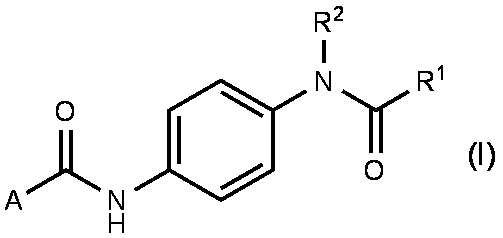
[式中、Aは、
1:下記(a)
1:下記(a)
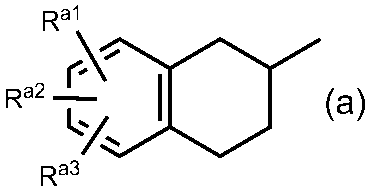
2:下記(b)

(i)Rb1は、
(a)水素原子、
(b)ハロゲン原子、
(c)シアノ、
(d)C1-4アルキル(該基は、4員~7員の環状アミノで置換されていてもよい。)、
(e)C1-4アルコキシ、
(f)アミノ、
(g)モノ-もしくはジ-(C1-6アルキル)アミノ、
(h)4員~7員の環状アミノ、
(i)アミノスルホニル、
(j)モノ-もしくはジ-(C1-6アルキル)アミノスルホニル、
(k)4員~7員の環状アミノスルホニル、
(l)5員もしくは6員の単環式ヘテロアリール基、または
(m)5員~10員の単環式もしくは多環式へテロアリールC1-4アルキルであり、
Rb2およびRb3は、各々独立して、
(a)水素原子、
(b)シアノ、
(c)C1-4アルキル、
(d)モノ-もしくはジ-(C1-6アルキル)アミノ、または
(e)4~7員の環状アミノであるか、または
(ii)Rb1およびRb2が、一緒になって下記
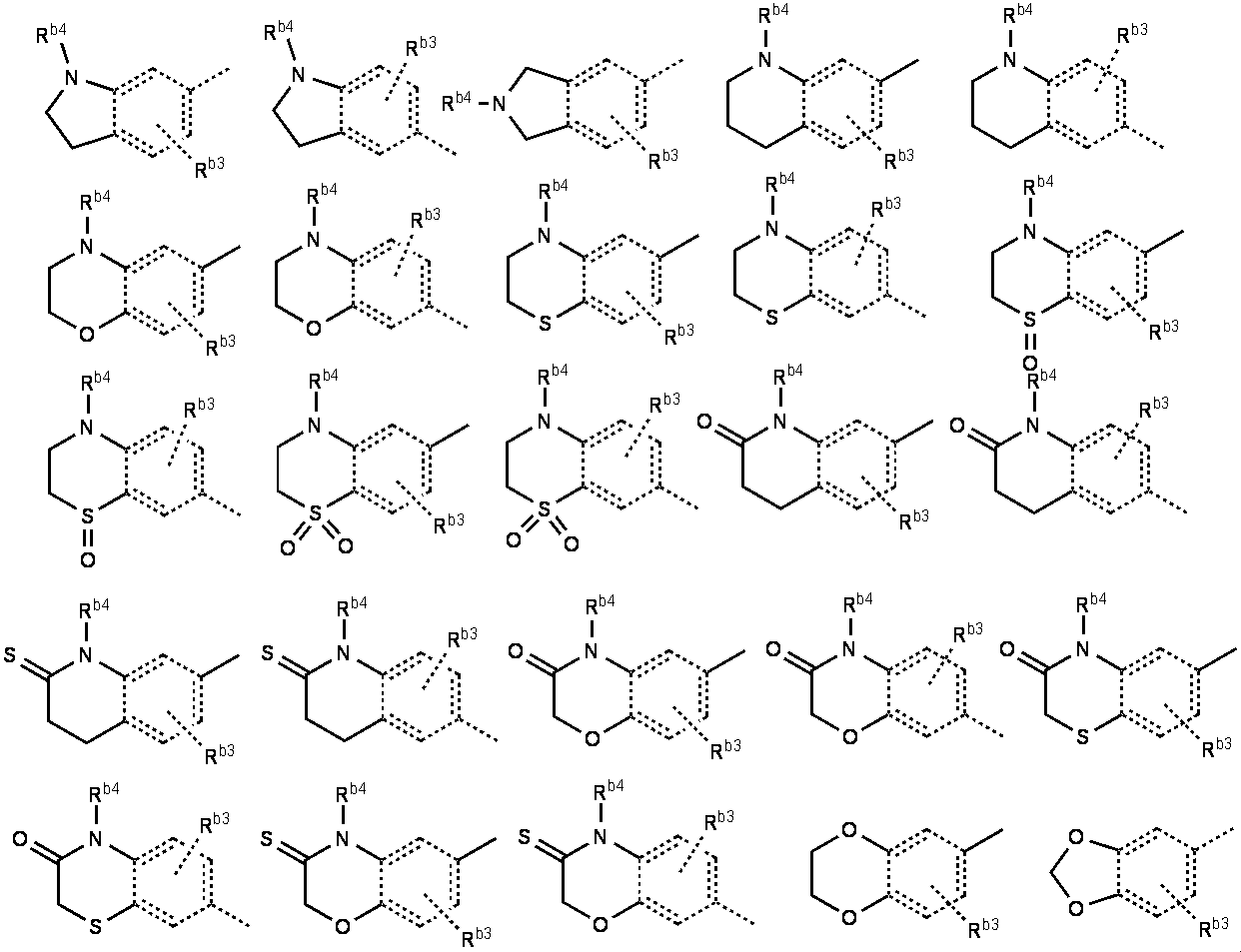
Rb3は、水素原子、またはC1-4アルキルである。)、
3:置換されていてもよいC3-6シクロアルキル基、
4:置換されていてもよい飽和へテロ環基、または
5:置換されていてもよい5員~10員の単環式もしくは多環式へテロアリール基であり;
R1は、
1:C1-6アルキル基(該基は、
(a)C1-4アルコキシ(該基は、C1-4アルコキシで置換されていてもよい。)、
(b)C1-4アルキルスルホニル、
(c)モノ-もしくはジ-(C1-6アルキル)アミノ、
(d)4員~7員の環状アミノ、または
(e)5員もしくは6員の単環式ヘテロアリールオキシで置換されている。)、
2:置換されていてもよい5員~10員の単環式もしくは多環式ヘテロアリール基、
3:置換されていてもよい5員もしくは6員のへテロ環基、または
4:5員~10員の単環式もしくは多環式へテロアリールC1-4アルキル基であり;
R2は、置換されていてもよいC1-6アルキル基、または置換されていてもよいC3-6シクロアルキル基である。]
項2:Aが、下記(a)
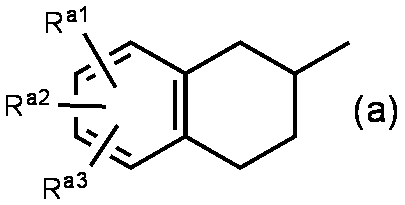
項3:Ra1、Ra2およびRa3が、共に水素原子である、項2に記載の化合物、またはその薬学的に許容される塩。
項4:Aが、下記(b)

項5:Rb1が、
(a)水素原子、
(b)シアノ、
(c)C1-4アルキル(該基は、4員~7員の環状アミノで置換されていてもよい。)、
(d)モノ-もしくはジ-(C1-6アルキル)アミノ、
(e)4員~7員の環状アミノ、
(f)4員~7員の環状アミノスルホニル、
(g)5員もしくは6員の単環式へテロアリール、または
(h)5員~10員の単環式もしくは多環式へテロアリールC1-4アルキルであり、
Rb2およびRb3が、共に水素原子である、項4に記載の化合物、またはその薬学的に許容される塩。
(a)水素原子、
(b)シアノ、
(c)C1-4アルキル(該基は、4員~7員の環状アミノで置換されていてもよい。)、
(d)モノ-もしくはジ-(C1-6アルキル)アミノ、
(e)4員~7員の環状アミノ、
(f)4員~7員の環状アミノスルホニル、
(g)5員もしくは6員の単環式へテロアリール、または
(h)5員~10員の単環式もしくは多環式へテロアリールC1-4アルキルであり、
Rb2およびRb3が、共に水素原子である、項4に記載の化合物、またはその薬学的に許容される塩。
項6:Aが、
1:C3-6シクロアルキル基(該基は、C1-4アルコキシで置換されていてもよい。)、
2:飽和へテロ環基(該環は、
(a)C1-4アルキル、
(b)5員もしくは6員の単環式ヘテロアリール、または
(c)C1-4アルキルカルボニルで置換されていてもよい。)、または
3:5員~10員の単環式もしくは多環式へテロアリール基(該環は、4~7員の環状アミノで置換されていてもよいC1-4アルキルで置換されていてもよい。)である、項1に記載の化合物、またはその薬学的に許容される塩。
1:C3-6シクロアルキル基(該基は、C1-4アルコキシで置換されていてもよい。)、
2:飽和へテロ環基(該環は、
(a)C1-4アルキル、
(b)5員もしくは6員の単環式ヘテロアリール、または
(c)C1-4アルキルカルボニルで置換されていてもよい。)、または
3:5員~10員の単環式もしくは多環式へテロアリール基(該環は、4~7員の環状アミノで置換されていてもよいC1-4アルキルで置換されていてもよい。)である、項1に記載の化合物、またはその薬学的に許容される塩。
項7:R1が、5員~10員の単環式もしくは多環式ヘテロアリール基(該基は、
(a)ハロゲン原子、
(b)C1-4アルキル(該基は、1~3個のフッ素原子で置換されていてもよい。)、
(c)ヒドロキシ、
(d)C1-4アルコキシ(該基は、1~3個のフッ素原子で置換されていてもよい。)、
(e)C3-6シクロアルキルオキシ、
(f)C6-10アリールオキシ、
(g)C6-10アリール、
(h)C1-4アルコキシスルホニル、
(i)C3-6シクロアルコキシスルホニル、
(j)5員もしくは6員の単環式へテロアリールオキシ、
(k)5員もしくは6員の飽和へテロ環オキシ、
(l)アミノ(該アミノは、
(l1)C1-6アルキル、
(l2)C3-6シクロアルキル、
(l3)C3-6シクロアルキルC1-4アルキル、
(l4)C7-14アラルキル、
(l5)C1-4アルキルカルボニル、
(l6)C3-6シクロアルキルカルボニル、
(l7)飽和へテロ環C1-4アルキル、
(l8)飽和へテロ環カルボニル、および
(l9)C1-6アルキルスルホニルから選択される同種または異種の1~2個の基で置換されてもよい。)、
(m)4員~7員環状アミノ、
(n)アミノカルボニル、および
(o)アミノカルボニルオキシから選択される1~3個の基で置換されていてもよい。)である、項1~項6のいずれか一項に記載の化合物、またはその薬学的に許容される塩。
(a)ハロゲン原子、
(b)C1-4アルキル(該基は、1~3個のフッ素原子で置換されていてもよい。)、
(c)ヒドロキシ、
(d)C1-4アルコキシ(該基は、1~3個のフッ素原子で置換されていてもよい。)、
(e)C3-6シクロアルキルオキシ、
(f)C6-10アリールオキシ、
(g)C6-10アリール、
(h)C1-4アルコキシスルホニル、
(i)C3-6シクロアルコキシスルホニル、
(j)5員もしくは6員の単環式へテロアリールオキシ、
(k)5員もしくは6員の飽和へテロ環オキシ、
(l)アミノ(該アミノは、
(l1)C1-6アルキル、
(l2)C3-6シクロアルキル、
(l3)C3-6シクロアルキルC1-4アルキル、
(l4)C7-14アラルキル、
(l5)C1-4アルキルカルボニル、
(l6)C3-6シクロアルキルカルボニル、
(l7)飽和へテロ環C1-4アルキル、
(l8)飽和へテロ環カルボニル、および
(l9)C1-6アルキルスルホニルから選択される同種または異種の1~2個の基で置換されてもよい。)、
(m)4員~7員環状アミノ、
(n)アミノカルボニル、および
(o)アミノカルボニルオキシから選択される1~3個の基で置換されていてもよい。)である、項1~項6のいずれか一項に記載の化合物、またはその薬学的に許容される塩。
項8:R1が、5員~10員の単環式もしくは多環式ヘテロアリール基(該基は、ハロゲン原子、C1-4アルキルまたはC1-4アルコキシで置換されていてもよい。)である、項7に記載の化合物、またはその薬学的に許容される塩。
項9:R1における5員~10員の単環式もしくは多環式ヘテロアリール基が、5員もしくは6員の単環式へテロアリール基である、項1~項8のいずれか一項に記載の化合物、またはその薬理学的に許容される塩。
項10:R1における5員もしくは6員の単環式ヘテロアリール基が、下記

からなる群から選択される基である、項9に記載の化合物、またはその薬学的に許容される塩。
項11:R1が、フリル基である、項10に記載の化合物、またはその薬学的に許容される塩。
項12:R1が、5員もしくは6員の飽和へテロ環基(該基は、
(a)ハロゲン原子、
(b)ヒドロキシ、
(c)シアノ、
(d)C1-4アルキル(該アルキルは、1~3個のフッ素原子で置換されてもよい。)、
(e)C1-4アルコキシ(該アルコキシは、1~3個のフッ素原子で置換されてもよい。)、
(f)C1-4アルコキシカルボニル、
(g)アミノ基(該アミノは、C1-6アルキルスルホニル、またはC6-10アリールスルホニルで置換されてもよい。)、
(h)アミノカルボニル基(該アミノは、C1-6アルキルおよびC6-10アリールからなる群から選択される同種または異種の1~2個の基で置換されていてもよい。)、
(i)アミノカルボニルオキシ基(該アミノは、C1-6アルキルおよびC6-10アリールからなる群から選択される同種または異種の1~2個の基で置換されていてもよい。)、
(j)アミノカルボニルアミノ基(該アミノカルボニルにおけるアミノは、C1-6アルキルおよびC6-10アリールからなる群から選択される同種または異種の1~2個の基で置換されていてもよい。)、または
(k)オキソ基で置換されていてもよい。)である、項1~項6のいずれか一項に記載の化合物、またはその薬学的に許容される塩。
(a)ハロゲン原子、
(b)ヒドロキシ、
(c)シアノ、
(d)C1-4アルキル(該アルキルは、1~3個のフッ素原子で置換されてもよい。)、
(e)C1-4アルコキシ(該アルコキシは、1~3個のフッ素原子で置換されてもよい。)、
(f)C1-4アルコキシカルボニル、
(g)アミノ基(該アミノは、C1-6アルキルスルホニル、またはC6-10アリールスルホニルで置換されてもよい。)、
(h)アミノカルボニル基(該アミノは、C1-6アルキルおよびC6-10アリールからなる群から選択される同種または異種の1~2個の基で置換されていてもよい。)、
(i)アミノカルボニルオキシ基(該アミノは、C1-6アルキルおよびC6-10アリールからなる群から選択される同種または異種の1~2個の基で置換されていてもよい。)、
(j)アミノカルボニルアミノ基(該アミノカルボニルにおけるアミノは、C1-6アルキルおよびC6-10アリールからなる群から選択される同種または異種の1~2個の基で置換されていてもよい。)、または
(k)オキソ基で置換されていてもよい。)である、項1~項6のいずれか一項に記載の化合物、またはその薬学的に許容される塩。
項13:R1が、5員もしくは6員の飽和へテロ環基(該基は、C1-4アルキルまたはオキソで置換されていてもよい。)である、項12に記載の化合物、またはその薬学的に許容される塩。
項14:R1における5員もしくは6員の飽和へテロ環基が、下記

からなる群から選択される基である、項12または項13に記載の化合物、またはその薬学的に許容される塩。
項15:R2が、C1-6アルキル基である、項1~項14のいずれか一項に記載の化合物、またはその薬学的に許容される塩。
項16:R2が、メチル基、またはエチル基である、項15に記載の化合物、またはその薬学的に許容される塩。
項17:R2が、C3-6シクロアルキル基である、項1~項14のいずれか一項に記載の化合物、またはその薬学的に許容される塩。
項17:R2が、C3-6シクロアルキル基である、項1~項14のいずれか一項に記載の化合物、またはその薬学的に許容される塩。
項18:項1~項17に記載の化合物、またはその薬学的に許容される塩を有効成分として含有する医薬組成物。
項19:項1~項17のいずれか一項に記載の化合物、またはその薬学的に許容される塩を有効成分として含有するsEH阻害剤。
項20:高血圧症、急性および慢性うっ血性心不全、原発性および二次性肺高血圧症、原発性および二次性アルドステロン血症、腎血管性高血圧症、原発性および二次性腎疾患、心肥大、左室肥大、左室線維化、左室拡張不全、左心室不全、心房細動、不安定狭心症、心筋梗塞、心筋症、脳卒中、血管再建術後の再狭窄、糖尿病性網膜症、認知障害、閉塞性動脈硬化症、糖尿病、肥満、脂質代謝異常、脂肪肝、血管障害、およびアテローム性動脈硬化からなる群から選択される疾患の治療及び/又は予防に有用である、項19に記載のsEH阻害剤。
項21:高血圧症、及び/又は原発性および二次性腎疾患の治療及び/又は予防に有用である、項19または項20に記載のsEH阻害剤。
項22:項1~項17のいずれか一項に記載の化合物、またはその薬学的に許容される塩を有効成分として含有する高血圧症、及び/又は原発性および二次性腎疾患の治療剤。
項23:sEH阻害剤の製造のための、項1~項17のいずれか一項に記載の化合物、またはその薬学的に許容される塩の使用。
項24:治療を必要とする患者に、項1~項17のいずれか一項に記載の化合物、またはその薬学的に許容される塩の有効量を投与する、高血圧症、及び/又は原発性および二次性腎疾患の治療方法。
式(I)で表される化合物、またはその薬学的に許容される塩(以下、本発明化合物と称する場合もある。)は、高血圧症の予防及び/又は治療薬として有用である。本発明化合物は、急性および慢性うっ血性心不全の管理にも有益である。また、原発性および二次性肺高血圧症、原発性および二次性アルドステロン血症、腎血管性高血圧症、原発性および二次性腎疾(例えば、糸球体腎炎、IgA腎症、糖尿病性腎症、高血圧性腎症(腎硬化症)、ネフローゼ症候群、腎不全など)、左室肥大、左室線維化、左室拡張不全、左心室不全、心房細動、不安定狭心症、心筋梗塞、心筋症、脳卒中、血管再建術後の再狭窄、糖尿病性網膜症、認知障害(例えば、アルツハイマー病、脳血管性認知症の治療など)、および血管障害(例えば、片頭痛、レイノー病など)の予防及び/又は治療、並びにアテローム性動脈硬化プロセスを最小に抑制するためにも有用である。また、高眼圧に関連した疾患(例えば、緑内障など)の治療に有用である。
以下に、本発明をさらに詳細に説明する。本明細書において「置換基」の定義における炭素の数を、例えば、「C1-6」などと表記する場合もある。具体的には、「C1-6アルキル」なる表記は、炭素数1から6のアルキル基と同義である。また、本明細書において、「置換されてもよい」または「置換された」なる用語を特に明示していない置換基については、「非置換」の置換基を意味する。例えば、「C1-6アルキル」とは、「非置換」であることを意味する。
本明細書において「基」なる用語は、1価基を意味する。例えば、「アルキル基」は、1価の飽和炭化水素基を意味する。また、本明細書における置換基の説明において、「基」なる用語を省略する場合もある。尚、「置換されてもよい」もしくは「置換された」で定義される基における置換基の数は、置換可能であれば特に制限はなく、1または複数である。また、特に指示した場合を除き、各々の基の説明はその基が他の基の一部分または置換基である場合にも該当する。
「ハロゲン原子」は、例えばフッ素原子、塩素原子、臭素原子またはヨウ素原子等が挙げられる。
「C1-6アルキル基」は、炭素数1~6個を有する直鎖または分枝状の飽和炭化水素基を意味する。好ましくは、「C1-4アルキル基」等が挙げられる。「C1-6アルキル基」の具体例としては、例えば、メチル、エチル、プロピル、イソプロピル、ブチル、イソブチル、sec-ブチル、tert-ブチル、ペンチル、イソペンチル、ネオペンチル、1-エチルプロピル、ヘキシル、イソヘキシル、1,1-ジメチルブチル、2,2-ジメチルブチル、3,3-ジメチルブチル、2-エチルブチル等が挙げられる。
「C2-6アルケニル基」は、炭素数2~6個を有し、二重結合を1個含む直鎖状または分枝鎖状の不飽和炭化水素基を意味する。具体的には、例えば、ビニル、プロペニル、メチルプロペニル、ブテニルまたはメチルブテニル等が挙げられる。
「C2-6アルキニル基」は、炭素数2~6個を有し、三重結合を1個含む直鎖状または分枝鎖状の不飽和炭化水素基を意味する。例えば、具体的には、例えば、エチニル、1-プロピニル、2-プロピニル、2-ブチニル、ペンチニルまたはヘキシニル等が挙げられる。
「C3-6シクロアルキル基」は、炭素数3~6個を有し、環状の飽和炭化水素基を意味する。具体例としては、例えば、シクロプロピル、シクロブチル、シクロペンチル、シクロヘキシル等が挙げられる。
前記「C3-6シクロアルキル基」には、「C3-6シクロアルキル」とフェニルまたは5員もしくは6員の窒素原子、硫黄原子または酸素原子から選ばれるヘテロ原子を同じまたは異なって1個以上(例えば1~4個)含有する環と縮環した基も包含される。該基の具体例としては、例えば、下記式で表される基等が挙げられる。

「C3-6シクロアルキルC1-4アルキル基」とは、「C3-6シクロアルキル」が「C1-4アルキル」に結合した基を意味する。具体例としては、例えば、シクロプロピルメチル、シクロブチルメチル、シクロペンチルメチル、シクロヘキシルメチル等が挙げられる。
「C6-10アリール基」は、炭素数6~10個を有する芳香族炭化水素基を意味する。好ましくは「C6アリール基」(フェニル)等が挙げられる。「C6-10アリール基」の具体例としては、例えば、フェニル、1-ナフチルまたは2-ナフチル等が挙げられる。
「C7-14アラルキル基」とは、「C6-10アリールC1-4アルキル基」を意味し、前記「アルキル基」に前記「アリール基」が置換した基を意味する。好ましくは、「C7-10アラルキル基」(C6アリールC1-4アルキル基)が挙げられる。「C7-14アラルキル基」の具体例としては、例えば、ベンジル、2-フェニルエチル、1-フェニルプロピルまたは1-ナフチルメチル等が挙げられる。
「ヘテロアリール基」としては、例えば、5員~10員の単環式もしくは多環式の芳香族基等が挙げられ、該基は、窒素原子、硫黄原子または酸素原子から選ばれるヘテロ原子を同じまたは異なって1個以上(例えば1~4個)含有する。「多環式のヘテロアリール基」としては、2もしくは3環式の基が好ましく、2環式の基がより好ましい。多環式のヘテロアリール基は、前記単環式のへテロアリール基と芳香族環(ベンゼン、ピリジンなど)または非芳香族環(シクロヘキシルなど)とが縮環したものを含む。「ヘテロアリール基」の具体例としては、例えば、下記式で表される基が挙げられる。

前記式において環を横切る結合手は、「基」が該環における置換可能な位置で結合することを意味する。例えば、下記式
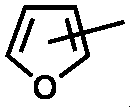
更に、「ヘテロアリール基」が多環式の基である場合において、例えば、下記式
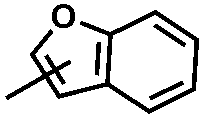
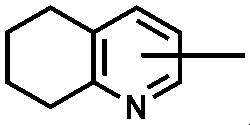
「ヘテロアリールC1-4アルキル基」とは、前記「アルキル基」に前記「ヘテロアリール基」が置換した基を意味する。該ヘテロアリール部分としては、前記のへテロアリール基として例示した具体例と同じものが挙げられる。例えば、「ヘテロアリールC1-4アルキル」が挙げられる。具体的には、例えば、2-ピリジルメチルなどが挙げられる。
「C1-6アルコキシ基」の「C1-6アルキル」部分は、前記「C1-6アルキル」と同義である。好ましくは、「C1-4アルコキシ基」等が挙げられる。「C1-6アルコキシ基」の具体例としては、メトキシ、エトキシ、プロポキシ、イソプロポキシ、ブトキシ、イソブトキシ、sec-ブトキシ、tert-ブトキシ等が挙げられる。
「C1-6アルキルスルホニル基」の「C1-6アルキル」部分は、前記「C1-6アルキル」と同義である。好ましくは、「C1-4アルキルスルホニル基」等が挙げられる。「C1-6アルキルスルホニル基」の具体例としては、例えば、メチルスルホニル、エチルスルホニル、プロピルスルホニル、イソプロピルスルホニル、ブチルスルホニル、ペンチルスルホニルまたはヘキシルスルホニル等が挙げられる。
「C3-6シクロアルキルスルホニル基」の「C3-6シクロアルキル」部分は、前記「C3-6シクロアルキル」と同義である。具体例としては、例えば、シクロプロピルスルホニル、シクロブチルスルホニル、シクロペンチルスルホニル、シクロヘキシルスルホニル等が挙げられる。
「C3-6シクロアルコキシ基」の「C3-6シクロアルキル」部分は、前記「C3-6シクロアルキル」と同義である。具体例としては、シクロプロピルオキシ、シクロブチルオキシ、シクロペンチルオキシ、シクロヘキシルオキシ等が挙げられる。
「C6-10アリールオキシ基」の「C6-10アリール」部分は、前記「C6-10アリール」と同義である。「C6アリールオキシ」(フェニルオキシ)が好ましい。「C6-10アリールオキシ基」の具体的としては、フェノキシ、1-ナフチルオキシまたは2-ナフチルオキシ等が挙げられる。
「C7-14アラルキルオキシ基」(C6-10アリールC1-4アルキルオキシ基)の「C7-14アラルキル」部分は、前記「C7-14アラルキル」と同義である。好ましくは、「C7-10アラルキルオキシ基」(「フェニルC1-4アルキル基」)などが挙げられる。「C7-14アラルキルオキシ基」の具体例としては、例えば、ベンジルオキシ、フェネチルオキシ、ナフチルメチルオキシ等が挙げられる。
「ヘテロアリールオキシ基」としては、前記「アラルキルオキシ基」の「アラルキル」部分が「ヘテロアリール」に置き換わった基を意味する。例えば、「5員~10員の単環式もしくは多環式ヘテロアリールオキシ基」等が挙げられる。好ましくは、「5員もしくは6員の単環式ヘテロアリールオキシ基」である。
「C1-4アルコキシスルホニル基」の「C1-4アルコキシ」部分は、前記「C1-4アルコキシ基」と同義である。例えば、メトキシスルホニルなどが挙げられる。
「C3-6シクロアルコキシスルホニル基」の「C3-6シクロアルコキシ」部分は、前記「C3-6シクロアルコキシ基」と同義である。具体例としては、例えば、シクロプロピルオキシスルホニルなどが挙げられる。
「C6-10アリールオキシスルホニル基」の「C6-10アリール」部分は、前記「C6-10アリール基」と同義である。具体例としては、例えば、フェノキシスルホニルなどが挙げられる。
「C7-14アラルキルオキシスルホニル基」の「C7-14アラルキルオキシ」部分は、前記「C7-14アラルキルオキシ基」と同義である。具体例としては、例えば、フェノキシスルホニルなどが挙げられる。
「C1-4アルコキシカルボニル基」は、前記「C1-4アルコキシ基」がカルボニル基に結合した基を意味する。具体的には、メトキシカルボニル、エトキシカルボニル、プロポキシカルボニル、2-プロポキシカルボニルまたはtert-ブトキシカルボニル等が挙げられる。
「C3-6シクロアルコキシカルボニル基」は、前記「C3-6シクロアルコキシ基」がカルボニル基に結合した基を意味する。具体的には、C3-6シクロアルコキシ部分としては、前記のC3-6シクロアルコキシ基として例示したものが挙げられる。
「C6-10アリールオキシカルボニル基」は、前記「C6-10アリールオキシ基」がカルボニル基に結合した基を意味する。具体的には、C6-10アリールオキシ部分として、前記のC6-10アリールオキシ基として例示したものが挙げられる。
「C1-4アルキルカルボニル基」は、前記「C1-4アルキル基」がカルボニル基に結合した基を意味する。具体的には、例えばアセチル、プロピオニルまたはブチリル等が挙げられる。
「C3-6シクロアルキルカルボニル基」は、前記「C3-6シクロアルキル基」がカルボニル基に結合した基を意味する。具体例としては、シクロプロピルカルボニル、シクロブチルカルボニル、シクロペンチルカルボニル、シクロヘキシルカルボニル等が挙げられる。
「C3-6シクロアルキルC1-4アルキルカルボニル基」は、前記「C3-10シクロアルキルC1-4アルキル基」がカルボニル基に結合した基を意味する。具体例としては、シクロプロピルメチルカルボニル等が挙げられる。
「C6-10アリールカルボニル基」とは、前記「C6-10アリール基」がカルボニル基に結合した基を意味する。「C6-10アリール」部分は、前記「C6-10アリール基」と同義である。好ましくは、「C6アリールカルボニル基」(フェニルカルボニル基)が挙げられる。「C6-10アリールカルボニル基」の具体例としては、例えば、ベンゾイル、1-ナフトイルまたは2-ナフトイル等が挙げられる。
「C1-4アルキルカルボニルオキシ基」の「C1-4アルキル」部分は、前記「C1-4アルキル基」と同義である。具体例としては、例えば、メチルカルボニルオキシ、エチルカルボニルオキシ、イソプロピルカルボニルオキシなどが挙げられる。
「C3-6シクロアルキルカルボニルオキシ基」の「C3-6シクロアルキル」部分は、前記「C3-6シクロアルキル基」と同義である。具体例としては、例えば、シクロプロピルカルボニルオキシ、シクロブチルカルボニルオキシ、シクロペンチルカルボニルオキシなどが挙げられる。
「C3-6シクロアルキルC1-4アルコキシ基」は、前記「C3-6シクロアルキル基」が「C1-4アルコキシ基」に置換した基を意味する。具体例としては、例えば、シクロプロピルメトキシなどが挙げられる。
「C3-6シクロアルキルC1-4アルコキシカルボニル基」の「C3-6シクロアルキルC1-4アルコキシ」部分は、前記と同義である。具体例としては、例えば、シクロプロピルメトキシカルボニルなどが挙げられる。
「C1-4アルキルカルボニルアミノ基」とは、前記「C1-4アルキルカルボニル基」がアミノ基に1個置換した基を意味する。具体例としては、例えば、メチルカルボニルアミノなどが挙げられる。尚、「C1-4アルキル」は、1~3個のフッ素原子で置換されてもよい。
「N-(C1-4アルキルカルボニル)-N-(C1-6アルキル)-アミノ基」とは、前記「C1-4アルキルカルボニルアミノ基」のアミノに前記「C1-6アルキル基」が置換した基を意味する。具体例としては、例えば、N-メチル-N-エチルカルボニルアミノなどが挙げられる。
「C3-6シクロアルキルカルボニルアミノ基」とは、前記「C3-6シクロアルキルカルボニル基」がアミノ基に1個置換した基を意味する。具体例としては、例えば、シクロプロピルカルボニルアミノなどが挙げられる。
「C3-6シクロアルキルC1-4アルキルカルボニルアミノ基」とは、前記「C3-6シクロアルキルC1-4アルキルカルボニル基」がアミノ基に1個置換した基を意味する。具体例としては、例えば、シクロプロピルメチルカルボニルアミノなどが挙げられる。
「C1-4アルコキシカルボニルアミノ基」とは、前記「C1-4アルコキシカルボニル基」がアミノ基に1個置換した基を意味する。具体例としては、例えば、メトキシカルボニルアミノ、エトキシカルボニルアミノなどが挙げられる。尚、「C1-4アルキル」は、1~3個のフッ素原子で置換されてもよい。
「N-(C1-6アルキル)-N-(C1-4アルコキシカルボニル)-アミノ基」とは、前記「C1-4アルコキシカルボニルアミノ基」のアミノ基に「C1-6アルキル基」が置換した基を意味する。具体例としては、例えば、N-メチル-メトキシカルボニルアミノなどが挙げられる。
「C1-4アルキルスルホニルアミノ基」とは、前記「C1-4アルキルスルホニル基」がアミノ基に1個置換した基を意味する。具体例としては、例えば、メチルスルホニルアミノ、エチルスルホニルアミノなどが挙げられる。
「ヘテロ環基」としては、例えば、窒素原子、酸素原子および硫黄原子から選択される同種または異種の原子を1~3個有する5員もしくは6員のヘテロ環基等が挙げられる。前記窒素原子、酸素原子および硫黄原子はいずれも環を構成する原子である。具体的には、ピラニル、テトラヒドロフリル、ピロリジニル、イミダゾリジニル、ピペリジニル、モルホリニル、チオモルホリニル、ジオキソチオモルホリニル、ヘキサメチレンイミニル、オキサゾリジニル、チアゾリジニル、イミダゾリジニル、オキソイミダゾリジニル、ジオキソイミダゾリジニル、オキソオキサゾリジニル、ジオキソオキサゾリジニル、ジオキソチアゾリジニル、テトラヒドロフラニルまたはテトラヒドロピリジニル等が挙げられる。該基は、部分不飽和であってもよい。該基は、「飽和へテロ環基」が好ましい。該基は、環を構成する窒素原子が、「基」の結合手となることはない。すなわち、該基には、例えば、ピロリジノ基などの概念は包含されない。
前記「飽和へテロ環基」は、6員の芳香族炭化水素または6員の不飽和へテロ環と縮合環を形成してもよい。例えば、前掲の5員もしくは6員の「飽和ヘテロ環基」と6員の芳香族炭化水素または6員の不飽和へテロ環が縮合した二環式の11もしくは12員の「飽和ヘテロ環」が挙げられる。6員の芳香族炭化水素としては、ベンゼンなどが挙げられる。6員の不飽和へテロ環としては、ピリジン、ピリミジンまたはピリダジン等が挙げられる。具体的には、ジヒドロインドリル、ジヒドロイソインドリル、ジヒドロプリニル、ジヒドロチアゾロピリミジニル、ジヒドロベンゾジオキサニル、イソインドリニル、インダゾリル、ピロロリジニル、テトラヒドロキノリニル、デカヒドロキノリニル、テトラヒドロイソキノリニル、デカヒドロイソキノリニル、テトラヒドロナフチリジニルまたはテトラヒドロピリドアゼピニル等が挙げられる。
「飽和へテロ環オキシ基」の「飽和へテロ環」部分は、前記「飽和へテロ環基」と同義である。具体例としては、4-ピラニルオキシなどが挙げられる。
「飽和へテロ環カルボニル基」は、前記「飽和へテロ環基」がカルボニル基に結合した基を意味する。具体例としては、4-ピラニルカルボニルなどが挙げられる。
「飽和へテロ環C1-4アルキル基」は、前記「飽和へテロ環基」が「C1-4アルキル基」に結合した基を意味する。具体例としては、4-ピラニルメチルなどが挙げられる。
「飽和へテロ環オキシカルボニル基」の「飽和へテロ環オキシ」部分は、前記と同義である。具体例としては、4-ピラニルオキシカルボニルなどが挙げられる。
「飽和へテロ環C1-4アルキルカルボニル基」の「飽和へテロ環C1-4アルキル」部分は、と同義である。具体例としては、4-ピラニルメチルカルボニルなどが挙げられる。
「置換されていてもよいアミノ基」とは、アミノ基、モノ-もしくはジ-置換されたアミノ基、および5員~7員の環状アミノ基を意味する。
「モノ-もしくはジ-置換されたアミノ基」は、「C1-6アルキル」、「C3-6シクロアルキル」、「C3-6シクロアルキルC1-4アルキル」、「C6-10アリール」、「C7-14アラルキル」、「C3-6シクロアルキルC1-4アルコキシカルボニル」、「C1-4アルキルカルボニル」、「C3-6シクロアルキルカルボニル」、「飽和へテロ環C1-4アルキル」、「飽和へテロ環カルボニル」、「飽和へテロ環オキシカルボニル」、「飽和へテロ環C1-4アルキルカルボニル」、「C1-6アルキルスルホニル」、および「C6-10アリールスルホニル」からなる群から選択される同種または異種の1~2個の基で置換されたアミノ基を意味する。
「モノ-もしくはジ-置換されたアミノ基」の具体例としては、例えば、
「モノ-もしくはジ-(C1-6アルキル)で置換されたアミノ基」(例えば、メチルアミノ、エチルアミノ、ジメチルアミノ、ジエチルアミノなど)、
「モノ-もしくはジ-(C3-6シクロアルキル)で置換されたアミノ基」(例えば、シクロプロピルアミノ、シクロブチルアミノ、シクロペンチルアミノ、ジシクロプロピルアミノ、ジシクロブチルアミノ、シクロジペンチルアミノなど)、
「モノ-(C3-6シクロアルキルC1-4アルキル)で置換されたアミノ基」(例えば、シクロプロピルメチルアミノ、シクロブチルメチルアミノ、シクロペンチルメチルアミノなど)、
「(C1-4アルキル)(C7-14アラルキル)で置換されたアミノ基」(例えば、N-メチル-N-ベンジルアミノ、N-エチル-N-ベンジルアミノなど)、
「(C3-6シクロアルキル)(C7-14アラルキル)で置換されたアミノ基」(例えば、N-シクロプロピル-N-ベンジルアミノ、N-シクロペンチル-N-ベンジルアミノ、N-シクロヘキシル-N-ベンジルアミノなど)、
「C3-6シクロアルキルC1-4アルコキシカルボニルアミノ」(例えば、シクロプロピルメトキシカルボニルアミノなど)、
「C6-10アリールアミノ」(例えば、フェニルアミノなど)、
「C7-14アラルキルアミノ」(例えば、ベンジルアミノなど)、
「5員もしくは6員の飽和ヘテロ環アミノ基」(例えば、3-ピロリジニルアミノなど)、
「飽和へテロ環C1-4アルキルカルボニルアミノ基」(例えば、(4-ピラニルメチルカルボニル)アミノなど)、
「C1-6アルキルスルホニルアミノ基」(例えば、メチルスルホニルアミノなど)、
「C6-10アリールスルホニルアミノ基」(例えば、フェニルスルホニルアミノなど)、
「N-(C1-6アルキル)-N-(飽和へテロ環C1-4アルキルカルボニル)-アミノ基」(例えば、N-メチル-N-(4-ピラニルメチルカルボニル)アミノなど)、
「飽和へテロ環カルボニルアミノ基」(例えば、4-ピラニルカルボニルアミノなど)、
「N-(C1-6アルキル)-N-(飽和へテロ環カルボニル)-アミノ基」(例えば、N-メチル-N-(4-ピラニルカルボニル)アミノなど)、
「N-(C1-4アルキルカルボニル)-N-(C1-6アルキル)-アミノ基」(例えば、N-メチル-N-メチルカルボニルアミノなど)、
「(飽和へテロ環オキシカルボニル)アミノ基」(例えば、3-テトラヒドロフリルオキシカルボニルアミノなど)、
「N-(飽和へテロ環C1-4アルキル)-N-(C1-6アルキル)-アミノ基」(例えば、N-メチル-N-(4-ピラニルメチル)アミノなど)、
「N-(飽和へテロ環カルボニル)-N-(C1-6アルキル)-アミノ基」(例えば、N-メチル-N-(4-ピラニルカルボニル)アミノなど)、
「N-(飽和へテロ環C1-4アルキルカルボニル)-N-(C1-6アルキル)-アミノ基」(例えば、N-メチル-N-(4-ピラニルメチルカルボニル)アミノなど)、
「N-(飽和へテロ環オキシカルボニル)-N-(C3-6シクロアルキル)-アミノ基」(例えば、N-シクロプロピル-N-(4-ピラニルオキシカルボニル)アミノなど)、
「N-(飽和へテロ環C1-4アルキルカルボニル)-N-(C3-6シクロアルキル)-アミノ基」(例えば、N-シクロプロピル-N-(4-ピラニルメチルカルボニル)アミノなど)等が挙げられる。
「モノ-もしくはジ-(C1-6アルキル)で置換されたアミノ基」(例えば、メチルアミノ、エチルアミノ、ジメチルアミノ、ジエチルアミノなど)、
「モノ-もしくはジ-(C3-6シクロアルキル)で置換されたアミノ基」(例えば、シクロプロピルアミノ、シクロブチルアミノ、シクロペンチルアミノ、ジシクロプロピルアミノ、ジシクロブチルアミノ、シクロジペンチルアミノなど)、
「モノ-(C3-6シクロアルキルC1-4アルキル)で置換されたアミノ基」(例えば、シクロプロピルメチルアミノ、シクロブチルメチルアミノ、シクロペンチルメチルアミノなど)、
「(C1-4アルキル)(C7-14アラルキル)で置換されたアミノ基」(例えば、N-メチル-N-ベンジルアミノ、N-エチル-N-ベンジルアミノなど)、
「(C3-6シクロアルキル)(C7-14アラルキル)で置換されたアミノ基」(例えば、N-シクロプロピル-N-ベンジルアミノ、N-シクロペンチル-N-ベンジルアミノ、N-シクロヘキシル-N-ベンジルアミノなど)、
「C3-6シクロアルキルC1-4アルコキシカルボニルアミノ」(例えば、シクロプロピルメトキシカルボニルアミノなど)、
「C6-10アリールアミノ」(例えば、フェニルアミノなど)、
「C7-14アラルキルアミノ」(例えば、ベンジルアミノなど)、
「5員もしくは6員の飽和ヘテロ環アミノ基」(例えば、3-ピロリジニルアミノなど)、
「飽和へテロ環C1-4アルキルカルボニルアミノ基」(例えば、(4-ピラニルメチルカルボニル)アミノなど)、
「C1-6アルキルスルホニルアミノ基」(例えば、メチルスルホニルアミノなど)、
「C6-10アリールスルホニルアミノ基」(例えば、フェニルスルホニルアミノなど)、
「N-(C1-6アルキル)-N-(飽和へテロ環C1-4アルキルカルボニル)-アミノ基」(例えば、N-メチル-N-(4-ピラニルメチルカルボニル)アミノなど)、
「飽和へテロ環カルボニルアミノ基」(例えば、4-ピラニルカルボニルアミノなど)、
「N-(C1-6アルキル)-N-(飽和へテロ環カルボニル)-アミノ基」(例えば、N-メチル-N-(4-ピラニルカルボニル)アミノなど)、
「N-(C1-4アルキルカルボニル)-N-(C1-6アルキル)-アミノ基」(例えば、N-メチル-N-メチルカルボニルアミノなど)、
「(飽和へテロ環オキシカルボニル)アミノ基」(例えば、3-テトラヒドロフリルオキシカルボニルアミノなど)、
「N-(飽和へテロ環C1-4アルキル)-N-(C1-6アルキル)-アミノ基」(例えば、N-メチル-N-(4-ピラニルメチル)アミノなど)、
「N-(飽和へテロ環カルボニル)-N-(C1-6アルキル)-アミノ基」(例えば、N-メチル-N-(4-ピラニルカルボニル)アミノなど)、
「N-(飽和へテロ環C1-4アルキルカルボニル)-N-(C1-6アルキル)-アミノ基」(例えば、N-メチル-N-(4-ピラニルメチルカルボニル)アミノなど)、
「N-(飽和へテロ環オキシカルボニル)-N-(C3-6シクロアルキル)-アミノ基」(例えば、N-シクロプロピル-N-(4-ピラニルオキシカルボニル)アミノなど)、
「N-(飽和へテロ環C1-4アルキルカルボニル)-N-(C3-6シクロアルキル)-アミノ基」(例えば、N-シクロプロピル-N-(4-ピラニルメチルカルボニル)アミノなど)等が挙げられる。
尚、「モノ-もしくはジ-(C1-6アルキル)で置換されたアミノ基」における「C1-6アルキル」部分は、C1-6アルコキシ、モノ-C1-6アルキルカルボニルアミノ(該C1-6アルキルは、1~3個のフッ素原子で置換されてもよい。)、またはモノ-C1-6アルコキシカルボニルアミノで置換されてもよい。
「4員~7員の環状アミノ基」は、4員~7員からなる環状のアミノ基を意味する。該環の窒素原子が直接「基」の結合手となる基を意味する。好ましくは、5員~7員であり、更に好ましくは5員もしくは6員である。具体例としては、例えば、ピロリジノ、ピペリジノ、モルホリノ、チオモルホリノ、チオモルホリノオキシド、チオモルホリノジオキシド、ピペラジノ、2-ピロリドン-1-イル等が挙げられる。該環は、例えば、ハロゲン原子、C1-4アルキル、またはC1-4アルコキシで置換されてもよいC6アリールなどで置換されてもよい。
「4員~7員の環状アミノ基」は、6員の芳香族炭化水素または6員の不飽和へテロ環と縮合環を形成してもよい。具体例としては、下記で表される「基」等が挙げられる。
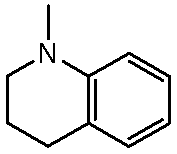
「置換されてもよいC1-6アルキル基」、「置換されてもよいC1-6アルコキシ基」、「置換されてもよいC2-6アルケニル基」、「置換されてもよいC2-6アルキニル基」、「置換されてもよいC1-6アルコキシカルボニル基」、「置換されてもよいC1-6アルキルスルホニル基」、「置換されてもよいC3-6シクロアルキルスルホニル基」、および「置換されてもよいC1-6アルコキシスルホニル基」における置換基としては、例えば、
(a)ハロゲン原子、
(b)シアノ基、
(c)C3-6シクロアルキル基、
(d)水酸基、
(e)C1-4アルコキシ基(該基は、
(e1)1~3個のフッ素原子、
(e2)C1-4アルコキシ、または
(e3)C3-6シクロアルキルで置換されてもよい。)、
(f)C3-6シクロアルキルオキシ基、
(g)C6-10アリールオキシ基、
(h)C7-14アラルキルオキシ基、
(i)ホルミル基、
(j)C1-4アルキルカルボニル基、
(k)C3-6シクロアルキルカルボニル基、
(l)C6-10アリールカルボニル基、
(m)C7-14アラルキルカルボニル基、
(n)ホルミルカルボニルオキシ基、
(o)C1-4アルキルカルボニルオキシ基、
(p)C3-6シクロアルキルカルボニルオキシ基、
(q)カルボキシル基、
(r)C1-4アルコキシカルボニル基、
(s)C3-6シクロアルコキシカルボニル基、
(t)アミノ基、
(u)モノ-置換されたアミノ基(該基は、
(u1)C1-6アルキル基、
(u2)C3-6シクロアルキル、
(u3)C3-6シクロアルキルC1-4アルキル、
(u4)C6-10アリール、
(u5)C7-14アラルキル、
(u6)C3-6シクロアルキルC1-4アルコキシカルボニル、
(u7)C1-4アルキルカルボニル、
(u8)C3-6シクロアルキルカルボニル、
(u9)飽和へテロ環C1-4アルキル、
(u10)飽和へテロ環カルボニル、
(u11)飽和へテロ環オキシカルボニル、
(u12)飽和へテロ環C1-4アルキルカルボニル、
(u13)C1-6アルキルスルホニル、または
(u14)C6-10アリールスルホニルで置換される。)、
(v)ジ-置換されたアミノ基(該基は、前記(u1)~(u14)から選択される同種または異種の2個の基で置換される。)、
(w)4員~7員の環状アミノ基、
(x)置換されてもよいアミノカルボニル基、
(y)置換されてもよいアミノカルボニルオキシ基、または
(z)飽和へテロ環基(該環は、例えば、C1-4アルコキシで置換されてもよいC1-4アルキル、C1-4アルコキシ、またはC1-4アルキルカルボニルアミノなどで置換されてもよい。)などが挙げられる。尚、これらの置換基リストに限定されることはない。
(a)ハロゲン原子、
(b)シアノ基、
(c)C3-6シクロアルキル基、
(d)水酸基、
(e)C1-4アルコキシ基(該基は、
(e1)1~3個のフッ素原子、
(e2)C1-4アルコキシ、または
(e3)C3-6シクロアルキルで置換されてもよい。)、
(f)C3-6シクロアルキルオキシ基、
(g)C6-10アリールオキシ基、
(h)C7-14アラルキルオキシ基、
(i)ホルミル基、
(j)C1-4アルキルカルボニル基、
(k)C3-6シクロアルキルカルボニル基、
(l)C6-10アリールカルボニル基、
(m)C7-14アラルキルカルボニル基、
(n)ホルミルカルボニルオキシ基、
(o)C1-4アルキルカルボニルオキシ基、
(p)C3-6シクロアルキルカルボニルオキシ基、
(q)カルボキシル基、
(r)C1-4アルコキシカルボニル基、
(s)C3-6シクロアルコキシカルボニル基、
(t)アミノ基、
(u)モノ-置換されたアミノ基(該基は、
(u1)C1-6アルキル基、
(u2)C3-6シクロアルキル、
(u3)C3-6シクロアルキルC1-4アルキル、
(u4)C6-10アリール、
(u5)C7-14アラルキル、
(u6)C3-6シクロアルキルC1-4アルコキシカルボニル、
(u7)C1-4アルキルカルボニル、
(u8)C3-6シクロアルキルカルボニル、
(u9)飽和へテロ環C1-4アルキル、
(u10)飽和へテロ環カルボニル、
(u11)飽和へテロ環オキシカルボニル、
(u12)飽和へテロ環C1-4アルキルカルボニル、
(u13)C1-6アルキルスルホニル、または
(u14)C6-10アリールスルホニルで置換される。)、
(v)ジ-置換されたアミノ基(該基は、前記(u1)~(u14)から選択される同種または異種の2個の基で置換される。)、
(w)4員~7員の環状アミノ基、
(x)置換されてもよいアミノカルボニル基、
(y)置換されてもよいアミノカルボニルオキシ基、または
(z)飽和へテロ環基(該環は、例えば、C1-4アルコキシで置換されてもよいC1-4アルキル、C1-4アルコキシ、またはC1-4アルキルカルボニルアミノなどで置換されてもよい。)などが挙げられる。尚、これらの置換基リストに限定されることはない。
前記「置換されてもよいアミノカルボニル基」とは、「置換されてもよいアミノ」がカルボニルに結合した記を意味する。ここにおいて、「置換されたアミノ」は、モノ-置換されたアミノ基、ジ-置換されたアミノ基または5員~7員の環状アミノを意味する。
「モノ-もしくはジ-置換されたアミノカルボニル基」の具体例としては、「モノ-もしくはジ-アミノカルボニル」部分が、前記「モノ-もしくはジ-置換されたアミノ」の具体例と同じものが挙げられる。
前記「置換されてもよいアミノカルボニルオキシ基」の「置換されてもよいアミノカルボニル」部分は、前記「置換されてもよいアミノカルボニル基」と同義である。具体例としては、例えば、アミノカルボニルオキシ等が挙げられる。
「4員~7員の環状アミノカルボニルオキシ」の「4員~7員の環状アミノカルボニル」部分は、前記と同義である。具体例としては、ピロリジノカルボニルオキシなどが挙げられる。
「置換されてもよいアミノスルホニル基」の「置換されてもよいアミノ」部分は、前記「置換されてもよいアミノ基」と同義である。具体例としては、例えば、アミノスルホニル等が挙げられる。
「置換されてもよいC3-6シクロアルキル基」、「置換されてもよいC3-6シクロアルキルオキシ基」、「置換されてもよいC3-6シクロアルコキシカルボニル基」、「置換されてもよいC3-6シクロアルキルスルホニル基」、および「置換されてもよいC3-6シクロアルキルオキシスルホニル基」における置換基としては、例えば、前記(a)~(z)、またはC1-4アルキル基で置換されていてもよい。
「置換されてもよいC6-10アリール基」、「置換されてもよいC6-10アリールオキシ基」、「置換されてもよいC6-10アリールオキシカルボニル基」、「置換されてもよいC6-10アリールオキシスルホニル基」、「置換されてもよいC7-14アラルキル基」、「置換されてもよいC7-14アラルキルオキシ基」、「置換されてもよいC7-14アラルキルオキシスルホニル基」、「置換されてもよい5員~10員の単環式もしくは多環式へテロアリール基」、および「置換されてもよい5員~10員の単環式もしくは多環式へテロアリールオキシ基」における置換基としては、例えば、
(a2)ハロゲン原子、
(b2)ニトロ基、
(c2)シアノ基、
(d2)C1-4アルキル基(該基は、
(d21)1~3個のフッ素原子、
(d22)ヒドロキシ、または
(d23)アミノなどで置換されてもよい。)、
(e2)水酸基、および
(f2)C1-4アルコキシ基(該基は、
(f21)1~3個のフッ素原子、
(f22)C1-4アルコキシ、または
(f23)C3-6シクロアルキルで置換されてもよい。)、
(g2)C3-6シクロアルキルオキシ基、
(h2)C6-10アリールオキシ基(該アリールは、
(h21)ハロゲン原子、
(h22)1~3個のフッ素原子で置換されていてもよいC1-4アルキル、および
(h23)1~3個のフッ素原子で置換されてもよいC1-4アルコキシからなる群から選択される同種または異種の1~3個の基で置換されてもよい。)、
(i2)C6-10アリール基(該アリールは、
(i21)ハロゲン原子、
(i22)1~3個のフッ素原子で置換されていてもよいC1-4アルキル、および
(i23)1~3個のフッ素原子で置換されてもよいC1-4アルコキシからなる群から選択される同種または異種の1~3個の基で置換されてもよい。)、
(j2)スルホニル基、
(k2)C1-4アルコキシスルホニル基、
(l2)C3-6シクロアルコキシスルホニル基、
(m2)C6-10アリールオキシスルホニル基(該アリールは、
(m21)ハロゲン原子、
(m22)1~3個のフッ素原子で置換されていてもよいC1-4アルキル、および
(m23)1~3個のフッ素原子で置換されてもよいC1-4アルコキシからなる群から選択される同種または異種の1~3個の基で置換されてもよい。)、
(n2)C7-14アリールオキシスルホニル基、
(o2)5員もしくは6員の単環式へテロアリールオキシ基、
(p2)5員もしくは6員の飽和へテロ環オキシ基、
(q2)アミノ基(該アミノは、前記(u1)~(u14)から選択される同種または異種の1~2個の基で置換されてもよい。)、
(r2)4員~7員環状アミノ基、
(s2)置換されてもよいアミノカルボニル基、および
(t2)置換されてもよいアミノカルボニルオキシ基からなる群から選択される基等が挙げられる。
(a2)ハロゲン原子、
(b2)ニトロ基、
(c2)シアノ基、
(d2)C1-4アルキル基(該基は、
(d21)1~3個のフッ素原子、
(d22)ヒドロキシ、または
(d23)アミノなどで置換されてもよい。)、
(e2)水酸基、および
(f2)C1-4アルコキシ基(該基は、
(f21)1~3個のフッ素原子、
(f22)C1-4アルコキシ、または
(f23)C3-6シクロアルキルで置換されてもよい。)、
(g2)C3-6シクロアルキルオキシ基、
(h2)C6-10アリールオキシ基(該アリールは、
(h21)ハロゲン原子、
(h22)1~3個のフッ素原子で置換されていてもよいC1-4アルキル、および
(h23)1~3個のフッ素原子で置換されてもよいC1-4アルコキシからなる群から選択される同種または異種の1~3個の基で置換されてもよい。)、
(i2)C6-10アリール基(該アリールは、
(i21)ハロゲン原子、
(i22)1~3個のフッ素原子で置換されていてもよいC1-4アルキル、および
(i23)1~3個のフッ素原子で置換されてもよいC1-4アルコキシからなる群から選択される同種または異種の1~3個の基で置換されてもよい。)、
(j2)スルホニル基、
(k2)C1-4アルコキシスルホニル基、
(l2)C3-6シクロアルコキシスルホニル基、
(m2)C6-10アリールオキシスルホニル基(該アリールは、
(m21)ハロゲン原子、
(m22)1~3個のフッ素原子で置換されていてもよいC1-4アルキル、および
(m23)1~3個のフッ素原子で置換されてもよいC1-4アルコキシからなる群から選択される同種または異種の1~3個の基で置換されてもよい。)、
(n2)C7-14アリールオキシスルホニル基、
(o2)5員もしくは6員の単環式へテロアリールオキシ基、
(p2)5員もしくは6員の飽和へテロ環オキシ基、
(q2)アミノ基(該アミノは、前記(u1)~(u14)から選択される同種または異種の1~2個の基で置換されてもよい。)、
(r2)4員~7員環状アミノ基、
(s2)置換されてもよいアミノカルボニル基、および
(t2)置換されてもよいアミノカルボニルオキシ基からなる群から選択される基等が挙げられる。
「置換されていてもよい飽和へテロ環基」、「置換されていてもよい5員もしくは6員のへテロ環基」および「置換されていてもよい飽和へテロ環オキシ基」の置換基としては、例えば、
(a3)ハロゲン原子、
(b3)水酸基、
(c3)ニトロ基、
(d3)シアノ基、
(e3)C1-4アルキル基(1~3個のハロゲン原子、またはC1-4アルコキシで置換されてもよい。)、
(f3)C1-4アルコキシ基(該基は、1~3個のフッ素原子で置換されてもよい。)、
(g3)カルボキシル基、
(h3)C1-4アルコキシカルボニル基、
(i3)C3-6シクロアルコキシカルボニル基、
(j3)アミノ基(該アミノは、前記(u1)~(u14)から選択される同種または異種の1~2個の基で置換されてもよい。)、
(k3)C6-10アリール基(該アリールは、
(k31)ハロゲン原子、
(k32)1~3個のフッ素原子で置換されていてもよいC1-4アルキル、および
(k33)1~3個のフッ素原子で置換されてもよいC1-4アルコキシからなる群から選択される同種または異種の1~3個の基で置換されてもよい。)、
(l3)アミノカルボニル基(該アミノは、前記(u1)~(u14)から選択される同種または異種の1~2個の基で置換されてもよい。)、
(m3)アミノカルボニルオキシ基(該アミノは、前記(u1)~(u14)から選択される同種または異種の1~2個の基で置換されてもよい。)、
(n3)アミノカルボニルアミノ基(該アミノカルボニルにおけるアミノは、前記(u1)~(u14)から選択される同種または異種の1~2個の基で置換されてもよい。)、
(o3)C1-4アルキルカルボニルアミノ基、
(p3)オキソ基、または
(q3)チオキソ基などが挙げられる。
(a3)ハロゲン原子、
(b3)水酸基、
(c3)ニトロ基、
(d3)シアノ基、
(e3)C1-4アルキル基(1~3個のハロゲン原子、またはC1-4アルコキシで置換されてもよい。)、
(f3)C1-4アルコキシ基(該基は、1~3個のフッ素原子で置換されてもよい。)、
(g3)カルボキシル基、
(h3)C1-4アルコキシカルボニル基、
(i3)C3-6シクロアルコキシカルボニル基、
(j3)アミノ基(該アミノは、前記(u1)~(u14)から選択される同種または異種の1~2個の基で置換されてもよい。)、
(k3)C6-10アリール基(該アリールは、
(k31)ハロゲン原子、
(k32)1~3個のフッ素原子で置換されていてもよいC1-4アルキル、および
(k33)1~3個のフッ素原子で置換されてもよいC1-4アルコキシからなる群から選択される同種または異種の1~3個の基で置換されてもよい。)、
(l3)アミノカルボニル基(該アミノは、前記(u1)~(u14)から選択される同種または異種の1~2個の基で置換されてもよい。)、
(m3)アミノカルボニルオキシ基(該アミノは、前記(u1)~(u14)から選択される同種または異種の1~2個の基で置換されてもよい。)、
(n3)アミノカルボニルアミノ基(該アミノカルボニルにおけるアミノは、前記(u1)~(u14)から選択される同種または異種の1~2個の基で置換されてもよい。)、
(o3)C1-4アルキルカルボニルアミノ基、
(p3)オキソ基、または
(q3)チオキソ基などが挙げられる。
式(I)で表される化合物、またはその薬学的に許容される塩における定義について更に説明する。「Rb1およびRb2が、一緒になって下記
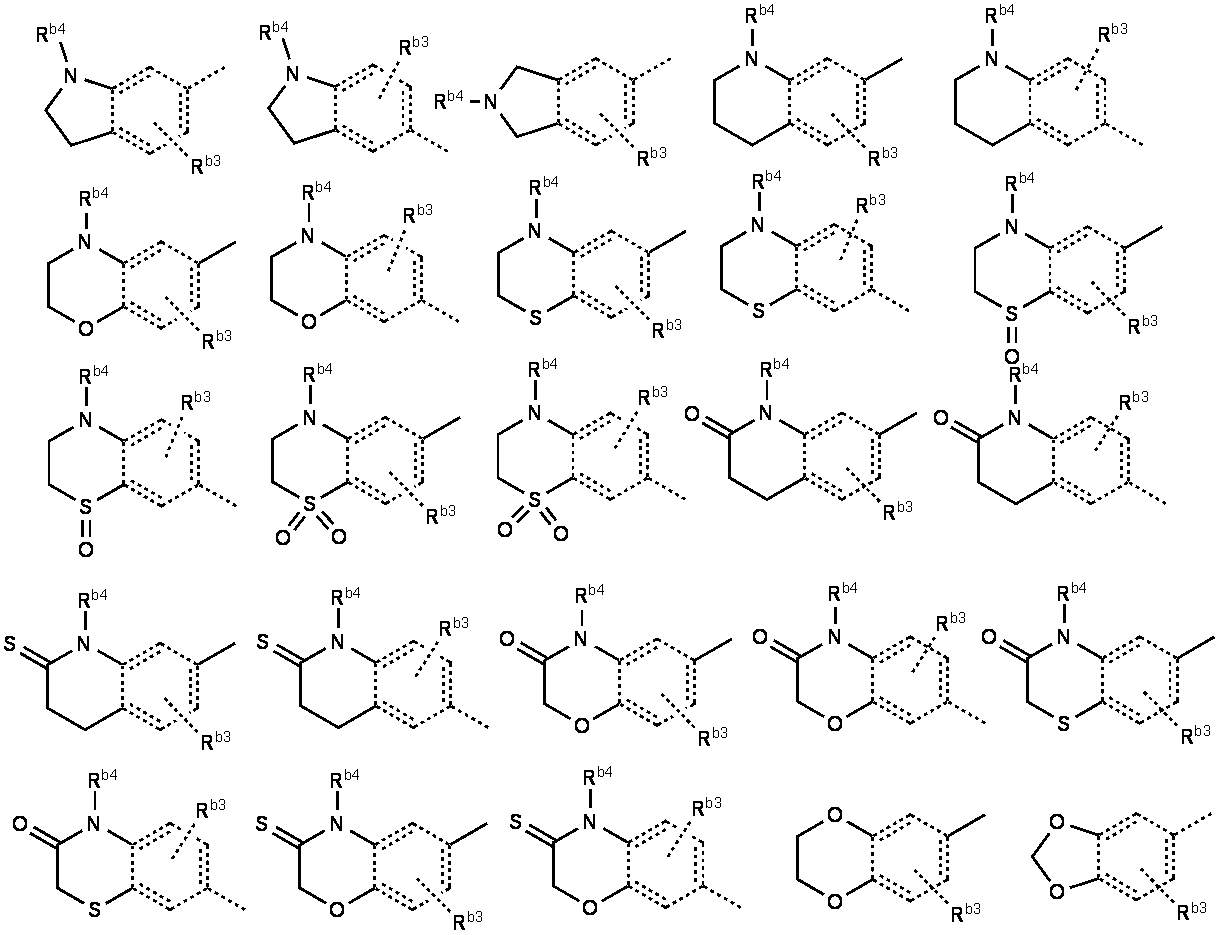
また、本発明には、式(I)で表される化合物もしくはそのプロドラッグ、またはその薬理学的に許容される塩が含まれる。また、この水和物またはエタノール溶媒和物等の溶媒和物も含まれる。さらに、あらゆる態様の結晶形のものも包含している。
本明細書における「式(I)の化合物のプロドラッグ」なる用語は、生体内における生理条件下で酵素や胃酸等による反応により式(I)の化合物に変換する化合物、すなわち酵素的に酸化、還元、加水分解等を起こして式(I)の化合物に変化する化合物、胃酸等により加水分解を起こして化合物(I)の化合物に変化する化合物のことを意味する。
式(I)の化合物は、互変異性体として存在する場合もあり得る。従って、本発明は、式(I)の化合物の互変異性体も包含する。
本発明化合物は、少なくとも一つの不斉炭素原子を有する場合もあり得る。従って、本発明は、本発明化合物のラセミ体のみならず、これらの化合物の光学活性体も包含する。本発明の化合物が、2個以上の不斉炭素原子を有する場合、立体異性を生じる場合がある。従って、本発明は、これらの化合物の立体異性体およびその混合物も包含する。
式(I)で表される化合物は公知化合物から公知の合成方法を組み合わせることにより合成することができる。例えば、次の方法により合成できる。尚、式(I)で表される化合物は、出発原料の種類に応じて、下記に示す方法を適宜選択して、組み合わせることにより合成することができる。
式(I)で表される化合物またはその塩は、例えば、下記に示す2種類の方法によって製造される。
製造法1:
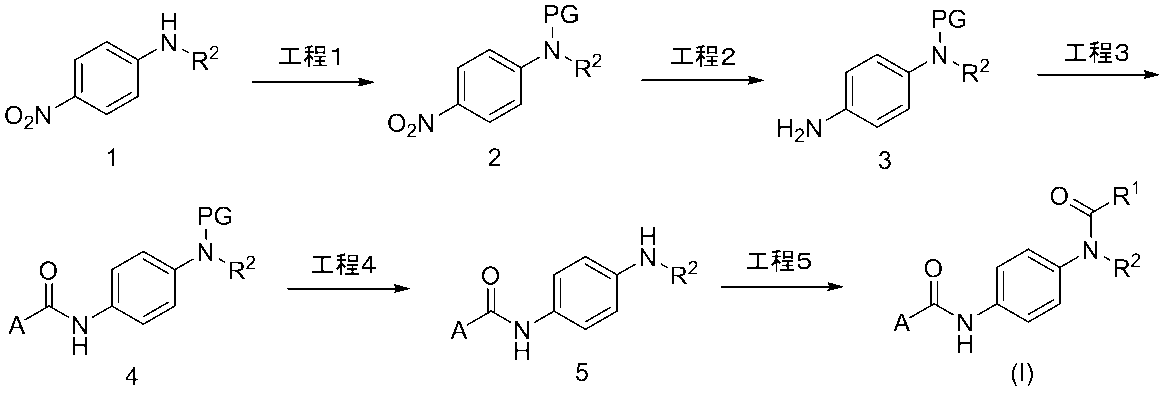
工程1:
市販の、または文献既知の手法(Synthesis 1993 (1) 121)で得られる化合物1のアミノ基に保護基(PG)を導入することによって化合物2を得ることができる。アミノ基の保護基としては一般的に知られているものであればよく、例えば、tert-ブチルオキシカルボニル(Boc)、ベンジルオキシカルボニル(Cbz)、9-フルオレニルメトキシカルボニル(Fmoc)などが挙げられる。反応溶媒としては、それぞれの保護基導入法で一般的に用いられる溶媒を用いることができる。反応温度は、-20℃~120℃であり、好ましくは室温である。
市販の、または文献既知の手法(Synthesis 1993 (1) 121)で得られる化合物1のアミノ基に保護基(PG)を導入することによって化合物2を得ることができる。アミノ基の保護基としては一般的に知られているものであればよく、例えば、tert-ブチルオキシカルボニル(Boc)、ベンジルオキシカルボニル(Cbz)、9-フルオレニルメトキシカルボニル(Fmoc)などが挙げられる。反応溶媒としては、それぞれの保護基導入法で一般的に用いられる溶媒を用いることができる。反応温度は、-20℃~120℃であり、好ましくは室温である。
工程2:
化合物2のニトロ基を還元し化合物3を得ることができる。その還元法としては、一般に知られているニトロ基の還元法が使用できる。例えば、亜鉛末や鉄粉などと塩化アンモニウムや酢酸などによる酸性条件下反応させる方法、パラジウム炭素やラネーニッケルなど金属触媒と水素ガスやギ酸アンモニウムなどの水素源を用いる方法、二塩化すずや三塩化チタンなど遷移金属塩を用いる方法などが挙げられる。反応溶媒としては、それぞれの方法で一般的に用いられる溶媒を用いることができる。反応温度は、-20℃~120℃であり、好ましくは室温である。亜鉛末または鉄粉は、化合物2に対して1当量~10当量、好ましくは3当量~5当量を用いる。塩化アンモニウムは、化合物2に対して1当量~20当量、好ましくは5当量~10当量を用いる。パラジウム炭素やラネーニッケルは、化合物2に対して触媒量~過剰量、好ましくは0.05当量~1当量を用いる。水素ガスは、1気圧から3気圧、好ましくは1気圧で用いる。二塩化すずや三塩化チタンは、化合物2に対して1当量~10当量、好ましくは3当量~5当量を用いる。
化合物2のニトロ基を還元し化合物3を得ることができる。その還元法としては、一般に知られているニトロ基の還元法が使用できる。例えば、亜鉛末や鉄粉などと塩化アンモニウムや酢酸などによる酸性条件下反応させる方法、パラジウム炭素やラネーニッケルなど金属触媒と水素ガスやギ酸アンモニウムなどの水素源を用いる方法、二塩化すずや三塩化チタンなど遷移金属塩を用いる方法などが挙げられる。反応溶媒としては、それぞれの方法で一般的に用いられる溶媒を用いることができる。反応温度は、-20℃~120℃であり、好ましくは室温である。亜鉛末または鉄粉は、化合物2に対して1当量~10当量、好ましくは3当量~5当量を用いる。塩化アンモニウムは、化合物2に対して1当量~20当量、好ましくは5当量~10当量を用いる。パラジウム炭素やラネーニッケルは、化合物2に対して触媒量~過剰量、好ましくは0.05当量~1当量を用いる。水素ガスは、1気圧から3気圧、好ましくは1気圧で用いる。二塩化すずや三塩化チタンは、化合物2に対して1当量~10当量、好ましくは3当量~5当量を用いる。
工程3:
化合物3に対してカルボン酸A-CO2H(脱水縮合剤を使用)または酸塩化物A-COCl(塩基を使用)を反応させ、化合物4を得ることができる(Aは前掲と同じである。)。この反応に使用する脱水縮合剤としては、1-エチル-3-(3-ジメチルアミノプロピル)カルボジイミド、その塩酸塩、N,N'-ジシクロヘキシルカルボジイミド、カルボニルジイミダゾール、ベンゾトリアゾール-1-イルオキシトリスピロリジノホスホニウム ヘキサフルオロホスファートなどが挙げられる。この反応に使用する塩基としては、ピリジン、トリエチルアミン、N,N-ジイソプロピルエチルアミンなどのアミン類や水酸化ナトリウム、炭酸カリウム、炭酸水素ナトリウムなどの無機塩基の水溶液などが挙げられる。この反応に使用する溶媒としては、テトラヒドロフラン、ジクロロメタン、N,N-ジメチルホルムアミド、ピリジン、ジオキサン、アセトニトリル、トルエンなどが挙げられる。反応温度は、-20℃~120℃であり、好ましくは室温である。カルボン酸A-CO2Hは、化合物3に対して1当量~5当量、好ましくは1当量~2当量を用いる。脱水縮合剤は、化合物3に対して1当量~5当量、好ましくは1当量~2当量を用いる。酸塩化物A-COClは、化合物3に対して1当量~5当量、好ましくは1当量~2当量を用いる。塩基は、酸塩化物に対して1当量以上、好ましくは1当量~2当量を用いる。
化合物3に対してカルボン酸A-CO2H(脱水縮合剤を使用)または酸塩化物A-COCl(塩基を使用)を反応させ、化合物4を得ることができる(Aは前掲と同じである。)。この反応に使用する脱水縮合剤としては、1-エチル-3-(3-ジメチルアミノプロピル)カルボジイミド、その塩酸塩、N,N'-ジシクロヘキシルカルボジイミド、カルボニルジイミダゾール、ベンゾトリアゾール-1-イルオキシトリスピロリジノホスホニウム ヘキサフルオロホスファートなどが挙げられる。この反応に使用する塩基としては、ピリジン、トリエチルアミン、N,N-ジイソプロピルエチルアミンなどのアミン類や水酸化ナトリウム、炭酸カリウム、炭酸水素ナトリウムなどの無機塩基の水溶液などが挙げられる。この反応に使用する溶媒としては、テトラヒドロフラン、ジクロロメタン、N,N-ジメチルホルムアミド、ピリジン、ジオキサン、アセトニトリル、トルエンなどが挙げられる。反応温度は、-20℃~120℃であり、好ましくは室温である。カルボン酸A-CO2Hは、化合物3に対して1当量~5当量、好ましくは1当量~2当量を用いる。脱水縮合剤は、化合物3に対して1当量~5当量、好ましくは1当量~2当量を用いる。酸塩化物A-COClは、化合物3に対して1当量~5当量、好ましくは1当量~2当量を用いる。塩基は、酸塩化物に対して1当量以上、好ましくは1当量~2当量を用いる。
工程4:
化合物4のアミノ基を脱保護することによって化合物5を得ることができる。用いた保護基に対応する一般的に知られている脱保護法を用いることができる。例えば、Boc基の脱保護法は、塩酸、トリフルオロ酢酸、メタンスルホン酸などを適当な溶媒存在下または非存在下作用させることにより行うことができる。Cbz基の脱保護法は、適当な溶媒中でパラジウム炭素やラネーニッケルなど金属触媒と水素ガスやギ酸アンモニウムなどの水素源を用いて加水素分解(hydrogenolysis)によって行うことができる。Fmoc基の脱保護法は、ピリジン、トリエチルアミン、N,N-ジイソプロピルエチルアミンなどのアミン類を適当な溶媒中で作用させることにより行うことができる。
化合物4のアミノ基を脱保護することによって化合物5を得ることができる。用いた保護基に対応する一般的に知られている脱保護法を用いることができる。例えば、Boc基の脱保護法は、塩酸、トリフルオロ酢酸、メタンスルホン酸などを適当な溶媒存在下または非存在下作用させることにより行うことができる。Cbz基の脱保護法は、適当な溶媒中でパラジウム炭素やラネーニッケルなど金属触媒と水素ガスやギ酸アンモニウムなどの水素源を用いて加水素分解(hydrogenolysis)によって行うことができる。Fmoc基の脱保護法は、ピリジン、トリエチルアミン、N,N-ジイソプロピルエチルアミンなどのアミン類を適当な溶媒中で作用させることにより行うことができる。
工程5:
化合物5に対してカルボン酸R1-CO2H(脱水縮合剤を使用)または酸塩化物R1-COCl(塩基を使用)を反応させ、式(I)で表される化合物を得ることができる(R1は前掲と同じである。)。この反応に使用する脱水縮合剤としては、1-エチル-3-(3-ジメチルアミノプロピル)カルボジイミド、その塩酸塩、N,N'-ジシクロヘキシルカルボジイミド、カルボニルジイミダゾール、ベンゾトリアゾール-1-イルオキシトリスピロリジノホスホニウム ヘキサフルオロホスファートなどが挙げられる。この反応に使用する塩基としては、ピリジン、トリエチルアミン、N,N-ジイソプロピルエチルアミンなどのアミン類や水酸化ナトリウム、炭酸カリウム、炭酸水素ナトリウムなどの無機塩基の水溶液などが挙げられる。この反応に使用する溶媒としては、テトラヒドロフラン、ジクロロメタン、N,N-ジメチルホルムアミド、ピリジン、ジオキサン、アセトニトリル、トルエンなどが挙げられる。反応温度は、-20℃~120℃であり、好ましくは室温である。カルボン酸A-CO2Hは、化合物3に対して1当量~5当量、好ましくは1当量~2当量を用いる。脱水縮合剤は、化合物3に対して1当量~5当量、好ましくは1当量~2当量を用いる。酸塩化物A-COClは、化合物3に対して1当量~5当量、好ましくは1当量~2当量を用いる。塩基は、酸塩化物に対して1当量以上、好ましくは1当量~2当量を用いる。
化合物5に対してカルボン酸R1-CO2H(脱水縮合剤を使用)または酸塩化物R1-COCl(塩基を使用)を反応させ、式(I)で表される化合物を得ることができる(R1は前掲と同じである。)。この反応に使用する脱水縮合剤としては、1-エチル-3-(3-ジメチルアミノプロピル)カルボジイミド、その塩酸塩、N,N'-ジシクロヘキシルカルボジイミド、カルボニルジイミダゾール、ベンゾトリアゾール-1-イルオキシトリスピロリジノホスホニウム ヘキサフルオロホスファートなどが挙げられる。この反応に使用する塩基としては、ピリジン、トリエチルアミン、N,N-ジイソプロピルエチルアミンなどのアミン類や水酸化ナトリウム、炭酸カリウム、炭酸水素ナトリウムなどの無機塩基の水溶液などが挙げられる。この反応に使用する溶媒としては、テトラヒドロフラン、ジクロロメタン、N,N-ジメチルホルムアミド、ピリジン、ジオキサン、アセトニトリル、トルエンなどが挙げられる。反応温度は、-20℃~120℃であり、好ましくは室温である。カルボン酸A-CO2Hは、化合物3に対して1当量~5当量、好ましくは1当量~2当量を用いる。脱水縮合剤は、化合物3に対して1当量~5当量、好ましくは1当量~2当量を用いる。酸塩化物A-COClは、化合物3に対して1当量~5当量、好ましくは1当量~2当量を用いる。塩基は、酸塩化物に対して1当量以上、好ましくは1当量~2当量を用いる。
製造法2:

工程1:
市販の、または文献既知の手法(Synthesis 1993 (1) 121)で得られる化合物1に対してカルボン酸R1-CO2H(脱水縮合剤を使用)または酸塩化物R1-COCl(塩基を使用)を反応させ、化合物6を得ることができる(R1は前掲と同じである。)。この反応に使用する脱水縮合剤としては、1-エチル-3-(3-ジメチルアミノプロピル)カルボジイミド、その塩酸塩、N,N'-ジシクロヘキシルカルボジイミド、カルボニルジイミダゾール、ベンゾトリアゾール-1-イルオキシトリスピロリジノホスホニウム ヘキサフルオロホスファートなどが挙げられる。この反応に使用する塩基としては、ピリジン、トリエチルアミン、N,N-ジイソプロピルエチルアミンなどのアミン類や水酸化ナトリウム、炭酸カリウム、炭酸水素ナトリウムなどの無機塩基の水溶液などが挙げられる。この反応に使用する溶媒としては、テトラヒドロフラン、ジクロロメタン、N,N-ジメチルホルムアミド、ピリジン、ジオキサン、アセトニトリル、トルエンなどが挙げられる。反応温度は、-20℃~120℃であり、好ましくは室温である。カルボン酸R1-CO2Hは、化合物1に対して1当量~5当量、好ましくは1当量~2当量を用いる。脱水縮合剤は、化合物1に対して1当量~5当量、好ましくは1当量~2当量を用いる。酸塩化物R1-COClは、化合物1に対して1当量~5当量、好ましくは1当量~2当量を用いる。塩基は、酸塩化物R1-COClに対して1当量以上、好ましくは1当量~2当量を用いる。
市販の、または文献既知の手法(Synthesis 1993 (1) 121)で得られる化合物1に対してカルボン酸R1-CO2H(脱水縮合剤を使用)または酸塩化物R1-COCl(塩基を使用)を反応させ、化合物6を得ることができる(R1は前掲と同じである。)。この反応に使用する脱水縮合剤としては、1-エチル-3-(3-ジメチルアミノプロピル)カルボジイミド、その塩酸塩、N,N'-ジシクロヘキシルカルボジイミド、カルボニルジイミダゾール、ベンゾトリアゾール-1-イルオキシトリスピロリジノホスホニウム ヘキサフルオロホスファートなどが挙げられる。この反応に使用する塩基としては、ピリジン、トリエチルアミン、N,N-ジイソプロピルエチルアミンなどのアミン類や水酸化ナトリウム、炭酸カリウム、炭酸水素ナトリウムなどの無機塩基の水溶液などが挙げられる。この反応に使用する溶媒としては、テトラヒドロフラン、ジクロロメタン、N,N-ジメチルホルムアミド、ピリジン、ジオキサン、アセトニトリル、トルエンなどが挙げられる。反応温度は、-20℃~120℃であり、好ましくは室温である。カルボン酸R1-CO2Hは、化合物1に対して1当量~5当量、好ましくは1当量~2当量を用いる。脱水縮合剤は、化合物1に対して1当量~5当量、好ましくは1当量~2当量を用いる。酸塩化物R1-COClは、化合物1に対して1当量~5当量、好ましくは1当量~2当量を用いる。塩基は、酸塩化物R1-COClに対して1当量以上、好ましくは1当量~2当量を用いる。
工程2:
化合物6のニトロ基を還元し化合物7を得ることができる。その還元法としては、一般に知られているニトロ基の還元法が使用できる。例えば、亜鉛末や鉄粉などと塩化アンモニウムや酢酸などによる酸性条件下反応させる方法、パラジウム炭素やラネーニッケルなど金属触媒と水素ガスやギ酸アンモニウムなどの水素源を用いる方法、二塩化スズや三塩化チタンなど遷移金属塩を用いる方法などが挙げられる。反応溶媒としては、それぞれの方法で一般的に用いられる溶媒を用いることができる。反応温度は、-20℃~120℃であり、好ましくは室温である。亜鉛末または鉄粉は、化合物6に対して1当量~10当量、好ましくは3当量~5当量を用いる。塩化アンモニウムは、化合物6に対して1当量~20当量、好ましくは5当量~10当量を用いる。パラジウム炭素やラネーニッケルは、化合物6に対して触媒量~過剰量、好ましくは0.05当量~1当量を用いる。水素ガスは、1気圧から3気圧、好ましくは1気圧で用いる。二塩化すずや三塩化チタンは、化合物6に対して1当量~10当量、好ましくは3当量~5当量を用いる。
化合物6のニトロ基を還元し化合物7を得ることができる。その還元法としては、一般に知られているニトロ基の還元法が使用できる。例えば、亜鉛末や鉄粉などと塩化アンモニウムや酢酸などによる酸性条件下反応させる方法、パラジウム炭素やラネーニッケルなど金属触媒と水素ガスやギ酸アンモニウムなどの水素源を用いる方法、二塩化スズや三塩化チタンなど遷移金属塩を用いる方法などが挙げられる。反応溶媒としては、それぞれの方法で一般的に用いられる溶媒を用いることができる。反応温度は、-20℃~120℃であり、好ましくは室温である。亜鉛末または鉄粉は、化合物6に対して1当量~10当量、好ましくは3当量~5当量を用いる。塩化アンモニウムは、化合物6に対して1当量~20当量、好ましくは5当量~10当量を用いる。パラジウム炭素やラネーニッケルは、化合物6に対して触媒量~過剰量、好ましくは0.05当量~1当量を用いる。水素ガスは、1気圧から3気圧、好ましくは1気圧で用いる。二塩化すずや三塩化チタンは、化合物6に対して1当量~10当量、好ましくは3当量~5当量を用いる。
工程3:
化合物7に対してカルボン酸A-CO2H(脱水縮合剤を使用)または酸塩化物A-COCl(塩基を使用)を反応させ、化合物(I)を得ることができる(Aは前掲と同じである。)。この反応に使用する脱水縮合剤としては、1-エチル-3-(3-ジメチルアミノプロピル)カルボジイミド、その塩酸塩、N,N'-ジシクロヘキシルカルボジイミド、カルボニルジイミダゾール、ベンゾトリアゾール-1-イルオキシトリスピロリジノホスホニウム ヘキサフルオロホスファートなどが挙げられる。この反応に使用する塩基としては、ピリジン、トリエチルアミン、N,N-ジイソプロピルエチルアミンなどのアミン類や水酸化ナトリウム、炭酸カリウム、炭酸水素ナトリウムなどの無機塩基の水溶液などが挙げられる。この反応に使用する溶媒としては、テトラヒドロフラン、ジクロロメタン、N,N-ジメチルホルムアミド、ピリジン、ジオキサン、アセトニトリル、トルエンなどが挙げられる。反応温度は、-20℃~120℃であり、好ましくは室温である。カルボン酸A-CO2Hは、化合物7に対して1当量~5当量、好ましくは1当量~2当量を用いる。脱水縮合剤は、化合物7に対して1当量~5当量、好ましくは1当量~2当量を用いる。酸塩化物A-COClは、化合物7に対して1当量~5当量、好ましくは1当量~2当量を用いる。塩基は、酸塩化物に対して1当量以上、好ましくは1当量~2当量を用いる。
化合物7に対してカルボン酸A-CO2H(脱水縮合剤を使用)または酸塩化物A-COCl(塩基を使用)を反応させ、化合物(I)を得ることができる(Aは前掲と同じである。)。この反応に使用する脱水縮合剤としては、1-エチル-3-(3-ジメチルアミノプロピル)カルボジイミド、その塩酸塩、N,N'-ジシクロヘキシルカルボジイミド、カルボニルジイミダゾール、ベンゾトリアゾール-1-イルオキシトリスピロリジノホスホニウム ヘキサフルオロホスファートなどが挙げられる。この反応に使用する塩基としては、ピリジン、トリエチルアミン、N,N-ジイソプロピルエチルアミンなどのアミン類や水酸化ナトリウム、炭酸カリウム、炭酸水素ナトリウムなどの無機塩基の水溶液などが挙げられる。この反応に使用する溶媒としては、テトラヒドロフラン、ジクロロメタン、N,N-ジメチルホルムアミド、ピリジン、ジオキサン、アセトニトリル、トルエンなどが挙げられる。反応温度は、-20℃~120℃であり、好ましくは室温である。カルボン酸A-CO2Hは、化合物7に対して1当量~5当量、好ましくは1当量~2当量を用いる。脱水縮合剤は、化合物7に対して1当量~5当量、好ましくは1当量~2当量を用いる。酸塩化物A-COClは、化合物7に対して1当量~5当量、好ましくは1当量~2当量を用いる。塩基は、酸塩化物に対して1当量以上、好ましくは1当量~2当量を用いる。
式(I)で表される化合物は、光学活性中心を有するものも含まれ、したがって、これらはラセミ体として、または、光学活性の出発材料が用いられた場合には光学活性型で得ることができる。必要であれば、得られたラセミ体を、物理的にまたは化学的にそれらの光学対掌体に公知の方法によって分割することができる。好ましくは、光学活性分割剤を用いる反応によってラセミ体からジアステレオマーを形成する。異なるかたちのジアステレオマーは、例えば分別結晶などの公知の方法によって分割することができる。
本発明化合物は、例えば水、メタノール、エタノール、アセトン等の溶媒中で、薬学上許容される酸と混合することで、塩にすることができる。薬学上許容される酸としては、例えば塩酸、臭化水素酸、硫酸塩、リン酸、硝酸等の無機酸、あるいは酢酸、プロピオン酸、シュウ酸、コハク酸、乳酸、リンゴ酸、酒石酸、クエン酸、マレイン酸、フマル酸、メタンスルホン酸、p-トルエンスルホン酸、アスコルビン酸等の有機酸が挙げられる。
本発明化合物は、そのsEHに対する阻害作用より様々な疾病の治療への応用が期待される。本明細書に記載の化合物は、高血圧症の治療薬として有用である。これらの化合物は、急性および慢性うっ血性心不全の管理にも有益である。これらの化合物は、原発性および二次性肺高血圧症、原発性および二次性アルドステロン血症、腎血管性高血圧症、原発性および二次性腎疾患(例えば、糸球体腎炎、IgA腎症、糖尿病性腎症、高血圧性腎症(腎硬化症)、ネフローゼ症候群、腎不全、慢性腎症など)、心肥大、左室肥大、左室線維化、左室拡張不全、左心室不全、心房細動、不安定狭心症、心筋梗塞、心筋症、脳卒中(脳梗塞、脳出血など)、血管再建術後の再狭窄、糖尿病性網膜症、認知障害(例えば、アルツハイマー病、脳血管性認知症など)、閉塞性動脈硬化症、糖尿病、肥満、脂質代謝異常、脂肪肝の治療、および血管障害(例えば、片頭痛、レイノー病など)、並びにアテローム性動脈硬化プロセスを最小に抑制するためにも有用である。また、高眼圧に関連した疾患(例えば、緑内障など)、呼吸器疾患および自己免疫疾患の治療に有用である。
本発明化合物は、治療に使用する場合に、医薬組成物として、経口的または非経口的(例えば、静脈内、皮下、もしくは筋肉内注射、局所的、経直腸的、経皮的、または経鼻的)に投与することができる。経口投与のための組成物としては、例えば、錠剤、カプセル剤、丸剤、顆粒剤、散剤、液剤、懸濁剤などが挙げられ、非経口投与のための組成物としては、例えば、注射用水性剤、もしくは油性剤、軟膏剤、クリーム剤、ローション剤、エアロゾル剤、坐剤、貼付剤などが挙げられる。これらの製剤は、従来公知の技術を用いて調製され、製剤分野において通常使用される無毒性かつ不活性な担体もしくは賦形剤を含有することができる。
用量は、個々の化合物により、また患者の疾患、年齢、体重、性別、症状、投与経路等により変化するが、通常は成人(体重50kg)に対して、本発明化合物またはそれらの薬学的に許容される塩を、0.1~1000mg/日、好ましくは1~300 mg/日を1日1回または2ないし3回に分けて投与する。また、数日~数週に1回投与することもできる。
本発明化合物は、その効果の増強を目的として、糖尿病治療剤、糖尿病性合併症治療剤、抗高脂血症剤、降圧剤、抗肥満剤、利尿剤などの薬剤(以下、併用薬剤と略記する)と組み合わせて用いることができる。本発明化合物および併用薬剤の投与時期は限定されず、これらを投与対象に対し、同時に投与してもよいし、時間差をおいて投与してもよい。また、本発明化合物と併用薬剤の合剤としても良い。併用薬剤の投与量は、臨床上用いられている用量を基準として適宜選択することができる。また、本発明化合物と併用薬剤との配合比は、投与対象、投与ルート、対象疾患、症状、組み合わせなどにより適宜選択することができる。例えば投与対象がヒトである場合、本発明化合物1重量部に対し、併用薬剤を0.01~100重量部用いればよい。
なお、糖尿病治療剤としては、インスリン製剤(例、ウシ、ブタの膵臓から抽出された動物インスリン製剤;大腸菌、イーストを用い、遺伝子工学的に合成したヒトインスリン製剤など)、インスリン抵抗性改善剤(例、ピオグリタゾンまたはその塩酸塩、トログリタゾン、ロシグリタゾンまたはそのマレイン酸塩、DSP-8658等)、α-グルコシダーゼ阻害剤(例、ボグリボース、アカルボース、ミグリトール、エミグリテート等)、ビグアナイド剤(例、メトホルミン等)、インスリン分泌促進剤(例、トルブタミド、グリベンクラミド、グリクラジド、クロルプロパミド、トラザミド、アセトヘキサミド、グリクロピラミド、グリメピリド等のスルホニルウレア剤;レパグリニド、セナグリニド、ナテグリニド、ミチグリニド等)、GLP-1、GLP-1アナログ(エキセナタイド、リラグルタイド、SUN-E7001、AVE010、BIM-51077、CJC1131等)、プロテインチロシンホスファターゼ阻害剤(例、バナジン酸等)、β3アゴニスト(例、GW-427353B、N-5984等)、DPPIV阻害剤(例、シタグリプチン、ビルダグリプチン、サクサグリプチン、アログリプチン等)が挙げられる。
糖尿病性合併症治療剤としては、アルドース還元酵素阻害剤(例、トルレスタット、エパルレスタット、ゼナレスタット、ゾポレスタット、ミナレスタット、フィダレスタット、SK-860、CT-112等)、神経栄養因子(例、NGF、NT-3、BDNF等)、PKC阻害剤(例、LY-333531等)、AGE阻害剤(例、ALT946、ピマゲジン、ピラトキサチン、N-フェナシルチアゾリウム ブロマイド(ALT766)等)、活性酸素消去薬(例、チオクト酸等)、脳血管拡張剤(例、チアプリド、メキシレチン等)が挙げられる。抗高脂血剤としては、HMG-CoA還元酵素阻害剤(例、プラバスタチン、シンバスタチン、ロバスタチン、アトルバスタチン、フルバスタチン、イタバスタチン、ロスバスタチンまたはそれらのナトリウム塩もしくはカルシウム塩等)、スクアレン合成酵素阻害剤、ACAT阻害剤等が挙げられる。降圧剤としては、アンジオテンシン変換酵素阻害剤(例、カプトプリル、エナラプリル、アラセプリル、デラプリル、リジノプリル、イミダプリル、ベナゼプリル、シラザプリル、テモカプリル、トランドラプリル等)、アンジオテンシンII拮抗剤(例、オルメサルタン メドキソミル、カンデサルタン シレキセチル、ロサルタン、エプロサルタン、バルサンタン、テルミサルタン、イルベサルタン、タソサルタン、アジルサルタン等)、カルシウム拮抗剤(例、塩酸ニカルジピン、塩酸マニジピン、ニソルジピン、ニトレンジピン、ニルバジピン、アムロジピン等)、ACE/NEP阻害剤(例、オマパトリラート、ファシドトリル等)、β遮断薬(例、アテノロール、ビソプロロール、ベタキソロール、メトプロロール等)、α遮断薬(例、ウラピジル、テラゾシン、ドキサゾシン、ブナゾシン等)、αβ遮断薬(例、アモスラロール、アロチノロール、ラベタロール、カルベジロール等)、レニン阻害薬(例、アリスキレン、SPP 635、SPP 1148、SPP 676等)が挙げられる。
抗肥満剤としては、例えば中枢性抗肥満薬(例、フェンテルミン、シブトラミン、アンフェプラモン、デキサンフェタミン、マジンドール、SR-141716A等)、膵リパーゼ阻害薬(例、オルリスタット等)、ペプチド性食欲抑制薬(例、レプチン、CNTF(毛様体神経栄養因子)等)、コレシストキニンアゴニスト(例、リンチトリプト、FPL-15849等)等が挙げられる。利尿剤としては、例えばキサンチン誘導体(例、サリチル酸ナトリウムテオブロミン、サリチル酸カルシウムテオブロミン等)、チアジド系製剤(例、エチアジド、シクロペンチアジド、トリクロルメチアジド、ヒドロクロロチアジド、ヒドロフルメチアジド、ベンチルヒドロクロロチアジド、ペンフルチジド、ポリチアジド、メチクロチアジド等)、抗アルドステロン製剤(例、スピロノラクトン、トリアムテレン等)、炭酸脱水酵素阻害剤(例、アセタゾラミド等)、クロルベンゼンスルホンアミド系製剤(例、クロルタリドン、メフルシド、インダパミド等)、アゾセミド、イソソルビド、エタクリン酸、ピレタニド、ブメタニド、フロセミド等が挙げられる。
上記併用薬剤は、2種以上を適宜の割合で組み合せて用いてもよい。
本発明化合物が、併用薬剤と組み合せて使用される場合には、これらの薬剤の使用量は、薬剤の副作用を考えて安全な範囲内で低減できる。したがって、これらの薬剤により引き起こされるであろう副作用は安全に防止できる。
以下に、実施例を挙げて本発明を具体的に説明するが、本発明はこれらに限定されるものではない。
実施例で使用した試薬、溶媒などは市販のものをそのまま用い、特別な精製などは行っていない。反応は、特記がないかぎり、不活性雰囲気下で行った。
シリカゲルカラムクロマトグラフィーには、山善製中圧分取液体クロマトグラフシステム(YFLC)にシリカゲルSiOHを充填剤とするHi-Flashカラムを用い、溶出溶媒としてヘキサンと酢酸エチルを適切な混合比で使用した。Gilson HPLC Systemでの精製は、カラムYMC CombiPrep ODS-A (S-5 um, 12 nm, 20 mm × 50 mm)を用い、流速25または35 mL/min、UV検出(220および254 nm)を採用した。溶出溶媒としては、0.35%トリフルオロ酢酸/アセトニトリルと0.05%トリフルオロ酢酸/水を適切な混合比で、または0.35%トリフルオロ酢酸/メタノールと0.05%トリフルオロ酢酸/水を適切な混合比で使用した。
実施例で使用した試薬、溶媒などは市販のものをそのまま用い、特別な精製などは行っていない。反応は、特記がないかぎり、不活性雰囲気下で行った。
シリカゲルカラムクロマトグラフィーには、山善製中圧分取液体クロマトグラフシステム(YFLC)にシリカゲルSiOHを充填剤とするHi-Flashカラムを用い、溶出溶媒としてヘキサンと酢酸エチルを適切な混合比で使用した。Gilson HPLC Systemでの精製は、カラムYMC CombiPrep ODS-A (S-5 um, 12 nm, 20 mm × 50 mm)を用い、流速25または35 mL/min、UV検出(220および254 nm)を採用した。溶出溶媒としては、0.35%トリフルオロ酢酸/アセトニトリルと0.05%トリフルオロ酢酸/水を適切な混合比で、または0.35%トリフルオロ酢酸/メタノールと0.05%トリフルオロ酢酸/水を適切な混合比で使用した。
化合物の構造の同定には、LC-MSスペクトルまたは1H NMRスペクトルにより行った。
LC-MSスペクトル測定には、以下の2条件のいずれかに従って行った。
(i)Perkin-Elmer製Sciex API150EX Mass Spectrometerに島津製LC 10ATVPを組み合わせた装置を用いて、カラムは資生堂製 CAPCELL PAK C18 ACR (S-5 um, 4.6 mm × 50 mm)、流速は3.5 mL/minの条件下で測定を行った。移動層として0.35%トリフルオロ酢酸/アセトニトリルと0.05%トリフルオロ酢酸/水、または0.35%トリフルオロ酢酸/メタノールと0.05%トリフルオロ酢酸/水を下記表1に示したグラジエント条件で送液した。
(ii)Waters製ACQUITY SQD-MSにACQUITY UPLCを組み合わせた装置を用いて、カラムはWaters製ACQUITY UPLC column BEH C18 (1.7 um, 2.1 mm × 30 mm)、カラム温度は40 ℃、流速は0.8 mL/minで測定を行った。移動層としてアセトニトリルと0.05%ギ酸/水を下記表1に示したグラジエント条件で送液した。
1H NMRスペクトルには、日本電子製JNM-LA300 FT NMR システムを用い23 ℃の室温で測定した。テトラメチルシランを内部標準として用いた。
LC-MSスペクトル測定には、以下の2条件のいずれかに従って行った。
(i)Perkin-Elmer製Sciex API150EX Mass Spectrometerに島津製LC 10ATVPを組み合わせた装置を用いて、カラムは資生堂製 CAPCELL PAK C18 ACR (S-5 um, 4.6 mm × 50 mm)、流速は3.5 mL/minの条件下で測定を行った。移動層として0.35%トリフルオロ酢酸/アセトニトリルと0.05%トリフルオロ酢酸/水、または0.35%トリフルオロ酢酸/メタノールと0.05%トリフルオロ酢酸/水を下記表1に示したグラジエント条件で送液した。
(ii)Waters製ACQUITY SQD-MSにACQUITY UPLCを組み合わせた装置を用いて、カラムはWaters製ACQUITY UPLC column BEH C18 (1.7 um, 2.1 mm × 30 mm)、カラム温度は40 ℃、流速は0.8 mL/minで測定を行った。移動層としてアセトニトリルと0.05%ギ酸/水を下記表1に示したグラジエント条件で送液した。
1H NMRスペクトルには、日本電子製JNM-LA300 FT NMR システムを用い23 ℃の室温で測定した。テトラメチルシランを内部標準として用いた。

実施例1:1-(エチルフラン-2-カルボニルアミノ)-4-(1,2,3,4-テトラヒドロナフタレン-2-カルボニルアミノ)ベンゼン

中間体(1-4)の化合物(0.050 g)をピリジン(1.5 mL)に溶解させた後、フラン-2-カルボン酸(0.025 g)および1-エチル-3-(3-ジメチルアミノプロピル) カルボジイミド塩酸塩(0.044 g)を加え、室温にて一夜撹拌した。反応液を酢酸エチル(約15 mL)で希釈した後、希塩酸、飽和炭酸水素ナトリウム水溶液、水、飽和食塩水で順次洗浄後、有機層を硫酸マグネシウムで乾燥、ろ過、このろ液を減圧下濃縮し固体(0.058 g)を得た。これをGilson HPLC Systemで精製し、白色固体(0.048 g)を得た。
1H NMR (300 MHz, CDCl3) δ: 7.60 (d, 2H, J = 8.7 Hz), 7.46 (br s, 1H), 7.30-7.29 (m, 1H), 7.15-7.10 (m, 6H), 6.17 (dd, 1H, J = 1.5, 3.6 Hz), 5.85-5.78 (m, 1H), 3.85 (q, 2H, J = 7.2 Hz), 3.27-2.80 (m, 4H), 2.75-2.63 (m, 1H), 2.27-2.16 (m, 1H), 2.07-1.93 (m, 1H), 1.17 (t, 3H, J = 7.2 Hz)
LC-MS:389.6(M+1)、保持時間(4.91分)、送液条件(4)
1H NMR (300 MHz, CDCl3) δ: 7.60 (d, 2H, J = 8.7 Hz), 7.46 (br s, 1H), 7.30-7.29 (m, 1H), 7.15-7.10 (m, 6H), 6.17 (dd, 1H, J = 1.5, 3.6 Hz), 5.85-5.78 (m, 1H), 3.85 (q, 2H, J = 7.2 Hz), 3.27-2.80 (m, 4H), 2.75-2.63 (m, 1H), 2.27-2.16 (m, 1H), 2.07-1.93 (m, 1H), 1.17 (t, 3H, J = 7.2 Hz)
LC-MS:389.6(M+1)、保持時間(4.91分)、送液条件(4)
中間体(1-1)の製造:

N-エチル-4-ニトロアニリン(2.50 g)をアセトニトリル(15 mL)に溶解させた後、ジ-tert-ブチルジカーボネート(2.85 g)、トリエチルアミン(2.07 mL)および4-ジメチルアミノピリジン(0.018 g)を加えた。この反応液を室温で一夜撹拌した後、原料の残存が確認されたためジ-tert-ブチルジカーボネート(1.03 g)を追加し、50度で5時間撹拌した。反応液を放冷後、水を加え、これを酢酸エチルで抽出した。抽出液を硫酸マグネシウムで乾燥、ろ過、このろ液を減圧濃縮することによって橙色油状物を得た。これをシリカゲルカラムクロマトグラフィー(ヘキサン/酢酸エチル)にて精製し、中間体(1-1)の化合物(3.13 g)を得た。
中間体(1-2)の製造:

中間体(1-1)の化合物(1.50g)をアセトンと水の混合溶媒(5/1, v/v;36 mL)に溶解させた後、塩化アンモニウム(2.99 g)および亜鉛粉(1.83 g)を加え室温で3日撹拌した。反応液を酢酸エチルと水に分配し、水層を酢酸エチルで抽出した。併せた抽出液を飽和食塩水で洗浄後、硫酸マグネシウムで乾燥、ろ過、このろ液を減圧濃縮することによって中間体(1-2)の化合物を黄色油状物(1.33 g)として得た。
1H NMR (300 MHz, CDCl3) δ: 7.04 (d, 0.8H, J = 8.7 Hz), 6.91 (d, 2H, J = 8.7 Hz), 6.62 (d, 1.2H, J = 8.7 Hz), 3.60 (q, 0.8H, J = 7.2 Hz), 3.56 (q, 1.2H, J = 7.2 Hz), 1.39 (br s, 9H), 1.09 (t, 0.8H, J = 7.2 Hz), 1.08 (t, 1.2H, J = 7.2 Hz). 尚、このスペクトルは回転異性体の混合物であることを示す。
1H NMR (300 MHz, CDCl3) δ: 7.04 (d, 0.8H, J = 8.7 Hz), 6.91 (d, 2H, J = 8.7 Hz), 6.62 (d, 1.2H, J = 8.7 Hz), 3.60 (q, 0.8H, J = 7.2 Hz), 3.56 (q, 1.2H, J = 7.2 Hz), 1.39 (br s, 9H), 1.09 (t, 0.8H, J = 7.2 Hz), 1.08 (t, 1.2H, J = 7.2 Hz). 尚、このスペクトルは回転異性体の混合物であることを示す。
中間体(1-3)の製造:
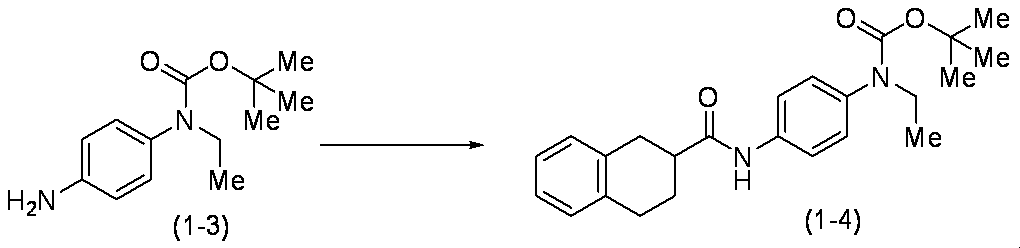
中間体(1-2)の化合物(1.30 g)をテトラヒドロフラン(7 mL)とN,N-ジメチルホルムアミド(3 mL)の混合溶媒に溶解させた後、1,2,3,4-テトラヒドロナフタレン-2-カルボン酸(0.116 g)、1-ヒドロキシベンゾトリアゾール(0.892 g)および1-エチル-3-(3-ジメチルアミノプロピル) カルボジイミド塩酸塩(1.27 g)を加え、室温にて一夜撹拌した。反応液を酢酸エチルで希釈した後、飽和炭酸水素ナトリウム水溶液、飽和食塩水で順次洗浄し、硫酸マグネシウムで乾燥、ろ過、このろ液を減圧濃縮することによって橙色油状物を得た。これをシリカゲルカラムクロマトグラフィー(ヘキサン/酢酸エチル)にて精製し、中間体(1-3)の化合物(1.72 g)を得た。
中間体(1-4)の製造:
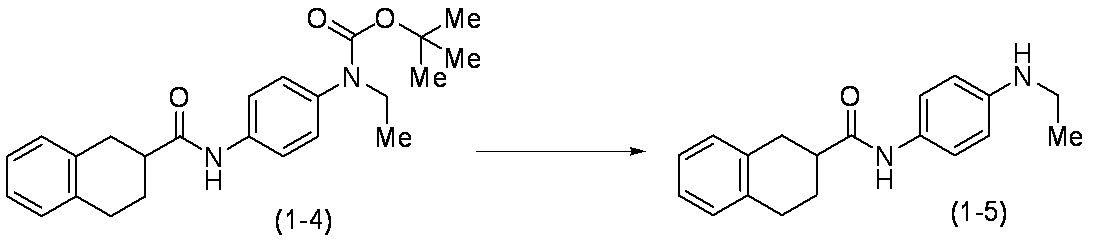
中間体(1-3)の化合物(1.70 g)を1,4-ジオキサン(2 mL)に溶解させた後、4 M塩化水素ジオキサン溶液(10 mL)を加えた。この反応液を室温で1時間撹拌した後、濃縮し、残留した塩化水素はトルエンを加え、再度濃縮することにより共沸的に取り除き、中間体(1-4)の化合物(1.35 g)を塩酸塩として得た。
1H NMR (300 MHz, DMSO d6) δ: 10.81 (br, 1H), 10.30 (br s, 1H), 7.75 (d, 2H, J = 9.0 Hz), 7.42 (d, 2H, J = 8.4 Hz), 7.11-7.06 (m, 4H), 3.93 (br, 1H), 3.26 (q, 2H, J = 7.2 Hz), 2.94-2.87 (m, 2H), 2.85-2.70 (m, 3H), 2.12-2.01 (m, 1H), 1.82-1.68 (m, 1H), 1.21 (t, 3H, J = 7.2 Hz).
1H NMR (300 MHz, DMSO d6) δ: 10.81 (br, 1H), 10.30 (br s, 1H), 7.75 (d, 2H, J = 9.0 Hz), 7.42 (d, 2H, J = 8.4 Hz), 7.11-7.06 (m, 4H), 3.93 (br, 1H), 3.26 (q, 2H, J = 7.2 Hz), 2.94-2.87 (m, 2H), 2.85-2.70 (m, 3H), 2.12-2.01 (m, 1H), 1.82-1.68 (m, 1H), 1.21 (t, 3H, J = 7.2 Hz).
実施例2~51:
実施例1と同様の手法により、実施例2~51の化合物を製造した。
実施例1と同様の手法により、実施例2~51の化合物を製造した。
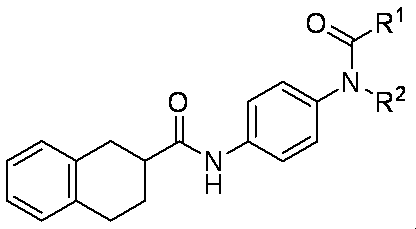
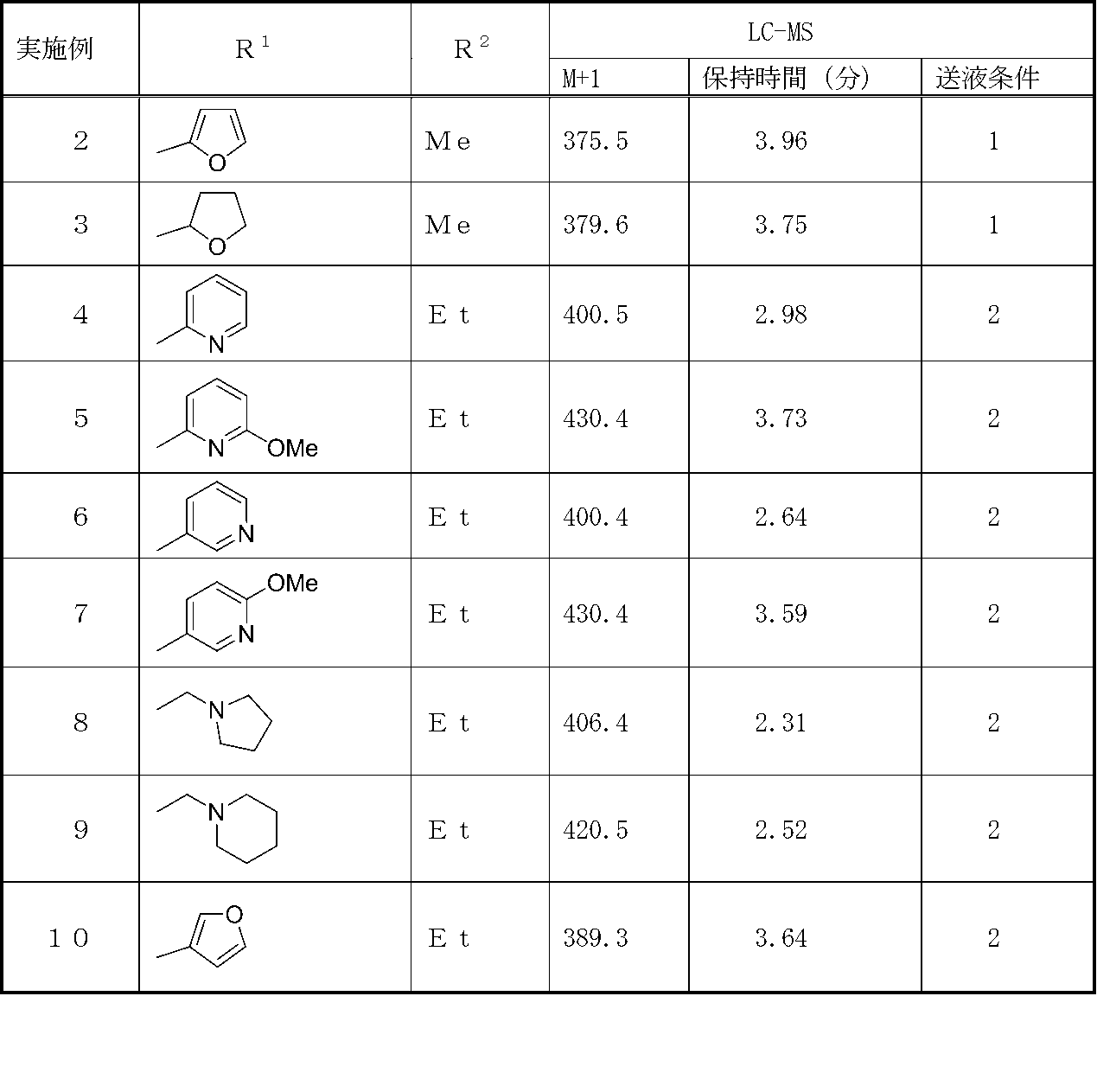

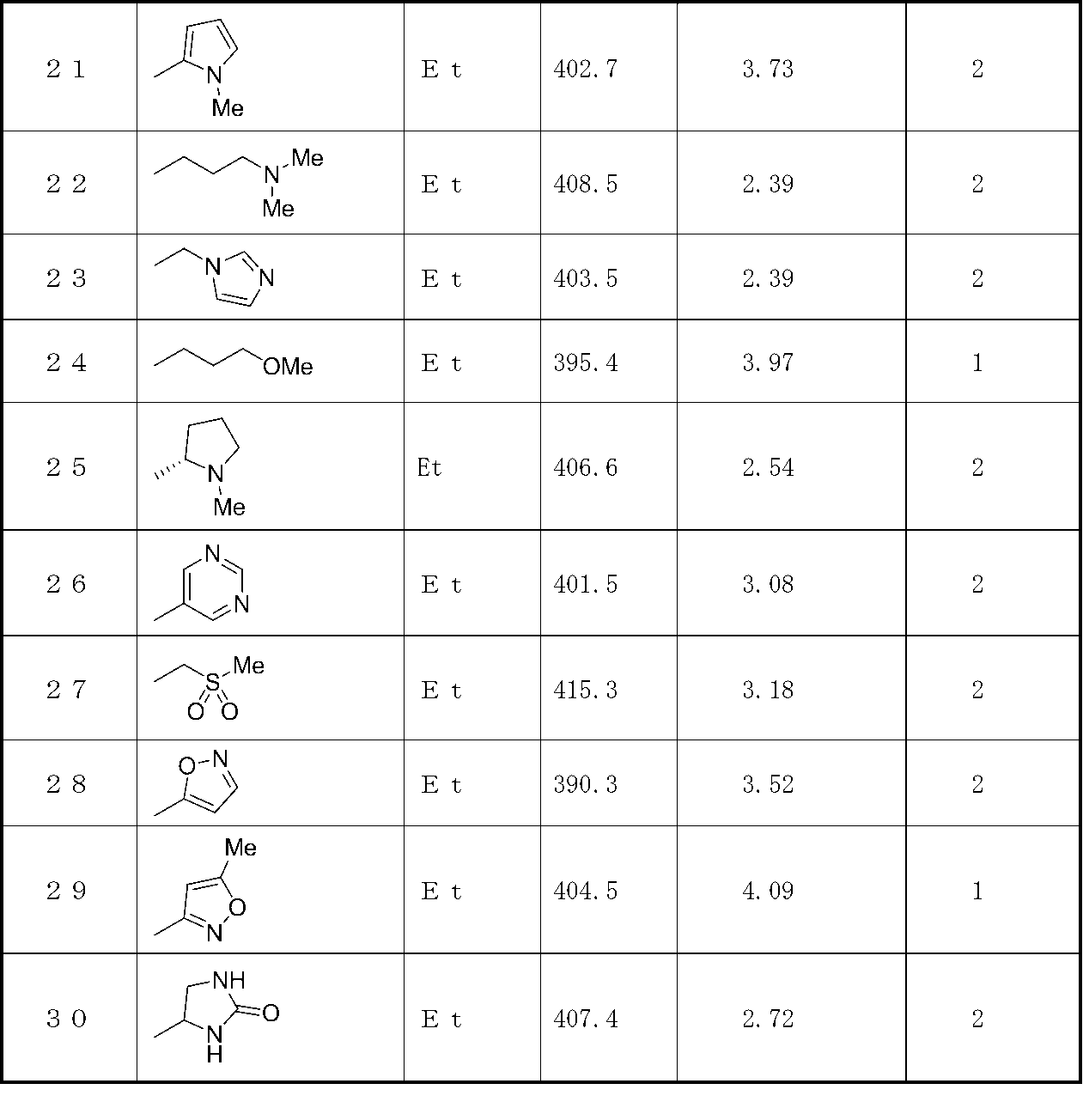


実施例52:1-(エチルフラン-2-カルボニルアミノ)-4-(4-メチル-3-(モルホリン-4-スルホニル)ベンゾイルアミノ)ベンゼン
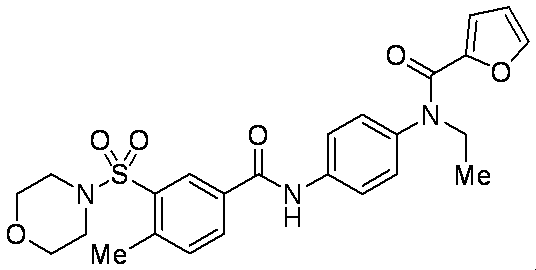
1H NMR (300 MHz, CDCl3) δ: 8.35 (d, 2H, J = 1.8 Hz), 8.07-8.04 (m, 2H), 7.74-7.68 (m, 2H), 7.49 (d, 1H, J = 8.1 Hz), 7.30 (d, 1H, J = 0.9 Hz), 7.23-7.17 (m, 2H), 6.19 (dd, 1H, J = 1.8, 3.6 Hz), 5.88 (d, 1H, J = 3.0 Hz), 3.88 (q, 2H, J = 7.1 Hz), 3.74-3.69 (m, 4H), 3.22-3.16 (m, 4H), 2.70 (s, 3H), 1.20 (t, 3H, J = 7.2 Hz).
LC-MS:498.4(M+1)、保持時間(4.22分)、送液条件(4)
中間体(52-1)の製造:
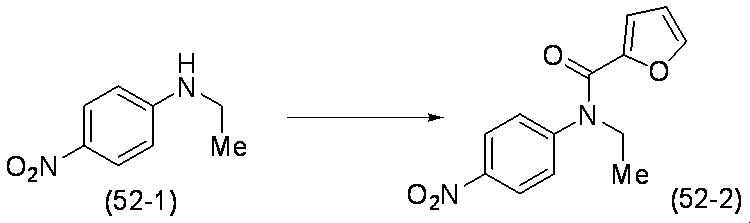
中間体(52-2)の製造:
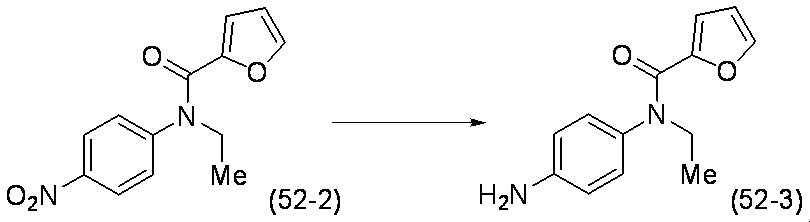
1H NMR (300 MHz, CDCl3) δ: 7.35-7.34 (m, 1H), 6.98-6.93 (m, 2H), 6.78-6.74 (m, 2H), 6.16 (dd, 1H, J = 1.8, 3.6 Hz), 5.64 (br d, 1H, J = 3.1 Hz), 3.82 (q, 2H, J = 7.1 Hz), 1.17 (t, 3H, J = 7.1 Hz).
実施例53~93:
実施例52と同様の手法により、実施例53~93の化合物を製造した。
実施例52と同様の手法により、実施例53~93の化合物を製造した。

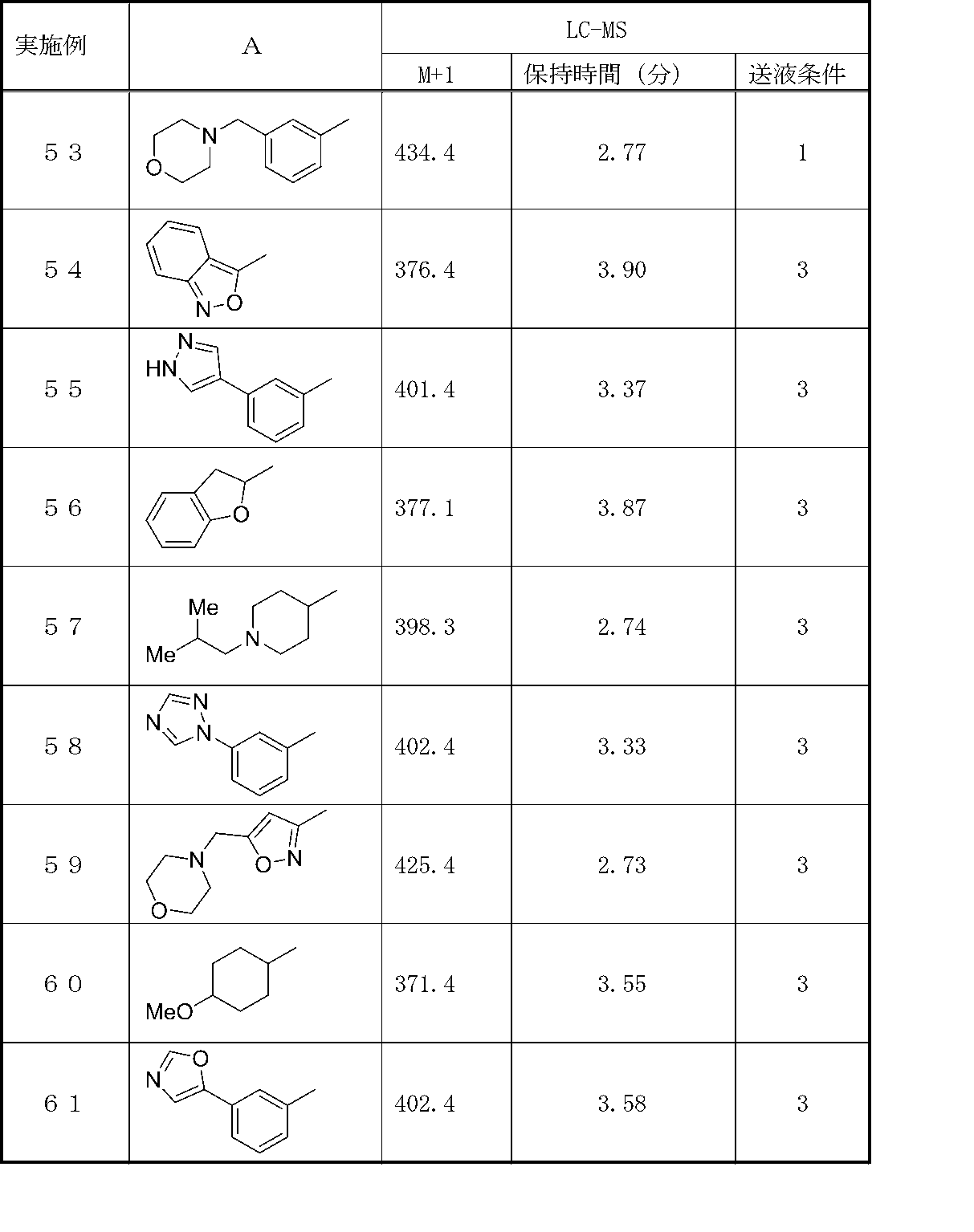
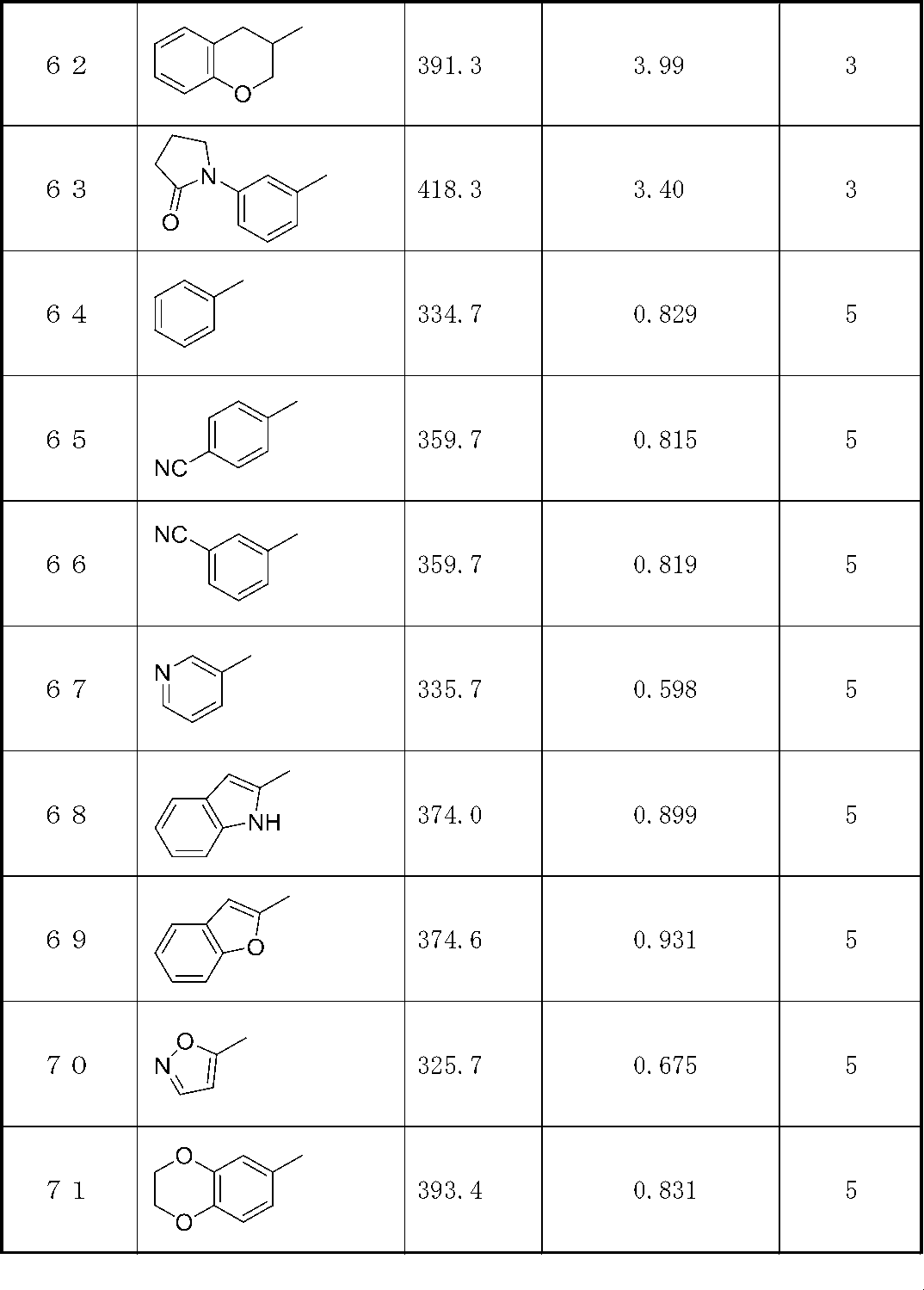
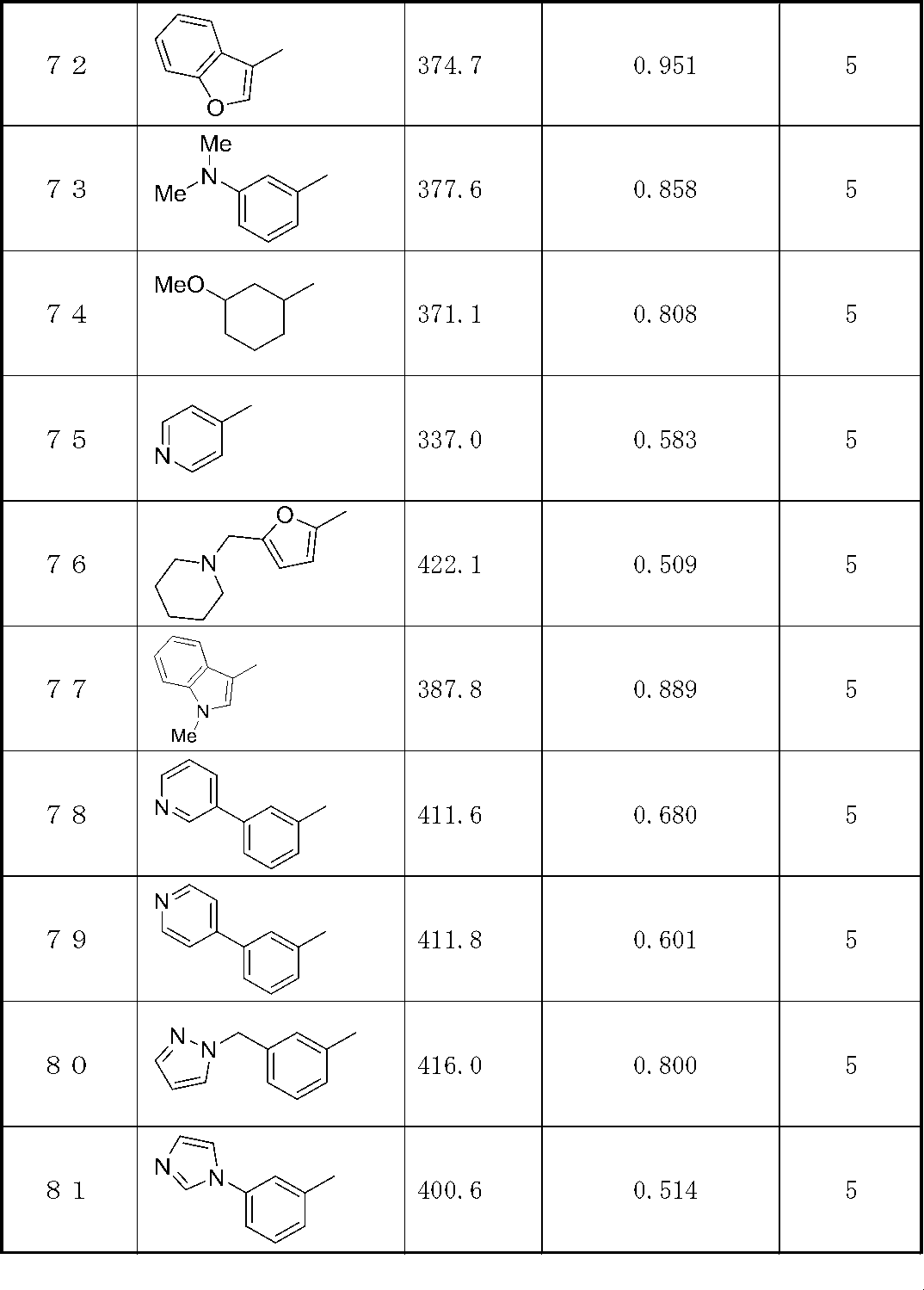

実施例94:1-(エチル(5-メチルイソキサゾール-3-カルボニル)アミノ)-4-(3-モルホリン-4-イル)ベンゾイルアミノ)ベンゼン

1H NMR (300 MHz, CDCl3) δ: 7.88 (br s, 1H), 7.59 (br d, 2H, J = 8.7 Hz), 7.43 (br, 1H), 7.35 (t, 1H, J = 8.0 Hz), 7.22 (br d, 1H, J = 7.2 Hz), 7.14-7.04 (m, 3H), 5.93 (br s, 1H), 3.90 (q, 2H, J = 7.1 Hz), 3.89-3.83 (m, 4H), 3.24-3.18 (m, 4H), 2.29 (s, 3H), 1.20 (t, 3H, J = 7.1 Hz).
LC-MS:435.4(M+1)、保持時間(3.77分)、送液条件(4)
中間体(94-1)の製造:

中間体(94-2)の製造:
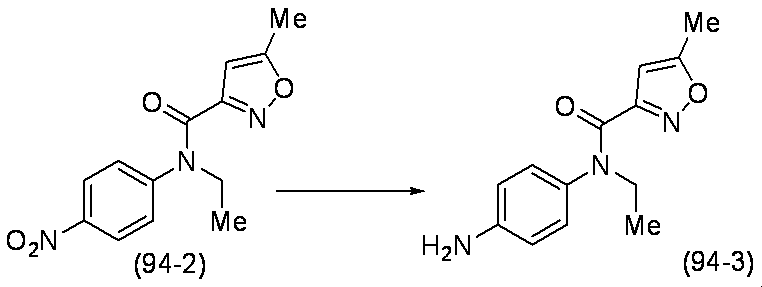
実施例95:1-(エチル(テトラヒドロフラン-3-カルボニル)アミノ)-4-(ピリジン-3-イル)ベンゾイルアミノ)ベンゼン

1H NMR (300 MHz, CDCl3) δ: 9.03 (d, 1H, J = 1.8 Hz), 8.62 (dd, 1H, J = 1.5, 4.8 Hz), 8.38 (s, 1H), 8.18 (t, 1H, J = 1.8 Hz), 7.99 (ddd, 1H, J = 1.8, 2.1, 7.8 Hz), 7.95-7.89 (m, 1H), 7.82-7.75 (m, 3H), 7.62 (t, 1H, J = 7.7 Hz), 7.49-7.43 (m, 1H), 7.16-7.10 (m, 2H), 3.89-3.80 (m, 1H), 3.79-3.63 (m, 5H), 2.92-2.80 (m, 1H), 2.24-2.11 (m, 1H), 1.87-1.74 (m, 1H), 1.09 (t, 3H, J = 7.2 Hz).
LC-MS:416.6(M+1)、保持時間(4.53分)、送液条件(4)
中間体(95-1)の製造:

中間体(95-3)の製造:

実施例94および実施例95と同様の手法により、実施例96~実施例103を合成した。
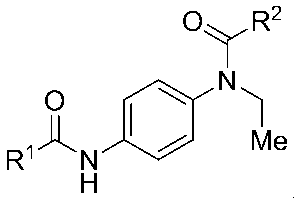

薬理試験例:in vitro sEH阻害活性測定試験
組み換えヒトsEHは、ヒトsEHとマルトース結合蛋白を融合させた蛋白を大腸菌で発現させたものを精製し実験に使用した。96-well blackプレート上で、60 ngの組換えヒトsEHを 0.1 mg/mL BSAを含む25 mM Bis-Tris buffer pH 7.0中で 基質、被験化合物とともに 25 ℃で1時間反応させた。基質としてはEpoxy Fluor 7(Cayman Chemical)を最終濃度25uMとなるように添加した。励起波長330 nm、蛍光波長465 nmにおける蛍光強度の上昇を蛍光プレートリーダを用いて検出し、複数濃度の被験化合物添加時の酵素阻害活性より、50%阻害する化合物濃度をIC50値として算出した。
組み換えヒトsEHは、ヒトsEHとマルトース結合蛋白を融合させた蛋白を大腸菌で発現させたものを精製し実験に使用した。96-well blackプレート上で、60 ngの組換えヒトsEHを 0.1 mg/mL BSAを含む25 mM Bis-Tris buffer pH 7.0中で 基質、被験化合物とともに 25 ℃で1時間反応させた。基質としてはEpoxy Fluor 7(Cayman Chemical)を最終濃度25uMとなるように添加した。励起波長330 nm、蛍光波長465 nmにおける蛍光強度の上昇を蛍光プレートリーダを用いて検出し、複数濃度の被験化合物添加時の酵素阻害活性より、50%阻害する化合物濃度をIC50値として算出した。
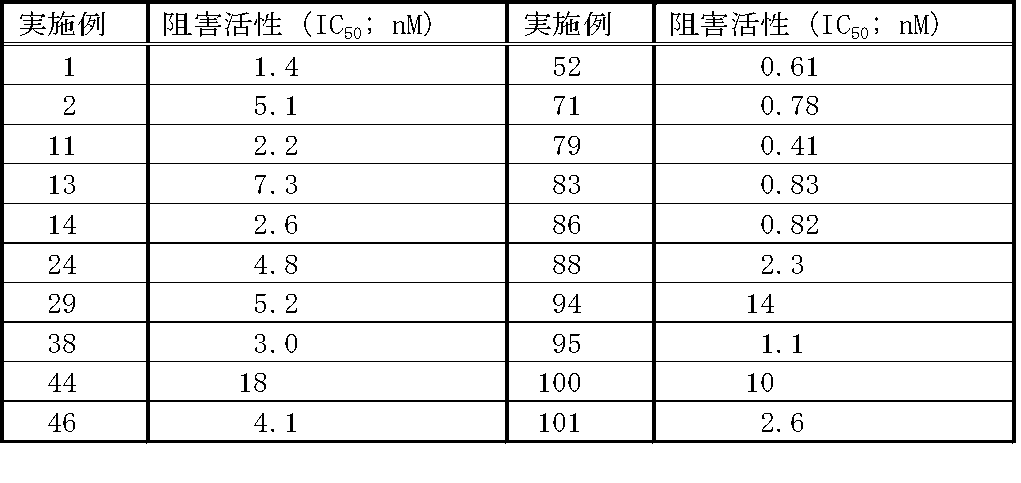
本発明化合物は、その可溶性エポキシドヒドロラーゼ(soluble epoxide hydrolase:sEH)に対する阻害作用より様々な疾病(例えば、高血圧症など)の予防及び/又は治療に有用である。
Claims (24)
- 式(I)で表される化合物、またはその薬学的に許容される塩。
[式中、Aは、
1:下記(a)
で表される基(Ra1、Ra2およびRa3は、各々独立して、水素原子、ハロゲン原子、カルボキシル基、ニトロ基、シアノ基、置換されていてもよいC1-6アルキル基、置換されていてもよいC2-6アルケニル基、置換されていてもよいC2-6アルキニル基、水酸基、置換されていてもよいC1-6アルコキシ基、置換されていてもよいC3-6シクロアルキル基、置換されていてもよいC3-6シクロアルキルオキシ基、置換されていてもよいC6-10アリールオキシ基、置換されていてもよいC6-10アリール基、置換されていてもよいC7-14アラルキルオキシ基、置換されていてもよいC1-4アルコキシカルボニル基、置換されていてもよいC3-6シクロアルコキシカルボニル基、置換されていてもよいC6-10アリールオキシカルボニル基、置換されていてもよいC1-6アルキルスルホニル基、置換されていてもよいC3-6シクロアルキルスルホニル基、置換されていてもよいC1-4アルコキシスルホニル基、置換されていてもよいC3-6シクロアルコキシスルホニル基、置換されていてもよいC6-10アリールオキシスルホニル基、置換されていてもよいC7-14アラルキルオキシスルホニル基、置換されていてもよい5員~10員の単環式もしくは多環式へテロアリールオキシ基、置換されていてもよい5員~10員の単環式もしくは多環式へテロアリール基、置換されていてもよい飽和へテロ環オキシ基、置換されていてもよい飽和へテロ環基、置換されていてもよいアミノ基、置換されてもよいアミノカルボニル基、置換されてもよいアミノカルボニルオキシ基、または置換されていてもよいアミノスルホニル基である。)、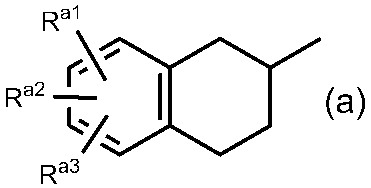
2:下記(b)
で表される基(ここにおいて、
(i)Rb1は、
(a)水素原子、
(b)ハロゲン原子、
(c)シアノ、
(d)C1-4アルキル(該基は、4員~7員の環状アミノで置換されていてもよい。)、
(e)C1-4アルコキシ、
(f)アミノ、
(g)モノ-もしくはジ-(C1-6アルキル)アミノ、
(h)4員~7員の環状アミノ、
(i)アミノスルホニル、
(j)モノ-もしくはジ-(C1-6アルキル)アミノスルホニル、
(k)4員~7員の環状アミノスルホニル、
(l)5員もしくは6員の単環式ヘテロアリール基、または
(m)5員~10員の単環式もしくは多環式へテロアリールC1-4アルキルであり、
Rb2およびRb3は、各々独立して、
(a)水素原子、
(b)シアノ、
(c)C1-4アルキル、または
(d)4~7員の環状アミノであるか、または
(ii)Rb1およびRb2が、一緒になって下記
で表される群から選択される一つの縮合環を形成し(Rb4は、水素原子、またはC1-4アルキルである。)、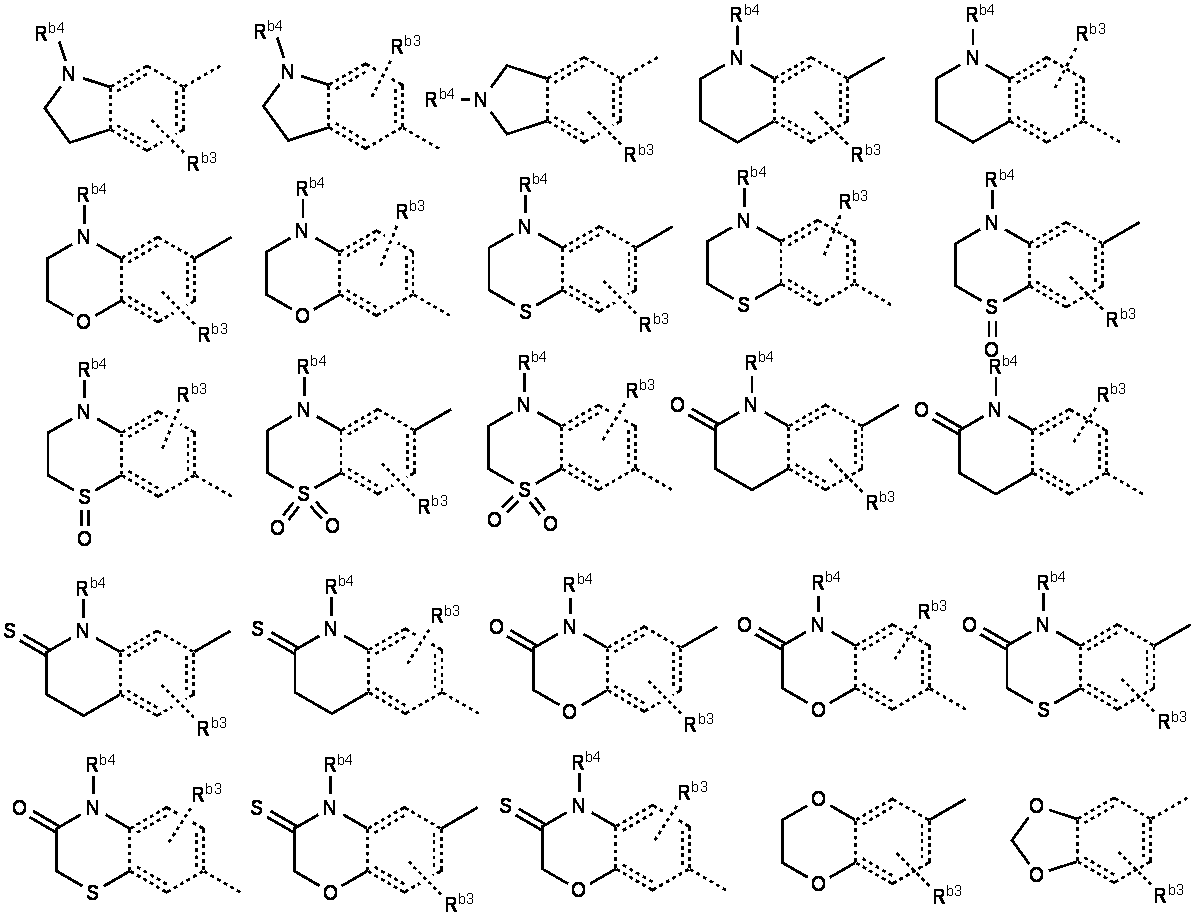
Rb3は、水素原子、またはC1-4アルキルである。)、
3:置換されていてもよいC3-6シクロアルキル基、
4:置換されていてもよい飽和へテロ環基、または
5:置換されていてもよい5員~10員の単環式もしくは多環式へテロアリール基であり;
R1は、
1:C1-6アルキル基(該基は、
(a)C1-4アルコキシ(該基は、C1-4アルコキシで置換されていてもよい。)、
(b)C1-4アルキルスルホニル、
(c)モノ-もしくはジ-(C1-6アルキル)アミノ、
(d)4員~7員の環状アミノ、または
(e)5員もしくは6員の単環式ヘテロアリールオキシで置換されている。)、
2:置換されていてもよい5員~10員の単環式もしくは多環式ヘテロアリール基、
3:置換されていてもよい5員もしくは6員のへテロ環基、または
4:5員~10員の単環式もしくは多環式へテロアリールC1-4アルキル基であり;
R2は、置換されていてもよいC1-6アルキル基、または置換されていてもよいC3-6シクロアルキル基である。] - Aが、下記(a)
で表される基である、請求項1に記載の化合物、またはその薬学的に許容される塩。
- Ra1、Ra2およびRa3が、共に水素原子である、請求項2に記載の化合物、またはその薬学的に許容される塩。
- Aが、下記(b)
で表される基である、請求項1に記載の化合物、またはその薬学的に許容される塩。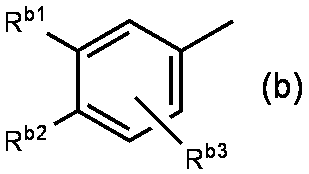
- Rb1が、
(a)水素原子、
(b)シアノ、
(c)C1-4アルキル(該基は、4員~7員の環状アミノで置換されていてもよい。)、
(d)モノ-もしくはジ-(C1-6アルキル)アミノ、
(e)4員~7員の環状アミノ、
(f)4員~7員の環状アミノスルホニル、
(g)5員もしくは6員の単環式へテロアリール、または
(h)5員~10員の単環式もしくは多環式へテロアリールC1-4アルキルであり、
Rb2およびRb3が、共に水素原子である、項4に記載の化合物、またはその薬学的に許容される塩。 - Aが、
1:C3-6シクロアルキル基(該基は、C1-4アルコキシで置換されていてもよい。)、
2:飽和へテロ環基(該環は、
(a)C1-4アルキル、
(b)5員もしくは6員の単環式ヘテロアリール、または
(c)C1-4アルキルカルボニルで置換されていてもよい。)、または
3:5員~10員の単環式もしくは多環式へテロアリール基(該環は、4~7員の環状アミノで置換されていてもよいC1-4アルキルで置換されていてもよい。)である、請求項1に記載の化合物、またはその薬学的に許容される塩。 - R1が、5員~10員の単環式もしくは多環式ヘテロアリール基(該基は、
(a)ハロゲン原子、
(b)C1-4アルキル(該基は、1~3個のフッ素原子で置換されていてもよい。)、
(c)ヒドロキシ、
(d)C1-4アルコキシ(該基は、1~3個のフッ素原子で置換されていてもよい。)、
(e)C3-6シクロアルキルオキシ、
(f)C6-10アリールオキシ、
(g)C6-10アリール、
(h)C1-4アルコキシスルホニル、
(i)C3-6シクロアルコキシスルホニル、
(j)5員もしくは6員の単環式へテロアリールオキシ、
(k)5員もしくは6員の飽和へテロ環オキシ、
(l)アミノ(該アミノは、
(l1)C1-6アルキル、
(l2)C3-6シクロアルキル、
(l3)C3-6シクロアルキルC1-4アルキル、
(l4)C7-14アラルキル、
(l5)C1-4アルキルカルボニル、
(l6)C3-6シクロアルキルカルボニル、
(l7)飽和へテロ環C1-4アルキル、
(l8)飽和へテロ環カルボニル、および
(l9)C1-6アルキルスルホニルから選択される同種または異種の1~2個の基で置換されてもよい。)、
(m)4員~7員環状アミノ、
(n)アミノカルボニル、および
(o)アミノカルボニルオキシから選択される1~3個の基で置換されていてもよい。)である、請求項1~請求項6のいずれか一項に記載の化合物、またはその薬学的に許容される塩。 - R1が、5員~10員の単環式もしくは多環式ヘテロアリール基(該基は、ハロゲン原子、C1-4アルキルまたはC1-4アルコキシで置換されていてもよい。)である、請求項7に記載の化合物、またはその薬学的に許容される塩。
- R1における5員~10員の単環式もしくは多環式ヘテロアリール基が、5員もしくは6員の単環式へテロアリール基である、請求項1~請求項8のいずれか一項に記載の化合物、またはその薬理学的に許容される塩。
- R1における5員もしくは6員の単環式ヘテロアリール基が、下記
からなる群から選択される基である、請求項9に記載の化合物、またはその薬学的に許容される塩。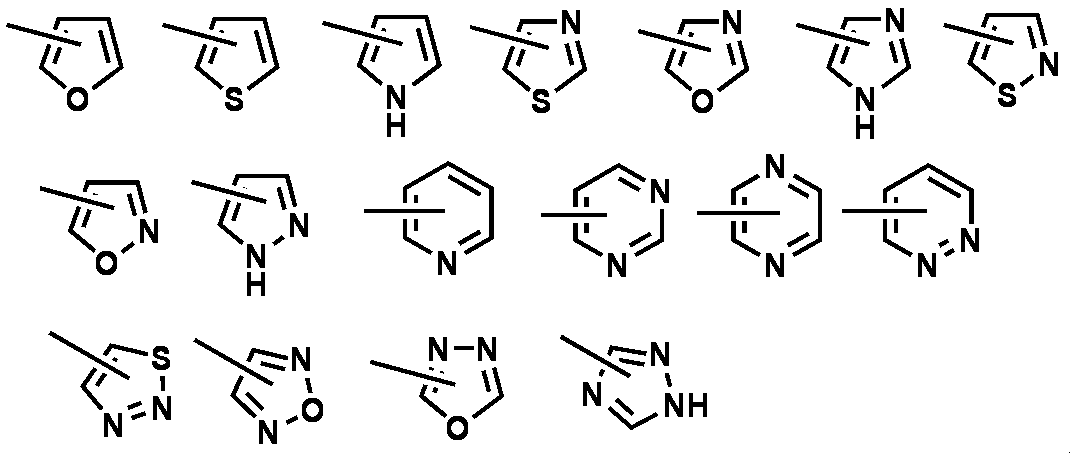
- R1が、フリル基である、請求項10に記載の化合物、またはその薬学的に許容される塩。
- R1が、5員もしくは6員の飽和へテロ環基(該基は、
(a)ハロゲン原子、
(b)ヒドロキシ、
(c)シアノ、
(d)C1-4アルキル(該アルキルは、1~3個のフッ素原子で置換されてもよい。)、
(e)C1-4アルコキシ(該アルコキシは、1~3個のフッ素原子で置換されてもよい。)、
(f)C1-4アルコキシカルボニル、
(g)アミノ基(該アミノは、C1-6アルキルスルホニル、またはC6-10アリールスルホニルで置換されてもよい。)、
(h)アミノカルボニル基(該アミノは、C1-6アルキルおよびC6-10アリールからなる群から選択される同種または異種の1~2個の基で置換されていてもよい。)、
(i)アミノカルボニルオキシ基(該アミノは、C1-6アルキルおよびC6-10アリールからなる群から選択される同種または異種の1~2個の基で置換されていてもよい。)、
(j)アミノカルボニルアミノ基(該アミノカルボニルにおけるアミノは、C1-6アルキルおよびC6-10アリールからなる群から選択される同種または異種の1~2個の基で置換されていてもよい。)、または
(k)オキソ基で置換されていてもよい。)である、請求項1~請求項6のいずれか一項に記載の化合物、またはその薬学的に許容される塩。 - R1が、5員もしくは6員の飽和へテロ環基(該基は、C1-4アルキルまたはオキソで置換されていてもよい。)である、請求項12に記載の化合物、またはその薬学的に許容される塩。
- R1における5員もしくは6員の飽和へテロ環基が、下記
からなる群から選択される基である、請求項12または請求項13に記載の化合物、またはその薬学的に許容される塩。
- R2が、C1-6アルキル基である、請求項1~請求項14のいずれか一項に記載の化合物、またはその薬学的に許容される塩。
- R2が、メチル基、またはエチル基である、請求項15に記載の化合物、またはその薬学的に許容される塩。
- R2が、C3-6シクロアルキル基である、請求項1~請求項14のいずれか一項に記載の化合物、またはその薬学的に許容される塩。
- 請求項1~請求項17に記載の化合物、またはその薬学的に許容される塩を有効成分として含有する医薬組成物。
- 請求項1~請求項17のいずれか一項に記載の化合物、またはその薬学的に許容される塩を有効成分として含有するsEH阻害剤。
- 高血圧症、急性および慢性うっ血性心不全、原発性および二次性肺高血圧症、原発性および二次性アルドステロン血症、腎血管性高血圧症、原発性および二次性腎疾患、心肥大、左室肥大、左室線維化、左室拡張不全、左心室不全、心房細動、不安定狭心症、心筋梗塞、心筋症、脳卒中、血管再建術後の再狭窄、糖尿病性網膜症、認知障害、閉塞性動脈硬化症、糖尿病、肥満、脂質代謝異常、脂肪肝、血管障害、およびアテローム性動脈硬化からなる群から選択される疾患の治療及び/又は予防に有用である、請求項19に記載のsEH阻害剤。
- 高血圧症、及び/又は原発性および二次性腎疾患の治療及び/又は予防に有用である、請求項19または請求項20に記載のsEH阻害剤。
- 請求項1~請求項17のいずれか一項に記載の化合物、またはその薬学的に許容される塩を有効成分として含有する高血圧症、及び/又は原発性および二次性腎疾患の治療剤。
- sEH阻害剤の製造のための、請求項1~請求項17のいずれか一項に記載の化合物、またはその薬学的に許容される塩の使用。
- 治療を必要とする患者に、請求項1~請求項17のいずれか一項に記載の化合物、またはその薬学的に許容される塩の有効量を投与する、高血圧症、及び/又は原発性および二次性腎疾患の治療方法。
Applications Claiming Priority (2)
| Application Number | Priority Date | Filing Date | Title |
|---|---|---|---|
| JP2009-205721 | 2009-09-07 | ||
| JP2009205721 | 2009-09-07 |
Publications (1)
| Publication Number | Publication Date |
|---|---|
| WO2011027888A1 true WO2011027888A1 (ja) | 2011-03-10 |
Family
ID=43649421
Family Applications (1)
| Application Number | Title | Priority Date | Filing Date |
|---|---|---|---|
| PCT/JP2010/065259 Ceased WO2011027888A1 (ja) | 2009-09-07 | 2010-09-06 | ジアミド-フェニル誘導体、またはその薬学的に許容される塩 |
Country Status (1)
| Country | Link |
|---|---|
| WO (1) | WO2011027888A1 (ja) |
Citations (3)
| Publication number | Priority date | Publication date | Assignee | Title |
|---|---|---|---|---|
| JP2000505471A (ja) * | 1996-02-28 | 2000-05-09 | メルク エンド カンパニー インコーポレーテッド | フィブリノーゲン受容体拮抗物質 |
| WO2003048081A2 (en) * | 2001-12-04 | 2003-06-12 | Bristol-Myers Squibb Company | Glycinamides as factor xa inhibitors |
| JP2007513988A (ja) * | 2003-12-16 | 2007-05-31 | メルク パテント ゲゼルシャフト ミット ベシュレンクテル ハフトング | プロリニルアリールアセトアミド |
-
2010
- 2010-09-06 WO PCT/JP2010/065259 patent/WO2011027888A1/ja not_active Ceased
Patent Citations (3)
| Publication number | Priority date | Publication date | Assignee | Title |
|---|---|---|---|---|
| JP2000505471A (ja) * | 1996-02-28 | 2000-05-09 | メルク エンド カンパニー インコーポレーテッド | フィブリノーゲン受容体拮抗物質 |
| WO2003048081A2 (en) * | 2001-12-04 | 2003-06-12 | Bristol-Myers Squibb Company | Glycinamides as factor xa inhibitors |
| JP2007513988A (ja) * | 2003-12-16 | 2007-05-31 | メルク パテント ゲゼルシャフト ミット ベシュレンクテル ハフトング | プロリニルアリールアセトアミド |
Non-Patent Citations (1)
| Title |
|---|
| D. DOYLE ET AL.: "Synthesis of novel glycophanes derived from glucuronic acid by ring closing alkene and alkyne metathesis", CARBOHYDRATE RESEARCH, vol. 343, no. 15, 2008, pages 2535 - 2544, XP025408846, DOI: doi:10.1016/j.carres.2008.06.007 * |
Similar Documents
| Publication | Publication Date | Title |
|---|---|---|
| US10538498B2 (en) | 1,3,4-oxadiazole sulfonamide derivative compounds as histone deacetylase 6 inhibitor, and the pharmaceutical composition comprising the same | |
| CN113924296B (zh) | 作为组蛋白脱乙酰酶6抑制剂的1,3,4-噁二唑衍生化合物及包含其的药物组合物 | |
| AU2003284188B2 (en) | Piperidinyl cyclopentyl aryl benzylamide modulators of chemokine receptor activity | |
| WO2009084497A1 (ja) | メチル置換ピペリジン誘導体 | |
| CA3136223C (en) | 1,3,4-oxadiazole homophthalimide derivative compounds as histone deacetylase 6 inhibitor, and the pharmaceutical composition comprising the same | |
| JP2010163361A (ja) | キノリン誘導体 | |
| KR20080018250A (ko) | 복소환 화합물 | |
| WO2004080966A1 (ja) | 含窒素複素環誘導体およびそれらを有効成分とする薬剤 | |
| JPWO2003062234A1 (ja) | キノキサリン化合物 | |
| RU2396257C2 (ru) | Производные 4-аминопиперидина | |
| JP5331883B2 (ja) | N−置換−環状アミノ誘導体 | |
| TW200938530A (en) | Pyrrolidine compounds | |
| JP2006511500A (ja) | γ−アミノアミド系のケモカイン受容体活性調節剤 | |
| US20130116227A1 (en) | Biaryl amide derivative or pharmaceutically acceptable salt thereof | |
| KR20230084174A (ko) | 난청의 예방 또는 치료에 사용하기 위한 소르틸린 길항제 | |
| CN114181207B (zh) | β-咔波啉类化合物及其制备方法和抗阿尔兹海默病的应用 | |
| JP2013532657A (ja) | 環式n,n’−ジアリールチオ尿素及びn,n’−ジアリール尿素−アンドロゲン受容体アンタゴニスト、抗癌剤、その調製のための方法及び使用 | |
| KR20100044829A (ko) | 아미노피라졸 아미드 유도체 | |
| TW201031658A (en) | Inhibitors of diacylglycerol acyltransferase | |
| JP2010064982A (ja) | アルキルアミノ誘導体 | |
| US20100056497A1 (en) | Amide derivative | |
| JP2012149054A (ja) | N−置換−環状アミノ誘導体からなる医薬 | |
| JP5711151B2 (ja) | インドール誘導体 | |
| AU2006243393A1 (en) | 3 -mono- and 3 , 5-disubstituted piperidine derivatives as renin inhibitors | |
| CN102282132A (zh) | 二酰基甘油酰基转移酶的抑制剂 |
Legal Events
| Date | Code | Title | Description |
|---|---|---|---|
| 121 | Ep: the epo has been informed by wipo that ep was designated in this application |
Ref document number: 10813834 Country of ref document: EP Kind code of ref document: A1 |
|
| NENP | Non-entry into the national phase |
Ref country code: DE |
|
| 122 | Ep: pct application non-entry in european phase |
Ref document number: 10813834 Country of ref document: EP Kind code of ref document: A1 |
|
| NENP | Non-entry into the national phase |
Ref country code: JP |