WO2010150823A1 - 濾過材料 - Google Patents
濾過材料 Download PDFInfo
- Publication number
- WO2010150823A1 WO2010150823A1 PCT/JP2010/060665 JP2010060665W WO2010150823A1 WO 2010150823 A1 WO2010150823 A1 WO 2010150823A1 JP 2010060665 W JP2010060665 W JP 2010060665W WO 2010150823 A1 WO2010150823 A1 WO 2010150823A1
- Authority
- WO
- WIPO (PCT)
- Prior art keywords
- glass
- mol
- molten salt
- chloride
- filtration material
- Prior art date
- Legal status (The legal status is an assumption and is not a legal conclusion. Google has not performed a legal analysis and makes no representation as to the accuracy of the status listed.)
- Ceased
Links
Classifications
-
- G—PHYSICS
- G21—NUCLEAR PHYSICS; NUCLEAR ENGINEERING
- G21F—PROTECTION AGAINST X-RADIATION, GAMMA RADIATION, CORPUSCULAR RADIATION OR PARTICLE BOMBARDMENT; TREATING RADIOACTIVELY CONTAMINATED MATERIAL; DECONTAMINATION ARRANGEMENTS THEREFOR
- G21F9/00—Treating radioactively contaminated material; Decontamination arrangements therefor
- G21F9/28—Treating solids
-
- B—PERFORMING OPERATIONS; TRANSPORTING
- B01—PHYSICAL OR CHEMICAL PROCESSES OR APPARATUS IN GENERAL
- B01D—SEPARATION
- B01D39/00—Filtering material for liquid or gaseous fluids
- B01D39/14—Other self-supporting filtering material ; Other filtering material
- B01D39/20—Other self-supporting filtering material ; Other filtering material of inorganic material, e.g. asbestos paper, metallic filtering material of non-woven wires
- B01D39/2003—Glass or glassy material
-
- B—PERFORMING OPERATIONS; TRANSPORTING
- B01—PHYSICAL OR CHEMICAL PROCESSES OR APPARATUS IN GENERAL
- B01D—SEPARATION
- B01D39/00—Filtering material for liquid or gaseous fluids
- B01D39/14—Other self-supporting filtering material ; Other filtering material
- B01D39/20—Other self-supporting filtering material ; Other filtering material of inorganic material, e.g. asbestos paper, metallic filtering material of non-woven wires
- B01D39/2068—Other inorganic materials, e.g. ceramics
-
- C—CHEMISTRY; METALLURGY
- C03—GLASS; MINERAL OR SLAG WOOL
- C03C—CHEMICAL COMPOSITION OF GLASSES, GLAZES OR VITREOUS ENAMELS; SURFACE TREATMENT OF GLASS; SURFACE TREATMENT OF FIBRES OR FILAMENTS MADE FROM GLASS, MINERALS OR SLAGS; JOINING GLASS TO GLASS OR OTHER MATERIALS
- C03C10/00—Devitrified glass ceramics, i.e. glass ceramics having a crystalline phase dispersed in a glassy phase and constituting at least 50% by weight of the total composition
-
- C—CHEMISTRY; METALLURGY
- C03—GLASS; MINERAL OR SLAG WOOL
- C03C—CHEMICAL COMPOSITION OF GLASSES, GLAZES OR VITREOUS ENAMELS; SURFACE TREATMENT OF GLASS; SURFACE TREATMENT OF FIBRES OR FILAMENTS MADE FROM GLASS, MINERALS OR SLAGS; JOINING GLASS TO GLASS OR OTHER MATERIALS
- C03C11/00—Multi-cellular glass ; Porous or hollow glass or glass particles
-
- C—CHEMISTRY; METALLURGY
- C03—GLASS; MINERAL OR SLAG WOOL
- C03C—CHEMICAL COMPOSITION OF GLASSES, GLAZES OR VITREOUS ENAMELS; SURFACE TREATMENT OF GLASS; SURFACE TREATMENT OF FIBRES OR FILAMENTS MADE FROM GLASS, MINERALS OR SLAGS; JOINING GLASS TO GLASS OR OTHER MATERIALS
- C03C3/00—Glass compositions
- C03C3/12—Silica-free oxide glass compositions
- C03C3/16—Silica-free oxide glass compositions containing phosphorus
-
- C—CHEMISTRY; METALLURGY
- C03—GLASS; MINERAL OR SLAG WOOL
- C03C—CHEMICAL COMPOSITION OF GLASSES, GLAZES OR VITREOUS ENAMELS; SURFACE TREATMENT OF GLASS; SURFACE TREATMENT OF FIBRES OR FILAMENTS MADE FROM GLASS, MINERALS OR SLAGS; JOINING GLASS TO GLASS OR OTHER MATERIALS
- C03C3/00—Glass compositions
- C03C3/12—Silica-free oxide glass compositions
- C03C3/16—Silica-free oxide glass compositions containing phosphorus
- C03C3/17—Silica-free oxide glass compositions containing phosphorus containing aluminium or beryllium
-
- C—CHEMISTRY; METALLURGY
- C03—GLASS; MINERAL OR SLAG WOOL
- C03C—CHEMICAL COMPOSITION OF GLASSES, GLAZES OR VITREOUS ENAMELS; SURFACE TREATMENT OF GLASS; SURFACE TREATMENT OF FIBRES OR FILAMENTS MADE FROM GLASS, MINERALS OR SLAGS; JOINING GLASS TO GLASS OR OTHER MATERIALS
- C03C3/00—Glass compositions
- C03C3/12—Silica-free oxide glass compositions
- C03C3/16—Silica-free oxide glass compositions containing phosphorus
- C03C3/21—Silica-free oxide glass compositions containing phosphorus containing titanium, zirconium, vanadium, tungsten or molybdenum
-
- G—PHYSICS
- G21—NUCLEAR PHYSICS; NUCLEAR ENGINEERING
- G21F—PROTECTION AGAINST X-RADIATION, GAMMA RADIATION, CORPUSCULAR RADIATION OR PARTICLE BOMBARDMENT; TREATING RADIOACTIVELY CONTAMINATED MATERIAL; DECONTAMINATION ARRANGEMENTS THEREFOR
- G21F9/00—Treating radioactively contaminated material; Decontamination arrangements therefor
- G21F9/04—Treating liquids
- G21F9/06—Processing
-
- G—PHYSICS
- G21—NUCLEAR PHYSICS; NUCLEAR ENGINEERING
- G21F—PROTECTION AGAINST X-RADIATION, GAMMA RADIATION, CORPUSCULAR RADIATION OR PARTICLE BOMBARDMENT; TREATING RADIOACTIVELY CONTAMINATED MATERIAL; DECONTAMINATION ARRANGEMENTS THEREFOR
- G21F9/00—Treating radioactively contaminated material; Decontamination arrangements therefor
- G21F9/28—Treating solids
- G21F9/30—Processing
Definitions
- the present invention relates to a filtration material that hardly reacts with a chloride-based molten salt and is suitable for filtering a precipitate in the molten salt.
- the molten salt electrolysis method using a chloride-based molten salt is currently used in various fields.
- the spent fuel is dissolved in a solvent of a chloride-based high-temperature molten salt, and electrolytic deposits deposited on the cathode are recovered by electrolytic treatment and reprocessed.
- the spent electrolyte melt generated in such a process includes a fission product that precipitates without being dissolved in the molten salt, such as a platinum group element (for example, see Non-Patent Document 1).
- a fission product that precipitates without being dissolved in the molten salt
- it has been studied to remove the fission product that cannot be separated by electrolysis by converting it into phosphate. (For example, refer nonpatent literature 2 or patent literature 1).
- Precipitation can be removed by filtration, but it is essential that the filter medium used can maintain its shape without reacting with the molten salt. Moreover, although the deposit containing a fission product is stabilized by vitrification, since a fission product adheres also to a filter medium, solidification is required. In patent document 1, although the filling of the precipitate to iron phosphate glass is considered for stabilization, since stable glass is not formed depending on the material of a filter medium, examination of a filter medium is a subject. .
- the present invention is to provide a filtration material made of phosphate glass that is suitable for filtering precipitates in a chloride-based molten salt and solves the above problems.
- the present invention provides a filtration material characterized by being glass or crystallized glass that hardly reacts with a chloride-based molten salt.
- the filtration material of the present invention the P 2 O 5 30 ⁇ 80 mol%, the Fe 2 O 3 0 ⁇ 50 mol%, the Al 2 O 3 0 ⁇ 30 mol%, the TiO 2 0 ⁇ 35 mol %, ZrO 2 is contained in a glass or crystallized glass containing 0 to 10 mol%.
- the glass or crystallized glass does not substantially contain alkali metal oxides and alkaline earth metal oxides, and the glass and crystallized glass precursor glass has a softening point of 450 ° C. or higher. It is characterized by.
- the filtration material of the present invention is made of P 2 O 5 -based glass or crystallized glass, and is characterized by being difficult to react with a chloride-based mixed molten salt.
- the filtration material of the present invention has a P 2 O 5 content of 30 to 80 mol%, an Fe 2 O 3 content of 0 to 50 mol%, an Al 2 O 3 content of 0 to 30 mol%, and a TiO 2 content of 0. It is made of P 2 O 5 glass or crystallized glass containing ⁇ 35 mol% and ZrO 2 in 0 to 10 mol%.
- P 2 O 5 is a main component of glass and is an essential component for facilitating glass melting. It is desirable to contain P 2 O 5 in the range of 30 to 80 mol% in the glass or crystallized glass. When the P 2 O 5 content is less than 30 mol%, the above-described effects cannot be exhibited, and vitrification becomes difficult. If the P 2 O 5 content exceeds 80 mol%, the moisture resistance of the glass will deteriorate. The P 2 O 5 content is more preferably in the range of 40 to 70 mol%.
- Fe 2 O 3 is a component that improves moisture absorption, which is a problem with P 2 O 5 glass, and stabilizes the glass. It is desirable to contain Fe 2 O 3 in the range of 0 to 50 mol% in the glass or crystallized glass. If the Fe 2 O 3 content exceeds 50 mol%, it will not vitrify. The Fe 2 O 3 content is more preferably in the range of 0 to 45 mol%.
- Al 2 O 3 is a component that suppresses the reaction with the molten salt and stabilizes by suppressing crystallization during glass production. It is preferable to contain Al 2 O 3 in the range of 0 to 30 mol% in the glass or crystallized glass. If the Al 2 O 3 content exceeds 30 mol%, it will not vitrify. The Al 2 O 3 content is preferably in the range of 0 to 25 mol%, more preferably 0 to 20 mol%.
- TiO 2 is a component that improves the heat resistance of the glass and suppresses the reaction with the molten salt in the same manner as Al 2 O 3 . It is preferable to contain TiO 2 in the range of 0 to 35 mol% in the glass or crystallized glass. If the TiO 2 content exceeds 35 mol%, vitrification becomes difficult. The TiO 2 content is more preferably in the range of 0 to 30 mol%.
- ZrO 2 is a component that improves the heat resistance of the glass and suppresses the reaction with the molten salt in the same manner as Al 2 O 3 . It is preferable to contain ZrO 2 in the range of 0 to 10 mol% in the glass or crystallized glass. If the ZrO 2 content exceeds 10 mol%, vitrification becomes difficult. The ZrO 2 content is more preferably in the range of 0 to 8 mol%.
- In 2 O 3 , V 2 O 5 , SnO 2 , TeO 2, etc. represented by general oxides, or F 2 , Cl 2, etc. may be added up to 3 mol% within the range where the above properties are not impaired. Also good. When the content of these components exceeds 3 mol%, the reaction with the molten salt becomes easy, and the properties and shape of the glass cannot be maintained.
- the glass or crystallized glass does not substantially contain an alkali metal oxide or an alkaline earth metal oxide, there is no reaction with the molten salt.
- the phrase “substantially free of alkali metal oxide or alkaline earth metal oxide” means an amount that is mixed as an impurity in the glass raw material. For example, if it is in the range of 1% by mass or less in glass or crystallized glass, there is almost no influence on the reaction with the molten salt.
- any glass or crystallized glass may be used as long as it is resistant to the chloride-based molten salt.
- the softening point of the glass and the precursor glass of crystallized glass is 450 ° C. or higher. If the softening point is less than 450 ° C., it may not be able to withstand the melting temperature of the electrolyte melt and the shape may not be maintained.
- the shape of the filtration material of the present invention is not particularly limited, but it is preferable to make it a powder, a fiber, or a porous material in order to improve filtration performance.
- the filtration material of the present invention is effective for a molten salt of a chloride electrolyte melt.
- the chloride electrolyte melt may contain other salts such as phosphates.
- Orthophosphoric acid as P 2 O 5 source iron oxide as Fe 2 O 3 source, aluminum oxide as Al 2 O 3 source, titanium oxide as TiO 2 source, zirconium oxide as ZrO 2 source, potassium carbonate as K 2 O source, Calcium carbonate is used as the CaO source and barium carbonate is used as the BaO source.
- P 2 O 5 source iron oxide as Fe 2 O 3 source, aluminum oxide as Al 2 O 3 source, titanium oxide as TiO 2 source, zirconium oxide as ZrO 2 source, potassium carbonate as K 2 O source, Calcium carbonate is used as the CaO source and barium carbonate is used as the BaO source.
- Each sample thus prepared was evaluated for softening point and resistance to molten salt.
- the softening point was measured using a thermal analyzer TG-DTA (manufactured by Rigaku Corporation).
- TG-DTA thermal analyzer
- LiCl-KCl-CsCl mixed salt is heated to 500 ° C in a dry atmosphere to form molten salt, and the glass sample is immersed in the molten salt for 5 hours to melt Resistance to salt was evaluated.
- Tables 1 and 2 show the compositions and evaluation test results of the glass samples of Examples 1 to 5 and Comparative Examples 1 to 3, respectively.
- the filtering material of the present invention can filter a precipitate without reacting with a chloride-based molten salt.
- the molten salt is an electrolyte melt
- the electrolyte melt can be regenerated. , Environmental and economic loads can be reduced.
Landscapes
- Chemical & Material Sciences (AREA)
- Engineering & Computer Science (AREA)
- Chemical Kinetics & Catalysis (AREA)
- Life Sciences & Earth Sciences (AREA)
- Materials Engineering (AREA)
- Geochemistry & Mineralogy (AREA)
- Organic Chemistry (AREA)
- General Chemical & Material Sciences (AREA)
- High Energy & Nuclear Physics (AREA)
- Physics & Mathematics (AREA)
- General Engineering & Computer Science (AREA)
- Geology (AREA)
- Ceramic Engineering (AREA)
- Inorganic Chemistry (AREA)
- Crystallography & Structural Chemistry (AREA)
- Dispersion Chemistry (AREA)
- Glass Compositions (AREA)
- Filtering Materials (AREA)
Abstract
本発明によれば、塩化物系の溶融塩と反応し難いガラス又は結晶化ガラスからなる濾過材料が提供される。この濾過材料の使用により、例えば、溶融塩が電解質融液の場合は電解質融液の再生が可能となり、環境及び経済面での負荷を低減することができる。
Description
本発明は、塩化物系の溶融塩と反応し難く、溶融塩中の沈殿物の濾過に適した濾過材料に関する。
塩化物系溶融塩を用いた溶融塩電解法は、現在、様々な分野で利用されている。例えば、使用済核燃料の乾式再処理工程では、塩化物系の高温溶融塩の溶媒に使用済燃料を溶解し、電解処理することで陰極上に析出する電解析出物を回収し、再処理している。このような工程で発生する使用済電解質融液には、白金族元素のように溶融塩に溶け込まずに沈殿する核分裂生成物が存在する(例えば、非特許文献1参照)。また、電解により分離不可能な核分裂生成物は、リン酸塩に転換することにより沈殿除去することも検討されている。(例えば、非特許文献2または特許文献1参照)。
沈殿は濾過により除去出来るが、用いる濾過材は溶融塩と反応せずに、形状を維持できることが必須である。また、核分裂生成物を含有する沈殿物は、ガラス固化により安定化されるが、濾過材にも核分裂生成物が付着するため、固化が必要である。特許文献1では、安定化に鉄リン酸ガラスへの沈殿物の充填を検討しているが、濾過材の材質によっては、安定なガラスを形成しないため、濾過材の検討が課題となっている。
「リン酸系ガラスによる放射性廃棄物固化技術」天本一平、明珍宗孝、福井寿樹、New GLASS、Vol.22、No.2、2007、p22
「乾式再処理から発生する廃溶融塩の固化技術の開発」豊原尚美 他、日本原子力学会和文論文誌、Vol.1、No.4、2002、p420
本発明は、塩化物系の溶融塩中の沈殿物の濾過に適し、上記問題を解決するためのリン酸系ガラスからなる濾過材料を提供することである。
即ち、本発明では、塩化物系の溶融塩と反応し難いガラス又は結晶化ガラスであることを特徴とする濾過材料が提供される。
好ましくは、本発明の濾過材料は、P2O5を30~80モル%、Fe2O3を0~50モル%、Al2O3を0~30モル%、TiO2を0~35モル%、ZrO2を0~10モル%含有するガラス又は結晶化ガラスであることを特徴とする。
また、好ましくは、ガラス又は結晶化ガラスは、実質的にアルカリ金属酸化物及びアルカリ土類金属酸化物を含有しないこと、ガラス及び結晶化ガラスの前駆体ガラスの軟化点が450℃以上であることを特徴とする。
以下、本発明を詳細に説明する。
本発明の濾過材料は、P2O5系のガラス又は結晶化ガラスからなり、塩化物系混合溶融塩と反応し難いことを特徴とする。
より具体的には、本発明の濾過材料は、P2O5を30~80モル%、Fe2O3を0~50モル%、Al2O3を0~30モル%、TiO2を0~35モル%、ZrO2を0~10モル%含有するP2O5系ガラス又は結晶化ガラスからなる。
P2O5は、ガラスの主成分であり、ガラス溶融を容易とするための必須成分である。ガラス又は結晶化ガラス中にP2O5を30~80モル%の範囲で含有させることが望ましい。P2O5含有量が30モル%未満では、上記作用を発揮し得ず、且つ、ガラス化が困難となる。P2O5含有量が80モル%を超えると、ガラスの耐湿性が悪くなる。P2O5含有量は、より好ましくは40~70モル%の範囲である。
Fe2O3は、P2O5系ガラスで問題となる吸湿性を改善し、ガラスを安定化させる成分である。ガラス又は結晶化ガラス中にFe2O3を0~50モル%の範囲で含有させることが望ましい。Fe2O3含有量が50モル%を超えると、ガラス化しなくなる。Fe2O3含有量は、より好ましくは0~45モル%の範囲である。
Al2O3は、溶融塩との反応を抑制し、ガラス作製の際に結晶化を抑制して安定化させる成分である。ガラス又は結晶化ガラス中にAl2O3を0~30モル%の範囲で含有させることが好ましい。Al2O3含有量が30モル%を超えると、ガラス化しなくなる。Al2O3含有量は、好ましくは0~25モル%、より好ましくは0~20モル%の範囲である。
TiO2は、ガラスの耐熱性を向上させ、Al2O3と同様に溶融塩との反応を抑制する成分である。ガラス又は結晶化ガラス中にTiO2を0~35モル%の範囲で含有させることが好ましい。TiO2含有量が35モル%を超えると、ガラス化が困難となる。TiO2含有量は、より好ましくは0~30モル%の範囲である。
ZrO2は、ガラスの耐熱性を向上させ、Al2O3と同様に溶融塩との反応を抑制する成分である。ガラス又は結晶化ガラス中にZrO2を0~10モル%の範囲で含有させることが好ましい。ZrO2含有量が10モル%を超えると、ガラス化が困難となる。ZrO2含有量は、より好ましくは0~8モル%の範囲である。
この他にも、一般的な酸化物で表すIn2O3、V2O5、SnO2、TeO2など、あるいはF2やCl2などを上記性質を損なわない範囲で3モル%まで加えてもよい。これらの成分の含有量が3モル%を超えると、溶融塩との反応がし易くなり、ガラスの性質及び形状を維持出来なくなる。
上記成分系において、ガラス又は結晶化ガラスが実質的にアルカリ金属酸化物やアルカリ土類金属酸化物を含まないことにより、溶融塩との反応を皆無とすることができる。ここで、実質的にアルカリ金属酸化物やアルカリ土類金属酸化物を含まないとは、ガラス原料中に不純物として混入する程度の量を意味する。例えば、ガラス又は結晶化ガラス中における1質量%以下の範囲であれば、溶融塩との反応に与える影響は殆どない。
また、上記成分系において、塩化物系溶融塩に耐性があれば、ガラス或いは結晶化ガラスのどちらでも構わない。
また、ガラス及び結晶化ガラスの前駆体ガラスの軟化点が450℃以上であることが好ましい。軟化点が450℃未満であると、電解質融液の溶融温度に耐えられなくなり、形状を維持できなくなる可能性がある。
本発明の濾過材料は特に形状を問わないが、濾過性能を上げるために粉末状、繊維状、あるいは多孔質にすることが好ましい。
本発明の濾過材料は、塩化物系電解質融液の溶融塩に効果を示す。但し、塩化物系電解質融液は、リン酸塩等の他の塩を含有してもよい。
以下、実施例を挙げて本発明を具体的に説明する。但し、本発明は以下の実施例に限定されるものではない。
P2O5源として正リン酸、Fe2O3源として酸化鉄、Al2O3源として酸化アルミニウム、TiO2源として酸化チタン、ZrO2源として酸化ジルコニウム、K2O源として炭酸カリウム、CaO源として炭酸カルシウム、BaO源として炭酸バリウムを使用し、これらを表の組成となるべく調合したうえで、白金ルツボに投入し、電気加熱炉内で1100~1300℃、1~3時間加熱溶融した。溶融ガラスを鋳型に流し込み、ブロック状とし、ガラス転移点以上に保持した電気炉内に移入して徐冷し、実施例1~5及び比較例1~3のガラス試料を得た。
このようにして作製した各試料について、軟化点及び溶融塩への耐性を評価した。尚、軟化点は、熱分析装置TG―DTA(リガク(株)製)を用いて測定した。塩化物系溶融塩への耐性評価は、LiCl-KCl―CsCl混合塩を、乾燥した大気中500℃で加熱することで溶融塩とし、上記ガラス試料をその溶融塩に5時間浸漬して、溶融塩への耐性を評価した。
実施例1~5及び比較例1~3のガラス試料の組成及び評価試験結果を表1及び表2にそれぞれ示す。
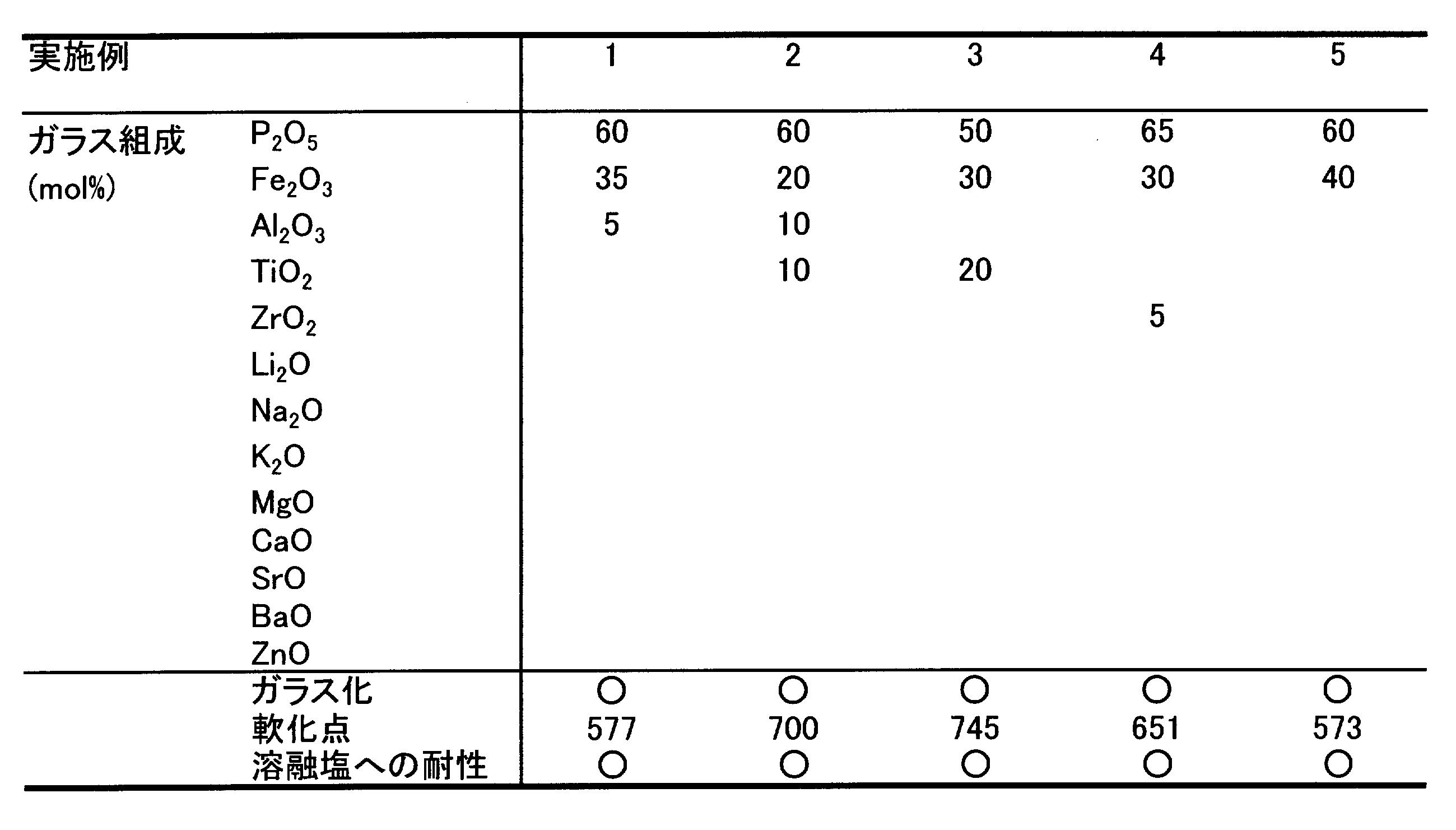
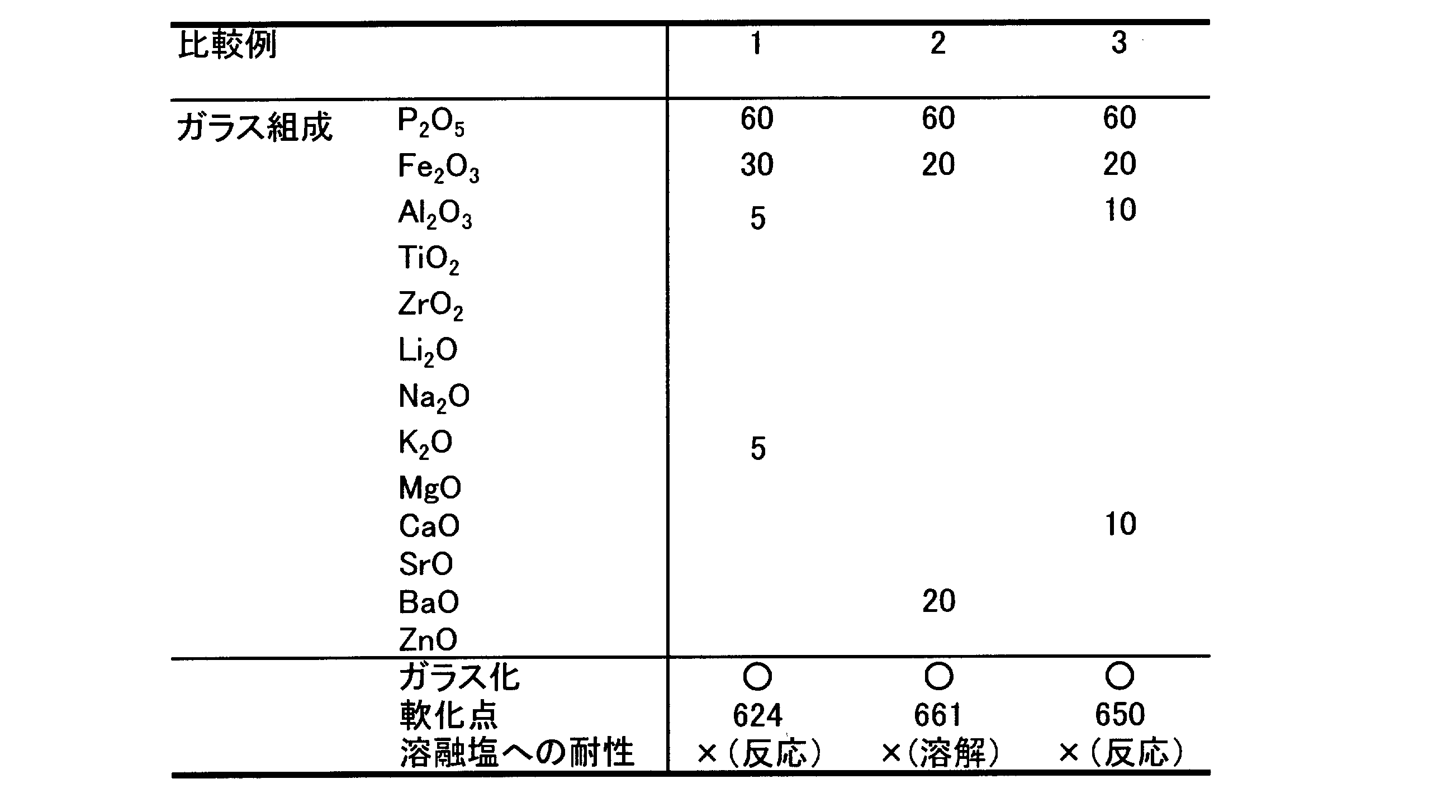
表1から明らかなように、実施例1~5の試料はいずれも組成が適切な範囲であるため、安定なガラスが得られ、軟化点も所望の範囲に入っていた。塩化物系溶融塩へ浸漬した後の各試料は、ガラス質及び形状を維持しており、塩化物系溶融塩に耐性があることが確認された。
一方、表2に示すように、比較例1~3の試料は、軟化点は所望の値が得られたものの、組成範囲が適切ではなく、アルカリ金属酸化物もしくはアルカリ土類酸化物を含んでいるため、溶融塩と反応し、結晶化もしくは形状が維持できずに溶解しており、溶融塩への耐性は得られなかった。
上述の通り、本発明の濾過材料は、塩化物系の溶融塩と反応せずに沈殿物を濾過することができ、例えば、溶融塩が電解質融液の場合は電解質融液の再生が可能となり、環境及び経済面での負荷を低減することができる。
以上、本発明の実施形態について説明したが、本発明は上記実施形態に限定されるものではなく、本発明の趣旨を逸脱しない範囲で、当業者の通常の知識に基づいて、以下の実施形態に対し適宜変更、改良可能であることはいうまでもない。
Claims (4)
- 塩化物系の溶融塩と反応し難いガラス又は結晶化ガラスからなる濾過材料。
- P2O5を30~80モル%、Fe2O3を0~50モル%、Al2O3を0~30モル%、TiO2を0~35モル%、ZrO2を0~10モル%含有するガラス又は結晶化ガラスであることを特徴とする、請求項1に記載の濾過材料。
- 前記ガラス又は結晶化ガラスは、実質的にアルカリ金属酸化物及びアルカリ土類金属酸化物を含有しないことを特徴とする、請求項1又は2に記載の濾過材料。
- 前記ガラス及び結晶化ガラスの前駆体ガラスの軟化点が450℃以上であることを特徴とする、請求項1乃至3のいずれか一項に記載の収着濾過材料。
Applications Claiming Priority (2)
| Application Number | Priority Date | Filing Date | Title |
|---|---|---|---|
| JP2009-152778 | 2009-06-26 | ||
| JP2009152778A JP2011005444A (ja) | 2009-06-26 | 2009-06-26 | 濾過材料 |
Publications (1)
| Publication Number | Publication Date |
|---|---|
| WO2010150823A1 true WO2010150823A1 (ja) | 2010-12-29 |
Family
ID=43386592
Family Applications (1)
| Application Number | Title | Priority Date | Filing Date |
|---|---|---|---|
| PCT/JP2010/060665 Ceased WO2010150823A1 (ja) | 2009-06-26 | 2010-06-23 | 濾過材料 |
Country Status (2)
| Country | Link |
|---|---|
| JP (1) | JP2011005444A (ja) |
| WO (1) | WO2010150823A1 (ja) |
Cited By (1)
| Publication number | Priority date | Publication date | Assignee | Title |
|---|---|---|---|---|
| WO2012121012A1 (ja) * | 2011-03-04 | 2012-09-13 | セントラル硝子株式会社 | 収着材料 |
Families Citing this family (3)
| Publication number | Priority date | Publication date | Assignee | Title |
|---|---|---|---|---|
| JP5668998B2 (ja) * | 2009-11-26 | 2015-02-12 | 独立行政法人日本原子力研究開発機構 | 核分裂生成物の濾過・収着材及びそれを使用した核分裂生成物の濾過・収着方法 |
| JP5358497B2 (ja) * | 2010-03-25 | 2013-12-04 | 日立Geニュークリア・エナジー株式会社 | フッ化化合物の処理方法 |
| JP5552922B2 (ja) * | 2010-06-29 | 2014-07-16 | セントラル硝子株式会社 | 核分裂生成物の分離材及びその製造方法、並びに該分離材を用いた核分裂生成物の分離方法 |
Citations (5)
| Publication number | Priority date | Publication date | Assignee | Title |
|---|---|---|---|---|
| JPS59123529A (ja) * | 1982-12-28 | 1984-07-17 | Toshiba Corp | 赤外線透過材料の製造方法 |
| JPS6059027A (ja) * | 1983-08-16 | 1985-04-05 | アルカン・インターナシヨナル・リミテツド | 溶融金属から異物質を除去する方法 |
| JPH06145777A (ja) * | 1992-11-09 | 1994-05-27 | Honda Motor Co Ltd | 溶融塩浴液中のスラッジ除去方法および装置 |
| JP2001521062A (ja) * | 1997-10-27 | 2001-11-06 | セリー・コーポレーション | 液体金属から液体塩を除去する方法および装置 |
| JP2009053097A (ja) * | 2007-08-28 | 2009-03-12 | Japan Atomic Energy Agency | 使用済媒質の再生システム |
-
2009
- 2009-06-26 JP JP2009152778A patent/JP2011005444A/ja active Pending
-
2010
- 2010-06-23 WO PCT/JP2010/060665 patent/WO2010150823A1/ja not_active Ceased
Patent Citations (5)
| Publication number | Priority date | Publication date | Assignee | Title |
|---|---|---|---|---|
| JPS59123529A (ja) * | 1982-12-28 | 1984-07-17 | Toshiba Corp | 赤外線透過材料の製造方法 |
| JPS6059027A (ja) * | 1983-08-16 | 1985-04-05 | アルカン・インターナシヨナル・リミテツド | 溶融金属から異物質を除去する方法 |
| JPH06145777A (ja) * | 1992-11-09 | 1994-05-27 | Honda Motor Co Ltd | 溶融塩浴液中のスラッジ除去方法および装置 |
| JP2001521062A (ja) * | 1997-10-27 | 2001-11-06 | セリー・コーポレーション | 液体金属から液体塩を除去する方法および装置 |
| JP2009053097A (ja) * | 2007-08-28 | 2009-03-12 | Japan Atomic Energy Agency | 使用済媒質の再生システム |
Cited By (1)
| Publication number | Priority date | Publication date | Assignee | Title |
|---|---|---|---|---|
| WO2012121012A1 (ja) * | 2011-03-04 | 2012-09-13 | セントラル硝子株式会社 | 収着材料 |
Also Published As
| Publication number | Publication date |
|---|---|
| JP2011005444A (ja) | 2011-01-13 |
Similar Documents
| Publication | Publication Date | Title |
|---|---|---|
| Wu et al. | Synthesis of pyrochlore-borosilicate glass-ceramics for immobilization of high-level nuclear waste | |
| JP5999094B2 (ja) | リチウムイオン伝導性固体電解質の製造方法 | |
| JPS6238298B2 (ja) | ||
| US9359244B2 (en) | Alumina-rich glasses and methods for making the same | |
| PL201403B1 (pl) | Sposób wytwarzania szkieł borokrzemianowych | |
| JP5964370B2 (ja) | 表面損傷に対して優れた耐性を有するガラスおよびその製造方法 | |
| SU1087091A3 (ru) | Состав дл отверждени радиоактивных отходов и способ отверждени радиоактивных отходов | |
| CN104743866B (zh) | 一种化学强化盐浴添加剂及其制备方法 | |
| WO2013164116A1 (de) | Lithiumionenleitende glaskeramik, verfahren zur herstellung einer lithiumionenleitenden glaskeramik, ionenleiter und verwendung des ionenleiters | |
| WO2010150823A1 (ja) | 濾過材料 | |
| JP5177442B2 (ja) | 収着濾過材料 | |
| JP6292854B2 (ja) | 放射性廃棄物のガラス固化体及びその形成方法 | |
| US20200369521A1 (en) | Precursor glass of lithium phosphorus complex oxide and method of producing same, method of producing precursor crystallized glass of lithium phosphorus complex oxide, and lithium phosphorus complex oxide powder and method of producing same | |
| JP5137043B2 (ja) | 収着材料 | |
| EP4017836B1 (en) | Method for removing disturbing metals like iron from glass | |
| JP3864203B2 (ja) | 放射性廃棄物の固化処理方法 | |
| CN118270978B (zh) | 一种结晶化离子筛及其制备方法和应用 | |
| CN118270804A (zh) | 一种离子筛及其制备方法和应用 | |
| CN117228956A (zh) | 一种含钇锆酸盐纳米晶的微晶玻璃及制备方法 | |
| JPH08109038A (ja) | ガラス融体の製造法 | |
| Nienhuis et al. | A comparative study on the effect of Zr, Sn, and Ti on the crystallization behavior of nepheline glass | |
| KR100766516B1 (ko) | 염화리튬 또는 염화리튬-염화칼륨 공융염 내에 존재하는 스트론튬 및 바륨 성분을 제거하는 방법 | |
| JP5668998B2 (ja) | 核分裂生成物の濾過・収着材及びそれを使用した核分裂生成物の濾過・収着方法 | |
| RU2848001C1 (ru) | Электрохимический способ синтеза порошков твердых растворов гексаборидов металлов лантаноидной группы и кальция состава СаM1M2B6 | |
| RU2386182C2 (ru) | Силикофосфатное стекло для иммобилизации радиоактивных отходов |
Legal Events
| Date | Code | Title | Description |
|---|---|---|---|
| 121 | Ep: the epo has been informed by wipo that ep was designated in this application |
Ref document number: 10792141 Country of ref document: EP Kind code of ref document: A1 |
|
| NENP | Non-entry into the national phase |
Ref country code: DE |
|
| 122 | Ep: pct application non-entry in european phase |
Ref document number: 10792141 Country of ref document: EP Kind code of ref document: A1 |