WO2010147206A1 - 酸化ストレス評価法及びその用途 - Google Patents
酸化ストレス評価法及びその用途 Download PDFInfo
- Publication number
- WO2010147206A1 WO2010147206A1 PCT/JP2010/060347 JP2010060347W WO2010147206A1 WO 2010147206 A1 WO2010147206 A1 WO 2010147206A1 JP 2010060347 W JP2010060347 W JP 2010060347W WO 2010147206 A1 WO2010147206 A1 WO 2010147206A1
- Authority
- WO
- WIPO (PCT)
- Prior art keywords
- oxidative stress
- working electrode
- red blood
- measurement
- electrode
- Prior art date
- Legal status (The legal status is an assumption and is not a legal conclusion. Google has not performed a legal analysis and makes no representation as to the accuracy of the status listed.)
- Ceased
Links
Images






Classifications
-
- G—PHYSICS
- G01—MEASURING; TESTING
- G01N—INVESTIGATING OR ANALYSING MATERIALS BY DETERMINING THEIR CHEMICAL OR PHYSICAL PROPERTIES
- G01N33/00—Investigating or analysing materials by specific methods not covered by groups G01N1/00 - G01N31/00
- G01N33/48—Biological material, e.g. blood, urine; Haemocytometers
- G01N33/50—Chemical analysis of biological material, e.g. blood, urine; Testing involving biospecific ligand binding methods; Immunological testing
- G01N33/80—Chemical analysis of biological material, e.g. blood, urine; Testing involving biospecific ligand binding methods; Immunological testing involving blood groups or blood types or red blood cells
-
- A—HUMAN NECESSITIES
- A61—MEDICAL OR VETERINARY SCIENCE; HYGIENE
- A61B—DIAGNOSIS; SURGERY; IDENTIFICATION
- A61B5/00—Measuring for diagnostic purposes; Identification of persons
- A61B5/145—Measuring characteristics of blood in vivo, e.g. gas concentration or pH-value ; Measuring characteristics of body fluids or tissues, e.g. interstitial fluid or cerebral tissue
- A61B5/14542—Measuring characteristics of blood in vivo, e.g. gas concentration or pH-value ; Measuring characteristics of body fluids or tissues, e.g. interstitial fluid or cerebral tissue for measuring blood gases
-
- A—HUMAN NECESSITIES
- A61—MEDICAL OR VETERINARY SCIENCE; HYGIENE
- A61B—DIAGNOSIS; SURGERY; IDENTIFICATION
- A61B5/00—Measuring for diagnostic purposes; Identification of persons
- A61B5/145—Measuring characteristics of blood in vivo, e.g. gas concentration or pH-value ; Measuring characteristics of body fluids or tissues, e.g. interstitial fluid or cerebral tissue
- A61B5/1468—Measuring characteristics of blood in vivo, e.g. gas concentration or pH-value ; Measuring characteristics of body fluids or tissues, e.g. interstitial fluid or cerebral tissue using chemical or electrochemical methods, e.g. by polarographic means
-
- G—PHYSICS
- G01—MEASURING; TESTING
- G01N—INVESTIGATING OR ANALYSING MATERIALS BY DETERMINING THEIR CHEMICAL OR PHYSICAL PROPERTIES
- G01N2800/00—Detection or diagnosis of diseases
- G01N2800/70—Mechanisms involved in disease identification
- G01N2800/7004—Stress
- G01N2800/7009—Oxidative stress
Definitions
- the present invention relates to a test method using red blood cells. Specifically, the present invention relates to a method for evaluating oxidative stress and its use (eg, a vascular disorder or a risk test method for diseases caused by vascular disorder).
- a method for evaluating oxidative stress and its use eg, a vascular disorder or a risk test method for diseases caused by vascular disorder.
- the blood test is a method that gives a lot of reliable information and is widely used.
- the current blood test is centered on serum analysis, and only a few calculations are performed on blood cells except in special cases.
- separation of erythrocytes are shown below.
- Serum analysis will certainly give you important information about your health condition and whether you have a particular disease.
- serum analysis is not effective, or proper determination cannot be made only by serum analysis.
- arteriosclerotic diseases such as myocardial infarction cannot be completely controlled only by management goals such as cholesterol level, triglyceride level, and blood glucose level obtained by serum analysis. The reason is considered to be that even if the values of these risk factors are the same, the circadian variation of individuals and the response of tissues and organs are different.
- an object of the present invention is to provide a simple and rapid blood cell analysis method (test method using red blood cells) using a new index.
- Human erythrocytes are non-nucleated cells having a long life of about 120 days, which occupies nearly half of the blood volume and can obtain many cells from a small amount of blood.
- erythrocytes reflect individual differences such as differences in surface sugar chains, and are also known to reflect the presence of stress such as undernutrition and oxidation. .
- Red blood cells circulate throughout the body's vascular system, and since they are anucleate, they accumulate stress generated in the living body via blood vessels and blood, and what kind of damage the human body composed of cells actually receives Is expected to be reflected.
- the degree of oxidative stress of erythrocytes can be rapidly evaluated by the degree of adhesion of erythrocytes to positive charge carriers.
- an assay using an animal model showed a correlation between the degree of adhesion of erythrocytes to the positive charge carrier and risk factors for vascular injury or arteriosclerosis.
- the risk of diseases based on oxidative stress such as vascular injury or arteriosclerosis, can be determined by examining the degree of adhesion of red blood cells to positive charge carriers (in other words, the degree of adhesion of red blood cells to positive charge carriers). Will be a new risk marker).
- an assay system using the degree of adhesion of erythrocytes to a positive charge carrier as an index is easy to operate and can be rapidly detected and tested, and is also suitable for screening for drugs against oxidative stress. It was considered. Based on the above knowledge, the present applicant has applied for a patent regarding an invention relating to an oxidative stress evaluation method and the like (Japanese Patent Application No. 2007-332529). In addition, for some findings, the 60th Annual Meeting of the Japanese Society for Biotechnology (p.
- the present inventors have further studied. As a result, it was shown that the electrochemical measurement method is effective as a means for detecting the degree of adhesion of red blood cells. Moreover, when a test reproducing oxidative stress in a diabetic state was performed, it was shown that the load state of oxidative stress can be easily determined and evaluated by an electrochemical measurement method. Furthermore, experiments using clinical samples confirmed that the measurement method enables rapid and simple determination / evaluation and that the measurement method is useful for determining disease risk due to oxidative stress. It was. The present invention to be described below is based on the above series of results obtained after the constant study by the present inventors.
- [2] The method for evaluating oxidative stress according to [1], comprising the following steps: (1) applying a potential that generates a positive potential or a positive current to the working electrode; (2) contacting a specimen containing red blood cells with the working electrode; (3) a step of measuring an electrical response of the measurement system in which fluctuation is recognized when red blood cells adhere to the working electrode; (4) A step of determining the degree of adhesion of red blood cells in the specimen to the working electrode based on the measurement result.
- [3] The method for evaluating oxidative stress according to [2], wherein the measurement in the step (3) is performed in the presence of an electron mediator.
- [4] The method for evaluating oxidative stress according to [3], wherein the measurement in the step (3) is CV (cyclic voltammetry) measurement.
- [5] The method for evaluating oxidative stress according to any one of [1] to [4], wherein the measurement system further includes a reference electrode.
- [6] A risk of a disorder or disease caused by oxidative stress, characterized by determining a disease risk based on an evaluation result by the oxidative stress evaluation method according to any one of [1] to [5] Inspection method.
- [8] The disease risk test method according to [6] or [7], wherein the risk is determined according to a criterion that oxidative stress is strong and disease risk is high when the degree of adhesion of red blood cells to the working electrode is small. .
- red blood cell count and current value Relationship between red blood cell count and current value.
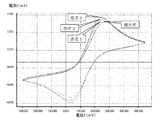
- the left is a voltammogram obtained by CV measurement, and the right is a plot of oxidation peak current value (Iox.) And red blood cell concentration (Ht value).
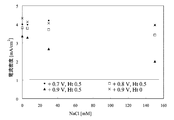
- Evaluation of erythrocyte adhesion to a positive potential applied electrode The relationship between the applied voltage in each salt concentration solution and the current density by CV measurement is shown.
- Red blood cell concentration optimization test The relationship between erythrocyte concentration and current density by CV measurement is shown. Evaluation of adhesion of red blood cells loaded with oxidative stress caused by hyperglycemia.
- the left is a voltammogram when a sample having an erythrocyte concentration of 0.2% is measured, and the right is a graph showing the relationship between the glucose load level and the current density.
- Ht0.2 represents an erythrocyte concentration of 0.2%
- Ht0.4 represents 0.4%
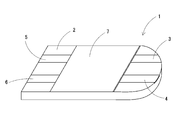
- a configuration example of a sensor chip The structural example of a sensor chip provided with a reference electrode. Evaluation of blood red blood cell adhesion obtained from healthy subjects and diabetic patients. The voltammogram when measuring a hematocrit 0.2% sample is shown. Confirmation of correlation between biochemical analysis values and erythrocyte adhesion test results. It is a plot of a current density and a blood glucose level. Confirmation of correlation between biochemical analysis values and erythrocyte adhesion test results. It is a plot of current density and HbA1c.
- the first aspect of the present invention relates to a method for evaluating oxidative stress (hereinafter also referred to as “oxidative stress evaluation method”).
- oxidative stress evaluation method a method for evaluating oxidative stress.
- the oxidative level of a living body is usually kept almost constant, but “oxidative stress” occurs when the balance between the reactive oxygen species producing system and the reducing system is lost. “Oxidative stress” can be considered as a result of the accumulation of the effects of oxidation.
- the degree (including presence or absence) of “oxidative stress” is evaluated using red blood cells collected from a subject.
- damage to the erythrocyte membrane due to oxidative stress is evaluated using as an index the change in the degree of adhesion of erythrocytes to a positively charged electrode. More specifically, using a measurement system equipped with a working electrode and a counter electrode, the degree of red blood cell adhesion to the working electrode to which a positive potential or a potential for generating a positive current is applied is detected by an electrochemical measurement method, and the detection result is obtained. Used to evaluate oxidative stress. If the oxidative stress increases, the degree of adhesion of red blood cells to the working electrode decreases, and the shielding effect on the electrode decreases. As a result, the electrical response in the measurement system such as current value and impedance changes. In the present invention, oxidative stress is determined and evaluated using such a change in electrical response that occurs according to the degree of oxidative stress (details will be described later).
- An electrode system having a working electrode and a counter electrode is used for various biosensors (for example, Japanese Patent Application Laid-Open No. 3-202864 and Japanese Patent Publication No. 8-10208). Such a known biosensor may be used (see FIG. 5).
- the biosensor configuration and the electrochemical measurement method using the biosensor are detailed in, for example, the actual bioelectrochemistry-practical deployment of biosensors and biobatteries (published in March 2007, CMC Publishing). .
- each electrode is not particularly limited.
- electrode materials for the working electrode and the counter electrode are Au, C, Pt, and Ti.
- a measurement system provided with a reference electrode (see FIG. 6). If such a so-called three-electrode measurement system is used, the potential of the working electrode can be expressed based on the potential of the reference electrode. More preferably, a measurement system using a potentiostatic electrolysis device (potentiostat) is used. When a constant potential electrolysis apparatus is used, an electrochemical reaction can be advanced while the potential of the working electrode is kept constant, and the measurement accuracy is improved.
- An example of the reference electrode material is Ag / AgCl.
- a saturated calomel electrode can also be employed as a reference electrode.
- the following steps are performed: (1) applying a positive potential or a potential that generates a positive current to the working electrode; (2) contacting a specimen containing red blood cells with the working electrode; (3) A step of measuring an electrical response of the measurement system in which fluctuation is observed when red blood cells adhere to the working electrode; and (4) determining the degree of red blood cell adhesion in the specimen to the working electrode based on the measurement result.
- the process to perform is implemented. Hereinafter, it demonstrates for every process.
- (1) Potential application step In this step, a potential that generates a positive potential or a positive current is applied to the working electrode.
- a potential is applied to the working electrode so that a positive current is generated in the measurement system. This causes the working electrode to have a positive charge and allow red blood cells to adhere thereto.
- a voltage is applied with the electrode immersed in a solution containing an electrolyte to impart a positive charge to the working electrode.
- electrolyte Various salts can be used as the electrolyte. It can be cited NaCl, KCl, and CaCl 2 as an example of the electrolyte.
- An appropriate electrolyte concentration can be easily set by a person skilled in the art through preliminary experiments. Although an appropriate electrolyte concentration varies depending on the configuration of the measurement system, an example of the concentration when using a NaCl solution is 5 mM to 100 mM. In addition, you may decide to employ
- PBS phosphate-buffered saline: phosphate buffered saline
- the required voltage may be set in consideration of the measurement system configuration (electrode configuration, electrolyte concentration, etc.).
- An appropriate voltage can be easily set by a person skilled in the art through preliminary experiments.
- the appropriate electrolyte concentration varies depending on the configuration of the measurement system, but a voltage example is 0.5 V to 1.0 V.
- the application time of the potential is not particularly limited. As shown in Examples described later, it has been confirmed that the object can be achieved even by applying for a short time. In addition, in order to evaluate quickly, it is better that the potential application time is short. Therefore, the potential application time is, for example, 2 seconds to 2 minutes.
- a specimen containing red blood cells is used.
- the type of specimen is not particularly limited as long as it contains red blood cells.
- erythrocytes erythrocyte suspension
- the sample may be prepared according to a conventional method. If the red blood cell concentration is too high, red blood cell adhesion to the working electrode will not be observed, so the red blood cell concentration in the sample is adjusted to, for example, 0.05 to 1% (v / v), preferably 0.1 to 0.4% (v / v) Use specimen.
- erythrocyte concentration A person skilled in the art can easily set an appropriate red blood cell concentration through preliminary experiments.
- the diluent used for adjusting the erythrocyte concentration include various salt solutions (NaCl solution, KCl solution, etc.), PBS, and the like. Note that a specimen containing an erythrocyte membrane ghost may be used as the erythrocyte.
- the working electrode may be immersed in the specimen.
- the specimen may be dropped or applied to the formation region of the working electrode and the counter electrode.
- the contact time between the specimen and the working electrode may be appropriately set in consideration of the electrode system, the measurement system, the number of red blood cells in the specimen, and the like.
- An example of contact time is 10 seconds to 5 minutes. From the viewpoint of obtaining the evaluation result quickly, it is better that the contact time is short. As shown in the examples described later, even if the contact time was about 1 minute, the difference in adhesion could be detected.
- This contact step may be performed simultaneously with the potential application step. That is, the potential may be applied while the specimen and the working electrode are in contact with each other. For example, the application of potential may be started simultaneously with the start of contact between the specimen and the working electrode. Or after making a test substance and an electrode contact, you may decide to apply an electric potential, maintaining a contact state.
- the electrical response of the measurement system is measured, in which variation is observed when red blood cells adhere to the working electrode.
- the “electric response” here is not particularly limited as long as fluctuation is observed when red blood cells adhere to the working electrode.
- CV cyclic voltammetry
- resistance value measurement resistance value measurement
- impedance value measurement impedance value measurement
- CP chronopotentiometry
- CV measurement is performed. This is because the shielding effect of the electrode due to red blood cell adhesion can be measured with high sensitivity from the change in the current value at the oxidation / reduction potential of the electron mediator, and stable data can be obtained.
- a solution containing an electrolyte is prepared, and the electrical response is measured with the electrode immersed in the solution (first mode).
- the electrode may be washed to remove red blood cells not attached to the electrode.
- the working electrode after the contact step is immersed in a washing solution for a predetermined time, and unnecessary red blood cells are washed away.
- a buffer solution such as physiological saline or PBS may be used.
- the washing operation may be performed a plurality of times (for example, 2 to 5 times).
- a washing solution having a salt concentration comparable to that of the sample used in the contact step is used so as not to damage the red blood cells attached to the working electrode.
- the electrical response may be measured while maintaining the state where the specimen and the electrode are in contact (second mode).
- the energized state necessary for measuring the electrical response is formed via the liquid component in the specimen. Therefore, a contact process and an electrical response measurement process can be performed continuously.
- an electronic mediator it is preferable to perform the electrical response measurement step in the presence of an electronic mediator. This is because highly sensitive and highly accurate measurement is possible.
- an electrolyte containing an electron mediator may be used.
- an electron mediator may be added to the specimen before or after the contact step.
- the electron mediator metal complexes and organic compounds such as potassium ferricyanide, ferrocene derivatives, and quinone derivatives can be used.
- reaction layer a layer containing an electron mediator
- reaction layer a layer containing an electron mediator
- the degree of adhesion of red blood cells in the specimen to the working electrode is determined.
- the degree of red blood cell adhesion can be determined by comparing the measurement result of the control and the measurement result of the specimen.
- a graph or a table showing the correspondence between the degree of erythrocyte adhesion and the measurement result may be prepared, and the degree of erythrocyte adhesion may be determined by comparing the measurement result of the specimen with this.
- oxidative stress is determined and evaluated based on the current density of the redox peak, for example.
- CV cyclic voltammetry
- the second aspect of the present invention relates to a risk test method for a disorder or disease caused by oxidative stress.
- disease risk is a term that comprehensively expresses the possibility of suffering from a disorder or disease and the possibility of developing (deteriorating) the disorder or disease. Therefore, the information (degree of disease risk) obtained by implementing the disease risk test method of the present invention serves as an index for evaluating the possibility of suffering from a disorder or disease, and suffers from a disorder or disease. When a person (patient) is a subject, this is an effective index for evaluating whether a disorder or disease tends to progress (deteriorate) or improves (or is in a lull state).
- the disease risk test method of the present invention provides useful information that contributes to prevention of morbidity or onset, delay of onset or progress (deterioration), and improvement of quality of life (QOL) of patients.
- the subject is not particularly limited. That is, the present invention can be widely applied to those who need to determine the risk of a disorder or disease caused by oxidative stress.
- disease risk relating to a disorder or disease caused by oxidative stress is tested.
- Oxidative stress is known to cause onset or progress of various disorders and diseases.
- the disease risk test method of the present invention can be widely applied to disorders or diseases caused by oxidative stress.
- “Due to oxidative stress” means that oxidative stress is a direct or indirect onset factor or progress factor.
- disorders or diseases caused by oxidative stress include vascular disorder, arteriosclerosis, diabetic complications, metabolic syndrome, cancer, and Alzheimer's disease.
- the risk of vascular injury, arteriosclerosis or diabetic complications is the subject of the examination.
- the risk is determined based on the evaluation result obtained by the oxidative stress evaluation method.
- the disease risk can be determined according to the determination criterion that “the degree of red blood cell adhesion to the working electrode is low, the oxidative stress is strong and the disease risk is high”.
- erythrocyte adhesion test for positive potential applied electrode> 1.
- Finger blood was collected from healthy adults, and erythrocyte suspensions with various erythrocyte concentrations were prepared using physiological saline (specimen).
- a potential of 0.9 V in NaCl 30 mM was applied to the working electrode of the sensor chip (same as that used in the above experiment) for 5 seconds, then immersed in the specimen, incubated for 1 minute, and then washed with physiological saline. .
- the sensor chip was immersed in physiological saline containing 10 mM potassium ferricyanide and 10 mM potassium ferrocyanide, and CV measurement (cyclic voltammetry) was performed to analyze the current density of the redox peak.
- ⁇ Evaluation of adhesion of red blood cells loaded with oxidative stress caused by hyperglycemia 1.
- Venous blood was collected from healthy adults, and a red blood cell suspension with a red blood cell concentration of 50% was prepared using physiological saline.
- 0.5 ml of erythrocyte suspension was dispensed into a microtube, and 0.125 ml of glucose solution was added to a final concentration of 5, 45, 60 mM and incubated (37 ° C., 24 hours).
- a voltammogram when a sample having an erythrocyte concentration of 0.2% (Ht0.2) is measured is shown on the left of FIG.
- the current density obtained from this measurement result increased in the hyperglycemia group, and a decrease in the number of oxidative stress erythrocytes attached to the positive potential application electrode was detected (right of FIG. 4).
- the state of oxidative stress load in a diabetic state can be easily determined and evaluated by electrochemical measurement using a positive potential application electrode.
- it was measurable with 10 ⁇ l of Ht0.2 specimen it can theoretically be measured with a very small amount of blood of 50 nl.
- the present invention it is possible to quickly detect and evaluate oxidative stress accumulated in the red blood cell membrane. Moreover, it becomes possible to test
- the risk test method of the present invention can be said to be a useful tool for evaluation of malignancy or progression of various diseases involving oxidative stress and evaluation of therapeutic effectiveness.
Landscapes
- Health & Medical Sciences (AREA)
- Life Sciences & Earth Sciences (AREA)
- Engineering & Computer Science (AREA)
- Physics & Mathematics (AREA)
- Molecular Biology (AREA)
- Biomedical Technology (AREA)
- Hematology (AREA)
- Chemical & Material Sciences (AREA)
- Pathology (AREA)
- General Health & Medical Sciences (AREA)
- Public Health (AREA)
- Surgery (AREA)
- Animal Behavior & Ethology (AREA)
- Medical Informatics (AREA)
- Heart & Thoracic Surgery (AREA)
- Veterinary Medicine (AREA)
- Biophysics (AREA)
- Urology & Nephrology (AREA)
- Immunology (AREA)
- Optics & Photonics (AREA)
- Cell Biology (AREA)
- Biotechnology (AREA)
- General Chemical & Material Sciences (AREA)
- Microbiology (AREA)
- Chemical Kinetics & Catalysis (AREA)
- Food Science & Technology (AREA)
- Medicinal Chemistry (AREA)
- Analytical Chemistry (AREA)
- Biochemistry (AREA)
- General Physics & Mathematics (AREA)
- Investigating Or Analysing Biological Materials (AREA)
Abstract
Description
そこで本発明は、新たな指標を用いた簡便且つ迅速な血球分析法(赤血球を利用した検査法)を提供することを課題とする。
以下に示す本発明は、本発明者らの不断の検討の末に得られた上記一連の成果に基づく。
[1]作用電極及び対極を備えた測定系を用い、正電位又は正電流を発生させる電位を印加した前記作用電極に対する赤血球の付着度状態を電気化学的測定法により検出することを特徴とする、酸化ストレス評価法。
[2]以下の工程を含むことを特徴とする、[1]に記載の酸化ストレス評価法:
(1)正電位又は正電流を発生させる電位を前記作用電極に印加する工程;
(2)赤血球を含む検体を前記作用電極に接触させる工程;
(3)前記作用電極に赤血球が付着したときに変動が認められる、前記測定系の電気的応答を測定する工程;
(4)測定結果に基づき、前記作用電極に対する前記検体中の赤血球の付着度を判定する工程。
[3]工程(3)における測定が、電子メディエータの存在下で行われることを特徴とする、[2]に記載の酸化ストレス評価法。
[4]工程(3)における測定がCV(サイクリックボルタンメトリ)測定であることを特徴とする、[3]に記載の酸化ストレス評価法。
[5]前記測定系が参照電極をさらに備えることを特徴とする、[1]~[4]のいずれか一項に記載の酸化ストレス評価法。
[6][1]~[5]のいずれか一項に記載の酸化ストレス評価法による評価結果をもとに疾病リスクを判定することを特徴とする、酸化ストレスに起因する障害又は疾病のリスク検査法。
[7]酸化ストレスに起因する障害又は疾病が、血管障害、動脈硬化症又は糖尿病合併症であることを特徴とする、[6]に記載の疾病リスク検査法。
[8]作用電極への赤血球の付着度が小さいと酸化ストレスが強く疾病リスクが高い、という基準に従ってリスクを判定することを特徴とする、[6]又は[7]に記載の疾病リスク検査法。
本発明の第1の局面は、酸化ストレスを評価する方法(以下、「酸化ストレス評価法」ともいう)に関する。生体の酸化レベルは通常はほぼ一定に保たれているが、活性酸素種産生系と還元系のバランスが崩れると「酸化ストレス」が生ずる。酸化の影響が蓄積した結果を表すものとして「酸化ストレス」を捉えることができる。本発明の評価法では被検者から採取した赤血球を利用して「酸化ストレス」の程度(有無を含む)を評価する。本発明では、酸化ストレスによる赤血球膜のダメージを、正に帯電した電極への赤血球の付着度の変化を指標として評価することになる。より具体的には、作用電極及び対極を備えた測定系を用い、正電位又は正電流を発生させる電位を印加した作用電極に対する赤血球の付着度を電気化学的測定法により検出し、検出結果を酸化ストレスの評価に用いる。酸化ストレスが大きくなれば作用電極への赤血球の付着度は低下し、電極に対する遮蔽効果が低下する。その結果、電流値やインピーダンスなど、測定系における電気的応答が変化する。本発明では、酸化ストレスの程度に応じて生ずる、このような電気的応答の変化を利用して酸化ストレスを判定・評価する(詳細は後述)。
この工程では、正電位又は正電流を発生させる電位を作用電極に印加する。換言すれば、測定系に正の電流が発生するよう、作用電極に電位を印加する。これによって作用電極が正電荷をもち、そこへの赤血球の付着が可能になる。
この工程では検体と作用電極との接触を行う。赤血球を含む検体が用いられる。赤血球を含む限り検体の種類は特に限定されない。例えば静脈血、毛細血管血由来の全血、赤血球画分、全血又は赤血球画分等から分離精製した赤血球(赤血球浮遊液)を検体として用いることができる。検体の調製は常法に従えばよい。赤血球濃度が高すぎると作用電極に対する赤血球の付着性が見られなくなるため、検体中の赤血球濃度を例えば0.05~1%(v/v)、好ましくは0.1~0.4%(v/v)に調整した検体を使用する。当業者であれば、予備実験を通して適切な赤血球濃度を容易に設定可能である。赤血球濃度の調整に用いる希釈液として、各種塩溶液(NaCl溶液、KCl溶液など)やPBS等を例示することができる。なお、赤血球として赤血球膜ゴーストを含む検体を用いることにしてもよい。
この工程では、作用電極に赤血球が付着したときに変動が認められる、測定系の電気的応答を測定する。ここでの「電気的応答」は、作用電極に赤血球が付着したときに変動が認められるものである限りにおいて特に限定されない。例えば、「電気的応答の測定」として、CV(サイクリックボルタンメトリ)測定、抵抗値の測定、インピーダンス値の測定、CP(クロノポテンシオメトリ)測定を行う。好ましくはCV測定を行う。赤血球付着による電極の遮蔽効果を、電子メディエータの酸化・還元電位における電流値の変化から高感度に測定でき、安定したデータが得られるからである。
次に、測定結果に基づき、作用電極に対する検体中の赤血球の付着度(赤血球付着度)を判定する。例えば、対照の測定結果と検体の測定結果を比較することによって、赤血球付着度を判定することができる。赤血球付着度と測定結果の対応関係を表すグラフや表などを作成しておき、これに検体の測定結果を照らし合わせることによって赤血球付着度を判定することにしてもよい。
本発明の第2の局面は、酸化ストレスに起因する障害又は疾病のリスク検査法に関する。本明細書において「疾病リスク」とは、障害又は疾病に罹患する可能性と、障害又は疾病を進展(悪化)させる可能性を包括的に表現する用語である。従って、本発明の疾病リスク検査法を実施することで得られる情報(疾病リスクの程度)は、障害又は疾病の罹患可能性を評価するための指標になるとともに、障害又は疾病に罹患している者(患者)を被検者とした場合においては障害又は疾病が進展(悪化)傾向にあるか又は改善傾向にあるか(或いは小康状態にあるか)を評価するための有効な指標となる。このように本発明の疾病リスク検査法は、罹患又は発症の阻止、発症又は進展(悪化)の遅延、患者の生活の質(QOL:Quality of Life)の向上に資する有益な情報を提供する。なお、被検者は特に限定されない。即ち、酸化ストレスに起因する障害又は疾病のリスク判定が必要な者に対して広く本発明を適用することができる。
1.方法
(1)健常成人より指頭血を採取し、生理食塩水を用いて各赤血球濃度の赤血球浮遊液を調製した(検体)。
(2)基板上に形成された電極系(作用電極、対極および参照極)を備えるセンサーチップ((有)バイオデバイステクノロジー製DEP Chip SP-N:作用極及び対極はカーボン、参照極はAg/AgCl)に検体10μlを載せ5分インキュベートした。
(3)8mMフェリシアン化カリウム(FCN)を含有する生理食塩水10μlを追加しCV測定(サイクリックボルタンメトリ)を行った。以降、電気化学測定実験には全て北斗電工製の電気化学測定システムHZ-5000を使用した。
測定結果を図1に示す。赤血球が電極を遮蔽するため、Ht値の増加に伴い酸化還元ピークが減少するボルタモグラム(図1左)が得られた。酸化ピーク電流値とHt値のプロットを図1の右欄に示した。赤血球が電極を完全に覆わない範囲であれば、電極上の赤血球数をメディエータ存在下でCV測定することによって正確に推定できることが確認された。
1.方法
(1)健常成人より指頭血を採取し、生理食塩水を用いて赤血球濃度0.5%(v/v)(Ht0.5 %と表記する)の赤血球浮遊液を調製した(検体)。
(2)センサーチップ((有)バイオデバイステクノロジー製DEP Chip SR-N:作用極は金、対極はカーボン、参照極はAg/AgCl)の作用電極に各濃度のNaCl溶液中(0、6、30、150 mM)で、定電位(0.7、0.8、0.9 V vs. Ag/AgCl)を5秒印加した後、検体中に浸漬し1分インキュベート後、生理食塩水で洗浄した。
(3)10 mMフェリシアン化カリウムおよび10 mMフェロシアン化カリウムを含有する生理食塩水にセンサーチップを浸漬し、CV測定(サイクリックボルタンメトリ)を行い酸化還元ピークの電流密度を解析した。
図2に示す通り、0.7 Vでは電流密度の変化は見られないが、0.8V、0.9V印加で電流密度は低下した。また0.9 V印加し赤血球と接触しない場合は電流密度の低下は起こらないため、0.8V、0.9 Vの電位印加による電流密度の低下は赤血球の付着によるものである。電位印加時のNaCl濃度が高いと電気二重層が薄くなり印加した電位差がより小さい距離にかかり、電極表面の電気的なエネルギーは大きくなるため、塩濃度が高いほど電流密度は低下する(赤血球の付着が増加する)。しかしより高い塩濃度では容易に溶液の電気分解が起こり電極表面の反応が複雑になるため、赤血球付着による電流密度の低下が見られ、かつ溶液の電気分解が起こらない範囲の塩濃度および印加電圧に設定する必要がある。例えば今回のセンサーチップの場合はNaCl 150 mM中で0.9 V印加し続けると電解電流が観察されるため、NaCl 30 mM中で0.9 V印加するのが適当であると考えられる。このように、正電位印加を適切な濃度の溶液中で行った電極には赤血球が付着し電流密度が低下することを確認できた。
1.方法
(1)健常成人より指頭血を採取し、生理食塩水を用いて各赤血球濃度の赤血球浮遊液を調製した(検体)。
(2)センサーチップ(上記実験で使用したものと同じ)の作用電極にNaCl 30 mM中0.9 Vの電位を5秒印加した後、検体中に浸漬し1分インキュベート後、生理食塩水で洗浄した。
(3)10 mMフェリシアン化カリウムおよび10 mMフェロシアン化カリウムを含有する生理食塩水にセンサーチップを浸漬し、CV測定(サイクリックボルタンメトリ)を行い酸化還元ピークの電流密度を解析した。
図3に示す通り、健常者のサンプルを用いた場合、赤血球濃度0.1%(Ht0.1)~0.4%(Ht 0.4)の範囲で赤血球数に応じたシグナルが検出された。赤血球濃度0.05%(Ht0.05)では赤血球がない場合の電流密度とほぼ同等の値となった。赤血球付着の減少による電流密度の低下を鋭敏に検出するために、もっとも付着数減少に電流値が応答する範囲に検体濃度を設定する必要がある。例えば今回のNaCl 30 mM中0.9 V vs. Ag/AgClで5秒間印加したセンサーチップを用いる場合、赤血球濃度0.1%~0.4%のサンプルを測定するのが適当であると考えられる。このように、適切な検体濃度であれば正電位印加電極への赤血球付着数の変化が電流密度の変化により検出できることを確認できた。
1.方法
(1)健常成人より静脈血を採取し、生理食塩水を用いて赤血球濃度50%の赤血球浮遊液を調製した。
(2)赤血球浮遊液を0.5 mlずつマイクロチューブに分注し、グルコース溶液0.125 mlを最終濃度5、45、60 mMとなるように添加し、インキュベートした(37℃、24時間)。
(3)グルコース負荷後洗浄し、再度赤血球濃度40%に調製した溶液0.5 mlについてTBA反応物を指標とした過酸化脂質量測定を行い、残りを赤血球濃度0.2%(Ht0.2)、0.4%(Ht0.4)に調製し(検体)電気化学測定を実施した。
(4)センサーチップ(上記実験で使用したものと同じ)の作用電極にNaCl 30 mM中0.9 V vs. Ag/AgClの電位を5秒印加した後、検体中に浸漬し1分インキュベート後、生理食塩水で洗浄した。
(5)10 mMフェリシアン化カリウムおよび10 mMフェロシアン化カリウムを含有する生理食塩水にセンサーチップを浸漬し、CV測定(サイクリックボルタンメトリ)を行い酸化還元ピークの電流密度を解析した。
24時間グルコース負荷を行った結果、正常血糖値に等しい5 mM負荷ではTBA反応性により定量した過酸化脂質(MDA)量は7.3±0.9 nmol/ml-RBCであったのに対し、高血糖のモデルである45 mMでは8.9±1.8 nmol/ml-RBC、60 mMでは10.7±0.8 nmol/ml-RBCと増加しており高血糖に起因する酸化ストレスが蓄積した赤血球サンプルを得られた。グルコース濃度の増加に伴い(酸化ストレスの増大に伴い)ボルタモグラムが変化した。赤血球濃度0.2%(Ht0.2)の検体を測定した場合のボルタモグラムを図4左に示す。この測定結果から得られる電流密度は高血糖群で増加し、酸化ストレス赤血球の正電位印加電極に対する付着数の低下が検出できた(図4右)。このように、糖尿病態における酸化ストレス負荷の状態を正電位印加電極を用いた電気化学測定によって簡便に判定・評価できることが示された。尚、Ht0.2の検体10μlで測定可能であったことから、理論的には血液50 nlという超微量で測定可能ということになる。
1.方法
(1)健常成人および糖尿病患者より採取した全血を生理食塩水を用いて200倍に希釈したものを検体とした(Ht約0.2%)。同時に患者血液について生化学分析を実施した。
(2)センサーチップ(上記実験で使用したものと同じ)の作用電極にNaCl 30 mM中0.9 Vの電位を5秒印加した後、検体中に浸漬し30秒インキュベート後、生理食塩水で洗浄した。
(3)10 mMフェリシアン化カリウムおよび10 mMフェロシアン化カリウムを含有する生理食塩水にセンサーチップを浸漬し、CV測定(サイクリックボルタンメトリ)を行い酸化還元ピークの電流密度を解析した。
健常者と比較し、患者血液で電流値の上昇(付着数の低下)が確認でき、全血を用いた簡易検査の実施が可能であった(図7)。また電流密度は血糖値とは直接相関せず(図8)、より糖尿病合併症発症リスクと関係の深い長期的血糖コントロールを反映するHbA1cと相関する傾向がみられた(図9)。このように正電位印加電極を用いた電気化学測定によれば、煩雑な検体調製および試薬調製も不要で臨床サンプルを極めて短時間(この条件では数分)で評価可能であった。糖尿病における高血糖状態や脂質代謝異常に由来する酸化ストレスは動脈硬化を始め様々な疾患の素因になる。中長期的な酸化ストレス状態を簡便に測定する方法はこれが初めてである。今回の検討で本法の結果がHbA1cと正の相関を示した。この事実は、酸化ストレスによるリスクをより簡便に予知できるという本法の有用性を裏付ける。
本明細書の中で明示した論文、公開特許公報、及び特許公報などの内容は、その全ての内容を援用によって引用することとする。
2、12 基板
3、13 作用電極
4、14 対極
5、6、15、16、19 リード
7、17 絶縁層
18 参照極
Claims (8)
- 作用電極及び対極を備えた測定系を用い、正電位又は正電流を発生させる電位を印加した前記作用電極に対する赤血球の付着度状態を電気化学的測定法により検出することを特徴とする、酸化ストレス評価法。
- 以下の工程を含むことを特徴とする、請求項1に記載の酸化ストレス評価法:
(1)正電位又は正電流を発生させる電位を前記作用電極に印加する工程;
(2)赤血球を含む検体を前記作用電極に接触させる工程;
(3)前記作用電極に赤血球が付着したときに変動が認められる、前記測定系の電気的応答を測定する工程;
(4)測定結果に基づき、前記作用電極に対する前記検体中の赤血球の付着度を判定する工程。 - 工程(3)における測定が、電子メディエータの存在下で行われることを特徴とする、請求項2に記載の酸化ストレス評価法。
- 工程(3)における測定がCV(サイクリックボルタンメトリ)測定であることを特徴とする、請求項3に記載の酸化ストレス評価法。
- 前記測定系が参照電極をさらに備えることを特徴とする、請求項1~4のいずれか一項に記載の酸化ストレス評価法。
- 請求項1~5のいずれか一項に記載の酸化ストレス評価法による評価結果をもとに疾病リスクを判定することを特徴とする、酸化ストレスに起因する障害又は疾病のリスク検査法。
- 酸化ストレスに起因する障害又は疾病が、血管障害、動脈硬化症又は糖尿病合併症であることを特徴とする、請求項6に記載の疾病リスク検査法。
- 作用電極への赤血球の付着度が小さいと酸化ストレスが強く疾病リスクが高い、という基準に従ってリスクを判定することを特徴とする、請求項6又は7に記載の疾病リスク検査法。
Priority Applications (2)
| Application Number | Priority Date | Filing Date | Title |
|---|---|---|---|
| US13/377,951 US20120080327A1 (en) | 2009-06-20 | 2010-06-18 | Method for evaluating oxidation stress and use of the same |
| JP2011519851A JPWO2010147206A1 (ja) | 2009-06-20 | 2010-06-18 | 酸化ストレス評価法及びその用途 |
Applications Claiming Priority (2)
| Application Number | Priority Date | Filing Date | Title |
|---|---|---|---|
| JP2009147094 | 2009-06-20 | ||
| JP2009-147094 | 2009-06-20 |
Publications (1)
| Publication Number | Publication Date |
|---|---|
| WO2010147206A1 true WO2010147206A1 (ja) | 2010-12-23 |
Family
ID=43356521
Family Applications (1)
| Application Number | Title | Priority Date | Filing Date |
|---|---|---|---|
| PCT/JP2010/060347 Ceased WO2010147206A1 (ja) | 2009-06-20 | 2010-06-18 | 酸化ストレス評価法及びその用途 |
Country Status (3)
| Country | Link |
|---|---|
| US (1) | US20120080327A1 (ja) |
| JP (1) | JPWO2010147206A1 (ja) |
| WO (1) | WO2010147206A1 (ja) |
Citations (3)
| Publication number | Priority date | Publication date | Assignee | Title |
|---|---|---|---|---|
| JP2000074923A (ja) * | 1998-08-27 | 2000-03-14 | Toshimitsu Niwa | 酸化ストレスの測定方法 |
| JP2008185577A (ja) * | 2007-01-26 | 2008-08-14 | Masaru Sonoda | 生体内抗酸化活性の測定法 |
| JP2009156624A (ja) * | 2007-12-25 | 2009-07-16 | Univ Nagoya | 酸化ストレス評価法及びその用途 |
Family Cites Families (1)
| Publication number | Priority date | Publication date | Assignee | Title |
|---|---|---|---|---|
| US4528270A (en) * | 1982-11-02 | 1985-07-09 | Kabushiki Kaisya Advance Kaihatsu Kenkyujo | Electrochemical method for detection and classification of microbial cell |
-
2010
- 2010-06-18 US US13/377,951 patent/US20120080327A1/en not_active Abandoned
- 2010-06-18 JP JP2011519851A patent/JPWO2010147206A1/ja active Pending
- 2010-06-18 WO PCT/JP2010/060347 patent/WO2010147206A1/ja not_active Ceased
Patent Citations (3)
| Publication number | Priority date | Publication date | Assignee | Title |
|---|---|---|---|---|
| JP2000074923A (ja) * | 1998-08-27 | 2000-03-14 | Toshimitsu Niwa | 酸化ストレスの測定方法 |
| JP2008185577A (ja) * | 2007-01-26 | 2008-08-14 | Masaru Sonoda | 生体内抗酸化活性の測定法 |
| JP2009156624A (ja) * | 2007-12-25 | 2009-07-16 | Univ Nagoya | 酸化ストレス評価法及びその用途 |
Non-Patent Citations (2)
| Title |
|---|
| MINA OKOCHI: "Sekkekkyu o Mochiita Seidenka Kiban eno Shinwasei ni yoru Sanka Stress no Kan'i Risk Hyoka", ABSTRACTS OF THE 40TH AUTUMN MEETING OF THE SOCIETY OF CHEMICAL ENGINEERS, 2008, JAPAN * |
| YAYOI ISAJI ET AL.: "Oxidative state determination of erythrocytes by adhesion test to the positive surface for prediction of diabetic complications risk", ABSTRACTS OF THE 60TH ANNUAL MEETING OF THE SOCIETY FOR BIOTECHNOLOGY, 11 July 2008 (2008-07-11), JAPAN, pages 65 * |
Also Published As
| Publication number | Publication date |
|---|---|
| US20120080327A1 (en) | 2012-04-05 |
| JPWO2010147206A1 (ja) | 2012-12-06 |
Similar Documents
| Publication | Publication Date | Title |
|---|---|---|
| Eom et al. | Sensitive and non-invasive cholesterol determination in saliva via optimization of enzyme loading and platinum nano-cluster composition | |
| KR101423851B1 (ko) | Ac 측정 방법들에 기초한 샘플 특성화 | |
| Koukouviti et al. | 3D printed enzymatic microchip for multiplexed electrochemical biosensing | |
| Schabmueller et al. | Micromachined sensor for lactate monitoring in saliva | |
| CN102667475B (zh) | 用于测量液体样本中的分析物浓度的方法 | |
| Thapa et al. | Label-free electrochemical detection of glucose and glycated hemoglobin (HbA1c) | |
| JP2013528289A5 (ja) | ||
| US11353417B2 (en) | Risk factor monitoring | |
| CN106796223A (zh) | 非侵入式体液压力感测 | |
| KR102051811B1 (ko) | 세포막으로 이루어진 필터를 포함하는 글루코스 측정용 바이오센서 | |
| JP2013511024A (ja) | バイオセンサ用の充填量不足認識システム | |
| Zhang et al. | Rapid electrochemical enzyme assay with enzyme-free calibration | |
| Liao et al. | Evaluation of an electrochemical biosensor for uric acid measurement in human whole blood samples | |
| Mattos et al. | An o-aminobenzoic acid film-based immunoelectrode for detection of the cardiac troponin T in human serum | |
| CN105891297A (zh) | 一种电化学测量方法 | |
| Adam et al. | Cyclic and differential pulse voltammetric measurements on fibrils formation of alpha synuclein in Parkinson’s disease by a gold interdigitated tetraelectrodes | |
| Beduk et al. | Multiplexed aptasensor for detection of acute myocardial infraction (AMI) biomarkers | |
| RU2633086C1 (ru) | Способ экспресс-определения кардиомиоглобина в плазме крови с помощью электрохимического сенсора на основе углеродных нанотрубок и молекулярно импринтированного поли-о-фенилендиамина как биоаффинного реагента | |
| Pan et al. | Determination of carbamazepine: a comparison of the differential pulse voltammetry (DPV) method and the immunoassay method in a clinical trial | |
| Zheng et al. | A wide-range UAC sensor for the classification of hyperuricemia in spot samples | |
| JP5247043B2 (ja) | 試料中のチオレドキシン類の濃度に関する情報取得装置、ストレス度情報取得装置及びストレス度判定方法 | |
| Panteghini et al. | Measurement of troponin I 48 h after admission as a tool to rule out impaired left ventricular function in patients with a first myocardial infarction. | |
| WO2010147206A1 (ja) | 酸化ストレス評価法及びその用途 | |
| US11045119B2 (en) | Biosensor for measuring glucose comprising cytoplasmic filter | |
| KR20140143999A (ko) | 당화 헤모글로빈의 일회용 전류식 검출방법 |
Legal Events
| Date | Code | Title | Description |
|---|---|---|---|
| 121 | Ep: the epo has been informed by wipo that ep was designated in this application |
Ref document number: 10789579 Country of ref document: EP Kind code of ref document: A1 |
|
| ENP | Entry into the national phase |
Ref document number: 2011519851 Country of ref document: JP Kind code of ref document: A |
|
| WWE | Wipo information: entry into national phase |
Ref document number: 13377951 Country of ref document: US |
|
| NENP | Non-entry into the national phase |
Ref country code: DE |
|
| 122 | Ep: pct application non-entry in european phase |
Ref document number: 10789579 Country of ref document: EP Kind code of ref document: A1 |