WO2010134499A2 - リステリア菌検出用のプライマーセット - Google Patents
リステリア菌検出用のプライマーセット Download PDFInfo
- Publication number
- WO2010134499A2 WO2010134499A2 PCT/JP2010/058305 JP2010058305W WO2010134499A2 WO 2010134499 A2 WO2010134499 A2 WO 2010134499A2 JP 2010058305 W JP2010058305 W JP 2010058305W WO 2010134499 A2 WO2010134499 A2 WO 2010134499A2
- Authority
- WO
- WIPO (PCT)
- Prior art keywords
- gene
- primer
- monocytogenes
- seq
- primer set
- Prior art date
- Legal status (The legal status is an assumption and is not a legal conclusion. Google has not performed a legal analysis and makes no representation as to the accuracy of the status listed.)
- Ceased
Links
Images










Classifications
-
- C—CHEMISTRY; METALLURGY
- C12—BIOCHEMISTRY; BEER; SPIRITS; WINE; VINEGAR; MICROBIOLOGY; ENZYMOLOGY; MUTATION OR GENETIC ENGINEERING
- C12Q—MEASURING OR TESTING PROCESSES INVOLVING ENZYMES, NUCLEIC ACIDS OR MICROORGANISMS; COMPOSITIONS OR TEST PAPERS THEREFOR; PROCESSES OF PREPARING SUCH COMPOSITIONS; CONDITION-RESPONSIVE CONTROL IN MICROBIOLOGICAL OR ENZYMOLOGICAL PROCESSES
- C12Q1/00—Measuring or testing processes involving enzymes, nucleic acids or microorganisms; Compositions therefor; Processes of preparing such compositions
- C12Q1/68—Measuring or testing processes involving enzymes, nucleic acids or microorganisms; Compositions therefor; Processes of preparing such compositions involving nucleic acids
- C12Q1/6876—Nucleic acid products used in the analysis of nucleic acids, e.g. primers or probes
- C12Q1/6888—Nucleic acid products used in the analysis of nucleic acids, e.g. primers or probes for detection or identification of organisms
- C12Q1/689—Nucleic acid products used in the analysis of nucleic acids, e.g. primers or probes for detection or identification of organisms for bacteria
-
- C—CHEMISTRY; METALLURGY
- C12—BIOCHEMISTRY; BEER; SPIRITS; WINE; VINEGAR; MICROBIOLOGY; ENZYMOLOGY; MUTATION OR GENETIC ENGINEERING
- C12Q—MEASURING OR TESTING PROCESSES INVOLVING ENZYMES, NUCLEIC ACIDS OR MICROORGANISMS; COMPOSITIONS OR TEST PAPERS THEREFOR; PROCESSES OF PREPARING SUCH COMPOSITIONS; CONDITION-RESPONSIVE CONTROL IN MICROBIOLOGICAL OR ENZYMOLOGICAL PROCESSES
- C12Q2600/00—Oligonucleotides characterized by their use
- C12Q2600/156—Polymorphic or mutational markers
Definitions
- the present invention relates to a primer set used for detection of Listeria monocytogenes .
- Listeria monocytogenes are widespread in the environment such as animals and soil, and are frequently detected from various foods such as meat and dairy products. However, since Listeria monocytogenes has a low-temperature growth ability and a high salt concentration tolerance (50-kun et al., 2003), it is difficult to prevent secondary contamination in the manufacturing process as well as primary contamination of food. If food is contaminated with this bacteria at a high concentration, it may grow during low-temperature storage of food and cause food poisoning.
- Taxonomically six species of Listeria are known, but only one species of L. monocytogenes is the cause of listeriosis. When infected with this bacterium, adults have strong resistance, and asymptomatic infection and colonization are achieved, but many high-risk groups such as newborns, the elderly, and immunocompromised individuals have developed many listeriosis and are severe The fatality rate in the case of a baby is known to be extremely high at 30%, and it is known that when a fetus is infected in the womb, it can lead to stillbirth and premature birth (Igo et al., 2003, 2004).
- Non-Patent Document 1 classification by RFLP (see Non-Patent Document 1) and classification by PFGE (see Non-Patent Document 2) have been proposed as methods for identifying and classifying Listeria monocytogenes.
- experiments require skill and are complicated. It takes a long time.
- a primer set for amplifying the hlyA gene by PCR has also been reported (Non-patent Document 3), but it is ineffective for strains that do not have a target internal base sequence, and is 100%
- L. monocytogenes cannot be detected (Non-patent Document 4).
- many attempts have been made to detect L. monocytogenes by PCR or determine the serotype (Patent Documents 1, 2, Non-Patent Documents 5, 6, 7, etc.) The relationship with highly pathogenic strains is not known.
- Non-Patent Literature 8 This method is a method of classifying using the characteristic single nucleotide substitution (single nucleotide polymorphism: SNP) found in the hlyA gene, clpC gene, inlA gene, and plcA gene, respectively (multi locus sequence typing (MLST)). Law).
- the types in the hlyA gene have been classified into nine groups from Group 1 to Group 9 (see Patent Document 3 and FIG. 1), and the types in the clpC gene have been classified into 14 groups from Group 1 to Group 14 (see the same document, FIG. 1). 2), the types in the inlA gene are classified into 17 groups of groups 1 to 17 (see the same document, FIG. 3), and the types in the plcA gene are classified into groups 1 to 21 (see the same document, FIG. 4). Has been revealed.
- the groups are classified into 12 groups of groups A to L (see the same document, Table 1).
- the pathogenicity of the detected Listeria monocytogenes can be estimated by detecting characteristic single base substitutions (SNPs) in the above four genes and examining the type by the single base substitution.
- SNPs characteristic single base substitutions
- the inventors of the present application subsequently conducted an additional investigation on clinically derived or food / environment-derived Listeria, and also by combining primers having a specific nucleotide sequence found based on the nucleotide sequence of the hlyA gene. The inventors have found that only Listeria can be specifically detected, and have completed the present invention.
- a primer set comprising a primer having the base sequence shown in SEQ ID NO: 1 and a primer having any one of the base sequences shown in SEQ ID NOS: 12-16 and 18-20 (primer set No. 1 in Table 8). 1 to 5 and 7 to 9), or a primer set (primer set No. 12 in Table 8) comprising a primer having the base sequence shown in SEQ ID NO: 11 and a primer having the base sequence shown in SEQ ID NO: 4
- RT-PCR real-time PCR method
- primers are conserved in all tested L. monocytogenes and are related bacteria L. ivanovii and L. In seeligeri , it was found from the base sequence of the region with many SNPs.
- the primer having the base sequence shown in SEQ ID NO: 1 is used as the forward primer
- the primer having any one of the base sequences shown in SEQ ID NOs: 12-16 and 18-20 is used as the reverse primer.
- the primer having the base sequence shown in SEQ ID NO: 11 is used as the reverse primer
- the primer having the base sequence shown in SEQ ID NO: 4 is used as the forward primer.
- L. monocytogenes can be detected specifically and rapidly.
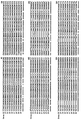
- FIG. 5 is a continuation diagram of FIG. 4.
- FIG. 10 is a continuation diagram of FIG. 9.
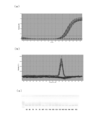
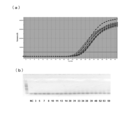
- (A) (b) is an increase curve of the fluorescence intensity in the detection of L. monocytogenes (part) using the primer set 7, wherein (a) shows an integral value and (b) shows a differential value.
- (C) is an electrophoretogram after completion of RT-PCR. The numbers listed at the bottom of (c) are strain Nos. It is.
- (A) (b) is an increase curve of the fluorescence intensity in the detection of L. monocytogenes (remainder) using the primer set 7, wherein (a) shows an integral value and (b) shows a differential value.
- (C) is an electrophoretogram after completion of RT-PCR.
- (c) The numbers listed at the bottom of (c) are strain Nos. It is.
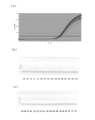
- (A) (b) is an increase curve of the fluorescence intensity in the detection of bacteria other than L. monocytogenes using the primer set 7, wherein (a) shows an integral value and (b) shows a differential value.
- (C) is an electrophoretogram after completion of RT-PCR.
- the numbers listed at the bottom of (c) are strain Nos. It is.
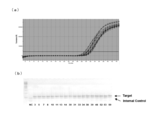
- (A) is an increase curve (integral value) of fluorescence intensity in the detection of L. monocytogenes (part) using a Takara Bio kit, and (b) is an electrophoretogram after completion of RT-PCR.
- the numbers listed at the bottom of (b) are strain No. It is.
- (A) is an increase curve (integral value) of fluorescence intensity in the detection of L. monocytogenes (part) using a Takara Bio kit, and (b) and (c) are electrophoretic diagrams after completion of RT-PCR. .
- (B) The numbers described at the bottom of (c) are the strain No. It is.
- (A) is an increase curve (integral value) of fluorescence intensity in the detection of bacteria other than L. monocytogenes using a Takara Bio kit, and (b) is an electrophoretic diagram after completion of RT-PCR.
- the numbers listed at the bottom of (b) are strain No. It is.
- (A) is an increase curve (integral value) of fluorescence intensity in the detection of L.
- a primer set comprising a primer having the base sequence shown in FIG. 5 and a primer having any one of the base sequences shown in SEQ ID NOs: 12-16 and 18-20, or a primer having the base sequence shown in SEQ ID NO: 11 and shown in SEQ ID NO: 4 It is characterized in that a primer set comprising a primer having a base sequence is used.
- a primer comprising a primer (forward) having the base sequence shown in SEQ ID NO: 1 and a primer (reverse) having any one of the base sequences shown in SEQ ID NOs: 12-16 and 18-20 Primer set (primer set No. 1 to 5 and 7 to 9) or a primer set (primer set) comprising a primer (reverse) having the base sequence shown in SEQ ID NO: 11 and a primer (forward) having the base sequence shown in SEQ ID NO: 4 No. 12) is used.
- the primer set of the primer (forward) which has the base sequence shown by sequence number 1 shown in primer set 7, and the primer (reverse) which has the base sequence shown by sequence number 8 is used preferably.
- E. coli O157 which is a causative agent of food poisoning, is not detected, and can be detected in a wide range of DNA concentrations (0.0001 to 100 ng / ml).
- Listeria monocytogenes (clinical strain) and 90 Listeria monocytogenes (food / environment-derived strain) isolated from food / environment were newly analyzed based on the following methods: hlyA gene, clpC gene, inlA gene, plcA Groups were made for each single base substitution of the gene.
- the test strain is statically cultured overnight at 37 ° C with 5 ml of TSB, 1 ml of the culture is centrifuged at 5,100 xg for 10 minutes, collected, and then attached using DNA Tissue Kit (Qiagen).
- the genomic DNA was prepared according to the above.
- F2-R2 primer set (F2: AAATCATCGACGGCAACCT (SEQ ID NO: 1), R2: ATTTCGGATAAAGCGTGGTG (SEQ ID NO: 11)) prepared from a high nucleotide sequence portion was used.
- This primer set is for amplifying 1070-1558 base pairs of the hlyA gene.
- the F2 primer and the R2 primer are the same as the primers used in Patent Document 3, respectively.
- Amplification was performed by heat denaturation (95 ° C., 1 min) followed by 35 cycles of 95 ° C., 30 sec ⁇ 55 ° C., 30 sec ⁇ 72 ° C., 60 sec.
- the size of the PCR product was confirmed by agarose gel electrophoresis and then purified with a commercially available PCR product purification kit.
- the base sequence was determined by requesting Biomatrix Laboratories (Nagayama City, Chiba Prefecture).
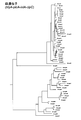
- FIG. 3 shows the phylogenetic tree of the newly grouped inlA gene.
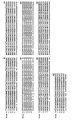
- the sequence portion (1192-1799 bp) containing 11 groups of SNPs added in the inlA gene is shown in FIGS. 4-5 and SEQ ID NOs: 26-35 (groups respectively).
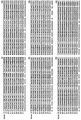
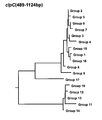
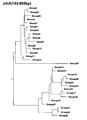
- the phylogenetic tree of the clpC gene grouped again is shown in FIG. 6, and the sequence portion (489-1124 bp) containing 3 groups of SNPs added in the clpC gene is shown in FIG. 7 and SEQ ID NOs: 36 to 38 (groups 15 to 17). Further, a phylogenetic tree of the newly grouped plcA gene is shown in FIG. 8, and base sequences (153-865 bp) containing 9 groups of SNPs added in the plcA gene are shown in FIGS. 9 to 10 and SEQ ID NOs: 39 to 47 ( Each corresponding to groups 22-30).
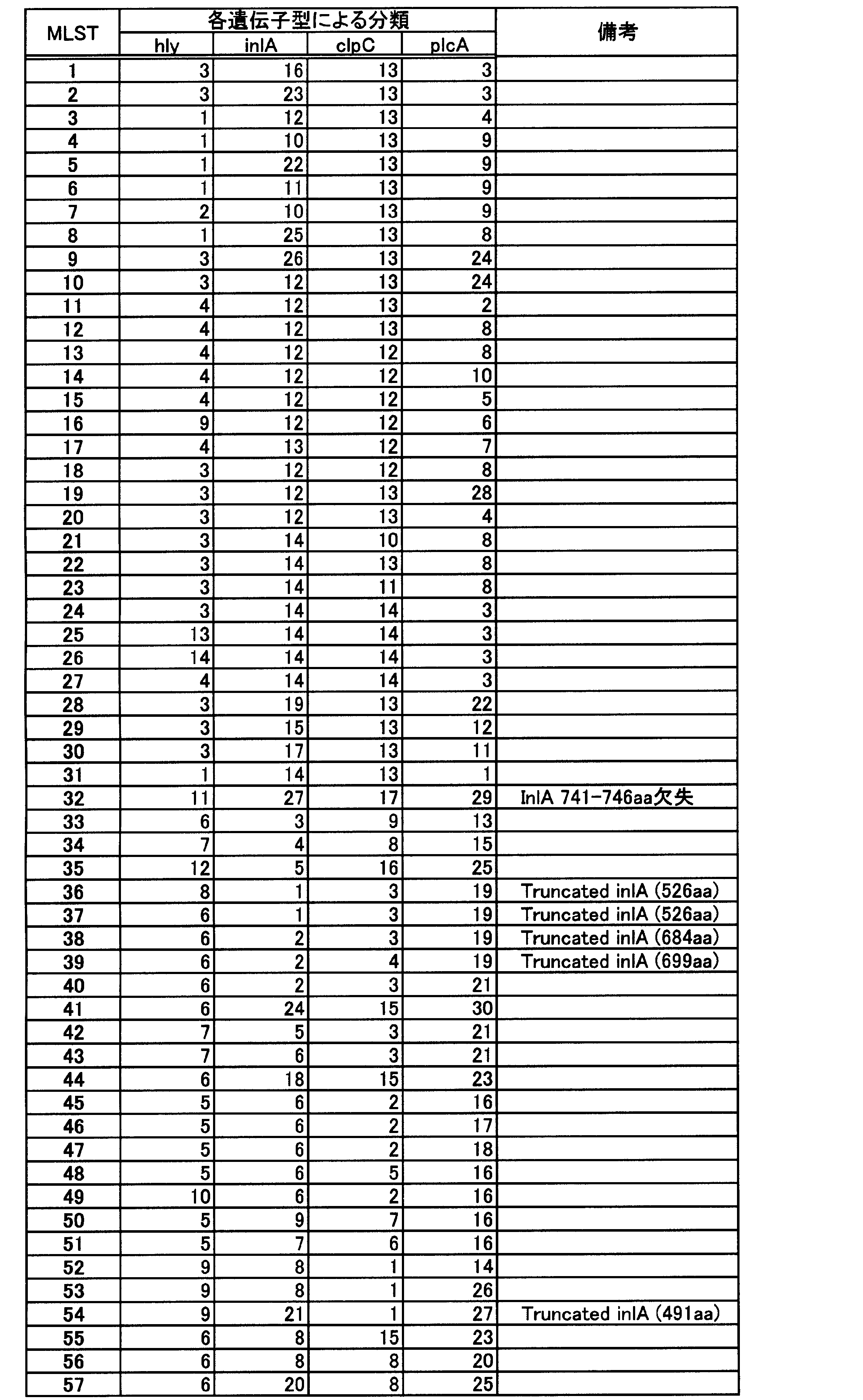
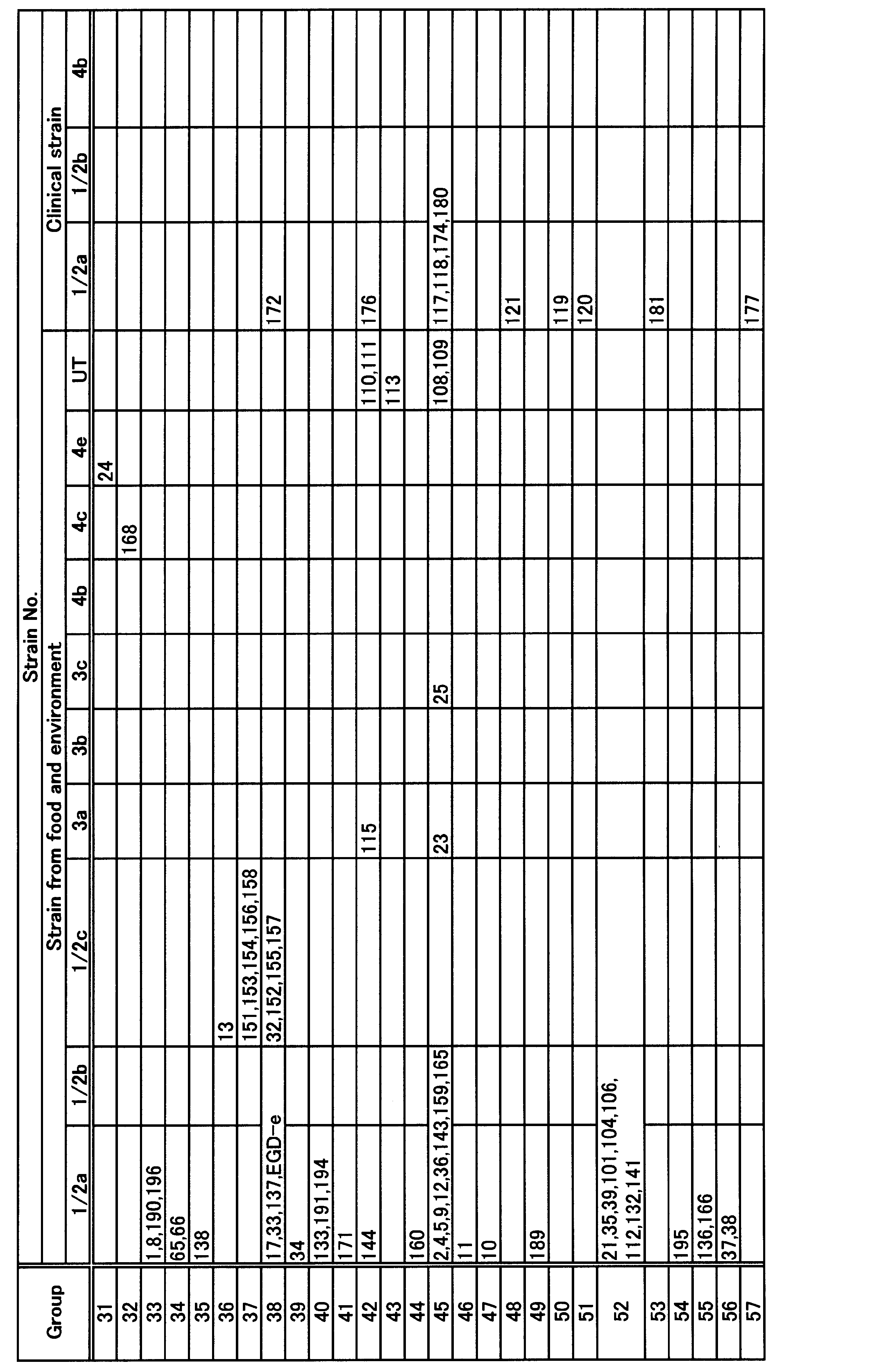
- MLSTs of 192 clinical and food / environmental stocks separated so far were classified into 57 groups as shown in Table 5 and FIG. Table 6 and Table 7 show the attributes of each strain. From the viewpoint of serotype classification of these strains, food / environmental strains were classified into 17 groups and clinical strains were classified into 8 groups in serotype 1 / 2a. Of these, food / environmental strains were not concentrated in a specific group, but 4 out of 11 clinical strains were grouped into MLST group 45, and MLST group 45 was relatively highly pathogenic. By analogy. On the other hand, in the serotype 1 / 2b, food / environmental strains were classified into 11 groups and clinical strains were classified into 5 groups.
- the Listeria monocytogenes detected from the sample to be investigated belongs to the MLST groups 22, 24, 45, the Listeria monocytogenes is presumed to be highly pathogenic. On the other hand, if it is judged that it belongs to MLST groups 4 and 13, it is presumed that the Listeria monocytogenes is less likely to be pathogenic.
- L. monocytogenes No. 4 strain was selected as a test bacterium .
- the template genomic DNA concentrations were 100 ng / ⁇ l, 10 ng / ⁇ l, 1.0 ng / ⁇ l, 0.1 ng / ⁇ l, 0.01 ng / ⁇ l, 0.001 ng / ⁇ l, 0.0001 ng / ⁇ l.
- E. coli O157 genomic DNA 45 ng / ⁇ l was used for Negative control.
- ⁇ Reaction solution composition > 2 x SYBR Premix Ex Taq 5.0 ⁇ l Forward primer (20 mM) 0.1 ⁇ l Reverse primer (20 mM) 0.1 ⁇ l 50 ⁇ Rox Reference Dye II 0.2 ⁇ l Template 0.4 ⁇ l 4.2 ⁇ l water Total 10.0 ⁇ l ⁇ Reaction conditions> Number of cycles: 35 cycles 10 minutes at 95 ° C. One cycle was 95 ° C. for 5 sec, 57 ° C. for 15 sec, and 72 ° C. for 10 sec.
- Table 10 shows the results of real-time PCR detection using each primer set.
- Table 10 shows primer set numbers arranged in order from the lowest Ct value (highest detection sensitivity) for each template concentration.
- high detection sensitivity In the primer sets 6, 10, 11 and 13-18, strong amplification was also observed in Escherichia coli O157 (template DNA concentration: 45 ng / ml) which is a negative control, so these results are not shown in Table 10.
- the primer set 7 has an average high detection sensitivity at each template concentration. It can be said that this primer set 7 can specifically and highly detect L. monocytogenes .
- primer sets other than primer set 7 primer sets 1 to 5, 8, 9, 12
- primer sets can also be used as primer sets for amplifying the hlyA gene. It can be said that these primer sets can also specifically detect L. monocytogenes without detecting E. coli O157 as with primer set 7.
- FIGS. 12 to 14 show an increase curve of fluorescence intensity in the detection using the primer set 7 and electrophoretograms after completion of the reaction.
- the results with the Takara Bio kit are shown in FIGS. 15 to 17, and the results with the ABI kit are shown in FIGS.
- electrophoresis 4% of the gel was used in FIGS. 15 to 17, and 1.5% of the gel was used in the other cases.
- All L. monocytogenes strains could be detected using the primer set of the present invention and the Takara Bio and ABI kits. However, new in the case of using the primer set 7 designed, although amplification was observed in L. innocua two strains in Listeria except L. monocytogenes, Listeria other non L. monocytogenes The target product was not amplified in (LIS30, LIS31, LIS33, LIS34, LM40, LM41, LM43) (see FIG. 14). In contrast, in the Takara Bio kit, band amplification was observed in 9 Listeria bacteria other than L. monocytogenes , but amplification was not observed in other LIS33, LIS35, and LM40 strains (see FIG. 17). ).
- ABI Inc. The kit, L. in Listeria other than monocytogenes but Ct value in L. innocua 1 strain (LIS30) was at 41.48 and 40 cycles or more, other Listeria except L. monocytogenes Then, a rise in fluorescence intensity was observed before 40 cycles. In the ABI kit, bands were not separated because the size of the amplification product of IPC and the target gene was almost the same, and amplification was observed in all strains except L. monocytogenes (see FIG. 20).
- primer set 7 can detect all L. monocytogenes, and the detection rate of Listeria bacteria other than L. monocytogenes is considerably lower than that of commercially available kits, and specificity for L. monocytogenes Was shown to be high.
- the primer set of the present invention in particular the primer having the base sequence shown in SEQ ID NO: 1 and the primer set having the base sequence shown in SEQ ID NO: 18, L. Only monocytogenes can be detected with relatively high accuracy.
Landscapes
- Chemical & Material Sciences (AREA)
- Life Sciences & Earth Sciences (AREA)
- Analytical Chemistry (AREA)
- Proteomics, Peptides & Aminoacids (AREA)
- Organic Chemistry (AREA)
- Zoology (AREA)
- Wood Science & Technology (AREA)
- Health & Medical Sciences (AREA)
- Engineering & Computer Science (AREA)
- Microbiology (AREA)
- Immunology (AREA)
- Molecular Biology (AREA)
- Biotechnology (AREA)
- Biophysics (AREA)
- Physics & Mathematics (AREA)
- Biochemistry (AREA)
- Bioinformatics & Cheminformatics (AREA)
- General Engineering & Computer Science (AREA)
- General Health & Medical Sciences (AREA)
- Genetics & Genomics (AREA)
- Measuring Or Testing Involving Enzymes Or Micro-Organisms (AREA)
Abstract
特に高い病原性を有するListeria
monocytogenesの菌株を特異的かつ迅速に検出、同定する方法を提供する。 Listeria
monocytogenesが有するhlyA遺伝子、inlA遺伝子、clpC遺伝子、plcA遺伝子の一塩基多型によって分類し、各遺伝子内の一塩基多型に特異的な一塩基置換若しくは分類可能に特定された組み合わせからなる複数の一塩基多型を検出することにより、臨床株で見出された菌株と同じグループに属する病原性の高い菌株を検出する。このために、例えば、配列番号1に示す塩基配列を有するプライマーと配列番号12~16及び18~20に示す何れかの塩基配列を有するプライマーとからなるプライマーセット、若しくは配列番号11に示す塩基配列を有するプライマーと配列番号4の塩基配列を有するプライマーとからなるプライマーセットを用いてPCR法を適用する。
Description
本発明は、リステリア モノサイトゲネス菌(Listeria monocytogenes)の検出に用いられるプライマーセットに関する。
リステリア菌は、動物や土壌などの環境中に広く常在しており、食肉や乳製品を中心とする様々な食品から高頻度に検出される。ところが、リステリア菌は低温増殖能や高食塩濃度耐性をもつため(五十君ら、2003)、食品の一次汚染はもちろん製造工程での二次汚染を防ぐことも困難である。食品が高濃度で本菌に汚染されていると、食品の低温保存中に増殖し、食中毒を引き起こす恐れがある。
分類学的にリステリア属には6菌種が知られているが、リステリア症の原因菌とされているのはリステリア モノサイトゲネス菌(L. monocytogenes)の1菌種だけである。本菌に感染した場合、成人は抵抗力が強いため、無症状感染や保菌状態となるが、新生児、高齢者及び免疫不全者などのハイリスク群では多くのリステリア症の発症がみられ、重症化した場合の致命率は30%と極めて高く、子宮内で胎児が感染すると死産や早産の原因となることが知られている(五十君ら、2003、2004)。
リステリア菌に感染した場合、発症までに長時間を要し、個人差があるため(五十君、2004)、頻発して起こるリステリア症が同一の食品を介して発生した集団食中毒であるかを判断することは困難である。また、菌株によっては血清型による分類ができない場合があり、血清型による分類のみでは病原性の有無の判定や追跡調査が十分にできない。このような観点からも詳細な分類が必要である。
リステリア菌の同定・分類方法として、例えばRFLPによる分類(非特許文献1参照)やPFGEによる分類(非特許文献2参照)が提案されているが、実験操作に熟練を必要とし、操作が煩雑で長時間を要する。また、簡易迅速検出法として、hlyA遺伝子をPCRにより増幅するためのプライマーセットも報告されているが(非特許文献3)、対象となる内部塩基配列を有しない菌株には無効であり、100%のL. monocytogenesを検出できるわけでは無いとの報告がある(非特許文献4)。これらの方法以外にも、PCRによりL. monocytogenesを検出したり、血清型を判定したりする試みが数々行われているが(特許文献1,2、非特許文献5,6、7など)、病原性の高い菌株との関連性については把握されていない。
また、inlA遺伝子を増幅する方法として、タカラバイオ株式会社やABI(Applied Biosystems)社からそれぞれ異なる内部塩基配列を標的とした遺伝子増幅用のキットが販売されている。しかし、リステリア菌以外の類縁菌をも検出される可能性が高かった。
このような状況下において、本願発明者らはL. monocytogenesを迅速に検出するとともに、病原性の有無を含めて分類同定する方法を提案し、特願2006-144723号として特許出願を行っている(特許文献3、非特許文献8)。この方法は、hlyA遺伝子、clpC遺伝子、inlA遺伝子、plcA遺伝子においてそれぞれ見いだされる特徴的な一塩基置換(一塩基多型:SNP)を利用して分類する方法である(multi locus sequence typing(MLST)法)。
MLST法では、hlyA遺伝子、clpC遺伝子、inlA遺伝子、plcA遺伝子においてそれぞれ見いだされる特徴的な一塩基置換の類型によってグループ化される。これまでのところ、hlyA遺伝子における類型はグループ1~グループ9の9つのグループに(特許文献3、図1参照)、clpC遺伝子における類型はグループ1~グループ14の14のグループに(同文献、図2参照)、inlA遺伝子における類型はグループ1~グループ17の17のグループに(同文献、図3参照)、plcA遺伝子における類型はグループ1~21に分類される(同文献、図4参照)ことが明らかにされている。
これらのうちで、病原性が高いと推定される臨床株(臨床から分離されたL. monocytogenes)は、特許文献1の表1に示されているように、グループA~Lの12のグループに分類される(同文献表1参照)。従って、検出されたリステリア菌におけるhlyA遺伝子、clpC遺伝子、inlA遺伝子、plcA遺伝子における特徴的な一塩基置換の類型(グループ)が、同文献の表1に示されたグループA~Lに一致すれば、当該検出菌は病原性が高いと類推できる。また、このとき、従来から用いられてきた血清型による分類を加味して判断することも可能であるが、血清型による分類を加味した場合にも、病原性が高いと類推可能な菌株は、前記グループA~Lの12グループに分類される(同文献、表1参照)。
すなわち、上記4つの遺伝子における特徴的な一塩基置換(SNP)を検出して、当該一塩基置換による類型を調べることにより、検出されたリステリア菌の病原性を推定できる。
Fukiko Ueda et al., Comparison of Genomic Structures in the Serovar 1/2a Listeria monocytogenes Isolated from Meats and Listeriosis Patients in Japan, Jpn. J. Infect. Dis., 58(2005), 289-293
Marc Yde, and Annie Genicot,Use of PFGE to characterize clonal relationships among Belgian clinical isolates of Listeria monocytogenes, J Med Microbiol, 53 (2004), 399-402
Lehner, et al., A rapid differentiation of Listeria monocytogenes by use of PCR-SSCP in the listeriolysin O (hlyA) locus, J. Microbiol. Med 34(1999), 165-171
五十君静信,山本茂貴,牧野壮一ら、2003年 食品由来リステリア菌の健康に関する研究 平成14年度 総括・分担研究報告書
Rodriguez-Lazaro, D. et al., Simultaneous quantitive detection of Listeria spp. and Listeria monocytogenes using a duplex real-time PCR-based assay, FEMS. Microbiol. Lett., 233(2004), 257-267
Thomas, E. J. G et al., Sensitive and Specific Detection of Listeria monocytogenes in Milk and Ground Beef with the Polymerase Chain Reaction, Appl. Environ. Microbiol., 57(1991), 2576-2580
Monica K. Borucki and Douglas R. Call, Listeria monocytogenes Serotype Identification by PCR, Journal of Clinical Microbiology, Vol. 41, No. 12(2003), 5537-5540
Ken-ichi Honjoh, Kumiko Fujihara et al., Subtyping of Listera monocytogenes Based on Nucleotide Polymorphism in the clpC, inlA, hlyA, and plcA Genes and Rapid Identification of L. monocytogenes Genetically Similar to Clinical Isolates, Food Sci. Technolo. Res., 14(6), 557-564, 2008
本願発明者らは、引き続き、臨床由来又は食品・環境由来のリステリア菌について追加調査を行ったところ、hlyA遺伝子の塩基配列をもとに見いだされた特定の塩基配列を有するプライマーを組み合わせることによっても、リステリア菌のみを特異的に検出できることを見いだし、本願発明を完成するに至った。
本発明においては、配列番号1に示される塩基配列を有するプライマーと配列番号12~16及び18~20に示される何れかの塩基配列を有するプライマーとからなるプライマーセット(表8におけるプライマーセットNo.1~5及び7~9の何れか)、若しくは配列番号11に示す塩基配列を有するプライマーと配列番号4に示す塩基配列を有するプライマーとからなるプライマーセット(表8におけるプライマーセットNo.12)を用いてリアルタイムPCR法(RT-PCR)法を適用することにしている。
これらのプライマーは、それぞれ試験した全てのL. monocytogenesで保存され、類縁菌であるL. ivanovii 及び L. seeligeri ではSNPの多い領域の塩基配列から見いだされたものである。配列番号1に示される塩基配列を有するプライマーをforward側のプライマーとして用いる際には、配列番号12~16及び18~20に示される何れかの塩基配列を有するプライマーがreverse側のプライマーとして用いられる。配列番号11に示される塩基配列を有するプライマーをreverse側のプライマーとして用いる際には、配列番号4に示される塩基配列を有するプライマーがforward側のプライマーとして用いられる。
本発明によると、L. monocytogenesを特異的かつ迅速に検出することができる。
本発明は、L. monocytogenes(以下、「リステリア菌」とのみ表記する場合がある)を検出する際に、リステリア菌のhlyA遺伝子における特徴的な一塩基変異部分を増幅させるために、配列番号1に示す塩基配列を有するプライマーと配列番号12~16及び18~20に示す何れかの塩基配列を有するプライマーとからなるプライマーセット、若しくは配列番号11に示す塩基配列を有するプライマーと配列番号4に示す塩基配列を有するプライマーとからなるプライマーセットを用いることに特徴がある。つまり、本発明のプライマーセットを用いてリステリア菌のhlyA遺伝子を増幅させる点が特許文献3に記載された方法と異なるものの、検出されたリステリア菌の分類・同定方法は、当該特許文献における考え方とは何ら異なるものではない。従って、本発明のプライマーセットを用いて増幅されたhlyA遺伝子をはじめ、clpC遺伝子、inlA遺伝子、plcA遺伝子における特徴的な一塩基置換の類型化(グループ化)は、特開2007-312660号公報に記載された方法と同一であり、本発明において、グループ化の説明部分は特開2007-312660号の記載が援用される。
本発明においてはhlyA遺伝子の増幅に、配列番号1に示す塩基配列を有するプライマー(forward)と配列番号12~16及び18~20に示す何れかの塩基配列を有するプライマー(reverse)とからなるプライマーセット(プライマーセットNo.1~5及び7~9)若しくは配列番号11に示す塩基配列を有するプライマー(reverse)と配列番号4に示す塩基配列を有するプライマー(forward)とからなるプライマーセット(プライマーセットNo.12)の何れかが用いられる。この中でも、プライマーセット7に示す配列番号1で示される塩基配列を有するプライマー(forward)と配列番号8で示される塩基配列を有するプライマー(reverse)のプライマーセットが好ましく用いられる。食中毒の原因菌とされる大腸菌O157を検出せず、広範囲のDNA濃度(0.0001~100ng/ml)で検出することができる。
次に下記の実施例に基づいて本発明について詳細に説明する。
〔リステリア菌の分類〕
新たに臨床的に分離されたリステリア菌(臨床株)及び食品・環境から分離されたリステリア菌(食品・環境由来株)90株について、下記方法に基づき、hlyA遺伝子、clpC遺伝子、inlA遺伝子、plcA遺伝子の各一塩基置換についてグループ化を行った。
新たに臨床的に分離されたリステリア菌(臨床株)及び食品・環境から分離されたリステリア菌(食品・環境由来株)90株について、下記方法に基づき、hlyA遺伝子、clpC遺伝子、inlA遺伝子、plcA遺伝子の各一塩基置換についてグループ化を行った。
(L. monocytogenes hlyA遺伝子部分塩基配列の決定)
被検菌株をTSB 5mlで37℃、一晩静置培養し、培養液1mlを5,100×gで10分間遠心分離して集菌後、DNA Tissue Kit(キアゲン社)を用い、付属のプロトコールに従ってゲノムDNAの調製を行った。
被検菌株をTSB 5mlで37℃、一晩静置培養し、培養液1mlを5,100×gで10分間遠心分離して集菌後、DNA Tissue Kit(キアゲン社)を用い、付属のプロトコールに従ってゲノムDNAの調製を行った。
hlyA遺伝子の内部塩基配列を増幅するためのPCRに用いるプライマーとして、既に全塩基配列が決定されているL. monocytogenes EDG-e株(血清型1/2a)およびF2365(血清型4b)において共通性の高い塩基配列部分から作成されたF2-R2プライマーセット(F2:AAATCATCGACGGCAACCT(配列番号1)、R2:ATTTCGGATAAAGCGTGGTG(配列番号11))を用いた。このプライマーセットは、hlyA遺伝子の1070-1558塩基対を増幅するためのものである。なお、F2プライマー及びR2プライマーはそれぞれ特許文献3において用いられたプライマーと同じである。増幅は、熱変性(95℃、1min)の後、95℃、30sec→55℃、30sec→72℃、60secの反応を35サイクル行った。PCR産物のサイズはアガロースゲル電気泳動により確認した後,市販のPCR産物精製キットで精製し、その塩基配列は株式会社バイオマトリックス研究所(千葉県流山市)に依頼して決定した。
(hlyA遺伝子の類型化)
塩基配列の決定の結果、hlyA遺伝子におけるグループは、特許文献3に開示された9グループから5グループ増えて計14グループに類型化された。表1には、hlyA遺伝子におけるグループ分けを示した。この表1には、特許文献3に示された菌株126株(菌株番号40、41、43、72、116は欠番)と、今回新たにグループ化された菌株66株(菌株番号132~197)の計192株すべてについて、改めてグループ化した結果が示されている。その系統樹(Neighbor joining 法による)を図1に示した。また、追加された5グループ(グループ10~14)のSNPを含む配列部分(1126-1527bp)を図2及び配列番号21~25(それぞれグループ10~14に対応)に示した。
塩基配列の決定の結果、hlyA遺伝子におけるグループは、特許文献3に開示された9グループから5グループ増えて計14グループに類型化された。表1には、hlyA遺伝子におけるグループ分けを示した。この表1には、特許文献3に示された菌株126株(菌株番号40、41、43、72、116は欠番)と、今回新たにグループ化された菌株66株(菌株番号132~197)の計192株すべてについて、改めてグループ化した結果が示されている。その系統樹(Neighbor joining 法による)を図1に示した。また、追加された5グループ(グループ10~14)のSNPを含む配列部分(1126-1527bp)を図2及び配列番号21~25(それぞれグループ10~14に対応)に示した。

hlyA遺伝子と同様に特許文献3に記載された方法に準じて、inlA遺伝子、clpC遺伝子、plcA遺伝子の各一塩基置換についてもグループ化を行った。その結果をそれぞれ表2~表4に示した。この結果、inlA遺伝子ではこれまでの17グループから27グループに、clpC遺伝子ではこれまでの14グループから17グループに、plcA遺伝子ではこれまでの21グループから30グループにそれぞれ増加した。改めてグループ化されたinlA遺伝子の系統樹が図3に示され、inlA遺伝子において追加された11グループのSNPを含む配列部分(1192-1799bp)が図4~5及び配列番号26~35(それぞれグループ18~27に対応)に示された。改めてグループ化されたclpC遺伝子の系統樹が図6に示され、clpC遺伝子において追加された3グループのSNPを含む配列部分(489-1124bp)が図7及び配列番号36~38(それぞれグループ15~17に対応)に示された。また、改めてグループ化されたplcA遺伝子における系統樹が図8に示され、plcA遺伝子において追加された9グループのSNPを含む塩基配列(153-865bp)が図9~10及び配列番号39~47(それぞれグループ22~30に対応)に示された。
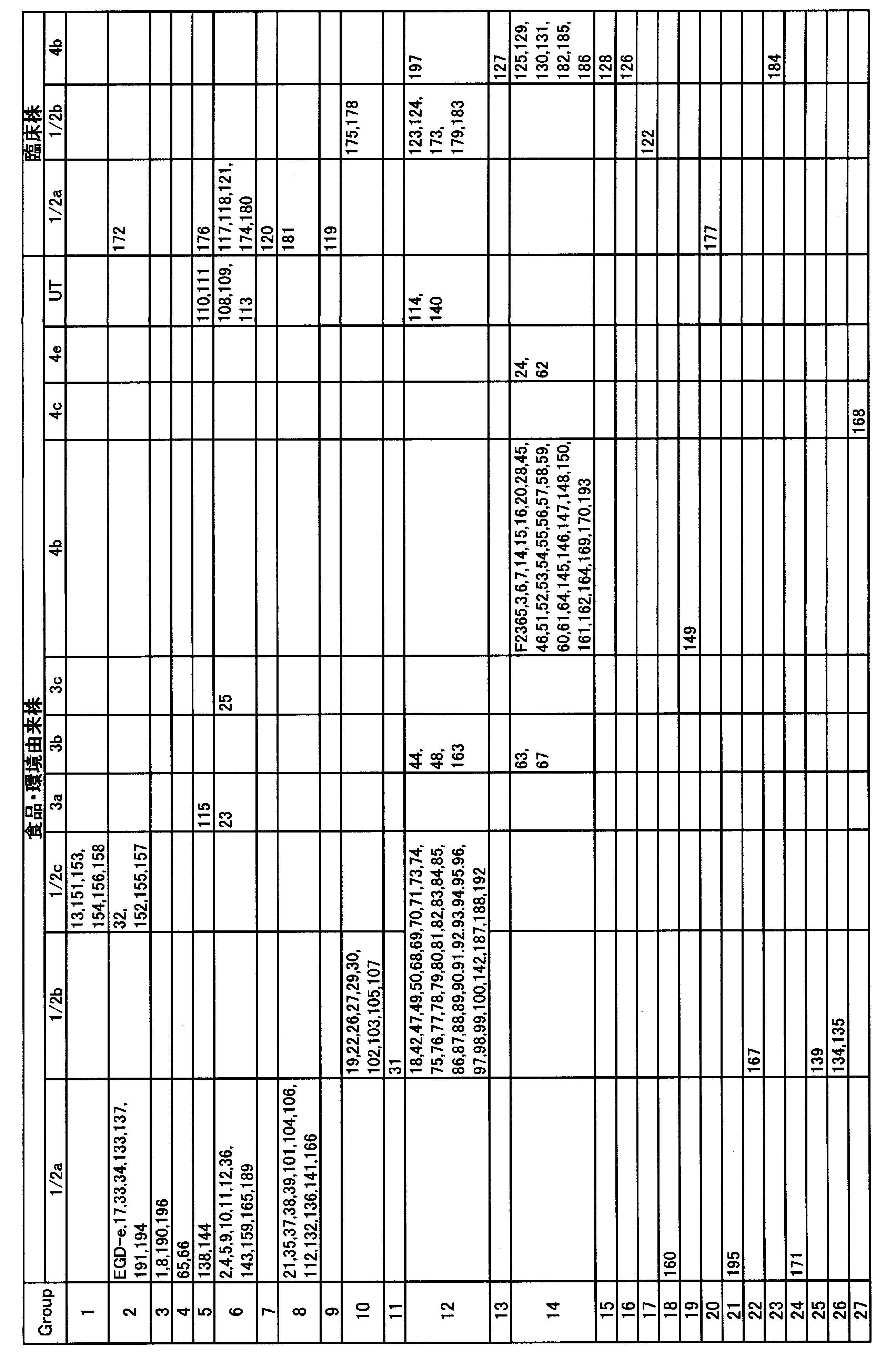
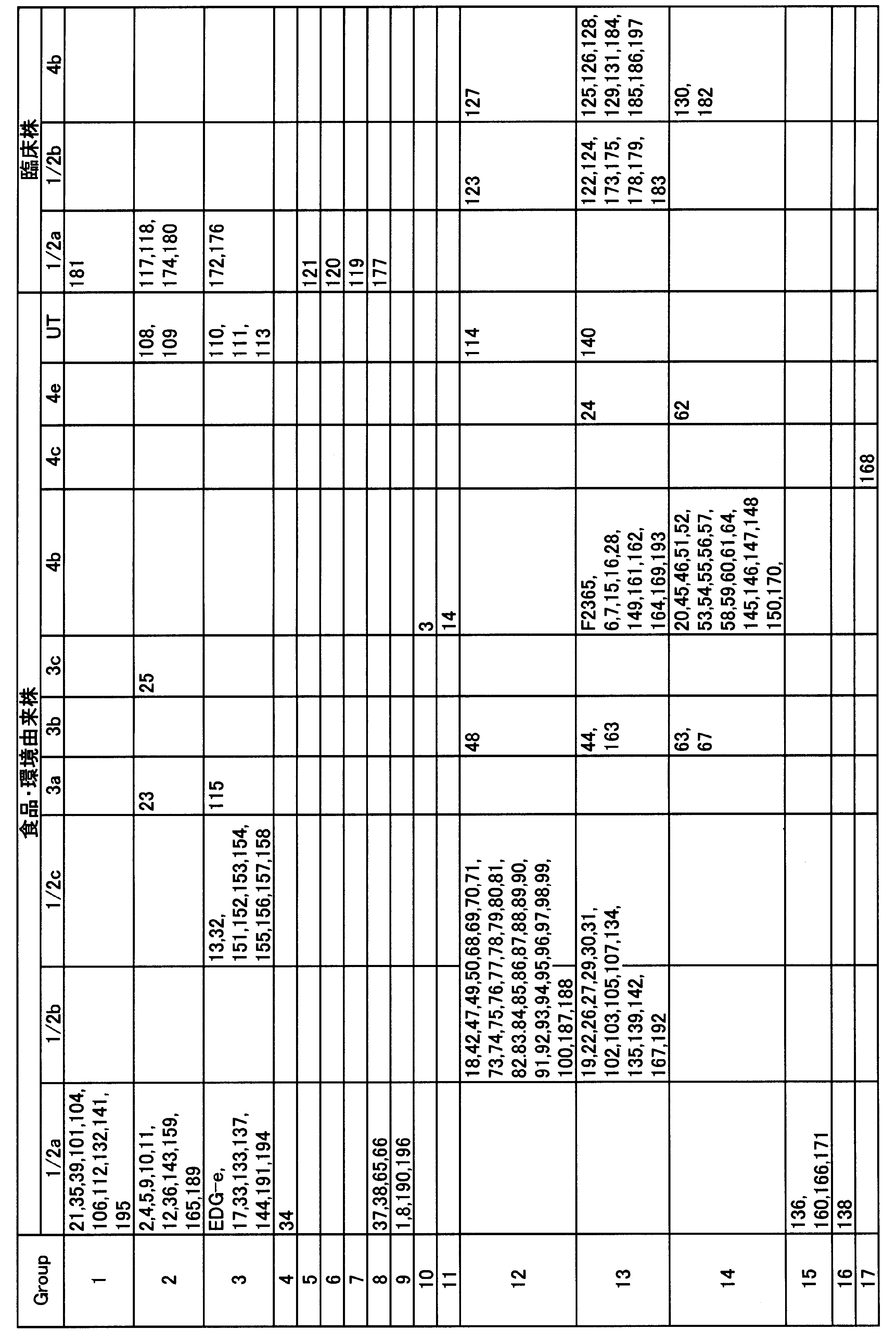

これらの結果から、これまでに分離された臨床株、食品・環境株計192株のMLSTは、表5及び図11に示す計57グループに分類された。また、各菌株の属性が表6及び表7に示された。これらの菌株について血清型による分類から見ると、血清型1/2aでは食品・環境株は17の群に、臨床株は8つの群に分類された。これらのうち食品・環境株は特定のグループに集中することはなかったが、臨床株は11株中4株がMLSTグループ45にまとまって分類され、当該MLSTグループ45が比較的病原性が高いと類推される。一方、血清型1/2bでは食品・環境株は11の群に、臨床株は5つの群に分類された。これらのうち、食品・環境株はMLSTグループ4及び13にまとまって分類されたが、臨床株は特定のグループに集中して分類されることはなかった。血清型4bでは食品・環境株、臨床株共にMLSTグループ7群に分類され、そのほとんどがMLSTグループ22及び24に分類された。
従って、調査対象となる検体から検出されたリステリア菌が、MLSTグループ22、24、45に属すると判断されるならば当該リステリア菌は病原性が高いものと類推される。一方、MLSTグループ4及び13に属すると判断されるならば当該リステリア菌が病原性である可能性が低いものと類推される。

〔新たなhlyA遺伝子検出用のプライマーセットの設計〕
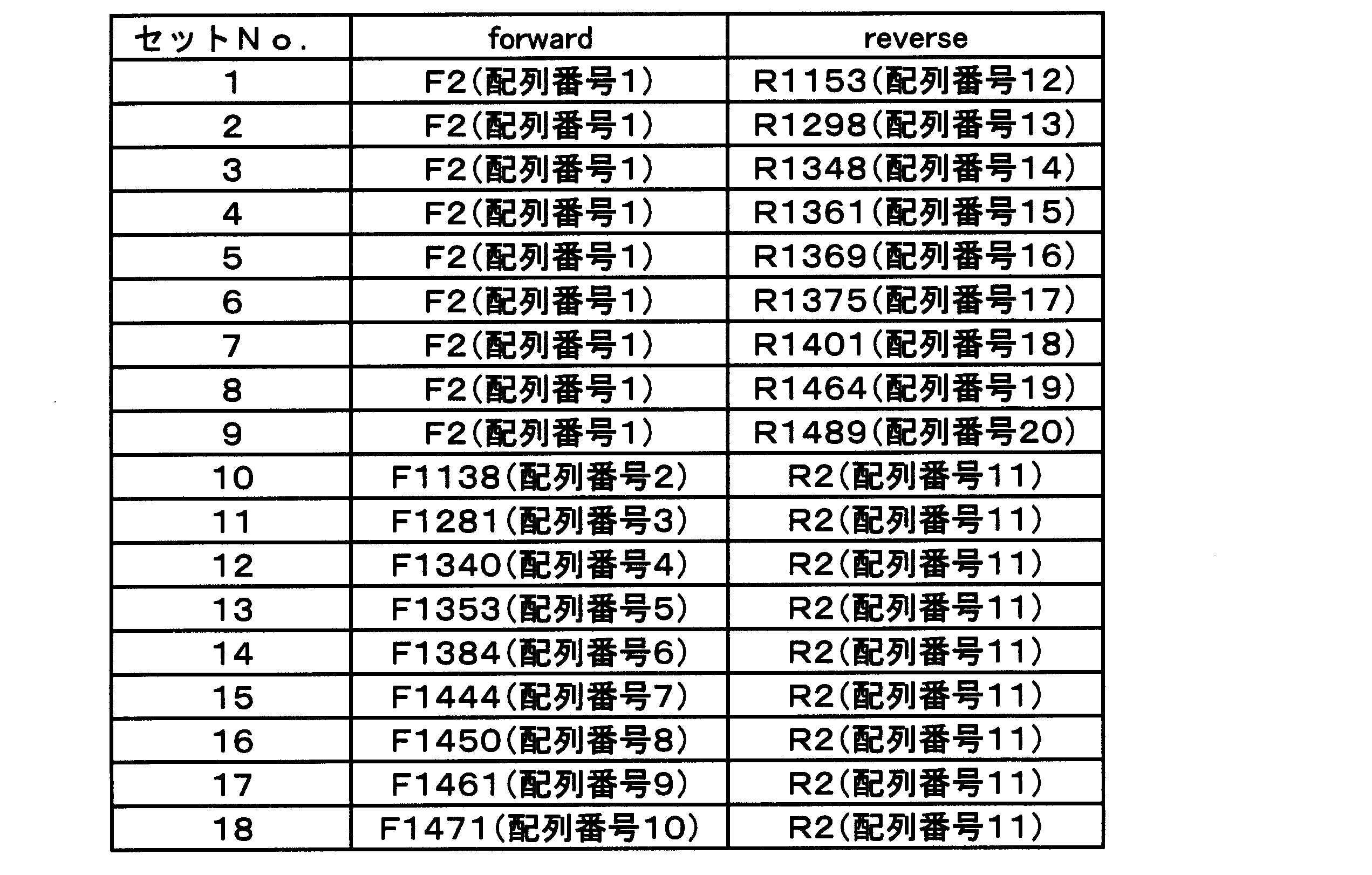
次に、上記で決定された塩基配列をもとに試験を行った全てのリステリア菌で保存され、リステリア菌の類縁菌であるL. ivanovii 及び L. seeligeriでSNPの多い領域の塩基配列から数種のプライマーを作製し、その検出精度の検討を行った。ここでは、遺伝子型グループ間で最もSNPが少なく、プライマーの塩基配列を決定しやすいと考えられたhlyA遺伝子の塩基配列を基にプライマーセットを設計した。そして、表8に示す18通りの組み合わせでPCR反応を行い,最も検出感度および特異性の高いプライマーセットを選択した。用いられたプライマーの塩基配列を表9(配列番号1~20)に示す。
次に、上記で決定された塩基配列をもとに試験を行った全てのリステリア菌で保存され、リステリア菌の類縁菌であるL. ivanovii 及び L. seeligeriでSNPの多い領域の塩基配列から数種のプライマーを作製し、その検出精度の検討を行った。ここでは、遺伝子型グループ間で最もSNPが少なく、プライマーの塩基配列を決定しやすいと考えられたhlyA遺伝子の塩基配列を基にプライマーセットを設計した。そして、表8に示す18通りの組み合わせでPCR反応を行い,最も検出感度および特異性の高いプライマーセットを選択した。用いられたプライマーの塩基配列を表9(配列番号1~20)に示す。

(供試菌と鋳型DNA濃度)
供試菌としてL. monocytogenes No.4株を選択した。鋳型ゲノムDNA濃度を100ng/μl、10ng/μl、1.0ng/μl、0.1ng/μl、0.01ng/μl、0.001ng/μl,、0.0001ng/μlとした。また、大腸菌O157のゲノムDNA(45ng/μl)をNegative controlに用いた。
供試菌としてL. monocytogenes No.4株を選択した。鋳型ゲノムDNA濃度を100ng/μl、10ng/μl、1.0ng/μl、0.1ng/μl、0.01ng/μl、0.001ng/μl,、0.0001ng/μlとした。また、大腸菌O157のゲノムDNA(45ng/μl)をNegative controlに用いた。
(リアルタイムPCRの条件)
反応にはSYBR Premix Ex Taq(タカラバイオ社)を用いた。Mx3000P(登録商標) Real-Time PCR System(STRATAGENE社)を用いて以下の条件でリアルタイムPCR(RT-PCR)を行った。
反応にはSYBR Premix Ex Taq(タカラバイオ社)を用いた。Mx3000P(登録商標) Real-Time PCR System(STRATAGENE社)を用いて以下の条件でリアルタイムPCR(RT-PCR)を行った。
<反応液組成>
2×SYBR Premix Ex Taq 5.0μl
Forward primer(20mM) 0.1μl
Reverse primer(20mM) 0.1μl
50×Rox Reference Dye II 0.2μl
Template 0.4μl
水 4.2μl
Total 10.0μl
<反応条件> サイクル数:35サイクル
95℃で10min、
95℃ 5sec、57℃ 15sec、72℃ 10secを1サイクルとした。
2×SYBR Premix Ex Taq 5.0μl
Forward primer(20mM) 0.1μl
Reverse primer(20mM) 0.1μl
50×Rox Reference Dye II 0.2μl
Template 0.4μl
水 4.2μl
Total 10.0μl
<反応条件> サイクル数:35サイクル
95℃で10min、
95℃ 5sec、57℃ 15sec、72℃ 10secを1サイクルとした。
各プライマーセットによるリアルタイムPCR検出結果を表10に示す。表10は各鋳型濃度ごとにCt値の低い順(検出感度の高い順)にプライマーセットの番号を上から下に並べたものである。プライマーセット6,10,11及び13~18ではNegative controlである大腸菌O157(鋳型DNA濃度45ng/ml)でも強い増幅が認められたため、これらの結果は表10には記載されていない。この試験では、プライマーセット7が各鋳型濃度で平均的に検出感度が高いことが示された。このプライマーセット7によって、L. monocytogenesを特異的かつ高感度に検出できると言える。もっとも、プライマーセット7以外の各プライマーセット(プライマーセット1~5,8,9,12)においても、同様にhlyA遺伝子増幅用のプライマーセットとして用いることができる。これらのプライマーセットも、プライマーセット7と同様に大腸菌O157を検出せず、L. monocytogenesを特異的に検出できると言える。

〔L. monocytogenes検出用市販PCRキットとの比較〕
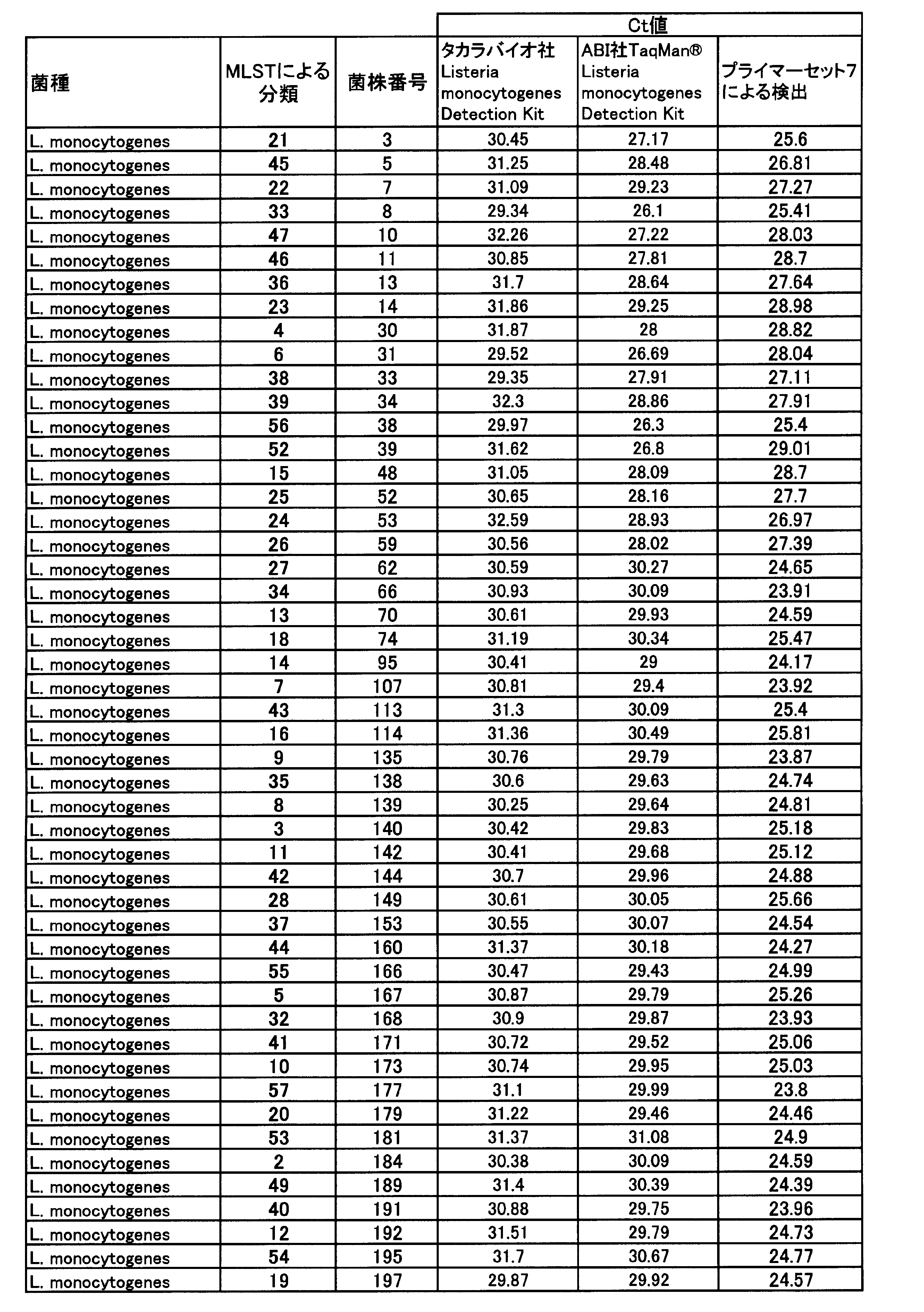
次に、上記プライマーセット7と市販されているL. monocytogenes検出用キットとの検出比較を行った。供試菌には、今回分類されたMLST57グループのうちから遺伝子型の異なる49グループについて、各グループから任意に取り出した代表株各1株と、L. monocytogenes以外のリステリア属細菌とリボプリンターシステムで同定されたリステリア属細菌12株の菌株を用いてリアルタイムPCRを行った。鋳型としてDNA濃度が5pg/μlのものをそれぞれ1μl用いた。市販品にはタカラバイオ社CycleavePCR(登録商標) L. monocytogenes (inlA gene) Detection KitおよびABI社遺伝子増幅キットTaqMan(登録商標) L. monocytogenes Detection Kitを用いた。各キットによる検出は,各附属の方法に従って実施した。鋳型としては同様にDNA濃度5pg/μlのものをそれぞれ1μl用いた。Mx3000P(登録商標) Real-Time PCR System (STRATAGENE社) を用いてリアルタイムPCRを行ない、得られた各菌株毎のCt値を表11,12に示した。表11はL. monocytogenesの結果を、表12はそれ以外の菌株の結果を示す。また、プライマーセット7を用いた検出における蛍光強度の増加曲線及び反応終了後の電気泳動写真を図12~14に示す。同様にタカラバイオ社のキットによる結果を図15~17に,ABI社のキットによる結果を図18~20に示す。なお、電気泳動では、図15~17では4%のゲルが使用され、その他では1.5%のゲルが使用された。
次に、上記プライマーセット7と市販されているL. monocytogenes検出用キットとの検出比較を行った。供試菌には、今回分類されたMLST57グループのうちから遺伝子型の異なる49グループについて、各グループから任意に取り出した代表株各1株と、L. monocytogenes以外のリステリア属細菌とリボプリンターシステムで同定されたリステリア属細菌12株の菌株を用いてリアルタイムPCRを行った。鋳型としてDNA濃度が5pg/μlのものをそれぞれ1μl用いた。市販品にはタカラバイオ社CycleavePCR(登録商標) L. monocytogenes (inlA gene) Detection KitおよびABI社遺伝子増幅キットTaqMan(登録商標) L. monocytogenes Detection Kitを用いた。各キットによる検出は,各附属の方法に従って実施した。鋳型としては同様にDNA濃度5pg/μlのものをそれぞれ1μl用いた。Mx3000P(登録商標) Real-Time PCR System (STRATAGENE社) を用いてリアルタイムPCRを行ない、得られた各菌株毎のCt値を表11,12に示した。表11はL. monocytogenesの結果を、表12はそれ以外の菌株の結果を示す。また、プライマーセット7を用いた検出における蛍光強度の増加曲線及び反応終了後の電気泳動写真を図12~14に示す。同様にタカラバイオ社のキットによる結果を図15~17に,ABI社のキットによる結果を図18~20に示す。なお、電気泳動では、図15~17では4%のゲルが使用され、その他では1.5%のゲルが使用された。
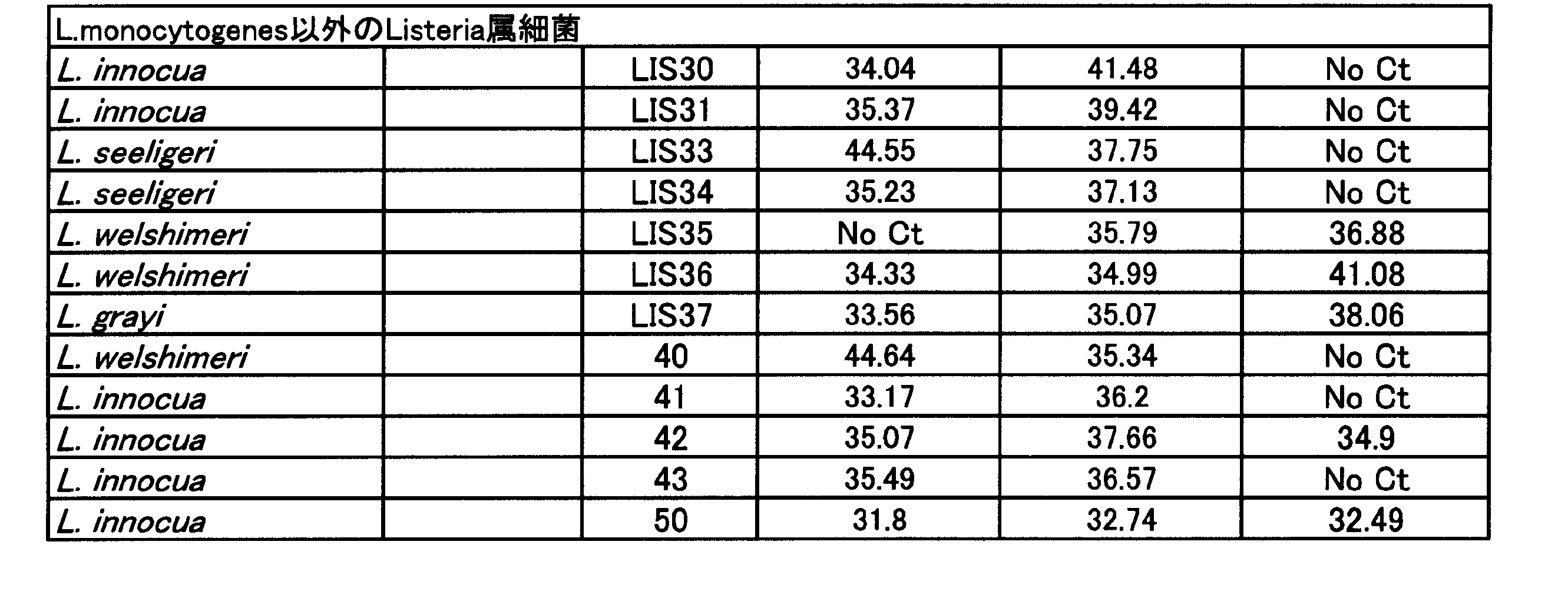
本発明のプライマーセット及びタカラバイオ社及びABI社キットでも全てのL. monocytogenes株を検出できた。しかしながら、新たに設計されたプライマーセット7を用いた場合には、L. monocytogenes以外のリステリア属細菌では2株のL. innocuaで増幅が認められたが、他のL. monocytogenes以外のリステリア属細菌(LIS30,LIS31,LIS33,LIS34,LM40,LM41,LM43)では目的の産物は増幅されなかった(図14参照)。これに対してタカラバイオ社のキットでは、L. monocytogenes以外のリステリア属細菌9株でバンドの増幅が認められたが、他のLIS33,LIS35,LM40株では増幅が認められなかった(図17参照)。ABI社のキットでは、L. monocytogenes以外のリステリア属細菌では1株(LIS30)のL. innocuaではCt値が41.48と40サイクル以上であったが、他のL. monocytogenes以外のリステリア属細菌では40サイクル以前に蛍光強度の立ち上がりが認められた。なお、ABI社のキットでは、IPCと目的遺伝子の増幅産物のサイズがほとんど同じ為バンドが分離できず、L. monocytogenes以外の全ての株で増幅が認められた(図20参照)。
これらの結果から、プライマーセット7では、全てのL. monocytogenesを検出でき、更にL. monocytogenes以外のリステリア属細菌を検出してしまう率は、市販のキットよりもかなり低く、L. monocytogenesに対する特異性が高いことが示された。
以上のように、本発明のプライマーセット、特に配列番号1に示される塩基配列を有するプライマーと配列番号18に示される塩基配列を有するプライマーセットを用いて、RT-PCRを行うことにより、L. monocytogenesのみを比較的高い精度で検出することが可能になる。
Claims (2)
- リステリア モノサイトゲネス菌(Listeria monocytogenes)のhlyA遺伝子内の特定の一塩基置換を挟む配列領域を増幅する核酸増幅用プライマーセットであって、
配列番号1に示される塩基配列を有するプライマーと配列番号12~16及び18~20に示される何れかの塩基配列を有するプライマーとからなるプライマーセット、若しくは配列番号11に示される塩基配列を有するプライマーと配列番号4に示す塩基配列を有するプライマーとからなるプライマーセット。 - リステリア モノサイトゲネス菌(Listeria monocytogenes)のhlyA遺伝子内の特定の一塩基置換を挟む配列領域を増幅する核酸増幅用プライマーセットであって、
配列番号1に示される塩基配列を有するプライマーと配列番号18に示される塩基配列を有するプライマーとからなるプライマーセット。
Applications Claiming Priority (2)
| Application Number | Priority Date | Filing Date | Title |
|---|---|---|---|
| JP2009-120420 | 2009-05-18 | ||
| JP2009120420A JP5522623B2 (ja) | 2009-05-18 | 2009-05-18 | リステリア菌検出用のプライマーセット |
Publications (2)
| Publication Number | Publication Date |
|---|---|
| WO2010134499A2 true WO2010134499A2 (ja) | 2010-11-25 |
| WO2010134499A3 WO2010134499A3 (ja) | 2011-03-10 |
Family
ID=43126606
Family Applications (1)
| Application Number | Title | Priority Date | Filing Date |
|---|---|---|---|
| PCT/JP2010/058305 Ceased WO2010134499A2 (ja) | 2009-05-18 | 2010-05-17 | リステリア菌検出用のプライマーセット |
Country Status (2)
| Country | Link |
|---|---|
| JP (1) | JP5522623B2 (ja) |
| WO (1) | WO2010134499A2 (ja) |
Cited By (1)
| Publication number | Priority date | Publication date | Assignee | Title |
|---|---|---|---|---|
| CN112011537A (zh) * | 2020-09-24 | 2020-12-01 | 上海国际旅行卫生保健中心(上海海关口岸门诊部) | 一组扩增李斯特氏菌mlst分型溯源的管家基因的引物组及二代测序建库方法和应用 |
Families Citing this family (2)
| Publication number | Priority date | Publication date | Assignee | Title |
|---|---|---|---|---|
| JP7177424B2 (ja) | 2016-09-29 | 2022-11-24 | 株式会社ニップン | リステリア・モノサイトゲネス検出方法 |
| CN110592189B (zh) * | 2019-09-26 | 2022-05-17 | 北京市食品安全监控和风险评估中心(北京市食品检验所) | 一种单核细胞增生李斯特氏菌的多位点基因分型方法 |
Family Cites Families (3)
| Publication number | Priority date | Publication date | Assignee | Title |
|---|---|---|---|---|
| JP2007117022A (ja) * | 2005-10-28 | 2007-05-17 | Kirin Brewery Co Ltd | リステリア・モノサイトゲネス検出のためのプライマーセットおよび方法 |
| JP2007274934A (ja) * | 2006-04-04 | 2007-10-25 | Nippon Meat Packers Inc | プライマーセット及び食中毒細菌の検出方法 |
| JP5613971B2 (ja) * | 2006-05-24 | 2014-10-29 | 国立大学法人九州大学 | 病原性リステリア菌の検出方法 |
-
2009
- 2009-05-18 JP JP2009120420A patent/JP5522623B2/ja active Active
-
2010
- 2010-05-17 WO PCT/JP2010/058305 patent/WO2010134499A2/ja not_active Ceased
Cited By (1)
| Publication number | Priority date | Publication date | Assignee | Title |
|---|---|---|---|---|
| CN112011537A (zh) * | 2020-09-24 | 2020-12-01 | 上海国际旅行卫生保健中心(上海海关口岸门诊部) | 一组扩增李斯特氏菌mlst分型溯源的管家基因的引物组及二代测序建库方法和应用 |
Also Published As
| Publication number | Publication date |
|---|---|
| JP2010263873A (ja) | 2010-11-25 |
| WO2010134499A3 (ja) | 2011-03-10 |
| JP5522623B2 (ja) | 2014-06-18 |
Similar Documents
| Publication | Publication Date | Title |
|---|---|---|
| Alía et al. | Development of a multiplex real-time PCR to differentiate the four major Listeria monocytogenes serotypes in isolates from meat processing plants | |
| Skladny et al. | Specific detection of Aspergillus species in blood and bronchoalveolar lavage samples of immunocompromised patients by two-step PCR | |
| Zhou et al. | Simultaneous detection of six food-borne pathogens by multiplex PCR with a GeXP analyzer | |
| Benacer et al. | Characterization of drug resistant Salmonella enterica serotype Typhimurium by antibiograms, plasmids, integrons, resistance genes and PFGE | |
| Vickery et al. | A real-time PCR assay for the rapid determination of 16S rRNA genotype in Vibrio vulnificus | |
| Mayr et al. | Rapid detection and differentiation of Campylobacter jejuni, Campylobacter coli, and Campylobacter lari in food, using multiplex real-time PCR | |
| JP2015039320A (ja) | 複数細菌の同時検出及び/又は定量方法 | |
| Samosornsuk et al. | Isolation and characterization of Campylobacter strains from diarrheal patients in central and suburban Bangkok, Thailand | |
| Rodríguez et al. | Development of an efficient real-time PCR assay to quantify enterotoxin-producing staphylococci in meat products | |
| Fontanot et al. | Rapid detection and differentiation of important Campylobacter spp. in poultry samples by dot blot and PCR | |
| EP2671953A1 (en) | Composition and kit for detection and analysis of strains of clostridium difficile and method of detecting strains of clostridium difficile by using the same | |
| WO2015190107A1 (ja) | ビブリオ・パラヘモリティカスの検出方法、及びビブリオ・パラヘモリティカス検出用担体 | |
| Kim et al. | Loop-mediated isothermal amplification of vanA gene enables a rapid and naked-eye detection of vancomycin-resistant enterococci infection | |
| US20170088882A1 (en) | Carrier for detecting foodborne-illness-causing bacteria, kit for detecting foodborne-illness-causing bacteria, method for detecting foodborne-illness-causing bacteria, and pcr reaction solution for foodborne-illness-causing bacteria | |
| Ngoi et al. | Molecular characterization of Salmonella enterica serovar Typhimurium isolated from human, food, and animal sources in Malaysia | |
| Bai et al. | Development of a loop-mediated isothermal amplification assay for sensitive and rapid detection of Mycoplasma bovis | |
| Cheng et al. | Rapid detection of Campylobacter jejuni in chicken rinse water by melting-peak analysis of amplicons in real-time polymerase chain reaction | |
| JP5522623B2 (ja) | リステリア菌検出用のプライマーセット | |
| Zhang et al. | Multiplex PCR assay simplifies serotyping and sequence typing of Listeria monocytogenes associated with human outbreaks | |
| Bui et al. | Multiplex PCR method for differentiating highly pathogenic Yersinia enterocolitica and low pathogenic Yersinia enterocolitica, and Yersinia pseudotuberculosis | |
| Lomonaco et al. | Analysis of additional virulence genes and virulence gene regions in Listeria monocytogenes confirms the epidemiologic relevance of multi-virulence-locus sequence typing | |
| CN102272305B (zh) | 属于Geosmithia属的菌类的检测方法 | |
| JP5613971B2 (ja) | 病原性リステリア菌の検出方法 | |
| JP6518110B2 (ja) | クレブシエラ・ニューモニエ(Klebsiellapneumoniae)を検出するためのプライマー及び方法 | |
| KR101425149B1 (ko) | 원-튜브 네스티드 실시간 피시알을 이용한 개선된 결핵균 진단방법 |
Legal Events
| Date | Code | Title | Description |
|---|---|---|---|
| 121 | Ep: the epo has been informed by wipo that ep was designated in this application |
Ref document number: 10777732 Country of ref document: EP Kind code of ref document: A2 |
|
| NENP | Non-entry into the national phase |
Ref country code: DE |
|
| 122 | Ep: pct application non-entry in european phase |
Ref document number: 10777732 Country of ref document: EP Kind code of ref document: A2 |