WO2010127558A1 - 取代苯甲酰脲类化合物及其制备方法和用途 - Google Patents
取代苯甲酰脲类化合物及其制备方法和用途 Download PDFInfo
- Publication number
- WO2010127558A1 WO2010127558A1 PCT/CN2010/000628 CN2010000628W WO2010127558A1 WO 2010127558 A1 WO2010127558 A1 WO 2010127558A1 CN 2010000628 W CN2010000628 W CN 2010000628W WO 2010127558 A1 WO2010127558 A1 WO 2010127558A1
- Authority
- WO
- WIPO (PCT)
- Prior art keywords
- urea
- compound
- group
- substituted
- indole
- Prior art date
- Legal status (The legal status is an assumption and is not a legal conclusion. Google has not performed a legal analysis and makes no representation as to the accuracy of the status listed.)
- Ceased
Links
Classifications
-
- C—CHEMISTRY; METALLURGY
- C07—ORGANIC CHEMISTRY
- C07C—ACYCLIC OR CARBOCYCLIC COMPOUNDS
- C07C275/00—Derivatives of urea, i.e. compounds containing any of the groups, the nitrogen atoms not being part of nitro or nitroso groups
- C07C275/46—Derivatives of urea, i.e. compounds containing any of the groups, the nitrogen atoms not being part of nitro or nitroso groups containing any of the groups, X being a hetero atom, Y being any atom, e.g. acylureas
- C07C275/48—Y being a hydrogen or a carbon atom
- C07C275/54—Y being a carbon atom of a six-membered aromatic ring, e.g. benzoylureas
-
- A—HUMAN NECESSITIES
- A61—MEDICAL OR VETERINARY SCIENCE; HYGIENE
- A61P—SPECIFIC THERAPEUTIC ACTIVITY OF CHEMICAL COMPOUNDS OR MEDICINAL PREPARATIONS
- A61P31/00—Antiinfectives, i.e. antibiotics, antiseptics, chemotherapeutics
- A61P31/12—Antivirals
- A61P31/14—Antivirals for RNA viruses
- A61P31/18—Antivirals for RNA viruses for HIV
-
- A—HUMAN NECESSITIES
- A61—MEDICAL OR VETERINARY SCIENCE; HYGIENE
- A61P—SPECIFIC THERAPEUTIC ACTIVITY OF CHEMICAL COMPOUNDS OR MEDICINAL PREPARATIONS
- A61P37/00—Drugs for immunological or allergic disorders
- A61P37/02—Immunomodulators
- A61P37/06—Immunosuppressants, e.g. drugs for graft rejection
-
- C—CHEMISTRY; METALLURGY
- C07—ORGANIC CHEMISTRY
- C07C—ACYCLIC OR CARBOCYCLIC COMPOUNDS
- C07C323/00—Thiols, sulfides, hydropolysulfides or polysulfides substituted by halogen, oxygen or nitrogen atoms, or by sulfur atoms not being part of thio groups
- C07C323/50—Thiols, sulfides, hydropolysulfides or polysulfides substituted by halogen, oxygen or nitrogen atoms, or by sulfur atoms not being part of thio groups containing thio groups and carboxyl groups bound to the same carbon skeleton
- C07C323/62—Thiols, sulfides, hydropolysulfides or polysulfides substituted by halogen, oxygen or nitrogen atoms, or by sulfur atoms not being part of thio groups containing thio groups and carboxyl groups bound to the same carbon skeleton having the sulfur atom of at least one of the thio groups bound to a carbon atom of a six-membered aromatic ring of the carbon skeleton
-
- C—CHEMISTRY; METALLURGY
- C07—ORGANIC CHEMISTRY
- C07D—HETEROCYCLIC COMPOUNDS
- C07D311/00—Heterocyclic compounds containing six-membered rings having one oxygen atom as the only hetero atom, condensed with other rings
- C07D311/02—Heterocyclic compounds containing six-membered rings having one oxygen atom as the only hetero atom, condensed with other rings ortho- or peri-condensed with carbocyclic rings or ring systems
- C07D311/78—Ring systems having three or more relevant rings
- C07D311/80—Dibenzopyrans; Hydrogenated dibenzopyrans
- C07D311/82—Xanthenes
- C07D311/84—Xanthenes with hetero atoms or with carbon atoms having three bonds to hetero atoms with at the most one bond to halogen, e.g. ester or nitrile radicals, directly attached in position 9
- C07D311/88—Nitrogen atoms
-
- C—CHEMISTRY; METALLURGY
- C07—ORGANIC CHEMISTRY
- C07C—ACYCLIC OR CARBOCYCLIC COMPOUNDS
- C07C2601/00—Systems containing only non-condensed rings
- C07C2601/12—Systems containing only non-condensed rings with a six-membered ring
- C07C2601/14—The ring being saturated
-
- C—CHEMISTRY; METALLURGY
- C07—ORGANIC CHEMISTRY
- C07C—ACYCLIC OR CARBOCYCLIC COMPOUNDS
- C07C2602/00—Systems containing two condensed rings
- C07C2602/02—Systems containing two condensed rings the rings having only two atoms in common
- C07C2602/04—One of the condensed rings being a six-membered aromatic ring
- C07C2602/08—One of the condensed rings being a six-membered aromatic ring the other ring being five-membered, e.g. indane
-
- C—CHEMISTRY; METALLURGY
- C07—ORGANIC CHEMISTRY
- C07C—ACYCLIC OR CARBOCYCLIC COMPOUNDS
- C07C2603/00—Systems containing at least three condensed rings
- C07C2603/02—Ortho- or ortho- and peri-condensed systems
- C07C2603/04—Ortho- or ortho- and peri-condensed systems containing three rings
- C07C2603/06—Ortho- or ortho- and peri-condensed systems containing three rings containing at least one ring with less than six ring members
- C07C2603/10—Ortho- or ortho- and peri-condensed systems containing three rings containing at least one ring with less than six ring members containing five-membered rings
- C07C2603/12—Ortho- or ortho- and peri-condensed systems containing three rings containing at least one ring with less than six ring members containing five-membered rings only one five-membered ring
- C07C2603/18—Fluorenes; Hydrogenated fluorenes
Definitions
- the invention relates to the field of medicinal chemistry and pharmacotherapy, in particular to a substituted benzoylurea compound as a small molecule non-peptide inhibitor of cyclophilin A, a preparation method thereof and a pharmacological use, the compound can be used as an immunity Inhibitors and anti-HIV-1 drugs.
- Background technique a substituted benzoylurea compound as a small molecule non-peptide inhibitor of cyclophilin A, a preparation method thereof and a pharmacological use, the compound can be used as an immunity Inhibitors and anti-HIV-1 drugs.
- CyP cyclophilin
- CyP is a conserved protein family (Gothel SF, Marahiel MA. Cell Mo. Life Sci, 1999, 55: 423-436), which has such proteins from lower prokaryotes to mammals.
- Peptidyl-prolyl cis-trans isomerase (PPIase) activity (Takahashi N, Hayano T, Suzuki M. Nature, 1989, 337: 473-475).
- CyP family has 16 members including CypA, CypB, CypC and CypD.
- Human cyclophilin A hCypA
- hCypA is the most important and the most widely studied member (Braaren D).
- Luban J is the most widely studied member.
- hCypA binds to proteins and catalyzes their folding, assembly and transport, in vivo and in vitro, acting as a molecular chaperone (Freskgard PO et al. S 'e"ce, 1992, 258: 466) .
- CypA consists of eight anti-parallel ⁇ -sheets. These ⁇ -sheets form a barrel-like structure. Each of the upper and lower mouths of the barrel has an ⁇ -helix to close both ends of the barrel.
- the ligand pocket of CypA is located on the side of the barrel. (Kallen J et al. Nature, 1991, 353: 276-279), consisting mainly of two large sub-pockets: sub-pocket A and sub-pocket B.
- Sub-pocket A is mainly composed of residues such as Thr73, Gly74, Asnl02, Alal03, Thrl07, Glyl09, Serl lO and Glnl ll, most of which are hydrophilic residues; sub-pocket B is a deep hydrophobic groove, mainly It consists of residues such as Phe60, Met61, Phel l3 and Leul22.
- CypA is closely related to various diseases.
- Luban et al. found that CypA and CypB can specifically bind to the Gag protein of HIV-1, while CsA can effectively inhibit Gag-CypA.
- Interaction (Luban J et al. Cell, 1993, 73: 1067-1078); 1994, Franke (Franke EK, Yuan HE. Nature, 1994, 372: 359-362) and Thali et al. (Thali M et al. Nature, 1994, 372: 363-365) reported in Nature that CypA specifically incorporated Incorporation into HIV-1 virions blocks CypA incorporation and inhibits HIV-1 replication, suggesting that CypA binding to Gag proteins is functionally related (Luban J.
- the Gag protein of HIV-1 is a polyprotein that plays a decisive role in viral assembly, maturation and budding (Gamble TR et al. Cell, 1996, 87: 1285-1294).
- CypA binds to the capsid protein (Capsid, CA; 231 residues) region of the Gag protein, and by this action, CypA is specifically encapsulated into the HIV-1 virus particle.
- the absence of CypA does not affect the assembly, budding and maturation of the virus, which is required early in the HIV-1 life cycle (before viral reverse transcription begins:). Therefore, CypA may play a role in the uncoating process after the virus enters the host cell, helping the Viral CA core disassembly.
- SARS-CoV N protein and CypA have high affinity, KD value is about 6 ⁇ 160 nM ; the next site-directed mutagenesis experiment initially determines SARS- The Trp302 ⁇ Pro3 10 fragment of the CoV N protein is a region that binds to CypA.
- the above results indicate that CypA is likely to participate in the life activity process of SARS-CoV.
- CypA is an oxidative stress-induced secretion growth factor that mediates the activation of extracellular signal-regulated kinase (ERK1/2) and vascular smooth muscle cell proliferation by reactive oxygen species, suggesting that CypA plays an important role in the pathogenesis of vascular disease. Role (Andreeva L, Heads, Green CJ. Int JExp Path, 1999, 80: 305-3 15).
- hCypA binds to ligands in the cytoplasm, and the resulting complex then binds to calcineurin, CaN) and inhibits the phosphorylation activity of CaN (Liu J et al. Ce//, 1991, 66: 807-815).
- CaN plays a very important role in the activation of lymphocytes, which activates the nuclear factor of activated T cell by dephosphorylation.
- NF-AT which is activated and displaced into the nucleus, and then participates in the transcription process of IL-2 and other factors. Inhibition of the phosphorylation activity of CaN inhibits the release of immunogenic cytokines, thereby exerting an immunosuppressive effect.
- CypA inhibitors fall into three broad categories: natural products and their analogs, peptides and peptidomimetic compounds, and organically synthesized small molecule compounds. In order to overcome the toxic side effects of natural products and the easy metabolism of peptide compounds, it is inevitable to find a highly selective and active organic synthetic small molecule CypA inhibitor.
- the de novo design of the active molecule means that the molecule automatically grows within the receptor binding site under the control of a suitable algorithm, ultimately forming a complete ligand structure. Unlike virtual screening based on molecular docking, the active molecular de novo design allows for sampling in larger compound spaces, thus providing a completely new structural structure of the compound.
- the de novo design of active molecules was greatly developed in the 1990s. For example, Japanese scientists developed the LEGEND program in 1992. Professor Liu Haiyan from the University of Science and Technology of China published the DycoBlock program in 1999 (/otoVw 1999, 36, 462-470). The research team of Peking University, Lu Hua, published the RASSE program for new structural design in 1996 and 2000 (J Chem. Inf. Comput.
- LigBuilder program J Mol. Model. 2000, 6, 498-516
- the new version has more complete functions, perfects the detection function of the binding part, and can predict the design of the drug target.
- the structural optimization module, the key-locking module and the synthesizable analysis module are added to form a complete protein-based structure.
- Drug design process from scratch.
- the program incorporates a built-in chemical reaction database (currently containing 465 reactions) that analyzes the synthesizable properties of molecules using reverse synthesis in the generation and export of molecules, reducing the new chemistry of de novo drug design.
- the difficulty of synthesizing the entity breaks through the bottleneck that the molecules brought by the de novo drug design program are difficult to synthesize.
- CypA as a target, combining de novo drug design methods and various levels of biological activity test, designing and synthesizing small molecule compounds is important for the development of immunosuppressive drugs or anti-HIV-1 drugs targeting CypA. Realistic meaning.
- An object of the present invention is to provide a novel substituted benzoylurea compound having an action of inhibiting CypA, which has a structural formula of the formula.
- Another object of the present invention is to provide a process for the preparation of the above substituted benzoylurea compound.
- a further object of the present invention is to provide a substituted benzoylurea compound as a CypA inhibitor for the preparation of a prophylactic or therapeutic CypA-mediated related disease (such as transplant rejection, host disease caused by transplantation, autoimmune disease and HIV- 1 Invasive infection:) The application of the pharmaceutical composition.
- the invention also provides a pharmaceutical composition
- a pharmaceutical composition comprising a therapeutically effective amount of one or more of the above substituted benzoylurea compounds and a pharmaceutically acceptable excipient, carrier or diluent.
- the above substituted benzoylurea compound accounts for 0.001 to 99.9% by weight based on the total weight of the pharmaceutical composition, more preferably 0.1 to 90% by weight based on the total weight.
- the present invention provides a substituted benzoylurea compound having the following structure of the general formula (I):
- R 3 is selected from the following structures II, III, IV, V, VI and VII:
- X is selected from N, 0 and S; m is an integer from 0 to 2; n is an integer from 1 to 3; p is an integer of 0;
- R 4, R 5 and R 6 are each independently selected from alkyl of hydrogen, dC 6 linear or branched, dC 4 alkoxy, Halogen, cyano, nitro, amino, hydroxy, trifluoromethyl, carboxy, fluorenyl and cc 4 acyl; aryl Ar is selected from substituted or unsubstituted phenyl or naphthyl, the substituents are from 1 to 4 From halogen, C r C 6 straight or branched chain hydrocarbon, hydroxy, ⁇ - alkoxy, C r C 4 unsaturated alkoxy, carboxy, carboxy substituted CC 6 alkoxy, cyano, nitro, A group of an amino group, a trifluoromethyl group, a trifluoromethoxy group, a fluorenyl group and a CC 4 acyl group.
- R 3 is selected from the group consisting of a fluorenyl group, a fluorenyl group, a 2,3-dihydro-inden-1-yl group, an R 4 -substituted cyclohexyl group, a R 5 and an R 6 -substituted diphenyl group.
- a first preferred embodiment of the compound of formula (I) according to the invention is compound 00: Among them, selected from the following structures:
- X is selected from N, 0 and S; m is an integer from 0 to 2; n is an integer from 1 to 3; p is an integer from 0 to 3; and R 4 , R 5 and R 6 are each independently selected from hydrogen, dC 6 alkyl with straight or branched chain, embankment dC 4 alkoxy, halo, cyano, nitro, amino, hydroxyl, trifluoromethyl, carboxyl, mercapto and dC 4 group; a substituted or unsubstituted aromatic group Ar is selected from Substituted phenyl or naphthyl, the substituent of which is 1 to 4 selected from halogen, CC 6 straight or branched hydrocarbon, hydroxy, C 4 methoxy, dC 4 unsaturated alkoxy, carboxy, carboxy substituted dC 6 alkoxy, cyano, nitro, amino, trifluoromethyl, trifluoromethoxy, a group of a thiol group and
- a second preferred embodiment of the compound of formula (i) of the present invention is the compound ⁇ ⁇ ) :
- R 2 are each independently selected from the group consisting of hydrogen, -C 6 straight or branched fluorenyl, alkoxy and alkylthio, hydroxy, nitro, amino, halogen, cyano, trifluoromethyl and benzyl Oxygen.
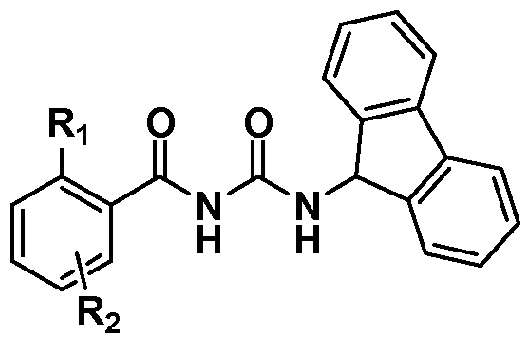
- a preferred embodiment of the compound of formula (I) of the invention is compound Ic):
- the amino group or the nitro group is selected from the group consisting of hydrogen, CC 6 straight or branched fluorenyl, alkoxy and alkylthio, hydroxy, nitro, amino halogen, cyano, trifluoromethyl and benzyloxy .
- the substituted benzoylurea compound is:
- the present invention also provides a substituted benzoylurea compound having the structure of the general formula (I) claimed in the present application.
- the preparation methods of the compounds (specifically, IA, I B and Ic) and their intermediate compounds VIII, IX, X, XI, XII, XIII, XIV and XV are as follows.
- step 2) The compound VIII obtained in the step 1) is dissolved in benzyl alcohol, and potassium hydroxide and a small amount of water are added thereto, and stirred at 120 to 140 ° C for 10 to 15 hours. The solvent was evaporated under reduced pressure. ice water was added to the residue, and the mixture was stirred for 30 minutes to precipitate a large solid, which was filtered, washed with water and dried to give a white solid. This was separated and purified by silica gel column chromatography toield (yield: 2,6-dibenzyloxybenzamide as a white powder).
- R 3 has the same definition as above.
- it is xanthene, naphthyl, benzyl, phenethyl, cyclohexyl, phenyl, 4-fluorophenyl, 2,3-dihydro-inden-1-yl or diphenylmethyl.
- R 2 is 2-chloro, 2-cyano, 2-fluoro, 2-methoxy, 2-methyl, 2-trifluoromethyl, hydrogen, 2-methylindenyl or 2- Benzyloxy;
- R 2 is 6-fluoro, 6-methylindenyl, 6-methoxy or 6-benzyloxy;
- R 2 is 6-chloro, 6-fluoro, 6-methylindenyl or 6-methoxy.
- the definition is the same as above.
- it is hydrogen.
- Figure 1 is a graph showing the dose-response effect of Compound I A -3 on CypA enzyme activity inhibition.
- Figure 2 is a graph showing the dose-response curve of compound I A -5 against CypA enzyme activity inhibition.
- Figure 3 is a graph showing the dose-response curve of compound I B -1 against CypA enzyme activity inhibition.
- Figure 4 is a graph showing the dose-response curve of Compound I B -2 against CypA enzyme activity inhibition.
- Figure 5 is a graph showing the dose-response curve of the inhibition of CypA activity by the compound I B -3.
- Figure 6 is a graph showing the dose-response curve of the inhibition of CypA activity by Compound I B- 6.
- Figure 7 is a graph showing the dose-response curve of Compound I B -7 against CypA enzyme activity inhibition.
- Figure 8 is a graph showing the dose-response curve of the inhibition of CypA activity by the compound I B -8 .
- Figure 9 is a graph showing the dose-response effect of Compound I B- 9 on CypA enzyme activity inhibition.
- Figure 10 is a graph showing the dose-response effect of Compound I B -11 on CypA enzyme activity inhibition.
- Figure 11 is a graph showing the dose-response effect of the compound ⁇ ⁇ - ⁇ on the inhibition of CypA activity.
- Figure 12 is a graph showing the dose-response curve of Compound I c -1 against CypA enzyme activity inhibition. detailed description
- triphosgene 0.5 g was dissolved in 3 ml of 1,2-dichloroacetamidine and stirred until dissolved in an ice bath. Dissolve 0.25 g of xanthene in 10 ml of 1,2-dichloroacetamidine and slowly add dropwise to the reaction solution containing triphosgene. The reaction solution was cloudy in white. After the ice bath was continued for 0.5 hour, the temperature was raised to 25 ° C for 1 hour, and then heated under reflux until the reaction mixture was colorless and transparent. 1 ml of triethylamine was added to the reaction mixture and reflux was continued for 0.5 hour.
- Example 3 The xantheneamine in Example 3 was replaced with 1-naphthylamine, and the remaining starting materials, reagents and preparation methods were the same as those in Examples 1 to 4 to give an off-white solid compound I A -2. Yield 50%; Mp 203-208.
- Example 3 Xanthene amine in Example 3 is replaced by benzylamine, the remaining required raw materials, reagents and preparation method as in Example 1-4, to give an off-white solid Compound I A -3. Yield 52%; Mp 210-215 ° C; 1H-NMR (400 Hz, OMSO-d 6 ) ⁇ : 4.42 (2H, d, -CH 2 ), 6.42 (2H, d, Ar-H), 7.18-7.33 (6H, m, Ar-H), 8.34 (IH, br, Ar-H), 10.54 (IH, s, -NH), 11.74 (2H, s, -OH); EI-MS m/z 286.1 (M+ ), 136.0 (100%).
- Example 3 The xantheneamine in Example 3 was replaced with phenethylamine, and the remaining starting materials, reagents, and preparation methods were the same as those in Examples 1 to 4 to obtain a yellowish solid compound I A -4. Yield 67%; Mp 208-212.
- Example 3 The xantheneamine in Example 3 was replaced with cyclohexylamine, and the remaining starting materials, reagents, and preparation methods were the same as those in Examples 1 to 4 to give an off-white solid compound I A -5. Yield 41%; Mp > 300.
- Example 3 The xantheneamine in Example 3 was replaced with 4-fluoroaniline, and the remaining materials, reagents, and preparation methods were the same as those in Examples 1 to 4 to give an off-white solid compound I A -7. Yield 49%; Mp 192-195 °C; 1 H-NMR (400 Hz, DMSO- ⁇ ) ⁇ : 7.15 (3H, t, Ar-H), 7.35 (3H, dd, Ar-H), 8.8 (IH , d, Ar-H); EI-MS m/z 290.1 (M+), 136.0 (100%).
- Example 3 The xantheneamine in Example 3 was replaced with 2,3-dihydro-inden-1-amine.
- the remaining starting materials, reagents and preparation methods were the same as those in Examples 1 to 4 to give a light brown solid compound I A -8. Yield 82%; Mp 250-252 °C; 1H-NMR (400 Hz, DMSO-i3 ⁇ 4 ⁇ : 1.65 (2H, m, -CH 2 ), 2.38 (2H, m, -CH 2 ), 2.76-2.87 (4H , m, -CH 2 ), 5.13 (IH, dd, -CH), 6.15(1H, d, -CH), 6.38 (IH, d, Ar-H), 7.17-7.30 (7H, m, Ar-H ), 8.54 (IH, d, Ar-H), 11.65 (1H, s, Ar-H); EI-MS m/z 312.1 (M + ), 132.1 (100%).
- Example 12 1-Diphenylmethyl-3-(2,6-dihydroxybenzoyl)urea (one of the compounds I A (I A -9)
- Example 3 The xantheneamine in Example 3 was replaced with diphenylmethylamine, and the remaining starting materials, reagents, and preparation methods were the same as those in Examples 1 to 4 to obtain a yellowish solid compound I A -9. Yield 70%; Mp 222-224 °C; ⁇ -NMR (400 Hz, DMSO-i3 ⁇ 4 ⁇ : 6.08 (1H, d, -CH), 6.24 (2H, d, Ar-H), 7.11 (1H, t, Ar-H), 7.10-7.12 (2H, m , Ar-H), 7.32-7.37 (8H, m, Ar-H), 9.19 (1H, d, Ar-H); EI-MS m/z 361.1 (M+), 302.1 (100%)
- Example 15 1-Indole-3-(2-chlorobenzoyl)urea (one of the compounds I B (I B -1)
- triphosgene 0.5 g was dissolved in 3 ml of 1,2-dichloroethane and stirred until dissolved in an ice bath. 0.25 g of 9-decylamine (XIII) was dissolved in 10 ml of 1,2-dichloroethane, and slowly added dropwise to the reaction liquid containing triphosgene, and the reaction liquid was white turbid. After the ice bath was continued for 0.5 hours, the temperature was raised to 25 ° C for 1 hour. .
- Example 15 The 2-chlorobenzamide in Example 15 was replaced with 2-methylbenzamide, and the remaining starting materials, reagents and preparation methods were the same as those in Examples 13 to 15, to give the white solid compound I B -5. Yield 47%; Mp 206-209. C; 1H-NMR (400Hz, DMSO-t ⁇ ) ⁇ : 2.43(3H, s, -CH 3 ), 5.99 (IH, d, CH), 7.27 (2H, d, Ar-H), 7.38 (3H, m, Ar-H), 7.46 (3H, t, Ar-H), 7.65 (2H, m, Ar-H), 7.88 (2H, d, Ar-H), 7.88 (2H, d, Ar-H) , 8.86 (IH, d, NH), 11.25 (IH, s, NH); EI-MS m/z 342.2 (M+), 180.1 (100%).
- Example 15 The 2-chlorobenzamide in Example 15 was replaced with 2,6-difluorobenzamide, and the remaining starting materials, reagents and preparation methods were the same as those in Examples 13 to 15, to obtain a yellow solid compound I B -7. Yield 68%; Mp 252-255.
- Example 15 The 2-chlorobenzamide of Example 15 was replaced with 2,6-dichlorobenzamide, and the remaining starting materials, reagents and preparation methods were the same as those of Examples 13 to 15, to give a pale yellow solid compound I B -8. Yield 42%; Mp 240-242.
- Example 15 The 2-chlorobenzamide in Example 15 was replaced with 2-chloro-6-fluorobenzamide, and the remaining materials, reagents and preparation methods were the same as those in Examples 13 to 15, to give a pale yellow solid compound I B -9 . Yield 46%; Mp 236-238.
- Example 15 The 2-chlorobenzamide in Example 15 was replaced with benzamide, and the remaining starting materials, reagents and preparation methods were the same as those in the examples, to obtain a white solid compound: - yield: 80%; Mp 241- 243 °C; 1H-NMR (400Hz, DMSO-i3 ⁇ 4 ⁇ : 5.97 (IH, m), 6.40 (4H, m, Ar-H), 7.22 (IH, t, Ar-H), 7.35 (3H, t, Ar-H), 7.45 (3H, t, Ar-H), 7.62 (2H, d, Ar-H), 7.88 (2H, d, Ar-H), 8.68 (IH, dd, Ar-H); EI - MS m/z 328.2 (M ⁇ ), 180.1 (100%).
- Example 15 The 2-chlorobenzamide in Example 15 was replaced with 2-fluoro-6-methylmercaptobenzamide, and the remaining materials, reagents and preparation methods were the same as those in Examples 13 to 15, to give an off-white solid compound I B -11. . Yield 32%; Mp 241-243.
- Example 15 The 2-chlorobenzamide in Example 15 was replaced with 2-fluoro-6-methoxybenzamide, and the remaining starting materials, reagents and preparation methods were the same as those in Examples 13 to 15, to obtain a white solid compound I B - 12. Yield 45%; Mp 112-114.
- Example 15 The 2-chlorobenzamide in Example 15 was replaced with 2-chloro-6-methylmercaptobenzamide, and the remaining starting materials, reagents and preparation methods were the same as those in Examples 13 to 15, to obtain a white solid compound I B - 13. Yield 56%; Mp 230-235.
- Example 15 The 2-chlorobenzamide in Example 15 was replaced with 2-chloro-6-methoxybenzamide, and the remaining starting materials, reagents and preparation methods were the same as those in Examples 13 to 15, to obtain a white solid compound I B . -14. Yield 44%; Mp 258-260 °C; 1H-NMR (400Hz, DMSO-i3 ⁇ 4 ⁇ : 3.75 (3H, s), 5.89 (IH, d, CH), 7.02 (2H, d, Ar-H), 7.10 (2H, d, Ar-H), 7.38(2H, t, Ar-H), 7.34 (IH, t, Ar-H) 7.34-7.53 (7H, m, Ar-H), 7.62 (2H, d , Ar-H), 7.78 (IH, d, Ar-H), 7.81 (2H, d, Ar-H), 8.69 (1H, d, NH), 11.23 (IH, s, NH); EI-MS m /z 39
- Example 15 The 2-chlorobenzamide in Example 15 was replaced with 2-fluoro-6-benzyloxybenzamide, and the remaining materials, reagents and preparation methods were the same as those in Examples 13 to 15, to obtain a white solid compound I B . -15. Yield 36%; Mp 242-244.
- Example 15 The 2-chlorobenzamide in Example 15 was replaced with 2-methylmercaptobenzamide, and the remaining starting materials, reagents and preparation methods were the same as those in Examples 13 to 15, to give a white solid compound ⁇ ⁇ -16. Yield 46%; Mp 204-207.
- Example 15 The 2-chlorobenzamide of Example 15 was replaced with 2-benzyloxybenzamide, and the remaining starting materials, reagents and preparation methods were the same as those of Examples 13 to 15, to give a pale yellow solid compound I B -17. Yield 43%; Mp 204-207.
- Example 32 o-Nitrobenzoyl isocyanate (intermediate XV) 1.66 g of o-nitrobenzamide was dissolved in 10 ml of dry toluene, and 2.52 g of oxalyl chloride was slowly added dropwise at room temperature. After the end of the reaction, the mixture was heated to reflux for 5 hours to completely dissolve the suspended solids, and the reaction solution became clear. Further, no hydrogen chloride gas is evolved, the reaction is terminated, and the reaction liquid is distilled off under reduced pressure to remove excess toluene and oxalyl chloride to obtain a pale yellow oily liquid intermediate XV, which is used in the next reaction or sealed for use without further purification.
- intermediate XV o-Nitrobenzoyl isocyanate
- IPTG isopropyl ⁇ -D thiogalactoside, 1 M solution
- C was cultured for 5 hours for induction of protein expression.
- the cells were collected at 4000 rpm/separation for 30 minutes, collected, and stored in an ultra-low temperature freezer at -80 °C overnight.
- the cells were suspended in 20 mL of binding buffer (20 mM Tris-Cl, 0.5 M NaCl, 5 mM imidazole, pH 8.0), and the suspension was ultrasonically disrupted on an ice bath (300 W, working for 30 minutes, once for 5 seconds).
- the peptide proline cis-trans isomerase (PPIase) activity of the target was determined.
- the entire experiment was carried out at a constant temperature of 4 ° C.
- the substrate for the enzyme was Suc-Ala-Ala-cis-Pro-Phe-pNA, which was dissolved in tetrahydrofuran containing 400 mM LiCl to form a 3.8 mM mother liquor.
- the chymotrypsin was dissolved in 1 mM HCl solution to prepare a 3 mg/mL mother liquor.
- IC 5Q was selected for compounds with a 10 ⁇ inhibition rate above 50%, and the appropriate compound concentration gradient was selected.
- the experimental method and system are as in Example 35. According to the reaction rate K of the compound at different concentrations on the CypA activity, the inhibition rate of the compound at different concentrations of CypA activity was calculated, and the IC 5 of the compound was obtained by fitting with the origin software using the Sigmoidal formula. Values, the results are shown in Table 2 and the drawings. Table 2-substituted benzoyl urea compound to inhibit CypA pair of IC 5 activity. Value No. IC 5 o (nM) No. ID ICso (nM)
- the partially substituted benzoylurea compound having the structural formula (I) of the present invention has a CPMA protease inhibitory activity of nanomolar (nM), indicating that the compound of the present invention is CypA inhibitor 1 J Qi II.
- the preparation method of the substituted benzoylurea compound of the present invention has the advantages of mild reaction conditions, abundant raw materials, easy handling and post-treatment.
- the substituted benzoylurea compounds of the present invention showed positive results in both de novo drug design and in the CypA inhibition test, confirming the pharmacological mechanism of action. Therefore, the compounds of the present invention are useful for the preparation of CypA inhibitors and for development as immunosuppressive drugs or anti-HIV-1 drugs.
Landscapes
- Organic Chemistry (AREA)
- Chemical & Material Sciences (AREA)
- Health & Medical Sciences (AREA)
- Life Sciences & Earth Sciences (AREA)
- Immunology (AREA)
- Veterinary Medicine (AREA)
- General Health & Medical Sciences (AREA)
- Virology (AREA)
- Bioinformatics & Cheminformatics (AREA)
- Engineering & Computer Science (AREA)
- Chemical Kinetics & Catalysis (AREA)
- General Chemical & Material Sciences (AREA)
- Medicinal Chemistry (AREA)
- Nuclear Medicine, Radiotherapy & Molecular Imaging (AREA)
- Pharmacology & Pharmacy (AREA)
- Animal Behavior & Ethology (AREA)
- Public Health (AREA)
- Molecular Biology (AREA)
- Tropical Medicine & Parasitology (AREA)
- Oncology (AREA)
- Communicable Diseases (AREA)
- AIDS & HIV (AREA)
- Transplantation (AREA)
- Organic Low-Molecular-Weight Compounds And Preparation Thereof (AREA)
- Pharmaceuticals Containing Other Organic And Inorganic Compounds (AREA)
- Acyclic And Carbocyclic Compounds In Medicinal Compositions (AREA)
Description
取代苯甲酰脲类化合物及其制备方法和用途 技术领域
本发明涉及药物化学和药物治疗学领域, 具体涉及一类作为亲环素 A的 小分子非肽类抑制剂的取代苯甲酰脲类化合物及其制备方法和药理用途, 该 类化合物可作为免疫抑制剂和抗 HIV-1药物。 背景技术
亲环素 (Cyclophilin, CyP)的发现与命名起源于它对环孢素 (Cyclosporin A, CsA)的高度亲合性, CsA 是临床上广泛使用的一种免疫抑制药物 (Handschumacher RE等. Science, 1984, 226: 544-547)。 CyP是一个保守的蛋白 质家族 (Gothel SF, Marahiel MA. Cell Mo. Life Sci, 1999, 55: 423-436) , 从低等 原核生物到哺乳动物都有这类蛋白。 该组蛋白的共同特征是具有肽脯氨酰顺 反异构酶 (Peptidyl-prolyl cis-trans isomerase , PPIase)活性 (Takahashi N, Hayano T, Suzuki M. Nature, 1989, 337: 473-475)。 依据相对分子量以及亚细胞定位等 特征, 目前已知人 CyP家族有 CypA、 CypB、 CypC和 CypD等 16种成员, 人亲环素 A(hCypA)是最重要的, 也是研究最广泛的成员 (Braaren D, Luban J.
J, 2001,20: 1300-1309) , 它由 165个氨基酸组成, 相对分子量 18,000, 约占细胞蛋白总量的 0.1%〜0.4%, 主要位于胞质内。除了作为 CsA的体内结 合蛋白, 在体内外, hCypA都能结合蛋白质并催化加速它们的折叠、 装配和 转运, 起分子伴侣的作用 (Freskgard PO等. S 'e"ce, 1992, 258: 466)。
CypA包含八股反平行 β片层,这些 β片层组成一个桶状结构,在桶的上下 口各有一段 α螺旋将桶的两端封闭, CypA的配体结合口袋则位于该桶状结构 的侧面 (Kallen J等. Nature, 1991, 353: 276-279) , 主要由两个大的亚口袋组成: 亚口袋 A和亚口袋 B。亚口袋 A主要由 Thr73、Gly74、Asnl02、Alal03、Thrl07、 Glyl09、 Serl lO和 Glnl l l等残基组成, 它们大部分为亲水性残基; 亚口袋 B 为一深的疏水性凹槽, 主要由 Phe60、 Met61、 Phel l3和 Leul22等残基组成。
CypA与多种疾病密切相关, 1993年, Luban等人发现 CypA和 CypB可 以与 I型爱滋病毒 (HIV-1)的 Gag蛋白特异性地结合, 而 CsA可以有效地抑制 Gag-CypA之间的相互作用 (Luban J等. Cell, 1993, 73: 1067-1078); 1994年,
Franke(Franke EK, Yuan HE. Nature, 1994, 372: 359-362)和 Thali等人 (Thali M 等. Nature, 1994, 372: 363-365)分别在 Nature上发表论文报道发现 CypA特异 性地掺入到 HIV-1病毒颗粒中, 阻断 CypA的掺入, 抑制 HIV-1的复制, 这 说明 CypA 与 Gag 蛋白的结合是功能相关的(Luban J. Cell, 1996, 87: 1157-1159)。 HIV-1的 Gag蛋白为一个多蛋白, 它在病毒组装、 成熟和出芽过 程中起着决定性作用 (Gamble TR等. Cell, 1996, 87: 1285-1294)。 CypA与 Gag 蛋白中的衣壳蛋白 (Capsid, CA; 231 residues)区域相结合, 通过这一作用, CypA被特异性地包裹进 HIV-1病毒颗粒中。但 CypA的缺失并不影响病毒的 组装、 出芽和成熟, 它在 HIV-1生命周期的早期 (病毒逆转录开始之前:)是必需 的。 因此, CypA可能在病毒进入宿主细胞后的脱壳 (Uncoating)过程中发挥作 用, 帮助病毒核心发生解装配 (Viral CA core disassembly)。
中国科学院上海药物研究所蒋华良等人 (Luo C等. Biochem Biophys Res Commun, 2004, 321: 557-565)通过生物信息学的手段发现: 虽然 SARS-CoV 并不编码 CA蛋白, 但 SARS-CoV N蛋白的 Val235~Pro369片断与 HIV-1 CA 蛋白的 N端结构域 (残基 1~151)具有较高的序列相似性 (36.7%), 因此推测 SARS-CoV N蛋白可能也与 CypA发生相互作用。 之后, 蛋白-蛋白结合活性 实验证实了这一假设: SARS-CoV N蛋白和 CypA具有很高的亲和性, KD值 约为 6~160 nM; 接下来的定点突变实验初歩地确定了 SARS-CoV N蛋白的 Trp302〜Pro3 10片断为与 CypA结合的区域。 以上结果说明 CypA很有可能参 与 SARS-CoV的生命活动过程。
hCypA与配体形成的复合物对多重神经元具有保护作用, 对于损伤后的 轴突、 髓鞘均有显著的促再生作用 (Yoshimoto T, Siesjo BK. Brain Res, 1999, 839: 283-291)。 Andreeva等证实 CypA是一种氧化应激诱导分泌的生长因子, 介导活性氧介质对细胞外信号调节激酶 (ERK1/2)的激活和血管平滑肌细胞增 殖, 表明 CypA在血管疾病发病机制中发挥重要作用 (Andreeva L, Heads , Green CJ. Int JExp Path, 1999, 80: 305-3 15)。
除了具有上述生理效应, hCypA关于免疫抑制方面的作用是研究的最深 入的。 目前公认的免疫抑制作用机制是: hCypA与胞浆内的配体结合, 形成 的复合物然后与钙调磷酸酶Calcineurin, CaN)结合并抑制 CaN的磷酸化活性 (Liu J等. Ce//, 1991, 66: 807-815)。 CaN在淋巴细胞的活化过程中具有非常重 要的作用,它通过脱磷酸化活化 T细胞核因子 (Nuclear factor of activated T cell,
NF-AT), 使之活化而移位进入核内, 然后参与 IL-2和其它一些因子的转录过 程。 抑制了 CaN的磷酸化活性就抑制了具有免疫作用的细胞因子的释放, 从 而发挥免疫抑制作用。
鉴于 CypA在多个生理途径中都发挥作用,因此有关它的抑制剂研究一直 是个热点。 按结构划分, CypA抑制剂分为三大类: 天然产物及其类似物、 肽 类及拟肽化合物和有机合成小分子化合物。 为了克服天然产物的毒副作用, 以及肽类化合物的易代谢性, 寻找选择性高、活性强的有机合成小分子 CypA 抑制剂成为必然。
活性分子从头设计法是指分子在合适的算法控制下, 在受体结合位点内 自动生长, 最终形成完整的配体结构。 与基于分子对接的虚拟筛选不同, 活 性分子从头设计法能够在更大的化合物空间进行取样, 因此可获得结构全新 的化合物结构。 活性分子从头设计法在上世纪九十年代得到较大发展, 如日 本科学家于 1992年开发出了 LEGEND程序, 中国科技大学刘海燕教授等于 1999年发表了 DycoBlock程序 (/ otoVw 1999, 36, 462-470),北京大学来鲁华教 授课题组分别于 1996年和 2000年发表了用于全新结构设计的 RASSE程序 (J Chem. Inf. Comput. Sci, 1996, 36, 1187 -1194)和 LigBuilder程序 (J Mol. Model. 2000, 6, 498-516), 并在此基础上, 开发了 LigBuilder2.0程序。 新版本功能更 齐全, 完善了结合部位探测功能, 并能对药物靶标进行初歩的可设计性预测, 增加了结构优化模块、 锁钥匹配模块和可合成性分析模块, 形成了完整的基 于蛋白质结构的药物从头设计流程。 特别是该程序加入了内置的化学反应数 据库 (目前包含 465个反应),可以在分子的产生及输出过程中用逆向合成原理 对分子的可合成性进行分析, 降低了从头药物设计得到的新化学实体的合成 难度, 突破了从头药物设计程序带来的分子难以合成这一瓶颈。
综上所述, 以 CypA作为靶标,结合从头药物设计方法和各种水平的生物 活性测试试验,设计并合成小分子化合物,对开发靶向 CypA的免疫抑制药物 或抗 HIV-1药物具有重要的现实意义。
综合运用从头药物设计方法和酶抑制活性实验, 发明人已经找到了一个 取代苯甲酰脲化合物, 运用合理药物设计方法针对此化合物进行结构修饰得 到一类化合物,并测试了此类化合物在体外酶水平实验测试中抑制 CypA的活 性。 结果证明本申请的化合物具有较强的 CypA抑制活性。
发明内容
本发明的一个目的是提供具有抑制 CypA 作用的新型取代苯甲酰脲类化 合物, 其结构通式如式 所示。
本发明的另一个目的是提供上述取代苯甲酰脲类化合物的制备方法。 本发明的再一个目的是提供作为 CypA 抑制剂的取代苯甲酰脲类化合物 在制备预防或治疗 CypA介导的相关疾病 (如移植排斥反应、 由移植引起的宿 主疾病、 自身免疫疾病和 HIV-1入侵感染:)方面的药物组合物中的应用。
本发明还提供包含治疗有效量的一种或多种上述取代苯甲酰脲类化合物 以及药学上可接受的赋形剂、 载体或稀释剂的药物组合物。 其中, 上述取代 苯甲酰脲类化合物占所述药物组合物总重量的 0.001-99.9%, 更优选占总重量 的 0.1-90%。
本发明提供具有如下通式 (I)结构的取代苯甲酰脲类化合物:

I
其中:
和 各自独立地选自氢, -C6直链或支链的垸基、 垸氧基和垸硫基, 羟基, 硝基, 氨基, 卤素, 氰基, 三氟甲基和苄氧基。
R3选自以下结构 II, III, IV, V, VI和 VII:

II III IV

V VI VII
其中, X选自 N、 0和 S; m是 0 ~ 2的整数; n是 1 ~ 3的整数; p是 0 的整数;
R4、 R5和 R6各自独立地选自氢, d-C6直链或支链的烷基, d-C4烷氧基,
卤素, 氰基, 硝基, 氨基, 羟基, 三氟甲基, 羧基, 巯基和 c c4酰基; 芳香基 Ar选自取代或未取代的苯基或萘基, 其取代基是 1 ~ 4个选自卤 素、 CrC6直链或支链烃基、 羟基、 ^-^烷氧基、 CrC4不饱和烃氧基、 羧基、 羧基取代的 C C6烷氧基、 氰基、 硝基、 氨基、 三氟甲基、 三氟甲氧基、 巯基 和 C C4酰基的基团。
优选地, 通式 (I)中, R3选自咕吨基, 芴基, 2,3-二氢-茚 -1-基, R4取代的 环己基, R5和 R6取代的二苯甲基以及未取代或被 1 ~ 2个选自卤素、 CrC6 直链或支链烷基、 羟基、 C C4烷氧基、 羧基、 氰基、 硝基、 氨基、 三氟甲基、 三氟甲氧基和巯基的基团取代的萘基、 苯基、 苯甲基和苯乙基; 其中, R4、 R5和 R6各自独立地选自氢, CrC6直链或支链的烷基, C C4烷氧基, 卤素, 氰基, 硝基, 氨基, 羟基, 三氟甲基, 羧基, 巯基和 d-C4酰基中。
本发明式 (I)化合物的第一个优选实施方案是化合物 00:
 其中, 选自以下结构:

II III IV

V VI VII
其中, X选自 N、 0和 S; m是 0 ~ 2的整数; n是 1 ~ 3的整数; p是 0 ~ 3的整数; R4、 R5和 R6各自独立地选自氢, d-C6直链或支链的垸基, d-C4 垸氧基, 卤素, 氰基, 硝基, 氨基, 羟基, 三氟甲基, 羧基, 巯基和 d-C4 酰基; 芳香基 Ar选自取代或未取代的苯基或萘基, 其取代基是 1 ~ 4个选自 卤素、 C C6直链或支链烃基、 羟基、 C C4垸氧基、 d-C4不饱和烃氧基、 羧 基、 羧基取代的 d-C6烷氧基、 氰基、 硝基、 氨基、 三氟甲基、 三氟甲氧基、
巯基和 -C4酰基的基团。
本发明式 (i)化合物的第二个优选实施方案是化合物 σΒ) :

其中, 和 R2各自独立地选自氢, -C6直链或支链的垸基、 烷氧基和 烷硫基, 羟基, 硝基, 氨基, 卤素, 氰基, 三氟甲基和苄氧基。
本发明式 (I)化合物的第: 个优选实施方案是化合物Ic):
I c
其中, 为氨基或硝基 1¾选自氢, C C6直链或支链的垸基、 烷氧基和 烷硫基, 羟基, 硝基, 氨基 卤素, 氰基, 三氟甲基和苄氧基。
具体地, 所述的取代苯甲酰脲类化合物为:
1-(1-咕吨基 )-3-(2,6-二羟基苯甲酰:)脲、 1-萘 -3-(2,6-二羟基苯甲酰)脲、 1- 苯甲基 -3-(2,6-二羟基苯甲酰)脲、 1-苯乙基 -3-(2,6-二羟基苯甲酰)脲、 1-环己基 -3-(2,6-二羟基苯甲酰)脲、 1-苯基 -3-(2,6-二羟基苯甲酰)脲、 1-(4-氟苯基 )-3-(2,6- 二羟基苯甲酰)脲、 1-(2,3-二氢-茚小基 )-3-(2,6-二羟基苯甲酰)脲、 1-二苯甲基 -3-(2,6-二羟基苯甲酰:)脲、 1-芴 -3-(2-氯苯甲酰)脲、 1-芴 -3-(2-氰基苯甲酰: (脲、 1-芴 -3-(2-氟苯甲酰)脲、 1-芴—3-(2-甲氧基苯甲酰)脲、 1—芴—3-(2-甲基苯甲酰)脲、 丄 -芴 -3-(2-三氟甲基苯甲酰)脲、 1-芴 -3-(2,6-二氟苯甲酰)脲、 1-芴 -3-(2,6-二氯苯 甲酰)脲、 1-芴 -3-(2-氯 -6-氟苯甲酰:)脲、 1-芴 -3- (苯甲酰)脲、 1-芴 -3-(2-氟 -6-甲 巯基苯甲酰:)脲、 1-芴 -3-(2-氟 -6-甲氧基苯甲酰:)脲、 1-芴 -3-(2-氯 -6-甲巯基苯甲 酰)脲、 1-芴 -3-(2-氯 -6-甲氧基苯甲酰)脲、 1-芴 -3-(2-氟 -6-苄氧基苯甲酰)脲、 1- 芴 -3-(2-甲巯基苯甲酰)脲、 1-芴 -3-(2- 氧基苯甲酰)脲、 1-芴 -3-(2-硝基苯甲酰) 脲或 1-芴 -3-(2-胺基苯甲酰)脲。
本发明还提供本申请要求保护的具有通式 (I)结构的取代苯甲酰脲类化合
物 (具体为 IA、 IB和 Ic)及其中间体化合物 VIII、 IX、 X、 XI、 XII、 XIII、 XIV 和 XV的制备方法, 具体合成方法如下。
方法一: IA的合成:
1)将苄醇钠和 2,6-二氟苯腈溶于二甲亚砜中, 快速升温至 110 ~ 130 °C后 搅拌 5〜 10小时。 冷至室温, 向反应液中加入冰水, 搅拌 30分钟, 析出大量 固体, 抽滤, 水洗, 干燥, 得白色固体。 用乙醇重结晶得白色片状晶体 2,6- 二苄氧基苯腈 (VIII)。
2)将歩骤 1)得到的化合物 VIII溶于苄醇中, 并加入氢氧化钾和少量水, 120〜 140 °C下搅拌 10〜 15小时。减压蒸馏除去溶剂, 向残余物中加入冰水, 搅拌 30分钟, 析出大量固体, 抽滤, 水洗, 干燥, 得白色固体。 将其用硅胶 柱层析分离纯化, 得到白色粉末状固体 2,6-二苄氧基苯甲酰胺 ( 。
3)将三光气溶于 1,2-二氯乙烷中, 冰浴冷却至 0 ~ 5 °C, 将溶于 1,2-二氯 乙烷的 取代胺类化合物 (R3-NH2)缓慢滴加入含有三光气的反应液中,加毕, 继续冰浴冷却下搅拌反应 30分钟, 后升温至室温反应 1小时, 然后加热至回 流, 当反应液呈无色透明状时, 将三乙胺加入反应液中, 继续回流 30分钟。 减压蒸镏除去溶剂, 加入甲苯, 抽滤, 滤液蒸干得到淡黄色固体, 为 取代 的异氰酸酯 (X)。
4)将歩骤 2)和歩骤 3)得到的化合物 IX和 X溶入甲苯中,加热至回流反应 10〜 15小时。 减压蒸除反应溶剂得到淡黄色固体, 将其用硅胶柱层析分离纯 化, 得到 1- 取代 -3-(2,6-二苄氧基苯甲酰基)脲 (XI)。
5)将歩骤 4)得到的化合物 XI加入 45%的溴化氢醋酸溶液中,控温 50 ~ 70 °C下搅拌 5 ~ 10小时。 将反应液倾入冰水中, 搅拌 30分钟, 析出大量固体, 抽滤, 水洗, 干燥, 得 1- 取代 -3-(2,6-二羟基苯甲酰基)脲 0 。
甲酰化

VIII IX XI IA
其中, R3的定义同上。 优选地, 是咕吨基、 萘基、 苯甲基、 苯乙基、 环己基、 苯基、 4-氟苯基、 2,3-二氢-茚 -1-基或二苯甲基。
方法二: 的合成:
1)将 9-芴酮与盐酸羟胺加入 70%乙醇水溶液中, 回流搅拌 2 ~ 5小时。 将 反应液倾入冰水中, 析出大量黄色固体, 抽滤, 水洗, 干燥, 得黄色固体 9- 芴肟 (XII)。
2)将步骤 1)得到的化合物 XII加入含少量水的醋酸溶液中, 加热至回流。 将 Zn粉缓慢加入反应液中, 继续反应 1 〜 3小时。 将反应液乘热过滤, 滤液 经减压蒸馏除去大部分溶剂, 抽滤, 得 9-芴胺醋酸盐。 将其加入稀盐酸中, 冰浴冷却下搅拌 10〜 15小时。抽滤, 得 9-芴胺盐酸盐。将 9-芴胺盐酸盐加入 氨水中搅拌 1 ~ 3小时, 抽滤, 氨水洗涤并干燥。 用石油醚重结晶, 得白色针 状结晶 9-芴胺 (XIII)。
3)将三光气溶于 1,2-二氯乙烷中, 冰浴冷却至 0 ~ 5 °C, 将溶于 1,2-二氯 乙垸的 9-芴胺 XIII缓慢滴加入含有三光气的反应液中, 加毕, 继续冰浴冷却 下搅拌反应 30分钟, 后升温至室温反应 1小时, 然后加热至回流, 当反应液 呈无色透明状时, 将三乙胺加入反应液中, 继续回流 30分钟。 减压蒸馏除去 溶剂, 加入甲苯, 抽滤, 滤液蒸干得到淡黄色固体, 为 9-芴异氰酸酯 (XIV)。
4)将歩骤 3)得到的化合物 XIV和 二取代苯甲酰胺溶入甲苯中, 加 热至回流反应 10 ~ 15小时。减压蒸除反应溶剂得到淡黄色固体, 将其用硅胶 柱层析分离纯化, 得到 1-芴 -3-( , -二取代苯甲酰基)脲 (ΙΒ)。

优选地, 为氢时, R2为 2-氯、 2-氰基、 2-氟、 2-甲氧基、 2-甲基、 2-三 氟甲基、 氢、 2-甲巯基或 2-苄氧基;
为2-氟时, R2为 6-氟、 6-甲巯基、 6-甲氧基或 6-苄氧基;
为2-氯时, R2为 6-氯、 6-氟、 6-甲巯基或 6-甲氧基。
方法三: Ic的合成:
1)将 2-硝基 -R2取代-苯甲酰胺溶于干燥甲苯中, 控温 20 ~ 30 °C, 慢慢滴 加草酰氯, 待反应放热结束后, 加热回流 3-5小时, 使悬浮固体全部溶解, 反 应液变澄清且无氯化氢气体放出, 结束反应, 将反应液减压蒸馏除去过量的 甲苯和草酰氯, 得 2-硝基 - 取代 -苯甲酰异氰酸酯 (XV:)。
2)将歩骤 1)得到的化合物 XV和 IB合成中步骤 3)得到的 9-芴胺 (XIII)溶 入甲苯中, 加热至回流反应 10 ~ 15小时。 减压蒸除反应溶剂, 将残余物用硅 胶柱层析分离纯化, 得到 1-芴 -3-(2-硝基 -R2取代-苯甲酰基:)脲 (Ic-1)。
3)将步骤 2)得到的化合物 Ic-1, 氯化铵和 Fe粉投入到 THF中, 回流反应 1 ~ 3小时。 冷至室温, 抽滤, 滤液被减压蒸除溶剂, 将残余物用硅胶柱层析 分离纯化, 得 1-芴 -3-(2-氨基 -R2取代 -苯甲酰基)脲 (Ic-2)。

其中, 的定义同上。 优选地, 是氢。 附图说明
图 1为化合物 IA-3对 CypA酶活抑制的量效曲线图。
图 2为化合物 IA-5对 CypA酶活抑制的量效曲线图。
图 3为化合物 IB-1对 CypA酶活抑制的量效曲线图。
图 4为化合物 IB-2对 CypA酶活抑制的量效曲线图。
图 5为化合物 IB-3对 CypA酶活抑制的量效曲线图。
图 6为化合物 IB-6对 CypA酶活抑制的量效曲线图。
图 7为化合物 IB-7对 CypA酶活抑制的量效曲线图。
图 8为化合物 IB-8对 CypA酶活抑制的量效曲线图。
图 9为化合物 IB-9对 CypA酶活抑制的量效曲线图。
图 10为化合物 IB-11对 CypA酶活抑制的量效曲线图。
图 11为化合物 ΙΒ-Π对 CypA酶活抑制的量效曲线图。
图 12为化合物 Ic-1对 CypA酶活抑制的量效曲线图。
具体实施方式
在以下的实施例中将进一歩举例说明本发明。 这些实施例仅用于说明本 发明, 但不以任何方式限制本发明。 实施例中的所有参数以及其余的说明, 除另有说明外, 都是以质量 (克)为单位。 实施例 1 2,6-二苄氧基苯腈 (中间体 VIII)

将 0.5克苄醇钠溶于 10毫升二甲亚砜中, 搅拌下加入 2,6-二氟苯腈。 快 速升温至 115 °C后继续搅拌 8小时。 冷至室温, 将 100毫升冰水倾入反应液 中, 搅拌 30分钟, 析出大量固体, 抽滤, 水洗, 干燥, 得白色固体。 用乙醇 重结晶得白色片状晶体中间体 VIII。 1H-NMR (400Hz, DMSO- d6) δ: 5.19 (4Η, s: -CH2), 6.60 (2H, d, Ar-H), 7.30-7.35 (3H, m, Ar-H), 7.38 (4H, t), 7.45 (4H, d)。 实施例 2 2,6-二苄氧基苯甲酰胺 (中间体 IX)

将 0.4克 2,6-二苄基苯腈 (VIII)溶于 7毫升苄醇中, 并加入 0.6克 KOH和 0.1毫升水, 130 °C下搅拌 12小时。 减压蒸馏除去溶剂, 将 100毫升冰水倾 入反应液中, 搅拌 30分钟, 析出大量固体, 抽滤, 水洗, 干燥, 得白色固体。 硅胶柱层析分离 (石油醚 /乙酸乙酯 =12/1), 得到白色粉末状固体中间体 IX。 1H-NMR (400Hz, DMSO- d6) δ: 5.15 (4Η, s, -CH2), 6.60 (2Η, d, Ar-H), 7.18-7.48 (12H, m, Ar-H); EI-MS m/z 333.2 (M+), 91.1 (100%)。
实施例 3 1-(1-咕吨基 )-3-(2,6-二苄氧基苯甲酰)脲 (中间体 XI-1)

将 0.5克三光气溶于 3毫升 1,2-二氯乙垸中, 冰浴搅拌至溶解。 将 0.25 克咕吨胺溶于 10毫升 1 ,2-二氯乙垸中,并缓慢滴加入含有三光气的反应液中,
反应液呈白色混浊。 继续冰浴 0.5小时后, 升温至 25 °C反应 1小时, 然后回 流加热至反应液呈无色透明状时, 将 1毫升三乙胺加入反应液中继续回流 0.5 小时。 减压蒸馏除去溶剂, 加入 10毫升甲苯, 抽滤, 滤液不经后处理, 向其 中加入 0.25克 2,6-二苄氧基苯甲酰胺 (IX),回流反应 10小时。减压蒸除溶剂, 加水析出固体, 将其用硅胶柱层析分离纯化, 洗脱剂为乙酸乙酯 /石油醚 =1/4, 得到白色固体产物中间体 XI-1。收率 44%; 1H-NMR (400Hz, DMSO-^) δ: 5.13 (4Η, s, -CH), 6.39 (IH, d, Ar-H), 6.56 (2H, t, Ar-H), 6.81 (2H, d, Ar-H), 7.03 (2H, d, Ar-H), 7.19 (2H, t, Ar-H), 7.29 (3H, t, Ar-H), 7.39-7.50(10H, m, Ar-H), 9.13(lH,d, -NH)。
实施例 4 1-(1-咕吨基 )-3-(2,6-二羟基苯甲酰)脲 (化合物 IA的一种 (IA-1))

将 0.3克 1-(1-咕吨基 )-3-(2,6-二苄氧基苯甲酰)脲 (XI-1)加入 4毫升 45%溴 化氢醋酸溶液中, 60 °C下搅拌 6小时。反应液倾入 150毫升冰水中, 搅拌 30 分钟, 析出大量固体, 抽滤, 水洗, 干燥得灰白色固体, 少量乙醚清洗, 得 白色固体化合物 IA-1。 收率 40%; 1H-NM (400Hz, DMSO-^) δ: 6.23 (IH, d, Ar-H), 6.60 (2H, t, Ar-H), 6.86 (2H, d, Ar-H), 7.05 (2H, d, Ar-H), 7.24 (2H, t, Ar-H), 7.29 (3H, t, Ar-H), 9.34(lH,d, -NH); EI-MS m/z 376.1 (M+), 180.1 (100%)
实施例 5 1-萘 -3-(2,6-二羟基苯甲酰)脲 (化合物 IA的一种 (IA-2))

将实施例 3中的咕吨胺替换成 1-萘胺, 其余所需原料、 试剂及制备方法 同实施例 1〜 4,得灰白色固体化合物 IA-2。收率 50%; Mp 203-208。C; 1H-NMR (400Hz, DMSO- 6) δ: 6.46 (IH, d, -CH), 7.26 (IH, s, Ar-H), 7.47-7.64 (5H, m, Ar-H), 7.66 (IH, d, Ar-H, 7.93-8.08 (3H, m, Ar-H), 8.21 (IH, d, Ar-H); EI-MS m/z 322 (M+), 169.1 (100%)。
实施例 6 1-苯甲基 -3-(2,6-二羟基苯甲酰)脲 (化合物 IA的一种 (IA-3))

将实施例 3 中的咕吨胺替换成苄胺, 其余所需原料、 试剂及制备方法同 实施例 1 ~ 4, 得灰白色固体化合物 IA-3。 收率 52%; Mp 210-215 °C; 1H-NMR (400Hz, OMSO-d6) δ: 4.42 (2H, d, -CH2), 6.42 (2H, d, Ar-H), 7.18-7.33 (6H, m, Ar-H), 8.34 (IH, br, Ar-H), 10.54 (IH, s, -NH), 11.74 (2H, s, -OH); EI-MS m/z 286.1 (M+), 136.0 (100%)。
实施例 7 1-苯乙基 -3-(2,6-二羟基苯甲酰)脲 (化合物 IA的一种 (IA-4))

将实施例 3 中的咕吨胺替换成苯乙胺, 其余所需原料、 试剂及制备方法 同实施例 1 ~ 4,得土黄色固体化合物 IA-4。收率 67%; Mp 208-212。C; ^-NM (400Hz, DMSO-i ) δ: 2.80 (2H, t, -CH2), 3.44 (2H, q, -CH2), 6.41 (2H, d, Ar-H), 7.21-7.30 (6H, m, Ar-H), 8.34 (IH, br, Ar-H), 10.54 (IH, s, -OH), 11.74 (2H, s, -OH); EI-MS m/z 300.1 (M+), 136.0 (100%)。
实施例 8 1-环己基 -3-(2,6-二羟基苯甲酰)脲 (化合物 IA的一种 (IA-5))

将实施例 3 中的咕吨胺替换成环己胺, 其余所需原料、 试剂及制备方法 同实施例 1 〜 4, 得灰白色固体化合物 IA-5。 收率 41 %; Mp > 300。C; 1H-NMR (400Hz, DMSO-i¾ δ: 1.52-1.68 (10H, m, -CH2), 3.60 (IH, d, -CH), 6.42 (2H, d, Ar-H), 7.22 (IH, s, Ar-H) , 8.214 (IH, br, Ar-H), 10.52 ( IH, s N-H), 11.68 (2H, s, -OH); EI-MS m/z 278.1 (M+), 136.0 (100%)。
实施例 9 1-苯基 -3-(2,6-二羟基苯甲酰)脲 (化合物 IA的一种 (IA-6》

将实施例 3 中的咕吨胺替换成苯胺, 其余所需原料、 试剂及制备方法同
实施例 1 ~ 4, 得白色固体化合物 IA-6。 收率 40%; Mp 251-255 。C; 1H-NMR (400Hz, OMSO-d6) δ: 7.02 (2H, d, Ar-H), 7.10 (2H, d, Ar-H), 7.38(2H, t, Ar-H), 7.34 (IH, t, Ar-H), 7.34-7.53 (7H, m, Ar-H), 7.62 (2H, d, Ar-H), 7.78 (IH, d, Ar-H), 7.81 (2H, d, Ar-H), 8.69(1H, d, Ar-H), 11.23 (IH, s, -OH) 0 EI-MS m/z 272.1 (M+), 136.0 (100%)。
实施例 10 l-(4-氟苯基 )-3-(2,6-二羟基苯甲酰)脲 (化合物 IA的一种 (IA-7

将实施例 3中的咕吨胺替换成 4-氟苯胺, 其余所需原料、 试剂及制备方法 同实施例 1 ~ 4,得灰白色固体化合物 IA-7。收率 49%; Mp 192-195 °C; 1 H-NMR (400Hz, DMSO-^) δ: 7.15 (3H, t, Ar-H), 7.35 (3H, dd, Ar-H), 8.8 (IH, d, Ar-H); EI-MS m/z 290.1 (M+), 136.0 (100%)。
实施例 11 l-(2,3-二氢-茚小基 )-3-(2,6-二羟基苯甲酰)脲 (化合物 IA的一种

将实施例 3中的咕吨胺替换成 2,3-二氢-茚 -1-胺, 其余所需原料、 试剂及 制备方法同实施例 1 ~ 4,得浅褐色固体化合物 IA-8。收率 82%; Mp 250-252 °C; 1H-NMR (400Hz, DMSO-i¾ δ: 1.65 (2H, m, -CH2), 2.38 (2H, m, -CH2), 2.76-2.87 (4H, m, -CH2), 5.13 (IH, dd, -CH), 6.15(1H, d, -CH), 6.38 (IH, d, Ar-H), 7.17-7.30 (7H, m, Ar-H), 8.54 (IH, d, Ar-H), 11.65 (1H, s, Ar-H); EI-MS m/z 312.1 (M+), 132.1 (100%)。
实施例 12 1-二苯甲基 -3-(2,6-二羟基苯甲酰)脲 (化合物 IA的一种 (IA-9》

将实施例 3 中的咕吨胺替换成二苯甲胺, 其余所需原料、 试剂及制备方 法同实施例 1 〜 4, 得土黄色固体化合物 IA-9。 收率 70%; Mp 222-224 °C;
Ή-NMR (400Hz, DMSO-i¾ δ: 6.08 (1H, d, -CH), 6.24 (2H, d, Ar-H), 7.11 (1H, t, Ar-H), 7.10-7.12 (2H, m, Ar-H), 7.32-7.37 (8H, m, Ar-H), 9.19 (1H, d, Ar-H); EI-MS m/z 361.1 (M+), 302.1 (100%)
实施例 13 9-芴肟 (中间体 XII)

将 5克 9-芴酮与 5克盐酸羟胺加入到 50毫升 70%乙醇溶液中,回流搅拌 3小时。将反应液倾入 100毫升冰水中, 析出大量黄色固体, 抽滤, 水洗, 干 燥得黄色固体产物中间体 XII(4.9g,90%)。EI-MS m/z 195.1 (M+), 179.1(100%)。 实施例 14 9-芴胺 (中间体 XIII)

将 3克 9-芴肟 (XII)加入到 50毫升 95%醋酸水溶液中, 加热至回流。将 6 克 Zn粉缓慢加入反应液中, 继续反应 1小时。将反应液乘热过滤, 滤液经减 压蒸馏除去大部分溶剂, 抽滤, 得晶状醋酸盐固体。 继续加入 60毫升 5 N盐 酸, 于冰浴下搅拌 12小时。 将反应液过滤, 得白色 9-芴胺盐酸盐固体。将 9- 芴胺盐酸盐加入 100毫升氨水中搅拌 2小时, 抽滤, 氨水洗涤并干燥。 用石 油醚重结晶,得白色针状结晶中间体 XIII。 1H-NMR (400Hz, DMSO-^) δ: 4.91 (d, 2H, Ar-H), 7.32 (t, 2H), 7.45(t, 2H, Ar-H), 7.71 (d, 2H, Ar-H), 7.79(d, 2H, Ar-H), 7.71 (m, 1H); EI-MS m/z 180.1 (M+), 180.1(100%)。
实施例 15 1-芴 -3-(2-氯苯甲酰)脲 (化合物 IB的一种 (IB-1》

将 0.5克三光气溶于 3毫升 1,2-二氯乙烷中, 冰浴搅拌至溶解。 将 0.25 克 9-芴胺 (XIII)溶于 10毫升 1,2-二氯乙烷中, 并缓慢滴加入含有三光气的反 应液中, 反应液呈白色混浊。 继续冰浴 0.5小时后升温至 25 °C反应 1小时,
。(%00ΐ) Γ081 X+W) 9 £ z/ui SVi- ί(Η-Ν 'ΉΖ) W8- '8 '(H-JV 'PI 'Ηΐ) Ζ0·8 '(H-JV 'Ρ 'ΐίΖ)£ί'ί '(H-JV 'Ρ 'Ηζ) O L '(H-JV ¾ 'Ηΐ) S 'L '(H-JV Ί 'ΙΚ) £VL-\VL '(H-V ¾e) 9£'LSZ'L %R- 'b 'Ηΐ) ZZ'L '(H -。 'P 'HI) 6Γ9 -9 O-OS醒 'zHOOt^) 腦 N-Hj -Do ζίζ-ZLZ dv ί%6ΐ7 ^。 £-ai 園 ' si〜 π -^P W

((e-ai) ^^ ai ^)菌 (賴 - )ϋ-ΐ Li m^>
°(%ooi) VLOZ 'Ln) ζ'ίζί ziu spv-ia '(H-JV 'S 'HI)
LVll '(H-M 'P 'HI) '(H-M ¾S) \6'LSL'L '(H-JV ¾ ¾e) \L'L L '(H-JV 'ra 'm) LYL-6 L '(H-3 'P 'Ηΐ) L6'9 -9 (9P-O^WQ ' OO ) ¾RM-HT 。 9Z乙
^ °z-ai


°(%00ΐ)ΐΌ8ΐ X+n) Z'Z9 z/ra S -I3 '(H"M 'S 'Ηΐ) ΐ9·ΐΐ '(Η"Ν
P 'Ηΐ) 99'8 '(H-JV 'P ¾l) 88 '(H-^V 'Ρ 'ΉΖ) WL '(H-^V ¾8) LS'L-Ui'L '(H- 'P 'Ηΐ) L6'9 -9 O-OS醒 'zHOOt ¾WN-H1 -Do SO O乙 -%\P °T-aI
^m^ ^ m °薪士 ^/i=灘 膨 ' ^
8Z9000/0T0ZN3/X3d 8SS.Zl/0T0Z OAV

将实施例 15中的 2-氯苯甲酰胺替换成 2-甲氧基苯甲酰胺,其余所需原料、 试剂及制备方法同实施例 13 ~ 15, 得白色固体化合物 IB-4。 收率 37%; Mp 206-209 °C; 1H-NMR (400Hz, OMSO-d6) δ: 3.92(3H, s, -OCH3), 6.00 (IH, d, C-H), 7.03 (IH, q, Ar-H), 7.19 (IH, d, Ar-H), 7.34-7.38 (2H, d, Ar-H), 7.40-7.47 (2H, m, Ar-H), 7.57 (2H, t, Ar-H), 7.63(2H, d, Ar-H), 7.88 (2H, d, Ar-H), 8.88 (IH, s, N-H), 10.43(1H, d, N-H); EI-MS m/z 358.2 (M十), 180.1 (100%)。
实施例 19 1-芴 -3-(2-甲基苯甲酰)脲 (化合物 IB的一种 (IB-5))

将实施例 15中的 2-氯苯甲酰胺替换成 2-甲基苯甲酰胺, 其余所需原料、 试剂及制备方法同实施例 13 ~ 15, 得白色固体化合物 IB-5。 收率 47%; Mp 206-209。C; 1H-NMR (400Hz, DMSO-t^) ό: 2.43(3H, s, -CH3), 5.99 (IH, d, C-H), 7.27 (2H, d, Ar-H), 7.38 (3H, m, Ar-H), 7.46 (3H, t, Ar-H), 7.65 (2H, m, Ar-H), 7.88 (2H, d, Ar-H), 7.88 (2H, d, Ar-H), , 8.86 (IH, d, N-H) , 11.25 (IH, s, N-H); EI-MS m/z 342.2 (M+), 180.1 (100%)。
实施例 20 1-芴 -3-(2-三氟甲基苯甲酰)脲 (化合物 IB的一种 (IB-6))

将实施例 15中的 2-氯苯甲酰胺替换成 2-三氟甲基苯甲酰胺, 其余所需原 料、 试剂及制备方法同实施例 13 ~ 15, 得土黄色固体化合物 IB-6。 收率 44%; Mp 272-275。C; 1H-NM (400Hz, DMSO-^) δ: 5.97 (IH, d, C-H), 7.37-7.46 (4H, m, Ar-H), 7.60 (2H, d, Ar-H), 7.69 (2H, d, Ar-H), 7.70-7.82 (2H, m, Ar-H), 7.88 (2H, d, Ar-H), 8.60 (IH, d, N-H), 11.25 (1H, s, N-H); EI-MS m/z 396.2 (M+),
180.1 (100%)。
实施例 21 1-芴 -3-(2,6-二氟苯甲酰)脲 (化合物 IB的 ;IB-7))

将实施例 15中的 2-氯苯甲酰胺替换成 2,6-二氟苯甲酰胺,其余所需原料、 试剂及制备方法同实施例 13 ~ 15, 得土黄色固体化合物 IB-7。 收率 68%; Mp 252-255。C; 1H-NM (400Hz, DMSO-^) δ: 5.94 (IH, d, C-H), 7.20 (2H, d, Ar-H) 7.36-7.60 (4H, m, Ar-H), 7.87(3H, m, Ar-H), 7.88 (2H, d, Ar-H), 8.54 (IH, d, N-H) , 11.44 (IH, s, N-H); EI-MS m/z 464.2 (M+), 180.1 (100%)。
实施例 22 1-芴 -3-(2,6-二氯苯甲酰)脲 (化合物 IB的一种 (IB-8))

将实施例 15中的 2-氯苯甲酰胺替换成 2,6-二氯苯甲酰胺,其余所需原料、 试剂及制备方法同实施例 13 ~ 15, 得浅黄色固体化合物 IB-8。 收率 42%; Mp 240-242。C; 1H-NMR (400Hz, DMSO-^) δ: 5.99 (IH, d, C-H), 7.27-7.50 (6H, m, Ar-H), 7.50-7.72 (3H, m, Ar-H), 7.38 (2H, t, Ar-H), 7.88 (2H, d, Ar-H), 8.58 (IH, d, N-H) , 11.51 (IH, s, N-H); EI-MS m/z 396.2 (M+), 180.1 (100%)。
实施例 23 1-芴 -3-(2-氯 -6-氟苯甲酰)脲 (化合物 IB的一种 (IB-9))

将实施例 15中的 2-氯苯甲酰胺替换成 2-氯 -6-氟苯甲酰胺,其余所需原料、 试剂及制备方法同实施例 13 ~ 15, 得浅黄色固体化合物 IB-9。 收率 46%; Mp 236-238。C; 1H-NMR (400Hz, DMSO-^) δ: 5.99 (IH, d, C-H), 7.27-7.50 (6H, m, Ar-H), 7.50-7.72 (3H, m, Ar-H), 7.38 (2H, t, Ar-H), 7.88 (2H, d, Ar-H), 8.58 (IH, d, N-H) , 11.51 (IH, s, N-H); EI-MS m/z 380.2 (M+), 180.1 (100%)。
实施例 24 1 -3- (苯甲酰: f勿 IB的 ΊΒ-10))

将实施例 15中的 2-氯苯甲酰胺替换成苯甲酰胺, 其余所需原料、 试剂及 制备方法同实施例 ^ ^,得白色固体化合物^-:^^收率 80%; Mp 241-243 °C; 1H-NMR (400Hz, DMSO-i¾ δ: 5.97 (IH, m), 6.40 (4H, m, Ar-H), 7.22 (IH, t, Ar-H), 7.35 (3H, t, Ar-H), 7.45 (3H, t, Ar-H), 7.62 (2H, d, Ar-H), 7.88 (2H, d, Ar-H), 8.68 (IH, dd, Ar-H); EI-MS m/z 328.2 (M十), 180.1 (100%)。
实施例 25 1-芴 -3-(2-氟 -6-甲巯基苯甲酰)脲 (化合物 IB的一种 (IB-11))

将实施例 15中的 2-氯苯甲酰胺替换成 2-氟 -6-甲巯基苯甲酰胺,其余所需 原料、试剂及制备方法同实施例 13 ~ 15,得灰白色固体化合物 IB-11。收率 32%; Mp 241-243。C; 1H-NMR (400Hz, DMSO- ) δ: 2.9 (3H, s, -SCH3), 5.99 (IH, d, C-H), 7.13 (IH, t, Ar-H), 7.24 (IH, d, Ar-H), 7.38(2H, t, Ar-H), 7.43-7.52 (3H, m, Ar-H), 7.62 (2H, d, Ar-H), 7.88 (2H, d, Ar-H), 8.78 (IH, d, N-H) , 11.03 (IH, s, N-H); EI-MS m/z 392.2 (M+), 180.1 (100%)。
实施例 26 1-芴 -3-(2-氟 -6-甲氧基苯甲酰)脲 (化合物 IB的一种 (IB-12))

将实施例 15中的 2-氯苯甲酰胺替换成 2-氟 -6-甲氧基苯甲酰胺,其余所需 原料、试剂及制备方法同实施例 13 ~ 15, 得白色固体化合物 IB-12。收率 45%; Mp 112-114。C; 1 H-NMR (400Hz, DMSO- ) δ: 3.75 (3H, s, -OCH3), 5.89 (IH, d, C-H), 6.87 (IH, t, Ar-H), 6.97 (IH, d, Ar-H), 7.38(2H, t, Ar-H), 7.41-7.48 (3H, m, Ar-H), 7.62 (2H, d, Ar-H), 7.89 (2H, d, Ar-H), 8.78 (IH, d, N-H) , 11.03 (IH, s,
N-H); EI-MS m/z 376.2 (M十), 180.1 (100%)。
实施例 27 1-芴 -3-(2-氯 -6-甲巯基苯甲酰)脲 (化合物 IB的一种 (IB-13

将实施例 15中的 2-氯苯甲酰胺替换成 2-氯 -6-甲巯基苯甲酰胺,其余所需 原料、 试剂及制备方法同实施例 13 ~ 15, 得类白色固体化合物 IB-13。 收率 56%; Mp 230-235 。C; ^-NMR (400Hz, DMSO-^) δ: 3.34 (3H, s, -SCH3), 5.99 (IH, d, C-H), 7.30-7.51 (9H, m, Ar-H), 7.58-7.62 (2H, d, Ar-H), 7.92(2H, d, Ar-H) 8.68 (IH, d, N-H) , 11.33 (IH, s, N-H); EI-MS m/z 408.2 (M+), 180.1 (100%)。 实施例 28 1-芴 -3-(2-氯 -6-甲氧基苯甲酰)脲 (化合物 IB的一种 (IB-14》
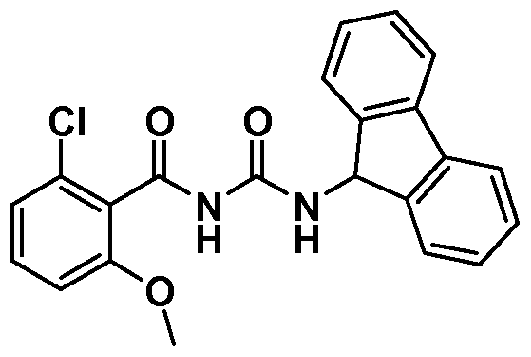
将实施例 15中的 2-氯苯甲酰胺替换成 2-氯 -6-甲氧基苯甲酰胺,其余所需 原料、 试剂及制备方法同实施例 13 ~ 15, 得类白色固体化合物 IB-14。 收率 44%; Mp 258-260 °C; 1H-NMR (400Hz, DMSO-i¾ δ: 3.75 (3H, s), 5.89 (IH, d, C-H), 7.02 (2H, d, Ar-H), 7.10 (2H, d, Ar-H), 7.38(2H, t, Ar-H), 7.34 (IH, t, Ar-H) 7.34-7.53 (7H, m, Ar-H), 7.62 (2H, d, Ar-H), 7.78 (IH, d, Ar-H), 7.81 (2H, d, Ar-H), 8.69(1H, d, N-H), 11.23 (IH, s, N-H); EI-MS m/z 392.2 (M+), 180.1 (100%)
实施例 29 1-芴 -3-(2-氟 -6-苄氧基苯甲酰)脲 (化合物 IB的一种 (IB-15))
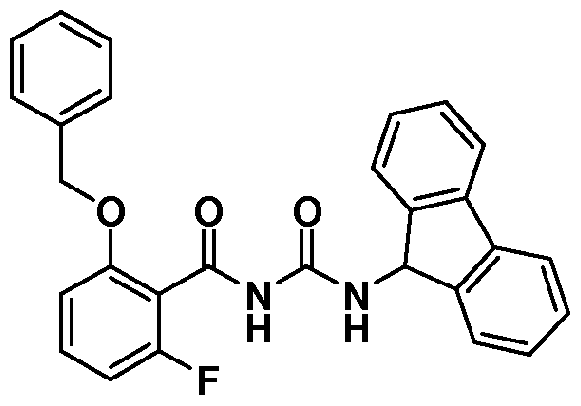
将实施例 15中的 2-氯苯甲酰胺替换成 2-氟 -6-苄氧基苯甲酰胺,其余所需 原料、 试剂及制备方法同实施例 13 〜 15, 得类白色固体化合物 IB-15。 收率
36%; Mp 242-244。C; Ή-ΝΜΚ_(400Ηζ, DMSO-^) δ: 5.15 (2H, s, -OCH2), 5.97 (IH, d, C-H), 6.95 (2H, d, Ar-H), 7.24-7.73 (13H, m, Ar-H), 7.42-750(3H, m, Ar-H), 7.54 (IH, d, Ar-H), 7.62 (2H, d, Ar-H), 7.88 (2H, d, Ar-H), 8.78 (IH, d, N-H) , 11.03 (IH, s, N-H); EI-MS m/z 542.3 (M+), 206.1 (100%)。
实施例 30 1-芴 -3-(2-甲巯基苯甲酰)脲 (化合物 IB的一种 (IB-16》

将实施例 15中的 2-氯苯甲酰胺替换成 2-甲巯基苯甲酰胺,其余所需原料、 试剂及制备方法同实施例 13 ~ 15, 得白色固体化合物 ΙΒ-16。 收率 46%; Mp 204-207 。C; 1H-NMR (400Hz, DMSO-^) δ: 2.40(3H, s, -SCH3), 5.99 (IH, d, C-H), 7.22 (2H, d, Ar-H), 7.35-7.40 (3H, m, Ar-H), 7.42-750(3H, m, Ar-H), 7.54 (IH, d, Ar-H), 7.62 (2H, d, Ar-H), 7.88 (2H, d, Ar-H), 8.78 (IH, d, N-H) , 11.03 (IH, s, N-H); EI-MS m/z 374.2 (M+), 180.1 (100%)。
实施例 31 1-芴 -3-(2-苄氧基苯甲酰)脲 (化合物 IB的一种 (IB-17))

将实施例 15中的 2-氯苯甲酰胺替换成 2-苄氧基苯甲酰胺,其余所需原料、 试剂及制备方法同实施例 13 〜 15, 得浅黄色固体化合物 IB-17。 收率 43%; Mp 204-207。C; 1H-NMR (400Hz, DMSO-i 6) δ: 5.27 (2H, s,-CH2), 5.98 (IH, d, -CH), 7.06 (IH, q, Ar-H), 7.28 (IH, d, Ar-H), 7.32-7.46 (7H, m, Ar-H), 7.53 (3H, d, Ar-H), 7.63 (2H, d, Ar-H), 7.65 (2H, dd, Ar-H), 7.88 (2H, d, Ar-H), 8.79 (IH, s, N-H), 10.54(1H, d, N-H); EI-MS m/z 434.3 (M 180.1 (100%)。
实施例 32 邻硝基苯甲酰异氰酸酯 (中间体 XV)
 将 1.66克邻硝基苯甲酰胺溶于 10毫升干燥甲苯中,室温下慢慢滴加 2.52 克草酰氯, 待反应放热结束后, 加热回流 5 小时, 使悬浮固体全部溶解, 反 应液变澄清且无氯化氢气体放出, 结束反应, 将反应液减压蒸馏除去过量的 甲苯和草酰氯, 得淡黄色油状液体中间体 XV, 无须进一歩纯化, 立即用于下 一歩反应或密封保存备用。
实施例 33 1-芴 -3-(2-硝基苯甲酰)脲 (化合物 Ic的一种 (Ic-1》

将 0.2克邻硝基苯甲酰异氰酸酯 (XV)和 0.18 克 9-芴胺 (XIII)加入到 10 毫升甲苯中, 回流反应 10小时。减压蒸除溶剂, 残余物用硅胶柱层析分离 (乙 酸乙酯 /石油醚 =1/1),得到黄色固体产物化合物 Ic-1。收率 37%; Mp 230-232 °C; 1H-NM (400Hz, DMSO-t¾ δ: 5.96 (IH, d, C-H), 7.36 (2H, t, Ar-H), 7.43 (2H, t, Ar-H), 7.60 (2H, d, Ar-H), 7.84-8.16 (3H, m, Ar-H), 8.16 (IH, d, Ar-H), 8.53 (1H, d, N-H), 11.28 (IH, s, N-H); EI-MS m/z 373.2 (M+), 180.1 (100%)。
实施例 34 1-芴 -3-(2-胺基苯甲酰)脲 (化合物 Ic的一种 (Ic-2》

在 25毫升茄型瓶中加入 35毫克的 1-芴 -3-(2-硝基苯甲酰)脲 (Ic-1), 0.75 毫克氯化铵, 50毫克 Fe粉,在 10毫升 THF中回流反应 1小时。反应完过滤, 滤液蒸干,用少量乙醚洗涤,得淡黄色固体化合物 Ic-2。收率 90%; Mp 194-197 。C; 1H-NMR (400Hz, DMSO-^) δ: 6.02 (IH, d, C-H), 6.49 (IH, t, Ar-H), 6.72 (lH,d, Ar-H), 7.18 (IH, t, Ar-H), 7.21 (2H, t, Ar-H), 7.35 (2H, d, Ar-H), 7.63 (2H, d, Ar-H), 7.70 (IH, d, Ar-H), 7.87 (2H, d, Ar-H), 8.95 (1H, d, N-H), 10.56 (IH, s, N-H); EI-MS m/z 353.2 (M+), 207.1 (100%)。
实施例 35 本发明化合物对 CypA肽基脯氨酰顺反异构酶百分抑制活性的测 定
(l)CypA蛋白的表达和纯化
将构建好的质粒 PET15b-CypA转入大肠杆菌 BL21中得到表达工程菌, 将工程菌培养于含 100 g/mL氨苄青霉素的 10 mL LB培养基中培养过夜 (蛋白胨 10 g/L, 酵母提取物 5 g/L, 氯化钠 10 g/L)。然后按 1 : 100转接入 1 L含氨苄青霉素的新鲜 LB培养基中, 37 °C 220转 /分培养。当 OD6Q。达到约 0.8时, 加入 IPTG(异丙基 β-D硫代半乳糖苷, 1 M溶液)至终浓度 0.5 mM, 同时将温度降到 25。C培养 5小时进行蛋白的诱导表达。 4000转 /分离心 30 分钟收集菌体, 收集好后放于 -80 °C超低温冰箱保存过夜。 将菌体用 20 mL 的结合缓冲液 (20 mM Tris-Cl, 0.5 M NaCl, 5 mM 咪唑, pH8.0)悬起, 将悬 浮液冰浴上超声波破碎 (300W, 工作 30 分钟, 一次 5秒, 中间间隔 10秒)。 破碎后得到的细胞匀浆在 4°C以 10000转 /分离心 30分钟, 保留上清。之后 该蛋白粗提液注入预先用结合缓冲液平衡好的 Ni-NTA树脂中,在 4 °C充分 结合 1小时,再分别用 10倍柱体积的结合缓冲液和 10倍柱体积的清洗缓冲 液 (20 mM Tris-Cl, 0.5 M NaCl, 60 mM 咪唑, pH8.0)冲洗树脂, 去除与树 脂有非特异性吸附的杂蛋白,最后用洗脱缓冲液 (20 mM Tris-Cl, 0.5 M NaCl, 100 mM咪唑, pH 8.0)10 mL洗脱树脂, 收集洗脱的 hCypA。 用 SDS-PAGE 检测蛋白的分子量和纯度。 透析好的蛋白即可进行酶活测定。
(2)本发明化合物对 CypA抑制活性的测定
依据标准糜蛋白
 1991, 30 (25): 6127-6134) , 测 定目标物的肽脯氨酸顺反异构酶 (PPIase)活性。 整个试验在恒温 4 °C下进 行, 酶作用底物为 Suc-Ala-Ala-cis-Pro-Phe-pNA, 用含有 400 mM LiCl的四 氢呋喃溶解成 3.8 mM的母液。 糜蛋白酶溶解到 I mM的 HC1溶液中, 配成 3 mg/mL的母液。 首先向 519 反应缓冲液 (50 mM HEPES , 100 mM NaCl) 中加入 30 μ∑ hCyPA蛋白母液 (终浓度 10 g/ml)和溶于 DMSO的待测化合物 溶液 (终浓度为 10 μΜ), 在冰上预冷, 将它们加到石英杯中, 再加入 15 糜 蛋白酶, 最后加入 12 底物起始反应。 4 °C下 390 nM处通过 U-2010分光 光度计每隔 0.1秒检测光吸收强度的变化并收集数据, 1分钟之后,反应结束。 每个反应重复 3次。 利用反应前 6秒的线性增长的斜率 (Κ)来表示 CypA酶的 活力大小。 用下列公式得出待测化合物在 10 μΜ下百分抑制率,
计算公式为:
(阳性对照组 Κ值一实验组 Κ值 y (阳性对照组 K值一阴性实验组 K值) x lOO %
其中阳性对照组 κ值为不加待测化合物所测值, 阴性对照组 K值为不 加待测化合物和 CypA所测值。
(3)化合物活性测试结果
表 1 取代苯甲酰脲类化合物对 CypA抑制率数据
百分抑制率 百分抑制率 序号 编号 序号 编号
(10 μΜ) (10 μΜ)
1 IA-1 18.2% 15 ΙΒ-6 91.6%
2 IA-2 22.4% 16 ΙΒ-7 95.0%

8 IA-8 12.4% 22 ΙΒ-13 16.5%
9 IA-9 36.2% 23 ΙΒ-14 13.9%
10 IB-1 60.5% 24 ΙΒ-15 0
11 IB-2 79.5% 25 ΙΒ-16 14.6%
12 IB-3 90.0% 26 ΙΒ-Π 88.6%
13 IB-4 18.6% 27 Ic-1 78.1%
14 IB-5 0 28 Ic-2 34.6% 由表 1可以看出, 本发明的具有结构通式 (I)的取代苯甲酰脲类化合物大 部分具有较强的 CypA抑制活性, 说明本发明的化合物为 CypA抑制剂。 实施例 36 本发明部分化合物对 CypA半数有效抑制浓度 (IC5a)的测定
选取 10 μΜ抑制率在 50 %以上的化合物测 IC5Q, 选择合适的化合物浓度 梯度, 实验方法和体系如实施例 35。 根据化合物在不同浓度下对 CypA酶活 的反应速率 K, 计算化合物在不同浓度下对 CypA 酶活的抑制率, 使用 Sigmoidal公式用 origin软件进行拟合得到化合物的 IC5。值, 结果见表 2和附 图。
表 2 取代苯甲酰脲类化合物对 CypA酶活抑制 IC5。值 序号 编号 IC5o (nM) 序号 编号 ICso (nM)

4 IB-2 72.1 10 IB-H 1910

由表 2可以看出, 本发明的具有结构通式 (I)的部分取代苯甲酰脲类化合 物具有纳摩级 (nM)的 CypA蛋白酶抑制活性,说明本发明的化合物为 CypA抑 伟1 J齐 II。
化合物 IA-3、 IA-5, IB-1. IB-2、 IB-3、 IB-6、 IB-7、 IB-8、 IB-9、 IB-11、 IB-17 和 IC-1对 CypA酶活抑制的量效曲线图见图 1〜 图 12。 由量效曲线图可以看 出, 这 12个抑制剂对 CypA酶的抑制活性具有较好的浓度依赖性。
产业上利用的可能性
本发明的取代苯甲酰脲类化合物的制备方法具有反应条件温和、 原料丰 富易得、 操作及后处理简单等优点。
本发明的取代苯甲酰脲类化合物在从头药物设计以及在 CypA 抑制试验 中均显示了阳性结果, 印证了其药理作用机制。 因此, 本发明的化合物可用 于制备 CypA抑制剂并发展为免疫抑制药物或抗 HIV-1药物。
Claims
1、 一种具有通式 (I)结构的取代苯甲酰脲类化合物:

I
其中:
和 各自独立地选自氢, crc6直链或支链的垸基、 烷氧基和垸硫基, 羟基, 硝基, 氨基, 卤素, 氰基, 三氟甲基和苄氧基;
R3选自以下结构:

II III IV

V VI VII
其中, X选自 N、 0和 S ; m是 0 ~ 2的整数; n是 1 ~ 3的整数; p是 0 ~ 3的整数;
R4、 和116各自独立地选自氢, -C6直链或支链的垸基, C C4烷氧基, 卤素, 氰基, 硝基, 氨基, 羟基, 三氟甲基, 羧基, 巯基和 C C4酰基;
芳香基 Ar选自取代或未取代的苯基或萘基, 其取代基是 1 ~ 4个选自卤 素、 CrC6直链或支链烃基、 羟基、 ^-^烷氧基、 CrC4不饱和烃氧基、 羧基、 羧基取代的 C C6烷氧基、 氰基、 硝基、 氨基、 三氟甲基、 三氟甲氧基、 巯基 和 C C4酰基的基团。
2、 根据权利要求 1所述的具有通式 (I)结构的取代苯甲酰脲类化合物, 其 特征在于, 通式 φ中,
R3选自咕吨基, 芴基, 2,3-二氢-茚 -1-基, R4取代的环己基, R5和 R6取
代的二苯甲基以及未取代或被 1 ~ 2个选自卤素、 d-C6直链或支链烷基、 羟 基、 CrC4垸氧基、 羧基、 氰基、 硝基、 氨基、 三氟甲基、 三氟甲氧基和巯基 的基团取代的萘基、 苯基、 苯甲基和苯乙基; 其中, R4、 1¾5和 各自独立地 选自氢, C C6直链或支链的垸基, C C4垸氧基, 卤素, 氰基, 硝基, 氨基, 羟基, 三氟甲基, 羧基, 巯基和 -C4酰基中。
3、 根据权利要求 1所述的具有通式 (I)结构的取代苯甲酰脲类化合物, 其 特征在于, 为下述化合物 IA:

I A
其中, R3的定义同权利要求 1。
4、 根据权利要求 1所述的具有通式 (I)结构的取代苯甲酰脲类化合物, 其 特征在于, 为下述化合物 IB:

5、 根据权利要求 1所述的具有通式 (I)结构的取代苯甲酰脲类化合物, 其 特征在于, 为下述化合物 Ic:

6、 根据权利要求 1所述的具有通式 (I)结构的取代苯甲酰脲类化合物, 其 特征在于, 所述化合物为:
1-(1-咕吨基 3-(2,6-二羟基苯甲酰)脲、 1-萘 -3-(2,6-二羟基苯甲酰)脲、 1-
苯甲基 -3-(2,6-二羟基苯甲酰:)脲、 1-苯乙基 -3-(2,6-二羟基苯甲酰:)脲、 1-环己基 -3-(2,6-二羟基苯甲酰)脲、 1-苯基 -3-(2,6-二羟基苯甲酰)脲、 1-(4-氟苯基 )-3-(2,6- 二羟基苯甲酰)脲、 1-(2,3-二氢-茚 -1-基;) -3-(2,6-二羟基苯甲酰:)脲、 1-二苯甲基 -3-(2,6-二羟基苯甲酰)脲、 1-芴 -3-(2-氯苯甲酰)脲、 1-芴 -3-(2-氰基苯甲酰)脲、 1-芴 -3-(2-氟苯甲酰)脲、 1-芴 -3-(2-甲氧基苯甲酰)脲、 1-芴 -3-(2-甲基苯甲酰)脲、 丄 -芴 -3—(2-三氟甲基苯甲酰)脲、 1-芴 -3-(2,6-二氟苯甲酰)脲、 1-芴 -3-(2,6-二氯苯 甲酰)脲、 1-芴 -3-(2-氯 -6-氟苯甲酰:)脲、 1-芴 -3- (苯甲酰)脲、 1-芴 -3-(2-氟 -6-甲 巯基苯甲酰)脲、 1—芴—3-(2-氟 -6-甲氧基苯甲酰)脲、 1-芴 -3-(2-氯 -6-甲巯基苯甲 酰)脲、 1-芴 -3-(2-氯 -6-甲氧基苯甲酰)脲、 1-芴 -3-(2-氟 -6-苄氧基苯甲酰)脲、 1- 芴 -3-(2-甲巯基苯甲酰)脲、 1-芴 -3-(2-苄氧基苯甲酰)脲、 1-芴 -3-(2-硝基苯甲酰) 脲或 1-芴 -3-(2-胺基苯甲酰)脲。
7、 一种权利要求 1所述的具有通式 (I)结构的取代苯甲酰脲类化合物的制 备方法, 其特征在于, 采用以下三种方法中的任意一种:
方法一:
1)将苄醇钠和 2,6-二氟苯腈溶于二甲亚砜中, 快速升温至 110 ~ 130 °C后 搅拌 5 〜 10小时; 冷至室温, 向反应液中加入冰水, 搅拌 30分钟, 析出大量 固体, 抽滤, 水洗, 干燥, 得白色固体; 用乙醇重结晶得白色片状晶体 2,6- 二苄氧基苯腈 VIII;
2)将歩骤 1)得到的化合物 VIII溶于苄醇中, 并加入氢氧化钾和少量水, 120〜 140 °C下搅拌 10 ~ 15小时; 减压蒸馏除去溶剂, 向残余物中加入冰水, 搅拌 30分钟, 析出大量固体, 抽滤, 水洗, 干燥, 得白色固体; 将其用硅胶 柱层析分离纯化, 得到白色粉末状固体 2,6-二苄氧基苯甲酰胺 IX;
3)将三光气溶于 1,2-二氯乙垸中, 冷却至 0 〜 5 °C, 将溶于 1,2-二氯乙烧 的 R3取代胺类化合物 R3-NH2缓慢滴加入含有三光气的反应液中, 加毕, 继 续冰浴冷却下搅拌反应 30分钟,后升温至室温反应 1小时,然后加热至回流, 当反应液呈无色透明状时, 将三乙胺加入反应液中, 继续回流 30分钟; 减压 蒸馏除去溶剂, 加入甲苯, 抽滤, 滤液蒸干得到淡黄色固体, 为 取代的异 氰酸酯 X;
4)将歩骤 2)和歩骤 3)得到的化合物 IX和 X溶入甲苯中,加热至回流反应 10 〜 15小时; 减压蒸除反应溶剂得到淡黄色固体, 将其用硅胶柱层析分离纯 化, 得到 1- 取代 -3-(2,6-二苄氧基苯甲酰基)脲 XI;
5)将步骤 4)得到的化合物 XI加入 45%的溴化氢醋酸溶液中,控温 50 °C下搅拌 5 ~ 10小时; 将反应液倾入冰水中, 搅拌 30分钟, 析出大量固 抽滤, 水洗, 干燥, 得 1- 取代 -3-(2,6-二羟基苯甲酰基)脲 IA;
甲酰化

VIII IX XI IA
其中, 的定义同权利要求 1 ; 或
方法二:
1)将 9-芴酮与盐酸羟胺加入 70%乙醇水溶液中, 回流搅拌 2 ~ 5小时; 将 反应液倾入冰水中, 析出大量黄色固体, 抽滤, 水洗, 干燥, 得黄色固体 9- 芴肟 XII;
2)将歩骤 1)得到的化合物 XII加入含少量水的醋酸溶液中, 加热至回流; 将 Zn粉缓慢加入反应液中, 继续反应 1 ~ 3小时; 将反应液乘热过滤, 滤液 经减压蒸馏除去大部分溶剂, 抽滤, 得 9-芴胺醋酸盐; 将其加入稀盐酸中, 冰浴冷却下搅拌 10〜 15小时; 抽滤, 得 9-芴胺盐酸盐; 将 9-芴胺盐酸盐加入 氨水中搅拌 1 ~ 3小时, 抽滤, 氨水洗涤并干燥; 用石油醚重结晶, 得白色针 状结晶 9-芴胺 XIII;
3)将三光气溶于 1,2-二氯乙烷中, 冰浴冷却至 0 ~ 5 °C, 将溶于 1,2-二氯 乙烷的 9-芴胺 XIII缓慢滴加入含有三光气的反应液中, 加毕, 继续冰浴冷却 下搅拌反应 30分钟, 后升温至室温反应 1小时, 然后加热至回流, 当反应液 呈无色透明状时, 将三乙胺加入反应液中, 继续回流 30分钟; 减压蒸馏除去 溶剂, 加入甲苯, 抽滤, 滤液蒸干得到淡黄色固体, 为 9-芴异氰酸酯 XIV;
4)将歩骤 3)得到的化合物 XIV和 二取代苯甲酰胺溶入甲苯中, 加 热至回流反应 10 ~ 15小时; 减压蒸除反应溶剂得到淡黄色固体, 将其用硅胶 柱层析分离纯化, 得到 1-芴 -3-(RhR2-二取代苯甲酰基:)脲 IB ;

方法三:
1)将 2-硝基 - 取代-苯甲酰胺溶于干燥甲苯中, 控温 20 ~ 30 °C, 慢慢滴 加草酰氯, 待反应放热结束后, 加热回流 3-5小时, 使悬浮固体全部溶解, 反 应液变澄清且无氯化氢气体放出, 结束反应, 将反应液减压蒸馏除去过量的 甲苯和草酰氯, 得 2-硝基 - 取代 -苯甲酰异氰酸酯 XV;
2)将歩骤 1)得到的化合物 XV和 IB合成中歩骤 3)得到的 9-芴胺 XIII溶入 甲苯中, 加热至回流反应 10 ~ 15小时; 减压蒸除反应溶剂, 将残余物用硅胶 柱层析分离纯化, 得到 1-芴 -3-(2-硝基 - 取代 -苯甲酰基)脲 Ic-1;
3)将步骤 2)得到的化合物 Ic-1, 氯化铵和 Fe粉投入到 THF中, 回流反应 1 ~ 3小时; 冷至室温, 抽滤, 滤液被减压蒸除溶剂, 将残余物用硅胶柱层析 分离纯化, 得 1-芴 -3-(2-氨基 - 取代-苯甲酰基)脲 Ic-2;

其中, 的定义同权利要求 1。
8、 权利要求 1 〜 6中任一项所述的取代苯甲酰脲类化合物作为 CypA抑 制剂的应用。
9、 权利要求 1 〜 6中任一项所述的取代苯甲酰脲类化合物在制备预防或 治疗 CypA介导的疾病的药物中的应用。
10、根据权利要求 9所述的应用, 其特征在于, 所述 CypA介导的疾病包 括移植排斥反应、 由移植引起的宿主疾病、 自身免疫疾病和 HIV-1入侵感染。
11、 一种药物组合物, 其特征在于, 该药物组合物包含治疗有效量的一 种或多种权利要求 1 ~ 6中任一项所述的取代苯甲酰脲类化合物以及药学上可 接受的赋形剂、 载体或稀释剂。
12、 根据权利要求 11所述的药物组合物, 其特征在于, 所述的取代苯甲 酰脲类化合物占该药物组合物总重量的 0.001-99.9%。
Applications Claiming Priority (2)
| Application Number | Priority Date | Filing Date | Title |
|---|---|---|---|
| CN200910050646.X | 2009-05-05 | ||
| CN200910050646A CN101880246B (zh) | 2009-05-05 | 2009-05-05 | 取代苯甲酰脲类化合物及其制备方法和用途 |
Publications (1)
| Publication Number | Publication Date |
|---|---|
| WO2010127558A1 true WO2010127558A1 (zh) | 2010-11-11 |
Family
ID=43049951
Family Applications (1)
| Application Number | Title | Priority Date | Filing Date |
|---|---|---|---|
| PCT/CN2010/000628 Ceased WO2010127558A1 (zh) | 2009-05-05 | 2010-05-04 | 取代苯甲酰脲类化合物及其制备方法和用途 |
Country Status (2)
| Country | Link |
|---|---|
| CN (1) | CN101880246B (zh) |
| WO (1) | WO2010127558A1 (zh) |
Cited By (1)
| Publication number | Priority date | Publication date | Assignee | Title |
|---|---|---|---|---|
| WO2014120790A1 (en) * | 2013-01-30 | 2014-08-07 | The Regents Of The University Of California | Small molecules to block signaling pathway |
Families Citing this family (6)
| Publication number | Priority date | Publication date | Assignee | Title |
|---|---|---|---|---|
| CN102453016A (zh) * | 2010-10-29 | 2012-05-16 | 华东理工大学 | N-(2,6-二苄氧基苯甲酰基)-n’-取代脲类化合物及其制备方法和用途 |
| CN103288823B (zh) * | 2012-02-23 | 2015-02-18 | 华东理工大学 | N,n’-芳基取代脲类化合物及其用途 |
| CN103992245A (zh) * | 2014-05-23 | 2014-08-20 | 华东理工大学 | 取代脲类化合物及其用途 |
| CN104058996B (zh) * | 2014-06-23 | 2016-01-20 | 清华大学 | 抗丙型肝炎病毒化合物及其制备方法和应用 |
| CN115028680B (zh) * | 2022-08-11 | 2023-01-20 | 深圳湾实验室 | 一种靶向降解Cyclophilin A的PROTAC化合物及其制备方法与应用 |
| CN119192064B (zh) * | 2023-06-25 | 2025-11-25 | 中国石油化工股份有限公司 | 双缩合席夫碱及含有其的组合物 |
Citations (2)
| Publication number | Priority date | Publication date | Assignee | Title |
|---|---|---|---|---|
| EP0136745A2 (en) * | 1983-09-01 | 1985-04-10 | Duphar International Research B.V | Benzoyl urea derivatives having anti-tumor activity |
| CN101108187A (zh) * | 2006-07-20 | 2008-01-23 | 复旦大学 | 一种化合物在制备抗艾滋病药物中的应用 |
-
2009
- 2009-05-05 CN CN200910050646A patent/CN101880246B/zh not_active Expired - Fee Related
-
2010
- 2010-05-04 WO PCT/CN2010/000628 patent/WO2010127558A1/zh not_active Ceased
Patent Citations (2)
| Publication number | Priority date | Publication date | Assignee | Title |
|---|---|---|---|---|
| EP0136745A2 (en) * | 1983-09-01 | 1985-04-10 | Duphar International Research B.V | Benzoyl urea derivatives having anti-tumor activity |
| CN101108187A (zh) * | 2006-07-20 | 2008-01-23 | 复旦大学 | 一种化合物在制备抗艾滋病药物中的应用 |
Non-Patent Citations (1)
| Title |
|---|
| NI, SHUAISHUAI ET AL.: "Discovering Potent Small Molecule Inhibitors of Cyclophilin A Using de Novo Drug Design Approach", J. MED. CHEM., vol. 52, no. 17, 19 August 2009 (2009-08-19), pages 5295 - 5298 * |
Cited By (1)
| Publication number | Priority date | Publication date | Assignee | Title |
|---|---|---|---|---|
| WO2014120790A1 (en) * | 2013-01-30 | 2014-08-07 | The Regents Of The University Of California | Small molecules to block signaling pathway |
Also Published As
| Publication number | Publication date |
|---|---|
| CN101880246B (zh) | 2012-10-03 |
| CN101880246A (zh) | 2010-11-10 |
Similar Documents
| Publication | Publication Date | Title |
|---|---|---|
| WO2010127558A1 (zh) | 取代苯甲酰脲类化合物及其制备方法和用途 | |
| EP2518067B1 (fr) | Dérives de n-[(1h-pyrazol-1-yl)aryl]-1h-indole ou 1h- indazole-3-carboxamide et leurs applications en thérapeutique comme antagonistes de p2y12. | |
| CN114292272A (zh) | 一种核苷类化合物及其用途 | |
| CN110092745B (zh) | 一种含芳环的化合物及其应用 | |
| CN103874414A (zh) | 用于制备大环内酰胺类的方法和中间体 | |
| PL191489B1 (pl) | Pochodna 2-arylo-8-oksodihydropuryny, sposób jej wytwarzania i jej zastosowanie, zawierająca ją kompozycja farmaceutyczna, zawierający ją środek do leczenia oraz zawierający ją środek przeciwlękowy | |
| CN108602835A (zh) | Pde1抑制剂 | |
| JP7030791B2 (ja) | チアゾール誘導体及びその応用 | |
| CN103842372A (zh) | 环孢菌素衍生物 | |
| CN106967004B (zh) | 含脲基的ido1和ido2双重抑制剂、其制法及其医药用途 | |
| WO2022116714A1 (zh) | 一类化合物及其用于新型冠状病毒肺炎的医药用途 | |
| WO2016127916A1 (zh) | 作为长效dpp-iv抑制剂的取代的氨基六元饱和杂脂环类 | |
| CN110753683A (zh) | 咔唑化合物及其使用方法 | |
| CN109748914B (zh) | 吡啶并嘧啶类化合物及其应用 | |
| CN117209556A (zh) | 一类氰基化合物、其制备方法及用途 | |
| CA2275610A1 (en) | Modulators of proteins with phosphotyrosine recognition units | |
| CN106892878B (zh) | 噻唑类衍生物及其在抑制二氢乳清酸脱氢酶中的应用 | |
| CN115353508B (zh) | 5-吡啶-1h-吲唑类化合物、药物组合物和应用 | |
| KR20110021799A (ko) | Ikk-베타 세린-트레오닌 단백질 키나아제의 억제제 | |
| CN115974855A (zh) | Ezh2和hdac双靶点抑制剂、其药物组合物及其制备方法和用途 | |
| CN112694473B (zh) | 一种7,9-双取代小檗碱结构类似物及其制备方法和用途 | |
| CN102453016A (zh) | N-(2,6-二苄氧基苯甲酰基)-n’-取代脲类化合物及其制备方法和用途 | |
| WO2024061172A1 (zh) | 一种脯氨酰羟化酶抑制剂及其用途 | |
| CN115322120A (zh) | 一类小分子化合物及在制备治疗dhodh介导疾病药物中的用途 | |
| JP2001097946A (ja) | アシルスルホンアミド誘導体 |
Legal Events
| Date | Code | Title | Description |
|---|---|---|---|
| 121 | Ep: the epo has been informed by wipo that ep was designated in this application |
Ref document number: 10771961 Country of ref document: EP Kind code of ref document: A1 |
|
| NENP | Non-entry into the national phase |
Ref country code: DE |
|
| 122 | Ep: pct application non-entry in european phase |
Ref document number: 10771961 Country of ref document: EP Kind code of ref document: A1 |