WO2010123009A1 - 感放射線性樹脂組成物、重合体及びレジストパターン形成方法 - Google Patents
感放射線性樹脂組成物、重合体及びレジストパターン形成方法 Download PDFInfo
- Publication number
- WO2010123009A1 WO2010123009A1 PCT/JP2010/057022 JP2010057022W WO2010123009A1 WO 2010123009 A1 WO2010123009 A1 WO 2010123009A1 JP 2010057022 W JP2010057022 W JP 2010057022W WO 2010123009 A1 WO2010123009 A1 WO 2010123009A1
- Authority
- WO
- WIPO (PCT)
- Prior art keywords
- group
- carbon atoms
- general formula
- repeating unit
- hydrogen atom
- Prior art date
- Legal status (The legal status is an assumption and is not a legal conclusion. Google has not performed a legal analysis and makes no representation as to the accuracy of the status listed.)
- Ceased
Links
- 0 Cc(cc1)ccc1[S+](c1ccc(C)cc1)c1ccc(*)cc1 Chemical compound Cc(cc1)ccc1[S+](c1ccc(C)cc1)c1ccc(*)cc1 0.000 description 14
- UHOVQNZJYSORNB-UHFFFAOYSA-N c1ccccc1 Chemical compound c1ccccc1 UHOVQNZJYSORNB-UHFFFAOYSA-N 0.000 description 1
Images

Classifications
-
- G—PHYSICS
- G03—PHOTOGRAPHY; CINEMATOGRAPHY; ANALOGOUS TECHNIQUES USING WAVES OTHER THAN OPTICAL WAVES; ELECTROGRAPHY; HOLOGRAPHY
- G03F—PHOTOMECHANICAL PRODUCTION OF TEXTURED OR PATTERNED SURFACES, e.g. FOR PRINTING, FOR PROCESSING OF SEMICONDUCTOR DEVICES; MATERIALS THEREFOR; ORIGINALS THEREFOR; APPARATUS SPECIALLY ADAPTED THEREFOR
- G03F7/00—Photomechanical, e.g. photolithographic, production of textured or patterned surfaces, e.g. printing surfaces; Materials therefor, e.g. comprising photoresists; Apparatus specially adapted therefor
- G03F7/004—Photosensitive materials
- G03F7/039—Macromolecular compounds which are photodegradable, e.g. positive electron resists
- G03F7/0392—Macromolecular compounds which are photodegradable, e.g. positive electron resists the macromolecular compound being present in a chemically amplified positive photoresist composition
- G03F7/0397—Macromolecular compounds which are photodegradable, e.g. positive electron resists the macromolecular compound being present in a chemically amplified positive photoresist composition the macromolecular compound having an alicyclic moiety in a side chain
-
- C—CHEMISTRY; METALLURGY
- C08—ORGANIC MACROMOLECULAR COMPOUNDS; THEIR PREPARATION OR CHEMICAL WORKING-UP; COMPOSITIONS BASED THEREON
- C08F—MACROMOLECULAR COMPOUNDS OBTAINED BY REACTIONS ONLY INVOLVING CARBON-TO-CARBON UNSATURATED BONDS
- C08F220/00—Copolymers of compounds having one or more unsaturated aliphatic radicals, each having only one carbon-to-carbon double bond, and only one being terminated by only one carboxyl radical or a salt, anhydride ester, amide, imide or nitrile thereof
- C08F220/02—Monocarboxylic acids having less than ten carbon atoms; Derivatives thereof
- C08F220/10—Esters
- C08F220/12—Esters of monohydric alcohols or phenols
- C08F220/16—Esters of monohydric alcohols or phenols of phenols or of alcohols containing two or more carbon atoms
- C08F220/18—Esters of monohydric alcohols or phenols of phenols or of alcohols containing two or more carbon atoms with acrylic or methacrylic acids
-
- C—CHEMISTRY; METALLURGY
- C08—ORGANIC MACROMOLECULAR COMPOUNDS; THEIR PREPARATION OR CHEMICAL WORKING-UP; COMPOSITIONS BASED THEREON
- C08F—MACROMOLECULAR COMPOUNDS OBTAINED BY REACTIONS ONLY INVOLVING CARBON-TO-CARBON UNSATURATED BONDS
- C08F220/00—Copolymers of compounds having one or more unsaturated aliphatic radicals, each having only one carbon-to-carbon double bond, and only one being terminated by only one carboxyl radical or a salt, anhydride ester, amide, imide or nitrile thereof
- C08F220/02—Monocarboxylic acids having less than ten carbon atoms; Derivatives thereof
- C08F220/10—Esters
- C08F220/12—Esters of monohydric alcohols or phenols
- C08F220/16—Esters of monohydric alcohols or phenols of phenols or of alcohols containing two or more carbon atoms
- C08F220/18—Esters of monohydric alcohols or phenols of phenols or of alcohols containing two or more carbon atoms with acrylic or methacrylic acids
- C08F220/1806—C6-(meth)acrylate, e.g. (cyclo)hexyl (meth)acrylate or phenyl (meth)acrylate
-
- C—CHEMISTRY; METALLURGY
- C08—ORGANIC MACROMOLECULAR COMPOUNDS; THEIR PREPARATION OR CHEMICAL WORKING-UP; COMPOSITIONS BASED THEREON
- C08F—MACROMOLECULAR COMPOUNDS OBTAINED BY REACTIONS ONLY INVOLVING CARBON-TO-CARBON UNSATURATED BONDS
- C08F220/00—Copolymers of compounds having one or more unsaturated aliphatic radicals, each having only one carbon-to-carbon double bond, and only one being terminated by only one carboxyl radical or a salt, anhydride ester, amide, imide or nitrile thereof
- C08F220/02—Monocarboxylic acids having less than ten carbon atoms; Derivatives thereof
- C08F220/10—Esters
- C08F220/12—Esters of monohydric alcohols or phenols
- C08F220/16—Esters of monohydric alcohols or phenols of phenols or of alcohols containing two or more carbon atoms
- C08F220/18—Esters of monohydric alcohols or phenols of phenols or of alcohols containing two or more carbon atoms with acrylic or methacrylic acids
- C08F220/1807—C7-(meth)acrylate, e.g. heptyl (meth)acrylate or benzyl (meth)acrylate
-
- C—CHEMISTRY; METALLURGY
- C08—ORGANIC MACROMOLECULAR COMPOUNDS; THEIR PREPARATION OR CHEMICAL WORKING-UP; COMPOSITIONS BASED THEREON
- C08F—MACROMOLECULAR COMPOUNDS OBTAINED BY REACTIONS ONLY INVOLVING CARBON-TO-CARBON UNSATURATED BONDS
- C08F220/00—Copolymers of compounds having one or more unsaturated aliphatic radicals, each having only one carbon-to-carbon double bond, and only one being terminated by only one carboxyl radical or a salt, anhydride ester, amide, imide or nitrile thereof
- C08F220/02—Monocarboxylic acids having less than ten carbon atoms; Derivatives thereof
- C08F220/10—Esters
- C08F220/12—Esters of monohydric alcohols or phenols
- C08F220/16—Esters of monohydric alcohols or phenols of phenols or of alcohols containing two or more carbon atoms
- C08F220/18—Esters of monohydric alcohols or phenols of phenols or of alcohols containing two or more carbon atoms with acrylic or methacrylic acids
- C08F220/1808—C8-(meth)acrylate, e.g. isooctyl (meth)acrylate or 2-ethylhexyl (meth)acrylate
-
- C—CHEMISTRY; METALLURGY
- C08—ORGANIC MACROMOLECULAR COMPOUNDS; THEIR PREPARATION OR CHEMICAL WORKING-UP; COMPOSITIONS BASED THEREON
- C08F—MACROMOLECULAR COMPOUNDS OBTAINED BY REACTIONS ONLY INVOLVING CARBON-TO-CARBON UNSATURATED BONDS
- C08F220/00—Copolymers of compounds having one or more unsaturated aliphatic radicals, each having only one carbon-to-carbon double bond, and only one being terminated by only one carboxyl radical or a salt, anhydride ester, amide, imide or nitrile thereof
- C08F220/02—Monocarboxylic acids having less than ten carbon atoms; Derivatives thereof
- C08F220/10—Esters
- C08F220/12—Esters of monohydric alcohols or phenols
- C08F220/16—Esters of monohydric alcohols or phenols of phenols or of alcohols containing two or more carbon atoms
- C08F220/18—Esters of monohydric alcohols or phenols of phenols or of alcohols containing two or more carbon atoms with acrylic or methacrylic acids
- C08F220/1811—C10or C11-(Meth)acrylate, e.g. isodecyl (meth)acrylate, isobornyl (meth)acrylate or 2-naphthyl (meth)acrylate
-
- C—CHEMISTRY; METALLURGY
- C08—ORGANIC MACROMOLECULAR COMPOUNDS; THEIR PREPARATION OR CHEMICAL WORKING-UP; COMPOSITIONS BASED THEREON
- C08F—MACROMOLECULAR COMPOUNDS OBTAINED BY REACTIONS ONLY INVOLVING CARBON-TO-CARBON UNSATURATED BONDS
- C08F220/00—Copolymers of compounds having one or more unsaturated aliphatic radicals, each having only one carbon-to-carbon double bond, and only one being terminated by only one carboxyl radical or a salt, anhydride ester, amide, imide or nitrile thereof
- C08F220/02—Monocarboxylic acids having less than ten carbon atoms; Derivatives thereof
- C08F220/10—Esters
- C08F220/26—Esters containing oxygen in addition to the carboxy oxygen
- C08F220/28—Esters containing oxygen in addition to the carboxy oxygen containing no aromatic rings in the alcohol moiety
- C08F220/281—Esters containing oxygen in addition to the carboxy oxygen containing no aromatic rings in the alcohol moiety and containing only one oxygen, e.g. furfuryl (meth)acrylate or 2-methoxyethyl (meth)acrylate
-
- C—CHEMISTRY; METALLURGY
- C08—ORGANIC MACROMOLECULAR COMPOUNDS; THEIR PREPARATION OR CHEMICAL WORKING-UP; COMPOSITIONS BASED THEREON
- C08F—MACROMOLECULAR COMPOUNDS OBTAINED BY REACTIONS ONLY INVOLVING CARBON-TO-CARBON UNSATURATED BONDS
- C08F220/00—Copolymers of compounds having one or more unsaturated aliphatic radicals, each having only one carbon-to-carbon double bond, and only one being terminated by only one carboxyl radical or a salt, anhydride ester, amide, imide or nitrile thereof
- C08F220/02—Monocarboxylic acids having less than ten carbon atoms; Derivatives thereof
- C08F220/10—Esters
- C08F220/26—Esters containing oxygen in addition to the carboxy oxygen
- C08F220/28—Esters containing oxygen in addition to the carboxy oxygen containing no aromatic rings in the alcohol moiety
- C08F220/282—Esters containing oxygen in addition to the carboxy oxygen containing no aromatic rings in the alcohol moiety and containing two or more oxygen atoms
-
- C—CHEMISTRY; METALLURGY
- C08—ORGANIC MACROMOLECULAR COMPOUNDS; THEIR PREPARATION OR CHEMICAL WORKING-UP; COMPOSITIONS BASED THEREON
- C08F—MACROMOLECULAR COMPOUNDS OBTAINED BY REACTIONS ONLY INVOLVING CARBON-TO-CARBON UNSATURATED BONDS
- C08F220/00—Copolymers of compounds having one or more unsaturated aliphatic radicals, each having only one carbon-to-carbon double bond, and only one being terminated by only one carboxyl radical or a salt, anhydride ester, amide, imide or nitrile thereof
- C08F220/02—Monocarboxylic acids having less than ten carbon atoms; Derivatives thereof
- C08F220/10—Esters
- C08F220/26—Esters containing oxygen in addition to the carboxy oxygen
- C08F220/28—Esters containing oxygen in addition to the carboxy oxygen containing no aromatic rings in the alcohol moiety
- C08F220/283—Esters containing oxygen in addition to the carboxy oxygen containing no aromatic rings in the alcohol moiety and containing one or more carboxylic moiety in the chain, e.g. acetoacetoxyethyl(meth)acrylate
-
- C—CHEMISTRY; METALLURGY
- C08—ORGANIC MACROMOLECULAR COMPOUNDS; THEIR PREPARATION OR CHEMICAL WORKING-UP; COMPOSITIONS BASED THEREON
- C08F—MACROMOLECULAR COMPOUNDS OBTAINED BY REACTIONS ONLY INVOLVING CARBON-TO-CARBON UNSATURATED BONDS
- C08F220/00—Copolymers of compounds having one or more unsaturated aliphatic radicals, each having only one carbon-to-carbon double bond, and only one being terminated by only one carboxyl radical or a salt, anhydride ester, amide, imide or nitrile thereof
- C08F220/02—Monocarboxylic acids having less than ten carbon atoms; Derivatives thereof
- C08F220/10—Esters
- C08F220/38—Esters containing sulfur
-
- C—CHEMISTRY; METALLURGY
- C08—ORGANIC MACROMOLECULAR COMPOUNDS; THEIR PREPARATION OR CHEMICAL WORKING-UP; COMPOSITIONS BASED THEREON
- C08F—MACROMOLECULAR COMPOUNDS OBTAINED BY REACTIONS ONLY INVOLVING CARBON-TO-CARBON UNSATURATED BONDS
- C08F220/00—Copolymers of compounds having one or more unsaturated aliphatic radicals, each having only one carbon-to-carbon double bond, and only one being terminated by only one carboxyl radical or a salt, anhydride ester, amide, imide or nitrile thereof
- C08F220/02—Monocarboxylic acids having less than ten carbon atoms; Derivatives thereof
- C08F220/10—Esters
- C08F220/38—Esters containing sulfur
- C08F220/382—Esters containing sulfur and containing oxygen, e.g. 2-sulfoethyl (meth)acrylate
-
- G—PHYSICS
- G03—PHOTOGRAPHY; CINEMATOGRAPHY; ANALOGOUS TECHNIQUES USING WAVES OTHER THAN OPTICAL WAVES; ELECTROGRAPHY; HOLOGRAPHY
- G03F—PHOTOMECHANICAL PRODUCTION OF TEXTURED OR PATTERNED SURFACES, e.g. FOR PRINTING, FOR PROCESSING OF SEMICONDUCTOR DEVICES; MATERIALS THEREFOR; ORIGINALS THEREFOR; APPARATUS SPECIALLY ADAPTED THEREFOR
- G03F7/00—Photomechanical, e.g. photolithographic, production of textured or patterned surfaces, e.g. printing surfaces; Materials therefor, e.g. comprising photoresists; Apparatus specially adapted therefor
- G03F7/004—Photosensitive materials
- G03F7/0045—Photosensitive materials with organic non-macromolecular light-sensitive compounds not otherwise provided for, e.g. dissolution inhibitors
-
- G—PHYSICS
- G03—PHOTOGRAPHY; CINEMATOGRAPHY; ANALOGOUS TECHNIQUES USING WAVES OTHER THAN OPTICAL WAVES; ELECTROGRAPHY; HOLOGRAPHY
- G03F—PHOTOMECHANICAL PRODUCTION OF TEXTURED OR PATTERNED SURFACES, e.g. FOR PRINTING, FOR PROCESSING OF SEMICONDUCTOR DEVICES; MATERIALS THEREFOR; ORIGINALS THEREFOR; APPARATUS SPECIALLY ADAPTED THEREFOR
- G03F7/00—Photomechanical, e.g. photolithographic, production of textured or patterned surfaces, e.g. printing surfaces; Materials therefor, e.g. comprising photoresists; Apparatus specially adapted therefor
- G03F7/004—Photosensitive materials
- G03F7/0046—Photosensitive materials with perfluoro compounds, e.g. for dry lithography
-
- G—PHYSICS
- G03—PHOTOGRAPHY; CINEMATOGRAPHY; ANALOGOUS TECHNIQUES USING WAVES OTHER THAN OPTICAL WAVES; ELECTROGRAPHY; HOLOGRAPHY
- G03F—PHOTOMECHANICAL PRODUCTION OF TEXTURED OR PATTERNED SURFACES, e.g. FOR PRINTING, FOR PROCESSING OF SEMICONDUCTOR DEVICES; MATERIALS THEREFOR; ORIGINALS THEREFOR; APPARATUS SPECIALLY ADAPTED THEREFOR
- G03F7/00—Photomechanical, e.g. photolithographic, production of textured or patterned surfaces, e.g. printing surfaces; Materials therefor, e.g. comprising photoresists; Apparatus specially adapted therefor
- G03F7/20—Exposure; Apparatus therefor
- G03F7/2041—Exposure; Apparatus therefor in the presence of a fluid, e.g. immersion; using fluid cooling means
-
- G—PHYSICS
- G03—PHOTOGRAPHY; CINEMATOGRAPHY; ANALOGOUS TECHNIQUES USING WAVES OTHER THAN OPTICAL WAVES; ELECTROGRAPHY; HOLOGRAPHY
- G03F—PHOTOMECHANICAL PRODUCTION OF TEXTURED OR PATTERNED SURFACES, e.g. FOR PRINTING, FOR PROCESSING OF SEMICONDUCTOR DEVICES; MATERIALS THEREFOR; ORIGINALS THEREFOR; APPARATUS SPECIALLY ADAPTED THEREFOR
- G03F7/00—Photomechanical, e.g. photolithographic, production of textured or patterned surfaces, e.g. printing surfaces; Materials therefor, e.g. comprising photoresists; Apparatus specially adapted therefor
- G03F7/26—Processing photosensitive materials; Apparatus therefor
-
- C—CHEMISTRY; METALLURGY
- C08—ORGANIC MACROMOLECULAR COMPOUNDS; THEIR PREPARATION OR CHEMICAL WORKING-UP; COMPOSITIONS BASED THEREON
- C08F—MACROMOLECULAR COMPOUNDS OBTAINED BY REACTIONS ONLY INVOLVING CARBON-TO-CARBON UNSATURATED BONDS
- C08F220/00—Copolymers of compounds having one or more unsaturated aliphatic radicals, each having only one carbon-to-carbon double bond, and only one being terminated by only one carboxyl radical or a salt, anhydride ester, amide, imide or nitrile thereof
- C08F220/02—Monocarboxylic acids having less than ten carbon atoms; Derivatives thereof
- C08F220/10—Esters
- C08F220/22—Esters containing halogen
-
- C—CHEMISTRY; METALLURGY
- C08—ORGANIC MACROMOLECULAR COMPOUNDS; THEIR PREPARATION OR CHEMICAL WORKING-UP; COMPOSITIONS BASED THEREON
- C08F—MACROMOLECULAR COMPOUNDS OBTAINED BY REACTIONS ONLY INVOLVING CARBON-TO-CARBON UNSATURATED BONDS
- C08F220/00—Copolymers of compounds having one or more unsaturated aliphatic radicals, each having only one carbon-to-carbon double bond, and only one being terminated by only one carboxyl radical or a salt, anhydride ester, amide, imide or nitrile thereof
- C08F220/02—Monocarboxylic acids having less than ten carbon atoms; Derivatives thereof
- C08F220/10—Esters
- C08F220/22—Esters containing halogen
- C08F220/24—Esters containing halogen containing perhaloalkyl radicals
Definitions
- the present invention relates to a radiation sensitive resin composition, a polymer, and a resist pattern forming method. More specifically, a radiation-sensitive resin composition that can be suitably used as an immersion exposure resist used in immersion exposure in which a resist film is exposed through an immersion exposure liquid such as water, and a novel used in the same The present invention relates to a polymer and a resist pattern forming method.
- Examples of such short-wavelength radiation include an emission line spectrum of a mercury lamp, far-ultraviolet rays typified by an excimer laser, X-rays, electron beams, and the like.
- ArF excimer laser wavelength 193 nm
- As a resist suitable for irradiation with such an excimer laser a component having an acid-dissociable functional group and a component that generates acid upon irradiation with radiation (hereinafter referred to as “exposure”) (hereinafter referred to as “acid generator”). )
- exposure a component having an acid-dissociable functional group and a component that generates acid upon irradiation with radiation
- exposure hereinafter referred to as “acid generator”.
- a resist utilizing the chemical amplification effect hereinafter referred to as “chemically amplified resist” have been proposed.
- the chemically amplified resist for example, a resist containing a resin having a t-butyl ester group of carboxylic acid or a t-butyl carbonate group of phenol and an acid generator has been proposed.
- a t-butyl ester group or t-butyl carbonate group present in the resin is dissociated by the action of an acid generated by exposure, and the resin has an acidic group composed of a carboxyl group or a phenolic hydroxyl group.
- the phenomenon that the exposed region of the resist film becomes readily soluble in an alkali developer is utilized.
- a liquid immersion lithography (liquid immersion lithography) method has been reported as a lithography technique that can solve such problems.
- a liquid refractive index medium such as pure water or a fluorine-based inert liquid having a predetermined thickness is formed on at least the resist film between the lens and the resist film on the substrate during exposure. It is to intervene.
- a light source having the same exposure wavelength can be used by replacing the exposure optical path space, which has conventionally been an inert gas such as air or nitrogen, with a liquid having a higher refractive index (n), such as pure water.
- the resist film directly contacts with an immersion exposure liquid such as water during exposure, so that the acid generator and the like are eluted from the resist film.
- an immersion exposure liquid such as water during exposure
- the acid generator and the like are eluted from the resist film.
- the amount of the eluted material is large, there are problems that the lens is damaged, a predetermined pattern shape cannot be obtained, and sufficient resolution cannot be obtained.
- water is used as the liquid for immersion exposure, if the receding contact angle of water in the resist film is low, the liquid for immersion exposure such as water spills from the edge of the wafer during high-speed scan exposure, and the water does not run out.
- the present invention has been made in view of the above circumstances, and is excellent in basic resist performance such as sensitivity, LWR, development defect, etc., has a good pattern shape, has excellent depth of focus, and is contacted during immersion exposure.
- a photoresist film capable of forming a fine resist pattern with high accuracy and a small receding contact angle with the immersion exposure liquid is small.
- the object is to provide a radiation-sensitive resin composition, a novel polymer used therefor, and a method for forming a resist pattern.
- the present invention is as follows. [1] (A) containing a repeating unit represented by the following general formula (1) and a repeating unit having a fluorine atom (excluding a repeating unit represented by the following general formula (1)) And a polymer having an acid dissociable group in the side chain; (B) A radiation sensitive resin composition comprising a solvent.
- R 1 represents a hydrogen atom, a methyl group, or a trifluoromethyl group
- Z represents a group containing a structure that generates an acid by light irradiation.
- the polymer (A) is a repeating unit represented by the following general formula (2), a repeating unit represented by the following general formula (3), and a repeating unit represented by the following general formula (4).
- R 2 represents a hydrogen atom, a methyl group or a trifluoromethyl group
- R 3 represents a linear or branched alkyl group having 1 to 4 carbon atoms
- m represents 1 to 3
- n represents an integer of 1 to 3.
- R 4 represents a hydrogen atom, a methyl group or a trifluoromethyl group
- R 5 represents a hydrogen atom, a linear or branched alkyl group having 1 to 4 carbon atoms
- 4 represents a linear or branched fluorinated alkyl group or a linear or branched alkoxyl group having 1 to 4 carbon atoms
- q represents an integer of 0 to 3.
- B is a single bond, an ether group, an ester group, a carbonyl group, a divalent chain hydrocarbon group having 1 to 30 carbon atoms, a divalent alicyclic hydrocarbon group having 3 to 30 carbon atoms, or 6 to 6 carbon atoms.
- R 6 represents a hydrogen atom, a methyl group or a trifluoromethyl group
- R 7 independently of each other represents a hydrogen atom, a chain hydrocarbon group having 1 to 5 carbon atoms
- A is a single bond, a divalent or trivalent chain hydrocarbon group having 1 to 30 carbon atoms, a divalent or trivalent alicyclic hydrocarbon group having 3 to 30 carbon atoms, or a carbon number 6 to 30 is a divalent or trivalent aromatic hydrocarbon group, and when A is trivalent, a carbon atom contained in A and a carbon atom constituting a cyclic carbonate are bonded to form a ring structure It is formed.
- n an integer of 2 to 4.
- the polymer (A) contains a repeating unit represented by the following general formula (P-1) having a fluorine atom and an acid dissociable group in the side chain as the repeating unit having a fluorine atom.
- the radiation sensitive resin composition according to the above [1] or [2].
- n represents an integer of 1 to 3.
- R 11 represents a hydrogen atom, a methyl group, or a trifluoromethyl group
- R 12 represents a single bond, or an (n + 1) -valent linear, branched, or cyclic saturated or unsaturated carbon atom having 1 to 10 carbon atoms.
- R 13 represents a hydrogen group, and R 13 represents a single bond or a divalent linear, branched or cyclic saturated or unsaturated hydrocarbon group having 1 to 20 carbon atoms.
- X represents a methylene group substituted with a fluorine atom or a linear or branched fluoroalkylene group having 2 to 20 carbon atoms, and Y represents a single bond or —CO—.
- R 14 represents an acid dissociable group.
- R 14 independently of each other represents a hydrogen atom or an acid dissociable group, and at least one R 14 is an acid dissociable group.
- the polymer (A) contains a repeating unit having a fluorine atom in a side chain represented by the following general formula (P-2) as the repeating unit having a fluorine atom, and
- R 15 represents a hydrogen atom, a methyl group or a trifluoromethyl group
- R 16 represents a straight chain having 1 to 6 carbon atoms in which at least one hydrogen atom is substituted with a fluorine atom.
- R 17 represents a hydrogen atom, a methyl group or a trifluoromethyl group
- R 18 independently of each other is a linear or branched alkyl group having 1 to 4 carbon atoms
- the remaining one R 18 is a linear or branched alkyl group having 1 to 4 carbon atoms, or A monovalent alicyclic hydrocarbon group having 4 to 20 carbon atoms or a group
- the repeating unit represented by the general formula (1) is a repeating unit represented by the following general formula (1-1), or a repeating unit represented by the following general formula (1-2)
- R 21 represents a hydrogen atom, a methyl group or a trifluoromethyl group
- n an integer of 0 to 3.
- A represents a methylene group, a linear or branched alkylene group having 2 to 10 carbon atoms, or an arylene group having 3 to 10 carbon atoms.
- X ⁇ represents a counter ion of S + .
- R 25 represents a hydrogen atom, a methyl group or a trifluoromethyl group
- Rf represents a fluorine atom or a linear or branched perfluoroalkyl group having 1 to 10 carbon atoms.
- a 1 represents a single bond or a divalent organic group
- M m + represents a metal ion or an onium cation.
- a repeating unit represented by the following general formula (1) and a repeating unit having a fluorine atom (excluding the repeating unit represented by the following general formula (1)) A polymer having an acid dissociable group in a chain.
- R 1 represents a hydrogen atom, a methyl group, or a trifluoromethyl group
- Z represents a group containing a structure that generates an acid by light irradiation.
- R 2 represents a hydrogen atom, a methyl group or a trifluoromethyl group
- R 3 represents a linear or branched alkyl group having 1 to 4 carbon atoms
- m represents 1 to 3
- n represents an integer of 1 to 3.
- R 4 represents a hydrogen atom, a methyl group or a trifluoromethyl group
- R 5 represents a hydrogen atom, a linear or branched alkyl group having 1 to 4 carbon atoms
- 4 represents a linear or branched fluorinated alkyl group or a linear or branched alkoxyl group having 1 to 4 carbon atoms
- q represents an integer of 0 to 3.
- B is a single bond, an ether group, an ester group, a carbonyl group, a divalent chain hydrocarbon group having 1 to 30 carbon atoms, a divalent alicyclic hydrocarbon group having 3 to 30 carbon atoms, or 6 to 6 carbon atoms.
- R 6 represents a hydrogen atom, a methyl group or a trifluoromethyl group
- R 7 independently of each other represents a hydrogen atom, a chain hydrocarbon group having 1 to 5 carbon atoms
- A is a single bond, a divalent or trivalent chain hydrocarbon group having 1 to 30 carbon atoms, a divalent or trivalent alicyclic hydrocarbon group having 3 to 30 carbon atoms, or a carbon number 6 to 30 is a divalent or trivalent aromatic hydrocarbon group, and when A is trivalent, a carbon atom contained in A and a carbon atom constituting a cyclic carbonate are bonded to form a ring structure It is formed.
- n an integer of 2 to 4.
- the radiation-sensitive resin composition containing the specific polymer of the present invention is used, the basic resist performance such as sensitivity, LWR, development defect, etc. is excellent, the pattern shape obtained is good, the focal depth is excellent, It is possible to form a fine resist pattern with high accuracy with a small amount of eluate to the immersion exposure liquid that is in contact with the immersion exposure, a large receding contact angle with the immersion exposure liquid. Furthermore, since it has excellent water repellency and a high receding contact angle, it can be suitably used in an immersion exposure process for forming a resist pattern without forming a protective film on the upper surface of the resist film. Therefore, it is considered to work suitably in lithography that will be miniaturized in the future.
- (meth) acryl means either or both of “acryl” and “methacryl”.
- the radiation-sensitive resin composition in the present invention contains (A) a polymer and (B) a solvent.
- This resin composition is a resist pattern forming method including immersion exposure in which a liquid for immersion exposure (for example, water) having a refractive index higher than that of air at a wavelength of 193 nm is irradiated between a lens and a resist film. And is preferably used for forming the resist film.
- Polymer (A) Polymer in the present invention [hereinafter also referred to as “polymer (A)”. ] Is a repeating unit represented by the following general formula (1) [hereinafter also referred to as “repeating unit (1)”. And a repeating unit having a fluorine atom (excluding the repeating unit (1)) and having an acid dissociable group in the side chain.
- R 1 represents a hydrogen atom, a methyl group, or a trifluoromethyl group
- Z represents a group containing a structure that generates an acid by light irradiation.
- Z in the general formula (1) represents a group containing a structure that generates an acid by light irradiation. Specifically, for example, a group containing an onium salt, a group containing a halogen, or a diazoketone structure. A group having a sulfone structure, a group having a sulfonic acid structure, and the like.
- the repeating unit (1) is a repeating unit represented by the following general formula (1-1) [hereinafter also referred to as “repeating unit (1-1)”. And a repeating unit represented by the following general formula (1-2) [hereinafter also referred to as “repeating unit (1-2)”. ] Is preferable.
- R 21 represents a hydrogen atom, a methyl group or a trifluoromethyl group
- R 22 , R 23 and R 24 independently of each other may have a substituent.
- n represents an integer of 0 to 3.
- A represents a methylene group, a linear or branched alkylene group having 2 to 10 carbon atoms, or an arylene group having 3 to 10 carbon atoms.
- X ⁇ represents a counter ion of S + .
- R 25 represents a hydrogen atom, a methyl group or a trifluoromethyl group
- Rf represents a fluorine atom or a linear or branched perfluoroalkyl group having 1 to 10 carbon atoms.
- a 1 represents a single bond or a divalent organic group
- M m + represents a metal ion or an onium cation.
- m represents an integer of 1 to 3
- n represents an integer of 1 to 8.
- Examples of the linear or branched alkyl group having 1 to 10 carbon atoms which may have a substituent of R 22 , R 23 and R 24 in the general formula (1-1) include, for example, methyl group, ethyl Group, n-propyl group, i-propyl group, n-butyl group, 2-methylpropyl group, 1-methylpropyl group, t-butyl group, pentyl group, hexyl group, hydroxymethyl group, hydroxyethyl group, trifluoro A methyl group is mentioned.
- the alkyl group may have a substituent such as a halogen atom. That is, it may be a haloalkyl group.
- Examples of the linear or branched alkoxyl group having 1 to 10 carbon atoms that may have a substituent of R 22 , R 23 and R 24 include, for example, a methoxy group, an ethoxy group, and an n-propoxy group.
- the alkoxyl group may have a substituent such as a halogen atom.
- examples of the aryl group having 3 to 10 carbon atoms which may have a substituent of R 22 , R 23 and R 24 include a phenyl group and a naphthyl group.
- this aryl group may have a substituent such as a halogen atom.
- R 22 and R 23 in the general formula (1-1) are excellent in stability as a compound among the above-described monovalent organic groups (alkyl group, alkoxyl group and aryl group), respectively. It is preferably a phenyl group or a naphthyl group.
- R 24 is preferably an alkoxyl group such as a methoxy group among the monovalent organic groups described above. Note that n in the general formula (1-1) is preferably 0.
- a in the general formula (1-1) is a divalent organic group (methylene group, alkylene group or arylene group) having 10 or less carbon atoms, and when this carbon number exceeds 10, sufficient Etching resistance may not be obtained.
- Examples of the linear or branched alkylene group having 2 to 10 carbon atoms in A include, for example, a propylene group such as an ethylene group, a 1,3-propylene group or a 1,2-propylene group, a tetramethylene group, and a pentamethylene group.
- a propylene group such as an ethylene group, a 1,3-propylene group or a 1,2-propylene group, a tetramethylene group, and a pentamethylene group.
- propylene group, a 1-methyl-1,4-butylene group, a 2-methyl-1,4-butylene group and the like can be mentioned.
- arylene group examples include a phenylene group, a naphthylene group, an anthrylene group, and a phenanthrylene group.
- an ethylene group and a propylene group are preferable from the viewpoint of excellent stability as a compound.
- examples of the arylene group having 3 to 10 carbon atoms in A include a phenylene group and a naphthylene group.
- X ⁇ in the general formula (1-1) represents a counter ion of S + , for example, sulfonate ion, carboxylate ion, halogen ion, BF 4- ion, PF 6- ion, tetraarylboronium ion, etc. Is mentioned.
- Examples of the sulfonate ion and the carboxylate ion include an alkyl group, an aryl group, an aralkyl group, an alicyclic alkyl group, a halogen-substituted alkyl group, a halogen-substituted aryl group, a halogen-substituted aralkyl group, and an oxygen atom-substituted alicyclic alkyl group, respectively.
- those containing a halogen-substituted alicyclic alkyl group are preferable.
- the halogen as a substituent is preferably a fluorine atom.
- halogen ion a chloride ion and a bromide ion are preferable.
- tetraarylboronium ion BPh 4 ⁇ and B [C 6 H 4 (CF 3 ) 2 ] 4 ⁇ ions are preferable.
- examples of a preferable monomer that gives the repeating unit (1-1) include (1-1-1) shown below.
- Examples of the linear or branched perfluoroalkyl group having 1 to 10 carbon atoms of Rf in the general formula (1-2) include a trifluoromethyl group, a pentafluoroethyl group, a heptafluoropropyl group, and a nonafluorobutyl group.
- Linear perfluoroalkyl groups such as undecafluoropentyl group, tridecafluorohexyl group, pentadecafluoroheptyl group, heptadecafluorooctyl group, nonadecafluorononyl group, heneicosadecyl group, And branched perfluoroalkyl groups such as (fluoromethyl) tetrafluoroethyl group, (1-trifluoromethyl) hexafluoropropyl group, 1,1-bistrifluoromethyl-2,2,2-trifluoroethyl group, etc. Can do.
- the Rf is preferably a fluorine atom or a trifluoromethyl group from the viewpoint that an excellent resolution can be obtained.
- two Rf may be the same or different.
- n is an integer of 1 to 8, preferably 1 or 2.
- Examples of the divalent organic group represented by A 1 in the general formula (1-2) include a divalent hydrocarbon group, a —CO— group, a —SO 2 — group, and the like.
- Examples of the divalent hydrocarbon group include a chain or cyclic hydrocarbon group. Preferred examples include a methylene group, an ethylene group, a 1,3-propylene group, or a 1,2-propylene group.
- cyclobutylene such as 1,
- Monocyclic carbonization such as cycloalkylene group having 3 to 10 carbon atoms such as cyclopentylene group, cyclohexylene group such as 1,4-cyclohexylene group, cyclooctylene group such as 1,5-cyclooctylene group, etc.
- cyclic groups such as hydrogen ring group, norbornylene group such as 1,4-norbornylene group or 2,5-norbornylene group, adamantylene group such as 1,5-adamantylene group, 2,6-adamantylene group, etc.
- Examples thereof include a bridged cyclic hydrocarbon ring group such as a hydrocarbon ring group having 4 to 30 carbon atoms.
- the A 1 is preferably a single bond or a —CO— group, a methylene group, an ethylene group, or a norbornylene group.
- Examples of the metal ions of M m + in the general formula (1-2) include alkali metal ions such as sodium, potassium and lithium, alkaline earth metal ions such as magnesium and calcium, iron ions and aluminum ions.
- alkali metal ions such as sodium, potassium and lithium
- alkaline earth metal ions such as magnesium and calcium
- iron ions and aluminum ions examples include sodium ion, potassium ion, and lithium ion.
- sodium ion, potassium ion, and lithium ion are preferable from the viewpoint that ion exchange to a sulfonate can be easily performed.
- Examples of the M m + onium cation include onium cations such as a sulfonium cation, an iodonium cation, a phosphonium cation, a diazonium cation, an ammonium cation, and a pyridinium cation.
- onium cations such as a sulfonium cation, an iodonium cation, a phosphonium cation, a diazonium cation, an ammonium cation, and a pyridinium cation.
- a sulfonium cation represented by the following general formula (2a) and an iodonium cation represented by the following general formula (2b) are preferable.
- R 26 , R 27 and R 28 each independently represents a substituted or unsubstituted alkyl group having 1 to 10 carbon atoms, or a substituted or unsubstituted aryl group having 4 to 18 carbon atoms. Or any two or more of R 26 , R 27 and R 28 are bonded to each other to form a ring together with the sulfur atom in the formula.
- R 29 and R 30 each independently represent a substituted or unsubstituted alkyl group having 1 to 10 carbon atoms, or a substituted or unsubstituted aryl group having 4 to 18 carbon atoms. Alternatively, R 29 and R 30 are bonded to each other to form a ring together with the iodine atom in the formula.
- Examples of the unsubstituted alkyl group having 1 to 10 carbon atoms of R 26 to R 30 in the general formulas (2a) and (2b) include linear or branched alkyl groups. Specifically, for example, methyl group, ethyl group, n-propyl group, i-propyl group, n-butyl group, 1-methylpropyl group, 2-methylpropyl group, t-butyl group, n-pentyl group, i-pentyl group, 1,1-dimethylpropyl group, 1-methylbutyl group, n-hexyl group, i-hexyl group, 1,1-dimethylbutyl group, n-heptyl group, n-octyl group, i-octyl group 2-ethylhexyl group, n-nonyl group, n-decyl group and the like.
- substituted or straight chain or branched alkyl group having 1 to 10 carbon atoms of R 26 to R 30 at least one hydrogen atom in the above-mentioned unsubstituted alkyl group is substituted with an aryl group or a straight chain.
- a branched or cyclic alkenyl group a group substituted by a group containing a hetero atom such as a halogen atom, an oxygen atom, a nitrogen atom, a sulfur atom, a phosphorus atom, or a silicon atom.
- benzyl methoxymethyl, methylthiomethyl, ethoxymethyl, ethylthiomethyl, phenoxymethyl, methoxycarbonylmethyl, ethoxycarbonylmethyl, acetylmethyl, fluoromethyl, trimethyl, Fluoromethyl group, chloromethyl group, trichloromethyl group, 2-fluoropropyl group, (trifluoroacetyl) methyl group, (trichloroacetyl) methyl group, (pentafluorobenzoyl) methyl group, aminomethyl group, (cyclohexylamino) methyl Group, (trimethylsilyl) methyl group, 2-phenylethyl group, 2-aminoethyl group, 3-phenylpropyl group and the like.
- Examples of the unsubstituted aryl group having 4 to 18 carbon atoms of R 26 to R 30 in the general formulas (2a) and (2b) include, for example, a phenyl group, a 1-naphthyl group, a 2-naphthyl group, a 1-anthryl group, Examples include 1-phenanthryl group, furanyl group, thiophenyl group and the like.
- substituted aryl group having 4 to 18 carbon atoms of R 26 to R 30 at least one hydrogen atom in the above-described unsubstituted aryl group is substituted with a linear, branched or cyclic alkyl group, halogen Examples thereof include those substituted with a group containing a hetero atom such as an atom, oxygen atom, nitrogen atom, sulfur atom, phosphorus atom, or silicon atom.
- o-tolyl group m-tolyl group, p-tolyl group, 4-hydroxyphenyl group, 4-methoxyphenyl group, mesityl group, o-cumenyl group, 2,3-xylyl group, 2 , 4-xylyl group, 2,5-xylyl group, 2,6-xylyl group, 3,4-xylyl group, 3,5-xylyl group, 4-fluorophenyl group, 4-trifluoromethylphenyl group, 4- Examples include chlorophenyl group, 4-bromophenyl group, 4-iodophenyl group and the like.
- the substituted aryl group having 4 to 18 carbon atoms of R 26 to R 30 may be one in which at least one hydrogen atom in the above-described unsubstituted aryl group is substituted with a group having two or more heteroatoms.
- a group having two or more heteroatoms is not particularly limited, but —OSO 2 —Rx and —SO 2 —Rx (Rx each independently represents an optionally substituted alkyl group or cycloalkyl group) , An alkoxy group, or an aryl group).
- the substituent in Rx is preferably a halogen atom.
- Specific examples of the group having two or more heteroatoms include groups having structures represented by the following formulas (h1) to (h8). Among these, groups represented by (h1) and (h2) are preferable.
- any two or more of R 26 , R 27 and R 28 are bonded to each other and formed together with the sulfur atom in the formula, for example, a 5- to 7-membered ring Examples thereof include a ring structure.
- examples of the ring formed by combining R 29 and R 30 together with the iodine atom in the formula include a 5- to 7-membered ring structure.
- preferred monomers that give the repeating unit (1-2) include (1-2-1), (1-2-2), and (1-2-3) shown below. .
- polymer (A) in this invention may contain only 1 type of repeating units (1), and may contain 2 or more types.
- the repeating unit having the fluorine atom contained in the polymer (A) [hereinafter also referred to as “fluorine atom-containing repeating unit”. ] Is a repeating unit having a fluorine atom and an acid dissociable group in the side chain [hereinafter also referred to as “repeating unit (P1)”. And a repeating unit having a fluorine atom in the side chain and not having an acid dissociable group [hereinafter also referred to as “repeating unit (P2)”. ].
- the repeating unit (P1) is not particularly limited as long as the side chain has a fluorine atom and an acid dissociable group, that is, a side chain having both a fluorine atom and an acid dissociable group. Is, for example, preferably a repeating unit represented by the following general formula (P-1).
- n represents an integer of 1 to 3.
- R 11 represents a hydrogen atom, a methyl group, or a trifluoromethyl group
- R 12 represents a single bond, or an (n + 1) -valent linear, branched, or cyclic saturated or unsaturated carbon atom having 1 to 10 carbon atoms.
- R 13 represents a hydrogen group, and R 13 represents a single bond or a divalent linear, branched or cyclic saturated or unsaturated hydrocarbon group having 1 to 20 carbon atoms.
- X represents a methylene group substituted with a fluorine atom or a linear or branched fluoroalkylene group having 2 to 20 carbon atoms, and Y represents a single bond or —CO—.
- R 14 represents an acid dissociable group.
- R 14 independently of each other represents a hydrogen atom or an acid dissociable group, and at least one R 14 is an acid dissociable group.
- the alicyclic hydrocarbon include cyclobutane, cyclopentane, cyclohexane, bicyclo [2.2.1] heptane, bicyclo [2.2.2] octane, and tricyclo [5.2.1.0 2,6.
- cycloalkanes such as decane and tricyclo [3.3.1.1 3,7 ] decane.
- the aromatic hydrocarbon include benzene and naphthalene.
- the hydrocarbon group in R 12 represents at least one hydrogen atom in the above-mentioned unsubstituted hydrocarbon group, methyl group, ethyl group, n-propyl group, i-propyl group, n-butyl group, 2- A linear, branched or cyclic alkyl group having 1 to 4 carbon atoms such as methylpropyl group, 1-methylpropyl group, t-butyl group, hydroxyl group, cyano group, hydroxyalkyl group having 1 to 10 carbon atoms, It may be a group substituted by one or more of a carboxyl group, an oxygen atom and the like.
- Examples of the divalent linear or branched saturated or unsaturated hydrocarbon group having 1 to 20 carbon atoms in R 13 of the general formula (P-1) include, for example, methyl group, ethyl group, n- Propyl group, i-propyl group, n-butyl group, 2-methylpropyl group, 1-methylpropyl group, t-butyl group, pentyl group, isopentyl group, neopentyl group, hexyl group, heptyl group, octyl group, nonyl group
- a divalent hydrocarbon group derived from a linear or branched alkyl group having 1 to 20 carbon atoms such as a decyl group.
- the divalent cyclic saturated or unsaturated hydrocarbon group in R 13 of the general formula (P-1) is a group derived from an alicyclic hydrocarbon or aromatic hydrocarbon having 3 to 20 carbon atoms.
- the alicyclic hydrocarbon include cyclobutane, cyclopentane, cyclohexane, bicyclo [2.2.1] heptane, bicyclo [2.2.2] octane, and tricyclo [5.2.1.0 2,6. ] Decane, tricyclo [3.3.1.1 3,7 ] decane, tetracyclo [6.2.1.1 3,6 . And cycloalkanes such as 0 2,7 ] dodecane.
- the aromatic hydrocarbon include benzene and naphthalene.
- the hydrocarbon group in R 13 represents at least one hydrogen atom in the above-mentioned unsubstituted hydrocarbon group, methyl group, ethyl group, n-propyl group, i-propyl group, n-butyl group, 2- A linear, branched or cyclic alkyl group having 1 to 12 carbon atoms such as methylpropyl group, 1-methylpropyl group, t-butyl group, hydroxyl group, cyano group, hydroxyalkyl group having 1 to 10 carbon atoms, It may be a group substituted by one or more of a carboxyl group, an oxygen atom and the like.
- n in the general formula (P-1) is 2 or 3
- all of R 13 may be the same group, or a part or all of them may be different groups.
- the acid dissociable group in R 14 of the general formula (P-1) is, for example, a group that substitutes a hydrogen atom in an acidic functional group such as a hydroxyl group, a carboxyl group, or a sulfonic acid group, and the presence of an acid It means a group that dissociates below.
- an acid dissociable group include a t-butoxycarbonyl group, a tetrahydropyranyl group, a tetrahydrofuranyl group, a (thiotetrahydropyranylsulfanyl) methyl group, a (thiotetrahydrofuranylsulfanyl) methyl group, and an alkoxy-substituted methyl group.
- alkylsulfanyl-substituted methyl group examples include an alkoxyl group having 1 to 4 carbon atoms.
- alkyl group (substituent) in the alkylsulfanyl-substituted methyl group examples include alkyl groups having 1 to 4 carbon atoms.
- examples of the acid dissociable group include a group represented by the general formula [—C (R) 3 ] [wherein, three Rs independently of each other have 1 to 4 linear or branched alkyl groups, monovalent alicyclic hydrocarbon groups having 4 to 20 carbon atoms, or groups derived therefrom, or any two R's bonded to each other Forming a divalent alicyclic hydrocarbon group having 4 to 20 carbon atoms or a group derived therefrom with the carbon atom to which each is bonded, and the remaining one R is a straight chain having 1 to 4 carbon atoms Or a branched alkyl group, a monovalent alicyclic hydrocarbon group having 4 to 20 carbon atoms, or a group derived therefrom. ].
- Examples of the linear or branched alkyl group having 1 to 4 carbon atoms in R in the acid dissociable group represented by the general formula [—C (R) 3 ] include, for example, a methyl group, an ethyl group, n -Propyl group, i-propyl group, n-butyl group, 2-methylpropyl group, 1-methylpropyl group, t-butyl group and the like.
- Examples of the monovalent alicyclic hydrocarbon group having 4 to 20 carbon atoms of R include norbornane, tricyclodecane, tetracyclododecane, adamantane, cyclobutane, cyclopentane, cyclohexane, cycloheptane, cyclooctane and the like. Examples thereof include groups consisting of alicyclic rings derived from cycloalkanes and the like.
- Examples of the group derived from this alicyclic hydrocarbon group include the above-mentioned monovalent alicyclic hydrocarbon groups such as methyl, ethyl, n-propyl, i-propyl, n- Groups substituted with one or more linear, branched or cyclic alkyl groups having 1 to 4 carbon atoms such as butyl group, 2-methylpropyl group, 1-methylpropyl group and t-butyl group Etc.
- the alicyclic hydrocarbon group of R is an alicyclic hydrocarbon group composed of an alicyclic ring derived from norbornane, tricyclodecane, tetracyclododecane, adamantane, cyclopentane or cyclohexane, A group obtained by substituting a cyclic hydrocarbon group with the alkyl group is preferred.
- any two Rs bonded to each other and formed together with the carbon atom to which each R is bonded (the carbon atom bonded to the oxygen atom), the divalent alicyclic hydrocarbon having 4 to 20 carbon atoms
- the group include a cyclobutylene group, a cyclopentylene group, a cyclohexylene group, and a cyclooctylene group.
- the above-mentioned divalent alicyclic hydrocarbon group is, for example, a methyl group, an ethyl group, Linear, branched or cyclic alkyl groups having 1 to 4 carbon atoms such as n-propyl group, i-propyl group, n-butyl group, 2-methylpropyl group, 1-methylpropyl group and t-butyl group Or a group substituted with one or more of the above.
- a cyclopentylene group, a cyclohexylene group, a group obtained by substituting the divalent alicyclic hydrocarbon group with the alkyl group, and the like are preferable.
- preferred examples of the acid dissociable group represented by the general formula [—C (R) 3 ] include a t-butyl group, a 1-n- (1-ethyl-1-methyl) propyl group, 1- n- (1,1-dimethyl) propyl group, 1-n- (1,1-dimethyl) butyl group, 1-n- (1,1-dimethyl) pentyl group, 1- (1,1-diethyl) propyl group Group, 1-n- (1,1-diethyl) butyl group, 1-n- (1,1-diethyl) pentyl group, 1- (1-methyl) cyclopentyl group, 1- (1-ethyl) cyclopentyl group, 1- (1-n-propyl) cyclopentyl group, 1- (1-i-propyl) cyclopentyl group, 1- (1-methyl) cyclohexyl group, 1- (1-ethyl) cyclohexyl group, 1- (1-n-
- the group represented by the above [—C (R) 3 ], t-butoxycarbonyl group, alkoxy-substituted methyl group and the like are preferable.
- a t-butoxycarbonyl group or an alkoxy-substituted methyl group is preferable.
- the carboxyl group it is represented by [—C (R) 3 ].
- Examples of the methylene group substituted with a fluorine atom or the linear or branched fluoroalkylene group having 2 to 20 carbon atoms in X of the general formula (P-1) include the following (X-1) to Examples of the structure include (X-8).
- Examples of the repeating unit represented by the general formula (P-1) include a repeating unit represented by the following general formula (P-1-1).
- n represents an integer of 1 to 3.
- R 11 represents a hydrogen atom, a methyl group, or a trifluoromethyl group.
- R 13 represents a single bond or a divalent linear, branched or cyclic saturated or unsaturated hydrocarbon group having 1 to 20 carbon atoms.
- X represents a methylene group substituted with a fluorine atom or a linear or branched fluoroalkylene group having 2 to 20 carbon atoms.
- R 14 represents an acid dissociable group.
- R 14 independently of each other represents a hydrogen atom or an acid dissociable group, and at least one R 14 is an acid dissociable group.
- R 8 represents an (n + 1) -valent linear, branched or cyclic saturated or unsaturated hydrocarbon group having 3 to 10 carbon atoms.
- R 13 , R 14 and X in the general formula (P-1-1) the description of R 13 , R 14 and X in the general formula (P-1) can be applied as they are.
- n 1 linear or branched saturated or unsaturated hydrocarbon group having 3 to 10 carbon atoms in R 8 of the general formula (P-1-1)
- a divalent hydrocarbon group derived from a linear or branched alkyl group having 3 to 10 carbon atoms such as a group, nonyl group, decyl group and the like.
- the alicyclic hydrocarbon include cyclobutane, cyclopentane, cyclohexane, bicyclo [2.2.1] heptane, bicyclo [2.2.2] octane, and tricyclo [5.2.1.0 2,6.
- cycloalkanes such as decane and tricyclo [3.3.1.1 3,7 ] decane.
- the aromatic hydrocarbon include benzene and naphthalene.
- the hydrocarbon group in R 8 represents at least one hydrogen atom in the above-mentioned unsubstituted hydrocarbon group, methyl group, ethyl group, n-propyl group, i-propyl group, n-butyl group, 2- A linear, branched or cyclic alkyl group having 1 to 4 carbon atoms such as methylpropyl group, 1-methylpropyl group, t-butyl group, hydroxyl group, cyano group, hydroxyalkyl group having 1 to 10 carbon atoms, It may be a group substituted by one or more of a carboxyl group, an oxygen atom and the like.
- repeating units represented by the general formula (P-1-1) the repeating units represented by the following general formulas (P-1-1a) to (P-1-1f) are preferable.
- the repeating unit represented by the formula (P-1-1d-1) is particularly preferable.
- n represents an integer of 1 to 3.
- R 11 represents a hydrogen atom, a methyl group, or a trifluoromethyl group.
- R 14 represents an acid dissociable group.
- R 14 independently of each other represents a hydrogen atom or an acid dissociable group, and at least one R 14 is an acid dissociable group.
- R 14 each independently represents a hydrogen atom or an acid-dissociable group, and at least one R 14 is an acid-dissociable group.
- R 14 in the general formulas (P-1-1a) to (P-1-1f) and (P-1-1d-1) the description of R 14 in the general formula (P-1) is applied as it is. can do.
- examples of the repeating unit represented by the general formula (P-1) further include a repeating unit represented by the following general formula (P-1-2).
- R 11 represents a hydrogen atom, a methyl group, or a trifluoromethyl group.
- R 9 represents a single bond or a divalent linear, branched or cyclic saturated or unsaturated hydrocarbon group having 1 to 20 carbon atoms.
- X represents a methylene group substituted with a fluorine atom or a linear or branched fluoroalkylene group having 2 to 20 carbon atoms.
- R 10 represents an acid dissociable group.
- R 9 in the general formula (P-1-2) include groups represented by the following structures (c1) to (c27).
- “*” represents a binding site.
- R 9 in the general formula (P-1-2) includes a methylene group, an ethylene group, a 1-methylethylene group, a 2-methylethylene group, and a divalent alicyclic hydrocarbon group having 4 to 20 carbon atoms. Or the group derived from it is preferable.
- R 10 in the general formula (P-1-2) is preferably a t-butoxycarbonyl group, an alkoxy-substituted methyl group, a group represented by the above general formula [—C (R) 3 ], or the like.
- examples of the repeating unit represented by the general formula (P-1) further include a repeating unit represented by the following general formula (P-1-3).
- R 11 represents a hydrogen atom, a methyl group, or a trifluoromethyl group.
- R 9 represents a single bond or a divalent linear, branched or cyclic saturated or unsaturated hydrocarbon group having 1 to 20 carbon atoms.
- X represents a methylene group substituted with a fluorine atom or a linear or branched fluoroalkylene group having 2 to 20 carbon atoms.
- R 10 represents an acid dissociable group.
- the said polymer (A) may contain only 1 type of the said repeating units (P1), and may contain 2 or more types.
- the repeating unit (P2) is not particularly limited as long as it has a fluorine atom in its side chain and no acid dissociable group.
- the repeating unit (P2) is represented by the following general formula (P-2). It is preferably a repeating unit.
- R 15 represents a hydrogen atom, a methyl group or a trifluoromethyl group
- R 16 represents a straight chain having 1 to 6 carbon atoms in which at least one hydrogen atom is substituted with a fluorine atom. Or a branched alkyl group, or an alicyclic hydrocarbon group having 4 to 20 carbon atoms in which at least one hydrogen atom is substituted with a fluorine atom, or a group derived therefrom.
- Examples of the linear or branched alkyl group having 1 to 6 carbon atoms in which at least one hydrogen atom of R 16 in the general formula (P-2) is substituted with a fluorine atom include, for example, methyl group, ethyl group Group, 1-propyl group, 2-propyl group, 1-butyl group, 2-butyl group, 2- (2-methylpropyl) group, 1-pentyl group, 2-pentyl group, 3-pentyl group, 1- ( 2-methylbutyl) group, 1- (3-methylbutyl) group, 2- (2-methylbutyl) group, 2- (3-methylbutyl) group, neopentyl group, 1-hexyl group, 2-hexyl group, 3-hexyl group 1- (2-methylpentyl) group, 1- (3-methylpentyl) group, 1- (4-methylpentyl) group, 2- (2-methylpentyl) group, 2- (3-methylpentyl) group , 2- (4-methylpenty
- Examples of the alicyclic hydrocarbon group having 4 to 20 carbon atoms in which at least one hydrogen atom of R 16 is substituted with a fluorine atom or a group derived therefrom include, for example, a cyclopentyl group, a cyclopentylmethyl group, 1- (1-cyclopentylethyl) group, 1- (2-cyclopentylethyl) group, cyclohexyl group, cyclohexylmethyl group, 1- (1-cyclohexylethyl) group, 1- (2-cyclohexylethyl group), cycloheptyl group A partial fluorine of an alicyclic hydrocarbon group such as cycloheptylmethyl group, 1- (1-cycloheptylethyl) group, 1- (2-cycloheptylethyl) group, 2-norbornyl group or a group derived therefrom A hydrocarbon group or a perfluorohydrocarbon group.
- Preferred monomers that give the repeating unit represented by the general formula (P-2) include, for example, trifluoromethyl (meth) acrylate, 2,2,2-trifluoroethyl (meth) acrylate Perfluoroethyl (meth) acrylate, perfluoro n-propyl (meth) acrylate, perfluoro i-propyl (meth) acrylate, perfluoro n-butyl (meth) acrylate, perfluoro i -Butyl (meth) acrylic acid ester, perfluoro t-butyl (meth) acrylic acid ester, 2- (1,1,1,3,3,3-hexafluoropropyl) (meth) acrylic acid ester, 1- ( 2,2,3,3,4,4,5,5-octafluoropentyl) (meth) acrylic acid ester, perf Orocyclohexylmethyl (meth) acrylic acid ester, 1- (2,2,3,3,3-penta
- the said polymer (A) may contain only 1 type of the said repeating units (P2), and may contain 2 or more types.
- the polymer (A) contains, as the fluorine atom-containing repeating unit, a repeating unit (P2) that does not contain an acid dissociable group in the side chain
- the polymer (A) is acid-dissociated in the side chain.
- Repeating unit having a functional group [hereinafter also referred to as “repeat unit (Q)”. ] Is contained.
- the repeating unit (Q) is not particularly limited as long as it has an acid-dissociable group in the side chain and does not have a fluorine atom.
- the repeating unit (Q) is represented by the following general formula (Q-1). A repeating unit is preferred.
- R 17 represents a hydrogen atom, a methyl group or a trifluoromethyl group
- R 18 independently of each other is a linear or branched alkyl group having 1 to 4 carbon atoms
- the remaining one R 18 is a linear or branched alkyl group having 1 to 4 carbon atoms, or A monovalent alicyclic hydrocarbon group having 4 to 20 carbon atoms or a group derived therefrom.
- the description of the acid dissociable group represented by the general formula [—C (R) 3 ] can be applied as it is.
- the said polymer (A) may contain only 1 type of the said repeating units (Q), and may contain 2 or more types.
- the polymer (A) in the present invention includes the above repeating unit (1); fluorine-containing repeating units such as the repeating unit (P1) and repeating unit (P2); and the repeating unit (Q).
- One or more other repeating units may be contained.
- the other repeating unit include a repeating unit having a lactone skeleton capable of enhancing alkali solubility, and a cyclic carbonate structure (cyclic) capable of generating a carboxyl group by the action of an acid in order to increase dissolution contrast after exposure. And a repeating unit having a carbonate structure).
- repeating unit having a lactone skeleton examples include a repeating unit represented by the following general formula (2) and a repeating unit represented by the following general formula (3).
- R 2 represents a hydrogen atom, a methyl group or a trifluoromethyl group
- R 3 represents a linear or branched alkyl group having 1 to 4 carbon atoms
- m represents 1 to 3
- n represents an integer of 1 to 3.
- R 4 represents a hydrogen atom, a methyl group or a trifluoromethyl group
- R 5 represents a hydrogen atom, a linear or branched alkyl group having 1 to 4 carbon atoms
- 4 represents a linear or branched fluorinated alkyl group or a linear or branched alkoxyl group having 1 to 4 carbon atoms
- q represents an integer of 0 to 3.
- B is a single bond, an ether group, an ester group, a carbonyl group, a divalent chain hydrocarbon group having 1 to 30 carbon atoms, a divalent alicyclic hydrocarbon group having 3 to 30 carbon atoms, or 6 to 6 carbon atoms. 30 divalent aromatic hydrocarbon groups, or a divalent group obtained by combining these groups.
- Examples of the linear or branched alkyl group having 1 to 4 carbon atoms of R 3 in the general formula (2) include, for example, a methyl group, an ethyl group, an n-propyl group, an i-propyl group, and an n-butyl group. 2-methylpropyl group, 1-methylpropyl group, t-butyl group and the like.
- m in the general formula (2) is an integer of 1 to 3, preferably 1 to 2.
- n in the general formula (2) is an integer of 1 to 3, preferably 1 to 2.
- Examples of preferable monomers that give the repeating unit represented by the general formula (2) include compounds represented by the following formulas (M-2-1) and (M-2-2).
- the said polymer (A) may contain only 1 type of repeating units represented by the said General formula (2), and may contain 2 or more types.
- Examples of the linear or branched alkyl group having 1 to 4 carbon atoms of R 5 in the general formula (3) include a methyl group, an ethyl group, an n-propyl group, an i-propyl group, and an n-butyl group. 2-methylpropyl group, 1-methylpropyl group, t-butyl group and the like.
- the linear or branched fluorinated alkyl group having 1 to 4 carbon atoms of R 5 for example, a part or all of the hydrogen atoms of the alkyl group having 1 to 4 carbon atoms are substituted with fluorine atoms. The group which was made can be mentioned.
- examples of the linear or branched alkoxyl group having 1 to 4 carbon atoms of R 5 include, for example, methoxy group, ethoxy group, n-propoxy group, i-propoxy group, n-butoxy group, 2-methylpropoxy group. Group, 1-methylpropoxy group, t-butoxy group and the like.
- q in the general formula (3) is an integer of 0 to 3, preferably 0 to 2.
- Examples of the divalent chain hydrocarbon group having 1 to 30 carbon atoms of B in the general formula (3) include a methylene group, an ethylene group, a 1,2-propylene group, a 1,3-propylene group, Tetramethylene group, pentamethylene group, hexamethylene group, heptamethylene group, octamethylene group, nonamethylene group, decamethylene group, undecamethylene group, dodecamethylene group, tridecamethylene group, tetradecamethylene group, pentadecamethylene group, Linear alkylene groups such as hexadecamethylene group, heptacamethylene group, octadecamethylene group, nonadecamethylene group, icosalen group; 1-methyl-1,3-propylene group, 2-methyl-1,3-propylene Group, 2-methyl-1,2-propylene group, 1-methyl-1,4-butylene group, 2-methyl-1,4-butylene , It can be exemplified methylidene group, eth
- Examples of the divalent alicyclic hydrocarbon group having 3 to 30 carbon atoms of B in the general formula (3) include 1,3-cyclobutylene group, 1,3-cyclopentylene group, etc.
- Monocyclic cycloalkylene groups having 3 to 30 carbon atoms such as 1,4-cyclohexylene group and 1,5-cyclooctylene group; 1,4-norbornylene group, 2,5-norbornylene group, 1,5-adamantylene
- a polycyclic cycloalkylene group such as a 2,6-adamantylene group.
- Examples of the divalent aromatic hydrocarbon group having 6 to 30 carbon atoms of B in the general formula (3) include arylene groups such as a phenylene group, a tolylene group, a naphthylene group, a phenanthrylene group, and an anthrylene group. Can be mentioned.
- Preferred examples of the monomer that gives the repeating unit represented by the general formula (3) include compounds represented by the following formulas (M-3-1) to (M-3-3).
- the said polymer (A) may contain only 1 type of the repeating unit represented by the said General formula (3), and may contain 2 or more types.
- examples of the repeating unit having the cyclic carbonate structure include a repeating unit represented by the following general formula (4).
- R 6 represents a hydrogen atom, a methyl group or a trifluoromethyl group
- R 7 independently of each other represents a hydrogen atom, a chain hydrocarbon group having 1 to 5 carbon atoms
- A is a single bond, a divalent or trivalent chain hydrocarbon group having 1 to 30 carbon atoms, a divalent or trivalent alicyclic hydrocarbon group having 3 to 30 carbon atoms, or a carbon number 6 to 30 is a divalent or trivalent aromatic hydrocarbon group, and when A is trivalent, a carbon atom contained in A and a carbon atom constituting a cyclic carbonate are bonded to form a ring structure It is formed.
- n represents an integer of 2 to 4.
- A is a single bond, a divalent or trivalent chain hydrocarbon group having 1 to 30 carbon atoms, or a substituted or unsubstituted carbon atom, or a substituted or unsubstituted carbon number of 3 to 30.
- An alicyclic hydrocarbon group which may contain a divalent or trivalent heteroatom, or a divalent or trivalent aromatic hydrocarbon group having 6 to 30 carbon atoms, which is substituted or unsubstituted. .
- the chain hydrocarbon group means a hydrocarbon group composed of only a chain structure without including a cyclic structure in the main chain.
- Examples of the divalent chain hydrocarbon group having 1 to 30 carbon atoms include methylene group, ethylene group, 1,2-propylene group, 1,3-propylene group, tetramethylene group, pentamethylene group, Hexamethylene group, heptamethylene group, octamethylene group, nonamethylene group, decamethylene group, undecamethylene group, dodecamethylene group, tridecamethylene group, tetradecamethylene group, pentadecamethylene group, hexadecamethylene group, heptacamethylene group
- a linear alkylene group such as a group, octadecamethylene group, nonacamethylene group, icosalen group; 1-methyl-1,3-propylene group, 2-methyl-1,3-propylene group, 2-methyl-1, 2-propylene group, 1-methyl-1,4-butylene group, 2-methyl-1,4
- the oxygen atom of (meth) acrylic acid constituting the polymer and the carbon atom forming the cyclic carbonate structure are 1 to 5 carbon atoms.
- Examples include structures bonded through a linear alkyl group (see repeating units (4-1) to (4-6) described later). Note that these chain hydrocarbon groups may have a substituent (see the repeating unit (4-16) described later).
- a ring structure may be formed by bonding a carbon atom contained in A and a carbon atom forming a cyclic carbonate structure.
- the cyclic carbonate structure may constitute a part of a bridged ring, a condensed ring, or a spiro ring.
- the ring structure includes two carbon atoms in the cyclic carbonate structure, a bridged ring or a condensed ring is formed, and when only one carbon atom in the cyclic carbonate is included, A ring is formed.
- Repeat units (4-7), (4-9), (4-11), (4-12), (4-15), and (4-17) to (4-22) described later are In this example, a condensed ring (5- to 6-membered ring) including carbon atoms contained and two carbon atoms forming a cyclic carbonate structure is formed.
- repeating units (4-10) and (4-14) described later are examples in which a spiro ring is formed by a carbon atom contained in A and one carbon atom forming a cyclic carbonate structure.
- the ring structure may be, for example, a heterocycle containing a heteroatom such as oxygen (O) or nitrogen (N) (see repeating units (4-17) to (4-22) described later).
- the repeating units (4-8) and (4-13) described later a bridged ring containing two carbon atoms contained in A and two carbon atoms forming a cyclic carbonate structure is formed. This is an example.
- the alicyclic hydrocarbon group means a hydrocarbon group containing only an alicyclic hydrocarbon structure in the ring structure and no aromatic ring structure.
- the alicyclic hydrocarbon group does not need to be composed only of the structure of the alicyclic hydrocarbon, and a part thereof may include a chain structure.
- Examples of the divalent alicyclic hydrocarbon group include 1,3-cyclobutylene group, 1,3-cyclopentylene group, 1,4-cyclohexylene group, 1,5-cyclooctylene group, and the like.
- Examples of the trivalent alicyclic hydrocarbon group include a group in which one hydrogen atom is eliminated from the functional group.
- A is an alicyclic hydrocarbon group
- an oxygen atom of (meth) acrylic acid constituting a polymer and a carbon atom constituting a cyclic carbonate are bonded via a cyclopentylene group.
- repeating units (4-10) described later those bonded via a norbornylene group (see repeating units (4-11) and (4-12) described later), substituted tetra And those bonded via a decahydrophenanthryl group (see the repeating unit (4-14) described later).
- the repeating units (4-11) and (4-12) described later are a condensed ring (4- to 5-membered ring) containing a carbon atom contained in A and two carbon atoms constituting a cyclic carbonate. Is an example in which is formed.
- repeating units (4-10) and (4-14) described later are examples in which a spiro ring is formed by the carbon atom contained in A and one carbon atom constituting the cyclic carbonate. .
- the aromatic hydrocarbon group means a hydrocarbon group containing an aromatic ring structure in the ring structure.
- this aromatic hydrocarbon group does not need to be composed only of an aromatic ring structure, and a part thereof may include a chain structure or an alicyclic hydrocarbon structure.
- Examples of the divalent aromatic hydrocarbon group include arylene groups such as a phenylene group, a tolylene group, a naphthylene group, a phenanthrylene group, and an anthrylene group.
- Examples of the trivalent aromatic hydrocarbon group include a group in which one hydrogen atom is eliminated from the functional group.
- A is an aromatic hydrocarbon group
- an oxygen atom of (meth) acrylic acid constituting a polymer and a carbon atom constituting a cyclic carbonate are bonded via a benzylene group ( And the like (see repeating unit (4-15) described later).
- This repeating unit (4-15) is an example in which a condensed ring (6-membered ring) containing a carbon atom contained in A and two carbon atoms forming a cyclic carbonate structure is formed.
- Monomers that give a repeating unit represented by the general formula (4) include, for example, Tetrahedron Letters, Vol. 27, no. 32 p. 3741 (1986), Organic Letters, Vol. 4, no. 15 p. 2561 (2002), etc., and can be synthesized by a conventionally known method.
- repeating unit represented by the general formula (4) include the repeating units (4-1) to (4-22) represented by the following general formulas (4-1) to (4-22). Can be mentioned.
- R 6 in the following general formula (4-1) to (4-22) has the same meaning as R 6 in the general formula (4).
- the said polymer (A) may contain only 1 type of repeating units represented by the said General formula (4), and may contain 2 or more types.
- the polymer (A) preferably contains at least one of the repeating units represented by the general formulas (2) to (4).
- the preferable content rate of each above-mentioned repeating unit when the sum total of all the repeating units which the polymer (A) in this invention contains is 100 mol% is shown below.
- the content of the repeating unit (1) is preferably 1 to 10 mol%, more preferably 1 to 7 mol%, and still more preferably 1 to 5 mol%. If this content is less than 1 mol%, the amount of acid generated for causing the deprotection reaction may be insufficient. On the other hand, if it exceeds 10 mol%, the irradiation light may not be sufficiently transmitted to the resist lower layer portion.
- the content ratio of the repeating unit (P1) is preferably 5 to 50 mol%, more preferably 5 to 40 mol%, still more preferably 5 to 30 mol%.
- the content of the repeating unit) (P2) is preferably 5 to 30 mol%, more preferably 5 to 25 mol%, still more preferably 10 to 20 mol%.
- the total content of these fluorine atom-containing repeating units is preferably 5 to 50 mol%, more preferably 5 to 40 mol%, and still more preferably 5 to 30 mol%.
- this content ratio is less than 5 mol%, there is a possibility that sufficient water repellency cannot be obtained.
- it exceeds 50 mol% the water repellency is too great, and during development, the developer may be repelled, making it impossible to form a resist pattern after exposure.
- the content of the repeating unit (Q) is preferably 20 to 80 mol%, more preferably 30 to 70 mol%, and still more preferably 35 to 70 mol%. It is. When the content is less than 20 mol%, there is a possibility that sufficient alkali solubility in the developer cannot be obtained after exposure. On the other hand, when it exceeds 80 mol%, the alkali solubility in the developer becomes too large after exposure, and the pattern shape may be lost.
- the content of the repeating unit represented by the general formula (2) (other repeating units) is usually 80 mol% or less, preferably 20 to 80 mol%, more preferably 30 to 70 mol%. When this content ratio is 80 mol% or less, sufficient alkali solubility can be obtained.
- the content of the repeating unit represented by the general formula (3) (other repeating units) is usually 80 mol% or less, preferably 20 to 80 mol%, more preferably 30 to 70 mol%. When this content ratio is 80 mol% or less, sufficient alkali solubility can be obtained.
- the content of the repeating unit represented by the general formula (4) (other repeating units) is usually 80 mol% or less, preferably 20 to 80 mol%, more preferably 30 to 70 mol%.
- this content ratio is 80 mol% or less, sufficient alkali solubility can be obtained.
- the total content of these other repeating units is usually 80 mol% or less, more preferably 1 to 70 mol%. When the total of other repeating units exceeds 80 mol%, there is a possibility that sufficient solubility in the resist solvent cannot be obtained.
- the polymer (A) in the present invention includes, for example, a polymerizable unsaturated monomer corresponding to each predetermined repeating unit such as hydroperoxides, dialkyl peroxides, diacyl peroxides, and azo compounds. It can be produced by using a radical polymerization initiator and polymerizing in an appropriate solvent in the presence of a chain transfer agent as required.
- Examples of the solvent used for the polymerization include alkanes such as n-pentane, n-hexane, n-heptane, n-octane, n-nonane, and n-decane; cyclohexane, cycloheptane, cyclooctane, decalin, Cycloalkanes such as norbornane; aromatic hydrocarbons such as benzene, toluene, xylene, ethylbenzene, cumene; halogenated hydrocarbons such as chlorobutanes, bromohexanes, dichloroethanes, hexamethylene dibromide, chlorobenzene; ethyl acetate Saturated carboxylic acid esters such as n-butyl acetate, i-butyl acetate and methyl propionate; ketones such as acetone, 2-butanone, 4-methyl-2-pent
- the reaction temperature in the polymerization is usually 40 to 150 ° C., preferably 50 to 120 ° C., and the reaction time is usually 1 to 48 hours, preferably 1 to 24 hours.
- the weight average molecular weight (hereinafter referred to as “Mw”) in terms of polystyrene by gel permeation chromatography (GPC) of the polymer (A) in the present invention is preferably 1000 to 50000, more preferably 1000 to 40000. More preferably, it is 1000-30000. If Mw of this polymer (A) is less than 1000, there is a possibility that a sufficient receding contact angle cannot be obtained. On the other hand, when this Mw exceeds 50000, the developability when resist is formed tends to be lowered.
- the ratio (Mw / Mn) of Mw of the polymer (A) to polystyrene-reduced number average molecular weight (hereinafter referred to as “Mn”) by GPC is usually 1 to 5, preferably 1 to 4.
- the polymer (A) is preferably as less as possible as impurities such as halogen and metal. Thereby, the sensitivity, resolution, process stability, pattern shape, etc. when used as a resist can be further improved.
- Examples of the purification method of the polymer (A) include chemical purification methods such as washing with water and liquid-liquid extraction, and combinations of these chemical purification methods with physical purification methods such as ultrafiltration and centrifugation. Can be mentioned.
- the radiation sensitive resin composition in the present invention may contain only one kind of the polymer (A), or may contain two or more kinds.
- the radiation sensitive resin composition of this invention may contain another polymer (A2) other than the said polymer (A) as a resin component.
- the other polymer (A2) include a resin having an alicyclic skeleton such as a norbornane ring in the main chain obtained by polymerizing a norbornene derivative and the like, and a polymer obtained by copolymerizing a norbornene derivative and maleic anhydride.
- Resin having a norbornane ring and a maleic anhydride derivative in the chain a resin having a norbornane ring and a (meth) acrylic skeleton in the main chain obtained by copolymerizing a norbornene derivative and a (meth) acrylic compound, a norbornene derivative and maleic anhydride
- the main chain obtained by copolymerizing a (meth) acrylic compound is a resin in which a norbornane ring, a maleic anhydride derivative and a (meth) acrylic skeleton are mixed, and the main chain obtained by copolymerizing a (meth) acrylic compound is ( Examples include resins having a meth) acrylic skeleton.
- content of the said polymer (A1) may exceed 50 mass% when the resin component (A) whole contained in the radiation sensitive resin composition of this invention is 100 mass%. More preferably, it is 50 to 100% by mass, and still more preferably 55 to 100% by mass.
- content of the polymer (A1) exceeds 50% by mass, it is preferable because the sensitivity and LWR are excellent and development defects can be sufficiently suppressed.
- the Mw by GPC of the polymer (A2) is not particularly limited, but is preferably 1000 to 50000, more preferably 1000 to 40000, and still more preferably 1000 to 30000.
- the ratio (Mw / Mn) of Mw of this polymer (A2) to Mn by GPC is usually 1 to 5, preferably 1 to 4.
- the radiation sensitive resin composition in this invention may contain only 1 type of the said polymer (A2), and may contain 2 or more types.
- the radiation-sensitive resin composition of the present invention is usually dissolved in a solvent so that the total solid content is usually 1 to 50% by mass, preferably 1 to 25% by mass.
- a composition solution is prepared by filtering with a filter having a pore size of about 0.2 ⁇ m.
- Examples of the solvent (B) include 2-butanone, 2-pentanone, 3-methyl-2-butanone, 2-hexanone, 4-methyl-2-pentanone, 3-methyl-2-pentanone, 3,3- Linear or branched ketones such as dimethyl-2-butanone, 2-heptanone, 2-octanone; cyclopentanone, 3-methylcyclopentanone, cyclohexanone, 2-methylcyclohexanone, 2,6-dimethylcyclohexanone, Cyclic ketones such as isophorone; propylene glycol monomethyl ether acetate, propylene glycol monoethyl ether acetate, propylene glycol mono-n-propyl ether acetate, propylene glycol mono-i-propyl ether acetate, propylene glycol mono-n-butyl Propylene glycol monoalkyl ether acetates such as ether acetate, propylene glycol mono-i-butyl
- n-propyl alcohol i-propyl alcohol, n-butyl alcohol, t-butyl alcohol, cyclohexanol, ethylene glycol monomethyl ether, ethylene glycol monoethyl ether, ethylene glycol mono-n-propyl ether, ethylene glycol mono-n-butyl ether , Diethylene glycol dimethyl ether, diethylene glycol diethyl ether, diethylene glycol di-n-propyl ether, diethylene glycol di-n-butyl ether, ethylene glycol monomethyl ether acetate, ethylene glycol monoethyl ether acetate, ethylene glycol mono-n-propyl ether acetate, propylene glycol monomethyl ether , Propylene glycol monoethyl Ether, propylene glycol mono-n-propyl ether, toluene, xylene, ethyl 2-hydroxy-2-methylpropionate, ethyl eth
- linear or branched ketones cyclic ketones, propylene glycol monoalkyl ether acetates, alkyl 2-hydroxypropionate, alkyl 3-alkoxypropionate, ⁇ -butyrolactone and the like are preferable.
- These solvent (B) may be used individually by 1 type, and may be used in combination of 2 or more type.
- the radiation sensitive resin composition of the present invention may contain a nitrogen-containing compound in addition to the polymer (A) and the solvent (B).
- This nitrogen-containing compound is a component that controls the diffusion phenomenon in the resist film of the acid generated from the polymer (A) and the acid generator upon exposure, and suppresses an undesirable chemical reaction in the non-exposed region.
- blending such an acid diffusion control agent the storage stability of the radiation sensitive resin composition obtained improves.
- the resolution as a resist is further improved, and it is possible to suppress changes in the line width of the resist pattern due to fluctuations in the holding time (PED) from exposure to post-exposure heat treatment, and an extremely excellent process stability. Things are obtained.
- nitrogen-containing compound examples include tertiary amine compounds, other amine compounds, amide group-containing compounds, urea compounds, and other nitrogen-containing heterocyclic compounds. These nitrogen-containing compounds may be used alone or in combination of two or more.
- the compounding amount of the acid diffusion controller is usually 15 parts by mass or less, preferably 10 parts by mass or less, and more preferably 5 parts by mass or less with respect to 100 parts by mass of the polymer (A). When this compounding quantity exceeds 15 mass parts, there exists a tendency for the sensitivity as a resist to fall. If the amount of the acid diffusion controller is less than 0.001 part by mass, the pattern shape and dimensional fidelity as a resist may be lowered depending on the process conditions.
- the radiation sensitive resin composition of the present invention may contain a radiation sensitive acid generator in addition to the polymer (A), the solvent (B) and the nitrogen-containing compound.
- This radiation-sensitive acid generator (hereinafter, also simply referred to as “acid generator”) generates an acid upon exposure, and the acid dissociation property present in the resin component by the action of the acid generated upon exposure.
- An acid dissociable group of a group-containing repeating unit is dissociated (protecting group is eliminated), and as a result, the exposed portion of the resist film becomes readily soluble in an alkali developer, and has a function of forming a positive resist pattern It is.
- an acid generator what contains the compound represented by following General formula (5) is preferable.
- R 30 represents a hydrogen atom, a fluorine atom, a hydroxyl group, a linear or branched alkyl group having 1 to 10 carbon atoms, or a linear or branched alkoxyl group having 1 to 10 carbon atoms.
- R 31 is a linear or branched alkyl group having 1 to 10 carbon atoms, a linear or branched alkoxyl group having 1 to 10 carbon atoms, or a linear or branched group having 1 to 10 carbon atoms. Or a cyclic alkanesulfonyl group.
- R 32 independently represents a linear or branched alkyl group having 1 to 10 carbon atoms, an optionally substituted phenyl group or an optionally substituted naphthyl group, or two R 32 Are bonded to each other to form an optionally substituted divalent group having 2 to 10 carbon atoms.
- K is an integer of 0 to 2
- X ⁇ is a formula: R 33 C n F 2n SO 3 — (wherein R 33 is a fluorine atom or an optionally substituted carbon atom having 1 to 12 carbon atoms.
- a hydrogen group, n is an integer of 1 to 10.
- r is an integer of 0 to 10.
- examples of the linear or branched alkyl group having 1 to 10 carbon atoms of R 30 , R 31 and R 32 include, for example, methyl group, ethyl group, n-propyl group, i-propyl group.
- a methyl group, an ethyl group, an n-butyl group, a t-butyl group, and the like are preferable.
- Examples of the linear or branched alkoxyl group having 1 to 10 carbon atoms of R 30 and R 31 include, for example, a methoxy group, an ethoxy group, an n-propoxy group, an i-propoxy group, an n-butoxy group, -Methylpropoxy group, 1-methylpropoxy group, t-butoxy group, n-pentyloxy group, neopentyloxy group, n-hexyloxy group, n-heptyloxy group, n-octyloxy group, 2-ethylhexyloxy group N-nonyloxy group, n-decyloxy group and the like.
- these alkoxyl groups a methoxy group, an ethoxy group, an n-propoxy group, an n-butoxy group, and the like are preferable.
- Examples of the linear or branched alkoxycarbonyl group having 2 to 11 carbon atoms of R 30 include, for example, a methoxycarbonyl group, an ethoxycarbonyl group, an n-propoxycarbonyl group, an i-propoxycarbonyl group, and an n-butoxycarbonyl group.
- Examples of the linear, branched or cyclic alkanesulfonyl group having 1 to 10 carbon atoms of R 31 include, for example, a methanesulfonyl group, an ethanesulfonyl group, an n-propanesulfonyl group, an n-butanesulfonyl group, a tert- Butanesulfonyl, n-pentanesulfonyl, neopentanesulfonyl, n-hexanesulfonyl, n-heptanesulfonyl, n-octanesulfonyl, 2-ethylhexanesulfonyl, n-nonanesulfonyl, n-decanesulfonyl , Cyclopentanesulfonyl group, cyclohexanesulfonyl group and the like.
- alkanesulfonyl groups a methanesulfonyl group, an ethanesulfonyl group, an n-propanesulfonyl group, an n-butanesulfonyl group, a cyclopentanesulfonyl group, a cyclohexanesulfonyl group, and the like are preferable.
- r in the general formula (5) is preferably 0-2.
- Examples of the optionally substituted phenyl group represented by R 32 in the general formula (5) include a phenyl group, o-tolyl group, m-tolyl group, p-tolyl group, 2,3-dimethylphenyl group, 2 , 4-dimethylphenyl group, 2,5-dimethylphenyl group, 2,6-dimethylphenyl group, 3,4-dimethylphenyl group, 3,5-dimethylphenyl group, 2,4,6-trimethylphenyl group, 4 -Substituted with phenyl groups such as ethylphenyl group, 4-t-butylphenyl group, 4-cyclohexylphenyl group, 4-fluorophenyl group, or linear, branched or cyclic alkyl groups having 1 to 10 carbon atoms These phenyl groups or alkyl-substituted phenyl groups can be converted into hydroxyl groups, carboxyl groups, cyano groups, nitro
- the alkoxyl group includes, for example, a methoxy group, an ethoxy group, an n-propoxy group, an i-propoxy group, an n-butoxy group, a 2-methylpropoxy group, 1- Examples thereof include straight-chain, branched or cyclic alkoxyl groups having 1 to 20 carbon atoms such as methylpropoxy group, t-butoxy group, cyclopentyloxy group, and cyclohexyloxy group.
- examples of the alkoxyalkyl group include a methoxymethyl group, an ethoxymethyl group, a 1-methoxyethyl group, a 2-methoxyethyl group, a 1-ethoxyethyl group, and a 2-ethoxyethyl group.
- examples thereof include a linear, branched or cyclic alkoxyalkyl group having 2 to 21 carbon atoms.
- the alkoxycarbonyl group includes, for example, a methoxycarbonyl group, an ethoxycarbonyl group, an n-propoxycarbonyl group, an i-propoxycarbonyl group, an n-butoxycarbonyl group, a 2-methylpropoxycarbonyl group, Examples thereof include linear, branched or cyclic alkoxycarbonyl groups having 2 to 21 carbon atoms such as 1-methylpropoxycarbonyl group, t-butoxycarbonyl group, cyclopentyloxycarbonyl group, cyclohexyloxycarbonyl and the like.
- the alkoxycarbonyloxy group includes, for example, a methoxycarbonyloxy group, an ethoxycarbonyloxy group, an n-propoxycarbonyloxy group, an i-propoxycarbonyloxy group, an n-butoxycarbonyloxy group, t Examples thereof include linear, branched or cyclic alkoxycarbonyloxy groups having 2 to 21 carbon atoms such as butoxycarbonyloxy group, cyclopentyloxycarbonyl group, cyclohexyloxycarbonyl and the like.
- a phenyl group, 4-cyclohexylphenyl group, 4-t-butylphenyl group, 4-methoxyphenyl group, 4-t-butoxyphenyl group and the like are preferable.
- Examples of the optionally substituted naphthyl group for R 32 include a 1-naphthyl group, a 2-methyl-1-naphthyl group, a 3-methyl-1-naphthyl group, and a 4-methyl-1-naphthyl group.
- alkoxyl group, alkoxyalkyl group, alkoxycarbonyl group, and alkoxycarbonyloxy group that are the substituents include the groups exemplified for the phenyl group and the alkyl-substituted phenyl group.
- naphthyl groups 1-naphthyl group, 1- (4-methoxynaphthyl) group, 1- (4-ethoxynaphthyl) group, 1- (4-n-propoxynaphthyl) group 1- (4-n-butoxynaphthyl) group, 2- (7-methoxynaphthyl) group, 2- (7-ethoxynaphthyl) group, 2- (7-n-propoxynaphthyl) group, 2- (7- n-butoxynaphthyl) group and the like are preferable.
- the divalent group having 2 to 10 carbon atoms formed by bonding two R 32 to each other includes a 5- or 6-membered ring, particularly preferably a 5-membered ring, together with the sulfur atom in the general formula (5).
- a group that forms a ring that is, a tetrahydrothiophene ring is desirable.
- substituent for the divalent group examples include a hydroxyl group, a carboxyl group, a cyano group, a nitro group, an alkoxyl group, an alkoxyalkyl group, an alkoxy group exemplified as the substituent for the phenyl group and the alkyl-substituted phenyl group.
- substituent for the divalent group examples include a carbonyl group and an alkoxycarbonyloxy group.
- R 32 in the general formula (5) a methyl group, an ethyl group, a phenyl group, a 4-methoxyphenyl group, a 1-naphthyl group, two R 32 's are bonded to each other, and a tetrahydrothiophene ring structure together with a sulfur atom.
- a divalent group or the like that forms is preferable.
- X - C n F in the anion 2n - - R 33 C n F 2n SO 3 represented by group is a perfluoroalkylene group having n carbon atoms, this group is a straight-chain Or may be branched.
- n is preferably 1, 2, 4 or 8.
- the optionally substituted hydrocarbon group having 1 to 12 carbon atoms for R 33 is preferably an alkyl group having 1 to 12 carbon atoms, a cycloalkyl group, or a bridged alicyclic hydrocarbon group.
- Specific examples of the general formula (5) include triphenylsulfonium trifluoromethanesulfonate, tri-tert-butylphenylsulfonium trifluoromethanesulfonate, 4-cyclohexylphenyl-diphenylsulfonium trifluoromethanesulfonate, 4-methanesulfonylphenyl-diphenyl.
- Triphenylsulfonium 2- (bicyclo [2.2.1] hepta-2'-yl) -1,1,2,2-tetrafluoroethanesulfonate, tri-tert-butylphenylsulfonium 2- (bicyclo [2.2 .1] Hepta-2'-yl) -1,1,2,2-tetrafluoroethanesulfonate, 4-cyclohexylphenyl-diphenylsulfonium 2- (bicyclo [2.2.1] hepta-2'-yl)- 1,1,2,2-tetrafluoroethanesulfonate, 4-methanesulfonylphenyl-diphenylsulfonium 2- (bicyclo [2.2.1] hepta-2'-yl) -1,1,2,2-tetrafluoro Ethanesulfonate, 1- (3,5-dimethyl-4-hydroxyphenyl) tetrahydrothiophenium 2-
- Triphenylsulfonium 2- (bicyclo [2.2.1] hepta-2'-yl) -1,1-difluoroethanesulfonate, tri-tert-butylphenylsulfonium 2- (bicyclo [2.2.1] hepta-2 '-Yl) -1,1-difluoroethanesulfonate, 4-cyclohexylphenyl-diphenylsulfonium 2- (bicyclo [2.2.1] hepta-2'-yl) -1,1-difluoroethanesulfonate, 4-methanesulfonylphenyl -Diphenylsulfonium 2- (bicyclo [2.2.1] hepta-2'-yl) -1,1-difluoroethanesulfonate, 1- (3,5-dimethyl-4-hydroxyphenyl) tetrahydrothiophenium 2- ( Bicyclo [
- these acid generators may be used individually by 1 type, and may be used in combination of 2 or more type.
- the compounding amount of the acid generator is usually 20 parts by mass or less, preferably 15 parts by mass or less, and more preferably 12 parts by mass or less with respect to 100 parts by mass of the polymer (A). If this amount exceeds 20 parts by mass, the irradiation light may not reach the lower layer portion of the resist film due to the influence of the acid generator.
- additives such as an alicyclic additive, surfactant, and a sensitizer, can be mix
- the alicyclic additive is a component having an action of further improving dry etching resistance, pattern shape, adhesion to a substrate, and the like.
- Examples of such alicyclic additives include 1-adamantane carboxylic acid, 2-adamantanone, 1-adamantane carboxylic acid t-butyl, 1-adamantane carboxylic acid t-butoxycarbonylmethyl, 1-adamantane carboxylic acid ⁇ .
- the surfactant is a component having an action of improving coating properties, striation, developability and the like.
- examples of such surfactants include polyoxyethylene lauryl ether, polyoxyethylene stearyl ether, polyoxyethylene oleyl ether, polyoxyethylene n-octylphenyl ether, polyoxyethylene n-nonylphenyl ether, polyethylene glycol dilaurate.
- nonionic surfactants such as polyethylene glycol distearate, KP341 (manufactured by Shin-Etsu Chemical Co., Ltd.), Polyflow No. 75, no.
- the sensitizer absorbs radiation energy and transmits the energy to the acid generator (B), thereby increasing the amount of acid produced.
- the radiation-sensitive resin composition It has the effect of improving the apparent sensitivity.
- Examples of such sensitizers include carbazoles, acetophenones, benzophenones, naphthalenes, phenols, biacetyl, eosin, rose bengal, pyrenes, anthracenes, phenothiazines, and the like. These sensitizers may be used individually by 1 type, and may be used in combination of 2 or more type.
- a dye or pigment the latent image of the exposed area can be visualized, and the influence of halation during exposure can be alleviated.
- an adhesion aid adhesion to the substrate can be improved. it can.
- additives other than the above include alkali-soluble resins, low-molecular alkali-solubility control agents having acid-dissociable protecting groups, antihalation agents, storage stabilizers, antifoaming agents, and the like.
- the receding contact angle with respect to water of a photoresist film formed by applying this resin composition on a substrate is preferably 68 degrees or more, more preferably. Is 70 degrees or more.
- the receding contact angle is less than 68 degrees, water drainage at the time of high-speed scanning exposure becomes poor, and a watermark defect may occur.
- “retreat contact angle” means that 25 ⁇ L of water is dropped on a substrate on which a photoresist film is formed of the resin composition of the present invention, and then water droplets on the substrate are dropped at a rate of 10 ⁇ L / min. This means the contact angle between the liquid surface and the substrate when sucked in step (b). Specifically, as shown in Examples described later, measurement can be performed using “DSA-10” manufactured by KRUS.
- the radiation sensitive resin composition of the present invention is particularly useful as a chemically amplified resist.
- an acid-dissociable group in the resin component [mainly polymer (A)] is dissociated by the action of an acid generated from an acid generator by exposure to generate a carboxyl group, As a result, the solubility of the exposed portion of the resist in the alkaline developer is increased, and the exposed portion is dissolved and removed by the alkaline developer to obtain a positive resist pattern.
- step (1) a step of forming a photoresist film on a substrate using a radiation-sensitive resin composition
- step (2) a step of exposing the photoresist film
- step (3) a step of causing the exposed photoresist film to form a resist pattern
- the resin composition solution obtained from the radiation-sensitive resin composition of the present invention is applied by an appropriate application means such as spin coating, cast coating, roll coating, etc., for example, with a silicon wafer or aluminum.
- a resist film is formed by applying on a substrate such as a coated wafer. Specifically, after applying the radiation-sensitive resin composition solution so that the resulting resist film has a predetermined thickness, the solvent in the coating film is volatilized by pre-baking (PB) to form a resist film. Is done.
- PB pre-baking
- the thickness of the resist film is not particularly limited, but is preferably 10 to 5000 nm, and more preferably 10 to 2000 nm.
- the prebaking heating conditions vary depending on the composition of the radiation-sensitive resin composition, but are preferably about 30 to 200 ° C, more preferably 50 to 150 ° C.
- the photoresist film formed in the step (1) is irradiated with radiation to expose the photoresist film.
- the photoresist film may be subjected to immersion exposure by irradiating with radiation through an immersion medium such as water.
- radiation is usually irradiated through a mask having a predetermined pattern.
- the radiation is appropriately selected from visible rays, ultraviolet rays, far ultraviolet rays, X-rays, charged particle beams, etc., depending on the type of acid generator used.
- ArF excimer laser (wavelength 193 nm) or Far ultraviolet rays typified by a KrF excimer laser (wavelength 248 nm) are preferable, and an ArF excimer laser (wavelength 193 nm) is particularly preferable.
- exposure conditions can be suitably selected according to the composition of the radiation-sensitive resin composition, the type of additive, and the like.
- exposure conditions can be suitably selected according to the composition of the radiation-sensitive resin composition, the type of additive, and the like.
- PEB heat treatment
- the heating condition of PEB is appropriately adjusted depending on the composition of the radiation sensitive resin composition, but is usually 30 to 200 ° C., preferably 50 to 170 ° C.
- an organic or inorganic antireflection film may be formed on the substrate to be formed.
- a protective film can be provided on the resist film as disclosed in, for example, Japanese Patent Laid-Open No. 5-188598.
- an immersion protective film is provided on the resist film as disclosed in, for example, JP-A-2005-352384. You can also.
- a resist pattern can be formed.
- the protective film (upper layer film) forming step can be omitted, and an improvement in throughput can be expected.
- a predetermined resist pattern is formed by developing the exposed resist film.
- the developer used for this development include sodium hydroxide, potassium hydroxide, sodium carbonate, sodium silicate, sodium metasilicate, aqueous ammonia, ethylamine, n-propylamine, diethylamine, and di-n-propyl.
- alkaline aqueous solution in which at least one alkaline compound such as [4.3.0] -5-nonene is dissolved is preferable.
- concentration of the alkaline aqueous solution is usually 10% by mass or less. When the concentration of the alkaline aqueous solution exceeds 10% by mass, the unexposed area may be dissolved in the developer.
- An organic solvent can also be added to the developer composed of the alkaline aqueous solution.
- the organic solvent include ketones such as acetone, methyl ethyl ketone, methyl i-butyl ketone, cyclopentanone, cyclohexanone, 3-methylcyclopentanone, and 2,6-dimethylcyclohexanone; methyl alcohol, ethyl alcohol, n-propyl Alcohols such as alcohol, i-propyl alcohol, n-butyl alcohol, t-butyl alcohol, cyclopentanol, cyclohexanol, 1,4-hexanediol and 1,4-hexanedimethylol; ethers such as tetrahydrofuran and dioxane And esters such as ethyl acetate, n-butyl acetate and i-amyl acetate; aromatic hydrocarbons such as toluene and xylene
- organic solvents may be used individually by 1 type, and may be used in combination of 2 or more type.
- the amount of the organic solvent used is preferably 100 parts by volume or less with respect to 100 parts by volume of the alkaline aqueous solution.
- An appropriate amount of a surfactant or the like can be added to the developer composed of the alkaline aqueous solution.
- the monomers used in the synthesis of the polymers (A-1) to (A-9) and (AR-1) to (AR-3) are represented by the following formulas (M-1) to (M-20). Shown in
- the polymerization start was carried out for 6 hours with the start of dropping as the polymerization start time.
- the polymerization solution was cooled with water to 30 ° C. or less, poured into 1000 g of methanol, and the precipitated white powder was separated by filtration.
- the filtered white powder was washed twice with 200 g of methanol as a slurry, then filtered and dried at 50 ° C. for 17 hours to obtain a white powder polymer (75 g, yield 75%).
- This polymer is referred to as “polymer (AR-1)”.
- the mixture was aged for 3 hours, and then cooled to 30 ° C. or lower to obtain a copolymer solution.
- the reaction solution was replaced with a methanol solution with an evaporator, washed with hexane, washed with water, and replaced with a propylene glycol monomethyl ether acetate solution with an evaporator.
- the solution mass% of each obtained polymer was measured by gas chromatography, and the yield (mass%) of the obtained polymer and the ratio (mol%) of each repeating unit in the polymer were measured.
- the polymerization start was carried out for 6 hours with the start of dropping as the polymerization start time.
- the polymerization solution was cooled with water to 30 ° C. or less, poured into 1000 g of methanol, and the precipitated white powder was separated by filtration.
- the filtered white powder was washed twice with 200 g of methanol as a slurry, then filtered and dried at 50 ° C. for 17 hours to obtain a white powder polymer (75 g, yield 75%).
- This polymer is referred to as “resin (AR-3)”.
- Each evaluation method is as follows. (1) Measurement of elution amount As shown in FIG. 1, an 8-inch silicon wafer that has been subjected to HMDS (hexamethyldisilazane) 11 treatment (100 ° C., 60 seconds) in advance in CLEAN TRACK ACT8 (manufactured by Tokyo Electron Limited). A silicon rubber sheet 2 (manufactured by Kureha Elastomer Co., Ltd., thickness: 1.0 mm, shape: square with a side of 30 cm) was placed on the central part of 1. Next, 10 ml of ultrapure water 3 was filled in the hollowed-out portion at the center of the silicon rubber using a 10 mL hole pipette.
- HMDS hexamethyldisilazane 11 treatment
- a lower layer antireflection film (“ARC29A”, manufactured by Brewer Science) 41 having a film thickness of 77 nm is formed in advance by CLEAN TRACK ACT8, and the resist composition shown in Table 3 is then applied to the lower layer in CLEAN TRACK ACT8.
- the ultrapure water 3 was placed on the silicon rubber sheet 2 so as not to leak from the silicon rubber 2. And it kept for 10 seconds with the state.
- the 8-inch silicon wafer 4 was removed, and ultrapure water 3 was collected with a glass syringe, and this was used as a sample for analysis.
- the recovery rate of ultrapure water after the experiment was 95% or more.
- the peak intensity of the anion part of the photoacid generator in the ultrapure water obtained above was measured by LC-MS (liquid chromatograph mass spectrometer, LC part: SERIES1100 manufactured by AGILENT, MS part: Perseptive Biosystems, Inc. (Manufactured by Mariner) was measured under the following measurement conditions.
- each peak intensity of 1 ppb, 10 ppb, and 100 ppb aqueous solutions of each acid generator was measured under the measurement conditions to prepare a calibration curve, and the elution amount was calculated from the peak intensity using this calibration curve.
- each peak intensity of the 1 ppb, 10 ppb, and 100 ppb aqueous solutions of the acid diffusion controller is measured under the above measurement conditions to create a calibration curve, and from this peak intensity using this calibration curve The elution amount of the acid diffusion controller was calculated.
- the receding contact angle was measured immediately after preparing a substrate (wafer) on which a coating film was formed from each radiation sensitive resin composition using “DSA-10” manufactured by KRUS.
- the receding contact angle was measured by the following procedure in an environment of room temperature 23 ° C., humidity 45%, and normal pressure.
- the wafer stage position of the product name “DSA-10” manufactured by KRUS
- the substrate is set on the adjusted stage.
- water is injected into the needle, and the position of the needle is finely adjusted to an initial position where water droplets can be formed on the set substrate. Thereafter, water is discharged from the needle to form a 25 ⁇ L water droplet on the substrate.
- the needle is once withdrawn from the water droplet, and the needle is pulled down again to the initial position and placed in the water droplet. Subsequently, a water droplet is sucked with a needle at a speed of 10 ⁇ L / min for 90 seconds, and at the same time, the contact angle between the liquid surface and the substrate is measured once per second (90 times in total). Of these, the average value for the contact angle for 20 seconds from the time when the measured value of the contact angle was stabilized was calculated as the receding contact angle (°).
- Sensitivity A 12-inch silicon wafer having a 77 nm-thick lower layer antireflection film (“ARC29A”, manufactured by Brewer Science Co., Ltd.) formed on the surface was used as the substrate.
- ARC29A 77 nm-thick lower layer antireflection film
- “CLEAN TRACK ACT8” manufactured by Tokyo Electron Limited
- the resist composition of Table 3 was spin-coated on the said board
- This resist film was exposed through a mask pattern by an ArF excimer laser exposure apparatus (“NSR S306C”, manufactured by NIKON, illumination conditions: NA 0.78, Sigma 0.93 / 0.69). Thereafter, PEB was performed under the conditions shown in Table 4, and then developed with a 2.38 mass% tetramethylammonium hydroxide aqueous solution at 23 ° C. for 30 seconds, washed with water, and dried to form a positive resist pattern. did. At this time, an exposure amount for forming a line-and-space pattern (1L1S) having a line width of 90 nm in a one-to-one line width was defined as an optimum exposure amount, and this optimum exposure amount was defined as sensitivity. In this measurement, a scanning electron microscope (“S-9380”, manufactured by Hitachi High-Technologies Corporation) was used.
- S-9380 manufactured by Hitachi High-Technologies Corporation
- Pattern shape The cross-sectional shape of the 90 nm line and space pattern in (3) was observed with “S-4800” manufactured by Hitachi High-Technologies Corporation, and the line width A at the top of the pattern and the line at the bottom of the pattern The width B is measured, and the rectangular pattern in which the relationship between the line widths A and B is within the range of 0.7 ⁇ A / B ⁇ 1 is defined as “good”, and the T-top shape pattern outside the range is defined as “defective”. did.
- NSR S306C ArF excimer laser immersion exposure apparatus
- an exposure amount for forming a hole pattern having a width of 1000 nm was set as an optimal exposure amount, and a hole pattern having a width of 1000 nm was formed on the entire surface of the wafer with the optimal exposure amount, and used as a wafer for defect inspection.
- a scanning electron microscope (“S-9380”, manufactured by Hitachi High-Technologies Corporation) was used. Thereafter, the number of defects on the hole pattern having a width of 1000 nm was measured using “KLA2351” manufactured by KLA-Tencor.
- the defects measured by “KLA2351” were observed using a scanning electron microscope (“S-9380”, manufactured by Hitachi High-Technologies Corporation), and those that appeared to be derived from resist and foreign matters derived from outside It was classified as what seems to be. Then, the case where the total number of defects considered to be derived from the resist was 100 / wafer or more was determined as “bad”, and the case where it was less than 100 / wafer was determined as “good”.
- the defect seen from the resist is a residue-like defect derived from the undissolved residue at the time of development, a protruding defect derived from the resin undissolved in the resist solvent, etc. It is a type of defect that is not related to the resist, such as dust, uneven coating, and bubbles derived from the dust inside.
- SSR S306C ArF excimer laser immersion exposure apparatus
- DOF depth of focus
- an 8-inch silicon wafer having a 77 nm-thick lower layer antireflection film (“ARC29A”, manufactured by Brewer Science) on the surface was used.
- ARC29A lower layer antireflection film
- “CLEAN TRACK ACT8” manufactured by Tokyo Electron Limited
- the resist composition of Table 3 was spin-coated on the said board
- NSR S306C ArF excimer laser immersion exposure apparatus
- an exposure amount for forming a 100 nm line on a line-and-space pattern having a width of 100 nm is set as an optimum exposure amount, and an actual isolated space dimension becomes 100 nm in 1S10L having a different mask size at the optimum exposure amount.
- the DOF on the isolated space pattern was evaluated. In this measurement, a scanning electron microscope (“S-9380”, manufactured by Hitachi High-Technologies Corporation) was used.
- silicon wafer, 11 hexamethyldisilazane treatment layer, 2; silicon rubber sheet, 3; ultrapure water, 4; silicon wafer, 41; antireflection film, 42;
Landscapes
- Chemical & Material Sciences (AREA)
- Physics & Mathematics (AREA)
- Health & Medical Sciences (AREA)
- Chemical Kinetics & Catalysis (AREA)
- Medicinal Chemistry (AREA)
- Polymers & Plastics (AREA)
- Organic Chemistry (AREA)
- General Physics & Mathematics (AREA)
- Spectroscopy & Molecular Physics (AREA)
- Addition Polymer Or Copolymer, Post-Treatments, Or Chemical Modifications (AREA)
- Materials For Photolithography (AREA)
Abstract
Description
このようなエキシマレーザーによる照射に適したレジストとして、酸解離性官能基を有する成分と、放射線の照射(以下、「露光」という。)により酸を発生する成分(以下、「酸発生剤」という。)と、による化学増幅効果を利用したレジスト(以下、「化学増幅型レジスト」という。)が数多く提案されている。化学増幅型レジストとしては、例えば、カルボン酸のt-ブチルエステル基又はフェノールのt-ブチルカーボナート基を有する樹脂と酸発生剤とを含有するレジストが提案されている。このレジストは、露光により発生した酸の作用により、樹脂中に存在するt-ブチルエステル基或いはt-ブチルカーボナート基が解離して、該樹脂がカルボキシル基或いはフェノール性水酸基からなる酸性基を有するようになり、その結果、レジスト被膜の露光領域がアルカリ現像液に易溶性となる現象を利用したものである。
この方法では、従来は空気や窒素等の不活性ガスであった露光光路空間を屈折率(n)のより大きい液体、例えば純水等で置換することにより、同じ露光波長の光源を用いてもより短波長の光源を用いた場合や高NAレンズを用いた場合と同様に、高解像性が達成されると同時に焦点深度の低下もない。このような液浸露光を用いれば、現存の装置に実装されているレンズを用いて、低コストで、より解像性に優れ、且つ焦点深度にも優れるレジストパターンの形成を実現できるため、大変注目されている。
また、液浸露光用液体として水を用いる場合、レジスト被膜における水の後退接触角が低いと高速スキャン露光時にウェハの端部から水等の液浸露光用液体がこぼれ落ちたり、水の切れが悪いためにウォーターマーク(液滴痕)が残ったり(ウォーターマーク欠陥)、レジスト被膜への水浸透により、被膜の溶解性が低下し、本来解像するはずのパターン形状が局所的に十分な解像性を実現できず、パターン形状不良となる溶け残り欠陥等の現像欠陥が生じるという問題点がある。
しかしながら、これらの樹脂や添加剤を用いたレジストでも、レジスト被膜と水との後退接触角は必ずしも十分ではなく、後退接触角が低いと高速スキャン露光時にウェハの端部から水等の液浸露光用液体がこぼれ落ちたり、水の切れが悪いためにウォーターマーク欠陥等の現像欠陥が生じ易い。また、酸発生剤等の水への溶出物量の抑制も十分とは言えない。
[1](A)下記一般式(1)で表される繰り返し単位と、フッ素原子を有する繰り返し単位(但し、下記一般式(1)で表される繰り返し単位を除く)とを含有しており、且つ側鎖に酸解離性基を有する重合体と、
(B)溶剤と、を含有することを特徴とする感放射線性樹脂組成物。

[2]前記(A)重合体が、下記一般式(2)で表される繰り返し単位、下記一般式(3)で表される繰り返し単位、及び下記一般式(4)で表される繰り返し単位のうちの少なくとも1種を更に含有する前記[1]に記載の感放射線性樹脂組成物。
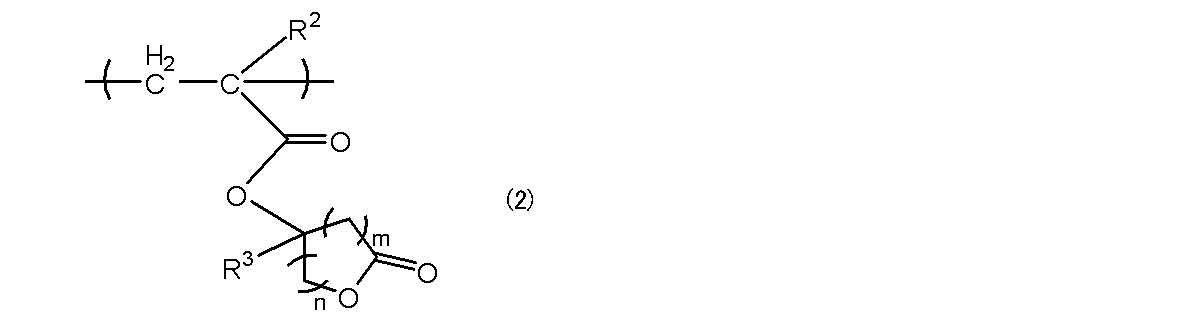
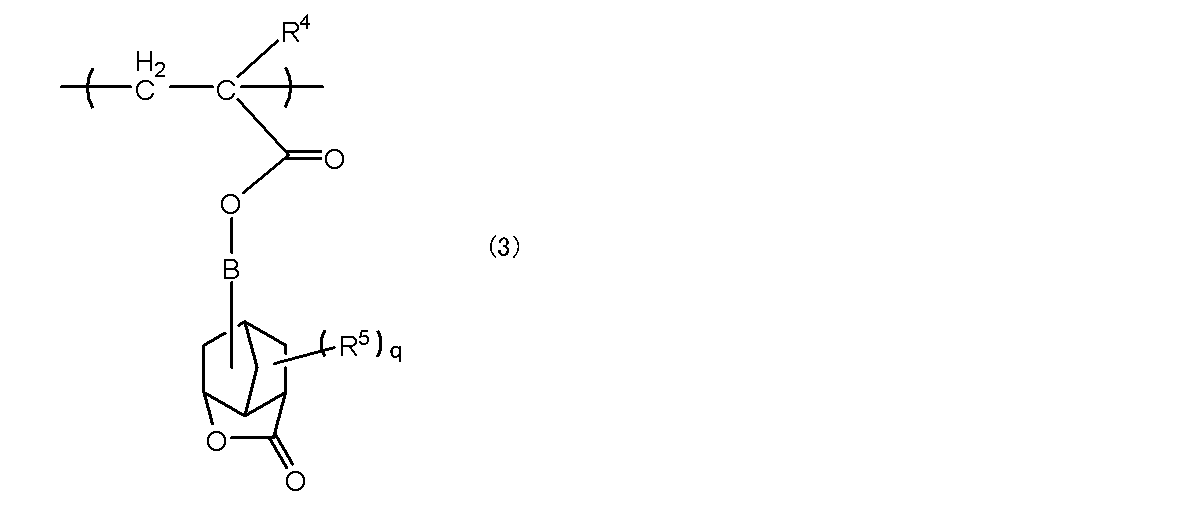

[3]前記(A)重合体が、前記フッ素原子を有する繰り返し単位として、下記一般式(P-1)で表される、側鎖にフッ素原子と酸解離性基とを有する繰り返し単位を含有する前記[1]又は[2]に記載の感放射線性樹脂組成物。

[4]前記(A)重合体が、前記フッ素原子を有する繰り返し単位として、下記一般式(P-2)で表される、側鎖にフッ素原子を有する繰り返し単位を含有しており、且つ、下記一般式(Q-1)で表される、側鎖に酸解離性基を有する繰り返し単位を更に含有する前記[1]又は[2]に記載の感放射線性樹脂組成物。
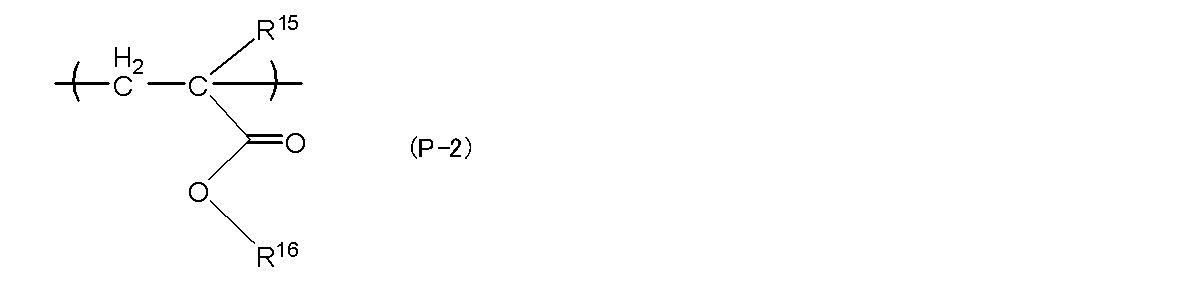
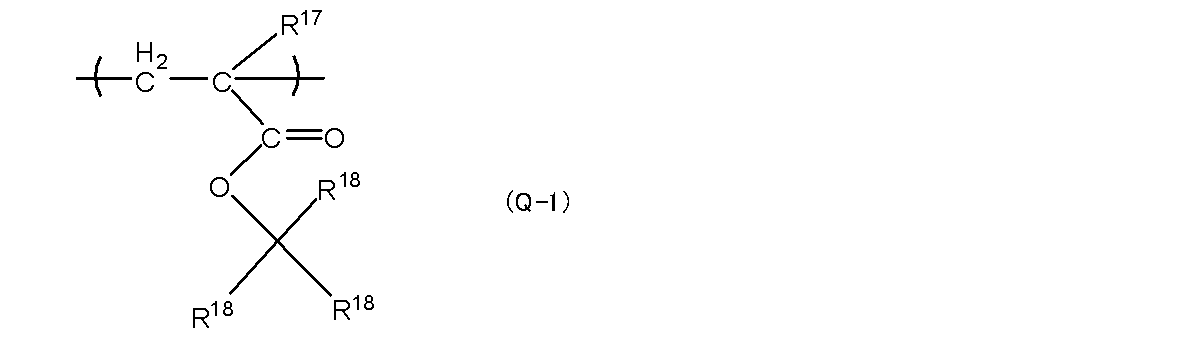
[5]前記一般式(1)で表される繰り返し単位が、下記一般式(1-1)で表される繰り返し単位、及び、下記一般式(1-2)で表される繰り返し単位のうちの少なくとも一方である前記[1]乃至[4]のうちのいずれかに記載の感放射線性樹脂組成物。
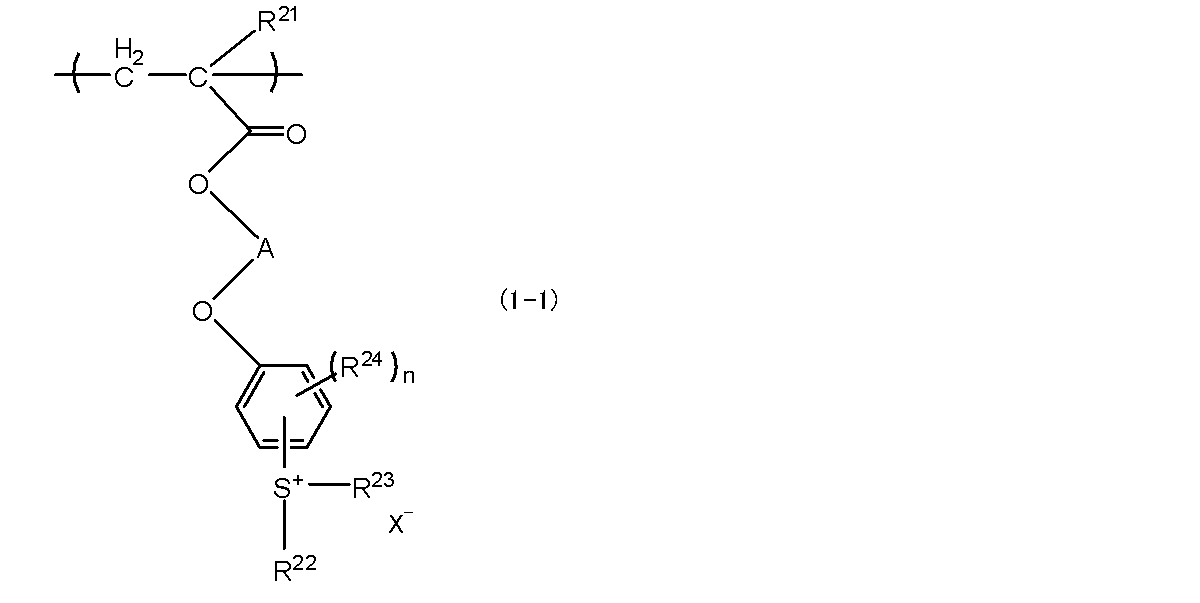

[6]下記一般式(1)で表される繰り返し単位と、フッ素原子を有する繰り返し単位(但し、下記一般式(1)で表される繰り返し単位を除く)とを含有しており、且つ側鎖に酸解離性基を有することを特徴とする重合体。
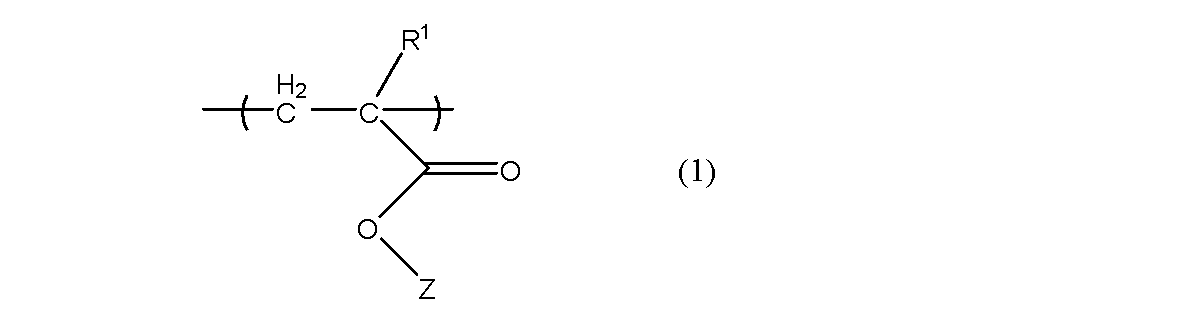
[7]下記一般式(2)で表される繰り返し単位、下記一般式(3)で表される繰り返し単位、及び、下記一般式(4)で表される繰り返し単位のうちの少なくとも1種を更に含有する前記[6]に記載の重合体。


[8](1)前記[1]乃至[5]のいずれかに記載の感放射線性樹脂組成物を用いて、基板上にフォトレジスト膜を形成する工程と、
(2)前記フォトレジスト膜を液浸露光する工程と、
(3)液浸露光されたフォトレジスト膜を現象し、レジストパターンを形成する工程と、を備えることを特徴とするレジストパターン形成方法。
本発明における重合体〔以下、「重合体(A)」ともいう。〕は、下記一般式(1)で表される繰り返し単位〔以下、「繰り返し単位(1)」ともいう。〕と、フッ素原子を有する繰り返し単位〔但し、繰り返し単位(1)を除く〕と、を含有しており、且つ側鎖に酸解離性基を有するものである。
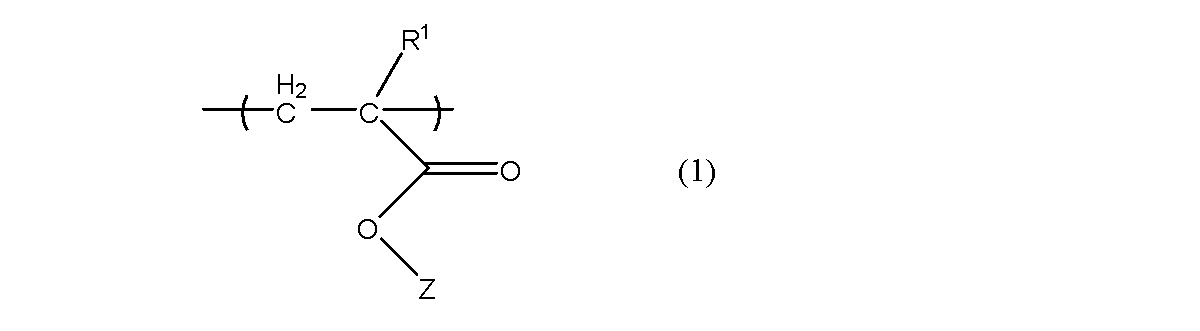
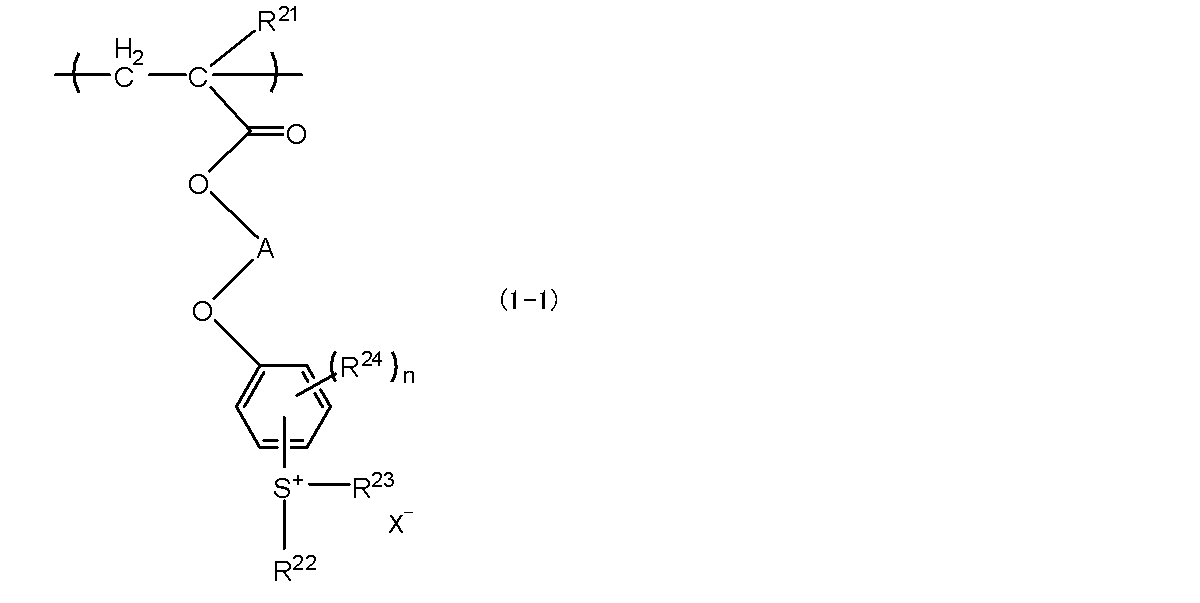
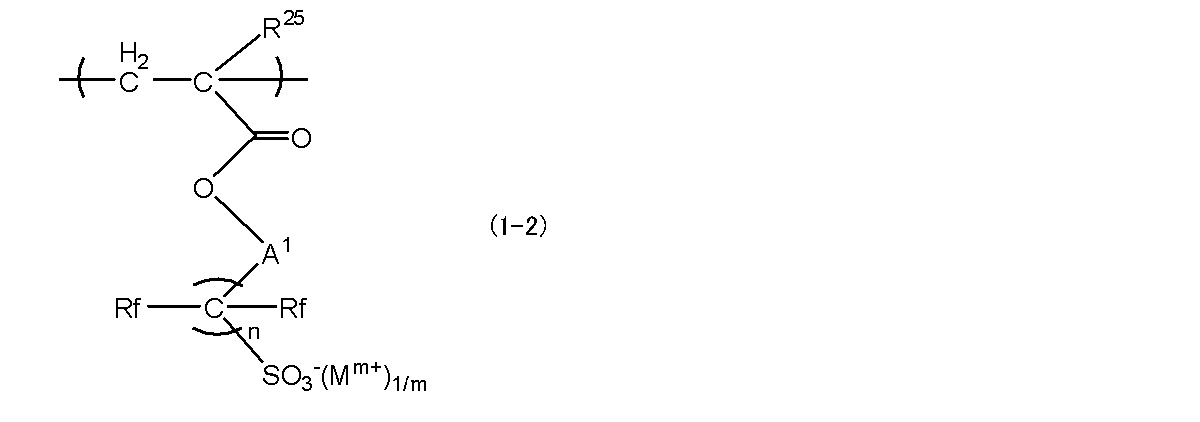
また、前記一般式(1-1)におけるR24は、上述した1価の有機基のなかでも、メトキシ基等のアルコキシル基であることが好ましい。
尚、一般式(1-1)におけるnは、0であることが好ましい。
また、アリーレン基としては、フェニレン基、ナフチレン基、アントリレン基、フェナントリレン基等が挙げられる。
これらのなかでも、化合物としての安定性に優れるという観点から、エチレン基、プロピレン基等が好ましい。
前記スルホネートイオン及びカルボキシレートイオンとしては、それぞれ、アルキル基、アリール基、アラルキル基、脂環式アルキル基、ハロゲン置換アルキル基、ハロゲン置換アリール基、ハロゲン置換アラルキル基、酸素原子置換脂環式アルキル基又はハロゲン置換脂環式アルキル基を含むものが好ましい。尚、置換基としてのハロゲンは、フッ素原子が好ましい。
また、前記ハロゲンイオンとしては、塩化物イオン、臭化物イオンが好ましい。
更に、前記テトラアリールボロニウムイオンとしては、BPh4-、B〔C6H4(CF3)2〕4-イオンが好ましい。
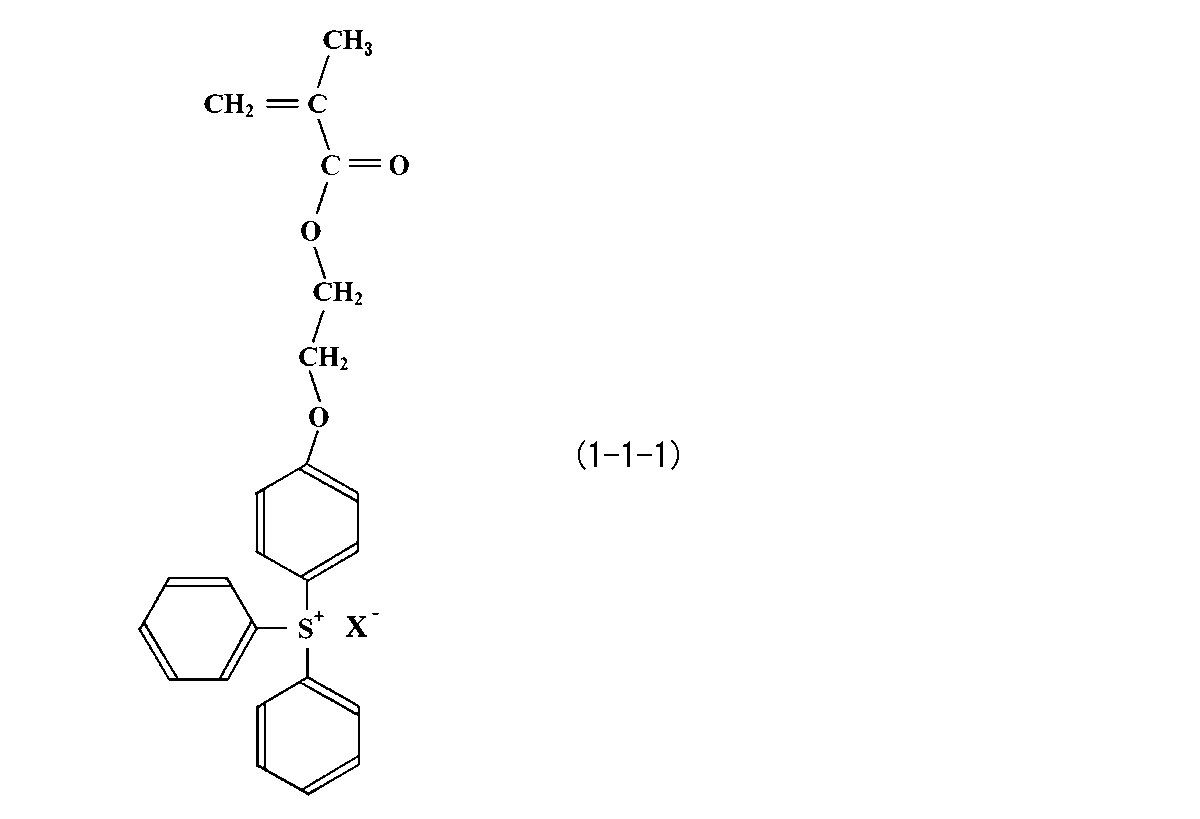
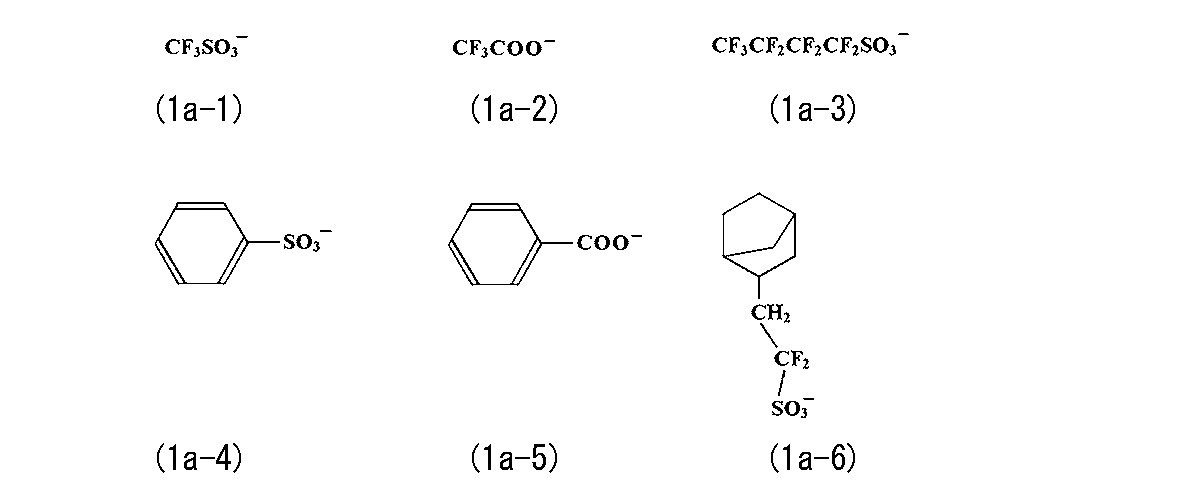

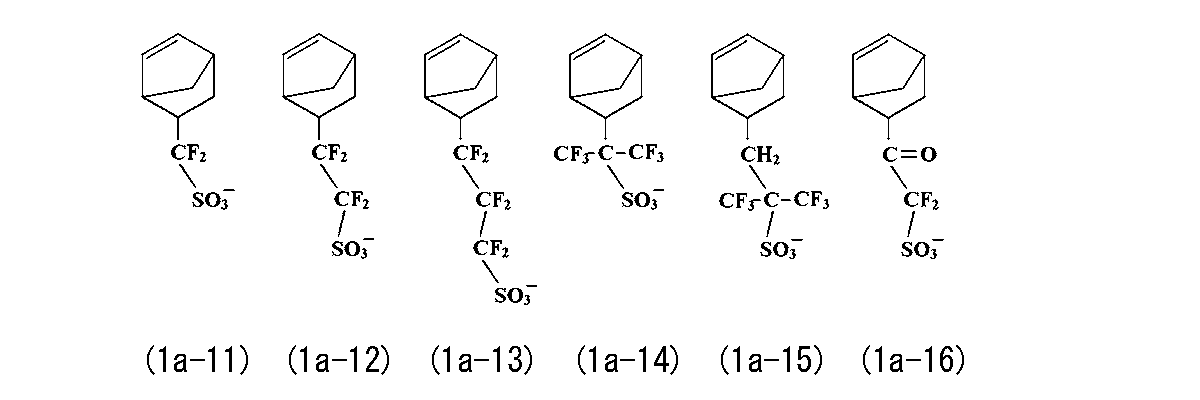

尚、式(1-2)中、2つのRfは、同一であってもよいし、異なっていてもよい。
前記2価の炭化水素基としては、鎖状又は環状の炭化水素基を挙げることができ、好ましい例としては、例えば、メチレン基、エチレン基、1,3-プロピレン基若しくは1,2-プロピレン基等のプロピレン基、テトラメチレン基、ペンタメチレン基、ヘキサメチレン基、ヘプタメチレン基、オクタメチレン基、ノナメチレン基、デカメチレン基、ウンデカメチレン基、ドデカメチレン基、トリデカメチレン基、テトラデカメチレン基、ペンタデカメチレン基、ヘキサデカメチレン基、ヘプタデカメチレン基、オクタデカメチレン基、ノナデカメチレン基、インサレン基、1-メチル-1,3-プロピレン基、2-メチル-1,3-プロピレン基、2-メチル-1,2-プロピレン基、1-メチル-1,4-ブチレン基、2-メチル-1,4-ブチレン基、メチリデン基、エチリデン基、プロピリデン基、又は、2-プロピリデン基等の飽和鎖状炭化水素基、1,3-シクロブチレン基などのシクロブチレン基、1,3-シクロペンチレン基などのシクロペンチレン基、1,4-シクロヘキシレン基等のシクロヘキシレン基、1,5-シクロオクチレン基等のシクロオクチレン基等の炭素数3~10のシクロアルキレン基などの単環式炭化水素環基、1,4-ノルボルニレン基若しくは2,5-ノルボルニレン基等のノルボルニレン基、1,5-アダマンチレン基、2,6-アダマンチレン基等のアダマンチレン基等の2~4環式の炭素数4~30の炭化水素環基等の架橋環式炭化水素環基等が挙げられる。

〔一般式(2b)において、R29及びR30は、相互に独立に置換若しくは非置換の炭素数1~10のアルキル基、又は置換若しくは非置換の炭素数4~18のアリール基を示すか、或いはR29とR30とが相互に結合して式中のヨウ素原子と共に環を形成している。〕
ヘテロ原子を2つ以上有する基の具体例としては、例えば、下記式(h1)~(h8)で表される構造の基等を挙げることができる。これらのなかでも、(h1)、(h2)で表される基が好ましい。
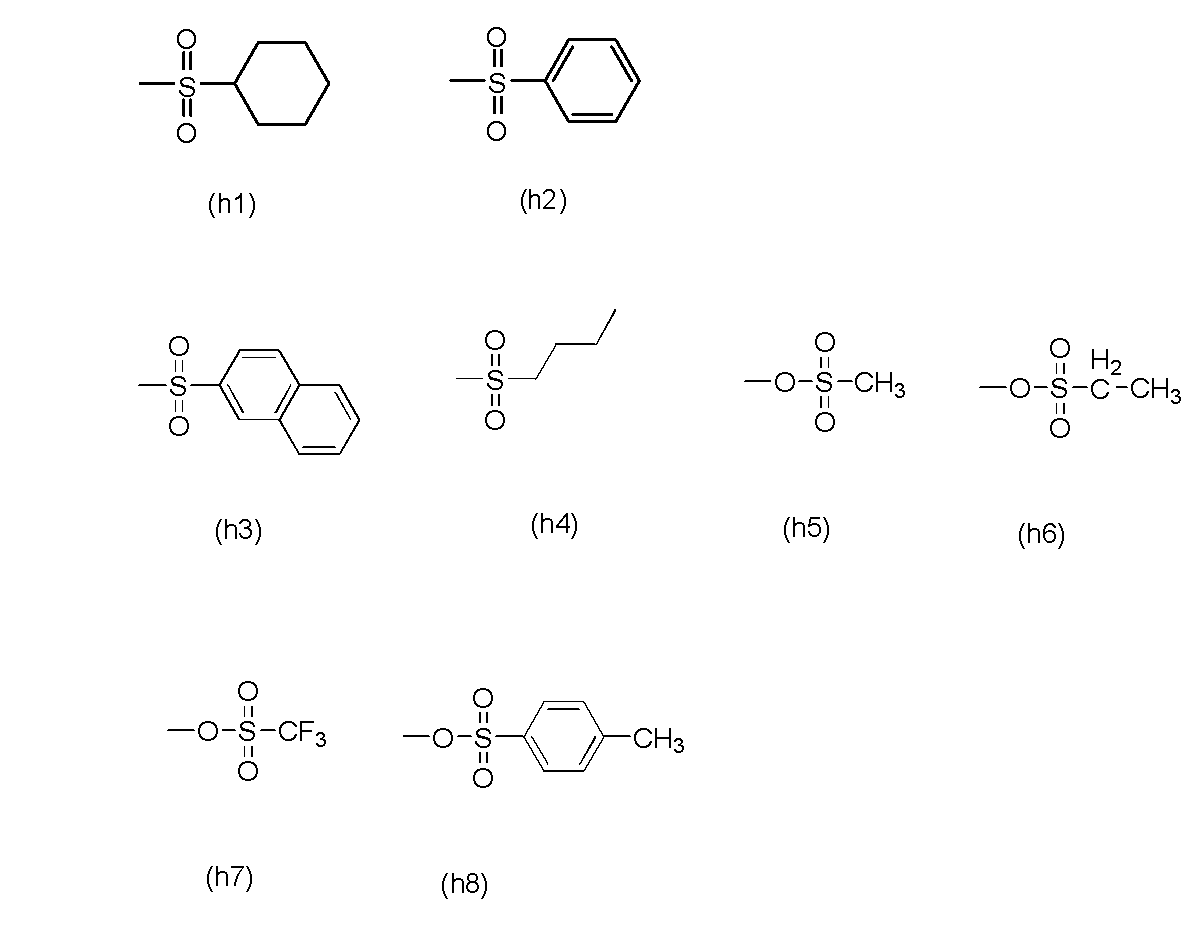
更に、一般式(2b)において、R29及びR30が相互に結合して式中のヨウ素原子と共に形成する環としては、例えば、5~7員の環構造等を挙げることができる。


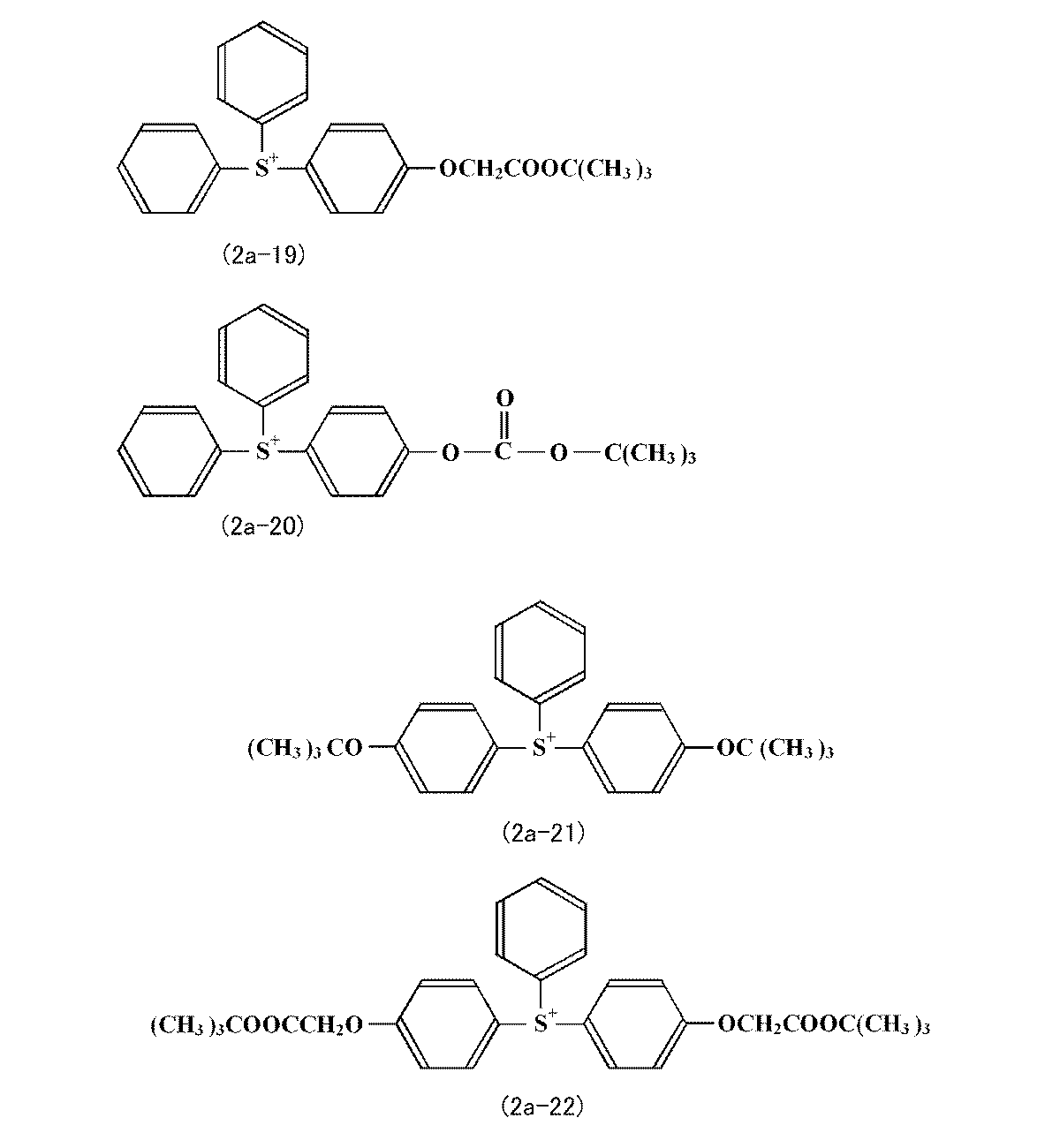

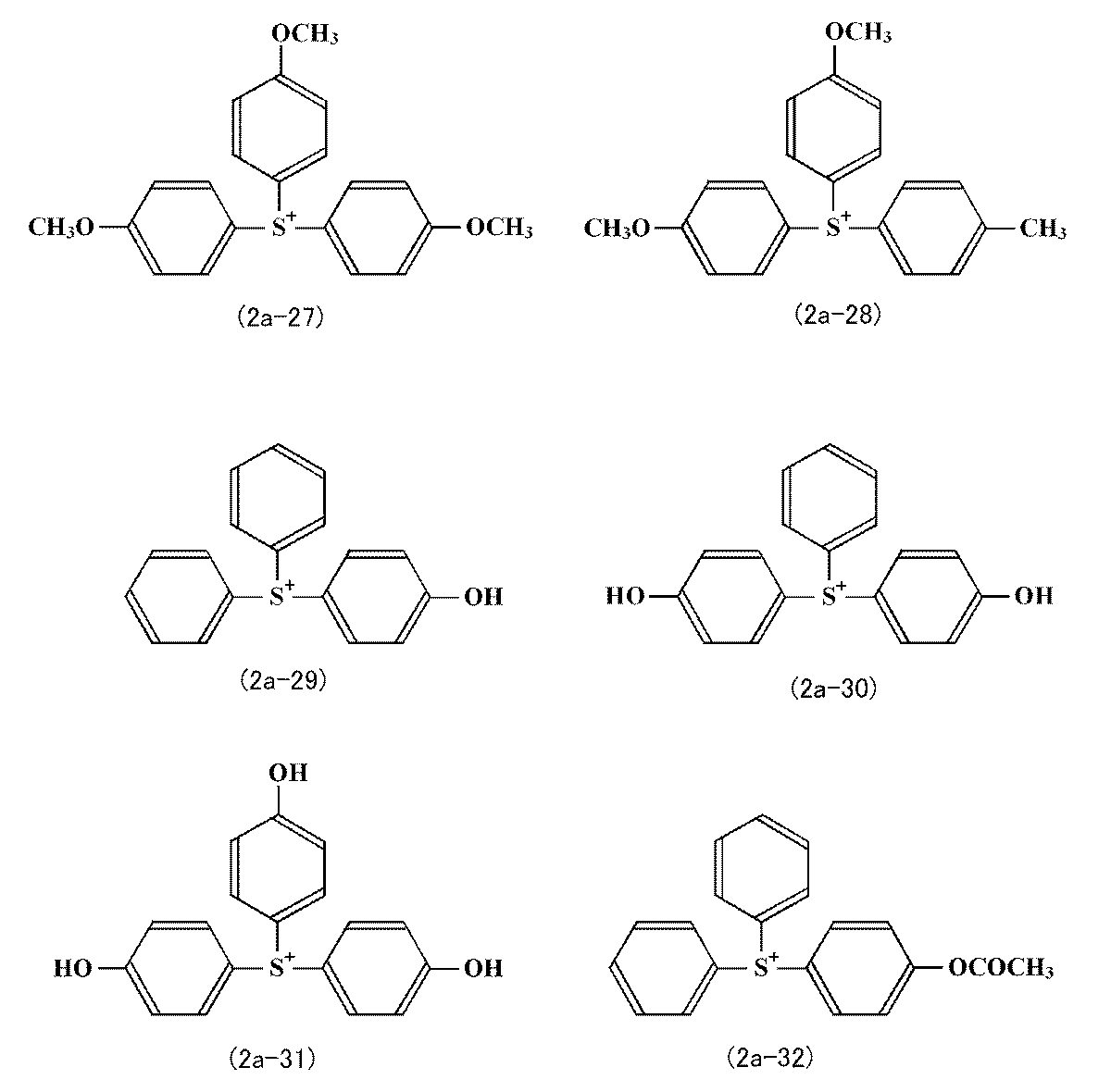


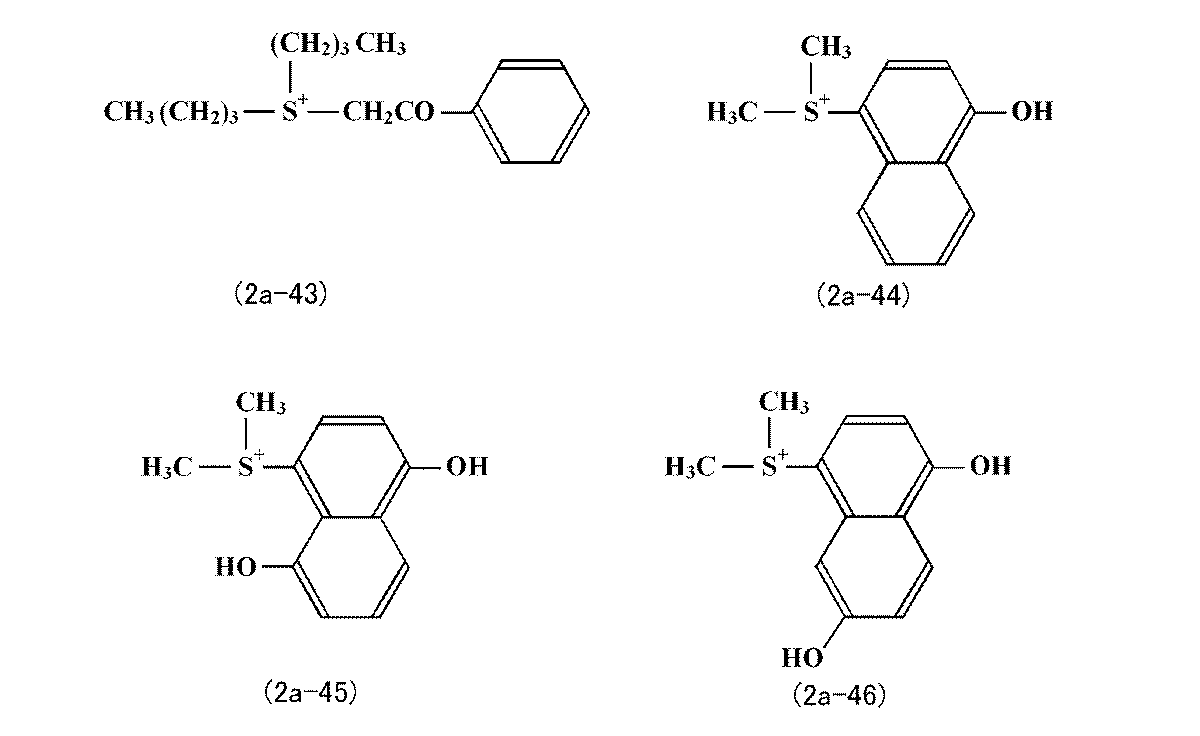


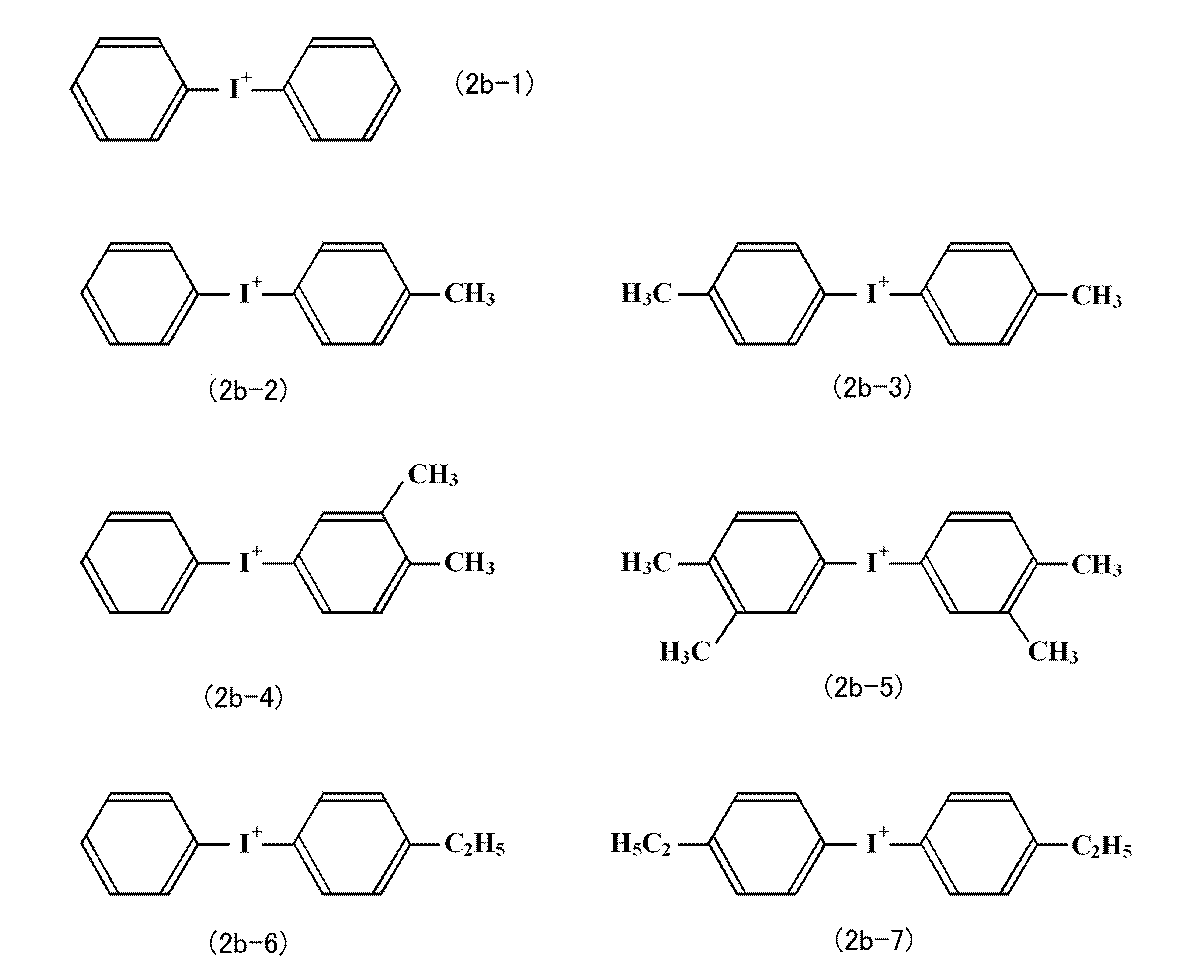


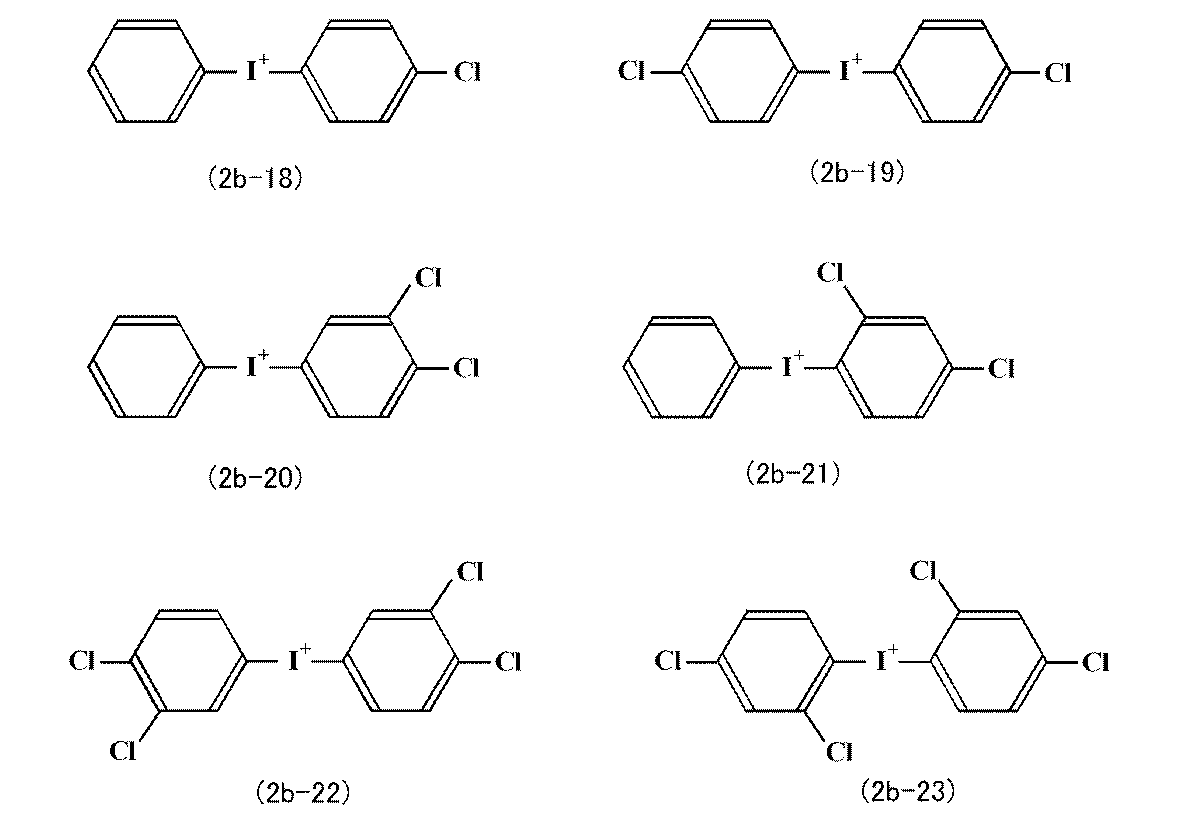


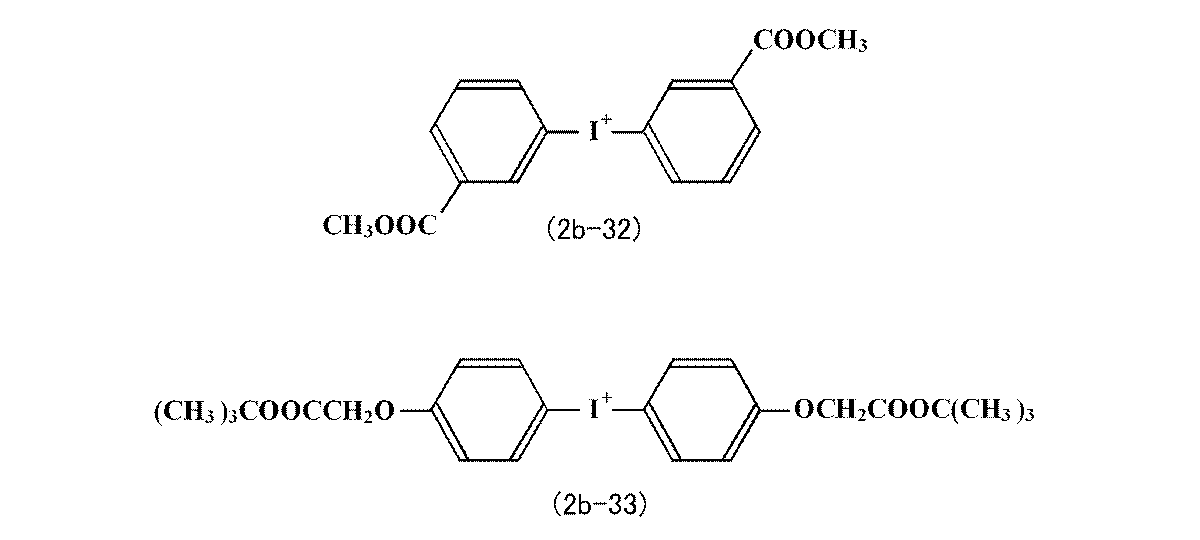

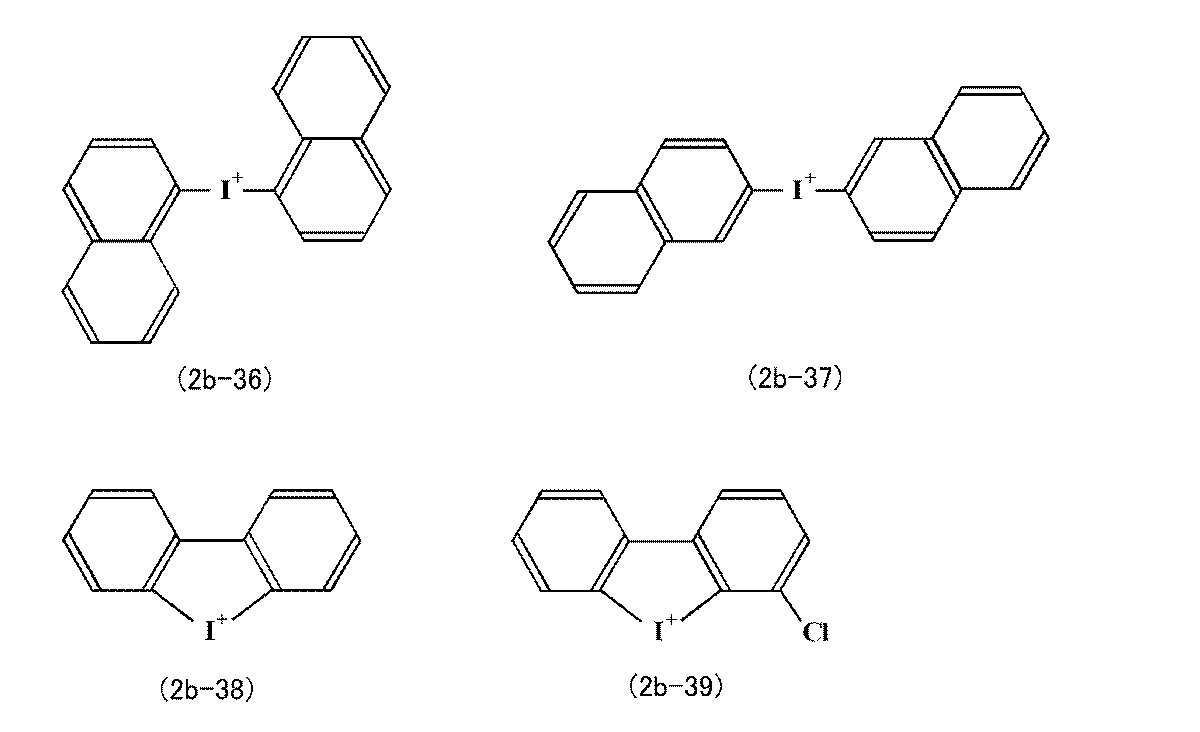
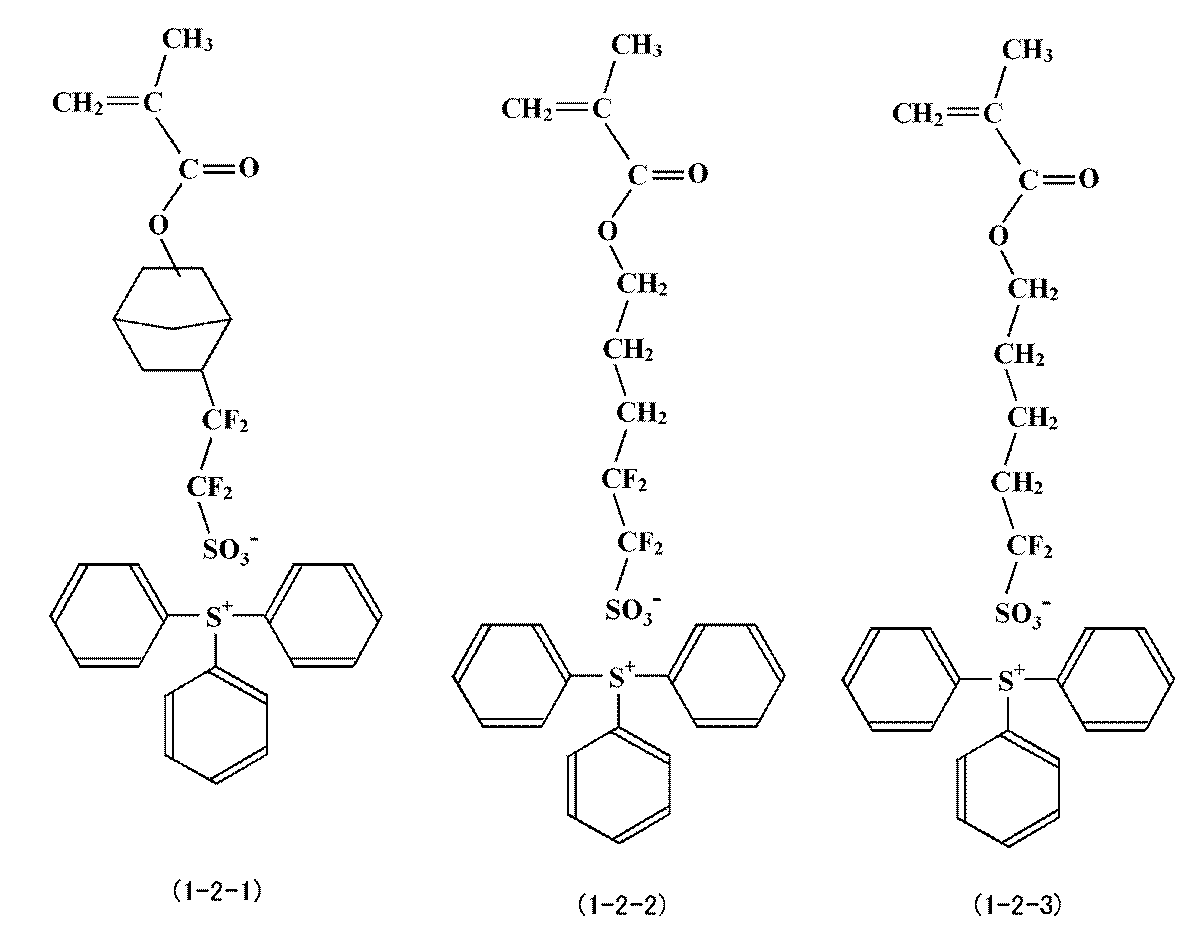
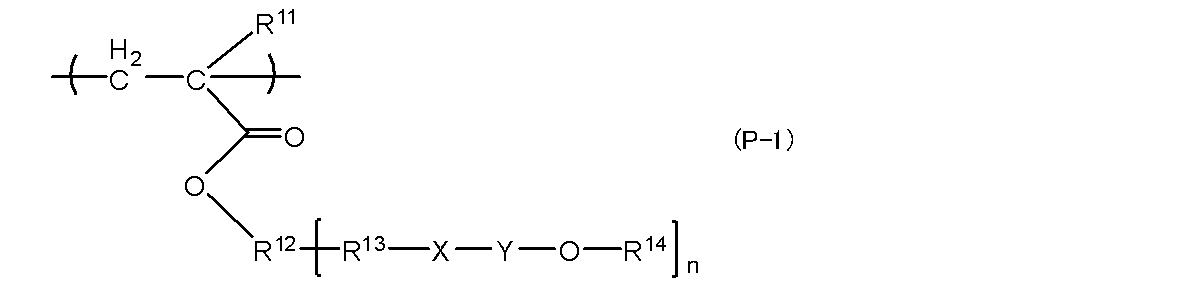
前記脂環式炭化水素としては、例えば、シクロブタン、シクロペンタン、シクロヘキサン、ビシクロ[2.2.1]ヘプタン、ビシクロ[2.2.2]オクタン、トリシクロ[5.2.1.02,6]デカン、トリシクロ[3.3.1.13,7]デカン等のシクロアルカン類等を挙げることができる。
また、前記芳香族炭化水素としては、例えば、ベンゼン、ナフタレン等を挙げることができる。
前記脂環式炭化水素としては、例えば、シクロブタン、シクロペンタン、シクロヘキサン、ビシクロ[2.2.1]ヘプタン、ビシクロ[2.2.2]オクタン、トリシクロ[5.2.1.02,6]デカン、トリシクロ[3.3.1.13,7]デカン、テトラシクロ[6.2.1.13,6.02,7]ドデカン等のシクロアルカン類等を挙げることができる。
また、前記芳香族炭化水素としては、例えば、ベンゼン、ナフタレン等を挙げることができる。
このような酸解離性基としては、例えば、t-ブトキシカルボニル基、テトラヒドロピラニル基、テトラヒドロフラニル基、(チオテトラヒドロピラニルスルファニル)メチル基、(チオテトラヒドロフラニルスルファニル)メチル基や、アルコキシ置換メチル基、アルキルスルファニル置換メチル基等を挙げることができる。
尚、アルコキシ置換メチル基におけるアルコキシル基(置換基)としては、炭素数1~4のアルコキシル基を挙げることができる。また、アルキルスルファニル置換メチル基におけるアルキル基(置換基)としては、炭素数1~4のアルキル基を挙げることができる。
前記Rの炭素数4~20の1価の脂環式炭化水素基としては、例えば、ノルボルナン、トリシクロデカン、テトラシクロドデカン、アダマンタンや、シクロブタン、シクロペンタン、シクロヘキサン、シクロヘプタン、シクロオクタン等のシクロアルカン類等に由来する脂環族環からなる基等を挙げることができる。
また、この脂環式炭化水素基から誘導される基としては、上述の1価の脂環式炭化水素基を、例えば、メチル基、エチル基、n-プロピル基、i-プロピル基、n-ブチル基、2-メチルプロピル基、1-メチルプロピル基、t-ブチル基等の炭素数1~4の直鎖状、分岐状又は環状のアルキル基の1種以上或いは1個以上で置換した基等を挙げることができる。
これらのなかでも、Rの脂環式炭化水素基は、ノルボルナン、トリシクロデカン、テトラシクロドデカン、アダマンタン、シクロペンタン又はシクロヘキサンに由来する脂環族環からなる脂環式炭化水素基や、この脂環式炭化水素基を前記アルキル基で置換した基等が好ましい。
更に、Rが相互に結合して形成された2価の脂環式炭化水素基から誘導される基としては、上述の2価の脂環式炭化水素基を、例えば、メチル基、エチル基、n-プロピル基、i-プロピル基、n-ブチル基、2-メチルプロピル基、1-メチルプロピル基、t-ブチル基等の炭素数1~4の直鎖状、分岐状又は環状のアルキル基の1種以上或いは1個以上で置換した基等を挙げることができる。
これらのなかでも、シクロペンチレン基、シクロヘキシレン基や、この2価の脂環式炭化水素基を前記アルキル基で置換した基等が好ましい。


前記脂環式炭化水素としては、例えば、シクロブタン、シクロペンタン、シクロヘキサン、ビシクロ[2.2.1]ヘプタン、ビシクロ[2.2.2]オクタン、トリシクロ[5.2.1.02,6]デカン、トリシクロ[3.3.1.13,7]デカン等のシクロアルカン類等を挙げることができる。
また、前記芳香族炭化水素としては、例えば、ベンゼン、ナフタレン等を挙げることができる。

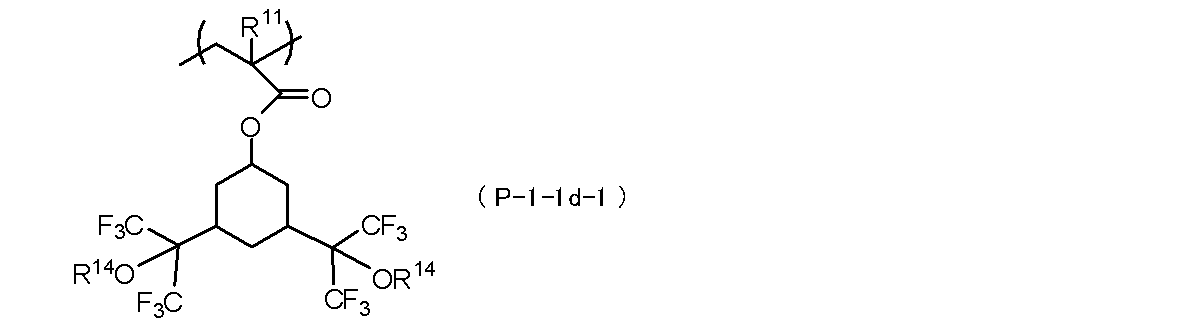

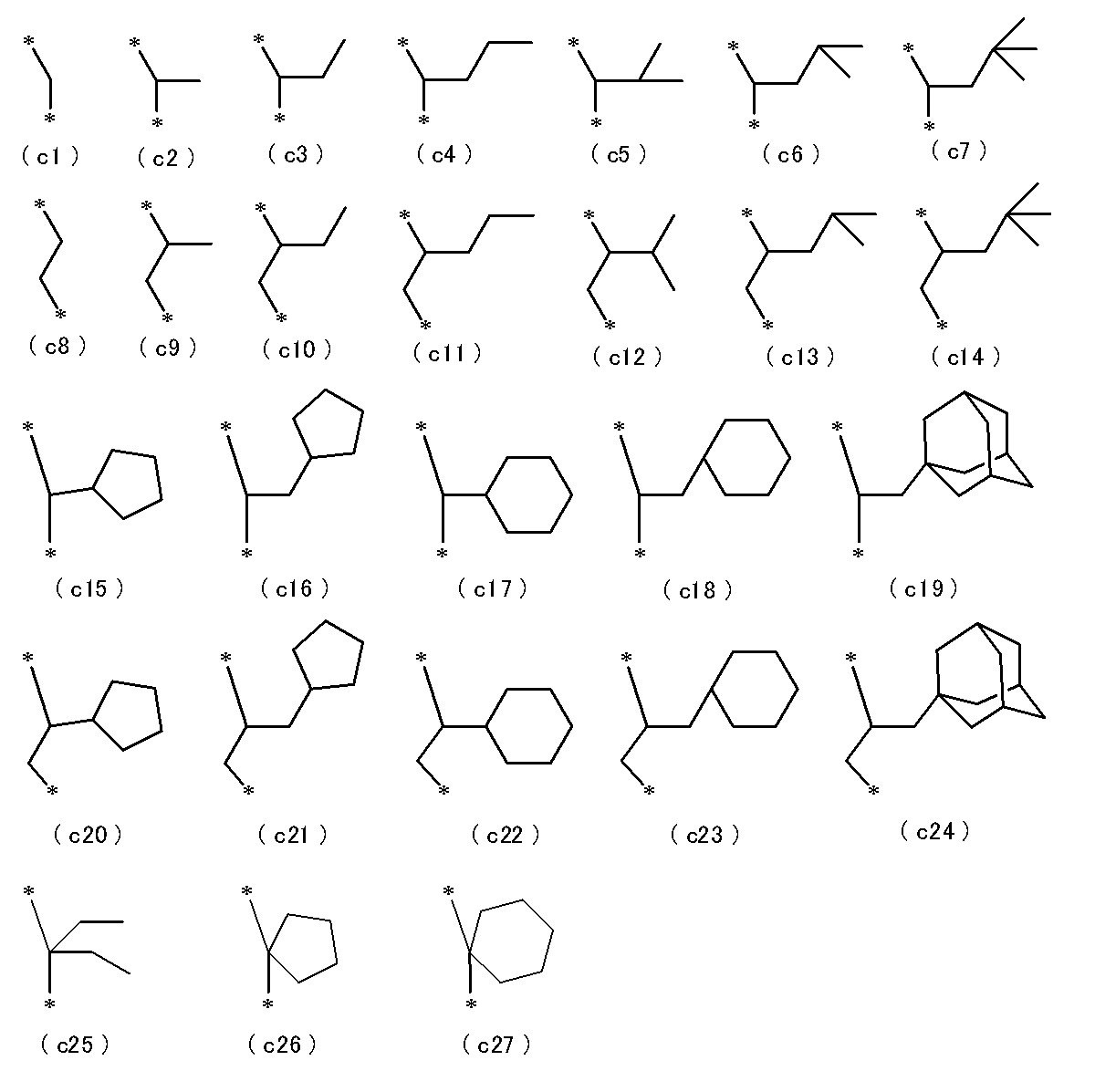
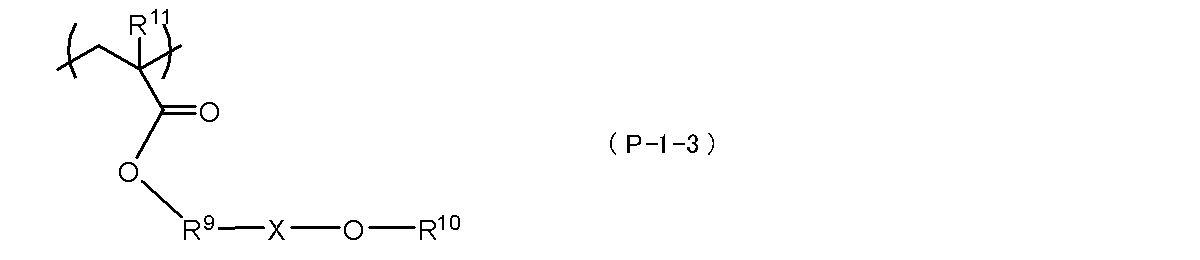
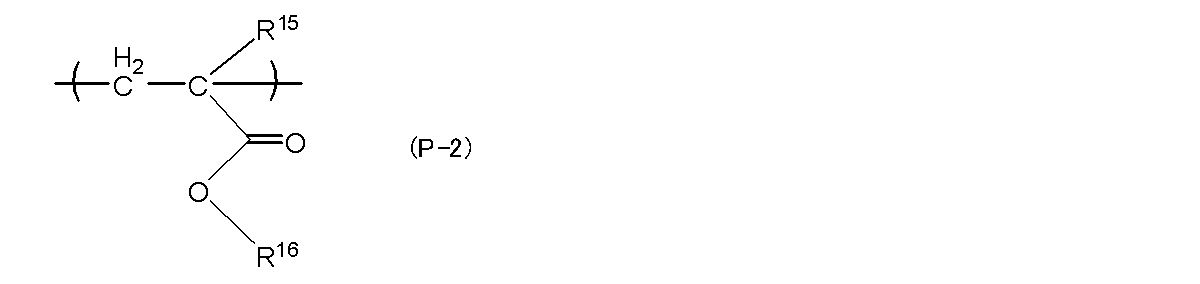
前記繰り返し単位(Q)としては、側鎖に酸解離性基を有しており且つフッ素原子を有していなければ、特に限定されないが、例えば、下記一般式(Q-1)で表される繰り返し単位であることが好ましい。
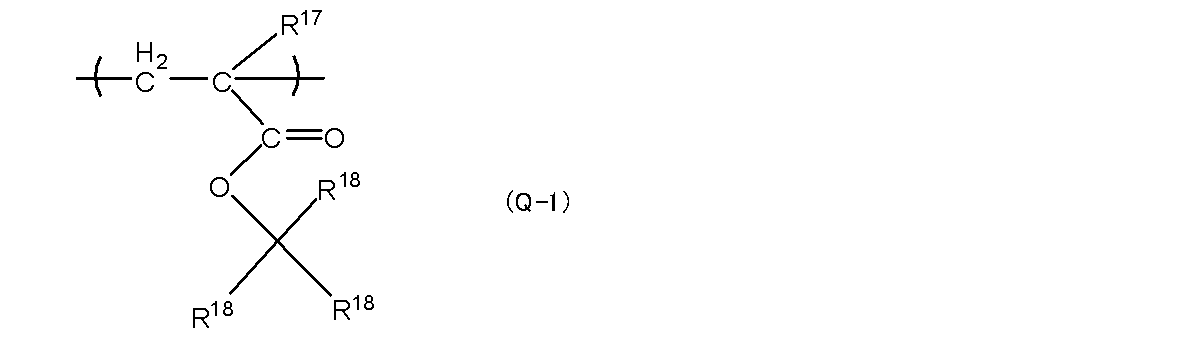
尚、前記重合体(A)は、前記繰り返し単位(Q)を1種のみ含有していてもよいし、2種以上含有していてもよい。
前記他の繰り返し単位としては、アルカリ溶解性を高めることができるラクトン骨格を有する繰り返し単位や、露光後、溶解コントラストを高めるために、酸の作用によりカルボキシル基を生じることができる環状カーボネート構造(環状炭酸エステル構造)を有する繰り返し単位等を挙げることができる。


また、一般式(2)におけるmは、1~3の整数であり、好ましくは1~2である。
更に、一般式(2)におけるnは、1~3の整数であり、好ましくは1~2である。
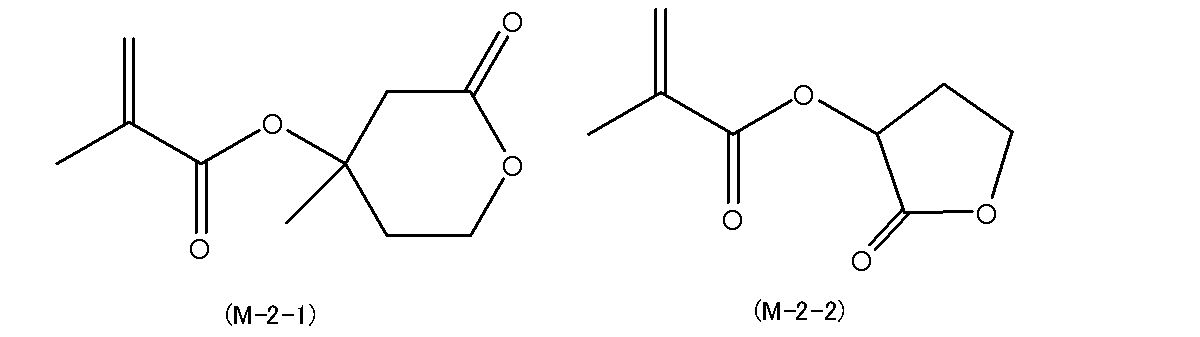
また、R5の炭素数1~4の直鎖状若しくは分岐状のフッ素化アルキル基としては、例えば、前記炭素数1~4のアルキル基の水素原子の一部、若しくは全てをフッ素原子に置換した基を挙げることができる。
更に、R5の炭素数1~4の直鎖状若しくは分岐状のアルコキシル基としては、例えば、メトキシ基、エトキシ基、n-プロポキシ基、i-プロポキシ基、n-ブトキシ基、2-メチルプロポキシ基、1-メチルプロポキシ基、t-ブトキシ基等が挙げられる。
また、一般式(3)におけるqは、0~3の整数であり、好ましくは0~2である。


前記炭素数が1~30である2価の鎖状炭化水素基としては、例えば、メチレン基、エチレン基、1,2-プロピレン基、1,3-プロピレン基、テトラメチレン基、ペンタメチレン基、ヘキサメチレン基、ヘプタメチレン基、オクタメチレン基、ノナメチレン基、デカメチレン基、ウンデカメチレン基、ドデカメチレン基、トリデカメチレン基、テトラデカメチレン基、ペンタデカメチレン基、ヘキサデカメチレン基、ヘプタデカメチレン基、オクタデカメチレン基、ノナデカメチレン基、イコサレン基等の直鎖状アルキレン基;1-メチル-1,3-プロピレン基、2-メチル-1,3-プロピレン基、2-メチル-1,2-プロピレン基、1-メチル-1,4-ブチレン基、2-メチル-1,4-ブチレン基、メチリデン基、エチリデン基、プロピリデン基、2-プロピリデン基等の分岐状アルキレン基;等を挙げることができる。
前記炭素数が1~30である3価の鎖状炭化水素基としては、前記官能基から水素原子が1個脱離した基等を挙げることができる。
前記3価の脂環式炭化水素基としては、前記官能基から水素原子が1個脱離した基等を挙げることができる。
前記3価の芳香族炭化水素基としては、前記官能基から水素原子が1個脱離した基等を挙げることができる。

前記繰り返し単位(1)の含有割合は、1~10モル%であることが好ましく、より好ましくは1~7モル%、更に好ましくは1~5モル%である。この含有割合が1モル%未満である場合には、脱保護反応を引き起こすための酸発生量が不十分となるおそれがある。一方、10モル%を超える場合には、照射光がレジスト下層部位まで十分に透過しなくなるおそれがある。
前記繰り返し単位(P1)(フッ素原子含有繰り返し単位)の含有割合は、5~50モル%であることが好ましく、より好ましくは5~40モル%、更に好ましくは5~30モル%である。この含有割合が5モル%未満である場合には、十分な撥水作用が得られなくなるおそれがある。一方、50モル%を超える場合には、撥水作用が大きすぎて、現像の際、現像液を露光後のレジストパターンに載せることができなくなる可能性がある。
前記繰り返し単位)(P2)(フッ素原子含有繰り返し単位)の含有割合は、5~30モル%であることが好ましく、より好ましくは5~25モル%、更に好ましくは10~20モル%である。この含有割合が5モル%未満である場合には、十分な撥水作用が得られなくなるおそれがある。一方、30モル%を超える場合には、撥水作用が大きすぎて、現像の際、現像液をはじいてしまい露光後のレジストパターンを形成できなくなる可能性がある。
これらのフッ素原子含有繰り返し単位の含有割合の合計は、5~50モル%であることが好ましく、より好ましくは5~40モル%、更に好ましくは5~30モル%である。この含有割合が5モル%未満である場合には、十分な撥水作用が得られなくなるおそれがある。一方、50モル%を超える場合には、撥水作用が大きすぎて、現像の際、現像液をはじいてしまい露光後のレジストパターンを形成できなくなる可能性がある。
前記一般式(3)で表される繰り返し単位(他の繰り返し単位)の含有割合は、通常80モル%以下、好ましくは20~80モル%、更に好ましくは30~70モル%である。この含有割合が80モル%以下である場合には、十分なアルカリ溶解性を得ることができる。
前記一般式(4)で表される繰り返し単位(他の繰り返し単位)の含有割合は、通常80モル%以下、好ましくは20~80モル%、更に好ましくは30~70モル%である。この含有割合が80モル%以下である場合には、十分なアルカリ溶解性を得ることができる。
これらの他の繰り返し単位の含有割合の合計は、通常80モル%以下、更に好ましくは1~70モル%である。他の繰り返し単位の合計が80モル%を超える場合には、レジスト溶剤に対して十分な溶解性を得られなくなるおそれがある。
前記重合における反応温度は、通常、40~150℃、好ましくは50~120℃であり、反応時間は、通常、1~48時間、好ましくは1~24時間である。
また、重合体(A)のMwとGPCによるポリスチレン換算数平均分子量(以下、「Mn」という。)との比(Mw/Mn)は、通常1~5、好ましくは1~4である。
前記重合体(A)の精製法としては、例えば、水洗、液々抽出等の化学的精製法や、これらの化学的精製法と限外ろ過、遠心分離等の物理的精製法との組み合わせ等を挙げることができる。
他の重合体(A2)としては、例えば、ノルボルネン誘導体等を重合して得られる主鎖にノルボルナン環等の脂環式骨格を有する樹脂、ノルボルネン誘導体と無水マレイン酸を共重合して得られる主鎖にノルボルナン環及び無水マレイン酸誘導体を有する樹脂、ノルボルネン誘導体と(メタ)アクリル化合物を共重合して得られる主鎖にノルボルナン環と(メタ)アクリル骨格が混在する樹脂、ノルボルネン誘導体と無水マレイン酸、(メタ)アクリル化合物を共重合して得られる主鎖にノルボルナン環と無水マレイン酸誘導体と(メタ)アクリル骨格が混在する樹脂、(メタ)アクリル化合物を共重合して得られる主鎖が(メタ)アクリル骨格の樹脂等が挙げられる。
この重合体(A2)のMwとGPCによるMnとの比(Mw/Mn)は、通常1~5であり、好ましくは1~4である。
本発明の感放射線性樹脂組成物は、普通、その使用に際して、全固形分濃度が、通常、1~50質量%、好ましくは1~25質量%となるように、溶剤に溶解したのち、例えば孔径0.2μm程度のフィルターでろ過することによって、組成物溶液として調製される。
前記溶剤(B)としては、例えば、2-ブタノン、2-ペンタノン、3-メチル-2-ブタノン、2-ヘキサノン、4-メチル-2-ペンタノン、3-メチル-2-ペンタノン、3,3-ジメチル-2-ブタノン、2-ヘプタノン、2-オクタノン等の直鎖状若しくは分岐状のケトン類;シクロペンタノン、3-メチルシクロペンタノン、シクロヘキサノン、2-メチルシクロヘキサノン、2,6-ジメチルシクロヘキサノン、イソホロン等の環状のケトン類;プロピレングリコールモノメチルエーテルアセテート、プロピレングリコールモノエチルエーテルアセテート、プロピレングリコールモノ-n-プロピルエーテルアセテート、プロピレングリコールモノ-i-プロピルエーテルアセテート、プロピレングリコールモノ-n-ブチルエーテルアセテート、プロピレングリコールモノ-i-ブチルエーテルアセテート、プロピレングリコールモノ-sec-ブチルエーテルアセテート、プロピレングリコールモノ-t-ブチルエーテルアセテート等のプロピレングリコールモノアルキルエーテルアセテート類;2-ヒドロキシプロピオン酸メチル、2-ヒドロキシプロピオン酸エチル、2-ヒドロキシプロピオン酸n-プロピル、2-ヒドロキシプロピオン酸i-プロピル、2-ヒドロキシプロピオン酸n-ブチル、2-ヒドロキシプロピオン酸i-ブチル、2-ヒドロキシプロピオン酸sec-ブチル、2-ヒドロキシプロピオン酸t-ブチル等の2-ヒドロキシプロピオン酸アルキル類;3-メトキシプロピオン酸メチル、3-メトキシプロピオン酸エチル、3-エトキシプロピオン酸メチル、3-エトキシプロピオン酸エチル等の3-アルコキシプロピオン酸アルキル類のほか、
これらの溶剤(B)は、1種単独で用いてもよいし、2種以上を組み合わせて用いてもよい。
本発明の感放射線性樹脂組成物は、前記重合体(A)及び溶剤(B)以外にも、窒素含有化合物を含有していてもよい。
この窒素含有化合物は、露光により重合体(A)及び酸発生剤から生じる酸のレジスト被膜中における拡散現象を制御し、非露光領域における好ましくない化学反応を抑制する作用を有する成分である。このような酸拡散制御剤を配合することにより、得られる感放射線性樹脂組成物の貯蔵安定性が向上する。また、レジストとしての解像度が更に向上するとともに、露光から露光後の加熱処理までの引き置き時間(PED)の変動によるレジストパターンの線幅変化を抑えることができ、プロセス安定性に極めて優れた組成物が得られる。
これらの窒素含有化合物は、1種単独で用いてもよいし、2種以上を組み合わせて用いてもよい。
本発明の感放射線性樹脂組成物は、前記重合体(A)、溶剤(B)及び窒素含有化合物以外にも、感放射線性酸発生剤を含有していてもよい。
この感放射線性酸発生剤(以下、単に「酸発生剤」ともいう。)は、露光により酸を発生するものであり、露光により発生した酸の作用によって、樹脂成分中に存在する酸解離性基含有繰り返し単位が有する酸解離性基を解離させ(保護基を脱離させ)、その結果レジスト被膜の露光部がアルカリ現像液に易溶性となり、ポジ型のレジストパターンを形成する作用を有するものである。
このような酸発生剤としては、下記一般式(5)で表される化合物を含むものが好ましい。

また、R31は、炭素数1~10の直鎖状若しくは分岐状のアルキル基、炭素数1~10の直鎖状若しくは分岐状のアルコキシル基、又は炭素数1~10の直鎖状、分岐状若しくは環状のアルカンスルホニル基を示す。
更に、R32は独立に炭素数1~10の直鎖状若しくは分岐状のアルキル基、置換されていてもよいフェニル基又は置換されていてもよいナフチル基を示すか、或いは2個のR32が互いに結合して、置換されていてもよい炭素数2~10の2価の基をしている。
また、kは0~2の整数であり、X-は式:R33CnF2nSO3 -(式中、R33は、フッ素原子又は置換されていてもよい炭素数1~12の炭化水素基を示し、nは1~10の整数である。)で表されるアニオンを示し、rは0~10の整数である。
更に、前記置換基のうち、前記アルコキシカルボニル基としては、例えば、メトキシカルボニル基、エトキシカルボニル基、n-プロポキシカルボニル基、i-プロポキシカルボニル基、n-ブトキシカルボニル基、2-メチルプロポキシカルボニル基、1-メチルプロポキシカルボニル基、t-ブトキシカルボニル基、シクロペンチルオキシカルボニル基、シクロヘキシルオキシカルボニル等の炭素数2~21の直鎖状、分岐状若しくは環状のアルコキシカルボニル基等を挙げることができる。
また、前記置換基のうち、前記アルコキシカルボニルオキシ基としては、例えば、メトキシカルボニルオキシ基、エトキシカルボニルオキシ基、n-プロポキシカルボニルオキシ基、i-プロポキシカルボニルオキシ基、n-ブトキシカルボニルオキシ基、t-ブトキシカルボニルオキシ基、シクロペンチルオキシカルボニル基、シクロヘキシルオキシカルボニル等の炭素数2~21の直鎖状、分岐状若しくは環状のアルコキシカルボニルオキシ基等を挙げることができる。
特に、一般式(5)におけるR32としては、メチル基、エチル基、フェニル基、4-メトキシフェニル基、1-ナフチル基、2個のR32が互いに結合して硫黄原子と共にテトラヒドロチオフェン環構造を形成する2価の基等が好ましい。
また、R33における置換されていてもよい炭素数1~12の炭化水素基としては、炭素数1~12のアルキル基、シクロアルキル基、有橋脂環式炭化水素基が好ましい。
具体的には、メチル基、エチル基、n-プロピル基、i-プロピル基、n-ブチル基、2-メチルプロピル基、1-メチルプロピル基、t-ブチル基、n-ペンチル基、ネオペンチル基、n-ヘキシル基、シクロヘキシル基、n-ヘプチル基、n-オクチル基、2-エチルヘキシル基、n-ノニル基、n-デシル基、ノルボルニル基、ノルボニルメチル基、ヒドロキシノルボルニル基、アダマンチル基等を挙げることができる。
本発明の感放射線性樹脂組成物には、必要に応じて、脂環族添加剤、界面活性剤、増感剤等の各種の添加剤を配合することができる。
このような脂環族添加剤としては、例えば、1-アダマンタンカルボン酸、2-アダマンタノン、1-アダマンタンカルボン酸t-ブチル、1-アダマンタンカルボン酸t-ブトキシカルボニルメチル、1-アダマンタンカルボン酸α-ブチロラクトンエステル、1,3-アダマンタンジカルボン酸ジ-t-ブチル、1-アダマンタン酢酸t-ブチル、1-アダマンタン酢酸t-ブトキシカルボニルメチル、1,3-アダマンタンジ酢酸ジ-t-ブチル、2,5-ジメチル-2,5-ジ(アダマンチルカルボニルオキシ)ヘキサン等のアダマンタン誘導体類;デオキシコール酸t-ブチル、デオキシコール酸t-ブトキシカルボニルメチル、デオキシコール酸2-エトキシエチル、デオキシコール酸2-シクロヘキシルオキシエチル、デオキシコール酸3-オキソシクロヘキシル、デオキシコール酸テトラヒドロピラニル、デオキシコール酸メバロノラクトンエステル等のデオキシコール酸エステル類;リトコール酸t-ブチル、リトコール酸t-ブトキシカルボニルメチル、リトコール酸2-エトキシエチル、リトコール酸2-シクロヘキシルオキシエチル、リトコール酸3-オキソシクロヘキシル、リトコール酸テトラヒドロピラニル、リトコール酸メバロノラクトンエステル等のリトコール酸エステル類;アジピン酸ジメチル、アジピン酸ジエチル、アジピン酸ジプロピル、アジピン酸ジn-ブチル、アジピン酸ジt-ブチル等のアルキルカルボン酸エステル類や、3-〔2-ヒドロキシ-2,2-ビス(トリフルオロメチル)エチル〕テトラシクロ[4.4.0.12,5.17,10]ドデカン等を挙げることができる。これらの脂環族添加剤は、1種単独で用いてもよいし、2種以上を組み合わせて用いてもよい。
このような界面活性剤としては、例えば、ポリオキシエチレンラウリルエーテル、ポリオキシエチレンステアリルエーテル、ポリオキシエチレンオレイルエーテル、ポリオキシエチレンn-オクチルフェニルエーテル、ポリオキシエチレンn-ノニルフェニルエーテル、ポリエチレングリコールジラウレート、ポリエチレングリコールジステアレート等のノニオン系界面活性剤のほか、以下商品名で、KP341(信越化学工業株式会社製)、ポリフローNo.75、同No.95(共栄社化学株式会社製)、エフトップEF301、同EF303、同EF352(トーケムプロダクツ株式会社製)、メガファックスF171、同F173(大日本インキ化学工業株式会社製)、フロラードFC430、同FC431(住友スリーエム株式会社製)、アサヒガードAG710、サーフロンS-382、同SC-101、同SC-102、同SC-103、同SC-104、同SC-105、同SC-106(旭硝子株式会社製)等を挙げることができる。これらの界面活性剤は、1種単独で用いてもよいし、2種以上を組み合わせて用いてもよい。
このような増感剤としては、例えば、カルバゾール類、アセトフェノン類、ベンゾフェノン類、ナフタレン類、フェノール類、ビアセチル、エオシン、ローズベンガル、ピレン類、アントラセン類、フェノチアジン類等を挙げることができる。これらの増感剤は、1種単独で用いてもよいし、2種以上を組み合わせて用いてもよい。
また、染料或いは顔料を配合することにより、露光部の潜像を可視化させて、露光時のハレーションの影響を緩和でき、接着助剤を配合することにより、基板との接着性を改善することができる。
また、本発明の感放射線性樹脂組成物においては、この樹脂組成物を基板上に塗布して形成されるフォトレジスト膜の水に対する後退接触角が、68度以上であることが好ましく、より好ましくは70度以上である。この後退接触角が68度未満である場合には、高速スキャン露光時の水切れが不良となり、ウォーターマーク欠陥が発生する可能性がある。
尚、本明細書中における「後退接触角」とは、本発明の樹脂組成物によるフォトレジスト膜を形成した基板上に、水を25μL滴下し、その後、基板上の水滴を10μL/minの速度で吸引した際の液面と基板との接触角を意味するものである。具体的には、後述の実施例に示すように、KRUS社製「DSA-10」を用いて測定することができる。
本発明の感放射線性樹脂組成物は、特に化学増幅型レジストとして有用である。前記化学増幅型レジストにおいては、露光により酸発生剤から発生した酸の作用によって、樹脂成分〔主に、重合体(A)〕中の酸解離性基が解離して、カルボキシル基を生じ、その結果、レジストの露光部のアルカリ現像液に対する溶解性が高くなり、該露光部がアルカリ現像液によって溶解、除去され、ポジ型のレジストパターンが得られる。
本発明においては、露光後に加熱処理(PEB)を行うことが好ましい。このPEBにより、樹脂成分中の酸解離性基の解離反応を円滑に進行させることができる。PEBの加熱条件は、感放射線性樹脂組成物の配合組成によって適宜調整されるが、通常、30~200℃、好ましくは50~170℃である。
この現像に使用される現像液としては、例えば、水酸化ナトリウム、水酸化カリウム、炭酸ナトリウム、けい酸ナトリウム、メタけい酸ナトリウム、アンモニア水、エチルアミン、n-プロピルアミン、ジエチルアミン、ジ-n-プロピルアミン、トリエチルアミン、メチルジエチルアミン、エチルジメチルアミン、トリエタノールアミン、テトラメチルアンモニウムヒドロキシド、ピロール、ピペリジン、コリン、1,8-ジアザビシクロ-[5.4.0]-7-ウンデセン、1,5-ジアザビシクロ-[4.3.0]-5-ノネン等のアルカリ性化合物の少なくとも1種を溶解したアルカリ性水溶液が好ましい。
前記アルカリ性水溶液の濃度は、通常、10質量%以下である。アルカリ性水溶液の濃度が10質量%を超えると、非露光部も現像液に溶解するおそれがある。
前記有機溶媒としては、例えば、アセトン、メチルエチルケトン、メチルi-ブチルケトン、シクロペンタノン、シクロヘキサノン、3-メチルシクロペンタノン、2,6-ジメチルシクロヘキサノン等のケトン類;メチルアルコール、エチルアルコール、n-プロピルアルコール、i-プロピルアルコール、n-ブチルアルコール、t-ブチルアルコール、シクロペンタノール、シクロヘキサノール、1,4-ヘキサンジオール、1,4-ヘキサンジメチロール等のアルコール類;テトラヒドロフラン、ジオキサン等のエーテル類;酢酸エチル、酢酸n-ブチル、酢酸i-アミル等のエステル類;トルエン、キシレン等の芳香族炭化水素類や、フェノール、アセトニルアセトン、ジメチルホルムアミド等を挙げることができる。これらの有機溶媒は、1種単独で用いてもよいし、2種以上を組み合わせて用いてもよい。
この有機溶媒の使用量は、アルカリ性水溶液100体積部に対して、100体積部以下が好ましい。有機溶媒の使用量が100体積部を超える場合、現像性が低下して、露光部の現像残りが多くなるおそれがある。
また、前記アルカリ性水溶液からなる現像液には、界面活性剤等を適量添加することもできる。
尚、アルカリ性水溶液からなる現像液で現像したのちは、一般に、水で洗浄して乾燥する。
(1)Mw及びMn
東ソー(株)製GPCカラム(G2000HXL2本、G3000HXL1本、G4000HXL1本)を用い、流量1.0ミリリットル/分、溶出溶媒テトラヒドロフラン、カラム温度40℃の分析条件で、単分散ポリスチレンを標準とするゲルパーミエーションクロマトグラフィ(GPC)により測定した。また、分散度Mw/Mnは測定結果より算出した。
(2)13C-NMR分析
各重合体の13C-NMR分析は、日本電子(株)製「JNM-EX270」を用い、測定した。
各重合体(A-1)~(A-9)及び(AR-1)~(AR-3)の合成に用いた各単量体を式(M-1)~(M-20)として以下に示す。
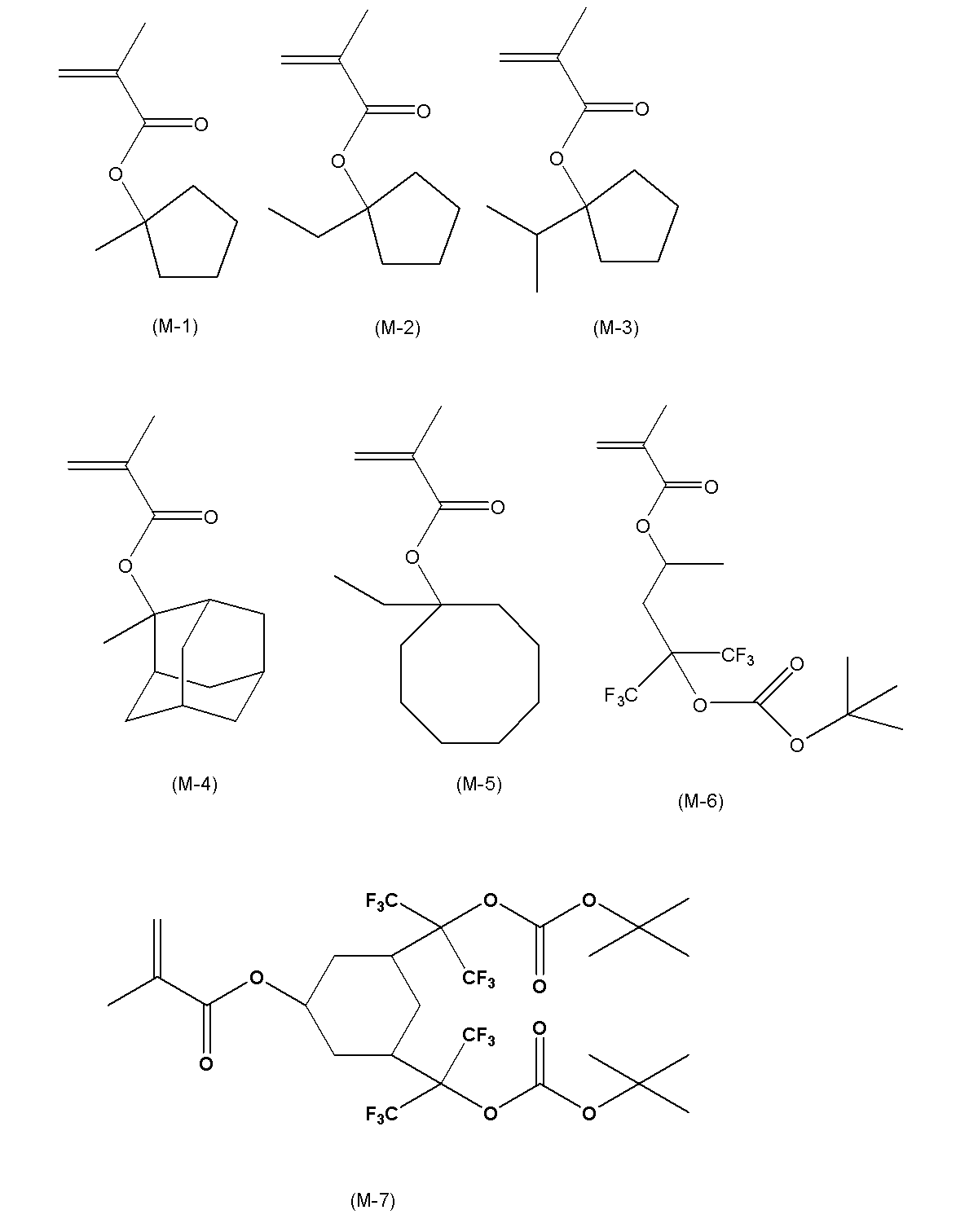
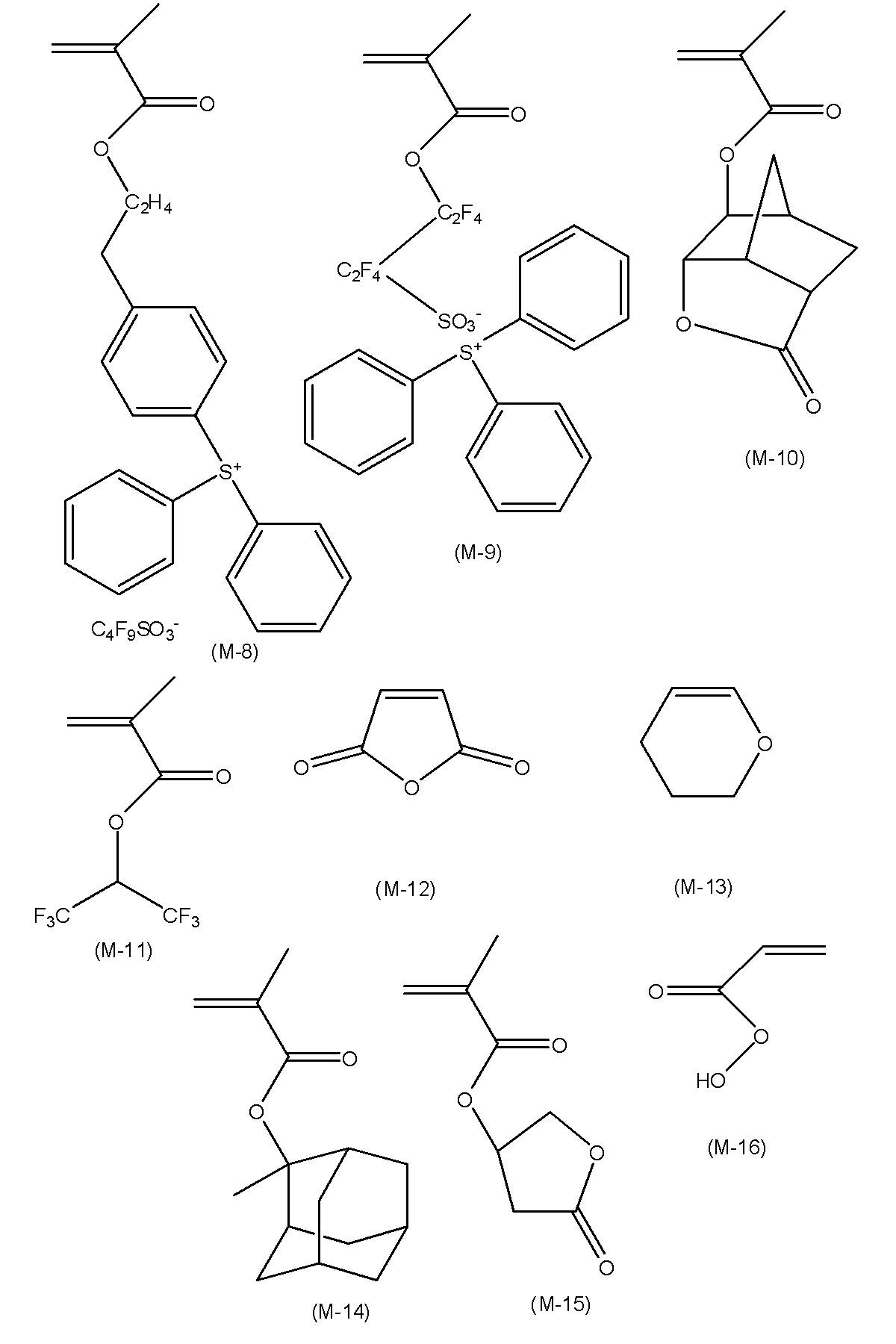
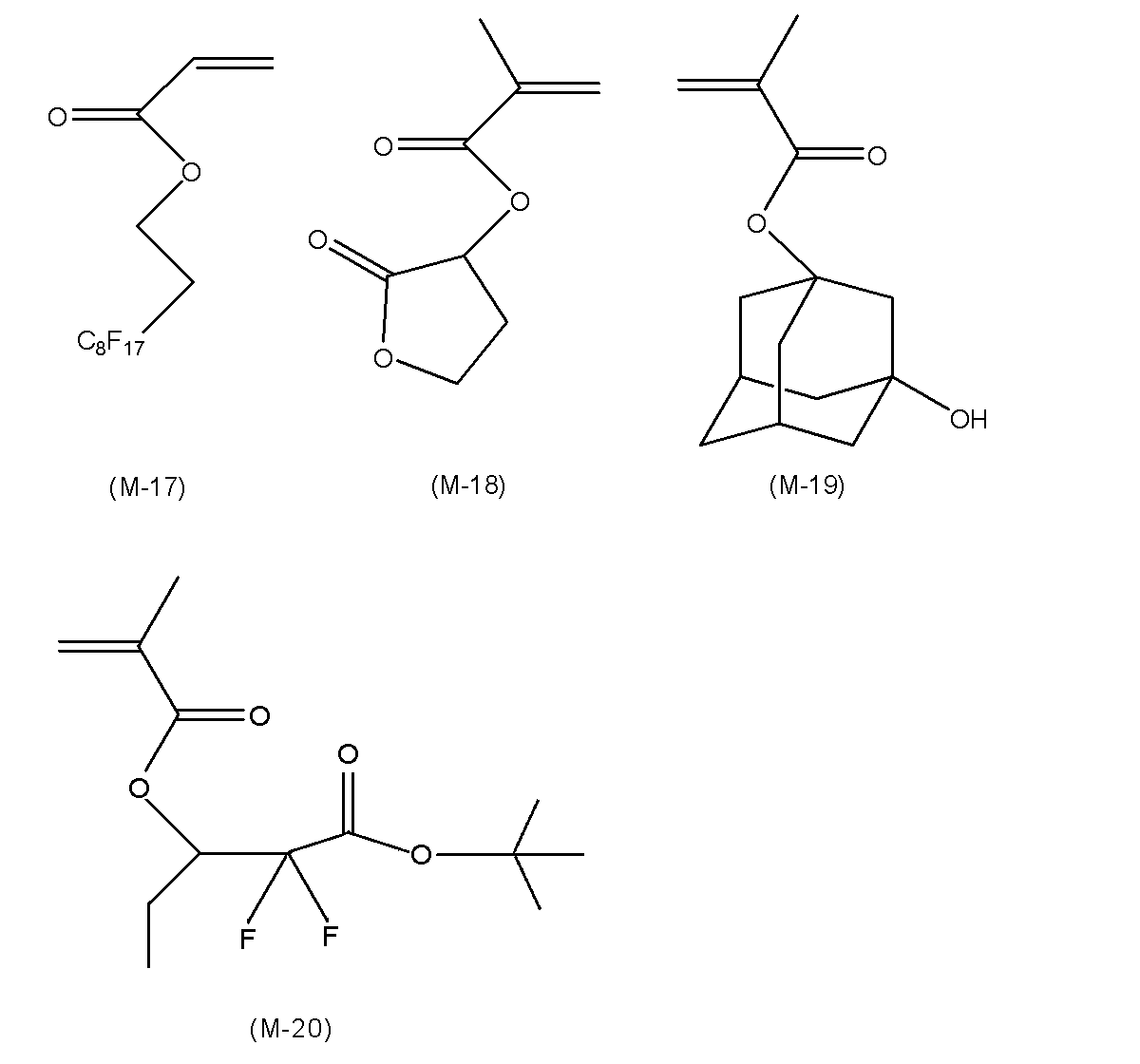
まず、表1に示す組み合わせ及び仕込みモル%となる質量の単量体、及び開始剤[2,2’-アゾビスイソブチロニトリル(AIBN)]を50gのメチルエチルケトンに溶解した単量体溶液を準備した。仕込み時の単量体の合計量は50gに調製した。尚、各単量体のモル%は単量体全量に対するモル%を表し、開始剤のモル%は単量体全量と開始剤の合計量に対するモル%を表す。
一方、温度計及び滴下漏斗を備えた500mlの三つ口フラスコにエチルメチルケトン50gを加え、30分間窒素バージを行った。その後、フラスコ内をマグネティックスターラーで攪拌しながら、80℃になるように加熱した。
次いで、前記単量体溶液をフラスコ内に滴下漏斗を用いて3hかけ滴下した。滴下後3時間熟成させ、その後、30℃以下になるまで冷却して共重合体溶液を得た。重合終了後、重合溶液を水冷することにより30℃以下に冷却し、1000gのメタノールへ投入し、析出した白色粉末をろ別した。ろ別された白色粉末を2度200gのメタノールにてスラリー状で洗浄した後、ろ別し、50℃にて17時間乾燥し、白色粉末の重合体を得た。
得られた各重合体の溶液質量%をガスクロマトグラフィーにて測定し、得られた重合体の収率(質量%)、及び重合体中の各繰り返し単位の割合(モル%)を測定した。それらの結果を表2に示す。
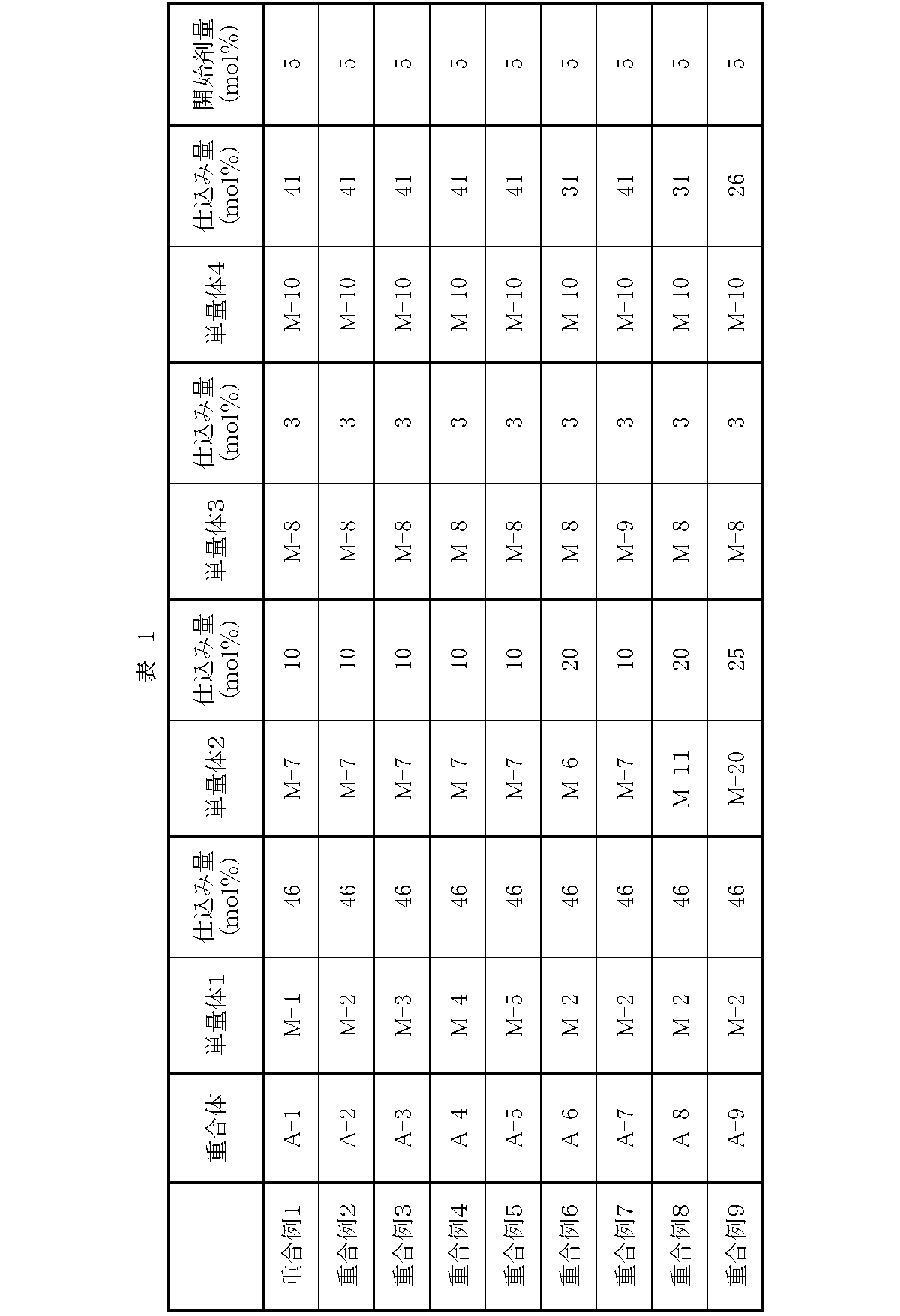

前記単量体(M-12)5.14g(19モル%)、単量体(M-13)9.15g(29モル%)、単量体(M-14)26.39g(35モル%)、及び単量体(M-15)9.31g(17モル%)を、2-ブタノン100gに溶解し、更にジメチル-2,2’-アゾビスイソブチレート(MAIB)0.74gを投入した単量体溶液を準備し、50gの2-ブタノンを投入した500mlの三口フラスコを30分窒素パージした。窒素パージの後、反応釜を攪拌しながら80℃に加熱し、事前に準備した前記単量体溶液を滴下漏斗を用いて3時間かけて滴下した。滴下開始を重合開始時間とし、重合反応を6時間実施した。重合終了後、重合溶液は水冷することにより30℃以下に冷却し、1000gのメタノールへ投入し、析出した白色粉末をろ別した。ろ別された白色粉末を2度200gのメタノールにてスラリー状で洗浄した後、ろ別し、50℃にて17時間乾燥し、白色粉末の重合体を得た(75g、収率75%)。
この重合体はMwが7200、Mw/Mn=1.65、13C-NMR分析の結果、単量体(M-12)、単量体(M-13)、単量体(M-14)、及び単量体(M-15)に由来する各繰り返し単位の含有割合が19.2:29.4:34.0:17.4(モル%)の共重合体であった。この重合体を重合体(AR-1)とする。
前記単量体(M-16)7.12g(50モル%)、及び単量体(M-17)42.88g(50モル%)を、2-ブタノン100gに溶解し、更にジメチル-2,2’-アゾビスイソブチレート(MAIB)1.91gを投入した単量体溶液を準備し、50gの2-ブタノンを投入した500mlの三口フラスコを30分窒素パージした。窒素パージの後、反応釜を攪拌しながら80℃に加熱し、事前に準備した前記単量体溶液を滴下漏斗を用いて3時間かけて滴下した。滴下後、3時間熟成させ、その後、30℃以下になるまで冷却して共重合体溶液を得た。
次いで、反応溶液をエバポレーターにてメタノール溶液に置換し、ヘキサンにて洗浄作業をおこなった後、水で洗浄、エバポレーターにてプロピレングリコールモノメチルエーテルアセテート溶液に置換した。得られた各重合体の溶液質量%をガスクロマトグラフィーにて測定し、得られた重合体の収率(質量%)、及び重合体中の各繰り返し単位の割合(モル%)を測定した。この重合体はMwが7200、Mw/Mn=1.72、13C-NMR分析の結果、単量体(M-16)、及び単量体(M-17)に由来する各繰り返し単位の含有割合が48.2:51.8(モル%)の共重合体であった。この重合体を重合体(AR-2)とする。
前記単量体(M-14)19.3g(35モル%)、単量体(M-18)16.03g(40モル%)、単量体(M-19)13.35g(24モル%)、及び単量体(M-8)1.31g(1モル%)を、2-ブタノン100gに溶解し、更にジメチル-2,2’-アゾビスイソブチレート(MAIB)2.71gを投入した単量体溶液を準備し、50gの2-ブタノンを投入した500mlの三口フラスコを30分窒素パージした。窒素パージの後、反応釜を攪拌しながら80℃に加熱し、事前に準備した前記単量体溶液を滴下漏斗を用いて3時間かけて滴下した。滴下開始を重合開始時間とし、重合反応を6時間実施した。重合終了後、重合溶液は水冷することにより30℃以下に冷却し、1000gのメタノールへ投入し、析出した白色粉末をろ別した。ろ別された白色粉末を2度200gのメタノールにてスラリー状で洗浄した後、ろ別し、50℃にて17時間乾燥し、白色粉末の重合体を得た(75g、収率75%)。
この重合体はMwが7100、Mw/Mn=1.62、13C-NMR分析の結果、単量体(M-14)、単量体(M-18)、単量体(M-19)、及び単量体(M-8)に由来する各繰り返し単位の含有割合が35:40:24:1(モル%)の共重合体であった。この重合体を樹脂(AR-3)とする。
表3及び表4に示す割合で、重合体、酸発生剤、含窒素化合物及び溶剤を混合し、実施例1~9及び比較例1~3の感放射線性樹脂組成物を調製した。尚、表3及び表4に示す重合体以外の成分は以下の通りであり、表中における「部」は、質量基準である。
(B-1):プロピレングリコールモノメチルエーテルアセテート



(C-1):下記に示す化合物

(D-1):N-t-ブトキシカルボニル-4-ヒドロキシピペリジン

実施例1~9及び比較例1~3の各感放射線性樹脂組成物について、以下のように下記(1)~(7)の各種評価を行った。これらの評価結果を表4に示す。
(1)溶出量の測定
図1に示すように、予めCLEAN TRACK ACT8(東京エレクトロン株式会社製)にてHMDS(ヘキサメチルジシラザン)11処理(100℃、60秒)を行った8インチシリコンウェハ1上の中心部に、中央部が直径11.3cmの円形状にくり抜かれたシリコンゴムシート2(クレハエラストマー社製、厚み;1.0mm、形状;1辺30cmの正方形)を載せた。次いで、シリコンゴム中央部のくり抜き部に10mLホールピペットを用いて10mlの超純水3を満たした。
その後、予めCLEAN TRACK ACT8により、膜厚77nmの下層反射防止膜(「ARC29A」、ブルワー・サイエンス社製)41を形成し、次いで、表3のレジスト組成物を前記CLEAN TRACK ACT8にて、前記下層反射防止膜41上にスピンコートし、ベーク(115℃、60秒)することにより膜厚205nmのレジスト被膜42を形成したシリコンウェハ4を、レジスト塗膜面が前記超純水3と接触するようあわせ、且つ超純水3がシリコンゴム2から漏れないように、前記シリコンゴムシート2上に載せた。
そして、その状態のまま10秒間保った。その後、前記8インチシリコンウェハ4を取り除き、超純水3をガラス注射器にて回収し、これを分析用サンプルとした。尚、実験終了後の超純水の回収率は95%以上であった。
次いで、前記で得られた超純水中の光酸発生剤のアニオン部のピーク強度を、LC-MS(液体クロマトグラフ質量分析計、LC部:AGILENT社製 SERIES1100、MS部:Perseptive Biosystems,Inc.社製 Mariner)を用いて下記の測定条件により測定した。その際、各酸発生剤の1ppb、10ppb、100ppb水溶液の各ピーク強度を前記測定条件で測定して検量線を作成し、この検量線を用いて前記ピーク強度から溶出量を算出した。
また、同様にして、酸拡散制御剤(含窒素化合物)の1ppb、10ppb、100ppb水溶液の各ピーク強度を前記測定条件で測定して検量線を作成し、この検量線を用いて前記ピーク強度から酸拡散制御剤の溶出量を算出した。
これらの溶出量の合計が、5.0×10⁻¹²mol/cm2/sec以上であった場合を「不良」とし、5.0×10-12mol/cm2/sec未満であった場合を「良好」とした。
使用カラム;「CAPCELL PAK MG」、資生堂株式会社製、1本
流量;0.2ml/分
流出溶剤:水/メタノール(3/7)(体積比)に0.1質量%のギ酸を添加したもの
測定温度;35℃
後退接触角の測定は、KRUS社製「DSA-10」を用いて、各感放射線性樹脂組成物による塗膜を形成した基板(ウェハ)を作成した後、速やかに、室温23℃、湿度45%、常圧の環境下で、次の手順により後退接触角を測定した。
まず、商品名「DSA-10」(KRUS社製)のウェハステージ位置を調整し、この調整したステージ上に前記基板をセットする。次いで、針に水を注入し、前記セットした基板上に水滴を形成可能な初期位置に前記針の位置を微調整する。その後、この針から水を排出させて前記基板上に25μLの水滴を形成し、一旦、この水滴から針を引き抜き、再び前記初期位置に針を引き下げて水滴内に配置する。続いて、10μL/minの速度で90秒間、針によって水滴を吸引すると同時に液面と基板との接触角を毎秒1回測定する(合計90回)。このうち、接触角の測定値が安定した時点から20秒間の接触角についての平均値を算出して後退接触角(°)とした。
基板として、表面に膜厚77nmの下層反射防止膜(「ARC29A」、ブルワー・サイエンス社製)を形成した12インチシリコンウェハを用いた。尚、この反射防止膜の形成には、「CLEAN TRACK ACT8」(東京エレクトロン株式会社製)を用いた。
次いで、表3のレジスト組成物を前記基板上に、前記CLEAN TRACK ACT8にて、スピンコートし、表4の条件でPBを行うことにより、膜厚120nmのレジスト被膜を形成した。このレジスト被膜に、ArFエキシマレーザー露光装置(「NSR S306C」、NIKON製、照明条件;NA0.78、シグマ0.93/0.69)により、マスクパターンを介して露光した。その後、表4に示す条件でPEBを行ったのち、2.38質量%のテトラメチルアンモニウムヒドロキシド水溶液により、23℃で30秒間現像し、水洗し、乾燥して、ポジ型のレジストパターンを形成した。このとき、線幅90nmのライン・アンド・スペースパターン(1L1S)を1対1の線幅に形成する露光量を最適露光量とし、この最適露光量を感度とした。尚、この測長には走査型電子顕微鏡(「S-9380」、株式会社日立ハイテクノロジーズ社製)を用いた。
前記(3)における90nmライン・アンド・スペースパターンの断面形状を、株式会社日立ハイテクノロジーズ社製「S-4800」にて観察し、パターン最上部での線幅Aと、パターン最下部での線幅Bとを測り、線幅A、Bの関係が0.7≦A/B≦1の範囲内である矩形パターンを「良好」とし、範囲外のT-top形状パターン等を「不良」とした。
基板として、表面に膜厚77nmの下層反射防止膜(「ARC29A」、ブルワー・サイエンス社製)を形成した12インチシリコンウェハを用いた。尚、この反射防止膜の形成には、「CLEAN TRACK ACT8」(東京エレクトロン株式会社製)を用いた。
次いで、表3のレジスト組成物を前記基板上に、前記CLEAN TRACK ACT8にて、スピンコートし、表4の条件でベーク(PB)を行うことにより、膜厚120nmのレジスト被膜を形成した。その後、純水により90秒間リンスを行った。このレジスト被膜に、ArFエキシマレーザー液浸露光装置(「NSR S306C」、NIKON製)をNA=0.75、σ=0.85、1/2Annularにより、マスクパターンを介して露光した。露光後、純水により90秒間、再度リンスを行い、表4に示す条件でPEBを行ったのち、2.38質量%のテトラメチルアンモニウムヒドロキシド水溶液により、23℃で60秒間現像し、水洗し、乾燥して、ポジ型のレジストパターンを形成した。このとき、幅1000nmのホールパターンを形成する露光量を最適露光量とし、この最適露光量にてウェハ全面に幅1000nmのホールパターンを形成し、欠陥検査用ウェハとして使用した。尚、この測長には走査型電子顕微鏡(「S-9380」、株式会社日立ハイテクノロジーズ社製)を用いた。
その後、幅1000nmのホールパターン上の欠陥数を、KLA-Tencor社製、「KLA2351」を用いて測定した。更に、「KLA2351」にて測定された欠陥を、走査型電子顕微鏡(「S-9380」、株式会社日立ハイテクノロジーズ社製)を用いて観察し、レジスト由来と見られるものと、外部由来の異物とみられるものとを分類した。そして、レジスト由来と見られる欠陥数の合計が100個/wafer以上であった場合を「不良」とし、100個/wafer未満であった場合を「良好」とした。
尚、レジスト由来と見られる欠陥とは、現像時の溶け残りに由来する残渣状欠陥、レジスト溶剤中の樹脂溶け残りに由来する突起状欠陥等であり、外部由来と見られる欠陥とは、大気中の塵に由来するゴミ及び塗布むら、泡等、レジストに関与しないタイプの欠陥である。
基板として、表面に膜厚77nmの下層反射防止膜(「ARC29A」、ブルワー・サイエンス社製)を形成した8インチシリコンウェハを用いた。尚、この反射防止膜の形成には、「CLEAN TRACK ACT8」(東京エレクトロン株式会社製)を用いた。
次いで、表3のレジスト組成物を前記基板上に、前記CLEAN TRACK ACT8にて、スピンコートし、表4の条件でベーク(PB)を行うことにより、膜厚120nmのレジスト被膜を形成した。その後、純水により90秒間リンスを行った。このレジスト被膜に、ArFエキシマレーザー液浸露光装置(「NSR S306C」、NIKON製)をNA=0.75、σ=0.85、1/2Annularにより、マスクパターンを介して露光した。露光後、純水により90秒間、再度リンスを行い、表4に示す条件でPEBを行ったのち、2.38質量%のテトラメチルアンモニウムヒドロキシド水溶液により、23℃で60秒間現像し、水洗し、乾燥して、ポジ型のレジストパターンを形成した。このとき、幅100nmのライン・アンド・スペースパターン上のパターンラフネスを10点測定し、平均値をLWRとして算出した。尚、この測長には走査型電子顕微鏡(「S-9380」、株式会社日立ハイテクノロジーズ社製)を用いた。LWRの値が10以上のものを「不良」、10以下のものを「良好」とした。
基板として、表面に膜厚77nmの下層反射防止膜(「ARC29A」、ブルワー・サイエンス社製)を形成した8インチシリコンウェハを用いた。尚、この反射防止膜の形成には、「CLEAN TRACK ACT8」(東京エレクトロン株式会社製)を用いた。
次いで、表3のレジスト組成物を前記基板上に、前記CLEAN TRACK ACT8にて、スピンコートし、表4の条件でベーク(PB)を行うことにより、膜厚120nmのレジスト被膜を形成した。その後、純水により90秒間リンスを行った。このレジスト被膜に、ArFエキシマレーザー液浸露光装置(「NSR S306C」、NIKON製)をNA=0.75、σ=0.85、1/2Annularにより、マスクパターンを介して露光した。露光後、純水により90秒間、再度リンスを行い、表4に示す条件でPEBを行ったのち、2.38質量%のテトラメチルアンモニウムヒドロキシド水溶液により、23℃で60秒間現像し、水洗し、乾燥して、ポジ型のレジストパターンを形成した。このとき、幅100nmのライン・アンド・スペースパターン上の100nmラインを形成する露光量を最適露光量とし、この最適露光量にてマスク寸法の異なる1S10Lにて、実際の孤立スペース寸法が100nmとなる孤立スペースパターン上のDOFを評価した。尚、この測長には走査型電子顕微鏡(「S-9380」、株式会社日立ハイテクノロジーズ社製)を用いた。


Claims (8)
- (A)下記一般式(1)で表される繰り返し単位と、フッ素原子を有する繰り返し単位(但し、下記一般式(1)で表される繰り返し単位を除く)とを含有しており、且つ側鎖に酸解離性基を有する重合体と、
(B)溶剤と、を含有することを特徴とする感放射線性樹脂組成物。

- 前記(A)重合体が、下記一般式(2)で表される繰り返し単位、下記一般式(3)で表される繰り返し単位、及び下記一般式(4)で表される繰り返し単位のうちの少なくとも1種を更に含有する請求項1に記載の感放射線性樹脂組成物。
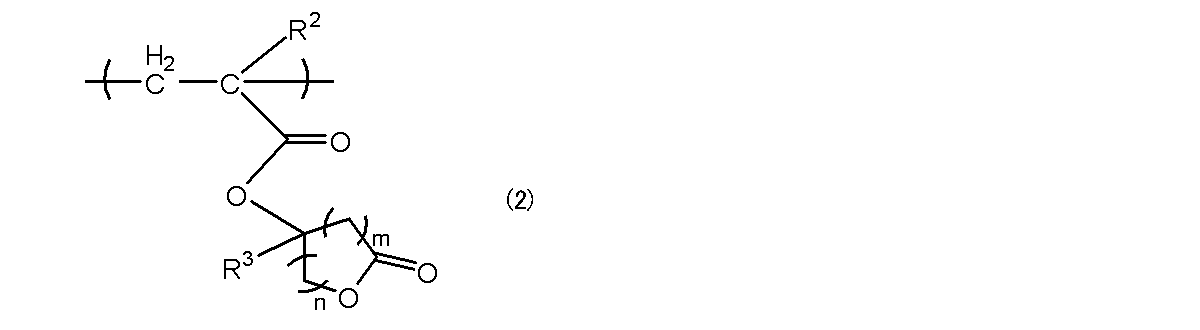
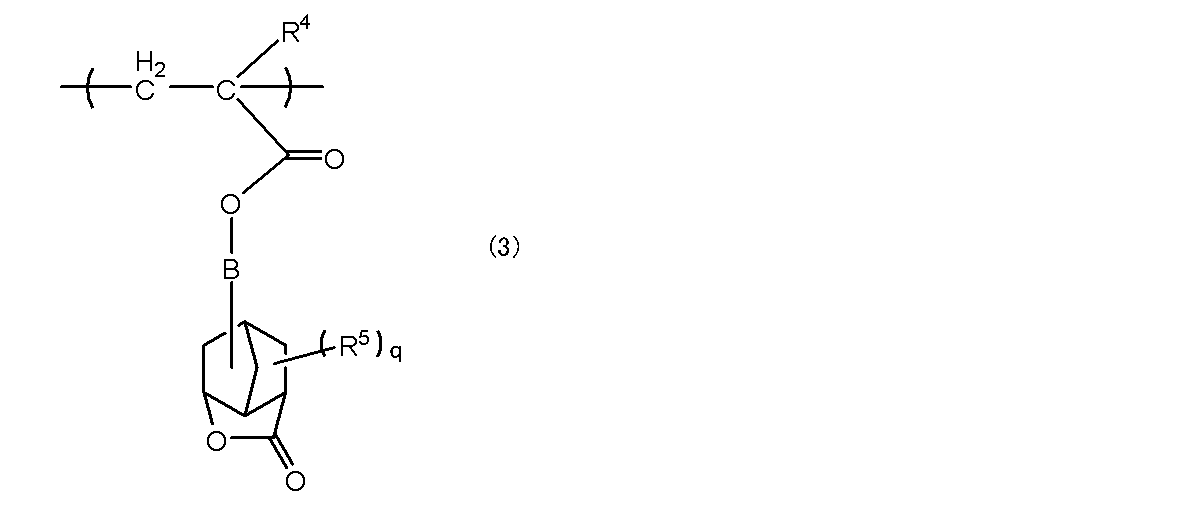

- 前記(A)重合体が、前記フッ素原子を有する繰り返し単位として、下記一般式(P-1)で表される、側鎖にフッ素原子と酸解離性基とを有する繰り返し単位を含有する請求項1又は2に記載の感放射線性樹脂組成物。

- 前記(A)重合体が、前記フッ素原子を有する繰り返し単位として、下記一般式(P-2)で表される、側鎖にフッ素原子を有する繰り返し単位を含有しており、且つ、下記一般式(Q-1)で表される、側鎖に酸解離性基を有する繰り返し単位を更に含有する請求項1又は2に記載の感放射線性樹脂組成物。


- 前記一般式(1)で表される繰り返し単位が、下記一般式(1-1)で表される繰り返し単位、及び、下記一般式(1-2)で表される繰り返し単位のうちの少なくとも一方である請求項1乃至4のうちのいずれか1項に記載の感放射線性樹脂組成物。


- 下記一般式(1)で表される繰り返し単位と、フッ素原子を有する繰り返し単位(但し、下記一般式(1)で表される繰り返し単位を除く)とを含有しており、且つ側鎖に酸解離性基を有することを特徴とする重合体。
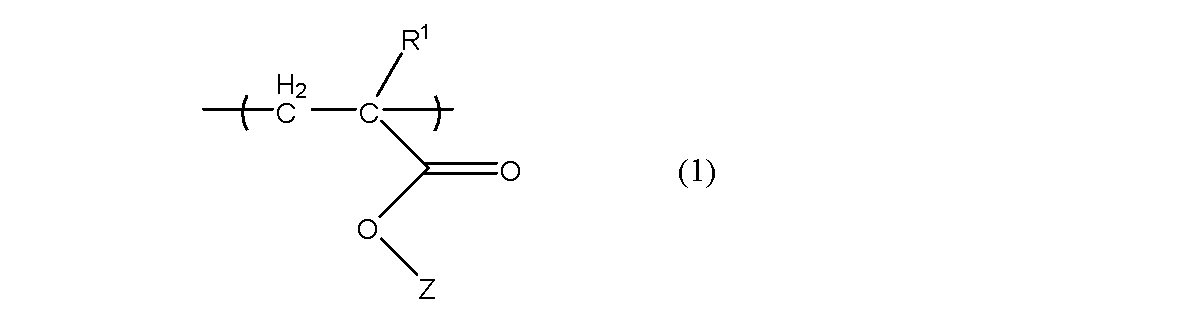
- 下記一般式(2)で表される繰り返し単位、下記一般式(3)で表される繰り返し単位、及び、下記一般式(4)で表される繰り返し単位のうちの少なくとも1種を更に含有する請求項6に記載の重合体。


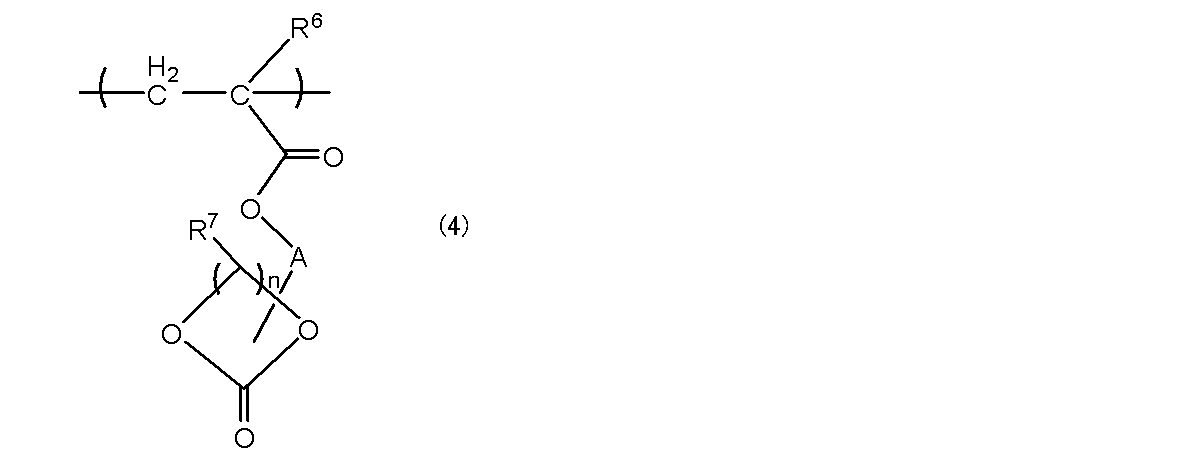
- (1)請求項1乃至5のいずれかに記載の感放射線性樹脂組成物を用いて、基板上にフォトレジスト膜を形成する工程と、
(2)前記フォトレジスト膜を液浸露光する工程と、
(3)液浸露光されたフォトレジスト膜を現象し、レジストパターンを形成する工程と、を備えることを特徴とするレジストパターン形成方法。
Priority Applications (3)
| Application Number | Priority Date | Filing Date | Title |
|---|---|---|---|
| JP2011510328A JP5522165B2 (ja) | 2009-04-21 | 2010-04-20 | 感放射線性樹脂組成物、重合体及びレジストパターン形成方法 |
| KR1020117024716A KR101766491B1 (ko) | 2009-04-21 | 2010-04-20 | 감방사선성 수지 조성물, 중합체 및 레지스트 패턴 형성 방법 |
| US13/278,202 US20120070783A1 (en) | 2009-04-21 | 2011-10-21 | Radiation-sensitive resin composition, polymer, and method for forming resist pattern |
Applications Claiming Priority (2)
| Application Number | Priority Date | Filing Date | Title |
|---|---|---|---|
| JP2009103449 | 2009-04-21 | ||
| JP2009-103449 | 2009-04-21 |
Related Child Applications (1)
| Application Number | Title | Priority Date | Filing Date |
|---|---|---|---|
| US13/278,202 Continuation US20120070783A1 (en) | 2009-04-21 | 2011-10-21 | Radiation-sensitive resin composition, polymer, and method for forming resist pattern |
Publications (1)
| Publication Number | Publication Date |
|---|---|
| WO2010123009A1 true WO2010123009A1 (ja) | 2010-10-28 |
Family
ID=43011126
Family Applications (1)
| Application Number | Title | Priority Date | Filing Date |
|---|---|---|---|
| PCT/JP2010/057022 Ceased WO2010123009A1 (ja) | 2009-04-21 | 2010-04-20 | 感放射線性樹脂組成物、重合体及びレジストパターン形成方法 |
Country Status (5)
| Country | Link |
|---|---|
| US (1) | US20120070783A1 (ja) |
| JP (1) | JP5522165B2 (ja) |
| KR (1) | KR101766491B1 (ja) |
| TW (1) | TW201040225A (ja) |
| WO (1) | WO2010123009A1 (ja) |
Cited By (1)
| Publication number | Priority date | Publication date | Assignee | Title |
|---|---|---|---|---|
| WO2021220648A1 (ja) * | 2020-04-27 | 2021-11-04 | Jsr株式会社 | 感放射線性樹脂組成物及びそれを用いたレジストパターンの形成方法、並びに、スルホン酸塩化合物及びそれを含む感放射線性酸発生剤 |
Families Citing this family (4)
| Publication number | Priority date | Publication date | Assignee | Title |
|---|---|---|---|---|
| KR101769154B1 (ko) | 2010-07-27 | 2017-08-17 | 제이에스알 가부시끼가이샤 | 감방사선성 수지 조성물, 레지스트 패턴 형성 방법, 중합체 및 화합물 |
| JP5741340B2 (ja) * | 2010-09-29 | 2015-07-01 | Jsr株式会社 | レジスト下層膜形成用組成物、重合体、レジスト下層膜、パターン形成方法及び半導体装置の製造方法 |
| KR102046849B1 (ko) * | 2012-03-30 | 2019-11-20 | 제이에스알 가부시끼가이샤 | 액침 상층막 형성용 조성물 |
| JP7331867B2 (ja) * | 2018-12-12 | 2023-08-23 | Jsr株式会社 | 感光性樹脂組成物、レジストパターン膜の製造方法、およびメッキ造形物の製造方法 |
Citations (10)
| Publication number | Priority date | Publication date | Assignee | Title |
|---|---|---|---|---|
| JP2006178317A (ja) * | 2004-12-24 | 2006-07-06 | Shin Etsu Chem Co Ltd | レジスト材料及びこれを用いたパターン形成方法 |
| JP2006215526A (ja) * | 2005-01-06 | 2006-08-17 | Shin Etsu Chem Co Ltd | レジスト材料及びこれを用いたパターン形成方法 |
| JP2007316600A (ja) * | 2006-04-25 | 2007-12-06 | Shin Etsu Chem Co Ltd | レジスト材料及びパターン形成方法 |
| JP2008133448A (ja) * | 2006-10-27 | 2008-06-12 | Shin Etsu Chem Co Ltd | 重合性アニオンを有するスルホニウム塩及び高分子化合物、レジスト材料及びパターン形成方法 |
| JP2008248063A (ja) * | 2007-03-30 | 2008-10-16 | Shin Etsu Chem Co Ltd | 高分子化合物、化学増幅ポジ型レジスト材料及びパターン形成方法 |
| WO2009057484A1 (ja) * | 2007-10-29 | 2009-05-07 | Jsr Corporation | 感放射線性樹脂組成物及び重合体 |
| JP2009217253A (ja) * | 2008-02-13 | 2009-09-24 | Shin Etsu Chem Co Ltd | ポジ型レジスト材料及びパターン形成方法 |
| JP2009242789A (ja) * | 2008-03-14 | 2009-10-22 | Shin Etsu Chem Co Ltd | スルホニウム塩の繰り返し単位を含有する高分子化合物、レジスト材料及びパターン形成方法 |
| JP2010077404A (ja) * | 2008-08-28 | 2010-04-08 | Shin-Etsu Chemical Co Ltd | 重合性アニオンを有するスルホニウム塩及び高分子化合物、レジスト材料及びパターン形成方法 |
| JP2010095643A (ja) * | 2008-10-17 | 2010-04-30 | Central Glass Co Ltd | 重合性アニオンを有する含フッ素スルホン塩類とその製造方法、含フッ素樹脂、レジスト組成物及びそれを用いたパターン形成方法 |
Family Cites Families (2)
| Publication number | Priority date | Publication date | Assignee | Title |
|---|---|---|---|---|
| US7569326B2 (en) * | 2006-10-27 | 2009-08-04 | Shin-Etsu Chemical Co., Ltd. | Sulfonium salt having polymerizable anion, polymer, resist composition, and patterning process |
| JP5449675B2 (ja) * | 2007-09-21 | 2014-03-19 | 富士フイルム株式会社 | 感光性組成物、該感光性組成物を用いたパターン形成方法及び該感光性組成物に用いられる化合物 |
-
2010
- 2010-04-20 KR KR1020117024716A patent/KR101766491B1/ko active Active
- 2010-04-20 JP JP2011510328A patent/JP5522165B2/ja active Active
- 2010-04-20 WO PCT/JP2010/057022 patent/WO2010123009A1/ja not_active Ceased
- 2010-04-21 TW TW099112517A patent/TW201040225A/zh unknown
-
2011
- 2011-10-21 US US13/278,202 patent/US20120070783A1/en not_active Abandoned
Patent Citations (10)
| Publication number | Priority date | Publication date | Assignee | Title |
|---|---|---|---|---|
| JP2006178317A (ja) * | 2004-12-24 | 2006-07-06 | Shin Etsu Chem Co Ltd | レジスト材料及びこれを用いたパターン形成方法 |
| JP2006215526A (ja) * | 2005-01-06 | 2006-08-17 | Shin Etsu Chem Co Ltd | レジスト材料及びこれを用いたパターン形成方法 |
| JP2007316600A (ja) * | 2006-04-25 | 2007-12-06 | Shin Etsu Chem Co Ltd | レジスト材料及びパターン形成方法 |
| JP2008133448A (ja) * | 2006-10-27 | 2008-06-12 | Shin Etsu Chem Co Ltd | 重合性アニオンを有するスルホニウム塩及び高分子化合物、レジスト材料及びパターン形成方法 |
| JP2008248063A (ja) * | 2007-03-30 | 2008-10-16 | Shin Etsu Chem Co Ltd | 高分子化合物、化学増幅ポジ型レジスト材料及びパターン形成方法 |
| WO2009057484A1 (ja) * | 2007-10-29 | 2009-05-07 | Jsr Corporation | 感放射線性樹脂組成物及び重合体 |
| JP2009217253A (ja) * | 2008-02-13 | 2009-09-24 | Shin Etsu Chem Co Ltd | ポジ型レジスト材料及びパターン形成方法 |
| JP2009242789A (ja) * | 2008-03-14 | 2009-10-22 | Shin Etsu Chem Co Ltd | スルホニウム塩の繰り返し単位を含有する高分子化合物、レジスト材料及びパターン形成方法 |
| JP2010077404A (ja) * | 2008-08-28 | 2010-04-08 | Shin-Etsu Chemical Co Ltd | 重合性アニオンを有するスルホニウム塩及び高分子化合物、レジスト材料及びパターン形成方法 |
| JP2010095643A (ja) * | 2008-10-17 | 2010-04-30 | Central Glass Co Ltd | 重合性アニオンを有する含フッ素スルホン塩類とその製造方法、含フッ素樹脂、レジスト組成物及びそれを用いたパターン形成方法 |
Cited By (1)
| Publication number | Priority date | Publication date | Assignee | Title |
|---|---|---|---|---|
| WO2021220648A1 (ja) * | 2020-04-27 | 2021-11-04 | Jsr株式会社 | 感放射線性樹脂組成物及びそれを用いたレジストパターンの形成方法、並びに、スルホン酸塩化合物及びそれを含む感放射線性酸発生剤 |
Also Published As
| Publication number | Publication date |
|---|---|
| KR20120007005A (ko) | 2012-01-19 |
| JP5522165B2 (ja) | 2014-06-18 |
| JPWO2010123009A1 (ja) | 2012-10-25 |
| US20120070783A1 (en) | 2012-03-22 |
| TW201040225A (en) | 2010-11-16 |
| KR101766491B1 (ko) | 2017-08-08 |
Similar Documents
| Publication | Publication Date | Title |
|---|---|---|
| JP5555914B2 (ja) | 感放射線性樹脂組成物 | |
| JP5761892B2 (ja) | 感放射線性樹脂組成物 | |
| JP5601198B2 (ja) | 重合体並びに感放射線性組成物 | |
| JP5141459B2 (ja) | 感放射線性樹脂組成物 | |
| WO2009142181A1 (ja) | 液浸露光用感放射線性樹脂組成物、重合体及びレジストパターン形成方法 | |
| JP5716397B2 (ja) | 感放射線性樹脂組成物、レジストパターン形成方法及びフォトレジスト膜 | |
| JP5343340B2 (ja) | 感放射線性樹脂組成物 | |
| KR20100106231A (ko) | 중합체 및 포지티브형 감방사선성 수지 조성물 | |
| JP5522165B2 (ja) | 感放射線性樹脂組成物、重合体及びレジストパターン形成方法 | |
| JP5481768B2 (ja) | 感放射線性樹脂組成物及びそれを用いたレジストパターン形成方法 | |
| JP5343535B2 (ja) | 感放射線性樹脂組成物、それを用いたレジスト成膜方法及びレジストパターン形成方法 | |
| JP2010230891A (ja) | 感放射線性樹脂組成物、レジストパターン形成方法、及びブロック共重合体 | |
| JP5515449B2 (ja) | 感放射線性樹脂組成物及びレジストパターン形成方法 | |
| JP5594283B2 (ja) | 化合物、フッ素原子含有重合体、及び感放射線性樹脂組成物 | |
| JPWO2008087840A1 (ja) | 液浸露光用感放射線性樹脂組成物及びフォトレジストパターン形成方法 | |
| JP5051232B2 (ja) | 感放射線性樹脂組成物及びパターン形成方法 | |
| JP5282621B2 (ja) | 感放射線性樹脂組成物及びレジストパターン形成方法 | |
| JP5605463B2 (ja) | 感放射線性樹脂組成物、及びレジストパターン形成方法 | |
| JP4706562B2 (ja) | レジストパターンの形成方法 | |
| JP5861741B2 (ja) | ブロック共重合体 | |
| JP2012150501A (ja) | 感放射線性樹脂組成物及びそれを用いたレジストパターン形成方法 | |
| JP2010276882A (ja) | 感放射線性樹脂組成物およびそれに用いる重合体 |
Legal Events
| Date | Code | Title | Description |
|---|---|---|---|
| 121 | Ep: the epo has been informed by wipo that ep was designated in this application |
Ref document number: 10767066 Country of ref document: EP Kind code of ref document: A1 |
|
| WWE | Wipo information: entry into national phase |
Ref document number: 2011510328 Country of ref document: JP |
|
| ENP | Entry into the national phase |
Ref document number: 20117024716 Country of ref document: KR Kind code of ref document: A |
|
| NENP | Non-entry into the national phase |
Ref country code: DE |
|
| 122 | Ep: pct application non-entry in european phase |
Ref document number: 10767066 Country of ref document: EP Kind code of ref document: A1 |