WO2010100762A1 - 荷物管理プログラム、荷物管理装置および荷物管理方法 - Google Patents
荷物管理プログラム、荷物管理装置および荷物管理方法 Download PDFInfo
- Publication number
- WO2010100762A1 WO2010100762A1 PCT/JP2009/054334 JP2009054334W WO2010100762A1 WO 2010100762 A1 WO2010100762 A1 WO 2010100762A1 JP 2009054334 W JP2009054334 W JP 2009054334W WO 2010100762 A1 WO2010100762 A1 WO 2010100762A1
- Authority
- WO
- WIPO (PCT)
- Prior art keywords
- container
- lane
- shipping destination
- master
- identifier
- Prior art date
- Legal status (The legal status is an assumption and is not a legal conclusion. Google has not performed a legal analysis and makes no representation as to the accuracy of the status listed.)
- Ceased
Links
Images





Classifications
-
- G—PHYSICS
- G06—COMPUTING OR CALCULATING; COUNTING
- G06Q—INFORMATION AND COMMUNICATION TECHNOLOGY [ICT] SPECIALLY ADAPTED FOR ADMINISTRATIVE, COMMERCIAL, FINANCIAL, MANAGERIAL OR SUPERVISORY PURPOSES; SYSTEMS OR METHODS SPECIALLY ADAPTED FOR ADMINISTRATIVE, COMMERCIAL, FINANCIAL, MANAGERIAL OR SUPERVISORY PURPOSES, NOT OTHERWISE PROVIDED FOR
- G06Q10/00—Administration; Management
Definitions
- the present invention relates to a package management program, a package management apparatus, and a package management method for managing packages.
- an accumulation place such as a container (luggage) relay point
- an operation of sorting containers into lanes (places) according to the shipping destination of the container is performed.
- a technique using an RFID (Radio Frequency IDentification) tag is known in order to accurately perform container sorting work in this accumulation area.
- an RFID tag storing the shipping destination of the container is pasted on each container in advance.
- a lane identifier for identifying each lane and a shipping destination assigned in advance to each lane are stored in the server that manages the container in association with each other.
- the lane identifier is, for example, a lane number assigned to each lane.
- an operator who sorts containers uses a terminal device to set the shipping destination read from the tag and the lane identifier of the lane in which the container is placed when placing the container in a desired lane.
- the server sends a warning to the worker via the terminal device. In this way, the container sorting operation is accurately performed by warning the worker that the container shipping destination is different from the shipping destination assigned to the lane.
- the worker is full of containers in the corresponding lanes corresponding to the shipping destination, and there are cases where the containers are unavoidably placed in the lane adjacent to the lanes.
- the server since the shipping destination assigned to the lane and the shipping destination of the container do not match, the server sends a warning to the worker, which is annoying to the worker.
- the package management program, the package management apparatus, and the package management method have been made to solve the above-described problems of the prior art, and can automatically change the shipping destination assigned to the lane. It is an object to provide a package management program, a package management apparatus, and a package management method.
- the disclosed package management program receives information for identifying a container placed in a lane, a procedure for receiving a lane identifier for identifying the lane in which the container is placed, and received Placed in the lane with reference to the container master having the information for identifying the container as a key and the information identifying the container, the shipping destination of the container, and the warehousing flag indicating whether or not the container is placed in association with each other
- Use the received lane identifier as a key to identify the ship destination of the container and refer to the lane master that associates the lane identifier with the lane ship destination to identify the ship destination of the lane where the container is placed
- To determine whether the shipping destination of the container placed in the lane matches the shipping destination of the lane where the container is placed If it is determined that the shipping destination of the container placed in the lane and the shipping destination of the lane in which the container is placed do not match in the order and the procedure for judging whether they match
- a record having the lane identifier of the lane where the container is placed is extracted, and the storage flag of the extracted record indicates that the container has been placed.
- FIG. 1 is a diagram for explaining the outline of the server according to the first embodiment.
- FIG. 2 is a diagram illustrating a code system of the RFID tag.
- FIG. 3 is a block diagram showing the configuration of the server.
- FIG. 4 is a diagram illustrating an example of information stored in the lane master.
- FIG. 5 is a diagram illustrating an example of information stored in the container master.
- FIG. 6 is a flowchart showing the flow of processing by the HTT terminal.
- FIG. 7 is a flowchart showing the flow of processing by the server.
- FIG. 8 is a diagram showing an example of information stored in the tag reader master.
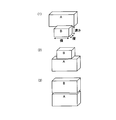
- FIG. 9 is a diagram for explaining processing by the determination unit.
- FIG. 10 is a diagram illustrating a computer that executes a package management program.
- FIG. 1 is a diagram for explaining the outline of the server according to the first embodiment.
- the outline of the server according to the first embodiment is to manage the sorting operation of the container using an RFID (Radio Frequency IDentification) tag. Then, the server according to the first embodiment automatically changes the shipping destination assigned to the lane.
- RFID Radio Frequency IDentification
- the server has a container master having information (management code) for identifying a container, a shipping destination of the container, and a warehousing flag indicating whether or not the container is placed.
- the container master is associated with the lane, the management code “R-001”, the shipping destination “North America”, and the warehousing flag “1” indicating that the container has already been placed in the lane. Is stored in association with each other.
- the warehousing flag “0” is a flag indicating that the container is a container before being placed on the lane.
- the server has a lane master that associates a lane identifier for identifying a lane with a shipping destination of the lane.
- the lane master stores the lane identifier 1 and the shipping destination “North America” in association with each other.
- HHT terminal Handy Terminal Terminal
- the worker uses an HHT terminal to transmit information for identifying the container and a lane identifier of the lane in which the container is placed to the server. For example, as shown in (1) of FIG. 1, the worker transmits a management code “R-004” and a lane identifier 2 for identifying the lane in which the container is placed to the server.
- the server Upon receiving the management code “R-004” and the lane identifier 2 from the HHT terminal, the server refers to the container master using the received management code “R-004” as a key, and ships the container placed in the lane. Identify the previous North America. Subsequently, the server refers to the lane master using the received lane identifier 2 as a key, and identifies “South America” that is the shipping destination of the lane in which the container is placed.
- the server determines whether the shipping destination of the container placed in the lane matches the shipping destination of the lane in which the container is placed. In other words, in the example of FIG. 1, the server determines whether “North America”, which is the shipping destination of the container placed in the lane, matches “South America”, which is the shipping destination assigned to the lane 2.
- the server determines that the shipping destination of the container placed in the lane does not match the shipping destination of the lane in which the container is placed, the server uses the lane identifier of the lane in which the container is placed as a key to Referring to the master, extract the record of the lane where the container is placed. Subsequently, the server determines whether there is a record having a flag indicating that the container is placed in the warehousing flag of the extracted record.
- the shipping destination associated with the lane in which the lane master container is placed is set to the container placed in the lane. Update to the shipping destination.
- the server determines that “North America” that is the shipping destination of the container placed in the lane does not match “South America” that is the shipping destination assigned to the lane 2. Subsequently, the server extracts the record associated with lane 2 from the container master, and there is no record having a flag indicating that the container is placed in the warehousing flag of the extracted record. Judge that there is no container for South America. Then, as shown in (2) of FIG. 1, the server updates the shipping destination stored in association with the lane identifier 2 in the lane master to “North America” that is the shipping destination of the container placed in the lane. .
- the server according to the first embodiment can automatically update the shipping destination assigned to the lane. Therefore, the server according to the first embodiment can avoid sending a warning that is annoying to the operator without increasing unnecessary labor for the container sorting operation.
- the HHT terminal transmits information identifying the container placed in the lane and the lane identifier of the lane in which the container is placed to the server. For example, when the HHT terminal accepts a read operation by an operator, the HHT terminal reads the management code from the RFID tag attached to the container, reads the lane identifier from the RFID tag suspended on the lane, and transmits it to the server. To do.
- FIG. 2 is a diagram showing a code system of the RFID tag.
- the RFID tag attached to the container has a code system shown in FIG.
- the management code is information uniquely given to each container in order to identify the container.
- the RFID tag suspended on the lane has a code system shown in FIG.
- the location code corresponds to an EPC (Electronic Product Code) indicating a lane identifier.
- the lane identifier is, for example, a lane number.
- the lane identifier may be information other than the number as long as it is information for identifying the lane such as a symbol and a code.
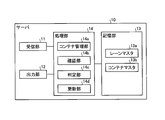
- FIG. 3 is a block diagram showing the configuration of the server. As illustrated in FIG. 3, the server 10 includes a receiving unit 11, an output unit 12, a storage unit 13, and a processing unit 14.
- the receiving unit 11 receives various information. Specifically, the receiving unit 11 receives a management code and a lane identifier from the HHT terminal.
- the output unit 12 outputs various types of information. Specifically, the output unit 12 sends a warning to the worker via the HHT terminal.
- the storage unit 13 stores data and programs necessary for managing the sorting work.
- the storage unit 13 includes a lane master 13a and a container master 13b.
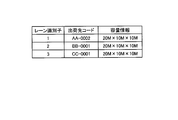
- FIG. 4 is a diagram showing an example of information stored in the lane master.
- the lane master 13a has a lane identifier, a shipping destination code indicating a shipping destination assigned in advance to the lane, and capacity information for calculating the capacity of a container that can be placed in each lane. And remember.
- Information stored in the lane master 13a is registered at the time of initial setting of the server 10, and is appropriately updated by an update unit 14d described later.
- FIG. 5 is a diagram showing an example of information stored in the container master.
- the container master 13b stores a management code, a container shipping destination, and a warehousing flag indicating whether or not the container is placed in association with each other.
- the container master 13b correlates with the management code, and stores the item code, product number, product name, shipping destination code, shipping destination, shipping source code, shipping source (supplier), receipt date and time.
- Various information for managing the container such as the delivery date / time, the lane identifier, the size information, the stack flag, and the receipt flag are stored.
- the record of each management code stored in the container master 13b is registered when the container is received at the accumulation place.
- the warehousing flag is written with a warehousing flag “0” indicating that the container has not been placed in the lane at the time of initial registration.
- the server 10 receives the management code of the container from the HHT terminal, and the warehousing flag is updated from “0” to “1” indicating that the container is already placed.
- the processing unit 14 includes a management program for managing the container, a program defining various processing procedures, and an internal memory for storing necessary data, and executes various processes using these.
- the processing unit 14 includes a container management unit 14a, a confirmation unit 14b, a determination unit 14c, and an update unit 14d.
- the container management unit 14a manages containers. Specifically, when receiving the management code and the lane identifier from the HHT terminal, the container management unit 14a sets the shipping destination code corresponding to the lane identifier of the lane in which the container is placed, using the received lane identifier as a key. Obtained from 13a. Also, the container management unit 14a acquires the shipping destination code of the container placed in the lane from the container master 13b using the received management code as a key. The container management unit 14a determines whether the shipping destination code corresponding to the lane identifier of the lane in which the container is placed matches the shipping destination code of the container placed in the lane. If it is determined that the shipping destination codes match, the container management unit 14a updates the warehousing flag corresponding to the received management code from “0” to “1”.
- the confirmation unit 14b A record having the lane identifier of the lane in which the container is placed is extracted from the container master 13b. Subsequently, the confirmation unit 14b determines whether there is a record having the warehousing flag “1” in the warehousing flag of the extracted record. If it is determined that there is a record having the warehousing flag “1”, the confirmation unit 14b indicates that a plurality of containers with different shipping destinations are placed in the lane where the container is placed. Sends a warning to the worker.
- the confirmation unit 14b further confirms whether or not the lane in which the container is placed is the lane adjacent to the corresponding lane corresponding to the shipping destination, and if it is not the adjacent lane, issues a warning to the worker. You may make it do.
- the confirmation unit 14b acquires the lane identifier corresponding to the management code received from the HHT terminal from the container master 13b, and calculates the difference between the acquired lane identifier and the lane identifier received from the HHT terminal. When the calculated difference is 2 or more, the confirmation unit 14b sends a warning to the worker.
- the determining unit 14c determines whether the corresponding lane is empty. Specifically, when the confirmation unit 14b determines that there is no record having the warehousing flag “1”, the determining unit 14c determines that the record having the lane identifier of the corresponding lane and having the warehousing flag “1” is the container master. The total capacity of the containers already placed in the corresponding lane is calculated by adding the size information of the extracted records extracted from 13b.
- the determination unit 14c reads the capacity information of the corresponding lane from the lane master 13a, and calculates the allowable total capacity indicating the capacity of the container that can be placed in the corresponding lane using the read capacity information. Subsequently, the determination unit 14c subtracts the total capacity from the allowable total capacity, calculates a free capacity indicating the capacity of the container that can be further placed in the corresponding lane, and compares it with the capacity of the container placed in the lane. As a result of comparison, if the capacity of the container placed in the lane is less than the free capacity, the container was placed in another lane other than the corresponding lane even though the corresponding lane is not full. Therefore, the determination unit 14c sends a warning to the worker.
- the update unit 14d updates the shipping destination associated with the lane identifier of the lane in which the container of the lane master 13a is placed to the shipping destination of the container placed in the lane. Specifically, the update unit 14d receives the shipping destination code stored in the lane master 13a in association with the received lane identifier when the determination unit 14c determines that the corresponding lane is not empty. The shipping code is updated in association with the management code stored in the container master 13b. Then, the updating unit 14d updates the warehousing flag stored in the container master 13b in association with the received management code from “0” to “1”.
- FIG. 6 is a flowchart showing the flow of processing by the HTT terminal.
- the HTT terminal accepts a read operation (Yes at Step S101)
- the HTT terminal reads the management code from the RFID tag attached to the container (Step S102), and the RFID tag suspended on the lane The lane identifier is read from (Step S103).
- the HTT terminal transmits the read management code and lane identifier to the server 10 (step S104).
- FIG. 7 is a flowchart showing the flow of processing by the server.
- the container management unit 14a receives the management code and the lane identifier from the HHT terminal (Yes in step S201)
- the container management unit 14a receives the shipping destination code and the management code acquired from the lane master 13a using the lane identifier as a key.
- the shipping destination code acquired from the container master 13b using the key is compared (step S202).
- the container management unit 14a updates the warehousing flag corresponding to the received management code from “0” to “1” (Step S210).
- the confirmation unit 14b confirms whether the lane on which the container is placed is the lane adjacent to the corresponding lane (Step S203).
- the confirmation unit 14b sends a warning to the worker (Step S204).
- the confirmation unit 14b extracts the record having the lane identifier of the lane in which the container is placed from the container master 13b. Then, it is determined whether there is a record having the receipt flag “1” in the receipt flag of the extracted record (step S205).
- the confirmation unit 14b sends a warning to the worker (Step S204).
- the determination unit 14c calculates the total capacity of the containers already placed in the corresponding lane using the size information (Step S206). ).
- the confirmation unit 14b calculates the free capacity by subtracting the total capacity from the allowable total capacity of the corresponding lane (step S207), and compares the free capacity with the capacity of the container placed in the lane (step 208). .
- the confirmation unit 14b sends a warning to the worker (Step S204).
- the update unit 14d associates the received lane identifier with the shipping destination stored in the lane master 13a.
- the code is updated to the shipping destination code stored in the container master 13b in association with the received management code (step S209), and the warehousing flag corresponding to the received management code is updated from “0” to “1”. (Step S210).
- the shipping destination assigned to the lane can be automatically updated. Therefore, according to the first embodiment, it is possible to avoid sending an alarm that is annoying to the operator without adding extra labor to the container sorting operation.
- an HHT terminal corresponding to each lane may be prepared in advance in the accumulation area, and the lane on which the container is placed may be specified based on the HHT terminal.
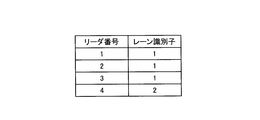
- the server further includes a tag reader master that stores a lane identifier in association with a reader number uniquely assigned to each HHT terminal in order to identify the HHT terminal.
- the container management unit 14a receives the shipping destination code and the reader number from the HHT terminal, the container management unit 14a acquires a lane identifier corresponding to the received reader number from the tag reader master, and specifies the lane in which the container is placed.
- FIG. 8 is a diagram showing an example of information stored in the tag reader master.
- the determination unit 14c calculates the free capacity by subtracting the total capacity of the containers already placed in the corresponding lane from the allowable total capacity of the corresponding lane. Subsequently, the determination unit 14c reads the stack flag corresponding to the management code of the container placed in the lane from the container master.
- the stacking flag “OK” means that the container may be placed on a container that has already been placed.
- the stack flag “impossible” means that the container has to be stacked.
- the determination unit 14c reads the size information (vertical, horizontal, height) of the container placed in the lane from the lane master 13a, and the capacity of the container placed in the lane. Is calculated. Then, the determination unit 14c compares the calculated container capacity with the free capacity.
- the determination unit 14c reads the size information (vertical and horizontal) of the container placed in the lane from the lane master 13a, and the height of the corresponding lane is the lane master 13a. Read from. Then, the determination unit 14c calculates the capacity occupied by the container placed in the lane as the capacity of the container using the read vertical, horizontal, and height. Then, the determination unit 14c compares the calculated container capacity with the free capacity.
- the determination unit 14c The container placed in the lane is determined to be a container that must be stacked.
- the determination unit 14c stacks the containers placed in the lane. Judge that it is a good container.
- each component of the server 10 shown in FIG. 3 is functionally conceptual and does not necessarily need to be physically configured as illustrated. That is, the specific form of distribution / integration of each device is not limited to the one shown in the figure. For example, various types of loads and usage situations such as integrating the confirmation unit 14b and the determination unit 14c shown in FIG. Depending on the above, it can be configured to be functionally or physically distributed and integrated in arbitrary units.
- each processing function performed in each device can be realized in whole or in any part by a CPU and a program that is analyzed and executed by the CPU.
- FIG. 10 is a diagram illustrating a computer that executes a package management program.
- the computer 110 as the server 10 is configured by connecting an input unit 120, a ROM 130, a CPU 140, an HDD 150, a RAM 160, and an output unit 170 via a bus 180 or the like.
- the ROM 130 has a package management program that performs the same function as the server 10 shown in the first embodiment, that is, a container management program 130a, a confirmation program 130b, a determination program 130c, and an update as shown in FIG.
- a program 130d is stored in advance. Note that these programs 130a to 130d may be appropriately integrated or distributed in the same manner as each component of the server 10 shown in FIG.
- the CPU 140 reads out these programs 130a to 130d from the ROM 130 and executes them, so that as shown in FIG. 10, the programs 130a to 130d are a container management process 140a, a confirmation process 140b, and a determination process 140c. Then, it functions as the update process 140d.
- the processes 140a to 140d correspond to the container management unit 14a, the confirmation unit 14b, the determination unit 14c, and the update unit 14d, respectively, illustrated in FIG.
- the HDD 150 is provided with a lane master table 150a and a container master table 150b.
- the CPU 140 reads the lane master 160a and the container master 160b from the lane master table 150a and the container master table 150b, stores them in the RAM 160, and executes processing based on the lane master 160a and the container master 160b stored in the RAM 160.
- the lane master table 150a and the container master table 150b correspond to the lane master 13a and the container master 13b illustrated in FIG.
- each program is stored in a computer-readable storage medium such as a flexible disk (FD), a CD-ROM, a DVD disk, a magneto-optical disk, and an IC card inserted into the computer 100.
- the program may be read and executed.
- each program is stored in “another computer (or server)” connected to the computer 100 via a communication line such as a public line, the Internet, a LAN, or a WAN, and the computer 100 uses these communication lines.
- Each program may be read out from “another computer (or server)” and executed.
- a step of identifying the shipping destination of the container placed in the lane, and using the received lane identifier as a key A step of identifying a shipping destination of a lane in which the container is placed, referring to a lane master having a lane identifier associated with a shipping destination of the lane, and a shipping destination of the container placed in the lane and the container A step of determining whether or not the shipping destination of the placed lane matches, and a step of determining whether or not the same If it is determined that the shipping destination of the container placed in the lane does not match the shipping destination of the lane in which the container is placed, the container master is referenced
Landscapes
- Business, Economics & Management (AREA)
- Engineering & Computer Science (AREA)
- Economics (AREA)
- Entrepreneurship & Innovation (AREA)
- Human Resources & Organizations (AREA)
- Marketing (AREA)
- Operations Research (AREA)
- Quality & Reliability (AREA)
- Strategic Management (AREA)
- Tourism & Hospitality (AREA)
- Physics & Mathematics (AREA)
- General Business, Economics & Management (AREA)
- General Physics & Mathematics (AREA)
- Theoretical Computer Science (AREA)
Abstract
レーンに置かれたコンテナの識別情報と該コンテナが置かれたレーンのレーン識別子を受け取り、コンテナ識別情報をキーに、コンテナ識別情報とコンテナの出荷先と入庫フラグとを関連付けて持つコンテナマスタを参照して、コンテナの出荷先を特定する。また、レーン識別子をキーに、レーン識別子と出荷先とを関連付けて持つレーンマスタを参照して、コンテナが置かれたレーンの出荷先を特定する。そして、コンテナの出荷先とコンテナが置かれたレーンの出荷先とが一致しているかを判断する。ここで、出荷先が一致していないと判断をすると、コンテナマスタを参照し、コンテナが置かれたレーンのレコードの中に、コンテナが置かれたことを示している入庫フラグを持つレコードがあるかを判断し、無いと判断をすると、レーンマスタのコンテナが置かれたレーンに関連付けられた出荷先を、レーンに置かれたコンテナの出荷先に更新する。
Description
この発明は、荷物を管理するための荷物管理プログラム、荷物管理装置および荷物管理方法に関する。
従来より、コンテナ(荷物)の中継地点などの集積地では、コンテナの出荷先に応じたレーン(置き場所)に、コンテナを仕分ける作業が行なわれる。この集積地において、コンテナの仕分け作業を正確に行なうために、RFID(Radio Frequency IDentification)タグを利用する技術が知られている。
例えば、コンテナの出荷先を記憶したRFIDタグを各コンテナに予め貼り付けておく。また、コンテナを管理するサーバに、各レーンを識別するためのレーン識別子と、各レーンに予め割り当てられている出荷先とを対応付けて格納しておく。レーン識別子とは、例えば、各レーンに付与されるレーン番号である。このような前提の下、コンテナの仕分けを行なう作業者は、コンテナを所望のレーンに置いたときに、タグから読み出した出荷先と、コンテナを置いたレーンのレーン識別子とを端末装置を使ってサーバに送信する。これに対してサーバは、受信したレーン識別子に対応する出荷先と、受信した出荷先とが一致していない場合には、端末装置を介して作業者に警告を発信する。このように、コンテナの出荷先と、レーンに割り当てられた出荷先とが異なることを作業員に警告することで、コンテナの仕分け作業を正確に行なう。
ところで、上記した集積地において、作業者は、出荷先が対応する対応レーンにおいてコンテナが満載となり、仕方なく、そのレーンの隣のレーンにコンテナを置く場合がある。このような場合には、レーンに割り当てられている出荷先と、コンテナの出荷先とが一致しないので、サーバは、作業者に警告を発信することとなり、作業者にとって警告が耳障りになる。
耳障りな警告の発信を避けるためには、対応レーン以外のレーンにコンテナを置く場合に、予めレーンに割り当てられている出荷先を変更する作業が必要となるので、コンテナの仕分け作業に余計な手間を増やすこととなる。
そこで、この荷物管理プログラム、荷物管理装置および荷物管理方法は、上述した従来技術の課題を解決するためになされたものであり、レーンに割り当てられている出荷先を自動で変更することが可能な荷物管理プログラム、荷物管理装置および荷物管理方法を提供することを目的とする。
上述した課題を解決し、目的を達成するため、開示の荷物管理プログラムは、レーンに置かれたコンテナを識別する情報と該コンテナが置かれたレーンを識別するレーン識別子を受け取る手順と、受け取ったコンテナを識別する情報をキーにして、コンテナを識別する情報とコンテナの出荷先とコンテナが置かれたか否かを示す入庫フラグとを関連付けて持つコンテナマスタを参照して、前記レーンに置かれたコンテナの出荷先を特定する手順と、受け取ったレーン識別子をキーにして、レーン識別子とレーンの出荷先とを関連付けて持つレーンマスタを参照して、前記コンテナが置かれたレーンの出荷先を特定する手順と、前記レーンに置かれたコンテナの出荷先と前記コンテナが置かれたレーンの出荷先とが一致しているかを判断する手順と、前記一致しているかを判断する手順で前記レーンに置かれたコンテナの出荷先と前記コンテナが置かれたレーンの出荷先が一致していないと判断をすると、前記コンテナが置かれたレーンのレーン識別子をキーにして前記コンテナマスタを参照し、前記コンテナが置かれたレーンのレーン識別子を持つレコードを抽出し、抽出したレコードの入庫フラグに、コンテナが置かれたことを示しているフラグを持つレコードがあるかを判断する手順と、コンテナが置かれたことを示しているフラグを持つレコードがあるかを判断する手順でコンテナが置かれたことを示しているフラグを持つレコードが無いと判断をすると、前記レーンマスタのコンテナが置かれたレーンに関連付けられた出荷先を、前記レーンに置かれたコンテナの出荷先に更新する手順と、をコンピュータに実行させることを要件とする。
開示の荷物管理プログラム、荷物管理装置および荷物管理方法によれば、レーンに割り当てられている出荷先を自動で変更することが可能である。
10 サーバ
11 受信部
12 出力部
13 記憶部
13a レーンマスタ
13b コンテナマスタ
14 処理部
14a コンテナ管理部
14b 確認部
14c 判定部
14d 更新部
110 コンピュータ
120 入力部
130 ROM(Read Only Memory)
130a コンテナ管理プログラム
130b 確認プログラム
130c 判定プログラム
130d 更新プログラム
140 CPU(Central Processing Unit)
140a コンテナ管理プロセス
140b 確認プロセス
140c 判定プロセス
140d 更新プロセス
150 HDD(Hard Disk Drive)
150a レーンマスタテーブル
150b コンテナマスタテーブル
160 RAM(Random Access Memory)
160a レーンマスタ
160b コンテナマスタ
170 出力部
180 バス
11 受信部
12 出力部
13 記憶部
13a レーンマスタ
13b コンテナマスタ
14 処理部
14a コンテナ管理部
14b 確認部
14c 判定部
14d 更新部
110 コンピュータ
120 入力部
130 ROM(Read Only Memory)
130a コンテナ管理プログラム
130b 確認プログラム
130c 判定プログラム
130d 更新プログラム
140 CPU(Central Processing Unit)
140a コンテナ管理プロセス
140b 確認プロセス
140c 判定プロセス
140d 更新プロセス
150 HDD(Hard Disk Drive)
150a レーンマスタテーブル
150b コンテナマスタテーブル
160 RAM(Random Access Memory)
160a レーンマスタ
160b コンテナマスタ
170 出力部
180 バス
以下に添付図面を参照して、荷物管理プログラム、荷物管理装置および荷物管理方法の一実施の形態を詳細に説明する。なお、以下では、この発明が適用されたサーバを例に挙げて説明する。
[実施例1に係るサーバの概要]
図1は、実施例1に係るサーバの概要を説明するための図である。実施例1に係るサーバは、RFID(Radio Frequency IDentification)タグを利用してコンテナの仕分け作業を管理することを概要とする。そして、実施例1に係るサーバは、レーンに割り当てられている出荷先を自動で変更する。
図1は、実施例1に係るサーバの概要を説明するための図である。実施例1に係るサーバは、RFID(Radio Frequency IDentification)タグを利用してコンテナの仕分け作業を管理することを概要とする。そして、実施例1に係るサーバは、レーンに割り当てられている出荷先を自動で変更する。
具体的な一例をあげて説明すると、サーバは、コンテナを識別する情報(管理コード)と、コンテナの出荷先と、コンテナが置かれたか否かを示す入庫フラグとを関連付けて持つコンテナマスタを有する。例えば、コンテナマスタは、図1に示すように、レーンに関連付けて、管理コード「R-001」と、出荷先「北米」と、既にレーンに置かれたコンテナであることを示す入庫フラグ「1」とを対応付けて記憶する。なお、入庫フラグ「0」は、レーンに置かれる前のコンテナであることを意味するフラグである。
また、サーバは、レーンを識別するレーン識別子と、レーンの出荷先とを関連付けて持つレーンマスタを有する。例えば、レーンマスタは、図1に示すように、レーン識別子1と、出荷先「北米」とを対応付けて記憶する。
このような集積地で北米宛のコンテナを仕分けるときに、作業者は、レーン1においてコンテナが満載となっていると、レーン2にコンテナを置く。続いて、作業者は、HHT端末(ハンディターミナル端末:Handy Host Terminal)を使って、コンテナを識別する情報と、コンテナが置かれたレーンのレーン識別子とをサーバに送信する。例えば、作業者は、図1の(1)に示すように、管理コード「R-004」と、コンテナが置かれたレーンを識別するレーン識別子2とをサーバに送信する。
サーバは、HHT端末から管理コード「R-004」およびレーン識別子2を受信すると、受け取った管理コード「R-004」をキーにして、コンテナマスタを参照して、レーンに置かれたコンテナの出荷先である「北米」を特定する。続いて、サーバは、受け取ったレーン識別子2をキーにして、レーンマスタを参照して、コンテナが置かれたレーンの出荷先である「南米」を特定する。
そして、サーバは、レーンに置かれたコンテナの出荷先とコンテナが置かれたレーンの出荷先とが一致しているかを判断する。つまり、図1の例では、サーバは、レーンに置かれたコンテナの出荷先である「北米」と、レーン2に割り当てられた出荷先である「南米」とが一致しているかを判断する。
ここで、サーバは、レーンに置かれたコンテナの出荷先とコンテナが置かれたレーンの出荷先が一致していないと判断をすると、コンテナが置かれたレーンのレーン識別子をキーにして、コンテナマスタを参照し、コンテナが置かれたレーンのレコードを抽出する。続いて、サーバは、抽出したレコードの入庫フラグに、コンテナが置かれたことを示しているフラグを持つレコードがあるかを判断する。
ここで、サーバは、コンテナが置かれたことを示しているフラグを持つレコードが無いと判断をすると、レーンマスタのコンテナが置かれたレーンに関連付けられた出荷先を、レーンに置かれたコンテナの出荷先に更新する。
つまり、図1の例では、サーバは、レーンに置かれたコンテナの出荷先である「北米」と、レーン2に割り当てられた出荷先である「南米」とが一致しないと判断する。続いて、サーバは、レーン2に関連付けられたレコードをコンテナマスタから抽出し、抽出したレコードの入庫フラグに、コンテナが置かれたことを示しているフラグを持つレコードが無いことから、レーン2に「南米」宛てのコンテナが置かれていないと判断をする。そして、サーバは、図1の(2)に示すように、レーンマスタにおいてレーン識別子2に対応付けて記憶されている出荷先をレーンに置かれたコンテナの出荷先である「北米」に更新する。
このように、実施例1に係るサーバは、レーンに割り当てられている出荷先を自動で更新することが可能である。そのため、実施例1に係るサーバは、コンテナの仕分け作業に余計な手間を増やすことなく作業者にとって耳障りな警告の発信を避けることができる。
[HHT端末の構成]
HHT端末は、レーンに置かれたコンテナを識別する情報と、そのコンテナが置かれたレーンのレーン識別子をサーバに対して送信する。例えば、HHT端末は、作業者による読み出し操作を受け付けると、コンテナに貼り付けられたRFIDタグから、管理コードを読み出し、レーン上に吊り下げられているRFIDタグからレーン識別子を読み出して、サーバに送信する。
HHT端末は、レーンに置かれたコンテナを識別する情報と、そのコンテナが置かれたレーンのレーン識別子をサーバに対して送信する。例えば、HHT端末は、作業者による読み出し操作を受け付けると、コンテナに貼り付けられたRFIDタグから、管理コードを読み出し、レーン上に吊り下げられているRFIDタグからレーン識別子を読み出して、サーバに送信する。
図2は、RFIDタグのコード体系を示す図である。コンテナに貼り付けられているRFIDタグは、図2の(A)に示すコード体系を有する。ここで、管理コードは、コンテナを識別するために各コンテナに一意に付与される情報である。また、レーン上に吊り下げられているRFIDタグは、図2の(B)に示すコード体系を有する。ここで、ロケーションコードは、レーン識別子を示すEPC(Electronic Product Code)に相当する。レーン識別子は、例えば、レーン番号である。なお、レーン識別子は、記号や符号などレーンを識別する情報であれば番号以外の他の情報であってもよい。
[サーバの構成]
図3は、サーバの構成を示すブロック図である。図3に示すように、サーバ10は、受信部11と、出力部12と、記憶部13と、処理部14とを備える。
図3は、サーバの構成を示すブロック図である。図3に示すように、サーバ10は、受信部11と、出力部12と、記憶部13と、処理部14とを備える。
受信部11は、各種の情報を受信する。具体的には、受信部11は、HHT端末から管理コードおよびレーン識別子を受信する。また、出力部12は、各種の情報を出力する。具体的には、出力部12は、HHT端末を介して作業者に警告を発信する。
記憶部13は、仕分け作業を管理するために必要なデータおよびプログラムを記憶する。特に、記憶部13は、レーンマスタ13aと、コンテナマスタ13bとを有する。
図4は、レーンマスタに記憶される情報の一例を示す図である。レーンマスタ13aは、図4に示すように、レーン識別子と、レーンに予め割り当てられている出荷先を示す出荷先コードと、各レーンに置くことが可能なコンテナの容量を算出するための容量情報とを記憶する。なお、レーンマスタ13aに記憶される情報は、サーバ10の初期設定時に登録され、後述の更新部14dにより適宜更新される。
図5は、コンテナマスタに記憶される情報の一例を示す図である。コンテナマスタ13bは、管理コードと、コンテナの出荷先と、コンテナが置かれたか否かを示す入庫フラグとを対応付けて記憶する。具体的には、コンテナマスタ13bは、図5に示すように、管理コードに対応付けて、品目コード、品番、品名、出荷先コード、出荷先、出荷元コード、出荷元(サプライヤ)、入庫日時、出庫日時、レーン識別子、サイズ情報、積み重ねフラグ、入庫フラグなどのコンテナを管理するための各種情報を記憶する。なお、コンテナマスタ13bに記憶される各管理コードのレコードは、集積地にコンテナが入荷される際に登録される。また、入庫フラグは、初期登録時に、レーンに置かれる前のコンテナであることを示す入庫フラグ「0」が書き込まれる。そして、コンテナがレーンに置かれると、サーバ10がHHT端末からそのコンテナの管理コードを受け付け、入庫フラグが「0」から既に置かれているコンテナであることを示す「1」に更新される。
処理部14は、コンテナを管理するための管理プログラム、各種の処理手順などを規定したプログラムおよび所要データを格納するための内部メモリを有し、これらによって種々の処理を実行する。特に、処理部14は、コンテナ管理部14aと、確認部14bと、判定部14cと、更新部14dとを有する。
コンテナ管理部14aは、コンテナを管理する。具体的には、コンテナ管理部14aは、HHT端末から管理コードおよびレーン識別子を受け付けると、受け取ったレーン識別子をキーにして、コンテナが置かれたレーンのレーン識別子に対応する出荷先コードをレーンマスタ13aから取得する。また、コンテナ管理部14aは、受け取った管理コードをキーにして、レーンに置かれたコンテナの出荷先コードをコンテナマスタ13bから取得する。そして、コンテナ管理部14aは、コンテナが置かれたレーンのレーン識別子に対応する出荷先コードと、レーンに置かれたコンテナの出荷先コードとが一致しているかを判断する。ここで、出荷先コードが一致していると判断をすると、コンテナ管理部14aは、受け取った管理コードに対応する入庫フラグを「0」から「1」に更新する。
確認部14bは、コンテナ管理部14aによって、コンテナが置かれたレーンのレーン識別子に対応する出荷先コードと、レーンに置かれたコンテナの出荷先コードとが一致していないと判断されると、コンテナが置かれたレーンのレーン識別子を持つレコードをコンテナマスタ13bから抽出する。続いて、確認部14bは、抽出したレコードの入庫フラグに、入庫フラグ「1」を持つレコードがあるかを判断する。ここで、入庫フラグ「1」を持つレコードがあると判断をすると、確認部14bは、コンテナが置かれたレーンに出荷先の異なる複数のコンテナが置かれていることになるので、確認部14bは、作業者に警告を発信する。
なお、確認部14bは、コンテナが置かれたレーンが、出荷先が対応する対応レーンの隣のレーンであるか否かをさらに確認し、隣のレーンでない場合には、作業者に警告を発信するようにしてもよい。
例えば、確認部14bは、HHT端末から受け取った管理コードに対応するレーン識別子をコンテナマスタ13bから取得し、取得したレーン識別子と、HHT端末から受け取ったレーン識別子との差分を算出する。そして、算出した差分が2以上である場合には、確認部14bは、作業者に警告を発信する。
判定部14cは、確認部14bによって、抽出したレコードの入庫フラグに、入庫フラグ「1」を持つレコードがないと判断されると、対応レーンに空きがあるかを判定する。具体的には、確認部14bによって入庫フラグ「1」を持つレコードがないと判断されると、判定部14cは、対応レーンのレーン識別子を持ち、かつ入庫フラグ「1」を持つレコードをコンテナマスタ13bから抽出し、抽出したレコードのサイズ情報を足し合わせて、対応レーンに既に置かれているコンテナの総容量を算出する。
次に、判定部14cは、対応レーンの容量情報をレーンマスタ13aから読み出し、読み出した容量情報を用いて、対応レーンに置くことができるコンテナの容量を示す許容総容量を算出する。続いて、判定部14cは、許容総容量から総容量を差し引いて、対応レーンにさらに置くことができるコンテナの容量を示す空き容量を算出し、レーンに置かれたコンテナの容量と比較する。比較の結果、レーンに置かれたコンテナの容量が空き容量を下回っている場合には、対応レーンが満載になっていないにもかかわらず、対応レーン以外の他のレーンにコンテナが置かれたことになるので、判定部14cは、作業者に警告を発信する。
更新部14dは、レーンマスタ13aのコンテナが置かれたレーンのレーン識別子に関連付けられた出荷先を、レーンに置かれたコンテナの出荷先に更新する。具体的には、更新部14dは、対応レーンに空きがないと判定部14cによって判定された場合には、受け取ったレーン識別子に対応付けてレーンマスタ13aに記憶されている出荷先コードを、受け取った管理コードに対応付けてコンテナマスタ13bに記憶されている出荷先コードに更新する。そして、更新部14dは、受け取った管理コードに対応付けてコンテナマスタ13bに記憶されている入庫フラグを「0」から「1」に更新する。
[HTT端末による処理]
図6は、HTT端末による処理の流れを示すフローチャート図である。図6に示すように、HTT端末は、読み出し操作を受け付けると(ステップS101肯定)、コンテナに貼り付けられたRFIDタグから管理コードを読み出し(ステップS102)、レーン上に吊り下げられているRFIDタグからレーン識別子を読み出す(ステップS103)。そして、HTT端末は、読み出した管理コードおよびレーン識別子をサーバ10に対して送信する(ステップS104)。
図6は、HTT端末による処理の流れを示すフローチャート図である。図6に示すように、HTT端末は、読み出し操作を受け付けると(ステップS101肯定)、コンテナに貼り付けられたRFIDタグから管理コードを読み出し(ステップS102)、レーン上に吊り下げられているRFIDタグからレーン識別子を読み出す(ステップS103)。そして、HTT端末は、読み出した管理コードおよびレーン識別子をサーバ10に対して送信する(ステップS104)。
[サーバによる処理]
図7は、サーバによる処理の流れを示すフローチャート図である。図7に示すように、コンテナ管理部14aは、HHT端末から管理コードおよびレーン識別子を受け付けると(ステップS201肯定)、レーン識別子をキーにしてレーンマスタ13aから取得した出荷先コードと、管理コードをキーにしてコンテナマスタ13bから取得した出荷先コードとを比較する(ステップS202)。
図7は、サーバによる処理の流れを示すフローチャート図である。図7に示すように、コンテナ管理部14aは、HHT端末から管理コードおよびレーン識別子を受け付けると(ステップS201肯定)、レーン識別子をキーにしてレーンマスタ13aから取得した出荷先コードと、管理コードをキーにしてコンテナマスタ13bから取得した出荷先コードとを比較する(ステップS202)。
出荷先コードが一致した場合には(ステップS202肯定)、コンテナ管理部14aは、受け取った管理コードに対応する入庫フラグを「0」から「1」に更新する(ステップS210)。一方では、出荷先コードが一致しない場合には(ステップS202否定)、確認部14bは、コンテナが置かれたレーンが、対応レーンの隣のレーンであるかを確認する(ステップS203)。
コンテナが置かれたレーンが対応レーンの隣のレーンでない場合には(ステップS203否定)、確認部14bは、作業者に警告を発信する(ステップS204)。一方では、コンテナが置かれたレーンが対応レーンの隣のレーンである場合には(ステップS203肯定)、確認部14bは、コンテナが置かれたレーンのレーン識別子を持つレコードをコンテナマスタ13bから抽出し、抽出したレコードの入庫フラグに、入庫フラグ「1」を持つレコードがあるかを判断する(ステップS205)。
入庫フラグ「1」を持つレコードがある場合には(ステップS205肯定)、確認部14bは、作業者に警告を発信する(ステップS204)。一方では、入庫フラグ「1」を持つレコードがない場合には(ステップS205否定)、判定部14cは、サイズ情報を用いて対応レーンに既に置かれているコンテナの総容量を算出する(ステップS206)。続いて、確認部14bは、対応レーンの許容総容量から総容量を差し引いて空き容量を算出し(ステップS207)、空き容量と、レーンに置かれたコンテナの容量とを比較する(ステップ208)。
レーンに置かれたコンテナの容量が空き容量を下回っている場合には(ステップ208否定)、確認部14bは、作業者に警告を発信する(ステップS204)。一方では、レーンに置かれたコンテナの容量が空き容量を上回っている場合には(ステップ208肯定)、更新部14dは、受け取ったレーン識別子に対応付けてレーンマスタ13aに記憶されている出荷先コードを、受け取った管理コードに対応付けてコンテナマスタ13bに記憶されている出荷先コードに更新し(ステップS209)、受け取った管理コードに対応する入庫フラグを「0」から「1」に更新する(ステップS210)。
[実施例1の効果]
上記したように、実施例1によれば、レーンに割り当てられている出荷先を自動で更新することが可能である。そのため、実施例1によれば、コンテナの仕分け作業に余計な手間を増やすことなく作業者にとって耳障りな警告の発信を避けることができる。
上記したように、実施例1によれば、レーンに割り当てられている出荷先を自動で更新することが可能である。そのため、実施例1によれば、コンテナの仕分け作業に余計な手間を増やすことなく作業者にとって耳障りな警告の発信を避けることができる。
なお、各レーンに対応するHHT端末を集積地に予め用意しておき、HHT端末に基づいて、コンテナが置かれたレーンを特定するようにしてもよい。例えば、サーバは、図8に示すように、HHT端末を識別するために各HHT端末に一意に付与されるリーダ番号に対応付けて、レーン識別子を記憶するタグリーダマスタをさらに有する。そして、コンテナ管理部14aは、HHT端末から出荷先コードおよびリーダ番号を受信すると、受信したリーダ番号に対応するレーン識別子をタグリーダマスタから取得し、コンテナが置かれたレーンを特定する。図8は、タグリーダマスタに記憶される情報の一例を示した図である。
ところで、既に置かれたコンテナの上に積み重ねてよいコンテナと、レーンに平積みにしなければならないコンテナとを区別してコンテナの仕分けが行なわれる場合がある。この場合の判定部14cによる処理を実施例2として説明する。
判定部14cは、対応レーンの許容総容量から対応レーンに既に置かれているコンテナの総容量を差し引いて、空き容量を算出する。続いて、判定部14cは、レーンに置かれたコンテナの管理コードに対応する積み重ねフラグをコンテナマスタから読み出す。なお、積み重ねフラグ「可」は、既に置かれているコンテナの上に置いてよいコンテナであることを意味する。また、積み重ねフラグ「不可」は、平積みにしなければならないコンテナであることを意味する。
積み重ねフラグ「可」を読み出した場合には、判定部14cは、レーンに置かれたコンテナのサイズ情報(縦、横、高さ)をレーンマスタ13aから読み出して、レーンに置かれたコンテナの容量を算出する。そして、判定部14cは、算出したコンテナの容量と、空き容量とを比較する。
一方では、積み重ねフラグ「不可」を読み出した場合には、判定部14cは、レーンに置かれたコンテナのサイズ情報(縦、横)をレーンマスタ13aから読み出し、対応レーンの高さをレーンマスタ13aから読み出す。そして、判定部14cは、読み出した縦、横、高さ用いて、レーンに置かれたコンテナが占有する容量をコンテナの容量として算出する。そして、判定部14cは、算出したコンテナの容量と、空き容量とを比較する。
このようにすることで、積み重ねをしてよいコンテナと、平積みにしなければならないコンテナとを区別した仕分けが行なわれる場合であっても、対応レーンにコンテナを置けるか否かを正確に判定することができる。
なお、レーンに置かれたコンテナのサイズ情報に基づいて、そのコンテナを積み重ねて置くべきか、平積みすべきかを判断するようにしてもよい。例えば、図9に示すように、レーンに置かれたコンテナ(A)の縦(横)の長さが、レーンに既に置かれている全てのコンテナ(B)の縦(横)の長さよりも大きい場合、および、レーンに置かれたコンテナの高さと、対応レーンに既に置かれているコンテナの高さとを足し合わせた合計の高さがレーンの高さを上回る場合には、判定部14cは、レーンに置かれたコンテナについて、平積みにしなければならないコンテナであると判断する。
また、図9に示すように、レーンに置かれたコンテナの縦(横)の長さが、対応レーンに既に置かれているいずれかのコンテナの縦(横)の長さ以下の場合、かつ、そのコンテナの高さとレーンに置かれたコンテナの高さとを足し合わせた合計の高さがレーンの高さ未満の場合には、判定部14cは、レーンに置かれたコンテナについて、積み重ねをしてよいコンテナであると判断する。
以下では、実施例3として、他の実施例を説明する。
(装置構成)
上記文書中や図面中で示した処理手順、制御手順、具体的名称、各種のデータやパラメータを含む情報(例えば、図4および図5に示した記憶情報や図2に示したコード体系)については、特記する場合を除いて任意に変更することができる。
上記文書中や図面中で示した処理手順、制御手順、具体的名称、各種のデータやパラメータを含む情報(例えば、図4および図5に示した記憶情報や図2に示したコード体系)については、特記する場合を除いて任意に変更することができる。
また、図3に示したサーバ10の各構成要素は機能概念的なものであり、必ずしも物理的に図示の如く構成されていることを要しない。すなわち、各装置の分散・統合の具体的形態は図示のものに限られず、例えば、図3に示した確認部14bと、判定部14cとを統合して構成するなど、各種の負荷や使用状況などに応じて、任意の単位で機能的または物理的に分散・統合して構成することができる。
さらに、各装置にて行なわれる各処理機能は、その全部または任意の一部が、CPUおよび当該CPUにて解析実行されるプログラムにて実現され得る。
(荷物管理プログラム)
ところで、本発明はあらかじめ用意されたプログラムをサーバ10としてのコンピュータで実行することによって実現するようにしてもよい。そこで、以下では、図10を用いて、上記の実施例に示したサーバ10と同様の機能を有する荷物管理プログラムを実行するコンピュータを一例として説明する。図10は、荷物管理プログラムを実行するコンピュータを示す図である。
ところで、本発明はあらかじめ用意されたプログラムをサーバ10としてのコンピュータで実行することによって実現するようにしてもよい。そこで、以下では、図10を用いて、上記の実施例に示したサーバ10と同様の機能を有する荷物管理プログラムを実行するコンピュータを一例として説明する。図10は、荷物管理プログラムを実行するコンピュータを示す図である。
同図に示すように、サーバ10としてのコンピュータ110は、入力部120、ROM130、CPU140、HDD150、RAM160および出力部170をバス180などで接続して構成される。
ROM130には、上記の実施例1に示したサーバ10と同様の機能を発揮する荷物管理プログラム、つまり、図10に示すようにコンテナ管理プログラム130aと、確認プログラム130bと、判定プログラム130cと、更新プログラム130dとがあらかじめ記憶されている。なお、これらのプログラム130a~プログラム130dについては、図3に示したサーバ10の各構成要素と同様、適宜統合または、分散してもよい。
そして、CPU140がこれらのプログラム130a~プログラム130dをROM130から読み出して実行することで、図10に示すように、プログラム130a~プログラム130dは、コンテナ管理プロセス140aと、確認プロセス140bと、判定プロセス140cと、更新プロセス140dとして機能するようになる。なお、プロセス140a~プロセス140dは、図3に示した、コンテナ管理部14aと、確認部14bと、判定部14cと、更新部14dとにそれぞれ対応する。
また、HDD150には、図10に示すように、レーンマスタテーブル150aと、コンテナマスタテーブル150bとが設けられる。そして、CPU140は、レーンマスタテーブル150aおよびコンテナマスタテーブル150bから、レーンマスタ160aおよびコンテナマスタ160bを読み出してRAM160に格納し、RAM160に格納されたレーンマスタ160aおよびコンテナマスタ160bに基づいて処理を実行する。なお、レーンマスタテーブル150aと、コンテナマスタテーブル150bとは、図3に示したレーンマスタ13aと、コンテナマスタ13bとに対応する。
なお、上記した識別情報取得プログラム121および利用可否判定プログラム122については、必ずしも最初からHDD120に記憶させておく必要はない。例えば、コンピュータ100に挿入されるフレキシブルディスク(FD)、CD-ROM、DVDディスク、光磁気ディスク、ICカードなどのコンピュータ読み取り可能な記憶媒体に各プログラムを記憶させておき、コンピュータ100がこれらから各プログラムを読み出して実行するようにしてもよい。あるいは、公衆回線、インターネット、LAN、WANなどの通信回線を介してコンピュータ100に接続される「他のコンピュータ(またはサーバ)」などに各プログラムを記憶させておき、コンピュータ100がこれらの通信回線を介して「他のコンピュータ(またはサーバ)」などから各プログラムを読み出して実行するようにしてもよい。
(荷物管理方法)
上記の実施例1で説明したサーバ10により、以下のような荷物管理方法が実現される。
上記の実施例1で説明したサーバ10により、以下のような荷物管理方法が実現される。
すなわち、レーンに置かれたコンテナを識別する情報と該コンテナが置かれたレーンを識別するレーン識別子を受け取るステップと、受け取ったコンテナを識別する情報をキーにして、コンテナを識別する情報とコンテナの出荷先とコンテナが置かれたか否かを示す入庫フラグとを関連付けて持つコンテナマスタを参照して、前記レーンに置かれたコンテナの出荷先を特定するステップと、受け取ったレーン識別子をキーにして、レーン識別子とレーンの出荷先とを関連付けて持つレーンマスタを参照して、前記コンテナが置かれたレーンの出荷先を特定するステップと、前記レーンに置かれたコンテナの出荷先と前記コンテナが置かれたレーンの出荷先とが一致しているかを判断するステップと、前記一致しているかを判断するステップで前記レーンに置かれたコンテナの出荷先と前記コンテナが置かれたレーンの出荷先が一致していないと判断をすると、前記コンテナが置かれたレーンのレーン識別子をキーにして前記コンテナマスタを参照し、前記コンテナが置かれたレーンのレーン識別子を持つレコードを抽出し、抽出したレコードの入庫フラグに、コンテナが置かれたことを示しているフラグを持つレコードがあるかを判断するステップと、コンテナが置かれたことを示しているフラグを持つレコードがあるかを判断するステップでコンテナが置かれたことを示しているフラグを持つレコードが無いと判断をすると、前記レーンマスタのコンテナが置かれたレーンに関連付けられた出荷先を、前記レーンに置かれたコンテナの出荷先に更新するステップとを含む荷物管理方法が実現される。
Claims (5)
- レーンに置かれたコンテナを識別する情報と該コンテナが置かれたレーンを識別するレーン識別子を受け取る手順と、
受け取ったコンテナを識別する情報をキーにして、コンテナを識別する情報とコンテナの出荷先とコンテナが置かれたか否かを示す入庫フラグとを関連付けて持つコンテナマスタを参照して、前記レーンに置かれたコンテナの出荷先を特定する手順と、
受け取ったレーン識別子をキーにして、レーン識別子とレーンの出荷先とを関連付けて持つレーンマスタを参照して、前記コンテナが置かれたレーンの出荷先を特定する手順と、
前記レーンに置かれたコンテナの出荷先と前記コンテナが置かれたレーンの出荷先とが一致しているかを判断する手順と、
前記一致しているかを判断する手順で前記レーンに置かれたコンテナの出荷先と前記コンテナが置かれたレーンの出荷先が一致していないと判断をすると、前記コンテナが置かれたレーンのレーン識別子をキーにして前記コンテナマスタを参照し、前記コンテナが置かれたレーンのレーン識別子を持つレコードを抽出し、抽出したレコードの入庫フラグに、コンテナが置かれたことを示しているフラグを持つレコードがあるかを判断する手順と、
コンテナが置かれたことを示しているフラグを持つレコードがあるかを判断する手順でコンテナが置かれたことを示しているフラグを持つレコードが無いと判断をすると、前記レーンマスタのコンテナが置かれたレーンに関連付けられた出荷先を、前記レーンに置かれたコンテナの出荷先に更新する手順と、
をコンピュータに実行させることを特徴とする荷物管理プログラム。 - 受け取ったレーン識別子をキーにして、コンテナを識別する情報に関連付けて、コンテナが置かれたレーンのレーン識別子と、コンテナの容量とをさらに持つコンテナマスタを参照し、前記レーンに置かれたコンテナの出荷先に対応する対応レーンに既に置かれているコンテナの総容量を算出する手順と、
コンテナの出荷先に対応する対応レーンの許容総容量から、前記コンテナの総容量を算出する手順によって算出されたコンテナの総容量を差し引いた容量である空き容量を算出する手順と、
前記レーンに置かれたコンテナの容量と、前記空き容量を算出する手順によって算出された空き容量とを比較する手順とをさらにコンピュータに実行させ、
前記レーンに置かれたコンテナの出荷先に更新する手順は、前記コンテナが置かれたことを示しているフラグを持つレコードがあるかを判断する手順でコンテナが置かれたことを示しているフラグを持つレコードが無いと判断し、かつ、前記比較する手順で前記レーンに置かれたコンテナの容量が空き容量以上であると判断することを条件に、前記レーンマスタのコンテナが置かれたレーンに関連付けられた出荷先を、前記レーンに置かれたコンテナの出荷先に更新することを特徴とする請求項1に記載の荷物管理プログラム。 - 前記レーンに置かれたコンテナが平積みすべきコンテナである場合には、コンテナの縦および横の長さと、コンテナが置かれたレーンの高さとに基づいて、前記レーンに置かれたコンテナが占有する空間の容量をコンテナの容量として算出する手順をさらにコンピュータに実行させることを特徴とする請求項2に記載の荷物管理プログラム。
- コンテナを識別する情報とコンテナの出荷先とコンテナが置かれたか否かを示す入庫フラグとを関連付けて持つコンテナマスタと、
レーンを識別するレーン識別子とレーンの出荷先とを関連付けて持つレーンマスタと、
レーンに置かれたコンテナを識別する情報と該コンテナが置かれたレーンを識別するレーン識別子を受け取る受け取り部と、
受け取ったコンテナを識別する情報をキーにして、前記コンテナマスタを参照して、前記レーンに置かれたコンテナの出荷先を特定する第一の出荷先特定部と、
受け取ったコンテナが置かれたレーンのレーン識別子をキーにして、前記レーンマスタを参照して、前記コンテナが置かれたレーンの出荷先を特定する第二の出荷先特定部と、
前記レーンに置かれたコンテナの出荷先と前記コンテナが置かれたレーンの出荷先とが一致しているかを判断する第一の判断部と、
前記第一の判断部で前記レーンに置かれたコンテナの出荷先と前記コンテナが置かれたレーンの出荷先が一致していないと判断をすると、前記コンテナが置かれたレーンのレーン識別子をキーにして前記コンテナマスタを参照し、前記コンテナが置かれたレーンのレーン識別子を持つレコードを抽出し、抽出したレコードの入庫フラグに、コンテナが置かれたことを示しているフラグを持つレコードがあるかを判断する第二の判断部と、
前記第二の判断部でコンテナが置かれたことを示しているフラグを持つレコードが無いと判断をすると、前記レーンマスタのコンテナが置かれたレーンに関連付けられた出荷先を、前記レーンに置かれたコンテナの出荷先に更新する更新部と、
を有することを特徴とする荷物管理装置。 - レーンに置かれたコンテナを識別する情報と該コンテナが置かれたレーンを識別するレーン識別子を受け取るステップと、
受け取ったコンテナを識別する情報をキーにして、コンテナを識別する情報とコンテナの出荷先とコンテナが置かれたか否かを示す入庫フラグとを関連付けて持つコンテナマスタを参照して、前記レーンに置かれたコンテナの出荷先を特定するステップと、
受け取ったレーン識別子をキーにして、レーン識別子とレーンの出荷先とを関連付けて持つレーンマスタを参照して、前記コンテナが置かれたレーンの出荷先を特定するステップと、
前記レーンに置かれたコンテナの出荷先と前記コンテナが置かれたレーンの出荷先とが一致しているかを判断するステップと、
前記一致しているかを判断するステップで前記レーンに置かれたコンテナの出荷先と前記コンテナが置かれたレーンの出荷先が一致していないと判断をすると、前記コンテナが置かれたレーンのレーン識別子をキーにして前記コンテナマスタを参照し、前記コンテナが置かれたレーンのレーン識別子を持つレコードを抽出し、抽出したレコードの入庫フラグに、コンテナが置かれたことを示しているフラグを持つレコードがあるかを判断するステップと、
コンテナが置かれたことを示しているフラグを持つレコードがあるかを判断するステップでコンテナが置かれたことを示しているフラグを持つレコードが無いと判断をすると、前記レーンマスタのコンテナが置かれたレーンに関連付けられた出荷先を、前記レーンに置かれたコンテナの出荷先に更新するステップと、
を含むことを特徴とする荷物管理方法。
Priority Applications (1)
| Application Number | Priority Date | Filing Date | Title |
|---|---|---|---|
| PCT/JP2009/054334 WO2010100762A1 (ja) | 2009-03-06 | 2009-03-06 | 荷物管理プログラム、荷物管理装置および荷物管理方法 |
Applications Claiming Priority (1)
| Application Number | Priority Date | Filing Date | Title |
|---|---|---|---|
| PCT/JP2009/054334 WO2010100762A1 (ja) | 2009-03-06 | 2009-03-06 | 荷物管理プログラム、荷物管理装置および荷物管理方法 |
Publications (1)
| Publication Number | Publication Date |
|---|---|
| WO2010100762A1 true WO2010100762A1 (ja) | 2010-09-10 |
Family
ID=42709340
Family Applications (1)
| Application Number | Title | Priority Date | Filing Date |
|---|---|---|---|
| PCT/JP2009/054334 Ceased WO2010100762A1 (ja) | 2009-03-06 | 2009-03-06 | 荷物管理プログラム、荷物管理装置および荷物管理方法 |
Country Status (1)
| Country | Link |
|---|---|
| WO (1) | WO2010100762A1 (ja) |
Cited By (1)
| Publication number | Priority date | Publication date | Assignee | Title |
|---|---|---|---|---|
| JP2018018380A (ja) * | 2016-07-29 | 2018-02-01 | 小林クリエイト株式会社 | 運搬資材管理プログラムおよび運搬資材管理装置 |
Citations (3)
| Publication number | Priority date | Publication date | Assignee | Title |
|---|---|---|---|---|
| JPH05201504A (ja) * | 1992-01-22 | 1993-08-10 | Toyo Umpanki Co Ltd | コンテナの位置検知装置 |
| JP2001301927A (ja) * | 2000-04-25 | 2001-10-31 | Matsushita Electric Works Ltd | 荷積作業指示方法及びそのシステム |
| JP2004099278A (ja) * | 2002-09-11 | 2004-04-02 | Mitsubishi Heavy Ind Ltd | 荷管理システム |
-
2009
- 2009-03-06 WO PCT/JP2009/054334 patent/WO2010100762A1/ja not_active Ceased
Patent Citations (3)
| Publication number | Priority date | Publication date | Assignee | Title |
|---|---|---|---|---|
| JPH05201504A (ja) * | 1992-01-22 | 1993-08-10 | Toyo Umpanki Co Ltd | コンテナの位置検知装置 |
| JP2001301927A (ja) * | 2000-04-25 | 2001-10-31 | Matsushita Electric Works Ltd | 荷積作業指示方法及びそのシステム |
| JP2004099278A (ja) * | 2002-09-11 | 2004-04-02 | Mitsubishi Heavy Ind Ltd | 荷管理システム |
Cited By (1)
| Publication number | Priority date | Publication date | Assignee | Title |
|---|---|---|---|---|
| JP2018018380A (ja) * | 2016-07-29 | 2018-02-01 | 小林クリエイト株式会社 | 運搬資材管理プログラムおよび運搬資材管理装置 |
Similar Documents
| Publication | Publication Date | Title |
|---|---|---|
| US20130300544A1 (en) | Method and apparatus for wireless management of articles | |
| US20080231426A1 (en) | Method and apparatus for wireless management of articles | |
| US12542787B2 (en) | Data verification method and system, and edge-end device | |
| WO2011102160A1 (ja) | イベント情報管理システム、イベント管理方法およびプログラム | |
| CN115860645A (zh) | 一种基于大数据的物流仓储管理方法及系统 | |
| CN102708478A (zh) | 基于智能组盘的仓储物流方法 | |
| JPWO2018142594A1 (ja) | 搬送対象物特定システム、搬送対象物特定方法及び搬送対象物特定プログラム | |
| CN114308681B (zh) | 信息处理方法、装置、设备及存储介质 | |
| JP5082596B2 (ja) | Id読取装置、id読取方法、id読取プログラム及び検品装置 | |
| JP7106218B2 (ja) | 荷役情報推定システム及び荷役情報推定方法 | |
| CN113435821A (zh) | 物料入库管理方法、装置及存储介质 | |
| WO2010100762A1 (ja) | 荷物管理プログラム、荷物管理装置および荷物管理方法 | |
| CN115600957A (zh) | 保管柜的控制方法、装置及电子设备 | |
| CN113538712B (zh) | 交通卡的识别方法、装置、设备及存储介质 | |
| US10541761B2 (en) | Management device, management method and program | |
| JP2018052653A (ja) | 作業管理装置、作業管理方法、プログラム、荷役機 | |
| JP5282785B2 (ja) | 荷物配置管理方法、運搬装置および運搬制御プログラム | |
| KR100976871B1 (ko) | 물류 소통품질 관리 방법, 물류작업 관리방법 및 이를수행하는 시스템 | |
| CN113762877B (zh) | 一种仓库发货站台口的分配方法、装置、设备和介质 | |
| CN116823095A (zh) | 一种物流要货信息的处理方法、装置及系统 | |
| JP2007246223A (ja) | 配送業務支援システム | |
| JP2008266002A (ja) | Icタグによる物品管理方法 | |
| JP2021051636A (ja) | 収容器管理装置及び収容器管理システム | |
| CN110969515A (zh) | 一种订单分配方法及装置 | |
| CN113361668A (zh) | 一种托盘监控方法以及计算机可读存储介质 |
Legal Events
| Date | Code | Title | Description |
|---|---|---|---|
| 121 | Ep: the epo has been informed by wipo that ep was designated in this application |
Ref document number: 09841124 Country of ref document: EP Kind code of ref document: A1 |
|
| NENP | Non-entry into the national phase |
Ref country code: DE |
|
| 122 | Ep: pct application non-entry in european phase |
Ref document number: 09841124 Country of ref document: EP Kind code of ref document: A1 |
|
| NENP | Non-entry into the national phase |
Ref country code: JP |