WO2010095746A1 - 化合物、フッ素原子含有重合体、及び感放射線性樹脂組成物 - Google Patents
化合物、フッ素原子含有重合体、及び感放射線性樹脂組成物 Download PDFInfo
- Publication number
- WO2010095746A1 WO2010095746A1 PCT/JP2010/052682 JP2010052682W WO2010095746A1 WO 2010095746 A1 WO2010095746 A1 WO 2010095746A1 JP 2010052682 W JP2010052682 W JP 2010052682W WO 2010095746 A1 WO2010095746 A1 WO 2010095746A1
- Authority
- WO
- WIPO (PCT)
- Prior art keywords
- group
- carbon atoms
- general formula
- linear
- hydrocarbon group
- Prior art date
- Legal status (The legal status is an assumption and is not a legal conclusion. Google has not performed a legal analysis and makes no representation as to the accuracy of the status listed.)
- Ceased
Links
- 0 *C(*)(*)OC(O***C(CC(**OC(OC(*)(*)*)=O)C1)CC1OC(C(*)=C)=O)=O Chemical compound *C(*)(*)OC(O***C(CC(**OC(OC(*)(*)*)=O)C1)CC1OC(C(*)=C)=O)=O 0.000 description 2
- MGNQQZXWCUSZEH-UHFFFAOYSA-N CC(C(O)OC(CCC(C(F)(F)F)(C(F)(F)F)O)CCC(C(F)(F)F)(C(F)(F)F)O)=C Chemical compound CC(C(O)OC(CCC(C(F)(F)F)(C(F)(F)F)O)CCC(C(F)(F)F)(C(F)(F)F)O)=C MGNQQZXWCUSZEH-UHFFFAOYSA-N 0.000 description 1
- FGXORNRMKRKBDY-UHFFFAOYSA-N CC(C(OC(C(CC1)C(C(F)(F)F)(C(F)(F)F)O)C1C(C(F)(F)F)(C(F)(F)F)O)=O)=C Chemical compound CC(C(OC(C(CC1)C(C(F)(F)F)(C(F)(F)F)O)C1C(C(F)(F)F)(C(F)(F)F)O)=O)=C FGXORNRMKRKBDY-UHFFFAOYSA-N 0.000 description 1
- ICURIFUTRQEJPA-UHFFFAOYSA-N CC(C(OC(CC(C1)C(C(F)(F)F)(C(F)(F)F)O)CC1C(C(F)(F)F)(C(F)(F)F)O)=O)=C Chemical compound CC(C(OC(CC(C1)C(C(F)(F)F)(C(F)(F)F)O)CC1C(C(F)(F)F)(C(F)(F)F)O)=O)=C ICURIFUTRQEJPA-UHFFFAOYSA-N 0.000 description 1
- CEMRHGMOUHWAEL-UHFFFAOYSA-N CC(C)(C)OC(OC(C(CC(C1)C(C(F)(F)F)(C(F)(F)F)OC(OC(C)(C)C)=O)CC1OC(C(C)=C)=O)(C(F)(F)F)C(F)(F)F)=O Chemical compound CC(C)(C)OC(OC(C(CC(C1)C(C(F)(F)F)(C(F)(F)F)OC(OC(C)(C)C)=O)CC1OC(C(C)=C)=O)(C(F)(F)F)C(F)(F)F)=O CEMRHGMOUHWAEL-UHFFFAOYSA-N 0.000 description 1
- YPDQWHKYNQNQTR-UHFFFAOYSA-N CC(C)(C)OC(OC(C(CCC1C(C(F)(F)F)(C(F)(F)F)OC(OC(C)(C)C)=O)C1OC(C(C)=C)=O)(C(F)(F)F)C(F)(F)F)=O Chemical compound CC(C)(C)OC(OC(C(CCC1C(C(F)(F)F)(C(F)(F)F)OC(OC(C)(C)C)=O)C1OC(C(C)=C)=O)(C(F)(F)F)C(F)(F)F)=O YPDQWHKYNQNQTR-UHFFFAOYSA-N 0.000 description 1
- AXDFGZIXUXDLPA-UHFFFAOYSA-N CC(C)(C)OC(OC(CCC(CCC(C(F)(F)F)(C(F)(F)F)OC(OC(C)(C)C)=O)OC(C(C)=C)=O)(C(F)(F)F)C(F)(F)F)=O Chemical compound CC(C)(C)OC(OC(CCC(CCC(C(F)(F)F)(C(F)(F)F)OC(OC(C)(C)C)=O)OC(C(C)=C)=O)(C(F)(F)F)C(F)(F)F)=O AXDFGZIXUXDLPA-UHFFFAOYSA-N 0.000 description 1
- VLPHQPVCRBAEHW-UHFFFAOYSA-N CC(CC(C(F)(F)F)(C(F)(F)F)O)C(CCC(C(F)(F)F)(C(F)(F)F)O)OC(C(C)=C)=O Chemical compound CC(CC(C(F)(F)F)(C(F)(F)F)O)C(CCC(C(F)(F)F)(C(F)(F)F)O)OC(C(C)=C)=O VLPHQPVCRBAEHW-UHFFFAOYSA-N 0.000 description 1
- NCRZBFNAMSURFO-UHFFFAOYSA-N CC(CC(C(F)(F)F)(C(F)(F)F)OC(OC(C)(C)C)=O)C(CCC(C(F)(F)F)(C(F)(F)F)OC(OC(C)(C)C)=O)OC(C(C)=C)=O Chemical compound CC(CC(C(F)(F)F)(C(F)(F)F)OC(OC(C)(C)C)=O)C(CCC(C(F)(F)F)(C(F)(F)F)OC(OC(C)(C)C)=O)OC(C(C)=C)=O NCRZBFNAMSURFO-UHFFFAOYSA-N 0.000 description 1
Images

Classifications
-
- C—CHEMISTRY; METALLURGY
- C07—ORGANIC CHEMISTRY
- C07C—ACYCLIC OR CARBOCYCLIC COMPOUNDS
- C07C69/00—Esters of carboxylic acids; Esters of carbonic or haloformic acids
- C07C69/96—Esters of carbonic or haloformic acids
-
- C—CHEMISTRY; METALLURGY
- C07—ORGANIC CHEMISTRY
- C07C—ACYCLIC OR CARBOCYCLIC COMPOUNDS
- C07C68/00—Preparation of esters of carbonic or haloformic acids
- C07C68/06—Preparation of esters of carbonic or haloformic acids from organic carbonates
-
- C—CHEMISTRY; METALLURGY
- C08—ORGANIC MACROMOLECULAR COMPOUNDS; THEIR PREPARATION OR CHEMICAL WORKING-UP; COMPOSITIONS BASED THEREON
- C08F—MACROMOLECULAR COMPOUNDS OBTAINED BY REACTIONS ONLY INVOLVING CARBON-TO-CARBON UNSATURATED BONDS
- C08F2/00—Processes of polymerisation
- C08F2/46—Polymerisation initiated by wave energy or particle radiation
- C08F2/48—Polymerisation initiated by wave energy or particle radiation by ultraviolet or visible light
-
- C—CHEMISTRY; METALLURGY
- C08—ORGANIC MACROMOLECULAR COMPOUNDS; THEIR PREPARATION OR CHEMICAL WORKING-UP; COMPOSITIONS BASED THEREON
- C08F—MACROMOLECULAR COMPOUNDS OBTAINED BY REACTIONS ONLY INVOLVING CARBON-TO-CARBON UNSATURATED BONDS
- C08F20/00—Homopolymers and copolymers of compounds having one or more unsaturated aliphatic radicals, each having only one carbon-to-carbon double bond, and only one being terminated by only one carboxyl radical or a salt, anhydride, ester, amide, imide or nitrile thereof
- C08F20/02—Monocarboxylic acids having less than ten carbon atoms, Derivatives thereof
- C08F20/10—Esters
- C08F20/22—Esters containing halogen
-
- C—CHEMISTRY; METALLURGY
- C08—ORGANIC MACROMOLECULAR COMPOUNDS; THEIR PREPARATION OR CHEMICAL WORKING-UP; COMPOSITIONS BASED THEREON
- C08F—MACROMOLECULAR COMPOUNDS OBTAINED BY REACTIONS ONLY INVOLVING CARBON-TO-CARBON UNSATURATED BONDS
- C08F20/00—Homopolymers and copolymers of compounds having one or more unsaturated aliphatic radicals, each having only one carbon-to-carbon double bond, and only one being terminated by only one carboxyl radical or a salt, anhydride, ester, amide, imide or nitrile thereof
- C08F20/02—Monocarboxylic acids having less than ten carbon atoms, Derivatives thereof
- C08F20/10—Esters
- C08F20/26—Esters containing oxygen in addition to the carboxy oxygen
- C08F20/28—Esters containing oxygen in addition to the carboxy oxygen containing no aromatic rings in the alcohol moiety
-
- C—CHEMISTRY; METALLURGY
- C08—ORGANIC MACROMOLECULAR COMPOUNDS; THEIR PREPARATION OR CHEMICAL WORKING-UP; COMPOSITIONS BASED THEREON
- C08F—MACROMOLECULAR COMPOUNDS OBTAINED BY REACTIONS ONLY INVOLVING CARBON-TO-CARBON UNSATURATED BONDS
- C08F214/00—Copolymers of compounds having one or more unsaturated aliphatic radicals, each having only one carbon-to-carbon double bond, and at least one being terminated by a halogen
- C08F214/18—Monomers containing fluorine
-
- C—CHEMISTRY; METALLURGY
- C08—ORGANIC MACROMOLECULAR COMPOUNDS; THEIR PREPARATION OR CHEMICAL WORKING-UP; COMPOSITIONS BASED THEREON
- C08F—MACROMOLECULAR COMPOUNDS OBTAINED BY REACTIONS ONLY INVOLVING CARBON-TO-CARBON UNSATURATED BONDS
- C08F220/00—Copolymers of compounds having one or more unsaturated aliphatic radicals, each having only one carbon-to-carbon double bond, and only one being terminated by only one carboxyl radical or a salt, anhydride ester, amide, imide or nitrile thereof
- C08F220/02—Monocarboxylic acids having less than ten carbon atoms; Derivatives thereof
- C08F220/10—Esters
- C08F220/22—Esters containing halogen
-
- C—CHEMISTRY; METALLURGY
- C08—ORGANIC MACROMOLECULAR COMPOUNDS; THEIR PREPARATION OR CHEMICAL WORKING-UP; COMPOSITIONS BASED THEREON
- C08F—MACROMOLECULAR COMPOUNDS OBTAINED BY REACTIONS ONLY INVOLVING CARBON-TO-CARBON UNSATURATED BONDS
- C08F220/00—Copolymers of compounds having one or more unsaturated aliphatic radicals, each having only one carbon-to-carbon double bond, and only one being terminated by only one carboxyl radical or a salt, anhydride ester, amide, imide or nitrile thereof
- C08F220/02—Monocarboxylic acids having less than ten carbon atoms; Derivatives thereof
- C08F220/10—Esters
- C08F220/26—Esters containing oxygen in addition to the carboxy oxygen
- C08F220/28—Esters containing oxygen in addition to the carboxy oxygen containing no aromatic rings in the alcohol moiety
- C08F220/282—Esters containing oxygen in addition to the carboxy oxygen containing no aromatic rings in the alcohol moiety and containing two or more oxygen atoms
-
- C—CHEMISTRY; METALLURGY
- C08—ORGANIC MACROMOLECULAR COMPOUNDS; THEIR PREPARATION OR CHEMICAL WORKING-UP; COMPOSITIONS BASED THEREON
- C08F—MACROMOLECULAR COMPOUNDS OBTAINED BY REACTIONS ONLY INVOLVING CARBON-TO-CARBON UNSATURATED BONDS
- C08F220/00—Copolymers of compounds having one or more unsaturated aliphatic radicals, each having only one carbon-to-carbon double bond, and only one being terminated by only one carboxyl radical or a salt, anhydride ester, amide, imide or nitrile thereof
- C08F220/02—Monocarboxylic acids having less than ten carbon atoms; Derivatives thereof
- C08F220/10—Esters
- C08F220/26—Esters containing oxygen in addition to the carboxy oxygen
- C08F220/28—Esters containing oxygen in addition to the carboxy oxygen containing no aromatic rings in the alcohol moiety
- C08F220/283—Esters containing oxygen in addition to the carboxy oxygen containing no aromatic rings in the alcohol moiety and containing one or more carboxylic moiety in the chain, e.g. acetoacetoxyethyl(meth)acrylate
-
- C—CHEMISTRY; METALLURGY
- C08—ORGANIC MACROMOLECULAR COMPOUNDS; THEIR PREPARATION OR CHEMICAL WORKING-UP; COMPOSITIONS BASED THEREON
- C08F—MACROMOLECULAR COMPOUNDS OBTAINED BY REACTIONS ONLY INVOLVING CARBON-TO-CARBON UNSATURATED BONDS
- C08F220/00—Copolymers of compounds having one or more unsaturated aliphatic radicals, each having only one carbon-to-carbon double bond, and only one being terminated by only one carboxyl radical or a salt, anhydride ester, amide, imide or nitrile thereof
- C08F220/02—Monocarboxylic acids having less than ten carbon atoms; Derivatives thereof
- C08F220/10—Esters
- C08F220/26—Esters containing oxygen in addition to the carboxy oxygen
- C08F220/30—Esters containing oxygen in addition to the carboxy oxygen containing aromatic rings in the alcohol moiety
- C08F220/303—Esters containing oxygen in addition to the carboxy oxygen containing aromatic rings in the alcohol moiety and one or more carboxylic moieties in the chain
-
- G—PHYSICS
- G03—PHOTOGRAPHY; CINEMATOGRAPHY; ANALOGOUS TECHNIQUES USING WAVES OTHER THAN OPTICAL WAVES; ELECTROGRAPHY; HOLOGRAPHY
- G03F—PHOTOMECHANICAL PRODUCTION OF TEXTURED OR PATTERNED SURFACES, e.g. FOR PRINTING, FOR PROCESSING OF SEMICONDUCTOR DEVICES; MATERIALS THEREFOR; ORIGINALS THEREFOR; APPARATUS SPECIALLY ADAPTED THEREFOR
- G03F7/00—Photomechanical, e.g. photolithographic, production of textured or patterned surfaces, e.g. printing surfaces; Materials therefor, e.g. comprising photoresists; Apparatus specially adapted therefor
- G03F7/004—Photosensitive materials
- G03F7/0046—Photosensitive materials with perfluoro compounds, e.g. for dry lithography
-
- G—PHYSICS
- G03—PHOTOGRAPHY; CINEMATOGRAPHY; ANALOGOUS TECHNIQUES USING WAVES OTHER THAN OPTICAL WAVES; ELECTROGRAPHY; HOLOGRAPHY
- G03F—PHOTOMECHANICAL PRODUCTION OF TEXTURED OR PATTERNED SURFACES, e.g. FOR PRINTING, FOR PROCESSING OF SEMICONDUCTOR DEVICES; MATERIALS THEREFOR; ORIGINALS THEREFOR; APPARATUS SPECIALLY ADAPTED THEREFOR
- G03F7/00—Photomechanical, e.g. photolithographic, production of textured or patterned surfaces, e.g. printing surfaces; Materials therefor, e.g. comprising photoresists; Apparatus specially adapted therefor
- G03F7/004—Photosensitive materials
- G03F7/039—Macromolecular compounds which are photodegradable, e.g. positive electron resists
- G03F7/0392—Macromolecular compounds which are photodegradable, e.g. positive electron resists the macromolecular compound being present in a chemically amplified positive photoresist composition
-
- C—CHEMISTRY; METALLURGY
- C07—ORGANIC CHEMISTRY
- C07C—ACYCLIC OR CARBOCYCLIC COMPOUNDS
- C07C2601/00—Systems containing only non-condensed rings
- C07C2601/12—Systems containing only non-condensed rings with a six-membered ring
- C07C2601/14—The ring being saturated
Definitions
- the present invention relates to a compound and a method for producing the same, a fluorine atom-containing polymer, and a radiation-sensitive resin composition. More specifically, a compound for providing a polymer component constituting a radiation-sensitive resin composition suitably used as an immersion exposure resist for exposing a resist film through an immersion exposure liquid such as water, and a method for producing the same, The present invention relates to a radiation-sensitive resin composition suitably used as an immersion exposure resist for exposing a resist film through an immersion exposure liquid such as a fluorine atom-containing polymer and water.
- near ultraviolet rays such as i-rays are generally used as radiation, and it is said that sub-quarter micron microfabrication is extremely difficult with this near ultraviolet rays.
- a resist suitable for irradiation with such an excimer laser a component having an acid dissociable functional group and a component that generates an acid upon irradiation with radiation (hereinafter also referred to as “exposure”) (hereinafter referred to as “acid generator”)
- exposure a component having an acid dissociable functional group and a component that generates an acid upon irradiation with radiation
- acid generator a component having an acid dissociable functional group and a component that generates an acid upon irradiation with radiation
- the chemically amplified resist for example, a resist containing a resin having a t-butyl ester group of carboxylic acid or a t-butyl carbonate group of phenol and an acid generator has been proposed.
- the t-butyl ester group or t-butyl carbonate group present in the resin is dissociated by the action of an acid generated by exposure, and the resin has an acidic group composed of a carboxyl group or a phenolic hydroxyl group.
- the phenomenon that the exposed region of the resist film becomes readily soluble in an alkali developer is utilized.
- a liquid immersion lithography method has been reported as a lithography technique that can solve such problems.
- a liquid refractive index medium such as pure water or a fluorine-based inert liquid having a predetermined thickness is formed on at least the resist film between the lens and the resist film on the substrate during exposure. It is a method of interposing.
- a light source having the same exposure wavelength can be used by replacing the exposure optical path space, which has conventionally been an inert gas such as air or nitrogen, with a liquid having a higher refractive index (n), such as pure water.
- n refractive index
- immersion exposure it is possible to realize formation of a resist pattern that is low in cost, excellent in resolution, and excellent in depth of focus, using a lens mounted on an existing apparatus.
- various polymers and additives for resist for use in such immersion exposure are disclosed (see, for example, Patent Documents 1 to 3).
- the resist film comes into direct contact with an immersion exposure liquid such as water during exposure, so that the acid generator and the like are eluted from the resist film.
- an immersion exposure liquid such as water during exposure
- the acid generator and the like are eluted from the resist film.
- the amount of the eluted material is large, there are problems that the lens is damaged, a predetermined pattern shape cannot be obtained, and sufficient resolution cannot be obtained.
- the immersion exposure liquid such as water may spill out from the edge of the wafer during high-speed scan exposure, or the water may not run out.
- Water mark droplet trace
- water penetration into the resist film reduces the solubility of the resist film, and the pattern shape that should be resolved is locally sufficient
- the present invention has been made in order to solve the above-described problems of the prior art, and the problem is that the pattern shape obtained is good and the liquid such as water that is in contact with the liquid during immersion exposure.
- Radiation-sensitive resin suitable for immersion exposure with a small amount of eluate in immersion exposure liquid, a large receding contact angle between the resist coating and immersion exposure liquid such as water, and few development defects It is providing the compound which gives the polymer component which comprises a composition.
- R 0 is an (n + 1) -valent linear or branched aliphatic hydrocarbon group having 1 to 10 carbon atoms, or an (n + 1) -valent alicyclic group having 3 to 20 carbon atoms.
- R 1 represents a hydrogen atom, a methyl group, or a trifluoromethyl group
- R 2 represents a single bond, or a hydrocarbon group or a (n + 1) -valent aromatic hydrocarbon group having 6 to 20 carbon atoms.
- R 3 independently of each other represents a monovalent alicyclic hydrocarbon group having 4 to 20 carbon atoms or a linear or branched alkyl group having 1 to 4 carbon atoms, provided that any one of them or two R 3 together with the carbon atoms of 4 to 20 carbon atoms, each bonded to each other are attached
- X represents a linear or branched fluoroalkylene group having 1 to 10 carbon atoms, provided that when a plurality of X are present, they are independent of each other.
- N represents an integer of 1 to 5.
- R 1 represents a hydrogen atom, a methyl group, or a trifluoromethyl group.
- R 2 represents a single bond, a methylene group, an ethylene group, a 1-methylethylene group, or 2-methylethylene.
- R 3 is independently from each other monovalent alicyclic hydrocarbon group having 20, or a linear or branched alkyl group having 1 to 4 carbon atoms.
- any two R 3 are bonded respectively bonded to each other
- a divalent alicyclic hydrocarbon group having 4 to 20 carbon atoms may be formed together with the carbon atom in which X represents a linear or branched fluoroalkylene group having 1 to 10 carbon atoms, provided that When a plurality of X are present, they are independent of each other, and n represents an integer of 1 to 5.
- R 1 represents a hydrogen atom, a methyl group, or a trifluoromethyl group.
- R 2 represents a single bond, a methylene group, an ethylene group, a 1-methylethylene group, 2- A methylethylene group, or a divalent alicyclic hydrocarbon group having 4 to 20 carbon atoms, R 3 independently of each other, a monovalent alicyclic hydrocarbon group having 4 to 20 carbon atoms, or carbon a linear or branched alkyl group having 1 to 4.
- a cyclic hydrocarbon group may be formed, and
- X represents a linear or branched fluoroalkylene group having 1 to 10 carbon atoms.
- R 0 represents an (n + 1) -valent linear or branched aliphatic hydrocarbon group having 1 to 10 carbon atoms, or an (n + 1) -valent alicyclic group having 3 to 20 carbon atoms.
- R 1 represents a hydrogen atom, a methyl group, or a trifluoromethyl group
- R 2 represents a single bond, or a hydrocarbon group or a (n + 1) -valent aromatic hydrocarbon group having 6 to 20 carbon atoms.
- a straight or branched fluoroalkylene group having 1 ⁇ 10 .n is an integer of 1-5.
- R 1 represents a hydrogen atom, a methyl group, or a trifluoromethyl group.
- R 2 represents a single bond, a methylene group, an ethylene group, a 1-methylethylene group, or 2-methylethylene.
- a divalent alicyclic hydrocarbon group having 4 to 20 carbon atoms, R 3 independently of each other, a monovalent alicyclic hydrocarbon group having 4 to 20 carbon atoms, or 1 carbon atom Represents a linear or branched alkyl group of ⁇ 4, provided that any two R 3 s are bonded to each other and together with the carbon atom to which each is bonded, a divalent alicyclic group having 4 to 20 carbon atoms.
- a hydrocarbon group may be formed, X represents a linear or branched fluoroalkylene group having 1 to 10 carbon atoms, and n represents an integer of 1 to 5.
- R 1 represents a hydrogen atom, a methyl group, or a trifluoromethyl group.
- R 2 represents a single bond, a methylene group, an ethylene group, a 1-methylethylene group, 2- A methylethylene group, or a divalent alicyclic hydrocarbon group having 4 to 20 carbon atoms, R 3 independently of each other, a monovalent alicyclic hydrocarbon group having 4 to 20 carbon atoms, or carbon a linear or branched alkyl group having 1 to 4.
- a cyclic hydrocarbon group may be formed, and
- X represents a linear or branched fluoroalkylene group having 1 to 10 carbon atoms.
- the content of the fluorine atom-containing polymer (A) is 0.1 to 40 parts by mass with respect to 100 parts by mass of the acid labile group-containing polymer (B). Radiation sensitive resin composition.
- a method for producing a compound comprising a step of reacting a compound represented by the following general formula (1-0) with a compound represented by the following general formula (0).
- R 0 is an (n + 1) -valent linear or branched aliphatic hydrocarbon group having 1 to 10 carbon atoms, or an (n + 1) -valent having 3 to 20 carbon atoms.
- R 1 represents a hydrogen atom, a methyl group, or a trifluoromethyl group
- R 2 represents a single atom.
- a plurality of R 3 are each independently a monovalent alicyclic hydrocarbon group having 4 to 20 carbon atoms, or a linear or branched group having 1 to 4 carbon atoms. Represents an alkyl group, provided that any two R 3 s may be bonded to each other to form a divalent alicyclic hydrocarbon group having 4 to 20 carbon atoms together with the carbon atoms to which they are bonded.
- the compound of the present invention has an effect of providing a polymer component constituting a radiation-sensitive resin composition suitably used for immersion exposure.
- the fluorine atom-containing polymer of the present invention has an effect of providing a polymer component constituting a radiation sensitive resin composition suitably used for immersion exposure.
- the radiation-sensitive resin composition of the present invention has an effect that it can be suitably used as an immersion exposure resist for exposing a resist film through an immersion exposure liquid such as water.
- the method for producing a compound of the present invention produces an effect that a compound that provides a polymer component constituting a radiation-sensitive resin composition that is suitably used for immersion exposure can be easily synthesized.
- (meth) acryl means at least one of “acryl” and “methacryl”.
- the compound of this invention is a compound represented by following General formula (1), and is a compound which comprises the fluorine atom containing polymer of this invention mentioned later. Since the compound of the present invention has a specific fluoroalkylene group in its molecule, a fluorine atom-containing polymer having the repeating unit (1) derived from the compound of the present invention (that is, the repeating unit (I)).
- the radiation-sensitive resin composition containing the polymer component to be contained can sufficiently increase the receding contact angle between the resist film and the immersion exposure liquid. In addition, the amount of eluate eluted into the liquid for immersion exposure such as water contacted during immersion exposure can be reduced, or the occurrence of W / M (watermark) and bubble defects derived from immersion exposure can be suppressed. can do.
- R 0 is an (n + 1) -valent linear or branched aliphatic hydrocarbon group having 1 to 10 carbon atoms, or an (n + 1) -valent alicyclic group having 3 to 20 carbon atoms.
- R 1 represents a hydrogen atom, a methyl group, or a trifluoromethyl group
- R 2 represents a single bond, methylene Group, ethylene group, 1-methylethylene group, 2-methylethylene group, or a divalent alicyclic hydrocarbon group having 4 to 20 carbon atoms, provided that a plurality of R 2 are present independently of each other.
- R 3 independently of one another represents a monovalent alicyclic hydrocarbon group having 4 to 20 carbon atoms or a linear or branched alkyl group having 1 to 4 carbon atoms, provided that either carbon with the carbon atom to which the two R 3 are attached respectively bonded to each other 4 divalent to 20
- An alicyclic hydrocarbon group may be formed
- X represents a linear or branched fluoroalkylene group having 1 to 10 carbon atoms, provided that a plurality of Xs are independent of each other.
- n represents an integer of 1 to 5.
- examples of the (n + 1) -valent linear or branched aliphatic hydrocarbon group having 1 to 10 carbon atoms include methane, ethane, and propane.
- (N + 1) hydrogen atoms from aliphatic hydrocarbons having 1 to 10 carbon atoms such as butane, 2-methylpropane, pentane, 2-methylbutane, 2,2-dimethylpropane, hexane, heptane, octane, nonane, decane, etc. There are groups that have been removed.
- Examples of the (n + 1) -valent alicyclic hydrocarbon group having 3 to 20 carbon atoms include cyclobutane, cyclopentane, cyclohexane, bicyclo [2.2.1] heptane, bicyclo [2.2.2] octane, There are groups in which (n + 1) hydrogen atoms have been removed from an alicyclic hydrocarbon such as tricyclo [5.2.1.0 2,6 ] decane and tricyclo [3.3.1.1 3,7 ] decane. Furthermore, examples of the (n + 1) -valent aromatic hydrocarbon group having 6 to 20 carbon atoms include groups obtained by removing (n + 1) hydrogen atoms from aromatic hydrocarbons such as benzene and naphthalene.
- examples of the divalent alicyclic hydrocarbon group having 4 to 20 carbon atoms include cyclobutane, cyclopentane, cyclohexane, and bicyclo [2.2. 1] heptane, bicyclo [2.2.2] octane, tricyclo [5.2.1.0 2,6 ] decane, tetracyclo [6.2.1.1 3,6 .
- divalent hydrocarbon groups composed of alicyclic rings derived from cycloalkanes such as 0 2,7 ] dodecane and tricyclo [3.3.1.1 3,7 ] decane.
- At least one hydrogen atom in a divalent hydrocarbon group composed of an alicyclic ring is a methyl group, an ethyl group, an n-propyl group, an i-propyl group, an n-butyl group, a 2-methylpropyl group, 1
- a linear or branched alkyl group having 1 to 4 carbon atoms such as methylpropyl group or t-butyl group, cycloalkyl group, hydroxyl group, cyano group, hydroxyalkyl group having 1 to 10 carbon atoms, carboxyl group, It may be a derivative substituted with one or more oxygen atoms.
- examples of the monovalent alicyclic hydrocarbon group having 4 to 20 carbon atoms include norbornane, tricyclodecane, tetracyclododecane, adamantane, Examples include groups consisting of alicyclic rings derived from cycloalkanes such as cyclobutane, cyclopentane, cyclohexane, cycloheptane, and cyclooctane.
- the group consisting of alicyclic rings is, for example, methyl group, ethyl group, n-propyl group, i-propyl group, n-butyl group, 2-methylpropyl group, 1-methylpropyl group, t-butyl group.
- a linear or branched alkyl group having 1 to 4 carbon atoms, or a derivative substituted with one or more cycloalkyl groups may be used.
- any two R 3 are bonded to each other and formed together with the carbon atoms (carbon atoms bonded to oxygen atoms) bonded to each other.
- the divalent alicyclic hydrocarbon group having 4 to 20 carbon atoms include a cycloalkylene group such as a cyclobutylene group, a cyclopentylene group, a cyclohexylene group, and a cyclooctylene group.
- the cycloalkylene group is, for example, a carbon number such as methyl group, ethyl group, n-propyl group, i-propyl group, n-butyl group, 2-methylpropyl group, 1-methylpropyl group, t-butyl group, etc. It may be a derivative substituted with one or more of 1 to 4 linear or branched alkyl groups or cycloalkyl groups.
- examples of the linear or branched alkyl group having 1 to 4 carbon atoms include, for example, methyl group, ethyl group, n-propyl group, i- Examples include propyl group, n-butyl group, 2-methylpropyl group, 1-methylpropyl group, t-butyl group and the like.
- preferred examples of the group represented by —C (R 3 ) 3 include a t-butyl group, 1-n- (1-ethyl-1-methyl) propyl group, 1 -N- (1,1-dimethyl) propyl group, 1-n- (1,1-dimethyl) butyl group, 1-n- (1,1-dimethyl) pentyl group, 1- (1,1-diethyl) Propyl group, 1-n- (1,1-diethyl) butyl group, 1-n- (1,1-diethyl) pentyl group, 1- (1-methyl) cyclopentyl group, 1- (1-ethyl) cyclopentyl group 1- (1-n-propyl) cyclopentyl group, 1- (1-i-propyl) cyclopentyl group, 1- (1-methyl) cyclohexyl group, 1- (1-ethyl) cyclohexyl group, 1- (1- n-propyl)
- preferred examples of the linear or branched fluoroalkylene group having 1 to 10 carbon atoms represented by X are represented by the following formulas (X-1) to (X-8). And fluoroalkylene groups.
- a (ditrifluoromethyl) methylene group (fluoroalkylene group represented by the formula (X-1)) is particularly preferable.
- R 1 represents a hydrogen atom, a methyl group, or a trifluoromethyl group.
- R 2 represents a single bond, a methylene group, an ethylene group, a 1-methylethylene group, 2 -Represents a methylethylene group or a divalent alicyclic hydrocarbon group having 4 to 20 carbon atoms, provided that when a plurality of R 2 are present, they are independent of each other, and R 3 is independently of each other carbon
- a divalent alicyclic hydrocarbon group having 4 to 20 carbon atoms may be formed together with the carbon atoms to which X is bonded, and X represents a linear or branched fluoroalkylene group having 1 to 10 carbon atoms. However, when a plurality of X are present
- the compound of the present invention is preferably a compound represented by the general formula (1a) (that is, a compound in which R 0 is a group derived from (n + 1) -valent cyclohexane in the general formula (1)), A compound in which n is 2 is more preferable, and a compound represented by the following general formula (1-2) is particularly preferable.
- R 1 represents a hydrogen atom, a methyl group, or a trifluoromethyl group.
- R 2 s are independently of each other a single bond, a methylene group, an ethylene group, or 1-methylethylene.
- R 3 represents a 2-methylethylene group or a divalent alicyclic hydrocarbon group having 4 to 20 carbon atoms, and R 3 independently of each other is a monovalent alicyclic hydrocarbon having 4 to 20 carbon atoms. group, or a linear or branched alkyl group having 1 to 4 carbon atoms.
- any two R 3 together with the carbon atoms of 4 to 20 carbon atoms, each bonded to each other are attached
- a divalent alicyclic hydrocarbon group may be formed, and X represents, independently of each other, a linear or branched fluoroalkylene group having 1 to 10 carbon atoms.
- the method for producing the compound of the present invention is a method comprising a step of reacting a compound represented by the general formula (1-0) with a compound represented by the general formula (0).
- the compound of the present invention is not limited to the compound produced by this production method. By this production method, the compound of the present invention can be easily synthesized. In addition, it is preferable to make this reaction react in a suitable solvent in presence of amines.
- R 0 represents an (n + 1) -valent linear or branched aliphatic hydrocarbon group having 1 to 10 carbon atoms, or an (n + 1) -valent fatty acid having 3 to 20 carbon atoms.
- R 1 represents a hydrogen atom, a methyl group, or a trifluoromethyl group
- R 2 represents a single bond Methylene group, ethylene group, 1-methylethylene group, 2-methylethylene group, or a divalent alicyclic hydrocarbon group having 4 to 20 carbon atoms, provided that when a plurality of R 2 are present
- X represents a linear or branched fluoroalkylene group having 1 to 10 carbon atoms, provided that when a plurality of X are present, they are mutually independent
- n is an integer of 1 to 5 Show.
- a plurality of R 3 are independently of each other a monovalent alicyclic hydrocarbon group having 4 to 20 carbon atoms, or a linear or branched alkyl group having 1 to 4 carbon atoms. However, any two R 3 may be bonded to each other to form a divalent alicyclic hydrocarbon group having 4 to 20 carbon atoms together with the carbon atoms to which they are bonded.
- amines include, but are not limited to, triethylamine, 1,4-diazabicyclo [2,2,2] octane, pyridine and the like.
- the reaction temperature is preferably ⁇ 15 to 100 ° C., more preferably 0 to 80 ° C., and particularly preferably 20 to 70 ° C.
- the reaction may be performed in a normal air atmosphere, it is preferably performed in an inert gas atmosphere such as nitrogen or argon.
- Examples of the compound purification method include a purification method by distillation or column chromatography.
- the compound of the present invention can be suitably used as a monomer component constituting the fluorine atom-containing polymer of the present invention described later.
- Fluorine atom-containing polymer 1. Structural component: The fluorine atom-containing polymer of the present invention has a repeating unit (1) derived from the compound of the present invention described in “I. Compound” (hereinafter also referred to as “repeating unit (1)”).
- a specific example of the repeating unit (1) is a repeating unit (I) represented by the following general formula (I) (hereinafter also referred to as “repeating unit (I)”).
- this fluorine atom containing polymer forms the coating film which consists only of a fluorine atom containing polymer, it is preferable that the "backward contact angle" of the coating film is 70 degrees or more, and is 72 degrees or more.
- “retreat contact angle” means that 25 ⁇ L of water is dropped on a substrate on which a coating film (resist coating) is formed, and then water on the substrate is sucked at a rate of 10 ⁇ L / min.
- the contact angle between the liquid level and the substrate can be measured using, for example, a contact angle meter (trade name “DSA-10”) manufactured by KRUS.
- R 0 is an (n + 1) -valent linear or branched aliphatic hydrocarbon group having 1 to 10 carbon atoms, or an (n + 1) -valent alicyclic group having 3 to 20 carbon atoms.
- R 1 represents a hydrogen atom, a methyl group, or a trifluoromethyl group
- R 2 represents a single bond, methylene Group, ethylene group, 1-methylethylene group, 2-methylethylene group, or a divalent alicyclic hydrocarbon group having 4 to 20 carbon atoms, provided that a plurality of R 2 are present independently of each other.
- R 3 independently of one another represents a monovalent alicyclic hydrocarbon group having 4 to 20 carbon atoms or a linear or branched alkyl group having 1 to 4 carbon atoms, provided that either carbon with the carbon atom to which the two R 3 are attached respectively bonded to each other 4 divalent to 20
- An alicyclic hydrocarbon group may be formed
- X represents a linear or branched fluoroalkylene group having 1 to 10 carbon atoms, provided that a plurality of Xs are independent of each other.
- n represents an integer of 1 to 5.
- repeating unit represented by the general formula (I) include the repeating units represented by the following general formulas (I-1) to (I-6).
- R 1 represents a hydrogen atom, a methyl group, or a trifluoromethyl group.
- R 2 represents a single bond, a methylene group, an ethylene group, or 1-methyl. ethylene, 2-methylethylene group, or a divalent alicyclic hydrocarbon group having 4 to 20 carbon atoms. However, when R 2 existing in plural numbers are mutually independent .R 3 are mutually independently, a monovalent alicyclic hydrocarbon group having 4 to 20 carbon atoms, or a linear or branched alkyl group having 1 to 4 carbon atoms.
- any two R 3 are bonded to each other
- a divalent alicyclic hydrocarbon group having 4 to 20 carbon atoms may be formed together with the carbon atom to which each is bonded
- X is a linear or branched fluoro having 1 to 10 carbon atoms. Represents an alkylene group, provided that when a plurality of Xs are present, they are mutually independent. I-4) in, n is an integer of 1-5.)
- the repeating unit represented by the general formula (I) is preferably a repeating unit represented by the following general formula (Ia), more preferably a repeating unit represented by the following general formula (I-2). preferable.
- R 1 represents a hydrogen atom, a methyl group, or a trifluoromethyl group.
- R 2 represents a single bond, a methylene group, an ethylene group, a 1-methylethylene group, or a 2-methylethylene group.
- R 3 is independently selected from 4 to 20 carbon atoms.
- a divalent alicyclic hydrocarbon group having 4 to 20 carbon atoms may be formed together with a carbon atom, and X represents a linear or branched fluoroalkylene group having 1 to 10 carbon atoms, provided that a plurality When present, they are independent of each other, and n represents an integer of 1 to 5.
- R 1 represents a hydrogen atom, a methyl group, or a trifluoromethyl group.
- R 2 s are independently of each other a single bond, a methylene group, an ethylene group, or 1-methylethylene.
- R 3 represents a 2-methylethylene group or a divalent alicyclic hydrocarbon group having 4 to 20 carbon atoms, and R 3 independently of each other is a monovalent alicyclic hydrocarbon having 4 to 20 carbon atoms. group, or a linear or branched alkyl group having 1 to 4 carbon atoms.
- any two R 3 together with the carbon atoms of 4 to 20 carbon atoms, each bonded to each other are attached
- a divalent alicyclic hydrocarbon group may be formed, and X represents, independently of each other, a linear or branched fluoroalkylene group having 1 to 10 carbon atoms.
- the content of the repeating unit (I) is preferably 5 to 50 mol%, more preferably 10 to 40 mol%, when the total number of repeating units constituting the fluorine atom-containing polymer is 100 mol%. 15 to 30 mol% is particularly preferable. If the content of the repeating unit (I) is less than 5 mol%, a sufficiently high receding contact angle may not be obtained. On the other hand, if it exceeds 50 mol%, a satisfactory pattern shape may not be obtained due to insufficient solubility of the fluorine atom-containing polymer in the developer.
- the fluorine atom-containing polymer of the present invention preferably further has a repeating unit represented by the following general formula (2) (hereinafter also referred to as “repeating unit (2)”).
- R 4 represents a hydrogen atom, a methyl group, or a trifluoromethyl group.
- R 5 independently of each other is a monovalent alicyclic hydrocarbon group having 4 to 20 carbon atoms. Or a linear or branched alkyl group having 1 to 4 carbon atoms, provided that any two R 5 's are bonded to each other and 2 to 4 carbon atoms together with the carbon atoms to which each is bonded.
- a valent alicyclic hydrocarbon group may be formed.
- examples of the monovalent alicyclic hydrocarbon group having 4 to 20 carbon atoms include norbornane, tricyclodecane, tetracyclododecane, adamantane, Examples include groups consisting of alicyclic rings derived from cycloalkanes such as cyclobutane, cyclopentane, cyclohexane, cycloheptane, and cyclooctane.
- the group consisting of alicyclic rings is, for example, methyl group, ethyl group, n-propyl group, i-propyl group, n-butyl group, 2-methylpropyl group, 1-methylpropyl group, t-butyl group.
- a linear or branched alkyl group having 1 to 4 carbon atoms, or a derivative substituted with one or more of a cycloalkyl group may be used.
- any two R 5 's are bonded to each other and formed together with the carbon atoms (carbon atoms bonded to the oxygen atom) that are bonded to each other.
- the divalent alicyclic hydrocarbon group having 4 to 20 carbon atoms include a cycloalkylene group such as a cyclobutylene group, a cyclopentylene group, a cyclohexylene group, and a cyclooctylene group.
- the cycloalkylene group is, for example, a carbon number such as methyl group, ethyl group, n-propyl group, i-propyl group, n-butyl group, 2-methylpropyl group, 1-methylpropyl group, t-butyl group, etc. It may be a derivative substituted with one or more of 1 to 4 linear or branched alkyl groups or cycloalkyl groups.
- examples of the linear or branched alkyl group having 1 to 4 carbon atoms include a methyl group, an ethyl group, an n-propyl group, i- Examples include propyl group, n-butyl group, 2-methylpropyl group, 1-methylpropyl group, t-butyl group and the like.
- preferred examples of the group represented by —C (R 5 ) 3 include —C (R 3 ) in the general formula (1) described in “I. Compound”. Examples thereof include the same groups as those exemplified as the preferred examples of the group represented by 3 .
- the fluorine atom-containing polymer of the present invention may have such a repeating unit (2) alone or in combination of two or more.
- the content ratio of the repeating unit (2) is preferably 5 to 95 mol%, more preferably 30 to 90 mol%, when the total number of repeating units constituting the fluorine atom-containing polymer is 100 mol%. 50 to 85 mol% is particularly preferable. By adopting such a content ratio, both a sufficiently high receding contact angle and lithography performance can be achieved.
- the fluorine atom-containing polymer of the present invention may further have other repeating units in addition to the repeating unit (I) and the repeating unit (2).
- repeating units examples include (i) a repeating unit having a lactone skeleton, a hydroxyl group, a carboxyl group or the like that can enhance alkali solubility, and (ii) an aromatic that can suppress reflection from the substrate.
- a repeating unit having an aromatic hydrocarbon group (iii) an aromatic hydrocarbon capable of increasing etching resistance, and a repeating unit having an alicyclic hydrocarbon group.
- a repeating unit having a lactone skeleton and a repeating unit having an alicyclic hydrocarbon group are preferable.
- repeating unit (3) Preferable examples of the compound giving a repeating unit having a lactone skeleton (hereinafter also referred to as “repeating unit (3)”) include compounds represented by the following general formulas (3-1) to (3-6). be able to.
- R 6 represents a hydrogen atom or a methyl group.
- R 7 represents a hydrogen atom or a carbon number of 1 to Represents an alkyl group which may have a substituent of 4.
- l represents an integer of 1 to 3.
- R 8 represents a hydrogen atom or
- A represents a single bond or a methylene group, m represents 0 or 1.
- the general formula (3-3) represents a methoxy group.
- B represents an oxygen atom or a methylene group.
- repeating unit (4) Specific examples of the repeating unit having an alicyclic hydrocarbon group (hereinafter also referred to as “repeating unit (4)”) include a repeating unit represented by the following general formula (4).
- R 9 represents a hydrogen atom, a methyl group, or a trifluoromethyl group.
- R 10 represents an alicyclic hydrocarbon group having 4 to 20 carbon atoms.
- examples of the alicyclic hydrocarbon group having 4 to 20 carbon atoms represented as R 10 include cyclobutane, cyclopentane, cyclohexane, bicyclo [2.2.1] heptane, bicyclo [2 2.2] octane, tricyclo [5.2.1.0 2,6 ] decane, tetracyclo [6.2.1.1 3,6 .
- hydrocarbon groups composed of alicyclic rings derived from cycloalkanes such as 0 2,7 ] dodecane and tricyclo [3.3.1.1 3,7 ] decane.
- At least one hydrogen atom in the hydrocarbon group composed of an alicyclic ring is a methyl group, an ethyl group, an n-propyl group, an i-propyl group, an n-butyl group, a 2-methylpropyl group, or a 1-methylpropyl group.
- Groups, straight-chain or branched alkyl groups having 1 to 4 carbon atoms such as t-butyl groups, cycloalkyl groups, hydroxyl groups, cyano groups, hydroxyalkyl groups having 1 to 10 carbon atoms, carboxyl groups, oxygen atoms, etc. Derivatives substituted with one or more of these may also be used.
- Fluorine atom-containing polymer for example, using a radical polymerization initiator such as hydroperoxides, dialkyl peroxides, diacyl peroxides, azo compounds, and the like, corresponding to each predetermined repeating unit, if necessary In the presence of a chain transfer agent in a suitable solvent.
- a radical polymerization initiator such as hydroperoxides, dialkyl peroxides, diacyl peroxides, azo compounds, and the like
- Examples of the solvent used for the polymerization include alkanes such as n-pentane, n-hexane, n-heptane, n-octane, n-nonane and n-decane; cycloalkanes such as cyclohexane, cycloheptane and cyclooctane.
- Alicyclic hydrocarbons such as decalin and norbornane; aromatic hydrocarbons such as benzene, toluene, xylene, ethylbenzene and cumene; halogenated hydrocarbons such as chlorobutane, bromohexane, dichloroethane, hexamethylenedibromide and chlorobenzene Saturated carboxylic acid esters such as ethyl acetate, n-butyl acetate, i-butyl acetate and methyl propionate; ketones such as acetone, 2-butanone, 4-methyl-2-pentanone and 2-heptanone; tetrahydrofuran, A, such as dimethoxyethane, diethoxyethane, etc.
- Le ethers methanol, ethanol, 1-propanol, 2-propanol, 4-methyl-2-pentanol alcohols such like.
- these solvents can be used individually by 1 type or
- the reaction temperature of the polymerization reaction is preferably 40 to 150 ° C, and more preferably 50 to 120 ° C.
- the reaction time is preferably 1 to 48 hours, and more preferably 1 to 24 hours.
- the polystyrene-reduced weight average molecular weight (hereinafter also referred to as “Mw”) of the fluorine atom-containing polymer by gel permeation chromatography (GPC) is preferably 1000 to 50000, more preferably 1000 to 40000, It is particularly preferably 1000 to 30000. If the Mw of the fluorine atom-containing polymer is less than 1000, a sufficiently high receding contact angle may not be obtained. On the other hand, if it exceeds 50,000, the developability when resist is formed tends to be lowered.
- the ratio (Mw / Mn) between the Mw of the fluorine atom-containing polymer and the polystyrene-equivalent number average molecular weight (hereinafter also referred to as “Mn”) by GPC is preferably 1 to 5. More preferably it is.
- the fluorine atom-containing polymer is preferably as less as possible as impurities such as halogen and metal, thereby further improving sensitivity, resolution, process stability, pattern shape and the like when used as a resist.
- the purification method of the fluorine atom-containing polymer include chemical purification methods such as washing with water and liquid-liquid extraction, and combinations of these chemical purification methods and physical purification methods such as ultrafiltration and centrifugation. There is.
- the radiation-sensitive resin composition includes a fluorine atom-containing polymer of the present invention described in “III. Fluorine atom-containing polymer” (hereinafter, also referred to as “polymer (A)”), an acid labile group-containing polymer. A polymer component containing a polymer (B) (excluding the polymer (A), hereinafter also referred to as “polymer (B)”), and usually containing a solvent. .
- the radiation-sensitive resin composition contains a polymer component including the polymer (A), an immersion exposure liquid (for example, water) having a refractive index higher than that of air at a wavelength of 193 nm is used as a lens.
- an immersion exposure liquid for example, water
- the resist film can be suitably used for forming the resist film.
- the resist film formed from this radiation-sensitive resin composition has a good pattern shape and has a small amount of eluate in the immersion exposure liquid such as water that has been in contact with the immersion exposure.
- a liquid for immersion exposure such as water have a large receding contact angle (high receding contact angle), and there are few development defects.
- the polymer component includes an acid labile group-containing polymer (B) different from the polymer (A).
- B acid labile group-containing polymer
- the radiation sensitive resin composition may contain the polymer (A) as an additive for resist.
- the content of the polymer (A) is preferably 0.1 to 40 parts by mass, more preferably 0.5 to 35 parts by mass with respect to 100 parts by mass of the polymer (B). If the content of the polymer (A) is less than 0.1 parts by mass, the effect of containing the polymer (A) does not appear, and the receding contact angle of the resist film tends to decrease. On the other hand, if it exceeds 40 parts by mass, it tends to be difficult to obtain a rectangular resist pattern and the depth of focus tends to be small.
- the acid labile group-containing polymer (B) is capable of suitably expressing the effects of the polymer (A), such as high receding contact angle, low elution amount, and development defect suppression.
- the polymer (A) such as high receding contact angle, low elution amount, and development defect suppression.
- an alkali-insoluble or hardly alkali-soluble polymer that becomes alkali-soluble by the action of an acid is preferable.
- Alkali insoluble or alkali poorly soluble means an alkali used when a resist pattern is formed from a resist film formed from a radiation-sensitive resin composition containing a polymer component including the polymer (B).
- a film using only the polymer (B) instead of the resist film is developed under development conditions, it means a property that 50% or more of the initial film thickness of the film remains after development.
- polymer (B) for example, a “polymer having an alicyclic skeleton such as a norbornane ring in the main chain” obtained by polymerizing a norbornene derivative, or the like, obtained by copolymerizing a norbornene derivative and maleic anhydride.
- Polymer having norbornane ring and maleic anhydride derivative in the main chain “polymer in which norbornane ring and (meth) acryl skeleton are mixed in main chain” obtained by copolymerizing norbornene derivative and (meth) acrylic compound ” , Obtained by copolymerizing a norbornene derivative, maleic anhydride and a (meth) acrylic compound, a “polymer in which the main chain contains a norbornane ring, a maleic anhydride derivative and a (meth) acrylic skeleton”, a (meth) acrylic compound “Polymer having a (meth) acrylic skeleton” obtained by polymerization.
- the polymer (B) is preferably a “polymer having a (meth) acryl skeleton in the main chain”, and the repeating unit (3) having a lactone skeleton described in “III. Fluorine atom-containing polymer”. It is more preferable to use one kind alone or in combination of two or more kinds.
- the polymer (B) has the repeating unit (2) described in “III. Fluorine atom-containing polymer” alone or in combination of two or more. Is more preferable.
- the content of the repeating unit (3) having a lactone skeleton is preferably 5 to 85 mol%, more preferably 10 to 70 mol%, and more preferably 15 to 60 mol%. Particularly preferred.
- the content ratio of the repeating unit (3) is less than 5 mol%, developability and exposure margin tend to deteriorate.
- it exceeds 85 mol% the solubility of the polymer (B) in the solvent and the resolution tend to deteriorate.
- the content ratio of the repeating unit (2) is preferably 10 to 70 mol%, more preferably 15 to 60 mol%, and particularly preferably 20 to 50 mol%. There exists a possibility that the resolution as a resist may fall that the content rate of a repeating unit (2) is less than 10 mol%. On the other hand, if it exceeds 70 mol%, the exposure margin may be deteriorated.
- the polymer (B) can be prepared by the same method as described in “2. Production method” of “III. Fluorine atom-containing polymer”.
- the Mw of the polymer (B) is not particularly limited, but is preferably 1000 to 100,000, more preferably 1000 to 30000, and particularly preferably 1000 to 20000.
- the Mw of the polymer (B) is less than 1000, the heat resistance when used as a resist tends to decrease. On the other hand, if it exceeds 100,000, the developability of the resist tends to be lowered.
- the ratio (Mw / Mn) between Mw and Mn of the polymer (B) is preferably 1 to 5, and more preferably 1 to 3.
- the content rate of the low molecular-weight component derived from the compound used when preparing a polymer (B) is 0.1 mass% or less in conversion of solid content with respect to 100 mass% of polymers (B). Is preferably 0.07% by mass or less, and particularly preferably 0.05% by mass or less.
- the content ratio of the low molecular weight component is 0.1% by mass or less, it is possible to reduce the amount of the eluate in the immersion exposure liquid such as water that has been in contact with the immersion exposure. Further, no foreign matter is generated in the resist during storage of the resist, and non-uniform coating does not occur during resist application, and the occurrence of defects during resist pattern formation can be sufficiently suppressed.
- the low molecular weight component derived from a compound examples include a monomer, a dimer, a trimer, and an oligomer, and more specifically, a component having an Mw of 500 or less.
- Components with an Mw of 500 or less should be removed, for example, by chemical purification methods such as washing with water, liquid-liquid extraction, or a combination of these chemical purification methods and physical purification methods such as ultrafiltration and centrifugation. Can do.
- the content rate of this low molecular weight component can be analyzed by high performance liquid chromatography (HPLC).
- the polymer (B) has less impurities such as halogen and metal, whereby the sensitivity, resolution, process stability, pattern shape, etc. when used as a resist can be further improved.
- the purification method of the polymer (B) include chemical purification methods such as washing with water and liquid-liquid extraction, and combinations of these chemical purification methods and physical purification methods such as ultrafiltration and centrifugation. Can be mentioned.
- a polymer component may contain such a polymer (B) individually by 1 type or in combination of 2 or more types.
- the radiation-sensitive resin composition is usually dissolved in a solvent so that the total solid content concentration is usually 1 to 50% by mass, preferably 1 to 25% by mass, and the pore size is, for example, 0. It is prepared as a composition solution by filtering with a filter of about 2 ⁇ m.
- the solvent examples include 2-butanone, 2-pentanone, 3-methyl-2-butanone, 2-hexanone, 4-methyl-2-pentanone, 3-methyl-2-pentanone, 3,3-dimethyl-2- Linear or branched ketones such as butanone, 2-heptanone, 2-octanone; cyclic such as cyclopentanone, 3-methylcyclopentanone, cyclohexanone, 2-methylcyclohexanone, 2,6-dimethylcyclohexanone, isophorone Ketones: propylene glycol monomethyl ether acetate, propylene glycol monoethyl ether acetate, propylene glycol mono-n-propyl ether acetate, propylene glycol mono-i-propyl ether acetate, propylene glycol mono-n-butyl ether acetate Propylene glycol mono-i-butyl ether acetate, propylene glycol mono-sec-butyl ether
- n-propyl alcohol i-propyl alcohol, n-butyl alcohol, t-butyl alcohol, cyclohexanol, ethylene glycol monomethyl ether, ethylene glycol monoethyl ether, ethylene glycol mono-n-propyl ether, ethylene glycol mono-n-butyl ether , Diethylene glycol dimethyl ether, diethylene glycol diethyl ether, diethylene glycol di-n-propyl ether, diethylene glycol di-n-butyl ether, ethylene glycol monomethyl ether acetate, ethylene glycol monoethyl ether acetate, ethylene glycol mono-n-propyl ether acetate, propylene glycol monomethyl ether , Propylene glycol monoethyl Ether, propylene glycol mono-n-propyl ether, toluene, xylene, ethyl 2-hydroxy-2-methylpropionate, ethyl eth
- linear or branched ketones, cyclic ketones, propylene glycol monoalkyl ether acetates, alkyl 2-hydroxypropionate, alkyl 3-alkoxypropionate, ⁇ -butyrolactone and the like are preferable.
- these solvents can be used individually by 1 type or in mixture of 2 or more types.
- the radiation sensitive resin composition of the present invention comprises a polymer component containing a polymer (A) and a polymer (B) and a solvent, a radiation sensitive acid generator (hereinafter simply referred to as “acid generator (C It is preferable to further contain (also referred to as “)”.
- an acid generator (C) can be used individually by 1 type or in combination of 2 or more types.
- the acid generator (C) generates an acid by exposure, and the acid dissociation property existing in the polymer components (polymer (A) and polymer (B)) by the action of the acid generated by exposure.
- the group or the acid labile group is dissociated (the protecting group is eliminated).
- the exposed portion of the resist film becomes readily soluble in an alkali developer and has a function of forming a positive resist pattern.
- Such an acid generator (C) preferably includes a compound represented by the following general formula (5).
- R 11 represents a hydrogen atom, a fluorine atom, a hydroxyl group, a linear or branched alkyl group having 1 to 10 carbon atoms, or a linear or branched alkyl group having 1 to 10 carbon atoms.
- R 12 represents a linear or branched alkyl group having 1 to 10 carbon atoms, and a straight chain having 1 to 10 carbon atoms
- Form a divalent group Good .k be, .Z represents an integer of 0 to 2 -, .r indicating the anion represented by the following general formula (6) represents an integer of 0-10).
- R 14 represents a fluorine atom or a hydrocarbon group having 1 to 12 carbon atoms.
- q represents an integer of 1 to 10.
- examples of the linear or branched alkyl group having 1 to 10 carbon atoms include a methyl group, an ethyl group, and n -Propyl group, i-propyl group, n-butyl group, 2-methylpropyl group, 1-methylpropyl group, t-butyl group, n-pentyl group, neopentyl group, n-hexyl group, n-heptyl group, n -Octyl group, 2-ethylhexyl group, n-nonyl group, n-decyl group and the like.
- a methyl group, an ethyl group, an n-butyl group, a t-butyl group and the like are preferable.
- examples of the linear or branched alkoxyl group having 1 to 10 carbon atoms include a methoxy group, an ethoxy group, and an n-propoxy group.
- a methoxy group, an ethoxy group, an n-propoxy group, an n-butoxy group and the like are preferable.
- examples of the linear or branched alkoxycarbonyl group having 2 to 11 carbon atoms include a methoxycarbonyl group, an ethoxycarbonyl group, and n-propoxycarbonyl.
- examples of the linear, branched or cyclic alkanesulfonyl group having 1 to 10 carbon atoms include methanesulfonyl group, ethanesulfonyl group, n- Propanesulfonyl group, n-butanesulfonyl group, tert-butanesulfonyl group, n-pentanesulfonyl group, neopentanesulfonyl group, n-hexanesulfonyl group, n-heptanesulfonyl group, n-octanesulfonyl group, 2-ethylhexanesulfonyl group Group, n-nonanesulfonyl group, n-decanesulfonyl group, cyclopentanesulfonyl group, cyclohexanesulfonyl group and the like.
- methanesulfonyl group methanesulfonyl group, ethanesulfonyl group, n-propanesulfonyl group, n-butanesulfonyl group, cyclopentanesulfonyl group, cyclohexanesulfonyl group and the like are preferable.
- r is preferably 0-2.
- examples of the optionally substituted phenyl group include a phenyl group, an o-tolyl group, an m-tolyl group, a p-tolyl group, 2, 3-dimethylphenyl group, 2,4-dimethylphenyl group, 2,5-dimethylphenyl group, 2,6-dimethylphenyl group, 3,4-dimethylphenyl group, 3,5-dimethylphenyl group, 2,4,4 Phenyl groups such as 6-trimethylphenyl group, 4-ethylphenyl group, 4-t-butylphenyl group, 4-cyclohexylphenyl group, 4-fluorophenyl group, etc., and linear or branched ones having 1 to 10 carbon atoms
- examples of the alkoxyl group include a methoxy group, an ethoxy group, an n-propoxy group, an i-propoxy group, an n-butoxy group, a 2-methylpropoxy group, and a 1-methyl group.
- examples thereof include a linear, branched or cyclic alkoxyl group having 1 to 20 carbon atoms such as a propoxy group, a t-butoxy group, a cyclopentyloxy group, and a cyclohexyloxy group.
- alkoxyalkyl group examples include a straight chain having 2 to 21 carbon atoms such as a methoxymethyl group, an ethoxymethyl group, a 1-methoxyethyl group, a 2-methoxyethyl group, a 1-ethoxyethyl group, and a 2-ethoxyethyl group.
- examples of the alkoxycarbonyl group include a methoxycarbonyl group, an ethoxycarbonyl group, an n-propoxycarbonyl group, an i-propoxycarbonyl group, an n-butoxycarbonyl group, a 2-methylpropoxycarbonyl group, a 1-methylpropoxycarbonyl group, Examples thereof include linear, branched or cyclic alkoxycarbonyl groups having 2 to 21 carbon atoms such as a t-butoxycarbonyl group, a cyclopentyloxycarbonyl group, and a cyclohexyloxycarbonyl group.
- alkoxycarbonyloxy group examples include methoxycarbonyloxy group, ethoxycarbonyloxy group, n-propoxycarbonyloxy group, i-propoxycarbonyloxy group, n-butoxycarbonyloxy group, t-butoxycarbonyloxy group, and cyclopentyl.
- alkoxycarbonyloxy group examples include linear, branched or cyclic alkoxycarbonyloxy groups having 2 to 21 carbon atoms such as oxycarbonyloxy group and cyclohexyloxycarbonyloxy.
- a phenyl group, 4-cyclohexylphenyl group, 4-t-butylphenyl group, 4-methoxyphenyl group, 4-t-butoxyphenyl group and the like are preferable.
- the naphthyl group which may be substituted includes, for example, 1-naphthyl group, 2-methyl-1-naphthyl group, 3-methyl-1- Naphthyl group, 4-methyl-1-naphthyl group, 5-methyl-1-naphthyl group, 6-methyl-1-naphthyl group, 7-methyl-1-naphthyl group, 8-methyl-1-naphthyl group, 2, 3-dimethyl-1-naphthyl group, 2,4-dimethyl-1-naphthyl group, 2,5-dimethyl-1-naphthyl group, 2,6-dimethyl-1-naphthyl group, 2,7-dimethyl-1- Naphthyl group, 2,8-dimethyl-1-naphthyl group, 3,4-dimethyl-1-naphthyl group, 3,5-dimethyl
- the alkoxyl group, the alkoxyalkyl group, the alkoxycarbonyl group, and the alkoxycarbonyloxy group include, for example, the alkoxyl groups exemplified in the above-described substituents for the phenyl group and the alkyl-substituted phenyl group. , An alkoxyalkyl group, an alkoxycarbonyl group, and an alkoxycarbonyloxy group.
- 1-naphthyl group 1- (4-methoxynaphthyl) group, 1- (4-ethoxynaphthyl) group, 1- (4-n-propoxynaphthyl) group, 1- (4-n-butoxynaphthyl) ) Group, 2- (7-methoxynaphthyl) group, 2- (7-ethoxynaphthyl) group, 2- (7-n-propoxynaphthyl) group, 2- (7-n-butoxynaphthyl) group and the like are preferable.
- the divalent group having 2 to 10 carbon atoms formed by bonding two R 13 to each other is the one in the general formula (5).
- a group that forms a 5- or 6-membered ring with a sulfur cation is preferable, and a group that forms a 5-membered ring (that is, a tetrahydrothiophene ring) is more preferable.
- substituent for the divalent group examples include a hydroxyl group, a carboxyl group, a cyano group, a nitro group, an alkoxyl group, an alkoxyalkyl group, an alkoxycarbonyl group exemplified as the substituent for the phenyl group and the alkyl-substituted phenyl group described above. Groups, alkoxycarbonyloxy groups and the like.
- R 13 in the general formula (5) includes a methyl group, an ethyl group, a phenyl group, a 4-methoxyphenyl group, a 1-naphthyl group, and two R 13s bonded to each other to form a tetrahydrothiophene ring together with a sulfur cation.
- a divalent group or the like that forms a structure is preferable.
- the C q F 2q group in the anion represented by the general formula (6) represented by Z 2 — is a perfluoroalkylene group having a carbon number q. It may be linear or branched. In general formula (6), q is preferably 1, 2, 4, or 8.
- the hydrocarbon group having 1 to 12 carbon atoms includes an alkyl group having 1 to 12 carbon atoms, a cycloalkyl group, and a bridged alicyclic hydrocarbon group. Is preferred.
- Preferable specific examples of the compound represented by the general formula (5) include triphenylsulfonium trifluoromethanesulfonate, tri-tert-butylphenylsulfonium trifluoromethanesulfonate, 4-cyclohexylphenyl-diphenylsulfonium trifluoromethanesulfonate, 4-methanesulfonyl.
- Phenyl-diphenylsulfonium trifluoromethanesulfonate 1- (3,5-dimethyl-4-hydroxyphenyl) tetrahydrothiophenium trifluoromethanesulfonate, 1- (4-n-butoxynaphthyl) tetrahydrothiophenium trifluoromethanesulfonate,
- Triphenylsulfonium 2- (bicyclo [2.2.1] hepta-2'-yl) -1,1,2,2-tetrafluoroethanesulfonate, tri-tert-butylphenylsulfonium 2- (bicyclo [2.2 .1] Hepta-2'-yl) -1,1,2,2-tetrafluoroethanesulfonate, 4-cyclohexylphenyl-diphenylsulfonium 2- (bicyclo [2.2.1] hepta-2'-yl)- 1,1,2,2-tetrafluoroethanesulfonate, 4-methanesulfonylphenyl-diphenylsulfonium 2- (bicyclo [2.2.1] hepta-2'-yl) -1,1,2,2-tetrafluoro Ethanesulfonate, 1- (3,5-dimethyl-4-hydroxyphenyl) tetrahydrothiophenium 2-
- Triphenylsulfonium 2- (bicyclo [2.2.1] hepta-2'-yl) -1,1-difluoroethanesulfonate, tri-tert-butylphenylsulfonium 2- (bicyclo [2.2.1] hepta-2 '-Yl) -1,1-difluoroethanesulfonate, 4-cyclohexylphenyl-diphenylsulfonium 2- (bicyclo [2.2.1] hepta-2'-yl) -1,1-difluoroethanesulfonate, 4-methanesulfonylphenyl -Diphenylsulfonium 2- (bicyclo [2.2.1] hepta-2'-yl) -1,1-difluoroethanesulfonate, 1- (3,5-dimethyl-4-hydroxyphenyl) tetrahydrothiophenium 2- ( Bicyclo [
- the radiation sensitive resin composition may further contain a nitrogen-containing compound (hereinafter, also referred to as “nitrogen-containing compound (E)”) as an additive.
- a nitrogen-containing compound hereinafter, also referred to as “nitrogen-containing compound (E)”
- the nitrogen-containing compound (E) is a component having an action of controlling the diffusion phenomenon in the resist film of the acid generated from the acid generator (C) by exposure and suppressing undesirable chemical reaction in the non-exposed region.
- blending such an acid diffusion control agent the storage stability of the radiation sensitive resin composition obtained improves.
- the resolution of the resist is further improved, and changes in the line width of the resist pattern due to fluctuations in the holding time (PED) from exposure to post-exposure heat treatment can be suppressed, resulting in an extremely superior process stability.
- a radiation resin composition is obtained.
- nitrogen-containing compound (E) examples include tertiary amine compounds, other amine compounds, amide group-containing compounds, urea compounds, and other nitrogen-containing heterocyclic compounds.
- a nitrogen-containing compound (E) can be used individually by 1 type or in combination of 2 or more types.
- the compounding amount of the nitrogen-containing compound (E) is preferably 15 parts by mass or less, more preferably 10 parts by mass or less, and further preferably 5 parts by mass or less with respect to 100 parts by mass of the polymer component. Particularly preferred. There exists a tendency for the sensitivity as a resist to fall that the compounding quantity of a nitrogen-containing compound (E) exceeds 15 mass parts. In addition, there exists a possibility that the pattern shape and dimension fidelity as a resist may fall depending on process conditions as the compounding quantity of a nitrogen-containing compound (E) is less than 0.001 mass part.
- the radiation-sensitive resin composition may further contain various other additives such as alicyclic additives, surfactants, and sensitizers as necessary.
- the alicyclic additive is a component having an action of further improving dry etching resistance, pattern shape, adhesion to the substrate, and the like.
- Examples of such alicyclic additives include 1-adamantane carboxylic acid, 2-adamantanone, 1-adamantane carboxylic acid t-butyl, 1-adamantane carboxylic acid t-butoxycarbonylmethyl, 1-adamantane carboxylic acid ⁇ .
- the surfactant is a component having an action of improving coating property, striation, developability and the like.
- surfactants examples include polyoxyethylene lauryl ether, polyoxyethylene stearyl ether, polyoxyethylene oleyl ether, polyoxyethylene n-octylphenyl ether, polyoxyethylene n-nonylphenyl ether, polyethylene glycol dilaurate.
- nonionic surfactants such as polyethylene glycol distearate, KP341 (manufactured by Shin-Etsu Chemical Co., Ltd.), Polyflow No. 75, no.
- the sensitizer absorbs radiation energy and transmits the energy to the acid generator (C), thereby increasing the amount of acid produced. It has the effect of improving the apparent sensitivity.
- sensitizers examples include carbazoles, acetophenones, benzophenones, naphthalenes, phenols, biacetyl, eosin, rose bengal, pyrenes, anthracenes, phenothiazines, and the like.
- these sensitizers can be used individually by 1 type or in combination of 2 or more types.
- additives other than those described so far include, for example, alkali-soluble resins, low-molecular alkali-solubility control agents having acid-dissociable protecting groups, antihalation agents, storage stabilizers, antifoaming agents, etc. There is.
- Resist pattern formation method The radiation sensitive resin composition is particularly useful as a chemically amplified resist.
- the acid dissociable groups or acid labile groups in the polymer components are dissociated by the action of the acid generated from the acid generator upon exposure to produce carboxyl groups, resulting in resist exposure. Therefore, the exposed portion is dissolved and removed by the alkaline developer, and a positive resist pattern is obtained.
- the composition solution of the radiation-sensitive resin composition is applied by appropriate application means such as spin coating, cast coating, roll coating, for example, a silicon wafer,
- a resist film is formed by coating on a substrate such as a wafer coated with aluminum, and the resist film is exposed to form a predetermined resist pattern after performing a heat treatment (PB) in some cases.
- PB heat treatment
- the radiation used for exposure visible light, ultraviolet light, far ultraviolet light, X-rays, charged particle beams, and the like can be appropriately selected and used according to the type of the acid generator (C) used.
- far ultraviolet rays represented by ArF excimer laser (wavelength 193 nm) or KrF excimer laser (wavelength 248 nm) are preferable, and ArF excimer laser (wavelength 193 nm) is more preferable.
- the exposure conditions such as the exposure amount are appropriately selected according to the blending composition of the radiation-sensitive resin composition, the type of additive, and the like.
- a liquid refractive index medium such as pure water or fluorine-based inert liquid having a predetermined thickness is formed on at least the resist film between the lens and the resist film on the substrate. It is preferable to interpose.
- PEB heat processing
- the heating conditions for PEB vary depending on the composition of the radiation sensitive resin composition, but are preferably 30 to 200 ° C, more preferably 50 to 170 ° C.
- An organic or inorganic antireflection film can also be formed.
- a protective film can be provided on the resist film as disclosed in, for example, Japanese Patent Laid-Open No. 5-188598.
- the immersion protection is provided on the resist film.
- a film can also be provided.
- a predetermined resist pattern can be formed by developing the resist film thus exposed with a developer.
- Examples of the developer used for development include sodium hydroxide, potassium hydroxide, sodium carbonate, sodium silicate, sodium metasilicate, ammonia, ethylamine, n-propylamine, diethylamine, di-n-propylamine, Triethylamine, methyldiethylamine, ethyldimethylamine, triethanolamine, tetramethylammonium hydroxide, pyrrole, piperidine, choline, 1,8-diazabicyclo- [5.4.0] -7-undecene, 1,5-diazabicyclo- [ 4.3.0]
- An alkaline aqueous solution in which at least one alkaline compound such as 5-nonene is dissolved is preferable.
- the concentration of the alkaline aqueous solution is preferably 10% by mass or less. If the concentration of the alkaline aqueous solution is more than 10% by mass, the unexposed area may be dissolved in the developer.
- an organic solvent can be added to the alkaline aqueous solution.
- the organic solvent include ketones such as acetone, methyl ethyl ketone, methyl i-butyl ketone, cyclopentanone, cyclohexanone, 3-methylcyclopentanone, and 2,6-dimethylcyclohexanone; methanol, ethanol, n-propyl alcohol, i Alcohols such as propyl alcohol, n-butyl alcohol, t-butyl alcohol, cyclopentanol, cyclohexanol, 1,4-hexanediol, 1,4-hexanedimethylol; ethers such as tetrahydrofuran and dioxane; ethyl acetate And esters such as n-butyl acetate and i-amyl acetate; aromatic hydrocarbons such as toluene and xylene; phenol, acetony
- the amount of the organic solvent used is preferably 100% by volume or less with respect to the alkaline aqueous solution.
- the amount of the organic solvent used exceeds 100% by volume, the developability is lowered, and there is a possibility that the remaining development in the exposed area increases.
- An appropriate amount of a surfactant or the like can be added to the alkaline aqueous solution.
- Example 1 Synthesis of Compound (M-4) 42.03 g (60 mmol) of a compound represented by the following formula (a-1) (hereinafter also referred to as “compound (a-1)”), 1.52 g (15 mmol) of triethylamine (NEt 3 ), dimethylaminopyridine (DMAP) ) 1.83 g (15 mmol) and 80 mL of tetrahydrofuran (THF) were placed in a 200 mL three-necked flask equipped with a reflux condenser and a dropping funnel, and heated to 70 ° C. and refluxed using an oil bath.
- compound (a-1) a compound represented by the following formula (a-1)
- NEt 3 triethylamine
- DMAP dimethylaminopyridine
- THF tetrahydrofuran
- Examples 2 to 4 Synthesis of compounds (M-5) to (M-7) Compound (M-5) to Compound (M-5) were prepared in the same manner as in Example 1 except that compounds (a-2) to (a-4) shown in Table 1 were used instead of compound (a-1) as a raw material. (M-7) was synthesized. The types and yields of the obtained compounds are shown in Table 1 together with Example 1.
- Example 5 Preparation of fluorine atom-containing polymer (A-1)) 14.96 g (90 mol%) of a compound represented by the following formula (M-1) (hereinafter also referred to as “compound (M-1)”), 35.04 g of the compound (M-4) synthesized in Example 1 ( 10 mol%) and a monomer solution obtained by dissolving 1.75 g (5 mol%) of dimethyl-2,2′-azobisisobutyrate (hereinafter also referred to as “AIBN”) as a polymerization initiator in 100 g of methyl ethyl ketone. Got ready.
- 50 g of methyl ethyl ketone was added to a 500 mL three-necked flask equipped with a thermometer and a dropping funnel, and purged with nitrogen for 30 minutes.
- the flask was heated to 80 ° C. while stirring with a magnetic stirrer. Subsequently, the prepared monomer solution was dripped in the flask using the dropping funnel over 3 hours. After completion of dropping, the mixture was aged for 3 hours and then cooled to 30 ° C. or lower to obtain a polymer solution.
- the polymer solution was put into 1000 g of methanol, and the precipitated white powder was filtered off. The filtered white powder was washed twice with 200 g of methanol in a slurry state, filtered again, dried at 50 ° C. for 17 hours, and 32.15 g of the white powder polymer (A-1). (Yield 64.3%) was obtained.
- Mw of the obtained polymer (A-1) was 5400, and Mw / Mn was 1.28. Further, when measured by gas chromatography, the content (mol%) of the repeating unit derived from the compound (M-1) and the repeating unit derived from the compound (M-4) was 92.1 / 7.9. Met.
- This polymer (A-1) is referred to as a fluorine atom-containing polymer (A-1).
- the total amount of the compound (M-1) and the compound (M-4) used is 50 g, the usage rate of each compound represents the usage rate relative to the total amount of the compound, and the usage rate of the polymerization initiator is the total amount of the compound and the polymerization amount. It represents the ratio of use to the total amount of initiator.
- a fluorine-containing polymer polymer (A) -7 ′ was prepared in the same manner as in Example 5 except that only the compound (a-1) was used as the monomer. Further, by reacting with chloromethoxymethane, a polymer (A) -7 ′ was obtained by substituting a methoxymethyl group for some of the hydroxyl groups in the polymer (A) -7 ′. When the polymer (A) -7 was measured by 1 H-NMR, 40 mol% of the hydrogen atoms constituting the hydroxyl group of the polymer (A) -7 ′ was substituted with a methoxymethyl group.
- the polymerization start was carried out for 6 hours with the start of dropping as the polymerization start time.
- the polymerization solution was cooled to 30 ° C. or less by water cooling, the cooled polymerization solution was put into 2000 g of methanol, and the precipitated white powder was filtered off.
- the filtered white powder was washed twice with 400 g of methanol in the form of a slurry, filtered again, and dried at 50 ° C. for 17 hours to obtain 38 g of a white powder polymer (B-1) (yield 76%).
- the obtained polymer (B-1) had an Mw of 7200 and an Mw / Mn of 1.65.
- the repeating unit derived from the compound (M-2) and the compound ( The content (mol%) of the repeating unit derived from M-3) was 50.2: 49.8.
- This polymer (B-1) is referred to as an acid labile group-containing polymer (B-1).
- the content of the low molecular weight component derived from the compound in the polymer (B-1) was 0.03% with respect to 100% of the polymer (B-1).
- a radiation sensitive resin composition containing a polymer component including the fluorine atom-containing polymer of the present invention was prepared, a resist pattern was formed using the composition, and the evaluation was performed.
- Example 11 Preparation of radiation-sensitive resin composition (1)
- 2.0 parts of the fluorine atom-containing polymer (A-1) prepared in Example 5 100 parts of the acid labile group-containing polymer (B-1) prepared in Synthesis Example, 9 acid generator (C-1) 9 .6 parts, 0.65 part of nitrogen-containing compound (E-1), 1500 parts of solvent (D-1), 650 parts of solvent (D-2), and 30 parts of solvent (D-3) Resin composition (1) was prepared.
- the types of the acid generator (C-1), the nitrogen-containing compound (E-1), and the solvents (D-1) to (D-3) are described below.
- Acid generator (C-1) Compound represented by the following formula (C-1)
- Solvent (D-1) Propylene glycol monomethyl ether acetate (compound represented by the following formula (D-1))
- Solvent (D-2) Cyclohexanone (compound represented by the following formula (D-2))
- Solvent (D-3) ⁇ -butyrolactone (compound represented by the following formula (D-3))
- HMDS hexamethyldisilazane
- a coater / developer trade name “CLEAN TRACK ACT8”, manufactured by Tokyo Electron Ltd.
- a silicon rubber sheet 2 (Kureha Elastomer Co., Ltd., thickness: 1.0 mm, shape: 30 cm per side) cut out in a circular shape with a center of 11.3 cm in diameter at the center on an 8-inch silicon wafer ).
- symbol 11 of FIG. 1 shows a hexamethyldisilazane processing layer.
- a lower layer antireflection film (trade name “ARC29A”, manufactured by Brewer Science) 41 having a film thickness of 77 nm is formed in advance by a coater / developer, and then Examples 11 to 16 and Comparative Examples
- the radiation sensitive resin composition prepared in 1-2 is spin-coated on the lower antireflection film 41 by a coater / developer and baked (115 ° C., 60 seconds) to form a resist film 42 having a thickness of 205 nm. did.
- the silicon wafer 4 on which the resist coating 42 was formed was placed on the silicon rubber sheet 2 so that the resist coating surface was in contact with the ultrapure water 3 and so that the ultrapure water 3 did not leak from the silicon rubber sheet 2. .
- the 8-inch silicon wafer 4 was removed, and ultrapure water 3 was collected with a glass syringe, and this was used as a sample for analysis.
- the recovery rate of ultrapure water 3 was 95% or more.
- the peak intensity of the anion part of the acid generator (C-1) in the obtained ultrapure water was measured using a liquid chromatograph mass spectrometer (LC-MS, LC part: trade name “SERIES1100” manufactured by AGILENT, MS part. : A product name “Mariner” manufactured by Perseptive Biosystems, Inc.) under the following measurement conditions.
- LC-MS liquid chromatograph mass spectrometer
- LC part trade name “SERIES1100” manufactured by AGILENT, MS part. : A product name “Mariner” manufactured by Perseptive Biosystems, Inc.
- each peak intensity of the 1 ppb, 10 ppb, and 100 ppb aqueous solutions of the acid generator (C-1) was measured under the following measurement conditions to prepare a calibration curve, and the acid generator ( The elution amount of C-1) was calculated.
- each peak intensity of a 1 ppb, 10 ppb, and 100 ppb aqueous solution of the nitrogen-containing compound (E-1) is measured under the following measurement conditions to prepare a calibration curve.
- the elution amount of the nitrogen compound (E-1) was calculated. A case where the elution amount was 5.0 ⁇ 10 ⁇ 12 mol / cm 2 / sec or more was evaluated as “bad”, and a case where the elution amount was less than 5.0 ⁇ 10 ⁇ 12 mol / cm 2 / sec It was evaluated as “good”.
- the resist film thus formed was exposed through a mask pattern using an ArF excimer laser exposure apparatus (trade name “NSR S306C”, manufactured by NIKON, illumination conditions: NA 0.78, Sigma 0.93 / 0.69). Thereafter, PEB was performed under the conditions shown in Table 5, and then developed with a 2.38% tetramethylammonium hydroxide aqueous solution at 23 ° C. for 30 seconds, washed with water, and dried to form a positive resist pattern. . At this time, an exposure amount for forming a line-and-space pattern (1L1S) having a line width of 90 nm in a one-to-one line width was defined as an optimum exposure amount, and this optimum exposure amount was defined as sensitivity. A scanning electron microscope (trade name “S-9380”, manufactured by Hitachi High-Technologies Corporation) was used for this measurement.
- S-9380 manufactured by Hitachi High-Technologies Corporation
- pattern shape The cross-sectional shape of the 90 nm line and space pattern in the measurement of “(3) sensitivity” is a product name “S-4800” manufactured by Hitachi High-Technologies Corporation. When a T-top shape (that is, a shape other than a rectangle) was indicated as “bad”, a case where a rectangular shape was indicated was evaluated as “good”.
- the exposure dose for forming a hole pattern with a width of 1000 nm was the optimum exposure dose, and a hole pattern with a width of 1000 nm was formed on the entire wafer surface with this optimum exposure dose, and used as a wafer for defect inspection. Note that a scanning electron microscope was used for this length measurement. The number of defects on the hole pattern with a width of 1000 nm was measured using a trade name “KLA2351” manufactured by KLA-Tencor.
- the measured defects were observed using the scanning electron microscope, and classified into those that appeared to be derived from the resist and those that appeared to be foreign matters derived from the outside. And the case where the sum total of the number of defects seen from a resist was 100 pieces / wafer or more was evaluated as “bad”, and the case where it was less than 100 pieces / wafer was evaluated as “good”.
- the defect considered to be derived from the resist refers to a residual defect derived from the undissolved residue at the time of development, a protruding defect derived from the resin undissolved residue in the resist solvent, etc. It refers to the type of defects that are not related to the resist, such as dust, coating unevenness, and bubbles derived from the dust inside.
- the amount of the eluate in the immersion exposure liquid that was contacted during immersion exposure was the same as that of the radiation-sensitive resin composition of the present invention.
- the receding contact angle was slightly low, and many defects were confirmed.
- the fluorine atom-containing polymer of the present invention can be used in a lithography process using far ultraviolet rays, X-rays, electron beams or the like as a light source, and is particularly suitable as a resist for forming a resist film used for immersion exposure. It can be suitably used as a polymer component of a radiation-sensitive resin composition that can be used in the present invention. Therefore, it can be suitably used in lithography technology that will require further line width reduction in the future.
Landscapes
- Chemical & Material Sciences (AREA)
- Organic Chemistry (AREA)
- Physics & Mathematics (AREA)
- Health & Medical Sciences (AREA)
- Chemical Kinetics & Catalysis (AREA)
- Medicinal Chemistry (AREA)
- Polymers & Plastics (AREA)
- Spectroscopy & Molecular Physics (AREA)
- General Physics & Mathematics (AREA)
- Addition Polymer Or Copolymer, Post-Treatments, Or Chemical Modifications (AREA)
- Materials For Photolithography (AREA)
- Organic Low-Molecular-Weight Compounds And Preparation Thereof (AREA)
Abstract
Description


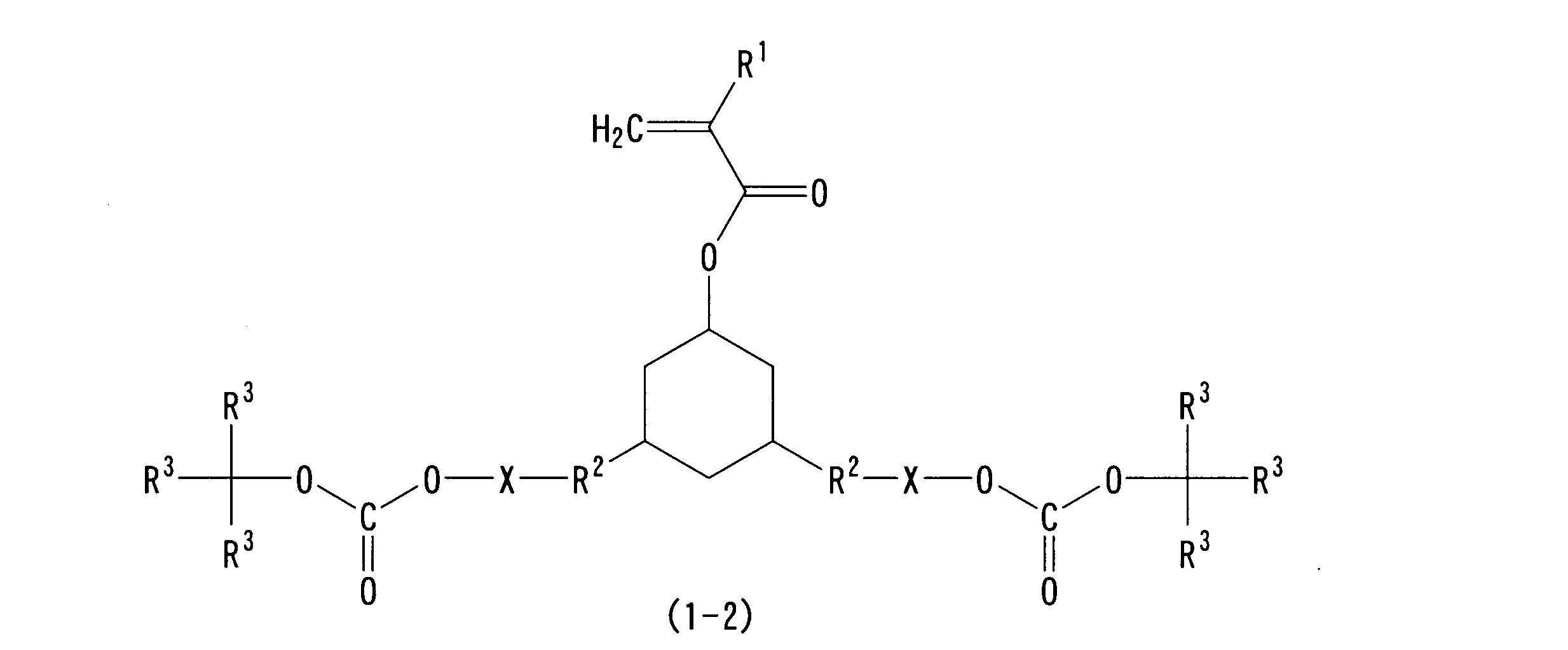

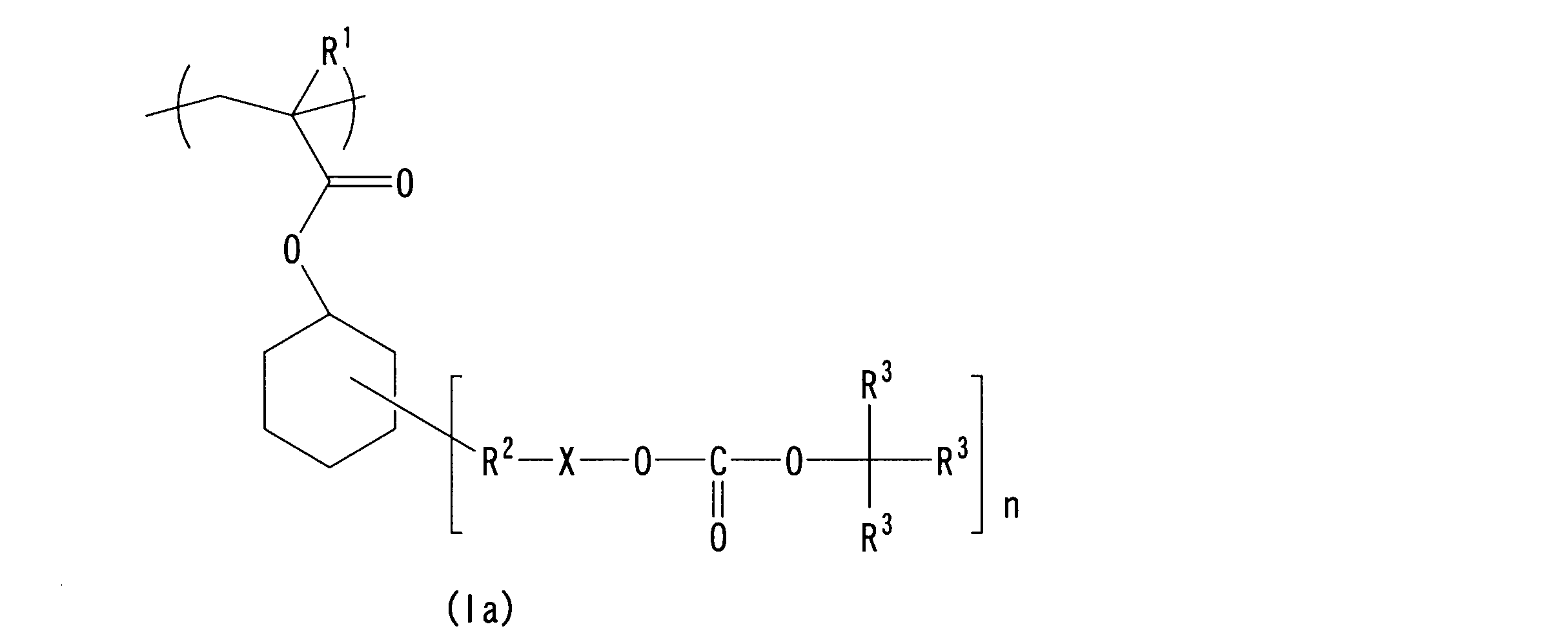

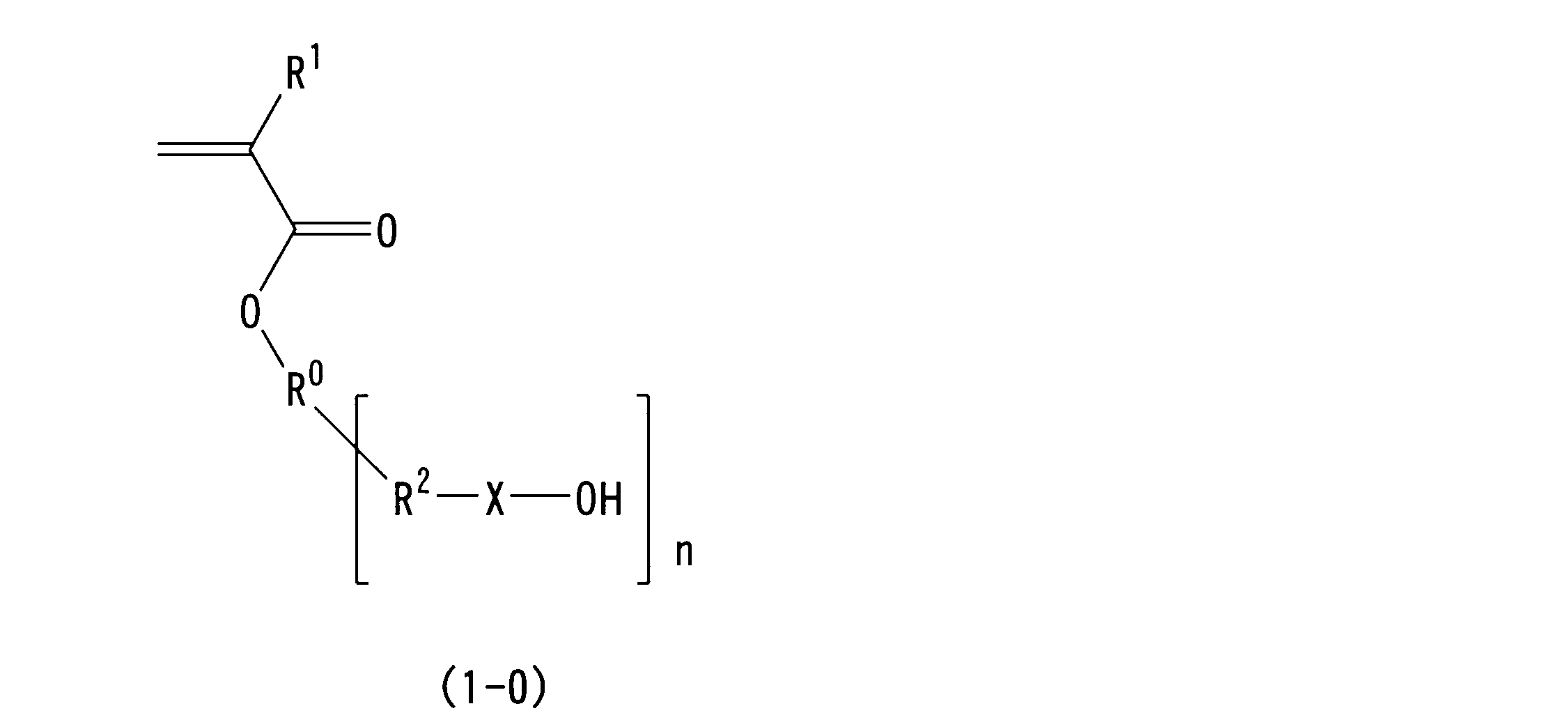
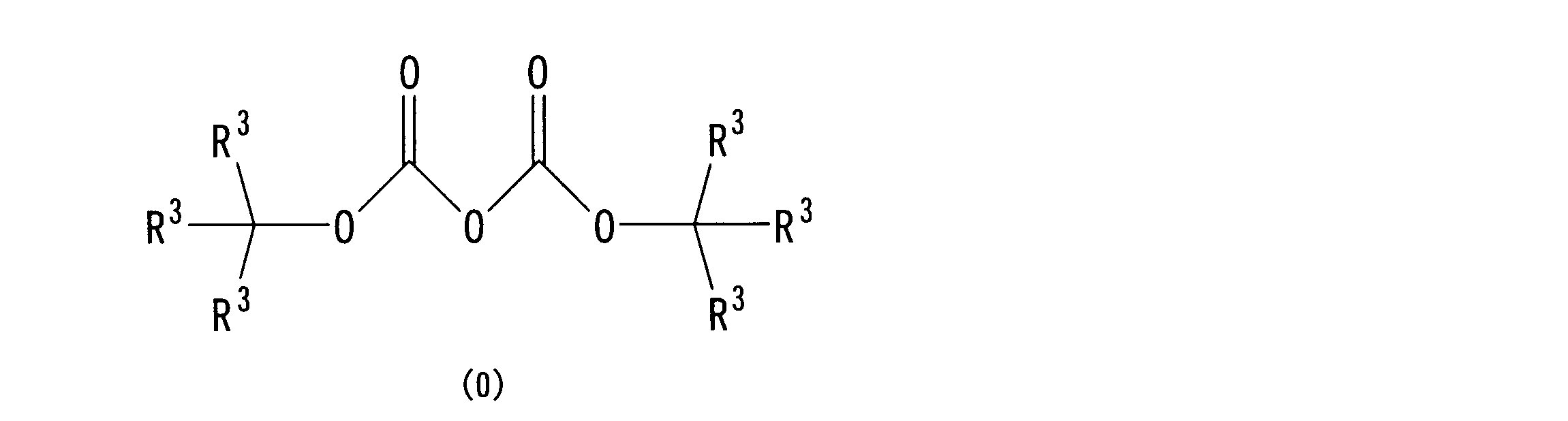
本発明の化合物は、下記一般式(1)で表される化合物であり、後述する本発明のフッ素原子含有重合体を構成する化合物である。本発明の化合物は、その分子中に、特定のフルオロアルキレン基を有することから、本発明の化合物に由来する繰り返し単位(1)(即ち、繰り返し単位(I))を有するフッ素原子含有重合体を含む重合体成分を含有する感放射線性樹脂組成物は、レジスト被膜と液浸露光用液体との後退接触角を十分に高くすることができる。また、液浸露光時に接触した水等の液浸露光用液体への溶出物の溶出量を少なくしたり、液浸露光に由来するW/M(ウォーターマーク)やバブル欠陥の発生を抑制したりすることができる。
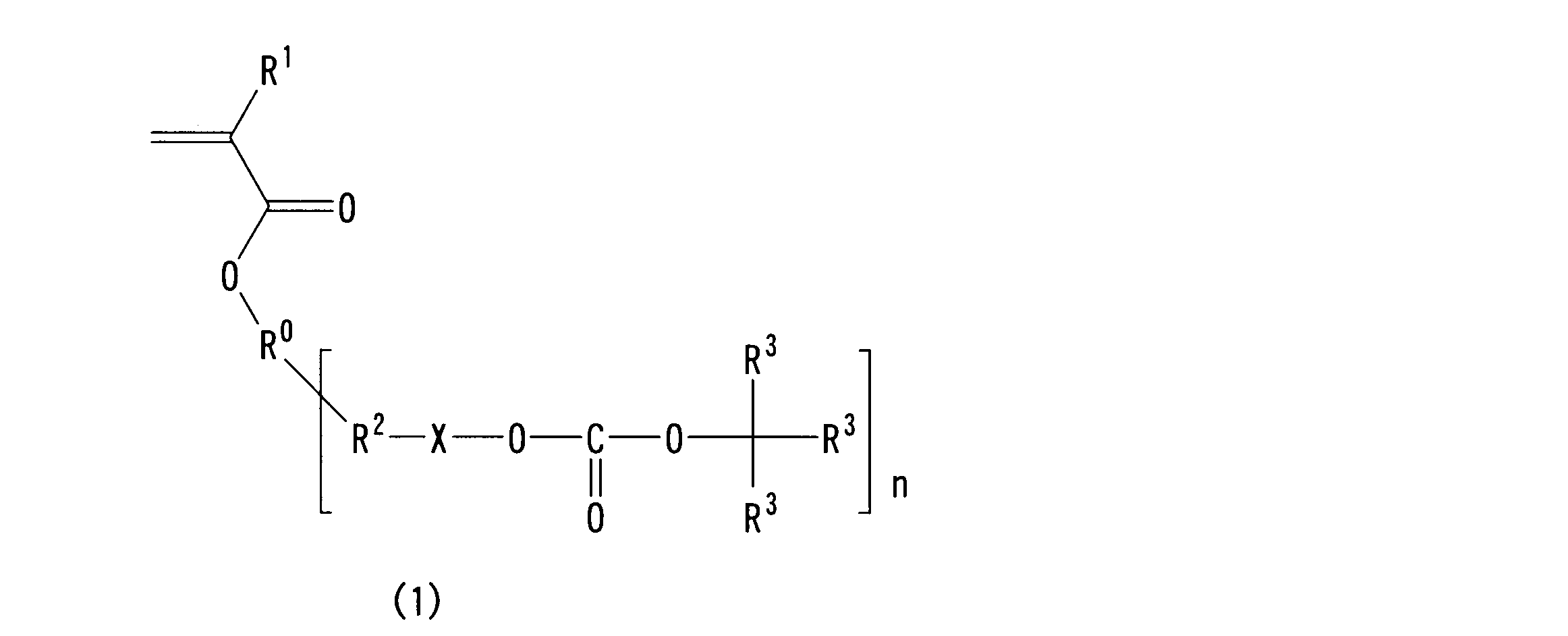
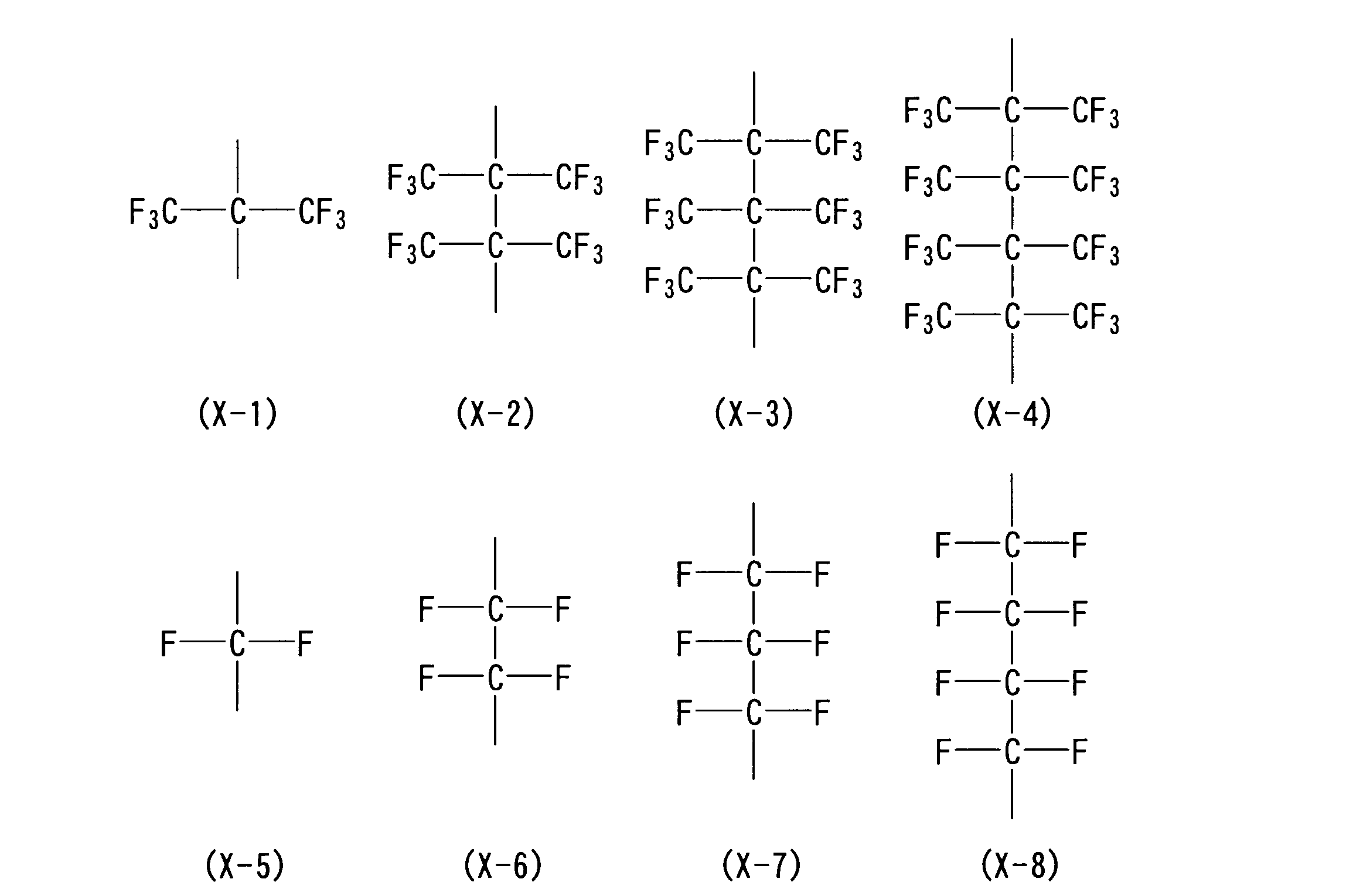
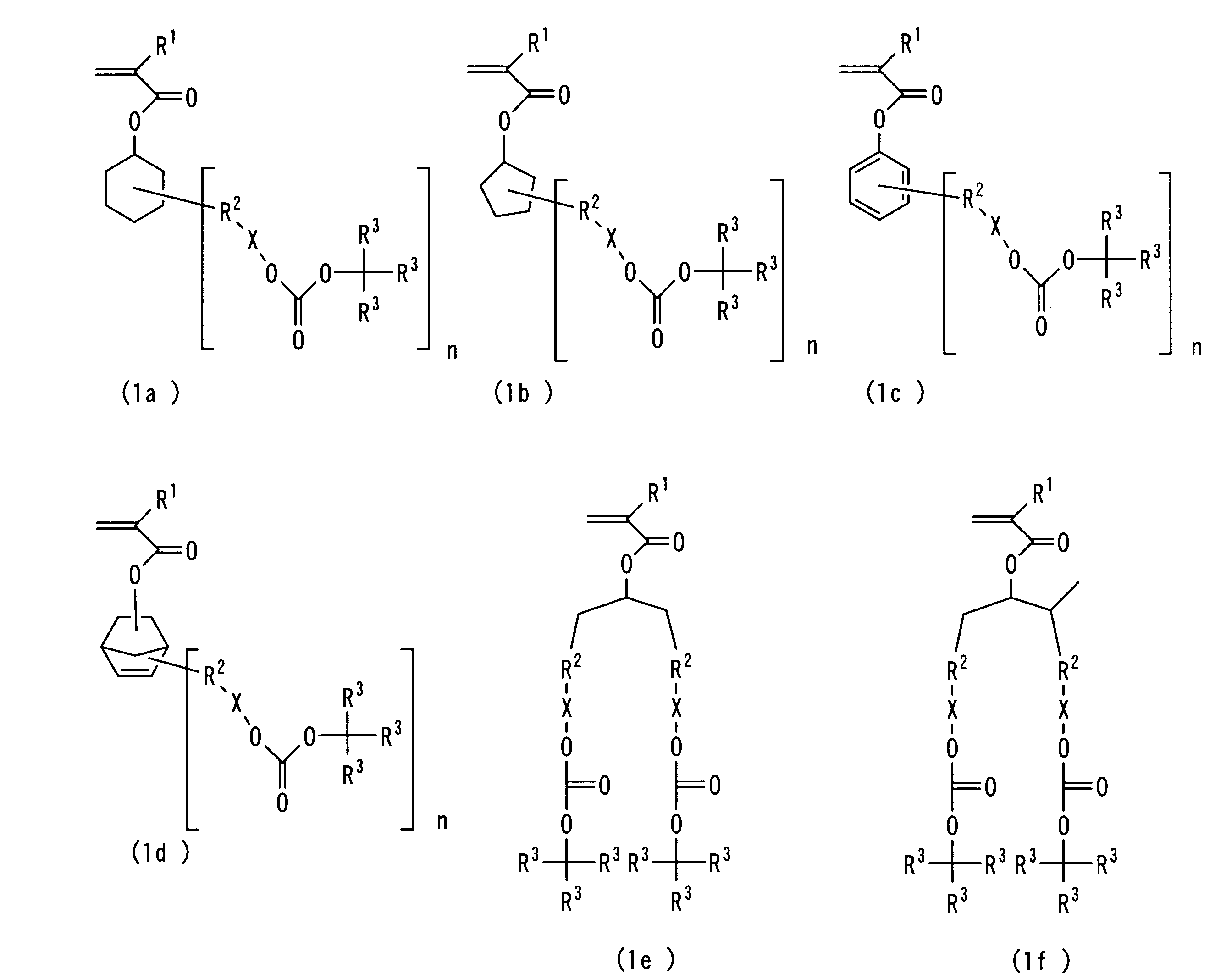

本発明の化合物の製造方法は、一般式(1-0)で表される化合物と、一般式(0)で表される化合物と、を反応させる工程を含む方法である。但し、本発明の化合物は、この製造方法により製造された化合物に限定されるものではない。この製造方法により本発明の化合物を簡便に合成することができる。なお、この反応は、アミン類の存在下、適当な溶媒中で反応させることが好ましい。


1.構成成分:
本発明のフッ素原子含有重合体は、「I.化合物」にて記載した本発明の化合物に由来する繰り返し単位(1)(以下、「繰り返し単位(1)」ともいう)を有するものである。繰り返し単位(1)の具体例は、下記一般式(I)で表される繰り返し単位(I)(以下、「繰り返し単位(I)」ともいう)である。なお、このフッ素原子含有重合体は、フッ素原子含有重合体のみからなる塗膜を形成した場合に、その塗膜の「後退接触角」が70°以上であることが好ましく、72°以上であることが更に好ましく、75°以上であることが特に好ましい。なお、本明細書中、「後退接触角」とは、塗膜(レジスト被膜)を形成した基板上に水を25μL滴下し、その後、基板上の水を10μL/minの速度で吸引した際の液面と基板との接触角をいう。このような後退接触角は、例えば、KRUS社製の接触角計(商品名「DSA-10」)を用いて測定することができる。


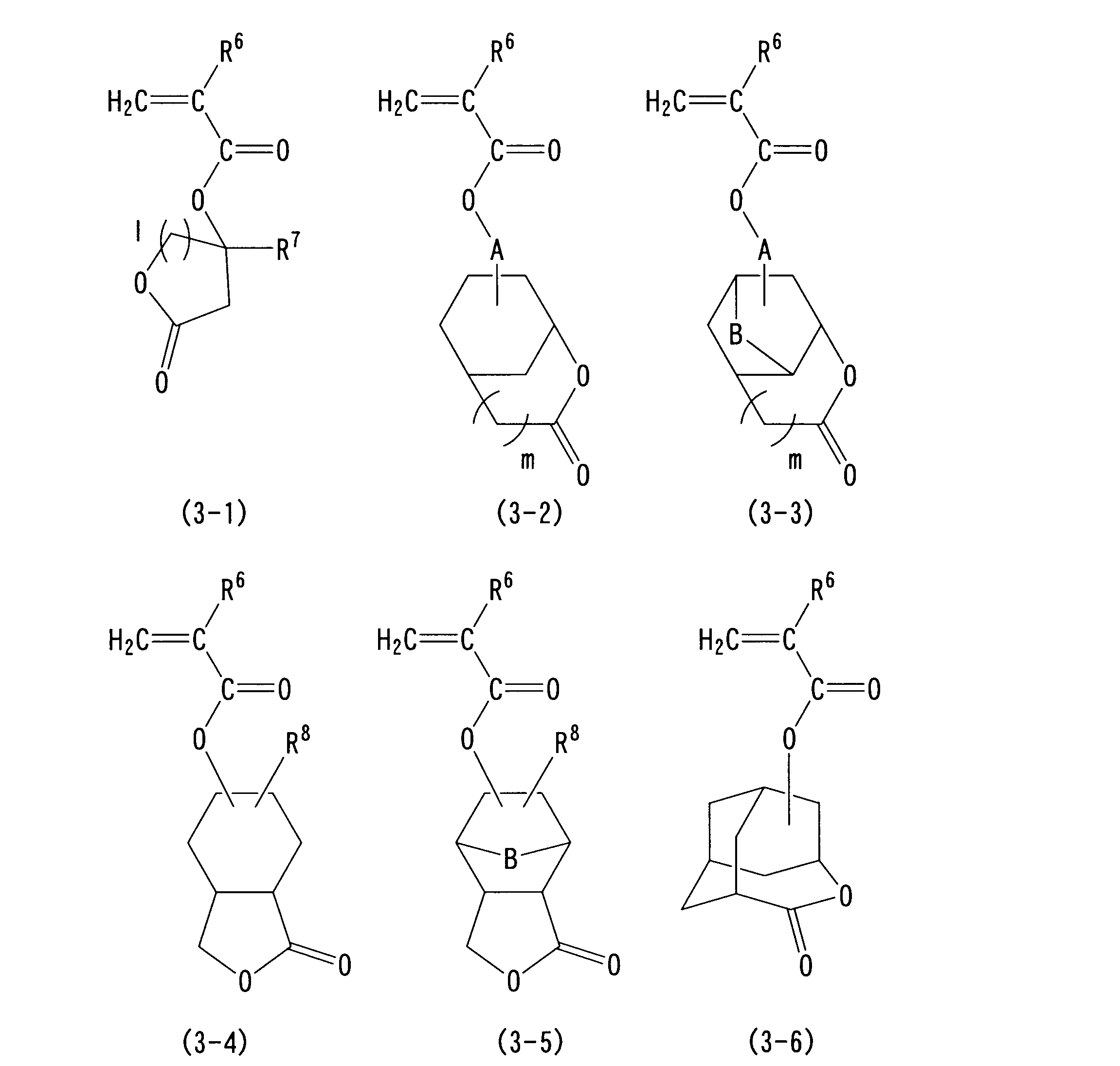
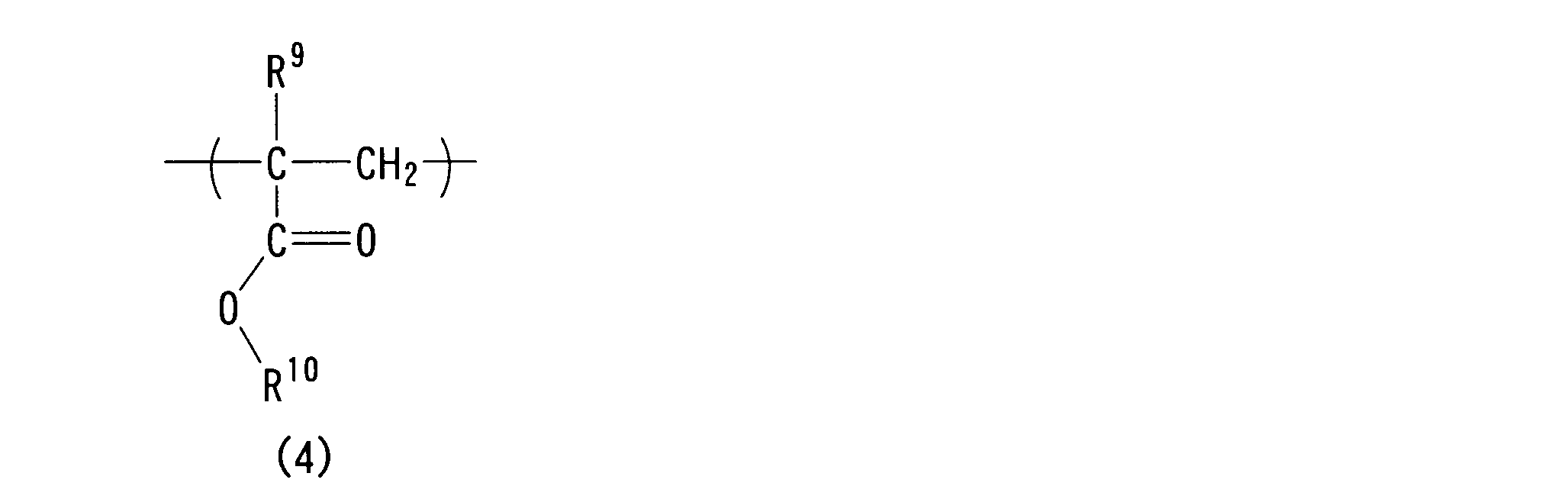
フッ素原子含有重合体は、例えば、所定の各繰り返し単位に対応する化合物を、ヒドロパーオキシド類、ジアルキルパーオキシド類、ジアシルパーオキシド類、アゾ化合物等のラジカル重合開始剤を使用し、必要に応じて連鎖移動剤の存在下、適当な溶媒中で重合することにより製造することができる。
フッ素原子含有重合体のゲルパーミエーションクロマトグラフィ(GPC)によるポリスチレン換算の重量平均分子量(以下、「Mw」ともいう)は、1000~50000であることが好ましく、1000~40000であることが更に好ましく、1000~30000であることが特に好ましい。フッ素原子含有重合体のMwが1000未満であると、十分に高い後退接触角が得られないおそれがある。一方、50000超であると、レジストとした際の現像性が低下する傾向がある。
本発明の感放射線性樹脂組成物の一実施形態について具体的に説明する。感放射線性樹脂組成物は、「III.フッ素原子含有重合体」にて記載した本発明のフッ素原子含有重合体(以下、「重合体(A)」ともいう)と、酸不安定基含有重合体(B)(但し、重合体(A)を除く。以下、「重合体(B)」ともいう)と、を含む重合体成分を含有するものであり、通常、溶剤を含有するものである。
重合体成分は、重合体(A)とは異なる酸不安定基含有重合体(B)を含む。このような重合体(B)を含むことによって、高後退接触角、低溶出量、及び現像欠陥の抑制等の効果を好適に発現させることができる。
酸不安定基含有重合体(B)は、重合体(A)の効果、例えば、高後退接触角、低溶出量、及び現像欠陥の抑制等の効果を好適に発現させることができるものであれば特に制限はないが、酸の作用によりアルカリ可溶性となる、アルカリ不溶性又はアルカリ難溶性の重合体が好ましい。
感放射線性樹脂組成物は、普通、その使用に際して、全固形分濃度が、通常、1~50質量%、好ましくは1~25質量%となるように、溶剤に溶解した後、例えば孔径0.2μm程度のフィルターでろ過することによって、組成物溶液として調製される。
本発明の感放射線性樹脂組成物は、重合体(A)と重合体(B)とを含む重合体成分及び溶剤に加えて、感放射線性酸発生剤(以下、単に「酸発生剤(C)」ともいう)を更に含有することが好ましい。なお、酸発生剤(C)は、1種単独で、又は2種以上を組み合わせて使用することができる。
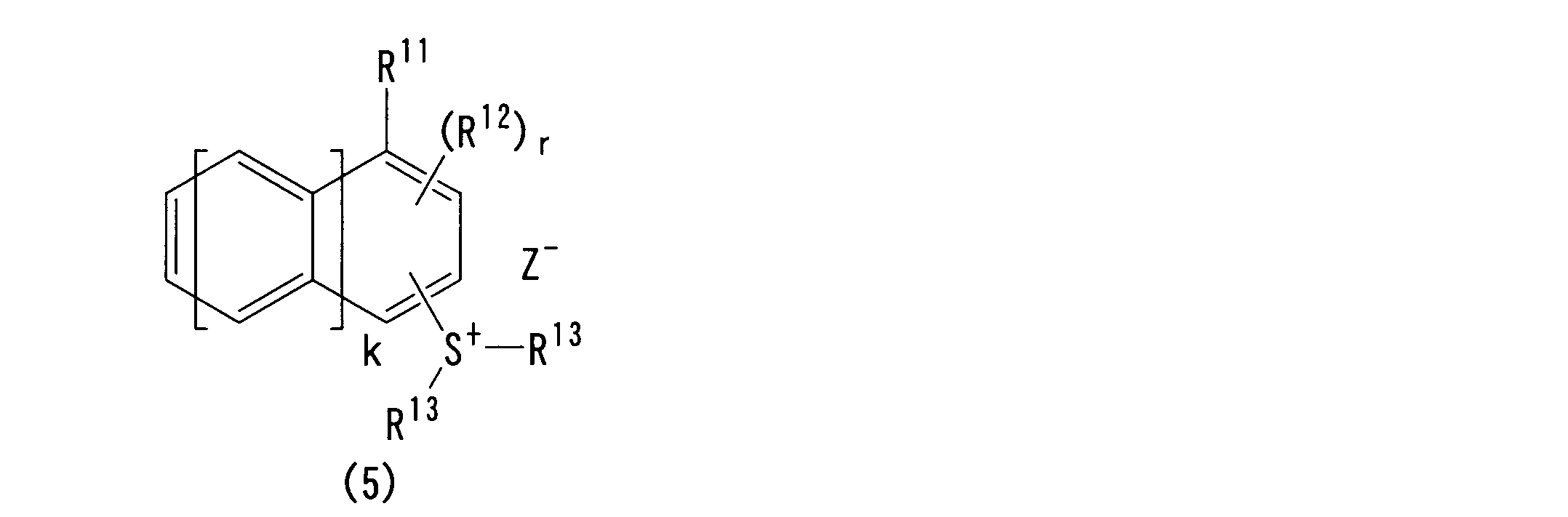
また、感放射線性樹脂組成物は、添加剤として、窒素含有化合物(以下、「窒素含有化合物(E)」ともいう)を更に含有していてもよい。
感放射線性樹脂組成物は、必要に応じて、脂環族添加剤、界面活性剤、増感剤等の各種の他の添加剤を更に含有していてもよい。
感放射線性樹脂組成物は、特に化学増幅型レジストとして有用である。化学増幅型レジストにおいては、露光により酸発生剤から発生した酸の作用によって、重合体成分中の酸解離性基又は酸不安定基が解離して、カルボキシル基を生じ、その結果、レジストの露光部のアルカリ現像液に対する溶解性が高くなり、この露光部がアルカリ現像液によって溶解、除去され、ポジ型のレジストパターンが得られる。
流量;1.0mL/分
溶出溶媒;テトラヒドロフラン
カラム温度;40℃
下記式(a-1)で表される化合物(以下、「化合物(a-1)」ともいう)42.03g(60mmol)、トリエチルアミン(NEt3)1.52g(15mmol)、ジメチルアミノピリジン(DMAP)1.83g(15mmol)、及びテトラヒドロフラン(THF)80mLを、還流冷却管及び滴下漏斗を備えた200mL三口フラスコに入れ、オイルバスを用いて70℃に加熱、還流した。そこに、THF20mLに溶解した下記式(a-5)で表される化合物39.28g(180mmol)の溶液を5分間かけて滴下した。反応を、薄層クロマトグラフィー(TLC)を用いて追跡し、原料の化合物(a-1)が消失した時点で反応を停止し、室温まで放冷した。水40mLと酢酸エチル75mLを加え、分液操作により有機層を取り出した後、ロータリーエバポレーターを用いて濃縮し、展開溶媒(ヘキサン/酢酸エチル=2/1)を用いてシリカゲルカラムクロマトグラフィー(商品名「ワコーゲルC-300」、和光純薬社製)を行い、目的物である下記式(M-4)で表される化合物(以下、「化合物(M-4)」ともいう)を収率80%の無色液体として単離した。

原料として化合物(a-1)のかわりに表1に示す化合物(a-2)~(a-4)を用いたこと以外は、実施例1と同様の方法によって、化合物(M-5)~(M-7)を合成した。得られた化合物の種類と収率を実施例1と併せて表1に示す。
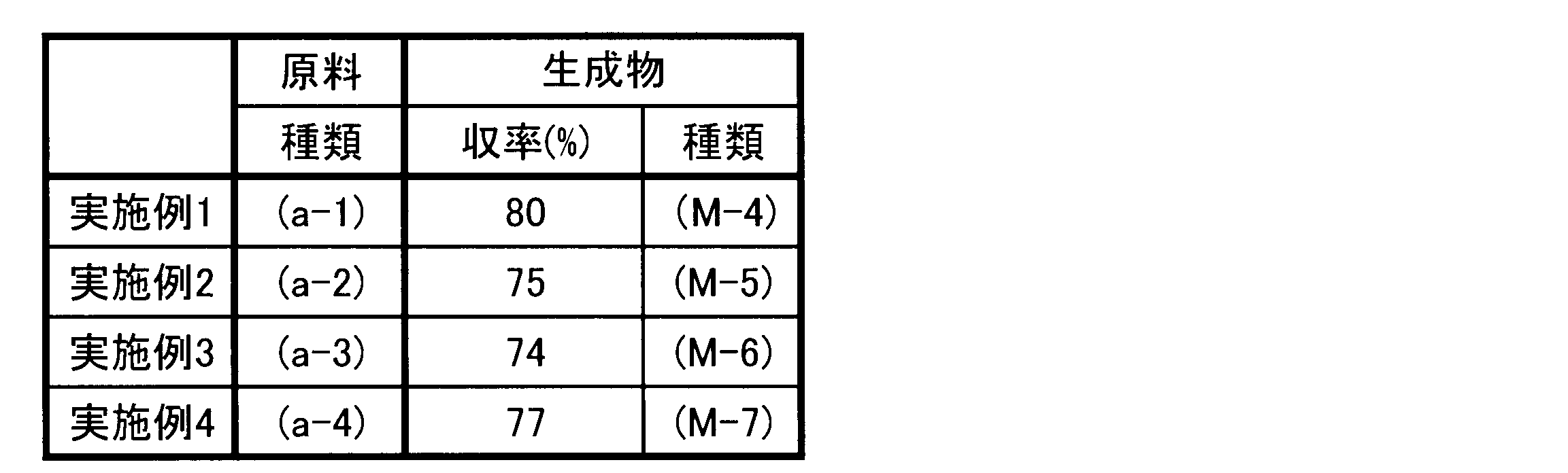
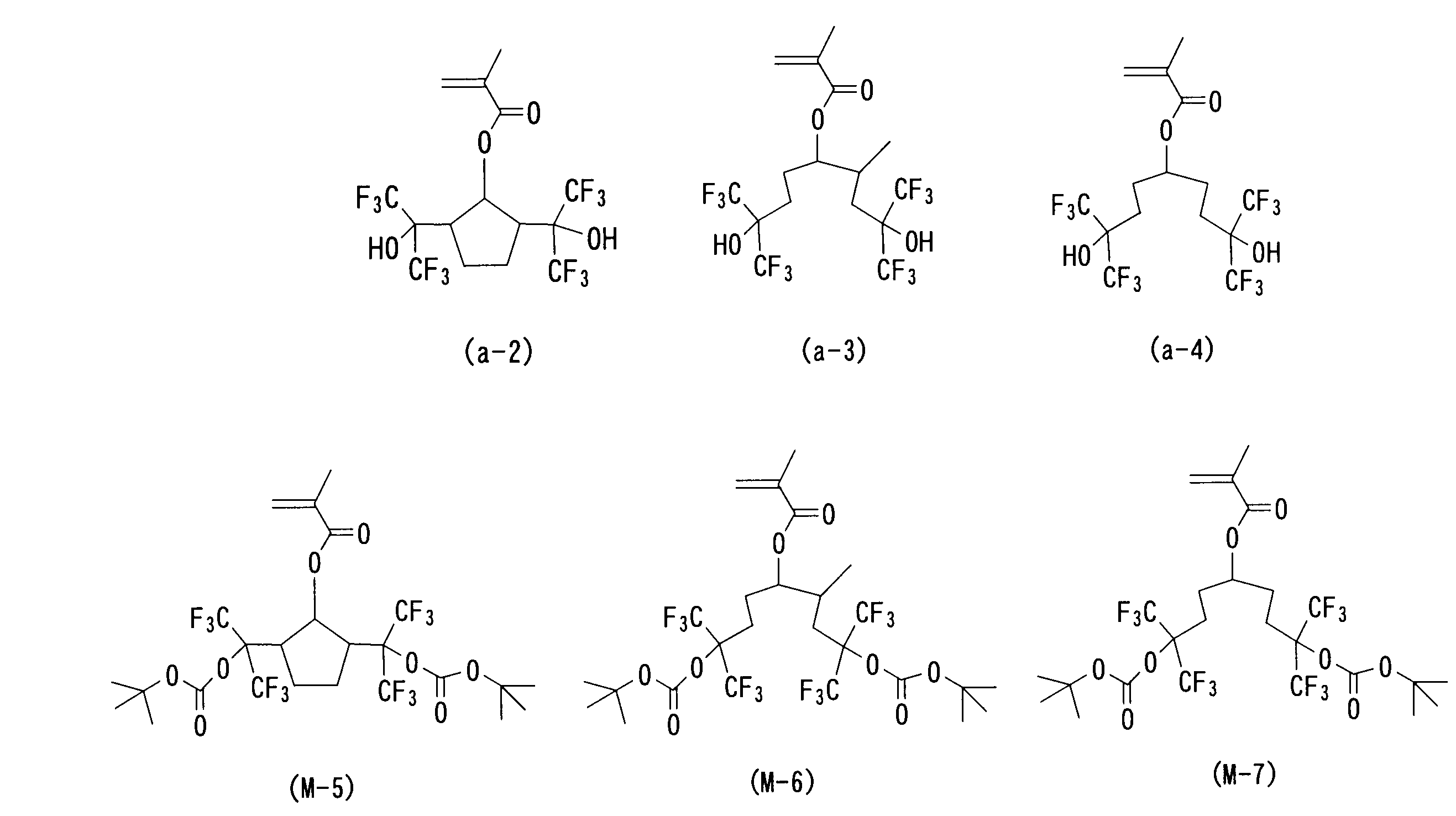
1H-NMR(400MHz,CDCl3):δ(ppm)=6.13(d,1H)、5.64(d,1H)、4.84~4.97(m,1H)、2.54~2.80(m,2H)、2.11(s,3H)、1.95~1.65(m,4H)、1.45(s,18H)。
1H-NMR(400MHz,CDCl3):δ(ppm)=6.12(d,1H)、5.62(d,1H)、4.77~4.92(m,1H)、2.43~2.61(m,1H)、2.13(s,3H)、1.75(q,2H)、1.66(t、2H)、1.55(d,2H)、1.38(s,18H)、1.10(d,3H)。
1H-NMR(400MHz,CDCl3):δ(ppm)=6.13(d,1H)、5.63(d,1H)、4.76~4.88(m,1H)、2.14(s,3H)、1.83(td,4H)、1.62(t,4H)、1.38(s,18H)。
下記式(M-1)で表される化合物(以下、「化合物(M-1)」ともいう)14.96g(90mol%)、実施例1で合成した化合物(M-4)35.04g(10mol%)、及び重合開始剤としてジメチル-2,2’-アゾビスイソブチレート(以下、「AIBN」ともいう)1.75g(5mol%)を、100gのメチルエチルケトンに溶解した単量体溶液を準備した。一方、温度計及び滴下漏斗を備えた500mLの三つ口フラスコにメチルエチルケトン50gを加え、30分間窒素パージを行った。

表2に示す化合物を表2に示す割合で使用したこと以外は、実施例5と同様にして、フッ素原子含有重合体(A-2)~(A-6)を調製した。各フッ素原子含有重合体のMw、Mw/Mn、収率(%)、及び各化合物に由来する繰り返し単位の含有率(mol%)を表3に示す。
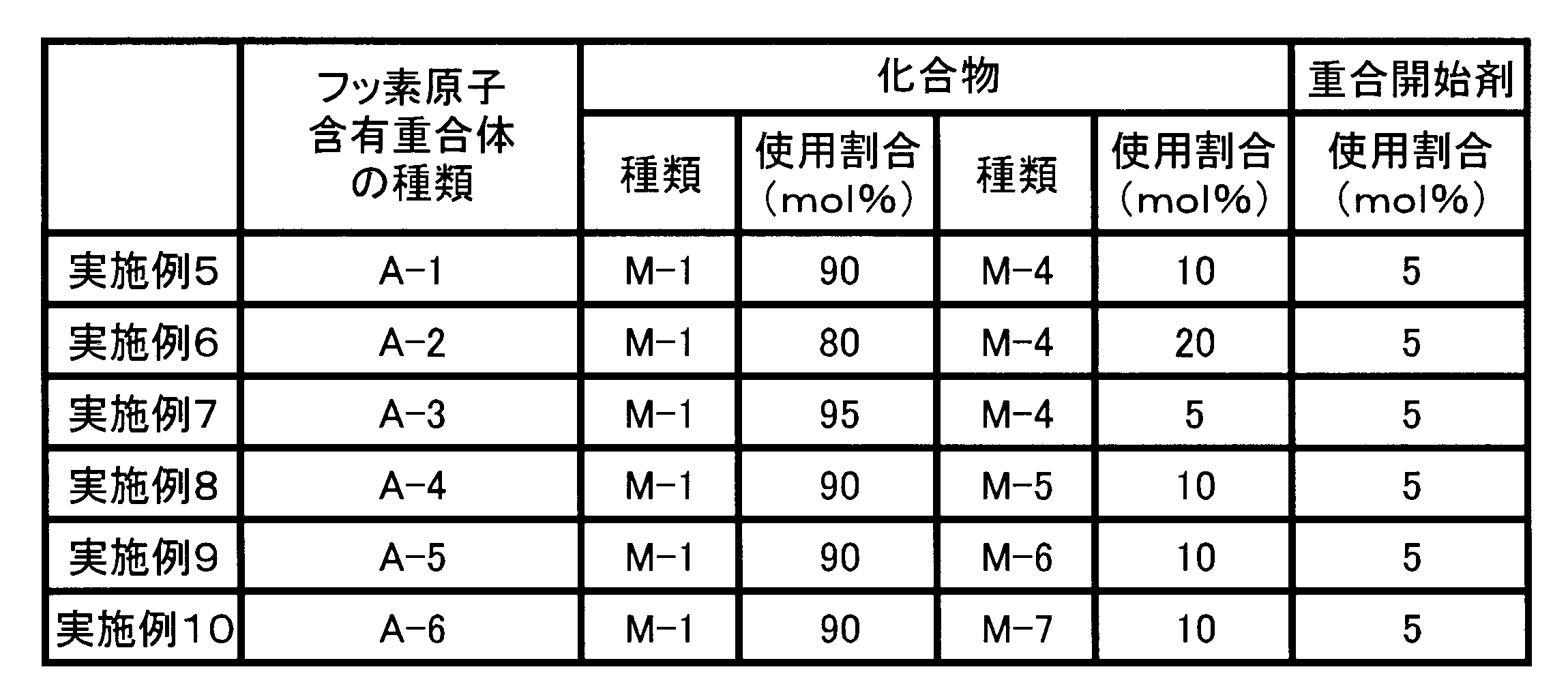
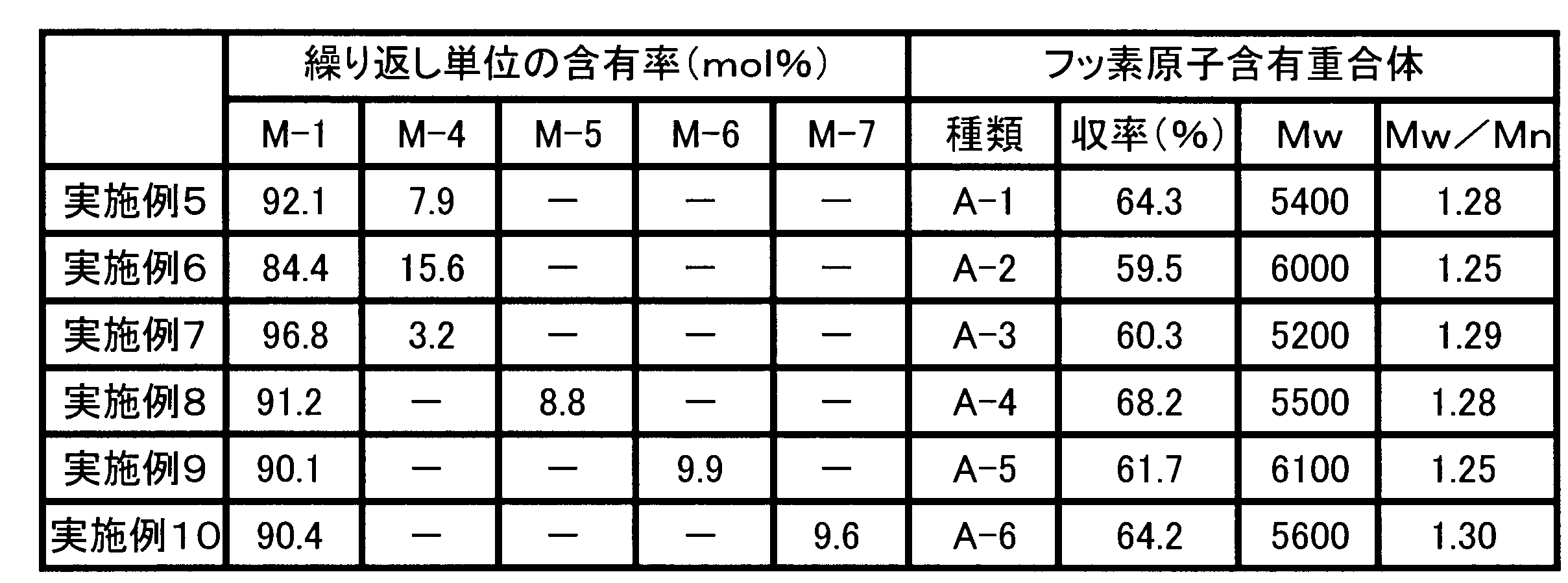
下記式(M-2)で表される化合物(以下、「化合物(M-2)」ともいう)21.5g(50mol%)、及び下記式(M-3)で表される化合物(以下、「化合物(M-3)」ともいう)28.4g(50mol%)を、2-ブタノン100gに溶解し、更にAIBN2.10gを投入して単量体溶液を準備した。一方、50gの2-ブタノンを投入した500mLの三口フラスコを30分窒素パージした後、攪拌しながら80℃に加熱した。そこに、準備しておいた単量体溶液を滴下漏斗を用いて3時間かけて滴下した。

実施例5で調製したフッ素原子含有重合体(A-1)2.0部、合成例で調製した酸不安定基含有重合体(B-1)100部、酸発生剤(C-1)9.6部、窒素含有化合物(E-1)0.65部、溶剤(D-1)1500部、溶剤(D-2)650部、及び溶剤(D-3)30部を混合し、感放射線性樹脂組成物(1)を調製した。なお、酸発生剤(C-1)、窒素含有化合物(E-1)、及び溶剤(D-1)~(D-3)の種類について、以下に記す。

溶剤(D-2):シクロヘキサノン(下記式(D-2)で表される化合物)
溶剤(D-3):γ-ブチロラクトン(下記式(D-3)で表される化合物)

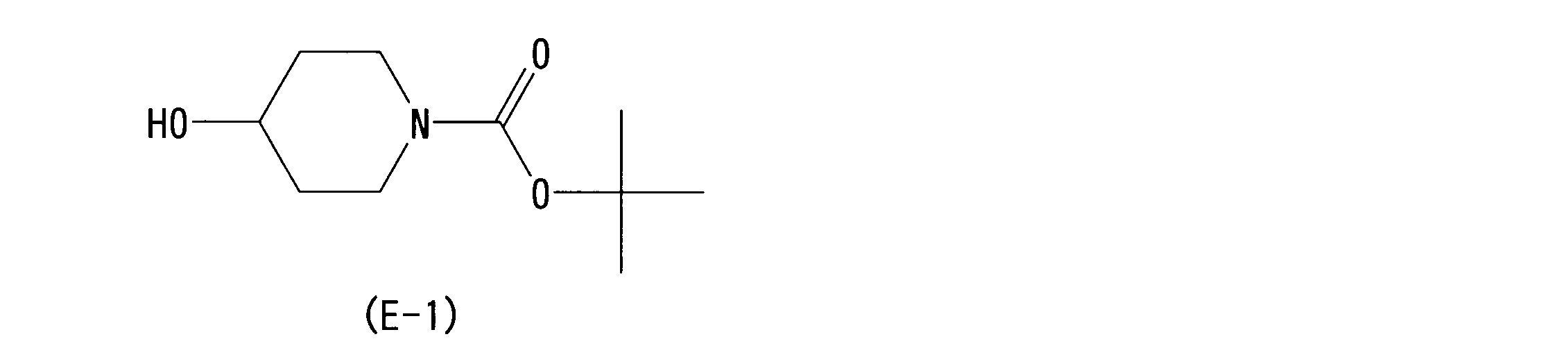
表4に示す配合処方にしたこと以外は、実施例11と同様にして感放射線性樹脂組成物(2)~(8)を調製した。

使用カラム;商品名「CAPCELL PAK MG」、資生堂社製、1本
流量;0.2mL/分
流出溶剤:水/メタノール(3/7)(質量比)に0.1%のギ酸を添加した溶剤
測定温度;35℃
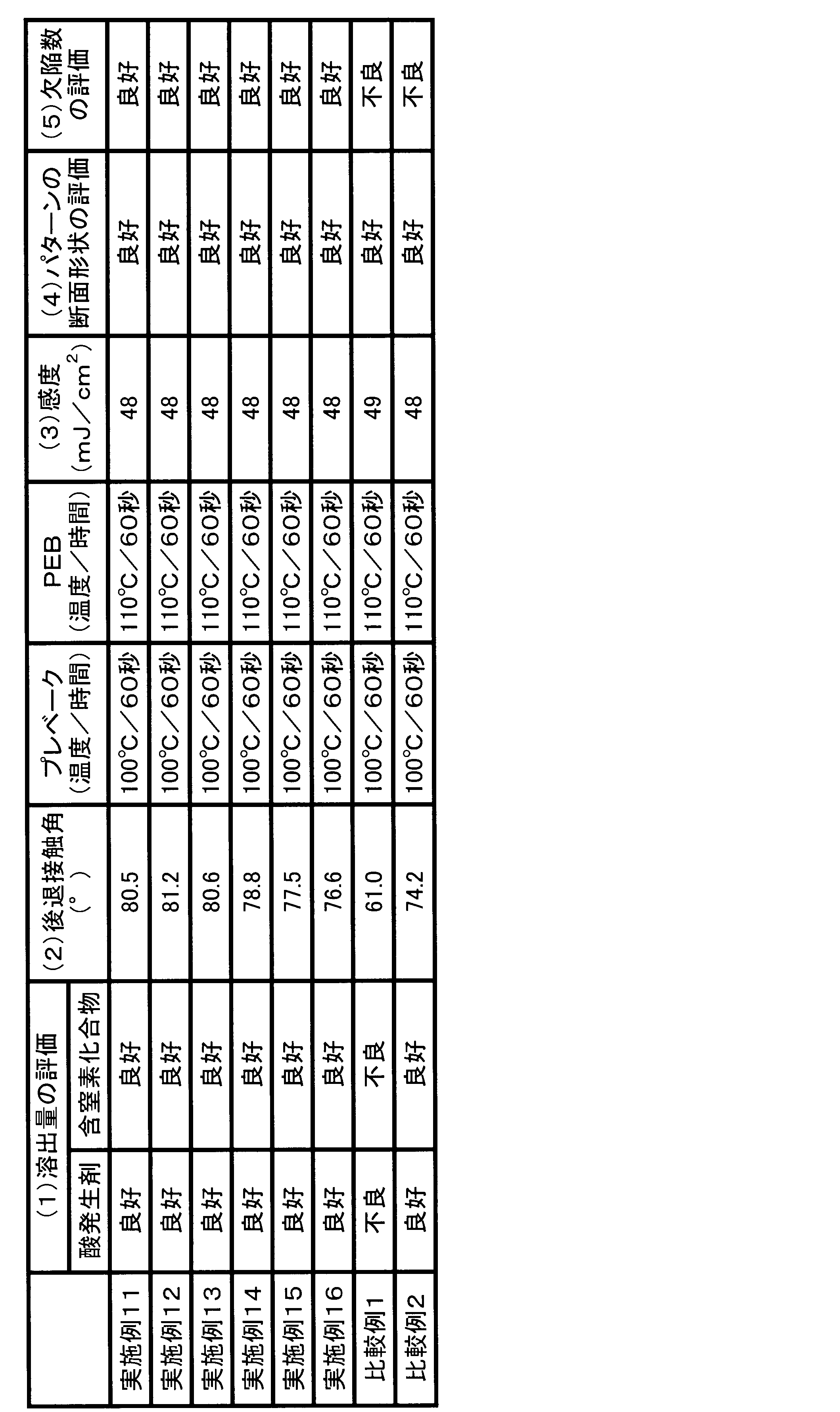
Claims (11)
- 下記一般式(1)で表される化合物。

- 前記一般式(1)で表される化合物が、下記一般式(1a)で表される化合物である請求項1に記載の化合物。
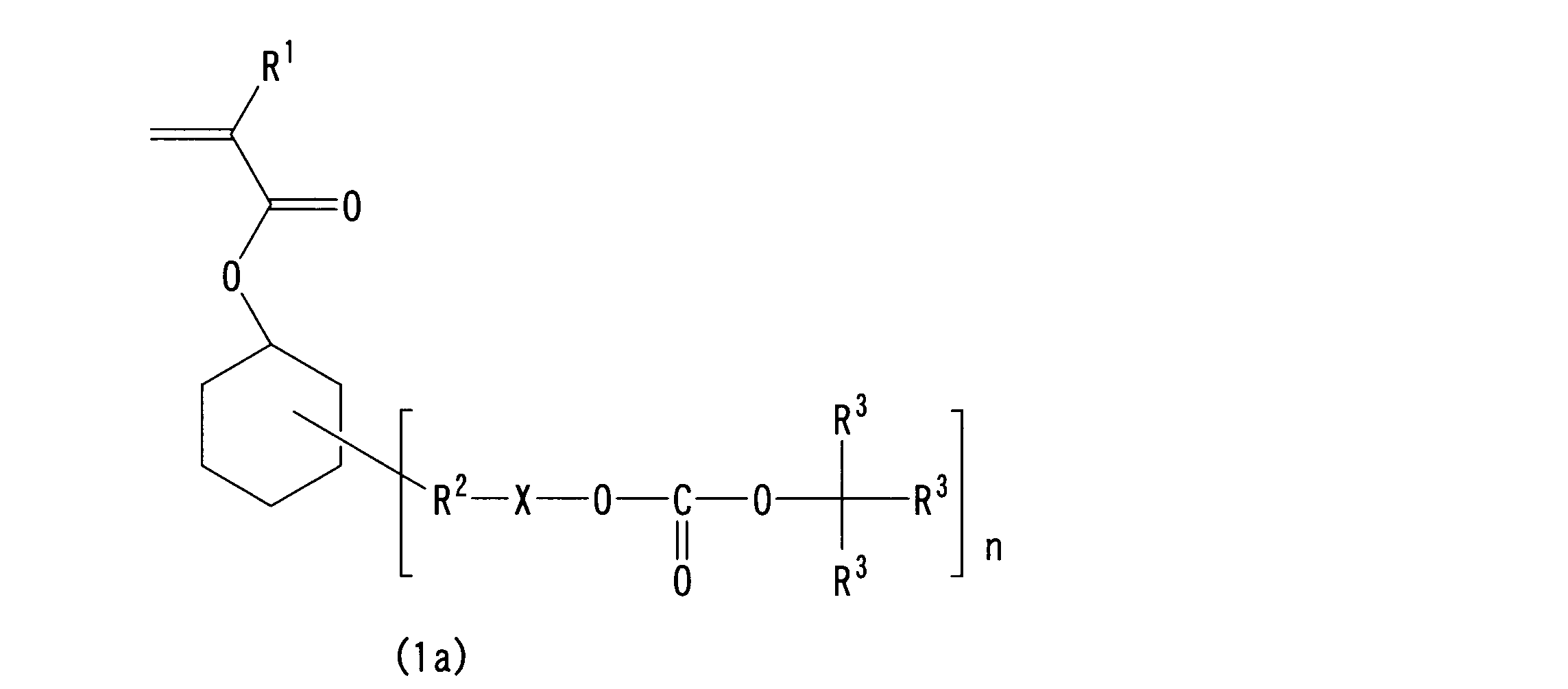
- nが2である請求項1又は2に記載の化合物。
- 下記一般式(1-2)で表される請求項3に記載の化合物。
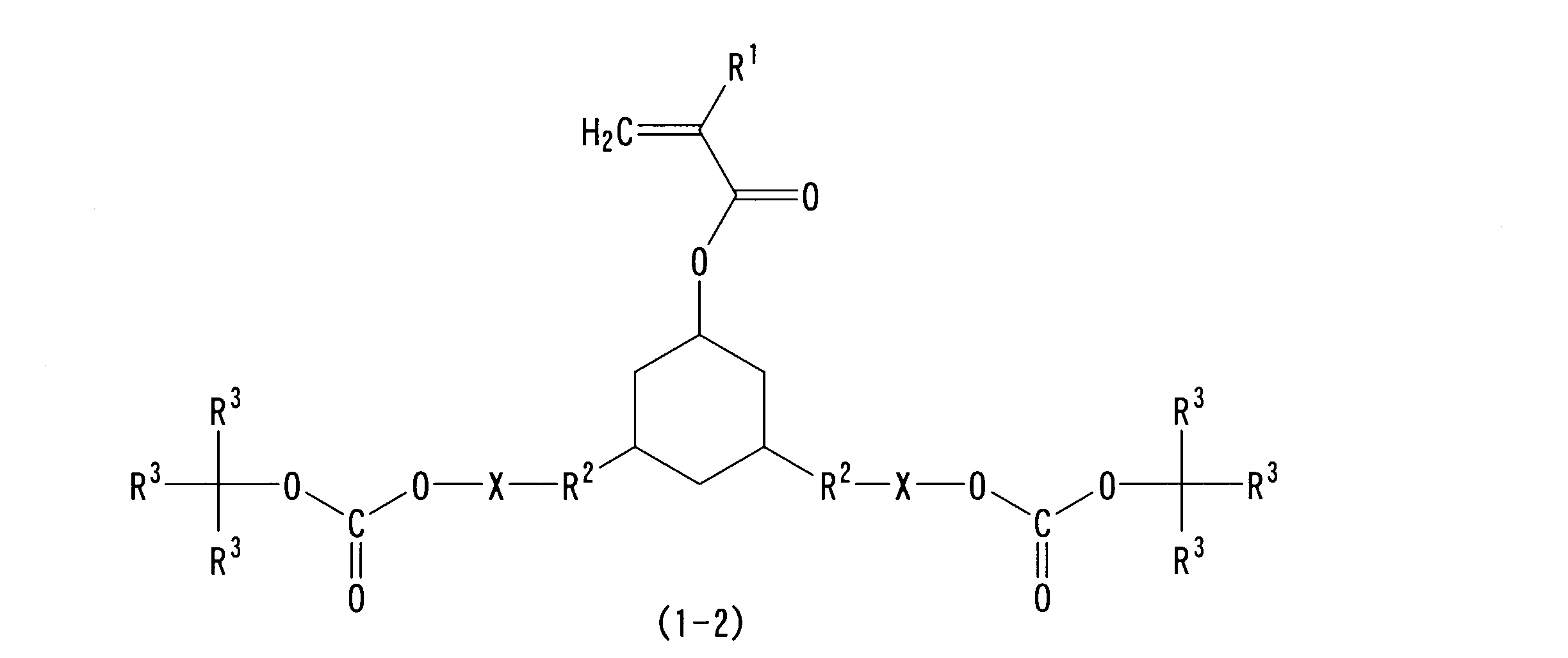
- 請求項1~4のいずれか一項に記載の化合物に由来する繰り返し単位(1)を有するフッ素原子含有重合体。
- 下記一般式(I)で表される繰り返し単位を有するフッ素原子含有重合体。
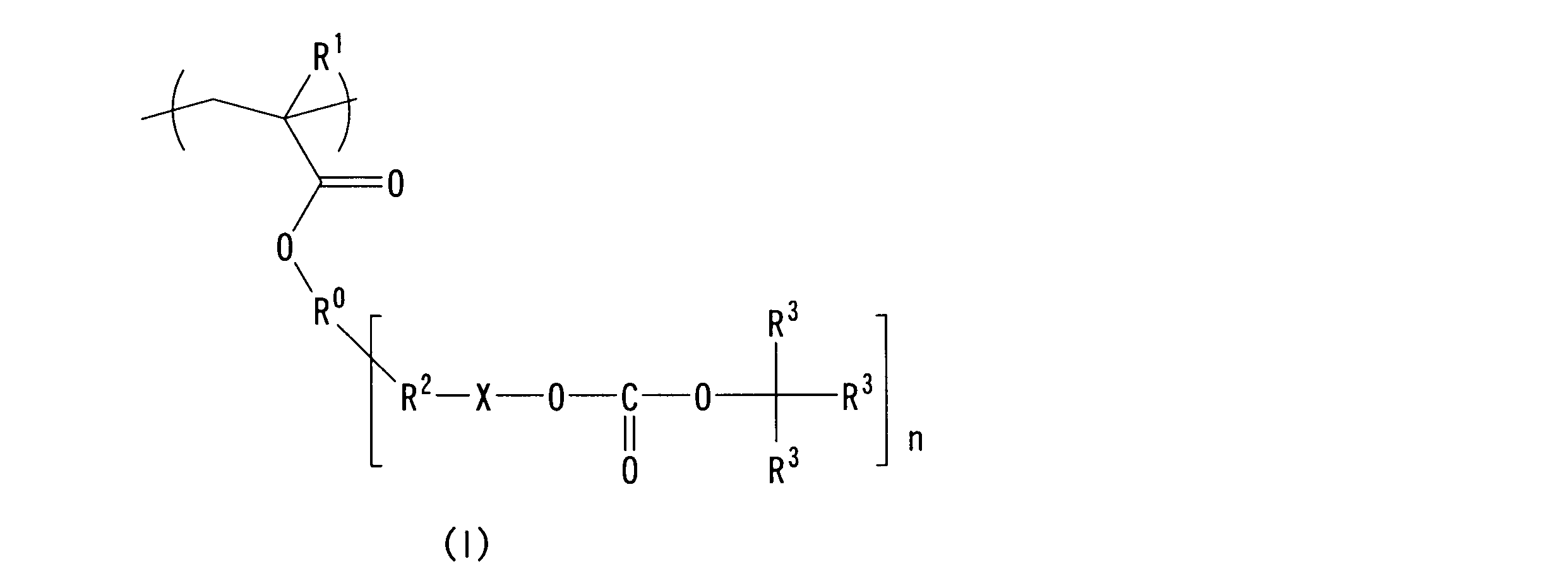
- 前記一般式(I)で表される繰り返し単位が、下記一般式(Ia)で表される繰り返し単位である請求項6に記載のフッ素原子含有重合体。

- 前記一般式(Ia)で表される繰り返し単位が、下記一般式(I-2)で表される繰り返し単位である請求項7に記載のフッ素原子含有重合体。
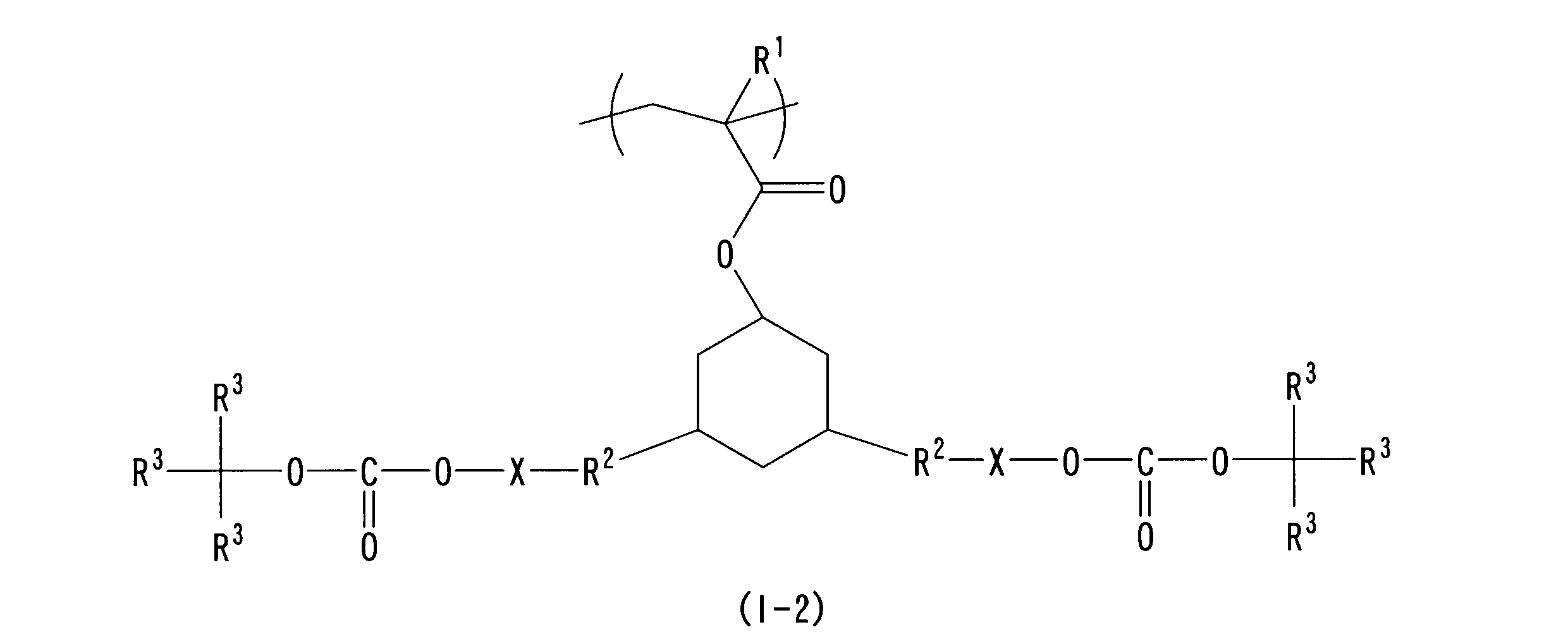
- 請求項5~8のいずれか一項に記載のフッ素原子含有重合体(A)と、
酸不安定基含有重合体(B)(但し、前記フッ素原子含有重合体(A)を除く)と、を含む重合体成分を含有する感放射線性樹脂組成物。 - 前記フッ素原子含有重合体(A)の含有量が、前記酸不安定基含有重合体(B)100質量部に対して、0.1~40質量部である請求項9に記載の感放射線性樹脂組成物。
- 下記一般式(1-0)で表される化合物と、下記一般式(0)で表される化合物と、を反応させる工程を含む化合物の製造方法。
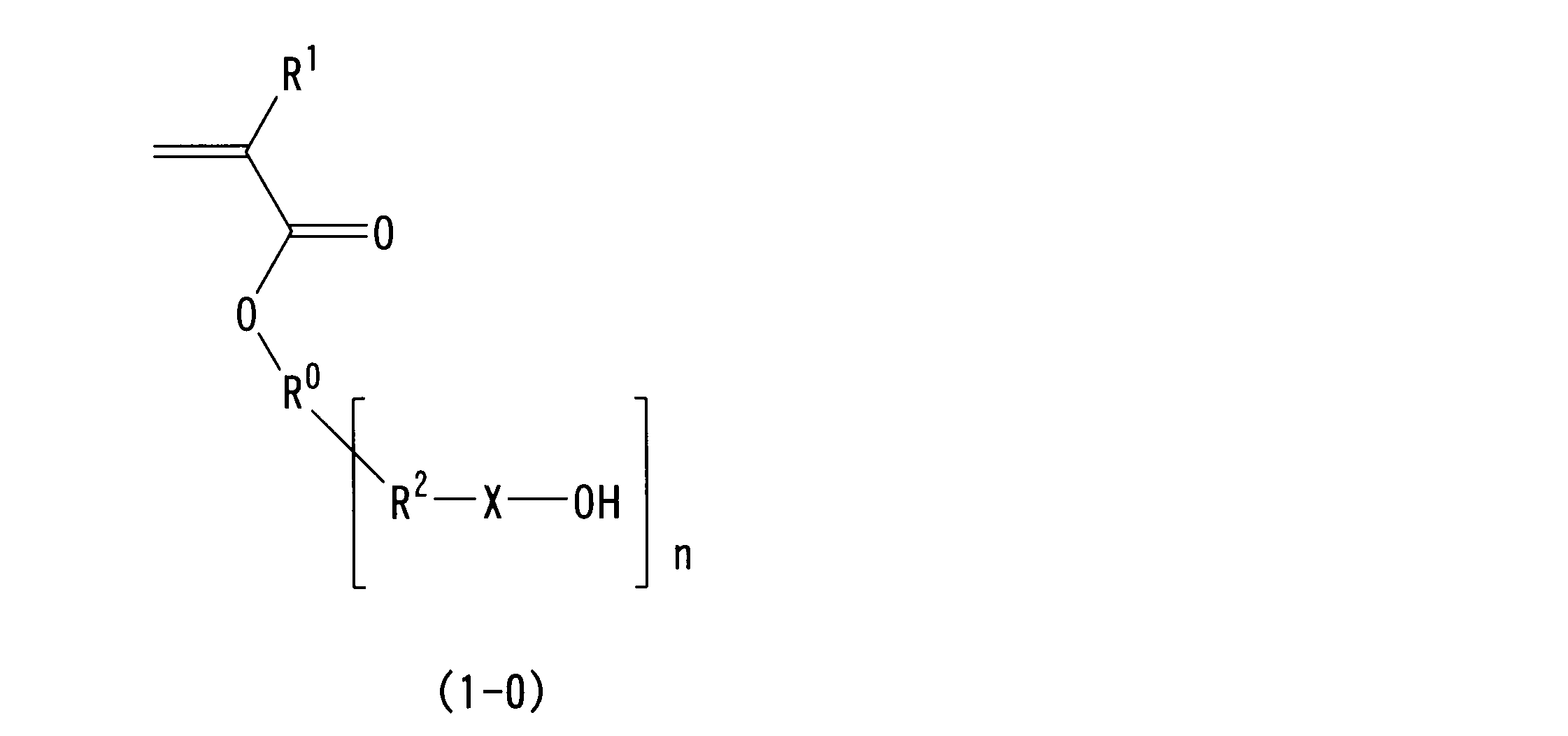

Priority Applications (4)
| Application Number | Priority Date | Filing Date | Title |
|---|---|---|---|
| KR1020117019408A KR101729792B1 (ko) | 2009-02-23 | 2010-02-23 | 화합물, 불소 원자 함유 중합체, 및 감방사선성 수지 조성물 |
| CN201080008657.2A CN102333797B (zh) | 2009-02-23 | 2010-02-23 | 化合物、含氟原子聚合物和放射线敏感性树脂组合物 |
| JP2011500678A JP5594283B2 (ja) | 2009-02-23 | 2010-02-23 | 化合物、フッ素原子含有重合体、及び感放射線性樹脂組成物 |
| US13/216,209 US8530692B2 (en) | 2009-02-23 | 2011-08-23 | Compound, fluorine-containing polymer, radiation-sensitive resin composition and method for producing compound |
Applications Claiming Priority (2)
| Application Number | Priority Date | Filing Date | Title |
|---|---|---|---|
| JP2009-039085 | 2009-02-23 | ||
| JP2009039085 | 2009-02-23 |
Related Child Applications (1)
| Application Number | Title | Priority Date | Filing Date |
|---|---|---|---|
| US13/216,209 Continuation US8530692B2 (en) | 2009-02-23 | 2011-08-23 | Compound, fluorine-containing polymer, radiation-sensitive resin composition and method for producing compound |
Publications (1)
| Publication Number | Publication Date |
|---|---|
| WO2010095746A1 true WO2010095746A1 (ja) | 2010-08-26 |
Family
ID=42634022
Family Applications (1)
| Application Number | Title | Priority Date | Filing Date |
|---|---|---|---|
| PCT/JP2010/052682 Ceased WO2010095746A1 (ja) | 2009-02-23 | 2010-02-23 | 化合物、フッ素原子含有重合体、及び感放射線性樹脂組成物 |
Country Status (6)
| Country | Link |
|---|---|
| US (1) | US8530692B2 (ja) |
| JP (1) | JP5594283B2 (ja) |
| KR (1) | KR101729792B1 (ja) |
| CN (1) | CN102333797B (ja) |
| TW (1) | TWI482755B (ja) |
| WO (1) | WO2010095746A1 (ja) |
Cited By (3)
| Publication number | Priority date | Publication date | Assignee | Title |
|---|---|---|---|---|
| JP2012078405A (ja) * | 2010-09-30 | 2012-04-19 | Jsr Corp | 感放射線性樹脂組成物、パターン形成方法及び化合物 |
| JP2018062508A (ja) * | 2016-10-07 | 2018-04-19 | 住友化学株式会社 | 化合物、樹脂、レジスト組成物及びレジストパターンの製造方法 |
| JP2018062507A (ja) * | 2016-10-07 | 2018-04-19 | 住友化学株式会社 | 化合物、樹脂、レジスト組成物及びレジストパターンの製造方法 |
Families Citing this family (1)
| Publication number | Priority date | Publication date | Assignee | Title |
|---|---|---|---|---|
| WO2022226424A1 (en) * | 2021-04-23 | 2022-10-27 | Align Technology, Inc. | Photopolymerizable block polymers and methods of producing and using the same |
Citations (10)
| Publication number | Priority date | Publication date | Assignee | Title |
|---|---|---|---|---|
| JP2002220416A (ja) * | 2000-11-21 | 2002-08-09 | Shin Etsu Chem Co Ltd | 高分子化合物、レジスト材料及びパターン形成方法 |
| JP2004004576A (ja) * | 2002-02-26 | 2004-01-08 | Fuji Photo Film Co Ltd | 感光性樹脂組成物 |
| JP2004004227A (ja) * | 2002-05-31 | 2004-01-08 | Fuji Photo Film Co Ltd | ポジ型レジスト組成物 |
| JP2004012510A (ja) * | 2002-06-03 | 2004-01-15 | Fuji Photo Film Co Ltd | ポジ型レジスト組成物 |
| JP2005309376A (ja) * | 2004-03-25 | 2005-11-04 | Fuji Photo Film Co Ltd | 液浸露光用ポジ型レジスト組成物及びそれを用いたパターン形成方法 |
| JP2007204385A (ja) * | 2006-01-31 | 2007-08-16 | Shin Etsu Chem Co Ltd | フッ素アルコール化合物の製造方法、含フッ素単量体、高分子化合物、レジスト材料及びパターン形成方法 |
| JP2008115102A (ja) * | 2006-11-02 | 2008-05-22 | Idemitsu Kosan Co Ltd | アダマンタン誘導体及びその製造方法 |
| WO2009087889A1 (ja) * | 2008-01-11 | 2009-07-16 | Daikin Industries, Ltd. | 重合性含フッ素単量体および含フッ素重合体ならびにレジストパターン形成方法 |
| WO2009142183A1 (ja) * | 2008-05-19 | 2009-11-26 | Jsr株式会社 | 新規化合物及び重合体並びに感放射線性組成物 |
| WO2009142181A1 (ja) * | 2008-05-19 | 2009-11-26 | Jsr株式会社 | 液浸露光用感放射線性樹脂組成物、重合体及びレジストパターン形成方法 |
Family Cites Families (10)
| Publication number | Priority date | Publication date | Assignee | Title |
|---|---|---|---|---|
| JPH0612452B2 (ja) | 1982-09-30 | 1994-02-16 | ブリュ−ワ−・サイエンス・インコ−ポレイテッド | 集積回路素子の製造方法 |
| JP2643056B2 (ja) | 1991-06-28 | 1997-08-20 | インターナショナル・ビジネス・マシーンズ・コーポレイション | 表面反射防止コーティング形成組成物及びその使用 |
| US6939662B2 (en) * | 2002-05-31 | 2005-09-06 | Fuji Photo Film Co., Ltd. | Positive-working resist composition |
| JP4434762B2 (ja) | 2003-01-31 | 2010-03-17 | 東京応化工業株式会社 | レジスト組成物 |
| JP2005173474A (ja) | 2003-12-15 | 2005-06-30 | Tokyo Ohka Kogyo Co Ltd | 液浸露光プロセス用レジスト組成物、該レジスト材料を用いたレジストパターン形成方法 |
| JP4551701B2 (ja) | 2004-06-14 | 2010-09-29 | 富士フイルム株式会社 | 液浸露光用保護膜形成組成物及びそれを用いたパターン形成方法 |
| JP4740666B2 (ja) | 2004-07-07 | 2011-08-03 | 富士フイルム株式会社 | 液浸露光用ポジ型レジスト組成物及びそれを用いたパターン形成方法 |
| EP1970760B1 (en) * | 2007-03-14 | 2012-12-26 | FUJIFILM Corporation | Positive resist composition containing a resin for hydrophobilizing resist surface, method for production thereof |
| JP5716397B2 (ja) * | 2008-05-19 | 2015-05-13 | Jsr株式会社 | 感放射線性樹脂組成物、レジストパターン形成方法及びフォトレジスト膜 |
| JP5188598B2 (ja) | 2011-04-27 | 2013-04-24 | 日本クラウンコルク株式会社 | プルリングを備えた合成樹脂製容器蓋 |
-
2010
- 2010-02-23 TW TW099105171A patent/TWI482755B/zh active
- 2010-02-23 JP JP2011500678A patent/JP5594283B2/ja active Active
- 2010-02-23 KR KR1020117019408A patent/KR101729792B1/ko active Active
- 2010-02-23 WO PCT/JP2010/052682 patent/WO2010095746A1/ja not_active Ceased
- 2010-02-23 CN CN201080008657.2A patent/CN102333797B/zh active Active
-
2011
- 2011-08-23 US US13/216,209 patent/US8530692B2/en active Active
Patent Citations (10)
| Publication number | Priority date | Publication date | Assignee | Title |
|---|---|---|---|---|
| JP2002220416A (ja) * | 2000-11-21 | 2002-08-09 | Shin Etsu Chem Co Ltd | 高分子化合物、レジスト材料及びパターン形成方法 |
| JP2004004576A (ja) * | 2002-02-26 | 2004-01-08 | Fuji Photo Film Co Ltd | 感光性樹脂組成物 |
| JP2004004227A (ja) * | 2002-05-31 | 2004-01-08 | Fuji Photo Film Co Ltd | ポジ型レジスト組成物 |
| JP2004012510A (ja) * | 2002-06-03 | 2004-01-15 | Fuji Photo Film Co Ltd | ポジ型レジスト組成物 |
| JP2005309376A (ja) * | 2004-03-25 | 2005-11-04 | Fuji Photo Film Co Ltd | 液浸露光用ポジ型レジスト組成物及びそれを用いたパターン形成方法 |
| JP2007204385A (ja) * | 2006-01-31 | 2007-08-16 | Shin Etsu Chem Co Ltd | フッ素アルコール化合物の製造方法、含フッ素単量体、高分子化合物、レジスト材料及びパターン形成方法 |
| JP2008115102A (ja) * | 2006-11-02 | 2008-05-22 | Idemitsu Kosan Co Ltd | アダマンタン誘導体及びその製造方法 |
| WO2009087889A1 (ja) * | 2008-01-11 | 2009-07-16 | Daikin Industries, Ltd. | 重合性含フッ素単量体および含フッ素重合体ならびにレジストパターン形成方法 |
| WO2009142183A1 (ja) * | 2008-05-19 | 2009-11-26 | Jsr株式会社 | 新規化合物及び重合体並びに感放射線性組成物 |
| WO2009142181A1 (ja) * | 2008-05-19 | 2009-11-26 | Jsr株式会社 | 液浸露光用感放射線性樹脂組成物、重合体及びレジストパターン形成方法 |
Cited By (4)
| Publication number | Priority date | Publication date | Assignee | Title |
|---|---|---|---|---|
| JP2012078405A (ja) * | 2010-09-30 | 2012-04-19 | Jsr Corp | 感放射線性樹脂組成物、パターン形成方法及び化合物 |
| JP2018062508A (ja) * | 2016-10-07 | 2018-04-19 | 住友化学株式会社 | 化合物、樹脂、レジスト組成物及びレジストパターンの製造方法 |
| JP2018062507A (ja) * | 2016-10-07 | 2018-04-19 | 住友化学株式会社 | 化合物、樹脂、レジスト組成物及びレジストパターンの製造方法 |
| JP7009149B2 (ja) | 2016-10-07 | 2022-01-25 | 住友化学株式会社 | 化合物、樹脂、レジスト組成物及びレジストパターンの製造方法 |
Also Published As
| Publication number | Publication date |
|---|---|
| JP5594283B2 (ja) | 2014-09-24 |
| CN102333797B (zh) | 2014-08-13 |
| JPWO2010095746A1 (ja) | 2012-08-30 |
| US20120100480A1 (en) | 2012-04-26 |
| TW201038531A (en) | 2010-11-01 |
| KR20110128822A (ko) | 2011-11-30 |
| US8530692B2 (en) | 2013-09-10 |
| KR101729792B1 (ko) | 2017-04-24 |
| CN102333797A (zh) | 2012-01-25 |
| TWI482755B (zh) | 2015-05-01 |
Similar Documents
| Publication | Publication Date | Title |
|---|---|---|
| JP5601198B2 (ja) | 重合体並びに感放射線性組成物 | |
| JP5555914B2 (ja) | 感放射線性樹脂組成物 | |
| WO2009142181A1 (ja) | 液浸露光用感放射線性樹脂組成物、重合体及びレジストパターン形成方法 | |
| JP5716397B2 (ja) | 感放射線性樹脂組成物、レジストパターン形成方法及びフォトレジスト膜 | |
| JP2010230891A (ja) | 感放射線性樹脂組成物、レジストパターン形成方法、及びブロック共重合体 | |
| JP5481768B2 (ja) | 感放射線性樹脂組成物及びそれを用いたレジストパターン形成方法 | |
| JP5594283B2 (ja) | 化合物、フッ素原子含有重合体、及び感放射線性樹脂組成物 | |
| JP5343535B2 (ja) | 感放射線性樹脂組成物、それを用いたレジスト成膜方法及びレジストパターン形成方法 | |
| KR101766491B1 (ko) | 감방사선성 수지 조성물, 중합체 및 레지스트 패턴 형성 방법 | |
| JP5051232B2 (ja) | 感放射線性樹脂組成物及びパターン形成方法 | |
| JP5282621B2 (ja) | 感放射線性樹脂組成物及びレジストパターン形成方法 | |
| JP2008138073A (ja) | 感放射線性樹脂組成物用重合体、感放射線性樹脂組成物、及びレジストパターン形成方法 | |
| JP5387014B2 (ja) | 感放射線性樹脂組成物及びレジストパターン形成方法 | |
| JP5605463B2 (ja) | 感放射線性樹脂組成物、及びレジストパターン形成方法 | |
| JP4848910B2 (ja) | 感放射線性樹脂組成物用重合体、及び感放射線性樹脂組成物 | |
| JP4752794B2 (ja) | 感放射線性樹脂組成物及び感放射線性樹脂組成物用重合体 | |
| JP5861741B2 (ja) | ブロック共重合体 | |
| JP2007327983A (ja) | 感放射線性樹脂組成物 | |
| JP4725421B2 (ja) | 感放射線性樹脂組成物及びレジストパターン形成方法 | |
| JP2010176037A (ja) | 感放射線性樹脂組成物及びレジストパターン形成方法 | |
| JP2012150501A (ja) | 感放射線性樹脂組成物及びそれを用いたレジストパターン形成方法 | |
| JP2008052081A (ja) | 液浸露光用感放射線性樹脂組成物およびレジストパターン形成方法 |
Legal Events
| Date | Code | Title | Description |
|---|---|---|---|
| WWE | Wipo information: entry into national phase |
Ref document number: 201080008657.2 Country of ref document: CN |
|
| 121 | Ep: the epo has been informed by wipo that ep was designated in this application |
Ref document number: 10743869 Country of ref document: EP Kind code of ref document: A1 |
|
| ENP | Entry into the national phase |
Ref document number: 2011500678 Country of ref document: JP Kind code of ref document: A |
|
| ENP | Entry into the national phase |
Ref document number: 20117019408 Country of ref document: KR Kind code of ref document: A |
|
| NENP | Non-entry into the national phase |
Ref country code: DE |
|
| 122 | Ep: pct application non-entry in european phase |
Ref document number: 10743869 Country of ref document: EP Kind code of ref document: A1 |