WO2010087243A1 - アディポネクチンを含有する経口用摂食調整剤 - Google Patents
アディポネクチンを含有する経口用摂食調整剤 Download PDFInfo
- Publication number
- WO2010087243A1 WO2010087243A1 PCT/JP2010/050507 JP2010050507W WO2010087243A1 WO 2010087243 A1 WO2010087243 A1 WO 2010087243A1 JP 2010050507 W JP2010050507 W JP 2010050507W WO 2010087243 A1 WO2010087243 A1 WO 2010087243A1
- Authority
- WO
- WIPO (PCT)
- Prior art keywords
- adiponectin
- oral feeding
- regulator according
- feeding regulator
- oral
- Prior art date
- Legal status (The legal status is an assumption and is not a legal conclusion. Google has not performed a legal analysis and makes no representation as to the accuracy of the status listed.)
- Ceased
Links
Images




Classifications
-
- C—CHEMISTRY; METALLURGY
- C12—BIOCHEMISTRY; BEER; SPIRITS; WINE; VINEGAR; MICROBIOLOGY; ENZYMOLOGY; MUTATION OR GENETIC ENGINEERING
- C12N—MICROORGANISMS OR ENZYMES; COMPOSITIONS THEREOF; PROPAGATING, PRESERVING, OR MAINTAINING MICROORGANISMS; MUTATION OR GENETIC ENGINEERING; CULTURE MEDIA
- C12N15/00—Mutation or genetic engineering; DNA or RNA concerning genetic engineering, vectors, e.g. plasmids, or their isolation, preparation or purification; Use of hosts therefor
- C12N15/09—Recombinant DNA-technology
- C12N15/63—Introduction of foreign genetic material using vectors; Vectors; Use of hosts therefor; Regulation of expression
- C12N15/79—Vectors or expression systems specially adapted for eukaryotic hosts
- C12N15/82—Vectors or expression systems specially adapted for eukaryotic hosts for plant cells, e.g. plant artificial chromosomes (PACs)
- C12N15/8241—Phenotypically and genetically modified plants via recombinant DNA technology
- C12N15/8242—Phenotypically and genetically modified plants via recombinant DNA technology with non-agronomic quality (output) traits, e.g. for industrial processing; Value added, non-agronomic traits
- C12N15/8257—Phenotypically and genetically modified plants via recombinant DNA technology with non-agronomic quality (output) traits, e.g. for industrial processing; Value added, non-agronomic traits for the production of primary gene products, e.g. pharmaceutical products, interferon
-
- A—HUMAN NECESSITIES
- A23—FOODS OR FOODSTUFFS; TREATMENT THEREOF, NOT COVERED BY OTHER CLASSES
- A23L—FOODS, FOODSTUFFS OR NON-ALCOHOLIC BEVERAGES, NOT OTHERWISE PROVIDED FOR; PREPARATION OR TREATMENT THEREOF
- A23L33/00—Modifying nutritive qualities of foods; Dietetic products; Preparation or treatment thereof
- A23L33/10—Modifying nutritive qualities of foods; Dietetic products; Preparation or treatment thereof using additives
- A23L33/17—Amino acids, peptides or proteins
-
- A—HUMAN NECESSITIES
- A23—FOODS OR FOODSTUFFS; TREATMENT THEREOF, NOT COVERED BY OTHER CLASSES
- A23L—FOODS, FOODSTUFFS OR NON-ALCOHOLIC BEVERAGES, NOT OTHERWISE PROVIDED FOR; PREPARATION OR TREATMENT THEREOF
- A23L33/00—Modifying nutritive qualities of foods; Dietetic products; Preparation or treatment thereof
- A23L33/10—Modifying nutritive qualities of foods; Dietetic products; Preparation or treatment thereof using additives
- A23L33/17—Amino acids, peptides or proteins
- A23L33/18—Peptides; Protein hydrolysates
-
- A—HUMAN NECESSITIES
- A61—MEDICAL OR VETERINARY SCIENCE; HYGIENE
- A61K—PREPARATIONS FOR MEDICAL, DENTAL OR TOILETRY PURPOSES
- A61K38/00—Medicinal preparations containing peptides
- A61K38/16—Peptides having more than 20 amino acids; Gastrins; Somatostatins; Melanotropins; Derivatives thereof
- A61K38/17—Peptides having more than 20 amino acids; Gastrins; Somatostatins; Melanotropins; Derivatives thereof from animals; from humans
- A61K38/22—Hormones
-
- A—HUMAN NECESSITIES
- A61—MEDICAL OR VETERINARY SCIENCE; HYGIENE
- A61P—SPECIFIC THERAPEUTIC ACTIVITY OF CHEMICAL COMPOUNDS OR MEDICINAL PREPARATIONS
- A61P3/00—Drugs for disorders of the metabolism
-
- A—HUMAN NECESSITIES
- A61—MEDICAL OR VETERINARY SCIENCE; HYGIENE
- A61P—SPECIFIC THERAPEUTIC ACTIVITY OF CHEMICAL COMPOUNDS OR MEDICINAL PREPARATIONS
- A61P3/00—Drugs for disorders of the metabolism
- A61P3/02—Nutrients, e.g. vitamins, minerals
-
- A—HUMAN NECESSITIES
- A61—MEDICAL OR VETERINARY SCIENCE; HYGIENE
- A61P—SPECIFIC THERAPEUTIC ACTIVITY OF CHEMICAL COMPOUNDS OR MEDICINAL PREPARATIONS
- A61P3/00—Drugs for disorders of the metabolism
- A61P3/04—Anorexiants; Antiobesity agents
-
- A—HUMAN NECESSITIES
- A61—MEDICAL OR VETERINARY SCIENCE; HYGIENE
- A61P—SPECIFIC THERAPEUTIC ACTIVITY OF CHEMICAL COMPOUNDS OR MEDICINAL PREPARATIONS
- A61P3/00—Drugs for disorders of the metabolism
- A61P3/06—Antihyperlipidemics
-
- C—CHEMISTRY; METALLURGY
- C07—ORGANIC CHEMISTRY
- C07K—PEPTIDES
- C07K14/00—Peptides having more than 20 amino acids; Gastrins; Somatostatins; Melanotropins; Derivatives thereof
- C07K14/435—Peptides having more than 20 amino acids; Gastrins; Somatostatins; Melanotropins; Derivatives thereof from animals; from humans
- C07K14/575—Hormones
- C07K14/5759—Products of obesity genes, e.g. leptin, obese (OB), tub, fat
Definitions
- the present invention relates to a feeding regulator containing adiponectin.
- Adiponectin is a kind of adipocytokine secreted from adipocytes and has been pointed out to be closely related to metabolic syndrome. So far, in order to improve metabolic syndrome, lactic acid bacteria (patent document 1), yeast (patent document 2), hot water extract of cordyceps (patent document 3), triglyceride (patent document) for the purpose of promoting adiponectin production 4) Various substances such as acylamide compounds (Patent Document 5) have been studied. On the other hand, an attempt to treat or prevent cancer (patent document 6), inflammatory disease (patent document 7), arteriosclerosis (patent document 8), etc. by administering adiponectin or a fragment thereof into the body. Has been made.
- non-patent document 1 adiponectin activates hypothalamic AMP kinase to enhance feeding
- non-patent document 2 a model in which appetite is controlled by adiponectin has been proposed
- Non-patent Document 3 Non-patent Document 3
- An object of the present invention is to provide a technique for facilitating large-dose intake of adiponectin and expanding the range of its use.
- the present inventors made a transformed strawberry that produces human adiponectin, and confirmed the effect of oral administration of adiponectin by giving the fruit to mice.
- the present invention has been completed as a result of finding an action completely different from the action known so far, that is, a feeding regulation action by feeding and further researching.
- the present invention relates to an oral feeding regulator containing adiponectin as an active ingredient. Furthermore, the present invention relates to the aforementioned oral feeding regulator comprising a transformant expressing adiponectin.
- the present invention also provides a transformant expressing adiponectin, (A) DNA consisting of the base sequence set forth in SEQ ID NO: 1, or (B) a DNA that hybridizes under stringent conditions with a DNA comprising a base sequence complementary to the DNA comprising the base sequence of (a) and encodes a polypeptide having adiponectin activity It is related with the said oral feeding regulator which is the transformant which introduce
- the present invention provides a transformant expressing adiponectin, (A) a polypeptide comprising the amino acid sequence set forth in SEQ ID NO: 2, or (B) Transformation in which a gene encoding a polypeptide consisting of an amino acid sequence in which one or several amino acids are deleted, substituted or added in the amino acid sequence shown in SEQ ID NO: 2 and having adiponectin activity is introduced It is related with the said oral feeding regulator which is a body.
- the present invention also relates to the aforementioned oral feeding regulator, comprising an edible tissue of a transformant expressing adiponectin. Furthermore, the present invention relates to the oral feeding regulator as described above, wherein the edible tissue can be eaten raw.
- the present invention also relates to the oral food intake regulator, wherein the transformant is a transformed plant. Furthermore, the present invention relates to the aforementioned oral feeding regulator, wherein adiponectin is expressed in a transformed plant. Moreover, this invention relates to the said oral feeding regulator which does not contain animal origin components other than the adiponectin expressed in the transformed plant. Furthermore, the present invention relates to the aforementioned oral feeding regulator, which is a plant-derived component other than adiponectin expressed in transformed plants.
- the present invention also relates to the oral feeding regulator, wherein the plant is a strawberry and the edible tissue is a strawberry fruit. Furthermore, this invention relates to the food composition for feeding adjustment containing the said oral feeding regulator.
- an oral feeding regulator containing adiponectin it is possible to provide an oral feeding regulator containing adiponectin, and feeding such an oral feeding regulator can cause feeding regulation such as increased feeding. .
- the present invention enables oral adiponectin to be taken orally by making it an oral feeding regulator, and, for example, unlike the case of direct administration into blood, adiponectin in blood Since the concentration is not changed rapidly, there is almost no burden on the body. That is, a food composition containing adiponectin excellent in safety and stability can be provided.
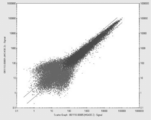
- FIG. 1 shows a comparison of gene expression profiles in the livers of mice administered orally with adiponectin preparation (control: PBS administration).
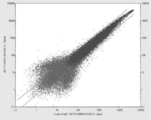
- FIG. 2 shows gene expression profile comparison (control: PBS administration) in the spleen of an adiponectin preparation orally administered mouse.
- FIG. 3 shows pBE-hAdi prepared by incorporating the human adiponectin gene into the plant expression vector pBE2113.
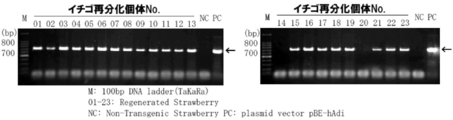
- FIG. 4 is an electrophoretic diagram confirming introduction of a human adiponectin gene in a strawberry transformed strain (Km resistant strain) by genomic PCR.
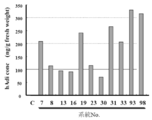
- FIG. 5 is a graph showing the adiponectin concentration of the human adiponectin high expression line.
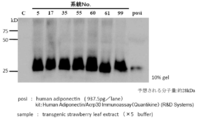
- FIG. 6 shows a western blot of a human adiponectin high expression line.
- FIG. 7 shows a Western blot of strawberry fruit-expressing human adipoctin.
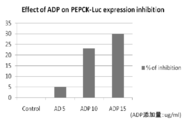
- FIG. 8 is a graph showing the luciferase activity when the constructed retrovirus is infected with assay system cells (Huh7) and adiponectin is added.
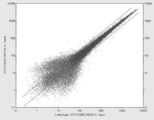
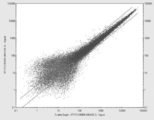
- FIG. 9 shows gene expression profile comparison (control: non-recombinant strawberry administration) in the liver of adiponectin-expressing strawberry orally administered (fed) mice.
- FIG. 10 shows gene expression profile comparison (control: non-recombinant strawberry administration) in the spleen of an adiponectin-expressing strawberry orally administered (fed) mouse.
- FIG. 11 shows gene expression profile comparison (control: non-recombinant strawberry administration) in the small intestine of an adiponectin-expressing strawberry orally administered (fed) mouse.
- FIG. 12 shows biochemical analysis (glucose content) of sera from orally administered (feeding) adiponectin-expressing strawberries.
- the oral feeding regulator containing an adiponectin according to the present invention as an active ingredient acts to enhance feeding or suppress feeding and can be adjusted for feeding.
- adiponectin those derived from any animal can be used, but those derived from mammals such as humans, cows and pigs are preferable from the viewpoint of oral intake.
- the “oral feeding regulator” is, for example, prepared by a conventional method of preparation according to the method described in “15th Revised Japanese Pharmacopoeia General Rules for Preparations” and suitable for oral use. Anything is acceptable.
- the dosage form can include capsules, granules, pills, powders, tablets and the like, and various additives such as excipients and binders depending on the dosage form of the oral feeding regulator. , Disintegrating agents, coating agents and the like may be blended.
- oral feeding regulators are not limited to artificially formulated compositions, for example, various compositions used for foods, as well as vegetables and fruits such as leaves, roots and fruits Including the food materials such as food and drinks and processed final products (food) such as foods and drinks, the concept includes an arbitrary food subject to eating.
- the oral feeding regulator according to the present invention may contain a transformant expressing adiponectin.
- the transformant is not particularly limited as long as there is no problem with feeding and adiponectin is expressed by transformation.
- it may be a transformant of microorganisms conventionally used in food such as natto, lactic acid bacteria, acetic acid bacteria, yeast, basidiomycetes, etc., or a transgenic animal that highly expresses adiponectin, but it should be taken orally.
- the transformant preferably has an edible tissue.
- edible tissues include basidiomycetous fruit bodies (mushrooms), plant fruits (eg, strawberry fruits, tomatoes), roots (radish, potatoes), leaves (cabbage, lettuce), seeds (rice, barley, And grains such as wheat and corn, and beans such as soybean and azuki bean).
- plant fruits eg, strawberry fruits, tomatoes
- roots radish, potatoes
- leaves cabbage, lettuce
- seeds rice, barley, And grains such as wheat and corn
- beans such as soybean and azuki bean
- the method for producing the transformant is not particularly limited, and can be produced by a generally well-known method.
- a method using competent formation by the calcium method mainly bacteria
- a method using vectors such as phages and plasmids mainly bacteria
- a protoplast-PEG method mainly filamentous fungi
- a lithium method mainly yeast
- Electroporation method particle gun method, Agrobacterium method (plant), and other transformation methods suitable for various objects can be used.
- the transformant expressing adiponectin of the present invention is a base complementary to (a) DNA consisting of the base sequence set forth in SEQ ID NO: 1 or (b) DNA consisting of the base sequence of (a).
- a gene comprising a DNA that hybridizes with a DNA comprising a sequence under stringent conditions and that encodes a polypeptide having adiponectin activity is introduced.
- the base sequence described in SEQ ID NO: 1 represents the translation region and stop codon (from 85 to 819) of the human adiponectin gene (NCBI Accession No. NM_004797).
- stringent conditions are conditions under which a specific hybrid is formed and a non-specific hybrid is not formed. Such conditions are understood by those skilled in the art. For example, nucleic acids having high homology such as 99.5% or more hybridize, but DNAs having lower homology do not hybridize. Conditions.
- the transformant expressing adiponectin of the present invention is (a) a polypeptide consisting of the amino acid sequence set forth in SEQ ID NO: 2, or (b) one amino acid sequence set forth in SEQ ID NO: 2 or A gene encoding a polypeptide consisting of an amino acid sequence in which several amino acids have been deleted, substituted or added and having adiponectin activity is introduced.
- “one or several” may vary depending on the position of the three-dimensional structure of the polypeptide or the type of amino acid residue of the amino acid residue to which an amino acid is added, deleted or substituted, but usually 2 to 20 The number is preferably about 2 to 15.
- “having adiponectin activity” means having at least one of the activities of adiponectin, and preferably has the same activity as the polypeptide consisting of the amino acid sequence shown in SEQ ID NO: 2.
- adiponectin activity for example, an activity well known as an action of adiponectin as described in Patent Document 6 (Japanese Patent Application Laid-Open No. 2004-345968) and the like: (1) AMPK activation action and ACC suppression action, glucose uptake promoting activity, fatty acid oxidation promoting activity (Nat. Med. 8: 1288-1295, 2002) in C2C12 cells; (2) AMPK activation action (Nat. Med. 8: 1288-1295, 2002), glucose release inhibitory action (Nat. Med.
- TNF- ⁇ production inhibitory activity 15: 522, 1995
- TNF- ⁇ production inhibitory activity (5) Growth / migration inhibition activity of vascular smooth muscle cells (Circulation 105: 2893, 2002); (6) Collagen I, III, V binding activity (Horm. Metab. Res. 32: 47-50, 2000), Etc.
- adiponectin evaluation system using the Phosphoenolpyruvate carboxykinase (PEPCK) promoter and luciferase constructed by the present inventors (the following Example “3. Evaluation of adiponectin using PEPCK promoter-luciferase”).
- System The administration concentration of adiponectin in the case of administering the oral feeding regulator containing adiponectin of the present invention in a liquid can be appropriately set, for example, from the viewpoint that no harmful effects are observed by oral administration,
- the content in breast milk can be adjusted based on 10 ng / ml to 20 ng / ml (LJ Martin et al., Am J Clin Nutr 2006, Vol. 83, p1106-1011).
- the oral feeding regulator containing adiponectin of the present invention when administered as a solid or liquid, the dose and content of adiponectin can be appropriately adjusted.
- the present invention will be described in more detail with reference to the following examples, but the present invention is not limited to these embodiments.
- adiponectin preparation (recombinant human adiponectin, manufactured by R & D Systems) is phosphate buffered saline (PBS) (composition: 137 mM sodium chloride, 2.7 mM potassium chloride, 10 mM hydrogen phosphate 2) Sodium, 1.8 mM potassium dihydrogen phosphate, pH 7.4) was dissolved at a concentration of 10 ⁇ g / 20 ⁇ l, and the obtained adiponectin aqueous solution was added to a standard body type mouse (Balb / c, female 8 weeks old) at a dose of 20 ⁇ l. Orally administered.
- PBS phosphate buffered saline
- chemokine ligand 15 junction adhesion molecule 2
- ubiquitin-activating enzyme E1 Rho GTPase activating protein 23
- Ssu72 RNA polymerase II CTD phosphatase homolog
- Yip1 domain family member 6 Cdc2-richinrine / se
- DCP1 decapping enzyme homolog b syndecan binding protein
- F-box and WD-40 domain protein 19 nucleoporin 153, Thyroid hormone receptor beta, prolactin-like protein C 1, Shc SH2-domain binding protein 1, FAT tumoromosuppress4 , Amiloride-sensitive cation channel 3, Eyes absent 3 homolog, testis expressed gene 13,
- RGM domain family member B, methyl-CpG binding domain protein 3-like 2, mesoderm posterior 2, prostaglandin F receptor, nuclear complex associated 2 homolog, potassium voltage-gated channel (shaker-related subfamily member 4), ankyrin repeat domain 44 , MYST histone acetyltransferase monocytic leukemia 4, fibronectin type III domain containing 1, pantothenate kinase 2 (Hallervorden-Spatz syndrome), Lemur tyrosine kinase 2, cyclic nucleotide gated channel alpha 2, RAD54 like, carbonic subunit 4 (delta), SAM domain and HD domain 1,
- chromodomain helicase DNA binding protein 8 sperm associated antigen 1
- Phosphofurin acidic cluster sorting protein 1 ribonucleotide reductase M2 B (TP53 inducible)
- six transmembrane epithelial antigen of prostate 2 Neural cell adzy RNA polymerase II, SMC6 structural maintenance of chromosomes 6-like 1, fibroblast growth factor 4, Rho guanine nucleotide exchange factor15, SMC2 structural maintenance of chromosomes 2-like 1, heparin-binding EGF-like growthineSerine, repetitive matrix 1,
- Histocompatibilitycom2K region Histocompatibilitycom2K region, growth arrest and DNA-damage-inducible 45 gamma, semasdomain (semaphorin) 4D, transformation related protein 53, matrix metallopeptidase 14 (membrane -inserted), regulator of G-protein signaling 16, phosphatidylinositol-4-phosphate 5-kinase, type 1 beta, ATP-binding cassette sub-family F (GCN20) member 1, HCF-binding transcription factor Zhangfei, methionine aminopeptidase 2, ring finger protein 2, ubiquitin-conjugating enzyme E2C, prosaposin, arylacetamide deacetylase-like 1, nuclear factor I / X, glucose-6-phosphate dehydrogenase X-linked, vesicle-associated membrane protein, ADP-ribosylation factor 4-like, CCAAT / enhancer binding protein beta,
- nuclear receptor subfamily 0 group B member 2 spastic paraplegia 20, DNA-damage-inducible transcript 4, cyclin-dependent kinase 5, regulatory subunit (p35) 1, methyltransferase like 7A, sialic acid binding Ig-like lectin 1, insulin-like growth factor binding protein 1, solute carrier organic anion transporter family, member 1a1, PRP40 pre-mRNA processing factor 40 homolog A, GNAS complex locus, amyloid beta (A4) precursor-like protein 2, phosphoenolpyruvate carboxykinase 1, interleukin 2 receptor gamma chain , TSC22 domain family 3, solute carrier family 45 member 3, macrophage receptor with collagenous structure, ectonucleoside triphosphate diphosphohydrolase 1.
- 52 genes were up-regulated and 109 genes were down-regulated.
- FIG. 3 The abbreviations in FIG. 3 are as follows: Pnos: nopaline synthase promoter, nptII: neomycin phosphotransferase II, Tnos: nopaline synthase terminator, eP35S: cauliflower mosaic virus 35S promoter, H.Adiponectin: Human adiponectin gene (SEQ ID NO: 1), AdiFW1: AdiFW1 primer (SEQ ID NO: 3) recognition region, AdiRV1: AdiRV1 primer (SEQ ID NO: 4) recognition region, His tag: histidine tag, KDEL: Endoplasmic reticulum retention signal.
- Genomic PCR using specific primers AdiFW1 (forward primer) and AdiRV1 (reverse primer) set at both ends of human adiponectin gene It was.
- Genomic DNA was extracted using a nucleic acid extraction kit MagExtractor-Plant Genome- (TOYOBO) according to a protocol using a nucleic acid purification system MagExtractor MFX-6100 (TOYOBO).
- PCR products were detected by electrophoresis using 1.5% TBE agarose gel. As a result, the target amplified fragment (732 bp) was detected in 21 of the 23 individuals tested, and the introduction of the gene was confirmed (FIG. 4).
- AdiFW1 primer sequence 5'-ATGCTGTTGCTGGGAGCTGTTCTA-3 '(SEQ ID NO: 3)
- AdiRV1 primer sequence 5'-GGTGTCATGGTAGAGAAGAAAGCC-3 '(SEQ ID NO: 4)
- a strain showing an expression level of 200 ng / gFW or more was confirmed (FIG. 5). If the expression level is 200 ng / g FW or more, a standard strawberry fruit (about 10 g) can secure the amount of adiponectin contained in 100 ml of breast milk.
- the resulting blot was blocked with ECL blocking agent (GE Healthcare, Inc.), and a primary antibody toshiteMouse anti-adiponectin, human monoclonal antibody (CHEMICON) 5,000-fold diluted solution was used as a secondary antibody to Anti- Mouse IgG-Peroxidase, A 10,000-fold diluted solution of Goat (SIGMA) was reacted and detected with ECL plus Western Blotting Detection Reagents (GE Healthcare, Inc.). As a result of analysis, a band was confirmed at the position of the estimated molecular weight (28 kDa), and expression in the leaf tissue of human adiponectin was confirmed (FIG. 6).
- Human adiponectin high expression strawberry fruit was cultivated and fruits were collected.
- a strawberry fruit sample is pulverized in the presence of liquid nitrogen, and then 3 times the raw weight of grinding buffer (potassium phosphate buffer, pH 7.0, 1% Triton X-100, Protease inhibitor ⁇ Roche Diagnostics GmbH; Centrifugal supernatant of the grinding liquid obtained by adding 1 tablet / 25 ml>) was used as the protein extract.
- grinding buffer potassium phosphate buffer, pH 7.0, 1% Triton X-100, Protease inhibitor ⁇ Roche Diagnostics GmbH; Centrifugal supernatant of the grinding liquid obtained by adding 1 tablet / 25 ml>
- a sample buffer (2% SDS, 20M Tris-HCl pH 6.8, 10% Glycerol, 0.05% BPB, 0.05% XC) containing no reducing agent was added to the protein extract. Adjust the protein amount to 16.5 ⁇ g / lane, incubate for 30 minutes, and then perform SDS-PAGE using 4-20% gradient SDS gel (TEFCO) without heat treatment. went. As a result, a plurality of bands were confirmed in a molecular weight range larger than that of the monomer, suggesting that multimers were formed in the transformed strawberry fruit (FIG. 7).
- the envelope was used by converting it into a VSV (Vesicular Stomatitis virus) G glycoprotein and expanding the host range.
- VSV Vasicular Stomatitis virus
- mouse and human PEPCK promoters were introduced into the promoter region (obtained from genomic DNA, respectively), and a luciferase gene (Gaussia Luciferase; GLuc modified to human type codon) was incorporated downstream thereof.
- a luciferase gene (Gaussia Luciferase; GLuc modified to human type codon) was incorporated downstream thereof.
- an SV40 promoter and a hygromycin resistance gene were incorporated downstream of GLuc to confer drug selectivity.
- the retroviral vector was constructed and transfected into packaging cells to obtain infectious viral particles.
- mice (Balb / c, male 7-week-old) were placed in the same gauge and administered free for 6 hours a day (0.2 g (dry weight)) for 5 consecutive days. .
- the adiponectin content contained in the transformed strawberry fruit fed per mouse in the administration group is estimated to be about 8.4 ⁇ g / day.
- the spinal cord was dislocated, and the internal organs (liver, spleen, small intestine) were removed and used as samples. Each sample was immersed in RNALater (Ambion, Inc) and then frozen at ⁇ 80 ° C.
- MRNA was extracted from the frozen sample, and DNA microarray analysis was performed using Affimetrix Gene Chip (Mouse Genome 430 2.0, 1-cycle target labeling protocol). By comparing data between the administration group and the control group, genes whose expression was up-regulated or suppressed were identified.
- RAD51 associated protein 1, pleckstrin homology domain interacting protein, FAST kinase domains 3, tryptase beta 2, solute carrier family 35 member F2, hemoglobin Z beta-like embryonic chain, scrapie responsive gene 1, leucine rich repeat containing 34, coiled-coil domain containing 38, Nephronectin, calcium channel voltage-dependent N type alpha 1B subunit, interleukin 7 receptor, ST6-N-acetylgalactosaminide alpha-2,6-sialyltransferase 1, neurexophilin 1, cellular retinoic acid binding protein I, Adult male hippocampus cDNA, layilin, Eph receptor A7, secretory blood group 1, lysyl oxidase, serine peptidase inhibitor clade A member 1p, trophokinplastic protein analym subfamily a polypeptide 1, zinc finger protein 352, synapsin II, Cat
- Peptide marker array (obesity-related) test in adiponectin oral administration (feeding) mice Serum was collected from the four control groups and administration groups, and used for peptide marker arrays (obesity-related).
- the peptide marker array was analyzed using Obesity Peptide Biomarker Array and Obesity Biomarker Chip (Rat, Mouse) manufactured by PHOENIX Pharmaceuticals according to the manufacturer's protocol.
- ghrelin, NPY (neuropeptide Y), etc. in which remarkable improvement was observed, are peptides involved in increased feeding.
- ACTH etc. in which a remarkable decrease was observed are peptides involved in feeding suppression. From the above, it is considered that the adiponectin feeding changes the behavior of peptides related to sugar metabolism and feeding regulation, and the feeding regulation action occurs in the fed individual.
- mice (Balb / c, male 7-week-old) were placed in the same gauge and administered for 10 days or 20 days by free feeding for 6 hours per day.
- strawberry homogenate was added to the normal feed (2 ml / animal equivalent).
- Homogenates of group A human adiponectin expressing strawberry fruits contain 1.2 ⁇ g / 2 ml of recombinant adiponectin.
- Serum was collected from 5 mice 10 days after administration, and the remaining 9 mice 20 days after administration, and the glucose content in the serum was measured 6 hours after the final administration.
- the glucose content in serum is shown in FIG.
- the feeding enhancement effect by promoting ghrelin secretion by feeding adiponectin is a new finding found in the research relating to the present invention.
Landscapes
- Health & Medical Sciences (AREA)
- Life Sciences & Earth Sciences (AREA)
- Chemical & Material Sciences (AREA)
- Genetics & Genomics (AREA)
- Engineering & Computer Science (AREA)
- Organic Chemistry (AREA)
- Molecular Biology (AREA)
- Bioinformatics & Cheminformatics (AREA)
- General Health & Medical Sciences (AREA)
- Medicinal Chemistry (AREA)
- Zoology (AREA)
- Proteomics, Peptides & Aminoacids (AREA)
- Pharmacology & Pharmacy (AREA)
- Veterinary Medicine (AREA)
- Animal Behavior & Ethology (AREA)
- Public Health (AREA)
- Obesity (AREA)
- Nutrition Science (AREA)
- Biotechnology (AREA)
- General Engineering & Computer Science (AREA)
- Biomedical Technology (AREA)
- Endocrinology (AREA)
- Wood Science & Technology (AREA)
- Gastroenterology & Hepatology (AREA)
- Biochemistry (AREA)
- Biophysics (AREA)
- Polymers & Plastics (AREA)
- Diabetes (AREA)
- Hematology (AREA)
- Food Science & Technology (AREA)
- Mycology (AREA)
- Nuclear Medicine, Radiotherapy & Molecular Imaging (AREA)
- Chemical Kinetics & Catalysis (AREA)
- General Chemical & Material Sciences (AREA)
- Child & Adolescent Psychology (AREA)
- Microbiology (AREA)
- Plant Pathology (AREA)
- Physics & Mathematics (AREA)
- Cell Biology (AREA)
- Toxicology (AREA)
Abstract
Description
さらに本発明は、アディポネクチンを発現する形質転換体を含有する、前記の経口用摂食調整剤に関する。
また本発明は、アディポネクチンを発現する形質転換体が、
(a)配列番号1に記載の塩基配列からなるDNA、または、
(b)(a)の塩基配列からなるDNAと相補的な塩基配列からなるDNAとストリンジェントな条件下でハイブリダイズし、かつアディポネクチン活性を有するポリペプチドをコードするDNA
からなる遺伝子を導入した形質転換体である、前記の経口用摂食調整剤に関する。
(a)配列番号2に記載のアミノ酸配列からなるポリペプチド、または、
(b)配列番号2に記載のアミノ酸配列において、1個または数個のアミノ酸が欠失、置換もしくは付加されたアミノ酸配列からなり、かつアディポネクチン活性を有するポリペプチド
をコードする遺伝子を導入した形質転換体である、前記の経口用摂食調整剤に関する。
また本発明は、アディポネクチンを発現する形質転換体の可食性組織を含有する、前記の経口用摂食調整剤に関する。
さらに本発明は、可食性組織が生食可能である前記の経口用摂食調整剤に関する。
さらに本発明は、アディポネクチンが、形質転換植物において発現したものである、前記の経口用摂食調整剤に関する。
また本発明は、形質転換植物において発現したアディポネクチン以外の動物由来成分を含有しない、前記の経口用摂食調整剤に関する。
さらに本発明は、形質転換植物において発現したアディポネクチン以外は植物由来成分である、前記の経口用摂食調整剤に関する。
さらに本発明は、前記の経口用摂食調整剤を含有する、摂食調整用食品組成物に関する。
また、「アディポネクチン活性を有する」とは、アディポネクチンの有する活性のうち少なくとも1つを有することを意味し、好ましくは、配列番号2に記載のアミノ酸配列からなるポリペプチドと同等の活性を有する。
(1)C2C12細胞における、AMPK活性化作用およびACC抑制作用、グルコース取り込み促進活性、脂肪酸酸化促進活性(Nat. Med. 8:1288-1295,2002);
(2)初代培養肝細胞におけるAMPK活性化作用(Nat. Med. 8:1288-1295, 2002)、グルコース放出抑制作用(Nat. Med. 7:947-953, 2001);
(3)血管内皮細胞におけるVCAM-1、ICAM-1、E-Selectin(Circulation 100:2473-2476, 1999);
(4)マクロファージにおける、コレステロールエステル量の低下(Eur. J. Clin. Invest. 27:285, 1997)、リピッドドロップレット蓄積低下(Arterioscler. Thromb. Vasc. Biol. 19:1333, 1999)、スカベンジャーレセプター(Biochem. Biophys. Res. Commun. 22:277, 2000)、またはリポプロテインリパーゼ(LPL)発現抑制活性(Arterioscler. Thromb. Vasc. Biol. 15:522, 1995)、またはTNF-α産生抑制活性;
(5)血管平滑筋細胞の増殖・遊走抑制活性(Circulation 105:2893, 2002) ;
(6)コラーゲンI、III、V結合活性(Horm. Metab. Res. 32:47-50, 2000)、
などが挙げられる。
本発明のアディポネクチンを含有する経口用摂食調整剤を液体で投与する場合のアディポネクチンの投与濃度は、適宜設定することができるが、例えば、経口投与により有害性が認められないとの観点から、母乳における含有量である10ng/ml~20ng/ml(L. J. Martin et al., Am J Clin Nutr 2006, Vol.83, p1106-1011)を基準として調整することが可能である。
以下に本発明を実施例により、さらに詳細に説明するが、本発明は、これらの態様に限定されるものではない。
精製アディポネクチン標品(recombinant human adiponectin、R & D Systems社製)をリン酸緩衝生理食塩水(PBS)(組成:137mM 塩化ナトリウム、2.7mM 塩化カリウム、10mM リン酸水素2ナトリウム、1.8mM リン酸2水素カリウム pH 7.4)に10μg/20μlの濃度で溶解し、得られたアディポネクチン水溶液を標準的な体型のマウス(Balb/c、メス8週齢)に1回あたり20μlを経口的に投与した。対照として、PBSのみを1回当たり20μlを経口的に投与した。これを5日間連続して行い、最終投与後6時間後に脊髄脱臼した後、内臓(肝臓、脾臓)を摘出し、試料とした。各試料をRNALater(Ambion,Inc)に浸漬後、-80℃に凍結した。凍結した試料からmRNAを抽出し、DNAマイクロアレイ解析をAffimetrix社Gene Chip(Mouse Genome 430 2.0、1-cycle target labeling プロトコール)を用いて行った。投与群と対照群とのデータを比較し、発現亢進、あるいは抑制が起きている遺伝子を同定した。
発現が亢進した遺伝子として、以下のものが認められた;ELAV-like 2、defensin beta 8、DEAD box polypeptide 24、CKLF-like MARVEL transmembrane domain containing 2A、early B-cell factor 3、SH3-domain kinase binding protein 1、olfactomedin 3、Kinesin family member 16B、leucine rich repeat containing 52、Septin 11、tripartite motif-containing 36、catenin delta 1、opioid receptor mu 1、phosphatase and actin regulator 1、protein phosphatase 1 regulatory (inhibitor) subunit 9A、transient receptor potential cation channel、regulator of G-protein signaling 18、Spire homolog 1 、
脾臓では52遺伝子が発現亢進され、また109遺伝子が発現抑制された。
(1)ヒトアディポネクチン人工合成遺伝子の作製
ヒトアディポネクチン遺伝子(NCBI Accession No.NM_004797)の翻訳領域(Position 85-816)(以下、hAdiとも記す)をコードするロングプライマーを人工合成し、オーバーラップ法にて当該遺伝子の翻訳領域を作製した。この人工合成遺伝子をTAクローニング法でpGEM-T vector(Promega)に導入してpGEM-bαLAを作出した。大腸菌の形質転換を通じて導入プラスミドpGEM-bαLAを回収し、これをシークエンス解析に供して遺伝子配列を同定した。
次に、配列確認後のクローンpGEM-hAdiを鋳型に用いてアダプタープライマーによるPCRを行い、制限酵素認識配列およびタグ配列を付加した。即ち、5’末端側にBam HI、Xba I認識配列、3’末端側にHis-Tag(6xHis)、KDEL配列、終止コドン、ならびにSac I認識配列を持つ遺伝子を作製した。これをpGEM-T Vector(Promega)にクローニングし、pGEM-hAdi/His+KDELを得た。
植物発現ベクターpBE2113-GUS(Mitsuhara et al.(1996) Plant and Cell Physiology Vol.37, No.1, p49-59)を制限酵素Xba I・Sac Iで同時消化した後、CIAP処理を施した。一方、ヒトアディポネクチン遺伝子cDNA断片は、pGEM-hAdi/His+KDELを制限酵素Xba I・Sac Iで同時消化して当該遺伝子領域を切り出して回収した。これらベクター側とcDNA断片を混和してライゲース処理を行い、pBE-hAdiを作製した(図3)。
ヒトアディポネクチン遺伝子植物発現用ベクターpBE-hAdiを直接導入法にてアグロバクテリウム(Agrobacterium tumefaciens strain LBA4404)に導入した。得られたカナマイシン(Km)耐性株(導入プラスミド確認済み)を用いてイチゴの形質転換試験を行った。Km添加培地を用いてカルス誘導と再分化を行い、Km耐性個体を選抜した。
ヒトアディポネクチン遺伝子両端部に設定した特異的プライマーAdiFW1(順方向プライマー)とAdiRV1(逆方向プライマー)を用い、ゲノミックPCRを行った。ゲノムDNAの抽出には核酸抽出キットMagExtractor-Plant Genome-(TOYOBO)を用い、核酸精製システムMagExtractor MFX-6100 (TOYOBO)を使用するプロトコールに準じて行った。PCR産物は、1.5%TBEアガロースゲルを用いた電気泳動により検出した。その結果、供試した23個体のうち21個体で目的の増幅断片(732bp)が検出され、遺伝子の導入が確認された(図4)。
AdiFW1プライマー配列:5’-ATGCTGTTGCTGGGAGCTGTTCTA-3’(配列番号3)
AdiRV1プライマー配列:5’-GGTGTCATGGTAGAGAAGAAAGCC-3’(配列番号4)
Human Adiponectin/Acrp30 Immunoassay〈Quantikine〉(R&D Systems)を用い、添付のプロトコールに準じて、エライザ検定を行った。100系統の培養株(夫々、系統No.1~系統No.100と記す)より葉組織を採取し、液体窒素存在下で粉末化した後、生重量の5倍量の磨砕用緩衝液 (リン酸カリウム緩衝液pH7.0 1% Triton X-100, Protease inhibitor〈Roche Diagnostics GmbH;濃度 1tablet/25ml〉)を添加して得られた磨砕液の遠心上清を、検定試料として供試した。
その結果、200ng/gFW以上の発現量を示す株が確認された(図5)。なお、200ng/gFW以上の発現量があれば、標準的なイチゴの一果実(約10g)で、母乳100mlに含まれるアディポネクチン量が確保できる。
イチゴ発現ヒトアディポネクチンのタンパク解析を行うために、ウエスタンブロットを行った。イチゴ試料はエライザ検定と同様(前記(6)に記述)に調製したものを供した。還元剤(2-Me)を添加したLaemmliバッファー系でプレキャストゲルSDS-PAGE Mini 10% (TEFCO)を用いてSDS-PAGEを行った後、分離したタンパク質をHybond-P (GE Healthcare, Inc.)へ転写した。得られたブロットをECL blocking agent (GE Healthcare,Inc.)でブロッキングし、1次抗体toshiteMouse anti-adiponectin, human monoclonal antibody (CHEMICON) 5,000倍希釈液を、2次抗体としてAnti- Mouse IgG-Peroxidase ,Goat(SIGMA)の10,000倍希釈液を反応させ、ECL plus Western Blotting Detection Reagents (GE Healthcare,Inc.)で検出した。
解析の結果、推定分子量(28kDa)の位置にバンドが確認され,ヒトアディポネクチンの葉組織における発現が確認された(図6)。
イチゴ果実におけるヒトアディポネクチンの発現および多量体形成の有無の確認を試みた。ヒトアディポネクチン高発現系統No.5(以下、単に系統No.5ともいう)を栽培し果実を採取した。イチゴ果実試料を液体窒素存在下で粉末化後、生重量の3倍量の磨砕用緩衝液 (リン酸カリウム緩衝液, pH7.0, 1% Triton X-100, Protease inhibitor〈Roche Diagnostics GmbH;濃度 1tablet/25ml〉)を添加して得られた磨砕液の遠心上清をタンパク抽出液とした。同試料に、Lammliサンプルバッファー(BIO-RAD)を添加し、タンパク量16.5μg/laneとなるように調整し、プレキャストゲルSDS-PAGE Mini 12%(TEFCO)を用いてSDS-PAGEを行い、前記(7)と同様のプロトコール(還元処理)でウエスタンブロットを行った。その結果、葉試料の場合と同様に、単量体の推定分子量である約28kDaの位置に2本のバンドが確認された(図7)。
アディポネクチンにより発現が抑制されるPEPCK(Phosphoenolpyruvate carboxykinase)のプロモーターとルシフェラーゼをレポーター遺伝子とした蛍光による活性測定系を構築した。活性測定系はレンチウイルスベクターシステムを活用した。ベクターを構成するプラスミドコンストラクト(パッケージングプラスミド、エンベロープ&Rev プラスミドおよびSIN(Self Inactivating)ベクタープラスミド)は既存のものを活用し、これに以下の改変を加えてアディポネクチン活性測定系を構築した。すなわち、エンベロープは、VSV(Vesicular Stomatitis virus)のG糖タンパク質に変換し、宿主域を広げたものを使用した。SINベクタープラスミドにおいては、プロモーター領域にマウスおよびヒトのPEPCKプロモーターを導入し(それぞれgenomic DNAより取得)、その下流にルシフェラーゼ遺伝子(ヒト型コドンに改変したGaussia Luciferase;GLuc)を組み込んだ。更に、GLuc下流には、薬剤選択性を付与するために、SV40プロモーターとハイグロマイシン耐性遺伝子を組み込んだ。上記レトロウイルスベクターを構築し、パッケージング細胞にトランスフェクトし、感染性ウイルス粒子を得た。
濃度依存性に発現抑制が起きることが確認できたことから、アディポネクチンの測定系として十分に利用できることが分かった。
標準的な体型のマウスを用いて、下記の対照群および投与群を用意し、実験を行った。
対照群:イチゴ果実(非組換え体)
投与群:アディポネクチン発現イチゴ果実(凍結乾燥果実、アディポネクチン含量:42μg/g乾燥重量)
各グループとも連続5日間の投与の後、最終投与後6時間後に脊髄脱臼した後、内臓(肝臓、脾臓、小腸)を摘出し、試料とした。各試料をRNALater(Ambion,Inc)に浸漬後、-80℃に凍結した。凍結した試料からmRNAを抽出し、DNAマイクロアレイ解析をAffimetrix社Gene Chip(Mouse Genome 430 2.0、1-cycle target labeling プロトコール)を用いて行った。投与群と対照群とのデータを比較し、発現亢進、あるいは抑制が起きている遺伝子を同定した。
発現が亢進した遺伝子として、以下のものが認められた;parathyroid hormone receptor 2、sodium channel(voltage-gated)type II alpha 1、Chemokine (C-C motif) receptor 9、potassium voltage gated channel Shaw-related subfamily member 3、tankyrase TRF1-interacting ankyrin-related ADP-ribose polymerase、thioredoxin-like 1、tumor necrosis factor receptor superfamily member 12a。
以上のことから、アディポネクチンの摂食によって、極めて多数の遺伝子の発現状態に変化が起こり、なかでも糖代謝や摂食調整に関連した遺伝子発現においても変化が起こっていることが分かった。
前記4の対照群および投与群から血清を採取し、これをペプチドマーカーアレイ(肥満関係)に供した。ペプチドマーカーアレイは、PHOENIX Pharmaceuticals社製 Obesity Peptide Biomarker ArrayおよびObesity Biomarker Chip (Rat, Mouse)を用い、製造者のプロトコールに準じて解析を行った。

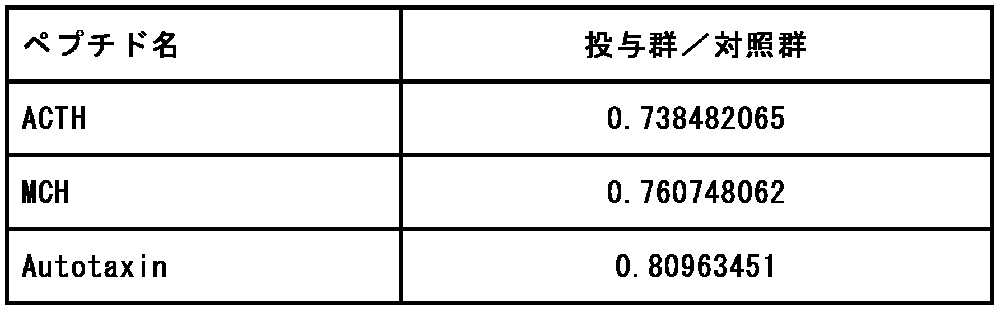
以上のことから、アディポネクチンの摂食によって、糖代謝や摂食調整に関連したペプチドの挙動に変化が起こり、摂食した個体において摂食調整作用が生じると考えられる。
標準的な体型のマウスを用いて、下記A~Cの各グループを用意し、実験を行った。
A:通常飼料+ヒトアディポネクチン発現イチゴ果実
B:通常飼料+非組換えイチゴ果実
C:通常飼料(対照)
Claims (12)
- アディポネクチンを有効成分として含有する、経口用摂食調整剤。
- アディポネクチンを発現する形質転換体を含有する、請求項1に記載の経口用摂食調整剤。
- アディポネクチンを発現する形質転換体が、
(a)配列番号1に記載の塩基配列からなるDNA、または、
(b)(a)の塩基配列からなるDNAと相補的な塩基配列からなるDNAとストリンジェントな条件下でハイブリダイズし、かつアディポネクチン活性を有するポリペプチドをコードするDNA
からなる遺伝子を導入した形質転換体である、請求項2に記載の経口用摂食調整剤。 - アディポネクチンを発現する形質転換体が、
(a)配列番号2に記載のアミノ酸配列からなるポリペプチド、または、
(b)配列番号2に記載のアミノ酸配列において、1個または数個のアミノ酸が欠失、置換もしくは付加されたアミノ酸配列からなり、かつアディポネクチン活性を有するポリペプチド
をコードする遺伝子を導入した形質転換体である、請求項2に記載の経口用摂食調整剤。 - アディポネクチンを発現する形質転換体の可食性組織を含有する、請求項2~4のいずれかに記載の経口用摂食調整剤。
- 可食性組織が生食可能である請求項5に記載の経口用摂食調整剤。
- 形質転換体が、形質転換植物である、請求項2~6のいずれかに記載の経口用摂食調整剤。
- アディポネクチンが、形質転換植物において発現したものである、請求項7に記載の経口用摂食調整剤。
- 形質転換植物において発現したアディポネクチン以外の動物由来成分を含有しない、請求項8に記載の経口用摂食調整剤。
- 形質転換植物において発現したアディポネクチン以外は植物由来成分である、請求項9に記載の経口用摂食調整剤。
- 植物がイチゴであり、可食性組織がイチゴ果実である、請求項7~10のいずれかに記載の経口用摂食調整剤。
- 請求項1~11のいずれかに記載の経口用摂食調整剤を含有する、摂食調整用食品組成物。
Priority Applications (2)
| Application Number | Priority Date | Filing Date | Title |
|---|---|---|---|
| JP2010548467A JP5685086B2 (ja) | 2009-01-29 | 2010-01-18 | アディポネクチンを含有する経口用摂食調整剤 |
| US13/146,575 US9181561B2 (en) | 2009-01-29 | 2010-01-18 | Adiponectin-containing eating behavior control agent for oral administration |
Applications Claiming Priority (2)
| Application Number | Priority Date | Filing Date | Title |
|---|---|---|---|
| JP2009018455 | 2009-01-29 | ||
| JP2009-018455 | 2009-01-29 |
Publications (1)
| Publication Number | Publication Date |
|---|---|
| WO2010087243A1 true WO2010087243A1 (ja) | 2010-08-05 |
Family
ID=42395504
Family Applications (1)
| Application Number | Title | Priority Date | Filing Date |
|---|---|---|---|
| PCT/JP2010/050507 Ceased WO2010087243A1 (ja) | 2009-01-29 | 2010-01-18 | アディポネクチンを含有する経口用摂食調整剤 |
Country Status (3)
| Country | Link |
|---|---|
| US (1) | US9181561B2 (ja) |
| JP (1) | JP5685086B2 (ja) |
| WO (1) | WO2010087243A1 (ja) |
Cited By (1)
| Publication number | Priority date | Publication date | Assignee | Title |
|---|---|---|---|---|
| CN104758944A (zh) * | 2015-04-02 | 2015-07-08 | 中国科学院过程工程研究所 | 一种疫苗制剂及其制备方法和用途 |
Families Citing this family (1)
| Publication number | Priority date | Publication date | Assignee | Title |
|---|---|---|---|---|
| CN119791290A (zh) * | 2025-01-08 | 2025-04-11 | 广东冠茵医药生物科技发展有限公司 | 一种具有减肥及降血脂功效的组合物及其制备方法 |
Family Cites Families (13)
| Publication number | Priority date | Publication date | Assignee | Title |
|---|---|---|---|---|
| JP3018186B1 (ja) | 1999-03-09 | 2000-03-13 | 大阪大学長 | 抗炎症剤、単球系細胞の増殖抑制剤 |
| US20020132773A1 (en) * | 2001-03-14 | 2002-09-19 | Oklahoma Medical Research Foundation | Methods for reducing fat by administration of adiponectin |
| US20060052292A1 (en) * | 2001-12-21 | 2006-03-09 | Maxygen Aps Maxygen Holdings, Ltd. | Adiponectin fragments and conjugates |
| US7419955B2 (en) | 2002-05-24 | 2008-09-02 | Japan Science And Technology Agency | Method for treating arteriosclerosis |
| JP2004345968A (ja) | 2003-05-20 | 2004-12-09 | Takashi Kadowaki | アディポネクチンの新規用途 |
| EP1767639B1 (en) * | 2004-05-31 | 2012-02-29 | The Kitasato Institute (formerly known as School Juridical Person Kitasato Gakuen) | Oral anti-leucocytozoonosis vaccines based on transgenic plants |
| JP2008105945A (ja) | 2005-02-07 | 2008-05-08 | Ajinomoto Co Inc | アディポネクチンの分泌促進又は誘導作用を有するアシルアミド化合物 |
| JP2007031302A (ja) | 2005-07-25 | 2007-02-08 | Noevir Co Ltd | アディポネクチン産生促進剤、及び代謝異常症候群予防剤 |
| CN101415461A (zh) | 2006-01-09 | 2009-04-22 | 儿童医院医疗中心 | 用于治疗各种疾病的脂连蛋白 |
| JP5066856B2 (ja) | 2006-07-21 | 2012-11-07 | 不二製油株式会社 | アディポネクチン分泌促進剤 |
| AU2007292786B2 (en) | 2006-09-04 | 2013-02-14 | Megmilk Snow Brand Co., Ltd. | Agent for accelerating the increase in and/or preventing the decrease in blood adiponectin level, and visceral fat accumulation inhibitor |
| JP5229977B2 (ja) | 2006-09-08 | 2013-07-03 | 雪印メグミルク株式会社 | 血中アディポネクチン濃度増加促進及び/又は減少抑制剤 |
| JP2008063293A (ja) | 2006-09-08 | 2008-03-21 | Yobo Igaku Shokuhin Kenkyusho Kk | アディポネクチン分泌促進剤、並びに該アディポネクチン分泌促進剤を含有する中性脂肪減少剤、抗肥満剤、飲食品添加剤及び機能性食品 |
-
2010
- 2010-01-18 JP JP2010548467A patent/JP5685086B2/ja active Active
- 2010-01-18 WO PCT/JP2010/050507 patent/WO2010087243A1/ja not_active Ceased
- 2010-01-18 US US13/146,575 patent/US9181561B2/en active Active
Non-Patent Citations (5)
| Title |
|---|
| "Biotechnology Symposium Yokoshu, 2008", vol. 26, article TAKASHI AOKI ET AL.: "Idenshi Kumikae ni yoru Kinosei Ichigo no Sakushutsu", pages: 32 - 35 * |
| "Biotechnology Symposium Yokoshu, 2008", vol. 26, article TAKASHI AOKI ET AL.: "Kokinosei Busshitsu Seisan Ichigo ni Kansuru Gijutsu Kaihatsu (sono 1) Kumikae Ichigo ni yoru Kokino Busshitsu Fukugo Seisan Gijutsu no Kaihatsu", pages: 81 - 82 * |
| HIROAKI UENO ET AL.: "Himansho Metabolic Syndrome no Chiryo to Adipo Science, The relationship between feeding regulation and visceral fat accumulation", ADIPOSCIENCE, vol. 4, no. 3, 2007, pages 231 - 238 * |
| KUBOTA, N. ET AL.: "Adiponectin stimulates AMP-activated proteinkinase in the hypothalamus and increases food intake", CELL METAB, vol. 6, no. 1, 2007, pages 55 - 68 * |
| RIE ANNO ET AL.: "Hito Adiponectin Idenshi Kumikae Shokubutsu no Sakushutsu to Kino Kaiseki", BMB2007 KOEN YOSHISHU, 2007, pages 350 * |
Cited By (1)
| Publication number | Priority date | Publication date | Assignee | Title |
|---|---|---|---|---|
| CN104758944A (zh) * | 2015-04-02 | 2015-07-08 | 中国科学院过程工程研究所 | 一种疫苗制剂及其制备方法和用途 |
Also Published As
| Publication number | Publication date |
|---|---|
| US20120115776A1 (en) | 2012-05-10 |
| JPWO2010087243A1 (ja) | 2012-08-02 |
| US9181561B2 (en) | 2015-11-10 |
| JP5685086B2 (ja) | 2015-03-18 |
Similar Documents
| Publication | Publication Date | Title |
|---|---|---|
| Yue et al. | Effects of triterpenes from Ganoderma lucidum on protein expression profile of HeLa cells | |
| Zhang et al. | The effect of the antimicrobial peptide plectasin on the growth performance, intestinal health, and immune function of yellow-feathered chickens | |
| CN104479001B (zh) | κ-酪蛋白来源生物活性肽的制备和应用 | |
| CN104710524B (zh) | 牛乳αs2-酪蛋白来源生物活性肽的制备和应用 | |
| Xu et al. | Oral administration of Lactococcus lactis‐expressed recombinant porcine epidermal growth factor stimulates the development and promotes the health of small intestines in early‐weaned piglets | |
| CN104479002A (zh) | 牛乳β-酪蛋白来源生物活性肽的制备和应用 | |
| Li et al. | High-level expression of maize γ-zein protein in transgenic soybean (Glycine max) | |
| JP5685086B2 (ja) | アディポネクチンを含有する経口用摂食調整剤 | |
| Salyaev et al. | The study of immunogenicity of the antigenic protein of high risk oncogenic type of the human papillomavirus HPV16 L1 produced in the plant expression system on the base of transgenic tomato | |
| CN119233983A (zh) | 鸢尾素的生产方法、其制剂及给药途径 | |
| CN104945490B (zh) | 分离的植物防御素多肽及其制备方法和在治疗肺癌中的用途 | |
| Balabanova et al. | Engineered fungus Thermothelomyces thermophilus producing plant storage proteins | |
| Su et al. | Molecular characterization of vascular endothelial growth factor b from spotted sea bass (Lateolabrax maculatus) and its potential roles in decreasing lipid deposition | |
| CN119019498A (zh) | 一种生物活性肽pct-2及其制备方法和应用 | |
| US7378513B2 (en) | Isolated proteins from a traditional Chinese medicine Yuzhu and use thereof | |
| JP7464932B2 (ja) | 大麦若葉由来の膵リパーゼ阻害剤、脂質吸収抑制用剤、及びそれらを含む飲食品 | |
| KR102208028B1 (ko) | 클로렐라 불가리스 유래의 염 유도성 프로모터 및 이의 용도 | |
| JP2002017186A (ja) | トランスジェニック植物 | |
| CN108060146A (zh) | 飞蝗过氧化物还原酶prx5及其编码基因与应用 | |
| WO2009124503A1 (zh) | 植物种子胚的蛋白提取物的应用及其组合物 | |
| Kim et al. | Expression of human growth hormone gene in Pleurotus eryngii | |
| Zhu et al. | Transcriptomic and antiviral analyses of PoIFN-Delta5 against porcine enteric viruses in porcine intestinal epithelial cells | |
| CN119326755B (zh) | (-)-Gallocatechin gallate在制备预防和/或治疗猪德尔塔冠状病毒的药物中的应用 | |
| CN118766981B (zh) | 一种具有协同抑制tslp表达作用的外用中药组合物及其制备方法和应用 | |
| KR20170084653A (ko) | 위장 단백분해효소에 저항성을 갖는 식물 세포 |
Legal Events
| Date | Code | Title | Description |
|---|---|---|---|
| 121 | Ep: the epo has been informed by wipo that ep was designated in this application |
Ref document number: 10735712 Country of ref document: EP Kind code of ref document: A1 |
|
| DPE1 | Request for preliminary examination filed after expiration of 19th month from priority date (pct application filed from 20040101) | ||
| WWE | Wipo information: entry into national phase |
Ref document number: 2010548467 Country of ref document: JP |
|
| NENP | Non-entry into the national phase |
Ref country code: DE |
|
| WWE | Wipo information: entry into national phase |
Ref document number: 13146575 Country of ref document: US |
|
| 122 | Ep: pct application non-entry in european phase |
Ref document number: 10735712 Country of ref document: EP Kind code of ref document: A1 |