WO2010085028A1 - Polyphenylether-based copolymer, method of preparing the copolymer, polymer electrolyte membrane including the copolymer, and fuel cell including the polymer electrolyte membrane - Google Patents
Polyphenylether-based copolymer, method of preparing the copolymer, polymer electrolyte membrane including the copolymer, and fuel cell including the polymer electrolyte membrane Download PDFInfo
- Publication number
- WO2010085028A1 WO2010085028A1 PCT/KR2009/003846 KR2009003846W WO2010085028A1 WO 2010085028 A1 WO2010085028 A1 WO 2010085028A1 KR 2009003846 W KR2009003846 W KR 2009003846W WO 2010085028 A1 WO2010085028 A1 WO 2010085028A1
- Authority
- WO
- WIPO (PCT)
- Prior art keywords
- formula
- polyphenylether
- polymer electrolyte
- electrolyte membrane
- copolymer
- Prior art date
- Legal status (The legal status is an assumption and is not a legal conclusion. Google has not performed a legal analysis and makes no representation as to the accuracy of the status listed.)
- Ceased
Links
- 0 C*(*c1c2*)c1c(*)c(*)c2OC(C)(C)c(c(C)c1C)c(*)c(I*)c1OC Chemical compound C*(*c1c2*)c1c(*)c(*)c2OC(C)(C)c(c(C)c1C)c(*)c(I*)c1OC 0.000 description 5
- OPDYDMMIJFNDPY-UHFFFAOYSA-N CC(CCC=C1C)=C1O Chemical compound CC(CCC=C1C)=C1O OPDYDMMIJFNDPY-UHFFFAOYSA-N 0.000 description 1
Images

Classifications
-
- C—CHEMISTRY; METALLURGY
- C08—ORGANIC MACROMOLECULAR COMPOUNDS; THEIR PREPARATION OR CHEMICAL WORKING-UP; COMPOSITIONS BASED THEREON
- C08G—MACROMOLECULAR COMPOUNDS OBTAINED OTHERWISE THAN BY REACTIONS ONLY INVOLVING UNSATURATED CARBON-TO-CARBON BONDS
- C08G65/00—Macromolecular compounds obtained by reactions forming an ether link in the main chain of the macromolecule
- C08G65/34—Macromolecular compounds obtained by reactions forming an ether link in the main chain of the macromolecule from hydroxy compounds or their metallic derivatives
- C08G65/38—Macromolecular compounds obtained by reactions forming an ether link in the main chain of the macromolecule from hydroxy compounds or their metallic derivatives derived from phenols
- C08G65/44—Macromolecular compounds obtained by reactions forming an ether link in the main chain of the macromolecule from hydroxy compounds or their metallic derivatives derived from phenols by oxidation of phenols
-
- C—CHEMISTRY; METALLURGY
- C08—ORGANIC MACROMOLECULAR COMPOUNDS; THEIR PREPARATION OR CHEMICAL WORKING-UP; COMPOSITIONS BASED THEREON
- C08G—MACROMOLECULAR COMPOUNDS OBTAINED OTHERWISE THAN BY REACTIONS ONLY INVOLVING UNSATURATED CARBON-TO-CARBON BONDS
- C08G65/00—Macromolecular compounds obtained by reactions forming an ether link in the main chain of the macromolecule
- C08G65/34—Macromolecular compounds obtained by reactions forming an ether link in the main chain of the macromolecule from hydroxy compounds or their metallic derivatives
- C08G65/48—Polymers modified by chemical after-treatment
- C08G65/485—Polyphenylene oxides
-
- H—ELECTRICITY
- H01—ELECTRIC ELEMENTS
- H01M—PROCESSES OR MEANS, e.g. BATTERIES, FOR THE DIRECT CONVERSION OF CHEMICAL ENERGY INTO ELECTRICAL ENERGY
- H01M8/00—Fuel cells; Manufacture thereof
- H01M8/10—Fuel cells with solid electrolytes
- H01M8/1009—Fuel cells with solid electrolytes with one of the reactants being liquid, solid or liquid-charged
- H01M8/1011—Direct alcohol fuel cells [DAFC], e.g. direct methanol fuel cells [DMFC]
-
- H—ELECTRICITY
- H01—ELECTRIC ELEMENTS
- H01M—PROCESSES OR MEANS, e.g. BATTERIES, FOR THE DIRECT CONVERSION OF CHEMICAL ENERGY INTO ELECTRICAL ENERGY
- H01M8/00—Fuel cells; Manufacture thereof
- H01M8/10—Fuel cells with solid electrolytes
- H01M8/1016—Fuel cells with solid electrolytes characterised by the electrolyte material
- H01M8/1018—Polymeric electrolyte materials
- H01M8/102—Polymeric electrolyte materials characterised by the chemical structure of the main chain of the ion-conducting polymer
- H01M8/1025—Polymeric electrolyte materials characterised by the chemical structure of the main chain of the ion-conducting polymer having only carbon and oxygen, e.g. polyethers, sulfonated polyetheretherketones [S-PEEK], sulfonated polysaccharides, sulfonated celluloses or sulfonated polyesters
-
- C—CHEMISTRY; METALLURGY
- C08—ORGANIC MACROMOLECULAR COMPOUNDS; THEIR PREPARATION OR CHEMICAL WORKING-UP; COMPOSITIONS BASED THEREON
- C08L—COMPOSITIONS OF MACROMOLECULAR COMPOUNDS
- C08L2205/00—Polymer mixtures characterised by other features
- C08L2205/05—Polymer mixtures characterised by other features containing polymer components which can react with one another
-
- Y—GENERAL TAGGING OF NEW TECHNOLOGICAL DEVELOPMENTS; GENERAL TAGGING OF CROSS-SECTIONAL TECHNOLOGIES SPANNING OVER SEVERAL SECTIONS OF THE IPC; TECHNICAL SUBJECTS COVERED BY FORMER USPC CROSS-REFERENCE ART COLLECTIONS [XRACs] AND DIGESTS
- Y02—TECHNOLOGIES OR APPLICATIONS FOR MITIGATION OR ADAPTATION AGAINST CLIMATE CHANGE
- Y02E—REDUCTION OF GREENHOUSE GAS [GHG] EMISSIONS, RELATED TO ENERGY GENERATION, TRANSMISSION OR DISTRIBUTION
- Y02E60/00—Enabling technologies; Technologies with a potential or indirect contribution to GHG emissions mitigation
- Y02E60/30—Hydrogen technology
- Y02E60/50—Fuel cells
-
- Y—GENERAL TAGGING OF NEW TECHNOLOGICAL DEVELOPMENTS; GENERAL TAGGING OF CROSS-SECTIONAL TECHNOLOGIES SPANNING OVER SEVERAL SECTIONS OF THE IPC; TECHNICAL SUBJECTS COVERED BY FORMER USPC CROSS-REFERENCE ART COLLECTIONS [XRACs] AND DIGESTS
- Y02—TECHNOLOGIES OR APPLICATIONS FOR MITIGATION OR ADAPTATION AGAINST CLIMATE CHANGE
- Y02P—CLIMATE CHANGE MITIGATION TECHNOLOGIES IN THE PRODUCTION OR PROCESSING OF GOODS
- Y02P70/00—Climate change mitigation technologies in the production process for final industrial or consumer products
- Y02P70/50—Manufacturing or production processes characterised by the final manufactured product
Definitions
- the present invention relates to a polyphenylether-based copolymer, a method of preparing the copolymer, a polymer electrolyte membrane including the copolymer, and a fuel cell including the polymer electrolyte membrane. More particularly, the present invention relates to a polyphenylether-based copolymer having a novel structure, a method of preparing the copolymer, a polymer electrolyte membrane including the copolymer, and a fuel cell including the polymer electrolyte membrane.
- Fuel cells can be classified, according to the type of electrolyte used, as polymer electrolyte membrane fuel cells (PEMFC), phosphoric acid fuel cells (PAFC), molten carbonate fuel cells (MCFC), solid oxide fuel cells (SOFC), and the like.
- PEMFC polymer electrolyte membrane fuel cells
- PAFC phosphoric acid fuel cells
- MCFC molten carbonate fuel cells
- SOFC solid oxide fuel cells
- fuel cells have different operating temperatures and use different materials for their components according to the type of the electrolyte.
- PEMFCs have a higher output power, a lower operating temperature, and faster response characteristics than other types of fuel cells.
- Fuel cells can also be classified, according to a method of supplying fuel to an anode, as direct fuel feeding type or internal reforming type fuel cells.
- a representative example of the direct fuel feeding type is a direct methanol fuel cell (DMFC).
- DMFCs use a polymer electrolyte membrane as an electrolyte, and thus are classified as PEMFCs.
- DMFCs use methanol as a fuel and do not require a hydrogen reformer.
- DMFCs operate at a low temperature and have a simple, compact structure. Thus, DMFCs are suitable as a power source for small devices and portable devices.
- a fuel cell includes a power generator, a reformer, a fuel tank, a fuel pump, and the like.
- the power generator forms the body of the fuel cell, and the fuel pump supplies fuel contained in the fuel tank to the reformer. Hydrogen gas is generated by the reformer and supplied to the energy generator as a fuel by the fuel pump to generate electrical energy through electrochemical reactions.
- the power generator may include a membrane-electrode assembly (MEA), which includes an anode, a cathode, and a polymer electrolyte membrane.
- MEA membrane-electrode assembly
- a functional proton exchange membrane having a cation exchange capability is used as the electrolyte membrane for PEMFCs.
- proton exchange membranes including a sulfonic acid group are is used because the sulfonic acid group has a very high acidity and has C-S bonds that are stable in oxidation conditions.
- water molecules should be present.
- the sulfonic acid group in the electrolyte membrane dissociates into sulfonate anions and protons in the presence of water molecules.
- the protons migrate due to a proton concentration gradient or an electric field.
- the proton conductivity varies according to the number of sulfonic acid groups in the polymer electrolyte membrane, the structure of the polymer electrolyte membrane, the content of water in the polymer electrolyte membrane, and the like.
- electrolyte membranes for PEMFCs include fluorinated polymer electrolyte membranes, such as NAFION membranes, ACIPLEX membranes, FLEMION membranes, and DOW membranes. These fluorinated polymer electrolyte membranes have a lower proton conductivity at a temperature of 100 °C or higher and a high fuel permeability, and are expensive. In addition, the fluorinated polymer electrolyte membranes have a high proton conductivity but have a high permeability to fuel (for example, methanol). Thus, it is difficult to ensure both a high ionic conductivity and a low fuel permeability, which are the requirements for fuel cells.
- fuel for example, methanol
- the present invention provides a polyphenylether-based copolymer having a novel structure.
- the present invention also provides a method of preparing the polyphenylether-based copolymer.
- the present invention also provides a polymer electrolyte membrane including the polyphenylether-based copolymer.
- the present invention also provides a fuel cell including the polymer electrolyte membrane.
- a polyphenylether-based copolymer including a repeating unit represented by Formula 1a and a repeating unit represented by Formula 1b:
- M 1 , M 2 and M 3 are each independently hydrogen, lithium, sodium, or potassium;
- Ar 1 and Ar 2 are each independently a C6-C20 arylene group or a C2-C20 heteroarylene group;
- R 1 , R 2 , R 3 and R 4 are each independently hydrogen, a C1-C20 alkyl group, a C6-C20 aryl group, or a C2-C20 heteroaryl group;
- X is a halogen atom
- a method of preparing a polyphenylether-based copolymer represented by Formula 1 including: preparing a compound represented by Formula 6 by reacting a compound represented by Formula 4 and a compound represented by Formula 5; preparing a compound represented by Formula 7 by reacting the compound represented by Formula 6 with halogen; and preparing the compound represented by Formula 1 by sulfonating the compound represented by Formula 7:
- M 1 , M 2 and M 3 are each independently hydrogen, lithium, sodium, or potassium;
- Ar 1 and Ar 2 are each independently a C6-C20 arylene group or a C2-C20 heteroarylene group;
- R 1 , R 2 , R 3 and R 4 are each independently hydrogen, a C1-C20 alkyl group, a C6-C20 aryl group, or a C2-C20 heteroaryl group;
- X is a halogen atom
- a polymer electrolyte membrane including the polyphenylether-based copolymer.
- a fuel cell employing the polymer electrolyte membrane.
- a polymer electrolyte membrane having a high proton conductivity and a low fuel permeability can be manufactured relatively inexpensively.
- FIG. 1 is a schematic view of a direct methanol fuel cell (DMFC) according to an embodiment of invention.
- the present invention provides a polyphenylether-based copolymer including a repeating unit represented by Formula 1a and a repeating unit represented by Formula 1b:
- M 1 , M 2 and M 3 are each independently hydrogen, lithium, sodium, or potassium;
- Ar 1 and Ar 2 are each independently a C6-C20 arylene group or a C2-C20 heteroarylene group;
- R 1 , R 2 , R 3 and R 4 are each independently hydrogen, a C1-C20 alkyl group, a C6-C20 aryl group, or a C2-C20 heteroaryl group;
- the arylene group is a divalent cyclic aromatic system including at least two rings, which can be attached to each other or fused with each other.
- the heteroarylene group indicates an aryl group, wherein at least one carbon atom of the aryl group is substituted with at least one selected from the group consisting of N, O, S and P.
- the aryl group is a monovalent group corresponding to the arylene group
- the heteroaryl group is a monovalent group corresponding to the heteroaryl group.
- a sulfonic acid group of Formula 1b which is separated from a backbone and linked to a side chain moves relatively freely.
- a sulfonic acid group of Formula 1b may form micelles like a surfactant in the copolymer and may function as ionic channels.
- the size of ionic channels can also be controlled by adjusting the length of the side chain. Therefore, the polyphenylether-based copolymer can easily adjust the amount of water in the ionic channels, and can have high proton conductivity.
- the copolymer additionally includes a hydrophobic halogen atom in addition to benzene rings in its backbones, and permeation of methanol can be suppressed due to the hydrophobic backbones, and water uptake ratio is low. Also, thermal stability and oxidation/reduction reaction stability of the polyphenylether-based copolymer is high.
- a sulfonic acid group is directly connected to backbones only. Accordingly, if the amount of a sulfonic acid group is high in a polymer, the polymer itself dissolves in water and thus, an electrolyte membrane may lose its function. Thus, the amount of a sulfonic acid group is limited. Therefore, high proton conductivity cannot be obtained. Also, since a sulfonic acid group is connected directly to backbones, methanol may easily pass through backbones.
- the polyphenylether-based copolymer may include a repeating unit represented by Formula 2a and a repeating unit represented by Formula 2b:
- the polyphenylether-based copolymer may include a repeating unit represented by Formula 3a and a repeating unit represented by Formula 3b:
- the ratio of m:n in the polyphenylether-based copolymers described above may be in a range of 1:9 to 9:1.
- the polyphenylether-based copolymers may have a weight average molecular weight of 10,000 to 200,000, specifically 30,000 to 150,000.
- the present invention also provides a method of preparing a polyphenylether-based copolymer represented by Formula 1 below, the method including: preparing a compound represented by Formula 6 by reacting a compound represented by Formula 4 and a compound represented by Formula 5; preparing a compound represented by Formula 7 by reacting the compound represented by Formula 6 with a halogen; and preparing the compound represented by Formula 1 by sulfonating the compound represented by Formula 7:
- M 1 , M 2 and M 3 are each independently hydrogen, lithium, sodium, or potassium;
- Ar 1 and Ar 2 are each independently a C6-C20 arylene group or a C2-C20 heteroarylene group;
- R 1 , R 2 , R 3 and R 4 are each independently hydrogen, a C1-C20 alkyl group, a C6-C20 aryl group, or a C2-C20 heteroaryl group;
- the present invention also provides a polymer electrolyte membrane including the polyphenylether-based copolymer. Since the polymer electrolyte membrane includes any one of the sulfone-based copolymers represented by Formulae 1 through 3, the methanol permeability is low, and the proton conductivity is high. In addition, the water uptake ratio is high.
- the polymer electrolyte membrane may have, at 100% relative humidity and a temperature of 25 °C , a proton conductivity of 1 ⁇ 10 -3 S/cm or higher, specifically, 8 ⁇ 10 -3 S/cm or higher, or more specifically in a range of 10 ⁇ 10 -3 S/cm to 200 ⁇ 10 -3 S/cm.
- the polymer electrolyte membrane may have, at 100% relative humidity and a temperature of 25 °C , a methanol permeability of 20 ⁇ 10 -7 cm 2 /s or less, specifically, 5.9 ⁇ 10 -7 cm 2 /s or less, or more specifically in a range of 4 ⁇ 10 -7 cm 2 /s to 0.01 ⁇ 10 -7 cm 2 /s.
- the polymer electrolyte membrane may have a proton conductivity of 1 ⁇ 10 -3 S/cm or higher and a methanol permeability of 5 ⁇ 10 -7 cm 2 /S or less, or specifically, a proton conductivity of 10 ⁇ 10 -3 S/cm to 200 ⁇ 10 -3 S/cm and a methanol permeability of 4 ⁇ 10 -7 cm 2 /s to 0.01 ⁇ 10 -7 cm 2 /s .
- the present invention also provides a fuel cell including the polymer electrolyte membrane.
- the fuel cell includes a cathode and an anode, wherein the polymer electrolyte membrane is interposed between the cathode and the anode.
- Each of the cathode and the anode includes a gas diffusion layer and a catalyst layer.
- the catalyst layer includes a metal catalyst that facilitates oxidation of hydrogen and reduction of oxygen.
- the catalyst layer may include at least one catalyst selected from the group consisting of platinum, ruthenium, osmium, a platinum-osmium alloy, a platinum-palladium alloy, and a platinum-M alloy where M is Ga, Ti, V, Cr, Mn, Fe, Co, Ni, Cu, or Zn.
- the catalyst layer may include platinum, ruthenium, osmium, a platinum-ruthenium alloy, a platinum-osmium alloy, a platinum-palladium alloy, a platinum-cobalt alloy, a platinum-nickel alloy, or a mixture of these alloys.
- the metal catalyst is used while being supported on a support.
- the support can be a carbonaceous material, such as acetylene black or graphite, or inorganic micro-particles formed of alumina, silica, or the like.
- the gas diffusion layer carbon paper or carbon cloth may be used, but the present invention is not limited thereto.
- the gas diffusion layers function to support the cathode and anode, and also diffuse reactant gases into the catalyst layers, so that the reactant gases can easily reach the catalyst layers.
- the gas diffusion layers may be formed by treating a carbon paper or carbon cloth with a fluorine-based resin, such as polytetrafluoroethylene, to be water-repellent
- the carbon paper or carbon cloth treated to be water-repellent can prevent a reduction in gas diffusion efficiency due to water that is generated as the fuel cell operates.
- the cathode and anode may respectively further include a micro-porous layer between the gas diffusion layer and the catalyst layer, to further enhance the gas diffusion effect of the gas diffusion layer.
- the micro-porous layer may be formed by applying a composition containing a conductive material, such as carbon powder, carbon black, activated carbon, acetylene black, or the like, a binder such as polytetrafluoroethylene, and an ionomer if necessary, between the gas diffusion layer and the catalyst layer.
- the fuel cell may be a direct methanol fuel cell (DMFC).
- FIG. 1 is a schematic view of a DMFC.
- the DMFC includes an anode 34 to which fuel is supplied, a cathode 30 to which an oxidant is supplied, and an electrolyte membrane 41 which is disposed between the anode 34 and the cathode 30.
- the anode 34 includes an anode diffusion layer 22 and an anode catalyst layer 33.
- the cathode 30 includes a cathode diffusion layer 32 and a cathode catalyst layer 31.
- An aqueous solution of methanol is transferred to the anode catalyst layer 33, through the anode diffusion layer 22, and then is decomposed into electrons, protons, carbon dioxide, and the like.
- the protons are transferred to the cathode catalyst layer 31 through the electrolyte membrane 41, the electrons are transferred to an external circuit, and carbon dioxide is discharged to the outside.
- a condenser was mounted on a 500 mL, 3-necked flask, and 12.25 g of 2,6-dimethylphenol, 2.745 g of 2,6-diphenylphenol, 0.15 g of CuCl(I) and 50 mL of pyridine were dissolved in 400 mL of 4-chlorotoluene in the flask.
- the mixture solution was reacted at room temperature for 18 hours in an oxygen bubbling condition to obtain a polymer.
- the color of the reaction solution changed from bright yellow to dark brown during the reaction.
- the polymer solution was precipitated in 2L of methanol to obtain a solid.
- a condenser was mounted on a 100 mL, 3-necked flask, and 5g of polyphenylether prepared in Step 1 was dissolved in 5 g of chloroform in the flask.
- a mixed solution of 1 mL of chloroform and 1 mL of bromine was placed into a dropping funnel and slowly dropwise added into the solution. Then, the mixed solution was reacted at room temperature for 1 hour. After the reaction was complete, the reaction solution was precipitated in 800 mL of methanol to obtain a solid.
- a condenser was mounted on a 500mL, 3-necked flask, and 5g of polyphenylether bromated in Step 2 was dissolved in 250 g of chloroform in the flask.
- a mixed solution of 60 mL of chloroform and 9 mL of chlorosulfonic acid was placed into a dropping funnel and slowly dropwise added into the solution. Then, the mixed solution was reacted at room temperature for 1 hour while stirring. After the reaction was complete, the reaction solution was precipitated in 2 L of a methanol solution diluted with water in a ratio of 5:5 to obtain a solid. Next, the solid was washed several times with methanol and distilled water until the pH reached 7, thereby resulting in a product represented by Formula 8 below.
- a polyphenylether copolymer was prepared in the same method as in Example 1, except that the amount of bromine added in Step 2 of Example 1 was varied to 0.4 mol based on 1 mol of polyphenylether.
- a polyphenylether copolymer was prepared in the same method as in Example 1, except that the amount of bromine added in Step 2 of Example 1 was varied to 0.6mol based on 1 mol of polyphenylether.
- a polyphenylether copolymer was prepared in the same method as in Example 1, except that the amount of bromine added in Step 2 of Example 1 was varied to 0.8 mol based on 1 mol of polyphenylether.
- a polyphenylether copolymer was prepared in the same method as in Example 1, except that the amount of bromine added in Step 2 of Example 1 was varied to 1.0 mol based on 1 mol of polyphenylether.
- a polyphenylether copolymer was prepared in the same method as in Example 1, except that the amount of bromine added in Step 2 of Example 1 was varied to 1.2 mol based on 1 mol of polyphenylether.
- a polyphenylether copolymer was prepared in the same method as in Example 1, except that the amount of bromine added in Step 2 of Example 1 was varied to 1.4 mol based on 1 mol of polyphenylether.
- a polyphenylether copolymer was prepared in the same method as in Example 1, except that the amount of bromine added in Step 2 of Example 1 was varied to 1.6 mol based on 1 mol of polyphenylether.
- the polyphenylether copolymer prepared in Example 1 was precipitated in a 1M sulfuric acid solution at 100 °C for 24 hours to exchange sodium cations of the sulfonate group with protons. Next, the protonated copolymer was washed with deionized water. Then the protonated copolymer was dissolved in dimethyl sulfoxide (DMSO), cast on a glass plate using a round glass rod, and dried in a vacuum oven at 150 °C to form a polymer electrolyte membrane having a thickness of 0.01-0.1 ⁇ m .
- DMSO dimethyl sulfoxide
- a polymer electrolyte membrane having a thickness of 0.01-0.1 ⁇ m was manufactured using the same method as in Example 9, except that the polyphenylether copolymer prepared in Example 2 was used.
- a polymer electrolyte membrane having a thickness of 0.01-0.1 ⁇ m was manufactured using the same method as in Example 9, except that the polyphenylether copolymer prepared in Example 3 was used.
- a polymer electrolyte membrane having a thickness of 0.01-0.1 ⁇ m was manufactured using the same method as in Example 9, except that the polyphenylether copolymer prepared in Example 4 was used.
- a polymer electrolyte membrane having a thickness of 0.01-0.1 ⁇ m was manufactured using the same method as in Example 9, except that the polyphenylether copolymer prepared in Example 5 was used.
- a polymer electrolyte membrane having a thickness of 0.01-0.1 ⁇ m was manufactured using the same method as in Example 9, except that the polyphenylether copolymer prepared in Example 6 was used.
- a polymer electrolyte membrane having a thickness of 0.01-0.1 ⁇ m was manufactured using the same method as in Example 9, except that the polyphenylether copolymer prepared in Example 7 was used.
- a polymer electrolyte membrane having a thickness of 0.01-0.1 ⁇ m was manufactured using the same method as in Example 9, except that the polyphenylether copolymer prepared in Example 8 was used.
- a polysulfone-based polymer represented by Formula 9 below (BASF Co. Ltd, ULTRASON S3010) was treated with sulfuric acid using the same method as in Example 9 and used as a polymer electrolyte membrane.)
- NAFION 112 (DuPont) was used as a polymer electrolyte membrane.
- the NAFION 112 was precipitated in a 1M sulfuric acid solution at 100 °C for 24 hours in order to exchange sodium cations of the sulfonate group with protons. Next, the hydrogenated copolymer was washed with deionized water.
- Proton conductivity [S/cm] (membrane thickness[cm]/membrane area[cm 2 ]) ⁇ initial conductivity[S]
- Each of the polymer electrolyte membranes manufactured in Examples 9 through 16 and Comparative Examples 1 and 2 was interposed between two cells. Then, 15 mL of 1M methanol aqueous solution was supplied to one cell and 15 mL of distilled water was supplied to the other cell. For the cell to which distilled water was supplied, 10 ⁇ l of distilled water was extracted from the cell in every ten minutes, and then the cell was filled with 10 ⁇ l of distilled water. The concentration of methanol contained in the extracted sample was measured by gas chromatography. Also, a graph showing methanol concentration according to time was prepared, and methanol permeability was calculated by using Equation 2 below from a slope of the graph. The results are shown in Table 1 below.
- Methanol permeability [cm 2 /S] (concentration gradient[ppm/s] ⁇ volume ⁇ thickness of electrolyte membrane thickness)/(area of electrolyte membrane ⁇ methanol concentration)
- the thickness of the electrolyte membrane was 0.05 ⁇ m , the diameter of the electrolyte membrane was 3 cm; methanol concentration was 1 mol(32000 ppm); a volume of solution was 15 ml; and the area of the electrolyte membrane was 7.06 cm 2
- the polymer electrolyte membranes manufactured in Examples 9 through 16 and Comparative Example 1 and 2 were immersed in distilled water at 30 °C for 24 hours.
- the polymer electrolyte membranes immersed in distilled water were removed from the distilled water and weighed (M wet ) and dried in a vacuum oven at 100 °C for 24 hours.
- the dried polymer electrolyte membranes were then weighed (M dry ), and the water uptake ratio was calculated according to Equation 3 below. The results are shown in Table 1 below.
- the polymer electrolyte membranes manufactured in Examples 9 through16 including the polyphenylether-based copolymer according to an embodiment of the present invention have low methanol permeability and low water uptake ratios compared with the polymer electrolyte membrane of Comparative Example 1.
- the polymer electrolyte membranes manufactured in Examples 13 through 16 have high proton conductivity while having low methanol permeability and low water uptake ratio, compared with the polymer electrolyte membrane of Comparative Example 1.
- the polymer electrolyte membranes manufactured in Examples 13 through 16 have remarkably low methanol permeability compared with the polymer electrolyte membrane of Comparative Example 2.
- the fuel cell employing the polymer electrolyte membrane including the polyphenylether-based copolymer has improved properties in terms of proton conductivity, methanol permeability, and water uptake ratio.
- the fuel cell employing the polymer electrolyte membrane including the polyphenylether-based copolymer has improved properties in terms of proton conductivity, methanol permeability, and water uptake ratio.
Landscapes
- Chemical & Material Sciences (AREA)
- Chemical Kinetics & Catalysis (AREA)
- General Chemical & Material Sciences (AREA)
- Sustainable Energy (AREA)
- Life Sciences & Earth Sciences (AREA)
- Sustainable Development (AREA)
- Manufacturing & Machinery (AREA)
- Electrochemistry (AREA)
- Engineering & Computer Science (AREA)
- Health & Medical Sciences (AREA)
- Medicinal Chemistry (AREA)
- Polymers & Plastics (AREA)
- Organic Chemistry (AREA)
- Crystallography & Structural Chemistry (AREA)
- Fuel Cell (AREA)
- Conductive Materials (AREA)
Abstract
Provided is a polyphenylether-based copolymer including a repeating unit represented by Formula 1a and a repeating unit represented by Formula 1b: wherein M1, M2, M3, Ar1, A42, R1, R2, R3, R4, X, m and n are the same as defined in the detailed description of the invention.
Description
The present invention relates to a polyphenylether-based copolymer, a method of preparing the copolymer, a polymer electrolyte membrane including the copolymer, and a fuel cell including the polymer electrolyte membrane. More particularly, the present invention relates to a polyphenylether-based copolymer having a novel structure, a method of preparing the copolymer, a polymer electrolyte membrane including the copolymer, and a fuel cell including the polymer electrolyte membrane.
Fuel cells can be classified, according to the type of electrolyte used, as polymer electrolyte membrane fuel cells (PEMFC), phosphoric acid fuel cells (PAFC), molten carbonate fuel cells (MCFC), solid oxide fuel cells (SOFC), and the like. In addition, fuel cells have different operating temperatures and use different materials for their components according to the type of the electrolyte. PEMFCs have a higher output power, a lower operating temperature, and faster response characteristics than other types of fuel cells.
Fuel cells can also be classified, according to a method of supplying fuel to an anode, as direct fuel feeding type or internal reforming type fuel cells. A representative example of the direct fuel feeding type is a direct methanol fuel cell (DMFC). DMFCs use a polymer electrolyte membrane as an electrolyte, and thus are classified as PEMFCs. DMFCs use methanol as a fuel and do not require a hydrogen reformer. In addition, DMFCs operate at a low temperature and have a simple, compact structure. Thus, DMFCs are suitable as a power source for small devices and portable devices.
A fuel cell includes a power generator, a reformer, a fuel tank, a fuel pump, and the like. The power generator forms the body of the fuel cell, and the fuel pump supplies fuel contained in the fuel tank to the reformer. Hydrogen gas is generated by the reformer and supplied to the energy generator as a fuel by the fuel pump to generate electrical energy through electrochemical reactions. The power generator may include a membrane-electrode assembly (MEA), which includes an anode, a cathode, and a polymer electrolyte membrane.
As the electrolyte membrane for PEMFCs, a functional proton exchange membrane having a cation exchange capability is used. In general, proton exchange membranes including a sulfonic acid group are is used because the sulfonic acid group has a very high acidity and has C-S bonds that are stable in oxidation conditions. In order to maintain high proton conductivity in the proton exchange membrane including the sulfonic acid group, water molecules should be present. The sulfonic acid group in the electrolyte membrane dissociates into sulfonate anions and protons in the presence of water molecules. In addition, as in a sulfuric acid solution electrolyte, the protons migrate due to a proton concentration gradient or an electric field. The proton conductivity varies according to the number of sulfonic acid groups in the polymer electrolyte membrane, the structure of the polymer electrolyte membrane, the content of water in the polymer electrolyte membrane, and the like.
Conventional, representative examples of electrolyte membranes for PEMFCs include fluorinated polymer electrolyte membranes, such as NAFION membranes, ACIPLEX membranes, FLEMION membranes, and DOW membranes. These fluorinated polymer electrolyte membranes have a lower proton conductivity at a temperature of 100 ℃ or higher and a high fuel permeability, and are expensive. In addition, the fluorinated polymer electrolyte membranes have a high proton conductivity but have a high permeability to fuel (for example, methanol). Thus, it is difficult to ensure both a high ionic conductivity and a low fuel permeability, which are the requirements for fuel cells.
Thus, there still is a need for a polymer electrolyte membrane that has a high proton conductivity and a low fuel permeability and that can be manufactured relatively inexpensively.
The present invention provides a polyphenylether-based copolymer having a novel structure.
The present invention also provides a method of preparing the polyphenylether-based copolymer.
The present invention also provides a polymer electrolyte membrane including the polyphenylether-based copolymer.
The present invention also provides a fuel cell including the polymer electrolyte membrane.
According to an aspect of the present invention, there is provided a polyphenylether-based copolymer including a repeating unit represented by Formula 1a and a repeating unit represented by Formula 1b:
Formula 1a Formula 1b

[Corrected under Rule 26 31.07.2009]
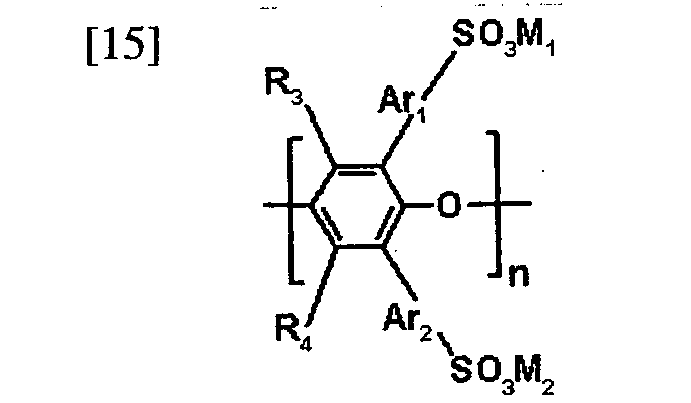
wherein
M1, M2 and M3 are each independently hydrogen, lithium, sodium, or potassium;
Ar1 and Ar2 are each independently a C6-C20 arylene group or a C2-C20 heteroarylene group;
R1, R2, R3 and R4 are each independently hydrogen, a C1-C20 alkyl group, a C6-C20 aryl group, or a C2-C20 heteroaryl group;
X is a halogen atom; and
m and n are molar fractions, where m+ n=1, 0<m<1, and 0<n<1.
According to another aspect of the present invention, there is provided a method of preparing a polyphenylether-based copolymer represented by Formula 1, the method including: preparing a compound represented by Formula 6 by reacting a compound represented by Formula 4 and a compound represented by Formula 5; preparing a compound represented by Formula 7 by reacting the compound represented by Formula 6 with halogen; and preparing the compound represented by Formula 1 by sulfonating the compound represented by Formula 7:
Formula 1

Formula 4 Formula 5


Formula 6

Formula 7

wherein
M1, M2 and M3 are each independently hydrogen, lithium, sodium, or potassium;
Ar1 and Ar2 are each independently a C6-C20 arylene group or a C2-C20 heteroarylene group;
R1, R2, R3 and R4 are each independently hydrogen, a C1-C20 alkyl group, a C6-C20 aryl group, or a C2-C20 heteroaryl group;
X is a halogen atom; and
m and n are molar fractions, where m+ n=1, 0<m<1, and 0<n<1.
According to another aspect of the present invention, there is provided a polymer electrolyte membrane including the polyphenylether-based copolymer.
According to another aspect of the present invention, there is provided a fuel cell employing the polymer electrolyte membrane.
A polymer electrolyte membrane having a high proton conductivity and a low fuel permeability can be manufactured relatively inexpensively.
The above and other features and advantages of the present invention will become more apparent by describing in detail exemplary embodiments thereof with reference to FIG. 1 which is a schematic view of a direct methanol fuel cell (DMFC) according to an embodiment of invention.
Hereinafter, a polyphenylether-based copolymer, a polymer electrolyte membrane including the copolymer, and a fuel cell including the polymer electrolyte membrane, according to embodiments of the present invention, will be described in detail.
The present invention provides a polyphenylether-based copolymer including a repeating unit represented by Formula 1a and a repeating unit represented by Formula 1b:
Formula 1a Formula 1b
[Corrected under Rule 26 31.07.2009]

wherein M1, M2 and M3 are each independently hydrogen, lithium, sodium, or potassium; Ar1 and Ar2 are each independently a C6-C20 arylene group or a C2-C20 heteroarylene group; R1, R2, R3 and R4 are each independently hydrogen, a C1-C20 alkyl group, a C6-C20 aryl group, or a C2-C20 heteroaryl group; X is a halogen atom; and m and n are molar fractions, where m+ n=1, 0<m<1, and 0<n<1.
The arylene group is a divalent cyclic aromatic system including at least two rings, which can be attached to each other or fused with each other. The heteroarylene group indicates an aryl group, wherein at least one carbon atom of the aryl group is substituted with at least one selected from the group consisting of N, O, S and P. The aryl group is a monovalent group corresponding to the arylene group, and the heteroaryl group is a monovalent group corresponding to the heteroaryl group.
Among sulfonic acid groups included in the copolymer, a sulfonic acid group of Formula 1b which is separated from a backbone and linked to a side chain moves relatively freely. Thus, such a sulfonic acid group of Formula 1b may form micelles like a surfactant in the copolymer and may function as ionic channels. In addition, the size of ionic channels can also be controlled by adjusting the length of the side chain. Therefore, the polyphenylether-based copolymer can easily adjust the amount of water in the ionic channels, and can have high proton conductivity.
In addition, the copolymer additionally includes a hydrophobic halogen atom in addition to benzene rings in its backbones, and permeation of methanol can be suppressed due to the hydrophobic backbones, and water uptake ratio is low. Also, thermal stability and oxidation/reduction reaction stability of the polyphenylether-based copolymer is high.
Meanwhile, for a conventional polysulfone-based copolymer, a sulfonic acid group is directly connected to backbones only. Accordingly, if the amount of a sulfonic acid group is high in a polymer, the polymer itself dissolves in water and thus, an electrolyte membrane may lose its function. Thus, the amount of a sulfonic acid group is limited. Therefore, high proton conductivity cannot be obtained. Also, since a sulfonic acid group is connected directly to backbones, methanol may easily pass through backbones.
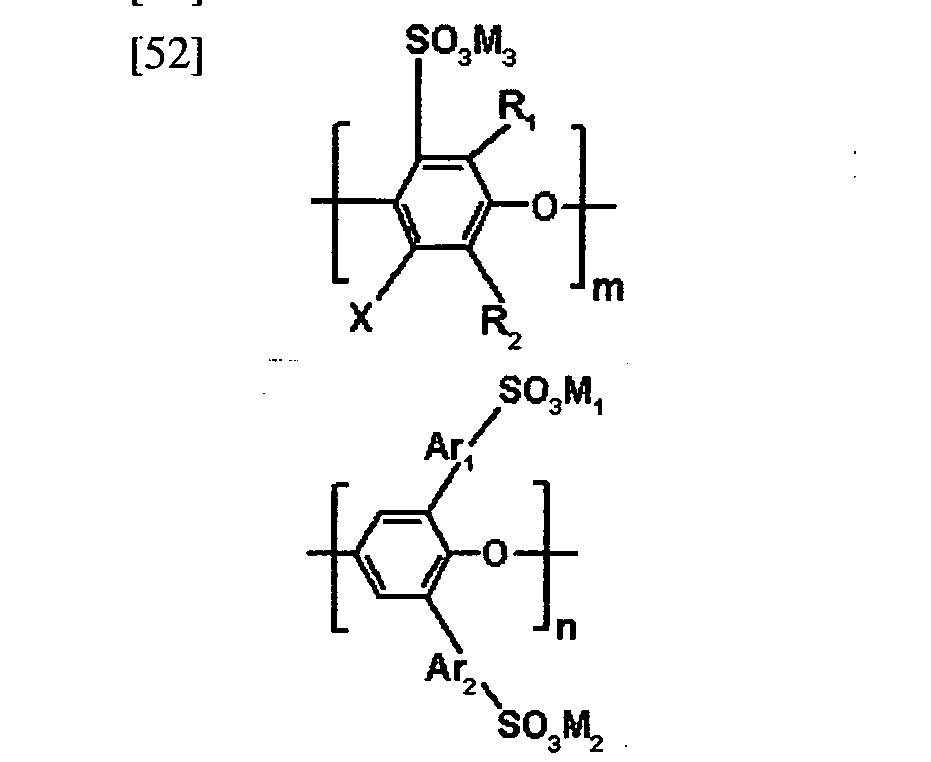
According to another embodiment of the present invention, the polyphenylether-based copolymer may include a repeating unit represented by Formula 2a and a repeating unit represented by Formula 2b:
Formula 2a Formula 2b
[Corrected under Rule 26 31.07.2009]
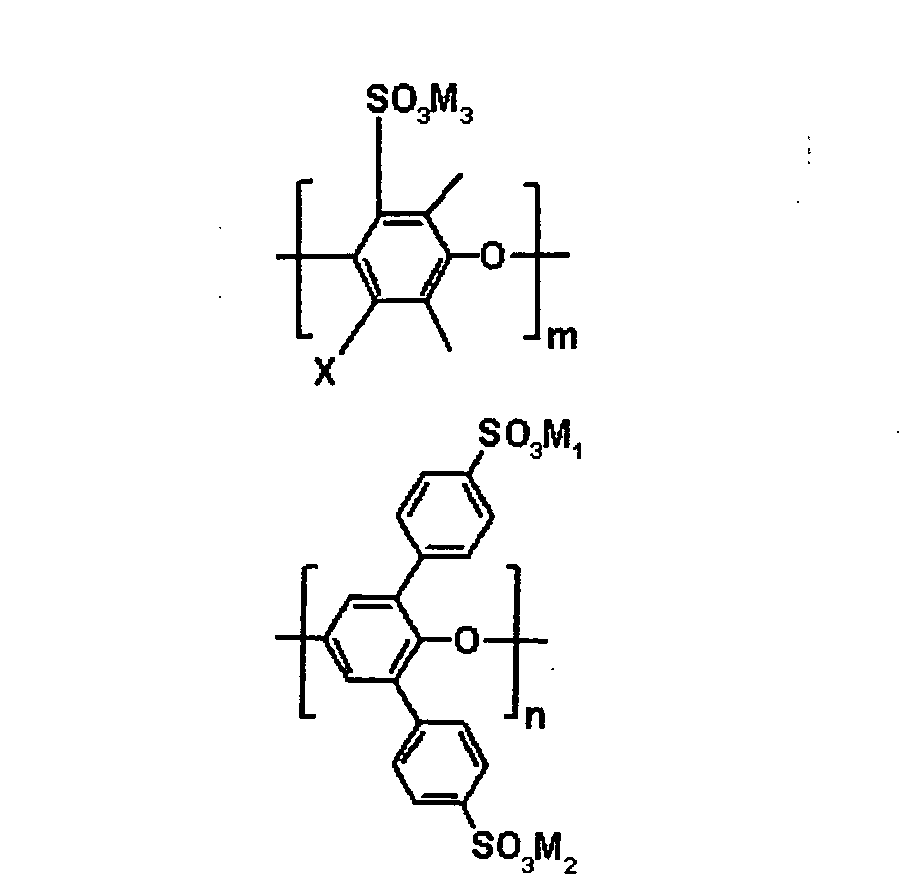
According to another embodiment of the present invention, the polyphenylether-based copolymer may include a repeating unit represented by Formula 3a and a repeating unit represented by Formula 3b:
Formula 3a Formula 3b
[Corrected under Rule 26 31.07.2009]
The ratio of m:n in the polyphenylether-based copolymers described above may be in a range of 1:9 to 9:1.
The polyphenylether-based copolymers may have a weight average molecular weight of 10,000 to 200,000, specifically 30,000 to 150,000.
The present invention also provides a method of preparing a polyphenylether-based copolymer represented by Formula 1 below, the method including: preparing a compound represented by Formula 6 by reacting a compound represented by Formula 4 and a compound represented by Formula 5; preparing a compound represented by Formula 7 by reacting the compound represented by Formula 6 with a halogen; and preparing the compound represented by Formula 1 by sulfonating the compound represented by Formula 7:
Formula 1

Formula 4 Formula 5


Formula 6

Formula 7

wherein M1, M2 and M3 are each independently hydrogen, lithium, sodium, or potassium; Ar1 and Ar2 are each independently a C6-C20 arylene group or a C2-C20 heteroarylene group; R1, R2, R3 and R4 are each independently hydrogen, a C1-C20 alkyl group, a C6-C20 aryl group, or a C2-C20 heteroaryl group; X is a halogen atom; and m and n are molar fractions, where m+ n=1, 0<m<1, and 0<n<1.
The present invention also provides a polymer electrolyte membrane including the polyphenylether-based copolymer. Since the polymer electrolyte membrane includes any one of the sulfone-based copolymers represented by Formulae 1 through 3, the methanol permeability is low, and the proton conductivity is high. In addition, the water uptake ratio is high.
In this regard, the polymer electrolyte membrane may have, at 100% relative humidity and a temperature of 25 ℃ , a proton conductivity of 1×10⁻³ S/cm or higher, specifically, 8×10⁻³ S/cm or higher, or more specifically in a range of 10×10-3 S/cm to 200×10-3 S/cm.
Also, the polymer electrolyte membrane may have, at 100% relative humidity and a temperature of 25 ℃ , a methanol permeability of 20×10-7 cm2/s or less, specifically, 5.9×10⁻⁷ cm2/s or less, or more specifically in a range of 4×10⁻⁷ cm2/s to 0.01×10⁻⁷ cm2/s.
The polymer electrolyte membrane may have a proton conductivity of 1×10⁻³S/cm or higher and a methanol permeability of 5×10⁻⁷ cm2/S or less, or specifically, a proton conductivity of 10×10-3 S/cm to 200×10-3 S/cm and a methanol permeability of 4×10⁻⁷ cm2/s to 0.01×10⁻⁷ cm2/s .
The present invention also provides a fuel cell including the polymer electrolyte membrane. The fuel cell includes a cathode and an anode, wherein the polymer electrolyte membrane is interposed between the cathode and the anode.
Each of the cathode and the anode includes a gas diffusion layer and a catalyst layer. The catalyst layer includes a metal catalyst that facilitates oxidation of hydrogen and reduction of oxygen. The catalyst layer may include at least one catalyst selected from the group consisting of platinum, ruthenium, osmium, a platinum-osmium alloy, a platinum-palladium alloy, and a platinum-M alloy where M is Ga, Ti, V, Cr, Mn, Fe, Co, Ni, Cu, or Zn. In particular, the catalyst layer may include platinum, ruthenium, osmium, a platinum-ruthenium alloy, a platinum-osmium alloy, a platinum-palladium alloy, a platinum-cobalt alloy, a platinum-nickel alloy, or a mixture of these alloys.
In general, the metal catalyst is used while being supported on a support. The support can be a carbonaceous material, such as acetylene black or graphite, or inorganic micro-particles formed of alumina, silica, or the like.
For the gas diffusion layer, carbon paper or carbon cloth may be used, but the present invention is not limited thereto. The gas diffusion layers function to support the cathode and anode, and also diffuse reactant gases into the catalyst layers, so that the reactant gases can easily reach the catalyst layers. The gas diffusion layers may be formed by treating a carbon paper or carbon cloth with a fluorine-based resin, such as polytetrafluoroethylene, to be water-repellent The carbon paper or carbon cloth treated to be water-repellent can prevent a reduction in gas diffusion efficiency due to water that is generated as the fuel cell operates.
The cathode and anode may respectively further include a micro-porous layer between the gas diffusion layer and the catalyst layer, to further enhance the gas diffusion effect of the gas diffusion layer. The micro-porous layer may be formed by applying a composition containing a conductive material, such as carbon powder, carbon black, activated carbon, acetylene black, or the like, a binder such as polytetrafluoroethylene, and an ionomer if necessary, between the gas diffusion layer and the catalyst layer.
According to an embodiment of the present invention, the fuel cell may be a direct methanol fuel cell (DMFC). FIG. 1 is a schematic view of a DMFC.
Referring to FIG. 1, the DMFC according to the present embodiment includes an anode 34 to which fuel is supplied, a cathode 30 to which an oxidant is supplied, and an electrolyte membrane 41 which is disposed between the anode 34 and the cathode 30. The anode 34 includes an anode diffusion layer 22 and an anode catalyst layer 33. The cathode 30 includes a cathode diffusion layer 32 and a cathode catalyst layer 31.
An aqueous solution of methanol is transferred to the anode catalyst layer 33, through the anode diffusion layer 22, and then is decomposed into electrons, protons, carbon dioxide, and the like. The protons are transferred to the cathode catalyst layer 31 through the electrolyte membrane 41, the electrons are transferred to an external circuit, and carbon dioxide is discharged to the outside. At the cathode catalyst layer 31, the protons transferred through the electrolyte membrane 41, the electrons supplied from the external circuit, and oxygen in air, which is transferred through the cathode diffusion layer 32, react to produce water.
Hereinafter, the present invention will be described more specifically with reference to the following examples. The following examples are for illustrative purposes only and are not intended to limit the scope of the present invention.
(Preparation of polyphenylether-based copolymer)
Example 1
Step 1: Preparation of polyphenylether
A condenser was mounted on a 500 mL, 3-necked flask, and 12.25 g of 2,6-dimethylphenol, 2.745 g of 2,6-diphenylphenol, 0.15 g of CuCl(I) and 50 mL of pyridine were dissolved in 400 mL of 4-chlorotoluene in the flask. The mixture solution was reacted at room temperature for 18 hours in an oxygen bubbling condition to obtain a polymer. The color of the reaction solution changed from bright yellow to dark brown during the reaction. After the reaction was complete, the polymer solution was precipitated in 2L of methanol to obtain a solid.
1 H NMR (400MHz, CDCl3, ) : δ2.35 (s, C(CH3)2),δ6.51 (aromatic methyl group), δ7.36 [aromatic phenylgroup]. FT-IR(Film) 1500-1600cm-1 (aromatic), 2800-3100cm-1(-CH3).
Step 2: Bromation
A condenser was mounted on a 100 mL, 3-necked flask, and 5g of polyphenylether prepared in Step 1 was dissolved in 5 g of chloroform in the flask. A mixed solution of 1 mL of chloroform and 1 mL of bromine was placed into a dropping funnel and slowly dropwise added into the solution. Then, the mixed solution was reacted at room temperature for 1 hour. After the reaction was complete, the reaction solution was precipitated in 800 mL of methanol to obtain a solid.
1 H NMR (400MHz, CDCl3, ) : δ2.35 (s, C(CH3)2),δ6.51 (aromatic methyl group), δ7.36 [aromatic phenylgroup], δ6.11 (shifted bromoaromatic methyl). FT-IR(Film) : 750cm-1(C-Br), 1500-1600cm-1 (aromatic), 2800-3100cm-1(-CH3).
Step 3: Sulfonation
A condenser was mounted on a 500mL, 3-necked flask, and 5g of polyphenylether bromated in Step 2 was dissolved in 250 g of chloroform in the flask. A mixed solution of 60 mL of chloroform and 9 mL of chlorosulfonic acid was placed into a dropping funnel and slowly dropwise added into the solution. Then, the mixed solution was reacted at room temperature for 1 hour while stirring. After the reaction was complete, the reaction solution was precipitated in 2 L of a methanol solution diluted with water in a ratio of 5:5 to obtain a solid. Next, the solid was washed several times with methanol and distilled water until the pH reached 7, thereby resulting in a product represented by Formula 8 below.
1 H NMR (400MHz, DMSOd6,) : δ2.35 (s, C(CH3)2),δ6.95(shifted aromatic methyl group δ6.51 ), δ6.51 (disappeared aromatic methyl group), δ7.78, δ7.58 [shifted aromatic phenyl group]. FT-IR(Film) : 750cm-1(C-Br), 1500-1600cm-1 (aromatic) ,2800-3100cm-1(-CH3), 3300-3500cm-1(-OH).
Formula 8

In Formula 8, M1, M2, and M3 are sodium, m=0.9, and n=0.1, X is brome and the weight average molecular weight is about 50,000.
Example 2
A polyphenylether copolymer was prepared in the same method as in Example 1, except that the amount of bromine added in Step 2 of Example 1 was varied to 0.4 mol based on 1 mol of polyphenylether.
Example 3
A polyphenylether copolymer was prepared in the same method as in Example 1, except that the amount of bromine added in Step 2 of Example 1 was varied to 0.6mol based on 1 mol of polyphenylether.
Example 4
A polyphenylether copolymer was prepared in the same method as in Example 1, except that the amount of bromine added in Step 2 of Example 1 was varied to 0.8 mol based on 1 mol of polyphenylether.
Example 5
A polyphenylether copolymer was prepared in the same method as in Example 1, except that the amount of bromine added in Step 2 of Example 1 was varied to 1.0 mol based on 1 mol of polyphenylether.
Example 6
A polyphenylether copolymer was prepared in the same method as in Example 1, except that the amount of bromine added in Step 2 of Example 1 was varied to 1.2 mol based on 1 mol of polyphenylether.
Example 7
A polyphenylether copolymer was prepared in the same method as in Example 1, except that the amount of bromine added in Step 2 of Example 1 was varied to 1.4 mol based on 1 mol of polyphenylether.
Example 8
A polyphenylether copolymer was prepared in the same method as in Example 1, except that the amount of bromine added in Step 2 of Example 1 was varied to 1.6 mol based on 1 mol of polyphenylether.
(Manufacture of polymer electrolyte membrane)
Example 9
The polyphenylether copolymer prepared in Example 1 was precipitated in a 1M sulfuric acid solution at 100 ℃ for 24 hours to exchange sodium cations of the sulfonate group with protons. Next, the protonated copolymer was washed with deionized water. Then the protonated copolymer was dissolved in dimethyl sulfoxide (DMSO), cast on a glass plate using a round glass rod, and dried in a vacuum oven at 150 ℃ to form a polymer electrolyte membrane having a thickness of 0.01-0.1 ㎛ .
Example 10
A polymer electrolyte membrane having a thickness of 0.01-0.1 ㎛ was manufactured using the same method as in Example 9, except that the polyphenylether copolymer prepared in Example 2 was used.
Example 11
A polymer electrolyte membrane having a thickness of 0.01-0.1 ㎛ was manufactured using the same method as in Example 9, except that the polyphenylether copolymer prepared in Example 3 was used.
Example 12
A polymer electrolyte membrane having a thickness of 0.01-0.1 ㎛ was manufactured using the same method as in Example 9, except that the polyphenylether copolymer prepared in Example 4 was used.
Example 13
A polymer electrolyte membrane having a thickness of 0.01-0.1 ㎛ was manufactured using the same method as in Example 9, except that the polyphenylether copolymer prepared in Example 5 was used.
Example 14
A polymer electrolyte membrane having a thickness of 0.01-0.1 ㎛ was manufactured using the same method as in Example 9, except that the polyphenylether copolymer prepared in Example 6 was used.
Example 15
A polymer electrolyte membrane having a thickness of 0.01-0.1 ㎛ was manufactured using the same method as in Example 9, except that the polyphenylether copolymer prepared in Example 7 was used.
Example 16
A polymer electrolyte membrane having a thickness of 0.01-0.1 ㎛ was manufactured using the same method as in Example 9, except that the polyphenylether copolymer prepared in Example 8 was used.
Comparative Example 1
A polysulfone-based polymer represented by Formula 9 below (BASF Co. Ltd, ULTRASON S3010) was treated with sulfuric acid using the same method as in Example 9 and used as a polymer electrolyte membrane.)
Formula 9

Comparative Example 2
NAFION 112 (DuPont) was used as a polymer electrolyte membrane.
The NAFION 112 was precipitated in a 1M sulfuric acid solution at 100 ℃ for 24 hours in order to exchange sodium cations of the sulfonate group with protons. Next, the hydrogenated copolymer was washed with deionized water.
Evaluation Example 1: Measurement of proton conductivity
The proton conductivity of each of the polymer electrolyte membranes manufactured in Examples 9 through 16 and Comparative Examples 1 and 2 was measured. The proton conductivity was measured while each of the polymer electrolyte membranes was interposed between two platinum electrodes having an area of 2.54 cm2 and using electrochemical impedance spectroscopy (EIS) with IM6ex (Zahner). The initial resistance was measured at 30 ℃ , and the proton conductivity was calculated using Equation 1 below. The results are shown in Table 1 below.
Equation 1
Proton conductivity [S/cm]=(membrane thickness[cm]/membrane area[cm2])×initial conductivity[S]
Evaluation Example 2: Measurement of methanol permeability
Each of the polymer electrolyte membranes manufactured in Examples 9 through 16 and Comparative Examples 1 and 2 was interposed between two cells. Then, 15 mL of 1M methanol aqueous solution was supplied to one cell and 15 mL of distilled water was supplied to the other cell. For the cell to which distilled water was supplied, 10 ㎕ of distilled water was extracted from the cell in every ten minutes, and then the cell was filled with 10 ㎕ of distilled water. The concentration of methanol contained in the extracted sample was measured by gas chromatography. Also, a graph showing methanol concentration according to time was prepared, and methanol permeability was calculated by using Equation 2 below from a slope of the graph. The results are shown in Table 1 below.
Equation 2
Methanol permeability [cm2/S]=(concentration gradient[ppm/s]× volume × thickness of electrolyte membrane thickness)/(area of electrolyte membrane × methanol concentration)
In Equation 2, the thickness of the electrolyte membrane was 0.05 ㎛ , the diameter of the electrolyte membrane was 3 cm; methanol concentration was 1 mol(32000 ppm); a volume of solution was 15 ml; and the area of the electrolyte membrane was 7.06 cm2
Evaluation Example 3: Water uptake
The polymer electrolyte membranes manufactured in Examples 9 through 16 and Comparative Example 1 and 2 were immersed in distilled water at 30 ℃ for 24 hours. The polymer electrolyte membranes immersed in distilled water were removed from the distilled water and weighed (Mwet) and dried in a vacuum oven at 100 ℃ for 24 hours. The dried polymer electrolyte membranes were then weighed (Mdry), and the water uptake ratio was calculated according to Equation 3 below. The results are shown in Table 1 below.
Equation 3
Water uptake[%]=(Mwet-Mdry)/Mdry
Table 1

As illustrated in table 1, the polymer electrolyte membranes manufactured in Examples 9 through16 including the polyphenylether-based copolymer according to an embodiment of the present invention have low methanol permeability and low water uptake ratios compared with the polymer electrolyte membrane of Comparative Example 1. In particular, the polymer electrolyte membranes manufactured in Examples 13 through 16 have high proton conductivity while having low methanol permeability and low water uptake ratio, compared with the polymer electrolyte membrane of Comparative Example 1. In addition, the polymer electrolyte membranes manufactured in Examples 13 through 16 have remarkably low methanol permeability compared with the polymer electrolyte membrane of Comparative Example 2.
As described above, according to the embodiments of the present invention, the fuel cell employing the polymer electrolyte membrane including the polyphenylether-based copolymer has improved properties in terms of proton conductivity, methanol permeability, and water uptake ratio.
While the present invention has been particularly shown and described with reference to exemplary embodiments thereof, it will be understood by those of ordinary skill in the art that various changes in form and details may be made therein without departing from the spirit and scope of the present invention as defined by the following claims.
The fuel cell employing the polymer electrolyte membrane including the polyphenylether-based copolymer has improved properties in terms of proton conductivity, methanol permeability, and water uptake ratio.
Claims (10)
1. A polyphenylether-based copolymer comprising a repeating unit represented by Formula 1a and a repeating unit represented by Formula 1b:
Formula 1a Formula 1b


wherein
M1, M2 and M3 are each independently hydrogen, lithium, sodium, or potassium;
Ar1 and Ar2 are each independently a C6-C20 arylene group or a C2-C20 heteroarylene group;
R1, R2, R3 and R4 are each independently hydrogen, a C1-C20 alkyl group, a C6-C20 aryl group, or a C2-C20 heteroaryl group;
X is a halogen atom; and
m and n are molar fractions, where m+ n=1, 0<m<1, and 0<n<1.
The polyphenylether-based copolymer of claim 1, comprising a repeating unit represented by Formula 2a and a repeating unit represented by Formula 2b:
Formula 2a Formula 2b


The polyphenylether-based copolymer of claim 1, comprising a repeating unit represented by Formula 3a and a repeating unit represented by Formula 3b:
Formula 3a Formula 3b


The polyphenylether-based copolymer of claim 1, wherein a ratio of m to n is in the range of about 1:9 to about 9:1.
The polyphenylether-based copolymer of claim 1, having a weight average molecular weight of about 10,000 to about 200,000.
A method of preparing a polyphenylether-based copolymer represented by Formula 1, the method comprising:
preparing a compound represented by Formula 6 below by reacting a compound represented by Formula 4 below and a compound represented by Formula 5 below;
preparing a compound represented by Formula 7 below by reacting the compound represented by Formula 6 with a halogen; and
preparing the compound represented by Formula 1 below by sulfonating the compound represented by Formula 7:
Formula 1

Formula 4 Formula 5


Formula 6

Formula 7

wherein
M1, M2 and M3 are each independently hydrogen, lithium, sodium, or potassium;
Ar1 and Ar2 are each independently a C6-C20 arylene group or a C2-C20 heteroarylene group;
R1, R2, R3 and R4 are each independently hydrogen, a C1-C20 alkyl group, a C6-C20 aryl group, or a C2-C20 heteroaryl group;
X is a halogen atom; and
m and n are molar fractions, where m+ n=1, 0<m<1, and 0<n<1.
A polymer electrolyte membrane comprising the polyphenylether-based copolymer of any one of claims 1 through 5.
The polymer electrolyte membrane of claim 7, having a proton conductivity of about 1×10⁻³S/cm or higher, and a methanol permeability of about 5×10⁻⁷ cm2/S or less.
A fuel cell employing the polymer electrolyte membrane of claim 8.
The fuel cell of claim 9, being a direct methanol fuel cell (DMFC).
Applications Claiming Priority (2)
| Application Number | Priority Date | Filing Date | Title |
|---|---|---|---|
| KR1020090004643A KR101573191B1 (en) | 2009-01-20 | 2009-01-20 | Polyphenylehter based copolymer method for preparing the copolymer polymer electrolyte membrane comprising the copolymer and fuel cell comprising the membrane |
| KR10-2009-0004643 | 2009-01-20 |
Publications (1)
| Publication Number | Publication Date |
|---|---|
| WO2010085028A1 true WO2010085028A1 (en) | 2010-07-29 |
Family
ID=42356065
Family Applications (1)
| Application Number | Title | Priority Date | Filing Date |
|---|---|---|---|
| PCT/KR2009/003846 Ceased WO2010085028A1 (en) | 2009-01-20 | 2009-07-14 | Polyphenylether-based copolymer, method of preparing the copolymer, polymer electrolyte membrane including the copolymer, and fuel cell including the polymer electrolyte membrane |
Country Status (2)
| Country | Link |
|---|---|
| KR (1) | KR101573191B1 (en) |
| WO (1) | WO2010085028A1 (en) |
Cited By (1)
| Publication number | Priority date | Publication date | Assignee | Title |
|---|---|---|---|---|
| CN113140769A (en) * | 2021-02-24 | 2021-07-20 | 吴丹 | Inorganic composite polyphenyl ether proton exchange membrane and preparation method thereof |
Families Citing this family (1)
| Publication number | Priority date | Publication date | Assignee | Title |
|---|---|---|---|---|
| KR102664565B1 (en) | 2022-02-15 | 2024-05-13 | 인비즈넷 주식회사 | Method and system for providing a secure number that can be called back |
Citations (4)
| Publication number | Priority date | Publication date | Assignee | Title |
|---|---|---|---|---|
| EP0369598A2 (en) * | 1988-10-12 | 1990-05-23 | Mitsubishi Chemical Corporation | Resin composition |
| US6045883A (en) * | 1995-06-29 | 2000-04-04 | Asahi Kasei Kogyo Kabushiki Kaisha | Resin composition and resin composition for secondary battery jar |
| US20070196712A1 (en) * | 2006-02-20 | 2007-08-23 | Samsung Sdi Co., Ltd. | Multiblock copolymer, method of preparing the same, polymer electrolyte membrane prepared from the multiblock copolymer, method of preparing the polymer electrolyte membrane, and fuel cell employing the polymer electrolyte membrane |
| US20080157422A1 (en) * | 2006-12-29 | 2008-07-03 | Samsung Sdi Co., Ltd. | Composition containing proton-conductive copolymer, polymer electrolyte membrane, method of producing the membrane , and fuel cell using the membrane |
-
2009
- 2009-01-20 KR KR1020090004643A patent/KR101573191B1/en active Active
- 2009-07-14 WO PCT/KR2009/003846 patent/WO2010085028A1/en not_active Ceased
Patent Citations (4)
| Publication number | Priority date | Publication date | Assignee | Title |
|---|---|---|---|---|
| EP0369598A2 (en) * | 1988-10-12 | 1990-05-23 | Mitsubishi Chemical Corporation | Resin composition |
| US6045883A (en) * | 1995-06-29 | 2000-04-04 | Asahi Kasei Kogyo Kabushiki Kaisha | Resin composition and resin composition for secondary battery jar |
| US20070196712A1 (en) * | 2006-02-20 | 2007-08-23 | Samsung Sdi Co., Ltd. | Multiblock copolymer, method of preparing the same, polymer electrolyte membrane prepared from the multiblock copolymer, method of preparing the polymer electrolyte membrane, and fuel cell employing the polymer electrolyte membrane |
| US20080157422A1 (en) * | 2006-12-29 | 2008-07-03 | Samsung Sdi Co., Ltd. | Composition containing proton-conductive copolymer, polymer electrolyte membrane, method of producing the membrane , and fuel cell using the membrane |
Cited By (1)
| Publication number | Priority date | Publication date | Assignee | Title |
|---|---|---|---|---|
| CN113140769A (en) * | 2021-02-24 | 2021-07-20 | 吴丹 | Inorganic composite polyphenyl ether proton exchange membrane and preparation method thereof |
Also Published As
| Publication number | Publication date |
|---|---|
| KR101573191B1 (en) | 2015-12-01 |
| KR20100085388A (en) | 2010-07-29 |
Similar Documents
| Publication | Publication Date | Title |
|---|---|---|
| WO2013081437A1 (en) | Sulphonate based compound, polymer electrolyte membrane comprising same and fuel cell comprising same | |
| KR100813242B1 (en) | Polymer electrolyte membrane, manufacturing method thereof and fuel cell having same | |
| JP2007224299A (en) | Polysiloxane compound and production method thereof, polymer electrolyte membrane, membrane electrode assembly, and fuel cell | |
| WO2010053297A2 (en) | Polymer electrolyte membrane | |
| WO2014178619A1 (en) | Polymer electrolyte membrane, membrane electrode assembly comprising polymer electrolyte membrane and fuel cell comprising membrane electrode assembly | |
| WO2023234725A1 (en) | Novel branch-containing poly(aryl piperidinium) copolymer ionomer, anion exchange membrane, and preparation method therefor | |
| WO2012134095A2 (en) | Hydrogen ion-conducting copolymer including a diphenyl fluorene group in which a sulfonic acid group is introduced, method for preparing same, polymer electrolyte membrane produced therefrom, membrane/electrolyte assembly using same, and polymer electrolyte membrane fuel cell adopting same | |
| US7619044B2 (en) | Composition containing proton-conductive copolymer, polymer electrolyte membrane, method of producing the membrane, and fuel cell using the membrane | |
| WO2017142344A1 (en) | Core-shell particles, polymer electrolyte membrane comprising same, fuel cell or electrochemical cell comprising polymer electrolyte membrane, and method for manufacturing core-shell particles | |
| WO2016163773A1 (en) | Polymer electrolyte membrane, electrochemical cell and flow cell comprising same, method for manufacturing polymer electrolyte membrane, and flow cell electrolyte | |
| WO2023085592A1 (en) | Fluorene- and biphenyl-based branched copolymer polymer electrolyte membrane and water electrolysis system using same | |
| WO2023106657A1 (en) | Polycarbazole-based cation-exchange ion conductor and method for manufacturing same | |
| KR100634551B1 (en) | Ion Conductive Crosslinked Copolymer and Fuel Cell Comprising the Same | |
| KR20160081117A (en) | Sulfonated poly(isatin-ethersulfone), method for preparing the same and polymer membrane composition for fuel cell using the same | |
| KR100707163B1 (en) | Solid acid, polymer electrolyte membrane containing same and fuel cell employing same | |
| WO2010085028A1 (en) | Polyphenylether-based copolymer, method of preparing the copolymer, polymer electrolyte membrane including the copolymer, and fuel cell including the polymer electrolyte membrane | |
| WO2016122200A1 (en) | Compound comprising aromatic ring, and polyelectrolyte membrane using same | |
| Itoh et al. | Anhydrous proton-conducting electrolyte membranes based on hyperbranched polymer with phosphonic acid groups for high-temperature fuel cells | |
| KR100907476B1 (en) | Polymer electrolyte membrane containing ion-conducting copolymer partially introduced with fluorine, preparation method thereof and polymer electrolyte fuel cell employing polymer electrolyte membrane | |
| US7759453B2 (en) | Multiblock copolymer, method of preparing the same, polymer electrolyte membrane prepared from the multiblock copolymer, method of preparing the polymer electrolyte membrane, and fuel cell employing the polymer electrolyte membrane | |
| Zhu et al. | Synthesis and characterization of polysulfone-containing sulfonated side chains for direct methanol fuel cells | |
| WO2010076911A1 (en) | Post-sulfonated copolymers containing perfluorocyclobutane groups and preparation method and use thereof | |
| WO2016122195A1 (en) | Compound comprising aromatic ring, polymer comprising same, and polyelectrolyte membrane using same | |
| WO2010082716A1 (en) | Polysulfone-based copolymer, method of preparing the polysulfone-based copolymer, polymer electrolyte membrane including the polysulfone-based copolymer, and fuel cell including the polymer electrolyte membrane | |
| KR100659130B1 (en) | Polymer electrolyte membrane and fuel cell having same |
Legal Events
| Date | Code | Title | Description |
|---|---|---|---|
| 121 | Ep: the epo has been informed by wipo that ep was designated in this application |
Ref document number: 09838915 Country of ref document: EP Kind code of ref document: A1 |
|
| NENP | Non-entry into the national phase |
Ref country code: DE |
|
| 122 | Ep: pct application non-entry in european phase |
Ref document number: 09838915 Country of ref document: EP Kind code of ref document: A1 |