WO2010052756A1 - 質量分析方法及び質量分析装置 - Google Patents
質量分析方法及び質量分析装置 Download PDFInfo
- Publication number
- WO2010052756A1 WO2010052756A1 PCT/JP2008/003246 JP2008003246W WO2010052756A1 WO 2010052756 A1 WO2010052756 A1 WO 2010052756A1 JP 2008003246 W JP2008003246 W JP 2008003246W WO 2010052756 A1 WO2010052756 A1 WO 2010052756A1
- Authority
- WO
- WIPO (PCT)
- Prior art keywords
- mass
- flight
- time
- spectrum
- overtaking
- Prior art date
- Legal status (The legal status is an assumption and is not a legal conclusion. Google has not performed a legal analysis and makes no representation as to the accuracy of the status listed.)
- Ceased
Links
Images





Classifications
-
- H—ELECTRICITY
- H01—ELECTRIC ELEMENTS
- H01J—ELECTRIC DISCHARGE TUBES OR DISCHARGE LAMPS
- H01J49/00—Particle spectrometers or separator tubes
- H01J49/26—Mass spectrometers or separator tubes
- H01J49/34—Dynamic spectrometers
- H01J49/40—Time-of-flight spectrometers
- H01J49/408—Time-of-flight spectrometers with multiple changes of direction, e.g. by using electric or magnetic sectors, closed-loop time-of-flight
-
- G—PHYSICS
- G01—MEASURING; TESTING
- G01N—INVESTIGATING OR ANALYSING MATERIALS BY DETERMINING THEIR CHEMICAL OR PHYSICAL PROPERTIES
- G01N27/00—Investigating or analysing materials by the use of electric, electrochemical, or magnetic means
- G01N27/62—Investigating or analysing materials by the use of electric, electrochemical, or magnetic means by investigating the ionisation of gases, e.g. aerosols; by investigating electric discharges, e.g. emission of cathode
- G01N27/622—Ion mobility spectrometry
-
- H—ELECTRICITY
- H01—ELECTRIC ELEMENTS
- H01J—ELECTRIC DISCHARGE TUBES OR DISCHARGE LAMPS
- H01J49/00—Particle spectrometers or separator tubes
- H01J49/0009—Calibration of the apparatus
Definitions
- the present invention is a multi-round time-of-flight mass spectrometer that separates and detects ions according to a mass-to-charge ratio (m / z value) by repeatedly flying a sample-derived ion along a closed orbit. And a mass spectrometric method using a multi-turn time-of-flight mass spectrometer.
- TOFMS Time of Flight Mass Spectrometer
- ions accelerated by applying a certain amount of energy each have a flight speed corresponding to the mass-to-charge ratio. Based on this, the time required for such ions to fly a certain distance is measured, and mass analysis is performed by converting the time of flight into a mass-to-charge ratio. Therefore, in order to improve the mass resolution (the resolution of the mass-to-charge ratio m / z value), the flight distance may be increased, but in order to extend the linear flight distance, it is necessary to enlarge the apparatus.
- MT-TOFMS Multi Turn TOFMS
- a multi-reflection time-of-flight mass spectrometer has been developed that extends the flight distance by using a reciprocating orbit that reflects ions multiple times by a reflected electric field instead of the orbit as described above.
- the ion optical system is different between the multi-round time-of-flight type and the multiple reflection time-of-flight type, the basic principle for improving the mass resolution is the same. Therefore, in this specification, the “multiple orbit flight time type” includes the “multiple reflection flight time type”.
- ions derived from the sample generated in the ion source are limited to the mass range (mass-to-charge ratio m / z value range) in which no overtaking occurs as described above.
- control is performed such that the selected ions are detected after being placed in a circular orbit and flying a predetermined number of times.
- a mass spectrum with high mass resolution can be obtained, but the mass range of the mass spectrum is considerably limited. This is contrary to the advantage of TOFMS that a mass spectrum in a relatively wide mass range can be obtained by one analysis.
- Patent Document 3 proposes a method for estimating the number of rounds of a peak appearing on a spectrum by comparing results obtained by executing a plurality of mass analyzes with different conditions on the same sample. Yes. Although such a technique is effective, it is inevitable that data processing becomes complicated. In addition, it is difficult to estimate the number of laps especially when the number of components included in the sample is large.
- Patent Document 4 proposes a method for reconstructing a time-of-flight spectrum of a single lap number by calculating a multiple correlation function of a plurality of time-of-flight spectra having different timings of ion detachment from the orbit. .
- this method with respect to a plurality of time-of-flight spectrum data obtained by performing a plurality of times of mass spectrometry under a separation timing with different number of laps, an ion intensity G (T In order to obtain T), the following equation (1) is used.
- y is the deviation of the flight time
- yl is the lower limit value of this deviation time
- yu is the upper limit of the deviation time.
- the value H is a function determined by the value of the variable Fj. Specific examples of the function H include arithmetic mean, minimum value, geometric mean, harmonic mean, etc. In order to eliminate false peaks in which Fj accidentally has a large value, there are various definitions of the function H. It is considered that a definition in which a smaller value than a larger value in the size Fj is greatly reflected in H is desirable.
- Patent Document 4 it is pointed out that depending on the timing at which ions are released from the orbit, there is an invalid period in which some of the ions flying on the orbit are not detected. However, no countermeasure has been proposed for that purpose. During this invalid period, the gate electrode (ion mirror) for detaching ions from the circular orbit has a finite length, and the ions that are passing through the gate electrode at the time of trying to detach the circulating ions Is generated in an appropriate direction (that is, a direction detectable by the detector).
- the present invention has been made in order to solve the above-described problems, and the object of the present invention is to normalize due to the timing of departure from the orbit when reconstructing a plurality of time-of-flight spectra obtained by multiple laps.
- the first invention is to introduce various ions starting from an ion source repeatedly into a detector along a circular orbit, and then introduce the mass spectrum on the basis of the detection signal.
- a second invention made to solve the above problems is a mass spectrometer for realizing the mass spectrometry method according to the first invention, wherein a plurality of various ions starting from the ion source are arranged along a circular orbit.
- a multi-round time-of-flight mass spectrometer that is introduced into a detector after repeated flight and acquires a mass spectrum based on the detection signal, a) conversion information holding means for storing a conversion formula between the time of flight and the mass-to-charge ratio obtained based on the result of actually measuring the time of flight for ions having a known mass-to-charge ratio; b) In the first measurement mode in which ions are caused to fly with a number of laps that guarantees that different types of ions will not catch up or overtake even if they are not circulated around the orbit, or even if they are circulated multiple times.
- First measurement mode execution control means for performing mass spectrometry on the measurement sample and obtaining a non-overtaking time-of-flight spectrum based on a detection signal obtained by the detector; c) Mass spectrometry in the second measurement mode in which ions are released from the orbiting orbit and introduced into the detector after a predetermined time after multiple orbiting so as to cause overtaking of ions on the orbiting orbit.
- the mass spectrometry method according to the first invention and the mass spectrometer according to the second invention in the first measurement mode, catching up and overtaking of different kinds of ions does not occur during flight even when ions are circulated. Therefore, the number of laps of ions corresponding to all peaks appearing in the acquired non-overtaking time-of-flight spectrum is the same. In addition, these peaks are arranged in descending order of mass-to-charge ratio of ions. However, since the flight distance cannot be made so long, mass resolution and mass accuracy are relatively low. On the other hand, in the second measurement mode, overtaking of different types of ions occurs during the flight.
- the number of ion turns corresponding to the peak appearing in the acquired overtaking time-of-flight spectrum is not the same, and the order of arranging the peaks is not the order of decreasing mass-to-charge ratio.
- mass resolution and mass accuracy can be increased. Therefore, if a mass spectrum is obtained based on an overtaking time-of-flight spectrum, a mass spectrum with high mass resolution and mass accuracy can be obtained.
- the approximate mass-to-charge ratio (or the range in which the mass-to-charge ratio can be taken) of the ion to be measured can be known from the information.
- Ion detachment timing from the orbit in the second measurement mode (the time from when the various ions depart the ion source almost simultaneously until the electric field is switched so that the various ions introduced into the orbit leave the orbit. )
- the approximate mass-to-charge ratio of each ion the approximate number of turns of the ion in the second measurement mode can be calculated.
- the mass-to-charge ratio can be calculated from the time of flight of the peak using the above conversion formula, and the non-overtaking obtained in the first measurement mode from the mass-to-charge ratio.
- the time of flight (assumed time of flight) on the time of flight spectrum can be calculated.
- peaks corresponding to the plurality of assumed flight times are found from the non-overtaking flight time spectrum, and the intensity information of each peak is obtained. If there is no peak corresponding to the assumed flight time, the intensity is set to zero. Ideally, a peak exists only in the flight time corresponding to the true number of laps among a plurality of assumed laps. However, there may be a peak by chance in the flight time corresponding to a false lap number that is not true among a plurality of assumed lap times.
- the intensity of the original peak on the overtaking flight time spectrum is distributed to the mass-to-charge ratio converted from the assumed flight time, for example, according to the peak intensity ratio.
- the intensity of the original peak on the overtaking flight time spectrum is added to the only mass-to-charge ratio converted from the flight time. Assigned.
- the intensity distribution process as described above is performed for each of a plurality of peaks appearing in one overtaking time-of-flight spectrum, and the intensity distributed to the same mass-to-charge ratio on the mass spectrum. Is accumulated. Since one mass spectrum can be created from one overtaking flight time spectrum in this way, a mass spectrum is created from each of a plurality of overtaking flight time spectra having different laps.
- the mass spectrum created based on the overtaking time-of-flight spectrum contains the ions that were not observed. No peak appears.
- the peak of the ions necessarily appears in the mass spectrum obtained based on the spectrum. Therefore, by confirming peaks appearing in a plurality of mass spectra, the accurate mass-to-charge ratio can be known without missing all the components (molecules) contained in the sample to be measured.
- the mass spectrometric method in the calculation processing step, peaks appearing in the overtaking time-of-flight spectrum are selected according to a predetermined condition, and intensity distribution is performed on the selected peaks. Processing may be performed to integrate the intensity distributed to the same mass-to-charge ratio on the mass spectrum.
- the peak selection conditions include, for example, selecting peaks whose intensity is greater than or equal to a threshold, or selecting a predetermined number of peaks in descending order of intensity. Thereby, it is possible to save calculation processing time and obtain a mass spectrum with few unnecessary peaks.
- mass spectra are obtained from the plurality of different overtaking time spectra by the intensity distribution processing as described above, and the plurality of mass spectra are displayed on the same screen of the display means. Try to draw it on top.
- the user can easily recognize peaks that appear in common in a plurality of mass spectra, peaks that are observed in at least one of the mass spectra but are not observed in other mass spectra, and the like. .
- the mass spectrometric method according to the first invention and the mass spectroscope according to the second invention based on the time-of-flight spectrum obtained by securing a long flight distance by repeatedly flying ions many times along the circular orbit.
- a mass spectrum with high mass resolution and mass accuracy can be obtained, and the target component contained in the sample to be measured can be detected without omission.
- FIG. 1 is a schematic configuration diagram of an MT-TOFMS according to an embodiment of the present invention.
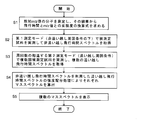
- the flowchart which shows the analysis procedure in MT-TOFMS of a present Example.
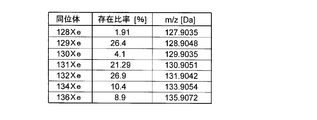
- the figure which shows the abundance ratio and mass charge ratio of Xe isotope molecule
- FIG. 1 is a schematic configuration diagram of the MT-TOFMS of this embodiment.
- the ion source 1 sample molecules are ionized, and the generated various ions are given predetermined energy to start flying.
- the ion source 1 temporarily holds various externally generated ions, such as a three-dimensional quadrupole ion trap, and applies energy to these ions at a predetermined timing for flight. It can be started.
- the ions that have started flying from the ion source 1 are introduced into the orbit 5 via the deflection electric field formed by the gate electrode 2.
- the orbit 5 is formed by the action of an electric field generated by each of the plurality of toroidal sector electrodes 4.
- the shape of the circular track 5 is not limited to this, and various shapes such as an 8-shaped shape can be realized. Further, it may be a linear or curved reciprocating orbit, a spiral orbit whose position gradually shifts, etc., instead of a completely closed orbit.
- the ions are released (exited) from the circular orbit 5 via the deflection electric field formed by the gate electrode 2 after making one or more rounds in the circular orbit 5 and reach the detector 8 provided outside to be detected.
- the gate electrode 2 for introduction into the circular orbit 5 and the gate electrode 2 for separation from the circular orbit 5 are common, but this may be different, or a part of the sector electrode 4 may be a gate electrode. It can also be set as the structure used instead of 2.
- the detection signal from the detector 8 is input to the data processing unit 9, where the flight time from when the ions exit the ion source 1 until finally reaching the detector 8 is measured, and a flight time spectrum is created. Is done. Further, a mass spectrum is created from the time-of-flight spectrum by executing data analysis processing as will be described later.
- the input / output voltage generator 11 applies a deflection voltage for introducing ions into the orbit 5 and a deflection voltage for separating ions from the orbit 5 at predetermined timing.
- the orbital flight voltage generator 12 forms a sector electric field by applying a predetermined voltage to each of the plurality of sector electrodes 4. These voltage generators 11 and 12 and the ion source 1 all operate under the control of the control unit 10.
- the control unit 10 is connected to an input unit 13 for inputting various parameters for analysis by a user and a display unit 14 for displaying analysis results such as a mass spectrum.
- an incident trajectory 6 is a flight path of ions from the ion source 1 to the incident point to the orbit 5 and its distance is Lin.
- the exit trajectory 7 is a flight path of ions from the ion exit point from the orbit 5 to the detector 8, and the distance is Lout. Further, the flight distance of one turn of the orbit 5, that is, the turn length is Lturn.
- various ions emitted from the ion source 1 pass through the incident orbit 6 and are introduced into the orbit 5 via the gate electrode 2 controlled by the incident / exit voltage generator 11.
- the orbit 5 flies around the orbit 5 one or more times in accordance with the electric sector formed by the sector electrode 4 controlled by the flight voltage generator 12.
- the emission of various ions from the ion source 1 is almost simultaneous, but the ions having a smaller mass-to-charge ratio have a faster flight speed. Therefore, as ions circulate along the orbit 5, the intervals between ions having different mass-to-charge ratios. Will open.
- the orbit 5 Since the orbit 5 is closed, when ions continue to circulate along the orbit 5, the low mass-to-charge ratio ions having the fastest flight speed among the introduced ions are Catch up and overtake the slowest mass to charge ratio ions. Until that time, the mass charge is switched by switching the voltage applied to the gate electrode 2 to the separation voltage between the time when the ion with the minimum velocity passes through the gate electrode 2 and the time when the ion with the maximum velocity reaches the gate electrode 2.
- the circular orbits 5 can be separated from the ions having a small ratio in order and reach the detector 8.
- the measurement mode in which this is guaranteed is the first measurement mode, and the time-of-flight spectrum obtained under the first measurement mode is referred to as a non-overtaking time-of-flight spectrum. In this case, the number of circulations of ions corresponding to all peaks appearing on the time-of-flight spectrum is the same.
- the order of ions reaching the detector 8 after that time is not in the order of decreasing mass-to-charge ratio.
- This measurement mode is called the second measurement mode
- the time-of-flight spectrum obtained under the second measurement mode is called the overtaking time-of-flight spectrum.
- the number of circulations of the ions corresponding to the peak appearing on the time-of-flight spectrum is not the same, and the number of circulations of the ions that are delayed is relatively small.
- the mass resolution depends on the flight distance, that is, the number of laps, the mass resolution increases as the number of laps increases.
- the MT-TOFMS of this embodiment performs characteristic measurement and data processing for that purpose. This will be described with reference to FIGS. 2 to 10 and specific examples.
- FIG. 3 shows the abundance ratio of the xenon (Xe) isotope molecule and the mass-to-charge ratio (m / z value).
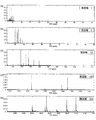
- FIG. 4 shows a time-of-flight spectrum obtained by measuring the xenon isotope molecule shown in FIG. 3 by the MT-TOFMS.
- 4A to 4E are time-of-flight spectra when the number of laps is set to 1, 3, 10, 100, and 300, respectively. However, the number of laps of each peak on the time-of-flight spectrum is actually unknown, and the lap times are not the same when the lap advance / delay as described above occurs. Only.
- the theoretical formula showing the relationship between the time-of-flight Tf and the mass-to-charge ratio m / z of ions in MT-TOFMS is the following formula (2).
- u is the atomic mass [kg]
- e is the elementary charge [C”
- V 0 is the ion acceleration voltage [V]
- n is the number of times of ion circulation.
- Lin, Lout, and Lturn are the above-mentioned distances [m], which are known because they are determined by the geometric arrangement of the ion optical element.
- V 0 is usually a value unique to the apparatus and is also known. Therefore, the unknown values in equation (2) are only Tf and m / z.
- the conversion formula (2) is necessary.
- the above theoretical conversion formula may be used as it is.
- deviation occurs because the ions do not always travel through the designed trajectory (center trajectory). Therefore, in the MT-TOFMS of the present example, a molecule with a known mass-to-charge ratio is measured in advance, and an accurate conversion formula for converting the time of flight and the mass-to-charge ratio to each other is obtained using this measured result.
- This is stored in the data processing unit 9 (step S1).
- the conversion formula is obtained using the method disclosed in JP-A-2005-322429.
- the two parameters Loff and V 0 in the modified conversion equation shown in the following equation (4) are estimated using the non-overtaking time-of-flight spectrum obtained by actual measurement of Xe isotope molecules having a known mass-to-charge ratio.
- Tf measurement values of Xe isotope molecules are obtained using these.
- the parameters Loff and V are set so that the error between the calculated Tf value obtained by converting the accurate mass-to-charge ratio m / z shown in FIG. 3 using the equation (2) and the measured Tf value based on the actual measurement is minimized.
- Estimate 0 As shown in FIGS.
- the number of revolutions of the Xe isotope molecule is estimated in the overtaking time-of-flight spectrum (FIGS. 4D and 4E) in which the overtaking of ions occurs.
- the time of flight of the peak in the overtaking time-of-flight spectrum data is converted into a mass-to-charge ratio m / z by applying equation (4) assuming the number of laps n.
- the mass-to-charge ratio m / z is converted into the flight time based on the data of the known number of laps n 0 using the equation (5), and the ion intensity Pn 0 (n) is calculated in the non-passing flight time spectrum.
- the ion intensity Pn 0 (n) is calculated in the non-passing flight time spectrum.
- FIG. 6 shows the result of the examination.
- the number of laps of the ion is obtained using the overtaking time-of-flight spectrum data obtained by multi-round mass spectrometry of Xe isotope molecular ions having a known mass-to-charge ratio, and the above-described modified conversion formula is used.
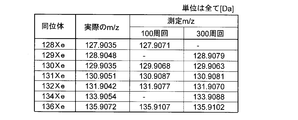
- FIG. 7 shows the result of converting the Tf measurement value into the mass-to-charge ratio m / z. In FIG. 7, the symbol “ ⁇ ” indicates that the target molecule is not observed.
- Loff and V 0 in the equations (4) and (5) are estimated for each measured overtaking flight time spectrum. That is, Loff and V 0 estimated above use only the actual measurement result of the non-overtaking flight time spectrum, but here, the actual measurement result of the overtaking flight time spectrum having a longer flight distance (the number of laps). Estimate with. As a result, the mutual conversion accuracy between the measured Tf value and the mass-to-charge ratio m / z is further improved.
- the conversion result based on the conversion formula corrected again in this way is shown in FIG. It can be seen from FIG. 7 that the actual mass-to-charge ratio is closer to m / z. As described above, a more accurate conversion formula can be obtained. The process for obtaining such a conversion formula need not be executed immediately before the measurement of the sample to be measured, but may be executed at any appropriate time to obtain the conversion formula and store it.
- step S2 When performing measurement on an unknown sample to be measured, first, mass analysis is performed on the sample to be measured in the first measurement mode, that is, under conditions where it is ensured that no overtaking of different types of ions occurs. A non-overtaking time-of-flight spectrum is acquired (step S2).
- various ions starting from the ion source 1 may be introduced into the detector 8 without being circulated at all along the circular orbit 5.
- the component contained in the sample to be measured can be estimated, and when it is certain that various ions are put on a circular orbit and circulated 1 to a small number of times, it is sure that no ion catch-up or overtaking occurs. Such laps may be allowed.
- the ion having the smallest mass-to-charge ratio among the components that may be included is 128Xe, and the mass-to-charge ratio among the components that may also be included is
- the maximum number of ions is 136Xe, it is possible to allow a maximum of 29 laps (actually, the time corresponding to the number of laps).
- the ions on the circular orbit 5 from the time when various ions leave the ion source 1 are directed to the gate electrode 2 so as to be separated from the circular orbit 5 in order to go to the detector 8.
- the mass analysis is repeated a plurality of times in the second measurement mode with different times until the applied voltage is switched, and each overtaking time-of-flight spectrum is acquired (step S3).
- the peaks are not arranged in ascending order of mass-to-charge ratio. Further, as described above, the number of rounds of each peak is not the same.
- the flight time is obtained by assuming the number of laps for the peak on the overtaking flight time spectrum, the peak corresponding to the flight time is found on the non-overtaking flight time spectrum, and the intensity of this peak is used.
- the peak observed on the overtaking flight time spectrum corresponds to the peak that gives the maximum ion intensity when a plurality of laps can be taken in association with the non-overtaking flight time spectrum data.
- the lap count was considered to be the true lap count.
- step S4 processing is performed such that the intensity of the peak on the overtaking time-of-flight spectrum is distributed to a plurality of mass-to-charge ratios according to the assumed ion intensity corresponding to a plurality of circulations. This process is called intensity distribution process (step S4).
- This intensity distribution process will be described with reference to FIG.
- the overtaking time-of-flight spectrum shown in FIG. 10 (a) is obtained under the condition that a certain ion detachment timing is set.
- the number of rounds of each peak appearing in this time-of-flight spectrum is unknown.
- the flight time of this peak is Tfa, and the peak intensity is Ia.
- the mass-to-charge ratio is obtained from the flight time Tfa after assuming the number of laps within a conceivable range.
- the mass-to-charge ratio can be set corresponding to each hypothesized lap using the conversion formula stored in advance.
- each mass-to-charge ratio can be converted into a flight time in the non-passing measurement using an inverse conversion formula stored in advance, so that the flight time Tf1, Tf2, from the mass-to-charge ratio M1, M2, M3, Tf3 is calculated.
- peaks corresponding to the above assumed flight times Tf1, Tf2, and Tf3 are found on the non-passing flight time spectrum obtained by actual measurement of the sample to be measured in step S2.
- the peak does not necessarily exist in all assumed flight times, and if the peak does not exist, the intensity may be zero.
- the intensities i1, i2, and i3 of the respective peaks are obtained, and the intensity ratio is obtained.
- the intensity Ia of the original focused peak is distributed to the mass-to-charge ratios M1, M2, and M3 according to the intensity ratio of each peak.
- the distributed intensity is recorded in the mass spectrum.
- the intensity Ia of the original focused peak is the only one regardless of the peak intensity. May be assigned to the mass-to-charge ratio corresponding to the assumed flight time.
- the intensity of one peak on one overtaking time-of-flight spectrum can be reflected on the peak intensity of one or more mass-to-charge ratios on the mass spectrum.
- the same intensity distribution process is repeated for each peak on one passing time-of-flight spectrum, and the peak intensity is distributed on one mass spectrum.
- the intensity is integrated.
- one mass spectrum is finally created from one overtaking time-of-flight spectrum. Since the intensity on the mass spectrum is relative, the integrated value may finally be normalized.
- the same processing is executed for each of the plurality of time-of-flight spectra acquired in step S3, and different mass spectra are created. Therefore, in the process of step S4, the same number of mass spectra as the overtaking time-of-flight spectrum acquired in step S3 are created.
- a peak selection process may be executed on the peak appearing in the overtaking time-of-flight spectrum, for example, the intensity is greater than or equal to a threshold value, and the intensity distribution process may be executed only for the selected peak.
- control unit 10 displays the plurality of mass spectra on the same screen of the display unit 14 (step S5). At this time, a plurality of mass spectra may be displayed side by side, or may be overwritten and displayed with different line colors on the same m / z value axis.
- the non-overtaking time-of-flight spectrum shown in FIG. 4 (c) is obtained from the overtaking time-of-flight spectrum of about 100 laps shown in FIG. 4 (d) and the overtaking time-of-flight spectrum of about 300 laps shown in FIG. 4 (e).
- 9A and 9B show mass spectra obtained by associating with. Comparing these two mass spectra, four of 130Xe, 131Xe, 132Xe, and 136Xe are commonly observed in both mass spectra. In contrast, three of 128Xe, 129e, and 134Xe are observed only in one mass spectrum, and are not observed in the other mass spectrum. That is, it can be inferred that the latter three kinds of isotope molecules could not detect ions due to the ineffective period described above.
- the MT-TOFMS of the present embodiment also recognizes ions that could not be normally detected due to the timing of ion detachment from the orbit 5, and can determine the mass-to-charge ratio with high resolution and accuracy. it can.
- the probability of missed detection of ions decreases, so if the number of executions of the second measurement mode is determined within the allowable measurement time range. Good.
Landscapes
- Chemical & Material Sciences (AREA)
- Analytical Chemistry (AREA)
- Physics & Mathematics (AREA)
- Life Sciences & Earth Sciences (AREA)
- Electrochemistry (AREA)
- Health & Medical Sciences (AREA)
- Chemical Kinetics & Catalysis (AREA)
- Spectroscopy & Molecular Physics (AREA)
- Biochemistry (AREA)
- General Health & Medical Sciences (AREA)
- General Physics & Mathematics (AREA)
- Immunology (AREA)
- Pathology (AREA)
- Other Investigation Or Analysis Of Materials By Electrical Means (AREA)
Abstract
異種のイオンの追い越しが生じた状態で取得された飛行時間スペクトルにおいて、1つのピークに対し周回数を複数仮定した上で所定の換算式により質量電荷比M1,M2,M3を計算し、逆換算式により非追い越し測定時の飛行時間Tf1,Tf2,Tf3を計算する。非追い越し飛行時間スペクトル上で各飛行時間Tf1,Tf2,Tf3に対応するピークが存在すれば、その強度i1,i2,i3,を求め、強度比に従って元のピークの強度Iaを質量電荷比M1,M2,M3に分配する。全ての又は選別された複数のピークについて同様の強度分配処理を実施し、同一質量電荷比に分配された強度は積算する。周回軌道からのイオン離脱タイミングを変えて取得した複数の追い越し飛行時間スペクトル毎にマススペクトルを作成し、この複数のマススペクトルを比較可能なように表示部の画面上に表示する。これにより、イオン離脱タイミングを原因とするイオンの見逃しを軽減することができる。
Description
本発明は、試料由来のイオンを閉じた周回軌道に沿って繰り返し飛行させることでイオンを質量電荷比(m/z値)に応じて分離して検出する多重周回飛行時間型の質量分析装置、及び多重周回飛行時間型質量分析装置を用いた質量分析方法に関する。
一般に、飛行時間型質量分析装置(Time of Flight Mass Spectrometer、以下「TOFMS」と略す)では、一定のエネルギーを与えることで加速したイオンはそれぞれ質量電荷比に応じた飛行速度を持つ、という原理に基づき、そうしたイオンが一定距離を飛行するのに要する飛行時間を計測し、その飛行時間を質量電荷比に換算することにより質量分析を行う。したがって、質量分解能(質量電荷比m/z値の分解能)を向上させるためには飛行距離を長くすればよいが、直線的な飛行距離を延ばすには装置を大型化する必要がある。そこで、飛行距離の延伸と装置の小形化とを両立させるため、略円形状、略楕円形状、略8の字形状など様々な態様の閉軌道に沿ってイオンを繰り返し飛行させるようにした多重周回飛行時間型質量分析装置(Multi Turn TOFMS、以下「MT-TOFMS」と略す)が開発されている(例えば特許文献1、2など参照)。
また、同様の目的で、上記のような周回軌道ではなく反射電場によりイオンを複数回反射させる往復軌道とすることで飛行距離を延ばすようにした、多重反射飛行時間型質量分析計も開発されている。多重周回飛行時間型と多重反射飛行時間型とではイオン光学系が相違するものの、質量分解能を向上させるための基本的な原理は同じである。そこで、本明細書では、「多重周回飛行時間型」は「多重反射飛行時間型」を包含するものとする。
上述のようにMT-TOFMSは高い質量分解能を達成することができるものの、イオンの飛行経路が閉軌道であることを原因とする欠点が存在する。即ち、周回数が増加するに伴い、低質量電荷比で速度の大きなイオンが高質量電荷比で速度の小さなイオンを追い越してしまうという問題である。このように異なる質量電荷比のイオンの追い越しが生じると、取得された飛行時間スペクトル上では、観測されるピーク毎にそのピークに対応するイオンの周回数が異なる、即ち、飛行距離が異なる、という状態が起こり得る。こうなると、イオンの質量電荷比と飛行距離とを一意的に決定することができないため、飛行時間スペクトルを直接的にマススペクトルに換算することができなくなる。
上記欠点のため、従来のMT-TOFMSでは、イオン源で生成された試料由来のイオンの中で上記のような追い越しの起こらない質量範囲(質量電荷比m/z値範囲)に限定したイオンを選別し、選別したイオンを周回軌道に乗せて所定周回数だけ飛行させた後に検出する、という制御を行うのが一般的である。このような手法では、高質量分解能のマススペクトルを得ることはできるものの、そのマススペクトルの質量範囲はかなり限られたものとなる。これは、一度の分析で比較的広い質量範囲のマススペクトルを得られる、というTOFMSの利点に反するものである。
そこで、飛行時間を質量電荷比に換算するために、飛行時間スペクトル上に現れるピークの周回数を推定する様々な手法が従来提案されている。例えば特許文献3には、同一試料に対し条件の相違する複数回の質量分析を実行して得られた結果を比較することで、スペクトル上に現れるピークの周回数を推定する方法が提案されている。こうした手法は有効ではあるものの、データ処理が複雑になることは避けられない。また、特に試料に含まれる成分の数が多い場合に周回数の推定が困難になる。
一方、特許文献4には、周回軌道からのイオンの離脱タイミングの異なる複数の飛行時間スペクトルの多重相関関数を計算することにより、単一周回数の飛行時間スペクトルを再構成する方法が提案されている。この方法では、周回数が異なるような離脱タイミングの下で複数回の質量分析を行って求めた複数個の飛行時間スペクトルデータに対し、周回軌道上の飛行時間がTであるイオンの強度G(T)を求めるために、次の(1)式を用いる。

ここで、Fj(j=1、2、…、r)は測定データから探した周回数Njのイオンの強度、yは飛行時間のずれ、ylはこのずれ時間の下限値、yuはずれ時間の上限値、Hは変数Fjの値により決まる関数である。関数Hの具体例として算術平均、最小値、相乗平均、調和平均などが挙げられているが、Fjが偶然大きな値を持った偽ピークを排除するためには、関数Hの定義は、様々な大きさのFjの中で大きな値ではなく小さな値のほうがHに大きく反映される定義が望ましいとされている。
特許文献4によれば、周回軌道からイオンを離脱させるタイミングによっては、周回軌道上を飛行しているイオンの一部が検出されない無効期間が生じることが指摘されている。しかしながら、特にそのための対策については提案されていない。この無効期間は、周回軌道からイオンを離脱させるためのゲート電極(イオンミラー)は有限の長さを有し、周回しているイオンを離脱させようとする時点でゲート電極を通過中であるイオンが適切な方向(つまり検出器により検出可能な方向)に出射されないために生じるものである。上述のように、大きな値ではなく小さな値のFjを重視して定義されたHに従った処理を行った場合、具体的には相乗平均や調和平均が採用された場合、ピーク強度Fjの中に1つでも強度0のものが存在すれば再構成される飛行時間スペクトル中にそのピークは含まれなくなる。即ち、上記のような無効期間のために周回数の異なる複数回の質量分析の中で観測されなかったイオンについては、そのピークは再構成スペクトルには現れなくなってしまう。そのため、イオンの検出見逃しが発生し、試料中に含まれる筈の成分が含まれないとの誤判断が下される原因となり得る。
本発明は上記課題を解決するためになされたものであり、その目的とするところは、多重周回により得られる複数の飛行時間スペクトルを再構成する際に、周回軌道からの離脱タイミングが原因で正常に検出されなかったイオンについてもその存在を確認することができるようにすることで、イオンの見逃し・見落としを防止することができる多重周回飛行時間型の質量分析装置及び質量分析方法を提供することである。
上記課題を解決するために成された第1発明は、イオン源から出発した各種イオンを周回軌道に沿って複数回繰り返し飛行させた後に検出器に導入し、その検出信号に基づいてマススペクトルを取得する多重周回飛行時間型の質量分析装置を用いた質量分析方法であって、
質量電荷比が既知であるイオンについて飛行時間を実測した結果に基づいて得られる、飛行時間と質量電荷比との間の換算式を記憶しておき、
a)周回軌道に沿ってイオンを多重周回させることなく又は多重周回させる場合でも異種のイオンの追いつき・追い越しが起こらないことが保証される周回数で以てイオンを飛行させる第1測定モードで被測定試料に対する質量分析を実行し、検出器により得られる検出信号に基づいて非追い越し飛行時間スペクトルを取得する第1測定モード実行ステップと、
b)前記周回軌道上でイオンの追い越しが生じるように多重周回させた後の所定の時点以降にイオンを周回軌道から離脱させて検出器に導入する第2測定モードによる質量分析を、同一種のイオンに対する周回数が異なるように周回軌道からのイオンの離脱タイミングを変えながら前記被測定試料に対して複数回実行し、検出器により得られる検出信号に基づいてそれぞれ異なる追い越し飛行時間スペクトルを取得する第2測定モード実行ステップと、
c)第2測定モードの実行により取得された追い越し飛行時間スペクトル上のピークについて、周回数を複数仮定した上で前記換算式を利用して非追い越し時の仮定飛行時間をそれぞれ計算し、前記非追い越し飛行時間スペクトルからその複数の仮定飛行時間に対応したピークをそれぞれ見つけてそれらピークの強度情報を取得し、その強度情報に従って追い越し飛行時間スペクトル上の元のピークの強度を、仮定飛行時間に対応した質量電荷比に分配するという強度分配処理を実行することにより、複数の追い越し飛行時間スペクトルに対応したマススペクトルをそれぞれ求める演算処理ステップと、
を有することを特徴としている。
質量電荷比が既知であるイオンについて飛行時間を実測した結果に基づいて得られる、飛行時間と質量電荷比との間の換算式を記憶しておき、
a)周回軌道に沿ってイオンを多重周回させることなく又は多重周回させる場合でも異種のイオンの追いつき・追い越しが起こらないことが保証される周回数で以てイオンを飛行させる第1測定モードで被測定試料に対する質量分析を実行し、検出器により得られる検出信号に基づいて非追い越し飛行時間スペクトルを取得する第1測定モード実行ステップと、
b)前記周回軌道上でイオンの追い越しが生じるように多重周回させた後の所定の時点以降にイオンを周回軌道から離脱させて検出器に導入する第2測定モードによる質量分析を、同一種のイオンに対する周回数が異なるように周回軌道からのイオンの離脱タイミングを変えながら前記被測定試料に対して複数回実行し、検出器により得られる検出信号に基づいてそれぞれ異なる追い越し飛行時間スペクトルを取得する第2測定モード実行ステップと、
c)第2測定モードの実行により取得された追い越し飛行時間スペクトル上のピークについて、周回数を複数仮定した上で前記換算式を利用して非追い越し時の仮定飛行時間をそれぞれ計算し、前記非追い越し飛行時間スペクトルからその複数の仮定飛行時間に対応したピークをそれぞれ見つけてそれらピークの強度情報を取得し、その強度情報に従って追い越し飛行時間スペクトル上の元のピークの強度を、仮定飛行時間に対応した質量電荷比に分配するという強度分配処理を実行することにより、複数の追い越し飛行時間スペクトルに対応したマススペクトルをそれぞれ求める演算処理ステップと、
を有することを特徴としている。
また上記課題を解決するために成された第2発明は、第1発明に係る質量分析方法を実現するための質量分析装置であって、イオン源から出発した各種イオンを周回軌道に沿って複数回繰り返し飛行させた後に検出器に導入し、その検出信号に基づいてマススペクトルを取得する多重周回飛行時間型の質量分析装置において、
a)質量電荷比が既知であるイオンについて飛行時間を実測した結果に基づいて得られる、飛行時間と質量電荷比との間の換算式を記憶しておく換算情報保持手段と、
b)周回軌道に沿ってイオンを多重周回させることなく又は多重周回させる場合でも異種のイオンの追いつき・追い越しが起こらないことが保証される周回数で以てイオンを飛行させる第1測定モードで被測定試料に対する質量分析を実行し、検出器により得られる検出信号に基づいて非追い越し飛行時間スペクトルを取得する第1測定モード実行制御手段と、
c)前記周回軌道上でイオンの追い越しが生じるように多重周回させた後の所定の時点以降にイオンを周回軌道から離脱させて検出器に導入する第2測定モードによる質量分析を、同一種のイオンに対する周回数が異なるように周回軌道からのイオンの離脱タイミングを変えながら前記被測定試料に対して複数回実行し、検出器により得られる検出信号に基づいてそれぞれ異なる追い越し飛行時間スペクトルを取得する第2測定モード実行制御手段と、
d)第2測定モードの実行により取得された追い越し飛行時間スペクトル上のピークについて、周回数を複数仮定した上で前記換算式を利用して非追い越し時の仮定飛行時間をそれぞれ計算し、前記非追い越し飛行時間スペクトルからその複数の仮定飛行時間に対応したピークをそれぞれ見つけてそれらピークの強度情報を取得し、その強度情報に従って追い越し飛行時間スペクトル上の元のピークの強度を、仮定飛行時間に対応した質量電荷比に分配するという強度分配処理を実行することにより、複数の追い越し飛行時間スペクトルに対応したマススペクトルをそれぞれ求める演算処理手段と、
を備えることを特徴としている。
a)質量電荷比が既知であるイオンについて飛行時間を実測した結果に基づいて得られる、飛行時間と質量電荷比との間の換算式を記憶しておく換算情報保持手段と、
b)周回軌道に沿ってイオンを多重周回させることなく又は多重周回させる場合でも異種のイオンの追いつき・追い越しが起こらないことが保証される周回数で以てイオンを飛行させる第1測定モードで被測定試料に対する質量分析を実行し、検出器により得られる検出信号に基づいて非追い越し飛行時間スペクトルを取得する第1測定モード実行制御手段と、
c)前記周回軌道上でイオンの追い越しが生じるように多重周回させた後の所定の時点以降にイオンを周回軌道から離脱させて検出器に導入する第2測定モードによる質量分析を、同一種のイオンに対する周回数が異なるように周回軌道からのイオンの離脱タイミングを変えながら前記被測定試料に対して複数回実行し、検出器により得られる検出信号に基づいてそれぞれ異なる追い越し飛行時間スペクトルを取得する第2測定モード実行制御手段と、
d)第2測定モードの実行により取得された追い越し飛行時間スペクトル上のピークについて、周回数を複数仮定した上で前記換算式を利用して非追い越し時の仮定飛行時間をそれぞれ計算し、前記非追い越し飛行時間スペクトルからその複数の仮定飛行時間に対応したピークをそれぞれ見つけてそれらピークの強度情報を取得し、その強度情報に従って追い越し飛行時間スペクトル上の元のピークの強度を、仮定飛行時間に対応した質量電荷比に分配するという強度分配処理を実行することにより、複数の追い越し飛行時間スペクトルに対応したマススペクトルをそれぞれ求める演算処理手段と、
を備えることを特徴としている。
第1発明に係る質量分析方法及び第2発明に係る質量分析装置において、第1測定モードでは、イオンを周回させる場合であっても飛行途中で異種のイオンの追いつきや追い越しは生じない。したがって、取得される非追い越し飛行時間スペクトルに現れる全てのピークに対応したイオンの周回数は同一である。また、それらピークはイオンの質量電荷比が小さいものから順に並ぶ。但し、飛行距離をそれほど長くすることはできないため、質量分解能や質量精度は相対的に低い。これに対し、第2測定モードでは、飛行途中で異種のイオンの追い越しが生じる。したがって、取得される追い越し飛行時間スペクトルに現れるピークに対応したイオンの周回数は同一とはならず、またピークの配列順序も質量電荷比の小さい順とはならない。その反面、周回数を増やすことで飛行距離を長くすることができるため、質量分解能や質量精度を高くすることができる。そのため、追い越し飛行時間スペクトルに基づいてマススペクトルを求めれば、質量分解能や質量精度の高いマススペクトルが得られる。
被測定試料中の成分が或る程度分かっている場合や推測できる場合には、その情報から、測定対象のイオンのおおよその質量電荷比(或いは質量電荷比が採り得る範囲)を知ることができる。第2測定モードにおける周回軌道からのイオン離脱タイミング(各種イオンがイオン源をほぼ一斉に出発した時点から、周回軌道に導入された該各種イオンが周回軌道を離れるように電場が切り替えられるまでの時間)と各イオンのおおよその質量電荷比とから、その第2測定モードにおける当該イオンのおおよその周回数を計算することができる。そこで、演算処理ステップ(演算処理手段)では、1つの追い越し飛行時間スペクトル中の1つのピークに対し、そうして求めた周回数を中心にして採り得る周回数を複数仮定する。或る1つの周回数を仮定すれば、上記換算式を利用してそのピークの飛行時間から質量電荷比を計算することができ、さらにその質量電荷比から第1測定モードで取得される非追い越し飛行時間スペクトル上での飛行時間(仮定飛行時間)を計算することができる。
異なる仮定周回数に対してそれぞれ異なる仮定飛行時間が求まるから、非追い越し飛行時間スペクトルからその複数の仮定飛行時間に対応したピークを見つけ、各ピークの強度情報を取得する。仮定飛行時間に対応したピークが存在しなければ、その強度をゼロとする。理想的には、複数の仮定周回数の中で真の周回数に対応した飛行時間にのみピークが存在する。しかしながら、複数の仮定周回数の中で真でない偽の周回数に対応した飛行時間に偶然、ピークが存在する場合もある。その場合、つまり複数の仮定飛行時間にピークが存在した場合には、例えばそのピーク強度比に従って、追い越し飛行時間スペクトル上の元のピークの強度を仮定飛行時間を換算した質量電荷比に分配する。前述のように真の周回数に対応した飛行時間にのみピークが存在する場合には、その飛行時間を換算した唯一の質量電荷比に、追い越し飛行時間スペクトル上の元のピークの強度の全てが割り当てられる。
また上記演算処理ステップでは、1つの追い越し飛行時間スペクトルに出現している複数のピークの各ピークについてそれぞれ上述のような強度分配処理を実行し、マススペクトル上の同一質量電荷比に分配された強度を積算する。このようにして1つの追い越し飛行時間スペクトルから1つのマススペクトルを作成することができるから、周回数の相違する複数の追い越し飛行時間スペクトルからそれぞれマススペクトルが作成される。
或る1つの追い越し飛行時間スペクトルにおいて前述の無効期間のために或る種のイオンが観測できなかったとすると、その追い越し飛行時間スペクトルに基づいて作成されたマススペクトルには、観測されなかったイオンのピークは現れない。しかしながら、そのイオンは周回数の相違する条件の下で取得された別の追い越し飛行時間スペクトルでは観測されている可能性がかなり高い。即ち、周回数が相違するようにイオン離脱タイミングが設定された条件の下で複数の追い越し飛行時間スペクトルを取得した場合、或る一種のイオンがその複数の追い越し飛行時間スペクトルのいずれでも観測されないという可能性はきわめて低い。いずれか1つの追い越し飛行時間スペクトル上でイオンが観測されていさえすれば、該スペクトルに基づいて得られるマススペクトルには該イオンのピークが必ず出現する。そのため、複数のマススペクトルに現れるピークを確認することで、被測定試料に含まれる全ての成分(分子)を見逃すことなく、その正確な質量電荷比を知ることができる。
なお、被測定試料に様々な夾雑物が微量ながら含まれる場合には、追い越し飛行時間スペクトルに夾雑物由来の多数のピークが出現する。その場合に、追い越し飛行時間スペクトル中の全てのピークについて強度分配処理を実行するとマススペクトルが複雑になり、また演算処理時間も長くなる。そこで、第1発明に係る質量分析方法の一態様として、前記演算処理ステップでは、追い越し飛行時間スペクトルに出現しているピークを所定条件に照らして選別し、その選別されたピークに対して強度分配処理を実行して、マススペクトル上の同一質量電荷比に分配された強度を積算するようにするとよい。ここでピーク選別の条件とは例えば、強度が閾値以上のピークを選別する、強度が高い順に所定数のピークを選別する、などが考えられる。これにより、演算処理時間を節約し、不要なピークの少ないマススペクトルを得ることができる。
また第1発明に係る質量分析方法において、前記演算処理ステップでは、異なる複数の追い越し飛行時間スペクトルから上述したような強度分配処理によりそれぞれマススペクトルを求め、その複数のマススペクトルを表示手段の同一画面上に描出するようにするとよい。これにより、複数のマススペクトルに共通に現れているピークや、少なくともいずれか1つのマススペクトルでは観測されているが他のマススペクトルでは観測されないピーク、などを、ユーザが容易に認識することができる。
第1発明に係る質量分析方法及び第2発明に係る質量分析装置によれば、周回軌道に沿ってイオンを多数回繰り返し飛行させることで長い飛行距離を確保して得られる飛行時間スペクトルに基づいて、高い質量分解能及び質量精度のマススペクトルを求めることができ、しかも、被測定試料に含まれる目的成分を漏れなく検出することができる。これにより、目的成分の検出見逃しを軽減しつつ、目的成分由来のイオンの質量電荷比を高い分解能及び精度で得ることができる。
1…イオン源
2…ゲート電極
4…トロイダル扇形電極
5…周回軌道
6…入射軌道
7…出射軌道
8…検出器
9…データ処理部
10…制御部
11…入出射電圧発生部
12…周回飛行電圧発生部
13…入力部
14…表示部
2…ゲート電極
4…トロイダル扇形電極
5…周回軌道
6…入射軌道
7…出射軌道
8…検出器
9…データ処理部
10…制御部
11…入出射電圧発生部
12…周回飛行電圧発生部
13…入力部
14…表示部
本発明の一実施例であるMT-TOFMSについて、添付図面を参照して説明する。図1は本実施例のMT-TOFMSの概略構成図である。
イオン源1では試料分子がイオン化され、生成された各種イオンは所定のエネルギーを付与されて飛行を開始する。なお、イオン源1は例えば3次元四重極型イオントラップなどのように、外部で生成された各種イオンを一時的に保持し、それらイオンに所定のタイミングで一斉にエネルギーを付与して飛行を開始させるものでもよい。
イオン源1を出発点として飛行を開始したイオンは、ゲート電極2により形成される偏向電場を介し周回軌道5に導入される。この周回軌道5は、複数のトロイダル扇形電極4によりそれぞれ生成される電場の作用で形成されるものである。なお、周回軌道5の形状はこれに限られるものではなく、8の字形状など、様々な形状が実現可能である。また、完全に閉じた周回軌道でなくても、直線状や曲線状の往復軌道や、徐々に位置がずれてゆく螺旋軌道などでもよい。
イオンは周回軌道5を1周又は複数周周回した後にゲート電極2により形成される偏向電場を介して周回軌道5から離脱(出射)され、外側に設けられた検出器8に到達して検出される。この例では、周回軌道5への導入用と周回軌道5からの離脱用のゲート電極2は共通になっているが、これは別であってもよいし、扇形電極4の一部がゲート電極2の代わりに使用される構成とすることもできる。
検出器8による検出信号はデータ処理部9に入力され、ここで、イオンがイオン源1を出射した時点から最終的に検出器8に到達するまでの飛行時間が計測され、飛行時間スペクトルが作成される。さらに後述するようなデータ解析処理が実行されることで、飛行時間スペクトルからマススペクトルが作成される。入出射電圧発生部11はゲート電極2に所定のタイミングで、周回軌道5へイオンを導入するための偏向電圧、及び周回軌道5からイオンを離脱させるための偏向電圧を印加するものである。周回飛行電圧発生部12は、複数の扇形電極4にそれぞれ所定の電圧を印加することで扇形電場を形成させるものである。これら電圧発生部11、12やイオン源1はいずれも制御部10の制御の下に動作する。また制御部10には、ユーザが分析のための各種パラメータを入力する入力部13、及び、マススペクトル等の分析結果を表示する表示部14が接続されている。
図1において、入射軌道6はイオン源1から周回軌道5への入射点までのイオンの飛行経路であり、その距離がLinである。出射軌道7は周回軌道5からのイオン出射点から検出器8までのイオンの飛行経路であり、その距離はLoutである。また、周回軌道5の1周の飛行距離、つまり周回長はLturnである。
本実施例のMT-TOFMSにおいて、イオン源1から出射された各種イオンは、入射軌道6を通り、入出射電圧発生部11により制御されるゲート電極2を介して周回軌道5に導入され、周回飛行電圧発生部12により制御される扇形電極4により形成される扇形電場に従って周回軌道5を1乃至複数回周回飛行する。イオン源1からの各種イオンの出射はほぼ同時であるが、質量電荷比が小さなイオンほど飛行速度が速いため、周回軌道5に沿ってイオンが周回を重ねるに従い、異なる質量電荷比のイオンの間隔は開いてゆく。周回軌道5上をイオンが周回している状態で、入出射電圧発生部11からゲート電極2への印加電圧がイオン離脱用電圧に切り替えられると、ゲート電極2へ到達する順にイオンは周回軌道5から離れ、出射軌道7を通って検出器8に到達する。
周回軌道5は閉じているから、周回軌道5に沿ってイオンが周回を重ねてゆくと、或る時点で、導入されたイオンの中で飛行速度の最も速い低質量電荷比のイオンが飛行速度の最も遅い高質量電荷比のイオンに追いつき、追い越す。その時点までは、速度最小のイオンがゲート電極2を通過してから速度最大のイオンがゲート電極2に達するまでの間にゲート電極2への印加電圧を離脱用電圧に切り替えることで、質量電荷比の小さなイオンから順に周回軌道5を離脱させて検出器8に到達させることができる。このようなことが保証される測定モードが第1測定モードであり、第1測定モードの下で得られた飛行時間スペクトルを非追い越し飛行時間スペクトルという。この場合、飛行時間スペクトル上に現れる全てのピークに対応したイオンの周回数は同一である。
これに対し、周回軌道5上で1種類のイオンでも追い越しが発生すると、その時点以降、検出器8に到達するイオンの順序は質量電荷比の小さい順とはならない。この測定モードを第2測定モードといい、第2測定モードの下で得られた飛行時間スペクトルを追い越し飛行時間スペクトルという。この場合、飛行時間スペクトル上に現れるピークに対応したイオンの周回数は同一とはならず、周回遅れになったイオンの周回数は相対的に少ない。但し、質量分解能は飛行距離、つまりは周回数に依存するから、周回数が多いほど質量分解能は高まる。したがって、正確な質量電荷比を算出するには、非追い越し飛行時間スペクトルではなく追い越し飛行時間スペクトルからマススペクトルを求めることが必要である。そこで、本実施例のMT-TOFMSではそのために特徴的な測定及びデータ処理を実行する。それについて、図2~図10を参照し具体例を挙げつつ説明する。
いまここでは一例として、キセノン(Xe)の同位体分子の質量電荷比を測定する場合を例に挙げる。キセノン(Xe)同位体分子の存在比率と質量電荷比(m/z値)とを図3に示す。
また、図3に示したキセノン同位体分子を上記MT-TOFMSで測定して得られる飛行時間スペクトルを図4に示す。図4(a)~(e)はそれぞれ周回数を1、3、10、100、300と設定したときの飛行時間スペクトルである。但し、飛行時間スペクトル上の各ピークの周回数は実際には未知であり、さらに上述したような周回進み・遅れが生じる場合には周回数は同一でないから、上記の設定周回数はあくまでも目安にすぎない。
MT-TOFMSにおける飛行時間Tfとイオンの質量電荷比m/zとの関係を示す理論式は次の(2)式である。

上記式中で、uは原子質量[kg]、eは電気素量[C]、V0はイオン加速電圧[V]、nはイオンの周回数、である。またLin、Lout、及びLturnは上述した各距離[m]であり、これらはイオン光学要素の幾何学的配置により決まるから既知である。またV0は、通常、装置固有の値であり、これも既知である。したがって、(2)式中で未知の値はTfとm/zのみである。
図3中で質量電荷比m/zが最小である128Xeと質量電荷比m/zが最大である136Xeの周回数が同じである(つまり飛行途中で追い越しが発生しない)とした場合、(2)式より、次の(3)式が成り立つ。但し、電荷zは1であるとする。

m1は128Xeの質量電荷比、m2は136Xeの質量電荷比である。一例として、Lin=1.01344[m]、Lout=0.53502[m]、Lturn=0.97364[m]としたとき、(3)式から周回数nを求めると、Xeの同位体分子を追い越しなしに測定可能であるのは30周回以下であることが分かる。つまり、図4の中で(a)~(c)は非追い越し飛行時間スペクトルであり、(d)及び(e)が追い越し飛行時間スペクトルである。
本実施例のMT-TOFMSにおいて追い越し飛行時間スペクトルからマススペクトルを求める際には、(2)式の換算式が必要である。上記のような理論的な換算式をそのまま用いてもよいが、実際の装置ではイオンは設計通りの軌道(中心軌道)を通って進むとは限らない等の理由により、ずれが生じる。そこで、本実施例のMT-TOFMSでは、予め質量電荷比が既知である分子を実測し、この実測結果を利用して飛行時間と質量電荷比とを相互に換算する正確な換算式を求め、これをデータ処理部9の内部に記憶しておく(ステップS1)。ここでは一例として、特開2005-322429号公報に開示された方法を利用して換算式を求めるものとする。
即ち、まず質量電荷比が既知であるXe同位体分子の実測による非追い越し飛行時間スペクトルを用いて、次の(4)式に示す修正換算式中の2つのパラメータLoff、V0を推定する。

上述したように、図4(a)、(b)及び(c)が非追い越し飛行時間スペクトルであるから、これらを用いてXe同位体分子のTf測定値を求める。そして、図3に示した正確な質量電荷比m/zを(2)式を用いて換算したTf計算値と、上記実測に基づくTf測定値との誤差が最小になるようにパラメータLoff、V0を推定する。このようにして求めた修正換算式を利用して推定した飛行時間は、図5(a)~(c)に示すように、実測の飛行時間スペクトル上のピークの飛行時間とほぼ一致した。これによって、飛行時間Tfから質量電荷比m/zへの換算式が求まる。もちろん、(4)式を変形して求めた次の(5)式の逆換算式により、質量電荷比m/zから飛行時間への逆換算が可能である。

次に、イオンの追い越しが発生した追い越し飛行時間スペクトル(図4(d)、(e))においてXe同位体分子の周回数を推定する。このために、追い越し飛行時間スペクトルデータにおけるピークの飛行時間を、周回数nを仮定した上で(4)式を適用して質量電荷比m/zに換算する。さらに、その質量電荷比m/zを、(5)式を用いて、既知の周回数n0のデータに基づく飛行時間に変換し、非追い越し飛行時間スペクトルにおいてそのイオン強度Pn0(n)を調べる。そして、異なる周回数nを仮定して求めた幾つかのPn0(n)を比較して、最大のPn0(n)を与えるnが真の周回数であるとする。
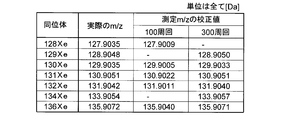
一例として、約100周回の飛行時間スペクトル(図4(d))における1376.8522[μs]のピークについて、3周回の飛行時間スペクトル(図4(b))上でイオン強度Pn0(n)を調べた結果を図6に示す。周回数を99、100、101と仮定して計算したTf計算値が実測によるTf測定値の範囲に入っており、周回数100でイオン強度Pn0(n)は最大となっている。したがって、n=100が求める真の周回数であるとする。このように、質量電荷比が既知であるXe同位体分子イオンを多重周回質量分析して得られた追い越し飛行時間スペクトルデータを利用して該イオンの周回数を求め、上記の修正換算式を用いてTf測定値を質量電荷比m/zに換算した結果を図7に示す。なお、図7中の-の印は、対象の分子が観測されていないことを表す。
さらに図7の結果を利用して、実測の追い越し飛行時間スペクトル毎に、(4)式、(5)式中のLoffとV0とを推定する。即ち、上記で推定されたLoffとV0は非追い越し飛行時間スペクトルの実測結果のみを用いたものであるが、ここでは、より飛行距離の長い(周回数の多い)追い越し飛行時間スペクトルの実測結果を加えた推定を行う。その結果、Tf測定値と質量電荷比m/zとの相互の換算精度が一層向上する。このように再度修正された換算式に基づく換算結果を図8に示す。図7よりさらに実際の質量電荷比m/zに近くなっていることが分かる。以上のようにして、より精度の高い換算式を得ることができる。なお、このような換算式を求める処理は、被測定試料の測定の直前に実行する必要はなく、任意の適宜の時点で実行して換算式を求め、それを記憶しておけばよい。
未知の被測定試料に対する測定を実行する際には、まず第1測定モードで、つまり異種のイオンの追い越しが発生しないことが保証されている条件の下で被測定試料に対する質量分析を実行し、非追い越し飛行時間スペクトルを取得する(ステップS2)。
被測定試料に含まれる成分が全く未知の場合には、イオン源1から出発した各種イオンを周回軌道5に沿って全く周回させずに検出器8に導入すればよい。図1の構成では、ゲート電極2に偏向電圧を印加しないことで、各種イオンをそのまま直進通過させ、入射軌道6→出射軌道7に直接導くことにより、周回軌道5をパスすればよい。また、被測定試料に含まれる成分が推測可能である場合で、各種イオンを周回軌道に乗せて1乃至少数回周回させてもイオンの追いつき、追い越しが発生しないことが確実である場合には、そうした周回を許可してもよい。例えば、上記例で言うと、含まれている可能性がある成分の中で質量電荷比が最小であるイオンが128Xeであり、同じく含まれている可能性がある成分の中で質量電荷比が最大であるイオンが136Xeである場合には、最大29周までの周回(実際にはその周回数に相当する時間)を許可することができる。
次に、同じ被測定試料に対し、各種イオンがイオン源1を出発する時点から周回軌道5に乗ったイオンが検出器8に向かうために周回軌道5から離脱されるようにゲート電極2への印加電圧が切り替えられる時点まで、の時間を変えた複数回の第2測定モードでの質量分析を繰り返し、それぞれ追い越し飛行時間スペクトルを取得する(ステップS3)。この追い越し飛行時間スペクトルでは、異種のイオンの追い越しが生じているために、質量電荷比の小さい順にピークは並ばない。また、各ピークの周回数も同一ではないことも前述した通りである。
そこで、追い越し飛行時間スペクトルからマススペクトルを求めるためには、各ピークの周回数を推測する必要がある。ここでも、追い越し飛行時間スペクトル上のピークに対し周回数を仮定して飛行時間を求め、非追い越し飛行時間スペクトル上でその飛行時間に対応するピークを見つけ、このピークの強度を利用する。但し、上記ステップS1の処理では、追い越し飛行時間スペクトル上で観測されたピークを非追い越し飛行時間スペクトルデータに対応付けて複数の周回数を採り得る場合に、最大のイオン強度を与えるピークに対応した周回数が真の周回数であるとみなしていた。これに対し、マススペクトルを求める際には、仮定した複数の周回数に対応したイオン強度に従って、追い越し飛行時間スペクトル上のピークの強度を複数の質量電荷比に分配するような処理を行う。この処理を強度分配処理という(ステップS4)。この強度分配処理を図10により説明する。
或るイオン離脱タイミングを設定した条件の下で、図10(a)に示す追い越し飛行時間スペクトルが得られたものとする。前述した通り、この飛行時間スペクトルに現れている各ピークの周回数は未知である。いま、この飛行時間スペクトル上の1つのピークに着目する。このピークの飛行時間はTfaであり、ピーク強度はIaである。周回数は不明であるが、考えられる範囲で周回数を仮定した上で、飛行時間Tfaから質量電荷比を求める。いま、周回数としてn-1周、n周、n+1周の3つが考えられるものとすると、予め記憶しておいた換算式を用いて、それら各仮定周回数に対応してそれぞれ質量電荷比を計算することができる。n-1周、n周、n+1周に対応して質量電荷比がM1、M2、M3と計算できたとする。さらに、各質量電荷比は、予め記憶しておいた逆換算式を用いて、非追い越し測定における飛行時間に換算することができるから、質量電荷比M1、M2、M3から飛行時間Tf1、Tf2、Tf3を計算する。
次に、ステップS2における被測定試料に対する実測により得られた非追い越し飛行時間スペクトル上で、上記の仮定飛行時間Tf1、Tf2、Tf3に対応するピークを見つける。ここでは、図10(b)に示すような非追い越し飛行時間スペクトル上でそれぞれピークが見つかったものとする。但し、必ずしも全ての仮定飛行時間にピークが存在するとは限らず、ピークが存在しなければ強度がゼロであるとすればよい。図10(b)に示すように複数のピークが見つかったならば、各ピークの強度i1、i2、i3を求め、その強度比を取得する。そして、元の着目したピークの強度Iaを上記各ピークの強度比に従って、質量電荷比M1、M2、M3に分配する。
即ち、m/z=M1に対しIa×{i1/(i1+i2+i3)}を分配し、m/z=M2に対しIa×{i2/(i1+i2+i3)}を分配し、m/z=M3に対しIa×{i3/(i1+i2+i3)}を分配する。そして、図10(c)に示すように、分配された強度をマススペクトルに記録する。非追い越し飛行時間スペクトル上で複数の仮定飛行時間の中で1つの仮定飛行時間に対してしかピークが見つからない場合には、そのピークの強度に拘わらず元の着目したピークの強度Iaをその唯一の仮定飛行時間に対応した質量電荷比に割り当てればよい。
以上のような手順により、1つの追い越し飛行時間スペクトル上の1つのピークの強度を、マススペクトル上の1乃至複数の質量電荷比のピーク強度に反映させることができる。1つの追い越し飛行時間スペクトル上の各ピークについて同様の強度分配処理を繰り返し、1つのマススペクトル上にピーク強度を分配していく。同一質量電荷比に強度が分配された場合には、その強度を積算してゆく。そうして、最終的に1つの追い越し飛行時間スペクトルから1つのマススペクトルを作成する。マススペクトル上の強度は相対的なものであるから、積算値を最終的に規格化してもよい。ステップS3で取得された複数の飛行時間スペクトルについて1つずつ同様の処理を実行し、それぞれ異なるマススペクトルを作成する。したがって、ステップS4の処理ではステップS3で取得された追い越し飛行時間スペクトルと同数のマススペクトルが作成されることになる。
但し、1つの追い越し飛行時間スペクトルに膨大な数のピークが現れている場合、全てのピークについて強度分配処理を実行すると演算処理時間が長くなる。また、そのような場合には強度の小さなピークは被測定試料に混入している夾雑物由来のものであることが多いため、全てのピークについて強度分配処理を実行することはマススペクトルを複雑にすることにもなる。そこで、追い越し飛行時間スペクトルに現れているピークに対し例えば強度が閾値以上であるものといったピーク選別処理を実行し、選別されたピークについてのみ強度分配処理を実行するようにしてもよい。
図6に示した例では、約100周回の追い越し飛行時間スペクトルにおける1376.8522[μs]のピークの強度は、m/z=123.9449(3周回の非追い越し飛行時間スペクトル上での飛行時間60.8034[μs])に0.83%、m/z=131.9062(3周回の非追い越し飛行時間スペクトル上での飛行時間62.7258[μs])に98.6%、m/z=140.6595(3周回の非追い越し飛行時間スペクトル上での飛行時間64.7736[μs])に0.57%が分配されることになる。
上述のようにして複数のマススペクトルが得られたならば、制御部10はその複数のマススペクトルを表示部14の同一画面上に表示する(ステップS5)。このとき、複数のマススペクトルを並べて表示してもよいし、同一のm/z値軸上に線色を変えて重ね書き表示してもよい。
図4(d)に示した約100周回の追い越し飛行時間スペクトルと図4(e)に示した約300周回の追い越し飛行時間スペクトルとをそれぞれ、図4(c)に示した非追い越し飛行時間スペクトルに対応付けることで求めたマススペクトルを図9(a)、(b)に示す。この2つのマススペクトルを見比べると、130Xe、131Xe、132Xe、136Xeの4つは両方のマススペクトルに共通に観測されている。これに対し、128Xe、129e、134Xeの3つは一方のマススペクトルのみで観測されており、他方のマススペクトルでは観測されていない。つまり、後者の3種の同位体分子は前述した無効期間のためにイオンが検出できなかったものと推測できる。
このようにして、本実施例のMT-TOFMSでは周回軌道5からのイオンの離脱のタイミングが原因で正常に検出できなかったイオンも認識し、その質量電荷比を高い分解能や精度で求めることができる。もちろん、第2測定モードで取得する追い越し飛行時間スペクトルの数が多いほど、イオンの検出見逃しの確率は下がることになるから、許容される測定時間の範囲で第2測定モードの実行回数を決めればよい。
なお、上記実施例は本発明の一例であり、本発明の趣旨の範囲で適宜変形、修正、追加を行っても本願請求の範囲に包含されることは明らかである。
Claims (8)
- イオン源から出発した各種イオンを周回軌道に沿って複数回繰り返し飛行させた後に検出器に導入し、その検出信号に基づいてマススペクトルを取得する多重周回飛行時間型の質量分析装置を用いた質量分析方法であって、
質量電荷比が既知であるイオンについて飛行時間を実測した結果に基づいて得られる、飛行時間と質量電荷比との間の換算式を記憶しておき、
a)周回軌道に沿ってイオンを多重周回させることなく又は多重周回させる場合でも異種のイオンの追いつき・追い越しが起こらないことが保証される周回数で以てイオンを飛行させる第1測定モードで被測定試料に対する質量分析を実行し、検出器により得られる検出信号に基づいて非追い越し飛行時間スペクトルを取得する第1測定モード実行ステップと、
b)前記周回軌道上でイオンの追い越しが生じるように多重周回させた後の所定の時点以降にイオンを周回軌道から離脱させて検出器に導入する第2測定モードによる質量分析を、同一種のイオンに対する周回数が異なるように周回軌道からのイオンの離脱タイミングを変えながら前記被測定試料に対して複数回実行し、検出器により得られる検出信号に基づいてそれぞれ異なる追い越し飛行時間スペクトルを取得する第2測定モード実行ステップと、
c)第2測定モードの実行により取得された追い越し飛行時間スペクトル上のピークについて、周回数を複数仮定した上で前記換算式を利用して非追い越し時の仮定飛行時間をそれぞれ計算し、前記非追い越し飛行時間スペクトルからその複数の仮定飛行時間に対応したピークをそれぞれ見つけてそれらピークの強度情報を取得し、その強度情報に従って追い越し飛行時間スペクトル上の元のピークの強度を、仮定飛行時間に対応した質量電荷比に分配するという強度分配処理を実行することにより、複数の追い越し飛行時間スペクトルに対応したマススペクトルをそれぞれ求める演算処理ステップと、
を有することを特徴とする質量分析方法。 - 請求項1に記載の質量分析方法であって、
前記演算処理ステップでは、追い越し飛行時間スペクトルに出現している複数のピークの各ピークについてそれぞれ強度分配処理を実行し、マススペクトル上の同一質量電荷比に分配された強度を積算することを特徴とする質量分析方法。 - 請求項2に記載の質量分析方法であって、
前記演算処理ステップでは、追い越し飛行時間スペクトルに出現しているピークを所定条件に照らして選別し、その選別されたピークに対して強度分配処理を実行して、マススペクトル上の同一質量電荷比に分配された強度を積算することを特徴とする質量分析方法。 - 請求項2又は3に記載の質量分析方法であって、
前記演算処理ステップでは、異なる複数の追い越し飛行時間スペクトルから強度分配処理によりそれぞれマススペクトルを求め、その複数のマススペクトルを表示手段の同一画面上に描出することを特徴とする質量分析方法。 - イオン源から出発した各種イオンを周回軌道に沿って複数回繰り返し飛行させた後に検出器に導入し、その検出信号に基づいてマススペクトルを取得する多重周回飛行時間型の質量分析装置において、
a)質量電荷比が既知であるイオンについて飛行時間を実測した結果に基づいて得られる、飛行時間と質量電荷比との間の換算式を記憶しておく換算情報保持手段と、
b)周回軌道に沿ってイオンを多重周回させることなく又は多重周回させる場合でも異種のイオンの追いつき・追い越しが起こらないことが保証される周回数で以てイオンを飛行させる第1測定モードで被測定試料に対する質量分析を実行し、検出器により得られる検出信号に基づいて非追い越し飛行時間スペクトルを取得する第1測定モード実行制御手段と、
c)前記周回軌道上でイオンの追い越しが生じるように多重周回させた後の所定の時点以降にイオンを周回軌道から離脱させて検出器に導入する第2測定モードによる質量分析を、同一種のイオンに対する周回数が異なるように周回軌道からのイオンの離脱タイミングを変えながら前記被測定試料に対して複数回実行し、検出器により得られる検出信号に基づいてそれぞれ異なる追い越し飛行時間スペクトルを取得する第2測定モード実行制御手段と、
d)第2測定モードの実行により取得された追い越し飛行時間スペクトル上のピークについて、周回数を複数仮定した上で前記換算式を利用して非追い越し時の仮定飛行時間をそれぞれ計算し、前記非追い越し飛行時間スペクトルからその複数の仮定飛行時間に対応したピークをそれぞれ見つけてそれらピークの強度情報を取得し、その強度情報に従って追い越し飛行時間スペクトル上の元のピークの強度を、仮定飛行時間に対応した質量電荷比に分配するという強度分配処理を実行することにより、複数の追い越し飛行時間スペクトルに対応したマススペクトルをそれぞれ求める演算処理手段と、
を備えることを特徴とする質量分析装置。 - 請求項5に記載の質量分析装置であって、
前記演算処理手段は、追い越し飛行時間スペクトルに出現している複数のピークの各ピークについてそれぞれ強度分配処理を実行し、マススペクトル上の同一質量電荷比に分配された強度を積算することを特徴とする質量分析装置。 - 請求項6に記載の質量分析装置であって、
前記演算処理手段は、追い越し飛行時間スペクトルに出現しているピークを所定条件に照らして選別するピーク選別手段を含み、その選別されたピークに対して強度分配処理を実行し、マススペクトル上の同一質量電荷比に分配された強度を積算することを特徴とする質量分析装置。 - 請求項6又は7に記載の質量分析装置であって、
前記演算処理手段は、異なる複数の追い越し飛行時間スペクトルから強度分配処理によりそれぞれマススペクトルを求め、その複数のマススペクトルを表示手段の同一画面上に描出することを特徴とする質量分析装置。
Priority Applications (2)
| Application Number | Priority Date | Filing Date | Title |
|---|---|---|---|
| PCT/JP2008/003246 WO2010052756A1 (ja) | 2008-11-10 | 2008-11-10 | 質量分析方法及び質量分析装置 |
| US13/128,389 US8258467B2 (en) | 2008-11-10 | 2008-11-10 | Mass-analyzing method and mass spectrometer |
Applications Claiming Priority (1)
| Application Number | Priority Date | Filing Date | Title |
|---|---|---|---|
| PCT/JP2008/003246 WO2010052756A1 (ja) | 2008-11-10 | 2008-11-10 | 質量分析方法及び質量分析装置 |
Related Child Applications (1)
| Application Number | Title | Priority Date | Filing Date |
|---|---|---|---|
| US12/813,024 Continuation US20100244251A1 (en) | 2008-09-29 | 2010-06-10 | Semiconductor device and method for fabricating the same |
Publications (1)
| Publication Number | Publication Date |
|---|---|
| WO2010052756A1 true WO2010052756A1 (ja) | 2010-05-14 |
Family
ID=42152572
Family Applications (1)
| Application Number | Title | Priority Date | Filing Date |
|---|---|---|---|
| PCT/JP2008/003246 Ceased WO2010052756A1 (ja) | 2008-11-10 | 2008-11-10 | 質量分析方法及び質量分析装置 |
Country Status (2)
| Country | Link |
|---|---|
| US (1) | US8258467B2 (ja) |
| WO (1) | WO2010052756A1 (ja) |
Cited By (6)
| Publication number | Priority date | Publication date | Assignee | Title |
|---|---|---|---|---|
| JP2011249032A (ja) * | 2010-05-24 | 2011-12-08 | Shimadzu Corp | 質量分析方法及び装置 |
| GB2484179A (en) * | 2010-09-28 | 2012-04-04 | Bruker Daltonik Gmbh | Calibration function for time of flight mass spectrometers with extreme mass accuracy |
| US20120112060A1 (en) * | 2010-11-05 | 2012-05-10 | Shimadzu Corporation | Multi-Turn Time-of-Flight Mass Spectrometer |
| GB2495899A (en) * | 2011-07-04 | 2013-05-01 | Thermo Fisher Scient Bremen | Method and apparatus for identification of samples using a multi reflection time of flight mass spectrometer |
| JP2014197555A (ja) * | 2014-07-10 | 2014-10-16 | 株式会社島津製作所 | 多重周回飛行時間型質量分析装置 |
| CN116680426A (zh) * | 2023-05-31 | 2023-09-01 | 广东省麦思科学仪器创新研究院 | Mr-tof质谱数据存储方法、装置、系统及存储介质 |
Families Citing this family (7)
| Publication number | Priority date | Publication date | Assignee | Title |
|---|---|---|---|---|
| US8399834B2 (en) * | 2008-06-20 | 2013-03-19 | Carl Zeiss Nts, Llc | Isotope ion microscope methods and systems |
| WO2010049972A1 (ja) * | 2008-10-30 | 2010-05-06 | 株式会社島津製作所 | 質量分析装置 |
| GB201122251D0 (en) | 2011-12-23 | 2012-02-01 | Micromass Ltd | Multi-pass ion mobility separation device |
| US10043644B2 (en) | 2014-05-14 | 2018-08-07 | Micromass Uk Limited | De-convolution of overlapping ion mobility spectrometer or separator data |
| CN110455907B (zh) * | 2019-07-04 | 2022-04-19 | 昆山禾信质谱技术有限公司 | 基于飞行时间质量分析器的串联质谱数据分析方法 |
| US20240242957A1 (en) * | 2021-06-09 | 2024-07-18 | Shimadzu Corporation | Time-of-flight mass spectrometer and time-of-flight mass spectrometry method |
| GB2629671B (en) * | 2022-03-08 | 2025-02-26 | Thermo Fisher Scient Bremen Gmbh | Disambiguation of cyclic ion analyser spectra |
Citations (2)
| Publication number | Priority date | Publication date | Assignee | Title |
|---|---|---|---|---|
| JP2005079049A (ja) * | 2003-09-03 | 2005-03-24 | Jeol Ltd | 多重周回型飛行時間型質量分析方法 |
| JP2005116343A (ja) * | 2003-10-08 | 2005-04-28 | Shimadzu Corp | 質量分析方法及び質量分析装置 |
Family Cites Families (3)
| Publication number | Priority date | Publication date | Assignee | Title |
|---|---|---|---|---|
| JP2006228435A (ja) | 2005-02-15 | 2006-08-31 | Shimadzu Corp | 飛行時間型質量分析装置 |
| JP4939138B2 (ja) | 2006-07-20 | 2012-05-23 | 株式会社島津製作所 | 質量分析装置用イオン光学系の設計方法 |
| JP5419047B2 (ja) * | 2010-03-19 | 2014-02-19 | 株式会社島津製作所 | 質量分析データ処理方法及び質量分析装置 |
-
2008
- 2008-11-10 WO PCT/JP2008/003246 patent/WO2010052756A1/ja not_active Ceased
- 2008-11-10 US US13/128,389 patent/US8258467B2/en not_active Expired - Fee Related
Patent Citations (2)
| Publication number | Priority date | Publication date | Assignee | Title |
|---|---|---|---|---|
| JP2005079049A (ja) * | 2003-09-03 | 2005-03-24 | Jeol Ltd | 多重周回型飛行時間型質量分析方法 |
| JP2005116343A (ja) * | 2003-10-08 | 2005-04-28 | Shimadzu Corp | 質量分析方法及び質量分析装置 |
Non-Patent Citations (1)
| Title |
|---|
| D. OKUMURA ET AL.: "A compact sector-type multi-turn time-of-flight mass spectrometer 'MULTUM II'", NUCLEAR INSTRUMENTS AND METHODS IN PHYSICS RESEACH A, vol. 519, no. IS.1-2, 21 February 2004 (2004-02-21), pages 331 - 337 * |
Cited By (11)
| Publication number | Priority date | Publication date | Assignee | Title |
|---|---|---|---|---|
| JP2011249032A (ja) * | 2010-05-24 | 2011-12-08 | Shimadzu Corp | 質量分析方法及び装置 |
| GB2484179A (en) * | 2010-09-28 | 2012-04-04 | Bruker Daltonik Gmbh | Calibration function for time of flight mass spectrometers with extreme mass accuracy |
| US8581183B2 (en) | 2010-09-28 | 2013-11-12 | Bruker Daltonik Gmbh | Calibration function for time-of-flight mass spectrometers with extreme mass accuracy |
| GB2484179B (en) * | 2010-09-28 | 2016-12-14 | Bruker Daltonik Gmbh | Calibration function for time-of-flight mass spectrometers with extreme mass accuracy |
| US20120112060A1 (en) * | 2010-11-05 | 2012-05-10 | Shimadzu Corporation | Multi-Turn Time-of-Flight Mass Spectrometer |
| US8492711B2 (en) * | 2010-11-05 | 2013-07-23 | Shimadzu Corporation | Multi-turn time-of-flight mass spectrometer |
| GB2495899A (en) * | 2011-07-04 | 2013-05-01 | Thermo Fisher Scient Bremen | Method and apparatus for identification of samples using a multi reflection time of flight mass spectrometer |
| GB2495899B (en) * | 2011-07-04 | 2018-05-16 | Thermo Fisher Scient Bremen Gmbh | Identification of samples using a multi pass or multi reflection time of flight mass spectrometer |
| JP2014197555A (ja) * | 2014-07-10 | 2014-10-16 | 株式会社島津製作所 | 多重周回飛行時間型質量分析装置 |
| CN116680426A (zh) * | 2023-05-31 | 2023-09-01 | 广东省麦思科学仪器创新研究院 | Mr-tof质谱数据存储方法、装置、系统及存储介质 |
| CN116680426B (zh) * | 2023-05-31 | 2024-06-11 | 广东省麦思科学仪器创新研究院 | Mr-tof质谱数据存储方法、装置、系统及存储介质 |
Also Published As
| Publication number | Publication date |
|---|---|
| US8258467B2 (en) | 2012-09-04 |
| US20110215238A1 (en) | 2011-09-08 |
Similar Documents
| Publication | Publication Date | Title |
|---|---|---|
| WO2010052756A1 (ja) | 質量分析方法及び質量分析装置 | |
| JP6305543B2 (ja) | 標的化した質量分析 | |
| JP6090479B2 (ja) | 質量分析装置 | |
| US8803083B2 (en) | Time of flight mass spectrometer | |
| EP4022664B1 (en) | Adaptive intrinsic lock mass correction | |
| JP6365661B2 (ja) | 質量分析方法及び質量分析装置 | |
| EP3675149A1 (en) | Imaging mass spectrometry device, mass spectrometric method, and program | |
| US8354635B2 (en) | Mass spectrometer | |
| JP2005116343A (ja) | 質量分析方法及び質量分析装置 | |
| CN107923872A (zh) | 串联型质谱分析装置 | |
| JP5472068B2 (ja) | 質量分析方法及び装置 | |
| JP6011438B2 (ja) | Maldiイオントラップ質量分析装置 | |
| EP3518274A1 (en) | Mass spectrometer | |
| JP5533255B2 (ja) | 質量分析方法及び装置 | |
| US7038198B2 (en) | Mass spectrometer | |
| JP2004158360A (ja) | 質量分析装置 | |
| WO2025120758A1 (ja) | 飛行時間型質量分析装置および信号処理装置 | |
| JP2010277970A (ja) | 多重周回飛行時間型質量分析装置 | |
| JP2025171306A (ja) | 信号処理装置、信号処理システムおよび信号処理方法 | |
| JP2015056262A (ja) | 質量分析装置、質量分析方法、およびプログラム | |
| JP2007207696A (ja) | 荷電粒子エネルギー分析装置及び該装置を用いた粒子反応解析装置 |
Legal Events
| Date | Code | Title | Description |
|---|---|---|---|
| 121 | Ep: the epo has been informed by wipo that ep was designated in this application |
Ref document number: 08877951 Country of ref document: EP Kind code of ref document: A1 |
|
| WWE | Wipo information: entry into national phase |
Ref document number: 13128389 Country of ref document: US |
|
| NENP | Non-entry into the national phase |
Ref country code: DE |
|
| 122 | Ep: pct application non-entry in european phase |
Ref document number: 08877951 Country of ref document: EP Kind code of ref document: A1 |
|
| NENP | Non-entry into the national phase |
Ref country code: JP |