WO2010035722A1 - ペプチド化合物およびその製造方法 - Google Patents
ペプチド化合物およびその製造方法 Download PDFInfo
- Publication number
- WO2010035722A1 WO2010035722A1 PCT/JP2009/066449 JP2009066449W WO2010035722A1 WO 2010035722 A1 WO2010035722 A1 WO 2010035722A1 JP 2009066449 W JP2009066449 W JP 2009066449W WO 2010035722 A1 WO2010035722 A1 WO 2010035722A1
- Authority
- WO
- WIPO (PCT)
- Prior art keywords
- formula
- salt
- compound
- lower alkyl
- optionally substituted
- Prior art date
- Legal status (The legal status is an assumption and is not a legal conclusion. Google has not performed a legal analysis and makes no representation as to the accuracy of the status listed.)
- Ceased
Links
- 0 CCCCC(C)C1*=C(C(N(C)C(C(CCCC)NC(C(CCCC)N(C)C(C(C)NC(C(C)NC(C(C(CC)CCC)N(C)C(C(CCCC)NC(*C(*C(C(C(C)O)N2C)=O)=O)=O)=O)=O)=*)=O)=O)=O)[P+])N(C)C1C2=O Chemical compound CCCCC(C)C1*=C(C(N(C)C(C(CCCC)NC(C(CCCC)N(C)C(C(C)NC(C(C)NC(C(C(CC)CCC)N(C)C(C(CCCC)NC(*C(*C(C(C(C)O)N2C)=O)=O)=O)=O)=O)=*)=O)=O)=O)[P+])N(C)C1C2=O 0.000 description 2
Classifications
-
- C—CHEMISTRY; METALLURGY
- C07—ORGANIC CHEMISTRY
- C07K—PEPTIDES
- C07K7/00—Peptides having 5 to 20 amino acids in a fully defined sequence; Derivatives thereof
- C07K7/64—Cyclic peptides containing only normal peptide links
-
- A—HUMAN NECESSITIES
- A61—MEDICAL OR VETERINARY SCIENCE; HYGIENE
- A61P—SPECIFIC THERAPEUTIC ACTIVITY OF CHEMICAL COMPOUNDS OR MEDICINAL PREPARATIONS
- A61P31/00—Antiinfectives, i.e. antibiotics, antiseptics, chemotherapeutics
- A61P31/12—Antivirals
- A61P31/14—Antivirals for RNA viruses
-
- C—CHEMISTRY; METALLURGY
- C07—ORGANIC CHEMISTRY
- C07K—PEPTIDES
- C07K7/00—Peptides having 5 to 20 amino acids in a fully defined sequence; Derivatives thereof
- C07K7/04—Linear peptides containing only normal peptide links
- C07K7/06—Linear peptides containing only normal peptide links having 5 to 11 amino acids
-
- A—HUMAN NECESSITIES
- A61—MEDICAL OR VETERINARY SCIENCE; HYGIENE
- A61K—PREPARATIONS FOR MEDICAL, DENTAL OR TOILETRY PURPOSES
- A61K38/00—Medicinal preparations containing peptides
Definitions
- the present invention relates to a method for producing a cyclic peptide compound useful as an active ingredient of a pharmaceutical composition, particularly a pharmaceutical composition for treating hepatitis C virus (HCV) known as an inhibitor of hepatitis C virus replicon RNA replication,
- HCV hepatitis C virus
- the present invention relates to an intermediate useful for production, and a production method thereof.
- Patent Document 1 discloses that a compound of formula (A) or a salt thereof can be produced via a compound of formula (I) or a salt thereof using a fermentation product FR901459 substance (Patent Document 2) as a starting material. Yes. Specifically, the following steps ⁇ 1> to ⁇ 6> are performed. ⁇ 1> Production of a compound of formula (I) or a salt thereof by ring-opening the FR901459 substance or a salt thereof after N—O rearrangement. ⁇ 2> Production of a compound of formula (A2-2) or a salt thereof by condensing threonine at the C-terminus of the compound of formula (I) or a salt thereof.
- a step of producing a compound of the formula (I) or a salt thereof from the FR90159 substance of the formula (A1-1) or a salt thereof Specifically, the compound of formula (A1-2) or a salt thereof obtained by hydrolyzing the ring of the FR901459 substance after the N—O rearrangement reaction under mildly acidic conditions and protecting the amino group was then opened. The compound (I) or a salt thereof is produced.
- Prot 0 means a protecting group. For other symbols in the formula, see Patent Document 1. ]
- a step of producing a compound of the formula (A2-2) or a salt thereof from the compound of the formula (I) or a salt thereof A compound of formula (A2-2) or a salt thereof is produced by condensing a compound of formula (A2-1) to a compound of formula (I) or a salt thereof.
- Prot 0 means a protecting group. For other symbols, see Patent Document 1. ]
- a step of producing a compound of formula (A3) or a salt thereof from a compound of formula (A2-2) or a salt thereof Edman decomposition is performed on the compound of the formula (A2-2) or a salt thereof three times, that is, by sequentially removing amino acids from the N-terminal of the compound of the formula (A2-2) or a salt thereof, the compound of the formula (A3) The compound or its salt is manufactured.
- Edman decomposition is performed on the compound of the formula (A2-2) or a salt thereof three times, that is, by sequentially removing amino acids from the N-terminal of the compound of the formula (A2-2) or a salt thereof, the compound of the formula (A3)
- the compound or its salt is manufactured.
- a step of producing a compound of formula (A4-4) or a salt thereof from a compound of formula (A3) or a salt thereof A compound of formula (A4-2) or a salt thereof obtained by introducing an amino acid at the N-terminus of the compound of formula (A3) or a salt thereof and deprotecting the compound or a salt thereof was protected. An amino acid is condensed to produce a compound of formula (A4-4) or a salt thereof. [Wherein, Prot 3 and Prot 4 both represent a protecting group. For other symbols, see Patent Document 1. ]
- the compound of formula (Ab) or a salt thereof is produced by ordinary catalytic reduction. [See Patent Document 1 for symbols in the formula. ]
- a compound of formula (A) which is directed to an industrial production method and excellent in terms of operability and purity, an intermediate useful for the production, and a production method thereof.
- the present invention was completed by finding a production method of the compound of the formula (A) from the viewpoint of industrial production, an intermediate useful for the production, and a production method thereof.
- Edman decomposition may be performed once, and the compound of the formula (A) and an intermediate useful for the production thereof can be provided with high purity without performing purification by column chromatography in the post-treatment associated therewith.
- this invention relates to the manufacturing method and intermediate body shown below.
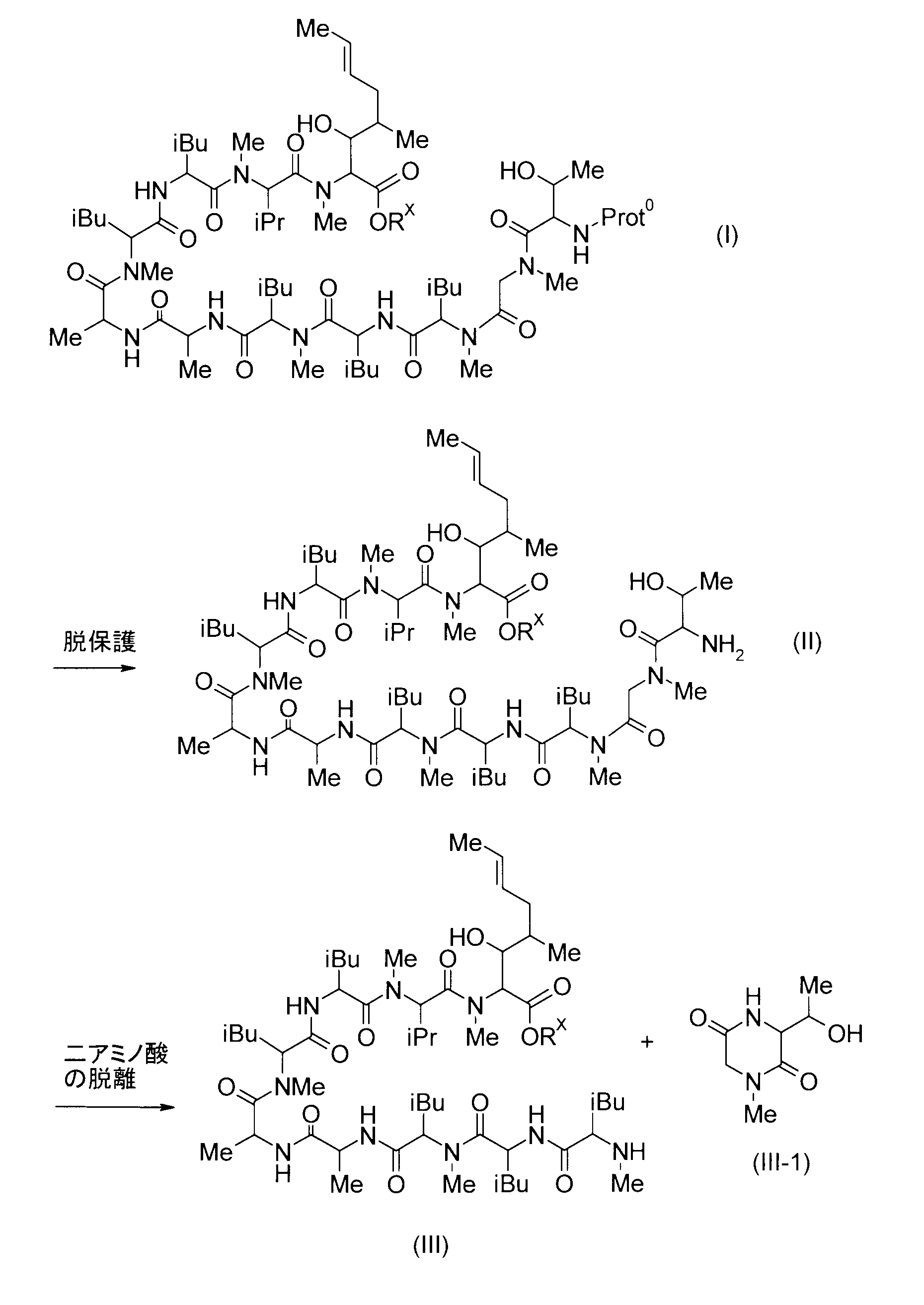
- Formula (II) Wherein two amino acids are eliminated from the compound or a salt thereof in one step, Formula (III) Or a salt thereof.
- R X represents —H or a protecting group
- iBu represents isobutyl
- iPr represents isopropyl
- Me represents methyl.
- Formula (I) A compound of formula (II) or a salt thereof is subjected to a deprotection reaction to obtain a compound of formula (II) or a salt thereof, and further a protecting group is added to the compound of formula (III) or a salt thereof obtained by the process according to claim 1.
- R 3 is cycloalkyl, aryl, an optionally substituted heterocyclic ring, or lower alkyl
- the lower alkyl is a group consisting of hydroxy, cycloalkyl, lower alkoxy, aryl, alloalkoxy, lower alkoxy-lower alkylene-O—, optionally substituted amino, and —OC (O) NR 6 R 7.
- R 6 and R 7 are each independently —H or lower alkyl, or R 6 and R 7 together with the nitrogen atom to which R 6 and R 7 are bonded are substituted with lower alkyl.
- R 4 and R 5 are each independently —H or lower alkyl; ---- represents a single bond or a double bond.
- R 2 is —H
- R 3 is cycloalkyl, aryl, an optionally substituted heterocyclic ring, lower alkoxymethyl, alloalkyl, t-butyl, sec-butyl, cycloalkyl, or ethyl.
- the ethyl represents lower alkyl, hydroxy, lower alkyl-O—, aryl-lower alkylene-O—, lower alkyl-O-lower alkylene-O—, optionally substituted amino, and —OC (O ) Optionally substituted by one suitable substituent selected from the group consisting of NR 6 R 7 , [4]
- the compound of the formula (VI) obtained by the production method of [2] or a salt thereof is condensed with a threonine protected at the carboxylic acid terminal, and then the amino terminal is deprotected, Formula (VIII) Or a salt thereof.
- Prot 2 represents a protecting group.
- the present invention relates to a novel intermediate represented by the following formula.
- the intermediate obtained by the production method of the present invention is useful from the following points.
- the compound of formula (VIII) obtained by the above production method [4] or a salt thereof is used for anti-HCV treatment by condensing two amino acids at the N-terminus, deprotecting, and then cyclizing. Since the compound of the formula (A) or a salt thereof reported to be useful as an active ingredient of a pharmaceutical composition can be produced, it is useful as a production intermediate.
- the compound of the formula (VI) obtained by the above production method [2] or a salt thereof has the formula (VIII) by condensing a protected threonine at the C-terminus and deprotecting the N-terminus.
- the compound of formula (VIII) or a salt thereof obtained according to the method described in (1) above is useful as an active ingredient of a pharmaceutical composition for anti-HCV treatment. Since it is possible to produce a compound of the formula (A) or a salt thereof that has been reported to be present, it is useful as a production intermediate (3) of the formula (III) obtained by the production method [1] above.
- the compound or a salt thereof can be produced by protecting the N-terminal after a single Edman decomposition, and the compound of the formula (VI) or a salt thereof can be produced.
- the method described in (1) and (2) above it is possible to produce a compound of the formula (A) which have been reported to be useful as an active ingredient of a pharmaceutical composition for anti-HCV therapy is useful as a production intermediate.
- This production method is excellent in operability in that two amino acids can be eliminated in one step.
- the compound of the formula (III) of the present invention or a salt thereof can be produced by Edman. Since thiohydantoins and the like are not by-produced in the process in which the decomposition reaction can be omitted, the compound of formula (A), an intermediate for its production, Can be obtained. Accordingly, it is possible to scale up on an industrial scale.
- the “protecting group” is a group that does not prevent the subsequent reaction and does not affect the functional group even during deprotection.
- protecting groups described in “Green's Protective Groups in Organic Synthesis (4th edition, 2006)” by PG Green Wuts and TW Greene. It can be selected as appropriate according to these reaction conditions.
- N-terminal and C-terminal are amino acids or carboxy groups at both ends in a linear peptide, the side where the amino group is present is the “N-terminal”, and the side where the carboxy group is present is “ “C-terminal” means.
- “It may be substituted” means unsubstituted or having 1 to 5 substituents. In addition, when it has a some substituent, those substituents may be the same, or may mutually differ.
- “Lower” indicates that the number of carbon atoms is 1 to 6 (hereinafter abbreviated as C 1-6 ), preferably 1 to 4 unless otherwise specified.
- “Lower alkyl” means linear or branched C 1-6 alkyl such as methyl, ethyl, n-propyl, isopropyl, n-butyl, isobutyl, sec-butyl, tert-butyl, n-pentyl, n -Hexyl and the like. Another embodiment is C 1-4 alkyl, and yet another embodiment is methyl, ethyl, or propyl.
- the “lower alkylene” is linear or branched C 1-6 alkylene such as methylene, ethylene, trimethylene, tetramethylene, pentamethylene, hexamethylene, propylene, methylmethylene, ethylethylene and the like. Another embodiment is C 1-4 alkylene.
- “Lower alkoxy” refers to methoxy, ethoxy, propoxy, isopropoxy, butoxy, isobutoxy, tert-butoxy, pentyloxy, tert-pentyloxy, neopentyloxy, hexyloxy, or isohexyloxy, A branched C 1-6 alkylalkoxy group. Another embodiment is methoxy, ethoxy, or propoxy.
- Cycloalkyl is a C 3-6 alkyl cyclic alkyl, such as cyclopropyl, cyclobutyl, cyclopentyl, and cyclohexyl.
- Aryl includes phenyl, naphthyl, anthryl and the like.
- “Alloalkyl” is lower alkyl substituted with 1 to 5 aryls such as phenylpropyl, phenethyl, benzyl and the like.
- “Alloalkoxy” is lower alkoxy substituted with 1 to 5 aryls such as phenylpropoxy, phenethyloxy, benzyloxy and the like.
- Suitable examples of “optionally substituted amino” are amino optionally substituted by one or two suitable substituents such as lower alkyl, amino protecting groups (eg, benzyloxycarbonyl, Boc, etc.), etc. .
- Suitable examples of “optionally substituted carbamoyloxy” may be substituted by 1 or 2 appropriate substituents such as lower alkyl, amino protecting group (eg, benzyloxycarbonyl, Boc, etc.), etc. Carbamoyloxy.
- Heterocycle (1) Pyrrolyl, pyrrolinyl, imidazolyl, pyrazolyl, pyridyl, dihydropyridyl, pyrimidinyl, pyrazinyl, pyridazinyl, triazolyl (example: 4H-1,2,4-triazolyl, 1H-1,2,3-triazolyl, 2H-1, 2,3-triazolyl and the like), tetrazolyl (eg 1H-tetrazolyl, 2H-tetrazolyl etc.), 3 to 8 membered (more preferably 5 or 6 membered) unsaturated containing 1 to 4 nitrogen atoms such as azepinyl Monocyclic heterocycle; (2) 3 to 8 members (more preferably 5) containing 1 to 4 nitrogen atoms such as aziridinyl, azetinyl, pyrrolidinyl, imidazolidinyl, piperidyl, piperaziny
- Suitable examples of the “nitrogen-containing heterocycle” are (1) to (7) of the above-mentioned “heterocycle”.
- at least one of pyrrolidinyl, piperidyl, morpholinyl, thiazolyl, oxazolyl, etc. A heterocyclic ring containing a nitrogen atom.
- Suitable examples of “optionally substituted heterocycle” are the above heterocycles optionally substituted with one suitable substituent such as lower alkyl, lower alkoxy, aryl, amino, lower alkoxycarbonyl and the like.
- Halogen means fluorine, chlorine, bromine and iodine.
- CPME cyclopentyl methyl ether
- DIBOC di-tert-butyl dicarbonate
- DME 1,2-dimethoxyethane
- DMF N, N-dimethylformamide
- DMI 1,3-dimethyl-2-imidazolidinone
- DMSO Dimethyl sulfoxide
- DIPEA diisopropylethylamine
- DPPA diphenyl phosphate azide
- EtOAc ethyl acetate
- Ex example number
- HOBt 1-hydroxybenzotriazole
- IPA isopropyl alcohol
- KH 2 PO 4 dihydrogen phosphate potassium
- NMP N-methylpyrrolidone
- Na 2 CO 3 sodium carbonate
- Na 2 HPO 4 disodium hydrogen phosphate
- TEA triethylamine
- TFA trifluoroacetic acid
- WSC 1-ethyl-3- (3-d
- the compound of the present invention may have geometric isomers.
- the compound of the present invention may be described in only one form of an isomer, but the present invention also includes other isomers, separated isomers, or a mixture thereof. Includes.
- the compound of the present invention has an asymmetric carbon atom, and there exists an optical isomer based on this.
- the present invention also includes separated optical isomers of the compounds of the present invention or mixtures thereof.
- the salt of the compound of the present invention may form an acid addition salt or a salt with a base depending on the kind of the substituent.
- inorganic acids such as hydrochloric acid, hydrobromic acid, hydroiodic acid, sulfuric acid, nitric acid, phosphoric acid, formic acid, acetic acid, propionic acid, oxalic acid, malonic acid, succinic acid, fumaric acid, maleic acid
- organic acids such as lactic acid, malic acid, mandelic acid, tartaric acid, dibenzoyl tartaric acid, ditoluoyl tartaric acid, citric acid, methanesulfonic acid, ethanesulfonic acid, benzenesulfonic acid, p-toluenesulfonic acid, aspartic acid, glutamic acid Salts, salts with inorganic bases such as sodium, potassium, magnesium, calcium and aluminum, salts with organic bases such as methylamine, ethylamine
- the present invention includes various hydrates and solvates of the compound of the present invention and salts thereof, and polymorphic substances.
- the present invention also includes compounds labeled with various radioactive or non-radioactive isotopes.
- This step is a step of removing two amino acids in one step under heating conditions after deprotecting the N-terminus.
- R x is a protecting group
- lower alkyl optionally substituted with phenyl, lower alkyl optionally substituted with aryl, and the like can be mentioned.
- Other embodiments include lower alkyl, benzyl, tert-butyl.
- Prot 0 includes carbamate, toluenesulfonyl, nitrobenzenesulfonyl and the like.
- Another embodiment includes Boc, benzyloxycarbonyl, 9-fluorenylmethyloxycarbonyl, 2,2,2-trichloroethoxycarbonyl, allyloxycarbonyl.
- Deprotection is described, for example, in each of “Green's Protective Groups in Organic Synthesis (4th edition, 2006)” by PG Green Wuts and TW Greene.
- the deprotection reaction for the protecting group can be referred to, and may be appropriately selected and used according to these reaction conditions.
- Two amino acids are eliminated by heating the raw material intermediate in a solvent.
- the reaction temperature is preferably from warming to reflux conditions. Any solvent may be used as long as it does not interfere with the reaction.
- CPME, dioxane, THF, DMSO, DMF, IPA, tBuOH, NMP, DMI, DME, water or the like is used, and ether or water is preferable.
- An aqueous system is particularly preferred.
- the reaction may be a homogeneous system or a two-layer system, but a two-layer system is particularly preferred. It may be advantageous to carry out the reaction in the presence of acids or bases or salts.
- a buffer solution is added to the reaction solution and the reaction is carried out in a hydrous system.
- the buffer include a phosphate buffer and a tris buffer, and a phosphate buffer is preferable.
- the temperature varies depending on the solvent, the temperature is 30 ° C. to the reflux temperature of the solvent, for example, 30 ° C. to 180 ° C. 50 to 120 ° C is preferable, and 60 to 85 ° C is particularly preferable.
- the product may be obtained as a crystal without adding a seed crystal. However, if a crystal is precipitated by adding a seed crystal, the crystal may be easily precipitated.
- This step is Edman degradation, which is a step of removing amino acids of the peptide from the N-terminus.
- the solvent is usually an alcohol such as acetonitrile, acetone, MeOH, EtOH, THF, dioxane, toluene, methylene chloride, chloroform, EtOAc, DMF, and the like, an organic solvent that does not adversely affect the reaction, or a mixed solvent thereof. It is carried out in a normal solvent.
- the reaction temperature is not limited, and the reaction is usually carried out under cooling to heating. This reaction is described, for example, in M.M. K. Everle et al. Org. Chem. 59, 7249-7258 (1994) or the like, or a method similar thereto.
- This step is a step of protecting the N-terminus of the chain peptide as an intermediate, condensing the protected threonine to the C-terminus, and then deprotecting the N-terminus.
- Examples of Prot 2 include lower alkyl which may be substituted with phenyl, lower alkyl which may be substituted with aryl, and the like. Other embodiments include lower alkyl, benzyl, tert-butyl.
- Examples of Prot 1 include carbamate, toluenesulfonyl, nitrobenzenesulfonyl and the like.
- Another embodiment includes Boc, benzyloxycarbonyl, 9-fluorenylmethyloxycarbonyl, 2,2,2-trichloroethoxycarbonyl, allyloxycarbonyl.
- Condensation of protected threonine to the C-terminal of the substrate chain peptide can be carried out in the same manner as the so-called amidation reaction.
- the compound of the formula (VII) or a salt thereof can be obtained by reacting the compound of the formula (VI) or a salt thereof with the protected threonine of the formula (B2).
- an equivalent amount or an excess amount of the compound of the formula (VI) or a salt thereof and the protected threonine of the formula (B2) is used in an excess amount, and these mixtures are inert to the reaction in the presence of a condensing agent.
- the mixture is stirred in a solvent under cooling to heating, preferably at ⁇ 20 ° C. to 60 ° C., usually for 0.1 hour to 5 days.
- the solvent used here are not particularly limited, but are aromatic hydrocarbons such as toluene or xylene, halogenated hydrocarbons such as dichloromethane, 1,2-dichloroethane or chloroform, diethyl ether, THF, dioxane.
- Ethers such as dimethoxyethane, DMF, DMSO, EtOAc, MeCN or water, and mixtures thereof.
- condensing agents include, but are not limited to, WSC, DPPA, and phosphorus oxychloride.
- an additive eg HOBt
- Examples of reactive derivatives of carboxylic acids include acid halides obtained by reacting with halogenating agents such as phosphorus oxychloride and thionyl chloride, mixed acid anhydrides obtained by reacting with isobutyl chloroformate, HOBt, etc.
- Examples include active esters obtained by condensation.
- the reaction of these reactive derivatives with the protected threonine of the formula (B2) is carried out in a solvent inert to the reaction such as halogenated hydrocarbons, aromatic hydrocarbons, ethers, etc. under cooling to heating. Preferably, it can be carried out at -20 ° C to 60 ° C. [Literature] R. Sandler and W.W. Karo, “Organic Functional Group Preparations”, 2nd edition, Volume 1, Academic Press Inc. 1991, Chemical Society of Japan “Experimental Chemistry Course (5th Edition)", Volume 16 (2005) (Maruzen)
- the compound of formula (I) or a salt thereof can be produced according to Patent Document 1 using FR901449 as a starting material.
- the FR901459 substance is a microorganism belonging to the genus Stachybotrys (Tachybotrys chartarum No. 19292), a patent biological deposit center (International Patent Organism Depositary), Tsukuba City East 1-1-5, Ibaraki Pref. It can be obtained from, for example, the method described in Patent Document 2 from a culture solution having a deposit number of FERM BP-3364, which is internationally deposited on April 16, 1991.
- Example compounds are isolated and purified as free compounds, their salts, hydrates, solvates, or crystalline polymorphic substances.
- the salt of an Example compound can also be manufactured by attaching
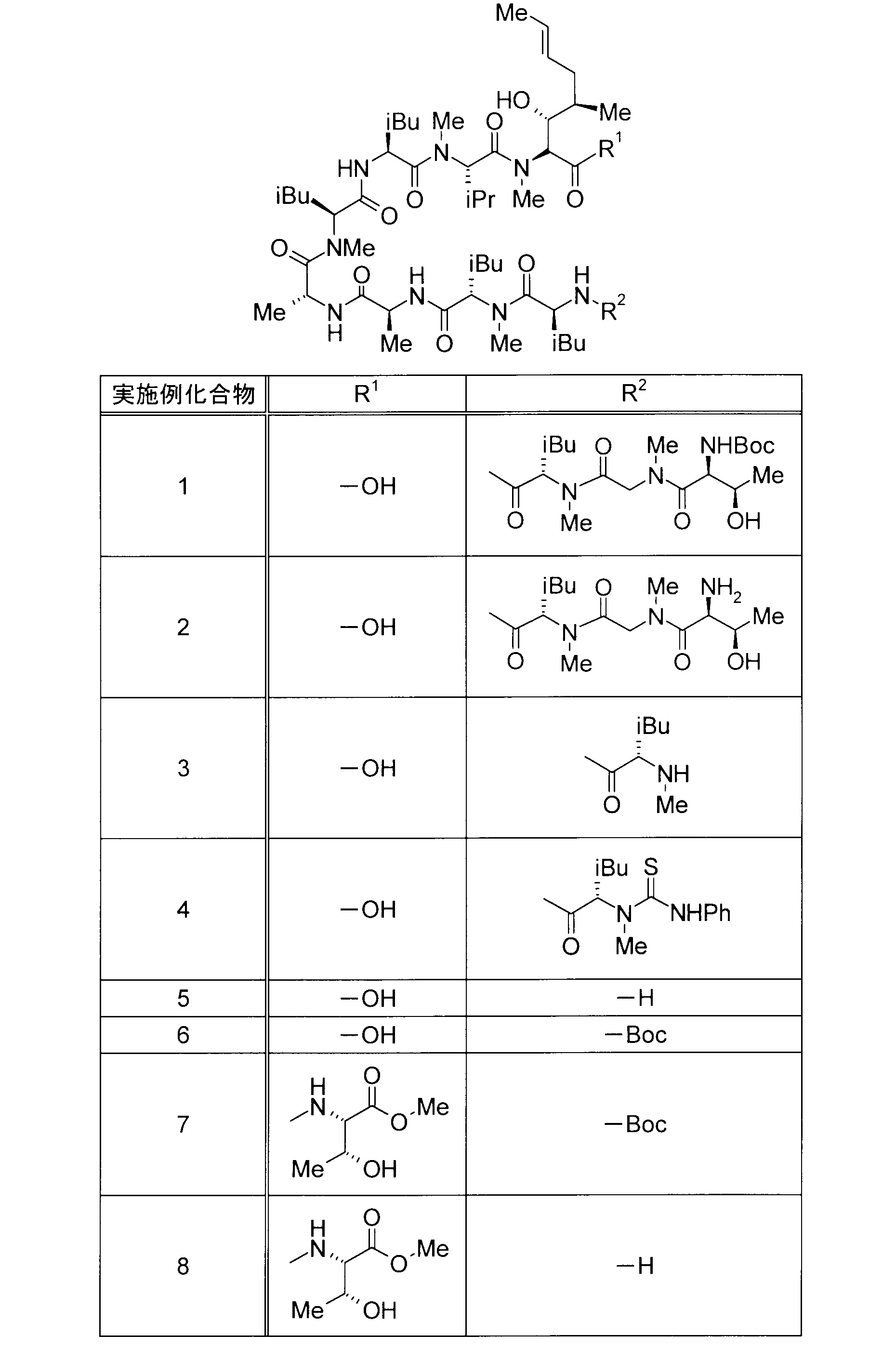
- Example 1 (Production of a compound in which Prot 0 is Boc in the formula (I)) According to the method described in Patent Document 1, (6S, 12S, 15S, 18S, 21S, 24R, 27S, 30S, 33S, 36S) -6-[(1R) -1-hydroxyethyl] -36-[(1R, 2R, 4E) -1-hydroxy-2-methyl-4-hexen-1-yl] -12,15,18,27,30-pentaisobutyl-33-isopropyl-2,2,8,11,17,21 , 24,26,32,35-decamethyl-4,7,10,13,16,19,22,25,28,31,34-undecaoxo-3-oxa-5,8,11,14,17,20 , 23, 26, 29, 32, 35-Undecaazaheptatritan-37-euic acid was obtained.
- Example 2 (Production of compound of formula (II)) After dissolving 50.0 g of Example Compound 1 in 500 mL of methylene chloride, the mixture was cooled to 5 ° C., 213.2 g of TFA was added dropwise, and the mixture was stirred for 4 hours. Thereafter, 500 mL of cold city water was added, and the pH was adjusted to 6.5 with a 10 (w / v)% Na 2 CO 3 aqueous solution. After liquid separation, 500 mL of cooled city water was added to the organic layer again, and the pH was adjusted to 6.5 to 7 with a 10 (w / v)% Na 2 CO 3 aqueous solution.
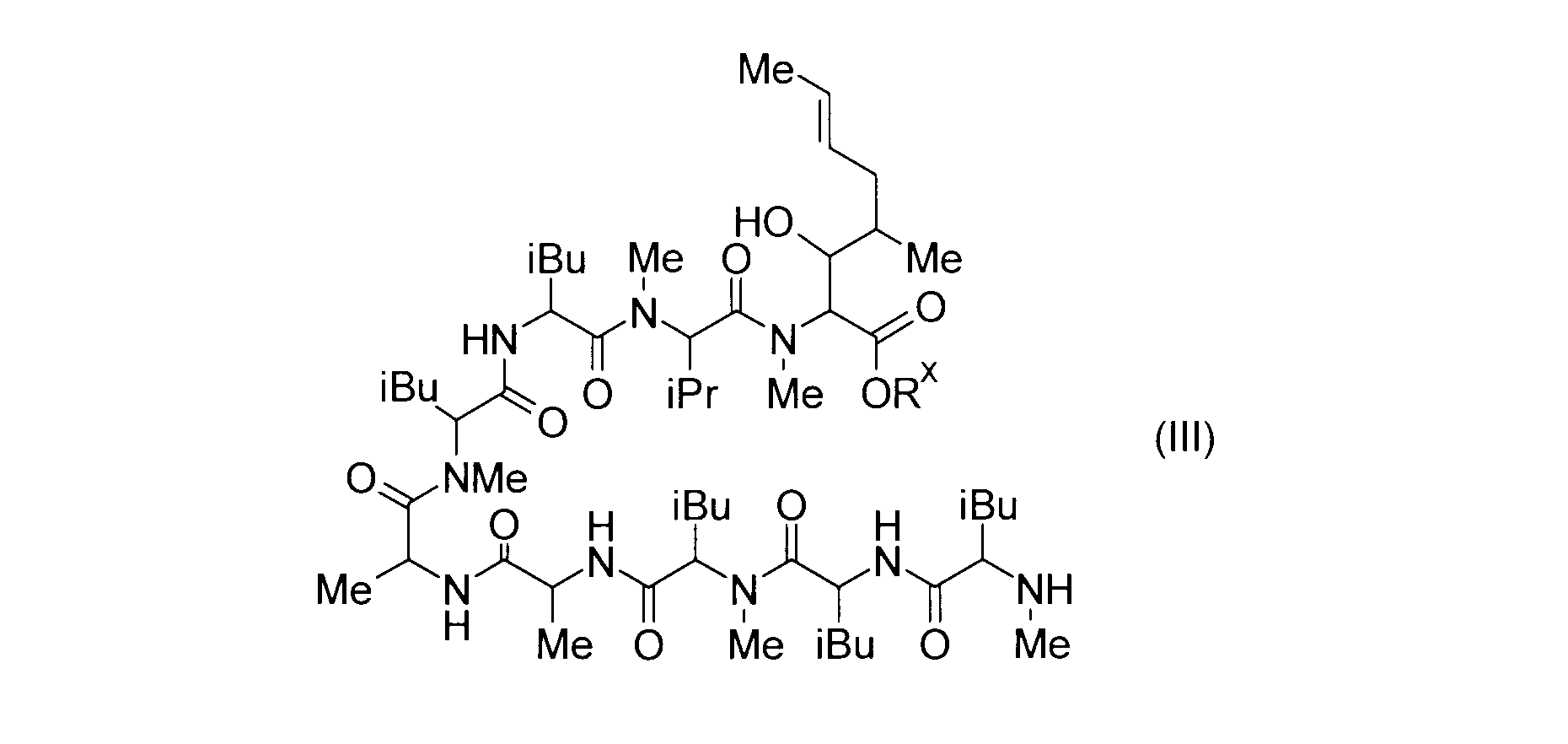
- Example 3 (Production of compound of formula (III)) About 250 mL of the CPME solution of Example Compound 2, 500 mL of CPME, 500 mL of a phosphate buffer aqueous solution of pH 7.6 (the pH of the Na 2 HPO 4 aqueous solution was adjusted to pH 7.6 with KH 2 PO 4 aqueous solution.
- the mixture was heated to 80 to 85 ° C., stirred for 5 hours, and then cooled to 25 ° C.
- the organic layer obtained by liquid separation was washed twice with 500 mL of city water.
- the organic layer was concentrated to about 105 mL, and then 115 mL of acetonitrile was added dropwise. Thereafter, 75 mg of seed crystals of Example Compound 3 were added at an internal temperature of 22 ° C., and 345 mL of acetonitrile was further added dropwise.
- the crystallized solution was collected by filtration and dried under reduced pressure to give (2S, 3R, 4R, 6E) -3-hydroxy-4-methyl-2- [methyl (N-methyl-L-leucyl-L-leucyl-N-methyl).
- Example 3-1 (Method for producing amorphous body) To a CPME solution of Example Compound 2 (equivalent to 40.0 g / 800 mL), pH 7.6 phosphate buffer aqueous solution 400 mL (pH of Na 2 HPO 4 aqueous solution was adjusted to pH 7.6 with KH 2 PO 4 aqueous solution.
- Example 4 (Production of compound of formula (IV)) After dissolving 10.0 g of Example Compound 3 in 150 mL of EtOAc, pH 7.6 phosphate buffer 50 mL (pH of Na 2 HPO 4 aqueous solution was adjusted to pH 7.6 with KH 2 PO 4 aqueous solution. Na 2 HPO 4 aqueous solution, by dissolving Na 2 HPO 4 ⁇ 12H 2 O 1.04 g prepared in water 87.5 L, KH 2 PO 4 aqueous solution, KH 2 PO 4 0 water 12.5 L. 568 g was dissolved, and 2.54 g of phenyl isothiocyanate was added and stirred for 4 hours. Thereafter, the pH was adjusted to 2.3 with 1M hydrochloric acid.
- Example 5 (Production of compound of formula (V)) To about 40 mL of the EtOAc solution of Example Compound 4 was further added dropwise into 200 mL of n-heptane. The precipitated powder was collected by filtration, dissolved in 100 mL of acetonitrile, added with 94 mL of 1M hydrochloric acid, and stirred at 20 ° C. for 3 hours and 15 minutes. It was confirmed that Example Compound 5 was obtained. HR-ESIMS Found m / z 937.6712 (M + H) + Calcd for C48H89N8O10, 937.6701
- Example 6 (Production of a compound in which Prot 1 is Boc in the formula (VI)) To the reaction solution of Example Compound 5, a 10 (w / v)% Na 2 CO 3 aqueous solution was further added to adjust the pH to about 7, and 2.25 g of DIBOC was added, and the mixture was added at 25 ° C. for 3 hours and 20 minutes. After stirring, the pH was adjusted to 2.5 with 1M hydrochloric acid. The organic layer was separated, 100 mL of 20 (w / v)% brine was added, and the mixture was extracted with 100 mL of EtOAc. The organic layer was separated and concentrated to about 40 mL, 150 mL of EtOAc was added again, and the mixture was concentrated to about 40 mL.
- Example 7 (Production of a compound in which Prot 1 is Boc and Prot 2 is methyl in formula (VII)) 7.5 g of Example Compound 6 was dissolved in 75 mL of methylene chloride, and 1.47 g of L-threonine methyl ester hydrochloride and 1.47 g of HOBt ⁇ monohydrate were added and cooled to 0 to 10 ° C. . Further, 1.12 g of WSC was added and stirred at 5 ° C. for about 20 hours, and then the organic layer was washed with 75 mL of city water. The aqueous layer was re-extracted with 38 mL of methylene chloride, and the organic layers were combined.
- the organic layer was washed with 68 mL of 0.3M hydrochloric acid, and the aqueous layer was re-extracted again with 38 mL of methylene chloride.
- the organic layers were combined, then washed sequentially with 5 mL (5 / w)% NaHCO 3 aqueous solution (76 mL) and 20 (w / v)% brine 55 mL, and concentrated to about 30 mL.
- the concentrated solution was dropped into 300 mL of heptane.
- the precipitated powder was collected by filtration and dried under reduced pressure, and (N-[(2S, 3R, 4R, 6E) -2- ⁇ [N- (tert-butoxycarbonyl) -L-leucyl-N-methyl-L-leucyl).
- -L-alanyl-D-alanyl-N-methyl-L-leucyl-L-leucyl-N-methyl-L-valyl] (methyl) amino ⁇ -3-hydroxy-4-methyloct-6-enoyl] -L- Threonine methyl ester was obtained as a white powder, yield: 7.12 g, yield: 85.5%.
- Example 8 (Production of a compound in which Prot 2 is methyl in formula (VIII)) 20.0 g of Example Compound 7 was dissolved in 120 mL of methylene chloride and cooled to ⁇ 5 ° C. After 98.9 g of TFA was added dropwise and stirred for 2 hours and 40 minutes, the mixture was washed with 200 mL of cooled city water. The organic layer obtained by liquid separation was further washed with 200 mL of cooled city water. 200 mL of cooled city water was added to the organic layer, and the pH was adjusted to 6.5 to 7 using a 10 (w / v)% Na 2 CO 3 aqueous solution.
- This production method is excellent in operability in that two amino acids can be eliminated in one step.
- the compound of the formula (III) of the present invention or a salt thereof can be produced by Edman. Since thiohydantoins and the like are not by-produced in the process in which the decomposition reaction can be omitted, the compound of formula (A), an intermediate for its production, Can be obtained. Accordingly, it is possible to scale up on an industrial scale.
Landscapes
- Chemical & Material Sciences (AREA)
- Health & Medical Sciences (AREA)
- Life Sciences & Earth Sciences (AREA)
- Organic Chemistry (AREA)
- General Health & Medical Sciences (AREA)
- Medicinal Chemistry (AREA)
- Molecular Biology (AREA)
- Proteomics, Peptides & Aminoacids (AREA)
- Biophysics (AREA)
- Genetics & Genomics (AREA)
- Biochemistry (AREA)
- Pharmacology & Pharmacy (AREA)
- Virology (AREA)
- Veterinary Medicine (AREA)
- Public Health (AREA)
- Animal Behavior & Ethology (AREA)
- Chemical Kinetics & Catalysis (AREA)
- Nuclear Medicine, Radiotherapy & Molecular Imaging (AREA)
- General Chemical & Material Sciences (AREA)
- Oncology (AREA)
- Communicable Diseases (AREA)
- Engineering & Computer Science (AREA)
- Bioinformatics & Cheminformatics (AREA)
- Immunology (AREA)
- Epidemiology (AREA)
- Peptides Or Proteins (AREA)
- Medicines That Contain Protein Lipid Enzymes And Other Medicines (AREA)
- Organic Low-Molecular-Weight Compounds And Preparation Thereof (AREA)
Abstract
Description
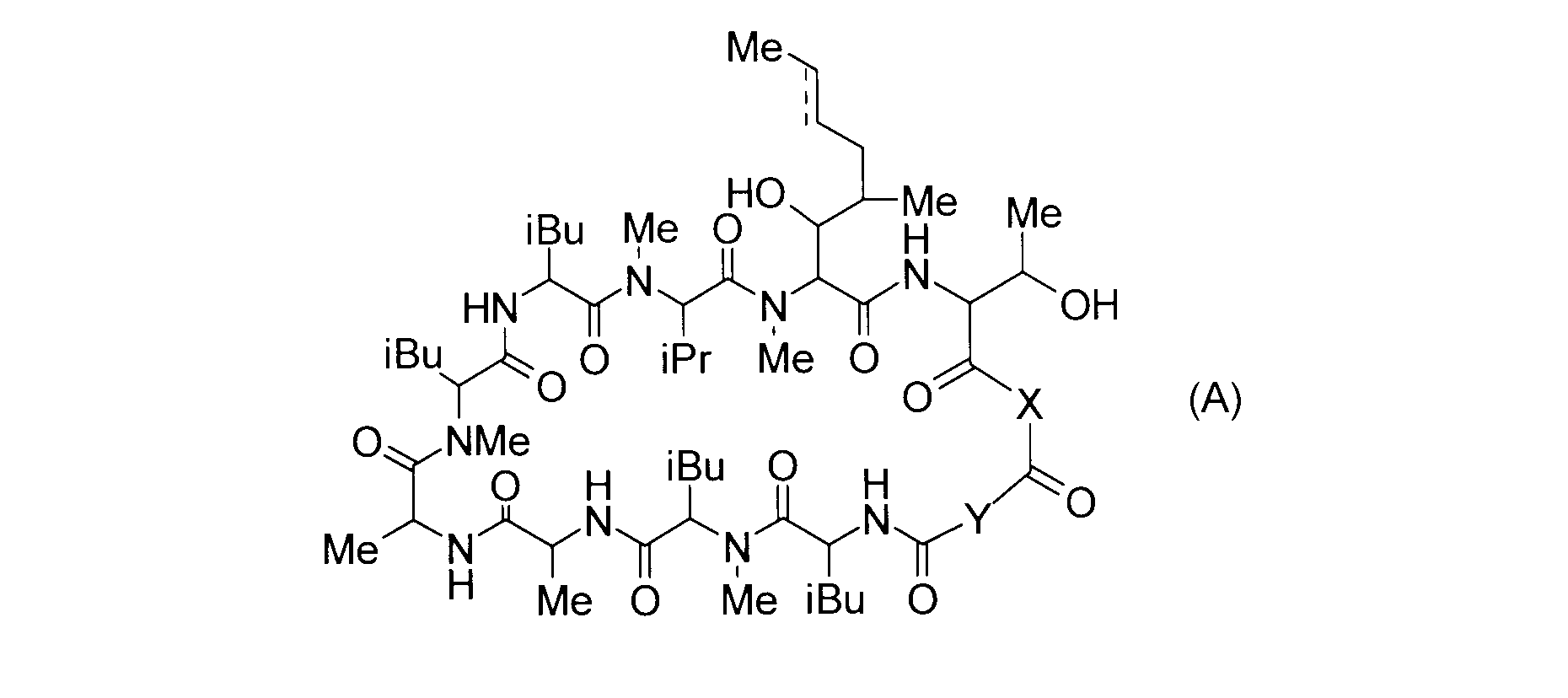
[式中の記号は、特許文献1を参照のこと。]
<1>FR901459物質又はその塩をN-O転位させた後に開環させることによる、式(I)の化合物又はその塩の製造。
<2>式(I)の化合物又はその塩のC末端にスレオニンを縮合させることによる、式(A2-2)の化合物又はその塩の製造。
<3>式(A2-2)の化合物又はその塩に対して、Edman分解を3度行うことによる、式(A3)の化合物又はその塩の製造。
<4>式(A3)の化合物又はその塩にN末端に二アミノ酸を縮合させることによる、式(A4-4)の化合物又はその塩の製造。
<5>式(A4-4)の化合物又はその塩を環化させることによる、式(A)の化合物又はその塩の製造。
<6>式(Aa)の化合物又はその塩を還元することによる、式(Ab)の化合物又はその塩の製造。
各工程を以下に詳述する。

[式中、Prot0は保護基を意味する。式中のその他の記号は特許文献1を参照のこと。]
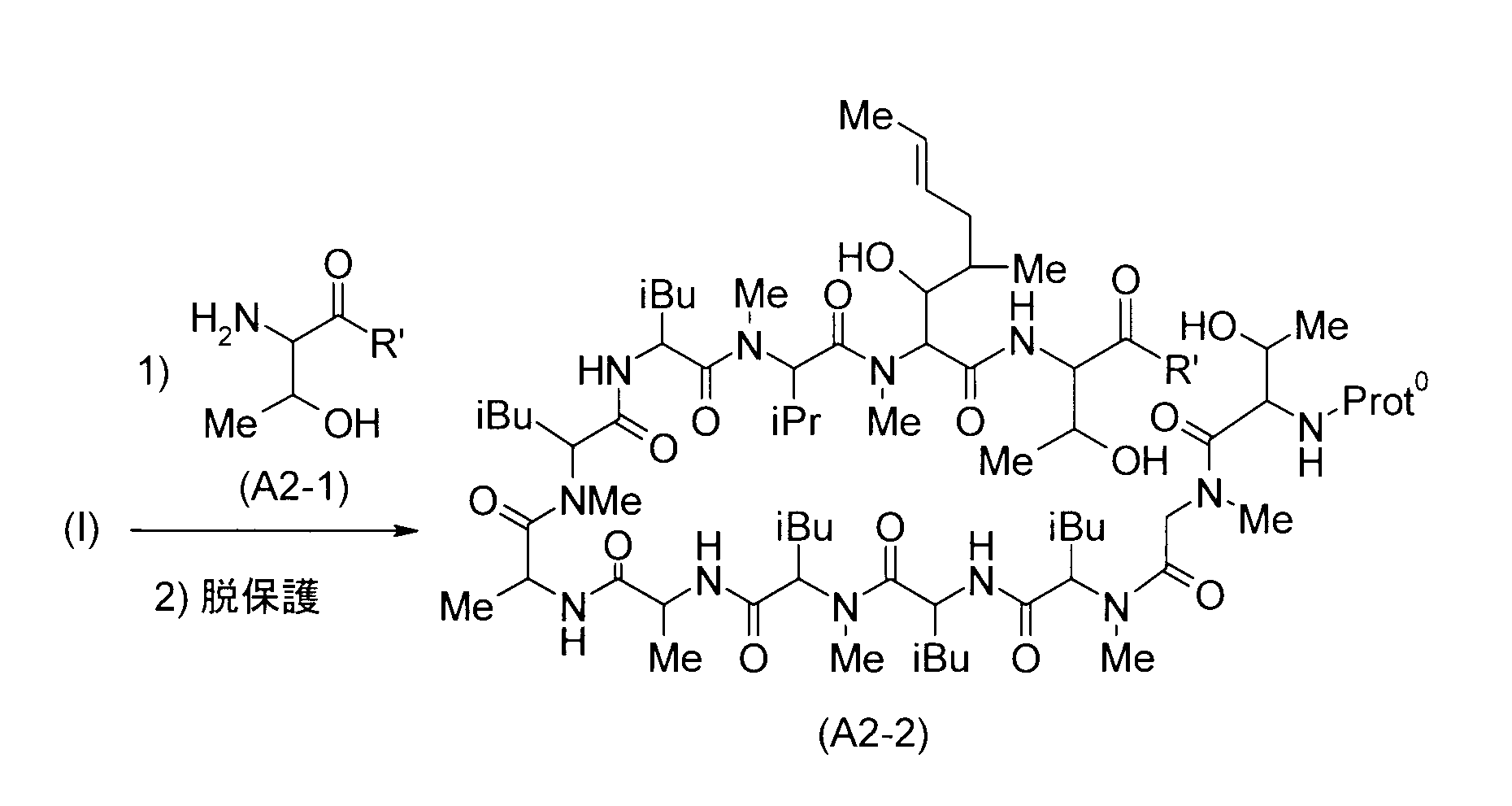
[式中、Prot0は保護基を意味する。その他の記号は特許文献1を参照のこと。]
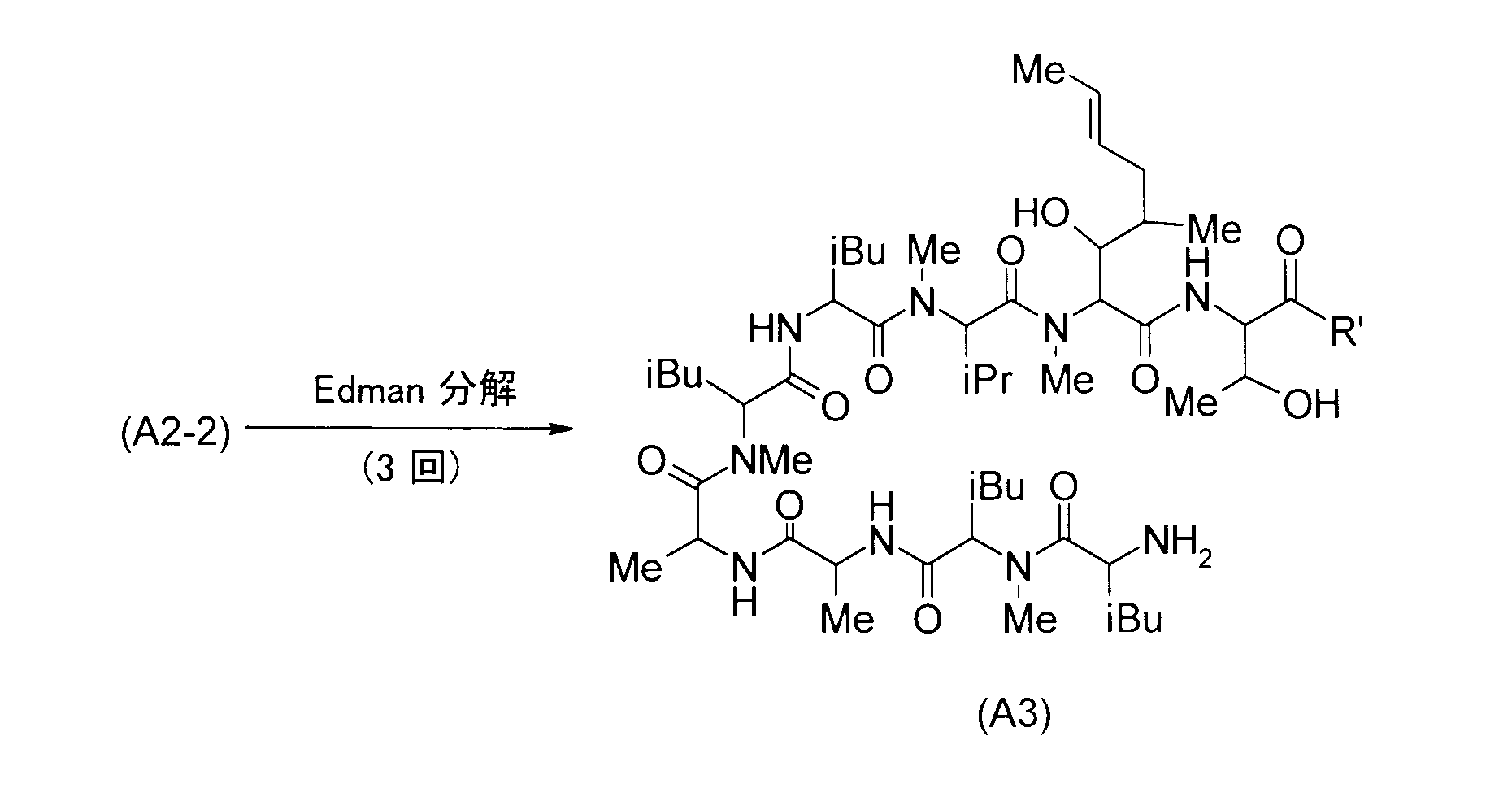
[式中の記号は、特許文献1を参照のこと。]

[式中、Prot3、Prot4はいずれも保護基を意味する。その他の記号は特許文献1を参照のこと。]
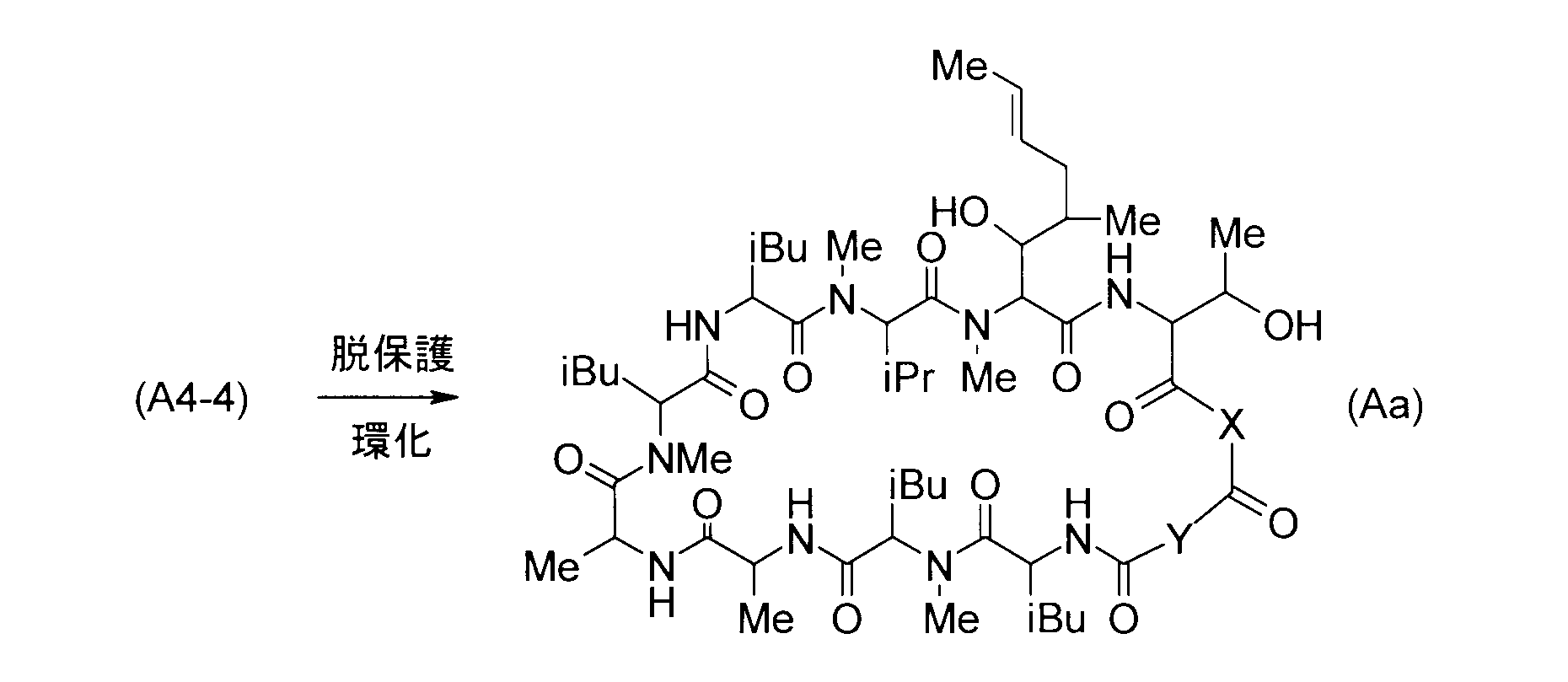
[式中の記号は、特許文献1を参照のこと。]
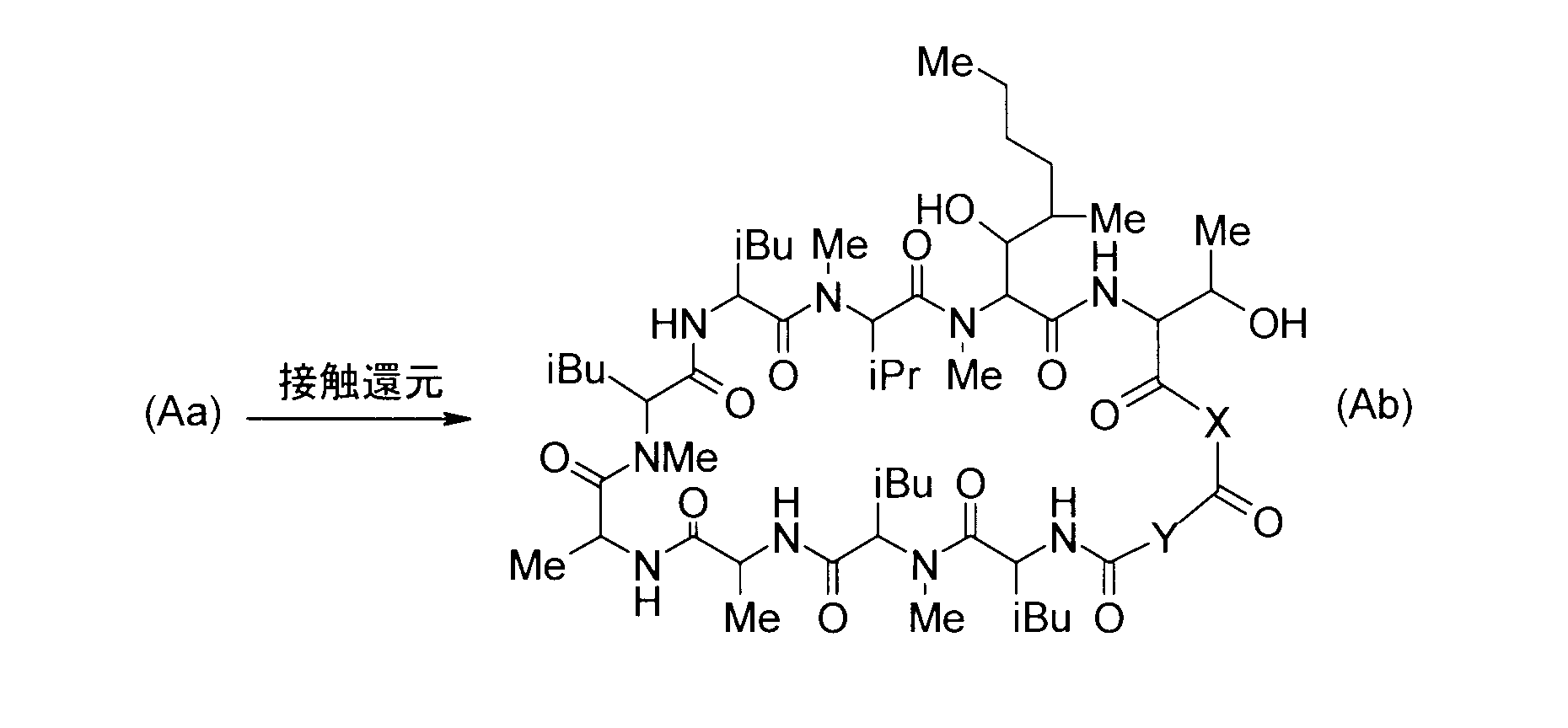
[式中の記号は、特許文献1を参照のこと。]
[1]式(II)

の化合物又はその塩から、二アミノ酸を一工程で脱離させることを特徴とする、
式(III)

の化合物又はその塩の製造方法。
(式中、RXは-H又は保護基、iBuはイソブチル、iPrはイソプロピル、Meはメチルをそれぞれ意味する。)
[2]
式(I)

の化合物又はその塩を脱保護反応に付し、式(II)の化合物又はその塩を得、さらに請求項1に記載の工程により得られた式(III)の化合物又はその塩に保護基を導入することを特徴とする、
式(VI)
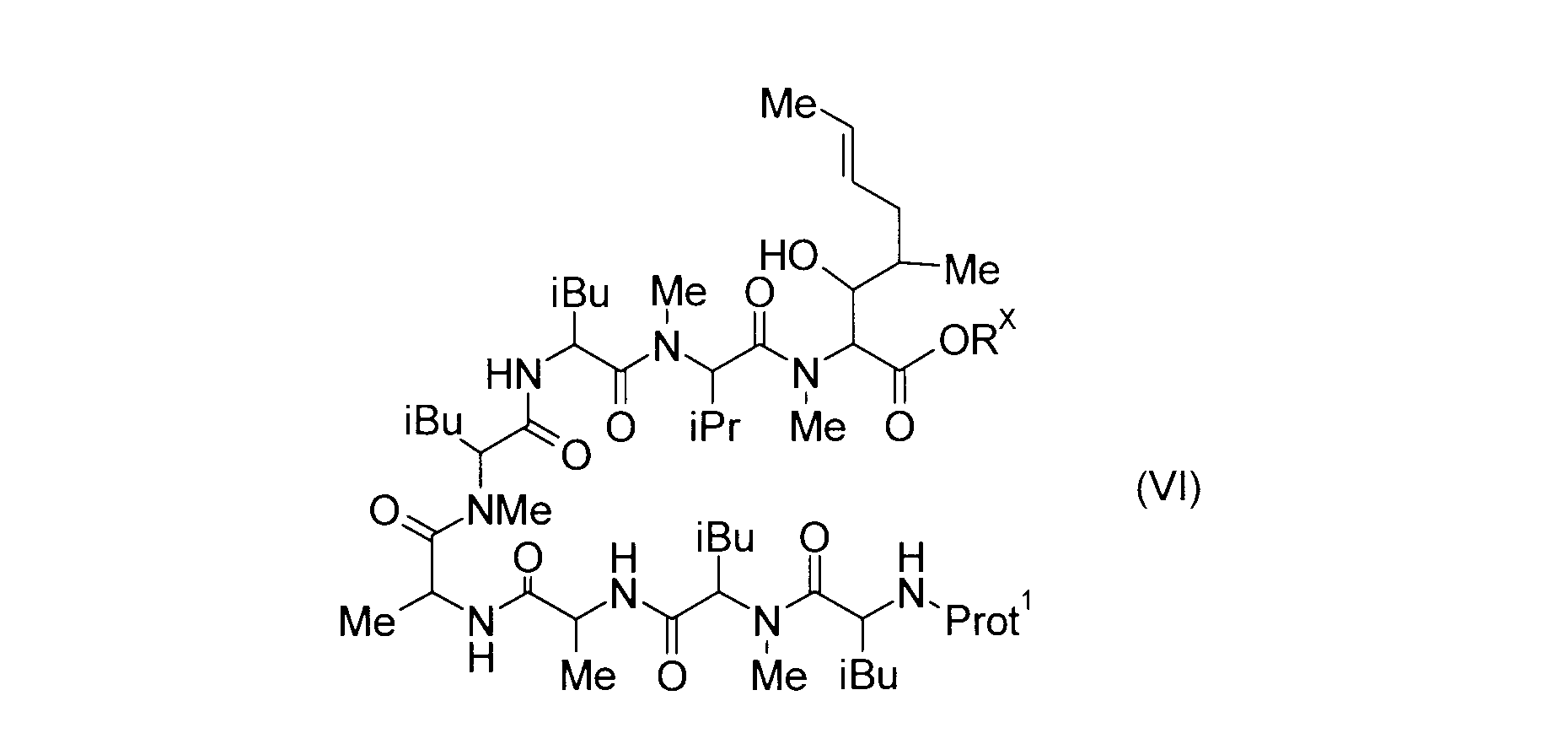
の化合物又はその塩の製造方法。
(式中、RXは-H又は保護基、iBuはイソブチル、iPrはイソプロピル、Meはメチル、Prot0及びProt1は保護基をそれぞれ意味する。)
式(A)

の化合物又はその塩の製造方法。
(式中、
Xは、

又は、

であり、
R1は、-H、又は、低級アルキルであり;
R2は、-H、アリール、又は、低級アルキルであり、
ここで、当該低級アルキルはヒドロキシ、シクロアルキル、低級アルコキシ、アリール、アロアルコキシ、置換されてもよいカルバモイルオキシ、及び、置換されてもよいアミノからなる群から選択される1個の適切な置換基で置換されてもよく、

は、含窒素複素環であり;
Yは、

又は、

であり、
R3は、シクロアルキル、アリール、置換されてもよい複素環、又は、低級アルキルであり、
ここで当該低級アルキルは、ヒドロキシ、シクロアルキル、低級アルコキシ、アリール、アロアルコキシ、低級アルコキシ-低級アルキレン-O-、置換されてもよいアミノ、及び、-OC(O)NR6R7からなる群から選択される1個の適切な置換基によって置換されてもよく、
(式中、R6及びR7は、それぞれ独立に-H、又は、低級アルキルであるか、あるいは、R6及びR7がその結合する窒素原子と一緒になって、低級アルキルで置換されてもよい含窒素複素環を表す。)
であり;
R4及びR5は、それぞれ独立に-H、又は低級アルキルであり;
----は、単結合または二重結合を表す。
(ただし、R2が-Hである場合、R3はシクロアルキル、アリール、置換されてもよい複素環、低級アルコキシメチル、アロアルキル、t-ブチル、sec-ブチル、シクロアルキル、又は、エチルであり、
ここで当該エチルは、低級アルキル、またはヒドロキシ、低級アルキル-O-、アリール-低級アルキレン-O-、低級アルキル-O-低級アルキレン-O-、置換されてもよいアミノ、及び、-OC(O)NR6R7からなる群より選択される1個の適切な置換基によって置換されていてもよく、
[4] [2]の製造方法により得られた式(VI)の化合物又はその塩に、カルボン酸末端に保護されたスレオニンを縮合させ、次いで、アミノ末端を脱保護することを特徴とする、
式(VIII)

の化合物又はその塩の製造方法。
[式中、Prot2は保護基を意味する。]
[5] [3]に記載の方法に従い、式(I)の化合物から製造された式(VIII)の化合物又はその塩のアミノ末端に二アミノ酸を縮合させ、脱保護後に環化させることを特徴とする上述の式(A)の化合物又はその塩の製造方法。
(3) 上述の製造方法[1]で得られた式(III)の化合物又はその塩は、一回のEdman分解後、N末端を保護することにより、式(VI)の化合物又はその塩を製造することができ、得られた式(VI)の化合物又はその塩は、上記(1)及び(2)に記載の方法に従い、抗HCV治療用の医薬組成物の有効成分として有用であることが報告されている式(A)の化合物又はその塩を製造することができる為、製造中間体として有用である。
本明細書において、「保護基」とは、続く反応を妨げず、脱保護時にも官能基に影響しない基である。例えば、ウッツ(P.G.M.Wuts)及びグリーン(T.W.Greene)著、「Greene’s Protective Groups in Organic Synthesis(第4版、2006年)」に記載の保護基等を挙げることができ、これらの反応条件に応じて適宜選択して用いればよい。
(1) ピロリル、ピロリニル、イミダソリル、ピラゾリル、ピリジル、ジヒドロピリジル、ピリミジニル、ピラジニル、ピリダジニル、トリアゾリル(例:4H-1,2,4-トリアゾリル、1H-1,2,3-トリアゾリル、2H-1,2,3-トリアゾリル、など)、テトラゾリル(例:1H-テトラゾリル、2H-テトラゾリルなど)、アゼピニルなどの1から4個の窒素原子を含む3から8員(より好ましくは5または6員)不飽和単環複素環;
(2) アジリジニル、アゼチニル、ピロリジニル、イミダゾリジニル、ピペリジル、ピペラジニル、2,5-メタノピペラジニル、ヘキサヒドロアゼピニル、などの1から4個の窒素原子を含む3から8員(より好ましくは5から6員)飽和単環複素環;
(3) インドリル、イソインドリル、インドリニル、インドリジニル、ベンズイミダゾリル、キノリル、イソキノリル、インダゾリル、ベンゾトリアゾリル、テトラヒドロキノリル、テトラヒドロイソキノリル、テトラヒドロインドリル、ジヒドロインダゾリルなどの1から4個の窒素原子を含む不飽和縮合複素環;
(4) オキサゾリル、イソキサゾリル、オキサジアゾリル(例:1,2,4-オキサジアゾリル、1,3,4-オキサジアゾリル、1,2,5-オキサジアゾリルなど)などの1または2個の酸素原子及び1から3個の窒素原子を含む3から8員(より好ましくは5から6員)不飽和単環複素環;
(5) モルホリニル、シドノニルなどの1または2個の酸素原子及び1から3個の窒素原子を含む3から8員(より好ましくは5から6員)飽和単環複素環;
(6) ベンズオキサゾリル、ベンズオキサジアゾリルなどの1または2個の酸素原子及び1から3個の窒素原子を含む不飽和縮合複素環;
(7) チアゾリル、イソチアゾリル、チアジアゾリル、(例:1,2,3-チアジアゾリル、1,2,4-チアジアゾリル、1,3,4-チアジアゾリル、1,2,5-チアジアゾリルなど)、ジヒドロチアジニルなどの1または2個のイオウ原子及び1から3個の窒素原子を含む3から8員(より好ましくは5から6員)不飽和単環複素環;
(8) チアゾリジニルなどの1または2個のイオウ原子及び1から3個の窒素原子を含む3から8員(より好ましくは5から6員)飽和単環複素環;
(9) チエニル、ジヒドロジチイニル、ジヒドロジチオニルなどの1または2個のイオウ原子を含む3から8員(より好ましくは5から6員)不飽和単環複素環;
(10) ベンゾチアゾリル、ベンゾチアジアゾリル、イミダゾチアジアゾリルなどの1または2個のイオウ原子及び1から3個の窒素原子を含む不飽和縮合複素環;
(11) フリルなどの1個の酸素原子を含む3から8員(より好ましくは5から6員)不飽和単環複素環;
(12) オキシラニル、1,3-ジオキソラニル、テトラヒドロフラニル、テトラヒドロピラニルなどの1または2個の酸素原子を含む3から8員(より好ましくは5から6員)飽和単環複素環;
(13) ジヒドロオキサチエニルなどの1個の酸素原子及び1または2個の硫黄原子を含む3から8員(より好ましくは5から6員)不飽和単環複素環;
(14) ベンゾチエニル、ベンゾジチイニルなどの1または2個の硫黄原子を含む不飽和縮合複素環;
(15) ベンゾオキサチイニルなどの1個の酸素原子及び1または2個の硫黄原子を含む不飽和縮合複素環;及び
(16) テトラヒドロピリドピロリジニルなどの1から3個の窒素原子を含む飽和縮合複素環;等である。
CPME=シクロペンチルメチルエーテル、DIBOC=ジ-tert-ブチルジカルボネート、DME=1,2-ジメトキシエタン、DMF=N,N-ジメチルホルムアミド、DMI=1,3-ジメチル-2-イミダゾジリジノン、DMSO=ジメチルスルホキサイド、DIPEA=ジイソプロピルエチルアミン、DPPA=ジフェニルリン酸アジド、EtOAc=酢酸エチル、Ex=実施例番号、HOBt=1-ヒドロキシベンゾトリアゾール、IPA=イソプロピルアルコール、KH2PO4=リン酸二水素カリウム、NMP=N-メチルピロリドン、Na2CO3=炭酸ナトリウム、Na2HPO4=リン酸水素二ナトリウム、TEA=トリエチルアミン、TFA=トリフルオロ酢酸、WSC=1-エチル-3-(3-ジメチルアミノプロピル)カルボジイミド、tBuOH=ターシャリーブタノール、LR-ESIMS=低分解能-ESIMS、HR-ESIMS=高分解能-ESIMS、Me=メチル、iBu=イソブチル、iPr=イソプロピル、Boc=ターシャリーブトキシカルボニル、Ph=フェニル、No.=番号。
また、本発明化合物は不斉炭素原子を有しており、これに基づく光学異性体が存在する。本発明には、本発明化合物の光学異性体の分離されたもの、あるいはそれらの混合物も包含する。
以下、式(I)~(VIII)の化合物の代表的な製造方法を説明する。
(第一段階)
[式中、Prot0は保護基を意味する。]
Rxが保護基の場合、フェニルに置換されていてもよい低級アルキル又はアリールに置換されていてもよい低級アルキル等が挙げられる。別の態様としては、低級アルキル、ベンジル、tert-ブチルが挙げられる。
Prot0としては、カルバメート、トルエンスルホニル、ニトロベンゼンスルホニル等が挙げられる。別の態様としては、Boc、ベンジルオキシカルボニル、9-フルオレニルメチルオキシカルボニル、2,2,2-トリクロロエトキシカルボニル、アリルオキシカルボニルが挙げられる。
脱保護は、例えば、ウッツ(P.G.M.Wuts)及びグリーン(T.W.Greene)著、「Greene’s Protective Groups in Organic Synthesis(第4版、2006年)」に記載の各々の保護基に対する脱保護の反応を参照することができ、これらの反応条件に応じて適宜選択して用いればよい。
原料中間体を溶媒中で加温することにより二アミノ酸が脱離する。反応温度として好ましくは、加温から還流条件である。溶媒としては反応を妨げないものであればよく、例えば、CPME、ジオキサン、THF、DMSO、DMF、IPA、tBuOH,NMP、DMI、DME又は水等が用いられ、エーテル系又は水が好ましく、CPME-水系が特に好ましい。反応は均一系でも二層系でもよいが、特に二層系が好ましい。酸又は塩基あるいは塩類の存在下に反応を行うのが有利なことがある。通常、反応液には緩衝液を加えて含水系で反応を行う。緩衝液の例としてはリン酸バッファーやトリスバッファー等が挙げられるが、リン酸バッファーが好ましい。温度は、溶媒によっても異なるが、30℃から溶媒の還流温度、例えば、30℃から180℃までで行われる。50℃から120℃が好ましく、60℃から85℃が特に好ましい。後述の実施例に記載のように、生成物は種晶を加えなくても結晶として得られることがあるが、種晶を加えて結晶を析出させると結晶が析出しやすくなる場合がある。
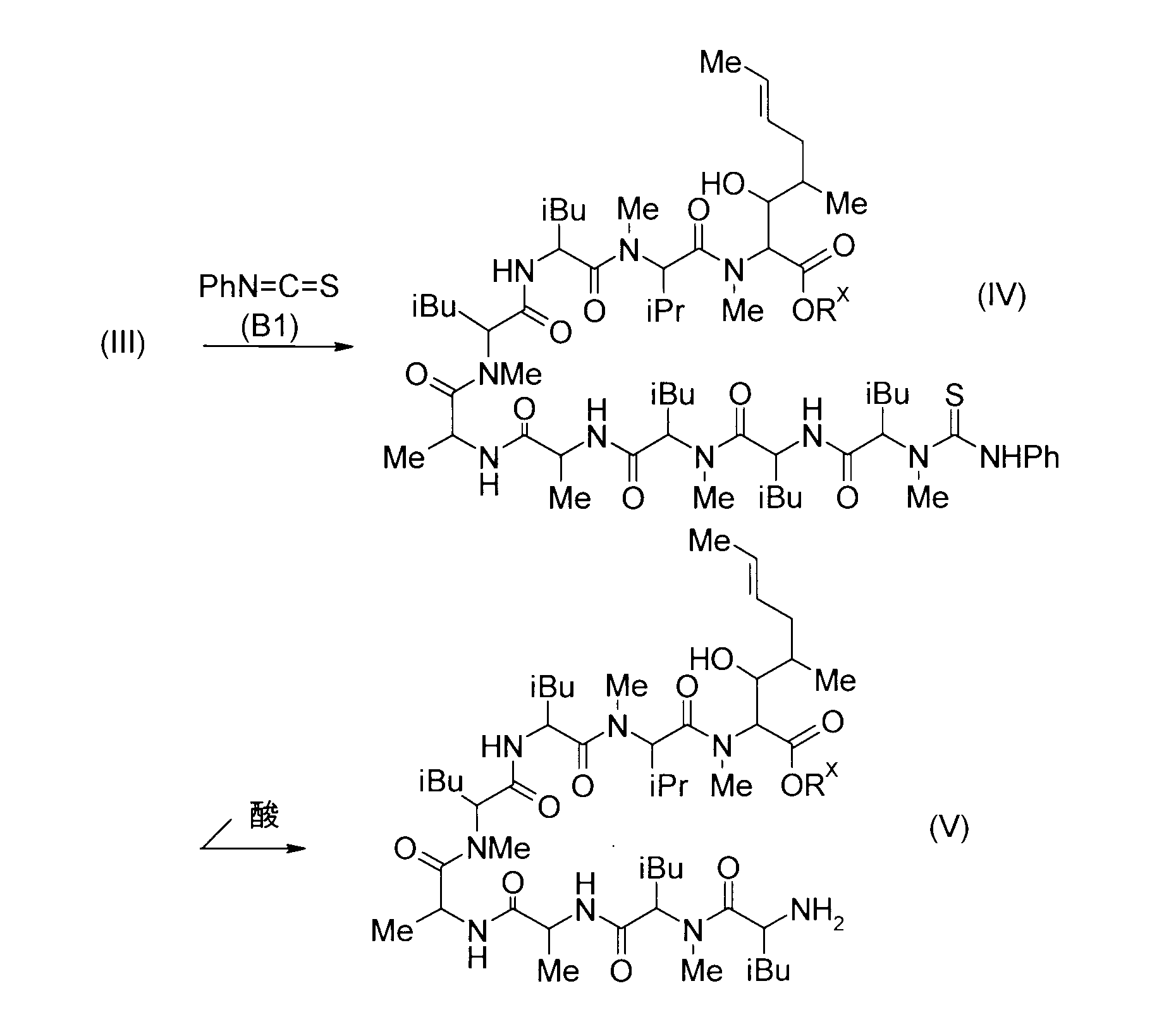
N末端に、弱塩基性条件下でフェニルイソチオシアネートを反応させた後、酸性条件でアミノ酸を、3-フェニル-2-チオヒダントインとして脱離させる二工程を経る。溶媒としては、通常、アセトニトリル、アセトン、MeOH、EtOH等のアルコール、THF、ジオキサン、トルエン、塩化メチレン、クロロホルム、EtOAc、DMF、等、反応に好ましくない影響を与えない有機溶媒またはその混合溶媒などの通常の溶媒中で行われる。反応温度は限定されず、また反応は通常は冷却から加熱下で実施される。本反応は、例えば、M.K.Eberle他、J.Org.Chem.59,7249-7258(1994)等に開示の方法またはこれと同様の方法によって行うことができる。

[式中、Prot1、Prot2はいずれも保護基を意味する。]
Prot2としては、フェニルに置換されていてもよい低級アルキル、又はアリールに置換されていてもよい低級アルキル等が挙げられる。別の態様としては、低級アルキル、ベンジル、tert-ブチルが挙げられる。
Prot1としては、カルバメート、トルエンスルホニル、ニトロベンゼンスルホニル等が挙げられる。別の態様としては、Boc、ベンジルオキシカルボニル、9-フルオレニルメチルオキシカルボニル、2,2,2-トリクロロエトキシカルボニル、アリルオキシカルボニルが挙げられる。
基質の鎖状ペプチドのC末端に、保護されたスレオニンを縮合させるにはいわゆるアミド化反応と同様にして行うことができる。具体的には式(VII)の化合物又はその塩は、式(VI)の化合物又はその塩と、式(B2)の保護されたスレオニンとの反応により得ることができる。 この反応では、式(VI)の化合物又はその塩と式(B2)の保護されたスレオニンとを等量若しくは一方を過剰量用い、これらの混合物を、縮合剤の存在下、反応に不活性な溶媒中、冷却下から加熱下、好ましくは-20℃~60℃において、通常0.1時間~5日間撹拌する。ここで用いられる溶媒の例としては、特に限定はされないが、トルエン若しくはキシレン等の芳香族炭化水素類、ジクロロメタン、1,2-ジクロロエタン若しくはクロロホルム等のハロゲン化炭化水素類、ジエチルエーテル、THF、ジオキサン、ジメトキシエタン等のエーテル類、DMF、DMSO、EtOAc、MeCN又は水、及びこれらの混合物が挙げられる。縮合剤の例としては、WSC、DPPA、オキシ塩化リンが挙げられるが、これらに限定されるものではない。添加剤(例えばHOBt)を用いることが反応に好ましい場合がある。TEA、DIPEA若しくはN-メチルモルホリン等の有機塩基、又はK2CO3、Na2CO3若しくはKOH等の無機塩基の存在下で反応を行うことが、反応を円滑に進行させる上で有利な場合がある。
また、式(VII)の化合物又はその塩を反応性誘導体へ変換後に、式(B2)の保護されたスレオニンと反応させる方法を用いてもよい。カルボン酸の反応性誘導体の例としては、オキシ塩化リン、塩化チオニル等のハロゲン化剤と反応して得られる酸ハロゲン化物、クロロギ酸イソブチル等と反応して得られる混合酸無水物、HOBt等と縮合して得られる活性エステル等が挙げられる。これらの反応性誘導体と式(B2)の保護されたスレオニンとの反応は、ハロゲン化炭化水素類、芳香族炭化水素類、エーテル類等の反応に不活性な溶媒中、冷却下~加熱下、好ましくは-20℃~60℃で行うことができる。
[文献] S.R.Sandler及びW.Karo著、「Organic Functional Group Preparations」、第2版、第1巻、Academic Press Inc.、1991年
日本化学会編「実験化学講座(第5版)」16巻(2005年)(丸善)
式(III)の化合物又はその塩、式(V)の化合物又はその塩、又は、式(VIII)の化合物又はその塩は、適宜保護基を用いて、適切な工程で保護又は脱保護し、アミノ酸又はペプチドを縮合し、式(A)の化合物又はその塩を製造できる。環化反応はアミド化であるので、上述の第3段階と同じ方法によって行うことができ、従って、使用する試薬及び反応条件(例、溶媒、反応温度など)は、上述の第3段階を参照することができる。
上述のように式(I)の化合物又はその塩は、FR901459物質を出発原料として、特許文献1に従って製造できる。
FR901459物質は、スタキボトリス属の微生物(Stachybotrys chartarum No.19292)、特許生物寄託センター(International Patent Organism Depositary)、〒305-8566 茨城県つくば市東1-1-1つくばセンター中央第6、独立行政法人産業技術総合研究所に受託番号FERM BP-3364として1991年4月16日に国際寄託されている)の培養液から、例えば、特許文献2に記載の方法により得ることができる。
特許文献1に記載の方法に従い、(6S,12S,15S,18S,21S,24R,27S,30S,33S,36S)-6-[(1R)-1-ヒドロキシエチル]-36-[(1R,2R,4E)-1-ヒドロキシ-2-メチル-4-ヘキセン-1-イル]-12,15,18,27,30-ペンタイソブチル-33-イソプロピル-2,2,8,11,17,21,24,26,32,35-デカメチル-4,7,10,13,16,19,22,25,28,31,34-ウンデカオキソ-3-オキサ-5,8,11,14,17,20,23,26,29,32,35-ウンデカアザヘプタトリアコンタン-37-オイックアシッドを93.8 g得た。
塩化メチレン 500 mLに実施例化合物1 50.0 gを溶解した後、5℃に冷却し、TFA 213.2 gを滴下して4時間撹拌した。その後、冷市水 500 mLを添加し、10(w/v)%Na2CO3水溶液でpHを6.5に調製した。分液した後、有機層に再度、冷却した市水 500 mLを加え、10(w/v)%Na2CO3水溶液で、pHを6.5~7に調製した。分液後、有機層を分取し,再々度、冷却した市水500 mLを添加し、10(W/V)%Na2CO3水溶液でpHを6.5~7に調製した。分液した後、下層を約250 mLまで濃縮後、CPME 500 mLを添加し、再度約250 mLまで濃縮した。CPME 500 mLを加え、約250 mLまで減圧濃縮した。実施例化合物2のCPME溶液約250 mLを得た。
Calcd for C62H114N11O14、1236.8546
実施例化合物2のCPME溶液約250 mLに、CPME 500 mL、pH7.6のリン酸バッファー水溶液500 mL(Na2HPO4水溶液のpHをKH2PO4水溶液にてpH7.6に調製した。Na2HPO4水溶液は、水522 mLにNa2HPO4・12H2O 6.26 gを溶解して調製した。KH2PO4水溶液は、水81 mLにKH2PO4 0.377 gを溶解して調製した。)を添加した後、80~85℃に昇温し、5時間撹拌した後,25℃に冷却した。分液して得られた有機層を、市水 500 mLで2回洗浄した。有機層を約105 mLまで濃縮後,アセトニトリル 115 mLを滴下した。その後、内温22℃で実施例化合物3の種晶 75 mgを添加し、更にアセトニトリル345 mLを滴下した。晶析液をろ取した後に減圧乾燥し、(2S,3R,4R,6E)-3-ヒドロキシ-4-メチル-2-[メチル(N-メチル-L-ロイシル-L-ロイシル-N-メチル-L-ロイシル-L-アラニル-D-アラニル-N-メチル-L-ロイシル-L-ロイシル-N-メチル-L-バリル)アミノ]オクタ-6-エン酸を白色粉末として得た。収量:22.7 g、収率:56.9 %
HR-ESIMS Found m/z 1064.7697 (M+H)+
Calcd for C55H102N9O11、1064.7698
Column: Waters Atlantis HILIC Silica Column, 2.1 X 50 mm, 3 μm; Gradient:CH3CN-HCOOH=1000-1 → CH3CN-H2O-HCOOH=500-500-1(0 分 → 5 分), CH3CN-H2O-HCOOH=500-500-1 (5分 → 7分), CH3CN-H2O-HCOOH=500-500-1) → CH3CN-HCOOH=1000-1 (7 分 → 7.1 分)、 CH3CN-HCOOH = 1000:1 (7.1分 → 10分)、 flow rate: 0.5 mL/分、 detector: diode Array (210 nm ~ 600 nm)、 Retention Time: 1.51 分。
13C-NMR (100 MHz,DMSO-d6):166.3, 166.2, 68.5, 60.6, 51.2, 32.9, 19.8
1H-NMR (400 MHz,DMSO-d6):1.08(3H,d,J=6.6Hz), 2.82(3H,s), 3.52(1H,brs), 3.66(1H,d,J=16.8Hz),3.96(1H,d,J=16.8Hz), 3.99~4.04(1H,m), 8.26(1H,brs),
MS:ESI(+)/TOF-MS、Found 173.0922(M+H)+、Calcd for C7H13N2O3、173.0921
(非晶質体の製造方法)
実施例化合物2のCPME溶液(40.0 g相当/800 mL)に、pH7.6リン酸バッファー水溶液 400 mL(Na2HPO4水溶液のpHをKH2PO4水溶液にてpH7.6に調整した。Na2HPO4水溶液は水 522 mLにNa2HPO4・12H2O 6.26 gを溶解して調製した。KH2PO4水溶液は、水 81 mLにKH2PO4 0.377 gを溶解して調製した)を加え、80~85℃に昇温し、 5時間30分間撹拌した後、室温まで冷却した。分液して得られた有機層を、市水 400 mL、20(w/v)%食塩水 400 mLで、順次洗浄した。有機層を約 280 mLまで濃縮した後、n-ヘプタン 1800 mL中へ滴下した。析出した粉末をろ取した後に減圧乾燥し、(2S,3R,4R,6E)-3-ヒドロキシ-4-メチル-2-[メチル(N-メチル-L-ロイシル-L-ロイシル-N-メチル-L-ロイシル-L-アラニル-D-アラニル-N-メチル-L-ロイシル-L-ロイシル-N-メチル-L-バリル)アミノ]オクタ-6-エン酸を粉末として得た。収量:32.17 g、収率:93.4 %
CPME 40 mL及びアセトニトリル 160 mLの混合溶媒に、実施例化合物3の粉末 25.0 gを25~45℃で溶解した。その後、1時間かけて20℃まで徐々に冷却し、20℃にて18時間攪拌した。析出した結晶をろ取した後に減圧乾燥し、(2S,3R,4R,6E)-3-ヒドロキシ-4-メチル-2-[メチル(N-メチル-L-ロイシル-L-ロイシル-N-メチル-L-ロイシル-L-アラニル-D-アラニル-N-メチル-L-ロイシル-L-ロイシル-N-メチル-L-バリル)アミノ]オクタ-6-エン酸を結晶として得た。収量:13.02 g、収率:52.1 %
EtOAc 150 mLに、実施例化合物3 10.0 gを溶解した後、pH7.6リン酸バッファー50 mL(Na2HPO4水溶液のpHは、KH2PO4水溶液でpH7.6に調整した。Na2HPO4水溶液は、水 87.5 LにNa2HPO4・12H2O 1.04 gを溶解して調製し、KH2PO4水溶液は、水 12.5 LにKH2PO4 0.568 gを溶解して調製した。)、フェニルイソチオシアネート 2.54 gを添加して、4時間撹拌した。その後、1M 塩酸でpHを2.3に調整した。分液後、有機層を分取し、20(w/v)%食塩水 100 mLで洗浄した後、約40 mLまで濃縮した。実施例化合物4のEtOAc溶液約40 mLを得た。
LR-ESIMS:1222.0(M+Na)+、1198.1(M-H)-
実施例化合物4のEtOAc溶液約40 mLに、さらに、n-ヘプタン 200 mL中に滴下した。析出した粉末をろ取した後、アセトニトリル 100 mLに溶解し、1M 塩酸 94 mLを添加し、20℃にて3時間15分撹拌した。実施例化合物5が得られたことを確認した。
HR-ESIMS Found m/z 937.6712 (M+H)+
Calcd for C48H89N8O10、 937.6701
実施例化合物5の反応液に、さらに、10(w/v)%Na2CO3水溶液を加え、pHを約7に調整し、DIBOC 2.25 gを添加し、25℃で3時間20分撹拌した後、1M 塩酸でpHを2.5に調整した。有機層を分取し、20(w/v)%食塩水 100 mL添加した後、EtOAc 100 mLにて抽出した。有機層を分取した後、約40 mLまで濃縮し、再度EtOAc 150 mLを添加し,約40 mLまで濃縮した。この濃縮液に再々度EtOAc 150 mLを添加し、約40 mLまで濃縮した後、5℃へ冷却し、予め5℃に冷却したn-ヘプタン 40 mL中へ滴下した。析出粉末を濾過した後減圧乾燥し、(2S,3R,4R,6E)-2-{[N-(tert-ブトキシカルボニル)-L-ロイシル-N-メチル-L-ロイシル-L-アラニル-D-アラニル-N-メチル-L-ロイシル-L-ロイシル-N-メチル-L-バリル](メチル)アミノ}-3-ヒドロキシ-4-メチルオクタ-6-エン酸を白色粉末として得た。収量:7.6 g、収率:77.9%
HR-ESIMS Found m/z 1037.7219 (M+H)+
Calcd for C53H97N8O12、 1037.7225
塩化メチレン 75 mLに実施例化合物6 7.5 gを溶解し、L-スレオニンメチルエステル塩酸塩 1.47 g及びHOBt・1水和物 1.47 gを添加し、0~10℃に冷却した。さらに, WSC 1.12 gを加え,5℃で約20時間撹拌した後、市水 75mLにて有機層を洗浄した。水層は塩化メチレン38 mLにて再抽出し、有機層を合わせた。有機層を0.3M 塩酸 68 mLで洗浄し、水層は再び塩化メチレン 38 mLにて再抽出した。有機層を合わせた後,5(w/v)%NaHCO3水溶液 76 mL,20(w/v)%食塩水 55 mLにて順次洗浄し,約30 mLまで濃縮した。濃縮液をヘプタン 300 mL中に滴下した。析出した粉末をろ取した後に減圧乾燥し、(N-[(2S,3R,4R,6E)-2-{[N-(tert-ブトキシカルボニル)-L-ロイシル-N-メチル-L-ロイシル-L-アラニル-D-アラニル-N-メチル-L-ロイシル-L-ロイシル-N-メチル-L-バリル](メチル)アミノ}-3-ヒドロキシ-4-メチルオクタ-6-エノイル]-L-スレオニンメチルエステルを白色粉末として得た。収量:7.12 g、収率:85.5 %
HR-ESIMS Found m/z 1152.7864 (M+H)+
Calcd for C58H106N9O14、 1152.7859
塩化メチレン 120 mLに実施例化合物7 20.0 gを溶解し、-5℃に冷却した。TFA 98.9 gを滴下し、2時間40分間撹拌した後、冷却した市水 200 mLで洗浄した。分液して得られた有機層をさらに冷却した市水 200 mLで洗浄した。有機層に冷却した市水 200 mLを添加し,さらに10(w/v)%Na2CO3水溶液を用いて、pHを6.5~7に調製した。分液して得られた有機層に、再び冷市水 200 mLを添加し、10(w/v)% Na2CO3水溶液でpHを6.5~7に調製した。分液して得られた有機層に再々度冷市水 200 mLを添加し、10(w/v)% Na2CO3水溶液でpHを6.5~7に調製した。分液して得られた有機層を約50 mLまで減圧濃縮した。濃縮液をヘプタン 1500 mL中に滴下した後に析出した粉末をろ取した後に減圧乾燥し、N-{(2S,3R,4R,6E)-3-ヒドロキシ-2-[(L-ロイシル-N-メチル-L-ロイシル-L-アラニル-D-アラニル-N-メチル-L-ロイシル-L-ロイシル-N-メチル-L-バリル)(メチル)アミノ]-4-メチルオクタ-6-エノイル}-L-スレオニンメチルエステルを白色粉末として得た。収量 :16.82 g、収率:92.1 %。
得られた実施例化合物8は、特許文献1のPrep3の化合物とNMR及びMSデータと比較した結果、同じ構造であることを確認した。
Calcd for C53H98N9O12、 1052.7335
Claims (6)
- 式(II)

の化合物又はその塩から、二アミノ酸を一工程で脱離させることを特徴とする、
式(III)
の化合物又はその塩の製造方法。
(式中、RXは-H又は保護基、iBuはイソブチル、iPrはイソプロピル、Meはメチルをそれぞれ意味する。) - 式(I)

の化合物又はその塩を脱保護反応に付し、式(II)の化合物又はその塩を得、さらに請求項1に記載の工程により得られた式(III)の化合物又はその塩に保護基を導入することを特徴とする、
式(VI)
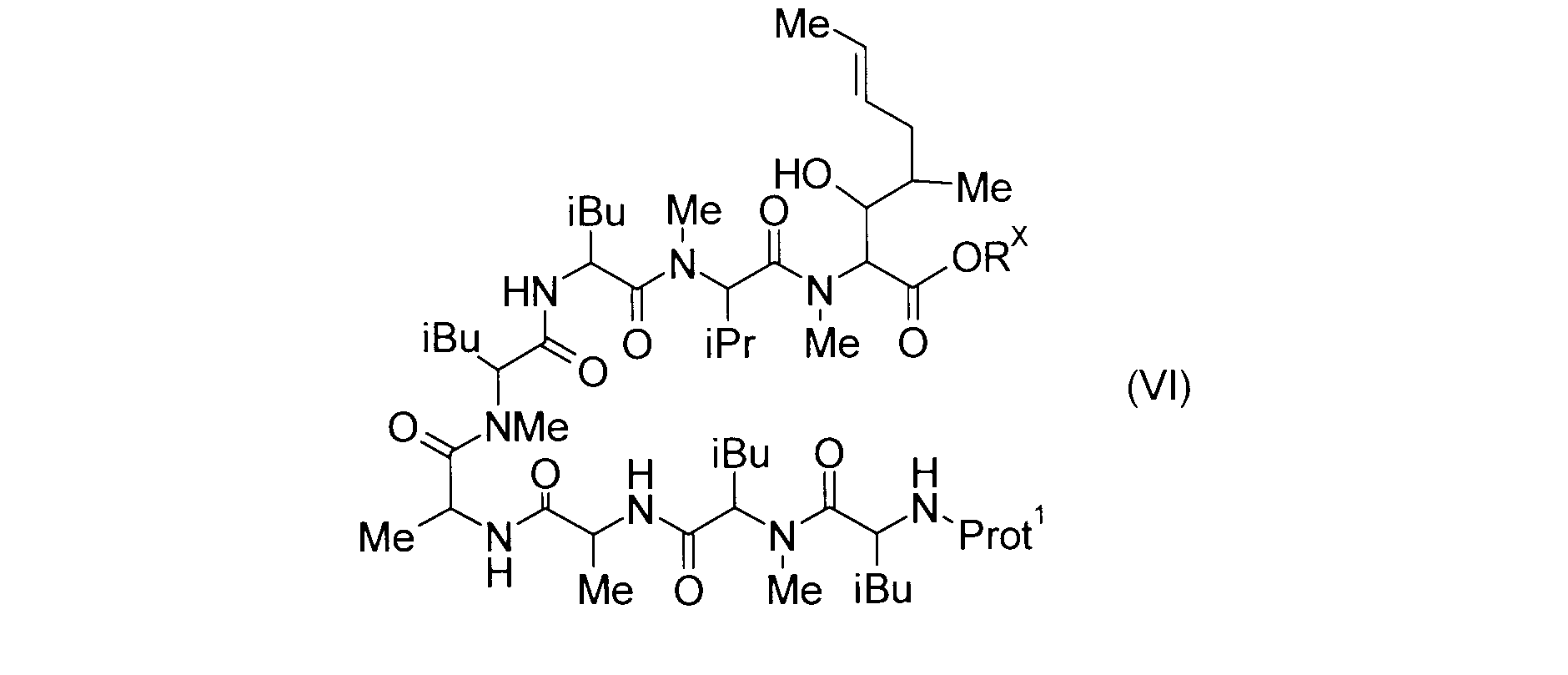
の化合物又はその塩の製造方法。
(式中、RXは-H又は保護基、iBuはイソブチル、iPrはイソプロピル、Meはメチル、Prot0及びProt1は保護基をそれぞれ意味する。) - 請求項2の製造方法に従い、式(I)の化合物又はその塩から得られた式(VI)の化合物又はその塩から、
式(A)

の化合物又はその塩の製造方法。
(式中、
Xは、

又は、

であり、
R1は、-H、又は、低級アルキルであり;
R2は、-H、アリール、又は、低級アルキルであり、
ここで当該低級アルキルは、ヒドロキシ、シクロアルキル、低級アルコキシ、アリール、アロアルコキシ、置換されてもよいカルバモイルオキシ、及び、置換されてもよいアミノからなる群から選択される1個の適切な置換基で置換されてもよく;

は、含窒素複素環であり;
Yは、

又は、

であり、
R3は、シクロアルキル、アリール、置換されてもよい複素環、又は、低級アルキルであり、
ここで当該低級アルキルは、ヒドロキシ、シクロアルキル、低級アルコキシ、アリール、アロアルコキシ、低級アルコキシ-低級アルキレン-O-、置換されてもよいアミノ、及び、-OC(O)NR6R7からなる群から選択される1個の適切な置換基によって置換されてもよく、
(式中、R6及びR7は、それぞれ独立に-H、又は、低級アルキルであるか、あるいは、R6及びR7がその結合する窒素原子と一緒になって、低級アルキルで置換されてもよい含窒素複素環を表す。)
であり;
R4及びR5は、それぞれ独立に-H、又は低級アルキルであり;
----は、単結合または二重結合を表す。
(ただし、R2が-Hである場合、R3は、シクロアルキル、アリール、置換されてもよい複素環、低級アルコキシメチル、アロアルキル、t-ブチル、sec-ブチル、シクロアルキル、又は、エチルであり、
ここで当該エチルは、低級アルキル、またはヒドロキシ、低級アルキル-O-、アリール-低級アルキレン-O-、低級アルキル-O-低級アルキレン-O-、置換されてもよいアミノ、及び、-OC(O)NR6R7からなる群より選択される1個の適切な置換基によって置換されていてもよい。)) - 請求項2の製造方法に従い、式(I)の化合物又はその塩から得られた式(VI)の化合物又はその塩に、カルボン酸末端に保護されたスレオニンを縮合させ、アミノ末端を脱保護することを特徴とする、
式(VIII)
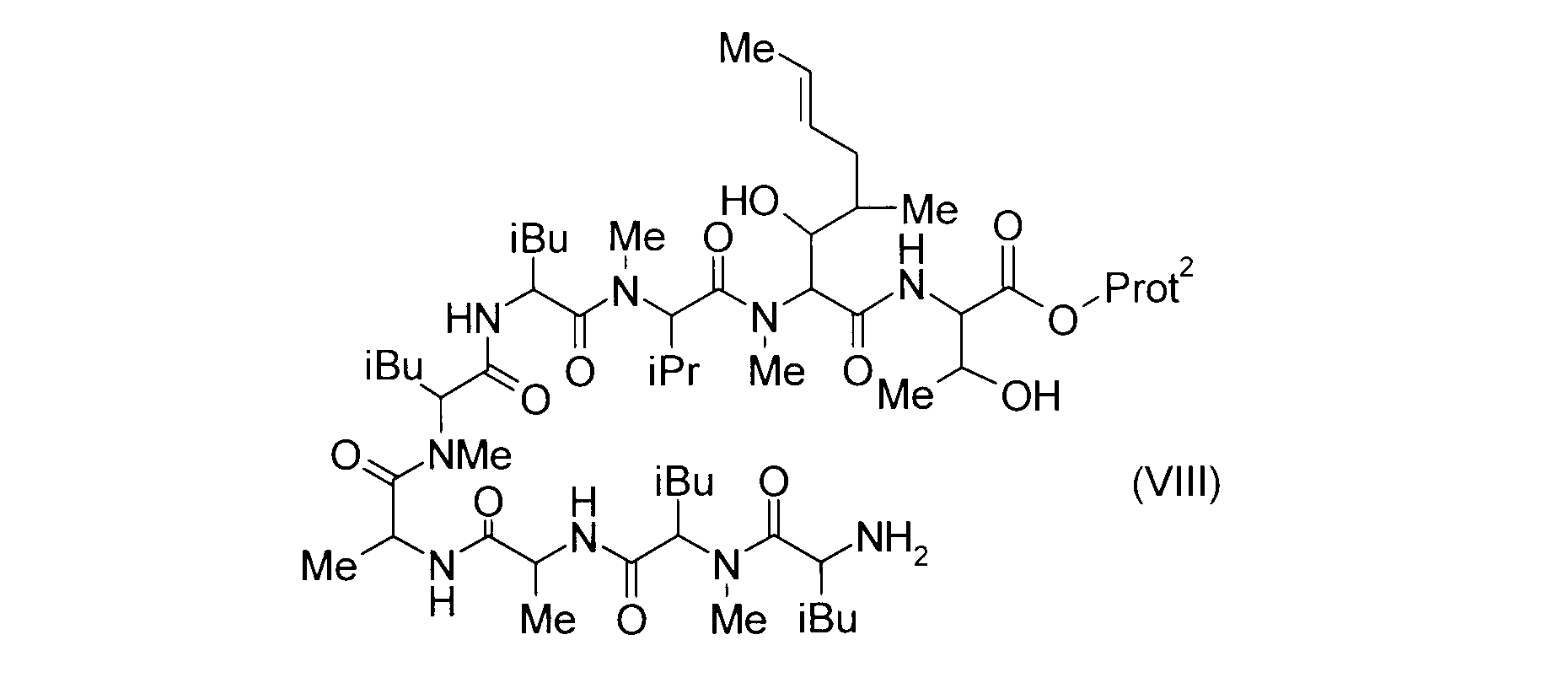
の化合物又はその塩の製造方法。
(式中、iBuはイソブチル、iPrはイソプロピル、Meはメチル、Prot2は保護基をそれぞれ意味する。) - 請求項3に記載の方法に従い、式(I)の化合物又はその塩から製造された式(VIII)の化合物又はその塩のアミノ末端に二アミノ酸を縮合させ、脱保護後に環化させることを特徴とする、式(A)の化合物又はその塩の製造方法。
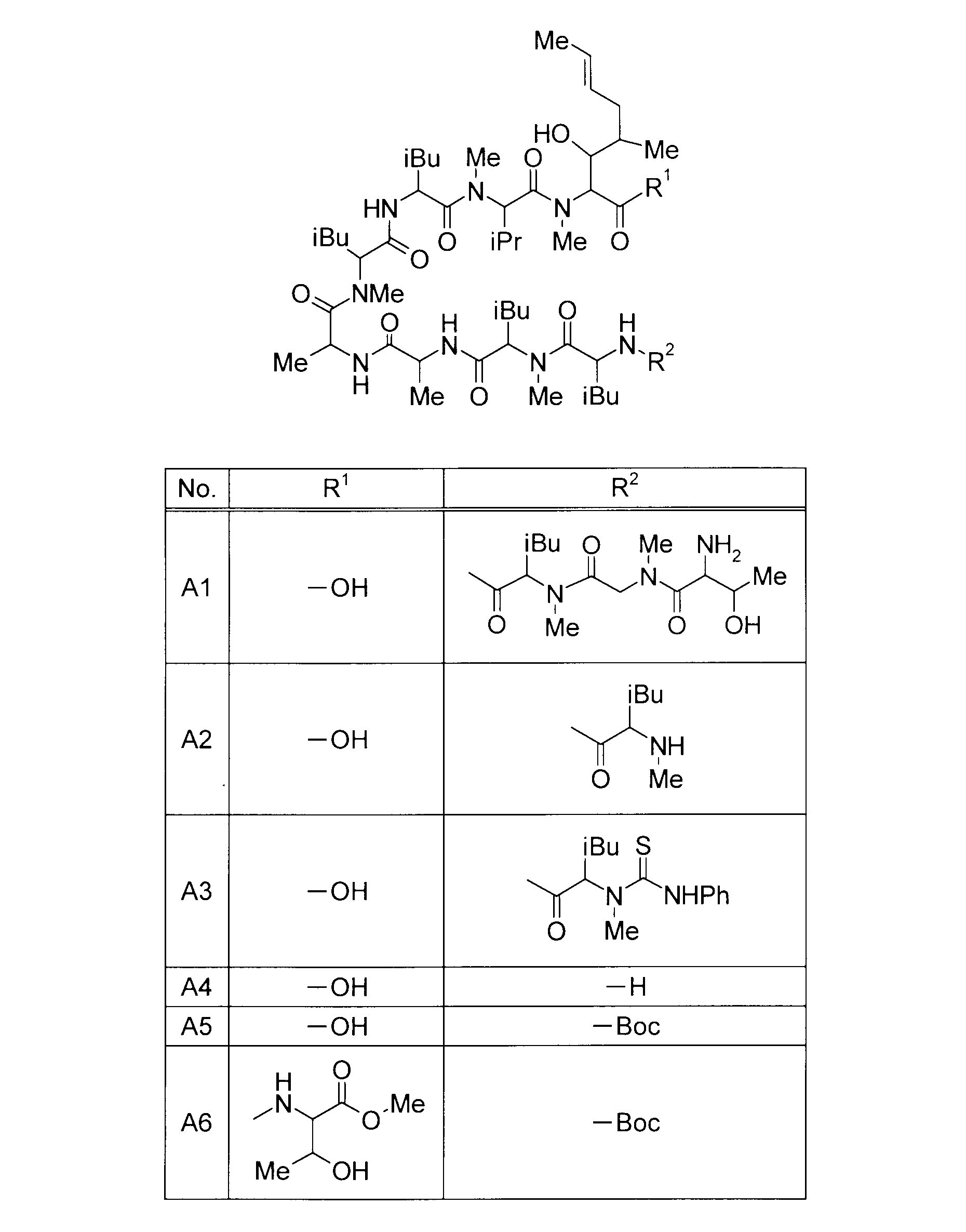
- 以下からなる群より選択される化合物又はその塩。

(式中、iBuはイソブチル、iPrはイソプロピル、Bocはターシャリーブトキシカルボニル、Meはメチル、Phはフェニルをそれぞれ意味する。)
Priority Applications (4)
| Application Number | Priority Date | Filing Date | Title |
|---|---|---|---|
| CA2738280A CA2738280A1 (en) | 2008-09-24 | 2009-09-18 | Peptide compound and method for producing the same |
| JP2010530839A JP5625910B2 (ja) | 2008-09-24 | 2009-09-18 | ペプチド化合物およびその製造方法 |
| CN2009801381065A CN102164947A (zh) | 2008-09-24 | 2009-09-18 | 肽化合物及其制备方法 |
| MX2011003259A MX2011003259A (es) | 2008-09-24 | 2009-09-18 | Compuesto de peptido y metodo para producir el mismo. |
Applications Claiming Priority (2)
| Application Number | Priority Date | Filing Date | Title |
|---|---|---|---|
| JP2008244410 | 2008-09-24 | ||
| JP2008-244410 | 2008-09-24 |
Publications (1)
| Publication Number | Publication Date |
|---|---|
| WO2010035722A1 true WO2010035722A1 (ja) | 2010-04-01 |
Family
ID=42059721
Family Applications (1)
| Application Number | Title | Priority Date | Filing Date |
|---|---|---|---|
| PCT/JP2009/066449 Ceased WO2010035722A1 (ja) | 2008-09-24 | 2009-09-18 | ペプチド化合物およびその製造方法 |
Country Status (6)
| Country | Link |
|---|---|
| JP (1) | JP5625910B2 (ja) |
| KR (1) | KR20110073473A (ja) |
| CN (1) | CN102164947A (ja) |
| CA (1) | CA2738280A1 (ja) |
| MX (1) | MX2011003259A (ja) |
| WO (1) | WO2010035722A1 (ja) |
Families Citing this family (1)
| Publication number | Priority date | Publication date | Assignee | Title |
|---|---|---|---|---|
| US11993629B2 (en) * | 2019-02-04 | 2024-05-28 | Nissan Chemical Corporation | Method for producing peptide compound |
Citations (2)
| Publication number | Priority date | Publication date | Assignee | Title |
|---|---|---|---|---|
| WO2007049803A1 (en) * | 2005-10-26 | 2007-05-03 | Astellas Pharma Inc. | New cyclic peptide compounds |
| WO2008139986A1 (en) * | 2007-05-02 | 2008-11-20 | Astellas Pharma Inc., | New cyclic peptide compounds |
Family Cites Families (2)
| Publication number | Priority date | Publication date | Assignee | Title |
|---|---|---|---|---|
| GB0320638D0 (en) * | 2003-09-03 | 2003-10-01 | Novartis Ag | Organic compounds |
| JP2007015926A (ja) * | 2003-10-06 | 2007-01-25 | Fujisawa Pharmaceut Co Ltd | C型肝炎治療剤 |
-
2009
- 2009-09-18 CN CN2009801381065A patent/CN102164947A/zh active Pending
- 2009-09-18 JP JP2010530839A patent/JP5625910B2/ja not_active Expired - Fee Related
- 2009-09-18 MX MX2011003259A patent/MX2011003259A/es active IP Right Grant
- 2009-09-18 KR KR1020117006749A patent/KR20110073473A/ko not_active Withdrawn
- 2009-09-18 CA CA2738280A patent/CA2738280A1/en not_active Abandoned
- 2009-09-18 WO PCT/JP2009/066449 patent/WO2010035722A1/ja not_active Ceased
Patent Citations (2)
| Publication number | Priority date | Publication date | Assignee | Title |
|---|---|---|---|---|
| WO2007049803A1 (en) * | 2005-10-26 | 2007-05-03 | Astellas Pharma Inc. | New cyclic peptide compounds |
| WO2008139986A1 (en) * | 2007-05-02 | 2008-11-20 | Astellas Pharma Inc., | New cyclic peptide compounds |
Also Published As
| Publication number | Publication date |
|---|---|
| CN102164947A (zh) | 2011-08-24 |
| JPWO2010035722A1 (ja) | 2012-02-23 |
| JP5625910B2 (ja) | 2014-11-19 |
| CA2738280A1 (en) | 2010-04-01 |
| KR20110073473A (ko) | 2011-06-29 |
| MX2011003259A (es) | 2011-04-21 |
Similar Documents
| Publication | Publication Date | Title |
|---|---|---|
| AU2022393856B2 (en) | Exatecan derivatives, linker-payloads, and conjugates and thereof | |
| JP5789260B2 (ja) | C型肝炎ウイルスのプロテアーゼ阻害薬の調製方法 | |
| US9637518B2 (en) | IAP antagonists | |
| JP2026053472A (ja) | 抗ウイルス剤としての官能化ペプチド | |
| US9783573B2 (en) | IAP antagonists | |
| US9603889B2 (en) | IAP antagonists | |
| US20030100768A1 (en) | Imidazolidinones and their related derivatives as hepatitis C virus NS3 protease inhibitors | |
| WO2019094920A1 (en) | Azepin-2-one derivatives as rsv inhibitors | |
| EP2407478A1 (en) | New cyclotetrapeptides with pro-angiogenic properties | |
| KR20150128891A (ko) | 인돌아민 2,3-디옥시게나제 (ido)의 억제제 | |
| US20140135270A1 (en) | Macrocyclic compounds for inhibition of inhibitors of apoptosis | |
| TW200538450A (en) | HCV NS-3 serine protease inhibitors | |
| WO2002048116A2 (en) | Inhibitors of hepatitis c virus ns3 protease | |
| HK1041007A1 (zh) | 截尾海兔肽15衍生物 | |
| WO2023127869A1 (ja) | N-アルキルアミノ酸、およびn-アルキルアミノ酸を含むペプチドの製造方法 | |
| CN111372942A (zh) | 调节β-联蛋白功能的物质及其方法 | |
| JP2025516873A (ja) | タンパク質分解剤クラスの生物学的活性化合物を含む抗体薬物複合体及びその調製方法並びに使用 | |
| AU2024203286A1 (en) | Antiviral 1,3-di-oxo-indene compounds | |
| JP5666442B2 (ja) | パンクラチスタチンの窒素化誘導体 | |
| JPH02300199A (ja) | レトロウイルスプロテアーゼ阻害剤 | |
| DE69928646T2 (de) | Streptograminderivate, ihre herstellung und die zusammensetzungen, die sie enthalten | |
| CA2182396A1 (en) | Novel amino acid derivatives, method of producing them and pharmaceutical compositions containing these compounds | |
| WO2018028491A1 (zh) | 吲哚胺2,3-双加氧酶抑制剂及其在药学中的用途 | |
| JP5625910B2 (ja) | ペプチド化合物およびその製造方法 | |
| US20050107288A1 (en) | Antibacterial macrocycles |
Legal Events
| Date | Code | Title | Description |
|---|---|---|---|
| WWE | Wipo information: entry into national phase |
Ref document number: 200980138106.5 Country of ref document: CN |
|
| 121 | Ep: the epo has been informed by wipo that ep was designated in this application |
Ref document number: 09816137 Country of ref document: EP Kind code of ref document: A1 |
|
| WWE | Wipo information: entry into national phase |
Ref document number: 2010530839 Country of ref document: JP |
|
| WWE | Wipo information: entry into national phase |
Ref document number: 1997/CHENP/2011 Country of ref document: IN |
|
| WWE | Wipo information: entry into national phase |
Ref document number: 2738280 Country of ref document: CA |
|
| ENP | Entry into the national phase |
Ref document number: 20117006749 Country of ref document: KR Kind code of ref document: A |
|
| NENP | Non-entry into the national phase |
Ref country code: DE |
|
| WWE | Wipo information: entry into national phase |
Ref document number: MX/A/2011/003259 Country of ref document: MX |
|
| 122 | Ep: pct application non-entry in european phase |
Ref document number: 09816137 Country of ref document: EP Kind code of ref document: A1 |