WO2010029909A1 - 一酸化ニオブの製造方法及び一酸化ニオブ - Google Patents
一酸化ニオブの製造方法及び一酸化ニオブ Download PDFInfo
- Publication number
- WO2010029909A1 WO2010029909A1 PCT/JP2009/065632 JP2009065632W WO2010029909A1 WO 2010029909 A1 WO2010029909 A1 WO 2010029909A1 JP 2009065632 W JP2009065632 W JP 2009065632W WO 2010029909 A1 WO2010029909 A1 WO 2010029909A1
- Authority
- WO
- WIPO (PCT)
- Prior art keywords
- niobium
- monoxide
- rare earth
- niobium monoxide
- earth element
- Prior art date
- Legal status (The legal status is an assumption and is not a legal conclusion. Google has not performed a legal analysis and makes no representation as to the accuracy of the status listed.)
- Ceased
Links
Images


Classifications
-
- H—ELECTRICITY
- H01—ELECTRIC ELEMENTS
- H01G—CAPACITORS; CAPACITORS, RECTIFIERS, DETECTORS, SWITCHING DEVICES, LIGHT-SENSITIVE OR TEMPERATURE-SENSITIVE DEVICES OF THE ELECTROLYTIC TYPE
- H01G9/00—Electrolytic capacitors, rectifiers, detectors, switching devices, light-sensitive or temperature-sensitive devices; Processes of their manufacture
- H01G9/004—Details
- H01G9/04—Electrodes or formation of dielectric layers thereon
- H01G9/048—Electrodes or formation of dielectric layers thereon characterised by their structure
- H01G9/052—Sintered electrodes
-
- C—CHEMISTRY; METALLURGY
- C01—INORGANIC CHEMISTRY
- C01G—COMPOUNDS CONTAINING METALS NOT COVERED BY SUBCLASSES C01D OR C01F
- C01G33/00—Compounds of niobium
-
- H—ELECTRICITY
- H01—ELECTRIC ELEMENTS
- H01G—CAPACITORS; CAPACITORS, RECTIFIERS, DETECTORS, SWITCHING DEVICES, LIGHT-SENSITIVE OR TEMPERATURE-SENSITIVE DEVICES OF THE ELECTROLYTIC TYPE
- H01G9/00—Electrolytic capacitors, rectifiers, detectors, switching devices, light-sensitive or temperature-sensitive devices; Processes of their manufacture
- H01G9/0029—Processes of manufacture
-
- H—ELECTRICITY
- H01—ELECTRIC ELEMENTS
- H01G—CAPACITORS; CAPACITORS, RECTIFIERS, DETECTORS, SWITCHING DEVICES, LIGHT-SENSITIVE OR TEMPERATURE-SENSITIVE DEVICES OF THE ELECTROLYTIC TYPE
- H01G9/00—Electrolytic capacitors, rectifiers, detectors, switching devices, light-sensitive or temperature-sensitive devices; Processes of their manufacture
- H01G9/004—Details
- H01G9/04—Electrodes or formation of dielectric layers thereon
- H01G9/042—Electrodes or formation of dielectric layers thereon characterised by the material
-
- C—CHEMISTRY; METALLURGY
- C01—INORGANIC CHEMISTRY
- C01P—INDEXING SCHEME RELATING TO STRUCTURAL AND PHYSICAL ASPECTS OF SOLID INORGANIC COMPOUNDS
- C01P2002/00—Crystal-structural characteristics
- C01P2002/70—Crystal-structural characteristics defined by measured X-ray, neutron or electron diffraction data
- C01P2002/72—Crystal-structural characteristics defined by measured X-ray, neutron or electron diffraction data by d-values or two theta-values, e.g. as X-ray diagram
-
- C—CHEMISTRY; METALLURGY
- C01—INORGANIC CHEMISTRY
- C01P—INDEXING SCHEME RELATING TO STRUCTURAL AND PHYSICAL ASPECTS OF SOLID INORGANIC COMPOUNDS
- C01P2004/00—Particle morphology
- C01P2004/01—Particle morphology depicted by an image
- C01P2004/03—Particle morphology depicted by an image obtained by SEM
-
- C—CHEMISTRY; METALLURGY
- C01—INORGANIC CHEMISTRY
- C01P—INDEXING SCHEME RELATING TO STRUCTURAL AND PHYSICAL ASPECTS OF SOLID INORGANIC COMPOUNDS
- C01P2006/00—Physical properties of inorganic compounds
- C01P2006/12—Surface area
-
- C—CHEMISTRY; METALLURGY
- C01—INORGANIC CHEMISTRY
- C01P—INDEXING SCHEME RELATING TO STRUCTURAL AND PHYSICAL ASPECTS OF SOLID INORGANIC COMPOUNDS
- C01P2006/00—Physical properties of inorganic compounds
- C01P2006/40—Electric properties
-
- C—CHEMISTRY; METALLURGY
- C01—INORGANIC CHEMISTRY
- C01P—INDEXING SCHEME RELATING TO STRUCTURAL AND PHYSICAL ASPECTS OF SOLID INORGANIC COMPOUNDS
- C01P2006/00—Physical properties of inorganic compounds
- C01P2006/80—Compositional purity
Definitions
- the present invention relates to a technique for producing niobium monoxide having a large specific surface area and a fine particle size.
- niobium oxide used as a raw material for electronic parts such as frequency filters and capacitors, and as a target material for sputtering has been rapidly increasing.
- niobium monoxide hereinafter sometimes referred to as “NbO”
- NbO niobium monoxide
- niobium capacitors have been required to be smaller and thinner (thinner), and accordingly, higher capacity has been demanded.
- the raw material powder parameter corresponding to the capacitance is the specific surface area, and the larger the specific surface area of the raw material powder as the dielectric and the anode, the larger the capacitance can be realized. Therefore, NbO used as a raw material for niobium capacitors is required to be a finer powder having a large specific surface area.
- Patent Document 1 discloses a manufacturing method in which an activation agent such as an oxide, carbonate, nitrate, or organic substance is added to niobium monoxide obtained by reducing niobium pentoxide with magnesium, and an activation process is performed. Proposed. According to the production method using this activator, niobium monoxide having many pores can be obtained, and the specific surface area can be increased. However, in the prior art using this activator, an activator is added and a removal step by washing is required, and an increase in cost due to an increase in the number of steps can be considered. Further, depending on the degree of the removal step, a large amount of impurities may be mixed into niobium monoxide, which may cause deterioration of the electrical characteristics of the capacitor, which is not preferable.
- an activation agent such as an oxide, carbonate, nitrate, or organic substance
- the present invention has been made under the circumstances described above, and an object thereof is to provide a technique for producing niobium monoxide having a large specific surface area suitable as a capacitor material and comprising fine particles.
- the present inventors have conducted extensive studies on a conventional method for producing niobium monoxide by reduction firing. As a result, the specific surface area is large and the particles are made of fine particles to improve capacitor characteristics.
- the present invention relates to a method for producing niobium monoxide by reducing and firing niobium pentoxide or niobium dioxide to produce niobium monoxide, wherein niobium pentoxide or niobium dioxide is mixed with a salt containing a rare earth element.
- the firing process is performed, and after the firing process, the reduction process is performed by mixing the niobium oxide in a state in which the rare earth element is doped at the niobium atom position and the reducing agent.
- niobium pentoxide or niobium dioxide and a salt containing a rare earth element are mixed and fired in an inert atmosphere or an atmosphere containing oxygen, so that the rare earth element is placed at the position of the niobium atom.
- a rare earth element-containing niobium oxide in a partially substituted state is obtained.
- the rare earth element-containing niobium oxide and the reducing agent thus obtained are mixed and reduced and fired, the sintering suppression effect due to the contained rare earth element is produced, so that the niobium oxidation not containing the rare earth element occurs.
- the primary particles of niobium monoxide are clearly finer than when the product is reduced and fired.
- the niobium monoxide obtained according to the present invention contains a rare earth element, but is contained in a state where it is substituted at the atomic level. Therefore, removal work as in the prior art of Patent Document 1 described above is required. do not do.
- the firing conditions after mixing are preferably 700 ° C. to 1100 ° C. for 5 hours to 24 hours in the air, and the subsequent reduction firing conditions are 1200 ° C. to 1500 ° C. for 5 hours to 24 hours in a hydrogen atmosphere. The firing time is preferred.
- the salt containing the rare earth element it is preferable to use at least one of carbonate, nitrate and oxalate as the salt containing the rare earth element.
- a rare earth salt compound of any one of carbonate, nitrate and oxalate is mixed with niobium pentoxide or niobium dioxide and calcined, the carbonate, nitrate and oxalate radicals are vaporized and vaporized, resulting in the rare earth This is because the elements are easily distributed uniformly at the positions of niobium atoms.
- the reducing agent in the production method of the present invention is preferably selected from the group of alkali metals, alkaline earth metals, niobium carbides, niobium nitrides, niobium sulfides, niobium hydrides, and niobium metals. This is because with these reducing agents, niobium monoxide can be efficiently produced from the niobium oxide containing the rare earth element subjected to the firing treatment.
- the rare earth element is selected from a group of Y, La, Ce, Pr, Nd, Sm, Eu, Gd, Tb, Dy, Ho, Er, Tm, Yb, and Lu. Is preferred. Furthermore, it is more preferable that at least one element is selected from Y, La, and Ce. If these rare earth elements are used, the rare earth element is substituted at the position of the niobium atoms, so that the sintering suppressing action becomes more effective.
- the amount of the salt containing a rare earth element to be mixed with niobium pentoxide or niobium dioxide is preferably adjusted so that the rare earth element content in the finally obtained niobium monoxide is 50 ppm to 1000 ppm. If it is less than 50 ppm, the sintering suppressing effect is reduced, and if it exceeds 1000 ppm, the rare earth element cannot be substituted at the position of the niobium atom, and a complex oxide of rare earth element and niobium is produced as an impurity. Because it will end up.
- niobium pentoxide and rare earth elements when mixing niobium pentoxide and rare earth elements, either dry mixing or wet mixing may be used, but wet mixing is preferable in consideration of homogeneity and workability after mixing.
- wet mixing an organic solvent such as pure water or alcohol can be used as a solvent.
- the rare earth element selected from the group consisting of Y, La, Ce, Pr, Nd, Sm, Eu, Gd, Tb, Dy, Ho, Er, Tm, Yb, and Lu is 50 ppm to 1000 ppm.
- Niobium monoxide containing can be produced. Since the niobium monoxide of the present invention is a powder of niobium monoxide having a large specific surface area, which is composed of fine primary particles, it is possible to improve the capacitance, which is a capacitor characteristic. When the content of the rare earth element is less than 50 ppm, the sintering suppressing effect is reduced and fine primary particles cannot be formed. When the content exceeds 1000 ppm, the complex oxide of rare earth element and niobium is used as an impurity. It is because it becomes what produced
- the niobium monoxide of the present invention is incorporated in a state where the rare earth metal is substituted at the position of the niobium atom, the peak indicated by niobium monoxide obtained by X-ray diffraction shifts to the high angle side.
- the reason for this is that when the rare earth metal is substituted at the position of the niobium atom, a defect occurs at the position of the niobium atom to compensate for the charge, the unit cell is distorted, and the lattice constant is reduced, resulting in a high peak. It is thought to shift to the angle side.
- the peak shift to the high angle side is 0.
- the angle is preferably 01 ° or more, and the peak shift to the high angle side is preferably 0.05 ° or less from the viewpoint of maintaining a uniform crystal structure.
- niobium monoxide having a large specific surface area and comprising fine particles can be easily produced.
- niobium monoxide according to the present invention has a large pore volume and specific surface area, it is possible to increase the capacitance of the capacitor characteristics.
- X-ray diffraction measurement chart X-ray diffraction measurement chart.
- Example 1 a case where La (lanthanum) is used as a rare earth element will be described as an example.
- lanthanum nitrate hexahydrate 44.3 mg of lanthanum nitrate hexahydrate and 1000 mL of pure water were prepared and mixed with 100 g of powdered niobium pentoxide (Nb 2 O 5 ) (this lanthanum nitrate hexahydrate). Is equivalent to 50 ppm in terms of lanthanum with respect to the finally obtained niobium monoxide powder).
- Mixing was performed by a ball mill, and 1 mm ⁇ zirconia balls were used as mixing media, and the mixing time was 60 min. Then, this mixture was subjected to solid-liquid separation, and the resulting cake was dried at 120 ° C. for 6 hours, and further baked in an air atmosphere at 800 ° C. for 6 hours. Niobium pentoxide in which lanthanum was substituted at the niobium atom position. I got a powder.
- niobium monoxide having lanthanum amounts of 50 ppm, 100 ppm, 500 ppm, and 1000 ppm with respect to the finally obtained niobium monoxide was prepared and evaluated.
- niobium monoxide containing no rare earth element was produced as follows. Niobium monoxide as a comparative example was wet mixed with 50 g of niobium pentoxide, 5.9 g of niobium carbide (NbC), and 100 mL of pure water. Mixing was performed by a ball mill, and 1 mm ⁇ zirconia balls were used as mixing media, and the mixing time was 60 min. This mixture was subjected to solid-liquid separation, and the resulting cake was dried at 120 ° C. for 6 hours, and further subjected to a baking treatment at 1350 ° C. for 5 hours in a hydrogen atmosphere to produce niobium monoxide.
- NbC niobium carbide
- niobium monoxide obtained as described above, the pore volume and specific surface area were measured as physical properties. Further, capacitors were formed, and CV values, capacitance, withstand voltage, and dielectric loss (Tan ⁇ ), which are capacitor characteristics, were examined. Each measurement condition is shown below.
- Pore volume After forming niobium monoxide powder into pellets ( ⁇ 5mm ⁇ 4.5mm), using the pellets, a mercury intrusion porosimeter for micropore distribution measurement (manufactured by Micromeritics, Auto Pore IV) It was measured.
- a BET specific surface area measuring apparatus (Co., Ltd.) using a nitrogen-helium mixed gas containing about 30% by volume of nitrogen as an adsorbing gas and about 70% by volume of helium as a carrier gas.
- a nitrogen-helium mixed gas containing about 30% by volume of nitrogen as an adsorbing gas and about 70% by volume of helium as a carrier gas.
- JIS R 1626 Method for measuring specific surface area of fine ceramic powder by gas adsorption BET method” according to 6.2 flow method (3.5) single point method It was.
- Capacitor characteristics such as CV value, capacitance, withstand voltage, and electrical characteristics of Tan ⁇ were obtained by using the obtained niobium monoxide to produce the following porous sintered body.
- niobium monoxide powder 0.25 g was put into a press mold in which a tantalum (Ta) wire having a diameter of 0.3 mm was inserted and molded into a pellet.
- the molded pellet ( ⁇ 5 mm ⁇ 4.5 mm) was fired at 1400 ° C. for 10 minutes.
- the pellets were immersed in a 0.1M-H 3 PO 4 bath at 80 ° C., and maintained at a constant current density of 0.375 A / m 2 and a conversion voltage of 30 V for 60 minutes to perform anodization.
- the anodized pellet was immersed again in 0.1M-H 3 PO 4 at 80 ° C. and held at a current density of 0.1 A / m 2 for 5 minutes to measure the withstand voltage.
- the anodized pellet was immersed in a 150 g / L ammonium adipate solution, held at room temperature for 30 minutes, and then measured for CV value, capacitance, and dielectric loss (Tan ⁇ ) under the condition of 120 Hz.
- Tables 1 and 2 show the evaluation results of physical properties and capacitor characteristics obtained in Example 1. In addition, about the physical-property value of Table 1, the average measurement result of three samples is shown.
- niobium monoxide of Example 1 can achieve a substantially target CV value with respect to the target CV value of 80000 ⁇ FV / g.
- Example 2 a case where Ce (cerium) is used as a rare earth element will be described as an example.
- cerium nitrate hexahydrate and 1000 mL of pure water were prepared and mixed with 100 g of powdered niobium pentoxide (Nb 2 O 5 ) (this cerium nitrate hexahydrate). Is equivalent to 50 ppm in terms of cerium with respect to the finally obtained niobium monoxide powder).
- Mixing was performed by a ball mill, and 1 mm ⁇ zirconia balls were used as mixing media, and the mixing time was 60 min. Then, this mixture was subjected to solid-liquid separation, and the resulting cake was dried at 120 ° C. for 6 hours, and further baked in an air atmosphere at 800 ° C. for 6 hours. Niobium pentoxide in which cerium was substituted at the position of niobium atoms I got a powder.
- niobium monoxide having a cerium content of 100 ppm and 500 ppm with respect to the finally obtained niobium monoxide was produced and evaluated.
- niobium monoxide containing no rare earth element was niobium monoxide for comparison in Example 1 above.
- the pore volume and specific surface area were measured as physical properties. Further, capacitors were formed, and CV values, capacitance, withstand voltage, and dielectric loss (Tan ⁇ ), which are capacitor characteristics, were examined. Each measurement condition was the same as in Example 1 above. Tables 3 and 4 show the evaluation results of the physical properties and capacitor characteristics obtained in Example 2. In addition, about the physical-property value of Table 3, the average measurement result of three samples is shown.
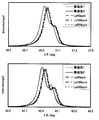
- FIG. 1 and 2 show the results of analyzing the niobium monoxide obtained in Example 1 and Example 2 by X-ray diffraction.
- FIG. 1 and 2 show the results of analyzing the niobium monoxide obtained in Example 1 and Example 2 by X-ray diffraction.
- the X-ray diffraction measurement was performed using an X-ray diffractometer (MXP18: manufactured by Mac Science Co., Ltd.), using a copper (Cu) target, and diffracted X-ray intensity by a Cu-
- FIG. 2 shows the results of measuring niobium monoxide with a cerium content equivalent to 500 ppm.
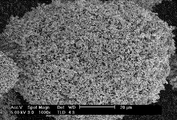
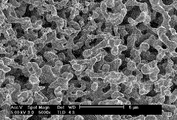
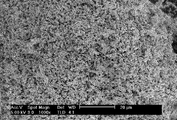
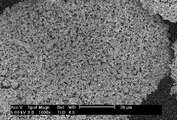
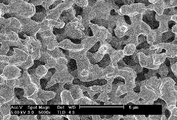
- FIGS. 3 to 8 show SEM observation photographs of niobium monoxide.
- 3 and 4 are niobium monoxide corresponding to 500 ppm of lanthanum in Example 1
- FIGS. 5 and 6 are niobium monoxide corresponding to 500 ppm of cerium in Example 2.
- FIG. 8 is a niobium monoxide which does not contain a rare earth element.
- the niobium monoxide in Examples 1 and 2 shown in FIGS. 3 to 6 has finer primary particles than the niobium monoxide containing no rare earth element. It has been found. It was also found that niobium monoxide in Example 1 and Example 2 was much finer in terms of pore formation.
- niobium monoxide having a large specific surface area and fine particles can be provided, a capacitor having a large capacitance can be easily realized.
Landscapes
- Engineering & Computer Science (AREA)
- Power Engineering (AREA)
- Chemical & Material Sciences (AREA)
- Microelectronics & Electronic Packaging (AREA)
- Organic Chemistry (AREA)
- Inorganic Chemistry (AREA)
- Manufacturing & Machinery (AREA)
- Materials Engineering (AREA)
- Inorganic Compounds Of Heavy Metals (AREA)
Abstract
【課題】コンデンサ材料として好適な比表面積が大きく、且つ微細な粒子からなる一酸化ニオブの製造技術を提供する。 【解決手段】本発明は、五酸化ニオブまたは二酸化ニオブを還元焼成して一酸化ニオブを生成する一酸化ニオブの製造方法において、五酸化ニオブまたは二酸化ニオブと、希土類元素を含む塩とを湿式混合して焼成処理を行い、焼成処理後、希土類元素がニオブ原子位置にドープされた状態のニオブ酸化物と還元剤とを混合して、還元焼成処理を行うことを特徴とする。
Description
本発明は、比表面積が大きく、微細な粒径から構成される一酸化ニオブを製造する技術に関する。
近年、ニオブ酸化物は、周波数フィルターやコンデンサなどのような電子部品の原料や、スパッタリングのターゲット原料等としての使用量が急増している。特に、一酸化ニオブ(以下、NbOと記載する場合がある)は、新しいタイプのコンデンサ原料として採用されており、小型サイズのチップで大容量を実現でき、優れた電気的安定性と難燃性という特徴を持ったコンデンサとして広く普及し始めている。
近年のニオブコンデンサは、小型化、低背化(薄型化)が求められており、それに伴って高容量化が求められている。静電容量に対応する原料粉体パラメーターは比表面積であり、誘電体及びアノードとなる原料粉体の比表面積が大きいほど、大きな静電容量を実現できる。そのため、ニオブコンデンサの原料となるNbOは、より微細で、比表面積が大きい粉体であることが要求される。
このような一酸化ニオブについては、各種の製造方法が提案されている。例えば、特許文献1では、五酸化ニオブをマグネシウムで還元して得られた一酸化ニオブに対して、酸化物、炭酸塩或いは硝酸塩、有機物などの賦活剤を投入し、賦活処理をする製造方法が提案されている。この賦活剤を用いた製造方法によると、多くの細孔を有した一酸化ニオブを得ることができ、比表面積を大きくすることができる。しかしながら、この賦活剤を用いる先行技術では、賦活剤の添加、及び洗浄による除去工程が必要となり、工程数の増加に伴うコストアップが考えられる。また、除去工程の程度によっては、多量の不純物が一酸化ニオブに混入することになり、コンデンサの電気特性の悪化を招く恐れがあり、好ましいものとはいえない。
本発明は、上述した事情の下でなされたものであり、コンデンサ材料として好適な比表面積が大きく、且つ微細な粒子からなる一酸化ニオブの製造技術を提供することを目的とする。
上記課題を解決するため、本発明者等は、従来の還元焼成による一酸化ニオブの製造方法について鋭意検討を行った結果、比表面積が大きく、微細な粒子からなり、コンデンサ特性を良好にすることができる一酸化ニオブを製造する技術を見出した。具体的には、本発明は、五酸化ニオブまたは二酸化ニオブを還元焼成して一酸化ニオブを生成する一酸化ニオブの製造方法において、五酸化ニオブまたは二酸化ニオブと、希土類元素を含む塩とを混合して焼成処理を行い、焼成処理後、希土類元素がニオブ原子位置にドープされた状態のニオブ酸化物と還元剤とを混合して、還元焼成処理を行うことを特徴とする。
本発明によれば、五酸化ニオブまたは二酸化ニオブと、希土類元素を含む塩とを混合して、不活性雰囲気中もしくは酸素を含む雰囲気中で焼成することで、希土類元素がニオブ原子の位置に一部置換された状態の希土類元素含有のニオブ酸化物が得られる。そして、このようにして得られた希土類元素含有のニオブ酸化物と還元剤とを混合して還元焼成すると、含有した希土類元素による焼結抑制効果が生じるため、希土類元素を含有していないニオブ酸化物を還元焼成する場合に比較すると、明らかに一酸化ニオブの一次粒子が微細となるのである。本発明により得られた一酸化ニオブは、希土類元素を含有するものであるが、原子レベルで置換された状態で含有されているため、上記した特許文献1の先行技術のような除去作業を要しない。混合後の焼成条件は、大気中、700℃~1100℃、5時間~24時間の焼成時間が好ましく、その後の還元焼成条件は、水素雰囲気中、1200℃~1500℃、5時間~24時間の焼成時間が好ましい。
本発明の製造方法において、希土類元素を含む塩は、炭酸塩、硝酸塩、蓚酸塩の少なくともいずれかを用いることが好ましい。炭酸塩、硝酸塩、蓚酸塩のいずれかの希土類塩化合物と、五酸化ニオブまたは二酸化ニオブとを混合して焼成処理すると、炭酸根、硝酸根、蓚酸根がそれぞれ気相となり揮発することで、希土類元素がニオブ原子の位置に、均一に分布しやすくなるからである。
また、本発明の製造方法における還元剤は、アルカリ金属、アルカリ土類金属、ニオブ炭化物、ニオブ窒化物、ニオブ硫化物、ニオブ水素化物、ニオブ金属の一群より選択されることが望ましい。これらの還元剤であると、焼成処理をした希土類元素を含有したニオブ酸化物から、一酸化ニオブを効率よく製造できるからである。
そして、本発明の製造方法においては、希土類元素は、Y、La、Ce、Pr、Nd、Sm、Eu、Gd、Tb、Dy、Ho、Er、Tm、Yb、Luの一群から選択されることが好ましい。さらにY、La、Ceから少なくとも1種の元素が選ばれることがより好ましい。これらの希土類元素であれば、希土類元素がニオブ原子の位置に置換された状態になることで、焼結抑制作用がより効果的になるからである。五酸化ニオブまたは二酸化ニオブと混合させる希土類元素を含む塩の混合量は、最終的に得られる一酸化ニオブ中の希土類元素含有量が50ppm~1000ppmになるように調整することが好ましい。50ppm未満であると、焼結抑制効果が小さくなり、1000ppmを超えると、希土類元素がニオブ原子の位置に置換できないものが多くなり、不純物としての、希土類元素とニオブとの複合酸化物を生成してしまうからである。
さらに、本発明の製造方法において、五酸化ニオブと希土類元素と混合する場合、乾式混合や湿式混合のいずれでもよいが、混合後の均質性や作業性を考慮すると湿式混合が好ましい。湿式混合する場合は、純水やアルコールなどの有機溶剤を溶媒として用いることができる。
本発明の製造方法によれば、Y、La、Ce、Pr、Nd、Sm、Eu、Gd、Tb、Dy、Ho、Er、Tm、Yb、Luの一群から選択される希土類元素を50ppm~1000ppm含有する一酸化ニオブを生成することができる。この本発明の一酸化ニオブは、微細な一次粒子から構成された、比表面積が大きな一酸化ニオブの粉末であるため、コンデンサ特性である静電容量を向上することが可能となる。この希土類元素の含有量は、50ppm未満であると、焼結抑制効果が小さくなり、微細な一次粒子の形成ができなくなり、1000ppmを超えると、不純物としての、希土類元素とニオブとの複合酸化物を生成したものになるからである。
本発明の一酸化ニオブは、希土類金属がニオブ原子の位置に置換した状態で取り込まれているため、X線回折により得られる一酸化ニオブの示すピークが、高角度側にシフトする。具体的には、X線回折により得られる一酸化ニオブ(NbO)の示す通常のピークとしては、JCPDSカード(71-2146)によれば第一ピークが2θ=36.9517°、第2ピークが2θ=42.9296°の位置に出現するが、本発明の一酸化ニオブでは、これらの第1ピーク及び第2ピークの位置が高角側にシフトする。この理由は、希土類金属がニオブ原子の位置に置換した際に、電荷補償するためにニオブ原子の位置に欠陥が生じ、単位格子が歪んでしまい、格子定数が小さくなることにより、そのピークが高角度側にシフトするものと考えられる。希土類元素がニオブ原子位置にドープされ、本発明の効果である比表面積が大きく、微細な粒径から構成される一酸化ニオブを得るという観点より、この高角度側へのピークのシフトは0.01°以上であることが好ましく、均一な結晶構造を維持するという観点より、高角度側へのピークのシフトは0.05°以下であることが好ましい。
本発明に係る一酸化ニオブの製造方法によると、比表面積が大きく、微細な粒子からなる一酸化ニオブを容易に生成することができる。また、本発明に係る一酸化ニオブは、細孔容積及び比表面積が大きいので、コンデンサ特性の静電容量を大きくすることが可能となる。
以下、最良と考えられる本発明の実施形態について、実施例を基にして説明する。尚、本発明は下記実施例に限定されるものではない。
この実施例1では、希土類元素としてLa(ランタン)を用いた場合を例にして説明する。
まず、100gの粉末状の五酸化ニオブ(Nb2O5)に対して、44.3mgの硝酸ランタン6水和物と1000mLの純水を準備し、これら混合した(この硝酸ランタン6水和物の量は、最終的に得られる一酸化ニオブ粉に対してランタン換算で50ppmに相当する)。混合は、ボールミルによって行い、1mmφのジルコニアボールを混合メディアとして用い、混合時間は60minとした。そして、この混合物を固液分離し、得られたケーキを、120℃、6時間乾燥し、さらに800℃の大気雰囲気中で焼成を6時間行い、ランタンがニオブ原子の位置に置換した五酸化ニオブ粉を得た。
このランタン含有の五酸化ニオブ80gと、9.5gの炭化ニオブ(NbC)と、純水100mLを湿式混合した。混合は、ボールミルによって行い、1mmφのジルコニアボールを混合メディアとして用い、混合時間は60minとした。この混合物を固液分離し、得られたケーキを、120℃、6時間乾燥し、さらに水素雰囲気中、1350℃で6時間の焼成処理行い、一酸化ニオブを製造した。尚、この実施例1では、最終的に得られる一酸化ニオブに対するランタン量が50ppm、100ppm、500ppm、1000ppmとなる一酸化ニオブを作製して評価した。
また、比較のために、希土類元素を含有しない一酸化ニオブを次のようにして製造した。この比較例としての一酸化ニオブは、五酸化ニオブ50gと、5.9gの炭化ニオブ(NbC)と、純水100mLを湿式混合した。混合は、ボールミルによって行い、1mmφのジルコニアボールを混合メディアとして用い、混合時間は60minとした。この混合物を固液分離し、得られたケーキを、120℃、6時間乾燥し、さらに水素雰囲気中、1350℃で5時間の焼成処理行い、一酸化ニオブを製造した。
以上のようにして得られた各一酸化ニオブについて、その物性として細孔容積及び比表面積を測定した。また、コンデンサを形成して、コンデンサ特性であるCV値、静電容量、耐圧、誘電損失(Tanδ)を調べた。各測定条件を以下に示す。
細孔容積:一酸化ニオブの粉体をペレット(φ5mm×4.5mm)に成形した後、そのペレットを用いて細孔分布測定用水銀圧入ポロシメーター(マイクロメリティックス社製、Auto Pore IV)により測定した。
比表面積:BET法によるもので、吸着ガスである窒素を約30容量%、キャリアガスであるヘリウムを約70容量%含有する窒素-ヘリウム混合ガスを用いて、BET比表面積測定装置((株)島津製作所製、マイクロメリティックス フローソープII2300)により、JIS R 1626「ファインセラミック粉体の気体吸着BET法による比表面積の測定方法」の6.2流動法の(3.5)一点法に従って行った。
コンデンサ特性:コンデンサ特性であるCV値、静電容量、耐圧、Tanδの電気特性については、得られた一酸化ニオブを用いて次のような多孔性焼結体を作製して行った。まず、0.25gの一酸化ニオブの粉体を、φ0.3mmのタンタル(Ta)ワイヤーが挿入されたプレス金型に投入し、ペレット状に成型した。成型したペレット(φ5mm×4.5mm)を1400℃、10分間で焼成した。そして、80℃、0.1M-H3PO4浴中にペレットを浸せきして、定電流密度0.375A/m2、化成電圧30Vで60分間保持して、アノード酸化処理を行った。このようなアノード酸化処理をしたペレットを、80℃、0.1M-H3PO4に再度浸せきし、電流密度0.1A/m2、で五分間保持して耐圧を測定した。また、アノード酸化処理をしたペレットを、150g/Lのアジピン酸アンモニウム溶液に浸せきし、常温で30分間保持後、120Hzの条件で、CV値、静電容量、誘電損失(Tanδ)を測定した。
表1及び表2には、実施例1で得られた物性及びコンデンサ特性の評価結果を示す。尚、表1の物性値については、3つのサンプルの平均測定結果を示している。

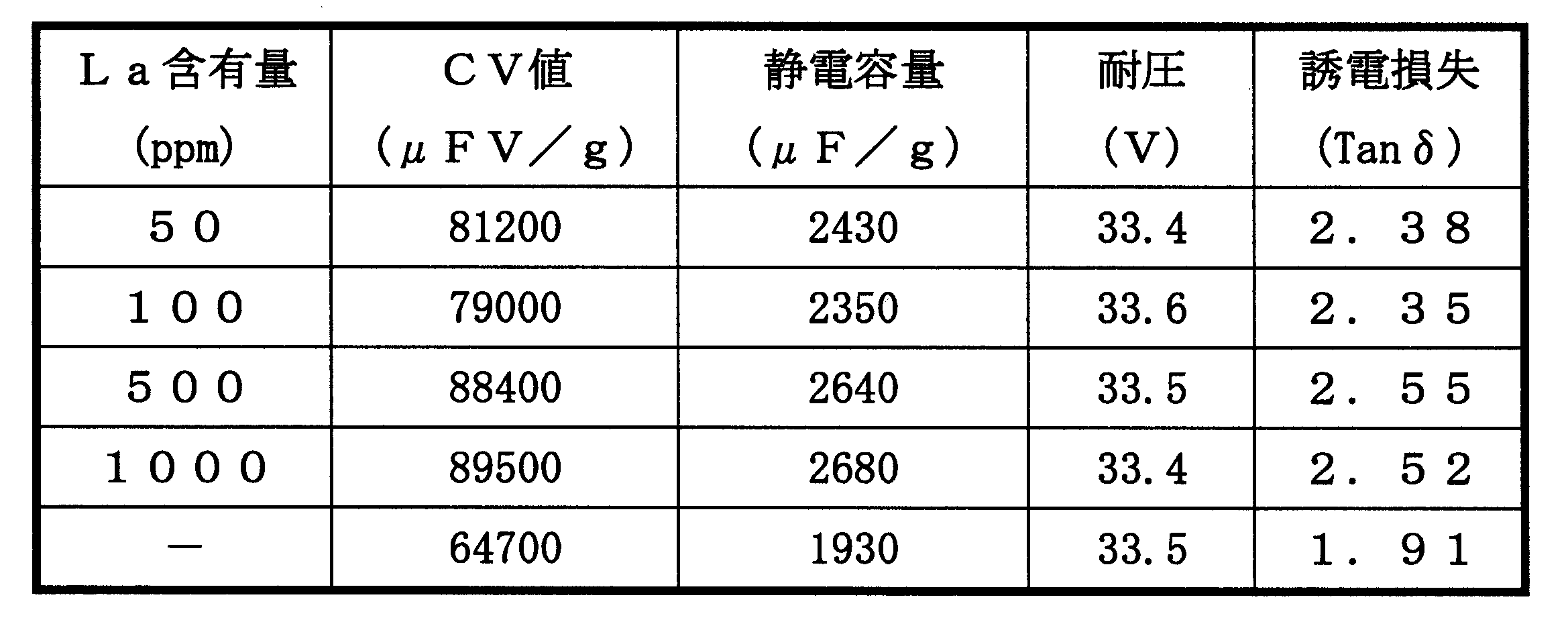
表1より、ランタンを含有した一酸化ニオブは、ランタンを含有しないものに比べて、明らかに比表面積が大きくなっていることが判明した。また、コンデンサ特性については、目標CV値80000μFV/gに対して、ほぼ目標レベルのCV値を、実施例1の一酸化ニオブが実現できることが判明した。
この実施例2では、希土類元素としてCe(セリウム)を用いた場合を例にして説明する。
まず、100gの粉末状の五酸化ニオブ(Nb2O5)に対して、44.3mgの硝酸セリウム6水和物と1000mLの純水を準備し、これら混合した(この硝酸セリウム6水和物の量は、最終的に得られる一酸化ニオブ粉に対してセリウム換算で50ppmに相当する)。混合は、ボールミルによって行い、1mmφのジルコニアボールを混合メディアとして用い、混合時間は60minとした。そして、この混合物を固液分離し、得られたケーキを、120℃、6時間乾燥し、さらに800℃の大気雰囲気中で焼成を6時間行い、セリウムがニオブ原子の位置に置換した五酸化ニオブ粉を得た。
このセリウム含有の五酸化ニオブ80gと、9.5gの炭化ニオブ(NbC)と、純水100mLを湿式混合した。混合は、ボールミルによって行い、1mmφのジルコニアボールを混合メディアとして用い、混合時間は60minとした。この混合物を固液分離し、得られたケーキを、120℃、6時間乾燥し、さらに水素雰囲気中、1350℃で6時間の焼成処理行い、一酸化ニオブを製造した。尚、この実施例2では、最終的に得られる一酸化ニオブに対するセリウム量が100ppm、500ppmとなる一酸化ニオブを作製して評価した。
また、比較としての希土類元素を含有しない一酸化ニオブは、上記実施例1における比較のための一酸化ニオブを用いた。
このようにして得られたセリウム含有の一酸化ニオブについて、その物性として細孔容積及び比表面積を測定した。また、コンデンサを形成して、コンデンサ特性であるCV値、静電容量、耐圧、誘電損失(Tanδ)を調べた。各測定条件を上記実施例1と同様にした。表3及び表4には、実施例2で得られた物性及びコンデンサ特性の評価結果を示す。尚、表3の物性値については、3つのサンプルの平均測定結果を示している。
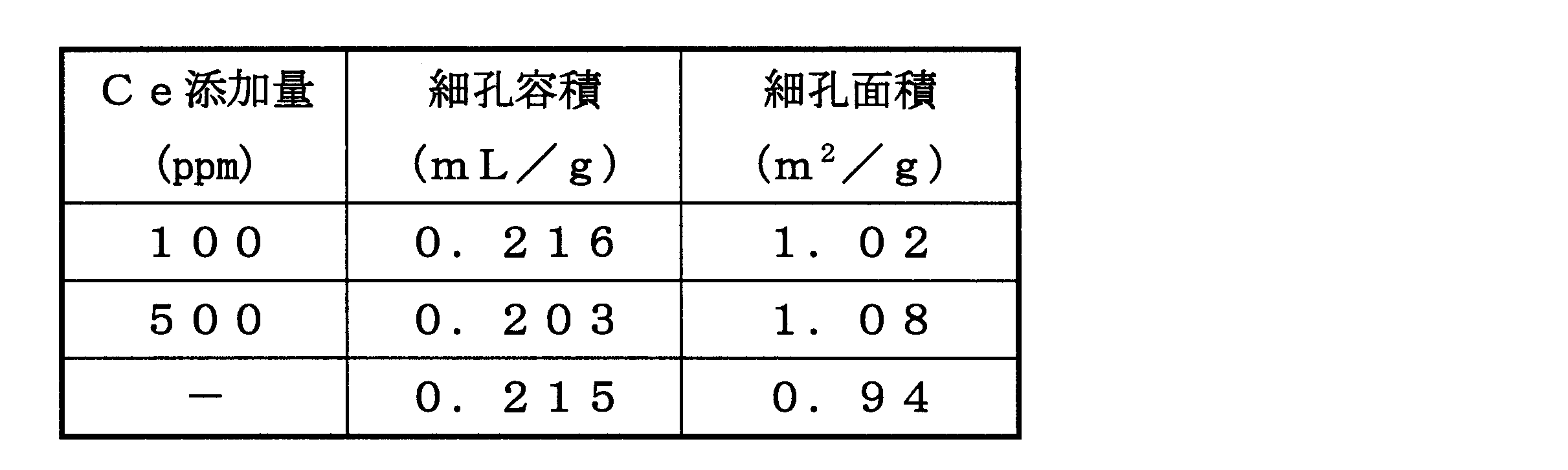

表3より、セリウムを500ppm含有した一酸化ニオブは、希土類元素を含有しないものに比べて、明らかに比表面積が大きくなっていることが判明した。また、コンデンサ特性については、目標CV値80000に対して、目標レベルのCV値を、実施例2の一酸化ニオブが実現できることが判明した。
最後に、一酸化ニオブの粉体観察の結果について説明する。図1及び図2に、実施例1及び実施例2で得られた一酸化ニオブを、X線回折により分析した結果を示す。X線回折測定は、X線回折装置(MXP18:マックサイエンス(株)社製)を用い、銅(Cu)ターゲットを使用して、Cu-Kα1線による回折X線強度(管電圧40kV、管電流150mA、測定範囲2θ=10°から90°、サンプリング幅0.02°、走査速度4.0°/分)を測定した。その結果として、図1には、実施例1の場合で、ランタン含有量が50ppm、100ppm、500ppm相当の一酸化ニオブを測定したもので、上が2θ=36.9°付近のピークを拡大したもので、下が2θ=42.9°付近のピークを拡大して示している。また、ランタンを含有しない一酸化ニオブについても同様に測定した(無添加1、無添加2)。また、図2には、セリウム含有量が500ppm相当の一酸化ニオブを測定した結果を示している。無添加1、無添加2のデータは、図1と同様である。尚、JCPDSカードによれば第一ピークが2θ=36.9517°、第2ピークが2θ=42.9296°の位置に出現することとなっている。
この図1及び図2に示すように、実施例1及び実施例2の一酸化ニオブは、NbOを示す第1ピーク(2θ=36.9517°)も、第2ピーク(2θ=42.9296°)もともに、高角度側にシフトしていることが判明した。
さらに、図3~図8には、一酸化ニオブのSEM観察写真を示す。図3及び図4が実施例1のランタン含有量が500ppm相当の一酸化ニオブであり、図5及び図6が実施例2のセリウム含有量が500ppm相当の一酸化ニオブであり、図7及び図8が希土類元素を含有しない一酸化ニオブのものである。図7及び8に示すように希土類元素を含有していない一酸化ニオブよりも、図3~図6に示す実施例1及び実施例2の一酸化ニオブの方が、一次粒子が微細化していることが判明した。そして、細孔の形成状態も、実施例1及び実施例2の一酸化ニオブの方が非常に細かなものとなっていたことが判った。
本発明によると、比表面積が大きく、微細な粒子からなる一酸化ニオブを提供できるため、静電容量が大きなコンデンサを容易に実現することが可能となる。
Claims (6)
- 五酸化ニオブまたは二酸化ニオブを還元焼成して一酸化ニオブを生成する一酸化ニオブの製造方法において、
五酸化ニオブまたは二酸化ニオブと、希土類元素を含む塩とを混合して焼成処理を行い、
焼成処理後、希土類元素がニオブ原子位置にドープされた状態のニオブ酸化物と還元剤とを混合して、還元焼成処理を行うことを特徴とする一酸化ニオブの製造方法。 - 希土類元素を含む塩は、炭酸塩、硝酸塩、蓚酸塩の少なくともいずれかである請求項1に記載の一酸化ニオブの製造方法。
- 還元剤は、アルカリ金属、アルカリ土類金属、ニオブ炭化物、ニオブ窒化物、ニオブ硫化物、ニオブ水素化物、ニオブ金属の一群より選択される請求項1または請求項2に記載の一酸化ニオブの製造方法。
- 希土類元素は、Y、La、Ce、Pr、Nd、Sm、Eu、Gd、Tb、Dy、Ho、Er、Tm、Yb、Luの一群から選択される請求項1~請求項3いずれかに記載の一酸化ニオブの製造方法。
- Y、La、Ce、Pr、Nd、Sm、Eu、Gd、Tb、Dy、Ho、Er、Tm、Yb、Luの一群から選択される希土類元素を50ppm~1000ppm含有することを特徴とする一酸化ニオブ。
- X線回折により得られる一酸化ニオブの示すピークが、高角度側にシフトしている請求項5に記載の一酸化ニオブ。
Applications Claiming Priority (2)
| Application Number | Priority Date | Filing Date | Title |
|---|---|---|---|
| JP2008232797A JP2010064923A (ja) | 2008-09-11 | 2008-09-11 | 一酸化ニオブの製造方法及び一酸化ニオブ |
| JP2008-232797 | 2008-09-11 |
Publications (1)
| Publication Number | Publication Date |
|---|---|
| WO2010029909A1 true WO2010029909A1 (ja) | 2010-03-18 |
Family
ID=42005162
Family Applications (1)
| Application Number | Title | Priority Date | Filing Date |
|---|---|---|---|
| PCT/JP2009/065632 Ceased WO2010029909A1 (ja) | 2008-09-11 | 2009-09-08 | 一酸化ニオブの製造方法及び一酸化ニオブ |
Country Status (2)
| Country | Link |
|---|---|
| JP (1) | JP2010064923A (ja) |
| WO (1) | WO2010029909A1 (ja) |
Cited By (1)
| Publication number | Priority date | Publication date | Assignee | Title |
|---|---|---|---|---|
| CN110963529A (zh) * | 2018-09-30 | 2020-04-07 | 中国科学院上海硅酸盐研究所 | 一种纯相的铌的低价态氧化物纳米粉体及其制备方法和应用 |
Citations (3)
| Publication number | Priority date | Publication date | Assignee | Title |
|---|---|---|---|---|
| JP2002524378A (ja) * | 1998-09-16 | 2002-08-06 | キャボット コーポレイション | 酸化ニオブを部分的に還元する方法及び酸素が減少した酸化ニオブ |
| WO2002093596A1 (en) * | 2001-05-15 | 2002-11-21 | Showa Denko K.K. | Niobium monoxide powder, niobium monoxide sintered product and capacitor using niobium monoxide sintered product |
| JP2007230865A (ja) * | 1998-10-13 | 2007-09-13 | Hc Starck Gmbh | ニオブの酸化物及びその製造方法 |
-
2008
- 2008-09-11 JP JP2008232797A patent/JP2010064923A/ja active Pending
-
2009
- 2009-09-08 WO PCT/JP2009/065632 patent/WO2010029909A1/ja not_active Ceased
Patent Citations (3)
| Publication number | Priority date | Publication date | Assignee | Title |
|---|---|---|---|---|
| JP2002524378A (ja) * | 1998-09-16 | 2002-08-06 | キャボット コーポレイション | 酸化ニオブを部分的に還元する方法及び酸素が減少した酸化ニオブ |
| JP2007230865A (ja) * | 1998-10-13 | 2007-09-13 | Hc Starck Gmbh | ニオブの酸化物及びその製造方法 |
| WO2002093596A1 (en) * | 2001-05-15 | 2002-11-21 | Showa Denko K.K. | Niobium monoxide powder, niobium monoxide sintered product and capacitor using niobium monoxide sintered product |
Cited By (2)
| Publication number | Priority date | Publication date | Assignee | Title |
|---|---|---|---|---|
| CN110963529A (zh) * | 2018-09-30 | 2020-04-07 | 中国科学院上海硅酸盐研究所 | 一种纯相的铌的低价态氧化物纳米粉体及其制备方法和应用 |
| CN110963529B (zh) * | 2018-09-30 | 2021-12-07 | 中国科学院上海硅酸盐研究所 | 一种纯相的铌的低价态氧化物纳米粉体及其制备方法和应用 |
Also Published As
| Publication number | Publication date |
|---|---|
| JP2010064923A (ja) | 2010-03-25 |
Similar Documents
| Publication | Publication Date | Title |
|---|---|---|
| Hennings et al. | Defect chemistry and microstructure of hydrothermal barium titanate | |
| US7652870B2 (en) | Multilayer ceramic capacitor | |
| US10065179B2 (en) | Ceria-zirconia-based composite oxide and method for producing same, and exhaust gas purification catalyst including ceria-zirconia-based composite oxide | |
| JP4294951B2 (ja) | 電解コンデンサ基板のためのタンタルおよび窒化タンタル粉末混合物 | |
| CN1576235A (zh) | 铌低价氧化物粉末 | |
| JP5862835B2 (ja) | 金属粉末の製造方法、導電性ペーストの製造方法、および積層セラミック電子部品の製造方法 | |
| WO2001071738A2 (en) | Oxygen reduced niobium oxides | |
| KR20150140288A (ko) | 큰 표면적을 갖는 저 산소 밸브 금속 소결체 제조 방법 | |
| CN107500754B (zh) | 一种用于高容高压mlcc的陶瓷介质材料及其制备方法 | |
| JP2021020836A (ja) | 焼結体の製造方法及び焼結体 | |
| JP2012126618A (ja) | 導電性マイエナイト化合物の製造方法 | |
| JP4683512B2 (ja) | コンデンサ用粉体、それを用いた焼結体及びそれを用いたコンデンサ | |
| WO2010029909A1 (ja) | 一酸化ニオブの製造方法及び一酸化ニオブ | |
| KR102372794B1 (ko) | 후처리 공정이 필요하지 않는 ZnO를 활용한 다공성 활성탄 제조 방법 및 이를 포함하는 슈퍼커패시터 전극 | |
| CN103717329A (zh) | 由阀金属粉末制造电解电容器的方法 | |
| Miao et al. | Doping effects of Dy and Mg on BaTiO3 ceramics prepared by hydrothermal method | |
| CN107739204B (zh) | 一种偏压特性优良的陶瓷介质材料及其制备方法 | |
| JP2012036440A (ja) | ニオブ粉の製造方法及び一酸化ニオブ粉の製造方法 | |
| Raymond et al. | Microstructure and electrical properties of chemically prepared Nb2O5‐doped SrTiO3 ceramics | |
| JP4766910B2 (ja) | チタン酸バリウム粉末の製法、チタン酸バリウム粉末、およびチタン酸バリウム焼結体 | |
| JP2016117605A (ja) | 誘電体セラミックスおよびその製造方法 | |
| JP4521849B2 (ja) | コンデンサ用ニオブ粉と該ニオブ粉を用いた焼結体および該焼結体を用いたコンデンサ | |
| JP6412501B2 (ja) | ニオブ造粒粉末の製造方法 | |
| JP5025100B2 (ja) | チタン酸バリウム粉末の製造方法 | |
| JP5084657B2 (ja) | 積層セラミックコンデンサ |
Legal Events
| Date | Code | Title | Description |
|---|---|---|---|
| 121 | Ep: the epo has been informed by wipo that ep was designated in this application |
Ref document number: 09813055 Country of ref document: EP Kind code of ref document: A1 |
|
| NENP | Non-entry into the national phase |
Ref country code: DE |
|
| 122 | Ep: pct application non-entry in european phase |
Ref document number: 09813055 Country of ref document: EP Kind code of ref document: A1 |